EP1308505A2 - Procédé de préparation d'un milieu de fermentation autosuffisant - Google Patents
Procédé de préparation d'un milieu de fermentation autosuffisant Download PDFInfo
- Publication number
- EP1308505A2 EP1308505A2 EP02292642A EP02292642A EP1308505A2 EP 1308505 A2 EP1308505 A2 EP 1308505A2 EP 02292642 A EP02292642 A EP 02292642A EP 02292642 A EP02292642 A EP 02292642A EP 1308505 A2 EP1308505 A2 EP 1308505A2
- Authority
- EP
- European Patent Office
- Prior art keywords
- fermentation medium
- production
- self
- raw material
- sufficient
- Prior art date
- Legal status (The legal status is an assumption and is not a legal conclusion. Google has not performed a legal analysis and makes no representation as to the accuracy of the status listed.)
- Withdrawn
Links
Classifications
-
- C—CHEMISTRY; METALLURGY
- C12—BIOCHEMISTRY; BEER; SPIRITS; WINE; VINEGAR; MICROBIOLOGY; ENZYMOLOGY; MUTATION OR GENETIC ENGINEERING
- C12P—FERMENTATION OR ENZYME-USING PROCESSES TO SYNTHESISE A DESIRED CHEMICAL COMPOUND OR COMPOSITION OR TO SEPARATE OPTICAL ISOMERS FROM A RACEMIC MIXTURE
- C12P13/00—Preparation of nitrogen-containing organic compounds
- C12P13/04—Alpha- or beta- amino acids
- C12P13/08—Lysine; Diaminopimelic acid; Threonine; Valine
-
- C—CHEMISTRY; METALLURGY
- C12—BIOCHEMISTRY; BEER; SPIRITS; WINE; VINEGAR; MICROBIOLOGY; ENZYMOLOGY; MUTATION OR GENETIC ENGINEERING
- C12N—MICROORGANISMS OR ENZYMES; COMPOSITIONS THEREOF; PROPAGATING, PRESERVING, OR MAINTAINING MICROORGANISMS; MUTATION OR GENETIC ENGINEERING; CULTURE MEDIA
- C12N1/00—Microorganisms; Compositions thereof; Processes of propagating, maintaining or preserving microorganisms or compositions thereof; Processes of preparing or isolating a composition containing a microorganism; Culture media therefor
-
- C—CHEMISTRY; METALLURGY
- C12—BIOCHEMISTRY; BEER; SPIRITS; WINE; VINEGAR; MICROBIOLOGY; ENZYMOLOGY; MUTATION OR GENETIC ENGINEERING
- C12N—MICROORGANISMS OR ENZYMES; COMPOSITIONS THEREOF; PROPAGATING, PRESERVING, OR MAINTAINING MICROORGANISMS; MUTATION OR GENETIC ENGINEERING; CULTURE MEDIA
- C12N1/00—Microorganisms; Compositions thereof; Processes of propagating, maintaining or preserving microorganisms or compositions thereof; Processes of preparing or isolating a composition containing a microorganism; Culture media therefor
- C12N1/14—Fungi; Culture media therefor
- C12N1/16—Yeasts; Culture media therefor
- C12N1/18—Baker's yeast; Brewer's yeast
-
- C—CHEMISTRY; METALLURGY
- C12—BIOCHEMISTRY; BEER; SPIRITS; WINE; VINEGAR; MICROBIOLOGY; ENZYMOLOGY; MUTATION OR GENETIC ENGINEERING
- C12N—MICROORGANISMS OR ENZYMES; COMPOSITIONS THEREOF; PROPAGATING, PRESERVING, OR MAINTAINING MICROORGANISMS; MUTATION OR GENETIC ENGINEERING; CULTURE MEDIA
- C12N1/00—Microorganisms; Compositions thereof; Processes of propagating, maintaining or preserving microorganisms or compositions thereof; Processes of preparing or isolating a composition containing a microorganism; Culture media therefor
- C12N1/22—Processes using, or culture media containing, cellulose or hydrolysates thereof
-
- C—CHEMISTRY; METALLURGY
- C12—BIOCHEMISTRY; BEER; SPIRITS; WINE; VINEGAR; MICROBIOLOGY; ENZYMOLOGY; MUTATION OR GENETIC ENGINEERING
- C12P—FERMENTATION OR ENZYME-USING PROCESSES TO SYNTHESISE A DESIRED CHEMICAL COMPOUND OR COMPOSITION OR TO SEPARATE OPTICAL ISOMERS FROM A RACEMIC MIXTURE
- C12P7/00—Preparation of oxygen-containing organic compounds
- C12P7/02—Preparation of oxygen-containing organic compounds containing a hydroxy group
- C12P7/04—Preparation of oxygen-containing organic compounds containing a hydroxy group acyclic
- C12P7/06—Ethanol, i.e. non-beverage
-
- C—CHEMISTRY; METALLURGY
- C12—BIOCHEMISTRY; BEER; SPIRITS; WINE; VINEGAR; MICROBIOLOGY; ENZYMOLOGY; MUTATION OR GENETIC ENGINEERING
- C12P—FERMENTATION OR ENZYME-USING PROCESSES TO SYNTHESISE A DESIRED CHEMICAL COMPOUND OR COMPOSITION OR TO SEPARATE OPTICAL ISOMERS FROM A RACEMIC MIXTURE
- C12P7/00—Preparation of oxygen-containing organic compounds
- C12P7/40—Preparation of oxygen-containing organic compounds containing a carboxyl group including Peroxycarboxylic acids
- C12P7/56—Lactic acid
-
- Y—GENERAL TAGGING OF NEW TECHNOLOGICAL DEVELOPMENTS; GENERAL TAGGING OF CROSS-SECTIONAL TECHNOLOGIES SPANNING OVER SEVERAL SECTIONS OF THE IPC; TECHNICAL SUBJECTS COVERED BY FORMER USPC CROSS-REFERENCE ART COLLECTIONS [XRACs] AND DIGESTS
- Y02—TECHNOLOGIES OR APPLICATIONS FOR MITIGATION OR ADAPTATION AGAINST CLIMATE CHANGE
- Y02E—REDUCTION OF GREENHOUSE GAS [GHG] EMISSIONS, RELATED TO ENERGY GENERATION, TRANSMISSION OR DISTRIBUTION
- Y02E50/00—Technologies for the production of fuel of non-fossil origin
- Y02E50/10—Biofuels, e.g. bio-diesel
Definitions
- the present invention relates to a method particular preparation of a fermentation medium self-sufficient from a raw material renewable.
- the present invention is relating to a particular method of treatment of a renewable raw material, so that it either possible to use it directly in fermentation, for the production of metabolites.
- material first renewable industrial waste inexpensive, unrefined food, usually not toxic and rich in nitrogen and carbon sources. More in particular, it will be co-products of starch mills and more particularly still wheat, pea or potato starches.
- fermentation medium is also understood to mean self-sufficient »a fermentation medium containing all the nutrients necessary for the growth of microorganisms and necessary and sufficient for the production of metabolites of interest, without it being necessary to add any complement nutrient.
- Methods means transformation products fermentation from directly assimilated carbon sources by microorganisms. It will advantageously be metabolites selected from the group consisting of organic acids and amino acids, and preferably organic acids such as acid L-lactic, gluconic acid, citric acid, and amino acids like L-Lysine or L-Threonine.
- a medium of fermentation should not only consist of a carbon source, but also by a nitrogen source, to which we add minerals and organic salts.
- carbon source can be drawn renewable raw materials like molasses, starch hydrolysates from wheat, corn, rice, cassava or potatoes but the "sources directly assimilated carbonaceous "are sugars, refined or purified from said carbon sources, such as glucose, fructose, maltose, sucrose, lactose and dextrins.
- nitrogen sources or nutrients protein are the yeast extracts, the corn steep liquor (also called Corn Steep Liquor), undenatured milk, protein from molasses, meat extracts or soy flour. But it is often preferred to use extracts from yeasts as nitrogen sources and also as vitamin and mineral supplements.
- the fermentation medium consisting of a "carbon source directly assimilable "i.e. glucose or sucrose, and extracts yeast, can be implemented basically for good number of fermentations, such as fermentations leading to the production of organic acids, such as lactic, propionic, gluconic, citric ..., essential amino acids such as lysine or any other metabolite of industrial interest.
- a carbon source directly assimilable i.e. glucose or sucrose
- extracts yeast can be implemented basically for good number of fermentations, such as fermentations leading to the production of organic acids, such as lactic, propionic, gluconic, citric ..., essential amino acids such as lysine or any other metabolite of industrial interest.
- a source nitrogen selected from the group consisting of extracts of yeast or molasses, proteins, peptides and amino acids, corn steep or wheat soluble.
- Whey permeate contains well from 75 to 80% by weight of lactose, but no longer contains protein large size. It is therefore deficient in the nitrogen source essential for the growth of microorganisms, hence the supplement made necessary in yeast extracts.
- the added whey essentially contains around 65 to 75% by weight of lactose.
- the first step of the process according to the invention therefore consists in choosing the renewable raw material in the group consisting of soluble wheat, pea and of potato, preferably the soluble of corn.
- the Applicant company has thus overcome the prejudice technique whereby the preparation of a fermentation must necessarily mean the reconstitution of a composite fermentation medium, mainly from a carbon source and a nitrogen source of separate origins, with the addition of vitamins, growth factor and trace elements.
- Wheat soluble comes from wheat starch separation flux "B" resulting from the separation of starch in the process of wet wheat starch.
- Starch B or secondary starch is the starch made up essentially by a preponderant proportion of small granules of starch or damaged granules.
- soluble wheat also contain quantities not negligible high-weight protein likely to provide a source of nitrogen for microorganisms interest.
- potato solubles they are obtained by recovery of the soluble fraction from crushing the potatoes at the start of starch.
- Soluble peas result from soaking water peas and are recovered before crushing and separation of the different constituents of the pea.
- the second step of the process according to the invention therefore consists in processing said raw material renewable so as to release carbon sources and nitrogen directly assimilated by microorganisms.
- Renewable raw materials contain here both starch as a carbon source or glucose, and high molecular weight proteins, to side of free peptides and amino acids as a source nitrogen.
- microorganisms have the capacity to assimilate directly starch or high molecular weight proteins because they have the enzymatic equipment necessary to their degradation for their growth and for the production of metabolites of interest, for others microorganisms, it is necessary to place them in conditions where carbon and nitrogen sources are processed so as to be directly assimilable.
- a first embodiment of the method according to the invention for microorganisms by example devoid of amylases, it is advantageously liberated fermentable sugars from soluble by heating said soluble to a temperature at least 60 ° C, by treatment with an ⁇ -amylase and a glucoamylase and optionally by means of a enzyme capable of degrading polysaccharides parietals of plant origin chosen from the group of hemicellulases, pectinases and xylanases.
- Treatment at pH 7 and at a temperature of 60 ° C for about 6 h, at a dose of 1% / sec can be advantageously used for the treatment with alkaline proteases.
- acid proteases which are suitable for perform proteolysis, they are to be chosen in the group of pancreatin, trypsin, chymotrypsin ...
- Treatment at pH 4.5 and at a temperature of 60 ° C for about 6 h, at a dose of 1% / sec can be advantageously used for the treatment with acid proteases.
- This proteolysis step forms peptides which can also have an activating effect on certain microorganisms.
- these two treatments of soluble by liquefaction and saccharification on the one hand, and by proteolysis on the other hand, can be implemented for the fermentation of incapable microorganisms assimilate carbon and nitrogen sources directly as present in said solubles.
- the third step of the process according to the invention therefore consists in recovering the medium from self-sufficient fermentation thus obtained and to use it directly in fermentation.
- This step can be performed using any means also known to those skilled in the art, such as microfiltration on membranes including pore size is adapted to the size of said insoluble impurities. he can be used for example a membrane of 0.14 ⁇ m.
- These environments are particularly suitable for production of lactic acid, lysine, ethanol, enzymes, for the production of selected polysaccharides in the group of pullulans and dextrans and also for the production of populations of microorganisms y relative, such as lactic ferments or yeasts.
- starch B or second starch contains impurities such as pentosans and lipids.
- This solution consists in lowering in content the self-sufficient fermentation medium and supplement directly with a carbon source assimilable, so as to bring to the microorganism considered the amount of carbon it needs to both for its growth and to allow the production of metabolites of interest, without loss of yield or productivity.
- the residual part of the fermentation medium self-sufficient should however be set to maintain nitrogen, mineral salts and vitamins essential for microorganisms, as it will exemplified below for lactic fermentation.
- Soluble wheat with 20% dry matter, from the separation stream of wheat starches "B” are heated at 60 ° C for 12 h and treated with using a NOAM TERMAMYL LC ⁇ -amylase at a rate of 0.05% / sec.
- the soluble thus liquefied are brought to an MS between 15 and 20% and treated for 3 to 5 hours at 60 ° C using an OPTIDEX L 300 A amyloglucosidase from GENENCOR to 0.5% / sec and a SPEZYME CP hemicellulase GENENCOR at 0.3% / sec to release sugars fermentable. Insoluble matter is eliminated by microfiltration on 0.14 ⁇ m membrane.
- Product A of a dry matter of 14.6% in accordance with the invention has the composition shown in Table I below.
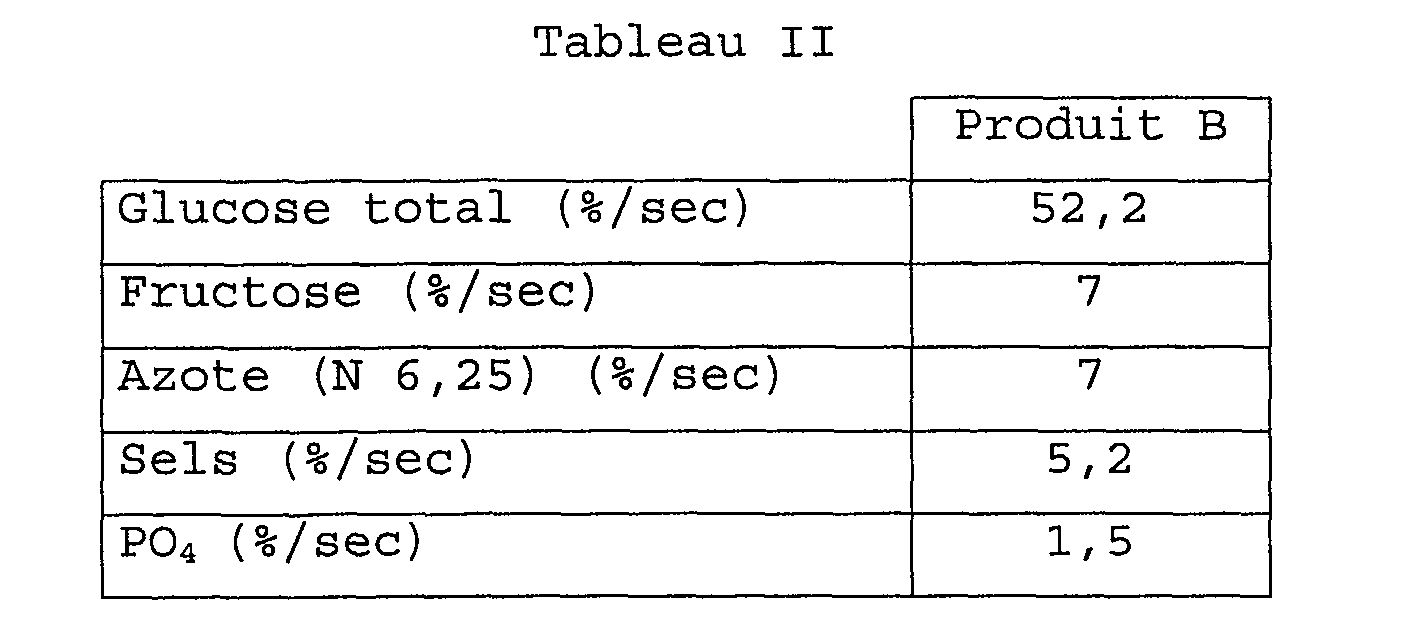
- wheat solubles liquefied are also brought to an MS between 15 and 20% (the pH is adjusted to a value between 7.5 and 8 with 1 time normal sodium hydroxide), and treated with 60 ° C for 4 to 6 hours using ALCALASE Novo at 0.2 to 1% / sec.
- the product obtained has a pH final on the order of 6.5 to 7. Insoluble matter is eliminated by microfiltration on 0.14 ⁇ m membrane.
- Product B of a dry matter of 14.8% in accordance with the invention has the composition shown in Table II below.
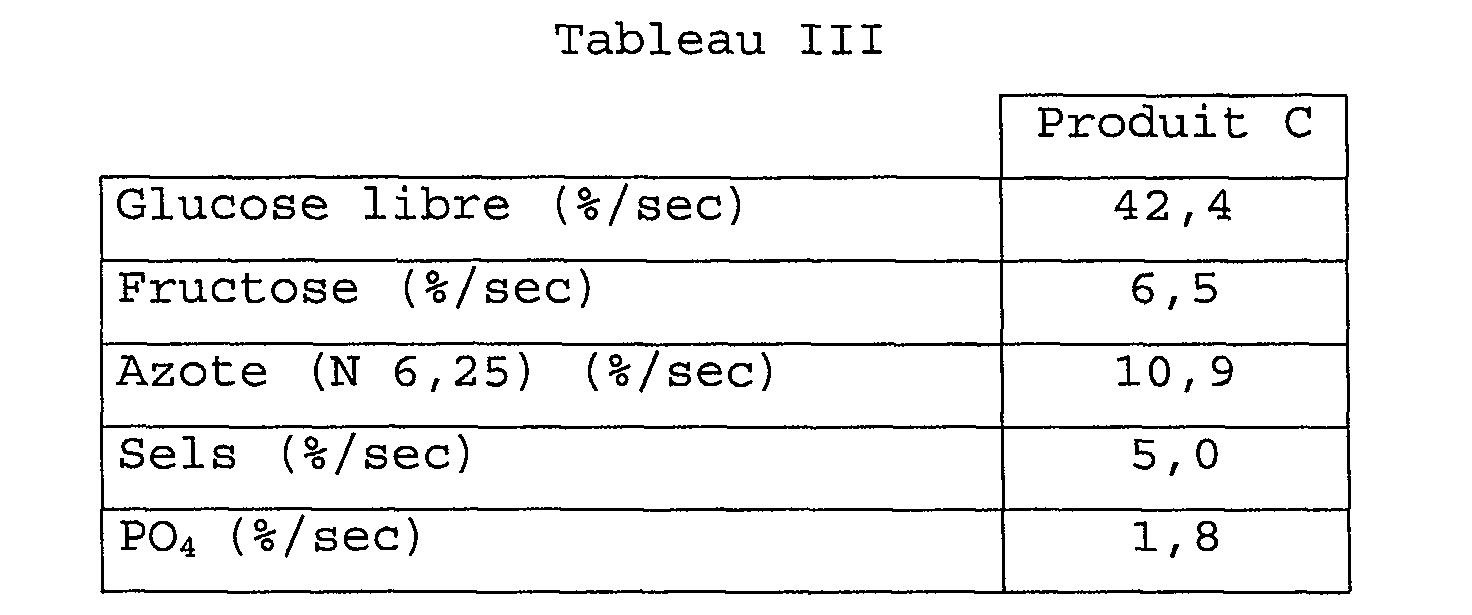
- wheat solubles first undergo saccharification in the same conditions as for the preparation of product A, then a treatment with ALCALASE in the same conditions which make it possible to obtain product B.
- the insolubles are also removed by microfiltration on 0.14 ⁇ m membrane.
- the product C of an 18.4% dry matter in accordance with the invention has the composition shown in Table III below.
- the aminograms produced on these three media self-sufficient fermentation in accordance with the invention base wheat soluble show remarkable acid content amino acids and amino acids with non-polar radicals, i.e. respectively of the order of 2250 and 1050 mg / kg of MS.
- Table IV below presents the profiles of this self-sufficient fermentation medium.
- the aminograms made on this medium of self-sufficient fermentation according to the invention shows remarkable content of amino acids and acids amines with non-polar radicals, i.e. respectively of around 2730 and 1100 mg / kg DM.
- the fermentation media thus obtained are rich in vitamin B7 (content 4 times higher than typically found in yeast extracts) and vitamin B3.
- Table V below presents the profiles of this self-sufficient fermentation medium.
- aminograms made on the middle of self-sufficient fermentation according to the invention show remarkable amino acid content in basic radicals and amino acids with acid radicals, i.e. respectively of the order of 13150 and 26780 mg / kg of MS.
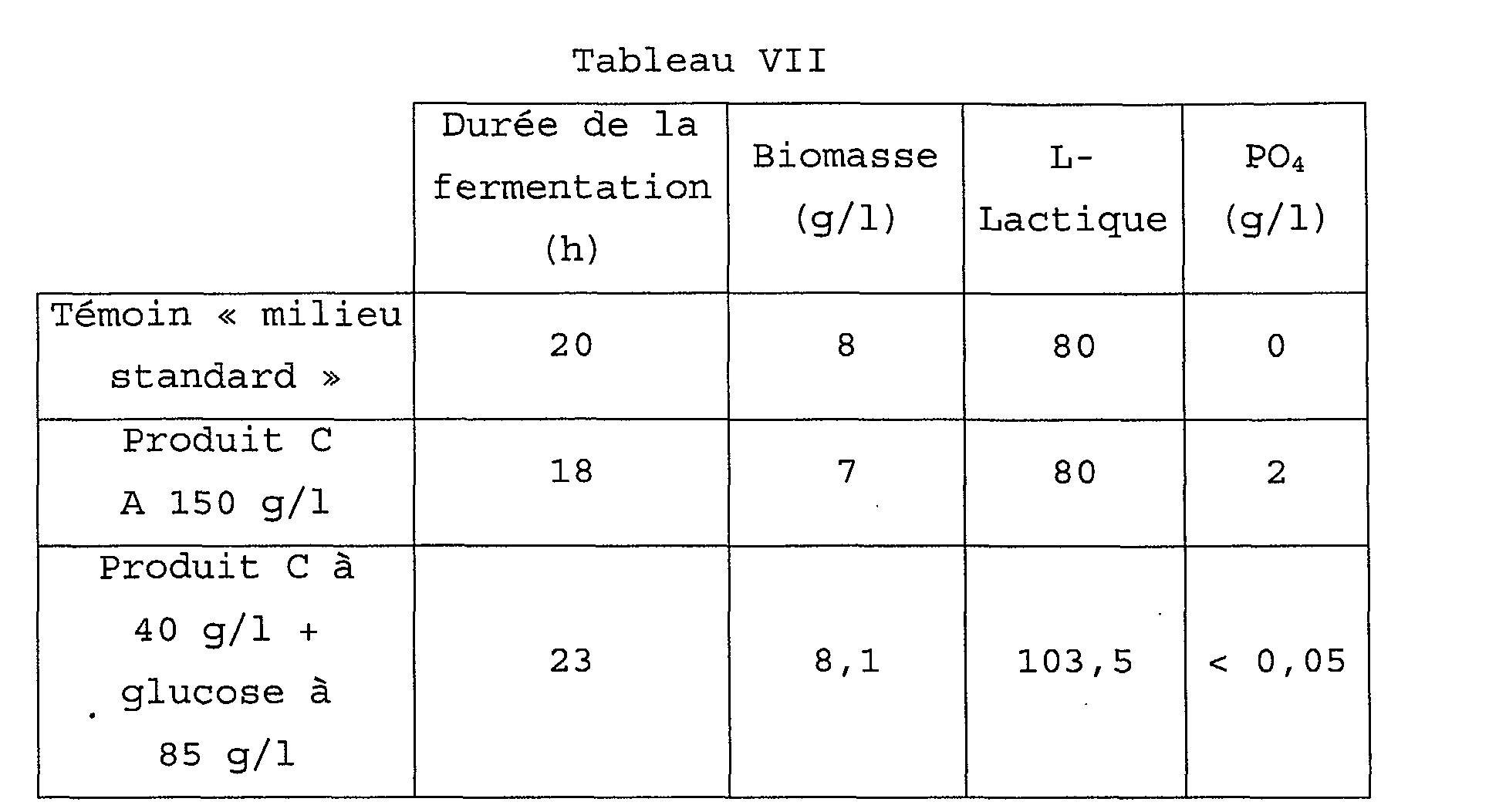
- a fermentation medium composed of glucose at 80 g / l, yeast extracts at 10 g / l and (NH 4 ) 2 HPO 4 at 0.5 g / l is tested.
- the dry matter of 150 to 180 g / l of the media self-sufficient fermentation in accordance with the invention used is chosen so that said medium contain about 80 g / l "equivalent glucose ”.
- 1.5 l of medium from a 7 h preculture of a strain of Lactococcus lactis are used to inoculate these fermenters.
- the pH, fixed at 6.5, is regulated with NH 4 OH 12N.
- the temperature is 40 ° C.
- Soluble wheat liquefied, saccharified and proteolysed can therefore be advantageously works for lactic fermentation.
- the test carried out with non-microfiltered product C also shows that for this particular fermentation, insoluble impurities do not affect the yield or productivity in L-lactic acid.
- the soluble treated according to the process according to the invention in this case by liquefaction, saccharification and proteolysis prove to be as effective for the growth of L. lactis as the standard reconstituted medium.
- the self-sufficient medium in accordance with the invention is therefore well suited to the production of biomass, in particular here for the production of lactic ferments.
- the fermentation of yeasts of the S. cerevisiae type is conventionally carried out for the production of ethanol.
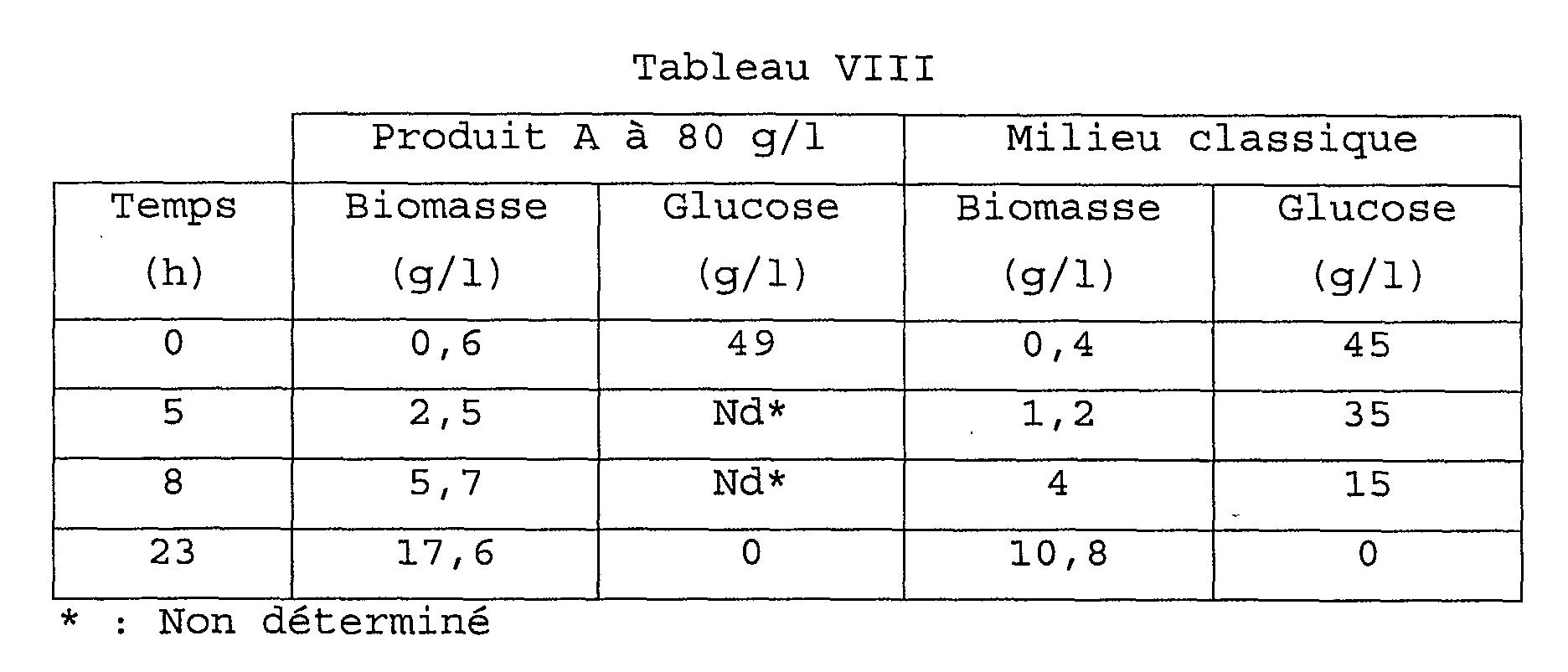
- yeast biomass is studied using the self-sufficient fermentation medium according to the invention in comparison with a medium classic made from yeast extracts as a source nitrogen, glucose as carbon source, supplemented with salts.
- the biomass production of S. cerevisiae is carried out in a medium prepared from product A of Example 1 at a rate of 80 g / l.
- the control medium consists of Glucose at 45 g / l, yeast extracts at 5 g / l, (NH 4 ) 2 SO 4 at 10 g / l, KH 2 PO 4 at 5 g / l and MgSO 4 to 2 g / l.
- the pH is regulated at 5 with normal soda, the temperature is set at 30 ° C and the culture is carried out in a 2 l reactor with stirring at 600 rpm and a 1 vvm ventilation.
- Table VIII below presents the growth result of the yeasts over time for the two fermentation media.
- Ethanol production is studied using the self-sufficient fermentation medium in accordance with the invention in comparison with a conventional medium consisting of yeast extracts as a source of nitrogen, glucose as a carbon source, supplemented with salts.
- the biomass production of S. cerevisiae is carried out in a medium prepared from product A of Example 1 at a rate of 180 g / l.
- the control medium consists of Glucose at 10 g / l, yeast extracts at 5 g / l, (NH 4 ) 2 SO 4 at 10 g / l, KH 2 PO 4 at 5 g / l and MgSO 4 to 2 g / l.
- the pH is regulated at 5 with normal soda, the temperature is set at 30 ° C and the culture is carried out in a 15 l reactor with 200 rpm stirring.
- Table IX below presents the growth result of the yeasts over time for the two fermentation media.
- the self-sufficient fermentation medium in accordance with the invention is therefore particularly well suited to the ethanol production.
Landscapes
- Life Sciences & Earth Sciences (AREA)
- Chemical & Material Sciences (AREA)
- Organic Chemistry (AREA)
- Engineering & Computer Science (AREA)
- Wood Science & Technology (AREA)
- Zoology (AREA)
- Health & Medical Sciences (AREA)
- Biotechnology (AREA)
- Bioinformatics & Cheminformatics (AREA)
- Genetics & Genomics (AREA)
- Biochemistry (AREA)
- General Health & Medical Sciences (AREA)
- General Engineering & Computer Science (AREA)
- Microbiology (AREA)
- Chemical Kinetics & Catalysis (AREA)
- General Chemical & Material Sciences (AREA)
- Mycology (AREA)
- Biomedical Technology (AREA)
- Virology (AREA)
- Tropical Medicine & Parasitology (AREA)
- Medicinal Chemistry (AREA)
- Botany (AREA)
- Preparation Of Compounds By Using Micro-Organisms (AREA)
- Micro-Organisms Or Cultivation Processes Thereof (AREA)
- Enzymes And Modification Thereof (AREA)
Abstract
Description
- dans le brevet US 5.416.020, un procédé de production d'acide L-Lactique à partir de perméat de petit lait et de petit lait, auquel il est encore ajouté de l'extrait de levures en présence de manganèse divalent, avec un mutant de Lactobacillus delbrueckii sub. bulgaricus ATCC 55163 qui produit essentiellement de l'acide L-Lactique.
- Dans le brevet US 4.467.034, il est montré qu'il est possible de produire de l'acide lactique à partir du petit lait comme matière première, grâce à un nouveau Lactobacillus bulgaricus DSM 2129. Le petit lait doit cependant encore être complémenté par une source d'azote, i.e. de l'extrait de viande, du corn steep ou de la farine de soja, et également par des vitamines et des sels minéraux.
- choisir la matière première renouvelable dans le groupe constitué des solubles de blé, de pois et de pomme de terre, préférentiellement les solubles de blé,
- traiter ladite matière première renouvelable de manière à en libérer les sources carbonée et azotée directement assimilables par des microorganismes,
- récupérer le milieu de fermentation autosuffisant ainsi obtenu.




Claims (12)
- Procédé de préparation d'un milieu de fermentation autosuffisant permettant la production de métabolites à partir d'une matière première renouvelable, caractérisé par le fait qu'il consiste à :choisir la matière première renouvelable dans le groupe constitué des solubles de blé, de pois et de pomme de terre, préférentiellement les solubles de blé,traiter ladite matière première renouvelable de manière à en libérer les sources carbonée et azotée directement assimilables par des microorganismes,récupérer le milieu de fermentation autosuffisant ainsi obtenu.
- Procédé selon la revendication 1, caractérisé par le fait que l'on soumet le milieu de fermentation autosuffisant à une étape de microfiltration pour en éliminer les impuretés insolubles.
- Procédé selon l'une ou l'autre des revendications 1 et 2, caractérisé par le fait que l'on traite la matière première renouvelable par des enzymes de liquéfaction et de saccharification de l'amidon de manière à en libérer le contenu en source carbonée directement assimilable.
- Procédé selon l'une quelconque des revendications 1 à 3, caractérisé par le fait que l'on traite la matière première renouvelable par des enzymes protéolytiques choisies dans le groupe constitué des protéases alcalines de manière à en libérer le contenu en source azotée directement assimilable.
- Procédé de préparation d'un milieu de fermentation permettant la production de métabolites aisément purifiables à partir d'un milieu de fermentation autosuffisant préparé ' en suivant le procédé d'une quelconque des revendications 1 à 4, caractérisé en ce qu'il est complémenté en une source de carbone directement assimilable.
- Milieu de fermentation susceptible d'être obtenu selon l'une quelconque des revendications 1 à 5.
- Utilisation du milieu de fermentation selon la revendication 6 pour la production d'acide lactique.
- Utilisation du milieu de fermentation selon la revendication 6 pour la production de lysine.
- Utilisation du milieu de fermentation selon la revendication 6 pour la production de polysaccharides choisis dans le groupe des pullulans et des dextrans, et plus préférentiellement des pullulans.
- Utilisation du milieu de fermentation selon la revendication 6 pour la production de populations de microorganismes.
- Utilisation du milieu de fermentation selon la revendication 6 pour la production d'enzymes.
- Utilisation du milieu de fermentation selon la revendication 6 pour la production d'éthanol.
Applications Claiming Priority (2)
| Application Number | Priority Date | Filing Date | Title |
|---|---|---|---|
| FR0114090A FR2831552B1 (fr) | 2001-10-30 | 2001-10-30 | Procede de preparation d'un milieu de fermentation autosuffisant |
| FR0114090 | 2001-10-30 |
Publications (2)
| Publication Number | Publication Date |
|---|---|
| EP1308505A2 true EP1308505A2 (fr) | 2003-05-07 |
| EP1308505A3 EP1308505A3 (fr) | 2004-01-02 |
Family
ID=8868925
Family Applications (1)
| Application Number | Title | Priority Date | Filing Date |
|---|---|---|---|
| EP02292642A Withdrawn EP1308505A3 (fr) | 2001-10-30 | 2002-10-24 | Procédé de préparation d'un milieu de fermentation autosuffisant |
Country Status (8)
| Country | Link |
|---|---|
| US (1) | US20030087002A1 (fr) |
| EP (1) | EP1308505A3 (fr) |
| JP (1) | JP2003164275A (fr) |
| KR (1) | KR20030036008A (fr) |
| CN (1) | CN1422947A (fr) |
| AU (1) | AU2002301652B2 (fr) |
| CA (1) | CA2409536A1 (fr) |
| FR (1) | FR2831552B1 (fr) |
Cited By (6)
| Publication number | Priority date | Publication date | Assignee | Title |
|---|---|---|---|---|
| WO2005116228A3 (fr) * | 2004-05-28 | 2006-05-11 | Basf Ag | Production de produits chimiques fins par fermentation |
| FR3033332A1 (fr) * | 2015-03-02 | 2016-09-09 | Etablissements J Soufflet | Utilisation d'un complement nutritionnel dans la fabrication d'acide lactique |
| FR3038617A1 (fr) * | 2015-07-10 | 2017-01-13 | Chamtor S A | Utilisation de coproduits de la transformation de cereales pour la preparation d'une composition enrichie en proteines comprenant des levures |
| US10568839B2 (en) | 2011-01-11 | 2020-02-25 | Capsugel Belgium Nv | Hard capsules |
| US11319566B2 (en) | 2017-04-14 | 2022-05-03 | Capsugel Belgium Nv | Process for making pullulan |
| US11576870B2 (en) | 2017-04-14 | 2023-02-14 | Capsugel Belgium Nv | Pullulan capsules |
Families Citing this family (4)
| Publication number | Priority date | Publication date | Assignee | Title |
|---|---|---|---|---|
| DE102005042541A1 (de) * | 2005-09-07 | 2007-03-08 | Basf Ag | Fermentative Herstellung nichtflüchtiger mikrobieller Stoffwechselprodukte in fester Form |
| DE102005056667A1 (de) * | 2005-11-28 | 2007-05-31 | Basf Ag | Fermentative Herstellung organischer Verbindungen |
| DE102007006483A1 (de) * | 2007-02-09 | 2008-08-14 | Westfalia Separator Gmbh | Verfahren zur Gewinnung eines Wertproduktes, insbesondere Stärke, aus einem Getreidemehl |
| FR2988607B1 (fr) * | 2012-03-27 | 2016-07-15 | Oreal | Utilisation d'un lysat de culture d'une bacterie du genre vitreoscilla sp. pour prevenir et/ou traiter les etats hyperseborrheiques du cuir chevelu. |
Family Cites Families (10)
| Publication number | Priority date | Publication date | Assignee | Title |
|---|---|---|---|---|
| GB1203623A (en) * | 1967-10-14 | 1970-08-26 | M G Syrups Ltd Ab | Production of fermentable syrups |
| DE3131717A1 (de) * | 1981-08-11 | 1983-03-03 | Hoechst Ag, 6000 Frankfurt | Lactobacillus bulgaricus dsm 2129 und seine verwendung zur herstellung von d-milchsaeure |
| US4963486A (en) * | 1989-04-21 | 1990-10-16 | Cornell Research Foundation, Inc. | Direct fermentation of corn to L(+)-lactic acid by Rhizopus oryzae |
| US5231017A (en) * | 1991-05-17 | 1993-07-27 | Solvay Enzymes, Inc. | Process for producing ethanol |
| US5416020A (en) * | 1992-09-29 | 1995-05-16 | Bio-Technical Resources | Lactobacillus delbrueckii ssp. bulgaricus strain and fermentation process for producing L-(+)-lactic acid |
| JP3547532B2 (ja) * | 1995-08-09 | 2004-07-28 | 麒麟麦酒株式会社 | 新規ビールの製造方法 |
| FR2791700B1 (fr) * | 1999-04-02 | 2003-07-04 | Roquette Freres | Procede de fabrication d'un hydrolysat d'amidon a haute teneur en dextrose |
| FR2791701B1 (fr) * | 1999-04-02 | 2003-05-23 | Roquette Freres | Procede de fabrication d'un hydrolysat d'amidon a haute teneur en dextrose |
| DE60008043T2 (de) * | 1999-06-16 | 2004-07-08 | Cerestar Holding B.V. | Verfahren zur Herstellung eines Getränkes des Types Bier |
| FR2816321B1 (fr) * | 2000-11-09 | 2003-01-24 | Roquette Freres | Procede de preparation d'un milieu de fermentation a partir d'une matiere premiere renouvelable |
-
2001
- 2001-10-30 FR FR0114090A patent/FR2831552B1/fr not_active Expired - Fee Related
-
2002
- 2002-10-24 EP EP02292642A patent/EP1308505A3/fr not_active Withdrawn
- 2002-10-28 US US10/281,685 patent/US20030087002A1/en not_active Abandoned
- 2002-10-29 CA CA002409536A patent/CA2409536A1/fr not_active Abandoned
- 2002-10-29 KR KR1020020066220A patent/KR20030036008A/ko not_active Ceased
- 2002-10-29 AU AU2002301652A patent/AU2002301652B2/en not_active Ceased
- 2002-10-30 CN CN02157585A patent/CN1422947A/zh active Pending
- 2002-10-30 JP JP2002316683A patent/JP2003164275A/ja active Pending
Non-Patent Citations (1)
| Title |
|---|
| BRINGER S. ET AL: "Ethanol production by Zymomonas mobilis and its application on an industrial scale", BIOTECHNOLOGY AND BIOENGINEERING SYMPOSIUM, vol. 14, 1982, pages 311 - 319, XP008037629 * |
Cited By (11)
| Publication number | Priority date | Publication date | Assignee | Title |
|---|---|---|---|---|
| WO2005116228A3 (fr) * | 2004-05-28 | 2006-05-11 | Basf Ag | Production de produits chimiques fins par fermentation |
| EA015492B1 (ru) * | 2004-05-28 | 2011-08-30 | Басф Акциенгезелльшафт | Способ получения по меньшей мере одного продукта микробного метаболизма, содежащего по крайней мере три атома углерода или по крайней мере два атома углерода и по крайней мере один атом азота, путем микробиологической ферментации сахаров и композиция на основе протеинов, полученная данным способом |
| EA015492B9 (ru) * | 2004-05-28 | 2012-02-28 | Басф Акциенгезелльшафт | Способ получения по меньшей мере одного продукта микробного метаболизма, содежащего по крайней мере три атома углерода или по крайней мере два атома углерода и по крайней мере один атом азота, путем микробиологической ферментации сахаров и композиция на основе протеинов, полученная данным способом |
| US9109244B2 (en) | 2004-05-28 | 2015-08-18 | Basf Se | Fermentative production of fine chemicals |
| US10568839B2 (en) | 2011-01-11 | 2020-02-25 | Capsugel Belgium Nv | Hard capsules |
| FR3033332A1 (fr) * | 2015-03-02 | 2016-09-09 | Etablissements J Soufflet | Utilisation d'un complement nutritionnel dans la fabrication d'acide lactique |
| WO2016139259A1 (fr) * | 2015-03-02 | 2016-09-09 | Etablissements J. Soufflet | Utilisation d'un complément nutritionnel dans la fabrication d'acide lactique |
| FR3038617A1 (fr) * | 2015-07-10 | 2017-01-13 | Chamtor S A | Utilisation de coproduits de la transformation de cereales pour la preparation d'une composition enrichie en proteines comprenant des levures |
| US11319566B2 (en) | 2017-04-14 | 2022-05-03 | Capsugel Belgium Nv | Process for making pullulan |
| US11576870B2 (en) | 2017-04-14 | 2023-02-14 | Capsugel Belgium Nv | Pullulan capsules |
| US11878079B2 (en) | 2017-04-14 | 2024-01-23 | Capsugel Belgium Nv | Pullulan capsules |
Also Published As
| Publication number | Publication date |
|---|---|
| AU2002301652B2 (en) | 2007-11-08 |
| US20030087002A1 (en) | 2003-05-08 |
| EP1308505A3 (fr) | 2004-01-02 |
| CA2409536A1 (fr) | 2003-04-30 |
| CN1422947A (zh) | 2003-06-11 |
| FR2831552B1 (fr) | 2004-08-27 |
| JP2003164275A (ja) | 2003-06-10 |
| FR2831552A1 (fr) | 2003-05-02 |
| KR20030036008A (ko) | 2003-05-09 |
Similar Documents
| Publication | Publication Date | Title |
|---|---|---|
| EP1205557B1 (fr) | Procédé de préparation d'un milieu de fermentation à partir d'une matière première renouvelable | |
| EP2295545B1 (fr) | Procédés et compositions de fermentation | |
| WO2016138437A1 (fr) | Procédés de production d'éthanol à l'aide d'un organisme de fermentation | |
| US20160152922A1 (en) | Process of extracting oil from thin stillage | |
| WO2007113417A2 (fr) | Complement nutritionnel pour milieu de fermentation alcoolique | |
| FR2831552A1 (fr) | Procede de preparation d'un milieu de fermentation autosuffisant | |
| WO2019228947A1 (fr) | Procede de culture d'algues rouges unicellulaires (aru) sur un mélange de substrats | |
| CA2783949C (fr) | Nouvelles souches de levure pour la production d'alcool | |
| FR2804691A1 (fr) | Composition azotee resultant de l'hydrolyse du gluten de mais et son procede de fabrication | |
| CA3128866A1 (fr) | Procede optimise d'exploitation industrielle d'algues rouges unicellulaires | |
| CH643296A5 (fr) | Procede de fabrication d'un extrait de levure. | |
| EP0354828A1 (fr) | Procédé de production d'acide lactique | |
| WO2021234329A1 (fr) | Methode de fabrication de substrat d'elevage de larves | |
| EP2850213A1 (fr) | Souche productrice de turanose et utilisations | |
| EP3102671B1 (fr) | Levure biologique, procédé d'obtention et utilisations | |
| US20240365832A1 (en) | Method for processing a starch hydrolysate and starch hydrolysate | |
| WO2016139259A1 (fr) | Utilisation d'un complément nutritionnel dans la fabrication d'acide lactique | |
| FR3154416A1 (fr) | Procede de production de composes d’interet par fermentation | |
| EP1052289A1 (fr) | Procédé de production d'arabitol par fermentation continue | |
| Gonzalez | Modeling and robust control of biological systems: example of lactic acid production in industrial fermenter | |
| FR2892729A1 (fr) | Procede de preparation de nouvelles boissons alcoolisees fonctionnelles au moyen de phellinus sp. j21 |
Legal Events
| Date | Code | Title | Description |
|---|---|---|---|
| PUAI | Public reference made under article 153(3) epc to a published international application that has entered the european phase |
Free format text: ORIGINAL CODE: 0009012 |
|
| AK | Designated contracting states |
Designated state(s): AT BE BG CH CY CZ DE DK EE ES FI FR GB GR IE IT LI LU MC NL PT SE SK TR |
|
| AX | Request for extension of the european patent |
Extension state: AL LT LV MK RO SI |
|
| PUAL | Search report despatched |
Free format text: ORIGINAL CODE: 0009013 |
|
| AK | Designated contracting states |
Kind code of ref document: A3 Designated state(s): AT BE BG CH CY CZ DE DK EE ES FI FR GB GR IE IT LI LU MC NL PT SE SK TR |
|
| AX | Request for extension of the european patent |
Extension state: AL LT LV MK RO SI |
|
| RIC1 | Information provided on ipc code assigned before grant |
Ipc: 7C 12N 9/00 B Ipc: 7C 12P 13/08 B Ipc: 7C 12P 7/56 B Ipc: 7C 12N 1/18 B Ipc: 7C 12N 1/00 A |
|
| 17P | Request for examination filed |
Effective date: 20040609 |
|
| AKX | Designation fees paid |
Designated state(s): AT BE BG CH CY CZ DE DK EE ES FI FR GB GR IE IT LI LU MC NL PT SE SK TR |
|
| 17Q | First examination report despatched |
Effective date: 20041109 |
|
| STAA | Information on the status of an ep patent application or granted ep patent |
Free format text: STATUS: THE APPLICATION IS DEEMED TO BE WITHDRAWN |
|
| 18D | Application deemed to be withdrawn |
Effective date: 20080424 |