EP1308193A1 - Verfahren zur Herstellung von Kristallen aus in Lösungsmitteln gelösten Feststoffen - Google Patents
Verfahren zur Herstellung von Kristallen aus in Lösungsmitteln gelösten Feststoffen Download PDFInfo
- Publication number
- EP1308193A1 EP1308193A1 EP02022514A EP02022514A EP1308193A1 EP 1308193 A1 EP1308193 A1 EP 1308193A1 EP 02022514 A EP02022514 A EP 02022514A EP 02022514 A EP02022514 A EP 02022514A EP 1308193 A1 EP1308193 A1 EP 1308193A1
- Authority
- EP
- European Patent Office
- Prior art keywords
- container
- crystallization
- solution
- inner part
- crystals
- Prior art date
- Legal status (The legal status is an assumption and is not a legal conclusion. Google has not performed a legal analysis and makes no representation as to the accuracy of the status listed.)
- Granted
Links
Images


Classifications
-
- B—PERFORMING OPERATIONS; TRANSPORTING
- B01—PHYSICAL OR CHEMICAL PROCESSES OR APPARATUS IN GENERAL
- B01D—SEPARATION
- B01D9/00—Crystallisation
- B01D9/0004—Crystallisation cooling by heat exchange
- B01D9/0013—Crystallisation cooling by heat exchange by indirect heat exchange
-
- B—PERFORMING OPERATIONS; TRANSPORTING
- B01—PHYSICAL OR CHEMICAL PROCESSES OR APPARATUS IN GENERAL
- B01D—SEPARATION
- B01D9/00—Crystallisation
- B01D9/0018—Evaporation of components of the mixture to be separated
- B01D9/0031—Evaporation of components of the mixture to be separated by heating
-
- C—CHEMISTRY; METALLURGY
- C30—CRYSTAL GROWTH
- C30B—SINGLE-CRYSTAL GROWTH; UNIDIRECTIONAL SOLIDIFICATION OF EUTECTIC MATERIAL OR UNIDIRECTIONAL DEMIXING OF EUTECTOID MATERIAL; REFINING BY ZONE-MELTING OF MATERIAL; PRODUCTION OF A HOMOGENEOUS POLYCRYSTALLINE MATERIAL WITH DEFINED STRUCTURE; SINGLE CRYSTALS OR HOMOGENEOUS POLYCRYSTALLINE MATERIAL WITH DEFINED STRUCTURE; AFTER-TREATMENT OF SINGLE CRYSTALS OR A HOMOGENEOUS POLYCRYSTALLINE MATERIAL WITH DEFINED STRUCTURE; APPARATUS THEREFOR
- C30B29/00—Single crystals or homogeneous polycrystalline material with defined structure characterised by the material or by their shape
- C30B29/54—Organic compounds
-
- C—CHEMISTRY; METALLURGY
- C30—CRYSTAL GROWTH
- C30B—SINGLE-CRYSTAL GROWTH; UNIDIRECTIONAL SOLIDIFICATION OF EUTECTIC MATERIAL OR UNIDIRECTIONAL DEMIXING OF EUTECTOID MATERIAL; REFINING BY ZONE-MELTING OF MATERIAL; PRODUCTION OF A HOMOGENEOUS POLYCRYSTALLINE MATERIAL WITH DEFINED STRUCTURE; SINGLE CRYSTALS OR HOMOGENEOUS POLYCRYSTALLINE MATERIAL WITH DEFINED STRUCTURE; AFTER-TREATMENT OF SINGLE CRYSTALS OR A HOMOGENEOUS POLYCRYSTALLINE MATERIAL WITH DEFINED STRUCTURE; APPARATUS THEREFOR
- C30B7/00—Single-crystal growth from solutions using solvents which are liquid at normal temperature, e.g. aqueous solutions
Definitions
- the invention relates to a method for producing regular crystals of at least one in a solvent dissolved solid with positive or negative Solubility by the solution to form the solid crystallizate cooled to below their saturation temperature or heated to above their saturation temperature becomes.
- the invention further relates to a device to carry out such a process with an essentially cylindrical crystallization container for holding the solution with a coaxial to form a radial annulus arranged and relative to this rotatable, essentially cylindrical inner part, wherein the crystallization container and / or the inner part can be tempered is / are, and the use of by means of a Crystals produced by such a method.
- Crystallization is a well known thermal recovery or separation process, where one component is one of at least two components of a homogeneous system, for example a solution, a melt or a gas mixture, separated to form a solid phase becomes.
- a solution for example a solution, a melt or a gas mixture
- evaporative crystallization evaporative crystallization
- the solid is obtained as crystals, that can be mechanically separated from the residual solution.
- the supersaturation can be caused by negative pressure (vacuum crystallization), Salting out, precipitation, if necessary by adding of vaccination germs, or supply of stirring energy (agitation) are also supported.
- crystallization Solutions are used for cleaning in many different ways or separation of mixtures, for concentration of solutions or for the production of high particles Purity or certain particle shape or to reduce of crystal defects or to modify the crystalline ones Phase.
- cooling or heating crystallization is primarily used in order to keep the thermal impairment of the crystallizate as low as possible compared to evaporation crystallization. While cooling crystallization can be used to produce crystals from solids with positive solubility, heating crystallization can be used to produce crystals with negative solubility. Most solids have a positive solubility, which means that the solubility product of a solution saturated at a certain temperature is exceeded by lowering this temperature to form the solid crystallizate.
- substance systems consisting of dissolved solid and solvent with negative solubility are known, in which the solubility product of a solution saturated at a certain temperature is exceeded by increasing this temperature with formation of the solid crystallizate. Crystal formation is triggered in the case of solids with positive solubility in the metastable range of the solution below their saturation temperature, in the case of solids with negative solubility in the metastable range of the solution above their saturation temperature.
- crystallization processes are generally suitable for all those from solvent and dissolved solid existing systems, which are proportionate strong dependence of the solubility of the solid on the Have temperature of the respective solvent.
- the Quality of the crystals with regard to particle size distribution, Reproducibility, crystal defects, such as defects etc., is strongly influenced by the flow conditions of the Solution and the dependent heat transfer during the cooling or heating of the solution is affected.
- the invention has for its object a method and propose a device which is the most economical Manufacture of regular crystals with high purity defined properties, such as average particle size Particle size distribution, high reproducibility and in particular, no or only minor crystal defects. It is also limited to the use of such manufactured crystals directed.
- this object is achieved according to the invention in a procedure of the type mentioned at the beginning for the production of crystals from at least one in one Solvent dissolved solid with positive solubility solved in that the solution in a laminar Shear flow (Couette flow) is cooled.
- Corresponding is in a process of making crystals from at least one dissolved in a solvent Solid with negative solubility of the above Kind provided for the solution of the invention task that the Solution in a laminar shear flow (Couette flow) is heated.
- DE 27 22 636 A1 describes a process for the production of fibrous polymer particles from a polymer solution, by placing the polymer chains in solution in a Couette flow using inoculants in parallel Orientation to the polymer fibers become. The longitudinal growth of the polymer fibers happens touching them with one to produce the rotor provided for the Couette flow.
- DE 41 03 575 C2 is a process for the production of Butter can be removed by removing the butter from a fat emulsion or melt in a Couette flow under gradual Temperature reduction depending on the different Melting points of the fatty acids present in the suspension is canceled.
- the process is designed to spread of the end product can be improved.
- the Couette flow has sufficient heat transfer Solution, being particularly in the case of the generation of the Couette flow in the narrowest possible gap between two relative concentric cylinders or parallel to each other Plates the formation of a temperature gradient in the solution is minimized.
- the crystals Upon completion of crystal growth the crystals become mechanical in a conventional manner, e.g. using a filter, separated from the solvent.
- the particle size of the solid crystals Variation of the cooling or heating rate and / or by the flow rate to control the Couette flow.
- fine particulate crystals are desired a relatively high cooling or heating rate and / or set relatively low flow velocity, so that after falling below or exceeding the saturation temperature due to the defined flow conditions spontaneously over the entire flow cross-section Variety of germs is generated.
- the residence time of the solution in the Couette flow be chosen relatively short.
- the cooling or Heating rate correspondingly lower and / or the flow rate set accordingly higher so that less Germs are formed and a larger proportion of the solid remains in solution during crystal growth due to further cooling or heating of the solution crystallized out and by the flow of the crystal nuclei formed is deposited on this.
- the cooling or heating of the solution in the Couette flow compared to conventional cooling crystallization processes more homogeneous crystal growth and thus the formation of more regular and less defective or -free crystals reached
- the solution can be cooled with an essentially constant or heating rate or with a e.g. in the range of the saturation temperature the solution reduced cooling or heating rate be cooled or heated. It is also possible that the temperature of the solution in the range of the saturation temperature the solution is essentially constant for some time is held.
- the cooling or Heating rate mainly according to the desired particle size Crystals, usually the more regular crystals are generated, the lower the cooling rate or heating rate selected or the slower the crystal growth takes place. Basically, it should be mentioned at this point that the cooling crystallization for material systems with positive Solubility and heating crystallization for systems with negative Solubility is used.
- the process according to the invention can either be carried out in batches (discontinuously) or continuously or semi-continuously be performed.
- Couette flow to continuous or semi-continuous implementation of the method with a perpendicular laminar flow of the Solution is superimposed.
- the laminar flow of e.g. So the supersaturated solution is continuously by vertical Couette flow field passed through and those formed there as a result of cooling or heating Crystals removed continuously or semi-continuously.
- closed-loop operation is possible in this way, by removing the solvent after separating the particles charged with the solid to be crystallized and is recirculated.
- the method according to the invention is especially for the production of crystals from thermal sensitive solids, such as fuels, explosives and Oxidizers, pharmaceuticals and active pharmaceutical ingredients, Hormones and hormone derivatives or homeopathic agents or concentrates of herbal active substances, suitable, with regular defects with defined defects Particle size, narrow particle size distribution and high bulk density can be obtained reproducibly.
- thermal sensitive solids such as fuels, explosives and Oxidizers
- pharmaceuticals and active pharmaceutical ingredients such as fuels, explosives and Oxidizers
- Hormones and hormone derivatives or homeopathic agents or concentrates of herbal active substances suitable, with regular defects with defined defects Particle size, narrow particle size distribution and high bulk density can be obtained reproducibly.
- a particularly preferred application of means of Process produced according to the invention essentially defect-free crystals from fuels and explosives and / or oxidates is used in polymer-bound ones Propellant and explosive devices, for example for rocket solid fuels.
- the in the aforementioned way generated crystals in a polymer matrix, e.g. from HTPB (Hydroxy-terminated polybutadiene), GAP (glycidyl azidopolymer) or the like, incorporated, due to a reduction of the extremely small crystal defects the sensitivity of such explosive systems by 50% compared to polymer-bound propellants and explosives explosive particles produced in a conventional manner results.
- the invention also relates to a device for production of crystals of at least one in a solvent dissolved solid, especially for carrying out the method of the aforementioned type, with at least one essentially cylindrical crystallization container for Inclusion of the solution with a coaxial to form a radial annulus arranged and relative to this rotatable, essentially cylindrical inner part, wherein the crystallization container and / or the inner part can be tempered is / are.
- the device according to the invention is thereby characterized in that the crystallization tank in Direction of its perpendicular to one in connection standing food container with an inlet for the solution upstream, which is for loading the crystallization container with one towards its perpendicular bisector directional laminar flow.
- both the inner part and the crystallization container can be tempered to be the formation of a temperature gradient largely in the flow profile of the Couette flow avoid.
- the device according to the invention works continuously or semi-continuously, with those in the annulus between the inner part and the crystallization container generated Couette flow with a perpendicular to it directional laminar flow can be superimposed so that the crystallization container continuously via the food container fresh, especially supersaturated solution supplied can be.
- essentially cylindrical is used on the one hand a cylindrical, in particular circular cylindrical, Design of crystallization containers and / or inner part meant, on the other hand, for example also as an approximation to a cylindrical shape straight polygon prism to be formed depending on the viscosity the solution an increased wall friction on the relative to each other to achieve moving parts.
- the crystallization container and / or the inner part are circular cylindrical educated. Furthermore, the crystallization container is preferably stationary and the inner part rotatable.
- the inner part converges preferentially a lower section towards the center of the Bottom of the crystallizer.
- it can Inner part also the bottom of the crystallization container push through.
- the crystallization container can, for example, have a fluid permeable insert, such as a membrane, a frit Filters or the like, in connection with the food container stand.
- a fluid permeable insert such as a membrane, a frit Filters or the like
- the cross section corresponds to the same preferably about the cross section of the food container.
- the latter preferably forms one for training one laminar at the mouth to the crystallization vessel Flow of the feed tank supplied to the feed container Solution sufficiently long inlet path.
- the crystallization container is useful at that Side facing away from the food container with another fluid permeable insert, such as a membrane, a frit, a filter or the like, on which a discharge container with a drain for removing the Solvent connects.
- another fluid permeable insert such as a membrane, a frit, a filter or the like
- the in crystals produced in the temperable crystallization container separated and can, for example, semi-continuously be removed.
- the on the side facing away from the food container Crystallization container arranged use a conveyor for the continuous removal of the generated Is associated with crystals.
- the crystallization container and / or the inner part are profiled or have a surface roughness provided or formed smooth, in particular be polished.
- the crystallization container and / or the inner part as already mentioned, have a polygonal cross section.
- the crystallization container and / or the inner part can / can made of metal or metal alloys, ceramics, glass or Plastic.
- certain materials such as polytetrafluoroethylene (PTFE), polyethylene (PE) and some polyurethanes, at certain consisting of solvent and dissolved solid Systems that promote crystal formation.
- PTFE polytetrafluoroethylene
- PE polyethylene
- polyurethanes at certain consisting of solvent and dissolved solid Systems that promote crystal formation.
- the crystallization container can use such material systems and / or the inner part preferably with such Plastic coated or entirely from it consist.
- FIG. 1 shows the flow profile of a Couette flow of a crystallization solution, as occurs, for example, in an annular space of width B between two concentric cylinders (not shown) when one of the cylinders is rotated with respect to the other at the rotational speed v 0 .
- the hydrodynamic transport of the solution to the phase boundary of crystals 1 precipitating in the flow field takes place in the form of a uniform and homogeneous inflow of the same, which ensures homogeneous crystal growth while largely avoiding crystal defects.
- the flow profile of a Couette flow shown in FIG. 2 differs from the flow profile according to Fig. 1 in that it is instead of a linear speed profile a more or less elliptical speed profile shows how it is with non-linear Flow behavior of the solution, for example after increasing Crystal formation.
- a more or less elliptical speed profile shows how it is with non-linear Flow behavior of the solution, for example after increasing Crystal formation.
- Fig. 3 shows a discontinuously operating device 2 for the production of crystals from dissolved in solvents Solids. It includes a circular cylindrical Crystallization container 3 for receiving the solution with a for this purpose arranged coaxially within the same and relative to this rotatable inner part 4 in the form of a Circular cylinder. Between the crystallization tank 3 and the circular cylindrical inner part 4 is a radial annular space 7 formed. In the present embodiment the crystallization container 3 stationary and the circular cylinder 4 via a with a drive motor (not shown) connected shaft 5 rotatable. The crystallization tank 3 can be tempered by means of a cooling / heating device 6.
- the circular cylinder 4 be temperable to the formation of a temperature gradient in the in the annular space 7 between the crystallization tank 3 and the circular cylinder 4 existing crystallization solution to be avoided as far as possible.
- Wall friction of the solution can be inside 3a of the Crystallization container 3 and / or the outer surface 4a of the circular cylinder 4 profiled or with a surface roughness provided or formed smooth, in particular be polished.
- the solution is transferred to the crystallization container 3 and the cylindrical inner part 4 rotates, for example, at a constant rotational speed v 0 (FIGS. 1 and 2), so that a Couette flow is generated in the annular space 7 becomes.
- the container 3 is then cooled (system with positive solubility) or heated (system with negative solubility) depending on the solubility behavior of the system formed from solvent and dissolved solid.
- the crystals produced are then separated from the solvent by means of filters or the like, washed and dried.
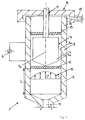
- FIG. 5 is a semi-continuous working according to the invention Device for the production of crystals Solids dissolved in solvents can be removed.
- Corresponding 4 and 5 shown discontinuously working devices is a circular cylindrical crystallization tank 3 with a coaxial inside it arranged inner part 4 in the form of a circular cylinder 4th provided which delimit a radial annular space 7.
- the circular cylindrical inner part is connected e.g. with a Electric motor (not shown) connected shaft 5 rotatable is.
- the crystallization tank 3 is via a heating / cooling device 6 heatable.
- the crystallization tank 3 is in the direction of its perpendicular 3c a food container 9 with an inlet 10 upstream for the crystallization solution, which at present embodiment below the crystallization container 3 is arranged.
- the food container 9 stands via a fluid-permeable insert forming its bottom 11 in the form of a membrane, a frit or a filter with the crystallization container 3 in connection, the Cross section of the crystallization container 3 the cross section corresponds to the food container 9.
- the feed container 9 is used for loading the crystallization container 3 with one in the direction of its perpendicular bisector 3c and with respect to the rotating circular cylinder 4 in the annular space 7 between the latter and the crystallization container 3 generated Couette flow directed vertically laminar rising flow 12 of the crystallization solution.
- the between the bottom inlet 10 of the food container 9 and the insert 11 extending flow path L the solution supplied is such that when entering the solution in the crystallization tank 3 a laminar Speed profile 12 set, which of generated by the cross-sectional expansion of the inlet 10 Turbulence is largely free in order to Crystallization container 3 for a homogeneous flow profile to care for by the Couette flow with the laminar Flow 12 is superimposed.
- This converges expediently circular cylindrical inner part 4 of the crystallization container 3 at its lower section towards the center the insert 11 to the laminar flow 12th to lead evenly into the annular space 7 and stagnation points or prevent backflow caused thereby as best as possible.
- Crystallization container 3 On its top facing away from the food container 9 Crystallization container 3 is another fluid permeable Insert 13 provided, which is also from a Membrane, a frit, a filter or the like is formed can be and from the drive shaft 5 of the cylinder 4th is enforced.
- the insert 13 serves to retain the void-free generated in the crystallization tank 3 Crystals attached to the crystallizer 3 Enrich the facing underside and, for example, semi-continuously can be removed.
- a discharge container 14 closes with an outlet 15 for Removal of the solvent, which in the present Embodiment in the form of an integrated in a cover 16 Overflow is formed.
- solvent can also be a corresponding to the inlet 10 of the food container 9 Return line can be provided, which with the respective solid to be crystallized can be acted upon (not ) Shown.
- the crystallization container 3 facing bottom of the insert 13 a conveyor for the continuous removal of the crystals produced be provided, e.g. in the form of fixed on the shaft 5 and be formed with these rotating blades can which the deposited crystals one below the insert 13 arranged, the crystallization tank 3 leads radially penetrating discharge line (not shown).
- HMX cyclotetramethylene tetranitramine
- HMX cyclotetramethylene tetranitramine
- the mixture is in a crystallizer 2 made of stainless steel (V4A steel) transferred according to FIG. 4 and the coaxial in it Crystallization cylinders arranged in rotation offset so that there is in the annulus between the latter a Couette flow results.
- the mixture will heated to 95 ° C to the total amount of HMX in the propylene carbonate to solve. That from the solvent propylene carbonate and the solid HMX to be crystallized The system is therefore in the saturation range.
- the solution is then cooled to 75 ° C. and then 50 ml of water was added to initiate nucleation.
- the HMX crystals produced in this way have an average particle diameter of 350 ⁇ m and a narrow particle size distribution.
- the density of the crystals obtained could be increased from 1.888 g / cm 3 to 1.912 g / cm 3 compared to crystals produced in a conventional manner (cooling crystallization in a stirred kettle under otherwise identical conditions), which suggests an extremely small number of crystal defects or defects ,
- the test is used to examine the HMX crystals using a polymer Propellant (PBX) manufactured.
- PBX polymer Propellant
- This propellant is placed in a vertical position
- a plexiglass plate is placed in the direction of the a side of the plexiglass plate facing away from the propellant charge standardized sensor charge ignited.
- the plexiglass plate serves as a transmission medium for the PBX propellant to be examined by igniting the sensor charge.
- the thickness of the plexiglass plate is that which is proportional to the thickness Shock wave pressure after passing through the plexiglass plate just detonates.
- "gap height" designated thickness of the plexiglass plate at the just detonation of the PBX propellant to be examined could be triggered with the PBX with the conventional HMX particles produced was 13 mm the gap height for those produced in the Couette flow Particles 7 mm, reducing sensitivity corresponds to 54%. The reason for this lies in a largely homogeneous and defect-free crystal structure.
- HMX For the semi-continuous production of crystals from HMX 160 g of HMX are mixed in a solvent mixture at room temperature from equal proportions of ⁇ -butyrolacetone and acetone dispersed.
- the dispersion becomes the feed of the food container of a crystallizer according to FIG. 5, wherein those in the annulus between the crystallizer and the rotating cylinder of the crystallizer Couette flow with a laminar flow perpendicular to it Flow is superimposed.
- With recirculation of the Dispersion is heated to 95 ° C, so that a saturated HMX solution is obtained. Then the solution is on Cooled 70 ° C and 60 ml of water added to nucleation to initiate.
- the HMX crystals produced in this way also have an average particle diameter of 350 ⁇ m and a narrow particle size distribution.
- the density is 1.908 g / cm 3 and is therefore in the range of the crystals produced in discontinuous operation (Example 1).
Landscapes
- Chemical & Material Sciences (AREA)
- Crystallography & Structural Chemistry (AREA)
- Physics & Mathematics (AREA)
- Thermal Sciences (AREA)
- Chemical Kinetics & Catalysis (AREA)
- Engineering & Computer Science (AREA)
- Materials Engineering (AREA)
- Metallurgy (AREA)
- Organic Chemistry (AREA)
- Organic Low-Molecular-Weight Compounds And Preparation Thereof (AREA)
Abstract
Description
- Fig. 1
- das Strömungsprofil einer laminaren Scherströmung (Couette-Strömung) einer Kristallisationslösung mit linearem (Newtonschem) Fließverhalten;
- Fig. 2
- das Strömungsprofil einer Couette-Strömung einer Kristallisationslösung mit nicht linearem Fließverhalten;
- Fig. 3
- eine schematische Schnittansicht einer diskontinuierlich arbeitenden Vorrichtung zur Herstellung von Kristallen;
- Fig. 4
- eine Ausführungsvariante der Vorrichtung gemäß Fig. 3 und
- Fig. 5
- eine Ausführungsform einer erfindungsgemäßen, semikontinuierlich arbeitenden Vorrichtung zur Herstellung von Kristallen.
Claims (26)
- Verfahren zur Herstellung von regelmäßigen Kristallen (1) aus wenigstens einem in einem Lösungsmittel gelösten Feststoff mit positiver Löslichkeit, indem die Lösung unter Bildung des Feststoffkristallisates bis unterhalb ihrer Sättigungstemperatur abgekühlt und das Feststoffkristallisat abgetrennt wird, dadurch gekennzeichnet, daß die Lösung in einer laminaren Scherströmung (Couette-Strömung) abgekühlt wird.
- Verfahren zur Herstellung von regelmäßigen Kristallen (1) aus wenigstens einem in einem Lösungsmittel gelösten Feststoff mit negativer Löslichkeit, indem die Lösung unter Bildung des Feststoffkristallisates bis oberhalb ihrer Sättigungstemperatur erhitzt und das Feststoffkristallisat abgetrennt wird, dadurch gekennzeichnet, daß die Lösung in einer laminaren Scherströmung (Couette-Strömung) erhitzt wird.
- Verfahren nach Anspruch 1 oder 2, dadurch gekennzeichnet, daß die Partikelgröße des Feststoffkristallisates durch Variation der Kühl- bzw. Heizrate und/oder durch die Strömungsgeschwindigkeit der Couette-Strömung gesteuert wird.
- Verfahren nach einem der Ansprüche 1 bis 3, dadurch gekennzeichnet, daß die Lösung mit einer im wesentlichen konstanten Kühlrate abgekühlt bzw. mit einer im wesentlichen konstanten Heizrate erhitzt wird.
- Verfahren nach einem der Ansprüche 1 bis 4, dadurch gekennzeichnet, daß es chargenweise durchgeführt wird.
- Verfahren nach einem der Ansprüche 1 bis 4, dadurch gekennzeichnet, daß die Couette-Strömung zur kontinuierlichen oder semikontinuierlichen Durchführung des Verfahrens mit einer hierzu senkrechten laminaren Strömung der Lösung überlagert wird.
- Verfahren nach einem der Ansprüche 1 bis 6 zur Herstellung von im wesentlichen fehlstellenfreien Kristallen aus thermisch empfindlichen Feststoffen.
- Verfahren nach Anspruch 7 zur Herstellung von Treib-, Explosivstoffen und/oder Oxidatoren in feinkristalliner Form.
- Verfahren nach Anspruch 7 zur Herstellung von pharmazeutischen und/oder homöopathischen Wirkstoffen in feinkristalliner Form.
- Verfahren nach Anspruch 7 zur Herstellung von Hormonen und/oder Hormonderivaten in feinkristalliner Form.
- Verwendung von mittels eines Verfahren nach einem der Ansprüche 1 bis 7 hergestellten, im wesentlichen fehlstellenfreien Kristallen aus Treib-, Explosivstoffen und/oder Oxidatoren zum Einsatz in polymergebundenen Treib- und Sprengsätzen.
- Vorrichtung (2) zur Herstellung von Kristallen (1) aus wenigstens einem in einem Lösungsmittel gelösten Feststoff, insbesondere zur Durchführung des Verfahrens nach einem der Ansprüche 1 bis 10, mit einem im wesentlichen zylindrischen Kristallisationsbehälter (3) zur Aufnahme der Lösung mit einem hierzu koaxial unter Bildung eines radialen Ringraums (7) angeordneten und relativ zu diesem rotierbaren, im wesentlichen zylindrischen Innenteil (4), wobei der Kristallisationsbehälter (3) und/oder das Innenteil (4) temperierbar ist/sind, dadurch gekennzeichnet, daß dem Kristallisationsbehälter (3) in Richtung seiner Mittelsenkrechten (3c) ein mit diesem in Verbindung stehender Speisebehälter (9) mit einem Zulauf (10) für die Lösung vorgeordnet ist, welcher zum Beaufschlagen des Kristallisationsbehälters (3) mit einer in Richtung seiner Mittelsenkrechten (3c) gerichteten Laminarströmung (12) dient.
- Vorrichtung nach Anspruch 12, dadurch gekennzeichnet, daß der Kristallisationsbehälters (3) und/oder das Innenteil (4) kreiszylindrisch ausgebildet ist/sind.
- Vorrichtung nach Anspruch 12 oder 13, dadurch gekennzeichnet, daß der Kristallisationsbehälter (3) stationär und das Innenteil (4) rotierbar ist.
- Vorrichtung nach einem der Ansprüche 12 bis 14, dadurch gekennzeichnet, daß das Innenteil (4) an einem unteren Abschnitt in Richtung des Mittelpunktes des Bodens (3b) des Kristallisationsbehälters (3) konvergiert.
- Vorrichtung nach einem der Ansprüche 12 bis 15, dadurch gekennzeichnet, daß der Kristallisationsbehälter (3) über einen fluidpermeablen Einsatz (11), wie eine Membran, eine Fritte, ein Filter oder dergleichen, mit dem Speisebehälter (9) in Verbindung steht.
- Vorrichtung nach einem der Ansprüche 12 bis 16, dadurch gekennzeichnet, daß der Querschnitt des Kristallisationsbehälters (3) etwa dem Querschnitt des Speisebehälters (9) entspricht.
- Vorrichtung nach einem der Ansprüche 12 bis 17, dadurch gekennzeichnet, daß der Kristallisationsbehälter (3) an seiner dem Speisebehälter (9) abgewandten Seite mit einem fluidpermeablen Einsatz (13), wie einer Membran, einer Fritte, einem Filter oder dergleichen, ausgestattet ist, an welchen sich ein Abführbehälter (14) mit einem Ablauf (15) zum Abführen des Lösungsmittels anschließt.
- Vorrichtung nach Anspruch 18, dadurch gekennzeichnet, daß dem an der dem Speisebehälter (9) abgewandten Seite des Kristallisationsbehälters (3) angeordneten Einsatz (13) eine Fördereinrichtung zum kontinuierlichen Abführen der erzeugten Kristalle zugeordnet ist.
- Vorrichtung nach einem der Ansprüche 12 bis 19, dadurch gekennzeichnet, daß die Innenseite des Kristallisationsbehälters (3) und/oder die Mantelfläche des Innenteils (4) profiliert oder mit einer Oberflächenrauhigkeit versehen sind.
- Vorrichtung nach einem der Ansprüche 12 bis 19, dadurch gekennzeichnet, daß die Innenseite des Kristallisationsbehälters (3) und/oder die Mantelfläche des Innenteils (4) glatt ausgebildet, insbesondere poliert sind.
- Vorrichtung nach einem der Ansprüche 12 bis 21, dadurch gekennzeichnet, daß der Kristallisationsbehälter (3) und/oder das Innenteil (4) aus Metall oder Metallegierungen besteht/bestehen.
- Vorrichtung nach einem der Ansprüche 12 bis 21, dadurch gekennzeichnet, daß der Kristallisationsbehälter (3) und/oder das Innenteil (4) aus Keramik besteht/bestehen.
- Vorrichtung nach einem der Ansprüche 12 bis 21, dadurch gekennzeichnet, daß der Kristallisationsbehälter (3) und/oder das Innenteil (4) aus Glas besteht/bestehen.
- Vorrichtung nach einem der Ansprüche 12 bis 21, dadurch gekennzeichnet, daß der Kristallisationsbehälter (3) und/oder das Innenteil (4) aus Kunststoff besteht/bestehen.
- Vorrichtung nach einem der Ansprüche 12 bis 25, dadurch gekennzeichnet, daß der Kristallisationsbehälter (3) und/oder das Innenteil (4) mit Kunststoff beschichtet ist/sind.
Applications Claiming Priority (2)
| Application Number | Priority Date | Filing Date | Title |
|---|---|---|---|
| DE10149814A DE10149814B4 (de) | 2001-10-09 | 2001-10-09 | Verfahren zur Herstellung von Kristallen aus in Lösungsmitteln gelösten Feststoffen |
| DE10149814 | 2001-10-09 |
Publications (2)
| Publication Number | Publication Date |
|---|---|
| EP1308193A1 true EP1308193A1 (de) | 2003-05-07 |
| EP1308193B1 EP1308193B1 (de) | 2005-03-16 |
Family
ID=7701938
Family Applications (1)
| Application Number | Title | Priority Date | Filing Date |
|---|---|---|---|
| EP02022514A Expired - Lifetime EP1308193B1 (de) | 2001-10-09 | 2002-10-07 | Verfahren zur Herstellung von Kristallen aus in Lösungsmitteln gelösten Feststoffen |
Country Status (2)
| Country | Link |
|---|---|
| EP (1) | EP1308193B1 (de) |
| DE (2) | DE10149814B4 (de) |
Cited By (4)
| Publication number | Priority date | Publication date | Assignee | Title |
|---|---|---|---|---|
| CN108413794A (zh) * | 2017-09-18 | 2018-08-17 | 徐阳 | 溶液结晶储能结构及应用该结构的发生储能器 |
| CN117255708A (zh) * | 2021-04-16 | 2023-12-19 | 艾迈有限公司 | 结晶和分离物质的工艺及装置 |
| CN118903842A (zh) * | 2024-10-09 | 2024-11-08 | 厚福生物科技江苏有限公司 | 一种化妆品生产用搅拌蒸发结晶罐 |
| CN119356009A (zh) * | 2024-12-23 | 2025-01-24 | 江西师范大学 | 碳酸双胍或硝酸双胍作为非线性光学晶体的应用 |
Families Citing this family (2)
| Publication number | Priority date | Publication date | Assignee | Title |
|---|---|---|---|---|
| FR2886641A1 (fr) * | 2005-06-02 | 2006-12-08 | Saint Louis Inst | Particules d'explosif peu sensibles aux chocs et procede de traitement associe |
| DE102020132043A1 (de) | 2020-12-02 | 2022-06-02 | Lübbers FTS GmbH | Kristallisationsvorrichtung zum Kristallisieren eines Vorproduktes und Trocknungsvorrichtung |
Citations (5)
| Publication number | Priority date | Publication date | Assignee | Title |
|---|---|---|---|---|
| DE2722636A1 (de) * | 1976-05-20 | 1977-12-08 | Stamicarbon | Verfahren zur kontinuierlichen herstellung faserartiger polymerkristalle |
| US4551196A (en) * | 1981-05-15 | 1985-11-05 | U.S. Philips Corporation | Method of growing crystalline cadmium mercury telluride and crystalline cadmium mercury telluride grown by the method |
| DE4103575A1 (de) * | 1990-05-21 | 1991-11-28 | Mfn Milchwirtschaftliche Foerd | Verfahren zur kristallisation von fettemulsionen oder fettschmelzen |
| DE4125463A1 (de) * | 1991-08-01 | 1993-02-04 | Deutsches Inst Lebensmitteltec | Verfahren und vorrichtung zur kontinuierlichen, gesteuerten strukturierung, insbesondere kristallisation von stoffsystemen in fliessfaehigem zustand, insbesondere fetthaltigen massen, wie schokolademasse |
| US5712511A (en) * | 1997-03-03 | 1998-01-27 | The United States Of America As Represented By The Secretary Of The Navy | Preparation of fine particulate CL-20 |
Family Cites Families (1)
| Publication number | Priority date | Publication date | Assignee | Title |
|---|---|---|---|---|
| DE19923730A1 (de) * | 1999-05-22 | 2000-11-23 | Fraunhofer Ges Forschung | Verfahren zur Herstellung feinpartikulärer Explosivstoffe |
-
2001
- 2001-10-09 DE DE10149814A patent/DE10149814B4/de not_active Expired - Fee Related
-
2002
- 2002-10-07 DE DE50202470T patent/DE50202470D1/de not_active Expired - Lifetime
- 2002-10-07 EP EP02022514A patent/EP1308193B1/de not_active Expired - Lifetime
Patent Citations (5)
| Publication number | Priority date | Publication date | Assignee | Title |
|---|---|---|---|---|
| DE2722636A1 (de) * | 1976-05-20 | 1977-12-08 | Stamicarbon | Verfahren zur kontinuierlichen herstellung faserartiger polymerkristalle |
| US4551196A (en) * | 1981-05-15 | 1985-11-05 | U.S. Philips Corporation | Method of growing crystalline cadmium mercury telluride and crystalline cadmium mercury telluride grown by the method |
| DE4103575A1 (de) * | 1990-05-21 | 1991-11-28 | Mfn Milchwirtschaftliche Foerd | Verfahren zur kristallisation von fettemulsionen oder fettschmelzen |
| DE4125463A1 (de) * | 1991-08-01 | 1993-02-04 | Deutsches Inst Lebensmitteltec | Verfahren und vorrichtung zur kontinuierlichen, gesteuerten strukturierung, insbesondere kristallisation von stoffsystemen in fliessfaehigem zustand, insbesondere fetthaltigen massen, wie schokolademasse |
| US5712511A (en) * | 1997-03-03 | 1998-01-27 | The United States Of America As Represented By The Secretary Of The Navy | Preparation of fine particulate CL-20 |
Cited By (5)
| Publication number | Priority date | Publication date | Assignee | Title |
|---|---|---|---|---|
| CN108413794A (zh) * | 2017-09-18 | 2018-08-17 | 徐阳 | 溶液结晶储能结构及应用该结构的发生储能器 |
| CN108413794B (zh) * | 2017-09-18 | 2024-02-20 | 徐阳 | 溶液结晶储能结构及应用该结构的发生储能器 |
| CN117255708A (zh) * | 2021-04-16 | 2023-12-19 | 艾迈有限公司 | 结晶和分离物质的工艺及装置 |
| CN118903842A (zh) * | 2024-10-09 | 2024-11-08 | 厚福生物科技江苏有限公司 | 一种化妆品生产用搅拌蒸发结晶罐 |
| CN119356009A (zh) * | 2024-12-23 | 2025-01-24 | 江西师范大学 | 碳酸双胍或硝酸双胍作为非线性光学晶体的应用 |
Also Published As
| Publication number | Publication date |
|---|---|
| DE50202470D1 (de) | 2005-04-21 |
| DE10149814B4 (de) | 2006-07-13 |
| DE10149814A1 (de) | 2003-04-30 |
| EP1308193B1 (de) | 2005-03-16 |
Similar Documents
| Publication | Publication Date | Title |
|---|---|---|
| US5487851A (en) | Composite gun propellant processing technique | |
| DE69506707T2 (de) | Verfahren und vorrichtung zur herstellung von teilchen | |
| DE2848518A1 (de) | Verfahren und vorrichtung zur herstellung von sprengemulsion | |
| DE69226064T2 (de) | Herstellung von Eiweissmikropartikeln durch Niederschlag ein einem Anti-Lösungsmittel | |
| DE69123783T2 (de) | Verfahren zur Herstellung eines gaserzeugenden Materials | |
| DE2923311C2 (de) | Verfahren und Vorrichtung zur Herstellung von rotationssymmetrischen Sprengkörpern für Hohlladungen | |
| DD144166A5 (de) | Kontinuierliche herstellung von explosivstoffgemischen | |
| US3138501A (en) | Method of preparing a cyclotrimethylene trinitramine and cyclotetramethylene tetranitramine plastic bonded explosives | |
| EP0605456B1 (de) | Verringerung der korngrösse von kristallinem explosivstoff | |
| EP1308193B1 (de) | Verfahren zur Herstellung von Kristallen aus in Lösungsmitteln gelösten Feststoffen | |
| DE3412410C2 (de) | Verfahren zur Herstellung kunststoffgebundener Treibladungspulver und Sprengstoffe | |
| DE1442939B2 (de) | Kontinuierliches Fallungsverfahren zur Erzeugung leicht abtrennbarer Nieder schlage und Vorrichtung zu seiner Durch führung | |
| DE1646283C3 (de) | Verfahren zur Herstellung von Sprengstofformkörpern hoher Festigkeit mit wählbarer definierter Detonationsgeschwindigkeit | |
| EP1256558A2 (de) | Verfahren zur Herstellung von Kristallen aus in einem Lösungsmittel gelösten Treib-, Explosivstoffen und Oxidatoren | |
| DE69226397T2 (de) | Druckgussverfahren zur Herstellung von Teilen mit hoher mechanischer Leistungsfähigkeit aus thixotropem Metall | |
| DE2461543A1 (de) | Verfahren zur entkristallisierung von zuckermaterial | |
| DE1157772B (de) | Verfahren zur Herstellung von thermoplastisch verformbaren Kunststoffen | |
| DE3714778A1 (de) | Verfahren und vorrichtung zum kontinuierlichen schmelzen einer gelierten substanz | |
| EP1555256A2 (de) | Verfahren zur Herstellung feindisperser kristalliner Treib-, Explosivstoffe und Oxidatoren | |
| EP1559700A2 (de) | Verfahren zur Herstellung von Komposit-Partikeln aus kristallinen Explosivstoffen | |
| DE3234978C1 (de) | Gegossene Sprengladung | |
| EP1331213A2 (de) | Verfahren zur Herstellung von mit additiven versetztem Ammoniumdinitramid (ADN) | |
| EP1090894A1 (de) | Verfahren zur Herstellung feinpartikulärer Explosivstoffe | |
| DE4237580C1 (de) | Aufbereitung wachshaltiger Explosivstoffe | |
| DE3209747A1 (de) | Einrichtung zur herstellung von granulat aus 2-phasen-gemischen |
Legal Events
| Date | Code | Title | Description |
|---|---|---|---|
| PUAI | Public reference made under article 153(3) epc to a published international application that has entered the european phase |
Free format text: ORIGINAL CODE: 0009012 |
|
| AK | Designated contracting states |
Designated state(s): AT BE BG CH CY CZ DE DK EE ES FI FR GB GR IE IT LI LU MC NL PT SE SK TR |
|
| AX | Request for extension of the european patent |
Extension state: AL LT LV MK RO SI |
|
| RAP1 | Party data changed (applicant data changed or rights of an application transferred) |
Owner name: FRAUNHOFER-GESELLSCHAFT ZURFOERDERUNG DER ANGEWAND |
|
| 17P | Request for examination filed |
Effective date: 20030723 |
|
| RAP1 | Party data changed (applicant data changed or rights of an application transferred) |
Owner name: FRAUNHOFER-GESELLSCHAFT ZUR FOERDERUNG DERANGEWAND |
|
| AKX | Designation fees paid |
Designated state(s): DE FR GB NL SE |
|
| GRAP | Despatch of communication of intention to grant a patent |
Free format text: ORIGINAL CODE: EPIDOSNIGR1 |
|
| 17Q | First examination report despatched |
Effective date: 20040824 |
|
| GRAS | Grant fee paid |
Free format text: ORIGINAL CODE: EPIDOSNIGR3 |
|
| GRAA | (expected) grant |
Free format text: ORIGINAL CODE: 0009210 |
|
| AK | Designated contracting states |
Kind code of ref document: B1 Designated state(s): DE FR GB NL SE |
|
| PG25 | Lapsed in a contracting state [announced via postgrant information from national office to epo] |
Ref country code: GB Free format text: LAPSE BECAUSE OF FAILURE TO SUBMIT A TRANSLATION OF THE DESCRIPTION OR TO PAY THE FEE WITHIN THE PRESCRIBED TIME-LIMIT Effective date: 20050316 Ref country code: NL Free format text: LAPSE BECAUSE OF FAILURE TO SUBMIT A TRANSLATION OF THE DESCRIPTION OR TO PAY THE FEE WITHIN THE PRESCRIBED TIME-LIMIT Effective date: 20050316 |
|
| REG | Reference to a national code |
Ref country code: GB Ref legal event code: FG4D Free format text: NOT ENGLISH |
|
| REG | Reference to a national code |
Ref country code: SE Ref legal event code: TRGR |
|
| REG | Reference to a national code |
Ref country code: IE Ref legal event code: FG4D Free format text: GERMAN |
|
| REF | Corresponds to: |
Ref document number: 50202470 Country of ref document: DE Date of ref document: 20050421 Kind code of ref document: P |
|
| NLV1 | Nl: lapsed or annulled due to failure to fulfill the requirements of art. 29p and 29m of the patents act | ||
| GBV | Gb: ep patent (uk) treated as always having been void in accordance with gb section 77(7)/1977 [no translation filed] |
Effective date: 20050316 |
|
| PGFP | Annual fee paid to national office [announced via postgrant information from national office to epo] |
Ref country code: FR Payment date: 20051019 Year of fee payment: 4 |
|
| PGFP | Annual fee paid to national office [announced via postgrant information from national office to epo] |
Ref country code: SE Payment date: 20051024 Year of fee payment: 4 |
|
| ET | Fr: translation filed | ||
| PLBE | No opposition filed within time limit |
Free format text: ORIGINAL CODE: 0009261 |
|
| STAA | Information on the status of an ep patent application or granted ep patent |
Free format text: STATUS: NO OPPOSITION FILED WITHIN TIME LIMIT |
|
| 26N | No opposition filed |
Effective date: 20051219 |
|
| PG25 | Lapsed in a contracting state [announced via postgrant information from national office to epo] |
Ref country code: SE Free format text: LAPSE BECAUSE OF NON-PAYMENT OF DUE FEES Effective date: 20061008 |
|
| EUG | Se: european patent has lapsed | ||
| REG | Reference to a national code |
Ref country code: FR Ref legal event code: ST Effective date: 20070629 |
|
| PG25 | Lapsed in a contracting state [announced via postgrant information from national office to epo] |
Ref country code: FR Free format text: LAPSE BECAUSE OF NON-PAYMENT OF DUE FEES Effective date: 20061031 |
|
| PGFP | Annual fee paid to national office [announced via postgrant information from national office to epo] |
Ref country code: DE Payment date: 20091218 Year of fee payment: 8 |
|
| REG | Reference to a national code |
Ref country code: DE Ref legal event code: R119 Ref document number: 50202470 Country of ref document: DE Effective date: 20110502 |
|
| PG25 | Lapsed in a contracting state [announced via postgrant information from national office to epo] |
Ref country code: DE Free format text: LAPSE BECAUSE OF NON-PAYMENT OF DUE FEES Effective date: 20110502 |