EP1304875A2 - Vorrichtung, Verfahren und System für eine elektronische Programmführung - Google Patents
Vorrichtung, Verfahren und System für eine elektronische Programmführung Download PDFInfo
- Publication number
- EP1304875A2 EP1304875A2 EP02021273A EP02021273A EP1304875A2 EP 1304875 A2 EP1304875 A2 EP 1304875A2 EP 02021273 A EP02021273 A EP 02021273A EP 02021273 A EP02021273 A EP 02021273A EP 1304875 A2 EP1304875 A2 EP 1304875A2
- Authority
- EP
- European Patent Office
- Prior art keywords
- program
- broadcast program
- viewer
- broadcast
- recommendation value
- Prior art date
- Legal status (The legal status is an assumption and is not a legal conclusion. Google has not performed a legal analysis and makes no representation as to the accuracy of the status listed.)
- Granted
Links
Images



Classifications
-
- H—ELECTRICITY
- H04—ELECTRIC COMMUNICATION TECHNIQUE
- H04H—BROADCAST COMMUNICATION
- H04H60/00—Arrangements for broadcast applications with a direct linking to broadcast information or broadcast space-time; Broadcast-related systems
- H04H60/68—Systems specially adapted for using specific information, e.g. geographical or meteorological information
- H04H60/72—Systems specially adapted for using specific information, e.g. geographical or meteorological information using electronic programme guides [EPG]
-
- H—ELECTRICITY
- H04—ELECTRIC COMMUNICATION TECHNIQUE
- H04N—PICTORIAL COMMUNICATION, e.g. TELEVISION
- H04N21/00—Selective content distribution, e.g. interactive television or video on demand [VOD]
- H04N21/40—Client devices specifically adapted for the reception of or interaction with content, e.g. set-top-box [STB]; Operations thereof
- H04N21/43—Processing of content or additional data, e.g. demultiplexing additional data from a digital video stream; Elementary client operations, e.g. monitoring of home network or synchronising decoder's clock; Client middleware
- H04N21/431—Generation of visual interfaces for content selection or interaction; Content or additional data rendering
-
- H—ELECTRICITY
- H04—ELECTRIC COMMUNICATION TECHNIQUE
- H04H—BROADCAST COMMUNICATION
- H04H60/00—Arrangements for broadcast applications with a direct linking to broadcast information or broadcast space-time; Broadcast-related systems
- H04H60/29—Arrangements for monitoring broadcast services or broadcast-related services
- H04H60/31—Arrangements for monitoring the use made of the broadcast services
-
- H—ELECTRICITY
- H04—ELECTRIC COMMUNICATION TECHNIQUE
- H04H—BROADCAST COMMUNICATION
- H04H60/00—Arrangements for broadcast applications with a direct linking to broadcast information or broadcast space-time; Broadcast-related systems
- H04H60/35—Arrangements for identifying or recognising characteristics with a direct linkage to broadcast information or to broadcast space-time, e.g. for identifying broadcast stations or for identifying users
- H04H60/46—Arrangements for identifying or recognising characteristics with a direct linkage to broadcast information or to broadcast space-time, e.g. for identifying broadcast stations or for identifying users for recognising users' preferences
-
- H—ELECTRICITY
- H04—ELECTRIC COMMUNICATION TECHNIQUE
- H04H—BROADCAST COMMUNICATION
- H04H60/00—Arrangements for broadcast applications with a direct linking to broadcast information or broadcast space-time; Broadcast-related systems
- H04H60/61—Arrangements for services using the result of monitoring, identification or recognition covered by groups H04H60/29-H04H60/54
- H04H60/65—Arrangements for services using the result of monitoring, identification or recognition covered by groups H04H60/29-H04H60/54 for using the result on users' side
-
- H—ELECTRICITY
- H04—ELECTRIC COMMUNICATION TECHNIQUE
- H04N—PICTORIAL COMMUNICATION, e.g. TELEVISION
- H04N21/00—Selective content distribution, e.g. interactive television or video on demand [VOD]
- H04N21/40—Client devices specifically adapted for the reception of or interaction with content, e.g. set-top-box [STB]; Operations thereof
- H04N21/43—Processing of content or additional data, e.g. demultiplexing additional data from a digital video stream; Elementary client operations, e.g. monitoring of home network or synchronising decoder's clock; Client middleware
- H04N21/442—Monitoring of processes or resources, e.g. detecting the failure of a recording device, monitoring the downstream bandwidth, the number of times a movie has been viewed, the storage space available from the internal hard disk
- H04N21/44213—Monitoring of end-user related data
- H04N21/44222—Analytics of user selections, e.g. selection of programmes or purchase activity
- H04N21/44224—Monitoring of user activity on external systems, e.g. Internet browsing
-
- H—ELECTRICITY
- H04—ELECTRIC COMMUNICATION TECHNIQUE
- H04N—PICTORIAL COMMUNICATION, e.g. TELEVISION
- H04N21/00—Selective content distribution, e.g. interactive television or video on demand [VOD]
- H04N21/40—Client devices specifically adapted for the reception of or interaction with content, e.g. set-top-box [STB]; Operations thereof
- H04N21/45—Management operations performed by the client for facilitating the reception of or the interaction with the content or administrating data related to the end-user or to the client device itself, e.g. learning user preferences for recommending movies, resolving scheduling conflicts
- H04N21/466—Learning process for intelligent management, e.g. learning user preferences for recommending movies
-
- H—ELECTRICITY
- H04—ELECTRIC COMMUNICATION TECHNIQUE
- H04N—PICTORIAL COMMUNICATION, e.g. TELEVISION
- H04N21/00—Selective content distribution, e.g. interactive television or video on demand [VOD]
- H04N21/40—Client devices specifically adapted for the reception of or interaction with content, e.g. set-top-box [STB]; Operations thereof
- H04N21/45—Management operations performed by the client for facilitating the reception of or the interaction with the content or administrating data related to the end-user or to the client device itself, e.g. learning user preferences for recommending movies, resolving scheduling conflicts
- H04N21/466—Learning process for intelligent management, e.g. learning user preferences for recommending movies
- H04N21/4668—Learning process for intelligent management, e.g. learning user preferences for recommending movies for recommending content, e.g. movies
-
- H—ELECTRICITY
- H04—ELECTRIC COMMUNICATION TECHNIQUE
- H04N—PICTORIAL COMMUNICATION, e.g. TELEVISION
- H04N21/00—Selective content distribution, e.g. interactive television or video on demand [VOD]
- H04N21/40—Client devices specifically adapted for the reception of or interaction with content, e.g. set-top-box [STB]; Operations thereof
- H04N21/47—End-user applications
- H04N21/482—End-user interface for programme selection
- H04N21/4826—End-user interface for programme selection using recommendation lists, e.g. of programmes or channels sorted out according to their score
-
- H—ELECTRICITY
- H04—ELECTRIC COMMUNICATION TECHNIQUE
- H04N—PICTORIAL COMMUNICATION, e.g. TELEVISION
- H04N5/00—Details of television systems
- H04N5/44—Receiver circuitry for the reception of television signals according to analogue transmission standards
- H04N5/445—Receiver circuitry for the reception of television signals according to analogue transmission standards for displaying additional information
-
- H—ELECTRICITY
- H04—ELECTRIC COMMUNICATION TECHNIQUE
- H04N—PICTORIAL COMMUNICATION, e.g. TELEVISION
- H04N7/00—Television systems
- H04N7/16—Analogue secrecy systems; Analogue subscription systems
- H04N7/162—Authorising the user terminal, e.g. by paying; Registering the use of a subscription channel, e.g. billing
- H04N7/163—Authorising the user terminal, e.g. by paying; Registering the use of a subscription channel, e.g. billing by receiver means only
Definitions
- the present invention relates to a broadcast program guiding apparatus, and method and system for using the apparatus, that indicates recommendable broadcast programs that match tastes for each viewer.
- a viewer usually reads broadcast program listings in a newspaper or a broadcast program guide magazine to select the television programs the viewer wants to watch.
- Some Internet sites offer radio and television program guides on their web pages, so that a viewer can view such program guides via the viewer's terminal, such as a personal computer.
- digital television broadcasting provides a viewer with an electronic program guide (EPG) together with television programs. Therefore, by using a television set that can receive digital television broadcasts, the viewer can select the EPG and display it on the television screen by remote control.
- EPG electronic program guide
- the EPG or a program table are displayed in the same form as that of program listings in a newspaper.
- a broadcast program guiding apparatus comprising: program feature storing means for storing program feature information indicating the program features for each broadcast program; viewer's tastes detecting means for obtaining history information indicating programs which a viewer has watched or which is recorded by the viewer, and for detecting taste information indicating program selections of the viewer based on the history information; recommendation value setting means for setting a recommendation value for each broadcast program in a predetermined time period in accordance with matching states between the program feature information for each broadcast program stored in the program feature storing means and the taste information detected by the viewer's taste detecting means; and display data creating means for detecting a position on a screen which is an angular position corresponding to a broadcast time with respect to a reference line passing through a reference point as a center point and which is separated from the reference point by a distance corresponding to the recommendation value for each broadcast program, and for creating display data for displaying a program title at the detected position of each broadcast program.
- a broadcast program guiding method comprising: the steps of storing program feature information indicating the program features for each broadcast program; obtaining history information indicating programs which a viewer has watched or which is recorded by the viewer, and detecting taste information indicating program selections of the viewer based on the history information; setting a recommendation value for each broadcast program in a predetermined time period in accordance with matching states between the stored program feature information for each broadcast program and the detected taste information; and detecting a position on a screen which is an angular position corresponding to a broadcast time with respect to a reference line passing through a reference point as a center point and which is separated from the reference point by a distance corresponding to the recommendation value for each broadcast program, and creating display data for displaying a program title at the detected position of each broadcast program.
- a broadcast program guiding system comprising: program information transmitting means for transmitting program information of each broadcast program; program feature storing means for storing program feature information indicating features for each broadcast program in accordance with the program information transmitted by the program information transmitting means; history information storing means for storing history information indicating programs which a viewer has watched or which is recorded by the viewer; viewer's tastes detecting means for obtaining the history information indicating programs from the history information storing means, and for detecting taste information indicating program selections of the viewer based on the history information; recommendation value setting means for setting a recommendation value for each broadcast program in a predetermined time period in accordance with matching states between the program feature information for each broadcast program stored in the program feature storing means and the taste information detected by the viewer's taste detecting means; and display means for displaying a program title at a position on a screen which is an angular position corresponding to a broadcast time with respect to a reference line passing through a reference point as a center point and which is separated from the
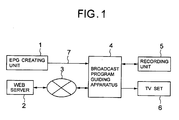
- Fig. 1 shows the general configuration of a broadcast program guiding system according to the present invention.
- the system comprises an EPG creating unit 1, a web server 2, the Internet 3, a broadcast program guiding apparatus 4, an image recording unit 5, and a television (TV) set 6.
- the EPG creating unit 1 and the web server 2 are installed in a broadcasting station, an EPG producing company, or a publishing company of a program information magazine, for example.
- the EPG creating unit 1 regularly creates EPG data for a predetermined period of time, such as one week, and has a receiving/transmitting function that sends the EPG data to the broadcast program guiding apparatus 4 in response to an EPG data request from a terminal that includes the broadcast program guiding apparatus 4, via a line 7 such as a telephone line, a cable television line, etc.
- the web server 2 stores a program table for each television broadcast channel as web data including a HTML (hypertext markup language) file in a database, searches and reads the web data corresponding to a television broadcast channel specified by a terminal including the broadcast program guiding apparatus 4 via the Internet 3, in the database and sends the read web data to the terminal via the Internet 3.
- the amount of web data can be specified, for example, for a day or for a week.
- the EPG data can be obtained by receiving and decoding a signal of the specified channel in the TV set 6.
- the EPG data contains a program title, a program type, a broadcast start time, a broadcast end time, the program contents, and a key word (for example, a performer's name, author's name, director's name, series name, song title, area name) every program.
- the web data also contains the same items as that of the EPG data together with a program table.
- the broadcast program guiding apparatus 4, the image recording unit 5, and the TV set 6 are installed on a viewer's side.
- the broadcast program guiding apparatus 4 reads the EPG data from the EPG creating unit 1 and the web data from the web server 2, stores the read data as a database, detects a program which matches a viewer's tastes in the database, and displays the detected result on the screen of the TV set 6.
- the broadcast program guiding apparatus 4 comprises, as shown in Fig. 2, a program information buffering unit 11, a program database unit 12, a viewer's taste information calculating unit 13, a viewer's taste database unit 14, a controlling unit 15, an operating unit 16, a display position calculating unit 17, and a recommendation value calculating unit 18.
- the program information buffering unit 11, program database unit 12, viewer's taste information calculating unit 13, viewer's taste database unit 14, operating unit 16, display position calculating unit 17, and recommendation value calculating unit 18 are each connected to the controlling unit 15.
- the program information buffering unit 11 is connected to the EPG creating unit 1 via the line 7, and can be connected to the web server 2 via the Internet 3.
- the program information buffering unit 11 is also connected to the program database unit 12. Data from the buffering unit 11 can be written into the program database unit 12 and data written to the program database unit 12 can be read by the buffering unit 11.
- the program information buffering unit 11 makes a request for EPG data to the EPG creating unit 1 via the line 7, receives EPG data transmitted from the EPG creating unit 1 in response to the request, and stores the received EPG data in the program database unit 12.
- the program information buffering unit 11 makes a request for web data to the web server 2 via the Internet 3, receives web data transmitted from the web server 2 in response to the request, and stores the received web data in the program database unit 12.
- the EPG data and the web data are written to the program database unit 12 to form a database having program information for each broadcast channel.
- a key word which is already used is used as it is as a program key word for showing the feature of a program.
- Each word contained in the program content of the EPG data and the web data may be made database as a program key word.
- the viewer's taste information calculating unit 13 is connected to the program database unit 12 and the viewer's taste database unit 14.
- the viewer's taste information calculating unit 13 is supplied with watching information from the TV set 6, and is supplied with recording information from the image recording unit 5.
- the watching information is information relating to programs or channels watched or received by a viewer (user) and a watching period of time for each program or channel.
- the recording information is information relating to programs recorded by using the image recording unit 5 such as a VCR (video cassette recorder), DVD recorder, hard disc recorder, etc., or channels of the recorded program and the recording periods.
- the viewer's taste information calculating unit 13 sets viewer's taste information based on the watching information and the recording information.
- the viewer's taste information calculating unit 13 can specify a program which has been watched or recorded by the viewer based on the watching information and recording information.
- the viewer's taste information calculating unit 13 extracts the type, person's name, and area name corresponding to the specified program by utilizing the program information stored in the program database unit 12, and an extraction frequency for each detail item of the type, person's name, and area name, in other words, the taste key words is counted.
- the type classification of the above-mentioned EPG data is used.
- the type includes, for example, cinema, sports, music, drama, news, variety, hobby/education, kids, documentary, special, etc.
- cinema may be divided into domestic films and foreign films, sports into each type, and music into classical and jazz.
- the performer's name, author's name, and director's name in the key words of the EPG data are used.
- area name too, one of key words in the EPG data is used.
- Broadcast time may be indicated by showing how often and which type was watched in every time period in one-hour units and counting the frequency according to the type classification of the EPG data.
- the controlling unit 15 controls each component in the broadcast program guiding apparatus 4.
- the operating unit 16 is provided with various keys by which the viewer inputs commands when the viewer uses the system.
- various keys there are a recommendable program display key, a +(plus) shift key, a -(minus) shift key, a future key, and a past key, none of which is shown.
- the display position calculating unit 17 calculates a position at which the recommendable program guide reflecting the viewer's tastes in a circular shape is displayed on the screen of the TV set 6. This operation will be described later.
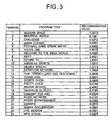
- the recommendation value calculating unit 18 calculates a recommendation value by performing a matching calculation according to the viewer's taste information stored in the viewer's taste database unit 14 for each program.
- the recommendation value is calculated as a point for each program in accordance with the taste key words of the viewer's taste information (for type, person's name, area name) and to the counted values thereof.
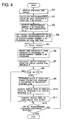
- the recommendable program display operation is started by a viewer's operation of a predetermined key (for example, the recommendable program display key) of the operating unit 16.
- the controlling unit 15 receives an assignment of a display time period (step S1). This is done by the viewer selecting one display time period the viewer wants for displaying the recommendable program guide of 12-hour display, 24-hour display, and one-week display. The request to select the display time period is displayed on the screen of the TV set 6, and the viewer selects one display time period by key operation. If the 12-hour display is selected, the viewer must next choose between the 12 hours from 6:00 A.M. to 6:00 P.M. or the 12 hours from 6:00 P.M. to 6:00 A.M. In this case, one of them is automatically selected in accordance with the current time. Any 12 hour period may be determined.
- the recommendation value calculating unit 18 calculates the recommendation value for each program in the display time period (step S2).
- Each program is extracted from the program database unit 12 regardless of broadcast channel, and the recommendation value is calculated for each of all the programs in the specified display time period.
- the extracted programs include any programs on the air at the current time.
- the controlling unit 15 extracts a predetermined number X of programs with high recommendation value based on the recommendation value for each program calculated by the recommendation value calculating unit 18 (step S3).
- the predetermined number X is determined, for example, in accordance with the time period specified in step S1.
- An unselected program Pi is selected from the predetermined number X of programs (step S6), and a display position r from the circle center for the program Pi is calculated (step S7).
- step S8 determines whether or not the display position r is 0 or more and at the same time whether it is equal to or less than the display upper limit value rlim (step S8). If r ⁇ 0 or r>rlim, the operation jumps to step S12, which is described later. If r ⁇ rlim, the display position calculating unit 17 determines an angle ⁇ from the circle center (reference point) with respect to a reference line in accordance with the broadcast start time of the program Pi (step S9).
- the reference line is, for example, a line in the vertical direction or in the horizontal direction.
- the controlling unit 15 When the controlling unit 15 receives the display position (r, ⁇ ) for the program Pi calculated by the display position calculating unit 17, it reads the program title of program Pi from the program database unit 12, and creates recommendable program guide display data for displaying the program title at the display position (r, ⁇ ) (step S10).
- the display data is formed of two parts: a program title indicator, which is a circular display pattern corresponding to the display time period specified in step S1, and contains the program title of the program Pi and the current time line, and a program content indicator for displaying the contents of the program whose name is displayed in the program title indicator.
- the display data for the program content indicator is created as described later.
- the display data is converted into an analog video signal by a conversion means that is not shown.
- the video signal is supplied to the TV set 6 (step S11). When the video signal is supplied from the broadcast program guiding apparatus 4 to the TV set 6, a recommendable program guide image corresponding to the video signal is promptly displayed.
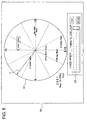
- Fig. 5 shows an exemplary display of a recommendable program guide.
- D1 is the program title indicator and D2 is the program content indicator.
- An arrow Y in the program title indicator D1 points to the current time.
- a black spot is placed at the starting time of each program.
- the angular position of each program moves clockwise as time passes.
- a 12-hour display from 6:00 A.M. to 6:00 P.M. is shown on the screen 6a of the TV set 6.
- the reference line is the 6:00 A.M. line.
- the viewer can sense the recommendation value of a program by glancing at the display screen of the recommendable program guide.
- the cursor square
- the cursor is placed at the part where the program title 'LUNCH VARIETY' is displayed in the program title indicator D1.
- the controlling unit 15 determines whether or not all of the predetermined number X of programs have been selected (step S12). If all of the predetermined number X of programs are not selected, the operation returns to step S6 in order to repeat the above-mentioned operation in the steps S6 to S12. In the creation of display data in step S9, it is repeated to add new program titles to the display pattern to which program titles have been added.
- the recommendable program display operation is terminated when all the predetermined number X of programs have been selected.
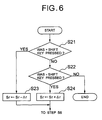
- the controlling unit 15 determines, for example, whether or not the viewer pressed the + shift key or the - shift key of the operating unit 16 by an interrupt operation (steps S21, S22). If the viewer presses the + shift key of the operating unit 16, the controlling unit 15 decreases the amount of shift Sr by a predetermined value ⁇ r cooperating with the recommendation value calculating unit 18 (step S23). The recommendation value calculating unit 18 executes the above-mentioned recommendable program display operation in the steps after step S6 so as to recreate the display data. On the other hand, if the viewer presses the shift key of the operating unit 16, the controlling unit 15 increases the amount of shift Sr by the predetermined value ⁇ r in association with the recommendation value calculating unit 18 (step S24). The above-mentioned recommendable program display operation in the steps after step S6 is executed, and the display data is recreated.
- Fig. 7 shows an exemplary display of the recommendable program guide when the + shift key of the operating unit 16 is pressed at the time that the recommendable program guide shown in Fig. 5 is displayed.
- the upper limit value and lower limit value are set for the amount of shift Sr; the amount of shift Sr is fixed to the lower limit value when the operation in step S21 causes the amount of shift Sr to be less than the lower limit value; and the amount of shift Sr is fixed to the upper limit value when the operation in step S23 causes the amount of shift Sr to be more than the upper limit value.
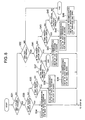
- the controlling unit 15 determines, for example, whether or not the viewer pressed the future key or the past key of the operating unit 16 by an interrupt operation (steps S31, S32). If the viewer presses the future key of the operating unit 16, the controlling unit 15 determines whether or not the display time period specified in step S1 is 12-hour display (step S33). In the case of 12-hour display, the recommendation value calculating unit 18 calculates the recommendation value corresponding to each program in the next 12 hours after the time period currently being displayed (step S34). If it is not 12-hour display, whether or not the display time period specified in step S1 is 24-hour display is determined (step S35).
- the recommendation value calculating unit 18 calculates the recommendation value corresponding to each program in the next 24 hours after the time period currently being displayed (step S36). If it is not 24-hour display, whether or not the display time period specified in step S1 is one-week display is determined (step S37). In the case of one-week display, the recommendation value calculating unit 18 calculates the recommendation value corresponding to each program in the next one week after the time period currently being displayed (step S38). After the execution of step S34, S36, or S38, the recommendable program display operation in the steps after step S3 is executed. Thus, recommendable program(s) in the next time period after the time period currently being displayed is displayed.
- step S41 When the viewer presses the past key of the operating unit 16, whether or not the display time period specified in step S1 is 12-hour display is determined (step S41). In the case of 12-hour display, the recommendation value calculating unit 18 calculates the recommendation value corresponding to each program in the previous 12 hours before the time period currently being displayed (step S42). If it is not 12-hour display, whether or not the display time period specified in step S1 is 24-hour display is determined (step S43). In the case of 24-hour display, the recommendation value calculating unit 18 calculates the recommendation value corresponding to each program in the previous 24 hours before the time period currently being displayed (step S44). If it is not 24-hour display, whether or not the display time period specified in step S1 is one-week display is determined (step S45).
- the recommendation value calculating unit 18 calculates the recommendation value corresponding to each program in the previous one week before the time period currently being displayed (step S46). After the execution of step S42, S44 or S46, the steps after step S3 of the recommendable program display operation are executed. Thus, recommendable program(s) in the previous time period before the time period currently being displayed is displayed.
- Fig. 9 is an exemplary display of the recommendable program guide when the future key of the operating unit 16 is pressed at the time that the recommendable program guide shown in Fig. 5 is displayed.
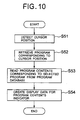
- the controlling unit 15 performs the following operation to display the contents of the program content indicator D2 of a recommendable program guide.
- the cursor position is first detected (step S 51).
- the cursor key (not shown) of the operating unit 16
- the viewer can move the cursor freely on the screen displaying the recommendable program guide.
- the information about the program corresponding to the cursor position is retrieved (step S52).
- the viewer can start the retrieval from the display position of each program obtained by the operation of steps S7 to S9 by the display position calculating unit 17.
- the program information (for example, program contents) stored in the program database 12 corresponding to the selected program is read (step S53), and the display data of the program content indicator D2 is formed(step S54).
- the display data of the program content indicator D2 formed in step S54 is used for creating the display data of the recommendable program guide in the above-mentioned step S10.
- the contents of the program selected by the cursor are displayed in the program content indicator D2 of the recommendable program guide, as is shown in Figs. 5, and 9.
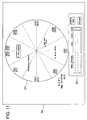
- Fig. 11 shows an exemplary application of the system according to the present invention.
- the lower value of recommendation value calculated by the recommendation value calculating unit 18 for programs already broadcast is displayed on the screen showing the recommendable program guide.
- the viewer can delete the recorded data of the programs from the image recording unit 5 by selecting them from the programs displayed on the screen by cursor operation.
- the image recording unit 5 is a hard disk recorder
- the image recording capacity of the hard disk recorder can be increased by erasing unnecessary recorded data.
- the viewer is not specified. However, it can be arranged so that, prior to the execution of step S1 of the recommendable program display operation, a viewer ID and a password that specify the viewer are requested.
- the taste information of each specified viewer can be set and the recommendation value of each program can be calculated based on the taste information. Therefore, a recommendable program guide for each individual viewer can be displayed.
- the display pattern of the recommendable program guide is circular.
- the display pattern may be elliptical or rectangular.
- the broadcast program guiding apparatus 4 the image recording unit 5, and the TV set 6 are installed on the viewer's side, but the broadcast program guiding apparatus 4 excluding the operating unit 16 may be installed on a broadcasting station side or a server side.
- a guide for recommendable programs corresponding to the viewer's tastes can be easily indicated.
Landscapes
- Engineering & Computer Science (AREA)
- Signal Processing (AREA)
- Multimedia (AREA)
- Databases & Information Systems (AREA)
- Social Psychology (AREA)
- Health & Medical Sciences (AREA)
- General Health & Medical Sciences (AREA)
- Computer Networks & Wireless Communication (AREA)
- Computer Security & Cryptography (AREA)
- Software Systems (AREA)
- Human Computer Interaction (AREA)
- Two-Way Televisions, Distribution Of Moving Picture Or The Like (AREA)
- Television Systems (AREA)
- User Interface Of Digital Computer (AREA)
Applications Claiming Priority (2)
| Application Number | Priority Date | Filing Date | Title |
|---|---|---|---|
| JP2001288965A JP2003101895A (ja) | 2001-09-21 | 2001-09-21 | 放送番組案内装置及び方法並びにシステム |
| JP2001288965 | 2001-09-21 |
Publications (3)
| Publication Number | Publication Date |
|---|---|
| EP1304875A2 true EP1304875A2 (de) | 2003-04-23 |
| EP1304875A3 EP1304875A3 (de) | 2004-03-17 |
| EP1304875B1 EP1304875B1 (de) | 2006-03-15 |
Family
ID=19111530
Family Applications (1)
| Application Number | Title | Priority Date | Filing Date |
|---|---|---|---|
| EP02021273A Expired - Lifetime EP1304875B1 (de) | 2001-09-21 | 2002-09-19 | Vorrichtung, Verfahren und System für eine elektronische Programmführung |
Country Status (5)
| Country | Link |
|---|---|
| US (1) | US20030061618A1 (de) |
| EP (1) | EP1304875B1 (de) |
| JP (1) | JP2003101895A (de) |
| KR (1) | KR100473355B1 (de) |
| DE (1) | DE60209842T2 (de) |
Cited By (1)
| Publication number | Priority date | Publication date | Assignee | Title |
|---|---|---|---|---|
| GB2486257A (en) * | 2010-12-09 | 2012-06-13 | Samsung Electronics Co Ltd | Multimedia content recommendations from ratings based on viewing history for time slots |
Families Citing this family (32)
| Publication number | Priority date | Publication date | Assignee | Title |
|---|---|---|---|---|
| US7266781B1 (en) * | 2003-04-25 | 2007-09-04 | Veritas Operating Corporation | Method and apparatus for generating a graphical display report |
| JP3933181B2 (ja) * | 2003-05-27 | 2007-06-20 | 松下電器産業株式会社 | 番組情報表示装置 |
| JP4661047B2 (ja) * | 2003-05-30 | 2011-03-30 | ソニー株式会社 | 情報処理装置及び情報処理方法、並びにコンピュータ・プログラム |
| US8073314B2 (en) * | 2004-02-10 | 2011-12-06 | Sony Corporation | Recording device for recording broadcasted information |
| JP2005252970A (ja) * | 2004-03-08 | 2005-09-15 | Sharp Corp | 番組情報提供装置 |
| JP4479366B2 (ja) | 2004-06-14 | 2010-06-09 | ソニー株式会社 | 番組情報処理システム,番組情報管理サーバ,番組情報利用端末およびコンピュータプログラム。 |
| US7487530B2 (en) * | 2004-07-09 | 2009-02-03 | Victor Company Of Japan, Ltd. | Method and apparatus for ranking broadcast programs |
| JP2006148853A (ja) * | 2004-10-18 | 2006-06-08 | Sharp Corp | 情報作成装置、番組推薦装置、情報作成方法、番組推薦プログラムおよびそのプログラムを記録した記録媒体 |
| JP2006324809A (ja) * | 2005-05-17 | 2006-11-30 | Sony Corp | 情報処理装置,情報処理方法,およびコンピュータプログラム |
| JP4550725B2 (ja) * | 2005-11-28 | 2010-09-22 | 株式会社東芝 | 映像視聴支援システム |
| KR101392910B1 (ko) | 2007-02-27 | 2014-05-09 | 엘지전자 주식회사 | 이동 단말기의 이벤트 표시 방법 및 그 장치 |
| JP4927607B2 (ja) * | 2007-03-09 | 2012-05-09 | シャープ株式会社 | 表示制御装置 |
| US7765571B2 (en) * | 2007-06-14 | 2010-07-27 | Microsoft Corporation | Continuous selection graphs |
| KR20100055712A (ko) | 2008-11-18 | 2010-05-27 | 한국전자통신연구원 | 개인 맞춤형 컨텐트 추천 방법 및 장치 |
| US9215423B2 (en) | 2009-03-30 | 2015-12-15 | Time Warner Cable Enterprises Llc | Recommendation engine apparatus and methods |
| US11076189B2 (en) | 2009-03-30 | 2021-07-27 | Time Warner Cable Enterprises Llc | Personal media channel apparatus and methods |
| US20110264530A1 (en) | 2010-04-23 | 2011-10-27 | Bryan Santangelo | Apparatus and methods for dynamic secondary content and data insertion and delivery |
| JP2012103955A (ja) * | 2010-11-11 | 2012-05-31 | Hitachi Solutions Ltd | プロファイル解析システム |
| CN103096160B (zh) * | 2011-11-02 | 2016-01-13 | 宏碁股份有限公司 | 电子装置与其电子节目表单显示方法 |
| JP2013126107A (ja) * | 2011-12-14 | 2013-06-24 | Samsung Yokohama Research Institute Co Ltd | デジタル放送受信装置 |
| US9426123B2 (en) | 2012-02-23 | 2016-08-23 | Time Warner Cable Enterprises Llc | Apparatus and methods for content distribution to packet-enabled devices via a network bridge |
| US8978079B2 (en) | 2012-03-23 | 2015-03-10 | Time Warner Cable Enterprises Llc | Apparatus and methods for managing delivery of content in a network with limited bandwidth using pre-caching |
| US9467723B2 (en) | 2012-04-04 | 2016-10-11 | Time Warner Cable Enterprises Llc | Apparatus and methods for automated highlight reel creation in a content delivery network |
| US20140082645A1 (en) | 2012-09-14 | 2014-03-20 | Peter Stern | Apparatus and methods for providing enhanced or interactive features |
| JP2014060790A (ja) * | 2013-11-28 | 2014-04-03 | Nec Corp | 携帯端末並びに携帯端末におけるテレビ番組名広告方法 |
| US9118888B1 (en) * | 2014-03-14 | 2015-08-25 | Tribune Broadcasting Company, Llc | News production system with integrated display |
| JP2015053710A (ja) * | 2014-10-23 | 2015-03-19 | レノボ・イノベーションズ・リミテッド(香港) | 携帯端末並びに携帯端末におけるテレビ番組名広告方法 |
| US10116676B2 (en) | 2015-02-13 | 2018-10-30 | Time Warner Cable Enterprises Llc | Apparatus and methods for data collection, analysis and service modification based on online activity |
| US9992523B1 (en) * | 2017-01-05 | 2018-06-05 | Hulu, LLC | Selecting recommendations in a video delivery system using diversity and relevance |
| WO2019119192A1 (en) * | 2017-12-18 | 2019-06-27 | Arris Enterprises Llc | Method to automatically highlight special program in the electronic program guide (epg) when user's physical condition is not healthy |
| KR102663873B1 (ko) * | 2019-01-07 | 2024-05-08 | 삼성전자주식회사 | 전자장치 및 그 제어방법 |
| US11403849B2 (en) | 2019-09-25 | 2022-08-02 | Charter Communications Operating, Llc | Methods and apparatus for characterization of digital content |
Family Cites Families (10)
| Publication number | Priority date | Publication date | Assignee | Title |
|---|---|---|---|---|
| JP3844901B2 (ja) * | 1999-02-26 | 2006-11-15 | 株式会社東芝 | 電子番組ガイド受信システム |
| GB9905968D0 (en) * | 1999-03-16 | 1999-05-12 | Pace Micro Tech Plc | Programme guide display |
| US6934964B1 (en) * | 2000-02-08 | 2005-08-23 | Koninklijke Philips Electronics N.V. | Electronic program guide viewing history generator method and system |
| US6704931B1 (en) * | 2000-03-06 | 2004-03-09 | Koninklijke Philips Electronics N.V. | Method and apparatus for displaying television program recommendations |
| US6593942B1 (en) * | 2000-03-31 | 2003-07-15 | Matsushita Electric Industrial Co., Ltd. | Event programming guide |
| KR100363619B1 (ko) * | 2000-04-21 | 2002-12-05 | 배동훈 | 나선형 도우넛 형태를 갖는 컨텐츠 구조 및 컨텐츠디스플레이 시스템 |
| US8302127B2 (en) * | 2000-09-25 | 2012-10-30 | Thomson Licensing | System and method for personalized TV |
| US7581237B1 (en) * | 2000-10-30 | 2009-08-25 | Pace Plc | Method and apparatus for generating television program recommendations based on prior queries |
| US7043702B2 (en) * | 2001-03-15 | 2006-05-09 | Xerox Corporation | Method for visualizing user path through a web site and a path's associated information scent |
| US6839072B2 (en) * | 2001-06-15 | 2005-01-04 | Koninklijke Philips Electronics N.V. | Method and system and article of manufacture for display of option recommendations through time-by-score |
-
2001
- 2001-09-21 JP JP2001288965A patent/JP2003101895A/ja not_active Withdrawn
-
2002
- 2002-09-17 US US10/244,421 patent/US20030061618A1/en not_active Abandoned
- 2002-09-18 KR KR10-2002-0056924A patent/KR100473355B1/ko not_active Expired - Fee Related
- 2002-09-19 DE DE60209842T patent/DE60209842T2/de not_active Expired - Fee Related
- 2002-09-19 EP EP02021273A patent/EP1304875B1/de not_active Expired - Lifetime
Cited By (2)
| Publication number | Priority date | Publication date | Assignee | Title |
|---|---|---|---|---|
| GB2486257A (en) * | 2010-12-09 | 2012-06-13 | Samsung Electronics Co Ltd | Multimedia content recommendations from ratings based on viewing history for time slots |
| GB2486257B (en) * | 2010-12-09 | 2015-05-27 | Samsung Electronics Co Ltd | Multimedia system and method of recommending multimedia content |
Also Published As
| Publication number | Publication date |
|---|---|
| DE60209842T2 (de) | 2007-02-15 |
| US20030061618A1 (en) | 2003-03-27 |
| EP1304875A3 (de) | 2004-03-17 |
| KR100473355B1 (ko) | 2005-03-10 |
| JP2003101895A (ja) | 2003-04-04 |
| DE60209842D1 (de) | 2006-05-11 |
| KR20030025837A (ko) | 2003-03-29 |
| EP1304875B1 (de) | 2006-03-15 |
Similar Documents
| Publication | Publication Date | Title |
|---|---|---|
| EP1304875B1 (de) | Vorrichtung, Verfahren und System für eine elektronische Programmführung | |
| US7254829B1 (en) | Method and apparatus for detecting and viewing similar programs within a video system | |
| US6934917B2 (en) | Automatic selection of favorite media selections of a user of a media presentation device | |
| CN1892880B (zh) | 内容提供系统、装置及方法、内容分发服务器及接收终端 | |
| CN100459671C (zh) | 用于产生建议的预定电视节目表的方法和装置 | |
| US6606128B2 (en) | Interactive special events video signal navigation system | |
| US8893178B2 (en) | Electronic television program guide schedule system and method | |
| US8042136B2 (en) | Information processing apparatus and information processing method, and computer program | |
| JP3557316B2 (ja) | 情報表示装置 | |
| EP1563682B1 (de) | Verfahren und vorrichtung zur bereitstellung einer liste zur auswahl von inhalten | |
| CN101170661B (zh) | Epg生成设备和epg生成方法 | |
| KR20030029955A (ko) | 콘텐츠 기호도 산출 방법 및 콘텐츠 수신 장치 | |
| KR20120064612A (ko) | 멀티미디어 시스템 및 멀티미디어 컨텐츠 추천 방법 | |
| WO2005039168A2 (en) | Ineractive program guides and program banners providing program segment information | |
| US8302125B2 (en) | Apparatus and method for providing EPG, and terminal and method for displaying EPG | |
| JP2002530946A (ja) | プログラム受信装置 | |
| US20070214477A1 (en) | Television viewing of RSS | |
| JP4329521B2 (ja) | 情報処理装置及び情報処理方法、並びにコンピュータ・プログラム | |
| US20060174275A1 (en) | Generation of television recommendations via non-categorical information | |
| KR20110091382A (ko) | 방송 수신 장치, 방송 프로그램 선택 방법 및 그 저장 매체 | |
| US20030023977A1 (en) | Presentation of automated personalized television programming with preference notations using a wireless hand-held computing device | |
| KR101507494B1 (ko) | 디지털 티브이의 뮤트시간을 이용한 콘텐츠 제공 시스템 및 그 방법 | |
| JP4698545B2 (ja) | 情報処理装置及び方法及びプログラム並びに記憶媒体 | |
| JP4235949B2 (ja) | テレビジョン番組検索方法及びテレビジョン番組検索装置 | |
| US20140310751A1 (en) | System and method for using television information codes |
Legal Events
| Date | Code | Title | Description |
|---|---|---|---|
| PUAI | Public reference made under article 153(3) epc to a published international application that has entered the european phase |
Free format text: ORIGINAL CODE: 0009012 |
|
| AK | Designated contracting states |
Designated state(s): AT BE BG CH CY CZ DE DK EE ES FI FR GB GR IE IT LI LU MC NL PT SE SK TR |
|
| AX | Request for extension of the european patent |
Extension state: AL LT LV MK RO SI |
|
| PUAL | Search report despatched |
Free format text: ORIGINAL CODE: 0009013 |
|
| AK | Designated contracting states |
Kind code of ref document: A3 Designated state(s): AT BE BG CH CY CZ DE DK EE ES FI FR GB GR IE IT LI LU MC NL PT SE SK TR |
|
| AX | Request for extension of the european patent |
Extension state: AL LT LV MK RO SI |
|
| 17P | Request for examination filed |
Effective date: 20040607 |
|
| AKX | Designation fees paid |
Designated state(s): DE FR GB |
|
| 17Q | First examination report despatched |
Effective date: 20050117 |
|
| GRAP | Despatch of communication of intention to grant a patent |
Free format text: ORIGINAL CODE: EPIDOSNIGR1 |
|
| GRAS | Grant fee paid |
Free format text: ORIGINAL CODE: EPIDOSNIGR3 |
|
| GRAA | (expected) grant |
Free format text: ORIGINAL CODE: 0009210 |
|
| AK | Designated contracting states |
Kind code of ref document: B1 Designated state(s): DE FR GB |
|
| REG | Reference to a national code |
Ref country code: GB Ref legal event code: FG4D |
|
| REF | Corresponds to: |
Ref document number: 60209842 Country of ref document: DE Date of ref document: 20060511 Kind code of ref document: P |
|
| REG | Reference to a national code |
Ref country code: GB Ref legal event code: 746 Effective date: 20060808 |
|
| PGFP | Annual fee paid to national office [announced via postgrant information from national office to epo] |
Ref country code: FR Payment date: 20060922 Year of fee payment: 5 |
|
| PGFP | Annual fee paid to national office [announced via postgrant information from national office to epo] |
Ref country code: GB Payment date: 20060926 Year of fee payment: 5 |
|
| ET | Fr: translation filed | ||
| PGFP | Annual fee paid to national office [announced via postgrant information from national office to epo] |
Ref country code: DE Payment date: 20061130 Year of fee payment: 5 |
|
| PLBE | No opposition filed within time limit |
Free format text: ORIGINAL CODE: 0009261 |
|
| STAA | Information on the status of an ep patent application or granted ep patent |
Free format text: STATUS: NO OPPOSITION FILED WITHIN TIME LIMIT |
|
| 26N | No opposition filed |
Effective date: 20061218 |
|
| GBPC | Gb: european patent ceased through non-payment of renewal fee |
Effective date: 20070919 |
|
| PG25 | Lapsed in a contracting state [announced via postgrant information from national office to epo] |
Ref country code: DE Free format text: LAPSE BECAUSE OF NON-PAYMENT OF DUE FEES Effective date: 20080401 |
|
| REG | Reference to a national code |
Ref country code: FR Ref legal event code: ST Effective date: 20080531 |
|
| PG25 | Lapsed in a contracting state [announced via postgrant information from national office to epo] |
Ref country code: FR Free format text: LAPSE BECAUSE OF NON-PAYMENT OF DUE FEES Effective date: 20071001 |
|
| PG25 | Lapsed in a contracting state [announced via postgrant information from national office to epo] |
Ref country code: GB Free format text: LAPSE BECAUSE OF NON-PAYMENT OF DUE FEES Effective date: 20070919 |