EP1298104A1 - Electrically conductive ceramic sintered compact exhibiting low thermal expansion - Google Patents
Electrically conductive ceramic sintered compact exhibiting low thermal expansion Download PDFInfo
- Publication number
- EP1298104A1 EP1298104A1 EP01934521A EP01934521A EP1298104A1 EP 1298104 A1 EP1298104 A1 EP 1298104A1 EP 01934521 A EP01934521 A EP 01934521A EP 01934521 A EP01934521 A EP 01934521A EP 1298104 A1 EP1298104 A1 EP 1298104A1
- Authority
- EP
- European Patent Office
- Prior art keywords
- thermal expansion
- tin
- sintered body
- particles
- low thermal
- Prior art date
- Legal status (The legal status is an assumption and is not a legal conclusion. Google has not performed a legal analysis and makes no representation as to the accuracy of the status listed.)
- Granted
Links
Images
Classifications
-
- C—CHEMISTRY; METALLURGY
- C04—CEMENTS; CONCRETE; ARTIFICIAL STONE; CERAMICS; REFRACTORIES
- C04B—LIME, MAGNESIA; SLAG; CEMENTS; COMPOSITIONS THEREOF, e.g. MORTARS, CONCRETE OR LIKE BUILDING MATERIALS; ARTIFICIAL STONE; CERAMICS; REFRACTORIES; TREATMENT OF NATURAL STONE
- C04B35/00—Shaped ceramic products characterised by their composition; Ceramics compositions; Processing powders of inorganic compounds preparatory to the manufacturing of ceramic products
- C04B35/01—Shaped ceramic products characterised by their composition; Ceramics compositions; Processing powders of inorganic compounds preparatory to the manufacturing of ceramic products based on oxide ceramics
- C04B35/16—Shaped ceramic products characterised by their composition; Ceramics compositions; Processing powders of inorganic compounds preparatory to the manufacturing of ceramic products based on oxide ceramics based on silicates other than clay
- C04B35/18—Shaped ceramic products characterised by their composition; Ceramics compositions; Processing powders of inorganic compounds preparatory to the manufacturing of ceramic products based on oxide ceramics based on silicates other than clay rich in aluminium oxide
- C04B35/19—Alkali metal aluminosilicates, e.g. spodumene
-
- B—PERFORMING OPERATIONS; TRANSPORTING
- B82—NANOTECHNOLOGY
- B82Y—SPECIFIC USES OR APPLICATIONS OF NANOSTRUCTURES; MEASUREMENT OR ANALYSIS OF NANOSTRUCTURES; MANUFACTURE OR TREATMENT OF NANOSTRUCTURES
- B82Y30/00—Nanotechnology for materials or surface science, e.g. nanocomposites
-
- C—CHEMISTRY; METALLURGY
- C04—CEMENTS; CONCRETE; ARTIFICIAL STONE; CERAMICS; REFRACTORIES
- C04B—LIME, MAGNESIA; SLAG; CEMENTS; COMPOSITIONS THEREOF, e.g. MORTARS, CONCRETE OR LIKE BUILDING MATERIALS; ARTIFICIAL STONE; CERAMICS; REFRACTORIES; TREATMENT OF NATURAL STONE
- C04B2235/00—Aspects relating to ceramic starting mixtures or sintered ceramic products
- C04B2235/02—Composition of constituents of the starting material or of secondary phases of the final product
- C04B2235/30—Constituents and secondary phases not being of a fibrous nature
- C04B2235/32—Metal oxides, mixed metal oxides, or oxide-forming salts thereof, e.g. carbonates, nitrates, (oxy)hydroxides, chlorides
- C04B2235/3201—Alkali metal oxides or oxide-forming salts thereof
- C04B2235/3203—Lithium oxide or oxide-forming salts thereof
-
- C—CHEMISTRY; METALLURGY
- C04—CEMENTS; CONCRETE; ARTIFICIAL STONE; CERAMICS; REFRACTORIES
- C04B—LIME, MAGNESIA; SLAG; CEMENTS; COMPOSITIONS THEREOF, e.g. MORTARS, CONCRETE OR LIKE BUILDING MATERIALS; ARTIFICIAL STONE; CERAMICS; REFRACTORIES; TREATMENT OF NATURAL STONE
- C04B2235/00—Aspects relating to ceramic starting mixtures or sintered ceramic products
- C04B2235/02—Composition of constituents of the starting material or of secondary phases of the final product
- C04B2235/30—Constituents and secondary phases not being of a fibrous nature
- C04B2235/34—Non-metal oxides, non-metal mixed oxides, or salts thereof that form the non-metal oxides upon heating, e.g. carbonates, nitrates, (oxy)hydroxides, chlorides
- C04B2235/3427—Silicates other than clay, e.g. water glass
- C04B2235/3463—Alumino-silicates other than clay, e.g. mullite
- C04B2235/3472—Alkali metal alumino-silicates other than clay, e.g. spodumene, alkali feldspars such as albite or orthoclase, micas such as muscovite, zeolites such as natrolite
-
- C—CHEMISTRY; METALLURGY
- C04—CEMENTS; CONCRETE; ARTIFICIAL STONE; CERAMICS; REFRACTORIES
- C04B—LIME, MAGNESIA; SLAG; CEMENTS; COMPOSITIONS THEREOF, e.g. MORTARS, CONCRETE OR LIKE BUILDING MATERIALS; ARTIFICIAL STONE; CERAMICS; REFRACTORIES; TREATMENT OF NATURAL STONE
- C04B2235/00—Aspects relating to ceramic starting mixtures or sintered ceramic products
- C04B2235/02—Composition of constituents of the starting material or of secondary phases of the final product
- C04B2235/30—Constituents and secondary phases not being of a fibrous nature
- C04B2235/38—Non-oxide ceramic constituents or additives
- C04B2235/3817—Carbides
- C04B2235/3826—Silicon carbides
-
- C—CHEMISTRY; METALLURGY
- C04—CEMENTS; CONCRETE; ARTIFICIAL STONE; CERAMICS; REFRACTORIES
- C04B—LIME, MAGNESIA; SLAG; CEMENTS; COMPOSITIONS THEREOF, e.g. MORTARS, CONCRETE OR LIKE BUILDING MATERIALS; ARTIFICIAL STONE; CERAMICS; REFRACTORIES; TREATMENT OF NATURAL STONE
- C04B2235/00—Aspects relating to ceramic starting mixtures or sintered ceramic products
- C04B2235/02—Composition of constituents of the starting material or of secondary phases of the final product
- C04B2235/30—Constituents and secondary phases not being of a fibrous nature
- C04B2235/38—Non-oxide ceramic constituents or additives
- C04B2235/3817—Carbides
- C04B2235/3839—Refractory metal carbides
-
- C—CHEMISTRY; METALLURGY
- C04—CEMENTS; CONCRETE; ARTIFICIAL STONE; CERAMICS; REFRACTORIES
- C04B—LIME, MAGNESIA; SLAG; CEMENTS; COMPOSITIONS THEREOF, e.g. MORTARS, CONCRETE OR LIKE BUILDING MATERIALS; ARTIFICIAL STONE; CERAMICS; REFRACTORIES; TREATMENT OF NATURAL STONE
- C04B2235/00—Aspects relating to ceramic starting mixtures or sintered ceramic products
- C04B2235/02—Composition of constituents of the starting material or of secondary phases of the final product
- C04B2235/30—Constituents and secondary phases not being of a fibrous nature
- C04B2235/38—Non-oxide ceramic constituents or additives
- C04B2235/3817—Carbides
- C04B2235/3839—Refractory metal carbides
- C04B2235/3843—Titanium carbides
-
- C—CHEMISTRY; METALLURGY
- C04—CEMENTS; CONCRETE; ARTIFICIAL STONE; CERAMICS; REFRACTORIES
- C04B—LIME, MAGNESIA; SLAG; CEMENTS; COMPOSITIONS THEREOF, e.g. MORTARS, CONCRETE OR LIKE BUILDING MATERIALS; ARTIFICIAL STONE; CERAMICS; REFRACTORIES; TREATMENT OF NATURAL STONE
- C04B2235/00—Aspects relating to ceramic starting mixtures or sintered ceramic products
- C04B2235/02—Composition of constituents of the starting material or of secondary phases of the final product
- C04B2235/30—Constituents and secondary phases not being of a fibrous nature
- C04B2235/38—Non-oxide ceramic constituents or additives
- C04B2235/3852—Nitrides, e.g. oxynitrides, carbonitrides, oxycarbonitrides, lithium nitride, magnesium nitride
- C04B2235/3886—Refractory metal nitrides, e.g. vanadium nitride, tungsten nitride
-
- C—CHEMISTRY; METALLURGY
- C04—CEMENTS; CONCRETE; ARTIFICIAL STONE; CERAMICS; REFRACTORIES
- C04B—LIME, MAGNESIA; SLAG; CEMENTS; COMPOSITIONS THEREOF, e.g. MORTARS, CONCRETE OR LIKE BUILDING MATERIALS; ARTIFICIAL STONE; CERAMICS; REFRACTORIES; TREATMENT OF NATURAL STONE
- C04B2235/00—Aspects relating to ceramic starting mixtures or sintered ceramic products
- C04B2235/02—Composition of constituents of the starting material or of secondary phases of the final product
- C04B2235/30—Constituents and secondary phases not being of a fibrous nature
- C04B2235/42—Non metallic elements added as constituents or additives, e.g. sulfur, phosphor, selenium or tellurium
- C04B2235/422—Carbon
-
- C—CHEMISTRY; METALLURGY
- C04—CEMENTS; CONCRETE; ARTIFICIAL STONE; CERAMICS; REFRACTORIES
- C04B—LIME, MAGNESIA; SLAG; CEMENTS; COMPOSITIONS THEREOF, e.g. MORTARS, CONCRETE OR LIKE BUILDING MATERIALS; ARTIFICIAL STONE; CERAMICS; REFRACTORIES; TREATMENT OF NATURAL STONE
- C04B2235/00—Aspects relating to ceramic starting mixtures or sintered ceramic products
- C04B2235/02—Composition of constituents of the starting material or of secondary phases of the final product
- C04B2235/30—Constituents and secondary phases not being of a fibrous nature
- C04B2235/42—Non metallic elements added as constituents or additives, e.g. sulfur, phosphor, selenium or tellurium
- C04B2235/422—Carbon
- C04B2235/424—Carbon black
-
- C—CHEMISTRY; METALLURGY
- C04—CEMENTS; CONCRETE; ARTIFICIAL STONE; CERAMICS; REFRACTORIES
- C04B—LIME, MAGNESIA; SLAG; CEMENTS; COMPOSITIONS THEREOF, e.g. MORTARS, CONCRETE OR LIKE BUILDING MATERIALS; ARTIFICIAL STONE; CERAMICS; REFRACTORIES; TREATMENT OF NATURAL STONE
- C04B2235/00—Aspects relating to ceramic starting mixtures or sintered ceramic products
- C04B2235/02—Composition of constituents of the starting material or of secondary phases of the final product
- C04B2235/30—Constituents and secondary phases not being of a fibrous nature
- C04B2235/42—Non metallic elements added as constituents or additives, e.g. sulfur, phosphor, selenium or tellurium
- C04B2235/422—Carbon
- C04B2235/425—Graphite
-
- C—CHEMISTRY; METALLURGY
- C04—CEMENTS; CONCRETE; ARTIFICIAL STONE; CERAMICS; REFRACTORIES
- C04B—LIME, MAGNESIA; SLAG; CEMENTS; COMPOSITIONS THEREOF, e.g. MORTARS, CONCRETE OR LIKE BUILDING MATERIALS; ARTIFICIAL STONE; CERAMICS; REFRACTORIES; TREATMENT OF NATURAL STONE
- C04B2235/00—Aspects relating to ceramic starting mixtures or sintered ceramic products
- C04B2235/02—Composition of constituents of the starting material or of secondary phases of the final product
- C04B2235/50—Constituents or additives of the starting mixture chosen for their shape or used because of their shape or their physical appearance
- C04B2235/54—Particle size related information
- C04B2235/5418—Particle size related information expressed by the size of the particles or aggregates thereof
- C04B2235/5436—Particle size related information expressed by the size of the particles or aggregates thereof micrometer sized, i.e. from 1 to 100 micron
-
- C—CHEMISTRY; METALLURGY
- C04—CEMENTS; CONCRETE; ARTIFICIAL STONE; CERAMICS; REFRACTORIES
- C04B—LIME, MAGNESIA; SLAG; CEMENTS; COMPOSITIONS THEREOF, e.g. MORTARS, CONCRETE OR LIKE BUILDING MATERIALS; ARTIFICIAL STONE; CERAMICS; REFRACTORIES; TREATMENT OF NATURAL STONE
- C04B2235/00—Aspects relating to ceramic starting mixtures or sintered ceramic products
- C04B2235/02—Composition of constituents of the starting material or of secondary phases of the final product
- C04B2235/50—Constituents or additives of the starting mixture chosen for their shape or used because of their shape or their physical appearance
- C04B2235/54—Particle size related information
- C04B2235/5418—Particle size related information expressed by the size of the particles or aggregates thereof
- C04B2235/5454—Particle size related information expressed by the size of the particles or aggregates thereof nanometer sized, i.e. below 100 nm
-
- C—CHEMISTRY; METALLURGY
- C04—CEMENTS; CONCRETE; ARTIFICIAL STONE; CERAMICS; REFRACTORIES
- C04B—LIME, MAGNESIA; SLAG; CEMENTS; COMPOSITIONS THEREOF, e.g. MORTARS, CONCRETE OR LIKE BUILDING MATERIALS; ARTIFICIAL STONE; CERAMICS; REFRACTORIES; TREATMENT OF NATURAL STONE
- C04B2235/00—Aspects relating to ceramic starting mixtures or sintered ceramic products
- C04B2235/70—Aspects relating to sintered or melt-casted ceramic products
- C04B2235/74—Physical characteristics
- C04B2235/78—Grain sizes and shapes, product microstructures, e.g. acicular grains, equiaxed grains, platelet-structures
- C04B2235/785—Submicron sized grains, i.e. from 0,1 to 1 micron
-
- C—CHEMISTRY; METALLURGY
- C04—CEMENTS; CONCRETE; ARTIFICIAL STONE; CERAMICS; REFRACTORIES
- C04B—LIME, MAGNESIA; SLAG; CEMENTS; COMPOSITIONS THEREOF, e.g. MORTARS, CONCRETE OR LIKE BUILDING MATERIALS; ARTIFICIAL STONE; CERAMICS; REFRACTORIES; TREATMENT OF NATURAL STONE
- C04B2235/00—Aspects relating to ceramic starting mixtures or sintered ceramic products
- C04B2235/70—Aspects relating to sintered or melt-casted ceramic products
- C04B2235/74—Physical characteristics
- C04B2235/78—Grain sizes and shapes, product microstructures, e.g. acicular grains, equiaxed grains, platelet-structures
- C04B2235/786—Micrometer sized grains, i.e. from 1 to 100 micron
-
- C—CHEMISTRY; METALLURGY
- C04—CEMENTS; CONCRETE; ARTIFICIAL STONE; CERAMICS; REFRACTORIES
- C04B—LIME, MAGNESIA; SLAG; CEMENTS; COMPOSITIONS THEREOF, e.g. MORTARS, CONCRETE OR LIKE BUILDING MATERIALS; ARTIFICIAL STONE; CERAMICS; REFRACTORIES; TREATMENT OF NATURAL STONE
- C04B2235/00—Aspects relating to ceramic starting mixtures or sintered ceramic products
- C04B2235/70—Aspects relating to sintered or melt-casted ceramic products
- C04B2235/80—Phases present in the sintered or melt-cast ceramic products other than the main phase
-
- C—CHEMISTRY; METALLURGY
- C04—CEMENTS; CONCRETE; ARTIFICIAL STONE; CERAMICS; REFRACTORIES
- C04B—LIME, MAGNESIA; SLAG; CEMENTS; COMPOSITIONS THEREOF, e.g. MORTARS, CONCRETE OR LIKE BUILDING MATERIALS; ARTIFICIAL STONE; CERAMICS; REFRACTORIES; TREATMENT OF NATURAL STONE
- C04B2235/00—Aspects relating to ceramic starting mixtures or sintered ceramic products
- C04B2235/70—Aspects relating to sintered or melt-casted ceramic products
- C04B2235/80—Phases present in the sintered or melt-cast ceramic products other than the main phase
- C04B2235/85—Intergranular or grain boundary phases
-
- C—CHEMISTRY; METALLURGY
- C04—CEMENTS; CONCRETE; ARTIFICIAL STONE; CERAMICS; REFRACTORIES
- C04B—LIME, MAGNESIA; SLAG; CEMENTS; COMPOSITIONS THEREOF, e.g. MORTARS, CONCRETE OR LIKE BUILDING MATERIALS; ARTIFICIAL STONE; CERAMICS; REFRACTORIES; TREATMENT OF NATURAL STONE
- C04B2235/00—Aspects relating to ceramic starting mixtures or sintered ceramic products
- C04B2235/70—Aspects relating to sintered or melt-casted ceramic products
- C04B2235/96—Properties of ceramic products, e.g. mechanical properties such as strength, toughness, wear resistance
-
- C—CHEMISTRY; METALLURGY
- C04—CEMENTS; CONCRETE; ARTIFICIAL STONE; CERAMICS; REFRACTORIES
- C04B—LIME, MAGNESIA; SLAG; CEMENTS; COMPOSITIONS THEREOF, e.g. MORTARS, CONCRETE OR LIKE BUILDING MATERIALS; ARTIFICIAL STONE; CERAMICS; REFRACTORIES; TREATMENT OF NATURAL STONE
- C04B2235/00—Aspects relating to ceramic starting mixtures or sintered ceramic products
- C04B2235/70—Aspects relating to sintered or melt-casted ceramic products
- C04B2235/96—Properties of ceramic products, e.g. mechanical properties such as strength, toughness, wear resistance
- C04B2235/9607—Thermal properties, e.g. thermal expansion coefficient
Definitions
- This invention relates to an electroconductive low thermal expansion ceramic sintered body and specifically to a ceramic to be used as the material for precision machine components.
- Super Invar is characterized by exhibiting a relatively low thermal expansion coefficient of 1.3 ⁇ 10 -7 /K at ordinary room temperature and high electroconductivity, it is handicapped by possessing marked low specific rigidity of less than 20 GPa/g/cm 3 as compared with ordinary ceramic materials. That is, the metallic low thermal expansion materials are extremely disadvantageous in terms of specific rigidity because they suffer from high specific gravity and relatively low Young's modulus as well.
- ceramic materials are advantageous in terms of specific rigidity.
- the low thermal expansion glass which has undergone a treatment for partial crystallization is disclosed in JP-A-50-132017 and in the catalog of Schott Corp. introducing its product sold under the trademark designation of "Zerodur.”
- the ceramic material which has undergone a treatment of partial crystallization owing to the coexistence therein of a crystalline part and a vitreous part having thermal expansion coefficients with different signs, realizes the low thermal expansion by counterbalancing the different thermal expansions of the two parts throughout the whole of the material.
- the low thermal expansion glass of this quality is handicapped by lacking sufficient electroconductivity notwithstanding the thermal expansion coefficient thereof is practically nil at room temperature.
- the specific rigidity thereof is about 35 GPa/g/cm 3 , a magnitude of which, though surpassing that of Super Invar, can hardly be rated as satisfactory.
- the so-called low thermal expansion ceramics such as cordierite, spodumene, and aluminum titanate exhibits neither necessarily high specific rigidity nor fully sufficient electroconductivity.
- the technique concerning the electroconductive low thermal expansion material that is aimed at providing a heater material enjoying exalted thermal shock properties has been in existence.
- the technique is at a disadvantage in failing to impart fully satisfactorily low thermal expansion to the produced material.
- JP-B-53-47514 and JP-B-60-37561 disclose electroconductive low thermal expansion ceramics having an electroconductive substance dispersed in substances of a negative thermal expansion coefficient or a very small positive thermal expansion coefficient.
- the inventions of these publications are directed toward accomplishing low thermal expansion by dispersing a compound possessing a positive thermal expansion coefficient in the matrix formed of a compound possessing a negative or very small positive thermal expansion coefficient and thereby counterbalancing or lowering the mutual thermal expansions throughout the whole of the material.
- these inventions have utilized the same technique disclosed in JP-A-50-132017 mentioned above.
- JP-B-53-47514 and JP-B-60-37561 are directed toward a technique which is characterized by using as the compound to be dispersed in the matric phase a uniphase electroconductive substance and allowing at least part of this substance to continue and form a network throughout the whole of the material and thereby securing electroconductivity of the entire material.
- These ceramics have failed, as demonstrated in examples cited in JP-B-53-47514, to realize satisfactorily low thermal expansivity because they require to disperse a large quantity of an electroconductive phase and, therefore, the absolute values of their thermal expansion coefficients are at least 4.2 ⁇ 10 -7 /K, a markedly large magnitude as compared with the thermal expansion coefficient of Super Invar.
- JP-B-53-47514 cites an example which demonstrates the dependency of specific resistance and thermal expansion coefficient on the quantity of the electroconductive material incorporated in the material. The results of this example deny that such satisfactory electroconductivity and low thermal expansion properties are at present simultaneously fulfilled.
- JP-B-60-37561 which utilizes a technique similar to the technique of JP-B-53-47514, requires a substance of low thermal expansion coefficient to incorporate therein not less than 25% by volume of an electroconductive phase and, consequently, fails to realize low thermal expansion in addition to securing satisfactory electroconductivity.
- carbon black to a material of low thermal expansion is possibly used, as mentioned in JP-A-11-343168, as a means for blackening the material with the object of imparting a sunproofing property.
- carbon black exhibits electroconductivity, the sole addition of carbon in the quantity specified in the specification to cordierite does not result in acquiring such satisfactory electroconductivity as mentioned above.
- this invention concerns a ceramic sintered body capable of high specific rigidity, electroconductivity, and low thermal expansion, which is characterized by containing not less than 75% by volume and not more than 99% by volume of a ⁇ -eucryptite phase and filling the balance less the ⁇ -eucryptite phase with carbon or a compound containing carbon other than SiC (hereinafter abbreviated as "carbon compound”) and TiN or SiC particles, and having a thermal expansion coefficient of the absolute value of not more than 1.0 ⁇ 10 -7 /K at a temperature in the range of 0°C - 50°C, a volumetric specific resistance of not more than 1.0 ⁇ 10 7 ⁇ cm, and a specific rigidity of not less than 40 GPa/g/cm 3 .
- carbon compound a compound containing carbon other than SiC
- This sintered body contains 0.5 - 4% by volume of a carbon compound and 0.5 - 12% by volume of TiN particles or 6 - 24.5% by volume of SiC particles. It is characterized by the ⁇ -eucryptite phase having an average particle diameter in the range of 0.5 - 5 ⁇ m and the TiN particles having an average particle diameter in the range of 0.5 - 3 ⁇ m or the SiC particles having an average particle diameter in the range of 0.2 - 3 ⁇ m.
- this electroconductive low thermal expansion ceramic sintered body has a textural structure in which the TiN or SiC particles are discretely dispersed, further the carbon compound exists as a grain boundary phase in at least part of the ⁇ -eucryptite phase and/or the grain boundary of the TiN particles or the SiC particles, and the average thickness of the grain boundary and the grain boundary phase in the vertical direction is not more than 10% of the average crystal particle diameter of the ⁇ -eucryptite.
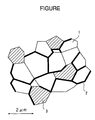
- Figure depicts a typical fine structure of an electroconductive low thermal expansion ceramic sintered body contemplated by this invention.
- the supporting member for a semiconductor producing device In the process for the production of a semiconductor, which requires a processing technique of the highest precision, it has been becoming essential for the positioning to be effected with high precision of not more than 100 nm.
- the supporting member for a semiconductor producing device For the purpose of improving the throughput, the supporting member for a semiconductor producing device must be moved at a high speed to a place prescribed for the positioning.
- any of the members of a semiconductor-producing device forms a major factor for the degradation of precision.
- a member having a thermal expansion coefficient of 10 ⁇ 10 -7 /K and measuring 500 mm in size is subjected to a change of 1°C in its temperature, it gives rise to such a deviation as 500 nm in the terminal surface thereof.
- the absolute value of the thermal expansion coefficient of this member is required to be limited to not more than 1.0 ⁇ 10 -7 /K.
- the supporting member generates vibration in consequence of the movement thereof at a high speed and this vibration forms a factor for lowering precision and reducing a throughput.
- the member is required to exhibit greater specific rigidity than the existing low thermal expansion glass. Particularly, this specific rigidity is required to be not less than 40 GPa/g/cm 3 .
- the member is also required to possess satisfactory electroconductivity for the purpose of preventing the member from being defiled by electrization.
- satisfactory electroconductivity refers to such electroconductivity as realizes a volumetric specific resistance of not more than 1.0 ⁇ 10 7 ⁇ cm.
- the electroconductive low thermal expansion ceramic contemplated by this invention contains mainly a ⁇ -eucryptite phase for the following reason.
- the sintered body is required to have the matrix phase thereof formed of a compound of negative thermal expansion for the purpose of obtaining a ceramic sintered body of low thermal expansion.
- ⁇ -eucryptite phase aluminum titanate, spodumene, and cordierite may be cited. Only when the ⁇ -eucryptite, which exhibits a large negative thermal expansion among them, is used for the matric phase, such low thermal expansion property, electroconductivity, and specific rigidity as are aimed at can be attained.
- TiN or SiC as a dispersing substance is that this substance is capable of heightening the specific rigidity of a complex ceramic to be produced. Even when an electroconductive high-rigidity substance such as WC is utilized as the dispersion particle, it is difficult to attain low thermal expansion and high specific rigidity at the same time.
- the ceramic contemplated by this invention may secure low thermal expansion property, electroconductivity, and high specific rigidity all at once, it is required to contain TiN or SiC particles and the carbon compound at the same time. If these two components are contained independently, the expected properties mentioned above will not be attained even when the content of the TiN or SiC particles or the carbon compound falls in the specified range.
- the sintered body contains 0.5 - 4% by volume of the carbon compound and 0.5 - 12% by volume of the TiN particles or 6 - 24.5% by volume of the SiC particles.
- the quantities in these ranges represent preferred contents of the relevant components for the sake of realizing such thermal expansion coefficient, volumetric resistivity, and specific rigidity specified by this invention.
- the target physical constants of this invention are attained.
- the absolute value of the thermal expansion coefficient of the sintered body exceeds 1.0 ⁇ 10 -7 /K when the content of TiN particles falls short of 0.5% by volume or exceeds 12% by volume or the content of SiC particles falls short of 6% by volume or exceeds 24.5% by volume. Thus, any deviation of such content from the specified range is unfavorable.
- the object of this invention is not attained because the specific rigidity also falls short of 40 GPa/g/cm 3 .
- the content of the carbon compound is smaller than 0.5% by volume, the thermal expansion coefficient is not affected.
- it is larger than 4% by volume however, it becomes difficult to attain the target low thermal expansion coefficient.
- the electroconductivity no sufficient electroconductivity is secured when the content of the carbon compound and the content of TiN particles or the content of SiC particles are smaller than the respectively prescribed quantities.
- the content of the carbon compound if this content exceeds 4% by volume, the excess will result in inhibiting the ceramic from being sintered, lowering the elastic modulus of the sintered body, and confining the specific rigidity below 40 GPa/g/cm 3 .
- the content exceeding 4% by volume therefore, is unfavorable because it does not conform to the object of this invention.
- the average crystal particle diameter of the ⁇ -eucryptite phase ought to assume a magnitude in the range of 0.5 - 5 ⁇ m and that of the TiN particles and that of the SiC particles respectively a magnitude in the range of 0.5 - 3 ⁇ m and a magnitude in the range of 0.2 - 3 ⁇ m.
- satisfactory electroconductivity and low thermal expansion property cannot be simultaneously realized.
- the carbon compound be present as a grain boundary phase in the grain boundary of the ⁇ -eucryptite phase and the TiN particles or the SiC particles and the average thickness of the grain boundary phase in the direction perpendicular to the grain boundary be not more than 10% of the average crystal particle diameter of the ⁇ -eucryptite. If the average thickness exceeds this size, it will become impossible to obtain satisfactory electroconductivity.
- FIG. 1 is a diagram portraying the typical fine texture of an electroconductive low thermal expansion ceramic according to this invention.
- the fine texture is characterized by the fact that TiN or SiC particles 3 are dispersed discretely therein and further the carbon compound 2 is present as a grain boundary phase in at least part of the ⁇ -eucryptite phase 1 and/or the grain boundary of TiN or SiC particles 3.
- the preceding expression that the particles are discretely dispersed in the fine texture describes the fact that TiN or SiC particles 3 are not mutually contacting to form a chain-like network.
- the statement that the carbon compound 2 is present in the ⁇ -eucryptite phase 1 and in the grain boundary of the TiN or SiC particles 3 describes the fact that the carbon compound is present with a certain thickness in the grain boundary.
- This thickness relative to the direction perpendicular to the crystal grain boundary of the ⁇ -eucryptite is preferred to be not more than 10% of the average crystal particle diameter of the ⁇ -eucryptite.
- the statement that the carbon compound is present with a certain thickness in the grain boundary describes the fact that the carbon compound is present contiguously in the form of independent particles to the ⁇ -eucryptite phase and the grain boundary of the TiN or SiC particles or the fact that the carbon compound is in such a situation as entrains segregation of carbon in the neighborhood of grain boundary of crystal particles having an average particle diameter.
- the method which determines this volumetric ratio by cutting the material in an arbitrary plane, measuring area radios of the individual particles appearing in the cut plain, and performing a necessary calculation using the measured area ratios may be utilized. Otherwise, when the volumetric change occurring after the calcination is considered to be negligible, the volumetric ratio may be found from the weight-mixing ratio of components of the raw material powder and the density of each of the components.
- the novel point of the material contemplated by this invention consists in enabling the carbon compound to exist in the form of a thin layer in the ⁇ -eucryptite phase and in the grain boundary of the TiN or SiC particles and secure electroconductivity despite the addition of an electroconductive substance in such a small quantity, as has been heretofore unattainable, by adding the carbon compound and the TiN or SiC particles together in the form of a composite and restricting both the quantities thereof so added and the fine texture of the sintered body, and in realizing such high specific rigidity, as has never been attained by the conventional low thermal expansion material, by selecting either TiN or SiC as the material for the dispersing particles.
- this invention makes it possible by utilizing the carbon compound as an electroconductive grain boundary phase to secure sufficient electroconductivity in spite of the presence of an electroconductive phase in an extremely small quantity as compared with the conventional countertype.
- the presence of the TiN or SiC particles having a specified particle diameter also contributes to the realization of the electroconductivity in consequence of the addition of such particles in the quantity prescribed by this invention.
- the volumetric ratio of the carbon compound would surpass markedly the quantity specified by this invention.
- the presence of the TiN or SiC particles enables the volumetric ratio of the carbon compound to be effectively lowered.
- the carbon compound is not particularly restricted on account of the sort of form but required to be such a substance as survives in the form of an electroconductive substance or varies during the course of calcining the ceramic.
- carbon black, graphite, and titanium carbide may be preferably cited. Among them, the carbon black proves particularly favorable.
- a low thermal expansion ceramic comprising the ⁇ -eucryptite phase as a main component and further incorporating therein TiN particles or SiC particles and a carbon compound, it is possible to secure the electroconductivity in spite of the addition of an electroconductive substance in a markedly small quantity as compared with the prior art and thereby realize a material of such high specific rigidity, electroconductivity, and low thermal expansion as have never been attained heretofore.
- the ceramic sintered body contemplated by this invention has a composition comprising the ⁇ -eucryptite mainly and is formed by the ordinary powder sintering. With the object of attaining compaction of the texture more effectively, such a sintering method as hot press or hot isostatic press may be utilized.
- a sintering method as hot press or hot isostatic press may be utilized.
- the carbon compound and the TiN particles or the SiC particles must exist in the forms mentioned above in the fine texture of the ceramic sintered body.
- first lithium oxide, aluminum oxide, and silicon oxide are weighed out in such quantities as form a eucryptite composition and further a TiN powder or a SiC powder and a carbon compound are weighed out in prescribed quantities and they are mixed together in a ball mill to produce a mixed powder.
- the sources for lithium, aluminum, and silicon are not particularly restricted. Spodumene, petalite, lithium carbonate, etc. may be utilized in a combination thereof.
- the known raw materials containing lithium, aluminum, and silicon may be suitably selected and used herein.
- the carbon compound to be used herein is not particularly restricted on account of factors such as form and origin. Carbon black and graphite may be added.
- the residual carbon of the binder used in the raw material powder, the type of carbon addable during the course of process, and a compound containing carbon may be utilized. Among them, the carbon black may be particularly selected as an inexpensive and optimum raw material.
- the TiN powder is preferred to have an average particle diameter in the range of 0.5 - 3 ⁇ m and the SiC powder an average particle diameter in the range of 0.2 - 3 ⁇ m. If the average particle diameter deviates from this range, it will become difficult to realize a low thermal expansion property and satisfactory electroconductivity at the same time.
- the particle diameter of the raw material of this additive forms an important factor. This particle diameter must be as small as permissible. Particularly when the primary particle diameter is not more than 50 nm, especially not more than 20 nm, the material texture for the sintered body aimed at by this invention can be realized.
- the excess will result in rendering it difficult to obtain the satisfactory electroconductivity with stability.
- known methods such as those which effect the determination by means of a laser scattering or specific surface area may be utilized.
- the mixed powder thus obtained is formed in a required shape by a means such as a molding press and an isostatic press and then calcined. Otherwise, the powder may be placed in a die, pressed, and calcined as in the case of a hot press.
- a means such as a molding press and an isostatic press and then calcined.
- the powder may be placed in a die, pressed, and calcined as in the case of a hot press.
- Other known methods in popular use are also available. The formation is not limited to the methods cited above.
- the temperature is not lower than 1000°C and not higher than 1420°C, preferably not lower than 1250°C and not higher than 1400°C and the atmosphere is formed of oxygen of a concentration of not more than 1000 ppm and preferably formed of an inert gas such as nitrogen or argon of a concentration of not more than 100 ppm.
- the temperature deviates from the range specified above, the deviation will result in preventing the ⁇ -eucryptite phase from being formed with stability and rendering it impossible to attain electroconductivity and a low thermal expansion property at the same time.
- the sintering resorting to the hot press or the hot isostatic press proves advantageous for the purpose of attaining the compaction more effectively.
- the pressure to be used by such a press for the compaction proves effective when it exceeds 10 MPa.
- the calcination temperature and the calcination atmosphere used for the compaction are the same as those described above.
- the mixed powder thus obtained was calcined with a hot press in the atmosphere of nitrogen at a temperature of 1320°C - 1370°C under a pressure of 20 MPa.
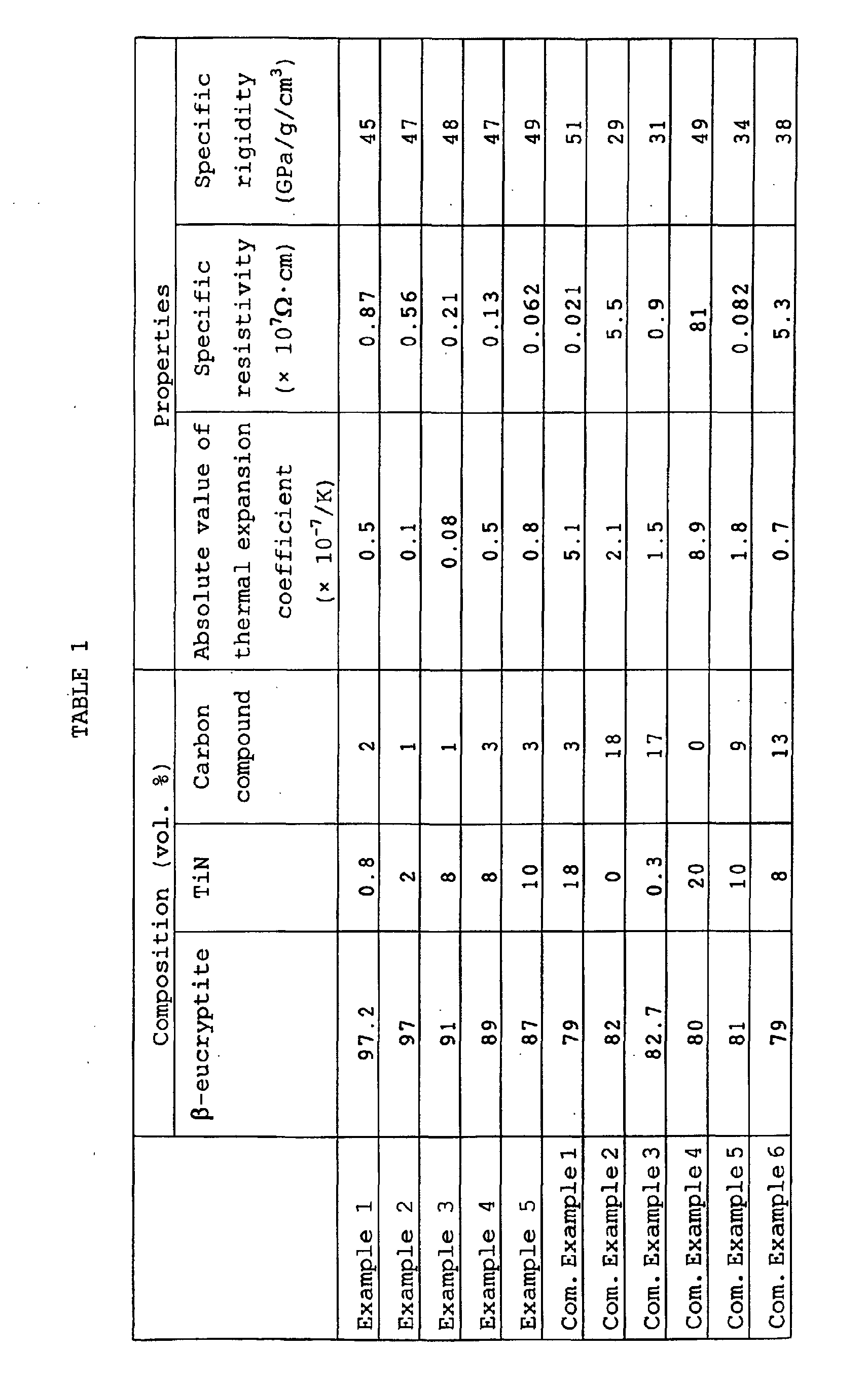
- the quantities of the carbon black and the TiN particles were so adjusted as to form a composition indicated in Table 1 after calcination.
- the volumetric ratios shown in Table 1 were found from the observation of an image under a transmission electron microscope (TEM) and the EDX analysis.
- Comparative Example 6 was performed by following the procedure described above, except that graphite having an average particle diameter of 2.1 ⁇ m was used instead of carbon black.
- the texture of the sintered body thus obtained was composed of a ⁇ -eucryptite phase having an average crystal particle diameter of 0.5 - 5 ⁇ m and TiN particles having an average particle diameter of 0.5 - 3 ⁇ m.
- Comparative Example 6 numerous carbon particles having particle diameters exceeding 1 ⁇ m in the sintered body.
- Table 1 The properties of the produced sintered bodies are shown in Table 1.
- Comparative Example 5 the specific rigidity was markedly low and the absolute value of thermal expansion coefficient failed to reach the target level because the quantity of the carbon compound was unduly large.
- Comparative Example 6 the properties other than the absolute value of thermal expansion coefficient were not satisfied because the fine texture of the sintered body specified by this invention was not realized.
- Comparative Example 12 was performed by following the procedure described above, except that graphite having an average particle diameter of 2.1 ⁇ m was used instead of carbon black.
- the texture of the sintered body thus obtained was composed of a ⁇ -eucryptite phase having an average crystal particle diameter of 0.5 - 5 ⁇ m and SiC particles having an average particle diameter of 0.2 - 3 ⁇ m.
- Comparative Example 12 there were numerous carbon particles having particle diameters exceeding 1 ⁇ m in the sintered body.
- Table 2 The properties of the produced sintered bodies are shown in Table 2.
- Comparative Example 11 the absolute value of thermal expansion coefficient was large and the specific rigidity was low because the quantity of SiC was not sufficient and the quantity of the carbon compound added was unduly large.
- Comparative Example 12 the expected specific resistivity was not obtained because the fine texture of the sintered body specified by this invention was not realized.
- the electroconductive low thermal expansion ceramic contemplated by this invention realizes a material for precision machine components which enjoy light weight and high dimensional stability and befit use in an environment demanding high cleanliness.
Landscapes
- Engineering & Computer Science (AREA)
- Chemical & Material Sciences (AREA)
- Nanotechnology (AREA)
- Ceramic Engineering (AREA)
- Materials Engineering (AREA)
- Organic Chemistry (AREA)
- Structural Engineering (AREA)
- Physics & Mathematics (AREA)
- Composite Materials (AREA)
- Condensed Matter Physics & Semiconductors (AREA)
- General Physics & Mathematics (AREA)
- Crystallography & Structural Chemistry (AREA)
- Manufacturing & Machinery (AREA)
- Compositions Of Oxide Ceramics (AREA)
Abstract
Description

Claims (6)
- An electroconductive low thermal expansion ceramic sintered body, comprising a β-eucryptite phase in a quantity of not less than 75% by volume and not more than 99% by volume, wherein an absolute value of thermal expansion coefficient thereof is not more than 1.0 × 10⁻⁷/K at a temperature in the range of 0°C to 50°C, a volumetric specific resistance thereof is not more than 1.0 × 10⁷ Ω·cm, and a specific rigidity thereof is not less than 40 GPa/g/cm3.
- A ceramic sintered body according to claim 1, wherein a balance less said β-eucryptite phase comprises carbon or a compound containing carbon other than SiC, and TiN or SiC particles.
- A ceramic sintered body according to claim 2, wherein a content of said carbon or said compound containing carbon other than SiC is in the range of 0.5 to 4% by volume, a content of said TiN particles is in the range of 0.5 to 12% by volume, and a content of said SiC particles is in the range of 6 to 24.5% by volume.
- A ceramic sintered body according to claim 1 or claim 2, wherein an average particle diameter of said β-eucryptite phase is in the range of 0.5 to 5 µm, an average particle diameter of said TiN particles is in the range of 0.5 to 3 µm, and an average particle diameter of said SiC particles is in the range of 0.2 to 3 µm.
- A ceramic sintered body according to any of claims 2 - 4, wherein a textural structure of said sintered body has TiN or SiC particles dispersed discretely therein and has the carbon or the compound containing carbon other than SiC formed a grain boundary phase in at least part of the grain boundary of said β-eucryptite phase and/or said TiN or SiC particles.
- A ceramic sintered body according to claim 5, wherein an average thickness of said grain boundary phase in the direction perpendicular to said grain boundary is not more than 10% of an average crystal particle diameter of said β-eucryptite.
Applications Claiming Priority (5)
| Application Number | Priority Date | Filing Date | Title |
|---|---|---|---|
| JP2000168437A JP3665537B2 (en) | 2000-06-06 | 2000-06-06 | Conductive low thermal expansion ceramic sintered body |
| JP2000168437 | 2000-06-06 | ||
| JP2000324518A JP3665553B2 (en) | 2000-10-24 | 2000-10-24 | Conductive low thermal expansion ceramic sintered body |
| JP2000324518 | 2000-10-24 | ||
| PCT/JP2001/004695 WO2001094272A1 (en) | 2000-06-06 | 2001-06-04 | Electrically conductive ceramic sintered compact exhibiting low thermal expansion |
Publications (3)
| Publication Number | Publication Date |
|---|---|
| EP1298104A1 true EP1298104A1 (en) | 2003-04-02 |
| EP1298104A4 EP1298104A4 (en) | 2005-11-23 |
| EP1298104B1 EP1298104B1 (en) | 2007-11-14 |
Family
ID=26593369
Family Applications (1)
| Application Number | Title | Priority Date | Filing Date |
|---|---|---|---|
| EP01934521A Expired - Lifetime EP1298104B1 (en) | 2000-06-06 | 2001-06-04 | Electrically conductive ceramic sintered compact exhibiting low thermal expansion |
Country Status (4)
| Country | Link |
|---|---|
| US (1) | US6953538B2 (en) |
| EP (1) | EP1298104B1 (en) |
| TW (1) | TWI232853B (en) |
| WO (1) | WO2001094272A1 (en) |
Cited By (3)
| Publication number | Priority date | Publication date | Assignee | Title |
|---|---|---|---|---|
| EP1323684A4 (en) * | 2000-09-20 | 2005-09-14 | Sumitomo Metal Ind | CERAMIC WITH LOW THERMAL EXPANSION AND ELEMENT FOR EXPOSURE SYSTEM |
| ES2354099A1 (en) * | 2009-08-27 | 2011-03-10 | Consejo Superior De Investigaciones Cientificas (Csic) | PROCEDURE FOR OBTAINING CERAMIC COMPOUNDS AND MATERIAL OBTAINABLE BY SUCH PROCEDURE. |
| EP2617693A1 (en) * | 2012-01-18 | 2013-07-24 | United Technologies Corporation | Article including ceramic structure |
Families Citing this family (5)
| Publication number | Priority date | Publication date | Assignee | Title |
|---|---|---|---|---|
| DE102004017597B4 (en) * | 2004-04-07 | 2006-06-22 | Hauni Maschinenbau Ag | Resonator housing for microwaves |
| JP4890968B2 (en) * | 2006-06-27 | 2012-03-07 | 黒崎播磨株式会社 | Low thermal expansion ceramic joined body and manufacturing method thereof |
| ES2362229B1 (en) | 2009-12-16 | 2012-05-09 | Consejo Superior De Investigaciones Cientificas (Csic) (50%) | ELECTROCONDUCTOR COMPOSITE MATERIAL WITH CONTROLLED THERMAL EXPANSION COEFFICIENT. |
| ES2362533B1 (en) | 2009-12-21 | 2012-05-17 | Consejo Superior De Investigaciones Cientificas (Csic) | COMPOSITE MATERIAL WITH THERMAL EXPANSION COEFFICIENT CONTROLLED WITH OXIDIC MICAS CERAMICS AND THEIR OBTAINING PROCEDURE. |
| CN113450943B (en) * | 2021-09-02 | 2022-01-04 | 西安宏星电子浆料科技股份有限公司 | Thermal shock resistant conductor paste for thick film circuit |
Family Cites Families (16)
| Publication number | Priority date | Publication date | Assignee | Title |
|---|---|---|---|---|
| US3854963A (en) | 1973-05-11 | 1974-12-17 | Corning Glass Works | AgCl-NUCLEATED GLASS-CERAMIC ARTICLES |
| US4098725A (en) * | 1974-11-28 | 1978-07-04 | Tokyo Denki Kagaku Kogyo Kabushiki Kaisha | Low thermal expansive, electroconductive composite ceramics |
| JPS6012381B2 (en) | 1976-10-06 | 1985-04-01 | 久光製薬株式会社 | thermal compress |
| JPS5826075A (en) * | 1981-08-05 | 1983-02-16 | 松下電器産業株式会社 | Low heat expansion heater composition |
| JPS6037561A (en) | 1983-08-11 | 1985-02-26 | Hitachi Chem Co Ltd | Electrophotographic sensitive body |
| US5001086A (en) * | 1989-10-26 | 1991-03-19 | Corning Incorporated | Sintered glass-ceramic body and method |
| US5179051A (en) * | 1991-12-16 | 1993-01-12 | Uop | High density lithium-based ceramics from zeolites |
| JPH11343168A (en) | 1998-05-29 | 1999-12-14 | Kyocera Corp | Low thermal expansion black ceramics, method of manufacturing the same, and member for semiconductor manufacturing equipment |
| JP4346129B2 (en) | 1998-09-21 | 2009-10-21 | 株式会社オハラ | Composite glass ceramics and method for producing the same |
| JP4069534B2 (en) * | 1999-02-02 | 2008-04-02 | Jsr株式会社 | Method for producing transparent laminated sheet |
| JP3090914B1 (en) * | 1999-04-06 | 2000-09-25 | 新日本製鐵株式会社 | Low thermal expansion high rigidity ceramic sintered body |
| JP3133302B2 (en) * | 1999-06-29 | 2001-02-05 | 新日本製鐵株式会社 | Black low thermal expansion ceramics sintered body and method for producing the same |
| JP4719965B2 (en) * | 1999-10-08 | 2011-07-06 | 東レ株式会社 | Ceramics |
| JP2001302339A (en) * | 2000-04-24 | 2001-10-31 | Taiheiyo Cement Corp | Member for precise measuring instrument and manufacturing method thereof |
| WO2002024600A1 (en) * | 2000-09-20 | 2002-03-28 | Sumitomo Metal Industries, Ltd. | Low thermal expansion ceramic and member for exposure system |
| KR100719185B1 (en) * | 2002-01-31 | 2007-05-16 | 엔지케이 스파크 플러그 캄파니 리미티드 | Ceramic sintered body and its manufacturing method |
-
2001
- 2001-06-04 WO PCT/JP2001/004695 patent/WO2001094272A1/en not_active Ceased
- 2001-06-04 US US10/296,516 patent/US6953538B2/en not_active Expired - Fee Related
- 2001-06-04 EP EP01934521A patent/EP1298104B1/en not_active Expired - Lifetime
- 2001-06-05 TW TW090113575A patent/TWI232853B/en not_active IP Right Cessation
Cited By (7)
| Publication number | Priority date | Publication date | Assignee | Title |
|---|---|---|---|---|
| EP1323684A4 (en) * | 2000-09-20 | 2005-09-14 | Sumitomo Metal Ind | CERAMIC WITH LOW THERMAL EXPANSION AND ELEMENT FOR EXPOSURE SYSTEM |
| US7112549B2 (en) * | 2000-09-20 | 2006-09-26 | Sumitomo Metal Industries, Ltd. | Low thermal expansion ceramic and member for exposure system |
| ES2354099A1 (en) * | 2009-08-27 | 2011-03-10 | Consejo Superior De Investigaciones Cientificas (Csic) | PROCEDURE FOR OBTAINING CERAMIC COMPOUNDS AND MATERIAL OBTAINABLE BY SUCH PROCEDURE. |
| WO2011023842A3 (en) * | 2009-08-27 | 2011-07-14 | Consejo Superior De Investigaciones Científicas (Csic) | Method for obtaining ceramic compounds and resulting material |
| US8828281B2 (en) | 2009-08-27 | 2014-09-09 | Consejo Superior De Investigaciones Cientificas (Csic) | Method for obtaining ceramic compounds and resulting material |
| EP2617693A1 (en) * | 2012-01-18 | 2013-07-24 | United Technologies Corporation | Article including ceramic structure |
| US8822360B2 (en) | 2012-01-18 | 2014-09-02 | United Technologies Corporation | Article including ceramic structure |
Also Published As
| Publication number | Publication date |
|---|---|
| US20030139280A1 (en) | 2003-07-24 |
| TWI232853B (en) | 2005-05-21 |
| WO2001094272A1 (en) | 2001-12-13 |
| EP1298104A4 (en) | 2005-11-23 |
| EP1298104B1 (en) | 2007-11-14 |
| US6953538B2 (en) | 2005-10-11 |
Similar Documents
| Publication | Publication Date | Title |
|---|---|---|
| EP0219933B1 (en) | Sintered silicon carbide ceramic body of high electrical resistivity | |
| EP1323684B9 (en) | Low thermal expansion ceramic and member for exposure system | |
| WO2009096384A1 (en) | POLYCRYSTALLINE MgO SINTERED COMPACT, PROCESS FOR PRODUCING THE POLYCRYSTALLINE MgO SINTERED COMPACT, AND MgO TARGET FOR SPUTTERING | |
| US6953538B2 (en) | Electroconductive low thermal expansion ceramic sintered body | |
| KR20210119009A (en) | Ceramic composite and method of fabricating thereof | |
| JP2003112963A (en) | Alumina sintered body and method for producing the same | |
| JP3150606B2 (en) | Method for controlling specific resistance of silicon carbide sintered body | |
| JP2002226285A (en) | Lightweight ceramic member and method of manufacturing the same | |
| EP0267623B1 (en) | Black sintered body of aluminum nitride and process for producing the same | |
| CA1118799A (en) | Process for forming mullite | |
| JP3665553B2 (en) | Conductive low thermal expansion ceramic sintered body | |
| JP2000128625A (en) | Alumina ceramic sintered body and method for producing the same | |
| JP4533994B2 (en) | Plasma corrosion resistant material, manufacturing method thereof and member thereof | |
| JPH0459658A (en) | Light-transmitting sintered yttria and production thereof | |
| JP3888766B2 (en) | Electrostatic chuck and manufacturing method thereof | |
| JP3665537B2 (en) | Conductive low thermal expansion ceramic sintered body | |
| JP5051834B2 (en) | Thermal shock-resistant electromagnetic shielding material and method for producing the same | |
| JP4542747B2 (en) | Manufacturing method of high strength hexagonal boron nitride sintered body | |
| JPH0974298A (en) | Electromagnetic wave shielding material | |
| JP3328280B2 (en) | Sintered silicon nitride with high toughness, strength and reliability | |
| JP2000247732A (en) | Low resistance ceramics, method of manufacturing the same, and member for semiconductor manufacturing equipment | |
| JP2000103677A (en) | Silicon-impregnated silicon carbide material for semiconductor heat treatment and method for producing the same | |
| JPH11255523A (en) | Mold for forming glass mold and its production | |
| JPS63134570A (en) | Manufacturing method of aluminum nitride sintered body | |
| JP2001172090A (en) | Ceramics |
Legal Events
| Date | Code | Title | Description |
|---|---|---|---|
| PUAI | Public reference made under article 153(3) epc to a published international application that has entered the european phase |
Free format text: ORIGINAL CODE: 0009012 |
|
| 17P | Request for examination filed |
Effective date: 20021227 |
|
| AK | Designated contracting states |
Kind code of ref document: A1 Designated state(s): NL |
|
| A4 | Supplementary search report drawn up and despatched |
Effective date: 20051011 |
|
| GRAP | Despatch of communication of intention to grant a patent |
Free format text: ORIGINAL CODE: EPIDOSNIGR1 |
|
| GRAS | Grant fee paid |
Free format text: ORIGINAL CODE: EPIDOSNIGR3 |
|
| RIN1 | Information on inventor provided before grant (corrected) |
Inventor name: TAKAHASHI, F.C Inventor name: NAKABAYASHI, M.,C/O NIPPON STEEL CORP. Inventor name: NOSE, T.C |
|
| GRAA | (expected) grant |
Free format text: ORIGINAL CODE: 0009210 |
|
| AK | Designated contracting states |
Kind code of ref document: B1 Designated state(s): NL |
|
| PLBE | No opposition filed within time limit |
Free format text: ORIGINAL CODE: 0009261 |
|
| STAA | Information on the status of an ep patent application or granted ep patent |
Free format text: STATUS: NO OPPOSITION FILED WITHIN TIME LIMIT |
|
| 26N | No opposition filed |
Effective date: 20080815 |
|
| PGFP | Annual fee paid to national office [announced via postgrant information from national office to epo] |
Ref country code: NL Payment date: 20090615 Year of fee payment: 9 |
|
| REG | Reference to a national code |
Ref country code: NL Ref legal event code: V1 Effective date: 20110101 |
|
| PG25 | Lapsed in a contracting state [announced via postgrant information from national office to epo] |
Ref country code: NL Free format text: LAPSE BECAUSE OF NON-PAYMENT OF DUE FEES Effective date: 20110101 |