EP1295905A1 - Silicone rubber compositions for the sealing and encapsulation of electric and electronic parts - Google Patents
Silicone rubber compositions for the sealing and encapsulation of electric and electronic parts Download PDFInfo
- Publication number
- EP1295905A1 EP1295905A1 EP02256590A EP02256590A EP1295905A1 EP 1295905 A1 EP1295905 A1 EP 1295905A1 EP 02256590 A EP02256590 A EP 02256590A EP 02256590 A EP02256590 A EP 02256590A EP 1295905 A1 EP1295905 A1 EP 1295905A1
- Authority
- EP
- European Patent Office
- Prior art keywords
- silicone rubber
- rubber composition
- electric
- metal powder
- parts
- Prior art date
- Legal status (The legal status is an assumption and is not a legal conclusion. Google has not performed a legal analysis and makes no representation as to the accuracy of the status listed.)
- Granted
Links
- 239000000203 mixture Substances 0.000 title claims abstract description 62
- 229920002379 silicone rubber Polymers 0.000 title claims abstract description 43
- 239000004945 silicone rubber Substances 0.000 title claims abstract description 42
- 238000005538 encapsulation Methods 0.000 title claims abstract description 10
- 238000007789 sealing Methods 0.000 title claims abstract description 8
- 229910052751 metal Inorganic materials 0.000 claims abstract description 41
- 239000002184 metal Substances 0.000 claims abstract description 40
- 239000000843 powder Substances 0.000 claims abstract description 33
- NINIDFKCEFEMDL-UHFFFAOYSA-N Sulfur Chemical compound [S] NINIDFKCEFEMDL-UHFFFAOYSA-N 0.000 claims abstract description 27
- 239000011593 sulfur Substances 0.000 claims abstract description 26
- 229910052717 sulfur Inorganic materials 0.000 claims abstract description 26
- 229910052976 metal sulfide Inorganic materials 0.000 claims abstract description 7
- VYPSYNLAJGMNEJ-UHFFFAOYSA-N Silicium dioxide Chemical compound O=[Si]=O VYPSYNLAJGMNEJ-UHFFFAOYSA-N 0.000 claims description 31
- 239000007789 gas Substances 0.000 claims description 28
- 229920001296 polysiloxane Polymers 0.000 claims description 17
- RYGMFSIKBFXOCR-UHFFFAOYSA-N Copper Chemical compound [Cu] RYGMFSIKBFXOCR-UHFFFAOYSA-N 0.000 claims description 12
- 229920006136 organohydrogenpolysiloxane Polymers 0.000 claims description 12
- BASFCYQUMIYNBI-UHFFFAOYSA-N platinum Chemical group [Pt] BASFCYQUMIYNBI-UHFFFAOYSA-N 0.000 claims description 12
- 239000000377 silicon dioxide Substances 0.000 claims description 12
- 239000000853 adhesive Substances 0.000 claims description 9
- 239000010949 copper Substances 0.000 claims description 7
- 229910052802 copper Inorganic materials 0.000 claims description 7
- 125000004435 hydrogen atom Chemical group [H]* 0.000 claims description 7
- XEEYBQQBJWHFJM-UHFFFAOYSA-N Iron Chemical compound [Fe] XEEYBQQBJWHFJM-UHFFFAOYSA-N 0.000 claims description 6
- BQCADISMDOOEFD-UHFFFAOYSA-N Silver Chemical group [Ag] BQCADISMDOOEFD-UHFFFAOYSA-N 0.000 claims description 6
- 238000007259 addition reaction Methods 0.000 claims description 6
- 239000003054 catalyst Substances 0.000 claims description 6
- XUIMIQQOPSSXEZ-UHFFFAOYSA-N Silicon Chemical group [Si] XUIMIQQOPSSXEZ-UHFFFAOYSA-N 0.000 claims description 5
- 125000005370 alkoxysilyl group Chemical group 0.000 claims description 5
- PXHVJJICTQNCMI-UHFFFAOYSA-N Nickel Chemical compound [Ni] PXHVJJICTQNCMI-UHFFFAOYSA-N 0.000 claims description 4
- HCHKCACWOHOZIP-UHFFFAOYSA-N Zinc Chemical compound [Zn] HCHKCACWOHOZIP-UHFFFAOYSA-N 0.000 claims description 4
- 150000002739 metals Chemical class 0.000 claims description 4
- 229910052710 silicon Inorganic materials 0.000 claims description 4
- 229910052709 silver Inorganic materials 0.000 claims description 4
- 239000004332 silver Substances 0.000 claims description 4
- 239000004593 Epoxy Substances 0.000 claims description 3
- CIUQDSCDWFSTQR-UHFFFAOYSA-N [C]1=CC=CC=C1 Chemical compound [C]1=CC=CC=C1 CIUQDSCDWFSTQR-UHFFFAOYSA-N 0.000 claims description 3
- 125000002915 carbonyl group Chemical group [*:2]C([*:1])=O 0.000 claims description 3
- 239000000463 material Substances 0.000 claims description 3
- ATJFFYVFTNAWJD-UHFFFAOYSA-N Tin Chemical compound [Sn] ATJFFYVFTNAWJD-UHFFFAOYSA-N 0.000 claims description 2
- 229910052782 aluminium Inorganic materials 0.000 claims description 2
- XAGFODPZIPBFFR-UHFFFAOYSA-N aluminium Chemical compound [Al] XAGFODPZIPBFFR-UHFFFAOYSA-N 0.000 claims description 2
- 239000000945 filler Substances 0.000 claims description 2
- 229910052742 iron Inorganic materials 0.000 claims description 2
- 229910052759 nickel Inorganic materials 0.000 claims description 2
- 229920005989 resin Polymers 0.000 claims description 2
- 239000011347 resin Substances 0.000 claims description 2
- 229910052718 tin Inorganic materials 0.000 claims description 2
- 229910052725 zinc Inorganic materials 0.000 claims description 2
- 239000011701 zinc Substances 0.000 claims description 2
- 239000004411 aluminium Substances 0.000 claims 1
- 238000004519 manufacturing process Methods 0.000 claims 1
- 239000011135 tin Substances 0.000 claims 1
- -1 alkenyl radicals Chemical class 0.000 description 35
- 238000005260 corrosion Methods 0.000 description 13
- 230000007797 corrosion Effects 0.000 description 13
- 125000004432 carbon atom Chemical group C* 0.000 description 8
- YXFVVABEGXRONW-UHFFFAOYSA-N Toluene Chemical compound CC1=CC=CC=C1 YXFVVABEGXRONW-UHFFFAOYSA-N 0.000 description 6
- 125000003342 alkenyl group Chemical group 0.000 description 6
- 125000000391 vinyl group Chemical group [H]C([*])=C([H])[H] 0.000 description 6
- 239000004215 Carbon black (E152) Substances 0.000 description 5
- 238000001723 curing Methods 0.000 description 5
- 229930195733 hydrocarbon Natural products 0.000 description 5
- 150000003254 radicals Chemical class 0.000 description 5
- 229920002554 vinyl polymer Polymers 0.000 description 5
- KDLHZDBZIXYQEI-UHFFFAOYSA-N Palladium Chemical compound [Pd] KDLHZDBZIXYQEI-UHFFFAOYSA-N 0.000 description 4
- RAHZWNYVWXNFOC-UHFFFAOYSA-N Sulphur dioxide Chemical compound O=S=O RAHZWNYVWXNFOC-UHFFFAOYSA-N 0.000 description 4
- GWEVSGVZZGPLCZ-UHFFFAOYSA-N Titan oxide Chemical compound O=[Ti]=O GWEVSGVZZGPLCZ-UHFFFAOYSA-N 0.000 description 4
- 239000002253 acid Substances 0.000 description 4
- 125000001931 aliphatic group Chemical group 0.000 description 4
- 125000002496 methyl group Chemical group [H]C([H])([H])* 0.000 description 4
- 125000001997 phenyl group Chemical group [H]C1=C([H])C([H])=C(*)C([H])=C1[H] 0.000 description 4
- 230000000979 retarding effect Effects 0.000 description 4
- 239000005046 Chlorosilane Substances 0.000 description 3
- 239000000654 additive Substances 0.000 description 3
- KOPOQZFJUQMUML-UHFFFAOYSA-N chlorosilane Chemical compound Cl[SiH3] KOPOQZFJUQMUML-UHFFFAOYSA-N 0.000 description 3
- 230000000052 comparative effect Effects 0.000 description 3
- 125000005388 dimethylhydrogensiloxy group Chemical group 0.000 description 3
- KPUWHANPEXNPJT-UHFFFAOYSA-N disiloxane Chemical class [SiH3]O[SiH3] KPUWHANPEXNPJT-UHFFFAOYSA-N 0.000 description 3
- 229910021485 fumed silica Inorganic materials 0.000 description 3
- PCHJSUWPFVWCPO-UHFFFAOYSA-N gold Chemical compound [Au] PCHJSUWPFVWCPO-UHFFFAOYSA-N 0.000 description 3
- 238000006460 hydrolysis reaction Methods 0.000 description 3
- 239000011256 inorganic filler Substances 0.000 description 3
- 229910003475 inorganic filler Inorganic materials 0.000 description 3
- 238000000034 method Methods 0.000 description 3
- 229920001843 polymethylhydrosiloxane Polymers 0.000 description 3
- 230000003014 reinforcing effect Effects 0.000 description 3
- 239000000565 sealant Substances 0.000 description 3
- 125000001731 2-cyanoethyl group Chemical group [H]C([H])(*)C([H])([H])C#N 0.000 description 2
- 125000003903 2-propenyl group Chemical group [H]C([*])([H])C([H])=C([H])[H] 0.000 description 2
- VTYYLEPIZMXCLO-UHFFFAOYSA-L Calcium carbonate Chemical compound [Ca+2].[O-]C([O-])=O VTYYLEPIZMXCLO-UHFFFAOYSA-L 0.000 description 2
- OKTJSMMVPCPJKN-UHFFFAOYSA-N Carbon Chemical compound [C] OKTJSMMVPCPJKN-UHFFFAOYSA-N 0.000 description 2
- 229910020388 SiO1/2 Inorganic materials 0.000 description 2
- 239000003795 chemical substances by application Substances 0.000 description 2
- 125000004218 chloromethyl group Chemical group [H]C([H])(Cl)* 0.000 description 2
- 125000000068 chlorophenyl group Chemical group 0.000 description 2
- 229910002026 crystalline silica Inorganic materials 0.000 description 2
- 125000004122 cyclic group Chemical group 0.000 description 2
- 229920005645 diorganopolysiloxane polymer Polymers 0.000 description 2
- 230000000694 effects Effects 0.000 description 2
- 239000008393 encapsulating agent Substances 0.000 description 2
- 125000003700 epoxy group Chemical group 0.000 description 2
- 125000001495 ethyl group Chemical group [H]C([H])([H])C([H])([H])* 0.000 description 2
- 125000001207 fluorophenyl group Chemical group 0.000 description 2
- 239000002923 metal particle Substances 0.000 description 2
- 229910052763 palladium Inorganic materials 0.000 description 2
- 238000007747 plating Methods 0.000 description 2
- 229910052697 platinum Inorganic materials 0.000 description 2
- 150000003058 platinum compounds Chemical class 0.000 description 2
- CLSUSRZJUQMOHH-UHFFFAOYSA-L platinum dichloride Chemical compound Cl[Pt]Cl CLSUSRZJUQMOHH-UHFFFAOYSA-L 0.000 description 2
- 125000001436 propyl group Chemical group [H]C([*])([H])C([H])([H])C([H])([H])[H] 0.000 description 2
- 230000001105 regulatory effect Effects 0.000 description 2
- QBERHIJABFXGRZ-UHFFFAOYSA-M rhodium;triphenylphosphane;chloride Chemical compound [Cl-].[Rh].C1=CC=CC=C1P(C=1C=CC=CC=1)C1=CC=CC=C1.C1=CC=CC=C1P(C=1C=CC=CC=1)C1=CC=CC=C1.C1=CC=CC=C1P(C=1C=CC=CC=1)C1=CC=CC=C1 QBERHIJABFXGRZ-UHFFFAOYSA-M 0.000 description 2
- 150000003839 salts Chemical class 0.000 description 2
- SCPYDCQAZCOKTP-UHFFFAOYSA-N silanol Chemical compound [SiH3]O SCPYDCQAZCOKTP-UHFFFAOYSA-N 0.000 description 2
- 235000012239 silicon dioxide Nutrition 0.000 description 2
- 229920002050 silicone resin Polymers 0.000 description 2
- 239000004408 titanium dioxide Substances 0.000 description 2
- KWEKXPWNFQBJAY-UHFFFAOYSA-N (dimethyl-$l^{3}-silanyl)oxy-dimethylsilicon Chemical compound C[Si](C)O[Si](C)C KWEKXPWNFQBJAY-UHFFFAOYSA-N 0.000 description 1
- QYLFHLNFIHBCPR-UHFFFAOYSA-N 1-ethynylcyclohexan-1-ol Chemical compound C#CC1(O)CCCCC1 QYLFHLNFIHBCPR-UHFFFAOYSA-N 0.000 description 1
- 125000005999 2-bromoethyl group Chemical group 0.000 description 1
- WKBOTKDWSSQWDR-UHFFFAOYSA-N Bromine atom Chemical compound [Br] WKBOTKDWSSQWDR-UHFFFAOYSA-N 0.000 description 1
- ZAMOUSCENKQFHK-UHFFFAOYSA-N Chlorine atom Chemical compound [Cl] ZAMOUSCENKQFHK-UHFFFAOYSA-N 0.000 description 1
- SNRUBQQJIBEYMU-UHFFFAOYSA-N Dodecane Natural products CCCCCCCCCCCC SNRUBQQJIBEYMU-UHFFFAOYSA-N 0.000 description 1
- PXGOKWXKJXAPGV-UHFFFAOYSA-N Fluorine Chemical compound FF PXGOKWXKJXAPGV-UHFFFAOYSA-N 0.000 description 1
- 229910003609 H2PtCl4 Inorganic materials 0.000 description 1
- 229910002621 H2PtCl6 Inorganic materials 0.000 description 1
- 229910020427 K2PtCl4 Inorganic materials 0.000 description 1
- AFCARXCZXQIEQB-UHFFFAOYSA-N N-[3-oxo-3-(2,4,6,7-tetrahydrotriazolo[4,5-c]pyridin-5-yl)propyl]-2-[[3-(trifluoromethoxy)phenyl]methylamino]pyrimidine-5-carboxamide Chemical compound O=C(CCNC(=O)C=1C=NC(=NC=1)NCC1=CC(=CC=C1)OC(F)(F)F)N1CC2=C(CC1)NN=N2 AFCARXCZXQIEQB-UHFFFAOYSA-N 0.000 description 1
- 229910019032 PtCl2 Inorganic materials 0.000 description 1
- 229910019029 PtCl4 Inorganic materials 0.000 description 1
- 229910020447 SiO2/2 Inorganic materials 0.000 description 1
- 229910020487 SiO3/2 Inorganic materials 0.000 description 1
- 229910020485 SiO4/2 Inorganic materials 0.000 description 1
- BLRPTPMANUNPDV-UHFFFAOYSA-N Silane Chemical compound [SiH4] BLRPTPMANUNPDV-UHFFFAOYSA-N 0.000 description 1
- UCKMPCXJQFINFW-UHFFFAOYSA-N Sulphide Chemical compound [S-2] UCKMPCXJQFINFW-UHFFFAOYSA-N 0.000 description 1
- FMRLDPWIRHBCCC-UHFFFAOYSA-L Zinc carbonate Chemical compound [Zn+2].[O-]C([O-])=O FMRLDPWIRHBCCC-UHFFFAOYSA-L 0.000 description 1
- 238000013006 addition curing Methods 0.000 description 1
- 230000000996 additive effect Effects 0.000 description 1
- 150000001336 alkenes Chemical class 0.000 description 1
- 125000000217 alkyl group Chemical group 0.000 description 1
- PNEYBMLMFCGWSK-UHFFFAOYSA-N aluminium oxide Inorganic materials [O-2].[O-2].[O-2].[Al+3].[Al+3] PNEYBMLMFCGWSK-UHFFFAOYSA-N 0.000 description 1
- 150000005840 aryl radicals Chemical class 0.000 description 1
- 125000001797 benzyl group Chemical group [H]C1=C([H])C([H])=C(C([H])=C1[H])C([H])([H])* 0.000 description 1
- DSVRVHYFPPQFTI-UHFFFAOYSA-N bis(ethenyl)-methyl-trimethylsilyloxysilane;platinum Chemical compound [Pt].C[Si](C)(C)O[Si](C)(C=C)C=C DSVRVHYFPPQFTI-UHFFFAOYSA-N 0.000 description 1
- GDTBXPJZTBHREO-UHFFFAOYSA-N bromine Substances BrBr GDTBXPJZTBHREO-UHFFFAOYSA-N 0.000 description 1
- 229910052794 bromium Inorganic materials 0.000 description 1
- 125000005998 bromoethyl group Chemical group 0.000 description 1
- 125000004369 butenyl group Chemical group C(=CCC)* 0.000 description 1
- 125000000484 butyl group Chemical group [H]C([*])([H])C([H])([H])C([H])([H])C([H])([H])[H] 0.000 description 1
- 229910000019 calcium carbonate Inorganic materials 0.000 description 1
- 239000000378 calcium silicate Substances 0.000 description 1
- 229910052918 calcium silicate Inorganic materials 0.000 description 1
- OYACROKNLOSFPA-UHFFFAOYSA-N calcium;dioxido(oxo)silane Chemical compound [Ca+2].[O-][Si]([O-])=O OYACROKNLOSFPA-UHFFFAOYSA-N 0.000 description 1
- 229910052799 carbon Inorganic materials 0.000 description 1
- 239000006229 carbon black Substances 0.000 description 1
- 230000015556 catabolic process Effects 0.000 description 1
- 230000003197 catalytic effect Effects 0.000 description 1
- 229910052801 chlorine Inorganic materials 0.000 description 1
- 239000000460 chlorine Substances 0.000 description 1
- 238000013005 condensation curing Methods 0.000 description 1
- 125000000582 cycloheptyl group Chemical group [H]C1([H])C([H])([H])C([H])([H])C([H])([H])C([H])(*)C([H])([H])C1([H])[H] 0.000 description 1
- 125000000596 cyclohexenyl group Chemical group C1(=CCCCC1)* 0.000 description 1
- 125000000113 cyclohexyl group Chemical group [H]C1([H])C([H])([H])C([H])([H])C([H])(*)C([H])([H])C1([H])[H] 0.000 description 1
- 125000001511 cyclopentyl group Chemical group [H]C1([H])C([H])([H])C([H])([H])C([H])(*)C1([H])[H] 0.000 description 1
- 125000002704 decyl group Chemical group [H]C([H])([H])C([H])([H])C([H])([H])C([H])([H])C([H])([H])C([H])([H])C([H])([H])C([H])([H])C([H])([H])C([H])([H])* 0.000 description 1
- 238000006731 degradation reaction Methods 0.000 description 1
- 239000004205 dimethyl polysiloxane Substances 0.000 description 1
- 235000013870 dimethyl polysiloxane Nutrition 0.000 description 1
- 125000003438 dodecyl group Chemical group [H]C([H])([H])C([H])([H])C([H])([H])C([H])([H])C([H])([H])C([H])([H])C([H])([H])C([H])([H])C([H])([H])C([H])([H])C([H])([H])C([H])([H])* 0.000 description 1
- 229920001971 elastomer Polymers 0.000 description 1
- 238000010292 electrical insulation Methods 0.000 description 1
- 230000002708 enhancing effect Effects 0.000 description 1
- NKSJNEHGWDZZQF-UHFFFAOYSA-N ethenyl(trimethoxy)silane Chemical compound CO[Si](OC)(OC)C=C NKSJNEHGWDZZQF-UHFFFAOYSA-N 0.000 description 1
- WOXXJEVNDJOOLV-UHFFFAOYSA-N ethenyl-tris(2-methoxyethoxy)silane Chemical compound COCCO[Si](OCCOC)(OCCOC)C=C WOXXJEVNDJOOLV-UHFFFAOYSA-N 0.000 description 1
- 230000009969 flowable effect Effects 0.000 description 1
- 229910052731 fluorine Inorganic materials 0.000 description 1
- 239000011737 fluorine Substances 0.000 description 1
- 238000009472 formulation Methods 0.000 description 1
- 125000000524 functional group Chemical group 0.000 description 1
- 239000011521 glass Substances 0.000 description 1
- 229910052737 gold Inorganic materials 0.000 description 1
- 239000010931 gold Substances 0.000 description 1
- 125000005843 halogen group Chemical group 0.000 description 1
- 238000010438 heat treatment Methods 0.000 description 1
- 125000003187 heptyl group Chemical group [H]C([*])([H])C([H])([H])C([H])([H])C([H])([H])C([H])([H])C([H])([H])C([H])([H])[H] 0.000 description 1
- 125000006038 hexenyl group Chemical group 0.000 description 1
- 125000004051 hexyl group Chemical group [H]C([H])([H])C([H])([H])C([H])([H])C([H])([H])C([H])([H])C([H])([H])* 0.000 description 1
- 238000006459 hydrosilylation reaction Methods 0.000 description 1
- 239000012535 impurity Substances 0.000 description 1
- UQSXHKLRYXJYBZ-UHFFFAOYSA-N iron oxide Inorganic materials [Fe]=O UQSXHKLRYXJYBZ-UHFFFAOYSA-N 0.000 description 1
- 125000000959 isobutyl group Chemical group [H]C([H])([H])C([H])(C([H])([H])[H])C([H])([H])* 0.000 description 1
- 125000000555 isopropenyl group Chemical group [H]\C([H])=C(\*)C([H])([H])[H] 0.000 description 1
- 125000001449 isopropyl group Chemical group [H]C([H])([H])C([H])(*)C([H])([H])[H] 0.000 description 1
- 125000006178 methyl benzyl group Chemical group 0.000 description 1
- 238000012986 modification Methods 0.000 description 1
- 230000004048 modification Effects 0.000 description 1
- 125000001624 naphthyl group Chemical group 0.000 description 1
- 125000001971 neopentyl group Chemical group [H]C([*])([H])C(C([H])([H])[H])(C([H])([H])[H])C([H])([H])[H] 0.000 description 1
- 125000001400 nonyl group Chemical group [H]C([*])([H])C([H])([H])C([H])([H])C([H])([H])C([H])([H])C([H])([H])C([H])([H])C([H])([H])C([H])([H])[H] 0.000 description 1
- 125000002347 octyl group Chemical group [H]C([*])([H])C([H])([H])C([H])([H])C([H])([H])C([H])([H])C([H])([H])C([H])([H])C([H])([H])[H] 0.000 description 1
- 150000001451 organic peroxides Chemical class 0.000 description 1
- 150000003961 organosilicon compounds Chemical class 0.000 description 1
- NDLPOXTZKUMGOV-UHFFFAOYSA-N oxo(oxoferriooxy)iron hydrate Chemical compound O.O=[Fe]O[Fe]=O NDLPOXTZKUMGOV-UHFFFAOYSA-N 0.000 description 1
- 125000001147 pentyl group Chemical group C(CCCC)* 0.000 description 1
- 125000000286 phenylethyl group Chemical group [H]C1=C([H])C([H])=C(C([H])=C1[H])C([H])([H])C([H])([H])* 0.000 description 1
- 125000004344 phenylpropyl group Chemical group 0.000 description 1
- 230000000704 physical effect Effects 0.000 description 1
- 229920000435 poly(dimethylsiloxane) Polymers 0.000 description 1
- 125000004368 propenyl group Chemical group C(=CC)* 0.000 description 1
- 229910052703 rhodium Inorganic materials 0.000 description 1
- 239000010948 rhodium Substances 0.000 description 1
- MHOVAHRLVXNVSD-UHFFFAOYSA-N rhodium atom Chemical compound [Rh] MHOVAHRLVXNVSD-UHFFFAOYSA-N 0.000 description 1
- 239000005060 rubber Substances 0.000 description 1
- 229910000077 silane Inorganic materials 0.000 description 1
- 125000000999 tert-butyl group Chemical group [H]C([H])([H])C(*)(C([H])([H])[H])C([H])([H])[H] 0.000 description 1
- FBEIPJNQGITEBL-UHFFFAOYSA-J tetrachloroplatinum Chemical compound Cl[Pt](Cl)(Cl)Cl FBEIPJNQGITEBL-UHFFFAOYSA-J 0.000 description 1
- 230000009974 thixotropic effect Effects 0.000 description 1
- 125000003944 tolyl group Chemical group 0.000 description 1
- 239000011995 wilkinson's catalyst Substances 0.000 description 1
- 125000005023 xylyl group Chemical group 0.000 description 1
- 239000011667 zinc carbonate Substances 0.000 description 1
- 229910000010 zinc carbonate Inorganic materials 0.000 description 1
- 235000004416 zinc carbonate Nutrition 0.000 description 1
Images

Classifications
-
- H—ELECTRICITY
- H01—ELECTRIC ELEMENTS
- H01B—CABLES; CONDUCTORS; INSULATORS; SELECTION OF MATERIALS FOR THEIR CONDUCTIVE, INSULATING OR DIELECTRIC PROPERTIES
- H01B3/00—Insulators or insulating bodies characterised by the insulating materials; Selection of materials for their insulating or dielectric properties
- H01B3/18—Insulators or insulating bodies characterised by the insulating materials; Selection of materials for their insulating or dielectric properties mainly consisting of organic substances
- H01B3/30—Insulators or insulating bodies characterised by the insulating materials; Selection of materials for their insulating or dielectric properties mainly consisting of organic substances plastics; resins; waxes
- H01B3/46—Insulators or insulating bodies characterised by the insulating materials; Selection of materials for their insulating or dielectric properties mainly consisting of organic substances plastics; resins; waxes silicones
-
- C—CHEMISTRY; METALLURGY
- C08—ORGANIC MACROMOLECULAR COMPOUNDS; THEIR PREPARATION OR CHEMICAL WORKING-UP; COMPOSITIONS BASED THEREON
- C08K—Use of inorganic or non-macromolecular organic substances as compounding ingredients
- C08K3/00—Use of inorganic substances as compounding ingredients
- C08K3/02—Elements
- C08K3/08—Metals
-
- Y—GENERAL TAGGING OF NEW TECHNOLOGICAL DEVELOPMENTS; GENERAL TAGGING OF CROSS-SECTIONAL TECHNOLOGIES SPANNING OVER SEVERAL SECTIONS OF THE IPC; TECHNICAL SUBJECTS COVERED BY FORMER USPC CROSS-REFERENCE ART COLLECTIONS [XRACs] AND DIGESTS
- Y10—TECHNICAL SUBJECTS COVERED BY FORMER USPC
- Y10T—TECHNICAL SUBJECTS COVERED BY FORMER US CLASSIFICATION
- Y10T428/00—Stock material or miscellaneous articles
- Y10T428/31504—Composite [nonstructural laminate]
- Y10T428/31652—Of asbestos
- Y10T428/31663—As siloxane, silicone or silane
Definitions
- This invention relates to silicone rubber compositions useful in the sealing and encapsulation of electric and electronic parts, e.g. preventing or retarding the electric and electronic parts from corrosion with sulfur-containing gas.
- Silicone rubber compositions are traditionally used for the sealing and encapsulation of electric and electronic parts for the purpose of preventing or retarding corrosion and degradation thereof.
- sulfur-containing gases such as sulfur gas and sulfur dioxide gas
- conventional silicone rubbers fail to prevent or retard the sulfur-containing gas from reaching the electric and electronic parts. In particular, they are not effective for preventing or retarding corrosion of metal parts.
- the aim here is to provide new and useful silicone rubber compositions suitable for encapsulating electronic or electric parts, and which preferably prevent or retard sulfur-containing gas from reaching the electric and electronic parts.
- the use of the composition for encapsulation and the corresponding encapsulated parts are further aspects of the invention.
- a silicone rubber composition which contains 0.5 to 90% by weight of a metal powder and is curable into an electrically non-conductive silicone rubber having a volume resistivity of at least 1x10 9 ⁇ cm.
- the metal powder is copper or analogous metal which is sulfidable with a sulfur-containing gas, it is converted upon contact with the gas into a metal sulfide powder, to prevent or retard the sulfur-containing gas from reaching the electric and electronic parts.
- a silicone rubber composition for the sealing and encapsulation of electric and electronic parts comprising 0.5 to 90% by weight of a metal powder, the composition curing into a non-conductive silicone rubber having a volume resistivity of at least 1 ⁇ 10 9 ⁇ cm.
- the metal powder is sulfidable with a sulfur-containing gas into a metal sulfide powder which prevents or retards the sulfur-containing gas from reaching the electric and electronic parts.
- the metal powder is copper.
- the composition may also usefully contain silica filler.
- FIG. 1 schematically illustrates a corrosion test.
- the silicone rubber composition of the invention contains (A) 0.5 to 90% by weight based on the entire composition of a metal powder and cures into a non-conductive silicone rubber. It is intended for the sealing and encapsulation of electric and electronic parts. If the metal powder is sulfidable with a sulfur-containing gas, the resulting metal sulfide powder can prevent or retard the sulfur-containing gas from reaching the electric and electronic parts.
- the metal powder (A) is sulfidable with a sulfur-containing gas into a metal sulfide powder which prevents or retards the sulfur-containing gas from reaching the electric and electronic parts.
- sulfidable metals include silver, copper, iron, nickel, aluminum, tin and zinc. Of these, copper powder is preferred for stability in the composition and economy.
- the metal powder is added to the composition in a sufficient amount to prevent or retard the sulfur-containing gas from reaching the electric and electronic parts and specifically, 0.5 to 90% by weight to attain that object.
- the preferred amount is 1 to 70%, and especially 2 to 50% by weight based on the entire composition.
- the metal powder is sulfided with a sulfur-containing gas into a metal sulfide powder which can prevent or retard the sulfur-containing gas from reaching the electric and electronic parts.
- the cured silicone rubber becomes conductive (i.e., having a volume resistivity of less than 1 ⁇ 10 9 ⁇ cm), it is unsatisfactory as an electric and electronic part sealant or encapsulant. It is then necessary to acquire a volume resistivity above the specific level.
- the type and amount of the metal powder must be selected such that the cured silicone rubber composition may have a volume resistivity of at least 1 ⁇ 10 9 ⁇ cm, especially at least 1 ⁇ 10 10 ⁇ cm.
- the silicone rubber composition used herein may be selected from compositions of various curing types including addition reaction, organic peroxide and condensation curing types. Compositions of the addition reaction curing type are preferred because the process time on use can be shortened.
- the preferred silicone rubber composition of the addition reaction curing type contains (B) an organopolysiloxane containing at least two alkenyl radicals in a molecule, (C) an organohydrogenpolysiloxane containing at least two hydrogen atoms each attached to a silicon atom in a molecule, and (D) a platinum group metal catalyst.
- an adhesive agent having at least one functional radical selected from among an epoxy, alkoxysilyl, carbonyl and phenyl radical is added for enhancing the adhesion of the composition to electric and electronic parts or casings thereof. Suitable respective components are described below in detail.
- the alkenyl-containing organopolysiloxane used herein is an organopolysiloxane containing at least two alkenyl radicals in a molecule. It is generally a linear organopolysiloxane whose backbone is basically composed of recurring diorganosiloxane units and which is blocked at either end with a triorganosiloxy radical, although it may also be branched (containing a branched structure as part of its molecular structure) or cyclic one. For the mechanical strength and other physical properties of the cured composition, a linear diorganopolysiloxane is preferred.
- alkenyl radicals may be located solely at both ends of the molecular chain or at both ends and intermediate positions of the molecular chain.
- Typical alkenyl-containing organopolysiloxanes are diorganopolysiloxanes of the following general formula (1).
- R 1 is independently a substituted or unsubstituted monovalent hydrocarbon radical free of aliphatic unsaturation
- X is alkenyl
- n is an integer of 0, 1 or greater
- m is an integer of 0, 1 or greater.
- Illustrative, non-limiting examples of the substituted or unsubstituted monovalent hydrocarbon radical free of aliphatic unsaturation represented by R 1 include alkyl radicals such as methyl, ethyl, propyl, isopropyl, butyl, isobutyl, tert-butyl, pentyl, neopentyl, hexyl, heptyl, octyl, nonyl, decyl and dodecyl; cycloalkyl radicals such as cyclopentyl, cyclohexyl and cycloheptyl; aryl radicals such as phenyl, tolyl, xylyl, naphthyl and biphenylyl; aralkyl radicals such as benzyl, phenylethyl, phenylpropyl and methylbenzyl; and substituted ones of the foregoing radicals in which some or all of the hydrogen atom
- Typical are those of 1 to 10 carbon atoms, especially 1 to 6 carbon atoms.
- Preferred are substituted or unsubstituted alkyl radicals of 1 to 3 carbon atoms such as methyl, ethyl, propyl, chloromethyl, bromoethyl, 3,3,3-trifluoropropyl, and cyanoethyl and substituted or unsubstituted phenyl radicals such as phenyl, chlorophenyl and fluorophenyl.
- alkenyl radical represented by X examples include those of about 2 to about 8 carbon atoms, such as vinyl, allyl, propenyl, isopropenyl, butenyl, hexenyl and cyclohexenyl. Of these, lower alkenyl radicals such as vinyl and allyl are preferred.
- n is an integer of 0, 1 or greater
- m is an integer of 0, 1 or greater.
- n and m are integers satisfying 10 ⁇ n+m ⁇ 10,000, more preferably 50 ⁇ n+m ⁇ 2,000 and 0 ⁇ m/(n+m) ⁇ 0.2.
- the alkenyl-containing organopolysiloxanes have a viscosity of about 10 to 1,000,000 centistokes (cSt) at 25°C, more preferably about 100 to 500,000 cSt at 25°C.
- cSt centistokes
- the organohydrogenpolysiloxane used herein has at least two, preferably at least three hydrogen atoms each attached to a silicon atom (i.e., SiH radicals) per molecule. It may be linear, branched or cyclic, or resinous one of three-dimensional network structure is also acceptable.
- Typical organohydrogenpolysiloxanes have the following average compositional formula (2).
- R 2 independently stands for substituted or unsubstituted monovalent hydrocarbon radicals free of aliphatic unsaturation
- a and b are numbers in the range: 0 ⁇ a ⁇ 2, 0.8 ⁇ b ⁇ 2 and 0.8 ⁇ a+b ⁇ 3, and preferably 0.05 ⁇ a ⁇ 1, 1.5 ⁇ b ⁇ 2, and 1.8 ⁇ a+b ⁇ 2.7.
- Examples of the substituted or unsubstituted monovalent hydrocarbon radicals free of aliphatic unsaturation represented by R 2 are as enumerated for R 1 in formula (1), typically those of 1 to 10 carbon atoms, especially 1 to 7 carbon atoms, preferably lower alkyl radicals of 1 to 3 carbon atoms (e.g., methyl), phenyl and 3,3,3-trifluoropropyl.
- organohydrogenpolysiloxanes examples include siloxane oligomers such as 1,1,3,3-tetramethyldisiloxane, 1,3,5,7-tetramethyltetracyclo-siloxane, and 1,3,5,7,8-pentamethylpentacyclosiloxane; both end trimethylsiloxy radical-blocked methylhydrogenpolysiloxane, both end trimethylsiloxy radical-blocked dimethylsiloxane-methylhydrogensiloxane copolymers, both end silanol radical-blocked methylhydrogenpolysiloxane, both end silanol radical-blocked dimethylsiloxane-methylhydrogensiloxane copolymers, both end dimethylhydrogensiloxy radical-blocked dimethylpolysiloxane, both end dimethylhydrogensiloxy radical-blocked methylhydrogenpolysiloxane, both end dimethylhydrogensiloxy radical-blocked methyl
- n is an integer of 0 to 200, preferably 0 to 100
- m is an integer of 2 to 200, preferably 2 to 100
- n+m is 2 to 400, preferably 2 to 200.
- the organohydrogenpolysiloxane used herein may be prepared by well-known methods, for example, by co-hydrolysis of at least one chlorosilane selected from R 2 SiHCl 2 and R 2 2 SiHCl wherein R 2 is as defined above, or co-hydrolysis of a mixture of the foregoing chlorosilane and at least one chlorosilane selected from R 2 3 SiCl and R 2 2 SiCl 2 wherein R 2 is as defined above.
- a polysiloxane resulting from such co-hydrolysis may be equilibrated into an organohydrogenpolysiloxane which is also useful herein.
- organohydrogenpolysiloxane (C) used usually gives 0.5 to 4 mol, preferably 1 to 2.5 mol of silicon-bonded hydrogen atoms (i.e., SiH radicals) in the organohydrogenpolysiloxane (C) available per mol of alkenyl radicals in the organopolysiloxane (B).
- platinum group metal catalyst used herein serves to promote addition reaction between alkenyl groups in component (B) and silicon-bonded hydrogen atoms in component (C),
- Platinum group metal elements such as platinum (inclusive of platinum black), rhodium and palladium
- platinum chloride, chloroplatinic acid and salts thereof such as H 2 PtCl 4 ⁇ nH 2 O, H 2 PtCl 6 ⁇ nH 2 O, NaHPtCl 6 ⁇ nH 2 O, KHPtCl 6 ⁇ nH 2 O, Na 2 PtCl 6 ⁇ nH 2 O, K 2 PtCl 4 ⁇ nH 2 O, PtCl 4 ⁇ nH 2 O, PtCl 2 , and Na 2 HPtCl 4 ⁇ nH 2 O wherein n is an integer of 0 to 6, preferably 0 or 6; alcohol-modified chloroplatinic acid (see USP 3,220,972); complexes of chloroplatinic acid (see USP 3,220,972)
- the catalyst (D) is used in a catalytic amount, typically in an amount to provide about 0.1 to 500 ppm, especially about 0.5 to 200 ppm of platinum group metal based on the weight of components (B) and (C) combined.
- Finely divided silica is an additive effective for maintaining electrical properties of the composition. Since the metal powder (A) tends to increase the conductivity of cured silicone rubber (or reduce the volume resistivity thereof), the electrical properties necessary as a sealant may be unsatisfactory as the amount of the metal powder added increases. If finely divided silica is added to this composition, silica particles bind to surfaces of metal particles, prevent metal particles from binding together, and eventually serve to maintain the volume resistivity of cured silicone rubber, that is, maintain the volume resistivity at or above 1 ⁇ 10 9 ⁇ cm.
- Finely divided silicas are available in several forms including crystalline, fused and fumed silicas. For the above purpose, addition of fumed silica is most preferred.
- the finely divided silica (E) is preferably added in an amount of at least 0.2 part by weight per 100 parts by weight of the organopolysiloxane (B), For ease of handling of the composition on use, it is recommended to add 0.5 to 30 parts by weight of silica.
- An adhesive agent is preferably added although it is an optional component.
- the adhesive agent used herein is an organosilicon compound (such as silane or siloxane) having at least one functional radical selected from among an epoxy, alkoxysilyl, carbonyl and phenyl radical.
- an organosilane compound having at least one functional group selected from vinyl group, epoxy group, (meth)acryloxy and phenyl group and at least one alkoxysilyl group is preferred.
- a linear or cyclic organosiloxane oligomer having 4 to 20 silicon atoms and having at least one group selected from epoxy group and alkoxysilyl and at least one hydrogen atom directly attached to silicon atom (i.e., SiH group) is also preferably used. It is preferably a component that makes the inventive composition self-adhesive to metals or organic resins or both.
- the inventive composition may contain other additives if necessary.
- additives include calcium carbonate; zinc carbonate; reinforcing inorganic fillers such as fumed titanium dioxide; reinforcing silicone resins; and non-reinforcing inorganic fillers such as calcium silicate, titanium dioxide, ferric oxide and carbon black. These inorganic fillers are usually used in amounts of 0 to 200 parts by weight per 100 parts by weight of the remaining components combined.
- the inventive composition may be of the two part type in which the components are divided into two parts which are to be combined and cured on use. However, it is preferred for ease of working on use that the invention composition be of one part type.
- the inventive composition thus formulated may be prepared as a flowable composition or a thixotropic composition.
- the addition curing type silicone rubber composition of the invention may be cured by similar methods under similar conditions as are well known for conventional curable silicone rubber compositions. preferably it is curable at room temperature, but may be heated if desired.
- the silicone rubber composition of the invention is used for the sealing and encapsulation of electric and electronic parts in a similar manner to well-known sealants and encapsulants.
- the cured silicone rubber composition or silicone rubber has heat resistance and improved electrical insulation.
- a sulfur-containing gas e.g., sulfur gas, sulfur dioxide gas or sulfide gas
- the metal powder dispersed in the cured product is sulfided with the sulfur-containing gas whereby the sulfur-containing gas is prevented or retarded from reaching the underlying electric and electronic parts.
- the electric and electronic parts are thus protected from the sulfur-containing gas.
- silicone rubber compositions of the one part, addition reaction curing type were prepared to the formulation shown in Table 1.
- compositions were cured under heating conditions of 120°C and one hour.
- the cured rubbers were measured for hardness and volume resistivity and subjected to a corrosion test as described below. The results are also shown in Table 1.
- Me is methyl
- a silver-plated copper plate 2 was placed in a glass vessel 1, a cured sheet 3 of the silicone rubber composition (0.8 mm thick) was placed over the vessel 1, and 0.10 g of sulfur powder 4 was rested on the sheet 3.
- the vessel 1 was closed with a metal cap 5.
- the vessel was held in a thermostat chamber at 70°C for several days while the degree of corrosion on the silver plating was visually observed at suitable intervals.
- the sample was rated " ⁇ " for no corrosion and "X" for corrosion observed as blackening.
- Comparative Example 2 using gold i.e., the metal powder which is not sulfidable with sulfur gas, fails to retard the corrosion of inside silver plating whereas the sulfidable metal powders as typified by copper within the scope of the invention are effective for retarding the corrosion. It is also evident that the inclusion of at least 0.2 part, preferably at least 0.5 part of silica fines is effective in preventing the volume resistivity from lowering.
- the silicone rubber compositions of the invention are used in the encapsulation of electric and electronic parts as the effective means for preventing metals from corrosion with sulfur-containing gas.
Landscapes
- Chemical & Material Sciences (AREA)
- Health & Medical Sciences (AREA)
- Chemical Kinetics & Catalysis (AREA)
- Medicinal Chemistry (AREA)
- Polymers & Plastics (AREA)
- Organic Chemistry (AREA)
- Physics & Mathematics (AREA)
- Spectroscopy & Molecular Physics (AREA)
- Compositions Of Macromolecular Compounds (AREA)
- Sealing Material Composition (AREA)
- Structures Or Materials For Encapsulating Or Coating Semiconductor Devices Or Solid State Devices (AREA)
- Adhesives Or Adhesive Processes (AREA)
Abstract
Description
- This invention relates to silicone rubber compositions useful in the sealing and encapsulation of electric and electronic parts, e.g. preventing or retarding the electric and electronic parts from corrosion with sulfur-containing gas.
- Silicone rubber compositions are traditionally used for the sealing and encapsulation of electric and electronic parts for the purpose of preventing or retarding corrosion and degradation thereof. When electric and electronic parts are exposed to sulfur-containing gases such as sulfur gas and sulfur dioxide gas, conventional silicone rubbers fail to prevent or retard the sulfur-containing gas from reaching the electric and electronic parts. In particular, they are not effective for preventing or retarding corrosion of metal parts.
- The aim here is to provide new and useful silicone rubber compositions suitable for encapsulating electronic or electric parts, and which preferably prevent or retard sulfur-containing gas from reaching the electric and electronic parts. The use of the composition for encapsulation and the corresponding encapsulated parts are further aspects of the invention.
- We propose a silicone rubber composition which contains 0.5 to 90% by weight of a metal powder and is curable into an electrically non-conductive silicone rubber having a volume resistivity of at least 1x10⁹ Ω·cm. Especially when the metal powder is copper or analogous metal which is sulfidable with a sulfur-containing gas, it is converted upon contact with the gas into a metal sulfide powder, to prevent or retard the sulfur-containing gas from reaching the electric and electronic parts.
- According to the invention, there is provided a silicone rubber composition for the sealing and encapsulation of electric and electronic parts, comprising 0.5 to 90% by weight of a metal powder, the composition curing into a non-conductive silicone rubber having a volume resistivity of at least 1×10⁹ Ω·cm.
- In a preferred embodiment, the metal powder is sulfidable with a sulfur-containing gas into a metal sulfide powder which prevents or retards the sulfur-containing gas from reaching the electric and electronic parts. Most often, the metal powder is copper. The composition may also usefully contain silica filler.
- FIG. 1 schematically illustrates a corrosion test.
- The silicone rubber composition of the invention contains (A) 0.5 to 90% by weight based on the entire composition of a metal powder and cures into a non-conductive silicone rubber. It is intended for the sealing and encapsulation of electric and electronic parts. If the metal powder is sulfidable with a sulfur-containing gas, the resulting metal sulfide powder can prevent or retard the sulfur-containing gas from reaching the electric and electronic parts.
- In a preferred embodiment, the metal powder (A) is sulfidable with a sulfur-containing gas into a metal sulfide powder which prevents or retards the sulfur-containing gas from reaching the electric and electronic parts. Examples of such sulfidable metals include silver, copper, iron, nickel, aluminum, tin and zinc. Of these, copper powder is preferred for stability in the composition and economy.
- No particular limits need be imposed on the shape and properties of the metal powder in order for the metal powder to exert the desired effects although an atomized metal powder is preferred for the supply of impurity and fluidity to the composition.
- The metal powder is added to the composition in a sufficient amount to prevent or retard the sulfur-containing gas from reaching the electric and electronic parts and specifically, 0.5 to 90% by weight to attain that object. From the standpoints of composition fluidity and cured composition's volume resistivity, the preferred amount is 1 to 70%, and especially 2 to 50% by weight based on the entire composition.
- As described above, the metal powder is sulfided with a sulfur-containing gas into a metal sulfide powder which can prevent or retard the sulfur-containing gas from reaching the electric and electronic parts. If the cured silicone rubber becomes conductive (i.e., having a volume resistivity of less than 1×10⁹ Ω·cm), it is unsatisfactory as an electric and electronic part sealant or encapsulant. It is then necessary to acquire a volume resistivity above the specific level. The type and amount of the metal powder must be selected such that the cured silicone rubber composition may have a volume resistivity of at least 1×10⁹ Ω·cm, especially at least 1×10¹⁰ Ω·cm.
- The silicone rubber composition used herein may be selected from compositions of various curing types including addition reaction, organic peroxide and condensation curing types. Compositions of the addition reaction curing type are preferred because the process time on use can be shortened. The preferred silicone rubber composition of the addition reaction curing type contains (B) an organopolysiloxane containing at least two alkenyl radicals in a molecule, (C) an organohydrogenpolysiloxane containing at least two hydrogen atoms each attached to a silicon atom in a molecule, and (D) a platinum group metal catalyst. In the silicone rubber composition, (E) at least 0.2 part by weight of finely divided silica per 100 parts by weight of the organopolysiloxane (B) is preferably added for preventing any reduction of volume resistivity by the inclusion of the metal powder and maintaining the composition non-conductive. Optionally, (F) an adhesive agent having at least one functional radical selected from among an epoxy, alkoxysilyl, carbonyl and phenyl radical is added for enhancing the adhesion of the composition to electric and electronic parts or casings thereof. Suitable respective components are described below in detail.
- The alkenyl-containing organopolysiloxane used herein is an organopolysiloxane containing at least two alkenyl radicals in a molecule. It is generally a linear organopolysiloxane whose backbone is basically composed of recurring diorganosiloxane units and which is blocked at either end with a triorganosiloxy radical, although it may also be branched (containing a branched structure as part of its molecular structure) or cyclic one. For the mechanical strength and other physical properties of the cured composition, a linear diorganopolysiloxane is preferred. The alkenyl radicals may be located solely at both ends of the molecular chain or at both ends and intermediate positions of the molecular chain. Typical alkenyl-containing organopolysiloxanes are diorganopolysiloxanes of the following general formula (1).

- Herein, R1 is independently a substituted or unsubstituted monovalent hydrocarbon radical free of aliphatic unsaturation, X is alkenyl, n is an integer of 0, 1 or greater, and m is an integer of 0, 1 or greater.
- Illustrative, non-limiting examples of the substituted or unsubstituted monovalent hydrocarbon radical free of aliphatic unsaturation represented by R1 include alkyl radicals such as methyl, ethyl, propyl, isopropyl, butyl, isobutyl, tert-butyl, pentyl, neopentyl, hexyl, heptyl, octyl, nonyl, decyl and dodecyl; cycloalkyl radicals such as cyclopentyl, cyclohexyl and cycloheptyl; aryl radicals such as phenyl, tolyl, xylyl, naphthyl and biphenylyl; aralkyl radicals such as benzyl, phenylethyl, phenylpropyl and methylbenzyl; and substituted ones of the foregoing radicals in which some or all of the hydrogen atoms attached to carbon atoms are substituted with halogen atoms (e.g., fluorine, chlorine and bromine), cyano radicals or the like, such as chloromethyl, 2-bromoethyl, 3-chloropropyl, 3,3,3-trifluoropropyl, chlorophenyl, fluorophenyl, cyanoethyl, and 3,3,4,4,5,5,6,6,6-nonafluorohexyl. Typical are those of 1 to 10 carbon atoms, especially 1 to 6 carbon atoms. Preferred are substituted or unsubstituted alkyl radicals of 1 to 3 carbon atoms such as methyl, ethyl, propyl, chloromethyl, bromoethyl, 3,3,3-trifluoropropyl, and cyanoethyl and substituted or unsubstituted phenyl radicals such as phenyl, chlorophenyl and fluorophenyl.
- Examples of the alkenyl radical represented by X include those of about 2 to about 8 carbon atoms, such as vinyl, allyl, propenyl, isopropenyl, butenyl, hexenyl and cyclohexenyl. Of these, lower alkenyl radicals such as vinyl and allyl are preferred.
- In formula (1), n is an integer of 0, 1 or greater, and m is an integer of 0, 1 or greater. Preferably n and m are integers satisfying 10 ≤ n+m ≤ 10,000, more preferably 50 ≤ n+m ≤ 2,000 and 0 ≤ m/(n+m) ≤ 0.2.
- Preferably, the alkenyl-containing organopolysiloxanes have a viscosity of about 10 to 1,000,000 centistokes (cSt) at 25°C, more preferably about 100 to 500,000 cSt at 25°C.
- The organohydrogenpolysiloxane used herein has at least two, preferably at least three hydrogen atoms each attached to a silicon atom (i.e., SiH radicals) per molecule. It may be linear, branched or cyclic, or resinous one of three-dimensional network structure is also acceptable. Typical organohydrogenpolysiloxanes have the following average compositional formula (2).
- Examples of the substituted or unsubstituted monovalent hydrocarbon radicals free of aliphatic unsaturation represented by R2 are as enumerated for R1 in formula (1), typically those of 1 to 10 carbon atoms, especially 1 to 7 carbon atoms, preferably lower alkyl radicals of 1 to 3 carbon atoms (e.g., methyl), phenyl and 3,3,3-trifluoropropyl. Examples of suitable organohydrogenpolysiloxanes include siloxane oligomers such as 1,1,3,3-tetramethyldisiloxane, 1,3,5,7-tetramethyltetracyclo-siloxane, and 1,3,5,7,8-pentamethylpentacyclosiloxane; both end trimethylsiloxy radical-blocked methylhydrogenpolysiloxane, both end trimethylsiloxy radical-blocked dimethylsiloxane-methylhydrogensiloxane copolymers, both end silanol radical-blocked methylhydrogenpolysiloxane, both end silanol radical-blocked dimethylsiloxane-methylhydrogensiloxane copolymers, both end dimethylhydrogensiloxy radical-blocked dimethylpolysiloxane, both end dimethylhydrogensiloxy radical-blocked methylhydrogenpolysiloxane, both end dimethylhydrogensiloxy radical-blocked dimethylsiloxane-methylhydrogensiloxane copolymers, silicone resins composed of R2(H)SiO1/2 units and SiO4/2 units and optionally, R3SiO1/2 units, R2SiO2/2 units, R(H)SiO2/2 units, (H)SiO3/2 units or RSiO3/2 units wherein R is a substituted or unsubstituted monovalent hydrocarbon radical as enumerated for R1. Also included are organohydrogenpolysiloxanes of the following formulae.
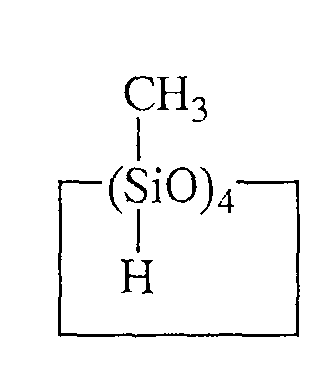
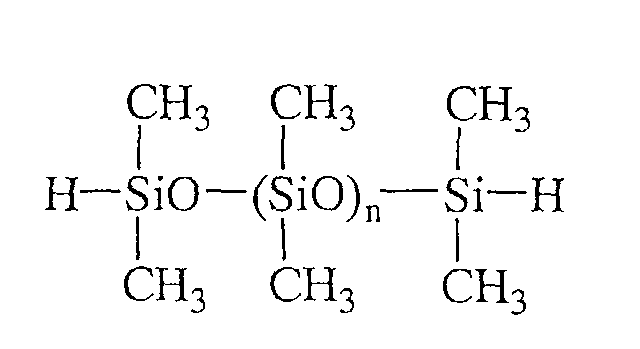
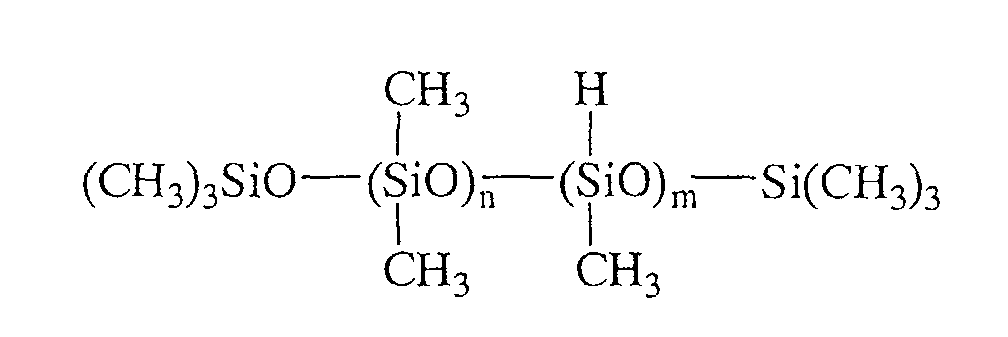
- Herein n is an integer of 0 to 200, preferably 0 to 100, m is an integer of 2 to 200, preferably 2 to 100, and n+m is 2 to 400, preferably 2 to 200.
- The organohydrogenpolysiloxane used herein may be prepared by well-known methods, for example, by co-hydrolysis of at least one chlorosilane selected from R2SiHCl2 and R2 2SiHCl wherein R2 is as defined above, or co-hydrolysis of a mixture of the foregoing chlorosilane and at least one chlorosilane selected from R2 3SiCl and R2 2SiCl2 wherein R2 is as defined above. A polysiloxane resulting from such co-hydrolysis may be equilibrated into an organohydrogenpolysiloxane which is also useful herein.
- An appropriate amount of the organohydrogenpolysiloxane (C) used usually gives 0.5 to 4 mol, preferably 1 to 2.5 mol of silicon-bonded hydrogen atoms (i.e., SiH radicals) in the organohydrogenpolysiloxane (C) available per mol of alkenyl radicals in the organopolysiloxane (B).
- The platinum group metal catalyst used herein serves to promote addition reaction between alkenyl groups in component (B) and silicon-bonded hydrogen atoms in component (C), Well-known catalysts for use in hydrosilylation reaction are useful. Examples include platinum group metal elements such as platinum (inclusive of platinum black), rhodium and palladium; platinum chloride, chloroplatinic acid and salts thereof such as H2PtCl4·nH2O, H2PtCl6·nH2O, NaHPtCl6·nH2O, KHPtCl6·nH2O, Na2PtCl6·nH2O, K2PtCl4·nH2O, PtCl4·nH2O, PtCl2, and Na2HPtCl4·nH2O wherein n is an integer of 0 to 6, preferably 0 or 6; alcohol-modified chloroplatinic acid (see USP 3,220,972); complexes of chloroplatinic acid with olefins (see USP 3,159,601, 3,159,662 and 3,775,452); platinum group metals such as platinum black and palladium on supports such as alumina, silica and carbon; rhodium-olefin complexes; chlorotris(triphenylphosphine)rhodium (Wilkinson catalyst); and complexes of platinum chloride, chloroplatinic acid or salts thereof with vinyl-containing siloxanes, especially vinyl-containing cyclic siloxanes.
- The catalyst (D) is used in a catalytic amount, typically in an amount to provide about 0.1 to 500 ppm, especially about 0.5 to 200 ppm of platinum group metal based on the weight of components (B) and (C) combined.
- Finely divided silica is an additive effective for maintaining electrical properties of the composition. Since the metal powder (A) tends to increase the conductivity of cured silicone rubber (or reduce the volume resistivity thereof), the electrical properties necessary as a sealant may be unsatisfactory as the amount of the metal powder added increases. If finely divided silica is added to this composition, silica particles bind to surfaces of metal particles, prevent metal particles from binding together, and eventually serve to maintain the volume resistivity of cured silicone rubber, that is, maintain the volume resistivity at or above 1×10⁹ Ω·cm.
- Finely divided silicas are available in several forms including crystalline, fused and fumed silicas. For the above purpose, addition of fumed silica is most preferred.
- To achieve the desired effects, the finely divided silica (E) is preferably added in an amount of at least 0.2 part by weight per 100 parts by weight of the organopolysiloxane (B), For ease of handling of the composition on use, it is recommended to add 0.5 to 30 parts by weight of silica.
- An adhesive agent is preferably added although it is an optional component.
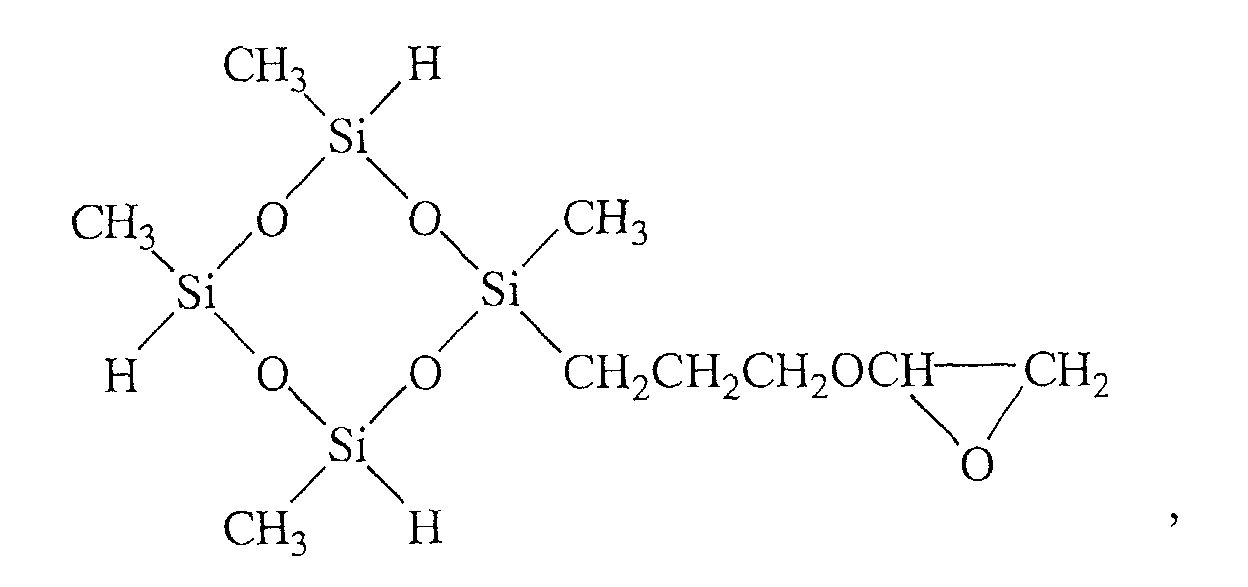
- The adhesive agent used herein is an organosilicon compound (such as silane or siloxane) having at least one functional radical selected from among an epoxy, alkoxysilyl, carbonyl and phenyl radical. Especially, an organosilane compound having at least one functional group selected from vinyl group, epoxy group, (meth)acryloxy and phenyl group and at least one alkoxysilyl group is preferred. A linear or cyclic organosiloxane oligomer having 4 to 20 silicon atoms and having at least one group selected from epoxy group and alkoxysilyl and at least one hydrogen atom directly attached to silicon atom (i.e., SiH group) is also preferably used. It is preferably a component that makes the inventive composition self-adhesive to metals or organic resins or both.
- Illustrative examples of the adhesive agent are given below.




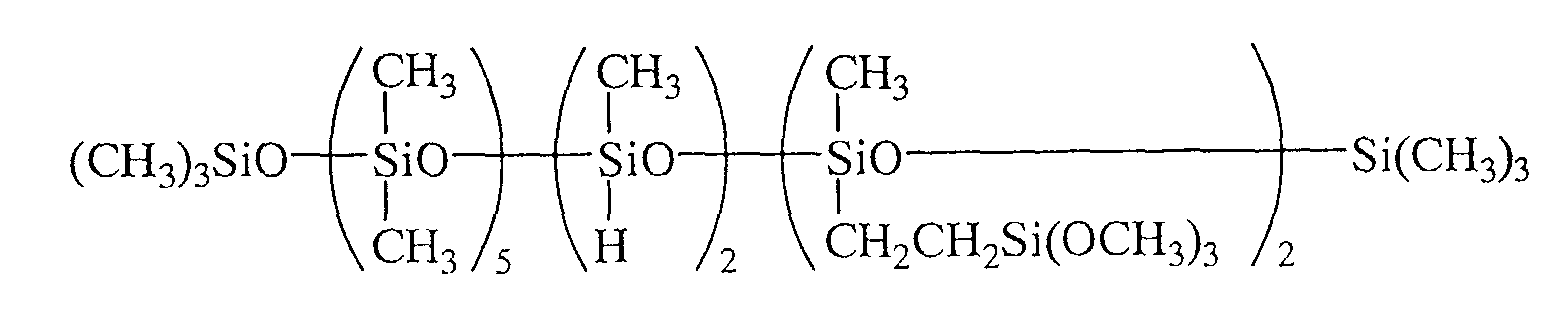
- In addition to components (A), (B), (C), (D), (E) and optionally (F), the inventive composition may contain other additives if necessary. Such additives include calcium carbonate; zinc carbonate; reinforcing inorganic fillers such as fumed titanium dioxide; reinforcing silicone resins; and non-reinforcing inorganic fillers such as calcium silicate, titanium dioxide, ferric oxide and carbon black. These inorganic fillers are usually used in amounts of 0 to 200 parts by weight per 100 parts by weight of the remaining components combined.
- Like conventional curable silicone rubber compositions, the inventive composition may be of the two part type in which the components are divided into two parts which are to be combined and cured on use. However, it is preferred for ease of working on use that the invention composition be of one part type.
- Depending on the service conditions, the inventive composition thus formulated may be prepared as a flowable composition or a thixotropic composition.
- The addition curing type silicone rubber composition of the invention may be cured by similar methods under similar conditions as are well known for conventional curable silicone rubber compositions. preferably it is curable at room temperature, but may be heated if desired.
- The silicone rubber composition of the invention is used for the sealing and encapsulation of electric and electronic parts in a similar manner to well-known sealants and encapsulants. The cured silicone rubber composition or silicone rubber has heat resistance and improved electrical insulation. When a sulfur-containing gas (e.g., sulfur gas, sulfur dioxide gas or sulfide gas) contacts the cured product, the metal powder dispersed in the cured product is sulfided with the sulfur-containing gas whereby the sulfur-containing gas is prevented or retarded from reaching the underlying electric and electronic parts. The electric and electronic parts are thus protected from the sulfur-containing gas.
- Examples of the invention are given below by way of illustration and not by way of limitation.
- Using the stock materials given below, silicone rubber compositions of the one part, addition reaction curing type were prepared to the formulation shown in Table 1.
- These compositions were cured under heating conditions of 120°C and one hour. The cured rubbers were measured for hardness and volume resistivity and subjected to a corrosion test as described below. The results are also shown in Table 1.
-
- (a-0) gold powder (flakes)
- (a-1) silver powder (flakes)
- (a-2-1) copper powder (flakes)
- (a-2-2) copper powder (atomized)
- (a-3) iron powder (atomized)
- (a-4) zinc powder (atomized)
-
- Vinyl-containing linear organopolysiloxane of the formula:wherein n is such a number that the siloxane has a viscosity of 1000 cSt at 25°C.

-

- platinum content: 0.5 wt%
-
- (e-1) fumed silica, R8200 by Degussa
- (e-2) crystalline silica, Crystallite VXST by Tatsumori
-
- 50% toluene solution of ethynyl cyclohexanol
- Me is methyl.

- As shown in FIG. 1, a silver-plated
copper plate 2 was placed in aglass vessel 1, a curedsheet 3 of the silicone rubber composition (0.8 mm thick) was placed over thevessel 1, and 0.10 g ofsulfur powder 4 was rested on thesheet 3. Thevessel 1 was closed with a metal cap 5. The vessel was held in a thermostat chamber at 70°C for several days while the degree of corrosion on the silver plating was visually observed at suitable intervals. The sample was rated "○" for no corrosion and "X" for corrosion observed as blackening.Components (pbw) Comparative Example Example 1 2 3 1 2 3 4 5 6 7 8 9 10 11 12 13 a-0 gold powder (flakes) 50 a-1 silver powder (flakes) 50 a-2-1 copper powder (flakes) 50 a-2-2 copper powder (atomized) 500 1 10 50 100 300 500 500 500 500 a-3 iron powder (atomized) 50 a-4 zinc powder (atomized) 50 b polysiloxane 100 100 100 100 100 100 100 100 100 100 100 100 100 100 100 100 c hydrosiloxane 4 4 4 4 4 4 4 4 4 4 4 4 4 4 4 4 d platinum compound 0.2 0.2 0.2 0.2 0.2 0.2 0.2 0.2 0.2 0.2 0.2 0.2 0.2 0.2 0.2 0.2 e-1 fumed silica 0.2 0.5 3 e-2 crystalline silica 3 f cure regulating agent 0.3 0.3 0.3 0.3 0.3 0.3 0.3 0.3 0.3 0.3 0.3 0.3 0.3 0.3 0.3 0.3 g adhesive agent 2 2 2 2 2 2 2 2 2 2 2 2 2 2 2 2 Hardness 20 24 55 23 25 20 22 25 30 33 52 56 32 33 24 23 Corrosion test Initial ○ ○ ○ ○ ○ ○ ○ ○ ○ ○ ○ ○ ○ ○ ○ ○ after 6 hr × × ○ ○ ○ ○ ○ ○ ○ ○ ○ ○ ○ ○ ○ ○ after 1 day × × ○ ○ ○ × ○ ○ ○ ○ ○ ○ ○ ○ × ○ after 3 days × × ○ × × × × ○ ○ ○ ○ ○ ○ ○ × × after 7 days × × ○ × × × × × ○ ○ ○ ○ ○ ○ × × Volume resistivity (Ω·cm) 8× 10¹⁴ 2× 10¹² 2× 10⁶ 2× 10¹³ 3× 10¹³ 7× 10¹⁴ 2× 10¹⁴ 6× 10¹² 5× 10¹¹ 3× 10¹⁰ 3× 10⁹ 8× 10¹¹ 6× 10¹⁴ 2× 10¹³ 6× 10¹³ 3× 10¹³ - As seen from the Table, Comparative Example 2 using gold, i.e., the metal powder which is not sulfidable with sulfur gas, fails to retard the corrosion of inside silver plating whereas the sulfidable metal powders as typified by copper within the scope of the invention are effective for retarding the corrosion. It is also evident that the inclusion of at least 0.2 part, preferably at least 0.5 part of silica fines is effective in preventing the volume resistivity from lowering.
- The silicone rubber compositions of the invention are used in the encapsulation of electric and electronic parts as the effective means for preventing metals from corrosion with sulfur-containing gas.
- Japanese Patent Application No. 2001-291034 is incorporated herein by reference.
- Although some preferred embodiments have been described, many modifications and variations may be made thereto in light of the above teachings. It is therefore to be understood that the invention may be practiced otherwise than as specifically described without departing from the scope of the appended claims.
Claims (12)
- A silicone rubber composition suitable for the sealing and encapsulation of electric or electronic parts, comprising (A) 0.5 to 90% by weight of metal powder, the composition being curable to a non-conductive silicone rubber having a volume resistivity of at least 1x10⁹ Ω·cm.
- The silicone rubber composition of claim 1 wherein the metal powder is sulfidable by sulfur-containing gas to a metal sulfide.
- The silicone rubber composition of claim 2 wherein the metal powder is selected from silver, copper, iron, nickel, aluminium, tin and zinc.
- The silicone rubber composition of claim 2 wherein the metal powder is copper.
- The silicone rubber composition of claim 1,2,3 or 4 of the addition reaction curing type, comprising(B) organopolysiloxane containing at least two alkenyl radicals in a molecule,(C) organohydrogenpolysiloxane containing at least two hydrogen atoms each attached to a silicon atom in a molecule, and(D) platinum group metal catalyst.
- A silicone rubber composition according to any one of the preceding claims, comprising finely divided silica as filler.
- A silicone rubber composition of claim 5 and claim 6, comprising (E) at least 0.2 parts by weight of said finely divided silica per 100 parts by weight of the organopolysiloxane (B).
- A silicone rubber composition of claim 5, 6 or 7 comprising (F) an adhesive agent having at least one functional radical selected from the group consisting of an epoxy, alkoxysilyl, carbonyl and phenyl radical.
- The silicone rubber composition of claim 8 which is self-bondable to metals and/or organic resins.
- A silicone rubber composition of claim 5, 6, 7, 8 or 9 which is of one part type.
- A method of manufacturing electronic or electric parts or components, including encapsulating said parts, components or portions thereof in a silicone rubber composition according to any one of claims 1 to 10.
- An encapsulated electric or electronic component in which the encapsulating material is a cured silicone rubber composition according to any one of claims 1 to 10.
Applications Claiming Priority (2)
| Application Number | Priority Date | Filing Date | Title |
|---|---|---|---|
| JP2001291034 | 2001-09-25 | ||
| JP2001291034A JP4114037B2 (en) | 2001-09-25 | 2001-09-25 | Silicone rubber sealing / sealing material for preventing or delaying sulfidation of electric / electronic parts and sulfidation preventing or delaying method |
Publications (2)
| Publication Number | Publication Date |
|---|---|
| EP1295905A1 true EP1295905A1 (en) | 2003-03-26 |
| EP1295905B1 EP1295905B1 (en) | 2012-02-22 |
Family
ID=19113241
Family Applications (1)
| Application Number | Title | Priority Date | Filing Date |
|---|---|---|---|
| EP02256590A Expired - Lifetime EP1295905B1 (en) | 2001-09-25 | 2002-09-23 | Use of Silicone rubber compositions for the sealing and encapsulation of electric and electronic parts |
Country Status (3)
| Country | Link |
|---|---|
| US (2) | US7501183B2 (en) |
| EP (1) | EP1295905B1 (en) |
| JP (1) | JP4114037B2 (en) |
Cited By (13)
| Publication number | Priority date | Publication date | Assignee | Title |
|---|---|---|---|---|
| EP1580236A1 (en) * | 2004-03-25 | 2005-09-28 | Shin-Etsu Chemical Co., Ltd. | Room temperature-curable organopolysiloxane compositions and automotive parts |
| EP1693398A1 (en) * | 2005-02-14 | 2006-08-23 | Shin-Etsu Chemical Co., Ltd. | Curable perfluoropolyether compositions and rubber or gel articles comprising the cured products of the compositions |
| CN100523089C (en) * | 2003-09-17 | 2009-08-05 | 信越化学工业株式会社 | Organopolysiloxane composition and electronic part encapsulated therewith |
| EP2043200A3 (en) * | 2007-09-28 | 2009-09-16 | Hitachi Ltd. | In-vehicle electronic device |
| WO2013160081A1 (en) * | 2012-04-26 | 2013-10-31 | Wacker Chemie Ag | Silicone composition with protection against pollutants |
| DE102012220700A1 (en) | 2012-11-13 | 2014-05-15 | Wacker Chemie Ag | Filler-containing silicone compositions |
| FR3034951A1 (en) * | 2015-04-10 | 2016-10-14 | Valeo Systemes Dessuyage | ELECTRONIC CARD PROTECTED AGAINST SULFUR VAPORS |
| US10242925B2 (en) | 2014-11-27 | 2019-03-26 | Institut Vedecom | Encapsulation of electronic components in polymer materials |
| EP3575358A4 (en) * | 2017-01-30 | 2020-08-12 | Shin-Etsu Chemical Co., Ltd. | SILANE RESIN COMPOSITION VULCANIZING AT ROOM TEMPERATURE AND ASSEMBLY CIRCUIT SUBSTRATE |
| WO2020168784A1 (en) * | 2019-02-22 | 2020-08-27 | 湖州五爻硅基材料研究院有限公司 | Preparation method for spherical or angular powder filler, spherical or angular powder filler obtained thereby, and application thereof |
| CN111801808A (en) * | 2019-02-22 | 2020-10-20 | 浙江三时纪新材科技有限公司 | A kind of preparation method of spherical or angular powder filler, spherical or angular powder filler obtained thereby and application thereof |
| US20210000371A1 (en) * | 2018-10-17 | 2021-01-07 | Nok Corporation | Bioelectrode and method for producing bioelectrode |
| US12258456B2 (en) | 2019-02-22 | 2025-03-25 | Zhejiang Third Age Material Technology Co., Ltd | Preparation method for spherical or angular powder filler, spherical or angular powder filler obtained thereby, and application thereof |
Families Citing this family (26)
| Publication number | Priority date | Publication date | Assignee | Title |
|---|---|---|---|---|
| JP4645793B2 (en) * | 2003-10-14 | 2011-03-09 | 信越化学工業株式会社 | Silicone rubber composition for electrode circuit protection, electrode circuit protection material and electric / electronic parts |
| DE102005005634A1 (en) * | 2005-02-08 | 2006-08-24 | Wacker Chemie Ag | Crosslinkable compositions based on organosilicon compounds |
| JP5004433B2 (en) * | 2005-04-27 | 2012-08-22 | 東レ・ダウコーニング株式会社 | Curable silicone composition and cured product thereof |
| JP4811562B2 (en) * | 2005-05-13 | 2011-11-09 | 信越化学工業株式会社 | Room temperature curable organopolysiloxane composition |
| JP4569765B2 (en) | 2005-05-13 | 2010-10-27 | 信越化学工業株式会社 | Room temperature curable silicone rubber composition for protecting electrical and electronic components, mounting circuit board, silver electrode and silver chip resistor |
| JP4684835B2 (en) * | 2005-09-30 | 2011-05-18 | 信越化学工業株式会社 | Method for reducing surface tackiness of cured silicone rubber, liquid silicone rubber composition for semiconductor encapsulation, silicone rubber encapsulated semiconductor device, and method for producing the semiconductor device |
| JP4844731B2 (en) * | 2006-05-23 | 2011-12-28 | 信越化学工業株式会社 | Curable organopolysiloxane composition, seal for automobile engine peripheral parts and method for suppressing mass reduction |
| JP2009088115A (en) * | 2007-09-28 | 2009-04-23 | Shin Etsu Chem Co Ltd | Automotive electrical and electronic parts |
| JP5455065B2 (en) | 2010-06-22 | 2014-03-26 | 信越化学工業株式会社 | Cycloalkyl group-containing silicone resin composition and method of using the composition. |
| JP5748512B2 (en) * | 2011-03-07 | 2015-07-15 | 信越化学工業株式会社 | Addition-curing self-adhesive silicone rubber composition |
| WO2013077700A1 (en) * | 2011-11-25 | 2013-05-30 | 주식회사 엘지화학 | Curable composition |
| JP6467125B2 (en) * | 2013-06-27 | 2019-02-06 | 株式会社カネカ | Curable resin composition, cured product obtained by curing the composition |
| US10479897B2 (en) * | 2014-01-16 | 2019-11-19 | International Business Machines Corporation | Producing an apparatus by covering an electronic component with a conformal coating containing metal nanoparticles |
| JP6211434B2 (en) * | 2014-02-26 | 2017-10-11 | 株式会社イノアックコーポレーション | Rubber cross-linked product and method for producing the same |
| KR102385489B1 (en) * | 2014-04-09 | 2022-04-14 | 듀폰 도레이 스페셜티 머티리얼즈 가부시키가이샤 | Curable organopolysiloxane composition, and protective-agent or adhesive-agent composition for electrical/electronic components |
| DE102014209445A1 (en) | 2014-05-19 | 2015-11-19 | Volkswagen Ag | Potting compound with corrosion inhibitor for electronic components, as well as electronic component and transmission with such |
| US20160189832A1 (en) * | 2014-12-29 | 2016-06-30 | International Business Machines Corporation | Implementing conformal coating composition for high current circuit applications |
| GB201805382D0 (en) | 2018-03-30 | 2018-05-16 | Dow Silicones Corp | Condensation curable compositions |
| GB201805383D0 (en) | 2018-03-30 | 2018-05-16 | Dow Silicones Corp | Condensation curable compositions |
| US12202930B2 (en) | 2018-08-03 | 2025-01-21 | Shin-Etsu Chemical Co., Ltd. | Room-temperature-curable polybutadiene resin composition, method for producing same, and packaged circuit board |
| CN111087822A (en) * | 2020-01-08 | 2020-05-01 | 东莞新东方科技有限公司 | Preparation method of two-component injection molding electromagnetic shielding silicone rubber for 5G base station antenna |
| JP7545871B2 (en) * | 2020-03-11 | 2024-09-05 | セイコーウオッチ株式会社 | Watch components and their manufacturing method, movement and watch |
| JP7468399B2 (en) | 2020-03-17 | 2024-04-16 | 信越化学工業株式会社 | Silicone coating composition and article |
| KR20230042272A (en) | 2020-07-22 | 2023-03-28 | 신에쓰 가가꾸 고교 가부시끼가이샤 | Anti-sulfur coating materials, cured products thereof, and electronic devices |
| JP7475791B2 (en) * | 2021-01-19 | 2024-04-30 | 信越化学工業株式会社 | Method for producing addition-curable silicone composition |
| US12391847B2 (en) | 2021-02-24 | 2025-08-19 | Shin-Etsu Chemical Co., Ltd. | Silicone coating agent composition and article |
Citations (2)
| Publication number | Priority date | Publication date | Assignee | Title |
|---|---|---|---|---|
| GB1179127A (en) * | 1967-10-02 | 1970-01-28 | Norman Frank Barty | Synthetic Resinous Compositions and Articles made therefrom. |
| EP0367562A2 (en) * | 1988-11-04 | 1990-05-09 | Dow Corning Corporation | Electrically conductive silicone compositions |
Family Cites Families (27)
| Publication number | Priority date | Publication date | Assignee | Title |
|---|---|---|---|---|
| US3159601A (en) | 1962-07-02 | 1964-12-01 | Gen Electric | Platinum-olefin complex catalyzed addition of hydrogen- and alkenyl-substituted siloxanes |
| US3220972A (en) | 1962-07-02 | 1965-11-30 | Gen Electric | Organosilicon process using a chloroplatinic acid reaction product as the catalyst |
| US3159662A (en) | 1962-07-02 | 1964-12-01 | Gen Electric | Addition reaction |
| NL6509449A (en) * | 1964-09-21 | 1966-03-22 | ||
| GB1193610A (en) * | 1967-04-17 | 1970-06-03 | Mallory & Co Inc P R | Desiccant for Electrical and Electronic Devices. |
| US3775452A (en) | 1971-04-28 | 1973-11-27 | Gen Electric | Platinum complexes of unsaturated siloxanes and platinum containing organopolysiloxanes |
| US4341842A (en) * | 1980-06-30 | 1982-07-27 | General Electric Company | Method of coating automotive parts with silicone compositions |
| JPS5876437A (en) * | 1981-11-02 | 1983-05-09 | Japan Synthetic Rubber Co Ltd | Insulating thermally conductive composition |
| US4544696A (en) * | 1984-10-29 | 1985-10-01 | Sws Silicones Corporation | Silicone elastomers having thermally conductive properties |
| DE3442132A1 (en) * | 1984-11-17 | 1986-05-22 | Messerschmitt-Bölkow-Blohm GmbH, 8012 Ottobrunn | METHOD FOR ENCODING MICROELECTRONIC CIRCUITS WITH ORGANIC COMPONENTS |
| JPS62221137A (en) * | 1986-03-24 | 1987-09-29 | Hitachi Ltd | Semiconductor device and manufacture thereof |
| JPS647546A (en) * | 1987-06-29 | 1989-01-11 | Oki Electric Ind Co Ltd | Resin-sealed semiconductor device |
| JPS6424946A (en) * | 1987-07-21 | 1989-01-26 | Yoshio Imahori | Sealing material for building material displaying copper group color |
| JPH0297559A (en) * | 1988-10-03 | 1990-04-10 | Toshiba Silicone Co Ltd | Heat-conductive silicone composition |
| US5326589A (en) * | 1991-01-22 | 1994-07-05 | Shin-Etsu Chemical Co., Ltd | Method of protecting electronic or electric part |
| JPH05271548A (en) * | 1992-03-27 | 1993-10-19 | Shin Etsu Chem Co Ltd | Organopolysiloxane composition and formation of cured product therefrom |
| JP3451732B2 (en) * | 1994-06-24 | 2003-09-29 | 信越化学工業株式会社 | Resin composition |
| JP3426726B2 (en) * | 1994-09-08 | 2003-07-14 | 京セラ株式会社 | Package for storing semiconductor elements |
| JPH08241938A (en) * | 1995-03-02 | 1996-09-17 | Hitachi Ltd | Resin-sealed products, heat transfer beads, and heat transfer materials |
| JPH09176495A (en) * | 1995-12-28 | 1997-07-08 | Furukawa Electric Co Ltd:The | Outdoor insulating polymer material composition and outdoor high-voltage equipment |
| JP3065288B2 (en) * | 1997-10-29 | 2000-07-17 | 日本電気株式会社 | Semiconductor bare chip sealing method, semiconductor integrated circuit device, and method of manufacturing semiconductor integrated circuit device |
| TWI257410B (en) * | 1999-03-25 | 2006-07-01 | Shinetsu Chemical Co | Conductive silicone rubber composition and low-resistance connector |
| AU5500399A (en) * | 1999-08-20 | 2001-04-10 | Csl Silicones Inc. | One-part organopolysiloxane rubber composition for use as a corrosion protection coating |
| JP3922332B2 (en) * | 2000-01-17 | 2007-05-30 | 信越化学工業株式会社 | Conductive liquid silicone rubber composition |
| JP3705343B2 (en) * | 2000-07-19 | 2005-10-12 | 信越化学工業株式会社 | Addition reaction curable silicone rubber composition and method for producing the same |
| JP2002371184A (en) * | 2001-06-15 | 2002-12-26 | Nisshin Steel Co Ltd | Heat conductive silicone resin composition |
| JP2003139593A (en) * | 2001-11-07 | 2003-05-14 | Hitachi Ltd | Automotive electronics and thermal flow meters |
-
2001
- 2001-09-25 JP JP2001291034A patent/JP4114037B2/en not_active Expired - Fee Related
-
2002
- 2002-09-23 EP EP02256590A patent/EP1295905B1/en not_active Expired - Lifetime
- 2002-09-24 US US10/252,595 patent/US7501183B2/en not_active Expired - Fee Related
-
2008
- 2008-10-02 US US12/244,402 patent/US7704607B2/en not_active Expired - Fee Related
Patent Citations (2)
| Publication number | Priority date | Publication date | Assignee | Title |
|---|---|---|---|---|
| GB1179127A (en) * | 1967-10-02 | 1970-01-28 | Norman Frank Barty | Synthetic Resinous Compositions and Articles made therefrom. |
| EP0367562A2 (en) * | 1988-11-04 | 1990-05-09 | Dow Corning Corporation | Electrically conductive silicone compositions |
Cited By (22)
| Publication number | Priority date | Publication date | Assignee | Title |
|---|---|---|---|---|
| CN100523089C (en) * | 2003-09-17 | 2009-08-05 | 信越化学工业株式会社 | Organopolysiloxane composition and electronic part encapsulated therewith |
| EP1580236A1 (en) * | 2004-03-25 | 2005-09-28 | Shin-Etsu Chemical Co., Ltd. | Room temperature-curable organopolysiloxane compositions and automotive parts |
| EP1693398A1 (en) * | 2005-02-14 | 2006-08-23 | Shin-Etsu Chemical Co., Ltd. | Curable perfluoropolyether compositions and rubber or gel articles comprising the cured products of the compositions |
| US7671160B2 (en) | 2005-02-14 | 2010-03-02 | Shin-Etsu Chemical Co., Ltd. | Curable perfluoropolyether compositions and rubber or gel articles comprising the cured products of the compositions |
| EP2043200A3 (en) * | 2007-09-28 | 2009-09-16 | Hitachi Ltd. | In-vehicle electronic device |
| US7674128B2 (en) | 2007-09-28 | 2010-03-09 | Hitachi, Ltd. | In-vehicle electronic device |
| CN104185663A (en) * | 2012-04-26 | 2014-12-03 | 瓦克化学股份公司 | Silicone composition with repellency against pollution |
| US9818663B2 (en) | 2012-04-26 | 2017-11-14 | Wacker Chemie Ag | Silicone composition with protection against pollutants |
| DE102012206968A1 (en) | 2012-04-26 | 2013-10-31 | Wacker Chemie Ag | Silicone composition with protection against harmful substances |
| WO2013160081A1 (en) * | 2012-04-26 | 2013-10-31 | Wacker Chemie Ag | Silicone composition with protection against pollutants |
| WO2014076088A1 (en) * | 2012-11-13 | 2014-05-22 | Wacker Chemie Ag | Filler-containing silicone compositions |
| CN104781355A (en) * | 2012-11-13 | 2015-07-15 | 瓦克化学股份公司 | Filler-containing silicone compositions |
| DE102012220700A1 (en) | 2012-11-13 | 2014-05-15 | Wacker Chemie Ag | Filler-containing silicone compositions |
| US10242925B2 (en) | 2014-11-27 | 2019-03-26 | Institut Vedecom | Encapsulation of electronic components in polymer materials |
| FR3034951A1 (en) * | 2015-04-10 | 2016-10-14 | Valeo Systemes Dessuyage | ELECTRONIC CARD PROTECTED AGAINST SULFUR VAPORS |
| EP3575358A4 (en) * | 2017-01-30 | 2020-08-12 | Shin-Etsu Chemical Co., Ltd. | SILANE RESIN COMPOSITION VULCANIZING AT ROOM TEMPERATURE AND ASSEMBLY CIRCUIT SUBSTRATE |
| US20210000371A1 (en) * | 2018-10-17 | 2021-01-07 | Nok Corporation | Bioelectrode and method for producing bioelectrode |
| US12527505B2 (en) * | 2018-10-17 | 2026-01-20 | Nok Corporation | Bioelectrode and method for producing bioelectrode |
| WO2020168784A1 (en) * | 2019-02-22 | 2020-08-27 | 湖州五爻硅基材料研究院有限公司 | Preparation method for spherical or angular powder filler, spherical or angular powder filler obtained thereby, and application thereof |
| CN111801808A (en) * | 2019-02-22 | 2020-10-20 | 浙江三时纪新材科技有限公司 | A kind of preparation method of spherical or angular powder filler, spherical or angular powder filler obtained thereby and application thereof |
| CN111801808B (en) * | 2019-02-22 | 2021-04-23 | 浙江三时纪新材科技有限公司 | Preparation method of spherical or angular powder filler, spherical or angular powder filler obtained by preparation method and application of spherical or angular powder filler |
| US12258456B2 (en) | 2019-02-22 | 2025-03-25 | Zhejiang Third Age Material Technology Co., Ltd | Preparation method for spherical or angular powder filler, spherical or angular powder filler obtained thereby, and application thereof |
Also Published As
| Publication number | Publication date |
|---|---|
| US7704607B2 (en) | 2010-04-27 |
| JP2003096301A (en) | 2003-04-03 |
| EP1295905B1 (en) | 2012-02-22 |
| US20030105206A1 (en) | 2003-06-05 |
| JP4114037B2 (en) | 2008-07-09 |
| US20090043029A1 (en) | 2009-02-12 |
| US7501183B2 (en) | 2009-03-10 |
Similar Documents
| Publication | Publication Date | Title |
|---|---|---|
| US7704607B2 (en) | Silicone rubber compositions for the sealing and encapsulation of electric and electronic parts | |
| US6001943A (en) | Silicone gel composition and silicone gel for use in sealing and filling of electrical and electronic parts | |
| US6509423B1 (en) | Silicone composition and cured silicone product | |
| EP2528974B1 (en) | Thermally conductive silicone rubber composition | |
| JP3595731B2 (en) | Addition-curable silicone composition for encapsulating semiconductor device and semiconductor device | |
| KR101495215B1 (en) | Curable silicone composition and cured product thereof | |
| EP0890617B1 (en) | Silicone gel composition for sealing and filling electrical and electronic components | |
| EP1852468B1 (en) | Method of forming a flux resistant silicone gel | |
| US6969554B2 (en) | Semiconductor sealing silicone composition and semiconductor device | |
| JP2006056986A (en) | Two-part curable silicone composition | |
| EP3666828A1 (en) | Addition-curable silicone composition and cured silicone rubber | |
| WO2004046233A1 (en) | Thermally-conductive silicone elastomer composition | |
| US5994461A (en) | Liquid silicone rubber composition for application to high-voltage electrical insulators and articles | |
| JPH086039B2 (en) | Organopolysiloxane composition and gel cured product thereof | |
| US20050059772A1 (en) | Organopolysiloxane composition and electronic part encapsulated therewith | |
| US5942571A (en) | Silicone rubber composition for use in high-voltage electrical insulating parts and method for manufacturing the same | |
| EP0509515B1 (en) | Curable organopolysiloxane gel composition | |
| TWI724223B (en) | Thermally conductive silicone resin composition and its hardening method | |
| JP6070488B2 (en) | Addition-curable liquid silicone rubber composition and cured silicone rubber | |
| KR20210027139A (en) | Addition-curable silicone composition and optical element | |
| JP3618446B2 (en) | Organopolysiloxane composition for impregnating electronic parts and electronic parts | |
| JP3540356B2 (en) | Conformal coating agent | |
| JP3998438B2 (en) | Adhesive for polymer electrolyte fuel cells | |
| JP3477008B2 (en) | Addition-curable silicone rubber composition filled with calcium carbonate | |
| JP3550321B2 (en) | Addition-curable organopolysiloxane composition |
Legal Events
| Date | Code | Title | Description |
|---|---|---|---|
| PUAI | Public reference made under article 153(3) epc to a published international application that has entered the european phase |
Free format text: ORIGINAL CODE: 0009012 |
|
| AK | Designated contracting states |
Kind code of ref document: A1 Designated state(s): AT BE BG CH CY CZ DE DK EE ES FI FR GB GR IE IT LI LU MC NL PT SE SK TR |
|
| AX | Request for extension of the european patent |
Extension state: AL LT LV MK RO SI |
|
| 17P | Request for examination filed |
Effective date: 20030701 |
|
| AKX | Designation fees paid |
Designated state(s): DE FR GB |
|
| 17Q | First examination report despatched |
Effective date: 20110225 |
|
| RTI1 | Title (correction) |
Free format text: USE OF SILICONE RUBBER COMPOSITIONS FOR THE SEALING AND ENCAPSULATION OF ELECTRIC AND ELECTRONIC PARTS |
|
| GRAP | Despatch of communication of intention to grant a patent |
Free format text: ORIGINAL CODE: EPIDOSNIGR1 |
|
| GRAS | Grant fee paid |
Free format text: ORIGINAL CODE: EPIDOSNIGR3 |
|
| GRAA | (expected) grant |
Free format text: ORIGINAL CODE: 0009210 |
|
| AK | Designated contracting states |
Kind code of ref document: B1 Designated state(s): DE FR GB |
|
| REG | Reference to a national code |
Ref country code: GB Ref legal event code: FG4D |
|
| REG | Reference to a national code |
Ref country code: DE Ref legal event code: R096 Ref document number: 60242247 Country of ref document: DE Effective date: 20120419 |
|
| PLBE | No opposition filed within time limit |
Free format text: ORIGINAL CODE: 0009261 |
|
| STAA | Information on the status of an ep patent application or granted ep patent |
Free format text: STATUS: NO OPPOSITION FILED WITHIN TIME LIMIT |
|
| 26N | No opposition filed |
Effective date: 20121123 |
|
| REG | Reference to a national code |
Ref country code: DE Ref legal event code: R097 Ref document number: 60242247 Country of ref document: DE Effective date: 20121123 |
|
| REG | Reference to a national code |
Ref country code: FR Ref legal event code: PLFP Year of fee payment: 15 |
|
| REG | Reference to a national code |
Ref country code: FR Ref legal event code: PLFP Year of fee payment: 16 |
|
| REG | Reference to a national code |
Ref country code: FR Ref legal event code: PLFP Year of fee payment: 17 |
|
| PGFP | Annual fee paid to national office [announced via postgrant information from national office to epo] |
Ref country code: FR Payment date: 20190815 Year of fee payment: 18 Ref country code: DE Payment date: 20190910 Year of fee payment: 18 |
|
| PGFP | Annual fee paid to national office [announced via postgrant information from national office to epo] |
Ref country code: GB Payment date: 20190920 Year of fee payment: 18 |
|
| REG | Reference to a national code |
Ref country code: DE Ref legal event code: R119 Ref document number: 60242247 Country of ref document: DE |
|
| GBPC | Gb: european patent ceased through non-payment of renewal fee |
Effective date: 20200923 |
|
| PG25 | Lapsed in a contracting state [announced via postgrant information from national office to epo] |
Ref country code: DE Free format text: LAPSE BECAUSE OF NON-PAYMENT OF DUE FEES Effective date: 20210401 Ref country code: FR Free format text: LAPSE BECAUSE OF NON-PAYMENT OF DUE FEES Effective date: 20200930 |
|
| PG25 | Lapsed in a contracting state [announced via postgrant information from national office to epo] |
Ref country code: GB Free format text: LAPSE BECAUSE OF NON-PAYMENT OF DUE FEES Effective date: 20200923 |