EP1295651A2 - Method of producing steel pipes, and welded pipes - Google Patents
Method of producing steel pipes, and welded pipes Download PDFInfo
- Publication number
- EP1295651A2 EP1295651A2 EP02292316A EP02292316A EP1295651A2 EP 1295651 A2 EP1295651 A2 EP 1295651A2 EP 02292316 A EP02292316 A EP 02292316A EP 02292316 A EP02292316 A EP 02292316A EP 1295651 A2 EP1295651 A2 EP 1295651A2
- Authority
- EP
- European Patent Office
- Prior art keywords
- pipe
- strength
- steel
- expansion
- reduction
- Prior art date
- Legal status (The legal status is an assumption and is not a legal conclusion. Google has not performed a legal analysis and makes no representation as to the accuracy of the status listed.)
- Granted
Links
Images


Classifications
-
- C—CHEMISTRY; METALLURGY
- C21—METALLURGY OF IRON
- C21D—MODIFYING THE PHYSICAL STRUCTURE OF FERROUS METALS; GENERAL DEVICES FOR HEAT TREATMENT OF FERROUS OR NON-FERROUS METALS OR ALLOYS; MAKING METAL MALLEABLE, e.g. BY DECARBURISATION OR TEMPERING
- C21D7/00—Modifying the physical properties of iron or steel by deformation
- C21D7/02—Modifying the physical properties of iron or steel by deformation by cold working
- C21D7/10—Modifying the physical properties of iron or steel by deformation by cold working of the whole cross-section, e.g. of concrete reinforcing bars
- C21D7/12—Modifying the physical properties of iron or steel by deformation by cold working of the whole cross-section, e.g. of concrete reinforcing bars by expanding tubular bodies
-
- B—PERFORMING OPERATIONS; TRANSPORTING
- B21—MECHANICAL METAL-WORKING WITHOUT ESSENTIALLY REMOVING MATERIAL; PUNCHING METAL
- B21C—MANUFACTURE OF METAL SHEETS, WIRE, RODS, TUBES, PROFILES OR LIKE SEMI-MANUFACTURED PRODUCTS OTHERWISE THAN BY ROLLING; AUXILIARY OPERATIONS USED IN CONNECTION WITH METAL-WORKING WITHOUT ESSENTIALLY REMOVING MATERIAL
- B21C37/00—Manufacture of metal sheets, rods, wire, tubes, profiles or like semi-manufactured products, not otherwise provided for; Manufacture of tubes of special shape
- B21C37/06—Manufacture of metal sheets, rods, wire, tubes, profiles or like semi-manufactured products, not otherwise provided for; Manufacture of tubes of special shape of tubes or metal hoses; Combined procedures for making tubes, e.g. for making multi-wall tubes
- B21C37/08—Making tubes with welded or soldered seams
- B21C37/0807—Tube treating or manipulating combined with, or specially adapted for use in connection with tube making machines, e.g. drawing-off devices, cutting-off
- B21C37/0811—Tube treating or manipulating combined with, or specially adapted for use in connection with tube making machines, e.g. drawing-off devices, cutting-off removing or treating the weld bead
-
- B—PERFORMING OPERATIONS; TRANSPORTING
- B21—MECHANICAL METAL-WORKING WITHOUT ESSENTIALLY REMOVING MATERIAL; PUNCHING METAL
- B21C—MANUFACTURE OF METAL SHEETS, WIRE, RODS, TUBES, PROFILES OR LIKE SEMI-MANUFACTURED PRODUCTS OTHERWISE THAN BY ROLLING; AUXILIARY OPERATIONS USED IN CONNECTION WITH METAL-WORKING WITHOUT ESSENTIALLY REMOVING MATERIAL
- B21C37/00—Manufacture of metal sheets, rods, wire, tubes, profiles or like semi-manufactured products, not otherwise provided for; Manufacture of tubes of special shape
- B21C37/06—Manufacture of metal sheets, rods, wire, tubes, profiles or like semi-manufactured products, not otherwise provided for; Manufacture of tubes of special shape of tubes or metal hoses; Combined procedures for making tubes, e.g. for making multi-wall tubes
- B21C37/30—Finishing tubes, e.g. sizing, burnishing
-
- C—CHEMISTRY; METALLURGY
- C21—METALLURGY OF IRON
- C21D—MODIFYING THE PHYSICAL STRUCTURE OF FERROUS METALS; GENERAL DEVICES FOR HEAT TREATMENT OF FERROUS OR NON-FERROUS METALS OR ALLOYS; MAKING METAL MALLEABLE, e.g. BY DECARBURISATION OR TEMPERING
- C21D2211/00—Microstructure comprising significant phases
- C21D2211/002—Bainite
-
- C—CHEMISTRY; METALLURGY
- C21—METALLURGY OF IRON
- C21D—MODIFYING THE PHYSICAL STRUCTURE OF FERROUS METALS; GENERAL DEVICES FOR HEAT TREATMENT OF FERROUS OR NON-FERROUS METALS OR ALLOYS; MAKING METAL MALLEABLE, e.g. BY DECARBURISATION OR TEMPERING
- C21D2211/00—Microstructure comprising significant phases
- C21D2211/008—Martensite
Definitions
- the present invention relates to a method of producing high-strength steel pipes which consists mainly of a martensitic and/or bainitic microstructure and can be used as high-strength line pipes of API X80 grade or higher. Steel pipes produced by this method are low in yield ratio and high in roundness or circularity in spite of their superior strength.
- API X70 grade steel pipes which are currently produced by the UOE process and used in practical pipelines, are up to API X70 grade.
- the practical use of API X80 grade steel pipes is found only in a few instances in the world. This is because high-strength steel pipes of X80 or higher grade become high in yield ratio and it is difficult to attain a yield ratio not higher than the tolerance limit prescribed in the relevant API specification, and because it is technologically difficult to establish basic characteristics of pipes, including strength, toughness and so forth. Furthermore, for putting steel pipes of X80 or higher grade to practical use, evaluation of the safety of such high-strength steel in actual application to pipelines is required.
- a steel of X60 grade should have a yield strength of 60 ksi (413 MPa) or higher.
- X80 grade means 80 ksi (551 MPa) or higher, and X100 grade means 100 ksi (689 MPa) or higher.
- the API specification specifies steels up to X80 grade.
- high-strength steel pipe as used herein, means a steel pipe of X80 or higher.
- High-strength steel pipes produced by the UOE process encounter new problems that have not been encountered by low-strength steel pipes. One of them is the increase in yield ratio.
- the yield ratio namely the value "(yield strength/tensile strength) x 100 (%)"
- the yield ratio should be not higher than 93%.
- Low-strength steel pipes can easily meet this requirement (yield ratio of not higher than 93%).
- high-strength steel pipes consisting mainly of martensite and/or bainite however, it is difficult to secure a yield ratio of not higher than 93%, since the increase in yield strength due to work hardening is significant.
- JP-A Japanese Patent Application
- U.S. Patent No. 5,794,840 there is disclosed a method of adjusting the characteristics of steel pipes in steel pipe production by the conventional UOE process.
- the method comprises carrying out cold expansion and cold reduction in combination.
- the target of this method is a pipe of X70 grade. According to Claim 2 therein, pipe reduction up to 2% is followed by expansion up to 4% and, according to Claim 3, pipe expansion up to 2% is followed by reduction up to 4%.
- the method in which pipe expansion is carried out after reduction, when applied to high-strength steel pipes causes an increase in yield ratio, leading to failure to meet the above-mentioned requirement (not higher than 93%).
- the method in which the pipe reduction follows expansion on the other hand, application of such a high degree of pipe expansion as 2% and such a high degree of reduction as 4%, when applied to high-strength steel pipes, results in a marked decrease in the toughness of the steel pipes.
- JP-A H09-1233 or U.S. Patent No. 5,794,840 is not concerned with a method of producing high-strength steel pipes consisting mainly of a martensitic and/or bainitic microstructure.
- the publication cited mentions nothing about how to maintain the yield ratio of high-strength steel pipes at low levels or secure the roundness thereof.
- the gist of the present invention consists in the following methods of producing steel pipes as specified under (1) to (3) and the welded steel pipe specified under (4).
- the pipe expansion step which is the final step in the conventional UOE process, causes an increase in yield ratio due to work hardening.
- the increase in pipe strength it becomes difficult to control the roundness within the intended range due to the plant capacity.
- the main objectives of the conventional pipe expansion step are relaxation of the residual stress in the vicinity of the welded portion welding and the securing of the roundness. In this step, however, the above-mentioned high yield ratio problem intrinsic in high strength steels, cannot be overcome.
- the present inventors could obtain the following novel findings concerning the high yield ratio of high-strength steel pipes.
- Fig. 1 is a graph summarizing the relationship between tensile strength and yield ratio (YR) as obtained by tensile testing of the round bar tensile test specimens and the API standard sheet tensile test specimens.
- the test specimens were collected, in the circumferential direction, from a large number of steel pipes which were produced in the UOE process and have different yield strengths.
- low-strength steels show no great difference in yield ratio (YR) between the testing of API standard sheet tensile test specimens and the round bar tensile test specimens.
- ZR yield ratio
- round bar tensile test specimens give a very high yield ratio, markedly exceeding the API requirement that "the yield ratio should be not higher than 93%".
- sheet tensile test specimens show an approximately constant yield ratio, irrespective of tensile strength.
- the yield ratio increases with increasing strength because the above-mentioned decrease in yield strength, due to the Bauschinger effect of the straitening working, is not caused so that the characteristics of each material itself are evaluated.
- a high yield ratio is attained expectedly due to the fact that the martensite or bainite structure, which is the main structure, has a high dislocation density, hence an extreme increase in strain sensitivity results.
- test material steel plate
- the test material had a tensile strength in the C direction of 900 MPa.
- Round bar test pieces of 14 mm in diameter were collected from this steel plate in the C direction (circumferential direction), given a compressive strain of 0.3%, corresponding to O pressing, then given a tensile strain of 1.0% or 3.0%, corresponding to the pipe expansion step, and further given a compressive strain of 1.0% or 3.0% on the analogy of the pipe reduction step.
- Fig. 3 is a graph showing the results of impact testing conducted using test pieces given a tensile strain and a compressive strain in the same manner as mentioned above. As shown in Fig. 2 discussed above, a high percentage of compression is desirable for lowering only the yield ratio. As is apparent from Fig. 3, however, working at a high percentage of compression results in a decrease in toughness.
- Fig. 4 there is shown the change in yield ratio as observed when a pipe expansion by the UOE process was followed by pipe reduction by 0.1%, 0.3% or 0.5% in an actual production process. It was confirmed that there was a tendency very similar to the results of the simulation test. Thus, it is evident that the yield ratio after expansion decreases through the step of pipe reduction. In the actual steel pipe production as well, a satisfactory effect can be produced at very low working ratios, as compared with the pipe expansion ratio and the reduction ratio which seem necessary for low-strength steel pipes.
- the yield ratio decreases excessively, it becomes necessary to increase the yield strength by adding an alloying component or components so that a prescribed level of yield strength can be secured.
- the toughness decreases with the increase in strength, so that it is difficult to secure good toughness with such a steel increased in strength as mentioned above.
- a desirable starting steel plate to be used in producing high-strength steel pipes is a steel that has the following chemical composition.
- the "%” indicating the content of each component refers to "% by mass”.
- Steel plate consisting of C: 0.03-0.10%, Si: 0.05-0.5%, Mn: 0.8-2.0%, P: not more than 0.02%, S: not more than 0.01% and, further, one or more elements selected from among Cu: 0.05-1.0%, Ni: 0.05-2.0%, Cr: 0.05-1.0%, Mo: 0.03-1.0%, Nb: 0.005-0.1%, V: 0.01-0.1%, Ti: 0.005-0.03%, Al: not more than 0.06% and B: 0.0005-0.0030%, with the balance being iron and impurities.
- the above steel plate may further contain not more than 0.005% of N and/or 0.0003-0.005% of Ca.
- the steel fails to have a desired microstructure, hence an intended strength can hardly be obtained. Conversely, when it exceeds 0.10%, the decrease in toughness becomes remarkable, the mechanical characteristics of the base metal are adversely affected and, at the same time, the occurrence of slab surface defects are promoted. Therefore, the appropriate C content range is 0.03 to 0.10%. Si: 0.05 to 0.5%
- Si serves as a deoxidizing agent for steel and also is a steel-strengthening component.
- Si content is lower than 0.05%, insufficient deoxidation will result.
- banded martensite martensite-austenite constituent
- Mn 0.8 to 2.0%
- Mn is an essential element rendering a steel, tough and strong. At levels below 0.8%, the effect is insufficient and a desired microstructure and strength cannot be obtained. Conversely, at levels exceeding 2.0%, center segregation becomes remarkable, lowering the base metal toughness; the weldability also deteriorates. Therefore, appropriate Mn content is 0.8 to 2.0%. P: not more than 0.02%
- P is an impurity and, when its content exceeds 0.02%, center segregation becomes significant, leading to a decrease in base metal toughness; hot cracking may also be caused in the step of welding. Therefore, the P content should desirably be as low as possible. S: not more than 0.01%
- S is also an impurity and, when its content exceeds 0.01%, the tendency increases toward hydrogen-induced cracking of steel plates and toward hydrogen embrittlement cracking in the step of welding. Therefore, the S content should desirably be as low as possible.
- Cu is a component which increases the strength of steel through solid solution hardening and through structural modification due to its increasing hardenability effect, without markedly impairing toughness of the steel.
- the level 0.05% is the minimum level for the production of this effect.
- Cu content exceeds 1.0%, copper checking occurs and slab surface defects are thereby induced. The copper checking can be prevented by low temperature heating of the slab but the conditions of steel plate production are restricted. Therefore, appropriate Cu content is 0.05 to 1.0%.
- Ni is an element which strengthen the steel through solid solution hardening and through structural modification by its increasing hardenability effect, without markedly impairing the toughness of the steel. Such effect becomes significant at 0.05% or more. However, a level exceeding 2.0% increases the cost of the production of steel, hence is not practical.
- Cr 0.05 to 1.0%
- Mo 0.03 to 1.0%
- Al is effective as a deoxidizing agent. Even at a level of 0.06% or less, this effect can be produced to a sufficient extent. The addition at levels exceeding 0.06% is undesirable from the economical viewpoint.
- the Al content may be the same or below the impurity level. However, for securing the toughness of the weld metal, however, the Al content of not less than 0.02% is desirable.
- B markedly increases the hardenability of the steel. At levels exceeding 0.0030%, however, it lowers the weldability. Therefore, the appropriate B content is 0.0005 to 0.0030%. N: not more than 0.005%
- N forms nitrides with V, Ti etc., and thereby effectively improves the strength of the steel at elevated temperatures.
- N content exceeds 0.005%, N forms coarse carbonitrides with Nb, V and Ti and thereby lowers the toughness of the base metal and the heat affected zone. Therefore, the N content needs to be suppressed to 0.005% or less.
- Ca is effective in morphological control of inclusions, specifically rendering inclusions spherical, and prevents hydrogen-induced cracking or lamellar tearing. These effects become significant at the level of 0.0003% or higher and reach a point of saturation at 0.005%. Therefore, the content of Ca, when it is added, is recommendably 0.0003 to 0.05%.
- the steel pipe obtained must have a metallographic structure such that the area percentage of martensite and/or bainite is not less than 80%. Thus, it is required that martensite alone, bainite alone or a mixed structure composed of both should amount to at least 80% as expressed in terms of area percentage.
- the steel pipe can be a high-strength steel pipe having yield strength of not lower than 551 MPa.
- a high-strength steel pipe having such a metallographic structure as mentioned above, can be obtained in the following manner.
- a slab having an appropriate chemical composition, is subjected to controlled rolling and controlled cooling in order to give a steel plate the above-mentioned metallographic structure. This is used as the base metal and subjected to the steps of forming, welding, and pipe expansion and reduction.
- the metallographic structure of the steel plate can be retained in the steel pipe after working.
- pipe expansion In order to reduce the stress remaining in the vicinity of the welded portion and for securing the pipe roundness, at least 0.3% of pipe expansion is required. On the other hand, pipe expansion, when carried out at a working rate of greater than 1.2%, causes more work hardening than needed, adversely affecting the mechanical properties.
- the method of pipe expansion may be either the mechanical expansion or hydraulic expansion, which should be carried out in the conventional UOE process.
- the pipe reduction percentage be smaller than the pipe expansion percentage.
- the decrease in yield ratio may become excessive.
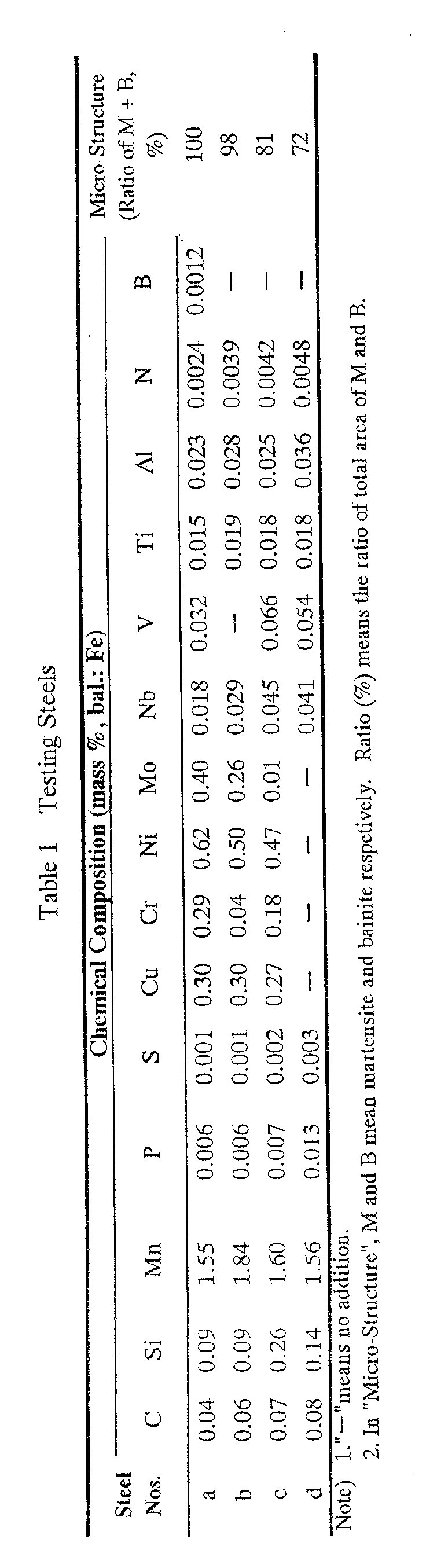
- each steel sheet was subjected to C-U-O press forming, tack welding, internal welding and external welding by the SAW method, followed by mechanical pipe expansion and pipe reduction using an O-press.
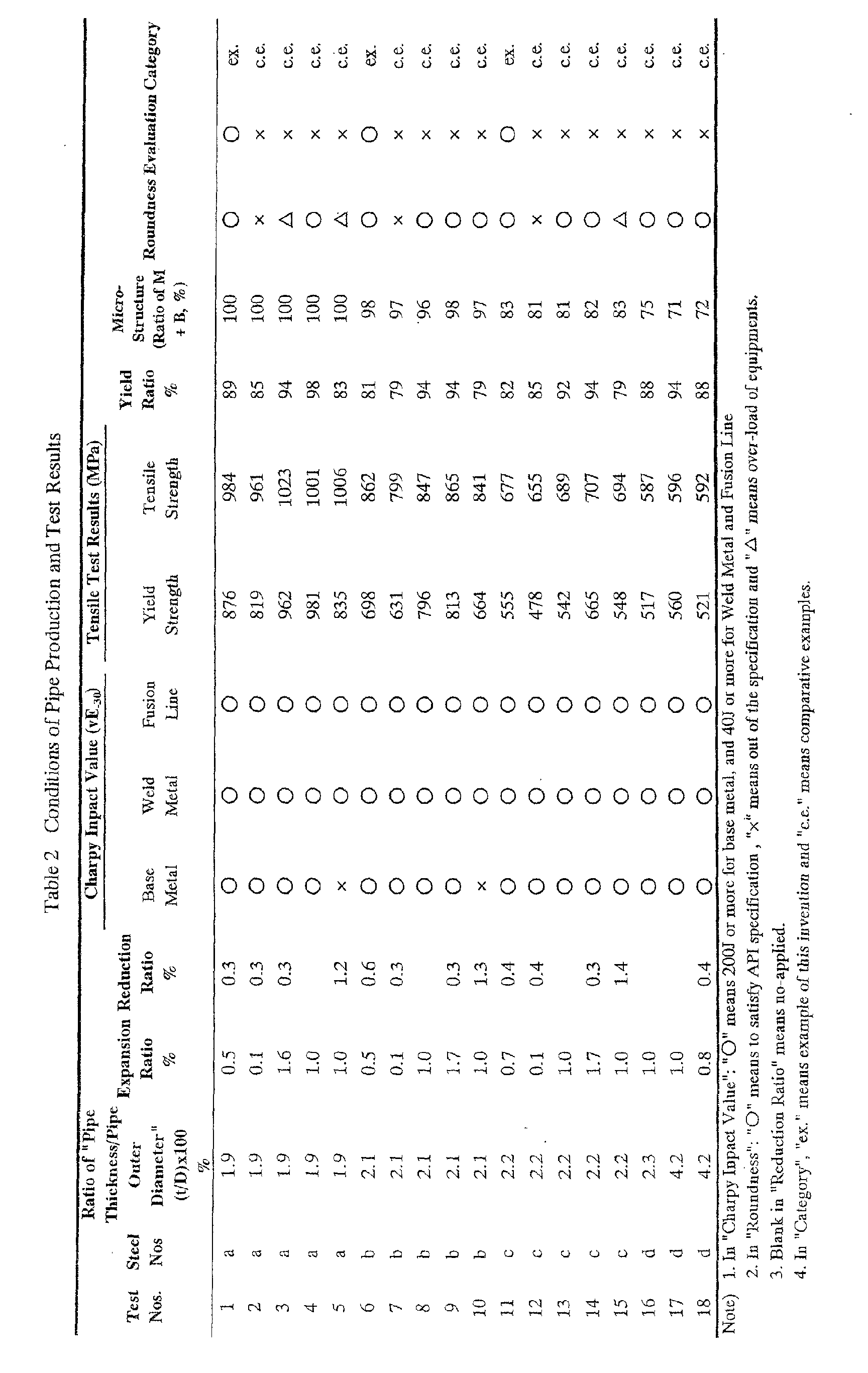
- the expansion percentage and reduction percentage are shown in Table 2.
- the pipe expansion percentage, pipe reduction percentage, the results of Charpy impact test and tensile test, and the roundness are shown in Table 2.
- the items, Charpy impact value, tensile characteristics and roundness are particularly important items to be checked for assuring the performance characteristics of line pipes.
- the impact test specimens used were JIS No. 4 specimens, and the tensile test specimens used were round bar specimens. The absorbed energy, yield strength and tensile strength at -30 were measured, and the yield ratio was calculated. The results obtained are shown in Table 2.
- Test specimens with the notch on the base metal, weld metal or fusion line were collected.
- “O” indicates that diameter values are within the API specification range “nominal outside diameter 1%", and " " indicates failure to fall within this tolerance range. The symbol means that the load on equipment for attaining a satisfactory level of circularity is very heavy.
- the microstructure of the base steel plate satisfied the prescribed conditions and the pipe was produced at an adequate pipe expansion percentage and reduction percentage and, therefore, the absorbed energy values for the base metal, weld metal and fusion line exceeded 200 J, 40 J and 40 J, respectively, and the toughness was thus high. In addition, the strength was adequate and the circularity was good.
- the metallographic structure fraction was not adequate, or the pipe expansion percentage and/or pipe reduction percentage was inadequate even when the structure was appropriate, so that the yield ratio reducing effect was slight, and the yield ratio exceeded the target level of 93%. Furthermore, when the strength was higher and the pipe reduction percentage was high, the base metal toughness decreased.
- the method of the present invention can solve the excessively high yield ratio problem intrinsic in high-strength steel pipes and can secure their safety as actual line pipes. It can produce steel pipes excellent in toughness as well as in circularity.
- the method of the present invention is very useful as a method of producing high-strength steel pipes, and the steel pipes produced can be put to practical use as line pipes of X80 or higher grade.
Landscapes
- Engineering & Computer Science (AREA)
- Chemical & Material Sciences (AREA)
- Mechanical Engineering (AREA)
- Crystallography & Structural Chemistry (AREA)
- Materials Engineering (AREA)
- Metallurgy (AREA)
- Organic Chemistry (AREA)
- Heat Treatment Of Steel (AREA)
Abstract
Description
C: 0.03 to 0.10%
Si: 0.05 to 0.5%
Mn: 0.8 to 2.0%
P: not more than 0.02%
S: not more than 0.01%
Cu: 0.05 to 1.0%
Ni: 0.05 to 2.0%
Cr: 0.05 to 1.0%, Mo: 0.03 to 1.0%
Nb: 0.005 to 0.1%, V: 0.01 to 0.1%, Ti: 0.005 to 0.03%
Al: not more than 0.06%
B: 0.0005 to 0.0030%
N: not more than 0.005%
Ca: 0.0003 to 0.005%
Claims (4)
- A method of producing a steel pipe having a microstructure comprised of martensite and/or bainite which amounts to at least 80 % as expressed in terms of area percentage, and having a yield strength of not lower than 551 MPa, characterised in that said method comprises the steps of forming and welding a steel plate into a steel pipe, expanding the steel pipe by 0.3 to 1.2 % and reducing the expanded steel pipe by 0.1 to 1.0 %.
- A method of producing a steel pipe according to claim 1, wherein the percentage of pipe reduction is smaller than the percentage of pipe expansion.
- A method of producing a steel pipe according to claim 1 or 2, wherein the steel pipe after expansion and reduction has a yield strength of not lower than 689 MPa.
- A welded steel pipe produced by a method according to any one of claims 1 to 3.
Applications Claiming Priority (2)
| Application Number | Priority Date | Filing Date | Title |
|---|---|---|---|
| JP2001289758A JP3846246B2 (en) | 2001-09-21 | 2001-09-21 | Steel pipe manufacturing method |
| JP2001289758 | 2001-09-21 |
Publications (3)
| Publication Number | Publication Date |
|---|---|
| EP1295651A2 true EP1295651A2 (en) | 2003-03-26 |
| EP1295651A3 EP1295651A3 (en) | 2003-05-07 |
| EP1295651B1 EP1295651B1 (en) | 2004-11-24 |
Family
ID=19112205
Family Applications (1)
| Application Number | Title | Priority Date | Filing Date |
|---|---|---|---|
| EP02292316A Expired - Lifetime EP1295651B1 (en) | 2001-09-21 | 2002-09-20 | Method of producing steel pipes |
Country Status (6)
| Country | Link |
|---|---|
| US (1) | US6948649B2 (en) |
| EP (1) | EP1295651B1 (en) |
| JP (1) | JP3846246B2 (en) |
| CA (1) | CA2403302C (en) |
| DE (1) | DE60202034T2 (en) |
| ES (1) | ES2227408T3 (en) |
Cited By (1)
| Publication number | Priority date | Publication date | Assignee | Title |
|---|---|---|---|---|
| EP3239317A4 (en) * | 2014-12-25 | 2018-06-06 | JFE Steel Corporation | High-strength thick-walled electric resistance welded steel pipe for conductor casing for deep well, production method therefor, and high-strength thick-walled conductor casing for deep well |
Families Citing this family (9)
| Publication number | Priority date | Publication date | Assignee | Title |
|---|---|---|---|---|
| CN100509253C (en) * | 2003-04-01 | 2009-07-08 | 纳米钢公司 | Controlled thermal expansion of solder to improve toughness |
| BRPI0410732A (en) * | 2003-05-28 | 2006-06-27 | Sumitomo Metal Ind | inlay-expansion oil well steel pipe |
| WO2006033720A2 (en) * | 2004-08-11 | 2006-03-30 | Enventure Global Technology, Llc | Method of expansion |
| JP4969915B2 (en) * | 2006-05-24 | 2012-07-04 | 新日本製鐵株式会社 | Steel tube for high-strength line pipe excellent in strain aging resistance, steel plate for high-strength line pipe, and production method thereof |
| US9040865B2 (en) * | 2007-02-27 | 2015-05-26 | Exxonmobil Upstream Research Company | Corrosion resistant alloy weldments in carbon steel structures and pipelines to accommodate high axial plastic strains |
| JP5088631B2 (en) * | 2008-09-17 | 2012-12-05 | 新日本製鐵株式会社 | Machine-structured steel pipe with excellent fatigue characteristics and bending formability and its manufacturing method |
| JP5299579B2 (en) * | 2010-09-03 | 2013-09-25 | 新日鐵住金株式会社 | High-strength steel sheet with excellent fracture and HIC resistance |
| JP5966441B2 (en) * | 2012-03-01 | 2016-08-10 | Jfeスチール株式会社 | Welded steel pipe excellent in pressure crushing performance and internal pressure fracture resistance and manufacturing method thereof |
| JP2014145532A (en) | 2013-01-29 | 2014-08-14 | Mitsubishi Electric Corp | Heat medium use device |
Family Cites Families (11)
| Publication number | Priority date | Publication date | Assignee | Title |
|---|---|---|---|---|
| JPS5411257B1 (en) * | 1970-03-27 | 1979-05-14 | ||
| JPS58151425A (en) * | 1982-02-27 | 1983-09-08 | Nippon Kokan Kk <Nkk> | Method for producing highly corrosion-resistant clad steel pipes with excellent low-temperature toughness |
| US4533405A (en) * | 1982-10-07 | 1985-08-06 | Amax Inc. | Tubular high strength low alloy steel for oil and gas wells |
| US5900075A (en) * | 1994-12-06 | 1999-05-04 | Exxon Research And Engineering Co. | Ultra high strength, secondary hardening steels with superior toughness and weldability |
| US5545269A (en) | 1994-12-06 | 1996-08-13 | Exxon Research And Engineering Company | Method for producing ultra high strength, secondary hardening steels with superior toughness and weldability |
| DE19522790C2 (en) * | 1995-06-14 | 1998-10-15 | Mannesmann Ag | Process for the production of pipes according to the UOE process |
| CA2230396C (en) * | 1997-02-25 | 2001-11-20 | Sumitomo Metal Industries, Ltd. | High-toughness, high-tensile-strength steel and method of manufacturing the same |
| CA2231985C (en) * | 1997-03-26 | 2004-05-25 | Sumitomo Metal Industries, Ltd. | Welded high-strength steel structures and methods of manufacturing the same |
| JPH10324950A (en) | 1997-03-26 | 1998-12-08 | Sumitomo Metal Ind Ltd | High strength welded steel structure and method of manufacturing the same |
| WO2001010591A1 (en) * | 1999-08-06 | 2001-02-15 | Sumitomo Metal Industries, Ltd. | Martensite stainless steel welded steel pipe |
| EP1231289B1 (en) * | 2000-06-07 | 2005-10-19 | Nippon Steel Corporation | Steel pipe having high formability and method for producing the same |
-
2001
- 2001-09-21 JP JP2001289758A patent/JP3846246B2/en not_active Expired - Fee Related
-
2002
- 2002-09-13 CA CA002403302A patent/CA2403302C/en not_active Expired - Fee Related
- 2002-09-20 DE DE60202034T patent/DE60202034T2/en not_active Expired - Lifetime
- 2002-09-20 ES ES02292316T patent/ES2227408T3/en not_active Expired - Lifetime
- 2002-09-20 EP EP02292316A patent/EP1295651B1/en not_active Expired - Lifetime
- 2002-09-20 US US10/247,373 patent/US6948649B2/en not_active Expired - Lifetime
Cited By (2)
| Publication number | Priority date | Publication date | Assignee | Title |
|---|---|---|---|---|
| EP3239317A4 (en) * | 2014-12-25 | 2018-06-06 | JFE Steel Corporation | High-strength thick-walled electric resistance welded steel pipe for conductor casing for deep well, production method therefor, and high-strength thick-walled conductor casing for deep well |
| US11041223B2 (en) | 2014-12-25 | 2021-06-22 | Jfe Steel Corporation | High strength thick-walled electric-resistance-welded steel pipe for deep-well conductor casing, method for manufacturing the same, and high strength thick-walled conductor casing for deep wells |
Also Published As
| Publication number | Publication date |
|---|---|
| CA2403302A1 (en) | 2003-03-21 |
| ES2227408T3 (en) | 2005-04-01 |
| EP1295651B1 (en) | 2004-11-24 |
| JP3846246B2 (en) | 2006-11-15 |
| CA2403302C (en) | 2006-07-04 |
| US6948649B2 (en) | 2005-09-27 |
| US20030062402A1 (en) | 2003-04-03 |
| JP2003094113A (en) | 2003-04-02 |
| EP1295651A3 (en) | 2003-05-07 |
| DE60202034T2 (en) | 2006-03-02 |
| DE60202034D1 (en) | 2004-12-30 |
Similar Documents
| Publication | Publication Date | Title |
|---|---|---|
| US7736447B2 (en) | Steel plates for ultra-high-strength linepipes and ultra-high-strength linepipes having excellent low-temperature toughness and manufacturing methods thereof | |
| JP3968011B2 (en) | High strength steel excellent in low temperature toughness and weld heat affected zone toughness, method for producing the same and method for producing high strength steel pipe | |
| US6183573B1 (en) | High-toughness, high-tensile-strength steel and method of manufacturing the same | |
| KR101410588B1 (en) | Thick welded steel pipe having excellent low-temperature toughness, method for producing thick welded steel pipe having excellent low-temperature toughness, and steel sheet for producing thick welded steel pipe | |
| KR101231270B1 (en) | High-strength steel tube for low-temperature use with superior buckling resistance and toughness in weld heat-affected areas, and manufacturing method for same | |
| EP2264205B1 (en) | High-strength steel plate excellent in low-temperature toughness, steel pipe, and processes for production of both | |
| JP5217556B2 (en) | High strength steel pipe for low temperature excellent in buckling resistance and weld heat affected zone toughness and method for producing the same | |
| JP5146051B2 (en) | Plate thickness excellent in toughness and deformability: Steel material for high-strength steel pipes of 25 mm or more and method for producing the same | |
| EP2039793A1 (en) | High-strength steel pipe with excellent unsusceptibility to strain aging for line piping, high-strength steel plate for line piping, and processes for producing these | |
| JP4997805B2 (en) | High-strength thick steel plate, method for producing the same, and high-strength steel pipe | |
| CN108603266A (en) | High-intensity and high-tenacity steel for steel pipes plate and its manufacturing method | |
| JP2004035925A (en) | Method for producing UOE steel pipe with high crushing strength | |
| JP5368820B2 (en) | 780 MPa class low yield ratio circular steel pipe for building structure having excellent earthquake resistance and method for producing the same | |
| EP1295651B1 (en) | Method of producing steel pipes | |
| EP1746175A1 (en) | Super high strength uoe steel pipe and method for production thereof | |
| JP2541070B2 (en) | Method for producing high nickel alloy clad steel sheet with excellent brittle fracture propagation stopping properties of base material | |
| JP5151034B2 (en) | Manufacturing method of steel plate for high tension line pipe and steel plate for high tension line pipe | |
| JP2002206140A (en) | Steel pipe and method of manufacturing the same | |
| JP7758256B1 (en) | High-strength steel plate, steel pipe, method for manufacturing high-strength steel plate, and method for manufacturing steel pipe | |
| JP7831702B2 (en) | Steel plate, steel pipe, method for manufacturing a steel plate, and method for manufacturing a steel pipe | |
| CN113646455B (en) | Steel material for line pipe and method for producing same, and line pipe and method for producing same |
Legal Events
| Date | Code | Title | Description |
|---|---|---|---|
| PUAI | Public reference made under article 153(3) epc to a published international application that has entered the european phase |
Free format text: ORIGINAL CODE: 0009012 |
|
| PUAL | Search report despatched |
Free format text: ORIGINAL CODE: 0009013 |
|
| AK | Designated contracting states |
Kind code of ref document: A2 Designated state(s): AT BE BG CH CY CZ DE DK EE ES FI FR GB GR IE IT LI LU MC NL PT SE SK TR Designated state(s): AT BE BG CH CY CZ DE DK EE ES FI FR GB GR IE IT LI LU MC NL PT SE SK TR |
|
| AX | Request for extension of the european patent |
Extension state: AL LT LV MK RO SI |
|
| AK | Designated contracting states |
Designated state(s): AT BE BG CH CY CZ DE DK EE ES FI FR GB GR IE IT LI LU MC NL PT SE SK TR |
|
| AX | Request for extension of the european patent |
Extension state: AL LT LV MK RO SI |
|
| 17P | Request for examination filed |
Effective date: 20030524 |
|
| 17Q | First examination report despatched |
Effective date: 20031216 |
|
| AKX | Designation fees paid |
Designated state(s): DE ES FR GB IT |
|
| GRAP | Despatch of communication of intention to grant a patent |
Free format text: ORIGINAL CODE: EPIDOSNIGR1 |
|
| RTI1 | Title (correction) |
Free format text: METHOD OF PRODUCING STEEL PIPES |
|
| GRAA | (expected) grant |
Free format text: ORIGINAL CODE: 0009210 |
|
| GRAS | Grant fee paid |
Free format text: ORIGINAL CODE: EPIDOSNIGR3 |
|
| AK | Designated contracting states |
Kind code of ref document: B1 Designated state(s): DE ES FR GB IT |
|
| REG | Reference to a national code |
Ref country code: GB Ref legal event code: FG4D |
|
| REF | Corresponds to: |
Ref document number: 60202034 Country of ref document: DE Date of ref document: 20041230 Kind code of ref document: P |
|
| REG | Reference to a national code |
Ref country code: ES Ref legal event code: FG2A Ref document number: 2227408 Country of ref document: ES Kind code of ref document: T3 |
|
| ET | Fr: translation filed | ||
| PLBI | Opposition filed |
Free format text: ORIGINAL CODE: 0009260 |
|
| PLAX | Notice of opposition and request to file observation + time limit sent |
Free format text: ORIGINAL CODE: EPIDOSNOBS2 |
|
| 26 | Opposition filed |
Opponent name: EUROPIPE GMBH Effective date: 20050817 |
|
| PLBB | Reply of patent proprietor to notice(s) of opposition received |
Free format text: ORIGINAL CODE: EPIDOSNOBS3 |
|
| PGFP | Annual fee paid to national office [announced via postgrant information from national office to epo] |
Ref country code: ES Payment date: 20060919 Year of fee payment: 5 |
|
| PLCK | Communication despatched that opposition was rejected |
Free format text: ORIGINAL CODE: EPIDOSNREJ1 |
|
| APAH | Appeal reference modified |
Free format text: ORIGINAL CODE: EPIDOSCREFNO |
|
| APBP | Date of receipt of notice of appeal recorded |
Free format text: ORIGINAL CODE: EPIDOSNNOA2O |
|
| APBQ | Date of receipt of statement of grounds of appeal recorded |
Free format text: ORIGINAL CODE: EPIDOSNNOA3O |
|
| PLAB | Opposition data, opponent's data or that of the opponent's representative modified |
Free format text: ORIGINAL CODE: 0009299OPPO |
|
| REG | Reference to a national code |
Ref country code: ES Ref legal event code: FD2A Effective date: 20070921 |
|
| PG25 | Lapsed in a contracting state [announced via postgrant information from national office to epo] |
Ref country code: ES Free format text: LAPSE BECAUSE OF NON-PAYMENT OF DUE FEES Effective date: 20070921 |
|
| APBU | Appeal procedure closed |
Free format text: ORIGINAL CODE: EPIDOSNNOA9O |
|
| PLBN | Opposition rejected |
Free format text: ORIGINAL CODE: 0009273 |
|
| STAA | Information on the status of an ep patent application or granted ep patent |
Free format text: STATUS: OPPOSITION REJECTED |
|
| 27O | Opposition rejected |
Effective date: 20100416 |
|
| REG | Reference to a national code |
Ref country code: GB Ref legal event code: 732E Free format text: REGISTERED BETWEEN 20131010 AND 20131016 |
|
| REG | Reference to a national code |
Ref country code: FR Ref legal event code: TP Owner name: NIPPON STEEL & SUMITOMO METAL CORPORATION, JP Effective date: 20131108 |
|
| REG | Reference to a national code |
Ref country code: DE Ref legal event code: R082 Ref document number: 60202034 Country of ref document: DE Representative=s name: GLAWE DELFS MOLL PARTNERSCHAFT MBB VON PATENT-, DE |
|
| REG | Reference to a national code |
Ref country code: DE Ref legal event code: R081 Ref document number: 60202034 Country of ref document: DE Owner name: NIPPON STEEL & SUMITOMO METAL CORPORATION, JP Free format text: FORMER OWNER: SUMITOMO METAL INDUSTRIES, LTD., OSAKA, JP Effective date: 20140402 Ref country code: DE Ref legal event code: R082 Ref document number: 60202034 Country of ref document: DE Representative=s name: GLAWE DELFS MOLL PARTNERSCHAFT MBB VON PATENT-, DE Effective date: 20140402 |
|
| REG | Reference to a national code |
Ref country code: FR Ref legal event code: PLFP Year of fee payment: 15 |
|
| REG | Reference to a national code |
Ref country code: FR Ref legal event code: PLFP Year of fee payment: 16 |
|
| REG | Reference to a national code |
Ref country code: FR Ref legal event code: PLFP Year of fee payment: 17 |
|
| REG | Reference to a national code |
Ref country code: DE Ref legal event code: R082 Ref document number: 60202034 Country of ref document: DE Representative=s name: GLAWE DELFS MOLL PARTNERSCHAFT MBB VON PATENT-, DE Ref country code: DE Ref legal event code: R081 Ref document number: 60202034 Country of ref document: DE Owner name: NIPPON STEEL CORP., JP Free format text: FORMER OWNER: NIPPON STEEL & SUMITOMO METAL CORPORATION, TOKYO, JP |
|
| PGFP | Annual fee paid to national office [announced via postgrant information from national office to epo] |
Ref country code: FR Payment date: 20190815 Year of fee payment: 18 Ref country code: DE Payment date: 20190910 Year of fee payment: 18 Ref country code: IT Payment date: 20190917 Year of fee payment: 18 |
|
| PGFP | Annual fee paid to national office [announced via postgrant information from national office to epo] |
Ref country code: GB Payment date: 20190920 Year of fee payment: 18 |
|
| REG | Reference to a national code |
Ref country code: DE Ref legal event code: R119 Ref document number: 60202034 Country of ref document: DE |
|
| GBPC | Gb: european patent ceased through non-payment of renewal fee |
Effective date: 20200920 |
|
| PG25 | Lapsed in a contracting state [announced via postgrant information from national office to epo] |
Ref country code: FR Free format text: LAPSE BECAUSE OF NON-PAYMENT OF DUE FEES Effective date: 20200930 Ref country code: DE Free format text: LAPSE BECAUSE OF NON-PAYMENT OF DUE FEES Effective date: 20210401 |
|
| PG25 | Lapsed in a contracting state [announced via postgrant information from national office to epo] |
Ref country code: GB Free format text: LAPSE BECAUSE OF NON-PAYMENT OF DUE FEES Effective date: 20200920 |
|
| PG25 | Lapsed in a contracting state [announced via postgrant information from national office to epo] |
Ref country code: IT Free format text: LAPSE BECAUSE OF NON-PAYMENT OF DUE FEES Effective date: 20200920 |