EP1292048A1 - Verfahren zur Sendemehrwegeübertragung von Daten in einem Funk-Kommunikationssystem - Google Patents
Verfahren zur Sendemehrwegeübertragung von Daten in einem Funk-Kommunikationssystem Download PDFInfo
- Publication number
- EP1292048A1 EP1292048A1 EP01121488A EP01121488A EP1292048A1 EP 1292048 A1 EP1292048 A1 EP 1292048A1 EP 01121488 A EP01121488 A EP 01121488A EP 01121488 A EP01121488 A EP 01121488A EP 1292048 A1 EP1292048 A1 EP 1292048A1
- Authority
- EP
- European Patent Office
- Prior art keywords
- physical channels
- station
- code
- communication system
- codes
- Prior art date
- Legal status (The legal status is an assumption and is not a legal conclusion. Google has not performed a legal analysis and makes no representation as to the accuracy of the status listed.)
- Granted
Links
Images

Classifications
-
- H—ELECTRICITY
- H04—ELECTRIC COMMUNICATION TECHNIQUE
- H04J—MULTIPLEX COMMUNICATION
- H04J13/00—Code division multiplex systems
- H04J13/0007—Code type
- H04J13/004—Orthogonal
- H04J13/0044—OVSF [orthogonal variable spreading factor]
-
- H—ELECTRICITY
- H04—ELECTRIC COMMUNICATION TECHNIQUE
- H04B—TRANSMISSION
- H04B7/00—Radio transmission systems, i.e. using radiation field
- H04B7/02—Diversity systems; Multi-antenna system, i.e. transmission or reception using multiple antennas
- H04B7/04—Diversity systems; Multi-antenna system, i.e. transmission or reception using multiple antennas using two or more spaced independent antennas
- H04B7/06—Diversity systems; Multi-antenna system, i.e. transmission or reception using multiple antennas using two or more spaced independent antennas at the transmitting station
- H04B7/0613—Diversity systems; Multi-antenna system, i.e. transmission or reception using multiple antennas using two or more spaced independent antennas at the transmitting station using simultaneous transmission
-
- H—ELECTRICITY
- H04—ELECTRIC COMMUNICATION TECHNIQUE
- H04J—MULTIPLEX COMMUNICATION
- H04J13/00—Code division multiplex systems
- H04J13/16—Code allocation
- H04J13/18—Allocation of orthogonal codes
- H04J13/20—Allocation of orthogonal codes having an orthogonal variable spreading factor [OVSF]
Definitions
- the invention relates to a method for transmitting multipath transmission (TxDiversity or Transmit Diversity) of identical data over several antennas over 2 L physical channels with the natural number L in a radio communication system - in particular in a mobile radio communication system - with at least one each connected via a radio interface Base station and subscriber station according to the preamble of claim 1.
- TxDiversity or Transmit Diversity multipath transmission
- the invention also relates to a transmitting station (in particular a base station as a transmitting station), a receiving station (in particular a subscriber station as a receiving station), and a radio communication system, which for Implementation of the procedure can be used.
- a transmitting station in particular a base station as a transmitting station
- a receiving station in particular a subscriber station as a receiving station
- a radio communication system which for Implementation of the procedure can be used.
- information with the help of electromagnetic waves via a radio interface between a base station and a mobile station transfer.
- the radiation of the electromagnetic Waves occur with carrier frequencies that are in the for that the respective system provided frequency band.
- UMTS Universal Mobile Telecommunication System
- UMTS Universal Mobile Telecommunication System
- the TDD mode is particularly characterized by the fact that a common Frequency band for both signal transmission in the upward direction (UL - uplink) as well as in the downward direction (DL - Downlink) is used while the FDD mode for the two Different directions of transmission Uses frequency band.
- the broadband TDD transmission method includes (Time Division Duplex) with UMTS one TDMA frame with a duration of 10 ms, in 15 time slots with a duration of approx. 666 ⁇ s, so that 15 Time slots per frame are available.
- the Time slots are divided into time slots for the Uplink and downlink.
- the switch point between the uplink and the downlink in the TDD frame can be moved to an asymmetrical Support traffic.
- TxDiversity or Transmit Diversity Method for multi-path transmission (TxDiversity or Transmit Diversity) of identical data via several antennas via 2 L physical channels with the natural number L in a radio communication system with at least one base station and subscriber station each connected via a radio interface
- the transmission using the CDMA Multiple access procedures are carried out and orthogonal codes with variable spreading factors of the OVSF tree structure are assigned to the physical channels are known in principle.
- TxDiversity for the Broadcast Channel (BCH) designated signaling channel related to the UTRA TDD mode.
- a proposal also includes STTD encoding (STTD: Space Time Transmit Diversity) for the data, however the encoded data is encoded using a transmit your own spreading codes. Because for the BCH time slot an assignment of training sequences (middle tambours) to the Codes is necessary and because the BCH-Mittambel m anyway two codes c (1) and c (2) is assigned is the separate one Spreading code c (2) a not to be used for other channels Code. As a result, this proposal (as STTD-2 referred to) compared to the currently standardized Solution does not lead to a limitation of codes. With STTD-2 can the same receiver is also used for the other time slots be because the STTD encoded data as a separate Data signal can be seen. For error correction you can the received data after the detector a soft combining be subjected.
- STTD Space Time Transmit Diversity
- the STTD encoding only serves that the same spreading code both for the original antenna and for the due the additional antenna existing multipath transmission can also be used on the STTD encoding to be dispensed with.
- x n stands for the received chip signal
- d for the nth data symbol
- c (k) Q for the code vector which contains the spreading code c k with the spreading factor Q
- H 1 for the channel matrix for the impulse response h 1 .
- the invention is therefore based on the object improved method, improved radio stations and a improved radio communication system of the aforementioned Way of showing.
- the necessary Computational effort can be reduced as possible.
- This task is for the sending station by the characteristics of claim 8 solved.
- the radio stations and the radio communication system according to the Invention can be used according to the procedure below presented refinements and developments his.
- the Parent code has a spreading factor greater than 1. Through this Measure can be achieved to improve, in particular the computing effort on the receiver side can be reduced.
- 2 L parallel codes of the spreading factor Q can be assigned to the physical channels, ie the mother code has a spreading factor Q / 2 L.
- the invention takes advantage of the fact that the channel delay of the physical channels are comparable, i.e. essentially do not differ from each other. Based on analyzes can for example, be shown that in case of use of 2 antennas for multipath transmission in 99% of the time the delay from the antennas to the receiving station is smaller is as one eighth of the chip time (Tc / 8).
- the number of antennas is identical to the number 2 L of physical channels.
- the matrix T contains the channel code vectors b in a specific Template.
- the calculation effort can be reduced, because on the one hand the calculation of the total impulse response b ' and the calculation of the matched filter function is simplified b 'x is simplified.
- Each code advantageously has a length Q and is composed of 2 L short codes of length Q / 2 L.
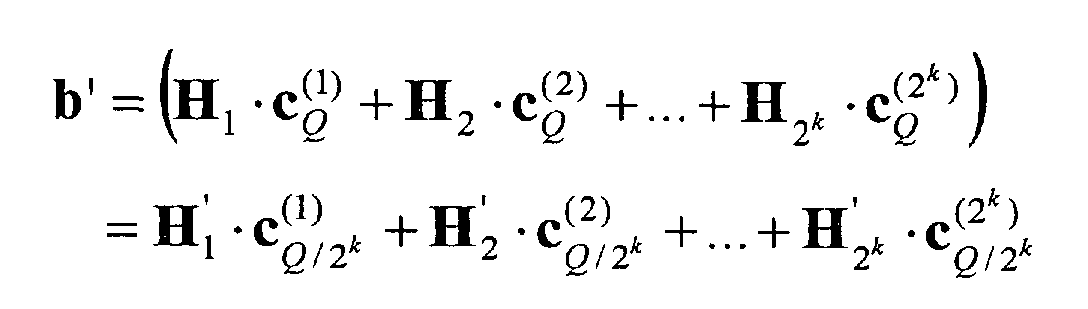
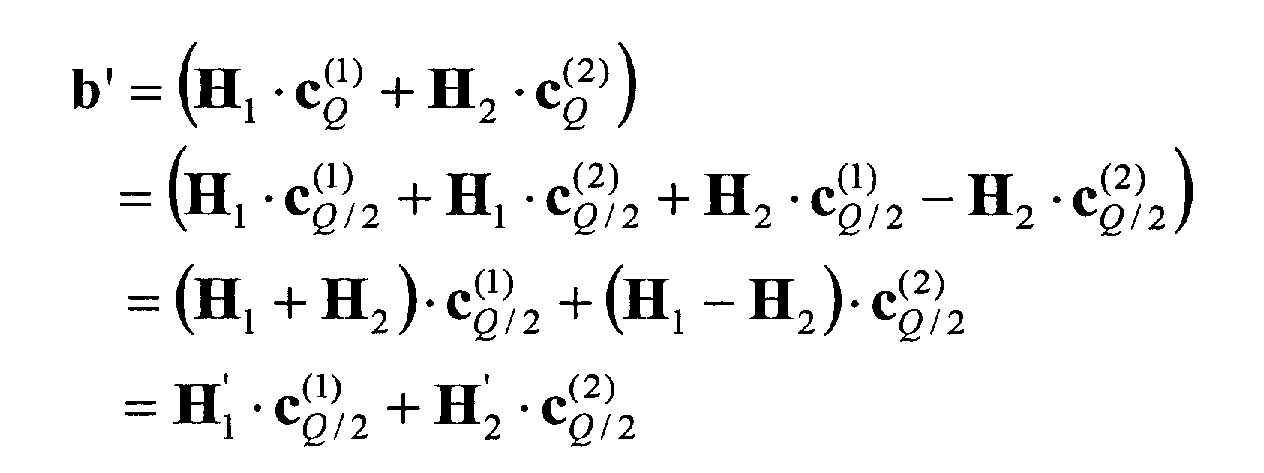
- the vector b 'can function are represented, with H x for the channel matrix for impulse response h x and C Q (x) for the spreading code for channel x of level Q of the OVSF tree structure.
- the new channel matrices H ' 1 and H' 2 have the same number of elements as the channel matrices H 1 and H 2 .
- the codes are only half the length, the number of arithmetic operations for b 'is identical to that for the calculation of b, with the exception that the additional addition must be taken into account.
- the OVSF structure cannot be used because the code c (2) is already used for the first antenna is used.
- the BCH is transmitted in UTRA 1.28 Mcps TDD on the two physical channels Primary Common Control Physical Channels P-CCPCH1 and P-CCPCH2; the signals given to these two channels are spread and processed in the multiplexers MUX taking into account the corresponding midambles m (1) and m (2) .
- the multiplexed signals are applied to the two antennas TxAntenna 1 and TxAntenna 2.
- FIG. 1 shows the spreading using the spreading codes on the basis of the designations spreading codes s (1) , spreading codes s (2) , spreading codes s (3) and spreading codes s (4) , which is intended to illustrate that in addition to the spreading With the spreading codes c (1) , c (2) , c (3) and c (4), a coding (scrambling) specific to the radio cell is generally carried out.
- the invention Method is suitable for radio communication systems, who work with a symbol-synchronous CDMA and the symbols spread with OVSF codes. This is particularly true for UTRA TDD radio communication systems.
- the multipath transmission can in particular be carried out via two antennas done over two physical channels. This possibility offers itself especially with UTRA TDD radio communication systems both for the high chip rate mode (high chip rate) as well as for the mode of the low chip rate (low chip rate).
- a unidirectional signaling channel in the downward direction preferably the broadcast channel (BCH).
- BCH broadcast channel
Landscapes
- Engineering & Computer Science (AREA)
- Computer Networks & Wireless Communication (AREA)
- Signal Processing (AREA)
- Mobile Radio Communication Systems (AREA)
- Radio Transmission System (AREA)
Abstract
Description
- 3GPP specification TS25.224 version 4.1.0 [3]









Claims (10)
- Verfahren zur Sendemehrwegeübertragung (Transmit Diversity) von identischen Daten über mehrere Antennen über 2L physikalische Kanäle mit der natürlichen Zahl L in einem Funk-Kommunikationssystem mit mindestens jeweils einer über eine Funkschnittstelle miteinander verbundenen Basisstation und Teilnehmerstation,
wobei die Übertragung mittels des CDMA-Vielfachzugriffsverfahrens erfolgt,
wobei den physikalischen Kanälen orthogonale Codes mit variablen Spreizfaktoren der OVSF-Baumstruktur zugeordnet werden,
dadurch gekennzeichnet, dass den physikalischen Kanälen von demselben Muttercode abgeleitete Codes zugeordnet werden, wobei der Muttercode einen Spreizfaktor größer als 1 hat. - Verfahren nach Anspruch 1, dadurch gekennzeichnet, dass den physikalischen Kanälen 2L parallele Codes des Spreizfaktors Q zugeordnet werden.
- Verfahren nach Anspruch 1 oder 2, dadurch gekennzeichnet, dass jeder Code eine Länge Q aufweist und aus 2L Kurzcodes der Länge Q/2L zusammengesetzt wird.
- Verfahren einem der Ansprüche 1 bis 3, dadurch gekennzeichnet, dass das Funk-Kommunikationssystem auf dem TDD-Übertragungsverfahren beruht.
- Verfahren nach einem der Ansprüche 1 bis 4, dadurch gekennzeichnet, dass das Funk-Kommunikationssystem auf dem FDD-Übertragungsverfahren beruht.
- Verfahren nach einem der Ansprüche 1 bis 5, dadurch gekennzeichnet, dass die Mehrwegeübertragung über zwei Antennen über zwei physikalische Kanäle erfolgt.
- Verfahren nach einem der Ansprüche 1 bis 6, dadurch gekennzeichnet, dass die Übertragung auf einem unidirektionalen Signalisierungskanal in Abwärtsrichtung erfolgt.
- Sendestation zur Sendemehrwegeübertragung von identischen Daten über mehrere Antennen über 2L physikalische Kanäle mit der natürlichen Zahl L in einem Funk-Kommunikationssystem mittels des CDMA-Vielfachzugriffsverfahrens,
wobei in dem Funk-Kommunikationssystem zumindest eine Basisstation mit zumindest einer Teilnehmerstation über eine Funkschnittstelle verbindbar ist,
wobei in der Sendestation Mittel zum Senden von Funkblöcken über physikalische Kanäle mittels orthogonaler Codes mit variablen Spreizfaktoren der OVSF-Baumstruktur vorgesehen sind,
dadurch gekennzeichnet, dass in der Sendestation Mittel zur Auswahl von den physikalische Kanälen zugeordnetenvon demselben Muttercode abgeleiteten Codes vorhanden sind, wobei der Muttercode einen Spreizfaktor größer als 1 hat. - Empfangsstation zum Empfang von identischen, über Sendemehrwegeübertragung über mehrere Antennen über 2L physikalische Kanäle mit der natürlichen Zahl L in einem Funk-Kommunikationssystem mittels des CDMA-Vielfachzugriffsverfahrens gesendeten Daten,
wobei in dem Funk-Kommunikationssystem zumindest eine Basisstation mit zumindest einer Teilnehmerstation über eine Funkschnittstelle verbindbar ist,
wobei in der Empfangsstation Mittel zum Empfang von Funkblöcken über physikalische Kanäle mittels orthogonaler Codes mit variablen Spreizfaktoren der OVSF-Baumstruktur vorgesehen sind,
dadurch gekennzeichnet, dass in der Empfangsstation Mittel zur Auswahl von den physikalische Kanälen zugeordneten von demselben Muttercode abgeleiteten Codes vorhanden sind, wobei der Muttercode einen Spreizfaktor größer als 1 hat. - Funk-Kommunikationssystem mit zumindest einer Sendestation und zumindest einer Empfangsstation, insbesondere mit zumindest einer Basisstation als Sendestation und zumindest einer Teilnehmerstation als Empfangsstation, nach den vorangehenden Ansprüchen.
Priority Applications (2)
| Application Number | Priority Date | Filing Date | Title |
|---|---|---|---|
| EP20010121488 EP1292048B1 (de) | 2001-09-07 | 2001-09-07 | Verfahren zur Sendemehrwegeübertragung von Daten in einem Funk-Kommunikationssystem |
| DE50114759T DE50114759D1 (de) | 2001-09-07 | 2001-09-07 | Verfahren zur Sendemehrwegeübertragung von Daten in einem Funk-Kommunikationssystem |
Applications Claiming Priority (1)
| Application Number | Priority Date | Filing Date | Title |
|---|---|---|---|
| EP20010121488 EP1292048B1 (de) | 2001-09-07 | 2001-09-07 | Verfahren zur Sendemehrwegeübertragung von Daten in einem Funk-Kommunikationssystem |
Publications (2)
| Publication Number | Publication Date |
|---|---|
| EP1292048A1 true EP1292048A1 (de) | 2003-03-12 |
| EP1292048B1 EP1292048B1 (de) | 2009-03-11 |
Family
ID=8178582
Family Applications (1)
| Application Number | Title | Priority Date | Filing Date |
|---|---|---|---|
| EP20010121488 Expired - Lifetime EP1292048B1 (de) | 2001-09-07 | 2001-09-07 | Verfahren zur Sendemehrwegeübertragung von Daten in einem Funk-Kommunikationssystem |
Country Status (2)
| Country | Link |
|---|---|
| EP (1) | EP1292048B1 (de) |
| DE (1) | DE50114759D1 (de) |
Cited By (2)
| Publication number | Priority date | Publication date | Assignee | Title |
|---|---|---|---|---|
| US7400692B2 (en) | 2004-01-14 | 2008-07-15 | Interdigital Technology Corporation | Telescoping window based equalization |
| US7437135B2 (en) | 2003-10-30 | 2008-10-14 | Interdigital Technology Corporation | Joint channel equalizer interference canceller advanced receiver |
Citations (5)
| Publication number | Priority date | Publication date | Assignee | Title |
|---|---|---|---|---|
| US5652764A (en) * | 1995-01-17 | 1997-07-29 | Kabushiki Kaisha Toshiba | Radio communication system |
| WO2000038462A1 (fr) * | 1998-12-22 | 2000-06-29 | Nortel Matra Cellular | Procede de radiocommunication cellulaire, equipements de controle et stations mobiles mettant en oeuvre ce procede |
| WO2000062444A1 (de) * | 1999-04-14 | 2000-10-19 | Siemens Aktiengesellschaft | Strahlformungsverfahren der abwärtsstrecke für basisstationen in funk-kommunikationssystemen |
| WO2001001605A1 (en) * | 1999-06-28 | 2001-01-04 | Lucent Technologies Inc. | High-speed data services using multiple transmit antennas |
| US6173005B1 (en) * | 1997-09-04 | 2001-01-09 | Motorola, Inc. | Apparatus and method for transmitting signals in a communication system |
-
2001
- 2001-09-07 DE DE50114759T patent/DE50114759D1/de not_active Expired - Fee Related
- 2001-09-07 EP EP20010121488 patent/EP1292048B1/de not_active Expired - Lifetime
Patent Citations (5)
| Publication number | Priority date | Publication date | Assignee | Title |
|---|---|---|---|---|
| US5652764A (en) * | 1995-01-17 | 1997-07-29 | Kabushiki Kaisha Toshiba | Radio communication system |
| US6173005B1 (en) * | 1997-09-04 | 2001-01-09 | Motorola, Inc. | Apparatus and method for transmitting signals in a communication system |
| WO2000038462A1 (fr) * | 1998-12-22 | 2000-06-29 | Nortel Matra Cellular | Procede de radiocommunication cellulaire, equipements de controle et stations mobiles mettant en oeuvre ce procede |
| WO2000062444A1 (de) * | 1999-04-14 | 2000-10-19 | Siemens Aktiengesellschaft | Strahlformungsverfahren der abwärtsstrecke für basisstationen in funk-kommunikationssystemen |
| WO2001001605A1 (en) * | 1999-06-28 | 2001-01-04 | Lucent Technologies Inc. | High-speed data services using multiple transmit antennas |
Cited By (2)
| Publication number | Priority date | Publication date | Assignee | Title |
|---|---|---|---|---|
| US7437135B2 (en) | 2003-10-30 | 2008-10-14 | Interdigital Technology Corporation | Joint channel equalizer interference canceller advanced receiver |
| US7400692B2 (en) | 2004-01-14 | 2008-07-15 | Interdigital Technology Corporation | Telescoping window based equalization |
Also Published As
| Publication number | Publication date |
|---|---|
| EP1292048B1 (de) | 2009-03-11 |
| DE50114759D1 (de) | 2009-04-23 |
Similar Documents
| Publication | Publication Date | Title |
|---|---|---|
| DE69938529T2 (de) | Empfang von Zeitsgechalteten Sendeniversitäts-(TSTD)-Signalen und nicht-TSTD-Signalen | |
| DE69931521T2 (de) | Rake-Empfänger | |
| EP1402657B1 (de) | Adaptives signalverarbeitungsverfahren in einem mimo-system | |
| EP1173943B1 (de) | Verfahren zur bildung bzw. ermittlung einer synchronisationsfolge, verfahren zur synchronisation, sendeeinheit und empfangseinheit | |
| DE69432394T2 (de) | Funk-Kommunikationssystem für CDMA und TDMA welches einen trainierten adaptiven Filter zur Demodulation benutzt | |
| EP1000472B1 (de) | Verfahren und funkstation zur datenübertragung | |
| DE60219834T2 (de) | Vereinfachter Block-Linearer Entzerrer mit Raum-Zeit Sende-Diversität | |
| DE19803188B4 (de) | Verfahren und Basisstation zur Datenübertragung in einem Funk-Kommunikationssystem | |
| DE20218536U1 (de) | Mehrfach-Eingabe-Mehrfach-Ausgabe-Benutzergerät | |
| WO2001063796A1 (de) | Datenübertragungsverfahren und -system mit sendeantennen-diversität | |
| DE10026077A1 (de) | Strahlformungsverfahren | |
| EP1000476B1 (de) | Verfahren und funkstation zur datenübertragung | |
| WO1997041647A1 (de) | System zur funkübertragung digitaler signale zwischen mehreren teilnehmerstationen und einer basisstation | |
| DE60311657T2 (de) | Datendetektion für Kodes mit nicht gleichartigen Spreizfaktoren | |
| WO1999022527A2 (de) | Verfahren und anordnung zur übertragung von daten über eine funkschnittstelle in einem funk-kommunikationssystem | |
| EP1224749B1 (de) | Strahlformung in einem funk-kommunikationssystem | |
| DE60010553T2 (de) | Interferenzunterdrückungsverfahren | |
| DE10350362B4 (de) | Verfahren zum Vorhersagen eines Kanalkoeffizienten | |
| DE60215945T2 (de) | Entzerrer mit zwei Raum-Zeit Filtern und mit einem Selektor zum Wählen des Filters mit der besten Symbolschätzung | |
| EP1004172B1 (de) | Verfahren und einrichtung zur kanalschätzung | |
| DE60316477T2 (de) | Vorrichtung und verfahren zur vorkodierung eines mehrträgersignals | |
| DE19826036C2 (de) | Verfahren zur Trennung von mehreren überlagerten codierten Nutzersignalen | |
| EP1292048B1 (de) | Verfahren zur Sendemehrwegeübertragung von Daten in einem Funk-Kommunikationssystem | |
| EP1133834B1 (de) | Verfahren zum steuern von speicherzugriffen bei "rake"-empfängern mit "early-late tracking" in telekommunikationssystemen | |
| EP1226666B1 (de) | Verfahren zur synchronisation einer signalübertragung in aufwärtsrichtung in einem funk-kommunikationssystem |
Legal Events
| Date | Code | Title | Description |
|---|---|---|---|
| PUAI | Public reference made under article 153(3) epc to a published international application that has entered the european phase |
Free format text: ORIGINAL CODE: 0009012 |
|
| AK | Designated contracting states |
Kind code of ref document: A1 Designated state(s): AT BE CH CY DE DK ES FI FR GB GR IE IT LI LU MC NL PT SE TR Designated state(s): AT BE CH CY DE DK ES FI FR GB GR IE IT LI LU MC NL PT SE TR |
|
| AX | Request for extension of the european patent |
Extension state: AL LT LV MK RO SI |
|
| 17P | Request for examination filed |
Effective date: 20030707 |
|
| AKX | Designation fees paid |
Designated state(s): DE ES FR GB IT |
|
| 17Q | First examination report despatched |
Effective date: 20050630 |
|
| 17Q | First examination report despatched |
Effective date: 20050630 |
|
| RAP1 | Party data changed (applicant data changed or rights of an application transferred) |
Owner name: NOKIA SIEMENS NETWORKS GMBH & CO. KG |
|
| RAP3 | Party data changed (applicant data changed or rights of an application transferred) |
Owner name: NOKIA SIEMENS NETWORKS S.P.A. |
|
| RAP3 | Party data changed (applicant data changed or rights of an application transferred) |
Owner name: NOKIA SIEMENS NETWORKS GMBH & CO. KG |
|
| GRAP | Despatch of communication of intention to grant a patent |
Free format text: ORIGINAL CODE: EPIDOSNIGR1 |
|
| GRAS | Grant fee paid |
Free format text: ORIGINAL CODE: EPIDOSNIGR3 |
|
| GRAA | (expected) grant |
Free format text: ORIGINAL CODE: 0009210 |
|
| AK | Designated contracting states |
Kind code of ref document: B1 Designated state(s): DE ES FR GB IT |
|
| REG | Reference to a national code |
Ref country code: GB Ref legal event code: FG4D Free format text: NOT ENGLISH |
|
| REF | Corresponds to: |
Ref document number: 50114759 Country of ref document: DE Date of ref document: 20090423 Kind code of ref document: P |
|
| PG25 | Lapsed in a contracting state [announced via postgrant information from national office to epo] |
Ref country code: ES Free format text: LAPSE BECAUSE OF FAILURE TO SUBMIT A TRANSLATION OF THE DESCRIPTION OR TO PAY THE FEE WITHIN THE PRESCRIBED TIME-LIMIT Effective date: 20090622 |
|
| PLBE | No opposition filed within time limit |
Free format text: ORIGINAL CODE: 0009261 |
|
| STAA | Information on the status of an ep patent application or granted ep patent |
Free format text: STATUS: NO OPPOSITION FILED WITHIN TIME LIMIT |
|
| 26N | No opposition filed |
Effective date: 20091214 |
|
| REG | Reference to a national code |
Ref country code: FR Ref legal event code: ST Effective date: 20100531 |
|
| PG25 | Lapsed in a contracting state [announced via postgrant information from national office to epo] |
Ref country code: FR Free format text: LAPSE BECAUSE OF NON-PAYMENT OF DUE FEES Effective date: 20090930 Ref country code: DE Free format text: LAPSE BECAUSE OF NON-PAYMENT OF DUE FEES Effective date: 20100401 |
|
| PG25 | Lapsed in a contracting state [announced via postgrant information from national office to epo] |
Ref country code: IT Free format text: LAPSE BECAUSE OF FAILURE TO SUBMIT A TRANSLATION OF THE DESCRIPTION OR TO PAY THE FEE WITHIN THE PRESCRIBED TIME-LIMIT Effective date: 20090311 |
|
| REG | Reference to a national code |
Ref country code: GB Ref legal event code: 732E Free format text: REGISTERED BETWEEN 20200402 AND 20200408 |
|
| PGFP | Annual fee paid to national office [announced via postgrant information from national office to epo] |
Ref country code: GB Payment date: 20200826 Year of fee payment: 20 |
|
| REG | Reference to a national code |
Ref country code: GB Ref legal event code: PE20 Expiry date: 20210906 |
|
| PG25 | Lapsed in a contracting state [announced via postgrant information from national office to epo] |
Ref country code: GB Free format text: LAPSE BECAUSE OF EXPIRATION OF PROTECTION Effective date: 20210906 |