EP1289757B1 - Film multicouche a haut module - Google Patents
Film multicouche a haut module Download PDFInfo
- Publication number
- EP1289757B1 EP1289757B1 EP01939121A EP01939121A EP1289757B1 EP 1289757 B1 EP1289757 B1 EP 1289757B1 EP 01939121 A EP01939121 A EP 01939121A EP 01939121 A EP01939121 A EP 01939121A EP 1289757 B1 EP1289757 B1 EP 1289757B1
- Authority
- EP
- European Patent Office
- Prior art keywords
- polyamide
- layer
- multilayer film
- film
- copolymer
- Prior art date
- Legal status (The legal status is an assumption and is not a legal conclusion. Google has not performed a legal analysis and makes no representation as to the accuracy of the status listed.)
- Expired - Lifetime
Links
- 229920006020 amorphous polyamide Polymers 0.000 claims description 38
- 229920001577 copolymer Polymers 0.000 claims description 31
- VGGSQFUCUMXWEO-UHFFFAOYSA-N Ethene Chemical compound C=C VGGSQFUCUMXWEO-UHFFFAOYSA-N 0.000 claims description 29
- 239000000463 material Substances 0.000 claims description 29
- 229920002302 Nylon 6,6 Polymers 0.000 claims description 28
- 239000005977 Ethylene Substances 0.000 claims description 26
- 229920002292 Nylon 6 Polymers 0.000 claims description 25
- 239000004952 Polyamide Substances 0.000 claims description 19
- 229920002647 polyamide Polymers 0.000 claims description 19
- 238000003860 storage Methods 0.000 claims description 19
- QVGXLLKOCUKJST-UHFFFAOYSA-N atomic oxygen Chemical compound [O] QVGXLLKOCUKJST-UHFFFAOYSA-N 0.000 claims description 16
- 239000001301 oxygen Substances 0.000 claims description 16
- 229910052760 oxygen Inorganic materials 0.000 claims description 16
- 229920006121 Polyxylylene adipamide Polymers 0.000 claims description 12
- 229920000098 polyolefin Polymers 0.000 claims description 12
- 230000005540 biological transmission Effects 0.000 claims description 9
- 229920001519 homopolymer Polymers 0.000 claims description 9
- 229920001903 high density polyethylene Polymers 0.000 claims description 7
- 239000004700 high-density polyethylene Substances 0.000 claims description 7
- 229920000092 linear low density polyethylene Polymers 0.000 claims description 7
- 239000004707 linear low-density polyethylene Substances 0.000 claims description 7
- 229920001684 low density polyethylene Polymers 0.000 claims description 7
- 239000004702 low-density polyethylene Substances 0.000 claims description 7
- 229920002239 polyacrylonitrile Polymers 0.000 claims description 7
- -1 polypropylene Polymers 0.000 claims description 7
- 239000005033 polyvinylidene chloride Substances 0.000 claims description 7
- 229920001328 Polyvinylidene chloride Polymers 0.000 claims description 6
- 239000012298 atmosphere Substances 0.000 claims description 6
- 150000002148 esters Chemical class 0.000 claims description 6
- 239000004743 Polypropylene Substances 0.000 claims description 5
- 229920001155 polypropylene Polymers 0.000 claims description 5
- 229920001897 terpolymer Polymers 0.000 claims description 5
- 239000004716 Ethylene/acrylic acid copolymer Substances 0.000 claims description 4
- 229920000305 Nylon 6,10 Polymers 0.000 claims description 4
- 229920006242 ethylene acrylic acid copolymer Polymers 0.000 claims description 4
- 229920001038 ethylene copolymer Polymers 0.000 claims description 4
- 229920003145 methacrylic acid copolymer Polymers 0.000 claims description 4
- 229940117841 methacrylic acid copolymer Drugs 0.000 claims description 4
- 229920000728 polyester Polymers 0.000 claims description 4
- 230000009477 glass transition Effects 0.000 claims description 3
- 101000576320 Homo sapiens Max-binding protein MNT Proteins 0.000 claims description 2
- 229920000572 Nylon 6/12 Polymers 0.000 claims description 2
- 229920006131 poly(hexamethylene isophthalamide-co-terephthalamide) Polymers 0.000 claims description 2
- 229920000058 polyacrylate Polymers 0.000 claims description 2
- 229920000515 polycarbonate Polymers 0.000 claims description 2
- 239000004417 polycarbonate Substances 0.000 claims description 2
- 229920002635 polyurethane Polymers 0.000 claims description 2
- 239000004814 polyurethane Substances 0.000 claims description 2
- 239000010410 layer Substances 0.000 description 149
- 238000004806 packaging method and process Methods 0.000 description 21
- 229920006039 crystalline polyamide Polymers 0.000 description 8
- 239000000155 melt Substances 0.000 description 8
- 238000000034 method Methods 0.000 description 7
- 239000000853 adhesive Substances 0.000 description 6
- 230000001070 adhesive effect Effects 0.000 description 6
- 230000004888 barrier function Effects 0.000 description 6
- 229920000642 polymer Polymers 0.000 description 6
- 238000002844 melting Methods 0.000 description 5
- 230000008018 melting Effects 0.000 description 5
- 230000008569 process Effects 0.000 description 5
- 239000004594 Masterbatch (MB) Substances 0.000 description 4
- 239000004677 Nylon Substances 0.000 description 4
- KKEYFWRCBNTPAC-UHFFFAOYSA-N Terephthalic acid Chemical compound OC(=O)C1=CC=C(C(O)=O)C=C1 KKEYFWRCBNTPAC-UHFFFAOYSA-N 0.000 description 4
- 125000001931 aliphatic group Chemical group 0.000 description 4
- 125000003118 aryl group Chemical group 0.000 description 4
- 239000011248 coating agent Substances 0.000 description 4
- 238000000576 coating method Methods 0.000 description 4
- 235000013305 food Nutrition 0.000 description 4
- 229920001778 nylon Polymers 0.000 description 4
- 238000007789 sealing Methods 0.000 description 4
- 238000012360 testing method Methods 0.000 description 4
- 102100022014 Angiopoietin-1 receptor Human genes 0.000 description 3
- 101100481403 Bos taurus TIE1 gene Proteins 0.000 description 3
- 229920000089 Cyclic olefin copolymer Polymers 0.000 description 3
- 101000753291 Homo sapiens Angiopoietin-1 receptor Proteins 0.000 description 3
- OFOBLEOULBTSOW-UHFFFAOYSA-N Malonic acid Chemical compound OC(=O)CC(O)=O OFOBLEOULBTSOW-UHFFFAOYSA-N 0.000 description 3
- VYPSYNLAJGMNEJ-UHFFFAOYSA-N Silicium dioxide Chemical compound O=[Si]=O VYPSYNLAJGMNEJ-UHFFFAOYSA-N 0.000 description 3
- 239000012790 adhesive layer Substances 0.000 description 3
- 150000008064 anhydrides Chemical group 0.000 description 3
- 125000004432 carbon atom Chemical group C* 0.000 description 3
- 150000004985 diamines Chemical class 0.000 description 3
- QQVIHTHCMHWDBS-UHFFFAOYSA-N isophthalic acid Chemical compound OC(=O)C1=CC=CC(C(O)=O)=C1 QQVIHTHCMHWDBS-UHFFFAOYSA-N 0.000 description 3
- 239000000203 mixture Substances 0.000 description 3
- 229920005989 resin Polymers 0.000 description 3
- 239000011347 resin Substances 0.000 description 3
- 229920006114 semi-crystalline semi-aromatic polyamide Polymers 0.000 description 3
- CBCKQZAAMUWICA-UHFFFAOYSA-N 1,4-phenylenediamine Chemical group NC1=CC=C(N)C=C1 CBCKQZAAMUWICA-UHFFFAOYSA-N 0.000 description 2
- CFVWNXQPGQOHRJ-UHFFFAOYSA-N 2-methylpropyl prop-2-enoate Chemical compound CC(C)COC(=O)C=C CFVWNXQPGQOHRJ-UHFFFAOYSA-N 0.000 description 2
- 229920013665 Ampacet Polymers 0.000 description 2
- VTYYLEPIZMXCLO-UHFFFAOYSA-L Calcium carbonate Chemical compound [Ca+2].[O-]C([O-])=O VTYYLEPIZMXCLO-UHFFFAOYSA-L 0.000 description 2
- UAUDZVJPLUQNMU-UHFFFAOYSA-N Erucasaeureamid Natural products CCCCCCCCC=CCCCCCCCCCCCC(N)=O UAUDZVJPLUQNMU-UHFFFAOYSA-N 0.000 description 2
- VZCYOOQTPOCHFL-OWOJBTEDSA-N Fumaric acid Chemical compound OC(=O)\C=C\C(O)=O VZCYOOQTPOCHFL-OWOJBTEDSA-N 0.000 description 2
- 239000005909 Kieselgur Substances 0.000 description 2
- 229920006097 Ultramide® Polymers 0.000 description 2
- XTXRWKRVRITETP-UHFFFAOYSA-N Vinyl acetate Chemical compound CC(=O)OC=C XTXRWKRVRITETP-UHFFFAOYSA-N 0.000 description 2
- SMEGJBVQLJJKKX-HOTMZDKISA-N [(2R,3S,4S,5R,6R)-5-acetyloxy-3,4,6-trihydroxyoxan-2-yl]methyl acetate Chemical compound CC(=O)OC[C@@H]1[C@H]([C@@H]([C@H]([C@@H](O1)O)OC(=O)C)O)O SMEGJBVQLJJKKX-HOTMZDKISA-N 0.000 description 2
- 239000002253 acid Substances 0.000 description 2
- WNLRTRBMVRJNCN-UHFFFAOYSA-N adipic acid Chemical class OC(=O)CCCCC(O)=O WNLRTRBMVRJNCN-UHFFFAOYSA-N 0.000 description 2
- 125000000217 alkyl group Chemical group 0.000 description 2
- 229920006125 amorphous polymer Polymers 0.000 description 2
- 230000009286 beneficial effect Effects 0.000 description 2
- 235000013361 beverage Nutrition 0.000 description 2
- VHRGRCVQAFMJIZ-UHFFFAOYSA-N cadaverine Chemical group NCCCCCN VHRGRCVQAFMJIZ-UHFFFAOYSA-N 0.000 description 2
- 229910052799 carbon Inorganic materials 0.000 description 2
- 238000001816 cooling Methods 0.000 description 2
- 239000012792 core layer Substances 0.000 description 2
- 239000002178 crystalline material Substances 0.000 description 2
- 230000007423 decrease Effects 0.000 description 2
- 230000003247 decreasing effect Effects 0.000 description 2
- 150000001991 dicarboxylic acids Chemical class 0.000 description 2
- 230000000694 effects Effects 0.000 description 2
- JBKVHLHDHHXQEQ-UHFFFAOYSA-N epsilon-caprolactam Chemical compound O=C1CCCCCN1 JBKVHLHDHHXQEQ-UHFFFAOYSA-N 0.000 description 2
- UAUDZVJPLUQNMU-KTKRTIGZSA-N erucamide Chemical compound CCCCCCCC\C=C/CCCCCCCCCCCC(N)=O UAUDZVJPLUQNMU-KTKRTIGZSA-N 0.000 description 2
- VXNZUUAINFGPBY-UHFFFAOYSA-N ethyl ethylene Natural products CCC=C VXNZUUAINFGPBY-UHFFFAOYSA-N 0.000 description 2
- 230000009969 flowable effect Effects 0.000 description 2
- 229920001112 grafted polyolefin Polymers 0.000 description 2
- NAQMVNRVTILPCV-UHFFFAOYSA-N hexane-1,6-diamine Chemical compound NCCCCCCN NAQMVNRVTILPCV-UHFFFAOYSA-N 0.000 description 2
- 239000011229 interlayer Substances 0.000 description 2
- 229940018564 m-phenylenediamine Drugs 0.000 description 2
- 238000004519 manufacturing process Methods 0.000 description 2
- 235000013372 meat Nutrition 0.000 description 2
- 229910052751 metal Chemical class 0.000 description 2
- 239000002184 metal Chemical class 0.000 description 2
- 238000002156 mixing Methods 0.000 description 2
- LIKMAJRDDDTEIG-UHFFFAOYSA-N n-hexene Natural products CCCCC=C LIKMAJRDDDTEIG-UHFFFAOYSA-N 0.000 description 2
- 238000012858 packaging process Methods 0.000 description 2
- 235000021485 packed food Nutrition 0.000 description 2
- KIDHWZJUCRJVML-UHFFFAOYSA-N putrescine Chemical group NCCCCN KIDHWZJUCRJVML-UHFFFAOYSA-N 0.000 description 2
- 238000010791 quenching Methods 0.000 description 2
- 235000015067 sauces Nutrition 0.000 description 2
- CXMXRPHRNRROMY-UHFFFAOYSA-N sebacic acid Chemical class OC(=O)CCCCCCCCC(O)=O CXMXRPHRNRROMY-UHFFFAOYSA-N 0.000 description 2
- 239000002904 solvent Substances 0.000 description 2
- 235000014347 soups Nutrition 0.000 description 2
- 239000000454 talc Substances 0.000 description 2
- 229910052623 talc Inorganic materials 0.000 description 2
- 235000012222 talc Nutrition 0.000 description 2
- VZCYOOQTPOCHFL-UHFFFAOYSA-N trans-butenedioic acid Natural products OC(=O)C=CC(O)=O VZCYOOQTPOCHFL-UHFFFAOYSA-N 0.000 description 2
- XFNJVJPLKCPIBV-UHFFFAOYSA-N trimethylenediamine Chemical group NCCCN XFNJVJPLKCPIBV-UHFFFAOYSA-N 0.000 description 2
- XLYOFNOQVPJJNP-UHFFFAOYSA-N water Substances O XLYOFNOQVPJJNP-UHFFFAOYSA-N 0.000 description 2
- 239000004711 α-olefin Substances 0.000 description 2
- WZCQRUWWHSTZEM-UHFFFAOYSA-N 1,3-phenylenediamine Chemical group NC1=CC=CC(N)=C1 WZCQRUWWHSTZEM-UHFFFAOYSA-N 0.000 description 1
- JCUZDQXWVYNXHD-UHFFFAOYSA-N 2,2,4-trimethylhexane-1,6-diamine Chemical compound NCCC(C)CC(C)(C)CN JCUZDQXWVYNXHD-UHFFFAOYSA-N 0.000 description 1
- DPQHRXRAZHNGRU-UHFFFAOYSA-N 2,4,4-trimethylhexane-1,6-diamine Chemical compound NCC(C)CC(C)(C)CCN DPQHRXRAZHNGRU-UHFFFAOYSA-N 0.000 description 1
- JZUHIOJYCPIVLQ-UHFFFAOYSA-N 2-methylpentane-1,5-diamine Chemical compound NCC(C)CCCN JZUHIOJYCPIVLQ-UHFFFAOYSA-N 0.000 description 1
- VQDJODAWOFNASI-UHFFFAOYSA-N 2-propylpropanedioic acid Chemical class CCCC(C(O)=O)C(O)=O VQDJODAWOFNASI-UHFFFAOYSA-N 0.000 description 1
- AHCBPEXSQCYFTH-UHFFFAOYSA-N 3-methylpentane-2,2-diamine Chemical group CCC(C)C(C)(N)N AHCBPEXSQCYFTH-UHFFFAOYSA-N 0.000 description 1
- DZIHTWJGPDVSGE-UHFFFAOYSA-N 4-[(4-aminocyclohexyl)methyl]cyclohexan-1-amine Chemical compound C1CC(N)CCC1CC1CCC(N)CC1 DZIHTWJGPDVSGE-UHFFFAOYSA-N 0.000 description 1
- 238000003855 Adhesive Lamination Methods 0.000 description 1
- 229920003313 Bynel® Polymers 0.000 description 1
- 229920006051 Capron® Polymers 0.000 description 1
- JIGUQPWFLRLWPJ-UHFFFAOYSA-N Ethyl acrylate Chemical compound CCOC(=O)C=C JIGUQPWFLRLWPJ-UHFFFAOYSA-N 0.000 description 1
- 229920000219 Ethylene vinyl alcohol Polymers 0.000 description 1
- 241000287828 Gallus gallus Species 0.000 description 1
- 229920003620 Grilon® Polymers 0.000 description 1
- 229920006060 Grivory® Polymers 0.000 description 1
- CERQOIWHTDAKMF-UHFFFAOYSA-M Methacrylate Chemical compound CC(=C)C([O-])=O CERQOIWHTDAKMF-UHFFFAOYSA-M 0.000 description 1
- CERQOIWHTDAKMF-UHFFFAOYSA-N Methacrylic acid Chemical compound CC(=C)C(O)=O CERQOIWHTDAKMF-UHFFFAOYSA-N 0.000 description 1
- 239000006057 Non-nutritive feed additive Substances 0.000 description 1
- 229920000299 Nylon 12 Polymers 0.000 description 1
- 241000667869 Psix Species 0.000 description 1
- 239000005700 Putrescine Chemical group 0.000 description 1
- XUIMIQQOPSSXEZ-UHFFFAOYSA-N Silicon Chemical compound [Si] XUIMIQQOPSSXEZ-UHFFFAOYSA-N 0.000 description 1
- 229920003182 Surlyn® Polymers 0.000 description 1
- FDLQZKYLHJJBHD-UHFFFAOYSA-N [3-(aminomethyl)phenyl]methanamine Chemical group NCC1=CC=CC(CN)=C1 FDLQZKYLHJJBHD-UHFFFAOYSA-N 0.000 description 1
- OXIKYYJDTWKERT-UHFFFAOYSA-N [4-(aminomethyl)cyclohexyl]methanamine Chemical group NCC1CCC(CN)CC1 OXIKYYJDTWKERT-UHFFFAOYSA-N 0.000 description 1
- ISKQADXMHQSTHK-UHFFFAOYSA-N [4-(aminomethyl)phenyl]methanamine Chemical group NCC1=CC=C(CN)C=C1 ISKQADXMHQSTHK-UHFFFAOYSA-N 0.000 description 1
- 150000007513 acids Chemical class 0.000 description 1
- BAPJBEWLBFYGME-UHFFFAOYSA-N acrylic acid methyl ester Natural products COC(=O)C=C BAPJBEWLBFYGME-UHFFFAOYSA-N 0.000 description 1
- 230000002730 additional effect Effects 0.000 description 1
- 239000000654 additive Substances 0.000 description 1
- 239000001361 adipic acid Chemical class 0.000 description 1
- 235000011037 adipic acid Nutrition 0.000 description 1
- 230000002411 adverse Effects 0.000 description 1
- 150000004984 aromatic diamines Chemical class 0.000 description 1
- CQEYYJKEWSMYFG-UHFFFAOYSA-N butyl acrylate Chemical compound CCCCOC(=O)C=C CQEYYJKEWSMYFG-UHFFFAOYSA-N 0.000 description 1
- 229910000019 calcium carbonate Inorganic materials 0.000 description 1
- 235000013351 cheese Nutrition 0.000 description 1
- 239000003795 chemical substances by application Substances 0.000 description 1
- 235000011950 custard Nutrition 0.000 description 1
- 125000004122 cyclic group Chemical group 0.000 description 1
- GEQHKFFSPGPGLN-UHFFFAOYSA-N cyclohexane-1,3-diamine Chemical group NC1CCCC(N)C1 GEQHKFFSPGPGLN-UHFFFAOYSA-N 0.000 description 1
- VKIRRGRTJUUZHS-UHFFFAOYSA-N cyclohexane-1,4-diamine Chemical group NC1CCC(N)CC1 VKIRRGRTJUUZHS-UHFFFAOYSA-N 0.000 description 1
- 230000032798 delamination Effects 0.000 description 1
- 230000001419 dependent effect Effects 0.000 description 1
- 230000001627 detrimental effect Effects 0.000 description 1
- 125000001142 dicarboxylic acid group Chemical group 0.000 description 1
- 230000003292 diminished effect Effects 0.000 description 1
- 238000001035 drying Methods 0.000 description 1
- 239000000839 emulsion Substances 0.000 description 1
- 238000005530 etching Methods 0.000 description 1
- 238000007765 extrusion coating Methods 0.000 description 1
- 239000006260 foam Substances 0.000 description 1
- 239000001530 fumaric acid Substances 0.000 description 1
- 239000007789 gas Substances 0.000 description 1
- 229920000578 graft copolymer Polymers 0.000 description 1
- 235000019692 hotdogs Nutrition 0.000 description 1
- 238000009863 impact test Methods 0.000 description 1
- 239000000976 ink Substances 0.000 description 1
- 229920000554 ionomer Polymers 0.000 description 1
- 150000002531 isophthalic acids Chemical class 0.000 description 1
- 235000015110 jellies Nutrition 0.000 description 1
- 238000002372 labelling Methods 0.000 description 1
- 238000003475 lamination Methods 0.000 description 1
- 150000004988 m-phenylenediamines Chemical class 0.000 description 1
- 239000000391 magnesium silicate Substances 0.000 description 1
- 229910052919 magnesium silicate Inorganic materials 0.000 description 1
- 235000019792 magnesium silicate Nutrition 0.000 description 1
- ZADYMNAVLSWLEQ-UHFFFAOYSA-N magnesium;oxygen(2-);silicon(4+) Chemical compound [O-2].[O-2].[O-2].[Mg+2].[Si+4] ZADYMNAVLSWLEQ-UHFFFAOYSA-N 0.000 description 1
- 238000012423 maintenance Methods 0.000 description 1
- VZCYOOQTPOCHFL-UPHRSURJSA-N maleic acid Chemical compound OC(=O)\C=C/C(O)=O VZCYOOQTPOCHFL-UPHRSURJSA-N 0.000 description 1
- 239000011976 maleic acid Substances 0.000 description 1
- 229920006281 multilayer packaging film Polymers 0.000 description 1
- RKISUIUJZGSLEV-UHFFFAOYSA-N n-[2-(octadecanoylamino)ethyl]octadecanamide Chemical compound CCCCCCCCCCCCCCCCCC(=O)NCCNC(=O)CCCCCCCCCCCCCCCCC RKISUIUJZGSLEV-UHFFFAOYSA-N 0.000 description 1
- 239000003921 oil Substances 0.000 description 1
- 235000016046 other dairy product Nutrition 0.000 description 1
- 229920006280 packaging film Polymers 0.000 description 1
- 239000012785 packaging film Substances 0.000 description 1
- 239000005022 packaging material Substances 0.000 description 1
- PNJWIWWMYCMZRO-UHFFFAOYSA-N pent‐4‐en‐2‐one Natural products CC(=O)CC=C PNJWIWWMYCMZRO-UHFFFAOYSA-N 0.000 description 1
- 239000000049 pigment Substances 0.000 description 1
- 229920001748 polybutylene Polymers 0.000 description 1
- 229920006149 polyester-amide block copolymer Polymers 0.000 description 1
- 244000144977 poultry Species 0.000 description 1
- 230000000171 quenching effect Effects 0.000 description 1
- 150000003839 salts Chemical class 0.000 description 1
- 229920006126 semicrystalline polymer Polymers 0.000 description 1
- 239000010703 silicon Substances 0.000 description 1
- 229910052710 silicon Inorganic materials 0.000 description 1
- 239000000126 substance Substances 0.000 description 1
- 239000000725 suspension Substances 0.000 description 1
- 239000012815 thermoplastic material Substances 0.000 description 1
- 238000009460 vacuum skin packaging Methods 0.000 description 1
- 238000007740 vapor deposition Methods 0.000 description 1
- 235000013618 yogurt Nutrition 0.000 description 1
Images
Classifications
-
- B—PERFORMING OPERATIONS; TRANSPORTING
- B32—LAYERED PRODUCTS
- B32B—LAYERED PRODUCTS, i.e. PRODUCTS BUILT-UP OF STRATA OF FLAT OR NON-FLAT, e.g. CELLULAR OR HONEYCOMB, FORM
- B32B27/00—Layered products comprising a layer of synthetic resin
- B32B27/30—Layered products comprising a layer of synthetic resin comprising vinyl (co)polymers; comprising acrylic (co)polymers
-
- B—PERFORMING OPERATIONS; TRANSPORTING
- B32—LAYERED PRODUCTS
- B32B—LAYERED PRODUCTS, i.e. PRODUCTS BUILT-UP OF STRATA OF FLAT OR NON-FLAT, e.g. CELLULAR OR HONEYCOMB, FORM
- B32B27/00—Layered products comprising a layer of synthetic resin
- B32B27/28—Layered products comprising a layer of synthetic resin comprising synthetic resins not wholly covered by any one of the sub-groups B32B27/30 - B32B27/42
-
- B—PERFORMING OPERATIONS; TRANSPORTING
- B32—LAYERED PRODUCTS
- B32B—LAYERED PRODUCTS, i.e. PRODUCTS BUILT-UP OF STRATA OF FLAT OR NON-FLAT, e.g. CELLULAR OR HONEYCOMB, FORM
- B32B27/00—Layered products comprising a layer of synthetic resin
- B32B27/34—Layered products comprising a layer of synthetic resin comprising polyamides
-
- Y—GENERAL TAGGING OF NEW TECHNOLOGICAL DEVELOPMENTS; GENERAL TAGGING OF CROSS-SECTIONAL TECHNOLOGIES SPANNING OVER SEVERAL SECTIONS OF THE IPC; TECHNICAL SUBJECTS COVERED BY FORMER USPC CROSS-REFERENCE ART COLLECTIONS [XRACs] AND DIGESTS
- Y10—TECHNICAL SUBJECTS COVERED BY FORMER USPC
- Y10T—TECHNICAL SUBJECTS COVERED BY FORMER US CLASSIFICATION
- Y10T428/00—Stock material or miscellaneous articles
- Y10T428/13—Hollow or container type article [e.g., tube, vase, etc.]
-
- Y—GENERAL TAGGING OF NEW TECHNOLOGICAL DEVELOPMENTS; GENERAL TAGGING OF CROSS-SECTIONAL TECHNOLOGIES SPANNING OVER SEVERAL SECTIONS OF THE IPC; TECHNICAL SUBJECTS COVERED BY FORMER USPC CROSS-REFERENCE ART COLLECTIONS [XRACs] AND DIGESTS
- Y10—TECHNICAL SUBJECTS COVERED BY FORMER USPC
- Y10T—TECHNICAL SUBJECTS COVERED BY FORMER US CLASSIFICATION
- Y10T428/00—Stock material or miscellaneous articles
- Y10T428/13—Hollow or container type article [e.g., tube, vase, etc.]
- Y10T428/1303—Paper containing [e.g., paperboard, cardboard, fiberboard, etc.]
- Y10T428/1307—Bag or tubular film [e.g., pouch, flexible food casing, envelope, etc.]
-
- Y—GENERAL TAGGING OF NEW TECHNOLOGICAL DEVELOPMENTS; GENERAL TAGGING OF CROSS-SECTIONAL TECHNOLOGIES SPANNING OVER SEVERAL SECTIONS OF THE IPC; TECHNICAL SUBJECTS COVERED BY FORMER USPC CROSS-REFERENCE ART COLLECTIONS [XRACs] AND DIGESTS
- Y10—TECHNICAL SUBJECTS COVERED BY FORMER USPC
- Y10T—TECHNICAL SUBJECTS COVERED BY FORMER US CLASSIFICATION
- Y10T428/00—Stock material or miscellaneous articles
- Y10T428/13—Hollow or container type article [e.g., tube, vase, etc.]
- Y10T428/131—Glass, ceramic, or sintered, fused, fired, or calcined metal oxide or metal carbide containing [e.g., porcelain, brick, cement, etc.]
- Y10T428/1317—Multilayer [continuous layer]
-
- Y—GENERAL TAGGING OF NEW TECHNOLOGICAL DEVELOPMENTS; GENERAL TAGGING OF CROSS-SECTIONAL TECHNOLOGIES SPANNING OVER SEVERAL SECTIONS OF THE IPC; TECHNICAL SUBJECTS COVERED BY FORMER USPC CROSS-REFERENCE ART COLLECTIONS [XRACs] AND DIGESTS
- Y10—TECHNICAL SUBJECTS COVERED BY FORMER USPC
- Y10T—TECHNICAL SUBJECTS COVERED BY FORMER US CLASSIFICATION
- Y10T428/00—Stock material or miscellaneous articles
- Y10T428/13—Hollow or container type article [e.g., tube, vase, etc.]
- Y10T428/131—Glass, ceramic, or sintered, fused, fired, or calcined metal oxide or metal carbide containing [e.g., porcelain, brick, cement, etc.]
- Y10T428/1317—Multilayer [continuous layer]
- Y10T428/1321—Polymer or resin containing [i.e., natural or synthetic]
-
- Y—GENERAL TAGGING OF NEW TECHNOLOGICAL DEVELOPMENTS; GENERAL TAGGING OF CROSS-SECTIONAL TECHNOLOGIES SPANNING OVER SEVERAL SECTIONS OF THE IPC; TECHNICAL SUBJECTS COVERED BY FORMER USPC CROSS-REFERENCE ART COLLECTIONS [XRACs] AND DIGESTS
- Y10—TECHNICAL SUBJECTS COVERED BY FORMER USPC
- Y10T—TECHNICAL SUBJECTS COVERED BY FORMER US CLASSIFICATION
- Y10T428/00—Stock material or miscellaneous articles
- Y10T428/13—Hollow or container type article [e.g., tube, vase, etc.]
- Y10T428/1328—Shrinkable or shrunk [e.g., due to heat, solvent, volatile agent, restraint removal, etc.]
-
- Y—GENERAL TAGGING OF NEW TECHNOLOGICAL DEVELOPMENTS; GENERAL TAGGING OF CROSS-SECTIONAL TECHNOLOGIES SPANNING OVER SEVERAL SECTIONS OF THE IPC; TECHNICAL SUBJECTS COVERED BY FORMER USPC CROSS-REFERENCE ART COLLECTIONS [XRACs] AND DIGESTS
- Y10—TECHNICAL SUBJECTS COVERED BY FORMER USPC
- Y10T—TECHNICAL SUBJECTS COVERED BY FORMER US CLASSIFICATION
- Y10T428/00—Stock material or miscellaneous articles
- Y10T428/13—Hollow or container type article [e.g., tube, vase, etc.]
- Y10T428/1334—Nonself-supporting tubular film or bag [e.g., pouch, envelope, packet, etc.]
- Y10T428/1341—Contains vapor or gas barrier, polymer derived from vinyl chloride or vinylidene chloride, or polymer containing a vinyl alcohol unit
-
- Y—GENERAL TAGGING OF NEW TECHNOLOGICAL DEVELOPMENTS; GENERAL TAGGING OF CROSS-SECTIONAL TECHNOLOGIES SPANNING OVER SEVERAL SECTIONS OF THE IPC; TECHNICAL SUBJECTS COVERED BY FORMER USPC CROSS-REFERENCE ART COLLECTIONS [XRACs] AND DIGESTS
- Y10—TECHNICAL SUBJECTS COVERED BY FORMER USPC
- Y10T—TECHNICAL SUBJECTS COVERED BY FORMER US CLASSIFICATION
- Y10T428/00—Stock material or miscellaneous articles
- Y10T428/13—Hollow or container type article [e.g., tube, vase, etc.]
- Y10T428/1352—Polymer or resin containing [i.e., natural or synthetic]
- Y10T428/1355—Elemental metal containing [e.g., substrate, foil, film, coating, etc.]
- Y10T428/1359—Three or more layers [continuous layer]
-
- Y—GENERAL TAGGING OF NEW TECHNOLOGICAL DEVELOPMENTS; GENERAL TAGGING OF CROSS-SECTIONAL TECHNOLOGIES SPANNING OVER SEVERAL SECTIONS OF THE IPC; TECHNICAL SUBJECTS COVERED BY FORMER USPC CROSS-REFERENCE ART COLLECTIONS [XRACs] AND DIGESTS
- Y10—TECHNICAL SUBJECTS COVERED BY FORMER USPC
- Y10T—TECHNICAL SUBJECTS COVERED BY FORMER US CLASSIFICATION
- Y10T428/00—Stock material or miscellaneous articles
- Y10T428/31504—Composite [nonstructural laminate]
- Y10T428/31725—Of polyamide
-
- Y—GENERAL TAGGING OF NEW TECHNOLOGICAL DEVELOPMENTS; GENERAL TAGGING OF CROSS-SECTIONAL TECHNOLOGIES SPANNING OVER SEVERAL SECTIONS OF THE IPC; TECHNICAL SUBJECTS COVERED BY FORMER USPC CROSS-REFERENCE ART COLLECTIONS [XRACs] AND DIGESTS
- Y10—TECHNICAL SUBJECTS COVERED BY FORMER USPC
- Y10T—TECHNICAL SUBJECTS COVERED BY FORMER US CLASSIFICATION
- Y10T428/00—Stock material or miscellaneous articles
- Y10T428/31504—Composite [nonstructural laminate]
- Y10T428/31725—Of polyamide
- Y10T428/31728—Next to second layer of polyamide
-
- Y—GENERAL TAGGING OF NEW TECHNOLOGICAL DEVELOPMENTS; GENERAL TAGGING OF CROSS-SECTIONAL TECHNOLOGIES SPANNING OVER SEVERAL SECTIONS OF THE IPC; TECHNICAL SUBJECTS COVERED BY FORMER USPC CROSS-REFERENCE ART COLLECTIONS [XRACs] AND DIGESTS
- Y10—TECHNICAL SUBJECTS COVERED BY FORMER USPC
- Y10T—TECHNICAL SUBJECTS COVERED BY FORMER US CLASSIFICATION
- Y10T428/00—Stock material or miscellaneous articles
- Y10T428/31504—Composite [nonstructural laminate]
- Y10T428/31725—Of polyamide
- Y10T428/31728—Next to second layer of polyamide
- Y10T428/31732—At least one layer is nylon type
Definitions
- the present invention relates to packaging materials of a type employing flexible, polymeric films. More specifically, the invention pertains to multilayer packaging films used in applications requiring a high degree of dimensional stability, i.e., both low shrinkage and low stretch, at elevated temperatures, and also a relatively low oxygen transmission rate.
- VFFS vertical form-fill-seal packaging for "hot fill” products, such as soups, sauces, jellies, beverages, and other liquified foods, which are normally maintained at about 80° C to about 100° C during packaging.
- VFFS packaging a flowable product is introduced through a central, vertical fill tube and into a formed tubular film having been heat-sealed transversely at its lower end and longitudinally.
- the package After being filled, the package, in the form of a pouch, is completed by transversely heat-scaling the upper end of the tubular segment, and severing the pouch from the tubular film above it, usually by applying sufficient heat to melt through the tube above the newly formed upper heat-seal. If the film from which the package is made does not have sufficient dimensional stability, the package becomes distorted both from the heated product and from the heat-sealing.
- package distortion ruin the aesthetic qualities of the package, e.g., by distorting any printed information or other labeling on the package, but it can cause the package to become mis-aligned in the packaging machinery, often resulting in ruined packages and costly downtime in production as misaligned packages become wedged between pieces of the machinery or when heat-sealing/severing equipment inadvertently contacts and melts through the walls of the package instead of sealing and severing at the periphery of the package as intended.
- VFFS and horizontal form/fill/seal (HFFS) packaging of flowable particulate products e.g., shredded cheese, frozen chicken wings and nuggets, etc.
- flowable particulate products e.g., shredded cheese, frozen chicken wings and nuggets, etc.
- HFFS horizontal form/fill/seal
- lidding materials for: flexible packages such as thermoformed pockets for, e.g., hot dogs, lunch meats, etc.; semi-rigid vacuum and/or gas-flushed packages for meat and poultry contained in a foam or other semi-rigid type tray; and rigid packages, e.g., for yogurt, custard and other dairy products contained in a rigid cup-like container.
- flexible packages such as thermoformed pockets for, e.g., hot dogs, lunch meats, etc.
- semi-rigid vacuum and/or gas-flushed packages for meat and poultry contained in a foam or other semi-rigid type tray
- rigid packages e.g., for yogurt, custard and other dairy products contained in a rigid cup-like container.
- a further process necessitating dimensional stability at elevated temperatures is printing. Maintenance of color-to-color registration on the printing press is important, as is overall consistency of the "repeat length" of each printed image. Drying tunnel temperatures commonly reach temperatures of 200 degrees F (93 degrees C). It is therefore preferred that the film have sufficient resistance to stretching, necking and other types of deformation at these temperatures so that registration is not lost, and that the repeat length of the images are consistently maintained on downstream packaging equipment, where it may again face elevated temperatures as noted above.
- Films that are dimensionally stable at high temperatures would generally tend to be relatively stiff at room temperatures. This attribute is highly desirable when the film is made into a stand-up pouch for, e.g., soups, sauces, beverages, and particulates, when it is thermoformed into a pocket and lidded, and when it is used as a lidding film.
- a film having high-temperature dimensional stability be able to withstand the rigors of the packaging process without distortion, but the resultant package would be stiff, which is advantageous in certain packaging applications such as those listed immediately above.
- oxygen transmission rate (OTR) must be on the order of 40 cc/m 2 per 24 hours at 1 atmosphere or less.
- a film that is fully coextruded i.e., formed by extruding two or more polymeric materials through a single die with two or more orifices arranged so that the extrudates merge and weld together into a multilayer structure.
- a proposed coextruded film having high-temperature dimensional stability and a low OTR includes a core layer of ethylene/vinyl alcohol copolymer (EVOH) bonded on both surfaces to layers comprising amorphous nylon, which may or may not be blended with a crystalline polyamide such as polyamide 12, 612, 6/66, etc. While amorphous polyamide is advantageous in that it provides relatively high modulus at high temperatures, thereby imparting high-temperature dimensional stability to a film in which it is incorporated, amorphous polyamide exhibits poor adhesion to EVOH, resulting in a film that will too easily delaminate. Blending crystalline polyamide with amorphous polyamide improves the bond strength to EVOH, but at the cost of greatly decreasing the modulus of the amorphous polyamide layers, and therefore of the entire film, at high temperatures.
- EVOH ethylene/vinyl alcohol copolymer
- US 5,491,009 discloses a multilayer film useful in vacuum skin packaging including a core layer of oxygen barrier material and a layer or layers of amorphous nylon with or without low flexural modulus polymeric material such as nylon.
- US 5,194,306 discloses a film incorporating a blend consisting essentially of a major portion of an amorphous polyamide and a minor portion of an ethylene vinyl alcohol copolymer which has gas barrier properties less dependent on humidity than those of either of the component polymers.
- the present invention provides a multilayer film, comprising, in the following order:
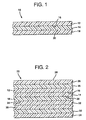
- FIG. 1 shows a multilayer film 10 in accordance with the present invention having, in order, a first layer 12 consisting essentially of amorphous polyamide, a second layer 14 adhered to a surface 16 of the first layer 12, and a third layer 18 adhered to a surface 20 of the second layer 14.
- multilayer film refers to a thermoplastic material, generally in sheet or web form, having one or more layers formed from polymeric or other materials which are bonded together by any conventional or suitable method, including one or more of the following methods: coextrusion, extrusion coating, lamination, vapor deposition coating, solvent coating, emulsion coating, or suspension coating, but preferably by coextrusion.
- Third layer 18 functions as an oxygen barrier layer, and preferably has an oxygen transmission rate (OTR) of less than or equal to 30 cc of oxygen per square meter of film per 24 hour period at 1 atmosphere and at a temperature of 23°C (73°F)(at 0% relative humidity). In this manner, the entire film 10 will have such OTR. More preferably, layer 18, and therefore film 10, has an OTR of less than 25 cc/m 2 per 24 hours at 1 atm., and more preferably less than 20, more preferably still less than15, even more preferably less than 10, such as less than 8, less than 7, or less than 6 cc/m 2 per 24 hours at 1 atm. (23°C or 73°F and 0% RH).
- OTR oxygen transmission rate
- suitable materials for third layer 18 include at least one member selected from ethylene/vinyl alcohol copolymer (EVOH), polyamide MXD6, polyamide MXD6/MXDI, polyvinylidene chloride (PVDC), and polyacrylonitrile (PAN), including copolymers of PVDC and PAN.
- EVOH is preferred.
- first layer 12 consisting essentially of amorphous polyamide
- film 10 has a storage modulus of greater than 207MPa (30,000 pounds/in 2 ) at 120° C (storage modulus being determined in accordance with ASTM 5026-95a). Because of this relatively high storage modulus at temperatures up to 120° C, film 10 has excellent high-temperature dimensional stability. More preferably, the multilayer film 10 has a storage modulus of greater than 276MPa (40,000 pounds/in 2 ) at 120° C.
- first layer 12 Small amounts of additives such as slip or antiblock agents, pigments, processing aids and the like can be included in first layer 12, as long as they do not materially affect the basic characteristics of film 10, e.g., by causing the storage modulus of the film to fall below 207MPa (30,000 pounds/in 2 ) at 120° C or by adversely affecting the inter-laminar bond-strength of the film.
- crystalline or semi-crystalline polyamide is not present in first layer 12, as this detrimentally affects the modulus of amorphous polyamide, as demonstrated in the Examples below (see Example 3).
- amorphous polyamide refers to those polyamides which are lacking in crystallinity as shown by the lack of an endotherm crystalline melting peak in a Differential Scanning Calorimeter (DSC) test (ASTM D-3417).
- DSC Differential Scanning Calorimeter
- polyamides examples include those amorphous polymers prepared from the following diamines: hexamethylenediamine, 2- methylpentamethylenediamine, 2,2,4-trimethylhexamethylenediamine, 2,4,4- trimethylhexamethylenediamine, bis(4-aminocyclohexyl)methane, 2,2-bis(4- aminocyclohexyl)isopropylidine, 1,4-diaminocyclohexane, 1,3-diaminocyclohexane, meta-xylylenediamine, 1,5-diaminopentane, 1,4-diaminobutane, 1,3-diaminopropane, 2-ethyldiaminobutane, 1,4-diaminomethylcyclohexane, p-xylylenediamine, m-phenylenediamine, p-phenylenediamine, and alkyl substituted m-pheny
- amorphous polyamides examples include those amorphous polymers prepared from the following dicarboxylic acids: isophthalic acid, terephthalic acid, alkyl substituted iso- and terephthalic acid, adipic acid, sebacic acid, butane dicarboxylic acid, and the like.
- the diamines and dicarboxylic acids mentioned above can be combined as desired, provided the resulting polyamide is amorphous.
- an aliphatic diamine can generally be combined with an aromatic dicarboxylic acid, or an aromatic diamine can generally be combined with an aliphatic dicarboxylic acid to give suitable amorphous polyamides.
- Preferred amorphous polyamides are those in which either the diamine or the dicarboxylic acid moiety is aromatic, and the other moiety is aliphatic.
- the aliphatic groups of these polyamides preferably contain between 4 and 12 carbon atoms in a chain or an aliphatic cyclic ring system having up to 15 carbon atoms.
- the aromatic groups of the polyamides preferably have mono or bi-cyclic aromatic rings which may contain aliphatic substituents of up to about 6 carbon atoms.
- the amorphous polyamide in first layer 12 preferably has a glass transition temperature of at least about 120° C, and may comprise, e.g., at least one member selected from polyamide 6I/6T, polyamide 66/69/6I, and polyamide 66/610/MXD6.
- amorphous polyamide 6I/6T polymers include - GrivoryTM G21 nylon from EMS, SelarTM PA 3426 from DuPont, and NovatecTM X21 from Mitsubishi Chemical.
- the second layer 14 is adhered to each of the first and third layers 12 and 18, respectively, at a bond strength of at least 87.6 N/m or 0.5 lb f /inch (ASTM F 904). More preferably, the bond strength between second layer 14 and first layer 12, and between second layer 14 and third layer 18, is at least about 122.6 N/m (0.7 lb f /inch)
- third (barrier) layer 18 comprises EVOH
- the inventors have determined that the bond strength between EVOH and amorphous polyamide is insufficient for commercial packaging applications (see Example 3).
- Selection of the material used in the second layer 14 to maintain an inter-laminar bond strength of at least 87.6N/m (0.5 lb f /inch) will depend upon the material selected for third layer 18. That is, the material selected for second layer 14 must be capable of bonding to both amorphous polyamide (first layer 12) and the barrier material present in third layer 18 at respective bond strengths of at least 87.6 N/m (0.5 lb f /inch).
- the second layer 14 preferably comprises at least one member selected from polyamide homopolymer or copolymer having greater than 50 mole percent polyamide 6, polyamide homopolymer or copolymer having greater than 50 mole percent polyamide 66, acid-modified polyolefins, and anhydride-modified polyolefins.
- Preferred polyamides in accordance with the foregoing include polyamide 6, polyamide 66, polyamide 6/66, polyamide 66/6, polyamide 6/69, polyamide 6/12, polyamide 66/610, and polyamide 66/69.
- Preferred examples of acid-modified polyolefins include ethylene/acrylic acid copolymer and ethylene/methacrylic acid copolymer.
- Preferred anhydride-modified polyolefins include anhydride- grafted ethylene/1-butene copolymer, anhydride-grafted ethylene/1-hexene copolymer, anhydride-grafted ethylene/1-octene copolymer, anhydride-grafted ethylene/vinyl acetate copolymer, and anhydride-grafted polypropylene.
- anhydride-modified refers to any form of anhydride functionality, such as the anhydride of maleic acid, fumaric acid, etc., whether grafted onto a polymer, copolymerized with a polymer, or blended with one or more polymers, and is also inclusive of derivatives of such functionalities, such as acids, esters, and metal salts derived therefrom.
- the second layer 14 preferably comprises an ethylene copolymer or terpolymer having between 5 and 30 mole % ester mer units.
- ester mer units may include, for example, methacrylate, n-butyl acrylate, iso-butyl acrylate, ethyl acrylate, vinyl acetate (e.g., ethylene/methacrylate copolymer, etc.).
- An example of a suitable terpolymer may comprise 80% ethylene, 10% iso-butyl acrylate, and 10% methacrylic acid.
- Multilayer film 10 may be made by any suitable and known film-making process, e.g., cast or blown through either an annular or flat die, and is preferably fully coextruded.
- coextruded refers to the process of extruding two or more materials through a single die with two or more orifices arranged so that the extrudates merge and weld together into a laminar structure before chilling and solidifying, e.g., via water, chilled metal roll, or air quenching.
- Multilayer film 10 preferably has less than 5% shrink in at least one direction at 120°C.
- the film is not oriented after coextrusion or, if it is, that it be heat-set to remove substantially all of the shrink capability from the film.
- This property i.e., less than 5% shrink at 120°C, along with a storage modulus of greater than 207MPa (30,000 pounds/in 2 ) at 120° C, results in a film with excellent dimensional stability, both at room temperature and at higher temperatures, e.g., up to about 120° C, as encountered during many food packaging processes as discussed hereinabove.
- Multilayer film 10 may have any desired thickness, e.g., ranging from about 0.5 to about 50 mils. More preferably, the thickness ranges from 0.5 - 40 mils, more preferably still from about 0.5 - 30 mils, yet more preferably from about 0.5 - 20 mils, even more preferably from about 1 - 15 mils, still more preferably from about 1 - 10 mils, and most preferably from 1 - 5 mils, such as from 1.5 - 4 mils.*
- Multilayer film 10 may be used alone, i.e., as a three-layer film.
- the larger multilayer film incorporating film 10 as a sub-structure would possess all of the properties and benefits resulting from the three-layer structure of film 10 as discussed above, but would also possess additional properties and benefits arising from the additional layers.
- Multilayer film 22 in FIG. 2 is an example of such a larger multilayer film, containing layers 12, 14, and 18 as interior layers. That is, in multilayer film 22, second layer 14 is adhered to surface 16 of first layer 12 (consisting essentially of amorphous polyamide), and third (barrier) layer 18 is adhered to surface 20 of second layer 14. In film 22, however, all three layers 12, 14, and 18 are interior layers.
- the phrase "interior layer” refers to any layer of a multilayer film having both of its principal surfaces directly adhered to another layer of the film.
- Multilayer film 22 preferably includes a fourth, exterior layer 24 comprising a material that is capable of forming a heat-seal.
- exterior layer refers to any layer of a multilayer film having only one of its principal surfaces directly adhered to another layer of that film.
- heat-seal refers to the union of two films by bringing the films into contact, or at least close proximity, with one another and then applying sufficient heat and pressure to a predetermined area (or areas) of the films to cause the contacting surfaces of the films in the predetermined area to become molten and intermix with one another, thereby forming an essentially inseparable bond between the two films in the predetermined area when the heat and pressure are removed therefrom and the area is allowed to cool.
- suitable materials for fourth, exterior layer 24 include ionomers (e.g., SURLYN from DuPont), heterogeneous (Zeiger-Natta catalyzed) ethylene/alpha- olefin copolymer such as linear low density polyethylene, homogeneous (metallocene or single-site catalyzed) ethylene/alpha-olefin copolymer, ethylene/vinyl acetate copolymer, ethylene/methyl acrylate copolymer, ethylene/propylene copolymer, polybutylene homopolymer or copolymer, and other similar materials that are capable of forming a heat-seal.
- ionomers e.g., SURLYN from DuPont
- heterogeneous (Zeiger-Natta catalyzed) ethylene/alpha- olefin copolymer such as linear low density polyethylene, homogeneous (metallocene or single-site catalyze
- Multilayer film 22 preferably further comprises a fifth, exterior layer 26 comprising a material having a surface energy of at least 36 dynes/cm 2 .
- a surface energy allows an image to be printed on outer surface 28 of fifth layer 26.
- Suitable materials for fifth layer 26 include at least one material selected from polyamides, polyesters, polycarbonates, polyurethanes, and polyacrylates. Polyolefin surfaces having been modified by corona, plasma, flame treatment or acid etching such that the surface energy exceeds 36 dynes/cm 2 are also suitable for printing.
- Fifth layer 26 also preferably provides heat- and abuse-resistance to the film.
- a semi-crystalline polyamide such as polyamide 6 is preferred.
- Multilayer film 22 may further comprise a sixth, interior layer 30 positioned generally between the third and fourth layers 18, 24, e.g., adjacent fourth layer 24 as shown. It is preferred to include sixth layer 30 to balance any tendency of fifth layer 26 to cause the film 22 to curl, which may occur if layer 26 contracts to a greater or lesser degree than the other layers of the film upon cooling.
- fifth layer 26 is a crystalline or semi-crystalline material, such as a semi-crystalline polyamide, it contracts to a greater degree upon cooling than the other film layers and, being an exterior layer, exerts a curling force on the film such that the film tends to curl towards the fifth layer.
- sixth layer 30 preferably comprises at least one material selected from high density polyethylene, low density polyethylene, linear low density polyethylene, polypropylene, polyamide, and polyesters.
- High density polyethylene is preferred because it has sufficient crystallinity to balance that of a semi-crystalline polymer in layer 26, such as polyamide 6, and also adheres well to materials from which the fourth (heat-seal) layer 24 is preferably constructed.
- Multilayer film 22 may further comprise a seventh layer 32 adhered to a surface 34 of third layer 18.
- the seventh layer 32 may be formed from the same material(s) as second layer 14, and thus may comprise at least one member selected from polyamide homopolymer or copolymer having greater than 50 mole percent polyamide 6, polyamide homopolymer or copolymer having greater than 50 mole percent polyamide 66, acid-modified polyolefins, anhydride-modified polyolefins, ethylene/acrylic acid copolymer, ethylene/methacrylic acid copolymer, and ethylene copolymer or terpolymer having between 5 and 30 mole % ester mer units.
- Preferred materials include at least one member selected from polyamide 6, polyamide 66, polyamide 6/66, and polyamide 66/6.
- Polymeric adhesive layers may be included in multilayer film 22 wherever necessary or desired.
- a first polymeric adhesive layer 36 may be included between first layer 12 and fifth layer 26 and a second polymeric adhesive layer 38 may be included between sixth layer 30 and seventh layer 32.
- Layers 36 and 38 may comprise any suitable polymeric adhesive, such as an olefin polymer or copolymer having an anhydride functionality grafted thereon and/or copolymerized therewith and/or blended therewith.
- suitable polymeric adhesives include the following anhydride-grafted polymers: ethylene/1-butene copolymer, ethylene/1-hexene copolymer, ethylene/1-octene copolymer, ethylene/vinyl acetate copolymer, polypropylene, and low density polyethylene.
- a multilayer film in accordance with the present invention had the following nine-layer structure (total film thickness ranging from 3.3-3.5 mils):*
- a multilayer film in accordance with the present invention was made as described in Example 1 and had the following nine-layer structure (total film thickness ranging from 3.6-3.7 mils):
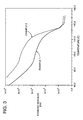
- the films of Examples 1 and 2 maintain high modulus, i.e., greater than 207MPa (30,000 psi) at temperatures exceeding 120 °C, i.e., up to about 130 °C. This is illustrated graphically in FIG. 3 (machine direction only).
- both films exhibited 0% shrink at 150 °C, and therefore have 0% shrink at lower temperatures, e.g., at 130 °C, 120 °C, etc.
- These properties, i.e., high modulus and no shrink at elevated temperatures result in excellent dimensional stability at high temperatures such as are experienced during various packaging operations as discussed hereinabove. While films having such a high modulus might suffer the drawback of being overly brittle, the impact test results (NITE) indicate that the films are sufficiently ductile throughout the tested temperature range for commercial packaging applications.
- the data in Table 1 also indicates that the films have excellent flatness, i.e., a very low tendency to curl. This greatly facilitates the handling and processing of the films during packaging, particularly as the films are being moved and manipulated in the packaging machinery. Finally, the films also exhibit a very low OTR, a highly beneficial property for the packaging of perishable items such as food products.
- Films having interlayer bond-strengths of less than about 87.6 N/m (0.5 lb/inch) are generally considered unsuitable for commercial packaging applications.
- the films of Samples 1, 2, and 3, having 100%, 90%, and 75% amorphous polyamide, respectively would not be suitable for commercial packaging use, whether such films were used alone or as a sub-component of a larger, multilayer film.
- Applicants have found that film layers containing more than 50% amorphous polyamide in a blend with polyamide 6/66 or other crystalline polyamide, have an inadequate bond strength with EVOH. Only when the amount of amorphous polyamide decreases to below about 50% does the bond-strength increase sufficiently to be acceptable for commercial use.
- a layer consisting essentially of 100% amorphous polyamide is important in achieving high-temperature stiffness/dimensional stability. Even the addition of as little as 10% crystalline polyamide has a dramatic detrimental effect on the high-temperature modulus property of the amorphous PA layer.
- the amorphous PA-containing layer is principally responsible for providing high temperature stiffness to the multilayer films of the present invention, which stiffness effect is diminished by the other lower modulus layers of the film, it is preferred not to blend crystalline polyamide with the amorphous polyamide when high temperature dimensional stability is desired of such multilayer film.
- amorphous polyamide has been determined to exhibit very poor bonding with EVOH, it is highly advantageous to include a suitably strong bonding layer, such as crystalline polyamide, between the amorphous PA and EVOH layers in accordance with the present invention to obtain improved bond strength without sacrificing high-temperature modulus.
Landscapes
- Laminated Bodies (AREA)
Claims (20)
- Un film multicouche comprenant, dans l'ordre suivant :dans lequel,a. une première couche composée essentiellement d'un polyamide amorphe ;b. une seconde couche accolée à la surface de ladite première couche ; etc. une troisième couche accolée à la surface de ladite seconde couche, ladite troisième couche comprenant au moins un élément choisi parmi le copolymère d'éthylène/alcool vinylique, le polyamide MXD6, le polyamide MXD6/MXDI, le chlorure de polyvinylidère, et le polyacrylonitrile,
ladite seconde couche est accolée à chacune desdites première et troisième couches avec une force de liaison d'au moins 87,6 N/m (0,5 livre/pouce) et
ledit film a un module de conservation supérieur à 207 MPa (30000 livres/pouce2) à 120°C. - Le film multicouche selon la revendication 1, dans lequel ledit polyamide amorphe dans ladite première couche a une température de transition vitreuse d'au moins environ 120°C.
- Le film multicouche selon la revendication 1 ou 2, dans lequel ledit polyamide amorphe dans ladite première couche comprend au moins un élément choisi à partir du polyamide 6I/6T, du polyamide 66/69/6I, et du polyamide 66/610/MXD6.
- Le film multicouche selon la revendication 1, 2 ou 3, dans lequel ladite troisième couche comprend au moins un élément choisi à partir du copolymère d'éthylène/alcool vinylique, du polyamide MXD6 et du polyamide MEXD6/MXDI.
- Le film multicouche selon la revendication 4, dans lequel ladite seconde couche comprend au moins un élément choisi parmi un homopolymère ou un copolymère de polyamide ayant plus de 50 % en mole de polyamide 6, un homopolymère ou un copolymère de polyamide ayant plus de 50 % en mole de polyamide 66, des polyoléfines modifiées par un acide, des polyoléfines modifiées par un anhydride, un copolymère d'éthylène/acide acrylique et un copolymère d'éthylène/acide méthacrylique.
- Le film multicouche selon la revendication 5, dans lequel ladite seconde couche comprend au moins un élément choisi à partir du polyamide 6, du polyamide 66, du polyamide 6/66, du polyamide 66/6, du polyamide 6/69, du polyamide 6/12, du polyamide 66/610 et du polyamide 66/69.
- Le film multicouche selon la revendication 1, 2 ou 3, dans lequel ladite troisième couche comprend au moins un élément choisi entre le chlorure de polyvinylidène et le polyacrylonitrile.
- Le film multicouche selon la revendication 7, dans lequel ladite seconde couche comprend un copolymère ou un terpolymère d'éthylène ayant entre 5 % et 30 % en mole d'unités monomères esters.
- Le film multicouche selon l'une quelconque des revendications précédentes, dans lequel ledit film a rétréci de moins de 5 % dans au moins une direction à 120°C.
- Le film multicouche selon l'une quelconque des revendications précédentes, dans lequel ledit film a un module de conservation supérieur à 276 MPa (40000 livres/pouce2) à 120°C.
- Le film multicouche selon l'une quelconque des revendications précédentes comprenant de plus une quatrième couche externe comprenant un matériau qui est capable de former un joint thermique.
- Le film multicouche selon la revendication 11 comprenant de plus une cinquième couche externe comprenant un matériau ayant une énergie de surface d'au moins 36 dynes/cm2.
- Le film multicouche selon la revendication 12, dans lequel ladite cinquième couche comprend au moins un matériau choisi à partir de polyamides, de polyesters, de polycarbonates, de polyuréthanes et de polyacrylates.
- Le film multicouche selon la revendication 12 comprenant de plus une sixième couche positionnée entre lesdites troisième et quatrième couches et adjacente à la quatrième couche, ladite sixième couche comprenant au moins un matériau choisi à partir d'un polyéthylène haute densité, d'un polyéthylène basse densité, d'un polyéthylène à basse densité linéaire, d'un polypropylène, d'un polyamide et de polyesters.
- Le film multicouche selon la revendication 14 comprenant de plus une septième couche accolée à une surface de ladite troisième couche, ladite septième couche comprenant au moins un élément choisi parmi un homopolymère ou un copolymère de polyamide ayant plus de 50 % en mole de polyamide 6, un homopolymère ou un copolymère de polyamide ayant plus de 50 % en mole de polyamide 66, des polyoléfines modifiées par un acide, des polyoléfines modifiées par un anhydride, un copolymère d'éthylène/acide acrylique, un copolymère d'éthylène/acide méthacrylique et un copolymère ou un terpolymère d'éthylène ayant entre 5 et 30 % en mole d'unités monomères esters.
- Le film multicouche selon la revendication 15, dans lequel ladite septième couche comprend au moins un élément choisi à partir du polyamide 6, du polyamide 66, du polyamide 6/66 et du polyamide 66/6.
- Le film multicouche selon l'une quelconque des revendications précédentes, dans lequel ledit film est co-extrudé.
- Le film multicouche selon l'une quelconque des revendications précédentes ayant une épaisseur s'étendant de 12,7 à 127 µm (0,5 à 50 mils).
- Le film multicouche selon l'une quelconque des revendications précédentes, dans lequel ledit film possède un taux de transmission de l'oxygène inférieur ou égal à 30 cc d'oxygène par mètre carré de film par période de 24 heures à 1 atmosphère et à une température de 23°C (73°F) à 0 % d'humidité relative.
- Le film multicouche selon la revendication 19, dans lequel ledit film possède un taux de transmission de l'oxygène inférieur ou égal à 15 cc d'oxygène par mètre carré de film par période de 24 heures à 1 atmosphère, à une température de 23°C (73°F) à 0 % d'humidité relative.
Applications Claiming Priority (3)
| Application Number | Priority Date | Filing Date | Title |
|---|---|---|---|
| US09/583,853 US6379812B1 (en) | 2000-05-31 | 2000-05-31 | High modulus, multilayer film |
| US583853 | 2000-05-31 | ||
| PCT/US2001/016091 WO2001092011A1 (fr) | 2000-05-31 | 2001-05-17 | Film multicouche a haut module |
Publications (2)
| Publication Number | Publication Date |
|---|---|
| EP1289757A1 EP1289757A1 (fr) | 2003-03-12 |
| EP1289757B1 true EP1289757B1 (fr) | 2004-08-04 |
Family
ID=24334853
Family Applications (1)
| Application Number | Title | Priority Date | Filing Date |
|---|---|---|---|
| EP01939121A Expired - Lifetime EP1289757B1 (fr) | 2000-05-31 | 2001-05-17 | Film multicouche a haut module |
Country Status (12)
| Country | Link |
|---|---|
| US (1) | US6379812B1 (fr) |
| EP (1) | EP1289757B1 (fr) |
| CN (1) | CN1198721C (fr) |
| AR (1) | AR030564A1 (fr) |
| AT (1) | ATE272498T1 (fr) |
| AU (2) | AU6467501A (fr) |
| BR (1) | BR0111184A (fr) |
| CA (1) | CA2413811C (fr) |
| DE (1) | DE60104688T2 (fr) |
| ES (1) | ES2225551T3 (fr) |
| MX (1) | MXPA02011166A (fr) |
| WO (1) | WO2001092011A1 (fr) |
Families Citing this family (48)
| Publication number | Priority date | Publication date | Assignee | Title |
|---|---|---|---|---|
| US6861125B1 (en) * | 2000-04-21 | 2005-03-01 | Curwood, Inc. | Thermoformable film lamination containing a flexible polyamide coextrusion |
| US6555243B2 (en) * | 2000-06-09 | 2003-04-29 | Ems-Chemie Ag | Thermoplastic multilayer composites |
| US20050208240A1 (en) * | 2002-05-17 | 2005-09-22 | Yuki Manabe | Multi-layer film and medicine container using the same |
| US6984442B2 (en) * | 2002-07-19 | 2006-01-10 | Cryovac, Inc. | Multilayer film comprising an amorphous polymer |
| US6964816B2 (en) * | 2002-09-09 | 2005-11-15 | Curwood, Inc. | Packaging films containing coextruded polyester and nylon layers |
| US20060237882A1 (en) * | 2002-12-26 | 2006-10-26 | Graham Packaging Company L.P. | Amorphous nylon container and method of manufacture |
| DE10301786A1 (de) | 2003-01-20 | 2004-07-29 | Mitsubishi Polyester Film Gmbh | Mehrschichtige transparente, biaxial orientierte Polyesterfolie, Verfahren zu ihrer Herstellung und ihre Verwendung |
| DE10302036A1 (de) * | 2003-01-21 | 2004-07-29 | Mitsubishi Polyester Film Gmbh | Polyesterfolie mit verbesserter Sauerstoffbarriere, enthaltend Poly(m-xylol-adipinamid) und eine Barrierebeschichtung, Verfahren zu ihrer Herstellung und ihre Verwendung |
| DE10302033A1 (de) | 2003-01-21 | 2004-07-29 | Mitsubishi Polyester Film Gmbh | Polyesterfolie mit verbesserter Sauerstoffbarriere und Poly(m-xylol-adipinamid)-haltiger Deckschicht, Verfahren zu ihrer Herstellung und ihre Verwendung |
| DE10302035A1 (de) * | 2003-01-21 | 2004-07-29 | Mitsubishi Polyester Film Gmbh | Polyesterfolie mit verbesserter Sauerstoffbarriere, enthaltend Poly(m-xylol-adipinamid) sowie eine Deckschicht und eine Barrierebeschichtung, Verfahren zu ihrer Herstellung und ihre Verwendung |
| DE10303144A1 (de) | 2003-01-28 | 2004-07-29 | Mitsubishi Polyester Film Gmbh | Einseitig matte, biaxial orientierte Polyesterfolie, Verfahren zu ihrer Herstellung und ihre Verwendung |
| ITMI20031203A1 (it) * | 2003-06-13 | 2004-12-14 | Tecno Coating Engineering S R L | Pellicola multistrato termoretraibile avente barriera all'ossigeno e al vapore acqueo, una migliorata resistenza meccanica e buone caratteristiche ottiche e ridotto effetto curling |
| US7147930B2 (en) * | 2003-12-16 | 2006-12-12 | Curwood, Inc. | Heat-shrinkable packaging films with improved sealing properties and articles made thereof |
| KR101150566B1 (ko) * | 2004-10-18 | 2012-06-08 | 가부시키가이샤 오츠까 세이야꾸 고죠 | 의료용 가스 배리어 필름 및 그것을 이용한 의료용 백 |
| GB0501225D0 (en) * | 2005-01-21 | 2005-03-02 | 3 S S Ltd | Multilayer film |
| US20060210744A1 (en) * | 2005-03-17 | 2006-09-21 | Cryovac, Inc. | Retortable packaging film with grease-resistance |
| US20060210743A1 (en) * | 2005-03-17 | 2006-09-21 | Cryovac, Inc. | Abuse-resistant retortable packaging film having oxygen barrier layer containing blend of amorphous polyamide and semicrystalline polyamide |
| US20060210740A1 (en) * | 2005-03-17 | 2006-09-21 | Cryovac, Inc. | Retort packaging process and product utilizing high-temperature abuse layer and low-temperature abuse layer |
| US20060210742A1 (en) * | 2005-03-17 | 2006-09-21 | Cryovac, Inc. | Retortable packaging film with outer layers containing blend of propylene-based polymer and homogeneous polymer |
| US20060210741A1 (en) * | 2005-03-17 | 2006-09-21 | Cryovac, Inc. | Retortable packaging film with having seal/product-contact layer containing blend of polyethylenes and skin layer containing propylene-based polymer blended with polyethylene |
| US8394474B2 (en) * | 2005-04-07 | 2013-03-12 | Cryovac, Inc. | Sterilizable coextruded film for aseptic packaging |
| KR101342748B1 (ko) * | 2005-06-27 | 2013-12-19 | 이데미쓰 유니테크 가부시키가이샤 | 이열성 연신 필름, 이열성 라미네이트 필름, 이열성 자루,및 이열성 연신 필름의 제조 방법 |
| US20070110853A1 (en) * | 2005-11-17 | 2007-05-17 | Solomon Bekele | Dimensionally stable sterilizable coextruded film for aseptic packaging |
| US20070292567A1 (en) * | 2005-12-30 | 2007-12-20 | Lithotype Company, Inc. | E-beam cured packaging structure, packages, and methods of making |
| US20070202337A1 (en) * | 2006-02-24 | 2007-08-30 | Curwood, Inc. | Dimensionally stable packaging film and articles made therefrom |
| US20070259142A1 (en) * | 2006-05-03 | 2007-11-08 | Curwood, Inc. | Rigid and semirigid packaging articles |
| JP5079275B2 (ja) * | 2006-07-18 | 2012-11-21 | 出光ユニテック株式会社 | 易裂性収縮フィルムの層内剥離防止方法 |
| US20080063845A1 (en) * | 2006-09-12 | 2008-03-13 | Excel-Pac Inc. | Multilayer structures, uses and preparation thereof |
| US20080190918A1 (en) * | 2007-02-09 | 2008-08-14 | Scholle Corporation | Shipping container for flowable material and flexible tank therefor |
| FR2912682B1 (fr) * | 2007-02-21 | 2013-07-26 | Bollore | Film barriere a 5 couches, procede de scellage, application a l'emballage de produit alimentaire. |
| EP2030784B1 (fr) * | 2007-08-27 | 2016-04-13 | Cryovac, Inc. | Films rétractables à barrière contre les gaz pour une utilisation dans des applications à formage profond |
| US20090123611A1 (en) * | 2007-11-09 | 2009-05-14 | Cryovac, Inc. | Printed sterilizable laminate for aseptic packaging |
| BRPI0921248B1 (pt) * | 2008-11-26 | 2019-08-20 | 3M Innovative Properties Company. | Filme de superfície para estruturas compósitas |
| AU2011293827B2 (en) * | 2010-08-23 | 2015-04-09 | Cryovac, Llc | Ovenable heat-sealed package |
| ES2582929T3 (es) * | 2011-09-05 | 2016-09-16 | Dsm Ip Assets B.V. | Un procedimiento para aumentar el periodo de conservación de un alimento o producto agrícola |
| EP2776246A4 (fr) * | 2011-11-08 | 2015-07-01 | Essel Propack Ltd | Film barrière multicouche, stratifiés et procédé associé |
| CA2859257A1 (fr) * | 2011-12-15 | 2013-06-20 | Windmoller & Holscher Kg | Produit en feuille pour l'emballage de produits dans des emballages scelles, realises avec ledit produit |
| EP2855150B1 (fr) * | 2012-06-05 | 2016-09-14 | Dow Global Technologies LLC | Films contenant des compositions de polymère à base d'éthylène fonctionnel |
| CN102825875A (zh) * | 2012-08-24 | 2012-12-19 | 爱索尔(广州)包装有限公司 | 多层复合片材及其制备方法 |
| US11292234B2 (en) * | 2012-09-13 | 2022-04-05 | Dow Global Technologies Llc | Polyolefin based films suitable for thermoforming |
| US9415990B2 (en) * | 2013-02-13 | 2016-08-16 | Cryovac, Inc. | Bag-in-box system for use in dispensing a pumpable product |
| EP3526041B1 (fr) * | 2016-10-14 | 2020-08-05 | Cryovac, LLC | Film d'emballage pour produit sensible organoleptique, et procédé, article d'emballage et produit emballé correspondant |
| CN108515762B (zh) * | 2018-04-08 | 2019-09-17 | 厦门长塑实业有限公司 | 一种三层结构的耐穿刺双向拉伸尼龙薄膜及其制备方法 |
| BR112020024397B1 (pt) * | 2018-05-30 | 2024-02-20 | Amcor Flexibles North America, Inc | Filmes para embalagem com teor de poliamida reciclada |
| US11518149B2 (en) | 2018-11-13 | 2022-12-06 | Campbell Soup Company | Multilayer packaging materials with release of migratory active substances |
| JPWO2022255370A1 (fr) * | 2021-06-01 | 2022-12-08 | ||
| DE102021120802B4 (de) * | 2021-08-10 | 2024-08-22 | Loparex Germany Gmbh & Co. Kg | Mehrschichtfolie, abdichtungsmaterial, deren verwendung und herstellungsverfahren |
| CN117719229B (zh) * | 2023-12-19 | 2026-05-26 | 升辉新材料股份有限公司 | 一种应用于冷鲜肉包装的微缩气调锁鲜包装盖膜及其制备方法 |
Family Cites Families (14)
| Publication number | Priority date | Publication date | Assignee | Title |
|---|---|---|---|---|
| US4410661A (en) | 1981-08-21 | 1983-10-18 | E. I. Du Pont De Nemours And Company | Toughened polyamide blends |
| US4640852A (en) | 1984-11-28 | 1987-02-03 | American Can Company | Multiple layer films containing oriented layers of nylon and ethylene vinyl alcohol copolymer |
| US4746562A (en) | 1986-02-28 | 1988-05-24 | W. R. Grace & Co., Cryovac Div. | Packaging film |
| US4800129A (en) * | 1987-03-26 | 1989-01-24 | E. I. Du Pont De Nemours And Company | Multi-layer plastic container |
| US5194306A (en) * | 1987-08-24 | 1993-03-16 | E. I. Du Pont De Nemours And Company | Barrier blends based on amorphous polyamide and ethylene/vinyl alcohol, unaffected by humidity |
| US5110855A (en) | 1987-08-24 | 1992-05-05 | E. I. Du Pont De Nemours And Company | Barrier blends based on amorphous polyamide and ethylene/vinyl alcohol, unaffected by humidity |
| NZ222632A (en) | 1987-11-20 | 1989-07-27 | Transpak Ind Ltd | Films comprising semi-crystalline polyamide and amorphous polyamide either as a blend or in a multi-layer film having at least one layer each of semi-crystalline and amorphous polyamide |
| US5208082A (en) * | 1990-07-12 | 1993-05-04 | E. I. Du Pont De Nemours And Company | Blends and structures based on ethylene vinyl alcohol copolymer and selected amorphous polyamides |
| US5491009A (en) | 1990-08-03 | 1996-02-13 | W. R. Grace & Co.-Conn. | Amorphous nylon composition and films |
| EP0756542A1 (fr) * | 1994-04-18 | 1997-02-05 | W.R. Grace & Co.-Conn. | Film presentant une fonctionnalite anhydride dans sa couche exterieure |
| US5707750A (en) | 1994-10-24 | 1998-01-13 | Alliedsignal Inc. | Retortable, high oxygen barrier polymeric films |
| US6068933A (en) | 1996-02-15 | 2000-05-30 | American National Can Company | Thermoformable multilayer polymeric film |
| US6500559B2 (en) | 1998-05-04 | 2002-12-31 | Cryovac, Inc. | Multiple layer film with amorphous polyamide layer |
| US6562443B1 (en) * | 1998-07-22 | 2003-05-13 | Cryovac, Inc. | Cook-in package with tight appearance |
-
2000
- 2000-05-31 US US09/583,853 patent/US6379812B1/en not_active Expired - Fee Related
-
2001
- 2001-05-17 DE DE2001604688 patent/DE60104688T2/de not_active Expired - Fee Related
- 2001-05-17 AU AU6467501A patent/AU6467501A/xx active Pending
- 2001-05-17 CN CNB01810410XA patent/CN1198721C/zh not_active Expired - Fee Related
- 2001-05-17 EP EP01939121A patent/EP1289757B1/fr not_active Expired - Lifetime
- 2001-05-17 ES ES01939121T patent/ES2225551T3/es not_active Expired - Lifetime
- 2001-05-17 CA CA 2413811 patent/CA2413811C/fr not_active Expired - Fee Related
- 2001-05-17 MX MXPA02011166A patent/MXPA02011166A/es active IP Right Grant
- 2001-05-17 AT AT01939121T patent/ATE272498T1/de not_active IP Right Cessation
- 2001-05-17 WO PCT/US2001/016091 patent/WO2001092011A1/fr not_active Ceased
- 2001-05-17 BR BR0111184A patent/BR0111184A/pt not_active Application Discontinuation
- 2001-05-17 AU AU2001264675A patent/AU2001264675B2/en not_active Ceased
- 2001-05-28 AR ARP010102544 patent/AR030564A1/es active IP Right Grant
Also Published As
| Publication number | Publication date |
|---|---|
| US6379812B1 (en) | 2002-04-30 |
| AR030564A1 (es) | 2003-08-27 |
| ES2225551T3 (es) | 2005-03-16 |
| DE60104688D1 (de) | 2004-09-09 |
| CA2413811C (fr) | 2009-03-24 |
| ATE272498T1 (de) | 2004-08-15 |
| AU6467501A (en) | 2001-12-11 |
| CN1198721C (zh) | 2005-04-27 |
| BR0111184A (pt) | 2003-06-10 |
| CA2413811A1 (fr) | 2001-12-06 |
| AU2001264675B2 (en) | 2004-11-04 |
| WO2001092011A1 (fr) | 2001-12-06 |
| EP1289757A1 (fr) | 2003-03-12 |
| DE60104688T2 (de) | 2005-08-11 |
| MXPA02011166A (es) | 2003-03-10 |
| CN1431955A (zh) | 2003-07-23 |
Similar Documents
| Publication | Publication Date | Title |
|---|---|---|
| US6379812B1 (en) | High modulus, multilayer film | |
| AU2001264675A1 (en) | High modulus, multilayer film | |
| EP1525092B1 (fr) | Film a couches multiples contenant un polymere amorphe | |
| US6858313B2 (en) | Multiple layer film with amorphous polyamide layer | |
| US7504142B2 (en) | Packaging laminates and articles made therefrom | |
| EP1592745B1 (fr) | Copolymere cyclo-olefinique pour film de module eleve | |
| CA2040064C (fr) | Pellicule de protection offrant une flexibilite accrue pour l'empaquetage de fromage | |
| AU2005201009B2 (en) | Packaging films containing coextruded polyester and nylon layers | |
| EP0692374B1 (fr) | Feuille rétractable résistant à l'usure | |
| US7279206B2 (en) | Packaging laminates and articles made therefrom | |
| CN112638648A (zh) | 阻隔性易撕裂共挤出多层薄膜和包装材料 | |
| EP0967073B1 (fr) | Feuille multicouche étirée biaxialement | |
| JP7385333B2 (ja) | ポリアミド系フィルム | |
| US20250282126A1 (en) | Multilayer packaging film and process |
Legal Events
| Date | Code | Title | Description |
|---|---|---|---|
| PUAI | Public reference made under article 153(3) epc to a published international application that has entered the european phase |
Free format text: ORIGINAL CODE: 0009012 |
|
| 17P | Request for examination filed |
Effective date: 20021211 |
|
| AK | Designated contracting states |
Designated state(s): AT BE CH CY DE DK ES FI FR GB GR IE IT LI LU MC NL PT SE TR Kind code of ref document: A1 Designated state(s): AT BE CH CY DE DK ES FI FR GB GR IE IT LI LU MC NL PT SE TR |
|
| AX | Request for extension of the european patent |
Extension state: AL LT LV MK RO SI |
|
| 17Q | First examination report despatched |
Effective date: 20030502 |
|
| GRAP | Despatch of communication of intention to grant a patent |
Free format text: ORIGINAL CODE: EPIDOSNIGR1 |
|
| GRAS | Grant fee paid |
Free format text: ORIGINAL CODE: EPIDOSNIGR3 |
|
| GRAA | (expected) grant |
Free format text: ORIGINAL CODE: 0009210 |
|
| AK | Designated contracting states |
Kind code of ref document: B1 Designated state(s): AT BE CH CY DE DK ES FI FR GB GR IE IT LI LU MC NL PT SE TR |
|
| PG25 | Lapsed in a contracting state [announced via postgrant information from national office to epo] |
Ref country code: TR Free format text: LAPSE BECAUSE OF FAILURE TO SUBMIT A TRANSLATION OF THE DESCRIPTION OR TO PAY THE FEE WITHIN THE PRESCRIBED TIME-LIMIT Effective date: 20040804 Ref country code: AT Free format text: LAPSE BECAUSE OF FAILURE TO SUBMIT A TRANSLATION OF THE DESCRIPTION OR TO PAY THE FEE WITHIN THE PRESCRIBED TIME-LIMIT Effective date: 20040804 Ref country code: BE Free format text: LAPSE BECAUSE OF FAILURE TO SUBMIT A TRANSLATION OF THE DESCRIPTION OR TO PAY THE FEE WITHIN THE PRESCRIBED TIME-LIMIT Effective date: 20040804 Ref country code: CH Free format text: LAPSE BECAUSE OF FAILURE TO SUBMIT A TRANSLATION OF THE DESCRIPTION OR TO PAY THE FEE WITHIN THE PRESCRIBED TIME-LIMIT Effective date: 20040804 Ref country code: NL Free format text: LAPSE BECAUSE OF FAILURE TO SUBMIT A TRANSLATION OF THE DESCRIPTION OR TO PAY THE FEE WITHIN THE PRESCRIBED TIME-LIMIT Effective date: 20040804 Ref country code: LI Free format text: LAPSE BECAUSE OF FAILURE TO SUBMIT A TRANSLATION OF THE DESCRIPTION OR TO PAY THE FEE WITHIN THE PRESCRIBED TIME-LIMIT Effective date: 20040804 |
|
| REG | Reference to a national code |
Ref country code: GB Ref legal event code: FG4D |
|
| REG | Reference to a national code |
Ref country code: CH Ref legal event code: EP |
|
| REG | Reference to a national code |
Ref country code: IE Ref legal event code: FG4D |
|
| REF | Corresponds to: |
Ref document number: 60104688 Country of ref document: DE Date of ref document: 20040909 Kind code of ref document: P |
|
| PG25 | Lapsed in a contracting state [announced via postgrant information from national office to epo] |
Ref country code: SE Free format text: LAPSE BECAUSE OF FAILURE TO SUBMIT A TRANSLATION OF THE DESCRIPTION OR TO PAY THE FEE WITHIN THE PRESCRIBED TIME-LIMIT Effective date: 20041104 Ref country code: GR Free format text: LAPSE BECAUSE OF FAILURE TO SUBMIT A TRANSLATION OF THE DESCRIPTION OR TO PAY THE FEE WITHIN THE PRESCRIBED TIME-LIMIT Effective date: 20041104 Ref country code: DK Free format text: LAPSE BECAUSE OF FAILURE TO SUBMIT A TRANSLATION OF THE DESCRIPTION OR TO PAY THE FEE WITHIN THE PRESCRIBED TIME-LIMIT Effective date: 20041104 |
|
| NLV1 | Nl: lapsed or annulled due to failure to fulfill the requirements of art. 29p and 29m of the patents act | ||
| LTIE | Lt: invalidation of european patent or patent extension |
Effective date: 20040804 |
|
| REG | Reference to a national code |
Ref country code: CH Ref legal event code: PL |
|
| ET | Fr: translation filed | ||
| REG | Reference to a national code |
Ref country code: ES Ref legal event code: FG2A Ref document number: 2225551 Country of ref document: ES Kind code of ref document: T3 |
|
| PG25 | Lapsed in a contracting state [announced via postgrant information from national office to epo] |
Ref country code: IE Free format text: LAPSE BECAUSE OF NON-PAYMENT OF DUE FEES Effective date: 20050517 Ref country code: CY Free format text: LAPSE BECAUSE OF FAILURE TO SUBMIT A TRANSLATION OF THE DESCRIPTION OR TO PAY THE FEE WITHIN THE PRESCRIBED TIME-LIMIT Effective date: 20050517 Ref country code: LU Free format text: LAPSE BECAUSE OF NON-PAYMENT OF DUE FEES Effective date: 20050517 |
|
| PG25 | Lapsed in a contracting state [announced via postgrant information from national office to epo] |
Ref country code: MC Free format text: LAPSE BECAUSE OF NON-PAYMENT OF DUE FEES Effective date: 20050531 |
|
| PLBE | No opposition filed within time limit |
Free format text: ORIGINAL CODE: 0009261 |
|
| STAA | Information on the status of an ep patent application or granted ep patent |
Free format text: STATUS: NO OPPOSITION FILED WITHIN TIME LIMIT |
|
| 26N | No opposition filed |
Effective date: 20050506 |
|
| REG | Reference to a national code |
Ref country code: IE Ref legal event code: MM4A |
|
| PG25 | Lapsed in a contracting state [announced via postgrant information from national office to epo] |
Ref country code: PT Free format text: LAPSE BECAUSE OF NON-PAYMENT OF DUE FEES Effective date: 20050104 |
|
| PGFP | Annual fee paid to national office [announced via postgrant information from national office to epo] |
Ref country code: ES Payment date: 20090526 Year of fee payment: 9 |
|
| PGFP | Annual fee paid to national office [announced via postgrant information from national office to epo] |
Ref country code: DE Payment date: 20090528 Year of fee payment: 9 Ref country code: FI Payment date: 20090529 Year of fee payment: 9 Ref country code: FR Payment date: 20090518 Year of fee payment: 9 Ref country code: IT Payment date: 20090526 Year of fee payment: 9 |
|
| PGFP | Annual fee paid to national office [announced via postgrant information from national office to epo] |
Ref country code: GB Payment date: 20090528 Year of fee payment: 9 |
|
| GBPC | Gb: european patent ceased through non-payment of renewal fee |
Effective date: 20100517 |
|
| PG25 | Lapsed in a contracting state [announced via postgrant information from national office to epo] |
Ref country code: FI Free format text: LAPSE BECAUSE OF NON-PAYMENT OF DUE FEES Effective date: 20100517 |
|
| REG | Reference to a national code |
Ref country code: FR Ref legal event code: ST Effective date: 20110131 |
|
| PG25 | Lapsed in a contracting state [announced via postgrant information from national office to epo] |
Ref country code: IT Free format text: LAPSE BECAUSE OF NON-PAYMENT OF DUE FEES Effective date: 20100517 |
|
| PG25 | Lapsed in a contracting state [announced via postgrant information from national office to epo] |
Ref country code: DE Free format text: LAPSE BECAUSE OF NON-PAYMENT OF DUE FEES Effective date: 20101201 |
|
| PG25 | Lapsed in a contracting state [announced via postgrant information from national office to epo] |
Ref country code: FR Free format text: LAPSE BECAUSE OF NON-PAYMENT OF DUE FEES Effective date: 20100531 |
|
| REG | Reference to a national code |
Ref country code: ES Ref legal event code: FD2A Effective date: 20110714 |
|
| PG25 | Lapsed in a contracting state [announced via postgrant information from national office to epo] |
Ref country code: ES Free format text: LAPSE BECAUSE OF NON-PAYMENT OF DUE FEES Effective date: 20110704 Ref country code: GB Free format text: LAPSE BECAUSE OF NON-PAYMENT OF DUE FEES Effective date: 20100517 |
|
| PG25 | Lapsed in a contracting state [announced via postgrant information from national office to epo] |
Ref country code: ES Free format text: LAPSE BECAUSE OF NON-PAYMENT OF DUE FEES Effective date: 20100518 |