EP1285925A1 - Verfahren zur Herstellung von Aryl- und Alkyl-Bor-Verbindungen in Mikroreaktoren - Google Patents
Verfahren zur Herstellung von Aryl- und Alkyl-Bor-Verbindungen in Mikroreaktoren Download PDFInfo
- Publication number
- EP1285925A1 EP1285925A1 EP02016150A EP02016150A EP1285925A1 EP 1285925 A1 EP1285925 A1 EP 1285925A1 EP 02016150 A EP02016150 A EP 02016150A EP 02016150 A EP02016150 A EP 02016150A EP 1285925 A1 EP1285925 A1 EP 1285925A1
- Authority
- EP
- European Patent Office
- Prior art keywords
- alkyl
- substituted
- aryl
- phenyl
- boron compounds
- Prior art date
- Legal status (The legal status is an assumption and is not a legal conclusion. Google has not performed a legal analysis and makes no representation as to the accuracy of the status listed.)
- Withdrawn
Links
Classifications
-
- C—CHEMISTRY; METALLURGY
- C07—ORGANIC CHEMISTRY
- C07F—ACYCLIC, CARBOCYCLIC OR HETEROCYCLIC COMPOUNDS CONTAINING ELEMENTS OTHER THAN CARBON, HYDROGEN, HALOGEN, OXYGEN, NITROGEN, SULFUR, SELENIUM OR TELLURIUM
- C07F5/00—Compounds containing elements of Groups 3 or 13 of the Periodic Table
- C07F5/02—Boron compounds
-
- C—CHEMISTRY; METALLURGY
- C07—ORGANIC CHEMISTRY
- C07F—ACYCLIC, CARBOCYCLIC OR HETEROCYCLIC COMPOUNDS CONTAINING ELEMENTS OTHER THAN CARBON, HYDROGEN, HALOGEN, OXYGEN, NITROGEN, SULFUR, SELENIUM OR TELLURIUM
- C07F5/00—Compounds containing elements of Groups 3 or 13 of the Periodic Table
- C07F5/02—Boron compounds
- C07F5/025—Boronic and borinic acid compounds
-
- C—CHEMISTRY; METALLURGY
- C07—ORGANIC CHEMISTRY
- C07F—ACYCLIC, CARBOCYCLIC OR HETEROCYCLIC COMPOUNDS CONTAINING ELEMENTS OTHER THAN CARBON, HYDROGEN, HALOGEN, OXYGEN, NITROGEN, SULFUR, SELENIUM OR TELLURIUM
- C07F5/00—Compounds containing elements of Groups 3 or 13 of the Periodic Table
- C07F5/02—Boron compounds
- C07F5/027—Organoboranes and organoborohydrides
Definitions
- Aryl and alkyl boron compounds have become too versatile in recent years usable synthetic building blocks developed through their use, e.g. in the Suzuki clutch, a variety of economically very interesting Fine chemicals are mainly manufactured for the pharmaceutical and agro industries can.
- Aryl and alkyl boronic acids should be mentioned here first which plotted the number of applications in the area of drug synthesis corresponds to an exponential function against a time axis in recent years.
- diarylborinic acids are also of increasing importance, for example as Cocatalysts in olefin polymerization or as feedstock in Suzuki couplings, in which all two aryl residues can be transferred.
- aryl or alkyl boronic acids For example, in the case of the production of aryl or alkyl boronic acids The following: Since there is a risk of biarylene or bialkylene, boric acids, Boranes and even boranates exist in which two, three and four, respectively Equivalents of the organometallic reagent can also be consumed for this reason, the yield if the optimal conditions are not met to collapse. In many cases, low yields become difficult get raw products to be purified. The same applies to the production of Boric acids, boranes and boranates.
- lithium aromatics with neighboring halogen atoms, with CF 3 radicals or with C-CI side chains can be subject to spontaneous decomposition, especially in the presence of catalytic impurities, with enormous energies being released due to the formation of very low-energy lithium halides. In large quantities, severe explosions can even be expected.
- the organolithium compound is generated in the first microreactor by one of the methods of organometallic chemistry familiar to the person skilled in the art, fed through a capillary or a tube into a second microreactor connected downstream and converted there with BX 3 .
- the processing of the collected reaction mixtures can be done by "classic" Work-up and hydrolysis methods are carried out.
- this method can be carried out continuously.
- Flow reactors are used whose channels have a diameter of Have 25 microns to 1.5 mm, especially 40 microns to 1.0 mm.
- the flow rate is set so that there is a dwell time that corresponds to reaching a turnover of at least 70%.
- the flow rate in the microreactor is set so that a residence time between one second and 10 minutes, especially 10 seconds to 5 minutes becomes. If two microreactors are connected in series, the Residence time in the first reactor including the residence time in the capillary or Hose system on the way to the second reactor are set so that the Turnover in the production of the organometallic compound at least 90% is, preferably at least 95%.
- Such reactors are preferably used, which are based on technologies can be produced, which are applied in the manufacture of silicon chips become. However, comparable reactors can also be used, which consist of others, inert towards the lithium solutions and the boron compounds Materials such as ceramics, glass, graphite or stainless steel or Hastelloy.
- the microreactors are preferably produced by joining thin silicon structures together.
- the conversions of the invention are advantageous at temperatures carried out between -60 ° C and + 30 ° C, preferably at -50 ° C to + 25 ° C, particularly preferably between -40 ° C and + 20 ° C.
- the microreactors used can be achieved optimal mixing leads to the very remarkable result that the Content of the resulting boron compounds in the above By-products is almost independent of the reaction temperature.
- Typical grades of the boron compounds produced on the by-products mentioned are in the In the case of the production of boronic acids between 0.1 and 3% boric acid, ⁇ 0.1% Borane and undetectable amounts of boranates. Such selectivities are even at low temperatures when using "classic processing techniques" not reachable.
- the processing can be made as simple as you want, that none Product purifications are more needed. Even for applications with the highest The boron compounds obtained can be used directly for purity purposes become.
- a preferred processing method is e.g. entering the Reaction mixtures in water, acidification with mineral acid, distillation of the Solvent and filtration of the pure boron compounds.
- Suitable solvents for the method according to the invention for the preparation of boron compounds are aliphatic and aromatic ethers and hydrocarbons and amines which do not carry hydrogen on the nitrogen, preferably triethylamine, diethyl ether, tetrahydrofuran, toluene, toluene / THF mixtures, and diisopropyl ether, particularly preferably toluene, THF or diisopropyl ether. Solutions in concentrations in the range from 1 to 35% by weight, in particular 5 to 30% by weight, particularly preferably 8 to 25% by weight, are preferred.
- organolithium compound in an upstream microreactor, all methods of organometallic chemistry familiar to the person skilled in the art can be used, slight variations being necessary in individual cases due to the special requirements of microreaction technology.
- organometallic chemistry familiar to the person skilled in the art can be used, slight variations being necessary in individual cases due to the special requirements of microreaction technology.
- a solution which can also be used for the transfer of such reactions to microreactor technology was sought and found with the use of "organic redox systems".
- lithium metal granules, pieces, powder, dispersions, bars, rods or other particles
- an electron carrier for example lithium biphenylide, lithium (bis-tert-butylbiphenylide) or other derivatives of mono- or polynuclear aromatics.
- Another preferred method of producing the organolithium compound in microreactor 1 is the reaction of an organolithium compound, either commercially available or generated in a "classic reactor", with an aromatic halogen or halogen aliphate or a deprotonable organic compound.
- furan can be produced from furan by reaction with n-hexyllithium in microreactor 1, which can then be reacted with trialkyl borates in microreactor 2 to form furan-2-boronic acid.
- 2-furanboronic acid with selectivities (based on boric acid, borane and tetrafurylboranate) of> 98%.
- a solution of lithium biphenylide in THF was made by 0.25 mol lithium granules and 0.27 mol biphenyl in 500 mL dry THF -40 ° C were stirred until the lithium metal was completely dissolved (7 h).
- the one used Micromixer was a single micromixer with 25 x 300 ⁇ m and 40 x 300 ⁇ m structures in nickel on a copper backing of the institute for microtechnology Mainz.
- the outlet of the reactor was through a 1.5 m stainless steel capillary, Inner diameter 0.5 mm with an identical, also cooled to -20 ° C Microreactor connected, in parallel to the lithiofuran solution formed in microreactor 1 the trimethyl borate solution was fed.
- the pH was then readjusted to 9.0 dissolve the product and the biphenyl by filtration at 5 ° C recover.
Landscapes
- Chemical & Material Sciences (AREA)
- Organic Chemistry (AREA)
Abstract
Description
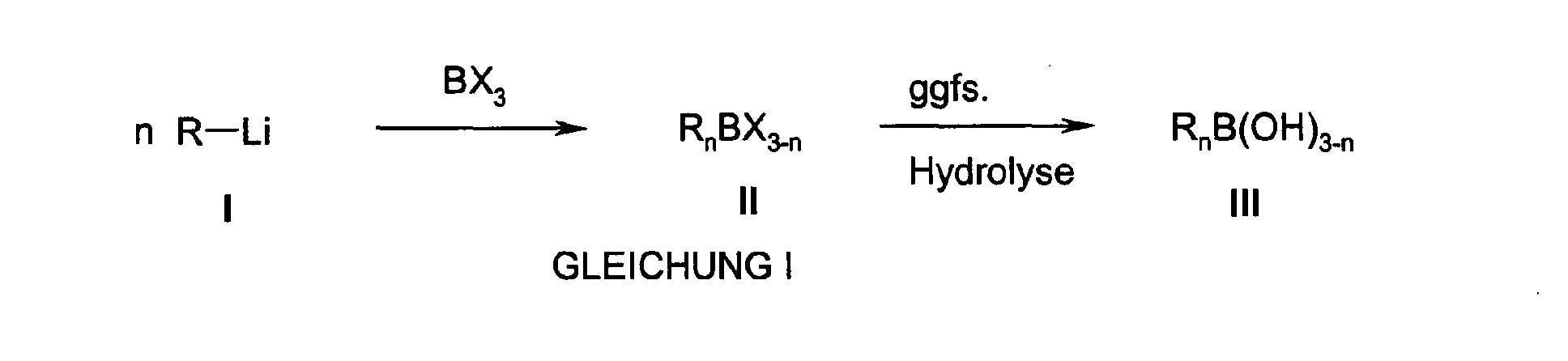

n = 1, 2 oder 3,
und R = geradkettiges oder verzweigtes C1-C6-Alkyl, mit einem Rest aus der Gruppe (RO, RR'N, Phenyl, substituiertes Phenyl, Fluor, RS) substituiertes C1-C6-Alkyl, Phenyl, mit einem Rest aus der Gruppe (C1-C6-Alkyl, C1-C6-Alkoxy, C1-C5-Thioether, Silyl, Fluor, Chlor, Dialkylamino, Diarylamino, Alkyl-aryl-amino) substituiertes Phenyl, Hetero-Sechsring-Aryl mit einem bis zwei Stickstoffatomen, Hetero-Fünfring-Aryl mit einem bis zwei Heteroatomen aus der Gruppe (N, O, S) oder einem substituierten oder unsubstituierten zwei- bis dreikernigen Aromaten,
bedeuten.


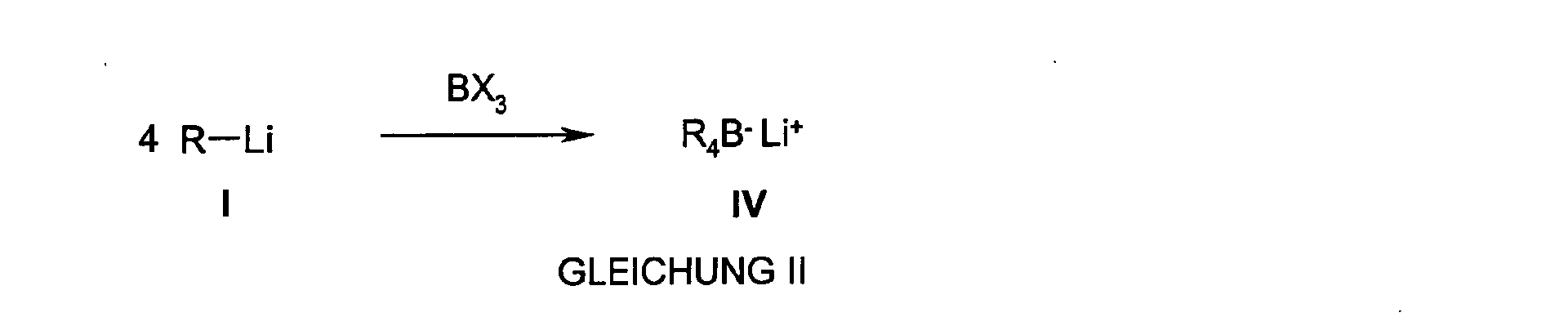
n = 1, 2 oder 3,
und R = geradkettiges oder verzweigtes C1-C6-Alkyl, mit einem Rest aus der Gruppe (RO, RR'N, Phenyl, substituiertes Phenyl, Fluor, RS) substituiertes C1-C6-Alkyl oder Phenyl, mit einem Rest aus der Gruppe (C1-C6-Alkyl, C1-C6-Alkoxy, C1-C5-Thioether, Silyl, Fluor, Chlor, Dialkylamino, Diarylamino, Alkyl-aryl-amino) substituiertes Phenyl oder
Hetero-Sechsring-Aryl mit einem bis zwei Stickstoffatomen, z.B. Pyridin, Picolin, Pyridazin, Pyrimidin oder Pyrazin, oder
Hetero-Fünfring-Aryl mit einem bis zwei Heteroatomen aus der Gruppe (N, O, S) z.B. Pyrrol, Furan, Thiophen, Imidazol, Oxazol oder Thiazol oder einem substituierten oder unsubstituierten zwei- bis dreikernigen Aromaten, z.B. Naphthalin, Anthracen oder Phenanthren,
bedeuten,
- Das Reaktionsgemisch muss in jedem Volumenelement annähernd gleichmäßig vermischt werden
- Die Kanäle müssen so weit sein, dass ein ungehindertes Durchströmen möglich ist, ohne dass sich unerwünschter Druck aufbaut
- Die Struktur der Mikroreaktoren muss in Kombination mit den eingestellten Flussraten eine ausreichende Verweilzeit ermöglichen, um einen Mindestumsatz zu erlauben
- Das System bestehend aus Mikroreaktor und Ableitungsschläuchen oder aus zwei hintereinandergeschalteten Mikroreaktoren mit Verbindungsschläuchen und Ableitungsschläuchen muss temperierbar sein
Bevorzugt werden Lösungen in Konzentrationen im Bereich von 1 bis 35 Gew.-%, insbesondere 5 bis 30 Gew.-%, besonders bevorzugt 8 bis 25 Gew.-%.
2-Furanboronsäure mit Selektivitäten (bezogen auf Borinsäure, Boran und Tetrafurylboranat) von > 98 %.
| Versuch | Substrat | Produkt | Isolierte Ausbeute | HPLC a/a (Reinheit) | Gehalt an Borinsäure |
| 1 | Furan | 2-Furan-boronsäure | 79,5 % | 96,9 % | < 0,1 % |
| 2 | Thiophen | 2-Thiophen-boronsäure | 74,2 % | 97,1 % | < 0,1 % |
| 3 | Fluorbenzol | 2-F-phenyl-boronsäure | 88,1 % | 96,9 % | 0,9 % |
| 4 | Benzotrifluorid | 2-CF3-phenyl-boronsäure | 86,7 % | 97,8 % | 0,7 % |
Claims (7)
- Verfahren zur Herstellung von Aryl- und Alkyl-Bor-Verbindungen der allgemeinen Formel (II) und (III) durch Umsetzung von Lithioaromaten und lithiierten Aliphaten der allgemeinen Formel (I) mit Borverbindungen in Mikroreaktoren gemäß Gleichung I oder Gleichung II,
 worin X = gleiche oder verschiedene Reste aus den Reihen Fluor, Chlor, Brom, lod, C1-C5-Alkoxy, N,N-Di(C1-C5-Alkyl)amino oder (C1-C5-Alkyl)thio,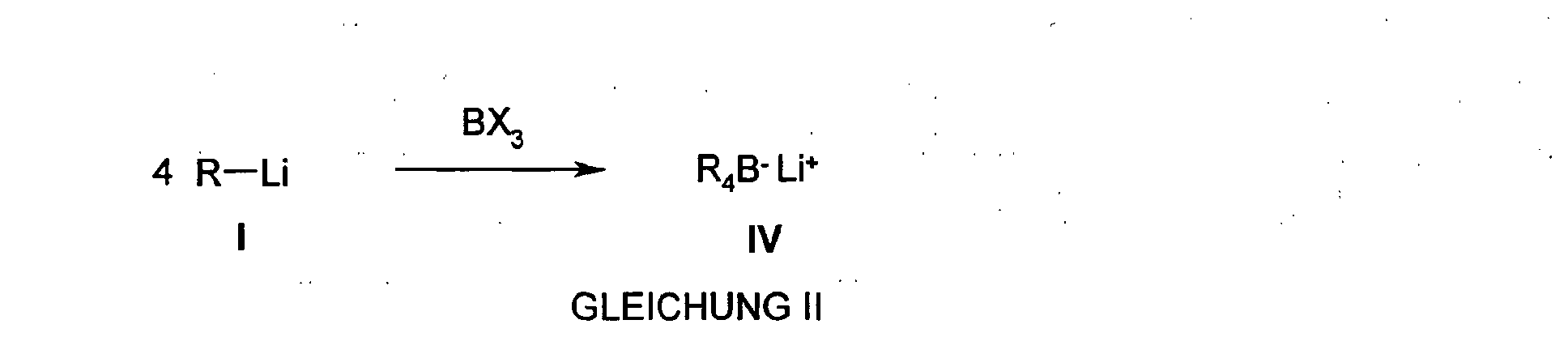
n = 1, 2 oder 3,
und R = geradkettiges oder verzweigtes C1-C6-Alkyl, mit einem Rest aus der Gruppe (RO, RR'N, Phenyl, substituiertes Phenyl, Fluor, RS) substituiertes C1-C6-Alkyl, Phenyl, mit einem Rest aus der Gruppe (C1-C6-Alkyl, C1-C6-Alkoxy, C1-C5-Thioether, Silyl, Fluor, Chlor, Dialkylamino, Diarylamino, Alkyl-aryl-amino) substituiertes Phenyl oder
substituierten oder unsubstituierten Hetero-Sechsring-Aryl mit einem bis zwei Stickstoffatomen oder Hetero-Fünfring-Aryl mit einem bis zwei Heteroatomen aus der Gruppe (N, O, S) oder
einem substituierten oder unsubstituierten zwei- bis dreikernigen Aromaten, bedeuten,
in einem oder gegebenenfalls mehreren hintereinandergeschalteten temperierbaren Mikroreaktoren, deren Auslasskanäle erforderlichenfalls mit mehrere Meter langen Kapillaren oder Schläuchen verbunden sind, wobei die Reaktionslösungen während einer ausreichenden Verweilzeit intensiv vermischt werden. - Verfahren nach Anspruch 1, dadurch gekennzeichnet, dass zunächst durch Rühren von Lithiummetall in einem Lösungsmittel mit einer organischen Verbindung, die leicht freie Valenzelektronen aufnehmen und übertragen kann, eine homogene Lösung eines Elektronenüberträgers generiert wird und diese mit einem Halogenaromaten im ersten Mikroreaktor zur Reaktion gebracht wird und durch eine Kapillare oder einen Schlauch in einen zweiten, dahintergeschalteten Mikroreaktor eingespeist und dort mit BX3 umgesetzt wird.
- Verfahren nach mindestens einem der vorhergehenden Ansprüche, dadurch gekennzeichnet, dass als Mikroreaktoren Durchflußreaktoren eingesetzt werden, deren Kanäle einen Durchmesser von 25 µm bis 1,5 mm aufweisen.
- Verfahren nach mindestens einem der vorhergehenden Ansprüche, dadurch gekennzeichnet, dass die Durchflussrate im Mikroreaktor so eingestellt wird, dass eine Verweilzeit zwischen einer Sekunde und 10 Minuten erzielt wird.
- Verfahren nach mindestens einem der vorhergehenden Ansprüche, dadurch gekennzeichnet, dass die Reaktion bei Temperaturen im Bereich von -60°C bis +30°C durchgeführt wird.
- Verfahren nach mindestens einem der vorhergehenden Ansprüche, dadurch gekennzeichnet, dass bei der Hintereinanderschaltung von zwei Mikroreaktoren, die Verweilzeit im ersten Reaktor, inklusive der Verweilzeit in den Kapillaren- und Schlauchsystemen auf dem Weg zum zweiten Reaktor so eingestellt wird, dass der Umsatz bei der Herstellung der metallorganischen Verbindung mindestens 90 % beträgt.
- Verfahren nach mindestens einem der vorhergehenden Ansprüche, dadurch gekennzeichnet, das Lösungen mit einer Konzentration im Bereich von 1 bis 35 Gew.-% eingesetzt werden.
Applications Claiming Priority (2)
| Application Number | Priority Date | Filing Date | Title |
|---|---|---|---|
| DE10139664 | 2001-08-11 | ||
| DE10139664A DE10139664A1 (de) | 2001-08-11 | 2001-08-11 | Verfahren zur Herstellung von Aryl- und Alkyl-Bor-Verbindungen in Mikroreaktoren |
Publications (1)
| Publication Number | Publication Date |
|---|---|
| EP1285925A1 true EP1285925A1 (de) | 2003-02-26 |
Family
ID=7695265
Family Applications (1)
| Application Number | Title | Priority Date | Filing Date |
|---|---|---|---|
| EP02016150A Withdrawn EP1285925A1 (de) | 2001-08-11 | 2002-07-20 | Verfahren zur Herstellung von Aryl- und Alkyl-Bor-Verbindungen in Mikroreaktoren |
Country Status (4)
| Country | Link |
|---|---|
| US (1) | US20030069420A1 (de) |
| EP (1) | EP1285925A1 (de) |
| JP (1) | JP2003113185A (de) |
| DE (1) | DE10139664A1 (de) |
Cited By (2)
| Publication number | Priority date | Publication date | Assignee | Title |
|---|---|---|---|---|
| EP2210894A1 (de) * | 2009-01-21 | 2010-07-28 | Siemens Aktiengesellschaft | Verfahren zur Herstellung von organischen Verbindungen durch Erzeugung von Aryllithium-Intermediaten und deren Umsetzung mit Elektrophilen |
| DE102019008481A1 (de) | 2018-12-21 | 2020-06-25 | Merck Patent Gmbh | Kontinuierliches Verfahren zur Funktionalisierung von fluorierten Benzolverbindungen im Strömungsrohr |
Families Citing this family (9)
| Publication number | Priority date | Publication date | Assignee | Title |
|---|---|---|---|---|
| US7135266B2 (en) * | 2000-02-09 | 2006-11-14 | Clariant Finance (Bvi) Limited | Preparation of azo colorants in microreactors and their use in electrophotographic toners and developers, powder coatings, ink jet inks and electronic medias |
| US7332632B2 (en) | 2004-01-28 | 2008-02-19 | Ubē Industries, Ltd. | Method for producing aldehyde compound or ketone compound by using microreactor |
| WO2006053345A1 (en) * | 2004-11-12 | 2006-05-18 | Velocys Inc. | Process using microchannel technology for conducting alkylation or acylation reaction |
| WO2007105620A1 (ja) * | 2006-03-10 | 2007-09-20 | Kyoto University | ジアリールエテン化合物の製造方法、及び新規ジアリールエテン化合物 |
| US7659414B2 (en) * | 2007-07-20 | 2010-02-09 | Rohm And Haas Company | Method of preparing organometallic compounds |
| US20100298575A1 (en) * | 2009-05-19 | 2010-11-25 | Tamkang University | Method for preparing an aromatic boron reagent through barbier-type reaction |
| US9145428B2 (en) * | 2011-09-14 | 2015-09-29 | Dow Agrosciences Llc | Methods and systems for forming boronic acids and intermediates thereof |
| CN103030660A (zh) * | 2012-12-20 | 2013-04-10 | 大连联化化学有限公司 | 合成甲基硼酸的工艺方法 |
| JOP20190188A1 (ar) * | 2017-02-01 | 2019-08-01 | Rempex Pharmaceuticals Inc | جهاز وعملية تدفق مستمرة لإنتاج مشتق حمض بورونيك |
Citations (5)
| Publication number | Priority date | Publication date | Assignee | Title |
|---|---|---|---|---|
| EP0238272A2 (de) * | 1986-03-13 | 1987-09-23 | Btg International Limited | Zwischenprodukte, nützlich bei der Produktion von Pestiziden |
| EP1010702A2 (de) * | 1998-12-19 | 2000-06-21 | MERCK PATENT GmbH | Verfahren zur Herstellung von ortho-substituierten Arylmetallverbindungen und deren Umsetzung mit Elektrophilen |
| EP1010703A2 (de) * | 1998-12-19 | 2000-06-21 | MERCK PATENT GmbH | Verfahren zur Herstellung Arylmetallverbindungen und deren Umsetzung mit Elektrophilen |
| EP1046640A2 (de) * | 1999-04-21 | 2000-10-25 | Clariant GmbH | Verfahren zur Herstellung von substituierten Phenyl-boronsäuren |
| EP1236730A2 (de) * | 2001-03-02 | 2002-09-04 | Clariant GmbH | Verfahren zur Herstellung von aromatischen Boron- und Borinsäuren |
Family Cites Families (2)
| Publication number | Priority date | Publication date | Assignee | Title |
|---|---|---|---|---|
| CZ20022724A3 (en) * | 2000-02-09 | 2002-12-11 | Clariant Finance Bvi Ltd | Method for prodn. of azo dyes in microreactors |
| DE10032019A1 (de) * | 2000-07-01 | 2002-01-10 | Clariant Gmbh | Verfahren zur Herstellung von Disazokondensationspigmenten in Mikroreaktoren |
-
2001
- 2001-08-11 DE DE10139664A patent/DE10139664A1/de not_active Withdrawn
-
2002
- 2002-07-20 EP EP02016150A patent/EP1285925A1/de not_active Withdrawn
- 2002-08-01 US US10/210,435 patent/US20030069420A1/en not_active Abandoned
- 2002-08-12 JP JP2002234590A patent/JP2003113185A/ja active Pending
Patent Citations (5)
| Publication number | Priority date | Publication date | Assignee | Title |
|---|---|---|---|---|
| EP0238272A2 (de) * | 1986-03-13 | 1987-09-23 | Btg International Limited | Zwischenprodukte, nützlich bei der Produktion von Pestiziden |
| EP1010702A2 (de) * | 1998-12-19 | 2000-06-21 | MERCK PATENT GmbH | Verfahren zur Herstellung von ortho-substituierten Arylmetallverbindungen und deren Umsetzung mit Elektrophilen |
| EP1010703A2 (de) * | 1998-12-19 | 2000-06-21 | MERCK PATENT GmbH | Verfahren zur Herstellung Arylmetallverbindungen und deren Umsetzung mit Elektrophilen |
| EP1046640A2 (de) * | 1999-04-21 | 2000-10-25 | Clariant GmbH | Verfahren zur Herstellung von substituierten Phenyl-boronsäuren |
| EP1236730A2 (de) * | 2001-03-02 | 2002-09-04 | Clariant GmbH | Verfahren zur Herstellung von aromatischen Boron- und Borinsäuren |
Cited By (2)
| Publication number | Priority date | Publication date | Assignee | Title |
|---|---|---|---|---|
| EP2210894A1 (de) * | 2009-01-21 | 2010-07-28 | Siemens Aktiengesellschaft | Verfahren zur Herstellung von organischen Verbindungen durch Erzeugung von Aryllithium-Intermediaten und deren Umsetzung mit Elektrophilen |
| DE102019008481A1 (de) | 2018-12-21 | 2020-06-25 | Merck Patent Gmbh | Kontinuierliches Verfahren zur Funktionalisierung von fluorierten Benzolverbindungen im Strömungsrohr |
Also Published As
| Publication number | Publication date |
|---|---|
| DE10139664A1 (de) | 2003-02-20 |
| JP2003113185A (ja) | 2003-04-18 |
| US20030069420A1 (en) | 2003-04-10 |
Similar Documents
| Publication | Publication Date | Title |
|---|---|---|
| DE10110051C2 (de) | Verfahren zur Herstellung von Boron- und Borinsäuren | |
| KR102300703B1 (ko) | 무용매(Solvent-free) 알칸 설폰화 | |
| EP1200373A1 (de) | Verfahren zur herstellung von biarylen unter palladaphosphacyclobutan-katalyse | |
| EP3064484A1 (de) | Herstellung von 2,2'-biarylen in gegenwart von molybdän(v)-chlorid | |
| EP1285924A1 (de) | Verfahren zur Herstellung von Aryl- und Alkyl-Bor-Verbindungen in Mikroreaktoren | |
| DE10139664A1 (de) | Verfahren zur Herstellung von Aryl- und Alkyl-Bor-Verbindungen in Mikroreaktoren | |
| EP1616863A1 (de) | Verfahren zur Herstellung Kernfluorierter Aromaten | |
| EP1266904B1 (de) | Verbessertes Verfahren zur Herstellung kernfluorierter Aromaten | |
| EP1856024A1 (de) | Verfahren zur herstellung substituierter biphenyle | |
| DE2753124A1 (de) | Verfahren zur herstellung von aminoalkylsilanen | |
| EP0972765A1 (de) | Verfahren zur Herstellung von Arylpyridinen | |
| DE3514450A1 (de) | Verfahren zur herstellung von imidaten sowie neue arylsubstituierte imidate | |
| DE10227223A1 (de) | Verfahren zur Herstellung substituierter organischer Verbindungen und Verwendung von Katalysatoren für Substitutionsreaktionen | |
| EP0979809B1 (de) | Vefahren zur Herstellung von 4-Chlorbiphenylen | |
| EP1099676B1 (de) | Verfahren zur Herstellung von 1,1,4,4-Tetramethoxybuten-2 | |
| EP0093419B1 (de) | Verfahren zur Herstellung von Chlor-diphenyl-phosphan | |
| EP0556737B1 (de) | Verfahren zur Herstellung von substituierten 2,3-Difluorpyridinen | |
| DE112011103786T5 (de) | Bis(Trifluormethansulfonyl)ethyl tragende Verbindung und Säurekatalysator und Verfahren zum Herstellen derselben | |
| EP1270535A2 (de) | Verfahren zur Herstellung von substituierten aromatischen Verbindungen | |
| DE3885823T2 (de) | Verfahren zur herstellung von 3-chlor-4-fluornitrobenzol. | |
| DE2753455A1 (de) | Verfahren zur herstellung von substituierten phenylphosphaten, -phosphonaten und -phosphinaten | |
| DE10064423A1 (de) | Verfahren zur Herstellung substituierter organischer Verbindungen und Verwendung von Katalysatoren für Substitutionsreaktionen | |
| EP1343792B1 (de) | Verfahren zur herstellung von formylphenylboronsäuren | |
| WO1981001406A1 (fr) | Procede pour la preparation de derives d'acide trifluoroacetyles | |
| EP1272496B1 (de) | Verfahren zur herstellung von alkalimetallmonohydrido-boranaten und -aluminaten |
Legal Events
| Date | Code | Title | Description |
|---|---|---|---|
| PUAI | Public reference made under article 153(3) epc to a published international application that has entered the european phase |
Free format text: ORIGINAL CODE: 0009012 |
|
| AK | Designated contracting states |
Kind code of ref document: A1 Designated state(s): AT BE BG CH CY CZ DE DK EE ES FI FR GB GR IE IT LI LU MC NL PT SE SK TR Designated state(s): AT BE BG CH CY CZ DE DK EE ES FI FR GB GR IE IT LI LU MC NL PT SE SK TR |
|
| AX | Request for extension of the european patent |
Extension state: AL LT LV MK RO SI |
|
| 17P | Request for examination filed |
Effective date: 20030826 |
|
| AKX | Designation fees paid |
Designated state(s): CH DE FR GB LI |
|
| GRAP | Despatch of communication of intention to grant a patent |
Free format text: ORIGINAL CODE: EPIDOSNIGR1 |
|
| STAA | Information on the status of an ep patent application or granted ep patent |
Free format text: STATUS: THE APPLICATION HAS BEEN WITHDRAWN |
|
| 18W | Application withdrawn |
Effective date: 20040403 |