EP1283198A1 - Process for producing 2-alkyl-2-adamantyl ester - Google Patents
Process for producing 2-alkyl-2-adamantyl ester Download PDFInfo
- Publication number
- EP1283198A1 EP1283198A1 EP01930145A EP01930145A EP1283198A1 EP 1283198 A1 EP1283198 A1 EP 1283198A1 EP 01930145 A EP01930145 A EP 01930145A EP 01930145 A EP01930145 A EP 01930145A EP 1283198 A1 EP1283198 A1 EP 1283198A1
- Authority
- EP
- European Patent Office
- Prior art keywords
- alkyl
- solution
- adamantyl
- lithium
- reaction
- Prior art date
- Legal status (The legal status is an assumption and is not a legal conclusion. Google has not performed a legal analysis and makes no representation as to the accuracy of the status listed.)
- Withdrawn
Links
Classifications
-
- C—CHEMISTRY; METALLURGY
- C07—ORGANIC CHEMISTRY
- C07C—ACYCLIC OR CARBOCYCLIC COMPOUNDS
- C07C67/00—Preparation of carboxylic acid esters
- C07C67/14—Preparation of carboxylic acid esters from carboxylic acid halides
-
- C—CHEMISTRY; METALLURGY
- C07—ORGANIC CHEMISTRY
- C07C—ACYCLIC OR CARBOCYCLIC COMPOUNDS
- C07C29/00—Preparation of compounds having hydroxy or O-metal groups bound to a carbon atom not belonging to a six-membered aromatic ring
- C07C29/68—Preparation of metal alcoholates
-
- C—CHEMISTRY; METALLURGY
- C12—BIOCHEMISTRY; BEER; SPIRITS; WINE; VINEGAR; MICROBIOLOGY; ENZYMOLOGY; MUTATION OR GENETIC ENGINEERING
- C12C—BEER; PREPARATION OF BEER BY FERMENTATION; PREPARATION OF MALT FOR MAKING BEER; PREPARATION OF HOPS FOR MAKING BEER
- C12C11/00—Fermentation processes for beer
- C12C11/02—Pitching yeast
-
- C—CHEMISTRY; METALLURGY
- C07—ORGANIC CHEMISTRY
- C07C—ACYCLIC OR CARBOCYCLIC COMPOUNDS
- C07C2603/00—Systems containing at least three condensed rings
- C07C2603/56—Ring systems containing bridged rings
- C07C2603/58—Ring systems containing bridged rings containing three rings
- C07C2603/70—Ring systems containing bridged rings containing three rings containing only six-membered rings
- C07C2603/74—Adamantanes
Definitions
- This invention relates to a process for preparing an 2-alkyl-2-adamantyl ester such as 2-alkyl-2-adamantyl acrylates and 2-alkyl-2-adamantyl methacrylates (hereinafter, collectively referred to as 2-alkyl-2-adamantyl (meth)acrylates), which are useful as a material for producing a semiconductor resist.
- 2-alkyl-2-adamantyl ester such as 2-alkyl-2-adamantyl acrylates and 2-alkyl-2-adamantyl methacrylates (hereinafter, collectively referred to as 2-alkyl-2-adamantyl (meth)acrylates
- a resist prepared from an 2-alkyl-2-adamantyl ester as a starting material has been known to be highly resistant to dry etching during a process for producing a semiconductor (see, e. g., JP-A 5-265212), and has been thus expected to be a promising resist for a semiconductor.
- a known process for preparing an 2-alkyl-2-adamantyl ester involves alkylating 2-adamantanone using an alkylating agent consisting of an organometallic compound, and then esterifying the resulting metal 2-alkyl-2-adamantyl alcoholate with an acid halide (e. g., JP-A 10-182552).
- an alkylating agent consisting of an organometallic compound
- an acid halide e. g., JP-A 10-182552
- the alkylating reagent is an organomagnesium or organoaluminum compound
- a reduction reaction preferentially proceeds, leading to a reduced yield of the alkyl compound as described in, e. g., Tetrahedron Lett., Vol. 31 (22), p.3151 (1990).
- a desired ester may be obtained in a significantly lower yield.
- alkylation using an alkyllithium as an alkylating reagent may frequently eliminate a reduction reaction as described above, allowing the above problem to be solved.
- An alkyllithium itself may be, however, prepared in a lower yield and has a short half life as indicated in J. Am. Chem. Soc., Vol. 63, p.2480 (1941) describing that ethyl lithium is prepared from ethyl bromide and lithium metal in an yield of at most about 50 %, and in "Yuki Kagaku Jikken No Tebiki (Guide for Organic Chemical Experiments), Kagaku Dojin, p. 34 (1988) describing that ethyl lithium has a half life as short as 54 hours.
- the reagent is expensive and unstable.
- Alkylation with an alkyllithium is, therefore, not unfavorable due to its higher production cost and troublesome operation in the light of the overall production process.
- an yield in the first alkylation step also significantly affects an yield of the ester.
- a resist material for a semiconductor must be highly pure. Conventional processes for preparing an 2-alkyl-2-adamantyl ester, therefore, carry industrially serious problems in terms of a lower yield and difficulty in purification.
- an objective of this invention is to provide a process for preparing an 2-alkyl-2-adamantyl ester with a high purity in an improved yield from 2-adamantanone without using an expensive and unstable compound such as an alkyl lithium.
- Another objective of this invention is to provide a process for preparing an 2-alkyl-2-adamantyl ester whereby the ester can be produced in a high yield by preventing the ester from polymerizing during esterification of a metal 2-alkyl-2-adamantyl alcoholate with an acid halide.
- this invention provides:
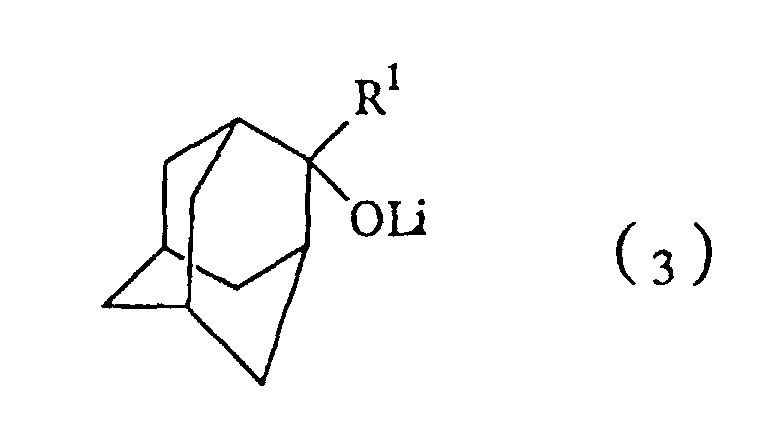
- a solution or suspension of 2-adamantanone and an alkyl halide is reacted with lithium metal to prepare a solution of an lithium 2-alkyl-2-adamantyl alcoholate.
- the lithium 2-alkyl-2-adamantyl alcoholate can be, therefore, prepared in a high yield and furthermore, the resulting alcoholate is reacted with an acid halide to give a desired product, an 2-alkyl-2-adamantyl ester in a high yield.
- the lithium 2-alkyl-2-adamantyl alcoholate can be prepared in a high yield when a solution or suspension of 2-adamantanone and an alkyl halide is added to lithium metal. Furthermore, when the solution of the lithium 2-alkyl-2-adamantyl alcoholate thus prepared is added to an esterifying agent or its solution, the desired product, 2-alkyl-2-adamantyl (meth)acrylate, is prevented from polymerizing. As a result, an yield of the desired product is improved. Furthermore, a reduced amount of impurities in the desired product makes a purification process easier and thus the desired product can be obtained easier with a high purity.
- a desired product can be obtained in a higher yield than a process using a Grignard reagent.
- the process does not use an alkyllithium which must be separately prepared and is unstable, an adamantyl ester can be easily prepared with a lower cost.
- 2-adamantanone is commercially available as a reagent or industrial grade, which may be used as it is or after purification by, for example, recrystallization or sublimation.
- alkyl halide (2) may be selected from, but not limited to, alkyl bromides, alkyl iodides and alkyl chlorides.
- alkyl bromides and iodides having 1 to 6 carbon atoms. Specific examples include butyl chloride, pentyl chloride, hexyl chloride, methyl bromide, ethyl bromide, butyl bromide, methyl iodide and ethyl iodide.
- a solvent or dispersion medium which dissolves or disperses 2-adamantanone and the alkyl halide may be an organic solvent which is stable to lithium metal, an alkyllithium and a lithium alcoholate.
- organic solvent include ethers such as diethyl ether, dioxane and tetrahydrofuran; hydrocarbons such as hexane and toluene; and mixtures thereof.
- Such an organic solvent is preferably used in an amount such that the concentration of 2-adamantanone is 0.01 to 10 mol/L, particularly 0.1 to 5 mol/L in the light of a crude yield, solubility and a reaction rate, but not limited to the range.
- the total amount of lithium metal is preferably, but not limited to, 1.6 to 2.4 gram atom, particularly 1.8 to 2.2 gram atom per 1 mole of adamantanone in the light of an yield and avoiding excessive use of lithium metal.
- lithium metal in the reaction solution and the alkyllithium generated in the reaction system are substantially absent after the alkylation.
- the amount of lithium metal is, therefore, preferably 2 gram atom or less, particularly 1.8 to 2.0 gram atom per 1 mole of 2-adamantanone.
- addition of an organic material mixture to lithium metal is particularly preferable because it can prevent lithium metal from being inactivated, increase a reaction rate and prevent lithium metal from remaining at the end of the reaction.
- to lithium metal is added an organic material mixture portionwise over a relatively longer period, or dropwise continuously or intermittently while controlling a reaction temperature within the range described later.
- a time for adding the organic material mixture to lithium metal may vary depending on a production scale, but is preferably 0.5 to 48 hours.
- Lithium metal may be used preferably as granules, foils or particles having a large surface area which can accelerate the reaction.
- a rate of adding the organic material mixture cannot be particularly defined because it varies depending on the type of an alkyl halide used. Generally, it is desirable to adjust an addition rate such that a reaction temperature does not exceed a lower temperature of a boiling point of the alkyl halide or a boiling point of the organic solvent used.
- the alkyl halide when the alkyl halide is an iodide, it is desirable to add an organic material mixture while maintaining a reaction temperature to 0 °C or lower in the light of minimizing side reactions.
- the alkyl halide is a bromide, it is desirable to add an organic material mixture to lithium metal while maintaining a reaction temperature to a level not only meeting the above conditions but also equal to or exceeding 20 °C, that is, 20 °C to a lower tempeature of a boiling point of the alkyl halide or a boiling point of the organic solvent used. Conducting such adjustment may prevent inactivation of lithium metal.
- the organic material mixture is preferably added to lithium while stirring the solvent.
- a reaction time for the above alkylation may vary depending on factors such as the amount of lithium metal used and a cooling efficiency, but is preferably 0.5 to 10 hours after adding an organic material mixture.
- the reaction is desirably conducted in an inert atmosphere such as argon for preventing inactivation of lithium metal.
- an 2-alkyl-2-adamantyl alcoholate prepared by the above alkylation is reacted with an acid halide to prepare the 2-alkyl-2-adamantyl ester.
- an 2-alkyl-2-adamantyl alcohol may be used as a lithium 2-alkyl-2-adamantyl alcoholate as prepared above without being isolated.
- a lithium 2-alkyl-2-adamantyl alcoholate may be separated and if necessary purified before being used in a subsequent reaction.
- the lithium 2-alkyl-2-adamantyl alcoholate itself may be not necessarily isolated. If possible, the above alcoholate may be separated from the remaining lithium metal while being dissolved in the solution. When the reaction solution after the above alkylation does not substantially contain lithium metal, the reaction solution may be used directly as a material for esterification.
- reaction solution is used as a material for esterification while containing lithium metal or an alkyllithium remains in a large amount, it may cause inactivation of an acid halide or polymerization of an 2-alkyladamantyl ester produced, leading to reduction in an yield of the desired 2-alkyladamantyl ester.
- An acid halide of the other starting material used in the esterification is not limited as long as it corresponds to the structure of a desired product.
- Halogens which can be shown include chlorine, bromine and iodine. Chlorine is preferable because it can readily prepare an acid halide.
- Examples of an acid halide which can be used in the esterification include acetyl chloride, acetyl bromide, acryloyl chloride, methacryloyl chloride, benzoyl chloride and 4-vinylbenzoyl chloride.
- an acryloyl or methacryloyl halide particularly acryloyl or methacryloyl chloride, is preferable as a starting material for an alkyladamantyl ester which is very useful as a resist.
- the amount of a lithium 2-alkyl-2-adamantyl alcoholate and an acid halide is preferably 0.9 to 2.0 moles of an acid halide per 1 mole of a lithium 2-alkyl-2-adamantyl alcoholate, more preferably 1.0 to 1.3 moles because an yield may be improved.
- the above esterification may be initiated by contacting the lithium 2-alkyl-2-adamantyl alcoholate with the acid halide in a solvent.
- Any solvent may be used as long as it does not react with an alcoholate or an esterifying agent.
- a solvent include ethers such as ethyl ether, tetrahydrofuran (THF) and dioxane; and hydrocarbons such as hexane, toluene and xylenes.
- a concentration of an lithium 2-alkyl-2-adamantyl alcoholate in the above solvent is preferably 0.01 to 10 mol/L, more preferably 0.1 to 1 mol/L in the light of handling.
- a particularly preferable procedure of contacting an lithium 2-alkyl-2-adamantyl alcoholate with an acid halide in a solvent is as follows. A solution of the lithium 2-alkyl-2-adamantyl alcoholate is added to the acid halide or its solution to initiate an esterification reaction by which an 2-alkyl-2-adamantyl (meth)acrylate is produced.
- the above contacting procedure can effectively prevent the 2-alkyl-2-adamantyl (meth)acrylate produced during the reaction from polymerizing due to the presence of the -OLi group in the lithium 2-alkyl-2-adamantyl alcoholate, resulting in improvement in an yield of the desired product.
- Such an effect is particularly prominent when the acid halide is an acryloyl halide or methacryloyl halide.
- a dropping period may be, therefore, often about 1 to 48 hours although it depends on a production scale.
- a reaction time is preferably 0.5 to 10 hours after completion of addition.
- a reaction temperature in the esterification may not be particularly restricted, but is preferably -20 to 100 °C, particularly preferably -20 to 50 °C in the light of balance between a reaction rate and prevention of polymerization.
- the reaction is desirably conducted in an atmosphere of an inert gas such as nitrogen and argon for preventing inactivation of an acid halide or a lithium 2-alkyl-2-adamantyl alcoholate.
- an inert gas such as nitrogen and argon for preventing inactivation of an acid halide or a lithium 2-alkyl-2-adamantyl alcoholate.
- the reaction system may contain a polymerization inhibitor unreactive to a lithium alkoxide.
- a polymerization inhibitor include those without a phenolic hydroxyl group such as phenothiazine.
- Esterification can be conducted as described above to obtain a desired alkyladamantyl ester by using corresponding to an alkyl halide and an acid halide used.
- an alkyl halide comprising alkyl having 1 to 6 carbon atoms as an alkyl halide and an acryloyl or methacryloyl halide as an acid halide
- an alkyladamantyl (meth)acrylate represented by formula (4) can be obtained.
- R 1 represents alkyl having 1 to 6 carbon atoms
- R 2 represents hydrogen or methyl.
- a desired product may be obtained from a reaction solution after esterification, by removing a lithium halide as a byproduct by an appropriate procedure such as washing with water, removing a solvent, and then purifying it by a proper method such as column chromatography, distillation and recrystallization.
- Example 2 Treatment with activated charcoal and recrystallization as described in Example 1 gave 22.8 g of 2-ethyl-2-adamantyl methacrylate (an isolation yield of 46.0 % from 2-adamantanone). The crystals were 99.2 % pure as determined by GC.
- Example 2 As described in Example 1, a solution of lithium 2-ethyl-2-adamantyl alcoholate was prepared, in which a conversion rate of 2-adamantanone was 98 % as determined by GC.
- reaction solution After maturing the reaction, to the reaction solution were added 10 g of methanol and 16 g of a 10 wt% aqueous solution of sodium hydroxide while maintaining a temperature below 10 °C, and the mixture was stirred for 1 hour. The organic phase was separated and washed with a 10 wt% aqueous solution of sodium hydroxide. After evaporating the solvent in vacuo, to the residue was added 150 g of methanol to precipitate a sticky oil which adhered to the stirring blade and the flask wall. After stirring at room temperature for further 3 hours, the reaction mixture was filtered to give an oil. The weight of the oil obtained by filtration was 4.4 g. The oil was so sticky that it took 30 min for filtration.
- the reaction was stopped by adding 100 mL of a 0.1 wt% solution of sodium hydroxide in methanol, and to the mixture was added 2000 mL of hexane. The organic layer was separated, washed with a 5 wt% aqueous solution of sodium hydroxide and then a 20 wt% saline. To the mixture was added 0.2 g of phenothiazine as a polymerization inhibitor, and then the solvent was evaporated in vacuo. The residue was dissolved in 200 mL of chloroform. The resulting solution was added to 2000 mL of methanol. While stirring the solution, precipitation of a solid was observed. After stirring at room temperature for 3 hours, the mixture was filtered to give 1.0 g of a solid.
- a solution of 2-butyl-2-adamantyl alcoholate was prepared as described in Example 1, replacing 33 g of butyl bromide (0.24 mol) for ethyl bromide, and it was reacted with methacryloyl chloride as described in Example 1. After maturing the reaction, to the reaction solution were added 10 g of methanol and 16 g of a 10 wt% aqueous solution of sodium hydroxide while maintaining a temperature below 10 °C. After stirring for 1 hour, the organic layer was separated. The organic layer was washed with a 10 wt% aqueous solution of sodium hydroxide.
- Example 2 A reaction was conducted as described in Example 1, replacing 22 g (0.24 mol) of acryloyl chloride for methacryloyl chloride. After maturing the reaction, work-up was conducted as described in Example 1. Distillation under a reduced pressure gave 21 g of 2-ethyl-2-adamantyl acrylate (an isolation yield of 48 % from 2-adamantanone).
- the reaction was stopped by adding 100 mL of a 0.1 wt% solution of sodium hydroxide in methanol, and to the mixture was then added 2500 mL of hexane.
- the organic layer was washed with a 5 wt% aqueous solution of sodium hydroxide and a 20 wt% saline.
- the solvent was evaporated in vacuo.
- the residue was dissolved in 200 mL of chloroform, and the solution was poured into 2000 mL of methanol.
- the insoluble (22 g) was removed by filtration, and the filtrate was evaporated in vacuo.
- the residue was further distilled under a reduced pressure to give 200 g of 2-methyl-2-adamantyl methacrylate (0.85 mol, an isolation yield of 51 % from 2-adamantanone).
- the reaction was stopped by adding 100 mL of a 0.1% solution of sodium hydroxide in methanol, and then to the mixture was added 2500 mL of hexane. The mixture was then washed with a 5% aqueous solution of sodium hydroxide and a 20 % saline. After adding 0.2 g of phenothiazine as a polymerization inhibitor, the solvent was evaporated in vacuo. The residual crude product was dissolved in 200 mL of chloroform. The solution was poured into 2000 mL of methanol. After removing the insoluble (5.1 g), the solvent was evaporated in vacuo. The residue was further distilled under a reduced pressure to give 200 g of 2-methyl-2-adamantyl methacrylate (0.85 mol, an isolation yield of 51 % from 2-adamantanone).
- the reaction probably did not proceed because an yield of ethyl lithium in the first step was too low.
- the reaction would proceed by, for example, increasing an yield of ethyl lithium using an increased amount of lithium metal.
- excessive use of lithium metal is not only undesirable in terms of a cost but also leads to a problem that an excessive lithium must be removed before esterification for avoiding the problems described above.
Landscapes
- Organic Chemistry (AREA)
- Chemical & Material Sciences (AREA)
- Life Sciences & Earth Sciences (AREA)
- Engineering & Computer Science (AREA)
- Food Science & Technology (AREA)
- Health & Medical Sciences (AREA)
- Mycology (AREA)
- Biochemistry (AREA)
- Bioinformatics & Cheminformatics (AREA)
- General Engineering & Computer Science (AREA)
- General Health & Medical Sciences (AREA)
- Genetics & Genomics (AREA)
- Microbiology (AREA)
- Wood Science & Technology (AREA)
- Zoology (AREA)
- Organic Low-Molecular-Weight Compounds And Preparation Thereof (AREA)
Abstract
Description


Claims (6)
- A process for preparing an 2-alkyl-2-adamantyl ester comprising the steps of combining a solution or suspension of 2-adamantanone and an alkyl halide with lithium metal for reacting them to generate an lithium 2-alkyl-2-adamantyl alcoholate, and then reacting the lithium 2-alkyl-2-adamantyl alcoholate with an acid halide.
- The process for preparing an 2-alkyl-2-adamantyl ester as claimed in Claim 1 wherein the reaction initiated by combining a solution or suspension of 2-adamantanone and an alkyl halide with lithium metal is conducted by adding the solution or suspension of 2-adamantanone and an alkyl halide to lithium metal.
- The process for preparing an 2-alkyl-2-adamantyl ester as claimed in Claim 1 wherein 2 gram atom or less of lithium metal is used per 1 mole of 2-adamantanone in the reaction initiated by combining a solution or suspension of 2-adamantanone and an alkyl halide with lithium metal.
- The process for preparing an 2-alkyl-2-adamantyl ester as claimed in Claim 1 wherein the reaction of the lithium 2-alkyl-2-adamantyl alcoholate with the acid halide is conducted by adding a solution of the lithium 2-alkyl-2-adamantyl alcoholate to the acid halide.
- The process for preparing an 2-alkyl-2-adamantyl ester as claimed in Claim 1 wherein the alkyl halide comprises alkyl having 1 to 6 carbon atoms and the acid halide is a (meth)acryloyl halide.
- The process for preparing an 2-alkyl-2-adamantyl ester as claimed in Claim 5 wherein the alkyl is ethyl.
Applications Claiming Priority (3)
| Application Number | Priority Date | Filing Date | Title |
|---|---|---|---|
| JP2000143036 | 2000-05-16 | ||
| JP2000143036 | 2000-05-16 | ||
| PCT/JP2001/004028 WO2001087817A1 (en) | 2000-05-16 | 2001-05-15 | Process for producing 2-alkyl-2-adamantyl ester |
Publications (2)
| Publication Number | Publication Date |
|---|---|
| EP1283198A1 true EP1283198A1 (en) | 2003-02-12 |
| EP1283198A4 EP1283198A4 (en) | 2005-09-21 |
Family
ID=18649906
Family Applications (1)
| Application Number | Title | Priority Date | Filing Date |
|---|---|---|---|
| EP01930145A Withdrawn EP1283198A4 (en) | 2000-05-16 | 2001-05-15 | PROCESS FOR THE PREPARATION OF 2-ALKYL-2-ADAMANTYLESTER |
Country Status (6)
| Country | Link |
|---|---|
| US (1) | US6770777B2 (en) |
| EP (1) | EP1283198A4 (en) |
| JP (1) | JP4021199B2 (en) |
| KR (1) | KR100738302B1 (en) |
| CN (1) | CN1234675C (en) |
| WO (1) | WO2001087817A1 (en) |
Cited By (1)
| Publication number | Priority date | Publication date | Assignee | Title |
|---|---|---|---|---|
| EP1468981A1 (en) * | 2003-04-18 | 2004-10-20 | Mitsubishi Gas Chemical Company, Inc. | Production method of adamantyl acrylate compounds |
Families Citing this family (11)
| Publication number | Priority date | Publication date | Assignee | Title |
|---|---|---|---|---|
| JP4667593B2 (en) * | 2000-12-21 | 2011-04-13 | ダイセル化学工業株式会社 | Process for producing 2-alkyl-2-adamantyl (meth) acrylates |
| JP4042416B2 (en) * | 2001-03-21 | 2008-02-06 | 宇部興産株式会社 | Nonaqueous electrolyte and lithium secondary battery using the same |
| JP2003012579A (en) * | 2001-06-28 | 2003-01-15 | Chemical Soft R & D Inc | Method for producing lithium alkoxides and method for producing alcohols and esters using the same |
| JP3862981B2 (en) * | 2001-09-04 | 2006-12-27 | 株式会社トクヤマ | 2-ethyl-2-adamantyl methacrylate crystal powder |
| JP5124915B2 (en) * | 2005-07-12 | 2013-01-23 | 三菱瓦斯化学株式会社 | Process for producing 2-alkyl-2-adamantyl acrylates |
| CN101798263A (en) * | 2010-04-16 | 2010-08-11 | 北京化工大学 | Method for preparing unsaturated adamantane ester |
| CN101870649A (en) * | 2010-07-16 | 2010-10-27 | 北京化工大学常州先进材料研究院 | A kind of method for preparing adamantyl unsaturated ester |
| CN104628561B (en) * | 2013-11-11 | 2017-04-12 | 上海博康精细化工有限公司 | Preparation method for 2-ethyl-2-adamantanol methacrylate |
| CN104628557B (en) * | 2013-11-11 | 2016-09-28 | 徐州博康信息化学品有限公司 | The preparation method of 2-methyl-2-adamantanol acrylate |
| US11328909B2 (en) | 2017-12-22 | 2022-05-10 | Applied Materials, Inc. | Chamber conditioning and removal processes |
| CN109879756A (en) * | 2019-02-22 | 2019-06-14 | 江苏南大光电材料股份有限公司 | The preparation method of 1- isopropylcyclohexyl (methyl) acrylate |
Family Cites Families (6)
| Publication number | Priority date | Publication date | Assignee | Title |
|---|---|---|---|---|
| JP3506575B2 (en) * | 1996-12-27 | 2004-03-15 | 富士通株式会社 | Method for preparing tertiary alcohol ester |
| JP2000229911A (en) * | 1999-02-05 | 2000-08-22 | Mitsubishi Rayon Co Ltd | Method for producing 2-alkyl-2-adamantyl (meth) acrylates |
| JP2000309558A (en) * | 1999-02-22 | 2000-11-07 | Sumitomo Chem Co Ltd | Method for producing 2-adamantyl (meth) acrylates |
| KR20010081853A (en) * | 2000-02-19 | 2001-08-29 | 김동석 | 2-Alkyl-2-adamantyl 5-norbornene-2-carboxylates and producing method therefor |
| TWI221835B (en) * | 2000-04-28 | 2004-10-11 | Tokuyama Corp | Processes for producing an alicyclic ketone and an alkyl-substituted alicyclic ester |
| GB0026868D0 (en) * | 2000-11-03 | 2000-12-20 | Isis Innovation | Control of deposition and other processes |
-
2001
- 2001-05-15 KR KR1020027015335A patent/KR100738302B1/en not_active Expired - Fee Related
- 2001-05-15 WO PCT/JP2001/004028 patent/WO2001087817A1/en not_active Ceased
- 2001-05-15 JP JP2001584215A patent/JP4021199B2/en not_active Expired - Fee Related
- 2001-05-15 US US10/276,690 patent/US6770777B2/en not_active Expired - Fee Related
- 2001-05-15 CN CNB018095666A patent/CN1234675C/en not_active Expired - Fee Related
- 2001-05-15 EP EP01930145A patent/EP1283198A4/en not_active Withdrawn
Cited By (2)
| Publication number | Priority date | Publication date | Assignee | Title |
|---|---|---|---|---|
| EP1468981A1 (en) * | 2003-04-18 | 2004-10-20 | Mitsubishi Gas Chemical Company, Inc. | Production method of adamantyl acrylate compounds |
| US7067692B2 (en) | 2003-04-18 | 2006-06-27 | Mitsubishi Gas Chemical Company, Inc. | Production method of adamantyl acrylate compounds |
Also Published As
| Publication number | Publication date |
|---|---|
| EP1283198A4 (en) | 2005-09-21 |
| US6770777B2 (en) | 2004-08-03 |
| CN1234675C (en) | 2006-01-04 |
| JP4021199B2 (en) | 2007-12-12 |
| WO2001087817A1 (en) | 2001-11-22 |
| KR100738302B1 (en) | 2007-07-12 |
| CN1429195A (en) | 2003-07-09 |
| KR20020094057A (en) | 2002-12-16 |
| US20030120106A1 (en) | 2003-06-26 |
Similar Documents
| Publication | Publication Date | Title |
|---|---|---|
| US6770777B2 (en) | Process for producing 2-alkyl-2-adamantyl ester | |
| US6949668B2 (en) | Process for producing 5-(3-cyanophenyl)-3-formylbenzoic acid compound | |
| JPWO2001087817A1 (en) | Method for producing 2-alkyl-2-adamantyl esters | |
| JP3868335B2 (en) | Method for producing 2-alkyl-2-adamantyl (meth) acrylate | |
| JP4456939B2 (en) | Method for purifying adamantyl esters | |
| JP2003089672A (en) | Decomposition method of Michael-type adduct | |
| JP2001106650A (en) | Method for producing adamantyl (meth) acrylates | |
| US6872846B2 (en) | Process for preparation of tertiary alcohol esters | |
| JP4163763B2 (en) | Method for alkylating cyclopentadiene compounds | |
| JP4171635B2 (en) | Method for producing 2-alkyl-2-adamantyl (meth) acrylate | |
| JP2003321418A (en) | Decomposition method of Michael-type adduct | |
| JP5124915B2 (en) | Process for producing 2-alkyl-2-adamantyl acrylates | |
| EP1468981B1 (en) | Production method of adamantyl acrylate compounds | |
| JP4362270B2 (en) | Method for producing triorganosilyl unsaturated carboxylate | |
| JPH05213779A (en) | Production of olefin compound | |
| JP4157448B2 (en) | Method for producing polymerizable unsaturated carboxylic acid adamantyl ester | |
| JPWO2011145354A1 (en) | Method for purifying 2-alkyl-2-adamantyl (meth) acrylate | |
| JP6685367B2 (en) | Method for producing adamantyl (meth) acrylate compound | |
| JPH0321537B2 (en) | ||
| JP2009091334A (en) | Method for producing adamantyl (meth) acrylates | |
| JP2009007304A (en) | Method for producing adamantyl (meth) acrylates | |
| JP3949359B2 (en) | Method for producing 2-alkyl-2-adamantyl ester | |
| CN117024239A (en) | A kind of preparation method of cyclopentadiene derivative | |
| JP2005272404A (en) | Process for producing 2-alkyl-2-adamantyl (meth) acrylate | |
| JP2003055363A (en) | Method for producing lactone |
Legal Events
| Date | Code | Title | Description |
|---|---|---|---|
| PUAI | Public reference made under article 153(3) epc to a published international application that has entered the european phase |
Free format text: ORIGINAL CODE: 0009012 |
|
| 17P | Request for examination filed |
Effective date: 20021028 |
|
| AK | Designated contracting states |
Designated state(s): AT BE CH CY DE DK ES FI FR GB GR IE IT LI LU MC NL PT SE TR |
|
| RBV | Designated contracting states (corrected) |
Designated state(s): AT BE DE GB |
|
| A4 | Supplementary search report drawn up and despatched |
Effective date: 20050804 |
|
| RIC1 | Information provided on ipc code assigned before grant |
Ipc: 7C 07C 67/14 A Ipc: 7C 07C 35/46 B Ipc: 7C 07C 69/013 B Ipc: 7C 07C 69/54 B Ipc: 7C 07C 29/68 B |
|
| STAA | Information on the status of an ep patent application or granted ep patent |
Free format text: STATUS: THE APPLICATION HAS BEEN WITHDRAWN |
|
| 18W | Application withdrawn |
Effective date: 20060228 |