EP1275674B1 - Epoxy resin composition and prepreg made with the epoxy resin composition - Google Patents
Epoxy resin composition and prepreg made with the epoxy resin composition Download PDFInfo
- Publication number
- EP1275674B1 EP1275674B1 EP01921960A EP01921960A EP1275674B1 EP 1275674 B1 EP1275674 B1 EP 1275674B1 EP 01921960 A EP01921960 A EP 01921960A EP 01921960 A EP01921960 A EP 01921960A EP 1275674 B1 EP1275674 B1 EP 1275674B1
- Authority
- EP
- European Patent Office
- Prior art keywords
- epoxy resin
- component
- curing
- resin composition
- weight
- Prior art date
- Legal status (The legal status is an assumption and is not a legal conclusion. Google has not performed a legal analysis and makes no representation as to the accuracy of the status listed.)
- Expired - Lifetime
Links
- 229920000647 polyepoxide Polymers 0.000 title claims description 218
- 239000003822 epoxy resin Substances 0.000 title claims description 209
- 239000000203 mixture Substances 0.000 title claims description 158
- 239000003795 chemical substances by application Substances 0.000 claims description 51
- 239000000463 material Substances 0.000 claims description 38
- 238000000034 method Methods 0.000 claims description 36
- LNEPOXFFQSENCJ-UHFFFAOYSA-N haloperidol Chemical compound C1CC(O)(C=2C=CC(Cl)=CC=2)CCN1CCCC(=O)C1=CC=C(F)C=C1 LNEPOXFFQSENCJ-UHFFFAOYSA-N 0.000 claims description 23
- 238000000465 moulding Methods 0.000 claims description 21
- 239000011342 resin composition Substances 0.000 claims description 20
- 238000002156 mixing Methods 0.000 claims description 19
- MQJKPEGWNLWLTK-UHFFFAOYSA-N Dapsone Chemical compound C1=CC(N)=CC=C1S(=O)(=O)C1=CC=C(N)C=C1 MQJKPEGWNLWLTK-UHFFFAOYSA-N 0.000 claims description 18
- 239000012783 reinforcing fiber Substances 0.000 claims description 17
- 239000000126 substance Substances 0.000 claims description 17
- 239000003733 fiber-reinforced composite Substances 0.000 claims description 13
- IISBACLAFKSPIT-UHFFFAOYSA-N bisphenol A Chemical compound C=1C=C(O)C=CC=1C(C)(C)C1=CC=C(O)C=C1 IISBACLAFKSPIT-UHFFFAOYSA-N 0.000 claims description 11
- 239000000853 adhesive Substances 0.000 claims description 9
- 230000001070 adhesive effect Effects 0.000 claims description 9
- 239000007788 liquid Substances 0.000 claims description 7
- 238000002360 preparation method Methods 0.000 claims description 7
- 239000004593 Epoxy Substances 0.000 claims description 6
- 150000001412 amines Chemical class 0.000 claims description 5
- IGALFTFNPPBUDN-UHFFFAOYSA-N phenyl-[2,3,4,5-tetrakis(oxiran-2-ylmethyl)phenyl]methanediamine Chemical compound C=1C(CC2OC2)=C(CC2OC2)C(CC2OC2)=C(CC2OC2)C=1C(N)(N)C1=CC=CC=C1 IGALFTFNPPBUDN-UHFFFAOYSA-N 0.000 claims description 5
- 230000003028 elevating effect Effects 0.000 claims description 4
- 230000008569 process Effects 0.000 claims description 4
- 239000000047 product Substances 0.000 description 124
- 230000009477 glass transition Effects 0.000 description 26
- 229920005989 resin Polymers 0.000 description 18
- 239000011347 resin Substances 0.000 description 18
- 230000000052 comparative effect Effects 0.000 description 16
- -1 aromatic diamine compound Chemical class 0.000 description 13
- QGBSISYHAICWAH-UHFFFAOYSA-N dicyandiamide Chemical compound NC(N)=NC#N QGBSISYHAICWAH-UHFFFAOYSA-N 0.000 description 10
- 229920006393 polyether sulfone Polymers 0.000 description 10
- 230000009257 reactivity Effects 0.000 description 10
- 229920005992 thermoplastic resin Polymers 0.000 description 10
- 239000004695 Polyether sulfone Substances 0.000 description 8
- VYPSYNLAJGMNEJ-UHFFFAOYSA-N Silicium dioxide Chemical compound O=[Si]=O VYPSYNLAJGMNEJ-UHFFFAOYSA-N 0.000 description 7
- 239000005060 rubber Substances 0.000 description 6
- 239000007787 solid Substances 0.000 description 6
- 229910002018 Aerosil® 300 Inorganic materials 0.000 description 5
- 229920000049 Carbon (fiber) Polymers 0.000 description 5
- 125000000217 alkyl group Chemical group 0.000 description 5
- 239000004917 carbon fiber Substances 0.000 description 5
- 239000000835 fiber Substances 0.000 description 5
- 229910052739 hydrogen Inorganic materials 0.000 description 5
- 239000001257 hydrogen Substances 0.000 description 5
- 239000011229 interlayer Substances 0.000 description 5
- 230000014759 maintenance of location Effects 0.000 description 5
- 238000005259 measurement Methods 0.000 description 5
- VNWKTOKETHGBQD-UHFFFAOYSA-N methane Chemical compound C VNWKTOKETHGBQD-UHFFFAOYSA-N 0.000 description 5
- 239000000843 powder Substances 0.000 description 5
- KUBDPQJOLOUJRM-UHFFFAOYSA-N 2-(chloromethyl)oxirane;4-[2-(4-hydroxyphenyl)propan-2-yl]phenol Chemical compound ClCC1CO1.C=1C=C(O)C=CC=1C(C)(C)C1=CC=C(O)C=C1 KUBDPQJOLOUJRM-UHFFFAOYSA-N 0.000 description 4
- XMTQQYYKAHVGBJ-UHFFFAOYSA-N 3-(3,4-DICHLOROPHENYL)-1,1-DIMETHYLUREA Chemical compound CN(C)C(=O)NC1=CC=C(Cl)C(Cl)=C1 XMTQQYYKAHVGBJ-UHFFFAOYSA-N 0.000 description 4
- UFHFLCQGNIYNRP-UHFFFAOYSA-N Hydrogen Chemical compound [H][H] UFHFLCQGNIYNRP-UHFFFAOYSA-N 0.000 description 4
- 150000001875 compounds Chemical class 0.000 description 4
- 239000004744 fabric Substances 0.000 description 4
- 239000011521 glass Substances 0.000 description 4
- 239000011159 matrix material Substances 0.000 description 4
- 229910052751 metal Inorganic materials 0.000 description 4
- 239000002184 metal Substances 0.000 description 4
- 229920002725 thermoplastic elastomer Polymers 0.000 description 4
- QTWJRLJHJPIABL-UHFFFAOYSA-N 2-methylphenol;3-methylphenol;4-methylphenol Chemical compound CC1=CC=C(O)C=C1.CC1=CC=CC(O)=C1.CC1=CC=CC=C1O QTWJRLJHJPIABL-UHFFFAOYSA-N 0.000 description 3
- WDGCBNTXZHJTHJ-UHFFFAOYSA-N 2h-1,3-oxazol-2-id-4-one Chemical group O=C1CO[C-]=N1 WDGCBNTXZHJTHJ-UHFFFAOYSA-N 0.000 description 3
- 239000000654 additive Substances 0.000 description 3
- 239000004202 carbamide Substances 0.000 description 3
- 238000001816 cooling Methods 0.000 description 3
- 229930003836 cresol Natural products 0.000 description 3
- 238000004090 dissolution Methods 0.000 description 3
- 230000001747 exhibiting effect Effects 0.000 description 3
- 238000010438 heat treatment Methods 0.000 description 3
- 239000012943 hotmelt Substances 0.000 description 3
- 230000001965 increasing effect Effects 0.000 description 3
- 239000010410 layer Substances 0.000 description 3
- FVCSARBUZVPSQF-UHFFFAOYSA-N 5-(2,4-dioxooxolan-3-yl)-7-methyl-3a,4,5,7a-tetrahydro-2-benzofuran-1,3-dione Chemical compound C1C(C(OC2=O)=O)C2C(C)=CC1C1C(=O)COC1=O FVCSARBUZVPSQF-UHFFFAOYSA-N 0.000 description 2
- CSCPPACGZOOCGX-UHFFFAOYSA-N Acetone Chemical compound CC(C)=O CSCPPACGZOOCGX-UHFFFAOYSA-N 0.000 description 2
- 229920003319 Araldite® Polymers 0.000 description 2
- ISWSIDIOOBJBQZ-UHFFFAOYSA-N Phenol Chemical compound OC1=CC=CC=C1 ISWSIDIOOBJBQZ-UHFFFAOYSA-N 0.000 description 2
- 229920000297 Rayon Polymers 0.000 description 2
- 230000009471 action Effects 0.000 description 2
- 238000004220 aggregation Methods 0.000 description 2
- 230000002776 aggregation Effects 0.000 description 2
- 229910052782 aluminium Inorganic materials 0.000 description 2
- XAGFODPZIPBFFR-UHFFFAOYSA-N aluminium Chemical compound [Al] XAGFODPZIPBFFR-UHFFFAOYSA-N 0.000 description 2
- 150000004982 aromatic amines Chemical class 0.000 description 2
- 239000004841 bisphenol A epoxy resin Substances 0.000 description 2
- 239000004918 carbon fiber reinforced polymer Substances 0.000 description 2
- 230000008859 change Effects 0.000 description 2
- 239000011248 coating agent Substances 0.000 description 2
- 238000000576 coating method Methods 0.000 description 2
- 238000001514 detection method Methods 0.000 description 2
- 229910003460 diamond Inorganic materials 0.000 description 2
- 239000010432 diamond Substances 0.000 description 2
- 239000006185 dispersion Substances 0.000 description 2
- 238000009826 distribution Methods 0.000 description 2
- 229920001971 elastomer Polymers 0.000 description 2
- 125000004435 hydrogen atom Chemical group [H]* 0.000 description 2
- 238000004519 manufacturing process Methods 0.000 description 2
- 238000003756 stirring Methods 0.000 description 2
- 238000003860 storage Methods 0.000 description 2
- 0 *(C1OC1)c1ccccc1 Chemical compound *(C1OC1)c1ccccc1 0.000 description 1
- ZWOULFZCQXICLZ-UHFFFAOYSA-N 1,3-dimethyl-1-phenylurea Chemical compound CNC(=O)N(C)C1=CC=CC=C1 ZWOULFZCQXICLZ-UHFFFAOYSA-N 0.000 description 1
- WBQDXWRDENKVSJ-UHFFFAOYSA-N 1-(dichloromethyl)-3-methyl-1-phenylurea Chemical compound CNC(=O)N(C(Cl)Cl)C1=CC=CC=C1 WBQDXWRDENKVSJ-UHFFFAOYSA-N 0.000 description 1
- RNFJDJUURJAICM-UHFFFAOYSA-N 2,2,4,4,6,6-hexaphenoxy-1,3,5-triaza-2$l^{5},4$l^{5},6$l^{5}-triphosphacyclohexa-1,3,5-triene Chemical compound N=1P(OC=2C=CC=CC=2)(OC=2C=CC=CC=2)=NP(OC=2C=CC=CC=2)(OC=2C=CC=CC=2)=NP=1(OC=1C=CC=CC=1)OC1=CC=CC=C1 RNFJDJUURJAICM-UHFFFAOYSA-N 0.000 description 1
- DZIHTWJGPDVSGE-UHFFFAOYSA-N 4-[(4-aminocyclohexyl)methyl]cyclohexan-1-amine Chemical compound C1CC(N)CCC1CC1CCC(N)CC1 DZIHTWJGPDVSGE-UHFFFAOYSA-N 0.000 description 1
- AOFIWCXMXPVSAZ-UHFFFAOYSA-N 4-methyl-2,6-bis(methylsulfanyl)benzene-1,3-diamine Chemical compound CSC1=CC(C)=C(N)C(SC)=C1N AOFIWCXMXPVSAZ-UHFFFAOYSA-N 0.000 description 1
- 229910002012 Aerosil® Inorganic materials 0.000 description 1
- 229930185605 Bisphenol Natural products 0.000 description 1
- ZAMOUSCENKQFHK-UHFFFAOYSA-N Chlorine atom Chemical compound [Cl] ZAMOUSCENKQFHK-UHFFFAOYSA-N 0.000 description 1
- 239000004594 Masterbatch (MB) Substances 0.000 description 1
- AFCARXCZXQIEQB-UHFFFAOYSA-N N-[3-oxo-3-(2,4,6,7-tetrahydrotriazolo[4,5-c]pyridin-5-yl)propyl]-2-[[3-(trifluoromethoxy)phenyl]methylamino]pyrimidine-5-carboxamide Chemical compound O=C(CCNC(=O)C=1C=NC(=NC=1)NCC1=CC(=CC=C1)OC(F)(F)F)N1CC2=C(CC1)NN=N2 AFCARXCZXQIEQB-UHFFFAOYSA-N 0.000 description 1
- WOBQSJVYSADMHV-UHFFFAOYSA-N NC.FB(F)F Chemical compound NC.FB(F)F WOBQSJVYSADMHV-UHFFFAOYSA-N 0.000 description 1
- 239000004952 Polyamide Substances 0.000 description 1
- 239000005062 Polybutadiene Substances 0.000 description 1
- 239000004642 Polyimide Substances 0.000 description 1
- 229910000831 Steel Inorganic materials 0.000 description 1
- 235000010724 Wisteria floribunda Nutrition 0.000 description 1
- 150000008065 acid anhydrides Chemical class 0.000 description 1
- 230000002411 adverse Effects 0.000 description 1
- 150000004984 aromatic diamines Chemical class 0.000 description 1
- 230000008901 benefit Effects 0.000 description 1
- 230000015572 biosynthetic process Effects 0.000 description 1
- 229920005549 butyl rubber Polymers 0.000 description 1
- 239000002775 capsule Substances 0.000 description 1
- 239000007795 chemical reaction product Substances 0.000 description 1
- 229910052801 chlorine Inorganic materials 0.000 description 1
- 239000000460 chlorine Substances 0.000 description 1
- 239000002131 composite material Substances 0.000 description 1
- 238000005238 degreasing Methods 0.000 description 1
- ZZTCPWRAHWXWCH-UHFFFAOYSA-N diphenylmethanediamine Chemical compound C=1C=CC=CC=1C(N)(N)C1=CC=CC=C1 ZZTCPWRAHWXWCH-UHFFFAOYSA-N 0.000 description 1
- 230000000694 effects Effects 0.000 description 1
- 125000001495 ethyl group Chemical group [H]C([H])([H])C([H])([H])* 0.000 description 1
- 238000011156 evaluation Methods 0.000 description 1
- 230000002349 favourable effect Effects 0.000 description 1
- XXOYNJXVWVNOOJ-UHFFFAOYSA-N fenuron Chemical compound CN(C)C(=O)NC1=CC=CC=C1 XXOYNJXVWVNOOJ-UHFFFAOYSA-N 0.000 description 1
- 239000010419 fine particle Substances 0.000 description 1
- 239000003063 flame retardant Substances 0.000 description 1
- 239000004088 foaming agent Substances 0.000 description 1
- 239000003365 glass fiber Substances 0.000 description 1
- 229910052736 halogen Inorganic materials 0.000 description 1
- 150000002367 halogens Chemical class 0.000 description 1
- 238000009787 hand lay-up Methods 0.000 description 1
- 229920006015 heat resistant resin Polymers 0.000 description 1
- 239000011874 heated mixture Substances 0.000 description 1
- 239000012456 homogeneous solution Substances 0.000 description 1
- 150000002460 imidazoles Chemical class 0.000 description 1
- 238000005470 impregnation Methods 0.000 description 1
- 230000000977 initiatory effect Effects 0.000 description 1
- 239000012784 inorganic fiber Substances 0.000 description 1
- 238000002844 melting Methods 0.000 description 1
- 230000008018 melting Effects 0.000 description 1
- 239000003094 microcapsule Substances 0.000 description 1
- 239000012778 molding material Substances 0.000 description 1
- QOHMWDJIBGVPIF-UHFFFAOYSA-N n',n'-diethylpropane-1,3-diamine Chemical compound CCN(CC)CCCN QOHMWDJIBGVPIF-UHFFFAOYSA-N 0.000 description 1
- 239000004843 novolac epoxy resin Substances 0.000 description 1
- 239000002245 particle Substances 0.000 description 1
- 229920006287 phenoxy resin Polymers 0.000 description 1
- 239000013034 phenoxy resin Substances 0.000 description 1
- 238000005498 polishing Methods 0.000 description 1
- 229920002647 polyamide Polymers 0.000 description 1
- 229920002857 polybutadiene Polymers 0.000 description 1
- 239000004848 polyfunctional curative Substances 0.000 description 1
- 229920001721 polyimide Polymers 0.000 description 1
- 239000004814 polyurethane Substances 0.000 description 1
- 229920002635 polyurethane Polymers 0.000 description 1
- 239000000377 silicon dioxide Substances 0.000 description 1
- 230000006641 stabilisation Effects 0.000 description 1
- 238000011105 stabilization Methods 0.000 description 1
- 239000010959 steel Substances 0.000 description 1
- 239000000454 talc Substances 0.000 description 1
- 229910052623 talc Inorganic materials 0.000 description 1
- 238000001721 transfer moulding Methods 0.000 description 1
- 230000007704 transition Effects 0.000 description 1
- 150000003672 ureas Chemical class 0.000 description 1
- 239000002023 wood Substances 0.000 description 1
Images

Classifications
-
- C—CHEMISTRY; METALLURGY
- C08—ORGANIC MACROMOLECULAR COMPOUNDS; THEIR PREPARATION OR CHEMICAL WORKING-UP; COMPOSITIONS BASED THEREON
- C08G—MACROMOLECULAR COMPOUNDS OBTAINED OTHERWISE THAN BY REACTIONS ONLY INVOLVING UNSATURATED CARBON-TO-CARBON BONDS
- C08G59/00—Polycondensates containing more than one epoxy group per molecule; Macromolecules obtained by polymerising compounds containing more than one epoxy group per molecule using curing agents or catalysts which react with the epoxy groups
- C08G59/18—Macromolecules obtained by polymerising compounds containing more than one epoxy group per molecule using curing agents or catalysts which react with the epoxy groups ; e.g. general methods of curing
-
- C—CHEMISTRY; METALLURGY
- C08—ORGANIC MACROMOLECULAR COMPOUNDS; THEIR PREPARATION OR CHEMICAL WORKING-UP; COMPOSITIONS BASED THEREON
- C08G—MACROMOLECULAR COMPOUNDS OBTAINED OTHERWISE THAN BY REACTIONS ONLY INVOLVING UNSATURATED CARBON-TO-CARBON BONDS
- C08G59/00—Polycondensates containing more than one epoxy group per molecule; Macromolecules obtained by polymerising compounds containing more than one epoxy group per molecule using curing agents or catalysts which react with the epoxy groups
- C08G59/18—Macromolecules obtained by polymerising compounds containing more than one epoxy group per molecule using curing agents or catalysts which react with the epoxy groups ; e.g. general methods of curing
- C08G59/20—Macromolecules obtained by polymerising compounds containing more than one epoxy group per molecule using curing agents or catalysts which react with the epoxy groups ; e.g. general methods of curing characterised by the epoxy compounds used
- C08G59/32—Epoxy compounds containing three or more epoxy groups
-
- C—CHEMISTRY; METALLURGY
- C08—ORGANIC MACROMOLECULAR COMPOUNDS; THEIR PREPARATION OR CHEMICAL WORKING-UP; COMPOSITIONS BASED THEREON
- C08G—MACROMOLECULAR COMPOUNDS OBTAINED OTHERWISE THAN BY REACTIONS ONLY INVOLVING UNSATURATED CARBON-TO-CARBON BONDS
- C08G59/00—Polycondensates containing more than one epoxy group per molecule; Macromolecules obtained by polymerising compounds containing more than one epoxy group per molecule using curing agents or catalysts which react with the epoxy groups
- C08G59/18—Macromolecules obtained by polymerising compounds containing more than one epoxy group per molecule using curing agents or catalysts which react with the epoxy groups ; e.g. general methods of curing
- C08G59/20—Macromolecules obtained by polymerising compounds containing more than one epoxy group per molecule using curing agents or catalysts which react with the epoxy groups ; e.g. general methods of curing characterised by the epoxy compounds used
- C08G59/32—Epoxy compounds containing three or more epoxy groups
- C08G59/3218—Carbocyclic compounds
-
- C—CHEMISTRY; METALLURGY
- C08—ORGANIC MACROMOLECULAR COMPOUNDS; THEIR PREPARATION OR CHEMICAL WORKING-UP; COMPOSITIONS BASED THEREON
- C08G—MACROMOLECULAR COMPOUNDS OBTAINED OTHERWISE THAN BY REACTIONS ONLY INVOLVING UNSATURATED CARBON-TO-CARBON BONDS
- C08G59/00—Polycondensates containing more than one epoxy group per molecule; Macromolecules obtained by polymerising compounds containing more than one epoxy group per molecule using curing agents or catalysts which react with the epoxy groups
- C08G59/18—Macromolecules obtained by polymerising compounds containing more than one epoxy group per molecule using curing agents or catalysts which react with the epoxy groups ; e.g. general methods of curing
- C08G59/40—Macromolecules obtained by polymerising compounds containing more than one epoxy group per molecule using curing agents or catalysts which react with the epoxy groups ; e.g. general methods of curing characterised by the curing agents used
- C08G59/50—Amines
-
- C—CHEMISTRY; METALLURGY
- C08—ORGANIC MACROMOLECULAR COMPOUNDS; THEIR PREPARATION OR CHEMICAL WORKING-UP; COMPOSITIONS BASED THEREON
- C08G—MACROMOLECULAR COMPOUNDS OBTAINED OTHERWISE THAN BY REACTIONS ONLY INVOLVING UNSATURATED CARBON-TO-CARBON BONDS
- C08G59/00—Polycondensates containing more than one epoxy group per molecule; Macromolecules obtained by polymerising compounds containing more than one epoxy group per molecule using curing agents or catalysts which react with the epoxy groups
- C08G59/18—Macromolecules obtained by polymerising compounds containing more than one epoxy group per molecule using curing agents or catalysts which react with the epoxy groups ; e.g. general methods of curing
- C08G59/40—Macromolecules obtained by polymerising compounds containing more than one epoxy group per molecule using curing agents or catalysts which react with the epoxy groups ; e.g. general methods of curing characterised by the curing agents used
- C08G59/50—Amines
- C08G59/5033—Amines aromatic
-
- Y—GENERAL TAGGING OF NEW TECHNOLOGICAL DEVELOPMENTS; GENERAL TAGGING OF CROSS-SECTIONAL TECHNOLOGIES SPANNING OVER SEVERAL SECTIONS OF THE IPC; TECHNICAL SUBJECTS COVERED BY FORMER USPC CROSS-REFERENCE ART COLLECTIONS [XRACs] AND DIGESTS
- Y10—TECHNICAL SUBJECTS COVERED BY FORMER USPC
- Y10T—TECHNICAL SUBJECTS COVERED BY FORMER US CLASSIFICATION
- Y10T428/00—Stock material or miscellaneous articles
- Y10T428/249921—Web or sheet containing structurally defined element or component
- Y10T428/249924—Noninterengaged fiber-containing paper-free web or sheet which is not of specified porosity
- Y10T428/24994—Fiber embedded in or on the surface of a polymeric matrix
-
- Y—GENERAL TAGGING OF NEW TECHNOLOGICAL DEVELOPMENTS; GENERAL TAGGING OF CROSS-SECTIONAL TECHNOLOGIES SPANNING OVER SEVERAL SECTIONS OF THE IPC; TECHNICAL SUBJECTS COVERED BY FORMER USPC CROSS-REFERENCE ART COLLECTIONS [XRACs] AND DIGESTS
- Y10—TECHNICAL SUBJECTS COVERED BY FORMER USPC
- Y10T—TECHNICAL SUBJECTS COVERED BY FORMER US CLASSIFICATION
- Y10T428/00—Stock material or miscellaneous articles
- Y10T428/29—Coated or structually defined flake, particle, cell, strand, strand portion, rod, filament, macroscopic fiber or mass thereof
- Y10T428/2913—Rod, strand, filament or fiber
- Y10T428/2933—Coated or with bond, impregnation or core
-
- Y—GENERAL TAGGING OF NEW TECHNOLOGICAL DEVELOPMENTS; GENERAL TAGGING OF CROSS-SECTIONAL TECHNOLOGIES SPANNING OVER SEVERAL SECTIONS OF THE IPC; TECHNICAL SUBJECTS COVERED BY FORMER USPC CROSS-REFERENCE ART COLLECTIONS [XRACs] AND DIGESTS
- Y10—TECHNICAL SUBJECTS COVERED BY FORMER USPC
- Y10T—TECHNICAL SUBJECTS COVERED BY FORMER US CLASSIFICATION
- Y10T428/00—Stock material or miscellaneous articles
- Y10T428/29—Coated or structually defined flake, particle, cell, strand, strand portion, rod, filament, macroscopic fiber or mass thereof
- Y10T428/2913—Rod, strand, filament or fiber
- Y10T428/2933—Coated or with bond, impregnation or core
- Y10T428/2971—Impregnation
-
- Y—GENERAL TAGGING OF NEW TECHNOLOGICAL DEVELOPMENTS; GENERAL TAGGING OF CROSS-SECTIONAL TECHNOLOGIES SPANNING OVER SEVERAL SECTIONS OF THE IPC; TECHNICAL SUBJECTS COVERED BY FORMER USPC CROSS-REFERENCE ART COLLECTIONS [XRACs] AND DIGESTS
- Y10—TECHNICAL SUBJECTS COVERED BY FORMER USPC
- Y10T—TECHNICAL SUBJECTS COVERED BY FORMER US CLASSIFICATION
- Y10T428/00—Stock material or miscellaneous articles
- Y10T428/31504—Composite [nonstructural laminate]
- Y10T428/31511—Of epoxy ether
Definitions
- the present invention relates to an epoxy resin composition which is suitable for application as a matrix resin for fiber-reinforced composite materials, and to a prepreg employing it.
- Fiber-reinforced composite materials are utilized in a wide range of applications, from sports and leisure-related purposes to transportation purposes such as in aircraft, and for industrial applications. Molding methods using dies are the most common molding methods for such fiber-reinforced composite materials.
- Examples of such methods include the hand layup method wherein a reinforcing fiber material such as a cloth is impregnated with a resin while being laid up along a die, or a "prepreg" of a reinforcing fiber material pre-impregnated with a resin is laid up along a die, and after repeating this process, is cured and released from the die to obtain a molded article; the resin transfer molding method wherein a reinforcing fiber material such as a cloth is set in a die, injected with a resin and cured and then released from the die to obtain a molded article; and the molding compound method wherein a reinforcing fiber material cut into staple fibers is mixed with a resin to prepare a molding material which is injected into a die and then cured and released from the die to obtain a molded article.
- the dies used for such molding methods are made of various materials such as metal, resin or wood.
- Metal dies exhibit excellent heat resistance and durability but are costly because of the effort and labor required for manufacture, while resin dies and wooden dies have the advantage of cheaper availability despite inferior heat resistance and durability.
- Molding methods employing such resin dies or wooden dies do not permit molding at high temperature because of the inadequate heat resistance of the resin or wooden dies themselves, and therefore cannot be applied for molding of articles with high heat resistance.
- the prepreg when such molding methods employing curing means comprising both primary curing and secondary curing are carried out using prepregs, it is essential for the prepreg to be cured for a short time at a relatively low temperature of 100°C or below to achieve releasable curing, to obtain a cured product with high heat resistance by secondary curing at high temperature, and to ensure that the prepreg itself has excellent stability and satisfactory handleability at room temperature.
- JP 58 168620 A discloses an epoxy resin composition comprising an epoxy resin, a diethylaminopropylamine/epoxy compound adduct and an aromatic diamine compound.
- JP-A-10045925 discloses a method for the preparation of a prepreg using a resin composition comprising an epoxy resin, diaminphenylsulfone and capsulated imidazoles.
- It is an object of the invention is therefore to provide epoxy resin compositions that do not require a long time to obtain releasable cured products by primary curing at a relatively low temperature of 100°C or below, while giving cured products with high heat resistance by secondary curing, the epoxy resin compositions also possessing properties such as satisfactory stability at room temperature and satisfactory handleability of their prepregs obtained by impregnating them into reinforcing fiber materials, as well as to provide prepregs comprising reinforcing fiber materials impregnated with the epoxy resin compositions.
- an epoxy resin composition according to the invention is an epoxy resin composition, comprising the following components (a), (b) and (c), which is curable in two stages.
- the mixing proportion of component (a), component (b) and component (c) is 3-40 parts by weight of component (b) and 10-40 parts by weight of component (c) to 100 parts by weight of component (a).
- the epoxy resin as component (a) is an epoxy resin containing at least 40% by weight of a trifunctional or greater functional epoxy resin, and the trifunctional or greater functional epoxy resin is preferably an epoxy resin containing at least one selected from novolac-type epoxy resins represented by chemical formula (1) below, novolac-type epoxy resins represented by chemical formula (2) below, and tetraglycidyldiaminodiphenylmethane. wherein n represents a number of 0 or greater, wherein n represents a number of 0 or greater.
- the latent curing agent (b) has a feature such that an epoxy resin composition obtained by uniformly mixing 100 parts by weight of a liquid bisphenol A type epoxy resin with 184 - 194 epoxy equivalents and 20 parts by weight of the curing agent has a temperature at which curing generated heat occurs, away from the base line on a DSC chart, of 100 °C or below when the heat generated upon curing under temperature elevating conditions of 10°C/min is measured by DSC
- the latent curing agent as component (b) is preferably an amine adduct-type curing agent, or else the latent curing agent of component (b) is preferably a microcapsular curing agent.
- the component (c) is 4,4'-diaminodiphenylsulfone.
- the epoxy resin composition according to the invention preferably further comprises a curing accelerator as component (d).
- the viscosity of an epoxy resin composition of the invention when the epoxy resin composition is prepared and allowed to stand at 25°C for 3 weeks, is preferably no greater than twice the viscosity immediately after preparation of the resin composition.
- the epoxy resin composition of the invention preferably gives a cured product with a curing degree of at least 70% when obtained by primary curing for no more than 10 hours at a temperature of 100°C or below, and it preferably gives a cured product with a tensile shear strength (adhesive strength) of at least 10 MPa according to JIS-K-6848 and JIS-K-6850.
- a prepreg according to the invention comprises a reinforcing fiber material impregnated with the epoxy resin composition having the constitution described above.
- the epoxy resin as component (a) of the epoxy resin composition according to the invention is not particularly restricted, and a bisphenol-type, novolac-type, cresol/novolac-type or aminoglycidyl-type epoxy resin may be used.
- the epoxy resin used as component (a) is one containing at least 40% by weight of a trifunctional or greater epoxy resin in order to achieve excellent heat resistance for cured products obtained by secondary curing.
- the epoxy resin composed mainly of a trifunctional or greater functional epoxy resin is therefore one containing the trifunctional or greater function epoxy resin at 40 wt% or greater in the epoxy resin of component (a), and more preferably it is one containing the trifunctional or greater functional epoxy resin at 60 wt% or greater in the epoxy resin of component (a)
- epoxy resins there may be mentioned tetraglycidyldiaminodiphenylmethane, aminophenol-type epoxy resins, aminocresol-type epoxy resins, phenol/novolac-type epoxy resins, cresol/novolac-type epoxy resins and epoxy resins represented by the following chemical formulas (3) and (4). wherein n represents a number of 0 or greater, wherein n represents a number of 0 or greater.
- trifunctional or greater epoxy resins are novolac-type epoxy resins represented by chemical formula (3) above and/or tetraglycidyldiaminodiphenylmethane.
- epoxy resins other than trifunctional epoxy resins in the epoxy resin of component (a) there may be mentioned, for example, bisphenol-type epoxy resins, hydrogenated bisphenol-type epoxy resins, biphenol-type epoxy resins and naphthalenediol-type epoxy resins, but for higher heat resistance of the cured product obtained by secondary curing, it is preferred to use an epoxy resin having a relatively rigid backbone structure such as a biphenol-type epoxy resin or naphthalenediol-type epoxy resin.
- the epoxy resin composition exhibits satisfactory adhesion with reinforcing fiber materials, resulting in a fiber-reinforced composite material with excellent mechanical properties.
- R represents hydrogen or an alkyl group.
- the epoxy resin with an oxazolidone ring is an epoxy resin composed of a unit represented by chemical formula (6) below
- the epoxy resin composition exhibits even more satisfactory adhesion with reinforcing fiber materials, resulting in a fiber-reinforced composite material with even more excellent mechanical properties.
- each R independently represents hydrogen or an alkyl group
- R 1 -R 8 each independently represent a halogen or hydrogen atom or an alkyl group of 1-4 carbons
- R 9 represents a group of chemical formula (7) or (8) below.
- R' 1 -R' 4 each independently represent hydrogen or an alkyl group of 1-4 carbons.
- R' 1 -R' 8 each independently represent hydrogen or an alkyl group of 1-4 carbons
- R' 9 represents a single bond, -CH 2 -, -C(CH 3 ) 2 -, -SO 2 -, -SO-, -S- or -O-.
- the curing agent of component (b) is a latent curing agent with curing power at 100°C or below. That is, the curing agent of component (b) possesses curing power at up to 100°C and has heating latent reactivity, or latency.
- the curing power of a curing agent at 100°C or below is identified in the following manner. Specifically, an epoxy resin composition is obtained by uniformly mixing 100 parts by weight of a liquid bisphenol A type epoxy resin with 184-194 epoxy equivalents (for example, Epikote 828 by Japan Epoxy Resins Co., Ltd.) and 20 parts by weight of the curing agent, and then the heat generated upon curing under temperature elevating conditions of 10°C/min by DSC is measured and the curing agent is judged to have curing power at 100°C or below if the temperature at which curing generated heat occurs, away from the baseline on a DSC chart, is 100°C or below. Using a curing agent with an initial curing generated heat temperature of 90°C or below is preferred to obtain an epoxy resin composition with satisfactory reactivity at 90°C and below.
- a liquid bisphenol A type epoxy resin with 184-194 epoxy equivalents (for example, Epikote 828 by Japan Epoxy Resins Co., Ltd.) and 20 parts by weight of the cu
- a curing agent has heating latent reactivity, or latency, then it will undergo virtually no reaction at temperatures near room temperature.
- the latency of a curing agent which undergoes virtually no reaction at near room temperature can be confirmed in the following manner.
- an epoxy resin composition is obtained by uniformly mixing 100 parts by weight of a liquid bisphenol A type epoxy resin with 184-194 epoxy equivalents (for example, Epikote 828 by Japan Epoxy Resins Co., Ltd.) and 20 parts by weight of the curing agent, and the curing agent may be said to have latency if the viscosity after standing at 30°C for 3 weeks is no greater than twice the viscosity before standing. More excellent and favorable latent reactivity is exhibited by a curing agent wherein the viscosity is no greater than 1.5 times the viscosity before standing, after the epoxy resin composition has been allowed to stand at 30°C for 3 weeks.
- the viscosity of the epoxy resin composition containing the curing agent is measured in the following manner. Specifically, a DSR-200 by Rheometrics or a measuring apparatus with performance equal thereto is used for measurement of the 30°C isothermal viscosity using two 25-mm diameter disc plates at a disc plate gap of 0.5 mm, under conditions with a shear rate of 10 radians/sec, and the data is recorded 10 minutes after the start of measurement. The viscosity of the epoxy resin composition being measured is determined by this method before and after being allowed to stand at 30°C for 3 weeks, and the presence or absence of latent reactivity is determined.
- the curing agent as component (b) is not particularly restricted so long as it possesses curing power at up to 100°C and has heating latent reactivity, as explained above, but using a microcapsular curing agent can give an epoxy resin composition according to the invention with an excellent balance between curability at 90°C and below and stability at near room temperature.
- the products Novacure HX3721 and HX3722 by Asahi-Ciba Co., Ltd. may be mentioned as curing agents for component (b) which have excellent curing power at up to 100°C and latency at room temperature, and which form microcapsules.
- An epoxy resin composition using an amine adduct-type curing agent as the curing agent of component (b) is even more suitable for providing curing power at 90°C or below and satisfactory stability at near room temperature.
- amine adduct-type curing agents there may be mentioned Fujicure FXE1000 and FXE1030 by Fuji Chemical Industry Co., Ltd., PN-23 by Ajinomoto Co., Inc., ACR Hardener H-3615, H-4070, H-3293, H-3366, H-3849 and H-3670 A.C.R. Co., Ltd., and Cureduct P-0505 by Shikoku Chemical Industries, Inc.
- the content of the latent curing agent as component (b) is less than 3 parts by weight to 100 parts by weight of the epoxy resin of component (a), the primary curing will tend to be insufficient at temperatures of 100°C and below, while if it is greater than 40 parts by weight, the stability of the resin composition at room temperature will tend to be reduced, and therefore the range is 3-40 parts by weight.
- the epoxy resin composition of the invention cures in a releasable manner by the action of the curing agent of component (b), and then in subsequent secondary curing at high temperature, the releasable cured product is converted by the action of 4,4-diaminodiphenylsulphone, i.e. component (c), into a cured product with a completely crosslinked structure exhibiting high heat resistance, i.e., a cured product with a high glass transition temperature and excellent rigidity at high temperature.
- component (c) the content of 4,4'-diaminodiphenylsulphone, i.e. component (c), is less than 10 parts by weight to 100 parts by weight of the epoxy resin of component (a), the cured product obtained by secondary curing will tend to have a lower glass transition temperature and/or reduced rigidity at high temperature, while if it is greater than 40 parts by weight, the cured product obtained by secondary curing will have more unreacted amine residues and therefore increased hygroscopicity or greater fragility, and therefore the range is 10-40 parts by weight.
- the epoxy resin composition of the invention may also contain a curing accelerator as component (d) in order to accelerate curing for the primary cured product.
- a curing accelerator comprising, for example, a urea compound, cyano compound, dihydrazide compound, acid anhydride or the like.
- urea compound used as the curing accelerator of component (d) it is possible to obtain an epoxy resin composition with excellent primary curability at relatively low temperatures, without sacrificing stability of the resin composition at room temperature.
- urea compounds to be included in the curing accelerator of component (d) are aromatic urea compounds, and even more preferred are compounds represented by the following chemical formula (9). wherein X 1 and X 2 represent hydrogen or chlorine, X 1 and X 2 being either the same or different.
- the viscosity of the epoxy resin composition of the invention when the epoxy resin composition has been prepared and allowed to stand at 25°C for 3 weeks, is preferably no greater than twice the viscosity immediately after preparation of the resin composition.
- the composition has excellent stability at room temperature, and it is preferably cured in a releasable manner by primary curing for no more than 10 hours at 100°C or below, more preferably cured in a releasable manner by primary curing for no more than 5 hours at 100°C or below, from the standpoint of the molding cycle, and even more preferably it is cured in a releasable manner by primary curing for no more than 5 hours at 90°C or below.
- the viscosity of the epoxy resin composition when it has been prepared and allowed to stand at 25°C for 3 weeks, is even more preferably no greater than 1.5 times the viscosity immediately after preparation of the resin composition, for a longer working life of the epoxy resin composition.
- the viscosity of the epoxy resin composition is measured in the following manner.
- the viscosity ⁇ i of the epoxy resin composition at 40°C immediately after preparation is measured using a Rheometrics DSR-200 or an apparatus with performance equivalent thereto, with parallel plates at a frequency of 10 radians/sec, and then the epoxy resin composition is allowed to stand in a thermostatic chamber at 25°C for 3 weeks, after which the viscosity ⁇ is measured at 40°C in the same manner and the increase in viscosity is determined as ⁇ / ⁇ i.
- DSC differential scanning calorimeter
- the measurement of the tensile shear strength (adhesive strength) of the primary cured product of the epoxy resin composition according to JIS-K-6848 and JIS-K-6850 is accomplished using a sample fabricated by polishing the 12.5 mm lap section of a 25 x 100 x 1.5 mm aluminum plate (A2024P specified by JIS-H-4000) with sandpaper (#240) and degreasing it with acetone, evenly coating the epoxy resin composition to be measured onto the lap section, combining it with the lap section of another aluminum plate polished and degreased in the same manner, and then subjecting these to primary curing while fixed under a pressure of 1 kgf/cm 2 and slowly cooling to room temperature.
- the epoxy resin composition of the invention is preferably one with a glass transition temperature of 150°C or above as the cured product obtained by subjecting the primary product cured at a low temperature of 100°C or below to secondary curing at a temperature of 130°C or above. Particularly excellent heat resistance is exhibited if the cured product of the epoxy resin composition has a glass transition temperature of 180°C or above when cured by secondary curing at 150°C or above (for example, 180°C).
- the curing time for secondary curing is not particularly restricted, but is preferably no longer than 10 hours and more preferably no longer than 5 hours.
- the glass transition temperature of the cured product is measured by the following method. Specifically, a Rheometrics RDA-700 or a viscoelasticity measuring apparatus with performance equivalent thereto is used to measure the storage elastic modulus (G') at various temperatures when the temperature of the cured product to be measured is raised in a stepwise manner. The temperature is raised by 5°C/step, and at each step, measurement is taken at a frequency of 10 radians/sec after temperature stabilization and holding at the temperature for 1 minute. The logarithm of the storage elastic modulus (G') is plotted against temperature, as shown in Fig. 1, and the glass transition temperature is determined as the temperature at the intersection of the tangents of the obtained G' curves.
- a Rheometrics RDA-700 or a viscoelasticity measuring apparatus with performance equivalent thereto is used to measure the storage elastic modulus (G') at various temperatures when the temperature of the cured product to be measured is raised in a stepwise manner. The temperature is raised by 5°C/step, and at each step
- the epoxy resin composition of the invention may also contain other additives within the spirit of the object of the invention.
- a thermoplastic resin it is possible to prevent stickiness of the resin composition, adjust the tack of the prepreg to a suitable level or reduce changes in the tack with time.
- thermoplastic resins there may be mentioned phenoxy resins, polyvinylformal, polyethersulfones, and the like.
- the epoxy resin composition of the invention may also contain an added fine particulate or short fibrous thermoplastic resin or rubber component, for improved toughness of the obtained cured product and, as such additives, there may be mentioned thermoplastic resins such as polyamides, polyimides, polyurethanes, polyethersulfones and the like, or rubber components such as acryl rubber, butadiene rubber and butyl rubber, as well as their molecular end-modified derivatives.
- thermoplastic resins such as polyamides, polyimides, polyurethanes, polyethersulfones and the like, or rubber components such as acryl rubber, butadiene rubber and butyl rubber, as well as their molecular end-modified derivatives.
- the epoxy resin composition of the invention may also contain added fine particles of an inorganic component such as talc or silica, or a metal such as steel, for the purpose of improving the rigidity of the obtained cured product.
- an inorganic component such as talc or silica
- a metal such as steel
- the epoxy resin composition of the invention may be applied as a matrix resin for fiber-reinforced composite materials or as an adhesive for structural materials, but it may be used with particular suitability as a matrix resin for fiber-reinforced composite materials.
- reinforcing fiber materials for molding of a fiber-reinforced composite material there are no particular restrictions on reinforcing fiber materials for molding of a fiber-reinforced composite material, and any reinforcing fiber material commonly used for fiber-reinforced composite materials, such as carbon fiber, glass fiber, high-stirring organic fiber, metal fiber or inorganic fiber, may be used.
- any reinforcing fiber material commonly used for fiber-reinforced composite materials such as carbon fiber, glass fiber, high-stirring organic fiber, metal fiber or inorganic fiber
- the form of the reinforcing fiber material and for example, it may be a unidirectional material, cloth or mat, or a tow composed of several thousand or more filaments.
- An epoxy resin composition according to the invention will be suitable as a matrix resin to be impregnated into a reinforcing fiber material as a prepreg for formation of a sheet, if its viscosity at 60°C is at least 10 Pa ⁇ sec and preferably at least 30 Pa ⁇ sec, and no greater than 700 Pa ⁇ sec and preferably no greater than 500 Pa ⁇ sec.
- the viscosity of the epoxy resin composition at 60°C is preferably not lower than 10 Pa ⁇ sec since the tack or stickiness of the prepreg will be too strong, and it is preferably not greater than 700 Pa ⁇ sec because the prepreg will exhibit an inadequate drape property and exhibit excessive hardness.
- the method of measuring the viscosity of the epoxy resin composition at 60°C is the same method used for - measurement of the viscosity of the epoxy resin composition as explained above, except that the measuring temperature is 60°C.
- the epoxy resin composition of the invention may be formed into a film to interrupt the resin flow or may be used as a sheet-like adhesive by being impregnated into a glass cloth or the like.
- the epoxy resin composition of the invention may also contain microballoons or foaming agents as additives, if the purpose of use is as a weight-reducing subsidiary material.
- a high-toughness material such as a thermoplastic resin or rubber component may be selectively added near the surface of a prepreg impregnated with the epoxy resin composition of the invention to increase the interlayer toughness of the obtained laminated cured product, so that the molding can be accomplished while maintaining the form even if a low-melting-point thermoplastic resin is added.
- This facilitates morphology control and makes it possible to situate the designed amount of high-toughness material, such as a thermoplastic resin or rubber component, between the layers to obtain the designed interlayer toughness.
- the high-toughness material such as a thermoplastic resin or rubber component
- the solid component is preferably used as a homogeneous solution in an epoxy resin in which it is soluble.
- the latent curing agent with curability at 100°C or below as component (b) is in powder form, it may be added after using an epoxy resin with relatively low viscosity in the epoxy resin component (a) to make a paste, as this will prevent secondary aggregation of the powdery component (b) and permit uniform dispersion.
- component (b) is in solid form, it is preferably pulverized into a powder and then added after making a paste with the low-viscosity epoxy resin.
- component (b) is a microcapsular latent curing agent, stirring with a strong shear stress will have an adverse effect on the capsules and impair their stability at room temperature.
- a microcapsular latent curing agent is preferably used as a master batch prepared beforehand as a uniform mixture with the low-viscosity epoxy resin.
- component (c) i.e. 4,4"-diaminodiphenylsulphone
- component (c) is preferably added in the form of a prepared dissolution in the epoxy resin of component (a).
- component (c) when component (c) is in a powder form which dissolves in the primary curing, its addition after forming a paste with a relatively low-viscosity epoxy resin in component (a) will prevent secondary aggregation of the component (c) powder and allow even dispersion.
- component (c) When component (c) is a solid which dissolves in the primary curing, it is preferably pulverized into a powder and then added after forming a paste with a low-viscosity epoxy resin. When component (c) is a liquid, it may be added and uniformly mixed at any stage.
- the epoxy resin composition of the invention is characterized by undergoing initial reaction at low temperature, it is preferably prepared at 70°C or below after addition of the latent curing agent of component (b), in order to stabilize the epoxy resin composition at room temperature. Preparation at 60°C or below can further improve the stability of the epoxy resin composition at room temperature.
- the method of preparing a prepreg using an epoxy resin composition according to the invention is preferably a hot-melt process.
- the coating is preferably carried out at 70°C or below, and more preferably at 60°C or below, in order to stabilize the life of the obtained prepreg.
- Ep604 tetraglycidyldiaminodiphenylmethane, "EPIKOTE 604", product of Japan Epoxy Resins Co., Ltd.
- Ep1032 special novolac-type epoxy resin corresponding to formula (1) wherein n>0, "EPIKOTE 1032S50", product of Japan Epoxy Resins Co., Ltd.
- Ep157 Ep157S65: special novolac-type epoxy resin corresponding to formula (2) wherein n>0, "EPIKOTE 157S65", product of Japan Epoxy Resins Co., Ltd.
- ELM-100 aminophenol-type epoxy resin, "SUMIEPOXY ELM-100", product of Sumitomo Chemical Co., Ltd.
- N-740 phenol/novolac-type epoxy resin, "EPICLON N-740", product of Dainippon Ink & Chemicals Inc.
- N-670 cresol/novolac epoxy resin, "EPICLON N-670", product of Dainippon Ink & Chemicals Inc.
- Ep828 liquid bisphenol A epoxy resin, "EPIKOTE 828", product of Japan Epoxy Resins Co., Ltd.
- Ep1001 semi-solid bisphenol A epoxy resin, "EPIKOTE 1001", product of Japan Epoxy Resins Co., Ltd.
- Ep5050 flame-retardant epoxy resin, "EPIKOTE 5050", product of Japan Epoxy Resins Co., Ltd.
- XAC4152 modified epoxy resin, "ARALDITE XAC4152", product of Asahi-Ciba Co., Ltd.
- HX3722 "NOVACURE HX3722", product of Asahi-Ciba Co., Ltd.
- FXE1000 "FUJICURE FXE-1000", product of Fuji Kasei Kogyo Co., Ltd.
- PN23 "AMICURE PN-23", product of Ajinomoto Co., Inc.
- Aromatic amine-based or alicyclic amine-based curing agents
- DDS diaminodiphenylsulfone, "SEIKACURE", product of Wakayama Seika Kogyo Co., Ltd.
- DDM diaminodiphenylmethane, product of Hodogaya Chemical Co., Ltd.
- BACHM bis(4-aminocyclohexyl)methane, "WANDAMIN HM”, product of New Japan Chemical Co., Ltd.
- ET300 dimethylthiotoluenediamine, "ETACURE 300", product of Ethyl Corporation
- PDMU phenyldimethylurea, "OMICURE 94", product of B.T.R. Japan
- DCMU dichlorophenyldimethylurea, "DCMU 99", product of Hodogaya Chemical Co., Ltd.
- PES polyether sulfone, "SUMIKA EXCEL PES 3600P", product of Sumitomo Chemical Co., Ltd.
- Aerosil 300 "Aerosil 300", product of Nippon Aerosil Co., Ltd.
- BF3MEA boron trifluoride monomethylamine complex
- Dicy dicyandiamide, "Dicy 7", product of Japan Epoxy Resins Co., Ltd.
- T#241 "TOHMIDE #241", product of Fuji Kasei Kogyo Co., Ltd.
- Epoxy resin compositions were obtained having the components listed in the respective columns of Tables 1 and 2 below.
- the values in the tables indicate the parts by weight of the added components.
- the procedure for adding the components was as follows. First, the epoxy resins of component (a) were heated to 150°C and mixed to uniformity. When another component such as a thermoplastic resin or inorganic substance was present among the components, it was added to the heated mixture of components (a) and dissolved or dispersed therein.
- component (a) or the mixture of component (a) and another component was lowered to a temperature of 130°C and the aromatic amine-based curing agent and/or alicyclic amine-based curing agent of component (c) was added and uniformly dissolved. This was immediately followed by cooling to 50-60°C, addition of component (b) and, depending on the case, addition of component (d) as a curing accelerator, and then mixing to uniformity to prepare epoxy resin compositions.
- Each epoxy resin composition was then heated to 60°C for defoaming and cast onto a release-treated glass plate with a thickness of 2 mm, which was then sandwiched with a glass plate treated in the same manner and raised to a temperature of 100°C over a period of one hour, and subsequently subjected to primary curing for 4 hours at 100°C.
- the curing degree in the primary curing was determined by the curing degree measuring method by DSC described above. The results are listed in Tables 1 and 2.
- each of the obtained epoxy resin compositions was raised to a temperature of 100°C over a period of one hour and subjected to primary curing for 4 hours at 100°C, after which the tensile shear strength (adhesive strength) of the primary cured product was measured according to JIS-K-6848 and JIS-K-6850. The results are listed in Tables 1 and 2.
- the primary cured product obtained when determining the curing degree of the product of primary curing, was released and allowed to stand in a hot-air furnace in a free standing state, the temperature was raised to 180°C over a period of 2 hours, and then secondary curing was carried out at 180°C for 4 hours.
- the glass transition temperatures (°C) of the secondary cured products are listed in Tables 1 and 2, together with the G' values at 150°C and 180°C.
- the G' values at 150°C and 180°C are indices of the high-temperature properties of composite materials employing the epoxy resin compositions. Table 1 No.
- Example 1 2 3 4 5* 6* Composition a Ep604 65 65 65 65 65 65 TACTIX742 33 33 33 33 33 33 33 33 33 33 33 33 33 33 33 33 33 33 33 33 33 33 33 33 33 33 33 33 33 33 33 33 33 33 33 33 33 33 33 33 33 33 33 33 33 33 33 33 33 33 33 33 33 33 33 33 33 33 33 33 33 33 33 33 33 33 33 33 33 33 33 33 33 33 33 33 33 33 33 33 33 33 33 33 33 33 33 33 33 33 33 33 33 33 33 33 33 33 33 33 33 33 33 33 33 33 33 33 33 33 33 33 33 33 33 33 33 33 33 33 33 33 33 33 33 33 33 33 33 33 33 33 33 33 33 33 33 33 33 33 33 33 33 33 33 33 33 33 33 33 33 33 33 33 33 33 33 33 33 33 33 33 33 33 33 33 33 33 33 33 33 33 33 33 33 33 33 33 33 33 33 33 33 33 33 33 33 33 33 33 33 33 33 33 33 33 33 33 33 33 33 33 33 33 33 33 33 33 33 33 33 33 33 33 33 33 33 33 33 33 33 33 33 33 33 33
- Example 7 8 9 10 11 Composition a Ep604 65 55 30 60 60 TACTIX742 33 20 55 Epl032 35 ELM100 35 Ep828 2 10 3 2 2 Ep1001 15 12 3 3 b HX3722 25 20 15 15 15 c DDS 21 23 23 21 21 d PDMU 2 2 2 DCMU 2 Other PES 2 2 Stability of resin composition (viscosity increase factor) 1.4 1.1 1.1 1.1 1.3 Curing degree of primary cured product (%) 92 90 88 92 88 Tensile shear strength of primary cured product (MPa) 17 19 18 19 18 Glass transition temperature of secondary cured product (°C) 190 193 197 200 182 G' of secondary cured product (150°C) x 10 9 dyne/cm 2 ) 10.0 9.7 10.0 10.3 9.2 G' of secondary cured product (180°C) x 10 9 dyne/cm 2 ) 9.0 8.9 9.3 9.2 8.0
- An epoxy resin composition comprising the components listed in the respective columns of Table 3 was obtained by dissolving and mixing DDS in EP604 at 130°C and then immediately lowering the temperature to 70°C and dissolving and mixing BF3MEA therewith.
- the obtained epoxy resin composition was stable at room temperature and gave a cured product with a glass transition temperature of 205°C upon curing at 180°C for 2 hours, but curability was poor even with primary curing at 100°C for 10 hours.
- An epoxy resin composition comprising the components listed in the respective columns of Table 3 was obtained by uniformly mixing Ep828 and Ep1001 at 120°C and then lowering the temperature to 60°C and adding and mixing HX3722 and PDMU.
- An epoxy resin composition comprising the components listed in the respective columns of Table 3 was obtained by uniformly mixing Ep1032, EP828 and Ep1001 at 120°C and then lowering the temperature to 70°C and adding, dispersing and mixing PDMU and Dicy.
- An epoxy resin composition was prepared in the same manner as Example 2.
- the viscosity of this epoxy resin composition at 60°C was 100 Pa ⁇ sec.
- the epoxy resin composition heated at 60°C was evenly coated onto a release step sheet to fabricate a resin film with a basis weight of 80 g/m 2 .
- "TR50S-12L” carbon fiber manufactured by Mitsubishi Rayon Co., Ltd. was arranged in one direction into a carbon fiber mat of a basis weight of 150 g/m 2 , and then subjected to heat and pressure for impregnation of the epoxy resin composition into the carbon fiber mat to obtain a unidirectional prepreg.
- the prepreg had satisfactory tack and drape property.
- the prepreg was then 14-ply laminated along one direction and subjected to primary curing by vacuum bag molding.
- the primary curing was accomplished by raising the temperature from room temperature to 100°C over a period of one hour, and keeping it at 100°C for 4 hours.
- the molded article obtained by the primary curing was adequately releasable, and produced no cracks even when cut with a diamond wet cutter.
- the glass transition temperature of the primary cured molded article was 120°C.
- the primary cured molded article was then allowed to stand in a hot-air furnace (free standing) for secondary curing.
- the secondary curing was accomplished by raising the temperature from room temperature to 180°C over a period of 3 hours, keeping it at 180°C for 4 hours, and then cooling it to room temperature over a period of 3 hours.
- the cured product with a thickness of approximately 2 mm was examined by ultrasonic flaw detection, which indicated a virtual absence of voids.
- a sample was also cut out from the cured product, and upon measuring G' to determine its glass transition temperature (°C), the result was 199°C.
- the interlayer shear strength of the cured product at room temperature (23°C), 100°C, 160°C and 180°C was measured according to ASTM D2344. The results are shown in Table 4.
- An epoxy resin composition was prepared in the same manner as Example 9.
- the viscosity of the epoxy resin composition at 60°C was 50 Pa ⁇ sec.
- the epoxy resin composition was used to obtain a unidirectional prepreg in the same manner as Example 12.
- the prepreg had satisfactory tack and drape property, and exhibited little change in tack and drape property even after standing at 25°C for 3 weeks, thus indicating a satisfactory working life.
- the molded article obtained by the primary curing was adequately releasable, and produced no cracks even when cut with a diamond wet cutter.
- the glass transition temperature of the primary cured molded article was 115°C.
- the primary cured molded article was then allowed to stand in a hot-air furnace (free standing) for secondary curing.
- the secondary curing was accomplished in the same manner as Example 12.
- the cured product with a thickness of approximately 2 mm was examined by ultrasonic flaw detection, which indicated the present of a small degree of voids that were not of any significant problem.
- a sample was also cut out from the cured product, and upon measuring G' to determine its glass transition temperature (°C), the result was 189°C.
- the interlayer shear strength of the cured product at room temperature (23°C), 100°C, 160°C and 180°C was measured according to ASTM D2344. The results are shown in Table 4.
- Table 4 Interlayer shear strength of cured product (MPa) Measuring temperature 23°C 100°C 160°C 180°C
- Example 12 90 68 53 48
- Example 13 92 65 50 45
- An epoxy resin composition comprising the components listed in the respective columns of Table 5.
- the initial temperature for curing generated heat was 86°C, and curing power was exhibited at below 100°C.
- the viscosity was found to increase by a factor of 1.1, indicating very high stability at near room temperature, and excellent latency.
- the first component (c) was added to the components of (a) except for Ep828 and dissolved therein at 100°C, after which the temperature was immediately lowered to 50°C, and Ep828 and component (b) were added and uniformly mixed therewith.
- the stability of the epoxy resin composition was confirmed based on the viscosity increase factor after standing at 25°C for 3 weeks, which was a factor of 1.5, indicating excellent stability at 25°C.
- the epoxy resin composition was then subjected to primary curing at 90°C for 2 hours, and a 2 mm-thick sheet was molded.
- the primary cured molded sheet was then subjected to secondary curing at 200°C for 4 hours.
- the glass transition temperature (°C) Tg of the cured sheet obtained by secondary curing was determined to be 185°C by a measuring method based on the G' temperature distribution, using a Rheometrics RDS-700. The results are shown in Table 5.
- Epoxy resin compositions were obtained comprising the components listed in the respective columns of Tables .5 and 6.
- component (c) was added to the components of (a) except for Ep828 and dissolved therein at 100°C, after which the temperature was immediately lowered to 50°C, and a mixture of Ep828 and PDMU as component (d), uniformly mixed with a triple roll, was added together with component (b), and uniformly mixed therewith.
- the compositions which did not contain Ep828 in component (a) were prepared as follows.
- Example 18 the total amount of TACTIX742 and 30 parts by weight of N-740 of component (a) were dissolved with component (c) at 100°C, after which the temperature was immediately lowered to 50°C, and a mixture of 20 parts by weight of N-740 and component (d), uniformly mixed with a triple roll, was added together with component (b), and uniformly mixed therewith.
- Example 19 the total amount of Ep1032 and 30 parts by weight of N-670 were dissolved with component (c) at 100°C, after which the temperature was immediately lowered to 50°C, and a mixture of 20 parts by weight of N-740 and component (d), uniformly mixed with a triple roll, was added together with component (b), and uniformly mixed therewith.
- Example 21 the total amount of Ep1032, the total amount of XAC4152 and 20 parts by weight of Ep604 were dissolved with component (c) at 100°C, after which the temperature was immediately lowered to 50°C, and a mixture of 20 parts by weight of Ep604 and component (d), uniformly mixed with a triple roll, was added together with component (b), and uniformly mixed therewith.
- Example 14 15 16 17 18 Composition a Ep828 20 20 20 20 20 TACTIX742 40 40 50 Ep604 40 40 40 40 40 N-740 50 Ep1032 40 Ep157 40 b HX3722 25 10 10 10 10 c DDS 20 20 20 20 20 d PDMU 3 3 3 3 Stability of resin composition (viscosity increase factor) 1.5 1.4 1.4 1.4 1.3 Releasability of primary cured product ⁇ ⁇ ⁇ ⁇ ⁇ Glass transition temperature of secondary cured product (°C) 185 198 209 203 185 Table 6 No.
- Example 19 20 21 22 Composition a Ep828 20 30 Ep1001 20 20 Ep604 40 N-740 50 Ep1032 50 40 30 N-670 50 ELM-100 20 XAC4152 30 b HX3722 10 10 10 10 c DDS 20 20 20 20 d PDMU 3 3 3 3 Stability of resin composition (viscosity increase factor) 1.3 1.9 1.4 1.2 Releasability of primary cured product ⁇ ⁇ ⁇ ⁇ Glass transition temperature of secondary cured product (°C) 188 185 207 168
- An epoxy resin composition was obtained comprising the components listed in the respective columns of Table 7.
- the addition procedure was carried out in the same manner as Example 15, except that no HX3722 was added.
- the releasability of the primary cured product of the epoxy resin composition was evaluated in the same manner as Example 14, but the composition did not cure in the primary curing for 2 hours at 90°C.
- An epoxy resin composition was obtained comprising the components listed in the respective columns of Table 7.
- the addition procedure was carried out in the same manner as Example 15, except that no DDS was added.
- the releasability of the primary cured product of the epoxy resin composition was evaluated in the same manner as Example 14, the releasability in the primary curing was found to be satisfactory.
- the Tg after secondary curing was also measured in the same manner as Example 14 and found to be low at 134°C.
- An epoxy resin composition comprising the components listed in the respective columns of Table 7.
- the addition procedure was carried out in the same manner as Example 15, except that no HX3722 was added.
- Dicy was added together with PDMU to 20 parts by weight of Ep828, and a uniform mixture was obtained using a triple roll.
- the releasability of the primary cured product of the epoxy resin composition was evaluated in the same manner as Example 14, but release was not possible due to insufficient curing in the primary curing for 2 hours at 90°C.
- the Dicy used in this comparative example is an excellent latent curing agent and its active temperature can be lowered by use in combination with a urea compound, it is commonly used as an epoxy resin composition curing agent for prepregs.
- the curing initiation temperature is 115°C, and it has no curing power at 100°C or below.
- Epoxy resin compositions were obtained comprising the components listed in the respective columns of Table 8.
- 50 parts by weight of Ep1032 and 30 parts by weight of Ep604 and component (c) were dissolved at 100°C, after which the temperature was immediately lowered to 50°C, and a mixture of component (b), a curing agent as component (d) in cases where component (d) was used, and 20 parts by weight of Ep604 of component (a), uniformly mixed with a triple roll, was loaded therein and the entire composition was mixed to uniformity.
- Example 25 PES was added to 50 parts by weight of Ep1032 in component (a) and 30 parts by weight of Ep604, the PES was dissolved therein at 150°C, and then after lowering the temperature to 100°C, component (c) was added and dissolved therein and the procedure was subsequently carried out in the same manner as Example 23.
- Example 26 Aerosil 300, PDMU and 20 parts by weight of Ep604 were combined into a uniform mixture with a triple roll, and the procedure was subsequently carried out in the same manner as Example 23.
- the viscosity of each of the epoxy resin compositions at 60°C, the viscosity increase factor after standing at 25°C for 3 weeks, the flexural modulus of the primary cured product obtained by primary curing at 90°C for 2 hours, the Tg of the secondary cured product obtained by secondary curing of the primary cured product at 200°C for 4 hours and the elastic modulus retention (%) at 180°C with respect to 30°C were measured.
- the glass transition temperature (°C) Tg was determined based on the temperature distribution of G'.
- the elastic modulus retention (%) at 180°C with respect to 30°C was determined by measuring the G' value at 30°C and the G' value at 180°C and calculating "(G' at 180°C) x 100/(G' at 30°C)". The results are shown in Table 8.
- a hot melt method was used to impregnate each of the epoxy resin compositions into a reinforcing fiber material doubled with TR50S-12L carbon fiber by Mitsubishi Rayon Co., Ltd. in one direction, to obtain a prepreg with a fiber basis weight of 125 g/m 2 and a resin content of 30 wt%.
- the prepreg was used for molding of a unidirectional sheet with a 2 mm thickness by primary curing at 90°C for 2 hours. The releasability of the primary cured product was satisfactory.
- the released primary cured product was subjected to secondary curing at 200°C for 4 hours, and upon measuring the ILSS of the secondary cured CFRP panel at 150°C according to ASTM D2344-84, it was confirmed to have excellent mechanical properties at high temperature. The results are shown in Table 8. Table 8 No.
- Example 23 24 25 26 Composition a Ep604 50 50 50 50 Ep1032 50 50 50 50 b HX3722 25 10 10 10 c DDS 20 20 20 20 d PDMU 3 3 3 Other PES 5 Aerosil 300 5 Viscosity at 60°C (Pa ⁇ sec) 210 520 980 540 Stability of resin composition (viscosity increase factor) 1.5 1.4 1.4 1.7 Tack of prepreg good good good good Working life of prepreg (days) >20 >20 >20 >20 Releasability of primary cured product O ⁇ ⁇ ⁇ Flexural modulus of primary cured product (MPa) 380 4200 3800 4800 Glass transition temperature of secondary cured product (°C) 198 210 205 208 Elastic modulus retention of secondary cured product (%) 51 68 64 67 ILSS of secondary cured product at 150°C (MPa) 48 55 57 61
- the epoxy resin composition was used to prepare a prepreg in the same manner as Example 23 and it was attempted to use the prepreg to mold a primary cured product in the same manner as Example 23, but the composition did not cure in the primary curing.
- the epoxy resin composition was used to prepare a prepreg in the same manner as Example 23, and the prepreg was used to mold primary and secondary cured products.
- the T#241 used in the epoxy resin composition of this comparative example is a curing agent with curing power at 100°C and below, but it exhibits no latent reactivity, and therefore in the latent reactivity evaluation the composition had cured after 1 day.
- the viscosity increase of the epoxy resin composition was rapid, reaching complete curing by 3 weeks at 25°C.
- the working life of the prepreg was therefore short, with complete loss of tack and an unusable state reached after 3 days.
- the epoxy resin composition was used to prepare a prepreg in the same manner as Example 23, and the prepreg was used to mold primary and secondary cured products.
- Epoxy resin compositions were obtained comprising the components listed in the respective columns of Table 10.
- the resin compositions were prepared by uniformly mixing all of component (a) at 100°C or below, subsequently lowering the temperature to 60°C, adding components (b), (c) and (d) and mixing them uniformly therewith.
- the initial curing temperature of FXE1000 is 69°C and the initial curing temperature of PN23 is 62°C.
- the viscosity increase factors of FXE1000 and PN23, indicating the stability, are both 1.2, and both exhibit excellent latent reactivity.
- the stabilities of each of the epoxy resin compositions were evaluated based on the viscosity increase factor after standing at 25°C for 3 weeks. The results are shown in Table 10.
- the obtained epoxy resin compositions were subjected to primary curing at 90°C for 2 hours, released from the die, and subjected to secondary curing at 200°C for 4 hours.
- the glass transition temperatures (°C) of the secondary cured products are shown in Table 10 along with the releasabilities of the primary cured products. Table 10 No.
- Example 27 28 * 29* 30 31
- 32 Composition a Ep604 60 60 15 80 80 80 ELM100 40 40 Ep5050 85 Ep828 20 20 20 b HX3722 10 10 10 FXE1000 5 3 PN23 5 c DDS 45 20 20 20 ET300 24 8 d PDMU 3 3 3 2
- Stability of resin composition (viscosity increase factor) 1.9 2.0 1.5 1.5 1.4 1.7 Releasability of primary cured product ⁇ ⁇ ⁇ ⁇ ⁇ ⁇ Glass transition temperature of secondary cured product (°C) 198 202 182 209 210 208 *Reference Example - not within the scope of the invention
- the epoxy resin compositions of the invention have excellent curability at low temperatures of 100°C and below, as well as excellent stability at room temperature, and give cured products with excellent heat resistance obtained by high-temperature secondary curing of low-temperature primary cured products.
- the prepregs of the invention are obtained by impregnating reinforcing fiber materials with epoxy resin compositions having the aforementioned properties, and they therefore exhibit a long working life and satisfactory handleability, while curing in a short time to a die-releasable hardness by primary curing at low temperatures of 100°C and below, and giving cured molded articles with excellent heat resistance by subsequent secondary curing at high temperature.
Landscapes
- Chemical & Material Sciences (AREA)
- Health & Medical Sciences (AREA)
- Chemical Kinetics & Catalysis (AREA)
- Medicinal Chemistry (AREA)
- Polymers & Plastics (AREA)
- Organic Chemistry (AREA)
- Reinforced Plastic Materials (AREA)
- Epoxy Resins (AREA)
Description
- The present invention relates to an epoxy resin composition which is suitable for application as a matrix resin for fiber-reinforced composite materials, and to a prepreg employing it.
- Fiber-reinforced composite materials are utilized in a wide range of applications, from sports and leisure-related purposes to transportation purposes such as in aircraft, and for industrial applications. Molding methods using dies are the most common molding methods for such fiber-reinforced composite materials.
- Examples of such methods include the hand layup method wherein a reinforcing fiber material such as a cloth is impregnated with a resin while being laid up along a die, or a "prepreg" of a reinforcing fiber material pre-impregnated with a resin is laid up along a die, and after repeating this process, is cured and released from the die to obtain a molded article; the resin transfer molding method wherein a reinforcing fiber material such as a cloth is set in a die, injected with a resin and cured and then released from the die to obtain a molded article; and the molding compound method wherein a reinforcing fiber material cut into staple fibers is mixed with a resin to prepare a molding material which is injected into a die and then cured and released from the die to obtain a molded article.
- The dies used for such molding methods are made of various materials such as metal, resin or wood. Metal dies exhibit excellent heat resistance and durability but are costly because of the effort and labor required for manufacture, while resin dies and wooden dies have the advantage of cheaper availability despite inferior heat resistance and durability.
- In order to meet the increasing requirements of recent years, it has been common to employ cheaply available resin dies for the increased production of various types of molded articles on a small scale, while wooden dies are sometimes used for molding of large-size fiber-reinforced composite materials for marine shipping and the like.
- Molding methods employing such resin dies or wooden dies do not permit molding at high temperature because of the inadequate heat resistance of the resin or wooden dies themselves, and therefore cannot be applied for molding of articles with high heat resistance.
- As a method for obtaining molded articles made of fiber-reinforced composite materials with high heat resistance using low-heat-resistant resin or wooden molding dies, there has been proposed a method wherein a low-heat-resistant molding die is utilized for primary curing at a relatively low temperature of 100°C or below to prepare a releasable primary cured molded article, after which the primary cured molded article is released from the low-heat-resistant molding die and subsequently allowed to stand in a high-temperature atmosphere for secondary curing, and this method has been attempted for molding of large-sized molded articles that require high heat resistance, such as articles destined for the shipping and aerospace industry.
- Incidentally, when such molding methods employing curing means comprising both primary curing and secondary curing are carried out using prepregs, it is essential for the prepreg to be cured for a short time at a relatively low temperature of 100°C or below to achieve releasable curing, to obtain a cured product with high heat resistance by secondary curing at high temperature, and to ensure that the prepreg itself has excellent stability and satisfactory handleability at room temperature.
- JP 58 168620 A discloses an epoxy resin composition comprising an epoxy resin, a diethylaminopropylamine/epoxy compound adduct and an aromatic diamine compound.
- JP-A-10045925 discloses a method for the preparation of a prepreg using a resin composition comprising an epoxy resin, diaminphenylsulfone and capsulated imidazoles.
- In light of these circumstances, numerous technical documents such as Japanese Unexamined Patent Publication HEI No. 11-302412, for example, have disclosed resin compositions that are relatively stable at room temperature and curable at comparatively low temperatures of 70-100°C, and although these resin compositions are all curable at low temperature and give primary cured products with excellent mechanical properties, they do not exhibit adequate heat resistance even during the subsequent secondary curing at high temperature.
- On the other hand, conventional resin compositions which give cured products with satisfactory heat resistance have also been problematic in that a long time is required for releasable primary curing at relatively low temperatures of 100°C and below.
- It is an object of the invention is therefore to provide epoxy resin compositions that do not require a long time to obtain releasable cured products by primary curing at a relatively low temperature of 100°C or below, while giving cured products with high heat resistance by secondary curing, the epoxy resin compositions also possessing properties such as satisfactory stability at room temperature and satisfactory handleability of their prepregs obtained by impregnating them into reinforcing fiber materials, as well as to provide prepregs comprising reinforcing fiber materials impregnated with the epoxy resin compositions.
- This object can be achieved by epoxy resin compositions of the invention having the constitution described below.
- Specifically, an epoxy resin composition according to the invention is an epoxy resin composition, comprising the following components (a), (b) and (c), which is curable in two stages.
- (a): An epoxy resin.
- (b): A latent curing agent with curing power at 100°C or below
- (c): 4,4'-diaminodiphenylsulphone.
- In the epoxy resin composition of the invention having the aforementioned constitution, the mixing proportion of component (a), component (b) and component (c) is 3-40 parts by weight of component (b) and 10-40 parts by weight of component (c) to 100 parts by weight of component (a).
- The epoxy resin as component (a) is an epoxy resin containing at least 40% by weight of a trifunctional or greater functional epoxy resin, and the trifunctional or greater functional epoxy resin is preferably an epoxy resin containing at least one selected from novolac-type epoxy resins represented by chemical formula (1) below, novolac-type epoxy resins represented by chemical formula (2) below, and tetraglycidyldiaminodiphenylmethane.


- The latent curing agent (b) has a feature such that an epoxy resin composition obtained by uniformly mixing 100 parts by weight of a liquid bisphenol A type epoxy resin with 184 - 194 epoxy equivalents and 20 parts by weight of the curing agent has a temperature at which curing generated heat occurs, away from the base line on a DSC chart, of 100 °C or below when the heat generated upon curing under temperature elevating conditions of 10°C/min is measured by DSC
- The latent curing agent as component (b) is preferably an amine adduct-type curing agent, or else the latent curing agent of component (b) is preferably a microcapsular curing agent.
- The component (c) is 4,4'-diaminodiphenylsulfone.
- The epoxy resin composition according to the invention preferably further comprises a curing accelerator as component (d).
- The viscosity of an epoxy resin composition of the invention, when the epoxy resin composition is prepared and allowed to stand at 25°C for 3 weeks, is preferably no greater than twice the viscosity immediately after preparation of the resin composition.
- Also, the epoxy resin composition of the invention preferably gives a cured product with a curing degree of at least 70% when obtained by primary curing for no more than 10 hours at a temperature of 100°C or below, and it preferably gives a cured product with a tensile shear strength (adhesive strength) of at least 10 MPa according to JIS-K-6848 and JIS-K-6850.
- A prepreg according to the invention comprises a reinforcing fiber material impregnated with the epoxy resin composition having the constitution described above.
-
- Fig. 1 is a graph used to determine the Tg of a cured product from the intersection between the tangent of the graph for the cured product in a glass state and the tangent of the graph in the transition area.
- The epoxy resin as component (a) of the epoxy resin composition according to the invention is not particularly restricted, and a bisphenol-type, novolac-type, cresol/novolac-type or aminoglycidyl-type epoxy resin may be used. The epoxy resin used as component (a) is one containing at least 40% by weight of a trifunctional or greater epoxy resin in order to achieve excellent heat resistance for cured products obtained by secondary curing.
- If the content of the trifunctional or greater functional epoxy resin in the epoxy resin of component (a) is less than 40 wt%, the cured product obtained by secondary curing may not possess sufficient heat resistance. The epoxy resin composed mainly of a trifunctional or greater functional epoxy resin is therefore one containing the trifunctional or greater function epoxy resin at 40 wt% or greater in the epoxy resin of component (a), and more preferably it is one containing the trifunctional or greater functional epoxy resin at 60 wt% or greater in the epoxy resin of component (a)
- As trifunctional or greater functional epoxy resins there may be mentioned tetraglycidyldiaminodiphenylmethane, aminophenol-type epoxy resins, aminocresol-type epoxy resins, phenol/novolac-type epoxy resins, cresol/novolac-type epoxy resins and epoxy resins represented by the following chemical formulas (3) and (4).


- Particularly preferred as trifunctional or greater epoxy resins are novolac-type epoxy resins represented by chemical formula (3) above and/or tetraglycidyldiaminodiphenylmethane.
- As epoxy resins other than trifunctional epoxy resins in the epoxy resin of component (a) there may be mentioned, for example, bisphenol-type epoxy resins, hydrogenated bisphenol-type epoxy resins, biphenol-type epoxy resins and naphthalenediol-type epoxy resins, but for higher heat resistance of the cured product obtained by secondary curing, it is preferred to use an epoxy resin having a relatively rigid backbone structure such as a biphenol-type epoxy resin or naphthalenediol-type epoxy resin.
- When using, for example, a bisphenol S-type epoxy resin having an SO2 structure or the pre-reaction product of an aromatic diamine and a bisphenol-type epoxy resin, secondary curing gives a cured product with comparatively high heat resistance and excellent toughness.
- When an epoxy resin having an oxazolidone ring as represented by the following chemical formula (5) is used, the epoxy resin composition exhibits satisfactory adhesion with reinforcing fiber materials, resulting in a fiber-reinforced composite material with excellent mechanical properties.

- When the epoxy resin with an oxazolidone ring is an epoxy resin composed of a unit represented by chemical formula (6) below, the epoxy resin composition exhibits even more satisfactory adhesion with reinforcing fiber materials, resulting in a fiber-reinforced composite material with even more excellent mechanical properties.


- As epoxy resins with oxazolidone rings represented by chemical formula (5) above there may be mentioned ARALDITE XAC4151 and XAC4152, by Asahi-Ciba.
- The curing agent of component (b) is a latent curing agent with curing power at 100°C or below. That is, the curing agent of component (b) possesses curing power at up to 100°C and has heating latent reactivity, or latency.
- The curing power of a curing agent at 100°C or below is identified in the following manner. Specifically, an epoxy resin composition is obtained by uniformly mixing 100 parts by weight of a liquid bisphenol A type epoxy resin with 184-194 epoxy equivalents (for example, Epikote 828 by Japan Epoxy Resins Co., Ltd.) and 20 parts by weight of the curing agent, and then the heat generated upon curing under temperature elevating conditions of 10°C/min by DSC is measured and the curing agent is judged to have curing power at 100°C or below if the temperature at which curing generated heat occurs, away from the baseline on a DSC chart, is 100°C or below. Using a curing agent with an initial curing generated heat temperature of 90°C or below is preferred to obtain an epoxy resin composition with satisfactory reactivity at 90°C and below.
- If a curing agent has heating latent reactivity, or latency, then it will undergo virtually no reaction at temperatures near room temperature. The latency of a curing agent which undergoes virtually no reaction at near room temperature can be confirmed in the following manner. Specifically, an epoxy resin composition is obtained by uniformly mixing 100 parts by weight of a liquid bisphenol A type epoxy resin with 184-194 epoxy equivalents (for example, Epikote 828 by Japan Epoxy Resins Co., Ltd.) and 20 parts by weight of the curing agent, and the curing agent may be said to have latency if the viscosity after standing at 30°C for 3 weeks is no greater than twice the viscosity before standing. More excellent and favorable latent reactivity is exhibited by a curing agent wherein the viscosity is no greater than 1.5 times the viscosity before standing, after the epoxy resin composition has been allowed to stand at 30°C for 3 weeks.
- The viscosity of the epoxy resin composition containing the curing agent is measured in the following manner. Specifically, a DSR-200 by Rheometrics or a measuring apparatus with performance equal thereto is used for measurement of the 30°C isothermal viscosity using two 25-mm diameter disc plates at a disc plate gap of 0.5 mm, under conditions with a shear rate of 10 radians/sec, and the data is recorded 10 minutes after the start of measurement. The viscosity of the epoxy resin composition being measured is determined by this method before and after being allowed to stand at 30°C for 3 weeks, and the presence or absence of latent reactivity is determined.
- The curing agent as component (b) is not particularly restricted so long as it possesses curing power at up to 100°C and has heating latent reactivity, as explained above, but using a microcapsular curing agent can give an epoxy resin composition according to the invention with an excellent balance between curability at 90°C and below and stability at near room temperature. The products Novacure HX3721 and HX3722 by Asahi-Ciba Co., Ltd. may be mentioned as curing agents for component (b) which have excellent curing power at up to 100°C and latency at room temperature, and which form microcapsules.
- An epoxy resin composition using an amine adduct-type curing agent as the curing agent of component (b) is even more suitable for providing curing power at 90°C or below and satisfactory stability at near room temperature. As amine adduct-type curing agents there may be mentioned Fujicure FXE1000 and FXE1030 by Fuji Chemical Industry Co., Ltd., PN-23 by Ajinomoto Co., Inc., ACR Hardener H-3615, H-4070, H-3293, H-3366, H-3849 and H-3670 A.C.R. Co., Ltd., and Cureduct P-0505 by Shikoku Chemical Industries, Inc.
- If the content of the latent curing agent as component (b) is less than 3 parts by weight to 100 parts by weight of the epoxy resin of component (a), the primary curing will tend to be insufficient at temperatures of 100°C and below, while if it is greater than 40 parts by weight, the stability of the resin composition at room temperature will tend to be reduced, and therefore the range is 3-40 parts by weight. This refers, of course, to the weight of only the curing agent as the effective component in cases where a paste-like curing agent is obtained through premixing of the curing agent with a low viscosity epoxy resin.
- In a primary curing step at relatively low temperature for a relatively short period of time, the epoxy resin composition of the invention cures in a releasable manner by the action of the curing agent of component (b), and then in subsequent secondary curing at high temperature, the releasable cured product is converted by the action of 4,4-diaminodiphenylsulphone, i.e. component (c), into a cured product with a completely crosslinked structure exhibiting high heat resistance, i.e., a cured product with a high glass transition temperature and excellent rigidity at high temperature.
- If the content of 4,4'-diaminodiphenylsulphone, i.e. component (c), is less than 10 parts by weight to 100 parts by weight of the epoxy resin of component (a), the cured product obtained by secondary curing will tend to have a lower glass transition temperature and/or reduced rigidity at high temperature, while if it is greater than 40 parts by weight, the cured product obtained by secondary curing will have more unreacted amine residues and therefore increased hygroscopicity or greater fragility, and therefore the range is 10-40 parts by weight.
- The epoxy resin composition of the invention may also contain a curing accelerator as component (d) in order to accelerate curing for the primary cured product. As component (d) it may contain a curing accelerator comprising, for example, a urea compound, cyano compound, dihydrazide compound, acid anhydride or the like.
- In particular, if a urea compound is used as the curing accelerator of component (d) it is possible to obtain an epoxy resin composition with excellent primary curability at relatively low temperatures, without sacrificing stability of the resin composition at room temperature. Especially preferred as urea compounds to be included in the curing accelerator of component (d) are aromatic urea compounds, and even more preferred are compounds represented by the following chemical formula (9).

- The viscosity of the epoxy resin composition of the invention, when the epoxy resin composition has been prepared and allowed to stand at 25°C for 3 weeks, is preferably no greater than twice the viscosity immediately after preparation of the resin composition. The composition has excellent stability at room temperature, and it is preferably cured in a releasable manner by primary curing for no more than 10 hours at 100°C or below, more preferably cured in a releasable manner by primary curing for no more than 5 hours at 100°C or below, from the standpoint of the molding cycle, and even more preferably it is cured in a releasable manner by primary curing for no more than 5 hours at 90°C or below.
- The viscosity of the epoxy resin composition, when it has been prepared and allowed to stand at 25°C for 3 weeks, is even more preferably no greater than 1.5 times the viscosity immediately after preparation of the resin composition, for a longer working life of the epoxy resin composition.
- The viscosity of the epoxy resin composition is measured in the following manner. The viscosity ηi of the epoxy resin composition at 40°C immediately after preparation is measured using a Rheometrics DSR-200 or an apparatus with performance equivalent thereto, with parallel plates at a frequency of 10 radians/sec, and then the epoxy resin composition is allowed to stand in a thermostatic chamber at 25°C for 3 weeks, after which the viscosity η is measured at 40°C in the same manner and the increase in viscosity is determined as η/ηi.
- The following method is used to determine whether or not the epoxy resin composition cures in a releasable manner by the primary curing. Specifically, curing is judged to be releasable if the curing degree is at least 70%, as determined by the formula curing degree (%) = {(Ei)-(E1)} x 100/Ei where the curing generated heat (Ei) of the prepared epoxy resin composition and the primary curing generated heat (E1) of the epoxy resin composition are measured using a differential scanning calorimeter (DSC), or if the tensile shear strength (adhesive strength) of the primary cured product of the epoxy resin composition is at least 10 MPa according to JIS-K-6848 and JIS-K-6850.
- The measurement of the tensile shear strength (adhesive strength) of the primary cured product of the epoxy resin composition according to JIS-K-6848 and JIS-K-6850 is accomplished using a sample fabricated by polishing the 12.5 mm lap section of a 25 x 100 x 1.5 mm aluminum plate (A2024P specified by JIS-H-4000) with sandpaper (#240) and degreasing it with acetone, evenly coating the epoxy resin composition to be measured onto the lap section, combining it with the lap section of another aluminum plate polished and degreased in the same manner, and then subjecting these to primary curing while fixed under a pressure of 1 kgf/cm2 and slowly cooling to room temperature.
- The epoxy resin composition of the invention is preferably one with a glass transition temperature of 150°C or above as the cured product obtained by subjecting the primary product cured at a low temperature of 100°C or below to secondary curing at a temperature of 130°C or above. Particularly excellent heat resistance is exhibited if the cured product of the epoxy resin composition has a glass transition temperature of 180°C or above when cured by secondary curing at 150°C or above (for example, 180°C). The curing time for secondary curing is not particularly restricted, but is preferably no longer than 10 hours and more preferably no longer than 5 hours.
- The glass transition temperature of the cured product is measured by the following method. Specifically, a Rheometrics RDA-700 or a viscoelasticity measuring apparatus with performance equivalent thereto is used to measure the storage elastic modulus (G') at various temperatures when the temperature of the cured product to be measured is raised in a stepwise manner. The temperature is raised by 5°C/step, and at each step, measurement is taken at a frequency of 10 radians/sec after temperature stabilization and holding at the temperature for 1 minute. The logarithm of the storage elastic modulus (G') is plotted against temperature, as shown in Fig. 1, and the glass transition temperature is determined as the temperature at the intersection of the tangents of the obtained G' curves.
- The epoxy resin composition of the invention may also contain other additives within the spirit of the object of the invention. For example, by dissolving and adding a thermoplastic resin it is possible to prevent stickiness of the resin composition, adjust the tack of the prepreg to a suitable level or reduce changes in the tack with time. As examples of such thermoplastic resins there may be mentioned phenoxy resins, polyvinylformal, polyethersulfones, and the like.
- The epoxy resin composition of the invention may also contain an added fine particulate or short fibrous thermoplastic resin or rubber component, for improved toughness of the obtained cured product and, as such additives, there may be mentioned thermoplastic resins such as polyamides, polyimides, polyurethanes, polyethersulfones and the like, or rubber components such as acryl rubber, butadiene rubber and butyl rubber, as well as their molecular end-modified derivatives.
- The epoxy resin composition of the invention may also contain added fine particles of an inorganic component such as talc or silica, or a metal such as steel, for the purpose of improving the rigidity of the obtained cured product.
- There are no particular restrictions on the purpose of use of the epoxy resin composition of the invention, and for example, it may be applied as a matrix resin for fiber-reinforced composite materials or as an adhesive for structural materials, but it may be used with particular suitability as a matrix resin for fiber-reinforced composite materials.
- There are no particular restrictions on reinforcing fiber materials for molding of a fiber-reinforced composite material, and any reinforcing fiber material commonly used for fiber-reinforced composite materials, such as carbon fiber, glass fiber, high-stirring organic fiber, metal fiber or inorganic fiber, may be used. There are also no particular restrictions on the form of the reinforcing fiber material, and for example, it may be a unidirectional material, cloth or mat, or a tow composed of several thousand or more filaments.
- An epoxy resin composition according to the invention will be suitable as a matrix resin to be impregnated into a reinforcing fiber material as a prepreg for formation of a sheet, if its viscosity at 60°C is at least 10 Pa·sec and preferably at least 30 Pa·sec, and no greater than 700 Pa·sec and preferably no greater than 500 Pa·sec.
- That is, the viscosity of the epoxy resin composition at 60°C is preferably not lower than 10 Pa·sec since the tack or stickiness of the prepreg will be too strong, and it is preferably not greater than 700 Pa·sec because the prepreg will exhibit an inadequate drape property and exhibit excessive hardness. The method of measuring the viscosity of the epoxy resin composition at 60°C is the same method used for - measurement of the viscosity of the epoxy resin composition as explained above, except that the measuring temperature is 60°C.
- The epoxy resin composition of the invention may be formed into a film to interrupt the resin flow or may be used as a sheet-like adhesive by being impregnated into a glass cloth or the like. The epoxy resin composition of the invention may also contain microballoons or foaming agents as additives, if the purpose of use is as a weight-reducing subsidiary material.
- In addition, as curing can be carried out at low temperatures of 100°C and below, a high-toughness material such as a thermoplastic resin or rubber component may be selectively added near the surface of a prepreg impregnated with the epoxy resin composition of the invention to increase the interlayer toughness of the obtained laminated cured product, so that the molding can be accomplished while maintaining the form even if a low-melting-point thermoplastic resin is added. This facilitates morphology control and makes it possible to situate the designed amount of high-toughness material, such as a thermoplastic resin or rubber component, between the layers to obtain the designed interlayer toughness. There are no particular restrictions on the form of the high-toughness material (such as a thermoplastic resin or rubber component) which is situated between the layers, but preferably a high-toughness material which forms particles or long or short fibers is selectively situated between the layers.
- There are also no particular restrictions on the method of preparing the epoxy resin composition of the invention, but when a solid epoxy resin or thermoplastic resin is included by dissolution, the solid component is preferably used as a homogeneous solution in an epoxy resin in which it is soluble.
- When the latent curing agent with curability at 100°C or below as component (b) is in powder form, it may be added after using an epoxy resin with relatively low viscosity in the epoxy resin component (a) to make a paste, as this will prevent secondary aggregation of the powdery component (b) and permit uniform dispersion. When component (b) is in solid form, it is preferably pulverized into a powder and then added after making a paste with the low-viscosity epoxy resin. When component (b) is a microcapsular latent curing agent, stirring with a strong shear stress will have an adverse effect on the capsules and impair their stability at room temperature. Thus, a microcapsular latent curing agent is preferably used as a master batch prepared beforehand as a uniform mixture with the low-viscosity epoxy resin.
- In cases where component (c) (i.e. 4,4"-diaminodiphenylsulphone) does not dissolve by the primary curing, that is, when the melting point of component (c) is higher than the primary curing temperature or the dissolution temperature of component (c) in the epoxy resin is higher than the primary curing temperature, the component (c) is preferably added in the form of a prepared dissolution in the epoxy resin of component (a). Alternatively, when component (c) is in a powder form which dissolves in the primary curing, its addition after forming a paste with a relatively low-viscosity epoxy resin in component (a) will prevent secondary aggregation of the component (c) powder and allow even dispersion. When component (c) is a solid which dissolves in the primary curing, it is preferably pulverized into a powder and then added after forming a paste with a low-viscosity epoxy resin. When component (c) is a liquid, it may be added and uniformly mixed at any stage.
- As the epoxy resin composition of the invention is characterized by undergoing initial reaction at low temperature, it is preferably prepared at 70°C or below after addition of the latent curing agent of component (b), in order to stabilize the epoxy resin composition at room temperature. Preparation at 60°C or below can further improve the stability of the epoxy resin composition at room temperature.
- The method of preparing a prepreg using an epoxy resin composition according to the invention is preferably a hot-melt process. When the epoxy resin composition is coated onto a release step sheet to obtain an epoxy resin composition film to be used to prepare a prepreg by a hot-melt process, the coating is preferably carried out at 70°C or below, and more preferably at 60°C or below, in order to stabilize the life of the obtained prepreg.
- Examples and comparative examples will now be provided for explanation of epoxy resin compositions of the invention and the concrete structure of a prepreg obtained using the epoxy resin compositions. The abbreviations for the components used in the epoxy resin compositions of the examples and comparative examples are as follows.
- Ep604: tetraglycidyldiaminodiphenylmethane, "EPIKOTE 604", product of Japan Epoxy Resins Co., Ltd.
- TACTIX742: solid trifunctional epoxy resin corresponding to formula (1) wherein n=0, "TACTIX 742", product of The Dow Chemical Company.
- Ep1032: special novolac-type epoxy resin corresponding to formula (1) wherein n>0, "EPIKOTE 1032S50", product of Japan Epoxy Resins Co., Ltd.
- Ep157: Ep157S65: special novolac-type epoxy resin corresponding to formula (2) wherein n>0, "EPIKOTE 157S65", product of Japan Epoxy Resins Co., Ltd.
- ELM-100: aminophenol-type epoxy resin, "SUMIEPOXY ELM-100", product of Sumitomo Chemical Co., Ltd.
- N-740: phenol/novolac-type epoxy resin, "EPICLON N-740", product of Dainippon Ink & Chemicals Inc.
- N-670: cresol/novolac epoxy resin, "EPICLON N-670", product of Dainippon Ink & Chemicals Inc.
- Ep828: liquid bisphenol A epoxy resin, "EPIKOTE 828", product of Japan Epoxy Resins Co., Ltd.
- Ep1001: semi-solid bisphenol A epoxy resin, "EPIKOTE 1001", product of Japan Epoxy Resins Co., Ltd.
- Ep5050: flame-retardant epoxy resin, "EPIKOTE 5050", product of Japan Epoxy Resins Co., Ltd.
- XAC4152: modified epoxy resin, "ARALDITE XAC4152", product of Asahi-Ciba Co., Ltd.
- HX3722: "NOVACURE HX3722", product of Asahi-Ciba Co., Ltd.
- FXE1000: "FUJICURE FXE-1000", product of Fuji Kasei Kogyo Co., Ltd.
- PN23: "AMICURE PN-23", product of Ajinomoto Co., Inc.
- DDS: diaminodiphenylsulfone, "SEIKACURE", product of Wakayama Seika Kogyo Co., Ltd.
- DDM: diaminodiphenylmethane, product of Hodogaya Chemical Co., Ltd.
- BACHM: bis(4-aminocyclohexyl)methane, "WANDAMIN HM", product of New Japan Chemical Co., Ltd.
- ET300: dimethylthiotoluenediamine, "ETACURE 300", product of Ethyl Corporation
- PDMU: phenyldimethylurea, "OMICURE 94", product of B.T.R. Japan
- DCMU: dichlorophenyldimethylurea, "DCMU 99", product of Hodogaya Chemical Co., Ltd.
- PES: polyether sulfone, "SUMIKA EXCEL PES 3600P", product of Sumitomo Chemical Co., Ltd.
- Aerosil 300: "Aerosil 300", product of Nippon Aerosil Co., Ltd.
- BF3MEA: boron trifluoride monomethylamine complex
- Dicy: dicyandiamide, "Dicy 7", product of Japan Epoxy Resins Co., Ltd.
- T#241: "TOHMIDE #241", product of Fuji Kasei Kogyo Co., Ltd.
- Epoxy resin compositions were obtained having the components listed in the respective columns of Tables 1 and 2 below. The values in the tables indicate the parts by weight of the added components.
- The procedure for adding the components was as follows. First, the epoxy resins of component (a) were heated to 150°C and mixed to uniformity. When another component such as a thermoplastic resin or inorganic substance was present among the components, it was added to the heated mixture of components (a) and dissolved or dispersed therein.
- Next, component (a) or the mixture of component (a) and another component was lowered to a temperature of 130°C and the aromatic amine-based curing agent and/or alicyclic amine-based curing agent of component (c) was added and uniformly dissolved. This was immediately followed by cooling to 50-60°C, addition of component (b) and, depending on the case, addition of component (d) as a curing accelerator, and then mixing to uniformity to prepare epoxy resin compositions.
- The stability of each of the obtained epoxy resin compositions was evaluated based on the ratio of viscosity increase after standing at 25°C for 3 weeks (viscosity increase factor). The results are listed in Tables 1 and 2.
- Each epoxy resin composition was then heated to 60°C for defoaming and cast onto a release-treated glass plate with a thickness of 2 mm, which was then sandwiched with a glass plate treated in the same manner and raised to a temperature of 100°C over a period of one hour, and subsequently subjected to primary curing for 4 hours at 100°C. The curing degree in the primary curing was determined by the curing degree measuring method by DSC described above. The results are listed in Tables 1 and 2. Separately, each of the obtained epoxy resin compositions was raised to a temperature of 100°C over a period of one hour and subjected to primary curing for 4 hours at 100°C, after which the tensile shear strength (adhesive strength) of the primary cured product was measured according to JIS-K-6848 and JIS-K-6850. The results are listed in Tables 1 and 2.
- Next, the primary cured product, obtained when determining the curing degree of the product of primary curing, was released and allowed to stand in a hot-air furnace in a free standing state, the temperature was raised to 180°C over a period of 2 hours, and then secondary curing was carried out at 180°C for 4 hours. The glass transition temperatures (°C) of the secondary cured products are listed in Tables 1 and 2, together with the G' values at 150°C and 180°C. The G' values at 150°C and 180°C are indices of the high-temperature properties of composite materials employing the epoxy resin compositions.
Table 1 No. Example 1 2 3 4 5* 6* Composition a Ep604 65 65 65 65 65 65 TACTIX742 33 33 33 33 33 33 Ep828 2 2 2 2 2 2 b HX3722 10 10 10 10 FXE1000 10 PN23 10 c DDS 21 21 21 21 DDM 25 BACHM 23 d PDMU 2 2 DCMU 2 2 2 2 Other PES 2 Aerosil 300 5 Stability of resin composition (viscosity increase factor) 1.1 1.1 1.3 1.2 1.2 1.5 Curing degree of primary cured product (%) 90 90 91 91 88 92 Tensile shear strength of primary cured product (MPa) 18 20 18 17 17 19 Glass transition temperature of secondary cured product (°C) 201 200 198 196 190 182 G' of secondary cured product (150°C) x 109 dyne/cm2) 10.5 10.2 10.0 9.8 9.5 9.0 G' of secondary cured product (180°C) x 109 dyne/cm2) 9.3 9.2 9.2 9.0 8.6 7.8 *Reference Examples - not within the scope of the invention Table 2 No. Example 7 8 9 10 11 Composition a Ep604 65 55 30 60 60 TACTIX742 33 20 55 Epl032 35 ELM100 35 Ep828 2 10 3 2 2 Ep1001 15 12 3 3 b HX3722 25 20 15 15 15 c DDS 21 23 23 21 21 d PDMU 2 2 2 DCMU 2 Other PES 2 2 Stability of resin composition (viscosity increase factor) 1.4 1.1 1.1 1.1 1.3 Curing degree of primary cured product (%) 92 90 88 92 88 Tensile shear strength of primary cured product (MPa) 17 19 18 19 18 Glass transition temperature of secondary cured product (°C) 190 193 197 200 182 G' of secondary cured product (150°C) x 109 dyne/cm2) 10.0 9.7 10.0 10.3 9.2 G' of secondary cured product (180°C) x 109 dyne/cm2) 9.0 8.9 9.3 9.2 8.0 - An epoxy resin composition comprising the components listed in the respective columns of Table 3 was obtained by dissolving and mixing DDS in EP604 at 130°C and then immediately lowering the temperature to 70°C and dissolving and mixing BF3MEA therewith.
- The obtained epoxy resin composition was stable at room temperature and gave a cured product with a glass transition temperature of 205°C upon curing at 180°C for 2 hours, but curability was poor even with primary curing at 100°C for 10 hours.
- An epoxy resin composition comprising the components listed in the respective columns of Table 3 was obtained by uniformly mixing Ep828 and Ep1001 at 120°C and then lowering the temperature to 60°C and adding and mixing HX3722 and PDMU.
- The stability of the epoxy resin composition, the curing degree of a primary cured product subjected to primary curing at 100°C for 4 hours, the tensile shear strength (adhesive strength) of the primary cured product, the glass transition temperature (°C) of a secondary cured product subjected to secondary curing at 180°C for 4 hours and the G' values at 150°C and 180°C, were measured in the same manner as described in Example 1. The results are listed in Table 3. The epoxy resin composition did not give a cured product exhibiting adequate heat resistance after secondary curing.
- An epoxy resin composition comprising the components listed in the respective columns of Table 3 was obtained by uniformly mixing Ep1032, EP828 and Ep1001 at 120°C and then lowering the temperature to 70°C and adding, dispersing and mixing PDMU and Dicy.
- The stability of the epoxy resin composition, the curing degree of a primary cured product, the tensile shear strength (adhesive strength) of the primary cured product, the glass transition temperature (°C) of a secondary cured product and the G' values at 150°C and 180°C, were measured in the same manner as described in Comparative Example 2. The results are listed in Table 3. The epoxy resin composition did not give a cured product exhibiting adequate heat resistance after secondary curing.
Table 3 No. Comp. Ex. 1 2 3 Composition a Ep604 100 Ep1032 10 Ep828 10 10 Ep1001 90 80 b HX3722 10 c DDS 50 d PDMU 5 5 Other BF3MEA 0.5 Dicy 8 Stability of resin composition (viscosity increase factor). 1.1 1.2 1.2 Curing degree of primary cured product (%) 40 94 93 Tensile shear strength of primary cured product (MPa) Unmeasurable 19 19 Glass transition temperature of secondary cured product (°C) 132 143 G' of secondary cured product (150°C) x 109 dyne/cm2) 3.5 4.0 G' of secondary cured product (180°C) x 109 dyne/cm2) 0.2 2.0 - An epoxy resin composition was prepared in the same manner as Example 2. The viscosity of this epoxy resin composition at 60°C was 100 Pa·sec. The epoxy resin composition heated at 60°C was evenly coated onto a release step sheet to fabricate a resin film with a basis weight of 80 g/m2.
- On the resin film, "TR50S-12L" carbon fiber manufactured by Mitsubishi Rayon Co., Ltd. was arranged in one direction into a carbon fiber mat of a basis weight of 150 g/m2, and then subjected to heat and pressure for impregnation of the epoxy resin composition into the carbon fiber mat to obtain a unidirectional prepreg. The prepreg had satisfactory tack and drape property.
- After allowing the prepreg to stand at 25°C for 3 weeks and evaluating the changes in tack and drape property with time by touch, it was found to have little change in tack and drape property even after standing for 3 weeks, thereby indicating a satisfactory working life.
- The prepreg was then 14-ply laminated along one direction and subjected to primary curing by vacuum bag molding. The primary curing was accomplished by raising the temperature from room temperature to 100°C over a period of one hour, and keeping it at 100°C for 4 hours. The molded article obtained by the primary curing was adequately releasable, and produced no cracks even when cut with a diamond wet cutter. The glass transition temperature of the primary cured molded article was 120°C.
- The primary cured molded article was then allowed to stand in a hot-air furnace (free standing) for secondary curing. The secondary curing was accomplished by raising the temperature from room temperature to 180°C over a period of 3 hours, keeping it at 180°C for 4 hours, and then cooling it to room temperature over a period of 3 hours.
- The cured product with a thickness of approximately 2 mm was examined by ultrasonic flaw detection, which indicated a virtual absence of voids. A sample was also cut out from the cured product, and upon measuring G' to determine its glass transition temperature (°C), the result was 199°C. The interlayer shear strength of the cured product at room temperature (23°C), 100°C, 160°C and 180°C was measured according to ASTM D2344. The results are shown in Table 4.
- An epoxy resin composition was prepared in the same manner as Example 9. The viscosity of the epoxy resin composition at 60°C was 50 Pa·sec. The epoxy resin composition was used to obtain a unidirectional prepreg in the same manner as Example 12. The prepreg had satisfactory tack and drape property, and exhibited little change in tack and drape property even after standing at 25°C for 3 weeks, thus indicating a satisfactory working life.
- Upon subsequently molding a primary cured sheet from the unidirectional prepreg in the same manner as Example 12, the molded article obtained by the primary curing was adequately releasable, and produced no cracks even when cut with a diamond wet cutter. The glass transition temperature of the primary cured molded article was 115°C.
- The primary cured molded article was then allowed to stand in a hot-air furnace (free standing) for secondary curing. The secondary curing was accomplished in the same manner as Example 12.
- The cured product with a thickness of approximately 2 mm was examined by ultrasonic flaw detection, which indicated the present of a small degree of voids that were not of any significant problem. A sample was also cut out from the cured product, and upon measuring G' to determine its glass transition temperature (°C), the result was 189°C. The interlayer shear strength of the cured product at room temperature (23°C), 100°C, 160°C and 180°C was measured according to ASTM D2344. The results are shown in Table 4.
Table 4 Interlayer shear strength of cured product (MPa) Measuring temperature 23°C 100°C 160°C 180°C Example 12 90 68 53 48 Example 13 92 65 50 45 - An epoxy resin composition was obtained comprising the components listed in the respective columns of Table 5. Upon examining the curing power of HX3722 as component (b), the initial temperature for curing generated heat was 86°C, and curing power was exhibited at below 100°C. Upon examining the stability at room temperature, i.e. the latent reactivity, the viscosity was found to increase by a factor of 1.1, indicating very high stability at near room temperature, and excellent latency.
- As the mixing procedure for the epoxy resin composition of the invention, the first component (c) was added to the components of (a) except for Ep828 and dissolved therein at 100°C, after which the temperature was immediately lowered to 50°C, and Ep828 and component (b) were added and uniformly mixed therewith. The stability of the epoxy resin composition was confirmed based on the viscosity increase factor after standing at 25°C for 3 weeks, which was a factor of 1.5, indicating excellent stability at 25°C.
- The epoxy resin composition was then subjected to primary curing at 90°C for 2 hours, and a 2 mm-thick sheet was molded.
- The releasability of the molded sheet upon release from the die is shown in Table 5, based on the following scale: ⊚= Releasable with no problems; ○ = Releasable; × = Not easily releasable, bends or cracks produced.
- The primary cured molded sheet was then subjected to secondary curing at 200°C for 4 hours. The glass transition temperature (°C) Tg of the cured sheet obtained by secondary curing was determined to be 185°C by a measuring method based on the G' temperature distribution, using a Rheometrics RDS-700. The results are shown in Table 5.
- Epoxy resin compositions were obtained comprising the components listed in the respective columns of Tables .5 and 6.
- As the mixing procedure for the epoxy resin compositions of the invention for Examples 15, 16, 17, 20 and 22 (which contained Ep828 in component (a)), component (c) was added to the components of (a) except for Ep828 and dissolved therein at 100°C, after which the temperature was immediately lowered to 50°C, and a mixture of Ep828 and PDMU as component (d), uniformly mixed with a triple roll, was added together with component (b), and uniformly mixed therewith. The compositions which did not contain Ep828 in component (a) were prepared as follows. First, for Example 18, the total amount of TACTIX742 and 30 parts by weight of N-740 of component (a) were dissolved with component (c) at 100°C, after which the temperature was immediately lowered to 50°C, and a mixture of 20 parts by weight of N-740 and component (d), uniformly mixed with a triple roll, was added together with component (b), and uniformly mixed therewith.
- For Example 19, the total amount of Ep1032 and 30 parts by weight of N-670 were dissolved with component (c) at 100°C, after which the temperature was immediately lowered to 50°C, and a mixture of 20 parts by weight of N-740 and component (d), uniformly mixed with a triple roll, was added together with component (b), and uniformly mixed therewith.
- For Example 21, the total amount of Ep1032, the total amount of XAC4152 and 20 parts by weight of Ep604 were dissolved with component (c) at 100°C, after which the temperature was immediately lowered to 50°C, and a mixture of 20 parts by weight of Ep604 and component (d), uniformly mixed with a triple roll, was added together with component (b), and uniformly mixed therewith.
- The stability of each of the epoxy resin compositions of Examples 15-22 was confirmed based on the viscosity increase factor after standing at 25°C for 3 weeks. The results are shown in Tables 5 and 6. The releasability of the primary cured products of the epoxy resin compositions and the Tg values of the secondary cured products were evaluated in the same manner as Example 14. The results are shown in Tables 5 and 6.
Table 5 No. Example 14 15 16 17 18 Composition a Ep828 20 20 20 20 TACTIX742 40 40 50 Ep604 40 40 40 40 N-740 50 Ep1032 40 Ep157 40 b HX3722 25 10 10 10 10 c DDS 20 20 20 20 20 d PDMU 3 3 3 3 Stability of resin composition (viscosity increase factor) 1.5 1.4 1.4 1.4 1.3 Releasability of primary cured product ○ ⊚ ⊚ ⊚ ⊚ Glass transition temperature of secondary cured product (°C) 185 198 209 203 185 Table 6 No. Example 19 20 21 22 Composition a Ep828 20 30 Ep1001 20 20 Ep604 40 N-740 50 Ep1032 50 40 30 N-670 50 ELM-100 20 XAC4152 30 b HX3722 10 10 10 10 c DDS 20 20 20 20 d PDMU 3 3 3 3 Stability of resin composition (viscosity increase factor) 1.3 1.9 1.4 1.2 Releasability of primary cured product ⊚ ⊚ ⊚ ⊚ Glass transition temperature of secondary cured product (°C) 188 185 207 168 - An epoxy resin composition was obtained comprising the components listed in the respective columns of Table 7. The addition procedure was carried out in the same manner as Example 15, except that no HX3722 was added. The releasability of the primary cured product of the epoxy resin composition was evaluated in the same manner as Example 14, but the composition did not cure in the primary curing for 2 hours at 90°C.
- An epoxy resin composition was obtained comprising the components listed in the respective columns of Table 7. The addition procedure was carried out in the same manner as Example 15, except that no DDS was added. When the releasability of the primary cured product of the epoxy resin composition was evaluated in the same manner as Example 14, the releasability in the primary curing was found to be satisfactory. The Tg after secondary curing was also measured in the same manner as Example 14 and found to be low at 134°C.
- An epoxy resin composition was obtained comprising the components listed in the respective columns of Table 7. The addition procedure was carried out in the same manner as Example 15, except that no HX3722 was added. Dicy was added together with PDMU to 20 parts by weight of Ep828, and a uniform mixture was obtained using a triple roll.
- The releasability of the primary cured product of the epoxy resin composition was evaluated in the same manner as Example 14, but release was not possible due to insufficient curing in the primary curing for 2 hours at 90°C.
- Because the Dicy used in this comparative example is an excellent latent curing agent and its active temperature can be lowered by use in combination with a urea compound, it is commonly used as an epoxy resin composition curing agent for prepregs. However, even with a Dicy/PDMU system such as used in this comparative example, the curing initiation temperature is 115°C, and it has no curing power at 100°C or below.
Table 7 No. Comp. Ex. 4 5 6 Composition a Ep828 20 20 20 TACTIX742 40 40 40 Ep604 40 40 40 b HX3722 10 c DDS 20 20 d PDMU 3 3 3 Other Dicy 5 Releasability of primary cured product × ⊚ × Glass transition temperature of secondary cured product (°C) 134 - Epoxy resin compositions were obtained comprising the components listed in the respective columns of Table 8. As the addition procedure, for the compositions of Examples 23 and 24 which contained no additional components, 50 parts by weight of Ep1032 and 30 parts by weight of Ep604 and component (c) were dissolved at 100°C, after which the temperature was immediately lowered to 50°C, and a mixture of component (b), a curing agent as component (d) in cases where component (d) was used, and 20 parts by weight of Ep604 of component (a), uniformly mixed with a triple roll, was loaded therein and the entire composition was mixed to uniformity.
- For Example 25, PES was added to 50 parts by weight of Ep1032 in component (a) and 30 parts by weight of Ep604, the PES was dissolved therein at 150°C, and then after lowering the temperature to 100°C, component (c) was added and dissolved therein and the procedure was subsequently carried out in the same manner as Example 23.
- For Example 26, Aerosil 300, PDMU and 20 parts by weight of Ep604 were combined into a uniform mixture with a triple roll, and the procedure was subsequently carried out in the same manner as Example 23.
- The viscosity of each of the epoxy resin compositions at 60°C, the viscosity increase factor after standing at 25°C for 3 weeks, the flexural modulus of the primary cured product obtained by primary curing at 90°C for 2 hours, the Tg of the secondary cured product obtained by secondary curing of the primary cured product at 200°C for 4 hours and the elastic modulus retention (%) at 180°C with respect to 30°C were measured.
- The glass transition temperature (°C) Tg was determined based on the temperature distribution of G'. The elastic modulus retention (%) at 180°C with respect to 30°C was determined by measuring the G' value at 30°C and the G' value at 180°C and calculating "(G' at 180°C) x 100/(G' at 30°C)". The results are shown in Table 8.
- A hot melt method was used to impregnate each of the epoxy resin compositions into a reinforcing fiber material doubled with TR50S-12L carbon fiber by Mitsubishi Rayon Co., Ltd. in one direction, to obtain a prepreg with a fiber basis weight of 125 g/m2 and a resin content of 30 wt%.
- Upon evaluating the tack of the prepregs by touch, they were found to exhibit satisfactory and suitable tack. Each prepreg exhibited suitable tack even after standing at 25°C for 20 days, and therefore the prepreg life was confirmed to be 20 days or longer.
- The prepreg was used for molding of a unidirectional sheet with a 2 mm thickness by primary curing at 90°C for 2 hours. The releasability of the primary cured product was satisfactory. The released primary cured product was subjected to secondary curing at 200°C for 4 hours, and upon measuring the ILSS of the secondary cured CFRP panel at 150°C according to ASTM D2344-84, it was confirmed to have excellent mechanical properties at high temperature. The results are shown in Table 8.
Table 8 No. Example 23 24 25 26 Composition a Ep604 50 50 50 50 Ep1032 50 50 50 50 b HX3722 25 10 10 10 c DDS 20 20 20 20 d PDMU 3 3 3 Other PES 5 Aerosil 300 5 Viscosity at 60°C (Pa·sec) 210 520 980 540 Stability of resin composition (viscosity increase factor) 1.5 1.4 1.4 1.7 Tack of prepreg good good good good Working life of prepreg (days) >20 >20 >20 >20 Releasability of primary cured product O ⊚ ⊚ ⊚ Flexural modulus of primary cured product (MPa) 380 4200 3800 4800 Glass transition temperature of secondary cured product (°C) 198 210 205 208 Elastic modulus retention of secondary cured product (%) 51 68 64 67 ILSS of secondary cured product at 150°C (MPa) 48 55 57 61 - After obtaining an epoxy resin composition comprising the components listed in the respective columns of Table 9, the epoxy resin composition was used to prepare a prepreg in the same manner as Example 23 and it was attempted to use the prepreg to mold a primary cured product in the same manner as Example 23, but the composition did not cure in the primary curing.
- After obtaining an epoxy resin composition comprising the components listed in the respective columns of Table 9, the epoxy resin composition was used to prepare a prepreg in the same manner as Example 23, and the prepreg was used to mold primary and secondary cured products.
- The T#241 used in the epoxy resin composition of this comparative example is a curing agent with curing power at 100°C and below, but it exhibits no latent reactivity, and therefore in the latent reactivity evaluation the composition had cured after 1 day. The viscosity increase of the epoxy resin composition was rapid, reaching complete curing by 3 weeks at 25°C. The working life of the prepreg was therefore short, with complete loss of tack and an unusable state reached after 3 days.
- After obtaining an epoxy resin composition comprising the components listed in the respective columns of Table 9, the epoxy resin composition was used to prepare a prepreg in the same manner as Example 23, and the prepreg was used to mold primary and secondary cured products.
- As the epoxy resin composition of this comparative example contained no component (c), the Tg of the secondary cured composition was low, and the elastic modulus retention (%) at 180°C with respect to 30°C was also low. Also, the 150°C ILSS of the CFRP obtained by secondary curing was unmeasurable and the mechanical properties were poor at high temperature.
Table 9 No. Comp. Ex. 7 8 9 Composition a Ep604 50 50 50 Ep1032 50 50 50 b HX3722 10 c DDS 20 20 d PDMU 3 3 3 Other T#241 80 Dicy 5 Viscosity at 60°C (Pa·sec) 1100 30 520 Stability of resin composition (viscosity increase factor) 1.3 ∞ 1.1 Tack of prepreg good good Working life of prepreg (days) 2 >20 Releasability of primary cured product ⊚ ⊚ Flexural modulus of primary cured product (MPa) no curing 3900 4100 Glass transition temperature of secondary cured product (°C) 185 145 Elastic modulus retention of secondary cured product (%) 38 <10 ILSS of secondary cured product at 150°C (MPa) 35 unmeasurable - Epoxy resin compositions were obtained comprising the components listed in the respective columns of Table 10. The resin compositions were prepared by uniformly mixing all of component (a) at 100°C or below, subsequently lowering the temperature to 60°C, adding components (b), (c) and (d) and mixing them uniformly therewith. The initial curing temperature of FXE1000 is 69°C and the initial curing temperature of PN23 is 62°C. The viscosity increase factors of FXE1000 and PN23, indicating the stability, are both 1.2, and both exhibit excellent latent reactivity.
- The stabilities of each of the epoxy resin compositions were evaluated based on the viscosity increase factor after standing at 25°C for 3 weeks. The results are shown in Table 10. The obtained epoxy resin compositions were subjected to primary curing at 90°C for 2 hours, released from the die, and subjected to secondary curing at 200°C for 4 hours. The glass transition temperatures (°C) of the secondary cured products are shown in Table 10 along with the releasabilities of the primary cured products.
Table 10 No. Example 27 28 * 29* 30 31 32 Composition a Ep604 60 60 15 80 80 80 ELM100 40 40 Ep5050 85 Ep828 20 20 20 b HX3722 10 10 10 FXE1000 5 3 PN23 5 c DDS 45 20 20 20 ET300 24 8 d PDMU 3 3 3 2 Stability of resin composition (viscosity increase factor) 1.9 2.0 1.5 1.5 1.4 1.7 Releasability of primary cured product ⊚ ⊚ ⊚ ⊚ ⊚ ⊚ Glass transition temperature of secondary cured product (°C) 198 202 182 209 210 208 *Reference Example - not within the scope of the invention - As explained in detail above, the epoxy resin compositions of the invention have excellent curability at low temperatures of 100°C and below, as well as excellent stability at room temperature, and give cured products with excellent heat resistance obtained by high-temperature secondary curing of low-temperature primary cured products.
- The prepregs of the invention are obtained by impregnating reinforcing fiber materials with epoxy resin compositions having the aforementioned properties, and they therefore exhibit a long working life and satisfactory handleability, while curing in a short time to a die-releasable hardness by primary curing at low temperatures of 100°C and below, and giving cured molded articles with excellent heat resistance by subsequent secondary curing at high temperature.
Claims (9)
- An epoxy resin composition, comprising the following components (a), (b) and (c), which is curable in two stages:(a) an epoxy resin containing at least 40 % by weight of a trifunctional or greater functional epoxy resin;(b) a latent curing agent having a feature such that an epoxy resin composition obtained by uniformly mixing 100 parts by weight of a liquid bisphenol A type epoxy resin with 184 - 194 epoxy equivalents and 20 parts by weight of the curing agent has a temperature at which curing generated heat occurs, away from the base line on a DSC chart, of 100 °C or below when the heat generated upon curing under temperature elevating conditions of 10°C/min is measured by DSC; and(c) 4,4'-diaminodiphenylsulphone, wherein the mixing proportion of component (a), component (b) and component (c) is 3 - 40 parts of by weight of component (b) and 10- 40 parts by weight of component (c) to 100 parts by weight of component (a).
- A composition according to claim 1, wherein the trifunctional or greater epoxy resin is an epoxy resin containing at least one selected from novolac-type epoxy resins represented by chemical formula (1) below, novolac-type epoxy resins represented by chemical formula (2) below, and tetraglycidyldiaminodiphenylmethane.

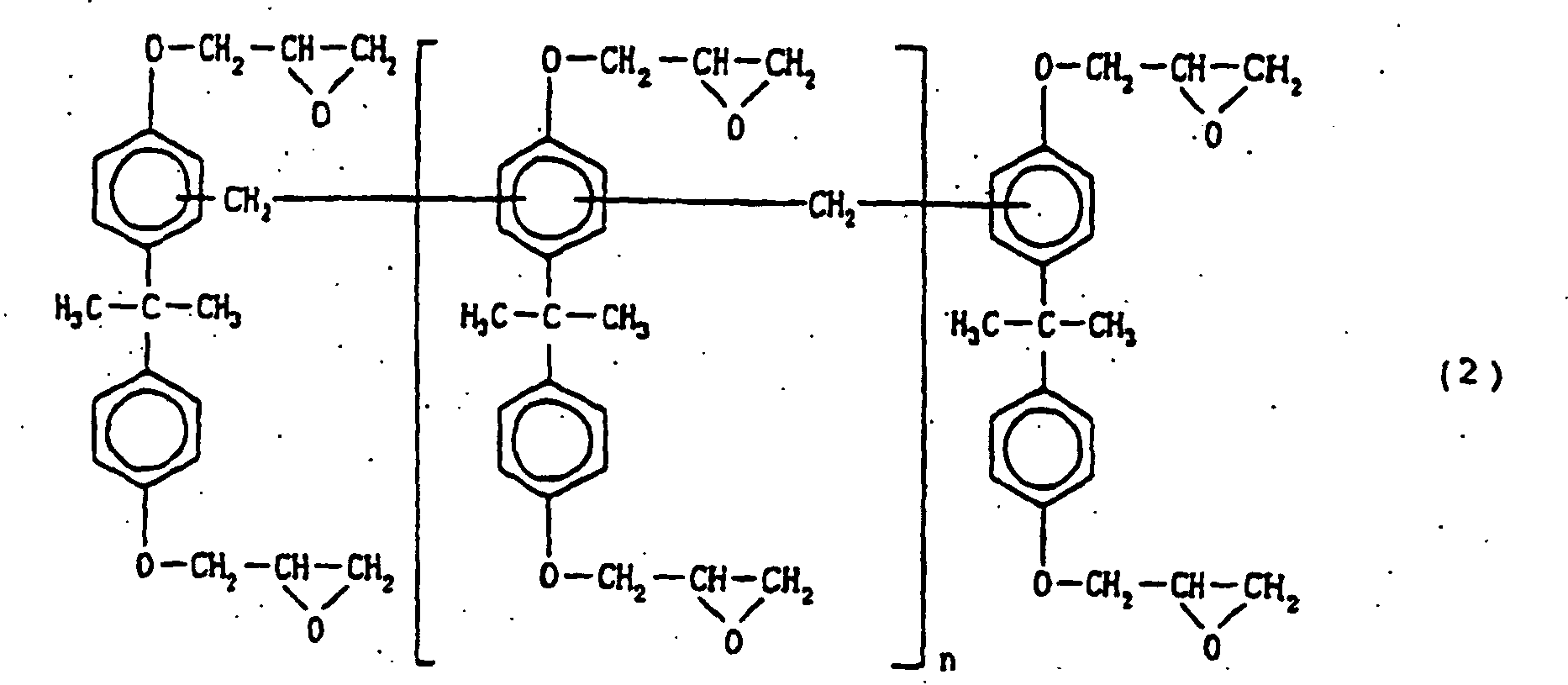
- A composition according to any one of claims 1 to 2, wherein the latent curing agent of component (b) is an amine adduct-type curing agent.
- A composition according to any one of claims 1 to 3 wherein the latent curing agent as component (b) is a microcapsular curing agent.
- A composition according to any one of claims 1 to 4 which further comprises a curing accelerator as component (d).
- A composition according to any one of claims 1 to 5, wherein the viscosity of the epoxy resin composition prepared and allowed to stand at 25°C for 3 weeks is no greater than twice the viscosity immediately after preparation of the resin composition.
- A composition according to any one of claims 1 to 6, which either gives a cured product with a curing degree of at least 70% when obtained by primary curing for no more than 10 hours at a temperature of 100°C or below, or gives a cured product with a tensile shear strength (adhesive strength) of at least 10 MPa according to JIS-K-6848 and JIS-K-6850.
- A prepreg comprising a reinforcing fiber material impregnated with an epoxy resin composition according to any one of claims 1 to 7.
- A process for producing a fiber-reinforced composites material comprising the steps of:(1) impregnating a reinforcing fiber material with an epoxy resin composition comprising(a) an epoxy resin containing at least 40 % by weight of a trifunctional or greater functional epoxy resin,(b) a latent curing agent having a feature such that an epoxy resin composition obtained by uniformly mixing 100 parts by weight of a liquid bisphenol A type epoxy resin with 184 - 194 epoxy equivalents and 20 parts by weight of the curing agent has a temperature at which curing generated heat occurs, away from the base line on a DSC chart, of 100 °C or below when the heat generated upon curing under temperature elevating conditions of 10°C/min is measured by DSC, and(c) 4,4'-diaminodiphenyl sulphone wherein the mixing proportion of component (a), component (b) and component (c) is 3 - 40 parts of by weight of component (b) and 10 - 40 parts by weight of component (c) to 100 parts by weight of component (a),to obtain a prepreg;and,(2) subjecting the prepreg to primary curing in a molding die at a temperature of 100 °C or below, and, after releasing from the molding die, subjecting the primary cured molded article to secondary curing to obtain a fiber-reinforced composite material.
Applications Claiming Priority (5)
| Application Number | Priority Date | Filing Date | Title |
|---|---|---|---|
| JP2000121163 | 2000-04-21 | ||
| JP2000121163 | 2000-04-21 | ||
| JP2001009389 | 2001-01-17 | ||
| JP2001009389 | 2001-01-17 | ||
| PCT/JP2001/003410 WO2001081445A1 (en) | 2000-04-21 | 2001-04-20 | Epoxy resin composition and prepreg made with the epoxy resin composition |
Publications (3)
| Publication Number | Publication Date |
|---|---|
| EP1275674A1 EP1275674A1 (en) | 2003-01-15 |
| EP1275674A4 EP1275674A4 (en) | 2003-08-06 |
| EP1275674B1 true EP1275674B1 (en) | 2007-04-04 |
Family
ID=26590569
Family Applications (1)
| Application Number | Title | Priority Date | Filing Date |
|---|---|---|---|
| EP01921960A Expired - Lifetime EP1275674B1 (en) | 2000-04-21 | 2001-04-20 | Epoxy resin composition and prepreg made with the epoxy resin composition |
Country Status (6)
| Country | Link |
|---|---|
| US (1) | US6838176B2 (en) |
| EP (1) | EP1275674B1 (en) |
| JP (1) | JP3796176B2 (en) |
| DE (1) | DE60127660T2 (en) |
| ES (1) | ES2281412T3 (en) |
| WO (1) | WO2001081445A1 (en) |
Families Citing this family (41)
| Publication number | Priority date | Publication date | Assignee | Title |
|---|---|---|---|---|
| US6875825B2 (en) * | 1999-12-13 | 2005-04-05 | Mitsubishi Rayon Co., Ltd. | Composition of bisphenol or novolak epoxy resin, epoxy resin from monoaromatic backbone and aromatic amine |
| US7247876B2 (en) | 2000-06-30 | 2007-07-24 | Intel Corporation | Three dimensional programmable device and method for fabricating the same |
| DE60114240T2 (en) * | 2000-12-18 | 2006-07-13 | Mitsubishi Rayon Co., Ltd. | FLAME-RESISTANT EPOXY RESIN COMPOSITION AND PREPREGS AND FIBER-REINFORCED COMPOSITES THEREFOR PREPREGOSED |
| JP2003073456A (en) * | 2001-09-03 | 2003-03-12 | Mitsubishi Rayon Co Ltd | Epoxy resin composition and prepreg using the epoxy resin composition |
| JP5078208B2 (en) * | 2001-09-25 | 2012-11-21 | 三菱レイヨン株式会社 | Epoxy resin composition and prepreg using the epoxy resin composition |
| AU2002344461B2 (en) * | 2001-11-07 | 2007-07-12 | Toray Industries, Inc. | Epoxy resin compositions for fiber-reinforced composite materials, process for production of the materials and fiber-reinforced composite materials |
| EP1566394B2 (en) | 2002-11-28 | 2015-08-26 | Mitsubishi Rayon Co., Ltd. | PROCESSES FOR PRODUCIng FIBER-REINFORCED COMPOSITE MATERIAL |
| EP1731553B1 (en) | 2004-02-27 | 2019-02-20 | Toray Industries, Inc. | Epoxy resin composition for carbon-fiber-reinforced composite material, prepreg, integrated molding, sheet of fiber-reinforced composite material and cabinet for electrical/electronic equipment |
| TWI414538B (en) * | 2006-04-25 | 2013-11-11 | Yokohama Rubber Co Ltd | Epoxy resin compositions for fiber-reinforced composite materials |
| JP4141478B2 (en) * | 2006-04-25 | 2008-08-27 | 横浜ゴム株式会社 | Epoxy resin composition for fiber reinforced composite materials |
| JP5371191B2 (en) * | 2007-01-05 | 2013-12-18 | 日本特殊塗料株式会社 | Two-component room-temperature curing coating type vibration-damping coating composition |
| JP5138506B2 (en) * | 2007-08-21 | 2013-02-06 | 三菱レイヨン株式会社 | Epoxy resin composition and prepreg |
| PL2265709T3 (en) * | 2008-03-27 | 2018-05-30 | Genomatica, Inc. | Microorganisms for the production of adipic acid and other compounds |
| JP5150381B2 (en) * | 2008-06-20 | 2013-02-20 | 太陽ホールディングス株式会社 | Thermosetting resin composition |
| CA2735883C (en) * | 2008-09-10 | 2020-05-05 | Genomatica, Inc. | Microorganisms for the production of 1,4-butanediol |
| US9248408B2 (en) * | 2009-03-31 | 2016-02-02 | Ube Industries, Ltd. | Hollow-fiber element for organic-vapor separation |
| WO2011040602A1 (en) | 2009-10-02 | 2011-04-07 | 三菱レイヨン株式会社 | Manufacturing method for fibre-reinforced composite material, heat resistant material using said composite material, and heat resistant structural material using said composite material |
| US8048661B2 (en) * | 2010-02-23 | 2011-11-01 | Genomatica, Inc. | Microbial organisms comprising exogenous nucleic acids encoding reductive TCA pathway enzymes |
| US20120095132A1 (en) * | 2010-10-19 | 2012-04-19 | Chung-Hao Chang | Halogen- and phosphorus-free thermosetting resin composition |
| JP5949545B2 (en) * | 2011-02-16 | 2016-07-06 | 三菱レイヨン株式会社 | Manufacturing method for obtaining fiber-reinforced composite material, and epoxy resin composition used therefor |
| RU2014130202A (en) * | 2011-12-23 | 2016-02-20 | Торэй Индастриз, Инк. | PREAGENT, FIBER REINFORCED COMPOSITE MATERIAL AND METHOD FOR PRODUCING FIBER REINFORCED COMPOSITE MATERIAL |
| KR101972314B1 (en) * | 2011-12-30 | 2019-04-25 | 사이텍 테크놀러지 코포레이션 | Peel ply, method of surface preparation and bonding composite structures using the same |
| GB201203341D0 (en) * | 2012-02-27 | 2012-04-11 | Cytec Technology Group | Curable resin composition and short-cure method |
| KR20150020318A (en) * | 2012-05-16 | 2015-02-25 | 주식회사 다이셀 | Epoxy-amine adduct, resin composition, sizing agent, carbon fiber coated with sizing agent, and fiber-reinforced composite material |
| JPWO2013172199A1 (en) * | 2012-05-16 | 2016-01-12 | 株式会社ダイセル | Curable resin composition and cured product thereof, prepreg, and fiber-reinforced composite material |
| RU2520543C2 (en) * | 2012-09-03 | 2014-06-27 | Федеральное государственное унитарное предприятие "Всероссийский научно-исследовательский институт авиационных материалов" (ФГУП "ВИАМ") | Epoxy binding agent, based on it prepreg and product made of it |
| KR20140037650A (en) * | 2012-09-19 | 2014-03-27 | 삼성전기주식회사 | Resin composition for package substrate, and package substrate comprising core layer and prepreg using the same |
| JP6240560B2 (en) * | 2013-06-26 | 2017-11-29 | 本田技研工業株式会社 | Matrix material |
| US9822227B2 (en) | 2014-09-16 | 2017-11-21 | Isola Usa Corp. | High Tg epoxy formulation with good thermal properties |
| RU2585638C1 (en) * | 2014-12-18 | 2016-05-27 | Федеральное государственное унитарное предприятие "Всероссийский научно-исследовательский институт авиационных материалов" (ФГУП "ВИАМ") | Epoxy binder, prepreg based thereon and article made therefrom |
| FR3030514A1 (en) * | 2014-12-18 | 2016-06-24 | Centre De Coop Int En Rech Agronomique Pour Le Dev (Cirad) | POLYAROMATIC DIMERS |
| TWI575016B (en) | 2015-12-03 | 2017-03-21 | 財團法人工業技術研究院 | Epoxy resin composition and thermal interface material containing the same |
| CN105400441A (en) * | 2015-12-22 | 2016-03-16 | 中国航空工业集团公司济南特种结构研究所 | Glue membrane manufacture method capable of prolonging storage period |
| CN108291010B (en) | 2016-01-26 | 2020-05-08 | 东丽株式会社 | Epoxy resin composition, prepreg and fiber reinforced composite material |
| US11008419B2 (en) * | 2016-06-28 | 2021-05-18 | Toray Industries, Inc. | Epoxy resin composition, prepreg, and fiber-reinforced composite material |
| JP7014153B2 (en) | 2017-03-02 | 2022-02-01 | 東レ株式会社 | Epoxy resin compositions, prepregs and fiber reinforced composites |
| EP3632982A1 (en) * | 2017-05-24 | 2020-04-08 | Mitsubishi Chemical Corporation | Molding material and fiber-reinforced composite material |
| CN111116870B (en) * | 2019-12-31 | 2023-12-26 | 浙江华正新材料股份有限公司 | Latent resin composition, prepreg and epoxy composite material |
| US12545822B2 (en) * | 2021-02-10 | 2026-02-10 | Resonac Corporation | Welding film and joined body |
| DE102021210974A1 (en) | 2021-09-30 | 2023-03-30 | Robert Bosch Gesellschaft mit beschränkter Haftung | Electrical machine and method for inserting at least one electrical conductor assembly into at least one slot of a stator or rotor for an electrical machine |
| KR20250150229A (en) * | 2024-04-11 | 2025-10-20 | 주식회사 케이씨씨 | Epoxy resin composition for molding |
Citations (1)
| Publication number | Priority date | Publication date | Assignee | Title |
|---|---|---|---|---|
| JPS58168620A (en) * | 1982-03-30 | 1983-10-05 | Toshiba Corp | Curing of epoxy resin composition |
Family Cites Families (16)
| Publication number | Priority date | Publication date | Assignee | Title |
|---|---|---|---|---|
| US5179139A (en) | 1988-10-24 | 1993-01-12 | Mitsubishi Rayon Co., Ltd. | Dihydroxybiphenyl-advanced epoxy resin blends |
| US5350826A (en) * | 1991-11-29 | 1994-09-27 | Tonen Corporation | Epoxy resin composition containing a polyaminoamide and a latent curing agent for fiber impregnation |
| US5357008A (en) * | 1992-01-22 | 1994-10-18 | W. R. Grace & Co.-Conn. | Latent curing agent for epoxy resin and its preparation |
| JPH0616838A (en) * | 1992-07-02 | 1994-01-25 | Nippon Oil Co Ltd | Resin composition for prepreg and composite material |
| JP3454437B2 (en) * | 1992-10-02 | 2003-10-06 | ナショナル スターチ アンド ケミカル インベストメント ホールディング コーポレイション | One-part epoxy resin adhesive composition with low viscosity and no solvent |
| JPH06157876A (en) * | 1992-11-30 | 1994-06-07 | Ajinomoto Co Inc | Conductive one-pack epoxy resin composition |
| JPH072975A (en) * | 1993-06-16 | 1995-01-06 | Mitsubishi Rayon Co Ltd | Epoxy resin composition and prepreg |
| JPH0770406A (en) * | 1993-08-31 | 1995-03-14 | Tonen Corp | Epoxy resin composition for low temperature curing prepreg and prepreg using the same |
| JPH0770410A (en) * | 1993-08-31 | 1995-03-14 | Tonen Corp | Epoxy resin composition for low temperature curing prepreg and prepreg using the same |
| JP3508346B2 (en) * | 1994-12-02 | 2004-03-22 | 東レ株式会社 | Prepreg and fiber reinforced composite materials |
| JP3292616B2 (en) * | 1995-02-08 | 2002-06-17 | 日石三菱株式会社 | Phenolic resin and resin composition |
| JPH1045925A (en) * | 1996-05-31 | 1998-02-17 | Arisawa Mfg Co Ltd | Manufacturing method of prepreg |
| JPH1036532A (en) * | 1996-07-22 | 1998-02-10 | Toray Ind Inc | Resin composition for fiber reinforced composite material, prepreg and fiber reinforced composite material |
| JP3570147B2 (en) * | 1997-02-24 | 2004-09-29 | 松下電工株式会社 | Epoxy resin composition, prepreg and laminate |
| JPH11246741A (en) * | 1998-02-27 | 1999-09-14 | Sumitomo Bakelite Co Ltd | Epoxy resin composition for laminate |
| JPH11279261A (en) * | 1998-03-31 | 1999-10-12 | Nippon Steel Chem Co Ltd | Heat resistant epoxy resin composition for fiber reinforced composite materials |
-
2001
- 2001-04-20 WO PCT/JP2001/003410 patent/WO2001081445A1/en not_active Ceased
- 2001-04-20 DE DE2001627660 patent/DE60127660T2/en not_active Expired - Lifetime
- 2001-04-20 ES ES01921960T patent/ES2281412T3/en not_active Expired - Lifetime
- 2001-04-20 JP JP2001578528A patent/JP3796176B2/en not_active Expired - Lifetime
- 2001-04-20 EP EP01921960A patent/EP1275674B1/en not_active Expired - Lifetime
- 2001-04-20 US US10/257,403 patent/US6838176B2/en not_active Expired - Lifetime
Patent Citations (1)
| Publication number | Priority date | Publication date | Assignee | Title |
|---|---|---|---|---|
| JPS58168620A (en) * | 1982-03-30 | 1983-10-05 | Toshiba Corp | Curing of epoxy resin composition |
Non-Patent Citations (2)
| Title |
|---|
| CHEMICAL ABSTRACTS, vol. 128, no. 205633, 27 February 1998, Columbus, Ohio, US; abstract no. 118703 * |
| DATABASE WPI Section Ch Week 198346, Derwent World Patents Index; Class A21, AN 1983-816642 * |
Also Published As
| Publication number | Publication date |
|---|---|
| EP1275674A4 (en) | 2003-08-06 |
| US6838176B2 (en) | 2005-01-04 |
| DE60127660D1 (en) | 2007-05-16 |
| ES2281412T3 (en) | 2007-10-01 |
| JP3796176B2 (en) | 2006-07-12 |
| EP1275674A1 (en) | 2003-01-15 |
| US20030135011A1 (en) | 2003-07-17 |
| WO2001081445A1 (en) | 2001-11-01 |
| DE60127660T2 (en) | 2007-12-13 |
Similar Documents
| Publication | Publication Date | Title |
|---|---|---|
| US6838176B2 (en) | Epoxy resin composition and prepreg made with the epoxy resin composition | |
| JP6292345B2 (en) | Molding materials and fiber reinforced composite materials | |
| JP4397970B2 (en) | Curable composition | |
| EP0262891B1 (en) | Resin composition of thermosetting resin and thermoplastic resin | |
| AU2001266730B2 (en) | Low moisture absorption epoxy resin systems | |
| JPWO2001081445A1 (en) | Epoxy resin composition and prepreg using said epoxy resin composition | |
| WO2019098028A1 (en) | Thermosetting resin composition, prepreg, and fiber-reinforced composite material and production method therefor | |
| CN109312057B (en) | Epoxy resin composition for fiber-reinforced composite material and prepreg using the same | |
| JP3653906B2 (en) | Epoxy resin composition, prepreg and fiber reinforced composite material | |
| JP2006131920A (en) | Epoxy resin composition and prepreg using the epoxy resin composition | |
| EP0455755B1 (en) | Epoxy matrix toughened with polyimide thermoplastic resin | |
| JP4859081B2 (en) | Manufacturing method of composite material | |
| JP4821163B2 (en) | Epoxy resin composition for fiber reinforced composite materials | |
| JP2003073456A (en) | Epoxy resin composition and prepreg using the epoxy resin composition | |
| JP2736443B2 (en) | Epoxy resin composition for composite materials | |
| JP2004292594A (en) | Epoxy resin composition, prepreg and fiber reinforced composite material | |
| JPS6143616A (en) | Epoxy resin composition | |
| JP2003096163A (en) | Epoxy resin composition and prepreg using the epoxy resin composition | |
| JPH072975A (en) | Epoxy resin composition and prepreg | |
| JPH0776616A (en) | Epoxy resin composition for prepreg and prepreg | |
| JPH0381342A (en) | Prepreg manufacturing method | |
| JP4344662B2 (en) | Epoxy resin composition, prepreg and molded body, and method for producing epoxy resin composition | |
| JPH05310890A (en) | Epoxy resin composition and prepreg for composite material therefrom | |
| JP3342709B2 (en) | Epoxy resin composition and prepreg therefrom | |
| JP2019116545A (en) | Method for curing epoxy resin composition |
Legal Events
| Date | Code | Title | Description |
|---|---|---|---|
| PUAI | Public reference made under article 153(3) epc to a published international application that has entered the european phase |
Free format text: ORIGINAL CODE: 0009012 |
|
| 17P | Request for examination filed |
Effective date: 20021016 |
|
| AK | Designated contracting states |
Kind code of ref document: A1 Designated state(s): AT BE CH CY DE DK ES FI FR GB GR IE IT LI LU MC NL PT SE TR |
|
| RIC1 | Information provided on ipc code assigned before grant |
Ipc: 7C 08G 59/40 A Ipc: 7C 08G 59/18 B Ipc: 7C 08G 59/50 B Ipc: 7C 08J 5/24 B |
|
| A4 | Supplementary search report drawn up and despatched |
Effective date: 20030623 |
|
| 17Q | First examination report despatched |
Effective date: 20040220 |
|
| RBV | Designated contracting states (corrected) |
Designated state(s): AT BE CH CY DE ES FR GB LI |
|
| GRAP | Despatch of communication of intention to grant a patent |
Free format text: ORIGINAL CODE: EPIDOSNIGR1 |
|
| GRAS | Grant fee paid |
Free format text: ORIGINAL CODE: EPIDOSNIGR3 |
|
| GRAA | (expected) grant |
Free format text: ORIGINAL CODE: 0009210 |
|
| AK | Designated contracting states |
Kind code of ref document: B1 Designated state(s): DE ES FR GB |
|
| RBV | Designated contracting states (corrected) |
Designated state(s): DE ES FR GB |
|
| REG | Reference to a national code |
Ref country code: GB Ref legal event code: FG4D |
|
| REF | Corresponds to: |
Ref document number: 60127660 Country of ref document: DE Date of ref document: 20070516 Kind code of ref document: P |
|
| ET | Fr: translation filed | ||
| REG | Reference to a national code |
Ref country code: ES Ref legal event code: FG2A Ref document number: 2281412 Country of ref document: ES Kind code of ref document: T3 |
|
| PLBE | No opposition filed within time limit |
Free format text: ORIGINAL CODE: 0009261 |
|
| STAA | Information on the status of an ep patent application or granted ep patent |
Free format text: STATUS: NO OPPOSITION FILED WITHIN TIME LIMIT |
|
| 26N | No opposition filed |
Effective date: 20080107 |
|
| REG | Reference to a national code |
Ref country code: FR Ref legal event code: PLFP Year of fee payment: 16 |
|
| REG | Reference to a national code |
Ref country code: FR Ref legal event code: PLFP Year of fee payment: 17 |
|
| REG | Reference to a national code |
Ref country code: DE Ref legal event code: R082 Ref document number: 60127660 Country of ref document: DE Representative=s name: HOFFMANN - EITLE PATENT- UND RECHTSANWAELTE PA, DE Ref country code: DE Ref legal event code: R081 Ref document number: 60127660 Country of ref document: DE Owner name: MITSUBISHI CHEMICAL CORPORATION, JP Free format text: FORMER OWNER: MITSUBISHI RAYON CO., LTD., TOKIO/TOKYO, JP |
|
| REG | Reference to a national code |
Ref country code: ES Ref legal event code: PC2A Owner name: MITSUBISHI CHEMICAL CORPORATION Effective date: 20180130 |
|
| REG | Reference to a national code |
Ref country code: FR Ref legal event code: PLFP Year of fee payment: 18 |
|
| REG | Reference to a national code |
Ref country code: FR Ref legal event code: CA Effective date: 20180515 Ref country code: FR Ref legal event code: CD Owner name: MITSUBISHI CHEMICAL CORPORATION, JP Effective date: 20180515 |
|
| PGFP | Annual fee paid to national office [announced via postgrant information from national office to epo] |
Ref country code: FR Payment date: 20200312 Year of fee payment: 20 |
|
| PGFP | Annual fee paid to national office [announced via postgrant information from national office to epo] |
Ref country code: DE Payment date: 20200408 Year of fee payment: 20 Ref country code: ES Payment date: 20200504 Year of fee payment: 20 |
|
| PGFP | Annual fee paid to national office [announced via postgrant information from national office to epo] |
Ref country code: GB Payment date: 20200408 Year of fee payment: 20 |
|
| REG | Reference to a national code |
Ref country code: DE Ref legal event code: R071 Ref document number: 60127660 Country of ref document: DE |
|
| REG | Reference to a national code |
Ref country code: GB Ref legal event code: PE20 Expiry date: 20210419 |
|
| REG | Reference to a national code |
Ref country code: ES Ref legal event code: FD2A Effective date: 20210727 |
|
| PG25 | Lapsed in a contracting state [announced via postgrant information from national office to epo] |
Ref country code: GB Free format text: LAPSE BECAUSE OF EXPIRATION OF PROTECTION Effective date: 20210419 |
|
| PG25 | Lapsed in a contracting state [announced via postgrant information from national office to epo] |
Ref country code: ES Free format text: LAPSE BECAUSE OF EXPIRATION OF PROTECTION Effective date: 20210421 |