EP1265688B1 - Piece filtrante en forme en fibres de carbone active - Google Patents
Piece filtrante en forme en fibres de carbone active Download PDFInfo
- Publication number
- EP1265688B1 EP1265688B1 EP01917195A EP01917195A EP1265688B1 EP 1265688 B1 EP1265688 B1 EP 1265688B1 EP 01917195 A EP01917195 A EP 01917195A EP 01917195 A EP01917195 A EP 01917195A EP 1265688 B1 EP1265688 B1 EP 1265688B1
- Authority
- EP
- European Patent Office
- Prior art keywords
- preform
- activated carbon
- fibres
- filtering part
- carbonization
- Prior art date
- Legal status (The legal status is an assumption and is not a legal conclusion. Google has not performed a legal analysis and makes no representation as to the accuracy of the status listed.)
- Expired - Lifetime
Links
- OKTJSMMVPCPJKN-UHFFFAOYSA-N Carbon Chemical compound [C] OKTJSMMVPCPJKN-UHFFFAOYSA-N 0.000 title claims abstract description 49
- 238000001914 filtration Methods 0.000 title claims description 10
- 238000000034 method Methods 0.000 claims abstract description 30
- 239000000835 fiber Substances 0.000 claims abstract description 12
- 239000007833 carbon precursor Substances 0.000 claims abstract description 11
- 238000004519 manufacturing process Methods 0.000 claims abstract description 10
- 238000009940 knitting Methods 0.000 claims abstract description 7
- 238000009954 braiding Methods 0.000 claims abstract description 6
- 239000000126 substance Substances 0.000 claims abstract description 4
- 230000001427 coherent effect Effects 0.000 claims abstract 5
- 230000000721 bacterilogical effect Effects 0.000 claims abstract 2
- 230000004913 activation Effects 0.000 claims description 18
- 238000003763 carbonization Methods 0.000 claims description 17
- 238000010438 heat treatment Methods 0.000 claims description 14
- 229920000297 Rayon Polymers 0.000 claims description 8
- 239000000203 mixture Substances 0.000 claims description 7
- 230000001681 protective effect Effects 0.000 claims description 7
- 229920002678 cellulose Polymers 0.000 claims description 5
- 239000001913 cellulose Substances 0.000 claims description 5
- 239000002964 rayon Substances 0.000 claims description 5
- 239000000470 constituent Substances 0.000 claims description 4
- 238000005470 impregnation Methods 0.000 claims description 3
- 238000000354 decomposition reaction Methods 0.000 claims description 2
- 230000001737 promoting effect Effects 0.000 claims description 2
- 238000010276 construction Methods 0.000 claims 6
- 229920003043 Cellulose fiber Polymers 0.000 claims 1
- 230000003213 activating effect Effects 0.000 abstract description 3
- 238000010000 carbonizing Methods 0.000 abstract 2
- 229920000049 Carbon (fiber) Polymers 0.000 description 14
- VNWKTOKETHGBQD-UHFFFAOYSA-N methane Chemical compound C VNWKTOKETHGBQD-UHFFFAOYSA-N 0.000 description 13
- CURLTUGMZLYLDI-UHFFFAOYSA-N Carbon dioxide Chemical compound O=C=O CURLTUGMZLYLDI-UHFFFAOYSA-N 0.000 description 10
- NBIIXXVUZAFLBC-UHFFFAOYSA-N Phosphoric acid Chemical compound OP(O)(O)=O NBIIXXVUZAFLBC-UHFFFAOYSA-N 0.000 description 8
- 239000004744 fabric Substances 0.000 description 8
- XLYOFNOQVPJJNP-UHFFFAOYSA-N water Chemical compound O XLYOFNOQVPJJNP-UHFFFAOYSA-N 0.000 description 8
- 238000012360 testing method Methods 0.000 description 6
- 239000004753 textile Substances 0.000 description 6
- 229910052799 carbon Inorganic materials 0.000 description 5
- 239000001569 carbon dioxide Substances 0.000 description 5
- 229910002092 carbon dioxide Inorganic materials 0.000 description 5
- 239000004917 carbon fiber Substances 0.000 description 5
- 229910000147 aluminium phosphate Inorganic materials 0.000 description 4
- 239000002245 particle Substances 0.000 description 4
- 238000009958 sewing Methods 0.000 description 4
- KWYUFKZDYYNOTN-UHFFFAOYSA-M Potassium hydroxide Chemical compound [OH-].[K+] KWYUFKZDYYNOTN-UHFFFAOYSA-M 0.000 description 3
- QKSKPIVNLNLAAV-UHFFFAOYSA-N bis(2-chloroethyl) sulfide Chemical compound ClCCSCCCl QKSKPIVNLNLAAV-UHFFFAOYSA-N 0.000 description 3
- 239000002131 composite material Substances 0.000 description 3
- 239000012071 phase Substances 0.000 description 3
- 239000002243 precursor Substances 0.000 description 3
- 238000001179 sorption measurement Methods 0.000 description 3
- NLXLAEXVIDQMFP-UHFFFAOYSA-N Ammonia chloride Chemical compound [NH4+].[Cl-] NLXLAEXVIDQMFP-UHFFFAOYSA-N 0.000 description 2
- IJGRMHOSHXDMSA-UHFFFAOYSA-N Atomic nitrogen Chemical compound N#N IJGRMHOSHXDMSA-UHFFFAOYSA-N 0.000 description 2
- 241000219198 Brassica Species 0.000 description 2
- 235000003351 Brassica cretica Nutrition 0.000 description 2
- 235000003343 Brassica rupestris Nutrition 0.000 description 2
- 230000003247 decreasing effect Effects 0.000 description 2
- 230000018044 dehydration Effects 0.000 description 2
- 238000006297 dehydration reaction Methods 0.000 description 2
- 229920001971 elastomer Polymers 0.000 description 2
- 239000006260 foam Substances 0.000 description 2
- 229910052751 metal Inorganic materials 0.000 description 2
- 239000002184 metal Substances 0.000 description 2
- 235000010460 mustard Nutrition 0.000 description 2
- 230000001590 oxidative effect Effects 0.000 description 2
- 229920002239 polyacrylonitrile Polymers 0.000 description 2
- 230000002829 reductive effect Effects 0.000 description 2
- 238000007493 shaping process Methods 0.000 description 2
- 239000000758 substrate Substances 0.000 description 2
- 231100000331 toxic Toxicity 0.000 description 2
- 230000002588 toxic effect Effects 0.000 description 2
- JIAARYAFYJHUJI-UHFFFAOYSA-L zinc dichloride Chemical compound [Cl-].[Cl-].[Zn+2] JIAARYAFYJHUJI-UHFFFAOYSA-L 0.000 description 2
- 229920000742 Cotton Polymers 0.000 description 1
- 239000005696 Diammonium phosphate Substances 0.000 description 1
- 229920005830 Polyurethane Foam Polymers 0.000 description 1
- 239000002253 acid Substances 0.000 description 1
- 238000004026 adhesive bonding Methods 0.000 description 1
- 239000003463 adsorbent Substances 0.000 description 1
- 235000019270 ammonium chloride Nutrition 0.000 description 1
- 230000000844 anti-bacterial effect Effects 0.000 description 1
- 230000003460 anti-nuclear Effects 0.000 description 1
- 230000001580 bacterial effect Effects 0.000 description 1
- 230000004888 barrier function Effects 0.000 description 1
- 238000006243 chemical reaction Methods 0.000 description 1
- 238000011109 contamination Methods 0.000 description 1
- 238000005520 cutting process Methods 0.000 description 1
- 239000008367 deionised water Substances 0.000 description 1
- 229910021641 deionized water Inorganic materials 0.000 description 1
- MNNHAPBLZZVQHP-UHFFFAOYSA-N diammonium hydrogen phosphate Chemical compound [NH4+].[NH4+].OP([O-])([O-])=O MNNHAPBLZZVQHP-UHFFFAOYSA-N 0.000 description 1
- 229910000388 diammonium phosphate Inorganic materials 0.000 description 1
- 235000019838 diammonium phosphate Nutrition 0.000 description 1
- 239000000806 elastomer Substances 0.000 description 1
- 230000005611 electricity Effects 0.000 description 1
- 230000008030 elimination Effects 0.000 description 1
- 238000003379 elimination reaction Methods 0.000 description 1
- 239000007789 gas Substances 0.000 description 1
- 239000003365 glass fiber Substances 0.000 description 1
- 239000003292 glue Substances 0.000 description 1
- 238000007654 immersion Methods 0.000 description 1
- 239000012535 impurity Substances 0.000 description 1
- 125000000959 isobutyl group Chemical group [H]C([H])([H])C([H])(C([H])([H])[H])C([H])([H])* 0.000 description 1
- 238000003475 lamination Methods 0.000 description 1
- 229920000126 latex Polymers 0.000 description 1
- 239000004816 latex Substances 0.000 description 1
- 239000010985 leather Substances 0.000 description 1
- 239000007791 liquid phase Substances 0.000 description 1
- 239000000463 material Substances 0.000 description 1
- 229910052757 nitrogen Inorganic materials 0.000 description 1
- 230000035515 penetration Effects 0.000 description 1
- 230000035699 permeability Effects 0.000 description 1
- 150000002989 phenols Chemical class 0.000 description 1
- 235000011007 phosphoric acid Nutrition 0.000 description 1
- 239000011295 pitch Substances 0.000 description 1
- 239000011496 polyurethane foam Substances 0.000 description 1
- 238000012805 post-processing Methods 0.000 description 1
- 235000011118 potassium hydroxide Nutrition 0.000 description 1
- OTYBMLCTZGSZBG-UHFFFAOYSA-L potassium sulfate Chemical compound [K+].[K+].[O-]S([O-])(=O)=O OTYBMLCTZGSZBG-UHFFFAOYSA-L 0.000 description 1
- 229910052939 potassium sulfate Inorganic materials 0.000 description 1
- 239000001120 potassium sulphate Substances 0.000 description 1
- 235000011151 potassium sulphates Nutrition 0.000 description 1
- 230000000717 retained effect Effects 0.000 description 1
- 238000004088 simulation Methods 0.000 description 1
- 238000009987 spinning Methods 0.000 description 1
- 238000005507 spraying Methods 0.000 description 1
- 230000003068 static effect Effects 0.000 description 1
- 230000005068 transpiration Effects 0.000 description 1
- 239000012808 vapor phase Substances 0.000 description 1
- 238000009941 weaving Methods 0.000 description 1
- 239000011592 zinc chloride Substances 0.000 description 1
- 235000005074 zinc chloride Nutrition 0.000 description 1
Images
Classifications
-
- B—PERFORMING OPERATIONS; TRANSPORTING
- B01—PHYSICAL OR CHEMICAL PROCESSES OR APPARATUS IN GENERAL
- B01D—SEPARATION
- B01D39/00—Filtering material for liquid or gaseous fluids
- B01D39/08—Filter cloth, i.e. woven, knitted or interlaced material
- B01D39/086—Filter cloth, i.e. woven, knitted or interlaced material of inorganic material
-
- A—HUMAN NECESSITIES
- A62—LIFE-SAVING; FIRE-FIGHTING
- A62B—DEVICES, APPARATUS OR METHODS FOR LIFE-SAVING
- A62B17/00—Protective clothing affording protection against heat or harmful chemical agents or for use at high altitudes
-
- B—PERFORMING OPERATIONS; TRANSPORTING
- B01—PHYSICAL OR CHEMICAL PROCESSES OR APPARATUS IN GENERAL
- B01D—SEPARATION
- B01D39/00—Filtering material for liquid or gaseous fluids
- B01D39/14—Other self-supporting filtering material ; Other filtering material
- B01D39/20—Other self-supporting filtering material ; Other filtering material of inorganic material, e.g. asbestos paper, metallic filtering material of non-woven wires
- B01D39/2055—Carbonaceous material
-
- B—PERFORMING OPERATIONS; TRANSPORTING
- B01—PHYSICAL OR CHEMICAL PROCESSES OR APPARATUS IN GENERAL
- B01D—SEPARATION
- B01D39/00—Filtering material for liquid or gaseous fluids
- B01D39/14—Other self-supporting filtering material ; Other filtering material
- B01D39/20—Other self-supporting filtering material ; Other filtering material of inorganic material, e.g. asbestos paper, metallic filtering material of non-woven wires
- B01D39/2055—Carbonaceous material
- B01D39/2065—Carbonaceous material the material being fibrous
-
- B—PERFORMING OPERATIONS; TRANSPORTING
- B01—PHYSICAL OR CHEMICAL PROCESSES OR APPARATUS IN GENERAL
- B01D—SEPARATION
- B01D2239/00—Aspects relating to filtering material for liquid or gaseous fluids
- B01D2239/02—Types of fibres, filaments or particles, self-supporting or supported materials
- B01D2239/0241—Types of fibres, filaments or particles, self-supporting or supported materials comprising electrically conductive fibres or particles
-
- B—PERFORMING OPERATIONS; TRANSPORTING
- B01—PHYSICAL OR CHEMICAL PROCESSES OR APPARATUS IN GENERAL
- B01D—SEPARATION
- B01D2239/00—Aspects relating to filtering material for liquid or gaseous fluids
- B01D2239/04—Additives and treatments of the filtering material
- B01D2239/0471—Surface coating material
- B01D2239/0478—Surface coating material on a layer of the filter
-
- B—PERFORMING OPERATIONS; TRANSPORTING
- B01—PHYSICAL OR CHEMICAL PROCESSES OR APPARATUS IN GENERAL
- B01D—SEPARATION
- B01D2239/00—Aspects relating to filtering material for liquid or gaseous fluids
- B01D2239/06—Filter cloth, e.g. knitted, woven non-woven; self-supported material
- B01D2239/065—More than one layer present in the filtering material
-
- B—PERFORMING OPERATIONS; TRANSPORTING
- B01—PHYSICAL OR CHEMICAL PROCESSES OR APPARATUS IN GENERAL
- B01D—SEPARATION
- B01D2239/00—Aspects relating to filtering material for liquid or gaseous fluids
- B01D2239/06—Filter cloth, e.g. knitted, woven non-woven; self-supported material
- B01D2239/065—More than one layer present in the filtering material
- B01D2239/0659—The layers being joined by needling
-
- B—PERFORMING OPERATIONS; TRANSPORTING
- B01—PHYSICAL OR CHEMICAL PROCESSES OR APPARATUS IN GENERAL
- B01D—SEPARATION
- B01D2239/00—Aspects relating to filtering material for liquid or gaseous fluids
- B01D2239/06—Filter cloth, e.g. knitted, woven non-woven; self-supported material
- B01D2239/065—More than one layer present in the filtering material
- B01D2239/0681—The layers being joined by gluing
-
- B—PERFORMING OPERATIONS; TRANSPORTING
- B01—PHYSICAL OR CHEMICAL PROCESSES OR APPARATUS IN GENERAL
- B01D—SEPARATION
- B01D2239/00—Aspects relating to filtering material for liquid or gaseous fluids
- B01D2239/10—Filtering material manufacturing
Definitions
- the invention relates to the manufacture of shaped filter parts having adsorbent properties through the use of activated carbon fibers.
- shaped filter parts here is meant self-supporting parts having non-planar shapes.
- the invention aims in particular at producing shaped garment parts, for example gloves, socks, undergarments, hats, ... intended for civilian or military personnel to protect them from attacks, in particular nuclear, bacterial or chemical.
- the method according to the invention can, however, be used in other applications, for example to produce filter parts having particular shapes, such as sleeves, caps, or other.
- activated carbon particles dispersed in a foam for example a polyurethane foam.
- the outfits or pieces of clothing thus produced are thick. They also have the disadvantages of poor washability and poor resistance to fire, due to the presence of the foam.
- porosity and breathability may be affected.
- the adsorption capacity of the activated carbons is decreased.
- activated carbon fibers have also been proposed. Their mechanical properties make it difficult to subject them to textile operations such as spinning, weaving, knitting, sewing, braiding, ... to make shaped parts.
- Activated carbon fabrics are known and used for filtration applications.
- the documents FR 2,741,363 A and WO 98/41678 A describe the production of such fabrics.
- the production of shaped parts from these fabrics requires a sewing operation.
- seams made on an activated carbon fabric locally increase rigidity significantly, creating discomfort.
- the seams create preferential passages for the toxic to be retained by generating a heterogeneity of porosity.
- the object of the present invention is to provide a method for producing shaped filter parts, in particular, but not exclusively, NBC protective clothing parts, without encountering the aforementioned drawbacks.
- the invention aims to obtain such shaped filter parts made entirely of activated carbon fibers, so that they are washable, thermally stable and capable of retaining good adsorption properties in a humid environment, while presenting inherently good mechanical strength and having a porosity free of preferential passages for the medium to be filtered.
- the invention is remarkable in that the filtering element is obtained directly after carbonization and activation of a carbon precursor fiber preform having been, by a textile process, put into a shape corresponding to that of the part to be manufactured.
- the textile process of shaping the preform may be at least in part a knitting, a two-dimensional texture seam or a braiding.
- two-dimensional texture is meant here in particular a fabric or a multidirectional web.
- the preform is made in particular of a cellulosic fiber texture, for example rayon fibers, which makes it possible to obtain a large specific surface area, for example greater than 800 m 2 / g, or even greater than 1200 m 2 / g, and a high purity of carbon fibers.
- a cellulosic fiber texture for example rayon fibers, which makes it possible to obtain a large specific surface area, for example greater than 800 m 2 / g, or even greater than 1200 m 2 / g, and a high purity of carbon fibers.
- the activation is carried out under an oxidizing atmosphere such as water vapor and / or carbon dioxide.
- the invention also relates to a piece of clothing as obtained by the process according to claim 1.
- Such a piece of clothing is remarkable in that it inherently has the necessary hold for use, while being formed of activated carbon fibers.
- the parts according to the invention have good fire resistance characteristics and are thermostable. Thanks to the conductivity of the carbon fibers, they allow the evacuation of static electricity. They are more easily washable. With respect to activated carbon particles, activated carbon fiber parts exhibit a loss of performance due to very limited humidity. The porosity of activated carbon fibers indeed has a large majority of micropores not likely to fill with water by capillarity. In addition, because of their much smaller size than that of activated carbon particles, the activated carbon fibers provide the gaseous flow, with equal mass, a much greater external surface. At identical performance, the thickness of the parts can be greatly reduced.
- the invention is however not limited to this application and includes the embodiment, in general, shaped filter parts.
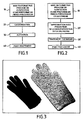
- a first step 10 of the method of figure 1 consists in making a preform of a part to be manufactured, using a textile making process.
- the preform is made from carbon precursor fibers which are formed into yarns or yarns.
- precursors can be used such as preoxidized polyacrylonitrile (PAN), pitches, phenolic compounds.
- PAN preoxidized polyacrylonitrile
- pitches pitches
- phenolic compounds phenolic compounds
- a cellulosic precursor is used, in particular a viscose, for example rayon.
- the preform is put into a shape corresponding to that of the part to be manufactured, while taking into account the shrinkages involved during the carbonization and activation treatment.
- the shaping can be carried out directly from threads or yarns made of carbon precursor fibers, in particular by knitting or braiding.
- a multidirectional web is formed by superposition of a plurality of unidirectional webs consisting of son or yarns extending parallel to the same direction. Unidirectional layers are superposed with different directions and possibly linked to each other for example by sewing or by light needling.
- a second step in the process is to carbonize the preform.
- the carbonization comprises a heat treatment phase in an inert atmosphere at a temperature of between 250 ° C. and 500 ° C., for example approximately equal to 400 ° C., this phase being carried out with a slow rise in temperature, typically between 0.01 ° C. C / min and 0.5 ° C / min, and over a relatively long period of several days to several weeks.
- a final phase of heat treatment at a higher temperature can then be carried out, for example up to 600 ° C. to 900 ° C., also under an inert atmosphere, for a much shorter time, for example a few minutes.
- An additional heat treatment at an even higher temperature for example between 1000 ° C. and 1300 ° C. and under reduced pressure, for example between 5 Pa and 60 Pa, may be carried out for a relatively short period of time, of the order of the minute, to promote the elimination of impurities that are entrained with the gaseous effluents.
- a third step of the process is to activate the resulting carbon fiber preform.
- the activation is carried out by heat treatment of the carbon fiber preform under an oxidizing atmosphere, such as water vapor or preferably carbon dioxide or a mixture of carbon dioxide and water vapor.
- an oxidizing atmosphere such as water vapor or preferably carbon dioxide or a mixture of carbon dioxide and water vapor.
- the heat treatment temperature is between 750 ° C and 950 ° C, preferably between 850 ° C and 950 ° C and its duration is preferably between 50 min and 300 min depending on the desired specific surface. It is thus possible to obtain an activated carbon fiber part having a specific surface area greater than 800 m 2 / g, even at 1200 m 2 / g.
- a last post-processing step 40 may optionally be performed, depending on the use envisaged for the part.
- a post-treatment may consist of forming a very fine deposit to fix possible carbon particles and prevent their departure during the use of the room. This deposit can be formed by spraying elastomer or latex.
- Another type of post-treatment may consist in associating with the part a lining whose function is not to give a piece of clothing, but to avoid a direct contact between the latter and the skin of the user.
- the lining may be ventilated, so as not to affect the porosity and permeability and be connected very punctually to the room, for example by gluing.
- the figure 2 illustrates a variant embodiment of the process that can be used with a preform made of cellulosic precursor fibers.
- This variant differs from the process of figure 1 in that the carbonization and activation steps 20 and 30 are replaced by a step 20 'of impregnating the preform with a composition containing a cellulose dehydration promoter constituent and a heat treatment stage 30' making it possible to obtain directly the activated carbon fiber part.
- the impregnation is carried out with a composition containing at least one promoter component of the dehydration of cellulose, such as an inorganic constituent chosen from phosphoric acid, zinc chloride, potassium sulphate, potassium hydroxide, diammonium phosphate and ammonium chloride.
- a composition containing phosphoric acid so that the mass of acid fixed on the preform is between 10 and 22% of the mass of the dry preform.
- the heat treatment comprises a rise in temperature at a speed of between 1 ° C./min and 15 ° C./min, followed by a bearing preferably carried out at a temperature of between 350 ° C. and 500 ° C.
- Glove preforms such as the one shown on the left on the photograph of the figure 3 , are made by knitting at the point of Jersey of a 330 dtex rayon yarn, the edges of the gloves being made with a 167 dtex rayon yarn.
- the preforms are placed on racks in an oven and heat treated for about 2 weeks.
- the rate of rise in temperature is very low, less than 0.1 ° C./min, up to a plateau of about 400 ° C.
- the preforms obtained are then heat-treated again to a temperature of about 700 ° C for a period of about 15 minutes, so as to stabilize the carbon network.
- Activation of the carbonized preforms is carried out in a rotary autoclave oven, at a temperature of about 850 ° C, under a carbon dioxide (CO 2 ) atmosphere for a period of about 1 hour.
- CO 2 carbon dioxide
- the shrinkage is not necessarily uniform throughout the room and in all directions.
- the shape to be imparted to the preform is preferably determined by tests, which may make it possible to produce simulation models.
- the activated carbon fiber glove can be threaded onto a sub-glove, for example made of cotton fabric.
- a sub-glove for example made of cotton fabric.
- a point connection by a few points of glue between the subglove and the glove can be achieved.
- the resulting assembly is directly insertable in an over-glove, for example leather.
- an over-glove for example leather.
- the subset formed by the activated carbon fiber glove and the optional underglove is consumable. It is also easily incinerable without release of toxic effluents.
- Glove preforms such as those of Example 1 are impregnated by immersion in a phosphoric acid solution H 3 PO 4 at 20% by volume in water.
- the impregnated preforms are baked at a temperature between 70 ° C and 90 ° C to remove water, the amount of phosphoric acid fixed on the preforms representing about 16% by weight relative to the mass of dry preforms.
- the preforms are then continuously admitted into a heat treatment furnace in which they pass by being supported by a fabric, for example made of glass fibers.
- the heat treatment comprises a rise in temperature at a rate of about 5 ° C / min, followed by a plateau at a temperature of about 200 ° C.
- the heat treatment is carried out under an atmosphere (nitrogen) for a total duration of about 90 minutes.
- the gloves obtained are washed with deionized water at a temperature of about 90 ° C.
- the measured withdrawal is on average 28%.
- a liquid phase test was performed with mustard at room temperature (20 ° C). Yperite was placed in contact with the gloves in the form of drops, the contamination dose used representing 10 g / m 2 of glove surface area.
- the amount of hyperite that has passed through the gloves is measured by extracting an air stream at a speed of 0.2.10 -2 m / s inside the gloves. After 24 h, the measured penetration dose ranged from 0.2 ⁇ g / m 2 to 1.02 ⁇ g / m 2 .
Landscapes
- Chemical & Material Sciences (AREA)
- Chemical Kinetics & Catalysis (AREA)
- Life Sciences & Earth Sciences (AREA)
- Health & Medical Sciences (AREA)
- Geology (AREA)
- Toxicology (AREA)
- Textile Engineering (AREA)
- Engineering & Computer Science (AREA)
- Inorganic Chemistry (AREA)
- General Health & Medical Sciences (AREA)
- Business, Economics & Management (AREA)
- Emergency Management (AREA)
- Inorganic Fibers (AREA)
- Knitting Of Fabric (AREA)
- Woven Fabrics (AREA)
- Professional, Industrial, Or Sporting Protective Garments (AREA)
- Filtering Materials (AREA)
Applications Claiming Priority (4)
| Application Number | Priority Date | Filing Date | Title |
|---|---|---|---|
| FR0003638A FR2806640B1 (fr) | 2000-03-22 | 2000-03-22 | Procede de fabrication d'une piece filtrante en forme en fibres de carbone active et piece de revetement de protection telle qu'obtenue par le procede |
| FR0003638 | 2000-03-22 | ||
| PCT/FR2001/000835 WO2001070372A1 (fr) | 2000-03-22 | 2001-03-21 | Piece filtrante en forme en fibres de carbone active |
| US10/239,130 US20030032556A1 (en) | 2000-03-22 | 2001-03-21 | Filtering component in the form of activated carbon fibres |
Publications (2)
| Publication Number | Publication Date |
|---|---|
| EP1265688A1 EP1265688A1 (fr) | 2002-12-18 |
| EP1265688B1 true EP1265688B1 (fr) | 2009-07-08 |
Family
ID=26212277
Family Applications (1)
| Application Number | Title | Priority Date | Filing Date |
|---|---|---|---|
| EP01917195A Expired - Lifetime EP1265688B1 (fr) | 2000-03-22 | 2001-03-21 | Piece filtrante en forme en fibres de carbone active |
Country Status (10)
| Country | Link |
|---|---|
| US (1) | US20030032556A1 (enExample) |
| EP (1) | EP1265688B1 (enExample) |
| JP (1) | JP2003527240A (enExample) |
| CN (1) | CN1189231C (enExample) |
| DE (1) | DE60139188D1 (enExample) |
| ES (1) | ES2329758T3 (enExample) |
| FR (1) | FR2806640B1 (enExample) |
| HK (1) | HK1052890B (enExample) |
| RU (1) | RU2233696C2 (enExample) |
| WO (1) | WO2001070372A1 (enExample) |
Families Citing this family (17)
| Publication number | Priority date | Publication date | Assignee | Title |
|---|---|---|---|---|
| DE10318054B3 (de) * | 2003-04-17 | 2004-12-23 | BLüCHER GMBH | Luftfiltereinheit mit mehreren Filterelementen und deren Verwendung |
| EP1622830A2 (en) * | 2003-05-09 | 2006-02-08 | McGill University | Process for the production of activated carbon |
| US7745684B2 (en) * | 2004-04-03 | 2010-06-29 | Huza James P | Odor control nether garment, method of making same and method of controlling odor |
| DE102004024075B4 (de) | 2004-05-13 | 2010-12-23 | BLüCHER GMBH | Adsorptionsfiltermaterial, seine Verwendung und Schutzmaterialien |
| DE102004032563B4 (de) * | 2004-07-05 | 2012-08-02 | BLüCHER GMBH | Textiles Verbundmaterial mit Aktivkohlefasern und Verfahren zu seiner Herstellung |
| DE102005050730A1 (de) * | 2005-07-01 | 2007-01-04 | BLüCHER GMBH | Handschuh mit verbesserter ABC-Schutzfunktion |
| EA015585B1 (ru) * | 2007-10-30 | 2011-10-31 | Людмила Петровна Шишкина | Санитарно-техническое устройство для защиты канализации от засоров |
| DE202010012377U1 (de) | 2009-09-09 | 2011-08-04 | BLüCHER GMBH | Brennstoffzelle |
| RU2488742C2 (ru) * | 2010-06-10 | 2013-07-27 | Владимир Петрович Шустов | Печка для оперативного сжигания медицинского и токсичного мусора |
| DE102011051902A1 (de) * | 2011-07-18 | 2013-01-24 | Haomin Ding | Filter, insbesondere Atemluftfilter |
| CN104475017A (zh) * | 2014-11-13 | 2015-04-01 | 蚌埠德美过滤技术有限公司 | 一种绞股蓝薰衣草保健活性炭过滤材料及其制备方法 |
| RU2698744C1 (ru) * | 2018-11-15 | 2019-08-29 | Акционерное общество "Научно-исследовательский институт конструкционных материалов на основе графита "НИИграфит" | Способ получения активированной углеродной ткани |
| TWI749718B (zh) * | 2019-08-21 | 2021-12-11 | 日商日本製紙股份有限公司 | 碳罐用吸附材 |
| TWI742804B (zh) * | 2019-08-21 | 2021-10-11 | 日商日本製紙股份有限公司 | 汽車碳罐用活性碳纖維板 |
| TWI750772B (zh) | 2019-08-21 | 2021-12-21 | 日商日本製紙股份有限公司 | 汽車碳罐用活性碳纖維板 |
| WO2026017278A1 (de) | 2024-07-15 | 2026-01-22 | BLüCHER GMBH | Abc-schutzfiltermaterial, insbesondere in form eines textillaminats, mit definierter elastizität |
| WO2026017277A2 (de) | 2024-07-15 | 2026-01-22 | BLüCHER GMBH | Abc-schutzfiltermaterial, insbesondere in form eines textillaminats, mit verbesserten stabilitätseigenschaften |
Family Cites Families (17)
| Publication number | Priority date | Publication date | Assignee | Title |
|---|---|---|---|---|
| CS150704B1 (enExample) * | 1969-10-29 | 1973-09-17 | Vyzk Ustav Pletarsky | |
| US4000630A (en) * | 1973-05-22 | 1977-01-04 | Burlington Industries, Inc. | Seamless panty hose and method |
| GB1570677A (en) * | 1978-04-21 | 1980-07-02 | Clairaire Ltd | Manufacture of activated carbon |
| WO1984001566A1 (fr) * | 1978-06-22 | 1984-04-26 | Hiroshi Nishino | Procede de production de charbon actif fibreux |
| JPS5727130A (en) * | 1980-07-28 | 1982-02-13 | Kobe Steel Ltd | Production of honeycomb like formed body of activated carbon |
| US4460708A (en) * | 1983-05-06 | 1984-07-17 | Celanese Corporation | Production of activated carbon fibers from acid contacted polybenzimidazole fibrous material |
| GB8422875D0 (en) * | 1984-09-11 | 1984-10-17 | Secr Defence | Fibrous activated carbon |
| FR2599761B1 (fr) * | 1986-06-04 | 1988-12-02 | Gosse Filature | Fil textile pour la confection d'une couche filtrante a base de charbon actif et utilisation de ce fil |
| JP2648711B2 (ja) * | 1986-11-07 | 1997-09-03 | 株式会社 ペトカ | ピッチ系炭素繊維三次元織物の製造法 |
| US5799333A (en) * | 1991-09-26 | 1998-09-01 | Polygenex International, Inc. | Glove liner having an ambidextreous and universal size |
| FR2741363B1 (fr) * | 1995-11-17 | 1998-02-20 | Carbone Ind | Procede et four d'activation d'une nappe textile tissee ou non tissee a base de fils continus ou de fils de fibres carbonees |
| ES2144307T3 (es) * | 1996-02-01 | 2000-06-01 | Bekaert Sa Nv | Tela utilizada como insercion resistente a la penetracion. |
| EP0932736B1 (en) * | 1996-10-03 | 2004-11-24 | Zodiac Pool Care Europe Société par Actions Simplifiée | Swimming pool cleaner component |
| FR2760759B1 (fr) * | 1997-03-14 | 1999-06-11 | Carbone Ind | Procede de realisation de textures activees en fibres de carbone |
| RU2127781C1 (ru) * | 1998-05-14 | 1999-03-20 | Товарищество с ограниченной ответственностью "УВИКОМ" | Трикотажное изделие |
| FR2788168A1 (fr) * | 1998-12-30 | 2000-07-07 | Messier Bugatti | Electrode a diffusion gazeuse supportant un catalyseur de reaction electrochimique |
| DE29904120U1 (de) * | 1999-03-06 | 1999-06-17 | Friedrich Seiz GmbH, 72555 Metzingen | Schutzhandschuh |
-
2000
- 2000-03-22 FR FR0003638A patent/FR2806640B1/fr not_active Expired - Fee Related
-
2001
- 2001-03-21 JP JP2001568558A patent/JP2003527240A/ja active Pending
- 2001-03-21 WO PCT/FR2001/000835 patent/WO2001070372A1/fr not_active Ceased
- 2001-03-21 DE DE60139188T patent/DE60139188D1/de not_active Expired - Lifetime
- 2001-03-21 HK HK03104381.6A patent/HK1052890B/zh not_active IP Right Cessation
- 2001-03-21 ES ES01917195T patent/ES2329758T3/es not_active Expired - Lifetime
- 2001-03-21 CN CNB018068278A patent/CN1189231C/zh not_active Expired - Fee Related
- 2001-03-21 RU RU2002124859/12A patent/RU2233696C2/ru not_active IP Right Cessation
- 2001-03-21 EP EP01917195A patent/EP1265688B1/fr not_active Expired - Lifetime
- 2001-03-21 US US10/239,130 patent/US20030032556A1/en not_active Abandoned
Also Published As
| Publication number | Publication date |
|---|---|
| FR2806640B1 (fr) | 2002-10-18 |
| HK1052890A1 (zh) | 2003-10-03 |
| CN1189231C (zh) | 2005-02-16 |
| CN1418123A (zh) | 2003-05-14 |
| EP1265688A1 (fr) | 2002-12-18 |
| DE60139188D1 (de) | 2009-08-20 |
| ES2329758T3 (es) | 2009-12-01 |
| FR2806640A1 (fr) | 2001-09-28 |
| RU2002124859A (ru) | 2004-01-27 |
| RU2233696C2 (ru) | 2004-08-10 |
| JP2003527240A (ja) | 2003-09-16 |
| HK1052890B (zh) | 2009-12-24 |
| US20030032556A1 (en) | 2003-02-13 |
| WO2001070372A1 (fr) | 2001-09-27 |
Similar Documents
| Publication | Publication Date | Title |
|---|---|---|
| EP1265688B1 (fr) | Piece filtrante en forme en fibres de carbone active | |
| EP1537262B1 (fr) | Structure fibreuse tridimensionnelle en fibres refractaires, procede pour sa realisation et application aux materiaux composites thermostructuraux. | |
| EP0828874B1 (fr) | Fil hybride pour la fabrication de preformes fibreuses de pieces en materiau composite et procede pour sa preparation | |
| EP2336099B1 (fr) | Procédé de fabrication d'une pièce de friction à base de matériau composite c/c. | |
| JPS638209B2 (enExample) | ||
| CN102836592B (zh) | 碳纤维玄武岩复合过滤材料 | |
| CA2990173A1 (fr) | Procede de traitement de fibres de carbure de silicium | |
| Yuan et al. | Layer‐by‐layer self‐assembly of aramid nanofibers on nonwoven fabric for liquid filtration | |
| Liu et al. | Development and evaluation of UHMWPE/woven fabric composite microfiltration membranes via thermally induced phase separation | |
| FR2582956A1 (fr) | Support de membrane minerale pour techniques separatives et procedes de fabrication de ce support | |
| FR2473037A1 (fr) | Procede de fabrication d'une structure en carbure de silicium et texture multidirectionnelle en carbure de silicium | |
| DE3339756A1 (de) | Aktivkohle | |
| CN103816719B (zh) | 高性能玻纤复合毡滤料及其制备方法 | |
| JP6879384B2 (ja) | ろ過材用不織布およびその製造方法 | |
| EP0555134B1 (fr) | Procédé d'élaboration de préformes fibreuses pour la fabrication de pièces en matériau composite et produits obtenus par le procédé | |
| JPH0571055A (ja) | 耐熱性濾布 | |
| JPH0557116A (ja) | 耐熱性濾材 | |
| KR100563720B1 (ko) | 활성 탄소 섬유 형태의 여과 성분 | |
| DE3346174A1 (de) | Verfahren zur herstellung eines aktivkohlegarns | |
| WO1987007657A2 (fr) | Fil textile pour la confection d'une couche filtrante a base de charbon actif et utilisation de ce fil | |
| KR101175866B1 (ko) | 관형 편직물 및 이를 이용하는 복합 중공사 막 | |
| JP2024110958A (ja) | 焼成体からなる布帛、膜蒸留用膜、淡水の製造方法、及び、布帛の製造方法 | |
| WO2025070061A1 (ja) | 流体分離膜および流体分離膜モジュール | |
| KR20240024657A (ko) | 활성 카본형 소취 마스크 | |
| JPH02259149A (ja) | 活性炭繊維不織布およびその製造方法 |
Legal Events
| Date | Code | Title | Description |
|---|---|---|---|
| PUAI | Public reference made under article 153(3) epc to a published international application that has entered the european phase |
Free format text: ORIGINAL CODE: 0009012 |
|
| 17P | Request for examination filed |
Effective date: 20020909 |
|
| AK | Designated contracting states |
Kind code of ref document: A1 Designated state(s): AT BE CH CY DE DK ES FI FR GB GR IE IT LI LU MC NL PT SE TR |
|
| AX | Request for extension of the european patent |
Free format text: AL;LT;LV;MK;RO;SI |
|
| RAP1 | Party data changed (applicant data changed or rights of an application transferred) |
Owner name: BLUECHER GMBH |
|
| RBV | Designated contracting states (corrected) |
Designated state(s): AT BE CH CY DE ES FR GB LI |
|
| GRAP | Despatch of communication of intention to grant a patent |
Free format text: ORIGINAL CODE: EPIDOSNIGR1 |
|
| DAX | Request for extension of the european patent (deleted) | ||
| RBV | Designated contracting states (corrected) |
Designated state(s): DE ES FR GB |
|
| GRAS | Grant fee paid |
Free format text: ORIGINAL CODE: EPIDOSNIGR3 |
|
| GRAA | (expected) grant |
Free format text: ORIGINAL CODE: 0009210 |
|
| AK | Designated contracting states |
Kind code of ref document: B1 Designated state(s): DE ES FR GB |
|
| REG | Reference to a national code |
Ref country code: GB Ref legal event code: FG4D Free format text: NOT ENGLISH |
|
| REF | Corresponds to: |
Ref document number: 60139188 Country of ref document: DE Date of ref document: 20090820 Kind code of ref document: P |
|
| REG | Reference to a national code |
Ref country code: ES Ref legal event code: FG2A Ref document number: 2329758 Country of ref document: ES Kind code of ref document: T3 |
|
| REG | Reference to a national code |
Ref country code: HK Ref legal event code: GR Ref document number: 1052890 Country of ref document: HK |
|
| PLBE | No opposition filed within time limit |
Free format text: ORIGINAL CODE: 0009261 |
|
| STAA | Information on the status of an ep patent application or granted ep patent |
Free format text: STATUS: NO OPPOSITION FILED WITHIN TIME LIMIT |
|
| 26N | No opposition filed |
Effective date: 20100409 |
|
| PGFP | Annual fee paid to national office [announced via postgrant information from national office to epo] |
Ref country code: FR Payment date: 20120403 Year of fee payment: 12 |
|
| PGFP | Annual fee paid to national office [announced via postgrant information from national office to epo] |
Ref country code: DE Payment date: 20120321 Year of fee payment: 12 |
|
| PGFP | Annual fee paid to national office [announced via postgrant information from national office to epo] |
Ref country code: GB Payment date: 20120322 Year of fee payment: 12 |
|
| REG | Reference to a national code |
Ref country code: DE Ref legal event code: R082 Ref document number: 60139188 Country of ref document: DE Representative=s name: VON ROHR PATENTANWAELTE PARTNERSCHAFT, DE Ref country code: DE Ref legal event code: R082 Ref document number: 60139188 Country of ref document: DE Representative=s name: VON ROHR PATENTANWAELTE PARTNERSCHAFT MBB, DE |
|
| PGFP | Annual fee paid to national office [announced via postgrant information from national office to epo] |
Ref country code: ES Payment date: 20120316 Year of fee payment: 12 |
|
| GBPC | Gb: european patent ceased through non-payment of renewal fee |
Effective date: 20130321 |
|
| REG | Reference to a national code |
Ref country code: FR Ref legal event code: ST Effective date: 20131129 |
|
| REG | Reference to a national code |
Ref country code: DE Ref legal event code: R119 Ref document number: 60139188 Country of ref document: DE Effective date: 20131001 |
|
| PG25 | Lapsed in a contracting state [announced via postgrant information from national office to epo] |
Ref country code: GB Free format text: LAPSE BECAUSE OF NON-PAYMENT OF DUE FEES Effective date: 20130321 Ref country code: FR Free format text: LAPSE BECAUSE OF NON-PAYMENT OF DUE FEES Effective date: 20130402 Ref country code: DE Free format text: LAPSE BECAUSE OF NON-PAYMENT OF DUE FEES Effective date: 20131001 |
|
| REG | Reference to a national code |
Ref country code: ES Ref legal event code: FD2A Effective date: 20140711 |
|
| PG25 | Lapsed in a contracting state [announced via postgrant information from national office to epo] |
Ref country code: ES Free format text: LAPSE BECAUSE OF NON-PAYMENT OF DUE FEES Effective date: 20130322 |