EP1265367A1 - Viterbi-decodierer - Google Patents
Viterbi-decodierer Download PDFInfo
- Publication number
- EP1265367A1 EP1265367A1 EP00908047A EP00908047A EP1265367A1 EP 1265367 A1 EP1265367 A1 EP 1265367A1 EP 00908047 A EP00908047 A EP 00908047A EP 00908047 A EP00908047 A EP 00908047A EP 1265367 A1 EP1265367 A1 EP 1265367A1
- Authority
- EP
- European Patent Office
- Prior art keywords
- path
- bit
- branch metric
- internal state
- branch
- Prior art date
- Legal status (The legal status is an assumption and is not a legal conclusion. Google has not performed a legal analysis and makes no representation as to the accuracy of the status listed.)
- Withdrawn
Links
Images







Classifications
-
- H—ELECTRICITY
- H03—ELECTRONIC CIRCUITRY
- H03M—CODING; DECODING; CODE CONVERSION IN GENERAL
- H03M13/00—Coding, decoding or code conversion, for error detection or error correction; Coding theory basic assumptions; Coding bounds; Error probability evaluation methods; Channel models; Simulation or testing of codes
- H03M13/37—Decoding methods or techniques, not specific to the particular type of coding provided for in groups H03M13/03 - H03M13/35
- H03M13/39—Sequence estimation, i.e. using statistical methods for the reconstruction of the original codes
- H03M13/3961—Arrangements of methods for branch or transition metric calculation
-
- H—ELECTRICITY
- H03—ELECTRONIC CIRCUITRY
- H03M—CODING; DECODING; CODE CONVERSION IN GENERAL
- H03M13/00—Coding, decoding or code conversion, for error detection or error correction; Coding theory basic assumptions; Coding bounds; Error probability evaluation methods; Channel models; Simulation or testing of codes
- H03M13/37—Decoding methods or techniques, not specific to the particular type of coding provided for in groups H03M13/03 - H03M13/35
- H03M13/39—Sequence estimation, i.e. using statistical methods for the reconstruction of the original codes
- H03M13/41—Sequence estimation, i.e. using statistical methods for the reconstruction of the original codes using the Viterbi algorithm or Viterbi processors
-
- H—ELECTRICITY
- H03—ELECTRONIC CIRCUITRY
- H03M—CODING; DECODING; CODE CONVERSION IN GENERAL
- H03M13/00—Coding, decoding or code conversion, for error detection or error correction; Coding theory basic assumptions; Coding bounds; Error probability evaluation methods; Channel models; Simulation or testing of codes
- H03M13/37—Decoding methods or techniques, not specific to the particular type of coding provided for in groups H03M13/03 - H03M13/35
- H03M13/39—Sequence estimation, i.e. using statistical methods for the reconstruction of the original codes
- H03M13/41—Sequence estimation, i.e. using statistical methods for the reconstruction of the original codes using the Viterbi algorithm or Viterbi processors
- H03M13/4107—Sequence estimation, i.e. using statistical methods for the reconstruction of the original codes using the Viterbi algorithm or Viterbi processors implementing add, compare, select [ACS] operations
Definitions
- the present invention relates to a Viterbi decoder which performs error correction of received convolutional codes.
- the Viterbi decoding technique for performing maximum likelihood decoding of convolutional codes has been known.
- this Viterbi decoding technique since a sequence closest to the received code sequence is selected, based on the Viterbi decoding algorithm, from the code sequences which could be generated on the transmitting side encoder, it is possible to decode the received codes even when they involve errors.
- the Viterbi decoding technique has a high correcting capability against random errors arising over the communication path, and in particular, this technique can provide a great coding gain when combined with soft decision decoding. Therefore, Viterbi decoders have been widely adopted to decode error correction codes for mobile communications systems and others.
- Fig.1 is a block diagram showing a configuration of a Viterbi decoder for generating the above convolutional codes.
- this Viterbi decoder is comprised of shift registers, namely registers 101A and 101B, adders 102A, 102B and 102C for performing modulo-two addition.
- this decoder has four internal states, each given by (b1, b2), explicitly, internal state (0,0), internal state (0,1), internal state (1,0) and internal state (1,1), and each internal state can make a transition to two internal states when an input is given.
- the decoder makes a transition to internal state (0,0) when the input is 0 and a transition to internal state (0,1) when the input is 1; in the case of internal state (0,1) the decoder makes a transition to internal state (1,0) when the input is 0 and a transition to internal state (1,1) when the input is 1; in the case of the internal state (1,0) the decoder makes a transition to internal state (0,0) when the input is 0 and a transition to internal state (0,1) when the input is 1; and in the case of the internal state (1,1) the decoder makes a transition to internal state (1,0) when the input is 0 and a transition to internal state (1,1) when the input is 1.
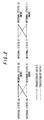
- Fig.3 is a trellis diagram showing the above internal state transitions.
- the branches represented by solid line indicate transitions when the input is '0' and the branches represented by dashed line indicate transitions when the input is 1'.
- the numerals attached to each branch are the code symbols (G1, G2) output when the transition of the branch occurs.
- G1, G2 the code symbols
- the selection of the maximum likelihood path is made based on the probability information of each of the merging paths.
- a hard-decision Viterbi algorithm the Hamming distances between each path bit sequence and the received bit sequence are summed to produce the probability of the path.
- a soft-decision Viterbi algorithm the squares of the Euclidean distances between each path bit sequence and the received bit sequence are summed to produce the probability of the path.
- path metric the value presenting the probability of a path
- branch metric the value presenting the probability for each unit period of reception
- This path metric can be translated as a sum of the probabilities of transitions to a certain internal state.
- the branch metric can be translated as a sum of the probabilities of individual bits at a transition from one baibu state to the next internal state.
- the Euclidean distance between two strings of data, i.e., received data (r 1 , r 2 ) and data (s 1 , s 2 ) generated by a transmission meter is given as expression as follows: ( s 1 - r 1 ) 2 +( s 2 - r 2 ) 2
- received data (r 1 , r 2 ) is fixed and hence r 1 and r 2 are constant regardless of the values (s 1 , s 2 ), these can be omitted from the expression.
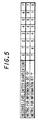
- transmitted data (s 1 , s 2 ) for elements s 1 and s 2 , assuming s 1 or s 2 to be '-1' when the data is '0' and assuming s 1 or s 2 to be '1' when the data is '1', s 1 2 and s 2 2 are constant regardless of the values (s 1 , s 2 ), so that these can be omitted from the expression. Further, when the remaining part is divided by 2, the expression is reduced to - s 1 ⁇ r 1 - s 2 ⁇ r 2 .
- the metrics shown in Fig.5 can be obtained from the above method.
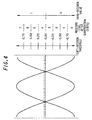
- the soft-decision process performs decisions based on multi-levels signals.
- the branch metric results in '0' and if the received level is '7'
- the branch metric results in '7'.
- the branch metric results in '0'. It should be noted that the smaller this branch metric value, the more probable the branch is.
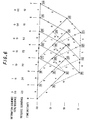
- Fig. 6 is a trellis diagram showing a soft-decision metric processing example.
- this soft-decision metric process suppose that an information sequence is given as '0110000', the code sequence is given as '00', '11', '10', '10', '11', '00' and '00', and the received sequence is given as '2', '4', '3', '6', '7', '2', '7', '5', '5', '7', '1', '0', '1' and '2'.
- the branch metrics for all the paths can be obtained in the same way.
- the numeral along each line segment denotes the branch metric and the numeral in hatching located at each internal-state and time-instant point denotes the path metric.
- the two paths merging into the internal state '00' at time instant '7' are one from the internal state '00' at time instant '6' and the other from the internal state '10' at time instant '6'.
- the path metric at time instant '6'/internal state '00' is '21' and the branch metric from the internal state '00' at time instant '6' to the internal state '00' at time instant '7' is '3', so that the probability of the path results in '24'.
- the path metric at time instant '6'/internal state '10' is '32' and the branch metric from the internal state '10' at time instant '6' to the internal state '00' at time instant '7' is '11', so that the probability of the path results in '43'. Therefore, '24' is assumed as the path metric at time instant '7'/internal state '00', that is, the path from the internal state '00' at time instant '6' to the internal state '00' at time instant '7' is selected.
- 'x' denotes the discarded path at the merging point.
- the decoded result can be obtained.
- the underlined numerals of the received sequence denotes error bits in transmission.
- the original information sequence can be obtained even when three bits of errors have occurred.
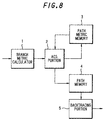
- Fig.8 shows a typical configuration of a Viterbi decoder for decoding convolutional codes based on the Viterbi algorithm, which is comprised of a branch metric calculator 1 for calculating the branch metric between the received sequence and each branch; an ACS portion 2 for selecting the survivor path and calculating the path metric of the survivor path; a path metric memory 3 for storing the path metric value at each internal state; apath memory 4 for storing the estimated output of a selected path; and a backtracing processor 5 for detecting the address of the most probable path metric and performing control of the path memory.
- a branch metric calculator 1 for calculating the branch metric between the received sequence and each branch
- an ACS portion 2 for selecting the survivor path and calculating the path metric of the survivor path
- a path metric memory 3 for storing the path metric value at each internal state
- apath memory 4 for storing the estimated output of a selected path
- a backtracing processor 5 for
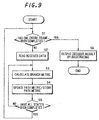
- the Viterbi decoder thus configured operates, as shown in the flowchart in Fig.9, in such a manner that it reads the received data and calculates branch metrics and updates the path metric into the path memory (Steps S2 to S5) until one entire frame is completed and when the frame has been completed (Step S1) then it outputs the decoded result by backtracing (Step S6).
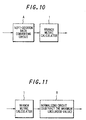
- a technique for such Viterbi decoders, various techniques have been proposed in order to improve calculation efficiency. As shown in Fig.10, a technique (see Japanese Patent Application Laid-Open Sho 63 No.122323) is disclosed in which a soft-decision data converting circuit A is provided so as to convert the input data in accordance with the circumstances so that it is used for calculations of branch metrics to thereby assign weights to the input bits.
- a normalizing circuit (maximum likelihood value subtraction) B is provided to search for the maximum likelihood value from all the branch metrics and subtract the value from each branch metric so as to narrow the data range to thereby determine the maximum likelihood value in branch metric.
- the data in a case of a Viterbi decoding process with a constraint length of 9 and a coding rate of 1/3, for example, when the bit accuracy of input data is set at three bits, the data can be correctly processed by an ACS portion having six or more internal operational bits if the process is combined with appropriate normalization.
- the input bit accuracy is set at four bits, not less than 7 or 8 internal operational bits are needed in the ACS portion even in combination with an appropriate normalization process.
- the internal operational bit length increases from six bits to 8 bits, the circuit scale also needs to be enlarged proportionally, to as large as a little over 1.3 times.
- the present invention is configured as follows.
- the first aspect of the present invention is a Viterbi decoder comprising: a branch metric calculating portion for calculating a branch metric value based on a received sequence; a bit range converting portion for converting a bit range of the branch metric value calculated by the branch metric calculating portion; a path metric calculating portion for calculating a path metric value based on the branch metric values whose bit range has been converted by the bit range converting portion; and a decoding portion for decoding received codes based on the path metric value calculated by the path metric calculating portion.
- the second aspect of the present invention is, in addition to the Viterbi decoder defined in the first aspect, is characterized in that the bit range converting portion converts the bit range by truncating a least significant bit of the branch metric value calculated by the branch metric calculating portion.
- the third aspect of the present invention is a method of Viterbi decoding comprising the steps of: calculating a branch metric value based on a received sequence; calculating a path metric value based on the branch metric values; and decoding received codes based on the path metric value, the method being characterized in that a bit range of the branch metric value is converted and the path metric value is calculated based on the branch metric values whose bit range has been converted.
- the branch metric calculating portion calculates branch metric values based on the received sequence, then the bit range converting portion converts the bit range of the calculated branch metric values into that operable by the path metric calculating portion.
- the path metric calculating portion calculates the path metric value based on the branch metric values whose bit range has been converted.
- the decoding portion decodes the received codes based on the calculated path metric value.
- the branch metric calculating portion calculates branch metric values based on a received sequence, then the bit range converting portion omit the least significant bit of the calculated branch metric values so as to converts the bit range of them into that operable by the path metric calculating portion.
- the path metric calculating portion calculates the path metric value based on the branch metric values whose bit range has been converted.
- the decoding portion decodes the received codes based on the calculated path metric value.
- branch metric values are calculated based on the received sequence, the bit range of the branch metric values is converted and the path metric value is calculated based on the branch metric values whose bit range has been converted. Then the received codes are decoded based on the path metric value.
- Fig.13 is a block diagram showing a configuration of a Viterbi decoder according to one embodiment of the present invention.
- This decoder is comprised of a branch metric calculator 1 for calculating the metric between the received sequence and each branch, a bit range converter 11 for converting the bit range of branch metric values calculated by branch metric calculator 1 so as to be suitable to the number of calculation bits to be used in an ACS portion 2, ACS portion 2 for selecting a survivor path and calculating the path metric of the survivor path, a path metric memory 3 for storing the path metric value of each internal state, a path memory 4 for storing the estimated output of a selected path; and a backtracing processor 5 for detecting the address of the most probable path metric and performing control of the path memory.
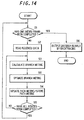
- the Viterbi decoder thus configured operates, as shown in the flowchart in Fig.14, in such a manner that it reads the received data and calculates the branch metrics, optimizes the branch metrics and updates the path metrics and stores them into the path memory (Steps S2 to S5, S11) until one frame is completed and when the frame has been completed (Step S1) then it outputs the decoded result by backtracing (Step S6).
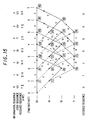
- Fig.15 is a trellis diagram showing a soft-decision metric processing example when the input bit precision is set at '4' in the Viterbi decoder thus configured as above.
- this soft-decision metric process suppose that an information sequence is given as '0110000', the code sequence is given as '00', '11', '10', '10', '11', '00' and '00', and the received sequence is given as '7', '8', '5', '13', '10', '4', '12', '3', '3', '9', '5', '8', '6' and '5'.
- the branch metrics for all the paths can be calculated in the same way. In the diagram, the numeral along each line segment denotes the branch metric and the numeral in hatching located at each internal-state and time-instant point denotes its path metric.
- the two paths merging into the internal state '00' at time instant '7' are one from the internal state '00' at time instant '6' and the other from the internal state '10' at time instant '6'.
- the path metric at time instant '6'/internal state '00' is '35' and the branch metric from the internal state '00' at time instant '6' to the internal state '00' at time instant '7' is '5', so that the probability of the path results in '40'.
- the path metric at time instant '6'/internal state '10' is '32' and the branch metric from the internal state '10' at time instant '6' to the internal state '00' at time instant '7' is '9', so that the probability of the path results in '41'. Therefore, '40' is assumed as the path metric at time instant '7'/internal state '00', that is, the path from the internal state '00' at time instant '6' to the internal state '00' at time instant '7' is selected.
- 'x' denotes the discarded path at the merging point.
- the decoded result can be obtained.
- the underlined numerals of the received sequence denotes error bits in transmission.
- the original information sequence can be obtained even when four bits of errors have occurred.
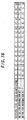
- the received sequence is obtained as '3', '4', '2', '6', '5', '2', '6', '1', '1', '4', '2', '4', '3' and '2', as shown in Fig.17.
- Metric calculation based on this received sequence results as follows.
- the two paths merging into the internal state '00' at time instant '7' are one from the internal state '00' at time instant '6' and the other from the internal state '10' at time instant '6'.
- the path metric at time instant '6'/internal state '00' is '34' and the branch metric from the internal state '00' at time instant '6' to the internal state '00' at time instant '7' is '5', so that the probability of the path results in '39'.
- the path metric at time instant '6'/internal state '10' is '29' and the branch metric from the internal state '10' at time instant '6' to the internal state '00' at time instant '7' is '9', so that the probability of the path results in '38'. Therefore, '38' is assumed as the path metric at time instant '7'/internal state '00', that is, the path from the internal state '10' at time instant '6' to the internal state '00' at time instant '7' is selected.
- ' x' denotes the discarded path at the merging point.
- the decoded result can be obtained.
- a path selection fault occurs from the internal state '10' at time instant '6' to the internal state '00' at time instant '7', hence causes errors in the information sequence, thus making it impossible to obtain the original information sequence.
- Fig.18 is a BER characteristic chart showing the bit error ratio (BER) characteristic (with an input bit precision of '4') when the present embodiment is applied, in comparison with the bit error ratio (BER) characteristics (with an input bit precision of '3' and with an input bit precision of '4') of the conventional example.
- Fig.19 is a partially enlarged chart of the same chart. As understood from the charts, the embodiment shows some degradation compared to the conventional example wherein full calculation is performed with an input bit precision of '4', but presents some improvement in characteristics compared to the conventional example wherein full calculation is performed with an input bit precision of '3'.
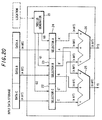
- Fig.20 is a constructional example of a branch metric calculator 1 in the Viterbi decoder configured as above.
- This calculator is comprised of a trellis generator 21, selectors 22, 23 and 24 and 6-bit adders 25 and 26.
- Trellis generator 21 is adapted to determine from which information bit, '0' or '1', a metric should be determined.
- a metric should be determined.
- selectors 22, 23 and 24 use respective metrics corresponding to information bit '0' for the received levels of data A, B and C.
- selectors 22 use respective metrics corresponding to information bit '0' for the received levels of data A, B and C.
- Each output from these selectors 22, 23 and 24 is supplied to adders 25 and 26, where these are summed to output branch metric values Y1 and Y2.
- the outputs from selectors 22, 23 and 24 range from 0 to 7. Therefore, the range of branch metrics is from 0 to 21 (10101b in binary), and the bit precision needs five bits.
- the outputs from selectors 22, 23 and 24 range from 0 to 15, so that the range of branch metrics is from 0 to 45 (101101b in binary) and the bit precision needs six bits.
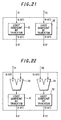
- Fig.21 is a constructional example of a bit range converter 11 in the Viterbi decoder configured as above.
- This converter is comprised of a least significant bit truncating portions 31 and 32.
- These least significant bit truncating portions 31 and 32 are adapted to drop the least significant bit of branch metric values Y1 and Y2 output from branch metric calculator 1, so that the values with their least significant bit truncated are output as branch metric values Y1' and Y2' having a bit length which is operable in ACS portion 2. More specifically, for example, when the input bit precision is set at four bits, the branch metric length is set at six bits taking into account the maximum value of the branch metric. Therefore this bit length is truncated into 5 bits as the number of bits which can be operated in ACS portion 2.
- branch metric calculator 1 it is possible to round the branch metric values Y1 and Y2 output from branch metric calculator 1 by adding '1' to each of them through 6-bit adders 33 and 34 and dropping the least significant bit through the least significant bit truncating portions 31 and 32.
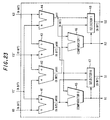
- Fig.23 is a constructional example of an ACS portion 2 in the Viterbi decoder configured as above.
- This ACS portion is comprised of 6-bit adders 41 to 44, comparators 45 and 46, selectors 47 and 48.
- adder 41 sums data K1 from path metric memory 3 and data Y1' from bit range converter 11 to output pt00
- adder 42 sums data K1 from path metric memory 3 and data Y2' from bit range converter 11 to output pt01
- adder 43 sums data K2 from path metric memory 3 and data Y2' from bit range converter 11 to output pt10
- adder 42 sums data K2 from path metric memory 3 and data Y1' from bit range converter 11 to output pt11.
- Comparator 45 compares pt00 and pt10 and outputs the result as the path data value to R1.
- Selector 47 in accordance with the result from comparator 45, selects pt00 if pt00 ⁇ pt10 or selects pt10 if pt00 > pt10 to output a new path metric S1.
- Comparator 46 compares pt01 and pt11 and outputs the result as the path data value to R2.
- Selector 48 in accordance with the result from comparator 46, selects pt01 if pt01 ⁇ pt11 or selects pt11 if pt01 > pt11 to output a new path metric S2.
- these new path metrics S1 and S2 are stored into path metric memory 3.
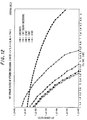
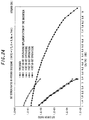
- Fig.24 shows the graphs for an uncoded case, a case with an input bit precision of 3 bits and operational bit length of 6 bits, a case where the present embodiment is employed with an input bit precision of 4 bits and operational bit length of 6 bits, a case where the present embodiment is not employed with an input bit precision of 4 bits and operational bit length of 6 bits and a case where the present embodiment is not employed with an input bit precision of 4 bits and operational bit length of 8 bits.
- Fig.25 shows its partially enlarged chart.
- the BER characteristic when the present embodiment is employed with an input bit precision of 4 bits or where the branch metric values are converted from 6 bits to 5 bits and internal operations are processed in 6 bits is more or less inferior to that when the input bit number is set at 4 bits and a large enough number of operational bits are taken or when the branch metric values are directly used with internal operations processed in 8 bits.
- the characteristic can be improved compared to the case where the input bit precision is set at 3 bits and a large enough number of operational bits are taken or where the circuit scale for internal operations is equivalent to the configuration of the embodiment.
- the invention is suitable for a Viterbi decoder which can improve error correction characteristics while suppressing enlargement in system scale.
Landscapes
- Physics & Mathematics (AREA)
- Probability & Statistics with Applications (AREA)
- Engineering & Computer Science (AREA)
- Theoretical Computer Science (AREA)
- Error Detection And Correction (AREA)
Applications Claiming Priority (1)
| Application Number | Priority Date | Filing Date | Title |
|---|---|---|---|
| PCT/JP2000/001523 WO2001069796A1 (en) | 2000-03-14 | 2000-03-14 | Viterbi decoder |
Publications (2)
| Publication Number | Publication Date |
|---|---|
| EP1265367A1 true EP1265367A1 (de) | 2002-12-11 |
| EP1265367A4 EP1265367A4 (de) | 2005-06-15 |
Family
ID=11735790
Family Applications (1)
| Application Number | Title | Priority Date | Filing Date |
|---|---|---|---|
| EP00908047A Withdrawn EP1265367A4 (de) | 2000-03-14 | 2000-03-14 | Viterbi-decodierer |
Country Status (5)
| Country | Link |
|---|---|
| EP (1) | EP1265367A4 (de) |
| KR (1) | KR100490815B1 (de) |
| CN (1) | CN1211933C (de) |
| AU (2) | AU2000229439B2 (de) |
| WO (1) | WO2001069796A1 (de) |
Families Citing this family (3)
| Publication number | Priority date | Publication date | Assignee | Title |
|---|---|---|---|---|
| CN100429870C (zh) * | 2005-08-08 | 2008-10-29 | 北京大学深圳研究生院 | 一种维特比译码器以及决定其中加比选单元数据位宽的方法 |
| US20110167323A1 (en) * | 2010-01-07 | 2011-07-07 | Mediatek Inc. | Error-Correcting Apparatus and Method Thereof |
| CN102904667B (zh) * | 2011-07-27 | 2015-05-20 | 开曼晨星半导体公司 | 一种用于lte中pbch解码的咬尾卷积码译码方法 |
Family Cites Families (4)
| Publication number | Priority date | Publication date | Assignee | Title |
|---|---|---|---|---|
| JPH06338808A (ja) * | 1993-05-28 | 1994-12-06 | Matsushita Electric Ind Co Ltd | 加算比較選択装置 |
| US5471500A (en) * | 1994-03-08 | 1995-11-28 | At&T Ipm Corp. | Soft symbol decoding |
| JPH0832633A (ja) * | 1994-07-20 | 1996-02-02 | Toshiba Corp | トレリス復号器 |
| KR100256270B1 (ko) * | 1997-08-30 | 2000-05-15 | 김영환 | 최소의 변이 상태값을 이용한 비터비 복호기 및복호 방법 |
-
2000
- 2000-03-14 EP EP00908047A patent/EP1265367A4/de not_active Withdrawn
- 2000-03-14 KR KR10-2002-7004693A patent/KR100490815B1/ko not_active Expired - Fee Related
- 2000-03-14 WO PCT/JP2000/001523 patent/WO2001069796A1/ja not_active Ceased
- 2000-03-14 AU AU2000229439A patent/AU2000229439B2/en not_active Ceased
- 2000-03-14 CN CNB008172153A patent/CN1211933C/zh not_active Expired - Fee Related
- 2000-03-14 AU AU2943900A patent/AU2943900A/xx active Pending
Also Published As
| Publication number | Publication date |
|---|---|
| EP1265367A4 (de) | 2005-06-15 |
| KR20020048963A (ko) | 2002-06-24 |
| CN1409899A (zh) | 2003-04-09 |
| KR100490815B1 (ko) | 2005-05-24 |
| AU2943900A (en) | 2001-09-24 |
| CN1211933C (zh) | 2005-07-20 |
| WO2001069796A1 (en) | 2001-09-20 |
| AU2000229439B2 (en) | 2004-10-14 |
Similar Documents
| Publication | Publication Date | Title |
|---|---|---|
| US5537444A (en) | Extended list output and soft symbol output viterbi algorithms | |
| US5406570A (en) | Method for a maximum likelihood decoding of a convolutional code with decision weighting, and corresponding decoder | |
| US6061823A (en) | Error correcting/decoding apparatus and error correcting/decoding method | |
| KR100580160B1 (ko) | 변형된 역추적 방식의 2단 연출력 비터비 알고리즘 복호화기 | |
| EP0671817A1 (de) | Analogwert-Symboldekoder zur Anwendung in einem MLSE-Equalizer oder Faltungsdekoder | |
| US6788750B1 (en) | Trellis-based decoder with state and path purging | |
| EP0529909B1 (de) | Fehlerkorrektur-Kodierung/Dekodierungsverfahren und -gerät | |
| US7062000B1 (en) | Viterbi decoder | |
| US7046747B2 (en) | Viterbi decoder and decoding method using rescaled branch metrics in add-compare-select operations | |
| EP1265367A1 (de) | Viterbi-decodierer | |
| US7020223B2 (en) | Viterbi decoder and method using sequential two-way add-compare-select operations | |
| JP2917177B2 (ja) | 誤り検出方法、装置ならびに識別方法 | |
| JP3823731B2 (ja) | 誤り訂正復号器 | |
| US20040064781A1 (en) | Viterbi decoder and Viterbi decoding method | |
| JP3987153B2 (ja) | マンハッタンあるいはハミングメトリックスキームに基づくビタビデコーダのための信号のデコード | |
| EP0807336B1 (de) | Verfahren zur Erzeugung von Verzweigungsmetriken und ein Empfänger für ein Mobiltelefon | |
| US6580769B1 (en) | Method and apparatus for backward recursion next state generation in recursive convolutional decoding | |
| KR101134806B1 (ko) | 부호 복호 방법 | |
| US6411663B1 (en) | Convolutional coder and viterbi decoder | |
| JP7835619B2 (ja) | 誤り訂正装置、誤り訂正方法、及び、誤り訂正プログラム | |
| JPH05244017A (ja) | ビタビ復号器 | |
| EP0674397A2 (de) | Viterbi-Dekoder mit verkleinerten Schaltungen | |
| KR0180303B1 (ko) | 비터비 디코더의 정규화 방법 및 장치 | |
| US20040153958A1 (en) | Path metric calculation circuit in viterbi decoders | |
| KR100459419B1 (ko) | 비터비 디코더 |
Legal Events
| Date | Code | Title | Description |
|---|---|---|---|
| PUAI | Public reference made under article 153(3) epc to a published international application that has entered the european phase |
Free format text: ORIGINAL CODE: 0009012 |
|
| 17P | Request for examination filed |
Effective date: 20020719 |
|
| AK | Designated contracting states |
Kind code of ref document: A1 Designated state(s): AT BE CH CY DE DK ES FI FR GB GR IE IT LI LU MC NL PT SE |
|
| RIN1 | Information on inventor provided before grant (corrected) |
Inventor name: KISHINO, MASAHIKO |
|
| RBV | Designated contracting states (corrected) |
Designated state(s): AT BE CH DE FR GB LI |
|
| A4 | Supplementary search report drawn up and despatched |
Effective date: 20050504 |
|
| STAA | Information on the status of an ep patent application or granted ep patent |
Free format text: STATUS: THE APPLICATION IS DEEMED TO BE WITHDRAWN |
|
| 18D | Application deemed to be withdrawn |
Effective date: 20101229 |