EP1262319A2 - Negative-working photosensitive composition and negative-working photosensitive lithographic printing plate - Google Patents
Negative-working photosensitive composition and negative-working photosensitive lithographic printing plate Download PDFInfo
- Publication number
- EP1262319A2 EP1262319A2 EP02253515A EP02253515A EP1262319A2 EP 1262319 A2 EP1262319 A2 EP 1262319A2 EP 02253515 A EP02253515 A EP 02253515A EP 02253515 A EP02253515 A EP 02253515A EP 1262319 A2 EP1262319 A2 EP 1262319A2
- Authority
- EP
- European Patent Office
- Prior art keywords
- negative
- working photosensitive
- photosensitive composition
- acid
- compound
- Prior art date
- Legal status (The legal status is an assumption and is not a legal conclusion. Google has not performed a legal analysis and makes no representation as to the accuracy of the status listed.)
- Granted
Links
Classifications
-
- C—CHEMISTRY; METALLURGY
- C09—DYES; PAINTS; POLISHES; NATURAL RESINS; ADHESIVES; COMPOSITIONS NOT OTHERWISE PROVIDED FOR; APPLICATIONS OF MATERIALS NOT OTHERWISE PROVIDED FOR
- C09D—COATING COMPOSITIONS, e.g. PAINTS, VARNISHES OR LACQUERS; FILLING PASTES; CHEMICAL PAINT OR INK REMOVERS; INKS; CORRECTING FLUIDS; WOODSTAINS; PASTES OR SOLIDS FOR COLOURING OR PRINTING; USE OF MATERIALS THEREFOR
- C09D161/00—Coating compositions based on condensation polymers of aldehydes or ketones; Coating compositions based on derivatives of such polymers
- C09D161/04—Condensation polymers of aldehydes or ketones with phenols only
- C09D161/06—Condensation polymers of aldehydes or ketones with phenols only of aldehydes with phenols
- C09D161/14—Modified phenol-aldehyde condensates
-
- B—PERFORMING OPERATIONS; TRANSPORTING
- B41—PRINTING; LINING MACHINES; TYPEWRITERS; STAMPS
- B41C—PROCESSES FOR THE MANUFACTURE OR REPRODUCTION OF PRINTING SURFACES
- B41C1/00—Forme preparation
- B41C1/10—Forme preparation for lithographic printing; Master sheets for transferring a lithographic image to the forme
- B41C1/1008—Forme preparation for lithographic printing; Master sheets for transferring a lithographic image to the forme by removal or destruction of lithographic material on the lithographic support, e.g. by laser or spark ablation; by the use of materials rendered soluble or insoluble by heat exposure, e.g. by heat produced from a light to heat transforming system; by on-the-press exposure or on-the-press development, e.g. by the fountain of photolithographic materials
-
- C—CHEMISTRY; METALLURGY
- C08—ORGANIC MACROMOLECULAR COMPOUNDS; THEIR PREPARATION OR CHEMICAL WORKING-UP; COMPOSITIONS BASED THEREON
- C08L—COMPOSITIONS OF MACROMOLECULAR COMPOUNDS
- C08L61/00—Compositions of condensation polymers of aldehydes or ketones; Compositions of derivatives of such polymers
- C08L61/04—Condensation polymers of aldehydes or ketones with phenols only
- C08L61/06—Condensation polymers of aldehydes or ketones with phenols only of aldehydes with phenols
-
- C—CHEMISTRY; METALLURGY
- C09—DYES; PAINTS; POLISHES; NATURAL RESINS; ADHESIVES; COMPOSITIONS NOT OTHERWISE PROVIDED FOR; APPLICATIONS OF MATERIALS NOT OTHERWISE PROVIDED FOR
- C09D—COATING COMPOSITIONS, e.g. PAINTS, VARNISHES OR LACQUERS; FILLING PASTES; CHEMICAL PAINT OR INK REMOVERS; INKS; CORRECTING FLUIDS; WOODSTAINS; PASTES OR SOLIDS FOR COLOURING OR PRINTING; USE OF MATERIALS THEREFOR
- C09D161/00—Coating compositions based on condensation polymers of aldehydes or ketones; Coating compositions based on derivatives of such polymers
- C09D161/04—Condensation polymers of aldehydes or ketones with phenols only
- C09D161/06—Condensation polymers of aldehydes or ketones with phenols only of aldehydes with phenols
-
- B—PERFORMING OPERATIONS; TRANSPORTING
- B41—PRINTING; LINING MACHINES; TYPEWRITERS; STAMPS
- B41C—PROCESSES FOR THE MANUFACTURE OR REPRODUCTION OF PRINTING SURFACES
- B41C2210/00—Preparation or type or constituents of the imaging layers, in relation to lithographic printing forme preparation
- B41C2210/04—Negative working, i.e. the non-exposed (non-imaged) areas are removed
-
- B—PERFORMING OPERATIONS; TRANSPORTING
- B41—PRINTING; LINING MACHINES; TYPEWRITERS; STAMPS
- B41C—PROCESSES FOR THE MANUFACTURE OR REPRODUCTION OF PRINTING SURFACES
- B41C2210/00—Preparation or type or constituents of the imaging layers, in relation to lithographic printing forme preparation
- B41C2210/06—Developable by an alkaline solution
-
- B—PERFORMING OPERATIONS; TRANSPORTING
- B41—PRINTING; LINING MACHINES; TYPEWRITERS; STAMPS
- B41C—PROCESSES FOR THE MANUFACTURE OR REPRODUCTION OF PRINTING SURFACES
- B41C2210/00—Preparation or type or constituents of the imaging layers, in relation to lithographic printing forme preparation
- B41C2210/22—Preparation or type or constituents of the imaging layers, in relation to lithographic printing forme preparation characterised by organic non-macromolecular additives, e.g. dyes, UV-absorbers, plasticisers
-
- B—PERFORMING OPERATIONS; TRANSPORTING
- B41—PRINTING; LINING MACHINES; TYPEWRITERS; STAMPS
- B41C—PROCESSES FOR THE MANUFACTURE OR REPRODUCTION OF PRINTING SURFACES
- B41C2210/00—Preparation or type or constituents of the imaging layers, in relation to lithographic printing forme preparation
- B41C2210/24—Preparation or type or constituents of the imaging layers, in relation to lithographic printing forme preparation characterised by a macromolecular compound or binder obtained by reactions involving carbon-to-carbon unsaturated bonds, e.g. acrylics, vinyl polymers
-
- B—PERFORMING OPERATIONS; TRANSPORTING
- B41—PRINTING; LINING MACHINES; TYPEWRITERS; STAMPS
- B41C—PROCESSES FOR THE MANUFACTURE OR REPRODUCTION OF PRINTING SURFACES
- B41C2210/00—Preparation or type or constituents of the imaging layers, in relation to lithographic printing forme preparation
- B41C2210/26—Preparation or type or constituents of the imaging layers, in relation to lithographic printing forme preparation characterised by a macromolecular compound or binder obtained by reactions not involving carbon-to-carbon unsaturated bonds
- B41C2210/262—Phenolic condensation polymers, e.g. novolacs, resols
Definitions
- the present invention relates to a negative-working photosensitive lithographic printing plate used in the offset printing field and, more particularly, to a negative-working photosensitive lithographic printing plate used as a so-called computer-to-plate (CTP) capable of directly making plate based on a digital signal from a computer, and a negative-working photosensitive composition suited for use in a photosensitive layer of such a lithographic original printing plate.
- CTP computer-to-plate
- CTP computer-to-plate
- a CTP system using a high-output laser having a maximum intensity within a near infrared or infrared range as a light source of light irradiation has advantages such that a high-resolution image can be obtained by exposure in a short time and a photosensitive lithographic printing plate used in the system can be handled in a lighted room.
- high-output and small-sized lasers are easily available as solid lasers and semiconductor lasers, which emit infrared rays having a wavelength within a range from 760 to 1200 nm.
- the negative-working photosensitive composition which can form an image using a solid laser or semiconductor laser which is capable of emitting infrared rays
- those comprising an alkali-soluble resin (novolak resin, etc.), a compound capable of being crosslinked by an acid (acid-crosslinking agent such as a resol resin), a compound capable of generating an acid by heat (acid-generating agent), and a photothermal converting agent (infrared absorber such as a dye or pigment) are proposed in Japanese Unexamined Patent Application, First Publication No. Hei 7-20629.
- a negative-working image is formed in the following manner. First, infrared rays emitted from the solid laser or semiconductor laser are converted into heat by the photothermal converting agent. An acid is generated from the acid-generating agent by the heat. When preheated (heating) prior to development, catalytic action of the acid causes crosslinking. Consequently, a negative-working image is formed.
- This photothermal converting agent incorporated into the negative-working photosensitive composition has an action of suppressing dissolution of the alkali-soluble resin, in addition to an action of converting light into heat. Therefore, it has an effect of suppressing the alkali-soluble resin from excessively dissolving upon development, thereby to improving (widening) "preheat latitude" (tolerance of heat treating conditions).
- "preheat latitude" tolerance of heat treating conditions
- the photothermal converting agent has a problem such that it increases ablation (scattering phenomenon of the photosensitive composition) upon exposure. It is necessary to suppress the ablation because it can cause a stain in the light source such as a solid laser or semiconductor laser.
- the amount of the photothermal converting agent cannot be increased for the object of widening the preheat latitude.
- an object of the present invention is to provide a negative-working photosensitive composition which can widen the preheat latitude without increasing ablation upon exposure, and a negative-working photosensitive lithographic printing plate.
- the present inventors have made intensive studies and discovered that a specific sulfone compound which has an excellent dissolution suppressing effect and which does not cause ablation upon exposure, and thus the present invention has been completed.
- the negative-working photosensitive composition of the present invention comprises (a) an alkali-soluble resin, (b) a compound capable of being crosslinked by an acid, (c) a compound capable of generating an acid by heat, (d) a photothermal converting agent, and (e) a sulfone compound represented by the following general formula (I): R-SO 2 -R' wherein R and R' may be the same or different and represent a substituted or non-substituted alkyl, alkenyl, aryl, or heterocyclic group.
- the negative-working photosensitive lithographic printing plate of the present invention comprises a substrate and a photosensitive layer made of the negative-working photosensitive composition of the present invention formed on the surface of the substrate.
- the negative-working photosensitive composition of the present invention can widen the preheat latitude upon exposure without increasing ablation.
- the negative-working photosensitive lithographic printing plate of the present invention suppresses ablation upon exposure to the same level as that of a conventional printing plate and achieves a wide preheat latitude.
- the alkali-soluble resin (a) refers to a binder resin which is insoluble in water and is soluble in an aqueous alkali solution.
- alkali-soluble resin (a) examples include: novolak resins or resol resins, such as phenol-formaldehyde resins, cresol-formaldehyde resins, phenol-cresol-formaldehyde co-condensed resins; polyhydroxystyrene; polyhalogenated hydroxystyrene; acrylic resins containing one or more kinds of monomers having an acidic group, such as N-(4-hydroxyphenyl)methacrylamide, hydroquinone monomethacrylate, N-(sulfamoylphenyl)methacrylamide, N-phenylsulfonylmethacrylamide, N-phenylsulfonylmaleimide, acrylic acid, or methacrylic acid; active methylene group-containing resins as described in Japanese Unexamined Patent Application, First Publication No.
- a novolak resin is preferably used because a wide developing tolerance can be obtained.
- the amount of the alkali-soluble resin (a) is preferably within a range from 40 to 95% by weight based on the solid content of the negative-working photosensitive composition. If necessary, two or more kinds of alkali-soluble resins (a) may be used in combination.
- the compound (b) capable of being crosslinked by an acid is not specifically limited as far as it is crosslinked and made insoluble by catalytic action of an acid generated from the compound (c), which is capable of generating an acid by heat, described below.
- Examples of the compound (b) capable of being crosslinked by an acid include an amino compound having at least two substituents such as a methylol group, alkoxymethyl group, or acetoxymethyl group.
- Specific examples thereof include a melamine derivative such as methoxymethylated melamine, a benzoguanamine derivative or glycol uril derivative, a urea resin derivative, and a resol resin.
- a resol resin is preferably used because the solubility in the developing solution and contrast of the image portion and non-image portion increase.
- the amount of the compound (b) capable of being crosslinked by an acid is preferably within a range from 5 to 70% by weight based on the solid content of the negative-working photosensitive composition. If necessary, two or more kinds of compounds (b) capable of being crosslinked by an acid may be used in combination.
- Examples of the compound (c) capable of generating an acid by heat include publicly known onium salt such as ammonium salt, phosphonium salt, iodonium salt, sulfonium salt, or selenonium salt, an organohalogen compound, a photo acid generating agent having an o-nitrobenzyl protective group, and a disulfone compound.
- onium salt such as ammonium salt, phosphonium salt, iodonium salt, sulfonium salt, or selenonium salt
- an organohalogen compound such as ammonium salt, phosphonium salt, iodonium salt, sulfonium salt, or selenonium salt
- an organohalogen compound such as ammonium salt, phosphonium salt, iodonium salt, sulfonium salt, or selenonium salt
- an organohalogen compound such as ammonium salt, phosphonium salt, iodonium salt, sulfonium salt,
- trihaloalkyl compound examples include a trihaloemethyl-s-triazine compound as described in U.S. Patent No. 4,239,850, and an oxadiazole compound and tribromomethylsulfonyl compound as described in U.S. Patent No. 4,212,970.
- diazonium salt compound examples include an organic or inorganic salt of at least one kind of a compound selected from 4-diazodiphenylamine, 4-diazo-3-methyldiphenylamine, 4-diazo-4'-methyldiphenylamine, 4-diazo-3'-methyldiphenylamine, 4-diazo-4'-methoxydiphenylamine, 4-diazo-3-methyl-4'-ethoxydiphenylamine, and 3-diazo-4-methoxydiphenylamine.
- Examples of the organic acid include methanesulfonic acid, benzenesulfonic acid, toluenesulfonic acid, xylenesulfonic acid, mesitylenesulfonic acid, dodecylbenzenesulfonic acid, naphthalenesulfonic acid, propylnaphthalenesulfonic acid, 1-naphthol-5-sulfonic acid, 2-nitrobenzenesulfonic acid, 3-chlorobenzenesulfonic acid, 2-hydroxy-4-methoxybenzophenone-5-sulfonic acid, 2,4-dihydroxybenzophenone, benzenephosphinic acid, and trifluoromethanesulfonic acid.
- Examples of the inorganic compound include hexafluorophosphoric acid, tetrafluoroboric acid, and thiocyanic acid.
- the amount of the compound (c) capable of generating an acid by heat is within a range from 0.01 to 50% by weight, and particularly preferably from 0.1 to 20% by weight, based on the solid content of the negative-working photosensitive composition.
- the amount of the compound (c) capable of generating an acid by heat is smaller than 0.01% by weight, it is impossible to expect generation of acid sufficient to crosslink the compound (b) which is capable of being crosslinked by an acid.
- the amount is larger than 50% by weight, the solubility of the non-image portion in the developing solution is drastically lowered.
- the photothermal converting agent (d) is a substance which absorbs light to generate an acid.
- examples of such a substance include various pigments or dyes.
- the pigments used in the present invention are commercially available pigments, and are described, for example, in Color Index, "Latest Pigment Handbook”, (edited by the Japan Association of Pigment Technology, 1977 edition), “Latest Pigment Application Technologies” (CMC, 1986), and “Printing Ink Technologies” (CMC, 1984).
- Examples of the pigments include black pigments, yellow pigments, orange pigments, brown pigments, red pigments, purple pigments, blue pigments, green pigments, fluorescent pigments, and polymers containing chemically combined dyes.
- the pigments are insoluble azo pigments, azo lake pigments, condensed azo pigments, chelated azo pigments, phthalocyanine-based pigments, anthraquinone-based pigments, perylene- and perinone-based pigments, thioindigo-based pigments, quinacridone-based pigments, dioxazine-based pigments, isoindolinone-based pigments, quinophthalone-based pigments, dyed lake pigments, azine pigments, nitroso pigments, nitro pigments, natural pigments, fluorescent pigments, inorganic pigments, and carbon black.
- carbon black is preferably used as a substance which absorbs light within a near infrared or infrared range to efficiently generate heat and is economically excellent.
- grafted carbon blacks which have various functional groups and are superior in dispersibility, are commercially available and are described on page 167 of "Carbon Black Handbook, Third Edition” (edited by the Association of Carbon Black, 1995) and page 111 of “Characteristics and Optimum Formulation of Carbon Black and Application Technique” (edited by the Association of Technical Information, 1997), and any of these carbon blacks can be preferably used in the present invention.
- pigments may be used without being surface-treated or may be used after being subjected to publicly known surface treatments.
- Publicly known surface treatments include a treatment wherein a resin or a wax is coated on the surface of the pigments, a treatment wherein a surface active agent is adhered to the surface of the pigments, and a treatment wherein a reactive substance (e.g., a silane coupling agent, an epoxy compound, or a polyisocyanate) is bonded to the surface of the pigments.
- a reactive substance e.g., a silane coupling agent, an epoxy compound, or a polyisocyanate
- the particle diameter of the pigments used in the present invention is preferably within a range from 0.01 to 15 ⁇ m, and more preferably from 0.01 to 5 ⁇ m.
- the dyes used in the present invention are commercially available dyes and known dyes described, for example, in "Dye Handbook” (edited by the Association of Organic Synthesis Chemistry, published 1970), “Handbook of Color Material Engineering” (edited by the Japan Society of Color Material, Asakura Shoten K.K., published 1989), “Technologies and Markets of Industrial Pigments” (CMC, published 1983), and “Chemical Handbook, Applied Chemistry Edition” (edited by The Chemical Society of Japan, Maruzen Shoten K.K., published 1986).
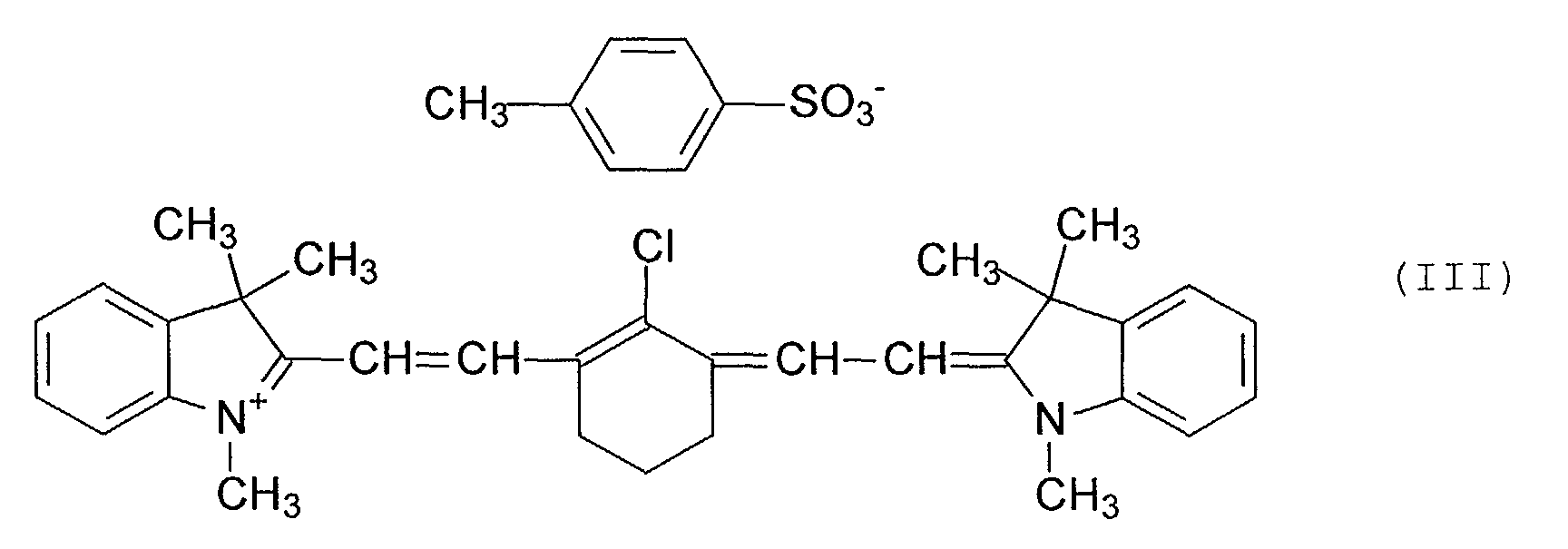
- the dyes include azo dyes, azo dyes in the form of metal complex salts, pyrazolone azo dyes, anthraquinone dyes, phthalocyanine dyes, carbonium dyes, quinonimine dyes, methine dyes, cyanine dyes, indigo dyes, quinoline dyes, nitro-based dyes, xanthene dyes, thiazine-based dyes, azine dyes, and oxazine dyes.
- these dyes those which absorb light within a near infrared or infrared range are particularly preferred.
- the dyes which absorb light within a near infrared or infrared range are, for example, cyanine dyes as described in Japanese Unexamined Patent Application, First Publication No. Sho 58-125246, Japanese Unexamined Patent Application, First Publication No. Sho 59-84356, Japanese Unexamined Patent Application, First Publication No. Sho 59-202829, and Japanese Unexamined Patent Application, First Publication No. Sho 60-78787; methine dyes as described in Japanese Unexamined Patent Application, First Publication No. Sho 58-173696, Japanese Unexamined Patent Application, First Publication No. Sho 58-181690, and Japanese Unexamined Patent Application, First Publication No.
- the dyes further include substituted arylbenzo(thio)pyridinium salts as described in U.S. Patent No. 3,881,924; trimethinethiapyrylium salts as described in Japanese Unexamined Patent Application, First Publication No. Sho 57-142645; pyrylium-based compound as described in Japanese Unexamined Patent Application, First Publication No. Sho 58-181051, Japanese Unexamined Patent Application, First Publication No. Sho 58-220143, Japanese Unexamined Patent Application, First Publication No. Sho 59-146063, and Japanese Unexamined Patent Application, First Publication No.
- Sho 59-146061 cyanine pigments as described in Japanese Unexamined Patent Application, First Publication No. Sho 59-216146; pentamethinethiopyrylium salts as described in U.S. Patent No. 4,283,475; pyrylium compounds as described in Japanese Examined Patent Application, Second Publication No. Hei 5-13514 and Japanese Examined Patent Application, Second Publication No. Hei 5-19702; and infrared absorbing dyes as described in U.S. Patent No. 4,756,993.
- the photothermal converting agent (d) can be used by selecting at least one kind of an appropriate pigment or dye, which can absorb light having a specific wavelength from a light source described hereinafter and convert into heat, from among the dyes and pigments described above.
- the amount of the pigment is preferably within a range from 1 to 70% by weight, and particularly preferably from 3 to 50% by weight, based on the total solid content of the negative-working photosensitive composition.
- the amount of the pigment is less than 1% by weight based on the total solid content, a sufficient quantity of heat cannot be obtained even if heat is generated by absorbing light.
- the amount is more than 70% by weight, the quantity of heat tends to be too large. Therefore, it is not preferred.
- the amount of the dye is preferably within a range from 0.1 to 30% by weight, and particularly preferably from 0.5 to 20% by weight, based on the total solid content of the negative-working photosensitive composition.
- the amount of the pigment is less than 0.1% by weight based on the total solid content, a sufficient quantity of heat cannot be obtained even if heat is generated by absorbing light.
- the amount is more than 30% by weight, the quantity of heat does not substantially increase any further, and the addition of the photothermal converting agent (d) is no longer effective. Therefore, it is not preferred.
- the sulfone compound (e) represented by the following general formula (I) serves as a dissolution inhibitor of the alkali-soluble resin (a) and does not cause ablation upon exposure.
- R-SO 2 -R' wherein R and R' may be the same or different and represent a substituted or non-substituted alkyl, alkenyl, aryl, or heterocyclic group.
- sulfone compound (e) represented by the general formula (I) include diphenyl sulfone, dixylyl sulfone, 4,4'-dichlorodiphenyl sulfone, di-n-butyl sulfone, and 2-pyridyltribromomethyl sulfone.
- sulfone compounds a sulfone compound of the above general formula (I) wherein R and R' represent an aryl group is preferred in view of the effect of suppressing the dissolution of the alkali-soluble resin (a) in the developing solution, and diphenylsulfone is particularly preferred. If necessary, two or more kinds of sulfone compounds (e) represented by the general formula (I) may be used in combination.
- the amount of the sulfone compound (e) represented by the general formula (I) is preferably within a range from 0.01 to 50% by weight, and particularly preferably from 0.5 to 20% by weight, based on the solid content of the negative-working photosensitive composition.
- the amount of the sulfone compound is less than 0.01% by weight, an improvement in the action of suppressing the dissolution of the alkali-soluble resin (a) cannot be sufficiently expected.
- the amount is more than 50% by weight, the solubility of the non-image portion to the developing solution is drastically lowered.
- Examples of preferred dyes include basic oil-soluble dyes such as Crystal Violet, Malachite Green, Victoria Blue, Methylene Blue, Ethyl Violet, and Rhodamine B.
- Examples of commercially available products thereof include “Victoria Pure Blue BOH” (manufactured by Hodogaya Chemical Co., Ltd.), “Oil Blue #603” (manufactured by Orient Chemical Industries, Ltd.), and “VPB-Naps (naphthalenesulfonate of Victoria Pure Blue)” (manufactured by Hodogaya Chemical Co., Ltd.).
- Examples of the pigments include Phthalocyanine Blue, Phthalocyanine Green, Dioxazine Violet, and Quinacridone Red.
- surfactants examples include fluorine-based surfactants and silicone-based surfactants as described in Japanese Unexamined Patent Application, First Publication No. Sho 62-36657 and Japanese Unexamined Patent Application, First Publication No. Sho 62-226143.
- plasticizers examples include diethyl phthalate, dibutyl phthalate, dioctyl phthalate, tributyl phosphate, trioctyl phosphate, tricresyl phosphate, tri(2-chloroethyl) phosphate, and tributyl acetate.
- phosphoric acid for example, phosphoric acid, phosphorous acid, oxalic acid, tartaric acid, malic acid, citric acid, dipicolinic acid, polyacrylic acid, benzenesulfonic acid and toluenesulfonic acid can also be used in combination.
- the amounts of these additives varies depending on the purposes, but are preferably within a range from 0 to 30% by weight based on the solid content of the photosensitive composition.
- the negative-working photosensitive lithographic printing plate of the present invention is generally composed of a substrate and a photosensitive layer made of the above negative-working photosensitive composition formed on the substrate.
- the photosensitive layer may be referred to as a heat-sensitive layer because heat generated by light-irradiation is utilized, but may be referred to as a photosensitive layer for the sake of convenience.
- the substrate examples include metal sheets made of aluminum, zinc, copper, stainless steel, and iron; plastic films made of polyethylene terephthalate, polycarbonate, polyvinyl acetal, and polyethylene; papers melt-coated or coated with a synthetic resin, and composite materials obtained by forming a metal layer on a plastic film by a technique such as vacuum deposition or laminating; and materials used as the substrate of the printing plate.
- metal sheets made of aluminum, zinc, copper, stainless steel, and iron
- plastic films made of polyethylene terephthalate, polycarbonate, polyvinyl acetal, and polyethylene
- papers melt-coated or coated with a synthetic resin, and composite materials obtained by forming a metal layer on a plastic film by a technique such as vacuum deposition or laminating and materials used as the substrate of the printing plate.
- aluminum and a composite substrate coated with aluminum are preferably used.
- the surface of the aluminum substrate is preferably surface-treated for the purpose of improving adhesion with the photosensitive layer by enhancing the water retentivity.
- the surface treatment include roughening methods such as a brush polishing method, ball polishing method, electrolytic etching method, chemical etching method, liquid honing polishing method, sand blasting method, and combinations thereof. Among these methods, a roughening treatment including the use of electrolytic etching is preferred.
- the electrolytic bath used in electrolytic etching contains an aqueous solution containing an acid, an alkali or a salt thereof, or an aqueous solution containing an organic solvent.
- an electrolytic solution containing hydrochloric acid, nitric acid, or a salt thereof is particularly preferred.
- the roughened aluminum substrate is optionally subjected to a desmutting treatment using an aqueous solution of an acid or alkali.
- the aluminum substrate thus obtained is preferably anodized. It is particularly preferred to anodize in a bath containing sulfuric acid or phosphoric acid.
- the aluminum substrate can be treated with a silicate (sodium silicate, potassium silicate) as described in U.S. Patent No. 2,714,066 and U.S. Patent No. 3,181,461, treated with a potassium zirconate fluoride as described in U.S. Patent No. 2,946,638, treated with phosphomolybdate as described in U.S. Patent No. 3,201,247, treated with alkyl titanate as described in British Patent No. 1,108,559, treated with polyacrylic acid as described in German Patent No. 1,091,433, treated with polyvinylsulfonic acid as described in German Patent No. 1,134,093 and British Patent No.
- silicate sodium silicate, potassium silicate
- an aluminum substrate obtained by subjecting to a sealing treatment after a roughening treatment (graining treatment) and an anodizing treatment is preferred.
- the sealing treatment is preferably conducted by dipping the aluminum substrate in hot water or a hot aqueous solution containing an inorganic or organic salt, or using a steam bath.
- the negative-working photosensitive lithographic printing plate of the present invention is produced by applying a solution, which is prepared by dissolving or dispersing the negative-working photosensitive composition in an organic solvent, on the surface of the substrate, and drying the coating film to form a photosensitive layer.
- organic solvent into which the negative-working photosensitive composition is dissolved or dispersed publicly known and conventional organic solvents can be used.
- these organic solvents those having a boiling point within a range from 40 to 200°C, and particularly from 60 to 160°C, are selected in view of convenience during drying.
- organic solvent examples include alcohols such as methyl alcohol, ethyl alcohol, n- or iso-propyl alcohol, n- or iso-butyl alcohol, and diacetone alcohol; ketones such as acetone, methyl ethyl ketone, methyl propyl ketone, methyl butyl ketone, methyl amyl ketone, methyl hexyl ketone, diethyl ketone, diisobutyl ketone, cyclohexanone, methylcyclohexanone, and acetylacetone; hydrocarbons such as hexane, cyclohexane, heptane, octane, nonane, decane, benzene, toluene, xylene, and methoxybenzene; acetates such as ethylacetate, n- or iso-propylacetate, n- or iso-butylacetate, ethoxy
- the coating method of the negative-working photosensitive composition for example, roll coating, dip coating, air knife coating, gravure coating, gravure offset coating, hopper coating, blade coating, wire doctor coating, and spray coating methods are used.
- the coating weight of the negative-working photosensitive composition is preferably within a range from 10 to 100 ml/m 2 .
- the negative-working photosensitive composition applied on the substrate is usually dried with heated air.
- the heating temperature is preferably within a range from 30 to 200°C, and particularly preferably from 40 to 140°C.
- a method of raising the temperature stepwise can also be carried out, in addition to a method of maintaining a constant temperature during drying.
- the dried air is preferably fed to the coated surface at a rate within a range from 0.1 to 30 m/s, and particularly preferably from 0.5 to 20 m/s.
- the coating weight of the photosensitive composition is within a range from about 0.5 to 5 g/m 2 in terms of dry weight.
- the negative-working photosensitive lithographic printing plate of the present invention can be used as a so-called computer-to-plate (CTP) capable of directly writing an image on a plate based on digital image information from a computer, using a laser.
- CTP computer-to-plate
- Examples of the light source of the laser used in the present invention include various semiconductor lasers each having an emission wavelength within a range from 300 nm to 950 nm, carbon dioxide gas lasers (emission wavelength: 10.6 nm), YAG lasers (emission wavelength: 532 nm, 1064 nm), excimer lasers (emission wavelength: 193 nm, 308 nm, 351 nm), and argon lasers (emission wavelength: 488 nm). Any of the lasers can be used by selecting an appropriate pigment or dye from those described above which is capable of absorbing light having the specific wavelength of the light source and converting the light into heat and by adding the pigment or dye to the negative-working photosensitive composition.
- a high-output laser having a maximum intensity within a near infrared or infrared range is used most preferably.
- the high-output laser having a maximum intensity within a near infrared or infrared range include various lasers having a maximum intensity within a near infrared or infrared range from 760 nm to 3000 nm, for example, a semiconductor laser and YAG laser.
- the negative-working photosensitive lithographic printing plate of the present invention is converted into a lithographic printing plate wherein an image portion is formed by writing an image in the photosensitive layer using laser light and developing the image to remove the non-image portion using a wet developing method.
- An example of the developing solution used in the developing treatment includes an aqueous alkali solution (basic aqueous solution).
- alkali agent used in the developing solution examples include an inorganic alkali compound such as sodium silicate, potassium silicate, potassium hydroxide, sodium hydroxide, lithium hydroxide, a sodium, potassium or ammonium salt of secondary or tertiary phosphoric acid, sodium metasilicate, sodium carbonate, or ammonia; and an organic alkali compound such as monomethylamine, dimethylamine, trimethylamine, monoethylamine, diethylamine, triethylamine, monoisopropylamine, diisopropylamine, n-butylamine, di-n-butylamine, monoethanolamine, diethanolamine, triethanolamine, ethyleneimine, or ethylenediamine.
- an inorganic alkali compound such as sodium silicate, potassium silicate, potassium hydroxide, sodium hydroxide, lithium hydroxide, a sodium, potassium or ammonium salt of secondary or tertiary phosphoric acid, sodium metasilicate, sodium carbonate, or ammonia
- the content of the alkali agent in the developing solution is preferably within a range from 0.005 to 10% by weight, and particularly preferably from 0.05 to 5% by weight.
- the content of the alkali agent in the developing solution is less than 0.005% by weight, poor development tends to result.
- the content is more than 10% by weight, an adverse influence such as erosion of the image portion upon development is likely to be exerted. Therefore, it is not preferred.
- the organic solvent can also be added to the developing solution.
- the organic solvent include ethyl acetate, butyl acetate, amyl acetate, benzyl acetate, ethylene glycolmonobutylacetate, butyl lactate, butyl levulinate, methyl ethyl ketone, ethyl butyl ketone, methyl isobutyl ketone, cyclohexanone, ethylene glycol monobutyl ether, ethylene glycol monobenzyl ether, ethylene glycol monophenyl ether, benzyl alcohol, methylphenyl carbitol, n-amyl alcohol, methylamyl alcohol, xylene, methylene dichloride, ethylene dichloride, and monochlorobenzene.
- the amount of the organic acid to be added to the developing solution is preferably 20% by weight or less, and particularly preferably 10% by weight or less.
- the developing solution can contain a water-soluble phosphite such as such as lithium sulfite, sodium sulfite, potassium sulfite, or magnesium sulfite; an aromatic hydroxy compound such as an alkali-soluble pyrazolone compound, alkali-soluble thiol compound, or methyl resorcin; a hard water softening agent such as polyphosphate or aminopolycarboxylate; and various surfactants such as an anionic surfactant (for example, sodium isopropylnaphthalenesulfonate, sodium n-butylnaphthalenesulfonate, sodium N-methyl-N-pentadecylaminoacetate, or sodium lauryl sulfate), cationic surfactant, amphoteric surfactant, and fluorine surfactant, and various defoamers.
- a water-soluble phosphite such as such as lithium sulfite, sodium sulfit
- a commercially available developing solution for a negative or positive presensitized (PS) plate can be practically used.
- a solution prepared by diluting a commercially available concentrated developing solution for a negative or positive PS plate by 1 to 1000 times can be used as the developing solution in the present invention.
- the temperature of the developing solution is preferably within a range from 15 to 40°C and the dipping time is preferably within a range from one second to 2 minutes. If necessary, the surface can also be slightly rubbed during the development.
- the developed lithographic printing plate is washed with water and/or treated with a water-based desensitizing solution.
- a water-based desensitizing agent examples include an aqueous solution of a water-soluble natural polymer such as gum arabic, dextrin, or carboxymethylcellulose; and a water-soluble synthetic polymer such as polyvinyl alcohol, polyvinyl pyrrolidone, or polyacrylic acid. If necessary, an acid or a surfactant is added to these water-based desensitizing agents. After treating with the desensitizing agent, the lithographic printing plate is dried and then used in printing as a printing plate.
- the negative-working photosensitive composition of the present invention can be used for various purposes, such as photoresist, in addition to the lithographic printing plate.
- an aluminum sheet having a thickness of 0.24 mm was degreased with an aqueous sodium hydroxide and then electrolytically polished in a 20% hydrochloric acid bath to obtain a grained sheet having a center line average roughness (Ra) of 0.5 ⁇ m.
- the resulting grained sheet was anodized in a 20% sulfuric acid bath at a current density of 2 A/dm 2 to form an oxide film of 2.7 g/m 2 , which was washed with water and then dried to obtain an aluminum substrate.
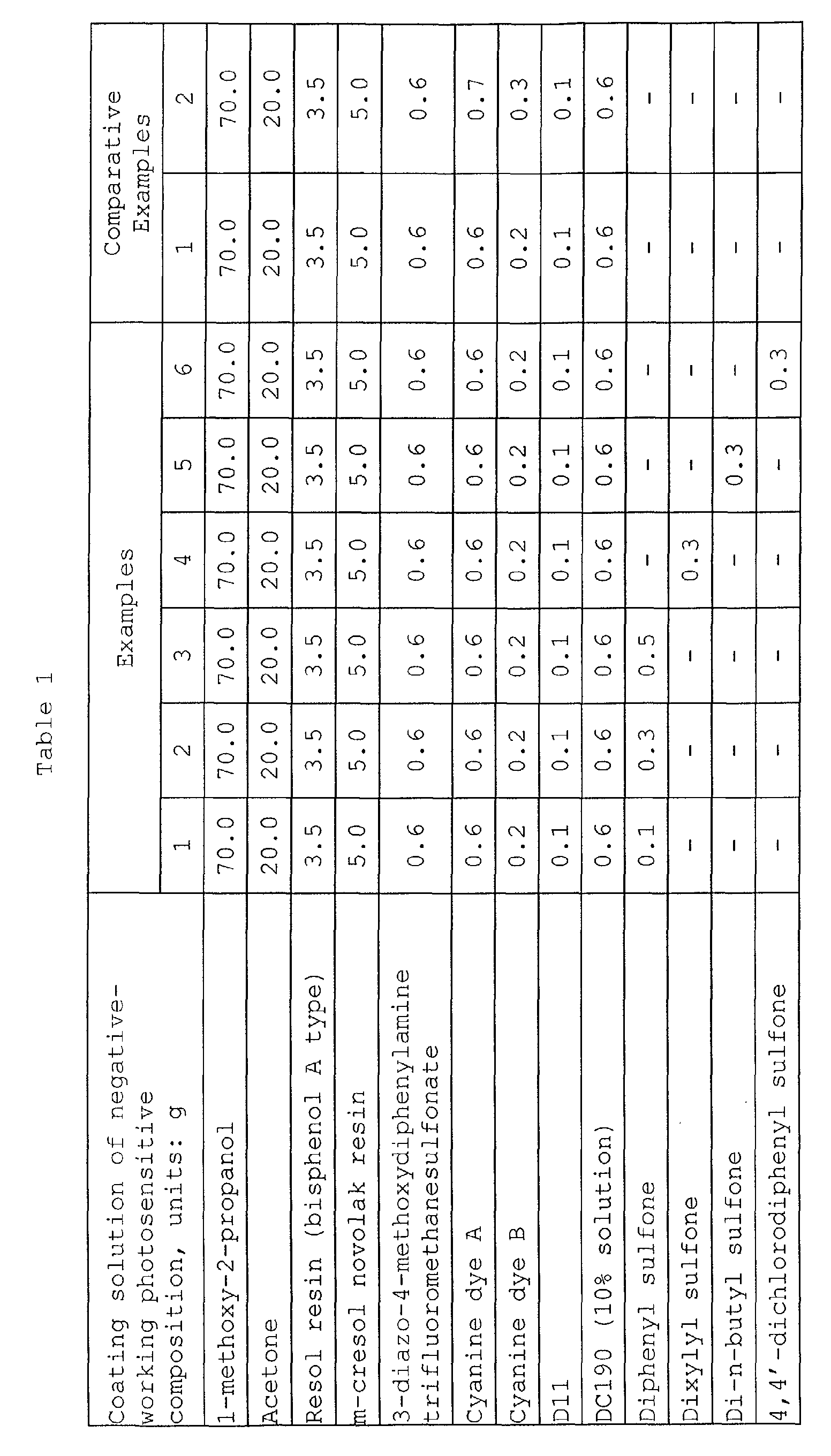
- the coating solution of the negative-working photosensitive composition was applied using a roll coater and dried at 100°C for 2 minutes to obtain a negative-working photosensitive lithographic printing plate.
- the weight of the dry coating film was 1.5 g/m 2 .
- the temperature range where the image can be formed could be widened by increasing the amount of an IR dye (photothermal converting agent (d)) (Comparative Example 2).
- an IR dye photothermal converting agent (d)
- ablation a dust scattering phenomenon
- this ablation constitutes a cause for the staining of a laser optical system.
- the temperature range where the image can be formed was widened, while the amount of ablation did not change.
Landscapes
- Chemical & Material Sciences (AREA)
- Engineering & Computer Science (AREA)
- Organic Chemistry (AREA)
- Life Sciences & Earth Sciences (AREA)
- Materials Engineering (AREA)
- Wood Science & Technology (AREA)
- Thermal Sciences (AREA)
- Optics & Photonics (AREA)
- Physics & Mathematics (AREA)
- Manufacturing & Machinery (AREA)
- Health & Medical Sciences (AREA)
- Chemical Kinetics & Catalysis (AREA)
- Medicinal Chemistry (AREA)
- Polymers & Plastics (AREA)
- Photosensitive Polymer And Photoresist Processing (AREA)
- Materials For Photolithography (AREA)
Abstract
Description


Claims (10)
- A negative-working photosensitive composition comprising (a) an alkali-soluble resin, (b) a compound capable of being crosslinked by an acid, (c) a compound capable of generating an acid by heat, (d) a photothermal converting agent, and (e) a sulfone compound represented by the following general formula (I) :
- A negative-working photosensitive composition according to claim 1, wherein the sulfone compound (e) is selected from the group consisting of diphenyl sulfone, dixylyl sulfone, 4,4'-dichlorodiphenyl sulfone, di-n-butyl sulfone, and 2-pyridyltribromomethyl sulfone.
- A negative-working photosensitive composition according to claim 1, wherein the amount of the sulfone compound (e) is within a range from 0.01 to 50% by weight with respect to the solid content of the negative-working photosensitive composition.
- A negative-working photosensitive composition according to claim 1, wherein the alkali-soluble resin (a) is selected from the group consisting of novolak resins, polyhydroxystyrene, acrylic resins containing one or more kinds of monomers having an acidic group, and active methylene group-containing resins.
- A negative-working photosensitive composition according to claim 4, wherein the alkaline-soluble resin (a) is a novolak resin.
- A negative-working photosensitive composition according to claim 1, wherein the compound (b) capable of being crosslinked by an acid is selected from the group consisting of melamine derivatives, urea resin derivatives, and resol resins.
- A negative-working photosensitive composition according to claim 1, wherein the compound (c) capable of generating an acid by heat is selected from the group consisting of onium salts, organohalogen compounds, photo acid generating agents having an o-nitrobenzyl protective group, and disulfone compounds.
- A negative-working photosensitive composition according to claim 7, wherein the compound (c) capable of generating an acid by heat is a trihaloalkyl compound or a diazonium salt.
- A negative-working photosensitive composition according to claim 1, wherein the photothermal converting agent (d) is a dye which absorbs light within a near infrared or infrared range, the dye being selected from the group consisting of cyanine dyes, methine dyes, naphthloquinone dyes, and squarilium pigments.
- A negative-working photosensitive lithographic printing plate comprising a substrate and a photosensitive layer made of the negative-working photosensitive composition of claim 1 formed on the surface of the substrate.
Applications Claiming Priority (2)
| Application Number | Priority Date | Filing Date | Title |
|---|---|---|---|
| JP2001150669A JP2002341536A (en) | 2001-05-21 | 2001-05-21 | Negative photosensitive composition and negative photosensitive lithographic printing plate |
| JP2001150669 | 2001-05-21 |
Publications (3)
| Publication Number | Publication Date |
|---|---|
| EP1262319A2 true EP1262319A2 (en) | 2002-12-04 |
| EP1262319A3 EP1262319A3 (en) | 2003-01-29 |
| EP1262319B1 EP1262319B1 (en) | 2004-07-07 |
Family
ID=18995651
Family Applications (1)
| Application Number | Title | Priority Date | Filing Date |
|---|---|---|---|
| EP02253515A Expired - Lifetime EP1262319B1 (en) | 2001-05-21 | 2002-05-20 | Negative-working photosensitive composition and negative-working photosensitive lithographic printing plate |
Country Status (4)
| Country | Link |
|---|---|
| US (1) | US6808857B2 (en) |
| EP (1) | EP1262319B1 (en) |
| JP (1) | JP2002341536A (en) |
| DE (1) | DE60200706T2 (en) |
Families Citing this family (22)
| Publication number | Priority date | Publication date | Assignee | Title |
|---|---|---|---|---|
| JP4085006B2 (en) | 2003-01-14 | 2008-04-30 | 富士フイルム株式会社 | Master for lithographic printing plate |
| EP1649322A4 (en) * | 2003-07-17 | 2007-09-19 | Honeywell Int Inc | PLANARIZATION FILMS FOR ADVANCED MICROELECTRONIC DEVICES AND APPLICATIONS AND METHODS FOR PRODUCING SAID FILMS |
| WO2005101126A1 (en) * | 2004-04-13 | 2005-10-27 | Kodak Polychrome Graphics Japan Ltd. | Negative photosensitive composition and negative photosensitive lithographic printing plate |
| US8198010B2 (en) * | 2007-11-09 | 2012-06-12 | Presstek, Inc. | Lithographic imaging with printing members having hydrophilic, surfactant-containing top layers |
| US8512800B2 (en) * | 2007-12-04 | 2013-08-20 | Triquint Semiconductor, Inc. | Optimal acoustic impedance materials for polished substrate coating to suppress passband ripple in BAW resonators and filters |
| US20100227269A1 (en) | 2009-03-04 | 2010-09-09 | Simpson Christopher D | Imageable elements with colorants |
| US8900798B2 (en) | 2010-10-18 | 2014-12-02 | Eastman Kodak Company | On-press developable lithographic printing plate precursors |
| US20120090486A1 (en) | 2010-10-18 | 2012-04-19 | Celin Savariar-Hauck | Lithographic printing plate precursors and methods of use |
| US20120141941A1 (en) | 2010-12-03 | 2012-06-07 | Mathias Jarek | Developing lithographic printing plate precursors in simple manner |
| US20120141942A1 (en) | 2010-12-03 | 2012-06-07 | Domenico Balbinot | Method of preparing lithographic printing plates |
| US20120141935A1 (en) | 2010-12-03 | 2012-06-07 | Bernd Strehmel | Developer and its use to prepare lithographic printing plates |
| US20120199028A1 (en) | 2011-02-08 | 2012-08-09 | Mathias Jarek | Preparing lithographic printing plates |
| US8632940B2 (en) | 2011-04-19 | 2014-01-21 | Eastman Kodak Company | Aluminum substrates and lithographic printing plate precursors |
| US8722308B2 (en) | 2011-08-31 | 2014-05-13 | Eastman Kodak Company | Aluminum substrates and lithographic printing plate precursors |
| US9029063B2 (en) | 2011-09-22 | 2015-05-12 | Eastman Kodak Company | Negative-working lithographic printing plate precursors |
| US8632941B2 (en) | 2011-09-22 | 2014-01-21 | Eastman Kodak Company | Negative-working lithographic printing plate precursors with IR dyes |
| US8679726B2 (en) | 2012-05-29 | 2014-03-25 | Eastman Kodak Company | Negative-working lithographic printing plate precursors |
| US8927197B2 (en) | 2012-11-16 | 2015-01-06 | Eastman Kodak Company | Negative-working lithographic printing plate precursors |
| US9063423B2 (en) | 2013-02-28 | 2015-06-23 | Eastman Kodak Company | Lithographic printing plate precursors and use |
| US9201302B2 (en) | 2013-10-03 | 2015-12-01 | Eastman Kodak Company | Negative-working lithographic printing plate precursor |
| CN108227384A (en) * | 2016-12-14 | 2018-06-29 | 乐凯华光印刷科技有限公司 | Negative type heat-sensitive CTP plate precursor with double-layer structure |
| US11633948B2 (en) | 2020-01-22 | 2023-04-25 | Eastman Kodak Company | Method for making lithographic printing plates |
Family Cites Families (59)
| Publication number | Priority date | Publication date | Assignee | Title |
|---|---|---|---|---|
| GB434875A (en) | 1933-02-08 | 1935-09-05 | Bela Gasper | An improved method of producing multi-colour photographic images on coloured and differently sensitized multi-layer photographic material |
| BE540601A (en) | 1950-12-06 | |||
| US2946638A (en) | 1959-03-31 | 1960-07-26 | Acme Visible Records Inc | Slidable shelf arrangement |
| BE606888A (en) | 1960-08-05 | 1900-01-01 | ||
| US3247791A (en) | 1960-05-06 | 1966-04-26 | Litho Chemical And Supply Co I | Surface treated lithographic plates and production thereof |
| US3307951A (en) | 1963-02-01 | 1967-03-07 | Lithoplate Inc | Lithographic plate |
| US3181461A (en) | 1963-05-23 | 1965-05-04 | Howard A Fromson | Photographic plate |
| DE1299661B (en) | 1964-02-27 | 1969-07-24 | Eastman Kodak Co | Process for improving the hydrophilic properties of the carrier of printing plates suitable for planographic printing processes |
| DE1546786C3 (en) | 1965-06-03 | 1973-12-13 | Kalle Ag, 6202 Wiesbaden-Biebrich | Method and material for the manufacture of planographic printing plates |
| ZA6807938B (en) | 1967-12-04 | |||
| US3658662A (en) | 1969-01-21 | 1972-04-25 | Durolith Corp | Corrosion resistant metallic plates particularly useful as support members for photo-lithographic plates and the like |
| US3881924A (en) | 1971-08-25 | 1975-05-06 | Matsushita Electric Industrial Co Ltd | Organic photoconductive layer sensitized with trimethine compound |
| US4212970A (en) | 1977-11-28 | 1980-07-15 | Fuji Photo Film Co., Ltd. | 2-Halomethyl-5-vinyl-1,3,4-oxadiazole compounds |
| JPS5928328B2 (en) | 1977-11-29 | 1984-07-12 | 富士写真フイルム株式会社 | Photopolymerizable composition |
| US4283475A (en) | 1979-08-21 | 1981-08-11 | Fuji Photo Film Co., Ltd. | Pentamethine thiopyrylium salts, process for production thereof, and photoconductive compositions containing said salts |
| US4327169A (en) | 1981-01-19 | 1982-04-27 | Eastman Kodak Company | Infrared sensitive photoconductive composition, elements and imaging method using trimethine thiopyrylium dye |
| JPS5816839A (en) | 1981-07-24 | 1983-01-31 | Sumitomo Rubber Ind Ltd | Method of vulcanizing elastomer product |
| DE3126626A1 (en) | 1981-07-06 | 1983-01-20 | Hoechst Ag, 6000 Frankfurt | HYDROPHILIZED CARRIER MATERIALS FOR OFFSET PRINTING PLATES, A METHOD FOR THEIR PRODUCTION AND THEIR USE |
| JPS58112792A (en) | 1981-12-28 | 1983-07-05 | Ricoh Co Ltd | Optical information recording medium |
| JPS58112793A (en) | 1981-12-28 | 1983-07-05 | Ricoh Co Ltd | Optical information recording member |
| JPS58125246A (en) | 1982-01-22 | 1983-07-26 | Ricoh Co Ltd | Laser recording medium |
| JPS58220143A (en) | 1982-06-16 | 1983-12-21 | Canon Inc | Organic film |
| JPS58181690A (en) | 1982-04-19 | 1983-10-24 | Canon Inc | Optical recording medium |
| JPS58173696A (en) | 1982-04-06 | 1983-10-12 | Canon Inc | Optical recording medium |
| JPS58181051A (en) | 1982-04-19 | 1983-10-22 | Canon Inc | Organic photoconductor |
| JPS58194595A (en) | 1982-05-10 | 1983-11-12 | Canon Inc | optical recording medium |
| JPS58224793A (en) | 1982-06-25 | 1983-12-27 | Nec Corp | Optical recording medium |
| JPS5948187A (en) | 1982-09-10 | 1984-03-19 | Nec Corp | Photo recording medium |
| JPS5973996A (en) | 1982-10-22 | 1984-04-26 | Nec Corp | Optical recording medium |
| JPS5984356A (en) | 1982-11-05 | 1984-05-16 | Ricoh Co Ltd | How to create an optical disc master |
| JPS59101651A (en) | 1982-12-02 | 1984-06-12 | Fuji Photo Film Co Ltd | Photosensitive lithographic printing plate |
| JPS59146063A (en) | 1983-02-09 | 1984-08-21 | Canon Inc | Organic film |
| JPS59146061A (en) | 1983-02-09 | 1984-08-21 | Canon Inc | Organic film |
| JPS59202829A (en) | 1983-05-04 | 1984-11-16 | Sanpo Gokin Kogyo Kk | Mold for injection molding synthetic resin product |
| JPS59216146A (en) | 1983-05-24 | 1984-12-06 | Sony Corp | Electrophotographic sensitive material |
| JPS6063744A (en) | 1983-08-23 | 1985-04-12 | Nec Corp | Optical information recording medium |
| JPS6052940A (en) | 1983-09-02 | 1985-03-26 | Nec Corp | Optical recording medium |
| JPS6064352A (en) | 1983-09-19 | 1985-04-12 | Fuji Photo Film Co Ltd | Manufacture of negative type photosensitive lithographic plate |
| JPS6078787A (en) | 1983-10-07 | 1985-05-04 | Ricoh Co Ltd | Optical information recording medium |
| JPH0721626B2 (en) | 1985-08-10 | 1995-03-08 | 日本合成ゴム株式会社 | Resist composition for semiconductor fine processing |
| JPS6259963A (en) | 1985-09-10 | 1987-03-16 | Fuji Photo Film Co Ltd | Electrophotographic sensitive material |
| JPS6256971A (en) | 1985-09-05 | 1987-03-12 | Fuji Photo Film Co Ltd | Electrophotographic sensitive material |
| US4756993A (en) | 1986-01-27 | 1988-07-12 | Fuji Photo Film Co., Ltd. | Electrophotographic photoreceptor with light scattering layer or light absorbing layer on support backside |
| JPH06105351B2 (en) | 1986-03-27 | 1994-12-21 | 富士写真フイルム株式会社 | Photosensitive composition |
| JPH0654382B2 (en) | 1986-11-18 | 1994-07-20 | 富士写真フイルム株式会社 | Photosensitive composition |
| JPH0727208B2 (en) | 1987-04-20 | 1995-03-29 | 富士写真フイルム株式会社 | Photosensitive composition |
| EP0291779B1 (en) | 1987-05-18 | 1994-07-27 | Siemens Aktiengesellschaft | Heat-resistant positive resist, and process for the production of heat-resistant resist patterns |
| JP2598977B2 (en) | 1988-09-14 | 1997-04-09 | 富士写真フイルム株式会社 | Photosensitive composition |
| US5156938A (en) | 1989-03-30 | 1992-10-20 | Graphics Technology International, Inc. | Ablation-transfer imaging/recording |
| EP0458325B1 (en) | 1990-05-25 | 1998-08-19 | Mitsubishi Chemical Corporation | Negative photosensitive composition and method for forming a resist pattern |
| DE4112965A1 (en) | 1991-04-20 | 1992-10-22 | Hoechst Ag | NEGATIVE WORKING RADIATION-SENSITIVE MIXTURE AND RADIATION-SENSITIVE RECORDING MATERIAL THEREFOR |
| JP3318022B2 (en) | 1993-02-09 | 2002-08-26 | コダックポリクロームグラフィックス株式会社 | Method for producing photosensitive resin composition and lithographic printing plate |
| US5340699A (en) | 1993-05-19 | 1994-08-23 | Eastman Kodak Company | Radiation-sensitive composition containing a resole resin and a novolac resin and use thereof in lithographic printing plates |
| JP3583217B2 (en) | 1995-04-11 | 2004-11-04 | コダックポリクロームグラフィックス株式会社 | Photosensitive composition and photosensitive lithographic printing plate |
| EP1258369B1 (en) | 1997-10-17 | 2005-03-30 | Fuji Photo Film Co., Ltd. | A positive type photosensitive image-forming material for an infrared laser and a positive type photosensitive composition for an infrared laser |
| JP3426531B2 (en) * | 1998-10-30 | 2003-07-14 | 日立化成デュポンマイクロシステムズ株式会社 | Photosensitive polymer composition, method for producing relief pattern, and electronic component |
| JP4161497B2 (en) * | 1999-12-24 | 2008-10-08 | Jsr株式会社 | Negative radiation sensitive resin composition |
| US6806020B2 (en) | 2001-08-21 | 2004-10-19 | Kodak Polychrome Graphics Llc | Negative working imageable composition containing sulfonic acid |
| US6921620B2 (en) | 2001-08-21 | 2005-07-26 | Kodak Polychrome Graphics Llc | Imageable composition containing colorant having a counter anion derived from a non-volatile acid |
-
2001
- 2001-05-21 JP JP2001150669A patent/JP2002341536A/en active Pending
-
2002
- 2002-05-20 EP EP02253515A patent/EP1262319B1/en not_active Expired - Lifetime
- 2002-05-20 US US10/151,199 patent/US6808857B2/en not_active Expired - Fee Related
- 2002-05-20 DE DE60200706T patent/DE60200706T2/en not_active Expired - Lifetime
Also Published As
| Publication number | Publication date |
|---|---|
| EP1262319A3 (en) | 2003-01-29 |
| US20030087177A1 (en) | 2003-05-08 |
| EP1262319B1 (en) | 2004-07-07 |
| US6808857B2 (en) | 2004-10-26 |
| DE60200706D1 (en) | 2004-08-12 |
| DE60200706T2 (en) | 2005-07-14 |
| JP2002341536A (en) | 2002-11-27 |
Similar Documents
| Publication | Publication Date | Title |
|---|---|---|
| EP1262319B1 (en) | Negative-working photosensitive composition and negative-working photosensitive lithographic printing plate | |
| JP3461377B2 (en) | Image recording material | |
| US6749984B2 (en) | Planographic printing plate precursor | |
| US20030219673A1 (en) | Selected acid generating agents and their use in processes for imaging radiation-sensitive elements | |
| JP4122189B2 (en) | Negative photosensitive composition and negative photosensitive lithographic printing plate | |
| DE602005003072T2 (en) | Lithographic printing plate precursor | |
| EP1554117A1 (en) | Heat-sensitive lithographic printing plate precursor | |
| US6214518B1 (en) | Negative type image recording material and method of plate-making using the same | |
| US6436596B1 (en) | Quality control method for a planographic printing plate | |
| JP2008197566A (en) | Planographic printing plate precursor | |
| JP4171254B2 (en) | Resin composition | |
| JP2001183816A (en) | Negative thermosensitive lithographic printing original plate | |
| JP2005181734A (en) | Image recording material | |
| EP1806620A1 (en) | Matte agent for infrared-sensitive planographic printing plate and use thereof | |
| JP4238152B2 (en) | Photosensitive composition | |
| JP2005215651A (en) | Method for manufacturing lithographic printing plate | |
| JP4404734B2 (en) | Planographic printing plate precursor | |
| JP4437960B2 (en) | Image forming material | |
| JP4404792B2 (en) | Planographic printing plate precursor | |
| JP4328172B2 (en) | Photosensitive composition and method for producing positive planographic printing plate precursor using the same | |
| EP1180728A2 (en) | Quality control method for planographic printing plate | |
| EP1475231B1 (en) | Quality control method for planographic printing plate | |
| JP4315535B2 (en) | Quality control method for lithographic printing plates | |
| JP2005004053A (en) | Photosensitive composition | |
| JP2006091765A (en) | Original plate of planographic printing plate |
Legal Events
| Date | Code | Title | Description |
|---|---|---|---|
| PUAI | Public reference made under article 153(3) epc to a published international application that has entered the european phase |
Free format text: ORIGINAL CODE: 0009012 |
|
| AK | Designated contracting states |
Kind code of ref document: A2 Designated state(s): AT BE CH CY DE DK ES FI FR GB GR IE IT LI LU MC NL PT SE TR |
|
| AX | Request for extension of the european patent |
Free format text: AL;LT;LV;MK;RO;SI |
|
| PUAL | Search report despatched |
Free format text: ORIGINAL CODE: 0009013 |
|
| AK | Designated contracting states |
Designated state(s): AT BE CH CY DE DK ES FI FR GB GR IE IT LI LU MC NL PT SE TR |
|
| AX | Request for extension of the european patent |
Extension state: AL LT LV MK RO SI |
|
| RIN1 | Information on inventor provided before grant (corrected) |
Inventor name: MIYAMOTO, YASUSHI Inventor name: HAYAKAWA, EIJI |
|
| 17P | Request for examination filed |
Effective date: 20030404 |
|
| 17Q | First examination report despatched |
Effective date: 20030519 |
|
| AKX | Designation fees paid |
Designated state(s): DE FR GB IT |
|
| GRAP | Despatch of communication of intention to grant a patent |
Free format text: ORIGINAL CODE: EPIDOSNIGR1 |
|
| GRAS | Grant fee paid |
Free format text: ORIGINAL CODE: EPIDOSNIGR3 |
|
| GRAA | (expected) grant |
Free format text: ORIGINAL CODE: 0009210 |
|
| AK | Designated contracting states |
Kind code of ref document: B1 Designated state(s): DE FR GB IT |
|
| PG25 | Lapsed in a contracting state [announced via postgrant information from national office to epo] |
Ref country code: IT Free format text: LAPSE BECAUSE OF FAILURE TO SUBMIT A TRANSLATION OF THE DESCRIPTION OR TO PAY THE FEE WITHIN THE PRESCRIBED TIME-LIMIT;WARNING: LAPSES OF ITALIAN PATENTS WITH EFFECTIVE DATE BEFORE 2007 MAY HAVE OCCURRED AT ANY TIME BEFORE 2007. THE CORRECT EFFECTIVE DATE MAY BE DIFFERENT FROM THE ONE RECORDED. Effective date: 20040707 Ref country code: FR Free format text: LAPSE BECAUSE OF FAILURE TO SUBMIT A TRANSLATION OF THE DESCRIPTION OR TO PAY THE FEE WITHIN THE PRESCRIBED TIME-LIMIT Effective date: 20040707 |
|
| REG | Reference to a national code |
Ref country code: GB Ref legal event code: FG4D |
|
| REG | Reference to a national code |
Ref country code: IE Ref legal event code: FG4D |
|
| REF | Corresponds to: |
Ref document number: 60200706 Country of ref document: DE Date of ref document: 20040812 Kind code of ref document: P |
|
| PLBE | No opposition filed within time limit |
Free format text: ORIGINAL CODE: 0009261 |
|
| STAA | Information on the status of an ep patent application or granted ep patent |
Free format text: STATUS: NO OPPOSITION FILED WITHIN TIME LIMIT |
|
| RAP2 | Party data changed (patent owner data changed or rights of a patent transferred) |
Owner name: KODAK POLYCHROME GRAPHICS COMPANY LTD. |
|
| 26N | No opposition filed |
Effective date: 20050408 |
|
| EN | Fr: translation not filed | ||
| PGFP | Annual fee paid to national office [announced via postgrant information from national office to epo] |
Ref country code: GB Payment date: 20080407 Year of fee payment: 7 |
|
| GBPC | Gb: european patent ceased through non-payment of renewal fee |
Effective date: 20090520 |
|
| PG25 | Lapsed in a contracting state [announced via postgrant information from national office to epo] |
Ref country code: GB Free format text: LAPSE BECAUSE OF NON-PAYMENT OF DUE FEES Effective date: 20090520 |
|
| PGFP | Annual fee paid to national office [announced via postgrant information from national office to epo] |
Ref country code: DE Payment date: 20130531 Year of fee payment: 12 |
|
| REG | Reference to a national code |
Ref country code: DE Ref legal event code: R119 Ref document number: 60200706 Country of ref document: DE |
|
| REG | Reference to a national code |
Ref country code: DE Ref legal event code: R119 Ref document number: 60200706 Country of ref document: DE Effective date: 20141202 |
|
| PG25 | Lapsed in a contracting state [announced via postgrant information from national office to epo] |
Ref country code: DE Free format text: LAPSE BECAUSE OF NON-PAYMENT OF DUE FEES Effective date: 20141202 |