EP1261052A2 - Dichtung - Google Patents
Dichtung Download PDFInfo
- Publication number
- EP1261052A2 EP1261052A2 EP02011021A EP02011021A EP1261052A2 EP 1261052 A2 EP1261052 A2 EP 1261052A2 EP 02011021 A EP02011021 A EP 02011021A EP 02011021 A EP02011021 A EP 02011021A EP 1261052 A2 EP1261052 A2 EP 1261052A2
- Authority
- EP
- European Patent Office
- Prior art keywords
- component
- seal
- fuel cell
- components
- seal according
- Prior art date
- Legal status (The legal status is an assumption and is not a legal conclusion. Google has not performed a legal analysis and makes no representation as to the accuracy of the status listed.)
- Granted
Links
- 238000007789 sealing Methods 0.000 title description 10
- 239000000446 fuel Substances 0.000 claims abstract description 85
- 239000000463 material Substances 0.000 claims abstract description 17
- RYGMFSIKBFXOCR-UHFFFAOYSA-N Copper Chemical compound [Cu] RYGMFSIKBFXOCR-UHFFFAOYSA-N 0.000 claims abstract description 15
- 229910052709 silver Inorganic materials 0.000 claims abstract description 13
- 239000010949 copper Substances 0.000 claims abstract description 12
- 229910052802 copper Inorganic materials 0.000 claims abstract description 10
- 239000004332 silver Substances 0.000 claims abstract description 10
- 239000012777 electrically insulating material Substances 0.000 claims abstract description 5
- 229910052573 porcelain Inorganic materials 0.000 claims abstract description 4
- 238000000576 coating method Methods 0.000 claims description 22
- 229910001092 metal group alloy Inorganic materials 0.000 claims description 13
- 229910052751 metal Inorganic materials 0.000 claims description 8
- 239000002184 metal Substances 0.000 claims description 8
- 239000007788 liquid Substances 0.000 claims description 7
- 229910010293 ceramic material Inorganic materials 0.000 claims description 6
- 238000000034 method Methods 0.000 claims description 4
- 239000000843 powder Substances 0.000 claims description 4
- 238000010285 flame spraying Methods 0.000 claims description 3
- 229910018072 Al 2 O 3 Inorganic materials 0.000 claims description 2
- 239000000919 ceramic Substances 0.000 claims description 2
- 239000004020 conductor Substances 0.000 claims description 2
- 238000005507 spraying Methods 0.000 claims description 2
- 239000007787 solid Substances 0.000 claims 1
- 239000012530 fluid Substances 0.000 abstract description 35
- BQCADISMDOOEFD-UHFFFAOYSA-N Silver Chemical compound [Ag] BQCADISMDOOEFD-UHFFFAOYSA-N 0.000 abstract description 10
- 229910001316 Ag alloy Inorganic materials 0.000 abstract description 3
- 229910000881 Cu alloy Inorganic materials 0.000 abstract description 2
- 239000002131 composite material Substances 0.000 abstract 2
- PNEYBMLMFCGWSK-UHFFFAOYSA-N aluminium oxide Inorganic materials [O-2].[O-2].[O-2].[Al+3].[Al+3] PNEYBMLMFCGWSK-UHFFFAOYSA-N 0.000 abstract 1
- 229910052593 corundum Inorganic materials 0.000 abstract 1
- 229910001845 yogo sapphire Inorganic materials 0.000 abstract 1
- 239000007789 gas Substances 0.000 description 39
- 239000002737 fuel gas Substances 0.000 description 35
- 239000011248 coating agent Substances 0.000 description 19
- 239000007800 oxidant agent Substances 0.000 description 18
- 239000003792 electrolyte Substances 0.000 description 10
- 230000001590 oxidative effect Effects 0.000 description 9
- 238000010292 electrical insulation Methods 0.000 description 7
- 230000000694 effects Effects 0.000 description 6
- 229910000679 solder Inorganic materials 0.000 description 6
- PXHVJJICTQNCMI-UHFFFAOYSA-N Nickel Chemical compound [Ni] PXHVJJICTQNCMI-UHFFFAOYSA-N 0.000 description 4
- 238000005452 bending Methods 0.000 description 4
- 229910052738 indium Inorganic materials 0.000 description 4
- APFVFJFRJDLVQX-UHFFFAOYSA-N indium atom Chemical compound [In] APFVFJFRJDLVQX-UHFFFAOYSA-N 0.000 description 4
- 238000002844 melting Methods 0.000 description 4
- 230000008018 melting Effects 0.000 description 4
- VNWKTOKETHGBQD-UHFFFAOYSA-N methane Chemical compound C VNWKTOKETHGBQD-UHFFFAOYSA-N 0.000 description 4
- 239000000203 mixture Substances 0.000 description 4
- 239000004215 Carbon black (E152) Substances 0.000 description 3
- MYMOFIZGZYHOMD-UHFFFAOYSA-N Dioxygen Chemical compound O=O MYMOFIZGZYHOMD-UHFFFAOYSA-N 0.000 description 3
- 230000002349 favourable effect Effects 0.000 description 3
- 238000010438 heat treatment Methods 0.000 description 3
- 229930195733 hydrocarbon Natural products 0.000 description 3
- 150000002430 hydrocarbons Chemical class 0.000 description 3
- 239000001301 oxygen Substances 0.000 description 3
- 229910052760 oxygen Inorganic materials 0.000 description 3
- -1 oxygen ions Chemical class 0.000 description 3
- UFHFLCQGNIYNRP-UHFFFAOYSA-N Hydrogen Chemical compound [H][H] UFHFLCQGNIYNRP-UHFFFAOYSA-N 0.000 description 2
- HCHKCACWOHOZIP-UHFFFAOYSA-N Zinc Chemical compound [Zn] HCHKCACWOHOZIP-UHFFFAOYSA-N 0.000 description 2
- 238000006243 chemical reaction Methods 0.000 description 2
- 239000001257 hydrogen Substances 0.000 description 2
- 229910052739 hydrogen Inorganic materials 0.000 description 2
- 238000009413 insulation Methods 0.000 description 2
- 238000004519 manufacturing process Methods 0.000 description 2
- 229910052759 nickel Inorganic materials 0.000 description 2
- QPLDLSVMHZLSFG-UHFFFAOYSA-N Copper oxide Chemical compound [Cu]=O QPLDLSVMHZLSFG-UHFFFAOYSA-N 0.000 description 1
- 239000005751 Copper oxide Substances 0.000 description 1
- 229910045601 alloy Inorganic materials 0.000 description 1
- 239000000956 alloy Substances 0.000 description 1
- 239000010953 base metal Substances 0.000 description 1
- 238000005524 ceramic coating Methods 0.000 description 1
- 239000000567 combustion gas Substances 0.000 description 1
- 230000000052 comparative effect Effects 0.000 description 1
- 229910000431 copper oxide Inorganic materials 0.000 description 1
- YCKOAAUKSGOOJH-UHFFFAOYSA-N copper silver Chemical compound [Cu].[Ag].[Ag] YCKOAAUKSGOOJH-UHFFFAOYSA-N 0.000 description 1
- 238000005520 cutting process Methods 0.000 description 1
- 230000002950 deficient Effects 0.000 description 1
- 238000004049 embossing Methods 0.000 description 1
- 239000003502 gasoline Substances 0.000 description 1
- 238000002955 isolation Methods 0.000 description 1
- 239000011344 liquid material Substances 0.000 description 1
- 239000007791 liquid phase Substances 0.000 description 1
- 239000000155 melt Substances 0.000 description 1
- 239000007769 metal material Substances 0.000 description 1
- 239000010445 mica Substances 0.000 description 1
- 229910052618 mica group Inorganic materials 0.000 description 1
- 239000003345 natural gas Substances 0.000 description 1
- 230000003647 oxidation Effects 0.000 description 1
- 238000007254 oxidation reaction Methods 0.000 description 1
- TWNQGVIAIRXVLR-UHFFFAOYSA-N oxo(oxoalumanyloxy)alumane Chemical group O=[Al]O[Al]=O TWNQGVIAIRXVLR-UHFFFAOYSA-N 0.000 description 1
- 230000002093 peripheral effect Effects 0.000 description 1
- 238000003825 pressing Methods 0.000 description 1
- 238000004080 punching Methods 0.000 description 1
- 238000001953 recrystallisation Methods 0.000 description 1
- 238000000926 separation method Methods 0.000 description 1
- 238000005476 soldering Methods 0.000 description 1
- 239000007784 solid electrolyte Substances 0.000 description 1
- 239000007790 solid phase Substances 0.000 description 1
- 239000007921 spray Substances 0.000 description 1
- XLYOFNOQVPJJNP-UHFFFAOYSA-N water Substances O XLYOFNOQVPJJNP-UHFFFAOYSA-N 0.000 description 1
- 238000003466 welding Methods 0.000 description 1
- 229910052725 zinc Inorganic materials 0.000 description 1
- 239000011701 zinc Substances 0.000 description 1
Images



Classifications
-
- H—ELECTRICITY
- H01—ELECTRIC ELEMENTS
- H01M—PROCESSES OR MEANS, e.g. BATTERIES, FOR THE DIRECT CONVERSION OF CHEMICAL ENERGY INTO ELECTRICAL ENERGY
- H01M8/00—Fuel cells; Manufacture thereof
- H01M8/02—Details
- H01M8/0271—Sealing or supporting means around electrodes, matrices or membranes
- H01M8/028—Sealing means characterised by their material
- H01M8/0282—Inorganic material
-
- H—ELECTRICITY
- H01—ELECTRIC ELEMENTS
- H01M—PROCESSES OR MEANS, e.g. BATTERIES, FOR THE DIRECT CONVERSION OF CHEMICAL ENERGY INTO ELECTRICAL ENERGY
- H01M8/00—Fuel cells; Manufacture thereof
- H01M8/24—Grouping of fuel cells, e.g. stacking of fuel cells
- H01M8/241—Grouping of fuel cells, e.g. stacking of fuel cells with solid or matrix-supported electrolytes
- H01M8/242—Grouping of fuel cells, e.g. stacking of fuel cells with solid or matrix-supported electrolytes comprising framed electrodes or intermediary frame-like gaskets
-
- H—ELECTRICITY
- H01—ELECTRIC ELEMENTS
- H01M—PROCESSES OR MEANS, e.g. BATTERIES, FOR THE DIRECT CONVERSION OF CHEMICAL ENERGY INTO ELECTRICAL ENERGY
- H01M8/00—Fuel cells; Manufacture thereof
- H01M8/02—Details
- H01M8/0271—Sealing or supporting means around electrodes, matrices or membranes
-
- H—ELECTRICITY
- H01—ELECTRIC ELEMENTS
- H01M—PROCESSES OR MEANS, e.g. BATTERIES, FOR THE DIRECT CONVERSION OF CHEMICAL ENERGY INTO ELECTRICAL ENERGY
- H01M8/00—Fuel cells; Manufacture thereof
- H01M8/02—Details
- H01M8/0271—Sealing or supporting means around electrodes, matrices or membranes
- H01M8/0286—Processes for forming seals
-
- H—ELECTRICITY
- H01—ELECTRIC ELEMENTS
- H01M—PROCESSES OR MEANS, e.g. BATTERIES, FOR THE DIRECT CONVERSION OF CHEMICAL ENERGY INTO ELECTRICAL ENERGY
- H01M8/00—Fuel cells; Manufacture thereof
- H01M8/24—Grouping of fuel cells, e.g. stacking of fuel cells
- H01M8/2465—Details of groupings of fuel cells
- H01M8/2483—Details of groupings of fuel cells characterised by internal manifolds
-
- Y—GENERAL TAGGING OF NEW TECHNOLOGICAL DEVELOPMENTS; GENERAL TAGGING OF CROSS-SECTIONAL TECHNOLOGIES SPANNING OVER SEVERAL SECTIONS OF THE IPC; TECHNICAL SUBJECTS COVERED BY FORMER USPC CROSS-REFERENCE ART COLLECTIONS [XRACs] AND DIGESTS
- Y02—TECHNOLOGIES OR APPLICATIONS FOR MITIGATION OR ADAPTATION AGAINST CLIMATE CHANGE
- Y02E—REDUCTION OF GREENHOUSE GAS [GHG] EMISSIONS, RELATED TO ENERGY GENERATION, TRANSMISSION OR DISTRIBUTION
- Y02E60/00—Enabling technologies; Technologies with a potential or indirect contribution to GHG emissions mitigation
- Y02E60/30—Hydrogen technology
- Y02E60/50—Fuel cells
Definitions
- the present invention relates to a seal for arrangement between two to be sealed, electrically conductive components, especially between two Components of a fuel cell block assembly.
- Such a glass solder is described, for example, in EP 0 907 215 A1.
- the present invention is therefore based on the object of a seal to create the type mentioned, which even at high operating temperatures and sufficient fluid tightness over a long period of operation and has a sufficient electrical insulation effect.
- seal at least a first component made of an electrically insulating material and a second component made of a material that is at operating temperature the seal is at least partially liquid, the second Component in the operating state of the seal with at most one of the seals to be sealed Components in contact.
- the present invention is therefore based on the concept of electrical Isolation function and the fluid sealing function of the seal from each other separate.
- the first component of the seal which consists of an electrically insulating Material is formed for the electrical insulation of the two to be sealed Components
- the second component which consists of one at the Operating temperature of the seal at least partially liquid material is formed, the residual sealing gap not covered by the first component sealed fluid-tight between the components to be sealed and thus for the required fluid tightness of the seal ensures.
- this second component is at least partially liquid at the operating temperature of the seal, can adapt the shape of the second component so that the residual sealing gap is reliably covered even if it is due to its shape of incompatibilities in the coefficient of thermal expansion of the seals Components and / or the sealing components and / or due to of relative movements of the two components to be sealed (for example due to vibrations) changes.
- the second component can in addition to at least the operating state of the seal a liquid phase also comprise at least one solid phase.
- the second component the seal comprises an electrically conductive material.
- the second component is a metal and / or a metallic alloy includes.
- the second component contains copper.
- the second component contains silver.
- the second component is a metallic alloy includes copper and silver.
- Such copper and silver alloys have a melting point that below the typical operating temperature of a high-temperature fuel cell lies, and are under the conditions of a high temperature fuel cell little reactive.
- the proportion of copper and silver in the second component taken together is at least 50% by weight.
- the material of the second component can be in the form of a powder and / or paste into the seal.
- the first component at the operating temperature the seal is essentially firm.
- the first component is a ceramic material includes. Such materials have a high temperature good dimensional stability and high electrical resistance.
- Such a ceramic material of the first component can in particular at least partially in the form of a green ceramic film on at least one of the components to be sealed.
- the first Component at least partially by a spray process, preferably by flame spraying, applied to at least one of the components to be sealed becomes.
- the first component is aluminum oxide and / or Porcelain covers.
- Reliable electrical separation of the second component from one of the two components to be sealed is achieved when the first component at least one of at least one of the two components to be sealed covering coating forms.
- Claim 17 is directed to a component group, the two to be sealed against each other electrically conductive components, preferably components of a fuel cell block assembly, and one arranged between the two components seal according to the invention comprises.
- the component group according to the invention is particularly suitable for use in a fuel cell block assembly, in particular a high temperature fuel cell block assembly.
- Such a high-temperature fuel cell block assembly comprises a plurality of high temperature fuel cell units that have an operating temperature up to 950 ° C and directly with one without an external reformer hydrocarbon-containing fuel gas, such as methane or natural gas or, alternatively, using an external reformer, with a diesel or gasoline fuel can be operated.
- an external reformer hydrocarbon-containing fuel gas such as methane or natural gas or, alternatively, using an external reformer, with a diesel or gasoline fuel
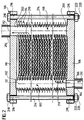
- a fuel cell device shown in FIGS. 1 to 8, designated as a whole by 100 comprises a substantially cuboid housing 102 (see FIG. 1) into which an oxidant supply line 104 opens, via the interior of the housing 102 an oxidizing agent, for example Air or pure oxygen.
- an oxidizing agent for example Air or pure oxygen.
- an oxidant discharge line 105 opens into the housing 102, through which excess oxidant from the interior of the housing 102 can be removed.
- Fuel cell block assembly 106 arranged, which has a lower end plate 108, an upper end plate 110 and a plurality between the lower end plate 108 and the upper end plate 110 arranged along a stacking direction 112 consecutive fuel cell units 114 comprises.
- Fuel cell units 114 includes each of the fuel cell units 114 a substantially plate-shaped cathode-anode-electrolyte unit 116 (hereinafter briefly: KAE unit), which is between a contact plate 118 and a fluid guide frame 120 is held.
- KAE unit substantially plate-shaped cathode-anode-electrolyte unit
- the KAE unit 116 comprises, as shown purely schematically in FIG. 3, one gas-permeable, electrically conductive carrier layer 121, which, for example, as Mesh can be formed from a metallic material through the mesh a fuel gas from a fuel gas space adjoining the carrier layer 121 124 can pass through.
- one gas-permeable, electrically conductive carrier layer 121 which, for example, as Mesh can be formed from a metallic material through the mesh a fuel gas from a fuel gas space adjoining the carrier layer 121 124 can pass through.
- the KAE unit 116 comprises one arranged on the carrier layer 121 plate-shaped anode 122 made of an electrically conductive ceramic material, which is porous to the fuel gas from the fuel gas chamber 124 Passes through the anode 122 to the electrolyte adjacent to the anode 122 126 to enable.
- a hydrocarbon-containing gas mixture or pure hydrogen can be used as the fuel gas be used.
- the electrolyte 126 is preferably designed as a solid electrolyte.
- an oxidizing agent for example air or pure oxygen
- the KAE unit 116 has each Fuel cell unit 114 has a temperature of, for example, approximately 800 ° C at which the electrolyte 126 is conductive for oxygen ions.
- the Oxidizing agent from the oxidizing agent space 130 takes on the anode 122 Electrons and gives divalent oxygen ions to the electrolyte 126 which migrate through the electrolyte 126 to the anode 122.
- On the anode 122 is the fuel gas from the fuel gas chamber 124 through the Oxygen ions from the electrolyte 126 oxidize and give electrons to the anode 122.
- the contact plates 118 are used for the reaction at the anode 122 to release released electrons from the anode 122 via the carrier layer 121 or the electrons required for the reaction at the cathode 128 to the cathode 128.
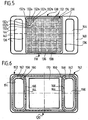
- each of the contact plates 118 consists of an electrically highly conductive Metal sheet (as best seen in Fig. 5) with a variety is provided by contact elements 132 which, for example, the shape of adjacent projections and depressions, each with a square Have a floor plan so that the contact elements 132 Formed contact field 134 of the contact plate 118 has the structure of one in two mutually perpendicular directions corrugated corrugated sheet.
- Each of the contact elements 132 has a central contact area 137, on which it is connected to an adjacent KAE unit 116 in an electrically conductive manner Contact is there.
- the cathode-side contact elements 132b of the contact plates 118 stand with the cathode 128 belonging to an adjacent fuel cell unit 114 KAE unit 116 in electrically conductive point contact, so that electrons can reach the cathode 128 from the contact plate 118.
- the contact plates 118 enable the charge balance between the anodes 122 and cathodes 128 along the stacking direction 112 successive KAE units 116.
- the contact plates arranged at the ends of the fuel cell block assembly 106 118 are connected to an external circuit to which the electrical charges arising from these peripheral contact plates 118 tap off.
- the wide side regions 140 of the flange region 136 each have one Through opening 144 on which the passage from the fuel cell units 114 fuel gas to be supplied or from the fuel cell units 114 allows exhaust gas to be removed.
- Each of the contact plates 118 is formed as a sheet metal part which is made of a substantially flat, substantially rectangular sheet metal layer Embossing and / or deep drawing as well as punching or cutting the Through openings 144 is formed.
- the fluid guide frames 120 are essentially made of a sheet metal part flat, essentially rectangular sheet metal layer is formed.
- each fluid guide frame 120 the through openings 144 in the contact plates at its end regions corresponding through openings, namely a fuel gas through opening 154 and an exhaust gas passage opening 156.
- each of the fluid guide frames 120 has between the through openings 154, 156 a substantially rectangular, central passage opening 170 for the passage of the contact elements 132 of the Contact plate 118 of an adjacent fuel cell unit 114.
- each of the through holes is 154, 156 in a fluid guide frame 120 from one along the stack 158 extending collar 158, one along a bending line 160 adjacent to the collar 158, perpendicular to the stacking direction 112 sealing contact area extending away from the through opening 162 and one on a bending line 164 to the seal support area 162 adjacent duct wall area aligned parallel to stack direction 112 166 surrounded.
- the sealing support area 162 of the fluid guide frame 120 is not continuously flat, but with a circumferential direction 234 around the respective through opening 154, 156 extending recess 244 with a bottom 246 and Sidewalls 248 provided, which by folding on additional bending lines 236, 238, 240 and 242 is formed.
- This depression 144 is also immersed from above in the circumferential direction 234 extending around the respective through opening 154, 156, a collar 250 aligned parallel to the stacking direction 112, which on the flange area 136 of the contact plate 118 by folding on a Bending line 252 is formed.
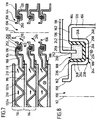
- the annular gas channel seal 188 has the structure shown in FIG. 8 and includes a coating 254 of an electrically insulating Material that, for example, at the operating temperature of the seal 800 ° C is dimensionally stable.
- This coating 254 is on the collar 250 facing top of the recess 244 and covers the Bottom wall 246 and the side walls 248 of the recess 244 completely.
- This coating 254 forms an electrically insulating first component 256 of the gas channel seal 188.
- the coating 254 preferably consists of a ceramic material, for example of Al 2 O 3 or of porcelain.
- the material of the coating 254 can be used in the manufacture of the gas channel seal 188 as a "green sheet", i.e. in the still unbaked state, on the Top of the seal support area 162 applied and during heating of the fuel cell device 100 to the operating temperature in the ceramized state are transferred.
- the ceramic coating 254 through a Spraying process, for example by flame spraying, onto the sealing contact area 162 of the fluid guide frame 120 to apply.
- This second component 258 of the gas channel seal 188 consists of a Material that, for example, at the operating temperature of the gas channel seal 188 about 800 ° C is at least partially liquid.
- the gas channel seal 188 is used as the material for the second component 258 preferably a metal or liquid at the operating temperature of the seal a metal alloy liquid at the operating temperature of the seal is used.
- the second component 258 of the gas channel seal 188 is electrically conductive, the required insulation effect remains Gas channel seal 188 exist because of the electrically conductive second component 258 through the electrically insulating first component 256 of the gas channel seal 188 is separated from the fluid guide frame 120.
- Such a copper-silver alloy has a melting temperature of approximately 780 ° C.
- This metallic alloy has a melting interval of approximately 600 ° C to about 710 ° C. This metallic alloy is complete above 710 ° C melted.
- This metallic alloy has a melting interval of approximately 725 ° C to about 780 ° C. This metallic alloy is complete above 780 ° C melted.
- the metallic alloy that forms the second component 258 of the gas channel seal 188 forms before the fuel cell device is started up for the first time 100 in the form of a powder or a paste in the sealing gap between the coating 254 and the collar 250 of the contact plate 118.
- the heating of the fuel cell device 100 to the Operating temperature of approximately 800 ° C melts the material the second component 258 and forms a bath in which the collar 250 of the contact plate 118 is immersed and which has a passage of gas through the gas channel seal 188 in operation of the fuel cell device 100 reliably prevented.
- each KAE unit is 116 on the edge of the same fluid cell frame 120 fuel cell unit 114 facing top with a gas-tight, electrically insulating Combustion gas chamber seal 186, which laterally over the KAE unit 116 survives.
- the fuel gas chamber seal 186 can be formed in the same way are produced like the gas channel seal 188.
- the fuel gas chamber seal 186 includes a mica flat gasket.
- the fuel cell units 114 of the fuel cell block assembly 106 are stacked on top of one another along the stacking direction 112 such that the cathode-side Contact elements 132b of each contact plate 118 extend through the passage opening 170 in the fluid guide frame 120 of the one arranged below each Fuel cell unit 114 to the cathode of KAE unit 116 or the one below arranged fuel cell unit 114 and extend in an electrically conductive Contact at the same.
- each contact plate 118 lies on the gas channel seal 188 of the fluid guide frame 120 or the one arranged below it Fuel cell unit 114, with the collar 158, which the Through opening 154 or 156 surrounds in the fluid guide frame 120, in the corresponding through opening 144 of the contact plate 118 extends into it.
- each Fluid guide frame 120 forms a fuel gas guide area.
- the exhaust passage opening 156 surrounding end portion 152 of each fluid guide frame 120 forms an exhaust gas routing area.
- the along the stacking direction 112 successive fuel gas guide areas the fluid guide frame 120 together is parallel to the stacking direction 112 extending fuel gas channel 190, which at its upper end in a Recess 192 opens on the underside of the upper end plate 110.
- Fuel gas supply opening 194 which is the lower end plate 108 of the fuel cell block assembly 106 coaxially penetrates to the fuel gas channel 190.
- a fuel gas supply line 196 is connected, which through the housing 102 of the fuel cell device 100 is passed gastight and is connected to a (not shown) fuel gas supply, which is the Fuel gas supply line 196 is a fuel gas, for example a hydrocarbon-containing one Gas or pure hydrogen.
- the exhaust gas routing areas form the along the stacking direction 112 successive fluid guide frame 120 together an exhaust duct 198, which is aligned parallel to the stacking direction 112 is and at its lower end by one at the top of the Lower end plate 108 of the fuel cell block assembly 106 provided Projection 200 is closed.
- the exhaust duct 198 opens into one of the same coaxial exhaust gas discharge opening 202, which the upper end plate 110 of the fuel cell block assembly 106 penetrates and on its the exhaust duct 198 opposite end is connected to an exhaust gas discharge line 204.
- the exhaust gas discharge line 204 is gas-tight through the housing 102 of the fuel cell device 100 passed through and to a (not shown) Exhaust treatment unit connected.
- the fuel gas flows through the Fuel gas supply line 196 and the fuel gas supply opening 194 into the fuel gas channel 190 and is distributed from there through the spaces between the contact plates 118 and the same fuel cell unit 114 in each case associated fluid guide frame 120 on the fuel gas chambers 124 of the fuel cell units 114, which each through the contact plate 118, the Fluid guide frame 120 and the KAE unit 116 of the relevant fuel cell unit 116 of the fuel cell unit 114 in question are.
- the fuel gas is at least partially at the anode 122 of the respective KAE unit 116 oxidized.
- the oxidation product (e.g. water) comes together with excess Fuel gas from the fuel gas spaces 124 of the fuel cell units 114 into the exhaust duct 198, from which it passes through the exhaust gas discharge opening 202 and the exhaust gas discharge line 204 to the exhaust gas treatment unit is dissipated.
- the oxidizing agent required to operate the fuel cell device 100 becomes the interior of the Housing 102 supplied through the oxidant supply line 104.
- the oxidizing agent is distributed between the the fuel gas chambers 124 of the fuel cell units 114 Oxidizing agent spaces 130, which each have a contact plate 118 a fuel cell unit 114 and through the fluid guide frame 120 and the cathode 128 of the KAE unit 116 of an adjacent fuel cell unit 114 are enclosed.
- the flow direction of the fuel gas and the exhaust gas through the fuel cell device 100 is in the drawings with simple arrows 210 that Flow direction of the oxidant through the fuel cell device 100 indicated by double arrows 212.
- Connecting screws 214 are provided, which through holes 216 in the end plates 108, 110 of the fuel cell block assembly 106 and at its end facing away from the respective screw head 218 are provided with an external thread 220, in each of which a connecting nut 222 is screwed in so that the end plates 108, 110 between the Screw heads 218 and the connecting nuts 222 are clamped and a desired pressing force on the end plates 108, 110 on the stack of Fuel cell units 114 is transferable (see FIG. 2).
- the fuel cell block assembly 106 described above becomes as follows assembled:
- the individual fuel cell units 114 are assembled by one KAE unit 116 each between a contact plate 118 and one Fluid guide frame 120 is arranged and then the to each other adjacent flange areas 136 of the contact plate 118 and the flange area of the fluid guide frame 120 gas-tight, for example by welding or soldering. Then will the material of the second component 258 of the gas channel seals 188 in Form a powder or paste on the coating 254 of the seal seating areas 162 of the fluid guide frame 120 applied.
- Fuel cell block assembly 106 from the individual fuel cell units 114 composed by the desired number of fuel cell units 114 is stacked along the stacking direction 112 and the fuel cell units 114 by means of the end plates 108, 110 and the end plates against each other bracing connecting screws 214 and connecting nuts 222 are fixed in their position relative to each other.
- a second embodiment of a fuel cell device shown in FIG. 9 100 differs from the first described above Embodiment by the type of arrangement of the first component 256 inside the gas channel seal 188.
- the whole is in the second component 258 of the gas channel seal 188 immersed area of the collar 250 without gaps provided with the coating 254 'so that an electrically conductive contact prevented between the second component 258 and the plate of the collar 250 becomes.
- the coating 254 ' can be made of the same materials and in the same way are produced like the coating 254 in that described above Embodiment.
- the second component 258 of the second embodiment differs of the second component of the first embodiment only in that that they are in direct contact with the top of the seal seating area 162 of the fluid guide frame 120 stands.
- the materials and method of manufacture of the second component 258 can be selected in the same manner as in the first embodiment.
- the second embodiment of a fuel cell device is correct 100 in structure and function with the first embodiment agree, to the above description of which reference is made.
- a third embodiment of a fuel cell device shown in FIG. 10 100 differs from the first described above Embodiment in that the first component 256 of the gas channel seal 188 in addition to the electrically insulating coating 254 of the seal support area 162 of the fluid guide frame 120 another electrically insulating coating 254 'of the collar 250 of the contact plate 118 includes.
- this second coating 254 ' is also formed and arranged like the electrically insulating coating 254 'of the Collar 250 in the second embodiment described above.
- the electrically conductive second component 258 of the gas channel seal 188 from both the collar 250 of the Contact plate 118 as well as from the seal support area 162 of the fluid guide frame 120 separated by an electrically insulating layer.
- the third embodiment of a fuel cell device is correct 100 in structure and function with the first embodiment agree, to the above description of which reference is made.
Landscapes
- Chemical & Material Sciences (AREA)
- Life Sciences & Earth Sciences (AREA)
- Engineering & Computer Science (AREA)
- Manufacturing & Machinery (AREA)
- Sustainable Development (AREA)
- Sustainable Energy (AREA)
- Chemical Kinetics & Catalysis (AREA)
- Electrochemistry (AREA)
- General Chemical & Material Sciences (AREA)
- Inorganic Chemistry (AREA)
- Fuel Cell (AREA)
- Gasket Seals (AREA)
Abstract
Description
- Fig. 1
- eine schematische perspektivische Darstellung einer Brennstoffzellenvorrichtung;
- Fig. 2
- einen schematischen Längsschnitt durch einen in dem Gehäuse der Brennstoffzellenvorrichtung aus Fig. 1 angeordneten Brennstoffzellenblockverbund;
- Fig. 3
- einen schematischen Längsschnitt durch eine KathodenAnoden-Elektrolyt-Einheit mit daran angrenzenden Kontaktplatten;
- Fig. 4
- eine schematische perspektivische Explosionsdarstellung zweier in einer Stapelrichtung aufeinanderfolgender Brennstoffzelleneinheiten des Brennstoffzellenblockverbunds aus Fig. 2;
- Fig. 5
- eine schematische Draufsicht auf eine Kontaktplatte einer der Brennstoffzelleneinheiten aus Fig. 4;
- Fig. 6
- eine schematische Draufsicht auf einen Fluidführungsrahmen einer der Brennstoffzelleneinheiten aus Fig. 4;
- Fig. 7
- den rechten Teil eines schematischen Längsschnitts durch drei längs der Stapelrichtung aufeinanderfolgende Brennstoffzelleneinheiten des Brennstoffzellenblockverbunds aus Fig. 2, wobei ein Fluidführungsrahmen einer Brennstoffzelleneinheit über eine ringförmige Dichtung an der Kontaktplatte einer benachbarten Brennstoffzelleneinheit anliegt;
- Fig. 8
- einen schematischen Schnitt durch die ringförmige Dichtung aus Fig. 7;
- Fig. 9
- einen schematischen Schnitt durch eine zweite Ausführungsform der ringförmigen Dichtung; und
- Fig. 10
- einen schematischen Schnitt durch eine dritte Ausführungsform der ringförmigen Dichtung.
- 28 Gewichtsprozent Kupfer; und
- 72 Gewichtsprozent Silber.
- 57 Gewichtsprozent Silber;
- 27 Gewichtsprozent Kupfer;
- 2 Gewichtsprozent Nickel; und
- 14 Gewichtsprozent Indium.
- 65 Gewichtsprozent Silber;
- 27 Gewichtsprozent Kupfer;
- 2 Gewichtsprozent Zink; und
- 6 Gewichtsprozent Indium.
Claims (18)
- Dichtung zur Anordnung zwischen zwei abzudichtenden, elektrisch leitfähigen Bauteilen (118, 120), insbesondere zwischen zwei Bauteilen eines Brennstoffzellenblockverbunds (106),
dadurch gekennzeichnet, daß die Dichtung (188) mindestens eine erste Komponente (256) aus einem elektrisch isolierenden Material und eine zweite Komponente (258) aus einem Material, das bei der Betriebstemperatur der Dichtung zumindest bereichsweise flüssig ist, umfaßt, wobei die zweite Komponente (258) im Betriebszustand der Dichtung mit höchstens einem der abzudichtenden Bauteile (118, 120) in Kontakt steht. - Dichtung nach Anspruch 1, dadurch gekennzeichnet, daß die zweite Komponente (258) bei der Betriebstemperatur der Dichtung (188) im wesentlichen vollständig-flüssig ist.
- Dichtung nach einem der Ansprüche 1 oder 2, dadurch gekennzeichnet, daß die zweite Komponente (258) ein elektrisch leitfähiges Material umfaßt.
- Dichtung nach einem der Ansprüche 1 bis 3, dadurch gekennzeichnet, daß die zweite Komponente (258) ein Metall und/oder eine metallische Legierung umfaßt.
- Dichtung nach Anspruch 4, dadurch gekennzeichnet, daß die zweite Komponente (258) Kupfer enthält.
- Dichtung nach einem der Ansprüche 4 oder 5, dadurch gekennzeichnet, daß die zweite Komponente Silber enthält.
- Dichtung nach einem der Ansprüche 4 bis 6, dadurch gekennzeichnet, daß die zweite Komponente (258) eine metallische Legierung umfaßt, die Kupfer und Silber enthält.
- Dichtung nach Anspruch 7, dadurch gekennzeichnet, daß der Anteil von Kupfer und Silber an der zweiten Komponente (258) zusammengenommen mindestens 50 Gewichtsprozent beträgt.
- Dichtung nach einem der Ansprüche 1 bis 8, dadurch gekennzeichnet, daß das Material der zweiten Komponente (258) in Form eines Pulvers und/oder einer Paste in die Dichtung (188) eingebracht wird.
- Dichtung nach einem der Ansprüche 1 bis 9, dadurch gekennzeichnet, daß die erste Komponente (256) bei der Betriebstemperatur der Dichtung (188) im wesentlichen fest ist.
- Dichtung nach einem der Ansprüche 1 bis 10, dadurch gekennzeichnet, daß die erste Komponente (256) ein keramisches Material umfaßt.
- Dichtung nach Anspruch 11, dadurch gekennzeichnet, daß die erste Komponente (256) zumindest teilweise in Form einer grünen Keramikfolie auf mindestens eines der abzudichtenden Bauteile (118, 120) aufgebracht wird.
- Dichtung nach einem der Ansprüche 11 oder 12, dadurch gekennzeichnet, daß die erste Komponente (256) zumindest teilweise durch ein Spritzverfahren, vorzugsweise durch Flammspritzen, auf mindestens eines der abzudichtenden Bauteile (118, 120) aufgebracht wird.
- Dichtungen nach einem der Ansprüche 11 bis 13, dadurch gekennzeichnet, daß die erste Komponente (256) Al2O3 und/oder Porzellan umfaßt.
- Dichtung nach einem der Ansprüche 1 bis 14, dadurch gekennzeichnet, daß die erste Komponente (256) eine mindestens eines der beiden abzudichtenden Bauteile (118, 120) zumindest teilweise überdeckende Beschichtung (254; 254') bildet.
- Dichtung nach Anspruch 15, dadurch gekennzeichnet, daß die erste Komponente (256) beide abzudichtende Bauteile (118, 120) zumindest teilweise überdeckende Beschichtungen (254, 254') bildet.
- Bauteilgruppe umfassend zwei gegeneinander abzudichtende elektrisch leitfähige Bauteile, (118, 120), vorzugsweise Bauteile eines Brennstöffzellenblockverbundes (106), und eine zwischen den beiden Bauteilen (118, 120) angeordnete Dichtung (188) nach einem der Ansprüche 1 bis 16.
- Brennstoffzellenblockverbund, umfassend mindestens eine Bauteilgruppe nach Anspruch 17.
Applications Claiming Priority (2)
| Application Number | Priority Date | Filing Date | Title |
|---|---|---|---|
| DE10125776 | 2001-05-26 | ||
| DE10125776A DE10125776A1 (de) | 2001-05-26 | 2001-05-26 | Dichtung |
Publications (3)
| Publication Number | Publication Date |
|---|---|
| EP1261052A2 true EP1261052A2 (de) | 2002-11-27 |
| EP1261052A3 EP1261052A3 (de) | 2004-10-06 |
| EP1261052B1 EP1261052B1 (de) | 2012-01-04 |
Family
ID=7686289
Family Applications (1)
| Application Number | Title | Priority Date | Filing Date |
|---|---|---|---|
| EP02011021A Expired - Lifetime EP1261052B1 (de) | 2001-05-26 | 2002-05-17 | Dichtung |
Country Status (2)
| Country | Link |
|---|---|
| EP (1) | EP1261052B1 (de) |
| DE (1) | DE10125776A1 (de) |
Cited By (3)
| Publication number | Priority date | Publication date | Assignee | Title |
|---|---|---|---|---|
| EP1484806A1 (de) * | 2003-06-03 | 2004-12-08 | Hewlett-Packard Development Company, L.P. | Strukturell verformbares Brennstoffzellenabdichtungsmaterial |
| DE102005045053A1 (de) * | 2005-09-21 | 2007-03-29 | Elringklinger Ag | Verfahren zum Herstellen einer Dichtungsanordnung für einen Brennstoffzellenstapel und Dichtungsanordnung für einen Brennstoffzellenstapel |
| US7537383B2 (en) | 2004-11-05 | 2009-05-26 | Emitec Gesellschaft Fuer Emissionstechnologie Mbh | Protective element for a measuring probe and corresponding measuring probe, honeycomb body and motor vehicle |
Families Citing this family (2)
| Publication number | Priority date | Publication date | Assignee | Title |
|---|---|---|---|---|
| DE102004047539A1 (de) | 2004-09-30 | 2006-04-06 | Elringklinger Ag | Dichtungsanordnung für einen Brennstoffzellenstapel und Verfahren zum Herstellen eines Brennstoffzellenstapels |
| DE102005048213A1 (de) * | 2005-09-29 | 2007-04-05 | Elringklinger Ag | Dichtungsanordnung für einen Brennstoffzellenstapel und Verfahren zum Herstellen eines Brennstoffzellenstapels |
Family Cites Families (4)
| Publication number | Priority date | Publication date | Assignee | Title |
|---|---|---|---|---|
| JPH05343079A (ja) * | 1992-06-03 | 1993-12-24 | Nippon Telegr & Teleph Corp <Ntt> | 固体電解質燃料電池のガスシール構造 |
| JPH06290798A (ja) * | 1993-02-08 | 1994-10-18 | Fuji Electric Co Ltd | 固体電解質型燃料電池 |
| DE19607947C1 (de) * | 1995-11-09 | 1997-06-19 | Mtu Friedrichshafen Gmbh | Schmelzkarbonat-Brennstoffzelle |
| EP0907215B1 (de) * | 1997-10-02 | 2002-01-02 | Siemens Aktiengesellschaft | Abdichten einer Hochtemperatur-Brennstoffzelle oder eines Hochtemperatur-Brennstoffzellenstapels |
-
2001
- 2001-05-26 DE DE10125776A patent/DE10125776A1/de not_active Withdrawn
-
2002
- 2002-05-17 EP EP02011021A patent/EP1261052B1/de not_active Expired - Lifetime
Non-Patent Citations (1)
| Title |
|---|
| None |
Cited By (4)
| Publication number | Priority date | Publication date | Assignee | Title |
|---|---|---|---|---|
| EP1484806A1 (de) * | 2003-06-03 | 2004-12-08 | Hewlett-Packard Development Company, L.P. | Strukturell verformbares Brennstoffzellenabdichtungsmaterial |
| US7537383B2 (en) | 2004-11-05 | 2009-05-26 | Emitec Gesellschaft Fuer Emissionstechnologie Mbh | Protective element for a measuring probe and corresponding measuring probe, honeycomb body and motor vehicle |
| DE102005045053A1 (de) * | 2005-09-21 | 2007-03-29 | Elringklinger Ag | Verfahren zum Herstellen einer Dichtungsanordnung für einen Brennstoffzellenstapel und Dichtungsanordnung für einen Brennstoffzellenstapel |
| US7550018B2 (en) | 2005-09-21 | 2009-06-23 | Elringklinger Ag | Method of producing a sealing arrangement for a fuel cell stack and a sealing arrangement for a fuel cell stack |
Also Published As
| Publication number | Publication date |
|---|---|
| EP1261052B1 (de) | 2012-01-04 |
| DE10125776A1 (de) | 2002-12-12 |
| EP1261052A3 (de) | 2004-10-06 |
Similar Documents
| Publication | Publication Date | Title |
|---|---|---|
| DE10044703B4 (de) | Brennstoffzelleneinheit, Brennstoffzellenblockverbund und Verfahren zum Herstellen eines Brennstoffzellenblockverbunds | |
| DE69838679T2 (de) | Elektrische leitfähigkeit in einer brennstoffzellen-anordnung | |
| DE69915056T2 (de) | Glaskeramische beschichtungen und dichtungsanordnungen und deren verwendung in brennstoffzellen | |
| EP1278259B1 (de) | Brennstoffzelleneinheit | |
| DE69508461T2 (de) | Flachaufbau in Serien für Sauerstoffpumpe mit festem Elektrolyt | |
| DE4004271A1 (de) | Brennstoffzelle mit festem oxid-elektrolyten | |
| DE4237602A1 (de) | Hochtemperatur-Brennstoffzellen-Stapel und Verfahren zu seiner Herstellung | |
| EP1662596B1 (de) | Dichtungsanordnung für einen Hochtemperatur Brennstoffzellenstapel und Verfahren zum Herstellen dieses Brennstoffzellenstapels | |
| DE10033898B4 (de) | Hochtemperaturbrennstoffzelle und Brennstoffzellenstapel | |
| WO1998040921A1 (de) | Werkstoff für elektrische kontaktschichten zwischen einer elektrode einer hochtemperatur-brennstoffzelle und einem interkonnektor | |
| DE19841919C2 (de) | Verfahren zur Herstellung eines Brennstoffzellenmoduls | |
| DE102006016001B4 (de) | Brennstoffzellenstapel | |
| EP1923944B1 (de) | Silberbasislot mit Titanzusatz beinhaltende Dichtungsanordnung für eine Hochtemperaturbrennstoffzelle und Verfahren zur Herstellung eines Brennstoffzellenstapels | |
| EP1246283A2 (de) | Elektrisch isolierende Abstandshalter/Dichtungsanordnung | |
| DE10135334B4 (de) | Brennstoffzelleneinheit und Brennstoffzellenblockverbund | |
| EP1261052B1 (de) | Dichtung | |
| DE102006040030B4 (de) | Stapeleinheit für einen Stapel elektrochemischer Zellen, Stapelanordnung und Verfahren zum Herstellen einer Stapeleinheit | |
| DE10210293B4 (de) | Brennstoffzellenblockverbund und Verfahren zum Herstellen eines Brennstoffzellenblockverbunds | |
| DE10350478B4 (de) | Brennstoffzelleneinheit | |
| EP0947026A1 (de) | Brennstoffzellenmodul mit einer gasversorgungseinrichtung | |
| DE10033897A1 (de) | Aluminiumhaltiger Interkonnektor für Brennstoffzellen |
Legal Events
| Date | Code | Title | Description |
|---|---|---|---|
| PUAI | Public reference made under article 153(3) epc to a published international application that has entered the european phase |
Free format text: ORIGINAL CODE: 0009012 |
|
| AK | Designated contracting states |
Kind code of ref document: A2 Designated state(s): AT BE CH CY DE DK ES FI FR GB GR IE IT LI LU MC NL PT SE TR |
|
| AX | Request for extension of the european patent |
Free format text: AL;LT;LV;MK;RO;SI |
|
| PUAL | Search report despatched |
Free format text: ORIGINAL CODE: 0009013 |
|
| AK | Designated contracting states |
Kind code of ref document: A3 Designated state(s): AT BE CH CY DE DK ES FI FR GB GR IE IT LI LU MC NL PT SE TR |
|
| AX | Request for extension of the european patent |
Extension state: AL LT LV MK RO SI |
|
| 17P | Request for examination filed |
Effective date: 20050112 |
|
| AKX | Designation fees paid |
Designated state(s): DE FR GB IT |
|
| 17Q | First examination report despatched |
Effective date: 20070117 |
|
| GRAP | Despatch of communication of intention to grant a patent |
Free format text: ORIGINAL CODE: EPIDOSNIGR1 |
|
| GRAS | Grant fee paid |
Free format text: ORIGINAL CODE: EPIDOSNIGR3 |
|
| GRAA | (expected) grant |
Free format text: ORIGINAL CODE: 0009210 |
|
| AK | Designated contracting states |
Kind code of ref document: B1 Designated state(s): DE FR GB IT |
|
| REG | Reference to a national code |
Ref country code: GB Ref legal event code: FG4D Free format text: NOT ENGLISH |
|
| REG | Reference to a national code |
Ref country code: DE Ref legal event code: R096 Ref document number: 50215337 Country of ref document: DE Effective date: 20120301 |
|
| PLBE | No opposition filed within time limit |
Free format text: ORIGINAL CODE: 0009261 |
|
| STAA | Information on the status of an ep patent application or granted ep patent |
Free format text: STATUS: NO OPPOSITION FILED WITHIN TIME LIMIT |
|
| PG25 | Lapsed in a contracting state [announced via postgrant information from national office to epo] |
Ref country code: IT Free format text: LAPSE BECAUSE OF FAILURE TO SUBMIT A TRANSLATION OF THE DESCRIPTION OR TO PAY THE FEE WITHIN THE PRESCRIBED TIME-LIMIT Effective date: 20120104 |
|
| 26N | No opposition filed |
Effective date: 20121005 |
|
| GBPC | Gb: european patent ceased through non-payment of renewal fee |
Effective date: 20120517 |
|
| REG | Reference to a national code |
Ref country code: DE Ref legal event code: R097 Ref document number: 50215337 Country of ref document: DE Effective date: 20121005 |
|
| REG | Reference to a national code |
Ref country code: FR Ref legal event code: ST Effective date: 20130131 |
|
| PG25 | Lapsed in a contracting state [announced via postgrant information from national office to epo] |
Ref country code: FR Free format text: LAPSE BECAUSE OF NON-PAYMENT OF DUE FEES Effective date: 20120531 Ref country code: GB Free format text: LAPSE BECAUSE OF NON-PAYMENT OF DUE FEES Effective date: 20120517 |
|
| REG | Reference to a national code |
Ref country code: DE Ref legal event code: R082 Ref document number: 50215337 Country of ref document: DE Representative=s name: HOEGER, STELLRECHT & PARTNER PATENTANWAELTE MB, DE |
|
| REG | Reference to a national code |
Ref country code: DE Ref legal event code: R082 Ref document number: 50215337 Country of ref document: DE Representative=s name: HOEGER, STELLRECHT & PARTNER PATENTANWAELTE MB, DE |
|
| PGFP | Annual fee paid to national office [announced via postgrant information from national office to epo] |
Ref country code: DE Payment date: 20190522 Year of fee payment: 18 |
|
| REG | Reference to a national code |
Ref country code: DE Ref legal event code: R119 Ref document number: 50215337 Country of ref document: DE |
|
| PG25 | Lapsed in a contracting state [announced via postgrant information from national office to epo] |
Ref country code: DE Free format text: LAPSE BECAUSE OF NON-PAYMENT OF DUE FEES Effective date: 20201201 |