EP1257265B1 - Verwendung von 2-phenylendiaminderivaten zur behandlung von infektionen - Google Patents

Verwendung von 2-phenylendiaminderivaten zur behandlung von infektionen Download PDF

Info

Publication number
EP1257265B1
EP1257265B1 EP01915288A EP01915288A EP1257265B1 EP 1257265 B1 EP1257265 B1 EP 1257265B1 EP 01915288 A EP01915288 A EP 01915288A EP 01915288 A EP01915288 A EP 01915288A EP 1257265 B1 EP1257265 B1 EP 1257265B1
Authority
EP
European Patent Office
Prior art keywords
alkyl
aryl
heteroaryl
benzoyl
amino
Prior art date
Legal status (The legal status is an assumption and is not a legal conclusion. Google has not performed a legal analysis and makes no representation as to the accuracy of the status listed.)
Expired - Lifetime
Application number
EP01915288A
Other languages
English (en)
French (fr)
Other versions
EP1257265A2 (de
Inventor
Hassan Jomaa
Martin Schlitzer
Jochen Wiesner
Current Assignee (The listed assignees may be inaccurate. Google has not performed a legal analysis and makes no representation or warranty as to the accuracy of the list.)
Bioagency AG
Original Assignee
Bioagency AG
Priority date (The priority date is an assumption and is not a legal conclusion. Google has not performed a legal analysis and makes no representation as to the accuracy of the date listed.)
Filing date
Publication date
Application filed by Bioagency AG filed Critical Bioagency AG
Publication of EP1257265A2 publication Critical patent/EP1257265A2/de
Application granted granted Critical
Publication of EP1257265B1 publication Critical patent/EP1257265B1/de
Anticipated expiration legal-status Critical
Expired - Lifetime legal-status Critical Current

Links

Classifications

    • A—HUMAN NECESSITIES
    • A61—MEDICAL OR VETERINARY SCIENCE; HYGIENE
    • A61K—PREPARATIONS FOR MEDICAL, DENTAL OR TOILETRY PURPOSES
    • A61K31/00—Medicinal preparations containing organic active ingredients
    • A61K31/13—Amines
    • A61K31/135—Amines having aromatic rings, e.g. ketamine, nortriptyline
    • A—HUMAN NECESSITIES
    • A61—MEDICAL OR VETERINARY SCIENCE; HYGIENE
    • A61P—SPECIFIC THERAPEUTIC ACTIVITY OF CHEMICAL COMPOUNDS OR MEDICINAL PREPARATIONS
    • A61P33/00—Antiparasitic agents
    • A—HUMAN NECESSITIES
    • A61—MEDICAL OR VETERINARY SCIENCE; HYGIENE
    • A61P—SPECIFIC THERAPEUTIC ACTIVITY OF CHEMICAL COMPOUNDS OR MEDICINAL PREPARATIONS
    • A61P33/00—Antiparasitic agents
    • A61P33/02—Antiprotozoals, e.g. for leishmaniasis, trichomoniasis, toxoplasmosis
    • A—HUMAN NECESSITIES
    • A61—MEDICAL OR VETERINARY SCIENCE; HYGIENE
    • A61P—SPECIFIC THERAPEUTIC ACTIVITY OF CHEMICAL COMPOUNDS OR MEDICINAL PREPARATIONS
    • A61P33/00—Antiparasitic agents
    • A61P33/02—Antiprotozoals, e.g. for leishmaniasis, trichomoniasis, toxoplasmosis
    • A61P33/04—Amoebicides
    • A—HUMAN NECESSITIES
    • A61—MEDICAL OR VETERINARY SCIENCE; HYGIENE
    • A61P—SPECIFIC THERAPEUTIC ACTIVITY OF CHEMICAL COMPOUNDS OR MEDICINAL PREPARATIONS
    • A61P33/00—Antiparasitic agents
    • A61P33/02—Antiprotozoals, e.g. for leishmaniasis, trichomoniasis, toxoplasmosis
    • A61P33/06—Antimalarials
    • Y—GENERAL TAGGING OF NEW TECHNOLOGICAL DEVELOPMENTS; GENERAL TAGGING OF CROSS-SECTIONAL TECHNOLOGIES SPANNING OVER SEVERAL SECTIONS OF THE IPC; TECHNICAL SUBJECTS COVERED BY FORMER USPC CROSS-REFERENCE ART COLLECTIONS [XRACs] AND DIGESTS
    • Y02—TECHNOLOGIES OR APPLICATIONS FOR MITIGATION OR ADAPTATION AGAINST CLIMATE CHANGE
    • Y02A—TECHNOLOGIES FOR ADAPTATION TO CLIMATE CHANGE
    • Y02A50/00—TECHNOLOGIES FOR ADAPTATION TO CLIMATE CHANGE in human health protection, e.g. against extreme weather
    • Y02A50/30—Against vector-borne diseases, e.g. mosquito-borne, fly-borne, tick-borne or waterborne diseases whose impact is exacerbated by climate change

Definitions

  • the present invention relates to the use of 2-phenylenediamine derivatives for the preparation of drugs for the prophylactic and therapeutic treatment of infections. It relates in particular to the manufacture of pharmaceuticals for the treatment of Infections caused by parasites.
  • Malaria is one of the main causes of the high mortality rate in tropical areas 300 to 500 million clinical cases and 1.5 to 2.5 million deaths per year. There the resistance of the parasites to conventional antimalarial drugs increases alarmingly, new funds are urgently needed.
  • the object of the present invention is therefore to develop new agents for combating parasitic Infections, especially malaria.
  • n 0 - 3
  • R 1 , R 2 and R 3 H
  • A CO, SO 2
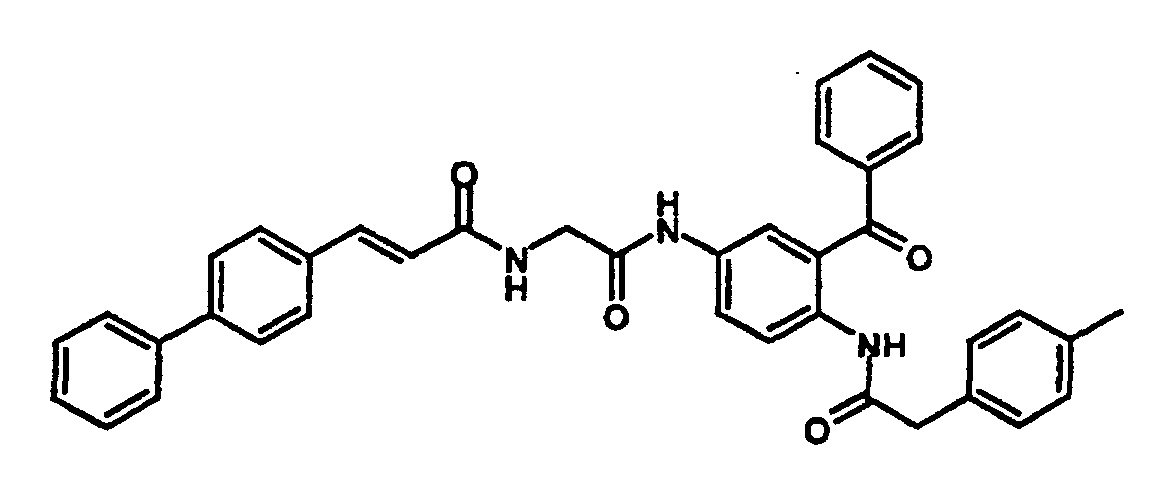
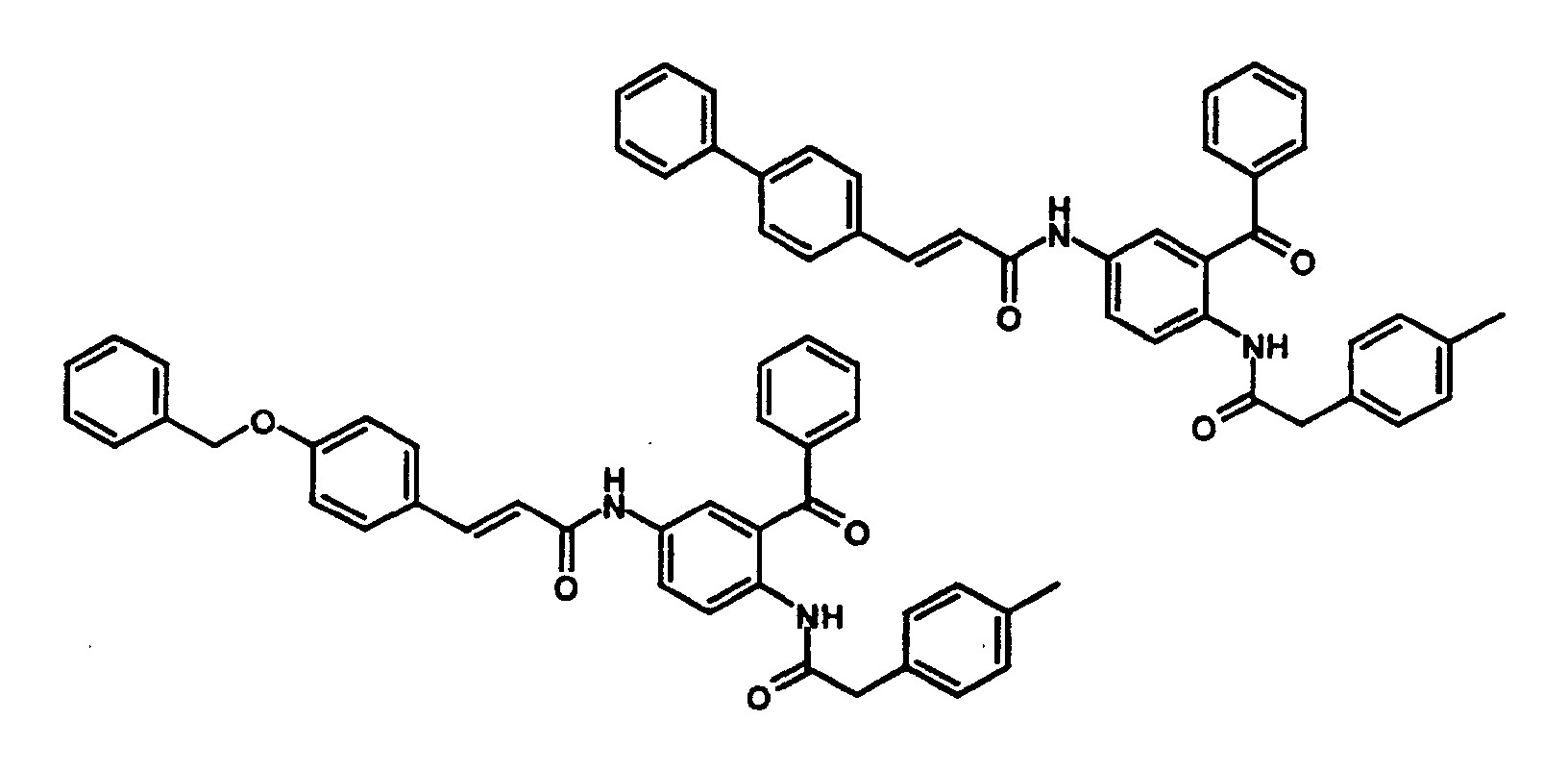
  • N- [3- [3-benzoyl-4- [2- (4-methylphenyl) acetyl] amino] phenylamino] -4-phenylcinnamic acid amide and N- [2- [3-benzoyl-4 - [[2- (4-methylphenyl) acetyl] amino] phenyl] - 4-benzyloxycinnamic acid amide is particularly preferred.
  • acyl means in particular alkanoyl, also alkanoyl substituted by aryl.
  • Acyl groups having 1 to 5 carbon atoms are preferred.
  • alkyl even in derived terms such as alkoxy, alkylene, alkenyl and alkynyl, is straight-chain or branched-chain, contains in particular 1 to 8 C atoms and is unsubstituted or, for example, by CN, NH 2 , NO 2 , COOH, CONH 2 and alkoxycarbonyl substituted.
  • Aryl mainly means phenyl, phenyl, naphthyl substituted by, for example, halogen, alkyl, for example halogen, alkyl, trifluoromethyl, cyano, aryl, alkoxy, hydroxy, benzyloxy, phenyl, styryl, acyl, NO 2 , COOH, alkylsulfonyl, SO 2 NH 2 , Aryl, alkoxy, acyl, NO 2 , COOH, SO 2 NH 2 substituted naphthyl, furthermore, for example, also fluorenyl and anthracenyl.
  • halogen alkyl
  • alkyl for example halogen, alkyl, trifluoromethyl, cyano, aryl, alkoxy, hydroxy, benzyloxy, phenyl, styryl, acyl, NO 2 , COOH, alkylsulfonyl, SO 2 NH 2 ,
  • Heteroaryl is, for example, a six-membered aromatic or a five-membered aromatic which contains 1 to 4 heteroatoms, whereby nitrogen, oxygen and sulfur are to be understood as heteroatoms, for example pyridyl, furanyl, thiazolyl, and also, for example, indolyl. Heteroaryl is unsubstituted or substituted like aryl and in particular also with aryl.
  • Aralkyl means alkyl which is mono- or polysubstituted by aryl, in particular mono- to tri-substituted.
  • Cycloalkylene in which the alkylene chain is interrupted by O, S or NR77 is, for example, pyrrolidine linked via N1 and C2, halogen means fluorine, chlorine, bromine and iodine.
  • the compounds are particularly for therapeutic and prophylactic treatment of infections in humans and animals, which are caused by viruses, bacteria and fungi multicellular parasites are caused. They show a particularly strong cytotoxic Efficacy against single and multicellular parasites, especially against the pathogens malaria and sleeping sickness.
  • the compounds can preferably be used against unicellular parasites (protozoa), in particular against pathogens of malaria and sleeping sickness as well as Chagas disease, toxoplasmosis, amoebic dysentery, leishmaniasis, trichomoniasis, pneumocystosis, balantidiosis, cryptosporidiosis, sarcocystosis, acanthamoebosis, the Naeglerose, Coccidiosis, Giardiosis and Lambliosis.
  • unicellular parasites protozoa
  • malaria prophylaxis and as a prophylaxis of sleeping sickness as well as Chagas disease, toxoplasmosis, amoebic dysentery, leishmaniasis, Trichomoniasis, Pneumocystosis, Balantidiosis, Cryptosporidiosis, Sarcocystosis, Akanthamöbose, Naeglerose, Coccidiosis, Giardiose and Lambliose suitable.
  • Chagas disease toxoplasmosis, amoebic dysentery, leishmaniasis, Trichomoniasis, Pneumocystosis, Balantidiosis, Cryptosporidiosis, Sarcocystosis, Akanthamöbose, Naeglerose, Coccidiosis, Giardiose and Lambliose suitable.
  • the compounds according to the invention in general also include their pharmaceuticals compatible salts or compounds which, when applied, the invention
  • Providing compounds as metabolic products or degradation products, also "prodrugs” may be analogous to known ones for administration in any suitable manner anti-infectious agents (mixed with a non-toxic pharmaceutically acceptable Carrier) are prepared.
  • the pharmaceutically active agents can be in the form of pharmaceutical preparations be prepared in dosage units. This means that the preparation is in the form of individual Parts, e.g. B. tablets, coated tablets, capsules, pills, suppositories and ampoules are present, whose active ingredient content corresponds to a fraction or a multiple of a single dose.
  • the dosage units can e.g. B. 1, 2, 3 or 4 single doses or 1/2, 1/3 or 1/4 one Single dose included.
  • a single dose preferably contains the amount of active ingredient an application is administered and usually a whole, half or one Corresponds to a third or a quarter of a daily dose.
  • non-toxic, inert pharmaceutically suitable carriers are solid, semi-solid or to understand liquid diluents, fillers and formulation aids of all kinds.
  • Preferred pharmaceutical preparations are tablets, dragees, capsules, pills, Granules, suppositories, solutions, suspensions and emulsions, pastes, ointments, gels, Creams, lotions, powders and sprays called.
  • Tablets, dragees, capsules, pills and granules can contain the active ingredient (s) in addition to the usual carriers, such as (a) filling and Extenders, e.g. B. starches, milk sugar, cane sugar, glucose, mannitol and silica, (b) binders, e.g. B.
  • the tablets, dragees, capsules, pills and granules can with the usual, if necessary Coatings and casings containing opacifying agents are provided and also so composed be that they contain the active ingredient (s) only or preferably in a certain one Part of the intestinal tract may be released with a delay, with z.
  • Coatings and casings containing opacifying agents are provided and also so composed be that they contain the active ingredient (s) only or preferably in a certain one Part of the intestinal tract may be released with a delay, with z.
  • B. polymer substances and waxes can be used.
  • the active ingredient (s) can optionally be combined with one or more of the above Carriers are also available in microencapsulated form.
  • Suppositories can contain the usual water-soluble or water-insoluble excipients in addition to the active ingredient or ingredients, e.g. B. polyethylene glycols, fats, e.g. B. cocoa fat and higher esters (z. B. C 14 alcohol with C 16 fatty acid) or mixtures of these substances.
  • B. polyethylene glycols e.g. B. polyethylene glycols
  • fats e.g. B. cocoa fat and higher esters (z. B. C 14 alcohol with C 16 fatty acid) or mixtures of these substances.
  • ointments, pastes, creams and gels can contain the usual carriers included, e.g. B. animal and vegetable fats, waxes, paraffins, starch, tragacanth, Cellulose derivatives, polyethylene glycols, silicones, bentonites, silicic acid, talc and zinc oxide or mixtures of these substances.
  • powders and sprays can contain the usual carriers, z. B. milk sugar, talc, silica, aluminum hydroxide, calcium silicate and polyamide powder or mixtures of these substances.
  • Sprays can also use the usual blowing agents, e.g. B. chlorofluorocarbons.
  • solutions and emulsions can contain the usual carriers such as solvents, solubilizers and emulsifiers, e.g. B. water, ethyl alcohol, isopropyl alcohol, Ethyl carbonate, ethyl acetate, benzyl alcohol, benzyl benzoate, propylene glycol, 1,3-butylene glycol, Dimethylformamide, oils, especially cottonseed oil, peanut oil, corn oil, Olive oil, castor oil and sesame oil, glycerin, glycerin formal, tetrahydrofurfuryl alcohol, Contain polyethylene glycols and fatty acid esters of sorbitan or mixtures of these substances.
  • solvents e.g. B. water, ethyl alcohol, isopropyl alcohol, Ethyl carbonate, ethyl acetate, benzyl alcohol, benzyl benzoate, propylene glycol, 1,3-butylene glycol, Dimethyl
  • solutions and emulsions can also be used in sterile and blood isotonic Form.
  • suspensions can contain the usual carriers, such as liquid ones Diluents, e.g. As water, ethyl alcohol, propylene glycol, suspending agents, e.g. B. ethoxylated isostearyl alcohols, polyoxyethylene sorbitol and sorbitan esters, microcrystalline Cellulose, aluminum metahydroxide, bentonite, agar and tragacanth or mixtures of these Contain substances.
  • liquid ones Diluents e.g. As water, ethyl alcohol, propylene glycol
  • suspending agents e.g. B. ethoxylated isostearyl alcohols, polyoxyethylene sorbitol and sorbitan esters, microcrystalline Cellulose, aluminum metahydroxide, bentonite, agar and tragacanth or mixtures of these Contain substances.
  • the active compounds of the formula (I) are said to be present in the pharmaceutical preparations listed above, preferably in a concentration of about 0.1 to 99.5% by weight, preferably of about 0.5 to 95% by weight of the total mixture.
  • the formulation forms mentioned can, in addition to other active pharmaceutical ingredients also colorants, preservatives and odor and taste-improving additives, z. B. peppermint oil and eucalyptus oil and sweeteners, e.g. B. saccharin.
  • the compounds can be used with previously described substances with anti-infectious properties. This includes in particular compounds that have already been used in therapy or are still being used. Substances are particularly suitable for this purpose, which are listed in the Red List or in Simon / Stille, Antibiotic Therapy in Clinic and Practice, 9th Edition 1998 Schattauer Verlag, or at http: /www.customs.treas.gov/imp-exp /rulings/harmoniz/hrm129.html listed on the Internet.
  • the pharmaceutical preparations listed above are prepared in a conventional manner Way by known methods, e.g. B. by mixing the active ingredient or ingredients with the or the carriers.
  • the preparations mentioned can be administered either orally, rectally or parenterally in humans and animals (intravenous, intramuscular, subcutaneous), intracisternal, intravaginal, intraperitoneal, local (powder, Ointment, drops) and used to treat infections in cavities, body cavities become.
  • ophthalmic and dermatological formulations Silver and other salts, ear drops, eye ointments, powder or solutions be used.
  • the intake can also be in the feed or drinking water appropriate formulations.
  • Gels, powders, powders, tablets, prolonged-release tablets, Premixes, concentrates, granules, pellets, tablets, boluses, capsules, aerosols, Sprays, inhalants can be used in humans and animals.
  • the invention Connections in other carrier materials such as plastics, (plastic chains for local therapy), collagen or bone cement.
  • the active ingredient or formula (I) in total amounts from about 0.05 to about 600, preferably 0.5 to 200 mg / kg body weight per 24 hours, optionally in Form of multiple doses to be administered to achieve the desired results.
  • a Single dose contains the active ingredient (s) preferably in amounts of about 1 to about 200, especially 1 to 60 mg / kg body weight.
  • Dosages vary, depending on the type and the body weight of the patient to be treated, the type and severity of the disease, the type of preparation and the application of the drug as well as the period or interval, within which the administration takes place.
  • the compounds according to the invention can be used in the customary concentrations and formulations in animals together with the feed or with feed preparations or with the Be given drinking water.
  • a suitable 2-acyl-4-nitroaniline is added in a sufficient amount of toluene - possibly under Warm up - solved. Then an equimolar amount of a suitable carboxylic acid chloride added and the mixture heated to 80 ° C for 2 h. Then the reaction mixture concentrated, whereupon spontaneous crystallization occurs in some cases. The Crystals are isolated and dried in vacuo. If there is no spontaneous crystallization, the solvent is distilled off completely and the residue by column chromatography cleaned on silica gel.
  • a solution of the compound obtained according to regulation 1 in ethanol or ethyl acetate (5th ml / mmol) is boiled with tin (II) chloride dihydrate (5 equivalents 1,125 g / mmol) for 2 h heated.
  • the cooled reaction solution is diluted with water, with saturated sodium hydrogen carbonate solution brought to pH 7-8 and extracted with ethyl acetate (3 ⁇ 100-200 ml).
  • the combined organic extracts are with saturated sodium chloride solution washed, dried over sodium sulfate and completely removed from the solvent on a rotary evaporator freed.
  • a solution of one equivalent of an acid chloride in dioxane becomes a solution of one Pour the compound obtained according to rule 2 into toluene / dioxane and the mixture for 1-2 h heated to 80 ° C. The mixture is then concentrated in vacuo and the resulting solid isolated.
  • a solution of one equivalent of an acid anhydride in dioxane becomes a solution of one Pour the compound obtained according to rule 2 into toluene / dioxane and the mixture 1-2 h heated to 80 ° C. The mixture is then concentrated in vacuo and the resulting solid isolated.
  • a solution of equimolar amounts of an amine and a carboxylic acid in DMF is made with a Equivalent 1-benzotriazolyloxy tripyrrolidinophosphonium hexafluorophosphate and 3 Equivalents of diisopropylethylamine were added and the mixture was stirred at room temperature for 18 h. Subsequently is diluted with saline and extracted with ethyl acetate. The extracts are saturated with 2N citric acid. Sodium bicarbonate solution and saline washed. The product remaining after distilling off the solvent becomes like specified cleaned.
  • N-acylamino acid is dried under argon in a sufficient amount DMF dissolved and after adding 2.28 equivalents of N-methyl- (NMM: 0.25 ml / mmol Amino acid) cooled to -15 ° C. Then one equivalent of isobutyl chloroformate (0.13 ml / mmol amino acid) added. After five minutes this mixture becomes a solution of an equivalent of a compound obtained according to regulation 2, in a sufficient amount of dried DMF dissolved. The reaction solution is stirred for several hours while slowly reaching room temperature. Then the Pour the batch into a stirred saturated saline solution (400-800 ml). The aqueous solution is extracted three times with ethyl acetate. The combined extracts are mixed with 2 N citric acid, saturated sodium bicarbonate solution and saturated sodium chloride
  • Washed solution and dried over magnesium sulfate Washed solution and dried over magnesium sulfate.
  • the one after removing the solvent Residue remaining on the rotary evaporator is removed by column chromatography cleaned on silica gel.
  • Step 1 N- (2-Benzoyl-4-nitrophenyl) -2-phenylpropionic acid amide
  • Step 2 N- (4-Amino-2-benzoylphenyl) -2-phenylpropionic acid amide
  • Step 3 2- [N- [3- [3-Benzoyl-4- (2-phenylpropionyl) amino] phenylamino] carbamoyl] acetic acid methyl ester
  • Step 1 N- (2-Benzoyl-4-nitrophenyl) -2- (4-methylphenyl) acetamide
  • Step 2 N- (4-amino-2-benzoylphenyl) -2- (4-methylphenyl) acetamide
  • Step 3 2- [N- [3- [3-Benzoyl-4 - [[2- (4-methylphenyl) acetyl] amino] phenylamino] carbamoyl] acetic acid methyl ester
  • Step 3 3- [N- [3- [3-Benzoyl-4 - [[2- (4-methylphenyl) acetyl] amino] phenylamino] carbamoyl] propionic acid
  • Step 3 3- [N- [3- [3-Benzoyl-4 - [[2- (4-methylphenyl) acetyl] amino] phenylamino] carbamoyl] propionic acid
  • Step 3 4- [N- [3- [3-Benzoyl-4 - [[2- (4-methylphenyl) acetyl] amino] phenylamino] carbamoyl] butyric acid
  • Step 3 4- [N- [3- [3-Benzoyl-4 - [[2- (4-methylphenyl) acetyl] amino] phenylamino] carbamoyl] butyric acid methyl ester
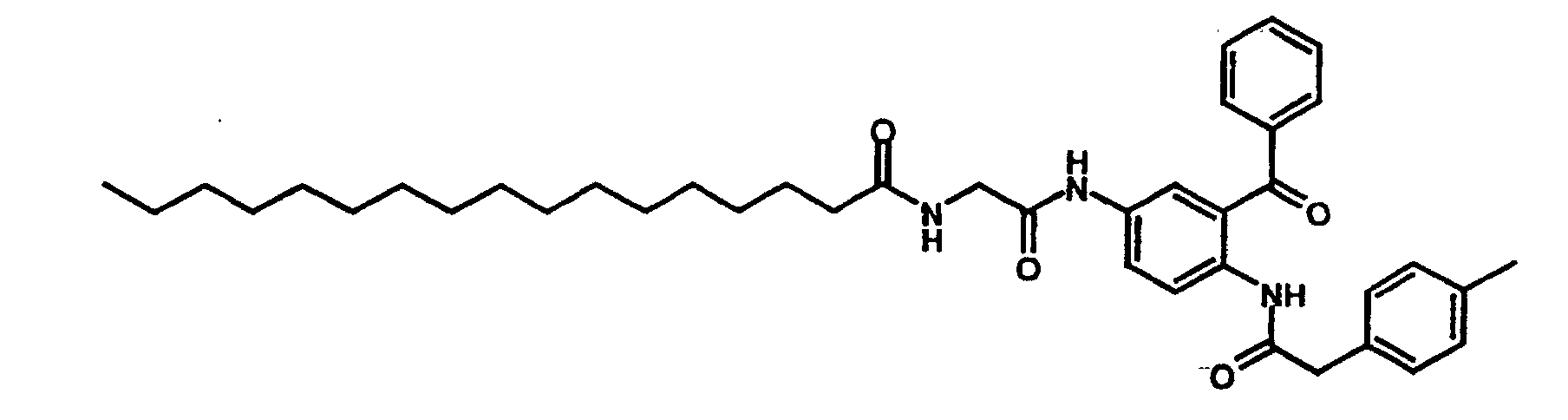
  • Step 3 N- [2- [3-benzoyl-4 - [[2- (4-methylphenyl) acetyl] amino] phenylamino] -2-oxoethyl] heptadecanoic acid amide
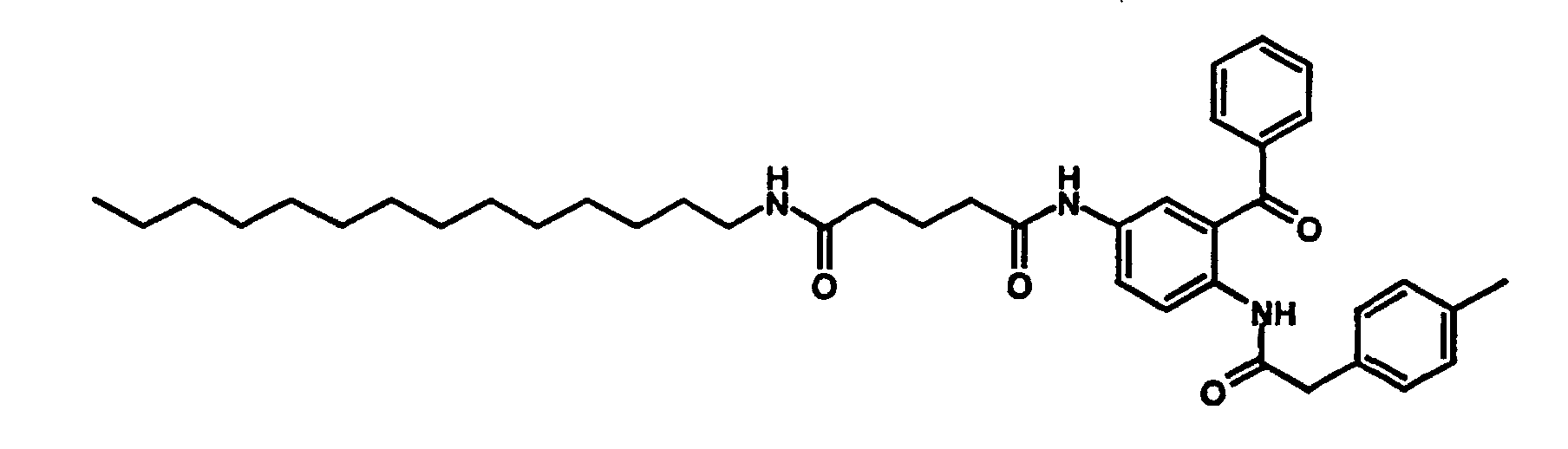
  • Step 3 N- [4- [3-Benzoyl-4 - [[2- (4-methylphenyl) acetyl] amino] phenylamino] -4-oxobutyl] pentadecanoic acid amide
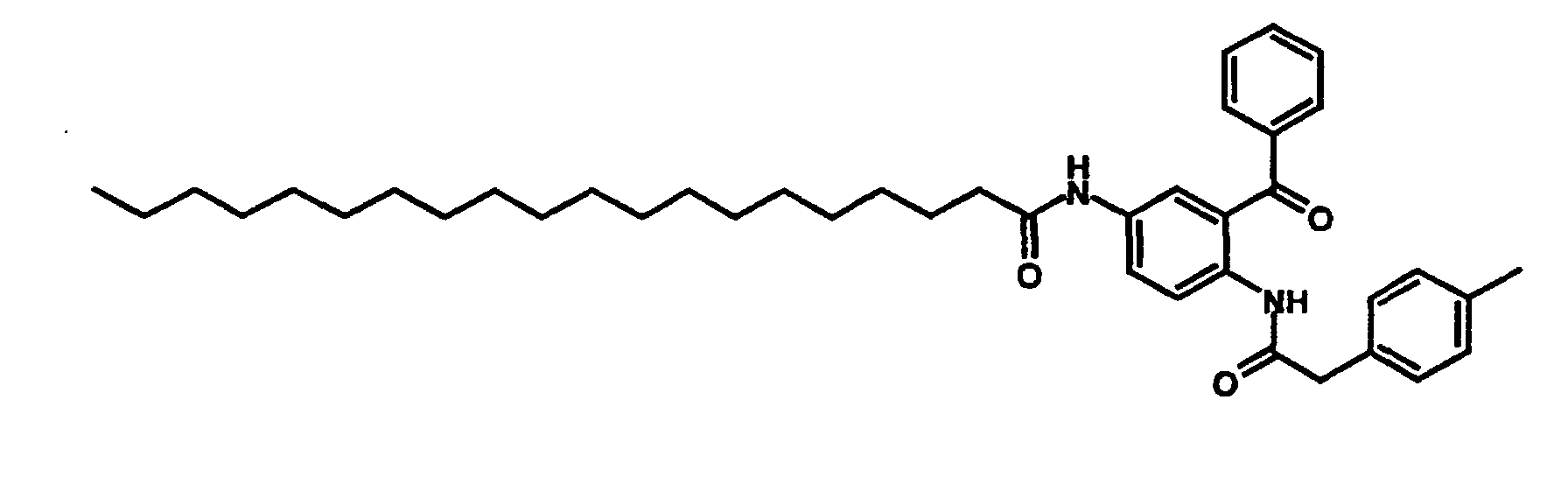
  • Step 3 N- [3-Benzoyl-4 - [[2- (4-methylphenyl) acetyl] amino] phenyl] eicosanoic acid amide
  • Step 1 N- (2-Benzoyl-4-nitrophenyl) -2-phenylacetamide
  • Step 2 N- (4-amino-2-benzoylphenyl) -2-phenylacetamide
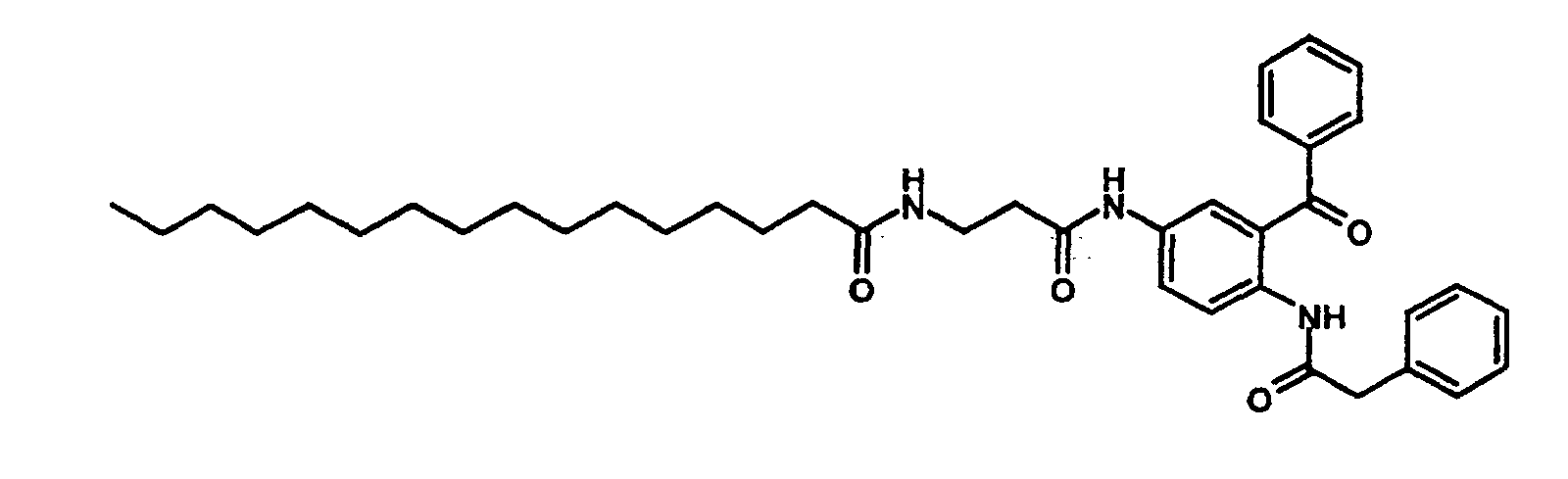
  • Step 3 N- [3- [3-Benzoyl-4 - [(2-phenylacetyl) amino] phenylamino] -3-oxopropyl] hexadecanoic acid amide
  • Step 3 N- [2- [3-Benzoyl-4 - [[2- (4-methylphenyl) acetyl] amino] phenylamino] -2-oxoethyl] -4-phenylcinnamic acid amide
  • Step 3 N- [3- [3-Benzoyl-4 - [(2-phenylacetyl) amino] phenylamino] -3-oxopropyl] -4-benzyloxycinnamic acid amide
  • Step 3 N- [3-Benzoyl-4- [2- (4-methylphenyl) acetyl] amino] phenyl] nicotinamide
  • Step 3 N- [3-Benzoyl-4- [2- (4-methylphenyl) acetyl] amino] phenyl] benzoic acid amide
  • Step 3 N- [3-Benzoyl-4- [2- (4-methylphenyl) acetyl] amino] phenyl] -2-phenylacetic acid amide
  • Step 3 N- [3-Benzoyl-4- [2- (4-methylphenyl) acetyl] amino] phenyl] -3-phenylpropionic acid amide
  • Step 3 N- [3-Benzoyl-4- [2- (4-methylphenyl) acetyl] amino] phenyl] -3-cyclohexylpropionic acid amide
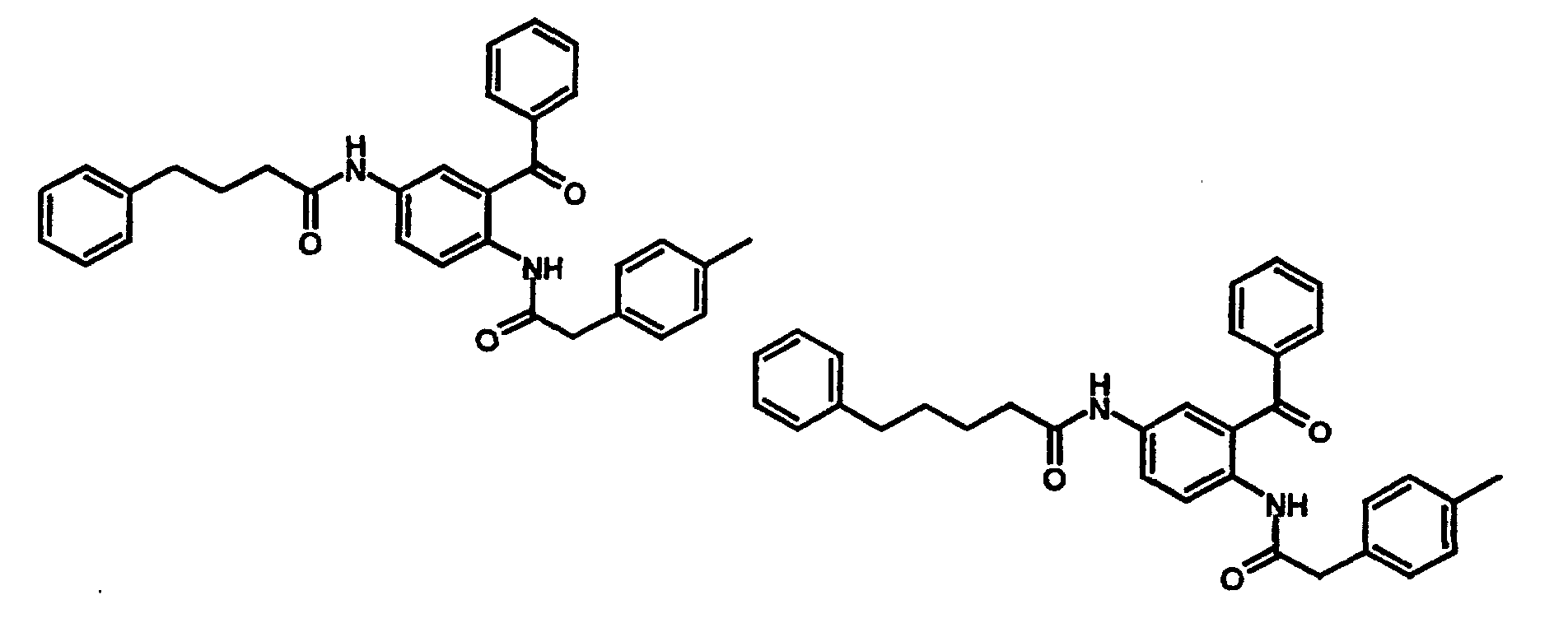
  • Step 3 N- [3-Benzoyl-4- [2- (4-methylphenyl) acetyl] amino] phenyl] -4-phenylbutyric acid amide
  • Step 3 N- [3-benzoyl-4- [2- (4-methylphenyl) acetyl] amino] phenyl] -5-phenylvaleric acid amide
  • Step 3 N- [3- [3-Benzoyl-4- [2- (4-methylphenyl) acetyl] amino] phenylamino] cinnamic acid amide
  • Step 3 N- [3- [3-Benzoyl-4- [2- (4-methylphenyl) acetyl] amino] phenylamino] cinnamic acid amide
  • Step 3 N- [3- [3-Benzoyl-4- [2- (4-methylphenyl) acetyl] amino] phenylamino] -4-phenylcinnamic acid amide
  • Step 3 N- [2- [3-Benzoyl-4 - [[2- (4-methylphenyl) acetyl] amino] phenyl] -4-benzyloxycinnamic acid amide
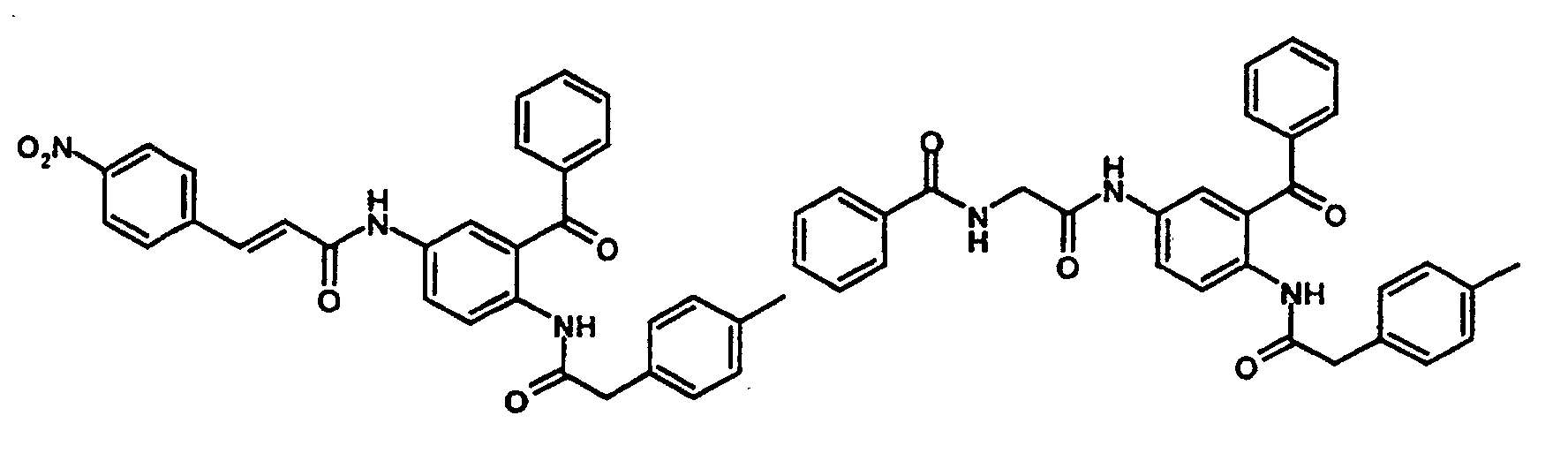
  • Step 3 N- [2- [3-Benzoyl-4 - [[2- (4-methylphenyl) acetyl] amino] phenylamino] -2-oxoethyl] -4-benzoic acid amide
  • Step 3 N- [3-Benzoyl-4- [2- (4-methylphenyl) acetyl] amino] phenyl] benzoic acid amide
  • Step 3 N- [3-Benzoyl-4- [2- (4-methylphenyl) acetyl] amino] phenyl] benzoic acid amide
  • Step 3 N- [3-Benzoyl-4- [2- (4-methylphenyl) acetyl] amino] phenyl] benzoic acid amide
  • Step 3 N- [2- [3-Benzoyl-4 - [[2- (4-methylphenyl) acetyl] amino] phenyl] benzylthioglycolic acid amide
  • Step 3 N- [2- [3-Benzoyl-4 - [[2- (4-methylphenyl) acetyl] amino] phenyl] benzyloxyacetic acid amide
  • Step 3 N- [3-Benzoyl-4- [2- (4-methylphenyl) acetyl] amino] phenyl] -4-phenylbutyric acid amide
  • Step 3 N- [2- [3-Benzoyl-4 - [[2- (4-methylphenyl) acetyl] amino] phenyl] - (4-nitrobenzyl) thioglycolic acid amide
  • IR (KBr): ⁇ 3428, 3327, 2968, 2938, 1663, 1603, 1550, 1509, 1400, 1285, 1171, 977 cm -1 .
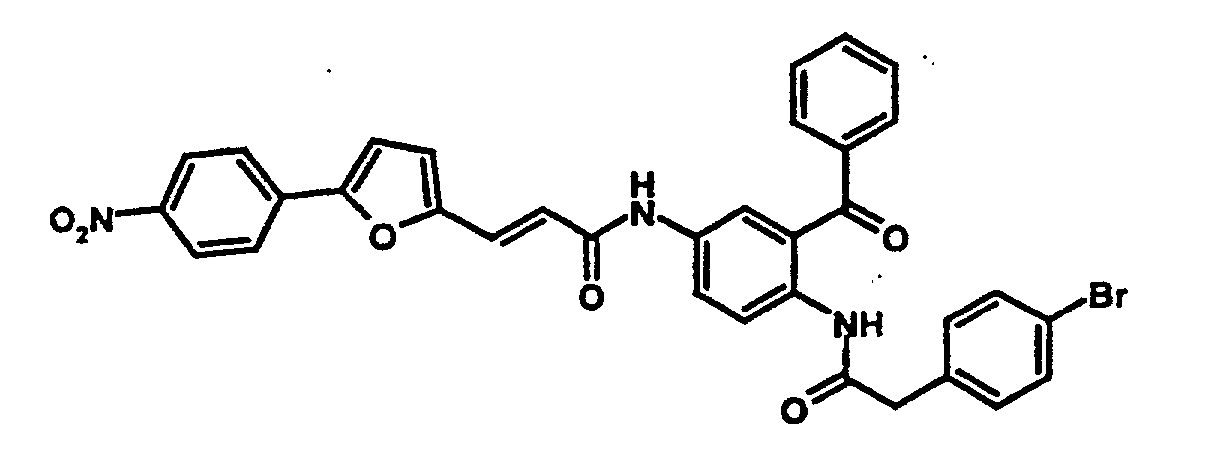
  • Example 36 N - [3-Benzoyl-4 - [(4-bromophenyl) acetylamino] phenyl] -3- [5- (4-nitrophenyl) -2-furyl] acrylic acid amide
  • N - [3-benzoyl-4- (trifluoroacetylamino) phenyl] -3- [5- (4-nitrophenyl) -2-furyl] acrylic acid amide (0.559 g, 1.0 mmol) is in a 1: 1 mixture (vol: vol ) of dioxane and saturated potassium carbonate solution (6 ml per mmol of the protected amine) heated under reflux for three hours. The mixture is then diluted with the same amount of water and the mixture is extracted three times with ethyl acetate. The combined organic phases are washed with water and saturated sodium chloride solution, dried over sodium sulfate and the solvent is distilled off on a rotary evaporator. Purification: recrystallization from toluene.
  • the activity of the substances is determined in a test system. This system is based on the inhibition of the growth of parasites, bacteria, viruses and fungi in vitro.
  • the inhibition of growth is used to determine antimalarial activity determined by malaria parasites in blood cultures.
  • microorganisms to be examined can only be examined in animal models become.
  • the corresponding models are used here.
  • the antimalarial activity of compounds 1 to 32 was determined on in vitro cultures of the malaria pathogen Plasmodium falciparum.
  • the wells of a 96-well microtiter plate were each loaded with 200 ⁇ l of an asynchronous Plasmodium falciparum culture with 0.4% parasitemia and 2% hematocrit.
  • a serial dilution series of the compounds was then prepared at concentrations of 100, 10 and 1 ⁇ mol l -1 .
  • the plates are incubated at 37 ° C, 3% CO 2 and 5% O 2 for 48 hours. Then 30 ⁇ l medium supplemented with 27 ⁇ Ci ml -1 [ 3 H] hypoxanthine was added to each well.
  • the inhibition of parasite growth was expressed as a percentage inhibition of tritium corporation based on a comparison without substance.
  • the table shows the percentage inhibition as a function of the concentrations.

Landscapes

  • Health & Medical Sciences (AREA)
  • Veterinary Medicine (AREA)
  • Life Sciences & Earth Sciences (AREA)
  • Chemical & Material Sciences (AREA)
  • Public Health (AREA)
  • Medicinal Chemistry (AREA)
  • General Health & Medical Sciences (AREA)
  • Animal Behavior & Ethology (AREA)
  • Pharmacology & Pharmacy (AREA)
  • Tropical Medicine & Parasitology (AREA)
  • General Chemical & Material Sciences (AREA)
  • Organic Chemistry (AREA)
  • Nuclear Medicine, Radiotherapy & Molecular Imaging (AREA)
  • Chemical Kinetics & Catalysis (AREA)
  • Epidemiology (AREA)
  • Pharmaceuticals Containing Other Organic And Inorganic Compounds (AREA)
  • Acyclic And Carbocyclic Compounds In Medicinal Compositions (AREA)
  • Organic Low-Molecular-Weight Compounds And Preparation Thereof (AREA)
  • Thiazole And Isothizaole Compounds (AREA)
  • Furan Compounds (AREA)
  • Pyridine Compounds (AREA)

Description

Die vorliegende Erfindung betrifft die Verwendung von 2-Phenylendiaminderivaten zur Herstellung von Arzneimitteln für die prophylaktische und therapeutische Behandlung von Infektionen. Sie betrifft insbesondere die Herstellung von Arzneimitteln für die Behandlung von Infektionen, die durch Parasiten hervorgerufen wurden.
Malaria ist eine der Hauptursachen für die hohe Sterblichkeitsrate in tropischen Gebieten mit 300 bis 500 Millionen klinischen Fällen und 1,5 bis 2,5 Millionen Todesfällen pro Jahr. Da die Resistenz der Parasiten gegenüber herkömmlichen Antimalariamitteln alarmierend ansteigt, werden dringend neue Mittel benötigt.
Aufgabe der vorliegenden Erfindung ist es daher, neue Mittel zur Bekämpfung von parasitären Infektionen, insbesondere Malaria bereitzustellen.
Diese Aufgabe wird in völlig überraschender Weise durch die in Anspruch 1 definierte Stoffgruppe der 2-Phenylendiaminderivate gelöst. Diese Stoffgruppe zeigt nicht nur eine antiinfektiöse Wirkung gegen ein- und mehrzellige Parasiten, sondern ebenfalls gegen Viren, Bakterien und Pilze. Im Sinne der vorliegenden Erfindung sind unter einzelligen Parasiten entsprechend der engen Definition der Parasitologie Protozoen zu verstehen.
Die erfindungsgemäß verwendeten Verbindungen sind bereits für die Krebstherapie vorgeschlagen worden, wie es in der gleichzeitig anhängigen Anmeldung desselben Anmelders offenbart ist.
Die 2-Phenylendiaminderivate entsprechen der allgemeinen Formel (I):
Figure 00010001
worin
n = 0 - 3;
R1, R2 = H, C1-26-Alkyl, Aryl, Heteroaryl, C1-26-Acyl;
R3 = H, Halogen, C1-26-Alkyl, Aryl, Heteroaryl, Ar-C1-26-alkyl, C1-26-Acyl, CN, NO2, R4-X-;
mit R4 = H, C1-26-Alkyl, Aryl, Heteroaryl, Ar- C1-26-alkyl, C1-26-Acyl;
 X = NH, O, S, SO2, NHSO2, OSO2,
A = CH2, CHR5, CR5R6, CO, CS, CONR4, CSNR4, SO2, PO2,
R5, R6 = unabhängig voneinander C1-26-Alkyl, Aryl, Heteroaryl, Ar- C1-26-alkyl, CN, NO2, COR7,
R7 = H, C1-26-Alkyl, Aryl, Ar- C1-26-alkyl, C1-26-Alkoxy, Aryloxy, Ar- C1-26-alkoxy, NR8R9,
R8, R9 = unabhängig voneinander H, C1-26-Alkyl, Aryl, Ar- C1-26-alkyl, Heteroaryl,
B = C1-26-Alkyl, Aryl, Heteroaryl, Arylcarbonyl, gesättigte Heterocyclen, substituiertes Alkyl mit 1-4 Kettenglieder, wobei als Substituenten C1-9-Alkyl, Aryl, Heteroaryl, Halogen, =O, OH, NH2, NH-CO-R10, NH-SO2-R10, COOR11, CO-NR12R13, CS-NR14R15, SO2OR16, SO2NR17R18, NH-CO-OR19, NH-CO-NR20R21, NHCSNR22R23 auftreten können,
R10 - R23 = unabhängig voneinander H, C1-26-Alkyl, Aryl, Ar- C1-26-alkyl, Heteroaryl,
D = H, C1-26-Alkyl, Aryl, Heteroaryl, Ar- C1-26-alkyl, -Y-R24, Halogen, NO2, CN, NH-CO-R25, NH-SO2-R26 , NH-CO-OR27, NH-CO-NR28R29, NH-CS-NR30R31,
Y= O, NH, S, CO, CS, SO2, COO, CONR31, CSNR32, SO2NR33,
R24 - R33 = unabhängig voneinander H, C1-26-Alkyl, Aryl, Heteroaryl, Ar- C1-26-alkyl bedeuten, und
Y = eine Gruppe ausgewählt aus
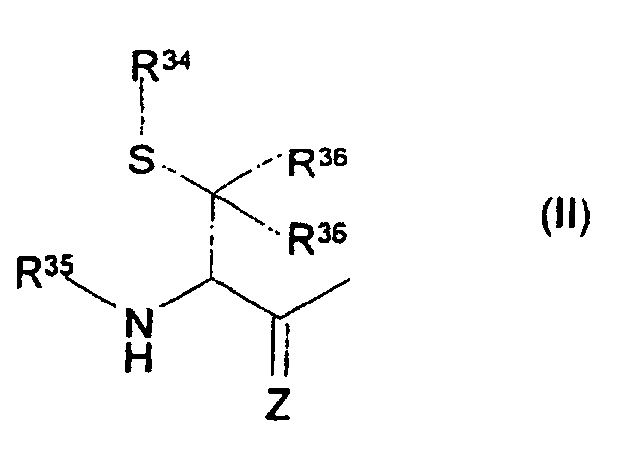
Figure 00030001
worin
Z = O, S oder zwei Wasserstoffatome,
R34 = H, C1-26-Alkyl, Aryl, Ar- C1-26-alkyl, COOR37, Arylsulfonyl,
R35 = H, C1-26-Acyl, COOR38,
R36 = unabhängig voneinander H, C1-26-Alkyl,
R37, R38 = unabhängig voneinander C1-26-Alkyl, Aryl, Ar- C1-26-alkyl bedeuten,
oder
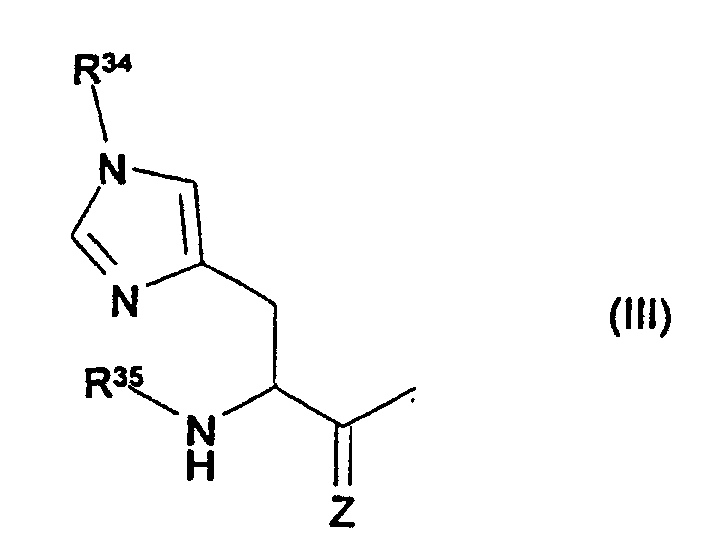
Figure 00030002
worin
Z = O, S oder zwei Wasserstoffatome,
R34 = H, C1-26-Alkyl, Aryl, Ar- C1-26-alkyl, COOR37, Arylsulfonyl,
R35 = H, C1-26-Acyl, COOR38
R37, R38 = unabhängig voneinander C1-26-Alkyl, Aryl, Ar- C1-26-alkyl bedeuten,
oder
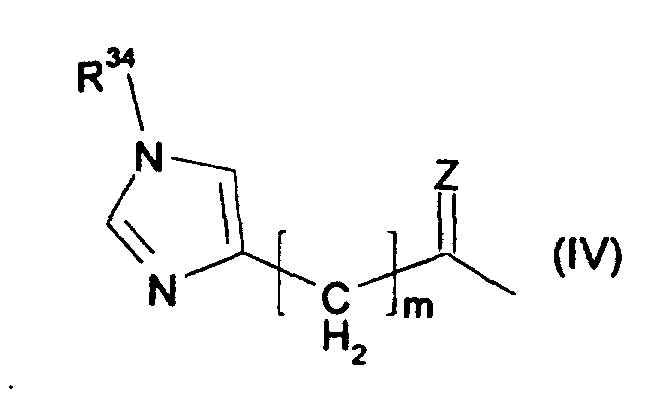
Figure 00040001
worin
Z = O, S oder zwei Wasserstoffatome,
m=0-3
R34 = H, C1-26-Alkyl, Aryl, Ar- C1-26-alkyl, COOR37, Arylsulfonyl,
R37 = C1-26-Alkyl, Aryl, Ar- C1-26-alkyl bedeuten,
oder
Figure 00040002
worin
F = CH2, CO, CS, SO2,
G = COOR39, CONHOH, CONR40R41, CSNR42R43, C1-26-alkyl- oder arylsubstituiertes Alkyl mit 1-3 Kettengliedern oder Alkyl mit 1-3 Kettengliedern, das am terminalen C-Atom einen Substituenten ausgewählt aus COOR44, CONHOH, CONR45R46, CSNR47R48, SR49, SOR50, SO2R51, SO2NR52R53, PO(OR54)OR55, PO(OR56)NR57 2, OSO2R58, O(PO)OR59, NHSO2R60, NHPO2R61, NHCOR62, NHCSR63, NHCONR64R65, NHCSNR66R67, -S(NH)2-R68 oder NH(C=NR70)NHR69 trägt, ferner Aryl oder Heteroaryl,
R39 - R69 = unabhängig voneinander H, C1-26-Alkyl, Aryl,
R70 = CONH2, SO2NH2 bedeuten,
oder
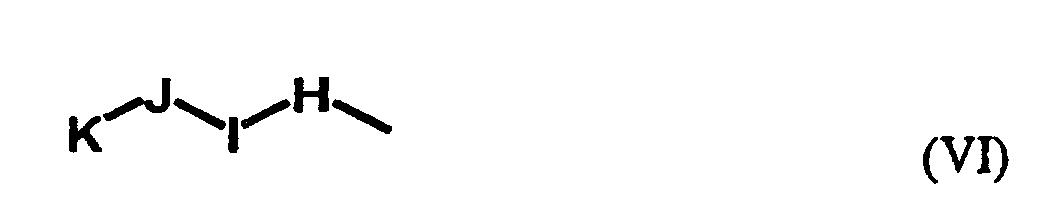
Figure 00040003
ist, worin
H = CH2, CO, CS, CHR71, CR72R73, SO2, SO, PO2,
I = C1-26-Alkylen, C1-26-Alkylen, bei dem eine Methylengruppe durch O, S, oder NR77 ersetzt ist, oder C2-26-Alkenylen, wobei diese Alkylen- bzw. Alkenylenreste unsubstituiert oder durch Aryl, Heteroaryl, Halogen, OH, CN, C1-9-Alkyloxy, Aryloxy, COOR74, CONR75R76, NR77R78, NH(C=NR70)NHR69, SR79, SO2R80 substituiert sind, ferner C3-8-Cycloalkylen, unsubstituiert
oder durch Aryl, Heteroaryl, Halogen, OH, CN, C1-9-Alkyloxy, Aryloxy, COOR74,
CONR75R76, NR77R78, SR79, SO2R80 substituiert, C3-8-Cycloalkylen, worin die Alkylenkette durch O, S oder NR77 unterbrochen ist, Arylen, unsubstituiert oder durch Aryl, Heteroaryl, Halogen, OH, CN, C1-26-Alkoxy, Aryloxy, COOR74, CONR75R76, NR77R78, SR79, SO2R80 sub stituiert,
R71 - R80 unabhängig voneinander H, C1-26-Alkyl, Aryl, Ar- C1-26-alkyl, Heteroaryl,
J = eine Bindung oder CO, COO, CONR81, CS, CSNR82, SO2, S(NH)2, SO(NH), SO2O, SO2NR83, PO(OR84), PO(OR85)NR86, NR87CO, NR88CS, NR89SO2, OSO2, NR90PO(OR84), OPO(OR91), PO(OR84)O, NR92CONR93, NR94CSNR95, NR96SO2NR97, NR98C(NR99)NR100,
R81-R100 = unabhängig voneinander H, C1-26-Alkyl, Aryl, Ar- C1-26-alkyl, Heteroaryl,
R99 = H, C1-26-Alkyl, Aryl, Ar- C1-26-alkyl, Heteroaryl, CONR101R102, CSNR103R104, SO2NR105R106
R101 - R106 = unabhängig voneinander H, C1-26-Alkyl, Aryl, Ar- C1-26-alkyl, Heteroaryl,
K = verzweigtes oder unverzweigtes C11-23-Alkyl, verzweigtes oder unverzweigtes C11-23-Alkenyl, welches unsubstituiert oder durch Aryl oder Heteroaryl substituiert ist, C11-23-Alkinyl, Aryl, Heteroaryl, Ar- C1-26-alkyl, wobei Aryl, Heteroaryl und Ar- C1-26-alkyl mit weiteren Aryl-, Heteroaryl- und/oder Ar- C1-26-alkylresten substituiert sein können, bedeuten und Salze davon.
Unter den Verbindungen, die durch ihre Wirkung besonders aufgefallen sind, gelten die folgenden Definitionen:
n = 0 - 3,
R1, R2 und R3 = H,
A = CO, SO2,
B = Phenyl, Benzyl, Phenethyl, 4-Chlorphenylmethyl, 4-Bromphenylmethyl, 4-Nitrophenylmethyl, 4-Trifluormethylphenylmethyl, 4-Methylphenylmethyl, 4-Phenylphenyl-methyl, 1-Naphthylmethyl, 2-Naphthylmethyl, Benzoyl, 2,4,4-Trimethylpentyl, 2-Carboxyethyl, 3-Carboxypropyl, 1-(4-Methyl-1-piperazinyl)-1-(4-trifluormethylphenyl)-methyl, 1-(4-Methyl-1-piperazinyl)-1-phenylmethyl,
D = Benzoyl,
Y =
ein Rest der Formel (II),
worin
Z = O,
R34 = H, Benzyloxycarbonyl, Trityl,
R35 = H, Benzyloxycarbonyl, tert.-Butyloxycarbonyl,
R36 = H,
oder ein Rest der Formel (III),
worin
Z = O,
R34 = H, Tosyl, Benzyl, 4-Nitrobenzyl, 4-Cyanobenzyl, Benzyloxycarbonyl,
R35 = H, Benzyloxycarbonyl, tert.-Butyloxycarbonyl,
oder ein Rest der Formel (IV),
worin
Z = O,
m = 0 - 3,
R34 = H, Tosyl, Benzyl, 4-Nitrobenzyl, 4-Cyanobenzyl, Benzyloxycarbonyl,
oder ein Rest der Formel (V),
worin
F = CO, CH2, SO2,
G = COOH, COOMe, CONHOH, CH2-COOH, CH2COOMe, CH2CONHOH, CH2CONH-(C14-C20)-Alkyl, CH2CH2COOH, CH2CH2COOMe, CH2CH2CONHOH, CH2CH2CONH-(C14-C20)-Alkyl, CH2CH2CH2COOH, CH2CH2CH2COOMe, CH2CH2CH2CONHOH, CH2CH2CH2CONH-(C14-C20)-Alkyl, Phenyl, Naphthyl, Pyridyl, Fluorenyl, Anthracenyl,
oder ein Rest der Formel (VI),
worin
H = CO, SO2,
I = Methylen, 1,2-Ethylen, 1,3-Trimethylen, 1,4-Tetramethylen, -CH2-S-CH2-, -CH2-O-CH2-, - CH2-NH-CH2-, 1,2-Ethenylen, 1,1-Ethylen, Prop-1-en-1,3-ylen, Prop-2-en-1,3-ylen, Benzylen, 2-Phenyl-1,1-ethylen, Carboxymethylen, Aminocarbonylmethylen, 2-Carboxy-1,1-ethylen, 2-Aminocarbonyl-1,1-ethylen, 3-Carboxy-1,1-propylen, 3-Aminocarbonyl-1,1-propylen, 2-Methyl-1,1-propylen, 3-Methyl-1,1-butylen, 2-Methyl-1,1-butylen, über N1 und C2 verknüpftes Pyrrolidin, 1,2-Phenylen, 1,3-Phenylen, 1,2-Naphthylen, 1,3-Naphthylen, 1,1-Cyclopentylen, 1,1-Cyclohexylen, 1,2-Cyclohexylen,
J = eine Bindung, CO, CS, SO2, PO(OMe), PO(OH), CONH, CSNH, SO2NH, PO(OH)O, PO(OH)NH, PO(OMe)O, PO(OMe)NH,
K = (C13-C19)-Alkyl, (C13-C19)-Alkenyl, 4-Benzyloxystyryl, 4-Styrylstyryl, 4-Phenylstyryl, 4-Cyanostyryl, 4-Nitrostyryl, Phenyl, 4-Biphenylyl, 4-Nitrophenyl, 4-Cyanophenyl, 4-Methylsulfonylphenyl, 4-Methoxyphenyl, 4-Bromphenyl, 4-Chlorphenyl, 4-Trifluormethylphenyl, 4-Formylphenyl, 4-Methoxycarbonylphenyl, 4-(1,1-Dicyano-2-vinyl)phenyl, 4-Aminophenyl, 4-Ethylphenyl, 4-Isopropylphenyl, 4-tert.-Butylphenyl, 4-Ethoxyphenyl, 4-Propoxyphenyl, 4-Butoxyphenyl, 4-Benzyloxyphenyl, 3,4-Bis-(benzyloxy)phenyl 3-Phenoxyphenyl, 4-Styrylphenyl 1-Naphthyl, 2-Naphthyl, 2-Fluorenyl, 2-(2-Phenylthiazol-4-yl), 5-(4-Nitrophenyl)thiazo-4-yl) 5-(4-Nitrophenyl)furan-2-yl), 5-(3-Nitrophenyl)furan-2-yl), 5-(2-Nitrophenyl)furan-2-yl), 5-(4-Bromphenyl)furan-2-yl), 5-(4-Chlorphenyl)furan-2-yl), 5-(3-Trifluormethylphenyl)furan-2-yl), 5-(4-Trifluormethylphenyl)furan-2-yl), 5-(2-Chlor-3-trifluormethylphenyl)furan-2-yl) 3,4-Methylendioxyphenyl, 1-Acetylindol-3-yl, 4'-Nitrobiphenylyl, 5-(4-Bromphenyl)thiophen-2-yl), 5-(4-Methylphenyl)furan-2-yl), 5-(4-Methoxyphenyl)furan-2-yl), 5-Bromthiophen-2-yl, 5-Bromfuran-2-yl, 4-Pyridyl, 3-Pyridyl, 2-Pyridyl, Chinolin-2-yl, 1-Naphthylvinyl, 2-Naphthylvinyl, 2-Fluorenyl-vinyl, 2-(2-Phenylthiazol-4-yl)vinyl, 2-[5-(4-Nitrophenyl)furan-2-yl)vinyl, 2-[5-(4-Acetoxy-methylphenyl)furan-2-yl)vinyl, 2-[5-(3-Trifluormethylphenyl)-furan-2-yl)vinyl, 4-Benzyloxystyryl, 3,4-Dibenzyloxystyryl, 3-Methoxy-4-(4-nitrobenzyloxy)styryl, 2-Methylindol-3-ylvinyl, 1-Acetylindol-3-ylvinyl, 3,4-Methylendioxystyryl, 4-(1,1 Dicyano-2-vinyl)styryl, bedeuten, und Salze davon.
Insbesondere eignen sich Verbindungen der Formel (I), für die gilt:
n=0-3,
R1, R2 = H
R3 = H,
A = CO, SO2,
B = Phenyl, Benzyl, Phenethyl, 4-Chlorphenylmethyl, 4-Methylphenylmethyl, 4-Bromphenylmethyl, 4-Nitrophenylmethyl, 4-Trifluormethylphenylmethyl, 4-Phenylphenyl-methyl, 1-Naphthylmethyl, 2-Naphthylmethyl, Benzoyl, 2,4,4-Trimethylpentyl, 2-Carboxyethyl, 3-Carboxypropyl, 1-(4-Methyl-1-piperazinyl)-1-(4-trifluormethylphenyl)-methyl, 1-(4-Methyl-1-piperazinyl)-1-phenylmethyl,
D = Benzoyl,
Y =
ein Rest der Formel (IV)
worin
Z = O,
m = 0 - 3,
R34 = H, Benzyl, 4-Nitrobenzyl, 4-Cyanobenzyl,
oder ein Rest der Formel (V)
worin
F = CO, CH2, SO2,
G = CH2CH2CONH-(C14-C18)-Alkyl, CH2CH2CH2CONH-(C14-C18)-Alkyl, Phenyl, Naphthyl, Pyridyl, Fluorenyl, Anthracenyl
oder ein Rest der Formel (VI)
H=CO,
I = Methylen, 1,2-Ethylen, 1,3-Trimethylen, 1,4-Tetramethylen, -CH2-S-CH2-, -CH2-O-CH2-, - CH2-NH-CH2-, 1,2-Ethenylen, 1,1-Ethylen, Prop-1-en-1,3-ylen, Prop-2-en-1,3-ylen, Benzylen, 2-Phenyl-1,1-ethylen, 2-Methyl-1,1-propylen, 3-Methyl-1,1-butylen, 2-Methyl-1,1-butylen, über N 1 und C2 verknüpftes Pyrrolidin,
J = PO(OMe), PO(OH), CONH, CSNH, SO2NH, PO(OH)O, PO(OH)NH, PO(OMe)O, PO(OMe)NH,
K = (C13-C19)-Alkyl, (C13-C19)-Alkenyl, 4-Benzyloxystyryl, 4-Phenylstyryl, 4-Cyanostyryl, 4-Nitrostyryl, Phenyl, 4-Biphenylyl, 4-Nitrophenyl, 4-Cyanophenyl, 4-Methoxyphenyl, 1-Naphthylvinyl, 2-Naphthylvinyl, 2-Fluorenylvinyl, 2-(2-Phenylthiazol-4-yl)vinyl, 2-[5-(4-Nitrophenyl)furan-2-yl)vinyl, 2-[5-(4-Acetoxymethylphenyl)furan-2-yl)vinyl, 2-[5-(3-Trifluormethylphenyl)furan-2-yl)vinyl, 3,4-Dibenzyloxystyryl, 3-Methoxy-4-(4-nitrobenzyloxy)styryl, 3,4-Methylendioxystyryl, 4-(1,1 Dicyano-2-vinyl)styryl bedeuten, und Salze davon.
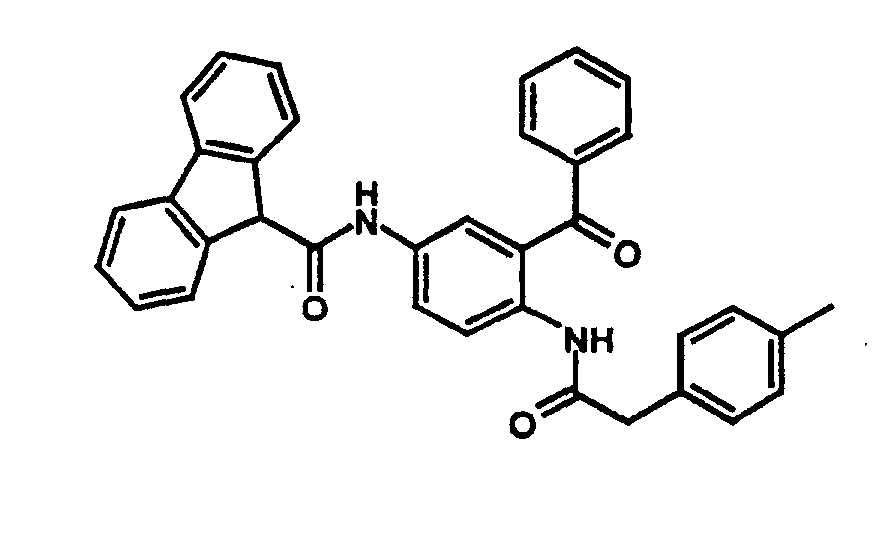
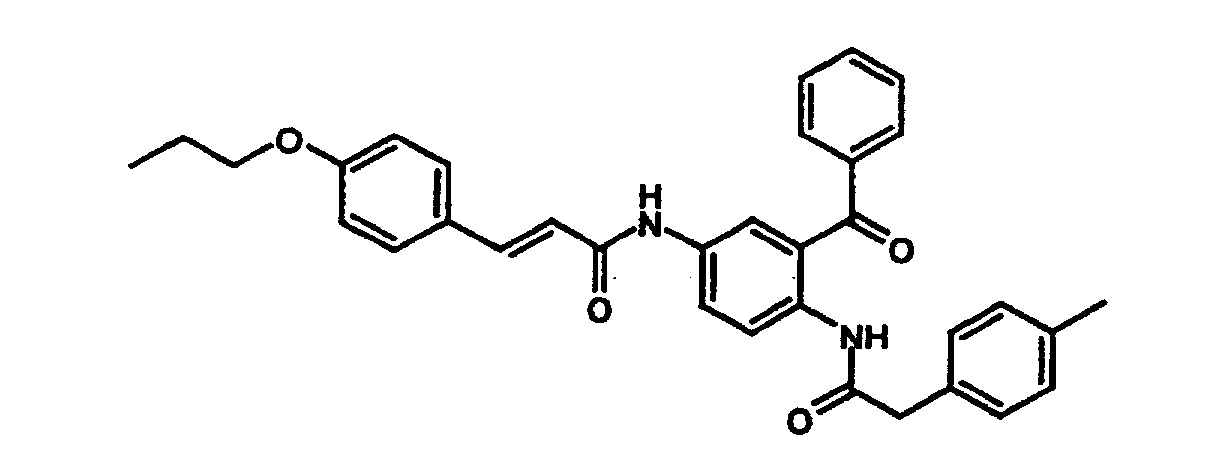
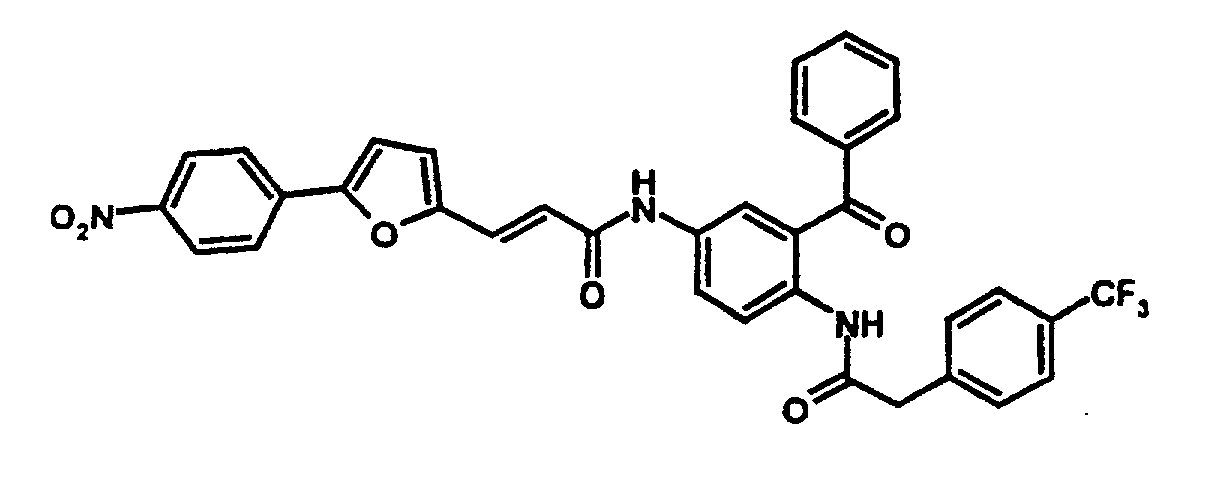
Besonders bevorzugt sind Einzelverbindungen, die den nachfolgenden Strukturformeln entsprechen:
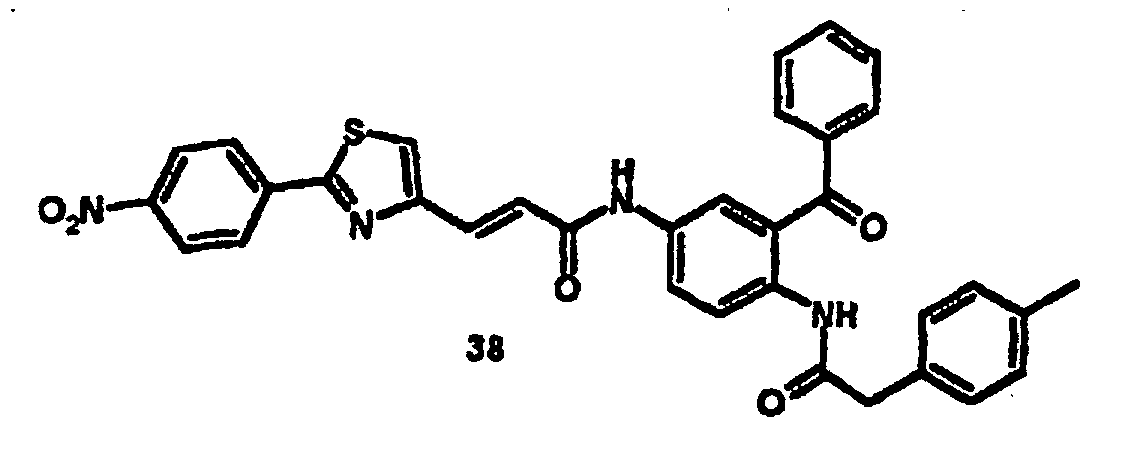
Figure 00080001
Figure 00080002
Figure 00090001
Figure 00090002
Figure 00090003
Figure 00090004
Figure 00100001
Figure 00100002
Figure 00100003
Figure 00110001
Figure 00110002
Figure 00110003
Figure 00110004
Figure 00120001
Figure 00120002
Figure 00120003
Figure 00120004
Figure 00130001
Figure 00130002
Figure 00130003
Figure 00130004
Figure 00130005
Figure 00140001
Figure 00140002
Figure 00140003
Figure 00140004
Von diesen Verbindungen sind N-[3-[3-Benzoyl-4-[2-(4-methylphenyl)-acetyl]amino]-phenylamino]-4-phenylzimtsäureamid und N-[2-[3-Benzoyl-4-[[2-(4-methylphenyl)acetyl]-amino]phenyl]- 4-benzyloxyzimtsäureamid ganz besonders bevorzugt.
In den vorstehenden und in den folgenden Formeln und Definitionen bedeuten Acyl insbesondere Alkanoyl, auch durch Aryl substituiertes Alkanoyl. Bevorzugt sind Acylgruppen mit 1 bis 5 Kohlenstoffatomen. Alkyl, auch in abgeleiteten Begriffen, wie Alkoxy, Alkylen, Alkenyl und Alkinyl ist geradkettig oder verzweigtkettig, enthält, soweit nicht anders angegeben, insbesondere 1 bis 8 C-Atome und ist unsubstituiert oder z.B. durch CN, NH2, NO2, COOH, CONH2 und Alkoxycarbonyl substituiert. Aryl bedeutet vorwiegend Phenyl, durch z.B. Halogen, Alkyl, Trifluormethyl, Cyano, Aryl, Alkoxy, Hydroxy, Benzyloxy, Phenyl, Styryl, Acyl, NO2, COOH, Alkylsulfonyl, SO2NH2 substituiertes Phenyl, Naphthyl, durch z.B. Halogen, Alkyl, Aryl, Alkoxy, Acyl, NO2, COOH, SO2NH2 substituiertes Naphthyl, ferner z.B. auch Fluorenyl und Anthracenyl. Für Arylen gelten sinngemäß die gleichen Bedeutungen. Heteroaryl ist z.B. ein sechsgliedriger Aromat oder ein fünfgliedriger Aromat, der 1 bis 4 Heteroatome enthält, wobei unter Heteroatomen Stickstoff, Sauerstoff und Schwefel zu verstehen sind, beispielsweise Pyridyl, Furanyl, Thiazolyl, ferner z.B. auch Indolyl. Heteroaryl ist unsubstituiert oder wie Aryl und insbesondere auch mit Aryl substituiert. Aralkyl bedeutet Alkyl, das durch Aryl mono- oder polysubstituiert, insbesondere mono- bis trisubstituiert, ist. Bei Cycloalkylen, worin die Alkylenkette durch O, S oder NR77 unterbrochen ist, handelt es sich z.B. um über N1 und C2 verknüpftes Pyrrolidin, Halogen bedeutet Fluor, Chlor, Brom und Iod.
Die Verbindungen sind insbesondere für die therapeutische und prophylaktischen Behandlung von Infektionen bei Mensch und Tier geeignet, die durch Viren, Bakterien und Pilze ein- und mehrzellige Parasiten hervorgerufen werden. Sie zeigen eine besonders starke zytotoxische Wirksamkeit gegenüber ein- und mehrzelligen Parasiten, insbesondere gegenüber den Erregern der Malaria und der Schlafkrankheit.
Die Verbindungen sind vorzugsweise gegen einzellige Parasiten (Protozoen) einsetzbar, insbesondere gegen Erreger der Malaria und der Schlafkrankheit sowie der Chagas-Krankheit, der Toxoplasmose, der Amöbenruhr, der Leishmaniosen, der Trichomoniasis, der Pneumozystose, der Balantidiose, der Kryptosporidiose, der Sarkozystose, der Akanthamöbose, der Naeglerose, der Kokzidiose, der Giardiose und der Lambliose.
Sie sind daher insbesondere als Malariaprophylaxe und als Prophylaxe der Schlafkrankheit sowie der Chagas-Krankheit, der Toxoplasmose, der Amöbenruhr, der Leishmaniosen, der Trichomoniasis, der Pneumozystose, der Balantidiose, der Kryptosporidiose, der Sarkozystose, der Akanthamöbose, der Naeglerose, der Kokzidiose, der Giardiose und der Lambliose geeignet.
Die erfindungsgemäßen Verbindungen, hierzu gehören im allgemeinen auch ihre pharmazeutisch verträglichen Salze oder aber Verbindungen, die bei Applikation die erfindungsgemäßen Verbindungen als Stoffwechselprodukte oder Abbauprodukte bereitstellen, auch "Prodrugs" genannt, können für die Verabreichung in irgendeiner geeigneten Weise analog zu bekannten antiinfektiös wirkenden Mitteln (gemischt mit einem nicht toxischen pharmazeutisch akzeptablen Träger) zubereitet werden.
Die pharmazeutisch wirksamen Mittel können in Form von pharmazeutischen Zubereitungen in Dosierungseinheiten zubereitet werden. Dies bedeutet, daß die Zubereitung in Form einzelner Teile, z. B. Tabletten, Dragees, Kapseln, Pillen, Suppositorien und Ampullen vorliegen, deren Wirkstoffgehalt einem Bruchteil oder einem Vielfachen einer Einzeldosis entsprechen. Die Dosierungseinheiten können z. B. 1, 2, 3 oder 4 Einzeldosen oder 1/2, 1/3 oder 1/4 einer Einzeldosis enthalten. Eine Einzeldosis enthält vorzugsweise die Menge Wirkstoff, die bei einer Applikation verabreicht wird und die gewöhnlich einer ganzen, einer halben oder einem Drittel oder einem Viertel einer Tagesdosis entspricht.
Unter nicht-toxischen, inerten pharmazeutisch geeigneten Trägerstoffen sind feste, halbfeste oder flüssige Verdünnungsmittel, Füllstoffe und Formulierungshilfsmittel jeder Art zu verstehen.
Als bevorzugte pharmazeutische Zubereitungen seien Tabletten, Dragees, Kapseln, Pillen, Granulate, Suppositorien, Lösungen, Suspensionen und Emulsionen, Pasten, Salben, Gele, Cremes, Lotions, Puder und Sprays genannt. Tabletten, Dragees, Kapseln, Pillen und Granulate können den oder die Wirkstoffe neben den üblichen Trägerstoffen enthalten, wie (a) Füllund Streckmittel, z. B. Stärken, Milchzucker, Rohrzucker, Glukose, Mannit und Kieselsäure, (b) Bindemittel, z. B. Carboxymethylcellulose, Alginate, Gelatine, Polyvinylpyrrolidon, (c) Feuchthaltemittel, z. B. Glycerin, (d) Sprengmittel, z. B. Agar-Agar, Calciumcarbonat und Natriumcarbonat, (e) Lösungsverzögerer, z. B. Paraffin und (f) Resorptionsbeschleuniger, z. B. quarternäre Ammoniumverbindungen, (g) Netzmittel, z. B. Cetylalkohol, Glycerinmonostearat, (h) Adsorptionsmittel, z. B. Kaolin und Bentonit und (i) Gleitmittel, z. B. Talkum, Calcium- und Magnesiumstearat und feste Polyethylenglykole oder Gemische der unter (a) bis (i) aufgeführten Stoffe.
Die Tabletten, Dragees, Kapseln, Pillen und Granulate können mit den üblichen, gegebenenfalls Opakisierungsmittel enthaltenden Überzügen und Hüllen versehen sein und auch so zusammengesetzt sein, daß sie den oder die Wirkstoffe nur oder bevorzugt in einem bestimmten Teil des Intestinaltraktes gegebenenfalls verzögert abgeben, wobei als Einbettungsmassen z. B. Polymersubstanzen und Wachse verwendet werden können.
Der oder die Wirkstoffe können gegebenenfalls mit einem oder mehreren der oben angegebenen Trägerstoffe auch in mikroverkapselter Form vorliegen.
Suppositorien können neben dem oder den Wirkstoffen die üblichen wasserlöslichen oder wasserunlöslichen Trägerstoffe enthalten, z. B. Polyethylenglykole, Fette, z. B. Kakaofett und höhere Ester (z. B. C14-Alkohol mit C16-Fettsäure) oder Gemische dieser Stoffe.
Salben, Pasten, Cremes und Gele können neben dem oder den Wirkstoffen die üblichen Trägerstoffe enthalten, z. B. tierische und pflanzliche Fette, Wachse, Paraffine, Stärke, Tragant, Cellulosederivate, Polyethylenglykole, Silikone, Bentonite, Kieselsäure, Talkum und Zinkoxid oder Gemische dieser Stoffe.
Puder und Sprays können neben dem oder den Wirkstoffen die üblichen Trägerstoffe enthalten, z. B. Milchzucker, Talkum, Kieselsäure, Aluminiumhydroxid, Calciumsilikat und Polyamidpulver oder Gemische dieser Stoffe. Sprays können zusätzlich die üblichen Treibmittel, z. B. Chlorfluorkohlenwasserstoffe, enthalten.
Lösungen und Emulsionen können neben dem oder den Wirkstoffen die üblichen Trägerstoffe wie Lösungsmittel, Lösungsvermittler und Emulgatoren, z. B. Wasser, Ethylalkohol, Isopropylalkohol, Ethylcarbonat, Ethylacetat, Benzylalkohol, Benzylbenzoat, Propylenglykol, 1,3-Butylenglykol, Dimethylformamid, Öle, insbesondere Baumwollsaatöl, Erdnußöl, Maiskeimöl, Olivenöl, Ricinusöl und Sesamöl, Glycerin, Glycerinformal, Tetrahydrofurfurylalkohol, Polyethylenglykole und Fettsäureester des Sorbitans oder Gemische dieser Stoffe enthalten.
Zur parenteralen Applikation können die Lösungen und Emulsionen auch in steriler und blutisotonischer Form vorliegen.
Suspensionen können neben dem oder den Wirkstoffen die üblichen Trägerstoffe wie flüssige Verdünnungsmittel, z. B. Wasser, Ethylalkohol, Propylenglykol, Suspendiermittel, z. B. ethoxylierte Isostearylalkohole, Polyoxyethylensorbit- und Sorbitan-Ester, mikrokristalline Cellulose, Aluminiummetahydroxid, Bentonit, Agar-Agar und Tragant oder Gemische dieser Stoffe enthalten.
Die Wirkstoffe der Formel (I) sollen in den oben aufgeführten pharmazeutischen Zubereitungen, vorzugsweise in einer Konzentration von etwa 0,1 bis 99,5 Gew.-%, vorzugsweise von etwa 0,5 bis 95 Gew.-%, der Gesamtmischung vorhanden sein.
Die genannten Formulierungsformen können neben weiteren pharmazeutischen Wirkstoffen auch Färbemittel, Konservierungsstoffe sowie geruchs- und geschmacksverbessernde Zusätze, z. B. Pfefferminzöl und Eukalyptusöl und Süßmittel, z. B. Saccharin, enthalten.
Die Verbindungen können mit bisher beschriebenen Substanzen mit antiinfektiösen Eigenschaften verwendet werden. Hierzu gehören insbesondere Verbindungen, die bereits in der Therapie Anwendung gefunden haben oder noch angewendet werden. Hierzu sind insbesondere geeignet Stoffe, die in der in der Roten Liste oder in Simon/Stille, Antibiotika-Therapie in Klinik und Praxis, 9.Auflage 1998 Schattauer Verlag, oder unter http:/www.customs.treas.gov/imp-exp/rulings/harmoniz/hrm129.html im Internet mitaufgeführt. Insbesondere können die Derivate mit Penicillin, Benzylpenicillin (Penicillin G), Phenoxypenicillin, Isoxazolylpenicillin, Aminopenicillin, Ampicillin, Amoxixillin, Bacampicillin, Carboxypenicillin, Ticarcillin, Temocillin, Acyalaminopenicillin, Azlocillin, Mezlocillin, Piperacillin, Apalcillin, Mecillinam, Cephalosporine, Cefazolin-Gruppe, Cefuroxim-Gruppe, Cefoxitin-Gruppe, Cefoxitin, Cefotetan, Cefmetazol, Latamoxef, Flomoxef, Cefotaxim-Guppe, Cefozidim, Ceftazidim-Gruppe, Ceftazidim, Cefpirom, Cefepim, übrige Cephalosporine, Cefsulodin, Cefoperazon, Oralcephalosporine der Cefalexin-Gruppe, Loracarbef, Cefprozil, neue Oralcephalosporine mit erweitertem Spektrum, Cefixim, Cefpodoxim-Proxetil, Cefuroxim-Axetil, Cefetamet, Cefotiam-Hexetil, Cefdinir, Ceftibuten, andere β-Lactam-Antibiotika, Carbapenem, Imipenem /Cilastatin, Meropenem, Biapenem, Aztreonam, β-Lactamase-Hemmer, Clavulansäure/Amoxicillin, Clavulansäure/Ticarcillin, Sulbactam/Ampicillin, Tazobactam/Piperacillin, Tetracycline, Oxytetracyclin, Rolitetraxyxlin, Doxycyclin, Minocyclin, Chloramphenicol, Aminoglykoside, Gentamicin, Tobramycin, Netilmicin, Amikacin, Spectinomyxin, Makrolide, Erythromycin, Clarithromycin, Roxithromycin, Azithromycin, Dirithromycin, Spiramycin, Josamycin, Lincosamide, Clindamycin, Fusidinsäure, Glykopeptid-Antibiotika, Vancomycin, Tecoplanin, Pristinamycin-Derivate, Fosfomycin, Antimikrobielle Folsäureantagonisten, Sulfonamide, Co-Trimoxazol, Trimethoprim, andere Diaminopyrimidin-Sulfonamid-Kombinationen, Nitrofurane, Nitrofurantoin, Nitrofurazon, Gyrase-Hemmer (Chinolone), Norfloxacin, Ciprofloxacin, Ofloxacin, Sparfloxacin, Enoxacin, Fleroxacin, Pefloxacin, Lomefloxacin, Bay Y3118, Nitroimidazole, antimykobakterielle Mittel, Isoniazid, Rifampicin, Rifabutin, Ethambutol, Pyrazinamid, Streptomycin, Capreomycin, Prothionamid, Terizidon, Dapson, Clofazimin, Lokalantibiotika, Bacitracin, Tyrothricin, Polymyxine, Neomycin, Kanamycin, Paromomycin, Mupirocin, antivirale Mittel, Acyclovir, Ganciclovir, Azidothymidin, Didanosin, Zalcitabin, Thiacytidin, Stavudin, Ribavirin, Idoxuridin, Trifluridin, Foscarnet, Amantadin, Interferone, Tibol-Derivate, Proteinase-Inhibitoren, Antimykotika, Polyene, Amphothericin B, Nystatin, Natamycin, Azole, Azole zur septischen Therapie, Miconazol, Ketoconazol, Itraconazol, Fluconazol, UK-109.496, Azole für lokale Anwendung, Clotrimazol, Econazol, Isoconazol, Oxiconazol, Bifonazol, Flucytosin, Griseofulvin, Ciclopiroxolamin, Tolnaftat, Naftifin, Terbinafin, Amorolfin, Antrachinone, Betulinic acid, Semianthrachinone, Xanthone, Naphtoquinone, Aryaminoalkohole, Chinin, Quinidine, Mefloquin, Halofantrin, Chloroquin, Amodiaquin, Acridin, Benzonaphthyridin, Mepacrin, Pyronaridin, Dapson, Sulfonamide, Sulfadoxin, Sulfalene, Trimethoprim, Proguanil, Chlorproguanil, Diaminopyrimidine, Pyrimethamin, Primaquin, Aminoquinoline, WR 238,605, Tetracyclin, Doxycyclin, Clindamycin, Norfloxacin, Ciprofloxacin, Ofloxacin, Artemisinin, Dihydroartemisinin, 10b Artemether, Arteether, Atrtesunat, Atovaquon, Suramin, Melarsoprol, Nifurtmox, Stibogluconat-Natrium, Pentamidin, Amphotericin B, Metronidazol, clioquinol, Mebendazol, Niclosamid, Praziquantel, Pyrantel, Tiabendazol, Diethylcarbamazin, Ivermectin, Bithionol, Oxamniquin, Metrifonat, Piperazin, Embonat kombiniert werden.
Ferner können die Verbindungen in den pharmazeutischen Mitteln in Kombination mit Sulfonamid, Sulfadoxin, Artemisinin, Atovaquon, Chinin, Chloroquin, Hydroxychloroquin, Mefloquin, Halofantrin, Pyrimethamin, Armesin, Tetracycline, Doxycyclin, Proguanil, Metronidazol, Praziquantil, Niclosamid, Mebendazol, Pyrantel, Tiabendazol, Diethylcarbazin, Piperazin, Pyrivinum, Metrifonat, Oxamniquin, Bithionol oder Suramin oder mehreren dieser Substanzen vorliegen.
Die Herstellung der oben aufgeführten pharmazeutischen Zubereitungen erfolgt in üblicher Weise nach bekannten Methoden, z. B. durch Mischen des oder der Wirkstoffe mit dem oder den Trägerstoffen.
Die genannten Zubereitungen können bei Mensch und Tier entweder oral, rektal, parenteral (intravenös, intramuskulär, subkutan), intracisternal, intravaginal, intraperitoneal, lokal (Puder, Salbe, Tropfen) und zur Therapie von Infektionen in Hohlräumen, Körperhöhlen angewendet werden. Als geeignete Zubereitungen kommen Injektionslösungen, Lösungen und Suspensionen für die orale Therapie, Gele, Aufgußformulierungen, Emulsionen, Salben oder Tropfen in Frage. Zur lokalen Therapie können ophtalmologische und dermatologische Formulierungen, Silber- und andere Salze, Ohrentropfen, Augensalben, Puder oder Lösungen verwendet werden. Bei Tieren kann die Aufnahme auch über das Futter oder Trinkwasser in geeigneten Formulierungen erfolgen. Ferner können Gele, Pulver, Puder, Tabletten, Retard-Tabletten, Premixe, Konzentrate, Granulate, Pellets, Tabletten, Boli, Kapseln, Aerosole, Sprays, Inhalate bei Mensch und Tier angewendet werden. Ferner können die erfindungsgemäßen Verbindungen in andere Trägermaterialien wie zum Beispiel Kunststoffe, (Kunststoffketten zur lokalen Therapie), Kollagen oder Knochenzement eingearbeitet werden.
Im allgemeinen hat es sich sowohl in der Human- als auch in der Veterinärmedizin als vorteilhaft erwiesen, den oder die Wirkstoffe der Formel (I) in Gesaintmengen von etwa 0,05 bis etwa 600, vorzugsweise 0,5 bis 200 mg/kg Körpergewicht je 24 Stunden, gegebenenfalls in Form mehrerer Einzelgaben, zur Erzielung der gewünschten Ergebnisse zu verabreichen. Eine Einzelgabe enthält den oder die Wirkstoffe vorzugsweise in Mengen von etwa 1 bis etwa 200, insbesondere 1 bis 60 mg/kg Körpergewicht. Es kann jedoch erforderlich sein, von den genannten Dosierungen abzuweichen, und zwar in Abhängigkeit von der Art und dem Körpergewicht des zu behandelnden Patienten, der Art und der Schwere der Erkrankung, der Art der Zubereitung und der Applikation des Arzneimittels sowie dem Zeitraum bzw. Intervall, innerhalb welchem die Verabreichung erfolgt.
So kann es in einigen Fällen ausreichend sein, mit weniger als der obengenannten Menge Wirkstoff auszukommen, während in anderen Fällen die oben angeführte Wirkstoffmenge überschritten werden muß. Die Festlegung der jeweils erforderlichen optimalen Dosierung und Applikationsart der Wirkstoffe kann durch den Fachmann aufgrund seines Fachwissens erfolgen.
Die erfindungsgemäßen Verbindungen können in den üblichen Konzentrationen und Zubereitungen bei Tieren zusammen mit dem Futter bzw. mit Futterzubereitungen oder mit dem Trinkwasser gegeben werden.
Die erfindungsgemäßen Verbindungen werden in an sich bekannter Weise hergestellt, beispielsweise, indem
  • (a) ein 2-Acyl-4-nitroanilin mit einem geeigneten Acylchlorid in inertem Lösungsmittel bei erhöhter Temperatur acyliert wird,
  • (b) das unter (a) erhaltene 4-Nitroanilid mit Zinn-II-chlorid oder Palladium/Wasserstoff zur entsprechenden Aminoverbindung reduziert wird,
  • (c) die unter (b) erhaltene Aminoverbindung mit geeigneten substituierten Carbonsäuren, substituierten Carbonsäureanhydriden oder N-substituierten Aminosäuren acyliert wird, wobei N-Acylaminosäuren in der Regel mittels der gemischten Anhydrid-Methode aktiviert werden; und
  • (d) falls in (c) geschützte Aminosäurederivate verwendet werden, ggf. vorhandene Schutzgruppen unter Verwendung von Standardtechniken der Peptidchemie abgespalten werden.
  • Die Herstellung der Verbindungen ist in den Schemata 1-4 exemplarisch dargestellt:
    Figure 00210001
    Figure 00210002
    Figure 00210003
    Figure 00220001
    Figure 00220002
    Figure 00230001
    Allgemeine Vorschrift 1:
    Ein geeignetes 2-Acyl-4-nitroanilin wird in einer ausreichenden Menge Toluol - evtl. unter Erwärmen - gelöst. Anschließend wird eine äquimolare Menge eines geeigneten Carbonsäurechlorids hinzugegeben und die Mischung 2 h auf 80°C erwärmt. Anschließend wird die Reaktionsmischung eingeengt, worauf in einigen Fällen spontane Kristallisation auftritt. Die Kristalle werden isoliert und im Vakuum getrocknet. Tritt keine spontane Kristallisation auf, wird das Lösungsmittel vollständig abdestilliert und der Rückstand durch Säulenchromatographie an Kieselgel gereinigt.
    Allgemeine Vorschrift 2:
    Eine Lösung der nach Vorschrift 1 erhaltenen Verbindung in Ethanol oder Ethylacetat (5 ml/mmol) wird mit Zinn-(II)-chlorid-Dihydrat (5 Äquivalente 1.125 g/mmol) 2 h zum Sieden erhitzt. Die abgekühlte Reaktionslösung wird mit Wasser verdünnt, mit gesättigter Nartiumhydrogencarbonat-Lösung auf pH 7-8 gebracht und mit Ethylacetat (3 × 100-200 ml) extrahiert. Die vereinigten organischen Extrakte werden mit gesättigter Natriumchlorid-Lösung gewaschen, über Natriumsulfat getrocknet und am Rotationsverdampfer vollständig vom Lösungsmittel befreit. In der Regel verbleibt ein Feststoff oder ein Öl, das oft innerhalb einiger Tage durchkristallisiert.
    Allgemeine Vorschrift 3:
    Eine Lösung von einem Äquivalent eines Säurechlorids in Dioxan wird zu eine Lösung einer nach Vorschrift 2 erhaltenen Verbindung in Toluol/Dioxan gegeben und das Gemisch 1-2 h auf 80°C erwärmt. Anschließend wird im Vakuum eingeengt und der anfallende Feststoff isoliert.
    Allgemeine Vorschrift 4:
    Eine Lösung von einem Äquivalent eines Säureanhydrids in Dioxan wird zu eine Lösung einer nach Vorschrift 2 erhaltenen Verbindung in Toluol/Dioxan gegeben und das Gemisch 1-2 h auf 80°C erwärmt. Anschließend wird im Vakuum eingeengt und der anfallende Feststoff isoliert.
    Allgemeine Vorschrift 5:
    Eine Lösung äquimolarer Mengen eines Amins und einer Carbonsäure in DMF wird mit einem Äquivalent 1-Benzotriazolyloxy-tripyrrolidinophosphoniumhexafluorophosphat und 3 Äquivalenten Diisopropylethylamin versetzt und 18 h bei Zimmertemperatur gerührt. Anschließend wird mit Kochsalzlösung verdünnt und mit Ethylacetat extrahiert. Die Extrakte werden mit 2N Citronensäure, ges. Natriumhydrogencarbonat-Lösung und Kochsalzlösung gewaschen. Das nach dem Abdestillieren des Lösungsmittels verbleibende Produkt wird wie angegeben gereinigt.
    Allgemeine Vorschrift 6:
    Eine geeignete N-Acylaminosäure wird unter Argon in einer ausreichenden Menge getrocketem DMF gelöst und nach Zugabe von 2.28 Äquivalenten N-Methyl- (NMM: 0.25 ml/mmol Aminosäure) auf -15°C abgekühlt. Anschließend wird ein Äquivalent Chlorameisensäureisobutylester (0.13 ml/mmol Aminosäure) zugegeben. Nach fünf Minuten wird zu dieser Mischung eine Lösung eines Äquivalentes einer nach Vorschrift 2 erhaltenen Verbindung, in einer ausreichenden Menge getrocknetem DMF gelöst, gegeben. Die Reaktionslösung wird mehrere Stunden gerührt wobei sie langsam Raumtemperatur erreicht. Anschließend wird der Ansatz in eine gerührte gesättigte Kochsalzlösung (400 - 800 ml) gegossen. Die wäßrige Lösung wird mit Ethylacetat dreimal extrahiert. Die vereinigten Extrakte werden mit 2 N Citronensäure, gesättigter Natriumhydrogencarbonat-Lösung und gesättigter Natriumchlorid-
    Lösung gewaschen und über Magnesiumsulfat getrocknet. Der nach dem Entfernen des Lösungsmittels am Rotationsverdampfer verbleibende Rückstand wird durch Säulenchromatographie an Kieselgel gereinigt.
    Beispiel 1: 2-[N-[3-[3-Benzoyl-4-(2-phenylpropionyl)amino]phenylamino]carbamoyl]-essigsäuremethylester Stufe 1: N-(2-Benzoyl-4-nitrophenyl)-2-phenylpropionsäureamid
    Gemäß Allgemeiner Vorschrift 1 aus 2-Amino-5-nitrobenzophenon (1.2 g, 5 mmol) und 2-Phenylpropansäurechlorid (0.842 g, 5 mmol). Reinigung: Umkristallisation aus Ethanol.
    Ausbeute: 1.098 g (59%)
    1H-NMR (CDCl3): δ = 1.55 (d, J=7 Hz, 3H), 3.74 (q, J=7 Hz, 1H), 7.19 (m, 1H), 7.30 (m, 2H), 7.34 (m, 2H), 7.45 (m,2H), 7.58 (m, 3H), 8.30 (m, 1H), 8.35 (m, 1H), 8.85 (m, 1H), 11.11 (s, 1H).
    Stufe 2: N-(4-Amino-2-benzoylphenyl)-2-phenylpropionsäureamid
    Gemäß Allgemeiner Vorschrift 2 aus N-(2-Benzoyl-4-nitrophenyl)-2-phenylpropionsäureamid (1.020 g, 2.75 mmol).
    Ausbeute: 0.937 g (99%)
    1H-NMR (CDCl3): δ = 1.50 (d, J=7 Hz, 3H), 3.63 (q, J=7 Hz, 1H), 6.69 (m, 1H), 6.69 (m 1H), 7.17 (m, 1H), 7.25 (m, 2H), 7.31 (m, 2H), 7.38 (m, 2H), 7.51 (m, 1H), 7.59 (m, 2 H), 8.25 (m, 1H), 10.21 (s, 1H).
    Stufe 3: 2-[N-[3-[3-Benzoyl-4-(2-phenylpropionyl)amino]phenylamino]carbamoyl]-essigsäuremethylester
    C26H24N2O5 (444.49 gmol-1)
    Gemäß allgemeiner Vorschrift 3 aus N-(4-Amino-2-benzoylphenyl)-2-(phenyl)propionsäureamid (0.688 g, 2 mmol) und Malonsäuremethylester-chlorid (0.24 ml, 2.2 mmol). Säulenchromatographie mit Ethylacetat Hexan 2:3.
    Ausbeute: 0.66 g (74%), gelber Feststoff.
    IR (KBr): ν = 3305, 2920, 1745, 1665, 1560 cm-1. 1H-NMR (CDCl3): δ = 1.61 (m, 3H), 3.41 (s, 2H), 3.74 (m, 1H), 3.77 (s, 3H), 7.25 (m, 1H), 7.34 (m, 2H), 7.39 (m, 2H), 7.47 (m, 2H), 7.56 (m, 2H), 7.67 (m, 2H), 7.90 (m, 1H), 8.69 (m, 1H), 9.18 (s, 1H), 10.69 (s, 1H)
    Beispiel 2: 2-[N-[3-[3-Benzoyl-4-[[2-(4-methylphenyl)acetyl]amino]phenylamino]-carbamoyl]essigsäuremethylester Stufe 1: N-(2-Benzoyl-4-nitrophenyl)-2-(4-methylphenyl)acetamid
    Gemäß Allgemeiner Vorschrift 1 aus 2-Amino-5-nitrobenzophenon (1.2 g, 5 mmol) und 2-(4-Methylphenyl)acetylchlorid (0.843 g, 5 mmol). Reinigung: Umkristallisation aus Ethanol. Ausbeute 1.75 g (93%).
    1H-NMR (CDCl3): δ =2.33 (s, 3H), 3.74 (s, 2H), 7.17 (m, 2H), 7.24 (m, 2H), 7.51 (m, 2H), 7.65 (m, 3H), 8.37 (m, 1H), 8.41 (m, 1H), 8.88 (d, J=9 Hz, 1H), 11.05 (s, 1H).
    Stufe 2: N-(4-Amino-2-benzoylphenyl)-2-(4-methylphenyl)acetamid
    Gemäß Allgemeiner Vorschrift 2 aus N-(2-Benzoyl-4-nitrophenyl)-2-(4-methylphenyl)acetamid (1.75 g, 4.7 mmol).
    Ausbeute: 1.053 g (65%).
    Stufe 3: 2-[N-[3-[3-Benzoyl-4-[[2-(4-methylphenyl)acetyl]amino]phenylamino]carbamoyl]-essigsäuremethylester
    C26H24N2O5 (444.49 gmol-1)
    Gemäß allgemeiner Vorschrift 3 N-(4-Amino-2-benzoylphenyl)-2-(4-methylphenyl)acetamid (0.688 g, 2 mmol) und Malonsäuremethylester-chlorid (0.24 ml, 2.2 mmol). Umkristallisation aus Toluol.
    Ausbeute: 0.46 g (50%), gelber Feststoff.
    IR (KBr): ν = 3295, 2955, 1740, 1690, 1660, 1560 cm-1. 1H-NMR (CDCl3): δ = 2.22 (s, 3H), 3.32 (s, 2H), 3.40 (s, 2H), 3.62 (s, 3H), 6.95 (m, 2H), 7.01 (m, 2H), 7.45 (m, 2H), 7.54 (m, 1H), 7.62 (m, 4H), 7.73 (m, 1H), 10.0 (s, 1H), 10.22 (s, 1H). 13C-NMR (CDCl3): δ = 16.7, 38.4, 39.5, 48.0, 116.5, 118.4, 120.4, 124.3, 124.9, 125.0, 125.6, 127.1, 128.1, 128.3, 128.7, 131.1131.6, 133.3, 160.1, 164.0, 165.2, 191.1.
    Beispiel 3: 3-[N-[3-[3-Benzoyl-4-[[2-(4-methylphenyl)acetyl]amino]phenylamino]-carbamoyl]propionsäure Stufen 1 und 2: s. Beispiel 2 Stufe 3: 3-[N-[3-[3-Benzoyl-4-[[2-(4-methylphenyl)acetyl]amino]phenylamino]carbamoyl]-propionsäure
    C26H24N2O5 (444.49 gmol-1)
    Gemäß allgemeiner Vorschrift 4 aus N-(4-Amino-2-benzoylphenyl)-2-(4-methylphenyl)acetamid (0.688 g, 2 mmol) und Bernsteinsäureanhydrid (0.200 g, 2 mmol). Umkristallisation aus Toluol.
    Ausbeute: 0.880 g (99%), hellgelber Feststoff.
    IR (KBr): ν = 3330, 2900-2600, 1725, 1655, 1560 cm-1. 1H-NMR (DMSO-d6): δ = 2.19 (s, 3H), 2.43 (m, 4H), 3.51 (s, 2H), 6.93 (m, 2H), 6.98 (m, 2H), 7.42 (m, 2H), 7.50 (m, 1H), 7.59 (m, 4H), 7.70 (m, 1H), 9.90 (s, 1H), 9.93 (s, 1H). 13C-NMR (DMSO-d6): δ = 20.4, 28.6, 30.9, 42.1, 120.0, 121.9, 124.0, 128.0, 128.6, 128.7, 129.3 131.3, 132.1, 132.4, 135.2, 135.3, 137.0, 168.8, 170.0, 173.4, 194.9.
    Beispiel 4: 3-[N-[3-[3-Benzoyl-4-[[2-(4-methylphenyl)acetyl]amino]phenylamino]-carbamoyl]propionsäuremethylester Stufen 1 und 2: s. Beispiel 2 Stufe 3: 3-[N-[3-[3-Benzoyl-4-[[2-(4-methylphenyl)acetyl]amino]phenylamino]carbamoyl]-propionsäure
    C27H26N2O5 (458.52 gmol-1)
    Gemäß allgemeiner Vorschrift 3 aus N-(4-Amino-2-benzoylphenyl)-2-(4-methylphenyl)acetamid (0.344 g, 1 mmol) und Bemsteinsäuremethylester-chlorid (0.20 ml, 1 mmol). Umkristallisation aus Toluol.
    Ausbeute: 0.348 g (76%), hellgelber Feststoff.
    IR (KBr): ν = 3375, 2950, 2930, 1735, 1715, 1690, 1635, 1550 cm-1. 1H-NMR (CDCl3): δ = 2.33 (s, 3H), 2.57 (m, 2H), 2.69 (m, 2H), 3.65 (s, 3H), 3.66 (s, 2H), 7.15 (m, 2H), 7.22 (m, 2H), 7.48 (m, 3H), 7.57 (m, 1H), 7.67 (m, 2H), 7.75 (m, 1H), 7.80 (m, 1H), 8.46 (m, 1H), 10.44 (s, 1H). 13C-NMR (CDCl3): δ = 21.1, 29.1, 31.8, 45.0, 52.0, 122.4, 124.2, 124.4, 125.1, 128.3, 129.3, 129.6, 130.0 131.2, 132.4, 132.7, 135.2, 136.1, 137.0, 138.0, 169.7, 170.3, 173.6, 198.5.
    Beispiel 5: 4-[N-[3-[3-Benzoyl-4-[[2-(4-methylphenyl)acetyl]amino]phenylamino]-carbamoyl]buttersäure Stufen 1 und 2: s. Beispiel 2 Stufe 3: 4-[N-[3-[3-Benzoyl-4-[[2-(4-methylphenyl)acetyl]amino]phenylamino]carbamoyl]-buttersäure
    C27H26N2O5 (458.52 gmol-1)
    Gemäß allgemeiner Vorschrift 6 aus N-(4-Amino-2-benzoylphenyl)-2-(4-methylphenyl)-acetamid (0.688 g, 2 mmol) und Glutarsäureanhydrid (0.228 g, 2 mmol). Umkristallisation aus Toluol.
    Ausbeute: 0.740 g (81%), hellgelber Feststoff.
    IR (KBr): ν = 3285, 2900-2600, 1735, 1690, 1660 cm-1. 1H-NMR (DMSO-d6): δ = 1.76 (m, 2H), 2.22 (m, 5H), 2.28 (m, 2H), 3.31 (s, 2H), 6.95 (m, 2H), 7.01 (m, 2H), 7.45 (m, 2H), 7.51-(m, 1H), 7.62 (m, 4H), 7.75 (m, 1H), 9.91 (s, 1H), 9.93 (s, 1H), 11.91 (s, 1H). 13C-NMR
    (DMSO-d6): δ = 20.2, 20.4, 32.8, 35.2, 42.5, 120.1, 122.0, 124.0, 128.0, 128.6, 128.7, 129.3 131.3, 132.1,132.4, 135.2, 135.3, 137.0,168.8, 170.6, 173.7, 194.3.
    Beispiel 6: 4-[N-[3-[3-Benzoyl-4-[[2-(4-methylphenyl)acetyl]amino]phenylamino]-carbamoyl]buttersäuremethylester Stufen 1 und 2: s. Beispiel 2 Stufe 3: 4-[N-[3-[3-Benzoyl-4-[[2-(4-methylphenyl)acetyl]amino]phenylamino]carbamoyl]-buttersäuremethylester
    C28H28N2O5 (472.55 gmol-1)
    Gemäß allgemeiner Vorschrift 3 aus N-(4-Amino-2-benzoylphenyl)-2-(4-methylphenyl)-acetamid (0.344 g, 1 mmol) und Glutarsäuremethylester-chlorid (0.17 ml, 1 mmol). Umkristallisation aus Toluol.
    Ausbeute: 0.310 g (65%), hellgelber Feststoff.
    IR (KBr): ν = 3300, 3050, 2950, 1740, 1660, 1560 cm-1. 1H-NMR (CDCl3): δ = 1.90 (m, 2H), 2.25 (s, 3H), 2.27 (m, 4H), 3.56 (s, 3H), 3.59 (s, 2H), 7.08 (m, 2H), 7.15 (m, 2H), 7.40 (m, 3H), 7.50 (m, 1H), 7.61 (m, 3H), 7.78 (m, 1H), 8.38 (m, 1H), 10.38 (s, 1H). 13C-NMR (CDCl3): δ = 20.5, 21.1, 32.9 36.1, 45.0, 51.6, 122.4, 124.3, 124.4, 125.1, 128.3, 129.3, 129.6, 130.0 131.1, 132.6, 132.7, 136.0, 137.0, 138.0, 170.3, 170.5, 173.7, 198.5.
    Beispiel 7: N-[2-[3-Benzoyl-4-[[2-(4-methylphenyl)acetyl]amino]phenylamino]-2-oxoethyl]-heptadecansäureamid Stufen 1 und 2: s. Beispiel 2 Stufe 3: N-[2-[3-Benzoyl-4-[[2-(4-methylphenyl)acetyl]amino]phenylamino]-2-oxoethyl]-heptadecansäureamid
    C41H55N3O4 (653.91 gmol-1)
    Gemäß Allgemeiner Vorschrift 6 aus N-(4-Amino-2-benzoylphenyl)-2-(4-methylphenyl)acetamid (0.344 g, 1 mmol) und N-Heptadecanoylglycin (0.328 g, 1 mmol). Säulenchromatographie mit Ethylacetat n-Hexan 3 : 2.
    Ausbeute: 0.415 g (63%), gelber Feststoff, Fp.: 46°C.
    Ber.: C 75.31, H 8.48, N 6.43; Gef.: C, 75.34 H, 8.79 N 6.56.
    IR (KBr): ν = 3305, 2920, 2850, 1645, 1555 cm-1. 1H-NMR (CDCl3): δ = 0.80 (t, J=7 Hz, 3H), 1.21 (m, 26H), 1.47 (m, 2H), 2.08 (m, 2H), 2.26 (s, 3H), 3.61 (s, 2H), 3.99 (d, J=5 Hz, 2H), 6.44 (m, 1H), 7.10 (m, 2H), 7.18 (m, 3H), 7.39 (m, 2H), 7.50 (m, 2H), 7.61 (m, 2H), 7.78 (m, 1H), 8.43 (m, 1H), 8.95 (s, 1H), 10.42 (s, 1H). 13C-NMR (CDCl3): δ = 14.1, 21.1, 22.7, 24.8, 25.5, 29.1, 29.2, 29.3, 29.4, 29.5, 29.6, 29.7, 29.8, 31.9, 33.7, 36.3, 44.4, 45.0, 122.4, 124.1, 124.2, 125.1, 128.3, 129.3, 129.6, 130.0, 131.1, 132.3, 132.7, 136.3, 137.0, 138.0, 167.1 170.3, 174.4, 198.4. MS: m/z = 652 (100, M+), 344 (93), 212 (94).
    Beispiel 8: N-[4-[3-Benzoyl-4-[[2-(4-methylphenyl)acetyl]amino]phenylamino]-4-oxobutyl]-pentadecansäureamid Stufen 1 und 2: s. Beispiel 2 Stufe 3: N-[4-[3-Benzoyl-4-[[2-(4-methylphenyl)acetyl]amino]phenylamino]-4-oxobutyl]-pentadecansäureamid
    C41H55N3O4 (653.91 gmol-1)
    Gemäß Allgemeiner Vorschrift 6 aus N-(4-Amino-2-benzoylphenyl)-2-(4-methylphenyl)-acetamid (0.688 g, 2 mmol) und N-Pentadecanoyl-γ-aminobuttersäure (0.712 g, 2 mmol). Säulenchromatographie mit Ethylacetat n-Hexan 3 : 2.
    Ausbeute: 0.310 g (47%), gelber Feststoff, Fp.: 115°C.
    Ber.: C 75.31, H 8.48, N 6.43; Gef.: C, 74.91 H, 8.06 N 6.62.
    IR (KBr): ν = 3295, 2920, 2850, 1645, 1550 cm-1. 1H-NMR (CDCl3): δ = 0.81 (t, J=7 Hz, 3H), 1.20 (m, 22H), 1.50 (m, 2H), 1.75 (m, 2H), 2.07 (m, 2H), 2.23 (m,2H), 2.26 (s, 3H), 3.24 (m, 2H), 3.60 (s, 2H), 5.80 (m, 1H), 7.10 (m, 2H), 7.17 (m, 3H), 7.39 (m, 2H), 7.50 (m, 2H), 7.65 (m, 2H), 7.96 (m, 1H), 8.43 (m, 1H), 9.20 (s, 1H), 10.46 (s, 1H). 13C-NMR (CDCl3): δ = 14.1, 21.1, 22.7, 25.8, 26.6, 29.2, 29.3, 29.4, 29.5, 29.6, 29.63, 29.7, 31.9, 34.6, 36.8, 38.5, 45.1, 122.2, 124.1, 124.4, 125.2, 128.3, 129.3, 129.6, 130.1, 131.3, 132.6, 133.1, 136.0, 136.9, 138.1, 170.2, 171.2, 174.7, 198.8. MS: m/z = 652 (18, M+), 140 (64), 127 (100).
    Beispiel 9: 4-[N-[3-[3-Benzoyl-4-[[2-(4-methylphenyl)acetyl]amino]phenylamino]-carbamoyl]buttersäure-N-tetradecylamid
    C41H55N3O4 (653.91 gmol-1)
    Gemäß Allgemeiner Vorschrift 5 aus Tetradecylamin (0.220 g, 1.0 mmol) 3-[N-[3-[3-Benzoyl-4-[[2-(4-methylphenyl)acetyl]amino]phenylamino]carbamoyl]buttersäure (0.460 g, 1.0 mmol). Reinigung: Säulenchromatographie an Kieselgel mit EtAc : n-Hexan 3 :2. Ausbeute: 0.325 g (50%), gelber Feststoff, Fp.: 109°C.
    Ber.: C 75.31, H 8.48, N 6.43; Gef.: C, 75.04 H, 8.23 N 6.72.
    IR (KBr): ν = 3300, 3060, 2925, 2855, 1655, 1550 cm-1. 1H-NMR (CDCl3): δ = 0.81 (t, J=7 Hz, 3H), 1.18 (m, 20H), 1.39 (m, 2H), 1.90 (m, 2H), 2.18 (m, 2H), 2.27 (s, 3H), 2.32 (m, 2H), 3.13 (m, 2H), 3.60 (s, 2H), 5.55 (m, 1H), 7.10 (m, 2H), 7.18 (m, 4H), 7.41 (m, 2H), 7.51 (m, 2H), 7.64 (m, 2H), 7.83 (m, 1H), 8.43 (m, 1H), 10.42 (s, 1H). 13C-NMR (CDCl3): δ = 14.1, 21.1, 22.7, 26.9, 29.2, 29.3, 29.5, 29.56, 29.6, 31.9, 35.0, 36.3, 39.7, 45.0, 122.3, 124.3, 125.1, 128.3, 129.3, 129.6, 130.0, 132.7, 132.8, 138.1, 170.2, 171.1, 172.7, 198.7.
    Beispiel 10: N-[3-Benzoyl-4-[[2-(4-methylphenyl)acetyl]amino]phenyl]eicosansäureamid Stufen 1 und 2: s. Beispiel 2 Stufe 3: N-[3-Benzoyl-4-[[2-(4-methylphenyl)acetyl]amino]phenyl]eicosansäureamid
    C42H59N2O3 (638.94 gmol-1)
    Gemäß Allgemeiner Vorschrift 6 aus N-(4-Amino-2-benzoylphenyl)-2-(4-methylphenyl)acetamid (0.344 g, 1 mmol) und Eicosansäure (0.312 g, 1 mmol). Säulenchromatographie mit Ethylacetat n-Hexan 2 : 3.
    Ausbeute: 0.476 g (75%), gelber Feststoff, Fp.: 102°C.
    Ber.: C 78.95, H 9.15, N 4.38; Gef.: C, 78.62 H, 8.78 N 4.63.
    IR (KBr): ν = 3290, 2920, 2850, 1685, 1655, 1550 cm-1. 1H-NMR (CDCl3): δ = 0.81 (t, J=7 Hz, 3H), 1.20 (m, 32H), 1.58 (m, 2H), 2.20 (m, 2H), 2.27 (s, 3H), 3.61 (s, 2H), 7.09 (m, 2H), 7.18 (m, 3H), 7.41 (m, 2H), 7.50 (m, 1H), 7.64 (m, 2H), 7.79 (m, 1H), 8.43 (m, 1H), 10.41 (s, 1H). 13C-NMR (CDCl3): δ = 14.1, 19.0, 21.1, 22.7, 25.8, 29.2, 29.3, 29.4, 29.44, 29.5, 29.6, 29.7, 31.9, 37.6, 45.0, 122.4, 124.3, 124.4, 125.1, 128.3, 129.3, 129.6, 130.0, 132.4, 132.7, 136.2, 137.0, 138.0, 170.3, 171.4, 198.6. MS: m/z = 638 (100, M+), 506 (68).
    Beispiel 11: N-[3-[3-Benzoyl-4-[(2-phenylacetyl)amino]phenylamino]-3-oxopropyl]-hexadecansäureamid Stufe 1: N-(2-Benzoyl-4-nitrophenyl)-2-phenylacetamid
    Gemäß Allgemeiner Vorschrift 1 aus 2-Amino-5-nitrobenzophenon (1.2 g, 5 mmol) und Phenylacetylchlorid (0.8 ml, 5 mmol).
    Ausbeute 1.7 g (94%).
    1H-NMR (CDCl3): δ = 3.79 (s, 2H), 7.37 (m, 2H), 7.52 (m, 3H), 7.64 (m, 3H), 8.15 (m, 1H), 8.25 (m, 1H), 8.41 (m, 1H), 8.46 (m, 1H), 8.98 (m, 1H), 11.08 (s, 1H).
    Stufe 2: N-(4-Amino-2-benzoylphenyl)-2-phenylacetamid
    Gemäß Allgemeiner Vorschrift 2 aus N-(2-Benzoyl-4-nitrophenyl)-2-phenylacetamid (1.7 g, 4.7 mmol).
    Ausbeute 1.38 g (89%).
    1H-NMR (CDCl3): δ = 3.53 (s, 2H), 3.61 (s, 2H), 6.68 (m, 1H), 6.79 (m, 1H), 7.18-7.30 (m, 5H), 7.3 6-7.40 (m, 2H), 7.51 (m, 1H), 7.62 (m, 2H), 8.21 (m, 1H), 10.05 (s, 1H).
    Stufe 3: N-[3-[3-Benzoyl-4-[(2-phenylacetyl)amino]phenylamino]-3-oxopropyl]hexadecansäureamid
    C40H53N3O4 (639.89 gmol-1)
    Gemäß Allgemeiner Vorschrift 6 aus N-Hexadodecanoyl-β-alanin (0.490 g, 1.5 mmol) und N-(4-Amino-2-benzoylphenyl)-2-phenylacetamid (0.495 g, 1.5 mmol). Reinigung: Säulenchromatographie an Kieselgel mit 1. Ethylacetat n-Hexan 2:3 und 2. Ethylacetat als Fließmittel.
    Ausbeute: 0.85 g (88%), gelber Feststoff, Fp.: 117°C.
    Ber.: C 75.08, H 8.35, N 6.57; Gef.: C, 74.77 H, 8.38 N 6.89.
    IR (KBr): ν = 3310, 2920, 2850, 1640, 1550 cm-1. 1H-NMR (CDCl3): δ = 0.81 (t, J=7 Hz, 3H), 1.17 (m, 24H), 1.45 (m, 2H), 2.02 (t, J=7 Hz, 2H), 2.46 (m, 2H), 3.44 (m, 2H), 3.65 (s, 2H), 6.12 (m, 1H), 7.23 (m, 1H), 7.29 (m, 3H), 7.39 (m, 2H), 7.48-7.57 (m, 2H), 7.62 (m, 2H), 7.77 (m, 1H), 8.43 (m, 2H), 10.45 (s, 1H). 13C-NMR (CDCl3): δ = 14.1, 22.7, 25.6, 29.2, 29.3, 29.4, 29.5, 29.6, 29.62, 29.7, 31.9, 35.2, 36.7, 36.9, 45.4, 122.4, 124.2, 124.3, 125.3, 127.4, 128.3, 128.9, 129.4, 130.0, 132.6, 132.7, 134.2, 136.2, 138.0, 169.7, 170.0, 174.0, 198.6. MS: m/z = 639 (100, M+), 330 (69), 312 (67), 212 (73).
    Beispiel 12: N-[2-[3-Benzoyl-4-[[2-(4-methylphenyl)acetyl]amino]phenylamino]-2-oxoethyl]-4-phenylzimtsäureamid Stufen 1 und 2: s. Beispiel 2 Stufe 3: N-[2-[3-Benzoyl-4-[[2-(4-methylphenyl)acetyl]amino]phenylamino]-2-oxoethyl]-4-phenylzimtsäureamid
    C40H35N3O4 (607.72 gmol-1)
    Gemäß Allgemeiner Vorschrift 6 aus N-(4-Phenylcinnamoyl)glycin (0.282 g, 1.0 mmol) und N-(4-Amino-2-benzoylphenyl)-2-(4-methylphenyl)acetamid (0.344 g, 1.0 mmol). Reinigung: Säulenchromatographie an Kieselgel mit 1. Ethylacetat n-Hexan 3:2, 2. Ethylacetat.
    Ausbeute: 0.476 g (78%), gelber Feststoff, Fp.: 223°C.
    Ber.: C 77.08, H, 5.47 N, 6.92; Gef.: C 76.75, H 5.95, N, 6.66.
    IR (KBr): ν = 3275, 3030, 2925, 1655, 1610, 1510, cm-1. 1H-NMR (DMSO-d6): δ = 2.22 (s, 3H), 3.33 (s, 2H), 3.98 (m, 2H), 6.77 (d, J=16 Hz, 1H), 6.98 (m, 2H), 7.02 (m, 2H), 7.18 (d, J=16 Hz, 1H), 7.35 (m, 2H), 7.45 (m, 6H), 7.68 (m, 10H), 7.75 (m, 2H), 8.32 (m, 1H), 10.0 (s, 1H), 10.10 (s, 1H). 13C-NMR (DMSO-d6): δ = 20.9, 42.5, 43.0, 119.1, 120.8, 122.2, 122.7, 124.5, 126.8, 126.9, 127.2, 127.4, 128.0, 128.4, 128.5, 128.8, 129.1, 129.2, 129.3, 129.8, 132.1, 132.5, 132.8, 134.3, 134.7, 135.3, 135.7, 137.5, 138.8, 139.7, 139.8, 140.5, 141.4, 165.7, 168.1, 169.3, 195.4.
    Beispiel 13: N-[3-[3-Benzoyl-4-[(2-phenylacetyl)amino]phenylamino]-3-oxopropyl]-4-benzyl-oxyzimtsäureamid Stufen 1 und 2: s. Beispiel 11 Stufe 3: N-[3-[3-Benzoyl-4-[(2-phenylacetyl)amino]phenylamino]-3-oxopropyl]-4-benzyloxyzimtsäureamid
    C40H35N3O5 (637.74 gmol-1)
    Gemäß Allgemeiner Vorschrift 6 aus N-(4-Benzyloxycinnamoyl)-β-alanin (0.44 g, 1.35 mmol) und N-(4-Amino-2-benzoylphenyl)-2-phenylacetamid (0.445 g, 1.35 mmol). Reinigung: Säulenchromatographie an Kieselgel mit 1. Ethylacetat n-Hexan 3:2 2. Ethylacetat als Fließmittel.
    Ausbeute: 0.8 g (93%), gelber Feststoff, Fp.: 138°C.
    Ber.: C 75.34, H, 5.53 N, 6.59; Gef.: C 74.95, H 5.72, N, 6.22.
    IR (KBr): ν = 3300, 3090, 2925, 1710, 1685, 1655, 1615, 1610, 1510, cm-1. 1H-NMR
    (CDCl3): δ = 2.54 (m, 2H), 3.55 (m, 2H), 3.64 (s, 2H), 4.99 (s, 2H), 6.13 (d, J=16 Hz, 1H), 6.43 (m, 1H), 6.85 (m, 2H), 7.21-7.46 (m, 17H), 7.58 (m, 2H), 7.76 (m, 1H), 8.43 (m, 1H), 8.58 (s, 1H), 10.45 (s, 1H). 13C-NMR (CDCl3): δ = 37.7, 37.1, 45.5, 70.1, 109.4, 115.2117.8, 122.5, 124.3, 124.6, 125.5, 127.4, 127.5, 128.2, 128.4, 128.7, 129.0, 129.5, 130.1, 132.7, 132.8, 134.3, 136.3, 136.6, 138.1, 141.2, 160.3, 167.2, 170.0, 170.1, 198.7. MS: m/z = 637 (0.2, M+), 384 (14), 312 (21), 311 (22), 253 (27), 91 (100).
    Beispiel 14: N-[3-Benzoyl-4-[2-(4-methylphenyl)acetyl]amino]phenyl]nicotinsäureamid Stufen 1 und 2: s. Beispiel 2 Stufe 3: N-[3-Benzoyl-4-[2-(4-methylphenyl)acetyl]amino]phenyl]nicotinsäureamid
    C28H23N3O3 (449.51 gmol-1)
    Gemäß Allgemeiner Vorschrift 3 aus Nicotinsäurechlorid (0.142 g, 1.0 mmol) und N-(4-Amino-2-benzoylphenyl)-2-(4-methylphenyl)acetamid (0.344 g, 1.0 mmol). Reinigung: Säulenchromatographie an Kieselgel mit Ethylacetat n-Hexan 3:2.
    Ausbeute: 0.098 g (22%), gelber Feststoff, Fp.: 198°C.
    Ber.: C 74.82, H, 5.16 N, 9.35; Gef.: C 74.66, H 5.39, N, 9.05.
    IR (KBr): ν = 3400, 2925, 1675, 1635, 1595, 1555 cm-1. 1H-NMR (CDCl3): δ = 2.26 (s, 3H), 3.60 (s, 2H), 7.08 (m, 2H), 7.15 (m, 2H), 7.30 (m, 1H), 7.41 (m, 2H), 7.51 (m, 1H), 7.58 (m, 1H), 7.64 (m, 2H), 7.91 (m, 1H), 8.14 (m, 1H), 8.47 (m, 1H), 8.65 (s, 1H), 8.97 (s, 1H), 10.44 (s, 1H). 13C-NMR (CDCl3): δ = 21.1, 45.1, 12.6, 123.8, 124.4, 125.1, 125.9, 128.4, 129.3, 129.7, 130.0, 130.3, 131.0, 132.0, 132.8, 135.2, 136.8, 137.1, 138.0, 147.9, 152.6, 163.9, 170.5, 198.4. MS: m/z = 449 (75, M+), 317 (100).
    Beispiel 15: N-[3-Benzoyl-4-[2-(4-methylphenyl)acetyl]amino]phenyl]benzoesäureamid Stufen 1 und 2: s. Beispiel 2 Stufe 3: N-[3-Benzoyl-4-[2-(4-methylphenyl)acetyl]amino]phenyl]benzoesäureamid
    C29H24N2O3 (448.53 gmol-1)
    Gemäß Allgemeiner Vorschrift 3 aus Benzoesäurechlorid (0.14 g, 1.0 mmol) und N-(4-Amino-2-benzoylphenyl)-2-(4-methylphenyl)acetamid (0.344 g, 1.0 mmol). Reinigung: Umkristallisation aus Toluol.
    Ausbeute: 0.365 g (81%), gelber Feststoff, Fp.: 212°C.
    Ber.: C 77.66, H, 5.36 N, 6.25; Gef.: C 77.40, H 5.29, N, 6.38.
    IR (KBr): ν = 3420, 1650, 1620, 1550, 1500 cm-1. 1H-NMR (CDCl3): δ = 2.34 (s, 3H), 3.66 (s, 2H), 7.14 (m, 2H), 7.22 (m, 2H), 7.40-7.50 (m, 5H), 7.57 (m, 1H), 7.62 (m, 1H), 7.70 (m, 2H), 7.78 (m, 2H), 7.90 (m, 1H), 7.98 (m, 1H), 8.55 (m, 1H), 10.52 (s, 1H). MS: m/z = 448 (96, M+), 316 (100).
    Beispiel 16: N-[3-Benzoyl-4-[2-(4-methylphenyl)acetyl]amino]phenyl]-2-phenylessigsäuresäureamid Stufen 1 und 2: s. Beispiel 2 Stufe 3: N-[3-Benzoyl-4-[2-(4-methylphenyl)acetyl]amino]phenyl]-2-phenylessigsäuresäureamid
    C30H26N2O3 (462.58 gmol-1)
    Gemäß Allgemeiner Vorschrift 3 aus Phenylessigsäurechlorid (0.2 ml, 1.5 mmol) und N-(4-Amino-2-benzoylphenyl)-2-(4-methylphenyl)acetamid (0.516 g, 1.5 mmol). Reinigung: Umkristallisation aus Toluol.
    Ausbeute: 0.471 g (68%), gelber Feststoff, Fp.: 134°C.
    Ber.: C 77.90, H, 5.67 N, 6.06; Gef.: C 77.51, H 5.50, N, 6.48.
    IR (KBr): ν = 3290, 1700, 1670, 1630 cm-1. 1H-NMR (CDCl3): δ = 2.30 (s, 3H), 3.61 (s, 2H), 3.64 (s, 2H), 7.13 (m, 2H), 7.20 (m, 2H), 7.25-7.45 (m, 6H), 7.57 (m, 1H), 7.43 (m, 2H), 7.55 (m, 1H), 7.65 (m, 2H), 7.87 (m, 1H), 8.43 (m, 1H), 10.44 (s, 1 H). MS: m/z = 462 (100, M+), 330 (79).
    Beispiel 17: N-[3-Benzoyl-4-[2-(4-methylphenyl)acetyl]amino]phenyl]-3-phenylpropionsäureamid Stufen 1 und 2: s. Beispiel 2 Stufe 3: N-[3-Benzoyl-4-[2-(4-methylphenyl)acetyl]amino]phenyl]-3-phenylpropionsäureamid
    C31H28N2O3 (476.58 gmol-1)
    Gemäß Allgemeiner Vorschrift 3 aus 3-Phenylpropionsäurechlorid (0.17 ml, 1.0 mmol) und N-(4-Amino-2-benzoylphenyl)-2-(4-methylphenyl)acetamid (0.344 g, 1.0 mmol). Reinigung: Umkristallisation aus Toluol.
    Ausbeute: 0.070 g (15%), gelber Feststoff, Fp.: 59°C.
    Ber.: C 78.18, H, 5.92 N, 5.88; Gef.: C 78.22, H 5.91, N, 5.78.
    IR (KBr): ν = 3420, 3270, 1655, 1595, 1555, 1505 cm-1. 1H-NMR (CDCl3): δ = 2.32 (s, 3H), 2.56 (t, J=8 Hz, 2H), 2.96 (t, J=8 Hz, 2H), 3.66 (s, 2H), 7.14 (m, 5H), 7.22 (m, 5H), 7.35 (m, 1H), 7.47 (m, 2H), 7.58 (m, 1H), 7.66 (m, 2H), 7.75 (m, 1H), 8.44 (m, 1H), 10.47 (s, 1H). 13C-NMR (CDCl3): δ = 21.1, 31,5, 39.3, 45.0. 122.4, 124.3, 124.6, 125.4, 126.4, 128.3, 128.4, 128.6, 129.3, 129.6, 130.0, 131.1, 132.2, 132.7, 136.0, 137.0, 138.0, 140.4, 170.3, 170.4, 198.5. MS: m/z = 476 (57, M+), 458 (100).
    Beispiel 18: N-[3-Benzoyl-4-[2-(4-methylphenyl)acetyl]amino]phenyl]-3-cyclohexylpropionsäureamid Stufen 1 und 2: s. Beispiel 2 Stufe 3: N-[3-Benzoyl-4-[2-(4-methylphenyl)acetyl]amino]phenyl]-3-cyclohexylpropionsäureamid
    C31H34N2O3 (482.63 gmol-1)
    Gemäß Allgemeiner Vorschrift 3 aus 3-Cyclohexylpropionsäurechlorid (0.17 ml, 1.0 mmol) und N-(4-Amino-2-benzoylphenyl)-2-(4-methylphenyl)acetamid (0.344 g, 1.0 mmol). Reinigung: Umkristallisation aus Toluol.
    Ausbeute: g (%), gelber Feststoff, Fp.: 55°C.
    Ber.: C 77.15, H, 7.10 N, 5.80; Gef.: C 77.07, H 6.91, N, 5.55.
    IR (KBr): ν = 3285, 2925, 2850, 1660, 1550, 1510 cm-1. 1H-NMR (CDCl3): δ = 1.14-1.25 (m, 4H), 1.55 (m, 2H), 1.67 (m, 6H), 2.27 (m, 2H), 2.34 (m, 4H), 3.66 (s, 2H). MS: m/z = 482 (100, M+), 350 (57).
    Beispiel 19: N-[3-Benzoyl-4-[2-(4-methylphenyl)acetyl]amino]phenyl]-4-phenylbuttersäureamid Stufen 1 und 2: s. Beispiel 2 Stufe 3: N-[3-Benzoyl-4-[2-(4-methylphenyl)acetyl]amino]phenyl]-4-phenylbuttersäureamid
    C32H30N2O3 (490.61 gmol-1)
    Gemäß Allgemeiner Vorschrift 3 aus 4-Phenylbuttersäurechlorid (0.185 mg, 1.0 mmol) und N-(4-Amino-2-benzoylphenyl)-2-(4-methylphenyl)acetamid (0.344 g, 1.0 mmol). Reinigung: Säulenchromatographie Ethylacetat n-Hexan 2:3.
    Ausbeute: 0.405 g (83%), gelber Feststoff, Fp.: 117°C.
    Ber.: C 78.34, H, 6.16 N, 5.71; Gef.: C 78.42, H 5.84, N, 6.02.
    IR (KBr): ν = 3430, 3290, 2945, 1700, 1645 cm-1. 1H-NMR (CDCl3): δ = 1.94 (m, 2H), 2.20 (m, 2H), 2.26 (s, 3H), 2.60 (m, 2H), 3.60 (s, 2H), 7.10 (m, 5H), 7.17 (m, 5H), 7.41 (m, 3H), 7.53 (m, 1H), 7.61 (m, 2H), 7.72 (m, 1H), 8.44 (m, 1H), 10.41 (s, 1H). MS: m/z = 490 (100, M+), 358 (52).
    Beispiel 20: N-[3-Benzoyl-4-[2-(4-methylphenyl)acetyl]amino]phenyl]-5-phenylvaleriansäureamid Stufen 1 und 2: s. Beispiel 2 Stufe 3: N-[3-Benzoyl-4-[2-(4-methylphenyl)acetyl]amino]phenyl]-5-phenylvaleriansäureamid
    C31H28N2O3 (504.63 gmol-1)
    Gemäß Allgemeiner Vorschrift 3 aus 5-Phenylvaleriansäurechlorid (0.200 mg, 1.0 mmol) und N-(4-Amino-2-benzoylphenyl)-2-(4-methylphenyl)acetamid (0.344 g, 1.0 mmol). Reinigung: Säulenchromatographie Ethylacetat n-Hexan 2:3.
    Ausbeute: 0.245 g (49%), gelber Feststoff.
    1H-NMR (CDCl3): δ = 1.61 (m, 4H), 2.21 (m, 2H), 2.26 (s, 3H), 2.55 (m, 2H), 3.60 (s, 2H), 7.09 (m, 5H), 7.18 (m, 5H), 7.40 (m, 3H), 7.51 (m, 1H), 7.62 (m, 2H), 7.76 (m, 1H), 8.41 (m, 1H), 10.41 (s, 1H).
    Beispiel 21: N-[3-Benzoyl-4-[2-(4-methylphenyl)acetyl]amino]phenyl]zimtsäureamid Stufen 1 und 2: s. Beispiel 2 Stufe 3: N-[3-[3-Benzoyl-4- [2-(4-methylphenyl)acetyl]amino]phenylamino]zimtsäureamid
    C31H26N2O3 (474.56 gmol-1)
    Gemäß Allgemeiner Vorschrift 3 aus Zimtsäurechlorid (0.210 g, 1.0 mmol) und N-(4-Amino-2-benzoylphenyl)-2-(4-methylphenyl)acetamid (0.270 g, 1.0 mmol). Reinigung: Umkristallistion aus Toluol.
    Ausbeute: 0.214 g (45%), gelber Feststoff, Fp.: 87°C.
    Ber.: C 78.46, H, 5.52 N, 5.90; Gef.: C 78.82, H 5.54, N, 5.86.
    IR (KBr): ν = 3440, 3260, 3085, 1665, 1635, 1505 cm-1. 1H-NMR (CDCl3): δ = 2.31 (s, 3H), 3.67 (s, 2H), 6.45 (d, J=16 Hz, 1H), 7.15 (m, 3H), 7.22 (m, 3H), 7.34 (m, 3H), 7.46 (m, 4H), 7.56 (m, 2H), 7.68 (m, 2H), 8.01 (m, 1H), 8.51 (m, 1H), 10.51 (s, 1H). MS: m/z = 474 (100, M+), 342 (39).
    Beispiel 22: N-[3-Benzoyl-4-[2-(4-methylphenyl)acetyl]amino]phenyl]-4-nitrozimtsäureamid Stufen 1 und 2: s. Beispiel 2 Stufe 3: N-[3-[3-Benzoyl-4- [2-(4-methylphenyl)acetyl]amino]phenylamino]zimtsäureamid
    C31H25N3O5 (519.56 gmol-1)
    Gemäß Allgemeiner Vorschrift 3 aus 4-Nitro-zimtsäurechlorid (0.382 g, 1.5 mmol) und N-(4-Amino-2-benzoylphenyl)-2-(4-methylphenyl)acetamid (0.516 g, 1.5 mmol). Reinigung: Umkristallistion aus Toluol.
    Ausbeute: 0.560 g (72%), gelber Feststoff, Fp.: 224°C.
    Ber.: C 71.28, H, 4.59 N, 8.31; Gef.: C 71.36, H 4.73, N, 8.31.
    IR (KBr): ν = 3430, 3070, 1685, 1665, 1505 cm-1. 1H-NMR (DMSO-d6): δ = 2.22 (s, 3H), 3.35 (s, 2H), 6.90 (d, J=18 Hz, 1H), 7.00 (m, 4H), 7.48 (m, 3H), 7.61 (m, 3H), 7.66 (m, 2H), 7.75 (m, 1H), 7.82 (m, 2H), 8.22 (m, 2H), 10.00 (s, 1H), 10.37 (s, 1H). MS: m/z = 519 (68, M+), 387 (100), 212 (75).
    Beispiel 23: N-[3-[3-Benzoyl-4- [2-(4-methylphenyl)acetyl]amino]phenylamino]-4-phenylzimtsäureamid Stufen 1 und 2: s. Beispiel 2 Stufe 3: N-[3-[3-Benzoyl-4- [2-(4-methylphenyl)acetyl]amino]phenylamino]-4-phenylzimtsäureamid
    C37H30N2O3 (550.66 gmol-1)
    Gemäß Allgemeiner Vorschrift 3 aus 4-Phenylzimtsäurechlorid (0.282 g, 1.0 mmol) und N-(4-Amino-2-benzoylphenyl)-2-(4-methylphenyl)acetamid (0.270 g, 1.0 mmol). Reinigung: Umkristallistion aus Toluol.
    Ausbeute: 0.456 g (83%), gelber Feststoff, Fp.: 200°C.
    Ber.: C 80.70, H, 5.49 N, 5.09; Gef.: C 80.53, H 5.36, N, 5.12.
    IR (KBr): ν = 3445, 1700, 1685, 1655, 1640, 1550, 1505 cm-1. 1H-NMR (CDCl3): δ = 2.24 (s, 3H), 3.60 (s, 2H), 6.42 (d, J=16 Hz, 1H), 7.08 (m, 2H), 7.16 (m, 3H), 7.28 (m,1H), 7.38 (m, 5H), 7.48 (m, 6H), 7.61 (m, 3H), 7.96 (m, 1H), 8.43 (m, 1H), 10.46 (s, 1H). MS: m/z = 550 (98, M+), 207 (100).
    Beispiel 24: N-[2-[3-Benzoyl-4-[[2-(4-methylphenyl)acetyl]amino]phenyl]-4-benzyloxyzimtsäureamid Stufen 1 und 2: s. Beispiel 2 Stufe 3: N-[2-[3-Benzoyl-4-[[2-(4-methylphenyl)acetyl]amino]phenyl]-4-benzyloxyzimtsäureamid
    C38H32N2O4 (580.72 gmol-1)
    Gemäß Allgemeiner Vorschrift 3 aus 4-Benzyloxyzimtsäurechlorid (0.327 g, 1.2 mmol) und N-(4-Amino-2-benzoylphenyl)-2-(4-methylphenyl)acetamid (0.413 g, 1.2 mmol). Reinigung: Umkrist. aus n-Hexan/Aceton.
    Ausbeute: 0.482 g (69%), gelber Feststoff, Fp.: 183°C.
    Ber.:C 78.60, H 5.55, N 4.82. Gef.: C 78.85, H 5.59, N, 4.94.
    IR (KBr): ν = 3285, 1675, 1600, 1540 cm-1. 1H-NMR (CDCl3): δ = 2.31 (s, 3H), 3.67, (s, 2H), 5.06 (s, 2H), 6.33 (d, J=16 Hz, 1H), 6.91 (m, 2H), 7.15 (m, 2H), 7.24 (m, 2H), 7.34 (m, 9H), 7.55 (m, 2H), 7.60 (d, J=16 Hz, 1H), 7.70 (m, 2H), 7.78,(s, 1H), 8.03 (s, 1H), 8.49 (m, 1H), 10.52 (s, 1H). 13C-NMR (CDCl3): δ = 21.1, 45.1, 70.1, 115.2, 118.0, 122.4, 124.4, 125.2, 128.3, 128.7, 129.3, 129.6, 129.6, 130.0, 131.1, 132.7, 132.9, 136.2, 136.5, 137.0, 138.1, 142.2, 160.4, 164.4, 170.4, 198.7. MS: m/z = 580 (0.3, M+), 581 (81), 345 (55), 237 (100).
    Beispiel 25: N-[2-[3-Benzoyl-4-[[2-(4-methylphenyl)acetyl]amino]phenylamino]-2-oxoethyl]-4-benzoesäureamid Stufen 1 und 2: s. Beispiel 2 Stufe 3: N-[2-[3-Benzoyl-4-[[2-(4-methylphenyl)acetyl]amino]phenylamino]-2-oxoethyl]-4-benzoesäureamid
    C31H27N3O4 (505.61 gmol-1)
    Gemäß Allgemeiner Vorschrift 6 aus N-(Benzoyl)glycin (0.18 g, 1.0 mmol) und N-(4-Amino-2-benzoylphenyl)-2-(4-methylphenyl)acetamid (0.344 g, 1.0 mmol). Reinigung: Säulenchromatographie an Kieselgel mit 1. Ethylacetat n-Hexan 3:2, 2. Ethylacetat.
    Ausbeute: 0.298 g (59%), gelber Feststoff, Fp.: 196°C.
    Ber.: C 73.64, H, 5.39 N, 8.31; Gef.: C 73.40, H 5.23, N, 8.26.
    IR (KBr): ν = 3395, 1680, 1640, 1575, 1520 cm-1. 1H-NMR (DMSO-d6): δ = 2.25 (s, 3H), 3.36 (s, 2H), 4.04 (m, 2H), 7.00 (m, 5H), 7.02 (m, 2H), 7.47 (m, 5H), 7.60 (m, 2H), 7.65 (m, 2H), 7.79 (m, 1H), 7.87 (m, 2H), 8.68 (m, 1H), 9.99 (s, 1H), 10.11 (s, 1H). 13C-NMR (DMSO-d6): δ = 20.4, 42.1, 43.1, 120.3, 122.2, 124.0, 127.1, 127.9, 128.0, 128.7, 129.3, 130.6, 131.0, 131.6, 132.0, 132.3, 133.8, 134.8, 135.2, 137.0, 166.4, 167.7, 168.8, 194.9. MS: m/z = 505 (67, M+), 212 (100).
    Beispiel 26: N-[3-Benzoyl-4-[2-(4-methylphenyl)acetyl]amino]phenyl]naphthalin-1-carbonsäureamid Stufen 1 und 2: s. Beispiel 2 Stufe 3: N-[3-Benzoyl-4-[2-(4-methylphenyl)acetyl]amino]phenyl]benzoesäureamid
    C33H26N2O3 (498.61 gmol-1)
    Gemäß Allgemeiner Vorschrift 3 aus Naphthylin-1-carbonsäurechlorid (0.19 g, 1.0 mmol) und N-(4-Amino-2-benzoylphenyl)-2-(4-methylphenyl)acetamid (0.344 g, 1.0 mmol). Reinigung: Umkristallisation aus Toluol.
    Ausbeute: 0.440 g (88%), gelber Feststoff, Fp.: 208°C.
    Ber.: C 79.49, H, 5.27 N, 5.62; Gef.: C 79.00, H 5.38, N, 5.64.
    1H-NMR (DMSO-d6): δ = 2.26 (s, 3H), 3.37 (s, 2H), 7.00 (m, 2H), 7.05 (m, 2H), 7.48 (m, 2H), 7.58 (m, 5H), 7.69 (m, 3H), 7.88 (m, 1H), 8.03 (m, 3H), 8.18 (m, 1H), 10.05 (s, 1H), 10.61 (s, 1H). 13C-NMR (DMSO-d6): δ = 20.4, 42.1, 120.9, 122.8, 124.7, 124.9, 125.3, 126.1, 126.7, 128.0, 128.1, 128.6, 128.7, 129.4, 129.5, 130.0, 132.0, 132.4, 133.0, 134.2, 135.2, 135.3, 137.0, 167.1, 168.9, 194.9. MS: m/z = 498 (100, M+), 366 (54), 155 (79).
    Beispiel 27: N-[3-Benzoyl-4-[2-(4-methylphenyl)acetyl]amino]phenyl]anthracen-9-carbonsäureamid Stufen 1 und 2: s. Beispiel 2 Stufe 3: N-[3-Benzoyl-4-[2-(4-methylphenyl)acetyl]amino]phenyl]benzoesäureamid
    C37H28N2O3 (548.65 gmol-1)
    Gemäß Allgemeiner Vorschrift 3 aus Anthracen-9-carbonsäurechlorid (0.36 g, 1.5 mmol) und N-(4-Amino-2-benzoylphenyl)-2-(4-methylphenyl)acetamid (0.516 g, 1.5 mmol). Reinigung: Säulenchromatographie mit Ethylacetat n-Hexan 2:3.
    Ausbeute: 0.345 g (42%), gelber Feststoff.
    1H-NMR (DMSO-d6): δ = 2.28 (s, 3H), 3.60 (s, 2H), 7.10 (m, 2H), 7.17 (m, 3H), 7.42 (m, 5H), 7.48 (m, 1H), 7.66 (m, 1H), 7.70 (m, 3H), 7.93 (m, 2H), 7.98 (m, 3H), 8.42 (s, 1H), 8.52 (m, 1H), 10.46 (s, 1H).
    Beispiel 28: N-[3-Benzoyl-4-[2-(4-methylphenyl)acetyl]amino]phenyl]fluoren-9-carbonsäure-amid Stufen 1 und 2: s. Beispiel 2 Stufe 3: N-[3-Benzoyl-4-[2-(4-methylphenyl)acetyl]amino]phenyl]benzoesäureamid
    C36H28N2O3 (536.64 gmol-1)
    Gemäß Allgemeiner Vorschrift 3 aus Fluoren-9-carbonsäurechlorid (0.34 g, 1.5 mmol) und N-(4-Amino-2-benzoylphenyl)-2-(4-methylphenyl)acetamid (0.516 g, 1.5 mmol). Reinigung: Umkristallisation aus Toluol.
    Ausbeute: 0.475 g (42%), gelber Feststoff.
    1H-NMR (DMSO-d6): δ = 2.22 (s, 3H), 3.32 (s, 2H), 4.96 (s, 1H), 6.95 (m, 2H), 7.01 (m, 2H), 7.29 (m, 2H), 7.37-7.45 (m, 4H), 7.55 (m, 4H), 7.62 (m, 2H), 7.69 (m, 1H), 7.80 (m, 1H), 7.83 (m, 2H), 9.99 (s, I H), 10.67 (s, 1H).
    Beispiel 29: N-[2-[3-Benzoyl-4-[[2-(4-methylphenyl)acetyl]amino]phenyl]-benzylthioglykolsäureamid Stufen 1 und 2: s. Beispiel 2 Stufe 3: N-[2-[3-Benzoyl-4-[[2-(4-methylphenyl)acetyl]amino]phenyl]benzylthioglykolsäureamid
    C31H28N2O3S (508.68 gmol-1)
    Gemäß Allgemeiner Vorschrift 3 aus Benzylthioglykolsäurechlorid (0.241 g, 1.2 mmol) und N-(4-Amino-2-benzoylphenyl)-2-(4-methylphenyl)acetamid (0.413 g, 1.2 mmol). Reinigung: MPLC an Kieselgel mit Ethylacetat/n-Hexan 1:1. Umkrist. aus n-Hexan/Aceton.
    Ausbeute: 0.341 g (67%), gelber Feststoff, Fp.: 120°C.
    Ber.:C 73.19, H 5.56, N 5.51, S 6.30. Gef.: C 73.10, H 5.53, N, 5.48, S 6.58.
    IR (KBr): ν = 3305, 1700, 1680, 1635, 1590, 1510 cm-1. 1H-NMR (CDCl3): δ = 2.34 (s, 3H), 3.23 (s, 2H), 3.68, (s, 2H), 3.73 (s, 2H), 7.19 (m, 9H), 7.37 (m, 1H), 7.50 (m, 2H), 7.60 (m, 1H), 7.71 (m, 3H), 8.33 (s, 1H), 8.51 (m, 1H), 10.52 (s, 1H). 13C-NMR (CDCl3): δ = 21.1, 36.4, 37.6, 45.0, 122.2, 124.1, 124.3, 125.1, 127.6, 128.3, 128.8, 128.8, 129.3, 129.6, 130.0, 131.1, 131.7, 132.8, 136.6, 137.0, 138.0, 166.6, 170.2, 198.5. MS: m/z = 508 (100, M+), 386 (52), 254 (84), 91 (54).
    Beispiel 30: N-[2-[3-Benzoyl-4-[[2-(4-methylphenyl)acetyl]amino]phenyl]-4-benzyloxyessigsäureamid Stufen 1 und 2: s. Beispiel 2 Stufe 3: N-[2-[3-Benzoyl-4-[[2-(4-methylphenyl)acetyl]amino]phenyl]benzyloxyessigsäureamid
    C31H28N2O4 (492.61 gmol-1)
    Gemäß Allgemeiner Vorschrift 3 aus Benzyloxyessigsäurechlorid (0.185 g, 1.0 mmol) und N-(4-Amino-2-benzoylphenyl)-2-(4-methylphenyl)acetamid (0.344 g, 1.0 mmol). Reinigung: MPLC an Kieselgel mit Ethylacetat/n-Hexan 1:1.
    Ausbeute: 0.379 g (77%), braun-gelbes Harz. ,
    Ber.: C 75.59, H, 5.73 N, 5.69; Gef.: C 75.40, H 5.85, N, 5.41.
    IR (KBr): ν = 3305, 3030, 2920, 1685, 1595, 1510 cm-1. 1H-NMR (CDCl3): δ = 2.34 (s, 3H), 3.69 (s, 2H), 4.04 (s, 2H), 4.62 (s, 2H), 7.17 (m, 2H), 7.24 (m, 2H), 7.35 (m, 5H), 7.49 (m, 2H), 7.54 (m, 1H), 7.60 (m, 1H), 7.71 (m, 2H), 7.89 (m 1H), 8.25 (s, 1H), 8.55 (m, 1H), 10.53 (s, 1H). 13C-NMR (CDCl3): δ = 21.1, 45.1, 69.5, 73.9, 122.4, 124.2, 124.5, 125.3, 128.1, 128.4, 128.5, 128.8, 129.3, 129.6,130.1, 131.2, 131.4, 132.8, 136.3, 136.7, 137.0, 138.1, 167.6, 170.3, 198.5. MS: m/z = 492 (100, M+), 360 (65), 91(55).
    Beispiel 31: N-[3-Benzoyl-4-[2-(4-methylphenyl)acetyl]amino]phenyl]-4-(4-nitrophenyl)-buttersäureamid Stufen 1 und 2: s. Beispiel 2 Stufe 3: N-[3-Benzoyl-4-[2-(4-methylphenyl)acetyl]amino]phenyl]-4-phenylbuttersäureamid
    C32H39N3O5 (535.61 gmol-1)
    Gemäß Allgemeiner Vorschrift 3 aus 4-(4-Nitrophenyl)buttersäurechlorid (0.340 mg, 1.5 mmol) und N-(4-Amino-2-benzoylphenyl)-2-(4-methylphenyl)acetamid (0.512 g, 1.5 mmol). Reinigung: Umkristallisation aus Toluol.
    Ausbeute: 0.330 g (41%), gelber Feststoff.
    1H-NMR (DMSO-d6): δ = 1.90 (m, 2H), 2.23 (s, 3H), 2.30 (m, 2H), 2.73 (m, 2H), 3.32 (s, 2H), 6.95 (m, 2H), 7.01 (m, 2H), 7.48 (m, 5H), 7.62 (m, 4H), 7.75 (m, 1H), 8.11 (m, 2H), 9.91 (s, 1H), 9.96 (s, 1H).
    Beispiel 32: N-[2-[3-Benzoyl-4-[[2-(4-methylphenyl)acetyl]amino]phenyl]-(4-nitrobenzyl)-thioglykolsäureamid Stufen 1 und 2: s. Beispiel 2 Stufe 3: N-[2-[3-Benzoyl-4-[[2-(4-methylphenyl)acetyl]amino]phenyl]-(4-nitrobenzyl)-thioglykolsäureamid
    C31H27N3O5S (553.68 gmol-1)
    Gemäß Allgemeiner Vorschrift 3 aus 4-Nitrobenzylthioglykolsäurechlorid (0.295 g, 1.2 mmol) und N-(4-Amino-2-benzoylphenyl)-2-(4-methylphenyl)acetamid (0.413 g, 1.2 mmol).
    Reinigung: MPLC an Kieselgel mit Ethylacetat/n-Hexan 1:1.
    Ausbeute: 0.397 g (60%), gelber Feststoff, Fp.: 60°C.
    Ber.: C 67.24, H 4.93, N 7.59, S 5.79. Gef.: C 67.04, H 5.08, N, 7.22, S 5.86.
    IR (KBr): ν = 3295, 1665, 1600, 1555, 1515 cm-1. 1H-NMR (CDCl3): δ = 2.34, (s, 3H), 3.16, (s, 2H), 3.68, (s, 2H), 3.82 (s, 2H), 7.15 (m, 2H), 7.22 (m, 2H), 7.47 (m, 5H), 7.61 (m, 1H), 7.70 (m, 2H), 7.82 (s, 1H), 8.10 (m, 2H), 8.31 (s, 1H), 8.50 (m, 1H), 10.47 (s, 1H). 13C-NMR (CDCl3): δ = 21.1, 35.8, 36.2, 45.0, 122.5, 123.9, 124.1, 124.4, 125.0, 128.4, 129.3, 129.6, 129.8, 130.0, 131.1, 131.8, 132.8, 136.7, 137.1, 137.9, 144.4, 147.2, 166.4, 170.4, 198.3. MS: m/z = 553 (0.5, M+), 554 (85), 421 (100).
    Beispiel 33: N-[3-Benzoyl-4-[(4-methylphenyl)acetylamino]phenyl]-4-propyloxyzimtsäureamid Stufen 1 und 2: s. Beispiel 2 3. Stufe: N-[3-Benzoyl-4-[(4-methylphenyl)acetylamino]phenyl]-4-propyloxyzimtsäureamid
    C34H32N2O4 (532.68 gmol-1)
    Gemäß Allgemeiner Vorschrift 3 aus 4-Propyloxyzimtsäurechlorid (0.270 g, 1.2 mmol) und N-(4-Amino-2-benzoylphenyl)-2-(4-methylphenyl)acetamid (0.413 g, 1.2 mmol). Reinigung:
    MPLC EtOAc:n-Hexan 1:1.
    Ausbeute: 0.384 g (60%), hellgelber Feststoff, Fp.: 175°C.
    Ber.: C, 76.66; H, 6.07;N,5.26; Gef.: C, 76.26; H, 5.88; N,5.56.
    IR (KBr): ν = 3230, 3035, 2965, 1665, 1605, 1550, 1515 cm-1. 1H-NMR (DMSO-D6): δ = 0.96 (t, J = 7 Hz, 3H), 1.67-1.77 (m, 2H), 2.26 (s, 3H), 3.37 (s, 2H), 3.97 (t, J = 6 Hz, 2H), 6.60 (d, J = 16 Hz, 1H), 6.98-6.96 (m, 2H), 7.00-7.02 (m, 2H), 7.04-7.06 (m, 2H), 7.50-7.53 (m, 5H), 7.60-7.70 (m, 4H), 7.77 (s, 1H), 7.88 (m, 1H), 10.02 (s, 1H), 10.16 (s, 1H). MS: m/z = 532 (10) [M+], 344 (11), 189 (39), 98 (23), 83 (38), 73 (93), 69 (97), 55 (85), 43 (100).
    Beispiel 34: N-[3-Benzoyl-4-[(4-bromphenyl)acetylamino]phenyl]-4-propyloxyzimtsäureamid Stufen 1 und 2: s. Beispiel 36 3. Stufe: N-[3-Benzoyl-4-[(4-bromphenyl)acetylamino]phenyl]-4-propyloxyzimtsäureamid
    C33H29BrN2O4 (597.51 gmol-1)
    Gemäß Allgemeiner Vorschrift 3 aus 4-Propyloxyzimtsäurechlorid (0.103 g, 0.5 mmol) und N-(4-Amino-2-benzoylphenyl)-2-(4-bromphenyl)acetamid (0.205 g, 0.5 mmol). Reinigung: Umkristallisation aus Ethanol.
    Ausbeute: 0.193 g (65%), hellbraune nadelförmige Kristalle, Fp.: 178 °C.
    Ber.: C, 66.34; H, 4.89; N, 4.69; Gef.: C, 66.31; H, 4.98; N, 4.77.
    IR (KBr): ν = 3428, 3327, 2968, 2938, 1663, 1603, 1550, 1509, 1400, 1285, 1171, 977 cm-1.
    1H-NMR (CDCl3): δ = 0.96 (t, J=8 Hz, 3H); 1.73 (m, 2H); 3.86 (t, J=7 Hz, 2H); 6.23 (d, J=16 Hz, 1H); 6.80 (m, 2H); 7.16-7.19 (m, 2H); 7.32-7.43 (m, 6H); 7.56 (d, J=16 Hz, 1H); 7.58-7.66 (m, 4H); 7.97 (s, 1H); 8.47 (m , 1H); 10.61 (s, 1H).
    MS: m/z = 598 (13, M+), 189 (100), 147 (44), 44 (32), 55 (26), 91 (23), 119 (23), 69 (19), 105 (14), 212 (14).
    Beispiel 35: N-[3-Benzoyl-4-[(4-methylphenyl)acetylamino]phenyl]-3-[5-(4-nitrophenyl)-2-furyl]acrylsäureamid Stufen 1 und 2: s. Beispiel 2 3. Stufe: N-[3-Benzoyl-4-[(4-methylphenyl)acetylamino]phenyl]-3-[5-(4-nitrophenyl)-2-furyl]acrylsäureamid
    Gemäß Allgemeiner Vorschrift 3 aus 3-[5-(4-Nitrophenyl)-2-furyl]acrylsäurechlorid (0.333 g, 1.2 mmol) und N-(4-Amino-2-benzoylphenyl)-2-(4-methylphenyl)acetamid (0.413 g, 1.2 mmol). Reinigung: MPLC EtOAc:n-Hexan 2:1.
    C35H27N3O6 (585.65 gmol-1)
    Gemäß Allgemeiner Vorschrift 3 aus 3-[5-(4-Nitrophenyl)-2-furyl]acrylsäure (g, mmol) und N-(4-Amino-2-benzoylphenyl)-2-(4-methylphenyl)acetamid (g, mmol). Reinigung: MPLC EtOAc:n-Hexan 1:1 und Umkristallisation aus n-Hexane:Aceton.
    Ausbeute: 0. 311g (48%), gelber Feststoff, Fp.: 221°C.
    Ber.: C, 71.77; H, 4.65; N, 7.18; Gef.: C, 71.40; H, 4.69; N, 7.05.
    IR (KBr): ν = 3260, 2920, 1665, 1630, 1595, 1550, 1510 cm-1. 1H-NMR (CDCl3): δ = 2.33, (s, 3H), 3.69, (s, 2H), 6.59 (d, J=15 Hz, 1H), 6.67-6.68 (m, 1H), 6.90-6.91 (m, 1H), 7.15-7.17 (m, 2H), 7.23-7.25 (m, 2H), 7.45-7.48 (m, 3H), 7.56-7.59 (m, 1H), 7.61-7.64 (m, 1H), 7.70-7.71 (m, 2H), 7.76 (m, 2H), 7.93 (s, br, 1H), 8.03 (s, br, 1H), 8.20 (m, 2H), 8.51 (m, 1H), 10.52 (s, br, 1H).. MS: m/z = 585 (52) [M+], 586 (20) [M++1], 583 (15), 453 (18), 345 (17), 344 (71), 326 (18), 325 (20), 243 (15), 242 (100), 238 (15), 212 (80), 211 (29), 196 (22), 105 (39), 40 (11).
    Beispiel 36: N-[3-Benzoyl-4-[(4-bromphenyl)acetylamino]phenyl]-3-[5-(4-nitrophenyl)-2-furyl]acrylsäureamid 1. Stufe: N-(2-Benzoyl-4-nitrophenyl)-2-(4-bromphenyl)acetamid
    C21H15BrN2O4 (439.27 gmol-1)
    Gemäß Allgemeiner Vorschrift 1 aus 2-Amino-4-nitrobenzophenon (1.2 g, 5.0 mmol) und 2-(4-Bromphenyl)acetylchlorid (1.167 g, 5.0 mmol). Reinigung: Umkristallisation aus Ethanol. Ausbeute: 1.91 g (87%), gelbe Kristalle, Fp.: 138°C.
    Ber.: C, 57.42; H, 3.44; N, 6.38; Gef.: C, 57.71; H, 3.73; N, 6.42.
    IR (KBr): ν = 3427, 1716, 1637, 1614, 1580, 1542, 1508 cm-1. 1H-NMR (CDCl3): δ = 3.75 (s, 2H), 7.25 (m, 2H), 7.29 (m, 2H), 7.24 (m, 2H), 7.61 (m, 3H), 8.39 (m, 1H), 8.45 (m, 1H), 8.88 (m, 1H), 11.17 (s, 1H). MS: m/z= 59 (100), 43 (77), 72 (51), 45 (46), 41 (44), 269 (13), 198 (11), 81 (11), 408 (2), 438 (1) [M+], 440 (0.9) [M++2].
    2. Stufe: N-(4-Amino-2-benzoylphenyl)-2-(4-bromphenyl)acetamid
    C21H17BrN2O2 (409.29 gmol-1)
    Gemäß Allgemeiner Vorschrift 2 aus N-(2-Benzoyl-4-nitrophenyl)-2-(4-bromphenyl)acetamid (1.490 g, 3.8 mmol)
    Ausbeute: 1.124 g (82%), gelber Feststoff, Fp.: 172°C.
    IR (KBr): ν = 3437, 3280, 2923, 1661, 1595, 1551, 1531, 1501 cm-1. 1H-NMR (CDCl3): δ = 3.58 (s, 4H), 6.71 (m, 1H), 6.80 (m, 1H), 7.15 (m, 1H), 7.19 (m, 1H), 7.40 (m, 4H), 7.52 (m, 1H), 7.61 (m, 2H), 8.21 (m, 1H), 10.16 (s, 1H). MS: m/z = 212 (100), 408 (70) [M+], 410 (70) [M++2], 211 (50), 409 (17), 41 (16), 239 (16), 213 (15), 105 (14), 169 (9), 171 (8), 210 (8).
    3. Stufe: N-[3-Benzoyl-4-[(4-bromphenyl)acetylamino]phenyl]-3-[5-(4-nitrophenyl)-2-furyl]-acrylsäureamid
    C34H24BrN3O6 (650.46 gmol-1)
    Gemäß Allgemeiner Vorschrift 3 aus 3-[5-(4-Nitrophenyl)-2-furyl]acrylsäurechlorid (0.277 g, 1.0 mmol) und N-(4-Amino-2-benzoylphenyl)-2-(4-bromphenyl)acetylamid (0.409 g, 1.0 mmol). Reinigung: Umkristallisation aus Toluol.
    Ausbeute: 0.532 g (82%), gelber Feststoff, Fp.: 237°C.
    Ber.: C, 62.78; H, 3.72; N, 6.46; Gef.: C, 63.08; H, 4.10; N, 6.44.
    IR (KBr): ν = 3384, 3302, 1680, 1628, 1597, 1553, 1511 cm-1. 1H-NMR (DMSO-D6): δ = 3.38 (s, 2H), 6.76 (d, J=16 Hz, 1H), 7.03-7.05 (m, 3H), 7.39-7.42 (m, 4H), 7.45-7.48 (m, 2H), 7.54-7.56 (m, 1H), 7.59-7.62 (m, 1H), 7.65-7.67 (m, 2H), 7.76-7.77 (m, 1H), 7.87-7.89 (m, 1H), 7.98-7.99 (m, 2H), 8.29-8.31 (m, 2H), 10.05 (s, 1H), 10.37 (s, 1H). MS: m/z= 212 (100), 242 (78), 408 (49), 211 (48), 410 (47), 238 (33), 239 (21), 196 (20), 169 (17), 171 (16), 105 (16), 183 (15) 650 (4).
    Beispiel 37: N-[3-Benzoyl-4-[(4-trifluormethylphenyl)acetylamino]phenyl]-3-[5-(4-nitrophenyl)-2-furyl]acrylsäureamid 1. Stufe: N-(2-Benzoyl-4-nitrophenyl)-trifluoracetamid
    C15H9F3N2O4 (338.25 gmol-1)
    Zu einer Lösung von 2-Amino-4-nitrobenzophenon (1.2 g, 5.0 mmol) in einer Mischung aus trockenem Dichlormethan (8.5 ml pro mmol Amin) und trockenem Pyridin (0.9 ml pro mmol Amin) wird bei 0°C Trifluoracetanhydrid (0.75 ml, 5.0 mmol; 0.15 ml pro mmol Amin) tropfenweise aus einer Spritze zugegeben. Die Reaktionsmischung wird zwei Stunden bei Raumtemperatur gerührt. Anschließend wird die Lösung mit Dichlormethan verdünnt und nacheinander mit. Wasser, gesättigter Natriumhydrogencarbonat-Lösung und gesättigter Natriumchlorid-Lösung gewaschen. Nach dem Trocknen über Natriumsulfat wird das Lösungsmittel am Rotationsverdampfer abdestilliert. Reinigung: Umkristallisation aus Ethanol.
    Ausbeute: 1.420 g (83%), weiße Kristalle, Fp.: 135°C.
    Ber.: C, 53.27; H, 2.68; N, 8.28; Gef.: C, 53.03; H, 2.91; N, 8.28.
    IR (KBr): ν = 3432, 1735, 1643, 1619, 1587, 1558,1522 cm-1. 1H-NMR (CDCl3): δ = 7.56 (m, 2H), 7.71 (m, 3H), 8.50 (m, 1H), 8.57 (m, 1H), 8.87 (m, 1H), 12.27 (s, 1H). MS: m/z = 105 (100), 77 (69), 338 (55) [M+], 269 (34), 191 (32), 145 (16), 51 (15), 69 (11), 339 (10), 139 (8), 106 (8), 241 (7).
    2. Stufe: N-(4-Amino-2-benzoylphenyl)-trifluoracetamid
    C15H11F3N2O2 (308.26 gmol-1)
    Gemäß Allgemeiner Vorschrift 2 aus N-(2-Benzoyl-4-nitrophenyl)-trifluoracetamid (1.4 g, 4.1 mmol)
    Ausbeute: 1.205 g (95%), gelber Feststoff, Fp.: 108°C.
    IR (KBr): ν = 3445, 3389, 3058, 2975, 2874, 1714, 1653, 1595, 1539 cm-1. 1H-NMR (CDCl3): δ = 6.83 (m, 1H), 6.87 (m, 1H), 7.43 (m, 2H), 7.55 (m, 1H), 7.65 (m, 2H), 8.32 (m, 1H), 11.47 (s, 1H). MS: m/z = 308 (100) [M+], 105 (91), 77 (54), 211 (29), 161 (21), 239 (18), 309 (17), 51 (13), 106 (12), 210 (10), 78 (10), 52 (9).
    3. Stufe: N-[3-Benzoyl-4-(trifluoracetylamino)phenyl]-3-[5-(4-nitrophenyl)-2-furyl]acrylsäureamid
    C28H18F3N3O6 (549.47 gmol-1)
    Gemäß Allgemeiner Vorschrift 2 aus 3-[5-(4-Nitrophenyl)-2-furyl]acrylsäurechlorid (0.554 g, 2.0 mmol) und N-(4-Amino-2-benzoylphenyl)-trifluoracetamid (0.616 g, 2.0 mmol). Reinigung: Umkristallisation aus Toluol.
    Ausbeute: 1.002 g (90%), gelber Feststoff, Fp.: 244°C.
    Ber.: C, 61.21; H, 3.30; N, 7.65; Gef.: C, 61.09; H, 3.24; N, 7.31.
    IR (KBr): ν = 3426, 1730, 1684, 1626, 1599, 1520 cm-1. 1H-NMR (DMSO-D6): δ = 6.74 (d, J=16 Hz, 1H), 7.06 (m, 1H), 7.38 (m, 2H), 7.47 (m, 3H), 7.61 (m, 1H), 7.64 (m, 2H), 7.83 (m, 1H), 7.95 (m, 3H), 8.27 (m, 2H), 10.53 (s, 1H), 11.24 (s, 1H). MS: m/z = 242 (100), 549 (24) [M+], 243 (15), 196 (14), 550 (8), 308 (6), 139 (5), 212 (2), 105 (2), 197 (2), 244 (1), 77 (1).
    4. Stufe: N-(4-Amino-3-benzoylphenyl)-3-[5-(4-nitrophenyl)-2-furyl]acrylsäureamid
    C26H19N3O5 (453.46 gmol-1)
    Das N-[3-Benzoyl-4-(trifluoracetylamino)phenyl]-3-[5-(4-nitrophenyl)-2-furyl]acrylsäureamid (0.559 g, 1.0 mmol) wird in einer 1 : 1 Mischung (Vol:Vol) von Dioxan und gesättigter Kaliumcarbonat-Lösung (6 ml pro mmol des geschützten Amins) drei Stunden unter Rückfluß erhitzt. Anschließend wird mit der gleichen Menge Wasser verdünnt und die Mischung dreimal mit Ethylacetat extrahiert. Die vereinigten organischen Phasen werden mit Wasser und gesättigter Natriumchlorid-Lösung gewaschen, über Natriumsulfat getrocknet und das Lösungsmittel am Rotationsverdampfer abdestilliert. Reinigung: Umkristallisation aus Toluol.
    Ausbeute: 0.385 g (85%), gelber Feststoff, Fp.: 257°C.
    Ber.: C, 68.87; H, 4.22; N, 9.27; Gef.: C, 68.69; H, 4.44; N, 9.28.
    IR (KBr): ν = 3487, 1700, 1684, 1622, 1598, 1550, 1511 cm-1. 1H-NMR (DMSO-D6): δ = 6.70 (d, J=16 Hz, 1H), 6.86 (m, 2H), 6.95 (m, 1H), 7.32 (d, J=16 Hz, 1H), 7.37 (m, 1H), 7.51 (m, 2H), 7.58 (m, 3H), 7.67 (m, 1H), 7.71 (m, 1H), 7.96 (m, 2H), 8.29 (m, 2H), 9.95 (s, 1H).
    MS: m/z = 453 (100) [M+], 212 (83), 242 (52), 454 (30), 211 (13), 213 (13), 243 (8), 455 (5), 423 (2), 214 (1), 196 (1), 238 (1).
    5. Stufe: N-[3-Benzoyl-4-[(4-trifluormethylphenyl)acetylamino]phenyl]-3-[5-(4-nitrophenyl)-2-furyl]acrylsäureamid
    C35H24F3N3O6 (639.59 gmol-1)
    Gemäß Allgemeiner Vorschrift 1 aus N-(4-Amino-3-benzoylphenyl)-3-[5-(4-nitrophenyl)-2-furyl]acrylsäureamid (0.325 g, 0.75 mmol) und 4-Trifluormethylphenylacetylchlorid (0.166 g, 0.75 mmol). Reinigung: Umkristallisation aus Toluol.
    Ausbeute: 0.190 g (40%), oranger Feststoff, Fp.: 235°C.
    Ber.: C, 65.73; H, 3.78; N, 6.57; Gef.: C, 65.42; H, 4.09; N, 6.46.
    IR (KBr): ν = 3426, 1684, 1626, 1598, 1553, 1511 cm-1. 1H-NMR (DMSO-D6): δ = 3.52 (s, 2H), 6.77 (d, J=16 Hz, 1H), 7.03 (m, 1H), 7.32 (m, 2H), 7.41 (m, 2H), 7.44 (m, 2H), 7.58 (m, 4H), 7.66 (m, 2H), 7.78 (m, 1H), 7.90 (m, 1H), 7.99 (m, 2H), 8.32 (m, 2H), 10.12 (s, 1H), 10.39 (s, 1H). MS: m/z = 43 (100), 55 (86), 41 (84), 57 (77), 59 (69), 69 (56), 44 (54), 73 (50), 285 (38), 239 (35), 129 (32), 639 (1) [M+].
    Beispiel 38: N-[3-Benzoyl-4-[(4-methylphenyl)acetylamino]phenyl]-3-[5-(4-nitrophenyl)-4-thiazolyl]acrylsäureamid Stufen 1 und 2: s. Beispiel 2 3. Stufe: N-[3-Benzoyl-4-[(4-methylphenyl)acetylamino]phenyl]-3-[5-(4-nitrophenyl)-4-thiazolyl]acrylsäureamid
    C34H26N4O5S (602.71 gmol-1)
    Gemäß Allgemeiner Vorschrift 3 aus 3-[5-(4-Nitrophenyl)-4-thiazolyl]acrylsäurechlorid (0.354 g, 1.2 mmol) und N-(4-Amino-2-benzoylphenyl)-2-(4-methylphenyl)acetamid (0.413 g, 1.2 mmol). Reinigung: MPLC EtOAc:n-Hexan 2:1.
    Ausbeute:0.376 g (52%), gelber Feststoff, Fp.: 243°C.
    Ber.: C, 67.75; H, 4.36; N, 9.30; S, 5.32; Gef.: C, 67.48; H, 4.46; N, 8.98; S, 5.37.
    IR (KBr): ν = 3335, 3085, 2920, 1685, 1660, 1635, 1595, 1550, 1515 cm-1. 1H-NMR = (CDCl3): δ = 2.34, (s, 3H), 3.71, (s, 2H), 7.01 (d, J=16 Hz, 1H), 7.17-7.18 (m, 2H), 7.24-7.28 (m, 4H), 7.44-7.54 (m, 3H), 7.59-7.68 (m, 2H), 7.72-7.74 (m, 2H), 8.00 (s, br, 1H), 8.12-8.14 (m, 2H), 8.28-8.32 (m, 2H), 8.57-8.59 (m, 1H), 10.54 (s, br, 1H). MS: m/z = 602 (5) [M+], 345 (17), 344 (79), 259 (14), 239 (20), 238 (13), 213 (22), 212 (100), 211 (47), 142 (13), 105 (42), 44 (11), 40 (24).
    Beispiel 39: N-[3-Benzoyl-4-[(4-methylphenyl)acetylamino]phenyl]-3-[5-(4-bromphenyl)-2-furyl]acrylsäureamid Stufen 1 und 2: s. Beispiel 2 3. Stufe: N-[3-Benzoyl-4-[(4-methylphenyl)acetylamino]phenyl]-3-[5-(4-bromphenyl)-2-furyl]acrylsäureamid
    C35H27BrN2O4 (619.54 gmol-1)
    Gemäß Allgemeiner Vorschrift 3 aus 3-[5-(4-Bromphenyl)-2-furyl]acrylsäurechlorid (0.355 g, 1.2 mmol) und N-(4-Amino-2-benzoylphenyl)-2-(4-methylphenyl)acetamid (0.413 g, 1.2 mmol). Reinigung: MPLC EtOAc:n-Hexan 1:1.
    Ausbeute: 0.468g (63%), gelber Feststoff, Fp.: 237°C.
    Ber.: C, 67.85; H, 4.40; Br, 12.90; N, 4.52; Gef.: C, 67.79; H, 4.52; Br, 12.69; N, 4.58.
    IR (KBr): ν = 3300, 3045, 2360, 1685, 1660, 1635, 1595, 1550, 1505 cm-1. 1H-NMR (CDCl3): δ = 2.33, (s, 3H), 3.68, (s, 2H), 6.43 (d, J=15 Hz, 1H), 6.62-6.64 (m, 1H), 6.68-6.70 (m, 1H), 7.13-7.16 (m, 2H), 7.21-7.25 (m, 3H), 7.30 (s, br, 1H), 7.42-7.62 (m, 8H), 7.71-7.72 (m, 2H), 7.94 (s, br, 1H), 8.54 (d, J=9 Hz, 1H), 10.46 (s, br, 1H). MS: m/z = 619 (9) [M+], 620 (34) [M++1], 618 (26), 607 (26), 344 (44), 277 (100), 275 (88), 265 (40), 212 (24), 105 (23), 40 (46).
    Beispiel 40: N-[3-Benzoyl-4-[(4-methylphenyl)acetylamino]phenyl]-3-[5-(4-chlorphenyl)-2-furyl]acrylsäureamid Stufen 1 und 2: s. Beispiel 2 3. Stufe: N-[3-Benzoyl-4-[(4-methylphenyl)acetylamino]phenyl]-3-[5-(4-chlorphenyl)-2-furyl]acrylsäureamid
    C35H27ClN2O4 (575.09 gmol-1)
    Gemäß Allgemeiner Vorschrift 3 aus 3-[5-(4-Chlorphenyl)-2-furyl]acrylsäurechlorid (0.321 g, 1.2 mmol) und N-(4-Amino-2-benzoylphenyl)-2-(4-methylphenyl)acetamid (0.413 g, 1.2 mmol). Reinigung: MPLC EtOAc:n-Hexan 1:1.
    Ausbeute: 0.493g (71%), gelber Feststoff, Fp.: 240°C.
    Ber.: C, 73.10; H, 4.73; Cl, 6.16; N, 4.87; Gef.: 72.92; H, 4.82; Cl, 6.00; N, 4.96.
    IR (KBr): ν = 3320, 1685, 1660, 1635, 1595, 1555, 1505 cm-1. 1H-NMR (DMSO-D6): δ = 2.26, (s, 3H), 3.38, (s, 2H), 6.70 (d, J=15 Hz, 1H), 6.94-6.95 (m, 1H), 7.00-7.02 (m, 2H), 7.04-7.06 (m, 2H), 7.12-7.13 (m, 1H), 7.38 (d, J= 15 Hz, 1H), 7.48-7.55 (m, 4H), 7.62-7.65 (m, 2H), 7.69-7.70 (m, 2H), 7.77-7.79 (m, 3H), 7.88-7.90 (m, 1H), 10.03 (s, br, 1H), 10.30 (s, br, 1H). MS: m/z = 575 (29) [M+], 576 (29) [M++1], 577 (10) [M++2], 574 (72), 345 (12), 344 (48), 233 (33), 232 (15), 231 (100), 212 (16).
    Beispiel 41: N-[3-Benzoyl-4-[[2-(4-methyl-1-piperazinyl)-2-phenylacetyl]amino]phenyl]-3-[5-{4-nitrophenyl)-2-furyl]acrylsäureamid 1. Stufe: N-(2-Benzoyl-4-nitrophenyl)-2-chlor-2-phenylacetamid
    C21H15ClN2O4 (394.82 gmol-1)
    Gemäß Allgemeiner Vorschrift 1 aus 2-Amino-4-nitrobenzophenon (1.2 g, 5.0 mmol) und 2-Chlor-2-phenylacetylchlorid (0.945 g, 5.0 mmol). Reinigung: Umkristallisation aus Ethanol.
    Ausbeute: 1.658 g (84%), gelbe Kristalle, Fp.: 124°C.
    Ber.: C, 63.89; H, 3.83; N, 7.10; Gef.: C, 63.80; H, 3.89; N, 7.45.
    IR (KBr): ν = 3421, 1691, 1653, 1644, 1616, 1579, 1539, 1507 cm-1. 1H-NMR (CDCl3): δ = 5.44 (s, 1H), 7.32 (m, 3H), 7.49 (m, 4H), 7.63 (m, 1H), 7.66 (m, 2H), 8.35 (m, 1H), 8.44 (m, 1H), 8.81 (m, 1H), 12.01 (s, 1H). MS: m/z= 269 (100), 270 (18), 191 (13), 105 (4), 118 (2), 271 (2), 192 (1), 394 (1) [M+], 223 (1), 125 (1), 145 (1), 226 (1).
    2. Stufe: N-(2-Benzoyl-4-nitrophenyl)-2-(4-methyl-1-piperazinyl)-2-phenylacetamid
    C26H26N4O4 (458.52 gmol-1)
    N-(2-Benzoyl-4-nitrophenyl)-2-chlor-2-phenylacetamid (0.945 g, 2.4 mmol) wird in 40 ml Acetonitril gelöst und nach Zugabe von drei Äquivalenten Methylpiperazin (80 ml, 7.2 mmol) wird die Reaktionsmischung 20 Stunden zum Sieden erhitzt. Nach dem Entfernen vom Acetonitril am Rotationsverdampfer wird der Feststoff in Dichlormethan aufgenommen und mit einer Kaliumcarbonat-Lösung gewaschen, anschließend über Natriumsulfat getrocknet und am Rotationsverdampfer vom Lösungsmittel befreit. Reinigung: Umkristallisation aus Ethanol. [J. Med. Chem. 23, (1980), 721]
    Ausbeute: 0.693 g (63%), rötliche Feststoff, Fp.: 78°C.
    Ber.: C, 68.11; H, 5.72; N, 12.22; Gef.: C, 67.93; H, 6.09; N, 12.19.
    IR (KBr): ν = 3425, 1698, 1641, 1612, 1597, 1578, 1525, 1502 cm-1. 1H-NMR (CDCl3): δ = 2.26 (s, 3H), 2.53 (s, 8H), 4.01 (s, 1H), 7.29 (m, 3H), 7.35 (m, 2H), 7.55 (m, 2H), 7.68 (m, 1H), 7.77 (m, 2H), 8.34 (m, 1H), 8.43 (m, 1H), 8.85 (m, 1H), 12.09 (s, 1H). MS: m/z = 189 (100), 40 (52), 59(20), 91 (20), 44 (17), 105 (16), 70(15), 190 (14), 57 (13), 41 (11), 77 (9), 458 (5) [M+].
    3. Stufe: N-(4-Amino-2-benzoylphenyl)-2-(4-methyl-1-piperazinyl)-2-phenylacetamid C26H28N4O2 (428.54 gmol-1)
    Gemäß Allgemeiner Vorschrift 2 aus N-(2-Benzoyl-4-nitrophenyl)-2-(4-methyl-1-piperazinyl)-2-phenylacetamid (0.553 g, 1.2 mmol).
    Ausbeute: 0.439 g (85%), rötlich ölige Substanz.
    IR (KBr): ν = 3369, 2945, 2833, 1712, 1634, 1616, 1597, 1512 cm-1. 1H-NMR (CDCl3): δ = 2.00 (s, 8H), 2.65 (s, 3H), 3.98 (s, 1H), 6.75 (m, 1H), 6.82 (m, 1H), 7.24 (m, 3H), 7.29 (m, 2H), 7.45 (m, 2H), 7.56 (m, 1H), 7.67 (m, 1H), 8.26 (m, 1H), 11.39 (s, 1H). MS: m/z = 189 (100), 91 (27), 190 (25), 70 (22), 44 (19), 59 (19), 43 (17), 105 (16), 57 (14), 55 (13), 43 (13), 428 (10) [M+].
    4. Stufe: N-[3-Benzoyl-4-[[2-(4-methyl-1-piperazinyl)-2-phenylacetyl]amino]phenyl]-3-[5-(4-nitrophenyl)-2-furyl]acrylsäureamid
    C39H35N5O6 (669.74 gmol-1)
    Gemäß Allgemeiner Vorschrift 3 aus 3-[5-(4-Nitrophenyl)-2-furyl]acrylsäurechlorid (0.277 g, 1.0 mmol) und N-(4-Amino-2-benzoylphenyl)-2-(4-methyl-1-piperazinyl)-2-phenylacetamid (0.428 g, 1.0 mmol). Reinigung: Umkristallisation aus Toluol.
    Ausbeute: 0.152 g (23%), gelber Feststoff, Fp.: 160°C.
    Ber.: C, 69.94; H, 5.27; N, 10.46; Gef.: C, 70.07; H, 5.60; N, 10.43.
    IR (KBr): ν = 3426, 1682, 1630, 1598, 1547, 1510 cm-1. 1H-NMR (DMSO-D6): δ = 2.28 (s, 8H), 2.71 (s, 3 H), 4.19 (s, 1H), 6.79 (d, J=16 Hz, 1H), 7.02-7.03 (m, 1H), 7.11-7.17 (m, 2H), 7.21-7.25 (m, 4H), 7.31-7.33 (m, 4H), 7.40-7.41 (m, 2H), 7.53-7.56 (m, 2H), 7.75-7.77 (m, 2H), 7.98-8.00 (m, 2H), 8.30-8.32 (m, 2H), 10.51 (s, 1H), 10.88 (s, 1H). MS: m/z = 189 (100), 190 (15), 105 (8), 91 (7), 77 (4), 70 (3), 212 (3), 42 (3), 44 (2), 43 (2), 428 (2), 58 (2).
    Die Aktivität der Substanzen wird in einem Versuchssystem bestimmt. Dieses System beruht auf der Inhibition des Wachstums von Parasiten, Bakterien, Viren und Pilzen in vitro.
    Zum Beispiel wird zur Bestimmung der Antimalaria-Aktivität die Inhibition des Wachstums von Malaria-Parasiten in Blutkulturen bestimmt.
    Einige der Mikroorganismen, die untersucht werden sollen, können nur in Tiermodellen untersucht werden. Hier werden die entsprechenden Modelle angewendet.
    Substanzen, die eine Wirksamkeit in den in vitro Meßsystemen zeigen, werden in in vivo Modellen weiter untersucht. Die antiparasitäre, antivirale, fungizide oder antibakterielle Aktivität wird in den entsprechenden Tiermodelle weiter evaluiert.
    Beispiel 42 zur Wirksamkeit
    Die Antimalaria-Wirksamkeit der Verbindungen 1 bis 32 wurde an in-vitro-Kulturen des Malaria-Erregers Plasmodium falciparum bestimmt. Die Vertiefungen einer 96-well- Mikrotiterplatte wurden mit je 200 µl einer asynchronen Plasmodium falciparum-Kultur bei 0.4 % Parasitämie und 2 % Hämatokrit beschickt. Dann wurde eine serielle Verdünnungsreihe der Verbindungen bei Konzentrationen von 100, 10 und 1 µmol l-1 hergestellt. Die Platten werden bei 37°C, 3 % CO2 und 5 % O2 über einen Zeitraum von 48 Stunden inkubiert. Dann wurden zu jedem well 30 µl Medium supplementiert mit 27 µCi ml-1 [3H]-Hypoxanthin zugefügt. Nach 24-stündiger Inkubation wurden die Parasiten durch Filtration auf Glasfaserfilter geemtet und die incorporierte Radioaktivität gemessen. Die Inhibition des Parasitenwachstums wurde als prozentuale Inhibition der Tritiumcorporation bezogen auf einen Vergleich ohne Substanz ausgedrückt. Die Tabelle gibt die prozentuale Inhibition in Abhängigkeit der Konzentrationen an.
    % Hemmung bei
    100 µM 10 µM 1 µM
    Beispiel 1 2-[N-[3-[3-Benzoyl-4-(2-phenylpropionyl)amino]-phenylamino]carbamoyl]essigsäuremethylester 89 19 --
    Beispiel 2 2-[N-[3-[3-Benzoyl-4-[[2-(4-methylphenyl)acetyl]-amino]phenylamino]carbamoyl]essigsäure-methylester 95 19 --
    Beispiel 3 3-[N-[3-[3-Benzoyl-4-[[2-(4-methylphenyl)acetyl]-amino]phenylamino]carbamoyl]propionsäure 38 0 --
    Beispiel 4 3-[N-[3-[3-Benzoyl-4-[[2-(4-methylphenyl)acetyl]-amino]phenylamino]carbamoyl]propionsäure-methylester 29 0 --
    Beispiel 5 4-[N-[3-[3-Benzoyl-4-[[2-(4-methylphenyl)acetyl]-amino]phenylamino]carbamoyl]buttersäure 59 0 --
    Beispiel 6 4-[N-[3-[3-Benzoyl-4-[[2-(4-methylphenyl)acetyl]-amino]phenylamino]carbamoyl]buttersäure-methylester 98 0 --
    Beispiel 7 N-[2-[3-Benzoyl-4-[[2-(4-methylphenyl)acetyl]-amino]phenylamino]-2-oxoethyl]heptadecan-säureamid 83 0 --
    Beispiel 8 N-[4-[3-Benzoyl-4-[[2-(4-methylphenyl)acetyl]-amino]phenylamino]-4-oxobutyl]pentadecan-säureamid 93 0 --
    Beispiel 9 4-[N-[3-[3-Benzoyl-4-[[2-(4-methylphenyl)acetyl]-amino]phenylamino]carbamoyl]buttersäure-N-tetradecylamid 96 0 --
    Beispiel 10 N-[3-Benzoyl-4-[[2-(4-methylphenyl)acetyl]-amino]phenyl]eicosansäureamid 99 0 --
    Beispiel 11 N-[3-[3-Benzoyl-4-[(2-phenylacetyl)amino]-phenylamino]-3-oxopropyl]hexadecansäureamid 98 0 --
    Beispiel 12 N-[2-[3-Benzoyl-4-[[2-(4-methylphenyl)acetyl]-amino]phenylamino]-2-oxoethyl]-4-phenylzimt-säureamid 89 67 --
    Beispiel 13 N-[3-[3-Benzoyl-4-[(2-phenylacetyl)amino]-phenylamino]-3-oxopropyl]-4-benzyloxyzimt-säureamid 95 97 --
    Beispiel 14 N-[3-Benzoyl-4-[2-(4-methylphenyl)acetyl]amino]-phenyl]nicotinsäureamid 34 0 --
    Beispiel 15 N-[3-Benzoyl-4-[2-(4-methylphenyl)acetyl]amino]-phenyl]benzoesäureamid 96 77 0
    Beispiel 16 N-[3-Benzoyl-4-[2-(4-methylphenyl)acetyl]amino]-phenyl]-2-phenylessigsäuresäureamid 94 0 0
    Beispiel 17 N-[3-Benzoyl-4-[2-(4-methylphenyl)acetyl]amino]-phenyl]-3-phenylpropionsäureamid 94 91 0
    Beispiel 18 N-[3-Benzoyl-4-[2-(4-methylphenyl)acetyl]amino]-phenyl]-3-cyclohexylpropionsäureamid 98 98 9
    Beispiel 19 N-[3-Benzoyl-4-[2-(4-methylphenyl)acetyl]amino]-phenyl]-4-phenylbuttersäureamid 97 95 0
    Beispiel 20 N-[3-Benzoyl-4-[2-(4-methylphenyl)acetyl]amino]-phenyl]-5-phenylvaleriansäureamid 97 94 0
    Beispiel 21 N-[3-Benzoyl-4-[2-(4-methylphenyl)acetyl]amino]-phenyl]zimtsäureamid 94 95 0
    Beispiel 22 N-[3-Benzoyl-4-[2-(4-methylphenyl)acetyl]amino]-phenyl]-4-nitrozimtsäureamid 88 82 0
    Beispiel 23 N-[3-[3-Benzoyl-4-[2-(4-methylphenyl)acetyl]amino]-phenylamino]-4-phenylzimtsäureamid 94 94 82
    Beispiel 24 N-[2-[3-Benzoyl-4-[[2-(4-methylphenyl)acetyl]-amino]phenyl]- 4-benzyloxyzimtsäureamid 97 96 85
    Beispiel 25 N-[2-[3-Benzoyl-4-[[2-(4-methylphenyl)acetyl]-amino]phenylamino]-2-oxoethyl]-4-benzoesäure-amid 86 0 0
    Beispiel 26 N-[3-Benzoyl-4-[2-(4-methylphenyl)acetyl]amino]-phenyl]naphthalin-1-carbonsäureamid 93 65 0
    Beispiel 27 N-[3-Benzoyl-4-[2-(4-methylphenyl)acetyl]amino]-phenyl]anthracen-9-carbonsäureamid
    Beispiel 28 N-[3-Benzoyl-4-[2-(4-methylphenyl)acetyl]amino]-phenyl]fluoren-9-carbonsäureamid 98 0 0
    Beispiel 29 N-[2-[3-Benzoyl-4-[[2-(4-methylphenyl)acetyl]-amino]phenyl]benzylthioglykolsäureamid 97 91 0
    Beispiel 30 N-[2-[3-Benzoyl-4-[[2-(4-methylphenyl)acetyl]-amino]phenyl]-4-benzyloxyessigsäureamid 97 93 0
    Beispiel 31 N-[3-Benzoyl-4-[2-(4-methylphenyl)acetyl]amino]-phenyl]-4-(4-nitrophenyl)buttersäureamid 96 93 0
    Beispiel 32 N-[2-[3-Benzoyl-4-[[2-(4-methylphenyl)acetyl]-amino]phenyl]-(4-nitrobenzyl)thioglykolsäureamid 96 0 0

    Claims (9)

    1. Verwendung mindestens eines 2-Phenylendiaminderivats der allgemeinen Formel (I):
      Figure 00510001
      worin
      n = 0 - 3;
      R1, R2 = H, C1-26-Alkyl, Aryl, Heteroaryl, C1-26-Acyl;
      R3 = H, Halogen, C1-26-Alkyl, Aryl, Heteroaryl, Ar- C1-26-alkyl, C1-26-Acyl, CN, NO2, R4-X-;
      mit R4 = H, C1-26-Alkyl, Aryl, Heteroaryl, Ar- C1-26-alkyl, C1-26-Acyl;
         X = NH, O, S, SO2, NHSO2, OSO2,
      A = CH2, CHR5, CR5R6, CO, CS, CONR4, CSNR4, SO2, PO2,
      R5, R6 = unabhängig voneinander C1-26-Alkyl, Aryl, Heteroaryl, Ar- C1-26-alkyl, CN, NO2, COR7,
      R7 = H, C1-26-Alkyl, Aryl, Ar- C1-26-alkyl, C1-26-Alkoxy, Aryloxy, Ar- C1-26-alkoxy, NR8R9,
      R8, R9 = unabhängig voneinander H, C1-26-Alkyl, Aryl, Ar- C1-26-alkyl, Heteroaryl,
      B = C1-26-Alkyl, Aryl, Heteroaryl, Arylcarbonyl, gesättigte Heterocyclen, substituiertes Alkyl mit 1-4 Kettenglieder, wobei als Substituenten C1-9-Alkyl, Aryl, Heteroaryl, Halogen, =O, OH, NH2, NH-CO-R10, NH-SO2-R10, COOR11, CO-NR12R13, CS-NR14R15, SO2OR16, SO2NR17R18, NH-CO-OR19, NH-CO-NR20R21, NHCSNR22R23 auftreten können,
      R10 - R23 = unabhängig voneinander H, C1-26-Alkyl, Aryl, Ar- C1-26-alkyl, Heteroaryl,
      D = H, C1-26-Alkyl, Aryl, Heteroaryl, Ar- C1-26-alkyl, -Y-R24, Halogen, NO2, CN, NH-CO-R25, NH-SO2-R26, NH-CO-OR27, NH-CO-NR28R29, NH-CS-NR30R31,
      Y= O, NH, S, CO, CS, SO2, COO, CONR31, CSNR32, SO2NR33,
      R24 - R33 = unabhängig voneinander H, C1-26-Alkyl, Aryl, Heteroaryl, Ar- C1-26-alkyl bedeuten, und
      Y = eine Gruppe ausgewählt aus
      Figure 00520001
      worin
      Z = O, S oder zwei Wasserstoffatome,
      R34 = H, C1-26-Alkyl, Aryl, Ar- C1-26-alkyl, COOR37, Arylsulfonyl,
      R35 = H, C1-26-Acyl, COOR38,
      R36 = unabhängig voneinander H, C1-26-Alkyl,
      R37, R38 = unabhängig voneinander C1-26-Alkyl, Aryl, Ar- C1-26-alkyl bedeuten,
      oder
      Figure 00520002
      worin
      Z = O, S oder zwei Wasserstoffatome,
      R34 = H, C1-26-Alkyl, Aryl, Ar- C1-26-alkyl, COOR37, Arylsulfonyl,
      R35 = H, C1-26-Acyl, COOR38
      R37, R38 = unabhängig voneinander C1-26-Alkyl, Aryl, Ar- C1-26-alkyl bedeuten, oder
      Figure 00520003
      worin
      Z = O, S oder zwei Wasserstoffatome,
      m=0-3
      R34 = H, C1-26-Alkyl, Aryl, Ar- C1-26-alkyl, COOR37, Arylsulfonyl,
      R37 = C1-26-Alkyl, Aryl, Ar- C1-26-alkyl bedeuten,
      oder
      Figure 00530001
      worin
      F = CH2, CO, CS, SO2,
      G = COOR39, CONHOH, CONR40R41, CSNR42R43, C1-26-alkyl- oder arylsubstituiertes Alkyl mit 1-3 Kettengliedern oder Alkyl mit 1-3 Kettengliedern, das am terminalen C-Atom einen Substituenten ausgewählt aus COOR44, CONHOH, CONR45R46, CSNR47R48, SR49, SOR50, SO2R51, SO2NR52R53, PO(OR54)OR55, PO(OR56)NR57 2, OSO2R58, O(PO)OR59, NHSO2R60, NHPO2R61, NHCOR62, NHCSR63, NHCONR64R65, NHCSNR66R67, -S(NH)2-R68 oder NH(C=NR70)NHR69 trägt, ferner Aryl oder Heteroaryl, R39 - R69 = unabhängig voneinander H, C1-26-Alkyl, Aryl,
      R70 = CONH2, SO2NH2 bedeuten,
      oder
      Figure 00530002
      ist, worin
      H = CH2, CO, CS, CHR71, CR72R73, SO2, SO, PO2,
      I = C1-26-Alkylen, C1-26-Alkylen, bei dem eine Methylengruppe durch O, S, oder NR77 ersetzt ist, oder C2-26-Alkenylen, wobei diese Alkylen- bzw. Alkenylenreste unsubstituiert oder durch Aryl, Heteroaryl, Halogen, OH, CN, C1-9-Alkyloxy, Aryloxy, COOR74, CONR75R76, NR77R78, NH(C=NR70)NHR69, SR79, SO2R80 substituiert sind, ferner C3-8-Cycloalkylen, unsubstituiert oder durch Aryl, Heteroaryl, Halogen, OH, CN, C1-9-Alkyloxy, Aryloxy, COOR74, CONR75R76, NR77R78, SR79, SO2R80 substituiert, C3-8-Cycloalkylen, worin die Alkylenkette durch O, S oder NR77 unterbrochen ist, Arylen, unsubstituiert oder durch Aryl, Heteroaryl, Halogen, OH, CN, C1-26-Alkoxy, Aryloxy, COOR74, CONR75R76, NR77R78, SR79, SO2R80 substituiert,
      R71 - R80 unabhängig voneinander H, C1-26-Alkyl, Aryl, Ar- C1-26-alkyl, Heteroaryl,
      J = eine Bindung oder CO, COO, CONR81, CS, CSNR82, SO2, S(NH)2, SO(NH), SO2O, SO2NR83, PO(OR84), PO(OR85)NR86, NR87CO, NR88CS, NR89SO2, OSO2, NR90PO(OR84), OPO(OR91), PO(OR84)O, NR92CONR93, NR94CSNR95, NR96SO2NR97, NR98C(NR99)NR100,
      R81-R100 = unabhängig voneinander H, C1-26-Alkyl, Aryl, Ar- C1-26-alkyl, Heteroaryl,
      R99 = H, C1-26-Alkyl, Aryl, Ar- C1-26-alkyl, Heteroaryl, CONR101R102, CSNR103R104, SO2NR105R106
      R101 - R106 = unabhängig voneinander H, C1-26-Alkyl, Aryl, Ar- C1-26-alkyl, Heteroaryl,
      K = verzweigtes oder unverzweigtes C11-23-Alkyl, verzweigtes oder unverzweigtes C11-23-Alkenyl, welches unsubstituiert oder durch Aryl oder Heteroaryl substituiert ist, C11-23-Alkinyl, Aryl, Heteroaryl, Ar- C1-26-alkyl, wobei Aryl, Heteroaryl und Ar- C1-26-alkyl mit weiteren Aryl-, Heteroaryl- und/oder Ar- C1-26-alkylresten substituiert sein können,
      oder eines seiner Salze zur Herstellung von Arzneimitteln für die therapeutische und prophylaktische Behandlung von Infektionen.
    2. Verwendung nach Anspruch 1, dadurch gekennzeichnet, daß für die Verbindungen der Formel (I) gilt:
      n = 0 - 3,
      R1, R2 und R3 = H,
      A = CO, SO2,
      B = Phenyl, Benzyl, Phenethyl, 4-Chlorphenylmethyl, 4-Bromphenylmexhyl, 4-Nitrophenylmethyl, 4-Trifluormethylphenylmethyl, 4-Methylphenylmethyl, 1-(4-Methyl-1-piperazinyl)-1-(4-trifluormethylphenyl)methyl, 1-(4-Methyl-1-piperazinyl)-1-phenylmethyl, 4-Phenylphenyl-methyl, 1-Naphthylmethyl, 2-Naphthylmethyl, Benzoyl, 2,4,4-Trimethylpentyl, 2-Carboxyethyl, 3-Carboxypropyl,
      D = Benzoyl,
      Y =
      ein Rest der Formel (II),
      worin
      Z = O,
      R34 = H, Benzyloxycarbonyl, Trityl,
      R35 = H, Benzyloxycarbonyl, tert.-Butyloxycarbonyl,
      R36 = H,
      oder ein Rest der Formel (III),
      worin
      Z = O,
      R34 = H, Tosyl, Benzyl, 4-Nitrobenzyl, 4-Cyanobenzyl, Benzyloxycarbonyl,
      R35 = H, Benzyloxycarbonyl, tert.-Butyloxycarbonyl,
      oder ein Rest der Formel (IV),
      worin
      Z = O,
      m = 0 - 3,
      R34 = H, Tosyl, Benzyl, 4-Nitrobenzyl, 4-Cyanobenzyl, Benzyloxycarbonyl,
      oder ein Rest der Formel (V),
      worin
      F = CO, CH2, SO2,
      G = COOH, COOMe, CONHOH, CH2-COOH, CH2COOMe, CH2CONHOH, CH2CONH-(C14-C20)-Alkyl, CH2CH2COOH, CH2CH2COOMe, CH2CH2CONHOH, CH2CH2CONH-(C14-C20)-Alkyl, CH2CH2CH2COOH, CH2CH2CH2COOMe, CH2CH2CH2CONHOH, CH2CH2CH2CONH-(C14-C20)-Alkyl, Phenyl, Naphthyl, Pyridyl, Fluorenyl, Anthracenyl,
      oder ein Rest der Formel (VI),
      worin
      H = CO, SO2,
      I = Methylen, 1,2-Ethylen, 1,3-Trimethylen, 1,4-Tetramethylen, -CH2-S-CH2-, -CH2-O-CH2-, -CH2-NH-CH2-, 1,2-Ethenylen, 1,1-Ethylen, Prop-1-en-1,3-ylen, Prop-2-en-1,3-ylen, Benzylen, 2-Phenyl-1,1-ethylen, Carboxymethylen, Aminocarbonylmethylen, 2-Carboxy-1,1-ethylen, 2-Aminocarbonyl-1,1-ethylen, 3-Carboxy-1,1-propylen, 3-Aminocarbonyl-1,1-propylen, 2-Methyl-1,1-propylen, 3-Methyl-1,1-butylen, 2-Methyl-1,1-butylen, über N1 und C2 verknüpftes Pyrrolidin, 1,2-Phenylen, 1,3-Phenylen, 1,2-Naphthylen, 1,3-Naphthylen, 1,1-Cyclopentylen, 1,1-Cyclohexylen, 1,2-Cyclohexylen,
      J = eine Bindung, CO, CS, SO2, PO(OMe), PO(OH), CONH, CSNH, SO2NH, PO(OH)O, PO(OH)NH, PO(OMe)O, PO(OMe)NH,
      K = (C13-C19)-Alkyl, (C13-C19)-Alkenyl, 4-Benzyloxystyryl, 4-Styrylstyryl, 4-Phenylstyryl, 4-Cyanostyryl, 4-Nitrostyryl, Phenyl, 4-Biphenylyl, 4-Nitrophenyl, 4-Cyanophenyl, 4-Methylsulfonylphenyl, 4-Methoxyphenyl, 4-Bromphenyl, 4-Chlorphenyl, 4-Trifluormethylphenyl, 4-Formylphenyl, 4-Methoxycarbonylphenyl, 4-(1,1-Dicyano-2-vinyl)phenyl, 4-Aminophenyl, 4-Ethylphenyl, 4-Isopropylphenyl, 4-tert.-Butylphenyl, 4-Ethoxyphenyl, 4-Propoxyphenyl, 4-Butoxyphenyl, 4-Benzyloxyphenyl, 3,4-Bis-(benzyloxy)phenyl 3-Phenoxyphenyl, 4-Styrylphenyl 1-Naphthyl, 2-Naphthyl, 2-Fluorenyl, 2-(2-Phenylthiazol-4-yl), 5-(4-Nitrophenyl)thiazo-4-yl) 5-(4-Nitrophenyl)-furan-2-yl), 5-(3-Nitrophenyl)furan-2-yl), 5-(2-Nitrophenyl)furan-2-yl), 5-(4-Bromphenyl)furan-2-yl), 5-(4-Chlorphenyl)furan-2-yl), 5-(3-Trifluormethylphenyl)-furan-2-yl), 5-(4-Trifluormethylphenyl)furan-2-yl), 5-(2-Chlor-3-trifluormethylphenyl)-furan-2-yl) 3,4-Methylendioxyphenyl, 1-Acetylindol-3-yl, 4'-Nitrobiphenylyl, 5-(4-Bromphenyl)thiophen-2-yl), 5-(4-Methylphenyl)furan-2-yl), 5-(4-Methoxyphenyl)furan-2-yl), 5-Bromthiophen-2-yl, 5-Bromfuran-2-yl, 4-Pyridyl, 3-Pyridyl, 2-Pyridyl, Chinolin-2-yl, 1-Naphthylvinyl, 2-Naphthylvinyl, 2-Fluorenyl-vinyl, 2-(2-Phenylthiazol-4-yl)vinyl, 2-[5-(4-Nitrophenyl)furan-2-yl)vinyl, 2-[5-(4-Acetoxy-methylphenyl)furan-2-yl)vinyl, 2-[5-(3-Trifluormethylphenyl)furan-2-yl)vinyl, 4-Benzyloxy-styryl, 3,4-Dibenzyloxystyryl, 3-Methoxy-4-(4-nitrobenzyloxy)styryl, 2-Methylindol-3-ylvinyl, 1-Acetylindol-3-ylvinyl, 3,4-Methylendioxystyryl, 4-(1,1 Dicyano-2-vinyl)styryl, bedeuten, und Salze davon.
    3. Verwendung nach Anspruch 1, dadurch gekennzeichnet, daß für die Verbindungen der Formel (I) gilt:
      n = 0 - 3,
      R1, R2 = H
      R3 = H,
      A = CO, SO2,
      B = Phenyl, Benzyl, Phenethyl, 4-Chlorphenylmethyl, 4-Methylphenylmethyl, 1-(4-Methyl-1-piperazinyl)-1-(4-trifluormethylphenyl)methyl, 1-(4-Methyl-1-piperazinyl)-1-phenylmethyl, 4-Bromphenylmethyl, 4-Nitrophenylmethyl, 4-Trifluormethylphenylmethyl, 4-Phenylphenyl-methyl, 1-Naphthylmethyl, 2-Naphthylmethyl, Benzoyl, 2,4,4-Trimethylpentyl, 2-Carboxyethyl, 3-Carboxypropyl,
      D = Benzoyl,
      Y =
      ein Rest der Formel (IV)
      worin
      Z = O,
      m = 0 - 3,
      R34 = H, Benzyl, 4-Nitrobenzyl, 4-Cyanobenzyl,
      oder ein Rest der Formel (V)
      worin
      F = CO, CH2, SO2,
      G = CH2CH2CONH-(C14-C18)-Alkyl, CH2CH2CH2CONH-(C14-C18)-Alkyl, Phenyl, Naphthyl, Pyridyl, Fluorenyl, Anthracenyl
      oder ein Rest der Formel (VI)
      H = CO,
      I = Methylen, 1,2-Ethylen, 1,3-Trimethylen, 1,4-Tetramethylen, -CH2-S-CH2-, -CH2-O-CH2-, -CH2-NH-CH2-, 1,2-Ethenylen, 1,1-Ethylen, Prop-1-en-1,3-ylen, Prop-2-en-1,3-ylen, Benzylen, 2-Phenyl-1,1-ethylen, 2-Methyl-1,1-propylen, 3-Methyl-1,1-butylen, 2-Methyl-1,1-butylen, über N1 und C2 verknüpftes Pyrrolidin,
      J = PO(OMe), PO(OH), CONH, CSNH, SO2NH, PO(OH)O, PO(OH)NH, PO(OMe)O, PO(OMe)NH,
      K = (C13-C19)-Alkyl, (C13-C19)-Alkenyl, 4-Benzyloxystyryl, 4-Phenylstyryl, 4-Cyanostyryl, 4-Nitrostyryl, Phenyl, 4-Biphenylyl, 4-Nitrophenyl, 4-Cyanophenyl, 4-Methoxyphenyl, 1-Naphthylvinyl, 2-Naphthylvinyl, 2-Fluorenylvinyl, 2-(2-Phenylthiazol-4-yl)vinyl, 2-[5-(4-Nitrophenyl)furan-2-yl)vinyl, 2-[5-(4-Acetoxymethylphenyl)furan-2-yl)vinyl, 2-[5-(3-Trifluormethylphenyl)furan-2-yl)vinyl, 3,4-Dibenzyloxystyryl, 3-Methoxy-4-(4-nitrobenzyloxy)styryl, 3,4-Methylendioxystyryl, 4-(1,1 Dicyano-2-vinyl)styryl bedeuten, und Salze davon.
    4. Verwendung nach einem der Ansprüche 1 bis 4, dadurch gekennzeichnet, daß A für CO und B für Benzyl oder 4-Methylphenylmethyl und D für Benzoyl steht.
    5. Verwendung nach Anspruch 4, dadurch gekennzeichnet, daß die Verbindungen der Formel (I) aus der Gruppe ausgewählt sind, die aus
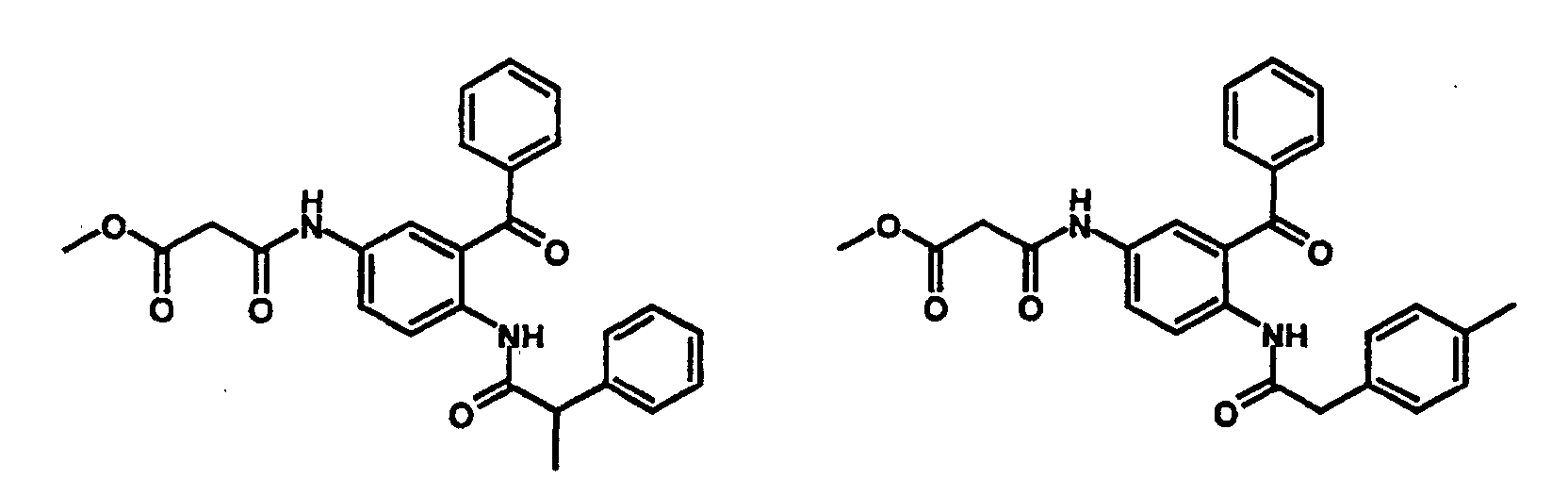
      Figure 00570001
      Figure 00570002
      Figure 00580001
      Figure 00580002
      Figure 00580003
      Figure 00580004
      Figure 00590001
      Figure 00590002
      Figure 00590003
      Figure 00600001
      Figure 00600002
      Figure 00600003
      Figure 00600004
      Figure 00610001
      Figure 00610002
      Figure 00610003
      Figure 00610004
      Figure 00620001
      Figure 00620002
      Figure 00620003
      Figure 00620004
      Figure 00620005
      Figure 00630001
      Figure 00630002
      Figure 00630003
      Figure 00630004
      besteht.
    6. Verwendung nach Anspruch 1, dadurch gekennzeichnet, daß die Verbindungen der Formel (I) aus der Gruppe ausgewählt sind, die aus N-[3-[3-Benzoyl-4-[2-(4-methylphenyl)-acetyl]amino]-phenylamino]-4-phenylzimtsäureamid und N-[2-[3-Benzoyl-4-[[2-(4-methylphenyl)acetyl]-amino]phenyl]-4-benzyloxyzimtsäureamid besteht.
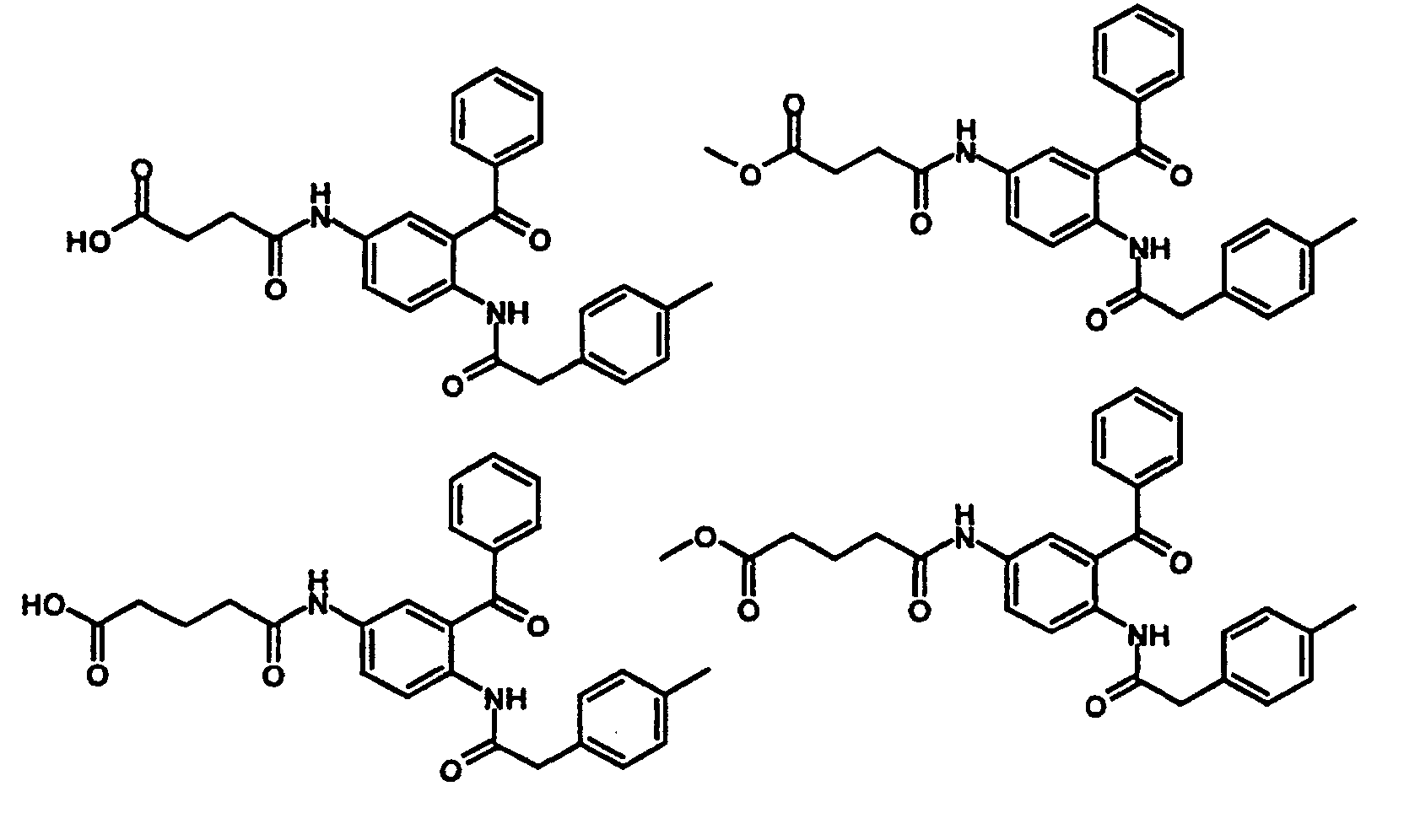
    7. Verwendung nach einem der Ansprüche 1 bis 6 zur Herstellung von Arzneimitteln zur Vorbeugung und Behandlung von Infektionen verursacht durch Parasiten, insbesondere einzellige Parasiten, nämlich Erreger der Malaria, der Schlafkrankheit, der Chagas-Krankheit, der Toxoplasmose, der Amöbenruhr, der Leishmaniosen, der Trichomoniasis, der Pneumozystose, der Balantidiose, der Kryptosporidiose, der Sarkozystose, der Akantha-möbose, der Naeglerose, der Kokzidiose, der Giardiose und der Lambliose.
    8. Arzneimittel zur therapeutischen und prophylaktischen Behandlung infektiöser Prozesse, dadurch gekennzeichnet, daß das Präparat einen wirksamen Gehalt an zumindest einer Verbindung nach einem der Ansprüche 1 bis 6 zusammen mit einem pharmazeutisch akzeptablen Träger enthält.
    9. Arzneimittel nach Anspruch 8, dadurch gekennzeichnet, daß das Präparat einen weiteren pharmazeutischen Wirkstoff enthält.
    EP01915288A 2000-02-24 2001-02-22 Verwendung von 2-phenylendiaminderivaten zur behandlung von infektionen Expired - Lifetime EP1257265B1 (de)

    Applications Claiming Priority (3)

    Application Number Priority Date Filing Date Title
    DE10008522A DE10008522A1 (de) 2000-02-24 2000-02-24 Verwendung von 2-PHenylendiaminderivaten zur Behandlung von Infektionen
    DE10008522 2000-02-24
    PCT/EP2001/002016 WO2001062709A2 (de) 2000-02-24 2001-02-22 Verwendung von 2-phenylendiaminderivaten zur behandlung von infektionen

    Publications (2)

    Publication Number Publication Date
    EP1257265A2 EP1257265A2 (de) 2002-11-20
    EP1257265B1 true EP1257265B1 (de) 2004-01-21

    Family

    ID=7632156

    Family Applications (1)

    Application Number Title Priority Date Filing Date
    EP01915288A Expired - Lifetime EP1257265B1 (de) 2000-02-24 2001-02-22 Verwendung von 2-phenylendiaminderivaten zur behandlung von infektionen

    Country Status (8)

    Country Link
    US (1) US20030036532A1 (de)
    EP (1) EP1257265B1 (de)
    JP (1) JP2004513067A (de)
    AT (1) ATE258048T1 (de)
    AU (1) AU2001242430A1 (de)
    CA (1) CA2401030A1 (de)
    DE (2) DE10008522A1 (de)
    WO (1) WO2001062709A2 (de)

    Families Citing this family (8)

    * Cited by examiner, † Cited by third party
    Publication number Priority date Publication date Assignee Title
    US20050113292A1 (en) * 2003-07-18 2005-05-26 Vanderbilt University Compositions of protein mimetics and methods of using same against HIV-1, SARS-coV and the like
    ZA200603215B (en) * 2003-10-22 2007-11-28 Council Scient Ind Res Use of selected amino acid-zinc complexes as antimalarial
    EP1939180A1 (de) 2006-12-20 2008-07-02 sanofi-aventis Heteroarylacrylamide und ihre Verwendung als Arzneimittel für die Stimulation der Expression der endothelialen NO-Synthase
    WO2008110351A2 (en) * 2007-03-15 2008-09-18 Dompe' Pha.R.Ma S.P.A. Use of (r) and (s)-2-aryl-propionic acid derivatives as antiseptic agents
    AU2007100477A4 (en) * 2007-06-05 2007-07-05 Jurox Pty Ltd Parasiticide Composition
    HRP20140890T1 (hr) * 2010-01-05 2014-11-07 Actelion Pharmaceuticals Ltd. Piperazini kao sredstva protiv malarije
    CN102304094B (zh) * 2011-09-23 2014-03-26 常熟市南湖实业化工有限公司 一种周效磺胺及其中间体的制备方法
    CN114644560B (zh) * 2022-04-20 2024-02-02 朗捷睿(苏州)生物科技有限公司 一种苯基丙烯酸类化合物及其制备方法和应用

    Family Cites Families (1)

    * Cited by examiner, † Cited by third party
    Publication number Priority date Publication date Assignee Title
    US5736557A (en) * 1994-06-17 1998-04-07 Hoffman-La Roche, Inc. N,N-bis (quinolin-4-yl)-diamine derivatives, their preparation and their use as antimalarials

    Also Published As

    Publication number Publication date
    WO2001062709A3 (de) 2002-04-18
    WO2001062709A2 (de) 2001-08-30
    JP2004513067A (ja) 2004-04-30
    DE10008522A1 (de) 2001-09-06
    CA2401030A1 (en) 2001-08-30
    ATE258048T1 (de) 2004-02-15
    US20030036532A1 (en) 2003-02-20
    AU2001242430A1 (en) 2001-09-03
    DE50101360D1 (de) 2004-02-26
    EP1257265A2 (de) 2002-11-20

    Similar Documents

    Publication Publication Date Title
    EP1071409B1 (de) Verwendung von phosphororganischen verbindungen zur therapeutischen und prophylaktischen behandlung von infektionen
    DE69813896T2 (de) Alpha-aminoamidderivate die als analgetische mittel nützlich sind
    EP1257265A2 (de) Verwendung von 2-phenylendiaminderivaten zur behandlung von infektionen
    DE3884858T2 (de) Phenol-thioalkylamide als Inhibitoren von 5-Lipoxygenase.
    WO2000044359A2 (de) Verwendung von thiadiazolderivaten zur prophylaktischen und therapeutischen behandlung von infektionen
    DE19920247A1 (de) Arzneimittel mit einem Gehalt an Verbindungen mit einem Stickstoff-Sauerstoff-Heterocyclus als Wirkstoff und ihre Verwendung
    EP1140952B1 (de) Phosphororganische verbindungen und ihre verwendung
    DE3888541T2 (de) Verbesserung der toxizitätskurven in der chemotherapie.
    EP1133500B1 (de) Phosphororganische verbindungen und ihre verwendung
    WO1995022327A1 (en) Use of 1-(arylalkylaminoalkyl) imidazoles for treating neurological damage
    DE19854402A1 (de) Verwendung von Phosphonameisensäurederivaten zur therapeutischen und prophylaktischen Behandlung von Infektionen
    DE3035688C2 (de)
    WO2000016757A2 (de) Verwendung von phosphororganischen verbindungen zur herstellung von arzneimitteln zur therapeutischen und prophylaktischen behandlung von infektionen oder als fungizid, bakterizid oder herbizid bei pflanzen
    DE19902924A1 (de) Verwendung von phosphororganischen Verbindungen zur prophylaktischen und therapeutischen Behandlung von Infektionen
    DE10014127A1 (de) Verwendung von phosphororganischen Verbindungen zur Behandlung von Infektionen
    DE3438585A1 (de) Neue sulfoxide, verfahren zu ihrer herstellung und ihre verwendung
    WO2000017212A1 (de) Phosphororganische verbindungen und ihre verwendung
    WO2000041473A2 (de) Verwendung von 3-isoxazolidinonen und hydroxylaminsäuren zur behandlung von infektionen
    DE10127922A1 (de) Verwendung von phosphororganischen Hydroxamsäurederivaten zur Herstellung von Arzneimitteln für die therapeutische und prophylaktische Behandlung von Infektionen
    DE19854310A1 (de) Verwendung von Phosphonoameisensäurederivaten zur therapeutischen und prophylaktischen Behandlung von Infektionen
    DE19843334A1 (de) Schwefelorganische Verbindungen und ihre Verwendung
    DE19903666A1 (de) Arzneimittel mit einem Gehalt an 3-Isoxazolidinonen und Hydroxylaminsäuren als Wirkstoff und ihre Verwendung
    DE2644941C3 (de) Arzneimittel zur Behandlung bösartiger Erkrankungen des lymphoproliferativen Systems
    JPS6251615A (ja) 比類なき非突然変異誘発性置換ニトロイミダゾ−ル
    DE3236389A1 (de) Neue nucleosidverbindungen, verfahren zu ihrer herstellung sowie ihre verwendung als arzneimittel

    Legal Events

    Date Code Title Description
    PUAI Public reference made under article 153(3) epc to a published international application that has entered the european phase

    Free format text: ORIGINAL CODE: 0009012

    17P Request for examination filed

    Effective date: 20020819

    AK Designated contracting states

    Kind code of ref document: A2

    Designated state(s): AT BE CH CY DE DK ES FI FR GB GR IE IT LI LU MC NL PT SE TR

    AX Request for extension of the european patent

    Free format text: AL;LT;LV;MK;RO;SI

    RAP1 Party data changed (applicant data changed or rights of an application transferred)

    Owner name: BIOAGENCY AG

    GRAP Despatch of communication of intention to grant a patent

    Free format text: ORIGINAL CODE: EPIDOSNIGR1

    GRAS Grant fee paid

    Free format text: ORIGINAL CODE: EPIDOSNIGR3

    GRAA (expected) grant

    Free format text: ORIGINAL CODE: 0009210

    AK Designated contracting states

    Kind code of ref document: B1

    Designated state(s): AT BE CH CY DE DK ES FI FR GB GR IE IT LI LU MC NL PT SE TR

    PG25 Lapsed in a contracting state [announced via postgrant information from national office to epo]

    Ref country code: TR

    Free format text: LAPSE BECAUSE OF FAILURE TO SUBMIT A TRANSLATION OF THE DESCRIPTION OR TO PAY THE FEE WITHIN THE PRESCRIBED TIME-LIMIT

    Effective date: 20040121

    Ref country code: NL

    Free format text: LAPSE BECAUSE OF FAILURE TO SUBMIT A TRANSLATION OF THE DESCRIPTION OR TO PAY THE FEE WITHIN THE PRESCRIBED TIME-LIMIT

    Effective date: 20040121

    Ref country code: IT

    Free format text: LAPSE BECAUSE OF FAILURE TO SUBMIT A TRANSLATION OF THE DESCRIPTION OR TO PAY THE FEE WITHIN THE PRESCRIBED TIME-LIMIT;WARNING: LAPSES OF ITALIAN PATENTS WITH EFFECTIVE DATE BEFORE 2007 MAY HAVE OCCURRED AT ANY TIME BEFORE 2007. THE CORRECT EFFECTIVE DATE MAY BE DIFFERENT FROM THE ONE RECORDED.

    Effective date: 20040121

    Ref country code: IE

    Free format text: LAPSE BECAUSE OF FAILURE TO SUBMIT A TRANSLATION OF THE DESCRIPTION OR TO PAY THE FEE WITHIN THE PRESCRIBED TIME-LIMIT

    Effective date: 20040121

    Ref country code: GB

    Free format text: LAPSE BECAUSE OF FAILURE TO SUBMIT A TRANSLATION OF THE DESCRIPTION OR TO PAY THE FEE WITHIN THE PRESCRIBED TIME-LIMIT

    Effective date: 20040121

    Ref country code: FR

    Free format text: LAPSE BECAUSE OF FAILURE TO SUBMIT A TRANSLATION OF THE DESCRIPTION OR TO PAY THE FEE WITHIN THE PRESCRIBED TIME-LIMIT

    Effective date: 20040121

    Ref country code: FI

    Free format text: LAPSE BECAUSE OF FAILURE TO SUBMIT A TRANSLATION OF THE DESCRIPTION OR TO PAY THE FEE WITHIN THE PRESCRIBED TIME-LIMIT

    Effective date: 20040121

    Ref country code: ES

    Free format text: LAPSE BECAUSE OF FAILURE TO SUBMIT A TRANSLATION OF THE DESCRIPTION OR TO PAY THE FEE WITHIN THE PRESCRIBED TIME-LIMIT

    Effective date: 20040121

    Ref country code: CY

    Free format text: LAPSE BECAUSE OF FAILURE TO SUBMIT A TRANSLATION OF THE DESCRIPTION OR TO PAY THE FEE WITHIN THE PRESCRIBED TIME-LIMIT

    Effective date: 20040121

    REG Reference to a national code

    Ref country code: GB

    Ref legal event code: FG4D

    Free format text: NOT ENGLISH

    REG Reference to a national code

    Ref country code: CH

    Ref legal event code: EP

    PG25 Lapsed in a contracting state [announced via postgrant information from national office to epo]

    Ref country code: LU

    Free format text: LAPSE BECAUSE OF NON-PAYMENT OF DUE FEES

    Effective date: 20040222

    Ref country code: AT

    Free format text: LAPSE BECAUSE OF NON-PAYMENT OF DUE FEES

    Effective date: 20040222

    REG Reference to a national code

    Ref country code: IE

    Ref legal event code: FG4D

    Free format text: GERMAN

    REF Corresponds to:

    Ref document number: 50101360

    Country of ref document: DE

    Date of ref document: 20040226

    Kind code of ref document: P

    PG25 Lapsed in a contracting state [announced via postgrant information from national office to epo]

    Ref country code: MC

    Free format text: LAPSE BECAUSE OF NON-PAYMENT OF DUE FEES

    Effective date: 20040228

    Ref country code: BE

    Free format text: LAPSE BECAUSE OF NON-PAYMENT OF DUE FEES

    Effective date: 20040228

    PG25 Lapsed in a contracting state [announced via postgrant information from national office to epo]

    Ref country code: SE

    Free format text: LAPSE BECAUSE OF FAILURE TO SUBMIT A TRANSLATION OF THE DESCRIPTION OR TO PAY THE FEE WITHIN THE PRESCRIBED TIME-LIMIT

    Effective date: 20040421

    Ref country code: GR

    Free format text: LAPSE BECAUSE OF FAILURE TO SUBMIT A TRANSLATION OF THE DESCRIPTION OR TO PAY THE FEE WITHIN THE PRESCRIBED TIME-LIMIT

    Effective date: 20040421

    Ref country code: DK

    Free format text: LAPSE BECAUSE OF FAILURE TO SUBMIT A TRANSLATION OF THE DESCRIPTION OR TO PAY THE FEE WITHIN THE PRESCRIBED TIME-LIMIT

    Effective date: 20040421

    LTIE Lt: invalidation of european patent or patent extension

    Effective date: 20040121

    NLV1 Nl: lapsed or annulled due to failure to fulfill the requirements of art. 29p and 29m of the patents act
    GBV Gb: ep patent (uk) treated as always having been void in accordance with gb section 77(7)/1977 [no translation filed]

    Effective date: 20040121

    REG Reference to a national code

    Ref country code: IE

    Ref legal event code: FD4D

    BERE Be: lapsed

    Owner name: BIOAGENCY AG

    Effective date: 20040228

    PG25 Lapsed in a contracting state [announced via postgrant information from national office to epo]

    Ref country code: DE

    Free format text: LAPSE BECAUSE OF NON-PAYMENT OF DUE FEES

    Effective date: 20040901

    PLBE No opposition filed within time limit

    Free format text: ORIGINAL CODE: 0009261

    STAA Information on the status of an ep patent application or granted ep patent

    Free format text: STATUS: NO OPPOSITION FILED WITHIN TIME LIMIT

    26N No opposition filed

    Effective date: 20041022

    EN Fr: translation not filed
    EN Fr: translation not filed
    PG25 Lapsed in a contracting state [announced via postgrant information from national office to epo]

    Ref country code: LI

    Free format text: LAPSE BECAUSE OF NON-PAYMENT OF DUE FEES

    Effective date: 20050228

    Ref country code: CH

    Free format text: LAPSE BECAUSE OF NON-PAYMENT OF DUE FEES

    Effective date: 20050228

    REG Reference to a national code

    Ref country code: FR

    Ref legal event code: ERR

    Free format text: BOPI DE PUBLICATION N: 05/03 PAGES: 237 PARTIE DU BULLETIN CONCERNEE: BREVETS EUROPEENS DONT LA TRADUCTION N'A PAS ETE REMISE I'INPI IL Y A LIEU DE SUPPRIMER: LA MENTION DE LA NON REMISE.

    REG Reference to a national code

    Ref country code: CH

    Ref legal event code: PL

    PG25 Lapsed in a contracting state [announced via postgrant information from national office to epo]

    Ref country code: PT

    Free format text: LAPSE BECAUSE OF NON-PAYMENT OF DUE FEES

    Effective date: 20040621