EP1254608A2 - Fixiereinlage - Google Patents
Fixiereinlage Download PDFInfo
- Publication number
- EP1254608A2 EP1254608A2 EP02000989A EP02000989A EP1254608A2 EP 1254608 A2 EP1254608 A2 EP 1254608A2 EP 02000989 A EP02000989 A EP 02000989A EP 02000989 A EP02000989 A EP 02000989A EP 1254608 A2 EP1254608 A2 EP 1254608A2
- Authority
- EP
- European Patent Office
- Prior art keywords
- adhesive mass
- mass points
- insert
- adhesive
- fixing insert
- Prior art date
- Legal status (The legal status is an assumption and is not a legal conclusion. Google has not performed a legal analysis and makes no representation as to the accuracy of the status listed.)
- Withdrawn
Links
Images

Classifications
-
- D—TEXTILES; PAPER
- D06—TREATMENT OF TEXTILES OR THE LIKE; LAUNDERING; FLEXIBLE MATERIALS NOT OTHERWISE PROVIDED FOR
- D06M—TREATMENT, NOT PROVIDED FOR ELSEWHERE IN CLASS D06, OF FIBRES, THREADS, YARNS, FABRICS, FEATHERS OR FIBROUS GOODS MADE FROM SUCH MATERIALS
- D06M17/00—Producing multi-layer textile fabrics
-
- A—HUMAN NECESSITIES
- A41—WEARING APPAREL
- A41D—OUTERWEAR; PROTECTIVE GARMENTS; ACCESSORIES
- A41D27/00—Details of garments or of their making
- A41D27/02—Linings
- A41D27/06—Stiffening-pieces
Definitions
- the invention relates to a fixing insert consisting of a textile Interlining which is coated with adhesive dots on one side.
- Double-layer adhesive compositions are known from documents DE-A 22 14 236, DE-A 22 31 723, DE-A 25 36 911 and DE-A 32 30 579.
- Back riveting is understood to mean an undesired bonding between two interlining materials, which can occur if the interlining layer coated with the adhesive point mass, hereinafter referred to as a fixing insert, is connected to the outer fabric in the inner sandwich ⁇ fixing method.
- the inner sandwich consists of the layer sequence of outer fabric, coated insert sheet and coated insert sheet and outer fabric, that is to say that the uncoated sides of the insert sheets lie against one another. 25 g / m 2 to 7 - - While the amount of coating applied per square meter insert track of earlier 18 was 15 g / m 2 is reduced and should be even further reduced with respect to the breathability of the textile laminate. At the same time, however, the requirements for the adhesion and durability of the laminate are increasing. Particularly with regard to the care properties of a textile laminate, there is a requirement that it also withstand several washes at washing temperatures up to 60 ° C. In particular, the adhesion of the top point to the bottom point always creates difficulties at the phase interfaces.
- the object of the invention is to provide a fixing insert, which overcomes the disadvantages of the prior art.
- the object is achieved by a fixing insert a textile interlining on one side with adhesive mass points is coated, wherein the adhesive mass points from a partially cross-linked Synthetic resin exist that contains a crosslinking initiator.
- the Fixing inserts according to the invention have separation force values which are 50 or especially after washing at temperatures of 60 ° C more than 100 % above those of known double-layer adhesive masses manufactured fixation inserts.
- the fixing insert is preferably one in which the crosslinking of the Resin more pronounced on the side facing the textile inlay is.
- the crosslinking of the synthetic resin in the orientation according to the invention creates a significantly improved non-return check.
- the fixing insert is preferably also one in which the Adhesive mass points a UV light activatable crosslinking initiator contain.
- a UV light can be activated Networking initiator enables simple and targeted partial networking the adhesion point mass.
- the fixing insert is preferably also one in which the Adhesive mass points as synthetic resin containing polymers or epoxy groups Contain acrylates.
- the epoxy-containing polymers or acrylates have proven to be particularly easy to process and the ones you want Substances that achieve adhesive forces are highlighted.
- the fixing insert is preferably also one in which the Adhesive mass points contain fillers.
- the use of fillers allowed a cheaper use of materials and more precise coordination of the Melting behavior of the adhesive on the processing in particular Conditions of Contract.
- the polyurethanes can consist of diisocyanates, polyols and diols be composed.
- the fixing insert is preferably also one in which the textile Interlining made of a nonwoven fabric, a woven fabric or a knitted fabric the basis of fibers, threads or filaments made of polyester, polyamide, Viscose, cotton, polyacrylonitrile or mixtures thereof.
- the fixing insert according to the invention is obtained in such a way that the Adhesive mass points on the inlay at spatially separated locations applied, warmed to their melting temperature, from the adhesive mass point free side of the interlining by irradiation with UV light to a Partial networking activated and can be handled and transported by cooling is made.
- Epoxy resins are those with softening points in the range from 70 to 130 ° C, preferably from 90 to 110 ° C and epoxide equivalents from 500 to 4000 mVal / kg used.
- the fixing insert according to the invention is advantageously obtained by that applying the adhesive mass points to the interlining by Hotmelt processes such as Rototherm, Meltprint or rotary screen printing are carried out.
- the fixing insert according to the invention is preferably thereby receive that the adhesive mass points for activating the partial crosslinking by means of IR radiators are kept at their melting temperature.
- Figure 1 shows a fixing insert according to the invention, in which on a preferably inlay web 1 consisting of nonwovens, adhesive mass points 2 are located, at least on the side adjacent to the interlining are partially networked.
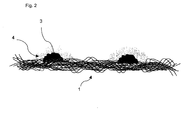
- FIG. 2 shows a fixing insert known from the prior art, in which on an insert web 1, preferably made of nonwovens Sub-item 3 and an upper item 4 sintered to this sub-item 3 is available.
- interlining 1 On a 35 g / m 2 nonwoven fabric as interlining 1, which consists of 100% by weight polyamide 6 (PA6) and is thermally bonded by means of a dot calender, 10 g / m 2 are stencil-printed with a CP52 stencil (52 dots / cm 2 ) a mixture of an epoxy resin and a thermoplastic polymer that can be crosslinked by UV light, printed on one side at 120 ° C. using the screenprint process.
- the adhesive mass points 2 are kept at approximately this temperature by means of IR emitters and irradiated with UV light from the side of the interlining web 1 free of the adhesive mass point, and the partial crosslinking reaction is initiated on the side of the adhesive mass points 2 facing the interlining web 1.
- the fixation insert is then cooled and rolled up.
- the fixing insert according to the invention can be laminated with outer materials at about 120 ° C. in a continuous press.
- the adhesive mass points 2 are kept at approximately this temperature by means of IR emitters and irradiated with UV light from the side of the interlining web 1 free of the adhesive mass point, and the partial crosslinking reaction is initiated on the side of the adhesive mass points 2 facing the interlining web 1.
- the fixation insert is then cooled and rolled up.
- the fixing insert according to the invention can be laminated at 100 to 120 ° C. in a continuous press with outer materials.
Landscapes
- Engineering & Computer Science (AREA)
- Textile Engineering (AREA)
- Details Of Garments (AREA)
- Adhesive Tapes (AREA)
- Laminated Bodies (AREA)
- Manufacturing Of Multi-Layer Textile Fabrics (AREA)
Abstract
Description
Die Epoxide sind bei Raumtemperatur feste Epoxidharze, die Reaktionsprodukte von Epichlorhydrin mit Bisphenol A und/oder Reaktionsprodukte von Epichlorhydrin mit Bisphenol F darstellen. Weiterhin können als Epoxidharz polyfunktionelle Epoxide eingesetzt werden. Hierunter fallen beispielsweise epoxidierte Novolacke.
Die eingesetzten Polyamide, Polyester, Polyurethane und/oder Vinylcopolymerisate mit Carboxyl-, Anhydro-, Hydroxy- und/oder Amido-Seitengruppen sind niedrigschmelzende thermoplastische Polymere. Weiterhin können Polymerblends aus niedrigschmelzenden Polyamiden, Polyestern, Polyurethanen und/oder Vinylcopolymerisaten mit Carboxyl-, Anhydro-, Hydroxy- und/oder Amido-Seitengruppen verwendet werden. Dabei sind die Polymere aus linearen oder verzweigten Monomeren aufgebaut. Das Polyamid ist aus den folgenden Monomeren gebildet:
- einer wenigstens difunktionellen Carbonsäure und
- einem wenigstens difunktionellen Amin und/oder
- einer ω-Aminocarbonsäure und/oder
- einem Lactam.
- einer wenigstens difunktionellen Carbonsäure und
- einem wenigstens difunktionellen Alkohol und/oder
- einer ω-Hydroxycarbonsäuren und/oder
- einem Lacton.
Claims (10)
- Fixiereinlage, bestehend aus einer textilen Einlagebahn (1), die auf einer Seite mit Haftmassenpunkten beschichtet ist, dadurch gekennzeichnet, dass die Haftmassenpunkte (2) aus einem teilvernetzten Kunstharz bestehen, das einen Vernetzungsinitiator enthält.
- Fixiereinlage nach Anspruch 1, dadurch gekennzeichnet, dass die Vernetzung des Kunstharzes an der zur textilen Einlagebahn (1) gerichteten Seite ausgeprägter ist.
- Fixiereinlage nach Anspruch 1 oder 2, dadurch gekennzeichnet, dass die Haftmassenpunkte (2) einen UV-Licht aktivierbaren Vernetzungsinitiator enthalten.
- Fixiereinlage nach einem der Ansprüche 1 bis 3, dadurch gekennzeichnet, dass die Haftmassenpunkte (2) als Kunstharz Epoxidgruppen haltige Polymere oder Acrylate enthalten.
- Fixiereinlage nach einem der Ansprüche 1 bis 4, dadurch gekennzeichnet, dass die Haftmassenpunkte (2) Füllstoffe enthalten.
- Fixiereinlage nach Anspruch 5, dadurch gekennzeichnet, dass die Haftmassenpunkte (2) als Füllstoffe thermoplastische Polymere wie Polyamide, Polyamidoamine, Polyester, Polyurethane oder Vinylpolymerisate enthalten.
- Fixiereinlage nach einem der Ansprüche 1 bis 6, dadurch gekennzeichnet, dass die textile Einlagebahn (1) aus einem Vliesstoff, einem Gewebe oder einem Gewirke auf der Basis von Fasern, Fäden oder Filamenten aus Polyester, Polyamid, Viskose, Baumwolle, Polyacrylnitril oder deren Gemischen besteht.
- Verfahren zur Herstellung einer Fixiereinlage nach einem der Ansprüche 1 bis 7, dadurch gekennzeichnet, dass die Haftmassenpunkte (2) auf die Einlagebahn (1) an räumlich getrennten Stellen aufgebracht, auf ihre Schmelztemperatur erwärmt, von der Haftmassepunkt freien Seite der Einlagebahn durch Bestrahlung mit UV-Licht zu einer Teilvernetzung aktiviert und durch Abkühlung handhab- und transportierbar gemacht wird.
- Verfahren nach Anspruch 8, dadurch gekennzeichnet, dass das Aufbringen der Haftmassenpunkte (2) auf die Einlagebahn (1) durch ein Hotmeltverfahren wie Rototherm, Meltprint oder Rotationssiebdruck erfolgt.
- Verfahren nach Anspruch 8 oder 9, dadurch gekennzeichnet, dass die Haftmassenpunkte (2) zur Aktivierung der Teilvernezung mittels IR-Strahlern auf ihrer Schmelztemperatur gehalten werden.
Applications Claiming Priority (2)
| Application Number | Priority Date | Filing Date | Title |
|---|---|---|---|
| DE10121843 | 2001-05-04 | ||
| DE10121843 | 2001-05-04 |
Publications (2)
| Publication Number | Publication Date |
|---|---|
| EP1254608A2 true EP1254608A2 (de) | 2002-11-06 |
| EP1254608A3 EP1254608A3 (de) | 2003-07-23 |
Family
ID=7683706
Family Applications (1)
| Application Number | Title | Priority Date | Filing Date |
|---|---|---|---|
| EP02000989A Withdrawn EP1254608A3 (de) | 2001-05-04 | 2002-01-17 | Fixiereinlage |
Country Status (2)
| Country | Link |
|---|---|
| EP (1) | EP1254608A3 (de) |
| KR (1) | KR20020084837A (de) |
Cited By (1)
| Publication number | Priority date | Publication date | Assignee | Title |
|---|---|---|---|---|
| DE102008012160B3 (de) * | 2008-03-01 | 2009-10-08 | Hänsel Textil GmbH | Leichter textiler Einlagestoff |
Families Citing this family (1)
| Publication number | Priority date | Publication date | Assignee | Title |
|---|---|---|---|---|
| KR101737913B1 (ko) * | 2016-12-15 | 2017-05-19 | (주) 제이제이통상 | 열고정 변부 형성 공정을 사용하는 환편 접착심지 제조방법 및 그 제조방법에 의해 제조된 접착심지 |
Family Cites Families (3)
| Publication number | Priority date | Publication date | Assignee | Title |
|---|---|---|---|---|
| FR2614034B1 (fr) * | 1987-04-17 | 1992-06-26 | Picardie Lainiere | Adhesif pour textile. procede de fabrication de renfort textile et tissu obtenu |
| FR2636986B1 (fr) * | 1988-09-28 | 1991-03-01 | Picardie Lainiere | Procede de fabrication d'un produit textile thermocollant bireactif et produit resultant |
| CN1157643A (zh) * | 1994-08-09 | 1997-08-20 | 旭化成工业株式会社 | 粘合衬布及其制造方法及粘合衬布用粘合剂 |
-
2002
- 2002-01-17 EP EP02000989A patent/EP1254608A3/de not_active Withdrawn
- 2002-05-04 KR KR1020020024604A patent/KR20020084837A/ko not_active Withdrawn
Cited By (1)
| Publication number | Priority date | Publication date | Assignee | Title |
|---|---|---|---|---|
| DE102008012160B3 (de) * | 2008-03-01 | 2009-10-08 | Hänsel Textil GmbH | Leichter textiler Einlagestoff |
Also Published As
| Publication number | Publication date |
|---|---|
| KR20020084837A (ko) | 2002-11-11 |
| EP1254608A3 (de) | 2003-07-23 |
Similar Documents
| Publication | Publication Date | Title |
|---|---|---|
| DE102008023411B4 (de) | Buchartiges Dokument sowie Verfahren zu dessen Herstellung | |
| DE60107850T2 (de) | Auf epoxidharz basierter verstärkter streifen mit verbesserter haftung an ölartigen metalloberflächen | |
| EP1393641B1 (de) | Fixiereinlage | |
| DE10027957C1 (de) | Fixiereinlage und Verfahren zur Herstellung einer Fixiereinlage | |
| EP2391686A1 (de) | Träger verstärkte hitzeaktivierbare klebemassen | |
| EP0940461A1 (de) | Vernetzende Basisschicht für Fixiereinlagen nach dem Doppelpunktverfahren | |
| DE68914482T2 (de) | Heisssiegelbares textiles Gebilde, ein mikroverkapseltes Vernetzungsmittel enthaltend. | |
| DE10347628A1 (de) | Vernetzbare Basisschicht für Fixiereinlagen nach dem Doppelpunktverfahren | |
| DE3783755T2 (de) | Thermoadhaesiver gegenstand und verfahren zur herstellung. | |
| DE10347665A1 (de) | Vernetzbare Basisschicht für Fixiereinlagen nach dem Doppelpunktverfahren | |
| DE2046432B2 (de) | Verfahren zur Herstellung faserverstärkter Bauelemente | |
| WO2017055025A1 (de) | Textiles substrat aus verstärkungsfasern | |
| WO2015097097A1 (de) | Langzeitstabile prepregs, verfahren zu deren herstellung und verwendungen der prepregs | |
| WO2013053587A1 (de) | Textilien mit schutzfunktion gegen abrieb und kontakthitze | |
| DE1956605C3 (de) | Verfahren zur Herstellung von heißsiegelbaren Einlagestoffen | |
| EP0987363B1 (de) | Verwendung von Polymerpulver zur Herstellung von beschussfesten Fasermaterialien | |
| WO2000034406A1 (de) | Klebstoffpulver | |
| EP1456314A1 (de) | Verfahren zum verbinden von zwei körpern | |
| EP1170413A2 (de) | Wasserlösliche Stickerei-Fixiereinlage | |
| DE2735147A1 (de) | Schichtfoermiges verbundmaterial aus hochmolekularem polyaethylen und phenolharz und verfahren zu dessen herstellung | |
| DE69802717T2 (de) | Verfahren zur Herstellung eines einbügelbaren Einlagestoffs und so hergestelltes Produkt | |
| WO2000000351A1 (de) | Verfahren zur herstellung eines verbundkörpers aus faserverstärktem kunststoff und nach diesem verfahren hergestellter verbundkörper | |
| DE3238057C2 (de) | Verfahren zum Herstellen eines festen, dünnwandigen, tiefgezogenen Formteiles | |
| DE202007010252U1 (de) | Verarbeitungshilfsmittel für das Harzinjektionsverfahren | |
| DE1694245A1 (de) | Heisssiegelbare Haftmassen fuer Textileinlagestoffe |
Legal Events
| Date | Code | Title | Description |
|---|---|---|---|
| PUAI | Public reference made under article 153(3) epc to a published international application that has entered the european phase |
Free format text: ORIGINAL CODE: 0009012 |
|
| AK | Designated contracting states |
Kind code of ref document: A2 Designated state(s): AT BE CH CY DE DK ES FI FR GB GR IE IT LI LU MC NL PT SE TR |
|
| AX | Request for extension of the european patent |
Free format text: AL;LT;LV;MK;RO;SI |
|
| PUAL | Search report despatched |
Free format text: ORIGINAL CODE: 0009013 |
|
| AK | Designated contracting states |
Designated state(s): AT BE CH CY DE DK ES FI FR GB GR IE IT LI LU MC NL PT SE TR |
|
| AX | Request for extension of the european patent |
Extension state: AL LT LV MK RO SI |
|
| RIC1 | Information provided on ipc code assigned before grant |
Ipc: 7C 09J 163/00 - Ipc: 7D 06M 17/04 B Ipc: 7A 41D 27/06 A |
|
| AKX | Designation fees paid | ||
| REG | Reference to a national code |
Ref country code: DE Ref legal event code: 8566 |
|
| STAA | Information on the status of an ep patent application or granted ep patent |
Free format text: STATUS: THE APPLICATION IS DEEMED TO BE WITHDRAWN |
|
| 18D | Application deemed to be withdrawn |
Effective date: 20040124 |