EP1250144B1 - Huile vegetale pour la preparation d'une composition inhibitrice de la 5 alpha-reductase - Google Patents
Huile vegetale pour la preparation d'une composition inhibitrice de la 5 alpha-reductase Download PDFInfo
- Publication number
- EP1250144B1 EP1250144B1 EP01907634A EP01907634A EP1250144B1 EP 1250144 B1 EP1250144 B1 EP 1250144B1 EP 01907634 A EP01907634 A EP 01907634A EP 01907634 A EP01907634 A EP 01907634A EP 1250144 B1 EP1250144 B1 EP 1250144B1
- Authority
- EP
- European Patent Office
- Prior art keywords
- oil
- unsaponifiable
- use according
- composition
- avocado
- Prior art date
- Legal status (The legal status is an assumption and is not a legal conclusion. Google has not performed a legal analysis and makes no representation as to the accuracy of the status listed.)
- Expired - Lifetime
Links
Classifications
-
- A—HUMAN NECESSITIES
- A61—MEDICAL OR VETERINARY SCIENCE; HYGIENE
- A61Q—SPECIFIC USE OF COSMETICS OR SIMILAR TOILETRY PREPARATIONS
- A61Q19/00—Preparations for care of the skin
- A61Q19/008—Preparations for oily skin
-
- A—HUMAN NECESSITIES
- A61—MEDICAL OR VETERINARY SCIENCE; HYGIENE
- A61K—PREPARATIONS FOR MEDICAL, DENTAL OR TOILETRY PURPOSES
- A61K36/00—Medicinal preparations of undetermined constitution containing material from algae, lichens, fungi or plants, or derivatives thereof, e.g. traditional herbal medicines
- A61K36/18—Magnoliophyta (angiosperms)
- A61K36/185—Magnoliopsida (dicotyledons)
- A61K36/28—Asteraceae or Compositae (Aster or Sunflower family), e.g. chamomile, feverfew, yarrow or echinacea
-
- A—HUMAN NECESSITIES
- A61—MEDICAL OR VETERINARY SCIENCE; HYGIENE
- A61K—PREPARATIONS FOR MEDICAL, DENTAL OR TOILETRY PURPOSES
- A61K36/00—Medicinal preparations of undetermined constitution containing material from algae, lichens, fungi or plants, or derivatives thereof, e.g. traditional herbal medicines
- A61K36/18—Magnoliophyta (angiosperms)
- A61K36/185—Magnoliopsida (dicotyledons)
- A61K36/48—Fabaceae or Leguminosae (Pea or Legume family); Caesalpiniaceae; Mimosaceae; Papilionaceae
-
- A—HUMAN NECESSITIES
- A61—MEDICAL OR VETERINARY SCIENCE; HYGIENE
- A61K—PREPARATIONS FOR MEDICAL, DENTAL OR TOILETRY PURPOSES
- A61K36/00—Medicinal preparations of undetermined constitution containing material from algae, lichens, fungi or plants, or derivatives thereof, e.g. traditional herbal medicines
- A61K36/18—Magnoliophyta (angiosperms)
- A61K36/185—Magnoliopsida (dicotyledons)
- A61K36/54—Lauraceae (Laurel family), e.g. cinnamon or sassafras
-
- A—HUMAN NECESSITIES
- A61—MEDICAL OR VETERINARY SCIENCE; HYGIENE
- A61K—PREPARATIONS FOR MEDICAL, DENTAL OR TOILETRY PURPOSES
- A61K8/00—Cosmetics or similar toiletry preparations
- A61K8/18—Cosmetics or similar toiletry preparations characterised by the composition
- A61K8/92—Oils, fats or waxes; Derivatives thereof, e.g. hydrogenation products thereof
- A61K8/922—Oils, fats or waxes; Derivatives thereof, e.g. hydrogenation products thereof of vegetable origin
-
- A—HUMAN NECESSITIES
- A61—MEDICAL OR VETERINARY SCIENCE; HYGIENE
- A61P—SPECIFIC THERAPEUTIC ACTIVITY OF CHEMICAL COMPOUNDS OR MEDICINAL PREPARATIONS
- A61P13/00—Drugs for disorders of the urinary system
- A61P13/08—Drugs for disorders of the urinary system of the prostate
-
- A—HUMAN NECESSITIES
- A61—MEDICAL OR VETERINARY SCIENCE; HYGIENE
- A61P—SPECIFIC THERAPEUTIC ACTIVITY OF CHEMICAL COMPOUNDS OR MEDICINAL PREPARATIONS
- A61P17/00—Drugs for dermatological disorders
-
- A—HUMAN NECESSITIES
- A61—MEDICAL OR VETERINARY SCIENCE; HYGIENE
- A61P—SPECIFIC THERAPEUTIC ACTIVITY OF CHEMICAL COMPOUNDS OR MEDICINAL PREPARATIONS
- A61P17/00—Drugs for dermatological disorders
- A61P17/04—Antipruritics
-
- A—HUMAN NECESSITIES
- A61—MEDICAL OR VETERINARY SCIENCE; HYGIENE
- A61P—SPECIFIC THERAPEUTIC ACTIVITY OF CHEMICAL COMPOUNDS OR MEDICINAL PREPARATIONS
- A61P17/00—Drugs for dermatological disorders
- A61P17/08—Antiseborrheics
-
- A—HUMAN NECESSITIES
- A61—MEDICAL OR VETERINARY SCIENCE; HYGIENE
- A61P—SPECIFIC THERAPEUTIC ACTIVITY OF CHEMICAL COMPOUNDS OR MEDICINAL PREPARATIONS
- A61P17/00—Drugs for dermatological disorders
- A61P17/10—Anti-acne agents
-
- A—HUMAN NECESSITIES
- A61—MEDICAL OR VETERINARY SCIENCE; HYGIENE
- A61Q—SPECIFIC USE OF COSMETICS OR SIMILAR TOILETRY PREPARATIONS
- A61Q19/00—Preparations for care of the skin
-
- A—HUMAN NECESSITIES
- A61—MEDICAL OR VETERINARY SCIENCE; HYGIENE
- A61Q—SPECIFIC USE OF COSMETICS OR SIMILAR TOILETRY PREPARATIONS
- A61Q7/00—Preparations for affecting hair growth
-
- A—HUMAN NECESSITIES
- A61—MEDICAL OR VETERINARY SCIENCE; HYGIENE
- A61Q—SPECIFIC USE OF COSMETICS OR SIMILAR TOILETRY PREPARATIONS
- A61Q7/00—Preparations for affecting hair growth
- A61Q7/02—Preparations for inhibiting or slowing hair growth
-
- A—HUMAN NECESSITIES
- A61—MEDICAL OR VETERINARY SCIENCE; HYGIENE
- A61K—PREPARATIONS FOR MEDICAL, DENTAL OR TOILETRY PURPOSES
- A61K2800/00—Properties of cosmetic compositions or active ingredients thereof or formulation aids used therein and process related aspects
- A61K2800/74—Biological properties of particular ingredients
- A61K2800/78—Enzyme modulators, e.g. Enzyme agonists
- A61K2800/782—Enzyme inhibitors; Enzyme antagonists
-
- A—HUMAN NECESSITIES
- A61—MEDICAL OR VETERINARY SCIENCE; HYGIENE
- A61K—PREPARATIONS FOR MEDICAL, DENTAL OR TOILETRY PURPOSES
- A61K8/00—Cosmetics or similar toiletry preparations
- A61K8/18—Cosmetics or similar toiletry preparations characterised by the composition
- A61K8/96—Cosmetics or similar toiletry preparations characterised by the composition containing materials, or derivatives thereof of undetermined constitution
- A61K8/97—Cosmetics or similar toiletry preparations characterised by the composition containing materials, or derivatives thereof of undetermined constitution from algae, fungi, lichens or plants; from derivatives thereof
- A61K8/9783—Angiosperms [Magnoliophyta]
- A61K8/9789—Magnoliopsida [dicotyledons]
Definitions
- the present invention relates to the use of at least one of a product of vegetable oil for the preparation of a composition intended to inhibit the activity of 5 ⁇ -reductase, in particular for the treatment of prostatic hypertrophy, prostatic adenoma, acne, hyperseborrhea, alopecia, hirsutism.
- the invention also relates to methods of cosmetic treatment, including oily skin, as well as the use of vegetable oil products described as additives in a food for humans and / or animals.
- 5 ⁇ -reductase is a microsomal NADPH-dependent enzyme that exists in the form of two isoenzymes synthesized from two different genes.
- the type 1 isoenzyme of 5 ⁇ -reductase is found essentially in the liver and the skin, especially in the sebaceous glands of the skin no genital and scalp, and appears at puberty.
- the isoenzyme type 2 is predominant in the prostate and at the level of the skin of the sexual territories differentiated: genital region, beard, and plays a role in sexual differentiation.
- the distribution of isoenzymes of type 1 and 2 of 5a-reductase in the skin and cutaneous appendages in humans can be illustrated by the table below.
- this enzyme 5 ⁇ -reductase mainly localized in the genital tissues and in the skin, catalyzes the hydroxylation of testosterone in 5 ⁇ -reductase dihydrotestosterone (DHT).
- DHT 5 ⁇ -reductase dihydrotestosterone
- An excessively high activity of 5 ⁇ -reductase thus causes levels of androgen in the form of DHT that are too high in the prostate, hence an overstimulation of the latter resulting in undesirable growth that can lead to the pathology of prostatic hypertrophy. even prostatic adenoma, usually requiring surgery.
- the activity of 5 ⁇ -reductase is more important in the gland sebaceous than in other structures.
- the seborrheic glands show a stronger 5 ⁇ -reductase activity than in other territories skin. Therefore, the level of physiological sebaceous secretion seems closely related to the activity of this enzyme.
- the oily skin (seborrhea), besides its unsightly appearance, constitutes a terrain on which complications may occur. It reaches the areas where sebaceous glands are numerous and results mainly from overstimulation androgenic production of sebaceous by these specific glands. hyperseborrhea participates in the occurrence of acne vulgaris lesions.
- the isoenzyme of type 2 of 5 ⁇ -reductase is located mainly in the sheath internal epithelial, as well as at the level of the dermal papilla of the hair. However this last location remains to be specified.
- Androgenic alopecia whose pathophysiology is very close to that of acne, is the most common alopecia and probably the one where the demand for therapeutic is the strongest. 5 ⁇ -reductase seems to play a key role in this pathology. Indeed, men with isoenzyme genetic deficiency type 2 5 ⁇ -reductase do not develop androgenetic alopecia.
- Serenoa Repens extract is also known as a reference for 5 ⁇ -reductase inhibitor, the Serenoa Repens extract having the advantage, compared with finasteride, of a natural origin as a plant extract for a better comparison for products also tested of natural origin.
- Serenoa Repens also known as Sabal serrulatum, is a small palm that can be found in the United States (Florida) in North Africa and Spain.
- the present invention thus relates to the use of at least one product vegetable oil selected from the group consisting of vegetable oil oleodistillates, unsaponifiables of vegetable oil, furanic lipids of vegetable oil and mixtures thereof, for the preparation of a composition intended to inhibit the activity of 5 ⁇ -reductase.
- the use according to the invention is characterized in that the composition is intended to inhibit isoenzyme type 1 and / or isoenzyme type 2 5 ⁇ -reductase.
- vegetable oil oleodistillate is meant according to the invention an oil plant which has been subjected to a concentration step of its unsaponifiable fraction.
- Unsaponifiable is the fraction of a fat that, after prolonged action alkaline base, remains insoluble in water and can be extracted with a solvent organic.
- Five major groups of substances are present in most unsaponifiable vegetable oils: saturated or unsaturated hydrocarbons, alcohols aliphatic or terpene, sterols, phytosterols, tocopherols, pigments carotenoids and xanthophiles.
- Vegetable oils whose unsaponifiable and / or oleodistillate are rich in tocopherols and / or phytosterols are particularly preferred for use according to the invention.
- Molecular distillation is particularly preferred, being preferably carried out at a temperature between about 180 and about 280 ° C while maintaining a pressure of between about 10 -3 and about 10 -2 mmHg and preferably of the order of 10 -3. mmHg.
- the unsaponifiable concentration of the distillate can reach 60%.
- This molecular distillation is preferably performed using a device selected from centrifugal type molecular distillers and molecular-type devices to scraped film.
- EP-0 493 144 discloses a molecular distiller of this type.
- the product to be distilled is spread in a thin layer on the heated surface (hot surface) of a conical rotor rotating at high speed.
- the distillation chamber is placed under vacuum. Under these conditions, there is evaporation and not boiling, from the hot surface, of the constituents of the unsaponifiable, the advantage being that the oil and the unsaponifiable (these products being considered fragile) do not are not degraded during evaporation.
- Molecular distillers of scraped film type also known those skilled in the art, include a distillation chamber with a scraper rotating, allowing continuous spreading on the evaporation surface (surface hot) of the product to be distilled. Product vapors are condensed through a refrigerated finger placed in the center of the distillation chamber. Systems power and vacuum devices are very close to those of a distiller Centrifugal (feed pumps, vane and diffusion vacuum pumps oil, etc.). The recovery of residues and distillates in glass balloons, made by gravitational flow.
- an oleodistillate selected from the group consisting of oil of avocado oil, soybean oil, lupine oil, sunflower oil and mixtures of these.
- the distillation ratio can be defined as follows: this is the mass ratio reduced to 100% of the mass of the distillate to the sum (mass of distillate + mass of the residue).
- the distillate thus obtained ie the sunflower oleodistillate, has a unsaponifiable content of between about 6 and about 10% by weight, the remaining being composed by the triglycerides of the sunflower oil.
- the unsaponifiable vegetable oil that can be used according to the invention is preferably selected from the group consisting of the unsaponifiable avocado oil, unsaponifiable soybean oil and mixtures thereof.
- this unsaponifiable is mainly composed of sterols (40 to 65%) and tocopherols ( ⁇ 10%).
- the main sterols are ⁇ -sitosterol (40 to 70% of the total sterols), the campesterol (15 to 30% of the total sterols) and stigmasterol (10 to 25% of the sterols total).
- the tocopherols are present in the form of a mixture of ⁇ -tocopherol (5 35% total tocopherols), ⁇ -tocopherol (45 to 70% total tocopherols) and ⁇ -tocopherol (10 to 43% of total tocopherols).
- the unsaponifiable avocado oil used according to the invention can be obtained from fresh fruit but, preferably, the unsaponifiable avocado is prepared from the previously heat-treated fruit, before extracting the oil and saponification, as described in patent FR-2,678,632.
- This heat treatment consists of controlled drying of the fruit, fresh from preferably, for at least four hours, advantageously at least 10 hours, of preferably between about 24 and about 48 hours at a preferred temperature at least about 80 ° C and preferably from about 80 to about 120 ° C.
- Said oleodistillate or “concentrate” of unsaponifiable is prepared by distillation according to a process such as that described for lupine oil in the patent application FR-2 762 512, but adapted to soybean oil.
- the soybean oil is distilled in a centrifugal type molecular distiller or scraped film, at a temperature between about 210 and 250 ° C and under a vacuum grown between 0.01 and 0.001 millimeters of mercury (ie 0.13 to 1.3 Pa).
- the distillate obtained has an unsaponifiable content of between 5 and 30% by weight and therefore constitutes an oil unsaponifiable oleodistillate (or "concentrate") soy.
- the latter is then saponified according to a conventional method of saponification, in presence of ethanolic potash.
- the mixture obtained is extracted with dichloroethane in a column against the current.
- the solvent phase is finally desolvenced by passing through a falling film evaporator to recover the unsaponifiable soy.
- the unsaponifiable of vegetable oil is a mixture of unsaponifiables of avocado and soy weight ratio of unsaponifiable avocado oil to unsaponifiable soybean oil ranging from about 0.1 to about 9, and preferably from about 0.25 and about 0.6.
- furanic lipids of vegetable oil means compounds comprising a C 11 -C 19 hydrocarbon linear main chain, saturated or comprising one or more ethylenic or acetylenic unsaturations, and a 2-furanyl group having 1 to 3 carbon atoms. one of its ends.
- the furan lipid of the avocado is particularly preferred.
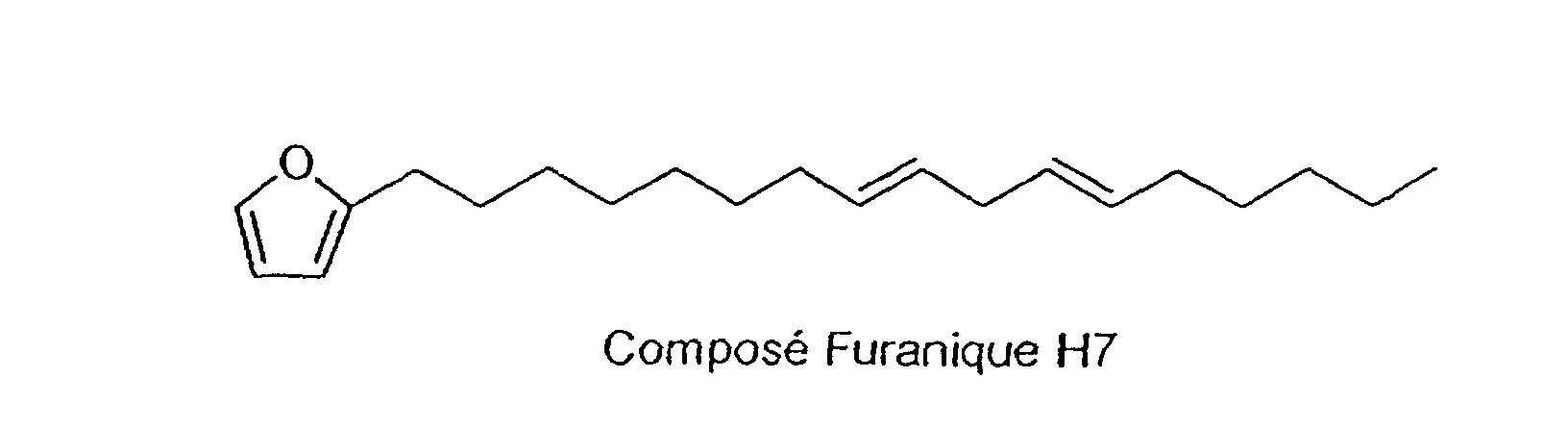
- the avocado in fact comprises particular lipids of furanic type, the main component of which is a linoleic furan:
- furanic lipids are metabolites of compounds initially present in the fruit and leaves which, under the effect of heat, are dehydrate and cyclize into furan derivatives.
- linoleic furan results from the thermal transformation of the following precursor:
- furanic lipid of avocado is meant in particular according to the invention the components corresponding to the formula: in which R is a linear hydrocarbon chain C 11 -C 19 preferably C 13 -C 17 saturated or comprising one or more ethylenic or acetylenic unsaturations.
- a new process for the preparation of these furan lipids of avocado was the subject of filing a patent application that same day. It essentially consists of a process for selectively extracting furan avocado lipids, characterized in that it comprises the steps of preparing an unsaponifiable avocado, and then subjecting the unsaponifiable avocado to a stage molecular distillation using temperature means set for a temperature between 100 and 160 ° C and pressure means set for a pressure of between 10 -3 and 510 -2 mmHg.
- This molecular distillation step using conditions of specific temperatures and pressures, is an essential feature of this process, in combination with the previous step of preparing the unsaponifiable already described above.
- the vegetable oil product as described above is used in a proportion of from about 0.001 to about 100% by weight (possibility of use in pure form, without excipient), preferably between 0.01 and about 70% by weight, and more particularly between about 0.1 and 10 % by weight, relative to the total weight of the composition.
- composition prepared by the use according to the invention may furthermore to include a pharmaceutically, dermatologically or cosmetically acceptable.
- Any excipient suitable for the forms may be used galenics known to those skilled in the art, for administration by topical, oral, enteral or parenteral, including rectal.
- this excipient can be adapted to obtain a composition in the form of an oily solution, a water-in-oil emulsion, a oil-in-water emulsion, a microemulsion, an oily gel, an anhydrous gel, a cream, a dispersion of vesicles, microcapsules or microparticles, or still capsules or soft capsules of gelatin or vegetable.
- an excipient suitable for administration by the route is used.
- the advantageous effect of inhibiting the activity of 5 ⁇ -reductase provided by the use according to the invention makes it possible to destine the composition thus prepared to therapeutic treatments, especially dermatological, and cosmetics.
- the use according to the invention is characterized in that the composition is intended for the treatment of pathologies and / or skin disorders related to a Congenital or acquired exaggeration of 5 ⁇ -reductase activity.
- the use according to the invention is characterized in that the composition is intended for the treatment of prostatic hypertrophy.
- composition is intended for the treatment of prostatic adenoma.
- excipient adapted for rectal administration as described above may be particularly contemplated for such treatments of hypertrophy and / or prostatic adenoma.
- composition is intended for the treatment of acne.
- composition is intended for the treatment of hyperseborrhoea.
- composition is intended for the treatment of alopecia.
- composition is intended for the treatment of hirsutism.
- the present invention also relates to a method of treatment cosmetic skin, characterized in that it applies to the skin a cosmetic composition containing at least one vegetable oil product such as described above.
- the invention furthermore relates to a method of cosmetic treatment other than a method of therapeutic treatment of hair loss, characterized in that a scalp is applied to the scalp cosmetic composition containing at least one vegetable oil product as described above.
- the subject of the invention is also a method of treatment other than a method of therapeutic treatment of excess hair, characterized in that it is applied to the skin with excessive hair a cosmetic composition containing the minus a vegetable oil product as described above.
- these last two cosmetic treatment methods can improve the appearance by reducing Visibly the unsightly phenomena of hair loss related to alopecia and the phenomena of excessive pilosity related to hirsutism.
- the vegetable oil product is present in the composition according to a a proportion of between about 0.001 and about 100% by weight (possibility use in pure form, without excipient), preferably between about 0.01 and about 70% by weight, and more particularly between about 0.1 and 10% by weight. weight, relative to the total weight of the composition.
- the cosmetic composition applied according to the method contains at least one cosmetically excipient acceptable as described above.
- the subject of the invention is also the use of at least one product of vegetable oil as described above, as an additive in a food to be human and / or animal.
- This food use is preferably characterized in what the vegetable oil product is present in the food in a proportion between about 0.001 and about 100% by weight, preferably about 0.01 and about 70% by weight, and more particularly between about 0.1 and 10 % by weight, based on the total weight of the food.
- the distillate obtained the sunflower oliodistillat, has a content of approximately 6.2% by weight, the remaining part being composed by triglycerides of sunflower oil.
- the Oleodistillate thus obtained is called "Sunflower Oleodistillate-1".
- the distillate obtained, the oil oil odeodistillate has a content of approximately 50% by weight, the remaining part being composed by the free fatty acids and triglycerides from avocado oil.
- the distillate obtained, the lupine oil oleodistillate has a content of about 58% by weight, the remaining part being composed by free fatty acids and triglycerides from lupine oil.
- the powder obtained in the preceding step is extracted with hexane by pressure at cold in a "KOMET" screw press.
- the meal is eliminated and the solution hexane is evaporated under reduced pressure.
- the recovered oil is filtered on "Büchner” then stored under nitrogen. 20 g of avocado oil are thus obtained.
- a scraped film distiller as described above is used, marketed by the company Leybold under the name "KDL 4".
- KDL 4 This is a glass appliance, equipped with a distillation chamber equipped with a rotary wiper, continuous spreading on the evaporation surface (hot surface) of the product to treat.
- the product vapors are condensed through a refrigerated finger, placed in the center of the distillation chamber.
- Peripheral power systems and are very close to those of a centrifugal distiller (feed pumps, vacuum pumps with vane and oil diffusion, ). The recovery of residues and distillates in glass balloons, is by gravitational flow.
- the distillation temperature is about 230 ° C with a pressure of the order of 10 -3 mmHg.
- the rotational speed of the shaft is 200 rpm and the feed rate is 7 ml / min.
- the unsaponifiable undergoes a new stage of desolvation push as well as a deodorization step at high temperature.
- Unsaponifiable Soy-1 The unsaponifiable thus obtained is hereinafter referred to as "Unsaponifiable Soy-1".
- Lipid-1 a distillate very rich in furanic lipids insofar as the content of these exceeds 99%. This distillate is hereinafter referred to as "Lipid-1".
- Example 2 Evaluation of the Inhibitory Activity on the Activity of 5 ⁇ -Reductase by measuring the level of 5-dihydrotestosterone formed from the testosterone by DU145 cells.
- Prostate cells DU145 are derived from a tumor line obtained at from a carcinoma of the prostate (ATCC No. HTB 81).
- the MEM medium (ref.0410265), glutamine and gentamycin come from Gibco.
- the serum Fetal calf (FCS) comes from DAP and is used decomplemented (45 mm at 56 ° C).
- the plastics used for culture (boxes and plates) come from Costar.
- the testosterone comes from Sigma.
- a stock solution of ethanol at 10 mg / ml is prepared from each of the tested products.
- the concentration range used for the experiments is as follows: 0, 5, 10, 50, 100 and 500 micrograms / ml. (Dilution carried out in the culture medium).
- the volume of extract added per well being 20 microliters / well, the solutions to be prepared are concentrated 50X.
- a stock solution of testosterone at 10 mM is prepared in ethanol. the moment of its use, this solution is diluted 1: 1000 in the medium of culture and 10 microliters are added per well.
- Prostate DU145 cells are cultured at 37 ° C, 5% CO 2 in MEM medium containing glutamine (2mM), gentamycin (50 micrograms / ml) and 10% FCS. Their subculture rate is 1:10.
- the cells are cultured in 6-well plates at the rate of 2.10 5 DU145 per well / 1 ml of medium containing only 1% of FCS. The cells are maintained for 3 days at 37 ° C., 5% CO 2 . On the day of the experiment, the culture medium contained in the wells is removed and replaced with new medium containing 1% FCS. Testosterone (0.1 micromolar final) and extracts at different concentrations are added to the medium at a rate of 10 and 20 microliters / well respectively. (The "control" wells correspond to cells incubated in the presence of testosterone and an ethanol equivalent, which makes it possible to subtract the effect of the solvent on the cultures and to determine the percentage of DHT formed in the absence of an inhibitor). The cells are then incubated at 37 ° C., 5% CO 2 . After 3 hours, the culture supernatants are collected and frozen at -80 ° C until the assay.
- Example 3 compositions in the form of usable oil-in-water emulsions according to the invention
- compositions 1.1 to 1.3 below were each prepared in the manner next.
- the components constituting the aqueous phase water and glycerol are placed in a water bath at 75 ° C.
- the components of the fatty phase with the exception of SEPIGEL 305, SILICONE SF 1202 and the vegetable oil product (respectively prepared below under the names "Sunflower Oleodistillate-1", “Unsaponifiable-1” and “ Lipids-1 "), are placed in a water bath at 75 ° C.
- SILICONE 1202 and the respective vegetable oil product are added to the fatty phase.
- the slow speed turbine emulsion is then carried out by incorporating the fatty phase into the aqueous phase.
- composition 1.1 (INCI formula) % (in weight) Aqueous phase Water 67.3 Glycerin 4 Fatty phase Sorbitan Tristearate 1.85 Peg 40 Stearate 3.15 Silicone SF 1202 3 Cetiol Oe 1 Vaseline Codex 2.5 Glyceryl Stearate 6 Decyl Pentanoate 3 Oleodistillate of sunflower-1 2 Beeswax 3 Stearate Peg 2 1 C12-15 Benzoate alcohol 1 Phenonip 0.7 Sepigel 305 0.5 TOTAL 100% Composition 1.2 (INCI names) % (in weight) Aqueous phase Water 67.3 Glycerin 4 Fatty phase Sorbitan Tristearate 1.85 Peg 40 Stearate 3.15 Silicone SF 1202 3 Cetiol Oe 1 Vaseline Codex 2.5 Glyceryl
Landscapes
- Health & Medical Sciences (AREA)
- Life Sciences & Earth Sciences (AREA)
- Veterinary Medicine (AREA)
- Public Health (AREA)
- General Health & Medical Sciences (AREA)
- Animal Behavior & Ethology (AREA)
- Natural Medicines & Medicinal Plants (AREA)
- Chemical & Material Sciences (AREA)
- Dermatology (AREA)
- Medicinal Chemistry (AREA)
- Pharmacology & Pharmacy (AREA)
- Engineering & Computer Science (AREA)
- Epidemiology (AREA)
- Organic Chemistry (AREA)
- Nuclear Medicine, Radiotherapy & Molecular Imaging (AREA)
- General Chemical & Material Sciences (AREA)
- Chemical Kinetics & Catalysis (AREA)
- Bioinformatics & Cheminformatics (AREA)
- Biotechnology (AREA)
- Alternative & Traditional Medicine (AREA)
- Botany (AREA)
- Medical Informatics (AREA)
- Microbiology (AREA)
- Mycology (AREA)
- Birds (AREA)
- Oil, Petroleum & Natural Gas (AREA)
- Urology & Nephrology (AREA)
- Medicines Containing Plant Substances (AREA)
- Cosmetics (AREA)
Abstract
Description
| répartition des isoenzymes de type 1 et 2 de la 5α-réductase au niveau de la peau et des annexes cutanées chez l'homme | |||
| HS-αr1 | H5-αr2 | ||
| EPIDERME | Couche basale | ++ | + |
| Couche spineuse | + | ++ | |
| Couche granuleuse | + | - | |
| Couche cornée | - | - | |
| DERME | Fibroblastes | ++ | - |
| GLANDES SEBACEES | Cellules basales | ++ | + |
| Cellules glandulaires | ++ | - | |
| GLANDES SUDORALES ECCRINES | Canal excréteur | - | - |
| Cellules sécrétrices | ++ | - | |
| Cellules myoépithéliales | ++ | + | |
| FOLLICULE PILEUX | Papille dermique | + | + ? |
| Cellules de la matrice | ++ | + | |
| Gaine épithéliale interne | ± | +++ | |
| Gaine épithéliale externe | ++ | - | |
| Muscle arrecteur | + | - |
- température de 230 à 250 °C;
- pression de 10-3 à 10-2 mmHg;
- taux de distillation d'environ 5 à 10 % massique.


- température : 220 °C;
- pression : 10-3 mmHg;
- taux de distillation : 6,7 % massique;
- débit d'alimentation : 18 kg/h.
- température 230 °C;
- pression : 10-3 mmHg;
- taux de distillation : 10 % massique;
- débit d'alimentation : 20 kg/h.
- température : 270 °C;
- pression : 10-3 mmHg;
- taux de distillation : 2,7 % massique;
- débit d'alimentation : 18 kg/h.
- alcools gras polyhydroxylés 24,3 %
- lipides furaniques 55,5 %
- stérols 3,1 %
- squalène 1,4 %
- autres 15,7%(1)
- température surface chaude: 108°C
- pression : 10-3 mm Hg
- vitesse de rotation de l'arbre: 240 t/min.
- débit d'insaponifiable d'avocat: 400 ml/h
Composition du distillat :
- alcools gras Polyhydroxylés : n.m.
- lipides furaniques 99,1 %
- stérols n.m.
- squalène n.m.
- autres 0,9 % (1)
("n.m." : non mesurable, c'est à dire une teneur inférieure à 0,05%)
- Après avoir agité au vortex les prélèvements, introduire les échantillons dans des flacons "SEPEX"
- Ajouter dans chaque tube 0,1 ml de la solution radioactive"3H-Rdt" (pour évaluation du rendement d'extraction). Boucher les flacons, les agiter un par un au vortex.
- Laisser reposer 30 min à température ambiante. Puis agiter de nouveau chaque flacon au vortex.
- Ajouter dans chaque flacon : 5 ml d'éther éthylique.
- Boucher les flacons et les agiter manuellement de façon énergique. Laisser décanter quelques minutes.
- Congeler les phases aqueuses à -30°C, pendant au moins 1 heure.
- Recueillir la phase éthérée dans un tube à essai en boro-silicate de 5 ml correspondant.
- Evaporer totalement la phase éthérée à l'aide du système évaporateur + bain-marie à 37°C.
- Préparation des colonnes : Préparer les colonnes dans des pipettes de culture en verre de 5 ml avec 10 cm de chromatolithe A.
- Rinçage des colonnes : 3 ml d'iso-octane pur combitips (3 fois), en laissant couler par simple gravité.
- Elution des extraits éthérés secs
- Chaque extrait sec est repris par 1 ml d'iso-octane pur, vortexer vigoureusement. Attendre 15 min à température ambiante. Réagiter au vortex.
- Lorsque les 3 ml d'iso-octane (lavage des colonnes) sont élués, transvaser les extraits éthérés secs repris par l'iso-octane sur la colonne. Laisser éluer.
- Rincer chaque tube "extrait sec" avec 1 ml d'iso-octane pur combitips, vortexer vigoureusement. Attendre 15 min à température ambiante. Réagiter au vortex et transvaser dans la colonne comme précédemment.
- Laver par 4 ml d'iso-octane pur.
- Recueil de la DHT
- Préparer le solvant d'élution (mélange à 6% iso-octane/acétate d'éthyl: 94/6 (v-v))
- Eluer par 6 ml (pipette) de ce mélange.
- Recueillir l'éluat DHT dans les tubes à essais en boro-silicate de 5 ml identifiés.
- Traitement de l'éluat DHT : Evaporer le solvant de l'éluat à l'aide du système évaporateur-bain-marie (37°C)
- Protocole de distribution : Rependre les échantillons par 0,5 ml de tampon RC, le
Blanc par 1 ml de tampon Rcet, les Contrôles par 0,5 ml de tampon RC. Placer à
l'étuve à 37°C 15 min Agiter de nouveau les tubes au sortir de l'étuve (1 min).
Dans des tubes à hémolyse en verre identifiés de 5 ml, mettre dans l'ordre:- Tampon : Activité Totale (AT): 0,7 ml de tampon RC, Activité Non Spécifique (N): 0,2 ml de tampon RC, Gamme : seul le point 0 de la gamme (noté B0) comporte 0, 1 ml de tampon RC,
- Solution étalon (1000 à 7,8 pg/tube) : 0,1 ml de la solution étalon respective.
- 0,1 ml d'extrait sec repris dans le tampon
- Puis, distribuer l'anti-sérum : 0,1 ml dans tous les tubes sauf AT et N.
- Puis, distribuer la solution de dosage "3HD" : 0,1 ml dans tous les tubes.
- Vortexer et recouvrir d'un parafilm.
- Incubation à 4°C, pendant 1h30 minimum (24 h. maximum).
- Préparation du charbon-dextran : Mettre la suspension de charbon-dextran dans un bécher, puis, dans un bain d'eau glacé à 4°C, pendant au moins 1h30.
- Rendement de purification en DHT
- Dans 6 petites fioles à scintillation (3 par série) déposer : 0,4 ml de tampon RC + 0,1 ml de la solution "3H-Rdt" (flacon du premier jour au réfrigérateur). Blancs : mettre 0,5 ml d'extrait sec reconstitué pour le blanc. Echantillons et contrôles : mettre 0,25 ml de tampon RC + 0,25 ml d'extrait.
- Ajouter 5 ml de liquide à scintillation dans toutes les fioles.
- Mettre la suspension de charbon-dextran sous agitation magnétique, dans une bassine d'eau glacée.
- Ajouter 0,5 ml de charbon-dextran dans tous les tubes sauf AT en 2 min maximum.
- Vortexer, remettre les tubes dans l'eau glacée. Attendre 10 min exactement. Centrifuger à 4°C, 3400 rpm, pendant 11 min
- Pipeter 0,5 ml de chaque surnageant (y compris AT) dans une petite fiole de comptage
- Ajouter 5 ml de liquide scintillant. Agiter, laisser s'équilibrer 30 min à température ambiante.
- Mettre à compter 2 min avec le compteur Beta (Beckman, LS 6000 SE).
| Produit testé | IC 50 (µg/ml) |
| Oléodistillat d'avocat-1 | 205 |
| Oléodistillat de lupin-1 | 928 |
| Insaponifiable d'avocat-1 | 233 |
| Insaponifiable de soja-1 | 367 |
| Insaponifiables d'avocat et de soja-1 | 605 |
| Serenoa repens | 10 |
| Composition 1.1 (formule INCI) | % (en poids) |
| Phase aqueuse | |
| Eau | 67,3 |
| Glycérine | 4 |
| Phase grasse | |
| Sorbitan Tristearate | 1,85 |
| Peg 40 Stearate | 3,15 |
| Silicone SF 1202 | 3 |
| Cetiol Oe | 1 |
| Vaseline Codex | 2,5 |
| Glycéryl Stearate | 6 |
| Decyl Pentanoate | 3 |
| Oléodistillat de tournesol-1 | 2 |
| Beeswax | 3 |
| Stearate Peg 2 | 1 |
| C12-15 Alcool Benzoate | 1 |
| Phenonip | 0,7 |
| Sepigel 305 | 0,5 |
| TOTAL | 100 % |
| Composition 1.2 (noms INCI) | % (en poids) |
| Phase aqueuse | |
| Eau | 67,3 |
| Glycérine | 4 |
| Phase grasse | |
| Sorbitan Tristearate | 1,85 |
| Peg 40 Stearate | 3,15 |
| Silicone SF 1202 | 3 |
| Cetiol Oe | 1 |
| Vaseline Codex | 2,5 |
| Glycéryl Stearate | 6 |
| Decyl Pentanoate | 3 |
| Insaponifiables d'avocat et de soja-1 | 2 |
| Beeswax | 3 |
| Stearate Peg 2 | 1 |
| C12-15 Alcool Benzoate | 1 |
| Phenonip | 0,7 |
| Sepigel 305 | 0,5 |
| TOTAL | 100 % |
| Composition 1.3 (noms INCI) | % (en poids) |
| Phase aqueuse | |
| Eau | 69 |
| Glycérine | 4 |
| Phase grasse | |
| Sorbitan Tristearate | 1,85 |
| Peg 40 Stearate | 3,15 |
| Silicone SF 1202 | 3 |
| Cetiol Oe | 1 |
| Vaseline Codex | 2,5 |
| Glycéryl Stearate | 6 |
| Decyl Pentanoate | 3 |
| Lipides-1 | 0,3 |
| Beeswax | 3 |
| Stearate Peg 2 | 1 |
| C12-15 Alcool Benzoate | 1 |
| Phenonip | 0,7 |
| Sepigel 305 | 0,5 |
| TOTAL | 100 % |
Claims (17)
- Utilisation d'au moins un produit d'huile végétale choisi dans le groupe constitué par les oléodistillats d'huile végétale, les insaponifiables d'huile végétale, les lipides furaniques d'huile végétale et les mélanges de ces derniers, pour la préparation d'une composition destinée au traitement d'une pathologie choisie pami l'hypertrophie prostatique, l'adénome prostatique, l'acné, l'hyperséborrhée, l'alopécie et l'hirsutisme.
- Utilisation selon la revendication 1, caractérisée en ce que les insaponifiables et les oléodistillats d'huile végétale sont choisis dans le groupe constitué par les insaponifiables et oléodistillats riches en tocophérols et/ou en phytostérols.
- Utilisation selon l'une quelconque des revendications précédentes, caractérisée en ce que les oléodistillats d'huile végétale sont choisis dans le groupe constitué par les oléodistillats d'huile d'avocat, d'huile de soja, d'huile de lupin, d'huile de tournesol et les mélanges de ces derniers.
- Utilisation selon l'une quelconque des revendications précédentes, caractérisée en ce que les insaponifiables d'huile végétale sont des insaponifiables d'avocat, de soja ou des mélanges de ces derniers.
- Utilisation selon l'une quelconque des revendications précédentes, caractérisée en ce que l'insaponifiable d'huile végétale est un mélange d'insaponifiable d'huile d'avocat et d'insaponifiable d'huile de soja, le rapport pondéral d'insaponifiable d'huile d'avocat à l'insaponifiable d'huile de soja étant compris entre environ 0,1 et environ 9.
- Utilisation selon l'une quelconque des revendications précédentes, caractérisée en ce que les lipides furaniques d'huile végétale sont des lipides furaniques de l'avocat.
- Utilisation selon l'une quelconque des revendications précédentes, caractérisée en ce que le produit d'huile végétale est utilisé selon une proportion comprise entre environ 0,001 et environ 100 % en poids, par rapport au poids total de la composition.
- Utilisation selon l'une quelconque des revendications précédentes, caractérisée en ce que la composition préparée comprend un excipient pharmaceutiquement, dermatologiquement ou cosmétiquement acceptable.
- Utilisation selon la revendication 8, caractérisée en ce que l'excipient est adapté pour une administration par voie topique externe ou par voie rectale.
- Utilisation selon l'une quelconque des revendications précédente s, caractérisée en ce que la composition est destinée au traitement des pathologies et/ou des désordres cutanés liés à une exagération congénitale ou acquise de l'activité de la 5α-réductase.
- Utilisation d'une composition cosmétique contenant au moins un produit d'huile végétale tel que défini à l'une quelconque des revendications 1 à 6, autre qu'une méthode de traitement thérapeutique pour la fabrication de compositions pour un traitement cosmétique de la peau grasse.
- Utilisation d'une composition cosmétique contenant au moins un produit d'huile végétale tel que défini à l'une quelconque des revendications 1 à 6, autre qu'une méthode de traitement thérapeutique, pour la fabrication de compositions pour un traitement cosmétique de la chute de cheveux.
- Utilisation d'une composition cosmétique contenant au moins un produit d'huile végétale tel que défini à l'une quelconque des revendications 1 à 6 autre qu'une méthode de traitement thérapeutique pour la fabrication de compositions pour un traitement cosmétique de l'excès de pilosité.
- Utilisation selon l'une quelconque des revendications 11 à 13, caractérisée en ce que le produit d'huile végétale est présent dans la composition selon une proportion comprise entre environ 0,001 et environ 100 % en poids, par rapport au poids total de la composition.
- Utilisation selon l'une quelconque des revendications 11 à 13, caractérisée en ce que la composition cosmétique contient en outre au moins un excipient cosmétiquement acceptable.
- Utilisation d'au moins un produit d'huile végétale tel que défini à l'une quelconque des revendications 1 à 6 autre qu'une méthode de traitement thérapeutique, en tant qu'additif dans un aliment pour l'être humain et/ou l'animal.
- Utilisation selon la revendication 16, caractérisée en ce que le produit d'huile végétale est présent dans l'aliment selon une proportion comprise entre environ 0,001 et environ 100 % en poids, par rapport au poids total de l'aliment.
Applications Claiming Priority (3)
| Application Number | Priority Date | Filing Date | Title |
|---|---|---|---|
| FR0000574A FR2803752B1 (fr) | 2000-01-18 | 2000-01-18 | Utilisation d'au moins un produit d'huile vegetale pour la preparation d'une composition destinee a inhiber l'activite de la 5 alpha-reductase, en pharmacie notamment en dermato- logie,en cosmetique et en tant qu'additif alimentaire |
| FR0000574 | 2000-01-18 | ||
| PCT/FR2001/000169 WO2001052873A1 (fr) | 2000-01-18 | 2001-01-18 | HUILE VEGETALE POUR LA PREPARATION D'UNE COMPOSITION INHIBITRICE DE LA 5α-REDUCTASE |
Publications (2)
| Publication Number | Publication Date |
|---|---|
| EP1250144A1 EP1250144A1 (fr) | 2002-10-23 |
| EP1250144B1 true EP1250144B1 (fr) | 2004-12-15 |
Family
ID=8846007
Family Applications (1)
| Application Number | Title | Priority Date | Filing Date |
|---|---|---|---|
| EP01907634A Expired - Lifetime EP1250144B1 (fr) | 2000-01-18 | 2001-01-18 | Huile vegetale pour la preparation d'une composition inhibitrice de la 5 alpha-reductase |
Country Status (10)
| Country | Link |
|---|---|
| EP (1) | EP1250144B1 (fr) |
| AR (1) | AR029433A1 (fr) |
| AT (1) | ATE284700T1 (fr) |
| AU (1) | AU2001235550A1 (fr) |
| DE (1) | DE60107809T2 (fr) |
| ES (1) | ES2233605T3 (fr) |
| FR (1) | FR2803752B1 (fr) |
| PE (1) | PE20011052A1 (fr) |
| TN (1) | TNSN01007A1 (fr) |
| WO (1) | WO2001052873A1 (fr) |
Cited By (1)
| Publication number | Priority date | Publication date | Assignee | Title |
|---|---|---|---|---|
| US7816547B2 (en) | 2005-11-18 | 2010-10-19 | Laboratoires Expanscience | Process for producing refined avocado oil rich in triglycerides, and oil obtainable by said process |
Families Citing this family (5)
| Publication number | Priority date | Publication date | Assignee | Title |
|---|---|---|---|---|
| WO2004089391A1 (fr) * | 2003-04-10 | 2004-10-21 | Johnson & Johnson Limited | Poudre cosmetique pour le traitement de l'acne, et procede d'elaboration |
| KR100794447B1 (ko) * | 2005-12-12 | 2008-01-16 | 남종현 | 발모촉진제 및 그의 제조방법 |
| FR2949044B1 (fr) * | 2009-08-12 | 2021-05-07 | Expanscience Lab | Composition comprenant une fraction d'insaponifiable |
| EP2583667B1 (fr) * | 2011-10-20 | 2019-01-16 | Les Laboratoires Asepta | Complexe lipidique pour favoriser la repousse des phanères et compositions associées |
| FR3143977A1 (fr) * | 2022-12-21 | 2024-06-28 | Laboratoires Expanscience | Insaponifiables d'avocat-malassezia |
-
2000
- 2000-01-18 FR FR0000574A patent/FR2803752B1/fr not_active Expired - Lifetime
-
2001
- 2001-01-15 TN TNTNSN01007A patent/TNSN01007A1/fr unknown
- 2001-01-17 PE PE2001000040A patent/PE20011052A1/es not_active Application Discontinuation
- 2001-01-18 DE DE60107809T patent/DE60107809T2/de not_active Expired - Lifetime
- 2001-01-18 AT AT01907634T patent/ATE284700T1/de not_active IP Right Cessation
- 2001-01-18 AR ARP010100226A patent/AR029433A1/es unknown
- 2001-01-18 WO PCT/FR2001/000169 patent/WO2001052873A1/fr not_active Ceased
- 2001-01-18 ES ES01907634T patent/ES2233605T3/es not_active Expired - Lifetime
- 2001-01-18 AU AU2001235550A patent/AU2001235550A1/en not_active Abandoned
- 2001-01-18 EP EP01907634A patent/EP1250144B1/fr not_active Expired - Lifetime
Cited By (2)
| Publication number | Priority date | Publication date | Assignee | Title |
|---|---|---|---|---|
| US7816547B2 (en) | 2005-11-18 | 2010-10-19 | Laboratoires Expanscience | Process for producing refined avocado oil rich in triglycerides, and oil obtainable by said process |
| US7863472B2 (en) | 2005-11-18 | 2011-01-04 | Laboratories Expanscience | Process for producing refined avocado oil rich in triglycerides, and oil obtainable by said process |
Also Published As
| Publication number | Publication date |
|---|---|
| DE60107809T2 (de) | 2005-12-22 |
| EP1250144A1 (fr) | 2002-10-23 |
| TNSN01007A1 (fr) | 2003-04-03 |
| WO2001052873A8 (fr) | 2001-10-18 |
| WO2001052873A1 (fr) | 2001-07-26 |
| ATE284700T1 (de) | 2005-01-15 |
| AU2001235550A1 (en) | 2001-07-31 |
| ES2233605T3 (es) | 2005-06-16 |
| FR2803752A1 (fr) | 2001-07-20 |
| AR029433A1 (es) | 2003-06-25 |
| PE20011052A1 (es) | 2001-11-14 |
| FR2803752B1 (fr) | 2002-04-12 |
| DE60107809D1 (de) | 2005-01-20 |
Similar Documents
| Publication | Publication Date | Title |
|---|---|---|
| EP1214051B1 (fr) | Utilisation d'un produit d'huile vegetale en tant qu'agent pour augmenter la synthese des lipides cutanes | |
| EP1248610B1 (fr) | Utilisation d'au moins un ester gras pour la preparation d'une composition destinee au traitement therapeutique et/ou cosmetique de l'hypertrophie prostatique, l'adenome prostatique, l'acne, l'hyperseborrhee, l'alopecie et l'hirsutisme | |
| EP3060228B1 (fr) | Extrait lipidique de graines de passiflores | |
| FR2798667A1 (fr) | Procede d'extraction des composes furaniques et alcools gras polyhydroxyles de l'avocat, composition a base de et utilisation de ces composes en therapeutique, cosmetique et alimentaire | |
| WO2002014251A1 (fr) | Procede d'obtention d'extraits polyphenoliques de feves de cacao, les extraits obtenus et leurs applications | |
| FR2942960A1 (fr) | Composition comprenant un extrait de graines de quinoa | |
| FR2883003A1 (fr) | Nouveaux antioxydants a base d'especes d'anacardiacees, plus particulierement de sclerocarya birrea, leurs procedes d'obtention et leurs applications | |
| WO2018172379A1 (fr) | Utilisation d'un extrait de copaifera contre l'alopecie et la seborrhee | |
| EP1928447B1 (fr) | Extrait de vanilla planifolia, son procede d' obtention, et composition cosmetique ou dermatologique le contenant | |
| FR2803747A1 (fr) | Utilisation d'isoflavones et/ou d'extraits de prunier d'afrique en pharmacie, cosmetique et en tant qu'additif alimentaire. | |
| FR2803752A1 (fr) | Utilisation d'au moins un produit d'huile vegetale pour la preparation d'une composition destinee a inhiber l'activite de la 5 alpha-reductase, en pharmacie notamment en dermato- logie,en cosmetique et en tant qu'additif alimentaire | |
| WO2001024806A1 (fr) | Extraits de branches de pommiers utiles en dermocosmetologie et leur procede de preparation | |
| FR2799122A1 (fr) | Production d'un complexe lipidique vegetal comme agent cosmetique et nutraceutique | |
| JP2008208053A (ja) | 皮膚細胞増殖促進組成物およびその製造方法 | |
| WO2005023234A1 (fr) | Utilisation de l’acide nor-dihydroguaiaretique en tant qu’inhibiteur de la formation adipocytaire humaine | |
| EP2736356B1 (fr) | Extraction liquide/liquide avec un solvant comprenant au moins 5 atomes de carbone et 1 ou 2 atomes d'oxygene | |
| WO2022013505A1 (fr) | Extrait huileux d'hibiscus et ses utilisations | |
| FR2832418A1 (fr) | Procede de preparation d'une huile de courge hydrolysee, l'huile de courge hydrolysee susceptible d'etre obtenue par ce procede et son utilisation | |
| EP4458346A1 (fr) | Extraits enrichis en oxylipines, issus de silybum marianum (l.) gaertn | |
| KR20200066089A (ko) | 높은 탈모개선효과를 지닌 고농도 유리 감마-리놀렌산을 포함하는 효소처리 보라지 오일, 이의 제조방법 및 이를 포함하는 화장료 조성물 | |
| FR2891148A1 (fr) | Extrait de vanille, son procede d'obtention, et composition cosmetique ou dermatologique le contenant | |
| FR3076220A1 (fr) | Huile de pastel antitache | |
| FR2889911A1 (fr) | Procede d'obtention d'un extrait vegetal de fruits pepins, extrait vegetal ainsi obtenu et ses utilisations | |
| MXPA06015195A (en) | Method of obtaining total fixed lipids from seeds of the sapodilla family, for the preparation of cosmetics and dermatological pharmaceutical compositions |
Legal Events
| Date | Code | Title | Description |
|---|---|---|---|
| PUAI | Public reference made under article 153(3) epc to a published international application that has entered the european phase |
Free format text: ORIGINAL CODE: 0009012 |
|
| 17P | Request for examination filed |
Effective date: 20020812 |
|
| AK | Designated contracting states |
Kind code of ref document: A1 Designated state(s): AT BE CH CY DE DK ES FI FR GB GR IE IT LI LU MC NL PT SE TR |
|
| AX | Request for extension of the european patent |
Free format text: AL;LT;LV;MK;RO;SI |
|
| RAP1 | Party data changed (applicant data changed or rights of an application transferred) |
Owner name: LABORATOIRES EXPANSCIENCE |
|
| 17Q | First examination report despatched |
Effective date: 20021216 |
|
| GRAP | Despatch of communication of intention to grant a patent |
Free format text: ORIGINAL CODE: EPIDOSNIGR1 |
|
| GRAS | Grant fee paid |
Free format text: ORIGINAL CODE: EPIDOSNIGR3 |
|
| GRAA | (expected) grant |
Free format text: ORIGINAL CODE: 0009210 |
|
| AK | Designated contracting states |
Kind code of ref document: B1 Designated state(s): AT BE CH CY DE DK ES FI FR GB GR IE IT LI LU MC NL PT SE TR |
|
| PG25 | Lapsed in a contracting state [announced via postgrant information from national office to epo] |
Ref country code: IE Free format text: LAPSE BECAUSE OF FAILURE TO SUBMIT A TRANSLATION OF THE DESCRIPTION OR TO PAY THE FEE WITHIN THE PRESCRIBED TIME-LIMIT Effective date: 20041215 Ref country code: NL Free format text: LAPSE BECAUSE OF FAILURE TO SUBMIT A TRANSLATION OF THE DESCRIPTION OR TO PAY THE FEE WITHIN THE PRESCRIBED TIME-LIMIT Effective date: 20041215 Ref country code: FI Free format text: LAPSE BECAUSE OF FAILURE TO SUBMIT A TRANSLATION OF THE DESCRIPTION OR TO PAY THE FEE WITHIN THE PRESCRIBED TIME-LIMIT Effective date: 20041215 Ref country code: AT Free format text: LAPSE BECAUSE OF FAILURE TO SUBMIT A TRANSLATION OF THE DESCRIPTION OR TO PAY THE FEE WITHIN THE PRESCRIBED TIME-LIMIT Effective date: 20041215 Ref country code: TR Free format text: LAPSE BECAUSE OF FAILURE TO SUBMIT A TRANSLATION OF THE DESCRIPTION OR TO PAY THE FEE WITHIN THE PRESCRIBED TIME-LIMIT Effective date: 20041215 |
|
| REG | Reference to a national code |
Ref country code: GB Ref legal event code: FG4D Free format text: NOT ENGLISH Ref country code: CH Ref legal event code: EP |
|
| REG | Reference to a national code |
Ref country code: IE Ref legal event code: FG4D Free format text: FRENCH |
|
| PG25 | Lapsed in a contracting state [announced via postgrant information from national office to epo] |
Ref country code: LU Free format text: LAPSE BECAUSE OF NON-PAYMENT OF DUE FEES Effective date: 20050118 Ref country code: CY Free format text: LAPSE BECAUSE OF FAILURE TO SUBMIT A TRANSLATION OF THE DESCRIPTION OR TO PAY THE FEE WITHIN THE PRESCRIBED TIME-LIMIT Effective date: 20050118 |
|
| REF | Corresponds to: |
Ref document number: 60107809 Country of ref document: DE Date of ref document: 20050120 Kind code of ref document: P |
|
| PG25 | Lapsed in a contracting state [announced via postgrant information from national office to epo] |
Ref country code: CH Free format text: LAPSE BECAUSE OF NON-PAYMENT OF DUE FEES Effective date: 20050131 Ref country code: MC Free format text: LAPSE BECAUSE OF NON-PAYMENT OF DUE FEES Effective date: 20050131 Ref country code: LI Free format text: LAPSE BECAUSE OF NON-PAYMENT OF DUE FEES Effective date: 20050131 Ref country code: BE Free format text: LAPSE BECAUSE OF NON-PAYMENT OF DUE FEES Effective date: 20050131 |
|
| PG25 | Lapsed in a contracting state [announced via postgrant information from national office to epo] |
Ref country code: DK Free format text: LAPSE BECAUSE OF FAILURE TO SUBMIT A TRANSLATION OF THE DESCRIPTION OR TO PAY THE FEE WITHIN THE PRESCRIBED TIME-LIMIT Effective date: 20050315 Ref country code: SE Free format text: LAPSE BECAUSE OF FAILURE TO SUBMIT A TRANSLATION OF THE DESCRIPTION OR TO PAY THE FEE WITHIN THE PRESCRIBED TIME-LIMIT Effective date: 20050315 Ref country code: GR Free format text: LAPSE BECAUSE OF FAILURE TO SUBMIT A TRANSLATION OF THE DESCRIPTION OR TO PAY THE FEE WITHIN THE PRESCRIBED TIME-LIMIT Effective date: 20050315 |
|
| GBT | Gb: translation of ep patent filed (gb section 77(6)(a)/1977) |
Effective date: 20050316 |
|
| NLV1 | Nl: lapsed or annulled due to failure to fulfill the requirements of art. 29p and 29m of the patents act | ||
| REG | Reference to a national code |
Ref country code: ES Ref legal event code: FG2A Ref document number: 2233605 Country of ref document: ES Kind code of ref document: T3 |
|
| REG | Reference to a national code |
Ref country code: IE Ref legal event code: FD4D |
|
| BERE | Be: lapsed |
Owner name: LABORATOIRES EXPANSCIENCE Effective date: 20050131 |
|
| REG | Reference to a national code |
Ref country code: CH Ref legal event code: PL |
|
| PLBE | No opposition filed within time limit |
Free format text: ORIGINAL CODE: 0009261 |
|
| STAA | Information on the status of an ep patent application or granted ep patent |
Free format text: STATUS: NO OPPOSITION FILED WITHIN TIME LIMIT |
|
| 26N | No opposition filed |
Effective date: 20050916 |
|
| BERE | Be: lapsed |
Owner name: LABORATOIRES *EXPANSCIENCE Effective date: 20050131 |
|
| PG25 | Lapsed in a contracting state [announced via postgrant information from national office to epo] |
Ref country code: PT Free format text: LAPSE BECAUSE OF NON-PAYMENT OF DUE FEES Effective date: 20050515 |
|
| PGFP | Annual fee paid to national office [announced via postgrant information from national office to epo] |
Ref country code: ES Payment date: 20150126 Year of fee payment: 15 Ref country code: IT Payment date: 20150115 Year of fee payment: 15 |
|
| REG | Reference to a national code |
Ref country code: FR Ref legal event code: PLFP Year of fee payment: 16 |
|
| PG25 | Lapsed in a contracting state [announced via postgrant information from national office to epo] |
Ref country code: IT Free format text: LAPSE BECAUSE OF NON-PAYMENT OF DUE FEES Effective date: 20160118 |
|
| REG | Reference to a national code |
Ref country code: FR Ref legal event code: PLFP Year of fee payment: 17 |
|
| REG | Reference to a national code |
Ref country code: ES Ref legal event code: FD2A Effective date: 20170224 |
|
| PGFP | Annual fee paid to national office [announced via postgrant information from national office to epo] |
Ref country code: DE Payment date: 20170117 Year of fee payment: 17 |
|
| PG25 | Lapsed in a contracting state [announced via postgrant information from national office to epo] |
Ref country code: ES Free format text: LAPSE BECAUSE OF NON-PAYMENT OF DUE FEES Effective date: 20160119 |
|
| PGFP | Annual fee paid to national office [announced via postgrant information from national office to epo] |
Ref country code: GB Payment date: 20170120 Year of fee payment: 17 |
|
| REG | Reference to a national code |
Ref country code: FR Ref legal event code: PLFP Year of fee payment: 18 |
|
| REG | Reference to a national code |
Ref country code: DE Ref legal event code: R119 Ref document number: 60107809 Country of ref document: DE |
|
| GBPC | Gb: european patent ceased through non-payment of renewal fee |
Effective date: 20180118 |
|
| PG25 | Lapsed in a contracting state [announced via postgrant information from national office to epo] |
Ref country code: DE Free format text: LAPSE BECAUSE OF NON-PAYMENT OF DUE FEES Effective date: 20180801 |
|
| PG25 | Lapsed in a contracting state [announced via postgrant information from national office to epo] |
Ref country code: GB Free format text: LAPSE BECAUSE OF NON-PAYMENT OF DUE FEES Effective date: 20180118 |
|
| PGFP | Annual fee paid to national office [announced via postgrant information from national office to epo] |
Ref country code: FR Payment date: 20200110 Year of fee payment: 20 |