EP1249499A1 - Verfahren und Vorrichtung zur Bestimmung und Selektion von Molekül-Molekül-Wechselwirkungen - Google Patents
Verfahren und Vorrichtung zur Bestimmung und Selektion von Molekül-Molekül-Wechselwirkungen Download PDFInfo
- Publication number
- EP1249499A1 EP1249499A1 EP01108919A EP01108919A EP1249499A1 EP 1249499 A1 EP1249499 A1 EP 1249499A1 EP 01108919 A EP01108919 A EP 01108919A EP 01108919 A EP01108919 A EP 01108919A EP 1249499 A1 EP1249499 A1 EP 1249499A1
- Authority
- EP
- European Patent Office
- Prior art keywords
- molecule
- molecules
- library
- immobilized
- combinatorial
- Prior art date
- Legal status (The legal status is an assumption and is not a legal conclusion. Google has not performed a legal analysis and makes no representation as to the accuracy of the status listed.)
- Withdrawn
Links
Images


Classifications
-
- C—CHEMISTRY; METALLURGY
- C40—COMBINATORIAL TECHNOLOGY
- C40B—COMBINATORIAL CHEMISTRY; LIBRARIES, e.g. CHEMICAL LIBRARIES
- C40B30/00—Methods of screening libraries
- C40B30/04—Methods of screening libraries by measuring the ability to specifically bind a target molecule, e.g. antibody-antigen binding, receptor-ligand binding
-
- B—PERFORMING OPERATIONS; TRANSPORTING
- B01—PHYSICAL OR CHEMICAL PROCESSES OR APPARATUS IN GENERAL
- B01J—CHEMICAL OR PHYSICAL PROCESSES, e.g. CATALYSIS OR COLLOID CHEMISTRY; THEIR RELEVANT APPARATUS
- B01J19/00—Chemical, physical or physico-chemical processes in general; Their relevant apparatus
- B01J19/0046—Sequential or parallel reactions, e.g. for the synthesis of polypeptides or polynucleotides; Apparatus and devices for combinatorial chemistry or for making molecular arrays
-
- C—CHEMISTRY; METALLURGY
- C12—BIOCHEMISTRY; BEER; SPIRITS; WINE; VINEGAR; MICROBIOLOGY; ENZYMOLOGY; MUTATION OR GENETIC ENGINEERING
- C12Q—MEASURING OR TESTING PROCESSES INVOLVING ENZYMES, NUCLEIC ACIDS OR MICROORGANISMS; COMPOSITIONS OR TEST PAPERS THEREFOR; PROCESSES OF PREPARING SUCH COMPOSITIONS; CONDITION-RESPONSIVE CONTROL IN MICROBIOLOGICAL OR ENZYMOLOGICAL PROCESSES
- C12Q1/00—Measuring or testing processes involving enzymes, nucleic acids or microorganisms; Compositions therefor; Processes of preparing such compositions
- C12Q1/68—Measuring or testing processes involving enzymes, nucleic acids or microorganisms; Compositions therefor; Processes of preparing such compositions involving nucleic acids
- C12Q1/6813—Hybridisation assays
- C12Q1/6834—Enzymatic or biochemical coupling of nucleic acids to a solid phase
- C12Q1/6837—Enzymatic or biochemical coupling of nucleic acids to a solid phase using probe arrays or probe chips
-
- C—CHEMISTRY; METALLURGY
- C40—COMBINATORIAL TECHNOLOGY
- C40B—COMBINATORIAL CHEMISTRY; LIBRARIES, e.g. CHEMICAL LIBRARIES
- C40B80/00—Linkers or spacers specially adapted for combinatorial chemistry or libraries, e.g. traceless linkers or safety-catch linkers
-
- G—PHYSICS
- G01—MEASURING; TESTING
- G01N—INVESTIGATING OR ANALYSING MATERIALS BY DETERMINING THEIR CHEMICAL OR PHYSICAL PROPERTIES
- G01N33/00—Investigating or analysing materials by specific methods not covered by groups G01N1/00 - G01N31/00
- G01N33/48—Biological material, e.g. blood, urine; Haemocytometers
- G01N33/50—Chemical analysis of biological material, e.g. blood, urine; Testing involving biospecific ligand binding methods; Immunological testing
- G01N33/68—Chemical analysis of biological material, e.g. blood, urine; Testing involving biospecific ligand binding methods; Immunological testing involving proteins, peptides or amino acids
- G01N33/6803—General methods of protein analysis not limited to specific proteins or families of proteins
- G01N33/6845—Methods of identifying protein-protein interactions in protein mixtures
-
- B—PERFORMING OPERATIONS; TRANSPORTING
- B01—PHYSICAL OR CHEMICAL PROCESSES OR APPARATUS IN GENERAL
- B01J—CHEMICAL OR PHYSICAL PROCESSES, e.g. CATALYSIS OR COLLOID CHEMISTRY; THEIR RELEVANT APPARATUS
- B01J2219/00—Chemical, physical or physico-chemical processes in general; Their relevant apparatus
- B01J2219/00274—Sequential or parallel reactions; Apparatus and devices for combinatorial chemistry or for making arrays; Chemical library technology
- B01J2219/00277—Apparatus
- B01J2219/00497—Features relating to the solid phase supports
- B01J2219/00527—Sheets
-
- B—PERFORMING OPERATIONS; TRANSPORTING
- B01—PHYSICAL OR CHEMICAL PROCESSES OR APPARATUS IN GENERAL
- B01J—CHEMICAL OR PHYSICAL PROCESSES, e.g. CATALYSIS OR COLLOID CHEMISTRY; THEIR RELEVANT APPARATUS
- B01J2219/00—Chemical, physical or physico-chemical processes in general; Their relevant apparatus
- B01J2219/00274—Sequential or parallel reactions; Apparatus and devices for combinatorial chemistry or for making arrays; Chemical library technology
- B01J2219/00583—Features relative to the processes being carried out
- B01J2219/00585—Parallel processes
-
- B—PERFORMING OPERATIONS; TRANSPORTING
- B01—PHYSICAL OR CHEMICAL PROCESSES OR APPARATUS IN GENERAL
- B01J—CHEMICAL OR PHYSICAL PROCESSES, e.g. CATALYSIS OR COLLOID CHEMISTRY; THEIR RELEVANT APPARATUS
- B01J2219/00—Chemical, physical or physico-chemical processes in general; Their relevant apparatus
- B01J2219/00274—Sequential or parallel reactions; Apparatus and devices for combinatorial chemistry or for making arrays; Chemical library technology
- B01J2219/00583—Features relative to the processes being carried out
- B01J2219/00596—Solid-phase processes
-
- B—PERFORMING OPERATIONS; TRANSPORTING
- B01—PHYSICAL OR CHEMICAL PROCESSES OR APPARATUS IN GENERAL
- B01J—CHEMICAL OR PHYSICAL PROCESSES, e.g. CATALYSIS OR COLLOID CHEMISTRY; THEIR RELEVANT APPARATUS
- B01J2219/00—Chemical, physical or physico-chemical processes in general; Their relevant apparatus
- B01J2219/00274—Sequential or parallel reactions; Apparatus and devices for combinatorial chemistry or for making arrays; Chemical library technology
- B01J2219/00583—Features relative to the processes being carried out
- B01J2219/00603—Making arrays on substantially continuous surfaces
- B01J2219/00605—Making arrays on substantially continuous surfaces the compounds being directly bound or immobilised to solid supports
-
- B—PERFORMING OPERATIONS; TRANSPORTING
- B01—PHYSICAL OR CHEMICAL PROCESSES OR APPARATUS IN GENERAL
- B01J—CHEMICAL OR PHYSICAL PROCESSES, e.g. CATALYSIS OR COLLOID CHEMISTRY; THEIR RELEVANT APPARATUS
- B01J2219/00—Chemical, physical or physico-chemical processes in general; Their relevant apparatus
- B01J2219/00274—Sequential or parallel reactions; Apparatus and devices for combinatorial chemistry or for making arrays; Chemical library technology
- B01J2219/00583—Features relative to the processes being carried out
- B01J2219/00603—Making arrays on substantially continuous surfaces
- B01J2219/00605—Making arrays on substantially continuous surfaces the compounds being directly bound or immobilised to solid supports
- B01J2219/0061—The surface being organic
-
- B—PERFORMING OPERATIONS; TRANSPORTING
- B01—PHYSICAL OR CHEMICAL PROCESSES OR APPARATUS IN GENERAL
- B01J—CHEMICAL OR PHYSICAL PROCESSES, e.g. CATALYSIS OR COLLOID CHEMISTRY; THEIR RELEVANT APPARATUS
- B01J2219/00—Chemical, physical or physico-chemical processes in general; Their relevant apparatus
- B01J2219/00274—Sequential or parallel reactions; Apparatus and devices for combinatorial chemistry or for making arrays; Chemical library technology
- B01J2219/00583—Features relative to the processes being carried out
- B01J2219/00603—Making arrays on substantially continuous surfaces
- B01J2219/00605—Making arrays on substantially continuous surfaces the compounds being directly bound or immobilised to solid supports
- B01J2219/00612—Making arrays on substantially continuous surfaces the compounds being directly bound or immobilised to solid supports the surface being inorganic
-
- B—PERFORMING OPERATIONS; TRANSPORTING
- B01—PHYSICAL OR CHEMICAL PROCESSES OR APPARATUS IN GENERAL
- B01J—CHEMICAL OR PHYSICAL PROCESSES, e.g. CATALYSIS OR COLLOID CHEMISTRY; THEIR RELEVANT APPARATUS
- B01J2219/00—Chemical, physical or physico-chemical processes in general; Their relevant apparatus
- B01J2219/00274—Sequential or parallel reactions; Apparatus and devices for combinatorial chemistry or for making arrays; Chemical library technology
- B01J2219/00583—Features relative to the processes being carried out
- B01J2219/00603—Making arrays on substantially continuous surfaces
- B01J2219/00605—Making arrays on substantially continuous surfaces the compounds being directly bound or immobilised to solid supports
- B01J2219/00623—Immobilisation or binding
- B01J2219/00626—Covalent
-
- B—PERFORMING OPERATIONS; TRANSPORTING
- B01—PHYSICAL OR CHEMICAL PROCESSES OR APPARATUS IN GENERAL
- B01J—CHEMICAL OR PHYSICAL PROCESSES, e.g. CATALYSIS OR COLLOID CHEMISTRY; THEIR RELEVANT APPARATUS
- B01J2219/00—Chemical, physical or physico-chemical processes in general; Their relevant apparatus
- B01J2219/00274—Sequential or parallel reactions; Apparatus and devices for combinatorial chemistry or for making arrays; Chemical library technology
- B01J2219/00583—Features relative to the processes being carried out
- B01J2219/00603—Making arrays on substantially continuous surfaces
- B01J2219/00605—Making arrays on substantially continuous surfaces the compounds being directly bound or immobilised to solid supports
- B01J2219/00632—Introduction of reactive groups to the surface
- B01J2219/00637—Introduction of reactive groups to the surface by coating it with another layer
-
- B—PERFORMING OPERATIONS; TRANSPORTING
- B01—PHYSICAL OR CHEMICAL PROCESSES OR APPARATUS IN GENERAL
- B01J—CHEMICAL OR PHYSICAL PROCESSES, e.g. CATALYSIS OR COLLOID CHEMISTRY; THEIR RELEVANT APPARATUS
- B01J2219/00—Chemical, physical or physico-chemical processes in general; Their relevant apparatus
- B01J2219/00274—Sequential or parallel reactions; Apparatus and devices for combinatorial chemistry or for making arrays; Chemical library technology
- B01J2219/00583—Features relative to the processes being carried out
- B01J2219/00603—Making arrays on substantially continuous surfaces
- B01J2219/00659—Two-dimensional arrays
-
- B—PERFORMING OPERATIONS; TRANSPORTING
- B01—PHYSICAL OR CHEMICAL PROCESSES OR APPARATUS IN GENERAL
- B01J—CHEMICAL OR PHYSICAL PROCESSES, e.g. CATALYSIS OR COLLOID CHEMISTRY; THEIR RELEVANT APPARATUS
- B01J2219/00—Chemical, physical or physico-chemical processes in general; Their relevant apparatus
- B01J2219/00274—Sequential or parallel reactions; Apparatus and devices for combinatorial chemistry or for making arrays; Chemical library technology
- B01J2219/0068—Means for controlling the apparatus of the process
- B01J2219/00702—Processes involving means for analysing and characterising the products
- B01J2219/00707—Processes involving means for analysing and characterising the products separated from the reactor apparatus
-
- B—PERFORMING OPERATIONS; TRANSPORTING
- B01—PHYSICAL OR CHEMICAL PROCESSES OR APPARATUS IN GENERAL
- B01J—CHEMICAL OR PHYSICAL PROCESSES, e.g. CATALYSIS OR COLLOID CHEMISTRY; THEIR RELEVANT APPARATUS
- B01J2219/00—Chemical, physical or physico-chemical processes in general; Their relevant apparatus
- B01J2219/00274—Sequential or parallel reactions; Apparatus and devices for combinatorial chemistry or for making arrays; Chemical library technology
- B01J2219/00718—Type of compounds synthesised
- B01J2219/0072—Organic compounds
- B01J2219/00722—Nucleotides
-
- C—CHEMISTRY; METALLURGY
- C07—ORGANIC CHEMISTRY
- C07B—GENERAL METHODS OF ORGANIC CHEMISTRY; APPARATUS THEREFOR
- C07B2200/00—Indexing scheme relating to specific properties of organic compounds
- C07B2200/11—Compounds covalently bound to a solid support
-
- C—CHEMISTRY; METALLURGY
- C40—COMBINATORIAL TECHNOLOGY
- C40B—COMBINATORIAL CHEMISTRY; LIBRARIES, e.g. CHEMICAL LIBRARIES
- C40B40/00—Libraries per se, e.g. arrays, mixtures
- C40B40/04—Libraries containing only organic compounds
- C40B40/06—Libraries containing nucleotides or polynucleotides, or derivatives thereof
Definitions
- the present invention relates to biochips for more specific documentation Molecule-molecule interactions or cell-molecule interactions, especially of unknown, singular protein interactions and corresponding methods for the selection and characterization of molecules, especially polypeptides and their complementary binding molecules.
- Carrier in the sense of the present invention includes support structures with different dimensions including microstructures (chips), however even larger structures such as slides and plates in the decimal range.
- Suitable carrier materials are signal-transmitting materials, in particular for light, heat and / or magnetic fields, transmissive materials, and particularly preferably light-transmissive materials (i.e. supports made of glass, Silicone, translucent PVC, etc.).
- Complementary binding molecules are, in particular, polypeptides which specifically interact with defined molecules.
- a specific effect means a dissociation constant K D ⁇ 10 -6 mol / l, preferably ⁇ 10 -8 mol / l.
- a "cDNA expression library for binding peptides” refers to one Variety of substances in a specific way in one Single component encoding the region of a nucleic acid with the associated associated binding-active polypeptide is linked.
- Typical examples of this are libraries of complementary binding peptides in transformed cells (preferably bacteria and yeast, especially preferably bacteriophages) in which the incorporated nucleic acid is functional is translated and the protein is expressed cytosolically, or in particular is anchored to the surface of the cell as a fusion protein. This can based on the properties of the binding peptide, an analysis of its Binding function with the membrane-associated polypeptide according to the current State of the art performed and at the same time the correlating Nucleic acid can be clearly assigned. The same applies to the "ribosome Display "or liposome display or profusion technology.
- Cell cDNA expression libraries refer to a variety unknown, peptide single molecules, in which specifically in a single component, the coding region converted to a cDNA an mRNA is linked to the associated expressed polypeptide.
- Typical examples of this are cDNA expression libraries e.g. B. in ⁇ phages or other filamentous bacteriophages that ensure that the built-in nucleic acids are functionally translated in bacteria and after lysis of the bacteria, the expressed protein in appropriate plaques exposed, or on the surface of compartments (liposomes, cells, Bacteria, bacteriophages), which ensure that the translation products of the built-in nucleic acids functionally on the outside of the Compartments are exposed.
- Synthetic peptide or molecule library means a variety of Peptides or molecules that have combinatorial synthesis, resulting in Ideally, all theoretically combinable molecular compositions become available.
- the general structure of the biochips is shown in Fig. 1.
- Basis of the biochips forms a quartz or glass plate, alternatively also a plastic carrier serve, but which is signal-transmissive (for light, heat, magnetic fields) have to be.
- An adhesive layer e.g. from Polylysine derivatives
- an immobilization layer applied, the on the one hand adheres to the carrier and on the other hand, on the protein-facing Side, with the individual molecules to be immobilized from the combinatorial libraries form a firm (covalent) bond.
- the Immobilization layer consists of either chemical molecules or Compounds that are chemically split by light excitation or Molecules or compounds separated by thermal action become.
- the coupling-active areas d. that is, the desired structures on the support generated.
- the photo linker layer can also be set after the Structure of the adhesive layer can be applied.
- This immobilization layer is made up of individual molecules load the combinatorial library in such a way that it ensures that a Molecule binds in one but not in two neighboring locations. This will achieved in that a distance of 10 nm to 1000 microns (preferably 100 nm to 5,000 nm or 100 nm to 1,500 nm) depending on the maximum single molecule size is allowed between the arrays, d. H. the Molecules are separated according to a fixed spatial grid.
- the location is entered using a second scanning system Laser beam through the biochip, i.e. through the support from below (axis Z) the immobilization layer (e.g. from the o-nitrobenzyl ester, pivaloyl or Triazene compounds as defined above).
- the immobilization layer e.g. from the o-nitrobenzyl ester, pivaloyl or Triazene compounds as defined above.
- the position of this Exposure corresponds to the previously determined position of the attached Molecule.
- Step 1 synthesis of the microchips
- Particle A-reactive ligand here: biotin
- Through laser technology are structuring areas with a diameter of ⁇ 50 nm at a distance generated by 1.2 ⁇ m. Because in the example system presented here, the length of the particles to be immobilized (particle A) ⁇ 1 ⁇ m and prevents If a particle A is to bind to two coupling areas, it must be Minimum distance between the coupling areas must be guaranteed.
- Step 2 generation of immobilized molecule libraries
- Protein A is located at one end of the particle (here: an unknown one) scFv or Fab of the library to be immobilized) the covalent and functional to a surface protein of particle A (here protein III (pIII) a filamentous bacteriophage) is coupled.
- a surface protein of particle A here protein III (pIII) a filamentous bacteriophage
- the opposite end of the same particle is modified so that a directional coupling of particle A to a coupling area of the microchip is guaranteed by the activity of link A (in this case: Streptavidin or a modified streptavidin binding component or a anti-biotin scFv).
- link A in this case: Streptavidin or a modified streptavidin binding component or a anti-biotin scFv.
- Particle A carries a phagmid with the genetic information for expression of protein A as a fusion protein with a surface protein (here gene A merged with Gen III controlled by the regulator).
- a surface protein here gene A merged with Gen III controlled by the regulator.
- the attachment sites (consensus A1 and A2) for the specific primers A1 and A2.
- the library constructed after step 2.1 will applied to the prepared microchips; there is a binding of the Individual components to the coupling areas through the interaction between the particle A-reactive ligand and the linkage A (here: Biotin / streptavidin or biotin / anti-biotin scFv). This ensures that there is a high probability that a different, unknown particle sits.
- Step 3 Generation of the soluble molecule libraries (using the example of a cDNA expression library from primary tumor material)
- Protein B (here: an unknown one) is located at one end of the particle Translation product from the primary pancreatic cancer cells) that covalently and functionally to a surface protein of particle B (here protein III (pIII) a filamentous bacteriophage) is coupled.
- protein III protein III
- Particle B carries a phagmid with the genetic information for expression of protein B as a fusion protein with a surface protein (here gene B merged with Gen III controlled by the regulator).
- a surface protein here gene B merged with Gen III controlled by the regulator.
- the attachment sites (consensus B1 and B2) for the specific primers B1 and B2.
- particle B can also be used with GFP fusions on e.g. Surface protein VIII can be provided for detection via To enable fluorescence techniques.
- Step 4 Detection of the individual interactions
- the soluble protein library is placed on the immobilized protein library given, and through several washing steps unspecific Binding activity between libraries eliminated.
- the sorting particle here: magnetic particle with binding activity for the poly-histidine tag, for example Ni-NTA or "high graft”
- Possibility to create a magnetic field and thus a vectorial
- Step 5 specific solving of the interacting molecules
- the coordinates of the detected interaction are with the coordinates of the Coupling areas adjusted (internal control).
- the release laser (SNOM, alternatively: CW-UV sources) is adjusted to these coordinates and has an effect the axis Z on the photolinker layer applied to the microchip (FIG. 2), which leads to a directed detachment of the interacting particles.
- Step 6 first proof-of-principle
- each a phagmid with the genetic information for the expression of the different antigens as a fusion with Gen III controlled by the regulator.
- the mini library is placed on the prepared microchips; it comes to bind the individual components to the coupling areas through the Interaction between biotin / anti-biotin ligands.
- the distribution of the antigen carriers Bacteriophage particles on the coupling areas correlate directly with the percentage of particles in the mini library.
- a soluble scFv bacteriophage mini library consisting of anti-CD30, anti-CEA and anti-MUC-1 is created, the individual components (particle B) of which are characterized as follows (FIG. 4): At each end of the particles are the scFv which is covalently and functionally linked to the protein III (pIII) of the filamentous bacteriophages. The opposite end of the same particle is modified in such a way that a directional coupling of particle B via the poly-histidine label to a Ni 2+ -NTA-coupled sorting particle is ensured.
- the particles B each carry a phagmid with the genetic information for the expression of the scFv as a fusion with gene III controlled by the regulator.
- Step 7 trapping the interacting molecules
- the coupled particles A & B are over the sorting particles (here: magnetic particle with binding activity for the poly-histidine tag, for example by metal chelates or "high graft”) by microfluidic systems in the final microreaction vessels.
- sorting particles here: magnetic particle with binding activity for the poly-histidine tag, for example by metal chelates or "high graft”
- Step 8 analysis of the interacting molecules
- the coding regions are sorted in the microreaction vessels Particles A & B simultaneously by using the specific primers A1 / A2 and B1 / B2 amplified by polymerase chain reaction. Aliquots of this Reaction approaches can be analyzed by parallel sequencing approaches and thereby at the same time the sequences of genes A & B are determined and from them the encoded protein sequences are derived using standard methods.
- the activity of the available translation products is characterized after expression in known systems in vitro and in vivo .
Landscapes
- Chemical & Material Sciences (AREA)
- Life Sciences & Earth Sciences (AREA)
- Health & Medical Sciences (AREA)
- Organic Chemistry (AREA)
- Molecular Biology (AREA)
- Engineering & Computer Science (AREA)
- Biochemistry (AREA)
- Immunology (AREA)
- General Health & Medical Sciences (AREA)
- Physics & Mathematics (AREA)
- Proteomics, Peptides & Aminoacids (AREA)
- Medicinal Chemistry (AREA)
- Chemical Kinetics & Catalysis (AREA)
- Bioinformatics & Cheminformatics (AREA)
- Analytical Chemistry (AREA)
- Wood Science & Technology (AREA)
- Microbiology (AREA)
- Zoology (AREA)
- General Chemical & Material Sciences (AREA)
- Hematology (AREA)
- Biophysics (AREA)
- Biotechnology (AREA)
- Biomedical Technology (AREA)
- Urology & Nephrology (AREA)
- Bioinformatics & Computational Biology (AREA)
- Cell Biology (AREA)
- Food Science & Technology (AREA)
- Genetics & Genomics (AREA)
- General Physics & Mathematics (AREA)
- Pathology (AREA)
- General Engineering & Computer Science (AREA)
- Apparatus Associated With Microorganisms And Enzymes (AREA)
- Measuring Or Testing Involving Enzymes Or Micro-Organisms (AREA)
- Investigating, Analyzing Materials By Fluorescence Or Luminescence (AREA)
- Investigating Or Analysing Biological Materials (AREA)
Abstract
Die vorliegende Erfindung betrifft Biochips zur Dokumentation spezifischer Molekül-Molekül-Wechselwirkungen bzw. Zell-Moleküi-Wechseiwirkung, insbesondere von unbekannten, singulären Protein-Interaktionen und entsprechende Verfahren zur Selektion und Charakterisierung von Molekülen, insbesondere Polypeptiden und ihren komplementären Bindungsmolekülen.
Description
Die vorliegende Erfindung betrifft Biochips zur Dokumentation spezifischer
Molekül-Molekül-Wechselwirkungen bzw. Zell-Molekül-Wechselwirkung,
insbesondere von unbekannten, singulären Protein-Interaktionen und
entsprechende Verfahren zur Selektion und Charakterisierung von Molekülen,
insbesondere Polypeptiden und ihren komplementären Bindungsmolekülen.
Die Wechselwirkungen zwischen Proteinen können derzeit durch verschiedene
Techniken dargestellt werden. In neuester Zeit sind dabei Techniken entwickelt
worden, die eine Selektion von Proteinbibliotheken auf immobilisierten
Bibliotheken ermöglichen. Vor allem durch Kopplung von zu exprimierender
DNA/RNA an das von ihr exprimierte Protein in Bakteriophagen ("Phage
Display") oder durch "Ribosome Display" bzw. Profusion-Technologie, steht die
genetische Information der angereicherten Proteine unmittelbar zur Verfügung.
Die derzeitigen Screeningverfahren zeichnen sich dadurch aus, dass die
Informationen zu den einzelnen Mitgliedern der immobilisierten Bibliotheken
bekannt sind und an vordefinierten Orten auf den Chips lokalisiert sind.
Üblicherweise kommt es im Rahmen der gängigen Systeme zu einer
Anreicherung eines oder mehrerer Klone aus der löslichen Proteinbibliothek in
höheren Kopienzahlen. Singuläre unbekannte Klone (im Sinne eines einzigen
Moleküls) können derzeit nicht unmittelbar untersucht werden; selektionierte
Bakteriophagen müssen üblicherweise vermehrt werden, bevor eine detaillierte
Analyse erfolgen kann. Würden unbekannte Mitglieder einer Proteinbibliothek
immobilisiert, wäre eine unmittelbare Analyse des immobilisierten, durch
Proteininteraktion detektierten Bindungsmoleküls derzeit ebenfalls nicht
möglich.
Diese Probleme werden durch die hier eingesetzten Biochips gelöst und
erlauben dadurch einen Einsatz von Verfahren zur Hochdurchsatzanalyse von
Molekül-Molekül-Wechselwirkungen insbesondere von Proteinen auf
Einzelmolekülebene.
Die vorliegende Erfindung betrifft somit
"Träger" im Sinne der vorliegenden Erfindung umfasst Trägerstrukturen mit
unterschiedlichen Dimensionen einschließlich Mikrostrukturen (Chips), aber
auch größere Strukturen wie Objektträger und Platten im Dezimalbereich.
Geeignete Trägermaterialien sind signaltransmittive Materialien, insbesondere
für Licht, Wärme und/oder magnetische Felder transmittive Materialien, und
besonders bevorzugt lichttransmittive Materialien (d. h. Träger aus Glas,
Silikon, lichtdurchlässigem PVC usw.).
Die erfindungsgemäßen Träger (nachfolgend auch kurz "Biochips") setzen sich
zusammen aus Arrays vereinzelter Moleküle aus kombinatorischen
Bibliotheken (z. B. Proteine, Peptide) in einem Abstand, der gewährleistet,
dass die Einzelmöleküle identifiziert werden können. Dieser Abstand ist daher
u. a. abhängig von der Größe der Moleküle und liegt vorzugsweise im Bereich
von 10 nm bis 100 µm, vorzugsweise 100 nm bis 5,0 µm und besonders
bevorzugt 100 nm bis 1.500 nm. Dies wird ermöglicht
Ein erfindungsgemäßes Verfahren zur Selektion interagierender Moleküle
(Zwei- und Mehrkomponentensysteme) umfasst folgende Schritte:
"Komplementäre Bindungsmoleküle" sind insbesondere Polypeptide, die
spezifisch mit definierten Molekülen in Wechselwirkung treten. Eine spezifische
Wirkung bedeutet eine Dissoziationskonstante KD<10-6 mol/l, bevorzugt <10-8
mol/l.
Eine "cDNA-Expressionsbibliothek für Bindungspeptide" bezeichnet eine
Vielzahl von Substanzen, bei denen in spezifischer Weise in einer
Einzelkomponente die kodierende Region einer Nukleinsäure mit dem
dazugehörenden exprimierten bindungsaktiven Polypeptid verknüpft ist.
Typische Beispiele hierfür sind Bibliotheken komplementärer Bindungspeptide
in transformierten Zellen (bevorzugt Bakterien und Hefen, besonders
bevorzugt Bakteriophagen), bei denen die eingebaute Nukleinsäure funktionell
translatiert wird und das Protein zytosolisch exprimiert wird, oder insbesondere
als Fusionsprotein an der Oberfläche der Zelle verankert ist. Dadurch kann,
ausgehend von den Eigenschaften des Bindungspeptids, eine Analyse seiner
Bindungsfunktion mit dem membranassoziierten Polypeptid nach derzeitigem
Stand der Technik durchgeführt und gleichzeitig die damit korrelierende
Nukleinsäure eindeutig zugeordnet werden. Ähnliches gilt für das "Ribosome
Display" oder Liposomendisplay oder die Profusion-Technologie.
Die Erstellung von cDNA-Expressionsbibliotheken für komplementäre
Bindungspeptide in Bakteriophagen ist beispielsweise beschrieben im US
Patent 5.969.108, für Display auf Ribosomen im US Patent 5.643.768.
"cDNA-Expressionsbibliotheken einer Zelle" bezeichnen eine Vielzahl
unbekannter, peptidischer Einzelmoleküle, bei denen in spezifischer Weise in
einer Einzelkomponente die zu einer cDNA umgewandelte kodierende Region
einer mRNA mit dem dazugehörenden exprimierten Polypeptid verknüpft ist.
Typisches Beispiel hierfür sind cDNA-Expressionsbibliotheken z. B. in λ-Phagen
oder anderen filamentösen Bakteriophagen, die gewährleisten, dass die
eingebauten Nukleinsäuren funktionell in Bakterien translatiert werden und
nach Lyse der Bakterien das exprimierte Protein in entsprechenden Plaques
exponiert ist, oder an der Oberfläche von Kompartimenten (Liposomen, Zellen,
Bakterien, Bakteriophagen), die gewährleisten, dass die Translationsprodukte
der eingebauten Nukleinsäuren funktionell an der Außenseite der
Kompartimente exponiert sind. Diese cDNA-Expressionsbibliotheken beinhalten
somit das Abbild der exprimierten Proteine einer Zelle, so dass ausgehend von
den Eigenschaften interagierender Polypeptide durch Kombination mit dem
entsprechenden komplementären Bindungspeptid durch die erfindungsgemäße
"Zwei-(oder mehr) Koordinaten"-Lasertechnik Molekül-Molekül-Wechselwirkungen
dokumentiert werden können.
"Synthetische Peptid- oder Molekülbibliothek" bezeichnet eine Vielzahl von
Peptiden oder Molekülen, die über kombinatorische Synthese, wodurch im
Idealfall alle theoretisch kombinierbaren Molekülzusammensetzungen
verfügbar werden, zusammengesetzt worden ist.
"Immobilisierung" bedeutet, dass die Mitglieder der einen Bibliothek an einer
festen Matrix gebunden werden (z. B. Immobilisierung mittels Ankergruppen
wie o-Nitrobenzylester, Pivaloyl- oder Triazenverbindungen), die nach
Dokumentation der Wechselwirkung mit dem zweiten Peptid, besonders leicht
durch Licht-(Wärme-, oder Magnet-)Reaktion getrennt werden können.
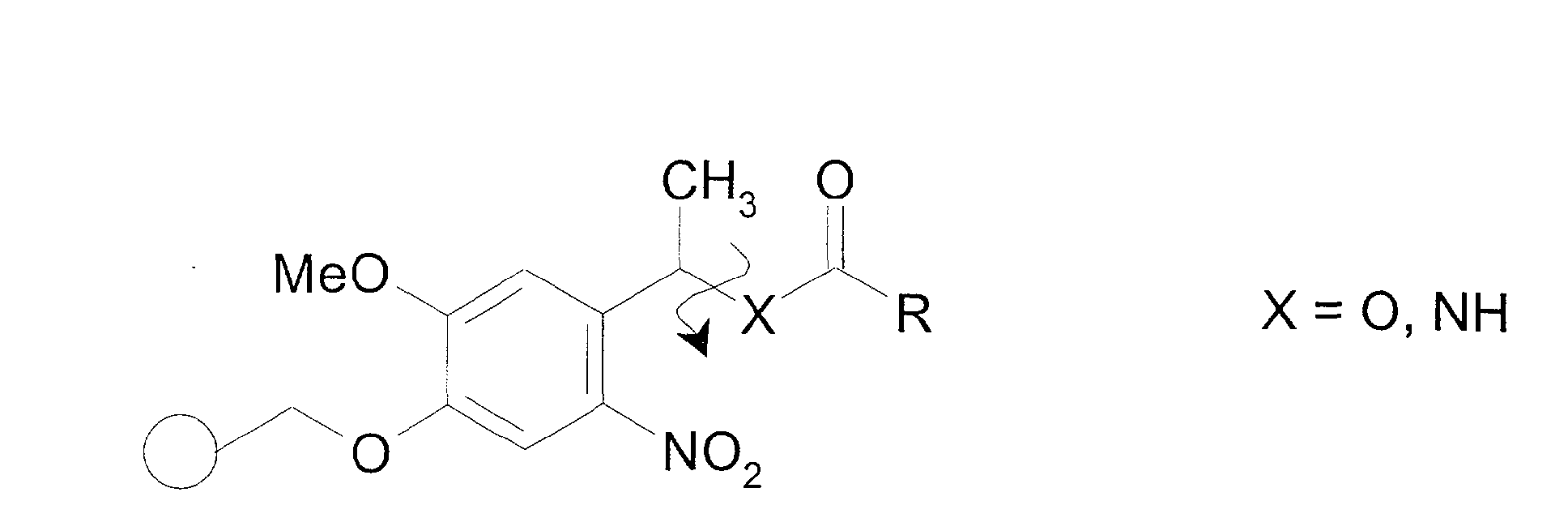
Geeignete Ankergruppen für die Immobilisierung sind insbesondere die
folgenden in WO 95/31429 und WO 99/67619 genannten Verbindungen:
• λSpalt = 365 nm

• λSpalt ≈ 280 bis 340 nm
Der generelle Aufbau der Biochips ist in Fig. 1 dargestellt. Basis der Biochips
bildet eine Quarz- bzw. Glasplatte, alternativ kann auch ein Kunststoffträger
dienen, der jedoch signaltransmittiv (für Licht, Wärme, magnetische Felder)
sein muss. Auf diesem Träger wird zunächst eine Haftschicht (z. B. aus
Polylysinderivaten) und dann eine Immobilisierungsschicht aufgetragen, die
einerseits an dem Träger haftet und andererseits, auf der Protein-zugewandten
Seite, mit den zu immobilisierenden Einzelmolekülen aus den
kombinatorischen Bibliotheken eine feste (kovalente) Bindung eingeht. Die
Immobilisierungsschicht besteht entweder aus chemischen Molekülen oder
Verbindungen, die durch Lichtanregung chemisch gespalten werden bzw.
Molekülen oder Verbindungen, die durch thermische Einwirkung getrennt
werden.
Nach dem Beladen mit Haftschicht und Fotolinkerschicht werden die
kopplungsaktiven Areale, d. h., die gewünschten Strukturen auf dem Träger
erzeugt. Alternativ kann auch die Fotolinkerschicht nach Einstellung der
Struktur der Haftschicht aufgebracht werden.
Diese Immobilisierungsschicht wird mit Einzelmolekülen einer
kombinatorischen Bibliothek so beladen, dass gewährleistet ist, dass ein
Molekül an einem, nicht aber an zwei benachbarten Orten bindet. Dies wird
dadurch erzielt, dass ein Abstand von 10 nm bis 1000 µm (vorzugsweise 100
nm bis 5.000 nm bzw. 100 nm bis 1.500 nm) in Abhängigkeit von der
maximalen Einzelmolekülgröße zwischen den Arrays gewährt wird, d. h. die
Moleküle werden nach einem festgelegten Ortsraster vereinzelt.
Die so vorbereiteten Biochips können in dieser Form einer zweiten
kombinatorischen Bibliothek ausgesetzt werden. Dabei lagern sich bestimmte
Moleküle aus der löslichen Bibliothek an einzelne Moleküle der immobilisierten
Bibliothek des Biochips an. Mittels einer geeigneten Messtechnik wird nun die
Position des angelagerten Moleküls bzw. auch einer angelagerten Zelle an dem
jeweiligen Protein mit hoher Ortsauflösung bestimmt (Fig. 2). Als
Messtechniken können dabei folgende Verfahren eingesetzt werden:
Nach Waschen des Biochips und Entfernung sämtlicher nicht angelagerter
Bestandteile und Restmoleküle erfolgt die eigentliche Messung der Molekül-Interaktion
am Anlagerungsort (über die Achsen X und Y). Nach Bestimmung
des Anlagerungsortes wird mittels eines zweiten Scanningsystems ein
Laserstrahl durch den Biochip, d.h. durch den Träger von unten (Achse Z) auf
die Immobilisierungsschicht (z. B. aus der o-Nitrobenzylester, Pivaloyl- oder
Triazenverbindungen, wie vorstehend definiert) gerichtet. Die Position dieser
Belichtung entspricht dabei der zuvor bestimmten Position des angelagerten
Moleküls. Durch kurzzeitige Bestrahlung der Immobilisierungsschicht werden
anschließend die chemischen Bindungen der photolabilen Linker- oder
Ankergruppe der Immobilisierungsschicht gespalten, bzw. die
Immobilisierungsschicht thermisch aufgelöst. Dadurch können die an diesem
Ort interagierenden Moleküle wieder spezifisch abgelöst werden. Dies
bedeutet, dass sowohl das zuvor immobilisierte Molekül (Peptid, Protein,
konjugierten Ribosom, konjugierten Bakteriophagen, Liposom, markierte
Partikel), als auch das damit verbundene lösliche Molekül (Peptid, Protein,
konjugierten Ribosom, konjugierten Bakteriophagen) für die nachfolgende
Analyse zur Verfügung stehen.
Über die nachgeschaltete Analyse der so selektionierten, interagierenden
Moleküle, z. B. über 'matrix associated laser desorption/ionization' (MALDI)
oder 'electrospray ionization' (ESI) mit anschließender Massenanalyse im
Flugzeit- (TOF oder oTOF), Quadrupol- (Q), Ionenfallen- (IT), Fourier-Tranform-
(FTMS oder FT-ICR) Massenspektrometer, 'post-source decay' PSD,
'in source decay' (ISD), 'surface plasmon resonance' (SPR),
Multispektralanalyse, Fluoreszenz-Korrelations-Spektroskopie (FCS), oder
Polymerasekettenreaktion (PCR) läßt sich die Struktur des Proteins und seiner
DNA ableiten und gegebenenfalls seine DNA vervielfältigen.
Ungeachtet der obengenannten Analyse und Ablösemechanismen können auch
andere ortsauflösende Detektionsmethoden und Aktivierungstechnologien
verwendet werden.
Auf Quarz- oder Glassubstrat wird zunächst eine Haftschicht aus
Polylysinderivaten, dann die Fotolinkerschicht aus Linker I (mit X = 0) ein
Partikel A-reaktiver Ligand (hier: Biotin) daran gekoppelt. Durch Lasertechnik
werden als Strukturierung Areale mit <50 nm Durchmesser in einem Abstand
von 1.2 µm generiert. Da in dem hier vorgestellten Beispielsystem die Länge
der zu immobilisierenden Partikel (Partikel A) ∼ 1 µm beträgt und verhindert
werden soll, dass ein Partikel A an zwei Kopplungsareale bindet, muss dieser
Mindestabstand zwischen den Kopplungsarealen gewährleistet sein.
Gemäß G. E. Stoica et al., J. Biol. Chem.
(2001) wird eine kombinatorische scFv-Bakteriophagenbibliothek (hier: mit
Reaktivität gegen Pankreaskarzinom) zur Immobilisierung auf den Mikrochips
erstellt, deren Einzelkomponenten (Partikel A) folgendermaßen charakterisiert
sind (Fig. 3):
An einem Ende des Partikels befindet sich das Protein A (hier: ein unbekanntes
scFv oder Fab der zu immobilisierenden Bibliothek) das kovalent und
funktionell an ein Oberflächenprotein des Partikels A (hier Protein III (pIII)
eines filamentösen Bakteriophagen) gekoppelt ist.
Das gegenüberliegende Ende desselben Partikels ist so modifiziert, dass eine
gerichtete Kopplung des Partikels A an ein Kopplungsareal des Mikrochips
durch die Aktivität der Verknüpfung A gewährleistet ist (in diesem Fall:
Streptavidin oder eine modifizierte Streptavidinbindungskomponente oder ein
anti-Biotin scFv).
Partikel A trägt ein Phagmid mit der genetischen Information zur Expression
des Proteins A als Fusionsprotein mit einem Oberflächenprotein (hier Gen A
fusioniert mit Gen III gesteuert durch den Regulator). Zusätzlich befindet sich
auf dem Phagmid die Anlagerungsstellen (Consensus A1 und A2) für die
spezifischen Primer A1 und A2.
Die nach Schritt 2.1 konstruierte Bibliothek wird
auf die vorbereiteten Mikrochips aufgebracht; es kommt zu einer Bindung der
Einzelkomponenten an die Kopplungsareale durch die Interaktion zwischen
dem Partikel A-reaktiven Liganden und der Verknüpfung A (hier:
Biotin/Streptavidin oder Biotin/anti-Biotin scFv). Hierdurch wird gewährleistet,
dass mit hoher Wahrscheinlichkeit an jedem Kopplungsareal ein anderer,
unbekannter Partikel sitzt.
Nach X. Cai et al., Proc. Natl. Acad. Sci. USA 92(14):6531-41 (1995) wird eine
lösliche cDNA-Expressionsbibliothek (hier: cDNA generiert aus der mRNA
primärer Pankreaskarzinomzellen) erstellt, deren Einzelkomponenten (Partikel
B) folgendermaßen charakterisiert sind (Fig. 4):
An einem Ende des Partikels befindet sich das Protein B (hier: ein unbekanntes
Translationsprodukt aus den primären Pankreaskarzinomzellen) das kovalent
und funktionell an ein Oberflächenprotein des Partikels B (hier Protein III (pIII)
eines filamentösen Bakteriophagen) gekoppelt ist.
Das gegenüberliegende Ende desselben Partikels ist so modifiziert, dass eine
gerichtete Kopplung des Partikels B über die Verknüpfung B an ein
Sortierungspartikel gewährleistet ist (in diesem Fall: poly-Histidin-Markierung).
Partikel B trägt ein Phagmid mit der genetischen Information zur Expression
des Proteins B als Fusionsprotein mit einem Oberflächenprotein (hier Gen B
fusioniert mit Gen III gesteuert durch den Regulator). Zusätzlich befindet sich
auf dem Phagmid die Anlagerungsstellen (Consensus B1 und B2) für die
spezifischen Primer B1 und B2.
Optional kann Partikel B zusätzlich mit GFP-Fusionen an bspw.
Oberflächenprotein VIII versehen sein, um eine Detektion über
Fluoreszenztechniken zu ermöglichen.
Die lösliche Proteinbibliothek wird auf die immobilisierte Proteinbibliothek
gegeben, und durch mehrere Waschschritte werden unspezifische
Bindungsaktivitäten zwischen den Bibliotheken eliminiert. Nach Kopplung an
das Sortierungspartikel (hier: magnetisches Partikel mit Bindungsaktivität für
den poly-Histidin-Tag, bspw. Ni-NTA oder "high graft") - es besteht optional die
Möglichkeit ein magnetisches Feld anzulegen und so eine vektorielle
Ausrichtung der interagierenden Partikel A & B zu erhalten (s. Fig. 5) - erfolgt
die Messung der entsprechend-interagierenden Partikel über bspw. SNOM,
oder 2-D-Scanning-Fluoreszenztechnik (Fig. 2). Hieraus ergibt sich eine
Zuordnung der detektierten Interaktion zu den Koordinaten X und Y.
Die Koordinaten der detektierten Interaktion werden mit den Koordinaten der
Kopplungsareale abgeglichen (interne Kontrolle). Der Ablöselaser (SNOM,
alternativ: CW-UV-Quellen) wird auf diese Koordinaten justiert und wirkt über
die Achse Z auf die auf dem Mikrochip aufgebrachte Fotolinkerschicht (Fig. 2),
wodurch es zu einem gerichteten Ablösen der interagierenden Partikel kommt.
Nach X. Cai et al., Proc. Natl. Acad. Sci. USA 92(14):6531-41 (1995) wird eine
cDNA-Miniexpressionsbibliothek bestehend aus CD30- und CEA-Antigen zur
Immobilisierung auf den Mikrochips erstellt, deren Einzelkomponenten wie in
Fig. 3 beschrieben charakterisiert sind. An einem Ende des Partikels befinden
sich die benannten Antigene die kovalent und funktionell an das Protein III
(pIII) filamentöser Bakteriophagen gekoppelt sind. Das gegenüberliegende
Ende desselben Partikels ist so modifiziert, dass eine gerichtete Kopplung des
Partikels A an ein Biotin-Kopplungsareal des Mikrochips durch Antibiotin-Bindungsliganden
möglich ist. Die beiden verschiedenen Partikel A tragen
jeweils ein Phagmid mit der genetischen Information zur Expression der
verschiedenen Antigene als Fusion mit Gen III gesteuert durch den Regulator.
Die Minibibliothek wird auf die vorbereiteten Mikrochips aufgebracht; es kommt
zu einer Bindung der Einzelkomponenten an die Kopplungsareale durch die
Interaktion zwischen Biotin/anti-Biotin Liganden. Die Verteilung der Antigentragenden
Bakteriophagenpartikel an den Kopplungsarealen korreliert direkt
mit den prozentualen Anteilen der Partikel in der Minibibliothek.
Nach X. Cai et al., Proc. Natl. Acad. Sci. USA 92(14):6531-41 (1995) wird eine
lösliche scFv-Bakteriophagenminibibliothek bestehend aus anti-CD30, anti-CEA
und anti-MUC-1 erstellt, deren Einzelkomponenten (Partikel B) folgendermaßen
charakterisiert sind (Fig. 4): An jeweils einem Ende der Partikel befinden sich
die scFv die kovalent und funktionell an das Protein III (pIII) der filamentösen
Bakteriophagen gekoppelt ist. Das gegenüberliegende Ende derselben Partikel
ist so modifiziert, daß eine gerichtete Kopplung der Partikel B über die poly-Histidin-Markierung
an ein Ni2+-NTA-gekoppeltes Sortierungspartikel
gewährleistet ist. Die Partikel B tragen jeweils ein Phagmid mit der genetischen
Information zur Expression der scFv als Fusion mit Gen III gesteuert durch den
Regulator.
Nach Einstellung verschiedener Verdünnungen sowohl von CD30 und CEA für
die immobilisierte als auch von anti-CD30, anti-CEA und anti-Muc-1 für die
lösliche Minibibliothek, werden miteinander wechselwirkende Partikel
detektiert, über den Ablöselaser von dem Träger gelöst, gesammelt und über
das gekoppelte magnetische Sortierungspartikel an entsprechende Säulen
gebunden. Nach intensivem Waschen werden die magnetisch gebundenen
Partikel eluiert und durch Polymerasekettenreaktion analysiert bzw. durch invitro-Bindungsstudien
(ELISA, Durchflusszytometrie) der scFv-tragenden
Bakteriophagen, die Bindung an CD30- und CEA-positive Zellen- und
Membranfraktionen bestätigt.
Die aneinandergekoppelten Partikel A & B werden über den Sortierungspartikel
(hier: magnetisches Partikel mit Bindungsaktivität für das poly-Histidin-Tag,
bspw. durch Metall-Chelate oder "high graft") durch Mikrofluidsysteme in die
finalen Mikroreaktionsgefäße abgeleitet.
In den Mikroreaktionsgefäßen werden die kodierenden Regionen der sortierten
Partikel A & B gleichzeitig durch Einsatz der spezifischen Primer A1/A2 und
B1/B2 durch Polymerasekettenreaktion amplifiziert. Aliquots dieses
Reaktionsansatzes können durch parallele Sequenzierungsansätze analysiert
und dadurch gleichzeitig die Sequenzen der Gene A & B ermittelt und daraus
mit Standardmethoden die kodierten Proteinsequenzen abgeleitet werden.
Die Aktivität der verfügbaren Translationsprodukte wird nach Expression in
bekannten Systemen in vitro und in vivo charakterisiert.
Claims (15)
- Verfahren zur Selektion unbekannter Moleküle, umfassend die folgenden Schritte:(a) Immobilisieren von Molekülen einer kombinatorischen Molekülbibliothek auf einem Träger,(b) Anlagern von komplementären, singulären Bindungsmolekülen oder Zellen an ein bestimmtes immobilisiertes Molekül,(c) selektives Ablösen der miteinander interagierenden, singulären Moleküle von dem Träger und(d) Analysieren des in Schritt (c) abgelösten Materials.
- Verfahren nach Anspruch 1, wobei der Träger aus signaltransmittivem Material, insbesondere für Licht, Wärme und/oder magnetische Felder transmittivem Material, und besonders bevorzugt aus lichttransmittivem Material besteht.
- Verfahren nach Anspruch 1 oder 2, wobei jeweils ein Einzelmolekül in kopplungsreaktiven Arealen, insbesondere in Arealen mit einer Abmessung von kleiner 50 nm x 50 nm und/oder einem Abstand von 10 nm bis 100 µm immobilisiert ist.
- Verfahren nach Anspruch 3, wobei Schritt (a) das Aufbringen einer licht-, wärme- oder magnetisch-reaktiven Ankergruppe, insbesondere photolabile Linker wie o-Nitrobenzylester, Pivaloyl- oder Triazenverbindungen oder ein thermisch-empfindliches Polymer auf den Träger und das Einstellen der kopplungsreaktiven Areale umfasst.
- Verfahren nach einem oder mehreren der Ansprüche 1 bis 4, wobei die lösliche Molekülbibliothek eine cDNA-Expressionsbibliothek für Bindungsproteine, eine cDNA-Expressionsbibliothek einer Zelle oder eine synthetische Peptid- oder Molekülbibliothek ist und insbesondere die Moleküle Peptide, Proteine, konjugierte Ribosomen oder konjugierte Bakteriophagen sind.
- Verfahren nach einem oder mehreren der Ansprüche 1 bis 5, wobei die komplementäre Molekülbibliothek ausgewählt ist aus Peptiden, Proteinen, konjugierten Ribosomen, konjugierten Bakteriophagen, Liposomen, markierten Partikeln.
- Verfahren nach einem oder mehreren der Ansprüche 1 bis 6, wobei nach Schritt (b) ein oder mehrere Waschschritte erfolgen.
- Verfahren nach einem oder mehreren der Ansprüche 1 bis 7, bei dem die Analyse des Ortes der Molekül- Zell- oder Molekül-Zell-Interaktion durch ein optisches, magnetisches oder profilometrisches Messverfahren erfolgt.
- Verfahren nach einem oder mehreren der Ansprüche 1 bis 8, wobei eine kombinatorische Bibliothek auf einem transparenten Träger immobilisiert ist und diese Immobilisierungsschicht selektiv durch photonische oder thermische Wechselwirkung aufgelöst werden kann.
- Verfahren nach einem oder mehreren der Ansprüche 1 bis 9, wobei Schritt (d) durch MALDI ("matrix associated laser desorption/ionization") oder ESI ("electrospray ionization") mit anschließender Massenanalyse, SPR ("surface plasmon resonance"), Multispektralanalyse, Fluoreszenz-Korrelations-Spektroskopie (FCS), oder Polymerasekettenreaktion (PCR) erfolgt.
- Biochip zur Selektion unbekannter Einzelmoleküle, umfassend einen Träger wie in Ansprüchen 1 bis 4 definiert, der zur Immobilisierung einer kombinatorischen Molekülbibliothek geeignet ist oder mit einer solchen immobilisiert ist, auf dem eine kombinatorische Molekülbibliothek immobilisiert werden kann oder eine solche immobilisiert ist, wobei gewährleistet ist, dass pro Kopplungsareal auf den Träger genau ein Molekül aufgenommen werden kann oder aufgenommen ist.
- Verfahren zur Herstellung eines Biochips gemäß Anspruch 11, umfassend(i) Erzeugung von Kopplungsarealen auf einem Träger, die geeignet sind, genau ein Molekül aufzunehmen, und/oder(ii) Immobilisieren von Molekülen einer kombinatorischen Molekülbibliothek auf einem Träger.
- Vorrichtung zur automatischen Messung der Molekül- oder Zellwechselwirkungen und deren koordinativen Zuordnung mit einer Ortsauflösung <100 nm, insbesondere zur Verwendung in einem Verfahren gemäß Ansprüchen 1 bis 10 und/oder zum Auslesen eines Biochips gemäß Anspruch 11.
- Vorrichtung nach Anspruch 13, die zur Sortierung der interagierenden Moleküle geeignet ist.
- Vorrichtung nach Anspruch 13, die zur Analyse der interagierenden Moleküle geeignet ist und vorzugsweise das detektierte Molekül mittels MALDI ("matrix associated laser desorption/ionization") oder ESI ("electrospray ionization"), SPR, Multispektralanalyse, FCS, oder PCR identifiziert.
Priority Applications (5)
| Application Number | Priority Date | Filing Date | Title |
|---|---|---|---|
| EP01108919A EP1249499A1 (de) | 2001-04-10 | 2001-04-10 | Verfahren und Vorrichtung zur Bestimmung und Selektion von Molekül-Molekül-Wechselwirkungen |
| PCT/EP2002/003983 WO2002083942A2 (de) | 2001-04-10 | 2002-04-10 | Verfahren und vorrichtung zur bestimmung und selektion von molekül-molekül-wechselwirkungen |
| EP02735242A EP1386000A2 (de) | 2001-04-10 | 2002-04-10 | Verfahren und vorrichtung zur bestimmung und selektion von molekül-molekül-wechselwirkungen |
| AU2002310934A AU2002310934A1 (en) | 2001-04-10 | 2002-04-10 | Method and device for determining and selecting molecule-molecule interactions |
| US10/474,602 US20040241675A1 (en) | 2001-04-10 | 2002-04-10 | Method and device for determining and selecting molecule-molecule interactions |
Applications Claiming Priority (1)
| Application Number | Priority Date | Filing Date | Title |
|---|---|---|---|
| EP01108919A EP1249499A1 (de) | 2001-04-10 | 2001-04-10 | Verfahren und Vorrichtung zur Bestimmung und Selektion von Molekül-Molekül-Wechselwirkungen |
Publications (1)
| Publication Number | Publication Date |
|---|---|
| EP1249499A1 true EP1249499A1 (de) | 2002-10-16 |
Family
ID=8177101
Family Applications (2)
| Application Number | Title | Priority Date | Filing Date |
|---|---|---|---|
| EP01108919A Withdrawn EP1249499A1 (de) | 2001-04-10 | 2001-04-10 | Verfahren und Vorrichtung zur Bestimmung und Selektion von Molekül-Molekül-Wechselwirkungen |
| EP02735242A Withdrawn EP1386000A2 (de) | 2001-04-10 | 2002-04-10 | Verfahren und vorrichtung zur bestimmung und selektion von molekül-molekül-wechselwirkungen |
Family Applications After (1)
| Application Number | Title | Priority Date | Filing Date |
|---|---|---|---|
| EP02735242A Withdrawn EP1386000A2 (de) | 2001-04-10 | 2002-04-10 | Verfahren und vorrichtung zur bestimmung und selektion von molekül-molekül-wechselwirkungen |
Country Status (4)
| Country | Link |
|---|---|
| US (1) | US20040241675A1 (de) |
| EP (2) | EP1249499A1 (de) |
| AU (1) | AU2002310934A1 (de) |
| WO (1) | WO2002083942A2 (de) |
Families Citing this family (4)
| Publication number | Priority date | Publication date | Assignee | Title |
|---|---|---|---|---|
| US20050059083A1 (en) * | 2003-09-15 | 2005-03-17 | Becton Dickinson And Company | High throughput method to identify ligands for cell attachment |
| US8921283B2 (en) * | 2006-10-30 | 2014-12-30 | Washington University | Method for generating microscopic patterns of protein and other macromolecules |
| US11014088B2 (en) * | 2016-03-09 | 2021-05-25 | The Board Of Regents Of The University Of Texas System | Sensitive ELISA for disease diagnosis on surface modified poly(methyl methacrylate) (PMMA) microfluidic microplates |
| WO2023081728A1 (en) * | 2021-11-03 | 2023-05-11 | Nautilus Biotechnology, Inc. | Systems and methods for surface structuring |
Citations (5)
| Publication number | Priority date | Publication date | Assignee | Title |
|---|---|---|---|---|
| US5412087A (en) * | 1992-04-24 | 1995-05-02 | Affymax Technologies N.V. | Spatially-addressable immobilization of oligonucleotides and other biological polymers on surfaces |
| WO1998012559A1 (en) * | 1996-09-20 | 1998-03-26 | Demers James P | Spatially addressable combinatorial chemical arrays in cd-rom format |
| WO1999055886A1 (en) * | 1998-04-24 | 1999-11-04 | Genova Pharmaceuticals Corporation | Function-based gene discovery |
| WO2000006770A1 (en) * | 1998-07-30 | 2000-02-10 | Solexa Ltd. | Arrayed biomolecules and their use in sequencing |
| WO2000036398A2 (de) * | 1998-12-14 | 2000-06-22 | Deutsches Krebsforschungszentrum Stiftung des öffentlichen Rechts | Verfahren und vorrichtungen zur erfassung optischer eigenschaften, insbesondere von lumineszenz-reaktionen und brechungsverhalten, von auf einem träger direkt oder indirekt gebundenen molekülen |
Family Cites Families (3)
| Publication number | Priority date | Publication date | Assignee | Title |
|---|---|---|---|---|
| ES2118066T3 (es) * | 1989-10-05 | 1998-09-16 | Optein Inc | Sintesis y aislamiento, exentos de celulas, de nuevos genes y polipeptidos. |
| GB9015198D0 (en) * | 1990-07-10 | 1990-08-29 | Brien Caroline J O | Binding substance |
| US5639603A (en) * | 1991-09-18 | 1997-06-17 | Affymax Technologies N.V. | Synthesizing and screening molecular diversity |
-
2001
- 2001-04-10 EP EP01108919A patent/EP1249499A1/de not_active Withdrawn
-
2002
- 2002-04-10 WO PCT/EP2002/003983 patent/WO2002083942A2/de not_active Ceased
- 2002-04-10 US US10/474,602 patent/US20040241675A1/en not_active Abandoned
- 2002-04-10 AU AU2002310934A patent/AU2002310934A1/en not_active Abandoned
- 2002-04-10 EP EP02735242A patent/EP1386000A2/de not_active Withdrawn
Patent Citations (5)
| Publication number | Priority date | Publication date | Assignee | Title |
|---|---|---|---|---|
| US5412087A (en) * | 1992-04-24 | 1995-05-02 | Affymax Technologies N.V. | Spatially-addressable immobilization of oligonucleotides and other biological polymers on surfaces |
| WO1998012559A1 (en) * | 1996-09-20 | 1998-03-26 | Demers James P | Spatially addressable combinatorial chemical arrays in cd-rom format |
| WO1999055886A1 (en) * | 1998-04-24 | 1999-11-04 | Genova Pharmaceuticals Corporation | Function-based gene discovery |
| WO2000006770A1 (en) * | 1998-07-30 | 2000-02-10 | Solexa Ltd. | Arrayed biomolecules and their use in sequencing |
| WO2000036398A2 (de) * | 1998-12-14 | 2000-06-22 | Deutsches Krebsforschungszentrum Stiftung des öffentlichen Rechts | Verfahren und vorrichtungen zur erfassung optischer eigenschaften, insbesondere von lumineszenz-reaktionen und brechungsverhalten, von auf einem träger direkt oder indirekt gebundenen molekülen |
Also Published As
| Publication number | Publication date |
|---|---|
| EP1386000A2 (de) | 2004-02-04 |
| AU2002310934A1 (en) | 2002-10-28 |
| US20040241675A1 (en) | 2004-12-02 |
| WO2002083942A2 (de) | 2002-10-24 |
| WO2002083942A3 (de) | 2003-11-20 |
Similar Documents
| Publication | Publication Date | Title |
|---|---|---|
| AU2004288228B2 (en) | Use of particulate labels in bioanalyte detection methods | |
| US7232691B2 (en) | Bioassay and biomolecular identification, sorting, and collection methods using magnetic microspheres | |
| Zhou et al. | Solution and chip arrays in protein profiling | |
| EP1390725B1 (de) | Verwendung von optischen diffraktionselementen in nachweisverfahren | |
| DE60037671T2 (de) | Kolloidale stabpartikel als nanobarcodes | |
| US20020146745A1 (en) | Methods and reagents for multiplexed analyte capture, surface array self-assembly, and analysis of complex biological samples | |
| JP2003505701A (ja) | アレーサイトメトリー | |
| JP2004537712A (ja) | 多重細胞分析システム | |
| EP1153282A2 (de) | Verfahren und vorrichtungen zur erfassung optischer eigenschaften, insbesondere von lumineszenz-reaktionen und brechungsverhalten, von auf einem träger direkt oder indirekt gebundenen molekülen | |
| US20040219066A1 (en) | Apparatus used in identification, sorting and collection methods using magnetic microspheres and magnetic microsphere kits | |
| Tas et al. | Small peptide–protein interaction pair for genetically encoded, fixation compatible peptide-PAINT | |
| Loeffler et al. | Biomolecule arrays using functional combinatorial particle patterning on microchips | |
| WO2005025737A2 (de) | Molekül-arrays und verfahren zu deren herstellung | |
| WO2002083942A2 (de) | Verfahren und vorrichtung zur bestimmung und selektion von molekül-molekül-wechselwirkungen | |
| EP1194780A2 (de) | Screening von target-ligand-wechselwirkungen | |
| DE102015117567B4 (de) | Ultra-hochdichte Oligomerarrays und Verfahren zu deren Herstellung | |
| KR20230042355A (ko) | 마이크로 구조체 및 분자 검출 방법 | |
| DE10220602A1 (de) | Verfahren zur Selektion und Identifikation von Peptid- oder Proteinmolekülen mittels Phage Display | |
| WO2003046198A2 (de) | Verfahren zur selektion und identifikation von peptid- oder proteinmolekülen mittels phage display | |
| DE102005031755A1 (de) | Salmonella spp. bindende Peptide, deren Verwendung und Verfahren und Kits zur Anreicherung, Immobilisierung und zum Nachweis von Salmonella spp. | |
| DE10128093A1 (de) | Verfahren zum Nachweis von Substanzen und Artikel zur Durchführung dieser Verfahren | |
| AT414047B (de) | Anordnung zur bindung von molekülen | |
| Zubritsky | Research Profiles: Dry Proteins may quench thirst for microarrays | |
| Petkewich | Research Profiles: Faster analysis of PBDEs and PCBs | |
| Harris | Research Profiles: Protein plays matchmaker for QD-antibody conjugation |
Legal Events
| Date | Code | Title | Description |
|---|---|---|---|
| PUAI | Public reference made under article 153(3) epc to a published international application that has entered the european phase |
Free format text: ORIGINAL CODE: 0009012 |
|
| STAA | Information on the status of an ep patent application or granted ep patent |
Free format text: STATUS: THE APPLICATION HAS BEEN WITHDRAWN |
|
| AK | Designated contracting states |
Kind code of ref document: A1 Designated state(s): AT BE CH CY DE DK ES FI FR GB GR IE IT LI LU MC NL PT SE TR |
|
| AX | Request for extension of the european patent |
Free format text: AL;LT;LV;MK;RO;SI |
|
| 18W | Application withdrawn |
Withdrawal date: 20020916 |