EP1244606B1 - Hydroxylapatitbeschichtung von aluminiumoxid-keramiken - Google Patents
Hydroxylapatitbeschichtung von aluminiumoxid-keramiken Download PDFInfo
- Publication number
- EP1244606B1 EP1244606B1 EP00990810A EP00990810A EP1244606B1 EP 1244606 B1 EP1244606 B1 EP 1244606B1 EP 00990810 A EP00990810 A EP 00990810A EP 00990810 A EP00990810 A EP 00990810A EP 1244606 B1 EP1244606 B1 EP 1244606B1
- Authority
- EP
- European Patent Office
- Prior art keywords
- layer
- tial6v4
- ceramic
- hydroxyapatite
- coating
- Prior art date
- Legal status (The legal status is an assumption and is not a legal conclusion. Google has not performed a legal analysis and makes no representation as to the accuracy of the status listed.)
- Expired - Lifetime
Links
- 229910052588 hydroxylapatite Inorganic materials 0.000 title claims abstract description 32
- XYJRXVWERLGGKC-UHFFFAOYSA-D pentacalcium;hydroxide;triphosphate Chemical compound [OH-].[Ca+2].[Ca+2].[Ca+2].[Ca+2].[Ca+2].[O-]P([O-])([O-])=O.[O-]P([O-])([O-])=O.[O-]P([O-])([O-])=O XYJRXVWERLGGKC-UHFFFAOYSA-D 0.000 title claims abstract description 32
- 239000000919 ceramic Substances 0.000 title claims abstract description 31
- 239000011248 coating agent Substances 0.000 title claims abstract description 13
- 238000000576 coating method Methods 0.000 title claims abstract description 13
- PNEYBMLMFCGWSK-UHFFFAOYSA-N Alumina Chemical compound [O-2].[O-2].[O-2].[Al+3].[Al+3] PNEYBMLMFCGWSK-UHFFFAOYSA-N 0.000 title claims description 12
- 238000000034 method Methods 0.000 claims abstract description 23
- 238000004519 manufacturing process Methods 0.000 claims abstract description 5
- 229910045601 alloy Inorganic materials 0.000 claims description 7
- 239000000956 alloy Substances 0.000 claims description 7
- 230000008021 deposition Effects 0.000 claims description 2
- 229960005363 aluminium oxide Drugs 0.000 claims 1
- 229910010293 ceramic material Inorganic materials 0.000 claims 1
- 239000010410 layer Substances 0.000 description 24
- 239000010936 titanium Substances 0.000 description 13
- 239000000853 adhesive Substances 0.000 description 12
- 230000001070 adhesive effect Effects 0.000 description 12
- 230000003746 surface roughness Effects 0.000 description 6
- 229910018072 Al 2 O 3 Inorganic materials 0.000 description 4
- 239000000463 material Substances 0.000 description 4
- 238000002474 experimental method Methods 0.000 description 3
- TWNQGVIAIRXVLR-UHFFFAOYSA-N oxo(oxoalumanyloxy)alumane Chemical compound O=[Al]O[Al]=O TWNQGVIAIRXVLR-UHFFFAOYSA-N 0.000 description 3
- 238000005240 physical vapour deposition Methods 0.000 description 3
- 238000002360 preparation method Methods 0.000 description 3
- RTAQQCXQSZGOHL-UHFFFAOYSA-N Titanium Chemical compound [Ti] RTAQQCXQSZGOHL-UHFFFAOYSA-N 0.000 description 2
- MCMNRKCIXSYSNV-UHFFFAOYSA-N Zirconium dioxide Chemical compound O=[Zr]=O MCMNRKCIXSYSNV-UHFFFAOYSA-N 0.000 description 2
- 239000011247 coating layer Substances 0.000 description 2
- 238000000227 grinding Methods 0.000 description 2
- 238000005259 measurement Methods 0.000 description 2
- 239000002184 metal Substances 0.000 description 2
- 229910052751 metal Inorganic materials 0.000 description 2
- 239000007769 metal material Substances 0.000 description 2
- 229910052574 oxide ceramic Inorganic materials 0.000 description 2
- 239000011224 oxide ceramic Substances 0.000 description 2
- 229910052719 titanium Inorganic materials 0.000 description 2
- 229910001069 Ti alloy Inorganic materials 0.000 description 1
- 239000012876 carrier material Substances 0.000 description 1
- 230000007547 defect Effects 0.000 description 1
- 238000000151 deposition Methods 0.000 description 1
- 229910003460 diamond Inorganic materials 0.000 description 1
- 239000010432 diamond Substances 0.000 description 1
- 239000007943 implant Substances 0.000 description 1
- 210000003127 knee Anatomy 0.000 description 1
- 238000013532 laser treatment Methods 0.000 description 1
- 238000003754 machining Methods 0.000 description 1
- 238000012545 processing Methods 0.000 description 1
- 238000011002 quantification Methods 0.000 description 1
- 238000007788 roughening Methods 0.000 description 1
- 238000005488 sandblasting Methods 0.000 description 1
- 239000007921 spray Substances 0.000 description 1
- 239000000758 substrate Substances 0.000 description 1
- 238000012360 testing method Methods 0.000 description 1
- 238000007751 thermal spraying Methods 0.000 description 1
Images


Classifications
-
- C—CHEMISTRY; METALLURGY
- C04—CEMENTS; CONCRETE; ARTIFICIAL STONE; CERAMICS; REFRACTORIES
- C04B—LIME, MAGNESIA; SLAG; CEMENTS; COMPOSITIONS THEREOF, e.g. MORTARS, CONCRETE OR LIKE BUILDING MATERIALS; ARTIFICIAL STONE; CERAMICS; REFRACTORIES; TREATMENT OF NATURAL STONE
- C04B41/00—After-treatment of mortars, concrete, artificial stone or ceramics; Treatment of natural stone
- C04B41/009—After-treatment of mortars, concrete, artificial stone or ceramics; Treatment of natural stone characterised by the material treated
-
- A—HUMAN NECESSITIES
- A61—MEDICAL OR VETERINARY SCIENCE; HYGIENE
- A61L—METHODS OR APPARATUS FOR STERILISING MATERIALS OR OBJECTS IN GENERAL; DISINFECTION, STERILISATION OR DEODORISATION OF AIR; CHEMICAL ASPECTS OF BANDAGES, DRESSINGS, ABSORBENT PADS OR SURGICAL ARTICLES; MATERIALS FOR BANDAGES, DRESSINGS, ABSORBENT PADS OR SURGICAL ARTICLES
- A61L27/00—Materials for grafts or prostheses or for coating grafts or prostheses
- A61L27/02—Inorganic materials
- A61L27/10—Ceramics or glasses
- A61L27/105—Ceramics or glasses containing Al2O3
-
- A—HUMAN NECESSITIES
- A61—MEDICAL OR VETERINARY SCIENCE; HYGIENE
- A61L—METHODS OR APPARATUS FOR STERILISING MATERIALS OR OBJECTS IN GENERAL; DISINFECTION, STERILISATION OR DEODORISATION OF AIR; CHEMICAL ASPECTS OF BANDAGES, DRESSINGS, ABSORBENT PADS OR SURGICAL ARTICLES; MATERIALS FOR BANDAGES, DRESSINGS, ABSORBENT PADS OR SURGICAL ARTICLES
- A61L27/00—Materials for grafts or prostheses or for coating grafts or prostheses
- A61L27/28—Materials for coating prostheses
- A61L27/30—Inorganic materials
- A61L27/32—Phosphorus-containing materials, e.g. apatite
-
- A—HUMAN NECESSITIES
- A61—MEDICAL OR VETERINARY SCIENCE; HYGIENE
- A61L—METHODS OR APPARATUS FOR STERILISING MATERIALS OR OBJECTS IN GENERAL; DISINFECTION, STERILISATION OR DEODORISATION OF AIR; CHEMICAL ASPECTS OF BANDAGES, DRESSINGS, ABSORBENT PADS OR SURGICAL ARTICLES; MATERIALS FOR BANDAGES, DRESSINGS, ABSORBENT PADS OR SURGICAL ARTICLES
- A61L27/00—Materials for grafts or prostheses or for coating grafts or prostheses
- A61L27/40—Composite materials, i.e. containing one material dispersed in a matrix of the same or different material
- A61L27/42—Composite materials, i.e. containing one material dispersed in a matrix of the same or different material having an inorganic matrix
-
- C—CHEMISTRY; METALLURGY
- C04—CEMENTS; CONCRETE; ARTIFICIAL STONE; CERAMICS; REFRACTORIES
- C04B—LIME, MAGNESIA; SLAG; CEMENTS; COMPOSITIONS THEREOF, e.g. MORTARS, CONCRETE OR LIKE BUILDING MATERIALS; ARTIFICIAL STONE; CERAMICS; REFRACTORIES; TREATMENT OF NATURAL STONE
- C04B41/00—After-treatment of mortars, concrete, artificial stone or ceramics; Treatment of natural stone
- C04B41/45—Coating or impregnating, e.g. injection in masonry, partial coating of green or fired ceramics, organic coating compositions for adhering together two concrete elements
- C04B41/52—Multiple coating or impregnating multiple coating or impregnating with the same composition or with compositions only differing in the concentration of the constituents, is classified as single coating or impregnation
-
- C—CHEMISTRY; METALLURGY
- C04—CEMENTS; CONCRETE; ARTIFICIAL STONE; CERAMICS; REFRACTORIES
- C04B—LIME, MAGNESIA; SLAG; CEMENTS; COMPOSITIONS THEREOF, e.g. MORTARS, CONCRETE OR LIKE BUILDING MATERIALS; ARTIFICIAL STONE; CERAMICS; REFRACTORIES; TREATMENT OF NATURAL STONE
- C04B41/00—After-treatment of mortars, concrete, artificial stone or ceramics; Treatment of natural stone
- C04B41/80—After-treatment of mortars, concrete, artificial stone or ceramics; Treatment of natural stone of only ceramics
- C04B41/81—Coating or impregnation
- C04B41/89—Coating or impregnation for obtaining at least two superposed coatings having different compositions
-
- A—HUMAN NECESSITIES
- A61—MEDICAL OR VETERINARY SCIENCE; HYGIENE
- A61F—FILTERS IMPLANTABLE INTO BLOOD VESSELS; PROSTHESES; DEVICES PROVIDING PATENCY TO, OR PREVENTING COLLAPSING OF, TUBULAR STRUCTURES OF THE BODY, e.g. STENTS; ORTHOPAEDIC, NURSING OR CONTRACEPTIVE DEVICES; FOMENTATION; TREATMENT OR PROTECTION OF EYES OR EARS; BANDAGES, DRESSINGS OR ABSORBENT PADS; FIRST-AID KITS
- A61F2310/00—Prostheses classified in A61F2/28 or A61F2/30 - A61F2/44 being constructed from or coated with a particular material
- A61F2310/00389—The prosthesis being coated or covered with a particular material
- A61F2310/00592—Coating or prosthesis-covering structure made of ceramics or of ceramic-like compounds
- A61F2310/00796—Coating or prosthesis-covering structure made of a phosphorus-containing compound, e.g. hydroxy(l)apatite
-
- B—PERFORMING OPERATIONS; TRANSPORTING
- B05—SPRAYING OR ATOMISING IN GENERAL; APPLYING FLUENT MATERIALS TO SURFACES, IN GENERAL
- B05D—PROCESSES FOR APPLYING FLUENT MATERIALS TO SURFACES, IN GENERAL
- B05D3/00—Pretreatment of surfaces to which liquids or other fluent materials are to be applied; After-treatment of applied coatings, e.g. intermediate treating of an applied coating preparatory to subsequent applications of liquids or other fluent materials
- B05D3/12—Pretreatment of surfaces to which liquids or other fluent materials are to be applied; After-treatment of applied coatings, e.g. intermediate treating of an applied coating preparatory to subsequent applications of liquids or other fluent materials by mechanical means
-
- C—CHEMISTRY; METALLURGY
- C04—CEMENTS; CONCRETE; ARTIFICIAL STONE; CERAMICS; REFRACTORIES
- C04B—LIME, MAGNESIA; SLAG; CEMENTS; COMPOSITIONS THEREOF, e.g. MORTARS, CONCRETE OR LIKE BUILDING MATERIALS; ARTIFICIAL STONE; CERAMICS; REFRACTORIES; TREATMENT OF NATURAL STONE
- C04B2111/00—Mortars, concrete or artificial stone or mixtures to prepare them, characterised by specific function, property or use
- C04B2111/00474—Uses not provided for elsewhere in C04B2111/00
- C04B2111/00836—Uses not provided for elsewhere in C04B2111/00 for medical or dental applications
-
- C—CHEMISTRY; METALLURGY
- C23—COATING METALLIC MATERIAL; COATING MATERIAL WITH METALLIC MATERIAL; CHEMICAL SURFACE TREATMENT; DIFFUSION TREATMENT OF METALLIC MATERIAL; COATING BY VACUUM EVAPORATION, BY SPUTTERING, BY ION IMPLANTATION OR BY CHEMICAL VAPOUR DEPOSITION, IN GENERAL; INHIBITING CORROSION OF METALLIC MATERIAL OR INCRUSTATION IN GENERAL
- C23C—COATING METALLIC MATERIAL; COATING MATERIAL WITH METALLIC MATERIAL; SURFACE TREATMENT OF METALLIC MATERIAL BY DIFFUSION INTO THE SURFACE, BY CHEMICAL CONVERSION OR SUBSTITUTION; COATING BY VACUUM EVAPORATION, BY SPUTTERING, BY ION IMPLANTATION OR BY CHEMICAL VAPOUR DEPOSITION, IN GENERAL
- C23C14/00—Coating by vacuum evaporation, by sputtering or by ion implantation of the coating forming material
- C23C14/06—Coating by vacuum evaporation, by sputtering or by ion implantation of the coating forming material characterised by the coating material
- C23C14/14—Metallic material, boron or silicon
Definitions
- the present invention is a process for producing hydroxylapatitbetiketer ceramic components, as well as those produced by this method ceramic components themselves.
- the adhesive strength of the hydroxyapatite on ceramic surfaces, in particular on Al 2 O 3 ceramics is not sufficient for the desired use.
- a direct coating of an aluminum oxide ceramic with hydroxyapatite as would be very advantageous for example for the direct fixation of the femoral part of a knee prosthesis, is not possible.
- the surface roughness is made analogous to the roughness of the Ti shafts, the adhesive strength of hydroxyapatite is not guaranteed. This was demonstrated in experiments using ground and sandblasted samples. Compared to the titanium materials, the surface roughness of the thus treated ceramic carrier materials is much lower. Coating experiments with the standard parameters for Ti shafts did not result in adhesion between hydroxyapatite and alumina ceramics.
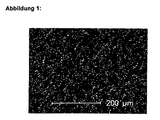
- FIG. 1 shows the typical surface after LASER treatment.
- the lasered surface of the alumina ceramic was then subjected to plasma coating with hydroxyapatite.
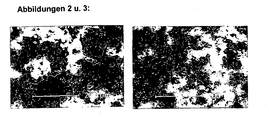
- Figures 2 and 3 show the surfaces of the lasered and hydroxyapatite (HA) coated samples.
- implants which consist of ceramics such as alumina, zirconia or the like may be a first coating layer of Ti, a Ti alloy or oxides thereof and a second coating layer of, for example, hydroxylapatite can.
- the titanium layers can each be obtained by thermal spraying be applied.
- Object of the present invention was therefore to provide a method with the ceramic components reliably provided with a hydroxyapatite coating can be.
- a ceramic component preferably an aluminum oxide ceramic component to be coated with hydroxyapatite, if the surface of the ceramic component is coated with a Ti layer.
- ceramic components with a thin Ti layer For example, by means of PVD (Physical Vapor Deposition), provided.
- PVD Physical Vapor Deposition
- According to the invention can roughen the surface of the ceramic component before, for example be sanded or lasered.
- the thickness of the Ti layer was about 1 micron; a 5 ⁇ m thick layer also leads to success.
- Figure 4 shows the cross section of a such coated sample.
- the hydroxylapatite layer was sprayed onto this intermediate layer.
- the cross section This layer structure is shown in Figures 5 and 6 at different Magnifications shown.
- the Ti intermediate layer before the coating with hydroxyapatite for example by a plasma coating, still subjected to a sandblasting process to further increase the adhesive strength.
- a particularly high adhesive strength is achieved if the Ti layer is adjusted to a roughness of R a ⁇ 40 - 50 microns.
- a Intermediate layer of the TiAl6V4 alloy, for example, deposited in the PVD process become.
- Figure 7 shows the typical layer structure in the cross-cut preparation.
- the corresponding adhesive strengths are summarized in Table 2.
- Adhesive strength of hydroxyapatite to Al 2 O 3 with TiAl6V4 intermediate layer sample Force [N] Voltage [MPa] 1 582 1.9 2 700 2.2 3 400 1.3 4 498 1.6
- a ceramic component in the form of a cylindrical specimen used.
- the cylinders with a diameter of 20 mm and a thickness of 2 mm were produced via the conventional press-turning production as a green body.
- the green bodies were pre-sintered, hot isostatically recompressed and annealed.
- the sintered blanks were then achieved with diamond tools edited the final geometry.
- ceramic components can be used.
- As a material a known per se aluminum oxide material was used, as he, for example known as Biolox® material.
- ceramic components can be provided for the first time, which can be used for medical purposes, for example as prostheses.
- Such prostheses show improved ingrowth behavior.
Landscapes
- Chemical & Material Sciences (AREA)
- Health & Medical Sciences (AREA)
- Engineering & Computer Science (AREA)
- Ceramic Engineering (AREA)
- Materials Engineering (AREA)
- Organic Chemistry (AREA)
- Structural Engineering (AREA)
- Inorganic Chemistry (AREA)
- Veterinary Medicine (AREA)
- Dermatology (AREA)
- General Health & Medical Sciences (AREA)
- Public Health (AREA)
- Life Sciences & Earth Sciences (AREA)
- Epidemiology (AREA)
- Transplantation (AREA)
- Oral & Maxillofacial Surgery (AREA)
- Medicinal Chemistry (AREA)
- Animal Behavior & Ethology (AREA)
- Composite Materials (AREA)
- Materials For Medical Uses (AREA)
- Prostheses (AREA)
- Compositions Of Oxide Ceramics (AREA)
- Physics & Mathematics (AREA)
- Plasma & Fusion (AREA)
- Dental Preparations (AREA)
- Manufacturing & Machinery (AREA)
Description
| Haftfestigkeit von Hydroxylapatit auf Al2O3 mit Ti-Zwischenschicht | ||
| Probe | Kraft [N] | Spannung [MPa] |
| 1 | 718 | 2,3 |
| 2 | 1203 | 3,8 |
| 3 | 932 | 3 |
| 4 | 1490 | 4,7 |
| 5 | 390 | 1,2 |
| Haftfestigkeit von Hydroxylapatit auf Al2O3 mit TiAl6V4-Zwischenschicht | ||
| Probe | Kraft [N] | Spannung [MPa] |
| 1 | 582 | 1,9 |
| 2 | 700 | 2,2 |
| 3 | 400 | 1,3 |
| 4 | 498 | 1,6 |
Claims (10)
- Verfahren zur Herstellung hydroxylapatitbeschichteter keramischer Bauteile, dadurch gekennzeichnet, dass in einem ersten Schritt das keramische Bauteil zunächst mit einer Ti-Schicht oder einer Schicht aus einer TiAl6V4-Legierung versehen wird, die Ti-Schicht oder die Schicht aus einer TiAl6V4-Legierung auf eine Rauhigkeit von Ra 40 bis 50 µm eingestellt wird und in einem zweiten Schritt auf der Ti-Schicht oder der Schicht aus der TiAl6V4-Legierung das Hydroxylapatit aufgebracht wird.
- Verfahren gemäß Anspruch 1, dadurch gekennzeichnet, dass die Ti-Schicht oder die Schicht aus der TiAl6V4-Legierung mit Hilfe des PVD (Physical Vapor Deposition)-Verfahrens aufgebracht wird.
- Verfahren gemäß Anspruch 1 oder 2, dadurch gekennzeichnet, dass die im ersten Schritt aufgebrachte Ti- bzw. TiAl6V4-Schicht bis 5 µm dick ist.
- Verfahren gemäß einem oder mehreren der Ansprüche 1 bis 3, dadurch gekennzeichnet, dass die im ersten Schritt aufgebrachte Ti- bzw. TiAl6V4-Schicht zwischen 1 und 5 µm dick ist.
- Verfahren gemäß einem oder mehreren der Ansprüche 1 bis 4, dadurch gekennzeichnet, dass das Hydroxylapatit auf die im ersten Schritt aufgebrachte Ti- bzw. TiAl6V4-Schicht aufgespritzt wird.
- Verfahren gemäß einem oder mehreren der Ansprüche 1 bis 5, dadurch gekennzeichnet, dass das Hydroxylapatit auf die im ersten Schritt aufgebrachte Ti- bzw. TiAl6V4-Schicht mit Hilfe der Plasma-Beschichtung aufgebracht wird.
- Verfahren gemäß einem oder mehreren der Ansprüche 1 bis 6, dadurch gekennzeichnet, dass das keramische Bauteil eine Aluminiumoxid-Keramik ist.
- Verfahren gemäß einem oder mehreren der Ansprüche 1 bis 7, dadurch gekennzeichnet, dass das keramische Bauteil ein medizinisches Bauteil ist.
- Verfahren gemäß einem oder mehreren der Ansprüche 1 bis 8, dadurch gekennzeichnet, dass das keramische Bauteil eine Prothese ist.
- Hydroxylapatitbeschichtetes keramisches Bauteil, herstellbar nach einem oder mehreren der vorhergehenden Ansprüche.
Applications Claiming Priority (3)
| Application Number | Priority Date | Filing Date | Title |
|---|---|---|---|
| DE19961917 | 1999-12-21 | ||
| DE19961917 | 1999-12-21 | ||
| PCT/EP2000/013109 WO2001046086A1 (de) | 1999-12-21 | 2000-12-21 | Hydroxylapatitbeschichtung von aluminiumoxid-keramiken |
Publications (2)
| Publication Number | Publication Date |
|---|---|
| EP1244606A1 EP1244606A1 (de) | 2002-10-02 |
| EP1244606B1 true EP1244606B1 (de) | 2005-04-27 |
Family
ID=7933740
Family Applications (1)
| Application Number | Title | Priority Date | Filing Date |
|---|---|---|---|
| EP00990810A Expired - Lifetime EP1244606B1 (de) | 1999-12-21 | 2000-12-21 | Hydroxylapatitbeschichtung von aluminiumoxid-keramiken |
Country Status (7)
| Country | Link |
|---|---|
| US (3) | US20030108658A1 (de) |
| EP (1) | EP1244606B1 (de) |
| AT (1) | ATE294151T1 (de) |
| AU (1) | AU3015501A (de) |
| DE (2) | DE50010191D1 (de) |
| ES (1) | ES2241689T3 (de) |
| WO (1) | WO2001046086A1 (de) |
Families Citing this family (6)
| Publication number | Priority date | Publication date | Assignee | Title |
|---|---|---|---|---|
| GB0226997D0 (en) * | 2002-11-19 | 2002-12-24 | Welding Inst | Heat resistant product |
| EP2011779A1 (de) * | 2007-07-06 | 2009-01-07 | Vita Zahnfabrik H. Rauter GmbH & Co. KG | Keramischer Körper und Verfahren zu seiner Herstellung |
| GB0821927D0 (en) * | 2008-12-01 | 2009-01-07 | Ucl Business Plc | Article and method of surface treatment of an article |
| US10537658B2 (en) | 2017-03-28 | 2020-01-21 | DePuy Synthes Products, Inc. | Orthopedic implant having a crystalline gallium-containing hydroxyapatite coating and methods for making the same |
| US10537661B2 (en) | 2017-03-28 | 2020-01-21 | DePuy Synthes Products, Inc. | Orthopedic implant having a crystalline calcium phosphate coating and methods for making the same |
| CN112919888B (zh) * | 2021-03-26 | 2022-06-14 | 华南理工大学 | 一种表面涂覆ha的氧化铝陶瓷及其制备方法 |
Family Cites Families (7)
| Publication number | Priority date | Publication date | Assignee | Title |
|---|---|---|---|---|
| US4818559A (en) * | 1985-08-08 | 1989-04-04 | Sumitomo Chemical Company, Limited | Method for producing endosseous implants |
| DE3844157A1 (de) * | 1988-12-23 | 1990-06-28 | Mecron Med Prod Gmbh | Endoprothese |
| JP2883214B2 (ja) * | 1990-12-28 | 1999-04-19 | 京セラ株式会社 | 生体インプラント材とその製法 |
| JPH06189977A (ja) * | 1992-12-24 | 1994-07-12 | Nikon Corp | 骨内インプラント |
| IT1288038B1 (it) * | 1996-04-30 | 1998-09-10 | Flametal S P A | Procedimento per la preparazione di rivestimenti di idrossiapatite |
| US6261322B1 (en) * | 1998-05-14 | 2001-07-17 | Hayes Medical, Inc. | Implant with composite coating |
| JP4091728B2 (ja) * | 2000-03-27 | 2008-05-28 | 京セラ株式会社 | 生体インプラント材とその製法 |
-
2000
- 2000-12-21 DE DE50010191T patent/DE50010191D1/de not_active Expired - Lifetime
- 2000-12-21 WO PCT/EP2000/013109 patent/WO2001046086A1/de not_active Ceased
- 2000-12-21 AT AT00990810T patent/ATE294151T1/de not_active IP Right Cessation
- 2000-12-21 US US10/168,414 patent/US20030108658A1/en not_active Abandoned
- 2000-12-21 DE DE10064355A patent/DE10064355A1/de not_active Ceased
- 2000-12-21 AU AU30155/01A patent/AU3015501A/en not_active Abandoned
- 2000-12-21 EP EP00990810A patent/EP1244606B1/de not_active Expired - Lifetime
- 2000-12-21 ES ES00990810T patent/ES2241689T3/es not_active Expired - Lifetime
-
2005
- 2005-10-18 US US11/252,377 patent/US20060110607A1/en not_active Abandoned
-
2008
- 2008-02-26 US US12/072,326 patent/US9216929B2/en not_active Expired - Fee Related
Also Published As
| Publication number | Publication date |
|---|---|
| WO2001046086A9 (de) | 2002-09-06 |
| DE50010191D1 (de) | 2005-06-02 |
| WO2001046086A1 (de) | 2001-06-28 |
| ATE294151T1 (de) | 2005-05-15 |
| US20060110607A1 (en) | 2006-05-25 |
| US20030108658A1 (en) | 2003-06-12 |
| US9216929B2 (en) | 2015-12-22 |
| EP1244606A1 (de) | 2002-10-02 |
| AU3015501A (en) | 2001-07-03 |
| ES2241689T3 (es) | 2005-11-01 |
| US20080152783A1 (en) | 2008-06-26 |
| DE10064355A1 (de) | 2001-06-28 |
Similar Documents
| Publication | Publication Date | Title |
|---|---|---|
| EP0388576B1 (de) | Metallisches Implantat | |
| EP0222853B1 (de) | Implantatkörper mit beschichtung | |
| DE69509293T2 (de) | Mehrfachlagiger erosionsresistenter Überzug und Verfahren zu seiner Herstellung | |
| EP0447744B1 (de) | Verfahren zur Herstellung von osteointegrierenden Oberflächen auf Skelettimplantaten sowie Skelettimplantat | |
| US6312472B1 (en) | Biocompatible medical implant element | |
| EP0232791A2 (de) | Keramisiertes Metallimplantat | |
| US20010036530A1 (en) | Biomedical implant material and method of producing the same | |
| EP0207088A1 (de) | Verfahren zur herstellung implantierbarer knochenersatzwerkstoffe. | |
| EP1527790A1 (de) | Implantat mit einer keramischen Beschichtung | |
| EP0248117B1 (de) | Verfahren zum Aufbringen einer Schutzschicht auf Gelenkendoprothesen | |
| EP2786771B1 (de) | Verfahren zur Herstellung eines funktionalisierten Implantats sowie funktionalisiertes Implantat | |
| US9216929B2 (en) | Aluminum oxide ceramics with hydroxyapatite | |
| DE112017004063B4 (de) | Verfahren zur Herstellung einer Dickbeschichtung mit schichtweisem Aufbau | |
| EP1942961B1 (de) | Verfahren zur Herstellung einer offenporigen biokompatiblen Oberflächenschicht für ein Implantat | |
| WO2011135100A1 (de) | Beschichteter körper sowie ein verfahren zur beschichtung eines körpers | |
| EP3628340B1 (de) | Implantat und verfahren zu dessen herstellung | |
| Chou et al. | Plasma-sprayed zirconia bond coat as an intermediate layer for hydroxyapatite coating on titanium alloy substrate | |
| EP2439183B1 (de) | Monolithischer Keramikkörper mit Mischoxid-Randbereich und metallischer Oberfläche, Verfahren zu dessen Herstellung und dessen Verwendung | |
| DE4032570A1 (de) | Verfahren zum herstellen von implantaten | |
| DE4114962A1 (de) | Verfahren zur herstellung von multilayerschichten | |
| DD282179A5 (de) | Verfahren zur herstellung bioaktiver und mechanisch hoch belastbarer implantate | |
| DE102020101852A1 (de) | Beschichteter medizinischer Artikel und Verfahren zu dessen Herstellung | |
| AT528221B1 (de) | Gleitelement | |
| DE10243092B4 (de) | Chirurgische Einrichtung |
Legal Events
| Date | Code | Title | Description |
|---|---|---|---|
| PUAI | Public reference made under article 153(3) epc to a published international application that has entered the european phase |
Free format text: ORIGINAL CODE: 0009012 |
|
| 17P | Request for examination filed |
Effective date: 20020722 |
|
| AK | Designated contracting states |
Kind code of ref document: A1 Designated state(s): AT BE CH CY DE DK ES FI FR GB GR IE IT LI LU MC NL PT SE TR |
|
| AX | Request for extension of the european patent |
Free format text: AL;LT;LV;MK;RO;SI |
|
| 17Q | First examination report despatched |
Effective date: 20021024 |
|
| GRAP | Despatch of communication of intention to grant a patent |
Free format text: ORIGINAL CODE: EPIDOSNIGR1 |
|
| GRAS | Grant fee paid |
Free format text: ORIGINAL CODE: EPIDOSNIGR3 |
|
| GRAA | (expected) grant |
Free format text: ORIGINAL CODE: 0009210 |
|
| AK | Designated contracting states |
Kind code of ref document: B1 Designated state(s): AT BE CH CY DE DK ES FI FR GB GR IE IT LI LU MC NL PT SE TR |
|
| PG25 | Lapsed in a contracting state [announced via postgrant information from national office to epo] |
Ref country code: TR Free format text: LAPSE BECAUSE OF FAILURE TO SUBMIT A TRANSLATION OF THE DESCRIPTION OR TO PAY THE FEE WITHIN THE PRESCRIBED TIME-LIMIT Effective date: 20050427 Ref country code: FI Free format text: LAPSE BECAUSE OF FAILURE TO SUBMIT A TRANSLATION OF THE DESCRIPTION OR TO PAY THE FEE WITHIN THE PRESCRIBED TIME-LIMIT Effective date: 20050427 Ref country code: NL Free format text: LAPSE BECAUSE OF FAILURE TO SUBMIT A TRANSLATION OF THE DESCRIPTION OR TO PAY THE FEE WITHIN THE PRESCRIBED TIME-LIMIT Effective date: 20050427 Ref country code: GB Free format text: LAPSE BECAUSE OF FAILURE TO SUBMIT A TRANSLATION OF THE DESCRIPTION OR TO PAY THE FEE WITHIN THE PRESCRIBED TIME-LIMIT Effective date: 20050427 Ref country code: IE Free format text: LAPSE BECAUSE OF FAILURE TO SUBMIT A TRANSLATION OF THE DESCRIPTION OR TO PAY THE FEE WITHIN THE PRESCRIBED TIME-LIMIT Effective date: 20050427 |
|
| REG | Reference to a national code |
Ref country code: GB Ref legal event code: FG4D Free format text: NOT ENGLISH |
|
| REG | Reference to a national code |
Ref country code: CH Ref legal event code: EP |
|
| REG | Reference to a national code |
Ref country code: IE Ref legal event code: FG4D Free format text: LANGUAGE OF EP DOCUMENT: GERMAN |
|
| REF | Corresponds to: |
Ref document number: 50010191 Country of ref document: DE Date of ref document: 20050602 Kind code of ref document: P |
|
| PG25 | Lapsed in a contracting state [announced via postgrant information from national office to epo] |
Ref country code: SE Free format text: LAPSE BECAUSE OF FAILURE TO SUBMIT A TRANSLATION OF THE DESCRIPTION OR TO PAY THE FEE WITHIN THE PRESCRIBED TIME-LIMIT Effective date: 20050727 Ref country code: GR Free format text: LAPSE BECAUSE OF FAILURE TO SUBMIT A TRANSLATION OF THE DESCRIPTION OR TO PAY THE FEE WITHIN THE PRESCRIBED TIME-LIMIT Effective date: 20050727 Ref country code: DK Free format text: LAPSE BECAUSE OF FAILURE TO SUBMIT A TRANSLATION OF THE DESCRIPTION OR TO PAY THE FEE WITHIN THE PRESCRIBED TIME-LIMIT Effective date: 20050727 |
|
| PG25 | Lapsed in a contracting state [announced via postgrant information from national office to epo] |
Ref country code: PT Free format text: LAPSE BECAUSE OF FAILURE TO SUBMIT A TRANSLATION OF THE DESCRIPTION OR TO PAY THE FEE WITHIN THE PRESCRIBED TIME-LIMIT Effective date: 20051010 |
|
| REG | Reference to a national code |
Ref country code: CH Ref legal event code: NV Representative=s name: ISLER & PEDRAZZINI AG |
|
| NLV1 | Nl: lapsed or annulled due to failure to fulfill the requirements of art. 29p and 29m of the patents act | ||
| REG | Reference to a national code |
Ref country code: ES Ref legal event code: FG2A Ref document number: 2241689 Country of ref document: ES Kind code of ref document: T3 |
|
| GBV | Gb: ep patent (uk) treated as always having been void in accordance with gb section 77(7)/1977 [no translation filed] |
Effective date: 20050427 |
|
| REG | Reference to a national code |
Ref country code: IE Ref legal event code: FD4D |
|
| PG25 | Lapsed in a contracting state [announced via postgrant information from national office to epo] |
Ref country code: AT Free format text: LAPSE BECAUSE OF NON-PAYMENT OF DUE FEES Effective date: 20051221 Ref country code: CY Free format text: LAPSE BECAUSE OF FAILURE TO SUBMIT A TRANSLATION OF THE DESCRIPTION OR TO PAY THE FEE WITHIN THE PRESCRIBED TIME-LIMIT Effective date: 20051221 |
|
| PG25 | Lapsed in a contracting state [announced via postgrant information from national office to epo] |
Ref country code: LU Free format text: LAPSE BECAUSE OF NON-PAYMENT OF DUE FEES Effective date: 20051231 Ref country code: BE Free format text: LAPSE BECAUSE OF NON-PAYMENT OF DUE FEES Effective date: 20051231 Ref country code: MC Free format text: LAPSE BECAUSE OF NON-PAYMENT OF DUE FEES Effective date: 20051231 |
|
| PLBE | No opposition filed within time limit |
Free format text: ORIGINAL CODE: 0009261 |
|
| STAA | Information on the status of an ep patent application or granted ep patent |
Free format text: STATUS: NO OPPOSITION FILED WITHIN TIME LIMIT |
|
| ET | Fr: translation filed | ||
| 26N | No opposition filed |
Effective date: 20060130 |
|
| REG | Reference to a national code |
Ref country code: CH Ref legal event code: PCAR Free format text: ISLER & PEDRAZZINI AG;POSTFACH 1772;8027 ZUERICH (CH) |
|
| BERE | Be: lapsed |
Owner name: CERAMTEC A.G. INNOVATIVE CERAMIC ENGINEERING Effective date: 20051231 |
|
| REG | Reference to a national code |
Ref country code: DE Ref legal event code: R081 Ref document number: 50010191 Country of ref document: DE Owner name: CERAMTEC GMBH, DE Free format text: FORMER OWNER: CERAMTEC AG, 73207 PLOCHINGEN, DE Effective date: 20110216 |
|
| REG | Reference to a national code |
Ref country code: FR Ref legal event code: PLFP Year of fee payment: 16 |
|
| PGFP | Annual fee paid to national office [announced via postgrant information from national office to epo] |
Ref country code: CH Payment date: 20151221 Year of fee payment: 16 |
|
| PGFP | Annual fee paid to national office [announced via postgrant information from national office to epo] |
Ref country code: FR Payment date: 20151221 Year of fee payment: 16 Ref country code: ES Payment date: 20151214 Year of fee payment: 16 |
|
| PGFP | Annual fee paid to national office [announced via postgrant information from national office to epo] |
Ref country code: IT Payment date: 20151228 Year of fee payment: 16 Ref country code: DE Payment date: 20160224 Year of fee payment: 16 |
|
| REG | Reference to a national code |
Ref country code: DE Ref legal event code: R119 Ref document number: 50010191 Country of ref document: DE |
|
| REG | Reference to a national code |
Ref country code: CH Ref legal event code: PL |
|
| REG | Reference to a national code |
Ref country code: FR Ref legal event code: ST Effective date: 20170831 |
|
| PG25 | Lapsed in a contracting state [announced via postgrant information from national office to epo] |
Ref country code: IT Free format text: LAPSE BECAUSE OF NON-PAYMENT OF DUE FEES Effective date: 20161221 Ref country code: CH Free format text: LAPSE BECAUSE OF NON-PAYMENT OF DUE FEES Effective date: 20161231 Ref country code: LI Free format text: LAPSE BECAUSE OF NON-PAYMENT OF DUE FEES Effective date: 20161231 Ref country code: FR Free format text: LAPSE BECAUSE OF NON-PAYMENT OF DUE FEES Effective date: 20170102 |
|
| PG25 | Lapsed in a contracting state [announced via postgrant information from national office to epo] |
Ref country code: DE Free format text: LAPSE BECAUSE OF NON-PAYMENT OF DUE FEES Effective date: 20170701 |
|
| PG25 | Lapsed in a contracting state [announced via postgrant information from national office to epo] |
Ref country code: ES Free format text: LAPSE BECAUSE OF FAILURE TO SUBMIT A TRANSLATION OF THE DESCRIPTION OR TO PAY THE FEE WITHIN THE PRESCRIBED TIME-LIMIT Effective date: 20050427 |
|
| REG | Reference to a national code |
Ref country code: ES Ref legal event code: FD2A Effective date: 20180628 |
|
| PG25 | Lapsed in a contracting state [announced via postgrant information from national office to epo] |
Ref country code: ES Free format text: LAPSE BECAUSE OF FAILURE TO SUBMIT A TRANSLATION OF THE DESCRIPTION OR TO PAY THE FEE WITHIN THE PRESCRIBED TIME-LIMIT Effective date: 20161222 |