EP1243817B1 - Continuously variable transmission having an accurate pressure control system - Google Patents
Continuously variable transmission having an accurate pressure control system Download PDFInfo
- Publication number
- EP1243817B1 EP1243817B1 EP20010201087 EP01201087A EP1243817B1 EP 1243817 B1 EP1243817 B1 EP 1243817B1 EP 20010201087 EP20010201087 EP 20010201087 EP 01201087 A EP01201087 A EP 01201087A EP 1243817 B1 EP1243817 B1 EP 1243817B1
- Authority
- EP
- European Patent Office
- Prior art keywords
- pressure
- valve
- hydraulic circuit
- flow
- medium
- Prior art date
- Legal status (The legal status is an assumption and is not a legal conclusion. Google has not performed a legal analysis and makes no representation as to the accuracy of the status listed.)
- Expired - Lifetime
Links
Images



Classifications
-
- F—MECHANICAL ENGINEERING; LIGHTING; HEATING; WEAPONS; BLASTING
- F16—ENGINEERING ELEMENTS AND UNITS; GENERAL MEASURES FOR PRODUCING AND MAINTAINING EFFECTIVE FUNCTIONING OF MACHINES OR INSTALLATIONS; THERMAL INSULATION IN GENERAL
- F16H—GEARING
- F16H9/00—Gearings for conveying rotary motion with variable gear ratio, or for reversing rotary motion, by endless flexible members
-
- F—MECHANICAL ENGINEERING; LIGHTING; HEATING; WEAPONS; BLASTING
- F16—ENGINEERING ELEMENTS AND UNITS; GENERAL MEASURES FOR PRODUCING AND MAINTAINING EFFECTIVE FUNCTIONING OF MACHINES OR INSTALLATIONS; THERMAL INSULATION IN GENERAL
- F16H—GEARING
- F16H61/00—Control functions within control units of change-speed- or reversing-gearings for conveying rotary motion ; Control of exclusively fluid gearing, friction gearing, gearings with endless flexible members or other particular types of gearing
- F16H61/02—Control functions within control units of change-speed- or reversing-gearings for conveying rotary motion ; Control of exclusively fluid gearing, friction gearing, gearings with endless flexible members or other particular types of gearing characterised by the signals used
- F16H61/0202—Control functions within control units of change-speed- or reversing-gearings for conveying rotary motion ; Control of exclusively fluid gearing, friction gearing, gearings with endless flexible members or other particular types of gearing characterised by the signals used the signals being electric
- F16H61/0204—Control functions within control units of change-speed- or reversing-gearings for conveying rotary motion ; Control of exclusively fluid gearing, friction gearing, gearings with endless flexible members or other particular types of gearing characterised by the signals used the signals being electric for gearshift control, e.g. control functions for performing shifting or generation of shift signal
- F16H61/0206—Layout of electro-hydraulic control circuits, e.g. arrangement of valves
-
- F—MECHANICAL ENGINEERING; LIGHTING; HEATING; WEAPONS; BLASTING
- F16—ENGINEERING ELEMENTS AND UNITS; GENERAL MEASURES FOR PRODUCING AND MAINTAINING EFFECTIVE FUNCTIONING OF MACHINES OR INSTALLATIONS; THERMAL INSULATION IN GENERAL
- F16H—GEARING
- F16H61/00—Control functions within control units of change-speed- or reversing-gearings for conveying rotary motion ; Control of exclusively fluid gearing, friction gearing, gearings with endless flexible members or other particular types of gearing
- F16H61/66—Control functions within control units of change-speed- or reversing-gearings for conveying rotary motion ; Control of exclusively fluid gearing, friction gearing, gearings with endless flexible members or other particular types of gearing specially adapted for continuously variable gearings
- F16H61/662—Control functions within control units of change-speed- or reversing-gearings for conveying rotary motion ; Control of exclusively fluid gearing, friction gearing, gearings with endless flexible members or other particular types of gearing specially adapted for continuously variable gearings with endless flexible members
- F16H61/66272—Control functions within control units of change-speed- or reversing-gearings for conveying rotary motion ; Control of exclusively fluid gearing, friction gearing, gearings with endless flexible members or other particular types of gearing specially adapted for continuously variable gearings with endless flexible members characterised by means for controlling the torque transmitting capability of the gearing
Definitions
- the present invention relates to a continuously variable transmission according to the preamble of claim 1.
- a transmission is known from DE-A-195 19 163.
- the known transmission comprises a first rotatable disc pair, at least one of the discs thereof being axially displaceable under the influence of a first pressure in a first medium chamber of a piston-cylinder assembly associated with the said first disc pair, a second rotatable disc pair, at least one of the discs thereof being axially displaceable under the influence of a second pressure in a second medium chamber of a piston-cylinder assembly associated with the said second disc pair, a drive belt running around said disc pairs at variable running radii defining a transmission ratio of the transmission, and a hydraulic control system coupled to the said medium chambers for influencing the hydraulic pressures therein.
- the present invention further relates to the use of such a continuously variable transmission for performing a traction process in a vehicle or to a mechanical load process in an aeroplane or ship, in particular to a mechanical load process where an engine drives the said first disc pair at a variable rotational speed and a load is driven by the said second disc pair at an essentially constant rotational speed, wherein the load may be a constant frequency electrical generator.
- the known control system is provided with a pressure valve for controlling the second pressure that prevails in a second hydraulic circuit comprising the said second medium chamber and to which second hydraulic circuit a pump is attached for supplying the control system with a flow of medium, i.e. the so called pump flow, and a flow valve for influencing the first pressure that prevails in a first hydraulic circuit comprising the said first medium chamber by allowing a flow of medium either from second hydraulic circuit to the first hydraulic circuit, or from the first hydraulic circuit to a medium sink or reservoir, or no flow at all.
- the pressure level of each of the first pressure and the second pressure in combination with an active surface area of the respective medium chamber determines a clamping force that is exerted by the respective disc pair on a part of the drive belt running between the discs thereof.
- This pressure control system has the disadvantage that its range of applications is limited. In particular it appeared in practice that an accurate adjustment of small amounts of medium flow from the second hydraulic circuit through the flow valve to the first hydraulic circuit, which are required during regularly occurring steady state transmission conditions wherein the transmission ratio is to be maintained constant, is hardly possible with the aid of the known control system at least with a desired degree of accuracy.
- German patent application No. 195 19 163 there is known a control system provided with a hydraulic circuit having a alternative layout.
- the system is intended and suited for fail safe operation of the transmission, i.e. without using electronically controlled valves.
- the second hydraulic circuit and the first hydraulic circuit are arranged in series with respect to the medium flow supplied into the second hydraulic circuit by a source thereof, such as e.g. the said pump, and wherein a first valve is situated between the said first and second hydraulic circuits, which valve is suited for and capable of affecting a flow of medium from the second circuit to the first circuit such that a flow dependent pressure difference may be effected between the said first and second pressures.
- a relatively large flow of medium passes through the first valve.
- the transmission according to the present invention is provided with a control system, wherein the second valve, although directly affecting the first pressure, is in fact used to control the second pressure.
- a control system wherein the second valve, although directly affecting the first pressure, is in fact used to control the second pressure.
- Such pressure control may be performed using a known valve control system wherein a valve setting is influenced in dependence on a hydraulic or electronic signal that represents the difference between an actual, i.e. measured, pressure, and a desired pressure.
- a valve control system is well known and is e.g. described in EP-B-0.451.887.
- the construction of the second valve conforms to that of the known pressure valve.
- This pressure control arrangement wherein the pressure valve is located between the first hydraulic circuit and the medium sink has the advantage that when the second pressure changes, i.e. increases or decreases, the first pressure has the tendency to change accordingly.
- the ratio between said pressures advantageously changes only slightly, if at all, as does the transmission ratio, which varies in dependency on such pressure ratio.
- This has the significant advantage that when the pressure levels are changed, e.g. as a result of a change in the torque level to be transferred, no large adaptations of the control system and in particular of the first valve are required to maintain a constant transmission ratio.
- Such control behaviour is considered desirable, since this means that the mutual interaction of transmission ratio control and belt-disc friction control, which would complicate and destabilise the controllability thereof, is reduced improving the responsiveness of the system and yielding a stable and accurate transmission control.
- the known control system will not be able to adequately control the first pressure, particularly because for the flow valve there is no fixed relation between a hydraulic or electronic control signal for influencing the setting of the flow valve and the level first pressure actually set. In these circumstances the first pressure may unwittingly become too low to prevent mutual slip of the belt and the first disc pair. This may disadvantageously result in a loss of transmission efficiency and wear of the drive belt.
- this problem is overcome by the fact that the second pressure is measured by the said sensor, whereas the pressure valve, which is controlled based on this measured pressure, is situated between the first hydraulic circuit and the medium sink.
- the second pressure is known, because it may be measured by means of the pressure sensor, whereas the first pressure may be accurately approximated or estimated, because the control characteristic of the pressure valve that sets this pressure shows a relatively accurate predetermined relation between a hydraulic or electronic control signal for influencing the setting of the pressure control valve and the level of the first pressure actually set by the said valve.
- the invention also relates a control system incorporating a pressure sensor for determining the medium pressure prevailing in the second circuit and a pressure valve for controlling the first pressure having a control characteristic that shows a predetermined relation between a control signal for influencing the setting of the pressure valve and the level of the pressure actually set by the valve.
- Constant Speed Drive Such CSD applications occur when driving electrical generators, such as on board of air planes and are characterised by the feature that the speed of the generator and thus the transmission ratio is to be controlled within narrow constraints.
- the control system maintains the advantage of the prior art control system, wherein the first pressure is equal to or lower than the second pressure, over other systems, such as are e.g. known from US-6.126.138, which advantage entails that only two separate valves are required and that these valves are of relatively simple and cheap design.
- Figure 1 schematically shows a driveline, as e.g. used for vehicular propulsion or for driving an electrical generator, provided with an engine and a load, as well as a continuously variable transmission 1 provided there between.
- the transmission comprises a first rotatable disc pair 10, at least one disc 11 of the discs 11, 12 thereof being axially displaceable under the influence of a first pressure P 1 in a first medium chamber 15 defined by a piston-cylinder assembly 13, 14 associated with the said first disc pair 10, a second rotatable disc pair 20, at least one disc 21 of the discs 21, 22 thereof being axially displaceable under the influence of a second pressure P 2 in a second medium chamber 25 defined by a piston-cylinder assembly 23, 24 associated with the said second disc pair 20, and a drive belt 2 running around said first and second disc pairs 10 and 20 at a variable running radius R 10 and R 20 respectively, which radii R 10 and R 20 define a speed transmission ratio i of the transmission 1.
- the running radius R 10 of the drive belt 2 around the first disc pair 10 is smaller than the running radius R 20 around the second disc pair 20.
- a torque T E generated by the engine on the first disc pair 10 is increased by the transmission 1 when it is transferred to the load, whereas a rotational speed of engine N E is decreased.
- Such transmission conditions where the running radius R 10 is smaller than the running radius R 20 are so-called decelerating conditions, whereas transmission conditions where the running radius R 10 is larger than the running radius R 20 are so-called accelerating conditions.
- respective clamping forces which are exerted by the respective disc pairs 10 and 20 on parts of the drive belt 2 running between the discs 11, 12; 21, 22 thereof, are set.
- the transmission 1 is provided with a -pressure- control system that will be discussed later on.
- the clamping forces allow torque to be transferred between the disc pairs 10 and 20 and the belt 2 through friction and, moreover, their mutual force ratio determines the instantaneous transmission ratio i of the transmission 1, which may be varied between a most decelerating transmission ratio i D and a most accelerating transmission ratio i A .
- Figure 2 shows a side elevation of the transmission 1 according to the cross section A-A indicated in figure 1.
- the drive belt 2 is shown to run at the smaller running radius R 10 on disc 12 of the first disc pair 10 and at the larger running radius R 20 on disc 21 of the second disc pair 20.
- the transmission 1 may be equipped with several types of drive belt such as a rubber belt or a chain.
- the drive belt 2 shown in figure 2 is a so-called push belt type drive belt 2, which is composed of a large number of plate-like transverse elements or blocks 3 that are provided freely movable along the circumference of an endless tensile means or carrier 4.
- This type of drive belt 2 is well known and is characterised by the feature that the engine torque T E may be transferred between the disc pairs 10 and 20 by the blocks 3 pushing each other forward in a direction of rotation DR.
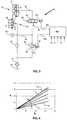
- a pressure control system 30 for the known transmission 1 is schematically illustrated showing only the relevant parts thereof.
- the control system 30 according to the contemporary state of the art comprises an electronic part and a hydraulic part, whereby electromagnetically operable valves 31 and 32 form a transition between such parts.
- the hydraulic part of the control system 30 comprises hydraulic circuits 33 and 34 for containing and guiding a medium, which usually is a suitable synthetic oil, whereby a first hydraulic 33 circuit includes the first medium chamber 15 and a second hydraulic circuit 34 includes the second medium chamber 25.
- the control system is further provided with:
- valves such as the pressure valve 32 and flow valve 31 are generally known in the art, however, it is summarised here that the known valve types usually comprise a valve body axially movably provided in a valve housing, whereby the relative (axial) position of the valve body within said housing determines a cross sectional surface area available for a medium flow through the valve between two of possibly several hydraulic channels connected to the valve. Such position is denoted as the valve setting.
- the said relative position of the valve body may be varied by varying at least one of several forces that usually act on at least two axially oriented end faces the valve body located on opposite ends thereof determining its position and/or movement within the valve housing, which at least one force is denoted here as the pilot force PF.
- the pilot force PF may, for instance, be realised mechanically by a so-called solenoid in dependency on an electric pilot signal PS. It is also known in the art to adopt a solenoid operated valve for converting the said pilot signal PS into a hydraulic pilot pressure that acts on an axially oriented end face of the valve body thus realising the pilot force PF that is dependent on the level of the pilot pressure and the specific surface area of the end face on which it acts.
- the electronic part of the control system 30 comprises a control unit CU, which unit is used for determining -an electronic representation of- desired levels of the first pressure P 1 and of the second pressure P 2 based on any number and origin of input signals usually including at least the rotational speed of the engine N E , the engine torque T E , the transmission ratio i and the second pressure P 2 , the latter being measured by means of a pressure sensor 37 associated with the second hydraulic circuit 34.
- the control unit CU also converts these desired pressure levels P 1 and P 2 into respective pilot signals PS 1 and PS 2 so as to effect valve settings of the flow valve 31 and the pressure valve 32 appropriate for realising these desired pressures P 1 and P 2 .
- the valve setting of the flow valve 31 is determined by a balance between a force effected by a spring 38 and a first pilot force PF 1 realised in dependency on a first pilot signal PS 1
- the valve setting of the pressure valve 32 is determined by a balance between on the one hand a force effected by the second pressure P 2 by means of a pressure feedback duct 39 and on the other hand a force effected by a spring 40 and a second pilot force PF 2 realised in dependency on a second pilot signal PS 2 .
- the pressure level of each of the said first pressure P 1 and the said second pressure P 2 in combination with an active surface area of the respective medium chamber 15; 25 determines the clamping force that is exerted by the respective disc pair 10 or 20 on the drive belt 2.
- the effect of the level of the first pressure P 1 and the second pressure P 2 on the transmission ratio i are illustrated as a graph.
- the second pressure P 2 may be controlled up to a level of 65 bar in dependency on the amount of torque that is to be transferred between the drive belt 2 and the second disc pair 20.
- the characteristics of the control system 30 including the relative size of the said active surface areas are chosen such that for any given level of the second pressure P 2 , the first pressure P 1 may be varied between a level P 1-MIN realising the most decelerating transmission ratio i D and a level P 1-MAX realising the most accelerating transmission ratio i A of the transmission 1.
- the known transmission 1 and more in particular the known flow valve 31 has the disadvantage that it is not particularly suited for accurate adjustment of small medium flows that regularly occur during operation of the transmission 1. Such accurate adjustments are, however, highly desirable for achieving optimum transmission efficiency and for optimising operational reliability.
- Another disadvantage of the known transmission is that there is no immediate relation between the first pilot signal PS 1 and the first pressure P 1 that is actually set. For example, when the first pilot signal PS 1 corresponds to a valve setting where the flow valve 31 is closed, i.e. allowing no medium flow at all, the first pressure P 1 may have, or obtain through medium leakage, any value between the level of the second pressure P 2 and a pressure prevailing in the medium sink 35, which usually is equal to the atmospheric pressure of about 1 bar.
- the clamping force at the first disc pair 10 may unwittingly become too low for adequate torque transfer between the drive belt 2 and the discs 11 and 12 of the first disc pair 10, which disadvantageously results in slip of the drive belt 2 between the said discs 11 and 12 causing a loss of transmission efficiency and additional wear.
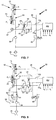
- the invention provides for a continuously variable transmission 1 having an improved control system 30 that is characterised by the features that the first hydraulic circuit 33, the second hydraulic circuit 34 and the pump 36 are hydraulically arranged in series and that there is provided a first valve 42; 43; 44 connecting the said hydraulic circuits 33 and 34, which first valve 42; 43; 44 is capable of realising a variable pressure difference between the first pressure P 1 and the second pressure P 2 prevailing in the said first and second circuits 33 and 34 respectively, e.g. by varying a cross sectional surface area available for a flow of medium between the said hydraulic circuits 33 and 34.
- the transmission 1 according to the invention has the advantage that a relatively large flow of medium passes through the first valve 42; 43; 44, which has an advantageous effect on the accuracy with which the control system may operate.
- the entire flow supplied to the second hydraulic circuit 34 advantageously flows through the first valve 42; 43; 44.
- the first valve 42; 43; 44 comprises a variable restrictor type valve 42.
- a variable restrictor type valve 42 is capable of restricting, alternatively denoted impeding, the medium flow between the said circuits 33 and 34 to a variable extend by setting an opening of a given surface area between the said circuits 33 and 34 in dependency on the level or magnitude of the first pilot signal PS 1 .
- a variable pressure difference may be effected across the valve.
- the said variable extend may be continuously varied from virtually no flow being allowed at all to a virtually unimpeded flow in which latter case the first pressure P 1 and the second pressure P 2 are virtually equal.
- the control system 30 is further provided with a second valve 45 situated between the first hydraulic circuit 33 and a medium sink 35 for influencing the first pressure P 1 by allowing a smaller or larger flow of medium from the first hydraulic circuit 33 to the medium sink 35.
- the second valve 45 conforms to the known pressure control type valve 32.
- the variable flow restrictor type valve 42 has the particular advantage that it is of relatively simple construction and accordingly may be implemented relatively cheaply.
- the first valve 42; 43; 44 comprises a variable pressure differential type valve 43.
- the valve setting of this type of valve is not only determined by the level or magnitude of first pilot signal PS 1 , but also by the level of the first pressure P 1 and the level of the second pressure P 2 .
- the latter influences are realised by providing ducts, e.g. as indicated in figure 6 as the dotted lines 46 and 47 respectively, for allowing the said pressures P 1 and P 2 to act on opposite end faces of the valve body of the differential control type valve 43.
- the influence of each of the pressures P 1 and P 2 is preferably such that changes in that respective pressure P 1 ; P 2 are counteracted.
- This arrangement has the advantage that, when the second pressure P 2 changes, e.g. increases in accordance with an increase in engine torque T E that is to be transferred by the transmission 1, the first pressure P 1 has the tendency to change accordingly, whereby the pressure ratio between said pressures P 1 and P 2 advantageously changes only slightly if at all, resulting in a stable transmission ratio i. Moreover, by selecting suitable surface areas of the said end faces of the said valve body on which the pressures P 1 and P 2 act, it may be realised that for a given magnitude of the first pilot signal PS 1 and the accompanying transmission ratio i, the said pressure ratio and thus also the transmission ratio i remains virtually constant.
- this transmission ratio i corresponds to the most decelerating transmission condition i D , because in this condition the transmission 1 is usually the most highly loaded and, moreover, this arrangement advantageously ensures that in all other transmission conditions an increase in the second pressure P 2 results in an increase in the first pressure P 1 and vice versa.
- the latter behaviour conforms to a generally preferred transmission behaviour, whereby the transmission ratio i becomes more decelerating when the engine torque T E increases and vice versa.
- the differential pressure type valve and its particular advantages, albeit in combination with a conventional control system, are extensively described in the unpublished European patent application 00204670.4.
- the first valve 42; 43; 44 comprises a variable flow control type valve 44.
- the valve setting of this type of valve 44 is not only determined in dependency on the first pilot signal PS 1 , but also in dependency on the amount of said flow of medium from the second circuit 34 to the first circuit 33.
- this may be realised by allowing a flow dependent pressure drop over a restrictor 48 positioned in the first hydraulic circuit 33 immediately after a variable pressure differential type valve 55, whereby the valve setting of variable pressure differential type valve 55 is influenced by the said pressure drop.
- the latter is realised by providing ducts, e.g.
- the restrictor 48 is a well-known hydraulic component and is usually present as a narrowing in, or of, a hydraulic channel or duct.
- the influence of the said pressures drop is such that changes in the amount of medium flow through the variable flow control type valve 44 are counteracted.
- this arrangement has the particular advantage that when the setting of the second valve 45 is changed, for example such that the first pressure P 1 increases, the variable flow control type valve 44 adjust itself so as to maintain a constant flow between the hydraulic circuits 33 and 34, thereby automatically effecting an increase in the second pressure P 2 .
- Figure 4 illustrates that when the said pressures P 1 and P 2 change more or less correspondingly, the transmission ratio i will change only slightly, if at all, yielding a relatively simple and advantageously independent control of the transmission ratio i and of the engine torque T E transferable by the transmission 1 without mutual notional slip of the belt 2 and the disc pairs 10 and 20.
- the invention suggests two further improvements to the third embodiment of the invention that are illustrated in figure 8.
- the pump flow should be as constant as possible to realise an optimum stability of the control system.
- -a change in- the pump flow would additionally and disadvantageously influence the valve setting of the variable flow control type valve 44, that is, independent from changes in the setting of the second valve 45.
- the pump flow will usually depend on the pressure gradient over the pump 36 and accordingly on the first pressure P 1 as well as on other parameters.
- the same engine that drives the transmission 1 and the load often also drives the pump 36.
- the medium flow generated by the pump 36 depends on the engine speed N E and thus will vary during operation of the transmission 1.
- the invention provides a solution to this problem in the addition of a third valve 49 that realises a fixed amount of medium flow from the pump 36 into the second hydraulic circuit 34 by branching-off into a further hydraulic circuit 50 of an mount of flow that is generated by the pump 36 in excess a the said fixed amount.
- such third valve 49 may comprise a restrictor 51, which is constituted by a narrowing in a hydraulic channel or duct carrying the pump flow into the second circuit 34 and which realises a pump flow dependent pressure drop, and a pressure control valve 52 situated between the second circuit 34 and the further hydraulic circuit 50, which is operable under the influence of the said pressure drop in such a manner that medium flow is increasingly branched-off when the said pressure drop increases and vice versa.
- the pump 36 is dimensioned such that it can provide an amount of flow equal to or slightly larger than the said constant amount of flow under all circumstances during normal operation.
- the pump 36 When the pump 36 is directly driven by the same engine that drives the load, this means that the pump 36 is preferably dimensioned such that it is capable of delivering the said constant amount of flow at the lowest engine speed N E that occurs during normal operation, e.g. idle engine speed in automotive applications.
- the branched-off flow need not be fed directly into the reservoir 35, but may be advantageously used for other typical functions of the control system 30 such as lubrication or clutch control.
- control behaviour of the third embodiment of the invention may be further optimised by a second improvement that entails constructing the variable flow control type valve 44 as two sub-valves 53 and 54, which feature is also illustrated in figure 8.
- a first sub-valve 53 is a variable restrictor type valve similar to the valve 42 used in the first embodiment of the invention and the second sub-valve 54 is a pressure differential type valve similar to the valve 43 used in the second embodiment of the invention. Both valves 53 and 54 are arranged such that the variable pressure drop existing over the first sub-valve 53 determines the valve setting of the first sub-valve 54 by providing ducts 56 and 57, one on either side of the variable restrictor type valve 53.
- the said ducts 56 and 57 allow the locally prevailing pressure to act on opposite end faces of the valve body of the second sub-valve 54.
- the second sub-valve 54 actually determines the flow between the first and second hydraulic circuits 33 and 34 respectively.
- This construction combines some of the particular advantages of the first and second embodiments of the invention and, moreover, allows valves of relative simple construction to be used.
- a particular advantage of this construction is that the valve that is actively controlled, i.e. variable restrictor type first sub-valve 53, disturbs the pressures and flows prevailing in the control system only slightly, whereas the real work of controlling the first pressure P 1 by determining the flow between the first circuit 33 and the second circuit 34 is performed by another valve, i.e. the pressure differential type second sub-valve 54.
- Such separation of functions can significantly improve the stability of the control behaviour of the system 30.
- the second pilot signal PS 2 of the second valve 45 which for this purpose preferably is of the known pressure valve type, is determined by the CU based on the difference between an actual, i.e. measured second pressure P 2 , and a desired pressure P 2 determined by the control unit CU.
- the pressure sensor 37 is, according to the invention, thus associated with the second circuit 34 although the second valve 45 is situated between the first circuit 33 and the medium sink 35. Accordingly, the second valve 45 influences the second pressure P 2 only indirectly because of the presence of the first valve 42; 43; 44 situated between the second valve 45 and the second hydraulic circuit 34.
- This unconventional arrangement has the unexpected advantage that, even when using only a single pressure sensor 37, at standstill both said pressures P 1 and P 2 are relatively accurately known, because the second pressure P 2 may be measured by means of the pressure sensor 37, whereas the first pressure P 1 may be estimated using a predetermined characteristic of the pressure valve type second valve 45, which characteristic provides an approximation of the pressure set by the second valve 45, being the first pressure P 1 , in dependency on the level or magnitude of the second pilot signal PS 2 and may be determined with sufficient accuracy. Thereby, the said slip of the drive belt 2 during standstill or initial acceleration may be prevented adequately and reliably.
Landscapes
- Engineering & Computer Science (AREA)
- General Engineering & Computer Science (AREA)
- Mechanical Engineering (AREA)
- Control Of Transmission Device (AREA)
- Transmissions By Endless Flexible Members (AREA)
Priority Applications (5)
| Application Number | Priority Date | Filing Date | Title |
|---|---|---|---|
| EP20010201087 EP1243817B1 (en) | 2001-03-23 | 2001-03-23 | Continuously variable transmission having an accurate pressure control system |
| DE60106722T DE60106722T2 (de) | 2001-03-23 | 2001-03-23 | Stufenloses Getriebe mit einer genauen Druckregelvorrichtung |
| AT01201087T ATE280917T1 (de) | 2001-03-23 | 2001-03-23 | Stufenloses getriebe mit einer genauen druckregelvorrichtung |
| PCT/EP2002/003174 WO2002077493A1 (en) | 2001-03-23 | 2002-03-21 | Continuously variable transmission having an accurate pressure control system |
| JP2002575509A JP4205429B2 (ja) | 2001-03-23 | 2002-03-21 | 精密圧力制御システムを有する連続可変トランスミッション |
Applications Claiming Priority (1)
| Application Number | Priority Date | Filing Date | Title |
|---|---|---|---|
| EP20010201087 EP1243817B1 (en) | 2001-03-23 | 2001-03-23 | Continuously variable transmission having an accurate pressure control system |
Publications (2)
| Publication Number | Publication Date |
|---|---|
| EP1243817A1 EP1243817A1 (en) | 2002-09-25 |
| EP1243817B1 true EP1243817B1 (en) | 2004-10-27 |
Family
ID=8180052
Family Applications (1)
| Application Number | Title | Priority Date | Filing Date |
|---|---|---|---|
| EP20010201087 Expired - Lifetime EP1243817B1 (en) | 2001-03-23 | 2001-03-23 | Continuously variable transmission having an accurate pressure control system |
Country Status (5)
| Country | Link |
|---|---|
| EP (1) | EP1243817B1 (enExample) |
| JP (1) | JP4205429B2 (enExample) |
| AT (1) | ATE280917T1 (enExample) |
| DE (1) | DE60106722T2 (enExample) |
| WO (1) | WO2002077493A1 (enExample) |
Families Citing this family (2)
| Publication number | Priority date | Publication date | Assignee | Title |
|---|---|---|---|---|
| ITFI20130156A1 (it) | 2013-07-01 | 2015-01-02 | Scuola Superiore Sant Anna | Molla torsionale |
| JP6439756B2 (ja) * | 2016-07-07 | 2018-12-19 | トヨタ自動車株式会社 | 車両用変速機の制御装置 |
Family Cites Families (6)
| Publication number | Priority date | Publication date | Assignee | Title |
|---|---|---|---|---|
| IT1201307B (it) | 1985-06-03 | 1989-01-27 | Penna Flli | Tendone ad assetto variabile,in particolare per veicoli di venditori ambulanti e simili |
| DE3938539A1 (de) * | 1989-11-21 | 1991-06-06 | Ford Werke Ag | Steuersystem fuer ein stufenlos regelbares kegelscheiben-umschlingungsgetriebe |
| NL9000860A (nl) | 1990-04-12 | 1991-11-01 | Doornes Transmissie Bv | Elektronisch geregelde continu variabele transmissie. |
| DE19519163A1 (de) * | 1995-05-24 | 1996-11-28 | Bosch Gmbh Robert | Hydrauliknotsteuerung für eine Änderung der Hydrauliköldrücke in der hydraulischen Kegelscheibenaxialverstellung eines stufenlosen Umschlingungsgetriebes zur Variation der Klemmkraftverhältnisse |
| NL1002245C2 (nl) | 1996-02-05 | 1997-08-07 | Doornes Transmissie Bv | Continu variabele transmissie. |
| US6126138A (en) | 1998-12-30 | 2000-10-03 | Hamilton Sundstrand Corporation | Pressure reducing valve and continuously variable transmission with control arrangement using same |
-
2001
- 2001-03-23 DE DE60106722T patent/DE60106722T2/de not_active Expired - Lifetime
- 2001-03-23 EP EP20010201087 patent/EP1243817B1/en not_active Expired - Lifetime
- 2001-03-23 AT AT01201087T patent/ATE280917T1/de not_active IP Right Cessation
-
2002
- 2002-03-21 WO PCT/EP2002/003174 patent/WO2002077493A1/en not_active Ceased
- 2002-03-21 JP JP2002575509A patent/JP4205429B2/ja not_active Expired - Fee Related
Also Published As
| Publication number | Publication date |
|---|---|
| DE60106722T2 (de) | 2005-11-10 |
| JP4205429B2 (ja) | 2009-01-07 |
| EP1243817A1 (en) | 2002-09-25 |
| JP2004522094A (ja) | 2004-07-22 |
| WO2002077493A1 (en) | 2002-10-03 |
| DE60106722D1 (de) | 2004-12-02 |
| ATE280917T1 (de) | 2004-11-15 |
Similar Documents
| Publication | Publication Date | Title |
|---|---|---|
| US4669336A (en) | Apparatus for controlling line pressure used in V-belt type continuously variable transmission for automobile | |
| EP0304085B1 (en) | Hydraulic control device for belt-and-pulley type continuously variable transmission for a vehicle | |
| US6547694B2 (en) | Hydraulic control system for a continuously variable transmission | |
| US4534243A (en) | Hydraulic control system for a V-belt transmission | |
| EP0228884B1 (en) | System for controlling transmission ratio of a continuously variable transmission for a motor vehicle | |
| US6623386B1 (en) | Oil-hydraulic circuit of belt-type continuous variable speed-change transmission | |
| EP0117696A1 (en) | Hydraulic apparatus for a continuously variable transmission | |
| EP0982512B1 (en) | Clutch hydraulic controller | |
| GB2260379A (en) | Control system for continuously-variable transmission | |
| JPH0586511B2 (enExample) | ||
| EP0289025B1 (en) | Belt-and-pulley type continuously variable transmission | |
| US20110118066A1 (en) | Sheave positioning device | |
| KR100564195B1 (ko) | 벨트식 무단 변속기의 변속 유압 제어 장치 | |
| US6350215B1 (en) | Hydraulic control system for pressure control of a CVT variator with limp home mode | |
| US5156572A (en) | Speed shift control system of a continuous transmission | |
| GB2298907A (en) | An electrohydraulic control system for a continuously-variable transmission. | |
| US6503169B2 (en) | Apparatus for controlling a power transmission device | |
| EP1243817B1 (en) | Continuously variable transmission having an accurate pressure control system | |
| US6679805B2 (en) | Control system and continuously variable transmission provided therewith | |
| JP2019173929A (ja) | 無段変速機の油圧制御装置 | |
| JP4164787B2 (ja) | 無段変速機の変速比制御装置 | |
| KR100504419B1 (ko) | 무단변속시에일정한클램핑력비율을조절하는비상유압제어장치 | |
| KR100357553B1 (ko) | 차량용 무단 변속기의 유압 제어 시스템 | |
| JP2004522094A5 (enExample) | ||
| KR100196793B1 (ko) | 자동 변속차량용 유압제어장치의 클러치 작동 라인압 보상방법 |
Legal Events
| Date | Code | Title | Description |
|---|---|---|---|
| PUAI | Public reference made under article 153(3) epc to a published international application that has entered the european phase |
Free format text: ORIGINAL CODE: 0009012 |
|
| AK | Designated contracting states |
Kind code of ref document: A1 Designated state(s): AT BE CH CY DE DK ES FI FR GB GR IE IT LI LU MC NL PT SE TR |
|
| AX | Request for extension of the european patent |
Free format text: AL;LT;LV;MK;RO;SI |
|
| 17P | Request for examination filed |
Effective date: 20030325 |
|
| AKX | Designation fees paid |
Designated state(s): AT BE CH CY DE DK ES FI FR GB GR IE IT LI LU MC NL PT SE TR |
|
| 17Q | First examination report despatched |
Effective date: 20030526 |
|
| GRAP | Despatch of communication of intention to grant a patent |
Free format text: ORIGINAL CODE: EPIDOSNIGR1 |
|
| GRAS | Grant fee paid |
Free format text: ORIGINAL CODE: EPIDOSNIGR3 |
|
| GRAA | (expected) grant |
Free format text: ORIGINAL CODE: 0009210 |
|
| AK | Designated contracting states |
Kind code of ref document: B1 Designated state(s): AT BE CH CY DE DK ES FI FR GB GR IE IT LI LU MC NL PT SE TR |
|
| PG25 | Lapsed in a contracting state [announced via postgrant information from national office to epo] |
Ref country code: IT Free format text: LAPSE BECAUSE OF FAILURE TO SUBMIT A TRANSLATION OF THE DESCRIPTION OR TO PAY THE FEE WITHIN THE PRESCRIBED TIME-LIMIT;WARNING: LAPSES OF ITALIAN PATENTS WITH EFFECTIVE DATE BEFORE 2007 MAY HAVE OCCURRED AT ANY TIME BEFORE 2007. THE CORRECT EFFECTIVE DATE MAY BE DIFFERENT FROM THE ONE RECORDED. Effective date: 20041027 Ref country code: FI Free format text: LAPSE BECAUSE OF FAILURE TO SUBMIT A TRANSLATION OF THE DESCRIPTION OR TO PAY THE FEE WITHIN THE PRESCRIBED TIME-LIMIT Effective date: 20041027 Ref country code: CH Free format text: LAPSE BECAUSE OF FAILURE TO SUBMIT A TRANSLATION OF THE DESCRIPTION OR TO PAY THE FEE WITHIN THE PRESCRIBED TIME-LIMIT Effective date: 20041027 Ref country code: TR Free format text: LAPSE BECAUSE OF FAILURE TO SUBMIT A TRANSLATION OF THE DESCRIPTION OR TO PAY THE FEE WITHIN THE PRESCRIBED TIME-LIMIT Effective date: 20041027 Ref country code: LI Free format text: LAPSE BECAUSE OF FAILURE TO SUBMIT A TRANSLATION OF THE DESCRIPTION OR TO PAY THE FEE WITHIN THE PRESCRIBED TIME-LIMIT Effective date: 20041027 Ref country code: AT Free format text: LAPSE BECAUSE OF FAILURE TO SUBMIT A TRANSLATION OF THE DESCRIPTION OR TO PAY THE FEE WITHIN THE PRESCRIBED TIME-LIMIT Effective date: 20041027 |
|
| REG | Reference to a national code |
Ref country code: GB Ref legal event code: FG4D |
|
| REG | Reference to a national code |
Ref country code: CH Ref legal event code: EP |
|
| REG | Reference to a national code |
Ref country code: IE Ref legal event code: FG4D |
|
| REF | Corresponds to: |
Ref document number: 60106722 Country of ref document: DE Date of ref document: 20041202 Kind code of ref document: P |
|
| PG25 | Lapsed in a contracting state [announced via postgrant information from national office to epo] |
Ref country code: SE Free format text: LAPSE BECAUSE OF FAILURE TO SUBMIT A TRANSLATION OF THE DESCRIPTION OR TO PAY THE FEE WITHIN THE PRESCRIBED TIME-LIMIT Effective date: 20050127 Ref country code: GR Free format text: LAPSE BECAUSE OF FAILURE TO SUBMIT A TRANSLATION OF THE DESCRIPTION OR TO PAY THE FEE WITHIN THE PRESCRIBED TIME-LIMIT Effective date: 20050127 Ref country code: DK Free format text: LAPSE BECAUSE OF FAILURE TO SUBMIT A TRANSLATION OF THE DESCRIPTION OR TO PAY THE FEE WITHIN THE PRESCRIBED TIME-LIMIT Effective date: 20050127 |
|
| PG25 | Lapsed in a contracting state [announced via postgrant information from national office to epo] |
Ref country code: ES Free format text: LAPSE BECAUSE OF FAILURE TO SUBMIT A TRANSLATION OF THE DESCRIPTION OR TO PAY THE FEE WITHIN THE PRESCRIBED TIME-LIMIT Effective date: 20050207 |
|
| PG25 | Lapsed in a contracting state [announced via postgrant information from national office to epo] |
Ref country code: CY Free format text: LAPSE BECAUSE OF FAILURE TO SUBMIT A TRANSLATION OF THE DESCRIPTION OR TO PAY THE FEE WITHIN THE PRESCRIBED TIME-LIMIT Effective date: 20050323 Ref country code: IE Free format text: LAPSE BECAUSE OF NON-PAYMENT OF DUE FEES Effective date: 20050323 Ref country code: LU Free format text: LAPSE BECAUSE OF NON-PAYMENT OF DUE FEES Effective date: 20050323 |
|
| PG25 | Lapsed in a contracting state [announced via postgrant information from national office to epo] |
Ref country code: MC Free format text: LAPSE BECAUSE OF NON-PAYMENT OF DUE FEES Effective date: 20050331 |
|
| REG | Reference to a national code |
Ref country code: CH Ref legal event code: PL |
|
| PLBE | No opposition filed within time limit |
Free format text: ORIGINAL CODE: 0009261 |
|
| STAA | Information on the status of an ep patent application or granted ep patent |
Free format text: STATUS: NO OPPOSITION FILED WITHIN TIME LIMIT |
|
| ET | Fr: translation filed | ||
| 26N | No opposition filed |
Effective date: 20050728 |
|
| REG | Reference to a national code |
Ref country code: IE Ref legal event code: MM4A |
|
| PG25 | Lapsed in a contracting state [announced via postgrant information from national office to epo] |
Ref country code: PT Free format text: LAPSE BECAUSE OF NON-PAYMENT OF DUE FEES Effective date: 20050327 |
|
| PGFP | Annual fee paid to national office [announced via postgrant information from national office to epo] |
Ref country code: BE Payment date: 20100323 Year of fee payment: 10 |
|
| BERE | Be: lapsed |
Owner name: *VAN DOORNE'S TRANSMISSIE B.V. Effective date: 20110331 |
|
| PG25 | Lapsed in a contracting state [announced via postgrant information from national office to epo] |
Ref country code: BE Free format text: LAPSE BECAUSE OF NON-PAYMENT OF DUE FEES Effective date: 20110331 |
|
| PGFP | Annual fee paid to national office [announced via postgrant information from national office to epo] |
Ref country code: FR Payment date: 20130329 Year of fee payment: 13 Ref country code: GB Payment date: 20130318 Year of fee payment: 13 |
|
| PGFP | Annual fee paid to national office [announced via postgrant information from national office to epo] |
Ref country code: NL Payment date: 20130318 Year of fee payment: 13 |
|
| PGFP | Annual fee paid to national office [announced via postgrant information from national office to epo] |
Ref country code: DE Payment date: 20130523 Year of fee payment: 13 |
|
| REG | Reference to a national code |
Ref country code: DE Ref legal event code: R119 Ref document number: 60106722 Country of ref document: DE |
|
| REG | Reference to a national code |
Ref country code: NL Ref legal event code: V1 Effective date: 20141001 |
|
| GBPC | Gb: european patent ceased through non-payment of renewal fee |
Effective date: 20140323 |
|
| REG | Reference to a national code |
Ref country code: FR Ref legal event code: ST Effective date: 20141128 |
|
| REG | Reference to a national code |
Ref country code: DE Ref legal event code: R119 Ref document number: 60106722 Country of ref document: DE Effective date: 20141001 |
|
| PG25 | Lapsed in a contracting state [announced via postgrant information from national office to epo] |
Ref country code: GB Free format text: LAPSE BECAUSE OF NON-PAYMENT OF DUE FEES Effective date: 20140323 Ref country code: DE Free format text: LAPSE BECAUSE OF NON-PAYMENT OF DUE FEES Effective date: 20141001 Ref country code: FR Free format text: LAPSE BECAUSE OF NON-PAYMENT OF DUE FEES Effective date: 20140331 |
|
| PG25 | Lapsed in a contracting state [announced via postgrant information from national office to epo] |
Ref country code: NL Free format text: LAPSE BECAUSE OF NON-PAYMENT OF DUE FEES Effective date: 20141001 |