EP1239074A1 - Verfahren zur Erzeugung von satiniertem Papier - Google Patents
Verfahren zur Erzeugung von satiniertem Papier Download PDFInfo
- Publication number
- EP1239074A1 EP1239074A1 EP01105754A EP01105754A EP1239074A1 EP 1239074 A1 EP1239074 A1 EP 1239074A1 EP 01105754 A EP01105754 A EP 01105754A EP 01105754 A EP01105754 A EP 01105754A EP 1239074 A1 EP1239074 A1 EP 1239074A1
- Authority
- EP
- European Patent Office
- Prior art keywords
- grinding
- paper
- web
- pulp
- intensity
- Prior art date
- Legal status (The legal status is an assumption and is not a legal conclusion. Google has not performed a legal analysis and makes no representation as to the accuracy of the status listed.)
- Granted
Links
- 238000000034 method Methods 0.000 title claims description 55
- 238000000227 grinding Methods 0.000 claims abstract description 53
- 239000000835 fiber Substances 0.000 claims abstract description 23
- 239000000725 suspension Substances 0.000 claims abstract description 9
- 238000003490 calendering Methods 0.000 claims abstract description 8
- 238000002360 preparation method Methods 0.000 claims abstract description 8
- 238000005520 cutting process Methods 0.000 claims abstract description 4
- 239000002699 waste material Substances 0.000 claims abstract description 4
- 238000004886 process control Methods 0.000 claims abstract description 3
- 238000009499 grossing Methods 0.000 claims description 6
- 238000004519 manufacturing process Methods 0.000 claims description 5
- 239000010893 paper waste Substances 0.000 claims description 5
- 239000002761 deinking Substances 0.000 claims 1
- 239000000463 material Substances 0.000 abstract description 2
- 238000005498 polishing Methods 0.000 abstract 6
- 238000000926 separation method Methods 0.000 abstract 1
- 230000000694 effects Effects 0.000 description 5
- 238000011161 development Methods 0.000 description 4
- 230000018109 developmental process Effects 0.000 description 4
- 230000003287 optical effect Effects 0.000 description 4
- 229920001131 Pulp (paper) Polymers 0.000 description 3
- 238000010586 diagram Methods 0.000 description 3
- 229920003043 Cellulose fiber Polymers 0.000 description 2
- 230000015572 biosynthetic process Effects 0.000 description 2
- 238000009826 distribution Methods 0.000 description 2
- 239000002657 fibrous material Substances 0.000 description 2
- 239000000203 mixture Substances 0.000 description 2
- 238000003825 pressing Methods 0.000 description 2
- 239000000126 substance Substances 0.000 description 2
- 230000006735 deficit Effects 0.000 description 1
- 230000002349 favourable effect Effects 0.000 description 1
- 239000011121 hardwood Substances 0.000 description 1
- 238000003801 milling Methods 0.000 description 1
- 239000000546 pharmaceutical excipient Substances 0.000 description 1
- 239000011122 softwood Substances 0.000 description 1
- 238000001228 spectrum Methods 0.000 description 1
- 230000001960 triggered effect Effects 0.000 description 1
- XLYOFNOQVPJJNP-UHFFFAOYSA-N water Substances O XLYOFNOQVPJJNP-UHFFFAOYSA-N 0.000 description 1
- 239000002023 wood Substances 0.000 description 1
Images

Classifications
-
- D—TEXTILES; PAPER
- D21—PAPER-MAKING; PRODUCTION OF CELLULOSE
- D21D—TREATMENT OF THE MATERIALS BEFORE PASSING TO THE PAPER-MAKING MACHINE
- D21D1/00—Methods of beating or refining; Beaters of the Hollander type
- D21D1/20—Methods of refining
- D21D1/30—Disc mills
-
- D—TEXTILES; PAPER
- D21—PAPER-MAKING; PRODUCTION OF CELLULOSE
- D21B—FIBROUS RAW MATERIALS OR THEIR MECHANICAL TREATMENT
- D21B1/00—Fibrous raw materials or their mechanical treatment
- D21B1/04—Fibrous raw materials or their mechanical treatment by dividing raw materials into small particles, e.g. fibres
- D21B1/06—Fibrous raw materials or their mechanical treatment by dividing raw materials into small particles, e.g. fibres by dry methods
-
- D—TEXTILES; PAPER
- D21—PAPER-MAKING; PRODUCTION OF CELLULOSE
- D21D—TREATMENT OF THE MATERIALS BEFORE PASSING TO THE PAPER-MAKING MACHINE
- D21D1/00—Methods of beating or refining; Beaters of the Hollander type
- D21D1/20—Methods of refining
- D21D1/30—Disc mills
- D21D1/306—Discs
-
- D—TEXTILES; PAPER
- D21—PAPER-MAKING; PRODUCTION OF CELLULOSE
- D21G—CALENDERS; ACCESSORIES FOR PAPER-MAKING MACHINES
- D21G1/00—Calenders; Smoothing apparatus
-
- D—TEXTILES; PAPER
- D21—PAPER-MAKING; PRODUCTION OF CELLULOSE
- D21H—PULP COMPOSITIONS; PREPARATION THEREOF NOT COVERED BY SUBCLASSES D21C OR D21D; IMPREGNATING OR COATING OF PAPER; TREATMENT OF FINISHED PAPER NOT COVERED BY CLASS B31 OR SUBCLASS D21G; PAPER NOT OTHERWISE PROVIDED FOR
- D21H11/00—Pulp or paper, comprising cellulose or lignocellulose fibres of natural origin only
- D21H11/14—Secondary fibres
Definitions
- the invention relates to a method according to the preamble of claim 1.
- Processes of this type are used to produce high quality and smooth papers.
- a large number of parameters have to be observed in paper production in order to to receive a paper with the required quality in all requirements.
- This one considered method stands at the same time producing a smooth surface good optical properties in the foreground.
- a smooth surface is usually generated by the paper web at a defined residual moisture and at certain temperatures between at least two, usually a variety of Smoothing rollers is passed through, which are pressed against each other.
- This The method has long been known and proven. But then it comes up against Limits if, as a result of the pressing pressure that is required in the smoothing units, undesirable side effects occur.
- Secondary fibers e.g.
- Waste paper for the production of high quality satined paper Waste paper for the production of high quality satined paper.
- the waste papers for Wood-containing graphic papers are usually used, a mixture of Wood pulp fibers and cellulose fibers, the cellulose fibers in turn a Mixture of softwood and hardwood fibers can be.
- Each of these three Fiber groups have a typical fiber length and fiber distribution pattern. Pulp fibers usually have a relatively narrow thickness distribution spectrum, In contrast, wood pulp fibers are very broad. The thicker portion of the Wood pulp fibers because of the relatively thin paper thickness of the types considered here have a disruptive effect when satinizing.
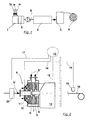
- Fig. 1 the three main process steps, namely Stock preparation 1, paper production 2 and calendering process 3 are shown.
- at least the first two process sections consist of one Put together a large number of process steps.
- the subsequent satinizing process 3 can be part of the paper machine, but can also be in a separate device be carried out.
- calenders or supercalenders are suitable for this. Its graphic representation is not necessary, as such Paper smoothing devices have long been known. That finished and smoothed paper is then wound up into a roll 4.
- the grinding refiners known per se are particularly suitable for grinding 5.
- Fig. 2 Such a refiner 6 is shown schematically.
- the pulp suspension to be ground S ' is introduced centrally and then passes into the grinding zone, which goes through against each other moving grinding sets 9 and 9 'is formed.
- the refiner 6 shown here is a Double disc refiner, i.e. there is an axially floating rotor 7 between the two stators 8 and 10.
- the stator 10 is a Loading device 11 can be pressed axially against the rotor 7. As is known thereby the one generated by the drive 12 and transferred to the fibrous material in the refiner 6 Power set. After grinding, the ground fiber suspension S " radial out.
- FIG. 2 also shows a possible favorable control concept when carrying out the inventive method.
- the material flow of the Fibrous suspension S 'by a control device 20 only indicated here in terms of consistency, as well as in terms of throughput.
- the power of the drive 12 is determined and this value via the control line 15 transmitted to a controller 13 (this could belong to a process computer). from that an actuating signal is formed, which via the control line 16 Load device 11 reached.
- This is how the specific work can be done Grinding work per amount of substance, e.g. measured in kWh / t.
- On the right part of this Fig. 2 is a schematic determination of the roughness or smoothness of the finished and satined paper web 19 with the aid of a scanner 18 (scanner).
- the signal determined is sent to the aforementioned controller 13 via the signal line 14 fed. If this measured value deviates from the target value 26, one is generated by the controller 13 Change in the intensity of the grinding triggered. This can usually happen by the loading device 11 generating a changed grinding pressure and thereby the power consumed changed or else by the same in the drive 12 A change in speed is made. The latter case is requires more equipment, but offers the possibility of e.g. measured in km / s. Then can with the same grinding performance Lowering the secondary edge load, e.g. measured in Ws / km, increased become. This means that the characteristics of the grinding can be adapted to the requirements adjust without doing the specific work to the same extent, i.e. proportionally change.
- the grinding process possible with a grinding refiner is also determined by the shape of the Refiner knife significantly influenced.
- 3 the supervision of one Rotor 7 with the set 9 fastened thereon, which has a large number of knives.
- the pure proportions are not drawn to scale, it comes with this representation to the angle that the knives have to the radius.
- the Set 9 ' which belongs to the stator, only a few knives are drawn. In this way the angle of intersection ⁇ can be seen in which the knives moved against each other are employed to each other.
- Knife sets, the cutting angle of which is relatively small, preferably about 15% are particularly well suited for carrying out the method. That is probably due to the particularly strong fiber cutting effect and therefore Attributed to the formation of fines without the fibers being severely fibrillated.
Landscapes
- Engineering & Computer Science (AREA)
- Life Sciences & Earth Sciences (AREA)
- Wood Science & Technology (AREA)
- Mechanical Engineering (AREA)
- Paper (AREA)
Abstract
Description
- Fig. 1
- den grundsätzlichen Ablauf des Verfahrens;
- Fig. 2
- Skizze eines Mahlrefiners mit entsprechender Regelung;
- Fig. 3
- Aufsicht auf eine Mahlgarnitur;
- Fig. 4
- Diagramm zur Verdeutlichung des erfindungsgemäß erzielten Glätteeffektes;
- Fig. 5
- Diagramm zur Verdeutlichung der mahlungsbedingten Festigkeitsentwicklung.
Claims (18)
- Verfahren zur Erzeugung von satiniertem Papier mitdadurch gekennzeichnet, dass in der Stoffaufbereitung (1) eine Mahlung (5) durchgeführt wird, bei der die Papierfasern in einer Faserstoffsuspension (S) mit einer Konsistenz zwischen 2 % und 8 %, vorzugsweise 3 bis 5 %, vorliegen, und dass die Intensität der Mahlung (5) entsprechend der beim Satinageprozess (3) erzielten Glätte der aus den gemahlenen Papierfasern erzeugten Papierbahn eingestellt wird, indem die Intensität bei nicht ausreichender Glätte erhöht wird.a) einer Stoffaufbereitung (1) zur Bereitstellung einer für die Verarbeitung auf einer Papiermaschine geeigneten Faserstoffsuspension (S),b) einer Papierherstellung (2), in welcher aus der Faserstoffsuspension eine getrocknete Papierbahn erzeugt wird, sowiec) einem Satinageprozess (3), in dem zwischen aufeinandergedrückten Glättflächen die Papierbahn geglättet wird,
- Verfahren nach Anspruch 1,
dadurch gekennzeichnet, dass die Intensität der Mahlung (5) durch Verändern der spezifischen Mahlarbeit eingestellt wird. - Verfahren nach Anspruch 1 oder 2,
dadurch gekennzeichnet, dass die Intensität der Mahlung (5) durch Verändern der sekundlichen Mahlkantenlänge eingestellt wird. - Verfahren nach Anspruch 3,
dadurch gekennzeichnet, dass die sekundliche Mahlkantenlänge eingestellt wird, ohne dass sich die spezifische Mahlarbeit proportional mit ihr verändert. - Verfahren nach Anspruch 3,
dadurch gekennzeichnet, dass die spezifische Mahlarbeit unverändert bleibt. - Verfahren nach Anspruch 4 oder 5,
dadurch gekennzeichnet, dass die Mahlung (5) in einem Refiner erfolgt, und dass die sekundliche Mahlkantenlänge durch Drehzahlveränderung eingestellt wird. - Verfahren nach einem der voranstehenden Ansprüche,
dadurch gekennzeichnet, dass die Mahlung (5) in einem Refiner erfolgt, der mit Messergarnituren ausgestattet ist, deren Schnittwinkel (α) höchstens 15° beträgt. - Verfahren nach einem der voranstehenden Ansprüche,
dadurch gekennzeichnet, dass bei der Mahlung (5) eine sekundliche Kantenbelastung von mindestens 1000 Ws/km eingestellt wird. - Verfahren nach Anspruch 8,
dadurch gekennzeichnet, dass bei der Mahlung (5) eine sekundliche Kantenbelastung von mindestens 2000 Ws/km eingestellt wird. - Verfahren nach einem der voranstehenden Ansprüche,
dadurch gekennzeichnet, dass bei der Mahlung (5) eine reine spezifische Mahlarbeit von mindestens 100 kWh/t übertragen wird. - Verfahren nach einem der voranstehenden Ansprüche,
dadurch gekennzeichnet, dass durch die Mahlung (5) ein Mahlgrad von mindestens 70° SR erzielt wird. - Verfahren nach einem der voranstehenden Ansprüche,
dadurch gekennzeichnet, dass die Faserstoffsuspension (S) zu mindestens 80 % aus Altpapier erzeugt wird, und dass die Stoffaufbereitung (1) mindestens ein Deinking-Verfahren enthält. - Verfahren nach Anspruch 12,
dadurch gekennzeichnet, dass das Altpapier überwiegend aus bedruckten Abfällen, wie Zeitungen und Büroabfällen besteht. - Verfahren nach einem der voranstehenden Ansprüche,
dadurch gekennzeichnet, dass im Satinageprozess (3) eine Flächenpressung von höchstens 100 N/mm2 angewendet wird. - Verfahren nach einem der voranstehenden Ansprüche,
dadurch gekennzeichnet, dass im Satinageprozess (3) ein Superkalander verwendet wird. - Verfahren nach einem der voranstehenden Ansprüche,
dadurch gekennzeichnet, dass in der Prozesssteuerung die im Satinageprozess (3) erzielte Glätte als Regelgröße für die Steuerung der Mahlung (5) eingesetzt wird. - Verfahren nach einem der voranstehenden Ansprüche,
dadurch gekennzeichnet, dass die Flächenpressung beim Satinageprozess (3) so gering gehalten wird, dass ein zulässiger Schwarzsatinage-Wert nicht überschritten wird und dass die Intensität der Mahlung (5) so hoch gewählt wird, bis die geforderte Glätte erreicht ist. - Verfahren nach einem der voranstehenden Ansprüche,
dadurch gekennzeichnet, dass die Flächenpressung beim Satinageprozess (3) so gering gehalten wird, dass danach ein geforderter Weißgrad erreicht wird und dass die Intensität der Mahlung (5) so hoch gewählt wird, bis die geforderte Glätte erreicht ist.
Priority Applications (3)
| Application Number | Priority Date | Filing Date | Title |
|---|---|---|---|
| AT01105754T ATE303467T1 (de) | 2001-03-08 | 2001-03-08 | Verfahren zur erzeugung von satiniertem papier |
| EP01105754A EP1239074B1 (de) | 2001-03-08 | 2001-03-08 | Verfahren zur Erzeugung von satiniertem Papier |
| DE50107277T DE50107277D1 (de) | 2001-03-08 | 2001-03-08 | Verfahren zur Erzeugung von satiniertem Papier |
Applications Claiming Priority (1)
| Application Number | Priority Date | Filing Date | Title |
|---|---|---|---|
| EP01105754A EP1239074B1 (de) | 2001-03-08 | 2001-03-08 | Verfahren zur Erzeugung von satiniertem Papier |
Publications (2)
| Publication Number | Publication Date |
|---|---|
| EP1239074A1 true EP1239074A1 (de) | 2002-09-11 |
| EP1239074B1 EP1239074B1 (de) | 2005-08-31 |
Family
ID=8176718
Family Applications (1)
| Application Number | Title | Priority Date | Filing Date |
|---|---|---|---|
| EP01105754A Expired - Lifetime EP1239074B1 (de) | 2001-03-08 | 2001-03-08 | Verfahren zur Erzeugung von satiniertem Papier |
Country Status (3)
| Country | Link |
|---|---|
| EP (1) | EP1239074B1 (de) |
| AT (1) | ATE303467T1 (de) |
| DE (1) | DE50107277D1 (de) |
Cited By (2)
| Publication number | Priority date | Publication date | Assignee | Title |
|---|---|---|---|---|
| EP2224057A1 (de) * | 2009-02-07 | 2010-09-01 | Seed Company Ltd. | Pulpenherstellungsverfahren für eine Recyclingvorrichtung für benutztes Papier, Pulpenherstellungsvorrichtung für eine Recyclingvorrichtung für benutztes Papier und Recyclingvorrichtung für benutztes Papier |
| EP2900868B1 (de) | 2012-09-28 | 2021-11-10 | Voith Patent GmbH | Verfahren zur regelung der formation einer faserstoffbahn eines faser- oder papierherstellungsprozesses |
Citations (6)
| Publication number | Priority date | Publication date | Assignee | Title |
|---|---|---|---|---|
| US4372810A (en) * | 1979-10-10 | 1983-02-08 | Sunds Defibrator Ab | Method and device for manufacturing mechanical pulp |
| DE19548865A1 (de) * | 1995-12-27 | 1997-07-03 | Kuesters Eduard Maschf | Kalander |
| US5673616A (en) * | 1993-06-24 | 1997-10-07 | Sulzer Escher-Wyss Gmbh | Apparatus for influencing the thickness and gloss and/or smoothness in the treatment of fiber material webs |
| US5914008A (en) * | 1993-01-16 | 1999-06-22 | V.I.B. Apparatebau Gmbh | Method for increasing the gloss and smoothness of a web of material |
| WO1999054046A1 (en) * | 1998-04-16 | 1999-10-28 | Metsä-Serla Oyj | Refiner disk segment |
| US6165317A (en) * | 1995-06-12 | 2000-12-26 | Andritz Sprout-Bauer, Inc. | Control of refined pulp quality by adjusting high temperature pre-heat residence time |
-
2001
- 2001-03-08 DE DE50107277T patent/DE50107277D1/de not_active Expired - Lifetime
- 2001-03-08 AT AT01105754T patent/ATE303467T1/de active
- 2001-03-08 EP EP01105754A patent/EP1239074B1/de not_active Expired - Lifetime
Patent Citations (6)
| Publication number | Priority date | Publication date | Assignee | Title |
|---|---|---|---|---|
| US4372810A (en) * | 1979-10-10 | 1983-02-08 | Sunds Defibrator Ab | Method and device for manufacturing mechanical pulp |
| US5914008A (en) * | 1993-01-16 | 1999-06-22 | V.I.B. Apparatebau Gmbh | Method for increasing the gloss and smoothness of a web of material |
| US5673616A (en) * | 1993-06-24 | 1997-10-07 | Sulzer Escher-Wyss Gmbh | Apparatus for influencing the thickness and gloss and/or smoothness in the treatment of fiber material webs |
| US6165317A (en) * | 1995-06-12 | 2000-12-26 | Andritz Sprout-Bauer, Inc. | Control of refined pulp quality by adjusting high temperature pre-heat residence time |
| DE19548865A1 (de) * | 1995-12-27 | 1997-07-03 | Kuesters Eduard Maschf | Kalander |
| WO1999054046A1 (en) * | 1998-04-16 | 1999-10-28 | Metsä-Serla Oyj | Refiner disk segment |
Cited By (2)
| Publication number | Priority date | Publication date | Assignee | Title |
|---|---|---|---|---|
| EP2224057A1 (de) * | 2009-02-07 | 2010-09-01 | Seed Company Ltd. | Pulpenherstellungsverfahren für eine Recyclingvorrichtung für benutztes Papier, Pulpenherstellungsvorrichtung für eine Recyclingvorrichtung für benutztes Papier und Recyclingvorrichtung für benutztes Papier |
| EP2900868B1 (de) | 2012-09-28 | 2021-11-10 | Voith Patent GmbH | Verfahren zur regelung der formation einer faserstoffbahn eines faser- oder papierherstellungsprozesses |
Also Published As
| Publication number | Publication date |
|---|---|
| EP1239074B1 (de) | 2005-08-31 |
| ATE303467T1 (de) | 2005-09-15 |
| DE50107277D1 (de) | 2005-10-06 |
Similar Documents
| Publication | Publication Date | Title |
|---|---|---|
| DE69516661T2 (de) | Verfahren zur Herstellung von Papier mit veredelten Oberflächen und Trockenpartie einer Papiermaschine | |
| EP0685016B1 (de) | Rollendruckpapier und verfahren zu seiner herstellung | |
| DE10236962A1 (de) | Verfahren zur Faserstoffbehandlung | |
| EP0995834B1 (de) | Verfahren und Vorrichtung zur Verbesserung des Schrumpfungs-Querprofils in einer Papiermaschine | |
| EP0908560A1 (de) | Gestrichenes Rollendruckpapier mit Eignung für das Bedrucken mit Coldset-Farben | |
| EP0779393B1 (de) | Kalander für die Behandlung einer Papierbahn und Anwendung dieses Kalanders | |
| EP0969141B1 (de) | Verfahren zur Erzeugung von satiniertem Papier | |
| EP1239074B1 (de) | Verfahren zur Erzeugung von satiniertem Papier | |
| DE102008063785A1 (de) | Verfahren zur Aufbereitung von Altpapier enthaltenden Rohstoffen zu einer zur Erzeugung graphischer Papiere geeigneten Faserstoffsuspension | |
| DE3014619C2 (de) | ||
| DE68917089T2 (de) | Verfahren zum Kalandern von Papier und nach dem Verfahren hergestelltes Papier. | |
| DE102004028047A1 (de) | Verfahren und Maschine zur Herstellung einer Faserstoffbahn | |
| DE10116368A1 (de) | Verfahren zur Aufbereitung von holzstoffhaltigem Altpapier | |
| AT412483B (de) | Verfahren und vorrichtung zur mahlung von faserstoffen | |
| DE10394019T5 (de) | Verfahren für ein Kalendrieren einer faserartigen Bahn und Kalander | |
| EP1964972B1 (de) | Verfahren zur Herstellung einer beschichteten Faserstoffbahn, insbesondere aus Papier oder Karton | |
| DE60104996T3 (de) | Verfahren und vorrichtung zum kalandrieren von papier mit einer beheizten walze | |
| EP1759057A1 (de) | Verfahren zur herstellung einer papierbahn und papiermaschine | |
| DE60011293T2 (de) | Kalandrierungsvorrichtung für eine papiermaschine | |
| EP2309058A1 (de) | Maschine zur Herstellung und/oder Behandlung einer Faserstoffbahn | |
| WO2006108508A1 (de) | Verfahren zur aufbereitung von papierfaser-rohstoffen | |
| WO2008087107A1 (de) | Verfahren zum herstellen von hochwertigen papieren | |
| EP0169988B2 (de) | Verfahren zum Veredeln von Papier und Vorrichtung zur Durchführung des Verfahrens | |
| EP1209282B1 (de) | Verfahren zur Mahlung eines Faserstoffes | |
| EP1842961A1 (de) | Verfahren und Vorrichtung zum Behandeln einer Bahn aus Faserstoff |
Legal Events
| Date | Code | Title | Description |
|---|---|---|---|
| PUAI | Public reference made under article 153(3) epc to a published international application that has entered the european phase |
Free format text: ORIGINAL CODE: 0009012 |
|
| AK | Designated contracting states |
Kind code of ref document: A1 Designated state(s): AT BE CH CY DE DK ES FI FR GB GR IE IT LI LU MC NL PT SE TR |
|
| AX | Request for extension of the european patent |
Free format text: AL;LT;LV;MK;RO;SI |
|
| 17P | Request for examination filed |
Effective date: 20030311 |
|
| AKX | Designation fees paid |
Designated state(s): AT DE FI FR SE |
|
| 17Q | First examination report despatched |
Effective date: 20040806 |
|
| GRAP | Despatch of communication of intention to grant a patent |
Free format text: ORIGINAL CODE: EPIDOSNIGR1 |
|
| GRAS | Grant fee paid |
Free format text: ORIGINAL CODE: EPIDOSNIGR3 |
|
| GRAA | (expected) grant |
Free format text: ORIGINAL CODE: 0009210 |
|
| AK | Designated contracting states |
Kind code of ref document: B1 Designated state(s): AT DE FI FR SE |
|
| REF | Corresponds to: |
Ref document number: 50107277 Country of ref document: DE Date of ref document: 20051006 Kind code of ref document: P |
|
| REG | Reference to a national code |
Ref country code: SE Ref legal event code: TRGR |
|
| ET | Fr: translation filed | ||
| PLBE | No opposition filed within time limit |
Free format text: ORIGINAL CODE: 0009261 |
|
| STAA | Information on the status of an ep patent application or granted ep patent |
Free format text: STATUS: NO OPPOSITION FILED WITHIN TIME LIMIT |
|
| 26N | No opposition filed |
Effective date: 20060601 |
|
| PGFP | Annual fee paid to national office [announced via postgrant information from national office to epo] |
Ref country code: AT Payment date: 20110314 Year of fee payment: 11 Ref country code: FR Payment date: 20110404 Year of fee payment: 11 Ref country code: SE Payment date: 20110314 Year of fee payment: 11 Ref country code: FI Payment date: 20110314 Year of fee payment: 11 |
|
| PGFP | Annual fee paid to national office [announced via postgrant information from national office to epo] |
Ref country code: DE Payment date: 20110325 Year of fee payment: 11 |
|
| REG | Reference to a national code |
Ref country code: SE Ref legal event code: EUG |
|
| PG25 | Lapsed in a contracting state [announced via postgrant information from national office to epo] |
Ref country code: SE Free format text: LAPSE BECAUSE OF NON-PAYMENT OF DUE FEES Effective date: 20120309 Ref country code: FI Free format text: LAPSE BECAUSE OF NON-PAYMENT OF DUE FEES Effective date: 20120308 |
|
| REG | Reference to a national code |
Ref country code: AT Ref legal event code: MM01 Ref document number: 303467 Country of ref document: AT Kind code of ref document: T Effective date: 20120308 |
|
| REG | Reference to a national code |
Ref country code: FR Ref legal event code: ST Effective date: 20121130 |
|
| PG25 | Lapsed in a contracting state [announced via postgrant information from national office to epo] |
Ref country code: FR Free format text: LAPSE BECAUSE OF NON-PAYMENT OF DUE FEES Effective date: 20120402 Ref country code: AT Free format text: LAPSE BECAUSE OF NON-PAYMENT OF DUE FEES Effective date: 20120308 |
|
| REG | Reference to a national code |
Ref country code: DE Ref legal event code: R119 Ref document number: 50107277 Country of ref document: DE Effective date: 20121002 |
|
| PG25 | Lapsed in a contracting state [announced via postgrant information from national office to epo] |
Ref country code: DE Free format text: LAPSE BECAUSE OF NON-PAYMENT OF DUE FEES Effective date: 20121002 |