EP1236568A1 - Mehrschichtige transparente, biaxial orientierte Polyesterfolie - Google Patents
Mehrschichtige transparente, biaxial orientierte Polyesterfolie Download PDFInfo
- Publication number
- EP1236568A1 EP1236568A1 EP20020003128 EP02003128A EP1236568A1 EP 1236568 A1 EP1236568 A1 EP 1236568A1 EP 20020003128 EP20020003128 EP 20020003128 EP 02003128 A EP02003128 A EP 02003128A EP 1236568 A1 EP1236568 A1 EP 1236568A1
- Authority
- EP
- European Patent Office
- Prior art keywords
- film
- range
- transparent
- layer
- multilayer
- Prior art date
- Legal status (The legal status is an assumption and is not a legal conclusion. Google has not performed a legal analysis and makes no representation as to the accuracy of the status listed.)
- Granted
Links
- 229920006267 polyester film Polymers 0.000 title claims abstract description 23
- 239000000049 pigment Substances 0.000 claims abstract description 33
- 238000004519 manufacturing process Methods 0.000 claims abstract description 16
- 229920000728 polyester Polymers 0.000 claims abstract description 10
- 238000009826 distribution Methods 0.000 claims abstract description 9
- 238000001125 extrusion Methods 0.000 claims abstract description 6
- 229920001169 thermoplastic Polymers 0.000 claims abstract description 6
- 239000004416 thermosoftening plastic Substances 0.000 claims abstract description 6
- 238000000034 method Methods 0.000 claims description 26
- 229920000642 polymer Polymers 0.000 claims description 11
- 239000000654 additive Substances 0.000 claims description 8
- 239000000155 melt Substances 0.000 claims description 5
- 238000004806 packaging method and process Methods 0.000 claims description 5
- 239000002699 waste material Substances 0.000 claims description 3
- 238000009459 flexible packaging Methods 0.000 claims description 2
- 238000004049 embossing Methods 0.000 claims 1
- 239000002245 particle Substances 0.000 abstract description 23
- 238000004381 surface treatment Methods 0.000 abstract 1
- 239000010408 film Substances 0.000 description 125
- 239000010410 layer Substances 0.000 description 118
- -1 polyethylene terephthalate Polymers 0.000 description 16
- LYCAIKOWRPUZTN-UHFFFAOYSA-N Ethylene glycol Chemical compound OCCO LYCAIKOWRPUZTN-UHFFFAOYSA-N 0.000 description 15
- 229920000139 polyethylene terephthalate Polymers 0.000 description 15
- 230000003287 optical effect Effects 0.000 description 12
- 239000011888 foil Substances 0.000 description 11
- 239000005020 polyethylene terephthalate Substances 0.000 description 10
- 238000012545 processing Methods 0.000 description 9
- 239000000203 mixture Substances 0.000 description 8
- 230000007704 transition Effects 0.000 description 8
- 238000004804 winding Methods 0.000 description 8
- VYPSYNLAJGMNEJ-UHFFFAOYSA-N Silicium dioxide Chemical compound O=[Si]=O VYPSYNLAJGMNEJ-UHFFFAOYSA-N 0.000 description 7
- 238000005259 measurement Methods 0.000 description 7
- 238000000576 coating method Methods 0.000 description 6
- 150000001991 dicarboxylic acids Chemical class 0.000 description 6
- 239000000945 filler Substances 0.000 description 6
- 238000001465 metallisation Methods 0.000 description 6
- 238000005809 transesterification reaction Methods 0.000 description 6
- 229910002038 SYLYSIA SY320 Inorganic materials 0.000 description 5
- QVGXLLKOCUKJST-UHFFFAOYSA-N atomic oxygen Chemical compound [O] QVGXLLKOCUKJST-UHFFFAOYSA-N 0.000 description 5
- 239000003054 catalyst Substances 0.000 description 5
- 239000011248 coating agent Substances 0.000 description 5
- 239000000543 intermediate Substances 0.000 description 5
- 239000000463 material Substances 0.000 description 5
- 229910052760 oxygen Inorganic materials 0.000 description 5
- 239000001301 oxygen Substances 0.000 description 5
- 239000011164 primary particle Substances 0.000 description 5
- VTYYLEPIZMXCLO-UHFFFAOYSA-L Calcium carbonate Chemical compound [Ca+2].[O-]C([O-])=O VTYYLEPIZMXCLO-UHFFFAOYSA-L 0.000 description 4
- 239000004594 Masterbatch (MB) Substances 0.000 description 4
- GWEVSGVZZGPLCZ-UHFFFAOYSA-N Titan oxide Chemical compound O=[Ti]=O GWEVSGVZZGPLCZ-UHFFFAOYSA-N 0.000 description 4
- 235000010724 Wisteria floribunda Nutrition 0.000 description 4
- TZCXTZWJZNENPQ-UHFFFAOYSA-L barium sulfate Chemical compound [Ba+2].[O-]S([O-])(=O)=O TZCXTZWJZNENPQ-UHFFFAOYSA-L 0.000 description 4
- KKEYFWRCBNTPAC-UHFFFAOYSA-N benzene-dicarboxylic acid Natural products OC(=O)C1=CC=C(C(O)=O)C=C1 KKEYFWRCBNTPAC-UHFFFAOYSA-N 0.000 description 4
- OSGAYBCDTDRGGQ-UHFFFAOYSA-L calcium sulfate Chemical compound [Ca+2].[O-]S([O-])(=O)=O OSGAYBCDTDRGGQ-UHFFFAOYSA-L 0.000 description 4
- 230000001186 cumulative effect Effects 0.000 description 4
- 150000002009 diols Chemical class 0.000 description 4
- 239000007789 gas Substances 0.000 description 4
- 239000010954 inorganic particle Substances 0.000 description 4
- PQXKHYXIUOZZFA-UHFFFAOYSA-M lithium fluoride Chemical compound [Li+].[F-] PQXKHYXIUOZZFA-UHFFFAOYSA-M 0.000 description 4
- 239000011572 manganese Substances 0.000 description 4
- 239000002861 polymer material Substances 0.000 description 4
- 239000000758 substrate Substances 0.000 description 4
- OYPRJOBELJOOCE-UHFFFAOYSA-N Calcium Chemical compound [Ca] OYPRJOBELJOOCE-UHFFFAOYSA-N 0.000 description 3
- XUIMIQQOPSSXEZ-UHFFFAOYSA-N Silicon Chemical compound [Si] XUIMIQQOPSSXEZ-UHFFFAOYSA-N 0.000 description 3
- HCHKCACWOHOZIP-UHFFFAOYSA-N Zinc Chemical compound [Zn] HCHKCACWOHOZIP-UHFFFAOYSA-N 0.000 description 3
- 229910052791 calcium Inorganic materials 0.000 description 3
- 239000011575 calcium Substances 0.000 description 3
- MTHSVFCYNBDYFN-UHFFFAOYSA-N diethylene glycol Chemical compound OCCOCCO MTHSVFCYNBDYFN-UHFFFAOYSA-N 0.000 description 3
- 239000006185 dispersion Substances 0.000 description 3
- 150000002696 manganese Chemical class 0.000 description 3
- RXOHFPCZGPKIRD-UHFFFAOYSA-N naphthalene-2,6-dicarboxylic acid Chemical compound C1=C(C(O)=O)C=CC2=CC(C(=O)O)=CC=C21 RXOHFPCZGPKIRD-UHFFFAOYSA-N 0.000 description 3
- 239000011146 organic particle Substances 0.000 description 3
- 238000006068 polycondensation reaction Methods 0.000 description 3
- 229920002959 polymer blend Polymers 0.000 description 3
- 229910052710 silicon Inorganic materials 0.000 description 3
- 239000010703 silicon Substances 0.000 description 3
- 230000003746 surface roughness Effects 0.000 description 3
- 239000011701 zinc Substances 0.000 description 3
- 229910052725 zinc Inorganic materials 0.000 description 3
- NEQFBGHQPUXOFH-UHFFFAOYSA-N 4-(4-carboxyphenyl)benzoic acid Chemical compound C1=CC(C(=O)O)=CC=C1C1=CC=C(C(O)=O)C=C1 NEQFBGHQPUXOFH-UHFFFAOYSA-N 0.000 description 2
- NIXOWILDQLNWCW-UHFFFAOYSA-M Acrylate Chemical compound [O-]C(=O)C=C NIXOWILDQLNWCW-UHFFFAOYSA-M 0.000 description 2
- 239000005995 Aluminium silicate Substances 0.000 description 2
- NBIIXXVUZAFLBC-UHFFFAOYSA-N Phosphoric acid Chemical compound OP(O)(O)=O NBIIXXVUZAFLBC-UHFFFAOYSA-N 0.000 description 2
- 239000004793 Polystyrene Substances 0.000 description 2
- 229910004298 SiO 2 Inorganic materials 0.000 description 2
- 235000012211 aluminium silicate Nutrition 0.000 description 2
- ADCOVFLJGNWWNZ-UHFFFAOYSA-N antimony trioxide Chemical compound O=[Sb]O[Sb]=O ADCOVFLJGNWWNZ-UHFFFAOYSA-N 0.000 description 2
- 229910052788 barium Inorganic materials 0.000 description 2
- DSAJWYNOEDNPEQ-UHFFFAOYSA-N barium atom Chemical compound [Ba] DSAJWYNOEDNPEQ-UHFFFAOYSA-N 0.000 description 2
- AYJRCSIUFZENHW-DEQYMQKBSA-L barium(2+);oxomethanediolate Chemical compound [Ba+2].[O-][14C]([O-])=O AYJRCSIUFZENHW-DEQYMQKBSA-L 0.000 description 2
- 230000004888 barrier function Effects 0.000 description 2
- 229910000019 calcium carbonate Inorganic materials 0.000 description 2
- 239000001506 calcium phosphate Substances 0.000 description 2
- 229910000389 calcium phosphate Inorganic materials 0.000 description 2
- 235000011010 calcium phosphates Nutrition 0.000 description 2
- 239000006229 carbon black Substances 0.000 description 2
- 239000003086 colorant Substances 0.000 description 2
- 230000003247 decreasing effect Effects 0.000 description 2
- JXTHNDFMNIQAHM-UHFFFAOYSA-N dichloroacetic acid Chemical compound OC(=O)C(Cl)Cl JXTHNDFMNIQAHM-UHFFFAOYSA-N 0.000 description 2
- 230000000694 effects Effects 0.000 description 2
- 239000011521 glass Substances 0.000 description 2
- 229920001519 homopolymer Polymers 0.000 description 2
- NLYAJNPCOHFWQQ-UHFFFAOYSA-N kaolin Chemical compound O.O.O=[Al]O[Si](=O)O[Si](=O)O[Al]=O NLYAJNPCOHFWQQ-UHFFFAOYSA-N 0.000 description 2
- 239000007788 liquid Substances 0.000 description 2
- 229910001386 lithium phosphate Inorganic materials 0.000 description 2
- 239000000314 lubricant Substances 0.000 description 2
- ZLNQQNXFFQJAID-UHFFFAOYSA-L magnesium carbonate Chemical compound [Mg+2].[O-]C([O-])=O ZLNQQNXFFQJAID-UHFFFAOYSA-L 0.000 description 2
- 229910000021 magnesium carbonate Inorganic materials 0.000 description 2
- 239000001095 magnesium carbonate Substances 0.000 description 2
- GVALZJMUIHGIMD-UHFFFAOYSA-H magnesium phosphate Chemical compound [Mg+2].[Mg+2].[Mg+2].[O-]P([O-])([O-])=O.[O-]P([O-])([O-])=O GVALZJMUIHGIMD-UHFFFAOYSA-H 0.000 description 2
- 239000004137 magnesium phosphate Substances 0.000 description 2
- 229910000157 magnesium phosphate Inorganic materials 0.000 description 2
- 229960002261 magnesium phosphate Drugs 0.000 description 2
- 235000010994 magnesium phosphates Nutrition 0.000 description 2
- 238000000691 measurement method Methods 0.000 description 2
- TWNQGVIAIRXVLR-UHFFFAOYSA-N oxo(oxoalumanyloxy)alumane Chemical compound O=[Al]O[Al]=O TWNQGVIAIRXVLR-UHFFFAOYSA-N 0.000 description 2
- 239000012785 packaging film Substances 0.000 description 2
- 229920006280 packaging film Polymers 0.000 description 2
- 230000000704 physical effect Effects 0.000 description 2
- 229920002223 polystyrene Polymers 0.000 description 2
- YPFDHNVEDLHUCE-UHFFFAOYSA-N propane-1,3-diol Chemical compound OCCCO YPFDHNVEDLHUCE-UHFFFAOYSA-N 0.000 description 2
- 239000002994 raw material Substances 0.000 description 2
- 239000003381 stabilizer Substances 0.000 description 2
- 239000000454 talc Substances 0.000 description 2
- 229910052623 talc Inorganic materials 0.000 description 2
- 229920005992 thermoplastic resin Polymers 0.000 description 2
- 239000004408 titanium dioxide Substances 0.000 description 2
- 238000012876 topography Methods 0.000 description 2
- QORWJWZARLRLPR-UHFFFAOYSA-H tricalcium bis(phosphate) Chemical compound [Ca+2].[Ca+2].[Ca+2].[O-]P([O-])([O-])=O.[O-]P([O-])([O-])=O QORWJWZARLRLPR-UHFFFAOYSA-H 0.000 description 2
- TWQULNDIKKJZPH-UHFFFAOYSA-K trilithium;phosphate Chemical compound [Li+].[Li+].[Li+].[O-]P([O-])([O-])=O TWQULNDIKKJZPH-UHFFFAOYSA-K 0.000 description 2
- PXGZQGDTEZPERC-UHFFFAOYSA-N 1,4-cyclohexanedicarboxylic acid Chemical compound OC(=O)C1CCC(C(O)=O)CC1 PXGZQGDTEZPERC-UHFFFAOYSA-N 0.000 description 1
- YHNCEEAUZFKPHN-UHFFFAOYSA-N 1-bromonaphthalene;diiodomethane Chemical compound ICI.C1=CC=C2C(Br)=CC=CC2=C1 YHNCEEAUZFKPHN-UHFFFAOYSA-N 0.000 description 1
- MMINFSMURORWKH-UHFFFAOYSA-N 3,6-dioxabicyclo[6.2.2]dodeca-1(10),8,11-triene-2,7-dione Chemical group O=C1OCCOC(=O)C2=CC=C1C=C2 MMINFSMURORWKH-UHFFFAOYSA-N 0.000 description 1
- LZFNKJKBRGFWDU-UHFFFAOYSA-N 3,6-dioxabicyclo[6.3.1]dodeca-1(12),8,10-triene-2,7-dione Chemical group O=C1OCCOC(=O)C2=CC=CC1=C2 LZFNKJKBRGFWDU-UHFFFAOYSA-N 0.000 description 1
- VPWNQTHUCYMVMZ-UHFFFAOYSA-N 4,4'-sulfonyldiphenol Chemical class C1=CC(O)=CC=C1S(=O)(=O)C1=CC=C(O)C=C1 VPWNQTHUCYMVMZ-UHFFFAOYSA-N 0.000 description 1
- 229910002012 Aerosil® Inorganic materials 0.000 description 1
- 229930185605 Bisphenol Natural products 0.000 description 1
- OKTJSMMVPCPJKN-UHFFFAOYSA-N Carbon Chemical compound [C] OKTJSMMVPCPJKN-UHFFFAOYSA-N 0.000 description 1
- WHXSMMKQMYFTQS-UHFFFAOYSA-N Lithium Chemical compound [Li] WHXSMMKQMYFTQS-UHFFFAOYSA-N 0.000 description 1
- FYYHWMGAXLPEAU-UHFFFAOYSA-N Magnesium Chemical compound [Mg] FYYHWMGAXLPEAU-UHFFFAOYSA-N 0.000 description 1
- ALQSHHUCVQOPAS-UHFFFAOYSA-N Pentane-1,5-diol Chemical compound OCCCCCO ALQSHHUCVQOPAS-UHFFFAOYSA-N 0.000 description 1
- 241000170793 Phalaris canariensis Species 0.000 description 1
- 238000001069 Raman spectroscopy Methods 0.000 description 1
- 229910002046 SYLYSIA SY430 Inorganic materials 0.000 description 1
- 239000002253 acid Substances 0.000 description 1
- 150000007513 acids Chemical class 0.000 description 1
- 230000000996 additive effect Effects 0.000 description 1
- 239000012790 adhesive layer Substances 0.000 description 1
- 230000002411 adverse Effects 0.000 description 1
- 150000001335 aliphatic alkanes Chemical class 0.000 description 1
- 125000001931 aliphatic group Chemical group 0.000 description 1
- 229910052782 aluminium Inorganic materials 0.000 description 1
- XAGFODPZIPBFFR-UHFFFAOYSA-N aluminium Chemical compound [Al] XAGFODPZIPBFFR-UHFFFAOYSA-N 0.000 description 1
- 229910000147 aluminium phosphate Inorganic materials 0.000 description 1
- 239000011324 bead Substances 0.000 description 1
- 229920006378 biaxially oriented polypropylene Polymers 0.000 description 1
- 239000011127 biaxially oriented polypropylene Substances 0.000 description 1
- 230000033228 biological regulation Effects 0.000 description 1
- 125000004432 carbon atom Chemical group C* 0.000 description 1
- 239000000919 ceramic Substances 0.000 description 1
- 238000005524 ceramic coating Methods 0.000 description 1
- 230000000052 comparative effect Effects 0.000 description 1
- 229920001577 copolymer Polymers 0.000 description 1
- 229920006037 cross link polymer Polymers 0.000 description 1
- 238000002425 crystallisation Methods 0.000 description 1
- 230000008025 crystallization Effects 0.000 description 1
- QYQADNCHXSEGJT-UHFFFAOYSA-N cyclohexane-1,1-dicarboxylate;hydron Chemical class OC(=O)C1(C(O)=O)CCCCC1 QYQADNCHXSEGJT-UHFFFAOYSA-N 0.000 description 1
- PDXRQENMIVHKPI-UHFFFAOYSA-N cyclohexane-1,1-diol Chemical class OC1(O)CCCCC1 PDXRQENMIVHKPI-UHFFFAOYSA-N 0.000 description 1
- VKONPUDBRVKQLM-UHFFFAOYSA-N cyclohexane-1,4-diol Chemical compound OC1CCC(O)CC1 VKONPUDBRVKQLM-UHFFFAOYSA-N 0.000 description 1
- 230000007423 decrease Effects 0.000 description 1
- 230000007547 defect Effects 0.000 description 1
- 229960005215 dichloroacetic acid Drugs 0.000 description 1
- NZZFYRREKKOMAT-UHFFFAOYSA-N diiodomethane Chemical compound ICI NZZFYRREKKOMAT-UHFFFAOYSA-N 0.000 description 1
- 229920001971 elastomer Polymers 0.000 description 1
- 230000032050 esterification Effects 0.000 description 1
- 238000005886 esterification reaction Methods 0.000 description 1
- 230000002349 favourable effect Effects 0.000 description 1
- 239000010419 fine particle Substances 0.000 description 1
- 229910021485 fumed silica Inorganic materials 0.000 description 1
- 238000009998 heat setting Methods 0.000 description 1
- XXMIOPMDWAUFGU-UHFFFAOYSA-N hexane-1,6-diol Chemical compound OCCCCCCO XXMIOPMDWAUFGU-UHFFFAOYSA-N 0.000 description 1
- 239000012535 impurity Substances 0.000 description 1
- 229910052744 lithium Inorganic materials 0.000 description 1
- 229910052749 magnesium Inorganic materials 0.000 description 1
- 239000011777 magnesium Substances 0.000 description 1
- 239000011159 matrix material Substances 0.000 description 1
- 229910052751 metal Inorganic materials 0.000 description 1
- 239000002184 metal Substances 0.000 description 1
- 239000011104 metalized film Substances 0.000 description 1
- 239000000178 monomer Substances 0.000 description 1
- KYTZHLUVELPASH-UHFFFAOYSA-N naphthalene-1,2-dicarboxylic acid Chemical class C1=CC=CC2=C(C(O)=O)C(C(=O)O)=CC=C21 KYTZHLUVELPASH-UHFFFAOYSA-N 0.000 description 1
- 150000003014 phosphoric acid esters Chemical class 0.000 description 1
- 150000003018 phosphorus compounds Chemical class 0.000 description 1
- XNGIFLGASWRNHJ-UHFFFAOYSA-N phthalic acid Chemical class OC(=O)C1=CC=CC=C1C(O)=O XNGIFLGASWRNHJ-UHFFFAOYSA-N 0.000 description 1
- 239000002985 plastic film Substances 0.000 description 1
- 229920006255 plastic film Polymers 0.000 description 1
- 229920001296 polysiloxane Polymers 0.000 description 1
- 238000002360 preparation method Methods 0.000 description 1
- 238000003825 pressing Methods 0.000 description 1
- 230000001737 promoting effect Effects 0.000 description 1
- 239000005060 rubber Substances 0.000 description 1
- 229920002050 silicone resin Polymers 0.000 description 1
- 238000007711 solidification Methods 0.000 description 1
- 230000008023 solidification Effects 0.000 description 1
- 238000010561 standard procedure Methods 0.000 description 1
- 239000000126 substance Substances 0.000 description 1
- 239000002344 surface layer Substances 0.000 description 1
- KKEYFWRCBNTPAC-UHFFFAOYSA-L terephthalate(2-) Chemical compound [O-]C(=O)C1=CC=C(C([O-])=O)C=C1 KKEYFWRCBNTPAC-UHFFFAOYSA-L 0.000 description 1
- 150000003504 terephthalic acids Chemical class 0.000 description 1
- 238000012360 testing method Methods 0.000 description 1
- 150000003608 titanium Chemical class 0.000 description 1
- 230000000007 visual effect Effects 0.000 description 1
- XLYOFNOQVPJJNP-UHFFFAOYSA-N water Substances O XLYOFNOQVPJJNP-UHFFFAOYSA-N 0.000 description 1
Images

Classifications
-
- B—PERFORMING OPERATIONS; TRANSPORTING
- B32—LAYERED PRODUCTS
- B32B—LAYERED PRODUCTS, i.e. PRODUCTS BUILT-UP OF STRATA OF FLAT OR NON-FLAT, e.g. CELLULAR OR HONEYCOMB, FORM
- B32B27/00—Layered products comprising a layer of synthetic resin
- B32B27/18—Layered products comprising a layer of synthetic resin characterised by the use of special additives
- B32B27/20—Layered products comprising a layer of synthetic resin characterised by the use of special additives using fillers, pigments, thixotroping agents
-
- B—PERFORMING OPERATIONS; TRANSPORTING
- B29—WORKING OF PLASTICS; WORKING OF SUBSTANCES IN A PLASTIC STATE IN GENERAL
- B29C—SHAPING OR JOINING OF PLASTICS; SHAPING OF MATERIAL IN A PLASTIC STATE, NOT OTHERWISE PROVIDED FOR; AFTER-TREATMENT OF THE SHAPED PRODUCTS, e.g. REPAIRING
- B29C55/00—Shaping by stretching, e.g. drawing through a die; Apparatus therefor
- B29C55/02—Shaping by stretching, e.g. drawing through a die; Apparatus therefor of plates or sheets
- B29C55/10—Shaping by stretching, e.g. drawing through a die; Apparatus therefor of plates or sheets multiaxial
- B29C55/12—Shaping by stretching, e.g. drawing through a die; Apparatus therefor of plates or sheets multiaxial biaxial
- B29C55/14—Shaping by stretching, e.g. drawing through a die; Apparatus therefor of plates or sheets multiaxial biaxial successively
- B29C55/143—Shaping by stretching, e.g. drawing through a die; Apparatus therefor of plates or sheets multiaxial biaxial successively firstly parallel to the direction of feed and then transversely thereto
-
- B—PERFORMING OPERATIONS; TRANSPORTING
- B29—WORKING OF PLASTICS; WORKING OF SUBSTANCES IN A PLASTIC STATE IN GENERAL
- B29C—SHAPING OR JOINING OF PLASTICS; SHAPING OF MATERIAL IN A PLASTIC STATE, NOT OTHERWISE PROVIDED FOR; AFTER-TREATMENT OF THE SHAPED PRODUCTS, e.g. REPAIRING
- B29C48/00—Extrusion moulding, i.e. expressing the moulding material through a die or nozzle which imparts the desired form; Apparatus therefor
- B29C48/03—Extrusion moulding, i.e. expressing the moulding material through a die or nozzle which imparts the desired form; Apparatus therefor characterised by the shape of the extruded material at extrusion
- B29C48/07—Flat, e.g. panels
- B29C48/08—Flat, e.g. panels flexible, e.g. films
-
- B—PERFORMING OPERATIONS; TRANSPORTING
- B29—WORKING OF PLASTICS; WORKING OF SUBSTANCES IN A PLASTIC STATE IN GENERAL
- B29C—SHAPING OR JOINING OF PLASTICS; SHAPING OF MATERIAL IN A PLASTIC STATE, NOT OTHERWISE PROVIDED FOR; AFTER-TREATMENT OF THE SHAPED PRODUCTS, e.g. REPAIRING
- B29C48/00—Extrusion moulding, i.e. expressing the moulding material through a die or nozzle which imparts the desired form; Apparatus therefor
- B29C48/16—Articles comprising two or more components, e.g. co-extruded layers
- B29C48/18—Articles comprising two or more components, e.g. co-extruded layers the components being layers
- B29C48/21—Articles comprising two or more components, e.g. co-extruded layers the components being layers the layers being joined at their surfaces
-
- B—PERFORMING OPERATIONS; TRANSPORTING
- B29—WORKING OF PLASTICS; WORKING OF SUBSTANCES IN A PLASTIC STATE IN GENERAL
- B29C—SHAPING OR JOINING OF PLASTICS; SHAPING OF MATERIAL IN A PLASTIC STATE, NOT OTHERWISE PROVIDED FOR; AFTER-TREATMENT OF THE SHAPED PRODUCTS, e.g. REPAIRING
- B29C48/00—Extrusion moulding, i.e. expressing the moulding material through a die or nozzle which imparts the desired form; Apparatus therefor
- B29C48/25—Component parts, details or accessories; Auxiliary operations
- B29C48/30—Extrusion nozzles or dies
- B29C48/305—Extrusion nozzles or dies having a wide opening, e.g. for forming sheets
- B29C48/307—Extrusion nozzles or dies having a wide opening, e.g. for forming sheets specially adapted for bringing together components, e.g. melts within the die
-
- B—PERFORMING OPERATIONS; TRANSPORTING
- B29—WORKING OF PLASTICS; WORKING OF SUBSTANCES IN A PLASTIC STATE IN GENERAL
- B29C—SHAPING OR JOINING OF PLASTICS; SHAPING OF MATERIAL IN A PLASTIC STATE, NOT OTHERWISE PROVIDED FOR; AFTER-TREATMENT OF THE SHAPED PRODUCTS, e.g. REPAIRING
- B29C55/00—Shaping by stretching, e.g. drawing through a die; Apparatus therefor
- B29C55/02—Shaping by stretching, e.g. drawing through a die; Apparatus therefor of plates or sheets
- B29C55/023—Shaping by stretching, e.g. drawing through a die; Apparatus therefor of plates or sheets using multilayered plates or sheets
-
- B—PERFORMING OPERATIONS; TRANSPORTING
- B32—LAYERED PRODUCTS
- B32B—LAYERED PRODUCTS, i.e. PRODUCTS BUILT-UP OF STRATA OF FLAT OR NON-FLAT, e.g. CELLULAR OR HONEYCOMB, FORM
- B32B27/00—Layered products comprising a layer of synthetic resin
- B32B27/36—Layered products comprising a layer of synthetic resin comprising polyesters
-
- B—PERFORMING OPERATIONS; TRANSPORTING
- B29—WORKING OF PLASTICS; WORKING OF SUBSTANCES IN A PLASTIC STATE IN GENERAL
- B29K—INDEXING SCHEME ASSOCIATED WITH SUBCLASSES B29B, B29C OR B29D, RELATING TO MOULDING MATERIALS OR TO MATERIALS FOR MOULDS, REINFORCEMENTS, FILLERS OR PREFORMED PARTS, e.g. INSERTS
- B29K2067/00—Use of polyesters or derivatives thereof, as moulding material
-
- B—PERFORMING OPERATIONS; TRANSPORTING
- B29—WORKING OF PLASTICS; WORKING OF SUBSTANCES IN A PLASTIC STATE IN GENERAL
- B29K—INDEXING SCHEME ASSOCIATED WITH SUBCLASSES B29B, B29C OR B29D, RELATING TO MOULDING MATERIALS OR TO MATERIALS FOR MOULDS, REINFORCEMENTS, FILLERS OR PREFORMED PARTS, e.g. INSERTS
- B29K2105/00—Condition, form or state of moulded material or of the material to be shaped
- B29K2105/0005—Condition, form or state of moulded material or of the material to be shaped containing compounding ingredients
- B29K2105/0032—Pigments, colouring agents or opacifiyng agents
-
- B—PERFORMING OPERATIONS; TRANSPORTING
- B32—LAYERED PRODUCTS
- B32B—LAYERED PRODUCTS, i.e. PRODUCTS BUILT-UP OF STRATA OF FLAT OR NON-FLAT, e.g. CELLULAR OR HONEYCOMB, FORM
- B32B38/00—Ancillary operations in connection with laminating processes
- B32B38/0012—Mechanical treatment, e.g. roughening, deforming, stretching
- B32B2038/0028—Stretching, elongating
-
- B—PERFORMING OPERATIONS; TRANSPORTING
- B32—LAYERED PRODUCTS
- B32B—LAYERED PRODUCTS, i.e. PRODUCTS BUILT-UP OF STRATA OF FLAT OR NON-FLAT, e.g. CELLULAR OR HONEYCOMB, FORM
- B32B38/00—Ancillary operations in connection with laminating processes
- B32B2038/0052—Other operations not otherwise provided for
- B32B2038/0092—Metallizing
-
- B—PERFORMING OPERATIONS; TRANSPORTING
- B32—LAYERED PRODUCTS
- B32B—LAYERED PRODUCTS, i.e. PRODUCTS BUILT-UP OF STRATA OF FLAT OR NON-FLAT, e.g. CELLULAR OR HONEYCOMB, FORM
- B32B2272/00—Resin or rubber layer comprising scrap, waste or recycling material
-
- B—PERFORMING OPERATIONS; TRANSPORTING
- B32—LAYERED PRODUCTS
- B32B—LAYERED PRODUCTS, i.e. PRODUCTS BUILT-UP OF STRATA OF FLAT OR NON-FLAT, e.g. CELLULAR OR HONEYCOMB, FORM
- B32B2307/00—Properties of the layers or laminate
- B32B2307/40—Properties of the layers or laminate having particular optical properties
- B32B2307/406—Bright, glossy, shiny surface
-
- B—PERFORMING OPERATIONS; TRANSPORTING
- B32—LAYERED PRODUCTS
- B32B—LAYERED PRODUCTS, i.e. PRODUCTS BUILT-UP OF STRATA OF FLAT OR NON-FLAT, e.g. CELLULAR OR HONEYCOMB, FORM
- B32B2307/00—Properties of the layers or laminate
- B32B2307/40—Properties of the layers or laminate having particular optical properties
- B32B2307/412—Transparent
-
- B—PERFORMING OPERATIONS; TRANSPORTING
- B32—LAYERED PRODUCTS
- B32B—LAYERED PRODUCTS, i.e. PRODUCTS BUILT-UP OF STRATA OF FLAT OR NON-FLAT, e.g. CELLULAR OR HONEYCOMB, FORM
- B32B2307/00—Properties of the layers or laminate
- B32B2307/50—Properties of the layers or laminate having particular mechanical properties
- B32B2307/514—Oriented
- B32B2307/518—Oriented bi-axially
-
- B—PERFORMING OPERATIONS; TRANSPORTING
- B32—LAYERED PRODUCTS
- B32B—LAYERED PRODUCTS, i.e. PRODUCTS BUILT-UP OF STRATA OF FLAT OR NON-FLAT, e.g. CELLULAR OR HONEYCOMB, FORM
- B32B2310/00—Treatment by energy or chemical effects
- B32B2310/14—Corona, ionisation, electrical discharge, plasma treatment
-
- B—PERFORMING OPERATIONS; TRANSPORTING
- B32—LAYERED PRODUCTS
- B32B—LAYERED PRODUCTS, i.e. PRODUCTS BUILT-UP OF STRATA OF FLAT OR NON-FLAT, e.g. CELLULAR OR HONEYCOMB, FORM
- B32B2367/00—Polyesters, e.g. PET, i.e. polyethylene terephthalate
-
- B—PERFORMING OPERATIONS; TRANSPORTING
- B32—LAYERED PRODUCTS
- B32B—LAYERED PRODUCTS, i.e. PRODUCTS BUILT-UP OF STRATA OF FLAT OR NON-FLAT, e.g. CELLULAR OR HONEYCOMB, FORM
- B32B2553/00—Packaging equipment or accessories not otherwise provided for
-
- B—PERFORMING OPERATIONS; TRANSPORTING
- B32—LAYERED PRODUCTS
- B32B—LAYERED PRODUCTS, i.e. PRODUCTS BUILT-UP OF STRATA OF FLAT OR NON-FLAT, e.g. CELLULAR OR HONEYCOMB, FORM
- B32B37/00—Methods or apparatus for laminating, e.g. by curing or by ultrasonic bonding
- B32B37/14—Methods or apparatus for laminating, e.g. by curing or by ultrasonic bonding characterised by the properties of the layers
- B32B37/15—Methods or apparatus for laminating, e.g. by curing or by ultrasonic bonding characterised by the properties of the layers with at least one layer being manufactured and immediately laminated before reaching its stable state, e.g. in which a layer is extruded and laminated while in semi-molten state
- B32B37/153—Methods or apparatus for laminating, e.g. by curing or by ultrasonic bonding characterised by the properties of the layers with at least one layer being manufactured and immediately laminated before reaching its stable state, e.g. in which a layer is extruded and laminated while in semi-molten state at least one layer is extruded and immediately laminated while in semi-molten state
-
- B—PERFORMING OPERATIONS; TRANSPORTING
- B32—LAYERED PRODUCTS
- B32B—LAYERED PRODUCTS, i.e. PRODUCTS BUILT-UP OF STRATA OF FLAT OR NON-FLAT, e.g. CELLULAR OR HONEYCOMB, FORM
- B32B38/00—Ancillary operations in connection with laminating processes
- B32B38/0008—Electrical discharge treatment, e.g. corona, plasma treatment; wave energy or particle radiation
-
- Y—GENERAL TAGGING OF NEW TECHNOLOGICAL DEVELOPMENTS; GENERAL TAGGING OF CROSS-SECTIONAL TECHNOLOGIES SPANNING OVER SEVERAL SECTIONS OF THE IPC; TECHNICAL SUBJECTS COVERED BY FORMER USPC CROSS-REFERENCE ART COLLECTIONS [XRACs] AND DIGESTS
- Y10—TECHNICAL SUBJECTS COVERED BY FORMER USPC
- Y10S—TECHNICAL SUBJECTS COVERED BY FORMER USPC CROSS-REFERENCE ART COLLECTIONS [XRACs] AND DIGESTS
- Y10S428/00—Stock material or miscellaneous articles
- Y10S428/91—Product with molecular orientation
-
- Y—GENERAL TAGGING OF NEW TECHNOLOGICAL DEVELOPMENTS; GENERAL TAGGING OF CROSS-SECTIONAL TECHNOLOGIES SPANNING OVER SEVERAL SECTIONS OF THE IPC; TECHNICAL SUBJECTS COVERED BY FORMER USPC CROSS-REFERENCE ART COLLECTIONS [XRACs] AND DIGESTS
- Y10—TECHNICAL SUBJECTS COVERED BY FORMER USPC
- Y10T—TECHNICAL SUBJECTS COVERED BY FORMER US CLASSIFICATION
- Y10T428/00—Stock material or miscellaneous articles
- Y10T428/24—Structurally defined web or sheet [e.g., overall dimension, etc.]
- Y10T428/24355—Continuous and nonuniform or irregular surface on layer or component [e.g., roofing, etc.]
-
- Y—GENERAL TAGGING OF NEW TECHNOLOGICAL DEVELOPMENTS; GENERAL TAGGING OF CROSS-SECTIONAL TECHNOLOGIES SPANNING OVER SEVERAL SECTIONS OF THE IPC; TECHNICAL SUBJECTS COVERED BY FORMER USPC CROSS-REFERENCE ART COLLECTIONS [XRACs] AND DIGESTS
- Y10—TECHNICAL SUBJECTS COVERED BY FORMER USPC
- Y10T—TECHNICAL SUBJECTS COVERED BY FORMER US CLASSIFICATION
- Y10T428/00—Stock material or miscellaneous articles
- Y10T428/24—Structurally defined web or sheet [e.g., overall dimension, etc.]
- Y10T428/24942—Structurally defined web or sheet [e.g., overall dimension, etc.] including components having same physical characteristic in differing degree
- Y10T428/2495—Thickness [relative or absolute]
- Y10T428/24967—Absolute thicknesses specified
-
- Y—GENERAL TAGGING OF NEW TECHNOLOGICAL DEVELOPMENTS; GENERAL TAGGING OF CROSS-SECTIONAL TECHNOLOGIES SPANNING OVER SEVERAL SECTIONS OF THE IPC; TECHNICAL SUBJECTS COVERED BY FORMER USPC CROSS-REFERENCE ART COLLECTIONS [XRACs] AND DIGESTS
- Y10—TECHNICAL SUBJECTS COVERED BY FORMER USPC
- Y10T—TECHNICAL SUBJECTS COVERED BY FORMER US CLASSIFICATION
- Y10T428/00—Stock material or miscellaneous articles
- Y10T428/31504—Composite [nonstructural laminate]
- Y10T428/31786—Of polyester [e.g., alkyd, etc.]
Definitions
- the invention relates to a transparent, biaxially oriented polyester film made of at least a base layer (B) which contains at least 80% by weight of thermoplastic polyester, and at least one transparent layer applied to this base layer (B) Top layer (A).
- the invention further relates to a method for producing the Foil and its use.
- the top layer (A) contains a special pigment system, which for an improved Wrapping the film ensures a highly transparent film with a high gloss Surface (A) leads.
- the film is for use as packaging film (especially for metallization or ceramic coating) and for Applications in the industrial sector (e.g. as a substrate for stamping foils) very good suitable.
- the packaging industry has a high need for highly transparent and high-gloss plastic films, e.g. biaxially oriented polypropylene or biaxial oriented polyester films.
- Such highly transparent and high-gloss films are characterized by a characteristic optical appearance and lend e.g. the packaging a particularly attractive and therefore advertising-effective appearance.
- Problematic with foils where high demands are made the foil optics are, among other things, their windability. It is not always enough requirements, especially when the machine rolls are too wide Customer roles with a long barrel length are processed.
- the prior art shows how the optical properties, in particular the gloss and haze of biaxially oriented polyester films can be improved can.
- EP-A-0 347 646 describes a biaxially oriented polyester film which has at least one cover layer (A) which contains a filler in a concentration of Contains 0.5 to 50%, the diameter of this filler in a certain Relation to the layer thickness of the top layer. Furthermore, the cover layer has a certain thickness and a certain degree of crystallization, which with the help of Raman spectroscopy is determined. Due to the topography of the top layer A the film is particularly suitable for magnetic recording tapes. About the The font does not give transparency of the film and the gloss achieved of the top layer A. Information desk. A film produced according to EP-A-0 347 646, Example 1, did not have that desired transparency and not the desired glossy surface. The shine this surface and the cloudiness of the film lies outside of that in this document claimed area.
- EP-A-0 514 129 describes a transparent multilayer film which includes a Primary layer substrate made of polymer material comprising at least one has a secondary layer of polymer material on its surfaces, the glass beads and silica particles in certain concentrations and in certain Has size distributions.
- the secondary layer can be on one or both Be arranged sides of the primary layer substrate.
- EP-A-0 604 057 describes a transparent multilayer film which includes a Primary layer substrate made of polymer material which is substantially free of Fill which has a secondary layer on at least one of its surfaces Has polymer material that acts as a filler silicone resin in a concentration of 100 to Contains 1000 ppm, which has an average particle diameter of 1.5 to 12.5 ⁇ m having.
- a disadvantage of the silicone particles is that they are comparatively expensive and are not an acceptable solution for the packaging market. Also tend Films equipped with such pigments are used for telescopic wrapping. There is also no indication in this document of how the Topography of such a film for the simultaneous improvement of gloss and Windability should be set.
- DE-A-16 94 404 describes a laminate with a plurality of layers of an oriented crystallizable thermoplastic film, in which at least one of the outer layers contains an additive.
- the additives are customary inert inorganic or organic particles which, in the case of inert particles such as SiO 2, are added to the outer layers in a concentration of 1 to 25% by weight.
- the particle size is 2 to 20 ⁇ m.
- the laminates can, for example, be metallized with aluminum for decorative purposes or used for magnetic tapes. With the teaching of this document, the processing properties of the film can be improved, but the teaching does not convey a teaching for improving the gloss and the windability of the film.
- a disadvantage of the film is that the surface A tends to block, so that a there is no good processing of the film.
- a lesson to improve the Gloss, the cloudiness and the windability of the film is not in the script demonstrated.
- a disadvantage of the film surface A is that it is against itself and against certain other surfaces (e.g. rubber rollers).
- the film cannot be Process economically, especially when vacuum metallizing, the film tends due to the high tendency to block demolition, which with great economic damage can be connected.
- the film is not suitable in the sense of the task to be solved.
- the clouding of the film is in need of improvement.
- the gloss of the film should be greater than 170 and the haze less than 2.5%.
- the film should be very easy to wind, which means in particular that the customer rolls produced from a machine roll have practically no longitudinal grooves. This is especially true when it comes to wide customer roles with a long barrel length. Less than 1.0 cm 3 of oxygen per square meter and per day should diffuse through the metallized film when air is loaded with a pressure of 1 bar.
- the film should be at least equivalent to the known packaging films of this type in the other properties. It should also be easy and inexpensive to manufacture and very easy to process on conventional machines. The coefficient of friction on both surfaces should be less than 0.6.
- the film has at least two layers and then comprises layers the base layer (B) and the glossy top layer (A).
- the base layer (B) of the film preferably contains at least 90% by weight of thermoplastic Polyester.
- polyesters which are composed of at least 90 mol%, preferably at least 95 mol% Ethylene glycol and terephthalic acid units or from ethylene glycol and naphthalene-2,6-dicarboxylic acid units consist.
- the base layer consists of polyethylene terephthalate homopolymer.
- the remaining Monomer units come from other aliphatic, cycloaliphatic or aromatic diols or dicarboxylic acids.
- Suitable other aliphatic diols are, for example, diethylene glycol, triethylene glycol, aliphatic glycols of the general formula HO- (CH 2 ) n -OH, where n represents an integer from 3 to 6 (in particular propane-1,3-diol, butane-1,4) diol, pentane-1,5-diol and hexane-1,6-diol) or branched aliphatic glycols with up to 6 carbon atoms.
- cyclohexanediols in particular cyclohexane-1,4-diol
- cyclohexanediols in particular cyclohexane-1,4-diol
- Suitable other aromatic diols correspond, for example, to the formula HO-C 6 H 4 -XC 6 H 4 -OH, where X is -CH 2 -, - C (CH 3 ) 2 -, -C (CF 3 ) 2 -, -O -, -S- or -SO 2 - stands.
- bisphenols of the formula HO-C 6 H 4 -C 6 H 4 -OH are also very suitable.
- aromatic dicarboxylic acids are preferably benzenedicarboxylic acids, naphthalene dicarboxylic acids, for example naphthalene-1,4- or 1,6-dicarboxylic acids, biphenyl-x, x'-dicarboxylic acids, in particular biphenyl-4,4'-dicarboxylic acids, diphenylacetylene-x, x'-dicarboxylic acids , in particular diphenylacetylene-4,4'-dicarboxylic acid, or stilbene-x, x'-dicarboxylic acids.
- cycloaliphatic dicarboxylic acids cyclohexanedicarboxylic acids, in particular cyclohexane-1,4-dicarboxylic acid, should be mentioned.
- aliphatic dicarboxylic acids the (C 3 to C 19 ) alkanedioic acids are particularly suitable, the alkane fraction being straight-chain or branched.
- the production of the polyesters can e.g. according to the transesterification process. It is based on dicarboxylic acid esters and diols, which with the usual Transesterification catalysts, such as zinc, calcium, lithium, magnesium and manganese salts, be implemented.
- the intermediates are then in the presence generally conventional polycondensation catalysts, such as antimony trioxide or titanium salts, polycondensed.
- Production can also be carried out using the direct esterification process take place in the presence of polycondensation catalysts. there one starts directly from the dicarboxylic acids and the diols.
- the same can be used for the outer layer (A) or further outer layers Polymers are used as for the base layer (B).
- Polymers are used as for the base layer (B).
- the Covering layers but also other materials may be included, in which case the Cover layers preferably made of a mixture of polymers, a copolymer or a homopolymer consisting of ethylene isophthalate units and / or Contain ethylene-2,6-naphthalate units and / or ethylene terephthalate units. Up to 10 mol% of the polymers can consist of further comonomers.
- the cover layer (A) at least contains the pigment system of the invention in an effective amount in the range of 0.05 up to 0.5% by weight, based on the weight of the top layer (A).
- Pigment concentration in the range from 0.055 to 0.45% by weight, particularly preferably from 0.06 to 0.4% by weight.
- Typical pigment systems are inorganic and / or organic particles, for example calcium carbonate, amorphous silica, talc, magnesium carbonate, Barium carbonate, calcium sulfate, barium sulfate, lithium phosphate, calcium phosphate, Magnesium phosphate, aluminum oxide, lithium fluoride, calcium, barium, zinc or Manganese salts of the dicarboxylic acids used, carbon black, titanium dioxide, or kaolin cross-linked polymer particles, e.g. Polystyrene or acrylate particles.
- Pigment systems or mixtures of pigment systems with the same composition can also be used Pigment systems or mixtures of pigment systems with the same composition, but different particle sizes can be selected.
- the particles can the polymers of the individual layers of the film in the respective advantageous concentrations, z. B. as a glycolic dispersion during the polycondensation or over Masterbatches during extrusion.
- the top layer (A) is used to achieve the desired high gloss and high Comparatively little transparency filled with inert particles.
- concentration of Inert particles in the outer layer (A) lie in the preferred embodiment between 0.055 and 0.45% by weight, in the particularly preferred embodiment between 0.06 and 0.4% by weight, and depends essentially on the achieving optical properties and the running properties of the film.
- the concentration of the particles is greater than the prescribed level, the desired optical properties (high transparency and high gloss) no longer reached.
- the film becomes cloudy and the surface becomes dull (matt).
- the concentration of the particles is less than the prescribed level, this will happen Loads of the running properties or the processing properties of the film.
- the Surface of the film tends to block, making it easy to process, especially on high-speed machines, is no longer guaranteed.
- Preferred particles are SiO 2 in colloidal and in chain-like form. These particles are very well integrated into the polymer matrix.
- the top layer (A) of the film according to the present invention contains a pigment system in which the mean diameter (the d 50 value) is in the range from 1.5 is up to 5.0 ⁇ m and the spread (expressed by SPAN 98) is less than 1.9.
- the top layer (A) of the film according to the Present invention a pigment system in which the average diameter in Range is from 1.6 to 4.9 microns and the scatter is less than 1.8.
- the cover layer (A) of the film according to the Present invention a pigment system in which the average diameter in Range is 1.7 to 4.8 microns and the scatter is less than 1.7.
- the top layer (A) of the film contains a pigment system in which the middle one Diameter and the scatter lie outside the range according to the invention, this has a particularly negative effect on the windability of the film. Can too this also negatively affects the transparency and gloss of the film become.
- top layer (A) of the film contains a pigment system in which the mean diameter is greater than 5.0 ⁇ m and the scatter is greater than 1.9, the windability of the film in particular is adversely affected.
- These foils have an increased tendency to block the foil layers against one another.
- the customer rolls produced from the machine roll tend to form longitudinal grooves, as shown in FIG. 1 , in which one (or more) groove (s) which are clearly visible over the circumference of the roll become visible and which are slightly indented in comparison with the surroundings can (leave). These grooves significantly limit the processability and the use of the film.
- the longitudinal grooves (partly irreversibly) embossed into the film become visible during / after further processing (e.g.
- the top layer (A) of the film contains a pigment system in which the middle one Diameters less than 1.5 ⁇ m and the scatter is greater than 1.9, this can happen also in a deteriorated winding and in a deteriorated optical Make properties noticeable. Due to the large number of small pigments (broad Distribution of the pigment system and small particle diameter) are in the film a multitude of scattering centers formed, not only transparency but also reduce the gloss of the film. Furthermore, the windability of the Role deteriorated to the extent described above. In addition, These films have a strong tendency to telescope or run the rollers pronounced.
- Stabilizers advantageous, for example, phosphorus compounds, such as phosphoric acid or Phosphoric acid ester used.
- Typical pigments (fillers) for the base layer (B) are the same as for the top layer (s) specified inorganic and / or organic particles, for example Calcium carbonate, amorphous silica, talc, magnesium carbonate, barium carbonate, Calcium sulfate, barium sulfate, lithium phosphate, calcium phosphate, magnesium phosphate, Aluminum oxide, LiF, calcium, barium, zinc or manganese salts of the used Dicarboxylic acids, carbon black, titanium dioxide, kaolin or cross-linked polystyrene or acrylate particles.
- Dicarboxylic acids carbon black, titanium dioxide, kaolin or cross-linked polystyrene or acrylate particles.
- the base layer (B) contains only that pigments introduced via the regenerate. This makes a film special low haze.
- the film consists of three layers, the Base layer (B) and cover layers applied to both sides of this base layer (A) and (C), the top layer (A) being high-gloss and the one according to the invention Contains amount of pigment system.
- the three-layer film is symmetrical and consists of the base layer (B) and cover layers (A) and (C) applied to both sides of this base layer (B), wherein the cover layers (A) and (C) are high-gloss and the invention Pigment system included.
- the intermediate layer may in turn consist of the base layer (B) described polymers exist.
- the intermediate layer consists of the polyester used for the base layer (B).
- the intermediate layer can also contain the usual additives described.
- the thickness of the intermediate layer is generally greater than 0.3 ⁇ m and is preferably in the range from 0.5 to 15 ⁇ m, especially in the range from 1.0 to 10 ⁇ m, particularly preferably in the range from 1.0 to 5 ⁇ m.
- the thickness of the cover layers (A) and (C) is generally in the range from 0.1 to 5.0 ⁇ m, preferably in the range from 0.2 to 4.5 ⁇ m, particularly preferably in Range from 0.3 to 4.0 microns, the outer layers (A) and (C) being the same or different can be fat.
- the total thickness of the polyester film according to the invention can be within certain Limits vary. It is preferably 3 to 80 ⁇ m, in particular 4 to 50 ⁇ m 5 to 30 ⁇ m, the base layer (B) preferably having a proportion of 5 to 97% the total thickness.
- the polymers for the base layer (B) and the two outer layers (A) and (C) three extruders are fed to produce the film. Any existing Foreign bodies or impurities can be removed from the polymer melt before Remove extrusion using suitable filters.
- the melts are then in one Multi-layer nozzle formed into flat melt films and layered on top of each other. Subsequently, the multilayer film with the help of a chill roll and optionally stripped further rollers and solidified.
- the invention also relates to a method for producing the invention Polyester film according to the coextrusion process known from the literature.
- the individual layers are processed in such a way (A), (B) and possibly (C) melts corresponding to the film through a flat nozzle be coextruded, the film thus obtained for solidification on one or more Roller / s is pulled off, the film is then stretched biaxially (oriented), the biaxial stretched film heat-set and, if necessary, on the treatment intended Surface layer is still corona or flame treated and then wound up.
- the biaxial stretching (orientation) is generally consecutive performed, the successive biaxial stretching, the first being longitudinal (in the machine direction) and then stretched across (perpendicular to the machine direction) is preferred.
- the polymer or Polymer mixtures for the individual layers are compressed in an extruder and liquefied, the additives provided as additives already in the Polymer or can be contained in the polymer mixture.
- the melts are then simultaneously pressed through a flat die (slot die), and the extruded multi-layer melt is on one or more take-off rolls deducted, the melt cools and solidifies to a pre-film.
- Biaxial stretching is generally carried out sequentially.
- the stretching in the longitudinal direction can be done accordingly with the help of two the desired stretch ratio of rollers rotating at different speeds carry out.
- a corresponding one is generally used for cross-stretching Clip frame in which the film is clamped on both edges and then at increased temperature is pulled to both sides.
- the temperature at which the stretching is carried out can be in a relatively large Range vary and depends on the desired properties of the film.
- the longitudinal stretching is carried out at a temperature in the range of 80 to 130 ° C and the transverse stretching in the range of 90 to 150 ° C.
- the Longitudinal stretching ratio is generally in the range from 2.5: 1 to 6: 1, preferably from 3: 1 up to 5.5: 1.
- the transverse stretching ratio is generally in the range from 3.0: 1 to 5.0: 1, preferably from 3.5: 1 to 4.5: 1.
- the in-line coating can be improved, for example Adhesion of a metal layer or any printing ink that may be applied later, but also to improve the antistatic behavior or processing behavior serve.
- the process parameters include in particular the stretching ratios in the longitudinal and transverse directions ( ⁇ MD and ⁇ TD ), the stretching temperatures in the longitudinal and transverse directions (T MD and T TD ), the film web speed and the type of stretching, in particular that in the longitudinal direction of the Machine.
- the film web speed was 370 m / min and the SV value of the material was about 730.
- LOE Low Orientation Elongation
- REP Rapid Elongation Process
- the film is over a period of about 0.1 kept at a temperature of 150 to 250 ° C for 10 s. Then the slide wound up in the usual way.
- one or both surfaces are preferred Film corona or flame treated according to one of the known methods.
- the Treatment intensity is generally adjusted so that the resulting Surface tension of the film is in the range of over 45 mN / m.
- the film can also be used to set other desired properties be coated.
- Typical coatings are adhesion promoting, antistatic, Slip-improving or adhesive layers. It lends itself to this additional layers via in-line coating using aqueous dispersions before Apply transverse stretching step to the film.
- the film according to the invention is distinguished by excellent optical properties off, i.e. with a high gloss and high transparency, with a very good one Winding behavior and very good processing behavior.
- the production of the film ensures that the waste material (Regenerate), which arises during the film production in the company, in a quantity in the range from 20 to 60% by weight, based on the total weight of the film, again of the extrusion can be supplied without the physical properties of the film noticeably affected, especially their visual appearance.
- the waste material which arises during the film production in the company
- the film is therefore extremely suitable for use in flexible Packaging, especially where its excellent workability is full comes into play. This is particularly their use on high-speed Packaging machines.
- Table 1 summarizes the most important film properties according to the invention at a glance.
- area according to the invention prefers particularly preferred unit measurement method Gloss, 20 ° > 170 > 175 > 180 DIN 67530 COF (friction) ⁇ 0.6 ⁇ 0.55 ⁇ 0.50 DIN 53375 Average roughness R a 30 to 150 35 to 140 40 to 130 nm DIN 4768, cut-off of 0.25 mm Measurement range for the Ofl gas flow 4 to 200 5 to 180 6 to 160 sec internally further film properties cloudiness ⁇ 2.5 ⁇ 2.3 ⁇ 2.1 % ASTM-D 1003-52 Planar orientation ⁇ p (optional) > 0.165 > 0.166 ⁇ 0.167 internally Oxygen permeation after metallization of layer A ⁇ 1.0 ⁇ 0.95 ⁇ 0.9 cm 3 / (m 2 dbar) DIN 53380
- the The present invention uses the following measurement methods:
- the standard viscosity SV (DCE) is measured based on DIN 53726 in dichloroacetic acid.
- the friction was determined according to DIN 53 375.
- the sliding friction number was 14 days measured after production.
- the surface tension was measured using the so-called ink method (DIN 53 364) certainly.
- the haze according to Hölz was determined based on ASTM-D 1003-52, where however, in order to utilize the optimal measuring range on four superimposed ones Film layers measured and a 1 ° slit aperture used instead of a 4 ° perforated aperture has been.
- the gloss was determined in accordance with DIN 67 530.
- the reflector value was measured as optical parameter for the surface of a film. Based on the standards ASTM-D 523-78 and ISO 2813 the angle of incidence was set at 20 ° or 60 °. On The light beam strikes the flat test surface and at the set angle of incidence is reflected or scattered by it. The on the photoelectronic receiver striking light rays are displayed as a proportional electrical quantity. The The measured value is dimensionless and must be specified together with the angle of incidence become.
- the principle of the measuring method is based on the air flow between one Foil side and a smooth silicon wafer plate.
- the air flows from the surroundings into an evacuated room, the interface between the film and the silicon wafer plate serves as flow resistance.
- a round film sample is placed on a silicon wafer plate, in the middle of which a hole ensures the connection to the recipient.
- the recipient is evacuated to a pressure of less than 0.1 mbar.
- the time in seconds that the air needs to cause a pressure increase of 56 mbar in the recipient is determined.
- Measurement conditions measuring surface 45.1 cm 2 pressing weight 1276 g air temperature 23 ° C humidity 50% relative humidity Gas collection volume 1.2 cm 3 print interval 56 mbar
- the planar orientation is determined by measuring the refractive indices with the Abbe refractometer in accordance with internal operating regulation 24.
- Sample preparation Sample size and sample length 60 to 100 mm sample width corresponds to prism width of 10 mm
- the sample to be measured must be cut out of the film, in which the running edge of the sample must exactly match the TD direction.
- the sample to be measured must be cut out of the film, in which the running edge of the sample must exactly match the MD direction.
- the refractive index of the mixture must be greater than 1.685.
- the sample cut out in the TD direction is first placed on top of it, so that the entire prism surface is covered. With the help of a paper handkerchief, the foil is now firmly ironed onto the prism so that the foil lies firmly and smoothly. The excess liquid must be sucked off. Then a little of the measuring liquid is dripped onto the film. The second prism is folded down and pressed firmly. Now use the right thumbscrew to turn the display scale until a transition from light to dark can be seen in the viewing window in the range 1.62 to 1.70.
- the colors are brought together using the upper knurled screw so that only a light and a dark zone is visible.
- the sharp transition line is brought into the intersection of the two (in the eyepiece) diagonal lines with the help of the lower knurled screw.
- the value now displayed in the measurement scale is read and entered in the measurement log. This is the refractive index in the machine direction n MD . Now the scale is turned with the lower knurled screw until the visible range between 1.49 and 1.50 can be seen.
- the refractive index in n a or n z (in the thickness direction of the film) is determined.
- a polarizing film is placed on the eyepiece so that the transition is only slightly visible. This should be turned until the transition is clearly visible. The same applies as for the determination of n MD . If the transition from light to dark is not sharp (colored), the colors are brought together using the upper knurled screw so that a sharp transition can be seen. This sharp transition line is brought into the intersection of the two diagonal lines with the help of the lower knurled screw and the value shown on the scale is read and entered in the table.
- the strip is turned over and the values for the B side are measured.
- the values for the A side and the B side are combined to mean refractive values.
- the average grain diameter d 50 was determined using a laser on a Malvern MasterSizer using the standard method (other measuring devices are, for example, Horiba LA 500 or Sympathec Helos, which use the same measuring principle).
- the samples were placed in a cuvette with water and then placed in the measuring device.
- the measuring process runs automatically and also includes the mathematical determination of the d 50 value.
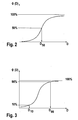
- the d 50 value is determined by definition from the (relative) cumulative curve of the particle size distribution: the intersection of the 50% ordinate value with the cumulative curve immediately provides the desired d 50 value on the abscissa axis, as is shown in more detail in FIG .
- the determination of the SPAN 98 was carried out with the same measuring device as described above for the determination of the mean diameter d 50 .
- the (relative) sum curve of the particle size distribution is again used to determine d 98 and d 10 .
- the intersection of the 98% ordinate value with the cumulative curve immediately provides the desired d 98 value on the abscissa axis and the intersection of the 10% ordinate value with the cumulative curve immediately provides the desired d 10 value on the abscissa axis, as is shown in more detail in FIG. 3 ,
- Polyethylene terephthalate chips (made by the transesterification process with Mn as a transesterification catalyst, Mn concentration: 100 ppm) were at one temperature dried from 150 ° C to a residual moisture of below 100 ppm and the extruder supplied for the base layer (B).
- chips made of a polyethylene terephthalate manufactured by the Transesterification process with Mn as transesterification catalyst, Mn concentration: 100 ppm
- Mn as transesterification catalyst, Mn concentration: 100 ppm
- the film had the required high gloss and the required low haze. Furthermore, the film shows the desired winding behavior and the desired Processing performance. The film structure and the properties achieved in this way Films produced are shown in Tables 2 and 3.
- the top layer thickness of the glossy top layers was (A) and (C) from 1.0 to 1.5 ⁇ m with otherwise identical film structure and identical Manufacturing method raised. This has changed the winding behavior of the film improved. The gloss of the film has decreased marginally and the cloudiness marginally elevated.
- the top layer thickness of the glossy top layers was (A) and (C) from 1.0 to 1.5 ⁇ m with otherwise identical film structure and identical Manufacturing method raised. This has changed the winding behavior of the film tends to improve again, while the gloss decreases significantly and the Have increased turbidity significantly.
- the glossy outer layers (A) and (C) used the coarser pigment Sylysia 430 instead of the Sylysia 320.
Landscapes
- Engineering & Computer Science (AREA)
- Mechanical Engineering (AREA)
- Manufacturing & Machinery (AREA)
- Laminated Bodies (AREA)
- Shaping By String And By Release Of Stress In Plastics And The Like (AREA)
- Wrappers (AREA)
Abstract
Description
- hoher Glanz
- geringe Trübung
- gute Wickelung
- geringe Sauerstoffpermeation der Folie nach Metallisierung oder nach Beschichtung mit oxydischen Materialien
- geringe Reibungskoeffizienten.
| erfindungsgemäßer Bereich | bevorzugt | besonders bevorzugt | Einheit | Messmethode | |
| Glanz, 20° | > 170 | > 175 | > 180 | DIN 67530 | |
| COF (Reibung) | < 0,6 | < 0,55 | < 0,50 | DIN 53375 | |
| Mittlere Rauhigkeit Ra | 30 bis 150 | 35 bis 140 | 40 bis 130 | nm | DIN 4768, Cut-off von 0,25 mm |
| Messwertbereich für die Ofl-Gasströmung | 4 bis 200 | 5 bis 180 | 6 bis 160 | sec | intern |
| weitere Folieneigenschaften | |||||
| Trübung | < 2,5 | < 2,3 | < 2,1 | % | ASTM-D 1003-52 |
| Planare Orientierung Δp (optional) | > 0,165 | > 0,166 | ≥ 0,167 | intern | |
| Sauerstoffpermeation nach Metallisierung von Schicht A | < 1,0 | < 0,95 | < 0,9 | cm3/(m2·d·bar) | DIN 53380 |
Die intrinsische Viskosität (IV) berechnet sich wie folgt aus der Standardviskosität
| Messfläche | 45,1 cm2 |
| Anpressgewicht | 1276 g |
| Lufttemperatur | 23 °C |
| Luftfeuchte | 50 % relative Feuchte |
| Gassammelvolumen | 1,2 cm3 |
| Druckintervall | 56 mbar |
Probenvorbereitung:
| Probengröße und Probenlänge | 60 bis 100 mm |
| Probenbreite | entspricht Prismenbreite von 10 mm |
- 90 Gew.-%
- Polyethylenterephthalat mit einem SV-Wert von 800
- 10 Gew.-%
- Masterbatch aus 99 Gew.-% Polyethylenterephthalat und 1,0 Gew.-% Kieselsäurepartikel (®Sylysia 320 von der Fa. Fuji/Japan) mit einem d50-Wert von 2,5 µm und einer SPAN 98 von 1,4.
- 100,0 Gew.-%
- Polyethylenterephthalat mit einem SV-Wert von 800
- 90 Gew.-%
- Polyethylenterephthalat mit einem SV-Wert von 800
- 10 Gew.-%
- Masterbatch aus 99 Gew.-% Polyethylenterephthalat und 1,0 Gew.-% Kieselsäurepartikel (®Sylysia 320 von der Fa. Fuji/Japan) mit einem d50-Wert von 2,5 µm und einer SPAN 98 von 1,4.
| Extrusion | Temperaturen | A-Schicht | 290 °C |
| B-Schicht | 290 °C | ||
| C-Schicht | 290 °C | ||
| Düsenspaltweite: | 3,5 mm | ||
| Temperatur der Abzugswalze | 30 °C | ||
| Längsstreckung | Temperatur: | 80 -126 °C | |
| Längsstreckverhältnis: | 4,5 | ||
| Querstreckung | Temperatur: | 80 -135 °C | |
| Querstreckverhältnis | 4,0 | ||
| Fixierung | Temperatur: | 230 °C | |
| Dauer: | 3 s |


Claims (12)
- Mehrschichtige, transparente, biaxial orientierte Polyesterfolie aus mindestens einer Basisschicht (B), die mindestens 80 Gew.-% thermoplastischen Polyester enthält, und mindestens einer auf dieser Basisschicht (B) aufgebrachten transparenten, hochglänzenden Deckschicht (A), dadurch gekennzeichnet, dass die transparente Deckschicht (A) zusätzlich ein Pigmentsystem in einer Menge im Bereich von 0,05 bis 0,5 Gew.-% enthält, bezogen auf das Gesamtgewicht der Deckschicht (A), das die folgenden Merkmale aufweist:a) der mittlere Korndurchmesser (d50-Wert) liegt im Bereich von 1,5 bis 5 µm undb) die Streuung der Verteilung der Korngröße, ausgedrückt durch den SPAN 98, ist kleiner/gleich 1,9.
- Mehrschichtige, transparente Polyesterfolie nach Anspruch 1, dadurch gekennzeichnet, dass die transparente Deckschicht (A) ein Pigmentsystem enthält, das einen mittleren Korndurchmesser (d50-Wert) im Bereich von 1,6 bis 4,9, bevorzugt im Bereich von 1,7 bis 4,8 µm, aufweist.
- Mehrschichtige, transparente Polyesterfolie nach Anspruch 1 oder 2, dadurch gekennzeichnet, dass die transparente Deckschicht (A) ein Pigmentsystem enthält, das einen SPAN 98 von kleiner/gleich 1,8, bevorzugt von kleiner/gleich 1,7, aufweist.
- Mehrschichtige, transparente Polyesterfolie nach einem der Ansprüche 1 bis 3, dadurch gekennzeichnet, dass sie einen dreischichtigen Aufbau mit einer Basisschicht (B) und beidseitig auf der Basisschicht (B) angeordneten Deckschichten (A) und (C) besitzt, dass sie eine Gesamtdicke im Bereich von 3 bis 80 µm besitzt, dass die Dicke der Deckschichten (A) und (C) im Bereich von 0,1 bis 5 µm liegt und dass Deckschichten (A) und (C) gleich oder verschieden dick sein können.
- Mehrschichtige, transparente Polyesterfolie nach einem der Ansprüche 1 bis 4, dadurch gekennzeichnet, dass ihr Glanz größer/gleich 170 und ihre Trübung kleiner/gleich 2,5 % ist.
- Mehrschichtige, transparente Polyesterfolie nach einem der Ansprüche 1 bis 5, dadurch gekennzeichnet, dass ihre Rauigkeit, ausgedrückt als ihr Ra-Wert, im Bereich von 30 bis 150 nm liegt, bevorzugt von 35 bis 140 nm, besonders bevorzugt von 40 bis 130 nm, und dass ihr Messwert der Oberflächengasströmung im Bereich von 4 bis 200 s liegt, bevorzugt von 5 bis 180 s.
- Mehrschichtige, transparente Polyesterfolie nach einem der Ansprüche 1 bis 6, dadurch gekennzeichnet, dass die planare Orientierung Δp der Folie größer/gleich 0,165 ist, bevorzugt größer/gleich 0,166, ganz bevorzugt größer/gleich 0,167.
- Verfahren zum Herstellen einer mehrschichtigen, transparenten Polyesterfolie nach einem der Ansprüche 1 bis 7 nach dem Coextrusionsverfahren, bei dem zunächst die Polyester der jeweiligen Schichten in Extrudern komprimiert, verflüssigt und dabei homogenisiert wird, wobei die gegebenenfalls als Zusätze vorgesehenen Additive bereits im jeweiligen Polymer enthalten sein können, und bei dem die Schmelzen dann durch eine mehrschichtige Flachdüse gepresst, und die ausgepresste mehrschichtige Schmelze auf einer oder mehreren Abzugswalzen abgezogen und zu einer Vorfolie verfestigt, die verfestigte Vorfolie anschließend biaxial gestreckt, die biaxial gestreckte Folie thermofixiert und gegebenenfalls an der zur Behandlung vorgesehenen Oberfläche noch corona- oder flammbehandelt wird, dadurch gekennzeichnet, dass die Temperatur bei der Längsstreckung im Bereich von 80 bis 130 °C und bei der Querstreckung im Bereich von 90 bis 150 °C eingestellt wird und dass das Längsstreckverhältnis im Bereich von 2,5:1 bis 6:1, bevorzugt von 3:1 bis 5,5:1, und das Querstreckverhältnis im Bereich von 3,0:1 bis 5,0:1, bevorzugt von 3,5:1 bis 4,5:1, liegt.
- Verfahren nach Anspruch 8, dadurch gekennzeichnet, dass die Folie nach dem Strecken über eine Zeitdauer im Bereich von 0,1 bis 10 s bei einer Temperatur von 150 bis 250 °C gehalten und dabei thermofixiert wird.
- Verfahren nach Anspruch 8 oder 9, dadurch gekennzeichnet, dass zusätzlich eine oder beide Oberfläche/n der Folie corona- oder flammbehandelt wird/werden, wobei die Behandlungsintensität so eingestellt wird, dass sich eine Oberflächenspannung der Folie im Bereich von größer/gleich 45 mN/m ergibt.
- Verfahren nach einem der Ansprüche 8 bis 10, dadurch gekennzeichnet, dass Verschnittmaterial, das während der Folienherstellung anfällt, als Regenerat in einer Menge im Bereich von 20 bis 60 Gew.-%, bezogen auf das Gesamtgewicht der Folie, wieder der Extrusion zugeführt wird.
- Verwendung einer mehrschichtigen, transparenten Folie nach einem der Ansprüche 1 bis 7 für den Einsatz in der flexiblen Verpackung, insbesondere auf schnelllaufenden Verpackungsmaschinen, oder im industriellen Sektor, insbesondere für Prägeanwendungen.
Applications Claiming Priority (2)
| Application Number | Priority Date | Filing Date | Title |
|---|---|---|---|
| DE2001109216 DE10109216A1 (de) | 2001-02-26 | 2001-02-26 | Mehrschichtige transparente, biaxial orientierte Polyesterfolie |
| DE10109216 | 2001-02-26 |
Publications (2)
| Publication Number | Publication Date |
|---|---|
| EP1236568A1 true EP1236568A1 (de) | 2002-09-04 |
| EP1236568B1 EP1236568B1 (de) | 2010-04-14 |
Family
ID=7675532
Family Applications (1)
| Application Number | Title | Priority Date | Filing Date |
|---|---|---|---|
| EP20020003128 Expired - Lifetime EP1236568B1 (de) | 2001-02-26 | 2002-02-14 | Mehrschichtige transparente, biaxial orientierte polyesterfolie |
Country Status (5)
| Country | Link |
|---|---|
| US (2) | US20020160168A1 (de) |
| EP (1) | EP1236568B1 (de) |
| JP (1) | JP2002307634A (de) |
| KR (1) | KR20020069486A (de) |
| DE (2) | DE10109216A1 (de) |
Cited By (1)
| Publication number | Priority date | Publication date | Assignee | Title |
|---|---|---|---|---|
| US7094465B2 (en) * | 2003-01-20 | 2006-08-22 | Mitsubishi Polyester Film Gmbh | Multilayer, transparent, biaxially oriented polyester film, process for its production and its use |
Families Citing this family (15)
| Publication number | Priority date | Publication date | Assignee | Title |
|---|---|---|---|---|
| DE10109217A1 (de) * | 2001-02-26 | 2002-09-05 | Mitsubishi Polyester Film Gmbh | Transparente, biaxial orientierte Polyesterfolie |
| DE10152141A1 (de) * | 2001-10-23 | 2003-04-30 | Mitsubishi Polyester Film Gmbh | Matte, biaxial orientiertge Polyesterfolie, Verfahren zu ihrer Herstellung und ihre Verwendung |
| DE10303144A1 (de) * | 2003-01-28 | 2004-07-29 | Mitsubishi Polyester Film Gmbh | Einseitig matte, biaxial orientierte Polyesterfolie, Verfahren zu ihrer Herstellung und ihre Verwendung |
| DE10303145A1 (de) * | 2003-01-28 | 2004-07-29 | Mitsubishi Polyester Film Gmbh | Einseitig matte, biaxial orietierte Polyesterfolie mit charakteristischen Schrumpfeigenschaften, Verfahren zu ihrer Herstellung und ihre Verwendung |
| US7141293B2 (en) * | 2003-04-22 | 2006-11-28 | Mitsubishi Polyester Film Gmbh | Coextruded, hot-sealable and peelable polyester film having high peeling resistance, process for its production and its use |
| US7144615B2 (en) * | 2003-04-22 | 2006-12-05 | Mitsubishi Polyester Film Gmbh | Coextruded, hot-sealable and peelable polyester film, process for its production and its use |
| US7223459B2 (en) * | 2003-04-22 | 2007-05-29 | Mitsubishi Polyester Film Gmbh | Coextruded, hot-sealable and peelable polyester film, process for its production and its use |
| US7186452B2 (en) * | 2003-04-22 | 2007-03-06 | Mitsubishi Polyester Film Gmbh | Coextruded, hot-sealable and peelable polyester film having high peeling resistance, process for its production and its use |
| DE10352431A1 (de) * | 2003-11-10 | 2005-06-09 | Mitsubishi Polyester Film Gmbh | Peelfähige Polyesterfolie mit selbsttätiger Entlüftung, Verfahren zu ihrer Herstellung und ihre Verwendung |
| DE10352430A1 (de) * | 2003-11-10 | 2005-06-09 | Mitsubishi Polyester Film Gmbh | Peelfähige Polyesterfolie mit verbesserter Sauerstoffbarriere, Verfahren zu ihrer Herstellung und ihre Verwendung |
| DE102006002595A1 (de) * | 2006-01-18 | 2007-07-19 | Tesa Ag | Verfahren zur Herstellung von vielseitig einsetzbaren Kunststoffprodukten mit bevorzugt abriebfester Oberfläche |
| KR101058337B1 (ko) | 2008-06-25 | 2011-08-22 | 코오롱인더스트리 주식회사 | 광학용 이축연신 폴리에스테르 필름 및 이의 제조방법 |
| JP5625742B2 (ja) * | 2010-10-26 | 2014-11-19 | 東洋紡株式会社 | 成型用ポリエステルフィルム |
| EP3498470B1 (de) | 2016-08-10 | 2022-04-13 | Nippon Shokubai Co., Ltd. | Harzverbundfolie |
| CN109531957B (zh) * | 2019-01-23 | 2023-06-16 | 戴元庆 | 多层保温充气塑料薄膜的多层共挤吹塑模头 |
Citations (9)
| Publication number | Priority date | Publication date | Assignee | Title |
|---|---|---|---|---|
| US3515626A (en) * | 1965-02-22 | 1970-06-02 | Ici Ltd | Thermoplastic laminates having improved surface properties |
| EP0502745A2 (de) * | 1991-03-06 | 1992-09-09 | Toray Industries, Inc. | Biaxial orientierte Verbundfolie |
| EP0514129A2 (de) * | 1991-05-16 | 1992-11-19 | Imperial Chemical Industries Plc | Polymerfilm |
| US5294474A (en) * | 1989-07-27 | 1994-03-15 | Rhone-Poulenc Films | Composite polyester films and their use as protective layers for photopolymer plates, and photopolymer plates comprising said films |
| JPH06155688A (ja) * | 1992-11-20 | 1994-06-03 | Diafoil Co Ltd | 積層ポリエステルフィルムおよびその製造方法 |
| EP0604057A1 (de) * | 1992-12-23 | 1994-06-29 | Imperial Chemical Industries Plc | Polymerfilm |
| EP0770473A1 (de) * | 1995-10-25 | 1997-05-02 | Hoechst Diafoil GmbH | Polyesterrohstoff und daraus hergestellte Folie |
| EP0952176A1 (de) * | 1998-04-22 | 1999-10-27 | Mitsubishi Polyester Film GmbH | Mehrschichtige, biaxial orientierte Polyesterfolie, Verfahren zu ihrer Herstellung und ihre Verwendung |
| JPH11322970A (ja) * | 1998-05-19 | 1999-11-26 | Mitsubishi Kagaku Polyester Film Kk | 二軸配向ポリエステルフィルム |
Family Cites Families (13)
| Publication number | Priority date | Publication date | Assignee | Title |
|---|---|---|---|---|
| EP0061769B1 (de) | 1981-03-30 | 1987-04-01 | Teijin Limited | Magnetisches Aufzeichnungsmedium |
| DE3368806D1 (en) | 1982-03-10 | 1987-02-05 | Toray Industries | Laminated film and magnetic recording medium made therewith |
| DE3752302T2 (de) * | 1986-08-27 | 2000-05-11 | Teijin Ltd., Osaka | Biaxial orientierte Polyesterfilme |
| EP0679508B1 (de) | 1988-06-08 | 1999-12-29 | Toray Industries, Inc. | Biaxial orientierte Verbundfolie |
| JPH0818456B2 (ja) * | 1989-09-08 | 1996-02-28 | 帝人株式会社 | スタンピングホイル |
| DE4313510A1 (de) * | 1993-04-24 | 1994-10-27 | Hoechst Ag | Polyesterrohstoff und daraus hergestellte Folie |
| JP3789144B2 (ja) * | 1994-06-14 | 2006-06-21 | 三菱化学ポリエステルフィルム株式会社 | フォトレジスト用積層ポリエステルフィルム |
| DE19653750A1 (de) * | 1996-12-20 | 1998-06-25 | Hoechst Diafoil Gmbh | Siegelfähige biaxial orientierte Polyesterfolie, Verfahren zu ihrer Herstellung und ihre Verwendung |
| WO2001015900A1 (fr) * | 1999-08-27 | 2001-03-08 | Toray Industries, Inc. | Couche mince stratifiee et couche mince a depot par evporation l'utilisant |
| DE10051083A1 (de) * | 2000-10-14 | 2002-04-25 | Mitsubishi Polyester Film Gmbh | Koextrudierte, zumindest einseitig matte, biaxial orientierte Polyesterfolie |
| DE10051084A1 (de) * | 2000-10-14 | 2002-04-25 | Mitsubishi Polyester Film Gmbh | Matte, biaxial orientierte Polyesterfolie |
| DE10051082A1 (de) * | 2000-10-14 | 2002-04-25 | Mitsubishi Polyester Film Gmbh | Matte, koextrudierte, biaxial orientierte Polyesterfolie |
| DE10109217A1 (de) * | 2001-02-26 | 2002-09-05 | Mitsubishi Polyester Film Gmbh | Transparente, biaxial orientierte Polyesterfolie |
-
2001
- 2001-02-26 DE DE2001109216 patent/DE10109216A1/de not_active Withdrawn
-
2002
- 2002-02-14 EP EP20020003128 patent/EP1236568B1/de not_active Expired - Lifetime
- 2002-02-14 DE DE50214349T patent/DE50214349D1/de not_active Expired - Lifetime
- 2002-02-15 US US10/077,122 patent/US20020160168A1/en not_active Abandoned
- 2002-02-22 KR KR1020020009592A patent/KR20020069486A/ko not_active Withdrawn
- 2002-02-26 JP JP2002049265A patent/JP2002307634A/ja not_active Withdrawn
-
2003
- 2003-12-18 US US10/739,808 patent/US7122240B2/en not_active Expired - Fee Related
Patent Citations (10)
| Publication number | Priority date | Publication date | Assignee | Title |
|---|---|---|---|---|
| US3515626A (en) * | 1965-02-22 | 1970-06-02 | Ici Ltd | Thermoplastic laminates having improved surface properties |
| DE1694404A1 (de) * | 1965-02-22 | 1971-04-08 | Ici Ltd | Schichtstoff und Verfahren zur Herstellung desselben |
| US5294474A (en) * | 1989-07-27 | 1994-03-15 | Rhone-Poulenc Films | Composite polyester films and their use as protective layers for photopolymer plates, and photopolymer plates comprising said films |
| EP0502745A2 (de) * | 1991-03-06 | 1992-09-09 | Toray Industries, Inc. | Biaxial orientierte Verbundfolie |
| EP0514129A2 (de) * | 1991-05-16 | 1992-11-19 | Imperial Chemical Industries Plc | Polymerfilm |
| JPH06155688A (ja) * | 1992-11-20 | 1994-06-03 | Diafoil Co Ltd | 積層ポリエステルフィルムおよびその製造方法 |
| EP0604057A1 (de) * | 1992-12-23 | 1994-06-29 | Imperial Chemical Industries Plc | Polymerfilm |
| EP0770473A1 (de) * | 1995-10-25 | 1997-05-02 | Hoechst Diafoil GmbH | Polyesterrohstoff und daraus hergestellte Folie |
| EP0952176A1 (de) * | 1998-04-22 | 1999-10-27 | Mitsubishi Polyester Film GmbH | Mehrschichtige, biaxial orientierte Polyesterfolie, Verfahren zu ihrer Herstellung und ihre Verwendung |
| JPH11322970A (ja) * | 1998-05-19 | 1999-11-26 | Mitsubishi Kagaku Polyester Film Kk | 二軸配向ポリエステルフィルム |
Non-Patent Citations (2)
| Title |
|---|
| DATABASE WPI Section Ch Week 199427, Derwent World Patents Index; Class A23, AN 1994-221297, XP002201231 * |
| DATABASE WPI Section Ch Week 200007, Derwent World Patents Index; Class A23, AN 2000-075681, XP002201230 * |
Cited By (1)
| Publication number | Priority date | Publication date | Assignee | Title |
|---|---|---|---|---|
| US7094465B2 (en) * | 2003-01-20 | 2006-08-22 | Mitsubishi Polyester Film Gmbh | Multilayer, transparent, biaxially oriented polyester film, process for its production and its use |
Also Published As
| Publication number | Publication date |
|---|---|
| KR20020069486A (ko) | 2002-09-04 |
| EP1236568B1 (de) | 2010-04-14 |
| DE10109216A1 (de) | 2002-09-05 |
| DE50214349D1 (de) | 2010-05-27 |
| US7122240B2 (en) | 2006-10-17 |
| JP2002307634A (ja) | 2002-10-23 |
| US20040142147A1 (en) | 2004-07-22 |
| US20020160168A1 (en) | 2002-10-31 |
Similar Documents
| Publication | Publication Date | Title |
|---|---|---|
| EP1197327B1 (de) | Koextrudierte, zumindest einseitig matte, biaxial orientierte Polyesterfolie | |
| EP1197326B1 (de) | Matte, pigmentierte, biaxial orientierte Polyesterfolie | |
| EP0903222B1 (de) | Mehrschichtige, biaxial orientierte Polyesterfolie, Verfahren zu ihrer Herstellung und ihre Verwendung | |
| EP1138480B1 (de) | Siegelfähige biaxial orientierte Polyesterfolie | |
| EP1234848B1 (de) | Transparent, biaxial orientierte Polyesterfolie | |
| EP1197328A2 (de) | Zumindest einseitig matte, biaxial orientierte Polyesterfolie | |
| EP1442876B1 (de) | Einseitig matte, biaxial orientierte Polyesterfolie mit charakteristischen Schrumpfeigenschaften, Verfahren zu ihrer Herstellung und ihre Verwendung | |
| EP1268632B2 (de) | Einseitig matte, siegelfähige, uv stabilisierte, flammhemmend ausgerüstete, biaxial orientierte polyesterfolie, verfahren zu ihrer herstellung und verwendung | |
| EP1176005A2 (de) | Mehrschichtige, transparente, biaxial orientierte Polyesterfolie | |
| EP1125732B1 (de) | Transparente, siegelfähige, UV-stabilisierte Polyesterfolie, Verfahren zu ihrer Herstellung und ihre Verwendung | |
| EP1236568B1 (de) | Mehrschichtige transparente, biaxial orientierte polyesterfolie | |
| EP1186405B1 (de) | Koextrudierte, biaxial orientierte Polyesterfolie mit guter Metallhaftung, Verfahren zu ihrer Herstellung und ihre Verwendung | |
| EP0903221A2 (de) | Biaxial orientierte Polyesterfolie, Verfahren zu ihrer Herstellung und ihre Verwendung zum Verpacken von Leben- und Genussmittel | |
| EP1380414A1 (de) | Mehrschichtige, transparente, siegelfähige, biaxial orientierte Polyesterfolie, Verfahren zu ihrer Herstellung und ihre Verwendung | |
| EP1274579B1 (de) | Einseitig matte, siegelfähige, uv stabilisierte, koextrudierte, biaxial orientierte folie, verfahren zu ihrer herstellung und verwendung | |
| EP0952176A1 (de) | Mehrschichtige, biaxial orientierte Polyesterfolie, Verfahren zu ihrer Herstellung und ihre Verwendung | |
| EP1268205B1 (de) | Einseitig matte, siegelfähige, flammhemmend ausgerüstete, koextrudierte, biaxial orientierte folie, verfahren zu ihrer herstellung und verwendung | |
| EP1442875B1 (de) | Einseitig matte, biaxial orientierte Polyesterfolie, Verfahren zu ihrer Herstellung und ihre Verwendung | |
| EP1219413B1 (de) | Einseitig matte, siegelfähige, biaxial orientierte Polyesterfolie | |
| WO2003035726A1 (de) | Matte, biaxial orientierte polyesterfolie, verfahren zu ihrer herstellung und ihre verwendung | |
| EP1176163B1 (de) | Transparente, biaxial orientierte Polyesterfolie | |
| EP1674507A1 (de) | Biaxial orientierte Polyesterfolie, die Siliziumdioxid und Titandioxid enthält | |
| DE10022944A1 (de) | Weisse, zumindest einseitig matte, biaxial orientierte und UV-stabilisierte Polyesterfolie mit Cycloolefincopolymer (COC), Verfahren zu ihrer Herstellung und ihre Verwendung |
Legal Events
| Date | Code | Title | Description |
|---|---|---|---|
| PUAI | Public reference made under article 153(3) epc to a published international application that has entered the european phase |
Free format text: ORIGINAL CODE: 0009012 |
|
| AK | Designated contracting states |
Kind code of ref document: A1 Designated state(s): AT BE CH CY DE DK ES FI FR GB GR IE IT LI LU MC NL PT SE TR |
|
| AX | Request for extension of the european patent |
Free format text: AL;LT;LV;MK;RO;SI |
|
| 17P | Request for examination filed |
Effective date: 20030304 |
|
| 17Q | First examination report despatched |
Effective date: 20030402 |
|
| AKX | Designation fees paid |
Designated state(s): DE FR GB IT LU NL |
|
| RAP1 | Party data changed (applicant data changed or rights of an application transferred) |
Owner name: MITSUBISHI POLYESTER FILM GMBH |
|
| GRAP | Despatch of communication of intention to grant a patent |
Free format text: ORIGINAL CODE: EPIDOSNIGR1 |
|
| RTI1 | Title (correction) |
Free format text: MULTILAYER TRANSPARENT, BIAXIALLY ORIENTED POLYESTER FILM |
|
| GRAS | Grant fee paid |
Free format text: ORIGINAL CODE: EPIDOSNIGR3 |
|
| GRAA | (expected) grant |
Free format text: ORIGINAL CODE: 0009210 |
|
| RBV | Designated contracting states (corrected) |
Designated state(s): DE FR GB IT LU |
|
| AK | Designated contracting states |
Kind code of ref document: B1 Designated state(s): DE FR GB IT LU |
|
| REG | Reference to a national code |
Ref country code: GB Ref legal event code: FG4D Free format text: NOT ENGLISH |
|
| REF | Corresponds to: |
Ref document number: 50214349 Country of ref document: DE Date of ref document: 20100527 Kind code of ref document: P |
|
| PLBE | No opposition filed within time limit |
Free format text: ORIGINAL CODE: 0009261 |
|
| STAA | Information on the status of an ep patent application or granted ep patent |
Free format text: STATUS: NO OPPOSITION FILED WITHIN TIME LIMIT |
|
| 26N | No opposition filed |
Effective date: 20110117 |
|
| PGFP | Annual fee paid to national office [announced via postgrant information from national office to epo] |
Ref country code: LU Payment date: 20120217 Year of fee payment: 11 |
|
| PGFP | Annual fee paid to national office [announced via postgrant information from national office to epo] |
Ref country code: FR Payment date: 20120227 Year of fee payment: 11 |
|
| PGFP | Annual fee paid to national office [announced via postgrant information from national office to epo] |
Ref country code: DE Payment date: 20120216 Year of fee payment: 11 |
|
| PGFP | Annual fee paid to national office [announced via postgrant information from national office to epo] |
Ref country code: IT Payment date: 20120222 Year of fee payment: 11 Ref country code: GB Payment date: 20120216 Year of fee payment: 11 |
|
| GBPC | Gb: european patent ceased through non-payment of renewal fee |
Effective date: 20130214 |
|
| REG | Reference to a national code |
Ref country code: FR Ref legal event code: ST Effective date: 20131031 |
|
| REG | Reference to a national code |
Ref country code: DE Ref legal event code: R119 Ref document number: 50214349 Country of ref document: DE Effective date: 20130903 |
|
| PG25 | Lapsed in a contracting state [announced via postgrant information from national office to epo] |
Ref country code: IT Free format text: LAPSE BECAUSE OF NON-PAYMENT OF DUE FEES Effective date: 20130214 |
|
| PG25 | Lapsed in a contracting state [announced via postgrant information from national office to epo] |
Ref country code: FR Free format text: LAPSE BECAUSE OF NON-PAYMENT OF DUE FEES Effective date: 20130228 Ref country code: GB Free format text: LAPSE BECAUSE OF NON-PAYMENT OF DUE FEES Effective date: 20130214 Ref country code: DE Free format text: LAPSE BECAUSE OF NON-PAYMENT OF DUE FEES Effective date: 20130903 |
|
| PG25 | Lapsed in a contracting state [announced via postgrant information from national office to epo] |
Ref country code: LU Free format text: LAPSE BECAUSE OF NON-PAYMENT OF DUE FEES Effective date: 20130214 |