EP1224198B1 - Nucleosid-derivate mit photolabilen schutzgruppen - Google Patents
Nucleosid-derivate mit photolabilen schutzgruppen Download PDFInfo
- Publication number
- EP1224198B1 EP1224198B1 EP00966152A EP00966152A EP1224198B1 EP 1224198 B1 EP1224198 B1 EP 1224198B1 EP 00966152 A EP00966152 A EP 00966152A EP 00966152 A EP00966152 A EP 00966152A EP 1224198 B1 EP1224198 B1 EP 1224198B1
- Authority
- EP
- European Patent Office
- Prior art keywords
- mmol
- nppoc
- group
- silica gel
- meoh
- Prior art date
- Legal status (The legal status is an assumption and is not a legal conclusion. Google has not performed a legal analysis and makes no representation as to the accuracy of the status listed.)
- Expired - Lifetime
Links
- 125000006239 protecting group Chemical group 0.000 title claims abstract description 32
- 150000003833 nucleoside derivatives Chemical class 0.000 title claims abstract description 28
- -1 hypoxanthin-9-yl Chemical group 0.000 claims abstract description 52
- UYTPUPDQBNUYGX-UHFFFAOYSA-N guanine Chemical compound O=C1NC(N)=NC2=C1N=CN2 UYTPUPDQBNUYGX-UHFFFAOYSA-N 0.000 claims abstract description 18
- OPTASPLRGRRNAP-UHFFFAOYSA-N cytosine Chemical compound NC=1C=CNC(=O)N=1 OPTASPLRGRRNAP-UHFFFAOYSA-N 0.000 claims abstract description 16
- RWQNBRDOKXIBIV-UHFFFAOYSA-N thymine Chemical compound CC1=CNC(=O)NC1=O RWQNBRDOKXIBIV-UHFFFAOYSA-N 0.000 claims abstract description 16
- 229930024421 Adenine Natural products 0.000 claims abstract description 9
- 229960000643 adenine Drugs 0.000 claims abstract description 9
- 230000015572 biosynthetic process Effects 0.000 claims abstract description 9
- 229910052739 hydrogen Inorganic materials 0.000 claims abstract description 9
- 238000003786 synthesis reaction Methods 0.000 claims abstract description 9
- GFFGJBXGBJISGV-UHFFFAOYSA-N Adenine Chemical group NC1=NC=NC2=C1N=CN2 GFFGJBXGBJISGV-UHFFFAOYSA-N 0.000 claims abstract description 8
- 229940104302 cytosine Drugs 0.000 claims abstract description 8
- 108091034117 Oligonucleotide Proteins 0.000 claims abstract description 7
- JLCPHMBAVCMARE-UHFFFAOYSA-N [3-[[3-[[3-[[3-[[3-[[3-[[3-[[3-[[3-[[3-[[3-[[5-(2-amino-6-oxo-1H-purin-9-yl)-3-[[3-[[3-[[3-[[3-[[3-[[5-(2-amino-6-oxo-1H-purin-9-yl)-3-[[5-(2-amino-6-oxo-1H-purin-9-yl)-3-hydroxyoxolan-2-yl]methoxy-hydroxyphosphoryl]oxyoxolan-2-yl]methoxy-hydroxyphosphoryl]oxy-5-(5-methyl-2,4-dioxopyrimidin-1-yl)oxolan-2-yl]methoxy-hydroxyphosphoryl]oxy-5-(6-aminopurin-9-yl)oxolan-2-yl]methoxy-hydroxyphosphoryl]oxy-5-(6-aminopurin-9-yl)oxolan-2-yl]methoxy-hydroxyphosphoryl]oxy-5-(6-aminopurin-9-yl)oxolan-2-yl]methoxy-hydroxyphosphoryl]oxy-5-(6-aminopurin-9-yl)oxolan-2-yl]methoxy-hydroxyphosphoryl]oxyoxolan-2-yl]methoxy-hydroxyphosphoryl]oxy-5-(5-methyl-2,4-dioxopyrimidin-1-yl)oxolan-2-yl]methoxy-hydroxyphosphoryl]oxy-5-(4-amino-2-oxopyrimidin-1-yl)oxolan-2-yl]methoxy-hydroxyphosphoryl]oxy-5-(5-methyl-2,4-dioxopyrimidin-1-yl)oxolan-2-yl]methoxy-hydroxyphosphoryl]oxy-5-(5-methyl-2,4-dioxopyrimidin-1-yl)oxolan-2-yl]methoxy-hydroxyphosphoryl]oxy-5-(6-aminopurin-9-yl)oxolan-2-yl]methoxy-hydroxyphosphoryl]oxy-5-(6-aminopurin-9-yl)oxolan-2-yl]methoxy-hydroxyphosphoryl]oxy-5-(4-amino-2-oxopyrimidin-1-yl)oxolan-2-yl]methoxy-hydroxyphosphoryl]oxy-5-(4-amino-2-oxopyrimidin-1-yl)oxolan-2-yl]methoxy-hydroxyphosphoryl]oxy-5-(4-amino-2-oxopyrimidin-1-yl)oxolan-2-yl]methoxy-hydroxyphosphoryl]oxy-5-(6-aminopurin-9-yl)oxolan-2-yl]methoxy-hydroxyphosphoryl]oxy-5-(4-amino-2-oxopyrimidin-1-yl)oxolan-2-yl]methyl [5-(6-aminopurin-9-yl)-2-(hydroxymethyl)oxolan-3-yl] hydrogen phosphate Polymers Cc1cn(C2CC(OP(O)(=O)OCC3OC(CC3OP(O)(=O)OCC3OC(CC3O)n3cnc4c3nc(N)[nH]c4=O)n3cnc4c3nc(N)[nH]c4=O)C(COP(O)(=O)OC3CC(OC3COP(O)(=O)OC3CC(OC3COP(O)(=O)OC3CC(OC3COP(O)(=O)OC3CC(OC3COP(O)(=O)OC3CC(OC3COP(O)(=O)OC3CC(OC3COP(O)(=O)OC3CC(OC3COP(O)(=O)OC3CC(OC3COP(O)(=O)OC3CC(OC3COP(O)(=O)OC3CC(OC3COP(O)(=O)OC3CC(OC3COP(O)(=O)OC3CC(OC3COP(O)(=O)OC3CC(OC3COP(O)(=O)OC3CC(OC3COP(O)(=O)OC3CC(OC3COP(O)(=O)OC3CC(OC3COP(O)(=O)OC3CC(OC3CO)n3cnc4c(N)ncnc34)n3ccc(N)nc3=O)n3cnc4c(N)ncnc34)n3ccc(N)nc3=O)n3ccc(N)nc3=O)n3ccc(N)nc3=O)n3cnc4c(N)ncnc34)n3cnc4c(N)ncnc34)n3cc(C)c(=O)[nH]c3=O)n3cc(C)c(=O)[nH]c3=O)n3ccc(N)nc3=O)n3cc(C)c(=O)[nH]c3=O)n3cnc4c3nc(N)[nH]c4=O)n3cnc4c(N)ncnc34)n3cnc4c(N)ncnc34)n3cnc4c(N)ncnc34)n3cnc4c(N)ncnc34)O2)c(=O)[nH]c1=O JLCPHMBAVCMARE-UHFFFAOYSA-N 0.000 claims abstract description 7
- 125000003729 nucleotide group Chemical group 0.000 claims abstract description 7
- ISAKRJDGNUQOIC-UHFFFAOYSA-N Uracil Chemical compound O=C1C=CNC(=O)N1 ISAKRJDGNUQOIC-UHFFFAOYSA-N 0.000 claims abstract description 6
- 239000002773 nucleotide Substances 0.000 claims abstract description 6
- 125000000217 alkyl group Chemical group 0.000 claims abstract description 5
- 229910052794 bromium Inorganic materials 0.000 claims abstract description 5
- 229910052801 chlorine Inorganic materials 0.000 claims abstract description 5
- 229910052731 fluorine Inorganic materials 0.000 claims abstract description 5
- 229910052740 iodine Inorganic materials 0.000 claims abstract description 4
- JCXJVPUVTGWSNB-UHFFFAOYSA-N nitrogen dioxide Inorganic materials O=[N]=O JCXJVPUVTGWSNB-UHFFFAOYSA-N 0.000 claims abstract description 3
- 125000001997 phenyl group Chemical group [H]C1=C([H])C([H])=C(*)C([H])=C1[H] 0.000 claims abstract description 3
- 229940113082 thymine Drugs 0.000 claims abstract description 3
- 229940035893 uracil Drugs 0.000 claims abstract description 3
- MSSXOMSJDRHRMC-UHFFFAOYSA-N 9H-purine-2,6-diamine Chemical group NC1=NC(N)=C2NC=NC2=N1 MSSXOMSJDRHRMC-UHFFFAOYSA-N 0.000 claims abstract 2
- 125000000524 functional group Chemical group 0.000 claims abstract 2
- 229910052736 halogen Inorganic materials 0.000 claims abstract 2
- 150000002367 halogens Chemical class 0.000 claims abstract 2
- 229910052760 oxygen Inorganic materials 0.000 claims abstract 2
- 229910052717 sulfur Inorganic materials 0.000 claims abstract 2
- JUJWROOIHBZHMG-UHFFFAOYSA-N Pyridine Chemical compound C1=CC=NC=C1 JUJWROOIHBZHMG-UHFFFAOYSA-N 0.000 claims description 40
- YMWUJEATGCHHMB-UHFFFAOYSA-N Dichloromethane Chemical compound ClCCl YMWUJEATGCHHMB-UHFFFAOYSA-N 0.000 claims description 39
- ZMANZCXQSJIPKH-UHFFFAOYSA-N Triethylamine Chemical compound CCN(CC)CC ZMANZCXQSJIPKH-UHFFFAOYSA-N 0.000 claims description 21
- 239000002777 nucleoside Substances 0.000 claims description 21
- UMJSCPRVCHMLSP-UHFFFAOYSA-N pyridine Natural products COC1=CC=CN=C1 UMJSCPRVCHMLSP-UHFFFAOYSA-N 0.000 claims description 20
- 239000007787 solid Substances 0.000 claims description 20
- LFQSCWFLJHTTHZ-UHFFFAOYSA-N Ethanol Chemical compound CCO LFQSCWFLJHTTHZ-UHFFFAOYSA-N 0.000 claims description 15
- 238000006243 chemical reaction Methods 0.000 claims description 15
- WEVYAHXRMPXWCK-UHFFFAOYSA-N Acetonitrile Chemical compound CC#N WEVYAHXRMPXWCK-UHFFFAOYSA-N 0.000 claims description 14
- 238000000034 method Methods 0.000 claims description 13
- YXFVVABEGXRONW-UHFFFAOYSA-N Toluene Chemical compound CC1=CC=CC=C1 YXFVVABEGXRONW-UHFFFAOYSA-N 0.000 claims description 9
- 150000003254 radicals Chemical class 0.000 claims description 9
- 150000001875 compounds Chemical class 0.000 claims description 8
- 125000003835 nucleoside group Chemical group 0.000 claims description 8
- YGYAWVDWMABLBF-UHFFFAOYSA-N Phosgene Chemical class ClC(Cl)=O YGYAWVDWMABLBF-UHFFFAOYSA-N 0.000 claims description 7
- 239000011877 solvent mixture Substances 0.000 claims description 7
- KJUGUADJHNHALS-UHFFFAOYSA-N 1H-tetrazole Chemical compound C=1N=NNN=1 KJUGUADJHNHALS-UHFFFAOYSA-N 0.000 claims description 6
- 239000003495 polar organic solvent Substances 0.000 claims description 5
- 125000004432 carbon atom Chemical group C* 0.000 claims description 4
- 125000003236 benzoyl group Chemical group [H]C1=C([H])C([H])=C(C([H])=C1[H])C(*)=O 0.000 claims description 3
- 238000004519 manufacturing process Methods 0.000 claims description 3
- JGFZNNIVVJXRND-UHFFFAOYSA-N N,N-Diisopropylethylamine (DIPEA) Chemical compound CCN(C(C)C)C(C)C JGFZNNIVVJXRND-UHFFFAOYSA-N 0.000 claims description 2
- DHKHKXVYLBGOIT-UHFFFAOYSA-N acetaldehyde Diethyl Acetal Natural products CCOC(C)OCC DHKHKXVYLBGOIT-UHFFFAOYSA-N 0.000 claims description 2
- 239000012190 activator Substances 0.000 claims description 2
- 125000003342 alkenyl group Chemical group 0.000 claims description 2
- 238000002156 mixing Methods 0.000 claims description 2
- 150000003003 phosphines Chemical class 0.000 claims description 2
- 125000002924 primary amino group Chemical group [H]N([H])* 0.000 claims description 2
- AOGYCOYQMAVAFD-UHFFFAOYSA-M carbonochloridate Chemical compound [O-]C(Cl)=O AOGYCOYQMAVAFD-UHFFFAOYSA-M 0.000 claims 3
- PWCLNQLPYQVWAB-UHFFFAOYSA-N 5-aminoimidazole-4-carboxylic acid Chemical group NC=1NC=NC=1C(O)=O PWCLNQLPYQVWAB-UHFFFAOYSA-N 0.000 claims 2
- 125000002777 acetyl group Chemical class [H]C([H])([H])C(*)=O 0.000 claims 1
- 125000003368 amide group Chemical group 0.000 claims 1
- 239000012876 carrier material Substances 0.000 claims 1
- 238000002515 oligonucleotide synthesis Methods 0.000 claims 1
- OJMIONKXNSYLSR-UHFFFAOYSA-N phosphorous acid Chemical group OP(O)O OJMIONKXNSYLSR-UHFFFAOYSA-N 0.000 claims 1
- 238000000018 DNA microarray Methods 0.000 abstract description 2
- 150000003141 primary amines Chemical group 0.000 abstract 1
- OKKJLVBELUTLKV-UHFFFAOYSA-N Methanol Chemical compound OC OKKJLVBELUTLKV-UHFFFAOYSA-N 0.000 description 150
- VYPSYNLAJGMNEJ-UHFFFAOYSA-N Silicium dioxide Chemical compound O=[Si]=O VYPSYNLAJGMNEJ-UHFFFAOYSA-N 0.000 description 54
- 239000000741 silica gel Substances 0.000 description 52
- 229910002027 silica gel Inorganic materials 0.000 description 52
- IQFYYKKMVGJFEH-XLPZGREQSA-N Thymidine Chemical compound O=C1NC(=O)C(C)=CN1[C@@H]1O[C@H](CO)[C@@H](O)C1 IQFYYKKMVGJFEH-XLPZGREQSA-N 0.000 description 40
- 238000005481 NMR spectroscopy Methods 0.000 description 32
- 238000002211 ultraviolet spectrum Methods 0.000 description 32
- 125000003118 aryl group Chemical group 0.000 description 19
- DWRXFEITVBNRMK-UHFFFAOYSA-N Beta-D-1-Arabinofuranosylthymine Natural products O=C1NC(=O)C(C)=CN1C1C(O)C(O)C(CO)O1 DWRXFEITVBNRMK-UHFFFAOYSA-N 0.000 description 16
- IQFYYKKMVGJFEH-UHFFFAOYSA-N beta-L-thymidine Natural products O=C1NC(=O)C(C)=CN1C1OC(CO)C(O)C1 IQFYYKKMVGJFEH-UHFFFAOYSA-N 0.000 description 16
- 239000000203 mixture Substances 0.000 description 16
- 229940104230 thymidine Drugs 0.000 description 16
- HEMHJVSKTPXQMS-UHFFFAOYSA-M Sodium hydroxide Chemical compound [OH-].[Na+] HEMHJVSKTPXQMS-UHFFFAOYSA-M 0.000 description 15
- 125000004742 propyloxycarbonyl group Chemical group 0.000 description 13
- SLEINTHDMZZHIC-UHFFFAOYSA-N 3-ethyl-4-nitroaniline Chemical compound CCC1=CC(N)=CC=C1[N+]([O-])=O SLEINTHDMZZHIC-UHFFFAOYSA-N 0.000 description 12
- QAOWNCQODCNURD-UHFFFAOYSA-N Sulfuric acid Chemical compound OS(O)(=O)=O QAOWNCQODCNURD-UHFFFAOYSA-N 0.000 description 12
- 239000011734 sodium Substances 0.000 description 12
- DKGAVHZHDRPRBM-UHFFFAOYSA-N Tert-Butanol Chemical compound CC(C)(C)O DKGAVHZHDRPRBM-UHFFFAOYSA-N 0.000 description 10
- 239000012043 crude product Substances 0.000 description 9
- 239000012074 organic phase Substances 0.000 description 9
- VEXZGXHMUGYJMC-UHFFFAOYSA-N Hydrochloric acid Chemical compound Cl VEXZGXHMUGYJMC-UHFFFAOYSA-N 0.000 description 8
- 238000003818 flash chromatography Methods 0.000 description 8
- 239000006260 foam Substances 0.000 description 8
- GXGSTWDXNDGXCL-UHFFFAOYSA-N n-(3-ethylphenyl)acetamide Chemical compound CCC1=CC=CC(NC(C)=O)=C1 GXGSTWDXNDGXCL-UHFFFAOYSA-N 0.000 description 8
- LPXPTNMVRIOKMN-UHFFFAOYSA-M sodium nitrite Chemical compound [Na+].[O-]N=O LPXPTNMVRIOKMN-UHFFFAOYSA-M 0.000 description 8
- 238000001816 cooling Methods 0.000 description 7
- HCUYBXPSSCRKRF-UHFFFAOYSA-N diphosgene Chemical compound ClC(=O)OC(Cl)(Cl)Cl HCUYBXPSSCRKRF-UHFFFAOYSA-N 0.000 description 7
- 239000000047 product Substances 0.000 description 7
- 239000011541 reaction mixture Substances 0.000 description 7
- WFDIJRYMOXRFFG-UHFFFAOYSA-N Acetic anhydride Chemical compound CC(=O)OC(C)=O WFDIJRYMOXRFFG-UHFFFAOYSA-N 0.000 description 6
- 229930040373 Paraformaldehyde Natural products 0.000 description 6
- XSQUKJJJFZCRTK-UHFFFAOYSA-N Urea Chemical compound NC(N)=O XSQUKJJJFZCRTK-UHFFFAOYSA-N 0.000 description 6
- 239000003153 chemical reaction reagent Substances 0.000 description 6
- 229920002866 paraformaldehyde Polymers 0.000 description 6
- 230000005855 radiation Effects 0.000 description 6
- 239000002904 solvent Substances 0.000 description 6
- 238000005160 1H NMR spectroscopy Methods 0.000 description 5
- 238000009835 boiling Methods 0.000 description 5
- 238000002474 experimental method Methods 0.000 description 5
- 239000002244 precipitate Substances 0.000 description 5
- 238000001644 13C nuclear magnetic resonance spectroscopy Methods 0.000 description 4
- GUVFZSOXNQEHPN-UHFFFAOYSA-N 2-(2,5-dinitrophenyl)propan-1-ol Chemical compound OCC(C)C1=CC([N+]([O-])=O)=CC=C1[N+]([O-])=O GUVFZSOXNQEHPN-UHFFFAOYSA-N 0.000 description 4
- SIMIZAFKXGRWOM-UHFFFAOYSA-N 2-(5-bromo-2-nitrophenyl)propan-1-ol Chemical compound OCC(C)C1=CC(Br)=CC=C1[N+]([O-])=O SIMIZAFKXGRWOM-UHFFFAOYSA-N 0.000 description 4
- ZFJXVDWBRBJPMT-ZEYYLZOASA-N 2-(5-bromo-2-nitrophenyl)propyl [(2r,3s,5r)-3-hydroxy-5-[6-[(2-phenoxyacetyl)amino]purin-9-yl]oxolan-2-yl]methyl carbonate Chemical compound N1=CN=C2N([C@@H]3O[C@@H]([C@H](C3)O)COC(=O)OCC(C)C=3C(=CC=C(Br)C=3)[N+]([O-])=O)C=NC2=C1NC(=O)COC1=CC=CC=C1 ZFJXVDWBRBJPMT-ZEYYLZOASA-N 0.000 description 4
- YJYOJMXBTDJZFO-UHFFFAOYSA-N 2-(5-bromo-2-nitrophenyl)propyl carbonochloridate Chemical compound ClC(=O)OCC(C)C1=CC(Br)=CC=C1[N+]([O-])=O YJYOJMXBTDJZFO-UHFFFAOYSA-N 0.000 description 4
- IELFZUVITSDTCT-UHFFFAOYSA-N 2-(5-chloro-2-nitrophenyl)propan-1-ol Chemical compound OCC(C)C1=CC(Cl)=CC=C1[N+]([O-])=O IELFZUVITSDTCT-UHFFFAOYSA-N 0.000 description 4
- YESGTGNARAYEDK-ZEYYLZOASA-N 2-(5-chloro-2-nitrophenyl)propyl [(2r,3s,5r)-3-hydroxy-5-[6-[(2-phenoxyacetyl)amino]purin-9-yl]oxolan-2-yl]methyl carbonate Chemical compound N1=CN=C2N([C@@H]3O[C@@H]([C@H](C3)O)COC(=O)OCC(C)C=3C(=CC=C(Cl)C=3)[N+]([O-])=O)C=NC2=C1NC(=O)COC1=CC=CC=C1 YESGTGNARAYEDK-ZEYYLZOASA-N 0.000 description 4
- FRYHZFNOESLODX-UHFFFAOYSA-N 2-(5-chloro-2-nitrophenyl)propyl carbonochloridate Chemical compound ClC(=O)OCC(C)C1=CC(Cl)=CC=C1[N+]([O-])=O FRYHZFNOESLODX-UHFFFAOYSA-N 0.000 description 4
- MULCFLNSLHMGMN-UHFFFAOYSA-N 2-(5-iodo-2-nitrophenyl)propan-1-ol Chemical compound OCC(C)C1=CC(I)=CC=C1[N+]([O-])=O MULCFLNSLHMGMN-UHFFFAOYSA-N 0.000 description 4
- IGWCSPARENMTQE-UHFFFAOYSA-N 2-(5-iodo-2-nitrophenyl)propyl carbonochloridate Chemical compound ClC(=O)OCC(C)C1=CC(I)=CC=C1[N+]([O-])=O IGWCSPARENMTQE-UHFFFAOYSA-N 0.000 description 4
- NXQMYLUHADIZDC-UHFFFAOYSA-N 2-ethyl-1,4-dinitrobenzene Chemical compound CCC1=CC([N+]([O-])=O)=CC=C1[N+]([O-])=O NXQMYLUHADIZDC-UHFFFAOYSA-N 0.000 description 4
- ZWKMZAZHKGXPBS-UHFFFAOYSA-N 4-chloro-2-ethyl-1-nitrobenzene Chemical compound CCC1=CC(Cl)=CC=C1[N+]([O-])=O ZWKMZAZHKGXPBS-UHFFFAOYSA-N 0.000 description 4
- LXBGVOMBROGGCT-UHFFFAOYSA-N 4-ethyl-2,5-dinitroaniline Chemical compound CCC1=CC([N+]([O-])=O)=C(N)C=C1[N+]([O-])=O LXBGVOMBROGGCT-UHFFFAOYSA-N 0.000 description 4
- HRXZRAXKKNUKRF-UHFFFAOYSA-N 4-ethylaniline Chemical compound CCC1=CC=C(N)C=C1 HRXZRAXKKNUKRF-UHFFFAOYSA-N 0.000 description 4
- KDCGOANMDULRCW-UHFFFAOYSA-N 7H-purine Chemical compound N1=CNC2=NC=NC2=C1 KDCGOANMDULRCW-UHFFFAOYSA-N 0.000 description 4
- XYFCBTPGUUZFHI-UHFFFAOYSA-N Phosphine Chemical compound P XYFCBTPGUUZFHI-UHFFFAOYSA-N 0.000 description 4
- CDBYLPFSWZWCQE-UHFFFAOYSA-L Sodium Carbonate Chemical compound [Na+].[Na+].[O-]C([O-])=O CDBYLPFSWZWCQE-UHFFFAOYSA-L 0.000 description 4
- PDOOCVTZDCMJET-ZEYYLZOASA-N [(2r,3s,5r)-3-hydroxy-5-[6-[(2-phenoxyacetyl)amino]purin-9-yl]oxolan-2-yl]methyl 2-(5-iodo-2-nitrophenyl)propyl carbonate Chemical compound N1=CN=C2N([C@@H]3O[C@@H]([C@H](C3)O)COC(=O)OCC(C)C=3C(=CC=C(I)C=3)[N+]([O-])=O)C=NC2=C1NC(=O)COC1=CC=CC=C1 PDOOCVTZDCMJET-ZEYYLZOASA-N 0.000 description 4
- 238000001035 drying Methods 0.000 description 4
- VFIIQVVDBAZISM-UHFFFAOYSA-N n-(4-ethyl-3-nitrophenyl)acetamide Chemical compound CCC1=CC=C(NC(C)=O)C=C1[N+]([O-])=O VFIIQVVDBAZISM-UHFFFAOYSA-N 0.000 description 4
- LPNYRYFBWFDTMA-UHFFFAOYSA-N potassium tert-butoxide Chemical compound [K+].CC(C)(C)[O-] LPNYRYFBWFDTMA-UHFFFAOYSA-N 0.000 description 4
- 235000010288 sodium nitrite Nutrition 0.000 description 4
- 239000007858 starting material Substances 0.000 description 4
- 238000003756 stirring Methods 0.000 description 4
- XLYOFNOQVPJJNP-UHFFFAOYSA-N water Substances O XLYOFNOQVPJJNP-UHFFFAOYSA-N 0.000 description 4
- ZVLPQPMFAPXLRD-LBAYRNBMSA-N 1-[6-amino-9-[(2R,4S,5R)-4-hydroxy-5-(hydroxymethyl)oxolan-2-yl]-8H-purin-6-yl]-2-phenoxyethanone Chemical compound C1(=CC=CC=C1)OCC(=O)C1(C2=NCN([C@H]3C[C@H](O)[C@@H](CO)O3)C2=NC=N1)N ZVLPQPMFAPXLRD-LBAYRNBMSA-N 0.000 description 3
- BSGSTDARNIKBMK-UHFFFAOYSA-N 2-(2,5-dinitrophenyl)propyl carbonochloridate Chemical compound ClC(=O)OCC(C)C1=CC([N+]([O-])=O)=CC=C1[N+]([O-])=O BSGSTDARNIKBMK-UHFFFAOYSA-N 0.000 description 3
- WUKNHQJDLCLXDN-UHFFFAOYSA-N 2-ethyl-4-iodo-1-nitrobenzene Chemical compound CCC1=CC(I)=CC=C1[N+]([O-])=O WUKNHQJDLCLXDN-UHFFFAOYSA-N 0.000 description 3
- RFMKUMRZBAGVMR-UHFFFAOYSA-N 4-bromo-2-ethyl-1-nitrobenzene Chemical compound CCC1=CC(Br)=CC=C1[N+]([O-])=O RFMKUMRZBAGVMR-UHFFFAOYSA-N 0.000 description 3
- OUVUXCBBKYHSLC-UHFFFAOYSA-N 4-ethyl-3-nitroaniline Chemical compound CCC1=CC=C(N)C=C1[N+]([O-])=O OUVUXCBBKYHSLC-UHFFFAOYSA-N 0.000 description 3
- HMFHBZSHGGEWLO-SOOFDHNKSA-N D-ribofuranose Chemical compound OC[C@H]1OC(O)[C@H](O)[C@@H]1O HMFHBZSHGGEWLO-SOOFDHNKSA-N 0.000 description 3
- XEKOWRVHYACXOJ-UHFFFAOYSA-N Ethyl acetate Chemical compound CCOC(C)=O XEKOWRVHYACXOJ-UHFFFAOYSA-N 0.000 description 3
- GRYLNZFGIOXLOG-UHFFFAOYSA-N Nitric acid Chemical compound O[N+]([O-])=O GRYLNZFGIOXLOG-UHFFFAOYSA-N 0.000 description 3
- 239000006227 byproduct Substances 0.000 description 3
- 239000004202 carbamide Substances 0.000 description 3
- 238000010511 deprotection reaction Methods 0.000 description 3
- 238000006193 diazotization reaction Methods 0.000 description 3
- 125000002887 hydroxy group Chemical group [H]O* 0.000 description 3
- NLKNQRATVPKPDG-UHFFFAOYSA-M potassium iodide Chemical compound [K+].[I-] NLKNQRATVPKPDG-UHFFFAOYSA-M 0.000 description 3
- 230000035484 reaction time Effects 0.000 description 3
- BMYNFMYTOJXKLE-UHFFFAOYSA-N 3-azaniumyl-2-hydroxypropanoate Chemical compound NCC(O)C(O)=O BMYNFMYTOJXKLE-UHFFFAOYSA-N 0.000 description 2
- RKTSTXUAVNKLRR-UHFFFAOYSA-N 3-ethyl-2,4-dinitroaniline Chemical compound CCC1=C([N+]([O-])=O)C=CC(N)=C1[N+]([O-])=O RKTSTXUAVNKLRR-UHFFFAOYSA-N 0.000 description 2
- RCLNDHGQMXZKTH-UHFFFAOYSA-N 4-ethyl-2,3-dinitroaniline Chemical compound CCC1=CC=C(N)C([N+]([O-])=O)=C1[N+]([O-])=O RCLNDHGQMXZKTH-UHFFFAOYSA-N 0.000 description 2
- QGNCZQKPGVRGSI-UHFFFAOYSA-N 5-ethyl-2,4-dinitroaniline Chemical compound CCC1=CC(N)=C([N+]([O-])=O)C=C1[N+]([O-])=O QGNCZQKPGVRGSI-UHFFFAOYSA-N 0.000 description 2
- XKRFYHLGVUSROY-UHFFFAOYSA-N Argon Chemical compound [Ar] XKRFYHLGVUSROY-UHFFFAOYSA-N 0.000 description 2
- 238000005684 Liebig rearrangement reaction Methods 0.000 description 2
- CZPWVGJYEJSRLH-UHFFFAOYSA-N Pyrimidine Chemical compound C1=CN=CN=C1 CZPWVGJYEJSRLH-UHFFFAOYSA-N 0.000 description 2
- ATYRLOZBBQIGIA-FNERBQMGSA-N [(2r,3s,5r)-3-[2-(5-bromo-2-nitrophenyl)propoxycarbonyloxy]-5-(5-methyl-2,4-dioxopyrimidin-1-yl)oxolan-2-yl]methyl 2-(5-bromo-2-nitrophenyl)propyl carbonate Chemical compound O([C@H]1C[C@@H](O[C@@H]1COC(=O)OCC(C)C=1C(=CC=C(Br)C=1)[N+]([O-])=O)N1C(NC(=O)C(C)=C1)=O)C(=O)OCC(C)C1=CC(Br)=CC=C1[N+]([O-])=O ATYRLOZBBQIGIA-FNERBQMGSA-N 0.000 description 2
- VFCLIALBRYABRN-FNERBQMGSA-N [(2r,3s,5r)-3-[2-(5-chloro-2-nitrophenyl)propoxycarbonyloxy]-5-(5-methyl-2,4-dioxopyrimidin-1-yl)oxolan-2-yl]methyl 2-(5-chloro-2-nitrophenyl)propyl carbonate Chemical compound O([C@H]1C[C@@H](O[C@@H]1COC(=O)OCC(C)C=1C(=CC=C(Cl)C=1)[N+]([O-])=O)N1C(NC(=O)C(C)=C1)=O)C(=O)OCC(C)C1=CC(Cl)=CC=C1[N+]([O-])=O VFCLIALBRYABRN-FNERBQMGSA-N 0.000 description 2
- VJWXMHQSXMWGHB-FNERBQMGSA-N [(2r,3s,5r)-3-[2-(5-iodo-2-nitrophenyl)propoxycarbonyloxy]-5-(5-methyl-2,4-dioxopyrimidin-1-yl)oxolan-2-yl]methyl 2-(5-iodo-2-nitrophenyl)propyl carbonate Chemical compound O([C@H]1C[C@@H](O[C@@H]1COC(=O)OCC(C)C=1C(=CC=C(I)C=1)[N+]([O-])=O)N1C(NC(=O)C(C)=C1)=O)C(=O)OCC(C)C1=CC(I)=CC=C1[N+]([O-])=O VJWXMHQSXMWGHB-FNERBQMGSA-N 0.000 description 2
- 239000008346 aqueous phase Substances 0.000 description 2
- YKQUCUCCKHTYKV-UHFFFAOYSA-N bis[2-(2,5-dinitrophenyl)propyl] carbonate Chemical compound C=1C([N+]([O-])=O)=CC=C([N+]([O-])=O)C=1C(C)COC(=O)OCC(C)C1=CC([N+]([O-])=O)=CC=C1[N+]([O-])=O YKQUCUCCKHTYKV-UHFFFAOYSA-N 0.000 description 2
- 238000004128 high performance liquid chromatography Methods 0.000 description 2
- 229910017604 nitric acid Inorganic materials 0.000 description 2
- 229910000073 phosphorus hydride Inorganic materials 0.000 description 2
- 229910000029 sodium carbonate Inorganic materials 0.000 description 2
- 238000009987 spinning Methods 0.000 description 2
- UCPYLLCMEDAXFR-UHFFFAOYSA-N triphosgene Chemical compound ClC(Cl)(Cl)OC(=O)OC(Cl)(Cl)Cl UCPYLLCMEDAXFR-UHFFFAOYSA-N 0.000 description 2
- XUGCGUWYIMXXAD-JCGVRSQUSA-N 1-[(2S,4S,5R)-2-(6-aminopurin-9-yl)-4-hydroxy-5-(hydroxymethyl)oxolan-2-yl]-2-phenoxyethanone Chemical compound O(C1=CC=CC=C1)CC(=O)[C@@]1(C[C@H](O)[C@@H](CO)O1)N1C=NC=2C(N)=NC=NC1=2 XUGCGUWYIMXXAD-JCGVRSQUSA-N 0.000 description 1
- TVTJUIAKQFIXCE-HUKYDQBMSA-N 2-amino-9-[(2R,3S,4S,5R)-4-fluoro-3-hydroxy-5-(hydroxymethyl)oxolan-2-yl]-7-prop-2-ynyl-1H-purine-6,8-dione Chemical compound NC=1NC(C=2N(C(N(C=2N=1)[C@@H]1O[C@@H]([C@H]([C@H]1O)F)CO)=O)CC#C)=O TVTJUIAKQFIXCE-HUKYDQBMSA-N 0.000 description 1
- CUFVFYDOOGYDDE-UHFFFAOYSA-N 3-ethyl-2,6-dinitroaniline Chemical compound CCC1=CC=C([N+]([O-])=O)C(N)=C1[N+]([O-])=O CUFVFYDOOGYDDE-UHFFFAOYSA-N 0.000 description 1
- AMKPQMFZCBTTAT-UHFFFAOYSA-N 3-ethylaniline Chemical compound CCC1=CC=CC(N)=C1 AMKPQMFZCBTTAT-UHFFFAOYSA-N 0.000 description 1
- ZXVONLUNISGICL-UHFFFAOYSA-N 4,6-dinitro-o-cresol Chemical group CC1=CC([N+]([O-])=O)=CC([N+]([O-])=O)=C1O ZXVONLUNISGICL-UHFFFAOYSA-N 0.000 description 1
- VDABVMSUEPVBJI-UHFFFAOYSA-N 4-(2-nitroethyl)aniline Chemical compound NC1=CC=C(CC[N+]([O-])=O)C=C1 VDABVMSUEPVBJI-UHFFFAOYSA-N 0.000 description 1
- 0 CC([C@@](*)*O[N+]([O-])OC)O* Chemical compound CC([C@@](*)*O[N+]([O-])OC)O* 0.000 description 1
- RYGMFSIKBFXOCR-UHFFFAOYSA-N Copper Chemical compound [Cu] RYGMFSIKBFXOCR-UHFFFAOYSA-N 0.000 description 1
- 229910021591 Copper(I) chloride Inorganic materials 0.000 description 1
- UFHFLCQGNIYNRP-UHFFFAOYSA-N Hydrogen Chemical compound [H][H] UFHFLCQGNIYNRP-UHFFFAOYSA-N 0.000 description 1
- 229910004013 NO 2 Inorganic materials 0.000 description 1
- ZLMJMSJWJFRBEC-UHFFFAOYSA-N Potassium Chemical compound [K] ZLMJMSJWJFRBEC-UHFFFAOYSA-N 0.000 description 1
- 238000012300 Sequence Analysis Methods 0.000 description 1
- FAPWRFPIFSIZLT-UHFFFAOYSA-M Sodium chloride Chemical class [Na+].[Cl-] FAPWRFPIFSIZLT-UHFFFAOYSA-M 0.000 description 1
- LJOOWESTVASNOG-UFJKPHDISA-N [(1s,3r,4ar,7s,8s,8as)-3-hydroxy-8-[2-[(4r)-4-hydroxy-6-oxooxan-2-yl]ethyl]-7-methyl-1,2,3,4,4a,7,8,8a-octahydronaphthalen-1-yl] (2s)-2-methylbutanoate Chemical compound C([C@H]1[C@@H](C)C=C[C@H]2C[C@@H](O)C[C@@H]([C@H]12)OC(=O)[C@@H](C)CC)CC1C[C@@H](O)CC(=O)O1 LJOOWESTVASNOG-UFJKPHDISA-N 0.000 description 1
- CIUQDSCDWFSTQR-UHFFFAOYSA-N [C]1=CC=CC=C1 Chemical compound [C]1=CC=CC=C1 CIUQDSCDWFSTQR-UHFFFAOYSA-N 0.000 description 1
- 150000001241 acetals Chemical class 0.000 description 1
- 150000001298 alcohols Chemical class 0.000 description 1
- 238000004458 analytical method Methods 0.000 description 1
- 229910052786 argon Inorganic materials 0.000 description 1
- 125000004429 atom Chemical group 0.000 description 1
- NLTMGJSCFBTTBI-UHFFFAOYSA-N bis[2-(5-bromo-2-nitrophenyl)propyl] carbonate Chemical compound C=1C(Br)=CC=C([N+]([O-])=O)C=1C(C)COC(=O)OCC(C)C1=CC(Br)=CC=C1[N+]([O-])=O NLTMGJSCFBTTBI-UHFFFAOYSA-N 0.000 description 1
- QBIQTARBHRYCAU-UHFFFAOYSA-N bis[2-(5-chloro-2-nitrophenyl)propyl] carbonate Chemical compound C=1C(Cl)=CC=C([N+]([O-])=O)C=1C(C)COC(=O)OCC(C)C1=CC(Cl)=CC=C1[N+]([O-])=O QBIQTARBHRYCAU-UHFFFAOYSA-N 0.000 description 1
- UFUGMPQOYREOBX-UHFFFAOYSA-N bis[2-(5-iodo-2-nitrophenyl)propyl] carbonate Chemical compound C=1C(I)=CC=C([N+]([O-])=O)C=1C(C)COC(=O)OCC(C)C1=CC(I)=CC=C1[N+]([O-])=O UFUGMPQOYREOBX-UHFFFAOYSA-N 0.000 description 1
- 229910052799 carbon Inorganic materials 0.000 description 1
- 125000002915 carbonyl group Chemical group [*:2]C([*:1])=O 0.000 description 1
- 239000000969 carrier Substances 0.000 description 1
- AOGYCOYQMAVAFD-UHFFFAOYSA-N chlorocarbonic acid Chemical class OC(Cl)=O AOGYCOYQMAVAFD-UHFFFAOYSA-N 0.000 description 1
- 238000004587 chromatography analysis Methods 0.000 description 1
- 229940125851 compound 27 Drugs 0.000 description 1
- 229940127204 compound 29 Drugs 0.000 description 1
- OXBLHERUFWYNTN-UHFFFAOYSA-M copper(I) chloride Chemical compound [Cu]Cl OXBLHERUFWYNTN-UHFFFAOYSA-M 0.000 description 1
- JZCCFEFSEZPSOG-UHFFFAOYSA-L copper(II) sulfate pentahydrate Chemical compound O.O.O.O.O.[Cu+2].[O-]S([O-])(=O)=O JZCCFEFSEZPSOG-UHFFFAOYSA-L 0.000 description 1
- 238000002425 crystallisation Methods 0.000 description 1
- 230000008025 crystallization Effects 0.000 description 1
- 238000001514 detection method Methods 0.000 description 1
- 230000008030 elimination Effects 0.000 description 1
- 238000003379 elimination reaction Methods 0.000 description 1
- 125000001495 ethyl group Chemical group [H]C([H])([H])C([H])([H])* 0.000 description 1
- 238000011156 evaluation Methods 0.000 description 1
- 239000007789 gas Substances 0.000 description 1
- 125000005843 halogen group Chemical group 0.000 description 1
- 125000000623 heterocyclic group Chemical group 0.000 description 1
- 239000001257 hydrogen Substances 0.000 description 1
- 239000007788 liquid Substances 0.000 description 1
- 239000002808 molecular sieve Substances 0.000 description 1
- 125000006502 nitrobenzyl group Chemical group 0.000 description 1
- 108020004707 nucleic acids Proteins 0.000 description 1
- 150000007523 nucleic acids Chemical class 0.000 description 1
- 102000039446 nucleic acids Human genes 0.000 description 1
- 239000003960 organic solvent Substances 0.000 description 1
- 125000004430 oxygen atom Chemical group O* 0.000 description 1
- 125000002467 phosphate group Chemical group [H]OP(=O)(O[H])O[*] 0.000 description 1
- 229910052700 potassium Inorganic materials 0.000 description 1
- 239000011591 potassium Substances 0.000 description 1
- 239000004540 pour-on Substances 0.000 description 1
- 238000001556 precipitation Methods 0.000 description 1
- 239000002243 precursor Substances 0.000 description 1
- 238000000746 purification Methods 0.000 description 1
- 239000010453 quartz Substances 0.000 description 1
- 238000010992 reflux Methods 0.000 description 1
- 150000003839 salts Chemical class 0.000 description 1
- 229920006395 saturated elastomer Polymers 0.000 description 1
- 238000010898 silica gel chromatography Methods 0.000 description 1
- URGAHOPLAPQHLN-UHFFFAOYSA-N sodium aluminosilicate Chemical compound [Na+].[Al+3].[O-][Si]([O-])=O.[O-][Si]([O-])=O URGAHOPLAPQHLN-UHFFFAOYSA-N 0.000 description 1
- 239000000725 suspension Substances 0.000 description 1
- 231100000331 toxic Toxicity 0.000 description 1
- 230000002588 toxic effect Effects 0.000 description 1
Classifications
-
- C—CHEMISTRY; METALLURGY
- C07—ORGANIC CHEMISTRY
- C07H—SUGARS; DERIVATIVES THEREOF; NUCLEOSIDES; NUCLEOTIDES; NUCLEIC ACIDS
- C07H19/00—Compounds containing a hetero ring sharing one ring hetero atom with a saccharide radical; Nucleosides; Mononucleotides; Anhydro-derivatives thereof
- C07H19/02—Compounds containing a hetero ring sharing one ring hetero atom with a saccharide radical; Nucleosides; Mononucleotides; Anhydro-derivatives thereof sharing nitrogen
- C07H19/04—Heterocyclic radicals containing only nitrogen atoms as ring hetero atom
- C07H19/06—Pyrimidine radicals
-
- C—CHEMISTRY; METALLURGY
- C07—ORGANIC CHEMISTRY
- C07H—SUGARS; DERIVATIVES THEREOF; NUCLEOSIDES; NUCLEOTIDES; NUCLEIC ACIDS
- C07H19/00—Compounds containing a hetero ring sharing one ring hetero atom with a saccharide radical; Nucleosides; Mononucleotides; Anhydro-derivatives thereof
- C07H19/02—Compounds containing a hetero ring sharing one ring hetero atom with a saccharide radical; Nucleosides; Mononucleotides; Anhydro-derivatives thereof sharing nitrogen
- C07H19/04—Heterocyclic radicals containing only nitrogen atoms as ring hetero atom
- C07H19/06—Pyrimidine radicals
- C07H19/10—Pyrimidine radicals with the saccharide radical esterified by phosphoric or polyphosphoric acids
-
- C—CHEMISTRY; METALLURGY
- C07—ORGANIC CHEMISTRY
- C07H—SUGARS; DERIVATIVES THEREOF; NUCLEOSIDES; NUCLEOTIDES; NUCLEIC ACIDS
- C07H19/00—Compounds containing a hetero ring sharing one ring hetero atom with a saccharide radical; Nucleosides; Mononucleotides; Anhydro-derivatives thereof
- C07H19/02—Compounds containing a hetero ring sharing one ring hetero atom with a saccharide radical; Nucleosides; Mononucleotides; Anhydro-derivatives thereof sharing nitrogen
- C07H19/04—Heterocyclic radicals containing only nitrogen atoms as ring hetero atom
- C07H19/16—Purine radicals
-
- C—CHEMISTRY; METALLURGY
- C07—ORGANIC CHEMISTRY
- C07H—SUGARS; DERIVATIVES THEREOF; NUCLEOSIDES; NUCLEOTIDES; NUCLEIC ACIDS
- C07H19/00—Compounds containing a hetero ring sharing one ring hetero atom with a saccharide radical; Nucleosides; Mononucleotides; Anhydro-derivatives thereof
- C07H19/02—Compounds containing a hetero ring sharing one ring hetero atom with a saccharide radical; Nucleosides; Mononucleotides; Anhydro-derivatives thereof sharing nitrogen
- C07H19/04—Heterocyclic radicals containing only nitrogen atoms as ring hetero atom
- C07H19/16—Purine radicals
- C07H19/20—Purine radicals with the saccharide radical esterified by phosphoric or polyphosphoric acids
-
- C—CHEMISTRY; METALLURGY
- C07—ORGANIC CHEMISTRY
- C07H—SUGARS; DERIVATIVES THEREOF; NUCLEOSIDES; NUCLEOTIDES; NUCLEIC ACIDS
- C07H21/00—Compounds containing two or more mononucleotide units having separate phosphate or polyphosphate groups linked by saccharide radicals of nucleoside groups, e.g. nucleic acids
-
- C—CHEMISTRY; METALLURGY
- C07—ORGANIC CHEMISTRY
- C07B—GENERAL METHODS OF ORGANIC CHEMISTRY; APPARATUS THEREFOR
- C07B2200/00—Indexing scheme relating to specific properties of organic compounds
- C07B2200/11—Compounds covalently bound to a solid support
-
- Y—GENERAL TAGGING OF NEW TECHNOLOGICAL DEVELOPMENTS; GENERAL TAGGING OF CROSS-SECTIONAL TECHNOLOGIES SPANNING OVER SEVERAL SECTIONS OF THE IPC; TECHNICAL SUBJECTS COVERED BY FORMER USPC CROSS-REFERENCE ART COLLECTIONS [XRACs] AND DIGESTS
- Y02—TECHNOLOGIES OR APPLICATIONS FOR MITIGATION OR ADAPTATION AGAINST CLIMATE CHANGE
- Y02P—CLIMATE CHANGE MITIGATION TECHNOLOGIES IN THE PRODUCTION OR PROCESSING OF GOODS
- Y02P20/00—Technologies relating to chemical industry
- Y02P20/50—Improvements relating to the production of bulk chemicals
- Y02P20/55—Design of synthesis routes, e.g. reducing the use of auxiliary or protecting groups
Definitions
- the present invention relates to nucleoside derivatives with photolabile protecting groups, process for their Manufacture and use.
- Photolabile protecting groups for the hydroxy and Phosphate functions in nucleosides or nucleotides are from of particular interest since they are used for example for light-controlled Parallel syntheses of oligonucleotides on a solid Carriers are suitable (see S.P.A. Fodor et al., Science 1991, 251, p. 767 ff). With their help, so-called DNA chips (i.e. carrier platelets with many on their surface different oligonucleotides are arranged) which, in turn, are used in molecular biology for Sequence analysis or expression studies are needed.
- DNA chips i.e. carrier platelets with many on their surface different oligonucleotides are arranged
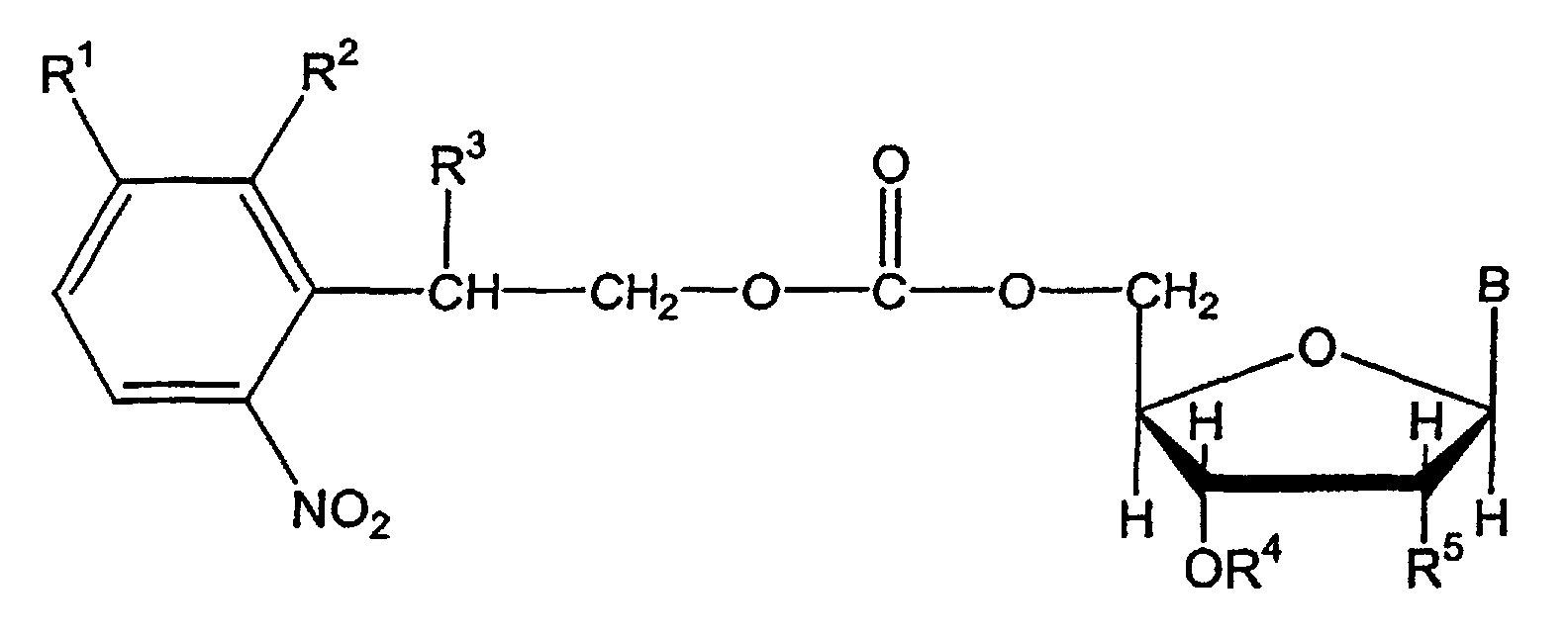
- the present invention was therefore based on the object Nucleoside derivatives with photolabile protecting groups for the 5'-OH function to develop in the sugar portion, which the said Do not have disadvantages according to the prior art, but rather comparatively quickly, quantitatively and without Protect formation of unwanted by-products.
- B cytosine, thymine, uracil
- B adenine, guanine
- bases 2,6-diaminopurin-9-yl-, hypoxanthine-9-yl-, 5-methylcytosin-1-yl-, 5-amino-4-imidazolecarboxamide-1-yl or 5-amino-4-imidazolecarboxamide-3-yl radicals be used.
- the OH group (s) in the ribofuranoside or 2'-deoxyribofuranose part can be free or protected as required.
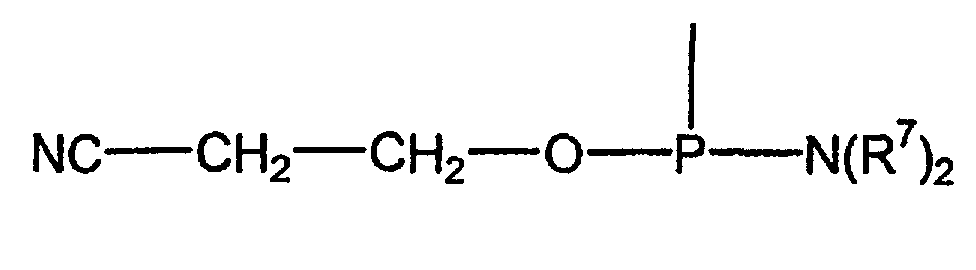
- the known phosphitamide groups have proven themselves, such as, for. B. or where the R 7 groups may be the same or different and represent linear or branched alkyl radicals having 1 to 4 carbon atoms. They are preferably ethyl or isopropyl radicals.
- ribofuranoside part there can be a free or protected OH group in addition to the hydrogen or halogen atom (in particular F, Cl, Br), any protective group customary in nucleotide chemistry (R 6 ) can be used.
- O-alkyl protective groups are O-methyl or O-ethyl radicals, for O-alkenyl protective groups O-allyl radicals, for O-acetal protective groups O-tetrahydropyranyl or O-methoxytetrahydropyranyl radicals and for O-silyl ethers -Protecting groups ot-butyldimethylsilyl residues.
- the pyrimidine or purine bases with primary amino functions e.g. adenine, Cytosine and guanine
- still permanent protective groups preferably have a carbonyl base.
- phenoxyacetyl or dimethylformamidino residues which are suitable for all three bases mentioned.
- protection groups that only work for certain bases are introduced. These are, for example, in the case of adenine benzoyl or p-nitrophenylethoxycarbonyl (p-NPEOC) residues.
- p-NPEOC p-nitrophenylethoxycarbonyl
- the nucleoside derivatives according to the invention are produced in at least two stages.
- a) an alcohol of the general formula (II) in which R 1 , R 2 , R 3 have the meaning given above, are reacted with a phosgene derivative, preferably in a nonpolar organic solvent, at temperatures between ⁇ 20 and + 25 ° C.
- phosgene derivative preferably in a nonpolar organic solvent, at temperatures between ⁇ 20 and + 25 ° C.
- diphosgene chloroformic acid trichloromethyl ester
- triphosgene bistrichloromethyl carbonate
- the alcohol component is known in most cases or can be prepared in an analogous manner by known processes become.
- the non-polar organic solvent preferably toluene or THF used.
- the Reaction components can in approximately stoichiometric ratio, but it will Phosgene derivative preferably in a significant excess, based on the alcohol component used.
- the Concentration of the alcohol component can vary widely can be varied, but it has proven to be particularly advantageous proved this concentration to 0.1 to 10.0 mmol per 10 ml Solvent set.
- the corresponding products are preferably worked up by first distilling off the excess phosgene derivative and the solvent in vacuo.
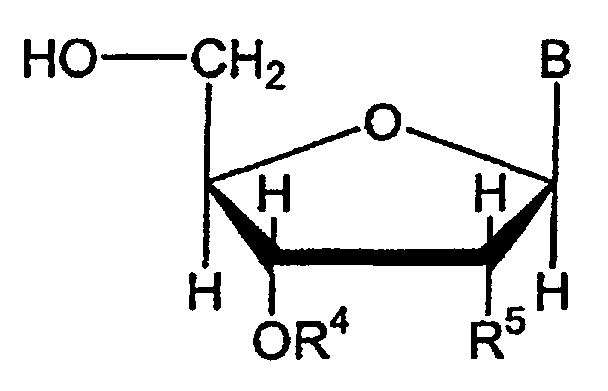
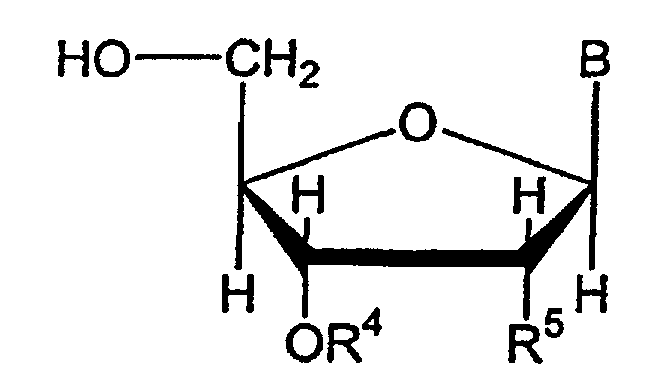
- the chlorocarbonic acid ester (IV) can then be processed in step b) with the nucleosides of the general formula (III) are implemented, wherein R 4 , R 5 and B have the meaning given above.
- the reaction is preferably carried out in a solvent mixture consisting of dichloromethane and a polar organic Solvent, if necessary, in the presence of a base at temperatures between - 60 and + 25 ° C.
- a polar organic solvent DMF or pyridine is preferably used, in which In the case of pyridine no additional base is required. However, is mixed with dichloromethane / DMF solvent mixtures worked, the addition of a base such.
- the Mixing ratio is dichloromethane to pyridine or DMF also not critical, but preferably 1 to 3 parts by volume Dichloromethane per part by volume of pyridine or DMF used.
- the corresponding nucleoside (III) which is in pyridine or DMF / base was dissolved, submitted and a solution of Chlorocarbonic acid ester in dichloromethane at the respective Reaction temperature added dropwise.
- the molar ratio of Nucleoside to chlorocarbonic acid ester can be used accordingly the stoichiometry can be set to approximately 1: 1.
- the chlorocarbonic acid ester is preferably used in Excess used in such an amount that the molar ratio of nucleoside to chlorocarbonic acid ester 1: 1 is up to 1: 2.
- concentration can of the nucleoside in the solvent mixture within wide limits can be varied, but it is preferably 0.1 to 3.0 mmol per 10 ml of solvent.
- nucleoside derivatives according to the invention After implementation (reaction time approx. 5 to 6 hours) can the nucleoside derivatives according to the invention known methods are isolated or cleaned, such as. B. Dilute with dichloromethane, wash out all salts with Water, drying the organic phase, concentrating the solution or crystallization and subsequent silica gel chromatography. In this way, the corresponding Nucleoside derivatives with high purity and in good yields (approx. 70 to 80%) can be obtained.
- the phosphitamide group or introduce according to known methods.
- This reaction is usually carried out with the corresponding phosphines in the presence of 1H-tetrazole as an activator in a solvent mixture consisting of dichloromethane and acetonitrile at temperatures between 0 and 25 ° C.
- the phosphine is preferably used in a 1.5 to 3-fold molar excess, while the molar ratio of phosphine to 1H-tetrazole is set to 2 to 4: about 1.0.
- the quantitative ratio of dichloromethane to acetonitrile is relatively uncritical and is preferably 1: 1 to 4: 1.
- the Nucleosides invention very good for the production of Oligonucleotides through light-controlled Splitting off of protective groups, in particular on fixed ones Support plates.
- a KPG stirrer is recommended for this reaction! Concentrated to 70 ml. Sulfuric acid, cooled to -20 ° C, 15 g (92 mmol) of 3-acetylamino-1-ethylbenzene (1) are added so that the temperature remains below 0 ° C. Then 9.5 g (6.2 ml, 0.15 mmol) of fuming nitric acid are added dropwise within 30 minutes so that the temperature does not rise above -3 ° C. After stirring for 1 hour in an ice bath, the reaction mixture is poured onto ice, neutralized with solid sodium carbonate and extracted 1 ⁇ with 400 ml and 2 ⁇ with 200 ml Et 2 O.
- This reaction mixture is added to a suspension of 1.5 g (6 mmol) copper sulfate pentahydrate and 600 mg (9.4 mmol) copper powder in 12.5 ml 48% hydrobromic acid and 7.5 ml H 2 O and 30 min to 80 ° C warmed. After cooling, the reaction solution is extracted 3 times with 50 ml of EA each time and the combined organic phases are washed once with 50 ml of NaOH and H 2 O each. It is dried over Na 2 SO 4 and rotated in. The crude product is drawn up on silica gel and by flash chromatography (40 g silica gel, 3.5 x 13 cm, LM: PE / EE, cond. PE, gradient: 150 ml PE, 600 ml 150: 1, 150 ml 150: 2 ) cleaned. 1.55 g (6.7 mmol, 67%) (7) are obtained as a yellow oil.
- the reaction mixture is extracted 3 times with 50 ml of EA and the combined organic phases are washed once with 50 ml of NaOH and H 2 O each. It is dried over Na 2 SO 4 and rotated in.
- the crude product is drawn up on silica gel and purified by flash chromatography (40 g silica gel, 3.5 x 13 cm, LM: PE). 1.57 g (5.7 mmol, 57%) (8) are obtained as a red oil.
- the combined organic phases are saturated 1 ⁇ with 200 ml. Washed NaHCO 3 solution and back extracted the aqueous phase with 50 ml Et 2 O. After drying over Na 2 SO 4, the mixture is rotated in and the crude product (3.55 g of red oil, applied to 4 g of silica gel) is purified by flash chromatography (67 g of silica gel, 4 ⁇ 12 cm, LM: PE / EE 8: 1) , 2.64 g (13 mmol, 71%) (34) are obtained as a yellow-orange solid.
- AAV 1 5 mmol of educt are dissolved with 5 mmol of paraformaldehyde in 10 ml of DMSO (for example, dried over molecular sieve).
- DMSO for example, dried over molecular sieve.
- 0.05-0.5 mmol of potassium tert-butoxide in 3 ml of tert-butanol is added, the color changes from yellow to violet.
- the solution is allowed to cool, neutralized with about 4 drops of conc. HCl, diluted with 25 ml saturated NaCl solution and extracted 3 times with 20 ml ethyl acetate. The combined organic phases are dried over Na 2 SO 4 , filtered off and evaporated.
- the crude product is purified by flash chromatography (45 g of silica gel, 4 ⁇ 12 cm, LM: Tol / EE, cond .: Tol, gradient: Tol until unreacted starting material has been separated off, then 15: 1 or 8: 1).
- AAV 1.2 Execution according to AAV 1, only with DMF instead of DMSO as the solvent, and the reaction time is increased to 3 h at 90 ° C.
- AAV 1 895 mg (4.8 mmol) 5-chloro-1-ethyl-2-nitrobenzene (6), 160 mg (5.3 mmol) paraformaldehyde in 10 ml DMSO and 76 mg (0.7 mmol) of potassium tert-butoxide in 4 ml of tert-butanol. Yield: 870 mg (4.03 mmol, 84%) (9) as a yellow oil.
- AAV 1 1.39 g (6 mmol) 5-bromo-1-ethyl-2-nitrobenzene (7), 210 mg (7 mmol) paraformaldehyde in 10 ml DMSO and 100 mg (0.89 mmol) potassium tert-butoxide in 4 ml tert-butanol. Yield: 1.32 g (5.01 mmol, 85%) (10) as a yellow oil.
- AAV 1 1.45 g (5 mmol) 5-iodo-1-ethyl-2-nitrobenzene (8), 165 mg (5.5 mmol) paraformaldehyde in 10 ml DMSO and 80 mg (0.7 mmol) potassium tert-butoxide in 4 ml tert-butanol. Yield: 1.36 g (4.4 mmol, 85%) (11) as a yellow solid.
- AAV1.2 1.44 g (7 mmol) 1-ethyl-2,5-dinitrobenzene (34), 662 mg (22 mmol) paraformaldehyde in 10 ml DMF and 200 mg (1.8 mmol) potassium tert. -butylate in 4 ml of tert-butanol. Yield: 628 mg (3.2 mmol, 46%) starting material (34) and 394 mg (1.74 mmol, 25%) (35) as a yellow solid. For the analysis, 100 mg (35) are recrystallized from 15 ml H 2 O / EtOH 4: 1.
- AAV 2 A solution of 5 mmol alcohol and 5 mmol is added to a solution of 6 mmol chloroformic acid trichloromethyl ester (1.2-fold excess) in 8 ml THF (distilled over CaH 2 ) cooled to 0 ° C within 5 min Triethylamine added dropwise in 8 ml of THF. After stirring for 1 to 2 hours in an ice bath (TLC control), the reaction solution is suctioned off over kieselguhr, washed with a little THF and the excess reagent is spun off. The protecting group reagents obtained are dried for 1 to 2 h at the HV and stored in the refrigerator under argon.
- AAV 3 1mmol nucleoside is 3 x with 3 ml abs. Pyridine coevaporated, in 3 ml abs. Dissolved pyridine and cooled to -50 ° C. A 1.25 to 1.75-fold excess of protective group reagent in 3 ml of abs is added dropwise to this within 15 minutes. CH 2 Cl 2 . After 5.5 h stirring at a temperature between -60 ° C and -30 ° C, at the end -15 ° C, the reaction solution is diluted with 10 ml H 2 O and the aqueous phase 3 times with 10 ml CH 2 Cl 2 extracted.
- the combined organic phases are dried over Na 2 SO 4 , concentrated using a rotary evaporator and coevaporated 3 ⁇ with toluene in order to completely remove the pyridine.
- the crude product obtained is passed through a silica gel column using flash chromatography (20 g silica gel, 2 ⁇ 14 cm, LM: CH 2 Cl 2 / MeOH, cond .: CH 2 Cl 2 , gradient: 100 ml CH 2 Cl 2 , 100 ml each 100: 1, 100: 2, 100: 3, 100: 3.5 and 100: 4).
- the corresponding product fractions are evaporated in a rotary evaporator and the foams obtained are dried in an HV at 35 ° C.
- AAV 3 1.12 g (4.6 mmol) thymidine / 20 ml abs. Pyridine, 2.3 g (6.2 mmol) 2- (5-iodo-2-nitrophenyl) propoxycarbonyl chloride (14) / 20 ml abs. CH 2 Cl 2 . Yield: 502 mg (0.8 mmol, 25%) (24) as an almost colorless solid, 458 mg (0.5 mmol, 11%) (25), 75 mg (0.13 mmol, 3%) (26) and 1.93 g (3.4 mmol, 73%) (23) as colorless foams.
- AAV 3 180 mg (0.74 mmol) thymidine / 3 ml abs. Pyridine, 320 mg (1 mmol) 2- (2,5-dinitrophenyl) propoxycarbonyl chloride (36) / 3 ml abs. CH 2 Cl 2 . Yield: 48 mg (0.1 mmol, 10%) (38) as a yellow solid and 250 mg (0.51 mmol, 68%) (37) as a colorless foam.
- AAV 3 310 mg (0.8 mmol) N 6 -phenyloxyacetyl-2'desoxyadenosine / 3 ml abs. Pyridine, 429 mg (1.16 mmol) 2- (5-iodo-2-nitrophenyl) propoxycarbonyl chloride (14) / 3 ml abs CH 2 Cl 2 . Yield: 451 mg (0.63 mmol, 78%) (29) as a colorless foam.
- the correspondingly protected nucleoside derivatives were used Irradiated with the help of an apparatus, which comes from an Hg high pressure lamp (200 W), an IR filter (water), one Shutter (automatic closure for exact regulation of the Exposure time), a standard interference filter (Filter 1) with a narrow range around the wavelength 365 nm, a converging lens and one at approx. 17 ° C thermostatted cell holder.
- a standard interference filter Filter 1 with a narrow range around the wavelength 365 nm, a converging lens and one at approx. 17 ° C thermostatted cell holder.
- To overheat of filter 1 was, if necessary, between shutter and Filter 1 and a broadband filter UG1 (filter 2) installed.
- light of wavelength 365 was used nm used so that only the protective group and not the heterocyclic bases are excited.
- the radiation was carried out in quartz cuvettes (3.5 ml) with 3 ml solution each (Solvent: methanol / water 1: 1; initial concentration 0.1 mmol / l After irradiation, the cuvette was two Samples taken and analyzed using an HPLC system.
- Table 2 shows that the 5'-O- [2- (5-chloro-2-nitrophenyl) propoxycarbonyl] -N 6 -phenyloxyacetyl-2'desoxyadenosine (compound 27) also contains them 97% is highest, while it takes values between approx. 75 and 95% for the other nucleoside derivatives.
- Results of the radiation experiments example connection Half-life t H Conc. t end (t end ) D1 5'-O- [2- (5-chloro-2-nitrophenyl) propoxycarbonyl] thymidine (15) 38 sec.
Landscapes
- Chemical & Material Sciences (AREA)
- Organic Chemistry (AREA)
- Health & Medical Sciences (AREA)
- Life Sciences & Earth Sciences (AREA)
- Biochemistry (AREA)
- Molecular Biology (AREA)
- Engineering & Computer Science (AREA)
- Biotechnology (AREA)
- General Health & Medical Sciences (AREA)
- Genetics & Genomics (AREA)
- Organic Low-Molecular-Weight Compounds And Preparation Thereof (AREA)
- Saccharide Compounds (AREA)
Description




Schmp.. 30-32 °C (Lit [I] : 33-34 °C)
DC (Kieselgel, PE/EE 1:1): Rf = 0,42
1H-NMR (250 MHz, CDCl3): 7,60 (s(br), 1H, NH), 7,34-7,16 (m, 3H, arom. H), 6,92 (d, 1H, arom. H), 2,59 (q, 2H, CH2), 2,14 (s, 3H, COCH3), 1,18 (t, 3H, CH3)
Uv-Spektrum (MeOH), λ max [nm] (log ε) : 206 (3,41), 242 (3,10), [280 (1,76)]
Schmp.: 84-85 °C (Lit [I]: 80-81 °C)
DC (Kieselgel, PE/EE 7:3): Rf = 0,27
1H-NMR (250 MHz, CDCl3): 7,96 (m, 1H, H(6)), 6,47 (m, 2H, H(3), H(5)), 4,23 (s(br), 2H, NH2), 2,93 (q, 2H, CH2), 1,24 (t, 3H, CH3)
13C-NMR (600 MHz, CDCl3): 151,30 (C(5)), 143, 25 (C(1)), 139,42 (C(2)), 128,35 (C(3)), 115,35 (C(6)), 111,72 (C(4)), 27,48 (CH2), 14,67 (CH3)
UV-Spektrum (MeOH), λ max [nm] (log ε): 203 (4,21), 231 (3,82), [245 (3,69)], [372 (4,09)]
MS (EI 70 eV, m/z (%)): M+ 166 (55), 149 (100), 121 (42), 93 (26), 65 (35), 52 (23), 39 (32)
Schmp.: 85-89 °C
DC (Kieselgel, PE/EE 7:3) : Rf = 0,77
1H-NMR (600 MHz, CDCl3) : 8,24 (d, 1H, H(5)), 7,02 (s(br), 2H, NH2), 6,66 (d, 1H, H(6)), 2,70 (q, 2H, CH2), 1,26 (t, 3H, CH3)
13C-NMR (600 MHz, CDCl3) : 147,46 (C(1)), 139,02 (C(2)), 138,80 (C(3)), 132,23 (C(4)), 129,40 (C(5)), 116,86 (C(6)), 26,57 (CH2), 14,42 (CH3)
UV-Spektrum (MeOH), λ max [nm] (log ε) : 202 (4,08), 225 (4,27), 270 (3,78), 399 (3,72)
Schmp.: 103-106 °C
DC (Kieselgel, PE/EE 7:3): Rf = 0,43
1H-NMR (600 MHz, CDCl3) : 7,95 (d, 1H, H(5)), 6, 70 (d, 1H, H(4)), 4,96 (s(br), 2H, NH2), 2,92 (q, 2H, CH2) , 1,31 (t, 3H, CH3)
13C-NMR (600 MHz, CDCl3) : 143, 94 (C(3)), 139,83 (C(6)), 137,48 (C(2)), 136,16 (C(1)), 129,32 (C(5)), 114,67 (C(4)), 22,29 (CH2), 14,62 (CH3)
UV-Spektrum (MeOH), λ max [nm] (log ε): 202 (4,19), 225 (3,93),346 (3,94)
Schmp.: 96-101 °C
DC (Kieselgel, PE/EE 7:3) : Rf = 0,27
1H-NMR (250 MHz, CDCl3) : 8,98 (s, 1H), 6,69 (s, 1H), 6,51 (s(br), 2H, NH2), 2,98 (q, 2H, CH2), 1,26 (t, 3H, CH3)
13C-NMR (600 MHz, CDCl3) : 147,97 (C(1)), 146,95 (C(5)), 138,16 (C(2)), 129,03 (C(4)), 125,70 (C(3)), 119,59 (C(6)), 27,13 (CH2), 14,19 (CH3)
UV-spektrum (MeOH), λ max [nm] (log ε) : 202 (4,15), [228 (4,01)], 265 (3,99), 342 (4,02), [361 (4,00)]
MS (EI 70 eV, m/z (%)): M+ 211 (56), 194 (100), 148 (26), 118 (30), 91 (30), 65 (24), 52 (38), 39 (31)
DC (Kieselgel, PE/EE 4:1) : Rf = 0,77
1H-NMR (250 MHz, CDCl3): 7,85 (d, 1H, H(3)), 7,34 (d, 1H, H(6)), 7,29 (dd, 1H, H(4)), 2,90 (q, 2H, CH2), 1,27 (t, 3H, CH3)
UV-Spektrum (MeOH), λ max [nm] (log ε): 206 (4,09), [216 (3,91)], 263 (3,79), [334 (2,84)]
C8H8ClNO2 (185,61 g/mol):
ber.: C 51,77, H 4,34, N 7,55; gef.: C 51,65, H 4,34, N 7,63
DC (Kieselgel, PE/EE 4:1): Rf = 0,76
1H-NMR (250 MHz, CDCl3) : 7,76 (d, 1H, H(3)), 7,50 (d, 1H, H(6)), 7,45 (dd, 1H, H(4)), 2,89 (q, 2H, CH2), 1,27 (t, 3H, CH3)
UV-Spektrum (MeOH), λ max [nm] (log ε) : 203 (4,19), [217 (3,98)], 267 (3,91), [320 (3,21)]
C8H8BrNO2 (230,07 g/mol) :
ber.: C 41,77, H 3,50, N 6,09; gef.: C 41,71, H 3,59, N 6,08
DC (Kieselgel, PE/EE 4:1): Rf = 0,78
1H-NMR (250 MHz, CDCl3) : 7,72 (d, 1H, H(6)), 7,66 (dd, 1H, H(4)), 7,58 (d, 1H, H(3)), 2,85 (q, 2H, CH2), 1,25 (t, 3H, CH3)
UV-Spektrum (MeOH), λ max [nm] (log ε) : 203 (4,22), [220 (3,88)], 281 (3,87), [328 (3,22)]
C8H8INO2 (277,06 g/mol) :
ber.: C 34,68, H 2,91, N 5,06; gef.: C 34,84, H 2,92, N 4,90
Schmp.: 30-31 °C (Lit. [2] : 44-45 °C)
DC (Kieselgel, Tol/EE 3:1) : Rf = 0,34
1H-NMR (250 MHz, CDCl3): 7,10 (d, 1H, H(6)), 7,03 (d, 1H, H(3)), 6,80 (dd, 1H, H(5)), 5,54 (s, 2H, NH2), 2,60 (q, 2H, CH2), 1,10 (t, 3H, CH3)
Schmp.. 112-113 °C (Lit. [III]: 111 °C)
DC (Kieselgel, PE/EE 1:1): Rf = 0,35
1H-NMR (250 MHz, CDCl3) : 8,01 (d, 1H, H(3)), 7,71 (dd, 1H, H(5)), 7,62 (s(br.). 1H, NH),
7,27 (d, 1H, H(6)), 2,84 (q, 2H, CH2), 2,19 (s, 3H, C(O)CH3), 1,23 (t, 3H, CH3)
UV-Spektrum (MeOH), λ max [nm] (log ε) : 202 (4,23), 241 (4,39), 333 (3,21)
Schmp. : 122-123 °C (Lit. [III]: 125 °C)
DC (Kieselgel, PE/EE 1:1): Rf = 0,50
1H-NMR (250 MHz, CDCl3) : 7,26 (d, 1H, arom. H), 6,90 (d, 1H, arom. H), 6,03 (s(br.), 2H, NH2), 2,45 (q, 2H, CH2), 1,18 (t, 3H, CH3)
UV-Spektrum (MeOH), λ max [nm] (log ε) : 202 (4,18), 227 (4,37), [265 (3,59)], 411 (3,75)
Schmp.: 124-125 °C (Lit. [III]: 121,6 °C)
DC (Kieselgel, PE/EE 1:1): Rf = 0,85
1H-NMR (250 MHz, CDCl3): 8,11 (s, 1H, arom. H), 7,27 (s, 1H, arom. H), 6,07 (s(br.), 2H, NH2), 2,75 (q, 2H, CH2), 1,24 (t, 3H, CH3)
UV-Spektrum (MeOH), λmax [nm] (log ε): 226 (4,39), [243 (4,16)], [266 (3,86)], 422 (3,71)
Schmp.: 57-60 °C (Lit. [III]: 57,4-59,9 °C)
DC (Kieselgel, PE/EE 4:1) : Rf = 0,60
1H-NMR (250 MHz, CDCl3) : 8,24 (d, 1H, H(6)), 8,16 (dd, 1H, H(4)), 7,95 (d, 1H, H(3)), 2,95 (q, 2H, CH2), 1,34 (t, 3H, CH3)
UV-Spektrum (MeOH), λ max [nm] (log ε) : 204 (4,26), 257 (4,02), [298 (3,37)], [332 (3,06)]
DC (Kieselgel, PE/EE 4:1) : Rf = 0,27
1H-NMR (250 MHz, CDCl3): 7,72 (d, 1H, H(3)), 7,45 (d, 1H, H(6)), 7,30 (dd, 1H, H(4)), 3,74 (m, 2H, α-CH2), 3,54 (sextett, 1H, β-CH), 1,71 (s(br.), 1H, OH), 1,30(d, 3H, CH3) UV-Spektrum (MeOH), λmax [nm] (log ε): 206 (4,17), 216 (4,06), 262 (3,76), [328 (2,95)]
C9H10ClNO3 (215, 64 g/mol) :
ber.: C 50,13, H 4,67, N 6,50; gef.: C 50,20, H 4,75, N 6,20
DC (Kieselgel, PE/EE 7:3): Rf = 0,57
1H-NMR (250 MHz, CDCl3) : 7,63 (m, 2H, H(3), H(6)), 7,47 (dd, 1H, H(4)), 3,74 (m, 2H,α-CH2), 3,52 (sextett, 1H, β-CH), 1,68 (s (br.), 1H, OH), 1,30(d, 3H, CH3)
UV-Spektrum (MeOH), λ max [nm] (log ε): 202 (4,16), [218 (3,95)], 263 (3,76), [330 (2,96)]
C9H10BrNO3 (260,09 g/mol):
ber.: C 41,56, H 3,88, N 5,39; gef.: C 41,74, H 3,95, N 5,27
Ausbeute: 1,36 g (4,4 mmol, 85 %) (11) als gelben Feststoff.
DC (Kieselgel, PE/EE 4:1): Rf = 0,29
1H-NMR (250 MHz, CDCl3) : 7,81 (d, 1H, H(6)), 7,69 (dd, 1H, H(4)), 7,46 (d, 1H, H(3)), 3,76 (m, 2H, α-CH2), 3,48 (sextett, 1H, β-CH), 1,54 (s (br.), 1H, OH), 1,29 (d, 3H, CH3)
UV-Spektrum (MeOH), λmax [nm] (log ε): 204 (4,29), [222 (3,93)], 274 (3,8), [335 (3,18)]
C9H10INO3 (307,08 g/mol):
ber.: C 35,17, H 3,28, N 4,56; gef.: C 35,18, H 3,27, N 4,06
Ausbeute: 628 mg (3,2 mmol, 46 %) Edukt (34) und 394 mg (1,74 mmol, 25 %) (35) als gelber Feststoff. Für die Analyse werden 100 mg (35) aus 15 ml H2O/EtOH 4:1 umkristallisiert.
Schmp.. 82-83 °C
DC (Kieselgel, PE/EE 7:3): Rf = 0,45
1H-NMR (250 MHz, CDCl3): 8,38 (d, 1H, H(6)), 8,19 (dd, 1H, H(4)), 7,84 (d, 1H, H(3)), 3,90-3,72 (m, 2H, 2 x α-CH), 3,52 (sextett, 1H, β-CH ), 1,55 (t, 1H, OH), 1,38 (d, 3H, CH3)
UV-Spektrum (MeOH), λ max [nm] (log ε): 205 (4,24), 256 (4,00), [289 (3,41)] , [334 (3,04)]
C9H10N2O5 (226,19 g/mol):
ber.: C 47,79, H 4,46, N 12,39; gef.: C 48,01, H 4,42, N 12,33
Chlorameisensäuretrichlormethylester in 4 ml abs. THF, 664 mg (3,1 mmol) 2-(5-Chlor-2-nitrophenyl)propanol (9) und 311 mg (425 µl, 3,1 mmol) Triethylamin in 4 ml abs. THF.
Ausbeute: 838 mg (3 mmol, 97 %) (12) als gelbes Öl.
DC (Kieselgel, CH2Cl2): Rf = 0,93
1H-NMR (250 MHz, CDCl3): 7,81 (d, 1H, H(3)), 7,39 (m, 2H, H(6), H(4)), 4,45 (m, 2H, α- CH2), 3,84 (sextett, 1H, β-CH), 1,39 (d, 3H, CH3)
Chlorameisensäuretrichlormethylester in 4 ml abs. THF, 653 mg (2,5 mmol) 2-(5-Brom-2-nitrophenyl)propanol (10) und 254 mg (350 µl, 2,5 mmol) Triethylamin in 4 ml abs. THF, Ausbeute: 805 mg (2,49 mmol, 99 %) (13) als gelbes Öl.
DC (Kieselgel, CH2Cl2): Rf = 0,92
1H-NMR (250 MHz, CDCl3): 7,72 (d, 1H, H(3)), 7,55 (m, 2H, H(6), H(4)), 4,45 (m, 2H, α-CH2), 3,80 (sextett, 1H, β-CH), 1,39 (d, 3H, CH3)
Chlorameisensäuretrichlormethylester in 4 ml abs. THF, 787 mg (2,6 mmol) 2-(5-Iod-2-nitrophenyl)propanol (11) und 259 mg (355 µl, 2,6 mmol) Triethylamin in 4 ml abs. THF.
Ausbeute: 666 mg (1,8 mmol, 95 %) (14) als gelbes Öl.
DC (Kieselgel, CH2Cl2) : Rf = 0,91
1H-NMR (250 MHz, CDCl3): 7,75 (m, 2H, H(6), H(4)),7,53 (d, 1H, H(3)), 4,44 (m, 2H, α-CH2), 3,74 (sextett, 1H, β-CH), 1,38 (d, 3H, CH3)
Chlorameisensäuretrichlormethylester in 4 ml abs. THF, 226 mg (1 mmol) 2-(2,5-Dinitrophenyl)propanol (35) und 101 mg (140 µl, 1 mmol) Triethylamin in 4 ml abs. THF.
Ausbeute: 320 mg (1,1 mmol, 110 %) leicht verunreinigtes (36) als gelbes Öl.
DC (Kieselgel, CH2Cl2): Rf = 0,98
1H-NMR (250 MHz, CDCl3): 8,34 (d, 1H, H(6)), 8,27 (dd, 1H, H(4)), 7,93 (d, 1H, H(3)), 4,43 (m, 2H, 2 x α-CH), 3,76 (sextett, 1H, β-CH ), 1,46 (d, 3H, CH3)
Ausbeute:359 mg (0,8 mmol, 30 %) (16) als gelben Feststoff, 173 mg (0, 24 mmol, 6 %) (17), 70 mg (0,14 mmol, 4 %) (18) und 1,34 (2,8 mmol, 69 %) (15) als farblose Schäume.
DC (Kieselgel, Tol/EE/MeOH 5:4:1): Rf = 0,40
1H-NMR (250 MHz, CDCl3) : 8,75 (s (br.), 1H, NH), 7,74 (d, 1H, arom. H NPPOC), 7,41 (d, 1H, arom. H NPPOC), 7,34 (dd, 1H, arom. H NPPOC), 7,29 (s, 1H, H-C(6)), 6,31 (m, 1H, H-C(1')), 4,47-4,08 (m, 6H, α-CH2 NPPOC, H-C(3'), 2 x H-C(5'), H-C(4')), 3,82 (m, 1H, β-CH NPPOC), 2,66 (d(br), 1H, OH-C(3')), 2,37 (m, 1H, H-C(2')), 2,17 (m, 1H, H-C(2')), 1,80 (dd, 3H, CH3 Thy), 1,34 (d, 3H, CH3 NPPOC)
UV-Spektrum (MeOH), λ max[nm] (log ε) : 207 (4,32), 263 (4,15), [335 (2,92)]
C20H22ClN3O9 (483,86 g/mol) :
ber.: C 49,65, H 4,58, N 8,68; gef.: C 49,31, H 4,57, N 8,54
Schmp.: 95-100 °C
DC (Kieselgel, Tol/EE/MeOH 5:4:1) : Rf = 0,94
1H-NMR (250 MHz, CDCl3) : 7,75 (d, 2H, 2 x H(3)), 7,40 (m, 2H,2 x H(6)), 7,33 (m, 2H, 2 x H(4)), 4,32-4,15 (m, 4H, 2 x α-CH2), 3,75 (m, 2H, 2 x β-CH), 1,33 (2 x d, 6H, 2 x CH3) UV-Spektrum (MeOH), λ max [nm] (log ε) : 203 (4,42), [215 (4,26)], 260 (4,07), [334 (3,23)]
C19H18Cl2N2O7 (457,27 g/mol) :
ber.: C 49,91, H 3,97, N 6,13; gef.: C 49,93, H 3,99, N 6,11
DC (Kieselgel, Tol/EE/MeOH 5:4:1): Rf = 0,79
1H-NMR (250 MHz, CDCl3): 8,03(s (br.), 1H, NH), 7,76 (m, 2H, 2 x arom. H NPPOC), 7,37 (m, 4H, 4 x arom. H NPPOC), 7,26 (s, 1H, H-C(6)), 6,32 (m, 1H, H-C(1')), 5,11 (m, 1H, H-C(3')), 4,46-4,12 (m, 7H, 2 x α-CH2 NPPOC, 2 x H-C(5')), H-C(4')), 3,82 (m, 2H, 2 x β-CH NPPOC), 2,46 (m, 1H, H-C(2')), 2,22 (m, 1H, H-C(2')), 1,80 (d, 3H, CH3 Thy), 1,36 (d, 6H, 2 x CH3 NPOOC)
UV-Spektrum (MeOH), λ max [nm] (log ε): 207 (4,64), 262 (4,32), [327 (3,34)]
C30H30Cl2N4O13 (725,49 g/mol):
ber.: C 49,67, H 4,17, N 7,72; gef.: C 49,55, H 4,32, N 7,42
DC (Kieselgel, Tol/EE/MeOH 5:4:1): Rf = 0,55
1H-NMR (250 MHz, CDCl3): 8,31(s (br.), 1H, NH), 7,78 (dd, 1H, arom. H NPPOC), 7,40 (m, 3H, 2 x arom. H NPPOC, H-C(6)), 6,12 (m, 1H, H-C(1')), 5,23 (m, 1H, H-C(3')), 4,38 (m, 1H, H-C(4')), 4,24-4,11 (m, 2H, α-CH2 NPPOC), 3,84 (m, 3H, 2 x H-C(5'), β-CH NPPOC), 2,59-2,36 (m, 3H, OH-C(5'), 2 x H-C(2')), 1,90 (s, 3H, CH3 Thy), 1,36(d, 3H, CH3 NPOOC)
UV-Spektrum (MeOH), λ max [nm] (log ε): 207 (4,37), 263 (4,17), [331 (2,96)]
C20H22ClN3O9 (483,86 g/mol):
ber.: C 49,65, H 4,58, N 8,68; gef.: C 49,58, H 4,70, N 8,02
DC (Kieselgel, Tol/EE/MeOH 5:4:1): Rf = 0,42
1H-NMR (250 MHz, CDCl3) : 8,71 (s (br.), 1H, NH), 7,65 (d, 1H, arom. H NPPOC), 7,57 (d, 1H, arom. H NPPOC), 7,51 (dd, 1H, arom. H NPPOC), 7,29 (s, 1H, H-C(6)), 6,31 (m, 1H, H-C(1')), 5,28-4,11 (m, 6H, α-CH2 NPPOC, H-C(3'), 2 x H-C(5'), H-C(4')), 3,80 (m, 1H, β-CH NPPOC), 2,64 (s(br), 1H, OH-C(3')), 2,37 (m, 1H, H-C(2')), 2,05 (m, 1H, H-C(2')), 1,80 (d, 3H, CH3 Thy), 1,35 (d, 3H, CH3 NPPOC)
UV-Spektrum (MeOH), λ max [nm] (log ε): 205 (4,41), 265 (4,18), [337 (2,95)]
C20H22BrN3O9 (528,32 g/mol):
ber.: C 45,47, H 4,20, N 7,95; gef.: C 45,09, H 4,14, N 7,54
Schmp.: 92-97 °C
DC (Kieselgel, Tol/EE/MeOH 5:4:1): Rf = 0,93
1H-NMR (250 MHz, CDCl3): 7,66 (d, 2H, 2 x H(3)), 7,56 (d, 2H, 2 x H(6)), 7,48 (m, 2H, 2 x H(4)), 4,32-4,15 (m, 4H, 2 x α-CH2), 3,71 (sextett, 2H, 2 x β-CH), 1,33 (2 x d, 6H, 2 x CH3) UV-Spektrum (MeOH), λ max [nm] (log ε) : 202 (4,49), [218 (4,26)], 263 (4,11), [334 (3,28)]
C19H18Br2N2O7 (546,18 g/mol) :
ber.: C 41,78, H 3,32, N 5,13; gef.: C 42,01, H 3,35, N 4,96
DC (Kieselgel, Tol/EE/MeOH 5:4:1) : Rf = 0,78
1H-NMR (250 MHz, CDCl3) : 8,12 (s (br.), 1H, NH), 7,67 (m, 2H, 2 x arom. H NPPOC), 7,53 (m, 4H, 4 x arom. H NPPOC), 7,26 (m, 1H, H-C(6)), 6,33 (m, 1H, H-C(1')), 5,11 (m, 1H, H-C(3')), 4,46-4,11 (m, 7H, 2 x α-CH2 NPPOC, 2 x H-C(5'), H-C(4')), 3,79 (m, 2H, 2 x β-CH NPPOC), 2,46 (m, 1H, H-C(2')), 2,22 (m, 1H, H-C(2')), 1,80 (d, 3H, CH3 Thy), 1,35 (d, 6H, 2 x CH3 NPPOC)
UV-Spektrum (MeOH), λ max [nm] (log ε) : 202 (4,61), [216 (4,42)], 263 (4,34), [333 (3,33)]
C30H30Br2N4O13 (814,40 g/mol) :
ber.: C 44,24, H 3,71, N 6,88; gef.: C 44,28, H 3,72, N 6,80
DC (Kieselgel, Tol/EE/MeOH 5:4:1) : Rf = 0,54
1H-NMR (250 MHz, CDCl3) : 7,98 (s (br.), 1H, NH), 7,69 (dd, 1H, arom. H NPPOC), 7,58 (d, 1H, arom. H NPPOC), 7,52 (dd, 1H, arom. H NPPOC), 7,38 (dd, 1H, H-C(6)), 6,12 (m, 1H, H-C(1')), 5,23 (m, 1H, H-C(3')), 4,38 (m, 1H-C(4')), 4,24-4,10 (m, 2H, α-CH2 NPPOC) 3,91-3,74 (m, 3H, 2 x H-C(5'), β-CH NPPOC), 2,56-2,34 (m, 2H, 2 x H-C(2')), OH-C(5') nicht sichtbar, 1,91 (s, 3H, CH3 Thy), 1,36 (d, 3H, CH3 NPPOC) UV-Spektrum (MeOH), λ max [nm] (log ε) : 202 (4,36), 264 (4,18), [333 (3,02)]
C20H22BrN3O9 (528,32 g/mol) :
ber.: C 45,47, H 4,20, N 7,95; gef.: C 45,15, H 4,21, N 7,57
DC (Kieselgel, Tol/EE/MeOH 5:4:1): Rf = 0,46
1H-NMR (250 MHz, CDCl3) : 8,51 (s (br.), 1H, NH), 7,74 (m, 2H, 2 x arom. H NPPOC), 7,47 (d, 1H, arom. H NPPOC), 7,29 (d, 1H, H-C(6)), 6,31 (t, 1H, H-C(1')), 4,46-4,10 (m, 6H, α-CH2 NPPOC, H-C(3'), 2 x H-C(5'), H-C(4')), 3,75 (m, 1H, β-CH NPPOC), 2,49 (s(br), 1H, OH-C(3')), 2,37 (m, 1H, H-C(2')), 2,18 (m, 1H, H-C(2')), 1,80 (m, 3H, CH3 Thy), 1,35 (d, 3H, CH3 NPPOC)
UV-Spektrum (MeOH), λ max [nm] (log ε) : 204 (4,41), 267 (4,16), [335 (3,19)]
C20H22IN3O9 (575,31 g/mol) :
ber.: C 41,76, H 3,85, N 7,30; gef. : C 41,46, H 3,88, N 7,18
Schmp.: 104-115 °C
DC (Kieselgel, Tol/EE/MeOH 5:4:1): Rf = 0,94
1H-NMR (250 MHz, CDCl3): 7,76 (s, 2H, 2 x H(6)), 7,71 (d, 2H, 2 x H(4)), 7,49 (d, 2H, 2 x H(3)), 4,29 (m, 2H, α-CH2 ), 4,17 (m, 2H, α-CH2 ), 3,68 (sextett, 2H, 2 x β-CH), 1,34 (d, 6H, 2 x CH3)
UV-Spektrum (MeOH), λmax [nm] (log ε): 203 (4,57), [219 (4,26)], 276 (4,07), [332 (3,47)]
C19H18I2N2O7 (640,16 g/mol):
ber.: C 35,65, H 2,83, N 4,38; gef.: C 36,04, H 3,06, N 4,07
DC (Kieselgel, Tol/EE/MeOH 5:4:1): Rf = 0,84
1H-NMR (250 MHz, CDCl3): 8,26 (s (br.), 1H, NH), 7,74 (m, 4H, 4 x arom. H NPPOC), 7,49 (m, 2H, 2 x arom. H NPPOC), 7,27 (m, 1H, H-C(6)), 6,34 (m, 1H, H-C(1')), 5,12 (m, 1H, H-C(3')), 4,45-4,10 (m, 7H, 2 x α-CH2 NPPOC, 2 x H-C(5'), H-C(4')), 3,75 (m, 2H, 2 x β-CH NPPOC), 2,45 (m, 1H, H-C(2')), 2,24 (m, 1H, H-C(2')), 1,80 (d, 3H, CH3 Thy), 1,35 (d, 6H, 2 x CH3 NPPOC)
UV-Spektrum (MeOH), λ max [nm] (log ε): 202 (4,69), 267 (4,30), [333 (3,45)]
C30H30I2N4O13 (908,38 g/mol) :
ber.: C 39,67, H 3,33, N 6,17; gef.: C 39,61, H 3,39, N 5,99
DC (Kieselgel, Tol/EE/MeOH 5:4:1): Rf = 0,53
1H-NMR (250 MHz, CDCl3): 7,78 (s (br.), 1H, NH), 7,73 (m, 2H, 2 x arom. H NPPOC), 7,51 (dd, 1H, arom. H NPPOC), 7,39 (dd, 1H, H-C(6)), 6,12 (m, 1H, H-C(1')), 5,23 (m, 1H, H-C(3')), 4,36 (m, 1H, α-CH NPPOC), 4,20 (m, 1H, α-CH NPPOC), 4,13 (m, 1H, H-C(4')), 3,87 (m, 2H, 2 x H-C(5')), 3,74 (sextett, 1H, β-CH NPPOC) , 2,56-2,39 (m, 3H, OH-C(5'), 2 x H-C(2')), 1,91 (s, 3H, CH3 Thy), 1,35 (d, 3H, CH3 NPPOC)
UV-Spektrum (MeOH), λmax [nm] (log ε): 202 (4,49), 267 (4,17), [333 (3,19)]
C20H22IN3O9 (575,31 g/mol):
ber.: C 41,76, H 3,85, N 7,30; gef.: C 42,22, H 3,85, N 7,20
Ausbeute: 48 mg (0,1 mmol, 10 %) (38) als gelben Feststoff und 250 mg (0,51 mmol, 68 %) (37) als farblosen Schaum.
DC (Kieselgel, Tol/EE/MeOH 5:4:1) : Rf = 0,34
1H-NMR (250 MHz, CDCl3) : 9,11 (s(br), 1H, NH), 8,33 (d, 1H, H(6) NPPOC), 8,23 (m, 1H, H(4) NPPOC), 7,87 (dd, 1H, H(3) NPPOC) , 7,27 (s, 1H, H-C(6)), 6,28 (t, 1H, H-C(1')), 4,51-4,17 (m, 5H, 2 x α-CH NPPOC, H-C(3'), 2 x H-C(5')), 4,10
(m, 1H, H-C(4')), 3,74 (m, 1H, β-CH NPPOC), 3,03 (m(br), 1H, OH-C(3')), 2,38 (m, 1H, H-C(2')), 2,17 (m, 1H, H-C(2')), 1,79 (d, 3H, CH3 Thy), 1,43 (d, 3H, CH3 NPPOC)
UV-Spektrum (MeOH), λ max [nm] (log ε): 205 (4,47), 258 (4,26), [334 (3,02)]
C20H22N4O11 x 0,5 H2O (503,42 g/mol) :
ber.: C 47,71, H 4,60, N 11,13; gef.: C 48,08, H 4,67, N 11,01
Ausbeute: 463 mg (0,74 mmol, 74 %) (27) als farblosen Schaum.
DC (Kieselgel, Tol/EE/MeOH 5:4:1): Rf = 0,46
1H-NMR (250 MHz, CDCl3) : 9,40 (s (br.), 1H, NH), 8,76 u. 8,16 (2 x d, 2H, H-C(2), H-C(8)), 7,74 (d, 1H, arom. H NPPOC), 7,41 (m, 1H, arom. H NPPOC), 7,32 (m, 3H, 1 x arom. H NPPOC, 2 x arom. H Pac), 7,04 (m, 3H, 3 x arom. H Pac), 6,49 (m, 1H, H-C(1')), 4,85 (s, 2H, CH2 Pac) , 4,72 (m, 1H, H-C(3')), 4,42-4,08 (m, 5H, α-CH2 NPPOC, 2 x H-C(5'), H-C(4')), 3,84 (m,
1H, β-CH NPPOC), 2,88 (m, 1H, H-C(2')), 2,56 (m, 1H, H-C(2')), 2,39 (s(br), 1H, OH-C(3')), 1,35 (d, 3H, CH3 NPPOC) UV-Spektrum (MeOH), λ max [nm] (log ε) : 209 (4,61), [260 (4,30)], 270 (4,38), [337 (2,94)]
C28H27ClN6O9 (627,01 g/mol):
ber.: C 53,64, H 4,34, N 13,40; gef.: C 53,44, H 4,30, N 13,50
Ausbeute: 397 mg (0,59 mmol, 71 %) (28) als farblosen Schaum.
DC (Kieselgel, Tol/EE/MeOH 5:4:1): Rf = 0,31
1H-NMR (250 MHz, CDCl3) : 9,44 (s (br.), 1H, NH), 8,75 u. 8,18 (2 x d, 1H, H-C(2), H-C(8)), 7,65 (d, 1H, arom. H NPPOC), 7,58 (dd, 1H, arom. H NPPOC), 7,47 (m, 1H, arom. H NPPOC), 7,31 (m, 2H, 2 x arom. H Pac), 7,02 (m, 3H, 3 x arom. H Pac), 6,50 (t, 1H, H-C(1')), 4,85 (s, 2H, CH2 Pac) , 4,71 (m, 1H, H-C(3')), 4,44-4,08 (m, 5H, α-CH2 NPPOC, 2 x H-C(5'), H-C(4')), 3,80 (m, 1H, β-CH NPPOC), 2,87 (m, 1H, H-C(2')), 2,57 (m, 1H, H-C(2'), OH-C(3') (verdeckt), 1,35 (d, 3H, CH3 NPPOC) UV-Spektrum (MeOH), λmax [nm] (log ε): 209 (4,62), [258 (4,29)], 270 (4,39), 335 (3,06)
C28H27BrN6O9 (671,46 g/mol):
ber.: C 50,09, H 4,05, N 12,52; gef.: C 49,86, H 4,04, N 12,57
Ausbeute: 451 mg (0,63 mmol, 78 %) (29) als farblosen Schaum.
DC (Kieselgel, Tol/EE/MeOH 5:4:1) : Rf = 0,44
1H-NMR (250 MHz, CDCl3): 9,43 (s (br.), 1H, NH), 8,75 u. 8,18 (2 x d, 2H, H-C(2), H-C(8)), 7,76 (m, 1H, arom. H NPPOC), 7,69 (m, 1H, arom. H NPPOC), 7,47 (d, 1H, arom. H NPPOC), 7,32 (m, 2H, 2 x arom. H Pac), 7,02 (m, 3H, 3 x arom. H Pac), 6,51 (t, 1H, H-C(1')), 4,85 (s, 2H, CH2 Pac), 4,72 (m, 1H, H-C(3')), 4,44-4,07 (m, 5H, α-CH2 NPPOC, 2 x H-C(5'), H-C(4')), 3,75 (m, 1H, β-CH NPPOC), 2,87 (m, 1H, H-C(2')), 2,68 (s(br), 1H, OH-C(3')), 2,57 (m, 1H, H-C(2')), 1,34 (d, 3H, CH3 NPPOC)
UV-Spektrum (MeOH), λ max [nm] (log ε) : 209 (4,62), [258 (4,29)], 270 (4,39), 335 (3,06)
C28H27IN6O9 (718,46 g/mol) :
ber.: C 46,81, H 3,79, N 11,70; gef.: C 46,64, H 3,79, N 11,73
| Gradient | ||||
| Zeit [min] | H2O | H2O/MeCN (1:1) [%] | MeCN [%] | Fluss |
| 0 | 100 | 0 | 0 | 1 |
| 3 | 100 | 0 | 0 | 1 |
| 10 | 0 | 100 | 0 | 1 |
| 25 | 0 | 0 | 100 | 1 |
| 30 | 0 | 100 | 0 | 1 |
| 33 | 100 | 0 | 0 | 1 |
| 38 | 100 | 0 | 0 | 1 |
| Ergebnisse der Bestrahlungsexperimente: | |||
| Beispiel | Verbindung | Halbwertszeit tH | Konz. tend (tend) |
| D1 | 5'-O-[2-(5-Chlor-2-nitrophenyl)propoxycarbonyl]thymidin (15) | 38 sec. | 91 % (5 min) |
| D2 | 5'-O-[2-(5-Brom-2-nitrophenyl)propoxycarbonyl]thymidin (19) | 32 sec. | 94 % (5 min) |
| D3 | 5'-O-[2-(5-Iod-2-nitrophenyl)propoxycarbonyl]thymidin (23) | 25 sec. | 86 % (5 min) |
| D4 | 5'-O-[2-(2,5-Dinitrophenyl)propoxycarbonyl]thymidin (37) | 44 sec. | 75 % (10 min) |
| D5 | 5'-O-[2-(5-Chlor-2-nitrophenyl)propoxycarbonyl]-N6-phenyloxyacetyl-2'-desoxyadenosin (27) | 35 sec. | 97 % (5 min) |
| D6 | 5'-O-[2-(5-Brom-2-nitrophenyl)propoxycarbonyl]-N6-phenyloxyacetyl-2'-desoxyadenosin (28) | 30 sec. | 95 % (5 min) |
| D7 | 5'-O-[2-(5-Iod-2-nitrophenyl)propoxycarbonyl]-N6-phenyloxyacetyl-2'-desoxyadenosin (29) | 23 sec. | 95 % (5 min) |
Claims (14)
- Verbindung der allgemeinen Formel (I)mit

- R1 =
- H, F, Cl, Br, I, NO2
- R2 =
- H, CN
wobei R1 und R2 nicht gleichzeitig H sind - R3 =
- H, Alkylrest mit 1 bis 4 C-Atomen, Phenyl
- R4 =
- H oder eine übliche funktionelle Gruppe zur Herstellung von Oligonucleotiden
- R5 =
- H, OH, Halogen oder XR6, wobei X = O oder S und R6 eine in der Nucleotidchemie übliche Schutzgruppe darstellt,
- B =
- Adenin, Cytosin, Guanin, Thymin, Uracil, 2,6-Diaminopurin-9-yl, Hypoxanthin-9-yl, 5-Methylcytosin-1-yl, 5-Amino-4-imidazolcarbonsäureamid-1-yl oder 5-Amino-4-imidazolcarbonsäureamid-3-yl, wobei im Falle von B = Adenin, Cytosin oder Guanin die primäre Aminofunktion ggf. eine permanente Schutzgruppe aufweist.
- Verbindung nach Anspruch 1, wobei R4 eine Phosphitamidgruppe der Formel:oder
 darstellt, wobei die R7-Gruppen gleich oder verschieden sind und lineare oder verzweigte Alkylreste mit 1 bis 4 C-Atomen bedeuten.
- Verbindung nach den Ansprüchenl oder 2, wobei R5 eine Gruppe XR6 ist und R6 im Fall von X = O eine Alkyl-, Alkenyl-, Acetal- oder Silylether-Schutzgruppe oder im Fall von X = S eine Alkyl-Schutzgruppe darstellt.
- Verbindung nach Anspruch 3, wobei als R5 ein O-Methyl- oder O-Ethylrest, ein O-Allylrest, ein O-Tetrahydropyranyl- bzw. O-Methoxytetrahydropyranyl-Rest oder ein O-t-Butyldimethylsilyl-Rest eingesetzt wird.
- Verbindung nach den Ansprüchen 1 bis 4, wobei im Falle von B = Adenin, Cytosin oder Guanin als permanente Schutzgruppe Phenoxyacetyl-, 4-tert-Butyl-phenoxyacetyl-, 4-Isopropyl-phenoxyacetyl- oder Dimethylformamidino-Reste, im Falle von B = Adenin als permanente Schutzgruppe Benzoyl- oder p-Nitrophenylethoxycarbonyl-(p-NPEOC)-Reste, im Falle von B = Guanin als permanente Schutzgruppe Isobutyroyl-, p-Nitrophenylethyl (p-NPE) oder p-NPEOC-Reste und im Falle von B = Cytosin als permanente Schutzgruppe Benzoyl-, Isobutyroyl- oder p-NPEOC-Reste eingesetzt wird.
- Verfahren zur Herstellung von Verbindungen nach den Ansprüchen 1 bis 5 in mindestens zwei Stufen, wobei manworin R7 die oben angegebene Bedeutung hat, nach bekannten Methoden einführt.a) einen Alkohol der allgemeinen Formel (II)in der R1, R2, R3 die oben angegebene Bedeutung besitzen, mit einem Phosgen-Derivat umsetzt und anschließend
 b) den in Stufe a) gebildeten Chlorkohlensäureester mit Nucleosiden der allgemeinen Formel (III)in der R4, R5 und B die oben angegebene Bedeutung besitzen, reagieren lässt und ggf. anschließend
 c) in der 3'-Stellung der Nucleosid-Derivate mit R4 = H die Phosphitamid-Gruppeoder

- Verfahren nach Anspruch 6, wobei man Stufe a) in einem unpolaren organischen Lösemittel, wie beispielsweise Toluol oder THF, bei Temperaturen zwischen - 20 und + 25 °C durchführt und/oder das Phosgenderivat in zwei- bis fünffachem Überschuss bezogen auf die Alkoholkomponente einsetzt.
- Verfahren nach den Ansprüchen 6 oder 7, wobei man Stufe b) in einem Lösemittelgemisch bestehend aus Dichlormethan und einem polaren organischen Lösemittel, wie beispielsweise DMF oder Pyridin, bei Temperaturen zwischen - 60 und + 25 °C durchführt.
- Verfahren nach den Ansprüchen 6 bis 8, wobei man in Stufe b) ein Lösemittelgemisch bestehend aus Dichlormethan und DMF sowie eine Base ausgewählt aus der Gruppe Pyridin, Triethylamin und Ethyldiisopropylamin einsetzt.
- Verfahren nach den Ansprüchen 6 bis 9, wobei das Mischungsverhältnis Dichlormethan zu Pyridin bzw. DMF 1 : 1 bis 3 : 1 und/oder das Molverhältnis Nucleosid zu Chlorkohlensäureester 1 : 1 bis 1 : 2 beträgt.
- Verfahren nach den Ansprüchen 6 bis 10, wobei man in Stufe b) das in Pyridin oder DMF/Base gelöste Nucleosid vorlegt und eine Lösung des Chlorkohlensäureesters in Dichlormethan bei der jeweiligen Reaktionstemperatur zutropfen lässt.
- Verfahren nach den Ansprüchen 6 bis 11, wobei man die Einführung der Phosphitamid-Gruppe (Stufe c)) durch Umsetzung der Nucleosid-Derivate (mit R4 = H) mit den entsprechenden Phosphinen in Gegenwart von 1H-Tetrazol als Aktivator in einem Lösemittelgemisch bestehend aus Dichlormethan und Acetonitril bei Temperaturen zwischen 0 und 25 °C vornimmt.
- Verwendung einer Verbindung der allgemeinen Formel (I) gemäß Anspruch 1 für die lichtgesteuerte Synthese von Oligonucleotiden.
- Verwendung gemäß Anspruch 13, wobei die lichtgesteuerte Oligonucleotidsynthese auf einem festen Trägermaterial erfolgt.
Applications Claiming Priority (3)
| Application Number | Priority Date | Filing Date | Title |
|---|---|---|---|
| DE19952113 | 1999-10-29 | ||
| DE19952113A DE19952113A1 (de) | 1999-10-29 | 1999-10-29 | Nucleosid-Derivate mit photolabilen Schutzgruppen |
| PCT/EP2000/009958 WO2001032671A1 (de) | 1999-10-29 | 2000-10-10 | Nucleosid-derivate mit photolabilen schutzgruppen |
Publications (2)
| Publication Number | Publication Date |
|---|---|
| EP1224198A1 EP1224198A1 (de) | 2002-07-24 |
| EP1224198B1 true EP1224198B1 (de) | 2003-04-23 |
Family
ID=7927291
Family Applications (1)
| Application Number | Title | Priority Date | Filing Date |
|---|---|---|---|
| EP00966152A Expired - Lifetime EP1224198B1 (de) | 1999-10-29 | 2000-10-10 | Nucleosid-derivate mit photolabilen schutzgruppen |
Country Status (8)
| Country | Link |
|---|---|
| US (1) | US6750335B2 (de) |
| EP (1) | EP1224198B1 (de) |
| JP (1) | JP2003513101A (de) |
| AT (1) | ATE238334T1 (de) |
| AU (1) | AU7664200A (de) |
| CA (1) | CA2385262A1 (de) |
| DE (2) | DE19952113A1 (de) |
| WO (1) | WO2001032671A1 (de) |
Families Citing this family (5)
| Publication number | Priority date | Publication date | Assignee | Title |
|---|---|---|---|---|
| WO2003074542A2 (en) * | 2002-03-04 | 2003-09-12 | Universität Konstanz | A method for cleavage of labile functional groups from chemical compounds |
| DE10209203A1 (de) | 2002-03-04 | 2003-09-25 | Ulrich Steiner | Verfahren zur Abspaltung von labilen funktionellen Gruppen aus chemischen Verbindungen |
| US8343710B1 (en) | 2005-03-11 | 2013-01-01 | The Regents Of The University Of Colorado, A Body Corporate | Photodegradable groups for tunable polymeric materials |
| US9180196B2 (en) | 2005-03-11 | 2015-11-10 | The Regents Of The University Of Colorado, A Body Corporate | Photodegradable groups for tunable polymeric materials |
| KR100801080B1 (ko) | 2006-08-07 | 2008-02-05 | 삼성전자주식회사 | 광분해성 화합물 및 상기 화합물이 결합된 올리고머 프로브어레이용 기판 |
Family Cites Families (9)
| Publication number | Priority date | Publication date | Assignee | Title |
|---|---|---|---|---|
| DE3606394A1 (de) * | 1986-02-27 | 1987-09-03 | Wolfgang Prof Dr Dr Pfleiderer | Neue ribonucleoside, verfahren zu deren herstellung und deren verwendung |
| DE3606395A1 (de) * | 1986-02-27 | 1987-09-03 | Wolfgang Prof Dr Dr Pfleiderer | Neue nucleinsaeurebausteine, verfahren zu deren herstellung und deren verwendung |
| AU5449094A (en) * | 1992-11-02 | 1994-05-24 | Affymax Technologies N.V. | Novel photoreactive protecting groups |
| US5623068A (en) * | 1994-03-07 | 1997-04-22 | Beckman Instruments, Inc. | Synthesis of DNA using substituted phenylacetyl-protected nucleotides |
| US5635608A (en) * | 1994-11-08 | 1997-06-03 | Molecular Probes, Inc. | α-carboxy caged compounds |
| DE4444996A1 (de) * | 1994-12-16 | 1996-06-20 | Wolfgang Prof Dr Dr Pfleiderer | Nucleosid-Derivate mit photolabilen Schutzgruppen |
| US5843655A (en) * | 1995-09-18 | 1998-12-01 | Affymetrix, Inc. | Methods for testing oligonucleotide arrays |
| US6147205A (en) * | 1995-12-15 | 2000-11-14 | Affymetrix, Inc. | Photocleavable protecting groups and methods for their use |
| DE19620170A1 (de) | 1996-05-20 | 1997-11-27 | Wolfgang Prof Dr Dr Pfleiderer | Nucleosid-Derivate mit photolabilen Schutzgruppen |
-
1999
- 1999-10-29 DE DE19952113A patent/DE19952113A1/de not_active Withdrawn
-
2000
- 2000-10-10 AU AU76642/00A patent/AU7664200A/en not_active Abandoned
- 2000-10-10 DE DE50001917T patent/DE50001917D1/de not_active Expired - Fee Related
- 2000-10-10 EP EP00966152A patent/EP1224198B1/de not_active Expired - Lifetime
- 2000-10-10 CA CA002385262A patent/CA2385262A1/en not_active Abandoned
- 2000-10-10 WO PCT/EP2000/009958 patent/WO2001032671A1/de not_active Ceased
- 2000-10-10 AT AT00966152T patent/ATE238334T1/de not_active IP Right Cessation
- 2000-10-10 JP JP2001535372A patent/JP2003513101A/ja active Pending
-
2002
- 2002-03-29 US US10/108,565 patent/US6750335B2/en not_active Expired - Fee Related
Also Published As
| Publication number | Publication date |
|---|---|
| WO2001032671A1 (de) | 2001-05-10 |
| DE50001917D1 (de) | 2003-05-28 |
| ATE238334T1 (de) | 2003-05-15 |
| CA2385262A1 (en) | 2001-05-10 |
| DE19952113A1 (de) | 2001-05-03 |
| US6750335B2 (en) | 2004-06-15 |
| EP1224198A1 (de) | 2002-07-24 |
| US20020146737A1 (en) | 2002-10-10 |
| AU7664200A (en) | 2001-05-14 |
| JP2003513101A (ja) | 2003-04-08 |
Similar Documents
| Publication | Publication Date | Title |
|---|---|---|
| EP0797580B1 (de) | Nucleosid-derivate mit photolabilen schutzgruppen | |
| EP0152459B1 (de) | Verfahren zur herstellung von oligonucleotiden | |
| DE112004000265B4 (de) | Neuartige photolabile Schutzgruppen für verbesserte Verfahren zur Herstellung von Oligonukleotid-Arrays | |
| DE69407419T2 (de) | 2' oder 3' -deoxy- und 2' -dideoxy-beta-l-pentafuranonukleoside, verfahren zur herstellung und anwendung in der therapie, insbesondere als antivirale wirkstoffe | |
| DE69632456T2 (de) | Nukleinsäuresynthese unter verwendung von mittels licht abspaltbaren schutzgruppen | |
| DE3887273T2 (de) | 2',3'-Dideoxy-2'-fluornucleoside. | |
| DE68923387T2 (de) | 2',3'-Dideoxy-2',2'-difluornucleoside. | |
| EP0901501B1 (de) | Nucleosid-derivate mit photolabilen schutzgruppen | |
| DE3751468T2 (de) | Verfahren zur herstellung von oligonukleotiden und verbindungen zur bildung hochmolekularer schutzgruppen. | |
| DE69724768T2 (de) | Oligonukleotid-analoge | |
| DE3390162T1 (de) | Desoxyuridinderivate, Verfahren zu ihrer Herstellung und ihre Verwendung als Pharmazeutika | |
| DE68923913T2 (de) | Neplanocinderivate. | |
| DE19952113A1 (de) | Nucleosid-Derivate mit photolabilen Schutzgruppen | |
| EP1401851B1 (de) | Zweistufige schutzgruppen für die synthese von biopolymeren | |
| DE602005001414T2 (de) | Photolabile Schutzgruppen | |
| DE69709098T2 (de) | Zwischenprodukten für oligonukleotid-synthese | |
| EP0839828A1 (de) | Bausteine für DNA/PNA-Cooligomere | |
| EP0475443B1 (de) | Verfahren zur chemischen Synthese von Oligonukleotiden | |
| DE68922900T2 (de) | Verfahren zur Herstellung von 2'-Deoxy-beta-adenosin. | |
| DE4029244A1 (de) | Verfahren zur chemischen synthese von oligonukleotiden | |
| DE202005021489U1 (de) | Zusammmensetzung für die Synthese von phosphitylierten Verbindungen |
Legal Events
| Date | Code | Title | Description |
|---|---|---|---|
| PUAI | Public reference made under article 153(3) epc to a published international application that has entered the european phase |
Free format text: ORIGINAL CODE: 0009012 |
|
| 17P | Request for examination filed |
Effective date: 20020219 |
|
| AK | Designated contracting states |
Kind code of ref document: A1 Designated state(s): AT BE CH CY DE DK ES FI FR GB GR IE IT LI LU MC NL PT SE |
|
| AX | Request for extension of the european patent |
Free format text: AL;LT;LV;MK;RO;SI |
|
| GRAH | Despatch of communication of intention to grant a patent |
Free format text: ORIGINAL CODE: EPIDOS IGRA |
|
| GRAH | Despatch of communication of intention to grant a patent |
Free format text: ORIGINAL CODE: EPIDOS IGRA |
|
| GRAA | (expected) grant |
Free format text: ORIGINAL CODE: 0009210 |
|
| AK | Designated contracting states |
Designated state(s): AT BE CH CY DE DK ES FI FR GB GR IE IT LI LU MC NL PT SE |
|
| PG25 | Lapsed in a contracting state [announced via postgrant information from national office to epo] |
Ref country code: IE Free format text: LAPSE BECAUSE OF FAILURE TO SUBMIT A TRANSLATION OF THE DESCRIPTION OR TO PAY THE FEE WITHIN THE PRESCRIBED TIME-LIMIT Effective date: 20030423 Ref country code: NL Free format text: LAPSE BECAUSE OF FAILURE TO SUBMIT A TRANSLATION OF THE DESCRIPTION OR TO PAY THE FEE WITHIN THE PRESCRIBED TIME-LIMIT Effective date: 20030423 Ref country code: FI Free format text: LAPSE BECAUSE OF FAILURE TO SUBMIT A TRANSLATION OF THE DESCRIPTION OR TO PAY THE FEE WITHIN THE PRESCRIBED TIME-LIMIT Effective date: 20030423 |
|
| REG | Reference to a national code |
Ref country code: GB Ref legal event code: FG4D Free format text: NOT ENGLISH |
|
| REG | Reference to a national code |
Ref country code: CH Ref legal event code: EP |
|
| GBT | Gb: translation of ep patent filed (gb section 77(6)(a)/1977) |
Effective date: 20030423 |
|
| REF | Corresponds to: |
Ref document number: 50001917 Country of ref document: DE Date of ref document: 20030528 Kind code of ref document: P |
|
| REG | Reference to a national code |
Ref country code: IE Ref legal event code: FG4D Free format text: GERMAN |
|
| REG | Reference to a national code |
Ref country code: CH Ref legal event code: NV Representative=s name: NOVAGRAAF INTERNATIONAL SA |
|
| PG25 | Lapsed in a contracting state [announced via postgrant information from national office to epo] |
Ref country code: SE Free format text: LAPSE BECAUSE OF FAILURE TO SUBMIT A TRANSLATION OF THE DESCRIPTION OR TO PAY THE FEE WITHIN THE PRESCRIBED TIME-LIMIT Effective date: 20030723 Ref country code: GR Free format text: LAPSE BECAUSE OF FAILURE TO SUBMIT A TRANSLATION OF THE DESCRIPTION OR TO PAY THE FEE WITHIN THE PRESCRIBED TIME-LIMIT Effective date: 20030723 Ref country code: PT Free format text: LAPSE BECAUSE OF FAILURE TO SUBMIT A TRANSLATION OF THE DESCRIPTION OR TO PAY THE FEE WITHIN THE PRESCRIBED TIME-LIMIT Effective date: 20030723 Ref country code: DK Free format text: LAPSE BECAUSE OF FAILURE TO SUBMIT A TRANSLATION OF THE DESCRIPTION OR TO PAY THE FEE WITHIN THE PRESCRIBED TIME-LIMIT Effective date: 20030723 |
|
| LTIE | Lt: invalidation of european patent or patent extension |
Effective date: 20030423 |
|
| NLV1 | Nl: lapsed or annulled due to failure to fulfill the requirements of art. 29p and 29m of the patents act | ||
| PGFP | Annual fee paid to national office [announced via postgrant information from national office to epo] |
Ref country code: AT Payment date: 20031001 Year of fee payment: 4 |
|
| PG25 | Lapsed in a contracting state [announced via postgrant information from national office to epo] |
Ref country code: CY Free format text: LAPSE BECAUSE OF FAILURE TO SUBMIT A TRANSLATION OF THE DESCRIPTION OR TO PAY THE FEE WITHIN THE PRESCRIBED TIME-LIMIT Effective date: 20031010 Ref country code: LU Free format text: LAPSE BECAUSE OF NON-PAYMENT OF DUE FEES Effective date: 20031010 |
|
| PG25 | Lapsed in a contracting state [announced via postgrant information from national office to epo] |
Ref country code: ES Free format text: LAPSE BECAUSE OF FAILURE TO SUBMIT A TRANSLATION OF THE DESCRIPTION OR TO PAY THE FEE WITHIN THE PRESCRIBED TIME-LIMIT Effective date: 20031030 |
|
| PG25 | Lapsed in a contracting state [announced via postgrant information from national office to epo] |
Ref country code: MC Free format text: LAPSE BECAUSE OF NON-PAYMENT OF DUE FEES Effective date: 20031031 Ref country code: BE Free format text: LAPSE BECAUSE OF NON-PAYMENT OF DUE FEES Effective date: 20031031 |
|
| REG | Reference to a national code |
Ref country code: IE Ref legal event code: FD4D Ref document number: 1224198E Country of ref document: IE |
|
| ET | Fr: translation filed | ||
| PLBE | No opposition filed within time limit |
Free format text: ORIGINAL CODE: 0009261 |
|
| STAA | Information on the status of an ep patent application or granted ep patent |
Free format text: STATUS: NO OPPOSITION FILED WITHIN TIME LIMIT |
|
| 26N | No opposition filed |
Effective date: 20040126 |
|
| BERE | Be: lapsed |
Owner name: *NIGU CHEMIE G.M.B.H. Effective date: 20031031 |
|
| PG25 | Lapsed in a contracting state [announced via postgrant information from national office to epo] |
Ref country code: AT Free format text: LAPSE BECAUSE OF NON-PAYMENT OF DUE FEES Effective date: 20041010 |
|
| PG25 | Lapsed in a contracting state [announced via postgrant information from national office to epo] |
Ref country code: CH Free format text: LAPSE BECAUSE OF NON-PAYMENT OF DUE FEES Effective date: 20041031 Ref country code: LI Free format text: LAPSE BECAUSE OF NON-PAYMENT OF DUE FEES Effective date: 20041031 |
|
| REG | Reference to a national code |
Ref country code: CH Ref legal event code: PL |
|
| PGFP | Annual fee paid to national office [announced via postgrant information from national office to epo] |
Ref country code: GB Payment date: 20051003 Year of fee payment: 6 |
|
| PG25 | Lapsed in a contracting state [announced via postgrant information from national office to epo] |
Ref country code: IT Free format text: LAPSE BECAUSE OF NON-PAYMENT OF DUE FEES Effective date: 20051010 |
|
| PGFP | Annual fee paid to national office [announced via postgrant information from national office to epo] |
Ref country code: DE Payment date: 20051014 Year of fee payment: 6 Ref country code: FR Payment date: 20051014 Year of fee payment: 6 |
|
| PG25 | Lapsed in a contracting state [announced via postgrant information from national office to epo] |
Ref country code: DE Free format text: LAPSE BECAUSE OF NON-PAYMENT OF DUE FEES Effective date: 20070501 |
|
| GBPC | Gb: european patent ceased through non-payment of renewal fee |
Effective date: 20061010 |
|
| REG | Reference to a national code |
Ref country code: FR Ref legal event code: ST Effective date: 20070629 |
|
| PG25 | Lapsed in a contracting state [announced via postgrant information from national office to epo] |
Ref country code: GB Free format text: LAPSE BECAUSE OF NON-PAYMENT OF DUE FEES Effective date: 20061010 |
|
| PG25 | Lapsed in a contracting state [announced via postgrant information from national office to epo] |
Ref country code: FR Free format text: LAPSE BECAUSE OF NON-PAYMENT OF DUE FEES Effective date: 20061031 |