EP1219127B1 - Associating dial numbers with call origination schemes - Google Patents
Associating dial numbers with call origination schemes Download PDFInfo
- Publication number
- EP1219127B1 EP1219127B1 EP00967310A EP00967310A EP1219127B1 EP 1219127 B1 EP1219127 B1 EP 1219127B1 EP 00967310 A EP00967310 A EP 00967310A EP 00967310 A EP00967310 A EP 00967310A EP 1219127 B1 EP1219127 B1 EP 1219127B1
- Authority
- EP
- European Patent Office
- Prior art keywords
- telephone
- call
- call origination
- scheme
- further characterized
- Prior art date
- Legal status (The legal status is an assumption and is not a legal conclusion. Google has not performed a legal analysis and makes no representation as to the accuracy of the status listed.)
- Expired - Lifetime
Links
- 238000000034 method Methods 0.000 claims description 23
- 238000005516 engineering process Methods 0.000 claims description 3
- 230000003750 conditioning effect Effects 0.000 claims 2
- 230000000881 depressing effect Effects 0.000 abstract description 2
- 238000010586 diagram Methods 0.000 description 4
- 230000001413 cellular effect Effects 0.000 description 1
- 238000004891 communication Methods 0.000 description 1
- 238000004590 computer program Methods 0.000 description 1
Images

Classifications
-
- H—ELECTRICITY
- H04—ELECTRIC COMMUNICATION TECHNIQUE
- H04M—TELEPHONIC COMMUNICATION
- H04M1/00—Substation equipment, e.g. for use by subscribers
- H04M1/26—Devices for calling a subscriber
- H04M1/27—Devices whereby a plurality of signals may be stored simultaneously
- H04M1/274—Devices whereby a plurality of signals may be stored simultaneously with provision for storing more than one subscriber number at a time, e.g. using toothed disc
- H04M1/2745—Devices whereby a plurality of signals may be stored simultaneously with provision for storing more than one subscriber number at a time, e.g. using toothed disc using static electronic memories, e.g. chips
- H04M1/2749—Automatic dialling or redialling systems, e.g. on off-hook or redial on busy
-
- H—ELECTRICITY
- H04—ELECTRIC COMMUNICATION TECHNIQUE
- H04W—WIRELESS COMMUNICATION NETWORKS
- H04W76/00—Connection management
- H04W76/10—Connection setup
-
- H—ELECTRICITY
- H04—ELECTRIC COMMUNICATION TECHNIQUE
- H04W—WIRELESS COMMUNICATION NETWORKS
- H04W8/00—Network data management
- H04W8/26—Network addressing or numbering for mobility support
Definitions
- This invention relates to wireless telephony, and has particular relation to automatically determining the proper origination scheme for a call being placed from a wireless telephone.
- a telephone call is a telephone call. If the call goes through, it goes through. If it doesn't, the user calls again later.
- the network or service provider of a landline phone makes no attempt to optimize the system to further increase the probability that a call origination will go through.
- Some devices have automatic redial. If a sending fax machine calls a receiving fax machine, and the receiving fax machine is busy, the sending fax machine tries again, at progressively longer intervals, until the call goes through or a predetermined maximum number of attempts is reached. A home computer attempting to reach an Internet Service Provider will make similarly repeated attempts if it does not get through the first time. Further flexibility is not possible in a landline telephone system.
- a telephone call is a telephone call.
- a network might be more or less likely to return a specific call origination failure indications, such as a REORDER or INTERCEPT, in comparison to a different network.
- distinct networks will usually also vary in the origination failure indication time period, that is, the time period from the call origination start time to when the mobile receives an origination failure indication from the network.
- a call plan is associated with each such call type.
- a call type is simply a subset of dial-strings that are grouped together and associated with a particular predefined call type.
- Example of predefined call types are voice, Emergency, Data, Fax, Packet, OTASP (Over The Air Service Provisioning), Test (Markov, Loopback), and SMS (Short Message Service).
- dial strings With each such call type there is associated a set of dial strings.
- the dial-string subset ⁇ "911", “*911", "#911" ⁇ might be associated with the emergency call type.
- any dial string that is within this set will be considered of type "emergency” while dial strings that are not within this set are not considered of type "emergency”.
- Different wireless service providers are available to the user of a wireless telephone. These providers offer different services, with different prices, to the wireless telephone user, and these services and prices depend on the telephone number being called.
- the user of a wireless telephone can thus customize a call origination scheme based on the telephone number (or at least the type of telephone number) being called.
- a "call origination scheme" is a decision as to how many times to attempt to redial, which service provider to use, which mode (Code Division Multiple Access vs. Frequency Division Multiple Access, for example) of service to use, etc.
- Table 1 shows a preferred Origination Plan Table. As shown in Table 1, each entry of the call origination plan table associates a call-type and/or a dial-string with a call origination plan. The call-origination plan holds all the information that is necessary to conduct the origination process for the associated call-type and/or dial-string.
- Table 2 is an explanation of the fields shown in Table 1.
- Table 3 is an Origination Plan Table Example. Note that the table is being searched from top to bottom. In the case where a particular call-type/dial-string can be matched against more than one table entry, the first entry from the top will dictate the origination plan.
- the origination plan can be specified using a table or a set of tables, as illustrated below.
- each entry specifies the origination plan variables that are associated with a particular call type.
- the origination plan variables can replaced with a script (see FIG. 3).
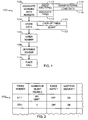
- FIG. 1 is a flow chart of the method (100), according to the present invention, for originating a wireless telephone call.
- a first call origination scheme is associated (102) with at least a first possible telephone number
- a second call origination scheme is associated (102) with at least a second possible telephone number.
- Each scheme may be associated with as many telephone numbers as is convenient, and there may be as many schemes as is convenient, but each telephone number is associated with only one scheme.
- Data representative of each of the associations is then stored (104) in the wireless telephone.
- wireless telephone is used in the broad sense herein, and means any device which is capable of placing a call over a wireless telephone network. It therefore is not limited to conventional wireless telephones as such, but also includes wireless fax machines, wireless computers, and the like.
- a telephone number is then entered (106) into the wireless telephone, as by depressing a sequence of keys on a keypad. This number has previously been associated with a call origination scheme.
- the wireless telephone thereupon determines (108) the scheme previously associated with the just-entered telephone number.
- the telephone then places the call (110) according to the associated scheme.
- the association process (102) may be a direct association, or it may be in two parts.
- the telephone numbers are first grouped into types (112), and then each type is associated with a call origination scheme (114).
- each type is associated with a call origination scheme (114).
- the first type is then associated with a first call origination scheme and the second type is associated with a second origination scheme. Additional types may be used if desired.
- FIG. 2 is a table (200) used in the method of FIG. 1.
- the left-most cell of each row shows individual telephone numbers.
- the remaining cells indicate the elements of the call origination scheme associated with that telephone number. This includes such matters as the number of silent redials to be made if the first dial does not go through, whether Advanced Mobile Phone System (AMPS) should be forced, whether the telephone should wait for service if its request for service is intercepted, and so on.
- a call is "intercepted” if immediate service is denied, but an indication is made that service will be available shortly. Interception thus differs from denial, in that a denied call will not be served for the foreseeable future.
- These elements are examples only, and other elements could also be used, as indicated by the jagged right edge of the table. The jagged bottom edge of the table indicates that additional telephone numbers could be used.
- the numbers shown are also only examples.
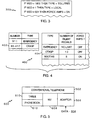
- FIG. 3 is a script (300) used in the method of FIG. 1. Rather than attempting to exhaustively list every possible telephone number, a script (computer program) takes the Most Significant Digit (MSD) or other information about the telephone number and assigns a type to it, or sets an element of a call origination scheme (as shown in the last line). A script and a look-up table may be used in combination if desired.
- MSD Most Significant Digit
- a script and a look-up table may be used in combination if desired.
- FIG. 4 is a pair (400) of tables showing the use of typing in the method of FIG. 1.
- the first table (402) associates each telephone number with a type.
- the second table (404) associates each type with a call origination scheme.
- the wireless service provider may have an Over-The-Air Service Provisioning (OTASP) number. This is a number which a new purchaser of a wireless telephone calls to get service from a wireless service provider.
- OTASP Over-The-Air Service Provisioning
- the call origination scheme for such calls (how many silent redials, whether to force AMPS, and so on) is often different from the scheme for a conventional call. If the OTASP number is Non-Standard (NSOTASP), its scheme will be different still.
- OTASP Non-Standard
- the service provider may have several OTASP numbers, so as to allow several new customers to sign up simultaneously. It is often convenient for each of these numbers to be associated only with the type "OTASP". This avoids the need for repeating, for every telephone number, every element of the call origination scheme associated with the OTASP type.
- FIG. 5 is a block diagram of a telephone (500) according to the present invention.
- a conventional telephone (502) receives data (504) through an adaptor (506). These data are representative of the look-up table, or of the groupings of telephone numbers into types. These data are stored in nonvolatile memory (508). They may include a look-up table (510), a telephone book (512) of grouped numbers, or both.
- FIG. 6 shows some of the types (600) used in FIG. 4. These include emergency (602), Over-The-Air Service Provisioning (OTASP) (604), Non-Standard Over-The-Air Service Provisioning (NSOTASP) (606), voice (608), and data (610). Other types may be used instead of or in addition to the types shown.
- emergency 602
- Over-The-Air Service Provisioning OTASP
- NSWOSP Non-Standard Over-The-Air Service Provisioning
- voice 608
- data data
- FIG. 7 shows some of the elements (700) of the call origination scheme included in FIG. 1. These include as the number of silent redials (702) to be made if the first dial does not go through, the preferred mode (704) of service, whether the telephone should wait (706) for service if its request for service is intercepted, and so on. "Modes" of service include such matters as the technology to be used (Code Division Multiple Access -- CDMA, Time Division Multiple Access -- TDMA, Advanced Mobile Phone Service -- AMPS, and so on), the frequency of operation (cellular -- 800 MHz, Personal Communication System -- PCS --1900 MHz, and so on), and similar factors.
- Modes include such matters as the technology to be used (Code Division Multiple Access -- CDMA, Time Division Multiple Access -- TDMA, Advanced Mobile Phone Service -- AMPS, and so on), the frequency of operation (cellular -- 800 MHz, Personal Communication System -- PCS --1900 MHz, and so on), and similar factors.
- FIG. 8 is a block diagram (800) of a failure handling routine according to the present invention.
- the telephone determines the reason for the failure, and conditions at least one element of one subsequent origination attempt on that reason.
- FIG. 9 shows some of the reasons (900) for failure handled by the routine of FIG. 8. If the call was intercepted (902), then a typical call origination scheme for a data call would provide for a redial in the same mode, after a short delay. A typical call origination scheme for an emergency call would provide for an immediate redial using a different mode. However, if the reason were a fade (904), then a typical scheme for all types of call would be to delay briefly and try again. If the reason were not-a-customer (906), then a switch to a different service provider would be required in all schemes. These schemes are examples only, and others could be used. Likewise, the above reasons for failure are examples only, and other reasons could be used instead of or in addition to them.
- My invention is capable of exploitation in industry, and can be made and used, whenever is it desired to associate dial numbers with call origination schemes.
- the individual components of the apparatus and method shown herein, taken separate and apart from one another, may be entirely conventional, it being their combination which I claim as my invention.
Landscapes
- Engineering & Computer Science (AREA)
- Signal Processing (AREA)
- Mobile Radio Communication Systems (AREA)
- Telephonic Communication Services (AREA)
- Telephone Function (AREA)
- Exchange Systems With Centralized Control (AREA)
Applications Claiming Priority (3)
| Application Number | Priority Date | Filing Date | Title |
|---|---|---|---|
| US413077 | 1982-08-30 | ||
| US09/413,077 US6535751B1 (en) | 1999-10-05 | 1999-10-05 | Associating dial numbers with call origination schemes |
| PCT/US2000/027383 WO2001026402A2 (en) | 1999-10-05 | 2000-10-04 | Associating dial numbers with call origination schemes |
Publications (2)
| Publication Number | Publication Date |
|---|---|
| EP1219127A2 EP1219127A2 (en) | 2002-07-03 |
| EP1219127B1 true EP1219127B1 (en) | 2005-12-14 |
Family
ID=23635723
Family Applications (1)
| Application Number | Title | Priority Date | Filing Date |
|---|---|---|---|
| EP00967310A Expired - Lifetime EP1219127B1 (en) | 1999-10-05 | 2000-10-04 | Associating dial numbers with call origination schemes |
Country Status (10)
| Country | Link |
|---|---|
| US (1) | US6535751B1 (enExample) |
| EP (1) | EP1219127B1 (enExample) |
| JP (2) | JP5128741B2 (enExample) |
| KR (1) | KR100832184B1 (enExample) |
| CN (1) | CN1186952C (enExample) |
| AT (1) | ATE313226T1 (enExample) |
| AU (1) | AU7752900A (enExample) |
| DE (1) | DE60024848T2 (enExample) |
| ES (1) | ES2253259T3 (enExample) |
| WO (1) | WO2001026402A2 (enExample) |
Families Citing this family (2)
| Publication number | Priority date | Publication date | Assignee | Title |
|---|---|---|---|---|
| US8277381B2 (en) | 2007-12-21 | 2012-10-02 | Boston Scientific Scimed, Inc. | Low profile intravascular ultrasound catheter |
| CN106412212A (zh) * | 2015-07-27 | 2017-02-15 | 中兴通讯股份有限公司 | 一种手机呼叫占线自动重拨方法、装置及终端 |
Family Cites Families (17)
| Publication number | Priority date | Publication date | Assignee | Title |
|---|---|---|---|---|
| US5459774A (en) * | 1990-05-17 | 1995-10-17 | Motorola, Inc. | Dialing prefix method and apparatus |
| JPH05114948A (ja) * | 1991-08-02 | 1993-05-07 | Oki Electric Ind Co Ltd | 自動リダイヤル方式 |
| JPH0758818A (ja) * | 1993-08-16 | 1995-03-03 | Casio Comput Co Ltd | 携帯電話装置 |
| US5638433A (en) | 1993-11-18 | 1997-06-10 | Best Rate, Inc. | Best rate telecommunication access code and data transceiver/facilitator (BRTF) |
| US5509060A (en) * | 1993-11-19 | 1996-04-16 | At&T Corp. | Network-accessible intelligent telephone service |
| US5602901A (en) * | 1994-12-22 | 1997-02-11 | Motorola, Inc. | Specialized call routing method and apparatus for a cellular communication system |
| US5722088A (en) * | 1995-09-20 | 1998-02-24 | Ericsson Inc. | Automatic prefix systems and methods for mobile radiotelephones |
| US5754953A (en) * | 1996-09-24 | 1998-05-19 | Motorola, Inc. | Method and apparatus for assisting a user to activate service for a subscriber unit in a messaging system |
| US5905447A (en) * | 1996-11-04 | 1999-05-18 | Motorola, Inc. | Selective call receiver and method for conveying message origination information for a selective call receiver |
| FI964621L (fi) | 1996-11-19 | 1998-05-20 | Ericsson Telefon Ab L M | Menetelmät ja laitteet puhelinnumeroihin pääsemiseksi |
| US6408191B1 (en) * | 1996-12-31 | 2002-06-18 | Lucent Technologies Inc. | Arrangement for displaying message screens on a telephone terminal |
| EP0876037A3 (fr) * | 1997-04-30 | 1999-04-14 | Koninklijke Philips Electronics N.V. | Terminal, procédé de rappel automatique et système de télécommunications |
| JPH1188492A (ja) * | 1997-09-04 | 1999-03-30 | Matsushita Electric Ind Co Ltd | 無線電話装置 |
| US6463298B1 (en) * | 1997-09-29 | 2002-10-08 | Qualcomm Incorporated | Method of acquiring an alternate communication system upon failure of reverse link communications |
| JPH11136286A (ja) * | 1997-10-31 | 1999-05-21 | Eitsuu:Kk | 回線接続切り替え装置 |
| JPH11187433A (ja) * | 1997-12-19 | 1999-07-09 | Toshiba Corp | 電話装置 |
| US6449497B1 (en) | 1998-03-10 | 2002-09-10 | Qualcomm Incorporated | System and method for use of feature codes in a wireless communication device |
-
1999
- 1999-10-05 US US09/413,077 patent/US6535751B1/en not_active Expired - Lifetime
-
2000
- 2000-10-04 WO PCT/US2000/027383 patent/WO2001026402A2/en not_active Ceased
- 2000-10-04 EP EP00967310A patent/EP1219127B1/en not_active Expired - Lifetime
- 2000-10-04 JP JP2001529235A patent/JP5128741B2/ja not_active Expired - Lifetime
- 2000-10-04 ES ES00967310T patent/ES2253259T3/es not_active Expired - Lifetime
- 2000-10-04 AT AT00967310T patent/ATE313226T1/de not_active IP Right Cessation
- 2000-10-04 AU AU77529/00A patent/AU7752900A/en not_active Abandoned
- 2000-10-04 CN CNB008139008A patent/CN1186952C/zh not_active Expired - Lifetime
- 2000-10-04 DE DE60024848T patent/DE60024848T2/de not_active Expired - Lifetime
- 2000-10-04 KR KR1020027004373A patent/KR100832184B1/ko not_active Expired - Lifetime
-
2011
- 2011-06-01 JP JP2011123582A patent/JP5372995B2/ja not_active Expired - Lifetime
Also Published As
| Publication number | Publication date |
|---|---|
| JP2011250415A (ja) | 2011-12-08 |
| HK1051289A1 (en) | 2003-07-25 |
| ES2253259T3 (es) | 2006-06-01 |
| EP1219127A2 (en) | 2002-07-03 |
| US6535751B1 (en) | 2003-03-18 |
| DE60024848T2 (de) | 2006-09-14 |
| JP2003511926A (ja) | 2003-03-25 |
| CN1186952C (zh) | 2005-01-26 |
| KR100832184B1 (ko) | 2008-05-23 |
| DE60024848D1 (de) | 2006-01-19 |
| JP5372995B2 (ja) | 2013-12-18 |
| JP5128741B2 (ja) | 2013-01-23 |
| AU7752900A (en) | 2001-05-10 |
| ATE313226T1 (de) | 2005-12-15 |
| WO2001026402A2 (en) | 2001-04-12 |
| KR20020038796A (ko) | 2002-05-23 |
| WO2001026402A3 (en) | 2001-12-27 |
| CN1399848A (zh) | 2003-02-26 |
Similar Documents
| Publication | Publication Date | Title |
|---|---|---|
| US8031851B2 (en) | Method and apparatus for routing calls based on the identification of the calling party or calling line | |
| CN1186915C (zh) | 更新存储在无线通信设备中的数据的方法和系统 | |
| EP0820207A2 (en) | Method and system for automatic activation of a wireless device | |
| US7146163B2 (en) | Sender-address-based telecommunications operator callback system and method | |
| US20070037561A1 (en) | Method for intelligently dialing contact numbers for a person using user-defined smart rules | |
| KR930007167A (ko) | 개별화된 전화 호출 특징을 제공하는 시스템 | |
| CN1383291A (zh) | 用于通信网的数据库维护方法和系统 | |
| US7983663B2 (en) | Special phone book entries | |
| CN100388749C (zh) | 通过用户电话簿中的被叫方姓名增强的账单记录 | |
| CN1835525A (zh) | 用于通过电话进行多重拨号的方法 | |
| WO2001020884A9 (en) | Method and system for using caller preferences to direct special call handling | |
| US6449475B1 (en) | System and method for matching calls to electronic phonebook entries | |
| US20130130664A1 (en) | System and method of modifying communications policy settings in a wireless network | |
| JPH06217365A (ja) | 無線通信システムにおける呼処理方法 | |
| EP1750422A1 (en) | System and method of modifying communications policy settings in a wireless network | |
| US6535751B1 (en) | Associating dial numbers with call origination schemes | |
| KR100854717B1 (ko) | 멀티 휴대폰, 이를 이용한 다중 번호 지원 시스템 및 그 방법 | |
| US20080043957A1 (en) | System and method for allowing a communication device to have multiple, hierarchically prioritized numbers | |
| JP5121129B2 (ja) | マルチライン・モバイルでダイアル番号の識別をサポートするネットワーク | |
| KR100394552B1 (ko) | 더블류엘엘시스템에서의인증수행방법 | |
| HK1051289B (en) | Associating dial numbers with call origination schemes |
Legal Events
| Date | Code | Title | Description |
|---|---|---|---|
| PUAI | Public reference made under article 153(3) epc to a published international application that has entered the european phase |
Free format text: ORIGINAL CODE: 0009012 |
|
| 17P | Request for examination filed |
Effective date: 20020326 |
|
| AK | Designated contracting states |
Kind code of ref document: A2 Designated state(s): AT BE CH CY DE DK ES FI FR GB GR IE IT LI LU MC NL PT SE |
|
| AX | Request for extension of the european patent |
Free format text: AL;LT;LV;MK;RO;SI |
|
| RIN1 | Information on inventor provided before grant (corrected) |
Inventor name: COOPER, ROTEM |
|
| 17Q | First examination report despatched |
Effective date: 20021216 |
|
| GRAP | Despatch of communication of intention to grant a patent |
Free format text: ORIGINAL CODE: EPIDOSNIGR1 |
|
| GRAS | Grant fee paid |
Free format text: ORIGINAL CODE: EPIDOSNIGR3 |
|
| GRAA | (expected) grant |
Free format text: ORIGINAL CODE: 0009210 |
|
| AK | Designated contracting states |
Kind code of ref document: B1 Designated state(s): AT BE CH CY DE DK ES FI FR GB GR IE IT LI LU MC NL PT SE |
|
| PG25 | Lapsed in a contracting state [announced via postgrant information from national office to epo] |
Ref country code: IT Free format text: LAPSE BECAUSE OF FAILURE TO SUBMIT A TRANSLATION OF THE DESCRIPTION OR TO PAY THE FEE WITHIN THE PRESCRIBED TIME-LIMIT;WARNING: LAPSES OF ITALIAN PATENTS WITH EFFECTIVE DATE BEFORE 2007 MAY HAVE OCCURRED AT ANY TIME BEFORE 2007. THE CORRECT EFFECTIVE DATE MAY BE DIFFERENT FROM THE ONE RECORDED. Effective date: 20051214 Ref country code: AT Free format text: LAPSE BECAUSE OF FAILURE TO SUBMIT A TRANSLATION OF THE DESCRIPTION OR TO PAY THE FEE WITHIN THE PRESCRIBED TIME-LIMIT Effective date: 20051214 Ref country code: BE Free format text: LAPSE BECAUSE OF FAILURE TO SUBMIT A TRANSLATION OF THE DESCRIPTION OR TO PAY THE FEE WITHIN THE PRESCRIBED TIME-LIMIT Effective date: 20051214 Ref country code: LI Free format text: LAPSE BECAUSE OF FAILURE TO SUBMIT A TRANSLATION OF THE DESCRIPTION OR TO PAY THE FEE WITHIN THE PRESCRIBED TIME-LIMIT Effective date: 20051214 Ref country code: CH Free format text: LAPSE BECAUSE OF FAILURE TO SUBMIT A TRANSLATION OF THE DESCRIPTION OR TO PAY THE FEE WITHIN THE PRESCRIBED TIME-LIMIT Effective date: 20051214 Ref country code: NL Free format text: LAPSE BECAUSE OF FAILURE TO SUBMIT A TRANSLATION OF THE DESCRIPTION OR TO PAY THE FEE WITHIN THE PRESCRIBED TIME-LIMIT Effective date: 20051214 |
|
| REG | Reference to a national code |
Ref country code: GB Ref legal event code: FG4D |
|
| REG | Reference to a national code |
Ref country code: CH Ref legal event code: EP |
|
| REG | Reference to a national code |
Ref country code: IE Ref legal event code: FG4D |
|
| REF | Corresponds to: |
Ref document number: 60024848 Country of ref document: DE Date of ref document: 20060119 Kind code of ref document: P |
|
| REG | Reference to a national code |
Ref country code: SE Ref legal event code: TRGR |
|
| PG25 | Lapsed in a contracting state [announced via postgrant information from national office to epo] |
Ref country code: GR Free format text: LAPSE BECAUSE OF FAILURE TO SUBMIT A TRANSLATION OF THE DESCRIPTION OR TO PAY THE FEE WITHIN THE PRESCRIBED TIME-LIMIT Effective date: 20060314 Ref country code: DK Free format text: LAPSE BECAUSE OF FAILURE TO SUBMIT A TRANSLATION OF THE DESCRIPTION OR TO PAY THE FEE WITHIN THE PRESCRIBED TIME-LIMIT Effective date: 20060314 |
|
| PG25 | Lapsed in a contracting state [announced via postgrant information from national office to epo] |
Ref country code: PT Free format text: LAPSE BECAUSE OF FAILURE TO SUBMIT A TRANSLATION OF THE DESCRIPTION OR TO PAY THE FEE WITHIN THE PRESCRIBED TIME-LIMIT Effective date: 20060515 |
|
| NLV1 | Nl: lapsed or annulled due to failure to fulfill the requirements of art. 29p and 29m of the patents act | ||
| REG | Reference to a national code |
Ref country code: ES Ref legal event code: FG2A Ref document number: 2253259 Country of ref document: ES Kind code of ref document: T3 |
|
| REG | Reference to a national code |
Ref country code: CH Ref legal event code: PL |
|
| ET | Fr: translation filed | ||
| PG25 | Lapsed in a contracting state [announced via postgrant information from national office to epo] |
Ref country code: IE Free format text: LAPSE BECAUSE OF NON-PAYMENT OF DUE FEES Effective date: 20061004 |
|
| PLBE | No opposition filed within time limit |
Free format text: ORIGINAL CODE: 0009261 |
|
| STAA | Information on the status of an ep patent application or granted ep patent |
Free format text: STATUS: NO OPPOSITION FILED WITHIN TIME LIMIT |
|
| PG25 | Lapsed in a contracting state [announced via postgrant information from national office to epo] |
Ref country code: MC Free format text: LAPSE BECAUSE OF NON-PAYMENT OF DUE FEES Effective date: 20061031 |
|
| 26N | No opposition filed |
Effective date: 20060915 |
|
| REG | Reference to a national code |
Ref country code: IE Ref legal event code: MM4A |
|
| PG25 | Lapsed in a contracting state [announced via postgrant information from national office to epo] |
Ref country code: LU Free format text: LAPSE BECAUSE OF NON-PAYMENT OF DUE FEES Effective date: 20061004 |
|
| PG25 | Lapsed in a contracting state [announced via postgrant information from national office to epo] |
Ref country code: CY Free format text: LAPSE BECAUSE OF FAILURE TO SUBMIT A TRANSLATION OF THE DESCRIPTION OR TO PAY THE FEE WITHIN THE PRESCRIBED TIME-LIMIT Effective date: 20051214 |
|
| PGFP | Annual fee paid to national office [announced via postgrant information from national office to epo] |
Ref country code: SE Payment date: 20100923 Year of fee payment: 11 Ref country code: FR Payment date: 20101004 Year of fee payment: 11 |
|
| PGFP | Annual fee paid to national office [announced via postgrant information from national office to epo] |
Ref country code: FI Payment date: 20101008 Year of fee payment: 11 |
|
| PGFP | Annual fee paid to national office [announced via postgrant information from national office to epo] |
Ref country code: IT Payment date: 20101021 Year of fee payment: 11 |
|
| PGFP | Annual fee paid to national office [announced via postgrant information from national office to epo] |
Ref country code: ES Payment date: 20101007 Year of fee payment: 11 |
|
| REG | Reference to a national code |
Ref country code: SE Ref legal event code: EUG |
|
| REG | Reference to a national code |
Ref country code: FR Ref legal event code: ST Effective date: 20120629 |
|
| PG25 | Lapsed in a contracting state [announced via postgrant information from national office to epo] |
Ref country code: FI Free format text: LAPSE BECAUSE OF NON-PAYMENT OF DUE FEES Effective date: 20111004 Ref country code: FR Free format text: LAPSE BECAUSE OF NON-PAYMENT OF DUE FEES Effective date: 20111102 Ref country code: IT Free format text: LAPSE BECAUSE OF NON-PAYMENT OF DUE FEES Effective date: 20111004 |
|
| PG25 | Lapsed in a contracting state [announced via postgrant information from national office to epo] |
Ref country code: SE Free format text: LAPSE BECAUSE OF NON-PAYMENT OF DUE FEES Effective date: 20111005 |
|
| REG | Reference to a national code |
Ref country code: ES Ref legal event code: FD2A Effective date: 20130605 |
|
| PG25 | Lapsed in a contracting state [announced via postgrant information from national office to epo] |
Ref country code: ES Free format text: LAPSE BECAUSE OF NON-PAYMENT OF DUE FEES Effective date: 20111005 |
|
| PGFP | Annual fee paid to national office [announced via postgrant information from national office to epo] |
Ref country code: GB Payment date: 20190925 Year of fee payment: 20 |
|
| PGFP | Annual fee paid to national office [announced via postgrant information from national office to epo] |
Ref country code: DE Payment date: 20190917 Year of fee payment: 20 |
|
| REG | Reference to a national code |
Ref country code: DE Ref legal event code: R071 Ref document number: 60024848 Country of ref document: DE |
|
| REG | Reference to a national code |
Ref country code: GB Ref legal event code: PE20 Expiry date: 20201003 |
|
| PG25 | Lapsed in a contracting state [announced via postgrant information from national office to epo] |
Ref country code: GB Free format text: LAPSE BECAUSE OF EXPIRATION OF PROTECTION Effective date: 20201003 |