EP1214978A2 - Labortemperiereinrichtung zur Temperierung auf unterschiedliche Temperaturen - Google Patents
Labortemperiereinrichtung zur Temperierung auf unterschiedliche Temperaturen Download PDFInfo
- Publication number
- EP1214978A2 EP1214978A2 EP01125514A EP01125514A EP1214978A2 EP 1214978 A2 EP1214978 A2 EP 1214978A2 EP 01125514 A EP01125514 A EP 01125514A EP 01125514 A EP01125514 A EP 01125514A EP 1214978 A2 EP1214978 A2 EP 1214978A2
- Authority
- EP
- European Patent Office
- Prior art keywords
- groups
- samples
- steps
- temperature control
- temperature
- Prior art date
- Legal status (The legal status is an assumption and is not a legal conclusion. Google has not performed a legal analysis and makes no representation as to the accuracy of the status listed.)
- Granted
Links
- 230000003750 conditioning effect Effects 0.000 title 1
- 238000006243 chemical reaction Methods 0.000 claims abstract description 65
- 238000011156 evaluation Methods 0.000 claims abstract description 21
- 239000007795 chemical reaction product Substances 0.000 claims abstract description 3
- 238000000034 method Methods 0.000 claims description 19
- 230000008569 process Effects 0.000 claims description 16
- 238000000137 annealing Methods 0.000 description 20
- 238000004925 denaturation Methods 0.000 description 13
- 230000036425 denaturation Effects 0.000 description 13
- 238000003752 polymerase chain reaction Methods 0.000 description 13
- 239000000523 sample Substances 0.000 description 13
- 238000005457 optimization Methods 0.000 description 10
- 238000010438 heat treatment Methods 0.000 description 6
- 238000005496 tempering Methods 0.000 description 6
- 230000008901 benefit Effects 0.000 description 5
- 230000015572 biosynthetic process Effects 0.000 description 4
- 238000010276 construction Methods 0.000 description 4
- 239000012895 dilution Substances 0.000 description 4
- 238000010790 dilution Methods 0.000 description 4
- 238000003491 array Methods 0.000 description 3
- 238000013461 design Methods 0.000 description 3
- 230000003993 interaction Effects 0.000 description 3
- 230000009286 beneficial effect Effects 0.000 description 2
- 239000000463 material Substances 0.000 description 2
- 239000000243 solution Substances 0.000 description 2
- 238000012360 testing method Methods 0.000 description 2
- 238000012549 training Methods 0.000 description 2
- 230000003321 amplification Effects 0.000 description 1
- 230000008859 change Effects 0.000 description 1
- 239000004020 conductor Substances 0.000 description 1
- 230000008094 contradictory effect Effects 0.000 description 1
- 230000004069 differentiation Effects 0.000 description 1
- 238000005516 engineering process Methods 0.000 description 1
- 238000006911 enzymatic reaction Methods 0.000 description 1
- 239000011888 foil Substances 0.000 description 1
- 230000001788 irregular Effects 0.000 description 1
- 239000000203 mixture Substances 0.000 description 1
- 238000012544 monitoring process Methods 0.000 description 1
- 238000003199 nucleic acid amplification method Methods 0.000 description 1
- 238000012545 processing Methods 0.000 description 1
- 230000008707 rearrangement Effects 0.000 description 1
- 230000007704 transition Effects 0.000 description 1
Images



Classifications
-
- B—PERFORMING OPERATIONS; TRANSPORTING
- B01—PHYSICAL OR CHEMICAL PROCESSES OR APPARATUS IN GENERAL
- B01L—CHEMICAL OR PHYSICAL LABORATORY APPARATUS FOR GENERAL USE
- B01L7/00—Heating or cooling apparatus; Heat insulating devices
- B01L7/54—Heating or cooling apparatus; Heat insulating devices using spatial temperature gradients
-
- B—PERFORMING OPERATIONS; TRANSPORTING
- B01—PHYSICAL OR CHEMICAL PROCESSES OR APPARATUS IN GENERAL
- B01L—CHEMICAL OR PHYSICAL LABORATORY APPARATUS FOR GENERAL USE
- B01L7/00—Heating or cooling apparatus; Heat insulating devices
- B01L7/52—Heating or cooling apparatus; Heat insulating devices with provision for submitting samples to a predetermined sequence of different temperatures, e.g. for treating nucleic acid samples
-
- Y—GENERAL TAGGING OF NEW TECHNOLOGICAL DEVELOPMENTS; GENERAL TAGGING OF CROSS-SECTIONAL TECHNOLOGIES SPANNING OVER SEVERAL SECTIONS OF THE IPC; TECHNICAL SUBJECTS COVERED BY FORMER USPC CROSS-REFERENCE ART COLLECTIONS [XRACs] AND DIGESTS
- Y10—TECHNICAL SUBJECTS COVERED BY FORMER USPC
- Y10T—TECHNICAL SUBJECTS COVERED BY FORMER US CLASSIFICATION
- Y10T436/00—Chemistry: analytical and immunological testing
- Y10T436/25—Chemistry: analytical and immunological testing including sample preparation
Definitions
- the invention relates to a laboratory temperature control device in the preamble of Claim 1 and claim 11 mentioned type.
- Such devices are used for tempering reaction samples, which in steps of a step sequence at temperatures in different Temperature ranges are brought.
- the sequence of steps is in one pass repeated cyclically.
- Such facilities are suitable for carrying out special chemical reactions, especially enzyme reactions.
- the main area of application is PCR (Polymerase Chain Reaction). In doing so usual three-step process of denaturation at about 90 ° C, the Go through the annealing step at around 50 ° C and the elongation step at around 60 ° C.
- reaction samples are according to the prior art arranged in a surface array in rows and columns.
- a temperature gradient in the direction of the rows created. This leads to the first groups of samples from the Columns are formed, with the same temperatures, between however, the gaps have different temperatures.
- the optimal temperature of this step e.g. B. of the annealing step.
- the temperature gradient is applied to the annealing step and is included the temperature range e.g. at 50 ° -60 ° C, you can e.g. B. in ten Split the temperatures differently one degree and thus the optimal Determine temperature.
- FIG. 5 is a generic type of claim 11 Laboratory temperature control described in two steps of the sequence of steps Gradients in different directions (X, Y) on the array of reaction samples invests. This makes it possible to run in two temperature ranges in just one pass to determine the optimal temperature.
- the main area of application of the generic laboratory temperature control devices is in the field of PCR. This usually uses three steps. It would be very beneficial to easily do all three steps in one To optimize the temperature control run. There are also processes with more than known three steps with the same problems. It is therefore a task the present invention to provide a laboratory temperature control device, which the work and equipment involved in determining the optimal temperatures all steps of the sequence of steps are reduced.
- the invention is based on the knowledge that in most of the feasible on generic laboratory temperature control devices Processes and especially in the usual three-step PCR process the temperature changes in the individual steps are not always the same Influence evaluation parameters. Affect in the usual PCR process Temperature changes in the annealing step and in the elongation step in essentially the same parameter, namely the specificity, i.e. the ratio from correctly amplified DNA strands of the correct length to incorrectly amplified Strands of different lengths. Temperature changes in the denaturation step but essentially affect another parameter the yield, that is the amount of amplified DNA material obtained. This Both parameters can be determined independently of one another on the reaction product.
- the invention is not based on two-dimensional array arrangements of the reaction samples limited in row and column alignment.
- the reaction samples can also be provided in a three-dimensional arrangement. Then leave optimize three steps in different gradient directions.
- the Invention then gives the advantage, even with more than three-step sequences, if an independent parameter influences at least one of the steps will be able to optimize all steps in one pass.
- the invention is also not limited to the usual arrangement of the reaction samples in a heat-conducting temperature control block, e.g. on opposite Ends are heated and cooled and this way over the block generated a temperature gradient.
- a heat-conducting temperature control block e.g. on opposite Ends are heated and cooled and this way over the block generated a temperature gradient.
- Any, even random, arrangement is available for all reaction samples reaction samples and the individual gradients possible.
- temper the first groups of reaction samples accordingly in the first step and in the second step second groups of reaction samples accordingly to temper the regulation of claim 1.
- These groups can be any Arrangement of the reaction samples and / or the temperature steps randomly be distributed over the sample arrangement. With today's computer technology, the resulting complex linking of the samples to the first and second Groups are not a problem.
- the samples can the third groups can be chosen completely arbitrarily because of the group composition in the other steps because of the independent parameter evaluation no consideration has to be taken.
- the first groups at least two of the samples different second Belong to groups.
- This enables very simple, coarsely screened optimizations perform the z. B. only two different temperatures per step investigate.
- the features of claim 3 are advantageously provided, after which z. B. also with larger groups all samples of the second groups belong to different first groups.
- a flat array with Rows and columns would mean that e.g. B. in the first step, the temperatures are different between the columns and in the second step between the rows are different, i.e. all samples of a column in different Lines (second groups).
- the invention can also be implemented with a very complex arrangement run the reaction samples.
- the features of the claim are advantageous 4 provided. This allows the formation of the invention Laboratory temperature control device in the usual standard design, such as. B. from one of the fonts mentioned at the beginning.
- the features are also advantageous of claim 5 provided, so the usual clear orthogonal Arrangement used, which has the advantage that of the orthogonal edges a block ago gradients are generated in the row and column direction can.
- the groups are advantageous according to claim 6, the lines and Assigned to columns.
- Generic laboratory temperature control devices are not only used for optimization the temperatures of the individual steps, but in particular are also after Determination of the optimal temperatures for mass processing of samples provided. They therefore take up a very large number of reaction samples, e.g. B. 384 samples in 24 columns and 16 rows.
- a special device can also be used has only one sample column and one sample line and specifically only for optimization is provided and not for mass throughput.
- more than one occupied row can be used per direction, e.g. two parallel rows directly next to each other or at a distance.
- the third groups can be chosen arbitrarily. You can also according to claim 2 with the first Groups collapse. You can also choose advantageously according to claim 9 become.
- the third groups are in a two-dimensional array Arrangement of the reaction samples divided into contiguous areas, which are only occupied with samples from one group at a time. This enables a special easy evaluation.
- the samples are arranged in the temperature control unit in rows and columns the third groups can differ of the rows and columns in areas, e.g. B. arranged in four sectors be, provided that the temperature control device allows by their design.
- the reaction samples are heated individually, the third groups can assigned areas can be chosen arbitrarily. One can for example For thermal reasons, warmer groups inside the array and colder ones Lay groups to the edge.
- the invention can only be applied to a few of the steps, z. B. applied to two of three steps, then the third Step without temperature optimization with the same temperature of all reaction samples is carried out.
- the features of claim 10 are advantageous intended.
- the temperature optimization in all Steps of a process are a significant advantage.
- reaction samples are first, second and assigned to third groups, each for one of the steps in the associated Temperature range between the groups different temperatures however, have the same temperatures within the groups.
- All three can be processed in one run Steps of the usual PCR process the optimal temperatures are determined.
- the samples can be arranged in three dimensions, which creates three dimensions, i.e. with regular arrangement e.g. Form columns, rows and levels, which can be grouped in a clear manner.
- regular arrangement e.g. Form columns, rows and levels, which can be grouped in a clear manner.
- Irregular 3-dimensional arrangements are also mentioned above for claim 1 with correspondingly more complicated group subdivision possible if Individual heaters of the reaction samples are provided.
- reaction samples are arranged in a surface.
- partial areas which have the usual X-Y arrangement of samples and which have the planes of one 3-dimensional arrangement correspond to several e.g. side by side in be arranged on a surface.
- the laboratory temperature control device Computer can be the somewhat confusing 2-dimensional for illustration purposes Arrangement in the three-dimensional, well-ordered with three coordinates Arrangement can be converted.
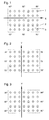
- reaction samples 1 shown are therefore different in the first groups tempered, the first groups the columns of the arrangement shown correspond. Within each first group (column) all reaction samples show 1 same temperature, there are different temperatures between the columns.
- FIG. 2 shows the temperature control device of FIG. 1 in the elongation step.
- the bottom line is on 70 °, the top line to 76 °.
- the intermediate lines have corresponding intermediate temperatures. So here are the reaction samples in second groups held at different temperatures, the second group being the rows correspond. From a comparison of Figures 1 and 2 it can be seen that in the two 1 and 2 steps shown all samples of a first group (Column) belong to different second groups (rows) and vice versa. In the flat representation, this means that the groups and also the temperature gradients are orthogonal to each other.
- Fig. 3 shows the same temperature control device in the execution of a third Step, namely the denaturing step.
- This step should also focus on the cheapest temperature can be optimized in a temperature range, which is 90 ° -96 ° in the example shown.
- the temperature gradient is here created in the Y direction.
- the three steps of annealing, elongation and denaturation form a sequence of steps, which is repeated several times for exponential amplification.
- Different annealing temperatures essentially influence the specificity of the reaction result. With specificity, the ratio of the correct amplified DNA pieces of correct length to incorrectly amplified DNA pieces of different lengths.
- the elongation temperature affects essentially the same evaluation parameter, namely the specificity. However, the denaturation temperature in the step according to FIG. 3 essentially influences the yield, that is the amount of the reaction material obtained.
- the temperature control device is therefore designed so that it is in the two steps Annealing (Fig 1) and elongation (Fig. 2), the same evaluation parameter influence that creates temperature gradients in independent directions X and Y.
- the step according to FIG. 3 denaturation
- the one deviating Evaluation parameter namely affects the yield
- the temperature gradient be placed in any direction. In the embodiment shown in Fig. 3 it lies in the Y direction. However, it can also lie in the X direction.
- FIGS. 1-3 shows an embodiment of the device of FIGS. 1-3 in the denaturing step, in the temperature range between 90 ° -96 °.
- the third groups of different temperatures are not row by row or arranged in columns, but in the form of the three surface areas shown, which are at the three temperatures 90 °, 93 ° and 96 °. The surface areas are divided by the range limits shown.
- Fig. 4 requires a slightly different construction.
- the invention is not restricted to the embodiment shown in FIGS. 1-4.
- FIG. 5 again shows a planar array arrangement of FIG Reaction samples arranged in rows and columns. Every reaction sample is shown with a number / letter combination. The numbers mean the columns and the letters the rows. A reaction test in the second Row and in the third column is therefore shown with 3b.
- FIG. 6 shows the same reaction samples shown in FIG. 5, but in FIG another, e.g., random arrangement. Even with such an arrangement, which, however, presupposes individual tempering of the reaction samples, can Laboratory temperature control device work according to the invention. You must z. B. with computer support determine the first groups (e.g. the numbers 1-4) and with one first step differently but temperate in itself and it must be in one second step second groups (letters) differ in groups but temper at the same temperature. If with the two In the two steps, the evaluation parameters are different Form any group of steps and temper them accordingly.
- first groups e.g. the numbers 1-4
- second groups letters
- the reaction samples are flat Arrays sorted in rows and columns. This facilitates in particular the use of conventional temperature control blocks, which are only used for the formation of Temperature gradients in the orthogonal direction, namely in the direction of the columns or lines are suitable. With other training of the facility, in particular, if equipped with individual temperature control for the individual reaction samples completely arbitrary arrangements can deviate from the line and column pattern can be selected.
- the invention is not applicable to devices with a two-dimensional arrangement Reaction samples limited.
- the reaction samples can also be three-dimensional be arranged, e.g. B. in a three-dimensional grid.
- three Optimize steps simultaneously in terms of their temperature all three the same Influence evaluation parameters. Is it a tempering process, which has more than three steps, so with additional steps the directions already used are used again, provided the evaluation parameters are independent.
- the three-dimensional arrangement mentioned can with individual heating of the samples, as in the two-dimensional example in the 5 and 6 are explained, resorted. There is also an arrangement in one Level possible on which the three-dimensional arrangement is mapped.
- an array of samples 1 is shown, which forms 5 rows and 7 columns, i.e. has a total of 35 samples. In order to determine the optimal temperatures for the three steps in one pass, 35 expensive samples must therefore be used.
- the resulting cross arrangement enables the impact of the applied Temperature gradients both in the X direction and in the Y direction a series of samples.
- the unoccupied sample places can stay empty.
- the laboratory temperature device can only be used in a special version be designed for the purpose of temperature optimization and then only those in the Figures 1 to 3 have underlined sample places.
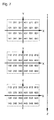
- FIG. 7 shows a further embodiment of a laboratory temperature control device, in of the reaction samples in an orthogonally ordered 3-dimensional arrangement with six columns, four rows and three levels.
- the three Levels that actually lie one above the other are shown side by side in FIG. 7, to simplify the overview.
- reaction samples are provided, which in Figure 7 with three-digit numbers are shown.
- the first digit means the column, the second digit the line and the third digit the level.
- Figure 7 Level all numbers end with 3 because this is the third level.
- the samples are made in a 3-dimensional block arranged thermally conductive material.
- gradients can be made in the X direction, Y direction or Z direction. If a gradient is created in the X direction, then samples with a lower number of columns are lower and samples with a higher number Column number at a higher temperature. If the gradient is applied in the Y direction, so it lies across the lines, bringing them to different temperatures. If the gradient is in the Z direction, the levels become different Brought temperature. The rows, columns or levels are that are at right angles to the respective gradient created.
- FIG. 8 shows an embodiment variant in which all the samples shown in FIG. 7 are used are arranged in the flat array shown. You can see, that here the three levels shown individually in Figure 7 side by side in one Are arranged, namely in the first six columns one above the other 7 and 8 column and the lowest 7 in rearrangement. With individual heating of the reaction samples or e.g. suitable subdivision of larger, not shown heating devices to the samples of the arrangement according to FIG. 8 gradually the same gradients be created, as explained for the embodiment of Figure 7.
- FIGS. 9 to 11 show a further embodiment of the laboratory temperature control device in three steps of a three-step sequence. It shows 9 the annealing step, FIG. 10 the elongation step and FIG. 11 the Denaturation.
- the temperatures indicated in the figures correspond the associated temperature ranges, which are already based on FIGS. 1 to 4 have been explained.
- FIGS. 9 to 11 there is the same flat array arrangement of reaction samples, each indicated with circles, shown.
- the reaction samples in six columns and four rows in orthogonal alignment arranged.
- the array surface is perpendicular first center line in two first partial areas (left and right of the center line) divided. Arrows are shown in the two partial areas formed in this way Temperature gradients created that correspond to those indicated with the numbers Temperature distribution.
- the columns on the right and left are on the outside at 40 °, the gaps near the first center line are at 60 °. It are the same gradients but with the opposite direction.
- Figure 11 shows the denaturation step.
- the two become four quadrants each formed from center lines shown in FIGS. 9 and 10 different temperature from 90 ° to 96 ° applied, i.e. in the temperature range required for denaturation.
- the optimal temperature in the step according to FIG. 9 were 50, according to FIG. 10 at 75 °, but different according to FIG. 11, for example at 96 °, would be so the sample for which all three temperatures are optimal, in the second column and the third line. Note that when in Fig. 9 the optimal temperature as mentioned at 50 °, then in the fifth line as well as in the second Line the optimal temperature prevails. In the selected example of FIG. 10 the optimal temperature is on the second line and also on the third line.
- Temperature control block worked according to the type of construction used in the DE 196 46 115 C2 is shown in Figures 1 to 3, then the temperature control block z. B. on its underside facing away from the samples with nine Peltier elements 3x3 arrangement. Thereby lie in both directions the middle Peltier elements under the center lines and heat each two neighboring quadrants from the edge. With this arrangement can be in different current applied to the Peltier elements alternately Achieve gradient temperature control according to FIG. 9 and FIG. 10.
- the heating that differs in quadrants according to FIG. 11 could be the underside of the temperature block additionally with heating foils covering the quadrants be provided in the step of FIG. 11 and when turned off Peltier elements individually bring the quadrants to the desired temperature.
- the Gradients can also be created in a different way. As shown in FIG. 9 the top right and bottom right quadrants with the same gradient acted in the same direction. The gradient could be in either of these Quadrants can also be created in the opposite direction. The same applies also for the quadrants at the top left and bottom. It can e.g. B in the upper left Quadrants the gradient with arrow to the left and bottom left the gradient with Right arrow. This consideration also applies to FIG. 10.
- this embodiment holds that in the four through the quadrants formed partial areas in the first and second step gradients in different Directions are created and all in the third step (Fig. 11) Samples of a partial area are at the same temperature. In the third step not four, as shown in Fig. 11, but e.g. six different temperatures accordingly, there are six in the manner described above Sub-areas to be treated required.
- a different temperature is and is present in each partial area in the other two steps, gradients are created over each partial area. Because it for each combination of different temperatures the different Steps gives a sample that has been treated with this temperature combination, with this arrangement, all interactions between the steps considered.
Landscapes
- Chemical & Material Sciences (AREA)
- Health & Medical Sciences (AREA)
- Clinical Laboratory Science (AREA)
- Chemical Kinetics & Catalysis (AREA)
- Life Sciences & Earth Sciences (AREA)
- Biochemistry (AREA)
- General Health & Medical Sciences (AREA)
- Molecular Biology (AREA)
- Physical Or Chemical Processes And Apparatus (AREA)
- Measuring Or Testing Involving Enzymes Or Micro-Organisms (AREA)
- Control Of Temperature (AREA)
- Control Of Heat Treatment Processes (AREA)
- Apparatus Associated With Microorganisms And Enzymes (AREA)
- Devices For Use In Laboratory Experiments (AREA)
- Automatic Analysis And Handling Materials Therefor (AREA)
- Feedback Control In General (AREA)
- Sampling And Sample Adjustment (AREA)
Abstract
Description
Es zeigen:
- Fig. 1
- eine stark schematisierte erfindungsgemäße Labortemperiereinrichtung in Draufsicht auf ein nach Zeilen und Spalten geordnetes zweidimensionales Array von Reaktionsproben mit einem in X-Richtung angelegten Temperaturgradienten für den Annealingschritt eines Standard PCR-Prozesses,
- Fig. 2
- die Ansicht nach Fig. 1 für den Elongationsschritt mit einem Temperaturgradient in Y-Richtung,
- Fig. 3
- eine Ansicht nach Fig. 1 für den Denaturierungsschritt mit einem Temperaturgradienten ebenfalls in Y-Richtung,
- Fig. 4
- eine Ansicht nach Fig. 1 für den Denaturierungsschritt mit einer Aufteilung des Arrays in drei flächig gestaltete Gruppen,
- Fig. 5
- die schematische Darstellung eines nach Zeilen und Spalten geordneten Arrays von Reaktionsproben, die ersten Gruppen (Zahlen) und zweiten Gruppen (Buchstaben) zugeordnet sind,
- Fig. 6
- eine Darstellung entsprechend Fig. 5 mit anderer Anordnung der Reaktionsproben,
- Fig. 7
- eine stark schematisierte erfindungsgemäße Labortemperiereinrichtung mit 3-dimensionaler Anordnung von Reaktionsproben, wobei drei Ebenen der 3-dimensionalen Anordnung in der Figur übereinander dargestellt sind,
- Fig. 8
- die Darstellung einer Anordnung der Proben der Ausführungsform der Figur 7 in einem Flächenarray und
- Fig. 9-11
- zeigen eine weitere Ausführungsform der Labortemperiereinrichtung mit den jeweils eingestellten Temperaturen bei drei Schritten.
Claims (14)
- Labortemperiereinrichtung zur gemeinsamen Temperierung von Reaktionsproben in mindestens zwei Schritten in jeweils zugeordneten bestimmten Temperaturbereichen, welche als Schrittfolge wiederholt nacheinander ausgeführt werden, wobei die Labortemperiereinrichtung in einem beliebig ausgewählten ersten Schritt der Schrittfolge mehrere jeweils wenigstens eine Probe enthaltende erste Gruppen von Proben auf innerhalb der Gruppen gleiche und zwischen den Gruppen unterschiedliche Temperaturen innerhalb des dem ersten Schritt zugeordneten ersten Temperaturbereiches bringt, dadurch gekennzeichnet, daß in einem beliebig ausgewählten zweiten Schritt der Schrittfolge, wenn das Reaktionsprodukt bei den beiden Schritten hinsichtlich gleicher Auswertparameter beeinflußt wird, bei mindestens einer der ersten Gruppen wenigstens zwei der Proben verschiedenen zweiten Gruppen angehören, die auf innerhalb der Gruppen gleiche und zwischen den Gruppen unterschiedliche Temperaturen innerhalb des dem zweiten Schritt zugeordneten zweiten Temperaturbereiches gebracht sind, und wobei, wenn die Auswertparameter unterschiedlich sind, wenigstens zwei beliebige der Proben unterschiedlichen dritten Gruppen angehören, die auf innerhalb der Gruppen gleiche und zwischen den Gruppen unterschiedliche Temperaturen innerhalb des dem zweiten Schritt zugeordneten zweiten Temperaturbereiches gebracht sind.
- Labortemperiereinrichtungen nach Anspruch 1, dadurch gekennzeichnet, daß bei zwei Schritten mit unterschiedlichen Auswertparametern alle Proben einer dritten Gruppe in einer ersten Gruppe enthalten sind oder alle Proben einer ersten Gruppe in einer dritten Gruppe enthalten sind.
- Labortemperiereinrichtungen nach Anspruch 1, dadurch gekennzeichnet, daß bei zwei Schritten mit gleichen Auswertparametern bei allen zweiten Gruppen jeweils alle Proben unterschiedlichen ersten Gruppen angehören.
- Labortemperiereinrichtungen nach Anspruch 1, dadurch gekennzeichnet, daß die Proben in einem Array in Zeilen und Spalten angeordnet sind.
- Labortemperiereinrichtungen nach Anspruch 4, dadurch gekennzeichnet, daß die Zeilen und Spalten orthogonal zueinander angeordnet sind.
- Labortemperiereinrichtungen nach Anspruch 4, dadurch gekennzeichnet, daß alle Proben einer Gruppe in einer Zeile oder in einer Spalte liegen.
- Labortemperiereinrichtungen nach Anspruch 1, dadurch gekennzeichnet, daß nur je eine der ersten und/oder zweiten und/oder dritten Gruppen mehrere Proben enthalten.
- Labortemperiereinrichtungen nach Anspruch 7, dadurch gekennzeichnet, daß die mehrere Proben enthaltenden Gruppen Proben derjenigen anderen Gruppen enthalten, die in ihrem jeweils zugeordneten Temperaturbereich in der Nähe der mittleren Temperatur liegen.
- Labortemperiereinrichtungen nach Anspruch 4, dadurch gekennzeichnet, daß die dritten Gruppen Teilbereiche des Arrays ausbilden, welche mit ihren Bereichsgrenzen nur jeweils Proben derselben dritten Gruppe umschließen.
- Labortemperiereinrichtungen nach Anspruch 1, dadurch gekennzeichnet, daß bei allen Schritten der Schrittfolge die Proben auf gruppenweise unterschiedliche Temperaturen im Bereich des zugeordneten Temperaturbereiches gebracht sind.
- Labortemperiereinrichtung zur gemeinsamen Temperierung von Reaktionsproben in mindestens drei Schritten in jeweils zugeordneten bestimmten Temperaturbereichen, welche als Schrittfolge wiederholt nacheinander ausgeführt werden, wobei die Labortemperiereinrichtung in einem beliebig ausgewählten ersten Schritt der Schrittfolge mehrere jeweils wenigstens eine Probe enthaltende erste Gruppen von Proben auf innerhalb der Gruppen gleiche und zwischen den Gruppen unterschiedliche Temperaturen innerhalb des dem ersten Schritt zugeordneten ersten Temperaturbereiches bringt, und wobei in einem beliebig ausgewählten zweiten Schritt der Schrittfolge bei mindestens einer der ersten Gruppen wenigstens zwei Proben verschiedenen zweiten Gruppen angehören, die auf innerhalb der Gruppen gleiche und zwischen den Gruppen unterschiedliche Temperaturen des dem zweiten Schritt zugeordneten zweiten Temperaturbereiches gebracht werden, dadurch gekennzeichnet, daß in einem beliebig ausgewählten dritten Schritt der Schrittfolge bei mindestens einer der ersten Gruppen und mindestens einer der zweiten Gruppen wenigstens jeweils zwei Proben verschiedenen dritten Gruppen angehören, die auf innerhalb der Gruppen gleiche und zwischen den Gruppen unterschiedliche Temperaturen innerhalb des dem dritten Schritt zugeordneten dritten Temperaturbereiches gebracht werden.
- Labortemperiereinrichtung nach Anspruch 11, dadurch gekennzeichnet, daß die Reaktionsproben 3-dimensional angeordnet sind und zur Erzeugung der unterschiedlichen Temperaturen für drei Schritte Temperaturgradienten in X-, Y- und Z-Richtung angelegt werden.
- Labortemperiereinrichtung nach Anspruch 11, dadurch gekennzeichnet, daß die Reaktionsproben in einer Fläche angeordnet sind.
- Labortemperiereinrichtung nach Anspruch 13, dadurch gekennzeichnet, daß in dem ersten Schritt die Fläche mit einer ersten Mittellinie in zwei erste Teilflächen geteilt ist, in denen jeweils gleiche Temperaturgradienten mit entgegengesetzter Richtung senkrecht zur Mittellinie angelegt sind, und daß in dem zweiten Schritt die Fläche mit einer zweiten Mittellinie, die senkrecht zur ersten Mittellinie steht, in zwei zweite Teilflächen geteilt ist, in denen jeweils gleiche Temperaturgradienten mit entgegengesetzter Richtung senkrecht zur Mittellinie angelegt sind, und daß in dem dritten Schritt in den durch die beiden Mittellinien gebildeten vier Quadranten der Fläche unterschiedliche Temperaturen angelegt sind.
Applications Claiming Priority (2)
| Application Number | Priority Date | Filing Date | Title |
|---|---|---|---|
| DE10062889A DE10062889A1 (de) | 2000-12-12 | 2000-12-12 | Labortemperiereinrichtung zur Temperierung auf unterschiedliche Temperaturen |
| DE10062889 | 2000-12-12 |
Publications (3)
| Publication Number | Publication Date |
|---|---|
| EP1214978A2 true EP1214978A2 (de) | 2002-06-19 |
| EP1214978A3 EP1214978A3 (de) | 2003-11-19 |
| EP1214978B1 EP1214978B1 (de) | 2006-06-21 |
Family
ID=7667517
Family Applications (1)
| Application Number | Title | Priority Date | Filing Date |
|---|---|---|---|
| EP01125514A Expired - Lifetime EP1214978B1 (de) | 2000-12-12 | 2001-10-25 | Verfahren zur Temperierung von Proben auf unterschiedliche Temperaturen in einer Labortemperiereinrichtung |
Country Status (5)
| Country | Link |
|---|---|
| US (2) | US20020142349A1 (de) |
| EP (1) | EP1214978B1 (de) |
| JP (1) | JP2002233774A (de) |
| AT (1) | ATE330705T1 (de) |
| DE (2) | DE10062889A1 (de) |
Cited By (1)
| Publication number | Priority date | Publication date | Assignee | Title |
|---|---|---|---|---|
| CN103175811A (zh) * | 2011-12-20 | 2013-06-26 | 霍夫曼-拉罗奇有限公司 | 用于核酸测试的改良方法 |
Families Citing this family (4)
| Publication number | Priority date | Publication date | Assignee | Title |
|---|---|---|---|---|
| US7452712B2 (en) | 2002-07-30 | 2008-11-18 | Applied Biosystems Inc. | Sample block apparatus and method of maintaining a microcard on a sample block |
| US20050237528A1 (en) * | 2003-09-19 | 2005-10-27 | Oldham Mark F | Transparent heater for thermocycling |
| US7570443B2 (en) * | 2003-09-19 | 2009-08-04 | Applied Biosystems, Llc | Optical camera alignment |
| US9188514B1 (en) * | 2013-05-23 | 2015-11-17 | The United States Of America As Represented By The Secretary Of The Navy | System and method for producing a sample having a monotonic doping gradient of a diffusive constituent or interstitial atom or molecule |
Family Cites Families (13)
| Publication number | Priority date | Publication date | Assignee | Title |
|---|---|---|---|---|
| GB1323309A (en) * | 1969-12-24 | 1973-07-11 | Toyo Kagaku Sangyo Kk Nobe A | Apparatus for establishing temperature gradients in specimen containers |
| FI77055C (fi) * | 1987-05-15 | 1989-01-10 | Limitek Oy | Vaermegradient-inkubator. |
| FI81831C (fi) * | 1989-03-06 | 1990-12-10 | Biodata Oy | Temperaturgradient-inkubator foer undersoekning av temperaturavhaengiga fenomen. |
| US5255976A (en) * | 1992-07-10 | 1993-10-26 | Vertex Pharmaceuticals Incorporated | Temperature gradient calorimeter |
| US5525300A (en) * | 1993-10-20 | 1996-06-11 | Stratagene | Thermal cycler including a temperature gradient block |
| DE29623597U1 (de) * | 1996-11-08 | 1999-01-07 | Eppendorf - Netheler - Hinz Gmbh, 22339 Hamburg | Temperierblock mit Temperiereinrichtungen |
| DE19646115C2 (de) * | 1996-11-08 | 2000-05-25 | Eppendorf Geraetebau Netheler | Verwendung von Temperiereinrichtungen zur Temperierung eines Temperierblockes |
| GB9720926D0 (en) * | 1997-10-03 | 1997-12-03 | Molecular Sensors Ltd | Intelligent control of nucleic amplification procedures including the polymerase chain reaction |
| US6337435B1 (en) * | 1999-07-30 | 2002-01-08 | Bio-Rad Laboratories, Inc. | Temperature control for multi-vessel reaction apparatus |
| DE29917313U1 (de) * | 1999-10-01 | 2001-02-15 | MWG-BIOTECH AG, 85560 Ebersberg | Vorrichtung zur Durchführung chemischer oder biologischer Reaktionen |
| US20020006619A1 (en) * | 2000-02-23 | 2002-01-17 | David Cohen | Thermal cycler that allows two-dimension temperature gradients and hold time optimization |
| US7727479B2 (en) * | 2000-09-29 | 2010-06-01 | Applied Biosystems, Llc | Device for the carrying out of chemical or biological reactions |
| DE10062890A1 (de) * | 2000-12-12 | 2002-06-27 | Eppendorf Ag | Labortemperiereinrichtung zur Temperierung von Reaktionsproben |
-
2000
- 2000-12-12 DE DE10062889A patent/DE10062889A1/de not_active Withdrawn
-
2001
- 2001-10-25 EP EP01125514A patent/EP1214978B1/de not_active Expired - Lifetime
- 2001-10-25 AT AT01125514T patent/ATE330705T1/de not_active IP Right Cessation
- 2001-10-25 DE DE50110234T patent/DE50110234D1/de not_active Expired - Lifetime
- 2001-12-03 JP JP2001368374A patent/JP2002233774A/ja not_active Withdrawn
-
2002
- 2002-02-19 US US10/015,001 patent/US20020142349A1/en not_active Abandoned
-
2005
- 2005-04-20 US US11/110,568 patent/US20050196873A1/en not_active Abandoned
Cited By (2)
| Publication number | Priority date | Publication date | Assignee | Title |
|---|---|---|---|---|
| CN103175811A (zh) * | 2011-12-20 | 2013-06-26 | 霍夫曼-拉罗奇有限公司 | 用于核酸测试的改良方法 |
| CN103175811B (zh) * | 2011-12-20 | 2017-05-03 | 霍夫曼-拉罗奇有限公司 | 用于核酸测试的改良方法 |
Also Published As
| Publication number | Publication date |
|---|---|
| US20050196873A1 (en) | 2005-09-08 |
| EP1214978A3 (de) | 2003-11-19 |
| DE10062889A1 (de) | 2002-06-27 |
| US20020142349A1 (en) | 2002-10-03 |
| EP1214978B1 (de) | 2006-06-21 |
| ATE330705T1 (de) | 2006-07-15 |
| DE50110234D1 (de) | 2006-08-03 |
| JP2002233774A (ja) | 2002-08-20 |
Similar Documents
| Publication | Publication Date | Title |
|---|---|---|
| EP0977037B1 (de) | Magnetseparator | |
| EP1216098B1 (de) | Vorrichtung zur durchführung chemischer oder biologischer reaktionen | |
| EP0936945B1 (de) | Temperierblock mit aufnahmen | |
| DE3214317A1 (de) | Mikrotiterplatte | |
| WO1998020975A1 (de) | Temperierblock mit temperiereinrichtungen | |
| DE19646115C2 (de) | Verwendung von Temperiereinrichtungen zur Temperierung eines Temperierblockes | |
| DE102006059851A1 (de) | Verfahren zum Herstellen eines dreidimensionalen Bauteils | |
| EP1340244A2 (de) | Verfahren zum thermischen behandeln von substraten | |
| EP1214978B1 (de) | Verfahren zur Temperierung von Proben auf unterschiedliche Temperaturen in einer Labortemperiereinrichtung | |
| DE102009007826A1 (de) | Heizvorrichtung zur Erwärmung einer metallenen Platine | |
| DE10228431B4 (de) | Laborprobentemperiervorrichtung mit Aufnahmen | |
| EP1214969A1 (de) | Labortemperiereinrichtung zur Temperierung von Reaktionsproben | |
| EP1207960B1 (de) | Nadel und verfahren zum transfer von liquiden sowie verfahren zum herstellen der nadel | |
| WO2002081089A1 (de) | Aufnahmevorrichtung für objektträger | |
| DE20303538U1 (de) | Gefässsystem zur Bearbeitung und/oder Aufbewahrung von Flüssigkeiten | |
| EP1228804B1 (de) | Vorrichtung zur Temperierung von Reaktionsproben | |
| DE102019134003A1 (de) | Verfahren und Vorrichtung zum Kultivieren biologischer Zellen | |
| DE102005044021A1 (de) | Labortemperiereinrichtung mit Oberseite | |
| DE602005002881T2 (de) | Vorrichtung und Verfahren zum Ordnen von Kugeln | |
| DE10241007B4 (de) | Verfahren zum Verteilen von Flüssigkeitsproben | |
| DE19655141B4 (de) | Gradienten-Temperierblock für Laborthermostaten | |
| DE20221055U1 (de) | Thermocycler mit in Zyklen angesteuertem Temperierblock | |
| DE69113953T2 (de) | Verfahren zum Erhitzen und Biegen einer Glasscheibe. | |
| DE19957320A1 (de) | Dynamische Sequenzierung durch Hybridisierung | |
| DE19655282B4 (de) | Temperierblock mit Temperiereinrichtungen |
Legal Events
| Date | Code | Title | Description |
|---|---|---|---|
| PUAI | Public reference made under article 153(3) epc to a published international application that has entered the european phase |
Free format text: ORIGINAL CODE: 0009012 |
|
| AK | Designated contracting states |
Kind code of ref document: A2 Designated state(s): AT BE CH CY DE DK ES FI FR GB GR IE IT LI LU MC NL PT SE TR |
|
| AX | Request for extension of the european patent |
Free format text: AL;LT;LV;MK;RO;SI |
|
| 17P | Request for examination filed |
Effective date: 20021126 |
|
| PUAL | Search report despatched |
Free format text: ORIGINAL CODE: 0009013 |
|
| AK | Designated contracting states |
Kind code of ref document: A3 Designated state(s): AT BE CH CY DE DK ES FI FR GB GR IE IT LI LU MC NL PT SE TR |
|
| AX | Request for extension of the european patent |
Extension state: AL LT LV MK RO SI |
|
| AKX | Designation fees paid |
Designated state(s): AT BE CH CY DE DK ES FI FR GB GR IE IT LI LU MC NL PT SE TR |
|
| 17Q | First examination report despatched |
Effective date: 20040830 |
|
| RTI1 | Title (correction) |
Free format text: METHOD OF HEATING SAMPLES AT MULTIPLE TEMPERATURES IN A LABORATORY THERMAL CONDITIONING DEVICE |
|
| GRAP | Despatch of communication of intention to grant a patent |
Free format text: ORIGINAL CODE: EPIDOSNIGR1 |
|
| GRAS | Grant fee paid |
Free format text: ORIGINAL CODE: EPIDOSNIGR3 |
|
| GRAA | (expected) grant |
Free format text: ORIGINAL CODE: 0009210 |
|
| AK | Designated contracting states |
Kind code of ref document: B1 Designated state(s): AT BE CH CY DE DK ES FI FR GB GR IE IT LI LU MC NL PT SE TR |
|
| PG25 | Lapsed in a contracting state [announced via postgrant information from national office to epo] |
Ref country code: IT Free format text: LAPSE BECAUSE OF FAILURE TO SUBMIT A TRANSLATION OF THE DESCRIPTION OR TO PAY THE FEE WITHIN THE PRESCRIBED TIME-LIMIT;WARNING: LAPSES OF ITALIAN PATENTS WITH EFFECTIVE DATE BEFORE 2007 MAY HAVE OCCURRED AT ANY TIME BEFORE 2007. THE CORRECT EFFECTIVE DATE MAY BE DIFFERENT FROM THE ONE RECORDED. Effective date: 20060621 Ref country code: NL Free format text: LAPSE BECAUSE OF FAILURE TO SUBMIT A TRANSLATION OF THE DESCRIPTION OR TO PAY THE FEE WITHIN THE PRESCRIBED TIME-LIMIT Effective date: 20060621 Ref country code: IE Free format text: LAPSE BECAUSE OF FAILURE TO SUBMIT A TRANSLATION OF THE DESCRIPTION OR TO PAY THE FEE WITHIN THE PRESCRIBED TIME-LIMIT Effective date: 20060621 Ref country code: FI Free format text: LAPSE BECAUSE OF FAILURE TO SUBMIT A TRANSLATION OF THE DESCRIPTION OR TO PAY THE FEE WITHIN THE PRESCRIBED TIME-LIMIT Effective date: 20060621 |
|
| REG | Reference to a national code |
Ref country code: GB Ref legal event code: FG4D Free format text: NOT ENGLISH |
|
| REG | Reference to a national code |
Ref country code: CH Ref legal event code: EP |
|
| REG | Reference to a national code |
Ref country code: IE Ref legal event code: FG4D Free format text: LANGUAGE OF EP DOCUMENT: GERMAN |
|
| REF | Corresponds to: |
Ref document number: 50110234 Country of ref document: DE Date of ref document: 20060803 Kind code of ref document: P |
|
| PG25 | Lapsed in a contracting state [announced via postgrant information from national office to epo] |
Ref country code: DK Free format text: LAPSE BECAUSE OF FAILURE TO SUBMIT A TRANSLATION OF THE DESCRIPTION OR TO PAY THE FEE WITHIN THE PRESCRIBED TIME-LIMIT Effective date: 20060921 Ref country code: SE Free format text: LAPSE BECAUSE OF FAILURE TO SUBMIT A TRANSLATION OF THE DESCRIPTION OR TO PAY THE FEE WITHIN THE PRESCRIBED TIME-LIMIT Effective date: 20060921 |
|
| PG25 | Lapsed in a contracting state [announced via postgrant information from national office to epo] |
Ref country code: ES Free format text: LAPSE BECAUSE OF FAILURE TO SUBMIT A TRANSLATION OF THE DESCRIPTION OR TO PAY THE FEE WITHIN THE PRESCRIBED TIME-LIMIT Effective date: 20061002 |
|
| GBT | Gb: translation of ep patent filed (gb section 77(6)(a)/1977) |
Effective date: 20060923 |
|
| PG25 | Lapsed in a contracting state [announced via postgrant information from national office to epo] |
Ref country code: MC Free format text: LAPSE BECAUSE OF NON-PAYMENT OF DUE FEES Effective date: 20061031 Ref country code: LI Free format text: LAPSE BECAUSE OF NON-PAYMENT OF DUE FEES Effective date: 20061031 Ref country code: CH Free format text: LAPSE BECAUSE OF NON-PAYMENT OF DUE FEES Effective date: 20061031 |
|
| ET | Fr: translation filed | ||
| PG25 | Lapsed in a contracting state [announced via postgrant information from national office to epo] |
Ref country code: PT Free format text: LAPSE BECAUSE OF FAILURE TO SUBMIT A TRANSLATION OF THE DESCRIPTION OR TO PAY THE FEE WITHIN THE PRESCRIBED TIME-LIMIT Effective date: 20061121 |
|
| NLV1 | Nl: lapsed or annulled due to failure to fulfill the requirements of art. 29p and 29m of the patents act | ||
| REG | Reference to a national code |
Ref country code: IE Ref legal event code: FD4D |
|
| PLBE | No opposition filed within time limit |
Free format text: ORIGINAL CODE: 0009261 |
|
| STAA | Information on the status of an ep patent application or granted ep patent |
Free format text: STATUS: NO OPPOSITION FILED WITHIN TIME LIMIT |
|
| 26N | No opposition filed |
Effective date: 20070322 |
|
| REG | Reference to a national code |
Ref country code: CH Ref legal event code: PL |
|
| BERE | Be: lapsed |
Owner name: EPPENDORF A.G. Effective date: 20061031 |
|
| PG25 | Lapsed in a contracting state [announced via postgrant information from national office to epo] |
Ref country code: AT Free format text: LAPSE BECAUSE OF NON-PAYMENT OF DUE FEES Effective date: 20061025 |
|
| PG25 | Lapsed in a contracting state [announced via postgrant information from national office to epo] |
Ref country code: GR Free format text: LAPSE BECAUSE OF FAILURE TO SUBMIT A TRANSLATION OF THE DESCRIPTION OR TO PAY THE FEE WITHIN THE PRESCRIBED TIME-LIMIT Effective date: 20060922 |
|
| PG25 | Lapsed in a contracting state [announced via postgrant information from national office to epo] |
Ref country code: TR Free format text: LAPSE BECAUSE OF FAILURE TO SUBMIT A TRANSLATION OF THE DESCRIPTION OR TO PAY THE FEE WITHIN THE PRESCRIBED TIME-LIMIT Effective date: 20060621 Ref country code: LU Free format text: LAPSE BECAUSE OF NON-PAYMENT OF DUE FEES Effective date: 20061025 |
|
| PG25 | Lapsed in a contracting state [announced via postgrant information from national office to epo] |
Ref country code: CY Free format text: LAPSE BECAUSE OF FAILURE TO SUBMIT A TRANSLATION OF THE DESCRIPTION OR TO PAY THE FEE WITHIN THE PRESCRIBED TIME-LIMIT Effective date: 20060621 |
|
| PG25 | Lapsed in a contracting state [announced via postgrant information from national office to epo] |
Ref country code: BE Free format text: LAPSE BECAUSE OF FAILURE TO SUBMIT A TRANSLATION OF THE DESCRIPTION OR TO PAY THE FEE WITHIN THE PRESCRIBED TIME-LIMIT Effective date: 20061031 |
|
| REG | Reference to a national code |
Ref country code: FR Ref legal event code: PLFP Year of fee payment: 15 |
|
| REG | Reference to a national code |
Ref country code: DE Ref legal event code: R082 Ref document number: 50110234 Country of ref document: DE Representative=s name: MEISSNER BOLTE & PARTNER GBR, DE Ref country code: DE Ref legal event code: R082 Ref document number: 50110234 Country of ref document: DE Representative=s name: MEISSNER BOLTE PATENTANWAELTE RECHTSANWAELTE P, DE |
|
| REG | Reference to a national code |
Ref country code: FR Ref legal event code: PLFP Year of fee payment: 16 |
|
| PGFP | Annual fee paid to national office [announced via postgrant information from national office to epo] |
Ref country code: GB Payment date: 20161028 Year of fee payment: 16 Ref country code: FR Payment date: 20161028 Year of fee payment: 16 Ref country code: DE Payment date: 20161028 Year of fee payment: 16 |
|
| REG | Reference to a national code |
Ref country code: DE Ref legal event code: R119 Ref document number: 50110234 Country of ref document: DE |
|
| GBPC | Gb: european patent ceased through non-payment of renewal fee |
Effective date: 20171025 |
|
| REG | Reference to a national code |
Ref country code: FR Ref legal event code: ST Effective date: 20180629 |
|
| PG25 | Lapsed in a contracting state [announced via postgrant information from national office to epo] |
Ref country code: DE Free format text: LAPSE BECAUSE OF NON-PAYMENT OF DUE FEES Effective date: 20180501 Ref country code: GB Free format text: LAPSE BECAUSE OF NON-PAYMENT OF DUE FEES Effective date: 20171025 |
|
| PG25 | Lapsed in a contracting state [announced via postgrant information from national office to epo] |
Ref country code: FR Free format text: LAPSE BECAUSE OF NON-PAYMENT OF DUE FEES Effective date: 20171031 |