EP1211298A2 - Pressure-sensitive adhesive composition, pressure-sensitive adhesive sheet, and optical film - Google Patents
Pressure-sensitive adhesive composition, pressure-sensitive adhesive sheet, and optical film Download PDFInfo
- Publication number
- EP1211298A2 EP1211298A2 EP01128426A EP01128426A EP1211298A2 EP 1211298 A2 EP1211298 A2 EP 1211298A2 EP 01128426 A EP01128426 A EP 01128426A EP 01128426 A EP01128426 A EP 01128426A EP 1211298 A2 EP1211298 A2 EP 1211298A2
- Authority
- EP
- European Patent Office
- Prior art keywords
- pressure
- sensitive adhesive
- optical film
- aromatic ring
- adhesive layer
- Prior art date
- Legal status (The legal status is an assumption and is not a legal conclusion. Google has not performed a legal analysis and makes no representation as to the accuracy of the status listed.)
- Withdrawn
Links
Images

Classifications
-
- C—CHEMISTRY; METALLURGY
- C09—DYES; PAINTS; POLISHES; NATURAL RESINS; ADHESIVES; COMPOSITIONS NOT OTHERWISE PROVIDED FOR; APPLICATIONS OF MATERIALS NOT OTHERWISE PROVIDED FOR
- C09D—COATING COMPOSITIONS, e.g. PAINTS, VARNISHES OR LACQUERS; FILLING PASTES; CHEMICAL PAINT OR INK REMOVERS; INKS; CORRECTING FLUIDS; WOODSTAINS; PASTES OR SOLIDS FOR COLOURING OR PRINTING; USE OF MATERIALS THEREFOR
- C09D133/00—Coating compositions based on homopolymers or copolymers of compounds having one or more unsaturated aliphatic radicals, each having only one carbon-to-carbon double bond, and at least one being terminated by only one carboxyl radical, or of salts, anhydrides, esters, amides, imides, or nitriles thereof; Coating compositions based on derivatives of such polymers
-
- C—CHEMISTRY; METALLURGY
- C09—DYES; PAINTS; POLISHES; NATURAL RESINS; ADHESIVES; COMPOSITIONS NOT OTHERWISE PROVIDED FOR; APPLICATIONS OF MATERIALS NOT OTHERWISE PROVIDED FOR
- C09J—ADHESIVES; NON-MECHANICAL ASPECTS OF ADHESIVE PROCESSES IN GENERAL; ADHESIVE PROCESSES NOT PROVIDED FOR ELSEWHERE; USE OF MATERIALS AS ADHESIVES
- C09J133/00—Adhesives based on homopolymers or copolymers of compounds having one or more unsaturated aliphatic radicals, each having only one carbon-to-carbon double bond, and at least one being terminated by only one carboxyl radical, or of salts, anhydrides, esters, amides, imides, or nitriles thereof; Adhesives based on derivatives of such polymers
- C09J133/04—Homopolymers or copolymers of esters
- C09J133/06—Homopolymers or copolymers of esters of esters containing only carbon, hydrogen and oxygen, the oxygen atom being present only as part of the carboxyl radical
-
- C—CHEMISTRY; METALLURGY
- C08—ORGANIC MACROMOLECULAR COMPOUNDS; THEIR PREPARATION OR CHEMICAL WORKING-UP; COMPOSITIONS BASED THEREON
- C08F—MACROMOLECULAR COMPOUNDS OBTAINED BY REACTIONS ONLY INVOLVING CARBON-TO-CARBON UNSATURATED BONDS
- C08F220/00—Copolymers of compounds having one or more unsaturated aliphatic radicals, each having only one carbon-to-carbon double bond, and only one being terminated by only one carboxyl radical or a salt, anhydride ester, amide, imide or nitrile thereof
- C08F220/02—Monocarboxylic acids having less than ten carbon atoms; Derivatives thereof
- C08F220/10—Esters
- C08F220/26—Esters containing oxygen in addition to the carboxy oxygen
- C08F220/30—Esters containing oxygen in addition to the carboxy oxygen containing aromatic rings in the alcohol moiety
- C08F220/301—Esters containing oxygen in addition to the carboxy oxygen containing aromatic rings in the alcohol moiety and one oxygen in the alcohol moiety
-
- C—CHEMISTRY; METALLURGY
- C09—DYES; PAINTS; POLISHES; NATURAL RESINS; ADHESIVES; COMPOSITIONS NOT OTHERWISE PROVIDED FOR; APPLICATIONS OF MATERIALS NOT OTHERWISE PROVIDED FOR
- C09J—ADHESIVES; NON-MECHANICAL ASPECTS OF ADHESIVE PROCESSES IN GENERAL; ADHESIVE PROCESSES NOT PROVIDED FOR ELSEWHERE; USE OF MATERIALS AS ADHESIVES
- C09J7/00—Adhesives in the form of films or foils
- C09J7/10—Adhesives in the form of films or foils without carriers
-
- C—CHEMISTRY; METALLURGY
- C09—DYES; PAINTS; POLISHES; NATURAL RESINS; ADHESIVES; COMPOSITIONS NOT OTHERWISE PROVIDED FOR; APPLICATIONS OF MATERIALS NOT OTHERWISE PROVIDED FOR
- C09J—ADHESIVES; NON-MECHANICAL ASPECTS OF ADHESIVE PROCESSES IN GENERAL; ADHESIVE PROCESSES NOT PROVIDED FOR ELSEWHERE; USE OF MATERIALS AS ADHESIVES
- C09J7/00—Adhesives in the form of films or foils
- C09J7/30—Adhesives in the form of films or foils characterised by the adhesive composition
- C09J7/38—Pressure-sensitive adhesives [PSA]
- C09J7/381—Pressure-sensitive adhesives [PSA] based on macromolecular compounds obtained by reactions involving only carbon-to-carbon unsaturated bonds
- C09J7/385—Acrylic polymers
-
- C—CHEMISTRY; METALLURGY
- C08—ORGANIC MACROMOLECULAR COMPOUNDS; THEIR PREPARATION OR CHEMICAL WORKING-UP; COMPOSITIONS BASED THEREON
- C08F—MACROMOLECULAR COMPOUNDS OBTAINED BY REACTIONS ONLY INVOLVING CARBON-TO-CARBON UNSATURATED BONDS
- C08F220/00—Copolymers of compounds having one or more unsaturated aliphatic radicals, each having only one carbon-to-carbon double bond, and only one being terminated by only one carboxyl radical or a salt, anhydride ester, amide, imide or nitrile thereof
- C08F220/02—Monocarboxylic acids having less than ten carbon atoms; Derivatives thereof
- C08F220/10—Esters
- C08F220/12—Esters of monohydric alcohols or phenols
- C08F220/16—Esters of monohydric alcohols or phenols of phenols or of alcohols containing two or more carbon atoms
- C08F220/18—Esters of monohydric alcohols or phenols of phenols or of alcohols containing two or more carbon atoms with acrylic or methacrylic acids
- C08F220/1804—C4-(meth)acrylate, e.g. butyl (meth)acrylate, isobutyl (meth)acrylate or tert-butyl (meth)acrylate
-
- C—CHEMISTRY; METALLURGY
- C09—DYES; PAINTS; POLISHES; NATURAL RESINS; ADHESIVES; COMPOSITIONS NOT OTHERWISE PROVIDED FOR; APPLICATIONS OF MATERIALS NOT OTHERWISE PROVIDED FOR
- C09J—ADHESIVES; NON-MECHANICAL ASPECTS OF ADHESIVE PROCESSES IN GENERAL; ADHESIVE PROCESSES NOT PROVIDED FOR ELSEWHERE; USE OF MATERIALS AS ADHESIVES
- C09J2301/00—Additional features of adhesives in the form of films or foils
- C09J2301/30—Additional features of adhesives in the form of films or foils characterized by the chemical, physicochemical or physical properties of the adhesive or the carrier
- C09J2301/302—Additional features of adhesives in the form of films or foils characterized by the chemical, physicochemical or physical properties of the adhesive or the carrier the adhesive being pressure-sensitive, i.e. tacky at temperatures inferior to 30°C
-
- Y—GENERAL TAGGING OF NEW TECHNOLOGICAL DEVELOPMENTS; GENERAL TAGGING OF CROSS-SECTIONAL TECHNOLOGIES SPANNING OVER SEVERAL SECTIONS OF THE IPC; TECHNICAL SUBJECTS COVERED BY FORMER USPC CROSS-REFERENCE ART COLLECTIONS [XRACs] AND DIGESTS
- Y10—TECHNICAL SUBJECTS COVERED BY FORMER USPC
- Y10T—TECHNICAL SUBJECTS COVERED BY FORMER US CLASSIFICATION
- Y10T428/00—Stock material or miscellaneous articles
- Y10T428/28—Web or sheet containing structurally defined element or component and having an adhesive outermost layer
- Y10T428/2839—Web or sheet containing structurally defined element or component and having an adhesive outermost layer with release or antistick coating
Definitions
- the present invention relates to a pressure-sensitive adhesive composition and a pressure-sensitive adhesive sheet used to stick and fix the optical film on the display panel of a liquid crystal display device and the like, and an optical film.
- Adhesive compositions containing acrylic polymers have hitherto been used as pressure-sensitive adhesive compositions used to laminate various optical films such as antireflection films and electrically conductive films (ITO films) to the display panels of liquid crystal display devices.
- the display panels on which these optical films are stuck are widely used for mobile communication terminals (mobile-type telephone terminals of portable telephones and PHS phones and PDA terminals).
- film light-guiding sheets As optical films for the purpose of such lightening and thinning.
- the "film light-guiding sheets,” which are used for liquid crystal display devices, are the optical films that have a function of allowing outgoing of light transmitted in the lateral direction to the upside or the downside inside the liquid crystal panels and that are able to carry out lighting with ease when luminous sources are arranged on the sides of the liquid crystal display devices.
- the film light-guiding sheets are thought effective in lightening and thinning of apparatus because the sheets are thin as compared with conventional light-guiding sheets.
- the display panels of liquid crystal display devices have structure where a plurality of optical members such as glass bases, polarizing films, and retardation films are laminated together with liquid crystal. Furthermore, the optical films also are stuck on the optical members constituting these display panels when used, and accordingly prevention of total reflection is expected at the respective interfaces of any two of optical film, pressure-sensitive adhesive layer and optical member in view of effective employment of light.
- the refractive indexes of materials for use in the optical films and the optical members in general are about 1.52 in glass, about 1.51 in methacrylic resin, and 1.54 in polycarbonate.
- the refractive indexes of conventional pressure-sensitive adhesive compositions are about 1.47 after drying, after curing or after drying and curing, and fail to reach values as high as 1.49 or more. Therefore, the difference in refractive index is produced at the interface of optical film and pressure-sensitive adhesive layer or the interface of pressure-sensitive adhesive layer and optical member to cause the total reflection at a shallow angle, which introduces a problem of inhibiting the effective employment of light.
- An object of the invention is to provide pressure-sensitive adhesive compositions that can reduce the total reflection of light at the respective interfaces of any two of optical film, pressure-sensitive adhesive layer and optical member when the various optical films are stuck on various optical members constituting display devices by use of the pressure-sensitive adhesives, and pressure-sensitive adhesive sheets which comprises pressure-sensitive adhesive layers comprising the pressure-sensitive adhesive compositions.
- Another object of the invention is to provide pressure-sensitive adhesive compositions whose refractive indexes after drying, after curing or after drying and curing are as high as those of the optical films and the optical members, and pressure-sensitive adhesive sheets which comprises pressure-sensitive adhesive layers comprising the pressure-sensitive adhesive compositions.
- the other object of the invention is to provide optical films that can reduce the total reflection at the respective interfaces of any two of optical film, pressure-sensitive adhesive layer and optical member to achieve the effective employment of light.
- the present inventor has intensively studied to achieve the above objects and as a result, found that use of a particular monomer component as a monomer unit for the pressure-sensitive adhesive compositions makes it possible to acquire high refractive indexes after drying, after curing or after drying and curing to obtain pressure-sensitive adhesive compositions having refractive indexes close to those of the optical films and optical members, thus accomplishing the invention.
- the invention provides a pressure-sensitive adhesive composition which comprises as a main component an acrylic polymer comprising as a monomer unit an aromatic ring-containing copolymerizable monomer, wherein the refractive index of the composition after drying, after curing or after drying and curing is 1.49 or more and 1.60 or less.
- the aromatic ring-containing copolymerizable monomer is at least one of an aromatic ring-containing acrylic monomer and a styrene-series monomer.
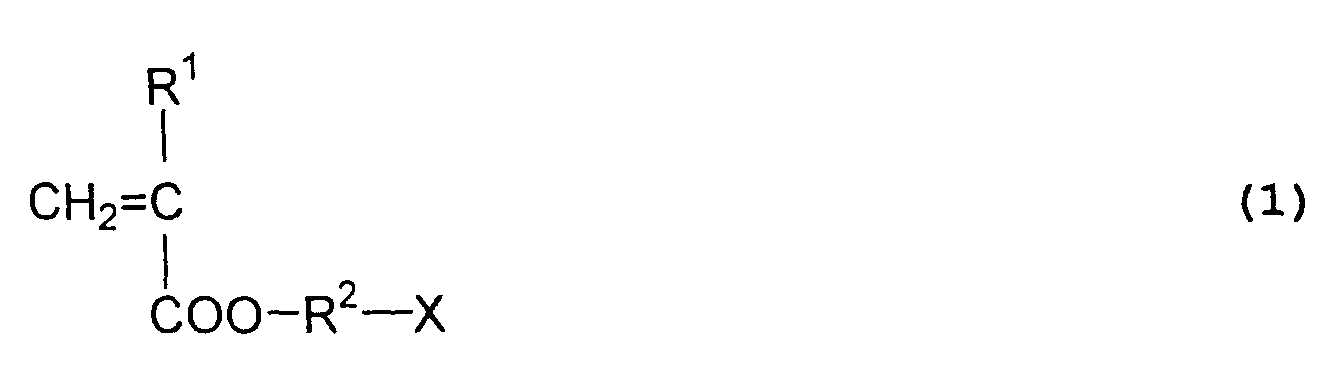
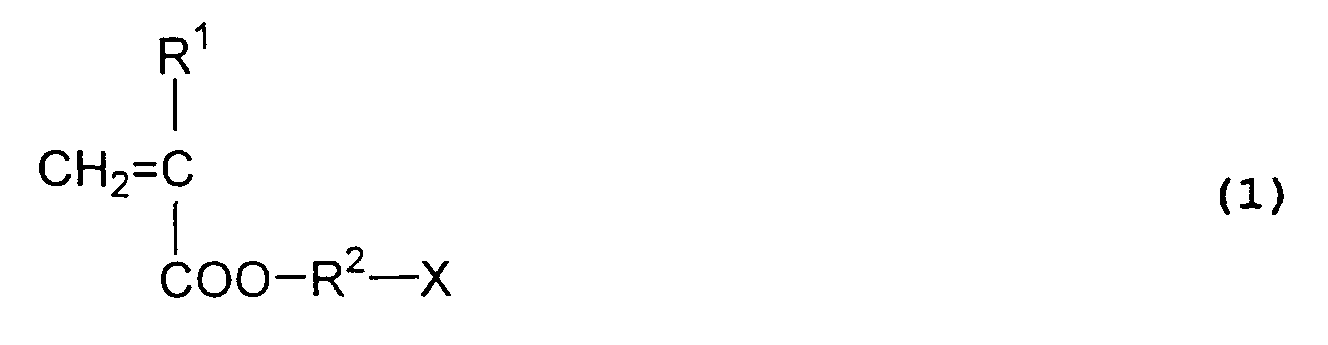
- the aromatic ring-containing acrylic monomer is preferably an aromatic ring-containing alkyl (meth)acrylate represented by the following formula (1): wherein R 1 represents a hydrogen atom or a methyl group; R 2 represents an alkylene group or -R 3 - (OR 3 ) n - where R 3 represents an alkylene group, and n represents a positive integer; and X represents an aryl group or an aryloxy group.
- R 1 represents a hydrogen atom or a methyl group
- R 2 represents an alkylene group or -R 3 - (OR 3 ) n - where R 3 represents an alkylene group, and n represents a positive integer
- X represents an aryl group or an aryloxy group.
- the invention also provides a pressure-sensitive adhesive sheet used to stick and fix an optical film on the display panel of a display device, wherein a pressure-sensitive adhesive layer comprising the aforesaid pressure-sensitive adhesive composition is formed on a release liner.
- the invention provides an optical film which comprises an optical film used to stick and fix on the display panel of a display device having formed on one side thereof a pressure-sensitive adhesive layer comprising the aforesaid pressure-sensitive adhesive composition.
- the aromatic ring-containing copolymerizable monomers used as monomers are not particularly limited as long as the monomers are copolymerizable monomers containing aromatic rings in molecules.
- aromatic ring-containing ethylenic unsaturated monomers are preferably used as the aromatic ring-containing copolymerizable monomers.
- the aromatic ring-containing copolymerizable monomers can be used singly or as mixtures of two or more thereof.
- aromatic ring-containing copolymerizable monomers examples include aromatic ring-containing acrylic monomers and styrene-series monomers.
- aromatic ring-containing acrylic monomers are not particularly limited as long as the monomers are acrylic monomers containing aromatic rings in molecules.
- Preferred aromatic ring-containing acrylic monomers are aromatic ring-containing (meth)acrylates, examples of which include aromatic ring-containing alkyl (meth)acrylates and aryl (meth)acrylates (phenyl (meth)acrylates, and the like).
- aromatic ring-containing (meth)acrylates aromatic ring-containing alkyl (meth)acrylates are particularly preferred.
- the term "(meth)acrylate” as used herein refers to both an acrylate and a methacrylate.
- (meth)acrylic acid” as used herein refers to both an acrylic acid and a methacrylic acid.
- R 1 represents a hydrogen atom or a methyl group
- R 2 represents an alkylene group or -R 3 -(OR 3 ) n -, where R 3 represents an alkylene group, and n represents a positive integer
- X represents an aryl group or an aryloxy group.
- alkylene group represented by R 2 examples include alkylene groups having from one to 18 carbon atoms (for example, methylene, ethylene, propylene, isopropylene, and butylene).
- Preferred alkylene groups include those having one to four carbon atoms, and particularly a methylene group and an ethylene group are most suitable.
- the alkylene groups represented by R 3 are those having from one to six carbon atoms (for example, methylene, ethylene, trimethylene, methylethylene, and tetramethylene).
- Preferred alkylene groups include those having from one to four carbon atoms, and particularly a methylene group and an ethylene group are most suitable.
- n is a positive integer, for example, an integer of from one to 10. Preferred n is an integer of from one to six.
- the aryl groups represented by X include a phenyl group, a naphthyl group and the like.
- the aryloxy groups include a phenyloxy group, a naphthyloxy group and the like.
- the aryl groups and the aryloxy groups represented by X may contain substituent groups.
- the substituent groups are not particularly limited, and examples thereof include alkyl groups, alkoxy groups, a hydroxy group, a carboxyl group, an amino group, a nitro group, a cyano group, halogen atoms, and a sulfo group.
- Preferred substituent groups on the aryl groups and the aryloxy groups represented by X are alkyl groups and alkoxy groups. These substituent groups can be used singly or as mixtures of two or more thereof.
- aromatic ring-containing alkyl (meth)acrylates represented by formula (1) include aryl-C 1-18 -alkyl (meth) acrylate, aryloxy-C 1-18 -alkyl (meth)acrylate, and aryloxy-poly-C 1-6 -alkylene glycol (meth)acrylate. More concrete examples of the aromatic ring-containing alkyl (meth)acrylates include benzyl (meth)acrylate, phenoxyethyl (meth)acrylate, phenoxydiethylene glycol (meth)acrylate, ethylene oxide-modified cresol (meth)acrylate, and ethylene oxide-modified nonylphenol (meth)acrylate.
- the aromatic ring-containing acrylic monomers can be used singly or as mixture of two or more thereof.
- styrene-series monomers examples include styrene, vinyltoluene, ⁇ -methylstyrene and the like. Of the styrene-series monomers, styrene is most suitable. The styrene-series monomers can be used singly or as mixtures of two or more thereof.
- aromatic ring-containing copolymerizable monomers comprising at least one of the aromatic ring-containing acrylic monomers and the styrene-series monomers may be used as monomers in the acrylic polymers contained as the main components in the pressure-sensitive adhesive compositions of the invention.
- the aromatic ring-containing copolymerizable monomers (the aromatic ring-containing acrylic monomers, the styrene-series monomers, etc.) can be used jointly with other monomers copolymerizable with the aromatic ring-containing copolymerizable monomers.
- Copolymerizable monomers containing no aromatic ring can be used as the aforesaid copolymerizable monomers.
- the copolymerizable monomers containing no aromatic ring can be used singly or as mixture of two or more thereof.
- the aforesaid copolymerizable monomers containing no aromatic ring are particularly limited, alkyl (meth)acrylates containing no aromatic ring where the alkyl group has from one to 18 carbon atoms are suitable.
- the copolymerizable monomers containing no aromatic ring are alkyl (meth)acrylates such as methyl (meth)acrylate, ethyl (meth)acrylate, propyl (meth)acrylate, isopropyl (meth)acrylate, butyl (meth)acrylate, isobutyl (meth)acrylate, 2-ethylhexyl (meth)acrylate, octyl (meth)acrylate, nonyl (meth)acrylate, isononyl (meth)acrylate, decyl (meth)acrylate, and dodecyl (meth)acrylate.
- alkyl (meth)acrylates can be used singly or as mixtures of two or more thereof.
- any of various monomers known as monomers for modification of the acrylic pressure-sensitive adhesives can be used.
- the monomers for modification also can be used as the copolymerizable monomers containing no aromatic ring.
- these monomers for modification include vinyl esters such as vinyl acetate; (meth)acrylonitrile; amido group-containing copolymerizable monomers such as (meth)acrylamide; hydroxyl group-containing copolymerizable monomers such as 2-hydroxyethyl (meth)acrylate, 3-hydroxypropyl (meth)acrylate, 4-hydroxybutyl (meth)acrylate, and 6-hydroxyhexyl (meth)acrylate; epoxy group-containing copolymerizable monomers such as glycidyl (meth)acrylate; amino group-containing copolymerizable monomers such as N,N-dimethylaminoethyl (meth)acrylate; and carboxyl group-containing copolymerizable monomers such as (meth)acrylic acid,
- the hydroxyl group-containing copolymerizable monomers and the carboxyl group-containing copolymerizable monomers are suitably used as the monomers for the modification.
- acrylic acid is particularly suitable.
- Polar group-containing copolymerizable monomers such as the carboxyl group-containing copolymerizable monomers are important components to produce crosslinked bonds in acrylic polymers.
- the pressure-sensitive adhesive compositions of the invention comprise as main components acrylic polymers containing as monomer units the aforesaid monomer components (the aromatic ring-containing copolymerizable monomers, the copolymerizable monomers containing no aromatic ring, the monomers for modification, etc.), that is, acrylic polymers prepared by polymerizing the aforesaid monomer components.
- Processes of polymerization adopted herein include solution polymerization carried out in the presence of a polymerization initiator such as azo compounds or peroxides, emulsion polymerization, mass polymerization, and polymerization carried out by irradiation with light or a radiation in the presence of a photoinitiator.
- the process where polymerization is carried out in the presence of the polymerization initiator that produces radicals by cleavage can be suitably adopted.
- radical polymerization polymerization initiators usable for usual radical polymerization are usable.
- the polymerization initiators include peroxides such as dibenzoyl peroxide and tert-butyl permaleate and azo-series compounds such as 2,2'-azobisisobutyronitrile and azobisisovaleronitirile.
- the amount of the polymerization initiators is an amount usually used in the polymerization of acrylic monomers.
- the amount of the polymerization initiators is from about 0.005 to about 10 parts by weight and preferably from about 0.1 to about 5 parts by weight to 100 parts by weight of the total amount of the aforesaid monomers.
- the acrylic polymers prepared by the polymerization of the aforesaid monomer components can be dried as such and used. Or the polymers can be cured by crosslinking process and used. Crosslinking of the polymers enables greater cohesion as the pressure-sensitive adhesives.
- Crosslinking agents can be used for the curing by crosslinking. That is, the pressure-sensitive adhesive compositions of the invention can be blended with the crosslinking agents. Herein, heating crosslinking process is preferably carried out for the crosslinking of the polymers.
- crosslinking agents widely include known ones and are particularly preferably polyfunctional melamine compounds, polyfunctional epoxy compounds, and polyfunctional isocyanate compounds.
- the crosslinking agents can be used singly or as mixtures of two or more thereof.
- polyfunctional melamine compounds examples include methylated trimethylolmelamine and butylated hexamethylolmelamine.
- polyfunctional epoxy compounds examples include diglycidylaniline and glycerin diglycidyl ether.
- the amount of at least one of the polyfunctional melamine compounds and the polyfunctional epoxy compounds used ranges from 0.001 to 10 parts by weight and preferably from 0.01 to 5 parts by weight to 100 parts by weight of the aforesaid polymers.
- polyfunctional isocyanate compounds examples include tolylenediisocyanate, hexamethylenediisocyanate, polymethylenepolyphenylisocyanate, diphenylmethanediisocyanate, a dimer of diphenylmethanediisocyanate, a reaction product of trimethylolpropane and tolylenediisocyanate, a reaction product of trimethylolpropane and hexamethylenediisocyanate, polyether polyisocyanate, and polyester polyisocyanate.
- the amount of the polyfunctional isocyanate compounds used ranges, for example, from 0.01 to 20 parts by weight and preferably from 0.05 to 15 parts by weight to 100 parts by weight of the aforesaid polymers.
- the pressure-sensitive adhesive compositions of the invention themselves can be used as such, a variety of additives can be blended as needed. That is, known or conventional tackifier resins (for example, rosin-series resins, terpene-series resins, petroleum resins, coumarone-indene resins, and styrene-series resins) can be blended to adjust the adhesive characteristics of the pressure-sensitive adhesive compositions comprising as main adhesive components the aforesaid polymers (particularly the acrylic polymers). Furthermore, a variety of known additives such as plasticizers, fillers such as finely divided silica, colorants, and ultraviolet absorbers also can be blended as additives other than the tackifier resins. The amount of these additives used is an amount usually applied to acrylic pressure-sensitive adhesives.
- tackifier resins for example, rosin-series resins, terpene-series resins, petroleum resins, coumarone-indene resins, and styrene-serie
- the pressure-sensitive adhesive compositions of the invention comprise as main components the acrylic polymers comprising as the monomer units the aromatic ring-containing copolymerizable monomers.
- the pressure-sensitive adhesive compositions are dried or the polymers are crosslinked as needed by use of the crosslinking agents to use the compositions as pressure-sensitive adhesives. It is important that the refractive index of the pressure-sensitive adhesive compositions after drying, after curing or after drying and curing is 1.49 or more.
- the refractive index of the materials used for the optical films such as film light-guiding sheets or the optical members such as glass bases ranges from about 1.51 to about 1.54 as described above.
- the refractive index of the pressure-sensitive adhesive compositions after drying, after curing or after drying and curing is less than 1.49, the difference in the refractive index between the compositions and the optical films or the optical members increases. Therefore, for example, when a layer comprising a pressure-sensitive adhesive composition is provided on a film light-guiding sheet that is a kind of optical film, total reflection can take place in a shallow angle in some time, leading to reduction in the effective employment of light. Furthermore, in order to reduce the difference in the refractive index between the compositions and the optical films or the optical members, it also is important that the refractive index of the pressure-sensitive adhesive compositions of the invention after drying, after curing or after drying and curing is 1.60 or less.
- the refractive index of the pressure-sensitive adhesive compositions of the invention after drying, after curing or after drying and curing ranges from 1.49 to 1.60. In particular, it is most suitable that the refractive index ranges from 1.50 to 1.55.
- the refractive index of the pressure-sensitive adhesive compositions after drying, after curing or after drying and curing can be adjusted depending upon the kind and the proportion of the aromatic ring-containing copolymerizable monomers blended (the aromatic ring-containing acrylic monomers, the styrene-series monomers, etc.)
- the refractive index tends to increase with increase in the proportion of the aromatic ring-containing copolymerizable monomers blended.
- Fig. 1 is a graph showing the relation between the content of phenoxyethyl acrylate of a monomer component and the refractive index of a pressure-sensitive adhesive composition after drying, after curing or after drying and curing in an acrylic polymer where phenoxyethyl acrylate is used as the aromatic ring-containing monomer. As may be seen from Fig. 1, the refractive index increases with increase in the content of phenoxyethyl acrylate.
- the measurement was carried out in the range of from five to 70 percent by weight in the content of phenoxyethyl acrylate to the total monomer components.
- Butyl acrylate and 3-hydroxypropyl acrylate are herein used as other monomers than phenoxyethyl acrylate.
- the proportion of butyl acrylate blended is increased or decreased with an increase or a decrease of the proportion of phenoxyethyl acrylate blended to the total monomer components.
- trimethylolpropane tolylenediisocyanate is blended as a crosslinking agent. That is, the acrylic polymer is crosslinked and cured.
- the content of the crosslinking agent is 0.8 part by weight to 100 parts by weight of the aforesaid polymer.
- the proportion of the aromatic ring-containing acrylic monomers blended is preferably 30 percent by weight or more (for example, from 30 to 100 percent by weight) and more preferably ranges from 40 to 80 percent by weight to the total amount of monomer components although the proportion thereof varies depending upon the kind of aromatic ring-containing copolymerizable monomers used.
- the proportion of the aromatic ring-containing acrylic monomers blended is less than 30 percent by weight to the total amount of monomer components, the refractive index of the resulting pressure-sensitive adhesive compositions after drying, after curing or after drying and curing may decrease to values less than 1.49 in some cases.
- Fig. 2 is a schematic sectional view showing a pressure-sensitive adhesive sheet of the invention.
- 1 is a pressure-sensitive adhesive sheet
- 2 is a release liner
- 3 is a pressure-sensitive adhesive layer.
- Pressure-sensitive adhesive sheet 1 is a pressure-sensitive adhesive sheet without any base material where pressure-sensitive adhesive layer 3 is provided on release liner 2.
- the pressure-sensitive adhesive composition of the invention is coated on a release liner comprising a base material such as a plastic film (polyethylene terephthalate film, etc.) and having a release layer, dried, and cured as needed by crosslinking.
- a surface coated with the pressure-sensitive adhesive composition is the surface of the release layer side.
- the release layer can be provided on one side of the base material or on both sides thereof.
- Coating of the pressure-sensitive adhesive compositions can be carried out, for example, by use of conventional coaters such as a gravure-roll coater, a reverse-roll coater, a kiss-roll coater, a dip-roll coater, a bar coater, a knife coater, or a spray coater.
- conventional coaters such as a gravure-roll coater, a reverse-roll coater, a kiss-roll coater, a dip-roll coater, a bar coater, a knife coater, or a spray coater.
- the thickness of a pressure-sensitive adhesive layer can be appropriately set as long as the handling properties are not deteriorated, but in general ranges from about 5 to 500 ⁇ m and preferably from about 10 to 100 ⁇ m.
- the pressure-sensitive adhesive layer can be constituted of a plurality of layers through another layer or through no another layer as long as the effect of the invention is not deteriorated.
- the pressure-sensitive adhesive sheet can be a double-sided adhesive sheet where the pressure-sensitive adhesive layers comprising the pressure-sensitive adhesive composition are provided on both sides of a transparent base material.
- plastic films are suitably used as the base material of the release liner, paper, foams, or metal foil also can be used.
- the thickness of the base materials is appropriately selected according to the purpose, but in general ranges from about 10 to about 500 ⁇ m.
- Materials for the plastic film used as the base material of the aforesaid release liner include polyesters such as polyethylene terephthalate, polyolefins such as polypropylene and ethylene-propylene copolymers, and thermoplastic resins such as polyvinyl chloride.
- the plastic film can be any of a non-stretched film and a stretched (uniaxially stretched or biaxially stretched) film.
- Release layers used as release layers for conventional release liners also can be used as the release layers of the invention.
- the pressure-sensitive adhesive sheet is stuck on an optical film such as a film light-guiding sheet to prepare an optical film having a pressure-sensitive adhesive layer.
- the optical film having such pressure-sensitive adhesive layer is stuck and fixed on a display panel, thereby to make a display device.
- the surface of the optical film stuck on the display panel is the surface of the pressure-sensitive adhesive layer side.
- the release liner is peeled, and the surface of the pressure-sensitive adhesive layer side of the optical film is thereby exposed to stick and fix on the display panel.
- the pressure-sensitive adhesive sheet of the invention is cut into appropriate width and wound in roll form, and also can be used as a pressure-sensitive adhesive tape.
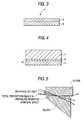
- Fig. 3 is a schematic sectional view showing an optical film of the invention.
- 4 is an optical film having a pressure-sensitive adhesive layer
- 5 is an optical film such as a film light-guiding sheet
- 6 is a pressure-sensitive adhesion layer.
- the aforesaid pressure-sensitive adhesive composition is coated on an optical film by use of a conventional coater (roll coater, reverse coater, gravure coater, bar coater, etc.), dried, and as needed thermally crosslinked or cured by ultraviolet, or further the pressure-sensitive adhesive sheet comprising the pressure-sensitive adhesive composition is stuck on an optical film. That is, transfer to the optical film by use of the pressure-sensitive adhesive sheet or direct coating onto an optical film can be carried out.
- a conventional coater roll coater, reverse coater, gravure coater, bar coater, etc.
- the film light-guiding sheet is exemplified by a film where the function of guiding light is imparted by forming fine concavities and convexities on one surface of a polycarbonate film.
- the refractive index of film materials used for the film light-guiding sheet is 1.49 or more, preferably 1.50 or more, more preferably 1.51 or more, and most preferably 1.52 or more.
- the upper limit of the refractive index is preferably 1.60.
- the thickness of the film light-guiding sheet can be appropriately selected, for example, from the range of from about 10 to about 200 ⁇ m according to the purpose.
- the optical film includes an antireflection film and an electrically conductive film.
- Materials forming these films are preferably those having the aforesaid refractive indexes.
- the optical film can have a release liner on the pressure-sensitive adhesive layer side.
- the optical film of the invention can be stuck and fixed on a display panel (for example, a liquid crystal panel having structure where a plurality of optical members such as a glass base, a polarizing film, and a retardation film are laminated together with liquid crystal).
- a display panel for example, a liquid crystal panel having structure where a plurality of optical members such as a glass base, a polarizing film, and a retardation film are laminated together with liquid crystal.
- Fig. 4 is a schematic sectional view showing a condition where an optical film is stuck on a liquid crystal panel.
- 4 is an optical film having a pressure-sensitive adhesive layer on one surface thereof; 5 is an optical film; 6 is a pressure-sensitive adhesive layer; and 7 is a liquid crystal panel (Description of various optical members such as a glass base is omitted) .
- the surface of the side of pressure-sensitive adhesive layer 6 in optical film 4 is stuck and fixed on the liquid crystal panel.
- the optical film is laminated to a display panel to make a display device.
- a liquid crystal panel is used as the display panel.
- the display device where the optical film is stuck on the liquid crystal panel can be used as a transmission liquid crystal display device.
- Display panels used suitably are the liquid crystal panels.
- the liquid crystal panels used suitably are liquid crystal panels used for the display picture parts of mobile telephones (portable telephones) in mobile communication.
- Glass bases and plastic bases (particularly glass bases) can be used as bases for these liquid crystal panels.
- the refractive index of the bases is 1.49 or more, preferably 1.50 or more, more preferably 1.51 or more, and most preferably 1.52 or more, and the upper limit thereof is preferably 1.60.
- the refractive indexes of the pressure-sensitive adhesive compositions of the invention after drying, after curing or after drying and curing are close to those of the optical films such as film light-guiding sheets or the optical members such as glass bases for the liquid crystal panels. Therefore, the difference of the refractive indexes is small at the interface of the pressure-sensitive adhesive layers comprising the pressure-sensitive adhesive compositions and the optical films or at the interface of the pressure-sensitive adhesive layers and the optical members, and accordingly the total reflection can be depressed to a minimum at the respective interfaces of any two of optical film, pressure-sensitive adhesive layer and optical member. Therefore, the optical films where the pressure-sensitive adhesive compositions of the invention are used can exert excellent optical performance, and furthermore the effective employment of light becomes possible.
- the pressure-sensitive adhesive compositions also have excellent adhesive performance because of use of the acrylic polymers.
- the use of particular monomer components as the monomer units of the pressure-sensitive adhesive compositions leads to high refractive indexes after drying, after curing or after drying and curing thereof, which are almost equivalent to the refractive index of the optical films such as antireflection films, electrically conductive films (ITO films), and film light-guiding sheets, and the optical members such as glass bases constituting liquid crystal panels.
- the optical films such as antireflection films, electrically conductive films (ITO films), and film light-guiding sheets
- the optical members such as glass bases constituting liquid crystal panels.
- any two of optical film, pressure-sensitive adhesive layer and optical member is reduced, and the total reflection can be depressed to a minimum. Accordingly, use of the optical films where the pressure-sensitive adhesive compositions are used enables an effective employment of light and a big saving of electricity.
- a release liner made of a polyethylene terephthalate film of 38- ⁇ m thickness underwent flow casting by use of the resulting solution so as to be about 25 ⁇ m in thickness after drying, was heated and dried at 130°C for three minutes to cover the release liner, and further underwent aging at 50°C for 72 hours to prepare a pressure-sensitive adhesive sheet having a pressure-sensitive adhesive layer that forms crosslinked structure.
- a pressure-sensitive adhesive sheet was prepared similarly to Example 1 except that 20 parts of styrene, 25 parts of benzyl acrylate, 55 parts of isononyl acrylate, and 0.1 part of 3-hydroxypropyl acrylate were used as the monomer components.
- a pressure-sensitive adhesive sheet was prepared similarly to Example 1 except that 25 parts of phenoxyethyl acrylate, 74 parts of butyl acrylate, one part of acrylic acid, and 0.1 part of 3-hydroxypropyl acrylate were used as the monomer components.
- the refractive indexes of the pressure-sensitive adhesive layers made of the pressure-sensitive adhesive compositions in the pressure-sensitive adhesive sheets were measured by use of an Abbe refractometer by irradiation with sodium D ray in an atmosphere at 25°C.
- a right angle prism (Material BK-7; nD 1.517) and a glass base (Material BK-7; nD 1.517) were stuck through the respective pressure-sensitive adhesive sheets obtained in the examples and the comparative example. Incidence of light from the edge of the glass base is allowed, and the angle of incidence and the presence or absence of light passing through the pressure-sensitive adhesive sheet and the prism and appearing from the prism were checked. The angle ⁇ at which light disappears is taken as the total reflection angle (°).
- the glass base was worked so that the upper surface and the lower surface thereof became parallel to each other and became vertical to the edge face (side surface), respectively.
- a He-Ne laser of a single mode was used as a light source and adjusted so that the polarization direction was 45° to the edge face.
- Fig. 5 is a schematic view showing a form where a pressure-sensitive adhesive sheet is stuck in the evaluation method of the total reflection angle and the intensity ratio of outgoing light.
- the upper glass (rectangular in section) is a glass base (Material BK-7; nD 1.517), and the lower glass (triangle in section) is a right-angle prism (Material BK-7; nD 1.517).
- the pressure-sensitive adhesive sheet is sandwiched between these two pieces of glass.
- the right-angle prism and the glass base were stuck by use of a matching oil adjusted so as to be nD 1.517 in refractive index beforehand, and the intensity of outgoing light from the right-angle prism is measured while changing the angle of incident laser beam at intervals of 5° to take the sum as the intensity of the incident beam.
- the pressure-sensitive adhesive compositions prepared in the examples are almost the same in the refractive index as the optical films or the optical members, small in the angle of total reflection, and large in the intensity ratio of outgoing light so that the total reflection is greatly depressed.
- a film light-guiding sheet having uniform prisms having a incline of 43° to the film surface and a pitch of 0.25 mm beforehand was stuck on a plate made of polymethyl methacrylate (PMMA plate) of 1.2-mm thickness which was cut into a width of 40 mm and a length of 25 mm by use of the respective pressure-sensitive adhesive sheets prepared in the examples and the comparative example.
- PMMA plate polymethyl methacrylate
- a cold cathode tube was arranged in the edge face of the PMMA plate standing opposite to the incline of the film light-guiding sheet, and conditions of emission were observed from the face opposite to the face on which the film light-guiding sheet was stuck.
- the uniformity in the face of brightness and the face brightness were satisfactory.
Landscapes
- Chemical & Material Sciences (AREA)
- Organic Chemistry (AREA)
- Chemical Kinetics & Catalysis (AREA)
- Health & Medical Sciences (AREA)
- Medicinal Chemistry (AREA)
- Polymers & Plastics (AREA)
- Life Sciences & Earth Sciences (AREA)
- Engineering & Computer Science (AREA)
- Materials Engineering (AREA)
- Wood Science & Technology (AREA)
- Adhesive Tapes (AREA)
- Adhesives Or Adhesive Processes (AREA)
Abstract
Description

| Example 1 | Example 2 | Comparative Example 1 | |
| Refractive Index | 1.508 | 1.506 | 1.485 |
| Total Reflection Angle (°) | 6.3 | 6.7 | 11.8 |
| Intensity Ratio of Outgoing Light (%) | 77 | 75 | 55 |
| Evaluation | A | A | B |
Claims (9)
- A pressure-sensitive adhesive composition which comprises as a main component an acrylic polymer comprising as a monomer unit an aromatic ring-containing copolymerizable monomer, wherein the refractive index of the composition after drying, after curing or after drying and curing is 1.49 or more and 1.60 or less.
- The composition as claimed in claim 1, wherein said aromatic ring-containing copolymerizable monomer is at least one of an aromatic ring-containing acrylic monomer and a styrene-series monomer.
- The composition as claimed in claim 2, wherein said aromatic ring-containing acrylic monomer is an aromatic ring-containing alkyl (meth)acrylate represented by the following formula (1) :wherein R1 is a hydrogen atom or a methyl group; R2 is an alkylene group or -R3-(OR3)n-, where R3 is an alkylene group, and n is a positive integer; and X is an aryl group or an aryloxy group.
- A pressure-sensitive adhesive sheet used to stick and fix an optical film on the display panel of a display device, wherein a pressure-sensitive adhesive layer comprising the pressure-sensitive adhesive composition as claimed in claim 1 is formed on a release liner.
- A pressure-sensitive adhesive sheet used to stick and fix an optical film on the display panel of a display device, wherein a pressure-sensitive adhesive layer comprising the pressure-sensitive adhesive composition as claimed in claim 2 is formed on a release liner.
- A pressure-sensitive adhesive sheet used to stick and fix an optical film on the display panel of a display device, wherein a pressure-sensitive adhesive layer comprising the pressure-sensitive adhesive composition as claimed in claim 3 is formed on a release liner.
- An optical film which comprises an optical film used to stick and fix on the display panel of a display device having formed on one face thereof a pressure-sensitive adhesive layer comprising the pressure-sensitive adhesive composition as claimed in claim 1.
- An optical film which comprises an optical film used to stick and fix on the display panel of a display device having formed on one face thereof a pressure-sensitive adhesive layer comprising the pressure-sensitive adhesive composition as claimed in claim 2.
- An optical film which comprises an optical film used to stick and fix on the display panel of a display device having formed on one face thereof a pressure-sensitive adhesive layer comprising the pressure-sensitive adhesive composition as claimed in claim 3.
Applications Claiming Priority (2)
| Application Number | Priority Date | Filing Date | Title |
|---|---|---|---|
| JP2000368144A JP4640740B2 (en) | 2000-12-04 | 2000-12-04 | Pressure-sensitive adhesive composition, pressure-sensitive adhesive sheet, and optical film |
| JP2000368144 | 2000-12-04 |
Publications (2)
| Publication Number | Publication Date |
|---|---|
| EP1211298A2 true EP1211298A2 (en) | 2002-06-05 |
| EP1211298A3 EP1211298A3 (en) | 2002-07-31 |
Family
ID=18838446
Family Applications (1)
| Application Number | Title | Priority Date | Filing Date |
|---|---|---|---|
| EP01128426A Withdrawn EP1211298A3 (en) | 2000-12-04 | 2001-12-04 | Pressure-sensitive adhesive composition, pressure-sensitive adhesive sheet, and optical film |
Country Status (4)
| Country | Link |
|---|---|
| US (1) | US20020098352A1 (en) |
| EP (1) | EP1211298A3 (en) |
| JP (1) | JP4640740B2 (en) |
| KR (1) | KR20020044070A (en) |
Cited By (6)
| Publication number | Priority date | Publication date | Assignee | Title |
|---|---|---|---|---|
| WO2004028797A1 (en) * | 2002-09-17 | 2004-04-08 | Tesa Ag | Pressure-sensitive adhesive tape for lcd's |
| WO2010072551A1 (en) * | 2008-12-15 | 2010-07-01 | Tesa Se | Pressure-sensitive adhesive mass |
| CN101921357A (en) * | 2010-08-17 | 2010-12-22 | 江门市制漆厂有限公司 | High-solid low-viscosity hydroxy acrylic resin and preparation process thereof |
| CN103025838A (en) * | 2010-08-12 | 2013-04-03 | 日东电工株式会社 | Adhesive composition, adhesive layer and adhesive sheet |
| CN107325309A (en) * | 2017-06-02 | 2017-11-07 | 江苏晨光涂料有限公司 | From the preparation method into nanoaperture antireflecting coating |
| US12402474B2 (en) * | 2021-08-30 | 2025-08-26 | Samsung Display Co., Ltd. | Display device and method for manufacturing the same |
Families Citing this family (55)
| Publication number | Priority date | Publication date | Assignee | Title |
|---|---|---|---|---|
| US20040075808A1 (en) * | 2002-10-21 | 2004-04-22 | Juei-Tse Lin | Polarizing glass |
| JP4493273B2 (en) * | 2003-01-29 | 2010-06-30 | 日東電工株式会社 | Double-sided adhesive sheet and display device with touch panel |
| US20080033109A1 (en) * | 2004-07-22 | 2008-02-07 | Soken Chemical & Engineering Co., Ltd. | Adhesive Composition For Polarizing Plate And Polarizing Plate |
| EP1813971A4 (en) * | 2004-11-11 | 2010-09-08 | Nitto Denko Corp | Combination optical film, laminated combination optical film, and image display |
| JP4849837B2 (en) * | 2005-07-21 | 2012-01-11 | 日東電工株式会社 | Optical member pressure-sensitive adhesive composition, optical member pressure-sensitive adhesive layer, pressure-sensitive adhesive optical member, method for producing the same, and image display device |
| EP1945731B1 (en) * | 2005-10-20 | 2011-03-09 | LG Chem, Ltd. | Pressure-sensitive adhesive composition |
| US7825189B2 (en) | 2005-11-21 | 2010-11-02 | Soken Chemical & Engineering Co., Ltd. | Adhesive composition for optical film, adhesive sheet, and optical member using such adhesive composition |
| JP5005264B2 (en) * | 2006-06-06 | 2012-08-22 | 日東電工株式会社 | Adhesive composition, adhesive sheet and adhesive-attached functional film |
| WO2008001418A1 (en) * | 2006-06-26 | 2008-01-03 | Sumitomo Metal Mining Co., Ltd. | Dispersive electroluminescent element and method for manufacturing the same |
| JP5016296B2 (en) * | 2006-11-22 | 2012-09-05 | 東京応化工業株式会社 | Adhesive composition and adhesive film |
| JP4976829B2 (en) * | 2006-11-29 | 2012-07-18 | 東京応化工業株式会社 | Adhesive composition and adhesive film |
| KR100948778B1 (en) * | 2007-01-23 | 2010-03-24 | 주식회사 엘지화학 | Optically compensated acrylic pressure sensitive adhesive composition, polarizing plate and liquid crystal display device comprising the same |
| US20090105437A1 (en) * | 2007-10-19 | 2009-04-23 | 3M Innovative Properties Company | High refractive index pressure-sensitive adhesives |
| KR101019064B1 (en) | 2008-01-14 | 2011-03-07 | 주식회사 엘지화학 | Acrylic pressure-sensitive adhesive composition |
| JP5258332B2 (en) * | 2008-03-06 | 2013-08-07 | 日東電工株式会社 | Light scattering adhesive composition, light scattering adhesive layer, light scattering adhesive sheet, and backlight system using them |
| JP5268137B2 (en) * | 2008-04-15 | 2013-08-21 | 日東電工株式会社 | Adhesive composition for optical film, adhesive optical film, and image display device |
| KR101133064B1 (en) | 2008-04-25 | 2012-04-04 | 주식회사 엘지화학 | An acrylic pressure-sensitive adhesive composition, a polarizer and a liquid crystal display device comprising the same |
| JP4524320B2 (en) * | 2008-08-11 | 2010-08-18 | 日東電工株式会社 | Adhesive composition, adhesive layer, and adhesive sheet |
| JP5362291B2 (en) * | 2008-08-26 | 2013-12-11 | 日東電工株式会社 | Acrylic adhesive composition, acrylic adhesive layer and acrylic adhesive tape or sheet |
| CN102272255A (en) * | 2009-01-09 | 2011-12-07 | 综研化学株式会社 | Pressure-sensitive adhesive composition for polarizer and polarizer using same |
| DE102009006591A1 (en) | 2009-01-29 | 2010-08-05 | Tesa Se | PSA |
| DE102009009757A1 (en) | 2009-02-20 | 2010-08-26 | Tesa Se | PSA |
| DE102009011167A1 (en) | 2009-03-04 | 2010-09-09 | Tesa Se | PSA |
| DE102009011165A1 (en) | 2009-03-04 | 2010-09-09 | Tesa Se | PSA |
| JP4673414B2 (en) | 2009-03-18 | 2011-04-20 | 日東電工株式会社 | Manufacturing method of liquid crystal display element |
| JP2010229246A (en) * | 2009-03-26 | 2010-10-14 | Daio Paper Corp | Pressure-sensitive adhesive sheet |
| JP5441504B2 (en) * | 2009-06-05 | 2014-03-12 | 日東電工株式会社 | Adhesive sheet |
| JP2011028251A (en) * | 2009-06-26 | 2011-02-10 | Fujifilm Corp | Phase difference film, polarizing plate, and liquid crystal display device |
| JP5552271B2 (en) * | 2009-07-08 | 2014-07-16 | 日東電工株式会社 | Transparent conductive film with adhesive layer, transparent conductive laminate, and touch panel |
| JP5544853B2 (en) * | 2009-12-09 | 2014-07-09 | サイデン化学株式会社 | Optical pressure-sensitive adhesive composition |
| JP5544858B2 (en) * | 2009-12-11 | 2014-07-09 | サイデン化学株式会社 | Adhesive composition for polarizing plate |
| JP5524640B2 (en) * | 2010-01-26 | 2014-06-18 | 大王製紙株式会社 | Adhesive sheet |
| KR101397697B1 (en) * | 2011-12-01 | 2014-05-22 | 제일모직주식회사 | Optical adhesive, optical member comprising the same and display apparatus comprising the same |
| JP2012184432A (en) * | 2012-05-02 | 2012-09-27 | Saiden Chemical Industry Co Ltd | Pressure-sensitive adhesive composition and pressure-sensitive adhesive sheet for optics |
| KR20130131795A (en) * | 2012-05-24 | 2013-12-04 | (주)엘지하우시스 | Adhesive composition having enhanced flexibility |
| KR101542618B1 (en) * | 2012-12-14 | 2015-08-06 | 제일모직주식회사 | Polarizing plate and optical display apparatus comprising the same |
| JP6057693B2 (en) * | 2012-12-17 | 2017-01-11 | 藤森工業株式会社 | Adhesive layer and adhesive film |
| JP6194358B2 (en) | 2014-01-17 | 2017-09-06 | 日東電工株式会社 | Adhesive sheet having a transparent adhesive layer |
| WO2015108159A1 (en) | 2014-01-17 | 2015-07-23 | 日東電工株式会社 | Optical member laminate having adhesive layer and method for producing same |
| JP5968957B2 (en) * | 2014-07-11 | 2016-08-10 | 日東電工株式会社 | Adhesive sheet for solar cell module and solar cell module |
| JP6060223B1 (en) | 2015-07-22 | 2017-01-11 | 日東電工株式会社 | Cover member having a transparent adhesive layer |
| JP6140775B2 (en) | 2015-07-22 | 2017-05-31 | 日東電工株式会社 | Polarizing film laminate having transparent adhesive layer and patterned transparent conductive layer, and liquid crystal panel and organic EL panel |
| JP6076420B2 (en) | 2015-07-22 | 2017-02-08 | 日東電工株式会社 | Conductive film laminate having transparent adhesive layer |
| JP6234970B2 (en) | 2015-07-22 | 2017-11-22 | 日東電工株式会社 | Cover member with transparent conductive layer having transparent adhesive layer |
| JP6076419B2 (en) | 2015-07-22 | 2017-02-08 | 日東電工株式会社 | Conductive film laminate having transparent adhesive layer |
| JP6140774B2 (en) | 2015-07-22 | 2017-05-31 | 日東電工株式会社 | Polarizing film laminate having a transparent adhesive layer and display panel |
| JP2017193595A (en) * | 2016-04-18 | 2017-10-26 | 日東電工株式会社 | Transparent flame-retardant tape and flame-retardant structure |
| JP6744289B2 (en) * | 2017-12-25 | 2020-08-19 | 藤森工業株式会社 | Adhesive layer and adhesive film |
| JP6717884B2 (en) * | 2018-07-05 | 2020-07-08 | 藤森工業株式会社 | Adhesive layer and adhesive film |
| JP6720255B2 (en) * | 2018-09-04 | 2020-07-08 | 藤森工業株式会社 | Adhesive layer and adhesive film |
| JP6644129B2 (en) * | 2018-12-27 | 2020-02-12 | 藤森工業株式会社 | Adhesive layer and adhesive film |
| JP7092823B2 (en) * | 2020-04-07 | 2022-06-28 | 藤森工業株式会社 | Adhesive layer and adhesive film |
| KR102809426B1 (en) * | 2020-09-02 | 2025-05-20 | 삼성에스디아이 주식회사 | Adhesive film, optical member comprising same, and optical display device comprising same |
| KR20230162036A (en) * | 2021-03-31 | 2023-11-28 | 가부시키가이샤 도모에가와 세이시쇼 | Display device having an anisotropic light diffusion adhesive layer and an anisotropic light diffusion adhesive layer |
| WO2023190669A1 (en) * | 2022-03-31 | 2023-10-05 | 株式会社巴川製紙所 | Anisotropic light diffusion adhesive layer and display device comprising anisotropic light diffusion adhesive layer |
Family Cites Families (9)
| Publication number | Priority date | Publication date | Assignee | Title |
|---|---|---|---|---|
| JPH0230354B2 (en) * | 1982-12-28 | 1990-07-05 | Kanzaki Paper Mfg Co Ltd | KANATSUSETSUCHAKUZAISOSEIBUTSU |
| ES2048202T3 (en) * | 1987-08-14 | 1994-03-16 | Minnesota Mining & Mfg | PRESSURE SENSITIVE ADHESIVE. |
| JPH02248482A (en) * | 1989-03-23 | 1990-10-04 | Fujikura Kasei Co Ltd | Photocurable pressure-sensitive adhesive composition |
| US5331073A (en) * | 1992-11-09 | 1994-07-19 | Allergan, Inc. | Polymeric compositions and intraocular lenses made from same |
| JPH09194798A (en) * | 1996-01-12 | 1997-07-29 | Japan Synthetic Rubber Co Ltd | Adhesive resin composition |
| JPH10140090A (en) * | 1996-11-08 | 1998-05-26 | Daicel U C B Kk | Adhesive for cathode ray tube and cured material thereof |
| JP3533589B2 (en) * | 1997-04-09 | 2004-05-31 | 綜研化学株式会社 | Pressure-sensitive adhesive composition for polarizing plate and polarizing plate |
| JP3870485B2 (en) * | 1997-06-06 | 2007-01-17 | 日立化成工業株式会社 | Method for producing electromagnetic shielding film having transparency and invisibility |
| US6663978B1 (en) * | 2000-06-28 | 2003-12-16 | 3M Innovative Properties Company | High refractive index pressure-sensitive adhesives |
-
2000
- 2000-12-04 JP JP2000368144A patent/JP4640740B2/en not_active Expired - Fee Related
-
2001
- 2001-12-03 US US09/998,656 patent/US20020098352A1/en not_active Abandoned
- 2001-12-03 KR KR1020010075944A patent/KR20020044070A/en not_active Withdrawn
- 2001-12-04 EP EP01128426A patent/EP1211298A3/en not_active Withdrawn
Cited By (12)
| Publication number | Priority date | Publication date | Assignee | Title |
|---|---|---|---|---|
| WO2004028797A1 (en) * | 2002-09-17 | 2004-04-08 | Tesa Ag | Pressure-sensitive adhesive tape for lcd's |
| US7514142B2 (en) | 2002-09-17 | 2009-04-07 | Tesa Ag | Pressure-sensitive adhesive tape for LCDs |
| WO2010072551A1 (en) * | 2008-12-15 | 2010-07-01 | Tesa Se | Pressure-sensitive adhesive mass |
| CN102057008A (en) * | 2008-12-15 | 2011-05-11 | 德莎欧洲公司 | Pressure-sensitive adhesive mass |
| CN102057008B (en) * | 2008-12-15 | 2013-07-10 | 德莎欧洲公司 | Pressure-sensitive adhesive mass |
| US8845846B2 (en) | 2008-12-15 | 2014-09-30 | Tesa Se | Pressure-sensitive adhesive mass |
| CN103025838A (en) * | 2010-08-12 | 2013-04-03 | 日东电工株式会社 | Adhesive composition, adhesive layer and adhesive sheet |
| CN103025838B (en) * | 2010-08-12 | 2015-03-04 | 日东电工株式会社 | Adhesive composition, adhesive layer and adhesive sheet |
| CN101921357A (en) * | 2010-08-17 | 2010-12-22 | 江门市制漆厂有限公司 | High-solid low-viscosity hydroxy acrylic resin and preparation process thereof |
| CN101921357B (en) * | 2010-08-17 | 2012-08-29 | 江门市制漆厂有限公司 | High-solid low-viscosity hydroxy acrylic resin and preparation process thereof |
| CN107325309A (en) * | 2017-06-02 | 2017-11-07 | 江苏晨光涂料有限公司 | From the preparation method into nanoaperture antireflecting coating |
| US12402474B2 (en) * | 2021-08-30 | 2025-08-26 | Samsung Display Co., Ltd. | Display device and method for manufacturing the same |
Also Published As
| Publication number | Publication date |
|---|---|
| JP4640740B2 (en) | 2011-03-02 |
| EP1211298A3 (en) | 2002-07-31 |
| JP2002173656A (en) | 2002-06-21 |
| KR20020044070A (en) | 2002-06-14 |
| US20020098352A1 (en) | 2002-07-25 |
Similar Documents
| Publication | Publication Date | Title |
|---|---|---|
| US20020098352A1 (en) | Pressure-sensitive adhesive composition, pressure-sensitive adhesive sheet, and optical film | |
| JP4618993B2 (en) | Pressure sensitive adhesive tape or sheet and optical film | |
| CN111902275B (en) | Adhesive sheet, optical film with adhesive layer, laminate, and image display device | |
| JP3989245B2 (en) | Pressure-sensitive adhesive composition, pressure-sensitive adhesive sheet and optical film | |
| CN101684394B (en) | Pressure-sensitive adhesive sheet for optical member adhesion | |
| US9796883B2 (en) | Optical pressure-sensitive adhesive sheet, liquid crystal display and input device comprising the same | |
| KR101795833B1 (en) | Acrylic resin composition, acrylic adhesive, adhesive sheet, double-sided adhesive sheet, adhesive for transparent electrodes, touch-panel and image display device, as well as production method for adhesive layer-containing laminates | |
| TWI434079B (en) | Polarizer and liquid crystal display including the same | |
| CN107641486B (en) | Adhesives, articles, and methods comprising pendant (meth) acryloyl groups | |
| JP5015648B2 (en) | Optical pressure-sensitive adhesive composition and optical functional film | |
| WO2020158484A1 (en) | Adhesive sheet, optical film with adhesive layer, multilayer body and image display device | |
| CN103709969B (en) | Adhesive composition, bonding sheet and lamination sheet for optical uses | |
| KR20170048440A (en) | Optically clear adhesive and optical laminate | |
| CN102838941A (en) | Optical double-sided pressure-sensitive adhesive sheet | |
| KR102340259B1 (en) | Acrylic pressure-sensitive adhesive composition, pressure-sensitive adhesive and pressure-sensitive adhesive sheet | |
| CN106256840B (en) | adhesive composition | |
| JP2012035431A (en) | Adhesive sheet for protective films | |
| JP4789351B2 (en) | Pressure-sensitive adhesive composition, pressure-sensitive adhesive sheet, and optical film | |
| KR20170062390A (en) | Pressure-sensitive adhesive sheet and pressure-sensitive adhesive sheet with release film | |
| JP2020158564A (en) | Acrylic resin and adhesive composition | |
| KR102246370B1 (en) | Pressure-sensitive adhesive composition, polarizer with pressure-sensitive adhesive, and display device | |
| JP5517716B2 (en) | Pressure-sensitive adhesive composition for conductive film, pressure-sensitive adhesive sheet, and conductive film | |
| JP2011042785A (en) | Pressure-sensitive adhesive tape or sheet and optical film | |
| CN101889223B (en) | Optical adhesive tape for light management of keyboards | |
| KR102708657B1 (en) | Adhesive layer, adhesive composition, solvent-free adhesive composition, adhesive and adhesive sheet |
Legal Events
| Date | Code | Title | Description |
|---|---|---|---|
| PUAI | Public reference made under article 153(3) epc to a published international application that has entered the european phase |
Free format text: ORIGINAL CODE: 0009012 |
|
| AK | Designated contracting states |
Kind code of ref document: A2 Designated state(s): AT BE CH CY DE DK ES FI FR GB GR IE IT LI LU MC NL PT SE TR |
|
| AX | Request for extension of the european patent |
Free format text: AL;LT;LV;MK;RO;SI |
|
| PUAL | Search report despatched |
Free format text: ORIGINAL CODE: 0009013 |
|
| AK | Designated contracting states |
Kind code of ref document: A3 Designated state(s): AT BE CH CY DE DK ES FI FR GB GR IE IT LI LU MC NL PT SE TR |
|
| AX | Request for extension of the european patent |
Free format text: AL;LT;LV;MK;RO;SI |
|
| RIC1 | Information provided on ipc code assigned before grant |
Free format text: 7C 09J 7/02 A, 7C 09J 133/08 B, 7G 02B 5/30 B, 7C 09J 7/00 B, 7C 09J 133/06 B |
|
| 17P | Request for examination filed |
Effective date: 20030121 |
|
| AKX | Designation fees paid |
Designated state(s): BE DE FR GB |
|
| 17Q | First examination report despatched |
Effective date: 20030417 |
|
| STAA | Information on the status of an ep patent application or granted ep patent |
Free format text: STATUS: THE APPLICATION IS DEEMED TO BE WITHDRAWN |
|
| 18D | Application deemed to be withdrawn |
Effective date: 20030828 |