EP1210929A2 - Kosmetische Mittel enthaltend Alkyl- oder Alkenylbernsteinsäurederivate - Google Patents
Kosmetische Mittel enthaltend Alkyl- oder Alkenylbernsteinsäurederivate Download PDFInfo
- Publication number
- EP1210929A2 EP1210929A2 EP01127510A EP01127510A EP1210929A2 EP 1210929 A2 EP1210929 A2 EP 1210929A2 EP 01127510 A EP01127510 A EP 01127510A EP 01127510 A EP01127510 A EP 01127510A EP 1210929 A2 EP1210929 A2 EP 1210929A2
- Authority
- EP
- European Patent Office
- Prior art keywords
- agent according
- carboxylic acid
- alcohols
- anhydride
- carboxylic
- Prior art date
- Legal status (The legal status is an assumption and is not a legal conclusion. Google has not performed a legal analysis and makes no representation as to the accuracy of the status listed.)
- Granted
Links
Classifications
-
- A—HUMAN NECESSITIES
- A61—MEDICAL OR VETERINARY SCIENCE; HYGIENE
- A61K—PREPARATIONS FOR MEDICAL, DENTAL OR TOILETRY PURPOSES
- A61K8/00—Cosmetics or similar toiletry preparations
- A61K8/02—Cosmetics or similar toiletry preparations characterised by special physical form
- A61K8/04—Dispersions; Emulsions
- A61K8/06—Emulsions
-
- A—HUMAN NECESSITIES
- A61—MEDICAL OR VETERINARY SCIENCE; HYGIENE
- A61K—PREPARATIONS FOR MEDICAL, DENTAL OR TOILETRY PURPOSES
- A61K47/00—Medicinal preparations characterised by the non-active ingredients used, e.g. carriers or inert additives; Targeting or modifying agents chemically bound to the active ingredient
- A61K47/06—Organic compounds, e.g. natural or synthetic hydrocarbons, polyolefins, mineral oil, petrolatum or ozokerite
-
- A—HUMAN NECESSITIES
- A61—MEDICAL OR VETERINARY SCIENCE; HYGIENE
- A61K—PREPARATIONS FOR MEDICAL, DENTAL OR TOILETRY PURPOSES
- A61K8/00—Cosmetics or similar toiletry preparations
- A61K8/18—Cosmetics or similar toiletry preparations characterised by the composition
- A61K8/30—Cosmetics or similar toiletry preparations characterised by the composition containing organic compounds
- A61K8/33—Cosmetics or similar toiletry preparations characterised by the composition containing organic compounds containing oxygen
- A61K8/36—Carboxylic acids; Salts or anhydrides thereof
- A61K8/362—Polycarboxylic acids
-
- A—HUMAN NECESSITIES
- A61—MEDICAL OR VETERINARY SCIENCE; HYGIENE
- A61K—PREPARATIONS FOR MEDICAL, DENTAL OR TOILETRY PURPOSES
- A61K8/00—Cosmetics or similar toiletry preparations
- A61K8/18—Cosmetics or similar toiletry preparations characterised by the composition
- A61K8/30—Cosmetics or similar toiletry preparations characterised by the composition containing organic compounds
- A61K8/33—Cosmetics or similar toiletry preparations characterised by the composition containing organic compounds containing oxygen
- A61K8/37—Esters of carboxylic acids
- A61K8/375—Esters of carboxylic acids the alcohol moiety containing more than one hydroxy group
-
- A—HUMAN NECESSITIES
- A61—MEDICAL OR VETERINARY SCIENCE; HYGIENE
- A61K—PREPARATIONS FOR MEDICAL, DENTAL OR TOILETRY PURPOSES
- A61K8/00—Cosmetics or similar toiletry preparations
- A61K8/18—Cosmetics or similar toiletry preparations characterised by the composition
- A61K8/72—Cosmetics or similar toiletry preparations characterised by the composition containing organic macromolecular compounds
- A61K8/81—Cosmetics or similar toiletry preparations characterised by the composition containing organic macromolecular compounds obtained by reactions involving only carbon-to-carbon unsaturated bonds
- A61K8/8105—Compositions of homopolymers or copolymers of unsaturated aliphatic hydrocarbons having only one carbon-to-carbon double bond; Compositions of derivatives of such polymers
- A61K8/8111—Homopolymers or copolymers of aliphatic olefines, e.g. polyethylene, polyisobutene; Compositions of derivatives of such polymers
-
- A—HUMAN NECESSITIES
- A61—MEDICAL OR VETERINARY SCIENCE; HYGIENE
- A61K—PREPARATIONS FOR MEDICAL, DENTAL OR TOILETRY PURPOSES
- A61K9/00—Medicinal preparations characterised by special physical form
- A61K9/0012—Galenical forms characterised by the site of application
- A61K9/0014—Skin, i.e. galenical aspects of topical compositions
-
- A—HUMAN NECESSITIES
- A61—MEDICAL OR VETERINARY SCIENCE; HYGIENE
- A61K—PREPARATIONS FOR MEDICAL, DENTAL OR TOILETRY PURPOSES
- A61K9/00—Medicinal preparations characterised by special physical form
- A61K9/06—Ointments; Bases therefor; Other semi-solid forms, e.g. creams, sticks, gels
-
- A—HUMAN NECESSITIES
- A61—MEDICAL OR VETERINARY SCIENCE; HYGIENE
- A61K—PREPARATIONS FOR MEDICAL, DENTAL OR TOILETRY PURPOSES
- A61K9/00—Medicinal preparations characterised by special physical form
- A61K9/10—Dispersions; Emulsions
- A61K9/107—Emulsions ; Emulsion preconcentrates; Micelles
-
- A—HUMAN NECESSITIES
- A61—MEDICAL OR VETERINARY SCIENCE; HYGIENE
- A61Q—SPECIFIC USE OF COSMETICS OR SIMILAR TOILETRY PREPARATIONS
- A61Q19/00—Preparations for care of the skin
-
- A—HUMAN NECESSITIES
- A61—MEDICAL OR VETERINARY SCIENCE; HYGIENE
- A61Q—SPECIFIC USE OF COSMETICS OR SIMILAR TOILETRY PREPARATIONS
- A61Q17/00—Barrier preparations; Preparations brought into direct contact with the skin for affording protection against external influences, e.g. sunlight, X-rays or other harmful rays, corrosive materials, bacteria or insect stings
- A61Q17/04—Topical preparations for affording protection against sunlight or other radiation; Topical sun tanning preparations
Definitions
- Combinations of are often used to manufacture cosmetic products Fatty acid salts and nonionic surfactants used as emulsifiers. adversely is the increase in pH caused by the fatty acid salts, whereby the cosmetic products react alkaline. Because the surface of the human Skin is covered with a weakly acidic membrane (pH 4.5 to 6.5) aspired to adjust cosmetics to a weakly acidic or neutral pH. By adding neutralizing agents, e.g. Hydrochloric acid, citric acid or Lactic acid, however, the emulsifying effect of the systems is impaired.
- neutralizing agents e.g. Hydrochloric acid, citric acid or Lactic acid
- EP 0 553 241 uses mixtures of alkyl polysaccharides, fatty alcohols and optionally polysaccharides for the preparation of emulsions.
- WO 92/07543 describes alkyl glycosides and fatty acid partial glycerides as cosmetic emulsifiers. Since the nonionic surfactants have an inadequate emulsifier effect, they have to be used in large quantities, which impairs the skin-friendliness of the cosmetic products. It is known that ethoxylated fatty acid esters, for example polyethylene glycol stearate (30 EO units) and sorbitan oleates, have a good emulsifying action.
- W / O emulsions generally contain metal soaps and lipophilic waxes, for example beeswax, micro waxes or esters of fatty acids and fatty alcohols with linear or branched fat residues, for example stearates, wool fat or wool fat derivatives, to stabilize the viscosity.
- WO 87/03 613, EP 155 800 and US 4,911,770 describe carboxylic acids, carboxylic anhydrides, ester and amide derivatives with long-chain (C 20 -C 500 ) alkyl radicals as emulsifiers for explosives.
- Preferred (C 2 -C 5 ) -alkenes are ethylene, propylene, butene and isobutene, particularly preferably isobutene.
- the polyalkyl chains and polyalkylene chains can also be copolymers of various (C 2 -C 5 ) alkenes.
- Particularly preferred alkyl chains are polyisobutenyl chains which pass through Polymerization of isobutene are available.
- the alkyl chains and alkenyl chains a) preferably have 28 to 200, especially preferably 40 to 150, particularly preferably 52 to 100, carbon atoms.
- Preferred as group b) are carboxylic acid, carboxylic acid derivative, Carboxylic anhydride and carboxylic anhydride derivative groups, especially preferably carboxylic anhydride and carboxylic anhydride derivative groups.
- group b) are carboxylic anhydride derivative groups.
- carboxylic acid, carboxylic acid derivative, carboxylic anhydride and Carboxylic anhydride derivative groups are preferably those which are of unsaturated carboxylic acids and carboxylic anhydrides, preferably of Acrylic acid, methacrylic acid, maleic acid and their anhydrides, especially preferably maleic acid and / or maleic anhydride.
- Particularly preferred emulsifiers are alkenylsuccinic anhydrides according to formula (1) and their derivatives, wherein n is equal to or greater than 4, preferably 4 to 46, particularly preferably 7 to 35, particularly preferably 10 to 22.
- the alkenylsuccinic anhydrides according to formula (1) can also be present in hydrogenated form, which has an advantageous effect on the oxidation stability.
- the emulsifiers are preferably prepared by ene reaction of the alkenes corresponding to chains a), which can be obtained by polymerizing the (C 2 -C 5 ) -alkenes, with the unsaturated carboxylic acids and / or carboxylic anhydrides corresponding to groups b). If appropriate, the chains a) can be hydrogenated.
- the alkenylsuccinic anhydrides according to formula (1) are preferably obtainable by ene reaction of the corresponding polysiobutenes obtainable by polymerization of isobutene with maleic anhydride.
- emulsifiers can be carried out using the techniques familiar to the person skilled in the art take place (see also WO 87/03613, EP 155 800 and US 4,911,770).
- the derivatization of the carboxylic acid and / or carboxylic anhydride groups b) is advantageously carried out after the ene reaction.
- the carboxylic acid derivative and carboxylic anhydride derivative groups are are preferably those which are formed by reaction of the corresponding carboxylic acid and Carboxylic anhydride groups with alkali, mono- and polyfunctional alcohols, Amino alcohols, unsubstituted mono- and polyamines and / or substituted Mono- and polyamines are available.
- Carboxylic anhydride groups are preferred, particularly preferably maleic anhydride groups, derivatized.
- the derivatization can also be a mixed derivatization act.
- carboxylic acid derivative and Carboxylic acid anhydride derivative groups around carboxylic acid salt, mono- and Dicarboxylic acid ester, carboxylic acid amide, amino ester and / or imide groups, particularly preferably around the corresponding maleic acid derivative groups.
- Alk (en) ylsuccinic anhydrides are particularly preferred for derivatization according to formula (1).
- Monofunctional alcohols having 1 to 30 carbon atoms are preferably suitable for the derivatization with alcohols; ethoxylated and / or propoxylated monoalcohols, preferably methyl glycols, in particular methyl triglycol, ethyl glycol and / or butyl glycol; fatty alcohol ethoxylates; glycerol; polyglycerols; Sugar alcohols, preferably sorbitol and sorbitan; Ethylene glycol; Propylene glycol; Oligomers of ethylene glycol; Propylene glycol oligomers; Polyalkylene glycols, preferably polyethylene glycols; and / or random and block-like copolymers of ethylene oxide and propylene oxide. Particularly preferred alcohols are methyl glycols, in particular methyl triglycol, ethyl glycol and / or butyl glycol; fatty alcohol ethoxylates; glycerol; polyglycerols;
- Amino alcohols In the derivatization by reaction with amino alcohols, depending on Amino alcohol forms either amides, imides or amino esters.
- amino alcohols In principle, all amino alcohols with a free OH and / or are suitable Amine function NH-, those with a tertiary amino function are particularly suitable.
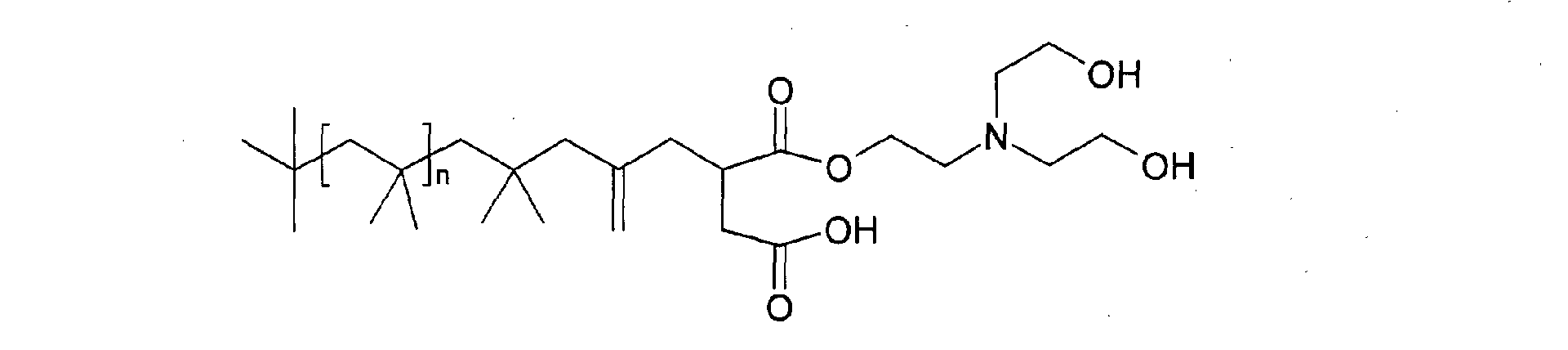
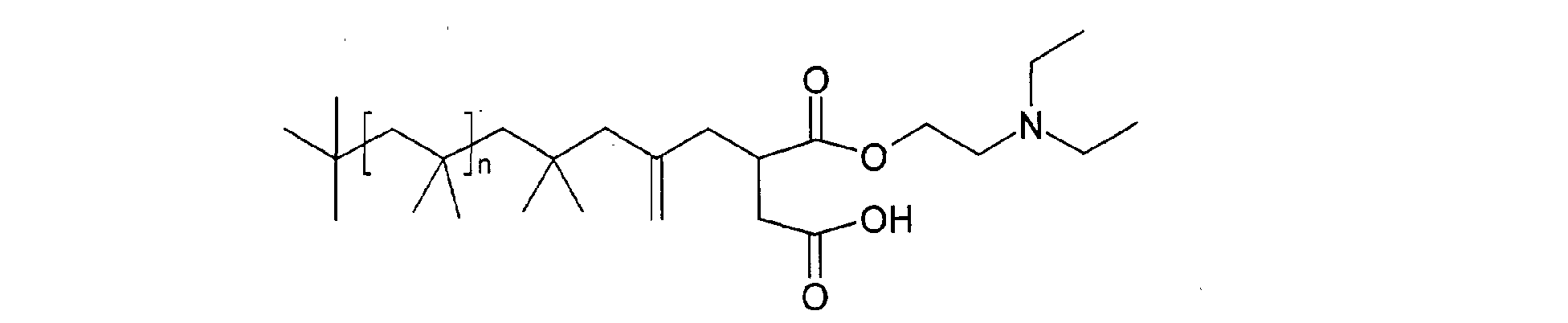
- Amino alcohols which are preferably suitable are ethanolamine, isopropanolamine, Diethanolamine, triethanolamine, diethylethanolamine, dimethylethanolamine and / or Dibutylethanolamine, particularly preferably triethanolamine, diethylethanolamine and / or dimethylethanolamine.
- the corresponding amides or imines are formed in the derivatization by reaction with amines.
- All mono- and polyamines with at least one reactive amino function are suitable as amines.
- Preferred amines are ammonia, monoalkylamines with a (C 1 -C 30 ) alk (en) yl radical, particularly preferably (C 1 -C 10 ) alk (en) yl radical, diamines with (C 1 -C 30 ) alk (en) yl residues, particularly preferably (C 1 -C 10 ) alk (en) yl residues, in particular 3-dimethylaminopropylamine, and / or polyamines, preferably polyethyleneimines.
- amino alcohols and Amines is the molar ratio of carboxylic acid anhydride groups to alcohol, Amino alcohol or amine in each case preferably 1: 0.9 to 1: 2, particularly preferably 1: 1. With the particularly preferred ratio of 1: 1, the corresponding ones are formed Half esters or half amides.
- the free carboxyl groups can also be in the form of their Metal or amine salts are present.
- Particularly preferred emulsifiers are those obtained by reacting the Alk (en) ylsuccinic anhydrides according to formula (1) with glycerol, triethanolamine, Diethylethanolamine, methyl glycols, preferably methyl triglycol, and / or Polyalkylene glycols, preferably polyethylene glycols, are available derivatives.
- the emulsifying properties can be modified and the Requirements are adjusted.
- the then free carboxyl residues can additionally by reaction with amine bases or alkali and alkaline earth metal hydroxides in the corresponding salts are transferred. This enables the setting of a corresponding pH value in the final formulation and modifies the Emulsifying properties.
- suitable emulsifiers for numerous oils, fats, waxes, paraffins and for water-immiscible Solvents and active ingredients in the cosmetic and pharmaceutical sector provide.
- the agents according to the invention preferably contain, based on the finished agents 0.1 to 8% by weight, particularly preferably 0.3 to 5% by weight, particularly preferably 0.5 to 4% by weight of emulsifiers.
- Agents are preferably oil-in-water emulsions or water-in-oil Emulsions.
- the non-aqueous proportion of the emulsions which largely consists of the emulsifier and the oil body, is preferably 5 to 95% by weight, particularly preferably 15 to 75% by weight.
- the water content of the emulsions varies depending on the desired viscosity of the emulsions. Lotions, for example, have a comparatively low viscosity, whereas creams and ointments have a comparatively high viscosity.
- Guerbet alcohols having 6 to 18, preferably 8 to 10 carbon atoms are preferably suitable as oil bodies; Esters of linear and branched (C 6 -C 13 ) fatty acids with linear (C 6 -C 20 ) fatty alcohols; Esters of linear (C 6 -C 18 ) fatty acids with branched alcohols, preferably 2-ethylhexanol; Esters of linear and branched fatty acids with polyhydric alcohols, preferably dimer diol and trimer diol and / or Guerbet alcohols; Triglycerides based on (C 6 -C 10 ) fatty acids; vegetable oils; branched primary alcohols; substituted cyclohexanes; Guerbet; dialkyl; aliphatic hydrocarbons, aromatic hydrocarbons; Silicone oils and / or silicone oil derivatives.
- the auxiliaries and additives can be co-emulsifiers, superfatting agents, Fats, waxes, stabilizers, biogenic agents, light stabilizers, UV light protection filters, Pigments, metal oxides, micropigments, antioxidants, hydrotropes, Solubilizers, consistency agents, cation polymers, glycerin, preservatives, Dispersants, protein derivatives such as e.g.
- Gelatin and collagen hydrolyzates Natural and synthetic polypeptides, egg yolk, lecithin, lanolin, Lanolin derivatives, fatty alcohols, silicones, deodorants, substances with keratolytic and keratoplastic action, enzymes, carrier substances, moisturizing substances, antimicrobial agents, pearlescent agents, Contain dyes and / or fragrances.
- Suitable nonionic O / W co-emulsifiers are preferably addition products of 2 to 30 mol of ethylene oxide and / or 0 to 5 mol of propylene oxide with linear fatty alcohols with 8 to 22 C atoms, with fatty acids with 12 to 22 C atoms and with alkylphenols with 8 to 15 carbon atoms in the alkyl group; (C 12 -C 18 ) fatty acid monoesters of adducts of 1 to 30 moles of ethylene oxide with glycerol; Glycerol monoesters and diesters and sorbitan monoesters and diesters of saturated and unsaturated fatty acids having 6 to 22 carbon atoms and their ethylene oxide addition products; Addition products of 15 to 60 moles of ethylene oxide with castor oil and / or hardened castor oil; Polyol, especially polyglycerol esters such as polyglycerol polyricin oleate and polyglycerol poly-12-hydroxystearate.
- the adducts of ethylene oxide and / or propylene oxide with fatty alcohols, fatty acids, castor oil and alkylphenols, as well as the glycerol mono- and diesters and sorbitan mono- and diesters of fatty acids are known and commercially available products. These are mixtures of homologs, the middle of which Degree of alkoxylation corresponds to the ratio of the starting amounts of ethylene oxide, propylene oxide and substrate. (C 12 -C 18 ) fatty acid monoesters and diesters of adducts of ethylene oxide with glycerol are known from DE-20 24 051 as refatting agents for cosmetic preparations.
- Polyethoxylated lanolin derivatives, lecithin derivatives, polyol fatty acid esters, monoglycerides and fatty acid alkanolamides are preferably used as superfatting agents, the latter simultaneously serving as foam stabilizers.
- Glycerides are preferred as fats.
- Preferred waxes are beeswax, Paraffin wax or micro wax, optionally in combination with hydrophilic Waxing such as Cetylstearylalkohol.
- Preferred stabilizers are metal salts of fatty acids, e.g. Magnesium-, Aluminum and / or zinc stearate.
- Plant extracts and vitamin complexes are among the biogenic active ingredients to understand.
- Suitable preservatives are, for example, phenoxyethanol, Formaldehyde solution, parabens, pentanediol or sorbic acid.
- Suitable UV filters are e.g. 4-aminobenzoic acid, 3- (4'-trimethylammonium) benzylidene bornan-2-one methyl sulfate, 3,3,5-trimethyl-cyclohexyl salicylate; 2-hydroxy-4-methoxybenzophenone; 2-phenylbenzimidazole-5-sulfonic acid and its potassium, sodium and triethanolamine; 3,3 '- (1,4-phenylenedimethine) -bis- (7,7-dimethyl-2-oxobicyclo [2.2.1] heptane-1-methanesulfonic acid and their salts; 1- (4-tert-butylphenyl) -3- (4-methoxyphenyl) propane-1,3-dione; 3- (4'-sulfo) benzylidene-bornan-2-one and its salts; 2-cyano-3,3-diphenyl-acrylic acid (2-ethylhexyl); polymer from N- [
- pigments / micropigments e.g. microfine titanium dioxide, zinc oxide and Silicon oxides are used.
- Suitable antioxidants are, for example, superoxide dismutase, tocopherol (Vitamin E) and ascorbic acid (vitamin C).
- Suitable dyes for cosmetic and pharmaceutical agents and approved substances are used.
- thickeners and dispersants are ethylene glycol esters of fatty acids with 14 to 22, particularly preferably 16 to 22, carbon atoms, in particular mono- and diethylene glycol stearate.
- polyacrylates and carbomers in particular those water-soluble or water
- Alcohols with 1 to 4 carbon atoms such as ethanol, propanol, isopropanol, n-butanol and isobutanol, glycerol and mixtures thereof, are preferably used.
- polyethylene glycols with a relative molecular weight below 2000 Particularly preferred are polyethylene glycols with a relative molecular weight between 200 and 600 in amounts up to 45% by weight and polyethylene glycols with a relative molecular weight between 400 and 600 in amounts from 0.5 to 15 wt .-%.
- Other suitable solvents are, for example, triacetin (glycerol triacetate) and 1-methoxy-2-propanol.
- Suitable carrier materials are e.g. vegetable oils, natural and hardened oils, Waxes, fats, water, alcohols, polyols, glycerol, glycerides, liquid paraffins, liquid fatty alcohols, sterols, polyethylene glycols, cellulose and cellulose derivatives.
- Suitable fungicidal active substances are preferably ketoconazole, oxiconazole, terbinafine, Bifonazole, butoconazole, cloconazole, clotrimazole, econazole, enilconazole, Fenticonazole, isoconazole, miconazole, sulconazole, tioconazole fluconazole, Itraconazole, Terconazole, Naftifine, Zn-Pyrethion and Octopyrox.
- Suitable cationic polymers are e.g. cationic cellulose derivatives; cationic Strength; Copolymers of diallylammonium salts and acrylamides; quaternsammlung Vinyl pyrrolidone / vinyl imidazole polymers; Condensation products of polyglycols and amines; quaternized collagen polypeptides; quaternized wheat polypeptides; polyethyleneimines; cationic silicone polymers, e.g. amidomethicones; Copolymers of adipic acid and dimethylaminohydroxy-propyldiethylenetriamine; Polyaminopolyamide and cationic chitin derivatives such as chitosan.
- Suitable silicone compounds are, for example, dimethylpolysiloxane, Methylphenylpolysiloxanes, cyclic silicones and amino, fatty acid, alcohol, polyether, epoxy, fluorine and / or alkyl modified silicone compounds, and Polyalkylsiloxanes, polyalkylarylsiloxanes and polyether siloxane copolymers - as in US 5104 645 and the documents cited therein - those at room temperature can be both liquid and resinous.
- the agents according to the invention can be mixed with conventional ceramides, Pseudoceramides, fatty acid-N-alkylpolyhydroxyalkylamides, cholesterol, Cholesterol fatty acid esters, fatty acids, triglycerides, cerebrosides, phospholipids and similar substances are mixed.
- the moisturizing substance is, for example, isopropyl palmitate, Glycerin and / or sorbitol are available, preferably in amounts of 0.1 to 50 wt .-%, are used.
- deodorant substances e.g. Allantoin and bisabolol, preferably in quantities from 0.0001 to 10% by weight can be used.
- Pearlescent agents include, for example, glycol distearic acid esters, such as Ethylene glycol distearate, but also fatty acid monoglycol esters into consideration.
- the total proportion of auxiliaries and additives, based on the finished product, is preferably 1 to 10% by weight, particularly preferably 2 to 5% by weight.
- the preparation can be carried out in a manner known per se Way, i.e. for example by hot, cold, hot-hot / cold or PIT emulsification, respectively.
- the agents according to the invention are characterized by good heat and Cold stability, high water absorption with high at the same time Oil binding capacity, good skin tolerance and good compatibility with the in cosmetic and pharmaceutical agents common ingredients. It is particularly advantageous that the agents according to the invention can be free of lipophilic waxes, e.g. Beeswax, micro waxes, hydrogenated castor oil or esters of fatty acids and fatty alcohols with linear or branched Grease residues, e.g. Stearates, wool fats and wool fat derivatives, and yet one high viscosity stability is achieved. Another advantage is the high stability of the agents according to the invention, which otherwise only with the help of rather expensive Silicone emulsifiers can be achieved.
- the cosmetic and pharmaceutical agents can e.g.
- Skin care products such as Day creams, night creams, skin care creams, nutritional creams and body lotions; ointments, creams and pharmaceutical active ingredients lotions; Deodorant sprays; Deodorant sticks; Deodorant gels; decorating cosmetics; Sunscreen; After-sun lotions and lotions for the production of act moisture-soaked cleaning and care wipes.
- a polyisobutenyl succinic anhydride was used as the base emulsifier for the examples below used with a mole of 918.3 g / mol. This was achieved by thermal conversion of Polyisobuten ® Glissopal 1000 (BASF) with an excess of 1.5 molar equivalents of maleic anhydride 205 ° C and produced by vacuum distillation of the excess Free maleic anhydride. It is a highly viscous, viscous at room temperature Oil.
- Polyisobutenyl succinic anhydride and glycerin esters 204.6 g of a polyisobutenyl succinic anhydride with a working mole of 918.3 g / mol, 87.7 g of paraffin oil (low viscosity) and 20.5 g of glycerol were placed under a nitrogen atmosphere, heated to 100 ° C. and stirred at this temperature for 5 hours. The product was then cooled. A light yellow oil with an acid number of 37.4 mg KOH / g resulted.
- Polyisobutenyl succinic anhydride and triethanolamine esters 204.4 g of a polyisobutenyl succinic anhydride with a working mole of 918.3 g / mol, 87.6 g of paraffin oil (low viscosity) and 33.2 g of triethanolamine were placed under a nitrogen atmosphere, heated to 100 ° C. and stirred for 5 hours at this temperature. The product was then cooled. A light yellow oil with an acid number of 37.2 mg KOH / g resulted.
- Polyisobutenyl succinic anhydride and diethylethanolamine esters 202.0 g of a polyisobutenyl succinic anhydride with a working mole of 918.3 g / mol, 86.6 g of paraffin oil (low viscosity) and 25.8 g of diethylethanolamine were placed under a nitrogen atmosphere, heated to 100 ° C. and stirred at this temperature for 5 hours. The product was then cooled. A light yellow oil with an acid number of 35.4 mg KOH / g resulted.
- Polyisobutenyl succinic anhydride and methyl triglycol esters 206.1 g of a polyisobutenyl succinic anhydride with a working mole of 918.3 g / mol, 88.4 g of paraffin oil (low viscosity) and 36.1 g of methyl triglycol were placed under a nitrogen atmosphere, heated to 100 ° C. and stirred at this temperature for 5 hours. The product was then cooled. A light yellow oil with an acid number of 37.8 mg KOH / g resulted.
- Phase A Emulsifier from preparation example 1 1.00% Hostacerin DGI (polyglyceryl-2 sesquiisostearate) 1.00% isododecane 3.00% Isohexadecan 5.00% Paraffin oil, low viscosity 6.25% isopropyl palmitate 3.75% soybean oil 2.50% Phase B water ad 100% sodium chloride 0.60% glycerin 1.00%
- the oil phase A is heated to 80 ° C., then the water phase B is added with stirring using a highly dispersing tool.
- the emulsion is stable for at least 6 weeks at a storage temperature of +50 ° C.
- the emulsion is stable after 5 cycles in the rocking test (-12 ° C / + 50 ° C).
- W / O cream (without stabilizers such as waxes or stearates)
- Phase A Emulsifier from preparation example 2 1.00% Isohexadecan 5.00% isododecane 3.00% Paraffin oil, low viscosity 6.25% isopropyl palmitate 3.75% soybean oil 2.50%
- Phase B water ad 100% sodium chloride 0.60% glycerin 1.00%
- the oil phase A is heated to 80 ° C., then the water phase B is added with stirring using a highly dispersing tool.
- the emulsion is stable for at least 6 weeks at a storage temperature of + 50 ° C.
- the emulsion is stable after 5 cycles in the rocking test (-12 ° C / + 50 ° C).
- W / O skin milk can be made cold, without stabilizers such as waxes or stearates
- Phase A Emulsifier from preparation example 3 1.00% Paraffin oil, low viscosity 14.00% isopropyl palmitate 5.00% octyldodecanol 5.00%
- Phase B water ad 100% sodium chloride 2.00%
- the water phase B is added to the oil phase A at room temperature with stirring using a highly dispersing tool.
- the emulsion is stable for at least 6 weeks at a storage temperature of + 50 ° C.
- the emulsion is stable after 5 cycles in the rocking test (-12 ° C / + 50 ° C).
- W / O soft cream can be made cold, without stabilizers such as waxes or stearates
- Phase A Emulsifier from preparation example 4 2.00% Hostacerin DGI (polyglyceryl-2 sesquiisostearate) 1.00% Paraffin oil, low viscosity 14.00% isopropyl palmitate 5.00% octyldodecanol 5.00%
- Phase B water ad 100.00% sodium chloride 2.00%
- the water phase B is added to the oil phase A at room temperature with stirring using a highly dispersing tool.
- the emulsion is stable for at least 6 weeks at a storage temperature of + 50 ° C.
- the emulsion is stable after 5 cycles in the rocking test (-12 ° C / + 50 ° C).
- W / O sun protection milk (can be made cold, without stabilizers such as waxes or stearates)
- Phase A Emulsifier from preparation example 5 2.00% Hostacerin DGI (polyglyceryl-2 sesquiisostearate) 1.00% Paraffin oil, low viscosity 14.00% isopropyl palmitate 5.00% Isoamyl p-methoxycinnamate 4.00% Benzophenone-3 1.00% Phase B water ad 100.00% sodium chloride 2.00%
- the water phase B is added to the oil phase A at room temperature with stirring using a highly dispersing tool.
- the emulsion is stable for at least 6 weeks at a storage temperature of + 50 ° C.
- the emulsion is stable after 5 cycles in the rocking test (-12 ° C / + 50 ° C).
- W / O sunscreen cream (without stabilizers such as waxes or stearates)
- Phase A Emulsifier from preparation example 1 2.00% Isohexadecan 5.00% isododecane 3.00% Paraffin oil, low viscosity 6.25% isopropyl palmitate 3.75% Isoamyl p-methoxycinnamate 4.00% Benzophenone-3 1.00% Phase B water ad 100% sodium chloride 0.60% glycerin 1.00%
- the oil phase A is heated to 80 ° C., then the water phase B is added with stirring using a highly dispersing tool.
- the emulsion is stable for at least 6 weeks at a storage temperature of + 50 ° C.
- the emulsion is stable after 5 cycles in the rocking test (-12 ° C / + 50 ° C).
- Phase A Emulsifier from preparation example 1 2.00% Hostacerin DGI (polyglyceryl-2 sesquiisostearate) 1.00% isododecane 3.00% Isohexadecan 5.00% Paraffin oil, low viscosity 6.25% isopropyl palmitate 3.75% Phase B talc 10.00% zinc oxide 10.00% Phase C water ad 100% sodium chloride 0.60% glycerin 1.00%
- Oil phase A is heated to 80 ° C, then add components B.
- the Water phase C is stirred with a highly dispersing tool added.
- the emulsion is at least at a storage temperature of + 50 ° C Stable for 6 weeks.
- the emulsion is rocking test after 5 cycles (-12 ° C / + 50 ° C) stable.
Landscapes
- Health & Medical Sciences (AREA)
- Life Sciences & Earth Sciences (AREA)
- Animal Behavior & Ethology (AREA)
- Veterinary Medicine (AREA)
- Public Health (AREA)
- General Health & Medical Sciences (AREA)
- Epidemiology (AREA)
- Chemical & Material Sciences (AREA)
- Pharmacology & Pharmacy (AREA)
- Medicinal Chemistry (AREA)
- Birds (AREA)
- Dispersion Chemistry (AREA)
- Emergency Medicine (AREA)
- Dermatology (AREA)
- Chemical Kinetics & Catalysis (AREA)
- Oil, Petroleum & Natural Gas (AREA)
- Engineering & Computer Science (AREA)
- General Chemical & Material Sciences (AREA)
- Cosmetics (AREA)
- Medicinal Preparation (AREA)
- Emulsifying, Dispersing, Foam-Producing Or Wetting Agents (AREA)
- Addition Polymer Or Copolymer, Post-Treatments, Or Chemical Modifications (AREA)
Abstract
Description
In WO 92/07543 werden Alkylglykoside und Fettsäurepartialglyceride als kosmetische Emulgatoren beschrieben.
Da die nichtionischen Tenside eine nur unzureichende Emulgatorwirkung aufweisen, müssen sie in großen Mengen eingesetzt werden, wodurch die Hautfreundlichkeit der kosmetischen Mittel beeinträchtigt wird.
Gute Emulgierwirkung zeigen bekanntermaßen ethoxylierte Fettsäureester, beispielsweise Polyethylenglycolstearat (30 EO-Einheiten) und Sorbitanoleate. Ethylenoxidhaltige Produkte stehen jedoch unter dem Verdacht, die Haut für schädliche Stoffe durchlässig zu machen und unter UV-Einwirkung nicht definierte und eventuell schädliche Stoffe zu bilden, weshalb sie für kosmetische Produkte unerwünscht sind.
W/O-Emulsionen enthalten neben emulgierenden Komponenten in der Regel zur Viskositätsstabilisierung Metallseifen und lipophile Wachse, beispielsweise Bienenwachs, Mikrowachse oder Ester von Fettsäuren und Fettalkoholen mit linearen oder verzweigten Fettresten, beispielsweise Stearate, Wollfett oder Wollfettderivate. Nachteilig daran ist, dass derartige Emulsionen aufgrund der zwingend vorhandenen lipophilen Wachse nur in fester Form, d.h. mit einem Schmelz- bzw. Tropfpunkt von 50 bis 60°C, zur Verfügung stehen - oder beim Weglassen der lipophilen Wachse eine unzureichende Phasenstabilität und ein unbefriedigendes Ölbindevermögen aufweisen.

Als Alkohole besonders bevorzugt sind Methyltriglykol, Glycerin, Polyglycerine, Polyethylenglykole und/oder Copolymere aus Ethylenoxid und Propylenoxid.
Als Amine bevorzugt sind Ammoniak, Monoalkylamine mit einem (C1-C30)-Alk(en)ylrest, besonders bevorzugt (C1-C10)-Alk(en)ylrest, Diamine mit (C1-C30)-Alk(en)ylresten, besonders bevorzugt (C1-C10)-Alk(en)ylresten, insbesondere 3-Dimethylaminopropylamin, und/oder Polyamine, bevorzugt Polyethylenimine.
Der Wassergehalt der Emulsionen variiert je nach gewünschter Viskosität der Emulsionen. Lotionen besitzen z.B. eine vergleichsweise niedrige Viskosität, wohingegen Cremes und Salben eine vergleichsweise hohe Viskosität besitzen.
Als Überfettungsmittel werden bevorzugt polyethoxilierte Lanolinderivate, Lecithinderivate, Polyolfettsäureester, Monoglyceride und Fettsäurealkanolamide verwendet, wobei die letzteren gleichzeitig als Schaumstabilisatoren dienen.
Weitere geeignete Lösungsmittel sind beispielsweise Triacetin (Glycerintriacetat) und 1-Methoxy-2-propanol.



| W/O Nachtcreme (ohne Stabilisatoren wie z.B. Wachse oder Stearate) | |
| Phase A | |
| Emulgator aus Herstellbeispiel 1 | 1,00 % |
| Hostacerin DGI (Polyglyceryl-2 Sesquiisostearate) | 1,00 % |
| Isododecan | 3,00 % |
| Isohexadecan | 5,00 % |
| Paraffinöl, niedrigviskos | 6,25 % |
| Isopropylpalmitat | 3,75 % |
| Sojaöl | 2,50 % |
| Phase B | |
| Wasser | ad 100% |
| Natriumchlorid | 0,60 % |
| Glycerin | 1,00% |
| W/O Creme (ohne Stabilisatoren wie z.B. Wachse oder Stearate) | |
| Phase A | |
| Emulgator aus Herstellbeispiel 2 | 1,00 % |
| Isohexadecan | 5,00 % |
| Isododecan | 3,00 % |
| Paraffinöl, niedrigviskos | 6,25 % |
| Isopropylpalmitat | 3,75 % |
| Sojaöl | 2,50 % |
| Phase B | |
| Wasser | ad 100 % |
| Natriumchlorid | 0,60 % |
| Glycerin | 1,00% |
| W/O Hautmilch (kalt herstellbar, ohne Stabilisatoren wie z.B. Wachse oder Stearate) | |
| Phase A | |
| Emulgator aus Herstellbeispiel 3 | 1,00 % |
| Paraffinöl, niedrigviskos | 14,00 % |
| Isopropylpalmitat | 5,00 % |
| Octyldodecanol | 5,00 % |
| Phase B | |
| Wasser | ad 100 % |
| Natriumchlorid | 2,00 % |
| W/O Softcreme (kalt herstellbar, ohne Stabilisatoren wie z.B. Wachse oder Stearate) | |
| Phase A | |
| Emulgator aus Herstellbeispiel 4 | 2,00 % |
| Hostacerin DGI (Polyglyceryl-2 Sesquiisostearate) | 1,00 % |
| Paraffinöl, niedrigviskos | 14,00 % |
| Isopropylpalmitat | 5,00 % |
| Octyldodecanol | 5,00 % |
| Phase B | |
| Wasser | ad 100,00 % |
| Natriumchlorid | 2,00 % |
| W/O Sonnenschutzmilch (kalt herstellbar, ohne Stabilisatoren wie z.B. Wachse oder Stearate) | |
| Phase A | |
| Emulgator aus Herstellbeispiel 5 | 2,00 % |
| Hostacerin DGI (Polyglyceryl-2 Sesquiisostearate) | 1,00 % |
| Paraffinöl, niedrigviskos | 14,00 % |
| Isopropylpalmitat | 5,00 % |
| Isoamyl p-Methoxycinnamate | 4,00 % |
| Benzophenone-3 | 1,00 % |
| Phase B | |
| Wasser | ad 100,00 % |
| Natriumchlorid | 2,00 % |
| W/O Sonnenschutzcreme (ohne Stabilisatoren wie z.B. Wachse oder Stearate) | |
| Phase A | |
| Emulgator aus Herstellbeispiel 1 | 2,00 % |
| Isohexadecan | 5,00 % |
| Isododecan | 3,00 % |
| Paraffinöl, niedrigviskos | 6,25 % |
| Isopropylpalmitat | 3,75 % |
| Isoamyl p-Methoxycinnamate | 4,00 % |
| Benzophenone-3 | 1,00% |
| Phase B | |
| Wasser | ad 100 % |
| Natriumchlorid | 0,60 % |
| Glycerin | 1,00 % |
| W/O Babycreme (ohne Stabilisatoren wie z.B. Wachse oder Stearate) | |
| Phase A | |
| Emulgator aus Herstellbeispiel 1 | 2,00 % |
| Hostacerin DGI (Polyglyceryl-2 Sesquiisostearate) | 1,00 % |
| Isododecan | 3,00 % |
| Isohexadecan | 5,00 % |
| Paraffinöl, niedrigviskos | 6,25 % |
| Isopropylpalmitat | 3,75 % |
| Phase B | |
| Talkum | 10,00 % |
| Zinkoxid | 10,00 % |
| Phase C | |
| Wasser | ad 100 % |
| Natriumchlorid | 0,60 % |
| Glycerin | 1,00% |
Claims (22)
- Kosmetische und pharmazeutische Mittel, enthaltend mindestens einen Emulgator, umfassenda) mindestens eine durch Polymerisation von (C2-C5)-Alkenen erhältliche Alkylkette und/oder Alkenylkette mit mindestens 28 Kohlenstoffatomen, die mitb) mindestens einer Carbonsäure-, Carbonsäurederivat-, Carbonsäureanhydrid-, Carbonsäureanhydridderivat-, Ester- und/oder Amidgruppe verknüpft ist.
- Mittel nach Anspruch 1, dadurch gekennzeichnet, dass es sich bei den (C2-C5)-Alkenen um Ethylen, Propylen, Buten und/oder Isobuten handelt.
- Mittel nach Anspruch 1 und/oder 2, dadurch gekennzeichnet, dass es sich bei den Ketten a) um durch Polymerisation von Isobuten erhältliche Polyisobutenylketten handelt.
- Mittel nach mindestens einem der Ansprüche 1 bis 3, dadurch gekennzeichnet, dass die Alkylketten und Alkenylketten a) 28 bis 200 Kohlenstoffatome besitzen.
- Mittel nach mindestens einem der Ansprüche 1 bis 4, dadurch gekennzeichnet, dass es sich bei der Gruppe b) um Carbonsäure-, Carbonsäurederivat-, Carbonsäureanhydrid- und/oder Carbonsäureanhydridderivatgruppen handelt.
- Mittel nach mindestens einem der Ansprüche 1 bis 5, dadurch gekennzeichnet, dass es sich bei der Gruppe b) um Carbonsäureanhydrid- und/oder Carbonsäureanhydridderivatgruppen handelt.
- Mittel nach mindestens einem der Ansprüche 1 bis 6, dadurch gekennzeichnet, dass es sich bei den Gruppen b) um solche handelt, die sich von ungesättigten Carbonsäuren und/oder Carbonsäureanhydriden, bevorzugt Acrylsäure, Acrylsäureanhydrid, Methacrylsäure, Methacrylsäureanhydrid, Maleinsäure und/oder Maleinsäureanhydrid, ableiten.
- Mittel nach mindestens einem der Ansprüche 1 bis 7, dadurch gekennzeichnet, dass es sich bei den Gruppen b) um solche handelt, die sich von Maleinsäure und/oder Maleinsäureanhydrid ableiten.
- Mittel nach mindestens einem der Ansprüche 1 bis 8, dadurch gekennzeichnet, dass es sich bei den Emulgatoren um Alkenylbernsteinsäureanhydride gemäß Formel (1) und deren Derivate handelt,wobei n gleich oder größer 4 ist.

- Mittel nach mindestens einem der Ansprüche 1 bis 8, dadurch gekennzeichnet, dass es sich bei den Carbonsäurederivat- und Carbonsäureanhydridderivatgruppen um solche handelt, die durch Umsetzung der Carbonsäureund Carbonsäureanhydridgruppen mit Alkali, mono- und polyfunktionellen Alkoholen, Aminoalkoholen, unsubstituierten Mono- und Polyaminen und/oder substituierten Mono- und Polyaminen erhältlich sind.
- Mittel nach Anspruch 10, dadurch gekennzeichnet, dass es sich bei den Carbonsäureanhydridderivatgruppen um solche handelt, die durch Umsetzung von Maleinsäureanhydridgruppen mit Alkali, mono- und polyfunktionellen Alkoholen, Aminoalkoholen, unsubstituierten Mono- und Polyaminen und/oder substituierten Mono- und Polyaminen erhältlich sind.
- Mittel nach Anspruch 11, dadurch gekennzeichnet, dass es sich bei den Emulgatoren um solche handelt, die durch Umsetzung von Alk(en)ylbernsteinsäureanhydriden gemäß Formel (1) mit Alkali, mono- und polyfunktionellen Alkoholen, Aminoalkoholen, unsubstituierten Mono- und Polyaminen und/oder substituierten Mono- und Polyaminen erhältlich sind.
- Mittel nach mindestens einem der Ansprüche 10 bis 12, dadurch gekennzeichnet, dass es sich bei den mono- und polyfunktionellen Alkoholen um monofunktionelle Alkohole mit 1 bis 30 Kohlenstoffatomen; ethoxylierte und/oder propoxylierte Monoalkohole; Fettalkoholethoxylate; Glycerin; Polyglycerine; Zuckeralkohole; Ethylenglykol; Propylenglykol; Oligomere aus Ethylenglykol; Oligomere aus Propylenglykol; Polyalkylenglykole und/oder statistische und blockartige Copolymere aus Ethylenoxid und Propylenoxid handelt.
- Mittel nach Anspruch 13, dadurch gekennzeichnet, dass es sich bei den mono- und polyfunktionellen Alkoholen um Methylglykole, Glycerin, Polyglycerine und/oder Polyalkylenglykole handelt.
- Mittel nach mindestens einem der Ansprüche 10 bis 12, dadurch gekennzeichnet, dass es sich bei den Aminoalkoholen um Ethanolamin, Isopropanolamin, Diethanolamin, Triethanolamin, Diethylethanolamin, Dimethylethanolamin und/oder Dibutylethanolamin handelt.
- Mittel nach mindestens einem der Ansprüche 10 bis 12, dadurch gekennzeichnet, dass es sich bei den Aminen um Ammoniak, Monoalkylamine mit einem (C1-C30)-Alk(en)ylrest, Dialkylamine mit (C1-C30)-Alk(en)ylresten und/oder Polyamine handelt.
- Mittel nach Anspruch 12 und 14 dadurch gekennzeichnet, dass es sich bei den Emulgatoren um solche handelt, die durch Umsetzung von Alk(en)ylbernsteinsäureanhydriden gemäß Formel (1) mit Glycerin, Methyltriglykol und/oder Polyethylenglykolen erhältlich sind.
- Mittel nach mindestens einem der Ansprüche 12 bis 15 dadurch gekennzeichnet, dass es sich bei den Emulgatoren um solche handelt, die durch Umsetzung von Alk(en)ylbernsteinsäureanhydriden gemäß Formel (1) mit Triethanolamin und/oder Diethylethanolamin erhältlich sind.
- Mittel nach mindestens einem der Ansprüche 10 bis 18, dadurch gekennzeichnet, dass bei der Umsetzung mit Alkoholen, Aminoalkoholen und Aminen das Molverhältnis von Carbonsäureanhydridgruppen zu Alkohol, Aminoalkohol und Amin jeweils 1: 0,9 bis 1 : 2, bevorzugt 1:1, beträgt.
- Mittel nach mindestens einem der Ansprüche 1 bis 19, dadurch gekennzeichnet, dass sie, bezogen auf die fertigen Mittel, 0,1 bis 8 Gew.-%, an Emulgatoren enthalten.
- Mittel nach mindestens einem der Ansprüche 1 bis 20, dadurch gekennzeichnet, daß es sich dabei um Emulsionen handelt.
- Mittel nach mindestens einem der Ansprüche 1 bis 21, dadurch gekennzeichnet, dass es sich dabei um Salben, Cremes, Lotionen, Gele oder Sprays handelt.
Applications Claiming Priority (2)
| Application Number | Priority Date | Filing Date | Title |
|---|---|---|---|
| DE10059318 | 2000-11-29 | ||
| DE10059318A DE10059318B4 (de) | 2000-11-29 | 2000-11-29 | Kosmetische Mittel enthaltend Alk(en)ylbernsteinsäurederivate |
Publications (3)
| Publication Number | Publication Date |
|---|---|
| EP1210929A2 true EP1210929A2 (de) | 2002-06-05 |
| EP1210929A3 EP1210929A3 (de) | 2003-06-11 |
| EP1210929B1 EP1210929B1 (de) | 2006-04-26 |
Family
ID=7665146
Family Applications (1)
| Application Number | Title | Priority Date | Filing Date |
|---|---|---|---|
| EP01127510A Expired - Lifetime EP1210929B1 (de) | 2000-11-29 | 2001-11-17 | Kosmetische Mittel enthaltend Alkyl- oder Alkenylbernsteinsäurederivate |
Country Status (4)
| Country | Link |
|---|---|
| US (1) | US20020136746A1 (de) |
| EP (1) | EP1210929B1 (de) |
| JP (1) | JP2002173411A (de) |
| DE (2) | DE10059318B4 (de) |
Cited By (7)
| Publication number | Priority date | Publication date | Assignee | Title |
|---|---|---|---|---|
| EP1353641A1 (de) | 2001-01-15 | 2003-10-22 | L'oreal | Kosmetische zubereitung enthaltend minerale filter |
| EP1437125A1 (de) * | 2003-01-03 | 2004-07-14 | L'oreal | Öl-in-Wasser Emulsionzusammensetzung enthaltend Wachse und deren kosmetische Verwendung |
| WO2007014939A1 (de) * | 2005-08-04 | 2007-02-08 | Basf Se | Verwendung von blockcopolymeren auf basis von polyisobutensuccinanhydrid in kosmetischen zubereitungen |
| WO2006106113A3 (de) * | 2005-04-05 | 2007-04-26 | Basf Ag | Verwendung von polyisobuten enthaltenden copolymerisaten in shampoos und haarpflegemitteln |
| WO2006106112A3 (de) * | 2005-04-05 | 2007-05-10 | Basf Ag | Verwendung von polyisobuten enthaltenden copolymerisaten in wasch-, dusch- und badepräparaten |
| FR2895673A1 (fr) * | 2006-01-03 | 2007-07-06 | Oreal | Composition cosmetique comprenant une huile |
| FR2895674A1 (fr) * | 2006-01-03 | 2007-07-06 | Oreal | Composition cosmetique comprenant une huile |
Families Citing this family (9)
| Publication number | Priority date | Publication date | Assignee | Title |
|---|---|---|---|---|
| US6884855B2 (en) * | 2003-01-30 | 2005-04-26 | Chevron Oronite Company Llc | Sulfurized polyisobutylene based wear and oxidation inhibitors |
| US20040223925A1 (en) * | 2003-04-14 | 2004-11-11 | L'oreal | Water-in-oil photoprotective emulsions comprising polyolefinic surfactants and 4,4-diarylbutadiene UV-A sunscreens |
| DE102005016537A1 (de) * | 2005-04-08 | 2006-10-19 | Basf Ag | Verwendung von Polyisobuten enthaltenden Copolymerisaten in kosmetischen Zusammensetzungen |
| FR2895675B1 (fr) * | 2006-01-03 | 2011-07-22 | Oreal | Composition cosmetique comprenant une huile |
| FR2895672B1 (fr) * | 2006-01-03 | 2012-08-24 | Oreal | Composition cosmetique comprenant une huile |
| JP5266063B2 (ja) * | 2006-01-03 | 2013-08-21 | ロレアル | 油を含む化粧用組成物 |
| WO2007122822A2 (ja) * | 2007-07-27 | 2007-11-01 | Shiseido Company, Ltd. | 水中油型乳化日焼け止め化粧料 |
| JP5382904B2 (ja) * | 2008-02-19 | 2014-01-08 | 株式会社 資生堂 | 油中水型乳化日焼け止め化粧料 |
| US20230190612A1 (en) * | 2021-12-20 | 2023-06-22 | Gelest, Inc. | Methods and compositions for the protection of hair |
Family Cites Families (12)
| Publication number | Priority date | Publication date | Assignee | Title |
|---|---|---|---|---|
| US3412111A (en) * | 1965-06-02 | 1968-11-19 | Gulf Research Development Co | Process for reacting an olefin with maleic anhydride to obtain an alkenyl succinic anhydride |
| US4370253A (en) * | 1980-06-19 | 1983-01-25 | Gulf Research & Development Company | Alkenylsuccinic acid emulsions and their preparation |
| US4369123A (en) * | 1980-06-19 | 1983-01-18 | Gulf Research & Development Company | Stable emulsions of substantially pure alkenylsuccinic acid and their preparation |
| DE3500877A1 (de) * | 1985-01-12 | 1986-07-17 | Henkel KGaA, 4000 Düsseldorf | Haarfaerbemittel-zubereitung |
| US4708753A (en) * | 1985-12-06 | 1987-11-24 | The Lubrizol Corporation | Water-in-oil emulsions |
| JPS6320382A (ja) * | 1986-07-15 | 1988-01-28 | Kao Corp | 発色組成物 |
| JP3120240B2 (ja) * | 1990-11-02 | 2000-12-25 | 東邦化学工業株式会社 | 一分子中にスルホン基、アミド基、カルボキシル基を含有するアルケニル又はアルキルコハク酸無水物誘導体及びその塩、並びにその製造法 |
| US5580553A (en) * | 1992-08-21 | 1996-12-03 | Nippon Starch Chemical Co., Ltd. | Cosmetic composition containing alkenylsuccinic acid ester of saccharide |
| DE4238032A1 (de) * | 1992-11-11 | 1994-05-19 | Henkel Kgaa | Hautkonditionierende Bernsteinsäure-Derivate |
| DE4415703A1 (de) * | 1994-05-04 | 1995-11-09 | Hoechst Ag | Salze von Alkyl- und Alkenylbernsteinsäurehalbamiden |
| FR2811565B1 (fr) * | 2000-07-13 | 2003-01-17 | Oreal | Emulsion eau-dans-huile et ses utilisations notamment dans le domaine cosmetique |
| FR2819406B1 (fr) * | 2001-01-15 | 2003-02-21 | Oreal | Composition cosmetique contenant des filtres mineraux |
-
2000
- 2000-11-29 DE DE10059318A patent/DE10059318B4/de not_active Expired - Fee Related
-
2001
- 2001-09-25 JP JP2001290983A patent/JP2002173411A/ja not_active Withdrawn
- 2001-11-17 EP EP01127510A patent/EP1210929B1/de not_active Expired - Lifetime
- 2001-11-17 DE DE50109613T patent/DE50109613D1/de not_active Expired - Fee Related
- 2001-11-24 US US10/003,656 patent/US20020136746A1/en not_active Abandoned
Cited By (10)
| Publication number | Priority date | Publication date | Assignee | Title |
|---|---|---|---|---|
| EP1353641A1 (de) | 2001-01-15 | 2003-10-22 | L'oreal | Kosmetische zubereitung enthaltend minerale filter |
| EP1353641B1 (de) * | 2001-01-15 | 2006-03-29 | L'oreal | Kosmetische zubereitung enthaltend minerale filter |
| EP1437125A1 (de) * | 2003-01-03 | 2004-07-14 | L'oreal | Öl-in-Wasser Emulsionzusammensetzung enthaltend Wachse und deren kosmetische Verwendung |
| WO2006106113A3 (de) * | 2005-04-05 | 2007-04-26 | Basf Ag | Verwendung von polyisobuten enthaltenden copolymerisaten in shampoos und haarpflegemitteln |
| WO2006106112A3 (de) * | 2005-04-05 | 2007-05-10 | Basf Ag | Verwendung von polyisobuten enthaltenden copolymerisaten in wasch-, dusch- und badepräparaten |
| WO2007014939A1 (de) * | 2005-08-04 | 2007-02-08 | Basf Se | Verwendung von blockcopolymeren auf basis von polyisobutensuccinanhydrid in kosmetischen zubereitungen |
| FR2895673A1 (fr) * | 2006-01-03 | 2007-07-06 | Oreal | Composition cosmetique comprenant une huile |
| FR2895674A1 (fr) * | 2006-01-03 | 2007-07-06 | Oreal | Composition cosmetique comprenant une huile |
| WO2007077156A1 (en) * | 2006-01-03 | 2007-07-12 | L'oréal | Cosmetic composition comprising an oil |
| WO2007077155A1 (en) * | 2006-01-03 | 2007-07-12 | L'oréal | Cosmetic composition comprising an oil |
Also Published As
| Publication number | Publication date |
|---|---|
| JP2002173411A (ja) | 2002-06-21 |
| US20020136746A1 (en) | 2002-09-26 |
| DE50109613D1 (de) | 2006-06-01 |
| DE10059318B4 (de) | 2005-02-10 |
| EP1210929A3 (de) | 2003-06-11 |
| EP1210929B1 (de) | 2006-04-26 |
| DE10059318A1 (de) | 2002-06-20 |
Similar Documents
| Publication | Publication Date | Title |
|---|---|---|
| EP1174180B1 (de) | Feinemulsionen | |
| DE10059318B4 (de) | Kosmetische Mittel enthaltend Alk(en)ylbernsteinsäurederivate | |
| US11311473B2 (en) | Use of a bio-based polymer in a cosmetic, dermatological or pharmaceutical composition | |
| EP1913038B1 (de) | Ampholytisches copolymer, dessen herstellung und verwendung | |
| DE69814382T2 (de) | Hydrophobe stärkederivate enthaltende kosmetische zusammensetzung | |
| CN1658823B (zh) | 包括至少一种含有(甲基)丙烯酰胺单元的水溶性共聚物的化妆品产品 | |
| EP1455739B1 (de) | Kosmetisches mittel enthaltend wenigstens ein copolymer mit n-vinyllactameinheiten | |
| EP1581569A2 (de) | Ampholytisches copolymer und dessen verwendung | |
| DE10059827A1 (de) | Kosmetische und dermatologische Haarbehandlungsmittel | |
| DE102004036146A1 (de) | Vernetzte Polytetrahydrofuran-haltige Polyurethane | |
| US20240368404A1 (en) | Hydrophobic and hydrophilic modified maleated natural oils and compositions thereof | |
| EP1048289A2 (de) | Haarfärbepräparate | |
| DE60216183T2 (de) | Topische zusammensetzungen mit einer äusseren ölphase und verfahren zu deren herstellung | |
| WO2002072047A2 (de) | Kosmetisches oder pharmazeutisches mittel | |
| JPS6036406A (ja) | スキン・ケアー組成物 | |
| CN116583263A (zh) | 异苯三醇的增大增溶 | |
| WO2025059043A1 (en) | A modified maleated natural oil containing a lactam moiety, salts, compositions, and use thereof | |
| EP1567115B1 (de) | Zusammensetzungen, die mindestens ein copolymer (a) und mindestens ein copolymer (b) enthalten, und deren verwendung in kosmetischen zubereitungen | |
| DE10041559A1 (de) | Verwendung von aminosäurehaltigen Polymeren als Bestandteile in kosmetischen oder dermatologischen Zubereitungen | |
| US20050079194A1 (en) | Cosmetic compositions comprising alk(en)ylsuccinic acid derivatives | |
| WO2005002532A2 (de) | Kosmetisches mittel enthaltend wenigstens ein wasserlösliches copolymer mit (meth)acrylsäureamideinheiten | |
| RU2741017C2 (ru) | Композиция, эмульсия, способ и применение | |
| DE102016223333A1 (de) | Alkalische Mittel zum Aufhellen von Haaren enthaltend Oxidationsmittel und spezielle Carbonsäureester als Keratinvernetzer | |
| HK40117573A (zh) | 疏水改性的和亲水改性的马来化天然油及其组合物 | |
| WO2007014964A2 (de) | Kosmetische und pharmazeutische mittel enthaltend isoalkanolalkoxilate |
Legal Events
| Date | Code | Title | Description |
|---|---|---|---|
| PUAI | Public reference made under article 153(3) epc to a published international application that has entered the european phase |
Free format text: ORIGINAL CODE: 0009012 |
|
| AK | Designated contracting states |
Kind code of ref document: A2 Designated state(s): AT BE CH CY DE DK ES FI FR GB GR IE IT LI LU MC NL PT SE TR |
|
| AX | Request for extension of the european patent |
Free format text: AL;LT;LV;MK;RO;SI |
|
| PUAL | Search report despatched |
Free format text: ORIGINAL CODE: 0009013 |
|
| AK | Designated contracting states |
Designated state(s): AT BE CH CY DE DK ES FI FR GB GR IE IT LI LU MC NL PT SE TR |
|
| AX | Request for extension of the european patent |
Extension state: AL LT LV MK RO SI |
|
| 17P | Request for examination filed |
Effective date: 20031211 |
|
| 17Q | First examination report despatched |
Effective date: 20040115 |
|
| AKX | Designation fees paid |
Designated state(s): DE FR GB IT |
|
| GRAP | Despatch of communication of intention to grant a patent |
Free format text: ORIGINAL CODE: EPIDOSNIGR1 |
|
| GRAS | Grant fee paid |
Free format text: ORIGINAL CODE: EPIDOSNIGR3 |
|
| GRAA | (expected) grant |
Free format text: ORIGINAL CODE: 0009210 |
|
| RAP1 | Party data changed (applicant data changed or rights of an application transferred) |
Owner name: CLARIANT PRODUKTE (DEUTSCHLAND) GMBH |
|
| AK | Designated contracting states |
Kind code of ref document: B1 Designated state(s): DE FR GB IT |
|
| PG25 | Lapsed in a contracting state [announced via postgrant information from national office to epo] |
Ref country code: IT Free format text: LAPSE BECAUSE OF FAILURE TO SUBMIT A TRANSLATION OF THE DESCRIPTION OR TO PAY THE FEE WITHIN THE PRESCRIBED TIME-LIMIT;WARNING: LAPSES OF ITALIAN PATENTS WITH EFFECTIVE DATE BEFORE 2007 MAY HAVE OCCURRED AT ANY TIME BEFORE 2007. THE CORRECT EFFECTIVE DATE MAY BE DIFFERENT FROM THE ONE RECORDED. Effective date: 20060426 |
|
| REG | Reference to a national code |
Ref country code: GB Ref legal event code: FG4D Free format text: NOT ENGLISH |
|
| RIC1 | Information provided on ipc code assigned before grant |
Ipc: A61K 47/06 20060101ALI20060306BHEP Ipc: A61K 8/362 20060101AFI20060306BHEP Ipc: A61K 8/37 20060101ALI20060306BHEP Ipc: A61K 9/107 20060101ALI20060306BHEP Ipc: A61K 9/06 20060101ALI20060306BHEP Ipc: A61Q 17/04 20060101ALI20060306BHEP Ipc: A61K 8/81 20060101ALI20060306BHEP Ipc: A61Q 19/00 20060101ALI20060306BHEP |
|
| REF | Corresponds to: |
Ref document number: 50109613 Country of ref document: DE Date of ref document: 20060601 Kind code of ref document: P |
|
| GBT | Gb: translation of ep patent filed (gb section 77(6)(a)/1977) |
Effective date: 20060807 |
|
| ET | Fr: translation filed | ||
| PLBE | No opposition filed within time limit |
Free format text: ORIGINAL CODE: 0009261 |
|
| STAA | Information on the status of an ep patent application or granted ep patent |
Free format text: STATUS: NO OPPOSITION FILED WITHIN TIME LIMIT |
|
| 26N | No opposition filed |
Effective date: 20070129 |
|
| PGFP | Annual fee paid to national office [announced via postgrant information from national office to epo] |
Ref country code: IT Payment date: 20071026 Year of fee payment: 7 |
|
| PGFP | Annual fee paid to national office [announced via postgrant information from national office to epo] |
Ref country code: DE Payment date: 20081025 Year of fee payment: 8 |
|
| PGFP | Annual fee paid to national office [announced via postgrant information from national office to epo] |
Ref country code: FR Payment date: 20081020 Year of fee payment: 8 |
|
| PGFP | Annual fee paid to national office [announced via postgrant information from national office to epo] |
Ref country code: GB Payment date: 20081021 Year of fee payment: 8 |
|
| PG25 | Lapsed in a contracting state [announced via postgrant information from national office to epo] |
Ref country code: IT Free format text: LAPSE BECAUSE OF NON-PAYMENT OF DUE FEES Effective date: 20081117 |
|
| GBPC | Gb: european patent ceased through non-payment of renewal fee |
Effective date: 20091117 |
|
| REG | Reference to a national code |
Ref country code: FR Ref legal event code: ST Effective date: 20100730 |
|
| PG25 | Lapsed in a contracting state [announced via postgrant information from national office to epo] |
Ref country code: FR Free format text: LAPSE BECAUSE OF NON-PAYMENT OF DUE FEES Effective date: 20091130 |
|
| PG25 | Lapsed in a contracting state [announced via postgrant information from national office to epo] |
Ref country code: DE Free format text: LAPSE BECAUSE OF NON-PAYMENT OF DUE FEES Effective date: 20100601 |
|
| PG25 | Lapsed in a contracting state [announced via postgrant information from national office to epo] |
Ref country code: GB Free format text: LAPSE BECAUSE OF NON-PAYMENT OF DUE FEES Effective date: 20091117 |