EP1210003B1 - Objective measurement and correction of optical systems using wavefront analysis - Google Patents
Objective measurement and correction of optical systems using wavefront analysis Download PDFInfo
- Publication number
- EP1210003B1 EP1210003B1 EP01941464A EP01941464A EP1210003B1 EP 1210003 B1 EP1210003 B1 EP 1210003B1 EP 01941464 A EP01941464 A EP 01941464A EP 01941464 A EP01941464 A EP 01941464A EP 1210003 B1 EP1210003 B1 EP 1210003B1
- Authority
- EP
- European Patent Office
- Prior art keywords
- wavefront
- eye
- cornea
- optical
- corneal
- Prior art date
- Legal status (The legal status is an assumption and is not a legal conclusion. Google has not performed a legal analysis and makes no representation as to the accuracy of the status listed.)
- Expired - Lifetime
Links
- 230000003287 optical effect Effects 0.000 title claims abstract description 97
- 238000012937 correction Methods 0.000 title claims abstract description 42
- 238000005259 measurement Methods 0.000 title abstract description 46
- 238000004458 analytical method Methods 0.000 title description 16
- 210000004087 cornea Anatomy 0.000 claims abstract description 51
- 210000001525 retina Anatomy 0.000 claims abstract description 25
- 239000000463 material Substances 0.000 claims abstract description 14
- 230000004075 alteration Effects 0.000 claims description 33
- 238000002679 ablation Methods 0.000 claims description 23
- 230000005855 radiation Effects 0.000 claims description 11
- 230000000694 effects Effects 0.000 claims description 10
- 230000033001 locomotion Effects 0.000 claims description 8
- 238000012876 topography Methods 0.000 claims description 7
- 230000007547 defect Effects 0.000 claims description 4
- 230000000007 visual effect Effects 0.000 claims description 3
- 238000012544 monitoring process Methods 0.000 claims 1
- 238000000034 method Methods 0.000 abstract description 25
- 230000004438 eyesight Effects 0.000 abstract description 15
- 230000004044 response Effects 0.000 abstract description 2
- 230000002708 enhancing effect Effects 0.000 abstract 1
- 239000011159 matrix material Substances 0.000 description 20
- 230000006870 function Effects 0.000 description 16
- 238000013459 approach Methods 0.000 description 10
- 210000001747 pupil Anatomy 0.000 description 9
- 230000008859 change Effects 0.000 description 8
- 208000014733 refractive error Diseases 0.000 description 8
- 238000000926 separation method Methods 0.000 description 8
- 238000001356 surgical procedure Methods 0.000 description 8
- 230000005540 biological transmission Effects 0.000 description 6
- 238000006073 displacement reaction Methods 0.000 description 6
- 210000000873 fovea centralis Anatomy 0.000 description 6
- 238000005286 illumination Methods 0.000 description 6
- 230000004424 eye movement Effects 0.000 description 5
- 230000004305 hyperopia Effects 0.000 description 5
- 201000006318 hyperopia Diseases 0.000 description 5
- 238000000608 laser ablation Methods 0.000 description 5
- 238000012986 modification Methods 0.000 description 5
- 230000004048 modification Effects 0.000 description 5
- 208000001491 myopia Diseases 0.000 description 5
- 230000004379 myopia Effects 0.000 description 5
- 230000002207 retinal effect Effects 0.000 description 5
- 239000000523 sample Substances 0.000 description 5
- 206010020675 Hypermetropia Diseases 0.000 description 4
- 241001465754 Metazoa Species 0.000 description 4
- 230000010339 dilation Effects 0.000 description 4
- 238000003384 imaging method Methods 0.000 description 4
- 238000004364 calculation method Methods 0.000 description 3
- 230000001419 dependent effect Effects 0.000 description 3
- 238000010586 diagram Methods 0.000 description 3
- 230000010287 polarization Effects 0.000 description 3
- 230000007704 transition Effects 0.000 description 3
- 238000013519 translation Methods 0.000 description 3
- JSMRMEYFZHIPJV-UHFFFAOYSA-N C1C2CCC1C2 Chemical compound C1C2CCC1C2 JSMRMEYFZHIPJV-UHFFFAOYSA-N 0.000 description 2
- 230000008901 benefit Effects 0.000 description 2
- 230000003247 decreasing effect Effects 0.000 description 2
- 238000011161 development Methods 0.000 description 2
- 238000005516 engineering process Methods 0.000 description 2
- 239000011521 glass Substances 0.000 description 2
- 239000007943 implant Substances 0.000 description 2
- 238000002955 isolation Methods 0.000 description 2
- 238000002430 laser surgery Methods 0.000 description 2
- 230000005499 meniscus Effects 0.000 description 2
- 230000037361 pathway Effects 0.000 description 2
- 230000008569 process Effects 0.000 description 2
- 230000002441 reversible effect Effects 0.000 description 2
- 230000003595 spectral effect Effects 0.000 description 2
- 238000012546 transfer Methods 0.000 description 2
- 230000004304 visual acuity Effects 0.000 description 2
- 208000002177 Cataract Diseases 0.000 description 1
- 206010010071 Coma Diseases 0.000 description 1
- 230000004308 accommodation Effects 0.000 description 1
- 230000009471 action Effects 0.000 description 1
- 230000001154 acute effect Effects 0.000 description 1
- 230000003466 anti-cipated effect Effects 0.000 description 1
- 238000003491 array Methods 0.000 description 1
- 230000003190 augmentative effect Effects 0.000 description 1
- 230000009286 beneficial effect Effects 0.000 description 1
- 230000036755 cellular response Effects 0.000 description 1
- 238000010276 construction Methods 0.000 description 1
- 230000001351 cycling effect Effects 0.000 description 1
- 238000013461 design Methods 0.000 description 1
- 238000001514 detection method Methods 0.000 description 1
- 238000003745 diagnosis Methods 0.000 description 1
- 238000007435 diagnostic evaluation Methods 0.000 description 1
- 230000036040 emmetropia Effects 0.000 description 1
- 238000011156 evaluation Methods 0.000 description 1
- 230000001747 exhibiting effect Effects 0.000 description 1
- 238000001914 filtration Methods 0.000 description 1
- 230000008571 general function Effects 0.000 description 1
- 238000000227 grinding Methods 0.000 description 1
- 238000002513 implantation Methods 0.000 description 1
- 230000006872 improvement Effects 0.000 description 1
- 238000010348 incorporation Methods 0.000 description 1
- 238000002329 infrared spectrum Methods 0.000 description 1
- 238000003780 insertion Methods 0.000 description 1
- 230000037431 insertion Effects 0.000 description 1
- 238000009434 installation Methods 0.000 description 1
- 238000000691 measurement method Methods 0.000 description 1
- 230000007246 mechanism Effects 0.000 description 1
- 239000000203 mixture Substances 0.000 description 1
- 239000002831 pharmacologic agent Substances 0.000 description 1
- 230000002980 postoperative effect Effects 0.000 description 1
- 238000002360 preparation method Methods 0.000 description 1
- 201000010041 presbyopia Diseases 0.000 description 1
- 238000011002 quantification Methods 0.000 description 1
- 238000007634 remodeling Methods 0.000 description 1
- 230000035945 sensitivity Effects 0.000 description 1
- 238000012163 sequencing technique Methods 0.000 description 1
- 238000009416 shuttering Methods 0.000 description 1
- 238000000638 solvent extraction Methods 0.000 description 1
- 230000004936 stimulating effect Effects 0.000 description 1
- 230000009897 systematic effect Effects 0.000 description 1
- 238000012360 testing method Methods 0.000 description 1
- 238000002560 therapeutic procedure Methods 0.000 description 1
- 238000001429 visible spectrum Methods 0.000 description 1
- 230000002747 voluntary effect Effects 0.000 description 1
Images














Classifications
-
- A—HUMAN NECESSITIES
- A61—MEDICAL OR VETERINARY SCIENCE; HYGIENE
- A61F—FILTERS IMPLANTABLE INTO BLOOD VESSELS; PROSTHESES; DEVICES PROVIDING PATENCY TO, OR PREVENTING COLLAPSING OF, TUBULAR STRUCTURES OF THE BODY, e.g. STENTS; ORTHOPAEDIC, NURSING OR CONTRACEPTIVE DEVICES; FOMENTATION; TREATMENT OR PROTECTION OF EYES OR EARS; BANDAGES, DRESSINGS OR ABSORBENT PADS; FIRST-AID KITS
- A61F9/00—Methods or devices for treatment of the eyes; Devices for putting in contact-lenses; Devices to correct squinting; Apparatus to guide the blind; Protective devices for the eyes, carried on the body or in the hand
- A61F9/007—Methods or devices for eye surgery
- A61F9/008—Methods or devices for eye surgery using laser
- A61F9/00802—Methods or devices for eye surgery using laser for photoablation
- A61F9/00804—Refractive treatments
- A61F9/00806—Correction of higher orders
-
- G—PHYSICS
- G16—INFORMATION AND COMMUNICATION TECHNOLOGY [ICT] SPECIALLY ADAPTED FOR SPECIFIC APPLICATION FIELDS
- G16H—HEALTHCARE INFORMATICS, i.e. INFORMATION AND COMMUNICATION TECHNOLOGY [ICT] SPECIALLY ADAPTED FOR THE HANDLING OR PROCESSING OF MEDICAL OR HEALTHCARE DATA
- G16H40/00—ICT specially adapted for the management or administration of healthcare resources or facilities; ICT specially adapted for the management or operation of medical equipment or devices
- G16H40/40—ICT specially adapted for the management or administration of healthcare resources or facilities; ICT specially adapted for the management or operation of medical equipment or devices for the management of medical equipment or devices, e.g. scheduling maintenance or upgrades
-
- A—HUMAN NECESSITIES
- A61—MEDICAL OR VETERINARY SCIENCE; HYGIENE
- A61F—FILTERS IMPLANTABLE INTO BLOOD VESSELS; PROSTHESES; DEVICES PROVIDING PATENCY TO, OR PREVENTING COLLAPSING OF, TUBULAR STRUCTURES OF THE BODY, e.g. STENTS; ORTHOPAEDIC, NURSING OR CONTRACEPTIVE DEVICES; FOMENTATION; TREATMENT OR PROTECTION OF EYES OR EARS; BANDAGES, DRESSINGS OR ABSORBENT PADS; FIRST-AID KITS
- A61F9/00—Methods or devices for treatment of the eyes; Devices for putting in contact-lenses; Devices to correct squinting; Apparatus to guide the blind; Protective devices for the eyes, carried on the body or in the hand
- A61F9/007—Methods or devices for eye surgery
- A61F9/008—Methods or devices for eye surgery using laser
- A61F2009/00844—Feedback systems
- A61F2009/00846—Eyetracking
-
- A—HUMAN NECESSITIES
- A61—MEDICAL OR VETERINARY SCIENCE; HYGIENE
- A61F—FILTERS IMPLANTABLE INTO BLOOD VESSELS; PROSTHESES; DEVICES PROVIDING PATENCY TO, OR PREVENTING COLLAPSING OF, TUBULAR STRUCTURES OF THE BODY, e.g. STENTS; ORTHOPAEDIC, NURSING OR CONTRACEPTIVE DEVICES; FOMENTATION; TREATMENT OR PROTECTION OF EYES OR EARS; BANDAGES, DRESSINGS OR ABSORBENT PADS; FIRST-AID KITS
- A61F9/00—Methods or devices for treatment of the eyes; Devices for putting in contact-lenses; Devices to correct squinting; Apparatus to guide the blind; Protective devices for the eyes, carried on the body or in the hand
- A61F9/007—Methods or devices for eye surgery
- A61F9/008—Methods or devices for eye surgery using laser
- A61F2009/00844—Feedback systems
- A61F2009/00848—Feedback systems based on wavefront
-
- A—HUMAN NECESSITIES
- A61—MEDICAL OR VETERINARY SCIENCE; HYGIENE
- A61F—FILTERS IMPLANTABLE INTO BLOOD VESSELS; PROSTHESES; DEVICES PROVIDING PATENCY TO, OR PREVENTING COLLAPSING OF, TUBULAR STRUCTURES OF THE BODY, e.g. STENTS; ORTHOPAEDIC, NURSING OR CONTRACEPTIVE DEVICES; FOMENTATION; TREATMENT OR PROTECTION OF EYES OR EARS; BANDAGES, DRESSINGS OR ABSORBENT PADS; FIRST-AID KITS
- A61F9/00—Methods or devices for treatment of the eyes; Devices for putting in contact-lenses; Devices to correct squinting; Apparatus to guide the blind; Protective devices for the eyes, carried on the body or in the hand
- A61F9/007—Methods or devices for eye surgery
- A61F9/008—Methods or devices for eye surgery using laser
- A61F2009/00861—Methods or devices for eye surgery using laser adapted for treatment at a particular location
- A61F2009/00872—Cornea
Definitions
- the invention relates generally to optical aberration measurement and correction, and more particularly to an objective measurement and correction of optical systems, such as systems of a human eye.
- Optical systems having a real image focus can receive collimated light and focus it at a point.
- Such optical systems can be found in nature, e.g., human and animal eyes, or can be man-made, e.g., laboratory systems, guidance systems, and the like. In either case, aberrations in the optical system can affect the system's performance.
- the human eye will be used to explain this problem.
- a perfect or ideal eye diffusely reflects an impinging light beam from its retina through optics of the eye which includes a lens and a cornea.
- optics of the eye which includes a lens and a cornea.
- reflected light exits the eye as a sequence of plane waves.
- an eye typically has aberrations that cause deformation or distortion of reflected light waves exiting the eye.
- An aberrated eye diffusely reflects an impinging light beam from its retina through its lens and cornea as a sequence of distorted wavefronts.
- the amount of corrective treatment is typically determined by placing spherical and/or cylindrical lenses of known refractive power at the spectacle plane (approximately 1.0-1.5 centimeters anterior to cornea) and literally asking the patient which lens or lens combination provides the clearest vision.
- the refraction of the eye corresponding to that surface point can be determined by adjusting the angle at which the beam strikes the cornea until the beam refracted on to the iris strikes the fovea centralis. Adjustment of the beam angle of propagation can be accomplished either manually by the patient or automatically by the autorefractometer, if a feedback loop involving a retinal imaging component is incorporated.
- Penney '791 further teaches the use of the autorefractometer measurements in determining the appropriate corneal surface reshaping to provide emmetropia, a condition of a normal eye when parallel beams or rays of light are focused exactly on the retina and vision is perfect. This is accomplished by first obtaining an accurate measurement of corneal surface topography using a separate commercially available device. A mathematical analysis is then performed using an initial corneal topography at each surface reference point, the measured refraction at each surface point, and Snell's law of refraction, to determine a desired change in surface contour at each reference point. The contour changes at the various reference points are then combined to arrive at a single reshaping profile to be applied across the full corneal surface.
- a major limitation to the approach described by Penney '791 is that a separate measurement of corneal topography is desired to perform the Snell's Law analysis of needed refraction change. This adds significantly to the time and cost of a complete and desirable diagnostic evaluation. Further, the accuracy of the refraction change analysis will be dependent upon the accuracy of the topographic measurement and the accuracy of the autorefractometer measurement. In addition, any error in the spatial orientation of a topography map with respect to a refraction map will degrade the accuracy of the needed correction profile. Yet another limitation to known approaches such as described in Penney '791, by way of example, is that test points on the corneal surface are examined sequentially. Eye motion during the examination, either voluntary or involuntary, could introduce substantial errors in the refraction measurement.
- Penney '791 teaches detection of such eye movement by deliberately including measurement points outside the pupil, i.e., in the corneal region overlying the iris, where the return from the retina will obviously be zero at specific intervals in the examination sequence. However, this approach may still allow substantial undetected eye movement error between such iris reference points.
- a Hartmann-Shack wavefront sensor to measure ocular aberrations by measuring the wavefront emerging from the eye by retinal reflection of a focused laser light spot on the retina's fovea.
- a parallel beam of laser light passes through beam splitters and a lens pair which brings the beam to a focus point on the retina by the optics of the eye.
- Possible myopia or hyperopia of the tested eye is corrected by movement of a lens within the lens pair.
- the focused light on the fovea is then assumed to be diffusely reflected and acts as a point source located on the retina.
- the reflected light passes through the eye and forms a distorted wavefront in front of the eye that results from the ocular aberrations.
- the aberrated wavefront is then directed to the wavefront sensor.
- a point source of radiation on the retina would be ideal for such measurements.
- the perfect eye receives a collimated beam of light
- the best possible image on the retina is a diffraction limited spot.
- parallel or collimated beams are used with the optics of the eye being measured to achieve this diffraction limited spot for such objective measurements.
- a setup for each patient includes a corrective lens or lens combination and adjustments thereto for accommodating that patient's specific visual acuity. Providing a corrective or lens combination, as well as setting up for their use becomes cumbersome, time consuming, and at an additional expense.
- the patient may be a wild or domestic animal, living or dead.
- the Hartmann-Shack wavefront sensor disclosed by Liang et al. includes two identical layers of cylindrical lenses with the layers arranged so that lenses in each layer are perpendicular to one another, as further disclosed in U.S. Patent No. 5,062,702 to Bille.
- the two layers operate as a two-dimensional array of spherical lenslets that divide the incoming light wave into sub-apertures. The light through each sub-aperture is brought to focus in the focal plane of the lens array where a charge coupled device (CCD) image module resides.
- CCD charge coupled device
- the system of Liang et al. is calibrated by impinging an ideal plane wave of light on the lenslet array so that a reference or calibrating pattern of focus spots is imaged on the CCD. Since the ideal wavefront is planar, each spot related to the ideal wavefront is located on the optical axis of the corresponding lenslet. When a distorted wavefront passes through the lenslet array, the image spots on the CCD are shifted with respect to a reference pattern generated by the ideal wavefront. Each shift is proportional a local slope, i.e., partial derivatives of the distorted wavefront, which partial derivatives are used to reconstruct the distorted wavefront, by means of modal wavefront estimation using Zernike polynomials.
- the present invention relates to an optical correction system as defined in claim 1.
- the present invention will be described with respect to diagnosing and correcting a human eye.
- teachings of the present invention are applicable to any optical system having a real image focus that can be, or can be adapted to diffusely reflect a focused spot of radiation from a rear portion of the optical system back through the optical system as a wavefront of radiation.
- the present invention can be used with human or animal eyes of patients that may be alive or dead, or any man-made optical system.
- Correction of the human eye that may be used in conjunction with or based upon the diagnostic information provided by embodiments of the present invention include, by way of example, the grinding or preparation of eye glasses and lenses, which teachings are well known in the art, such as described in "Geometric, Physical, and Visual Optics” by Michael P. Keating, Ph.D. published by Butterworth Publishers, 80 Montvale Avenue, Stone, MA 02180, Copyright 1988.
- the ideal emmetropic or perfect eye 100 diffusely reflects an impinging light beam (not shown for sake of clarity) from the back of its retina 102 (i.e., the fovea centralis 103 ) through the eye's optics which includes lens 104 and cornea 106 .
- the reflected light exits the eye 100 as a sequence of plane waves, one of which is represented by straight line 110 .
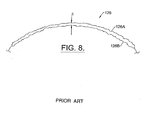
- a typical eye 120 normally has aberrations that cause deformation or distortion of a reflected wave exiting the eye, where the aberrated eye 120 diffusely reflects an impinging light beam (again not shown for sake of clarity) from the back of its retina 122 of the fovea centralis 123 through lens 124 and cornea 126 .
- the reflected light 128 exits the eye 120 as a sequence of distorted wavefronts, one of which is represented by wavy line 130 .
- a coordinate system is defined for convenience, where positive x is upward in the plane of the figure, positive y is outward from the plane of the figure, and positive z is to the right along a propagation direction.
- the distorted wavefront 130 is herein described mathematically as W(x,y).
- One method of measuring distortions in the wavefront 130 is by determining a spatial separation ⁇ z between a reference plane 131 (by way of example, a plane analogous to the ideal wavefront 110 ) at a known distance Z 0 from the eye 120 at each (x,y) point of the distorted wavefront 130 as the leading edge of the wavefront 130 traverses the distance Z 0 .
- ⁇ Z(x,y) Z 0 - W(w,y)
- the amount of material removed or added at each (x, y) coordinate can be calculated directly if the refractive index of the material in question is known.
- a wavefront analysis may be performed repetitively during a procedure to provide feedback information as to the appropriate endpoint of the procedure.
- Ablation is then carried out discretely at each (x,y) coordinate along the cornea 126 by a laser beam delivery and eye tracking system such as described in U.S. Patent Nos. 5,980,513; 5,849,006; and 5,632,742, commonly owned with the present invention.
- the appropriate corneal ablation depth at any (x,y) transverse coordinate is, to within a small error, given by: ⁇ z(x,y) / (n c - 1) where n c is the refractive index of corneal tissue or 1.3775.
- the method described in detail below calculates ⁇ z(x,y) by first measuring the local slopes in wavefront 130 , i.e. ⁇ W(x,y)/ ⁇ x and ⁇ W(x,y)/ ⁇ y, at a number of points in the transverse x and y directions in reference plane 131 and then generating a mathematical description of W(x,y) having slopes in best possible agreement with the experimentally determined values.
- ⁇ W(x, y) / ⁇ x is illustrated with reference again to FIG. 1D.
- a small error is introduced due to the fact that distorted wavefront 130 is measured at the reference plane 131 while wavefront 130 emerged from a curved corneal surface just posterior to reference plane 131 .
- an error E x (x,y) is the lateral displacement in the x-direction at each (x,y) location at the measurement plane (i.e., reference plane 131 ) to the curved corneal surface.
- a similar error will be manifest for any corrections involving curved optical surfaces. The error will generally increase with both (x,y) displacement from the point of tangency and local wavefront error.
- the error may be negligibly small.
- E y (X 0 , y 0 ) y'-y 0 . If significant, these transverse errors can be compensated for by laterally displacing the aberration correction calculated at each (x,y) coordinate by the amounts E x (x,y) and E y (x,y).
- the transverse error under most circumstances will be negligible.
- the error will be zero at the origin where the corneal tissue and reference plane 131 are tangent.
- the tissue is approximately spherical with a radius of curvature of approximately 7.5-8.0 mm.
- the corrective treatment radius is typically no more than 3 mm, and local wavefront radius of curvature will almost never exceed 50 mm (a 20 diopter refractive error).
- the transverse error E at a 3 mm treatment radius for a local wavefront radius of curvature of 50 mm is less than 40 ⁇ m.
- the amount of spatial separation of component portions of wavefront 130 relative to the corresponding component portions of the planar or ideal wavefront 110 is measured. It is the system and method of the present invention that allows such separation to be objectively and accurately measured for even substantially aberrated eyes 120 including those exhibiting severe defects such as severe myopia or hyperopia.
- the patient's pupil should ideally be dilated to approximately 6 mm or more, i.e., the typical size of a human pupil in low light. Smaller amounts of dilation or no dilation at all may also evaluated or measured. In this way, the eye is evaluated while it is using the greatest area of the cornea so that any correction developed from such measurement takes into account the largest usable corneal area of the patient's eye. A lesser amount of the cornea is used in daylight where the pupil is considerable smaller, e.g., on the order of 3 millimeters. Dilation can be brought about naturally by implementing the measurement portion of the present invention in a low light environment such as a dimly lit room. Dilation can also be induced through the use of pharmacologic agents.
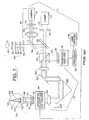
- the apparatus 10 includes a laser 12 for generating optical radiation used to produce a small-diameter laser beam 14 .
- the laser 12 generates a collimated laser light beam (represented by dashed lines for the beam 14 ) of a wavelength and power that is eye-safe.
- appropriate wavelengths would include the entire visible spectrum and the near infrared spectrum.
- an iris diaphragm 16 is used to block all of laser light beam 14 except for the laser beam 18 of a size desired for use.
- the laser beam 18 will have a diameter in the range of approximately 0.5-4.5 millimeters with 1-3 millimeters being typical, by way of example.
- a badly aberrated eye uses a smaller diameter beam while an eye with only slight aberrations can be evaluated with a larger diameter beam.
- a lens as will be later described, can be positioned in the beam path to optimize collimating of the beam.
- Laser beam 18 is a polarized beam that is passed through a polarization sensitive beam splitter 20 for routing to a focusing optical train 22 which optical train operates to focus the laser beam 18 through the optics of the eye 120 (e.g., the cornea 126 , pupil 125 and the lens 124 ) to the retina 122 .
- the lens 124 may not be present for a patient that has undergone a cataract procedure.
- the optical train 22 images the laser beam 18 as a small spot of light at or near the eye's fovea centralis 123 where the eye's vision is most acute. Note that the small spot of light could be reflected off another portion of retina 122 in order to determine aberrations related to another aspect of one's vision.
- the diffuse reflection of the laser beam 18 back from the retina 122 is represented in FIG. 2 by solid lines 24 indicative of radiation that passes back through the eye 120.
- the wavefront 24 is depolarized relative to the laser beam 18 due to reflection and refraction as the wavefront 24 emanates from the retina 122 . Accordingly, the wavefront 24 is turned at the polarization sensitive beam splitter 20 and directed to a wavefront analyzer 26 such as a Hartmann-Shack (H-S) wavefront analyzer.
- H-S Hartmann-Shack
- the wavefront analyzer 26 measures the slopes of wavefront 24 , i.e., the partial derivatives with respect to x and y, at a number of (x,y) transverse coordinates, as earlier described with reference to FIGS. 1C and 1D. This partial derivative information is then used to reconstruct or approximate the original wavefront with a mathematical expression such as a weighted series of Zemike polynomials.
- the optical train 22 includes a first lens 220, a flat mirror 221 , a Porro mirror 222 and a second lens 224 all of which lie along the path of laser beam 18 and the wavefront 24 .
- the first lens 220 and the second lens 224 are identical lenses maintained in fixed positions.
- the Porro mirror 222 is capable of linear movement as indicated by arrow 223 to change the optical path length between the lenses 220 and 224 .
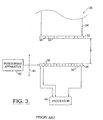
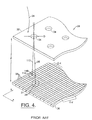
- the dynamic range of the apparatus 10 is further improved by providing an improved wavefront sensor arrangement 28 as illustrated with reference to FIGS. 3 and 4 as disclosed in our International Patent Application No. WO-99/27334.
- each such wavefront portion 25 passes through the hole 34 to illuminate planar array 36 .
- the resulting image formed by each such wavefront portion 25 is a positive shadow of the respective hole 34 .
- diffraction occurs as determined by the diameter D of each hole 34, the wavelength ⁇ of the light source (e.g. the wavefront 24 ) and the separation distance F between the plate 32 and the planar array 36.
- the value of F is varied by the positioning apparatus 42 to adjust the gain based on the particular patient as will be explained further below.
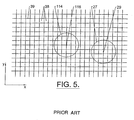
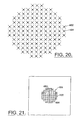
- One method used to determine the centroid 29 of each spot 27 unambiguously with respect to a spot caused by another one of the holes 34 assigns a unique number of cells 38 to each hole 34 .
- the "assigned areas" are designated, as illustrated with reference to FIG. 5, as also described in our International Patent Application No. 99/27334 by way of example, with the heavy grid lines 39 . It is to be understood that the grid lines 39 are not actual physical boundaries between cells 38 but are shown simply to illustrate the unique designated areas containing a plurality of the cells 38 . It is anticipated that other centroid strategies will be utilized that do not necessitate such partitioning of the array 36 given the teachings of the present invention.
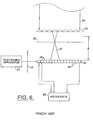
- the lenslet array 33 may be operable by the positioning apparatus 42 such that separation distance F is independent of the focal length f that defines the focal plane of the lenslet array 33 which is represented by dashed line 35 .
- the processor 40 computes each two-dimensional centroid 29 of each spot 27 generated by the wavefront 24 .
- the amount of two dimensional centroid shift relative to the centroid of the calibrating spot for each designated area associated with a corresponding hole 34 (or sub-aperture of lenslet array 33 ) is divided by the separation distance F to generate a matrix of local slopes of the wavefront, i.e., ⁇ W(x,y)/ ⁇ x and ⁇ W(x,y)/ ⁇ y at the (x,y) coordinates of the centers of holes 34 .
- ⁇ W(x,y)/ ⁇ x ⁇ W(x,y)/ ⁇ x
- Q(x,y) ⁇ W(x,y)/ ⁇ y, respectively.
- such approaches may include the use of Fourier series and Taylor series.
- the wavefront W(x,y) is expressed as a weighted sum of the individual polynomials where Ci are the weighting coefficients, and Z i (x,y) are the Zernike polynomials up to some order. This is further described in our International Application WO 9927334.
- a method is herein described in accordance with the present invention for identifying individual spots and correlating their geometry.
- the apparatus is configured such that the optical axis is aligned to the center of a particular aperture at the entrance face of the wavefront sensor. This aperture is located at or near the center of the entrance face. If the probe beam entering the eye is also aligned to the system optical axis, then due to the reversible nature of light rays, a light spot will always be seen directly behind the aligned aperture. That is, a spot will always be seen on the CCD sensor at this location, regardless of the wavefront aberrations, and will always correspond to the overlying aperture. Immediately adjacent spots will be minimally displaced from their "zero slope" locations. As one moves further from the central reference spot, generally greater spot displacements will occur. Using this knowledge, it is a relatively straight forward process to identify all the spots in the CCD pattern and establish their geometric relationships.
- the displacement of the centroid from that of a perfectly collimated light beam, corresponding to ideal and emmetropic vision, is then calculated and used to determine the wavefront slope at each sample location.
- the location of the centroids for a collimated light beam may either be directly measured in a calibration step prior to the patient exam, or taken from a calculated reference pattern based on the wavefront sensor construction.
- the apparatus 10 can be augmented by the addition of an eye tracker 25 , illustrated with reference again to FIG. 2.
- an eye tracker 25 illustrated with reference again to FIG. 2.
- One possible placement of the eye tracker 25 is herein illustrated. However, it is to be understood that the eye tracker 25 could be placed elsewhere within the apparatus 10.
- One such eye tracker is disclosed in the aforementioned U.S. Patent No. 5,980,513, commonly owned with the present invention. In this way, wavefront analysis is performed even during a limited amount of eye motion.
- a one-time calibration exposure can also be used to determine the relative sensitivities of the individual cells. This is made in uniform collimated light with plate 32 removed. The responses of individual cells are then recorded. For each light transmissive aperture (e.g, hole 34 ), the centroid in the collimated case serves as a dedicated origin for the particular hole. The shift from the "origin" for each hole to the centroid caused by the wavefront 24 (as observed in this coordinate system) is determined by the direction of the wave surface corresponding to that hole.
- each P(m,n) and Q(m,n) represents the partial derivatives of W(x,y) with respect to x and y for the (x,y) coordinates of each hole 34.
- each hole 34 is assigned its dedicated area of the array 36 or (I m,n ⁇ ⁇ i, j m,n ⁇ ⁇ j). This square of many light-sensitive cells is large enough that neighboring hole images never encroach, and all illumination from this hole is contained. The square contains 4 ⁇ i* ⁇ j cells.
- the functions Z k (x,y) in equation (19) are the Zernike polynomials. There is no standard convention as to their sequence. Thus, for consistency, it is important that the same sequence is used to produce the set C k that was chosen for deriving the matrix TM.
- orders up to and including 4 are used (less Z 0 - the single member of order 0 that is the constant 1 which describes the reference position of the group in the z direction). Since wavefront 24 is moving along z (at the velocity of light), this "piston term" describes only an arbitrary offset in Z, and this term may be ignored.
- the first 5 orders (0, 1, ...,4) contain 15 functions including the piston term.
- 14 values of C k are calculated as coefficients of 14 Zernike polynomials.
- TM one such order used to calculate TM is herein illustrated, and includes both the Zernike functions and their partial derivatives.
- Calculation of the ⁇ z (x,y) optical path difference information from the Zernike reconstruction of the wavefront is accomplished simply by subtracting a constant from the Zemike approximation.
- the value of the constant will depend on the desired characteristics of ⁇ z (x,y).
- transition matrix TM The development of the transition matrix TM will now be explained for the illustrated example of a 7 x 7 array of holes in plate 32.
- the tangents of the components of the normal are P (x i ,y j ) and Q (x i ,y j ) where and Combining these with equation (11), and each applicable to 49 (i,j) combinations.
- PQ that is 98 elements high, i.e., a 98 x 1 matrix.
- Equation (19) can be rewritten as the matrix equation where the top 49 rows of M are the ⁇ W (x i , y j ) / ⁇ y.
- equation (25) gives the normal components in terms of the Zernike coefficients for a surface described by the array of 14 C's. These are exact, but it is not guaranteed that the actual total surface can be described by such an array of coefficients. Accordingly, if it is assumed that the description is within an acceptable tolerance, i.e., tolerating the errors that remain after least square error determination, then equation (26) can be considered to define the column vector C implicitly in terms of the mathematical matrix M and the measured vector PQ, both of which are known.
- the method of effecting the solution under the minimization condition is as follows.
- equation (25) is multiplied on the left by M T , the transpose of M such that where S ⁇ M T M is a square and symmetric matrix, e.g., of dimensions 14 x14 (with each element the sum of 98 products). Such a matrix has an inverse unless the determinant of its coefficients is zero. Since this is based on the Zernike polynomials alone, and they are all independent of each other, the determinant is non-zero, so that an inverse S -1 is defined.
- equation (25) is multiplied on the left by S -1 to yield Then, the mathematical transition matrix (independent of measurement) is and the "best fit" array of C's from the measured PQ's can be produced by the simple matrix multiplication
- a pulsing or shuttering laser source may be used, or an eye tracker.
- FIG. 7 An implementation suitable for clinical use is illustrated, by way of example, with reference to FIG. 7 as also described in our International Patent Application No. 99/27334 and is referenced generally by numeral 11 .
- a dichroic beam splitter 52 is interposed between the beam splitter 20 and the optical train 22 to introduce fixation target optics 60 and observation optics 70 into the apparatus 11 which are optically separated from one another by a 50/50 beam splitter 54 .
- Fixation target optics provide the eye 120 with visible light in the shape of a target. The visible light generated by fixation target optics 60 is reflected by the dichroic beam splitter 20 and directed through optical train 22 .
- FIGS. 9-24B and 17A, 27B also referred to in our co-pending European Patent Application No. EP-A-1,153,570
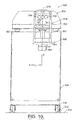
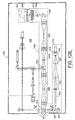
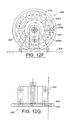
- an exemplary embodiment of the apparatus 10 will be herein described beginning with series 300 , which improved apparatus 300 is constructed as a patient examination station which allows the patient 302 to be comfortably positioned for the measurement of the eye 120 , as earlier described.
- a computer monitor, mouse, and keyboard are located on a separate cart for this embodiment of the present invention, herein described.
- the apparatus 300 includes a housing 304 having a platform 306 which is carried by a rigid frame 308 .
- the frame 308 includes wheels 310 to facilitate shipping and installation at the clinical site, as well as locking and leveling feet 312 for securing the apparatus to the supporting floor 314 . Once the apparatus is positioned, the integrated leveling feet 312 are deployed to provide a stable stationary frame 308 , and thus platform 306 .
- a fourth optical path 352 a re-emitted wavefront optical path illustrated in isolation in FIG. 12D for convenience to the reader, conveys the reflected wavefront 24 of FIG. 2, and herein described with numeral 354 re-emitted from the eye 120 and directed towards a wavefront sensor 356 .
- first and second afocal relay stages 358, 360 transfer the reflected wavefront 354 from the corneal plane of the eye 120 to the entrance face of the wavefront sensor 356 .
- a fifth optical path 362 a calibration wavefront optical path illustrated in isolation in FIG. 12E for convenience to the reader, injects collimated laser light into the wavefront transfer path leading to the sensor 356 .
- Software operable within the computer 326 described earlier with reference to FIG. 9, uses collimated light wavefront sensor output data to calibrate the apparatus 300 prior to patient measurement.
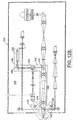
- the first optical path 340 is herein described as a fixation path which provides a reference image to the patient, such that the eye 120 is properly aligned when the patient is fixating on the reticle 344 of a reference target 366 .
- a target illumination lamp 368 backlights the fixation target 366 , which fixation target image reaches the patient eye 120 by transmission through a 50/50 beam splitter 370, lenses 372, reflection in 50/50 beam splitters 374, 376 , and transmission through lens combinations of afocal relay stage 358 , as well as through polarizing beam splitter 378 .
- a spectral filter is placed over the target illumination lamp 368 to remove radiation over the 620-790 nm wavelength range that might otherwise interfere with a wavefront measurement at 670 nm.
- the lens combinations in the first relay stage 358 contain identical lens elements mounted in reverse order. Each consists of two meniscus lens elements, with an interposed achromatic doublet. The lens combinations work in tandem as a unity magnification afocal relay stage.
- the optical elements including the polarizing beam splitter 378 , the lenses of the first afocal stage 358, the beam splitters 374, 376 , and one lens 380 of the lenses 372 are mechanically fixed in place on the surface of the platform 306 .
- the optical elements including a lens pair 382 of the lenses 372 , the beam splitter 370 , the fixation target 366 , and the illumination lamp 368 are all mounted on one precision linear translation stage, capable of movement along the optical axis 342 of this pathway. Translation of these optical elements focuses the fixation target 366 for the patient's view, compensating for any myopia/hyperopia present in the eye 120 .
- the focus translation stage is adjusted to place the target optically just beyond the eye's infinity focal plane. This allows the patient to see a relatively distinct reticle pattern without stimulating accommodation by the eye 120 .
- the beam splitters 378, 376, 374 serve as interfaces between other optical pathways within the optical axis 342 , as will herein be described in further detail.
- the beam splitter 370 is included for alignment purposes.
- a photo-detector 384 attached to the center of the left edge of beam splitter 370 senses light transmitted toward the fixation target along the optical axis.
- the second optical path 346 captures video images of the eye 120 at an examination plane. This allows the clinical operator/technician to assist in patient alignment, and to measure actual eye displacement during the wavefront measurement.
- the illumination lamps 336 illuminate the eye 120 .
- the image of the eye is conveyed to the video camera 338 by transmission through the polarizing beam splitter 378 and the lens combinations 358, reflection in the 50/50 beam splitter 376, transmission through the 50/50 beam splitter 374, reflection off mirror 386, and transmission through lens 388 . All these optical elements are fixed in place on the surface of the platform 306.
- this second path 346 provides a video field of view approximately 22 mm in diameter at the eye plane, with a limiting resolution of ⁇ 64 mm.
- a number of filters are placed in front of each eye illumination lamp 336 to reduce the spectral bandwidth of the radiation reaching the eye 120 .
- these will includes a blue filter to remove light at wavelengths below ⁇ 455nm (for eye safety), an infrared filter to remove light at wavelengths above ⁇ 920nm (for eye safety), and a rejection filter to remove light over the wavelength range 620nm - 790nm (to prevent interference with the wavefront measurement at 670 nm).
- the third optical path 348 irradiates a small spot on the patient's retina with eye safe laser radiation, as earlier described with reference to FIGS. 1A - 1D.
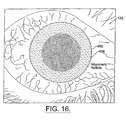
- the irradiated retinal spot on the fovea centralis 123 of the retina 122 is, as herein described, the origin of the re-emitted wavefront 130 measured by the sensor 356 .
- the output beam, probe laser beam 350 from diode laser 390 reaches the patient eye 120 by transmission through a linear polarizer and attenuator 392 , lens 394 , shutter 396 , and reflection off mirror 398 and in the polarizing beam splitter 378 . All these elements are fixed in position.
- output of the diode laser 390 is essentially collimated and is focused onto a corneal surface of the eye 120 by lens 394 .
- the projected probe laser beam 350 collimated light from the diode laser 390 , is directed by a long focal length lens 394 for focusing on the anterior surface of the cornea 126 of the eye 120 , as illustrated by way of example with reference again to FIG. 1B, passing through the pupil and lens 124 of the eye 120 , and onto the retina 122 as a small measurable spot on the fovea centralis 123.
- the lens 394 comprises a zoom lens for varying the focus and moving the focus location as desired.
- the measurement is minimally dependent on the curvature of the cornea.
- other locations proximate the corneal surface are acceptable.
- the present invention avoids the aberration effects from the cornea which typically dominate.
- the lens of the eye 120 contributes a relatively small aberration effect when compared to that of the cornea 126 .
- selecting a lens with a short focal length would provide a relatively large incident angle of the beam 350, a well focused point on the surface of the cornea 126 , and less aberration effects from the cornea.
- a small incident angle provides a larger focus point on the cornea 126 , but a more desirable smaller spot on the retina 122 , which spot size will depend on the wavelength and starting point size and focal length of the lens 394 selected.
- Embodiments of the present invention including lenses of approximate one half meter and 100 mm, by way of example, haves been effectively used.
- each of the lenses of the second afocal relay stage 360 consists of three lens elements, two meniscus lenses and an interposed achromatic doublet. However, they are not identical, and their combined action serves to magnify the passing wavefront 130.
- the wavefront 354 at the trial lens holder 408 location is imaged onto the surface of the microlens array 412 with a magnification of 1.22. Magnification of the wavefront image by this defined factor of 1.22 reduces the wavefront slope at each point in the image plane by the same 1.22 factor. This extends the measurement dynamic range of the device, again without decreasing accuracy.
- this magnification distributes the wavefront 130 over more elements, CCD cells 38 as earlier described with reference to FIG.
- the microlens array contains a square array of microlenses which divide the incident wavefront into a transverse array of secondary "wavelets.” These wavelets are focused onto a detector surface of the CCD camera, which is positioned parallel to the microlens array and one focal length posterior thereto. The pattern of focused wavelets in the CCD image is used to calculate the shape of the incident wavefront.
- the calibration beam path 362 provides the collimated beam 364 to the Hartman Shack wavefront sensor 356.
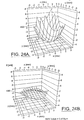
- FIG. 24A An example of the computed Zernike coefficients for an eye and the corresponding wavefront reconstruction 493 is illustrated with reference to FIG. 24A.
- the spherical and cylindrical powers computed from the wavefront are -1.60/-1.13 x 150.4.
- the corresponding values obtained by an optometrist performing a phoropter examination were -1.47/-1.19 x 150.
- the standard measurements of spherical and cylindrical powers agree well with the computation of spherical and cylindrical powers, but there are also higher order aberrations present.
- FIG. 24B illustrates just these higher order aberrations 495 on the same scale as the plot of FIG. 24A.
- OPD optical path difference
- scaling an optical path difference profile, OPD(x,y), by a refractive index difference (cornea to air) is not the only step included to calculate the correct ablation profile.
- the present invention allows for a treatment on the curved corneal surface, while the wavefront measurement was made at a plane tangent to the cornea, as illustrated with reference to FIG. 25, which is exaggerated to illustrate the effect.
- the image plane of the wavefront path is the lenslet array plate.
- the object plane of the wavefront path is the reference plane 494 .
- one light ray 496 emerging from the eye 120 at transverse location a is detected at a transverse location b.
- the wavefront reconstructed from sensor data will have the slope of this ray at location b .
- This is true of the wavefront at the reference plane 494 simple scaling of this wavefront would yield an ablative treatment at corneal location b that may not be entirely correct. In actuality this effect is small.
- the radius of curvature of the cornea is typically on the order of 7.5 mm. (a range of 7-8 mm encompasses most eyes.)
- compensating for the curved geometry may be performed in the following manner:
- a wavefront measurement has the patient correctly positioned at the apparatus 300 .
- the eye 120 being measured is at the correct location and looking in the appropriate direction.
- the apparatus 300 of this embodiment of the present invention provides the following patient position information:
- This embodiment of the apparatus includes a sufficient dynamic range to measure eyes over the expected scope of refractive errors.
- the apparatus detects complex aberrations, and does so with sufficient accuracy to serve as the basis for ablative treatment.
- a computation of a shot pattern is performed in the LADARVision® system.
- the Zernike coefficients computed in the manner described here are imported into the LADARVision® system along with all other d measurement and patient information and used along with LADARVision® system parameters to compute the optimal number and placement of shots.
- One embodiment of the present invention for a calculation of a treatment laser spot pattern includes an ablation effectiveness distribution over the corneal surface.
- One embodiment of the present invention optimizes refractive surgery ablation profiles so that post operative aberrations are minimized.
- One treatment profile takes into account information beyond just that of pre-operative aberrations.
- wave front measurement devices has provided greater insight into the effectiveness of current excimer ablation profiles.
- Analysis of multiple patients for pre and post laser reflective surgery has resulted in a model for describing an effectiveness of a laser ablation as a radially symmetric attenuation function.
- One embodiment of the present venture provides for this attenuation function. As illustrated by way of example with reference to FIGS.
- FIG. 26A illustrates an intended and achieved profile for surgery on a myopic eye
- the 26B illustrates an intended and achieved profile for surgery on a hyperopic eye.
- the ablation depth versus normalized radial profile plots of FIGS. 26A and 26B are representative of multiple surgeries analyzed.
- a constant attenuation independent of radial position results. Sometimes the attenuation is zero.
- a radially symmetric attenuation function results.
- the attenuation function may be graphically described, by way of example, with reference to FIG. 26C.
- an embodiment of the present invention takes a previously unknown efficiency or attenuation function and modifies treatment profiles accordingly so that a desired outcome is achieved. By way of illustration and example, this may be accomplished by taking a desired change in corneal depth (e.g. a nominal ablation profile), and dividing the nominal profile by the attenuation function.
- P INPUT P DESIRED ⁇ A ⁇ 1+B ⁇ 2 +C ⁇ 4 ⁇
- the output from wavefront analyzer 26 can be used in a variety of ways.
- the output may be used to continually or periodically monitor the progress or effects of an ophthalmic procedure, with such stored on disc or transmitted via e-mail, and the like.
- the measurement of the eye and the resulting surgery need not take place at the same site.
- the output could also be used to develop an optical correction for the eye 120 .
- the optical correction will make the aberrated wavefront 130 appear approximately as the planar wavefront 110 .
- the optical correction can be implemented in a variety of ways.
- the output of the wavefront analyzer 26 is input to a processor 90 which converts the Zemike expansion of equation (19) into a form suitable for being implemented as one of the possible optical corrections.
- the processor 90 may also be implemented at the processor 40 of the wavefront analyzer 26 , described earlier with reference to FIG. 6.
- the processor 90 can be used with preselected Zernike coefficients from the expansion of equation (19) to generate a standard sphero-cylindrical correction for a lens grinder 92 to produce a conventional optical lens, e.g., a lens for glasses, a contact lens, and the like.
- the processor 90 includes a modification of the Zernike reconstruction of the aberrated wavefront 130 by the index of refraction of the cornea 126 minus that of air, having value of 1 , as earlier described, to calculate an amount of corneal material to be ablated at each corresponding (x,y) location on the cornea 126 .
- This information regarding the amount of corneal material can be used in conjunction with a laser beam delivery system 94 that typically has eye tracking capability.
- the laser beam delivery system 94 including the eye tracker is placed in line with the optical axis of the apparatus 11 , as illustrated again with reference to FIG. 7.
- the eye tracker portion allows the apparatus 11 to respond to unwanted eye motion.
- the system 94 would typically focus short pulses or "shots" of ablating laser light onto the cornea 126 to remove a specified thickness t of material at each location.
- the ablation thickness t is specified across the aperture of the cornea measured, e.g., the 6 millimeter circle to which the eye's pupil was dilated during the measurement of the eye. Outside the prescribed treatment circle, a tapering blend zone of partial ablation may be added to minimize severe changes in corneal curvature and hence lessen regression.
- the laser beam delivery system 94 removes thickness t to achieve the optical correction, which results in the corrected cornea surface 126B .
- the optical correction is not concerned with the ultimate corneal topography, but instead removes corneal material to achieve an optical correction that takes into account all ocular aberrations of the eye 120 .
- This is important because the shape of the corneal surface can be independent of the correction d because the eye's vision depends on numerous factors besides corneal curvature.
- the best corneal surface topography for optimal vision may be far from regular in that it may compensate for the errors in the eye's other surfaces.
- the present invention can be used to provide corneal surface corrections other than the conventional spherical and/or cylindrical corrections.
- the apparatus 300 of the present venture includes first and second afocal relays stages 358, 360 .
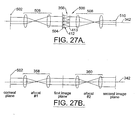
- first and second afocal relays stages 358, 360 To retain the benefit of wavefront magnification, as a means of increasing the dynamic range of the wavefront sensor 356 to accommodate patients with large refractive errors, while at the same time allowing for incorporation of a small format, inexpensive camera to record the wavefront slope data, a modification 500 to the apparatus 300 as illustrated with reference to FIG. 27A is provided.
- a lens array may also be positioned and configured as illustrated with reference to FIG. 27B, wherein a portion of the apparatus 300 of FIG. 12 includes the first and second afocal stages 358, 360 within the optical axis 342 , and the wavefront sensor 356 consist of the microlens array and CCD camera separated by a fixed distant, as earlier described with reference to FIG. 6.
- This optical path through the afocal relay stages results in an image of the corneal plane 502 at the lenslet array, i.e. at the entrance face of the actual wave front sensor 356 . This can be accomplished by a single afocal stage.
- FIG. 27B a portion of the apparatus 300 of FIG. 12 includes the first and second afocal stages 358, 360 within the optical axis 342 , and the wavefront sensor 356 consist of the microlens array and CCD camera separated by a fixed distant, as earlier described with reference to FIG. 6.
- This optical path through the afocal relay stages results in an image
- the apparatus 300 includes an intermediate image plane as insertion point, the holder 408 , for a trial lens. Placing a spherical lens into the optical axis 342 at the first image plane, in theory, could be used to remove the defocus wavefront error. This would potentially expand the dynamic range of the apparatus 300 .
- the trial lens approach s a moving mechanism that can position lenses at the first image plane with tremendous accuracy in repeatability. It is highly desirable that alternative means be developed to address dynamic range.
- One way to accomplish this is to magnify the corneal plane image at the lenslet array with the afocal stage 360 , earlier described. Magnification of the wavefront reduces the wavefront slope, so that the displacement of the focused lights spots on the CCD is decreased.
- the chosen magnification factor used with the apparatus 300 second afocal stage 360 is approximately 1.2 which is sufficient to cover the desired range in refractive errors. A magnification factor in excess of 1.5 is desirable for expanding the use of the apparatus 300.
- simply magnifying the corneal plane has a drawback in that it necessitate a large aperture wavefront sensor. That is, both the lens array and the CCD camera preferably have large cross-sectional areas to encompass the magnified image of the point of plane. This is not a significant issue for the lens array.
- a large format CCD camera is quite expensive and such cameras are only available from a limited number of vendors.
- the corneal plane 502 is imaged at a reference plane 504 by an afocal relay stage 506 , which magnifies the corneal plane by a preselected amount.
- the lenslet array 412 is placed at the reference plane 504. Focused spots of light from the eye 120 are produced at the lenslet array focal plane 504 .
- an optical train 508 is inserted to image the array focal plane 413 at yet another plane, a final image plane 510 , at which plane the CCD detector face is positioned.
- magnification of the array focal plane at the final image plane 510 is provided. This allows a small, relatively inexpensive, active area camera to be used as the light recording element in the wavefront sensor. Details of optical design including magnification specifics can be adjusted to maximize performance for a given camera and lens array plate specification.
- the advantages of the present invention are numerous. A totally objective approach is presented for measuring ocular aberrations. The approach is effective for a wide range of vision defects. Accordingly, the present invention will be of great utility in a wide variety of clinical applications.
- the calculated Zernike coefficients can be used to develop a completely objective lens prescription or a corneal correction that could be accomplished with laser ablation.
- each of the wavefront sensor embodiments provides for a greater degree of accuracy over the prior art with respect to measuring wavefront deflections. Further, the present wavefront sensor can be adjusted in terms of gain simply by adjusting the separation distance between the imaging plane of the sensor and the planar array of light-sensitive cells.
- the objective measurement of the present invention will also find great utility for a large variety of applications where the "patient” is unable to provide feedback as d by conventional eye diagnosis.
- the present invention could be used to evaluate the eyes of any patient not possessed of demonstrative communicative skills, e.g., babies, animals, dead specimens, as well as any constructed optical system, since the present invention is an objective analysis not requiring any assessment from the "subject". All that is necessary is for the subject's eye to be properly positioned so that proper optical access to the eye can be obtained.
- the present invention will also be used in the area of identification should it be determined that each eye's Zemike coefficients are unique. Then, the present invention would find great utility in the fields of law enforcement, credit card/bank security, or any other field where positive identification would be beneficial.
Landscapes
- Health & Medical Sciences (AREA)
- Engineering & Computer Science (AREA)
- Biomedical Technology (AREA)
- General Health & Medical Sciences (AREA)
- Public Health (AREA)
- General Business, Economics & Management (AREA)
- Business, Economics & Management (AREA)
- Ophthalmology & Optometry (AREA)
- Veterinary Medicine (AREA)
- Epidemiology (AREA)
- Life Sciences & Earth Sciences (AREA)
- Animal Behavior & Ethology (AREA)
- Physics & Mathematics (AREA)
- Heart & Thoracic Surgery (AREA)
- Optics & Photonics (AREA)
- Nuclear Medicine, Radiotherapy & Molecular Imaging (AREA)
- Surgery (AREA)
- Vascular Medicine (AREA)
- Medical Informatics (AREA)
- Primary Health Care (AREA)
- Eye Examination Apparatus (AREA)
- Laser Surgery Devices (AREA)
- Optical Radar Systems And Details Thereof (AREA)
- Spectrometry And Color Measurement (AREA)
- Investigating Or Analysing Materials By Optical Means (AREA)
Applications Claiming Priority (3)
| Application Number | Priority Date | Filing Date | Title |
|---|---|---|---|
| US566668 | 1990-08-13 | ||
| US56666800A | 2000-05-08 | 2000-05-08 | |
| PCT/US2001/014448 WO2001085016A2 (en) | 2000-05-08 | 2001-05-03 | Objective measurement and correction of optical systems using wavefront analysis |
Publications (2)
| Publication Number | Publication Date |
|---|---|
| EP1210003A2 EP1210003A2 (en) | 2002-06-05 |
| EP1210003B1 true EP1210003B1 (en) | 2004-08-04 |
Family
ID=24263884
Family Applications (1)
| Application Number | Title | Priority Date | Filing Date |
|---|---|---|---|
| EP01941464A Expired - Lifetime EP1210003B1 (en) | 2000-05-08 | 2001-05-03 | Objective measurement and correction of optical systems using wavefront analysis |
Country Status (12)
| Country | Link |
|---|---|
| EP (1) | EP1210003B1 (enExample) |
| JP (2) | JP2003532476A (enExample) |
| AT (1) | ATE272355T1 (enExample) |
| AU (1) | AU7481601A (enExample) |
| BR (1) | BR0106431A (enExample) |
| CA (1) | CA2376111C (enExample) |
| DE (1) | DE60104633T2 (enExample) |
| DK (1) | DK1210003T3 (enExample) |
| ES (1) | ES2223874T3 (enExample) |
| MX (1) | MXPA01013365A (enExample) |
| PT (1) | PT1210003E (enExample) |
| WO (1) | WO2001085016A2 (enExample) |
Families Citing this family (33)
| Publication number | Priority date | Publication date | Assignee | Title |
|---|---|---|---|---|
| DE19938203A1 (de) | 1999-08-11 | 2001-02-15 | Aesculap Meditec Gmbh | Verfahren und Vorrichtung zur Korrektur von Sehfehlern des menschlichen Auges |
| KR100603543B1 (ko) | 1999-10-21 | 2006-07-24 | 테크노라스 게엠베하 옵탈몰로지쉐 시스템 | 광학 치료용 홍체 인식 및 추적 |
| EP2008576B1 (en) * | 2001-03-15 | 2011-05-11 | AMO WaveFront Sciences, LLC | Topographic wavefront analysis system and method of mapping an optical system |
| US6582079B2 (en) | 2001-06-05 | 2003-06-24 | Metrologic Instruments, Inc. | Modular adaptive optical subsystem for integration with a fundus camera body and CCD camera unit and improved fundus camera employing same |
| US6709108B2 (en) | 2001-08-31 | 2004-03-23 | Adaptive Optics Associates, Inc. | Ophthalmic instrument with adaptive optic subsystem that measures aberrations (including higher order aberrations) of a human eye and that provides a view of compensation of such aberrations to the human eye |
| WO2003102498A1 (en) | 2002-05-30 | 2003-12-11 | Visx, Inc. | “tracking torsional eye orientation and position” |
| US7320517B2 (en) | 2002-12-06 | 2008-01-22 | Visx, Incorporated | Compound modulation transfer function for laser surgery and other optical applications |
| US8342686B2 (en) | 2002-12-06 | 2013-01-01 | Amo Manufacturing Usa, Llc. | Compound modulation transfer function for laser surgery and other optical applications |
| DE10314944A1 (de) | 2003-04-02 | 2004-10-14 | Carl Zeiss Meditec Ag | Beleuchtungs- und Bestrahlungseinheit für ophthalmologische Geräte |
| US7458683B2 (en) | 2003-06-16 | 2008-12-02 | Amo Manufacturing Usa, Llc | Methods and devices for registering optical measurement datasets of an optical system |
| US7175278B2 (en) * | 2003-06-20 | 2007-02-13 | Visx, Inc. | Wavefront reconstruction using fourier transformation and direct integration |
| US7226443B1 (en) * | 2003-11-07 | 2007-06-05 | Alcon Refractivehorizons, Inc. | Optimization of ablation correction of an optical system and associated methods |
| US7343099B2 (en) | 2004-02-12 | 2008-03-11 | Metrologic Instruments, Inc. | Free space optical (FSO) laser communication system employing fade mitigation measures based on laser beam speckle tracking and locking principles |
| US7481536B2 (en) | 2004-02-19 | 2009-01-27 | Amo Manufacturing Usa, Llc | Methods and systems for differentiating left and right eye images |
| US7296893B2 (en) | 2004-03-03 | 2007-11-20 | Visx, Incorporated | Transformation methods of wavefront maps from one vertex distance to another |
| US7547102B2 (en) | 2004-03-03 | 2009-06-16 | Amo Manufacturing Usa, Llc | Wavefront propagation from one plane to another |
| CN102307514B (zh) | 2008-12-01 | 2015-07-22 | 完美视觉科技(香港)有限公司 | 人眼屈光矫正的方法和设备 |
| KR20150083902A (ko) * | 2012-11-07 | 2015-07-20 | 클레러티 메디칼 시스템즈 인코포레이티드 | 실시간 고디옵터 범위 순차 파면 센서를 작동하는 장치 및 방법 |
| KR102002634B1 (ko) * | 2013-01-28 | 2019-07-22 | 노바르티스 아게 | 각막 교차 결합을 위한 장치 |
| EP2968000B1 (en) | 2013-03-13 | 2018-08-15 | Optimedica Corporation | Laser eye surgery system |
| AU2014249863B2 (en) | 2013-03-13 | 2018-07-12 | Amo Development, Llc | Free floating patient interface for laser surgery system |
| WO2015081214A1 (en) | 2013-11-26 | 2015-06-04 | Abbott Medical Optics Inc. | System and method for measuring dysphotopsia |
| CN104398236B (zh) * | 2014-12-17 | 2015-12-16 | 天津市索维电子技术有限公司 | 一种大视场眼底成像装置 |
| EP3522771B1 (en) | 2016-10-25 | 2022-04-06 | Amo Groningen B.V. | Realistic eye models to design and evaluate intraocular lenses for a large field of view |
| US10739227B2 (en) | 2017-03-23 | 2020-08-11 | Johnson & Johnson Surgical Vision, Inc. | Methods and systems for measuring image quality |
| EP3687447A1 (en) | 2017-11-30 | 2020-08-05 | AMO Groningen B.V. | Intraocular lenses that improve post-surgical spectacle independent and methods of manufacturing thereof |
| US10864075B2 (en) * | 2017-12-31 | 2020-12-15 | Rxsight, Inc. | Intraocular lens visualization and tracking system |
| JP7210200B2 (ja) * | 2018-09-21 | 2023-01-23 | 株式会社ディスコ | 厚み計測装置、及び厚み計測装置を備えた研削装置 |
| CA3175489A1 (en) * | 2020-05-27 | 2021-12-02 | Alcon Inc. | Method of correcting higher-order aberrations using laser vision correction |
| JP2024504656A (ja) * | 2021-01-20 | 2024-02-01 | アルコン インコーポレイティド | 眼球モデルの水晶体パラメータの精密化 |
| CN112905952A (zh) * | 2021-02-09 | 2021-06-04 | 南京信息工程大学 | 一种用于任意孔径光学元件波前梯度数据重构方法 |
| WO2022233683A1 (en) | 2021-05-05 | 2022-11-10 | Amo Groningen B.V. | Ring halometer system and method for quantifying dysphotopsias |
| KR20240090569A (ko) * | 2021-10-27 | 2024-06-21 | 가부시키가이샤 니데크 | 안굴절 측정 장치 및 안굴절 측정 프로그램 |
Family Cites Families (8)
| Publication number | Priority date | Publication date | Assignee | Title |
|---|---|---|---|---|
| US5163934A (en) | 1987-08-05 | 1992-11-17 | Visx, Incorporated | Photorefractive keratectomy |
| US5062702A (en) | 1990-03-16 | 1991-11-05 | Intelligent Surgical Lasers, Inc. | Device for mapping corneal topography |
| US5258791A (en) | 1990-07-24 | 1993-11-02 | General Electric Company | Spatially resolved objective autorefractometer |
| US5395356A (en) | 1993-06-04 | 1995-03-07 | Summit Technology, Inc. | Correction of presbyopia by photorefractive keratectomy |
| US5849006A (en) | 1994-04-25 | 1998-12-15 | Autonomous Technologies Corporation | Laser sculpting method and system |
| US6302876B1 (en) * | 1997-05-27 | 2001-10-16 | Visx Corporation | Systems and methods for imaging corneal profiles |
| JP3911074B2 (ja) * | 1997-08-28 | 2007-05-09 | ペンタックス株式会社 | 面形状測定装置 |
| JP3621044B2 (ja) * | 1997-11-21 | 2005-02-16 | オートナマス・テクノロジーズ・コーポレーション | 波面分析を用いた光学系の客観測定と補正 |
-
2001
- 2001-05-03 AU AU74816/01A patent/AU7481601A/en not_active Abandoned
- 2001-05-03 CA CA002376111A patent/CA2376111C/en not_active Expired - Fee Related
- 2001-05-03 EP EP01941464A patent/EP1210003B1/en not_active Expired - Lifetime
- 2001-05-03 ES ES01941464T patent/ES2223874T3/es not_active Expired - Lifetime
- 2001-05-03 JP JP2001581679A patent/JP2003532476A/ja not_active Withdrawn
- 2001-05-03 BR BR0106431-2A patent/BR0106431A/pt not_active Application Discontinuation
- 2001-05-03 DE DE60104633T patent/DE60104633T2/de not_active Expired - Lifetime
- 2001-05-03 PT PT01941464T patent/PT1210003E/pt unknown
- 2001-05-03 MX MXPA01013365A patent/MXPA01013365A/es active IP Right Grant
- 2001-05-03 WO PCT/US2001/014448 patent/WO2001085016A2/en not_active Ceased
- 2001-05-03 AT AT01941464T patent/ATE272355T1/de active
- 2001-05-03 DK DK01941464T patent/DK1210003T3/da active
-
2008
- 2008-03-05 JP JP2008055117A patent/JP2008149164A/ja active Pending
Non-Patent Citations (1)
| Title |
|---|
| MACRAE S.: "Guest Editorial", JOURNAL OF CATARACT AND REFRACTIVE SURGERY, vol. 26, no. 2, February 2000 (2000-02-01) * |
Also Published As
| Publication number | Publication date |
|---|---|
| MXPA01013365A (es) | 2003-09-04 |
| DE60104633T2 (de) | 2005-10-13 |
| ATE272355T1 (de) | 2004-08-15 |
| JP2008149164A (ja) | 2008-07-03 |
| DE60104633D1 (de) | 2004-09-09 |
| EP1210003A2 (en) | 2002-06-05 |
| AU7481601A (en) | 2001-11-20 |
| ES2223874T3 (es) | 2005-03-01 |
| JP2003532476A (ja) | 2003-11-05 |
| BR0106431A (pt) | 2002-04-09 |
| PT1210003E (pt) | 2004-11-30 |
| WO2001085016A3 (en) | 2002-03-21 |
| DK1210003T3 (da) | 2004-12-06 |
| WO2001085016A2 (en) | 2001-11-15 |
| CA2376111C (en) | 2009-02-17 |
| CA2376111A1 (en) | 2001-11-15 |
Similar Documents
| Publication | Publication Date | Title |
|---|---|---|
| EP1210003B1 (en) | Objective measurement and correction of optical systems using wavefront analysis | |
| US6271915B1 (en) | Objective measurement and correction of optical systems using wavefront analysis | |
| EP1032809B1 (en) | Objective measurement and correction of optical systems using wavefront analysis | |
| US6497483B2 (en) | Apparatus and method for objective measurement of optical systems using wavefront analysis | |
| US20050124983A1 (en) | Method for determining and correcting vision | |
| US6578963B2 (en) | Wavefront sensor for objective measurement of an optical system and associated methods | |
| US6598973B2 (en) | Spatial filter for enhancing Hartmann-Shack images and associated methods | |
| MXPA01001167A (es) | Aparato y metodo para medir dfectos de division de un ojo humano. | |
| NZ513720A (en) | Objective measurement and correction of optical systems using wavefront analysis | |
| MXPA00004897A (en) | Objective measurement and correction of optical systems using wavefront analysis |
Legal Events
| Date | Code | Title | Description |
|---|---|---|---|
| PUAI | Public reference made under article 153(3) epc to a published international application that has entered the european phase |
Free format text: ORIGINAL CODE: 0009012 |
|
| 17P | Request for examination filed |
Effective date: 20011214 |
|
| AK | Designated contracting states |
Kind code of ref document: A2 Designated state(s): AT BE CH CY DE DK ES FI FR GB GR IE IT LI LU MC NL PT SE TR |
|
| 17Q | First examination report despatched |
Effective date: 20020628 |
|
| GRAP | Despatch of communication of intention to grant a patent |
Free format text: ORIGINAL CODE: EPIDOSNIGR1 |
|
| GRAS | Grant fee paid |
Free format text: ORIGINAL CODE: EPIDOSNIGR3 |
|
| GRAA | (expected) grant |
Free format text: ORIGINAL CODE: 0009210 |
|
| AK | Designated contracting states |
Kind code of ref document: B1 Designated state(s): AT BE CH CY DE DK ES FI FR GB GR IE IT LI LU MC NL PT SE TR |
|
| PG25 | Lapsed in a contracting state [announced via postgrant information from national office to epo] |
Ref country code: TR Free format text: LAPSE BECAUSE OF FAILURE TO SUBMIT A TRANSLATION OF THE DESCRIPTION OR TO PAY THE FEE WITHIN THE PRESCRIBED TIME-LIMIT Effective date: 20040804 |
|
| REG | Reference to a national code |
Ref country code: GB Ref legal event code: FG4D |
|
| REG | Reference to a national code |
Ref country code: CH Ref legal event code: EP |
|
| REG | Reference to a national code |
Ref country code: IE Ref legal event code: FG4D |
|
| REF | Corresponds to: |
Ref document number: 60104633 Country of ref document: DE Date of ref document: 20040909 Kind code of ref document: P |
|
| PG25 | Lapsed in a contracting state [announced via postgrant information from national office to epo] |
Ref country code: GR Free format text: LAPSE BECAUSE OF FAILURE TO SUBMIT A TRANSLATION OF THE DESCRIPTION OR TO PAY THE FEE WITHIN THE PRESCRIBED TIME-LIMIT Effective date: 20041104 |
|
| REG | Reference to a national code |
Ref country code: SE Ref legal event code: TRGR |
|
| REG | Reference to a national code |
Ref country code: CH Ref legal event code: NV Representative=s name: CRONIN INTELLECTUAL PROPERTY Ref country code: PT Ref legal event code: SC4A Free format text: AVAILABILITY OF NATIONAL TRANSLATION Effective date: 20040914 |
|
| REG | Reference to a national code |
Ref country code: DK Ref legal event code: T3 |
|
| REG | Reference to a national code |
Ref country code: ES Ref legal event code: FG2A Ref document number: 2223874 Country of ref document: ES Kind code of ref document: T3 |
|
| PG25 | Lapsed in a contracting state [announced via postgrant information from national office to epo] |
Ref country code: CY Free format text: LAPSE BECAUSE OF FAILURE TO SUBMIT A TRANSLATION OF THE DESCRIPTION OR TO PAY THE FEE WITHIN THE PRESCRIBED TIME-LIMIT Effective date: 20050503 |
|
| ET | Fr: translation filed | ||
| PLBE | No opposition filed within time limit |
Free format text: ORIGINAL CODE: 0009261 |
|
| STAA | Information on the status of an ep patent application or granted ep patent |
Free format text: STATUS: NO OPPOSITION FILED WITHIN TIME LIMIT |
|
| 26N | No opposition filed |
Effective date: 20050506 |
|
| REG | Reference to a national code |
Ref country code: CH Ref legal event code: PCAR Free format text: CRONIN INTELLECTUAL PROPERTY;CHEMIN DE PRECOSSY 31;1260 NYON (CH) |
|
| PGFP | Annual fee paid to national office [announced via postgrant information from national office to epo] |
Ref country code: ES Payment date: 20110526 Year of fee payment: 11 Ref country code: FR Payment date: 20110607 Year of fee payment: 11 Ref country code: IE Payment date: 20110525 Year of fee payment: 11 Ref country code: PT Payment date: 20110421 Year of fee payment: 11 Ref country code: CH Payment date: 20110525 Year of fee payment: 11 Ref country code: LU Payment date: 20110607 Year of fee payment: 11 Ref country code: SE Payment date: 20110527 Year of fee payment: 11 Ref country code: MC Payment date: 20110419 Year of fee payment: 11 |
|
| PGFP | Annual fee paid to national office [announced via postgrant information from national office to epo] |
Ref country code: NL Payment date: 20110531 Year of fee payment: 11 Ref country code: BE Payment date: 20110530 Year of fee payment: 11 Ref country code: DK Payment date: 20110525 Year of fee payment: 11 Ref country code: AT Payment date: 20110420 Year of fee payment: 11 Ref country code: GB Payment date: 20110525 Year of fee payment: 11 Ref country code: FI Payment date: 20110527 Year of fee payment: 11 |
|
| PGFP | Annual fee paid to national office [announced via postgrant information from national office to epo] |
Ref country code: IT Payment date: 20110525 Year of fee payment: 11 Ref country code: DE Payment date: 20110527 Year of fee payment: 11 |
|
| REG | Reference to a national code |
Ref country code: PT Ref legal event code: MM4A Free format text: LAPSE DUE TO NON-PAYMENT OF FEES Effective date: 20121105 |
|
| BERE | Be: lapsed |
Owner name: *ALCON INC. Effective date: 20120531 |
|
| REG | Reference to a national code |
Ref country code: NL Ref legal event code: V1 Effective date: 20121201 |
|
| PG25 | Lapsed in a contracting state [announced via postgrant information from national office to epo] |
Ref country code: MC Free format text: LAPSE BECAUSE OF NON-PAYMENT OF DUE FEES Effective date: 20120531 |
|
| REG | Reference to a national code |
Ref country code: CH Ref legal event code: PL |
|
| REG | Reference to a national code |
Ref country code: SE Ref legal event code: EUG |
|
| REG | Reference to a national code |
Ref country code: AT Ref legal event code: MM01 Ref document number: 272355 Country of ref document: AT Kind code of ref document: T Effective date: 20120503 |
|
| REG | Reference to a national code |
Ref country code: DK Ref legal event code: EBP |
|
| GBPC | Gb: european patent ceased through non-payment of renewal fee |
Effective date: 20120503 |
|
| PG25 | Lapsed in a contracting state [announced via postgrant information from national office to epo] |
Ref country code: LI Free format text: LAPSE BECAUSE OF NON-PAYMENT OF DUE FEES Effective date: 20120531 Ref country code: AT Free format text: LAPSE BECAUSE OF NON-PAYMENT OF DUE FEES Effective date: 20120503 Ref country code: FI Free format text: LAPSE BECAUSE OF NON-PAYMENT OF DUE FEES Effective date: 20120503 Ref country code: CH Free format text: LAPSE BECAUSE OF NON-PAYMENT OF DUE FEES Effective date: 20120531 |
|
| REG | Reference to a national code |
Ref country code: IE Ref legal event code: MM4A |
|
| PG25 | Lapsed in a contracting state [announced via postgrant information from national office to epo] |
Ref country code: PT Free format text: LAPSE BECAUSE OF NON-PAYMENT OF DUE FEES Effective date: 20121105 Ref country code: IT Free format text: LAPSE BECAUSE OF NON-PAYMENT OF DUE FEES Effective date: 20120503 Ref country code: SE Free format text: LAPSE BECAUSE OF NON-PAYMENT OF DUE FEES Effective date: 20120504 Ref country code: BE Free format text: LAPSE BECAUSE OF NON-PAYMENT OF DUE FEES Effective date: 20120531 |
|
| REG | Reference to a national code |
Ref country code: FR Ref legal event code: ST Effective date: 20130131 |
|
| REG | Reference to a national code |
Ref country code: DE Ref legal event code: R119 Ref document number: 60104633 Country of ref document: DE Effective date: 20121201 |
|
| PG25 | Lapsed in a contracting state [announced via postgrant information from national office to epo] |
Ref country code: NL Free format text: LAPSE BECAUSE OF NON-PAYMENT OF DUE FEES Effective date: 20121201 |
|
| PG25 | Lapsed in a contracting state [announced via postgrant information from national office to epo] |
Ref country code: IE Free format text: LAPSE BECAUSE OF NON-PAYMENT OF DUE FEES Effective date: 20120503 Ref country code: GB Free format text: LAPSE BECAUSE OF NON-PAYMENT OF DUE FEES Effective date: 20120503 Ref country code: FR Free format text: LAPSE BECAUSE OF NON-PAYMENT OF DUE FEES Effective date: 20120531 Ref country code: DK Free format text: LAPSE BECAUSE OF NON-PAYMENT OF DUE FEES Effective date: 20120531 |
|
| PG25 | Lapsed in a contracting state [announced via postgrant information from national office to epo] |
Ref country code: DE Free format text: LAPSE BECAUSE OF NON-PAYMENT OF DUE FEES Effective date: 20121201 |
|
| REG | Reference to a national code |
Ref country code: ES Ref legal event code: FD2A Effective date: 20130820 |
|
| PG25 | Lapsed in a contracting state [announced via postgrant information from national office to epo] |
Ref country code: ES Free format text: LAPSE BECAUSE OF NON-PAYMENT OF DUE FEES Effective date: 20120504 |
|
| PG25 | Lapsed in a contracting state [announced via postgrant information from national office to epo] |
Ref country code: LU Free format text: LAPSE BECAUSE OF NON-PAYMENT OF DUE FEES Effective date: 20120503 |