EP1208149B1 - Compositions de polyesters aliphatiques thermoplastiques, procede pour leur preparation et utilisation de celles-ci - Google Patents
Compositions de polyesters aliphatiques thermoplastiques, procede pour leur preparation et utilisation de celles-ci Download PDFInfo
- Publication number
- EP1208149B1 EP1208149B1 EP00956330A EP00956330A EP1208149B1 EP 1208149 B1 EP1208149 B1 EP 1208149B1 EP 00956330 A EP00956330 A EP 00956330A EP 00956330 A EP00956330 A EP 00956330A EP 1208149 B1 EP1208149 B1 EP 1208149B1
- Authority
- EP
- European Patent Office
- Prior art keywords
- caprolactone
- temperature
- compositions
- films
- polymers
- Prior art date
- Legal status (The legal status is an assumption and is not a legal conclusion. Google has not performed a legal analysis and makes no representation as to the accuracy of the status listed.)
- Expired - Lifetime
Links
- 239000000203 mixture Substances 0.000 title claims abstract description 132
- 238000002360 preparation method Methods 0.000 title claims description 4
- 229920001169 thermoplastic Polymers 0.000 title abstract description 66
- 239000004416 thermosoftening plastic Substances 0.000 title abstract description 66
- 229920003232 aliphatic polyester Polymers 0.000 title abstract description 63
- 238000000034 method Methods 0.000 claims abstract description 30
- 239000006260 foam Substances 0.000 claims abstract description 10
- 229920000642 polymer Polymers 0.000 claims description 104
- PAPBSGBWRJIAAV-UHFFFAOYSA-N ε-Caprolactone Chemical group O=C1CCCCCO1 PAPBSGBWRJIAAV-UHFFFAOYSA-N 0.000 claims description 86
- CURLTUGMZLYLDI-UHFFFAOYSA-N Carbon dioxide Chemical compound O=C=O CURLTUGMZLYLDI-UHFFFAOYSA-N 0.000 claims description 36
- 239000000463 material Substances 0.000 claims description 22
- 238000001125 extrusion Methods 0.000 claims description 21
- 229910002092 carbon dioxide Inorganic materials 0.000 claims description 18
- 239000001569 carbon dioxide Substances 0.000 claims description 18
- 239000000945 filler Substances 0.000 claims description 16
- 238000004519 manufacturing process Methods 0.000 claims description 14
- 238000007664 blowing Methods 0.000 claims description 9
- 229920001519 homopolymer Polymers 0.000 claims description 8
- 229920001577 copolymer Polymers 0.000 claims description 2
- 239000000155 melt Substances 0.000 abstract description 9
- 239000002313 adhesive film Substances 0.000 abstract description 4
- 229920006280 packaging film Polymers 0.000 abstract 1
- 239000012785 packaging film Substances 0.000 abstract 1
- 238000002425 crystallisation Methods 0.000 description 42
- 230000008025 crystallization Effects 0.000 description 42
- 229920001610 polycaprolactone Polymers 0.000 description 29
- 238000002844 melting Methods 0.000 description 26
- 230000008018 melting Effects 0.000 description 26
- 238000005259 measurement Methods 0.000 description 25
- 238000012936 correction and preventive action Methods 0.000 description 23
- 238000006243 chemical reaction Methods 0.000 description 15
- 230000006698 induction Effects 0.000 description 14
- 238000005227 gel permeation chromatography Methods 0.000 description 13
- 239000003381 stabilizer Substances 0.000 description 13
- UHOVQNZJYSORNB-UHFFFAOYSA-N Benzene Chemical compound C1=CC=CC=C1 UHOVQNZJYSORNB-UHFFFAOYSA-N 0.000 description 12
- VTYYLEPIZMXCLO-UHFFFAOYSA-L Calcium carbonate Chemical compound [Ca+2].[O-]C([O-])=O VTYYLEPIZMXCLO-UHFFFAOYSA-L 0.000 description 12
- 230000000052 comparative effect Effects 0.000 description 10
- HEDRZPFGACZZDS-UHFFFAOYSA-N Chloroform Chemical compound ClC(Cl)Cl HEDRZPFGACZZDS-UHFFFAOYSA-N 0.000 description 9
- 239000000654 additive Substances 0.000 description 9
- 238000002156 mixing Methods 0.000 description 9
- 238000000265 homogenisation Methods 0.000 description 7
- 230000000996 additive effect Effects 0.000 description 6
- 229910000019 calcium carbonate Inorganic materials 0.000 description 6
- 238000007906 compression Methods 0.000 description 6
- 230000006835 compression Effects 0.000 description 6
- 238000001816 cooling Methods 0.000 description 6
- -1 polybutylene succinate Polymers 0.000 description 6
- 238000000518 rheometry Methods 0.000 description 6
- 239000007788 liquid Substances 0.000 description 5
- 229920000728 polyester Polymers 0.000 description 5
- 230000008961 swelling Effects 0.000 description 5
- 239000007983 Tris buffer Substances 0.000 description 4
- 238000007872 degassing Methods 0.000 description 4
- 238000010438 heat treatment Methods 0.000 description 4
- 239000007787 solid Substances 0.000 description 4
- 239000002904 solvent Substances 0.000 description 4
- 239000003643 water by type Substances 0.000 description 4
- 239000004793 Polystyrene Substances 0.000 description 3
- 125000001931 aliphatic group Chemical group 0.000 description 3
- 238000004455 differential thermal analysis Methods 0.000 description 3
- 150000001451 organic peroxides Chemical class 0.000 description 3
- 238000004806 packaging method and process Methods 0.000 description 3
- 229920002223 polystyrene Polymers 0.000 description 3
- XCPFSALHURPPJE-UHFFFAOYSA-N (3,5-ditert-butyl-4-hydroxyphenyl) propanoate Chemical compound CCC(=O)OC1=CC(C(C)(C)C)=C(O)C(C(C)(C)C)=C1 XCPFSALHURPPJE-UHFFFAOYSA-N 0.000 description 2
- RKDVKSZUMVYZHH-UHFFFAOYSA-N 1,4-dioxane-2,5-dione Chemical compound O=C1COC(=O)CO1 RKDVKSZUMVYZHH-UHFFFAOYSA-N 0.000 description 2
- REKYPYSUBKSCAT-UHFFFAOYSA-N 3-hydroxypentanoic acid Chemical compound CCC(O)CC(O)=O REKYPYSUBKSCAT-UHFFFAOYSA-N 0.000 description 2
- YEJRWHAVMIAJKC-UHFFFAOYSA-N 4-Butyrolactone Chemical compound O=C1CCCO1 YEJRWHAVMIAJKC-UHFFFAOYSA-N 0.000 description 2
- OZJPLYNZGCXSJM-UHFFFAOYSA-N 5-valerolactone Chemical compound O=C1CCCCO1 OZJPLYNZGCXSJM-UHFFFAOYSA-N 0.000 description 2
- 229920001634 Copolyester Polymers 0.000 description 2
- MHAJPDPJQMAIIY-UHFFFAOYSA-N Hydrogen peroxide Chemical compound OO MHAJPDPJQMAIIY-UHFFFAOYSA-N 0.000 description 2
- UQSXHKLRYXJYBZ-UHFFFAOYSA-N Iron oxide Chemical compound [Fe]=O UQSXHKLRYXJYBZ-UHFFFAOYSA-N 0.000 description 2
- KFZMGEQAYNKOFK-UHFFFAOYSA-N Isopropanol Chemical compound CC(C)O KFZMGEQAYNKOFK-UHFFFAOYSA-N 0.000 description 2
- JKIJEFPNVSHHEI-UHFFFAOYSA-N Phenol, 2,4-bis(1,1-dimethylethyl)-, phosphite (3:1) Chemical compound CC(C)(C)C1=CC(C(C)(C)C)=CC=C1OP(OC=1C(=CC(=CC=1)C(C)(C)C)C(C)(C)C)OC1=CC=C(C(C)(C)C)C=C1C(C)(C)C JKIJEFPNVSHHEI-UHFFFAOYSA-N 0.000 description 2
- VYPSYNLAJGMNEJ-UHFFFAOYSA-N Silicium dioxide Chemical compound O=[Si]=O VYPSYNLAJGMNEJ-UHFFFAOYSA-N 0.000 description 2
- 229920002472 Starch Polymers 0.000 description 2
- 238000004458 analytical method Methods 0.000 description 2
- 238000012512 characterization method Methods 0.000 description 2
- 150000001875 compounds Chemical class 0.000 description 2
- 238000004132 cross linking Methods 0.000 description 2
- 238000010586 diagram Methods 0.000 description 2
- FPAFDBFIGPHWGO-UHFFFAOYSA-N dioxosilane;oxomagnesium;hydrate Chemical class O.[Mg]=O.[Mg]=O.[Mg]=O.O=[Si]=O.O=[Si]=O.O=[Si]=O.O=[Si]=O FPAFDBFIGPHWGO-UHFFFAOYSA-N 0.000 description 2
- 238000010101 extrusion blow moulding Methods 0.000 description 2
- 230000008014 freezing Effects 0.000 description 2
- 238000007710 freezing Methods 0.000 description 2
- 230000004927 fusion Effects 0.000 description 2
- 230000006911 nucleation Effects 0.000 description 2
- 238000010899 nucleation Methods 0.000 description 2
- 239000002245 particle Substances 0.000 description 2
- 239000000843 powder Substances 0.000 description 2
- 239000008107 starch Substances 0.000 description 2
- 235000019698 starch Nutrition 0.000 description 2
- 239000000454 talc Substances 0.000 description 2
- 235000012222 talc Nutrition 0.000 description 2
- 229910052623 talc Inorganic materials 0.000 description 2
- VPVXHAANQNHFSF-UHFFFAOYSA-N 1,4-dioxan-2-one Chemical compound O=C1COCCO1 VPVXHAANQNHFSF-UHFFFAOYSA-N 0.000 description 1
- SJDLIJNQXLJBBE-UHFFFAOYSA-N 1,4-dioxepan-2-one Chemical compound O=C1COCCCO1 SJDLIJNQXLJBBE-UHFFFAOYSA-N 0.000 description 1
- AOLNDUQWRUPYGE-UHFFFAOYSA-N 1,4-dioxepan-5-one Chemical compound O=C1CCOCCO1 AOLNDUQWRUPYGE-UHFFFAOYSA-N 0.000 description 1
- ODBCKCWTWALFKM-UHFFFAOYSA-N 2,5-bis(tert-butylperoxy)-2,5-dimethylhex-3-yne Chemical compound CC(C)(C)OOC(C)(C)C#CC(C)(C)OOC(C)(C)C ODBCKCWTWALFKM-UHFFFAOYSA-N 0.000 description 1
- DMWVYCCGCQPJEA-UHFFFAOYSA-N 2,5-bis(tert-butylperoxy)-2,5-dimethylhexane Chemical compound CC(C)(C)OOC(C)(C)CCC(C)(C)OOC(C)(C)C DMWVYCCGCQPJEA-UHFFFAOYSA-N 0.000 description 1
- BIISIZOQPWZPPS-UHFFFAOYSA-N 2-tert-butylperoxypropan-2-ylbenzene Chemical compound CC(C)(C)OOC(C)(C)C1=CC=CC=C1 BIISIZOQPWZPPS-UHFFFAOYSA-N 0.000 description 1
- WHBMMWSBFZVSSR-UHFFFAOYSA-M 3-hydroxybutyrate Chemical compound CC(O)CC([O-])=O WHBMMWSBFZVSSR-UHFFFAOYSA-M 0.000 description 1
- ALRHLSYJTWAHJZ-UHFFFAOYSA-M 3-hydroxypropionate Chemical compound OCCC([O-])=O ALRHLSYJTWAHJZ-UHFFFAOYSA-M 0.000 description 1
- VLGDSNWNOFYURG-UHFFFAOYSA-N 4-propyloxetan-2-one Chemical compound CCCC1CC(=O)O1 VLGDSNWNOFYURG-UHFFFAOYSA-N 0.000 description 1
- JJTUDXZGHPGLLC-IMJSIDKUSA-N 4511-42-6 Chemical compound C[C@@H]1OC(=O)[C@H](C)OC1=O JJTUDXZGHPGLLC-IMJSIDKUSA-N 0.000 description 1
- 244000198134 Agave sisalana Species 0.000 description 1
- 239000005995 Aluminium silicate Substances 0.000 description 1
- 241000196324 Embryophyta Species 0.000 description 1
- 241000208202 Linaceae Species 0.000 description 1
- 235000004431 Linum usitatissimum Nutrition 0.000 description 1
- YVNYRZGQMJTPLA-UHFFFAOYSA-N O=C1CCCCCO1.O=C1CCCCCO1 Chemical compound O=C1CCCCCO1.O=C1CCCCCO1 YVNYRZGQMJTPLA-UHFFFAOYSA-N 0.000 description 1
- WHBMMWSBFZVSSR-UHFFFAOYSA-N R3HBA Natural products CC(O)CC(O)=O WHBMMWSBFZVSSR-UHFFFAOYSA-N 0.000 description 1
- 229920008262 Thermoplastic starch Polymers 0.000 description 1
- 235000012211 aluminium silicate Nutrition 0.000 description 1
- 239000003963 antioxidant agent Substances 0.000 description 1
- 239000002216 antistatic agent Substances 0.000 description 1
- VEZXCJBBBCKRPI-UHFFFAOYSA-N beta-propiolactone Chemical compound O=C1CCO1 VEZXCJBBBCKRPI-UHFFFAOYSA-N 0.000 description 1
- 229920002988 biodegradable polymer Polymers 0.000 description 1
- 239000004621 biodegradable polymer Substances 0.000 description 1
- 230000015572 biosynthetic process Effects 0.000 description 1
- 239000002981 blocking agent Substances 0.000 description 1
- 125000004432 carbon atom Chemical group C* 0.000 description 1
- 239000006229 carbon black Substances 0.000 description 1
- 235000019241 carbon black Nutrition 0.000 description 1
- 239000001913 cellulose Substances 0.000 description 1
- 229920002678 cellulose Polymers 0.000 description 1
- 239000000110 cooling liquid Substances 0.000 description 1
- 239000013078 crystal Substances 0.000 description 1
- 238000000354 decomposition reaction Methods 0.000 description 1
- 230000003247 decreasing effect Effects 0.000 description 1
- LSXWFXONGKSEMY-UHFFFAOYSA-N di-tert-butyl peroxide Chemical compound CC(C)(C)OOC(C)(C)C LSXWFXONGKSEMY-UHFFFAOYSA-N 0.000 description 1
- 239000003085 diluting agent Substances 0.000 description 1
- 239000006185 dispersion Substances 0.000 description 1
- 239000000975 dye Substances 0.000 description 1
- 150000002148 esters Chemical group 0.000 description 1
- 239000000835 fiber Substances 0.000 description 1
- 239000003365 glass fiber Substances 0.000 description 1
- 238000005469 granulation Methods 0.000 description 1
- 230000003179 granulation Effects 0.000 description 1
- NLYAJNPCOHFWQQ-UHFFFAOYSA-N kaolin Chemical compound O.O.O=[Al]O[Si](=O)O[Si](=O)O[Al]=O NLYAJNPCOHFWQQ-UHFFFAOYSA-N 0.000 description 1
- JJTUDXZGHPGLLC-UHFFFAOYSA-N lactide Chemical compound CC1OC(=O)C(C)OC1=O JJTUDXZGHPGLLC-UHFFFAOYSA-N 0.000 description 1
- 229910044991 metal oxide Inorganic materials 0.000 description 1
- 150000004706 metal oxides Chemical class 0.000 description 1
- 239000010445 mica Substances 0.000 description 1
- 229910052618 mica group Inorganic materials 0.000 description 1
- 239000000178 monomer Substances 0.000 description 1
- 230000007935 neutral effect Effects 0.000 description 1
- 239000002667 nucleating agent Substances 0.000 description 1
- 230000000737 periodic effect Effects 0.000 description 1
- ISWSIDIOOBJBQZ-UHFFFAOYSA-N phenol group Chemical group C1(=CC=CC=C1)O ISWSIDIOOBJBQZ-UHFFFAOYSA-N 0.000 description 1
- 150000003018 phosphorus compounds Chemical class 0.000 description 1
- 229920000747 poly(lactic acid) Polymers 0.000 description 1
- 229920002961 polybutylene succinate Polymers 0.000 description 1
- 239000004631 polybutylene succinate Substances 0.000 description 1
- 239000004626 polylactic acid Substances 0.000 description 1
- 229960000380 propiolactone Drugs 0.000 description 1
- 230000005855 radiation Effects 0.000 description 1
- 239000000377 silicon dioxide Substances 0.000 description 1
- 238000005507 spraying Methods 0.000 description 1
- 239000004628 starch-based polymer Substances 0.000 description 1
- 238000003756 stirring Methods 0.000 description 1
- 238000007669 thermal treatment Methods 0.000 description 1
- 239000006200 vaporizer Substances 0.000 description 1
- 238000004804 winding Methods 0.000 description 1
- 239000002023 wood Substances 0.000 description 1
- 239000010457 zeolite Substances 0.000 description 1
Images




Classifications
-
- C—CHEMISTRY; METALLURGY
- C08—ORGANIC MACROMOLECULAR COMPOUNDS; THEIR PREPARATION OR CHEMICAL WORKING-UP; COMPOSITIONS BASED THEREON
- C08K—Use of inorganic or non-macromolecular organic substances as compounding ingredients
- C08K5/00—Use of organic ingredients
- C08K5/04—Oxygen-containing compounds
- C08K5/14—Peroxides
-
- C—CHEMISTRY; METALLURGY
- C08—ORGANIC MACROMOLECULAR COMPOUNDS; THEIR PREPARATION OR CHEMICAL WORKING-UP; COMPOSITIONS BASED THEREON
- C08L—COMPOSITIONS OF MACROMOLECULAR COMPOUNDS
- C08L67/00—Compositions of polyesters obtained by reactions forming a carboxylic ester link in the main chain; Compositions of derivatives of such polymers
- C08L67/04—Polyesters derived from hydroxycarboxylic acids, e.g. lactones
Definitions
- the invention relates to thermoplastic aliphatic polyester compositions, a process for their preparation, their use for the production of films, foams, flasks or thermoformed products, the films, foams, flasks and thermoformed products obtained and the use of films obtained.
- Thermoplastic aliphatic polyesters and in particular polymers of ⁇ -caprolactone, have a large number of desirable properties, including good biodegradability and good tensile strength. These properties make thermoplastic aliphatic polyesters and especially polymers of ⁇ -caprolactone, particularly attractive in the polymer industry.
- thermoplastic aliphatic polyesters and in particular polymers of ⁇ -caprolactone, it is nevertheless necessary that these polymers are characterized by a curing behavior under elongation in the molten state.
- These applications include films used, for example, for the production of garbage bags, films for agriculture, films for packaging, shrouds, diapers or adhesive films; foams, flasks and thermoformed products, such as young plant pots.
- thermoplastic polyesters and in particular ⁇ -caprolactone polymers, do not naturally exhibit this melt stretch curing behavior.
- the present invention relates to thermoplastic aliphatic polyester compositions, in particular polymers of ⁇ -caprolactone, which do not have the aforementioned drawbacks.
- the present invention also relates to a process for preparing these compositions.
- the subject of the invention is also the use of these compositions for the production of films, foams, flasks or thermoformed products as well as the films, foams, flasks and thermoformed products obtained and the use of the films obtained for manufacturing garbage bags, agricultural films, films for packaging, shrouds, diapers and adhesive films.
- the invention firstly relates to thermoplastic aliphatic polyester compositions characterized by a value of RMFI of between 1.1 and 2.5.
- RMFI is meant for the purposes of the present invention, the ratio between two MFIs measured at the same temperature, namely the ratio between the MFI 8/2 obtained with a cylindrical die (height 8 mm +/- 0.025, diameter 2.095 mm +/- 0.003) and the MFI 0.3 / 1 obtained with a conical die as shown in FIG. 1.
- the conical die is characterized by a cone angle of 60 ° +/- 0.5, a diameter outside diameter 9.48 mm, inner diameter 1.0 mm +/- 0.025, total height 2.55 mm +/- 0.025 and cylindrical section height 0.3 mm +/- 0.025.
- the two MFI are obtained by measuring the amount of polymer passing through a calibrated die, whose characteristics are listed above, under a weight of 5 kg and at the same temperature.
- the measurement temperature is generally 20 to 40 ° C. higher than the melting temperature of the thermoplastic aliphatic polyester, in particular 20 to 40 ° C. higher than the melting temperature of the ⁇ -caprolactone polymers.
- the measurement temperature is 40 ° C higher than the melting temperature of thermoplastic aliphatic polyester, in particular 40 ° C higher than the melting temperature of the polymers of ⁇ -caprolactone.
- the measurement temperature is usually 100 ° C for homopolymers of ⁇ -caprolactone. MFIs are expressed in dg / min.
- RMFI is an indication of the rate of branching in the compositions according to the invention.
- An RMFI value of between 1.1 and 2.5 generally corresponds to a low but non-zero connection rate.
- compositions according to the invention are usually characterized by a value of RMFI greater than or equal to 1.1, preferably greater than or equal to 1.2, more preferably greater than or equal to 1.3.
- compositions according to the invention are usually characterized by a value of RMFI less than or equal to 2.5, preferably less than or equal to 2, particularly preferably less than or equal to 1.8.
- compositions according to the invention also have a gel level of less than or equal to 0.5%.
- gel rate is meant for the purposes of the present invention, the rate of chloroform-insoluble polymers extracted by means of a soxhlet after 8 hours.
- compositions according to the invention are usually characterized by a gel level of less than or equal to 0.5%, preferably zero.
- compositions according to the invention also exhibit a melt stretching curing behavior characterized by an exponential increase in elongational viscosity as a function of time.
- elongational viscosity is meant the elongational viscosity as determined by means of a rheometer, at a temperature of 20 to 40 ° C higher than the melting point of the thermoplastic aliphatic polyester, in particular at a temperature greater than 20 to 40 ° C at the melting temperature of the ⁇ -caprolactone polymers (the temperature is usually 80 ° C. for the homopolymers of ⁇ -caprolactone), for an elongation gradient of 1 s -1 , on a sample obtained by extrusion and subjected to relaxation of the internal stresses before the measurements.
- compositions according to the invention are further characterized in that the point of inflection corresponding to the exponential increase of the elongational viscosity as a function of time is generally less than 3 seconds, preferably less than 2 seconds.
- thermoplastic aliphatic polyesters is meant for the purposes of the present invention, the aliphatic polyesters and copolyesters in which the ester functions are separated by a chain of at least 2 carbon atoms, optionally substituted.
- polyesters or copolyesters there may be mentioned those derived from hydroxyalkanoates, in particular 3-hydroxybutyrate, 3-hydroxyvalerate and 3-hydroxypropionate, but also polybutylene succinate and polymers of ⁇ -caprolactone.
- the polymers of ⁇ -caprolactone are very particularly preferred.
- thermoplastic aliphatic polyesters of the compositions according to the invention are therefore preferably polymers of ⁇ -caprolactone.
- polymers of ⁇ -caprolactone is meant both the homopolymers of ⁇ -caprolactone and the predominantly ⁇ -caprolactone copolymers, for example at least 50% by weight, with other monomers, preferably with other cyclic lactones.
- cyclic lactones there may be mentioned for example ⁇ -propiolactone, ⁇ -butyrolactone, ⁇ -valerolactone, 1,4-dioxan-2-one, 1,4-dioxepan-2-one, 1, 5-dioxepan-2-one, glycolide (1,4-dioxane-2,5-dione) and their substituted derivatives as well as L-lactide, D-lactide, DL-lactide.
- the polymers of ⁇ -caprolactone are preferably homopolymers of ⁇ -caprolactone.
- thermoplastic aliphatic polyester compositions in particular ⁇ -caprolactone polymers, are also generally characterized by a quasi-linear relationship (absence of a Newtonian plateau) between the dynamic viscosity and the frequency when they are plotted in graphs. logarithmic.
- the dynamic viscosity is usually measured at a temperature 20 to 40 ° C higher than the melting temperature of the thermoplastic aliphatic polyester, in particular at a temperature of 20 to 40 ° C higher than the melting temperature of the polymers of the caprolactone (the temperature is usually 80 ° C for homopolymers of ⁇ -caprolactone), between 0.1 and 100 rad / s, by means of a deformation rheogoniometer imposed on a sample with a diameter of 25 mm and a thickness of 2 mm cut in a pressed plate, placed between two parallel plates and subjected to deformation.
- compositions according to the invention are furthermore usually characterized by a value of tan ⁇ at a temperature of 20 to 40 ° C. melting temperature of the thermoplastic aliphatic polyester, in particular at a temperature of 20 to 40 ° C higher than the melting temperature of the ⁇ -caprolactone polymers (the temperature is in general 80 ° C. for the homopolymers of the ⁇ -caprolactone -caprolactone) and 0.1 rad / sec, less than or equal to 5, preferably less than or equal to 2.5.
- tan ⁇ is meant, for the purpose of the present invention, the ratio between the loss modulus G "and the elastic modulus G ', measured at the same temperature 20 to 40 ° C higher than the melting temperature of the polyester thermoplastic aliphatic, in particular at the same temperature 20 to 40 ° C higher than the melting temperature of the ⁇ -caprolactone polymers (the temperature is in general 80 ° C. for homopolymers of ⁇ -caprolactone), by means of a deformation rheogoniometer imposed on a sample, placed between 2 parallel plates and subjected to a deformation, with a diameter of 25 mm and a thickness of 2 mm, cut in a pressed plate.
- compositions according to the invention are further characterized by a faster crystallization than the corresponding compositions characterized by a value of RMFI of between 0.85 and 1.05.
- compositions according to the invention usually have a crystallization temperature, measured by differential thermal analysis, at the first cooling passage, after having erased the thermal history thereof and with a scanning speed of 10 ° K / min. at least 1 ° C higher than that of the corresponding compositions characterized by a value of RMFI between 0.85 and 1.05.
- compositions characterized by a value of RMFI of between 0.85 and 1.05 is meant for the purposes of the present invention, the compositions corresponding in every respect to the compositions according to the invention, but which are characterized by an RMFI value of between 0.85 and 1.05.
- Such an RMFI value between 0.85 and 1.05 generally corresponds to a zero connection rate.
- the kinetics of crystallization can be demonstrated by measurements of the dynamic viscosity as a function of time, for a given deformation frequency and thermal treatment.
- the compositions according to the invention thus have a crystallization speed such that the ratio between this crystallization rate and the crystallization rate of the corresponding compositions characterized by a value of RMFI of between 0.85 and 1.05, measured at the same temperature. , is greater than 1.
- crystallization speed is meant for the purpose of the present invention, the speed at which the crystals grow in the compositions according to the invention.
- the crystallization rate can be determined by means of an imposed deformation rheogoniometer. Measurements of the dynamic viscosity as a function of time, for a given deformation frequency, are carried out on a sample subjected to a heat treatment determined so as to follow the evolution of this rheological property throughout the crystallization process. The slope of the curve observed when the dynamic viscosity increases during crystallization is a measure of the rate of crystallization.
- compositions according to the invention preferably have a crystallization rate such as the ratio between this crystallization rate and the crystallization rate of the corresponding compositions characterized by a value of RMFI of between 0.85 and 1.05, measured at the same temperature. temperature, is greater than 1.25, particularly preferably greater than 1.5.
- compositions according to the invention also have an induction time for crystallization such as the ratio between this induction time and the induction time of the corresponding compositions characterized by a value of RMFI of between 0.85 and 1.05. , measured at the same temperature, is less than 1.
- Induction time for crystallization means for the purpose of the present invention, the time required for nucleation to occur in the compositions according to the invention.
- the induction time for crystallization corresponds to the time during which the dynamic viscosity remains constant before increasing significantly during dynamic viscosity measurements as a function of time explained above.
- compositions according to the invention preferably have an induction time for crystallization such as the ratio between this induction time and the induction time of the corresponding compositions characterized by a value of RMFI of between 0.85 and 1, 05, measured at the same temperature, is less than 0.85, particularly preferably less than 0.7.
- compositions according to the invention preferably comprise a thermoplastic aliphatic polyester, in particular an ⁇ -caprolactone polymer, whose number-average molecular mass, measured by gel permeation chromatography, is greater than or equal to 10,000 g / mole.
- the number-average molecular weight of the thermoplastic aliphatic polyester, in particular the ⁇ -caprolactone polymer is preferably greater than or equal to 10,000, more preferably greater than or equal to 25,000, most preferably greater than or equal to 25,000. equal to 40,000 g / mole.
- compositions according to the invention comprise a thermoplastic aliphatic polyester, in particular an ⁇ -caprolactone polymer, whose number-average molecular mass, measured by gel permeation chromatography, is less than or equal to 200,000 g. /mole.
- the number-average molecular weight of the thermoplastic aliphatic polyester, in particular the ⁇ -caprolactone polymer is preferably less than or equal to 200,000, particularly preferably less than or equal to 175,000, most preferably lower than or equal to equal to 150,000 g / mole.
- number average molecular weight measured by gel permeation chromatography is meant the number average molecular weight measured by gel permeation chromatography, using a Polymer Laboratories Mix-C type column and a refractometer. type Waters Differential Refractometer R401. The concentration of the sample is 20 mg / ml and the flow rate is 1 ml / min.
- the standards used are polystyrene standards. In the particular case of ⁇ -caprolactone polymers, the solvent used is chloroform and the conversion factor used is 0.6.
- thermoplastic aliphatic polyester in particular the ⁇ -caprolactone polymer, compositions according to the invention generally consists of a single polymer.
- thermoplastic aliphatic polyester of the compositions according to the invention can also result from the mixing of at least two thermoplastic aliphatic polyesters.
- the polymer of ⁇ -caprolactone compositions according to the invention may also result from mixing at least two polymers of ⁇ -caprolactone.
- thermoplastic aliphatic polyester in particular the ⁇ -caprolactone polymer
- the thermoplastic aliphatic polyester can result from the mixing of at least two thermoplastic aliphatic polyesters, in particular at least two ⁇ -caprolactone polymers, with a number-average molecular weight.
- thermoplastic aliphatic polyester, in particular the polymer of ⁇ -caprolactone, compositions according to the invention is characterized by a number average molecular weight as defined above.
- the thermoplastic aliphatic polyester, in particular the ⁇ -caprolactone polymer, compositions according to the invention results from the mixture of 0.1 to 99.9% by weight of the total amount of polymers, a polyester thermoplastic aliphatic, in particular of a polymer of ⁇ -caprolactone, of low molecular weight and from 99.9 to 0.1% by weight of the total amount of polymers, of a thermoplastic aliphatic polyester, in particular of a polymer of ⁇ -caprolactone, of high molecular weight.
- the thermoplastic aliphatic polyester, in particular the ⁇ -caprolactone polymer, compositions according to the invention results from the mixture of 0.1 to 80% by weight of the total amount of polymers, a polyester thermoplastic aliphatic, in particular of a low molecular weight ⁇ -caprolactone polymer and from 99.9 to 20% by weight of the total amount of polymers, of a thermoplastic aliphatic polyester, in particular of a polymer ⁇ -caprolactone, of high molecular weight.
- thermoplastic aliphatic polyester in particular the ⁇ -caprolactone polymer
- compositions according to the invention results from the mixture of 0.1 to 70% by weight of the total amount of polymers, a thermoplastic aliphatic polyester, in particular of a low molecular weight ⁇ -caprolactone polymer and from 99.9 to 30% by weight of the total amount of polymers, of a thermoplastic aliphatic polyester, in particular of a high molecular weight ⁇ -caprolactone polymer.
- thermoplastic aliphatic polyester in particular the ⁇ -caprolactone polymer
- compositions according to the invention results from mixing 10 to 60% by weight of the total amount of polymers, a thermoplastic aliphatic polyester. , in particular a polymer of ⁇ -caprolactone, of low molecular weight and 90 to 40% by weight of the total amount of polymers, of a thermoplastic aliphatic polyester, in particular of a polymer of ⁇ -caprolactone, of high molecular weight.
- thermoplastic aliphatic polyester in particular the low molecular weight ⁇ -caprolactone polymer
- thermoplastic aliphatic polyester in particular the high molecular weight ⁇ -caprolactone polymer
- thermoplastic aliphatic polyester in particular the high molecular weight ⁇ -caprolactone polymer
- thermoplastic aliphatic polyester in particular the low molecular weight ⁇ -caprolactone polymer, usually has a number-average molecular weight, measured by gel permeation chromatography, of less than or equal to 60,000 g / mol.
- thermoplastic aliphatic polyester in particular the ⁇ -caprolactone polymer, of low molecular weight usually has a number-average molecular weight, measured by gel permeation chromatography, of greater than or equal to 10,000, preferably greater than or equal to 25,000, particularly preferably greater than or equal to 40,000 g / mol.
- thermoplastic aliphatic polyester in particular the high molecular weight ⁇ - caprolactone polymer, usually has a number average molecular weight, measured by gel permeation chromatography, of greater than 60,000 g / mole.
- thermoplastic aliphatic polyester in particular the high molecular weight ⁇ - caprolactone polymer, usually has a number average molecular weight measured by gel permeation chromatography of less than or equal to 200,000, preferably less than or equal to 175,000. , particularly preferably less than or equal to 150 000 g / mol.
- compositions according to the invention may further comprise a certain amount of other biodegradable polymers such as, for example, polylactic acid, native or thermoplastic starch and modified or unmodified cellulose.
- compositions according to the invention may further comprise one or more usual additives for thermoplastic aliphatic polyesters, in particular polymers of ⁇ -caprolactone, such as, for example, stabilizing agents, antioxidant additives, antistatic agents, organic or inorganic dyes, anti-blocking agents, nucleating agents and fillers, etc.
- additives for thermoplastic aliphatic polyesters in particular polymers of ⁇ -caprolactone, such as, for example, stabilizing agents, antioxidant additives, antistatic agents, organic or inorganic dyes, anti-blocking agents, nucleating agents and fillers, etc.
- compositions according to the invention further comprise at least one filler.
- any usual filler material for thermoplastic aliphatic polyesters in particular polymers of ⁇ -caprolactone, may be used.
- these include, for example, neutral or basic carbon blacks, metal oxides (in particular iron oxide), silica, kaolin, mica, talc, zeolites, glass fibers. , natural fibers (flax, wood, sisal), biodegradable fillers (recycled paper, native starch) and calcium carbonate.
- the fillers may also be surface-treated to facilitate their dispersion in the compositions according to the invention.
- a particularly preferred filler material is calcium carbonate.
- compositions according to the invention usually comprise up to 80% by weight, preferably up to 60% by weight, particularly preferably up to 50% by weight, most preferably up to 40% by weight. at least one filler.
- compositions according to the invention may also also comprise at least one stabilizing agent.
- stabilizing agents of the thermoplastic aliphatic polyesters in particular polymers of ⁇ -caprolactone, can be used.
- Particularly preferred stabilizing agents are compounds comprising a sterically hindered phenol group, phosphorus compounds and mixtures thereof.
- 1,3,5-trimethyl-2,4,6-tris (3,5-t-butyl-4-hydroxybenzyl) benzene pentaerythrityl tetrakis- (3,5 -di-t-butyl-4-hydroxyphenylpropionate), tris- (2,4-di-tert-butylphenyl) phosphite or the mixture of pentaerythrityl tetrakis- (3,5-di-t-butyl-4-hydroxyphenylpropionate) and tris (2,4-di-t-butylphenyl) phosphite, preferably in equal amounts.
- a suitable stabilizing agent is 1,3,5-trimethyl-2,4,6-tris (3,5-t-butyl-4-hydroxybenzyl) benzene.
- compositions according to the invention can be obtained by any method. Good results are obtained if they are prepared using the method according to the invention.
- the invention also relates to a process for the preparation of thermoplastic aliphatic polyester compositions in which a thermoplastic aliphatic polyester is reacted in a melt in an extruder with a radical generator in an amount of between 0.01 and 0.2% by weight. weight relative to the thermoplastic aliphatic polyester.
- thermoplastic aliphatic polyesters are defined above and are preferably polymers of ⁇ -caprolactone.
- the radical generator is generally used in the process according to the invention in an amount sufficient to allow the reaction between the radical generator and the thermoplastic aliphatic polyester, in particular the ⁇ -caprolactone polymer. Furthermore, it is desirable that the amount does not exceed the necessary amount because any excess of radical generator may result in crosslinking of the polymers present.
- the amount of radical generator is generally between 0.01 and 0.2% by weight relative to the thermoplastic aliphatic polyester, in particular with respect to the ⁇ -caprolactone polymer.
- the amount is usually at least 0.01, preferably at least 0.025, particularly preferably at least 0.05% by weight, based on the thermoplastic aliphatic polyester, in particular with respect to the polymer of the invention.
- ⁇ -caprolactone In general, the amount is at most 0.2, preferably at most 0.15, more preferably at most 0.125% by weight, based on the thermoplastic aliphatic polyester, in particular compared to the polymer of ⁇ -caprolactone.
- an organic peroxide and more particularly an alkylperoxide, is preferably used.
- an organic peroxide and more particularly an alkylperoxide
- t-butylcumylperoxide 1,3-di (2-t-butylperoxyisopropyl) benzene
- 2,5-dimethyl-2,5-di (t-butylperoxy) hexane di (t-butyl) peroxide and 2,5-dimethyl-2,5-di (t-butylperoxy) -3-hexyne.
- 2,5-Dimethyl-2,5-di-t-butylperoxyhexane (DHBP) is particularly preferred.
- the radical generator can be introduced in any way as long as it is introduced continuously in time and is well dispersed in the melt.
- the radical generator can be introduced by spraying, for example by means of a spray-type injector or a vaporizer.
- the radical generator is introduced into the extruder mixed with the carbon dioxide, by means of a thermoplastic aliphatic polyester containing it or by means of a filler containing it.
- the radical generator is introduced into the extruder in a mixture with carbon dioxide.
- Any device allowing the mixture of the radical generator and carbon dioxide and the introduction of this mixture into the extruder can be used for this purpose. end.
- the carbon dioxide may be in the liquid, gaseous or supercritical state.
- the radical generator is introduced into the extruder via a thermoplastic aliphatic polyester, preferably a polymer of ⁇ -caprolactone, containing the radical generator.
- the radical generator preferably DHBP
- the radical generator is introduced into the extruder in the form of a mixture of a thermoplastic aliphatic polyester, preferably an ⁇ -caprolactone polymer, at a temperature of solid state with the radical generator, preferably DHBP, also in the solid state.
- the ⁇ -caprolactone polymer is in the form of a powder whose particles have a size less than or equal to 100 ⁇ m.
- the DHBP is in the form of a talcum powder impregnated with DHBP.
- the radical generator preferably DHBP
- a thermoplastic aliphatic polyester preferably a polymer of ⁇ -caprolactone, previously impregnated with the radical generator, preferably DHBP, during pretreatment.
- the radical generator is introduced into the extruder through a feedstock containing the radical generator.
- the DHBP is introduced as a mixture of calcium carbonate in the solid state and DHBP in the solid state, for example in the form of a talcum powder impregnated with the DHBP.
- melt reaction is intended to mean any reaction in the substantial absence of a solvent or diluent and at a temperature at least equal to the melting point of the thermoplastic aliphatic polyesters, in particular polymers of the ⁇ -caprolactone.
- extruder any continuous device comprising at least one feed zone and, at its outlet, an evacuation zone preceded by a compression zone, the latter forcing the melt to pass through the zone d 'evacuation.
- the evacuation zone may further be followed by a granulation device or device giving the extruded material a shaped shape, such as a film or vial parison.
- a granulation device or device giving the extruded material a shaped shape, such as a film or vial parison.
- he will be used known extruders based on the work of two screws, they are co- or counter-rotating.
- the extruder used in the process according to the present invention is arranged in such a way that it successively comprises a feed zone, a melting zone of the material, a homogenization zone, a reaction zone, optionally an additive introduction zone, optionally a degassing zone and an evacuation zone preceded by a compression zone.
- a feed zone a melting zone of the material
- a homogenization zone a reaction zone
- an additive introduction zone optionally a degassing zone
- evacuation zone preceded by a compression zone.
- Each of these zones has a very specific function and is at a very specific temperature.
- the function of the feeding zone is to supply the polymer (s). It is usually at a temperature of 20 ° C or less.
- the function of the melting zone of the material is to ensure the melting of the material.
- the function of the homogenization zone is to homogenize the melt.
- the reaction zone serves to ensure the reaction.
- the temperature in the melting zone and in the homogenization zone of the material is usually greater than or equal to the melting temperature of the polymer and less than or equal to the temperature at which the half-life time of the radical generator is ten. times the residence time of the material in the area.
- the temperature in the reaction zone is usually greater than or equal to the temperature at which the half-life of the radical generator is less than or equal to the residence time of the material in that zone.
- the additive introduction zone has the function of ensuring the introduction of additives when they are added.
- the temperature of this zone is usually the same as that of the reaction zone or is slightly higher.
- the function of the degassing zone is to allow the removal of volatile decomposition products from the radical generator.
- the temperature of this zone is usually the same as that of the reaction zone or is slightly lower.
- the purpose of the compression zone is to compress the material in order to force it through the evacuation zone.
- the temperature in the compression zone is usually a function of the viscosity of the material to be discharged.
- the purpose of the evacuation zone is to ensure the evacuation of the material.
- the temperature in the evacuation zone is usually a function of the viscosity of the material to be evacuated.
- the radical generator When the radical generator is introduced into the extruder in admixture with the carbon dioxide, it is preferably introduced into the melting zone of the extruder material.
- the radical generator When the radical generator is introduced into the extruder through a thermoplastic aliphatic polyester, in particular a polymer of ⁇ -caprolactone, it is preferably introduced into the feed zone of the extruder.
- the radical generator When the radical generator is introduced into the extruder through a feedstock containing the radical generator, it is preferably introduced into the feed zone of the extruder.
- thermoplastic aliphatic polyesters in particular polymers of ⁇ -caprolactone, such as those described above.
- At least one filler is added during the process.
- the preferred fillers are those described above.
- a particularly preferred filler is calcium carbonate.
- a suitable stabilizing agent is 1,3,5-trimethyl-2,4,6-tris (3,5-t-butyl-4-hydroxybenzyl) benzene.
- a stabilizing agent When a stabilizing agent is added, it is preferably added at the same time as the filler. These are then preferably introduced into the additive introduction zone.
- the invention furthermore relates to thermoplastic aliphatic polyester compositions, in particular ⁇ -caprolactone polymers, resulting from the process according to the invention.
- the present invention also relates to the use of the compositions according to the invention for the manufacture of films, foams, flasks or thermoformed products.
- the invention also relates to the films obtained from the compositions according to the invention.
- the films obtained are produced by extrusion blow molding.
- the invention also relates to the use of the films obtained for the manufacture of garbage bags, agricultural films, films for packaging, shrouds, diapers and adhesive films.
- the invention also relates to foams obtained from the compositions according to the invention.
- the invention also relates to the flasks obtained from the compositions according to the invention.
- the invention also relates to thermoformed products obtained from the compositions according to the invention.
- thermoplastic aliphatic polyester compositions in particular ⁇ -caprolactone polymers, according to the invention are therefore advantageously characterized by a rheological behavior (elongational viscosity, tan ⁇ , dynamic viscosity) as they are characterized by a increased resistance to deformation during blowing, resulting in an extremely stable blowing process and the formation of extremely stable bubbles of uniform thickness.
- a rheological behavior elongational viscosity, tan ⁇ , dynamic viscosity
- compositions according to the invention is furthermore characterized by a very low gel level (insoluble polymer content), or even zero, giving rise to films having no or very few heterogeneous zones and therefore having a very good quality of surface and a transparency adapted to the targeted applications.
- compositions according to the invention are further characterized by a higher crystallization rate than the corresponding compositions according to the prior art. As a result, the production yield of the produced films is less sensitive to cooling and ambient temperature.
- Films, foams, flasks or thermoformed products obtained from the compositions according to the invention are moreover biodegradable. Finally, the films obtained are also characterized by very good printability.
- the poly- ⁇ -caprolactone CAPA® 65100 sold by SOLVAY INTEROX was also used.
- This poly- ⁇ -caprolactone is chemically identical to the poly- ⁇ -caprolactone CAPA® 650 but is supplied in the form of a powder whose particles have a size less than or equal to 100 ⁇ m.
- the radical generator used is 2,5-dimethyl-2,5-di-t-butylperoxyhexane (DHBP) sold under the tradename LUPERSOL® 101 by PEROXID CHEMIE or 2,5-dimethyl-2,5-di-t -butylperoxyhexane (DHBP) absorbed on talc, sold under the name DHBP-45-IC by PEROXID CHEMIE.
- DHBP 2,5-dimethyl-2,5-di-t-butylperoxyhexane
- the filler when used, is the calcium carbonate sold under the trade name OMYA BLH TM by OMYA Benelux.
- the stabilizing agent when it is used, is 1,3,5-trimethyl-2,4,6-tris (3,5-t-butyl-4-hydroxybenzyl) benzene sold under the brand name IRGANOX® 1330 by CIBA.
- a first extruder used is the WERNER & PFLEIDERER ZSK® 40 co-rotating twin-screw extruder.
- the diameter of the screws is 40 mm and their length is 1360 mm.
- the speed of rotation of the screws is 200 rpm (rotations per minute).
- the extruder is arranged so that it successively comprises a feed zone, a melting zone of the material, a homogenization zone, a reaction zone, optionally an additive introduction zone and a evacuation zone preceded by a compression zone. Each of these areas is at a very specific temperature.
- the polymer feed zone of ⁇ -caprolactone is at a temperature of less than or equal to 20 ° C.
- the melting zone of the material is at a temperature of 130 ° C.
- DHBP is introduced into this zone in a mixture with carbon dioxide by means of the introduction device described below.
- the homogenization zone is at a temperature of 130 ° C.
- the reaction zone is at a temperature of 180 ° C.
- the additive introduction zone when added, is at a temperature of 180 ° C.
- the compression zone is at a temperature of 180 ° C
- the evacuation zone is at a temperature of 180 ° C.
- a second extruder used is the WERNER & PFLEIDERER ZSK® 58 co-rotating twin-screw extruder.
- the diameter of the screws is 58 mm and their length is 2160 mm.
- the speed of rotation of the screws is 200 rpm (rotations per minute).
- the extruder is arranged so that it successively comprises a feed zone, a melting zone of the material, a homogenization zone, a reaction zone, optionally an additive introduction zone and a Compression-evacuation zone preceded by a degassing zone. Each of these areas is at a very specific temperature.
- the polymer feed zone of ⁇ -caprolactone is at a temperature of less than or equal to 20 ° C.
- DHBP is introduced into this zone in the form of a mixture with a polymer of ⁇ -caprolactone.
- the melting zone of the material is at a temperature of 120 ° C.
- the homogenization zone is at a temperature of 120 ° C.
- the reaction zone is at a temperature of 180 ° C.
- the degassing zone is at a temperature of 160 ° C
- the compression-exhaust zone is at a temperature of 120 ° C.
- the device for introducing organic peroxide mixed with carbon dioxide is schematically represented in FIG. 2.
- the DHBP LUPERSOL® 101 contained in the tank 6 is supplied to the mixing chamber 2 via the pump 1.
- the liquid carbon dioxide contained in the tank 4 is cooled to -10 ° C. in the cryothermostat 3 before to be fed into the mixing chamber 2 via a pump 1 '.
- the mixture of the DHBP and the liquid carbon dioxide produced in the mixing chamber is then discharged into the injector 7, the pressure of which is measured by means of a pressure sensor 5.
- the liquid carbon dioxide tank 4 is a carbon dioxide pressure cylinder.
- GILSON 305 or 306 type pumps The carbon dioxide pump head is equipped with a GILSON thermostat kit 5/10 / 25SG which allows the head to be cooled to -10 ° C.
- the cooling liquid is isopropanol cooled in a cryo-thermostat type JUBALO F30.
- cryo-thermostat 3 This same cryo-thermostat is used to cool the liquid carbon dioxide (cryo-thermostat 3)
- the mixing chamber 2 is an analytical mixer provided with a propeller of the GILSON 811C type.
- the injector 7 is an injector for working under high pressure (greater than 74 bar).
- a pressure sensor 5 of the GILSON 806 type is placed between the pump 1 'and the mixing chamber 2 to raise the pressure in the injector (between 90 and 120 bar).
- the injector of the introduction device is arranged perpendicular to the sheath of the extruder and opens out tangentially to the thread of the extrusion screw. It is precisely arranged perpendicular to the melting zone of the extruder. Carbon dioxide is usually in the supercritical state at the injector.
- the 2,5-dimethyl-2,5-di-t-butylperoxyhexane DHBP-45-IC was mixed with the CAPA® 65100 poly- ⁇ -caprolactone in a slow-stirring mixer, at the rate of 30 g of DHBP- 45-IC per kg poly- ⁇ -caprolactone CAPA® 65100.
- the RMFI is obtained by calculating the ratio between the MFI 8/2 obtained with a cylindrical die (height 8 mm +/- 0.025, diameter 2.095 mm +/- 0.003) and the MFI 0.3 / 1 obtained with a conical die such as as shown in Figure 1.
- the conical die is characterized by a cone angle of 60 ° +/- 0.5, an outside diameter of 9.48 mm, an inside diameter of 1.0 mm +/- 0.025, a total height of 2.55 mm +/- 0.025 and a height of the cylindrical section of 0.3 mm +/- 0.025.
- the two MFIs are obtained by measuring the amount of polymer passing through a calibrated die, whose characteristics are listed above, at a temperature of 100 ° C. and under the action of a mass of 5 kg and at the same temperature. MFIs are expressed in dg / min.
- the level of gel is the rate of insoluble polymers in chloroform extracted with a soxhlet after 8 hours.
- the number average molecular weight is measured by gel permeation chromatography, using chloroform as a solvent, using a Polymer Laboratories Mix-C type column and a Waters Differential refractometer type R401 refractometer.
- the concentration of the sample is 20 mg / ml and the flow rate is 1 ml / min.
- the standards used are polystyrene standards and the conversion factor used is 0.6.
- the crystallization temperature of the compositions is measured by differential thermal analysis, at the first cooling passage, after erasing the thermal history of these and with a scanning speed of 10 K / min.
- the sample after having been maintained at -50 ° C. for 5 minutes, is brought to a temperature of 120 ° C. with a constant sweep rate of 10 ° K / min. After being held for 5 minutes at 120 ° C., the sample is subjected to cooling with a scanning rate of 10 ° K / min. and it is during this cooling that the crystallization temperature is measured.
- the dynamic rheometry measurements are carried out using an imposed deformation rheogoniometer, marketed by RHEOMETRICS under the name ADVANCED RHEOLOGICAL EXPANSION SYSTEM (ARES).
- the measurements are made on the sample, placed between 2 parallel plates and subjected to a periodic deformation applied by the movement of one plate relative to the other, with a diameter of 25 mm and a thickness of 2 mm. cut into a pressed plate.
- the sample is subjected to a heat treatment determined so as to follow the evolution of the dynamic viscosity, at a determined strain rate, as a function of time, while throughout the crystallization process.
- the heat treatment consists in heating the sample up to 150 ° C with a speed of 24 ° C / min, maintaining it at 150 ° C for 10 minutes, cooling it to 47 ° C with a speed of 24 ° C / min. ° C / min and then up to 45 ° C with a speed of 2 ° C / min.
- the evolution of the dynamic viscosity at 45 ° C., as a function of time, at a frequency of 1 rad / s, is plotted.
- the slope of the curve observed when the dynamic viscosity increases during crystallization is a measure of the rate of crystallization.
- the induction time for crystallization is the time during which the dynamic viscosity remains constant before increasing significantly during nucleation in ⁇ -caprolactone polymers, the zero time corresponding to the arrival at the temperature of 45 ° C.
- the sample is subjected to a deformation at a constant temperature of 80 ° C.
- the result of the measurement is expressed by the variation, at 80 ° C., of the dynamic viscosity expressed in Pa.s or of the modules G "(loss modulus) and G '(elastic modulus), expressed in Pa as a function of the frequency expressed in rad / s Tan ⁇ is the ratio between the modules G "and G '.
- the elongational rheometry measurements are carried out using a rheometer marketed by RHEOMETRICS under the name RMEOMETRICS ELONGATIONAL RHEOMETER FOR MELTS.
- the sample 52 x 7 x 1.5 mm is obtained by extrusion and is subjected to an internal stress relaxation procedure before the measurements.
- the result of the measurement is expressed by the variation at 80 ° C of the elongational viscosity in the molten state (expressed in kPa.s) as a function of time (expressed in s) for an elongation gradient (expressed in s -1 ) of 1.
- Films were made by extrusion blowing from the compositions obtained, where possible, by means of a DOLCI 20 extruder.
- This single-screw extruder is used to bring the material to the molten state (75-150 ° C. ) before forcing through an annular die 30 mm in diameter and 0.75 mm gap (28.5 mm core), oriented perpendicular to the axis of the extruder, so that the product goes vertically upward.
- the material flow is adjusted by changing the rotation speed of the screw.
- the tubular parison is then inflated by an internal air pressure and cooled externally by a flow of air distributed uniformly around the bubble thus formed a few centimeters above the die.
- the air can be refrigerated, but is advantageously at room temperature.
- the swelling rate (defined as the ratio of the perimeter of the film to the perimeter of the die) is adjusted by adjusting the indoor air pressure.
- the bubble is then gradually flattened by 2 guides, then pinched between 2 rollers, at least one of which is rubberized and at least one is driven.
- the tubular parison is therefore also stretched in the axial direction by the two rollers pinch.
- the draw ratio (defined as the ratio of film speed to winding to die film speed) is adjusted by varying the speed of the nip rolls.
- the final thickness of the film is a function of the gap of the die, the rate of swelling and the rate of stretching.
- Tensile measurements are carried out according to ISO 527-3 (1993) on specimens of 50 x 15 mm 2 , at 23 ° C and 50% relative humidity and with a speed of 100 mm / min (traction machine Instron).
- the nominal stress ratio of the tensile force on the initial section
- the elongation ratio of the length after tension on the initial length, ie 50 mm
- the nominal stress is expressed in MPa and the elongation in%.
- the impact resistance is measured according to ISO 7765-1 (1998) (method A).
- the weight thus determined is related to the thickness of the sample to express the result in g / ⁇ m.
- the resistance to the propagation of a tear is measured according to the "Elmendorf" technique described in ASTM-D1922 on samples with constant radius, at 23 ° C. and 50% relative humidity with a 1.6 kgf pendulum. .
- films with low tear resistance several samples were superimposed as specified by the standard. To prevent them from being welded during the impact, the different layers were then separated by a very thin intermediate, for which it was verified that it does not disturb the measurement.
- the resistance to the propagation of a tear in the direction of extrusion or in the direction perpendicular to the extrusion is determined.
- Poly- ⁇ -caprolactone CAPA®680 was introduced into the feeding zone of the extruder WERNER & PFLEIDERER ZSK® 40 with a flow rate of 30 kg / h and spread through the different zones of the extruder .
- the LUPERSOL® 101 DHBP in admixture with the carbon dioxide, was sprayed onto the poly- ⁇ -caprolactone by means of the introducer described above.
- the LUPERSOL® 101 DHBP was introduced at a rate of 1 g per kg of CAPA®680 poly- ⁇ -caprolactone and at a rate of 570 ⁇ l of DHBP in 5 ml of carbon dioxide per minute.
- Both films are characterized by an impact resistance of 1.2 and 2.3 g / ⁇ m respectively.
- the film No. 1.1 is characterized by a tear propagation resistance of 0.3 N in the direction of extrusion and 0.65 N in the direction perpendicular to the extrusion.
- Example 1 was reproduced in the absence of DHBP.
- Example 1 was reproduced by replacing the poly- ⁇ -caprolactone CAPA® 680 with a mixture of 40% by weight of the poly- ⁇ -caprolactone CAPA® 680 and 60% by weight of the poly- ⁇ -caprolactone CAPA ®650.
- the number average molecular weight as measured by gel permeation chromatography is 55,000 g / mole.
- a film was made starting from the composition according to Example 3 in the manner described above and with the conditions listed below. No. of films Flow, kg / h Speed, m / min Thickness, ⁇ m Draw ratio Swelling rate 3.1 2.1 1.3 59 2.5 4.5
- the tensile measurements made on this film give the following results: the nominal stress in the direction of extrusion is 46 MPa, the elongation in the direction of extrusion is 1000%, the nominal stress in the perpendicular direction at the extrusion is 48 MPa and the elongation in the direction perpendicular to the extrusion is 950%.
- the film is characterized by an impact resistance of 0.9 g / ⁇ m.
- the film is also characterized by resistance to tear propagation of 0.7 N in the direction of extrusion and 0.95 N in the direction perpendicular to extrusion.
- Example 3 was reproduced in the absence of DHBP.
- the ratio between the crystallization rate of the composition according to the invention (Example 3) and the crystallization rate of the corresponding composition (Comparative Example 4) is equal to 3.45.
- the ratio between the induction time of the composition according to the invention (Example 3) and the induction time of the corresponding composition (Comparative Example 4) is equal to 0.65.
- Example 3 was reproduced by adding 30% by weight, based on the final composition, of OMYA BLH TM calcium carbonate and 3.5 g of the stabilizing agent IRGANOX® 1330 per kg of poly- ⁇ -caprolactone.
- a film (No. 5.1) was made from the composition according to Example 5 in the manner described above and with the conditions listed below. No. of films Flow, kg / h Speed, m / min Thickness, ⁇ m Draw ratio Swelling rate 5.1 3 1.4 50 2.4 4.6
- Film No. 5.1 is characterized by an impact resistance of less than 0.8 g / ⁇ m.
- Example 5 was reproduced in the absence of DHBP.
- a mixture of 40% by weight of the poly- ⁇ -caprolactone CAPA® 680 and 60% by weight of the poly- ⁇ -caprolactone CAPA® 650 was introduced into the feed zone of the extruder WERNER & PFLEIDERER ZSK ® 58 and has spread through different areas of the extruder.
- DHBP was also introduced as a mixture of DHBP-45-IC with poly- ⁇ -caprolactone CAPA® 65100 as described above.
- the total flow rate of the poly- ⁇ -caprolactones is 150 kg / h and the amount of DHBP is 1 g / kg of the poly- ⁇ -caprolactone mixture.
- a film was made from the composition according to Example 7 in the manner described above and with conditions similar to those used for the film made from the composition according to Example 3.
- the film obtained is characterized by a homogeneous thickness and similar characteristics to that obtained from the composition according to Example 3.
- Example 7 was reproduced in the absence of DHBP.
- Example RMFI Frost rate (%) Number average molecular weight (g / mole) T c (° C) Tan ⁇ 1 1.31 0 80000 35 1.15 2 (comparative) 0.96 0 70000 32 8.18 3 1.61 0 64000 36 1.64 4 (comparative) 0.90 0 55000 32 27.2 5 1.31 0 64000 36 1.62 6 (comparative) 0.98 0 55000 35 37.9 7 1.7 0 59000 34 1.47 8 (comparative) 0.90 0 55,000 32 27.2
- compositions according to the invention are characterized by a crystallization temperature (T c ) which is at least 1 ° C higher than those observed for the corresponding compositions. Moreover, it is found that the crystallization speed of the compositions according to the invention is much greater than that of the corresponding compositions.
- compositions according to the invention are moreover characterized by a value of tan ⁇ which is significantly lower than those measured for the corresponding compositions.
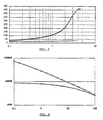
- compositions according to the invention are further characterized by an exponential increase in elongational viscosity as a function of time, characteristic of a structural hardening under stress, contrary to the corresponding compositions.
- the inflection point corresponding to the exponential increase in the elongational viscosity as a function of time is less than 3 seconds, unlike the corresponding compositions.
- compositions according to the invention are further characterized by an almost linear relationship between the dynamic viscosity and the frequency.
- the corresponding compositions are characterized by an evolution of the dynamic viscosity towards the decreasing frequencies in the form of a Newtonian plateau.
- compositions according to the invention make it possible to obtain films. These films are resistant to traction, impact and tear. On the other hand, the corresponding compositions do not make it possible to obtain films by extrusion blowing.
Landscapes
- Chemical & Material Sciences (AREA)
- Health & Medical Sciences (AREA)
- Chemical Kinetics & Catalysis (AREA)
- Medicinal Chemistry (AREA)
- Polymers & Plastics (AREA)
- Organic Chemistry (AREA)
- Compositions Of Macromolecular Compounds (AREA)
- Biological Depolymerization Polymers (AREA)
- Manufacture Of Macromolecular Shaped Articles (AREA)
- Processes Of Treating Macromolecular Substances (AREA)
- Polyesters Or Polycarbonates (AREA)
- Shaping By String And By Release Of Stress In Plastics And The Like (AREA)
- Manufacture Of Porous Articles, And Recovery And Treatment Of Waste Products (AREA)
Applications Claiming Priority (3)
| Application Number | Priority Date | Filing Date | Title |
|---|---|---|---|
| BE9900510A BE1012800A3 (fr) | 1999-07-27 | 1999-07-27 | Compositions de polyesters aliphatiques thermoplastiques, procede pour leur preparation et utilisation de celles-ci. |
| BE9900510 | 1999-07-27 | ||
| PCT/EP2000/007274 WO2001007512A1 (fr) | 1999-07-27 | 2000-07-25 | Compositions de polyesters aliphatiques thermoplastiques, procede pour leur preparation et utilisation de celles-ci |
Publications (2)
| Publication Number | Publication Date |
|---|---|
| EP1208149A1 EP1208149A1 (fr) | 2002-05-29 |
| EP1208149B1 true EP1208149B1 (fr) | 2006-01-18 |
Family
ID=3892023
Family Applications (1)
| Application Number | Title | Priority Date | Filing Date |
|---|---|---|---|
| EP00956330A Expired - Lifetime EP1208149B1 (fr) | 1999-07-27 | 2000-07-25 | Compositions de polyesters aliphatiques thermoplastiques, procede pour leur preparation et utilisation de celles-ci |
Country Status (9)
| Country | Link |
|---|---|
| US (1) | US6797788B1 (https=) |
| EP (1) | EP1208149B1 (https=) |
| JP (1) | JP4895451B2 (https=) |
| AT (1) | ATE316115T1 (https=) |
| AU (1) | AU6831400A (https=) |
| BE (1) | BE1012800A3 (https=) |
| DE (1) | DE60025619T2 (https=) |
| ES (1) | ES2257311T3 (https=) |
| WO (1) | WO2001007512A1 (https=) |
Families Citing this family (6)
| Publication number | Priority date | Publication date | Assignee | Title |
|---|---|---|---|---|
| ITMI20020865A1 (it) * | 2002-04-22 | 2003-10-22 | Novamont Spa | Poliesteri biodegradabili ottenuti mediante estrusione reattiva |
| US6984426B2 (en) * | 2003-06-02 | 2006-01-10 | Cortec Corporation | Biodegradable bag |
| JP4336994B2 (ja) * | 2006-07-31 | 2009-09-30 | 三菱自動車工業株式会社 | フィルム付き合成板 |
| DE102009011746A1 (de) | 2009-03-09 | 2010-09-16 | Teijin Monofilament Germany Gmbh | Bestattungsartikel aus biologisch abbaubaren Polyestern und deren Verwendung |
| US10759899B2 (en) | 2017-08-03 | 2020-09-01 | Colorado State University Research Foundation | Recyclable polymers based on ring-fused gamma-butyrolactones |
| JP6971947B2 (ja) * | 2018-03-30 | 2021-11-24 | 積水化成品工業株式会社 | ポリ乳酸樹脂発泡体 |
Family Cites Families (6)
| Publication number | Priority date | Publication date | Assignee | Title |
|---|---|---|---|---|
| US5066231A (en) * | 1990-02-23 | 1991-11-19 | Minnesota Mining And Manufacturing Company | Dental impression process using polycaprolactone molding composition |
| US5359026A (en) * | 1993-07-30 | 1994-10-25 | Cargill, Incorporated | Poly(lactide) copolymer and process for manufacture thereof |
| FI99125C (fi) * | 1993-12-31 | 1997-10-10 | Neste Oy | Polylaktidikoostumus |
| JPH08176356A (ja) * | 1994-12-27 | 1996-07-09 | Ube Ind Ltd | 非晶質ポリオレフィン乳化物とその製造方法 |
| JP3295717B2 (ja) * | 1994-12-29 | 2002-06-24 | フォータム オイル アンド ガス オサケ ユキチュア | 加工性ポリ(ヒドロキシ酸) |
| AU7360696A (en) * | 1995-09-18 | 1997-04-09 | Minnesota Mining And Manufacturing Company | Thermoplastic lens blocking material |
-
1999
- 1999-07-27 BE BE9900510A patent/BE1012800A3/fr not_active IP Right Cessation
-
2000
- 2000-07-25 ES ES00956330T patent/ES2257311T3/es not_active Expired - Lifetime
- 2000-07-25 AU AU68314/00A patent/AU6831400A/en not_active Abandoned
- 2000-07-25 DE DE60025619T patent/DE60025619T2/de not_active Expired - Lifetime
- 2000-07-25 EP EP00956330A patent/EP1208149B1/fr not_active Expired - Lifetime
- 2000-07-25 AT AT00956330T patent/ATE316115T1/de not_active IP Right Cessation
- 2000-07-25 WO PCT/EP2000/007274 patent/WO2001007512A1/fr not_active Ceased
- 2000-07-25 JP JP2001512789A patent/JP4895451B2/ja not_active Expired - Lifetime
- 2000-07-25 US US10/030,140 patent/US6797788B1/en not_active Expired - Lifetime
Also Published As
| Publication number | Publication date |
|---|---|
| JP2003505567A (ja) | 2003-02-12 |
| ATE316115T1 (de) | 2006-02-15 |
| BE1012800A3 (fr) | 2001-03-06 |
| JP4895451B2 (ja) | 2012-03-14 |
| ES2257311T3 (es) | 2006-08-01 |
| DE60025619D1 (de) | 2006-04-06 |
| US6797788B1 (en) | 2004-09-28 |
| AU6831400A (en) | 2001-02-13 |
| EP1208149A1 (fr) | 2002-05-29 |
| WO2001007512A1 (fr) | 2001-02-01 |
| DE60025619T2 (de) | 2006-11-23 |
Similar Documents
| Publication | Publication Date | Title |
|---|---|---|
| DE69806262T2 (de) | Modifizierte polyhydroxyalkanoate zur herstellung von überzügen und filmen | |
| US5883199A (en) | Polyactic acid-based blends | |
| EP2625221B1 (fr) | Plastification de polyesters aliphatiques par des esters alkyliques de dianhydrohexitols | |
| RU2762161C2 (ru) | Биоразлагаемая полимерная смесь и способ ее получения | |
| BE1005080A3 (fr) | Film souple, elastique et biodegradable en polymere a base d'acide lactique pouvant notamment convenir pour la realisation de pansements medicaux. | |
| EP0579546B1 (fr) | Composition thermoformable, son procédé de préparation et son utilisation pour l'obtention d'articles thermoformés | |
| US20090124723A1 (en) | Process for the modification of biodegradable polymers | |
| Chen et al. | Degradation of PGA, prepared by reactive extrusion polymerization, in water, humid, and dry air, and in a vacuum | |
| EP1208149B1 (fr) | Compositions de polyesters aliphatiques thermoplastiques, procede pour leur preparation et utilisation de celles-ci | |
| CA3164570A1 (fr) | Procede de preparation d'un melange maitre enzyme | |
| Dominici et al. | Improving the flexibility and compostability of starch/poly (butylene cyclohexanedicarboxylate)-based blends | |
| EP3997174B1 (fr) | Matiere plastique à haute teneur en pla comprenant du ppgdge | |
| FR3083543A1 (fr) | Matiere plastique à haute teneur en pla comprenant un ester de citrate | |
| AU676191B2 (en) | Polymer compositions | |
| JPH10501560A (ja) | 加工性ポリ(ヒドロキシ酸) | |
| EP3494158B1 (fr) | Polyester thermoplastique semi-cristallin pour la fabrication de films bi-orientés | |
| JP2025528457A (ja) | セルロース繊維強化ポリビニルアルコール複合材料 | |
| CA3226094A1 (fr) | Procede de preparation d'un melange maitre enzyme | |
| Thomas et al. | Nanocellulose incorporated polylactic acid films for chilled preservation of Indian anchovy (Stolephorus indicus)(van Hasselt, 1823) | |
| WO2021148666A1 (fr) | Utilisation d'un melange enzyme pour ameliorer les proprietes mecaniques d'un article comprenant le melange enzyme et un polymere biodegradable | |
| CA3032104C (fr) | Polyester thermoplastique semi-cristallin pour la fabrication de films bi-orientes | |
| Wang et al. | Synthesis of grafted polylactic acid and polyhydroxyalkanoate by a green reactive extrusion process | |
| EP4481001A1 (fr) | Composition de (co)polyesters, film monocouche et utilisation pour sachet d emballage | |
| EP0878289A1 (fr) | Procédé de fabrication d'un film souflé biodégrable | |
| FR3139500A1 (fr) | ARTICLE MULTICOUCHE ENZYMÉ ayant des propriétés barrières à l’eau |
Legal Events
| Date | Code | Title | Description |
|---|---|---|---|
| PUAI | Public reference made under article 153(3) epc to a published international application that has entered the european phase |
Free format text: ORIGINAL CODE: 0009012 |
|
| 17P | Request for examination filed |
Effective date: 20020227 |
|
| AK | Designated contracting states |
Kind code of ref document: A1 Designated state(s): AT BE CH CY DE DK ES FI FR GB GR IE IT LI LU MC NL PT SE |
|
| AX | Request for extension of the european patent |
Free format text: AL;LT;LV;MK;RO;SI |
|
| 17Q | First examination report despatched |
Effective date: 20030219 |
|
| GRAP | Despatch of communication of intention to grant a patent |
Free format text: ORIGINAL CODE: EPIDOSNIGR1 |
|
| GRAS | Grant fee paid |
Free format text: ORIGINAL CODE: EPIDOSNIGR3 |
|
| GRAA | (expected) grant |
Free format text: ORIGINAL CODE: 0009210 |
|
| AK | Designated contracting states |
Kind code of ref document: B1 Designated state(s): AT BE CH CY DE DK ES FI FR GB GR IE IT LI LU MC NL PT SE |
|
| PG25 | Lapsed in a contracting state [announced via postgrant information from national office to epo] |
Ref country code: NL Free format text: LAPSE BECAUSE OF FAILURE TO SUBMIT A TRANSLATION OF THE DESCRIPTION OR TO PAY THE FEE WITHIN THE PRESCRIBED TIME-LIMIT Effective date: 20060118 Ref country code: FI Free format text: LAPSE BECAUSE OF FAILURE TO SUBMIT A TRANSLATION OF THE DESCRIPTION OR TO PAY THE FEE WITHIN THE PRESCRIBED TIME-LIMIT Effective date: 20060118 Ref country code: IE Free format text: LAPSE BECAUSE OF FAILURE TO SUBMIT A TRANSLATION OF THE DESCRIPTION OR TO PAY THE FEE WITHIN THE PRESCRIBED TIME-LIMIT Effective date: 20060118 Ref country code: AT Free format text: LAPSE BECAUSE OF FAILURE TO SUBMIT A TRANSLATION OF THE DESCRIPTION OR TO PAY THE FEE WITHIN THE PRESCRIBED TIME-LIMIT Effective date: 20060118 |
|
| REG | Reference to a national code |
Ref country code: GB Ref legal event code: FG4D Free format text: NOT ENGLISH |
|
| REG | Reference to a national code |
Ref country code: CH Ref legal event code: EP |
|
| REG | Reference to a national code |
Ref country code: IE Ref legal event code: FG4D Free format text: LANGUAGE OF EP DOCUMENT: FRENCH |
|
| REF | Corresponds to: |
Ref document number: 60025619 Country of ref document: DE Date of ref document: 20060406 Kind code of ref document: P |
|
| PG25 | Lapsed in a contracting state [announced via postgrant information from national office to epo] |
Ref country code: SE Free format text: LAPSE BECAUSE OF FAILURE TO SUBMIT A TRANSLATION OF THE DESCRIPTION OR TO PAY THE FEE WITHIN THE PRESCRIBED TIME-LIMIT Effective date: 20060418 Ref country code: DK Free format text: LAPSE BECAUSE OF FAILURE TO SUBMIT A TRANSLATION OF THE DESCRIPTION OR TO PAY THE FEE WITHIN THE PRESCRIBED TIME-LIMIT Effective date: 20060418 |
|
| GBT | Gb: translation of ep patent filed (gb section 77(6)(a)/1977) |
Effective date: 20060331 |
|
| PG25 | Lapsed in a contracting state [announced via postgrant information from national office to epo] |
Ref country code: PT Free format text: LAPSE BECAUSE OF FAILURE TO SUBMIT A TRANSLATION OF THE DESCRIPTION OR TO PAY THE FEE WITHIN THE PRESCRIBED TIME-LIMIT Effective date: 20060619 |
|
| NLV1 | Nl: lapsed or annulled due to failure to fulfill the requirements of art. 29p and 29m of the patents act | ||
| PG25 | Lapsed in a contracting state [announced via postgrant information from national office to epo] |
Ref country code: CH Free format text: LAPSE BECAUSE OF NON-PAYMENT OF DUE FEES Effective date: 20060731 Ref country code: LI Free format text: LAPSE BECAUSE OF NON-PAYMENT OF DUE FEES Effective date: 20060731 Ref country code: MC Free format text: LAPSE BECAUSE OF NON-PAYMENT OF DUE FEES Effective date: 20060731 |
|
| REG | Reference to a national code |
Ref country code: ES Ref legal event code: FG2A Ref document number: 2257311 Country of ref document: ES Kind code of ref document: T3 |
|
| REG | Reference to a national code |
Ref country code: IE Ref legal event code: FD4D |
|
| PLBE | No opposition filed within time limit |
Free format text: ORIGINAL CODE: 0009261 |
|
| STAA | Information on the status of an ep patent application or granted ep patent |
Free format text: STATUS: NO OPPOSITION FILED WITHIN TIME LIMIT |
|
| 26N | No opposition filed |
Effective date: 20061019 |
|
| REG | Reference to a national code |
Ref country code: CH Ref legal event code: PL |
|
| PGFP | Annual fee paid to national office [announced via postgrant information from national office to epo] |
Ref country code: BE Payment date: 20071008 Year of fee payment: 8 |
|
| PG25 | Lapsed in a contracting state [announced via postgrant information from national office to epo] |
Ref country code: GR Free format text: LAPSE BECAUSE OF FAILURE TO SUBMIT A TRANSLATION OF THE DESCRIPTION OR TO PAY THE FEE WITHIN THE PRESCRIBED TIME-LIMIT Effective date: 20060419 |
|
| PGFP | Annual fee paid to national office [announced via postgrant information from national office to epo] |
Ref country code: FR Payment date: 20070710 Year of fee payment: 8 |
|
| PG25 | Lapsed in a contracting state [announced via postgrant information from national office to epo] |
Ref country code: LU Free format text: LAPSE BECAUSE OF NON-PAYMENT OF DUE FEES Effective date: 20060725 |
|
| REG | Reference to a national code |
Ref country code: GB Ref legal event code: 732E |
|
| PG25 | Lapsed in a contracting state [announced via postgrant information from national office to epo] |
Ref country code: CY Free format text: LAPSE BECAUSE OF FAILURE TO SUBMIT A TRANSLATION OF THE DESCRIPTION OR TO PAY THE FEE WITHIN THE PRESCRIBED TIME-LIMIT Effective date: 20060118 |
|
| REG | Reference to a national code |
Ref country code: FR Ref legal event code: ST Effective date: 20090331 |
|
| PG25 | Lapsed in a contracting state [announced via postgrant information from national office to epo] |
Ref country code: FR Free format text: LAPSE BECAUSE OF NON-PAYMENT OF DUE FEES Effective date: 20080731 |
|
| REG | Reference to a national code |
Ref country code: ES Ref legal event code: PC2A |
|
| PG25 | Lapsed in a contracting state [announced via postgrant information from national office to epo] |
Ref country code: BE Free format text: LAPSE BECAUSE OF NON-PAYMENT OF DUE FEES Effective date: 20080731 |
|
| REG | Reference to a national code |
Ref country code: DE Ref legal event code: R082 Ref document number: 60025619 Country of ref document: DE Representative=s name: LEDERER & KELLER PATENTANWAELTE PARTNERSCHAFT , DE Ref country code: DE Ref legal event code: R081 Ref document number: 60025619 Country of ref document: DE Owner name: INGEVITY UK LTD, WARRINGTON, GB Free format text: FORMER OWNER: PERSTORP SPECIALTY CHEMICALS AB, PERSTORP, SE |
|
| REG | Reference to a national code |
Ref country code: GB Ref legal event code: 732E Free format text: REGISTERED BETWEEN 20190829 AND 20190904 |
|
| PGFP | Annual fee paid to national office [announced via postgrant information from national office to epo] |
Ref country code: DE Payment date: 20190710 Year of fee payment: 20 Ref country code: IT Payment date: 20190710 Year of fee payment: 20 Ref country code: ES Payment date: 20190801 Year of fee payment: 20 |
|
| REG | Reference to a national code |
Ref country code: ES Ref legal event code: PC2A Owner name: INGEVITY UK LTD Effective date: 20191121 |
|
| PGFP | Annual fee paid to national office [announced via postgrant information from national office to epo] |
Ref country code: GB Payment date: 20190715 Year of fee payment: 20 |
|
| REG | Reference to a national code |
Ref country code: DE Ref legal event code: R071 Ref document number: 60025619 Country of ref document: DE |
|
| REG | Reference to a national code |
Ref country code: GB Ref legal event code: PE20 Expiry date: 20200724 |
|
| PG25 | Lapsed in a contracting state [announced via postgrant information from national office to epo] |
Ref country code: GB Free format text: LAPSE BECAUSE OF EXPIRATION OF PROTECTION Effective date: 20200724 |
|
| REG | Reference to a national code |
Ref country code: ES Ref legal event code: FD2A Effective date: 20201105 |
|
| PG25 | Lapsed in a contracting state [announced via postgrant information from national office to epo] |
Ref country code: ES Free format text: LAPSE BECAUSE OF EXPIRATION OF PROTECTION Effective date: 20200726 |