EP1207148A1 - Verfahren zur Herstellung von Phenylessigsäurederivaten - Google Patents
Verfahren zur Herstellung von Phenylessigsäurederivaten Download PDFInfo
- Publication number
- EP1207148A1 EP1207148A1 EP01126255A EP01126255A EP1207148A1 EP 1207148 A1 EP1207148 A1 EP 1207148A1 EP 01126255 A EP01126255 A EP 01126255A EP 01126255 A EP01126255 A EP 01126255A EP 1207148 A1 EP1207148 A1 EP 1207148A1
- Authority
- EP
- European Patent Office
- Prior art keywords
- alkyl
- radical
- hydrogen
- general formula
- catalyst
- Prior art date
- Legal status (The legal status is an assumption and is not a legal conclusion. Google has not performed a legal analysis and makes no representation as to the accuracy of the status listed.)
- Withdrawn
Links
- WLJVXDMOQOGPHL-UHFFFAOYSA-N phenylacetic acid Chemical class OC(=O)CC1=CC=CC=C1 WLJVXDMOQOGPHL-UHFFFAOYSA-N 0.000 title claims abstract description 17
- 238000004519 manufacturing process Methods 0.000 title description 3
- 238000000034 method Methods 0.000 claims abstract description 25
- 150000003254 radicals Chemical class 0.000 claims abstract description 20
- -1 acyloxy radical Chemical class 0.000 claims abstract description 18
- 239000003054 catalyst Substances 0.000 claims abstract description 17
- 125000000217 alkyl group Chemical group 0.000 claims abstract description 16
- 229910052739 hydrogen Inorganic materials 0.000 claims abstract description 13
- 239000001257 hydrogen Substances 0.000 claims abstract description 13
- UFHFLCQGNIYNRP-UHFFFAOYSA-N Hydrogen Chemical compound [H][H] UFHFLCQGNIYNRP-UHFFFAOYSA-N 0.000 claims abstract description 11
- UGFAIRIUMAVXCW-UHFFFAOYSA-N Carbon monoxide Chemical compound [O+]#[C-] UGFAIRIUMAVXCW-UHFFFAOYSA-N 0.000 claims abstract description 10
- 125000003118 aryl group Chemical group 0.000 claims abstract description 10
- 229910002091 carbon monoxide Inorganic materials 0.000 claims abstract description 10
- 150000005524 benzylchlorides Chemical class 0.000 claims abstract description 9
- 150000001875 compounds Chemical class 0.000 claims abstract description 9
- 125000001931 aliphatic group Chemical group 0.000 claims abstract description 8
- 239000000010 aprotic solvent Substances 0.000 claims abstract description 8
- 125000004432 carbon atom Chemical group C* 0.000 claims abstract description 8
- 229910052723 transition metal Inorganic materials 0.000 claims abstract description 7
- 150000003624 transition metals Chemical class 0.000 claims abstract description 7
- 229910052731 fluorine Inorganic materials 0.000 claims abstract description 6
- 125000003545 alkoxy group Chemical group 0.000 claims abstract description 5
- 125000004429 atom Chemical group 0.000 claims abstract description 3
- 125000001153 fluoro group Chemical group F* 0.000 claims abstract description 3
- 125000005842 heteroatom Chemical group 0.000 claims abstract description 3
- 230000000737 periodic effect Effects 0.000 claims abstract description 3
- 238000002360 preparation method Methods 0.000 claims abstract description 3
- KDLHZDBZIXYQEI-UHFFFAOYSA-N Palladium Chemical compound [Pd] KDLHZDBZIXYQEI-UHFFFAOYSA-N 0.000 claims description 22
- XEEYBQQBJWHFJM-UHFFFAOYSA-N Iron Chemical compound [Fe] XEEYBQQBJWHFJM-UHFFFAOYSA-N 0.000 claims description 12
- KCXMKQUNVWSEMD-UHFFFAOYSA-N benzyl chloride Chemical compound ClCC1=CC=CC=C1 KCXMKQUNVWSEMD-UHFFFAOYSA-N 0.000 claims description 10
- 229940073608 benzyl chloride Drugs 0.000 claims description 10
- 150000004820 halides Chemical class 0.000 claims description 10
- 238000006243 chemical reaction Methods 0.000 claims description 9
- 229910052763 palladium Inorganic materials 0.000 claims description 9
- PXHVJJICTQNCMI-UHFFFAOYSA-N Nickel Chemical compound [Ni] PXHVJJICTQNCMI-UHFFFAOYSA-N 0.000 claims description 8
- 150000002431 hydrogen Chemical class 0.000 claims description 4
- 229910052759 nickel Inorganic materials 0.000 claims description 4
- PXGOKWXKJXAPGV-UHFFFAOYSA-N Fluorine Chemical compound FF PXGOKWXKJXAPGV-UHFFFAOYSA-N 0.000 claims description 3
- XYFCBTPGUUZFHI-UHFFFAOYSA-N Phosphine Natural products P XYFCBTPGUUZFHI-UHFFFAOYSA-N 0.000 claims description 3
- 239000003513 alkali Substances 0.000 claims description 3
- 150000001869 cobalt compounds Chemical class 0.000 claims description 3
- 239000011737 fluorine Substances 0.000 claims description 3
- 239000003446 ligand Substances 0.000 claims description 3
- 150000005840 aryl radicals Chemical class 0.000 claims description 2
- 125000004104 aryloxy group Chemical group 0.000 claims description 2
- 229910000073 phosphorus hydride Inorganic materials 0.000 claims description 2
- 125000006702 (C1-C18) alkyl group Chemical group 0.000 abstract 1
- SECXISVLQFMRJM-UHFFFAOYSA-N N-Methylpyrrolidone Chemical compound CN1CCCC1=O SECXISVLQFMRJM-UHFFFAOYSA-N 0.000 description 16
- XLYOFNOQVPJJNP-UHFFFAOYSA-N water Substances O XLYOFNOQVPJJNP-UHFFFAOYSA-N 0.000 description 12
- FEWLNYSYJNLUOO-UHFFFAOYSA-N 1-Piperidinecarboxaldehyde Chemical compound O=CN1CCCCC1 FEWLNYSYJNLUOO-UHFFFAOYSA-N 0.000 description 6
- 239000000203 mixture Substances 0.000 description 6
- QJPQVXSHYBGQGM-UHFFFAOYSA-N palladium;triphenylphosphane Chemical compound [Pd].C1=CC=CC=C1P(C=1C=CC=CC=1)C1=CC=CC=C1.C1=CC=CC=C1P(C=1C=CC=CC=1)C1=CC=CC=C1 QJPQVXSHYBGQGM-UHFFFAOYSA-N 0.000 description 6
- VEXZGXHMUGYJMC-UHFFFAOYSA-N Hydrochloric acid Chemical compound Cl VEXZGXHMUGYJMC-UHFFFAOYSA-N 0.000 description 5
- NLXLAEXVIDQMFP-UHFFFAOYSA-N Ammonia chloride Chemical compound [NH4+].[Cl-] NLXLAEXVIDQMFP-UHFFFAOYSA-N 0.000 description 4
- 125000005233 alkylalcohol group Chemical group 0.000 description 4
- KWGKDLIKAYFUFQ-UHFFFAOYSA-M lithium chloride Chemical compound [Li+].[Cl-] KWGKDLIKAYFUFQ-UHFFFAOYSA-M 0.000 description 4
- 238000002844 melting Methods 0.000 description 4
- 230000008018 melting Effects 0.000 description 4
- PIBWKRNGBLPSSY-UHFFFAOYSA-L palladium(II) chloride Chemical compound Cl[Pd]Cl PIBWKRNGBLPSSY-UHFFFAOYSA-L 0.000 description 4
- RIOQSEWOXXDEQQ-UHFFFAOYSA-N triphenylphosphine Chemical compound C1=CC=CC=C1P(C=1C=CC=CC=1)C1=CC=CC=C1 RIOQSEWOXXDEQQ-UHFFFAOYSA-N 0.000 description 4
- AGRIQBHIKABLPJ-UHFFFAOYSA-N 1-Pyrrolidinecarboxaldehyde Chemical compound O=CN1CCCC1 AGRIQBHIKABLPJ-UHFFFAOYSA-N 0.000 description 3
- VEXZGXHMUGYJMC-UHFFFAOYSA-M Chloride anion Chemical compound [Cl-] VEXZGXHMUGYJMC-UHFFFAOYSA-M 0.000 description 3
- ZMXDDKWLCZADIW-UHFFFAOYSA-N N,N-Dimethylformamide Chemical compound CN(C)C=O ZMXDDKWLCZADIW-UHFFFAOYSA-N 0.000 description 3
- HEMHJVSKTPXQMS-UHFFFAOYSA-M Sodium hydroxide Chemical compound [OH-].[Na+] HEMHJVSKTPXQMS-UHFFFAOYSA-M 0.000 description 3
- 230000015572 biosynthetic process Effects 0.000 description 3
- 238000001816 cooling Methods 0.000 description 3
- LCEDQNDDFOCWGG-UHFFFAOYSA-N morpholine-4-carbaldehyde Chemical compound O=CN1CCOCC1 LCEDQNDDFOCWGG-UHFFFAOYSA-N 0.000 description 3
- 229960003424 phenylacetic acid Drugs 0.000 description 3
- 239000003279 phenylacetic acid Substances 0.000 description 3
- NLKNQRATVPKPDG-UHFFFAOYSA-M potassium iodide Chemical compound [K+].[I-] NLKNQRATVPKPDG-UHFFFAOYSA-M 0.000 description 3
- FVAUCKIRQBBSSJ-UHFFFAOYSA-M sodium iodide Chemical compound [Na+].[I-] FVAUCKIRQBBSSJ-UHFFFAOYSA-M 0.000 description 3
- 239000002904 solvent Substances 0.000 description 3
- 238000003786 synthesis reaction Methods 0.000 description 3
- LVEYOSJUKRVCCF-UHFFFAOYSA-N 1,3-bis(diphenylphosphino)propane Chemical compound C=1C=CC=CC=1P(C=1C=CC=CC=1)CCCP(C=1C=CC=CC=1)C1=CC=CC=C1 LVEYOSJUKRVCCF-UHFFFAOYSA-N 0.000 description 2
- CPELXLSAUQHCOX-UHFFFAOYSA-M Bromide Chemical compound [Br-] CPELXLSAUQHCOX-UHFFFAOYSA-M 0.000 description 2
- XTHFKEDIFFGKHM-UHFFFAOYSA-N Dimethoxyethane Chemical compound COCCOC XTHFKEDIFFGKHM-UHFFFAOYSA-N 0.000 description 2
- FXHOOIRPVKKKFG-UHFFFAOYSA-N N,N-Dimethylacetamide Chemical compound CN(C)C(C)=O FXHOOIRPVKKKFG-UHFFFAOYSA-N 0.000 description 2
- 101150003085 Pdcl gene Proteins 0.000 description 2
- WCUXLLCKKVVCTQ-UHFFFAOYSA-M Potassium chloride Chemical compound [Cl-].[K+] WCUXLLCKKVVCTQ-UHFFFAOYSA-M 0.000 description 2
- FAPWRFPIFSIZLT-UHFFFAOYSA-M Sodium chloride Chemical compound [Na+].[Cl-] FAPWRFPIFSIZLT-UHFFFAOYSA-M 0.000 description 2
- WYURNTSHIVDZCO-UHFFFAOYSA-N Tetrahydrofuran Chemical compound C1CCOC1 WYURNTSHIVDZCO-UHFFFAOYSA-N 0.000 description 2
- 150000001408 amides Chemical class 0.000 description 2
- 235000019270 ammonium chloride Nutrition 0.000 description 2
- VJLOFJZWUDZJBX-UHFFFAOYSA-N bis(2-hydroxyethyl)azanium;chloride Chemical compound [Cl-].OCC[NH2+]CCO VJLOFJZWUDZJBX-UHFFFAOYSA-N 0.000 description 2
- 229910017052 cobalt Inorganic materials 0.000 description 2
- 239000010941 cobalt Substances 0.000 description 2
- GUTLYIVDDKVIGB-UHFFFAOYSA-N cobalt atom Chemical compound [Co] GUTLYIVDDKVIGB-UHFFFAOYSA-N 0.000 description 2
- IQDGSYLLQPDQDV-UHFFFAOYSA-N dimethylazanium;chloride Chemical compound Cl.CNC IQDGSYLLQPDQDV-UHFFFAOYSA-N 0.000 description 2
- VURFVHCLMJOLKN-UHFFFAOYSA-N diphosphane Chemical compound PP VURFVHCLMJOLKN-UHFFFAOYSA-N 0.000 description 2
- JBKVHLHDHHXQEQ-UHFFFAOYSA-N epsilon-caprolactam Chemical compound O=C1CCCCCN1 JBKVHLHDHHXQEQ-UHFFFAOYSA-N 0.000 description 2
- 150000002148 esters Chemical class 0.000 description 2
- IXCSERBJSXMMFS-UHFFFAOYSA-N hydrogen chloride Substances Cl.Cl IXCSERBJSXMMFS-UHFFFAOYSA-N 0.000 description 2
- 229910000041 hydrogen chloride Inorganic materials 0.000 description 2
- AMXOYNBUYSYVKV-UHFFFAOYSA-M lithium bromide Chemical compound [Li+].[Br-] AMXOYNBUYSYVKV-UHFFFAOYSA-M 0.000 description 2
- HSZCZNFXUDYRKD-UHFFFAOYSA-M lithium iodide Chemical compound [Li+].[I-] HSZCZNFXUDYRKD-UHFFFAOYSA-M 0.000 description 2
- 150000002941 palladium compounds Chemical class 0.000 description 2
- NFHFRUOZVGFOOS-UHFFFAOYSA-N palladium;triphenylphosphane Chemical compound [Pd].C1=CC=CC=C1P(C=1C=CC=CC=1)C1=CC=CC=C1.C1=CC=CC=C1P(C=1C=CC=CC=1)C1=CC=CC=C1.C1=CC=CC=C1P(C=1C=CC=CC=1)C1=CC=CC=C1.C1=CC=CC=C1P(C=1C=CC=CC=1)C1=CC=CC=C1 NFHFRUOZVGFOOS-UHFFFAOYSA-N 0.000 description 2
- IOLCXVTUBQKXJR-UHFFFAOYSA-M potassium bromide Chemical compound [K+].[Br-] IOLCXVTUBQKXJR-UHFFFAOYSA-M 0.000 description 2
- HNJBEVLQSNELDL-UHFFFAOYSA-N pyrrolidin-2-one Chemical compound O=C1CCCN1 HNJBEVLQSNELDL-UHFFFAOYSA-N 0.000 description 2
- JHJLBTNAGRQEKS-UHFFFAOYSA-M sodium bromide Chemical compound [Na+].[Br-] JHJLBTNAGRQEKS-UHFFFAOYSA-M 0.000 description 2
- 0 *c1c(*)c(*)c(COC(C2)=O)c2c1* Chemical compound *c1c(*)c(*)c(COC(C2)=O)c2c1* 0.000 description 1
- RYHBNJHYFVUHQT-UHFFFAOYSA-N 1,4-Dioxane Chemical compound C1COCCO1 RYHBNJHYFVUHQT-UHFFFAOYSA-N 0.000 description 1
- ILHLUZUMRJQEAH-UHFFFAOYSA-N 1,4-dihydroisochromen-3-one Chemical class C1=CC=C2COC(=O)CC2=C1 ILHLUZUMRJQEAH-UHFFFAOYSA-N 0.000 description 1
- VQRBXYBBGHOGFT-UHFFFAOYSA-N 1-(chloromethyl)-2-methylbenzene Chemical compound CC1=CC=CC=C1CCl VQRBXYBBGHOGFT-UHFFFAOYSA-N 0.000 description 1
- BASMANVIUSSIIM-UHFFFAOYSA-N 1-chloro-2-(chloromethyl)benzene Chemical compound ClCC1=CC=CC=C1Cl BASMANVIUSSIIM-UHFFFAOYSA-N 0.000 description 1
- UAXNXOMKCGKNCI-UHFFFAOYSA-N 1-diphenylphosphanylethyl(diphenyl)phosphane Chemical compound C=1C=CC=CC=1P(C=1C=CC=CC=1)C(C)P(C=1C=CC=CC=1)C1=CC=CC=C1 UAXNXOMKCGKNCI-UHFFFAOYSA-N 0.000 description 1
- NJPQAIBZIHNJDO-UHFFFAOYSA-N 1-dodecylpyrrolidin-2-one Chemical compound CCCCCCCCCCCCN1CCCC1=O NJPQAIBZIHNJDO-UHFFFAOYSA-N 0.000 description 1
- IRSVDHPYXFLLDS-UHFFFAOYSA-N 2,4-dichloro-1-(chloromethyl)benzene Chemical compound ClCC1=CC=C(Cl)C=C1Cl IRSVDHPYXFLLDS-UHFFFAOYSA-N 0.000 description 1
- GXMWLJKTGBZMBH-UHFFFAOYSA-N 2-(2,4-dichlorophenyl)acetic acid Chemical compound OC(=O)CC1=CC=C(Cl)C=C1Cl GXMWLJKTGBZMBH-UHFFFAOYSA-N 0.000 description 1
- IUJAAIZKRJJZGQ-UHFFFAOYSA-N 2-(2-chlorophenyl)acetic acid Chemical compound OC(=O)CC1=CC=CC=C1Cl IUJAAIZKRJJZGQ-UHFFFAOYSA-N 0.000 description 1
- RZWGTXHSYZGXKF-UHFFFAOYSA-N 2-(2-methylphenyl)acetic acid Chemical compound CC1=CC=CC=C1CC(O)=O RZWGTXHSYZGXKF-UHFFFAOYSA-N 0.000 description 1
- XZXYQEHISUMZAT-UHFFFAOYSA-N 2-[(2-hydroxy-5-methylphenyl)methyl]-4-methylphenol Chemical compound CC1=CC=C(O)C(CC=2C(=CC=C(C)C=2)O)=C1 XZXYQEHISUMZAT-UHFFFAOYSA-N 0.000 description 1
- BCJVBDBJSMFBRW-UHFFFAOYSA-N 4-diphenylphosphanylbutyl(diphenyl)phosphane Chemical compound C=1C=CC=CC=1P(C=1C=CC=CC=1)CCCCP(C=1C=CC=CC=1)C1=CC=CC=C1 BCJVBDBJSMFBRW-UHFFFAOYSA-N 0.000 description 1
- QGZKDVFQNNGYKY-UHFFFAOYSA-O Ammonium Chemical compound [NH4+] QGZKDVFQNNGYKY-UHFFFAOYSA-O 0.000 description 1
- LFQSCWFLJHTTHZ-UHFFFAOYSA-N Ethanol Chemical compound CCO LFQSCWFLJHTTHZ-UHFFFAOYSA-N 0.000 description 1
- YCKRFDGAMUMZLT-UHFFFAOYSA-N Fluorine atom Chemical group [F] YCKRFDGAMUMZLT-UHFFFAOYSA-N 0.000 description 1
- WPPOGHDFAVQKLN-UHFFFAOYSA-N N-Octyl-2-pyrrolidone Chemical compound CCCCCCCCN1CCCC1=O WPPOGHDFAVQKLN-UHFFFAOYSA-N 0.000 description 1
- CTQNGGLPUBDAKN-UHFFFAOYSA-N O-Xylene Chemical compound CC1=CC=CC=C1C CTQNGGLPUBDAKN-UHFFFAOYSA-N 0.000 description 1
- 229910021605 Palladium(II) bromide Inorganic materials 0.000 description 1
- KJTLSVCANCCWHF-UHFFFAOYSA-N Ruthenium Chemical compound [Ru] KJTLSVCANCCWHF-UHFFFAOYSA-N 0.000 description 1
- XSQUKJJJFZCRTK-UHFFFAOYSA-N Urea Chemical compound NC(N)=O XSQUKJJJFZCRTK-UHFFFAOYSA-N 0.000 description 1
- 239000002253 acid Substances 0.000 description 1
- 239000003905 agrochemical Substances 0.000 description 1
- 150000001298 alcohols Chemical class 0.000 description 1
- 125000005210 alkyl ammonium group Chemical group 0.000 description 1
- SWLVFNYSXGMGBS-UHFFFAOYSA-N ammonium bromide Chemical compound [NH4+].[Br-] SWLVFNYSXGMGBS-UHFFFAOYSA-N 0.000 description 1
- 229940107816 ammonium iodide Drugs 0.000 description 1
- 239000002585 base Substances 0.000 description 1
- 230000009286 beneficial effect Effects 0.000 description 1
- YNHIGQDRGKUECZ-UHFFFAOYSA-L bis(triphenylphosphine)palladium(ii) dichloride Chemical compound [Cl-].[Cl-].[Pd+2].C1=CC=CC=C1P(C=1C=CC=CC=1)C1=CC=CC=C1.C1=CC=CC=C1P(C=1C=CC=CC=1)C1=CC=CC=C1 YNHIGQDRGKUECZ-UHFFFAOYSA-L 0.000 description 1
- 239000004202 carbamide Substances 0.000 description 1
- 150000001728 carbonyl compounds Chemical class 0.000 description 1
- 230000006315 carbonylation Effects 0.000 description 1
- 238000005810 carbonylation reaction Methods 0.000 description 1
- 230000003197 catalytic effect Effects 0.000 description 1
- WMKGGPCROCCUDY-PHEQNACWSA-N dibenzylideneacetone Chemical compound C=1C=CC=CC=1\C=C\C(=O)\C=C\C1=CC=CC=C1 WMKGGPCROCCUDY-PHEQNACWSA-N 0.000 description 1
- 238000004821 distillation Methods 0.000 description 1
- 238000001914 filtration Methods 0.000 description 1
- 238000004508 fractional distillation Methods 0.000 description 1
- 239000012456 homogeneous solution Substances 0.000 description 1
- 229910000039 hydrogen halide Inorganic materials 0.000 description 1
- 239000012433 hydrogen halide Substances 0.000 description 1
- XMBWDFGMSWQBCA-UHFFFAOYSA-N hydrogen iodide Chemical compound I XMBWDFGMSWQBCA-UHFFFAOYSA-N 0.000 description 1
- 239000000543 intermediate Substances 0.000 description 1
- 229910052742 iron Inorganic materials 0.000 description 1
- 239000000463 material Substances 0.000 description 1
- VUZPPFZMUPKLLV-UHFFFAOYSA-N methane;hydrate Chemical compound C.O VUZPPFZMUPKLLV-UHFFFAOYSA-N 0.000 description 1
- 150000003003 phosphines Chemical class 0.000 description 1
- 239000001103 potassium chloride Substances 0.000 description 1
- 235000011164 potassium chloride Nutrition 0.000 description 1
- 230000001376 precipitating effect Effects 0.000 description 1
- 239000011541 reaction mixture Substances 0.000 description 1
- 229910052703 rhodium Inorganic materials 0.000 description 1
- 239000010948 rhodium Substances 0.000 description 1
- MHOVAHRLVXNVSD-UHFFFAOYSA-N rhodium atom Chemical compound [Rh] MHOVAHRLVXNVSD-UHFFFAOYSA-N 0.000 description 1
- 229910052707 ruthenium Inorganic materials 0.000 description 1
- 239000011780 sodium chloride Substances 0.000 description 1
- 235000009518 sodium iodide Nutrition 0.000 description 1
- 239000007787 solid Substances 0.000 description 1
- 238000003756 stirring Methods 0.000 description 1
- 239000000126 substance Substances 0.000 description 1
- NVBFHJWHLNUMCV-UHFFFAOYSA-N sulfamide Chemical compound NS(N)(=O)=O NVBFHJWHLNUMCV-UHFFFAOYSA-N 0.000 description 1
- HXJUTPCZVOIRIF-UHFFFAOYSA-N sulfolane Chemical compound O=S1(=O)CCCC1 HXJUTPCZVOIRIF-UHFFFAOYSA-N 0.000 description 1
- RKHXQBLJXBGEKF-UHFFFAOYSA-M tetrabutylphosphanium;bromide Chemical compound [Br-].CCCC[P+](CCCC)(CCCC)CCCC RKHXQBLJXBGEKF-UHFFFAOYSA-M 0.000 description 1
- IBWGNZVCJVLSHB-UHFFFAOYSA-M tetrabutylphosphanium;chloride Chemical compound [Cl-].CCCC[P+](CCCC)(CCCC)CCCC IBWGNZVCJVLSHB-UHFFFAOYSA-M 0.000 description 1
- CCIYPTIBRAUPLQ-UHFFFAOYSA-M tetrabutylphosphanium;iodide Chemical compound [I-].CCCC[P+](CCCC)(CCCC)CCCC CCIYPTIBRAUPLQ-UHFFFAOYSA-M 0.000 description 1
- YLQBMQCUIZJEEH-UHFFFAOYSA-N tetrahydrofuran Natural products C=1C=COC=1 YLQBMQCUIZJEEH-UHFFFAOYSA-N 0.000 description 1
- 150000003623 transition metal compounds Chemical class 0.000 description 1
- COIOYMYWGDAQPM-UHFFFAOYSA-N tris(2-methylphenyl)phosphane Chemical compound CC1=CC=CC=C1P(C=1C(=CC=CC=1)C)C1=CC=CC=C1C COIOYMYWGDAQPM-UHFFFAOYSA-N 0.000 description 1
- 238000010626 work up procedure Methods 0.000 description 1
- 239000008096 xylene Substances 0.000 description 1
Classifications
-
- C—CHEMISTRY; METALLURGY
- C07—ORGANIC CHEMISTRY
- C07C—ACYCLIC OR CARBOCYCLIC COMPOUNDS
- C07C51/00—Preparation of carboxylic acids or their salts, halides or anhydrides
- C07C51/10—Preparation of carboxylic acids or their salts, halides or anhydrides by reaction with carbon monoxide
-
- C—CHEMISTRY; METALLURGY
- C07—ORGANIC CHEMISTRY
- C07C—ACYCLIC OR CARBOCYCLIC COMPOUNDS
- C07C67/00—Preparation of carboxylic acid esters
- C07C67/36—Preparation of carboxylic acid esters by reaction with carbon monoxide or formates
Definitions
- the present patent application describes a process for the production of substituted phenylacetic acids or their esters by reacting substituted benzyl chlorides with carbon monoxide and alcohols or water Presence of a catalyst and a dipolar aprotic solvent.
- R 6 represents hydrogen, a C 1 -C 18 alkyl, in particular a C 1 -C 4 alkyl, or C 6 -C 18 aryl radical.
- the radicals R 1 , R 2 , R 3 , R 4 and R 5 are, in particular, independently of one another hydrogen, fluorine, C 1 -C 8 alkyl, or C 1 -C 8 alkoxy or two of the radicals R 1 , R 2 , R 3 , R 4 , and R 5 are linked to one another and preferably form an aliphatic or aromatic ring having 5 to 10 carbon atoms.
- the radicals R 1 , R 2 , R 3 , R 4 and R 5 are independently hydrogen, fluorine and C 1 -C 4 -alkyl.
- the inventive method can in the presence or absence of a ionic halide can be carried out.
- the ionic halide is an alkali, ammonium, alkylammonium or phosphonium halide, in particular an alkali or ammonium halide, where halide means chloride, bromide or iodide, especially chloride or bromide, preferably chloride.
- the presence of the ionic halide can also be dispensed with and the process can be carried out in the absence of the ionic halide.
- the ionic halide can be used in particular if the catalyst contains palladium.
- the catalyst contains at least one transition metal compound from sub-group VIII, in particular palladium, nickel and / or cobalt compounds, preferably palladium and / or cobalt compounds, particularly preferably palladium compounds.
- a palladium catalyst which contains nickel, cobalt or palladium applied to a support material can also be used for the process according to the invention.
- Such a supported catalyst has the advantage that it can be separated from the reaction mixture in a simple manner, for example by filtration.
- the palladium catalyst has at least one palladium (II) compound, in particular PdCl 2 , PdBr 2 or Pd (OAc) 2, preferably PdCl 2 , or at least one palladium ( 0) compound, in particular Pd 2 dba 3 , where dba is dibenzylidene acetone, contains Pd (P (C 6 H 5 ) 3 ) 4 or Pd (C 8 H 12 ) 2 , preferably Pd 2 dba 3 .
- a ligand in particular a phosphine compound, contains.
- phosphine compounds are a monophosphine, in particular a tri (C 1 -C 6 ) alkylphosphine or a triarylphosphine, or a diphosphine.
- the palladium catalyst contains a bis (triphenylphosphine) palladium (II) compound, for example bis (triphenylphosphine) palladium (II) chloride or bis (triphenylphosphine) palladium (II) bromide.
- a bis (triphenylphosphine) palladium (II) compound for example bis (triphenylphosphine) palladium (II) chloride or bis (triphenylphosphine) palladium (II) bromide.
- the catalyst is usually used in an amount of 0.00001 to 0.3 mol Transition metal, in particular 0.0001 to 0.2 mol of transition metal, is preferred 0.0005 to 0.1 mole of transition metal per mole of benzyl chloride of the formula (II).
- the reaction can usually be carried out at a temperature of 20 to 220 ° C. in particular at 40 to 200 ° C, preferably at 60 to 180 ° C with good success carried out.
- Suitable dipolar aprotic solvents are dioxane, tetrahydrofuran, N- (C 1 -C 18 alkyl) pyrrolidone, ethylene glycol dimethyl ether, C 1 -C 4 alkyl esters of aliphatic C 1 -C 6 carboxylic acids, C 1 -C 6 dialkyl ethers, N , N-di- (C 1 -C 4 alkyl) amides of aliphatic C 1 -C 4 carboxylic acids, sulfolane, 1,3-di (C 1 -C 8 alkyl) -2-imidazolidinone, N- (C 1 -C 8 alkyl) caprolactam, N, N, N ', N'-tetra- (C 1 -C 8 alkyl) urea, 1,3-di- (C 1 -C 8 alkyl) -3, 4,5,6-tetrahydro-2 (1 H) -pyrimidone
- N-methylpyrrolidone is used as the solvent.
- the hydrogen chloride formed can be isolated as aqueous hydrogen chloride after the reaction and the solvent N-methylpyrrolidone can be used again.
- the compound of the formula R 6 OH corresponding to an alkyl alcohol or water, can be added in an amount of 0.1 to 50 moles per mole of benzyl chloride of the formula (II).
- the reaction is usually carried out with an amount of alkyl alcohol or water corresponding to 0.2 to 10, in particular 0.5 to 4, preferably 1 to 4, moles per mole of benzyl chloride of the formula (II).
- one mole of benzyl chloride corresponds to the formula (II) in which at least one of the radicals R 1 , R 2 , R 3 , R 4 and R 5 independently of one another represents a CH 2 Cl radical, corresponding to the number of CH 2 Cl groups many moles of benzyl chloride.
- the benzyl chloride of the formula (II), the catalyst, the dipolar aprotic solvent and, if appropriate, also the compound R 6 OH and, if appropriate, the ionic halide are introduced, the CO pressure and the temperature are adjusted and metered in then the alkyl alcohol or water or a mixture consisting of the alkyl alcohol or water and the dipolar aprotic solvent.
- the mix is well mixed Reaction partners to ensure a rapid course of the reaction.
- the inventive method is suitable for both a continuous and also discontinuous implementation.
- the N-methylpyrrolidone and the hydrogen chloride are separated off at 150 ° C. and 200 mbar.
- the residue is melted in water with parallel metering in of 50% aqueous sodium hydroxide solution, so that the pH is kept at 10.
- a homogeneous solution is obtained, which is extracted with 20 ml of xylene in order to separate organically soluble substances.
- the mixture is then acidified to pH 1 with about 30% aqueous hydrochloric acid, the 2,4-dichlorophenylacetic acid precipitating out as a white solid.
- the precipitated product is washed with enough water until the effluent has a constant pH.
- the washed product is dried at 100 ° C. and reduced pressure.
- the practical yield is 89% with a GC purity of 100% of 2,4-dichlorpenylacetic acid.
- the melting point is 131-133 ° C.
Landscapes
- Chemical & Material Sciences (AREA)
- Organic Chemistry (AREA)
- Chemical Kinetics & Catalysis (AREA)
- Engineering & Computer Science (AREA)
- Oil, Petroleum & Natural Gas (AREA)
- Organic Low-Molecular-Weight Compounds And Preparation Thereof (AREA)
- Low-Molecular Organic Synthesis Reactions Using Catalysts (AREA)
Abstract
Verfahren zur Herstellung von Phenylessigsäurederivaten der allgemeinen Formel (I) durch Umsetzung von Benzylchloriden der allgemeinen Formel (II) <IMAGE> mit einer Verbindung der allgemeinen Formel R<6>OH und mit Kohlenmonoxid in einem dipolar aprotischen Lösungsmittel in Gegenwart eines Katalysators, der mindestens eine Verbindung eines Übergangsmetalls der VIII. Nebengruppe des Periodensystems enthält, wobei R<1>, R<2>, R<3>, R<4>, und R<5> unabhängig voneinander für folgende Reste stehen: ein Wasserstoff oder Fluoratom; ein CH2CI-Rest; eine HO2CCH=CH-, NC- oder CF3-Gruppe; einen Alkyl-, Alkoxy-, oder Acyloxyrest, mit jeweils 1 bis 18 Kohlenstoffatomen; oder einen C6-C18-Aryloxy, Aryl- oder Heteroarylrest, wobei als Heteroatome 1 bis 3 Atome der Gruppe O, N und/oder S vorhanden sind; einen R<8>2P(=O)-, R<9>C(=O)-, R<9>OC(=O)-, R<9>OC(=O)CH=CH-, R<10>C(=O)-, R<10>OC(=O)-, R<10>OC(=O)CH=CH-, oder R<10>2P(=O)-Rest, worin R<8> einen C1-C4-Alkylrest, R<9> einen C1-C18-Alkylrest oder Wasserstoff und R<10> einen C6-C18-Arylrest darstellen; oder worin mindestens zwei der Reste R<1>, R<2>, R<3>, R<4>, und R<5> untereinander verknüpft sind und mindestens einen aliphatischen oder aromatischen Ring mit 5 bis 18 C-Atomen bilden; R<6> steht für Wasserstoff oder einen C1-C18-Alkyl- oder C6-C18-Arylrest.
Description
Die vorliegende Patentanmeldung beschreibt ein Verfahren zur Herstellung von
substituierten Phenylessigsäuren oder deren Estern durch Umsetzung von
substituierten Benzylchloriden mit Kohlenmonoxid und Alkoholen oder Wasser in
Gegenwart eines Katalysators und eines dipolar aprotischen Lösemittels.
Substituierte Phenylessigsäuren und deren Ester sind wichtige Intermediate in der
pharmazeutischen sowie der agrochemischen Industrie.
Die Synthese von Phenylessigsäuren ausgehend von Benzylchloriden sowie die
Synthese von Phenylessigsäureestern wird von Colquhoun, Thompson und Twigg
beschrieben ("Carbonylation, Direct Synthesis of Carbonyl Compounds" Plenum
Press, New York, 1991, Seiten 91 - 97 und 111 - 119). Die Umsetzungen der
Benzylchloride mit Kohlenmonoxid und Wasser oder einem Alkohol gelingt danach
in Gegenwart katalytischer Mengen von Nickel-, Cobalt-, Eisen-, Ruthenium-,
Rhodium-, oder Palladiumverbindungen und unter Zusatz stöchiometrischer Mengen
einer Base um den in der Reaktion erzeugten Halogenwasserstoff zu neutralisieren.
Aufgrund der Nachteile der bekannten Verfahren und des steigenden Bedarfs
bestand die Aufgabe ein Verfahren zu finden, dass es erlaubt substituierte oder
unsubstituierte Benzylchloride auf einfache und wirtschaftliche Weise und in hohen
Ausbeuten zu den korrespondierenden Phenylessigsäurederivaten umzusetzen.
Diese Aufgabe wird gelöst durch ein Verfahren zur Herstellung von
Phenylessigsäurederivaten der allgemeinen Formel (I) durch Umsetzung von
Benzylchloriden der allgemeinen Formel (II)
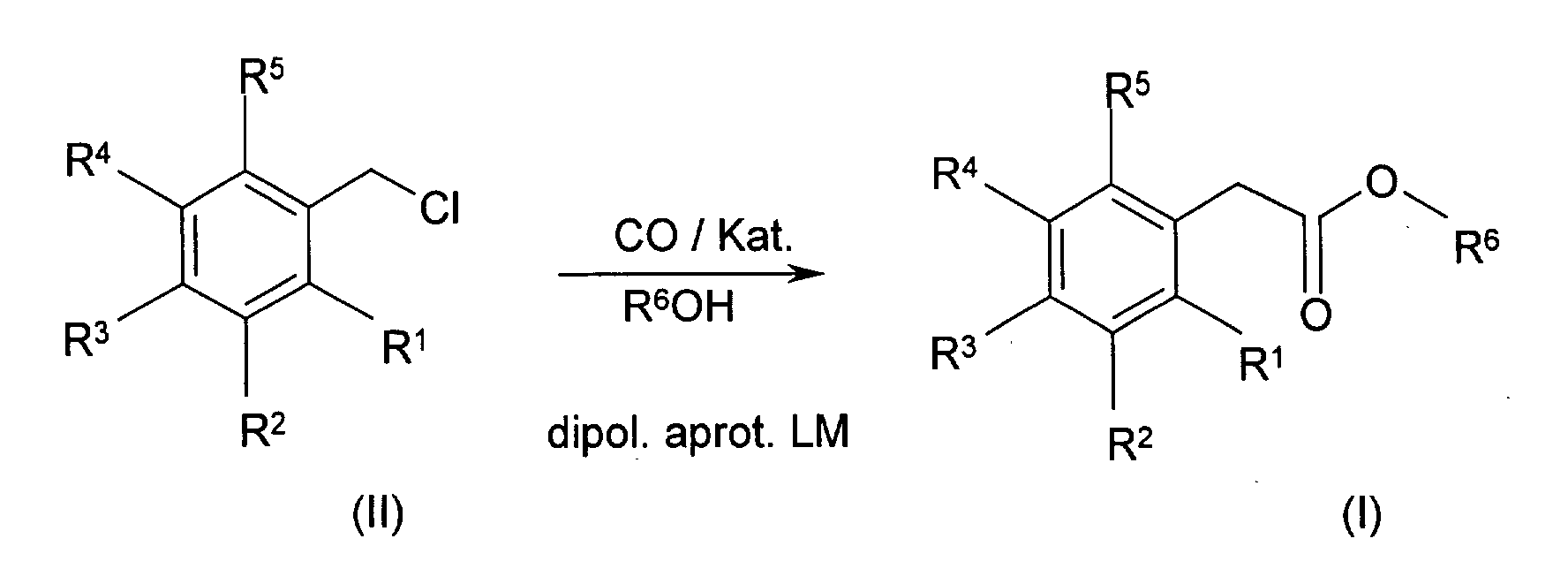 mit einer Verbindung der allgemeinen Formel R6OH und mit Kohlenmonoxid, in
einem dipolar aprotischen Lösungsmittel in Gegenwart eines Katalysators, der
mindestens eine Verbindung eines Übergangsmetalls der VIII. Nebengruppe des
Periodensystems enthält,
mit einer Verbindung der allgemeinen Formel R6OH und mit Kohlenmonoxid, in
einem dipolar aprotischen Lösungsmittel in Gegenwart eines Katalysators, der
mindestens eine Verbindung eines Übergangsmetalls der VIII. Nebengruppe des
Periodensystems enthält,
wobei R1, R2, R3, R4, und R5 unabhängig voneinander für folgende Reste stehen:
wobei R1, R2, R3, R4, und R5 unabhängig voneinander für folgende Reste stehen:
R6 steht für Wasserstoff, einen C1-C18-Alkyl-, insbesondere einen C1-C4-Alkyl-, oder
C6-C18-Arylrest.
Die Reste R1, R2, R3, R4, und R5 bedeuten insbesondere unabhängig voneinander
Wasserstoff, Fluor, C1-C8-Alkyl, oder C1-C8-Alkoxy oder zwei der Reste R1, R2, R3,
R4, und R5 sind untereinander verknüpft und bilden vorzugsweise einen
aliphatischen oder aromatischen Ring mit 5 bis 10 C-Atomen. Vorzugsweise
bedeuten die Reste R1, R2, R3, R4, und R5 unabhängig voneinander Wasserstoff,
Fluor und C1-C4-Alkyl.
Das erfindungsgemäße Verfahren kann in Anwesenheit oder Abwesenheit eines
ionischen Halogenids durchgeführt werden.
Üblicherweise ist das ionische Halogenid ein Alkali-, Ammonium-, Alkylammonium-
oder Phosphoniumhalogenid, insbesondere ein Alkali- oder Ammoniumhalogenid,
wobei Halogenid die Bedeutung Chlorid, Bromid oder Jodid, insbesondere Chlorid
oder Bromid, bevorzugt Chlorid hat.
Man kann als ionisches Halogenid Ammoniumbromid, Lithiumbromid,
Natriumbromid, Kaliumbromid, Tetrabutylphosphoniumbromid, Ammoniumchlorid,
Dimethylammoniumchlorid, Diethanolammoniumchlorid, Lithiumchlorid,
Natriumchlorid, Kaliumchlorid, Tetrabutylphosphoniumchlorid, Ammoniumjodid,
Lithiumjodid, Natriumjodid, Kaliumjodid und/oder Tetrabutylphosphoniumjodid,
insbesondere Lithiumchlorid, Ammoniumchlorid, Dimethylammoniumchlorid,
und/oder Diethanolammoniumchlorid einsetzen.
Bei dem erfindungsgemäßen Verfahren kann aber auch auf die Anwesenheit des
ionischen Halogenids verzichtet werden und das Verfahren in Abwesenheit des
ionischen Halogenids durchgeführt werden.
In einer besonderen Ausführungsform des Verfahrens kann das ionische Halogenid insbesondere wenn der Katalysator Palladium enthält eingesetzt werden.
In einer besonderen Ausführungsform des Verfahrens kann das ionische Halogenid insbesondere wenn der Katalysator Palladium enthält eingesetzt werden.
Der Katalysator enthält mindestens eine Übergangsmetallverbindung der VIII-Nebengruppe,
insbesondere Palladium-, Nickel- und/oder Kobaltverbindungen,
bevorzugt Palladium- und/oder Kobaltverbindungen, besonders bevorzugt
Palladiumverbindungen.
Man kann für das erfindungsgemäße Verfahren auch einen Palladiumkatalysator, der auf einem Trägermaterial aufgebrachtes Nickel, Kobalt oder Palladium enthält, einsetzen. Ein derartiger Träger-Katalysator hat den Vorzug, dass er sich aus dem Reaktionsgemisch, beispielsweise durch Filtration, auf einfache Weise abtrennen lässt.
Man kann für das erfindungsgemäße Verfahren auch einen Palladiumkatalysator, der auf einem Trägermaterial aufgebrachtes Nickel, Kobalt oder Palladium enthält, einsetzen. Ein derartiger Träger-Katalysator hat den Vorzug, dass er sich aus dem Reaktionsgemisch, beispielsweise durch Filtration, auf einfache Weise abtrennen lässt.
Bei der Verwendung von Palladiumkatalysatoren hat es sich in einer Reihe von
Fällen bewährt, dass der Palladiumkatalysator mindestens eine Palladium-(II)-Verbindung,
insbesondere PdCl2, PdBr2 oder Pd(OAc)2 bevorzugt PdCl2, oder
mindestens eine Palladium-(0)-Verbindung, insbesondere Pd2dba3, worin dba für
Dibenzylidenaceton steht, Pd(P(C6H5)3)4 oder Pd(C8H12)2, bevorzugt Pd2dba3
enthält.
In einer Reihe von Fällen hat es sich ferner als günstig erwiesen, dass der
Katalysator zusätzlich einen Liganden, insbesondere eine Phosphinverbindung,
enthält.
Als Phosphinverbindung kommt beispielsweise ein Monophosphin, insbesondere ein
Tri-(C1-C6)-alkylphosphin oder ein Triarylphosphin, oder ein Diphosphin in Betracht.
Mit gutem Erfolg kann man Triphenylphosphin, Tritolylphosphin,
Bis(diphenylphosphino)ethan, 1,3-Bis(diphenylphosphino)propan oder
1,4-Bis(diphenylphosphino)butan, insbesondere Triphenylphosphin einsetzen.
Nach einer besonderen Ausführungsform enthält der Palladiumkatalysator eine Bis(triphenylphosphin)-palladium(II)-Verbindung, beispielsweise Bis(triphenylphosphin)-palladium(II)-chlorid oder Bis(triphenylphosphin)-palladium(II)-bromid.
Nach einer besonderen Ausführungsform enthält der Palladiumkatalysator eine Bis(triphenylphosphin)-palladium(II)-Verbindung, beispielsweise Bis(triphenylphosphin)-palladium(II)-chlorid oder Bis(triphenylphosphin)-palladium(II)-bromid.
Man setzt den Katalysator üblicherweise in einer Menge von 0,00001 bis 0,3 Mol
Übergangsmetall, insbesondere 0,0001 bis 0,2 Mol Übergangsmetall, bevorzugt
0,0005 bis 0,1 Mol Übergangsmetall je Mol Benzylchlorid der Formel (II) ein.
In einer Vielzahl von Fällen genügt es, die Umsetzung bei einem CO-Druck von
0,5 bis 20 MPa, insbesondere 0,8 bis 10, bevorzugt 1,0 bis 6 MPa durchzuführen.
Üblicherweise kann man die Umsetzung bei einer Temperatur von 20 bis 220°C,
insbesondere bei 40 bis 200°C, bevorzugt bei 60 bis 180°C mit gutem Erfolg
durchgeführt.
Als dipolar aprotisches Lösungsmittel eignet sich Dioxan, Tetrahydrofuran,
N-(C1-C18-Alkyl)pyrrolidon, Ethylenglykoldimethylether, C1-C4-Alkylester
aliphatischer C1-C6-Carbonsäuren, C1-C6-Dialkylether, N,N-Di-(C1-C4-alkyl)amide
aliphatischer C1-C4-Carbonsäuren, Sulfolan, 1,3-Di-(C1-C8-alkyl)-2-imidazolidinon,
N-(C1-C8-Alkyl)caprolactam, N,N,N',N'-Tetra-(C1-C8-alkyl)harnstoff, 1,3-Di-(C1-C8-alkyl)-3,4,5,6-tetrahydro-2(1
H)-pyrimidon, N,N,N',N'-Tetra-(C1-C8-alkyl)sulfamid,
4-Formylmorpholin, 1-Formylpiperidin oder 1-Formylpyrrolidin, insbesondere
N-(C1-C18-Alkyl)pyrrolidon, N,N-Di-(C1-C4-Alkyl)amide aliphatischer C1-C4-Carbonsäuren,
4-Formylmorpholin, 1-Formylpiperidin oder 1-Formylpyrrolidin,
bevorzugt N-Methylpyrrolidon, N-Octylpyrrolidon, N-Dodecylpyrrolidon,
N,N-Dimethylformamid, N,N-Dimethylacetamid, 4-Formylmorpholin,
1-Formylpiperidin oder 1-Formylpyrrolidin, besonders bevorzugt N-Methylpyrrolidon,
N,N-Dimethylformamid oder N,N-Dimethylacetamid. Es lassen sich auch
Mischungen der vorstehend genannten dipolar aprotischen Lösungsmittel
verwenden.
In der ganz besonders bevorzugten Variante wird N-Methylpyrrolidon als Lösemittel
eingesetzt.
Beim Einsatz von N-Methylpyrrolidon als Lösemittel kann der entstehende Chlorwasserstoff im Anschluss an die Reaktion als wässriger Chlorwasserstoff isoliert und das Lösemittel N-Methylpyrrolidon wieder eingesetzt werden.
Beim Einsatz von N-Methylpyrrolidon als Lösemittel kann der entstehende Chlorwasserstoff im Anschluss an die Reaktion als wässriger Chlorwasserstoff isoliert und das Lösemittel N-Methylpyrrolidon wieder eingesetzt werden.
Man kann die Verbindung der Formel R6OH, entsprechend einem Alkylalkohol oder
Wasser, in einer Menge von je 0,1 bis 50 Mol je Mol Benzylchlorid der Formel (II)
zusetzen. Üblicherweise führt man die Umsetzung mit einer Menge Alkylalkohol oder
Wasser entsprechend 0,2 bis 10, insbesondere 0,5 bis 4, bevorzugt mit 1 bis 4 Mol
je Mol Benzylchlorid der Formel (II) durch.
Beim Einsatz Benzylchloriden der Formel (II), worin mindestens einer der Reste R1,
R2, R3, R4, und R5 unabhängig voneinander einen CH2Cl-Rest darstellt, erhält man
entsprechend dem erfindungsgemäßen Verfahren Phenylessigsäuren der Formel (I),
worin mindestens einer der Reste R1, R2, R3, R4, und R5 unabhängig voneinander
einen CH2Cl-Rest darstellt. Diese Produkte sind entsprechend dem beschriebenen
Verfahren wieder Benzylchloride der Formel (II) und werden entsprechend dem
beschriebenen Verfahren weiter umgesetzt. Folglich entspricht ein Mol Benzylchlorid
der Formel (II), worin mindestens einer der Reste R1, R2, R3, R4, und R5 unabhängig
voneinander einen CH2Cl-Rest darstellt, der Zahl der CH2Cl-Gruppen entsprechend
viele Mole Benzylchlorid.
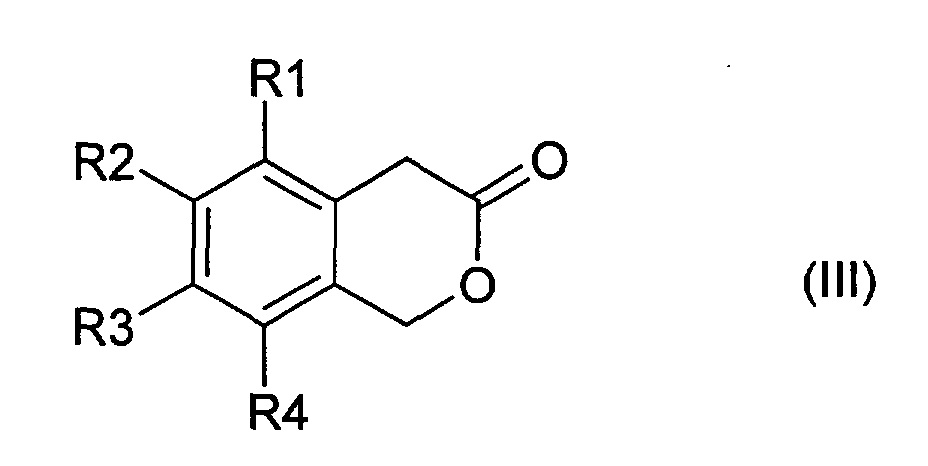
Beim Einsatz Benzylchloriden der Formel (II), worin mindestens einer der Reste R1,
R2, R3, R4, und R5 unabhängig voneinander einen CH2Cl-Rest darstellt und worin
mindestens zwei CH2Cl-Gruppen ortho-ständig sind, erhält man neben den
Phenylessigsäuren der Formel (I) auch 3-Isochromanon-Derivate der allgemeinen
Formel (III).
Nach einer besonderen Ausführungsform des erfindungsgemäßen Verfahrens legt
man das Benzylchlorid der Formel (II), den Katalysator, das dipolar aprotische
Lösemittel und gegebenenfalls auch die Verbindung R6OH sowie gegebenenfalls
das ionische Halogenid vor, stellt den CO-Druck und die Temperatur ein und dosiert
anschließend den Alkylalkohol oder das Wasser oder ein aus dem Alkylalkohol oder
Wasser und dem dipolar aprotischen Lösungsmittel bestehendes Gemisch zu.
Während der Umsetzung sorgt man für eine gute Durchmischung der
Reaktionspartner, um einen zügigen Reaktionsverlauf zu gewährleisten.
Das erfindungsgemäße Verfahren eignet sich sowohl für eine kontinuierliche als
auch diskontinuierliche Durchführung.
Die nachfolgenden Beispiele beschreiben die Erfindung, ohne sie darauf zu
beschränken.
In einem 300 ml HC4-Autoklav wird zu einer Lösung von 36,9 g Benzylchlorid
[291,5mmol] und 26 mg Palladiumchlorid [0,145mmol] in 76 g N-Methylpyrrolidon bei
einem Druck von 30 bar Kohlenmonoxid und einer Temperatur von 150°C, 11,6 g
einer Lösung aus 50 Gew.-% Wasser [321mmol] in N-Methylpyrrolidon über einen
Zeitraum von 1 Stunden eindosiert. Der Druck wird während der Zudosierung
konstant auf 30 bar gehalten. Nach ca. 10 Stunden Nachrührzeit ist die
Kohlenmonoxidaufnahme beendet. Nach dem Abkühlen erhält man eine GC-Ausbeute
von 87 % an Phenylessigsäure. Nach fraktionierter Destillation erhält man
32,1 g Phenylessigsäure [278,7mmol], entsprechend einer praktischen Ausbeute
von 81 %. Der Schmelzpunkt beträgt 78°C.
Die Fraktion der Leichtsieder enthält N-Methylpyrrolidon und nicht umgesetztes Benzylchlorid.
Die Fraktion der Leichtsieder enthält N-Methylpyrrolidon und nicht umgesetztes Benzylchlorid.
In einem 300 ml HC4-Autoklav wird zu einer Lösung von 35 g o-Methylbenzylchlorid
[248,9mmol] und 22 mg Palladiumchlorid [0,124mmol] in 75 g N-Methylpyrrolidon bei
einem Druck von 20 bar Kohlenmonoxid und einer Temperatur von 130°C, 10 g
einer Lösung aus 4,9 g Wasser [273,8mmol] in 5 g N-Methylpyrrolidon über einen
Zeitraum von 1 Stunde eindosiert. Der Druck wird während der Zudosierung
konstant auf 20 bar gehalten Nach Beendigung der Zudosierung wird 12 Stunden,
bis zur Druckkonstanz weiter erhitzt. Die Aufarbeitung erfolgt analog Beispiel 1.
Die praktische Ausbeute beträgt nach Destillation 79 % an o-Methylphenylessigsäure
[197,5mmol]. Der Schmelzpunkt liegt bei 88-90°C, die GC-Reinheit
beträgt 100 %.
In einem 300 ml HC4-Autoklav wird zu einer Lösung von 35 g o-Chlorbenzylchlorid
[217,4 mmol] und 20 mg Palladiumchlorid [0,109mmol] in 75 g N-Methylpyrrolidon,
bei einem Druck von 20 bar Kohlenmonoxid und einer Temperatur von 130°C eine
Lösung aus 4,3 g Wasser [239mmol] in 5 g N-Methylpyrrolidon über einen Zeitraum
von 1 Stunde eindosiert. Der Druck wird während der Zudosierung konstant auf
20 bar gehalten.
Nach Beendigung der Zudosierung wird 9 Stunden bis zur Druckkonstanz weiter erhitzt. Die Aufarbeitung erfolgt nach dem Abkühlen analog Beispiel 1.
Die praktische Ausbeute beträgt 82 %, das entspricht einer Masse von 30,3 g an o-Chlorphenylessigsäure mit einer GC-Reinheit von 100 % und einem Schmelzpunkt von 95-97°C.
Nach Beendigung der Zudosierung wird 9 Stunden bis zur Druckkonstanz weiter erhitzt. Die Aufarbeitung erfolgt nach dem Abkühlen analog Beispiel 1.
Die praktische Ausbeute beträgt 82 %, das entspricht einer Masse von 30,3 g an o-Chlorphenylessigsäure mit einer GC-Reinheit von 100 % und einem Schmelzpunkt von 95-97°C.
In einem 300 ml HC4-Autoklav wird zu einer Lösung von 49 g
2,4-Dichlorbenzylchlorid [252,5 mmol] und 18 mg Palladiumchlorid [0,1 mmol] in
105 g N-Methylpyrrolidon, bei einem Druck von 20 bar Kohlenmonoxid und einer
Temperatur von 130°C, 10 g einer Lösung aus 5 g Wasser [278 mmol] und 5 g
N-Methylpyrrolidon über einen Zeitraum von 1 Stunde eindosiert. Der Druck wird
während der Zudosierung konstant auf 20 bar gehalten. Es wird bis zur
Druckkonstanz, die nach 16 Stunden erreicht wird, nachgerührt. Nach dem
Abkühlen wird das N-Methylpyrrolidon sowie der Chlorwasserstoff bei 150°C und
200 mbar abgetrennt. Der Rückstand wird als Schmelze in Wasser unter paralleler
Eindosierung von 50 %iger wässeriger Natriumhydroxydlösung, so dass der pH-Wert
10 gehalten wird. Man erhält eine homogene Lösung, die mit 20 ml Xylol
extrahiert wird um organisch lösliche Stoffe abzutrennen.
Anschließend wird mit ca. 30 %iger wässeriger Salzsäure auf pH 1 angesäuert, wobei die 2,4-Dichlorphenylessigsäure als weißer Feststoff ausfällt. Das ausgefallene Produkt wird mit soviel Wasser gewaschen, bis das ablaufende Abwasser einen konstanten pH-Wert hat. Das gewaschene Produkt wird bei 100°C und erniedrigten Druck getrocknet.
Die praktische Ausbeute beträgt 89 % mit einer GC-Reinheit von 100 % an 2,4-Dichlorpenylessigsäure. Der Schmelzpunkt beträgt 131-133°C.
Anschließend wird mit ca. 30 %iger wässeriger Salzsäure auf pH 1 angesäuert, wobei die 2,4-Dichlorphenylessigsäure als weißer Feststoff ausfällt. Das ausgefallene Produkt wird mit soviel Wasser gewaschen, bis das ablaufende Abwasser einen konstanten pH-Wert hat. Das gewaschene Produkt wird bei 100°C und erniedrigten Druck getrocknet.
Die praktische Ausbeute beträgt 89 % mit einer GC-Reinheit von 100 % an 2,4-Dichlorpenylessigsäure. Der Schmelzpunkt beträgt 131-133°C.
Claims (11)
- Verfahren zur Herstellung von Phenylessigsäurederivaten der allgemeinen Formel (I) durch Umsetzung von Benzylchloriden der allgemeinen Formel (II)mit einer Verbindung der allgemeinen Formel R6OH und mit Kohlenmonoxid in einem dipolar aprotischen Lösungsmittel in Gegenwart eines Katalysators, der mindestens eine Verbindung eines Übergangsmetalls der VIII. Nebengruppe des Periodensystems enthält,

wobei R1, R2, R3, R4, und R5 unabhängig voneinander für folgende Reste stehen:ein Wasserstoff oder Fluoratom;ein CH2Cl-Rest;eine HO2CCH=CH-, NC- oder CF3-Gruppe;einen Alkyl-, Alkoxy-, oder Acyloxyrest, mit jeweils 1 bis 18 Kohlenstoffatomen; oder einen C6-C18-Aryloxy, Aryl- oder Heteroarylrest, wobei als Heteroatome 1 bis 3 Atome der Gruppe O, N und/oder S vorhanden sind;einen R8 2P(=O)-, R9C(=O)-, R9OC(=O)-, R9OC(=O)CH=CH-, R10C(=O)-,R10OC(=O)-, R10OC(=O)CH=CH-, oder R10 2P(=O)-Rest, worin R8 einen C1-C4-Alkylrest, R9 einen C1-C18-Alkylrest oder Wasserstoff und R10 einen C6-C18-Arylrest darstellen;oder worin mindestens zwei der Reste R1, R2, R3, R4, und R5 untereinander verknüpft sind und mindestens einen aliphatischen oder aromatischen Ring mit 5 bis 18 C-Atomen bilden;R6 steht für Wasserstoff oder einen C1-C18-Alkyl- oder C6-C18-Arylrest. - Verfahren nach Anspruch 1, dadurch gekennzeichnet, dass R1, R2, R3, R4, und R5 unabhängig voneinander Wasserstoff, Fluor, einen C1-C8-Alkyl- oder einen C1-C8-Alkoxyrest bedeuten oder zwei der Reste R1, R2, R3, R4, und R5 untereinander verknüpft sind und einen aliphatischen oder aromatischen Ring mit 5 bis 10 C-Atomen bilden.
- Verfahren nach Anspruch 1 oder 2, dadurch gekennzeichnet, dass R6 für einen C1-C4-Alkylrest oder Wasserstoff steht.
- Verfahren nach einem oder mehreren der vorigen Ansprüche, dadurch gekennzeichnet, dass die Umsetzung in Gegenwart eines ionischen Halogenids durchgeführt wird.
- Verfahren nach Anspruch 4, dadurch gekennzeichnet, dass als ionisches Halogenid ein Alkali- oder Ammoniumhalogenid oder ein Alkylammoniumhalogenid oder ein Phosphoniumhalogenid verwendet wird.
- Verfahren nach mindestens einem der vorhergehenden Ansprüche, dadurch gekennzeichnet, dass der Katalysator Palladium-, Nickel- und/oder Kobaltverbindungen enthält.
- Verfahren nach Anspruch 6, dadurch gekennzeichnet, dass der Katalysator zusätzlich einen Liganden enthält.
- Verfahren nach Anspruch 7, dadurch gekennzeichnet, dass der Ligand eine Phosphinverbindung ist.
- Verfahren nach mindestens einem der vorhergehenden Ansprüche, dadurch gekennzeichnet, dass der Katalysator in einer Menge von 0,00001 bis 0,3 Mol Übergangsmetall je Mol Benzylchlorid der Formel (II) eingesetzt wird.
- Verfahren nach mindestens einem der vorhergehenden Ansprüche, dadurch gekennzeichnet, dass die Umsetzung bei einem CO-Druck von 0,5 bis 20 MPa durchgeführt wird.
- Verfahren nach mindestens einem der vorhergehenden Ansprüche, dadurch gekennzeichnet, dass die Umsetzung bei einer Temperatur im Bereich von 20 bis 220°C durchgeführt wird.
Applications Claiming Priority (2)
| Application Number | Priority Date | Filing Date | Title |
|---|---|---|---|
| DE10057262 | 2000-11-18 | ||
| DE10057262A DE10057262A1 (de) | 2000-11-18 | 2000-11-18 | Verfahren zur Herstellung von Phenylessigsäurederivaten |
Publications (1)
| Publication Number | Publication Date |
|---|---|
| EP1207148A1 true EP1207148A1 (de) | 2002-05-22 |
Family
ID=7663797
Family Applications (1)
| Application Number | Title | Priority Date | Filing Date |
|---|---|---|---|
| EP01126255A Withdrawn EP1207148A1 (de) | 2000-11-18 | 2001-11-06 | Verfahren zur Herstellung von Phenylessigsäurederivaten |
Country Status (4)
| Country | Link |
|---|---|
| US (1) | US6653502B2 (de) |
| EP (1) | EP1207148A1 (de) |
| JP (1) | JP2002155014A (de) |
| DE (1) | DE10057262A1 (de) |
Cited By (1)
| Publication number | Priority date | Publication date | Assignee | Title |
|---|---|---|---|---|
| US7161026B1 (en) | 2005-07-08 | 2007-01-09 | Property Development Corporation International, Ltd, Inc. | Method of preparation of methyl-benzyl-ketone |
Families Citing this family (7)
| Publication number | Priority date | Publication date | Assignee | Title |
|---|---|---|---|---|
| WO2006010885A1 (en) * | 2004-07-30 | 2006-02-02 | Heriot-Watt University | Palladacyles, their preparation and catalytic processes involving their use as catalyst, especially catalytic carbonylation processes |
| US7470809B2 (en) * | 2004-08-31 | 2008-12-30 | Janssen Pharmaceutica N.V. | Process for the production of [2-(4-fluoro-benzyl)-phenyl]-acetic acid |
| US8703992B2 (en) * | 2008-05-27 | 2014-04-22 | Basf Se | Method for producing aromatic and heteroaromatic carboxylic acids, carboxylic acid esters and carboxylic acid amides |
| CN102140062B (zh) * | 2011-03-13 | 2012-11-14 | 联化科技股份有限公司 | 一种2,5-二甲基苯乙酸的制备方法 |
| CN103387490B (zh) * | 2012-05-09 | 2015-08-26 | 中国科学院兰州化学物理研究所 | 一种甲苯羰化合成苯乙酸的方法 |
| CN106496013A (zh) * | 2016-09-08 | 2017-03-15 | 上海引盛生物科技有限公司 | 一种苯乙酸类化合物的制备方法 |
| CN118026975A (zh) * | 2023-06-27 | 2024-05-14 | 甘肃博克斯生物技术有限公司 | 基于羰基化反应的苯并呋喃酮合成方法 |
Citations (3)
| Publication number | Priority date | Publication date | Assignee | Title |
|---|---|---|---|---|
| DE1914391A1 (de) * | 1968-03-25 | 1969-10-23 | Montedison Spa | Verfahren zur Herstellung von Phenylessigsaeure und deren Estern |
| DE2521610B1 (de) * | 1975-05-15 | 1976-09-16 | Basf Ag | Verfahren zur herstellung von arylessigsaeuren und deren estern |
| EP0338852A1 (de) * | 1988-04-22 | 1989-10-25 | Hoechst Celanese Corporation | Verfahren zur Carbonylierung von Arylalkylhalogeniden |
Family Cites Families (5)
| Publication number | Priority date | Publication date | Assignee | Title |
|---|---|---|---|---|
| US2730546A (en) * | 1952-05-07 | 1956-01-10 | Basf Ag | Process for the production of aliphatic acid anhydrides by carbonylation of esters |
| US3988358A (en) * | 1974-05-10 | 1976-10-26 | The University Of Delaware | Process for the preparation of carboxylic acid esters from organic halides |
| IT1014957B (it) * | 1974-06-11 | 1977-04-30 | Montedison Spa | Processo per la preparazione di acidi carbossilici da alogenuri organici |
| US5003104A (en) * | 1987-03-03 | 1991-03-26 | Bp Chemicals Limited | Carbonylation process and catalyst |
| US5315029A (en) * | 1993-05-11 | 1994-05-24 | Ethyl Corporation | Process for preparing aryl-substituted aliphatic carboxylic acid esters by carbonylation |
-
2000
- 2000-11-18 DE DE10057262A patent/DE10057262A1/de not_active Withdrawn
-
2001
- 2001-09-27 JP JP2001296386A patent/JP2002155014A/ja active Pending
- 2001-11-06 EP EP01126255A patent/EP1207148A1/de not_active Withdrawn
- 2001-11-09 US US10/037,078 patent/US6653502B2/en not_active Expired - Fee Related
Patent Citations (3)
| Publication number | Priority date | Publication date | Assignee | Title |
|---|---|---|---|---|
| DE1914391A1 (de) * | 1968-03-25 | 1969-10-23 | Montedison Spa | Verfahren zur Herstellung von Phenylessigsaeure und deren Estern |
| DE2521610B1 (de) * | 1975-05-15 | 1976-09-16 | Basf Ag | Verfahren zur herstellung von arylessigsaeuren und deren estern |
| EP0338852A1 (de) * | 1988-04-22 | 1989-10-25 | Hoechst Celanese Corporation | Verfahren zur Carbonylierung von Arylalkylhalogeniden |
Non-Patent Citations (2)
| Title |
|---|
| H. URATA ET AL.: "Transition Metal Complex Catalyzed Carbonylation of Organic Halides ...", J. ORG. CHEM., vol. 56, 1991, pages 4320 - 4322, XP001061847 * |
| H.URATA ET AL.: "Transition Metal Complex catalyzed Carnonylation ...", TETRAHEDRON LETTERS, vol. 32, no. 36, 1991, pages 4733 - 4736, XP001061852 * |
Cited By (1)
| Publication number | Priority date | Publication date | Assignee | Title |
|---|---|---|---|---|
| US7161026B1 (en) | 2005-07-08 | 2007-01-09 | Property Development Corporation International, Ltd, Inc. | Method of preparation of methyl-benzyl-ketone |
Also Published As
| Publication number | Publication date |
|---|---|
| US20020062041A1 (en) | 2002-05-23 |
| DE10057262A1 (de) | 2002-05-23 |
| US6653502B2 (en) | 2003-11-25 |
| JP2002155014A (ja) | 2002-05-28 |
Similar Documents
| Publication | Publication Date | Title |
|---|---|---|
| DE69204691T2 (de) | Verfahren zur Karbonylierung von Olefin. | |
| DE60103255T2 (de) | Verfahren zum carbonylieren von pentennitril | |
| EP0623582A2 (de) | Verfahren zur Herstellung von Carbonsäureestern aus Carbonsäurehalogeniden und Alkoholen | |
| EP2185500B1 (de) | Verfahren zur herstellung von biarylen | |
| DE69007256T3 (de) | Verfahren zur Herstellung von Ibuprofen und dessen Alkylester. | |
| DE10057262A1 (de) | Verfahren zur Herstellung von Phenylessigsäurederivaten | |
| DE2801886A1 (de) | Verfahren zur herstellung der alkalisalze der phenylessigsaeure | |
| EP0949256B1 (de) | Verfahren zur Herstellung von Isochroman-3-onen | |
| DE2359963C2 (de) | Verfahren zur Herstellung von Malonsäuredialkylestern | |
| DE69318037T2 (de) | Verfahren zur herstellung von aryl-substituierten aliphatischen carbonsäuren und ihren alkylestern | |
| EP0087585A1 (de) | Verfahren zur Herstellung von 3-Alkoxi-acrylnitrilen | |
| DE2410782C2 (de) | Phenylendiessigsäuredialkylester und Verfahren zu deren Herstellung | |
| DE69409651T2 (de) | Verfahren zur carbonylierung von acetylenisch ungesättigten verbindungen | |
| EP0352641B1 (de) | Verfahren zur Herstellung von Pentensäurealkylestern | |
| DE69518748T2 (de) | Verfahren zur herstellung von zwischenprodukten für die synthese von schimmelbeseitigungsmitteln | |
| DE69612563T2 (de) | Hydroformylierungsverfahren | |
| NZ201464A (en) | Preparation of glycol aldehyde | |
| EP0675129A1 (de) | Verfahren zur Herstellung von heterosubstituierten Acetalen | |
| EP1086949B1 (de) | Verfahren zur Herstellung von Isochroman-3-onen | |
| EP0994096B1 (de) | Verfahren zur Herstellung von 2-Methyl-1,3-dicarbonsäureestern | |
| DE2457555C3 (de) | Verfahren zur Herstellung von 1,2disubstituierten trans-Olefinen | |
| DE4425677A1 (de) | Herstellung von Carbaminsäurevinylestern | |
| EP0400292A2 (de) | Verfahren zur Herstellung von Cyclooctandicarbonsäurediestern | |
| DE68908450T2 (de) | Organische Phosphorverbindungen und Verfahren zu ihrer Herstellung. | |
| WO2002051780A1 (de) | Verfahren zur herstellung von 1,6-hexandiolen |
Legal Events
| Date | Code | Title | Description |
|---|---|---|---|
| PUAI | Public reference made under article 153(3) epc to a published international application that has entered the european phase |
Free format text: ORIGINAL CODE: 0009012 |
|
| AX | Request for extension of the european patent |
Free format text: AL;LT;LV;MK;RO;SI |
|
| 17P | Request for examination filed |
Effective date: 20021122 |
|
| AKX | Designation fees paid |
Designated state(s): AT BE CH CY DE DK ES FI FR GB GR IE IT LI LU MC NL PT SE TR |
|
| 17Q | First examination report despatched |
Effective date: 20030821 |
|
| STAA | Information on the status of an ep patent application or granted ep patent |
Free format text: STATUS: THE APPLICATION HAS BEEN WITHDRAWN |
|
| 18W | Application withdrawn |
Effective date: 20031118 |