EP1201460A2 - Lenkrollevorrichtung für die Verwendung bei Doppelboden - Google Patents
Lenkrollevorrichtung für die Verwendung bei Doppelboden Download PDFInfo
- Publication number
- EP1201460A2 EP1201460A2 EP01204101A EP01204101A EP1201460A2 EP 1201460 A2 EP1201460 A2 EP 1201460A2 EP 01204101 A EP01204101 A EP 01204101A EP 01204101 A EP01204101 A EP 01204101A EP 1201460 A2 EP1201460 A2 EP 1201460A2
- Authority
- EP
- European Patent Office
- Prior art keywords
- cabinet
- casters
- caster
- panel
- access floor
- Prior art date
- Legal status (The legal status is an assumption and is not a legal conclusion. Google has not performed a legal analysis and makes no representation as to the accuracy of the status listed.)
- Withdrawn
Links
Images




Classifications
-
- E—FIXED CONSTRUCTIONS
- E04—BUILDING
- E04F—FINISHING WORK ON BUILDINGS, e.g. STAIRS, FLOORS
- E04F15/00—Flooring
- E04F15/02—Flooring or floor layers composed of a number of similar elements
- E04F15/024—Sectional false floors, e.g. computer floors
-
- A—HUMAN NECESSITIES
- A47—FURNITURE; DOMESTIC ARTICLES OR APPLIANCES; COFFEE MILLS; SPICE MILLS; SUCTION CLEANERS IN GENERAL
- A47B—TABLES; DESKS; OFFICE FURNITURE; CABINETS; DRAWERS; GENERAL DETAILS OF FURNITURE
- A47B91/00—Feet for furniture in general
-
- B—PERFORMING OPERATIONS; TRANSPORTING
- B60—VEHICLES IN GENERAL
- B60B—VEHICLE WHEELS; CASTORS; AXLES FOR WHEELS OR CASTORS; INCREASING WHEEL ADHESION
- B60B33/00—Castors in general ; Anti-clogging castors
Definitions
- the present invention relates generally to cabinets supported on casters and, more particularly to an arrangement for casters on cabinets for use on access or raised floors of a computer room or the like.
- FIG. 1 illustrates an isometric view of an equipment cabinet 10 supported on a access floor 20 by a plurality of casters 12.
- the equipment cabinet may include computer or telecommunications devices or other equipment required to support such devices.
- a structural system of interchangeable floor panels 22 create access floor 20.
- Columns 24 support panels 22 at a specified height above raw floor 26 of the building.
- Columns 24 vary in height typically from 6 to 30 inches.
- Several systems may be used to support or sustain the panels on the columns.
- the panels may be held on the columns by gravity, snaps, bolts or locks.
- stringers or bars that run from column to column in the grid may provide additional support.
- Access panels 22 create a plenum 28 below access floor 20.
- Wiring (not shown) may be distributed in plenum 28 between raw floor 26 and access floor 20. By removing interchangeable panels 21, one can access the wiring contained within plenum 28. In plenum 28, the electrical wiring can be economically installed. The plenum can also be used to deliver conditioned air.
- the access floor and panels are built to various weight and strength specifications.
- the floors must be able to handle static loads and rolling loads.
- Equipment having common commercial casters for support and rolling can deform the access floor system or even cause the flooring to fail.
- Table 1 illustrates criteria for an access floor system using steel panels held by gravity and stringers.
- the floor panel can support a concentrated load of 1000 lbs. and an ultimate load of 2100 lbs.
- the rolling loads allowable for a minimum deformation (0.040 inches) of the panels is about 400 lbs. for up to 10,000 passes.
- the values presented are for a commercial access floor as provided by the "All Steel 1000 System" from Tate Access Floors, Inc.
- FIGS. 2A-B illustrate prior art caster arrangements.
- a portion of access floor 30 is shown from above.
- Three rows 32, 34, 36 of access panels and three columns A, B, C create the grid of the present portion of access floor 30.
- the panels are typically square and have a side length of one or two feet.
- the panels are arranged in a grid as shown.
- An outline of a cabinet 40 lies within the portion of access floor 30 and represents the location of an equipment cabinet 40 on the floor.
- Cabinet 40 has a plurality of casters 41-49 arranged under the cabinet to provide support and rolling of the cabinet on access floor 30.
- FIG. 2A example dimensions and values will be used to illustrate and describe the arrangement of casters and loads for FIG. 2A.
- the access panels that compose access floor have a side length of 24 inches and have performance criteria as shown in Table 1.
- Cabinet 40 has a width W of 54" and a depth D of 33". Assuming that cabinet 40 holds equipment that creates a uniform load weighing 4500 lbs., each of the casters 41-49 supports a weight of 500 lbs.
- each panel of access floor 40 can sustain a recommended concentrated load of 1000 lbs. and an ultimate load of 2100 lbs.
- the weight can be properly distributed to the various panels as the cabinet rests or rolls on access floor 30.
- panel 34A supports weight of cabinet 40 through casters 41 and 44. If each caster 41 and 44 applies a concentrated load of 500 lbs. each, then the panel 34A supports an ultimate load of 1000 lbs. and falls within the performance criteria of Table 1.
- the concentrated load i.e. , the point load from a single caster, applied to panel 34A does not exceed the 1000 lbs. limit.
- the combined static load of casters 41 and 44 being 1000 Ibs. does not exceed the ultimate load of the panel of 2100 lbs. in Table 1.
- panel 34B supports casters 42 and 45 having 1000 lbs. of static load
- panel 34C supports casters 43 and 46 having 1000 lbs. of static load
- panels 36A, 36B and 36C each support a single caster having static loads of 500 lbs.
- the casters properly distribute weight of the cabinet to the panels of the access floor.
- no matter how the cabinet is ultimately situated on the access floor differently than depicted in FIG. 2A, a given panel will support at most only the static load of two casters.
- FIG. 2B shows another caster arrangement according to the prior art.
- Cabinet 50 has similar dimensions as the cabinet described in FIG. 2A. Specifically, width W is 54 inches, and depth D is 33 inches.
- Six casters 51-56 support cabinet 50. If the cabinet uniformly weighs 4500 lbs. as before, each caster applies a concentrated load of 150 lbs. on a panel of access floor 30. With the present arrangement of six casters 51-56 for cabinet 50 on access floor 30, each panel supports the load of only one caster for any given orientation or roll of the cabinet.
- access floor 30 in FIGS. 2A and 2B can properly accommodate a 4500 lbs. cabinet having the dimensions of 54" width and 33" depth and nine or six casters distributed uniformly below the cabinet.
- the computer and telecommunications industries design electrical components smaller and more compact. More equipment is being used by businesses and placed in more restrictive environments and computer rooms. These trends develop a growing need for more compact cabinets for containing a significant amount of equipment.
- Present caster arrangements if used with smaller cabinets results in problems and failures with respect to the access floor systems used in many data centers and computer rooms. For this reason, a need exists for a caster arrangement for more compact and densely equipped cabinets that will not overburden access floor systems.
- the present invention is directed to overcoming, or at least reducing the effects of, one or more of the problems set forth above.
- the present invention relates to an arrangement for casters on cabinets having electronic equipment for use on access or raised floors of a computer room or the like.
- a method for arranging casters to support a cabinet on an access floor The access floor has a plurality of panels having a side length S.
- the cabinet is a right quadrangle having side lengths of W and D.
- the method includes establishing four corner casters on the corners of the right quadrangle.
- the method includes establishing a plurality of casters along sides W of the cabinet by spacing the plurality of casters at a distance of approximately from one another.
- the method includes establishing a plurality of casters along sides D of the cabinet by spacing the plurality of casters a distance of at least form one another. Maintaining each of the casters a minimum distance from the sides of the right quadrangle cabinet to which the casters lie adjacent ensures the stability of the cabinet.
- the sides W are each at least twice the distance
- the sides D are each at least twice the distance
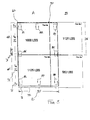
- FIG. 3 illustrate a caster arrangement according to the present invention.
- FIG. 3 shows a top view of a four-panel portion of an access floor 60.
- the panels form a grid and are situated by rows 62, 64 and columns A, B.
- the sides of the panels have a dimension of 24 inches, which is a conventional size for access floor panels.
- the panels will be discussed with the exemplary performance criteria as first discussed in Table 1, which represents a commercial access floor with common stability characteristics. It is to be understood that dimensions and values provided in the present discussion will vary in accordance with different dimensions or performance criteria for other access floors. Such variations can be properly considered by one of ordinary skill in the art when applying the present invention to a particular design situation.
- FIG. 2A-B An outline of a cabinet 70 is depicted as the cabinet would rest on access floor 60.
- the cabinet applies weight to the floor with a plurality of casters 81-88.
- cabinet 70 has a width W of 46.75 inches and a depth D of 30 inches, giving cabinet 70 a cross-sectional area of 1402.5 square inches with which to distribute weight to access floor 60.
- the cabinet in FIG. 2A-B had a cross-sectional area of 1782 square inches. Therefore, the present cabinet 70 has a decrease in cross-sectional area of roughly 21% with which to apply its weight to a similar access floor.
- cabinet 70 may contain as much equipment as the larger cabinet described in the prior art of FIG. 2A-B. Therefore, cabinet 70 may also weigh 4500 lbs.
- Casters 81-88 are arranged as follows on the bottom of cabinet 70.
- the corner casters 81, 83, 86 and 88 are situated a distance 72 within the width W of cabinet 70.
- Distance 72 is two inches for the present cabinet and panel dimensions.
- corner casters 81, 83, 86 and 88 are situated a distance 76 within the depth D of cabinet 70.
- Distance 76 is also two inches for the present cabinet and panel dimensions.
- Caster 82 is centered between casters 81 and 83, lies distance 72 within the width W, and is located distance 78 from both caster 81 and 83.
- caster 87 is centered between casters 86 and 88, lies distance 72 within the width W, and is located distance 78 from both caster 86 and 88.
- the distance 78 is equal to half of the value of the depth D of cabinet 70 minus twice the distance 76. In other words, distance 78 is approximately 13 inches for the present dimensions.
- Caster 84 is centered between casters 81 and 86, lies distance 76 within the depth D, and is located distance 74 from both caster 81 and 86.
- caster 85 is centered between casters 83 and 88, lies distance 76 within the depth D, and is located distance 74 from both caster 83 and 88.
- the distance 76 is equal to half of the value of the width W of cabinet 70 minus twice the distance 72. In other words, distance 74 is 21.4 inches for the present dimensions.
- panel 62A has a static load of 1687.5 lbs. from casters 81, 82, 84.
- Panel 62B has a static load of 1125 lbs. from casters 83 and 85.
- Panel 64A has a static load of 1125 lbs. from casters 86 and 87.
- Panel 64B has a static load of 562.5 lbs. from caster 88.
- the access floor 60 and panels properly supports the smaller and densely equipped cabinet 70.
- FIGS. 4A-D illustrate the caster arrangement and cabinet 70 in various positions relative to access floor 60.
- FIGS. 4A-D illustrate that the present invention allows cabinet 70 with the caster arrangement according to the present invention to be arbitrarily situated on access floor 60 without exceeding the performance and ultimate loading of the access floor and panels.
- FIGS. 4A-D show, the present invention properly applies the load of the small, heavy cabinet on the access floor so that failure may be avoided due to the arbitrary orientation or rolling of the cabinet on the access floor.
- a given access panel will receive at most the load of three casters totaling a static load of 1687.5 lbs.
- FIG. 4A shows a top view of portion of an access floor 100 forming a grid of nine panels.
- the outline of a cabinet 110 with the dimensional characteristics as previously described is arbitrarily situated on access floor 100.
- the cabinet has eight casters 121-128 that have the similar dimensional arrangement as described previously.
- Each of the panels 102B-C, 104A-C, and 106A-B supports only the concentrated load of 562.5 lbs. for one caster.
- FIG. 4B shows cabinet 110 in a second, arbitrary orientation relative to access floor 100, as if the cabinet is being moved or has been repositioned on the access floor.
- Each of the panels 102B, 104A-C, and 106B supports only the concentrated load of 562.5 lbs. from one caster.
- Panel 106A supports three casters 126, 127, 128 having a combined load of 1687.5 lbs.
- cabinet 110 and casters 181-188 do not exceed the performance criteria of the access floor.
- FIG. 4C shows cabinet 110 in another arbitrary orientation relative to access floor 100, as if the cabinet is being moved or has been repositioned on the access floor.
- Panels 104B and 104C support only the concentrated load of one caster having a load of 562.5 lbs.
- Panels 102B, 104A and 106A supports two casters each having a combined load of 1128 lbs.
- cabinet 110 and casters 181-188 do not exceed the performance criteria of the access floor.
- FIG. 4D shows cabinet 110 in yet another arbitrary orientation relative to access floor 100, as if the cabinet is being moved or has been repositioned on the access floor.
- Panels 102A, 102B, 104B and 106C support only the concentrated load of one caster having a load of 562.5 lbs.
- Panels 104A and 106B supports two casters each having a combined load of 1128 lbs.
- cabinet 110 and casters 181-188 do not exceed the performance criteria of the access floor.
- FIGS. 4A-D help to illustrate various arbitrary orientations for the cabinet and casters. It will become obvious under further inspection that any orientation of the cabinet and caster arrangement according to the present invention will result in no more than the load of three casters being applied to any one panel at one time.
- FIG. 5A-C presents a method for determining the caster arrangement for an access floor with panels of any given size.
- an arbitrary panel for a raised floor having a side length S is shown in bold line.
- a comer caster arrangement of casters C1, C2 and C3 is shown relative to the panel P.
- the corner caster arrangement is understood to represent only part of the casters required to support a cabinet. The cabinet would require four such caster arrangements at each comer with additional casters placed between the comers as necessitated by the total width and depth of the cabinet.
- the distance b, between casters C1 and C3, must be greater than S / 2 . If b is less than half the length of S, then a fourth caster D1 will also rest on the panel if the casters are used on a relatively compact cabinet with the casters situated evenly. Also, if the cabinet that the casters support requires a second comer arrangement made up of casters D1, D2 and C3, then caster D2 would also lie on the panel if b were to be less than S / 2.
- FIG. 5B illustrates the comer arrangement of casters C1, C2 and C3 in relation to the panel P having a side length S .
- Panel P is shown skewed at 45° to help in further refining the distances of a and b in terms of the given length S of panel P.
- Caster C2 rests on one comer of the panel of side length S .
- length a may be provided by the relation: a ⁇ 214 240 S
- triangle T is an isosceles triangle, having the equal sides of ( 2 S - a ). Therefore, the length b may be obtained by: b ⁇ 2 S - a ⁇ b ⁇ 2 S - 214 240 S
- length a for comer arrangement should be approximately 10.7 inches.
- Length b should be approximately 6.3 inches.
- the comer casters of C1, C2 and C3 in order to provide stability, should not be situated far from the edges of the cabinet that they are used to support.
- the casters may be situated a distance of 2 inches from the edge of the cabinet. Therefore, the caster arrangement is appropriate where the arrangement of the casters supports a cabinet that does not overly exceed the requirements for stability.
Landscapes
- Engineering & Computer Science (AREA)
- Architecture (AREA)
- Mechanical Engineering (AREA)
- General Engineering & Computer Science (AREA)
- Civil Engineering (AREA)
- Structural Engineering (AREA)
- Legs For Furniture In General (AREA)
- Floor Finish (AREA)
Applications Claiming Priority (2)
| Application Number | Priority Date | Filing Date | Title |
|---|---|---|---|
| US24400300P | 2000-10-27 | 2000-10-27 | |
| US244003 | 2000-10-27 |
Publications (1)
| Publication Number | Publication Date |
|---|---|
| EP1201460A2 true EP1201460A2 (de) | 2002-05-02 |
Family
ID=22921005
Family Applications (1)
| Application Number | Title | Priority Date | Filing Date |
|---|---|---|---|
| EP01204101A Withdrawn EP1201460A2 (de) | 2000-10-27 | 2001-10-29 | Lenkrollevorrichtung für die Verwendung bei Doppelboden |
Country Status (2)
| Country | Link |
|---|---|
| US (1) | US6705625B2 (de) |
| EP (1) | EP1201460A2 (de) |
Families Citing this family (10)
| Publication number | Priority date | Publication date | Assignee | Title |
|---|---|---|---|---|
| US7630198B2 (en) * | 2006-03-08 | 2009-12-08 | Cray Inc. | Multi-stage air movers for cooling computer systems and for other uses |
| US6775137B2 (en) * | 2002-11-25 | 2004-08-10 | International Business Machines Corporation | Method and apparatus for combined air and liquid cooling of stacked electronics components |
| US8507824B2 (en) * | 2006-01-27 | 2013-08-13 | New Rule Products, Inc. | System for processing floor decking of structures |
| US8061692B1 (en) * | 2007-05-22 | 2011-11-22 | DIS Inc. | Floor isolation system |
| US20090154091A1 (en) * | 2007-12-17 | 2009-06-18 | Yatskov Alexander I | Cooling systems and heat exchangers for cooling computer components |
| US8170724B2 (en) | 2008-02-11 | 2012-05-01 | Cray Inc. | Systems and associated methods for controllably cooling computer components |
| US7898799B2 (en) * | 2008-04-01 | 2011-03-01 | Cray Inc. | Airflow management apparatus for computer cabinets and associated methods |
| US7903403B2 (en) * | 2008-10-17 | 2011-03-08 | Cray Inc. | Airflow intake systems and associated methods for use with computer cabinets |
| US8081459B2 (en) | 2008-10-17 | 2011-12-20 | Cray Inc. | Air conditioning systems for computer systems and associated methods |
| US8472181B2 (en) | 2010-04-20 | 2013-06-25 | Cray Inc. | Computer cabinets having progressive air velocity cooling systems and associated methods of manufacture and use |
Family Cites Families (5)
| Publication number | Priority date | Publication date | Assignee | Title |
|---|---|---|---|---|
| US5205381A (en) * | 1991-02-19 | 1993-04-27 | Waterloo Industries, Inc. | Brake system |
| US6206385B1 (en) * | 1996-12-23 | 2001-03-27 | Rehrig International, Inc. | Modular universal flat bed cart with variable support and maneuvering handles |
| US5787663A (en) * | 1997-02-06 | 1998-08-04 | Sony Corporation | Beam support bracket for a raised access floor |
| IT236238Y1 (it) * | 1997-11-28 | 2000-08-08 | Galtieri Giuseppe | Carrello multiuso per servizi di ristorazione |
| US6256952B1 (en) * | 1998-07-27 | 2001-07-10 | Interface, Inc. | Perforated raised flooring panel |
-
2001
- 2001-10-23 US US10/002,642 patent/US6705625B2/en not_active Expired - Fee Related
- 2001-10-29 EP EP01204101A patent/EP1201460A2/de not_active Withdrawn
Also Published As
| Publication number | Publication date |
|---|---|
| US6705625B2 (en) | 2004-03-16 |
| US20020117822A1 (en) | 2002-08-29 |
Similar Documents
| Publication | Publication Date | Title |
|---|---|---|
| EP1201460A2 (de) | Lenkrollevorrichtung für die Verwendung bei Doppelboden | |
| US5983582A (en) | Seismic resistant equipment platforms | |
| TWI767457B (zh) | 用於管理資料中心架之方法 | |
| US5787663A (en) | Beam support bracket for a raised access floor | |
| US11124358B2 (en) | Roller platform transport system | |
| US4682453A (en) | Floor construction suitable for installation in rooms containing switchgear, computers, and like electrical apparatus, and a method for producing such a floor construction | |
| US8251467B2 (en) | Server assembly with multi-funtional fixing frame | |
| CA2757976C (en) | Low profile push-back cart and push-back cart storage system | |
| EP0411568B1 (de) | Freizugänglicher Fussboden | |
| US10815654B2 (en) | Supplemental support structure for hot aisle/cold aisle forming apparatus and method of providing supplemental support for hot aisle/cold aisle forming apparatus | |
| US20030213191A1 (en) | Cable support apparatus for a raised floor system | |
| US20240044134A1 (en) | Service access floor panel | |
| WO2022149327A1 (ja) | 自動分析システム | |
| US9376806B2 (en) | Portable dynamic load aisle protection system | |
| CN216949280U (zh) | 高架地板强化模块 | |
| CN212295077U (zh) | 一种模块化建筑单元和模块化建筑 | |
| CN209211977U (zh) | 厂房结构 | |
| JPH0791025A (ja) | 機器の耐震据付装置 | |
| CN117905171A (zh) | 一种模块化建筑和模块建筑系统 | |
| KR102888629B1 (ko) | 함체의 내진보강 지지구조 | |
| CN219097294U (zh) | 托盘组件 | |
| JPS63255461A (ja) | フリ−アクセスフロアの機器据付装置 | |
| US20260125895A1 (en) | Self-Storage Facility, Fabrication, and Methodology | |
| JP2939007B2 (ja) | 階段取付構造 | |
| US20040033125A1 (en) | Modular frame for a wafer fabrication system |
Legal Events
| Date | Code | Title | Description |
|---|---|---|---|
| PUAI | Public reference made under article 153(3) epc to a published international application that has entered the european phase |
Free format text: ORIGINAL CODE: 0009012 |
|
| AK | Designated contracting states |
Kind code of ref document: A2 Designated state(s): AT BE CH CY DE DK ES FI FR GB GR IE IT LI LU MC NL PT SE TR |
|
| AX | Request for extension of the european patent |
Free format text: AL;LT;LV;MK;RO;SI |
|
| STAA | Information on the status of an ep patent application or granted ep patent |
Free format text: STATUS: THE APPLICATION HAS BEEN WITHDRAWN |
|
| 18W | Application withdrawn |
Effective date: 20031024 |