EP1199763A1 - Générateur électrochimique étanche à dispositif de recombination amélioré - Google Patents
Générateur électrochimique étanche à dispositif de recombination amélioré Download PDFInfo
- Publication number
- EP1199763A1 EP1199763A1 EP01402495A EP01402495A EP1199763A1 EP 1199763 A1 EP1199763 A1 EP 1199763A1 EP 01402495 A EP01402495 A EP 01402495A EP 01402495 A EP01402495 A EP 01402495A EP 1199763 A1 EP1199763 A1 EP 1199763A1
- Authority
- EP
- European Patent Office
- Prior art keywords
- recombination
- generator according
- recombination device
- electrodes
- electrolyte
- Prior art date
- Legal status (The legal status is an assumption and is not a legal conclusion. Google has not performed a legal analysis and makes no representation as to the accuracy of the status listed.)
- Withdrawn
Links
Images


Classifications
-
- H—ELECTRICITY
- H01—ELECTRIC ELEMENTS
- H01M—PROCESSES OR MEANS, e.g. BATTERIES, FOR THE DIRECT CONVERSION OF CHEMICAL ENERGY INTO ELECTRICAL ENERGY
- H01M10/00—Secondary cells; Manufacture thereof
- H01M10/34—Gastight accumulators
- H01M10/345—Gastight metal hydride accumulators
-
- H—ELECTRICITY
- H01—ELECTRIC ELEMENTS
- H01M—PROCESSES OR MEANS, e.g. BATTERIES, FOR THE DIRECT CONVERSION OF CHEMICAL ENERGY INTO ELECTRICAL ENERGY
- H01M10/00—Secondary cells; Manufacture thereof
- H01M10/42—Methods or arrangements for servicing or maintenance of secondary cells or secondary half-cells
- H01M10/52—Removing gases inside the secondary cell, e.g. by absorption
-
- H—ELECTRICITY
- H01—ELECTRIC ELEMENTS
- H01M—PROCESSES OR MEANS, e.g. BATTERIES, FOR THE DIRECT CONVERSION OF CHEMICAL ENERGY INTO ELECTRICAL ENERGY
- H01M4/00—Electrodes
- H01M4/02—Electrodes composed of, or comprising, active material
- H01M2004/026—Electrodes composed of, or comprising, active material characterised by the polarity
- H01M2004/027—Negative electrodes
-
- Y—GENERAL TAGGING OF NEW TECHNOLOGICAL DEVELOPMENTS; GENERAL TAGGING OF CROSS-SECTIONAL TECHNOLOGIES SPANNING OVER SEVERAL SECTIONS OF THE IPC; TECHNICAL SUBJECTS COVERED BY FORMER USPC CROSS-REFERENCE ART COLLECTIONS [XRACs] AND DIGESTS
- Y02—TECHNOLOGIES OR APPLICATIONS FOR MITIGATION OR ADAPTATION AGAINST CLIMATE CHANGE
- Y02E—REDUCTION OF GREENHOUSE GAS [GHG] EMISSIONS, RELATED TO ENERGY GENERATION, TRANSMISSION OR DISTRIBUTION
- Y02E60/00—Enabling technologies; Technologies with a potential or indirect contribution to GHG emissions mitigation
- Y02E60/10—Energy storage using batteries
Definitions
- the present invention relates to a secondary electrochemical generator waterproof Ni-MH type, with aqueous alkaline electrolyte, high and low capacity internal pressure, comprising a bundle of electrodes placed in an enclosure and composed of a plurality of negative electrodes and positive electrodes, the space separating the negative electrode from the positive electrode comprising a separator, in which a recombination device is placed between two negative electrodes adjacent.
- the batteries with aqueous alkaline electrolyte are in particular of the type Ni-MH, namely nickel and metal or metal alloy hydrurable.
- Accumulators Industrial seals have a high capacity, typically from 5 Ah to 400 Ah.
- the electrochemical reduction (recombination) of the oxygen produced in overload by the positive electrode is done on the surface of negative electrodes.
- the low pressures allowed, typically less than 2 bar and a greater inter-electrode distance as well as a larger quantity of electrolyte make insufficient the only direct recombination on the negative electrodes opposite the positive electrodes. Recombination devices are therefore placed at the negative electrodes to accelerate this recombination.
- the documents FR-1 243 784, US-3,023,258 and US-5,447,806 describe recombination devices in the form of a spacer between two half-electrodes negative, this spacer allows the oxygen evacuated in the sky of the cell (originally overpressure) to recombine on the surfaces defined by the spacer.
- this spacer is formed by a porous structure made of metal or plastic.
- the spacer is for example made of nickel.
- the separators used are impermeable to gases.
- the separators (impermeable to gases) used have a high resistivity higher than very porous separators (such as nonwovens for example for which the resistivity is of the order of 5 times lower at identical thickness).
- the invention makes it possible to obtain a secondary Ni-MH type accumulator, which is maintenance free, with a very low opening pressure valve (notably less than 3 bars), a low dead volume (to optimize energy volume), a high amount of electrolyte (for a long service life).
- This goal is achieved by using a recombination device which is hydrophobic, porous and with a minimum thickness.
- the invention therefore provides a sealed secondary electrochemical generator of Ni-MH type, with an aqueous alkaline electrolyte, comprising a bundle of electrodes placed in an enclosure and composed of a plurality of negative electrodes and positive electrodes, the space separating the negative electrode from the positive electrode comprising a separator, in which a recombination device is placed between two adjacent negative electrodes, characterized in that the separator is permeable to gases and in that the recombination device has an angle of wetting at least 45 °, an average pore section of at least 10 3 ⁇ m 2 , and a thickness between 0.2 and 5 mm.
- the wetting angle of the recombination is at least 60 °.
- the thickness of the recombination device is between 0.3 and 2 mm.
- the recombination device is in polyethylene or polypropylene.
- the recombination device is non-conductive.
- the recombination device is processed in surface with PTFE.
- the generator has a pressure of operation less than 2 bars.
- the generator has a dead volume less than 2 cc / Ah.
- the generator has a quantity electrolyte greater than 1.8 cc / Ah.
- the generator has a volume capacity greater than 100 Ah.l -1 .
- the accumulator according to the invention comprises in an enclosure 1 a plurality of negative 2 and positive electrodes 3. These electrodes are separated by a separator 4. A recombination device 5 is placed between two negative electrodes 2.
- An accumulator according to the invention comprises in general n positive electrodes (n ⁇ 2), p recombination devices (p ⁇ 1) and q negative electrodes (q ⁇ n + p + 1), for which each recombination is placed between two negative electrodes.
- the positive electrode is conventional. It is generally formed of a conductive support in the form of foam, for example based on Co or Ni and an active material based on Ni (OH) 2 (in particular spherical in shape) possibly containing Co and / or Zn (syn) crystallized. Its thickness is classic.
- the negative electrode is conventional. It is usually made of a metal or a hydrurable alloy, for example based on Mischmetal Mm, Ni, Mn, Al and Co; in general associated with carbon powder.
- the current collector is for example a perforated nickel-plated steel strip. Its thickness is classic.
- the inter-electrode distance is for example 0.15 to 0.60 mm.
- the separator is permeable to gases (in particular its permeability is at least 1 cc.s -1 .m -2 ). It is for example made of a nonwoven based on a polymer, in particular a polyolefin. If necessary, treatment can be applied. This separator can have a surface mass of between 30 and 100 g / m 2 .
- the separator may include two or more non-woven underlays, for example. Its thickness is classic.
- the electrolyte used in the accumulator according to the invention is conventional. It's about for example of an aqueous solution of soda, potash and lithine.
- the recombination device comprises a hydrophobic material, having a porous structure and having an appropriate thickness.
- Hydrophobicity is materialized by the electrolyte wettability, which is preference such as the wetting angle (or contact angle between the surface of the recombination device and electrolyte) is greater than 45 °, preferably greater than 60 °.
- the surface is cleaned with potash density 1.30, dry at room temperature and carry out the measurement using potash density 1.30 again.
- polyethylene like polypropylene
- PVC contact angle of approximately 43 °
- nickel contact angle less than 10 °
- carbon whose contact angle is very less than 45 °.
- Surface treatment to make the material hydrophobic can understand the application of polytetrafluoroethylene (PTFE).
- the material of this recombination device can be conductive or not ; preferably it is plastic.
- it can be made of polyolefin such than polyethylene (for example high density) or polypropylene.
- the porous structure (open porosity) is materialized by a medium section of pores.
- This average pore section is preferably at least 10 3 ⁇ m 2 , for example approximately 3.5 mm 2 .
- the thickness is for example between 0.2 and 5 mm, preferably between 0.3 and 2 mm.
- a maintenance-free accumulator is obtained (therefore without adding regular water), having a low operating pressure (less than 3 bars, and in particular between 1 and 2 bars), a high capacity (more than 5 Ah, and in particular from 10 to 500 Ah), a high volume capacity (more than 100 Ah.l -1 , and in particular from 100 to 250 Ah.l -1 ), a low dead volume and an amount of high electrolyte.
- the dead volume defined as being equal to the total internal volume of the accumulator minus the sum of the volumes of the components and the electrolyte, is in particular less than 2 cc / Ah, in particular between 0.5 and 1.5 cc / Ah. This low dead volume optimizes the volume energy.
- the amount of electrolyte is in particular greater than 1.8 cc / Ah, and in especially between 1.8 and 2.5 cc / Ah.
- a high amount of electrolyte guarantees a long life long life, typically more than 1000 cycles.
- the accumulators according to the invention are conventionally prismatic (parallelepiped, with flat electrodes).
- the accumulators according to the invention find application in fields various such as electric vehicles, aeronautics, stationary, rail, etc.
- the electrolyte used is a concentrated mixture of soda, potash and lithium hydroxide.
- the quantity used is 56 cc or 2.24 cc / Ah.
- Dead volume is estimated at 0.8 cc / Ah.
- the entire beam is mounted in a polypropylene tank.
- a cover on which is mounted a valve (calibrated at 2 bar) is then heat sealed.
- the accumulator undergoes an electrical training cycle. We measure the pressure increase in overload at the speed of C / 10.
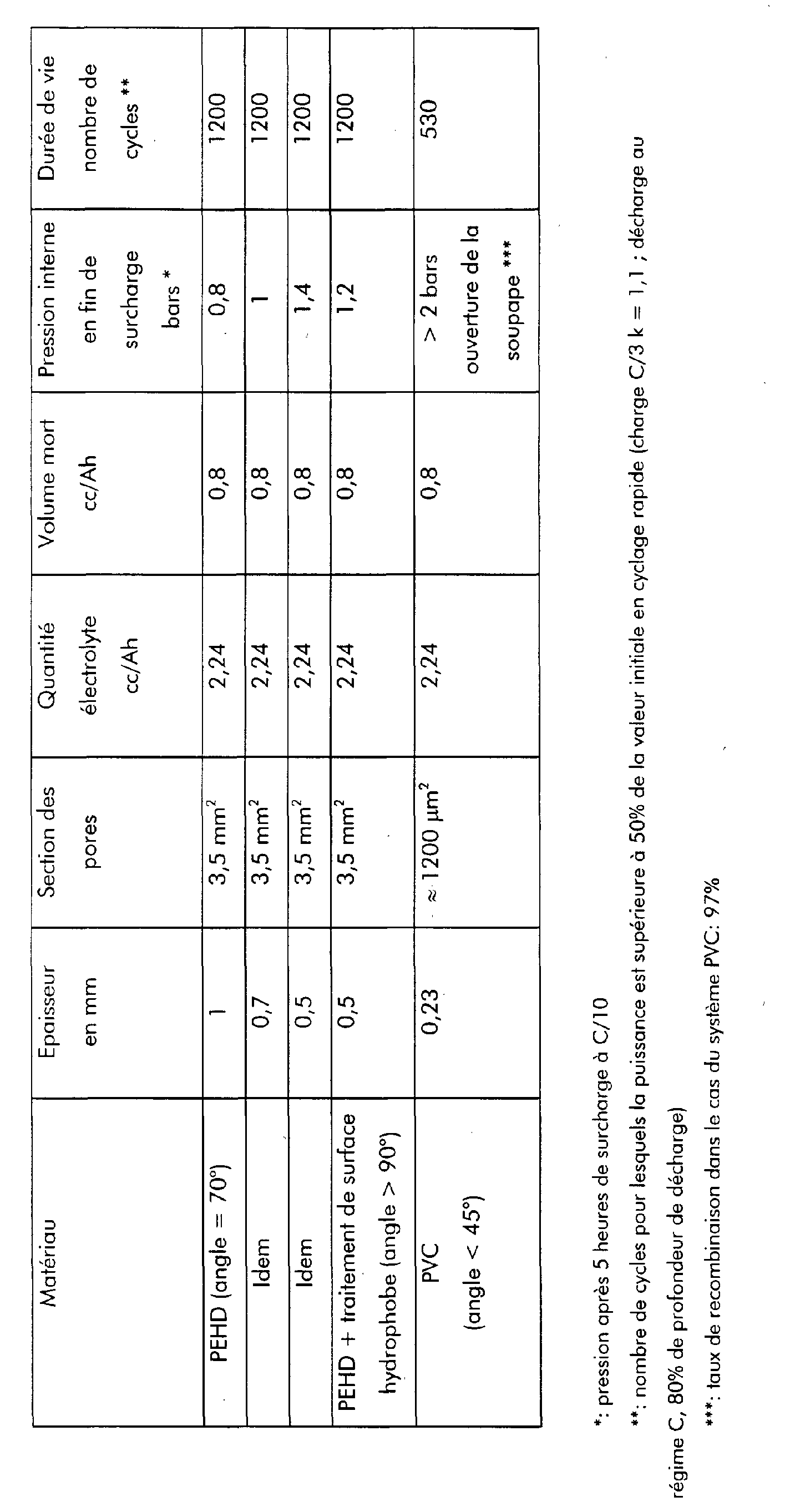
- angle represents the wetting angle, namely the contact angle with the electrolyte.
- Figure 2 shows the end of charge pressure as a function of volume dead, for two BDUs, one 0.2 mm thick, the other 0.8 mm thick.
- the valve is calibrated at 2 bars.
- the EDR is in HDPE as in the table above. We note that the end of charge pressure remains below 2 bar for the EDR 0.2 mm thick up to a dead volume of 1.5 cc / Ah, while the dead volume can be as low as 0.2 cc / Ah with 0.8 mm thick EDR.
- Figure 3 shows the end-of-charge pressure as a function of the quantity of electrolyte, for two EDRs, one 0.2 mm thick and the other 0.8 mm thick.
- the valve is calibrated at 2 bars.
- the EDR is in HDPE as in the table above. Note that the end of charge pressure remains below 2 bar for the EDR 0.2 mm thick up to an amount of 1.8 cc / Ah, while the amount of electrolyte can go up to 2.5 cc / Ah with the 0.8 mm thick EDR.
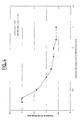
- Figure 4 shows the end of charge pressure as a function of the thickness of the EDR.
- the valve is calibrated at 2 bars.
- the EDR is in HDPE as in the table above. Note that the end of charge pressure remains below 3 bars for an EDR up to a thickness of approximately 0.2 mm and less than 2 bars for a EDR up to a thickness of approximately 0.3 mm.
Landscapes
- Engineering & Computer Science (AREA)
- Manufacturing & Machinery (AREA)
- Chemical & Material Sciences (AREA)
- Chemical Kinetics & Catalysis (AREA)
- Electrochemistry (AREA)
- General Chemical & Material Sciences (AREA)
- Secondary Cells (AREA)
- Cell Separators (AREA)
Abstract
Description
- la figure 1 est une représentation schématique d'un accumulateur selon l'invention ;
- la figure 2 représente la pression de fin de charge en fonction du volume mort ;
- la figure 3 représente la pression de fin de charge en fonction de la quantité d'électrolyte ;
- la figure 4 représente la pression de fin de charge en fonction de l'épaisseur du dispositif de recombinaison.
/-/s/+/s/-/s/+/s/-/s/+/s/-/s/+/s/-/EDR/-/s/+/s/-/s/+/s/-/s/+/s/-/s/+/s/-/
Claims (10)
- Générateur électrochimique secondaire étanche de type Ni-MH, à électrolyte alcalin aqueux, comportant un faisceau d'électrodes placé dans une enceinte (1) et composé d'une pluralité d'électrodes négatives (2) et d'électrodes positives (3), l'espace séparant l'électrode négative de l'électrode positive comportant un séparateur (4), dans lequel un dispositif de recombinaison (5) est placé entre deux électrodes négatives adjacentes, caractérisé en ce que le séparateur (4) est perméable aux gaz et en ce que le dispositif de recombinaison (5) présente un angle de mouillage d'au moins 45°, une section moyenne de pores d'au moins au moins 103 µm2, et une épaisseur comprise entre 0,2 et 5 mm.
- Générateur selon la revendication 1, dans lequel l'angle de mouillage du dispositif de recombinaison est d'au moins 60°.
- Générateur selon l'une des revendications 1 et 2, dans lequel l'épaisseur du dispositif de recombinaison est comprise entre 0,3 et 2 mm.
- Générateur selon l'une des revendications précédentes, dans lequel le dispositif de recombinaison est en polyéthylène ou en polypropylène.
- Générateur selon l'une des revendications précédentes, dans lequel le dispositif de recombinaison est non-conducteur.
- Générateur selon l'une des revendications précédentes, dans lequel le dispositif de recombinaison est traité en surface avec du PTFE.
- Générateur selon l'une des revendications précédentes, présentant une pression de fonctionnement inférieure à 2 bar.
- Générateur selon l'une des revendications précédentes, présentant un volume mort inférieur à 2 cc/Ah.
- Générateur selon l'une des revendications précédentes, présentant une quantité d'électrolyte supérieure à 1,8 cc/Ah.
- Générateur selon l'une des revendications précédentes, présentant une capacité volumique supérieure à 100 Ah.l-1.
Applications Claiming Priority (2)
| Application Number | Priority Date | Filing Date | Title |
|---|---|---|---|
| FR0013214A FR2815474B1 (fr) | 2000-10-16 | 2000-10-16 | Generateur electrochimique etanche a dispositif de recombinaison amiliore |
| FR0013214 | 2000-10-16 |
Publications (1)
| Publication Number | Publication Date |
|---|---|
| EP1199763A1 true EP1199763A1 (fr) | 2002-04-24 |
Family
ID=8855381
Family Applications (1)
| Application Number | Title | Priority Date | Filing Date |
|---|---|---|---|
| EP01402495A Withdrawn EP1199763A1 (fr) | 2000-10-16 | 2001-09-27 | Générateur électrochimique étanche à dispositif de recombination amélioré |
Country Status (3)
| Country | Link |
|---|---|
| US (1) | US6673483B2 (fr) |
| EP (1) | EP1199763A1 (fr) |
| FR (1) | FR2815474B1 (fr) |
Families Citing this family (4)
| Publication number | Priority date | Publication date | Assignee | Title |
|---|---|---|---|---|
| BR112019008041A2 (pt) | 2016-10-21 | 2019-07-02 | Nantenergy Inc | elétrodo de combustível corrugado |
| WO2019133702A1 (fr) | 2017-12-29 | 2019-07-04 | Staq Energy, Inc. | Batteries secondaires alcalines scellées à longue durée de vie |
| MA53343A (fr) | 2018-07-27 | 2022-03-23 | Form Energy Inc | Électrodes négatives pour cellules électrochimiques |
| US12294086B2 (en) | 2019-07-26 | 2025-05-06 | Form Energy, Inc. | Low cost metal electrodes |
Citations (7)
| Publication number | Priority date | Publication date | Assignee | Title |
|---|---|---|---|---|
| JPS60250567A (ja) * | 1984-05-25 | 1985-12-11 | Yuasa Battery Co Ltd | 密閉形ニツケル・亜鉛蓄電池 |
| US5576116A (en) * | 1994-01-27 | 1996-11-19 | Saft | Sealed storage cell operating at low pressure |
| US5658694A (en) * | 1996-09-27 | 1997-08-19 | Energy Research Corporation | Simplified zinc negative electrode with multiple electrode assemblies |
| JPH10125313A (ja) * | 1996-10-22 | 1998-05-15 | Sanyo Electric Co Ltd | アルカリ蓄電池用負極及びその負極を備えたアルカリ蓄電池 |
| US5789097A (en) * | 1993-05-21 | 1998-08-04 | Deutsche Automobilgesellschaft Mbh | Gas-tight maintenance-free cell or battery |
| FR2766973A1 (fr) * | 1997-08-04 | 1999-02-05 | Alsthom Cge Alcatel | Accumulateur ouvert de type industriel sans maintenance |
| DE19929947A1 (de) * | 1999-06-29 | 2001-01-11 | Deutsche Automobilgesellsch | Zelle für die elektrochemische Speicherung von Energie |
Family Cites Families (8)
| Publication number | Priority date | Publication date | Assignee | Title |
|---|---|---|---|---|
| US2842607A (en) * | 1954-03-29 | 1958-07-08 | Accumulatoren Fabrik Ag Fa | Hermetically-sealed storage battery |
| US3023258A (en) * | 1958-03-28 | 1962-02-27 | Accumulatoren Fabrik Ag | Hermetically sealed galvanic smoothing or stabilization cell |
| DE1181292B (de) * | 1958-12-31 | 1964-11-12 | Varta Ag | Anordnung zur Verhinderung von Elektrolyt-austritt an den Fugen zwischen Gehaeuseteilen aus Metall und solchen aus Kunststoff |
| US4115630A (en) * | 1977-03-17 | 1978-09-19 | Communications Satellite Corporation | Metal-hydrogen battery |
| DE4218381C1 (fr) * | 1992-06-04 | 1993-05-13 | Daimler-Benz Aktiengesellschaft, 7000 Stuttgart, De | |
| DE4305560A1 (de) * | 1993-02-24 | 1994-08-25 | Varta Batterie | Gasdicht verschlossener Nickel/Hydrid-Akkumulator |
| US5780184A (en) * | 1995-04-24 | 1998-07-14 | Saft | Negative electrode for an alkaline cell |
| FR2760897B1 (fr) * | 1997-03-13 | 1999-04-16 | Alsthom Cge Alcatel | Accumulateur a electrolyte alcalin de type industriel ouvert sans maintenance |
-
2000
- 2000-10-16 FR FR0013214A patent/FR2815474B1/fr not_active Expired - Fee Related
-
2001
- 2001-09-27 EP EP01402495A patent/EP1199763A1/fr not_active Withdrawn
- 2001-10-12 US US09/974,858 patent/US6673483B2/en not_active Expired - Fee Related
Patent Citations (7)
| Publication number | Priority date | Publication date | Assignee | Title |
|---|---|---|---|---|
| JPS60250567A (ja) * | 1984-05-25 | 1985-12-11 | Yuasa Battery Co Ltd | 密閉形ニツケル・亜鉛蓄電池 |
| US5789097A (en) * | 1993-05-21 | 1998-08-04 | Deutsche Automobilgesellschaft Mbh | Gas-tight maintenance-free cell or battery |
| US5576116A (en) * | 1994-01-27 | 1996-11-19 | Saft | Sealed storage cell operating at low pressure |
| US5658694A (en) * | 1996-09-27 | 1997-08-19 | Energy Research Corporation | Simplified zinc negative electrode with multiple electrode assemblies |
| JPH10125313A (ja) * | 1996-10-22 | 1998-05-15 | Sanyo Electric Co Ltd | アルカリ蓄電池用負極及びその負極を備えたアルカリ蓄電池 |
| FR2766973A1 (fr) * | 1997-08-04 | 1999-02-05 | Alsthom Cge Alcatel | Accumulateur ouvert de type industriel sans maintenance |
| DE19929947A1 (de) * | 1999-06-29 | 2001-01-11 | Deutsche Automobilgesellsch | Zelle für die elektrochemische Speicherung von Energie |
Non-Patent Citations (2)
| Title |
|---|
| PATENT ABSTRACTS OF JAPAN vol. 010, no. 117 (E - 400) 2 May 1986 (1986-05-02) * |
| PATENT ABSTRACTS OF JAPAN vol. 1998, no. 10 31 August 1998 (1998-08-31) * |
Also Published As
| Publication number | Publication date |
|---|---|
| US6673483B2 (en) | 2004-01-06 |
| FR2815474B1 (fr) | 2009-02-13 |
| FR2815474A1 (fr) | 2002-04-19 |
| US20020068216A1 (en) | 2002-06-06 |
Similar Documents
| Publication | Publication Date | Title |
|---|---|---|
| KR102166391B1 (ko) | 고출력 응용을 위한 2차 아연-이산화망간 전지 | |
| JP4920803B2 (ja) | 非水電解質二次電池用負極、およびその製造方法、ならびに非水電解質二次電池 | |
| FR3013899A1 (fr) | Batterie a electrode a air extractible | |
| JP6120093B2 (ja) | 非水電解液二次電池 | |
| WO2013145752A1 (fr) | Électrode pour cellule secondaire à électrolyte non aqueux et cellule secondaire à électrolyte non aqueux l'utilisant | |
| CN114223093A (zh) | 组电池 | |
| CN118696427A (zh) | 二次电池用电极和二次电池 | |
| CN109844999B (zh) | 蓄电元件和蓄电元件的制造方法 | |
| EP0907216B1 (fr) | Accumulateur ouvert de type industriel sans maintenance | |
| EP1199763A1 (fr) | Générateur électrochimique étanche à dispositif de recombination amélioré | |
| JP2013109929A (ja) | 非水系二次電池 | |
| KR102336961B1 (ko) | 공기극 구조와 이를 포함하는 금속-공기 전지 및 이들의 제조방법 | |
| KR20180017794A (ko) | 마그네슘 이차전지용 음극활물질 및 이를 포함하는 마그네슘 이차전지 | |
| EP2856542A1 (fr) | Cathode pour batterie lithium-air, comportant une structure bi-couches de catalyseurs differents et batterie lithium-air comprenant cette cathode | |
| JP2019117785A (ja) | 空気電池用正極及び空気電池 | |
| JP7528106B2 (ja) | 再充電可能エネルギー貯蔵デバイスの電極 | |
| JP7083561B2 (ja) | 電極群及び亜鉛電池 | |
| US20240363890A1 (en) | Lithium-ion rechargeable battery | |
| JP7054479B2 (ja) | 蓄電素子 | |
| US12051812B2 (en) | Rechargeable cell architecture | |
| WO2020166189A1 (fr) | Électrode positive et batterie secondaire | |
| JP3021517B2 (ja) | 有機電解液二次電池 | |
| JP2013122862A (ja) | 円筒型アルカリ蓄電池 | |
| JP2023004578A (ja) | アルカリ二次電池及びアルカリ二次電池の製造方法 | |
| CN118661280A (zh) | 非水电解质二次电池用正极及非水电解质二次电池 |
Legal Events
| Date | Code | Title | Description |
|---|---|---|---|
| PUAI | Public reference made under article 153(3) epc to a published international application that has entered the european phase |
Free format text: ORIGINAL CODE: 0009012 |
|
| AK | Designated contracting states |
Kind code of ref document: A1 Designated state(s): AT BE CH CY DE DK ES FI FR GB GR IE IT LI LU MC NL PT SE TR Kind code of ref document: A1 Designated state(s): DE FR GB |
|
| AX | Request for extension of the european patent |
Free format text: AL;LT;LV;MK;RO;SI |
|
| 17P | Request for examination filed |
Effective date: 20021024 |
|
| AKX | Designation fees paid |
Free format text: DE FR GB |
|
| RAP1 | Party data changed (applicant data changed or rights of an application transferred) |
Owner name: SAFT FINANCE S.AE.R.L. |
|
| 17Q | First examination report despatched |
Effective date: 20071221 |
|
| STAA | Information on the status of an ep patent application or granted ep patent |
Free format text: STATUS: THE APPLICATION IS DEEMED TO BE WITHDRAWN |
|
| 18D | Application deemed to be withdrawn |
Effective date: 20080701 |