EP1198589B9 - Tenascin-c nucleic acid ligands - Google Patents
Tenascin-c nucleic acid ligands Download PDFInfo
- Publication number
- EP1198589B9 EP1198589B9 EP00911657A EP00911657A EP1198589B9 EP 1198589 B9 EP1198589 B9 EP 1198589B9 EP 00911657 A EP00911657 A EP 00911657A EP 00911657 A EP00911657 A EP 00911657A EP 1198589 B9 EP1198589 B9 EP 1198589B9
- Authority
- EP
- European Patent Office
- Prior art keywords
- nucleic acid
- tenascin
- complex
- artificial sequence
- ligand
- Prior art date
- Legal status (The legal status is an assumption and is not a legal conclusion. Google has not performed a legal analysis and makes no representation as to the accuracy of the status listed.)
- Expired - Lifetime
Links
- 150000007523 nucleic acids Chemical class 0.000 title claims abstract description 244
- 108020004707 nucleic acids Proteins 0.000 title claims abstract description 242
- 102000039446 nucleic acids Human genes 0.000 title claims abstract description 242
- 239000003446 ligand Substances 0.000 title claims abstract description 191
- 102000007000 Tenascin Human genes 0.000 claims abstract description 130
- 108010008125 Tenascin Proteins 0.000 claims abstract description 130
- 238000000034 method Methods 0.000 claims abstract description 84
- 201000010099 disease Diseases 0.000 claims abstract description 21
- 208000037265 diseases, disorders, signs and symptoms Diseases 0.000 claims abstract description 21
- 238000002360 preparation method Methods 0.000 claims abstract description 4
- 150000003230 pyrimidines Chemical class 0.000 claims description 74
- 206010028980 Neoplasm Diseases 0.000 claims description 55
- 239000003550 marker Substances 0.000 claims description 20
- 239000003814 drug Substances 0.000 claims description 17
- 150000001875 compounds Chemical class 0.000 claims description 15
- 238000001727 in vivo Methods 0.000 claims description 15
- 229940124597 therapeutic agent Drugs 0.000 claims description 15
- 230000001225 therapeutic effect Effects 0.000 claims description 14
- -1 125I Chemical compound 0.000 claims description 11
- 201000011510 cancer Diseases 0.000 claims description 11
- 239000002738 chelating agent Substances 0.000 claims description 9
- 238000002560 therapeutic procedure Methods 0.000 claims description 7
- YBJHBAHKTGYVGT-ZKWXMUAHSA-N (+)-Biotin Chemical compound N1C(=O)N[C@@H]2[C@H](CCCCC(=O)O)SC[C@@H]21 YBJHBAHKTGYVGT-ZKWXMUAHSA-N 0.000 claims description 6
- 201000004681 Psoriasis Diseases 0.000 claims description 6
- GKLVYJBZJHMRIY-OUBTZVSYSA-N Technetium-99 Chemical compound [99Tc] GKLVYJBZJHMRIY-OUBTZVSYSA-N 0.000 claims description 6
- 229940056501 technetium 99m Drugs 0.000 claims description 6
- BMVXCPBXGZKUPN-UHFFFAOYSA-N 1-hexanamine Chemical compound CCCCCCN BMVXCPBXGZKUPN-UHFFFAOYSA-N 0.000 claims description 5
- 201000001320 Atherosclerosis Diseases 0.000 claims description 4
- 239000000032 diagnostic agent Substances 0.000 claims description 4
- 229940039227 diagnostic agent Drugs 0.000 claims description 4
- 238000004519 manufacturing process Methods 0.000 claims description 4
- 239000008194 pharmaceutical composition Substances 0.000 claims description 4
- 229960002685 biotin Drugs 0.000 claims description 3
- 235000020958 biotin Nutrition 0.000 claims description 3
- 239000011616 biotin Substances 0.000 claims description 3
- 238000002864 sequence alignment Methods 0.000 claims description 3
- 108091032973 (ribonucleotides)n+m Proteins 0.000 description 94
- 108091023037 Aptamer Proteins 0.000 description 52
- 125000000956 methoxy group Chemical group [H]C([H])([H])O* 0.000 description 46
- 239000000203 mixture Substances 0.000 description 46
- 230000027455 binding Effects 0.000 description 35
- 238000009739 binding Methods 0.000 description 35
- 125000003729 nucleotide group Chemical group 0.000 description 35
- 108091034117 Oligonucleotide Proteins 0.000 description 31
- 210000004027 cell Anatomy 0.000 description 30
- 230000004048 modification Effects 0.000 description 30
- 238000012986 modification Methods 0.000 description 30
- 239000002773 nucleotide Substances 0.000 description 25
- 210000001519 tissue Anatomy 0.000 description 22
- JLCPHMBAVCMARE-UHFFFAOYSA-N [3-[[3-[[3-[[3-[[3-[[3-[[3-[[3-[[3-[[3-[[3-[[5-(2-amino-6-oxo-1H-purin-9-yl)-3-[[3-[[3-[[3-[[3-[[3-[[5-(2-amino-6-oxo-1H-purin-9-yl)-3-[[5-(2-amino-6-oxo-1H-purin-9-yl)-3-hydroxyoxolan-2-yl]methoxy-hydroxyphosphoryl]oxyoxolan-2-yl]methoxy-hydroxyphosphoryl]oxy-5-(5-methyl-2,4-dioxopyrimidin-1-yl)oxolan-2-yl]methoxy-hydroxyphosphoryl]oxy-5-(6-aminopurin-9-yl)oxolan-2-yl]methoxy-hydroxyphosphoryl]oxy-5-(6-aminopurin-9-yl)oxolan-2-yl]methoxy-hydroxyphosphoryl]oxy-5-(6-aminopurin-9-yl)oxolan-2-yl]methoxy-hydroxyphosphoryl]oxy-5-(6-aminopurin-9-yl)oxolan-2-yl]methoxy-hydroxyphosphoryl]oxyoxolan-2-yl]methoxy-hydroxyphosphoryl]oxy-5-(5-methyl-2,4-dioxopyrimidin-1-yl)oxolan-2-yl]methoxy-hydroxyphosphoryl]oxy-5-(4-amino-2-oxopyrimidin-1-yl)oxolan-2-yl]methoxy-hydroxyphosphoryl]oxy-5-(5-methyl-2,4-dioxopyrimidin-1-yl)oxolan-2-yl]methoxy-hydroxyphosphoryl]oxy-5-(5-methyl-2,4-dioxopyrimidin-1-yl)oxolan-2-yl]methoxy-hydroxyphosphoryl]oxy-5-(6-aminopurin-9-yl)oxolan-2-yl]methoxy-hydroxyphosphoryl]oxy-5-(6-aminopurin-9-yl)oxolan-2-yl]methoxy-hydroxyphosphoryl]oxy-5-(4-amino-2-oxopyrimidin-1-yl)oxolan-2-yl]methoxy-hydroxyphosphoryl]oxy-5-(4-amino-2-oxopyrimidin-1-yl)oxolan-2-yl]methoxy-hydroxyphosphoryl]oxy-5-(4-amino-2-oxopyrimidin-1-yl)oxolan-2-yl]methoxy-hydroxyphosphoryl]oxy-5-(6-aminopurin-9-yl)oxolan-2-yl]methoxy-hydroxyphosphoryl]oxy-5-(4-amino-2-oxopyrimidin-1-yl)oxolan-2-yl]methyl [5-(6-aminopurin-9-yl)-2-(hydroxymethyl)oxolan-3-yl] hydrogen phosphate Polymers Cc1cn(C2CC(OP(O)(=O)OCC3OC(CC3OP(O)(=O)OCC3OC(CC3O)n3cnc4c3nc(N)[nH]c4=O)n3cnc4c3nc(N)[nH]c4=O)C(COP(O)(=O)OC3CC(OC3COP(O)(=O)OC3CC(OC3COP(O)(=O)OC3CC(OC3COP(O)(=O)OC3CC(OC3COP(O)(=O)OC3CC(OC3COP(O)(=O)OC3CC(OC3COP(O)(=O)OC3CC(OC3COP(O)(=O)OC3CC(OC3COP(O)(=O)OC3CC(OC3COP(O)(=O)OC3CC(OC3COP(O)(=O)OC3CC(OC3COP(O)(=O)OC3CC(OC3COP(O)(=O)OC3CC(OC3COP(O)(=O)OC3CC(OC3COP(O)(=O)OC3CC(OC3COP(O)(=O)OC3CC(OC3COP(O)(=O)OC3CC(OC3CO)n3cnc4c(N)ncnc34)n3ccc(N)nc3=O)n3cnc4c(N)ncnc34)n3ccc(N)nc3=O)n3ccc(N)nc3=O)n3ccc(N)nc3=O)n3cnc4c(N)ncnc34)n3cnc4c(N)ncnc34)n3cc(C)c(=O)[nH]c3=O)n3cc(C)c(=O)[nH]c3=O)n3ccc(N)nc3=O)n3cc(C)c(=O)[nH]c3=O)n3cnc4c3nc(N)[nH]c4=O)n3cnc4c(N)ncnc34)n3cnc4c(N)ncnc34)n3cnc4c(N)ncnc34)n3cnc4c(N)ncnc34)O2)c(=O)[nH]c1=O JLCPHMBAVCMARE-UHFFFAOYSA-N 0.000 description 19
- 230000008569 process Effects 0.000 description 19
- 230000009897 systematic effect Effects 0.000 description 19
- 235000018102 proteins Nutrition 0.000 description 14
- 102000004169 proteins and genes Human genes 0.000 description 14
- 108090000623 proteins and genes Proteins 0.000 description 14
- 238000000638 solvent extraction Methods 0.000 description 14
- 238000002474 experimental method Methods 0.000 description 13
- 150000003212 purines Chemical group 0.000 description 12
- 238000006467 substitution reaction Methods 0.000 description 11
- 208000005017 glioblastoma Diseases 0.000 description 10
- 239000000126 substance Substances 0.000 description 10
- 108020004414 DNA Proteins 0.000 description 9
- 241000699670 Mus sp. Species 0.000 description 9
- 230000003321 amplification Effects 0.000 description 9
- 238000003199 nucleic acid amplification method Methods 0.000 description 9
- 230000001965 increasing effect Effects 0.000 description 8
- 238000002347 injection Methods 0.000 description 8
- 239000007924 injection Substances 0.000 description 8
- 239000000243 solution Substances 0.000 description 8
- KDCGOANMDULRCW-UHFFFAOYSA-N 7H-purine Chemical compound N1=CNC2=NC=NC2=C1 KDCGOANMDULRCW-UHFFFAOYSA-N 0.000 description 7
- 241001465754 Metazoa Species 0.000 description 7
- 230000021615 conjugation Effects 0.000 description 7
- QPCDCPDFJACHGM-UHFFFAOYSA-N N,N-bis{2-[bis(carboxymethyl)amino]ethyl}glycine Chemical compound OC(=O)CN(CC(O)=O)CCN(CC(=O)O)CCN(CC(O)=O)CC(O)=O QPCDCPDFJACHGM-UHFFFAOYSA-N 0.000 description 6
- 150000001412 amines Chemical class 0.000 description 6
- 238000006243 chemical reaction Methods 0.000 description 6
- 238000001514 detection method Methods 0.000 description 6
- LYCAIKOWRPUZTN-UHFFFAOYSA-N ethylene glycol Natural products OCCO LYCAIKOWRPUZTN-UHFFFAOYSA-N 0.000 description 6
- 238000009472 formulation Methods 0.000 description 6
- 125000002887 hydroxy group Chemical group [H]O* 0.000 description 6
- 230000003993 interaction Effects 0.000 description 6
- 238000002372 labelling Methods 0.000 description 6
- 238000003786 synthesis reaction Methods 0.000 description 6
- 101000666340 Homo sapiens Tenascin Proteins 0.000 description 5
- 229910019142 PO4 Chemical group 0.000 description 5
- WDLRUFUQRNWCPK-UHFFFAOYSA-N Tetraxetan Chemical compound OC(=O)CN1CCN(CC(O)=O)CCN(CC(O)=O)CCN(CC(O)=O)CC1 WDLRUFUQRNWCPK-UHFFFAOYSA-N 0.000 description 5
- 210000004369 blood Anatomy 0.000 description 5
- 239000008280 blood Substances 0.000 description 5
- 230000000694 effects Effects 0.000 description 5
- 238000003384 imaging method Methods 0.000 description 5
- 239000010452 phosphate Chemical group 0.000 description 5
- XLXOKMFKGASILN-UHFFFAOYSA-N rhodamine red-X Chemical compound C=12C=CC(=[N+](CC)CC)C=C2OC2=CC(N(CC)CC)=CC=C2C=1C1=CC=C(S(=O)(=O)NCCCCCC(O)=O)C=C1S([O-])(=O)=O XLXOKMFKGASILN-UHFFFAOYSA-N 0.000 description 5
- 238000013518 transcription Methods 0.000 description 5
- 230000035897 transcription Effects 0.000 description 5
- 238000012384 transportation and delivery Methods 0.000 description 5
- OZFAFGSSMRRTDW-UHFFFAOYSA-N (2,4-dichlorophenyl) benzenesulfonate Chemical compound ClC1=CC(Cl)=CC=C1OS(=O)(=O)C1=CC=CC=C1 OZFAFGSSMRRTDW-UHFFFAOYSA-N 0.000 description 4
- 239000012591 Dulbecco’s Phosphate Buffered Saline Substances 0.000 description 4
- KCXVZYZYPLLWCC-UHFFFAOYSA-N EDTA Chemical compound OC(=O)CN(CC(O)=O)CCN(CC(O)=O)CC(O)=O KCXVZYZYPLLWCC-UHFFFAOYSA-N 0.000 description 4
- WSFSSNUMVMOOMR-UHFFFAOYSA-N Formaldehyde Chemical compound O=C WSFSSNUMVMOOMR-UHFFFAOYSA-N 0.000 description 4
- 230000015572 biosynthetic process Effects 0.000 description 4
- 239000000872 buffer Substances 0.000 description 4
- RYYVLZVUVIJVGH-UHFFFAOYSA-N caffeine Chemical compound CN1C(=O)N(C)C(=O)C2=C1N=CN2C RYYVLZVUVIJVGH-UHFFFAOYSA-N 0.000 description 4
- 102000057345 human TNC Human genes 0.000 description 4
- 239000000463 material Substances 0.000 description 4
- 238000011580 nude mouse model Methods 0.000 description 4
- NBIIXXVUZAFLBC-UHFFFAOYSA-K phosphate Chemical group [O-]P([O-])([O-])=O NBIIXXVUZAFLBC-UHFFFAOYSA-K 0.000 description 4
- 238000003752 polymerase chain reaction Methods 0.000 description 4
- 125000006850 spacer group Chemical group 0.000 description 4
- 238000010561 standard procedure Methods 0.000 description 4
- ZFXYFBGIUFBOJW-UHFFFAOYSA-N theophylline Chemical compound O=C1N(C)C(=O)N(C)C2=C1NC=N2 ZFXYFBGIUFBOJW-UHFFFAOYSA-N 0.000 description 4
- 238000011282 treatment Methods 0.000 description 4
- UXVMQQNJUSDDNG-UHFFFAOYSA-L Calcium chloride Chemical compound [Cl-].[Cl-].[Ca+2] UXVMQQNJUSDDNG-UHFFFAOYSA-L 0.000 description 3
- 241000699660 Mus musculus Species 0.000 description 3
- ZMXDDKWLCZADIW-UHFFFAOYSA-N N,N-Dimethylformamide Chemical compound CN(C)C=O ZMXDDKWLCZADIW-UHFFFAOYSA-N 0.000 description 3
- CZPWVGJYEJSRLH-UHFFFAOYSA-N Pyrimidine Chemical compound C1=CN=CN=C1 CZPWVGJYEJSRLH-UHFFFAOYSA-N 0.000 description 3
- FAPWRFPIFSIZLT-UHFFFAOYSA-M Sodium chloride Chemical compound [Na+].[Cl-] FAPWRFPIFSIZLT-UHFFFAOYSA-M 0.000 description 3
- 230000009471 action Effects 0.000 description 3
- 125000003277 amino group Chemical group 0.000 description 3
- 239000012148 binding buffer Substances 0.000 description 3
- 230000036765 blood level Effects 0.000 description 3
- 239000001110 calcium chloride Substances 0.000 description 3
- 229910001628 calcium chloride Inorganic materials 0.000 description 3
- 239000003795 chemical substances by application Substances 0.000 description 3
- 238000003745 diagnosis Methods 0.000 description 3
- 238000010828 elution Methods 0.000 description 3
- 229910052739 hydrogen Inorganic materials 0.000 description 3
- 239000001257 hydrogen Substances 0.000 description 3
- 230000002163 immunogen Effects 0.000 description 3
- 150000002634 lipophilic molecules Chemical class 0.000 description 3
- 239000000178 monomer Substances 0.000 description 3
- 239000000546 pharmaceutical excipient Substances 0.000 description 3
- 239000002953 phosphate buffered saline Substances 0.000 description 3
- 239000013615 primer Substances 0.000 description 3
- 238000011321 prophylaxis Methods 0.000 description 3
- 239000002213 purine nucleotide Substances 0.000 description 3
- 239000002719 pyrimidine nucleotide Substances 0.000 description 3
- 230000009870 specific binding Effects 0.000 description 3
- RGNOTKMIMZMNRX-XVFCMESISA-N 2-amino-1-[(2r,3r,4s,5r)-3,4-dihydroxy-5-(hydroxymethyl)oxolan-2-yl]pyrimidin-4-one Chemical compound NC1=NC(=O)C=CN1[C@H]1[C@H](O)[C@H](O)[C@@H](CO)O1 RGNOTKMIMZMNRX-XVFCMESISA-N 0.000 description 2
- ZLOIGESWDJYCTF-UHFFFAOYSA-N 4-Thiouridine Natural products OC1C(O)C(CO)OC1N1C(=O)NC(=S)C=C1 ZLOIGESWDJYCTF-UHFFFAOYSA-N 0.000 description 2
- ZLOIGESWDJYCTF-XVFCMESISA-N 4-thiouridine Chemical class O[C@@H]1[C@H](O)[C@@H](CO)O[C@H]1N1C(=O)NC(=S)C=C1 ZLOIGESWDJYCTF-XVFCMESISA-N 0.000 description 2
- LQLQRFGHAALLLE-UHFFFAOYSA-N 5-bromouracil Chemical class BrC1=CNC(=O)NC1=O LQLQRFGHAALLLE-UHFFFAOYSA-N 0.000 description 2
- KSNXJLQDQOIRIP-UHFFFAOYSA-N 5-iodouracil Chemical class IC1=CNC(=O)NC1=O KSNXJLQDQOIRIP-UHFFFAOYSA-N 0.000 description 2
- 206010002091 Anaesthesia Diseases 0.000 description 2
- 108091003079 Bovine Serum Albumin Proteins 0.000 description 2
- 201000009030 Carcinoma Diseases 0.000 description 2
- 108091035707 Consensus sequence Proteins 0.000 description 2
- HMFHBZSHGGEWLO-SOOFDHNKSA-N D-ribofuranose Chemical group OC[C@H]1OC(O)[C@H](O)[C@@H]1O HMFHBZSHGGEWLO-SOOFDHNKSA-N 0.000 description 2
- 102000053602 DNA Human genes 0.000 description 2
- 108060002716 Exonuclease Proteins 0.000 description 2
- 108090000288 Glycoproteins Proteins 0.000 description 2
- 102000003886 Glycoproteins Human genes 0.000 description 2
- 108700020121 Human Immunodeficiency Virus-1 rev Proteins 0.000 description 2
- LPHGQDQBBGAPDZ-UHFFFAOYSA-N Isocaffeine Natural products CN1C(=O)N(C)C(=O)C2=C1N(C)C=N2 LPHGQDQBBGAPDZ-UHFFFAOYSA-N 0.000 description 2
- PIWKPBJCKXDKJR-UHFFFAOYSA-N Isoflurane Chemical compound FC(F)OC(Cl)C(F)(F)F PIWKPBJCKXDKJR-UHFFFAOYSA-N 0.000 description 2
- TWRXJAOTZQYOKJ-UHFFFAOYSA-L Magnesium chloride Chemical compound [Mg+2].[Cl-].[Cl-] TWRXJAOTZQYOKJ-UHFFFAOYSA-L 0.000 description 2
- 241000699666 Mus <mouse, genus> Species 0.000 description 2
- 239000000020 Nitrocellulose Substances 0.000 description 2
- PYMYPHUHKUWMLA-LMVFSUKVSA-N Ribose Natural products OC[C@@H](O)[C@@H](O)[C@@H](O)C=O PYMYPHUHKUWMLA-LMVFSUKVSA-N 0.000 description 2
- 206010039491 Sarcoma Diseases 0.000 description 2
- 241000700605 Viruses Species 0.000 description 2
- HMFHBZSHGGEWLO-UHFFFAOYSA-N alpha-D-Furanose-Ribose Natural products OCC1OC(O)C(O)C1O HMFHBZSHGGEWLO-UHFFFAOYSA-N 0.000 description 2
- 230000037005 anaesthesia Effects 0.000 description 2
- 238000004458 analytical method Methods 0.000 description 2
- 210000000481 breast Anatomy 0.000 description 2
- 229960001948 caffeine Drugs 0.000 description 2
- VJEONQKOZGKCAK-UHFFFAOYSA-N caffeine Natural products CN1C(=O)N(C)C(=O)C2=C1C=CN2C VJEONQKOZGKCAK-UHFFFAOYSA-N 0.000 description 2
- 150000001720 carbohydrates Chemical class 0.000 description 2
- 235000014633 carbohydrates Nutrition 0.000 description 2
- 125000003636 chemical group Chemical group 0.000 description 2
- 238000007385 chemical modification Methods 0.000 description 2
- 238000010367 cloning Methods 0.000 description 2
- 210000001072 colon Anatomy 0.000 description 2
- 230000001268 conjugating effect Effects 0.000 description 2
- 230000001351 cycling effect Effects 0.000 description 2
- 230000007423 decrease Effects 0.000 description 2
- 238000012217 deletion Methods 0.000 description 2
- 230000037430 deletion Effects 0.000 description 2
- 238000002059 diagnostic imaging Methods 0.000 description 2
- 238000000502 dialysis Methods 0.000 description 2
- 238000006073 displacement reaction Methods 0.000 description 2
- 238000010494 dissociation reaction Methods 0.000 description 2
- 230000005593 dissociations Effects 0.000 description 2
- 238000004090 dissolution Methods 0.000 description 2
- 230000009881 electrostatic interaction Effects 0.000 description 2
- 238000005516 engineering process Methods 0.000 description 2
- 102000013165 exonuclease Human genes 0.000 description 2
- 230000002349 favourable effect Effects 0.000 description 2
- 239000012894 fetal calf serum Substances 0.000 description 2
- 239000012634 fragment Substances 0.000 description 2
- 238000001502 gel electrophoresis Methods 0.000 description 2
- 239000003112 inhibitor Substances 0.000 description 2
- 210000000936 intestine Anatomy 0.000 description 2
- 238000001990 intravenous administration Methods 0.000 description 2
- 229960002725 isoflurane Drugs 0.000 description 2
- 210000003734 kidney Anatomy 0.000 description 2
- 150000002605 large molecules Chemical class 0.000 description 2
- 230000003902 lesion Effects 0.000 description 2
- 238000005567 liquid scintillation counting Methods 0.000 description 2
- 210000004185 liver Anatomy 0.000 description 2
- 210000004072 lung Anatomy 0.000 description 2
- 239000012528 membrane Substances 0.000 description 2
- 230000011987 methylation Effects 0.000 description 2
- 238000007069 methylation reaction Methods 0.000 description 2
- 229920001220 nitrocellulos Polymers 0.000 description 2
- 230000000269 nucleophilic effect Effects 0.000 description 2
- 125000003835 nucleoside group Chemical group 0.000 description 2
- 125000002467 phosphate group Chemical group [H]OP(=O)(O[H])O[*] 0.000 description 2
- 239000000047 product Substances 0.000 description 2
- 210000002307 prostate Anatomy 0.000 description 2
- 230000010076 replication Effects 0.000 description 2
- 238000004007 reversed phase HPLC Methods 0.000 description 2
- 238000012163 sequencing technique Methods 0.000 description 2
- 239000007787 solid Substances 0.000 description 2
- 238000007920 subcutaneous administration Methods 0.000 description 2
- 229960000278 theophylline Drugs 0.000 description 2
- 230000007838 tissue remodeling Effects 0.000 description 2
- 238000005406 washing Methods 0.000 description 2
- 102000040650 (ribonucleotides)n+m Human genes 0.000 description 1
- JKMHFZQWWAIEOD-UHFFFAOYSA-N 2-[4-(2-hydroxyethyl)piperazin-1-yl]ethanesulfonic acid Chemical compound OCC[NH+]1CCN(CCS([O-])(=O)=O)CC1 JKMHFZQWWAIEOD-UHFFFAOYSA-N 0.000 description 1
- HWRFTOWHSBECMR-UHFFFAOYSA-N 6-n-[(4-aminophenyl)methyl]-2-n-[[3-(trifluoromethyl)phenyl]methyl]-7h-purine-2,6-diamine Chemical compound C1=CC(N)=CC=C1CNC1=NC(NCC=2C=C(C=CC=2)C(F)(F)F)=NC2=C1NC=N2 HWRFTOWHSBECMR-UHFFFAOYSA-N 0.000 description 1
- 102000006306 Antigen Receptors Human genes 0.000 description 1
- 108010083359 Antigen Receptors Proteins 0.000 description 1
- 206010003571 Astrocytoma Diseases 0.000 description 1
- 0 C1CC*CC1 Chemical compound C1CC*CC1 0.000 description 1
- 206010010144 Completed suicide Diseases 0.000 description 1
- 229920001076 Cutan Polymers 0.000 description 1
- 102000004594 DNA Polymerase I Human genes 0.000 description 1
- 108010017826 DNA Polymerase I Proteins 0.000 description 1
- 108020001019 DNA Primers Proteins 0.000 description 1
- 239000003155 DNA primer Substances 0.000 description 1
- 239000006144 Dulbecco’s modified Eagle's medium Substances 0.000 description 1
- 102100031780 Endonuclease Human genes 0.000 description 1
- 108010042407 Endonucleases Proteins 0.000 description 1
- 102000004533 Endonucleases Human genes 0.000 description 1
- 102000004190 Enzymes Human genes 0.000 description 1
- 108090000790 Enzymes Proteins 0.000 description 1
- 102000010834 Extracellular Matrix Proteins Human genes 0.000 description 1
- 108010037362 Extracellular Matrix Proteins Proteins 0.000 description 1
- 241001123946 Gaga Species 0.000 description 1
- HTTJABKRGRZYRN-UHFFFAOYSA-N Heparin Chemical compound OC1C(NC(=O)C)C(O)OC(COS(O)(=O)=O)C1OC1C(OS(O)(=O)=O)C(O)C(OC2C(C(OS(O)(=O)=O)C(OC3C(C(O)C(O)C(O3)C(O)=O)OS(O)(=O)=O)C(CO)O2)NS(O)(=O)=O)C(C(O)=O)O1 HTTJABKRGRZYRN-UHFFFAOYSA-N 0.000 description 1
- 241000282412 Homo Species 0.000 description 1
- 101000801260 Homo sapiens Troponin C, slow skeletal and cardiac muscles Proteins 0.000 description 1
- 108091006905 Human Serum Albumin Proteins 0.000 description 1
- 102000008100 Human Serum Albumin Human genes 0.000 description 1
- 208000008636 Neoplastic Processes Diseases 0.000 description 1
- 101710163270 Nuclease Proteins 0.000 description 1
- 229920001213 Polysorbate 20 Polymers 0.000 description 1
- 239000004793 Polystyrene Substances 0.000 description 1
- 108010092799 RNA-directed DNA polymerase Proteins 0.000 description 1
- 102000006382 Ribonucleases Human genes 0.000 description 1
- 108010083644 Ribonucleases Proteins 0.000 description 1
- VMHLLURERBWHNL-UHFFFAOYSA-M Sodium acetate Chemical compound [Na+].CC([O-])=O VMHLLURERBWHNL-UHFFFAOYSA-M 0.000 description 1
- 101710137500 T7 RNA polymerase Proteins 0.000 description 1
- 229910021626 Tin(II) chloride Inorganic materials 0.000 description 1
- 230000003187 abdominal effect Effects 0.000 description 1
- 238000010521 absorption reaction Methods 0.000 description 1
- 230000002411 adverse Effects 0.000 description 1
- 229940045686 antimetabolites antineoplastic purine analogs Drugs 0.000 description 1
- 229940045688 antineoplastic antimetabolites pyrimidine analogues Drugs 0.000 description 1
- 230000003143 atherosclerotic effect Effects 0.000 description 1
- 230000000975 bioactive effect Effects 0.000 description 1
- 210000001124 body fluid Anatomy 0.000 description 1
- 239000010839 body fluid Substances 0.000 description 1
- 238000012754 cardiac puncture Methods 0.000 description 1
- 239000005018 casein Substances 0.000 description 1
- BECPQYXYKAMYBN-UHFFFAOYSA-N casein, tech. Chemical compound NCCCCC(C(O)=O)N=C(O)C(CC(O)=O)N=C(O)C(CCC(O)=N)N=C(O)C(CC(C)C)N=C(O)C(CCC(O)=O)N=C(O)C(CC(O)=O)N=C(O)C(CCC(O)=O)N=C(O)C(C(C)O)N=C(O)C(CCC(O)=N)N=C(O)C(CCC(O)=N)N=C(O)C(CCC(O)=N)N=C(O)C(CCC(O)=O)N=C(O)C(CCC(O)=O)N=C(O)C(COP(O)(O)=O)N=C(O)C(CCC(O)=N)N=C(O)C(N)CC1=CC=CC=C1 BECPQYXYKAMYBN-UHFFFAOYSA-N 0.000 description 1
- 235000021240 caseins Nutrition 0.000 description 1
- 238000004113 cell culture Methods 0.000 description 1
- 239000007795 chemical reaction product Substances 0.000 description 1
- 238000005352 clarification Methods 0.000 description 1
- 238000003776 cleavage reaction Methods 0.000 description 1
- 239000011248 coating agent Substances 0.000 description 1
- 238000000576 coating method Methods 0.000 description 1
- 238000004590 computer program Methods 0.000 description 1
- 231100000433 cytotoxic Toxicity 0.000 description 1
- 229940127089 cytotoxic agent Drugs 0.000 description 1
- 239000002254 cytotoxic agent Substances 0.000 description 1
- 231100000599 cytotoxic agent Toxicity 0.000 description 1
- 230000001472 cytotoxic effect Effects 0.000 description 1
- 238000002405 diagnostic procedure Methods 0.000 description 1
- LOKCTEFSRHRXRJ-UHFFFAOYSA-I dipotassium trisodium dihydrogen phosphate hydrogen phosphate dichloride Chemical compound P(=O)(O)(O)[O-].[K+].P(=O)(O)([O-])[O-].[Na+].[Na+].[Cl-].[K+].[Cl-].[Na+] LOKCTEFSRHRXRJ-UHFFFAOYSA-I 0.000 description 1
- 238000009826 distribution Methods 0.000 description 1
- 229940079593 drug Drugs 0.000 description 1
- 239000003937 drug carrier Substances 0.000 description 1
- 239000000975 dye Substances 0.000 description 1
- 230000013020 embryo development Effects 0.000 description 1
- 239000000839 emulsion Substances 0.000 description 1
- 230000002708 enhancing effect Effects 0.000 description 1
- 210000002744 extracellular matrix Anatomy 0.000 description 1
- GNBHRKFJIUUOQI-UHFFFAOYSA-N fluorescein Chemical compound O1C(=O)C2=CC=CC=C2C21C1=CC=C(O)C=C1OC1=CC(O)=CC=C21 GNBHRKFJIUUOQI-UHFFFAOYSA-N 0.000 description 1
- 238000000799 fluorescence microscopy Methods 0.000 description 1
- 230000006870 function Effects 0.000 description 1
- 230000005714 functional activity Effects 0.000 description 1
- 210000001035 gastrointestinal tract Anatomy 0.000 description 1
- 239000000499 gel Substances 0.000 description 1
- 150000004676 glycans Chemical class 0.000 description 1
- PCHJSUWPFVWCPO-UHFFFAOYSA-N gold Chemical compound [Au] PCHJSUWPFVWCPO-UHFFFAOYSA-N 0.000 description 1
- 239000010931 gold Substances 0.000 description 1
- 229910052737 gold Inorganic materials 0.000 description 1
- 239000003102 growth factor Substances 0.000 description 1
- 230000036541 health Effects 0.000 description 1
- 229920000669 heparin Polymers 0.000 description 1
- 229960002897 heparin Drugs 0.000 description 1
- 239000005556 hormone Substances 0.000 description 1
- 229940088597 hormone Drugs 0.000 description 1
- 230000003463 hyperproliferative effect Effects 0.000 description 1
- 238000000338 in vitro Methods 0.000 description 1
- 238000010348 incorporation Methods 0.000 description 1
- 238000011534 incubation Methods 0.000 description 1
- 230000036512 infertility Effects 0.000 description 1
- 238000001802 infusion Methods 0.000 description 1
- 238000001361 intraarterial administration Methods 0.000 description 1
- 230000003834 intracellular effect Effects 0.000 description 1
- 238000007918 intramuscular administration Methods 0.000 description 1
- 238000010253 intravenous injection Methods 0.000 description 1
- 238000002955 isolation Methods 0.000 description 1
- 210000002429 large intestine Anatomy 0.000 description 1
- 230000000670 limiting effect Effects 0.000 description 1
- 239000002502 liposome Substances 0.000 description 1
- 239000008176 lyophilized powder Substances 0.000 description 1
- 229910001629 magnesium chloride Inorganic materials 0.000 description 1
- 230000007246 mechanism Effects 0.000 description 1
- 239000002609 medium Substances 0.000 description 1
- 201000001441 melanoma Diseases 0.000 description 1
- 239000002207 metabolite Substances 0.000 description 1
- 206010061289 metastatic neoplasm Diseases 0.000 description 1
- 230000003278 mimic effect Effects 0.000 description 1
- 238000010369 molecular cloning Methods 0.000 description 1
- 239000003068 molecular probe Substances 0.000 description 1
- 238000012544 monitoring process Methods 0.000 description 1
- 125000000896 monocarboxylic acid group Chemical group 0.000 description 1
- 210000003205 muscle Anatomy 0.000 description 1
- 230000009826 neoplastic cell growth Effects 0.000 description 1
- 230000007935 neutral effect Effects 0.000 description 1
- 235000015097 nutrients Nutrition 0.000 description 1
- 238000002515 oligonucleotide synthesis Methods 0.000 description 1
- 210000000056 organ Anatomy 0.000 description 1
- 230000001575 pathological effect Effects 0.000 description 1
- FPVKHBSQESCIEP-JQCXWYLXSA-N pentostatin Chemical compound C1[C@H](O)[C@@H](CO)O[C@H]1N1C(N=CNC[C@H]2O)=C2N=C1 FPVKHBSQESCIEP-JQCXWYLXSA-N 0.000 description 1
- 229960002340 pentostatin Drugs 0.000 description 1
- 150000004713 phosphodiesters Chemical group 0.000 description 1
- 230000035790 physiological processes and functions Effects 0.000 description 1
- 239000002504 physiological saline solution Substances 0.000 description 1
- 239000013612 plasmid Substances 0.000 description 1
- 229920002401 polyacrylamide Polymers 0.000 description 1
- 108091033319 polynucleotide Proteins 0.000 description 1
- 102000040430 polynucleotide Human genes 0.000 description 1
- 239000002157 polynucleotide Substances 0.000 description 1
- 239000000256 polyoxyethylene sorbitan monolaurate Substances 0.000 description 1
- 235000010486 polyoxyethylene sorbitan monolaurate Nutrition 0.000 description 1
- 229920001282 polysaccharide Polymers 0.000 description 1
- 239000005017 polysaccharide Substances 0.000 description 1
- 229920002223 polystyrene Polymers 0.000 description 1
- 150000003141 primary amines Chemical class 0.000 description 1
- 108090000765 processed proteins & peptides Proteins 0.000 description 1
- 229940002612 prodrug Drugs 0.000 description 1
- 239000000651 prodrug Substances 0.000 description 1
- 238000004393 prognosis Methods 0.000 description 1
- 238000000159 protein binding assay Methods 0.000 description 1
- 238000000746 purification Methods 0.000 description 1
- 125000000561 purinyl group Chemical group N1=C(N=C2N=CNC2=C1)* 0.000 description 1
- 125000000714 pyrimidinyl group Chemical group 0.000 description 1
- 238000000163 radioactive labelling Methods 0.000 description 1
- 230000003439 radiotherapeutic effect Effects 0.000 description 1
- 238000001959 radiotherapy Methods 0.000 description 1
- 239000011541 reaction mixture Substances 0.000 description 1
- 239000006215 rectal suppository Substances 0.000 description 1
- 229940100618 rectal suppository Drugs 0.000 description 1
- 210000000664 rectum Anatomy 0.000 description 1
- 230000002829 reductive effect Effects 0.000 description 1
- 238000011160 research Methods 0.000 description 1
- 108091008146 restriction endonucleases Proteins 0.000 description 1
- 230000000717 retained effect Effects 0.000 description 1
- 238000010839 reverse transcription Methods 0.000 description 1
- 238000003757 reverse transcription PCR Methods 0.000 description 1
- 230000002441 reversible effect Effects 0.000 description 1
- 238000012552 review Methods 0.000 description 1
- 201000009410 rhabdomyosarcoma Diseases 0.000 description 1
- PYWVYCXTNDRMGF-UHFFFAOYSA-N rhodamine B Chemical compound [Cl-].C=12C=CC(=[N+](CC)CC)C=C2OC2=CC(N(CC)CC)=CC=C2C=1C1=CC=CC=C1C(O)=O PYWVYCXTNDRMGF-UHFFFAOYSA-N 0.000 description 1
- 230000007017 scission Effects 0.000 description 1
- 238000000926 separation method Methods 0.000 description 1
- 238000004904 shortening Methods 0.000 description 1
- 208000017520 skin disease Diseases 0.000 description 1
- 210000000813 small intestine Anatomy 0.000 description 1
- 150000003384 small molecules Chemical class 0.000 description 1
- 239000011780 sodium chloride Substances 0.000 description 1
- 239000012064 sodium phosphate buffer Substances 0.000 description 1
- 239000002904 solvent Substances 0.000 description 1
- 210000000952 spleen Anatomy 0.000 description 1
- 238000012453 sprague-dawley rat model Methods 0.000 description 1
- 238000010186 staining Methods 0.000 description 1
- 239000000758 substrate Substances 0.000 description 1
- 239000000829 suppository Substances 0.000 description 1
- 239000000725 suspension Substances 0.000 description 1
- 238000012385 systemic delivery Methods 0.000 description 1
- 230000008685 targeting Effects 0.000 description 1
- 238000012360 testing method Methods 0.000 description 1
- MPLHNVLQVRSVEE-UHFFFAOYSA-N texas red Chemical compound [O-]S(=O)(=O)C1=CC(S(Cl)(=O)=O)=CC=C1C(C1=CC=2CCCN3CCCC(C=23)=C1O1)=C2C1=C(CCC1)C3=[N+]1CCCC3=C2 MPLHNVLQVRSVEE-UHFFFAOYSA-N 0.000 description 1
- RYYWUUFWQRZTIU-UHFFFAOYSA-K thiophosphate Chemical compound [O-]P([O-])([O-])=S RYYWUUFWQRZTIU-UHFFFAOYSA-K 0.000 description 1
- AXZWODMDQAVCJE-UHFFFAOYSA-L tin(II) chloride (anhydrous) Chemical compound [Cl-].[Cl-].[Sn+2] AXZWODMDQAVCJE-UHFFFAOYSA-L 0.000 description 1
- 230000001988 toxicity Effects 0.000 description 1
- 231100000419 toxicity Toxicity 0.000 description 1
- 230000007704 transition Effects 0.000 description 1
- 210000004881 tumor cell Anatomy 0.000 description 1
- 230000004614 tumor growth Effects 0.000 description 1
- 239000006216 vaginal suppository Substances 0.000 description 1
- 229940120293 vaginal suppository Drugs 0.000 description 1
- 230000000007 visual effect Effects 0.000 description 1
- 239000011534 wash buffer Substances 0.000 description 1
- 230000029663 wound healing Effects 0.000 description 1
Images



Classifications
-
- C—CHEMISTRY; METALLURGY
- C12—BIOCHEMISTRY; BEER; SPIRITS; WINE; VINEGAR; MICROBIOLOGY; ENZYMOLOGY; MUTATION OR GENETIC ENGINEERING
- C12N—MICROORGANISMS OR ENZYMES; COMPOSITIONS THEREOF; PROPAGATING, PRESERVING, OR MAINTAINING MICROORGANISMS; MUTATION OR GENETIC ENGINEERING; CULTURE MEDIA
- C12N15/00—Mutation or genetic engineering; DNA or RNA concerning genetic engineering, vectors, e.g. plasmids, or their isolation, preparation or purification; Use of hosts therefor
- C12N15/09—Recombinant DNA-technology
- C12N15/11—DNA or RNA fragments; Modified forms thereof; Non-coding nucleic acids having a biological activity
- C12N15/115—Aptamers, i.e. nucleic acids binding a target molecule specifically and with high affinity without hybridising therewith ; Nucleic acids binding to non-nucleic acids, e.g. aptamers
-
- A—HUMAN NECESSITIES
- A61—MEDICAL OR VETERINARY SCIENCE; HYGIENE
- A61K—PREPARATIONS FOR MEDICAL, DENTAL OR TOILETRY PURPOSES
- A61K47/00—Medicinal preparations characterised by the non-active ingredients used, e.g. carriers or inert additives; Targeting or modifying agents chemically bound to the active ingredient
- A61K47/50—Medicinal preparations characterised by the non-active ingredients used, e.g. carriers or inert additives; Targeting or modifying agents chemically bound to the active ingredient the non-active ingredient being chemically bound to the active ingredient, e.g. polymer-drug conjugates
- A61K47/51—Medicinal preparations characterised by the non-active ingredients used, e.g. carriers or inert additives; Targeting or modifying agents chemically bound to the active ingredient the non-active ingredient being chemically bound to the active ingredient, e.g. polymer-drug conjugates the non-active ingredient being a modifying agent
- A61K47/54—Medicinal preparations characterised by the non-active ingredients used, e.g. carriers or inert additives; Targeting or modifying agents chemically bound to the active ingredient the non-active ingredient being chemically bound to the active ingredient, e.g. polymer-drug conjugates the non-active ingredient being a modifying agent the modifying agent being an organic compound
-
- A—HUMAN NECESSITIES
- A61—MEDICAL OR VETERINARY SCIENCE; HYGIENE
- A61K—PREPARATIONS FOR MEDICAL, DENTAL OR TOILETRY PURPOSES
- A61K47/00—Medicinal preparations characterised by the non-active ingredients used, e.g. carriers or inert additives; Targeting or modifying agents chemically bound to the active ingredient
- A61K47/50—Medicinal preparations characterised by the non-active ingredients used, e.g. carriers or inert additives; Targeting or modifying agents chemically bound to the active ingredient the non-active ingredient being chemically bound to the active ingredient, e.g. polymer-drug conjugates
- A61K47/51—Medicinal preparations characterised by the non-active ingredients used, e.g. carriers or inert additives; Targeting or modifying agents chemically bound to the active ingredient the non-active ingredient being chemically bound to the active ingredient, e.g. polymer-drug conjugates the non-active ingredient being a modifying agent
- A61K47/54—Medicinal preparations characterised by the non-active ingredients used, e.g. carriers or inert additives; Targeting or modifying agents chemically bound to the active ingredient the non-active ingredient being chemically bound to the active ingredient, e.g. polymer-drug conjugates the non-active ingredient being a modifying agent the modifying agent being an organic compound
- A61K47/547—Chelates, e.g. Gd-DOTA or Zinc-amino acid chelates; Chelate-forming compounds, e.g. DOTA or ethylenediamine being covalently linked or complexed to the pharmacologically- or therapeutically-active agent
-
- A—HUMAN NECESSITIES
- A61—MEDICAL OR VETERINARY SCIENCE; HYGIENE
- A61K—PREPARATIONS FOR MEDICAL, DENTAL OR TOILETRY PURPOSES
- A61K47/00—Medicinal preparations characterised by the non-active ingredients used, e.g. carriers or inert additives; Targeting or modifying agents chemically bound to the active ingredient
- A61K47/50—Medicinal preparations characterised by the non-active ingredients used, e.g. carriers or inert additives; Targeting or modifying agents chemically bound to the active ingredient the non-active ingredient being chemically bound to the active ingredient, e.g. polymer-drug conjugates
- A61K47/51—Medicinal preparations characterised by the non-active ingredients used, e.g. carriers or inert additives; Targeting or modifying agents chemically bound to the active ingredient the non-active ingredient being chemically bound to the active ingredient, e.g. polymer-drug conjugates the non-active ingredient being a modifying agent
- A61K47/54—Medicinal preparations characterised by the non-active ingredients used, e.g. carriers or inert additives; Targeting or modifying agents chemically bound to the active ingredient the non-active ingredient being chemically bound to the active ingredient, e.g. polymer-drug conjugates the non-active ingredient being a modifying agent the modifying agent being an organic compound
- A61K47/549—Sugars, nucleosides, nucleotides or nucleic acids
-
- A—HUMAN NECESSITIES
- A61—MEDICAL OR VETERINARY SCIENCE; HYGIENE
- A61P—SPECIFIC THERAPEUTIC ACTIVITY OF CHEMICAL COMPOUNDS OR MEDICINAL PREPARATIONS
- A61P17/00—Drugs for dermatological disorders
-
- A—HUMAN NECESSITIES
- A61—MEDICAL OR VETERINARY SCIENCE; HYGIENE
- A61P—SPECIFIC THERAPEUTIC ACTIVITY OF CHEMICAL COMPOUNDS OR MEDICINAL PREPARATIONS
- A61P17/00—Drugs for dermatological disorders
- A61P17/06—Antipsoriatics
-
- A—HUMAN NECESSITIES
- A61—MEDICAL OR VETERINARY SCIENCE; HYGIENE
- A61P—SPECIFIC THERAPEUTIC ACTIVITY OF CHEMICAL COMPOUNDS OR MEDICINAL PREPARATIONS
- A61P35/00—Antineoplastic agents
-
- A—HUMAN NECESSITIES
- A61—MEDICAL OR VETERINARY SCIENCE; HYGIENE
- A61P—SPECIFIC THERAPEUTIC ACTIVITY OF CHEMICAL COMPOUNDS OR MEDICINAL PREPARATIONS
- A61P9/00—Drugs for disorders of the cardiovascular system
-
- A—HUMAN NECESSITIES
- A61—MEDICAL OR VETERINARY SCIENCE; HYGIENE
- A61P—SPECIFIC THERAPEUTIC ACTIVITY OF CHEMICAL COMPOUNDS OR MEDICINAL PREPARATIONS
- A61P9/00—Drugs for disorders of the cardiovascular system
- A61P9/10—Drugs for disorders of the cardiovascular system for treating ischaemic or atherosclerotic diseases, e.g. antianginal drugs, coronary vasodilators, drugs for myocardial infarction, retinopathy, cerebrovascula insufficiency, renal arteriosclerosis
-
- B—PERFORMING OPERATIONS; TRANSPORTING
- B82—NANOTECHNOLOGY
- B82Y—SPECIFIC USES OR APPLICATIONS OF NANOSTRUCTURES; MEASUREMENT OR ANALYSIS OF NANOSTRUCTURES; MANUFACTURE OR TREATMENT OF NANOSTRUCTURES
- B82Y5/00—Nanobiotechnology or nanomedicine, e.g. protein engineering or drug delivery
-
- C—CHEMISTRY; METALLURGY
- C07—ORGANIC CHEMISTRY
- C07H—SUGARS; DERIVATIVES THEREOF; NUCLEOSIDES; NUCLEOTIDES; NUCLEIC ACIDS
- C07H19/00—Compounds containing a hetero ring sharing one ring hetero atom with a saccharide radical; Nucleosides; Mononucleotides; Anhydro-derivatives thereof
- C07H19/02—Compounds containing a hetero ring sharing one ring hetero atom with a saccharide radical; Nucleosides; Mononucleotides; Anhydro-derivatives thereof sharing nitrogen
- C07H19/04—Heterocyclic radicals containing only nitrogen atoms as ring hetero atom
- C07H19/06—Pyrimidine radicals
-
- C—CHEMISTRY; METALLURGY
- C07—ORGANIC CHEMISTRY
- C07H—SUGARS; DERIVATIVES THEREOF; NUCLEOSIDES; NUCLEOTIDES; NUCLEIC ACIDS
- C07H19/00—Compounds containing a hetero ring sharing one ring hetero atom with a saccharide radical; Nucleosides; Mononucleotides; Anhydro-derivatives thereof
- C07H19/02—Compounds containing a hetero ring sharing one ring hetero atom with a saccharide radical; Nucleosides; Mononucleotides; Anhydro-derivatives thereof sharing nitrogen
- C07H19/04—Heterocyclic radicals containing only nitrogen atoms as ring hetero atom
- C07H19/06—Pyrimidine radicals
- C07H19/10—Pyrimidine radicals with the saccharide radical esterified by phosphoric or polyphosphoric acids
-
- C—CHEMISTRY; METALLURGY
- C07—ORGANIC CHEMISTRY
- C07H—SUGARS; DERIVATIVES THEREOF; NUCLEOSIDES; NUCLEOTIDES; NUCLEIC ACIDS
- C07H21/00—Compounds containing two or more mononucleotide units having separate phosphate or polyphosphate groups linked by saccharide radicals of nucleoside groups, e.g. nucleic acids
-
- C—CHEMISTRY; METALLURGY
- C07—ORGANIC CHEMISTRY
- C07K—PEPTIDES
- C07K14/00—Peptides having more than 20 amino acids; Gastrins; Somatostatins; Melanotropins; Derivatives thereof
- C07K14/001—Peptides having more than 20 amino acids; Gastrins; Somatostatins; Melanotropins; Derivatives thereof by chemical synthesis
-
- C—CHEMISTRY; METALLURGY
- C12—BIOCHEMISTRY; BEER; SPIRITS; WINE; VINEGAR; MICROBIOLOGY; ENZYMOLOGY; MUTATION OR GENETIC ENGINEERING
- C12N—MICROORGANISMS OR ENZYMES; COMPOSITIONS THEREOF; PROPAGATING, PRESERVING, OR MAINTAINING MICROORGANISMS; MUTATION OR GENETIC ENGINEERING; CULTURE MEDIA
- C12N15/00—Mutation or genetic engineering; DNA or RNA concerning genetic engineering, vectors, e.g. plasmids, or their isolation, preparation or purification; Use of hosts therefor
- C12N15/09—Recombinant DNA-technology
- C12N15/10—Processes for the isolation, preparation or purification of DNA or RNA
- C12N15/1034—Isolating an individual clone by screening libraries
- C12N15/1048—SELEX
-
- C—CHEMISTRY; METALLURGY
- C12—BIOCHEMISTRY; BEER; SPIRITS; WINE; VINEGAR; MICROBIOLOGY; ENZYMOLOGY; MUTATION OR GENETIC ENGINEERING
- C12N—MICROORGANISMS OR ENZYMES; COMPOSITIONS THEREOF; PROPAGATING, PRESERVING, OR MAINTAINING MICROORGANISMS; MUTATION OR GENETIC ENGINEERING; CULTURE MEDIA
- C12N9/00—Enzymes; Proenzymes; Compositions thereof; Processes for preparing, activating, inhibiting, separating or purifying enzymes
- C12N9/10—Transferases (2.)
- C12N9/12—Transferases (2.) transferring phosphorus containing groups, e.g. kinases (2.7)
- C12N9/1241—Nucleotidyltransferases (2.7.7)
- C12N9/1276—RNA-directed DNA polymerase (2.7.7.49), i.e. reverse transcriptase or telomerase
-
- C—CHEMISTRY; METALLURGY
- C12—BIOCHEMISTRY; BEER; SPIRITS; WINE; VINEGAR; MICROBIOLOGY; ENZYMOLOGY; MUTATION OR GENETIC ENGINEERING
- C12Q—MEASURING OR TESTING PROCESSES INVOLVING ENZYMES, NUCLEIC ACIDS OR MICROORGANISMS; COMPOSITIONS OR TEST PAPERS THEREFOR; PROCESSES OF PREPARING SUCH COMPOSITIONS; CONDITION-RESPONSIVE CONTROL IN MICROBIOLOGICAL OR ENZYMOLOGICAL PROCESSES
- C12Q1/00—Measuring or testing processes involving enzymes, nucleic acids or microorganisms; Compositions therefor; Processes of preparing such compositions
- C12Q1/34—Measuring or testing processes involving enzymes, nucleic acids or microorganisms; Compositions therefor; Processes of preparing such compositions involving hydrolase
- C12Q1/37—Measuring or testing processes involving enzymes, nucleic acids or microorganisms; Compositions therefor; Processes of preparing such compositions involving hydrolase involving peptidase or proteinase
-
- C—CHEMISTRY; METALLURGY
- C12—BIOCHEMISTRY; BEER; SPIRITS; WINE; VINEGAR; MICROBIOLOGY; ENZYMOLOGY; MUTATION OR GENETIC ENGINEERING
- C12Q—MEASURING OR TESTING PROCESSES INVOLVING ENZYMES, NUCLEIC ACIDS OR MICROORGANISMS; COMPOSITIONS OR TEST PAPERS THEREFOR; PROCESSES OF PREPARING SUCH COMPOSITIONS; CONDITION-RESPONSIVE CONTROL IN MICROBIOLOGICAL OR ENZYMOLOGICAL PROCESSES
- C12Q1/00—Measuring or testing processes involving enzymes, nucleic acids or microorganisms; Compositions therefor; Processes of preparing such compositions
- C12Q1/68—Measuring or testing processes involving enzymes, nucleic acids or microorganisms; Compositions therefor; Processes of preparing such compositions involving nucleic acids
- C12Q1/6876—Nucleic acid products used in the analysis of nucleic acids, e.g. primers or probes
- C12Q1/6883—Nucleic acid products used in the analysis of nucleic acids, e.g. primers or probes for diseases caused by alterations of genetic material
-
- G—PHYSICS
- G01—MEASURING; TESTING
- G01N—INVESTIGATING OR ANALYSING MATERIALS BY DETERMINING THEIR CHEMICAL OR PHYSICAL PROPERTIES
- G01N33/00—Investigating or analysing materials by specific methods not covered by groups G01N1/00 - G01N31/00
- G01N33/48—Biological material, e.g. blood, urine; Haemocytometers
- G01N33/50—Chemical analysis of biological material, e.g. blood, urine; Testing involving biospecific ligand binding methods; Immunological testing
- G01N33/53—Immunoassay; Biospecific binding assay; Materials therefor
- G01N33/531—Production of immunochemical test materials
-
- G—PHYSICS
- G01—MEASURING; TESTING
- G01N—INVESTIGATING OR ANALYSING MATERIALS BY DETERMINING THEIR CHEMICAL OR PHYSICAL PROPERTIES
- G01N33/00—Investigating or analysing materials by specific methods not covered by groups G01N1/00 - G01N31/00
- G01N33/48—Biological material, e.g. blood, urine; Haemocytometers
- G01N33/50—Chemical analysis of biological material, e.g. blood, urine; Testing involving biospecific ligand binding methods; Immunological testing
- G01N33/53—Immunoassay; Biospecific binding assay; Materials therefor
- G01N33/531—Production of immunochemical test materials
- G01N33/532—Production of labelled immunochemicals
-
- G—PHYSICS
- G01—MEASURING; TESTING
- G01N—INVESTIGATING OR ANALYSING MATERIALS BY DETERMINING THEIR CHEMICAL OR PHYSICAL PROPERTIES
- G01N33/00—Investigating or analysing materials by specific methods not covered by groups G01N1/00 - G01N31/00
- G01N33/48—Biological material, e.g. blood, urine; Haemocytometers
- G01N33/50—Chemical analysis of biological material, e.g. blood, urine; Testing involving biospecific ligand binding methods; Immunological testing
- G01N33/53—Immunoassay; Biospecific binding assay; Materials therefor
- G01N33/531—Production of immunochemical test materials
- G01N33/532—Production of labelled immunochemicals
- G01N33/535—Production of labelled immunochemicals with enzyme label or co-enzymes, co-factors, enzyme inhibitors or enzyme substrates
-
- G—PHYSICS
- G01—MEASURING; TESTING
- G01N—INVESTIGATING OR ANALYSING MATERIALS BY DETERMINING THEIR CHEMICAL OR PHYSICAL PROPERTIES
- G01N33/00—Investigating or analysing materials by specific methods not covered by groups G01N1/00 - G01N31/00
- G01N33/48—Biological material, e.g. blood, urine; Haemocytometers
- G01N33/50—Chemical analysis of biological material, e.g. blood, urine; Testing involving biospecific ligand binding methods; Immunological testing
- G01N33/53—Immunoassay; Biospecific binding assay; Materials therefor
- G01N33/569—Immunoassay; Biospecific binding assay; Materials therefor for microorganisms, e.g. protozoa, bacteria, viruses
- G01N33/56983—Viruses
- G01N33/56988—HIV or HTLV
-
- G—PHYSICS
- G01—MEASURING; TESTING
- G01N—INVESTIGATING OR ANALYSING MATERIALS BY DETERMINING THEIR CHEMICAL OR PHYSICAL PROPERTIES
- G01N33/00—Investigating or analysing materials by specific methods not covered by groups G01N1/00 - G01N31/00
- G01N33/48—Biological material, e.g. blood, urine; Haemocytometers
- G01N33/50—Chemical analysis of biological material, e.g. blood, urine; Testing involving biospecific ligand binding methods; Immunological testing
- G01N33/68—Chemical analysis of biological material, e.g. blood, urine; Testing involving biospecific ligand binding methods; Immunological testing involving proteins, peptides or amino acids
-
- G—PHYSICS
- G01—MEASURING; TESTING
- G01N—INVESTIGATING OR ANALYSING MATERIALS BY DETERMINING THEIR CHEMICAL OR PHYSICAL PROPERTIES
- G01N33/00—Investigating or analysing materials by specific methods not covered by groups G01N1/00 - G01N31/00
- G01N33/48—Biological material, e.g. blood, urine; Haemocytometers
- G01N33/50—Chemical analysis of biological material, e.g. blood, urine; Testing involving biospecific ligand binding methods; Immunological testing
- G01N33/74—Chemical analysis of biological material, e.g. blood, urine; Testing involving biospecific ligand binding methods; Immunological testing involving hormones or other non-cytokine intercellular protein regulatory factors such as growth factors, including receptors to hormones and growth factors
- G01N33/76—Human chorionic gonadotropin including luteinising hormone, follicle stimulating hormone, thyroid stimulating hormone or their receptors
-
- A—HUMAN NECESSITIES
- A61—MEDICAL OR VETERINARY SCIENCE; HYGIENE
- A61K—PREPARATIONS FOR MEDICAL, DENTAL OR TOILETRY PURPOSES
- A61K2123/00—Preparations for testing in vivo
-
- A—HUMAN NECESSITIES
- A61—MEDICAL OR VETERINARY SCIENCE; HYGIENE
- A61K—PREPARATIONS FOR MEDICAL, DENTAL OR TOILETRY PURPOSES
- A61K38/00—Medicinal preparations containing peptides
-
- C—CHEMISTRY; METALLURGY
- C12—BIOCHEMISTRY; BEER; SPIRITS; WINE; VINEGAR; MICROBIOLOGY; ENZYMOLOGY; MUTATION OR GENETIC ENGINEERING
- C12N—MICROORGANISMS OR ENZYMES; COMPOSITIONS THEREOF; PROPAGATING, PRESERVING, OR MAINTAINING MICROORGANISMS; MUTATION OR GENETIC ENGINEERING; CULTURE MEDIA
- C12N2310/00—Structure or type of the nucleic acid
- C12N2310/10—Type of nucleic acid
- C12N2310/13—Decoys
-
- C—CHEMISTRY; METALLURGY
- C12—BIOCHEMISTRY; BEER; SPIRITS; WINE; VINEGAR; MICROBIOLOGY; ENZYMOLOGY; MUTATION OR GENETIC ENGINEERING
- C12N—MICROORGANISMS OR ENZYMES; COMPOSITIONS THEREOF; PROPAGATING, PRESERVING, OR MAINTAINING MICROORGANISMS; MUTATION OR GENETIC ENGINEERING; CULTURE MEDIA
- C12N2310/00—Structure or type of the nucleic acid
- C12N2310/30—Chemical structure
- C12N2310/31—Chemical structure of the backbone
- C12N2310/317—Chemical structure of the backbone with an inverted bond, e.g. a cap structure
-
- C—CHEMISTRY; METALLURGY
- C12—BIOCHEMISTRY; BEER; SPIRITS; WINE; VINEGAR; MICROBIOLOGY; ENZYMOLOGY; MUTATION OR GENETIC ENGINEERING
- C12N—MICROORGANISMS OR ENZYMES; COMPOSITIONS THEREOF; PROPAGATING, PRESERVING, OR MAINTAINING MICROORGANISMS; MUTATION OR GENETIC ENGINEERING; CULTURE MEDIA
- C12N2310/00—Structure or type of the nucleic acid
- C12N2310/30—Chemical structure
- C12N2310/31—Chemical structure of the backbone
- C12N2310/318—Chemical structure of the backbone where the PO2 is completely replaced, e.g. MMI or formacetal
- C12N2310/3183—Diol linkers, e.g. glycols or propanediols
-
- C—CHEMISTRY; METALLURGY
- C12—BIOCHEMISTRY; BEER; SPIRITS; WINE; VINEGAR; MICROBIOLOGY; ENZYMOLOGY; MUTATION OR GENETIC ENGINEERING
- C12N—MICROORGANISMS OR ENZYMES; COMPOSITIONS THEREOF; PROPAGATING, PRESERVING, OR MAINTAINING MICROORGANISMS; MUTATION OR GENETIC ENGINEERING; CULTURE MEDIA
- C12N2310/00—Structure or type of the nucleic acid
- C12N2310/30—Chemical structure
- C12N2310/32—Chemical structure of the sugar
- C12N2310/321—2'-O-R Modification
-
- C—CHEMISTRY; METALLURGY
- C12—BIOCHEMISTRY; BEER; SPIRITS; WINE; VINEGAR; MICROBIOLOGY; ENZYMOLOGY; MUTATION OR GENETIC ENGINEERING
- C12N—MICROORGANISMS OR ENZYMES; COMPOSITIONS THEREOF; PROPAGATING, PRESERVING, OR MAINTAINING MICROORGANISMS; MUTATION OR GENETIC ENGINEERING; CULTURE MEDIA
- C12N2310/00—Structure or type of the nucleic acid
- C12N2310/30—Chemical structure
- C12N2310/32—Chemical structure of the sugar
- C12N2310/322—2'-R Modification
-
- C—CHEMISTRY; METALLURGY
- C12—BIOCHEMISTRY; BEER; SPIRITS; WINE; VINEGAR; MICROBIOLOGY; ENZYMOLOGY; MUTATION OR GENETIC ENGINEERING
- C12N—MICROORGANISMS OR ENZYMES; COMPOSITIONS THEREOF; PROPAGATING, PRESERVING, OR MAINTAINING MICROORGANISMS; MUTATION OR GENETIC ENGINEERING; CULTURE MEDIA
- C12N2310/00—Structure or type of the nucleic acid
- C12N2310/30—Chemical structure
- C12N2310/35—Nature of the modification
- C12N2310/351—Conjugate
- C12N2310/3517—Marker; Tag
-
- C—CHEMISTRY; METALLURGY
- C12—BIOCHEMISTRY; BEER; SPIRITS; WINE; VINEGAR; MICROBIOLOGY; ENZYMOLOGY; MUTATION OR GENETIC ENGINEERING
- C12N—MICROORGANISMS OR ENZYMES; COMPOSITIONS THEREOF; PROPAGATING, PRESERVING, OR MAINTAINING MICROORGANISMS; MUTATION OR GENETIC ENGINEERING; CULTURE MEDIA
- C12N2310/00—Structure or type of the nucleic acid
- C12N2310/50—Physical structure
- C12N2310/53—Physical structure partially self-complementary or closed
-
- C—CHEMISTRY; METALLURGY
- C12—BIOCHEMISTRY; BEER; SPIRITS; WINE; VINEGAR; MICROBIOLOGY; ENZYMOLOGY; MUTATION OR GENETIC ENGINEERING
- C12Q—MEASURING OR TESTING PROCESSES INVOLVING ENZYMES, NUCLEIC ACIDS OR MICROORGANISMS; COMPOSITIONS OR TEST PAPERS THEREFOR; PROCESSES OF PREPARING SUCH COMPOSITIONS; CONDITION-RESPONSIVE CONTROL IN MICROBIOLOGICAL OR ENZYMOLOGICAL PROCESSES
- C12Q2541/00—Reactions characterised by directed evolution
- C12Q2541/10—Reactions characterised by directed evolution the purpose being the selection or design of target specific nucleic acid binding sequences
- C12Q2541/101—Selex
-
- C—CHEMISTRY; METALLURGY
- C12—BIOCHEMISTRY; BEER; SPIRITS; WINE; VINEGAR; MICROBIOLOGY; ENZYMOLOGY; MUTATION OR GENETIC ENGINEERING
- C12Q—MEASURING OR TESTING PROCESSES INVOLVING ENZYMES, NUCLEIC ACIDS OR MICROORGANISMS; COMPOSITIONS OR TEST PAPERS THEREFOR; PROCESSES OF PREPARING SUCH COMPOSITIONS; CONDITION-RESPONSIVE CONTROL IN MICROBIOLOGICAL OR ENZYMOLOGICAL PROCESSES
- C12Q2600/00—Oligonucleotides characterized by their use
- C12Q2600/158—Expression markers
-
- C—CHEMISTRY; METALLURGY
- C40—COMBINATORIAL TECHNOLOGY
- C40B—COMBINATORIAL CHEMISTRY; LIBRARIES, e.g. CHEMICAL LIBRARIES
- C40B40/00—Libraries per se, e.g. arrays, mixtures
-
- F—MECHANICAL ENGINEERING; LIGHTING; HEATING; WEAPONS; BLASTING
- F02—COMBUSTION ENGINES; HOT-GAS OR COMBUSTION-PRODUCT ENGINE PLANTS
- F02B—INTERNAL-COMBUSTION PISTON ENGINES; COMBUSTION ENGINES IN GENERAL
- F02B75/00—Other engines
- F02B75/02—Engines characterised by their cycles, e.g. six-stroke
- F02B2075/022—Engines characterised by their cycles, e.g. six-stroke having less than six strokes per cycle
- F02B2075/027—Engines characterised by their cycles, e.g. six-stroke having less than six strokes per cycle four
-
- G—PHYSICS
- G01—MEASURING; TESTING
- G01N—INVESTIGATING OR ANALYSING MATERIALS BY DETERMINING THEIR CHEMICAL OR PHYSICAL PROPERTIES
- G01N2333/00—Assays involving biological materials from specific organisms or of a specific nature
- G01N2333/005—Assays involving biological materials from specific organisms or of a specific nature from viruses
- G01N2333/08—RNA viruses
- G01N2333/15—Retroviridae, e.g. bovine leukaemia virus, feline leukaemia virus, feline leukaemia virus, human T-cell leukaemia-lymphoma virus
- G01N2333/155—Lentiviridae, e.g. visna-maedi virus, equine infectious virus, FIV, SIV
- G01N2333/16—HIV-1, HIV-2
-
- G—PHYSICS
- G01—MEASURING; TESTING
- G01N—INVESTIGATING OR ANALYSING MATERIALS BY DETERMINING THEIR CHEMICAL OR PHYSICAL PROPERTIES
- G01N2333/00—Assays involving biological materials from specific organisms or of a specific nature
- G01N2333/005—Assays involving biological materials from specific organisms or of a specific nature from viruses
- G01N2333/08—RNA viruses
- G01N2333/15—Retroviridae, e.g. bovine leukaemia virus, feline leukaemia virus, feline leukaemia virus, human T-cell leukaemia-lymphoma virus
- G01N2333/155—Lentiviridae, e.g. visna-maedi virus, equine infectious virus, FIV, SIV
- G01N2333/16—HIV-1, HIV-2
- G01N2333/163—Regulatory proteins, e.g. tat, nef, rev, vif, vpu, vpr, vpt, vpx
-
- G—PHYSICS
- G01—MEASURING; TESTING
- G01N—INVESTIGATING OR ANALYSING MATERIALS BY DETERMINING THEIR CHEMICAL OR PHYSICAL PROPERTIES
- G01N2333/00—Assays involving biological materials from specific organisms or of a specific nature
- G01N2333/435—Assays involving biological materials from specific organisms or of a specific nature from animals; from humans
- G01N2333/475—Assays involving growth factors
- G01N2333/50—Fibroblast growth factors [FGF]
- G01N2333/503—Fibroblast growth factors [FGF] basic FGF [bFGF]
-
- G—PHYSICS
- G01—MEASURING; TESTING
- G01N—INVESTIGATING OR ANALYSING MATERIALS BY DETERMINING THEIR CHEMICAL OR PHYSICAL PROPERTIES
- G01N2333/00—Assays involving biological materials from specific organisms or of a specific nature
- G01N2333/435—Assays involving biological materials from specific organisms or of a specific nature from animals; from humans
- G01N2333/575—Hormones
-
- G—PHYSICS
- G01—MEASURING; TESTING
- G01N—INVESTIGATING OR ANALYSING MATERIALS BY DETERMINING THEIR CHEMICAL OR PHYSICAL PROPERTIES
- G01N2333/00—Assays involving biological materials from specific organisms or of a specific nature
- G01N2333/435—Assays involving biological materials from specific organisms or of a specific nature from animals; from humans
- G01N2333/575—Hormones
- G01N2333/62—Insulins
-
- G—PHYSICS
- G01—MEASURING; TESTING
- G01N—INVESTIGATING OR ANALYSING MATERIALS BY DETERMINING THEIR CHEMICAL OR PHYSICAL PROPERTIES
- G01N2333/00—Assays involving biological materials from specific organisms or of a specific nature
- G01N2333/81—Protease inhibitors
- G01N2333/8107—Endopeptidase (E.C. 3.4.21-99) inhibitors
- G01N2333/811—Serine protease (E.C. 3.4.21) inhibitors
- G01N2333/8121—Serpins
- G01N2333/8125—Alpha-1-antitrypsin
-
- G—PHYSICS
- G01—MEASURING; TESTING
- G01N—INVESTIGATING OR ANALYSING MATERIALS BY DETERMINING THEIR CHEMICAL OR PHYSICAL PROPERTIES
- G01N2333/00—Assays involving biological materials from specific organisms or of a specific nature
- G01N2333/90—Enzymes; Proenzymes
- G01N2333/914—Hydrolases (3)
- G01N2333/948—Hydrolases (3) acting on peptide bonds (3.4)
- G01N2333/95—Proteinases, i.e. endopeptidases (3.4.21-3.4.99)
- G01N2333/964—Proteinases, i.e. endopeptidases (3.4.21-3.4.99) derived from animal tissue
- G01N2333/96425—Proteinases, i.e. endopeptidases (3.4.21-3.4.99) derived from animal tissue from mammals
- G01N2333/96427—Proteinases, i.e. endopeptidases (3.4.21-3.4.99) derived from animal tissue from mammals in general
- G01N2333/9643—Proteinases, i.e. endopeptidases (3.4.21-3.4.99) derived from animal tissue from mammals in general with EC number
- G01N2333/96433—Serine endopeptidases (3.4.21)
-
- G—PHYSICS
- G01—MEASURING; TESTING
- G01N—INVESTIGATING OR ANALYSING MATERIALS BY DETERMINING THEIR CHEMICAL OR PHYSICAL PROPERTIES
- G01N2333/00—Assays involving biological materials from specific organisms or of a specific nature
- G01N2333/90—Enzymes; Proenzymes
- G01N2333/914—Hydrolases (3)
- G01N2333/948—Hydrolases (3) acting on peptide bonds (3.4)
- G01N2333/95—Proteinases, i.e. endopeptidases (3.4.21-3.4.99)
- G01N2333/964—Proteinases, i.e. endopeptidases (3.4.21-3.4.99) derived from animal tissue
- G01N2333/96425—Proteinases, i.e. endopeptidases (3.4.21-3.4.99) derived from animal tissue from mammals
- G01N2333/96427—Proteinases, i.e. endopeptidases (3.4.21-3.4.99) derived from animal tissue from mammals in general
- G01N2333/9643—Proteinases, i.e. endopeptidases (3.4.21-3.4.99) derived from animal tissue from mammals in general with EC number
- G01N2333/96433—Serine endopeptidases (3.4.21)
- G01N2333/96441—Serine endopeptidases (3.4.21) with definite EC number
- G01N2333/96455—Kallikrein (3.4.21.34; 3.4.21.35)
-
- G—PHYSICS
- G01—MEASURING; TESTING
- G01N—INVESTIGATING OR ANALYSING MATERIALS BY DETERMINING THEIR CHEMICAL OR PHYSICAL PROPERTIES
- G01N2333/00—Assays involving biological materials from specific organisms or of a specific nature
- G01N2333/90—Enzymes; Proenzymes
- G01N2333/914—Hydrolases (3)
- G01N2333/948—Hydrolases (3) acting on peptide bonds (3.4)
- G01N2333/966—Elastase
-
- G—PHYSICS
- G01—MEASURING; TESTING
- G01N—INVESTIGATING OR ANALYSING MATERIALS BY DETERMINING THEIR CHEMICAL OR PHYSICAL PROPERTIES
- G01N2333/00—Assays involving biological materials from specific organisms or of a specific nature
- G01N2333/90—Enzymes; Proenzymes
- G01N2333/914—Hydrolases (3)
- G01N2333/948—Hydrolases (3) acting on peptide bonds (3.4)
- G01N2333/972—Plasminogen activators
- G01N2333/9726—Tissue plasminogen activator
-
- G—PHYSICS
- G01—MEASURING; TESTING
- G01N—INVESTIGATING OR ANALYSING MATERIALS BY DETERMINING THEIR CHEMICAL OR PHYSICAL PROPERTIES
- G01N2333/00—Assays involving biological materials from specific organisms or of a specific nature
- G01N2333/90—Enzymes; Proenzymes
- G01N2333/914—Hydrolases (3)
- G01N2333/948—Hydrolases (3) acting on peptide bonds (3.4)
- G01N2333/974—Thrombin
-
- G—PHYSICS
- G01—MEASURING; TESTING
- G01N—INVESTIGATING OR ANALYSING MATERIALS BY DETERMINING THEIR CHEMICAL OR PHYSICAL PROPERTIES
- G01N2333/00—Assays involving biological materials from specific organisms or of a specific nature
- G01N2333/90—Enzymes; Proenzymes
- G01N2333/914—Hydrolases (3)
- G01N2333/948—Hydrolases (3) acting on peptide bonds (3.4)
- G01N2333/976—Trypsin; Chymotrypsin
Definitions
- Described herein are high affinity nucleic acid ligands to tenascin-C. Also described herein are methods for identifying and preparing high affinity nucleic acid ligands to tenascin-C. The method used herein for identifying such nucleic acid ligands is called SELEX, an acronym for Systematic Evolution of Ligands by Exponential enrichment. Further disclosed are high affinity nucleic acid ligands to tenascin-C. Further disclosed are RNA ligands to tenascin-C. Also included are oligonucleotides containing nucleotide derivatives chemically modified at the 2'-positions of the purines and pyrimidines. Additionally disclosed are RNA ligands to tenascin-C containing 2'-F and 2'OMe modifications. The oligonucleotides of the present invention are useful as diagnostic and/or therapeutic agents.
- Tenascin-C is a 1.1-1.5 million Da, hexameric glycoprotein that is located primarily in the extracellular matrix. Tenascin-C is expressed during embryogenesis, wound healing, and neoplasia, suggesting a role for this protein in tissue remodeling ( Erickson and Bourdon (1989) Ann Rev Cell Biol 5:71-92 ). Neoplastic processes also involve tissue remodeling, and tenascin-C is over-expressed in many tumor types including carcinomas of the lung, breast, prostate, and colon, astrocytomas, glioblastomas, melanomas, and sarcomas ( Soini et al. (1993) Am J Clin Pathol 100(2):145-50 : Koukoulis et al.
- Radiolabeled antibodies that bind tenascin-C are used for imaging and therapy of tumors in clinical settings ( Paganelli et al. (1999) Eur J Nucl Med 26(4):348-57 ; Paganelli et al. (1994) Eur J Nucl Med 21(4):314-21 : Bigner et al. (1998) J Clin Oncol 16(6):2202-12 ; Merlo et al. (1997) Int J Cancer 71(5):810-6 ).
- Aptamers against tenascin-C have potential utility for cancer diagnosis and therapy, as well as for diagnosis and therapy of atheroslerosis and therapy of psoriasis.
- Relative to antibodies, aptamers are small (7-20 kDa), clear very rapidly from blood, and are chemically synthesized. Rapid blood clearance is important for in vivo diagnostic imaging, where blood levels are a primary determinant of background that obscures an image. Rapid blood clearance may also be important in therapy, where blood levels may contribute to toxicity.
- SELEX technology allows rapid aptamer isolation, and chemical synthesis enables facile and site-specific conjugation of aptamers to a variety of inert and bioactive molecules.
- An aptamer to tenascin-C would therefore be useful for tumor therapy or in vivo or ex vivo diagnostic imaging and/or for delivering a variety of therapeutic agents complexed with the tenascin-C nucleic acid ligand for treatment of disease conditions in which tenascin-C is expressed.
- SELEX process Systematic Evolution of Ligands by Exponential enrichment
- nucleic acids have three dimensional structural diversity not unlike proteins.
- the SELEX process is a method for the in vitro evolution of nucleic acid molecules with highly specific binding to target molecules and is described in United States Patent Application Serial No. 07/536,428, filed June 11, 1990 , entitled “Systematic Evolution of Ligands by Exponential Enrichment," now abandoned, United States Patent No. 5,475.096 entitled “Nucleic Acid Ligands," United States Patent No.
- the SELEX process is based on the unique insight that nucleic acids have sufficient capacity for forming a variety of two- and three-dimensional structures and sufficient chemical versatility available within their monomers to act as ligands (form specific binding pairs) with virtually any chemical compound, whether monomeric or polymeric. Molecules of any size or composition can serve as targets in the SELEX method.
- the SELEX method applied to the application of high affinity binding involves selection from a mixture of candidate oligonucleotides and step-wise iterations of binding, partitioning and amplification, using the same general selection scheme, to achieve virtually any desired criterion of binding affinity and selectivity.
- the SELEX method includes steps of contacting the mixture with the target under conditions favorable for binding, partitioning unbound nucleic acids from those nucleic acids which have bound specifically to target molecules, dissociating the nucleic acid-target complexes, amplifying the nucleic acids dissociated from the nucleic acid-target complexes to yield a ligand-enriched mixture of nucleic acids, then reiterating the steps of binding, partitioning, dissociating and amplifying through as many cycles as desired to yield highly specific high affinity nucleic acid ligands to the target molecule.
- nucleic acids as chemical compounds can form a wide array of shapes, sizes and configurations, and are capable of a far broader repertoire of binding and other functions than those displayed by nucleic acids in biological systems.
- the SELEX method encompasses the identification of high-affinity nucleic acid ligands containing modified nucleotides conferring improved characteristics on the ligand, such as improved in vivo stability or improved delivery characteristics. Examples of such modifications include chemical substitutions at the ribose and/or phosphate and/or base positions. SELEX process-identified nucleic acid ligands containing modified nucleotides are described in United States Patent No. 5,660,985 , entitled "High Affinity Nucleic Acid Ligands Containing Modified Nucleotides," that describes oligonucleotides containing nucleotide derivatives chemically modified at the 5- and 2'-positions of pyrimidines. United States Patent No.
- the SELEX method encompasses combining selected oligonucleotides with other selected oligonucleotides and non-oligonucleotide functional units as described in United States Patent No. 5,637,459 , entitled “Systematic Evolution of Ligands by EXponential Enrichment: Chimeric SELEX,” and United States Patent No. 5,683,867 , entitled “Systematic Evolution of Ligands by EXponential Enrichment: Blended SELEX,” respectively.
- These applications allow the combination of the broad array of shapes and other properties, and the efficient amplification and replication properties, of oligonucleotides with the desirable properties of other molecules.
- the SELEX method further encompasses combining selected nucleic acid ligands with lipophilic compounds or non-immunogenic, high molecular weight compounds in a diagnostic or therapeutic complex as described in United States Patent Application Serial No. 08/434,465, filed May 4, 1995 , entitled "Nucleic Acid Ligand Complexes".
- the present invention includes a complex comprising a nucleic acid ligand to tenascin-C and a marker.
- the nucleic acid ligand to tenascin-C can be selected from the group consisting of the sequences as set forth in SEQ ID NOs:4-64.
- said ligand can be in excess of 70% homologous to and have substantially the same ability to bind tenascin-C as one of the ligands with a sequence as set forth in SEQ ID NOs:4-64.
- a complex wherein the ligand has substantially the same structure as postulated using NMR or by sequence alignment using the Zukerfold program and has substantially the same ability to bind tenascin-C as one of the ligands with a sequence as set forth in SEQ ID NOs:4-64.
- the complex of the invention can be prepared by covalently linking the tenascin-C nucleic acid ligand with said marker.
- the complex of the invention in the manufacture of a pharmaceutical composition for detecting the presence of a disease that is expressing tenascin-C in a biological tissue, which may contain said disease.
- a therapeutic or diagnostic agent can be attached to the complex.
- the marker-nucleic acid complex can be used in the manufacture of a pharmaceutical composition for delivering a therapeutic agent to a disease that is expressing tenascin-C, wherein the therapeutic agent is covalently bound to said ligand to form said complex.
- the disease can be selected from the group consisting of cancer, psoriasis, and atherosclerosis.
- the central method utilized herein for identifying nucleic acid ligands to tenascin-C is called the SELEX process, an acronym for S ystematic E volution of L igands by Ex ponential enrichment and involves (a) contacting the candidate mixture of nucleic acids with tenascin-C (b) partitioning between members of said candidate mixture on the basis of affinity to tenascin-C, and c) amplifying the selected molecules to yield a mixture of nucleic acids enriched for nucleic acid sequences with a relatively higher affinity for binding to tenascin-C.
- the invention includes RNA ligands to tenascin-C.
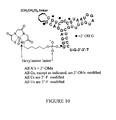
- This invention further includes the specific RNA ligands to tenascin-C shown in Tables 3 and 4 and Figure 10 . More specifically, this invention includes nucleic acid sequences that are substantially homologous to and that have substantially the same ability to bind tenascin-C as the specific nucleic acid ligands shown in Tables 3 and 4 and Figure 10 .
- substantially homologous it is meant a degree of primary sequence homology in excess of 70%, most preferably in excess of 80%, and even more preferably in excess of 90%, 95%, or 99%.
- the percentage of homology as described herein is calculated as the percentage of nucleotides found in the smaller of the two sequences which align with identical nucleotide residues in the sequence being compared when 1 gap in a length of 10 nucleotides may be introduced to assist in that alignment.
- Substantially the same ability to bind tenascin-C means that the affinity is within one or two orders of magnitude of the affinity of the ligands described herein. It is well within the skill of those of ordinary skill in the art to determine whether a given sequence - substantially homologous to those specifically described herein - has the same ability to bind tenascin-C.
- nucleic acid ligands of tenascin-C shown in Tables 3 and 4 and Figure 10 show that sequences with little or no primary homology may have substantially the same ability to bind tenascin-C.
- this invention also includes nucleic acid ligands that have substantially the same postulated structure or structural motifs and ability to bind tenascin-C as the nucleic acid ligands shown in Tables 3 and 4 and Figure 10 . Substantially the same structure or structural motifs can be postulated by sequence alignment using the Zukerfold program (see Zuker (1989) Science 244:48-52 ).
- a method for detecting the presence of a disease that is expressing tenascin-C in a biological tissue which may contain the disease by the method of (a) identifying a nucleic acid ligand from a candidate mixture of nucleic acids, the nucleic acid ligand being a ligand of tenascin-C, by the method comprising (i) contacting a candidate mixture of nucleic acids with tenascin-C, wherein nucleic acids having an increased affinity to tenascin-C relative to the candidate mixture may be partitioned from the remainder of the candidate mixture; (ii) partitioning the increased affinity nucleic acids from the remainder of the candidate mixture; (iii) amplifying the increased affinity nucleic acids to yield a mixture of nucleic acids with relatively higher affinity and specificity for binding to tenascin-C, whereby a nucleic acid ligand of tenascin-C is identified; (b) attaching a marker that can be
- candidate mixture is a mixture of nucleic acids of differing sequence from which to select a desired ligand.
- the source of a candidate mixture can be from naturally-occurring nucleic acids or fragments thereof, chemically synthesized nucleic acids, enzymatically synthesized nucleic acids or nucleic acids made by a combination of the foregoing techniques.
- each nucleic acid has fixed sequences surrounding a randomized region to facilitate the amplification process.
- nucleic acid means either DNA, RNA, single-stranded or double-stranded, and any chemical modifications thereof. Modifications include, but are not limited to, those which provide other chemical groups that incorporate additional charge, polarizability, hydrogen bonding, electrostatic interaction, and fluxionality to the nucleic acid ligand bases or to the nucleic acid ligand as a whole.
- modifications include, but are not limited to, 2'-position sugar modifications, 5-position pyrimidine modifications, 8-position purine modifications, modifications at exocyclic amines, substitution of 4-thiouridine, substitution of 5-bromo or 5-iodo-uracil; backbone modifications, methylations, unusual base-pairing combinations such as the isobases isocytidine and isoguanidine and the like. Modifications can also include 3' and 5' modifications such as capping.
- SELEX methodology involves the combination of selection of nucleic acid ligands which interact with a target in a desirable manner, for example binding to a protein, with amplification of those selected nucleic acids. Optional iterative cycling of the selection/amplification steps allows selection of one or a small number of nucleic acids which interact most strongly with the target from a pool which contains a very large number of nucleic acids. Cycling of the selection/amplification procedure is continued until a selected goal is achieved. In the present invention, the SELEX methodology is employed to obtain nucleic acid ligands to tenascin-C.
- SELEX target or “target” means any compound or molecule of interest for which a ligand is desired.
- a target can be a protein, peptide, carbohydrate, polysaccharide, glycoprotein, hormone, receptor, antigen, antibody, virus, substrate, metabolite, transition state analog, cofactor, inhibitor, drug, dye, nutrient, growth factor, etc. without limitation.
- the SELEX target is tenascin-C.
- Complex as used herein means the molecular entity formed by the covalent linking of one or more tenascin-C nucleic acid ligands with one or more markers.
- the complex is depicted as A-B-Y, wherein A is a marker; B is optional, and comprises a linker; and Y is a tenascin-C nucleic acid ligand.
- Marker as used herein is a molecular entity or entities that when complexed with the tenascin-C nucleic acid ligand, either directly or through a linker(s) or spacer(s), allows the detection of the complex in an in vivo or ex vivo setting through visual or chemical means.
- markers include, but are not limited to radionuclides, including Tc-99m.
- linker is a molecular entity that connects two or more molecular entities through covalent bond or non-covalent interactions, and can allow spatial separation of the molecular entities in a manner that preserves the functional properties of one or more of the molecular entities.
- a linker can also be known as a spacer. Examples of a linker include, but are not limited to, the (CH 2 CH 2 O) 6 and hexylamine structures shown in Figure 2 .
- “Therapeutic” as used herein, includes treatment and/or prophylaxis. When used, therapeutic refers to humans and other animals.
- Covalent Bond is the chemical bond formed by the sharing of electrons.
- Non-covalent interactions are means by which molecular entities are held together by interactions other than Covalent Bonds including ionic interactions and hydrogen bonds.
- the nucleic acid ligands of the present invention are derived from the SELEX methodology.
- the SELEX process is described in United States Patent Application Serial No. 07/536,428 , entitled “Systematic Evolution of Ligands by Exponential Enrichment,” now abandoned, United States Patent No. 5,475,096 , entitled “Nucleic Acid Ligands” and United States Patent No. 5,270,163 , (see also WO 91/19813 ), entitled “Methods for Identifying Nucleic Acid Ligands.” These applications are collectively called the SELEX Patent Applications.
- the SELEX process provides a class of products which are nucleic acid molecules, each having a unique sequence, and each of which has the property of binding specifically to a desired target compound or molecule.
- Target molecules are preferably proteins, but can also include among others carbohydrates, peptidoglycans and a variety of small molecules.
- SELEX methodology can also be used to target biological structures, such as cell surfaces or viruses, through specific interaction with a molecule that is an integral part of that biological structure.
- the SELEX process may be defined by the following series of steps:
- the SELEX method encompasses the identification of high-affinity nucleic acid ligands containing modified nucleotides conferring improved characteristics on the ligand, such as improved in vivo stability or improved delivery characteristics. Examples of such modifications include chemical substitutions at the ribose and/or phosphate and/or base positions. SELEX-identified nucleic acid ligands containing modified nucleotides are described in United States Patent No. 5,660,985 . entitled "High Affinity Nucleic Acid Ligands Containing Modified Nucleotides," that describes oligonucleotides containing nucleotide derivatives chemically modified at the 5- and 2'-positions of pyrimidines. United States Patent No.
- 5,637,459 describes highly specific nucleic acid ligands containing one or more nucleotides modified with 2'-amino (2'-NH 2 ), 2'-fluoro (2'-F), and/or 2'-O-methyl (2'-OMe).
- United States Patent Application Serial No. 08/264.029 filed June 22, 1994 , entitled "Novel Method of Preparation of Known and Novel 2' Modified Nucleosides by Intramolecular Nucleophilic Displacement," describes oligonucleotides containing various 2'-modified pyrimidines.
- the SELEX method encompasses combining selected oligonucleotides with other selected oligonucleotides and non-oligonucleotide functional units as described in United States Patent No. 5,637,459 , entitled “Systematic Evolution of Ligands by Exponential Enrichment: Chimeric SELEX,” and United States Patent No. 5,683,867 , entitled “Systematic Evolution of Ligands by Exponential Enrichment: Blended SELEX,” respectively.
- These applications allow the combination of the broad array of shapes and other properties, and the efficient amplification and replication properties, of oligonucleotides with the desirable properties of other molecules.
- United States Patent Application No. 08/434,425 entitled “Systematic Evolution of Ligands by Exponential Enrichment: Tissue SELEX,” filed May 3, 1995, now United States Patent No. 5,789.157 , describes methods for identifying a nucleic acid ligands to a macromolecular component of a tissue, including cancer cells, and the nucleic acid ligands so identified.
- nucleic acid ligand can be made to increase the in vivo stability of the nucleic acid ligand or to enhance or to mediate the delivery of the nucleic acid ligand. See, e.g., U.S. Patent Application Serial No. 08/117,991. filed September 8. 1993 , now abandoned, and United States Patent No.
- nucleic acid ligands Containing Modified Nucleotides.
- Modifications of the nucleic acid ligands contemplated in this invention include, but are not limited to, those which provide other chemical groups that incorporate additional charge, polarizability, hydrophobicity, hydrogen bonding, electrostatic interaction, and fluxionality to the nucleic acid ligand bases or to the nucleic acid ligand as a whole.
- Such modifications include, but are not limited to 2'-position sugar modifications, 5-position pyrimidine modifications, 8-position purine modifications, modifications at exocyclic amines, substitution of 4-thiouridine, substitution of 5-bromo or 5-iodo-uracil; backbone modifications, phosphorothioate or alkyl phosphate modifications, methylations, unusual base-pairing combinations such as the isobases isocytidine and isoguanidine and the like. Modifications can also include 3' and 5' modifications such as capping.
- the nucleic acid ligands are RNA molecules that are 2'-fluoro (2'-F) modified on the sugar moiety of pyrimidine residues.
- the modifications can be pre- or post-SELEX process modifications.
- Pre-SELEX process modifications yield nucleic acid ligands with both specificity for their SELEX target and improved in vivo stability.
- Post-SELEX process modifications made to 2'-OH nucleic acid ligands can result in improved in vivo stability without adversely affecting the binding capacity of the nucleic acid ligand.
- nucleic acid ligands of the invention are prepared through the SELEX methodology that is outlined above and thoroughly enabled in the SELEX applications.
- the tenascin-C aptamers of the invention bind to the heparin binding site of the tenascin-C COOH terminus.
- the nucleic acid ligands to tenascin-C described herein are useful for diagnostic purposes and can be used to image pathological conditions (such as human tumor imaging).
- the tenascin-C nucleic acid ligands are useful in the prognosis and monitoring of disease conditions in which tenascin-C is expressed.
- Diagnostic agents need only be able to allow the user to identify the presence of a given target at a particular locale or concentration. Simply the ability to form binding pairs with the target may be sufficient to trigger a positive signal for diagnostic purposes.
- Those skilled in the art would be able to adapt any tenascin-C nucleic acid ligand by procedures known in the art to incorporate a marker in order to track the presence of the nucleic acid ligand. Such a marker could be used in a number of diagnostic procedures, such as detection of primary and metastatic tumors and athersclerotic lesions.
- the labeling markers exemplified herein are technetium-99m and 111 In: however, other markers such as additional radionuclides, magnetic compounds, fluorophores, biotin, and the like can be conjugated to the tenascin-C nucleic acid ligand for imaging in an in vivo or ex vivo setting disease conditions in which tenascin-C is expressed (e.g., cancer, atherosclerosis, and psoriasis).
- the marker may be covalently bound to a variety of positions on the tenascin-C nucleic acid ligand, such as to an exocyclic amino group on the base, the 5-position of a pyrimidine nucleotide, the 8-position of a purine nucleotide, the hydroxyl group of the phosphate, or a hydroxyl group or other group at the 5' or 3' terminus of the tenascin-C nucleic acid ligand.
- the marker is technetium-99m of 111 In, preferably it is bonded to the 5' or 3' hydroxyl of the phosphate group thereof or to the 5 position of a modified pyrimidine.
- the marker is bonded to the 5' hydroxyl of the phosphate group of the nucleic acid ligand with or without a linker.
- the marker is conjugated to the nucleic acid ligand by incorporating a pyrimidine containing a primary amine at the 5 position, and use of the amine for conjugation to the marker. Attachment of the marker can be done directly or with the utilization of a linker.
- the preferred linker is a hexylamine linker as shown in Figure 10 .
- the tenascin-C nucleic acid ligands are useful for the delivery of therapeutic compounds (including, but not limited to, cytotoxic compounds, immune enhancing substances and therapeutic radionuclides) to tissues or organs expressing tenascin-C.
- therapeutic compounds including, but not limited to, cytotoxic compounds, immune enhancing substances and therapeutic radionuclides
- Disease conditions in which tenascin-C may be expressed include, but are not limited to, cancer, atherosclerosis, and psoriasis.
- Those skilled in the art would be able to adapt any tenascin-C nucleic acid ligand by procedures known in the art to incorporate a therapeutic compound in a complex.
- the therapeutic compound may be covalently bound to a variety of positions on the tenascin-C nucleic acid ligand, such as to an exocyclic amino group on the base, the 5-position of a pyrimidine nucleotide, the 8-position of a purine nucleotide, the hydroxyl group of the phosphate, or a hydroxyl group or other group at the 5' or 3' terminus of the tenascin-C nucleic acid ligand.
- the therapeutic agent is bonded to the 5' amine of the nucleic acid ligand. Attachment of the therapeutic agent can be done directly or with the utilization of a linker.
- 5-fluorodeoxyuracil or other nucleotide analogs known to be active against tumors can be incorporated internally into existing U's within the tenascin-C nucleic acid ligand or can be added internally or conjugated to either terminus either directly or through a linker.
- both pyrimidine analogues 2'2'-difluorocytidine and purine analogues (deoxycoformycin) can be incorporated.
- nucleotide-based prodrugs comprising nucleic acid ligands directed to a tumor, for example tenascin-C, for precisely localizing chemoradiosensitizers, and radiosensitizers and radionuclides and other radiotherapeutic agents to the tumor.
- both the marker and therapeutic agent may be associated with the tenascin-C nucleic acid ligand, such that detection of the disease condition and delivery of the therapeutic agent is accomplished together in one aptamer or as a mixture of two or more different modified versions of the same aptamer. It is also contemplated that either or both the marker and/or the therapeutic agent may be associated with a non-immunogenic, high molecular weight compound or lipophilic compound, such as a liposome. Methods for conjugating nucleic acid ligands with lipophilic compounds or non-immunogenic compounds in a diagnostic or therapeutic complex are described in United States Patent Application Serial No. 08/434,465, filed May 4, 1995 , entitled "Nucleic Acid Ligand Complexes".
- compositions described herein may be administered parenterally by injection (e.g., intravenous, subcutaneous, intradermal, intralesional), although other effective administration forms, such as intraarticular injection, inhalant mists, orally active formulations, transdermal iontophoresis or suppositories, are also envisioned. They may also be applied locally by direct injection, can be released from devices, such as implanted stents or catheters, or delivered directly to the site by an infusion pump.
- One preferred carrier is physiological saline solution, but it is contemplated that other pharmaceutically acceptable carriers may also be used.
- the carrier and the tenascin-C nucleic acid ligand complexed with a therapeutic compound constitute a physiologically-compatible, slow release formulation.
- the primary solvent in such a carrier may be either aqueous or non-aqueous in nature.
- the carrier may contain other pharmacologically acceptable excipients for modifying or maintaining the pH, osmolarity, viscosity, clarity, color, sterility, stability, rate of dissolution, or odor of the formulation.
- the carrier may contain still other pharmacologically-acceptable excipients for modifying or maintaining the stability, rate of dissolution, release, or absorption of the tenascin-C nucleic acid ligand.
- excipients are those substances usually and customarily employed to formulate dosages for parental administration in either unit dose or multi-dose form.
- the therapeutic or diagnostic composition may be stored in sterile vials as a solution, suspension, gel, emulsion, solid, or dehydrated or lyophilized powder. Such formulations may be stored either in ready to use form or requiring reconstitution immediately prior to administration.
- the manner of administering formulations containing tenascin-C nucleic acid ligands for systemic delivery may be via subcutaneous, intramuscular, intravenous, intraarterial, intranasal or vaginal or rectal suppository.
- Example 1 describes the materials and experimental procedures used in Example 2 for the generation of RNA ligands to tenascin-C.
- Example 2 describes the RNA ligands to tenascin-C and the predicted secondary structure of a selected nucleic acid ligand.
- Example 3 describes the determination of minimal size necessary for high affinity binding of a selected nucleic acid ligand, and substitution of 2'-OH purines with 2'-OMe purines.
- Example 4 describes the biodistribution of Tc-99m labeled tenascin-C nucleic acid ligands in tumor-bearing mice.
- Example 5 describes the use of a fluorescently labeled tenascin-C nucleic acid ligand to localize tenascin-c within tumor tissue.
- Example 6 describes detection of tumors in vivo by Aptamer TTA1 (also known as GS7641).
- Example 7 describes alternative labeling using 111 In.
- Example 1 Use of SELEX to obtain nucleic acid ligands to tenascin-C and to U251 glioblastoma cells.
- Tenascin-C was purchased from Chemicon (Temecula, CA). Single-stranded DNA-primers and templates were synthesized by Operon Technologies Inc. (Alameda. CA).
- Lumino plates (Labsystems, Needham Heights, MA) were coated for 2 hours at room temperature with 200 ⁇ l Dulbecco's PBS containing tenascin-C concentrations as shown in Table 1 .
- wells were blocked using HBSMC+ buffer [20 mM Hepes, pH 7.4, 137 mM NaCl, 1 mM CaCl 2 , 1 mM MgCl 2 and 1 g/liter human serum albumin (Sigma, fraction V) for rounds I to 6 while for rounds 7 and 8 wells were blocked HBSMC+ buffer containing 1 g/liter casein (I-block; Tropix).
- Binding and wash buffer consisted of HBSMC+ buffer containing 0.05% Tween 20.
- RNA was diluted into 100 ⁇ l of binding buffer and allowed to incubate for 2 hours at 37°C in the protein coated wells that were pre-washed with binding buffer. After binding, six washes of 200 ⁇ l each were performed. Following the wash step, the dry well was placed on top of a 95°C heat block for 5 minutes. Standard AMV reverse transcriptase reactions (50 ⁇ l) were performed at 48°C directly in the well and the reaction products utilized for standard PCR and transcription reactions. Two synthetic primers 5N7 (see above) and 3N7a:
- U251 human glioblastoma cells ( Hum. Hered. (1971) 21:238 ) were grown to confluence in Dulbecco's Modified Eagle's Medium supplemented with 10% fetal calf serum (GIBCO BRL. Gaithersburg. MD) on six-well tissue culture plates (Becton Dickinson Labware. Lincoln Park, NJ) and washed three times using Dulbecco's PBS supplemented with CaCl 2 (DPBS, GIBCO BRL) buffer. RNA labeled internally by transcription (Fitzwater (1996) supra ) was incubated with the cells at 37°C for one hour.
- Dulbecco's Modified Eagle's Medium supplemented with 10% fetal calf serum
- DPBS CaCl 2
- RNA binding assays for the U251 cells Internally labeled RNA was incubated at increasing concentrations with confluent U251 cells in six-well tissue culture plates (Becton Dickinson Labware. Lincoln Park, NJ) at 37°C for 60 min. Unbound RNA was washed away using three 10 minute washes with DPBS+ CaCl 2 at 37°C, and bound RNA was collected by disrupting the cells using Trizol (Gibco BRL, Gaithersburg, MD). Bound RNA was quantitated by liquid scintillation counting.
- Nucleic Acid Ligands to U251 cells were obtained by the SELEX process and are described in United States Patent Application Serial No. 08/434,425 , entitled “Systematic Evolution of Ligands by Exponential Enrichment: Tissue SELEX,” filed May 3, 1995, now United States Patent No. 5,789,157 . Subsequently it was determined that the ligands that were obtained were tenascin-C nucleic acid ligands.
- oligonucleotide ligands against human tenascin-C eight rounds of SELEX were performed using the randomized nucleotide library as described above in Materials and Methods. RNA and protein input into each round is shown in Table 1 . After 8 rounds of SELEX, the affinity of the oligonucleotide pool for tenascin-C was 10 nM. and this affinity did not increase with additional SELEX rounds.
- the E9 pool (nine rounds of binding and EDTA elution from U251 cells) was then used as a starting point for a SELEX against purified tenascin-C. Two rounds of SELEX using purified tenascin-C were performed as described above. Input protein and RNA concentrations for two rounds of SELEX (E9P1 and E9P2) are described in Table 2 .
- Example 3 Determination of minimal size of TN9, and substitution of 2'-OH purines with 2'-OMe purines: synthesis of aptamer TTA1.
- Oligonucleotide synthesis procedures were standard for those skilled in the art ( Green et al. (1995) Chem Biol 2(10):683-95 ).
- 2'-fluoro pyrimidine phosphoramidite monomers were obtained from JBL Scientific (San Luis Obispo, CA); 2'-OMe purine, 2'-OH purine, hexylamine, and (CH 2 CH 2 O) 6 monomers, along with the dT polystyrene solid support, were obtained from Glen Research (Sterling, VA). Aptamer affinities were determined using nitrocellulose filter partitioning ( Green et al., supra).
- TN9 was chosen for further analysis based on its high affinity for tenascin-C. We first searched for a minimal sequence necessary for high affinity binding. Using standard techniques (Green et al, supra ) , it was discovered that nucleotides 3'of nucleotide 55 were required for binding to tenascin-C, while no nucleotides could be removed from the 5' end without loss of affinity. To further decrease the TN9's length from 55 nucleotides and retain high affinity binding, we then attempted to define internal deletions of TN9.
- RNA foldings predicted by the algorithm, a structure common to each oligonucleotide was found.
- This structure represented by oligonucleotide TTA1 in Figure 2 , contains three stems that meet at a single junction, a so-called 3-stem junction.
- This folding places the most highly conserved nucleotides of family II oligonucleotides at the junction area.
- TN9 TN7. TN21, and TN41.
- the second stem was of variable length and sequence, suggesting that extension of the second stem is not required for binding to tenascin-C. Testing this hypothesis on TN9.
- nucleotides 10-26 could be replaced with an ethylene glycol linker, (CH 2 CH 2 O) 6 .
- the linker serves as a substitute loop and decreases the size of the aptamer. Additionally, four-nucleotide loops (CACU or GAGA) that replace nucleotides 10-26 produce sequences with high affinity for tenascin-C. It would be well within one skilled in the art to determine other nucleotide loops or other spacers that could replace nucleotides 10-26 to produce sequences with high affinity for tenascin-C.
- the aptamer TTA1 ( Table 4 ) was then synthesized with the (CH 2 CH 2 O) 6 (Spacer 18) linker, a 3'-3' dT cap for exonuclease protection, a 5' hexylamine ( Table 4 ), and all purines as 2'-OMe except the 5 Gs indicated in Table 4 .
- a non-binding control aptamer, TTA1.NB was generated by deleting 5 nucleotides at the 3' end to produce TTA1.NB.
- TTA1 binds to tenascin-C with an equilibrium dissociation constant (K d ) of 5 nM, while TTA1.NB has a K d of > 5 ⁇ M for tenascin-C.
- Nucleotides 10-26 can be replaced by a non-nucleotide ethylene glycol linker. It is therefore likely that TTA1 can be synthesized in two separate pieces, where a break is introduced at the position of the ethylene glycol linker and new 5' and 3' ends are introduced. Subsequent to synthesis, the two molecules will incubated together to allow hybrid formation. This method allows introduction of additional amine groups as well as nucleotides at the new 5' and 3' ends. The new functionalities could be used for bioconjugation. In addition, two-piece synthesis results in increased chemical synthetic yield due to shortening the length of the molecules.
- Tc-99m chelator Hi 15 : Hilger et al. (1998) Tet Lett 39:9403-9406 ) to the 5' end of the oligonucleotide as shown in Figure 2 , and radiolabeling the aptamer with Tc-99m.
- the aptamer in its Tc-99m labeled form is shown in Figure 10 .
- TTA1 and TTA1.NB were conjugated to Hi 15 at 50 mg/ml aptamer in 30% dimethylformamide with 5 molar equivalents of Hi 15 -N-hydoxysuccinimide, buffered in 100 mM Na Borate pH 9.3, for 30 minutes at room temperature.
- the aptamer in its Tc-99m labeled form is shown in Figure 10 .
- Reversed phase HPLC purification yielded Hi 15 -TTA1 and Hi 15 -TTA1.NB.
- the oligonucleotides were then labeled with Tc-99m in the following manner: to 1 nmole Hi15-aptamer was added 200 ⁇ L of 100 mM sodium phosphate buffer, pH 8.5, 23 mg/mL NaTartrate, and 50 ⁇ L Tc-99m pertechnetate (5.0 mCi) eluted from a Mo-99 column (Syncor, Denver) within 12 hours of use.
- the labeling reaction was initiated by the addition of 10 ⁇ L 5 mg/mL SnCl 2 .
- the reaction mixture was incubated for 15 minutes at 90° C.
- the reaction was separated from unreacted Tc-99m by spin dialysis through a 30,000 MW cut-off membrane (Centrex, Schleicher & Scheull) with two 300 ⁇ L washes.
- This labeling protocol results in 30-50% of the added 99mTc being incorporated with a specific activity of 2-3 mCi/nmole RNA.
- the Tc-99m is bound through the 5'G as shown in Figure 5 .
- U251 xenograft tumors were prepared as follows: U251 cells were cultured in Dulbeccos' Modified Eagle's Medium supplemented with 10% v/v fetal calf serum (Gibco BRL, Gaithersburg, MD). Athymic mice (Harlan Sprague Dawley, Indianapolis, IN) were injected subcutaneously with 1x10 6 U251 cells. When the tumors reached a size of 200-300 mg (1-2 weeks), Tc-99m labeled aptamer was injected intravenously at 3.25 mg/kg.
- mice were anesthetized using isoflurane (Fort Dodge Animal Health, Fort Dodge, IA), blood was collected by cardiac puncture, and the animal was sacrificed and tissues were harvested. Tc-99m levels were counted using a gamma counter (Wallac Oy, Turku, Finland). Aptamer uptake into tissues was measured as the % of injected dose per gram of tissue (%ID/g).
- mice were obtained using a gamma camera. Mice were placed onto the camera (Siemens, LEM+) under anesthesia (isoflurane). Data were collected (30 sec to 10 minutes) and analyzed using Nuclear MAC software version 3.22.2 (Scientific Imaging. CA) on a Power MAC G3 (Apple Computer, CA).
- Tc-99m radioactivity also appears in other tissues, notably the small and large intestines.
- the hepatobiliary clearance pattern seen here can be readily altered by those skilled in the art, for example by altering the hydrophilicity of the Tc-99m chelator, changing the chelator, or changing the radiometal/chelator pair altogether.
- TTA1 and TTA1.NB were synthesized as described above.
- Succinimdyl Rhodamine-Red-X (Molecular Probes, Eugene, OR) was conjugated to the 5' amine of the aptamers as described above for H 15 -NHS conjugation.
- the Rhodamine-Red-X-conjugated aptamers, TTA1-Red and TTA1.NB-Red were purified by reversed phase HPLC.
- U251 cell culture and tumor growth in nude mice were as described above. Five nmol of TTA1-Red or TTA1.NB-Red were injected intravenously into nude mice and at the desired time the animal was placed under anesthesia, perfused with 0.9% NaCl, and sacrificed. The tumor was excised and placed in formalin. After 24 hr in formalin, 10 ⁇ M sections were cut and Rhodamine-Red-X was detected using a fluorescence microscope (Eclipse E800, Nikon, Japan).
- TTA1-Red has identical affinity for tenascin-C as the unconjugated parent aptamer, TTA1, at 5 nM.
- TTA1-Red has identical affinity for tenascin-C as the unconjugated parent aptamer, TTA1, at 5 nM.
- TTA1-Red has identical affinity for tenascin-C as the unconjugated parent aptamer, TTA1, at 5 nM.
- TTA1-Red The binding aptamer, TTA1-Red, strongly stains the tumor but not adjacent tissue ( Figure 4 ). In contrast, only tissue auto-fluorescence is detected with TTA1.NB-Red.
- Example 6 Detection of Tumors In Vivo by Aptamer TTA1 (now also known as GS7641): additional tumor types.
- TTA1/GS7641 Many human tumor types are known to express tenascin-C.
- human tumor cell lines were grown as tumors in nude mice. Tumor tissue was tested for expression of human tenascin-C, and those tumors expressing human tenascin-C were tested for aptamer uptake.
- Figure 6 demonstrates aptamer uptake in several tumors, including glioblastoma, breast, colorectal, and rhabdomyosarcoma. Specific uptake into the tumor is demonstrated by the comparison between binding (TTA1/GS7641) and non-binding aptamer (TTA1.NB).
- KB a xenograft that expresses mouse but not human TN-C, does not show tumor uptake. This experiment extends the observation of glioblastoma uptake into additional carcinomas and sarcomas, and further indicates that all tumors expressing human tenascin-C show uptake of TTA1/GS7641.
- Tumor xenograft and biodistribution studies were performed as described in Example 4.
- the cyclic anhydride of each was incubated with the amine-containing TTA1/GS7641 under neutral pH conditions using standard methods.
- the structures of the DTPA and conjugates are shown in Figure 8 and Figure 9 , respectively, where each has been labeled with In-111.
- the DOTA conjugate has the identical linkers as for DTPA.
- DOTA- and DTPA-conjugates were labeled with In-111 by incubation at 95°C in 0.5 M NaOAc, pH 5.5 for 30 min. After removal of unincorporated radiolabel by spin dialysis over a 30K cut-off membrane, radiolabeled aptamer was transferred into phosphate-buffered saline for injection into tumor-bearing mice.
- Such conditions include but are not limited to radiotherapy applications as well as imaging of intestines, prostate and other abdominal regions.
- Table 1 Tenascin-C SELEX RNA and protein input.
- Tenascin-C RNA Round (pMol/well) (pMol/well) 1 12 200 2 12 200 3 12 200 4 12 200 5 2 33 6 2 33 7 2 33 8 0.2 3.3 Table 2.
- TN9.4M1235 55 16667667C67U6C6677C77U6C7CUCGUCGCCGU77U667U6UUU6CUCCCU65 16.5 nM TN9.4M135G6 56 166676 6 ACGAUGCG677C77U6C7CUCGUCGCCGU77U667U6UUU6CUCCCU65 2.2 nM TN9.4M135A7 57 166676G 7 CGAUGCG677C77U6C7CUCGUCGCCGU77U667U6UUU6CUCCCU65 1.7 nM TN9.4M135G9 58 166676GAC 6 AUGCG677C77U6C7CUCGUCGCCGU77U667U6UUU6CUCCCU65 7.7 nM TN9.4M135A10 59 166676GACG 7 UGCG677C77U6C7CUCGUCGCCGU77U667U6UUU6CUCCCU
Landscapes
- Health & Medical Sciences (AREA)
- Life Sciences & Earth Sciences (AREA)
- Chemical & Material Sciences (AREA)
- Engineering & Computer Science (AREA)
- Molecular Biology (AREA)
- Organic Chemistry (AREA)
- Immunology (AREA)
- General Health & Medical Sciences (AREA)
- Biomedical Technology (AREA)
- Genetics & Genomics (AREA)
- Biotechnology (AREA)
- Biochemistry (AREA)
- Bioinformatics & Cheminformatics (AREA)
- Medicinal Chemistry (AREA)
- Urology & Nephrology (AREA)
- Hematology (AREA)
- Microbiology (AREA)
- Wood Science & Technology (AREA)
- Zoology (AREA)
- Physics & Mathematics (AREA)
- Analytical Chemistry (AREA)
- General Engineering & Computer Science (AREA)
- Pathology (AREA)
- Proteomics, Peptides & Aminoacids (AREA)
- Biophysics (AREA)
- Pharmacology & Pharmacy (AREA)
- Cell Biology (AREA)
- Food Science & Technology (AREA)
- General Physics & Mathematics (AREA)
- Veterinary Medicine (AREA)
- Public Health (AREA)
- Animal Behavior & Ethology (AREA)
- General Chemical & Material Sciences (AREA)
- Chemical Kinetics & Catalysis (AREA)
- Epidemiology (AREA)
- Nuclear Medicine, Radiotherapy & Molecular Imaging (AREA)
- Plant Pathology (AREA)
- Virology (AREA)
- Endocrinology (AREA)
- Crystallography & Structural Chemistry (AREA)
Applications Claiming Priority (3)
| Application Number | Priority Date | Filing Date | Title |
|---|---|---|---|
| US364902 | 1989-06-08 | ||
| US09/364,902 US6232071B1 (en) | 1990-06-11 | 1999-07-29 | Tenascin-C nucleic acid ligands |
| PCT/US2000/002167 WO2001009390A1 (en) | 1999-07-29 | 2000-01-28 | Tenascin-c nucleic acid ligands |
Publications (4)
| Publication Number | Publication Date |
|---|---|
| EP1198589A1 EP1198589A1 (en) | 2002-04-24 |
| EP1198589A4 EP1198589A4 (en) | 2003-02-19 |
| EP1198589B1 EP1198589B1 (en) | 2008-08-20 |
| EP1198589B9 true EP1198589B9 (en) | 2009-08-12 |
Family
ID=23436596
Family Applications (1)
| Application Number | Title | Priority Date | Filing Date |
|---|---|---|---|
| EP00911657A Expired - Lifetime EP1198589B9 (en) | 1999-07-29 | 2000-01-28 | Tenascin-c nucleic acid ligands |
Country Status (29)
| Country | Link |
|---|---|
| US (4) | US6232071B1 (enExample) |
| EP (1) | EP1198589B9 (enExample) |
| JP (1) | JP2003505111A (enExample) |
| KR (1) | KR100605072B1 (enExample) |
| CN (2) | CN1164760C (enExample) |
| AT (1) | ATE405675T1 (enExample) |
| AU (1) | AU767501C (enExample) |
| BG (1) | BG106361A (enExample) |
| BR (1) | BR0013170A (enExample) |
| CA (1) | CA2380473A1 (enExample) |
| CZ (1) | CZ2002365A3 (enExample) |
| DE (1) | DE60039986D1 (enExample) |
| DK (1) | DK1198589T3 (enExample) |
| EA (1) | EA004795B1 (enExample) |
| EE (1) | EE200200051A (enExample) |
| ES (1) | ES2310989T3 (enExample) |
| HK (1) | HK1048499B (enExample) |
| HR (1) | HRP20020186A2 (enExample) |
| HU (1) | HUP0202221A3 (enExample) |
| IL (2) | IL147872A0 (enExample) |
| MX (1) | MXPA02000819A (enExample) |
| NO (1) | NO20020424L (enExample) |
| NZ (2) | NZ516907A (enExample) |
| PL (1) | PL201637B1 (enExample) |
| RS (1) | RS50426B (enExample) |
| SK (1) | SK1222002A3 (enExample) |
| UA (1) | UA75578C2 (enExample) |
| WO (1) | WO2001009390A1 (enExample) |
| ZA (1) | ZA200200747B (enExample) |
Families Citing this family (27)
| Publication number | Priority date | Publication date | Assignee | Title |
|---|---|---|---|---|
| US6232071B1 (en) * | 1990-06-11 | 2001-05-15 | Gilead Sciences, Inc. | Tenascin-C nucleic acid ligands |
| US7005260B1 (en) * | 2000-01-28 | 2006-02-28 | Gilead Sciences, Inc. | Tenascin-C nucleic acid ligands |
| US7645743B2 (en) * | 1999-12-22 | 2010-01-12 | Altermune, Llc | Chemically programmable immunity |
| CA2328356A1 (en) * | 1999-12-22 | 2001-06-22 | Itty Atcravi | Recreational vehicles |
| EP2070939B1 (en) | 2001-05-25 | 2014-04-02 | Duke University | Modulators of pharmacological agents |
| WO2003106659A2 (en) * | 2002-06-18 | 2003-12-24 | Archemix Corp. | Aptamer-toxin molecules and methods for using same |
| US20040249130A1 (en) * | 2002-06-18 | 2004-12-09 | Martin Stanton | Aptamer-toxin molecules and methods for using same |
| US8853376B2 (en) | 2002-11-21 | 2014-10-07 | Archemix Llc | Stabilized aptamers to platelet derived growth factor and their use as oncology therapeutics |
| US10100316B2 (en) | 2002-11-21 | 2018-10-16 | Archemix Llc | Aptamers comprising CPG motifs |
| US8039443B2 (en) * | 2002-11-21 | 2011-10-18 | Archemix Corporation | Stabilized aptamers to platelet derived growth factor and their use as oncology therapeutics |
| US7727969B2 (en) * | 2003-06-06 | 2010-06-01 | Massachusetts Institute Of Technology | Controlled release nanoparticle having bound oligonucleotide for targeted delivery |
| WO2006093932A2 (en) * | 2005-03-01 | 2006-09-08 | Cedars-Sinai Medical Center | Use of eotaxin as a diagnostic indicator for atherosclerosis and vascular inflammation |
| AR052741A1 (es) * | 2005-04-08 | 2007-03-28 | Noxxon Pharma Ag | Acidos nucleicos de union a ghrelin |
| EP1897562A1 (en) * | 2006-09-08 | 2008-03-12 | Bayer Schering Pharma Aktiengesellschaft | Aptamers labelled with Gallium-68 |
| US8557776B2 (en) | 2006-09-08 | 2013-10-15 | Bayer Pharma AG | Compounds and methods for 18F labeled agents |
| US20110136099A1 (en) | 2007-01-16 | 2011-06-09 | Somalogic, Inc. | Multiplexed Analyses of Test Samples |
| US8975026B2 (en) | 2007-01-16 | 2015-03-10 | Somalogic, Inc. | Method for generating aptamers with improved off-rates |
| MX2010000578A (es) * | 2007-07-17 | 2010-04-30 | Somalogic Inc | Metodo para generar aptameros con constantes de disociacion mejoradas. |
| EP2036981A1 (en) * | 2007-09-12 | 2009-03-18 | Bayer Schering Pharma Aktiengesellschaft | Aptamers labeled with 18F |
| CN102459298A (zh) | 2009-05-05 | 2012-05-16 | 阿尔特姆恩科技责任有限公司 | 化学可编程免疫 |
| US8841429B2 (en) | 2009-11-03 | 2014-09-23 | Vivonics, Inc. | Nucleic acid ligands against infectious prions |
| US8236570B2 (en) | 2009-11-03 | 2012-08-07 | Infoscitex | Methods for identifying nucleic acid ligands |
| GB201114662D0 (en) | 2011-08-24 | 2011-10-12 | Altermune Technologies Llc | Chemically programmable immunity |
| JP6158825B2 (ja) * | 2011-12-12 | 2017-07-05 | オックスフォード ユニヴァーシティ イノヴェーション リミテッド | テネイシンcおよび関節リウマチにおけるその使用 |
| CN102533772B (zh) * | 2011-12-12 | 2013-10-09 | 中国科学院武汉病毒研究所 | 一种抗hbv诱饵适体及其筛选方法 |
| EP2872147B1 (en) | 2012-07-13 | 2022-12-21 | Wave Life Sciences Ltd. | Method for making chiral oligonucleotides |
| CN107058596A (zh) * | 2017-06-19 | 2017-08-18 | 上海市第十人民医院 | 一种与恶性胶质瘤诊断相关的标志物及其应用 |
Family Cites Families (16)
| Publication number | Priority date | Publication date | Assignee | Title |
|---|---|---|---|---|
| DE3590766C2 (enExample) | 1985-03-30 | 1991-01-10 | Marc Genf/Geneve Ch Ballivet | |
| WO1989006694A1 (en) | 1988-01-15 | 1989-07-27 | Trustees Of The University Of Pennsylvania | Process for selection of proteinaceous substances which mimic growth-inducing molecules |
| US6232071B1 (en) * | 1990-06-11 | 2001-05-15 | Gilead Sciences, Inc. | Tenascin-C nucleic acid ligands |
| US5789157A (en) * | 1990-06-11 | 1998-08-04 | Nexstar Pharmaceuticals, Inc. | Systematic evolution of ligands by exponential enrichment: tissue selex |
| US6127119A (en) * | 1990-06-11 | 2000-10-03 | Nexstar Pharmaceuticals, Inc. | Nucleic acid ligands of tissue target |
| DE69128350T2 (de) * | 1990-06-11 | 1998-03-26 | Nexstar Pharmaceuticals Inc | Nukleinsäureliganden |
| US6610841B1 (en) * | 1997-12-18 | 2003-08-26 | Gilead Sciences, Inc. | Nucleotide-based prodrugs |
| US5496938A (en) * | 1990-06-11 | 1996-03-05 | Nexstar Pharmaceuticals, Inc. | Nucleic acid ligands to HIV-RT and HIV-1 rev |
| JPH06508022A (ja) | 1991-02-21 | 1994-09-14 | ギリアド サイエンシズ,インコーポレイテッド | 生体分子に特異的なアプタマーおよび生産方法 |
| US5683874A (en) * | 1991-03-27 | 1997-11-04 | Research Corporation Technologies, Inc. | Single-stranded circular oligonucleotides capable of forming a triplex with a target sequence |
| US5582981A (en) * | 1991-08-14 | 1996-12-10 | Gilead Sciences, Inc. | Method for identifying an oligonucleotide aptamer specific for a target |
| US5436132A (en) * | 1993-02-13 | 1995-07-25 | Amano Pharmaceutical Co., Ltd. | Quantitative determination of tenascin as glioma marker |
| US5859228A (en) * | 1995-05-04 | 1999-01-12 | Nexstar Pharmaceuticals, Inc. | Vascular endothelial growth factor (VEGF) nucleic acid ligand complexes |
| US6229002B1 (en) * | 1995-06-07 | 2001-05-08 | Nexstar Pharmaceuticlas, Inc. | Platelet derived growth factor (PDGF) nucleic acid ligand complexes |
| DK0957929T3 (da) * | 1996-10-25 | 2006-07-03 | Gilead Sciences Inc | Vaskulær endotelial vækstfaktor (VEGF) nukleinsyreligandkomplekser |
| US6242246B1 (en) * | 1997-12-15 | 2001-06-05 | Somalogic, Inc. | Nucleic acid ligand diagnostic Biochip |
-
1999
- 1999-07-29 US US09/364,902 patent/US6232071B1/en not_active Expired - Fee Related
-
2000
- 2000-01-28 DE DE60039986T patent/DE60039986D1/de not_active Expired - Lifetime
- 2000-01-28 AU AU33519/00A patent/AU767501C/en not_active Ceased
- 2000-01-28 CZ CZ2002365A patent/CZ2002365A3/cs unknown
- 2000-01-28 JP JP2001513645A patent/JP2003505111A/ja active Pending
- 2000-01-28 ES ES00911657T patent/ES2310989T3/es not_active Expired - Lifetime
- 2000-01-28 AT AT00911657T patent/ATE405675T1/de not_active IP Right Cessation
- 2000-01-28 SK SK122-2002A patent/SK1222002A3/sk not_active Application Discontinuation
- 2000-01-28 HK HK03100657.1A patent/HK1048499B/zh not_active IP Right Cessation
- 2000-01-28 IL IL14787200A patent/IL147872A0/xx active IP Right Grant
- 2000-01-28 CN CNB008109796A patent/CN1164760C/zh not_active Expired - Fee Related
- 2000-01-28 MX MXPA02000819A patent/MXPA02000819A/es not_active IP Right Cessation
- 2000-01-28 EP EP00911657A patent/EP1198589B9/en not_active Expired - Lifetime
- 2000-01-28 WO PCT/US2000/002167 patent/WO2001009390A1/en not_active Ceased
- 2000-01-28 EE EEP200200051A patent/EE200200051A/xx unknown
- 2000-01-28 EA EA200200094A patent/EA004795B1/ru not_active IP Right Cessation
- 2000-01-28 PL PL353357A patent/PL201637B1/pl not_active IP Right Cessation
- 2000-01-28 RS YUP-64/02A patent/RS50426B/sr unknown
- 2000-01-28 KR KR1020027001167A patent/KR100605072B1/ko not_active Expired - Fee Related
- 2000-01-28 NZ NZ516907A patent/NZ516907A/en unknown
- 2000-01-28 HR HR20020186A patent/HRP20020186A2/hr not_active Application Discontinuation
- 2000-01-28 BR BR0013170-9A patent/BR0013170A/pt not_active Application Discontinuation
- 2000-01-28 HU HU0202221A patent/HUP0202221A3/hu unknown
- 2000-01-28 UA UA2002021549A patent/UA75578C2/uk unknown
- 2000-01-28 CN CNB2004100629077A patent/CN100558411C/zh not_active Expired - Fee Related
- 2000-01-28 DK DK00911657T patent/DK1198589T3/da active
- 2000-01-28 CA CA002380473A patent/CA2380473A1/en not_active Abandoned
- 2000-01-29 NZ NZ528077A patent/NZ528077A/en unknown
-
2001
- 2001-05-14 US US09/854,662 patent/US6596491B2/en not_active Expired - Fee Related
-
2002
- 2002-01-28 ZA ZA200200747A patent/ZA200200747B/xx unknown
- 2002-01-28 NO NO20020424A patent/NO20020424L/no not_active Application Discontinuation
- 2002-01-28 IL IL147872A patent/IL147872A/en not_active IP Right Cessation
- 2002-01-29 BG BG106361A patent/BG106361A/bg unknown
-
2003
- 2003-05-01 US US10/429,176 patent/US20040058884A1/en not_active Abandoned
-
2005
- 2005-12-13 US US11/300,662 patent/US20060105378A1/en not_active Abandoned
Also Published As
Similar Documents
| Publication | Publication Date | Title |
|---|---|---|
| EP1198589B9 (en) | Tenascin-c nucleic acid ligands | |
| US6124449A (en) | High affinity TGFβ nucleic acid ligands and inhibitors | |
| US6699843B2 (en) | Method for treatment of tumors using nucleic acid ligands to PDGF | |
| JP4176466B2 (ja) | 前立腺特異的膜抗原に対する核酸リガンド | |
| EP1975172A2 (en) | High affinity TGFß nucleic acid ligands and inhibitors | |
| AU2002224401A1 (en) | Nucleic acid ligands to the prostate specific membrane antigen | |
| US7005260B1 (en) | Tenascin-C nucleic acid ligands | |
| WO2001087351A1 (en) | Method for treatment of tumors using nucleic acid ligands to pdgf | |
| US20060084797A1 (en) | High affinity TGFbeta nucleic acid ligands and inhibitors | |
| AU2004242532A1 (en) | High affinity TGF beta nucleic acid ligands and inhibitors |
Legal Events
| Date | Code | Title | Description |
|---|---|---|---|
| PUAI | Public reference made under article 153(3) epc to a published international application that has entered the european phase |
Free format text: ORIGINAL CODE: 0009012 |
|
| 17P | Request for examination filed |
Effective date: 20020129 |
|
| AK | Designated contracting states |
Kind code of ref document: A1 Designated state(s): AT BE CH CY DE DK ES FI FR GB GR IE IT LI LU MC NL PT SE |
|
| AX | Request for extension of the european patent |
Free format text: AL PAYMENT 20020129;LT PAYMENT 20020129;LV PAYMENT 20020129;MK PAYMENT 20020129;RO PAYMENT 20020129;SI PAYMENT 20020129 |
|
| A4 | Supplementary search report drawn up and despatched |
Effective date: 20030108 |
|
| GRAP | Despatch of communication of intention to grant a patent |
Free format text: ORIGINAL CODE: EPIDOSNIGR1 |
|
| GRAS | Grant fee paid |
Free format text: ORIGINAL CODE: EPIDOSNIGR3 |
|
| GRAA | (expected) grant |
Free format text: ORIGINAL CODE: 0009210 |
|
| AK | Designated contracting states |
Kind code of ref document: B1 Designated state(s): AT BE CH CY DE DK ES FI FR GB GR IE IT LI LU MC NL PT SE |
|
| AX | Request for extension of the european patent |
Extension state: AL LT LV MK RO SI |
|
| REG | Reference to a national code |
Ref country code: GB Ref legal event code: FG4D |
|
| REG | Reference to a national code |
Ref country code: CH Ref legal event code: EP |
|
| REG | Reference to a national code |
Ref country code: IE Ref legal event code: FG4D |
|
| REF | Corresponds to: |
Ref document number: 60039986 Country of ref document: DE Date of ref document: 20081002 Kind code of ref document: P |
|
| REG | Reference to a national code |
Ref country code: CH Ref legal event code: NV Representative=s name: SCHMAUDER & PARTNER AG PATENTANWALTSBUERO |
|
| REG | Reference to a national code |
Ref country code: DK Ref legal event code: T3 |
|
| LTIE | Lt: invalidation of european patent or patent extension |
Effective date: 20080820 |
|
| PG25 | Lapsed in a contracting state [announced via postgrant information from national office to epo] |
Ref country code: NL Free format text: LAPSE BECAUSE OF FAILURE TO SUBMIT A TRANSLATION OF THE DESCRIPTION OR TO PAY THE FEE WITHIN THE PRESCRIBED TIME-LIMIT Effective date: 20080820 |
|
| REG | Reference to a national code |
Ref country code: ES Ref legal event code: FG2A Ref document number: 2310989 Country of ref document: ES Kind code of ref document: T3 |
|
| PG25 | Lapsed in a contracting state [announced via postgrant information from national office to epo] |
Ref country code: FI Free format text: LAPSE BECAUSE OF FAILURE TO SUBMIT A TRANSLATION OF THE DESCRIPTION OR TO PAY THE FEE WITHIN THE PRESCRIBED TIME-LIMIT Effective date: 20080820 |
|
| PGFP | Annual fee paid to national office [announced via postgrant information from national office to epo] |
Ref country code: IE Payment date: 20090123 Year of fee payment: 10 Ref country code: AT Payment date: 20090115 Year of fee payment: 10 Ref country code: DK Payment date: 20090113 Year of fee payment: 10 |
|
| PG25 | Lapsed in a contracting state [announced via postgrant information from national office to epo] |
Ref country code: PT Free format text: LAPSE BECAUSE OF FAILURE TO SUBMIT A TRANSLATION OF THE DESCRIPTION OR TO PAY THE FEE WITHIN THE PRESCRIBED TIME-LIMIT Effective date: 20090120 |
|
| PLBE | No opposition filed within time limit |
Free format text: ORIGINAL CODE: 0009261 |
|
| STAA | Information on the status of an ep patent application or granted ep patent |
Free format text: STATUS: NO OPPOSITION FILED WITHIN TIME LIMIT |
|
| 26N | No opposition filed |
Effective date: 20090525 |
|
| PGFP | Annual fee paid to national office [announced via postgrant information from national office to epo] |
Ref country code: BE Payment date: 20090219 Year of fee payment: 10 |
|
| REG | Reference to a national code |
Ref country code: CH Ref legal event code: PCAR Free format text: SCHMAUDER & PARTNER AG PATENT- UND MARKENANWAELTE VSP;ZWAENGIWEG 7;8038 ZUERICH (CH) |
|
| PG25 | Lapsed in a contracting state [announced via postgrant information from national office to epo] |
Ref country code: MC Free format text: LAPSE BECAUSE OF NON-PAYMENT OF DUE FEES Effective date: 20090131 |
|
| PG25 | Lapsed in a contracting state [announced via postgrant information from national office to epo] |
Ref country code: SE Free format text: LAPSE BECAUSE OF FAILURE TO SUBMIT A TRANSLATION OF THE DESCRIPTION OR TO PAY THE FEE WITHIN THE PRESCRIBED TIME-LIMIT Effective date: 20081120 |
|
| PGFP | Annual fee paid to national office [announced via postgrant information from national office to epo] |
Ref country code: ES Payment date: 20100125 Year of fee payment: 11 Ref country code: CH Payment date: 20100125 Year of fee payment: 11 |
|
| PGFP | Annual fee paid to national office [announced via postgrant information from national office to epo] |
Ref country code: IT Payment date: 20100130 Year of fee payment: 11 Ref country code: FR Payment date: 20100223 Year of fee payment: 11 |
|
| PGFP | Annual fee paid to national office [announced via postgrant information from national office to epo] |
Ref country code: DE Payment date: 20100121 Year of fee payment: 11 Ref country code: GB Payment date: 20100121 Year of fee payment: 11 |
|
| BERE | Be: lapsed |
Owner name: GILEAD SCIENCES, INC. Effective date: 20100131 |
|
| REG | Reference to a national code |
Ref country code: DK Ref legal event code: EBP |
|
| PG25 | Lapsed in a contracting state [announced via postgrant information from national office to epo] |
Ref country code: GR Free format text: LAPSE BECAUSE OF FAILURE TO SUBMIT A TRANSLATION OF THE DESCRIPTION OR TO PAY THE FEE WITHIN THE PRESCRIBED TIME-LIMIT Effective date: 20081121 |
|
| PG25 | Lapsed in a contracting state [announced via postgrant information from national office to epo] |
Ref country code: AT Free format text: LAPSE BECAUSE OF NON-PAYMENT OF DUE FEES Effective date: 20100128 |
|
| PG25 | Lapsed in a contracting state [announced via postgrant information from national office to epo] |
Ref country code: DK Free format text: LAPSE BECAUSE OF NON-PAYMENT OF DUE FEES Effective date: 20100131 Ref country code: IE Free format text: LAPSE BECAUSE OF NON-PAYMENT OF DUE FEES Effective date: 20100128 |
|
| PG25 | Lapsed in a contracting state [announced via postgrant information from national office to epo] |
Ref country code: BE Free format text: LAPSE BECAUSE OF NON-PAYMENT OF DUE FEES Effective date: 20100131 |
|
| PG25 | Lapsed in a contracting state [announced via postgrant information from national office to epo] |
Ref country code: LU Free format text: LAPSE BECAUSE OF NON-PAYMENT OF DUE FEES Effective date: 20090128 |
|
| REG | Reference to a national code |
Ref country code: CH Ref legal event code: PL |
|
| GBPC | Gb: european patent ceased through non-payment of renewal fee |
Effective date: 20110128 |
|
| PG25 | Lapsed in a contracting state [announced via postgrant information from national office to epo] |
Ref country code: CY Free format text: LAPSE BECAUSE OF FAILURE TO SUBMIT A TRANSLATION OF THE DESCRIPTION OR TO PAY THE FEE WITHIN THE PRESCRIBED TIME-LIMIT Effective date: 20080820 |
|
| REG | Reference to a national code |
Ref country code: FR Ref legal event code: ST Effective date: 20110930 |
|
| PG25 | Lapsed in a contracting state [announced via postgrant information from national office to epo] |
Ref country code: FR Free format text: LAPSE BECAUSE OF NON-PAYMENT OF DUE FEES Effective date: 20110131 Ref country code: CH Free format text: LAPSE BECAUSE OF NON-PAYMENT OF DUE FEES Effective date: 20110131 Ref country code: LI Free format text: LAPSE BECAUSE OF NON-PAYMENT OF DUE FEES Effective date: 20110131 |
|
| PG25 | Lapsed in a contracting state [announced via postgrant information from national office to epo] |
Ref country code: GB Free format text: LAPSE BECAUSE OF NON-PAYMENT OF DUE FEES Effective date: 20110128 |
|
| PG25 | Lapsed in a contracting state [announced via postgrant information from national office to epo] |
Ref country code: IT Free format text: LAPSE BECAUSE OF NON-PAYMENT OF DUE FEES Effective date: 20110128 |
|
| REG | Reference to a national code |
Ref country code: ES Ref legal event code: FD2A Effective date: 20120220 |
|
| REG | Reference to a national code |
Ref country code: DE Ref legal event code: R119 Ref document number: 60039986 Country of ref document: DE Effective date: 20110802 |
|
| PG25 | Lapsed in a contracting state [announced via postgrant information from national office to epo] |
Ref country code: ES Free format text: LAPSE BECAUSE OF NON-PAYMENT OF DUE FEES Effective date: 20110129 |
|
| PG25 | Lapsed in a contracting state [announced via postgrant information from national office to epo] |
Ref country code: DE Free format text: LAPSE BECAUSE OF NON-PAYMENT OF DUE FEES Effective date: 20110802 |