EP1197269A2 - Vorrichtung zum mikrobiologischen Waschen von Teilen - Google Patents
Vorrichtung zum mikrobiologischen Waschen von Teilen Download PDFInfo
- Publication number
- EP1197269A2 EP1197269A2 EP02000396A EP02000396A EP1197269A2 EP 1197269 A2 EP1197269 A2 EP 1197269A2 EP 02000396 A EP02000396 A EP 02000396A EP 02000396 A EP02000396 A EP 02000396A EP 1197269 A2 EP1197269 A2 EP 1197269A2
- Authority
- EP
- European Patent Office
- Prior art keywords
- chamber
- parts
- washing liquid
- organic matter
- fluid
- Prior art date
- Legal status (The legal status is an assumption and is not a legal conclusion. Google has not performed a legal analysis and makes no representation as to the accuracy of the status listed.)
- Withdrawn
Links
Images


Classifications
-
- C—CHEMISTRY; METALLURGY
- C02—TREATMENT OF WATER, WASTE WATER, SEWAGE, OR SLUDGE
- C02F—TREATMENT OF WATER, WASTE WATER, SEWAGE, OR SLUDGE
- C02F3/00—Biological treatment of water, waste water, or sewage
- C02F3/34—Biological treatment of water, waste water, or sewage characterised by the microorganisms used
- C02F3/344—Biological treatment of water, waste water, or sewage characterised by the microorganisms used for digestion of mineral oil
-
- B—PERFORMING OPERATIONS; TRANSPORTING
- B08—CLEANING
- B08B—CLEANING IN GENERAL; PREVENTION OF FOULING IN GENERAL
- B08B3/00—Cleaning by methods involving the use or presence of liquid or steam
- B08B3/02—Cleaning by the force of jets or sprays
-
- B—PERFORMING OPERATIONS; TRANSPORTING
- B08—CLEANING
- B08B—CLEANING IN GENERAL; PREVENTION OF FOULING IN GENERAL
- B08B3/00—Cleaning by methods involving the use or presence of liquid or steam
- B08B3/006—Cabinets or cupboards specially adapted for cleaning articles by hand
-
- B—PERFORMING OPERATIONS; TRANSPORTING
- B08—CLEANING
- B08B—CLEANING IN GENERAL; PREVENTION OF FOULING IN GENERAL
- B08B7/00—Cleaning by methods not provided for in a single other subclass or a single group in this subclass
-
- C—CHEMISTRY; METALLURGY
- C02—TREATMENT OF WATER, WASTE WATER, SEWAGE, OR SLUDGE
- C02F—TREATMENT OF WATER, WASTE WATER, SEWAGE, OR SLUDGE
- C02F3/00—Biological treatment of water, waste water, or sewage
- C02F3/02—Aerobic processes
- C02F3/04—Aerobic processes using trickle filters
-
- C—CHEMISTRY; METALLURGY
- C02—TREATMENT OF WATER, WASTE WATER, SEWAGE, OR SLUDGE
- C02F—TREATMENT OF WATER, WASTE WATER, SEWAGE, OR SLUDGE
- C02F3/00—Biological treatment of water, waste water, or sewage
- C02F3/02—Aerobic processes
- C02F3/10—Packings; Fillings; Grids
-
- C—CHEMISTRY; METALLURGY
- C02—TREATMENT OF WATER, WASTE WATER, SEWAGE, OR SLUDGE
- C02F—TREATMENT OF WATER, WASTE WATER, SEWAGE, OR SLUDGE
- C02F3/00—Biological treatment of water, waste water, or sewage
- C02F3/34—Biological treatment of water, waste water, or sewage characterised by the microorganisms used
-
- C—CHEMISTRY; METALLURGY
- C02—TREATMENT OF WATER, WASTE WATER, SEWAGE, OR SLUDGE
- C02F—TREATMENT OF WATER, WASTE WATER, SEWAGE, OR SLUDGE
- C02F3/00—Biological treatment of water, waste water, or sewage
- C02F3/34—Biological treatment of water, waste water, or sewage characterised by the microorganisms used
- C02F3/343—Biological treatment of water, waste water, or sewage characterised by the microorganisms used for digestion of grease, fat, oil
-
- C—CHEMISTRY; METALLURGY
- C12—BIOCHEMISTRY; BEER; SPIRITS; WINE; VINEGAR; MICROBIOLOGY; ENZYMOLOGY; MUTATION OR GENETIC ENGINEERING
- C12N—MICROORGANISMS OR ENZYMES; COMPOSITIONS THEREOF; PROPAGATING, PRESERVING, OR MAINTAINING MICROORGANISMS; MUTATION OR GENETIC ENGINEERING; CULTURE MEDIA
- C12N1/00—Microorganisms; Compositions thereof; Processes of propagating, maintaining or preserving microorganisms or compositions thereof; Processes of preparing or isolating a composition containing a microorganism; Culture media therefor
-
- C—CHEMISTRY; METALLURGY
- C12—BIOCHEMISTRY; BEER; SPIRITS; WINE; VINEGAR; MICROBIOLOGY; ENZYMOLOGY; MUTATION OR GENETIC ENGINEERING
- C12P—FERMENTATION OR ENZYME-USING PROCESSES TO SYNTHESISE A DESIRED CHEMICAL COMPOUND OR COMPOSITION OR TO SEPARATE OPTICAL ISOMERS FROM A RACEMIC MIXTURE
- C12P1/00—Preparation of compounds or compositions, not provided for in groups C12P3/00 - C12P39/00, by using microorganisms or enzymes
-
- C—CHEMISTRY; METALLURGY
- C02—TREATMENT OF WATER, WASTE WATER, SEWAGE, OR SLUDGE
- C02F—TREATMENT OF WATER, WASTE WATER, SEWAGE, OR SLUDGE
- C02F2103/00—Nature of the water, waste water, sewage or sludge to be treated
- C02F2103/44—Nature of the water, waste water, sewage or sludge to be treated from vehicle washing facilities
-
- C—CHEMISTRY; METALLURGY
- C12—BIOCHEMISTRY; BEER; SPIRITS; WINE; VINEGAR; MICROBIOLOGY; ENZYMOLOGY; MUTATION OR GENETIC ENGINEERING
- C12R—INDEXING SCHEME ASSOCIATED WITH SUBCLASSES C12C - C12Q, RELATING TO MICROORGANISMS
- C12R2001/00—Microorganisms ; Processes using microorganisms
-
- Y—GENERAL TAGGING OF NEW TECHNOLOGICAL DEVELOPMENTS; GENERAL TAGGING OF CROSS-SECTIONAL TECHNOLOGIES SPANNING OVER SEVERAL SECTIONS OF THE IPC; TECHNICAL SUBJECTS COVERED BY FORMER USPC CROSS-REFERENCE ART COLLECTIONS [XRACs] AND DIGESTS
- Y02—TECHNOLOGIES OR APPLICATIONS FOR MITIGATION OR ADAPTATION AGAINST CLIMATE CHANGE
- Y02W—CLIMATE CHANGE MITIGATION TECHNOLOGIES RELATED TO WASTEWATER TREATMENT OR WASTE MANAGEMENT
- Y02W10/00—Technologies for wastewater treatment
- Y02W10/10—Biological treatment of water, waste water, or sewage
Definitions
- the present invention relates generally to an apparatus and process for washing parts, and more particularly, to an apparatus and process for washing parts using bioremediation.
- Parts washers have been developed to clean objects contaminated with organic waste products. These conventional parts washers traditionally use chlorinated solvents, mineral spirits solvents, other organic solvents, aqueous detergents or surfactant blends for cleaning fluids. Although these cleaning fluids may be effective for cleaning parts, there are many drawbacks to their use in parts washing.
- chlorinated solvents, mineral spirits solvents, and terpene based solvents are presently classified by government regulatory agencies as hazardous materials because of their low flash point and potential health concerns. Because of this classification, these solvents must be used, handled, and disposed of in compliance with extensive government regulations. For example, the disposal of mineral spirits solvents can be expensive and is usually achieved at special hazardous waste recycling plants. Furthermore, mineral spirits solvents that are not properly contained may result in shop fires and cause workers to have dermatitis and respiratory problems.
- filters may be utilized to help remove debris from the cleaning fluid.
- filters may no longer clean the fluid and need to be replaced.
- the replacement of the filters in conventional parts washers can be difficult and time consuming.
- the filters, after they have absorbed the organic waste products are often considered hazardous material, and therefore, have to be disposed of according to governmental regulations.
- a dedicated brake washer is known to reduce asbestos and other fiber emissions from being dispersed into the air by wetting the brakes with cleaning fluid and then collecting and filtering the drippings.
- this device is usually large, costly, and is used for brake applications.
- disposable aerosol cans of brake cleaner can result in undesirable environmental dangers.
- the shop air may become contaminated after fibers in the drippings of the cleaning fluid evaporate into the air.
- the present invention relates to an apparatus and process for washing parts contaminated with organic matter.
- the apparatus provides a safe environment and reduces environmental problems associated with the use of cleaning fluids, such as mineral spirits.
- the invention also decreases the production of hazardous waste material by biodegrading organic matter.
- the components of the apparatus are readily accessible allowing easy repair and replacement of the components. Further, the controller of the apparatus is modular allowing easy replacement of parts.
- One aspect of the invention relates to a closed system for cleaning automotive parts, equipment parts and machinery parts fouled with organic matter.
- the system includes a fluid that removes organic matter from the parts, and a plurality of live microorganisms that biodegrades the organic matter in the fluid wherein the fluid recirculates to be available to clean parts.
- the apparatus includes a first mechanical component and a second mechanical component.
- the first mechanical component is used for cleaning the parts by contacting the parts with a fluid
- the second mechanical component is used for biodegrading the organic matter removed from the parts.
- the first mechanical component is in communication with the second mechanical component so that the fluid recirculates between the first and second mechanical components.
- the second mechanical component is a holding tank that can house a plurality of live microorganisms to biodegrade the organic matter.
- the apparatus includes a first chamber to wash articles with a washing liquid and a second chamber for biodegrading organic matter.
- a circulating mechanism circulates the washing liquid between the first and second chambers.
- the apparatus includes a microorganism for biodegrading organic matter.
- the device includes a housing having an upper portion and a lower portion.
- a first chamber, having a drain, is formed in the upper portion of the housing.
- a second chamber is formed in the lower portion of the housing. The second chamber is in communication with the first chamber.
- a circulation mechanism circulates a washing liquid between the first chamber and the second chamber.
- a method of washing parts includes the steps of placing an article in a first chamber, circulating a washing liquid from a second chamber to the first chamber to wash the surfaces of the article in contact with the liquid, passing the washing liquid through a porous medium, draining the washing liquid into the second chamber, removing organic matter in the washing liquid wherein the step of removing the organic matter from the fluid comprises biologically degrading the organic matter, and recirculating the washing liquid from the second chamber to the first chamber.
- the organic matter is biologically degraded.
- a conversion kit for parts washers that clean organic matter from metal and plastic parts includes a receptacle that contains a surfactant cleaning fluid which is suitable for cleaning the parts, and a filter pack having a solid support, where microorganisms that biodegrade organic matter are affixed.
- Special adaptive fittings create a recirculating biodegrading system wherein the cleaning fluid cleans parts and, in a separate location, nurtures the biodegrading organisms. The fluid recirculates between a cleaning and biodegrading location.
- the apparatus includes a housing having a first portion and a second portion.
- a first chamber having a drain, is formed in the first portion of the housing while a second chamber is formed in the second portion of the housing.
- the second chamber is in communication with the first chamber and a circulation mechanism circulates a washing liquid between the first and second chambers.
- a modular controller is in communication with the circulation mechanism.
- a modular controller in another aspect of the invention, includes a housing having an upper portion and a lower portion.
- a sensor is coupled to the upper portion of the housing and a heater is coupled to the lower portion.
- At least one level detector is in communication with the controller and the controller is energized by a power source.
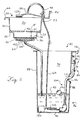
- a parts washer 10 is shown for washing parts including automotive, industrial, and military parts, such as nuts, bolts, valves, pistons, carburetors, transmission parts, and the like, that have been fouled with organic and particulate matter.
- the parts washer 10 is preferably manufactured from a plastic material.
- the parts washer 10 is constructed from a high density polyethylene.
- the parts washer 10 may also be made from a variety of materials including other plastics (e.g. polyvinyl chloride or polypropylene), as well as stainless steel, fiberglass, or the like without departing from the spirit and scope of the invention.
- the parts washer 10 generally comprises a first chamber 20, such as a sink or basin, and a second chamber 80, such as a tank or housing.
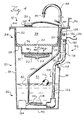
- the first chamber 20 includes side walls 32 that extend downwardly to a bottom panel 22 that has an opening 24 for draining a washing liquid 82 as shown in FIG. 2.
- the side walls 32 and the bottom panel 22 of the first chamber 20 define a cavity 26 for washing parts.
- An upper ledge 28 and lower ledge 30 are preferably formed in the sidewalls 32 of the first chamber 20 for supporting various components of the part washer 10.
- the upper ledge 28 and lower ledge 30 preferably encircle the cavity 26 and overflow drain holes 34 are formed in the side walls 32 between the upper ledge 28 and lower ledge 30, as shown in FIG. 4.
- a false bottom member 36, a porous medium 38, and a support grid 40 are preferably positioned within the first chamber 20.
- the support grid 40 is preferably rectangular and positioned on the bottom panel 22 of the first chamber 20.
- the support grid 40 is used to support the porous medium 38.
- the porous medium 38 rests upon the lower ledge 30 and the support grid 40.
- the porous medium 38 may function to strain particulate matter from the washing liquid 82 as well as a vehicle for bringing a microorganism in contact with the washing liquid 82, as discussed below.
- the porous medium 38 is preferably rated between about 10 to 25 microns and does not have an affinity for hydrocarbons, such as polyester.
- the porous medium 38 may be constructed from a variety of materials such as cotton, cellulose, polyolefin fibers, polyester fibers, fiberglass, or the like without departing from the spirit and scope of the invention.
- the false bottom member 36 is preferably positioned above the porous medium 38 on the upper ledge 28 such that the false bottom member 36 partitions the cavity 26.
- the false bottom member 36 is capable of supporting a variety of parts to be cleaned.
- the false bottom member 36 provides easy access to the porous medium 38 by allowing a user to simply lift the false bottom member 36 out of the cavity 26 to expose the porous medium 38.
- the false bottom member 36 further contacts the side walls 32 of the first chamber 20.
- the false bottom member 36 includes a drain hole 42 that may be closed or have a strainer (not shown) therein.
- the first chamber 20 has an outer ledge 44 that extends around its periphery and a back-splash 46 that extends upwardly from a rear portion of the outer ledge 44.
- the first chamber 20 also has a flexible faucet 48 that extends from the rear portion of the outer ledge 44 and terminates in the form of a nozzle 50.
- the size and shape of the first chamber 20 may be modified without departing from the spirit and scope of the invention.
- the side walls 32, bottom panel 22, upper ledge 28, lower ledge 30, outer ledge 44, and back-splash 46 may be formed as a single, molded, unitary piece.
- an alarm may be used to indicate when there is an overflow of the washing liquid 82 in the first chamber 20.
- a thermo-sensor 81 may be used to detect heat from the washing liquid when it rises to a certain level in the first chamber 20.
- other devices may be used to detect an overflow of the washing liquid 82 in the first chamber 20.
- a lever 140 containing a spoon-like end may be mounted on a pivot or pin 144.
- the lever 140 is located below an overflow outlet 146 of the first chamber 20 and is in contact with a switch 142.
- the spoon-like end has a small hole at the bottom to let accumulated liquid drip out.
- the lever 140 will pivot because of the weight of the fluid and actuate the switch 142 triggering a warning lamp or buzzer.
- the second chamber 80 of the parts washer 10 has an upper end 84 and a lower end 86.
- the second chamber 80 includes side walls 88 and a bottom 90 that define a cavity 92 therebetween.
- the second chamber 80 may also include handles (not shown) at each end for lifting the parts washer 10.
- the second chamber 80 may be constructed from a polyolefin plastic, preferably polyethylene.
- the first compartment 20 may be mounted or secured to the upper end 84 of the second chamber 80.
- the arrangement of the first chamber 20 with the second chamber 80 as well as the size and shape of the chambers may be modified without departing from the spirit and scope of the invention.
- the second chamber 80 may remain stationary while the first chamber 20 may be transported to a desired work area as shown in FIG. 1 and 3.
- the parts washer 10 may use the condensed water vapor from the second chamber 80 as a source of a clean distilled rinse water to rinse parts in the first chamber 20.
- the parts washer includes a modular controller 100 that is preferably fastened or mounted to the second chamber 80 by two clamps 118.
- the modular controller 100 has an upper portion 102 and a lower portion 104.
- the modular controller 100 preferably passes through a hole 106 in the second chamber 80 and is sealed to the second chamber 80 with a feed-through disc 108.
- the modular controller 100 may be modified without departing from the spirit and scope of the invention.
- the modular controller may be disposed completely outside of the second chamber 80.
- the heater could transmit heat through the side or bottom of the second chamber 80 and the temperature sensor could detect the temperature of the washing liquid 82 through the walls or bottom of the second chamber 80.
- the heater may be a flat pad, and the level sensor could detect the weight of the washing liquid 82 by sensing the force of fluid on the bottom of the tank.
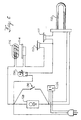
- the modular controller 100 further includes a heater 110, thermostat 111, and high limit protection thermostat 112 (see FIG. 6) that are coupled to the lower portion 104 of the modular controller 100.
- a level probe 116 such as a float actuated switch having a switch equipped float, and over temperature protection thermostat 114 may also be attached to the lower portion 86 of the modular controller 100 to monitor the level of the washing liquid 82 and to limit the sheath temperature of the heater 110.
- the thermostat 111 cycles power to the heater 110 to heat the washing liquid 82 to a desired temperature.
- the washing liquid 82 is preferably maintained in a temperature range which supports an environment for microorganisms employed within the parts washer 10.
- the washing liquid is heated between about 105 to 115 degrees Fahrenheit.
- the thermostat 111 senses that the temperature of the washing liquid 82 within the second chamber 80 is below a desired temperature, the heater 110 is turned on, and when the thermostat 111 senses that the temperature of the washing liquid 82 is at or above the desired temperature, the heater 110 is turned off.
- the high limit protection thermostat 112 turns off the heater 110 if the thermostat 111 does not open and the temperature of the fluid reaches about 135 degrees F.
- the over protection thermostat 114 interrupts power to the heater 110 if the sheath temperature of the heater 110 reaches 170 degrees F.
- the heater 110 is further controlled by a level switch 117 of the level probe 116. When the level switch 117 senses a low level of the washing liquid 82, the level switch 117 disables the heater 110 and causes a low level warning buzzer to sound.
- a warning buzzer 150 is wired across the high limit protection thermostat 112, the over temperature protection thermostat 114, and the level switch 117 to sound a warning should any of these components be open and the thermostat 111 is closed. In normal operation, the buzzer 150 will also indicate the need for more washing liquid 82. Continued operation of the buzzer 150 after fluid level is restored indicates a thermostat or component failure and may require a replacement modular controller 100.
- the modular controller 100 is in electrical communication with a circulation mechanism 124, such as a pump or a pneumatic column pump.
- the circulation mechanism 124 plugs into a receptacle 126 of the modular controller 100 and is disposed in the second chamber 80.
- the circulation mechanism 124 also has a liquid transfer line 129, such as a tube or conduit, that extends to the first chamber 20.
- the circulating mechanism 124 is preferably activated when motion is sensed in the first chamber 20 or when a brush 123 is used.
- the first chamber 20 and second chamber 80 have an opening in one of their sides to allow a motion sensing device 128 to detect motion.
- the motion sensing device 128 is integrated with a timer switch (not shown). For example, the circulation mechanism 124 will automatically shut off after the motion sensing device does not detect activity in the first chamber 20 for about four minutes.
- the circulation mechanism 124 may also be manually activated by switch 130, such as an electrical switch or pneumatic switch, in order to allow continuous operation of the circulation mechanism 124 for a steady flow of washing liquid 82 over a part, to empty the liquid into a bucket, or in the event the sensor malfunctions.
- switch 130 such as an electrical switch or pneumatic switch
- the switch may take many forms such as a foot switch without departing from the spirit and scope of the invention. If the motion sensor 128 and switch 130 of modular controller fail, the circulation mechanism 124 may be plugged directly into a receptacle, such as a wall receptacle, until the modular controller 100 is replaced or fixed. Thus, the user is able to wash parts during most failure conditions.
- the parts washer 10 may have a plurality of circulation mechanisms without departing from the spirit and scope of the invention.
- a circulation mechanism may be used in conjunction with the first chamber 20 for circulating the washing liquid 82 only in the first chamber 20.
- the flow rate of the washing liquid 82 in the first chamber 20 may be at a different rate than the flow rate of the washing liquid 82 between the first and second chambers.
- the device may be equipped with pre-treatment chamber 60, such as a tank.
- the pre-treatment chamber 60 may be used alone as a soaker tank or with the parts washer 10.
- the pre-treatment chamber 60 is preferably molded in polyolefin plastic, such as polyethylene.
- a flexible tube 62 made of rubber or plastic, is preferably attached through the side 61 of the chamber 60.
- the tube 62 may be held by a clip or retainer 44 in an upright position to prevent the washing liquid 82 from draining into the part washer 10 or a waste receptacle.
- the pretreatment chamber 60 also has a porous medium pad 66 which is preferably in contact with a plastic film bag 68, which may have an elastic perimeter band 70.
- the elastic perimeter band 70 fits into a groove 72 in the pre-treatment chamber 60.
- a porous medium support 68 is placed under the porous medium pad 66 to provide a reservoir for the washing liquid 82.
- the porous medium pad 66 filters harmful fibers, such as asbestos, from the washing liquid 82 if used to clean automotive brakes. Because the washing fluid 82 in the pre-treatment chamber 60 can be retained until the organic matter is virtually eliminated, the pre-treatment chamber 60 allows waste to be discharged into publicly operated treatment facilities or into the parts washer 10.
- the second chamber 80 of the part washer 10 is preferably filled with a washing liquid 82 for separating organic matter from objects.
- the washing liquid 82 is not toxic to microorganisms.
- the washing liquid 82 is used to separate organic and particulate waste from the parts washed in the first chamber 20.
- the washing liquid 82 is a free flowing aqueous solution with a specific gravity of 1.083, including a slight pleasant odor, no flash point, a boiling point of 210 degrees Fahrenheit, a pH of approximately seven, and infinitely soluble in water.
- the washing liquid 82 is preferably a mixture of pH neutral emulsifiers and surfactants containing no volatile organic compounds, phosphates, formaldehyde, biocides, or other toxic materials.
- the emulsifier and surfactants are blended in liquid form to produce a biodegradable, non-toxic, non-caustic, non-flammable oil dispersant cleaner and degreaser.
- a suitable washing liquid is available from Advanced Bioremediation Systems, such as SurfzymeTM (solution #5 in Table 1), or Safeworld Products SW-2.
- a biological component is added to the washing liquid 82 to break down organic wastes in the washing liquid 82.
- the biological component is preferably in the form of microorganisms that biodegrade organic compounds, such as hydrocarbons, oils, greases, petroleum by-products, creolates, and other carbon based compositions.
- the microorganisms generally convert hydrocarbon compounds and chlorinated solvents into elements of water, carbon dioxide, and other digestion products.
- the microorganisms are preferably nonpathogenic and may include those from the genera Bacillus, Micrococcus, Acinetobacter, Rhodococcus, Nocardia, Pseudomonas, Flavobacterium, Saccharomyces, Candida, and White Rot Fungus.
- microorganisms which may degrade other carbon based compositions, i.e. the long-chain polymers compounds found in structural plastics such as the polyolefins, styrenes, neoprenes, and the like, are not suitable if the physical structure of the parts washer or the parts being washed is degradable by the microorganisms.
- Suitable microorganisms are available from ABS Inc. of Duluth, Georgia, part Number PWM-25 or from Louisiana Remediation as LRC-1.
- microbes disclosed herein are combined, there is no guarantee of compatibility. Even species within a genus may or may not be compatible. There are no hard and fast rules regarding combinations and most academic work done has been in pure culture so there are no guidelines. It is general knowledge that most manufactures of microbes use up to 5 genera and 15 different species in total just for hydrocarbon degradation. The actual role of each species are generally completely undefined after 20 years of such business activity.
- the microorganisms are preferably added directly to the washing liquid 82 of the part washer 10 in a dormant state.
- the microorganisms may be added to the parts washer 10 in a variety of ways without departing from the spirit and scope of the invention.
- the microorganisms may be attached to the porous medium with an adhering agent, such as 3M Super 77 adhesive, or an encapsulating agent 84 that is water soluble, and then released when the washing liquid 72 is introduced into the porous medium.
- the microorganisms may also be subjected to a preservation technique in an effort to ensure their viability in the field and their resistance to environmental shock.
- nutrient and buffer components such as agar, and water soluble adhesives, such as gum, are preferably mixed with the microorganisms to promote stability of the microorganisms prior to mixing the microorganisms with a carrier.
- the carrier is preferably composed of inert and nutrient organic materials that preserve and protect the microorganisms during storage and transportation.
- microorganisms may be employed in combination with nitrifying or denitrifying bacteria, phosphate solubilizing strains of microorganisms, bioemulsifier producing strains of microorganisms, and strains of microorganisms which produce growth factors, such as B-vitamins, without departing from the spirit and scope of the invention.
- Critical macronutrients such as nitrogen and phosphorus, may also be combined with the microbial formulation or blended with the surfactant to enhance biodegradation for the oil and grease.
- micro-nutrients may be limited in certain cases that require supplementing. Micronutrients requirements for effective biological oxidation and a Figure indicating the benefit of nutrient addition versus enhanced BOD removal is provided in Tables 2 and 3.
- the circulation mechanism 124 circulates the washing liquid 82 from the second chamber 80 through the conduit 48 and nozzle 50 or pressurized spray jets to the first chamber 20 to wash the surfaces of the object in contact with the washing liquid 82.
- the washing liquid 82 is used to separate organic waste from the object being washed.
- the washing liquid 82, along with the organic waste and any small particulate washed from the part then flows by gravity through the drain hole 42 of the false bottom member 36.
- the strainer (not shown) will, of course, keep certain objects from passing through the drain hole 42. Thereafter, the washing liquid 82, organic waste, and remaining matter then flow into the cavity or opening containing the porus medium 38.
- the porous medium 38 traps the particulate matter and allows the organic contaminants and washing liquid 82 to pass therethrough. Because the porous medium 38 does not collect the organic contaminants, it is capable of being disposed of as solid waste. If the porous medium 38 contains microorganisms, the washing liquid 82 will release the microorganisms. The released microorganisms then flow with the washing liquid 82 and organic contaminants through the support grid 40 into the second chamber 80. If the flow of the washing liquid 82 becomes obstructed in the first chamber 20, the washing liquid 82 may flow through a pair of supplemental drain holes 34 defined through the rear of the second chamber 80 as shown in FIG. 4.
- the second chamber 80 a large percentage of the microorganisms and organic contaminants will tend to accumulate proximate to the surface of the washing liquid 82 such that a large portion of the biodegradation takes place proximate to the surface of the washing liquid 82.
- the vapor may be condensed, collected, and used in a closed-loop source for rinsing. If organic waste increasingly accumulates toward the surface of the washing liquid 82 in the second chamber 80, the microorganisms may need to be replenished.
- the second chamber 80 usually does not need to be dredged of any waste.
- the washing liquid 82 is re-circulated to the first chamber 20.
- the temperature, pressure, or flow of the washing liquid 82 in the first chamber 20 may be greater or less than in the second chamber 80 without departing from the spirit and scope of the invention. Further, the temperature, pressure, or flow of the washing liquid 82 in the first chamber 20 may not be optimum for bioremediation.
Landscapes
- Life Sciences & Earth Sciences (AREA)
- Chemical & Material Sciences (AREA)
- Microbiology (AREA)
- Engineering & Computer Science (AREA)
- Organic Chemistry (AREA)
- Environmental & Geological Engineering (AREA)
- Hydrology & Water Resources (AREA)
- Biodiversity & Conservation Biology (AREA)
- Water Supply & Treatment (AREA)
- Health & Medical Sciences (AREA)
- Wood Science & Technology (AREA)
- Zoology (AREA)
- Bioinformatics & Cheminformatics (AREA)
- Genetics & Genomics (AREA)
- Biotechnology (AREA)
- General Health & Medical Sciences (AREA)
- Oil, Petroleum & Natural Gas (AREA)
- Biochemistry (AREA)
- General Engineering & Computer Science (AREA)
- Chemical Kinetics & Catalysis (AREA)
- Medicinal Chemistry (AREA)
- Virology (AREA)
- Mycology (AREA)
- Biomedical Technology (AREA)
- General Chemical & Material Sciences (AREA)
- Tropical Medicine & Parasitology (AREA)
- Cleaning By Liquid Or Steam (AREA)
- Processing Of Solid Wastes (AREA)
- Apparatus Associated With Microorganisms And Enzymes (AREA)
- Enzymes And Modification Thereof (AREA)
- Detergent Compositions (AREA)
- Micro-Organisms Or Cultivation Processes Thereof (AREA)
- Filtering Materials (AREA)
- Purification Treatments By Anaerobic Or Anaerobic And Aerobic Bacteria Or Animals (AREA)
- Biological Treatment Of Waste Water (AREA)
Applications Claiming Priority (5)
| Application Number | Priority Date | Filing Date | Title |
|---|---|---|---|
| US370898 | 1982-04-22 | ||
| US31590294A | 1994-09-30 | 1994-09-30 | |
| US315902 | 1994-09-30 | ||
| US37089895A | 1995-01-10 | 1995-01-10 | |
| EP19950936304 EP0784518B2 (de) | 1994-09-30 | 1995-09-29 | Vorrichtung zum mikrobiologischen waschen von teilen |
Related Parent Applications (1)
| Application Number | Title | Priority Date | Filing Date |
|---|---|---|---|
| EP19950936304 Division EP0784518B2 (de) | 1994-09-30 | 1995-09-29 | Vorrichtung zum mikrobiologischen waschen von teilen |
Publications (2)
| Publication Number | Publication Date |
|---|---|
| EP1197269A2 true EP1197269A2 (de) | 2002-04-17 |
| EP1197269A3 EP1197269A3 (de) | 2002-05-08 |
Family
ID=26980122
Family Applications (2)
| Application Number | Title | Priority Date | Filing Date |
|---|---|---|---|
| EP20020000396 Withdrawn EP1197269A3 (de) | 1994-09-30 | 1995-09-29 | Vorrichtung zum mikrobiologischen Waschen von Teilen |
| EP19950936304 Expired - Lifetime EP0784518B2 (de) | 1994-09-30 | 1995-09-29 | Vorrichtung zum mikrobiologischen waschen von teilen |
Family Applications After (1)
| Application Number | Title | Priority Date | Filing Date |
|---|---|---|---|
| EP19950936304 Expired - Lifetime EP0784518B2 (de) | 1994-09-30 | 1995-09-29 | Vorrichtung zum mikrobiologischen waschen von teilen |
Country Status (14)
| Country | Link |
|---|---|
| US (3) | US6571810B1 (de) |
| EP (2) | EP1197269A3 (de) |
| JP (1) | JPH10506797A (de) |
| KR (1) | KR100362009B1 (de) |
| CN (1) | CN1167517C (de) |
| AT (1) | ATE219704T1 (de) |
| AU (1) | AU709648B2 (de) |
| BR (1) | BR9509114A (de) |
| CA (2) | CA2435648A1 (de) |
| DE (2) | DE29522341U1 (de) |
| ES (1) | ES2176341T5 (de) |
| MX (1) | MX9702387A (de) |
| PT (1) | PT784518E (de) |
| WO (1) | WO1996011072A2 (de) |
Cited By (4)
| Publication number | Priority date | Publication date | Assignee | Title |
|---|---|---|---|---|
| US6571810B1 (en) | 1994-09-30 | 2003-06-03 | Zymo International, Inc. | Parts washing system |
| FR2844464A1 (fr) * | 2002-09-16 | 2004-03-19 | Fillon Investissement | Installation de nettoyage d'objets divers |
| EP1872874A1 (de) * | 2006-06-30 | 2008-01-02 | Ulrich Berens | Vorrichtung zum Reinigen von mit Öl oder Fett verschmutzten Maschinenteilen |
| WO2011082480A1 (en) * | 2010-01-05 | 2011-07-14 | Jacques St-Pierre | Bioremediation device |
Families Citing this family (45)
| Publication number | Priority date | Publication date | Assignee | Title |
|---|---|---|---|---|
| WO1996011071A2 (en) * | 1994-09-30 | 1996-04-18 | Chemfree Corporation | Parts washing system |
| DE10032351A1 (de) * | 1999-07-23 | 2001-01-25 | Heidelberger Druckmasch Ag | Farbwerk in einer Druckmaschine |
| IT1319025B1 (it) * | 2000-10-26 | 2003-09-19 | Rosauto Srl | Vasca di lavaggio per freni di veicoli industriali e simili. |
| US6503394B1 (en) * | 2000-11-15 | 2003-01-07 | Stephen A. Hoyt | Digester method and system for processing farm waste |
| FR2824802B1 (fr) * | 2001-05-15 | 2003-08-15 | Culasse Europ Service | Dispositif pour le nettoyage de pieces automobiles |
| US20030203118A1 (en) * | 2002-04-26 | 2003-10-30 | Wickes Roger D. | Oscillating dispersion apparatus, system, and method |
| US6762047B2 (en) | 2002-06-24 | 2004-07-13 | Osprey Biotechnics, Inc. | Bacterial parts washer, composition and method of use |
| DE10252634A1 (de) * | 2002-11-11 | 2004-05-27 | Umwelttechnik Georg Fritzmeier Gmbh & Co. | Reinigungsmittel und Verfahren zu seiner Herstellung |
| KR20050103916A (ko) * | 2003-02-04 | 2005-11-01 | 포워드 테크놀로지 에이 크레스트 그룹 컴퍼니 | 초음파 세척 탱크 |
| US6874512B2 (en) * | 2003-04-10 | 2005-04-05 | Safety-Kleen Systems, Inc. | Parts washer with improved temperature and pump control |
| FR2854824B1 (fr) * | 2003-05-16 | 2005-07-08 | Clean 3 Bio System | Procede et installation pour le nettoyage de pieces souillees par de la matiere organique par bio-depollution |
| US7128075B2 (en) * | 2003-12-01 | 2006-10-31 | Safety-Kleen Systems, Inc. | Parts washing apparatus |
| KR100522716B1 (ko) * | 2004-02-20 | 2005-10-19 | 학교법인 한림대학교 | 지오트리쿰 속 균주가 고정된 바이오필터 및 이를 이용한메틸에틸케톤의 제거방법 |
| GB0405337D0 (en) * | 2004-03-09 | 2004-04-21 | Petty Robert H | Paint spraygun cleaner |
| US7674251B2 (en) * | 2004-04-08 | 2010-03-09 | Boston Scientific Scimed, Inc. | Medical devices including aerated adhesive bonds and methods of forming the same |
| US20050273955A1 (en) * | 2004-06-11 | 2005-12-15 | Rogus Thomas E | Bar stock degreasing machine |
| DE102006036633A1 (de) * | 2006-08-03 | 2008-02-07 | Schickert Gmbh & Co. Kg | Verfahren zur Reinigung von Kleinteilen, Maschinenteilen, odgl; Reinigungsgerät |
| US7740711B2 (en) * | 2006-11-02 | 2010-06-22 | Safety-Kleen Systems, Inc. | Parts washer heater pump module |
| US8220471B2 (en) * | 2007-03-02 | 2012-07-17 | Safety-Kleen Systems, Inc. | Multipurpose aqueous parts washer |
| US20080210260A1 (en) * | 2007-03-02 | 2008-09-04 | Safety-Kleen Systems, Inc. | Multipurpose Aqueous Parts Washer |
| US20080303388A1 (en) * | 2007-06-07 | 2008-12-11 | Petrovich Andy | Surgical cart with a mister |
| DE102007034464B4 (de) * | 2007-07-20 | 2011-07-14 | ph-cleantec GmbH, 70736 | Reinigungsgerät |
| KR100915960B1 (ko) * | 2007-07-25 | 2009-09-10 | (주)클레슨 | 바이오 초음파 세척장치 |
| WO2009067753A1 (en) * | 2007-11-28 | 2009-06-04 | Wasabi (Holdings) Pty Ltd | Liquid treatment apparatus |
| US8141477B2 (en) * | 2008-05-13 | 2012-03-27 | William Broderick | Mash/lauter tun and method of use thereof |
| ITPD20080262A1 (it) * | 2008-09-12 | 2010-03-12 | Vemec S R L | Apparecchiatura per il lavaggio di aerografi e/o per il lavaggio di piccoli pezzi |
| EP2415532B1 (de) * | 2010-08-02 | 2015-09-16 | NCH Corporation | Teilewaschvorrichtung und Verfahren zum Waschen von Teilen |
| CA2839515A1 (en) * | 2011-06-17 | 2012-12-20 | Duke Manufacturing Co. | Kitchenware washing assemblies and related methods |
| GB201117910D0 (en) * | 2011-10-15 | 2011-11-30 | Safety Kleen Europ Ltd | Parts washing machiine |
| CN102580956B (zh) * | 2012-02-20 | 2014-01-29 | 陕西科技大学 | 一种毛细不锈钢管内壁清洗设备及方法 |
| USD750852S1 (en) * | 2012-09-07 | 2016-03-01 | Sata Gmbh & Co. Kg | Paint spray gun cleaning device |
| USD733979S1 (en) | 2012-10-26 | 2015-07-07 | Chemfree Corporation | Parts washer |
| USD735957S1 (en) | 2012-10-29 | 2015-08-04 | Chemfree Corporation | Parts washer |
| USD747567S1 (en) | 2012-10-26 | 2016-01-12 | Chemfree Corporation | Parts washer |
| US9132455B2 (en) | 2012-10-29 | 2015-09-15 | Chemfree Corporation | Portable parts washer |
| MX358003B (es) * | 2013-03-22 | 2018-07-25 | Decisiones Ambientales S A De C V | Sistema y método para el lavado de partes mecánicas. |
| KR101489439B1 (ko) * | 2013-05-16 | 2015-02-03 | 경북대학교 산학협력단 | 유용미생물을 이용한 유기물 세척기 |
| EP3187272B1 (de) * | 2015-12-30 | 2022-08-31 | Bio-Circle Surface Technology GmbH | Station zur reinigung von mit lacken und farben behafteten werkzeugen oder systemteilen sowie reinigungsverfahren in einem stationären system |
| BE1024938B1 (nl) * | 2017-01-25 | 2018-08-27 | Living Technologies Coöperatieve Vennootschap Met Beperkte Aansprakelijkheid | Werkwijze voor het schoonmaken van oppervlakken in binnenruimten en in technische installaties |
| KR101869643B1 (ko) * | 2017-02-27 | 2018-07-20 | 문태주 | 친환경 신재생 지능형 세척시스템 |
| US11285505B2 (en) * | 2019-12-19 | 2022-03-29 | MTI Baths, Inc. | Waterfall sink |
| US12285808B2 (en) * | 2020-08-20 | 2025-04-29 | The Boeing Company | Coupling systems and methods of use thereof |
| US12569889B1 (en) * | 2022-09-09 | 2026-03-10 | Alliance Manufacturing, Inc. | Gas heating system for a parts washing machine, and to the method of converting an electric parts washing machine to a gas parts washing machine |
| US12539529B2 (en) * | 2023-01-29 | 2026-02-03 | Ronald Bluestone | Combination parts jet washer and sink washer with parts washer with minimum grip sprocket drive system |
| KR102808255B1 (ko) | 2024-12-04 | 2025-05-15 | 김인수 | 차량부품의 이물질 제거장치 |
Family Cites Families (53)
| Publication number | Priority date | Publication date | Assignee | Title |
|---|---|---|---|---|
| SU80983A1 (ru) | 1948-12-13 | 1949-11-30 | Ф.В. Соловей | Устройство дл мыть и обезжиривани деталей |
| US2675012A (en) * | 1952-10-18 | 1954-04-13 | Frank J Scales | Washing apparatus for automotive and machine parts and assmeblies |
| US3352310A (en) | 1965-03-15 | 1967-11-14 | Robert E Doyscher | Parts washer |
| US3378019A (en) * | 1966-04-08 | 1968-04-16 | Albert Armato | Parts washers |
| US3522814A (en) * | 1968-12-06 | 1970-08-04 | Safety Kleen Corp | Washer for parts and the like |
| US3856667A (en) | 1970-06-03 | 1974-12-24 | Bioteknika Int Inc | Microbial degradation of petroleum |
| US3707404A (en) | 1971-05-12 | 1972-12-26 | Build All Fabricating Inc | Parts washer and method of solvent cleaning |
| SU452392A1 (ru) | 1972-08-07 | 1974-12-05 | Уральский автомобильный завод | Пуансон дл правки полых деталей |
| US3970560A (en) * | 1974-09-20 | 1976-07-20 | Metzger Herman U | Parts washer |
| US3960728A (en) * | 1975-03-12 | 1976-06-01 | Safety-Kleen Corporation | Disposable filter apparatus |
| US3971394A (en) | 1975-04-28 | 1976-07-27 | Osborne Irving R | Apparatus for cleaning vehicle parts |
| US4056114A (en) | 1975-06-03 | 1977-11-01 | Boutillette Arthur A | Parts washer and filter assembly therefor |
| US4213475A (en) | 1979-02-05 | 1980-07-22 | Minkin Gary E | Power parts washer |
| US4351729A (en) | 1980-02-06 | 1982-09-28 | Celanese Corporation | Biological filter and process |
| US4407717A (en) | 1980-12-08 | 1983-10-04 | Sterling Drug Inc. | Wastewater treatment process |
| US4670149A (en) * | 1985-02-25 | 1987-06-02 | John Francis | Bacterial incubator and method of use |
| US4925564A (en) * | 1985-02-25 | 1990-05-15 | Robert B. Grubbs | Bacterial incubator and method of use |
| US4713343A (en) | 1985-08-29 | 1987-12-15 | The United States Of America As Represented By The Administrator Of The U.S. Environmental Protection Agency | Biodegradation of halogenated aliphatic hydrocarbons |
| SU1496841A1 (ru) | 1987-01-05 | 1989-07-30 | М. И. Кубицкий | Установка дл мойки изделий |
| US4952315A (en) * | 1987-05-05 | 1990-08-28 | Nabil Saab | Method, system and emulsifier substance for treatment of materials containing harmful substances |
| SE8801511L (sv) * | 1987-09-21 | 1989-03-22 | Lars Aake Hilmer Haakansson | Avfettningsfoerfarande och anordning daerfoer |
| US4765020A (en) * | 1987-11-30 | 1988-08-23 | Weihe Clyde R | Silverware washing machine |
| DE3815271A1 (de) * | 1988-05-05 | 1989-11-16 | Sandoz Ag | Verfahren zur reinigung von industrieabwaessern |
| US5037551A (en) | 1988-12-19 | 1991-08-06 | Weyerhaeuser Company | High-flow rate capacity aerobic biological dehalogenation reactor |
| US4995409A (en) * | 1990-01-29 | 1991-02-26 | Watts Craig L | Automotive parts washer utilizing a volatile cleaning solution |
| US5039415A (en) | 1990-04-23 | 1991-08-13 | Smith Alvin J | Decontamination of hydrocarbon contaminated soil |
| RU2014286C1 (ru) | 1990-05-24 | 1994-06-15 | Государственный научно-исследовательский институт биосинтеза белковых веществ | Способ очистки воды и почвы от нефтепродуктов |
| NL9100063A (nl) * | 1991-01-15 | 1992-08-03 | Pacques Bv | Werkwijze en inrichting voor de biologische behandeling van vast organisch materiaal. |
| US5401413A (en) * | 1991-02-11 | 1995-03-28 | Yissum Research Development Company Of The Hebrew University Of Jerusalem | Method for enhancing the biodegradation of biodegradable organic wastes |
| WO1992016314A1 (en) | 1991-03-12 | 1992-10-01 | Haakansson Lars | A device for cleaning objects, preferably of metal |
| DE4116082C2 (de) * | 1991-05-16 | 1994-10-20 | Dlk Ventilatoren Gmbh | Verfahren und Vorrichtung zur Abwasseraufbereitung bei Autowaschanlagen |
| US5209851A (en) * | 1991-06-11 | 1993-05-11 | Hume Frank C | Remediation methods for toxic materials |
| US5225083A (en) * | 1991-08-12 | 1993-07-06 | Pappas Thomas C | Method for bioremediation of grease traps |
| DE4209052A1 (de) | 1991-08-16 | 1993-02-25 | Peter Prof Dr Kunz | Anlage und verfahren zur mikrobiellen entfettung/entoelung von oberflaechen |
| DE4138400C1 (de) * | 1991-11-22 | 1993-02-18 | Aichelin Gmbh, 7015 Korntal-Muenchingen, De | |
| US5935843A (en) * | 1992-02-13 | 1999-08-10 | Osprey Biotechnics, Inc. | Method and apparatus for waste degradation |
| US5413713A (en) * | 1992-04-15 | 1995-05-09 | Day; Donal F. | Method for increasing the rate of anaerobic bioremediation in a bioreactor |
| DE69305847T2 (de) * | 1992-05-04 | 1997-03-20 | Alliedsignal Inc., Morristown, N.J. | Einrichtung und verfahren zu beseitigung von schmutzstoffen aus abwasser |
| DE4225967A1 (de) * | 1992-08-06 | 1994-02-10 | Dyckerhoff & Widmann Ag | Verfahren zur Behandlung von Öl-Wasser-Emulsionen, insbesondere aus Autowaschanlagen |
| ATE186757T1 (de) * | 1992-09-14 | 1999-12-15 | Aamot Haldor | Reinigung- und spülverfahren für industrielle produkte |
| US5303725A (en) | 1993-02-18 | 1994-04-19 | Kleer-Flo Company | Machine part cleaning apparatus |
| JPH0785767B2 (ja) * | 1993-03-09 | 1995-09-20 | 栄一 吉田 | ろ過装置 |
| US5314620A (en) * | 1993-04-02 | 1994-05-24 | Harvey Universal, Inc. | Cutting oil treatment |
| US5413714A (en) | 1993-04-16 | 1995-05-09 | Alliedsignal Inc. | Process for biological remediation of vaporous pollutants |
| US5398708A (en) | 1993-04-16 | 1995-03-21 | Sheldon; Morris W. | Parts cleaning machine |
| JP2963317B2 (ja) * | 1993-09-27 | 1999-10-18 | 日本バイリーン株式会社 | 立体状不織布及びその製造法 |
| DE4340058A1 (de) * | 1993-11-24 | 1995-06-01 | Aamot Haldor | Verfahren zum Aufarbeiten gebrauchter Entfettungs- und Reinigungslösungen |
| US5368653A (en) | 1994-01-10 | 1994-11-29 | Layfield Company, Inc. | Parts washer for cleaning mechanical parts |
| US5364789A (en) * | 1994-01-14 | 1994-11-15 | Guinn Lloyd J | Microbial cleaner |
| US6069002A (en) * | 1994-04-11 | 2000-05-30 | Aplc, Inc. | System and process for in tank treatment of crude oil sludges to recover hydrocarbons and aid in materials separation |
| US5492139A (en) * | 1994-08-01 | 1996-02-20 | B&S Research, Inc. | Method and apparatus for remediating contaminated material |
| US6571810B1 (en) | 1994-09-30 | 2003-06-03 | Zymo International, Inc. | Parts washing system |
| EP4209052A4 (de) | 2021-01-14 | 2024-05-29 | ZTE Corporation | Verfahren, vorrichtungen und systeme zur konfiguration eines erweiterten nichtöffentlichen netzwerks |
-
1995
- 1995-08-04 US US08/511,506 patent/US6571810B1/en not_active Expired - Fee Related
- 1995-09-29 KR KR1019970701963A patent/KR100362009B1/ko not_active Expired - Lifetime
- 1995-09-29 DE DE29522341U patent/DE29522341U1/de not_active Expired - Lifetime
- 1995-09-29 MX MX9702387A patent/MX9702387A/es not_active IP Right Cessation
- 1995-09-29 ES ES95936304T patent/ES2176341T5/es not_active Expired - Lifetime
- 1995-09-29 BR BR9509114A patent/BR9509114A/pt not_active IP Right Cessation
- 1995-09-29 CA CA 2435648 patent/CA2435648A1/en not_active Abandoned
- 1995-09-29 WO PCT/US1995/013042 patent/WO1996011072A2/en not_active Ceased
- 1995-09-29 EP EP20020000396 patent/EP1197269A3/de not_active Withdrawn
- 1995-09-29 CN CNB951964992A patent/CN1167517C/zh not_active Expired - Fee Related
- 1995-09-29 CA CA 2201314 patent/CA2201314C/en not_active Expired - Fee Related
- 1995-09-29 EP EP19950936304 patent/EP0784518B2/de not_active Expired - Lifetime
- 1995-09-29 AU AU38302/95A patent/AU709648B2/en not_active Ceased
- 1995-09-29 AT AT95936304T patent/ATE219704T1/de active
- 1995-09-29 PT PT95936304T patent/PT784518E/pt unknown
- 1995-09-29 DE DE1995627209 patent/DE69527209T3/de not_active Expired - Lifetime
- 1995-09-29 JP JP51269696A patent/JPH10506797A/ja active Pending
-
1997
- 1997-06-02 US US08/867,586 patent/US6318387B1/en not_active Expired - Lifetime
-
2001
- 2001-08-08 US US09/925,634 patent/US6440226B2/en not_active Expired - Fee Related
Cited By (7)
| Publication number | Priority date | Publication date | Assignee | Title |
|---|---|---|---|---|
| US6571810B1 (en) | 1994-09-30 | 2003-06-03 | Zymo International, Inc. | Parts washing system |
| FR2844464A1 (fr) * | 2002-09-16 | 2004-03-19 | Fillon Investissement | Installation de nettoyage d'objets divers |
| WO2004024351A1 (fr) * | 2002-09-16 | 2004-03-25 | Fillon Investissement | Installation de nettoyage d’objets divers |
| CN100348341C (zh) * | 2002-09-16 | 2007-11-14 | 菲永投资公司 | 清洁物体的装置 |
| EP1872874A1 (de) * | 2006-06-30 | 2008-01-02 | Ulrich Berens | Vorrichtung zum Reinigen von mit Öl oder Fett verschmutzten Maschinenteilen |
| WO2008000566A1 (de) * | 2006-06-30 | 2008-01-03 | Ulrich Berens | Vorrichtung zum reinigen von mit öl oder fett verschmutzten maschinenteilen. |
| WO2011082480A1 (en) * | 2010-01-05 | 2011-07-14 | Jacques St-Pierre | Bioremediation device |
Also Published As
| Publication number | Publication date |
|---|---|
| EP1197269A3 (de) | 2002-05-08 |
| CA2201314C (en) | 2003-12-16 |
| PT784518E (pt) | 2002-10-31 |
| ES2176341T5 (es) | 2008-04-01 |
| ATE219704T1 (de) | 2002-07-15 |
| US6318387B1 (en) | 2001-11-20 |
| DE69527209D1 (de) | 2002-08-01 |
| AU709648B2 (en) | 1999-09-02 |
| CA2435648A1 (en) | 1996-04-18 |
| WO1996011072A2 (en) | 1996-04-18 |
| BR9509114A (pt) | 1998-11-03 |
| US6571810B1 (en) | 2003-06-03 |
| CN1171066A (zh) | 1998-01-21 |
| WO1996011072A3 (en) | 1996-05-23 |
| ES2176341T3 (es) | 2002-12-01 |
| MX9702387A (es) | 1998-02-28 |
| EP0784518B2 (de) | 2007-10-10 |
| EP0784518B8 (de) | 2003-01-08 |
| CA2201314A1 (en) | 1996-04-18 |
| DE69527209T3 (de) | 2008-04-03 |
| JPH10506797A (ja) | 1998-07-07 |
| KR100362009B1 (ko) | 2003-03-29 |
| DE69527209T2 (de) | 2003-02-06 |
| EP0784518A2 (de) | 1997-07-23 |
| US6440226B2 (en) | 2002-08-27 |
| DE29522341U1 (de) | 2002-02-28 |
| US20020017314A1 (en) | 2002-02-14 |
| EP0784518A4 (de) | 1998-12-23 |
| EP0784518B1 (de) | 2002-06-26 |
| CN1167517C (zh) | 2004-09-22 |
| AU3830295A (en) | 1996-05-02 |
| KR970706079A (ko) | 1997-11-03 |
Similar Documents
| Publication | Publication Date | Title |
|---|---|---|
| EP0784518B1 (de) | Vorrichtung zum mikrobiologischen waschen von teilen | |
| US6074491A (en) | Parts washing system | |
| WO1996011071A9 (en) | Parts washing system | |
| US8298417B2 (en) | Integrated apparatus and system for the treatment of waste fluids and drain networks | |
| WO1996011072B1 (en) | Microbiological parts washer | |
| US6057147A (en) | Apparatus and method for bioremediation of hydrocarbon-contaminated objects | |
| US5422019A (en) | Method for removing contaminants from industrial cleaning systems | |
| US6328045B1 (en) | Parts washing system | |
| RU2172651C2 (ru) | Система для микробиологической очистки деталей машин и механизмов, микробиологическая моечная установка и способ промывки (варианты) | |
| US20060278255A1 (en) | Method and unit for cleaning pieces contaminated with organic matter | |
| JP2000079302A (ja) | 油脂含有排水の処理方法および装置 |
Legal Events
| Date | Code | Title | Description |
|---|---|---|---|
| PUAI | Public reference made under article 153(3) epc to a published international application that has entered the european phase |
Free format text: ORIGINAL CODE: 0009012 |
|
| PUAL | Search report despatched |
Free format text: ORIGINAL CODE: 0009013 |
|
| AC | Divisional application: reference to earlier application |
Ref document number: 784518 Country of ref document: EP |
|
| AK | Designated contracting states |
Kind code of ref document: A2 Designated state(s): AT BE CH DE DK ES FR GB GR IE IT LI LU MC NL PT SE |
|
| AK | Designated contracting states |
Kind code of ref document: A3 Designated state(s): AT BE CH DE DK ES FR GB GR IE IT LI LU MC NL PT SE |
|
| RIC1 | Information provided on ipc code assigned before grant |
Free format text: 7B 08B 3/00 A, 7C 02F 3/00 B, 7C 12R 1/00 B |
|
| RIN1 | Information on inventor provided before grant (corrected) |
Inventor name: LELAND STRANGE, J Inventor name: MC NALLY, THOMAS W Inventor name: FRANCIS MARK Inventor name: WHITEMAN, G. ROB Inventor name: MEARS, ERIC L. Inventor name: MCCLURE, JAMES C. |
|
| 17P | Request for examination filed |
Effective date: 20021009 |
|
| AKX | Designation fees paid |
Designated state(s): AT BE CH DE DK ES FR GB GR IE IT LI LU MC NL PT SE |
|
| 17Q | First examination report despatched |
Effective date: 20021218 |
|
| RAP1 | Party data changed (applicant data changed or rights of an application transferred) |
Owner name: CHEMFREE CORPORATION Owner name: ZYMO INTERNATIONAL INC. |
|
| STAA | Information on the status of an ep patent application or granted ep patent |
Free format text: STATUS: THE APPLICATION IS DEEMED TO BE WITHDRAWN |
|
| 18D | Application deemed to be withdrawn |
Effective date: 20150401 |