EP1197200B1 - Haarpflegemittel - Google Patents
Haarpflegemittel Download PDFInfo
- Publication number
- EP1197200B1 EP1197200B1 EP01123312A EP01123312A EP1197200B1 EP 1197200 B1 EP1197200 B1 EP 1197200B1 EP 01123312 A EP01123312 A EP 01123312A EP 01123312 A EP01123312 A EP 01123312A EP 1197200 B1 EP1197200 B1 EP 1197200B1
- Authority
- EP
- European Patent Office
- Prior art keywords
- hair care
- salts
- weight
- care composition
- composition according
- Prior art date
- Legal status (The legal status is an assumption and is not a legal conclusion. Google has not performed a legal analysis and makes no representation as to the accuracy of the status listed.)
- Expired - Lifetime
Links
Classifications
-
- A—HUMAN NECESSITIES
- A61—MEDICAL OR VETERINARY SCIENCE; HYGIENE
- A61K—PREPARATIONS FOR MEDICAL, DENTAL OR TOILETRY PURPOSES
- A61K8/00—Cosmetics or similar toiletry preparations
- A61K8/18—Cosmetics or similar toiletry preparations characterised by the composition
- A61K8/19—Cosmetics or similar toiletry preparations characterised by the composition containing inorganic ingredients
- A61K8/29—Titanium; Compounds thereof
-
- A—HUMAN NECESSITIES
- A61—MEDICAL OR VETERINARY SCIENCE; HYGIENE
- A61Q—SPECIFIC USE OF COSMETICS OR SIMILAR TOILETRY PREPARATIONS
- A61Q17/00—Barrier preparations; Preparations brought into direct contact with the skin for affording protection against external influences, e.g. sunlight, X-rays or other harmful rays, corrosive materials, bacteria or insect stings
- A61Q17/04—Topical preparations for affording protection against sunlight or other radiation; Topical sun tanning preparations
-
- A—HUMAN NECESSITIES
- A61—MEDICAL OR VETERINARY SCIENCE; HYGIENE
- A61Q—SPECIFIC USE OF COSMETICS OR SIMILAR TOILETRY PREPARATIONS
- A61Q5/00—Preparations for care of the hair
Definitions
- the present invention relates to an agent for treating human hair, which gives this improved properties, especially wet and dry combability, increased gloss, a full and at the same time loose grip and good grip and at the same time exerts an improved protective effect, especially against environmental influences.
- Means for conditioning human hair have been known for a long time. They usually contain quaternary ammonium compounds which have at least one long-chain alkyl or alkenyl group, and optionally also polymers. Such agents are usually formulated as aqueous dispersions or emulsions, microemulsions, gels or in aerosol form and used as hair rinses, cures, etc.
- An overview of the known hair-aftertreatment agents and their composition can be found in the monograph by K. Schrader, Grundtagen und Phuren der Kosmetika, 2nd ed. (1989), pp. 722 to 781, in particular pp. 728 to 737. However, these known compositions are still capable of improvement.
- a hair treatment agent the hair improved properties, in particular a significantly increased volume effect, easier wet and dry combability and a discreet gloss, a full loose grip and good grip and protection against negative environmental influences is awarded, if this means aqueous-based at least one mica / titania pigment having a particle diameter of at least 90% in the range of 10 to 250 microns, green tea extract, and at least one water-soluble or oil-soluble UV-absorbing substance.
- This agent is, preferably after a shampoo, optionally applied to the hair following a previously performed hair coloring or Treasurewellung, preferably massaged into this and not removed after the action.
- Suitable mica-titanium dioxide pigments which are preferably used in the compositions used for the hair treatment according to the invention in an amount of 0.05 to 10, in particular 0.1 to 5,% by weight, based on the total composition of the composition, are per se known, for example, under the name "Timiron®”. 90% of the particles have a particle diameter in the range of 10 to 250, 80%, preferably between 20 and 150 microns.
- the UV absorbing substance is selected from at least one of the following compounds: 4-aminobenzoic acid and its esters and salts, 2-phenylbenzimidazole-5-sulfonic acid and its alkali and amine salts, 4-dimethylaminobenzoic acid and its esters and salts, cinnamic acid and its esters and salts, 4-methoxycinnamic acid and its esters and salts, salicylic acid and their esters and salts, 2,4-dihydroxybenzophenone, 2,2 ', 4,4'-tetrahydroxybenzophenone, 2-hydroxy-4-methoxybenzophenone and its 5-sulfonic acid or its sodium salt, 2,2'-dihydroxy-4,4 '-dimethoxybenzophenone, 2-hydroxy-5-chlorobenzophenone, 2,2'-dihydroxy-4-methoxybenzophenone, 2,2'-dihydroxy-4,4'-dimethoxy-5,5'-disul
- compositions of the invention contain additional further hair conditioning agents.
- Suitable hair conditioning active ingredients whose amount in the compositions according to the invention are usually from 0.25 to 15, in particular 0.5 to 10, preferably 0.75 to 7.5 wt .-%, based on the total amount of the composition, for example, cationic surfactants , especially quaternary ammonium compounds.
- Suitable long-chain quaternary ammonium compounds which may be used alone or in admixture with each other are, for example cetyltrimethylammonium chloride, Dimethyldicetylammoniumchlorid, trimethylcetylammonium bromide, dimethyldistearylammonium chloride, stearyltrimethylammonium chloride, dimethylstearylbenzylammonium chloride Benzyltetradecylodimethylammoniumchlorid, dimethyl dihydrogenated-tallow ammonium chloride, lauryl pyridinium chloride, lauryldimethylbenzylammonium chloride, behenyltrimethylammonium chloride, lauryltrimethylammonium chloride, tris- (oligooxyethyl) alkylammonium phosphate, cetylpyridinium chloride, etc.
- cetyltrimethylammonium chloride Dimethyldicetylammoniumchlorid,
- Their proportion is preferably 0.5 to 10, in particular 1 to 7.5 wt .-%, calculated on the total composition.
- Particularly suitable long-chain quaternary ammonium compounds are esterquats of the general formula (I) in the R 1 and R 2 is an optionally hydroxy-substituted C 8 -C 22 alkyl or alkenyl group, R 3 and R 4 is a C 1 -C 3 alkyl group or a group -CH 2 -CH 2 -O- [EO ] z H and x, y and z are 0 to 5 and Y - stand for an anion.
- a particularly preferred esterquat in the context of the invention is one in which the radicals R 1 and R 2 are each an oleyl group or a C 12 -C 18 -alkyl group, the radical R 3 is a methyl group and the radical R 4 is a group -CH 2 Mean -CH 2 -O- [E0] z -H.
- the anion Y - is preferably a halide such as Cl - or Br - , a lower alkyl sulfate, such as methosulfate and ethosulfate, or an alkyl phosphate, but of course other radicals can be used.
- R 1 and R 2 are each an optionally hydroxy-substituted C 8 -C 22 -alkyl or alkenyl group
- R 3 and R 4 are a C 1 -C 3 -alkyl group or a group -CH 2 -CH 2 -O- [ EO] x -H
- x stands for 0 to 5
- Y - stands for an anion.
- radicals R 1 and R 2 are C 12 -C 18 -alkyl and oleyl radicals, the radical R 3 is a methyl group and the radical R 4 is a group -CH 2 -CH 2 -O [EO] x -H, where x is 0 is up to 3; Y - is preferably a methosulfate, ethylsulfate, chloride or phosphate anion.
- Suitable hair conditioning active ingredients are synthetic or natural hair conditioning polymers, preferably in an amount of 0.1 to 10, in particular 0.25 to 5 wt .-% of the total composition.
- cationic (co) polymers known under the CTFA name "Polyquaternium”, but nonionic, anionic and / or amphoteric polymers, for example those of the “Amphomer R " type, can be used alone or in admixture.
- hair conditioning active ingredients are lipophilic, ie fatty and oily substances, which include waxes, are in particular natural oils such as avocado oil, coconut oil, palm oil, sesame oil, peanut oil, sperm oil, sunflower oil, almond oil, peach kernel oil, wheat germ oil, macadamia nut oil, evening primrose oil, jojoba oil, Castor oil, or also olive oil or soybean oil, lanolin and its derivatives, as well as mineral oils such as paraffin oil and Vaseline.
- natural oils such as avocado oil, coconut oil, palm oil, sesame oil, peanut oil, sperm oil, sunflower oil, almond oil, peach kernel oil, wheat germ oil, macadamia nut oil, evening primrose oil, jojoba oil, Castor oil, or also olive oil or soybean oil, lanolin and its derivatives, as well as mineral oils such as paraffin oil and Vaseline.
- Synthetic oils and waxes are, for example, silicone oils, polyethylene glycols, etc.
- suitable hydrophobic components are, in particular, fatty alcohols, preferably those having about 8 to 22 carbon atoms in the molecule, such as myristyl, cetyl, stearyl alcohol, wax alcohols and fatty acid esters, such as isopropyl myristate, palmitate, stearate and isostearate, oleyl oleate, isocetyl stearate, hexyl laurate, dibutyl adipate, dioctyl adipate, myristyl myristate, oleyl erucate, polyethylene glycol and polyglyceryl fatty acid esters such as PEG-7-glyceryl cocoate, cetyl palmitate, etc.
- hydrophobic components are contained in the compositions used according to the invention preferably in a total amount of 0.5 to 15, in particular 1 to 10, especially 1.5 to 7.5 wt .-%, calculated on the total composition.
- Another component of the composition according to the invention is green tea extract.
- This tea extract is obtained from leaves, leaf buds and tender stems of tea bush, Camellia sinensis or Camellia oleifera, by aqueous or aqueous-alcoholic extraction and subsequent spray drying.
- Green tea is the product of Thea sinensis or Thea assamica, unlike black tea, which is not fermented.
- the content of green tea extract in the compositions of the invention is variable. It is preferably from 0.01 to 10, preferably 0.05 to 5, in particular 0.25 to 2.5 wt .-%, calculated on the total composition of the composition and the powdered extract.
- R 1 and R 2 are C 12 -C 18 -alkyl radicals; n is a number from 1 to 3, R 3 is preferably hydrogen or a methyl radical, and R 4 is hydrogen or a dihydroxypropyl radical. Particular preference is given to compounds in which R 1 is a C 12 -C 24 -alkyl radical, in particular a C 13 H 27 -alkyl group, R 2 is a C 14 C 18 -alkyl radical, in particular a C 16 H 33 -alkyl group, R 3 is a methyl radical , R 4 a and n 3, or a compound where R 1 is a C 15 -C 31 alkyl radical, R 2 is a C 16 H 33 alkyl radical, R 3 and R 4 are each a hydrogen atom and n is 2.
- Their amount in the hair treatment compositions used according to the invention is suitably from 0.01 to 10, preferably 0.05 to 7.5, in particular 0.1 to 5 wt .-%, calculated on the total composition.
- Suitable hair conditioning active ingredients are water-insoluble vitamins and their derivatives, for example vitamin E and its esters such as tocopherol acetate, propionate, palmitate, etc.
- additives whose type and amount are of course dependent on the form of application of the agent are fats, fatty alcohols, emulsifiers, pH regulators, solvents and diluents, solubilizers, preservatives, perfumes, etc.
- compositions of the invention may also contain surfactants.
- Nonionic surfactants are particularly suitable as surfactants.
- Particularly preferred nonionic surfactants are the known C 8 -C 18 -alkyl polyglucosides, in particular having a degree of polycondensation of from 1.2 to 3, especially those of the general formula RO- (R 1 O) n -Z x , wherein R is an alkyl group having 8 to 18 carbon atoms, R 1 is an ethylene or propylene group, Z is a saccharide residue having 5 to 6 carbon atoms, n is a number from 0 to 10 and x is a number between 1 and 2.5 in an amount from 1 to 10, especially 2.5 to 7.5 wt .-% of the total composition.
- Suitable nonionic surfactants are, for example, the various sorbitan esters, such as polyethylene glycol sorbitan stearic acid esters, fatty acid polyglycol esters or also mixed condensates of ethylene oxide and propylene oxide, such as those sold under the trade name "Pluronics”.
- Particularly suitable surfactants are amphoteric and / or zwitterionic surfactants in an amount of 0.5 to 15, preferably from 1 to 5 wt .-%, based on the total composition.
- betaines such as fatty acid amidoalkylbetaines and sulfobetaines, for example laurylhydroxysulfobetaine
- betaines such as fatty acid amidoalkylbetaines and sulfobetaines, for example laurylhydroxysulfobetaine
- long-chain alkyl amino acids such as cocoaminoacetate, cocoaminopropionate and sodium cocoamphopropionate and acetate have proven to be suitable.
- Alkylamidobetaines of the general formula wherein R is a C 8 -C 18 alkyl group and n is 1 to 3, are used. The addition of these substances further improves, in particular, the hair-protecting and conditioning properties of the product.
- the hair care preparations may comprise at least one C 12 -C 18 -alkylamidopropyldimethyl- or -diethylamine, for example stearyl, oleyl or cocoamidopropyldimethylamine.
- Its proportion is 0.1 to 10, preferably 0.25 to 5 wt .-% of the total composition.
- anionic and / or other amphoteric or zwitterionic surfactants are suitable.
- compositions of the invention are plant extracts in an amount of 0.01 to 10, preferably 0.1 to 7.5, in particular 0.5 to 5 wt .-%, calculated as the dry residue thereof on the total amount of the composition.
- Suitable, known per se aqueous (eg steam-distilled), alcoholic or aqueous-alcoholic plant extracts are in particular extracts of leaves, fruits, flowers, roots, barks or stems of aloe, pineapple, artichoke, arnica, avocado, valerian, bamboo, henbane , Birch, nettles, echinacea, ivy, angelica, gentian, ferns, spruce needles, goosecote, ginseng, broom, oats, rose hips, witch hazel, hay flowers, elderberry, hops, coltsfoot, currants, camomiles, carrots, chestnuts, clover, burdock roots, coconut , Corn, lime blossom, lily-of-the-valley, seaweed, melissa, mistletoe, passionflower, ratanhia, marigold, rosemary, horse chestnut, hawthorn, sage, horsetail, sharply, cowslip, thyme,
- Suitable commercial products are, for example, the various "Extrapone R”, “Herbasol R”, “Sedaplant R” and “Hexaplant R”. Extracts and their preparation are also described in “Hager Handbook of Pharmaceutical Practice", 4th ed.
- the hair conditioning agents used in the invention are preferably as, aqueous or aqueous / alcoholic solution, aqueous emulsion, microemulsion, Dispersion or opaque or transparent gel before, and can also be formulated as aerosols.
- aqueous or aqueous / alcoholic solution preferably as, aqueous emulsion, microemulsion, Dispersion or opaque or transparent gel before, and can also be formulated as aerosols.
- Such compositions and their preparation are generally known to the person skilled in the art and therefore require no further explanation.
- the pH of the hair treatment agents used in the invention is not critical; it may preferably be 3 to 8, in particular 4 to 6.5.
- the viscosity is in the general range and, of course, depends on the dosage form of the agent.
- a leave-on cure of the following composition was prepared: Cetylstearylalkohol 2.5 (wt.%) isopropyl 0.2 stearamidopropyl 0.6 2-phenylbenzimidazole-5-sulfonic acid 0.3 lactic acid 0.3 Perfume 0.1 Green tea extract 0.5 preservative 0.3 Mica / TiO 2 pigment (Timiron R Diamond Cluster; 0.5 av. particle diameter: 90% between 20 and 150 ⁇ m) PH value: ⁇ 4.5 water ad 100.0
- composition 1 was massaged in 5 strands into the still wet hair according to the above example.
- composition 1A identical to Composition 1 but containing no pigment particles.
- composition 1A a) Wet hair hair feeling 4 (Silky soft, smooth) 1 (soft, slippery) wet combing 5 (very good) 0 (good) b) dry hair Volume, fullness 4 1 Stop 4 1 shine 4 1 dry combing 5 (very good) 0 (good) Handle 5 (silky soft, smooth from the roots to the tips) 0 (firmer, pointed rougher)
- a styting gel of the following composition tocopheryl acetate 0.5 (% by weight) Mica / TiO 2 pigment (Timiron R Gleamer Flake; 0.5 av. particle size: 90% between 20 and 100 ⁇ m) Carbopol R ETD 2001 (Carbomer) 0.5 ethanol 11.0 Vinyl pyrrolidone vinyl acetate copolymer 5.5 (Luviskol R VA 551) amino methyl propanol 0.4 cocoamidopropyl 1.0 PEG-60 hydrogenated castor oil 0.4 Green tea extract 0.4 Perfume 0.3 Benzophenone-4 0.3 preservative 0.3 PH value: ⁇ 6.8 water ad 100.0 after rubbing into freshly washed hair gave excellent hair care effectiveness and excellent sun protection of the hair.
- composition 4 Composition 4 A Better Equal Better Wet hair combing 5 2 1 Grip, looseness 6 1 1 Dry hair combing 6 1 1 Grip, looseness 6 1 1 volume 5 2 1 shine 5 2 1
Landscapes
- Health & Medical Sciences (AREA)
- Life Sciences & Earth Sciences (AREA)
- Animal Behavior & Ethology (AREA)
- General Health & Medical Sciences (AREA)
- Public Health (AREA)
- Veterinary Medicine (AREA)
- Chemical & Material Sciences (AREA)
- Inorganic Chemistry (AREA)
- Birds (AREA)
- Epidemiology (AREA)
- Dermatology (AREA)
- Cosmetics (AREA)
Description
- Die vorliegende Erfindung betrifft ein Mittel zum Behandeln von menschlichem Haar, das diesem verbesserte Eigenschaften, insbesondere Naß- und Trockenkämmbarkeit, erhöhten Glanz, einen vollen und gleichzeitig lockeren Griff sowie guten Halt verleiht und gleichzeitig eine verbesserte Schutzwirkung vor allem gegen Umwelteinflüsse ausübt.
- Mittel zum Konditionieren von menschlichen Haaren sind seit langem bekannt.
Sie enthalten in der Regel quaternäre Ammoniumverbindungen, die mindestens eine langkettige Alkyl- oder Alkenylgruppe aufweisen, und gegebenenfalls auch Polymere.
Solche Mittel werden üblicherweise als wäßrige Dispersionen bzw. Emulsionen, Mikroemulsionen, Gele oder auch in Aerosolform konfektioniert und als Haarspülungen, Kuren etc. eingesetzt.
Eine Übersicht über die bekannten Haarnachbehandlungsmittel und ihre Zusammensetzung findet sich in der Monographie von K. Schrader, Grundtagen und Rezepturen der Kosmetika, 2. Aufl. (1989), S. 722 bis 781, insbesondere S. 728 bis 737.
Diese bekannten Zusammensetzungen sind aber noch verbesserungsfähig. - Es wurde nunmehr gefunden, daß durch die Anwendung eines Haarbehandlungsmittels dem Haar verbesserte Eigenschaften, insbesondere ein deutlich erhöhter Volumeneffekt, leichtere Naß- und Trockenkämmbarkeit sowie einen dezenter Glanz, ein voller lockerer Griff und guter Halt sowie Schutz gegen negative Umwelteinflüsse verliehen wird, wenn dieses Mittel auf wäßriger Basis mindestens ein Glimmer/Titandioxid-Pigment mit einem Teilchendurchmesser von mindestens 90% im Bereich von 10 bis 250 Mikron, Grünen Tee Extrakt, und mindestens eine wasserlösliche oder öltösliche UV-absorbierende Substanz enthält.
- Dieses Mittel wird, vorzugsweise nach einer Haarwäsche, gegebenenfalls im Anschluß an eine zuvor durchgeführte Haarfärbung oder Dauerwellung, auf das Haar aufgebracht, vorzugsweise in dieses einmassiert und nach der Einwirkung nicht entfernt.
- Es handelt sich also um sogenannte "Leave on"-Produkte, im Gegensatz zu sogenannten "Rinse off"-Produkten, die nach einer kurzen Einwirkungszeit wieder aus dem Haar ausgespült werden.
- Geeignete Glimmer-Titandioxid-Pigmente, die in den erfindungsgemäß zur Haarbehandlung verwendeten Mitteln vorzugsweise in einer Menge von 0,05 bis 10, insbesondere 0,1 bis 5 Gew.-%, bezogen auf die Gesamtzusammensetzung des Mittels, eingesetzt werden, sind an sich bekannt, beispielsweise unter der Bezeichnung "Timiron® ".
90% der Teilchen weisen dabei einen Teilchendurchmesser im Bereich von 10 bis 250, 80% vorzugsweise zwischen 20 und 150 Mikron auf. - Vorzugsweise wird die UV-absorbierende Substanz aus mindestens einer der folgenden Verbindungen ausgewählt:
4-Aminobenzoesäure und deren Estern und Salzen, 2-Phenylbenzimidazol-5-sulfonsäure und deren Alkali- und Aminsalzen, 4-Dimethylaminobenzoesäure und deren Estern und Salzen, Zimtsäure und deren Estern und Salzen, 4-Methoxyzimtsäure und deren Estern und Salzen, Salicylsäure und deren Estern und Salzen, 2,4-Dihydroxybenzophenon, 2,2',4,4'-Tetrahydroxybenzophenon, 2-Hydroxy-4-methoxybenzophenon und dessen 5-Sulfonsäure bzw. deren Natriumsalz, 2,2'-Dihydroxy-4,4'-dimethoxybenzophenon, 2-Hydroxy-5-chlorbenzophenon, 2,2'-Dihydroxy-4-methoxybenzophenon, 2,2'-Dihydroxy-4,4'-dimethoxy-5,5'-disulfobenzophenon bzw. dessen Natriumsalzen, 2-Hydroxy-4-octyloxybenzophenon, 2-Hydroxy-4-methoxy-4'-methylbenzophenon, 3-Benzylidencampher, 3-(4'-Sulfo)-benzylidenbornan-2-on und dessen Salzen und/oder 3-(4'-Methylbenzyliden)-DL-campher. Der bevorzugte Anteil des UV-Absorbers beträgt 0,05 bis 2,5, vorzugsweise 0,1 bis 1 Gew.-%, berechnet auf die Gesamtzusammensetzung des Mittels. - Die erfindungsgemäßen Mittel enthalten zusätzliche weitere haarkonditionierende Wirkstoffe.
Geeignete haarkonditionierende Wirkstoffe, deren Menge in den erfindungsgemäß verwendeten Mitteln üblicherweise bei 0,25 bis 15, insbesondere 0,5 bis 10, vorzugsweise 0,75 bis 7,5 Gew.-%, bezogen auf die Gesamtmenge des Mittels, sind beispielsweise kationische Tenside, vor allem quaternäre Ammoniumverbindungen. - Geeignete langkettige quaternäre Ammoniumverbindungen, die allein oder im Gemisch miteinander eingesetzt werden können, sind beispielsweise Cetyltrimethylammoniumchlorid, Dimethyldicetylammoniumchlorid, Trimethylcetylammoniumbromid, Dimethyldistearylammoniumchlorid, Stearyltrimethylammoniumchlorid, Dimethylstearylbenzylammoniumchlorid, Benzyltetradecylodimethylammoniumchlorid, Dimethyl- dihydriertes-Talgammoniumchlorid, Laurylpyridiniumchlorid, Lauryldimethylbenzylammoniumchlorid, Behenyltrimethylammoniumchlorid, Lauryltrimethylammoniumchlorid, Tris-(oligooxyethyl)alkylammoniumphosphat, Cetylpyridiniumchlorid, etc.
- Gut geeignet sind auch die in der EP-A 472 107 geoffenbarten quaternären Ammoniumsalze.
Im Prinzip sind alle quaternären Ammoniumverbindungen, wie sie im jeweils gültigen "CTFA International Cosmetic Ingredient Dictionary" unter dem Trivialnamen "Quaternium" aufgeführt sind, einsetzbar. - Ihr Anteil liegt vorzugsweise bei 0,5 bis 10, insbesondere 1 bis 7,5 Gew.-%, berechnet auf die Gesamtzusammensetzung.
- Besonders geeignete langkettige quaternäre Ammoniumverbindungen sind Esterquats der allgemeinen Formel (I)

- Ein besonders bevorzugtes Esterquat ist im Rahmen der Erfindung eine solche, in der die Reste R1 und R2 jeweils eine Oleylgruppe oder eine C12-C18-Alkylgruppe, der Rest R3 eine Methylgruppe und der Rest R4 eine Gruppe -CH2-CH2-O-[E0]z-H bedeuten.
- Das Anion Y- ist vorzugsweise ein Halogenid wie Cl- oder Br-, ein niederes Alkylsulfat, z.B. Methosulfat und Ethosulfat, oder ein Alkylphosphat, jedoch können selbstverständlich auch andere Reste eingesetzt werden.
- Diese Verbindungen sind an sich bekannt und beispielsweise unter den Handelsnamen "SchercoquatA", "DehyquartRF30" und "TetranylR" im Handel.
- Der Einsatz dieser Verbindungen, in Haarpflegemitteln ist ebenfalls bereits bekannt und beispielsweise in der WO-A 93/10748, der WO-A 92/06899 und der WO-A 94/16677 beschrieben, wo sich jedoch keinerlei Hinweise auf die erfindungsgemäße Kombination und deren vorteilhafte Eigenschaften finden.
- Ebenso geeignet sind "Amidoquats" der allgemeinen Formel
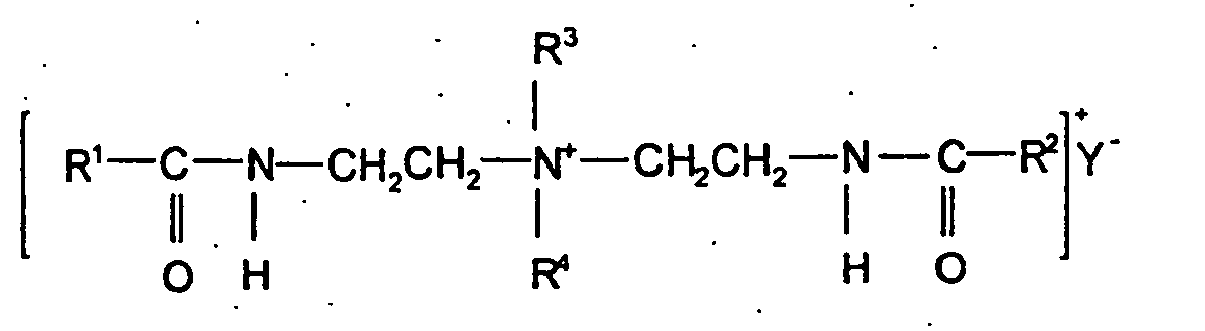
- Bevorzugte Reste R1 und R2 sind C12-C18-Alkyl- und Oleylreste, der Rest R3 eine Methylgruppe und der Rest R4 eine Gruppe -CH2-CH2-O[EO]x-H, worin x 0 bis 3 ist; Y- ist vorzugsweise ein Methosulfat-, Ethylsulfat-, Chlorid oder Phosphatanion.
- Diese Verbindungen sind an sich bekannt und beispielsweise unter den Markenbezeichnungen "INCROQUAT® HO" oder "OCS" im Handel.
- Weitere geeignete haarkonditionierende Wirkstoffe sind synthetische oder natürliche haarkonditionierende Polymere, vorzugsweise in einer Menge von 0,1 bis 10, insbesondere 0,25 bis 5 Gew.-% der Gesamtzusammensetzung.
- Besonders bevorzugt sind hierbei die unter der CTFA-Bezeichnung "Polyquaternium" bekannten kationischen (Co-)Polymeren, jedoch können auch nichtionische, anionische und/oder amphotere Polymere, beispielsweise solche vom Typ "AmphomerR", alleine oder im Gemisch verwendet werden.
- Weitere haarkonditionierende Wirkstoffe sind lipophile, d.h. fett- und ölhaltige Substanzen, zu denen auch Wachse zählen, sind insbesondere natürliche Öle wie Avocadoöl, Cocosöl, Palmöl, Sesamöl, Erdnußöl, Spermöl, Sonnenblumenöl, Mandelöl, Pfirsichkernöl, Weizenkeimöl, Macadamianußöl, Nachtkerzenöl, Jojobaöl, Ricinusöl, oder auch Oliven- bzw. Sojaöl, Lanolin und dessen Derivate, ebenso Mineralöle wie Paraffinöl und Vaseline.
- Synthetische Öle und Wachse sind beispielsweise Silikonöle, Polyethylengykole, etc. Weitere geeignete hydrophobe Komponenten sind insbesondere Fettalkohole, vorzugsweise solche mit etwa 8 bis 22 Kohlenstoffatomen im Molekül wie Myristyl-, Cetyl-, Stearylalkohol, Wachsalkohole und Fettsäureester wie Isopropylmyristat, -palmitat, -stearat und -isostearat, Oleyloleat, Isocetylstearat, Hexyllaurat, Dibutyladipat, Dioctyladipat, Myristylmyristat, Oleylerucat, Polyethylenglykol- und Polyglycerylfettsäureester wie PEG-7-glycerylcocoat, Cetylpalmitat, etc.
- Diese hydrophoben Komponenten sind in den erfindungsgemäß verwendeten Zusammensetzungen vorzugsweise in einer Gesamtmenge von 0,5 bis 15, insbesondere 1 bis 10, vor allem 1,5 bis 7,5 Gew.-%, berechnet auf die Gesamtzusammensetzung, enthalten.
- Ein weiterer Bestandteil der erfindungsgemäßen Zusammensetzung ist Grüner Tee-Extrakt.
Dieser Tee-Extrakt wird aus Blättern, Blattknospen und zarten Stielen des Teestrauchs, Camellia sinensis bzw. Camellia oleifera, durch wäßrige bzw. wäßrigalkoholische Extraktion und anschließende Sprühtrocknung erhalten. - Bei grünem Tee handelt es sich um die aus den Arten Thea sinensis bzw. Thea assamica gewonnenen, im Gegensatz zum schwarzen Tee nicht fermentierten Produkte.
- Eine Übersicht über die biologische und pharmakologische Wirkung grünen Tees sowie seine Inhaltsstoffe findet sich z.B. in einem Artikel von A. Pistorius, SÖFW-Journal, 122. Jahrgang, No. 7/1996, S. 468-471, auf den Bezug genommen wird.
- Der Gehalt an Extrakt aus grünem Tee in den erfindungsgemäßen Zusammensetzungen ist variabel. Er liegt vorzugsweise bei 0,01 bis 10, vorzugsweise 0,05 bis 5, insbesondere 0,25 bis 2,5 Gew.-%, berechnet auf die Gesamtzusammensetzung des Mittels und den pulverförmigen Extrakt.
- Weitere geeignete haarkonditionierende Zusatzstoffe sind Ceramide der allgemeinen Formel

- Die bevorzugten Gruppen R1 und R2 sind C12-C18-Alkylreste; n ist eine Zahl von 1 bis 3, R3 bedeutet vorzugsweise Wasserstoff oder einen Methylrest, und R4 Wasserstoff oder einen Dihydroxypropylrest.
Besonders bevorzugt sind Verbindungen, in denen R1 einen C12-C24-Alkylrest, insbesondere eine C13H27-Alkylgruppe, R2 einen C14C18-Alkylrest, insbesondere eine C16H33-Alkylgruppe, R3 einen Methylrest, R4 eine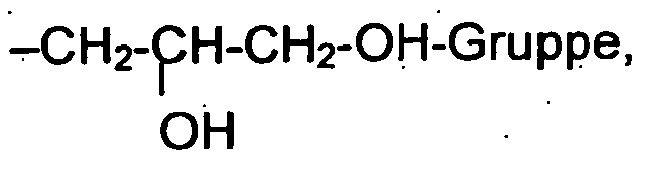
- Deren Menge in den erfindungsgemäß eingesetzten Haarbehandlungsmitteln liegt zweckmäßigerweise bei 0,01 bis 10, vorzugsweise 0,05 bis 7,5, insbesondere 0,1 bis 5 Gew.-%, berechnet auf die Gesamtzusammensetzung.
- Weitere geeignete haarkonditionierende Wirkstoffe sind wasserunlösliche Vitamine und deren Derivate, beispielsweise Vitamin E und dessen Ester wie Tocopherolacetat, -propionat, -palmitat, etc.
- Weitere Zusatzstoffe, deren Art und Menge natürlich von der Applikationsform des Mittels abhängig sind, sind Fette, Fettalkohole, Emulgatoren, pH-Regulatoren, Lösungs- und Verdünnungsmittel, Lösungsvermittler, Konservierungsmittel, Parfums, etc.
- Die erfindungsgemäßen Mittel können auch Tenside enthalten.
Als Tenside sind insbesondere nichtionische Tenside geeignet.
Besonders bevorzugte nichtionische Tenside sind die bekannten C8-C18-Alkylpolyglucoside, insbesondere mit einem Polykondensationsgrad von 1,2 bis 3, vor allem solche der allgemeinen Formel
R-O-(R1O)n-Zx,
worin R eine Alkylgruppe mit 8 bis 18 Kohlenstoffatomen, R1 eine Ethylen- oder Propylengruppe, Z. einen Saccharidrest mit 5 bis 6 Kohlenstoffatomen, n eine Zahl von 0 bis 10 und x eine Zahl zwischen 1 und 2,5 bedeuten, in einer Menge von 1 bis 10, insbesondere 2,5 bis 7,5 Gew.-% der Gesamtzusammensetzung. - Andere geeignete nichtionische Tenside sind beispielsweise die verschiedenen Sorbitanester, wie Polyethylenglykolsorbitanstearinsäureester, Fettsäurepolyglykolester oder auch Mischkondensate aus Ethylenoxid und Propylenoxid, wie sie beispielsweise unter der Handelsbezeichnung "Pluronics" im Verkehr sind.
- Besonders geeignete Tenside sind amphotere und/oder zwitterionische oberflächenaktive Substanzen in einer Menge von 0,5 bis 15, vorzugsweise von 1 bis 5 Gew.-%, bezogen auf die Gesamtzusammensetzung.
- Als solche sind insbesondere die verschiedenen bekannten Betaine wie Fettsäureamidoalkylbetaine und Sulfobetaine, beispielsweise Laurylhydroxysulfobetain, zu nennen; auch langkettige Alkylaminosäuren wie Cocoaminoacetat, Cocoaminopropionat und Natriumcocoamphopropionat und -acetat haben sich als geeignet erwiesen.
Im einzelnen können Betaine der Struktur
Sulfobetaine der Struktur
- Alkylamidobetaine der allgemeinen Formel

- Zusätzlich zu oder anstelle der genannten amphoteren bzw. zwitterionischen Tenside können die Haarpflegemittel mindestens ein C12-C18-Alkylamidopropyldimethyl- bzw.-diethylamin enthalten, beispielsweise Stearyl-, Oleyl- oder Cocoamidopropyldimethylamin.
- Dessen Anteil liegt bei 0,1 bis 10, vorzugsweise 0,25 bis 5 Gew.-% der Gesamtzusammensetzung.
- Daneben sind natürlich auch anionische und/oder andere amphotere bzw. zwitterionische Tenside geeignet.
- Ein weiterer bevorzugter Bestandteil in den erfindungsgemäßen Mitteln sind Pflanzenextrakte in einer Menge von 0,01 bis 10, vorzugsweise 0,1 bis 7,5, insbesondere 0,5 bis 5 Gew.-%, berechnet als Trockenrückstand desselben auf die Gesamtmenge des Mittels.
- Geeignete, an sich bekannte wäßrige (z.B Wasserdampf-destillierte), alkoholische oder wäßrig-alkoholische Pflanzenextrakte sind insbesondere Extrakte von Blättern, Früchten, Blüten, Wurzeln, Rinden oder Stämmen von Aloe, Ananas, Artischoken, Arnika, Avocado, Baldrian, Bambus, Bilsenkraut, Birke, Brennesseln, Echinacea, Efeu, Engelwurz, Enzian, Farnen, Fichtennadeln, Gänsefingerkraut, Ginseng, Ginster, Hafer, Hagebutten, Hamamelis, Heublumen, Holunder, Hopfen, Huflattich, Johannisbeeren, Kamillen, Karotten, Kastanien, Klee, Klettenwurzeln, Kokosnuß, Korn, Lindenblüten, Maiglöckchen, Meeralgen, Melisse, Mistel, Passionsblumen, Ratanhia, Ringelblumen, Rosmarin, Roßkastanien, Rotdorn, Salbei, Schachtelhalm, Scharfgarbe, Schlüsselblumen, Taubnesseln, Thymian, Walnüssen, Weinblättern, Weißdorn, etc.
- Geeignete Handelsprodukte sind beispielsweise die verschiedenen "ExtraponeR", "HerbasolR", "SedaplantR" und "HexaplantR". Extrakte und deren Herstellung sind auch in "Hagers Handbuch der pharmazeutischen Praxis", 4. Aufl., beschrieben.
- Die erfindungsgemäß verwendeten haarkonditionierenden Mittel liegen vorzugsweise als, wäßrige oder wäßrig/alkoholische Lösung, wäßrige Emulsion, Mikroemulsion, Dispersion oder opakes oder transparentes Gel vor, und können auch als Aerosole konfektioniert werden. Solche Zusammensetzungen und ihre Herstellung sind dem Fachmann grundsätzlich bekannt und bedürfen daher keiner näheren Erläuterung.
- Der pH-Wert der erfindungsgemäß verwendeten Haarbehandlungsmittel ist nicht kritisch; er kann vorzugsweise bei 3 bis 8, insbesondere zwischen 4 und 6,5, liegen.
- Ebenso liegt die Viskosität im allgemein Bereich und ist selbstverständlich abhängig von der Darreichungsform des Mittels.
- Die folgenden Beispiele beschreiben die Erfindung im Detail:
- Es wurde eine "Leave-on Kur" folgender Zusammensetzung hergestellt:
Cetylstearylalkohol 2,5 (Gew.-%) Isopropylmyristat 0,2 Stearamidopropyldimethylamin 0,6 2-Phenylbenzimidazol-5-sulfonsäure 0,3 Milchsäure 0,3 Parfum 0,1 Grüner Tee-Extrakt 0,5 Konservierungsmittel 0,3 Mica/TiO2-Pigment (TimironR Diamond Cluster; 0,5 mittl. Teilchendurchmesser: 90% zwischen 20 und 150 µm) pH-Wert: ~4,5 Wasser ad 100,0 - An leicht strapazierten Haarsträhnen wurde folgender Blindversuch durchgeführt:
- In 5 Strähnen wurde nach der Haarwäsche mit einem handelsüblichen Shampoo in das noch nasse Haar eine Zusammensetzung 1 entsprechend dem obigen Beispiel einmassiert.
- Weitere 5 Strähnen wurden mit einer mit der Zusammensetzung 1 identischen Zusammensetzung 1A, die jedoch keine Pigmentteilchen enthielt, in identischer Weise behandelt.
- Die Haarsträhnen wurden vor und nach dem Trocknen von jeweils 2 Friseuren nach der Präferenzmethode beurteilt.
Ergebnis Präferenz Zusammensetzung 1 Zusammensetzung 1A a) Nasses Haar Haargefühl 4 (Seidig weich, glatt) 1 (Weich, glitschig) Naßkämmbarkeit 5 (Sehr gut) 0 (Gut) b) Trockenes Haar Volumen, Fülle 4 1 Halt 4 1 Glanz 4 1 Trockenkämmbarkeit 5 (Sehr gut) 0 (Gut) Griff 5 (Seidig weich, glatt vom Ansatz bis zur Spitze) 0 (Fester, Spitzen rauher) - Dieses Ergebnis zeigt die überraschende Überlegenheit des erfindungsgemäßen Mittels.
- Diese Unterschiede traten noch verstärkt nach 24-stündiger UV-Bestrahlung der behandelten Strähnen auf.
-
1,2-Propylenglykol 2,00 (Gew.-%) CarbopoIRETD 2020 (Acrylates/ 0,50 C10-C20-Alkyl acrylate crosspolymer) Cocoamidopropylbetain 1,00 Ethanol 17,50 PPG 9 0,70 PEG-60 Hydriertes Ricinusöl 0,50 NaOH (32%) 0,25 Parfum 0,10 PEG-25 PABA 0,80 Mandelöl 2,00 Mica/TiO2-Pigment (TimironR Diamond Cluster; 0,60 90 % mit durchschnittl. Teilchendurchmesser von 20 bis 150µm) Wasser ad 100,0 pH-Wert: ~6,0 - Mit diesem Produkt wurde eine ähnliche Verbesserung der Haareigenschaften wie mit demjenigen nach Beispiel 1 erzielt.
- Ein Styting-Gel der folgenden Zusammensetzung:
Tocopherylacetat 0,5 (Gew.%) Mica/TiO2-Pigment (TimironR Gleamer Flake; 0,5 mittl. Teilchengröße: 90% zwischen 20 und 100µm) CarbopolR ETD 2001 (Carbomer) 0,5 Ethanol 11,0 VinylpyrrolidonVinylacetat-Copolymer 5,5 (LuviskolR VA 551) Aminomethylpropanol 0,4 Cocoamidopropylbetain 1,0 PEG-60 Hydriertes Ricinusöl 0,4 Grüner Tee-Extrakt 0,4 Parfum 0,3 Benzophenone-4 0,3 Konservierungsmittel 0,3 pH-Wert: ~6,8 Wasser ad 100,0 - Eine Leave-on Kur der Zusammensetzung
Cetearylalkohol 3,00 Isopropylpalmitat 0,20 Sphingolipid E 0,10 Quaternium-80 0,10 Mica/TiO2-Pigment (TimironR Diamond Chuster; 0,15 mittl. Teilchengröße:20 und 150µm) Grüner Tee-Extrakt 0,05 Benzophenone-4 0,10 Cocoamidopropyldimethylamin 0,60 Milchsäure 0,35 Konservierungsmittel 0,45 Parfumöl 0,20 Ceteareth-20 0,40 Wasser ad 100,00
Eine identische Zusammensetzung (4A), bei der jedoch Cocoamidopropyldimethylamin und Benzophenone-4 durch Wasser ersetzt waren, wurde in die andere Hälfte des Haares einmassiert.
Nach 10-minütiger Einwirkung wurden die Haarhälften durch zwei erfahrene Friseure begutachtet, wobei weder die Friseure noch die Probandinnen die Zuordnung der Produkte zu den jeweiligen Haarhälften kannten (Doppelblind-Methode). - Es wurde folgendes Ergebnis erzielt:
Eigenschaften Zusammensetzung 4 Zusammensetzung 4 A Besser Gleich Besser Nasses Haar Kämmbarkeit 5 2 1 Griff, Lockerheit 6 1 1 Trockenes Haar Kämmbarkeit 6 1 1 Griff, Lockerheit 6 1 1 Volumen 5 2 1 Glanz 5 2 1
Claims (8)
- Haarpflegemittel auf wäßriger Basis, enthaltenda) mindestens eine wasserlösliche oder öllösliche UV-absorbierende Substanz,b) mindestens ein Glimmer/Titaniumdioxid-Pigment, wobei mindestens 90 Gew.-% desselben eine Teilchengröße zwischen und 10 und 250 Mikron aufweisen, undc) Grünen Tee Extrakt.
- Haarpflegemittel nach Anspruch 1, dadurch gekennzeichnet, daß das Pigment zu 80 bis 90 Gew.-% aus Glimmer und zu 10 bis 20 Gew.-% aus Titandioxid besteht.
- Haarpflegemittel nach Anspruch 1 oder 2, dadurch gekennzeichnet, daß der Anteil des Glimmer/Titandioxid-Pigments 0,05 bis 5 Gew.-%, berechnet auf die Gesamtzusammensetzung, beträgt.
- Haarpflegemittel nach einem öder mehreren der Ansprüche 1 bis 3, dadurch gekennzeichnet, daß der UV-Absorber ausgewählt ist aus mindestens einer der Verbindungen 4-Aminobenzoesäure und deren Estern und Salzen, 2-Phenylbenzimidazol-5-sulfonsäure und deren Alkali- und Aminsalzen, 4-Dimethylaminobenzoesäure und deren Estern und Salzen, Zimtsäure und deren Estern und Salzen, 4-Methoxyzimtsäure und deren Estern und Salzen, Salicylsäure und deren Estern und Salzen, 2,4-Dihydroxybenzophenon, 2,2',4,4'-Tetrahydrobenzophenon, 2-Hydroxy-4-methoxybenzophenon und dessen 5-Sulfonsäure bzw. deren Natriumsalz, 2,2'-Dihydroxy-4,4'-dimethoxybenzophenon, 2-Hydroxy-5-chlorbenzophenon, 2,2'-Dihydroxy-4-methoxybenzophenon, 2-2'-Dihydroxy-4,4'-dimethoxy-5,5'-disulfobenzophenon bzw. dessen Natriumsalzen, 2-Hydroxy-4-octyloxybenzophenon, 2-Hydroxy-4-methoxy-4'-methylbenzophenon, 3-Benzylidencampher, 3-(4'-Sulfo)-benzylidenbornan-2-on und dessen Salzen und/oder 3-(4'-Methylbenzyliden)-DL-campher.
- Haarpflegemittel nach einem oder mehreren der Ansprüche 1 bis 4, dadurch gekennzeichnet, daß der Anteil des UV-Absorbers 0,05 bis 2,5 Gew.-%, berechnet auf die Gesamtzusammensetzung, beträgt.
- Haarpflegemittel nach einem oder mehreren der Ansprüche 1 bis 5, dadurch gekennzeichnet, daß es 0,5 bis 15 Gew.-% mindestens eines amphoteren bzw. zwitterionischen Tensids, berechnet auf die Gesamtzusammensetzung, enthält.
- Haarpflegemittel nach Anspruch 6, dadurch gekennzeichnet, daß es 1 bis 5 Gew.-%, berechnet auf die Gesamtzusammensetzung, mindestens eines Betains enthält.
- Haarpflegemittel nach einem oder mehreren der Ansprüche 1 bis 7, dadurch gekennzeichnet, daß es 0,1 bis 10 Gew.-% mindestens eines C12-C18-Alkylamidopropyldimethyl- oder -diethylamins enthält.
Applications Claiming Priority (2)
| Application Number | Priority Date | Filing Date | Title |
|---|---|---|---|
| DE10050782 | 2000-10-13 | ||
| DE10050782A DE10050782A1 (de) | 2000-10-13 | 2000-10-13 | Haarpflegemittel |
Publications (3)
| Publication Number | Publication Date |
|---|---|
| EP1197200A2 EP1197200A2 (de) | 2002-04-17 |
| EP1197200A3 EP1197200A3 (de) | 2004-01-02 |
| EP1197200B1 true EP1197200B1 (de) | 2006-06-07 |
Family
ID=7659667
Family Applications (1)
| Application Number | Title | Priority Date | Filing Date |
|---|---|---|---|
| EP01123312A Expired - Lifetime EP1197200B1 (de) | 2000-10-13 | 2001-10-08 | Haarpflegemittel |
Country Status (4)
| Country | Link |
|---|---|
| US (1) | US6942851B2 (de) |
| EP (1) | EP1197200B1 (de) |
| AT (1) | ATE328572T1 (de) |
| DE (2) | DE10050782A1 (de) |
Families Citing this family (20)
| Publication number | Priority date | Publication date | Assignee | Title |
|---|---|---|---|---|
| DE10100721A1 (de) * | 2001-01-10 | 2002-07-11 | Beiersdorf Ag | Wässrige kosmetische und dermatologische Zubereitungen mit einem Gehalt an wasserlöslichen UV-Filtersubstanzen |
| EP1453474A1 (de) * | 2001-10-03 | 2004-09-08 | The Procter & Gamble Company | Zusammensetzung zur verbesserung des haarvolumens |
| MXPA04003015A (es) * | 2001-10-03 | 2004-07-15 | Procter & Gamble | Champu que contiene particulas y un auxiliar de deposito. |
| WO2003028680A1 (en) * | 2001-10-03 | 2003-04-10 | The Procter & Gamble Company | Conditioner containing particles |
| US20030108501A1 (en) * | 2001-10-03 | 2003-06-12 | Hofrichter Brian David | Shampoo containing a cationic polymer and particles |
| US20040005285A1 (en) * | 2001-10-03 | 2004-01-08 | The Procter & Gamble Company | Conditioner containing particles |
| US6780826B2 (en) * | 2002-09-11 | 2004-08-24 | Unilever Home & Personal Care Usa, Division Of Conopco, Inc. | Oil-containing personal wash compositions or emulsions comprising particles of high refractive index and defined thickness, geometry and size |
| US6759376B2 (en) * | 2002-09-11 | 2004-07-06 | Unilever Home & Personal Care Usa, Division Of Conopco, Inc. | Oil-containing personal wash liquid compositions or emulsions comprising particles of high refractive index and defined thickness, geometry and size |
| US20060013838A1 (en) * | 2004-07-13 | 2006-01-19 | Qinyun Peng | Cosmetic powder compositions having large particle size color travel effect pigments |
| US7244698B2 (en) * | 2004-07-30 | 2007-07-17 | Nalco Company | Viscoelastic surfactant composition having improved rheological properties and method of using for treating subterranean formations |
| US20060083706A1 (en) * | 2004-10-13 | 2006-04-20 | Gabin Vic | Haircare composition comprising at least one electrophilic monomer and micro- or nanoparticles of at least one solid lubricant |
| EP1647258A1 (de) * | 2004-10-13 | 2006-04-19 | L'oreal | Haarbehandlungsmittel auf Basis von elektrophilen Monomeren und lubrifizierenden festen Mikro- oder Nanopartikeln |
| DE102005060435A1 (de) * | 2005-12-15 | 2007-06-21 | Henkel Kgaa | Haarwachsspray |
| US20080102045A1 (en) * | 2006-10-05 | 2008-05-01 | Shim Elisabeth K | Topical preparations containing antioxidant extracts of broccoli, green tea, and red tea |
| WO2008112890A1 (en) * | 2007-03-13 | 2008-09-18 | Elementis Specialties, Inc. | Biodegradable cleaning compositions |
| EP2022469A1 (de) * | 2007-08-07 | 2009-02-11 | KPSS-Kao Professional Salon Services GmbH | Zusammensetzung zur Haarkonditionierung |
| DE102008005411A1 (de) | 2008-01-21 | 2009-07-30 | Beiersdorf Ag | Neuartige tensidhaltige Haarpflegezubereitung zum Schutz blond gefärbten Haares vor dem Auswaschen der Färbung |
| UA100326C2 (uk) * | 2009-01-13 | 2012-12-10 | Фейяз Кюджюкай | Мазь для місцевого лікування геморою |
| KR101387081B1 (ko) | 2012-11-05 | 2014-04-18 | 바이오스펙트럼 주식회사 | 시나픽산 또는 이의 약학적으로 허용가능한 염을 유효성분으로 포함하는 탈모방지 및 발모촉진용 조성물 |
| MX368467B (es) * | 2015-06-01 | 2019-10-03 | Procter & Gamble | Producto de laca en aerosol para el cabello que comprende un dispositivo de rociado. |
Family Cites Families (13)
| Publication number | Priority date | Publication date | Assignee | Title |
|---|---|---|---|---|
| MY100343A (en) | 1985-12-20 | 1990-08-28 | Kao Corp | Amide derivative and external medicament comprising same |
| US5225162A (en) | 1990-10-17 | 1993-07-06 | Sps Medical Supply Corporation | Disposable tamper evident locking device |
| DE4138630A1 (de) | 1991-11-25 | 1993-05-27 | Henkel Kgaa | Saure haarpflegemittel |
| DE59402667D1 (de) | 1993-01-23 | 1997-06-12 | Henkel Kgaa | Detergensgemische mit verbesserten avivageeigenschaften |
| FR2711138B1 (fr) | 1993-10-12 | 1995-11-24 | Oreal | Céramides, leur procédé de préparation et leurs applications en cosmétique et en dermopharmacie. |
| FR2721208B1 (fr) * | 1994-06-16 | 1996-08-02 | Oreal | Composition à usage topique contenant un antioxidant et un extrait bactérien, et utilisation de cette composition. |
| HU214511B (hu) | 1995-10-27 | 1998-04-28 | János Molnár | Elemkészlet felületek, továbbá falak képzésére |
| DE19646867C1 (de) * | 1996-11-13 | 1997-12-04 | Henkel Kgaa | Kosmetische Zubereitungen |
| DE59813594D1 (de) * | 1997-08-09 | 2006-07-27 | Merck Patent Gmbh | Sonnenschutzmittel mit Ultraspektralschutz |
| US5851544A (en) * | 1997-12-18 | 1998-12-22 | Chesebrough-Pond's Usa Co., Division Of Conopco, Inc. | Cosmetic skin or hair care compositions containing fluorocarbons infused with carbon dioxide |
| GB9807271D0 (en) * | 1998-04-03 | 1998-06-03 | Unilever Plc | Hair treatment compositions |
| DE19855097A1 (de) * | 1998-11-28 | 2000-05-31 | Wella Ag | Pigmenthaltiges, verschäumbares Gel |
| AU2211199A (en) * | 1999-01-04 | 2000-07-24 | Procter & Gamble Company, The | Transparent hair conditioning composition comprising breakable visible particle |
-
2000
- 2000-10-13 DE DE10050782A patent/DE10050782A1/de not_active Ceased
-
2001
- 2001-10-08 DE DE50110019T patent/DE50110019D1/de not_active Expired - Lifetime
- 2001-10-08 AT AT01123312T patent/ATE328572T1/de not_active IP Right Cessation
- 2001-10-08 EP EP01123312A patent/EP1197200B1/de not_active Expired - Lifetime
- 2001-10-11 US US09/975,520 patent/US6942851B2/en not_active Expired - Fee Related
Also Published As
| Publication number | Publication date |
|---|---|
| EP1197200A3 (de) | 2004-01-02 |
| ATE328572T1 (de) | 2006-06-15 |
| DE10050782A1 (de) | 2002-04-25 |
| EP1197200A2 (de) | 2002-04-17 |
| US6942851B2 (en) | 2005-09-13 |
| US20020110534A1 (en) | 2002-08-15 |
| DE50110019D1 (de) | 2006-07-20 |
Similar Documents
| Publication | Publication Date | Title |
|---|---|---|
| EP1197200B1 (de) | Haarpflegemittel | |
| WO1999011222A1 (de) | Zwei-komponenten kosmetisches pflegemittel | |
| EP1179339A2 (de) | Kosmetische Mittel enthaltend Malvaceae-Samenextrakte | |
| DE19735865C1 (de) | Verwendung eines Mittels auf wäßriger Basis zur Verbesserung der Farbstabilität und/oder Formbeständigkeit von gefärbten und/oder dauergewellten Haaren | |
| DE19810120C1 (de) | Verwendung eines Mittels zur Haarbehandlung | |
| EP0925775B1 (de) | Haarbehandlungsmittel | |
| DE19809942A1 (de) | Dosierbares kosmetisches Pflegemittel | |
| EP1133973A1 (de) | Haarpflegemulsion | |
| EP0945124B1 (de) | Haarbehandlungsmittel | |
| DE19955842A1 (de) | Verfahren zum Behandeln von menschlichem Haar | |
| EP1203573B1 (de) | Haarpflegemittel | |
| DE19902528A1 (de) | Haarbehandlungsmittel | |
| DE20017586U1 (de) | Haarpflegemittel | |
| DE19937830A1 (de) | Kosmetisches Mittel | |
| DE29804154U1 (de) | Haarbehandlungsmittel | |
| DE20019871U1 (de) | Haarbehandlungsmittel | |
| DE20011440U1 (de) | Mittel zur Pflege und Behandlung von menschlichen Haaren | |
| DE10058037A1 (de) | Haarbehandlungsmittel und Verfahren zu dessen Herstellung | |
| DE19902530C1 (de) | Verwendung eines Mittels zum Behandeln von menschlichen Haaren | |
| DE29714786U1 (de) | Haarbehandlungsmittel | |
| DE20018677U1 (de) | Haarfärbemittel | |
| DE29901069U1 (de) | Haarbehandlungsmittel | |
| DE29819027U1 (de) | Haut- und Haarbehandlungsmittel | |
| EP1180357A2 (de) | Verfahren zum Behandeln von menschlichen Haaren | |
| DE20000871U1 (de) | Haarpflegeemulsion |
Legal Events
| Date | Code | Title | Description |
|---|---|---|---|
| PUAI | Public reference made under article 153(3) epc to a published international application that has entered the european phase |
Free format text: ORIGINAL CODE: 0009012 |
|
| AK | Designated contracting states |
Kind code of ref document: A2 Designated state(s): AT BE CH CY DE DK ES FI FR GB GR IE IT LI LU MC NL PT SE TR |
|
| AX | Request for extension of the european patent |
Free format text: AL;LT;LV;MK;RO;SI |
|
| RAP1 | Party data changed (applicant data changed or rights of an application transferred) |
Owner name: KPSS-KAO PROFESSIONAL SALON SERVICES GMBH |
|
| PUAL | Search report despatched |
Free format text: ORIGINAL CODE: 0009013 |
|
| AK | Designated contracting states |
Kind code of ref document: A3 Designated state(s): AT BE CH CY DE DK ES FI FR GB GR IE IT LI LU MC NL PT SE TR |
|
| AX | Request for extension of the european patent |
Extension state: AL LT LV MK RO SI |
|
| 17P | Request for examination filed |
Effective date: 20040309 |
|
| 17Q | First examination report despatched |
Effective date: 20040803 |
|
| AKX | Designation fees paid |
Designated state(s): AT BE CH CY DE DK ES FI FR GB GR IE IT LI LU MC NL PT SE TR |
|
| GRAP | Despatch of communication of intention to grant a patent |
Free format text: ORIGINAL CODE: EPIDOSNIGR1 |
|
| GRAS | Grant fee paid |
Free format text: ORIGINAL CODE: EPIDOSNIGR3 |
|
| GRAA | (expected) grant |
Free format text: ORIGINAL CODE: 0009210 |
|
| RIC1 | Information provided on ipc code assigned before grant |
Ipc: A61Q 17/04 20060101ALI20060411BHEP Ipc: A61Q 5/00 20060101ALI20060411BHEP Ipc: A61K 8/29 20060101AFI20060411BHEP |
|
| AK | Designated contracting states |
Kind code of ref document: B1 Designated state(s): AT BE CH CY DE DK ES FI FR GB GR IE IT LI LU MC NL PT SE TR |
|
| PG25 | Lapsed in a contracting state [announced via postgrant information from national office to epo] |
Ref country code: FI Free format text: LAPSE BECAUSE OF FAILURE TO SUBMIT A TRANSLATION OF THE DESCRIPTION OR TO PAY THE FEE WITHIN THE PRESCRIBED TIME-LIMIT Effective date: 20060607 Ref country code: IE Free format text: LAPSE BECAUSE OF FAILURE TO SUBMIT A TRANSLATION OF THE DESCRIPTION OR TO PAY THE FEE WITHIN THE PRESCRIBED TIME-LIMIT Effective date: 20060607 Ref country code: IT Free format text: LAPSE BECAUSE OF FAILURE TO SUBMIT A TRANSLATION OF THE DESCRIPTION OR TO PAY THE FEE WITHIN THE PRESCRIBED TIME-LIMIT;WARNING: LAPSES OF ITALIAN PATENTS WITH EFFECTIVE DATE BEFORE 2007 MAY HAVE OCCURRED AT ANY TIME BEFORE 2007. THE CORRECT EFFECTIVE DATE MAY BE DIFFERENT FROM THE ONE RECORDED. Effective date: 20060607 Ref country code: NL Free format text: LAPSE BECAUSE OF FAILURE TO SUBMIT A TRANSLATION OF THE DESCRIPTION OR TO PAY THE FEE WITHIN THE PRESCRIBED TIME-LIMIT Effective date: 20060607 |
|
| REG | Reference to a national code |
Ref country code: GB Ref legal event code: FG4D Free format text: NOT ENGLISH |
|
| REG | Reference to a national code |
Ref country code: CH Ref legal event code: EP |
|
| REG | Reference to a national code |
Ref country code: IE Ref legal event code: FG4D Free format text: LANGUAGE OF EP DOCUMENT: GERMAN |
|
| REF | Corresponds to: |
Ref document number: 50110019 Country of ref document: DE Date of ref document: 20060720 Kind code of ref document: P |
|
| PG25 | Lapsed in a contracting state [announced via postgrant information from national office to epo] |
Ref country code: DK Free format text: LAPSE BECAUSE OF FAILURE TO SUBMIT A TRANSLATION OF THE DESCRIPTION OR TO PAY THE FEE WITHIN THE PRESCRIBED TIME-LIMIT Effective date: 20060907 Ref country code: SE Free format text: LAPSE BECAUSE OF FAILURE TO SUBMIT A TRANSLATION OF THE DESCRIPTION OR TO PAY THE FEE WITHIN THE PRESCRIBED TIME-LIMIT Effective date: 20060907 |
|
| GBT | Gb: translation of ep patent filed (gb section 77(6)(a)/1977) |
Effective date: 20060822 |
|
| PG25 | Lapsed in a contracting state [announced via postgrant information from national office to epo] |
Ref country code: ES Free format text: LAPSE BECAUSE OF FAILURE TO SUBMIT A TRANSLATION OF THE DESCRIPTION OR TO PAY THE FEE WITHIN THE PRESCRIBED TIME-LIMIT Effective date: 20060918 |
|
| PG25 | Lapsed in a contracting state [announced via postgrant information from national office to epo] |
Ref country code: MC Free format text: LAPSE BECAUSE OF NON-PAYMENT OF DUE FEES Effective date: 20061031 Ref country code: LI Free format text: LAPSE BECAUSE OF NON-PAYMENT OF DUE FEES Effective date: 20061031 Ref country code: CH Free format text: LAPSE BECAUSE OF NON-PAYMENT OF DUE FEES Effective date: 20061031 |
|
| PG25 | Lapsed in a contracting state [announced via postgrant information from national office to epo] |
Ref country code: PT Free format text: LAPSE BECAUSE OF FAILURE TO SUBMIT A TRANSLATION OF THE DESCRIPTION OR TO PAY THE FEE WITHIN THE PRESCRIBED TIME-LIMIT Effective date: 20061107 |
|
| NLV1 | Nl: lapsed or annulled due to failure to fulfill the requirements of art. 29p and 29m of the patents act | ||
| ET | Fr: translation filed | ||
| REG | Reference to a national code |
Ref country code: IE Ref legal event code: FD4D |
|
| PLBE | No opposition filed within time limit |
Free format text: ORIGINAL CODE: 0009261 |
|
| STAA | Information on the status of an ep patent application or granted ep patent |
Free format text: STATUS: NO OPPOSITION FILED WITHIN TIME LIMIT |
|
| 26N | No opposition filed |
Effective date: 20070308 |
|
| REG | Reference to a national code |
Ref country code: CH Ref legal event code: PL |
|
| BERE | Be: lapsed |
Owner name: KPSS-KAO PROFESSIONAL SALON SERVICES G.M.B.H. Effective date: 20061031 |
|
| PG25 | Lapsed in a contracting state [announced via postgrant information from national office to epo] |
Ref country code: AT Free format text: LAPSE BECAUSE OF NON-PAYMENT OF DUE FEES Effective date: 20061008 |
|
| PG25 | Lapsed in a contracting state [announced via postgrant information from national office to epo] |
Ref country code: GR Free format text: LAPSE BECAUSE OF FAILURE TO SUBMIT A TRANSLATION OF THE DESCRIPTION OR TO PAY THE FEE WITHIN THE PRESCRIBED TIME-LIMIT Effective date: 20060908 |
|
| PG25 | Lapsed in a contracting state [announced via postgrant information from national office to epo] |
Ref country code: TR Free format text: LAPSE BECAUSE OF FAILURE TO SUBMIT A TRANSLATION OF THE DESCRIPTION OR TO PAY THE FEE WITHIN THE PRESCRIBED TIME-LIMIT Effective date: 20060607 Ref country code: LU Free format text: LAPSE BECAUSE OF NON-PAYMENT OF DUE FEES Effective date: 20061008 |
|
| PG25 | Lapsed in a contracting state [announced via postgrant information from national office to epo] |
Ref country code: CY Free format text: LAPSE BECAUSE OF FAILURE TO SUBMIT A TRANSLATION OF THE DESCRIPTION OR TO PAY THE FEE WITHIN THE PRESCRIBED TIME-LIMIT Effective date: 20060607 |
|
| PG25 | Lapsed in a contracting state [announced via postgrant information from national office to epo] |
Ref country code: BE Free format text: LAPSE BECAUSE OF FAILURE TO SUBMIT A TRANSLATION OF THE DESCRIPTION OR TO PAY THE FEE WITHIN THE PRESCRIBED TIME-LIMIT Effective date: 20061031 |
|
| REG | Reference to a national code |
Ref country code: FR Ref legal event code: CD Owner name: KAO GERMANY GMBH, DE Effective date: 20120411 |
|
| REG | Reference to a national code |
Ref country code: DE Ref legal event code: R081 Ref document number: 50110019 Country of ref document: DE Owner name: KAO GERMANY GMBH, DE Free format text: FORMER OWNER: KPSS-KAO PROFESSIONAL SALON SERVICES GMBH, 64297 DARMSTADT, DE Effective date: 20120403 |
|
| REG | Reference to a national code |
Ref country code: FR Ref legal event code: PLFP Year of fee payment: 15 |
|
| REG | Reference to a national code |
Ref country code: FR Ref legal event code: PLFP Year of fee payment: 16 |
|
| PGFP | Annual fee paid to national office [announced via postgrant information from national office to epo] |
Ref country code: GB Payment date: 20161028 Year of fee payment: 16 Ref country code: FR Payment date: 20161027 Year of fee payment: 16 |
|
| PGFP | Annual fee paid to national office [announced via postgrant information from national office to epo] |
Ref country code: DE Payment date: 20170102 Year of fee payment: 16 |
|
| REG | Reference to a national code |
Ref country code: DE Ref legal event code: R119 Ref document number: 50110019 Country of ref document: DE |
|
| GBPC | Gb: european patent ceased through non-payment of renewal fee |
Effective date: 20171008 |
|
| REG | Reference to a national code |
Ref country code: FR Ref legal event code: ST Effective date: 20180629 |
|
| PG25 | Lapsed in a contracting state [announced via postgrant information from national office to epo] |
Ref country code: GB Free format text: LAPSE BECAUSE OF NON-PAYMENT OF DUE FEES Effective date: 20171008 Ref country code: DE Free format text: LAPSE BECAUSE OF NON-PAYMENT OF DUE FEES Effective date: 20180501 |
|
| PG25 | Lapsed in a contracting state [announced via postgrant information from national office to epo] |
Ref country code: FR Free format text: LAPSE BECAUSE OF NON-PAYMENT OF DUE FEES Effective date: 20171031 |