EP1193322A1 - High tensile cold-rolled steel sheet having excellent strain aging hardening properties - Google Patents
High tensile cold-rolled steel sheet having excellent strain aging hardening properties Download PDFInfo
- Publication number
- EP1193322A1 EP1193322A1 EP01904406A EP01904406A EP1193322A1 EP 1193322 A1 EP1193322 A1 EP 1193322A1 EP 01904406 A EP01904406 A EP 01904406A EP 01904406 A EP01904406 A EP 01904406A EP 1193322 A1 EP1193322 A1 EP 1193322A1
- Authority
- EP
- European Patent Office
- Prior art keywords
- less
- sheet
- cold rolled
- steel sheet
- tensile strength
- Prior art date
- Legal status (The legal status is an assumption and is not a legal conclusion. Google has not performed a legal analysis and makes no representation as to the accuracy of the status listed.)
- Granted
Links
Classifications
-
- C—CHEMISTRY; METALLURGY
- C21—METALLURGY OF IRON
- C21D—MODIFYING THE PHYSICAL STRUCTURE OF FERROUS METALS; GENERAL DEVICES FOR HEAT TREATMENT OF FERROUS OR NON-FERROUS METALS OR ALLOYS; MAKING METAL MALLEABLE, e.g. BY DECARBURISATION OR TEMPERING
- C21D8/00—Modifying the physical properties of ferrous metals or ferrous alloys by deformation combined with, or followed by, heat treatment
- C21D8/02—Modifying the physical properties of ferrous metals or ferrous alloys by deformation combined with, or followed by, heat treatment during manufacturing of plates or strips
- C21D8/0221—Modifying the physical properties of ferrous metals or ferrous alloys by deformation combined with, or followed by, heat treatment during manufacturing of plates or strips characterised by the working steps
- C21D8/0236—Cold rolling
-
- C—CHEMISTRY; METALLURGY
- C21—METALLURGY OF IRON
- C21D—MODIFYING THE PHYSICAL STRUCTURE OF FERROUS METALS; GENERAL DEVICES FOR HEAT TREATMENT OF FERROUS OR NON-FERROUS METALS OR ALLOYS; MAKING METAL MALLEABLE, e.g. BY DECARBURISATION OR TEMPERING
- C21D8/00—Modifying the physical properties of ferrous metals or ferrous alloys by deformation combined with, or followed by, heat treatment
- C21D8/02—Modifying the physical properties of ferrous metals or ferrous alloys by deformation combined with, or followed by, heat treatment during manufacturing of plates or strips
- C21D8/0221—Modifying the physical properties of ferrous metals or ferrous alloys by deformation combined with, or followed by, heat treatment during manufacturing of plates or strips characterised by the working steps
- C21D8/0226—Hot rolling
-
- C—CHEMISTRY; METALLURGY
- C21—METALLURGY OF IRON
- C21D—MODIFYING THE PHYSICAL STRUCTURE OF FERROUS METALS; GENERAL DEVICES FOR HEAT TREATMENT OF FERROUS OR NON-FERROUS METALS OR ALLOYS; MAKING METAL MALLEABLE, e.g. BY DECARBURISATION OR TEMPERING
- C21D8/00—Modifying the physical properties of ferrous metals or ferrous alloys by deformation combined with, or followed by, heat treatment
- C21D8/02—Modifying the physical properties of ferrous metals or ferrous alloys by deformation combined with, or followed by, heat treatment during manufacturing of plates or strips
- C21D8/0247—Modifying the physical properties of ferrous metals or ferrous alloys by deformation combined with, or followed by, heat treatment during manufacturing of plates or strips characterised by the heat treatment
- C21D8/0268—Modifying the physical properties of ferrous metals or ferrous alloys by deformation combined with, or followed by, heat treatment during manufacturing of plates or strips characterised by the heat treatment between cold rolling steps
-
- C—CHEMISTRY; METALLURGY
- C21—METALLURGY OF IRON
- C21D—MODIFYING THE PHYSICAL STRUCTURE OF FERROUS METALS; GENERAL DEVICES FOR HEAT TREATMENT OF FERROUS OR NON-FERROUS METALS OR ALLOYS; MAKING METAL MALLEABLE, e.g. BY DECARBURISATION OR TEMPERING
- C21D8/00—Modifying the physical properties of ferrous metals or ferrous alloys by deformation combined with, or followed by, heat treatment
- C21D8/02—Modifying the physical properties of ferrous metals or ferrous alloys by deformation combined with, or followed by, heat treatment during manufacturing of plates or strips
- C21D8/0247—Modifying the physical properties of ferrous metals or ferrous alloys by deformation combined with, or followed by, heat treatment during manufacturing of plates or strips characterised by the heat treatment
- C21D8/0273—Final recrystallisation annealing
-
- C—CHEMISTRY; METALLURGY
- C22—METALLURGY; FERROUS OR NON-FERROUS ALLOYS; TREATMENT OF ALLOYS OR NON-FERROUS METALS
- C22C—ALLOYS
- C22C38/00—Ferrous alloys, e.g. steel alloys
- C22C38/001—Ferrous alloys, e.g. steel alloys containing N
-
- C—CHEMISTRY; METALLURGY
- C22—METALLURGY; FERROUS OR NON-FERROUS ALLOYS; TREATMENT OF ALLOYS OR NON-FERROUS METALS
- C22C—ALLOYS
- C22C38/00—Ferrous alloys, e.g. steel alloys
- C22C38/02—Ferrous alloys, e.g. steel alloys containing silicon
-
- C—CHEMISTRY; METALLURGY
- C22—METALLURGY; FERROUS OR NON-FERROUS ALLOYS; TREATMENT OF ALLOYS OR NON-FERROUS METALS
- C22C—ALLOYS
- C22C38/00—Ferrous alloys, e.g. steel alloys
- C22C38/04—Ferrous alloys, e.g. steel alloys containing manganese
-
- C—CHEMISTRY; METALLURGY
- C22—METALLURGY; FERROUS OR NON-FERROUS ALLOYS; TREATMENT OF ALLOYS OR NON-FERROUS METALS
- C22C—ALLOYS
- C22C38/00—Ferrous alloys, e.g. steel alloys
- C22C38/06—Ferrous alloys, e.g. steel alloys containing aluminium
-
- C—CHEMISTRY; METALLURGY
- C22—METALLURGY; FERROUS OR NON-FERROUS ALLOYS; TREATMENT OF ALLOYS OR NON-FERROUS METALS
- C22C—ALLOYS
- C22C38/00—Ferrous alloys, e.g. steel alloys
- C22C38/12—Ferrous alloys, e.g. steel alloys containing tungsten, tantalum, molybdenum, vanadium, or niobium
-
- C—CHEMISTRY; METALLURGY
- C22—METALLURGY; FERROUS OR NON-FERROUS ALLOYS; TREATMENT OF ALLOYS OR NON-FERROUS METALS
- C22C—ALLOYS
- C22C38/00—Ferrous alloys, e.g. steel alloys
- C22C38/18—Ferrous alloys, e.g. steel alloys containing chromium
- C22C38/22—Ferrous alloys, e.g. steel alloys containing chromium with molybdenum or tungsten
-
- C—CHEMISTRY; METALLURGY
- C22—METALLURGY; FERROUS OR NON-FERROUS ALLOYS; TREATMENT OF ALLOYS OR NON-FERROUS METALS
- C22C—ALLOYS
- C22C38/00—Ferrous alloys, e.g. steel alloys
- C22C38/18—Ferrous alloys, e.g. steel alloys containing chromium
- C22C38/38—Ferrous alloys, e.g. steel alloys containing chromium with more than 1.5% by weight of manganese
-
- C—CHEMISTRY; METALLURGY
- C21—METALLURGY OF IRON
- C21D—MODIFYING THE PHYSICAL STRUCTURE OF FERROUS METALS; GENERAL DEVICES FOR HEAT TREATMENT OF FERROUS OR NON-FERROUS METALS OR ALLOYS; MAKING METAL MALLEABLE, e.g. BY DECARBURISATION OR TEMPERING
- C21D2211/00—Microstructure comprising significant phases
- C21D2211/005—Ferrite
-
- C—CHEMISTRY; METALLURGY
- C21—METALLURGY OF IRON
- C21D—MODIFYING THE PHYSICAL STRUCTURE OF FERROUS METALS; GENERAL DEVICES FOR HEAT TREATMENT OF FERROUS OR NON-FERROUS METALS OR ALLOYS; MAKING METAL MALLEABLE, e.g. BY DECARBURISATION OR TEMPERING
- C21D2211/00—Microstructure comprising significant phases
- C21D2211/008—Martensite
Definitions
- the present invention relates to a high tensile strength cold rolled steel sheet which is mainly useful for vehicle bodies, and particularly, relates to a high tensile strength cold rolled steel sheet having tensile strength (TS) of 440 MPa or higher and excellent strain age hardening characteristics, and the production thereof.
- TS tensile strength
- the high tensile strength cold rolled steel sheet of the present invention is widely applicable, ranging from relatively light working, such as forming into a pipe by light bending and roll forming, to relatively heavy drawing.
- the steel sheet of the present invention includes a steel strip.
- steel sheets that use an extra-low carbon steel as a material and in which the amount of C finally remaining in a solid solution state is controlled in an appropriate range are known as, for instance, cold rolled steel sheets for an outer sheet panel.
- This type of steel sheet is kept soft during press forming, and maintains shape freezability and ductility and maintains dent resistance due to an increase in yield stress which utilized strain age hardening phenomenon during the coating and baking process of 170 °C ⁇ about 20 minutes after press forming.
- C is dissolved in steel in a solid solution state during press forming, and the steel is soft.
- solid solution C is fixed to a dislocation that is introduced during the press forming, in the coating and baking process, thus increasing yield stress.
- yield stress have to be increased by strain aging but strength characteristics also have to increase so as to reduce the weight of parts.
- strength characteristics also have to increase so as to reduce the weight of parts.
- Japanese Unexamined Patent Application Publication No. 60-52528 discloses a production of high-strength thin steel having good ductility and spot weldability in which steel containing 0.02 to 0.15% of C, 0.8 to 3.5% of Mn, 0.02 to 0.15% of P, 0.10% or less of Al, and 0.005 to 0.025% of N is coiled at 550°C or below for hot-rolling, and annealing after cool-rolling is a controlled cooling heat treatment.
- the steel sheet produced in the art of Japanese Unexamined Patent Application Publication No. 60-52528 has a mixed structure consisting of a low-temperature transformation product phase mainly having ferrite and martensite, and has excellent ductility. At the same time, high strength is obtained by utilizing strain aging during a coating and baking process due to N, which is actively added.
- Japanese Examined Patent Application Publication No. 5-24979 discloses a cold rolled high tensile steel sheet having baking hardenability.
- the steel sheet contains 0.08 to 0.20% of C and 1.5 to 3.5% of Mn, and the balance Fe and inevitable impurities as components.
- the steel structure is composed of uniform bainite containing 5% or less of ferrite, or bainite partly containing martensite.
- a baking hardening quantity as a structure mainly having bainite, is greater than conventionally used due to quenching in the temperature range of 400 to 200°C and the following slow cooling in a cooling process after continuous annealing.
- Japanese Examined Patent Application Publication No. 8-23048 proposes a production of hot rolled steel plate having a composite structure mainly of ferrite and martensite in which steel containing 0.02 to 0.13% of C, 2.0% or less of Si, 0.6 to 2.5% of Mn, 0.10% or less of sol. Al, and 0.0080 to 0.0250% of N is reheated at 1,100°C or higher and finish rolling is finished at 850 to 900°C for hot-rolling. Then, the steel is cooled to less than 150°C at the cooling rate of 15°C/s or higher, and is coiled.
- High tensile strength steel sheets having relatively high yield stress include so-called precipitation strengthened steel to which carbonitride-forming elements, such as Ti, Nb and V, are added and which is strengthened by the fine deposits thereof.
- carbonitride-forming elements such as Ti, Nb and V
- YS/TS ratios of yield stress relative to tensile strength
- the strain age hardening characteristics in the present invention target 80 MPa or more of BH amounts and 40 MPa or more of ⁇ TS under the aging condition of holding the temperature at 170°C for 20 minutes after predeformation at 5% of tensile strain.
- the steel sheet is also advantageously applicable to, particularly, parts to which relatively small strain is added.
- the present inventors in order to achieve the objects mentioned above, produced steel sheets by changing compositions and conditions, and carried out many material evaluations. Accordingly, it was found that both the improvement of formability and an increase in strength after forming can be easily achieved by effectively utilizing a large strain age hardening phenomenon due to a strengthening element N, which has never much been conventionally actively used.
- the present inventors realized that it is necessary to advantageously combine strain age hardening phenomenon due to N and coating and baking conditions of vehicles, or furthermore, heat treatment conditions after forming actively, and that it is effective to control the microstructure of steel sheets and solid solution N in certain ranges under appropriate hot rolling conditions and cold rolling, cold rolling annealing conditions therefor. They also found that it is important, with respect to composition, to control particularly an Al content in response to a N content in order to provide stable strain age hardening phenomenon due to N. Moreover, the present inventors realized that N can be sufficiently used without causing a conventional problem such as room temperature aging deterioration when the microstructure of steel sheets is composed of ferrite as a main phase and has an average grain size of 10 ⁇ m or less.
- the present inventors found that low yield ratios are obtained and ductility and formability improve when the microstructure of steel sheets is composed of ferrite as a main phase and contains a martensite as a second phase at the area ratio of 3% or higher. At the same time, strain age hardening phenomenon due to N can be effectively utilized, increasing strength after forming and improving impact resistance as parts.
- the present inventors found that a steel sheet having far superior formability than conventional solid solution strengthening type C-Mn steel sheets and precipitation strengthening type steel sheets, and strain age hardening characteristics that are not found in the conventional steel sheets mentioned above, is provided when N is used as a strengthening element and an Al content is controlled in an appropriate range in response to a N content; at the same time, an appropriate microstructure and solid solution N are provided under the optimum hot rolling conditions and cold rolling, cold rolling annealing conditions.
- the present inventors found that a steel sheet having far superior formability than conventional solid solution strengthening type C-Mn steel sheets and precipitation strengthening type steel sheets, high yield ratios of 0.7 or higher, and strain age hardening characteristics that are not found in the conventional steel sheets mentioned above, is provided when N is used as a strengthening element and an Al content is controlled at an appropriate range in response to a N content; at the same time, an appropriate microstructure, solid solution N (N in a solid solution state), and a Nb deposit (deposited Nb) are provided under the optimum hot rolling conditions and cold rolling, cold rolling annealing conditions.
- the main phase is ferrite, and the residual portion is mainly pearlite.
- bainite or martensite at the area ratio of 2% or less is acceptable.
- the Nb deposit analyzed by a method mentioned later is 0.005% or more.
- the steel sheet of the present invention has higher strength after a coating and baking treatment in a simple tensile test than conventional steel sheets. Furthermore, the fluctuation of strengths is small when plastic deformation is carried out under actual pressing conditions, and the strength of parts is stable. For example, a part where thickness is reduced due to heavy strain is harder than other parts and tends to be even in the weighting load capacity of (sheet thickness) ⁇ (strength), and strength as parts become stable.
- the present invention has been completed with further examinations based on the above-mentioned knowledge.
- a first invention is a high tensile strength cold rolled steel sheet having excellent strain age hardening characteristics with the tensile strength of 440 MPa or higher, and preferably, a sheet thickness of 3.2 mm or less.
- the steel sheet is characterized in that the sheet has a composition containing, by mass %, 0.15% or less of C, 2.0% or less of Si, 3.0% or less of Mn, 0.08% or less of P, 0.02% or less of S, 0.02% or less of Al, and 0.0050 to 0.0250% of N, having 0.3 or higher of N/Al and 0.0010% or more of N in a solid solution state, and having the balance of Fe and inevitable impurities.
- the steel sheet has a structure that contains a ferritic phase having an average crystal grain size of 10 ⁇ m or less at the area ratio of 50% or more.
- the first invention further contains, in addition to the composition mentioned above, one group, or two or more groups of the following a to d by mass %:
- electroplating or melt plating may be carried out on the above-mentioned high tensile strength cold rolled steel sheet in the first invention.
- a second invention is a production of a high tensile strength cold rolled steel sheet having excellent strain age hardening characteristics with the tensile strength of 440 MPa or more.
- the production is characterized in that sequentially carried out are: a hot rolling step in which a steel slab having a composition containing, by mass %, of 0.15% or less of C, 2.0% or less of Si, 3.0% or less of Mn, 0.08% or less of P, 0.02% or less of S, 0.02% or less of Al, and 0.0050 to 0.0250% of N, and having N/Al of 0.3 or higher is heated at the slab heating temperature of 1,000°C or higher and is roughly rolled to form a sheet bar, and the sheet bar is finish rolled at the finish rolling deliver-side temperature of 800°C or higher and is quenched at the cooling rate of 40°C/s or above, preferably, within 0.5 seconds after finish rolling and is coiled at the coiling temperature of 650°C or below to form a hot rolled sheet;
- adjacent sheet bars are joined between the rough rolling and the finish rolling. It is also preferable in the second invention that one or both of a sheet bar edge heater that heats a width edge section of the sheet bar, and a sheet bar heater that heats a length edge section of the sheet bar, are used between the rough rolling and the finish rolling.
- a third invention is a high yield ratio type high tensile strength cold rolled steel sheet having excellent strain age hardening characteristics with the tensile strength of 440 MPa or higher and the yield ratio of 0.7 or above, and preferably, a sheet thickness of 3.2 mm or less.
- the steel sheet is characterized in that the sheet has a composition containing, by mass %, 0.15% or less of C, 2.0% or less of Si, 3.0% or less of Mn, 0.08% or less of P, 0.02% or less of S, 0.02% or less of Al, 0.0050 to 0.0250% of N, and 0.007 to 0.04% of Nb, having 0.3 or higher of N/Al and 0.0010% or more of N in a solid solution state, and having the balance of Fe and inevitable impurities.
- the steel sheet has a structure that contains a ferritic phase having an average crystal grain size of 10 ⁇ m or less at the area ratio of 50% or more, with mainly pearlite as a residual portion.
- the third invention further contains, in addition to the composition mentioned above, one group, or two or more groups of the following a to d by mass %:
- a fourth invention is a production of a high tensile strength cold rolled steel sheet having excellent strain age hardening characteristics with the tensile strength of 440 MPa or more and the yield ratio of 0.7 or above.
- the production is characterized in that sequentially carried out are: a hot rolling step in which a steel slab having a composition containing, by mass %, 0.15% or less of C, 2.0% or less of Si, 3.0% or less of Mn, 0.08% or less of P, 0.02% or less of S, 0.02% or less of Al, 0.0050 to 0.0250% of N, and 0.007 to 0.04% of Nb, and having N/Al of 0.3 or higher is heated at the slab heating temperature of 1,100°C or higher and is roughly rolled to form a sheet bar, and the sheet bar is finish rolled at the final pass draft of 25% or more at the finish rolling delivery-side temperature of 800°C or higher and is quenched at the cooling rate of 40°C/s or above, preferably, within 0.5 seconds
- adjacent sheet bars are joined between the rough rolling and finish rolling. It is also preferable in the fourth invention that one or both of a sheet bar edge heater that heats a width edge section of the sheet bar, and a sheet bar heater that heats a length edge section of the sheet bar, are used between the rough rolling and the finish rolling.
- a fifth invention is a high tensile strength cold rolled steel sheet having excellent strain age hardening characteristics, formability and impact resistance, tensile strength of 440 MPa or higher and, preferably, a sheet thickness of 3.2 mm or less.
- the steel sheet is characterized in that the sheet has a composition containing, by mass %, 0.15% or less of C, 3.0% or less of Mn, 0.02% or less of S, 0.02% or less of Al, and 0.0050 to 0.0250% of N, and furthermore, one or two elements of Mo at 0.05 to 1.0% and Cr at 0.05 to 1.0%, having 0.3 or higher of N/Al and 0.0010% or more of N in a solid solution state, and having the balance of Fe and inevitable impurities.
- the steel sheet has a structure that contains a ferritic phase having an average crystal grain size of 10 ⁇ m or less at the area ratio of 50% or more, and furthermore, a martensitic phase at the area ratio of 3% or more.
- the fifth invention further contains, in addition to the composition mentioned above, one group, or two or more groups of the following e to h by mass %:
- a sixth invention is a production of a high tensile strength cold rolled steel sheet having excellent strain age hardening characteristics, formability and impact resistance and tensile strength of 440 MPa or more.
- the production is characterized in that sequentially carried out are: a hot rolling step in which a steel slab having a composition containing, by mass %, 0.15% or less of C, 3.0% or less of Mn, 0.02% or less of S, 0.02% or less of Al, and 0.0050 to 0.0250% of N, and furthermore, one or two elements of Mo at 0.05 to 1.0% and Cr at 0.05 to 1.0%, having N/Al of 0.3 or higher, or furthermore, containing one group, or two or more groups of the following e to h:
- Mass % is simply noted as % hereinafer.
- C is an element that increases the strength of a steel sheet. Moreover, in order to achieve important features of the present invention such as the average grain size of ferrite at 10 ⁇ m or less, and furthermore, to maintain desirable strength, it is preferable to contain C at 0.005% or more. However, beyond 0.15%, a fractional ratio of carbide becomes excessive in a steel sheet, thus clearly lowering ductility and deteriorating formability. Furthermore, spot weldability, arc weldability, and the like clearly decline. In consideration of formability and weldability, the content of C is limited to 0.15% or less, or preferably, 0.10% or less. For applications requiring more preferable ductility, C is contained preferably at 0.08% or less. For applications requiring the most preferable ductility, C is contained preferably at 0.05% or less.
- Si is a useful element for strengthening a steel sheet without clearly reducing the ductility of steel, and is preferably contained at 0.1% or more.
- Si sharply increases a transformation point during hot rolling, deteriorating quality and shape or providing negative effects on the appearance of a steel sheet surface, such as surface properties and chemical convertibility.
- the content of Si is limited to 2.0% or less.
- Si is contained at 2.0% or less, the sharp increase of a transformation point can be prevented by adjusting the amount of Mn added along with Si, and good surface properties can be kept.
- Mn is a useful element, preventing S from causing thermal cracking, and is preferably added in response to S content. Moreover, Mn is effective in the refinement of crystal grains as an important feature of the present invention. It is preferable to actively add Mn to improve the quality of a material. Moreover, Mn is an element, improving hardenability. It is preferable to actively add Mn to form a martensitic phase as a second phase with stability. Mn is preferably contained at 0.2% or more for fixing S with stability and forming a martensitic phase.
- Mn is an element increasing steel sheet strength, and is preferably contained at 1.2% or more for providing strength of more than TS 500 MPa. It is more preferable to contain Mn at 1.5% or more to maintain strength with stability.
- Mn content is increased to this level, fluctuations of mechanical properties and strain age hardening characteristics of a steel sheet in relation to the change in production conditions, including hot rolling conditions, become small, thus effectively stabilizing quality.
- Mn also lowers a transformation point during a hot rolling process. As Mn is added with Si, it can prevent Si from increasing a transformation point. Particularly, in products having thin sheet thickness, since quality and shape sensitively change due to the fluctuation of transformation points, it is important to strictly balance the contents of Mn and Si. Accordingly, it is more preferable that Mn/Si is 3.0 or higher.
- the content of Mn is limited to 3.0% or less.
- the content of Mn is preferably 2.5% or less.
- the content of Mn is 1.5% or less.
- P is a useful element as a solid solution strengthening element for steel.
- steel becomes brittle, and furthermore, the stretch-flanging workability of a steel sheet declines.
- P is likely to be segregated in steel, which makes a weld zone brittle thereby. Therefore, the content of P is limited to 0.08% or less.
- stretch-flanging workability and weld zone toughness are particularly emphasized, it is preferable that P is contained at 0.04% or less, and more preferably, 0.02% or less for weld zone toughness.
- S is an inclusion in a steel sheet, and is an element that deteriorates the ductility of a steel sheet and also corrosion resistance.
- the content of S is limited to 0.02% or less.
- the content is preferably 0.015% or less.
- stretch-flanging workability is highly required, the content of S is preferably 0.008% or less.
- the content of S is preferably reduced to 0.008% or less although the detailed mechanism thereof is unclear.
- Al is a useful element that functions as a deoxidizer and improves the purity of steel. Furthermore, Al is an element refining the structure of a steel sheet. In the present invention, Al is preferably contained at 0.001% or more. On the other hand, excessive Al deteriorates surface properties of a steel sheet, and furthermore, solid solution N as an important feature of the present invention is reduced. Thus, solid solution N contributing to strain age hardening phenomenon becomes insufficient, and strain age hardening characteristics are likely to be inconsistent when production conditions are changed. Accordingly, in the present invention, Al content is limited to a low 0.02% or less. In consideration of material stability, the content of Al is preferably 0.015% or less.
- N is an element increasing the strength of a steel sheet due to solid solution strengthening and strain age hardening, and is the most important element in the present invention. N also lowers the transformation point of steel, and is also useful for stable operation under a situation of rolling thin sheets while heavily interrupting transformation points. By adding an appropriate amount of N and controlling production conditions, the present invention obtains solid solution N in a necessary and sufficient amount for cold rolled products and plated products. Accordingly, strength (YS, TS) in solid solution strengthening and strain age hardening sufficiently increases.
- the mechanical properties of the steel sheet of the present invention are satisfied with stability, including 440 MPa or above of TS, 80 MPa or above of a baking hardening amount (BH amount) and an increase in tensile strength before and after a strain aging process ⁇ TS of 40 MPa or above.
- stability including 440 MPa or above of TS, 80 MPa or above of a baking hardening amount (BH amount) and an increase in tensile strength before and after a strain aging process ⁇ TS of 40 MPa or above.
- the content of N is less than 0.0050%, an increase in strength is unlikely to be stable.
- the content of N exceeds 0.0250%, a steel sheet tends to have more internal defects, and slab cracking and the like are likely to occur more frequently during continuous casting.
- the content of N is in the range of 0.0050 to 0.0250%.
- the content of N is 0.0070 to 0.0170%. If the N content is within the range of the present invention, there are no negative effects on weldability of spot welding, arc welding, and the like.
- steel In order to obtain sufficient strength and furthermore provide enough strain age hardening due to N in cold rolled products, steel should have N in a solid solution state (also mentioned as solid state N) at an amount (in concentration) of 0.0010% or more.
- the amount of solid solution N is calculated by subtracting a deposited N amount from a total N amount in steel. Based on the comparison of various analyses by the present inventors, it is effective to analyze a deposited N amount in accordance with an electrolytic extraction analysis applying a constant potential electrolysis.
- Methods of dissolving ferrite for extraction and analysis include acid decomposition, halogenation, and electrolysis. Among them, electrolysis can dissolve only ferrite with stability without decomposing unstable deposits such as carbide and nitride. Acetyl-acetone based electrolyte is used for electrolysis at a constant potential.
- a deposited N amount by the measurement of a constant potential electrolysis showed the best result in relation to the actual strength of parts.
- the amount of solid solution N is 0.0020% or more.
- the amount is 0.0030% or more.
- the amount of solid solution N is preferably 0.0050% or more.
- N/Al ratio between N content and Al content: 0.3 or higher
- N/Al has to be 0.3 or higher to provide 0.0010% or more of solid solution N in a cold rolled product and a plated product when the amount of Al is limited low at 0.02% or below.
- the Al content is limited to (N content)/0.3 or less.
- the Group a elements of Cu, Ni, Cr and Mo contribute to an increase in strength of a steel sheet depending on needs, and they may be contained alone or in combination. However, when the content is too high, thermal deformation resistance increases or chemical convertibility and broad surface treatment characteristics deteriorate. Thus, a weld zone hardens, and weld zone formability deteriorates. Accordingly, it is preferable that the total content of the Group a is 1.0% or less.
- Both Mo and Cr contribute to an increase in strength of a steel sheet. Furthermore, the elements improve the hardenability of steel, and are likely to generate a martensitic phase as a second phase. In order to actively obtain a martensitic phase, the elements are contained alone or in combination. Particularly, Mo and Cr have a function to finely disperse a martensitic phase, and have effects to lower yield strength and easily achieve low yield ratios. Such effects are found when each amount of Mo and Cr is 0.05% or more. On the other hand, when Mo is contained at more than 1.0%, formability and surface treatment properties deteriorate. Thus, production costs increase, which is economically disadvantageous. Moreover, when the content of Cr is more than 1.0%, plating wettability deteriorates. Thus, the content of Mo is limited to 0.05 to 1.0%, and that of Cr is limited to 0.05 to 1.0%.
- the Group b elements of Nb, Ti and V contribute to provide fine and uniform crystal grains. Depending on needs, the elements may be selected and contained alone or in combination. However, when the content is too large, thermal deformation resistance increases, and chemical convertibility and broad surface treatment characteristics deteriorate. Accordingly, it is preferable that the total content of the Group b is 0.1% or less.
- the content of Nb is preferably 0.007% or more.
- Nb content is preferably limited to 0.04% or less to maintain a required amount of solid solution N.
- Nb in the present invention the existing state of Nb in steel is also important.
- Nb in a deposited state also mentioned as deposited Nb
- deposited Nb content should be at least 0.005%.
- Nb is dissolved by electrolytic extraction with the use of acetyl-acetone based solvent and is extracted. The value obtained by this method showed the best correlation with strain age hardening characteristics although there are various types of dissolution methods. It is assumed that Nb is more correlated to C than N within the range of the present invention, but the details thereof are unknown.
- the Group c element of B is effective in improving the hardenability of steel.
- the element can be contained based on needs so as to increase a fractional ratio of a low temperature transformation phase, except for a ferritic phase, and to increase the strength of steel.
- the content of B is 0.0030% or less.
- the Group d elements of Ca and REM are useful for controlling the form of an inclusion. Particularly, when stretch-flanging formability is required, it is preferable to add the elements alone or in combination. In this case, when the total content of the Group d elements is less than 0.0010%, the effect of controlling a form is insufficient. On the other hand, when the content exceeds 0.010%, surface defects become apparent. Accordingly, it is preferable to limit the total content of the Group d to the range of 0.0010 to 0.010%.
- one, or two or more Groups of the following Group e to Group h may be added to the composition mentioned above in the present invention.
- the Group e elements of Cu, Ni, Cr and Mo contribute to an increase in strength without reducing high ductility of a steel sheet. This effect is found at 0.01% or above of Cu, 0.01% or above of Ni, 0.01% or above of Cr, and 0.01% or above of Mo. Based on needs, the elements may be selected and contained alone or in combination. However, when the content is too high, thermal deformation resistance increases, or chemical convertibility and broad surface treatment characteristics deteriorate. Thus, a weld zone hardens, and weld zone formability deteriorates. Accordingly, it is preferable that the total content of the Group a is 1.0% or less.
- the Group f elements of Ti and V contribute to provide fine and uniform crystal grains. This effect is found at 0.002% or above for Ti and at 0.002% or above for V. Depending on needs, the elements may be selected and contained alone or in combination. However, when the content is too high, thermal deformation resistance increases, and chemical convertibility and broad surface treatment characteristics deteriorate. Thus, it is preferable that the Group b is contained at the total of 0.1% or less.
- the Group g element of B is effective in improving the hardenability of steel.
- the element can be added based on needs so as to increase a fractional ratio of a low temperature transformation phase, except for a ferritic phase, and to increase the strength of steel. This effect is found when B is added at 0.0002% or more. However, when the amount is too large, thermal deformation deteriorates, and solid solution N decreases because of the generation of BN. Thus, it is preferable that B is 0.0030% or less.
- the Group h elements of Ca and REM are useful for controlling the form of an inclusion. Particularly, when stretch-flanging formability is required, it is preferable to add the elements alone or in combination. In this case, when the total content of the Group d elements is less than 0.0010%, the effect of controlling a form is insufficient. On the other hand, when the content exceeds 0.010%, surface defects become apparent. Accordingly, it is preferable to limit the total content of the Group d to the range of 0.0010 to 0.010%.
- a cold rolled steel sheet of the present invention is an application for steel sheets for vehicles and the like that is preferably highly workable.
- the steel sheet has a structure containing a ferritic phase at an area ratio of 50% or above.
- the area ratio of the ferritic phase is less than 50%, it is difficult to obtain required ductility as a steel sheet for vehicles that has to be highly workable.
- the area ratio of the ferritic phase is preferably 75% or above.
- the ferrite of the present invention includes not only normal ferrite (polygonal ferrite) but also bainitic ferrite and acicular ferrite that contain no carbide.
- phase besides a ferritic phase, are not particularly limited. However, in order to increase strength, a single phase or a mixed phase of bainite and martensite is preferable. Additionally, in the component ranges and production method of the present invention, retained austenite is often formed at less than 3%.
- a phase (second phase), other than a ferritic phase is a structure composed mainly of pearlite, in other words, a structure composed of a pearlistic single phase, or a structure that contains bainite or martensite at an area ratio of 2% or less with the balance pearlite.
- the composition of the steel sheet of the present invention in which a martensitic phase is finely dispersed and yield strength is reduced to achieve low yield ratios is a microstructure containing a ferritic phase as a main phase and a martesitic phase as a second phase. Additionally, when the area ratio of a ferritic phase exceeds 97%, effects as a composite structure cannot be expected.
- the martensitic phase as a second phase is dispersed mainly at the grain boundary of the ferritic phase as a main phase.
- Martensite is a hard phase, and increases the strength of a steel sheet by strengthening a structure. Furthermore, as moving dislocations are generated during transformation, martensite improves ductility and lowers yield ratios of a steel sheet. These effects become clear when martensite exists at 3% or more. When martensite exceeds 30%, a problem such as a decrease in ductility is found.
- the area ratio of martensite as a second phase is between 3% and 30%, preferably, 20% or less. Moreover, no problems are caused when 10% or less of bainite, as a second phase, is contained in addition to martensite in those amounts.
- Average crystal grain size 10 ⁇ m or less
- the present invention adopts a larger crystal grain size, calculated from a grain size based on a picture of a cross-sectional structure by a quadrature in accordance with ASTM, and a nominal grain size based on a picture of a cross-sectional structure by a cutting method in accordance with ASTM (for instance, see Umemoto et al.: Heat Treatment, 24 (1984), 334).
- the cold rolled steel sheet of the present invention has a predetermined amount of solid solution N as a product
- the present inventors' test results showed that strain age hardening characteristics fluctuate greatly even at a constant amount of solid solution N when the average crystal grain size of a ferritic phase exceeds 10 ⁇ m.
- the deterioration of mechanical characteristics also becomes obvious when the steel sheet is kept at room temperature.
- the detailed mechanism is currently unknown.
- one cause of inconsistent strain age hardening characteristics is crystal grain size, and that crystal grain size is related to the segregation and precipitation of alloy elements to a grain boundary, and furthermore, the effect of work and heat treatments thereon.
- a ferritic phase in order to stabilize strain age hardening characteristics, should have an average crystal grain size of 10 ⁇ m or less. It is also preferable that ferrite has an average crystal grain size of 8 ⁇ m or less in order to further increase a BH amount and ⁇ TS with stability.
- the cold rolled steel sheet of the present invention having the above-mentioned composition and structure has a tensile strength TS of 440 MPa or higher and excellent strain age hardening characteristics.
- the cold rolled steel sheet has excellent workability and impact resistance.
- TS When TS is below 440 MPa, the steel sheet cannot be applied for structural members. Additionally, in order to broaden the applications, it is desirable that TS is 500 MPa or above.
- a prestrain (predeformation) amount is an important factor regulating strain age hardening characteristics.
- the present inventors assumed deformation styles that are applicable to steel sheets for vehicles, and examined the effect of a prestrain amount on strain age hardening characteristics. As a result, they found that (1) deformation stress in the deformation styles can be regulated by a uniaxial equivalent strain (tensile strain) amount, except for the case of extremely deep drawing; (2) a uniaxial equivalent strain exceeds 5% in actual parts; and (3) part strength corresponds well to strength (YS and TS) obtained after a strain aging process at 5% of prestrain. Based on that knowledge, predeformation of a strain aging process is set at 5% of tensile strain.
- the lower limit of heating temperature at which hardening after predeformation becomes obvious is 100°C in the steel sheet of the present invention.
- hardening reaches the limit when the heating temperature exceeds 300°C.
- the steel sheet tends to be slightly soft on the contrary, and heat strain and temper color become noticeable at 400°C.
- Nearly enough hardening is performed if the heating temperature of about 200°C is held for about 30 seconds.
- holding time is preferably 60 seconds or longer. However, if the holding time exceeds 20 minutes, hardening cannot be expected and productivity also sharply declines. Thus, this is impractical.
- aging conditions of the present invention in accordance with conventional coating and baking conditions, such as 170°C of heating temperature and 20 minutes of holding time. Even under aging conditions of low temperature heating and short holding time under which conventional coating and baking steel sheets are not sufficiently hardened, the steel sheet of the present invention is well hardened with stability.
- Heating methods are not particularly limited. In addition to atmosphere heating by a furnace for general coating and baking purposes, for instance, inductive heating, and heating with a non-oxidizing flame, laser, plasma, and the like are all preferably used.
- a BH amount and ⁇ TS of the steel sheet of the present invention as a material for vehicle parts at 80 MPa or above and 40MPa or above. More preferably, a BH amount is 100 MPa or above, and ⁇ TS is 50 MPa or above. In order to further increase a BH amount and ⁇ TS, heating temperature may be set higher, and/or holding time may be made longer during aging.
- the steel sheet of the present invention also has an advantage in that it can be stored for a long period, such as for about one year, at room temperature without aging deterioration (the phenomenon where YS increases and E1 (elongation) decreases) if it is not formed; this advantage is not conventionally found.
- the present invention can still be effective even if a product sheet is relatively thick.
- a product sheet exceeds the thickness of 3.2 mm, the cooling ratio will be sufficient enough during a rolled sheet annealing process. Strain aging is found during continuous annealing, and it will be difficult to achieve target strain age hardening characteristics as a product. Therefore, the thickness of the steel sheet of the present invention is preferably 3.2 mm or less.
- plated steel sheets also have about the same TS, BH amount and ⁇ TS as those before plating.
- Types of plating include electrogalvanizing, hot dip galvanizing, hot dip galvannealing, electrolytic tin plating, electrolytic chrome plating, electrolytic nickel plating, and the like. Any plating can be preferably applied.
- the steel sheet of the present invention is produced by sequentially carrying out: a hot rolling step in which a sheet bar is prepared by roughly rolling a steel slab having a composition in the range mentioned above after heating, and the sheet bar is finish rolled and then cooled after finish rolling to provide a coiled hot rolled sheet; a cold rolling step in which the hot rolled sheet is treated with pickling and cold rolling; and a cold rolled sheet annealing step of continuously annealing the cold rolled sheet.
- a slab for use in the production of the present invention by continuous casting so as to prevent the macro-level segregation of components.
- a slab may be produced by an ingot-making method and a thin slab continuous casting method.
- the production of the present invention is also applicable to energy-saving processes. Included are a normal process in which a slab is cooled to room temperature after production and is reheated, hot direct rolling after inserting a warm steel piece into a furnace without cooling, and direct rolling right after some heat insulation. Particularly, the direct rolling is useful as it delays the precipitation of N, thus effectively maintaining solid solution N.
- the slab heating temperature is preferably 1,000°C or higher in order to, as an initial state, maintain a necessary and sufficient amount of solid solution N and to obtain a target amount of solid solution N (0.0010% or more) as a product. As carbonitride becomes solution with acceleration at a more preferable temperature of 1,100°C or higher, solid solution N is more likely to be maintained, which is also preferable in regards to uniform quality. Moreover, in order to prevent an increase in loss due to an increase in oxidation, slab heating temperature is preferably 1280°C or lower.
- a slab heated under the above-mentioned conditions is made into a sheet bar by rough rolling. It is unnecessary to set the conditions of rough rolling in particular, and rough rolling may be carried out under general conventional conditions. However, it is desirable to keep the process as short as possible so as to maintain solid solution N.
- the sheet bar is finish rolled, thus providing a hot rolled sheet.
- adjacent sheet bars are joined between rough rolling and finish rolling, and that they are continuously finish rolled. It is preferable to join sheet bars by a pressure-welding method, a laser beam welding method, an electron beam welding method, and the like.
- a sheet bar edge heater that heats a width edge section of the sheet bar
- a sheet bar heater that heats a length edge section of the sheet bar, between rough rolling and finish rolling.
- the sheet bar edge heater and the sheet bar heater are preferably induction heating types.
- a sheet bar edge heater it is desirable to compensate a temperature difference in a width direction by a sheet bar edge heater. Heating also depends on a steel composition and the like at this time, but it is preferable to set temperature in a width direction at a finish rolling delivery-side at 20°C or less. Subsequently, a temperature difference in a longitudinal direction is compensated for by a sheet bar heater. It is preferable to set the temperature of a length edge section higher than that of a center section by about 20 to 40°C. Draft of finish rolling final pass: 25% or above
- the final pass of finish rolling is one of the important factors for determining a microstructure of a steel sheet.
- Unrecrystallized austenite where enough strains are accumulated, can be transformed into ferrite by the draft of 25% or above. Accordingly, the structure of a hot rolled sheet becomes clearly fine.
- a ferritic structure can be obtained having a final target average grain size of 10 ⁇ m or less by cold rolling and annealing.
- the structure after cold rolling and annealing becomes not only fine but also consistent at the draft of 25% or above. In other words, the grain size distribution of a ferritic phase becomes consistent, and dispersed phases are also fine and uniform. Accordingly, there is also an advantage in that hole expanding properties also improve.
- Finish rolling delivery-side temperature 800°C or higher
- Finish rolling delivery-side temperature FDT is 800°C or higher in order to provide an even and fine steel sheet structure.
- FDT is below 800°C, the structure becomes uneven, and a working structure partially remains.
- the working structure can be prevented at high temperature.
- coiling temperature is high, large crystal grains generate, and the amount of solid solution N decreases markedly.
- Cooling after finish rolling cooling within 0.5 seconds after finish rolling, and quenching at the cooling ratio of 40°C/s or higher
- the cooling ratio is preferably 300°C/s or below.
- Coiling temperature 750°C or below
- CT As coiling temperature CT declines, the strength of a steel sheet tends to increase.
- CT is preferably 750°C or below, more preferably, 650°C or below.
- CT is below 200°C, a steel sheet shape tends to be distorted, which results in trouble during operations and tends to make material quality uneven. Therefore, it is desirable that CT is 200°C or above.
- CT is preferably 300°C or above.
- ferrite + pearlite (cementite) are more preferable as a hot rolling sheet structure, so that it is more preferable that coiling temperature is 600°C or above. This is because ferritic + pearlitic phases are more evenly cold rolled as the phases have a smaller difference in hardness between the two than the structure having martensite or bainite as a second phase.
- lubrication rolling may be performed in the present invention in order to reduce hot rolling load during finish rolling.
- the shape and quality of a hot rolled sheet become more even due to lubrication rolling.
- the coefficient of friction during lubrication rolling is preferably 0.25 to 0.10. Hot rolling becomes stable by combining lubrication rolling and continuous rolling.
- the hot rolled sheet is then pickled and cold rolled into a cold rolled sheet in a cold rolling step.
- Pickling conditions can be normally conventional conditions, and are not particularly limited. When a hot rolled sheet is extremely thin, it may be cold rolled right away without pickling.
- cold rolling conditions can be normally conventional conditions, and are not particularly limited. It is also preferable that a cold draft is 40% or higher in order to provide an even structure. Additionally, a cold rolled sheet is treated with continuous annealing in a cold rolled sheet annealing step.
- the annealing temperature of continuous annealing is the recrystallization temperature or above.
- annealing temperature is preferably 850°C or below so as to prevent a structure from enlarging and to reduce the loss of solid solution N due to the progress of precipitation.
- annealing temperature is preferably between (Ac1 transformation point) and (Ac3 transformation point).
- Annealing is preferably continuous annealing for the sake of productivity. Heating is carried out at the temperature of (Ac 1 transformation point) to (Ac 3 transformation point) in an annealing step.
- Two phases of an austenitic ( ⁇ ) phase and a ferritic ( ⁇ ) phase are formed by heating in this temperature range.
- C concentrates in the ⁇ phase.
- the ⁇ phase transforms into a martensitic phase during cooling, and a second phase is formed and a composite structure of ⁇ + martensite is thus formed. Accordingly, ductility and workability improve, and low yield ratios are obtained.
- Holding time of continuous annealing temperature 10 to 120 seconds
- the holding time of continuous annealing temperature is preferably 10 seconds or longer. When the holding time exceeds 120 seconds, it will be difficult to provide a fine structure and maintain a solid solution N amount.
- the holding time of continuous annealing temperature is preferably 10 to 120 seconds.
- the holding time of continuous annealing temperature is more preferably 10 to 90 seconds, and most preferably, 10 to 60 seconds.
- the cooling ratio in primary cooling is 10 to 300°C/s down to the temperature of 500°C or below in the second invention. Cooling after soaking in continuous annealing is important to provide a fine structure and to maintain a solid solution N amount. Continuous cooling is carried out at the cooling ratio of 10 to 300°C/s down to the temperature of 500°C or below as primary cooling in the present invention. If the cooling ratio is less than 10°C/s, it will be difficult to provide an even and fine structure and to secure solid solution N at a desirable amount or more. On the other hand, when the cooling ratio exceeds 300°C/s, material quality becomes inconsistent in a width direction of a steel sheet. When cooling stopping temperature is above 500°C in case of cooling at the cooling ratio of 10 to 300°C/s, a fine structure cannot be obtained.
- residence time in a temperature range of the cooling stopping temperature of the primary cooling or below and 400°C or above is 300 seconds or below.
- the secondary cooling after the primary cooling becomes important for strain age hardening characteristics.
- the specific mechanism is currently unclear, but it is assumed that solid solution C and N amounts change by the conditions of the secondary cooling and affect strain age characteristics.
- the so-called overaging process may be performed after continuous annealing in the present invention, but strain age hardening characteristics decrease due to the overaging process.
- the cooling ratio in cooling (primary cooling) after holding at the annealing temperature is preferably 70°C/s down to 600°C or below in the fourth invention. Cooling after soaking in continuous annealing is important to provide a fine structure and to secure a solid solution N amount. Continuous cooling is carried out at the cooling ratio of 70°C/s down to 600°C or below in the present invention. If the cooling ratio exceeds 70°C/s, yield ratios will decline and material quality in the width direction of a steel sheet will be uneven.
- the cooling ratio is more preferably 5°C/s or above to secure TS and YS. When cooling stopping temperature is above 600°C in case of cooling at such cooling ratio, hardenability declines, which is not preferable.
- overaging in which a predetermined temperature range is held, may or may not be particularly carried out after the primary cooling.
- heating to the soaking temperature of annealing is at the heating rate of 5°C/s or above at least between 600°C and (Ac 1 transformation point).
- the rate is more preferably 5 to 30°C/s.
- Cooling after soaking Average cooling ratio between 600°C and 300°C at a critical cooling rate CR or above.
- Cooling after soaking in annealing is important to provide a fine structure, to secure a solid solution N amount and to form martensite.
- cooling is performed at an average cooling rate of 600 to 300°C, supposedly a critical cooling rate CR or above.
- the critical cooling rate CR is defined by the following formula (1) or (2) based on the amounts of alloy elements:
- the precipitation of pearlite can be prevented during cooling, in accordance with the amounts of alloy elements, with at least the average cooling ratio which is the critical cooling rate CR of either Formula (1) or (2).
- the cooling ratio is below CR (°C/s) defined by each formula mentioned above, it becomes difficult to form martensite M (sometimes partly containing bainite) as a second phase.
- a structure of a product sheet cannot be a composite structure composed of ⁇ + M (+ B).
- the average cooling ratio exceeds 300°C/s, material quality becomes uneven in a width direction of a steel sheet.
- the average cooling ratio between 600 and 300°C is CR that is defined by Formula (1) or (2), or above, or preferably, 300°C/s or below. It is also preferable that the average cooling ratio in the temperature range below 300°C is 5°C/s.
- temper rolling or leveling at the elongation percentage of 1.0 to 15% may be continuously carried out after the cold rolled sheet annealing step in the present invention. Due to temper rolling or leveling after the cold rolled sheet annealing step, strain age hardening characteristics, such as an BH amount and ⁇ TS, can improve with stability.
- the elongation percentage in temper rolling or leveling is preferably 1.0% or above in total. When the elongation percentage is below 1.0%, there is little improvement in strain age hardening characteristics. On the other hand, when the elongation percentage exceeds 15%, the ductility of a steel sheet decreases.
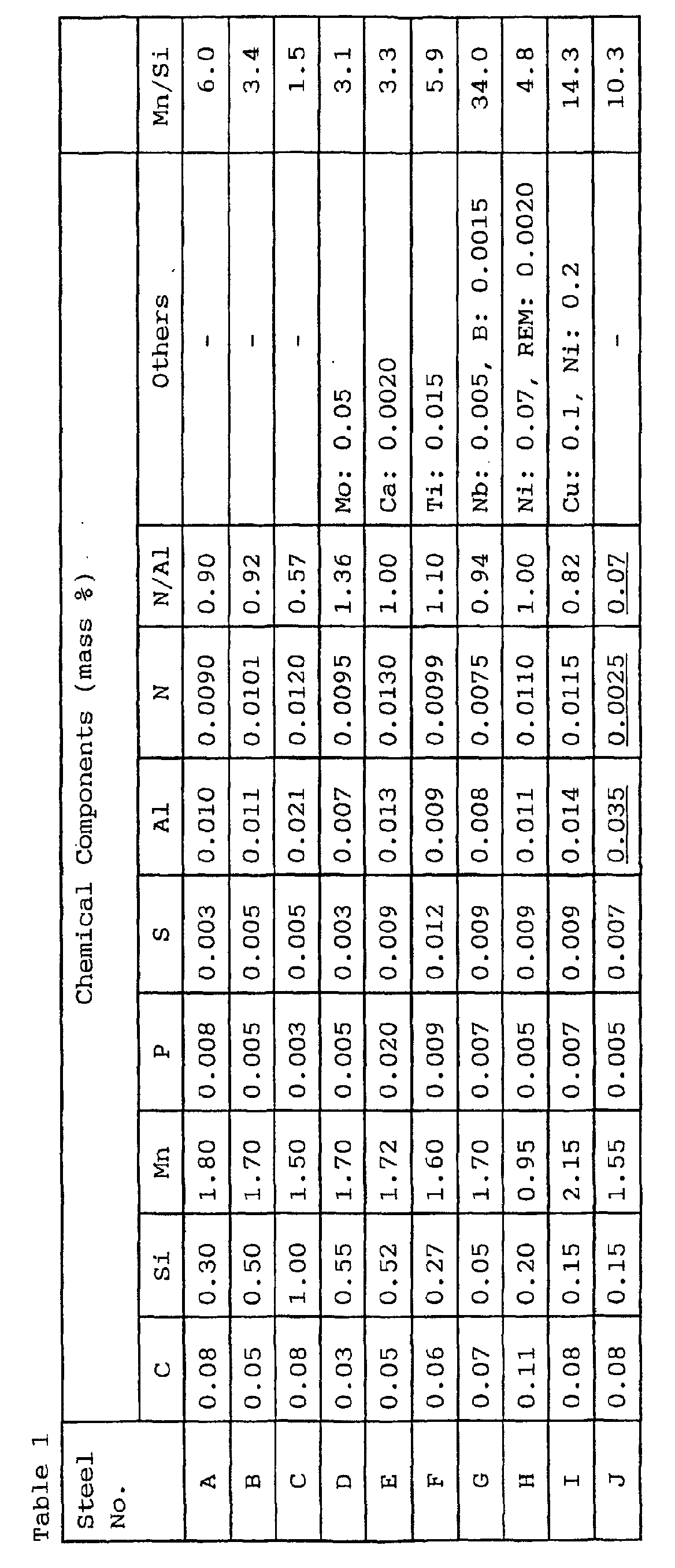
- Molten steel having compositions shown in Table 1 were prepared by a converter, and slabs were prepared by continuous casting.
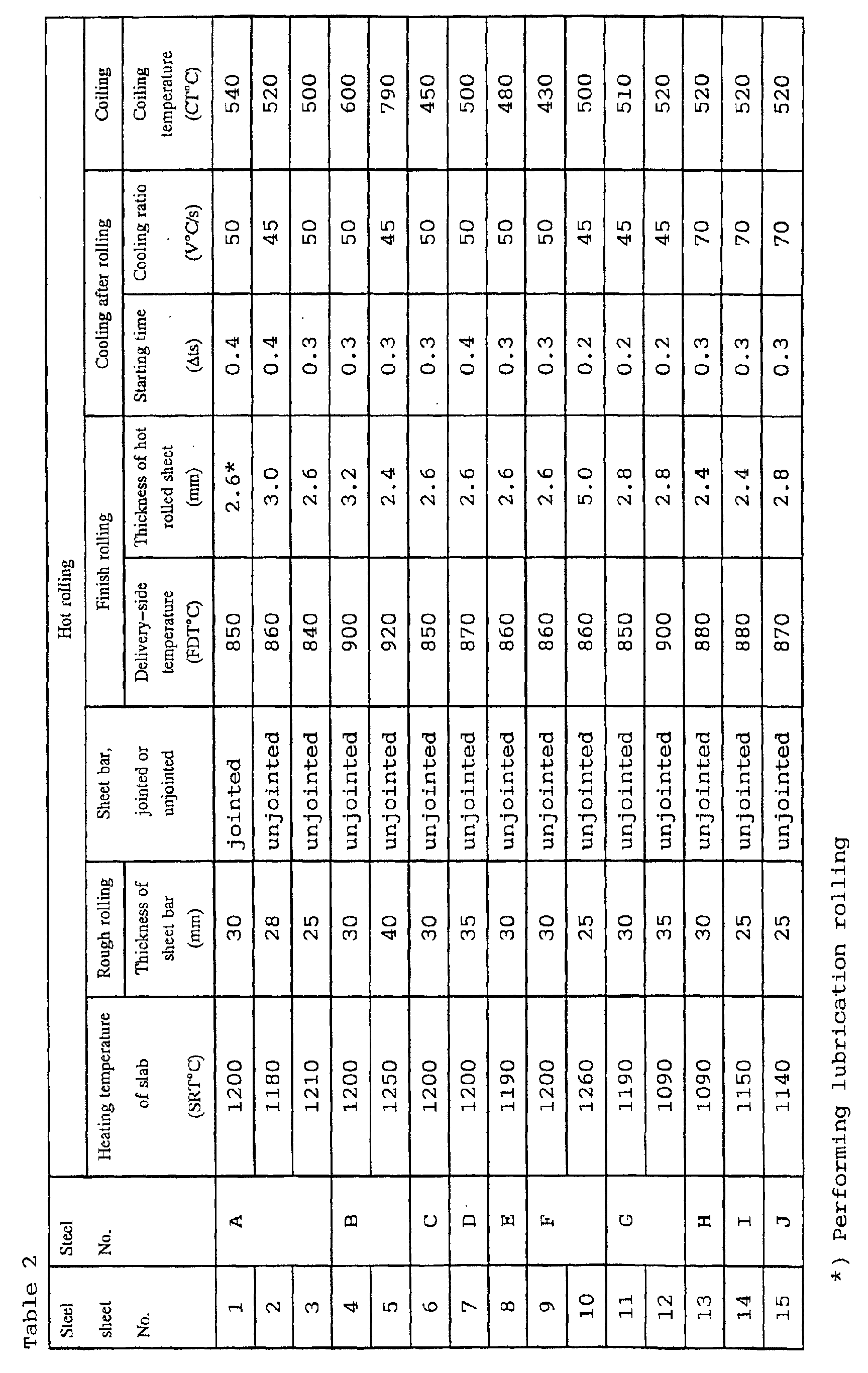
- the slabs were heated under conditions shown in Table 2, preparing sheet bars having thickness shown in Table 2 by rough rolling and then preparing hot rolled sheets in a hot rolling step in which finish rolling was performed under conditions shown in Table 2. For a portion thereof, lubrication rolling was performed in the finish rolling.
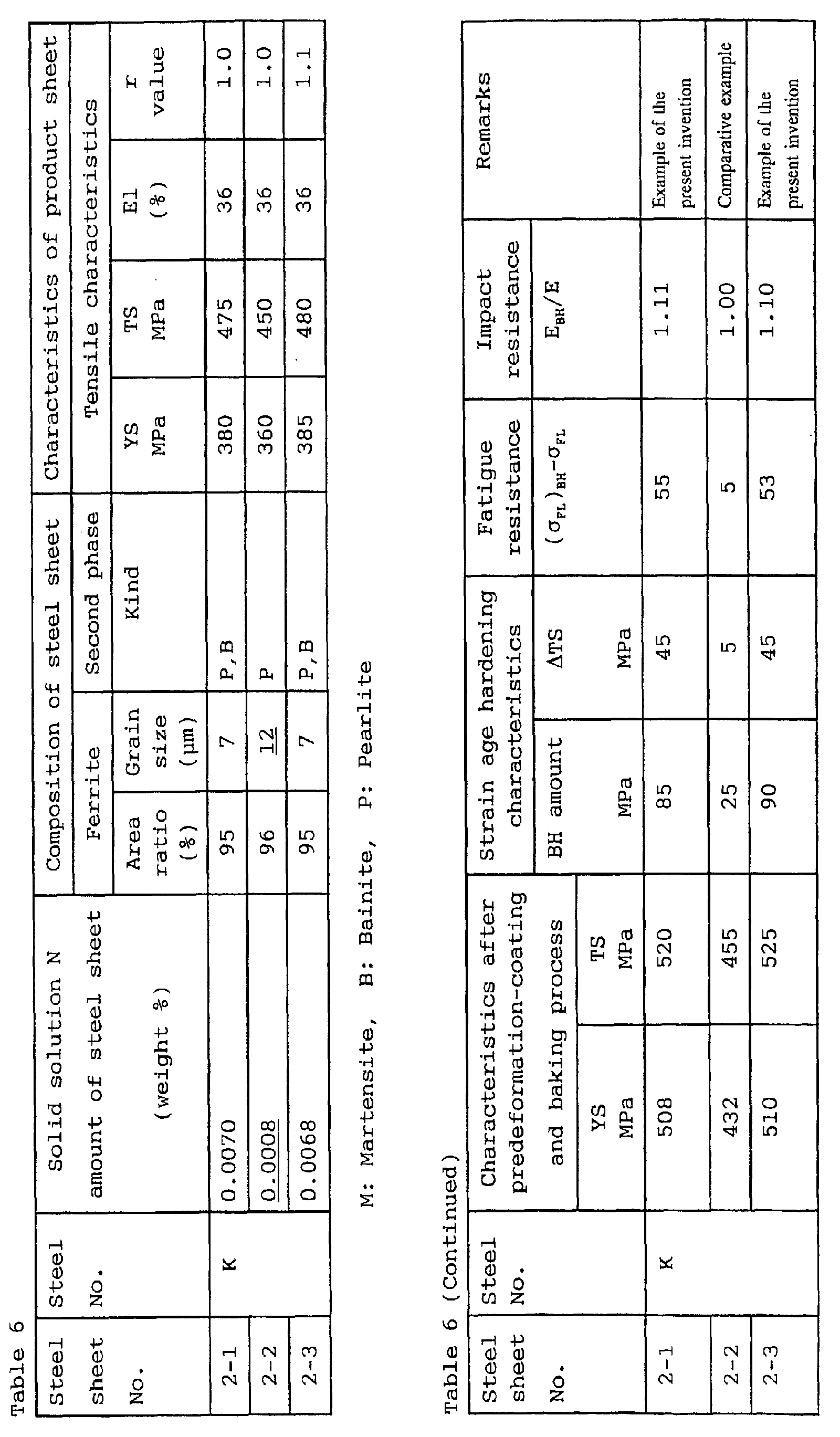
- Solid solution N amounts, microstructures, tensile characteristics, strain age hardening characteristics, fatigue resistance and impact resistance were tested for the cold rolled and annealed sheets obtained thereby.
- the amounts of solid solution N were calculated by subtracting a deposited N amount from a total N amount in steel found by chemical analysis.
- the deposited N amounts were found by the analysis applying the constant potential electrolysis mentioned above.
- Test pieces were collected from each cold rolled and annealed sheet, and the images of microstructure thereof were recorded by an optical microscope or a scanning electron microscope for cross sections (C cross sections) orthogonal to a rolling direction.
- the fractional ratios of ferrite as a main phase and the types of second phases were found by an image analyzing device.
- a larger crystal grain size was used as the crystal grain size of the main ferritic phase, chosen from a grain size calculated from a structural picture of a cross section (C cross section) orthogonal to a rolling direction by a quadrature in accordance with ASTM, and a nominal grain size calculated by a cutting method in accordance with ASTM.
- JIS No. 5 test pieces were collected in a rolling direction from each cold rolled and annealed sheet.
- a tensile test was carried out at the strain speed of 3 ⁇ 10 - 3 /s based on the provision of JIS Z 2241, and yield strength YS, tensile strength TS and elongation percentage E1 were found.
- Fatigue test pieces were collected in a rolling direction from each cold rolled and annealed sheet, and a tensile fatigue test was carried out at the minimum stress of 0 MPa in accordance with the provision of JIS Z 2273.
- the fatigue limit (10 7 repetitions) ⁇ FL was found.
- Tensile prestrain of 5% was added as predeformation, and a heat treatment equivalent to a coating and baking treatment of 170°C ⁇ 20 minutes was also carried out.
- the same fatigue test was carried out, and the fatigue limit ( ⁇ FL )BH was found.
- An improvement in fatigue resistance ( ⁇ FL )BH - ⁇ FL ) due to a predeformation-coating and baking treatment was evaluated.
- Impact test pieces were collected in a rolling direction from each cold rolled and annealed sheet.
- a high-speed tensile test was carried out at the strain speed of 2 ⁇ 10 3 /s in accordance with the high-speed tensile test described on page 1,058 of "Journal of the Society of Materials Science Japan, 10(1998)", and a stress-strain curve was found.
- absorbed energy E was calculated by integrating stress in the range of 0 to 30% of strain.
- Tensile prestrain of 5% was added as predeformation, and a heat treatment equivalent to a coating and baking treatment of 170°C ⁇ 20 minutes was also carried out. The same fatigue test was carried out thereafter, and absorbed energy E BH was found.
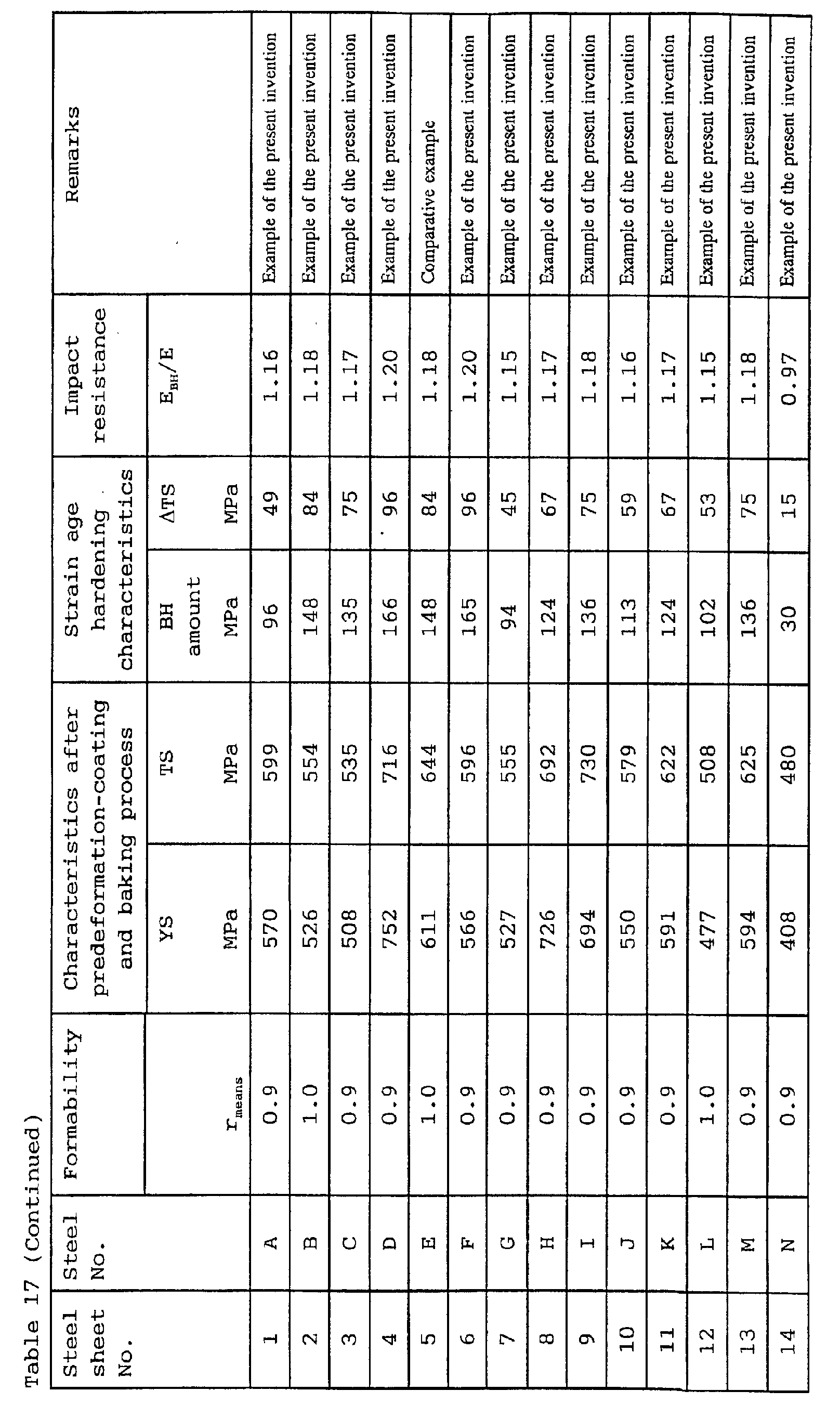
- An improvement in impact resistance E BH /E due to a predeformation-coating and baking treatment was evaluated.
- All the examples of the present invention have excellent ductility and strain age hardening characteristics, and have significantly high BH amounts and ⁇ TS. Improvements in fatigue resistance and impact resistance due to a strain aging treatment are large.
- the characteristics of the plated steel sheets where hot dip galvanizing was carried out on the surface of No. 11 and No. 13 steel sheets showed nearly the same characteristics as those before plating.
- the steel sheets were dipped in a hot dip galvanizing bath, and coating weights were adjusted by gas wiping after lifting the dipped steel sheets.
- the galvanizing conditions were a sheet temperature of 475°C, galvanizing bath of 0.13% Al-Zn, bath temperature of 475°C, dipping time of three seconds, and coating weight of 45g/m 2 .
- Example 4 Steel having compositions shown in Table 4 were used to prepare slabs in the same method of Example 1.
- the slabs were heated under conditions shown in Table 5, preparing sheet bars having the thickness of 25 mm by rough rolling and then preparing hot rolled sheets in a hot rolling step where finish rolling was performed under conditions shown in Table 5.
- adjacent sheet bars were joined by a pressure-welding method at an inlet of finish rolling after rough rolling, and the bars were continuously rolled.
- An induction heating type sheet bar edge heater and sheet bar heater were used to control the temperature of the width edge section and the length edge section of the sheet bars.
- Example 1 As in Example 1, (1) solid solution N amounts, (2) microstructures, (3) tensile characteristics, (4) strain age hardening characteristics, (5) fatigue resistance, and (6) impact resistance were tested for the cold rolled and annealed sheets obtained thereby.
- All the examples of the present invention have excellent strain age hardening characteristics, and have significantly high BH amounts and ⁇ TS even with changes in production conditions. Improvements in fatigue resistance and impact resistance due to a strain aging treatment are also large. Moreover, the precision of sheet thickness and shapes of product steel sheets improved due to continuous rolling and the adjustment of temperature in the longitudinal direction and the width direction of sheet bars in the examples of the present invention.
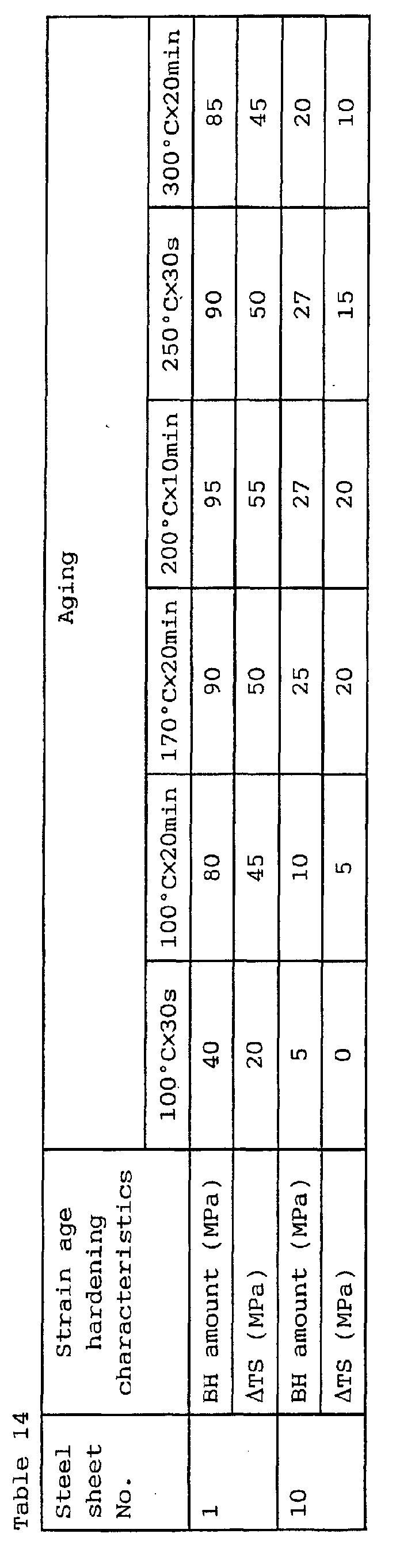
- steel sheet No. 1 as an example of the present invention and steel sheet No. 5 as a comparative example aging conditions were changed, and strain age hardening characteristics were examined. The results are shown in Table 7. The test methods were the same as those in Example 1, and only aging temperature and aging time were changed.
- the steel sheet No. 1 as an example of the present invention showed the BH amount of 115 MPa and ⁇ TS of 60 MPa by the aging treatment of 170°C ⁇ 20 minutes as standard aging conditions. Even under the wide range of aging conditions as shown in Table 7, the steel sheet No. 1 could satisfy the condition of BH amount of 80 MPa or above and ⁇ TS of 40 MPa or above. On the other hand, the comparative example did not show BH amounts and ⁇ TS as high as those in the example of the present invention even if the aging temperature was changed to the range of 100 to 300°C.
- the steel sheet of the present invention can secure a high BH amount and ⁇ TS in a wide range of aging conditions.
- Molten steel having compositions shown in Table 8 were prepared by a converter, and slabs were prepared by continuous casting.
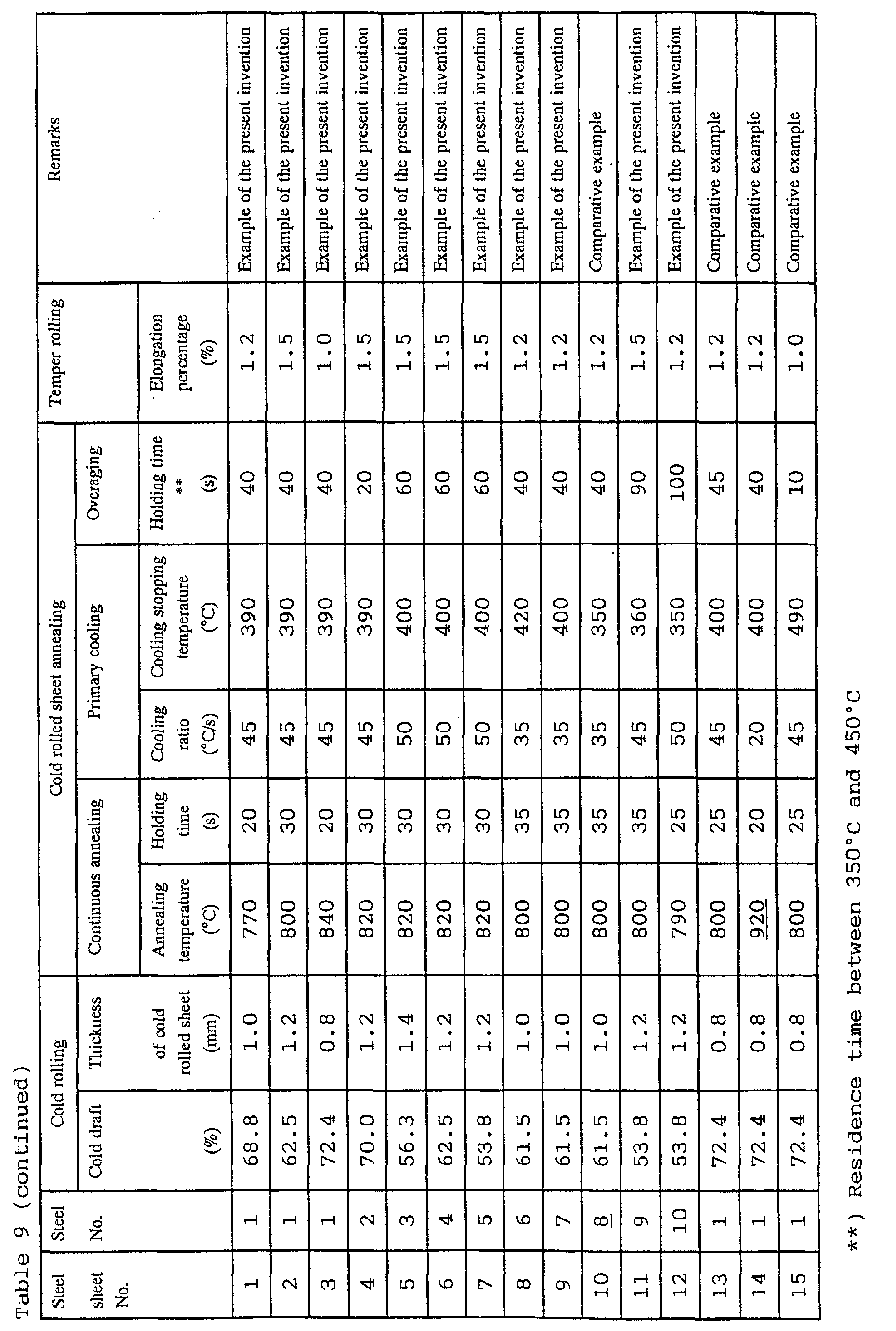
- the slabs were heated under conditions shown in Table 9, preparing sheet bars having thickness shown in Table 9 by rough rolling and then preparing hot rolled sheets in a hot rolling step in which finish rolling was performed under conditions shown in Table 9. For a portion thereof, lubrication rolling was performed in the finish rolling.
- Example 1 As in Example 1, (1) solid solution N amounts, (2) microstructures, (3) tensile characteristics, and (4) strain age hardening characteristics were tested for the cold rolled and annealed sheets obtained thereby. The results are shown in Table 10.
- the characteristics of plated steel sheets where hot dip galvanizing was carried out on the surface of steel No. 7 were similarly evaluated.
- the steel sheet was dipped in a hot dip galvanizing bath, and a coating weight was adjusted by gas wiping after lifting the dipped steel sheet.
- the galvanizing conditions were a sheet temperature of 475°C, galvanizing bath of 0.13% Al-Zn, bath temperature of 475°C, dipping time of three seconds, and coating weight of 45g/m 2 .
- the annealing conditions for a continuous plating line were the same as those for a continuous annealing line.
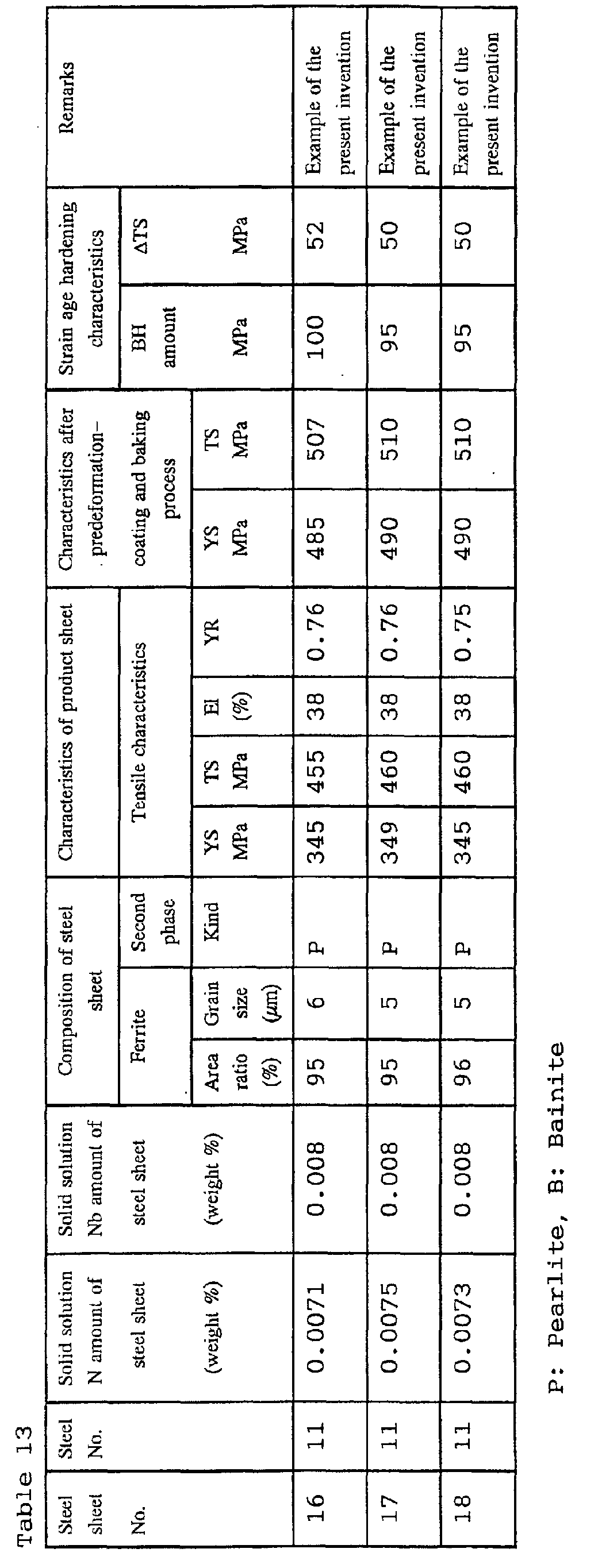
- All the examples of the present invention had excellent ductility, high yield ratios, and excellent strain age hardening characteristics, and had significantly high BH amounts and ⁇ TS.
- the tensile characteristics of the plated steel sheet where hot dip galvanizing was carried out on the surface of the steel No. 7 showed nearly the same characteristics as those before plating in consideration of a balance between strength and elongation, although TS tends to decrease slightly.
- Example 11 Steel having compositions shown in Table 11 were used to prepare slabs in the same method of Example 3.
- the slabs were heated under conditions shown in Table 12, preparing sheet bars having the thickness of 25 mm by rough rolling and then preparing hot rolled sheets in a hot rolling step where finish rolling was performed under conditions shown in Table 12.
- adjacent sheet bars were joined by a pressure-welding method at an inlet of finish rolling after rough rolling, and were continuously rolled.
- An induction heating type sheet bar edge heater and a sheet bar heater were used to control the temperature in the width edge section and the length edge section of the sheet bars, respectively.
- Example 1 As in Example 1, (1) solid solution N amounts, (2) microstructures, (3) tensile characteristics, and (4) strain age hardening characteristics were tested for the cold rolled and annealed sheets obtained thereby.
- All the examples of the present invention had excellent ductility, high yield ratios, and excellent strain age hardening characteristics, and had significantly high BH amounts and ⁇ TS with stability, even with changes in production conditions. Moreover, the precision of sheet thickness and shapes of steel sheets products improved due to continuous rolling and the adjustment of temperature in the longitudinal direction and the width direction of sheet bars in the examples of the present invention.
- the example of the present invention (steel sheet No. 1) showed the BH amount of 90 MPa and ⁇ TS of 50 MPa by the aging treatment of 170°C ⁇ 20 minutes as standard aging conditions. Even under the wide range of aging conditions as shown in Table 14, the steel sheet No. 1 could satisfy the condition of BH amount of 80 MPa or above and ⁇ TS of 40 MPa or above. On the other hand, the comparative example (steel sheet No. 10) did not show BH amounts and ⁇ TS as high as those in the example of the present invention even if aging temperature was changed to the range of 100 to 300°C.
- the steel sheet of the present invention can secure a high BH amount and ⁇ TS over a wide range of aging conditions.
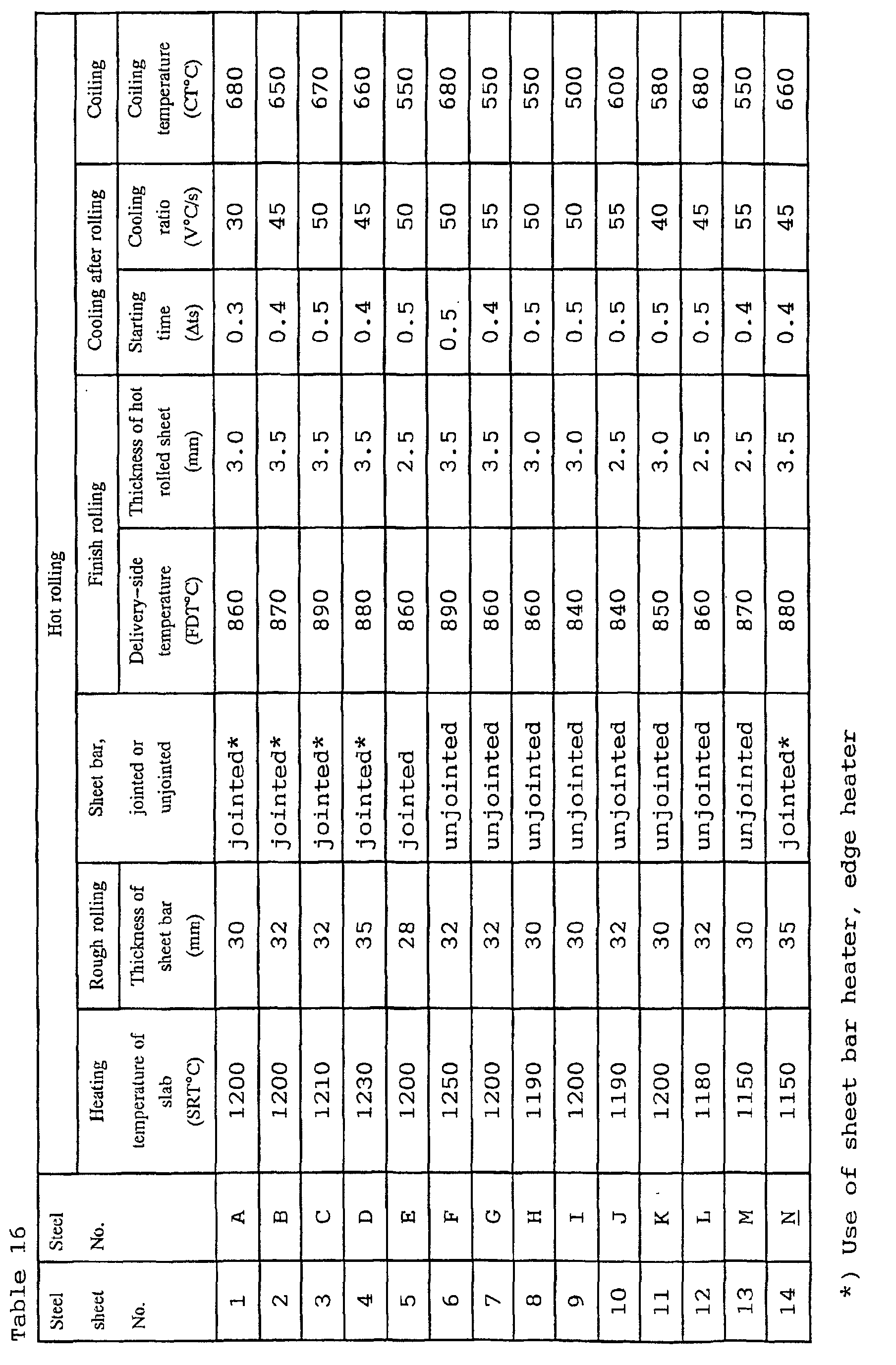
- Molten steel having compositions shown in Table 15 were prepared by a converter, and slabs were prepared by continuous casting.
- the slabs were heated under conditions shown in Table 16, preparing sheet bars having thickness shown in Table 16 by rough rolling and then preparing hot rolled sheets in a hot rolling step in which finish rolling was performed under conditions shown in Table 16.
- finish rolling was performed under conditions shown in Table 16.
- adjacent sheet bars were also joined by a pressure-welding method at an inlet of finish rolling after rough rolling, and were continuously rolled.
- An induction heating type sheet bar edge heater and sheet bar heater were used to control the temperature of the width edge section and the length edge section of the sheet bars, respectively.
- JIS No. 13B test pieces were collected from each cold rolled and annealed sheet from a rolling direction (direction L), 45° direction (direction D) relative to the rolling direction, and 90° direction (direction C) relative to the rolling direction.
- the width strain and the thickness strain of each test piece were found when a uniaxial tensile prestrain of 15% was added to the test pieces.
- r mean (rL + 2rD + rc)/4.
- r L is a r value in the rolling direction (direction L)
- r D is a r value in 45° direction (direction D) relative to the rolling direction (direction L)
- r c is a r value in 90° direction (direction C) relative to the rolling direction (direction L).
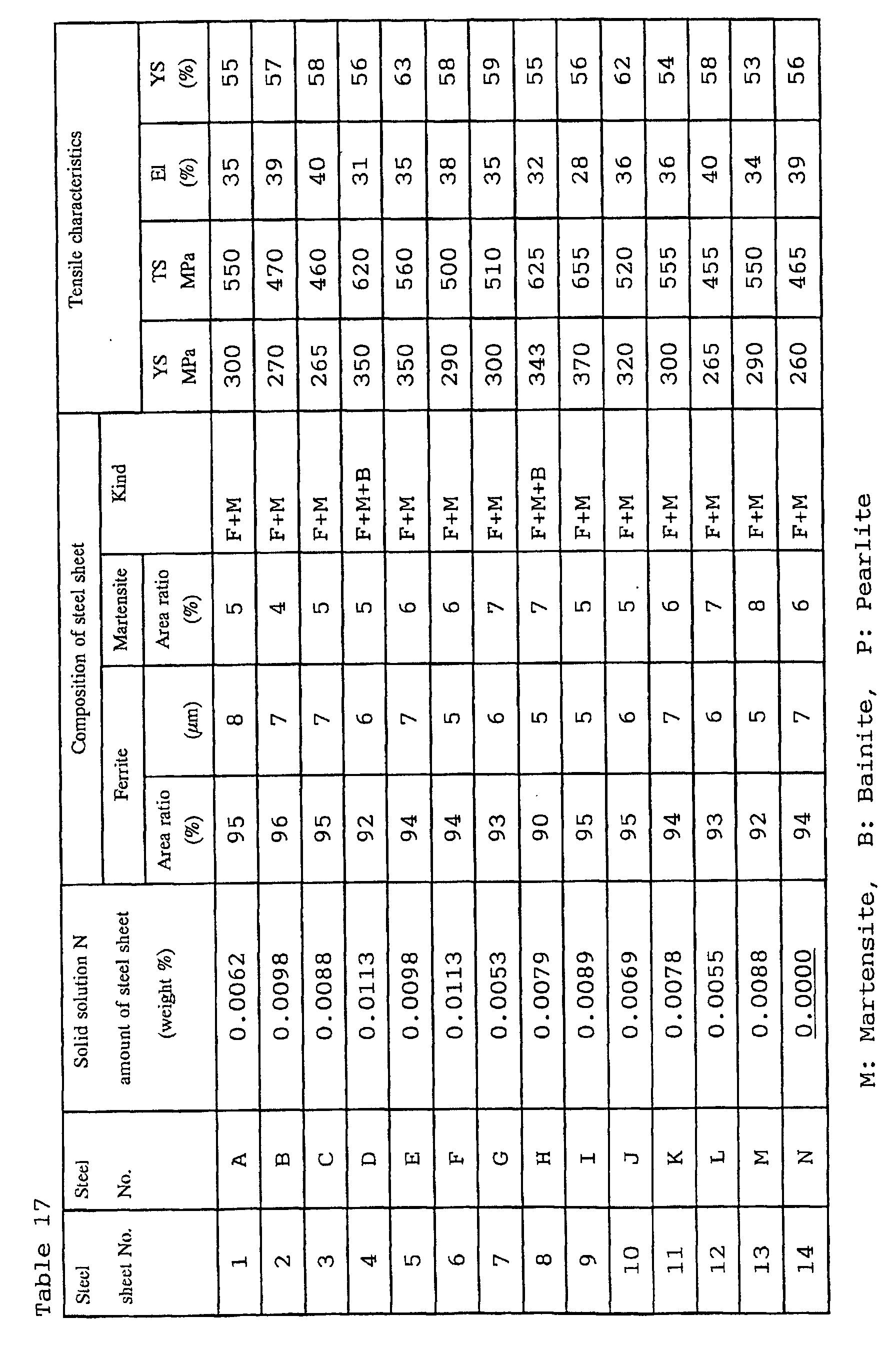
- All the examples of the present invention show excellent ductility and low yield ratios, and furthermore, have excellent strain age hardening characteristics.
- BH amounts and ⁇ TS are significantly high, and improvements in impact resistance due to strain aging are also large.
- the present invention can produce high tensile strength cold rolled steel sheets having yield stress of 80 MPa or above and tensile strength of 40 MPa or above due to a predeformation-coating and baking treatment, and that also have increasing high strain age hardening characteristics and high formability therewith, economically and without distorting shapes, providing remarkable industrial effects. Furthermore, when the high tensile strength cold rolled steel sheet of the present invention is used for vehicle parts, there are effects such as yield stress as well as tensile strength will increase due to a coating and baking treatment, and the like, providing stable and good characteristics of parts, reducing the thickness of a steel sheet, for instance, from 2.0 mm to 1.6 mm, and reducing weights of vehicle bodies.
Landscapes
- Chemical & Material Sciences (AREA)
- Engineering & Computer Science (AREA)
- Materials Engineering (AREA)
- Mechanical Engineering (AREA)
- Metallurgy (AREA)
- Organic Chemistry (AREA)
- Physics & Mathematics (AREA)
- Thermal Sciences (AREA)
- Crystallography & Structural Chemistry (AREA)
- Heat Treatment Of Sheet Steel (AREA)
Abstract
Description
Moreover, when the content of Cr is more than 1.0%, plating wettability deteriorates. Thus, the content of Mo is limited to 0.05 to 1.0%, and that of Cr is limited to 0.05 to 1.0%.
The reason for containing Nb at 0.007 to 0.04%, in particular:
Heat Treatment, 24 (1984), 334).
Moreover, in order to prevent an increase in loss due to an increase in oxidation, slab heating temperature is preferably 1280°C or lower.
Draft of finish rolling final pass: 25% or above
The critical cooling rate CR is defined by the following formula (1) or (2) based on the amounts of alloy elements:
When the cooling ratio is below CR (°C/s) defined by each formula mentioned above, it becomes difficult to form martensite M (sometimes partly containing bainite) as a second phase. A structure of a product sheet cannot be a composite structure composed of α + M (+ B). When the average cooling ratio exceeds 300°C/s, material quality becomes uneven in a width direction of a steel sheet. Thus, for cooling after annealing, the average cooling ratio between 600 and 300°C is CR that is defined by Formula (1) or (2), or above, or preferably, 300°C/s or below. It is also preferable that the average cooling ratio in the temperature range below 300°C is 5°C/s.
The annealing temperature in continuous annealing was the recrystallization temperature or above in any case.








Claims (17)
- A high tensile strength cold rolled steel sheet having excellent strain age hardening characteristics,
characterized in that the sheet consists of a composition containing, by mass %:having 0.3 or more of N/Al and 0.0010% or more of N in a solid solution state, and having the balance of Fe and inevitable impurities.0.15% or less of C;2.0% or less of Si;3.0% or less of Mn;0.08% or less of P;0.02% or less of S;0.02% or less of Al; and0.0050 to 0.0250% of N; - A high tensile strength cold rolled steel sheet having excellent strain age hardening characteristics with tensile strength of 440 MPa or above, characterized in that the sheet consists of a composition containing, by mass %:having 0.3 or more of N/Al and 0.0010% or more of N in a solid solution state, and having the balance of Fe and inevitable impurities; and that the steel sheet has a structure containing a ferritic phase having an average crystal grain size of 10 µm or less at an area ratio of 50% or more.0.15% or less of C;2.0% or less of Si;3.0% or less of Mn;0.08% or less of P;0.02% or less of S;0.02% or less of Al; and0.0050 to 0.0250% of N;
- A high tensile strength cold rolled steel sheet,
characterized in that the sheet further contains, in addition to the composition according to Claim 2, one group, or two or more groups of the following a to d by mass %:Group a: one, or two or more elements of Cu, Ni, Cr, and Mo at a total of 1.0% or less;Group b: one or two elements of Nb, Ti, and V at a total of 0.1% or less;Group c: B at 0.0030% or less; andGroup d: one or two elements of Ca and REM at a total of 0.0010 to 0.010%. - The steel sheet according to Claim 2 or 3, wherein the high tensile strength cold rolled steel sheet has a thickness of 3.2 mm or less.
- A high tensile strength cold rolled plated steel plate
wherein electroplating or melt plating is carried out on the high tensile strength cold rolled steel sheet according to one of Claims 2 to 4. - Production of a high tensile strength cold rolled steel sheet having excellent strain age hardening characteristics with tensile strength of 440 MPa or more,
characterized in that sequentially carried out are:a hot rolling step wherein a steel slab that has a composition containing, by mass %:and having N/Al of 0.3 or higher is heated at a slab heating temperature of 1,000°C or higher and is roughly rolled to form a sheet bar, and0.15% or less of C;2.0% or less of Si;3.0% or less of Mn;0.08% or less of P;0.02% or less of S;0.02% or less of Al; and0.0050 to 0.0250% of N;
the sheet bar is finish rolled at a finish rolling deliver-side temperature of 800°C or higher and is coiled at a coiling temperature of 650°C or below to form a hot-rolled sheet;a cold rolling step in which the hot rolled sheet is pickled and cold rolled to form a cold rolled sheet; anda cold rolled sheet annealing step of primary cooling in which the cold rolled sheet is annealed at a temperature between the recrystallization temperature and 900°C for a holding time of 10 to 60 seconds, andthe cold rolled sheet is also cooled at a cooling rate of 10 to 300°C/s to a temperature of 500°C or below, with a secondary cooling at a residence time of 300 seconds or less in a temperature range between the stopping temperature of the primary cooling and 400°C. - The production of a high tensile strength cold rolled steel sheet according to Claim 6, characterized in that the sheet bar is cooled within 0.5 seconds after the finish rolling and is quenched at a cooling rate of 40°C/s or above before the coiling.
- The production of a high tensile strength cold rolled steel sheet according to Claim 6 or 7, characterized in that temper rolling or leveling at an elongation percentage of 1.0 to 15% is further carried out after the cold rolled sheet annealing step.
- The production of a high tensile strength cold rolled steel sheet according to one of Claims 6 to 8,
characterized in that adjacent sheet bars are joined between the rough rolling and finish rolling. - The production of a high tensile strength cold rolled steel sheet according to one of Claims 6 to 9,
characterized in that one or both of a sheet bar edge heater that heats a width edge section of the sheet bar, and a sheet bar heater that heats a length edge section of the sheet bar, are used between the rough rolling and finish rolling. - A high yield ratio type high tensile strength cold rolled steel sheet having excellent strain age hardening characteristics with tensile strength of 440 MPa or higher and a yield ratio of 0.7 or above, characterized in that the sheet has a composition containing, by mass %:having 0.3 or more of N/Al and 0.0010% or more of N in a solid solution state, and0.15% or less of C;2.0% or less of Si;3.0% or less of Mn;0.08% or less of P;0.02% or less of S;0.02% or less of Al;0.0050 to 0.0250% of N; and0.007 to 0.04% of Nb;
furthermore containing deposited Nb at 0.005% or more, and having the balance of Fe and inevitable impurities; and that
the steel sheet has a structure containing a ferritic phase having an average crystal grain size of 10 µm or less at an area ratio of 50% or more, and mainly pearlite as a residual portion. - A high tensile strength cold rolled steel sheet,
characterized in that the sheet further contains, in addition to the composition according to Claim 11, one group, or two or more groups of the following a to d by mass %:Group a: one, or two or more elements of Cu, Ni, Cr, and Mo at a total of 1.0% or less;Group b: one or two elements of Ti and V at a total of 0.1% or less;Group c: B at 0.0030% or less; andGroup d: one or two elements of Ca and REM at a total of 0.0010 to 0.010%. - A production of a high yield ratio type high tensile strength cold rolled steel sheet having excellent strain age hardening characteristics with tensile strength of 440 MPa or more and a yield ratio of 0.7 or above,
characterized in that sequentially carried out are:a hot rolling step wherein a steel slab that has a composition containing, by mass %:0.15% or less of C;2.0% or less of Si;3.0% or less of Mn;0.08% or less of P;0.02% or less of S;0.02% or less of Al;0.0050 to 0.0250% of N; and0.007 to 0.04% of Nb;and having N/Al of 0.3 or moreis heated at a slab heating temperature of 1,100°C or higher, andis roughly rolled to form a sheet bar, andthe sheet bar is finish rolled at a final pass draft of 25% or more at a finish rolling delivery-side temperature of 800°C or higher, andis coiled at a coiling temperature of 650°C or below to form a hot rolled sheet;a cold rolling step in which the hot rolled sheet is pickled and cold rolled to form a cold rolled sheet; anda cold rolled sheet annealing step in which the cold rolled sheet is annealed at a temperature between the recrystallization temperature and 900°C for a holding time of 10 to 90 seconds, andthe cold rolled sheet is cooled at a cooling rate of 70°C/s or below to a temperature of 600°C and below. - A high tensile strength cold rolled steel sheet having excellent strain age hardening characteristics, formability and impact resistance with tensile strength of 440 MPa or higher, characterized in that the sheet has a composition containing, by mass %:having one or two elements of 0.05 to 1.0% of Mo and 0.05 to 1.0% of Cr, and0.15% or less of C;3.0% or less of Mn;0.02% or less of S;0.02% or less of Al; and0.0050 to 0.0250% of N; and furthermore,
having 0.3 or more of N/Al and 0.0010% or more of N in a solid solution state, and having the balance of Fe and inevitable impurities; and that
the steel sheet has a structure containing a ferritic phase having an average crystal grain size of 10 µm or less at an area ratio of 50% or more, and furthermore, a martensitic phase at an area ratio of 3% or more. - A high tensile strength cold rolled steel sheet,
characterized in that the sheet further contains, in addition to the composition according to Claim 14, one group, or two or more groups of the following e to h by mass %:Group e: one, or two or more elements of Si at 0.05 to 1.5%, P at 0.03 to 0.15%, and B at 0.0003 to 0.01%;Group f: one, or two or more elements of Nb at 0.01 to 0.1%, Ti at 0.01 to 0.2%, and V at 0.01 to 0.2%;Group g: one or two elements of Cu at 0.05 to 1.5% and Ni at 0.05 to 1.5%; andGroup h: one or two elements of Ca and REM at a total of 0.0010 to 0.010%. - A production of a high tensile strength cold rolled steel sheet having excellent strain age hardening characteristics, formability and impact resistance with tensile strength of 440 MPa or more, characterized in that sequentially carried out are:a hot rolling step wherein a steel slab has a composition containing, by mass %:0.15% or less of C;3.0% or less of Mn;0.02% or less of S;0.02% or less of Al; and0.0050 to 0.0250% of N; and furthermore,containing one or two elements of 0.05 to 1.0% of Mo and 0.05 to 1.0% of Cr, andhaving N/Al of 0.3 or higher, or furthermore,containing one group, or two or more groups of the following e to h:Group e: one, or two or more elements of Si at 0.05 to 1.5%, P at 0.03 to 0.15%, and B at 0.0003 to 0.01%;Group f: one, or two or more elements of Nb at 0.01 to 0.1%, Ti at 0.01 to 0.2%, and V at 0.01 to 0.2%;Group g: one or two elements of Cu at 0.05 to 1.5% and Ni at 0.05 to 1.5%; andGroup h: one or two elements of Ca and REM at a total of 0.0010 to 0.010% is heated at a slab heating temperature of 1,000°C or above and is roughly rolled to form a sheet bar, andthe sheet bar is finish rolled at finish rolling delivery-side temperature of 800°C or above and
is coiled at coiling temperature of 750°C or below to form a hot rolled sheet;a cold rolling step in which the hot rolled sheet is pickled and cold rolled to form a cold rolled sheet; anda cold rolled sheet annealing step in which the cold rolled sheet is annealed at a temperature between (Ac1 transformation point) and (Ac3 transformation point) for a holding time of 10 to 120 seconds, andis cooled at an average cooling rate that is a critical cooling rate CR defined by the following formula (1) or (2), or above from 600 to 300°C:when B < 0.0003%,
log CR = -1.73[Mn + 2.67Mo + 1.3Cr + 0.26Si + 3.5P + 0.05Cu + 0.05Ni] + 3.95 ... (1); andwhen B ≥ 0.0003%,
log CR = -1.73[Mn + 2.67Mo + 1.3Cr + 0.26Si + 3.5P + 0.05Cu + 0.05Ni] + 3.40 ... (2)
wherein CR is a cooling rate (°C/s); and Mn, Mo, Cr, Si, P, Cu and Ni are contents of each element (mass %). - The production of a high tensile strength cold rolled steel sheet according to Claim 16, characterized in that the sheet bar is cooled within 0.5 seconds after the finish rolling, and is quenched at a cooling rate of 40°C/s or above before the coiling.
Priority Applications (2)
| Application Number | Priority Date | Filing Date | Title |
|---|---|---|---|
| EP05006028A EP1571229B1 (en) | 2000-02-29 | 2001-02-14 | High tensile strength cold rolled steel sheet having excellent strain age hardening characteristics and the production thereof |
| EP05006029A EP1571230B1 (en) | 2000-02-29 | 2001-02-14 | High tensile strength cold rolled steel sheet having excellent strain age hardening characteristics and the production thereof |
Applications Claiming Priority (7)
| Application Number | Priority Date | Filing Date | Title |
|---|---|---|---|
| JP2000053923 | 2000-02-29 | ||
| JP2000053923 | 2000-02-29 | ||
| JP2000151170 | 2000-05-23 | ||
| JP2000151170 | 2000-05-23 | ||
| JP2000162497 | 2000-05-31 | ||
| JP2000162497 | 2000-05-31 | ||
| PCT/JP2001/001003 WO2001064967A1 (en) | 2000-02-29 | 2001-02-14 | High tensile cold-rolled steel sheet having excellent strain aging hardening properties |
Related Child Applications (2)
| Application Number | Title | Priority Date | Filing Date |
|---|---|---|---|
| EP05006028A Division EP1571229B1 (en) | 2000-02-29 | 2001-02-14 | High tensile strength cold rolled steel sheet having excellent strain age hardening characteristics and the production thereof |
| EP05006029A Division EP1571230B1 (en) | 2000-02-29 | 2001-02-14 | High tensile strength cold rolled steel sheet having excellent strain age hardening characteristics and the production thereof |
Publications (3)
| Publication Number | Publication Date |
|---|---|
| EP1193322A1 true EP1193322A1 (en) | 2002-04-03 |
| EP1193322A4 EP1193322A4 (en) | 2004-06-30 |
| EP1193322B1 EP1193322B1 (en) | 2006-07-05 |
Family
ID=27342519
Family Applications (3)
| Application Number | Title | Priority Date | Filing Date |
|---|---|---|---|
| EP01904406A Expired - Lifetime EP1193322B1 (en) | 2000-02-29 | 2001-02-14 | High tensile cold-rolled steel sheet having excellent strain aging hardening properties |
| EP05006029A Expired - Lifetime EP1571230B1 (en) | 2000-02-29 | 2001-02-14 | High tensile strength cold rolled steel sheet having excellent strain age hardening characteristics and the production thereof |
| EP05006028A Expired - Lifetime EP1571229B1 (en) | 2000-02-29 | 2001-02-14 | High tensile strength cold rolled steel sheet having excellent strain age hardening characteristics and the production thereof |
Family Applications After (2)
| Application Number | Title | Priority Date | Filing Date |
|---|---|---|---|
| EP05006029A Expired - Lifetime EP1571230B1 (en) | 2000-02-29 | 2001-02-14 | High tensile strength cold rolled steel sheet having excellent strain age hardening characteristics and the production thereof |
| EP05006028A Expired - Lifetime EP1571229B1 (en) | 2000-02-29 | 2001-02-14 | High tensile strength cold rolled steel sheet having excellent strain age hardening characteristics and the production thereof |
Country Status (8)
| Country | Link |
|---|---|
| US (3) | US6702904B2 (en) |
| EP (3) | EP1193322B1 (en) |
| KR (1) | KR100595946B1 (en) |
| CN (1) | CN1145709C (en) |
| CA (1) | CA2368504C (en) |
| DE (3) | DE60125253T2 (en) |
| TW (1) | TW550296B (en) |
| WO (1) | WO2001064967A1 (en) |
Cited By (25)
| Publication number | Priority date | Publication date | Assignee | Title |
|---|---|---|---|---|
| FR2830260A1 (en) * | 2001-10-03 | 2003-04-04 | Kobe Steel Ltd | Two-phase sheet steel with excellent heat hardening and formability properties for pressings |
| FR2844281A1 (en) * | 2002-09-06 | 2004-03-12 | Usinor | VERY HIGH MECHANICAL STRENGTH STEEL AND METHOD FOR MANUFACTURING A SHEET OF SUCH A ZINC COATED STEEL OR A ZINC ALLOY |
| FR2850671A1 (en) * | 2003-02-05 | 2004-08-06 | Usinor | Production of cold rolled steel strip with a dual phase ferrite-martensite structure for the fabrication of motor vehicle components by deep pressing |
| EP1516937A4 (en) * | 2002-06-25 | 2005-06-22 | Jfe Steel Corp | High-strength cold rolled steel sheet and process for producing the same |
| WO2006026982A1 (en) * | 2004-09-09 | 2006-03-16 | Salzgitter Flachstahl Gmbh | Killed, unalloyed or microalloyed rolled steel of the bake hardening type and method for producing the same |
| EP1666622A4 (en) * | 2003-09-26 | 2006-11-29 | Jfe Steel Corp | High strength steel sheet excellent in deep drawing characteristics and method for production thereof |
| US7608155B2 (en) | 2006-09-27 | 2009-10-27 | Nucor Corporation | High strength, hot dip coated, dual phase, steel sheet and method of manufacturing same |
| EP1826287A3 (en) * | 2006-02-23 | 2010-12-01 | Kabushiki Kaisha Kobe Seiko Sho | High strength steel sheet having excellent formability |
| EP1659191A4 (en) * | 2003-08-26 | 2012-02-29 | Jfe Steel Corp | High tensile strength cold-rolled steel sheet and method for production thereof |
| RU2478729C2 (en) * | 2011-05-20 | 2013-04-10 | Открытое акционерное общество "Северсталь" (ОАО "Северсталь") | Method of making steel strip (versions) |
| US8435363B2 (en) | 2007-10-10 | 2013-05-07 | Nucor Corporation | Complex metallographic structured high strength steel and manufacturing same |
| WO2013149732A1 (en) * | 2012-04-05 | 2013-10-10 | Tata Steel Ijmuiden B.V. | Steel strip having a low si content |
| RU2514743C2 (en) * | 2011-09-30 | 2014-05-10 | ДжФЕ СТИЛ КОРПОРЕЙШН | High-strength steel sheet of higher thermal hardening and forming capacity and method of its production |
| RU2518852C1 (en) * | 2012-07-20 | 2014-06-10 | ДжФЕ СТИЛ КОРПОРЕЙШН | High-strength cold-rolled sheet steel and method of its production |
| RU2530212C2 (en) * | 2011-09-15 | 2014-10-10 | ДжФЕ СТИЛ КОРПОРЕЙШН | High-strength cold-rolled steel sheet and steel sheet with coating that features excellent thermal hardenability and mouldability and method of their production |
| WO2015091216A1 (en) * | 2013-12-18 | 2015-06-25 | Tata Steel Uk Limited | High strength hot-finished steel hollow sections with low carbon equivalent for improved welding |
| RU2563397C2 (en) * | 2011-07-06 | 2015-09-20 | Ниппон Стил Энд Сумитомо Метал Корпорейшн | Production of cold-rolled steel sheet |
| RU2571667C2 (en) * | 2012-03-30 | 2015-12-20 | ДжФЕ СТИЛ КОРПОРЕЙШН | Cold-rolled steel plate with excellent resistance to ageing, and its manufacturing method |
| EP2933346A4 (en) * | 2012-12-11 | 2016-01-20 | Nippon Steel & Sumitomo Metal Corp | HOT ROLLED STEEL SHEET AND MANUFACTURING METHOD THEREOF |
| EP2623622A4 (en) * | 2010-09-29 | 2016-08-17 | Jfe Steel Corp | HIGH STRENGTH STEEL SHEET, HOT GALVANIZED, ESPECIALLY SUITABLE FOR DEEP BOTTLING AND STRETCH BINDING, AND PROCESS FOR PRODUCING SAME |
| EP2671964A4 (en) * | 2011-01-31 | 2017-06-14 | JFE Steel Corporation | High-strength cold-rolled steel sheet having excellent processability and high yield ratio, and method for producing same |
| EP3255167A4 (en) * | 2015-03-25 | 2018-07-04 | JFE Steel Corporation | High-strength steel sheet and method for manufacturing same |
| EP2128289B2 (en) † | 2007-02-28 | 2019-10-23 | JFE Steel Corporation | Steel sheet for cans, hot-rolled steel sheet to be used as the base metal and processes for production of both |
| US11155902B2 (en) | 2006-09-27 | 2021-10-26 | Nucor Corporation | High strength, hot dip coated, dual phase, steel sheet and method of manufacturing same |
| RU2863316C1 (en) * | 2026-02-13 | 2026-06-01 | Публичное Акционерное Общество "Новолипецкий металлургический комбинат" | High-strength corrosion-resistant hot-rolled steel, its production method and application |
Families Citing this family (89)
| Publication number | Priority date | Publication date | Assignee | Title |
|---|---|---|---|---|
| DE60124792T2 (en) * | 2000-02-23 | 2007-03-29 | Jfe Steel Corp. | High strength hot rolled steel sheet with excellent strain age properties and manufacturing process therefor |
| US20030015263A1 (en) * | 2000-05-26 | 2003-01-23 | Chikara Kami | Cold rolled steel sheet and galvanized steel sheet having strain aging hardening property and method for producing the same |
| US7192551B2 (en) * | 2002-07-25 | 2007-03-20 | Philip Morris Usa Inc. | Inductive heating process control of continuous cast metallic sheets |
| KR100958025B1 (en) * | 2002-11-07 | 2010-05-17 | 주식회사 포스코 | Manufacturing method of ferritic stainless steel with improved ridging property |
| KR20050009277A (en) * | 2003-01-06 | 2005-01-24 | 제이에프이 스틸 가부시키가이샤 | Steel sheet for high strength heat shrink band for cathode-ray tube and high strength heat shrink band |
| JP3934604B2 (en) * | 2003-12-25 | 2007-06-20 | 株式会社神戸製鋼所 | High strength cold-rolled steel sheet with excellent coating adhesion |
| KR20060028909A (en) * | 2004-09-30 | 2006-04-04 | 주식회사 포스코 | High strength cold rolled steel sheet with excellent shape freezing property and manufacturing method thereof |
| US8337643B2 (en) | 2004-11-24 | 2012-12-25 | Nucor Corporation | Hot rolled dual phase steel sheet |
| US7959747B2 (en) * | 2004-11-24 | 2011-06-14 | Nucor Corporation | Method of making cold rolled dual phase steel sheet |
| US7442268B2 (en) * | 2004-11-24 | 2008-10-28 | Nucor Corporation | Method of manufacturing cold rolled dual-phase steel sheet |
| US7717976B2 (en) * | 2004-12-14 | 2010-05-18 | L&P Property Management Company | Method for making strain aging resistant steel |
| US20080149230A1 (en) * | 2005-05-03 | 2008-06-26 | Posco | Cold Rolled Steel Sheet Having Superior Formability, Process for Producing the Same |
| KR100723160B1 (en) * | 2005-05-03 | 2007-05-30 | 주식회사 포스코 | Cold rolled steel sheet having reduced plane anistropy and process for producing the same |
| KR100716342B1 (en) | 2005-06-18 | 2007-05-11 | 현대자동차주식회사 | Martensitic type ultra high strength cold rolled steel sheet composition and preparation method thereof |
| EP1960562B1 (en) * | 2005-12-09 | 2015-08-26 | Posco | High strenght cold rolled steel sheet having excellent formability and coating property, zinc-based metal plated steel sheet made of it and the method for manufacturing thereof |
| RU2312923C1 (en) * | 2006-04-05 | 2007-12-20 | Юлия Алексеевна Щепочкина | Steel |
| JP5095958B2 (en) * | 2006-06-01 | 2012-12-12 | 本田技研工業株式会社 | High strength steel plate and manufacturing method thereof |
| KR100782759B1 (en) | 2006-12-19 | 2007-12-05 | 주식회사 포스코 | Manufacturing method of high yield ratio high strength cold rolled steel and plated steel |
| KR100782760B1 (en) | 2006-12-19 | 2007-12-05 | 주식회사 포스코 | Manufacturing method of high yield ratio high strength cold rolled steel and plated steel |
| JP5058769B2 (en) * | 2007-01-09 | 2012-10-24 | 新日本製鐵株式会社 | Manufacturing method and manufacturing equipment for high strength cold-rolled steel sheet excellent in chemical conversion processability |
| US8721809B2 (en) | 2007-02-23 | 2014-05-13 | Tata Steel Ijmuiden B.V. | Method of thermomechanical shaping a final product with very high strength and a product produced thereby |
| WO2008110670A1 (en) * | 2007-03-14 | 2008-09-18 | Arcelormittal France | Steel for hot working or quenching with a tool having an improved ductility |
| WO2008123025A1 (en) * | 2007-03-30 | 2008-10-16 | Sumitomo Metal Industries, Ltd. | Expandable oil well pipe to be expanded in well and process for production of the pipe |
| WO2008068352A2 (en) * | 2007-07-19 | 2008-06-12 | Corus Staal Bv | A strip of steel having a variable thickness in length direction |
| CN101755063A (en) * | 2007-07-19 | 2010-06-23 | 科鲁斯斯塔尔有限公司 | Method for annealing steel strips having different thicknesses in the length direction |
| CN101376944B (en) * | 2007-08-28 | 2011-02-09 | 宝山钢铁股份有限公司 | High-strength high-tensile ratio cold-rolled steel sheet and manufacturing method thereof |
| DE102007061475B3 (en) | 2007-12-20 | 2009-09-24 | Kabushiki Kaisha Kobe Seiko Sho (Kobe Steel, Ltd.), Kobe | Method of producing formed components from high strength and ultra high strength steels |
| CN102015155B (en) * | 2008-03-19 | 2013-11-27 | 纽科尔公司 | Strip casting apparatus with casting roll positioning |
| US20090236068A1 (en) | 2008-03-19 | 2009-09-24 | Nucor Corporation | Strip casting apparatus for rapid set and change of casting rolls |
| US20090235718A1 (en) * | 2008-03-21 | 2009-09-24 | Fox Michael J | Puncture-Resistant Containers and Testing Methods |
| CN101983251A (en) * | 2008-04-03 | 2011-03-02 | 杰富意钢铁株式会社 | High-strength steel plate for cans and manufacturing method thereof |
| JP5434212B2 (en) * | 2008-04-11 | 2014-03-05 | Jfeスチール株式会社 | Steel plate for high-strength container and manufacturing method thereof |
| RU2379370C1 (en) * | 2008-04-14 | 2010-01-20 | Открытое акционерное общество "Магнитогорский металлургический комбинат" | Low-carbon cold-rolled sheet steel for deep-drawing |
| RU2379371C1 (en) * | 2008-04-16 | 2010-01-20 | Открытое акционерное общество "Магнитогорский металлургический комбинат" | Low-carbon cold-rolled sheet steel for deep-drawing of domestic products |
| JP5201625B2 (en) * | 2008-05-13 | 2013-06-05 | 株式会社日本製鋼所 | High strength low alloy steel with excellent high pressure hydrogen environment embrittlement resistance and method for producing the same |
| US20090288798A1 (en) * | 2008-05-23 | 2009-11-26 | Nucor Corporation | Method and apparatus for controlling temperature of thin cast strip |
| RU2379369C1 (en) * | 2008-06-18 | 2010-01-20 | Открытое акционерное общество "Магнитогорский металлургический комбинат" | Low-carbon cold-rolled sheet steel |
| WO2010005362A1 (en) * | 2008-07-11 | 2010-01-14 | Aktiebolaget Skf | A method for manufacturing a steel component, a weld seam, a welded steel component, and a bearing component |
| RU2395616C2 (en) * | 2008-07-21 | 2010-07-27 | Открытое акционерное общество "Магнитогорский металлургический комбинат" | Low carbon cold rolled automobile body sheet steel for deep punching |
| EP2309014B1 (en) | 2008-07-31 | 2013-12-25 | JFE Steel Corporation | Thick, high tensile-strength hot-rolled steel sheets with excellent low temperature toughness and manufacturing method therefor |
| US8128762B2 (en) * | 2008-08-12 | 2012-03-06 | Kobe Steel, Ltd. | High-strength steel sheet superior in formability |
| JP5418168B2 (en) * | 2008-11-28 | 2014-02-19 | Jfeスチール株式会社 | High-strength cold-rolled steel sheet excellent in formability, high-strength hot-dip galvanized steel sheet, and production method thereof |
| US8784577B2 (en) | 2009-01-30 | 2014-07-22 | Jfe Steel Corporation | Thick high-tensile-strength hot-rolled steel sheet having excellent low-temperature toughness and manufacturing method thereof |
| CN103276291A (en) | 2009-01-30 | 2013-09-04 | 杰富意钢铁株式会社 | Heavy gauge, high tensile strength, hot rolled steel sheet with excellent HIC resistance and manufacturing method therefor |
| KR101149117B1 (en) * | 2009-06-26 | 2012-05-25 | 현대제철 주식회사 | Steel sheet having excellent low yield ratio property, and method for producing the same |
| JP5786318B2 (en) * | 2010-01-22 | 2015-09-30 | Jfeスチール株式会社 | High-strength hot-dip galvanized steel sheet with excellent fatigue characteristics and hole expansibility and method for producing the same |
| JP4998757B2 (en) * | 2010-03-26 | 2012-08-15 | Jfeスチール株式会社 | Manufacturing method of high strength steel sheet with excellent deep drawability |
| CN102011081B (en) * | 2010-10-26 | 2012-08-29 | 常州大学 | Method for removing iron through external circulation standing and cooling during continuous hot-dipping of zinc and aluminum |
| CN102455662B (en) * | 2010-10-26 | 2013-09-25 | 宝山钢铁股份有限公司 | Optimized setting method and system for straightening parameters of hot rolled strip straightener |
| JP5093423B2 (en) * | 2010-12-06 | 2012-12-12 | 新日本製鐵株式会社 | Steel plate for aerosol can bottom cover and manufacturing method thereof |
| KR101033412B1 (en) * | 2011-01-04 | 2011-05-11 | 현대하이스코 주식회사 | Box Annealing Heat Treatment Method of Cold Rolled Steel Sheet for Drum Material |
| KR101033401B1 (en) * | 2011-01-04 | 2011-05-09 | 현대하이스코 주식회사 | Box Annealing Heat Treatment Method of Cold Rolled Steel Sheet for General Materials |
| JP5488763B2 (en) | 2011-05-25 | 2014-05-14 | 新日鐵住金株式会社 | Cold-rolled steel sheet and manufacturing method thereof |
| ES2714302T3 (en) * | 2011-07-27 | 2019-05-28 | Nippon Steel & Sumitomo Metal Corp | High strength cold rolled steel sheet that has excellent flawlessness and precision drivability, and a manufacturing method of said sheet |
| JP5338873B2 (en) * | 2011-08-05 | 2013-11-13 | Jfeスチール株式会社 | High-strength hot-dip galvanized steel sheet excellent in workability with a tensile strength of 440 MPa or more and its production method |
| JP2013060644A (en) * | 2011-09-14 | 2013-04-04 | Jfe Steel Corp | Thin steel sheet excellent in workability, plated thin steel sheet, and method for producing them |
| JP2013072107A (en) * | 2011-09-27 | 2013-04-22 | Jfe Steel Corp | Bake-hardenable, cold-rolled steel sheet excellent in surface quality after molding and method for manufacturing the same |
| JP2013072110A (en) * | 2011-09-27 | 2013-04-22 | Jfe Steel Corp | High-tensile, cold-rolled steel sheet excellent in surface quality after molding and method for manufacturing the same |
| JP5365673B2 (en) | 2011-09-29 | 2013-12-11 | Jfeスチール株式会社 | Hot rolled steel sheet with excellent material uniformity and method for producing the same |
| KR101316320B1 (en) * | 2011-12-06 | 2013-10-08 | 주식회사 포스코 | Steel sheet having excellent yield strength and elongation and method foe mafufacturing the same |
| JP5316634B2 (en) * | 2011-12-19 | 2013-10-16 | Jfeスチール株式会社 | High-strength steel sheet with excellent workability and method for producing the same |
| KR20140099544A (en) * | 2011-12-26 | 2014-08-12 | 제이에프이 스틸 가부시키가이샤 | High-strength steel sheet and method for manufacturing same |
| JP5578288B2 (en) | 2012-01-31 | 2014-08-27 | Jfeスチール株式会社 | Hot-rolled steel sheet for generator rim and manufacturing method thereof |
| JP2013224477A (en) * | 2012-03-22 | 2013-10-31 | Jfe Steel Corp | High-strength thin steel sheet excellent in workability and method for manufacturing the same |
| JP2013209725A (en) * | 2012-03-30 | 2013-10-10 | Jfe Steel Corp | Cold rolled steel sheet excellent in bendability and manufacturing method thereof |
| JP2013231216A (en) * | 2012-04-27 | 2013-11-14 | Jfe Steel Corp | High strength cold rolled steel sheet having excellent chemical conversion property and method for producing the same |
| JP2013237877A (en) * | 2012-05-11 | 2013-11-28 | Jfe Steel Corp | High yield ratio type high strength steel sheet, high yield ratio type high strength cold rolled steel sheet, high yield ratio type high strength galvanized steel sheet, high yield ratio type high strength hot dip galvanized steel sheet, high yield ratio type high strength hot dip galvannealed steel sheet, method for producing high yield ratio type high strength cold rolled steel sheet, method for producing high yield ratio type high strength hot dip galvanized steel sheet and method for producing high yield ratio type high strength hot dip galvannealed steel sheet |
| JP2013241636A (en) * | 2012-05-18 | 2013-12-05 | Jfe Steel Corp | Low yield ratio type high strength hot dip galvanized steel sheet, low yield ratio type high strength alloying hot dip galvannealed steel sheet, method for manufacturing low yield ratio type high strength hot dip galvanized steel sheet, and method for manufacturing low yield ratio type high strength alloying hot dip galvannealed steel sheet |
| KR101443442B1 (en) * | 2012-06-28 | 2014-09-24 | 현대제철 주식회사 | High strength cold rolled steel sheet and method for manufacturing of the same |
| JP2014015651A (en) * | 2012-07-06 | 2014-01-30 | Jfe Steel Corp | High strength cold rolled steel sheet having excellent deep drawability and method for producing the same |
| CN105143486B (en) * | 2013-04-15 | 2017-05-03 | 杰富意钢铁株式会社 | High strength hot rolled steel sheet and method for producing same |
| CN103290312B (en) * | 2013-06-05 | 2015-01-21 | 首钢总公司 | Production method for increasing work hardening value of 440MPa-level carbon structural steel |
| DE102013013067A1 (en) * | 2013-07-30 | 2015-02-05 | Salzgitter Flachstahl Gmbh | Silicon-containing microalloyed high-strength multiphase steel having a minimum tensile strength of 750 MPa and improved properties and processes for producing a strip of this steel |
| JP5817805B2 (en) * | 2013-10-22 | 2015-11-18 | Jfeスチール株式会社 | High strength steel sheet with small in-plane anisotropy of elongation and method for producing the same |
| KR101568547B1 (en) | 2013-12-25 | 2015-11-11 | 주식회사 포스코 | Equipment for continuous annealing strip and method of continuous annealing same |
| WO2015177582A1 (en) | 2014-05-20 | 2015-11-26 | Arcelormittal Investigación Y Desarrollo Sl | Double-annealed steel sheet having high mechanical strength and ductility characteristics, method of manufacture and use of such sheets |
| DE102014017274A1 (en) * | 2014-11-18 | 2016-05-19 | Salzgitter Flachstahl Gmbh | Highest strength air hardening multiphase steel with excellent processing properties and method of making a strip from this steel |
| KR101657845B1 (en) * | 2014-12-26 | 2016-09-20 | 주식회사 포스코 | High strength cold rolled steel sheet having excellent surface quality of thin slab and method for manufacturing the same |
| US10174398B2 (en) * | 2016-02-22 | 2019-01-08 | Nucor Corporation | Weathering steel |
| JP6278162B1 (en) * | 2016-03-31 | 2018-02-14 | Jfeスチール株式会社 | Thin steel plate and plated steel plate, hot rolled steel plate manufacturing method, cold rolled full hard steel plate manufacturing method, thin steel plate manufacturing method and plated steel plate manufacturing method |
| WO2017169871A1 (en) * | 2016-03-31 | 2017-10-05 | Jfeスチール株式会社 | Thin steel plate and plated steel plate, hot rolled steel plate manufacturing method, cold rolled full hard steel plate manufacturing method, thin steel plate manufacturing method and plated steel plate manufacturing method |
| CN107794357B (en) | 2017-10-26 | 2018-09-14 | 北京科技大学 | The method of super rapid heating technique productions superhigh intensity martensite cold-rolled steel sheet |
| CA3076932C (en) * | 2017-11-02 | 2023-08-15 | Ak Steel Properties, Inc. | Press hardened steel with tailored properties |
| CN110029277A (en) * | 2018-01-12 | 2019-07-19 | Posco公司 | Precipitation hardened steel sheet with little variation in material properties in all directions and method for producing the same |
| CN110117756B (en) * | 2019-05-21 | 2020-11-24 | 安徽工业大学 | A kind of Cu alloyed deep drawing dual-phase steel plate and preparation method thereof |
| EP4437146A4 (en) * | 2021-12-30 | 2025-03-05 | Eregli Demir ve Celik Fabrikalari T.A.S. | HIGH STRENGTH IRON-ZINC ALLOY (GALVANNEAL) COATED STEEL SHEET AND PRODUCTION METHOD FOR THE AUTOMOTIVE INDUSTRY |
| DE102022121780A1 (en) * | 2022-08-29 | 2024-02-29 | Thyssenkrupp Steel Europe Ag | Process for producing a cold-rolled flat steel product |
| CN119095994A (en) * | 2023-04-06 | 2024-12-06 | 日本制铁株式会社 | Steel Plate |
| CN117418172B (en) * | 2023-10-31 | 2026-06-12 | 华北理工大学 | A method for preparing ultra-deep drawing dual-phase steel subjected to two cold rolling processes. |
Family Cites Families (28)
| Publication number | Priority date | Publication date | Assignee | Title |
|---|---|---|---|---|
| US3673009A (en) * | 1969-12-17 | 1972-06-27 | Inland Steel Co | Method for producing a part from steel sheet |
| US3988173A (en) * | 1972-04-03 | 1976-10-26 | Nippon Steel Corporation | Cold rolled steel sheet having excellent workability and method thereof |
| JPS5849627B2 (en) * | 1979-02-27 | 1983-11-05 | 川崎製鉄株式会社 | Method for producing non-temporal cold-rolled steel sheet |
| JPS55141526A (en) * | 1979-04-18 | 1980-11-05 | Kawasaki Steel Corp | Production of high tension cold-rolled steel plate for deep drawing |
| JPS583922A (en) * | 1981-06-29 | 1983-01-10 | Kawasaki Steel Corp | Production of class t-3 tin plate of superior aging property |
| JPS6052528A (en) * | 1983-09-02 | 1985-03-25 | Kawasaki Steel Corp | Production of high-strength thin steel sheet having good ductility and spot weldability |
| JPS60145355A (en) * | 1984-01-06 | 1985-07-31 | Kawasaki Steel Corp | Low yield ratio high tension hot rolled steel sheet having good ductility without deterioration with age and its production |
| US4578124A (en) * | 1984-01-20 | 1986-03-25 | Kabushiki Kaisha Kobe Seiko Sho | High strength low carbon steels, steel articles thereof and method for manufacturing the steels |
| JPS61104031A (en) * | 1984-10-25 | 1986-05-22 | Kawasaki Steel Corp | Manufacture of high-strength cold-rolled steel sheet having superior burning hardenability |
| JPS61272323A (en) * | 1985-05-28 | 1986-12-02 | Kawasaki Steel Corp | Manufacture of original sheet for surface treatment by continuous annealing |
| JPH0823048B2 (en) * | 1990-07-18 | 1996-03-06 | 住友金属工業株式会社 | Method for producing hot rolled steel sheet with excellent bake hardenability and workability |
| US5123969A (en) * | 1991-02-01 | 1992-06-23 | China Steel Corp. Ltd. | Bake-hardening cold-rolled steel sheet having dual-phase structure and process for manufacturing it |
| CA2067043C (en) * | 1991-04-26 | 1998-04-28 | Susumu Okada | High strength cold rolled steel sheet having excellent non-aging property at room temperature and suitable for drawing and method of producing the same |
| JPH04365814A (en) * | 1991-06-11 | 1992-12-17 | Nippon Steel Corp | Production of cold rolled high strength steel sheet excellent in baking hardenability |
| GB2266805A (en) | 1992-04-03 | 1993-11-10 | Ibm | Disc data storage device with cooling fins. |
| KR940702231A (en) * | 1992-06-22 | 1994-07-28 | 미노루 다나까 | COLD ROLLED STEEL SHEET AND HOT DIP AINC-COATED COLD ROLLED STEEL SHEET HAVING EXCELLENT BAKE HARDENABILITY, NON-AGING PROPERTIES AND FORMABILITY, AND PROCESS FOR PRODUCING SAME) |
| EP0612857B1 (en) * | 1992-09-14 | 1999-07-28 | Nippon Steel Corporation | Ferrite single phase cold rolled steel sheet or fused zinc plated steel sheet for cold non-ageing deep drawing and method for manufacturing the same |
| JPH06116648A (en) * | 1992-10-02 | 1994-04-26 | Nippon Steel Corp | Method for producing cold rolled steel sheet or hot dip galvanized cold rolled steel sheet having excellent bake hardenability and non-aging property |
| JP3303931B2 (en) * | 1992-10-06 | 2002-07-22 | 川崎製鉄株式会社 | High-strength steel sheet for baking having hardenability and its manufacturing method |
| JP3458416B2 (en) * | 1993-09-21 | 2003-10-20 | Jfeスチール株式会社 | Cold rolled thin steel sheet excellent in impact resistance and method for producing the same |
| JP3390256B2 (en) * | 1994-07-21 | 2003-03-24 | 川崎製鉄株式会社 | High-strength and high-workability steel sheet for cans with excellent bake hardenability and aging resistance, and method for producing the same |
| JP3323676B2 (en) * | 1994-12-06 | 2002-09-09 | 株式会社神戸製鋼所 | Manufacturing method of cold rolled steel sheet with excellent perforated corrosion resistance |
| JPH08325670A (en) * | 1995-03-29 | 1996-12-10 | Kawasaki Steel Corp | Steel plate for can making having excellent deep drawability and flange formability during can making, and surface properties after can making, and sufficient can strength, and method for producing the same |
| JP3713804B2 (en) * | 1996-05-02 | 2005-11-09 | Jfeスチール株式会社 | Thin hot-rolled steel sheet with excellent formability |
| KR20000068896A (en) * | 1997-09-04 | 2000-11-25 | 에모토 간지 | Steel plates for drum cans, method of manufacturing the same, and drum can |
| JP3376882B2 (en) * | 1997-09-11 | 2003-02-10 | 住友金属工業株式会社 | Manufacturing method of high tensile alloyed hot-dip galvanized steel sheet with excellent bendability |
| EP0999288B1 (en) * | 1998-04-08 | 2007-11-07 | JFE Steel Corporation | Steel sheet for can and manufacturing method thereof |
| DE60110586T2 (en) * | 2000-05-31 | 2005-12-01 | Jfe Steel Corp. | COLD-ROLLED STEEL PLATE WITH EXCELLENT RECALTERING CHARACTERISTICS AND MANUFACTURING METHOD FOR SUCH STEEL PLATE |
-
2001
- 2001-02-14 CA CA002368504A patent/CA2368504C/en not_active Expired - Fee Related
- 2001-02-14 EP EP01904406A patent/EP1193322B1/en not_active Expired - Lifetime
- 2001-02-14 TW TW090103279A patent/TW550296B/en not_active IP Right Cessation
- 2001-02-14 DE DE60125253T patent/DE60125253T2/en not_active Expired - Lifetime
- 2001-02-14 EP EP05006029A patent/EP1571230B1/en not_active Expired - Lifetime
- 2001-02-14 WO PCT/JP2001/001003 patent/WO2001064967A1/en not_active Ceased
- 2001-02-14 US US09/980,513 patent/US6702904B2/en not_active Expired - Lifetime
- 2001-02-14 KR KR1020017013657A patent/KR100595946B1/en not_active Expired - Fee Related
- 2001-02-14 DE DE60121266T patent/DE60121266T2/en not_active Expired - Lifetime
- 2001-02-14 CN CNB01801125XA patent/CN1145709C/en not_active Expired - Fee Related
- 2001-02-14 EP EP05006028A patent/EP1571229B1/en not_active Expired - Lifetime
- 2001-02-14 DE DE60127879T patent/DE60127879T2/en not_active Expired - Lifetime
-
2003
- 2003-01-13 US US10/341,165 patent/US6899771B2/en not_active Expired - Lifetime
- 2003-01-13 US US10/341,166 patent/US6902632B2/en not_active Expired - Lifetime
Cited By (42)
| Publication number | Priority date | Publication date | Assignee | Title |
|---|---|---|---|---|
| US7553380B2 (en) | 2001-10-03 | 2009-06-30 | Kobe Steel, Ltd. | Dual-phase steel sheet excellent in stretch flange formability and production method thereof |
| FR2830260A1 (en) * | 2001-10-03 | 2003-04-04 | Kobe Steel Ltd | Two-phase sheet steel with excellent heat hardening and formability properties for pressings |
| EP1516937A4 (en) * | 2002-06-25 | 2005-06-22 | Jfe Steel Corp | High-strength cold rolled steel sheet and process for producing the same |
| US7559997B2 (en) | 2002-06-25 | 2009-07-14 | Jfe Steel Corporation | High-strength cold rolled steel sheet and process for producing the same |
| CN100422352C (en) * | 2002-09-06 | 2008-10-01 | 于西纳公司 | Ultra-high mechanical strength steel and method for producing steel sheet coated with zinc or zinc alloy |
| RU2321667C2 (en) * | 2002-09-06 | 2008-04-10 | Юзинор | Steel with super-high mechanical property, method for producing steel sheet with zinc or zinc alloy coating and method for using such sheet |
| US7976647B2 (en) | 2002-09-06 | 2011-07-12 | Usinor | Very high mechanical strength steel and method for making a sheet thereof coated with zinc or zinc alloy |
| WO2004022793A3 (en) * | 2002-09-06 | 2004-05-06 | Usinor | Very high mechanical strength steel and method for making a sheet thereof coated with zinc or zinc alloy |
| FR2844281A1 (en) * | 2002-09-06 | 2004-03-12 | Usinor | VERY HIGH MECHANICAL STRENGTH STEEL AND METHOD FOR MANUFACTURING A SHEET OF SUCH A ZINC COATED STEEL OR A ZINC ALLOY |
| WO2004079022A1 (en) * | 2003-02-05 | 2004-09-16 | Usinor | Method of producing a cold-rolled band of dual-phase steel with a ferritic/martensitic structure and band thus obtained |
| FR2850671A1 (en) * | 2003-02-05 | 2004-08-06 | Usinor | Production of cold rolled steel strip with a dual phase ferrite-martensite structure for the fabrication of motor vehicle components by deep pressing |
| CN100465299C (en) * | 2003-02-05 | 2009-03-04 | 于西纳公司 | Process for producing cold-rolled ferritic/martensitic dual-phase steel strip and strip obtained therefrom |
| EP1659191A4 (en) * | 2003-08-26 | 2012-02-29 | Jfe Steel Corp | High tensile strength cold-rolled steel sheet and method for production thereof |
| US7686896B2 (en) | 2003-09-26 | 2010-03-30 | Jfe Steel Corporation | High-strength steel sheet excellent in deep drawing characteristics and method for production thereof |
| EP1666622A4 (en) * | 2003-09-26 | 2006-11-29 | Jfe Steel Corp | High strength steel sheet excellent in deep drawing characteristics and method for production thereof |
| WO2006026982A1 (en) * | 2004-09-09 | 2006-03-16 | Salzgitter Flachstahl Gmbh | Killed, unalloyed or microalloyed rolled steel of the bake hardening type and method for producing the same |
| EP1826287A3 (en) * | 2006-02-23 | 2010-12-01 | Kabushiki Kaisha Kobe Seiko Sho | High strength steel sheet having excellent formability |
| US11155902B2 (en) | 2006-09-27 | 2021-10-26 | Nucor Corporation | High strength, hot dip coated, dual phase, steel sheet and method of manufacturing same |
| US7608155B2 (en) | 2006-09-27 | 2009-10-27 | Nucor Corporation | High strength, hot dip coated, dual phase, steel sheet and method of manufacturing same |
| EP2128289B2 (en) † | 2007-02-28 | 2019-10-23 | JFE Steel Corporation | Steel sheet for cans, hot-rolled steel sheet to be used as the base metal and processes for production of both |
| US8435363B2 (en) | 2007-10-10 | 2013-05-07 | Nucor Corporation | Complex metallographic structured high strength steel and manufacturing same |
| US9157138B2 (en) | 2007-10-10 | 2015-10-13 | Nucor Corporation | Complex metallographic structured high strength steel and method of manufacturing |
| EP2623622A4 (en) * | 2010-09-29 | 2016-08-17 | Jfe Steel Corp | HIGH STRENGTH STEEL SHEET, HOT GALVANIZED, ESPECIALLY SUITABLE FOR DEEP BOTTLING AND STRETCH BINDING, AND PROCESS FOR PRODUCING SAME |
| EP2671964A4 (en) * | 2011-01-31 | 2017-06-14 | JFE Steel Corporation | High-strength cold-rolled steel sheet having excellent processability and high yield ratio, and method for producing same |
| RU2478729C2 (en) * | 2011-05-20 | 2013-04-10 | Открытое акционерное общество "Северсталь" (ОАО "Северсталь") | Method of making steel strip (versions) |
| RU2563397C2 (en) * | 2011-07-06 | 2015-09-20 | Ниппон Стил Энд Сумитомо Метал Корпорейшн | Production of cold-rolled steel sheet |
| RU2530212C2 (en) * | 2011-09-15 | 2014-10-10 | ДжФЕ СТИЛ КОРПОРЕЙШН | High-strength cold-rolled steel sheet and steel sheet with coating that features excellent thermal hardenability and mouldability and method of their production |
| RU2514743C2 (en) * | 2011-09-30 | 2014-05-10 | ДжФЕ СТИЛ КОРПОРЕЙШН | High-strength steel sheet of higher thermal hardening and forming capacity and method of its production |
| RU2571667C2 (en) * | 2012-03-30 | 2015-12-20 | ДжФЕ СТИЛ КОРПОРЕЙШН | Cold-rolled steel plate with excellent resistance to ageing, and its manufacturing method |
| WO2013149732A1 (en) * | 2012-04-05 | 2013-10-10 | Tata Steel Ijmuiden B.V. | Steel strip having a low si content |
| US9593400B2 (en) | 2012-04-05 | 2017-03-14 | Tata Steel Ijmuiden Bv | Steel strip having a low Si content |
| US9695493B2 (en) | 2012-04-05 | 2017-07-04 | Tata Steel Ijmuiden Bv | Steel strip having a low Si content |
| WO2013149733A1 (en) * | 2012-04-05 | 2013-10-10 | Tata Steel Ijmuiden B.V. | Steel strip having a low si content |
| WO2013149734A1 (en) * | 2012-04-05 | 2013-10-10 | Tata Steel Ijmuiden B.V. | Steel strip having a low si content |
| RU2518852C1 (en) * | 2012-07-20 | 2014-06-10 | ДжФЕ СТИЛ КОРПОРЕЙШН | High-strength cold-rolled sheet steel and method of its production |
| EP2933346A4 (en) * | 2012-12-11 | 2016-01-20 | Nippon Steel & Sumitomo Metal Corp | HOT ROLLED STEEL SHEET AND MANUFACTURING METHOD THEREOF |
| US10273566B2 (en) | 2012-12-11 | 2019-04-30 | Nippon Steel & Sumitomo Metal Corporation | Hot-rolled steel sheet and method for producing same |
| WO2015091216A1 (en) * | 2013-12-18 | 2015-06-25 | Tata Steel Uk Limited | High strength hot-finished steel hollow sections with low carbon equivalent for improved welding |
| EP3255167A4 (en) * | 2015-03-25 | 2018-07-04 | JFE Steel Corporation | High-strength steel sheet and method for manufacturing same |
| US10655194B2 (en) | 2015-03-25 | 2020-05-19 | Jfe Steel Corporation | High-strength steel sheet and method for producing the same |
| RU2863316C1 (en) * | 2026-02-13 | 2026-06-01 | Публичное Акционерное Общество "Новолипецкий металлургический комбинат" | High-strength corrosion-resistant hot-rolled steel, its production method and application |
| RU2867581C1 (en) * | 2026-03-27 | 2026-08-05 | Публичное Акционерное Общество "Новолипецкий металлургический комбинат" | High-strength hot-rolled steel, its production method and application |
Also Published As
| Publication number | Publication date |
|---|---|
| US20030188811A1 (en) | 2003-10-09 |
| US6902632B2 (en) | 2005-06-07 |
| DE60127879D1 (en) | 2007-05-24 |
| CA2368504A1 (en) | 2001-09-07 |
| TW550296B (en) | 2003-09-01 |
| EP1571230B1 (en) | 2006-12-13 |
| DE60121266D1 (en) | 2006-08-17 |
| WO2001064967A1 (en) | 2001-09-07 |
| US20030047256A1 (en) | 2003-03-13 |
| KR100595946B1 (en) | 2006-07-03 |
| US6702904B2 (en) | 2004-03-09 |
| KR20010112947A (en) | 2001-12-22 |
| EP1193322B1 (en) | 2006-07-05 |
| US20030145920A1 (en) | 2003-08-07 |
| US6899771B2 (en) | 2005-05-31 |
| EP1571229B1 (en) | 2007-04-11 |
| DE60125253T2 (en) | 2007-04-05 |
| EP1193322A4 (en) | 2004-06-30 |
| EP1571230A1 (en) | 2005-09-07 |
| CN1145709C (en) | 2004-04-14 |
| DE60127879T2 (en) | 2007-09-06 |
| DE60121266T2 (en) | 2006-11-09 |
| DE60125253D1 (en) | 2007-01-25 |
| CN1366559A (en) | 2002-08-28 |
| CA2368504C (en) | 2007-12-18 |
| EP1571229A1 (en) | 2005-09-07 |
Similar Documents
| Publication | Publication Date | Title |
|---|---|---|
| US6899771B2 (en) | High tensile strength cold rolled steel sheet having excellent strain age hardening characteristics and the production thereof | |
| JP7154298B2 (en) | High-strength and high-formability steel sheet and manufacturing method | |
| CA3133435C (en) | High strength and high formability steel sheet and manufacturing method | |
| US10745775B2 (en) | Galvannealed steel sheet and method for producing the same | |
| EP1191114A1 (en) | High tensile hot-rolled steel sheet having excellent strain aging hardening properties and method for producing the same | |
| US7067023B2 (en) | Cold rolled steel sheet and galvanized steel sheet having strain age hardenability and method of producing the same | |
| EP1291447B1 (en) | Cold-rolled steel sheet having excellent strain aging hardening properties and method for producing the same | |
| JP4265545B2 (en) | High tensile cold-rolled steel sheet with excellent strain age hardening characteristics and method for producing the same | |
| JP3846206B2 (en) | High tensile cold-rolled steel sheet with excellent strain age hardening characteristics and method for producing the same | |
| JP3812279B2 (en) | High yield ratio type high-tensile hot dip galvanized steel sheet excellent in workability and strain age hardening characteristics and method for producing the same | |
| US20130048155A1 (en) | High-strength galvanized steel sheet having excellent formability and spot weldability and method for manufacturing the same | |
| US12565691B2 (en) | Steel sheet, member, and methods for manufacturing the same | |
| US12258647B2 (en) | Steel sheet, member, and methods for manufacturing the same | |
| US12565690B2 (en) | Steel sheet, member, and methods for manufacturing the same | |
| KR20190022786A (en) | High strength steel sheet and manufacturing method thereof | |
| JP4665302B2 (en) | High-tensile cold-rolled steel sheet having high r value, excellent strain age hardening characteristics and non-aging at room temperature, and method for producing the same | |
| JP4839527B2 (en) | Cold-rolled steel sheet with excellent strain age hardening characteristics and method for producing the same | |
| JP3959934B2 (en) | High-tensile cold-rolled steel sheet excellent in strain age hardening characteristics, impact resistance characteristics and workability, and a method for producing the same | |
| JP2007197748A (en) | Manufacturing method of high strength cold-rolled steel sheet for deep drawing |
Legal Events
| Date | Code | Title | Description |
|---|---|---|---|
| PUAI | Public reference made under article 153(3) epc to a published international application that has entered the european phase |
Free format text: ORIGINAL CODE: 0009012 |
|
| 17P | Request for examination filed |
Effective date: 20011217 |
|
| AK | Designated contracting states |
Kind code of ref document: A1 Designated state(s): AT BE CH CY DE DK ES FI FR GB GR IE IT LI LU MC NL PT SE TR |
|
| RIC1 | Information provided on ipc code assigned before grant |
Ipc: 7C 21D 8/02 B Ipc: 7C 22C 38/00 A Ipc: 7C 21D 9/46 B Ipc: 7C 22C 38/58 B Ipc: 7C 22C 38/04 B Ipc: 7C 22C 38/06 B |
|
| RAP1 | Party data changed (applicant data changed or rights of an application transferred) |
Owner name: JFE STEEL CORPORATION |
|
| RBV | Designated contracting states (corrected) |
Designated state(s): BE DE FR GB IT |
|
| A4 | Supplementary search report drawn up and despatched |
Effective date: 20040517 |
|
| 17Q | First examination report despatched |
Effective date: 20040727 |
|
| GRAP | Despatch of communication of intention to grant a patent |
Free format text: ORIGINAL CODE: EPIDOSNIGR1 |
|
| GRAS | Grant fee paid |
Free format text: ORIGINAL CODE: EPIDOSNIGR3 |
|
| GRAA | (expected) grant |
Free format text: ORIGINAL CODE: 0009210 |
|
| AK | Designated contracting states |
Kind code of ref document: B1 Designated state(s): BE DE FR GB IT |
|
| PG25 | Lapsed in a contracting state [announced via postgrant information from national office to epo] |
Ref country code: IT Free format text: LAPSE BECAUSE OF FAILURE TO SUBMIT A TRANSLATION OF THE DESCRIPTION OR TO PAY THE FEE WITHIN THE PRESCRIBED TIME-LIMIT;WARNING: LAPSES OF ITALIAN PATENTS WITH EFFECTIVE DATE BEFORE 2007 MAY HAVE OCCURRED AT ANY TIME BEFORE 2007. THE CORRECT EFFECTIVE DATE MAY BE DIFFERENT FROM THE ONE RECORDED. Effective date: 20060705 Ref country code: BE Free format text: LAPSE BECAUSE OF FAILURE TO SUBMIT A TRANSLATION OF THE DESCRIPTION OR TO PAY THE FEE WITHIN THE PRESCRIBED TIME-LIMIT Effective date: 20060705 |
|
| REG | Reference to a national code |
Ref country code: GB Ref legal event code: FG4D |
|
| REF | Corresponds to: |
Ref document number: 60121266 Country of ref document: DE Date of ref document: 20060817 Kind code of ref document: P |
|
| ET | Fr: translation filed | ||
| PLBE | No opposition filed within time limit |
Free format text: ORIGINAL CODE: 0009261 |
|
| STAA | Information on the status of an ep patent application or granted ep patent |
Free format text: STATUS: NO OPPOSITION FILED WITHIN TIME LIMIT |
|
| 26N | No opposition filed |
Effective date: 20070410 |
|
| REG | Reference to a national code |
Ref country code: FR Ref legal event code: PLFP Year of fee payment: 16 |
|
| PGFP | Annual fee paid to national office [announced via postgrant information from national office to epo] |
Ref country code: DE Payment date: 20160209 Year of fee payment: 16 |
|
| PGFP | Annual fee paid to national office [announced via postgrant information from national office to epo] |
Ref country code: FR Payment date: 20160108 Year of fee payment: 16 Ref country code: GB Payment date: 20160210 Year of fee payment: 16 |
|
| REG | Reference to a national code |
Ref country code: DE Ref legal event code: R119 Ref document number: 60121266 Country of ref document: DE |
|
| GBPC | Gb: european patent ceased through non-payment of renewal fee |
Effective date: 20170214 |
|
| REG | Reference to a national code |
Ref country code: FR Ref legal event code: ST Effective date: 20171031 |
|
| PG25 | Lapsed in a contracting state [announced via postgrant information from national office to epo] |
Ref country code: DE Free format text: LAPSE BECAUSE OF NON-PAYMENT OF DUE FEES Effective date: 20170901 Ref country code: FR Free format text: LAPSE BECAUSE OF NON-PAYMENT OF DUE FEES Effective date: 20170228 |
|
| PG25 | Lapsed in a contracting state [announced via postgrant information from national office to epo] |
Ref country code: GB Free format text: LAPSE BECAUSE OF NON-PAYMENT OF DUE FEES Effective date: 20170214 |