EP1188732A2 - Kombinatorische Herstellung einer Substanzbibliothek unter Abtrennung einer zwitterionischen Verbindung durch Fällung - Google Patents
Kombinatorische Herstellung einer Substanzbibliothek unter Abtrennung einer zwitterionischen Verbindung durch Fällung Download PDFInfo
- Publication number
- EP1188732A2 EP1188732A2 EP01120764A EP01120764A EP1188732A2 EP 1188732 A2 EP1188732 A2 EP 1188732A2 EP 01120764 A EP01120764 A EP 01120764A EP 01120764 A EP01120764 A EP 01120764A EP 1188732 A2 EP1188732 A2 EP 1188732A2
- Authority
- EP
- European Patent Office
- Prior art keywords
- alkyl
- different
- μmol
- reaction
- zwitterionic compound
- Prior art date
- Legal status (The legal status is an assumption and is not a legal conclusion. Google has not performed a legal analysis and makes no representation as to the accuracy of the status listed.)
- Withdrawn
Links
- 150000001875 compounds Chemical class 0.000 title claims abstract description 26
- 239000000126 substance Substances 0.000 title claims abstract description 7
- 230000015572 biosynthetic process Effects 0.000 title abstract description 5
- 238000003786 synthesis reaction Methods 0.000 title description 5
- 238000001556 precipitation Methods 0.000 title description 3
- 238000000926 separation method Methods 0.000 title description 2
- 238000006243 chemical reaction Methods 0.000 claims abstract description 35
- KWIUHFFTVRNATP-UHFFFAOYSA-N Betaine Natural products C[N+](C)(C)CC([O-])=O KWIUHFFTVRNATP-UHFFFAOYSA-N 0.000 claims abstract description 15
- 239000002798 polar solvent Substances 0.000 claims abstract description 11
- 229960003237 betaine Drugs 0.000 claims abstract description 10
- 239000000376 reactant Substances 0.000 claims abstract description 9
- 239000012454 non-polar solvent Substances 0.000 claims abstract description 7
- 239000007787 solid Substances 0.000 claims abstract description 6
- 238000004519 manufacturing process Methods 0.000 claims abstract description 4
- KWIUHFFTVRNATP-UHFFFAOYSA-O N,N,N-trimethylglycinium Chemical compound C[N+](C)(C)CC(O)=O KWIUHFFTVRNATP-UHFFFAOYSA-O 0.000 claims abstract 5
- OKKJLVBELUTLKV-UHFFFAOYSA-N Methanol Chemical compound OC OKKJLVBELUTLKV-UHFFFAOYSA-N 0.000 claims description 114
- 125000000217 alkyl group Chemical group 0.000 claims description 43
- -1 amino aldehyde Chemical class 0.000 claims description 27
- RTZKZFJDLAIYFH-UHFFFAOYSA-N Diethyl ether Chemical compound CCOCC RTZKZFJDLAIYFH-UHFFFAOYSA-N 0.000 claims description 15
- 125000000959 isobutyl group Chemical group [H]C([H])([H])C([H])(C([H])([H])[H])C([H])([H])* 0.000 claims description 15
- 125000004108 n-butyl group Chemical group [H]C([H])([H])C([H])([H])C([H])([H])C([H])([H])* 0.000 claims description 15
- 125000004123 n-propyl group Chemical group [H]C([H])([H])C([H])([H])C([H])([H])* 0.000 claims description 15
- 125000001147 pentyl group Chemical group C(CCCC)* 0.000 claims description 13
- 125000001449 isopropyl group Chemical group [H]C([H])([H])C([H])(*)C([H])([H])[H] 0.000 claims description 12
- 238000000034 method Methods 0.000 claims description 12
- 150000002084 enol ethers Chemical class 0.000 claims description 9
- 125000001797 benzyl group Chemical group [H]C1=C([H])C([H])=C(C([H])=C1[H])C([H])([H])* 0.000 claims description 7
- 229910052760 oxygen Inorganic materials 0.000 claims description 6
- 125000000738 acetamido group Chemical group [H]C([H])([H])C(=O)N([H])[*] 0.000 claims description 4
- 125000001997 phenyl group Chemical group [H]C1=C([H])C([H])=C(*)C([H])=C1[H] 0.000 claims description 4
- 229910052799 carbon Inorganic materials 0.000 claims description 3
- 125000004122 cyclic group Chemical group 0.000 claims description 3
- 239000000203 mixture Substances 0.000 claims description 3
- 229910052717 sulfur Inorganic materials 0.000 claims description 3
- XLYOFNOQVPJJNP-UHFFFAOYSA-N water Substances O XLYOFNOQVPJJNP-UHFFFAOYSA-N 0.000 claims description 2
- 229910052727 yttrium Inorganic materials 0.000 claims description 2
- 239000013067 intermediate product Substances 0.000 abstract description 3
- 239000012467 final product Substances 0.000 abstract 1
- 238000002955 isolation Methods 0.000 abstract 1
- 238000002360 preparation method Methods 0.000 abstract 1
- YXFVVABEGXRONW-UHFFFAOYSA-N Toluene Chemical compound CC1=CC=CC=C1 YXFVVABEGXRONW-UHFFFAOYSA-N 0.000 description 96
- PYOKUURKVVELLB-UHFFFAOYSA-N trimethyl orthoformate Chemical compound COC(OC)OC PYOKUURKVVELLB-UHFFFAOYSA-N 0.000 description 62
- 229910052757 nitrogen Inorganic materials 0.000 description 46
- 239000002904 solvent Substances 0.000 description 35
- 239000000047 product Substances 0.000 description 32
- 239000012300 argon atmosphere Substances 0.000 description 31
- 239000013078 crystal Substances 0.000 description 31
- SAXQBSJDTDGBHS-UHFFFAOYSA-N 2-azaniumylethylazanium;diacetate Chemical compound CC([O-])=O.CC([O-])=O.[NH3+]CC[NH3+] SAXQBSJDTDGBHS-UHFFFAOYSA-N 0.000 description 24
- 238000004128 high performance liquid chromatography Methods 0.000 description 23
- 238000001644 13C nuclear magnetic resonance spectroscopy Methods 0.000 description 17
- 238000005160 1H NMR spectroscopy Methods 0.000 description 14
- AZDCYKCDXXPQIK-UHFFFAOYSA-N ethenoxymethylbenzene Chemical compound C=COCC1=CC=CC=C1 AZDCYKCDXXPQIK-UHFFFAOYSA-N 0.000 description 14
- IAZDPXIOMUYVGZ-UHFFFAOYSA-N Dimethylsulphoxide Chemical compound CS(C)=O IAZDPXIOMUYVGZ-UHFFFAOYSA-N 0.000 description 9
- QARNHIBOPBXNSX-UHFFFAOYSA-N prop-1-enoxymethylbenzene Chemical compound CC=COCC1=CC=CC=C1 QARNHIBOPBXNSX-UHFFFAOYSA-N 0.000 description 9
- JQSIHOWVTRFFNR-UHFFFAOYSA-N [NH4+].[NH4+].C=C.CC([O-])=O.CC([O-])=O Chemical compound [NH4+].[NH4+].C=C.CC([O-])=O.CC([O-])=O JQSIHOWVTRFFNR-UHFFFAOYSA-N 0.000 description 8
- XTXJPZGMVKIPHE-UHFFFAOYSA-N benzyl n-(1-oxopropan-2-yl)carbamate Chemical compound O=CC(C)NC(=O)OCC1=CC=CC=C1 XTXJPZGMVKIPHE-UHFFFAOYSA-N 0.000 description 6
- PQMOZOQTXKMYSK-UHFFFAOYSA-N benzyl n-(3-oxopropyl)carbamate Chemical compound O=CCCNC(=O)OCC1=CC=CC=C1 PQMOZOQTXKMYSK-UHFFFAOYSA-N 0.000 description 5
- VCCLKQVBXFXPRR-UHFFFAOYSA-N but-1-enoxymethylbenzene Chemical compound CCC=COCC1=CC=CC=C1 VCCLKQVBXFXPRR-UHFFFAOYSA-N 0.000 description 5
- VXIXUWQIVKSKSA-UHFFFAOYSA-N 4-hydroxycoumarin Chemical compound C1=CC=CC2=C1OC(=O)C=C2O VXIXUWQIVKSKSA-UHFFFAOYSA-N 0.000 description 4
- KDLHZDBZIXYQEI-UHFFFAOYSA-N Palladium Chemical compound [Pd] KDLHZDBZIXYQEI-UHFFFAOYSA-N 0.000 description 4
- OWWYUFODFZSVTI-UHFFFAOYSA-N [4-methyl-2-(4-methyl-1-phenylpent-2-en-2-yl)oxypent-2-enyl]benzene Chemical compound C=1C=CC=CC=1CC(=CC(C)C)OC(=CC(C)C)CC1=CC=CC=C1 OWWYUFODFZSVTI-UHFFFAOYSA-N 0.000 description 4
- SEWLQRPKYMZHDM-UHFFFAOYSA-N benzyl n-(4-methyl-1-oxopentan-2-yl)carbamate Chemical compound CC(C)CC(C=O)NC(=O)OCC1=CC=CC=C1 SEWLQRPKYMZHDM-UHFFFAOYSA-N 0.000 description 4
- ZYABAHXFLKXFHN-UHFFFAOYSA-N 1,3-dimethyl-5-(1-methylpyrrolidin-3-yl)-1,3-diazinane-2,4,6-trione Chemical compound C1N(C)CCC1C1C(=O)N(C)C(=O)N(C)C1=O ZYABAHXFLKXFHN-UHFFFAOYSA-N 0.000 description 3
- YWNLKCRKGJTDLF-UHFFFAOYSA-N 4,4-dimethyl-2-(2-methylpyrrolidin-3-yl)cyclohexane-1,3-dione Chemical compound CC1NCCC1C1C(=O)C(C)(C)CCC1=O YWNLKCRKGJTDLF-UHFFFAOYSA-N 0.000 description 3
- QSNONXQMKXTNQH-UHFFFAOYSA-N benzyl n-(2-oxoethyl)carbamate Chemical compound O=CCNC(=O)OCC1=CC=CC=C1 QSNONXQMKXTNQH-UHFFFAOYSA-N 0.000 description 3
- JYBDVASSFVUWHZ-UHFFFAOYSA-N benzyl n-(3-methyl-1-oxobutan-2-yl)carbamate Chemical compound CC(C)C(C=O)NC(=O)OCC1=CC=CC=C1 JYBDVASSFVUWHZ-UHFFFAOYSA-N 0.000 description 3
- 125000001584 benzyloxycarbonyl group Chemical group C(=O)(OCC1=CC=CC=C1)* 0.000 description 3
- 239000003054 catalyst Substances 0.000 description 3
- 238000009833 condensation Methods 0.000 description 3
- 230000005494 condensation Effects 0.000 description 3
- 239000007791 liquid phase Substances 0.000 description 3
- 239000011541 reaction mixture Substances 0.000 description 3
- MFLQHFLGLBPAFG-UHFFFAOYSA-N 1,3-dimethyl-5-(2-propan-2-ylpyrrolidin-3-yl)-1,3-diazinane-2,4,6-trione Chemical compound CC(C)C1NCCC1C1C(=O)N(C)C(=O)N(C)C1=O MFLQHFLGLBPAFG-UHFFFAOYSA-N 0.000 description 2
- WASJOTLNTKIZAW-UHFFFAOYSA-N 1,3-dimethyl-5-(3-methylazepan-4-yl)-1,3-diazinane-2,4,6-trione Chemical compound CC1CNCCCC1C1C(=O)N(C)C(=O)N(C)C1=O WASJOTLNTKIZAW-UHFFFAOYSA-N 0.000 description 2
- VDNUBNIOHBQSOS-UHFFFAOYSA-N 1,3-dimethyl-5-(3-methylpiperidin-4-yl)-1,3-diazinane-2,4,6-trione Chemical compound CC1CNCCC1C1C(=O)N(C)C(=O)N(C)C1=O VDNUBNIOHBQSOS-UHFFFAOYSA-N 0.000 description 2
- YQGHTHUHQPJCFV-UHFFFAOYSA-N 1,3-dimethyl-5-(3-propan-2-ylpiperidin-4-yl)-1,3-diazinane-2,4,6-trione Chemical compound CC(C)C1CNCCC1C1C(=O)N(C)C(=O)N(C)C1=O YQGHTHUHQPJCFV-UHFFFAOYSA-N 0.000 description 2
- LAUDFCOJVYRZFB-UHFFFAOYSA-N 1,3-dimethyl-5-(4-methylpyrrolidin-3-yl)-1,3-diazinane-2,4,6-trione Chemical compound CC1CNCC1C1C(=O)N(C)C(=O)N(C)C1=O LAUDFCOJVYRZFB-UHFFFAOYSA-N 0.000 description 2
- NMGJZUDIIOGRAQ-UHFFFAOYSA-N 1,3-dimethyl-5-[2-(2-methylpropyl)-4-propan-2-ylpyrrolidin-3-yl]-1,3-diazinane-2,4,6-trione Chemical compound CC(C)CC1NCC(C(C)C)C1C1C(=O)N(C)C(=O)N(C)C1=O NMGJZUDIIOGRAQ-UHFFFAOYSA-N 0.000 description 2
- QAEGRXIHPDQLFC-UHFFFAOYSA-N 1,3-dimethyl-5-[2-(2-methylpropyl)pyrrolidin-3-yl]-1,3-diazinane-2,4,6-trione Chemical compound CC(C)CC1NCCC1C1C(=O)N(C)C(=O)N(C)C1=O QAEGRXIHPDQLFC-UHFFFAOYSA-N 0.000 description 2
- BABPUODFBIBXHP-UHFFFAOYSA-N 1,3-dimethyl-5-[4-methyl-2-(2-methylpropyl)pyrrolidin-3-yl]-1,3-diazinane-2,4,6-trione Chemical compound CC(C)CC1NCC(C)C1C1C(=O)N(C)C(=O)N(C)C1=O BABPUODFBIBXHP-UHFFFAOYSA-N 0.000 description 2
- WNIKIVKCPVHQAV-UHFFFAOYSA-N 1,3-dimethyl-5-piperidin-4-yl-1,3-diazinane-2,4,6-trione Chemical compound O=C1N(C)C(=O)N(C)C(=O)C1C1CCNCC1 WNIKIVKCPVHQAV-UHFFFAOYSA-N 0.000 description 2
- MMVGCSJZXYIRQE-UHFFFAOYSA-N 1,3-dimethyl-5-pyrrolidin-3-yl-1,3-diazinane-2,4,6-trione Chemical compound O=C1N(C)C(=O)N(C)C(=O)C1C1CNCC1 MMVGCSJZXYIRQE-UHFFFAOYSA-N 0.000 description 2
- YQWWQSSPSJUXTP-UHFFFAOYSA-N 3-(2-methylpyrrolidin-3-yl)chromene-2,4-dione Chemical compound CC1NCCC1C1C(=O)C2=CC=CC=C2OC1=O YQWWQSSPSJUXTP-UHFFFAOYSA-N 0.000 description 2
- WYUVGHVGKKBSFX-UHFFFAOYSA-N 3-piperidin-4-ylchromene-2,4-dione Chemical compound O=C1OC2=CC=CC=C2C(=O)C1C1CCNCC1 WYUVGHVGKKBSFX-UHFFFAOYSA-N 0.000 description 2
- PLGPBTCNKJQJHQ-UHFFFAOYSA-N 4,4-dimethylcyclohexane-1,3-dione Chemical compound CC1(C)CCC(=O)CC1=O PLGPBTCNKJQJHQ-UHFFFAOYSA-N 0.000 description 2
- DHIUUNZEEYOZCD-UHFFFAOYSA-N 5,5-dimethyl-2-(2-methylpyrrolidin-3-yl)cyclohexane-1,3-dione Chemical compound CC1NCCC1C1C(=O)CC(C)(C)CC1=O DHIUUNZEEYOZCD-UHFFFAOYSA-N 0.000 description 2
- HPKCRYUOUNKWPF-UHFFFAOYSA-N 5-(1,4-dimethylpyrrolidin-3-yl)-1,3-dimethyl-1,3-diazinane-2,4,6-trione Chemical compound CC1CN(C)CC1C1C(=O)N(C)C(=O)N(C)C1=O HPKCRYUOUNKWPF-UHFFFAOYSA-N 0.000 description 2
- WUJWEPXYAZBDOD-UHFFFAOYSA-N 5-(1-butyl-2-methylpiperidin-4-yl)-1,3-dimethyl-1,3-diazinane-2,4,6-trione Chemical compound C1C(C)N(CCCC)CCC1C1C(=O)N(C)C(=O)N(C)C1=O WUJWEPXYAZBDOD-UHFFFAOYSA-N 0.000 description 2
- BPKWWABQLNJVPA-UHFFFAOYSA-N 5-(2,3,5,6,7,8-hexahydro-1h-pyrrolizin-1-yl)-1,3-dimethyl-1,3-diazinane-2,4,6-trione Chemical compound O=C1N(C)C(=O)N(C)C(=O)C1C1C2CCCN2CC1 BPKWWABQLNJVPA-UHFFFAOYSA-N 0.000 description 2
- KYRQPGYZJMQQFE-UHFFFAOYSA-N 5-(2,5-dimethylpiperidin-4-yl)-1,3-dimethyl-1,3-diazinane-2,4,6-trione Chemical compound CC1CNC(C)CC1C1C(=O)N(C)C(=O)N(C)C1=O KYRQPGYZJMQQFE-UHFFFAOYSA-N 0.000 description 2
- PQHSLCKFMPCKJM-UHFFFAOYSA-N 5-(2-benzylpyrrolidin-3-yl)-1,3-dimethyl-1,3-diazinane-2,4,6-trione Chemical compound O=C1N(C)C(=O)N(C)C(=O)C1C1C(CC=2C=CC=CC=2)NCC1 PQHSLCKFMPCKJM-UHFFFAOYSA-N 0.000 description 2
- ZDHJCHYBWBEASJ-UHFFFAOYSA-N 5-(3-ethylpiperidin-4-yl)-1,3-dimethyl-1,3-diazinane-2,4,6-trione Chemical compound CCC1CNCCC1C1C(=O)N(C)C(=O)N(C)C1=O ZDHJCHYBWBEASJ-UHFFFAOYSA-N 0.000 description 2
- MTOQKMUITKXLJJ-UHFFFAOYSA-N 5-(4-ethyl-2-methylpyrrolidin-3-yl)-1,3-dimethyl-1,3-diazinane-2,4,6-trione Chemical compound CCC1CNC(C)C1C1C(=O)N(C)C(=O)N(C)C1=O MTOQKMUITKXLJJ-UHFFFAOYSA-N 0.000 description 2
- GRJMGWFWEWGEJW-UHFFFAOYSA-N 5-(4-ethylpyrrolidin-3-yl)-1,3-dimethyl-1,3-diazinane-2,4,6-trione Chemical compound CCC1CNCC1C1C(=O)N(C)C(=O)N(C)C1=O GRJMGWFWEWGEJW-UHFFFAOYSA-N 0.000 description 2
- KGSWCGPIFKKGOZ-UHFFFAOYSA-N 5-(azepan-4-yl)-1,3-dimethyl-1,3-diazinane-2,4,6-trione Chemical compound O=C1N(C)C(=O)N(C)C(=O)C1C1CCNCCC1 KGSWCGPIFKKGOZ-UHFFFAOYSA-N 0.000 description 2
- NVNPTTKUARKBKW-UHFFFAOYSA-N 5-[4-ethyl-2-(2-methylpropyl)pyrrolidin-3-yl]-1,3-dimethyl-1,3-diazinane-2,4,6-trione Chemical compound CCC1CNC(CC(C)C)C1C1C(=O)N(C)C(=O)N(C)C1=O NVNPTTKUARKBKW-UHFFFAOYSA-N 0.000 description 2
- OKTJSMMVPCPJKN-UHFFFAOYSA-N Carbon Chemical compound [C] OKTJSMMVPCPJKN-UHFFFAOYSA-N 0.000 description 2
- LFQSCWFLJHTTHZ-UHFFFAOYSA-N Ethanol Chemical compound CCO LFQSCWFLJHTTHZ-UHFFFAOYSA-N 0.000 description 2
- DHKHKXVYLBGOIT-UHFFFAOYSA-N acetaldehyde Diethyl Acetal Natural products CCOC(C)OCC DHKHKXVYLBGOIT-UHFFFAOYSA-N 0.000 description 2
- 125000002777 acetyl group Chemical class [H]C([H])([H])C(*)=O 0.000 description 2
- 150000001299 aldehydes Chemical class 0.000 description 2
- 150000001412 amines Chemical group 0.000 description 2
- 239000012298 atmosphere Substances 0.000 description 2
- HFLBBPNJTAHFEA-UHFFFAOYSA-N benzyl 2-hydroxypyrrolidine-1-carboxylate Chemical compound OC1CCCN1C(=O)OCC1=CC=CC=C1 HFLBBPNJTAHFEA-UHFFFAOYSA-N 0.000 description 2
- GWYHMMFQVZSCNB-UHFFFAOYSA-N benzyl n-butyl-n-(4-oxobutan-2-yl)carbamate Chemical compound CCCCN(C(C)CC=O)C(=O)OCC1=CC=CC=C1 GWYHMMFQVZSCNB-UHFFFAOYSA-N 0.000 description 2
- ULSOLOBYKJRHGB-UHFFFAOYSA-N benzyl n-methyl-n-(2-oxoethyl)carbamate Chemical compound O=CCN(C)C(=O)OCC1=CC=CC=C1 ULSOLOBYKJRHGB-UHFFFAOYSA-N 0.000 description 2
- 239000007795 chemical reaction product Substances 0.000 description 2
- 238000006077 hetero Diels-Alder cycloaddition reaction Methods 0.000 description 2
- 238000007327 hydrogenolysis reaction Methods 0.000 description 2
- 125000002496 methyl group Chemical group [H]C([H])([H])* 0.000 description 2
- 239000007790 solid phase Substances 0.000 description 2
- 0 *C(C(*)(*)C(*)(*)C=O)N* Chemical compound *C(C(*)(*)C(*)(*)C=O)N* 0.000 description 1
- DXYRBBMBCSMFLI-UHFFFAOYSA-N 1,3-dimethyl-5-(2-methyl-4-propan-2-ylpyrrolidin-3-yl)-1,3-diazinane-2,4,6-trione Chemical compound CC(C)C1CNC(C)C1C1C(=O)N(C)C(=O)N(C)C1=O DXYRBBMBCSMFLI-UHFFFAOYSA-N 0.000 description 1
- HILAEEBYZLEHOT-UHFFFAOYSA-N 1,3-dimethyl-5-(4-methyl-2-propan-2-ylpyrrolidin-3-yl)-1,3-diazinane-2,4,6-trione Chemical compound CC(C)C1NCC(C)C1C1C(=O)N(C)C(=O)N(C)C1=O HILAEEBYZLEHOT-UHFFFAOYSA-N 0.000 description 1
- MJKVTPMWOKAVMS-UHFFFAOYSA-N 3-hydroxy-1-benzopyran-2-one Chemical class C1=CC=C2OC(=O)C(O)=CC2=C1 MJKVTPMWOKAVMS-UHFFFAOYSA-N 0.000 description 1
- SOWGMELFZXEZRX-UHFFFAOYSA-N 5-(1-butyl-2,5-dimethylpiperidin-4-yl)-1,3-dimethyl-1,3-diazinane-2,4,6-trione Chemical compound C1C(C)N(CCCC)CC(C)C1C1C(=O)N(C)C(=O)N(C)C1=O SOWGMELFZXEZRX-UHFFFAOYSA-N 0.000 description 1
- WMALOYCCLLKXBP-UHFFFAOYSA-N 5-(2,4-dimethylpyrrolidin-3-yl)-1,3-dimethyl-1,3-diazinane-2,4,6-trione Chemical compound CC1CNC(C)C1C1C(=O)N(C)C(=O)N(C)C1=O WMALOYCCLLKXBP-UHFFFAOYSA-N 0.000 description 1
- XBEDIHLDBFPQSH-UHFFFAOYSA-N 5-[2,4-di(propan-2-yl)pyrrolidin-3-yl]-1,3-dimethyl-1,3-diazinane-2,4,6-trione Chemical compound CC(C)C1CNC(C(C)C)C1C1C(=O)N(C)C(=O)N(C)C1=O XBEDIHLDBFPQSH-UHFFFAOYSA-N 0.000 description 1
- VVSASNKOFCZVES-UHFFFAOYSA-N CN(C(CC(N1C)=O)=O)C1=O Chemical compound CN(C(CC(N1C)=O)=O)C1=O VVSASNKOFCZVES-UHFFFAOYSA-N 0.000 description 1
- UFHFLCQGNIYNRP-UHFFFAOYSA-N Hydrogen Chemical compound [H][H] UFHFLCQGNIYNRP-UHFFFAOYSA-N 0.000 description 1
- 238000005481 NMR spectroscopy Methods 0.000 description 1
- VYPSYNLAJGMNEJ-UHFFFAOYSA-N Silicium dioxide Chemical compound O=[Si]=O VYPSYNLAJGMNEJ-UHFFFAOYSA-N 0.000 description 1
- 230000002378 acidificating effect Effects 0.000 description 1
- 150000001298 alcohols Chemical class 0.000 description 1
- 150000001413 amino acids Chemical class 0.000 description 1
- 150000001414 amino alcohols Chemical class 0.000 description 1
- 238000013459 approach Methods 0.000 description 1
- 150000007656 barbituric acids Chemical class 0.000 description 1
- ASNHSGGMNWXBEI-UHFFFAOYSA-N benzyl 2-formylpyrrolidine-1-carboxylate Chemical compound O=CC1CCCN1C(=O)OCC1=CC=CC=C1 ASNHSGGMNWXBEI-UHFFFAOYSA-N 0.000 description 1
- HZDPJHOWPIVWMR-UHFFFAOYSA-N benzyl n-(1-oxo-3-phenylpropan-2-yl)carbamate Chemical compound C=1C=CC=CC=1COC(=O)NC(C=O)CC1=CC=CC=C1 HZDPJHOWPIVWMR-UHFFFAOYSA-N 0.000 description 1
- GBEOOFGKKKURNF-UHFFFAOYSA-N benzyl n-benzyl-n-(4-oxobutan-2-yl)carbamate Chemical compound C=1C=CC=CC=1COC(=O)N(C(CC=O)C)CC1=CC=CC=C1 GBEOOFGKKKURNF-UHFFFAOYSA-N 0.000 description 1
- 125000000484 butyl group Chemical group [H]C([*])([H])C([H])([H])C([H])([H])C([H])([H])[H] 0.000 description 1
- 239000003153 chemical reaction reagent Substances 0.000 description 1
- 238000003776 cleavage reaction Methods 0.000 description 1
- 239000007859 condensation product Substances 0.000 description 1
- 239000012024 dehydrating agents Substances 0.000 description 1
- 125000004989 dicarbonyl group Chemical group 0.000 description 1
- BADXJIPKFRBFOT-UHFFFAOYSA-N dimedone Chemical compound CC1(C)CC(=O)CC(=O)C1 BADXJIPKFRBFOT-UHFFFAOYSA-N 0.000 description 1
- 230000008030 elimination Effects 0.000 description 1
- 238000003379 elimination reaction Methods 0.000 description 1
- 150000002170 ethers Chemical class 0.000 description 1
- 125000001495 ethyl group Chemical group [H]C([H])([H])C([H])([H])* 0.000 description 1
- 239000007789 gas Substances 0.000 description 1
- 239000001257 hydrogen Substances 0.000 description 1
- 229910052739 hydrogen Inorganic materials 0.000 description 1
- 238000005984 hydrogenation reaction Methods 0.000 description 1
- CBOIHMRHGLHBPB-UHFFFAOYSA-N hydroxymethyl Chemical compound O[CH2] CBOIHMRHGLHBPB-UHFFFAOYSA-N 0.000 description 1
- 150000002466 imines Chemical class 0.000 description 1
- 238000011065 in-situ storage Methods 0.000 description 1
- ZRKSVHFXTRFQFL-UHFFFAOYSA-N isocyanomethane Chemical compound C[N+]#[C-] ZRKSVHFXTRFQFL-UHFFFAOYSA-N 0.000 description 1
- 150000002576 ketones Chemical class 0.000 description 1
- 229910052763 palladium Inorganic materials 0.000 description 1
- 230000000144 pharmacologic effect Effects 0.000 description 1
- 239000004476 plant protection product Substances 0.000 description 1
- 239000003495 polar organic solvent Substances 0.000 description 1
- 239000002244 precipitate Substances 0.000 description 1
- 125000001436 propyl group Chemical group [H]C([*])([H])C([H])([H])C([H])([H])[H] 0.000 description 1
- 125000006239 protecting group Chemical group 0.000 description 1
- 230000001681 protective effect Effects 0.000 description 1
- 238000000746 purification Methods 0.000 description 1
- 238000009419 refurbishment Methods 0.000 description 1
- 230000007017 scission Effects 0.000 description 1
- 238000010532 solid phase synthesis reaction Methods 0.000 description 1
- 239000011877 solvent mixture Substances 0.000 description 1
- 125000004055 thiomethyl group Chemical group [H]SC([H])([H])* 0.000 description 1
- 125000000026 trimethylsilyl group Chemical group [H]C([H])([H])[Si]([*])(C([H])([H])[H])C([H])([H])[H] 0.000 description 1
- 108010089746 wobe Proteins 0.000 description 1
- 238000010626 work up procedure Methods 0.000 description 1
Classifications
-
- C—CHEMISTRY; METALLURGY
- C07—ORGANIC CHEMISTRY
- C07D—HETEROCYCLIC COMPOUNDS
- C07D207/00—Heterocyclic compounds containing five-membered rings not condensed with other rings, with one nitrogen atom as the only ring hetero atom
- C07D207/02—Heterocyclic compounds containing five-membered rings not condensed with other rings, with one nitrogen atom as the only ring hetero atom with only hydrogen or carbon atoms directly attached to the ring nitrogen atom
- C07D207/04—Heterocyclic compounds containing five-membered rings not condensed with other rings, with one nitrogen atom as the only ring hetero atom with only hydrogen or carbon atoms directly attached to the ring nitrogen atom having no double bonds between ring members or between ring members and non-ring members
- C07D207/08—Heterocyclic compounds containing five-membered rings not condensed with other rings, with one nitrogen atom as the only ring hetero atom with only hydrogen or carbon atoms directly attached to the ring nitrogen atom having no double bonds between ring members or between ring members and non-ring members with hydrocarbon radicals, substituted by hetero atoms, attached to ring carbon atoms
-
- C—CHEMISTRY; METALLURGY
- C07—ORGANIC CHEMISTRY
- C07D—HETEROCYCLIC COMPOUNDS
- C07D401/00—Heterocyclic compounds containing two or more hetero rings, having nitrogen atoms as the only ring hetero atoms, at least one ring being a six-membered ring with only one nitrogen atom
- C07D401/02—Heterocyclic compounds containing two or more hetero rings, having nitrogen atoms as the only ring hetero atoms, at least one ring being a six-membered ring with only one nitrogen atom containing two hetero rings
- C07D401/04—Heterocyclic compounds containing two or more hetero rings, having nitrogen atoms as the only ring hetero atoms, at least one ring being a six-membered ring with only one nitrogen atom containing two hetero rings directly linked by a ring-member-to-ring-member bond
-
- C—CHEMISTRY; METALLURGY
- C07—ORGANIC CHEMISTRY
- C07D—HETEROCYCLIC COMPOUNDS
- C07D403/00—Heterocyclic compounds containing two or more hetero rings, having nitrogen atoms as the only ring hetero atoms, not provided for by group C07D401/00
- C07D403/02—Heterocyclic compounds containing two or more hetero rings, having nitrogen atoms as the only ring hetero atoms, not provided for by group C07D401/00 containing two hetero rings
- C07D403/04—Heterocyclic compounds containing two or more hetero rings, having nitrogen atoms as the only ring hetero atoms, not provided for by group C07D401/00 containing two hetero rings directly linked by a ring-member-to-ring-member bond
-
- C—CHEMISTRY; METALLURGY
- C07—ORGANIC CHEMISTRY
- C07D—HETEROCYCLIC COMPOUNDS
- C07D405/00—Heterocyclic compounds containing both one or more hetero rings having oxygen atoms as the only ring hetero atoms, and one or more rings having nitrogen as the only ring hetero atom
- C07D405/02—Heterocyclic compounds containing both one or more hetero rings having oxygen atoms as the only ring hetero atoms, and one or more rings having nitrogen as the only ring hetero atom containing two hetero rings
- C07D405/04—Heterocyclic compounds containing both one or more hetero rings having oxygen atoms as the only ring hetero atoms, and one or more rings having nitrogen as the only ring hetero atom containing two hetero rings directly linked by a ring-member-to-ring-member bond
-
- C—CHEMISTRY; METALLURGY
- C40—COMBINATORIAL TECHNOLOGY
- C40B—COMBINATORIAL CHEMISTRY; LIBRARIES, e.g. CHEMICAL LIBRARIES
- C40B40/00—Libraries per se, e.g. arrays, mixtures
Definitions
- the invention relates to a method for producing a substance library from n different connections.
- Combinatorial syntheses are currently in both liquid and solid phases carried out. Both methods have disadvantages. In solid phase synthesis In addition, two stages are carried out, namely the connection to and the Cleavage from a polymeric carrier. In addition, many reactions are currently pending solid phase not possible or only possible to a limited extent. In liquid phase synthesis that is Removal of excess reagent and purification of the reaction products problematic.
- the object of the invention is a method for combinatorial synthesis of a Provide substance library that has the advantages of conventional fixed and Liquid phase synthesis combined, but largely avoids their disadvantages.
- an intermediate or end product is used zwitterionic compound (a betaine) formed in aqueous, aqueous-organic or polar organic media is soluble, but is insoluble in non-polar media.
- zwitterionic compound a betaine
- Suitable polar solvents are all solvents in which the zwitterionic Compounds are soluble. Examples are water and alcohols such as methanol and ethanol or their mixtures. Suitable non-polar solvents are those with the polar Solvents are at least partially miscible. One example is diethyl ether. By Add the non-polar solvent to the solution of the zwitterionic compound a solvent mixture with a lower polarity is obtained, whereupon the zwitterionic connection fails. The precipitated solid is thus of high purity receive.
- the zwitterionic compound is obtained dissolved in a polar solvent.
- the zwitterionic compound can already be formed in the polar solvent, or it can be the compound already formed in one workup step in the polar solvents are dissolved.
- a protected aminoaldehyde of the general formula 1, 2 or 3 with an enol ether of the general formula 5 and a 1,3-dicarbonyl compound 4 in the reaction sequence below is converted into a betaine of the general formula 6, 7 or 8 implemented as a zwitterionic compound:
- Cbz therein denotes a benzyloxycarbonyl group and R d denotes a benzyl or trimethylsilyl group.
- the condensation of the protected amino aldehyde 1, 2 or 3 with the 1,3-dicarbonyl compound 4 is preferred in the presence of an acidic or basic catalyst such as Ethylene diammonium diacetate and / or a dehydrating agent such as Trialkyl orthoformate performed. It is preferred in toluene as the solvent and worked under a protective gas atmosphere.
- an acidic or basic catalyst such as Ethylene diammonium diacetate and / or a dehydrating agent such as Trialkyl orthoformate performed. It is preferred in toluene as the solvent and worked under a protective gas atmosphere.
- Hydrogenolysis can be carried out on any suitable hydrogenation catalyst, for example Palladium on activated carbon. It is preferred in methanol as Solvent worked, the betaine 6, 7 and 8 in methanol as polar Solvent is obtained. The betaine is preferred by adding diethyl ether as non-polar solvent. The betaine can be dissolved before the precipitation step be concentrated by distilling off methanol.
- any suitable hydrogenation catalyst for example Palladium on activated carbon. It is preferred in methanol as Solvent worked, the betaine 6, 7 and 8 in methanol as polar Solvent is obtained. The betaine is preferred by adding diethyl ether as non-polar solvent. The betaine can be dissolved before the precipitation step be concentrated by distilling off methanol.
- Betaines 6, 7 and 8, respectively, are preferably 80 to 100 mol% pure. isolated.
- Suitable compounds 1-5 are, for example, those that contain pharmacophoric groups contain, such as barbituric acids and hydroxycoumarins, as well as other 1,3-dicarbonyl compounds, which with amino aldehydes, can be produced from natural and synthetic Amino acids and amino alcohols, and various benzylenol ethers for the reaction can be brought.
- Me methyl
- Et ethyl
- Pr propyl
- Bu butyl
- Ph phenyl
- Bn benzyl
- the isolated zwitterionic compounds can be further implemented.
- the reactions are spatially separated in n different reaction batches Reaction sites carried out, where n is at least 2.
- n is at least 2.
- the combination results in 10 different ones Amino aldehydes 1, 2 or 3 with 10 different enol ethers 5 and 10 different 1,3-dicarbonyl compounds 4 a total of 1000 different reaction approaches.
- the n Reactions can be carried out in parallel and automatically, with usual Automatic synthesizers can be used. With automated work n can be very be large, for example up to 100, 1000 or 10,000.
- the compounds obtained can be tested on suitable test systems, for example pharmacological activity and / or their effectiveness as plant protection products being checked.
- AAV Domino Knoevenagel hetero Diels Alder reaction with protected amino aldehydes
- N -Cbz aminoacetaldehyde (24.1 mg, 125 ⁇ mol), N, N -dimethylbarbituric acid (19.5 mg, 125 ⁇ mol) and benzyl vinyl ether (134 mg, 1.00 mmol) were mixed with 0.5 ml toluene, 0.1 ml trimethyl orthoformate and a few crystals of ethylenediammonium diacetate (EDDA) implemented under an argon atmosphere in a 10 ml pressure flask according to the AAV. After dissolving in methanol and then removing the solvent, the product was obtained as a yellowish oil which later crystallized out amorphously. The purity determined by HPLC was> 95%.
- N- Cbz-aminoacetaldehyde (24.1 mg, 125 ⁇ mol), N, N -dimethylbarbituric acid (19.5 mg, 125 ⁇ mol) and benzylprop-1-enyl ether (148 mg, 1.00 mmol) were mixed with 0.5 ml toluene, 0.1 ml trimethyl orthoformate and a few crystals Ethylene diammonium diacetate (EDDA) reacted under an argon atmosphere in a 10 ml pressure flask according to the AAV. After dissolving in methanol and then removing the solvent, the product was obtained as a yellowish oil which later crystallized out amorphously. The purity determined by HPLC was> 95%.
- N -Cbz-aminoacetaldehyde (24.1 mg, 125 ⁇ mol), N, N -dimethylbarbituric acid (19.5 mg, 125 ⁇ mol) and benzylbut-1-enyl ether (162 mg, 1.00 mmol) were mixed with 0.5 ml toluene, 0.1 ml trimethyl orthoformate and a few crystals Ethylene diammonium diacetate (EDDA) reacted under an argon atmosphere in a 10 ml pressure flask according to the AAV. After dissolving in methanol and then removing the solvent, the product was obtained as a yellowish oil which later crystallized out amorphously. The purity determined by HPLC was 97%.
- N -Cbz-methylaminoacetaldehyde 25.9 mg, 125 ⁇ mol
- N, N- dimethylbarbituric acid (19.5 mg, 125 ⁇ mol)
- benzyl vinyl ether 134 mg, 1.00 mmol
- EDDA ethylenediammonium diacetate
- N -Cbz-methylaminoacetaldehyde 25.9 mg, 125 ⁇ mol
- N, N -dimethylbarbituric acid (19.5 mg, 125 ⁇ mol)
- benzylprop-1-enyl ether 148 mg, 1.00 mmol
- EDDA Ethylene diammonium diacetate
- N -Cbz-pyrrolidine-2-carbaldehyde 29.14 mg, 125 ⁇ mol
- N, N -dimethylbarbituric acid (19.5 mg, 125 ⁇ mol)
- benzyl vinyl ether 134 mg, 1.00 mmol
- EDDA Ethylene diammonium diacetate
- N -Cbz-2-aminopropionaldehyde 25.9 mg, 125 ⁇ mol
- N, N -dimethylbarbituric acid (19.5 mg, 125 ⁇ mol)
- benzylprop-1-enyl ether 148 mg, 1.00 mmol
- EDDA ethylenediammonium diacetate
- N -Cbz-2-aminopropionaldehyde 25.9 mg, 125 ⁇ mol
- N, N -dimethylbarbituric acid (19.5 mg, 125 ⁇ mol)
- benzylbut-1-enyl ether (162 mg, 1.00 mmol) were treated with 0.5 ml toluene, 0.1 ml trimethyl orthoformate and a few crystals of ethylenediammonium diacetate (EDDA) in an argon atmosphere in a 10 ml pressure flask according to the AAV. After dissolving in methanol and then removing the solvent, the product was obtained as a yellowish oil which later crystallized out amorphously. The purity determined by HPLC was 97%.
- N -Cbz-2-aminopropionaldehyde 25.9 mg, 125 ⁇ mol
- N, N -dimethylbarbituric acid (19.5 mg, 125 ⁇ mol)
- benzyl-3-methylbut-1-enyl ether 190 mg, 1.00 mmol
- EDDA ethylenediammonium diacetate
- N -Cbz-2-amino-3-methylbutyraldehyde 29.4 mg, 125 ⁇ mol
- N, N -dimethylbarbituric acid (19.5 mg, 125 ⁇ mol)
- benzyl vinyl ether 134 mg, 1.00 mmol
- EDDA ethylenediammonium diacetate
- N -Cbz-2-amino-3-methylbutyraldehyde 29.4 mg, 125 ⁇ mol
- N, N -dimethylbarbituric acid (19.5 mg, 125 ⁇ mol)
- benzylprop-l-enyl ether 148 mg, 1.00 mmol
- EDDA ethylenediammonium diacetate
- N -Cbz-2-amino-3-methylbutyraldehyde 29.4 mg, 125 ⁇ mol
- N, N- dimethylbarbituric acid (19.5 mg, 125 ⁇ mol)
- benzyl-3-methylbut-1-enyl ether 190 mg, 1.00 mmol
- EDDA ethylenediammonium diacetate
- N-Cbz-2-amino-3-phenylpropionaldehyde (35.4 mg, 125 ⁇ mol), N, N -dimethylbarbituric acid (19.5 mg, 125 ⁇ mol) and benzylbut-1-enyl ether (162 mg, 1.00 mmol) were mixed with 0.5 ml of toluene, 0.1 ml of trimethyl orthoformate and a few crystals of ethylenediammonium diacetate (EDDA) in an argon atmosphere in a 10 ml pressure flask according to the AAV. After dissolving in methanol and then removing the solvent, the product was obtained as a yellowish oil which later crystallized out amorphously. The purity determined by HPLC was 97%.
- N-Cbz-2-Amino-4-methylpentanal (31.2 mg, 125 ⁇ mol), N, N- dimethylbarbituric acid (19.5 mg, 125 ⁇ mol) and benzyl vinyl ether (134 mg, 1.00 mmol) were treated with 0.5 ml toluene, 0.1 ml trimethyl orthoformate and a few crystals of ethylenediammonium diacetate (EDDA) in an argon atmosphere in a 10 ml pressure flask according to the AAV. After dissolving in methanol and then removing the solvent, the product was obtained as a yellowish oil which later crystallized out amorphously. The purity determined by HPLC was 99%.
- N-Cbz-2-amino-4-methylpentanal (31.2 mg, 125 ⁇ mol), N, N -dimethylbarbituric acid (19.5 mg, 125 ⁇ mol) and benzylprop-1-enyl ether (148 mg, 1.00 mmol) were mixed with 0.5 ml of toluene, 0.1 ml of trimethyl orthoformate and a few crystals of ethylenediammonium diacetate (EDDA) in an argon atmosphere in a 10 ml pressure flask according to the AAV. After dissolving in methanol and then removing the solvent, the product was obtained as a yellowish oil which later crystallized out amorphously. The purity determined by HPLC was> 95%.
- N-Cbz-2-Amino-4-methylpentanal (31.2 mg, 125 ⁇ mol), N, N -dimethylbarbituric acid (19.5 mg, 125 ⁇ mol) and benzylbut-1-enyl ether (162 mg, 1.00 mmol) were mixed with 0.5 ml of toluene, 0.1 ml of trimethyl orthoformate and a few crystals of ethylenediammonium diacetate (EDDA) in an argon atmosphere in a 10 ml pressure flask according to the AAV. After dissolving in methanol and then removing the solvent, the product was obtained as a yellowish oil which later crystallized out amorphously. The purity determined by HPLC was> 95%.
- N-Cbz-2-amino-4-methylpentanal (31.2 mg, 125 ⁇ mol), N, N -dimethylbarbituric acid (19.5 mg, 125 ⁇ mol) and benzyl-3-methylbut-1-enyl ether (190 mg, 1.00 mmol) were added 0.5 ml of toluene, 0.1 ml of trimethyl orthoformate and a few crystals of ethylenediammonium diacetate (EDDA) were reacted under an argon atmosphere in a 10 ml pressure flask according to the AAV. After dissolving in methanol and then removing the solvent, the product was obtained as a yellowish oil which later crystallized out amorphously.
- EDDA ethylenediammonium diacetate
- N-Cbz-pyrrolidin-2-ol 27.6 mg, 125 ⁇ mol
- N, N-dimethylbarbituric acid (19.5 mg, 125 ⁇ mol)
- benzyl vinyl ether 134 mg, 1.00 mmol
- EDDA ethylenediammonium diacetate
- N-Cbz-pyrrolidin-2-ol (27.6 mg, 125 ⁇ mol), N, N-dimethylbarbituric acid (19.5 mg, 125 ⁇ mol) and benzylprop-1-enyl ether (148 mg, 1.00 mmol) were mixed with 0.5 ml toluene, 0.1 ml Trimethyl orthoformate and a few crystals of ethylenediammonium diacetate (EDDA) were reacted under an argon atmosphere in a 10 ml pressure flask according to the AAV. After dissolving in methanol and then removing the solvent, the product was obtained as a yellowish oil which later crystallized out amorphously. The purity determined by HPLC was> 95%.
- N-Cbz-2-aminopropionaldehyde 25.9 mg, 125 ⁇ mol
- 4-hydroxycoumarin 20.25 mg, 125 ⁇ mol
- benzyl vinyl ether 134 mg, 1.00 mmol
- EDDA ethylenediammonium diacetate
- N -Cbz-3-aminopropionaldehyde 25.9 mg, 125 ⁇ mol
- 4-hydroxycoumarin 20.25 mg, 125 ⁇ mol
- benzyl vinyl ether 134 mg, 1.00 mmol
- EDDA ethylenediammonium diacetate
- N -Cbz-2-aminopropionaldehyde 25.9 mg, 125 ⁇ mol
- 4,4-dimethylcyclohexane-1,3-dione (17.5 mg, 125 ⁇ mol)
- benzyl vinyl ether 134 mg, 1.00 mmol
- EDDA ethylenediammonium diacetate
- N -Cbz-2-aminopropionaldehyde 25.9 mg, 125 ⁇ mol
- 5,5-dimethylcyclohexane-1,3-dione (17.5 mg, 125 ⁇ mol)
- benzyl vinyl ether 134 mg, 1.00 mmol
- EDDA ethylenediammonium diacetate
- N -Cbz-3-aminopropionaldehyde 25.9 mg, 125 ⁇ mol
- N, N -dimethylbarbituric acid (19.5 mg, 125 ⁇ mol)
- benzyl vinyl ether 134 mg, 1.00 mmol
- EDDA ethylenediammonium diacetate
- N -Cbz-3-aminopropionaldehyde 25.9 mg, 125 ⁇ mol
- N, N -dimethylbarbituric acid (19.5 mg, 125 ⁇ mol)
- benzylprop-1-enyl ether 148 mg, 1.00 mmol
- EDDA ethylene diammonium diacetate
- N -Cbz-3-aminopropionaldehyde 25.9 mg, 125 ⁇ mol
- N, N -dimethylbarbituric acid (19.5 mg, 125 ⁇ mol)
- benzylbut-1-enyl ether (162 mg, 1.00 mmol) were mixed with 0.5 ml toluene, 0.1 ml trimethyl orthoformate and a few crystals of ethylenediammonium diacetate (EDDA) under an argon atmosphere in a 10 ml pressure flask according to the AAV. After dissolving in methanol and then removing the solvent, the product was obtained as a yellowish oil which later crystallized out amorphously.
- EDDA ethylenediammonium diacetate
- N -Cbz-3-aminopropionaldehyde 25.9 mg, 125 ⁇ mol
- N, N -dimethylbarbituric acid (19.5 mg, 125 ⁇ mol)
- benzyl-3-methylbut-1-enyl ether 190 mg, 1.00 mmol
- EDDA ethylenediammonium diacetate
- N -Cbz-3-benzylaminobutyraldehyde 38.9 mg, 125 ⁇ mol
- N, N -dimethylbarbituric acid (19.5 mg, 125 ⁇ mol)
- benzylprop-1-enyl ether 148 mg, 1.00 mmol
- EDDA ethylene diammonium diacetate
- N -Cbz-3-butylaminobutyraldehyde (34.7 mg, 125 ⁇ mol), N, N -dimethylbarbituric acid (19.5 mg, 125 ⁇ mol) and benzyl vinyl ether (134 mg, 1.00 mmol) were mixed with 0.5 ml toluene, 0.1 ml trimethyl orthoformate and a few crystals of ethylenediammonium diacetate (EDDA ) under an argon atmosphere in a 10 ml pressure flask according to the AAV. After dissolving in methanol and then removing the solvent, the product was obtained as a yellowish oil which later crystallized out amorphously. The purity determined by HPLC was> 95%.
- N -Cbz-3-butylaminobutyraldehyde (34.7 mg, 125 ⁇ mol), N, N- dimethylbarbituric acid (19.5 mg, 125 ⁇ mol) and benzylprop-1-enyl ether (148 mg, 1.00 mmol) were mixed with 0.5 ml toluene, 0.1 ml trimethyl orthoformate and a few Crystals of ethylene diammonium diacetate (EDDA) reacted under an argon atmosphere in a 10 ml pressure flask according to the AAV. After dissolving in methanol and then removing the solvent, the product was obtained as a yellowish oil which later crystallized out amorphously.
- EDDA ethylene diammonium diacetate
Landscapes
- Chemical & Material Sciences (AREA)
- Organic Chemistry (AREA)
- Plural Heterocyclic Compounds (AREA)
- Nitrogen Condensed Heterocyclic Rings (AREA)
- Pyrrole Compounds (AREA)
- Organic Low-Molecular-Weight Compounds And Preparation Thereof (AREA)
Abstract
Verfahren zur kombinatorischen Herstellung einer Substanzbibliothek aus n verschiedenen Verbindungen in einem Array aus n verschiedenen Reaktionsansätzen an n räumlich getrennten Reaktionsorten, bei dem an jedem der n Reaktionsorte a) aus jeweils m Reaktanten in einer Reaktion oder Reaktionssequenz eine zwitterionische Verbindung in einem polaren Lösungsmittel gelöst erhalten wird, b) die zwitterionische Verbindung durch Zugabe eine unpolaren Lösungsmittels als Feststoff gefällt, isoliert und damit in reiner Form erhalten wird, c) gegebenenfalls die zwitterionische Verbindung weiter umgesetzt wird, wobei sich jeder der n Reaktionsansätze von jedem der n - 1 übrigen Reaktionsansätzen in mindestens einem der m Reaktanten unterscheidet.
Description
Die Erfindung betrifft ein Verfahren zur Herstellung einer Substanzbibliothek aus n
verschiedenen Verbindungen.
Kombinatorische Synthesen werden derzeit sowohl in flüssiger als auch an fester Phase
durchgeführt. Beide Verfahren weisen Nachteile auf. Bei der Festphasen-Synthese müssen
zusätzlich zwei Stufen durchgeführt werden, nämlich die Anknüpfung an und die
Abspaltung von einem polymeren Träger. Darüber hinaus sind viele Reaktionen derzeit an
fester Phase nicht oder nur eingeschränkt möglich. Bei der Flüssigphasen-Synthese ist die
Abtrennung von Reagenzüberschüssen und Reinigung der Reaktionsprodukte
problematisch.
Aufgabe der Erfindung ist, ein Verfahren zur kombinatorischen Synthese einer
Substanzbibliothek bereitzustellen, das die Vorteile der herkömmlichen Fest- und
Flüssigphasen-Synthese auf sich vereinigt, aber deren Nachteile weitgehend vermeidet.
Gelöst wird die Aufgabe durch ein Verfahren zur kombinatorischen Herstellung einer
Substanzbibliothek aus n verschiedenen Verbindungen in einem Array aus n verschiedenen
Reaktionsansätzen an n räumlich getrennten Reaktionsorten, bei dem an jedem der n
Reaktionsorte
Bei dem erfindungsgemäßen Verfahren wird als Zwischen- oder Endprodukt eine
zwitterionische Verbindung (ein Betain) gebildet, die in wässrigen, wässrig-organischen
oder polaren organischen Medien löslich ist, in unpolaren Medien jedoch unlöslich ist.
Dadurch kann die im Verlauf einer Reaktion oder Reaktionssequenz gebildete
zwitterionische Verbindung problemlos aus dem Reaktionsgemisch abgetrennt werden,
indem sie aus Lösung in einem polaren Lösungsmittel durch Zugabe eines unpolaren
organischen Lösungsmitels als Feststoff gefällt und isoliert wird.
Geeignete polare Lösungsmittel sind alle Lösungsmittel, in dem die zwitterionischen
Verbindungen löslich sind. Beispiele sind Wasser und Alkohole wie Methanol und Ethanol
oder deren Gemische. Geeignete unpolare Lösungsmittel sind solche, die mit den polaren
Lösungsmitteln zumindest teilweise mischbar sind. Ein Beispiel ist Diethylether. Durch
Zugabe des unpolaren Lösungsmittels zu der Lösung der zwitterionischen Verbindung
wird ein Lösungsmittelgemisch mit geringerer Polarität erhalten, worauf die
zwitterionische Verbindung ausfällt. Der gefällte Feststoff wird dadurch in hoher Reinheit
erhalten.
Die zwitterionische Verbindung wird in einem polaren Lösungsmittel gelöst erhalten. Die
zwitterionische Verbindung kann bereits in dem polaren Lösungsmittel gebildet werden,
oder es kann die bereits gebildete Verbindung in einem Aufarbeitungsschritt in dem
polaren Lösungsmittel gelöst werden.
In einer Ausführungsform des erfindungsgemäßen Verfahrens werden als m Reaktanten
ein geschütztes Aminoaldehyd der allgemeinen Formel 1, 2 oder 3 mit einem Enolether der
allgemeinen Formel 5 und einer 1,3-Dicarbonylverbindung 4 in untenstehender
Reaktionssequenz zu einem Betain der allgemeinen Formel 6, 7 bzw. 8 als zwitterionischer
Verbindung umgesetzt:
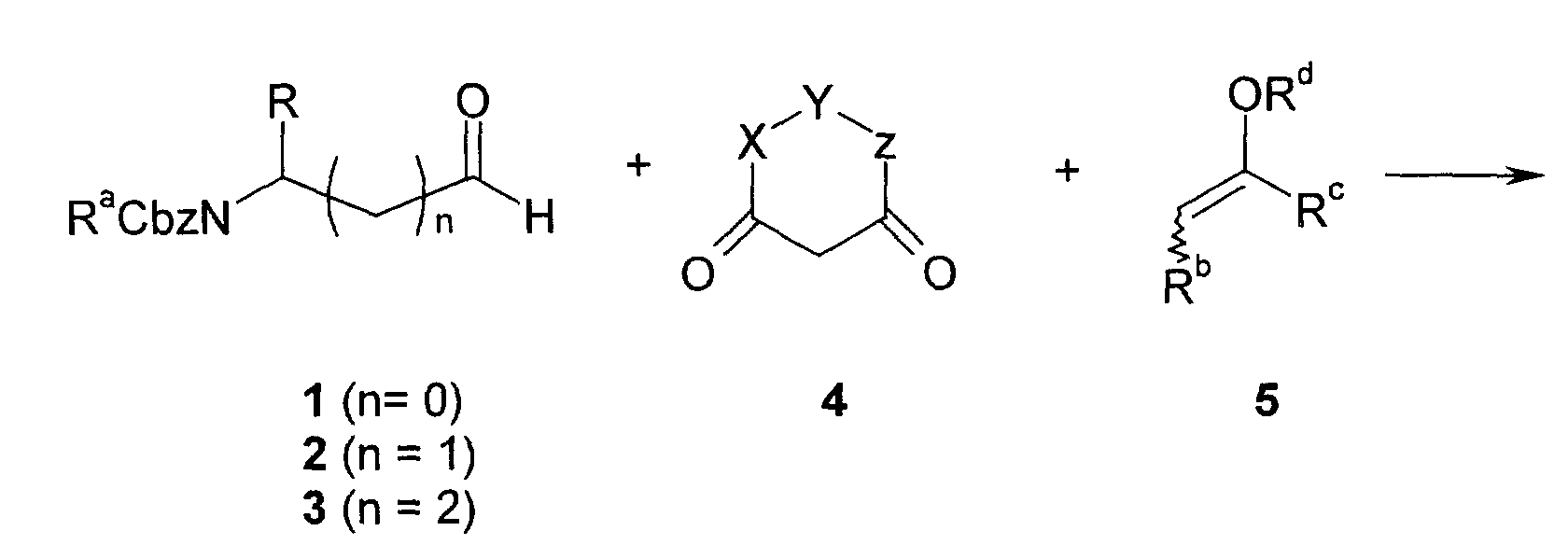

Darin bedeuten Cbz eine Benzyloxycarbonylgruppe und Rd eine Benzyl- oder
Trimethylsilylgruppe.
Durch Kondensation des geschützten Aminoaldehyds 1, 2 oder 3 mit der 1,3-Dicarbonylverbindung
4 und nachfolgender Hetero-Diels-Alder-Reaktion des gebildeten
Kondensationsproduktes mit dem Enolether 5 wird ein Acetal als Zwischenprodukt
erhalten. Das Acetal wird anschließend durch hydrogenolytische Abspaltung der Benzyl-Schutzgruppe
in den feien Aldehyd bzw., falls Rc ≠ H ist, in das freie Keton überführt.
Durch hydrogenolytische Abspaltung der Benzyloxycarbonylgruppe wird darüber hinaus
eine freie Aminfunktion gebildet. Durch intramolekulare Kondensation des Aldehyds mit
dem Amin wird in situ ein cyclisches Enamin/Imin gebildet, das unter den Bedingungen
der Hydrogenolyse zu dem entsprechenden gesättigten Stickstoff-Heterocyclus 6, 7 bzw. 8
reduziert wird.
Die Kondensation des geschützten Aminoaldehyds 1, 2 oder 3 mit der 1,3-Dicarbonylverbindung
4 wird bevorzugt in Gegenwart eines sauren oder basischen Katalysators wie
Ethylendiammoniumdiacetat und/oder eines wasserentziehenden Mittels wie
Trialkylorthoformiat durchgeführt. Dabei wird bevorzugt in Toluol als Lösungsmittel und
unter Schutzgas-Atmosphäre gearbeitet.
Die Hydrogenolyse kann an jedem geeigneten Hydrierungskatalysator, beispielsweise
Palladium auf Aktivkohle, durchgeführt werden. Dabei wird bevorzugt in Methanol als
Lösungsmittel gearbeitet, wobei das Betain 6, 7 bzw. 8 in Methanol als polarem
Lösungsmittel erhalten wird. Bevorzugt wird das Betain durch Zugabe von Diethylether als
unpolarem Lösungsmittel gefällt. Die Lösung des Betains kann vor dem Fällungsschritt
durch Abdestillieren von Methanol eingeengt werden.
Die Betaine 6, 7 bzw. 8 werden mit einer Reinheit von vorzugsweise 80 bis 100 mol.-%
isoliert.
Geeignete Verbindungen 1 - 5 sind beispielsweise solche, die pharmakophore Gruppen
enthalten, wie Barbitursäuren und Hydroxycumarine, sowie weitere 1,3-Dicarbonylverbindungen,
welche mit Aminoaldehyden, herstellbar aus natürlichen und synthetischen
Aminosäuren und Aminoalkoholen, und verschiedensten Benzylenolethern zur Reaktion
gebracht werden können.
Bevorzugte geschützte Aminoaldehyde sind die alpha-, beta- und gamma-Aminoaldehyde
der allgemeinen Formeln 1a bis 1e:

 mit
mit
- R1
- H, Alkyl, CH2OH, CH2SH,
- R2
- H, Alkyl
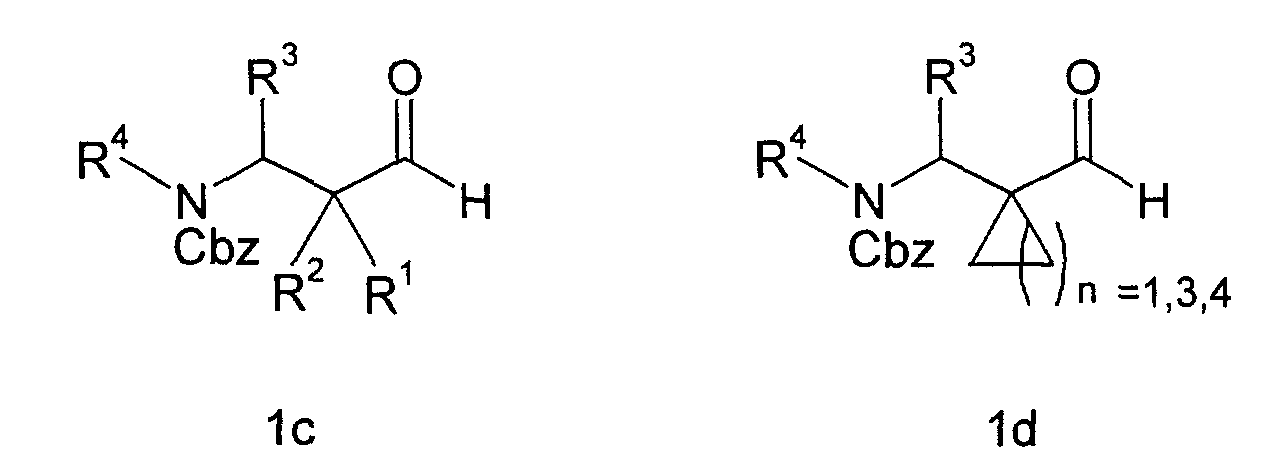
- R1, R2,
- gleich oder verschieden, H, Alkyl,
- R3, R4,
- gleich oder verschieden, H, Alkyl,
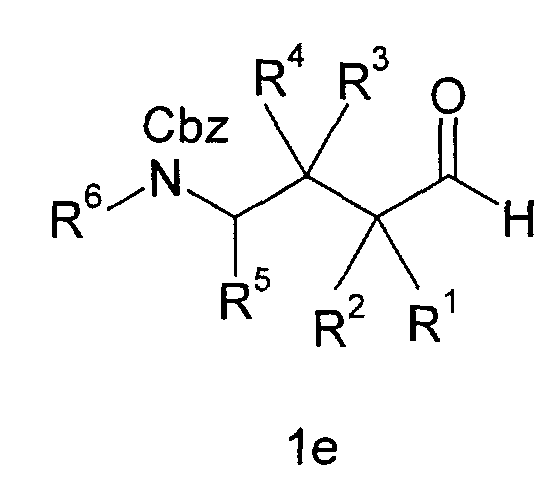
- R1, R2, R3, R4,
- gleich oder verschieden, H, Alkyl,
- R5, R6,
- gleich oder verschieden, H, Alkyl,
Bevorzugte Enolether sind diejenigen der allgemeinen Formeln 2a bis 2d:
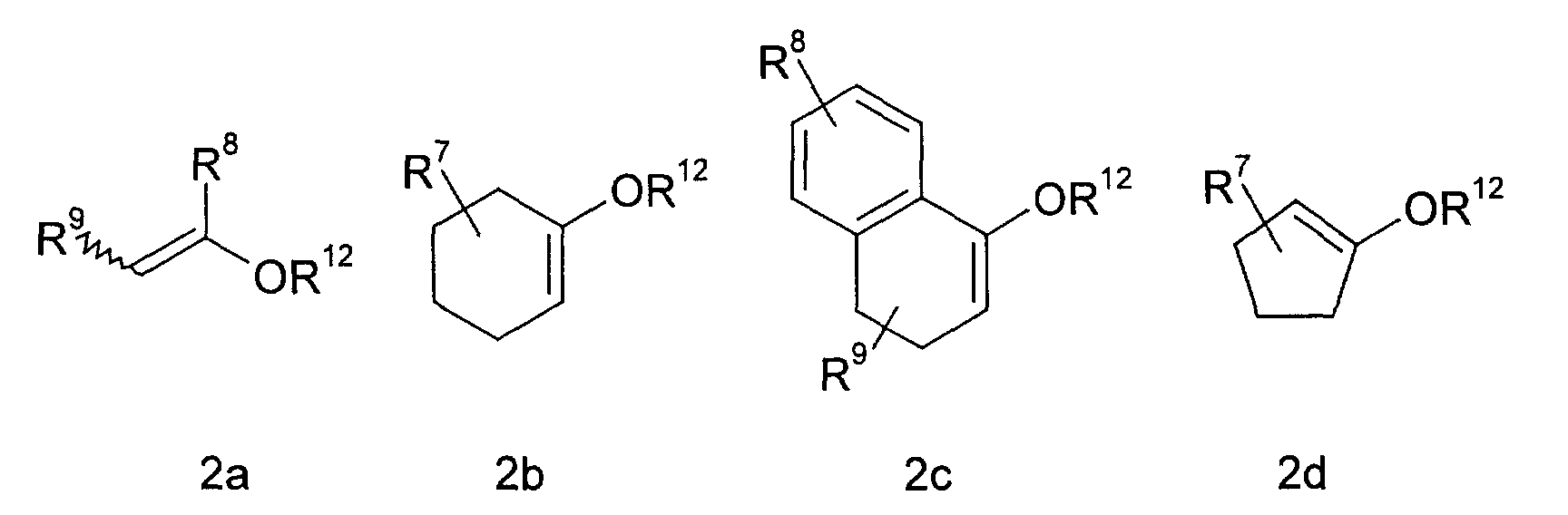 mit
mit
- R7, R8, R9,
- gleich oder verschieden = H, Alkyl, Bn, Ph-C2H4,CH2OR, CH2SR, CH2NHAc, CH2CH2OR, CH2CH2SR, CH2CH2NHAc, und
- R9
- zusätzlich Ph,
- R12
- Benzyl oder - Si (CH3)3,
Bevorzugte 1,3-Dicarbonylverbindungen sind diejenigen der allgemeinen Formeln 3a und
3b:
 mit
mit
- X, Z,
- gleich oder verschieden, NH, NAlkyl, CH2, CMe2, O, S, und
- Y
- CH2, CMe2, C=O, C=S, oder
- X-Y-Z
- NH-CR10=CR11, NAlkyl-CR10=CR11,
O-CR10=CR11, NAlkyl-CHR1-CHR2,
mit R10 und R11 gleich oder verschieden = Alkyl, unsubstituiertes oder mit OH, OAlkyl, NH2, NHAlkyl oder N(Alkyl)2 substituiertes Phenyl, unsubstituiertes oder mit OH, OAlkyl, NH2, NHAlkyl oder N(Alkyl)2 substituiertes 1,3-Butadien-1,3-dienyl, wobei im zuletzt genannten Fall R10 und R11 Teile des gleichen Ringsystems sind,
Vorstehend bedeuten Me = Methyl, Et = Ethyl, Pr = Propyl, Bu = Butyl, Ph = Phenyl und
Bn=Benzyl.
Nachstehend sind einige Beispielreaktionen aufgeführt.


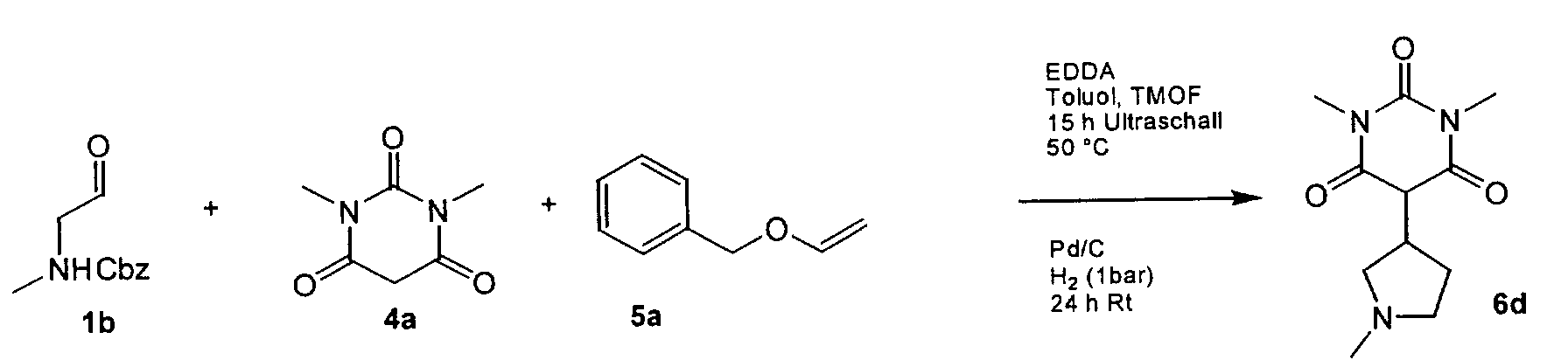


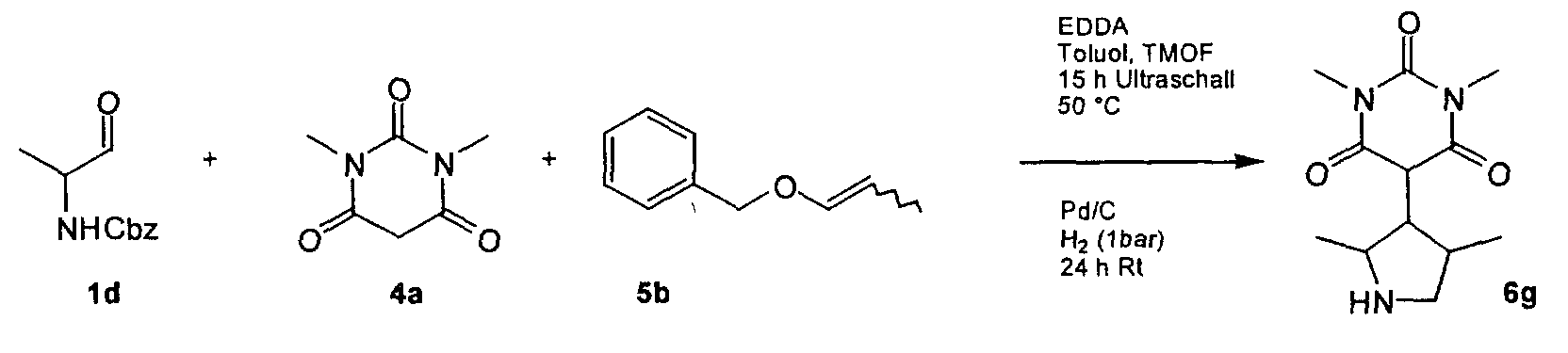


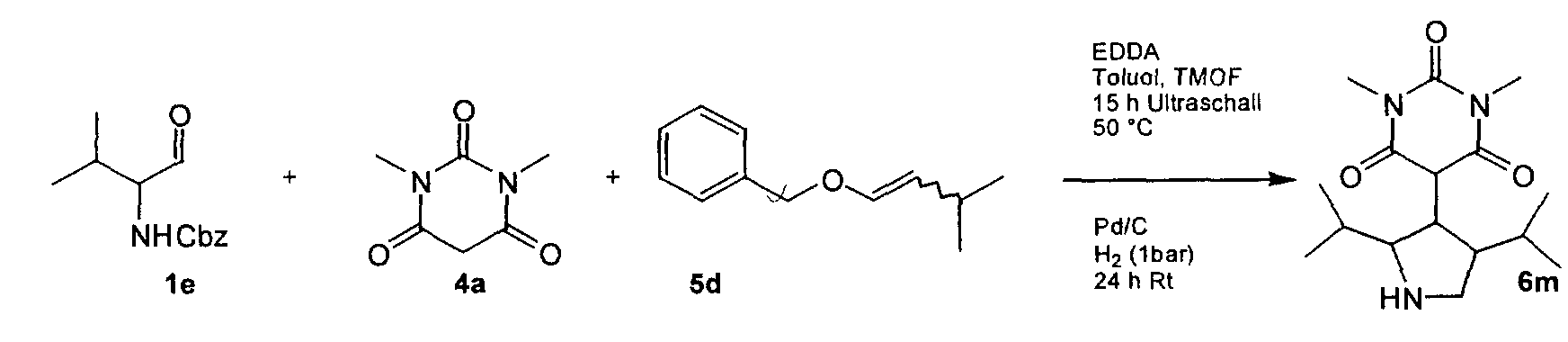


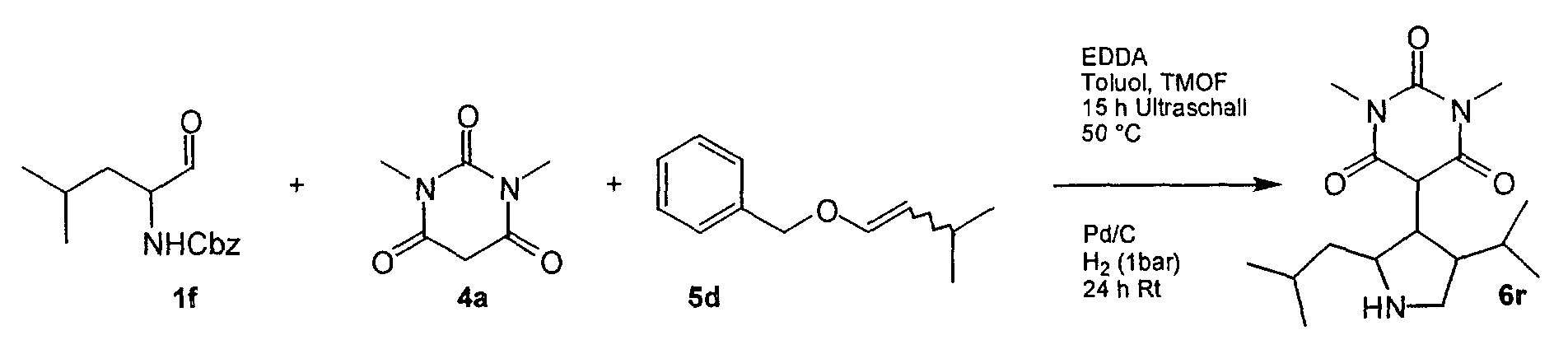


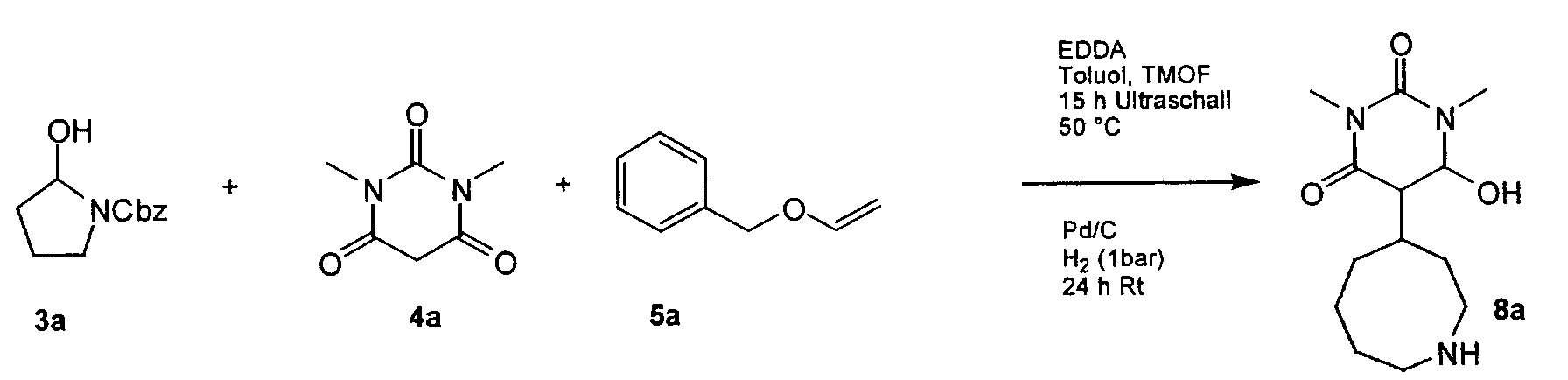


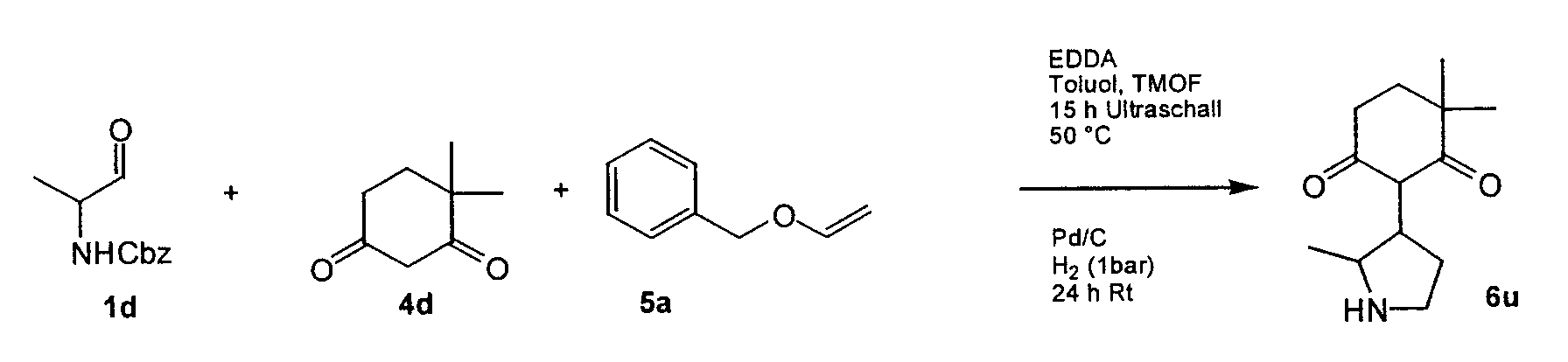
Durch die Kombination der Aminoaldehyde 1, 2 bzw. 3 mit den Dicarbonylverbindungen 5
und den Enolethern 4 kann eine sehr große Zahl unterschiedlicher Betaine 6, 7 bzw. 8
erhalten werden.
Die isolierten zwitterionischen Verbindungen können weiter umgesetzt werden.
Die Reaktionen werden in n verschiedenen Reaktionsansätzen an n räumlich getrennten
Reaktionsorten durchgeführt, wobei n mindestens 2 beträgt. Pro Reaktionsansatz wird
mindestens einer der m Reaktanten variiert, so daß sich jeder der n Reaktionsansätze von
jedem der n -1 übrigen Reaktionsansätze in mindestens einem der m Reaktanten
unterscheidet. Beispielsweise ergibt die Kombination von 10 verschiedenen
Aminoaldehyden 1, 2 oder 3 mit 10 verschiedenen Enolethern 5 und 10 verschiedenen 1,3-Dicarbonylverbindungen
4 insgesamt 1000 verschiedene Reaktionsansätze. Die n
Reaktionen können parallel und automatisiert durchgeführt werden, wobei übliche
Syntheseautomaten eingesetzt werden können. Beim automatisierten Arbeiten kann n sehr
groß sein und beispielsweise bis zu 100, 1000 oder 10 000 betragen. Es können auch
bestimmte Teilschritte, beispielsweise die Umsetzungsschritte, automatisiert durchgeführt
werden und andere Schritte, beispielsweise die Aufarbeitungsschritte, manuell
durchgeführt werden. In jedem Fall ermöglicht das problemlose Abtrennen der
zwitterionischen Verbindung von dem Reaktionsgemisch als Feststoff durch Fällen und
Isolieren eine erhebliche Zeitersparnis, so daß auch bei manuellem oder
halbautomatisiertem Arbeiten eine große Zahl von Reaktionen, beispielsweise 10 oder 100
Reaktionen, parallel durchgeführt werden können.
Die erhaltenen Verbindungen können an geeigneten Testsystemen beispielsweise auf ihre
pharmakologische Wirksamkeit und/oder ihre Wirksamkeit als Pflanzenschutzmittel
geprüft werden.
Die Erfindung wird durch die nachstehenden Beispiele näher erläutert.
1.0 Äquivalente des Cbz-geschützten Aminoaldehyds, 1.0 Äquivalente der 1,3-Dicarbonyl-Komponente,
4.0 Äquivalente des Enolethers sowie Toluol (4 ml/mmol),
Trimethylorthoformiat (0.8 ml/mmol) und wenige Kristalle Ethylendiammoniumdiacetat
(EDDA) wurden unter Argonatmosphäre in einem 10 ml-Druckkolben zusammengegeben.
Die Reaktionsmischung wurde im Ultraschallbad 15 h bei 50-60°C beschallt (DC-Kontrolle).
Nach vollständigem Umsatz wurde das Lösungsmittel am Rotationsverdampfer
entfernt und der Rückstand in Methanol (4 ml/mmol) gelöst. Nach Zugabe von Palladium
auf Kohle (10 %, 100 mg/mmol) rührte man 24h unter Wasserstoffatmosphäre (DC-Kontrolle).
Anschließend wurde der Katalysator über wenig Celite abfiltriert, mit Methanol
nachgewaschen und das Lösungsmittel erneut im Vakuum abgezogen. Den Rückstand
nahm man in wenig Methanol auf und fällte das Produkt durch langsame Zugabe von
Diethylether aus. Der weiße amorphe Niederschlag wurde abfiltriert und mit Diethylether
nachgewaschen.
N-Cbz-Aminoacetaldehyd (24.1 mg, 125 µmol), N,N-Dimethylbarbitursäure (19.5 mg,
125 µmol) und Benzylvinylether (134 mg, 1.00 mmol) wurden mit 0.5 ml Toluol, 0.1 ml
Trimethylorthoformiat und wenigen Kristallen Ethylendiammoniumdiacetat (EDDA) unter
Argonatmosphäre in einem 10 ml-Druckkolben gemäß der AAV umgesetzt. Das Produkt
wurde nach Lösen in Methanol und anschließendem Entfernen des Lösungsmittel als
gelbliches Öl erhalten, welches später amorph auskristallisierte. Die per HPLC bestimmte
Reinheit betrug >95 %.
1H-NMR (500 MHz, CD3OD): δ = 2.06 - 2.14, 2.18 - 2.25 (2 m, 2H, 4-H), 3.14 - 3.26 (m,
8H, 2xNMe, 5-H), 3.41 - 3.47, 3.50 - 3.56 (2m, 2H, 2-H), 3.78 - 3.88 (m, 1H, 3-H).
13C-NMR (50 MHz, CD3OD): δ = 28.02, 34.30 (NMe, C-3), 30.22 (C-4), 88.14 (C-5'), 154.5 (C-2'), 165.1 (C-4', C-6').
13C-NMR (50 MHz, CD3OD): δ = 28.02, 34.30 (NMe, C-3), 30.22 (C-4), 88.14 (C-5'), 154.5 (C-2'), 165.1 (C-4', C-6').
C10H15N3O3 (225.1), HRMS: 225.1113.
N-Cbz-Aminoacetaldehyd (24.1 mg, 125 µmol), N,N-Dimethylbarbitursäure (19.5 mg,
125 µmol) und Benzylprop-1-enylether (148 mg, 1.00 mmol) wurden mit 0.5 ml Toluol,
0.1 ml Trimethylorthoformiat und wenigen Kristallen Ethylendiammoniumdiacetat
(EDDA) unter Argonatmosphäre in einem 10 ml-Druckkolben gemäß der AAV umgesetzt.
Das Produkt wurde nach Lösen in Methanol und anschließendem Entfemen des
Lösungsmittel als gelbliches Öl erhalten, welches später amorph auskristallisierte. Die per
HPLC bestimmte Reinheit betrug >95 %.
MS (70eV): m/z = 239.1 (100) [M+], 156.1 (45) [C6H8N2O3], 83.0 (100) [M+ - C6H8N2O3],
68.0 (73) [M+ - C6H8N2O3 - Methyl].
C11H17N3O3 (239.1), HRMS: 239.1269.
N-Cbz-Aminoacetaldehyd (24.1 mg, 125 µmol), N,N-Dimethylbarbitursäure (19.5 mg,
125 µmol) und Benzylbut-1-enylether (162 mg, 1.00 mmol) wurden mit 0.5 ml Toluol,
0.1 ml Trimethylorthoformiat und wenigen Kristallen Ethylendiammoniumdiacetat
(EDDA) unter Argonatmosphäre in einem 10 ml-Druckkolben gemäß der AAV umgesetzt.
Das Produkt wurde nach Lösen in Methanol und anschließendem Entfernen des
Lösungsmittel als gelbliches Öl erhalten, welches später amorph auskristallisierte. Die per
HPLC bestimmte Reinheit betrug 97 %.
13C-NMR (50 MHz, CD3OD): δ = 12.75, 13.55 (C-2"), 23.45, 24.15 (C-1"), 27.76, 27.78,
28.02, 28.23 (NMe), 40.64 (C-4), 44.93, 45.49 (C-3), 52.31 (C-2 oder 5), 86.93, 87.65 (C-5'),
154.6, 154.7 (C-2'), 165.0, 165.2, 165.8 (C-4', C-6').
MS (70eV): m/z = 253.2 (10) [M+], 156.1 (6) [C6H8N2O3], 97.1 (82) [M+ - C6H8N2O3], 68.0 (100) [M+ - C6H8N2O3 - Et].
MS (70eV): m/z = 253.2 (10) [M+], 156.1 (6) [C6H8N2O3], 97.1 (82) [M+ - C6H8N2O3], 68.0 (100) [M+ - C6H8N2O3 - Et].
C12H19N3O3 (253.1), HRMS: 253.1426.
N-Cbz-Methylaminoacetaldehyd (25.9 mg, 125 µmol), N,N-Dimethylbarbitursäure
(19.5 mg, 125 µmol) und Benzylvinylether (134 mg, 1.00 mmol) wurden mit 0.5 ml
Toluol, 0.1 ml Trimethylorthoformiat und wenigen Kristallen Ethylendiammoniumdiacetat
(EDDA) unter Argonatmosphäre in einem 10 ml-Druckkolben gemäß der AAV umgesetzt.
Das Produkt wurde nach Lösen in Methanol und anschließendem Entfernen des
Lösungsmittel als gelbliches Öl erhalten, welches später amorph auskristallisierte.
13C-NMR (50 MHz, CD3OD): δ = 30.77 (C-4), 28.05, 33.95, 40.40 (C-3, CONMe, NMe),
57.42, 61.07 (C-2, C-5), 90.74 (C-5'), 154.5 (C-2'), 165.1 (C-4', C-6').
MS (70eV): m/z = 239.2 (20) [M+], 83.0 (100) [M+ - C6H8N2O3].
MS (70eV): m/z = 239.2 (20) [M+], 83.0 (100) [M+ - C6H8N2O3].
C11H17N3O3 (239.2).
N-Cbz-Methylaminoacetaldehyd (25.9 mg, 125 µmol), N,N-Dimethylbarbitursäure
(19.5 mg, 125 µmol) und Benzylprop-1-enylether (148 mg, 1.00 mmol) wurden mit 0.5 ml
Toluol, 0.1 ml Trimethylorthoformiat und wenigen Kristallen Ethylendiammoniumdiacetat
(EDDA) unter Argonatmosphäre in einem 10 ml-Druckkolben gemäß der AAV umgesetzt.
Das Produkt wurde nach Lösen in Methanol und anschließendem Entfernen des
Lösungsmittel als gelbliches Öl erhalten, welches später amorph auskristallisierte. Die per
HPLC bestimmte Reinheit betrug >95 %.
1H-NMR (300 MHz, DMSO): δ = 0.74, 0.95 (2d, J= 6.5 Hz, 3H, 1"-H), 2.52 - 2.68 (m,
2H, 4-H), 2.71, 2.75 (2s, 3H, NMe), 2.70 - 3.84 (3m, 5H, 2-H, 3-H, 5-H), 3.20, 3.40 (2s,
6H, MeNC(O)NMe).
MS (70eV): m/z = 253.2 (100) [M+], 97.1 (92) [M+ - C6H8N2O3], 82.1 (80) [M+ - C6H8N2O3 - Me].
MS (70eV): m/z = 253.2 (100) [M+], 97.1 (92) [M+ - C6H8N2O3], 82.1 (80) [M+ - C6H8N2O3 - Me].
C12H19N3O3 (253.1), HRMS: 253.1426.
N-Cbz-Pyrrolidin-2-carbaldehyd (29.14 mg, 125 µmol), N,N-Dimethylbarbitursäure
(19.5 mg, 125 µmol) und Benzylvinylether (134 mg, 1.00 mmol) wurden mit 0.5 ml
Toluol, 0.1 ml Trimethylorthoformiat und wenigen Kristallen Ethylendiammoniumdiacetat
(EDDA) unter Argonatmosphäre in einem 10 ml-Druckkolben gemäß der AAV umgesetzt.
Das Produkt wurde nach Lösen in Methanol und anschließendem Entfernen des
Lösungsmittel als gelbliches Öl erhalten, welches später amorph auskristallisierte.
1H-NMR (500 MHz, DMSO-D6): δ = 1.84 - 1.92, 1.98 - 2.08, 2.17 - 2.26, 2.44 - 2.54 (4m,
6H, 2-H, 6-H, 7-H), 3.04 - 3.11, 3.20 - 3.25, 3.37 - 3.58 (3m, 4H, 3-H, 5-H), 3.22 (s, 6H,
NMe), 3.77 - 3.82 (m, 1H, 7a-H), 4.42 - 4.60 (m, 1H, 1-H).
13C-NMR (50 MHz, CD3OD): δ =24.88, 24.64, 30.19, 30.64, 30.97 (C-2, C-6, C-7), 27.74, 27.97, 28.10, 28.24 (NMe), 42.36, 42.07 (C-1), 52.94, 55.65, 56.35 (C-3, C-5), 68.63, 68.81, 70.45 (C-7a), 81.34, 84.94, 85.25 (C-5'), 154.7, 154.8 (C-2'), 165.2, 165.3 (C-4', C-6').
MS (70eV): m/z = 265.2 (10) [M+], 156.1 (45) [C6H8N2O3], 109.1 (73) [M+ - C6H8N2O3].
13C-NMR (50 MHz, CD3OD): δ =24.88, 24.64, 30.19, 30.64, 30.97 (C-2, C-6, C-7), 27.74, 27.97, 28.10, 28.24 (NMe), 42.36, 42.07 (C-1), 52.94, 55.65, 56.35 (C-3, C-5), 68.63, 68.81, 70.45 (C-7a), 81.34, 84.94, 85.25 (C-5'), 154.7, 154.8 (C-2'), 165.2, 165.3 (C-4', C-6').
MS (70eV): m/z = 265.2 (10) [M+], 156.1 (45) [C6H8N2O3], 109.1 (73) [M+ - C6H8N2O3].
C13H19N3O3 (265.2).
N-Cbz-2-Aminopropionaldehyd (25.9 mg, 125 µmol), N,N-Dimethylbarbitursäure
(19.5 mg, 125 µmol) und Benzylprop-1-enylether (148 mg, 1.00 mmol) wurden mit 0.5 ml
Toluol, 0.1 ml Trimethylorthoformiat und wenigen Kristallen Ethylendiammoniumdiacetat
(EDDA) unter Argonatmosphäre in einem 10 ml-Druckkolben gemäß der AAV umgesetzt.
Das Produkt wurde nach Lösen in Methanol und anschließendem Entfernen des
Lösungsmittel als gelbliches Öl erhalten, welches später amorph auskristallisierte. Die per
HPLC bestimmte Reinheit betrug 97 %.
1H-NMR (500 MHz, DMSO-D6): δ = 0.74, 0.85 (2d, J= 7 Hz, 3H, 1"'-H), 1.11, 1.19 (2d,
J= 7 Hz, 3H, 1"-H), 2.48 - 2.56 (m, 1H, 4-H), 2.64 - 2.94 (3m, 2H, 5-H), 3.02, 3.08 (m,
1H, 2-H), 3.30-3.38 (m, 1H, 2-H), 3.90 - 3.98, 4.02 - 4.10 (2m, 1H, 3-H).
13C-NMR (125 MHz, DMSO-D6): δ = 14.33, 16.26, 16.68, 17.40 (1"-H, 1"'-H), 26.68, 26.94 (NMe), 33.72, 34.00, 44.43, 49.26 (C-3, C-4), 49.79, 50.40, (C-5), 56.10, 57.72 (C-2), 78.62, 81.78 (C-5'), 152.5, 152.8 (C-2'), 162.2, 162.7 (C-4', C-6').
MS (70eV): m/z = 253.2 (26) [M+], 238.2 (23) [M+ - Me], 97.1 (100) [M+ - C6H8N2O3], 82.1 (98) [M+ - C6H8N2O3 - Me].
13C-NMR (125 MHz, DMSO-D6): δ = 14.33, 16.26, 16.68, 17.40 (1"-H, 1"'-H), 26.68, 26.94 (NMe), 33.72, 34.00, 44.43, 49.26 (C-3, C-4), 49.79, 50.40, (C-5), 56.10, 57.72 (C-2), 78.62, 81.78 (C-5'), 152.5, 152.8 (C-2'), 162.2, 162.7 (C-4', C-6').
MS (70eV): m/z = 253.2 (26) [M+], 238.2 (23) [M+ - Me], 97.1 (100) [M+ - C6H8N2O3], 82.1 (98) [M+ - C6H8N2O3 - Me].
C12H19N3O3 (253.1), HRMS: 253.1426.
N-Cbz-2-Aminopropionaldehyd (25.9 mg, 125 µmol), N,N-Dimethylbarbitursäure
(19.5 mg, 125 µmol) und Benzylbut-1-enylether (162 mg, 1.00 mmol) wurden mit 0.5 ml
Toluol, 0.1 ml Trimethylorthoformiat und wenigen Kristallen Ethylendiammoniumdiacetat
(EDDA) unter Argonatmosphäre in einem 10 ml-Druckkolben gemäß der AAV umgesetzt.
Das Produkt wurde nach Lösen in Methanol und anschließendem Entfernen des
Lösungsmittel als gelbliches Öl erhalten, welches später amorph auskristallisierte. Die per
HPLC bestimmte Reinheit betrug 97 %.
13C-NMR (50 MHz, CD3OD): δ = 12.62, 13.37 (C-2'''), 16.47, 17.90 (C-1"), 23.98, 27.28
(C-1'''), 227.99, 28.06, 28.24, 28.61 (NMe), 42.85, 43.28, 45.18, 48.86 (C-3, C-4), 60.35
(C-5), 58.55, 60.35 (C-2), 154.8, 154.9 (C-2'), 165.4, 165.6, 165.7, 165.8, 166.0 (C-4', C-6').
MS (70eV): m/z = 267.2 (8) [M+], 252.2 (6) [M+ - Me], 223.2 (1) [M+ - Me - Et], 111.1 (18) [M+ - C6H8N2O3].
MS (70eV): m/z = 267.2 (8) [M+], 252.2 (6) [M+ - Me], 223.2 (1) [M+ - Me - Et], 111.1 (18) [M+ - C6H8N2O3].
C13H21N3O3 (267.2), HRMS: 267.1582.
N-Cbz-2-Aminopropionaldehyd (25.9 mg, 125 µmol), N,N-Dimethylbarbitursäure
(19.5 mg, 125 µmol) und Benzyl-3-methylbut-1-enylether (190 mg, 1.00 mmol) wurden
mit 0.5 ml Toluol, 0.1 ml Trimethylorthoformiat und wenigen Kristallen
Ethylendiammoniumdiacetat (EDDA) unter Argonatmosphäre in einem 10 ml-Druckkolben
gemäß der AAV umgesetzt. Das Produkt wurde nach Lösen in Methanol und
anschließendem Entfernen des Lösungsmittel als gelbliches Öl erhalten, welches später
amorph auskristallisierte. Die per HPLC bestimmte Reinheit betrug 75 %.
1H-NMR (500 MHz, DMSO-D6): δ = 0.85 - 1.20 (mehrere d, 9H, J = 7 - 8 Hz, 1"-H, 2"'-H,
3"'-H), 1.30 - 1.56 (2m, 1H, 1"'-H), 1.85 - 2.15 (2m, 1H, 4-H), 3.00 - 3.80 (mehrere
m, 10H, 2xNMe, 5-H, 2-H, 3-H).
13C-NMR (125 MHz, DMSO-D6): δ = 13.05, 13.46, 16.33, 18.13, 19.21, 20.22, 20.91, 21.49, 21.66, 22.06, 22.50, 22.73, 24.39, 26.77, 26.87, 26.99, 27.19, 27.23, 27.29, 27.45, 28.14, 29.34, 32.08 (-Me, -iPr, NMe), 42.33, 47.71 (C-3, C-4), 48.04, 48.55 (C-5), 68.57, 60.12 (C-2), 83.46, 86.47 (C-5'), 152.5 (C-2'), 162.8, 162.9 (C-4', C-6').
MS (70eV): m/z = 281.2 (69) [M+], 266.2 (24) [M+ - Me], 239.1 (86) [M+ - iPr + H].
13C-NMR (125 MHz, DMSO-D6): δ = 13.05, 13.46, 16.33, 18.13, 19.21, 20.22, 20.91, 21.49, 21.66, 22.06, 22.50, 22.73, 24.39, 26.77, 26.87, 26.99, 27.19, 27.23, 27.29, 27.45, 28.14, 29.34, 32.08 (-Me, -iPr, NMe), 42.33, 47.71 (C-3, C-4), 48.04, 48.55 (C-5), 68.57, 60.12 (C-2), 83.46, 86.47 (C-5'), 152.5 (C-2'), 162.8, 162.9 (C-4', C-6').
MS (70eV): m/z = 281.2 (69) [M+], 266.2 (24) [M+ - Me], 239.1 (86) [M+ - iPr + H].
C14H23N3O3 (281.2), HRMS: 281.1739.
N-Cbz-2-Amino-3-methylbutyraldehyd (29.4 mg, 125 µmol), N,N-Dimethylbarbitursäure
(19.5 mg, 125 µmol) und Benzylvinylether (134 mg, 1.00 mmol) wurden mit 0.5 ml
Toluol, 0.1 ml Trimethylorthoformiat und wenigen Kristallen Ethylendiammoniumdiacetat
(EDDA) unter Argonatmosphäre in einem 10 ml-Druckkolben gemäß der AAV umgesetzt.
Das Produkt wurde nach Lösen in Methanol und anschließendem Entfernen des
Lösungsmittel als gelbliches Öl erhalten, welches später amorph auskristallisierte. Die per
HPLC bestimmte Reinheit betrug 95 %.
1H-NMR (300 MHz, MeOH-D4): δ = 0.82 - 1.10 (2d, J= 6 Hz, 6H, 2"-H, 3"-H), 1.80 -
2.30 (m, 3H, 4-H, 1"-H), 3.24 (s, 6H, NMe), 3.20 - 3.58 (2m, 3H, 5-H, 2-H), 3.75 - 3.82
(m, 1H, 3-H).
MS (70eV): m/z = 267.2 (1) [M+], 224.1 (100) [M+ - iPr], 111.1 (6) [M+ - C6H8N2O3].
MS (70eV): m/z = 267.2 (1) [M+], 224.1 (100) [M+ - iPr], 111.1 (6) [M+ - C6H8N2O3].
C13H21N3O3 (267.2).
N-Cbz-2-Amino-3-methylbutyraldehyd (29.4 mg, 125 µmol), N,N-Dimethylbarbitursäure
(19.5 mg, 125 µmol) und Benzylprop-l-enylether (148 mg, 1.00 mmol) wurden mit 0.5 ml
Toluol, 0.1 ml Trimethylorthoformiat und wenigen Kristallen Ethylendiammoniumdiacetat
(EDDA) unter Argonatmosphäre in einem 10 ml-Druckkolben gemäß der AAV umgesetzt.
Das Produkt wurde nach Lösen in Methanol und anschließendem Entfernen des
Lösungsmittel als gelbliches Öl erhalten, welches später amorph auskristallisierte. Die per
HPLC bestimmte Reinheit betrug 78 %.
13C-NMR (125 MHz, DMSO-D6): δ = 12.90, 14.96, 16.18, 18.96, 19.39, 19.64, 20.28,
20.39, 26.83, 27.31, 27.64, 29.71, 31.14, 34.93, 35.19, 35.48, 39.11, 39.76, 40.66, 45.11 (-Me,
-iPr, NMe) 50.33, 50.83, 51.73 (C-5), 65.43, 68.39, 69.44 (C-2), 80.11, 80.51, 82.82
(C-5'), 152.8 (C-2'), 162.9, 163.4, 163.8 (C-4', C-6').
MS (70eV): m/z = 281.2 (10) [M+], 238.1 (100) [M+ - iPr], 223.1 (1) [M+ - iPr - Me].
MS (70eV): m/z = 281.2 (10) [M+], 238.1 (100) [M+ - iPr], 223.1 (1) [M+ - iPr - Me].
C14H23N3O3 (281.2), HRMS: 281.1739.
N-Cbz-2-Amino-3-methylbutyraldehyd (29.4 mg, 125 µmol), N,N-Dimethylbarbitursäure
(19.5 mg, 125 µmol) und Benzyl-3-methylbut-1-enylether (190 mg, 1.00 mmol) wurden
mit 0.5 ml Toluol, 0.1 ml Trimethylorthoformiat und wenigen Kristallen
Ethylendiammoniumdiacetat (EDDA) unter Argonatmosphäre in einem 10 ml-Druckkolben
gemäß der AAV umgesetzt. Das Produkt wurde nach Lösen in Methanol und
anschließendem Entfernen des Lösungsmittel als gelbliches Öl erhalten, welches später
amorph auskristallisierte. Die per HPLC bestimmte Reinheit betrug 82 %.
1H-NMR (500 MHz, DMSO-D6): δ = 0.72 - 0.98 (mehrere d, J= 7 - 8 Hz, 12H, 2"-H, 3"-H,
2"'-H, 3"'-H), 1.30 - 1.40 (m, 1H, 1"'-H), 1.48 - 1.82 (2m, 2H, 4-H, 1"H), 3.00 - 3.12
(m, 8H, 2 x NMe, 5-H), 3.32 - 3.58 (2m, 1H, 2-H), 3.72 - 3.88 (2m, 1H, 3-H).
13C-NMR (125 MHz, DMSO-D6): δ = 19.27, 21.87, 20.06, 20.18, 20.25, 20.40, 20.90, 21.47, 21.71, 22.10, 22.59, 26.75, 27.12, 27.28, 27.32, 27.49, 27.55, 28.02, 29.40, 31.66, 32.14 (2 x -iPr, NMe) 39.67, 39.93, 40.10, (C-3, C-4), 48.55, 48.95, 49.90 (C-3, C-4), 49.04, 49.96, 51.90 (C-5), 68.26, 70.01, 70.15 (C-2), 80.26, 84.10, 87.26 (C-5'), 152.4, 152.8 (C-2'), 162.4, 162.5, 163.4, 163.5, 163.7 (C-4', C-6').
MS (70eV): m/z = 309.2 (21) [M+], 266.2 (100) [M+ - iPr], 110.1 (25) [M+ - C6H8N2O3 - iPr].
13C-NMR (125 MHz, DMSO-D6): δ = 19.27, 21.87, 20.06, 20.18, 20.25, 20.40, 20.90, 21.47, 21.71, 22.10, 22.59, 26.75, 27.12, 27.28, 27.32, 27.49, 27.55, 28.02, 29.40, 31.66, 32.14 (2 x -iPr, NMe) 39.67, 39.93, 40.10, (C-3, C-4), 48.55, 48.95, 49.90 (C-3, C-4), 49.04, 49.96, 51.90 (C-5), 68.26, 70.01, 70.15 (C-2), 80.26, 84.10, 87.26 (C-5'), 152.4, 152.8 (C-2'), 162.4, 162.5, 163.4, 163.5, 163.7 (C-4', C-6').
MS (70eV): m/z = 309.2 (21) [M+], 266.2 (100) [M+ - iPr], 110.1 (25) [M+ - C6H8N2O3 - iPr].
C16H27N3O3 (309.2), HRMS: 309.2052.
N-Cbz-2-Amino-3-phenylpropionaldehyd (35.4 mg, 125 µmol), N,N-Dimethylbarbitursäure
(19.5 mg, 125 µmol) und Benzylbut-1-enylether (162 mg, 1.00 mmol) wurden mit
0.5 ml Toluol, 0.1 ml Trimethylorthoformiat und wenigen Kristallen Ethylendiammoniumdiacetat
(EDDA) unter Argonatmosphäre in einem 10 ml-Druckkolben gemäß der AAV
umgesetzt. Das Produkt wurde nach Lösen in Methanol und anschließendem Entfernen des
Lösungsmittel als gelbliches Öl erhalten, welches später amorph auskristallisierte. Die per
HPLC bestimmte Reinheit betrug 97 %.
1H-NMR (300 MHz, CD3OD): δ = 2.05 - 2.45 (2m, 2H, 4-H), 2.90 - 2.95 (m, 2H, PhCH 2),
3.20 (s, 6H, 2NMe), 3.30 - 3.55 (m, 3H, 2-H, 5-H), 4.22 - 4.32 (m, 1H, 3-H), 7.15 - 7.30
(m, 5H, PhH).
13C-NMR (75MHz, DMSO-D6): δ = 26.17 (NMe), 27.21 (C-4), 39.87 (C-3), 35.28, 43.49 (C-1", C-5), 61.83 (C-2), 81.15 (C-5'), 125.5, 128.3, 128.7 (C-3", C-4", C-5", C-6") 131.0 (C-2"), 152.6 (C-2'), 162.0 (C-4', C-6').
MS (70eV): m/z = 315.2 (1) [M+], 224.1 (100) [M+ - Bn], 91.0 (10) [Bn].
13C-NMR (75MHz, DMSO-D6): δ = 26.17 (NMe), 27.21 (C-4), 39.87 (C-3), 35.28, 43.49 (C-1", C-5), 61.83 (C-2), 81.15 (C-5'), 125.5, 128.3, 128.7 (C-3", C-4", C-5", C-6") 131.0 (C-2"), 152.6 (C-2'), 162.0 (C-4', C-6').
MS (70eV): m/z = 315.2 (1) [M+], 224.1 (100) [M+ - Bn], 91.0 (10) [Bn].
C15H21N3O3 (315.2), HRMS: 315.1582.
N-Cbz-2-Amino-4-methylpentanal (31.2 mg, 125 µmol), N,N-Dimethylbarbitursäure
(19.5 mg, 125 µmol) und Benzylvinylether (134 mg, 1.00 mmol) wurden mit 0.5 ml
Toluol, 0.1 ml Trimethylorthoformiat und wenigen Kristallen Ethylendiammoniumdiacetat
(EDDA) unter Argonatmosphäre in einem 10 ml-Druckkolben gemäß der AAV umgesetzt.
Das Produkt wurde nach Lösen in Methanol und anschließendem Entfernen des
Lösungsmittel als gelbliches Öl erhalten, welches später amorph auskristallisierte. Die per
HPLC bestimmte Reinheit betrug 99 %.
1H-NMR (500 MHz, DMSO-D6): δ = 0.88 (d, J= 8 Hz, 6H, 3"-H, 4"-H), 1.44 - 1.57,
1.60 - 1.70 (3H, 2"-H, 1"-H), 2.04 - 2.37 (2m, 2H, 4.H), 3.14 (s, 6H, NMe), 3.16 - 3.47
(2m, 3H, 2-H, 5-H), 3.98 - 4.03 (m, 1H, 3-H).
13C-NMR (50 MHz, CD3OD): δ = 22.38, 23.24, 26.80, 27.99, (C-2", C-3", C-4", NMe), 28.60 (C-4), 41.57 (C-3), 41.97, 45.59 (C-1", C-5), 60.72 (C-2), 86.10 (C-5'), 154.7 (C-2'), 165.1 (C-4', C-6').
13C-NMR (50 MHz, CD3OD): δ = 22.38, 23.24, 26.80, 27.99, (C-2", C-3", C-4", NMe), 28.60 (C-4), 41.57 (C-3), 41.97, 45.59 (C-1", C-5), 60.72 (C-2), 86.10 (C-5'), 154.7 (C-2'), 165.1 (C-4', C-6').
C14H23N3O3 (281.2), HRMS: 281.1739.
N-Cbz-2-Amino-4-methylpentanal (31.2 mg, 125 µmol), N,N-Dimethylbarbitursäure
(19.5 mg, 125 µmol) und Benzylprop-1-enylether (148 mg, 1.00 mmol) wurden mit 0.5 ml
Toluol, 0.1 ml Trimethylorthoformiat und wenigen Kristallen Ethylendiammoniumdiacetat
(EDDA) unter Argonatmosphäre in einem 10 ml-Druckkolben gemäß der AAV umgesetzt.
Das Produkt wurde nach Lösen in Methanol und anschließendem Entfernen des
Lösungsmittel als gelbliches Öl erhalten, welches später amorph auskristallisierte. Die per
HPLC bestimmte Reinheit betrug >95 %.
1H-NMR (500 MHz, DMSO-D6): δ = 0.75 - 0.88 (mehrere d, J= 7 Hz, 9H, 3"-H, 4"-H,
1"'-H), 1.35 - 1.65 (3m, 3H, 1"-H, 2"-H), 2.38 - 2.50 (m, 1H, 4-H), 3.00 - 3.40 (3m, 3H,
2-H, 5-H), 3.05, 3.08 (2s, 6H, NMe), 3.95-4.10 (2m, 1H, 3-H).
13C-NMR (125 MHz, DMSO-D6): δ = 13.79, 16.43 (C-1'''), 20.35, 21.81, 22.32, 22.38, 22.48, 22.90, 22.96, 24.76, 25.01, 25.04, 22.96, 22.99, 27.07, 27.14, 27.20, 27.26 (C-3", C-4", C-2", NMe), 33.94, 34.39, 42.68, 43.02 (C-3, C-4), 40.69, 41.49 (C-1"), 49.99, 51.09, 51.41 (C-5), 59.22, 60.01 (C-2), 79.09, 81.84 (C-5'), 152.9 (C-2'), 162.4 (C-4'. C-6').
MS (70eV): m/z = 295.2 (11) [M+], 238.1 (100) [M+ - iBu], 139.1 (30) [M+ - C6H8N2O3].
13C-NMR (125 MHz, DMSO-D6): δ = 13.79, 16.43 (C-1'''), 20.35, 21.81, 22.32, 22.38, 22.48, 22.90, 22.96, 24.76, 25.01, 25.04, 22.96, 22.99, 27.07, 27.14, 27.20, 27.26 (C-3", C-4", C-2", NMe), 33.94, 34.39, 42.68, 43.02 (C-3, C-4), 40.69, 41.49 (C-1"), 49.99, 51.09, 51.41 (C-5), 59.22, 60.01 (C-2), 79.09, 81.84 (C-5'), 152.9 (C-2'), 162.4 (C-4'. C-6').
MS (70eV): m/z = 295.2 (11) [M+], 238.1 (100) [M+ - iBu], 139.1 (30) [M+ - C6H8N2O3].
C15H25N3O3 (295.2), HRMS: 295.1895.
N-Cbz-2-Amino-4-methylpentanal (31.2 mg, 125 µmol), N,N-Dimethylbarbitursäure
(19.5 mg, 125 µmol) und Benzylbut-1-enylether (162 mg, 1.00 mmol) wurden mit 0.5 ml
Toluol, 0.1 ml Trimethylorthoformiat und wenigen Kristallen Ethylendiammoniumdiacetat
(EDDA) unter Argonatmosphäre in einem 10 ml-Druckkolben gemäß der AAV umgesetzt.
Das Produkt wurde nach Lösen in Methanol und anschließendem Entfernen des
Lösungsmittel als gelbliches Öl erhalten, welches später amorph auskristallisierte. Die per
HPLC bestimmte Reinheit betrug >95 %.
1H-NMR (500 MHz, DMSO-D6): δ = 0.84-0.95 (mehrere d, J= 6.5 Hz, 9H, 2"'-H, 3"-H,
4"-H), 1.19-1.72 (5m, 5H, 1"-H, 2"-H, 1"'-H), 2.32 - 2.42 (m, 1H, 4-H), 3.22 - 3.26
(mehrere s, 6H, NMe), 3.30 - 3.43 (2m, 2H, 5-H), 3.48 - 3.60 (2m, 1H, 2-H), 4.05 - 4.17
(2m, 1H, 3-H).
13C-NMR (50 MHz, CD3OD): δ = 12.62, 13.43 (C-2"), 23.42, 26.93 (C-1'''), 22.76, 22.80, 22.68, 26.76, 27.94, 28.00, 28.45 (C-3", C-4", C-2", NMe), 42.17, 43.15 (C-1"), 42.80, 43.42, 43.76 (C-3, C-4), 50.41, 51.59 (C-5), 60.73, 62.59 (C-2), 86.54 (C-5'), 154.7 (C-2'), 154.4, 165.9 (C-4', C-6').
MS (70eV): m/z = 309.2 (16) [M+], 252.2 (100) [M+ - iBu].
13C-NMR (50 MHz, CD3OD): δ = 12.62, 13.43 (C-2"), 23.42, 26.93 (C-1'''), 22.76, 22.80, 22.68, 26.76, 27.94, 28.00, 28.45 (C-3", C-4", C-2", NMe), 42.17, 43.15 (C-1"), 42.80, 43.42, 43.76 (C-3, C-4), 50.41, 51.59 (C-5), 60.73, 62.59 (C-2), 86.54 (C-5'), 154.7 (C-2'), 154.4, 165.9 (C-4', C-6').
MS (70eV): m/z = 309.2 (16) [M+], 252.2 (100) [M+ - iBu].
C16H27N3O3 (309.2), HRMS: 309.2052.
N-Cbz-2-Amino-4-methylpentanal (31.2 mg, 125 µmol), N,N-Dimethylbarbitursäure
(19.5 mg, 125 µmol) und Benzyl-3-methylbut-1-enylether (190 mg, 1.00 mmol) wurden
mit 0.5 ml Toluol, 0.1 ml Trimethylorthoformiat und wenigen Kristallen
Ethylendiammoniumdiacetat (EDDA) unter Argonatmosphäre in einem 10 ml-Druckkolben
gemäß der AAV umgesetzt. Das Produkt wurde nach Lösen in Methanol und
anschließendem Entfernen des Lösungsmittel als gelbliches Öl erhalten, welches später
amorph auskristallisierte.
13C-NMR (75 MHz, DMSO-D6): δ = 21.67, 22.11, 22.44, 22.52, 24.70, 24.88, 26.77, 27.04, 27.25, 27.75 (2 x -iPr, NMe), 42.20 (C-1"), 40.78, 48.33 (C-3, C-4), 49.33 (C-5), 59.69, 62.20 (C-2), 83.54 (C-5'), 152.3, 152.6, 152.8 (C-2'), 161.8, 162.5, 162.6, 162.6 (C-4', C-6').
MS (70eV): m/z = 323.2 (22) [M+], 266.2 (100) [M+ - iBu].
13C-NMR (75 MHz, DMSO-D6): δ = 21.67, 22.11, 22.44, 22.52, 24.70, 24.88, 26.77, 27.04, 27.25, 27.75 (2 x -iPr, NMe), 42.20 (C-1"), 40.78, 48.33 (C-3, C-4), 49.33 (C-5), 59.69, 62.20 (C-2), 83.54 (C-5'), 152.3, 152.6, 152.8 (C-2'), 161.8, 162.5, 162.6, 162.6 (C-4', C-6').
MS (70eV): m/z = 323.2 (22) [M+], 266.2 (100) [M+ - iBu].
C17H29N3O3 (323.2), HRMS: 323.2208.
N-Cbz-Pyrrolidin-2-ol (27.6 mg, 125 µmol), N,N-Dimethylbarbitursäure (19.5 mg,
125 µmol) und Benzylvinylether (134 mg, 1.00 mmol) wurden mit 0.5 ml Toluol, 0.1 ml
Trimethylorthoformiat und wenigen Kristallen Ethylendiammoniumdiacetat (EDDA) unter
Argonatmosphäre in einem 10 ml-Druckkolben gemäß der AAV umgesetzt. Das Produkt
wurde nach Lösen in Methanol und anschließendem Entfernen des Lösungsmittel als
gelbliches Öl erhalten, welches später amorph auskristallisierte. Die per HPLC bestimmte
Reinheit betrug 98 %.
13C-NMR (125 MHz, DMSO): δ = 22.80, 23.54, 29.89, 29.93 (C-3, C-4, C-6), 26.82,
26.88, 26.90, 27.04, 32.00 (NMe, C-5), 46.54, 46.60, (C-2, C-7), 89.50, (C-5'), 152.5 (C-2'),
162.1 (C-4'), 162.1 (C-4', C-6').
C12H19N3O3 (253.2).
N-Cbz-Pyrrolidin-2-ol (27.6 mg, 125 µmol), N,N-Dimethylbarbitursäure (19.5 mg,
125 µmol) und Benzylprop-1-enylether (148 mg, 1.00 mmol) wurden mit 0.5 ml Toluol,
0.1 ml Trimethylorthoformiat und wenigen Kristallen Ethylendiammoniumdiacetat
(EDDA) unter Argonatmosphäre in einem 10 ml-Druckkolben gemäß der AAV umgesetzt.
Das Produkt wurde nach Lösen in Methanol und anschließendem Entfernen des
Lösungsmittel als gelbliches Öl erhalten, welches später amorph auskristallisierte. Die per
HPLC bestimmte Reinheit betrug >95 %.
13C-NMR (125 MHz, DMSO): δ = 21.15, 23.16, 26.96, 27.23, 27.44, 32.89 (C-3, C-4, C-5, C-6, C-1", NMe), 48.64, 53.30 (C-2, C-7), 88.14 (C-5'), 152.4 (C-2'), 162.5 (C-4', C-6').
13C-NMR (125 MHz, DMSO): δ = 21.15, 23.16, 26.96, 27.23, 27.44, 32.89 (C-3, C-4, C-5, C-6, C-1", NMe), 48.64, 53.30 (C-2, C-7), 88.14 (C-5'), 152.4 (C-2'), 162.5 (C-4', C-6').
C13H21N3O3 (267.2).
N-Cbz-2-Aminopropionaldehyd (25.9 mg, 125 µmol), 4-Hydroxycumarin (20.25 mg,
125 µmol) und Benzylvinylether (134 mg, 1.00 mmol) wurden mit 0.5 ml Toluol, 0.1 ml
Trimethylorthoformiat und wenigen Kristallen Ethylendiammoniumdiacetat (EDDA) unter
Argonatmosphäre in einem 10 ml-Druckkolben gemäß der AAV umgesetzt. Das Produkt
wurde nach Lösen in Methanol und anschließendem Entfernen des Lösungsmittel als
gelbliches Öl erhalten, welches später amorph auskristallisierte. Die per HPLC bestimmte
Reinheit betrug 95.0 %.
1H-NMR (500 MHz, DMSO-D6): δ = 1.10, 1.14 (2d, J= 6 Hz, 3H, 1"-H), 2.00 - 2.20
(2m, 2H, 4-H), 3.15-3.24, 3.30 - 3.45 (2m, 3H, 2-H, 5-H), 3.72 - 3.80, 3.88 - 3.95 (2m, 1H,
3-H), 7.02 - 7.14 (m, 2H, 6'-H, 7'-H), 7.30 - 7.41, 7.74 - 7.82 (2m, 2H, 5'-H, 8'-H).
C14H15NO3 (245.1), HRMS: 245.1051.
N-Cbz-3-Aminopropionaldehyd (25.9 mg, 125 µmol), 4-Hydroxycumarin (20.25 mg,
125 µmol) und Benzylvinylether (134 mg, 1.00 mmol) wurden mit 0.5 ml Toluol, 0.1 ml
Trimethylorthoformiat und wenigen Kristallen Ethylendiammoniumdiacetat (EDDA) unter
Argonatmosphäre in einem 10 ml-Druckkolben gemäß der AAV umgesetzt. Das Produkt
wurde nach Lösen in Methanol und anschließendem Entfemen des Lösungsmittel als
gelbliches Öl erhalten, welches später amorph auskristallisierte. Die per HPLC bestimmte
Reinheit betrug >95 %.
13C-NMR (125 MHz, DMSO-D6): δ = 25.65 (C-3, C-5), 30.80 (C-4), 44.25 (C-2, C-6),
102.9 (C-3'), 115.7, 122.7, 124.4, 130.7 (C-5', C-6', C-7', C-8'), 120.0 (C-4a), 152.9 (C-8a),
162.9, 166.7 (C-2', C-4').
C14H15NO3 (245.1), HRMS: 245.1051.
N-Cbz-2-Aminopropionaldehyd (25.9 mg, 125 µmol), 4,4-Dimethylcyclohexan-1,3-dion
(17.5 mg, 125 µmol) und Benzylvinylether (134 mg, 1.00 mmol) wurden mit 0.5 ml
Toluol, 0.1 ml Trimethylorthoformiat und wenigen Kristallen Ethylendiammoniumdiacetat
(EDDA) unter Argonatmosphäre in einem 10 ml-Druckkolben gemäß der AAV umgesetzt.
Das Produkt wurde nach Lösen in Methanol und anschließendem Entfernen des
Lösungsmittel als gelbliches Öl erhalten, welches später amorph auskristallisierte. Die per
HPLC bestimmte Reinheit betrug >95 %.
1H-NMR (300 MHz, DMSO-D6): δ = 0.92 (s, 6H, C(CH3)2), 1.00 - 1.05 (m, 3H, 1"-H),
1.57 (t, J= 5.5 Hz, 2H, 5'-H), 1.62 - 2.05 (m, 2H, 4-H), 2.15 (t, J= 5.5 Hz, 2H, 6'-H), 3.00
- 3.42 (3m, 3H, 2-H, 5-H), 3.60 (m, 1H, 3-H).
C13H21NO2 (223.2).
N-Cbz-2-Aminopropionaldehyd (25.9 mg, 125 µmol), 5,5-Dimethylcyclohexan-1,3-dion
(17.5 mg, 125 µmol) und Benzylvinylether (134 mg, 1.00 mmol) wurden mit 0.5ml
Toluol, 0.1 ml Trimethylorthoformiat und wenigen Kristallen Ethylendiammoniumdiacetat
(EDDA) unter Argonatmosphäre in einem 10 ml-Druckkolben gemäß der AAV umgesetzt.
Das Produkt wurde nach Lösen in Methanol und anschließendem Entfernen des
Lösungsmittel als gelbliches Öl erhalten, welches später amorph auskristallisierte. Die per
HPLC bestimmte Reinheit betrug >95 %.
1H-NMR (300 MHz, DMSO-D6): δ = 0.86, 0.87 (2s, 6H, C(CH3)2), 0.95, 1.05 (2d, J = 6
Hz, 3H, 1"-H), 1.78 - 2.22 (m, 2H, 4-H), 1.96, 1.97 (2s, 4H, 3'-H, 5'-H), 2.78 - 3.30 (m,
3H, 2-H, 5-H), 3.66 - 3.80 (m, 1H, 3-H).
C13H21NO2 (223.2).
N-Cbz-3-Aminopropionaldehyd (25.9 mg, 125µmol), N,N-Dimethylbarbitursäure (19.5
mg, 125 µmol) und Benzylvinylether (134 mg, 1.00 mmol) wurden mit 0.5 ml Toluol,
0.1 ml Trimethylorthoformiat und wenigen Kristallen Ethylendiammoniumdiacetat
(EDDA) unter Argonatmosphäre in einem 10 ml-Druckkolben gemäß der AAV umgesetzt.
Das Produkt wurde nach Lösen in Methanol und anschließendem Entfernen des
Lösungsmittel als gelbliches Öl erhalten, welches später amorph auskristallisierte. Die per
HPLC bestimmte Reinheit betrug >95 %.
13C-NMR (50 MHz, CD3OD): δ = 22.55 (C-3, C-5), 28.02 (NMe), 32.74 (C-4), 46.53 (C-2,
C-6), 91.72 (C-5'), 154.7 (C-2'), 165.1 (C-4', C-6').
MS (70eV): m/z = 239.2 (37) [M+], 156.1 (48) [C6H8N2O3], 83.0 (100) [M+ - C6H8N2O3].
MS (70eV): m/z = 239.2 (37) [M+], 156.1 (48) [C6H8N2O3], 83.0 (100) [M+ - C6H8N2O3].
C11H17N3O3 (239.2).
N-Cbz-3-Aminopropionaldehyd (25.9 mg, 125µmol), N,N-Dimethylbarbitursäure (19.5
mg, 125 µmol) und Benzylprop-1-enylether (148 mg, 1.00 mmol) wurden mit 0.5 ml
Toluol, 0.1 ml Trimethylorthoformiat und wenigen Kristallen Ethylendiammoniumdiacetat
(EDDA) unter Argonatmosphäre in einem 10 ml-Druckkolben gemäß der AAV umgesetzt.
Das Produkt wurde nach Lösen in Methanol und anschließendem Entfernen des
Lösungsmittel als gelbliches Öl erhalten, welches später amorph auskristallisierte.
MS (70eV): m/z = 253.2 (18) [M+], 238.1 (5) [M+ - Me], 98.1 (100) [M+ - C6H8N2O3].
C12H19N3O3 (253.1), HRMS: 253.1426.
N-Cbz-3-Amino-propionaldehyd (25.9 mg, 125µmol), N,N-Dimethylbarbitursäure (19.5
mg, 125 µmol) und Benzylbut-1-enylether (162 mg, 1.00 mmol) wurden mit 0.5 ml Toluol,
0.1 ml Trimethylorthoformiat und wenigen Kristallen Ethylendiammoniumdiacetat
(EDDA) unter Argonatmosphäre in einem 10 ml-Druckkolben gemäß der AAV umgesetzt.
Das Produkt wurde nach Lösen in Methanol und anschließendem Entfernen des
Lösungsmittel als gelbliches Öl erhalten, welches später amorph auskristallisierte.
MS (70eV): m/z = 267.1 (30) [M+], 238.1 (18) [M+ - Et], 156.1 (38) [C6H8N2O3], 112.1
(89) [M+ - C6H8N2O3].
C13H21N3O3 (267.2), HRMS: 267.1582.
N-Cbz-3-Aminopropionaldehyd (25.9 mg, 125µmol), N,N-Dimethylbarbitursäure (19.5
mg, 125 µmol) und Benzyl-3-methylbut-1-enylether (190 mg, 1.00 mmol) wurden mit
0.5 ml Toluol, 0.1 ml Trimethylorthoformiat und wenigen Kristallen
Ethylendiammoniumdiacetat (EDDA) unter Argonatmosphäre in einem 10 ml-Druckkolben
gemäß der AAV umgesetzt. Das Produkt wurde nach Lösen in Methanol und
anschließendem Entfernen des Lösungsmittel als gelbliches Öl erhalten, welches später
amorph auskristallisierte.
MS (70eV): m/z = 281.1(33) [M+], 238.1 (20) [M+ - iPr], 156.0 (100) [C6H8N2O3], 126.1
(55) [M+ - C6H8N2O3].
C14H23N3O3 (281.2), HRMS: 281.1817.
N-Cbz-3-Benzylaminobutyraldehyd (38.9 mg, 125µmol), N,N-Dimethylbarbitursäure (19.5
mg, 125 µmol) und Benzylprop-1-enylether (148 mg, 1.00 mmol) wurden mit 0.5 ml
Toluol, 0.1 ml Trimethylorthoformiat und wenigen Kristallen Ethylendiammoniumdiacetat
(EDDA) unter Argonatmosphäre in einem 10 ml-Druckkolben gemäß der AAV umgesetzt.
Das Produkt wurde nach Lösen in Methanol und anschließendem Entfernen des
Lösungsmittel als gelbliches Öl erhalten, welches später amorph auskristallisierte. Die per
HPLC bestimmte Reinheit betrug >95 %.
MS (70eV): m/z = 267.1 (30) [M+], 252.2 (33) [M+ - Me], 156.1 (7) [C6H8N2O3], 112.1 (100) [M+ - C6H8N2O3]. 96.1 (65) [M+ - C6H8N2O3 - Me].
MS (70eV): m/z = 267.1 (30) [M+], 252.2 (33) [M+ - Me], 156.1 (7) [C6H8N2O3], 112.1 (100) [M+ - C6H8N2O3]. 96.1 (65) [M+ - C6H8N2O3 - Me].
C13H21N3O3 (267.2).
N-Cbz-3-Butylaminobutyraldehyd (34.7 mg, 125µmol), N,N-Dimethylbarbitursäure (19.5
mg, 125 µmol) und Benzylvinylether (134 mg, 1.00 mmol) wurden mit 0.5 ml Toluol,
0.1 ml Trimethylorthoformiat und wenigen Kristallen Ethylendiammoniumdiacetat
(EDDA) unter Argonatmosphäre in einem 10 ml-Druckkolben gemäß der AAV umgesetzt.
Das Produkt wurde nach Lösen in Methanol und anschließendem Entfernen des
Lösungsmittel als gelbliches Öl erhalten, welches später amorph auskristallisierte. Die per
HPLC bestimmte Reinheit betrug >95 %.
MS (70eV): m/z = 309.3 (7) [M+], 294.3 (43) [M+ - Me], 266.7 (100) [M+ - C3H7], 138.2
[M+ - C6H8N2O3 - Me].
C16H27N3O3 (309.2), HRMS: 309.2052.
N-Cbz-3-Butylaminobutyraldehyd (34.7 mg, 125µmol), N,N-Dimethylbarbitursäure (19.5
mg, 125 µmol) und Benzylprop-1-enylether (148 mg, 1.00 mmol) wurden mit 0.5 ml
Toluol, 0.1 ml Trimethylorthoformiat und wenigen Kristallen Ethylendiammoniumdiacetat
(EDDA) unter Argonatmosphäre in einem 10 ml-Druckkolben gemäß der AAV umgesetzt.
Das Produkt wurde nach Lösen in Methanol und anschließendem Entfernen des
Lösungsmittel als gelbliches Öl erhalten, welches später amorph auskristallisierte.
MS (70eV): m/z = 323.2 (8) [M+], 280.2 (100) [M+ - C3H7].
C16H27N3O3 (323.2), HRMS: 323.2208.
Claims (7)
- Verfahren zur kombinatorischen Herstellung einer Substanzbibliothek aus n verschiedenen Verbindungen in einem Array aus n verschiedenen Reaktionsansätzen an n räumlich getrennten Reaktionsorten, bei dem an jedem der n Reaktionsortea) aus jeweils m Reaktanten in einer Reaktion oder Reaktionssequenz eine zwitterionische Verbindung in einem polaren Lösungsmittel gelöst erhalten wird,b) die zwitterionische Verbindung durch Zugabe eine unpolaren Lösungsmittels als Feststoff gefällt, isoliert und damit in reiner Form erhalten wird,c) gegebenenfalls die zwitterionische Verbindung weiter umgesetzt wird, wobei sich jeder der n Reaktionsansätze von jedem der n - 1 übrigen Reaktionsansätzen in mindestens einem der m Reaktanten unterscheidet.
- Verfahren nach Anspruch 1, dadurch gekennzeichnet, daß als m Reaktanten ein geschützter Aminoaldehyd der allgemeinen Formel 1, 2 oder 3 mit einem Enolether der allgemeinen Formel 5 und einer 1,3-Dicarbonylverbindung 4 in untenstehender Reaktionssequenz A zu einem Betain der allgemeinen Formel 6, 7 bzw. 8 als zwitterionischer Verbindung umgesetzt werden.
 mit Rd = Benzyl oder Si(CH3)3.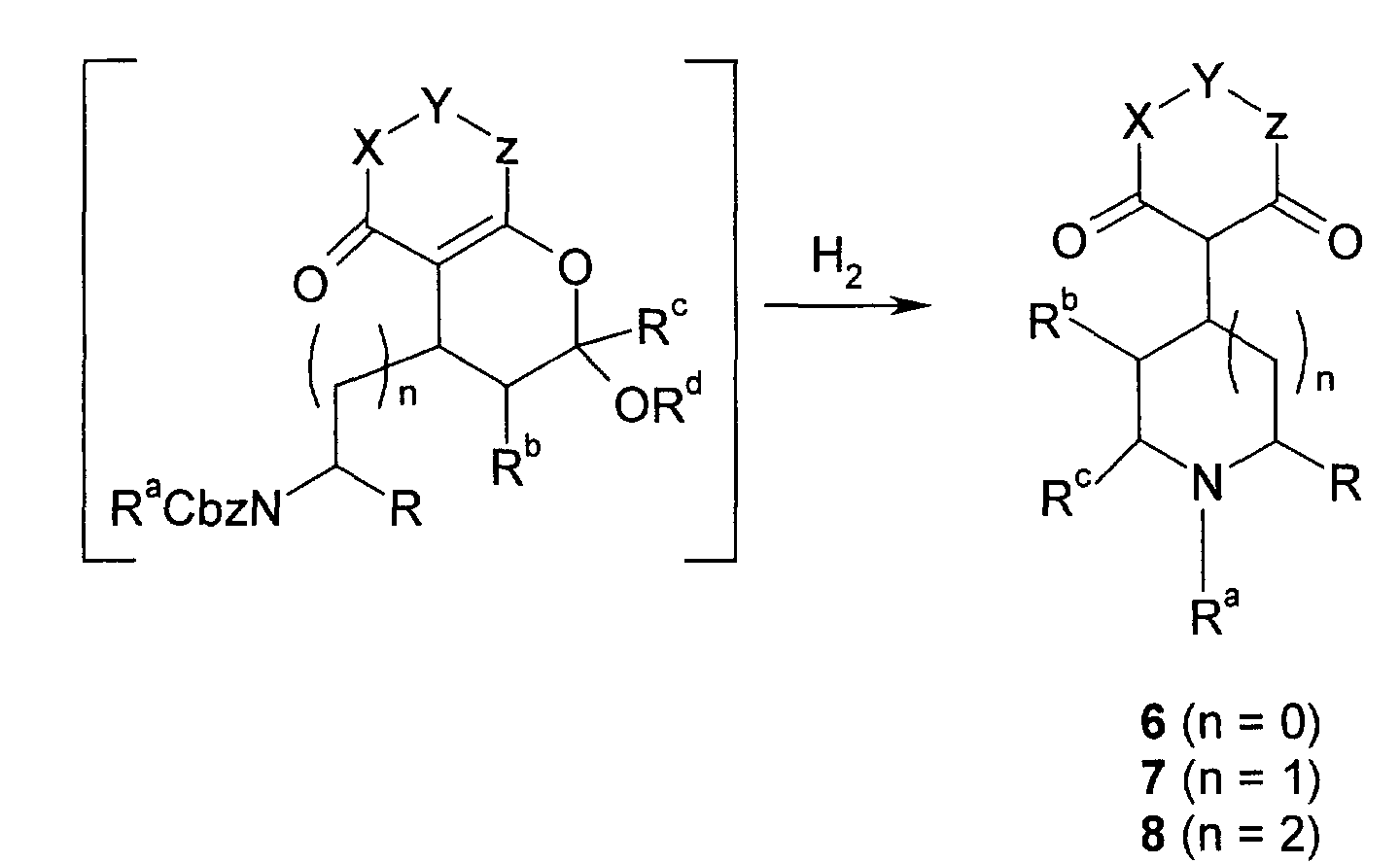
- Verfahren nach Anspruch 2, dadurch gekennzeichnet, daß der geschützte Aminoaldehyd ausgwählt ist aus den alpha-, beta- und gamma-Aminoaldehyden der allgemeinen Formeln 1a bis 1e:mit

- R1 =
- H, Alkyl, CH2OH, CH2SH,
- R2 =
- H, Alkyl,
Alkyl = Me, Et, n-Pr, i-Pr, n-Bu, sek-Bu, i-Bu oder Pentylmit
- R1, R2,
- gleich oder verschieden, H, Alkyl
- R3, R4,
- gleich oder verschieden, H, Alkyl,
mit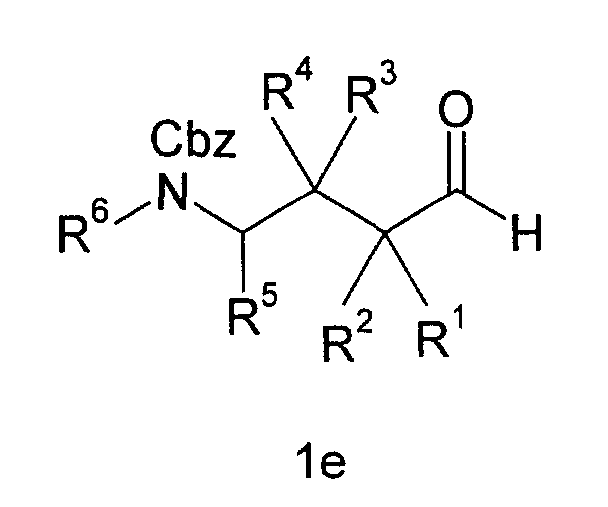
- R1, R2, R3, R4,
- gleich oder verschieden, H, Alkyl
- R5, R6,
- gleich oder verschieden, H, Alkyl,
- Verfahren nach Anspruch 2 oder 3, dadurch gekennzeichnet, daß der Enolether ausgewählt ist aus den Enolethern der allgemeinen Formeln 2a bis 2d:mit

- R7, R8, R9,
- gleich oder verschieden, H, Alkyl, Bn, Ph-C2H4,CH2OR, CH2SR, CH2NHAc, CH2CH2OR, CH2CH2SR, CH2CH2NHAc, und
- R9
- zusätzlich Ph,
- R12
- Benzyl oder Si(CH3)3,
- Verfahren nach einem der Ansprüche 2 bis 4, dadurch gekennzeichnet, daß die 1,3-Dicarbonylverbindung ausgewählt ist aus den 1,3-Dicarbonylverbindungen der allgemeinen Formeln 3a und 3b:mit

- X, Z,
- gleich oder verschieden, NH, NAlkyl, CH2, CMe2, O, S, und
- Y
- CH2, CMe2, C=O, C=S,
oder - X-Y-Z
- NH-CR10=CR11, NAlkyl-CR10=CR11,
O-CR10=CR11, NAlkyl-CHR1-CHR2,
mit R10 und R11, gleich oder verschieden, Alkyl, unsubstituiertes oder mit OH, OAlkyl, NH2, NHAlkyl oder N(Alkyl)2 substituiertes Phenyl, unsubstituiertes oder mit OH, Oalkyl, NH2, NHAlkyl oder N(Alkyl)2 substituiertes 1,3-Butadien-1,3-dienyl, wobei im zuletzt genannten Fall R10 und R11 Teile des gleichen Ringsystems sind,
- Verfahren nach einem der Ansprüche 1 bis 5, dadurch gekennzeichnet, daß die zwitterionische Verbindung in Wasser, Methanol oder deren Gemischen als polarem Lösungsmittel erhalten werden.
- Verfahren nach einem der Ansprüche 1 bis 6, dadurch gekennzeichnet, daß die zwitterionische Verbindung durch Zugabe von Diethylether als unpolarem Lösungsmittel gefällt wird.
Applications Claiming Priority (2)
| Application Number | Priority Date | Filing Date | Title |
|---|---|---|---|
| DE10045530 | 2000-09-13 | ||
| DE10045530A DE10045530A1 (de) | 2000-09-13 | 2000-09-13 | Kombinatorische Herstellung einer Substanzbibliothek unter Abtrennung einer zwitterionischen Verbindung durch Fällung |
Publications (1)
| Publication Number | Publication Date |
|---|---|
| EP1188732A2 true EP1188732A2 (de) | 2002-03-20 |
Family
ID=7656222
Family Applications (1)
| Application Number | Title | Priority Date | Filing Date |
|---|---|---|---|
| EP01120764A Withdrawn EP1188732A2 (de) | 2000-09-13 | 2001-09-07 | Kombinatorische Herstellung einer Substanzbibliothek unter Abtrennung einer zwitterionischen Verbindung durch Fällung |
Country Status (4)
| Country | Link |
|---|---|
| US (1) | US20020037534A1 (de) |
| EP (1) | EP1188732A2 (de) |
| JP (1) | JP2002145857A (de) |
| DE (1) | DE10045530A1 (de) |
-
2000
- 2000-09-13 DE DE10045530A patent/DE10045530A1/de not_active Withdrawn
-
2001
- 2001-09-07 EP EP01120764A patent/EP1188732A2/de not_active Withdrawn
- 2001-09-11 US US09/949,571 patent/US20020037534A1/en not_active Abandoned
- 2001-09-12 JP JP2001277290A patent/JP2002145857A/ja not_active Withdrawn
Also Published As
| Publication number | Publication date |
|---|---|
| JP2002145857A (ja) | 2002-05-22 |
| DE10045530A1 (de) | 2002-03-21 |
| US20020037534A1 (en) | 2002-03-28 |
Similar Documents
| Publication | Publication Date | Title |
|---|---|---|
| EP0986548B1 (de) | Herstellung von mono- und 1,7-bis-n-hydroxyalkyl-cyclen und lithium-salz-komplexen | |
| EP0173199A1 (de) | cis, endo-2-Azabicycloalkan-3-carbonsäure-Derivate, Verfahren zu deren Herstellung, deren Verwendung sowie Zwischenprodukte bei deren Herstellung | |
| DE69328962T2 (de) | Verfahren zur herstellng von cyano-methoxyiminomethylderivaten | |
| WO2003066558A2 (de) | Herstellung von alkenonen | |
| DE60317092T2 (de) | Katalytisches verfahren zur herstellung von hydromorphone und hydrocodone | |
| EP1049674B1 (de) | Verfahren zur herstellung von (-)cis-3- hydroxy-1- methyl-4-(2, 4,6-trimethoxyphenyl)- piperidin | |
| EP2041066A1 (de) | Verfahren zur herstellung von chiralen aminocarbonylverbindungen | |
| EP0971931A1 (de) | Verfahren zur entbenzylierung von dibenzylbiotin | |
| EP1188732A2 (de) | Kombinatorische Herstellung einer Substanzbibliothek unter Abtrennung einer zwitterionischen Verbindung durch Fällung | |
| EP1899337B1 (de) | Verfahren zur herstellung von 3,7-diaza-bicyclo[3.3.1]nonan-verbindungen | |
| DE69108743T2 (de) | Recematspaltung von trans-2-(2-pyrimidinyl)-7-(hydroxymethyl)octahydro-2h-pyrido[1,2-a]-pyrazin. | |
| DE69128442T2 (de) | Optisches Trennungsverfahren | |
| EP0374647B1 (de) | Verfahren zur Herstellung von optisch aktiven alpha-Aminoacetalen | |
| EP0173185B1 (de) | Verfahren zur Herstellung von (3a5,6aR)-und/oder(3aR,6a5)-1,3-Dibenzyl-hexahydro-1H-furo(3,4-d)imidazol-2,4-dion | |
| EP1355898A1 (de) | Verfahren zur herstellung von flavon derivaten | |
| DE69700236T2 (de) | Verfahren zur herstellung von (-)-trans-n-p-fluorbenzoylmethyl-4-(p-fluorphenyl)-3-[[3,4-(methylendioxy)phenoxy]methyl]-piperidin | |
| EP1819647B1 (de) | Verfahren zur hydrierung von , -ungesättigten carbonylverbindungen | |
| DE69918565T2 (de) | Verfahren zur herstellung von 4-substituierte n-[(alk-2-en-1-yl)oxy]- und n-aralkyloxy-2,2,6,6-tetraalkylpiperidine | |
| DE60007894T2 (de) | Verfahren für die herstellung und zwischenprodukte von tetrahydro-[1,8]-naphthyridin | |
| DE60213604T2 (de) | Verfahren zur herstellung von 4-amino-4-phenylpiperidinen | |
| AT399151B (de) | Asymmetrische synthese von furo(3,4-c) pyridinderivaten | |
| DE2621645C3 (de) | Verfahren zur Herstellung von Aminoderivaten von N-Heterocyclen | |
| DE2618721C2 (de) | Benzo(b)-bicyclo[3,3,1]nonene, Verfahren zu deren Herstellung und pharmazeutische Mittel, die diese Verbindungen enthalten | |
| EP1675851B1 (de) | Verfahren zur herstellung von n-substituierten 3beta-aminonortropanen | |
| DE2845843C3 (de) | Verfahren zur Herstellung von 2,4-Dialkyl-4-hydroxy-23-di-hydrofuran-3onen |
Legal Events
| Date | Code | Title | Description |
|---|---|---|---|
| PUAI | Public reference made under article 153(3) epc to a published international application that has entered the european phase |
Free format text: ORIGINAL CODE: 0009012 |
|
| AK | Designated contracting states |
Kind code of ref document: A2 Designated state(s): AT BE CH CY DE DK ES FI FR GB GR IE IT LI LU MC NL PT SE TR |
|
| AX | Request for extension of the european patent |
Free format text: AL;LT;LV;MK;RO;SI |
|
| STAA | Information on the status of an ep patent application or granted ep patent |
Free format text: STATUS: THE APPLICATION HAS BEEN WITHDRAWN |
|
| 18W | Application withdrawn |
Effective date: 20030724 |