EP1184390A2 - Acetylcholinrezeptor-Untereinheiten - Google Patents
Acetylcholinrezeptor-Untereinheiten Download PDFInfo
- Publication number
- EP1184390A2 EP1184390A2 EP01118863A EP01118863A EP1184390A2 EP 1184390 A2 EP1184390 A2 EP 1184390A2 EP 01118863 A EP01118863 A EP 01118863A EP 01118863 A EP01118863 A EP 01118863A EP 1184390 A2 EP1184390 A2 EP 1184390A2
- Authority
- EP
- European Patent Office
- Prior art keywords
- subunit
- acetylcholine receptor
- nucleic acid
- seq
- acetylcholine
- Prior art date
- Legal status (The legal status is an assumption and is not a legal conclusion. Google has not performed a legal analysis and makes no representation as to the accuracy of the status listed.)
- Withdrawn
Links
- 108010009685 Cholinergic Receptors Proteins 0.000 title claims abstract description 79
- 102000034337 acetylcholine receptors Human genes 0.000 title claims abstract 31
- 150000007523 nucleic acids Chemical group 0.000 claims abstract description 42
- 108020004414 DNA Proteins 0.000 claims abstract description 29
- 241000238631 Hexapoda Species 0.000 claims abstract description 29
- 238000000034 method Methods 0.000 claims abstract description 27
- OIPILFWXSMYKGL-UHFFFAOYSA-N acetylcholine Chemical class CC(=O)OCC[N+](C)(C)C OIPILFWXSMYKGL-UHFFFAOYSA-N 0.000 claims abstract description 25
- 150000001413 amino acids Chemical class 0.000 claims abstract description 24
- 239000013598 vector Substances 0.000 claims abstract description 20
- 241000251539 Vertebrata <Metazoa> Species 0.000 claims abstract description 17
- 210000004027 cell Anatomy 0.000 claims description 67
- 241000287828 Gallus gallus Species 0.000 claims description 41
- 102000039446 nucleic acids Human genes 0.000 claims description 41
- 108020004707 nucleic acids Proteins 0.000 claims description 41
- 102000053602 DNA Human genes 0.000 claims description 24
- 230000014509 gene expression Effects 0.000 claims description 24
- 125000003275 alpha amino acid group Chemical group 0.000 claims description 17
- 239000012634 fragment Substances 0.000 claims description 17
- 239000002299 complementary DNA Substances 0.000 claims description 16
- 125000003729 nucleotide group Chemical group 0.000 claims description 15
- 230000001537 neural effect Effects 0.000 claims description 14
- 239000002773 nucleotide Substances 0.000 claims description 14
- 108090000765 processed proteins & peptides Proteins 0.000 claims description 11
- 108091034117 Oligonucleotide Proteins 0.000 claims description 10
- 102000004196 processed proteins & peptides Human genes 0.000 claims description 10
- 241000256244 Heliothis virescens Species 0.000 claims description 9
- JLCPHMBAVCMARE-UHFFFAOYSA-N [3-[[3-[[3-[[3-[[3-[[3-[[3-[[3-[[3-[[3-[[3-[[5-(2-amino-6-oxo-1H-purin-9-yl)-3-[[3-[[3-[[3-[[3-[[3-[[5-(2-amino-6-oxo-1H-purin-9-yl)-3-[[5-(2-amino-6-oxo-1H-purin-9-yl)-3-hydroxyoxolan-2-yl]methoxy-hydroxyphosphoryl]oxyoxolan-2-yl]methoxy-hydroxyphosphoryl]oxy-5-(5-methyl-2,4-dioxopyrimidin-1-yl)oxolan-2-yl]methoxy-hydroxyphosphoryl]oxy-5-(6-aminopurin-9-yl)oxolan-2-yl]methoxy-hydroxyphosphoryl]oxy-5-(6-aminopurin-9-yl)oxolan-2-yl]methoxy-hydroxyphosphoryl]oxy-5-(6-aminopurin-9-yl)oxolan-2-yl]methoxy-hydroxyphosphoryl]oxy-5-(6-aminopurin-9-yl)oxolan-2-yl]methoxy-hydroxyphosphoryl]oxyoxolan-2-yl]methoxy-hydroxyphosphoryl]oxy-5-(5-methyl-2,4-dioxopyrimidin-1-yl)oxolan-2-yl]methoxy-hydroxyphosphoryl]oxy-5-(4-amino-2-oxopyrimidin-1-yl)oxolan-2-yl]methoxy-hydroxyphosphoryl]oxy-5-(5-methyl-2,4-dioxopyrimidin-1-yl)oxolan-2-yl]methoxy-hydroxyphosphoryl]oxy-5-(5-methyl-2,4-dioxopyrimidin-1-yl)oxolan-2-yl]methoxy-hydroxyphosphoryl]oxy-5-(6-aminopurin-9-yl)oxolan-2-yl]methoxy-hydroxyphosphoryl]oxy-5-(6-aminopurin-9-yl)oxolan-2-yl]methoxy-hydroxyphosphoryl]oxy-5-(4-amino-2-oxopyrimidin-1-yl)oxolan-2-yl]methoxy-hydroxyphosphoryl]oxy-5-(4-amino-2-oxopyrimidin-1-yl)oxolan-2-yl]methoxy-hydroxyphosphoryl]oxy-5-(4-amino-2-oxopyrimidin-1-yl)oxolan-2-yl]methoxy-hydroxyphosphoryl]oxy-5-(6-aminopurin-9-yl)oxolan-2-yl]methoxy-hydroxyphosphoryl]oxy-5-(4-amino-2-oxopyrimidin-1-yl)oxolan-2-yl]methyl [5-(6-aminopurin-9-yl)-2-(hydroxymethyl)oxolan-3-yl] hydrogen phosphate Polymers Cc1cn(C2CC(OP(O)(=O)OCC3OC(CC3OP(O)(=O)OCC3OC(CC3O)n3cnc4c3nc(N)[nH]c4=O)n3cnc4c3nc(N)[nH]c4=O)C(COP(O)(=O)OC3CC(OC3COP(O)(=O)OC3CC(OC3COP(O)(=O)OC3CC(OC3COP(O)(=O)OC3CC(OC3COP(O)(=O)OC3CC(OC3COP(O)(=O)OC3CC(OC3COP(O)(=O)OC3CC(OC3COP(O)(=O)OC3CC(OC3COP(O)(=O)OC3CC(OC3COP(O)(=O)OC3CC(OC3COP(O)(=O)OC3CC(OC3COP(O)(=O)OC3CC(OC3COP(O)(=O)OC3CC(OC3COP(O)(=O)OC3CC(OC3COP(O)(=O)OC3CC(OC3COP(O)(=O)OC3CC(OC3COP(O)(=O)OC3CC(OC3CO)n3cnc4c(N)ncnc34)n3ccc(N)nc3=O)n3cnc4c(N)ncnc34)n3ccc(N)nc3=O)n3ccc(N)nc3=O)n3ccc(N)nc3=O)n3cnc4c(N)ncnc34)n3cnc4c(N)ncnc34)n3cc(C)c(=O)[nH]c3=O)n3cc(C)c(=O)[nH]c3=O)n3ccc(N)nc3=O)n3cc(C)c(=O)[nH]c3=O)n3cnc4c3nc(N)[nH]c4=O)n3cnc4c(N)ncnc34)n3cnc4c(N)ncnc34)n3cnc4c(N)ncnc34)n3cnc4c(N)ncnc34)O2)c(=O)[nH]c1=O JLCPHMBAVCMARE-UHFFFAOYSA-N 0.000 claims description 9
- 229920001184 polypeptide Polymers 0.000 claims description 8
- 241001465754 Metazoa Species 0.000 claims description 7
- 239000013543 active substance Substances 0.000 claims description 7
- FWMNVWWHGCHHJJ-SKKKGAJSSA-N 4-amino-1-[(2r)-6-amino-2-[[(2r)-2-[[(2r)-2-[[(2r)-2-amino-3-phenylpropanoyl]amino]-3-phenylpropanoyl]amino]-4-methylpentanoyl]amino]hexanoyl]piperidine-4-carboxylic acid Chemical compound C([C@H](C(=O)N[C@H](CC(C)C)C(=O)N[C@H](CCCCN)C(=O)N1CCC(N)(CC1)C(O)=O)NC(=O)[C@H](N)CC=1C=CC=CC=1)C1=CC=CC=C1 FWMNVWWHGCHHJJ-SKKKGAJSSA-N 0.000 claims description 6
- 241000255601 Drosophila melanogaster Species 0.000 claims description 5
- 241000721621 Myzus persicae Species 0.000 claims description 5
- 239000004480 active ingredient Substances 0.000 claims description 5
- 210000003527 eukaryotic cell Anatomy 0.000 claims description 5
- 241000252212 Danio rerio Species 0.000 claims description 4
- 241000588724 Escherichia coli Species 0.000 claims description 4
- 241000282560 Macaca mulatta Species 0.000 claims description 4
- 241000255908 Manduca sexta Species 0.000 claims description 4
- 241000699666 Mus <mouse, genus> Species 0.000 claims description 4
- 241000700159 Rattus Species 0.000 claims description 4
- 150000001875 compounds Chemical class 0.000 claims description 4
- 238000004519 manufacturing process Methods 0.000 claims description 4
- 235000015277 pork Nutrition 0.000 claims description 4
- 210000001236 prokaryotic cell Anatomy 0.000 claims description 4
- 235000015278 beef Nutrition 0.000 claims description 3
- 238000000338 in vitro Methods 0.000 claims description 3
- 230000001105 regulatory effect Effects 0.000 claims description 3
- 239000001963 growth medium Substances 0.000 claims description 2
- 238000012258 culturing Methods 0.000 claims 2
- 238000003786 synthesis reaction Methods 0.000 claims 2
- 108091032973 (ribonucleotides)n+m Proteins 0.000 claims 1
- 241000283690 Bos taurus Species 0.000 claims 1
- 108020004682 Single-Stranded DNA Proteins 0.000 claims 1
- 230000003321 amplification Effects 0.000 claims 1
- 238000003199 nucleic acid amplification method Methods 0.000 claims 1
- 238000011084 recovery Methods 0.000 claims 1
- 108091028043 Nucleic acid sequence Proteins 0.000 abstract description 2
- 239000003814 drug Substances 0.000 abstract description 2
- 239000011814 protection agent Substances 0.000 abstract 1
- 108020003175 receptors Proteins 0.000 description 52
- 102000005962 receptors Human genes 0.000 description 51
- 102000009660 Cholinergic Receptors Human genes 0.000 description 48
- 108050006807 Nicotinic acetylcholine receptors Proteins 0.000 description 34
- 102000019315 Nicotinic acetylcholine receptors Human genes 0.000 description 33
- 210000000287 oocyte Anatomy 0.000 description 21
- 108090000623 proteins and genes Proteins 0.000 description 21
- 235000001014 amino acid Nutrition 0.000 description 20
- 239000005906 Imidacloprid Substances 0.000 description 19
- YWTYJOPNNQFBPC-UHFFFAOYSA-N imidacloprid Chemical compound [O-][N+](=O)\N=C1/NCCN1CC1=CC=C(Cl)N=C1 YWTYJOPNNQFBPC-UHFFFAOYSA-N 0.000 description 19
- 229940056881 imidacloprid Drugs 0.000 description 19
- 229960004373 acetylcholine Drugs 0.000 description 18
- 239000000556 agonist Substances 0.000 description 15
- 239000011575 calcium Substances 0.000 description 15
- 238000003752 polymerase chain reaction Methods 0.000 description 15
- 239000013612 plasmid Substances 0.000 description 14
- OYPRJOBELJOOCE-UHFFFAOYSA-N Calcium Chemical compound [Ca] OYPRJOBELJOOCE-UHFFFAOYSA-N 0.000 description 13
- 229910052791 calcium Inorganic materials 0.000 description 13
- 239000003446 ligand Substances 0.000 description 13
- 241000255581 Drosophila <fruit fly, genus> Species 0.000 description 11
- 241000269370 Xenopus <genus> Species 0.000 description 11
- 150000002500 ions Chemical class 0.000 description 10
- 239000000203 mixture Substances 0.000 description 10
- 239000000243 solution Substances 0.000 description 9
- IAZDPXIOMUYVGZ-UHFFFAOYSA-N Dimethylsulphoxide Chemical compound CS(C)=O IAZDPXIOMUYVGZ-UHFFFAOYSA-N 0.000 description 8
- 239000005557 antagonist Substances 0.000 description 8
- 238000002474 experimental method Methods 0.000 description 8
- 230000035945 sensitivity Effects 0.000 description 8
- 239000000126 substance Substances 0.000 description 8
- JKMHFZQWWAIEOD-UHFFFAOYSA-N 2-[4-(2-hydroxyethyl)piperazin-1-yl]ethanesulfonic acid Chemical compound OCC[NH+]1CCN(CCS([O-])(=O)=O)CC1 JKMHFZQWWAIEOD-UHFFFAOYSA-N 0.000 description 7
- 238000010276 construction Methods 0.000 description 7
- 238000012360 testing method Methods 0.000 description 7
- 108091006146 Channels Proteins 0.000 description 6
- 239000007995 HEPES buffer Substances 0.000 description 6
- FAPWRFPIFSIZLT-UHFFFAOYSA-M Sodium chloride Chemical compound [Na+].[Cl-] FAPWRFPIFSIZLT-UHFFFAOYSA-M 0.000 description 6
- 241000251733 Tetronarce californica Species 0.000 description 6
- KWIUHFFTVRNATP-UHFFFAOYSA-N glycine betaine Chemical compound C[N+](C)(C)CC([O-])=O KWIUHFFTVRNATP-UHFFFAOYSA-N 0.000 description 6
- 230000003834 intracellular effect Effects 0.000 description 6
- 239000002609 medium Substances 0.000 description 6
- 239000012528 membrane Substances 0.000 description 6
- 101710195183 Alpha-bungarotoxin Proteins 0.000 description 5
- 230000004913 activation Effects 0.000 description 5
- 239000000872 buffer Substances 0.000 description 5
- 230000008859 change Effects 0.000 description 5
- 239000002917 insecticide Substances 0.000 description 5
- 238000005259 measurement Methods 0.000 description 5
- XLTANAWLDBYGFU-UHFFFAOYSA-N methyllycaconitine hydrochloride Natural products C1CC(OC)C2(C3C4OC)C5CC(C(C6)OC)C(OC)C5C6(O)C4(O)C2N(CC)CC31COC(=O)C1=CC=CC=C1N1C(=O)CC(C)C1=O XLTANAWLDBYGFU-UHFFFAOYSA-N 0.000 description 5
- 230000000144 pharmacologic effect Effects 0.000 description 5
- 239000002243 precursor Substances 0.000 description 5
- 238000006467 substitution reaction Methods 0.000 description 5
- LYTCVQQGCSNFJU-LKGYBJPKSA-N α-bungarotoxin Chemical compound C(/[C@H]1O[C@H]2C[C@H]3O[C@@H](CC(=C)C=O)C[C@H](O)[C@]3(C)O[C@@H]2C[C@@H]1O[C@@H]1C2)=C/C[C@]1(C)O[C@H]1[C@@]2(C)O[C@]2(C)CC[C@@H]3O[C@@H]4C[C@]5(C)O[C@@H]6C(C)=CC(=O)O[C@H]6C[C@H]5O[C@H]4C[C@@H](C)[C@H]3O[C@H]2C1 LYTCVQQGCSNFJU-LKGYBJPKSA-N 0.000 description 5
- 241000196324 Embryophyta Species 0.000 description 4
- 108010043121 Green Fluorescent Proteins Proteins 0.000 description 4
- 102000004144 Green Fluorescent Proteins Human genes 0.000 description 4
- 241000256257 Heliothis Species 0.000 description 4
- 241000282412 Homo Species 0.000 description 4
- 108090000543 Ligand-Gated Ion Channels Proteins 0.000 description 4
- 238000013459 approach Methods 0.000 description 4
- 238000012512 characterization method Methods 0.000 description 4
- 238000010367 cloning Methods 0.000 description 4
- 238000007796 conventional method Methods 0.000 description 4
- 230000004927 fusion Effects 0.000 description 4
- 239000005090 green fluorescent protein Substances 0.000 description 4
- 235000018102 proteins Nutrition 0.000 description 4
- 102000004169 proteins and genes Human genes 0.000 description 4
- 241000894007 species Species 0.000 description 4
- 239000011550 stock solution Substances 0.000 description 4
- 108020004635 Complementary DNA Proteins 0.000 description 3
- 102000004086 Ligand-Gated Ion Channels Human genes 0.000 description 3
- HEMHJVSKTPXQMS-UHFFFAOYSA-M Sodium hydroxide Chemical compound [OH-].[Na+] HEMHJVSKTPXQMS-UHFFFAOYSA-M 0.000 description 3
- 229960003237 betaine Drugs 0.000 description 3
- 238000004113 cell culture Methods 0.000 description 3
- 210000000170 cell membrane Anatomy 0.000 description 3
- 238000004140 cleaning Methods 0.000 description 3
- 238000001514 detection method Methods 0.000 description 3
- 239000003599 detergent Substances 0.000 description 3
- 230000000694 effects Effects 0.000 description 3
- 238000002347 injection Methods 0.000 description 3
- 239000007924 injection Substances 0.000 description 3
- 108020001756 ligand binding domains Proteins 0.000 description 3
- 238000002703 mutagenesis Methods 0.000 description 3
- 231100000350 mutagenesis Toxicity 0.000 description 3
- 210000000653 nervous system Anatomy 0.000 description 3
- 230000010412 perfusion Effects 0.000 description 3
- 239000000047 product Substances 0.000 description 3
- 238000002741 site-directed mutagenesis Methods 0.000 description 3
- 239000011780 sodium chloride Substances 0.000 description 3
- 230000010473 stable expression Effects 0.000 description 3
- 239000012085 test solution Substances 0.000 description 3
- 238000012546 transfer Methods 0.000 description 3
- SNICXCGAKADSCV-JTQLQIEISA-N (-)-Nicotine Chemical compound CN1CCC[C@H]1C1=CC=CN=C1 SNICXCGAKADSCV-JTQLQIEISA-N 0.000 description 2
- 241000242764 Aequorea victoria Species 0.000 description 2
- 241000894006 Bacteria Species 0.000 description 2
- BHPQYMZQTOCNFJ-UHFFFAOYSA-N Calcium cation Chemical compound [Ca+2] BHPQYMZQTOCNFJ-UHFFFAOYSA-N 0.000 description 2
- 108010062745 Chloride Channels Proteins 0.000 description 2
- 102000011045 Chloride Channels Human genes 0.000 description 2
- 108090000862 Ion Channels Proteins 0.000 description 2
- 102000004310 Ion Channels Human genes 0.000 description 2
- ROHFNLRQFUQHCH-YFKPBYRVSA-N L-leucine Chemical compound CC(C)C[C@H](N)C(O)=O ROHFNLRQFUQHCH-YFKPBYRVSA-N 0.000 description 2
- -1 Leu Chemical compound 0.000 description 2
- 241000254022 Locusta migratoria Species 0.000 description 2
- KDXKERNSBIXSRK-UHFFFAOYSA-N Lysine Natural products NCCCCC(N)C(O)=O KDXKERNSBIXSRK-UHFFFAOYSA-N 0.000 description 2
- 241000009328 Perro Species 0.000 description 2
- 240000004808 Saccharomyces cerevisiae Species 0.000 description 2
- 241000256251 Spodoptera frugiperda Species 0.000 description 2
- 241000269368 Xenopus laevis Species 0.000 description 2
- HIHOWBSBBDRPDW-PTHRTHQKSA-N [(3s,8s,9s,10r,13r,14s,17r)-10,13-dimethyl-17-[(2r)-6-methylheptan-2-yl]-2,3,4,7,8,9,11,12,14,15,16,17-dodecahydro-1h-cyclopenta[a]phenanthren-3-yl] n-[2-(dimethylamino)ethyl]carbamate Chemical compound C1C=C2C[C@@H](OC(=O)NCCN(C)C)CC[C@]2(C)[C@@H]2[C@@H]1[C@@H]1CC[C@H]([C@H](C)CCCC(C)C)[C@@]1(C)CC2 HIHOWBSBBDRPDW-PTHRTHQKSA-N 0.000 description 2
- 239000008186 active pharmaceutical agent Substances 0.000 description 2
- 125000001931 aliphatic group Chemical group 0.000 description 2
- 102000047725 alpha7 Nicotinic Acetylcholine Receptor Human genes 0.000 description 2
- 108700006085 alpha7 Nicotinic Acetylcholine Receptor Proteins 0.000 description 2
- 150000001408 amides Chemical class 0.000 description 2
- 102000016966 beta-2 Adrenergic Receptors Human genes 0.000 description 2
- 108010014499 beta-2 Adrenergic Receptors Proteins 0.000 description 2
- 210000004556 brain Anatomy 0.000 description 2
- 210000004899 c-terminal region Anatomy 0.000 description 2
- 229910001424 calcium ion Inorganic materials 0.000 description 2
- 235000018417 cysteine Nutrition 0.000 description 2
- 125000000151 cysteine group Chemical group N[C@@H](CS)C(=O)* 0.000 description 2
- 238000000586 desensitisation Methods 0.000 description 2
- 230000029087 digestion Effects 0.000 description 2
- 239000000975 dye Substances 0.000 description 2
- 239000013613 expression plasmid Substances 0.000 description 2
- 230000006870 function Effects 0.000 description 2
- YFHXZQPUBCBNIP-UHFFFAOYSA-N fura-2 Chemical compound CC1=CC=C(N(CC(O)=O)CC(O)=O)C(OCCOC=2C(=CC=3OC(=CC=3C=2)C=2OC(=CN=2)C(O)=O)N(CC(O)=O)CC(O)=O)=C1 YFHXZQPUBCBNIP-UHFFFAOYSA-N 0.000 description 2
- 108020001507 fusion proteins Proteins 0.000 description 2
- 102000037865 fusion proteins Human genes 0.000 description 2
- 238000002523 gelfiltration Methods 0.000 description 2
- RWSXRVCMGQZWBV-WDSKDSINSA-N glutathione Chemical compound OC(=O)[C@@H](N)CCC(=O)N[C@@H](CS)C(=O)NCC(O)=O RWSXRVCMGQZWBV-WDSKDSINSA-N 0.000 description 2
- 150000002632 lipids Chemical class 0.000 description 2
- 230000001404 mediated effect Effects 0.000 description 2
- 108020004999 messenger RNA Proteins 0.000 description 2
- 210000003205 muscle Anatomy 0.000 description 2
- 210000002569 neuron Anatomy 0.000 description 2
- 229960002715 nicotine Drugs 0.000 description 2
- SNICXCGAKADSCV-UHFFFAOYSA-N nicotine Natural products CN1CCCC1C1=CC=CN=C1 SNICXCGAKADSCV-UHFFFAOYSA-N 0.000 description 2
- 230000008569 process Effects 0.000 description 2
- 238000012545 processing Methods 0.000 description 2
- 238000000746 purification Methods 0.000 description 2
- 238000003259 recombinant expression Methods 0.000 description 2
- 108091008146 restriction endonucleases Proteins 0.000 description 2
- 229920002477 rna polymer Polymers 0.000 description 2
- 238000010998 test method Methods 0.000 description 2
- SBKVPJHMSUXZTA-MEJXFZFPSA-N (2S)-2-[[(2S)-2-[[(2S)-1-[(2S)-5-amino-2-[[2-[[(2S)-1-[(2S)-6-amino-2-[[(2S)-2-[[(2S)-5-amino-2-[[(2S)-2-[[(2S)-2-[[(2S)-2-[[(2S)-2-amino-3-(1H-indol-3-yl)propanoyl]amino]-3-(1H-imidazol-4-yl)propanoyl]amino]-3-(1H-indol-3-yl)propanoyl]amino]-4-methylpentanoyl]amino]-5-oxopentanoyl]amino]-4-methylpentanoyl]amino]hexanoyl]pyrrolidine-2-carbonyl]amino]acetyl]amino]-5-oxopentanoyl]pyrrolidine-2-carbonyl]amino]-4-methylsulfanylbutanoyl]amino]-3-(4-hydroxyphenyl)propanoic acid Chemical compound C([C@@H](C(=O)N[C@@H](CC=1C2=CC=CC=C2NC=1)C(=O)N[C@@H](CC(C)C)C(=O)N[C@@H](CCC(N)=O)C(=O)N[C@@H](CC(C)C)C(=O)N[C@@H](CCCCN)C(=O)N1CCC[C@H]1C(=O)NCC(=O)N[C@@H](CCC(N)=O)C(=O)N1CCC[C@H]1C(=O)N[C@@H](CCSC)C(=O)N[C@@H](CC=1C=CC(O)=CC=1)C(O)=O)NC(=O)[C@@H](N)CC=1C2=CC=CC=C2NC=1)C1=CNC=N1 SBKVPJHMSUXZTA-MEJXFZFPSA-N 0.000 description 1
- GZCWLCBFPRFLKL-UHFFFAOYSA-N 1-prop-2-ynoxypropan-2-ol Chemical compound CC(O)COCC#C GZCWLCBFPRFLKL-UHFFFAOYSA-N 0.000 description 1
- OSJPPGNTCRNQQC-UWTATZPHSA-N 3-phospho-D-glyceric acid Chemical compound OC(=O)[C@H](O)COP(O)(O)=O OSJPPGNTCRNQQC-UWTATZPHSA-N 0.000 description 1
- 102000040125 5-hydroxytryptamine receptor family Human genes 0.000 description 1
- 108091032151 5-hydroxytryptamine receptor family Proteins 0.000 description 1
- 230000005730 ADP ribosylation Effects 0.000 description 1
- QTBSBXVTEAMEQO-UHFFFAOYSA-M Acetate Chemical compound CC([O-])=O QTBSBXVTEAMEQO-UHFFFAOYSA-M 0.000 description 1
- 102000013563 Acid Phosphatase Human genes 0.000 description 1
- 108010051457 Acid Phosphatase Proteins 0.000 description 1
- PLXMOAALOJOTIY-FPTXNFDTSA-N Aesculin Natural products OC[C@@H]1[C@@H](O)[C@H](O)[C@@H](O)[C@H](O)[C@H]1Oc2cc3C=CC(=O)Oc3cc2O PLXMOAALOJOTIY-FPTXNFDTSA-N 0.000 description 1
- CXISPYVYMQWFLE-VKHMYHEASA-N Ala-Gly Chemical compound C[C@H]([NH3+])C(=O)NCC([O-])=O CXISPYVYMQWFLE-VKHMYHEASA-N 0.000 description 1
- 239000004475 Arginine Substances 0.000 description 1
- HCAUEJAQCXVQQM-ACZMJKKPSA-N Asn-Glu-Asp Chemical compound [H]N[C@@H](CC(N)=O)C(=O)N[C@@H](CCC(O)=O)C(=O)N[C@@H](CC(O)=O)C(O)=O HCAUEJAQCXVQQM-ACZMJKKPSA-N 0.000 description 1
- 241000193830 Bacillus <bacterium> Species 0.000 description 1
- 108091003079 Bovine Serum Albumin Proteins 0.000 description 1
- 241000208199 Buxus sempervirens Species 0.000 description 1
- 101100348617 Candida albicans (strain SC5314 / ATCC MYA-2876) NIK1 gene Proteins 0.000 description 1
- 101710132601 Capsid protein Proteins 0.000 description 1
- 102000014914 Carrier Proteins Human genes 0.000 description 1
- 101710094648 Coat protein Proteins 0.000 description 1
- 108091026890 Coding region Proteins 0.000 description 1
- 108700010070 Codon Usage Proteins 0.000 description 1
- ZGERHCJBLPQPGV-ACZMJKKPSA-N Cys-Ser-Gln Chemical compound C(CC(=O)N)[C@@H](C(=O)O)NC(=O)[C@H](CO)NC(=O)[C@H](CS)N ZGERHCJBLPQPGV-ACZMJKKPSA-N 0.000 description 1
- 241000701022 Cytomegalovirus Species 0.000 description 1
- 241000701959 Escherichia virus Lambda Species 0.000 description 1
- 108060002716 Exonuclease Proteins 0.000 description 1
- 108091060211 Expressed sequence tag Proteins 0.000 description 1
- 108700039691 Genetic Promoter Regions Proteins 0.000 description 1
- FTIJVMLAGRAYMJ-MNXVOIDGSA-N Gln-Ile-Leu Chemical compound CC(C)C[C@@H](C(O)=O)NC(=O)[C@H]([C@@H](C)CC)NC(=O)[C@@H](N)CCC(N)=O FTIJVMLAGRAYMJ-MNXVOIDGSA-N 0.000 description 1
- 108010024636 Glutathione Proteins 0.000 description 1
- 102000005720 Glutathione transferase Human genes 0.000 description 1
- 108010070675 Glutathione transferase Proteins 0.000 description 1
- 102100021181 Golgi phosphoprotein 3 Human genes 0.000 description 1
- RXVOMIADLXPJGW-GUBZILKMSA-N His-Asp-Glu Chemical compound [H]N[C@@H](CC1=CNC=N1)C(=O)N[C@@H](CC(O)=O)C(=O)N[C@@H](CCC(O)=O)C(O)=O RXVOMIADLXPJGW-GUBZILKMSA-N 0.000 description 1
- RENBRDSDKPSRIH-HJWJTTGWSA-N Ile-Phe-Met Chemical compound N[C@@H]([C@@H](C)CC)C(=O)N[C@@H](CC1=CC=CC=C1)C(=O)N[C@@H](CCSC)C(=O)O RENBRDSDKPSRIH-HJWJTTGWSA-N 0.000 description 1
- 108091092195 Intron Proteins 0.000 description 1
- ODKSFYDXXFIFQN-BYPYZUCNSA-P L-argininium(2+) Chemical compound NC(=[NH2+])NCCC[C@H]([NH3+])C(O)=O ODKSFYDXXFIFQN-BYPYZUCNSA-P 0.000 description 1
- LEVWYRKDKASIDU-IMJSIDKUSA-N L-cystine Chemical compound [O-]C(=O)[C@@H]([NH3+])CSSC[C@H]([NH3+])C([O-])=O LEVWYRKDKASIDU-IMJSIDKUSA-N 0.000 description 1
- WHUUTDBJXJRKMK-VKHMYHEASA-N L-glutamic acid Chemical compound OC(=O)[C@@H](N)CCC(O)=O WHUUTDBJXJRKMK-VKHMYHEASA-N 0.000 description 1
- ZDXPYRJPNDTMRX-VKHMYHEASA-N L-glutamine Chemical compound OC(=O)[C@@H](N)CCC(N)=O ZDXPYRJPNDTMRX-VKHMYHEASA-N 0.000 description 1
- TYYLDKGBCJGJGW-UHFFFAOYSA-N L-tryptophan-L-tyrosine Natural products C=1NC2=CC=CC=C2C=1CC(N)C(=O)NC(C(O)=O)CC1=CC=C(O)C=C1 TYYLDKGBCJGJGW-UHFFFAOYSA-N 0.000 description 1
- OUYCCCASQSFEME-QMMMGPOBSA-N L-tyrosine Chemical compound OC(=O)[C@@H](N)CC1=CC=C(O)C=C1 OUYCCCASQSFEME-QMMMGPOBSA-N 0.000 description 1
- 102000006830 Luminescent Proteins Human genes 0.000 description 1
- 108010047357 Luminescent Proteins Proteins 0.000 description 1
- YKIRNDPUWONXQN-GUBZILKMSA-N Lys-Asn-Gln Chemical compound C(CCN)C[C@@H](C(=O)N[C@@H](CC(=O)N)C(=O)N[C@@H](CCC(=O)N)C(=O)O)N YKIRNDPUWONXQN-GUBZILKMSA-N 0.000 description 1
- 101710125418 Major capsid protein Proteins 0.000 description 1
- 108010038049 Mating Factor Proteins 0.000 description 1
- 108010052285 Membrane Proteins Proteins 0.000 description 1
- 241000721623 Myzus Species 0.000 description 1
- 101710141454 Nucleoprotein Proteins 0.000 description 1
- BQMFWUKNOCJDNV-HJWJTTGWSA-N Phe-Val-Ile Chemical compound [H]N[C@@H](CC1=CC=CC=C1)C(=O)N[C@@H](C(C)C)C(=O)N[C@@H]([C@@H](C)CC)C(O)=O BQMFWUKNOCJDNV-HJWJTTGWSA-N 0.000 description 1
- FDINZVJXLPILKV-DCAQKATOSA-N Pro-His-Asn Chemical compound [H]N1CCC[C@H]1C(=O)N[C@@H](CC1=CNC=N1)C(=O)N[C@@H](CC(N)=O)C(O)=O FDINZVJXLPILKV-DCAQKATOSA-N 0.000 description 1
- 101710083689 Probable capsid protein Proteins 0.000 description 1
- 102000001253 Protein Kinase Human genes 0.000 description 1
- 241000589516 Pseudomonas Species 0.000 description 1
- 101000638040 Rattus norvegicus Neurogenic differentiation factor 1 Proteins 0.000 description 1
- 108020004511 Recombinant DNA Proteins 0.000 description 1
- 108700008625 Reporter Genes Proteins 0.000 description 1
- 239000012891 Ringer solution Substances 0.000 description 1
- 101100007329 Saccharomyces cerevisiae (strain ATCC 204508 / S288c) COS1 gene Proteins 0.000 description 1
- 101100221606 Saccharomyces cerevisiae (strain ATCC 204508 / S288c) COS7 gene Proteins 0.000 description 1
- 241000253973 Schistocerca gregaria Species 0.000 description 1
- 241000256248 Spodoptera Species 0.000 description 1
- 241000191940 Staphylococcus Species 0.000 description 1
- 241000194017 Streptococcus Species 0.000 description 1
- 241000187747 Streptomyces Species 0.000 description 1
- GQPQJNMVELPZNQ-GBALPHGKSA-N Thr-Ser-Trp Chemical compound C[C@H]([C@@H](C(=O)N[C@@H](CO)C(=O)N[C@@H](CC1=CNC2=CC=CC=C21)C(=O)O)N)O GQPQJNMVELPZNQ-GBALPHGKSA-N 0.000 description 1
- 241000251735 Torpedo marmorata Species 0.000 description 1
- 108020004566 Transfer RNA Proteins 0.000 description 1
- 102000004142 Trypsin Human genes 0.000 description 1
- 108090000631 Trypsin Proteins 0.000 description 1
- LUMQYLVYUIRHHU-YJRXYDGGSA-N Tyr-Ser-Thr Chemical compound [H]N[C@@H](CC1=CC=C(O)C=C1)C(=O)N[C@@H](CO)C(=O)N[C@@H]([C@@H](C)O)C(O)=O LUMQYLVYUIRHHU-YJRXYDGGSA-N 0.000 description 1
- FZADUTOCSFDBRV-RNXOBYDBSA-N Tyr-Tyr-Trp Chemical compound C([C@H](N)C(=O)N[C@@H](CC=1C=CC(O)=CC=1)C(=O)N[C@@H](CC=1C2=CC=CC=C2NC=1)C(O)=O)C1=CC=C(O)C=C1 FZADUTOCSFDBRV-RNXOBYDBSA-N 0.000 description 1
- GVJUTBOZZBTBIG-AVGNSLFASA-N Val-Lys-Arg Chemical compound CC(C)[C@@H](C(=O)N[C@@H](CCCCN)C(=O)N[C@@H](CCCN=C(N)N)C(=O)O)N GVJUTBOZZBTBIG-AVGNSLFASA-N 0.000 description 1
- 230000021736 acetylation Effects 0.000 description 1
- 238000006640 acetylation reaction Methods 0.000 description 1
- JUGOREOARAHOCO-UHFFFAOYSA-M acetylcholine chloride Chemical compound [Cl-].CC(=O)OCC[N+](C)(C)C JUGOREOARAHOCO-UHFFFAOYSA-M 0.000 description 1
- 229960004266 acetylcholine chloride Drugs 0.000 description 1
- 230000009471 action Effects 0.000 description 1
- 230000010933 acylation Effects 0.000 description 1
- 238000005917 acylation reaction Methods 0.000 description 1
- 238000001042 affinity chromatography Methods 0.000 description 1
- 238000000246 agarose gel electrophoresis Methods 0.000 description 1
- 108010047495 alanylglycine Proteins 0.000 description 1
- 230000009435 amidation Effects 0.000 description 1
- 238000007112 amidation reaction Methods 0.000 description 1
- 238000004458 analytical method Methods 0.000 description 1
- ODKSFYDXXFIFQN-UHFFFAOYSA-N arginine Natural products OC(=O)C(N)CCCNC(N)=N ODKSFYDXXFIFQN-UHFFFAOYSA-N 0.000 description 1
- 210000004507 artificial chromosome Anatomy 0.000 description 1
- 125000003118 aryl group Chemical group 0.000 description 1
- 230000008901 benefit Effects 0.000 description 1
- 108091008324 binding proteins Proteins 0.000 description 1
- 230000004071 biological effect Effects 0.000 description 1
- 230000015572 biosynthetic process Effects 0.000 description 1
- 239000005388 borosilicate glass Substances 0.000 description 1
- 229940098773 bovine serum albumin Drugs 0.000 description 1
- 239000007975 buffered saline Substances 0.000 description 1
- 244000309466 calf Species 0.000 description 1
- 150000001768 cations Chemical class 0.000 description 1
- 210000005056 cell body Anatomy 0.000 description 1
- 210000003855 cell nucleus Anatomy 0.000 description 1
- 210000004671 cell-free system Anatomy 0.000 description 1
- 238000006243 chemical reaction Methods 0.000 description 1
- 239000007795 chemical reaction product Substances 0.000 description 1
- 239000000544 cholinesterase inhibitor Substances 0.000 description 1
- 238000003776 cleavage reaction Methods 0.000 description 1
- 239000000306 component Substances 0.000 description 1
- 229960003067 cystine Drugs 0.000 description 1
- 238000012217 deletion Methods 0.000 description 1
- 230000037430 deletion Effects 0.000 description 1
- 230000017858 demethylation Effects 0.000 description 1
- 238000010520 demethylation reaction Methods 0.000 description 1
- 230000001419 dependent effect Effects 0.000 description 1
- 238000009795 derivation Methods 0.000 description 1
- 230000006334 disulfide bridging Effects 0.000 description 1
- 231100000673 dose–response relationship Toxicity 0.000 description 1
- 229940079593 drug Drugs 0.000 description 1
- 230000009977 dual effect Effects 0.000 description 1
- 238000001962 electrophoresis Methods 0.000 description 1
- 238000003372 electrophysiological method Methods 0.000 description 1
- 238000005516 engineering process Methods 0.000 description 1
- 230000002964 excitative effect Effects 0.000 description 1
- 102000013165 exonuclease Human genes 0.000 description 1
- 239000013604 expression vector Substances 0.000 description 1
- 238000000605 extraction Methods 0.000 description 1
- 230000001605 fetal effect Effects 0.000 description 1
- 150000002211 flavins Chemical class 0.000 description 1
- 230000022244 formylation Effects 0.000 description 1
- 238000006170 formylation reaction Methods 0.000 description 1
- VPSRLGDRGCKUTK-UHFFFAOYSA-N fura-2-acetoxymethyl ester Chemical compound CC(=O)OCOC(=O)CN(CC(=O)OCOC(C)=O)C1=CC=C(C)C=C1OCCOC(C(=C1)N(CC(=O)OCOC(C)=O)CC(=O)OCOC(C)=O)=CC2=C1OC(C=1OC(=CN=1)C(=O)OCOC(C)=O)=C2 VPSRLGDRGCKUTK-UHFFFAOYSA-N 0.000 description 1
- 230000006251 gamma-carboxylation Effects 0.000 description 1
- 210000000609 ganglia Anatomy 0.000 description 1
- 239000011521 glass Substances 0.000 description 1
- 108010042598 glutamyl-aspartyl-glycine Proteins 0.000 description 1
- 229960003180 glutathione Drugs 0.000 description 1
- 230000013595 glycosylation Effects 0.000 description 1
- 238000006206 glycosylation reaction Methods 0.000 description 1
- VPZXBVLAVMBEQI-UHFFFAOYSA-N glycyl-DL-alpha-alanine Natural products OC(=O)C(C)NC(=O)CN VPZXBVLAVMBEQI-UHFFFAOYSA-N 0.000 description 1
- 150000003278 haem Chemical class 0.000 description 1
- 238000004128 high performance liquid chromatography Methods 0.000 description 1
- 238000002744 homologous recombination Methods 0.000 description 1
- 230000006801 homologous recombination Effects 0.000 description 1
- 210000005260 human cell Anatomy 0.000 description 1
- 230000002209 hydrophobic effect Effects 0.000 description 1
- 230000033444 hydroxylation Effects 0.000 description 1
- 238000005805 hydroxylation reaction Methods 0.000 description 1
- 238000010191 image analysis Methods 0.000 description 1
- 238000003384 imaging method Methods 0.000 description 1
- 230000000749 insecticidal effect Effects 0.000 description 1
- 238000003780 insertion Methods 0.000 description 1
- 230000037431 insertion Effects 0.000 description 1
- 238000009413 insulation Methods 0.000 description 1
- 230000003993 interaction Effects 0.000 description 1
- 210000001153 interneuron Anatomy 0.000 description 1
- 230000026045 iodination Effects 0.000 description 1
- 238000006192 iodination reaction Methods 0.000 description 1
- 238000004255 ion exchange chromatography Methods 0.000 description 1
- 238000002955 isolation Methods 0.000 description 1
- 238000002372 labelling Methods 0.000 description 1
- 230000004807 localization Effects 0.000 description 1
- 125000003588 lysine group Chemical group [H]N([H])C([H])([H])C([H])([H])C([H])([H])C([H])([H])C([H])(N([H])[H])C(*)=O 0.000 description 1
- 229920002521 macromolecule Polymers 0.000 description 1
- 235000019988 mead Nutrition 0.000 description 1
- 230000011987 methylation Effects 0.000 description 1
- 238000007069 methylation reaction Methods 0.000 description 1
- 230000004048 modification Effects 0.000 description 1
- 238000012986 modification Methods 0.000 description 1
- 210000002161 motor neuron Anatomy 0.000 description 1
- 238000002887 multiple sequence alignment Methods 0.000 description 1
- 230000007498 myristoylation Effects 0.000 description 1
- 239000006225 natural substrate Substances 0.000 description 1
- 239000002858 neurotransmitter agent Substances 0.000 description 1
- 230000008520 organization Effects 0.000 description 1
- 230000003647 oxidation Effects 0.000 description 1
- 238000007254 oxidation reaction Methods 0.000 description 1
- 150000003905 phosphatidylinositols Chemical class 0.000 description 1
- 230000026731 phosphorylation Effects 0.000 description 1
- 238000006366 phosphorylation reaction Methods 0.000 description 1
- 230000001766 physiological effect Effects 0.000 description 1
- 238000005498 polishing Methods 0.000 description 1
- 229920001983 poloxamer Polymers 0.000 description 1
- 102000040430 polynucleotide Human genes 0.000 description 1
- 108091033319 polynucleotide Proteins 0.000 description 1
- 239000002157 polynucleotide Substances 0.000 description 1
- 239000011148 porous material Substances 0.000 description 1
- 230000001242 postsynaptic effect Effects 0.000 description 1
- 238000001556 precipitation Methods 0.000 description 1
- 238000002360 preparation method Methods 0.000 description 1
- 210000000063 presynaptic terminal Anatomy 0.000 description 1
- 125000002924 primary amino group Chemical group [H]N([H])* 0.000 description 1
- 108060006633 protein kinase Proteins 0.000 description 1
- 230000002797 proteolythic effect Effects 0.000 description 1
- 230000006337 proteolytic cleavage Effects 0.000 description 1
- 238000010188 recombinant method Methods 0.000 description 1
- 238000011160 research Methods 0.000 description 1
- 230000004044 response Effects 0.000 description 1
- 238000012552 review Methods 0.000 description 1
- 238000007363 ring formation reaction Methods 0.000 description 1
- 229910001419 rubidium ion Inorganic materials 0.000 description 1
- 239000012266 salt solution Substances 0.000 description 1
- 230000007017 scission Effects 0.000 description 1
- 210000002966 serum Anatomy 0.000 description 1
- 238000010561 standard procedure Methods 0.000 description 1
- 230000000638 stimulation Effects 0.000 description 1
- 230000005062 synaptic transmission Effects 0.000 description 1
- 210000001519 tissue Anatomy 0.000 description 1
- 239000003053 toxin Substances 0.000 description 1
- 231100000765 toxin Toxicity 0.000 description 1
- 108700012359 toxins Proteins 0.000 description 1
- 238000001890 transfection Methods 0.000 description 1
- 239000012096 transfection reagent Substances 0.000 description 1
- 230000001960 triggered effect Effects 0.000 description 1
- 239000012588 trypsin Substances 0.000 description 1
- 108010044292 tryptophyltyrosine Proteins 0.000 description 1
- 241000701161 unidentified adenovirus Species 0.000 description 1
- 241000701447 unidentified baculovirus Species 0.000 description 1
- XLYOFNOQVPJJNP-UHFFFAOYSA-N water Substances O XLYOFNOQVPJJNP-UHFFFAOYSA-N 0.000 description 1
Images


Classifications
-
- G—PHYSICS
- G01—MEASURING; TESTING
- G01N—INVESTIGATING OR ANALYSING MATERIALS BY DETERMINING THEIR CHEMICAL OR PHYSICAL PROPERTIES
- G01N33/00—Investigating or analysing materials by specific methods not covered by groups G01N1/00 - G01N31/00
- G01N33/48—Biological material, e.g. blood, urine; Haemocytometers
- G01N33/50—Chemical analysis of biological material, e.g. blood, urine; Testing involving biospecific ligand binding methods; Immunological testing
- G01N33/5005—Chemical analysis of biological material, e.g. blood, urine; Testing involving biospecific ligand binding methods; Immunological testing involving human or animal cells
- G01N33/5008—Chemical analysis of biological material, e.g. blood, urine; Testing involving biospecific ligand binding methods; Immunological testing involving human or animal cells for testing or evaluating the effect of chemical or biological compounds, e.g. drugs, cosmetics
-
- C—CHEMISTRY; METALLURGY
- C07—ORGANIC CHEMISTRY
- C07K—PEPTIDES
- C07K14/00—Peptides having more than 20 amino acids; Gastrins; Somatostatins; Melanotropins; Derivatives thereof
- C07K14/435—Peptides having more than 20 amino acids; Gastrins; Somatostatins; Melanotropins; Derivatives thereof from animals; from humans
- C07K14/705—Receptors; Cell surface antigens; Cell surface determinants
-
- G—PHYSICS
- G01—MEASURING; TESTING
- G01N—INVESTIGATING OR ANALYSING MATERIALS BY DETERMINING THEIR CHEMICAL OR PHYSICAL PROPERTIES
- G01N33/00—Investigating or analysing materials by specific methods not covered by groups G01N1/00 - G01N31/00
- G01N33/48—Biological material, e.g. blood, urine; Haemocytometers
- G01N33/50—Chemical analysis of biological material, e.g. blood, urine; Testing involving biospecific ligand binding methods; Immunological testing
- G01N33/5005—Chemical analysis of biological material, e.g. blood, urine; Testing involving biospecific ligand binding methods; Immunological testing involving human or animal cells
- G01N33/5008—Chemical analysis of biological material, e.g. blood, urine; Testing involving biospecific ligand binding methods; Immunological testing involving human or animal cells for testing or evaluating the effect of chemical or biological compounds, e.g. drugs, cosmetics
- G01N33/502—Chemical analysis of biological material, e.g. blood, urine; Testing involving biospecific ligand binding methods; Immunological testing involving human or animal cells for testing or evaluating the effect of chemical or biological compounds, e.g. drugs, cosmetics for testing non-proliferative effects
-
- G—PHYSICS
- G01—MEASURING; TESTING
- G01N—INVESTIGATING OR ANALYSING MATERIALS BY DETERMINING THEIR CHEMICAL OR PHYSICAL PROPERTIES
- G01N33/00—Investigating or analysing materials by specific methods not covered by groups G01N1/00 - G01N31/00
- G01N33/48—Biological material, e.g. blood, urine; Haemocytometers
- G01N33/50—Chemical analysis of biological material, e.g. blood, urine; Testing involving biospecific ligand binding methods; Immunological testing
- G01N33/68—Chemical analysis of biological material, e.g. blood, urine; Testing involving biospecific ligand binding methods; Immunological testing involving proteins, peptides or amino acids
Definitions
- the invention relates to modified acetylcholine receptor subunits, coding therefor Nucleic acids, and a method for finding active ingredients for the Plant protection or active pharmaceutical ingredients for the treatment of humans and / or animal.
- Nicotinic acetylcholine receptors are ligand-gated ion channels, one Play a role in neurotransmission in the animal kingdom.
- the binding of acetylcholine or other agonists to the receptor causes a temporary opening of the channel and allows the flow of cations.
- Receptor consists of five subunits, which are grouped around a pore. each this subunit is a protein that consists of an extracellular N-terminal part consists of three transmembrane regions, an intracellular part, and a fourth transmembrane region and a short extracellular C-terminal Part. Certain subunits carry the binding site on their extracellular part for ligands such as acetylcholine.
- ⁇ subunits Two vicinal cysteines are part of this binding site and therefore common structural feature of all ligand-binding subunits, which are also referred to as ⁇ subunits. Subunits without this Depending on the location and function of the receptor, structural features are identified as ⁇ -, ⁇ -, designated ⁇ or ⁇ subunits (Changeux et al. 1992).
- Acetylcholine receptors have been well studied, especially in vertebrates. Based on their anatomical location and their functional properties (conduction properties of the channel, desensitization, sensitivity to agonists and antagonists and to toxins such as ⁇ -bungarotoxin), three groups can be distinguished. The classification correlates with the molecular composition of the receptors. There are heterooligomeric receptors with the subunit composition ⁇ 2 ⁇ that occur in muscle (Noda et al. 1982, Claudio et al. 1983, Devillers-Thiery et al. 1983, Noda et al.
- heterooligomeric receptors the subunits from the group ⁇ 2 - ⁇ 6 and ⁇ 2 - ⁇ 4, and which occur in the nervous system (Schoepfer et al. 1990, Heinemann et al. 1997) as well as homooligomeric receptors that contain subunits from the group ⁇ 7 - ⁇ 9 and which also occur in the nervous system (Lindstrom et al. 1997, Elgoyhen et al. 1997).
- This division is also supported by considering the relationship of the gene sequences of the various subunits. Typically, the sequences of functionally homologous subunits from different species are more similar than sequences from subunits from different groups but of the same species.
- acetylcholine receptor subunits are not only somewhat similar to one another, but also to those of some other ligand-gated ion channels (e.g. the 5HT 3 serotonin receptors, the GABA-gated chloride channels, the glycine-gated chloride channels). It is therefore assumed that all of these receptors are derived from a common precursor and are classified in a gene superfamily (Ortells et al. 1995).
- acetylcholine In insects, acetylcholine is the main excitatory neurotransmitter of the central one Nervous system. Accordingly, acetylcholine receptors can be prepared Detect central ganglia from insects electrophysiologically. The proof succeeds on both post- and presynaptic nerve endings as well on the cell bodies of interneurons, motor neurons and modulatory neurons (Breer et al. 1987, Buckingham et al. 1997). Among the receptors there are which are inhibited by ⁇ -bungarotoxin and those which are insensitive (Schrance et al. 1988). The acetylcholine receptors are also the molecular target important natural (e.g. nicotine) and synthetic insecticides (e.g. chloronicotinyls).
- tobacco e.g. nicotine
- synthetic insecticides e.g. chloronicotinyls
- nicotinic receptors The recombinant expression of nicotinic receptors from insects has proven to be proven more difficult than that of the analogue receptors from vertebrates or C. elegans. So far it has not been possible to use nicotinic receptors that only consist of subunits consist of insects, so as to express their functional properties are similar to those of natural receptors (Marshall et al. 1990, Amar et al. 1995, Hermsen et al. 1998, Sgard et al. 1998). Relevant functional properties are e.g. sensitivity to agonists and antagonists, conductivity for ion currents or desensitization.
- At least some ⁇ subunits different insect species contribute to a functional receptor, if instead of an insect ⁇ subunit a non- ⁇ subunit from vertebrates is co-expressed.
- the ligand-induced conductivity is of such hybrid receptors have been studied.
- Combinations e.g. the Drosophila ⁇ 1, ⁇ 2 or ⁇ 3 subunit with the ⁇ 2 subunit of chicken or Rat lead to receptors that are sensitive to agonists and antagonists or their conductivity for ion currents are similar to those receptors described in Native drugs are detected (Bertrand et al. 1994, Lansdell et al. 1997, Schulz et al.
- hybrid receptors e.g. from combinations of the Myzus persicae ⁇ 1, ⁇ 2 or ⁇ 3 subunit with the rat ⁇ 2 subunit or combinations thereof the Drosophila ⁇ 1, ⁇ 2 or ⁇ 3 subunit with the ⁇ 2 or ⁇ 4 subunit of the rat, so far only through the binding of nicotinic ligands (Lansdell et al. 1997, 2000, Huang et al. 1999) can be demonstrated. The ligand-induced Conductivity of such receptors has so far not been demonstrated in any case.
- nicotinic receptors from insects or such nicotinic receptor constructs that isolate the receptors from insects in their sensitivity against agonists and antagonists and in their ligand-induced conductivity for ion currents, in eukaryotic cell lines there is not just one previously unsolved scientific problem, but is also of great practical Significance, for example for the establishment of test systems with high Throughput for the search for new active ingredients for crop protection or pharmaceutical Active substances for the treatment of humans and / or animals.
- the present invention is therefore based in particular on the object to provide test procedures or the components of a test procedure, with which connections can be found which act as modulators, in particular as agonists or antagonists, the conduction properties of nicotinic Change receptors from insects.
- Such compounds can act as active ingredients for plant protection or active pharmaceutical ingredients for the treatment of humans and / or animals are used.
- modified acetylcholine receptor subunits where at least one amino acid in the range of an ⁇ subunit of a vertebrate acetylcholine receptor, which corresponds to the amino acid sequence according to SEQ ID NO: 1 is homologous, by an amino acid which is identical to the Position in the corresponding region of an ⁇ subunit of an insect acetylcholine receptor occurs, is replaced.
- the area serves structurally and / or functionally due to the different numbering corresponding areas in acetylcholine receptor subunits different Species the ⁇ -subunit of the Rochens Torpedo californica as a yardstick.
- the amino acid sequence according to SEQ ID NO: 1 corresponds to that region of the ⁇ subunit from Torpedo californica, which has the amino acid labeled 123 begins and ends with the amino acid labeled 167.
- the numbering was taken from the entry "Acetylcholine Receptor Protein, Alpha Chain Precursor "from the Swissprot database (P02710).
- the correspondence of the amino acid positions can by sequence comparison of the amino acids of other subunits of acetylcholine receptors from vertebrates can be determined using conventional methods.
- a common method involves using the Gap programs or "Pileup" from the program package GCG Version 10.0 (GCG Genetics Computer Group, Inc., Madison Wisconsin, USA) for the comparison of two or more amino acid sequences.
- sequences to be compared cover the region from the N-terminus of the protein to the first transmembrane region.
- amino acids apply that are used by the sequence comparison programs be arranged one below the other.
- At least preferred in the acetylcholine receptor subunits according to the invention four, particularly preferably at least seven, very particularly preferably all Amino acids in the region of an ⁇ subunit of a vertebrate acetylcholine receptor described above by the corresponding number of amino acids an ⁇ subunit of an insect acetylcholine receptor.
- Such modified subunits are more sensitive to insecticides Active substances, e.g. Imidacloprid, on as an unmodified subunit.
- the Figure 1 illustrates the sequence comparison, the correspondences and the ones described Area with some subunits as an example.
- ⁇ -subunits of acetylcholine receptors are preferred from vertebrates around neuronal subunits of mouse, rat, chicken, Dog, zebra fish, rhesus monkey, beef or pork.
- ⁇ -subunits of acetylcholine receptors are preferred from insects around the Myzus ⁇ 2 subunit or ⁇ 3 subunit persicae, or around the ⁇ 1 subunit of Heliothis virescens or Manduca sexta, or the Drosophila melanogaster ⁇ 1, ⁇ 2 or ⁇ 3 subunit.
- a modified acetylcholine receptor subunit with a is particularly preferred Amino acid sequence according to SEQ ID NO: 3.
- the present invention also relates to acetylcholine receptors which comprise the subunits according to the invention.
- Subunits contain these receptors preferably a ⁇ 2 subunit from mouse, rat, chicken, dog, zebra fish, rhesus monkey, beef or pork.
- ⁇ -subunits of vertebrate acetylcholine receptors is that the receptors have ligand-induced conductivity for ion currents.
- Such differences can occur at different points and multiple times in an ⁇ subunit occur, such as on the peptide backbone, on the amino acid side chain, at the amino and / or at the carboxy terminus. They include, for example Acetylations, acylations, ADP-ribosylations, amidations, covalent linkages with flavins, heme components, nucleotides or nucleotide derivatives, Lipids or lipid derivatives or phosphatidylinositol, cyclizations, Disulfide bridging, demethylation, cystine formation, formylation, gamma carboxylations, glycosylations, hydroxylations, iodinations, Methylation, myristoylation, oxidation, proteolytic processing, Phosphorylation, selenoylation and tRNA-mediated addition of amino acids.
- the present invention also relates to nucleic acids which are suitable for the Encode subunits.
- the nucleic acids according to the invention are in particular single-stranded or double-stranded deoxyribonucleic acids (DNA) or ribonucleic acids (RNA).
- DNA deoxyribonucleic acids
- RNA ribonucleic acids
- Preferred embodiments are fragments of genomic DNA, which can contain introns, and cDNAs.
- a preferred embodiment of the nucleic acids according to the invention is a represents cDNA which has the nucleotide sequence according to SEQ ID NO: 2.
- the present invention furthermore relates to DNA constructs which have a comprise nucleic acid according to the invention and a heterologous promoter.
- heterologous promoter refers to a promoter that has different properties than that promoter that in The organism of origin controls the expression of the gene in question.
- Promoter as used herein generally refers to expression control sequences.
- heterologous promoters depend on whether for expression pro- or eukaryotic cells or cell-free systems can be used.
- heterologous promoters are the early or late promoter of SV40, adenovirus or the cytomegalovirus, the "immediate early" promoter from baculovirus, the metallothionine promoter from Drosophila melanogaster, the lac system, the trp system, the main operator and promoter regions of the phage lambda, the control regions of the fd coat protein, the promoter of the 3-phosphoglycerate kinase, the Acid phosphatase promoter and yeast ⁇ -mating factor promoter.
- the invention furthermore relates to vectors which comprise a nucleic acid according to the invention or contain a DNA construct according to the invention.
- vectors can all plasmids, phasmids, cosmids used in molecular biological laboratories, YACs or artificial chromosomes can be used.
- the present invention also relates to host cells that have an inventive Nucleic acid, a DNA construct according to the invention or one according to the invention Vector included.
- prokaryotic cells and bacteria of the genera are suitable as host cells Bacillus, Pseudomonas, Streptomyces, Streptococcus, Staphylococcus, preferably E. coli, as well as eukaryotic cells, such as yeast, mammalian, amphibian, Insect or plant cells.
- Preferred eukaryotic host cells are HEK-293, Schneider S2, Spodoptera Sf9, CHO, COS1, COS7 cells and plant cells in Cell culture.
- the present invention furthermore relates to methods for producing the subunits according to the invention.
- the nucleic acids according to the invention can be encoded, host cells which are one of the contain nucleic acids according to the invention, cultivated under suitable conditions become.
- the nucleic acid to be expressed can be linked to the "codon usage" of the Host cells are adjusted.
- the desired subunits can then be opened are isolated from the cells or the culture medium in the usual way.
- the subunits can also be produced in in vitro systems.
- a quick method for isolating the subunits of the invention by Host cells synthesized using a nucleic acid according to the invention begins with the expression of a fusion protein, the fusion partner can be easily cleaned of affinity.
- the fusion partner can, for example Be glutathione S-transferase.
- the fusion protein can then on one Glutathione affinity column can be purified.
- the merger partner can by partial proteolytic cleavage, for example, on linkers between the fusion partner and the subunit to be cleaned according to the invention are separated.
- the linker can be designed to target amino acids such as arginine and lysine residues includes defining sites for trypsin cleavage. About such linkers can generate standard cloning methods using oligonucleotides be applied.
- acetylcholine receptors are made up of membrane proteins
- in the cleaning process preferably carried out detergent extractions, for example using detergents that cover the secondary and tertiary structures of the Do not or little affect polypeptides, such as non-ionic detergents.
- the purification of the subunits according to the invention can isolate membranes starting from host cells which express the nucleic acids according to the invention, include. Such cells preferably express those of the invention Polypeptides in a sufficient number of copies, so that the amount of polypeptides in a membrane fraction is at least 10 times higher than that in comparable ones Membranes of cells are found that have acetylcholine receptors naturally expressing; the amount is particularly preferably at least 100 times, whole particularly preferably at least 1000 times higher.
- insulation or cleaning as used herein mean that the subunits of other proteins or other macromolecules of the cell or tissue are separated.
- the subunits according to the invention can also be used without a fusion partner affinity purified from antibodies that bind to the polypeptides.
- nucleic acids according to the invention can be made in the usual way.
- the nucleic acid molecules be synthesized completely chemically.
- You can also use gene fragments, e.g. from genes for acetylcholine receptor subunits from insects, into which Gene of interest, e.g. a gene for an acetylcholine receptor subunit of Vertebrate, introduce.
- Restriction interfaces can be used for this or suitable restriction interfaces are also created, for example with the Methods of "site-directed mutagenesis" or PCR.
- genes for Acetylcholine receptor subunits of interest are also directly related to the methods of "site-directed mutagenesis" or the PCR can be changed to the desired one Achieve properties and structural features. Homologous recombination too between DNA sequences offers a possibility for targeted modification of the Genes.
- oligonucleotide (s) as used herein means DNA molecules consisting of 10 to 50 nucleotides, preferably 15 to 30 nucleotides, consist. They are chemically synthesized.
- nucleic acids or acetylcholine receptor subunits can new active substances for crop protection or pharmaceutical active substances for the treatment of humans and animals, like chemical compounds, which as modulators, especially as agonists or antagonists, the properties of Change acetylcholine receptors according to the invention are identified.
- a recombinant DNA molecule which has at least one nucleic acid according to the invention comprises, introduced into a suitable host cell.
- the host cell becomes present one or more compounds are cultivated under conditions that allow expression of allow receptors according to the invention.
- the detection of changed line properties enables the detection of insecticidal substances, for example.
- Changes in the receptor properties such as opening of the channel, lack of opening of the channel despite the presence of an agonist in sufficient concentration, changed probability or duration of opening lead to corresponding changes in the ion current through the channel.
- electrophysiological methods Gopalakrishnan et al 1995, Buisson et al. 1996, Stetzer et al. 1996, Ragozzino et al. 1997.
- Radiolabelled ions such as 86 Rb ions also allow direct tracking of the ion current (Gopalakrishnan et al. 1996).
- the change in the membrane potential resulting from the ion current can also be represented with voltage-sensitive dyes.
- Biological voltage sensors are also described.
- Changes in membrane potential continue to lead to a large number of physiological changes in cells that are directly or indirectly detectable, such as opening, closing, changed opening probability or duration of voltage-dependent ion channels. These can also be detected using the methods described above. If the ion current through the acetylcholine receptor can contain calcium ions, or if the ion current through a secondary open channel can contain calcium ions, the change in the concentration of the free intracellular calcium can be demonstrated, for example, with calcium-sensitive dyes (Stetzer et al. 1996, Delbono et al. 1997 , Staudermann et al. 1998, Zhang et al. 1999). Other known methods for detecting the change in the intracellular calcium concentration are the use of bioluminescent proteins or the use of reporter gene constructs.
- agonist refers to a molecule activated the acetylcholine receptors.
- antagonist refers to a molecule after binding, the activation of the receptor may even after binding of an agonist is absent.
- modulator provides the preamble Agonist or antagonist.
- Modulators can be small organic chemical Molecules, peptides or antibodies that are attached to the receptors according to the invention tie.
- modulators can be small organic chemical molecules, peptides or be antibodies that bind to a molecule, which in turn binds to the invention Binds receptors, thereby influencing their biological activity.
- Modulators can be mimetics of natural substrates and ligands.
- the modulators are preferably small organic chemical Links.
- Figure 1 shows a sequence comparison of nicotinic ⁇ subunits Acetylcholine receptors from various insect and vertebrate species in the area the ligand-binding domain.
- Figure 4 shows the increase in intracellular calcium in Sf9 cells that the receptors according to SEQ ID NO: 3 and chicken ⁇ 2 (top) or chicken ⁇ 4 and chicken ⁇ 2 subunits (bottom) expressed.
- the experiments are described in Example 4.
- the horizontal scale shows the time axis: the distance between two Measuring points is 250 ms.
- the vertical axis shows the relative calcium concentration in the cells again on a non-standardized scale.
- the relative Calcium concentration was determined from the ratio of the fluorescence activities of the Cells formed when irradiated with light of the wavelengths 340 nm and 380 nm.
- Row 1 (characterized by ligand-induced increase in Ca concentration) denotes transfected cells, row 2 non-transfected control cells in the same field of view.
- nucleic acids based on the chicken produces ⁇ 4 subunit, which is either larger areas (SEQ ID NO: 6) or smaller areas from the ligand-binding amino acid area of the Heliothis virescens ⁇ 1 subunit (SEQ ID NO: 10, 14) included. With none of the three corresponding modified ⁇ subunits, the task was solved.
- the subunit according to SEQ ID NO: 7 has in the oocyte expression system along with the chicken ⁇ 2 subunit, a marked sensitivity to Insecticides of the chloronicotinyl type, but is found in cell lines (e.g. Spodoptera frugiperda Sf 9 cells or HEK 293 cells) cannot be functionally expressed. This corresponds to that Behavior of the wild-type ⁇ 1 subunit from Heliothis in combination with the chicken ⁇ 2 subunit.
- the reaction product was analyzed using a TOPO-TA kit (Invitrogen, La Jolla, CA, USA) subcloned into a TOPO-TA vector according to the manufacturer.
- a colony containing a plasmid with the amplified fragment was created identified with the help of restriction digests. It became plasmid DNA usual methods won.
- a SacI / NdeI fragment was made from this DNA usual methods isolated.
- the cDNA of the ⁇ 4 subunit of the chicken nicotinic acetylcholine receptor was cloned into the vector described above in accordance with FIG. 1Aa (pBluescript KS + without Sac I) via flanking EcoRI sites. This plasmid was then digested with SacI and NdeI.
- the SacI / NdeI fragment was inserted into the cDNA of the opened by conventional methods Chicken ⁇ 4 subunit ligated. An aliquot of the ligation mix was made using standard Methods in competent E.coli cells of the DH5 ⁇ strain (Gibco, Düsseldorf, Germany) transformed.
- the cDNA of the ⁇ 4 subunit of the chicken nicotinic acetylcholine receptor was digested with BamHI and Eco47III.
- the cDNA was cloned into the vector pcDNA3.1 + .
- the BamHI / Eco47III fragment was ligated into the opened cDNA of the chicken ⁇ 4 subunit by conventional methods.
- An aliquot of the ligation mixture was transformed into competent E. coli cells of the DH5 ⁇ strain.
- the fragments from a) and b) were then combined with one another by customary methods ligated and the ligation products in bacteria of the strain XL-1-Blue (Stratagene, Heidelberg, Germany).
- a colony that ligated a plasmid with the Contained fragment was identified using restriction digests. Plasmid DNA was obtained from it using conventional methods. This plasmid DNA was used for injections in Xenopus oocytes.
- SEQ ID NO: 12 (5'-GCTAAGATAGACTTGAGACACATCGATGAGGCTAGAGGAACCAACGTGG TAGAACTGGGTGTGGACCAACTGGACTACTGG-3 ') and SEQ ID NO: 13 (5'-CCAGTAGTCCAGTTGGTCCACACCCAGTTCTACCACGTTGGTTCCTCTAG ) CCTCATCGATGTGTCTCAAGTCTATCTTAGC-3 '
- the nucleic acid according to SEQ ID NO: 14 was generated from that of the chicken ⁇ 4 subunit (Genbank AJ250361) in the vector according to FIG. 1Aa by a two-stage quickchange mutagenesis (Stratagene, Heidelberg, Germany) according to the manufacturer.
- SEQ ID NO: 16 (5'-CAACAGCAAGAAATATGAATGCTGCGACGAGCCCTACCTTGATATAACTT TCAACTTCATTATCCGGAGGCTGCCGCTG-3 ') and SEQ ID NO: 17 (5'-CAGCGGCAGCCTCCGGATAATGAAGTTGAATCTATGTTCTAGGATTCTGGTCTCG
- SEQ ID NO: 20 5'-GC GGG GAG TGG GTC ATC TTAGAA GTC CCG GCC GTT CGC AAC GAA AAG TTT TAT ACA TGC TGC GAC GAG CCC TAC C-3 '
- SEQ ID NO: 21 5'-G GTA GGG CTC GTC GCA GCA TGT ATA AAA CTT TTC GTT GCG AAC GGC CGG GAC TTC AATGAT GAC CCA CTC C
- Xenopus oocytes were isolated and provided as already described (Bertrand et al. 1991). On the first day after the isolation of the oocytes, 10 nl of a solution with 2 ng of a corresponding cDNA expression vector were injected into the cell nuclei of the oocytes. The oocytes were kept for 3-5 days at 19 ° C. in a suitable medium (BARTH solution consisting (in mM) of NaCl 88, KCl 1, NaHCO 3 2.4, MgSO 4 0.82, Ca (NO 3 ) 2 0.33, CaCl 2 0.41, HEPES 10, pH 7.4). After this time, the electrophysiological tests were carried out.
- BARTH solution consisting (in mM) of NaCl 88, KCl 1, NaHCO 3 2.4, MgSO 4 0.82, Ca (NO 3 ) 2 0.33, CaCl 2 0.41, HEPES 10, pH 7.4
- Electrophysiological recordings were carried out using a dual electrode voltage clamp according to proven and known methods (cf. Bertrand et al. 1992). Each oocyte was placed individually in a measuring chamber and punctured with two microelectrodes.
- the microelectrodes are finely drawn glass capillaries which have been filled with a suitable salt solution (e.g. 3M KCl or 1.5M K acetate with 100mM KCl) and then have a series resistance of 0.3 - 1.2 M-Ohm.
- the membrane voltage was set to -80mV using the voltage clamp amplifier (TEC-00, npi, Tamm, Germany) and the inward current flowing through the cell membrane was measured and registered with a computer.
- the measuring chamber was filled with Frog Ringer's solution containing: 115 mM NaCl; 2.5 mM KCl; 1.8 mM CaCl 2 ; 10 mM HEPES; at pH 7.4 (adjusted with NaOH) with a flow rate of 5 - 10 ml / minute.
- Frog Ringer's solution containing: 115 mM NaCl; 2.5 mM KCl; 1.8 mM CaCl 2 ; 10 mM HEPES; at pH 7.4 (adjusted with NaOH) with a flow rate of 5 - 10 ml / minute.
- the substance was added to the Frosch-Ringer solution in the intended concentration and the perfusion of the measuring chamber was switched to this test solution for a short time.
- Acetylcholine (Fluka, Buchs, Switzerland) was stored as a stock solution at -20 ° C and added to the measurement solution immediately before the experiment.
- Spodoptera frugiperda 9 (Sf9) cells were transfected simultaneously with cDNA expression plasmids encoding the modified Heliothis / chicken subunit and the chicken ⁇ 2 subunit using a liposomal transfection reagent (DAC-30, Eurogentec, Belgium).
- An expression construct for the green fluorescent protein from Aequorea victoria was simultaneously transfected as a further cDNA. This allows easy identification of transfected cells because experience has shown that a large proportion of the cells that one of the constructs has taken up has also taken up the other.
- the currents through the cell membrane of the Sf9 cells were measured with whole-cell derivatives. For this purpose, the potential difference across the cell membrane was kept constant at -70 mV.
- the resistance of the fire-polished microelectrodes was between 4 and 6 M ⁇ when using the above-mentioned pipette and bath solution. All tests were carried out at room temperature (22 - 25 ° C) with an L / M-EPC7 patchclamp amplifier (List electronic). The analog signals were filtered to 315 Hz using an 8-pole Bessel filter and digitized at 1 kHz. The software pClamp (version 6.06) was used to record and analyze the data. After reaching the "giga-seal", the fast interference capacities (pipette capacity) were compensated for with the C-Fast compensation mode of the EPC-7. The series resistance (cell capacity) was not compensated.
- the inward currents were induced by 100 ⁇ M Imidacloprid compared to the inward currents triggered by 1000 ⁇ M Acetylcholine.
- acetylcholine receptor ⁇ subunit has a Amino acid sequence according to SEQ ID NO: 3 together with the ⁇ 2 subunit the chicken forms a functional receptor in Sf9 cells that is pharmacological clearly differentiates from the recombinantly expressed chicken ⁇ 4- ⁇ 2 receptor.
- Sf9 cells were in a mixture of 3 ⁇ 4 TC100 medium (Gibco, Düsseldorf, Germany) + 1 ⁇ 4 SF900 Medium (Gibco, Düsseldorf, Germany), 10% fetalem Calf serum, 0.1% Pluronic (Gibco, Düsseldorf, Germany) cultivated at 27 ° C.
- DAC-30 Eurogentec
- the changes in the intracellular calcium concentration were measured with Fura-2.
- a stock solution with 2 mM fura-2-acetoxymethyl ester (Sigma, Kunststoff, Germany) in dimethyl sulfoxide (DMSO) was made to a final concentration of 10 ⁇ M in 3 ⁇ 4 TC100 medium (Gibco, Düsseldorf, Germany) + 1 ⁇ 4 SF900 medium (Gibco, Düsseldorf, Germany ) diluted with 2% bovine serum albumin (Sigma, Kunststoff, Germany).
- the cells were incubated in a microtiter plate in this solution for 45 to 60 minutes.
- the cells were then washed twice in N- (2-hydroxyethyl) piperazine-N '- (2-ethanesulfonic acid) (5 mM HEPES) buffered calcium buffer (HEPES buffered saline, pH 7.2 with 84 mM CaCl 2 ) , 100 ⁇ l of tyrode buffer was added to the wells of the microtiter plate and the cells were alternately irradiated with light of the wavelengths 340 nm and 380 nm under a fluorescence microscope (Axiovert, Zeiss, Jena, Germany).
- a series of video images (120 images) with a time resolution of 250 msec was recorded using a TILL Imago CCD / polychrome image analysis system (TILL Photonics, Martinsried, Germany). After taking 30 pictures, the cells were stimulated by adding 600 ⁇ l 2mM acetylcholine chloride in calcium buffer (final concentration of acetylcholine ImM, arrow in Figure 4). The data was then analyzed using the TILLVision software (3.3, TILL Photonics, Martinsried, Germany): The cells in an image field were separated into a transfected and a non-transfected population based on the expression of the green fluorescent protein.
- the fluorescence intensity of the cells when irradiated with light of wavelength 380 nm was divided by the corresponding intensity at 340 nm, thus forming a ratio that represents the relative increase in calcium concentration on a non-standardized scale (similar to Grynkiewicz et al. 1985).
- a nicotinic acetylcholine receptor subunit from insect brain forms a non-desensitizing homo-oligomeric nicotinic acetylcholine receptor when expressed in Xenopus oocytes, Neuroscience Letters 199, 107-110.
- the ARD protein is a component of a high-affinity ⁇ -bungarotoxin binding complex, EMBO J 7, 2889-2984.
- Brain alpha-bungarotoxin binding protein cDNAs and MAbs reveal subtypes of this branch of the ligand-gated ion channel gene superfamily; Neuron 5, 35-48.
Landscapes
- Health & Medical Sciences (AREA)
- Life Sciences & Earth Sciences (AREA)
- Engineering & Computer Science (AREA)
- Immunology (AREA)
- Chemical & Material Sciences (AREA)
- Biomedical Technology (AREA)
- Molecular Biology (AREA)
- Urology & Nephrology (AREA)
- Hematology (AREA)
- Biochemistry (AREA)
- Medicinal Chemistry (AREA)
- Cell Biology (AREA)
- General Health & Medical Sciences (AREA)
- Analytical Chemistry (AREA)
- Food Science & Technology (AREA)
- Biotechnology (AREA)
- Physics & Mathematics (AREA)
- Toxicology (AREA)
- General Physics & Mathematics (AREA)
- Pathology (AREA)
- Microbiology (AREA)
- Organic Chemistry (AREA)
- Tropical Medicine & Parasitology (AREA)
- Bioinformatics & Cheminformatics (AREA)
- Proteomics, Peptides & Aminoacids (AREA)
- Zoology (AREA)
- Biophysics (AREA)
- Genetics & Genomics (AREA)
- Gastroenterology & Hepatology (AREA)
- Micro-Organisms Or Cultivation Processes Thereof (AREA)
- Peptides Or Proteins (AREA)
- Preparation Of Compounds By Using Micro-Organisms (AREA)
- Investigating Or Analysing Biological Materials (AREA)
- Measuring Or Testing Involving Enzymes Or Micro-Organisms (AREA)
- Breeding Of Plants And Reproduction By Means Of Culturing (AREA)
- Medicines That Contain Protein Lipid Enzymes And Other Medicines (AREA)
- Pharmaceuticals Containing Other Organic And Inorganic Compounds (AREA)
Abstract
Die Erfindung betrifft modifizierte Acetylcholinrezeptor-Untereinheiten, dafür codierende Nukleinsäuren, sowie ein Verfahren zum Auffinden von Wirkstoffen für den Pflanzenschutz bzw. pharmazeutischen Wirkstoffen für die Behandlung von Mensch und/oder Tier.
Description
Die Erfindung betrifft modifizierte Acetylcholinrezeptor-Untereinheiten, dafür codierende
Nukleinsäuren, sowie ein Verfahren zum Auffinden von Wirkstoffen für den
Pflanzenschutz bzw. pharmazeutischen Wirkstoffen für die Behandlung von Mensch
und/oder Tier.
Nikotinische Acetylcholinrezeptoren sind ligandengesteuerte Ionenkanäle, die eine
Rolle bei der Neurotransmission im Tierreich spielen. Die Bindung von Acetylcholin
oder anderen Agonisten an den Rezeptor verursacht eine vorübergehende Öffnung
des Kanals und gestattet den Durchstrom von Kationen. Man nimmt an, dass ein
Rezeptor aus fünf Untereinheiten besteht, die sich um eine Pore gruppieren. Jede
dieser Untereinheiten ist ein Protein, das aus einem extrazellulären N-terminalen Teil
besteht, gefolgt von drei Transmembranregionen, einem intrazellulären Teil, sowie
einer vierten Transmembranregion und einem kurzen extrazellulären C-terminalen
Teil. Bestimmte Untereinheiten tragen auf ihrem extrazellulären Teil die Bindestelle
für Liganden wie Acetylcholin. Zwei vicinale Cysteine sind Bestandteil dieser Bindestelle
und daher gemeinsames Strukturmerkmal aller ligandenbindenden Untereinheiten,
die auch als α-Untereinheiten bezeichnet werden. Untereinheiten ohne dieses
Strukturmerkmal werden je nach Lokalisation und Funktion des Rezeptors als β-, γ-,
δ- oder ε-Untereinheiten bezeichnet (Changeux et al. 1992).
Acetylcholinrezeptoren sind vor allem in Wirbeltieren gut untersucht. Anhand ihrer
anatomischen Lokalisierung und ihrer funktionellen Eigenschaften (Leitungseigenschaften
des Kanals, Desensibilisierung, Sensitivität gegenüber Agonisten und Antagonisten
sowie gegenüber Toxinen wie z.B. α-Bungarotoxin) lassen sich hier drei
Gruppen unterscheiden. Die Einteilung korreliert mit der molekularen Zusammensetzung
der Rezeptoren. Es gibt heterooligomere Rezeptoren mit der Untereinheitenzusammensetzung
α2βγδ, die im Muskel vorkommen (Noda et al. 1982, Claudio et
al. 1983, Devillers-Thiery et al. 1983, Noda et al. 1983a, b), heterooligomere Rezeptoren,
die Untereinheiten aus der Gruppe α2 - α6 und β2 - β4 enthalten, und die im
Nervensystem vorkommen (Schoepfer et al. 1990, Heinemann et al. 1997) sowie
homooligomere Rezeptoren, die Untereinheiten aus der Gruppe α7 - α9 enthalten,
und die ebenfalls im Nervensystem vorkommen (Lindstrom et al. 1997, Elgoyhen et
al. 1997). Diese Einteilung wird auch durch eine Betrachtung der Verwandschaft der
Gensequenzen der verschiedenen Untereinheiten gestützt. Typischerweise sind die
Sequenzen funktionell homologer Untereinheiten verschiedener Spezies ähnlicher als
Sequenzen von Untereinheiten aus verschiedenen Gruppen, aber der gleichen Spezies.
Weiterhin sind die Gensequenzen aller bekannten Acetylcholinrezeptor-Untereinheiten
nicht nur untereinander in gewissem Maße ähnlich, sondern auch mit denen
einiger anderer ligandengesteuerter Ionenkanäle (z.B. den Serotoninrezeptoren vom
Typ 5HT3, den GABA-gesteuerten Chloridkanälen, den Glycin-gesteuerten Chloridkanälen).
Man geht daher davon aus, dass alle diese Rezeptoren von einem gemeinsamen
Vorläufer abstammen und ordnet sie in eine Gen-Superfamilie ein (Ortells et
al. 1995).
In Insekten ist Acetylcholin der wichtigste exzitatorische Neurotransmitter des zentralen
Nervensystems. Dementsprechend lassen sich Acetylcholinrezeptoren an Präparaten
zentraler Ganglien aus Insekten elektrophysiologisch nachweisen. Der Nachweis
gelingt sowohl an post- als auch an präsynaptischen Nervenendigungen sowie
an den Zellkörpern von Interneuronen, Motorneuronen und modulatorischen Neuronen
(Breer et al. 1987, Buckingham et al. 1997). Unter den Rezeptoren gibt es solche,
die durch α-Bungarotoxin inhibiert werden, und solche, die insensitiv sind (Schloß et
al. 1988). Die Acetylcholinrezeptoren sind außerdem der molekulare Angriffspunkt
wichtiger natürlicher (z.B. Nikotin) und synthetischer Insektizide (z.B. Chloronikotinyle).
Die Gensequenzen einer Anzahl von nikotinischen Acetylcholinrezeptoren der
Insekten sind bereits bekannt. So sind in Drosophila melanogaster die Sequenzen
fünf verschiedener Untereinheiten beschrieben (Bossy et al. 1988, Hermanns-Borgmeyer
et al. 1986, Sawruk et al. 1990a, 1990b, Schulz et al. 1998), in Locusta
migratoria ebenfalls fünf (Hermsen et al. 1998), in Schistocerca gregaria eine
(Marshall et al. 1990), in Myzus persicae sechs (Sgard et al. 1998, Huang et al.
1999), in Manduca sexta zwei Sequenzen (Eastham et al. 1997, Genbank AJ007397)
und in Heliothis virescens sechs (Genbank AF 096878, AF 096879, AF 096880,
AF143846, AF143847, AJ 000399). Zudem ist eine Reihe von partiellen Gensequenzen
aus Drosophila melanogaster als sog. expressed sequence tags charakterisiert
worden (Genbank AA540687, AA698155, AA697710, AA697326). Alle diese
Sequenzen werden in α- und β-Untereinheiten klassifiziert, je nachdem, ob die zwei
vicinalen Cysteine der Ligandenbindestelle vorhanden sind oder nicht.
Die rekombinante Expression nikotinischer Rezeptoren aus Insekten hat sich als
schwieriger erwiesen als die der analogen Rezeptoren aus Vertebraten oder C.
elegans. So ist es bisher nicht gelungen, nikotinische Rezeptoren, die nur aus Untereinheiten
von Insekten bestehen, so zu exprimieren, dass ihre funktionalen Eigenschaften
denen natürlicher Rezeptoren gleichen (Marshall et al. 1990, Amar et al.
1995, Hermsen et al. 1998, Sgard et al. 1998). Relevante funktionale Eigenschaften
sind z.B. die Empfindlichkeit gegen Agonisten und Antagonisten, die Leitfähigkeit
für Ionenströme oder die Desensitivierung. Zumindest einige α-Untereinheiten aus
verschiedenen Insektenspezies tragen jedoch zu einem funktionellen Rezeptor bei,
wenn statt einer Insekten-β-Untereinheit eine nicht-α-Untereinheit aus Vertebraten
koexprimiert wird. In Oocyten von Xenopus laevis ist die ligandeninduzierte Leitfähigkeit
solcher hybrider Rezeptoren untersucht worden. Kombinationen z.B. der
Drosophila α1-, α2- oder α3-Untereinheit mit der β2-Untereinheit von Huhn oder
Ratte führen zu Rezeptoren, die in ihrer Empfindlichkeit gegen Agonisten und Antagonisten
oder ihrer Leitfähigkeit für Ionenströme solchen Rezeptoren ähneln, die in
Nativpräparaten nachgewiesen werden (Bertrand et al. 1994, Lansdell et al. 1997,
Schulz et al. 1998, 2000, Matsuda et al. 1998). Dagegen konnte in Zellinien die
Expression hybrider Rezeptoren, die z.B. aus Kombinationen der Myzus persicae
α1-, α2- oder α3-Untereinheit mit der β2-Untereinheit der Ratte oder aus Kombinationen
der Drosophila α1-, α2- oder α3-Untereinheit mit der β2- oder β4-Untereinheit
der Ratte bestehen, bisher nur durch die Bindung nikotinischer Liganden (Lansdell
et al. 1997, 2000, Huang et al. 1999) nachgewiesen werden. Die ligandeninduzierte
Leitfähigkeit solcher Rezeptoren wurde bisher in keinem einzigen Fall nachgewiesen.
Einen weiteren Versuch der Annäherung an die Expression nikotinischer Rezeptoren
aus Insekten stellen chimäre Untereinheiten dar (van den Beukel 1998). In die Gensequenz
der α7-Untereinheit der Ratte wurden gentechnisch Abschnitte der Gensequenz
der α2-Untereinheit aus Drosophila eingefügt. Die Expression der Chimären in
Oocyten von Xenopus laevis konnte durch Bindung nikotinischer Liganden nachgewiesen
werden, aber auch diese Rezeptoren wiesen keine ligandeninduzierte Leitfähigkeit
auf.
Die rekombinante Ausprägung nikotinischer Rezeptoren aus Insekten oder solcher
nikotinischer Rezeptor-Konstrukte, die den Rezeptoren aus Insekten in ihrer Empfindlichkeit
gegen Agonisten und Antagonisten und in ihrer ligandeninduzierten Leitfähigkeit
für lonenströme entsprechen, in eukaryotischen Zelllinien ist nicht nur ein
bisher ungelöstes wissenschaftliches Problem, sondern ist auch von großer praktischer
Bedeutung, beispielsweise für die Etablierung von Testsystemen mit hohem
Durchsatz für die Suche nach neuen Wirkstoffen für den Pflanzenschutz bzw. pharmazeutischen
Wirkstoffe für die Behandlung von Mensch und/oder Tier.
Der vorliegenden Erfindung liegt somit insbesondere die Aufgabe zu Grunde, ein
Testverfahren bzw. die Bestandteile eines Testverfahrens zur Verfügung zu stellen,
mit dem Verbindungen aufgefunden werden können, welche als Modulatoren, insbesondere
als Agonisten oder Antagonisten, die Leitungseigenschaften nikotinischer
Rezeptoren aus Insekten verändern. Solche Verbindungen können als Wirkstoffe für
den Pflanzenschutz bzw. pharmazeutische Wirkstoffe für die Behandlung von Mensch
und/oder Tier genutzt werden.
Die Aufgabe wird gelöst durch die Bereitstellung von modifizierten Acetylcholinrezeptor-Untereinheiten,
wobei zumindest eine Aminosäure im Bereich einer α-Untereinheit
eines Vertebraten-Acetylcholinrezeptors, welcher zu der Aminosäuresequenz
gemäß SEQ ID NO: 1 homolog ist, durch eine Aminosäure, die an der identischen
Position in dem entsprechenden Bereich einer α-Untereinheit eines Insekten-Acetylcholinrezeptors
vorkommt, ersetzt ist.
Zur Beschreibung der auszutauschenden Aminosäure(n) bzw. des auszutauschenden
Bereichs dient wegen der unterschiedlichen Numerierung strukturell und/oder funktionell
entsprechender Bereiche in Acetylcholinrezeptor-Untereinheiten verschiedener
Spezies die α-Untereinheit des Rochens Torpedo californica als Maßstab. Die Aminosäuresequenz
gemäß SEQ ID NO: 1 entspricht demjenigen Bereich der α-Untereinheit
von Torpedo californica, der mit der Aminosäure, die mit 123 gekennzeichnet ist,
beginnt und mit der Aminosäure, die mit 167 gekennzeichnet ist, endet. Die Numerierung
wurde übernommen aus dem Eintrag "Acetylcholine Receptor Protein, Alpha
Chain Precursor" der Swissprot-Datenbank (P02710). Die Entsprechung der Aminosäurepositionen
kann durch Sequenzvergleich der Aminosäuren anderer Untereinheiten
von Acetylcholinrezeptoren aus Vertebraten mit üblichen Methoden festgestellt werden.
Eine übliche Methode beinhaltet die Verwendung der Programme "Gap" bzw.
"Pileup" aus dem Programmpaket GCG Version 10.0 (GCG Genetics Computer
Group, Inc., Madison Wisconsin, USA) zum Vergleich zweier bzw. mehrerer Aminosäuresequenzen.
Es können auch das ClustalX Programm (Version 1.81) (Thompson
et al. 1997, IGBMC, Straßburg, Frankreich) oder andere ähnliche Programme
verwendet werden.Die Programme werden mit Standardeinstellungen verwendet.
Die zu vergleichenden Sequenzen umfassen den Bereich vom N-Terminus des Proteins
bis zur ersten Transmembranregion. Als "an der identischen Position vorkommend"
gelten solche Aminosäuren, die von den Sequenzvergleichsprogrammen
untereinander angeordnet werden.
Bevorzugt sind in den erfindungsgemäßen Acetylcholinrezeptor-Untereinheiten mindestens
vier, besonders bevorzugt mindestens sieben, ganz besonders bevorzugt alle
Aminosäuren in dem oben beschriebenen Bereich einer α-Untereinheit eines Vertebraten-Acetylcholinrezeptors
durch die entsprechende Anzahl von Aminosäuren
einer α-Untereinheit eines Insekten-Acetylcholinrezeptors ersetzt.
Solche modifizierten Untereinheiten weisen eine höhere Sensitivität für insektizide
Wirkstoffe, wie z.B. Imidacloprid, auf als eine nicht-modifizierte Untereinheit. Die
Abbildung 1 illustriert den Sequenzvergleich, die Entsprechungen und den beschriebenen
Bereich beispielhaft mit einigen Untereinheiten.
Bevorzugt handelt es sich bei den oben erwähnten α-Untereinheiten von Acetylcholinrezeptoren
aus Vertebraten um neuronale Untereinheiten von Maus, Ratte, Huhn,
Hund, Zebrafisch, Rhesusaffe, Rind oder Schwein.
Bevorzugt handelt es sich bei den oben erwähnten α-Untereinheiten von Acetylcholinrezeptoren
aus Insekten um die α2-Untereinheit oder die α3-Untereinheit von Myzus
persicae, oder um die α1-Untereinheit von Heliothis virescens oder Manduca sexta,
oder um die α1-, α2- oder α3-Untereinheit von Drosophila melanogaster.
Besonders bevorzugt ist eine modifizierte Acetylcholinrezeptor-Untereinheit mit einer
Aminosäuresequenz gemäß SEQ ID NO: 3.
Gegenstand der vorliegenden Erfindung sind auch Acetylcholinrezeptoren, welche
die erfindungsgemäßen Untereinheiten umfassen. Als strukturelle Partner der erfindungsgemäßen
Untereinheiten enthalten diese Rezeptoren bevorzugt eine β2-Untereinheit
von Maus, Ratte, Huhn, Hund, Zebrafisch, Rhesusaffe, Rind oder Schwein.
Auch die nicht-modifizierten Bereiche der erfindungsgemäßen Untereinheiten
müssen nicht identisch mit den entsprechenden Bereichen natürlich vorkommender
α-Untereinheiten von Vertebraten-Acetylcholinrezeptoren sein, solange gewährleistet
ist, dass die Rezeptoren eine ligandeninduzierte Leitfähigkeit für Ionenströme aufweisen.
Solche Unterschiede können an verschiedenen Stellen und mehrfach in einer α-Untereinheit
vorkommen, wie beispielsweise an dem Peptid-Rückgrat, an der Aminosäure-Seitenkette,
am Amino- und/oder am Carboxy-Terminus. Sie umfassen beispielsweise
Acetylierungen, Acylierungen, ADP-Ribosylierungen, Amidierungen,
kovalente Verknüpfungen mit Flavinen, Häm-Anteilen, Nukleotiden oder Nukleotid-Derivaten,
Lipiden oder Lipid-Derivaten oder Phosphatidylinositol, Cyclisierungen,
Disulfidbrückenbildungen, Demethylierungen, Cystin-Bildungen, Formylierungen,
gamma-Carboxylierungen, Glycosylierungen, Hydroxylierungen, Iodierungen,
Methylierungen, Myristoylierungen, Oxidationen, proteolytische Prozessierungen,
Phosphorylierungen, Selenoylierungen und tRNA-vermittelte Additionen von Aminosäuren.
Weiterhin können die erfindungsgemäßen Untereinheiten im Vergleich zu den entsprechenden
Bereichen natürlich vorkommender Acetylcholinrezeptor-Untereinheiten
Deletionen oder Aminosäuresubstitutionen aufweisen, solange sie noch die oben
erwähnte Leitfähigkeit vermitteln können. Konservative Substitutionen sind bevorzugt.
Solche konservativen Substitutionen umfassen Variationen, wobei eine Aminosäure
durch eine andere Aminosäure aus der folgenden Gruppe ersetzt wird:
Die folgende Liste zeigt bevorzugte konservative Substitutionen:
| Ursprünglicher Rest | Substitution |
| Ala | Gly, Ser |
| Arg | Lys |
| Asn | Gln, His |
| Asp | Glu |
| Cys | Ser |
| Gln | Asn |
| Glu | Asp |
| Gly | Ala, Pro |
| His | Asn, Gln |
| Ile | Leu, Val |
| Leu | Ile, Val |
| Lys | Arg, Gln, Glu |
| Met | Leu, Tyr, Ile |
| Phe | Met, Leu, Tyr |
| Ser | Thr |
| Thr | Ser |
| Trp | Tyr |
| Tyr | Trp, Phe |
| Val | Ile, Leu |
Gegenstand der vorliegenden Erfindung sind auch Nukleinsäuren, die für die erfindungsgemäßen
Untereinheiten codieren.
Bei den erfindungsgemäßen Nukleinsäuren handelt es sich insbesondere um einzelsträngige
oder doppelsträngige Desoxyribonukleinsäuren (DNA) oder Ribonukleinsäuren
(RNA). Bevorzugte Ausführungsformen sind Fragmente genomischer DNA,
die Introns enthalten können, und cDNAs.
Eine bevorzugte Ausführungsform der erfindungsgemäßen Nukleinsäuren stellt eine
cDNA dar, welche die Nukleotidsequenz gemäß SEQ ID NO: 2 besitzt.
Gegenstand der vorliegenden Erfindung sind weiterhin DNA-Konstrukte, die eine
erfindungsgemäße Nukleinsäure und einen heterologen Promotor umfassen.
Der Ausdruck "heterologer Promotor", wie er hierin verwendet wird, bezieht sich auf
einen Promotor, der andere Eigenschaften als derjenige Promotor aufweist, der im
Ursprungsorganismus die Expression des betreffenden Gens kontrolliert. Der Ausdruck
"Promotor", wie er hierin verwendet wird, bezieht sich allgemein auf Expressionskontrollsequenzen.
Die Auswahl von heterologen Promotoren ist davon abhängig, ob zur Expression
pro- oder eukaryotische Zellen oder zellfreie Systeme verwendet werden. Beispiele
für heterologe Promotoren sind der frühe oder späte Promotor des SV40, des Adenovirus
oder des Cytomegalovirus, der "immediate early" Promotor aus Baculovirus,
der Metallothionin-Promotor aus Drosophila melanogaster, das lac-System, das trp-System,
die Haupt-Operator- und Promotorregionen des Phagen lambda, die Kontrollregionen
des fd-Hüllproteins, der Promotor der 3-Phosphoglyceratkinase, der
Promotor der Sauren Phosphatase und der Promotor des α-Mating-Faktors der Hefe.
Gegenstand der Erfindung sind weiterhin Vektoren, die eine erfindungsgemäße Nukleinsäure
bzw. ein erfindungsgemäßes DNA-Konstrukt enthalten. Als Vektoren können
alle in molekularbiologischen Laboratorien verwendete Plasmide, Phasmide, Cosmide,
YACs oder künstliche Chromosomen verwendet werden.
Gegenstand der vorliegenden Erfindung sind auch Wirtszellen, die eine erfindungsgemäße
Nukleinsäure, ein erfindungsgemäßes DNA-Konstrukt oder einen erfindungsgemäßen
Vektor enthalten.
Als Wirtszellen eignen sich sowohl prokaryotische Zellen, wie Bakterien der Gattungen
Bacillus, Pseudomonas, Streptomyces, Streptococcus, Staphylococcus, vorzugsweise
E. coli, als auch eukaryotische Zellen, wie Hefen, Säuger-, Amphibien-,
Insekten- oder Pflanzenzellen. Bevorzugte eukaryotische Wirtszellen sind HEK-293-,
Schneider S2-, Spodoptera Sf9-, CHO-, COS1-, COS7-Zellen und Pflanzenzellen in
Zellkultur.
Gegenstand der vorliegenden Erfindung sind weiterhin Verfahren zum Herstellen der
erfindungsgemäßen Untereinheiten. Zur Herstellung der Untereinheiten, die von den
erfindungsgemäßen Nukleinsäuren codiert werden, können Wirtszellen, die eine der
erfindungsgemäßen Nukleinsäuren enthalten, unter geeigneten Bedingungen kultiviert
werden. Dabei kann die zu exprimierende Nukleinsäure an die "Codon Usage" der
Wirtszellen angepasst werden. Die gewünschten Untereinheiten können danach auf
übliche Weise aus den Zellen oder dem Kulturmedium isoliert werden. Die Untereinheiten
können auch in in vitro-Systemen hergestellt werden.
Ein schnelles Verfahren zum Isolieren der erfindungsgemäßen Untereinheiten, die von
Wirtszellen unter Verwendung einer erfindungsgemäßen Nukleinsäure synthetisiert
werden, beginnt mit der Expression eines Fusionsproteins, wobei der Fusionspartner
auf einfache Weise affinitätsgereinigt werden kann. Der Fusionspartner kann beispielsweise
Glutathion S-Transferase sein. Das Fusionsprotein kann dann an einer
Glutathion-Affinitätssäule gereinigt werden. Der Fusionspartner kann durch partielle
proteolytische Spaltung beispielsweise an Linkern zwischen dem Fusionspartner und
der zu reinigenden erfindungsgemäßen Untereinheit abgetrennt werden. Der Linker
kann so gestaltet werden, dass er Ziel-Aminosäuren, wie Arginin- und Lysin-Reste
einschließt, die Stellen für eine Spaltung durch Trypsin definieren. Um solche Linker
zu erzeugen, können Standard-Klonierungsverfahren unter Verwendung von Oligonukleotiden
angewendet werden.
Weitere mögliche Reinigungsverfahren basieren auf präparativer Elektrophorese,
FPLC, HPLC (z.B. unter Anwendung von Gelfiltrations-, Reversphasen- oder leicht
hydrophoben Säulen), Gelfiltration, differentieller Präzipitation, Ionenaustausch-Chromatographie
und Affinitätschromatographie.
Da Acetylcholinrezeptoren aus Membranproteinen aufgebaut sind, werden in den Reinigungsverfahren
vorzugsweise Detergensextraktionen durchgeführt, beispielsweise
unter Verwendung von Detergenzien, die die Sekundär- und Tertiärstrukturen der
Polypeptide nicht oder nur wenig beeinflussen, wie nicht-ionische Detergenzien.
Die Reinigung der erfindungsgemäßen Untereinheiten kann die Isolierung von Membranen
ausgehend von Wirtszellen, die die erfindungsgemäßen Nukleinsäuren exprimieren,
umfassen. Vorzugsweise exprimieren solche Zellen die erfindungsgemäßen
Polypeptide in einer ausreichenden Kopienanzahl, so dass die Menge der Polypeptide
in einer Membranfraktion mindestens 10-fach höher ist als diejenige, die in vergleichbaren
Membranen von Zellen gefunden wird, die Acetylcholinrezeptoren natürlicherweise
exprimieren; besonders bevorzugt ist die Menge mindestens 100-fach, ganz
besonders bevorzugt mindestens 1000-fach höher.
Die Ausdrücke "Isolierung oder Reinigung", wie sie hierin verwendet werden,
bedeuten, dass die erfindungsgemäßen Untereinheiten von anderen Proteinen oder
anderen Makromolekülen der Zelle oder des Gewebes abgetrennt werden. Vorzugsweise
ist eine die erfindungsgemäßen Untereinheiten enthaltende Zusammensetzung
hinsichtlich des Proteingehalts gegenüber einer Präparation aus den Wirtszellen mindestens
10-fach und besonders bevorzugt mindestens 100-fach angereichert.
Die erfindungsgemäßen Untereinheiten können auch ohne Fusionspartner mit Hilfe
von Antikörpern, die an die Polypeptide binden, affinitätsgereinigt werden.
Ferner sind auch Verfahren zum Herstellen der erfindungsgemäßen Nukleinsäuren
Gegenstand der vorliegenden Erfindung. Die erfindungsgemäßen Nukleinsäuren
können auf die übliche Weise hergestellt werden. Beispielsweise können die Nukleinsäuremoleküle
vollständig chemisch synthetisiert werden. Man kann auch Genfragmente,
z.B. aus Genen für Acetylcholinrezeptor-Untereinheiten aus Insekten, in das
Gen von Interesse, z.B. ein Gen für eine Acetylcholinrezeptor-Untereinheit von
Vertebraten, einführen. Dazu können Restriktionsschnittstellen ausgenutzt werden oder
auch geeignete Restriktionsschnittstellen geschaffen werden, beispielsweise mit den
Methoden der "site-directed mutagenesis" oder der PCR. Schließlich können Gene für
Acetylcholinrezeptor-Untereinheiten von Interesse auch direkt mit den Methoden der
"site-directed mutagenesis" oder der PCR verändert werden, um die gewünschten
Eigenschaften und Strukturmerkmale zu erzielen. Auch die homologe Rekombination
zwischen DNA-Sequenzen bietet eine Möglichkeit zur gezielten Veränderung der
Gene.
Für PCR-Verfahren werden chemisch synthetisierte Oligonukleotide als Primer eingesetzt.
Der Ausdruck "Oligonukleotid(e)", wie er hierin verwendet wird, bedeutet
DNA-Moleküle, die aus 10 bis 50 Nukleotiden, vorzugsweise 15 bis 30 Nukleotiden,
bestehen. Sie werden chemisch synthetisiert.
Mit Hilfe der erfindungsgemäßen Nukleinsäuren bzw. Acetylcholinrezeptor-Untereinheiten
können neue Wirkstoffe für den Pflanzenschutz bzw. pharmazeutische Wirkstoffe
für die Behandlung von Mensch und Tier, wie chemische Verbindungen, welche
als Modulatoren, insbesondere als Agonisten oder Antagonisten, die Eigenschaften der
erfindungsgemäßen Acetylcholinrezeptoren verändern, identifiziert werden. Dazu wird
ein rekombinantes DNA-Molekül, das zumindest eine erfindungsgemäße Nukleinsäure
umfasst, in eine geeignete Wirtszelle eingebracht. Die Wirtzelle wird in Gegenwart
einer oder mehrerer Verbindungen unter Bedingungen kultiviert, die die Expression der
erfindungsgemäßen Rezeptoren erlauben. Die Detektion veränderter Leitungseigenschaften
ermöglicht das Auffinden beispielsweise insektizider Substanzen.
Veränderungen der Rezeptoreigenschaften wie z.B. Öffnung des Kanals, fehlende Öffnung
des Kanals trotz Anwesenheit eines Agonisten in ausreichender Konzentration,
veränderte Öffnungswahrscheinlichkeit oder -dauer führen zu entsprechenden Veränderungen
des Ionenstroms durch den Kanal. Diese können z.B. mit elektrophysiologischen
Methoden direkt verfolgt werden (Gopalakrishnan et al 1995, Buisson et al.
1996, Stetzer et al. 1996, Ragozzino et al. 1997). Auch radioaktiv markierte Ionen wie
z.B. 86Rb-Ionen erlauben eine direkte Verfolgung des Ionenstroms (Gopalakrishnan et
al. 1996). Es kann auch die aus dem Ionenstrom resultierende Veränderung des Membranpotentials
mit spannungssensitiven Farbstoffen dargestellt werden. Biologische
Spannungssensoren sind ebenfalls beschrieben. Veränderungen des Membranpotentials
führen in Zellen weiterhin zu einer Vielzahl von physiologischen Veränderungen, die
mittelbar oder unmittelbar nachweisbar sind, wie z.B. Öffnung, Schließung, veränderte
Öffnungswahrscheinlichkeit oder -dauer von spannungsabhängigen Ionenkanälen.
Diese können ebenfalls mit den oben beschriebenen Methoden detektiert werden. Falls
der Ionenstrom durch den Acetylcholinrezeptor Calciumionen enthalten kann, oder
falls der Ionenstrom durch einen sekundär geöffneten Kanal Calciumionen enthalten
kann, kann die Konzentrationsänderung des freien intrazellulären Calciums z.B. mit
Calcium-sensitiven Farbstoffen nachgewiesen werden (Stetzer et al. 1996, Delbono et
al. 1997, Staudermann et al. 1998, Zhang et al. 1999). Weitere bekannte Verfahren zum
Nachweis der Änderung der intrazellulären Calciumkonzentration sind die Verwendung
biolumineszenter Proteine oder der Einsatz von Reportergen-Konstrukten.
Der Ausdruck "Agonist", wie er hierin verwendet wird, bezieht sich auf ein Molekül,
das Acetylcholinrezeptoren aktiviert.
Der Ausdruck "Antagonist", wie er hierin verwendet wird, bezieht sich auf ein Molekül,
nach dessen Bindung die Aktivierung des Rezeptors evtl. selbst nach Binden
eines Agonisten ausbleibt.
Der Ausdruck "Modulator", wie er hierin verwendet wird, stellt den Oberbegriff zu
Agonist bzw. Antagonist dar. Modulatoren können kleine organisch-chemische
Moleküle, Peptide oder Antikörper sein, die an die erfindungsgemäßen Rezeptoren
binden. Weiterhin können Modulatoren kleine organisch-chemische Moleküle, Peptide
oder Antikörper sein, die an ein Molekül binden, welches wiederum an die erfindungsgemäßen
Rezeptoren bindet, und dadurch deren biologische Aktivität beeinflusst.
Modulatoren können Mimetika von natürlichen Substraten und Liganden darstellen.
Vorzugsweise handelt es sich bei den Modulatoren um kleine organisch-chemische
Verbindungen.
Die Abbildung 1 zeigt einen Sequenzvergleich von α-Untereinheiten nikotinischer
Acetylcholinrezeptoren verschiedener Insekten- und Vertebratenspezies im Bereich
der ligandenbindenden Domäne.
Die aufgeführten Sequenzen wurden mit Hilfe des ClustalX Programmes (Version
1.81) im Bereich der putativen ligandenbindenden Domäne (Changeux et al. 1992)
aligniert. Die zwischen der Heliothis-α1- und der Huhn-α4-Untereinheit
ausgetauschten Bereiche sind umrandet. Fett gedruckt sind dabei die Aminosäuren,
welche durch die Klonierung in die α4-Untereinheit des Huhns eingeführt wurden.
Die mit einem Stern markierten Aminosäurepositionen sind essentiell für die
Bindung des Acetylcholins (Changeux et al. 1992). Die mit einem Pfeil versehenen
Stellen markieren den Anfang und das Ende des in SEQ ID NO: 6 ausgetauschten
Bereiches.
Die Abbildung 2 zeigt Strom-Zeit-Kurven, die von in Xenopus-Oocyten exprimierten
Acetylcholinrezeptoren abgeleitet wurden. Die Experimente sind in Beispiel 2
beschrieben. Waagerechte Balken über den Kurven kennzeichnen die Zeiträume der
Perfusion der Messkammer mit den über den Balken angegebenen Testlösungen. Der
L-förmige Massstab gibt die Zeit- (horizontal) und die Stromachse (vertikal) an.
Die Abbildung 3 zeigt Strom-Zeit-Kurven, die von in Sf9 exprimierten Acetylcholinrezeptoren
abgeleitet wurden. Die Experimente sind in Beispiel 3 beschrieben.
Waagerechte Balken über den Kurven kennzeichnen die Zeiträume der Applikation
der über den Balken angegebenen Testlösungen. Der Massstab gibt die Zeit(horizontal)
und die Stromachse (vertikal) an.
Die Abbildung 4 zeigt den Anstieg des intrazellulären Calciums in Sf9-Zellen, die
die Rezeptoren gemäß SEQ ID NO: 3 und Huhn β2 (oben) bzw. Huhn α4- und Huhn
β2-Untereinheiten (unten) exprimierten. Die Experimente sind in Beispiel 4 beschrieben.
Die horizontale Skala gibt die Zeitachse wieder: Der Abstand zwischen zwei
Messpunkten beträgt 250 ms. Die vertikale Achse gibt die relative Calcium-Konzentration
in den Zellen auf einer nicht normierten Skala wieder. Die relative
Calciumkonzentration wurde aus dem Verhältnis der Fluoreszenzaktivitäten der
Zellen bei Bestrahlung mit Licht der Wellenlängen 340 nm und 380 nm gebildet.
Reihe 1 (gekennzeichnet durch Liganden-induzierten Anstieg der Ca-Konzentration)
kennzeichnet transfizierte Zellen, Reihe 2 nicht-transfizierte Kontroll-Zellen im
gleichen Bildfeld.
Es wurden verschiedene Nukleinsäuren generiert, die für modifizierte α-Untereinheiten
codieren.
Neben der Nukleinsäure gemäß SEQ ID NO: 2 wurden auch Nukleinsäuren auf Basis
der Huhn α4-Untereinheit erzeugt, welche entweder größere Bereiche (SEQ ID NO: 6)
oder aber kleinere Bereiche aus dem ligandenbindenden Aminosäurebereich der Heliothis
virescens α1-Untereinheit (SEQ ID NO: 10, 14) enthalten. Mit keiner der drei entsprechenden
modifizierten α-Untereinheiten konnte die gestellte Aufgabe gelöst werden.
Die Untereinheit gemäß SEQ ID NO: 7 besitzt zwar im Oocyten-Expressionssystem
zusammen mit der Huhn β2-Untereinheit eine deutliche Empfindlichkeit für
Insektizide des Chlornikotinyl-Typs, ist aber in Zelllinien (z.B. Spodoptera frugiperda
Sf 9-Zellen oder HEK 293-Zellen) nicht funktionell ausprägbar. Dies entspricht dem
Verhalten der Wildtyp α1-Untereinheit aus Heliothis in Kombination mit der Huhn β2-Untereinheit.
Bei den α-Untereinheiten gemäß SEQ ID NO: 11, 15 war keine Empfindlichkeit für
Insektizide des Chlornikotinyl-Typs nachweisbar. Ihre pharmakologischen Eigenschaften
entsprechen denen des Wildtyp Huhn α4/β2-Rezeptors und sind damit nicht
für die oben genannte Fragestellung geeignet.
Somit ist es von entscheidender Bedeutung für die Kombination der guten Expressionseigenschaften
der α4-Untereinheit aus dem Huhn und der gewünschten insektenartigen
Pharmakologie der Heliothis virescens α1-Untereinheit, einen eng definierten
Bereich innerhalb der Ligandenbindedomäne der α-Untereinheiten auszutauschen. Das
Polypeptid gemäß SEQ ID NO: 3 enthält diesen Bereich.
Die Manipulation von Polynukleotiden erfolgte nach Standardmethoden der rekombinanten
DNA Technologie (Sambrook et al. 1989). Die bioinformatische Bearbeitung
von Nukleotid- und Proteinsequenzen erfolgten mit dem Programmpaket GCG
Version 10.0 (GCG Genetics Computer Group, Inc., Madison Wisconsin, USA).
| Ansatz | 51,4µl | H2O |
| 10 µl | 10x PfuTurbo Puffer (Stratagene, Heidelberg, Deutschland) | |
| 2 µl | Templat-DNA (20ng) | |
| 2 µl | d'NTP mix, jeweils 1mM | |
| 2 µl | Primer für das 5'-Ende | |
| 2 µl | Primer für das 3'-Ende | |
| 2,6 µl | Dimethylsulfoxid (wasserfrei) | |
| 26 µl | Betain | |
| 2 µl | PfuTurbo Polymerase (Stratagene, Heidelberg, Deutschland) | |
| PCR Prog. | (1) 95°C | 1min |
| (2) 95°C | 30sec | |
| (3) 55°C | 30sec | |
| (4) 72°C | 30sec, 29 mal zurück zu (2) | |
| (5) 4°C | Pause |
Nach der PCR wurde das Reaktionsprodukt mittels TOPO-TA Kit (Invitrogen, La
Jolla, CA, USA) nach Angaben des Herstellers in einen TOPO-TA Vektor subkloniert.
Eine Kolonie, die ein Plasmid mit dem amplifizierten Fragment enthielt, wurde
mit Hilfe von Restriktionsverdaus identifiziert. Aus ihr wurde Plasmid-DNA mit
üblichen Methoden gewonnen. Aus dieser DNA wurde ein SacI/NdeI-Fragment mit
üblichen Methoden isoliert.
Parallel dazu wurde die cDNA der α4-Untereinheit des nikotinischen Acetylcholinrezeptors
des Huhns (Genbank AJ250361) in den oben beschriebenen Vektor gemäß
1Aa (pBluescript KS+ ohne Sac I) über flankierende EcoRI-Schnittstellen kloniert.
Dieses Plasmid wurde anschließend mit SacI und NdeI verdaut.
Das SacI/NdeI-Fragment wurde mit üblichen Methoden in die geöffnete cDNA der
α4-Untereinheit des Huhns ligiert. Ein Aliquot des Ligationsansatzes wurde mit üblichen
Methoden in kompetente E.coli Zellen des Stammes DH5α (Gibco, Karlsruhe,
Deutschland) transformiert.
Eine Kolonie, die ein Plasmid mit dem einligierten Fragment enthielt, wurde mit
Hilfe von Restriktionsverdaus identifiziert. Aus ihr wurde Plasmid-DNA mit üblichen
Methoden gewonnen. Aus dieser DNA wurde ein BamHI/Eco47III-Fragment
isoliert.
Parallel dazu wurde die cDNA der α4-Untereinheit des nikotinischen Acetylcholinrezeptors
des Huhns mit BamHI und Eco47III verdaut. Die cDNA war kloniert in
den Vektor pcDNA3.1+. Das BamHI/Eco47III-Fragment wurde mit üblichen Methoden
in die geöffnete cDNA der α4-Untereinheit des Huhns ligiert. Ein Aliquot des
Ligationsansatzes wurde in kompetente E.coli Zellen des Stammes DH5α transformiert.
Eine Kolonie, die ein Plasmid mit dem einligierten Fragment enthielt, wurde mit
Hilfe von Restriktionsverdaus identifiziert. Aus ihr wurde Plasmid-DNA mit üblichen
Methoden gewonnen. Diese Plasmid-DNA wurde für Injektionen in Xenopus-Oocyten
verwendet.
Mittels PCR mit den folgenden Oligonukleotiden: SEQ ID NO: 8
(5'-CCGGAGCTCATCTGGCGGCCGGACATAGTC-3') und SEQ ID NO: 9 (5'-CCGAGATCTCGTCGCAGCACGTGTAGAACT-3')
wurde der Bereich zwischen
Aminosäure 113 und Aminosäure 239 des Vorläufers (siehe auch Abbildung 1) der
α1-Untereinheit von Heliothis virescens (Genbank AJ000399) im Vektor pBluescript
KS+ (10ng/µl) amplifiziert und mit Restriktionsschnittstellen für SstI und BglII versehen.
Der Ansatz für die PCR sah wie folgt aus:
| Ansatz | 51,4µl | H2O |
| 10 µl | 10x PfuTurbo Puffer (Stratagene, Heidelberg, Deutschland) | |
| 2 µl | Templat-DNA (20ng) | |
| 2 µl | d'NTP mix, jeweils 1mM | |
| 2 µl | Primer für das 5'-Ende | |
| 2 µl | Primer für das 3'-Ende | |
| 2,6 µl | Dimethylsulfoxid (wasserfrei) | |
| 26 µl | Betain | |
| 2 µl | PfuTurbo Polymerase (Stratagene, Heidelberg, Deutschland) | |
| PCR Prog. | (1) 95°C | 1min |
| (2) 95°C | 30sec | |
| (3) 55°C | 30sec | |
| (4) 72°C | 30sec, 29 mal zurück zu (2) | |
| (5) 4°C | Pause |
Die Fragmente aus a) und b) wurden dann nach üblichen Verfahren miteinander
ligiert und die Ligationsprodukte in Bakterien des Stammes XL-1-Blue (Stratagene,
Heidelberg, Deutschland) transformiert. Eine Kolonie, die ein Plasmid mit dem einligierten
Fragment enthielt, wurde mit Hilfe von Restriktionsverdaus identifiziert.
Aus ihr wurde Plasmid-DNA mit üblichen Methoden gewonnen. Diese Plasmid-DNA
wurde für Injektionen in Xenopus-Oocyten verwendet.
In die DNA der Huhn α4-Untereinheit (Genbank AJ250361) im Vektor gemäß 1Aa
wurde durch Quickchange Mutagenese (Stratagene, Heidelberg, Deutschland) die
sogenannte insektentypische Insertion (codierend für RHIDEARGTNVVELG) eingefügt.
Die Mutagenese wurde nach Angaben des Herstellers mit Hilfe der folgenden
Oligonukleotide durchgeführt: SEQ ID NO: 12 (5'-GCTAAGATAGACTTGAGACACATCGATGAGGCTAGAGGAACCAACGTGG
TAGAACTGGGTGTGGACCAACTGGACTACTGG-3') und SEQ ID NO: 13 (5'-CCAGTAGTCCAGTTGGTCCACACCCAGTTCTACCACGTTGGTTCCTCTAG
CCTCATCGATGTGTCTCAAGTCTATCTTAGC-3')
Die Nukleinsäure gemäß SEQ ID NO: 14 wurde ausgehend von der der Huhn α4-Untereinheit
(Genbank AJ250361) im Vektor gemäß 1Aa durch eine zweistufige
Quickchange Mutagenese (Stratagene, Heidelberg, Deutschland) nach Angaben des
Herstellers erzeugt. Für die erste Reaktion fanden folgende Oligonukleotide Verwendung:
SEQ ID NO: 16 (5'-CAACAGCAAGAAATATGAATGCTGCGACGAGCCCTACCTTGATATAACTT TCAACTTCATTATCCGGAGGCTGCCGCTG-3') und SEQ ID NO: 17 (5'-CAGCGGCAGCCTCCGGATAATGAAGTTGAAAGTTATATCAAGGTAGGGC TCGTCGCAGCATTCATATTTCTTGCTGTTG-3'). Dieses Produkt wurde anschließend einer zweiten Quickchange Mutagenese mit folgenden Oligonukleotiden unterzogen: SEQ ID NO: 20 (5'-GC GGG GAG TGG GTC ATC TTAGAA GTC CCG GCC GTT CGC AAC GAA AAG TTT TAT ACA TGC TGC GAC GAG CCC TAC C-3') und SEQ ID NO: 21 (5'-G GTA GGG CTC GTC GCA GCA TGT ATA AAA CTT TTC GTT GCG AAC GGC CGG GAC TTC AATGAT GAC CCA CTC CCC GC-3')
SEQ ID NO: 16 (5'-CAACAGCAAGAAATATGAATGCTGCGACGAGCCCTACCTTGATATAACTT TCAACTTCATTATCCGGAGGCTGCCGCTG-3') und SEQ ID NO: 17 (5'-CAGCGGCAGCCTCCGGATAATGAAGTTGAAAGTTATATCAAGGTAGGGC TCGTCGCAGCATTCATATTTCTTGCTGTTG-3'). Dieses Produkt wurde anschließend einer zweiten Quickchange Mutagenese mit folgenden Oligonukleotiden unterzogen: SEQ ID NO: 20 (5'-GC GGG GAG TGG GTC ATC TTAGAA GTC CCG GCC GTT CGC AAC GAA AAG TTT TAT ACA TGC TGC GAC GAG CCC TAC C-3') und SEQ ID NO: 21 (5'-G GTA GGG CTC GTC GCA GCA TGT ATA AAA CTT TTC GTT GCG AAC GGC CGG GAC TTC AATGAT GAC CCA CTC CCC GC-3')
Um die Wirkung von Acetylcholin, Imidacloprid oder anderen potenziellen Agonisten
der Acetylcholinrezeptoren auf die hergestellten modifizierten Rezeptoren zu
charakterisieren, wurden elektrophysiologische Messungen an Xenopus-Oocyten
durchgeführt. Die entsprechenden Methoden und Versuchsanordnungen sind in der
Literatur an vielen Stellen beschrieben worden (s. z.B. Kettenmann & Grantyn, eds.
1992). Die Expression von klonierten oder rekombinant hergestellten Rezeptorgenen
in Xenopus-Oocyten hat eine Reihe von technischen Vorteilen. Die Oocyten lassen
sich durch einfache Injektion von mRNA oder cDNA zur Expression der entsprechenden
Rezeptoren anregen und an diesen Zellen können die notwendigen elektrophysiologischen
Messungen besonders einfach und bequem durchgeführt werden
(z.B. Bertrand et al. 1992, Amar et al. 1993, Cooper et al. 1996).
Xenopus-Oocyten wurden isoliert und wie bereits beschrieben bereitgestellt
(Bertrand et al. 1991). Am ersten Tag nach der Isolierung der Oocyten wurden
jeweils 10 nl einer Lösung mit 2 ng eines entsprechenden cDNA-Expressionsvektors
in die Zellkerne der Oocyten injiziert. Die Oocyten wurden 3 - 5 Tage bei 19°C in
einem geeigneten Medium gehalten (BARTH-Lösung bestehend (in mM) aus NaCl
88, KCl 1, NaHCO3 2,4, MgSO4 0,82, Ca(NO3)2 0,33, CaCl2 0,41, HEPES 10, pH
7,4). Nach dieser Zeit wurden die elektrophysiologischen Versuche durchgeführt.
Elektrophysiologische Aufzeichnungen wurden unter Verwendung einer Dualelektroden-Spannungsklemme
nach bewährten und bekannten Methoden durchgeführt
(vgl. Bertrand et al. 1992). Jede Oocyte wurde einzeln in eine Messkammer platziert
und mit zwei Mikroelektroden angestochen. Die Mikroelektroden sind fein ausgezogene
Glaskapillaren, die mit einer geeigneten Salzlösung (z.B. 3M KCl oder 1,5M K-Acetat
mit 100mM KCl) gefüllt wurden und dann einen Serienwiderstand von 0,3 -
1,2 M-Ohm aufweisen. Die Membranspannung wurde mit Hilfe des Voltage-Clamp-Verstärkers
(TEC-00, Fa. npi, Tamm, Deutschland) auf -80mV festgesetzt und der
Einwärtsstrom, der durch die Zellmembran fließt, wurde gemessen und mit einem
Computer registriert. Die Messkammer wurde mit Frosch-Ringerlösung, enthaltend:
115 mM NaCl; 2,5 mM KCl; 1,8 mM CaCl2; 10 mM HEPES; bei pH 7,4 (eingestellt
mit NaOH) mit einer Fließgeschwindigkeit von 5 - 10 ml/Minute durchströmt. Um
Acetylcholin, Imidacloprid oder eine andere Wirksubstanz an diesen Oocyten zu
testen, wurde die Substanz in der vorgesehenen Konzentration der Frosch-Ringer-Lösung
zugesetzt und die Perfusion der Messkammer wurde kurzfristig auf diese
Testlösung umgestellt. Acetylcholin (Fluka, Buchs, Schweiz) wurde als Stammlösung
bei -20°C aufbewahrt und unmittelbar vor dem Experiment der Messlösung
zugegeben.
Alle modifizierten Rezeptoren, die auf Acetylcholin reagierten, wurden anschließend
auch mit Imidacloprid getestet. Dabei ist am Auftreten eines zusätzlichen Einwärts-Stromsignals
sogleich zu erkennen, ob die in der jeweiligen Oocyte ausgeprägte
Rezeptorvariante von Imidacloprid aktiviert werden kann, oder nicht.
Um die Empfindlichkeit der modifizierten Rezeptoren auf Acetylcholin und Imidacloprid
genauer zu charakterisieren, wurden Dosis-Wirkungs-Kurven aufgenommen,
indem das oben beschriebene Experiment mit unterschiedlichen Konzentrationen der
Substanz wiederholt wurde. Die Darstellung der relativen Signalstärken (bezogen auf
die Strom-Antwort, die von einer Standarddosis Acetylcholin, hier meist 0,32 µM,
ausgelöst wird) gegen die Konzentration der Testsubstanz erlaubt unmittelbar den
Vergleich, welche Rezeptorvarianten gegenüber Imidacloprid besonders empfindlich
sind indem erheblich geringere Konzentration an Imidacloprid erforderlich sind, um
ein Stromsignal auszulösen.
Spodoptera frugiperda 9 (Sf9) Zellen wurden gleichzeitig mit cDNA-Expressionsplasmiden,
die für die modifizierte Heliothis/Huhn-Untereinheit und für die
Huhn β2-Untereinheit codieren, unter Verwendung einer liposomalen Transfektionsreagenz
(DAC-30, Eurogentec, Belgien) transfiziert. Als weitere cDNA wurde
gleichzeitig ein Expressionskonstrukt für das grün fluoreszierende Protein aus
Aequorea victoria transfiziert. Dies erlaubt eine einfache Identifizierung transfizierter
Zellen, weil erfahrungsgemäss ein Grossteil der Zellen, die eines der Konstrukte
aufgenommen hat, auch die anderen aufgenommen hat. 24 bis 48 Stunden nach
Transfektion wurden die Ströme durch die Zellmembran der Sf9-Zellen mit Ganz-Zell-Ableitungen
gemessen. Dazu wurde die Potenzialdifferenz über die
Zellmembran auf-70 mV konstant gehalten. Substanzapplikationen erfolgten mittels
der U-Tube-reversed flow technique (Fenwick 1982). Das Volumen der
Versuchskammer, die kontinuierlich mit Badlösung perfundiert wurde (3 ml/min),
betrug weniger als 0,5 ml. Die Standardperfusionslösung (extrazelluläres Medium)
hatte folgende Zusammensetzung (in mM): 150 NaCl, 4 KCl, 2 MgCl2, 2 CaCl2, 10
HEPES (pH 7,3). Die Pipettenlösung enthielt (in mM): 150 KCl, 10 HEPES 10 K-EGTA
(pH 7,2). Die Mikroelektroden wurden am Elektrodenpuller (Zeitz,
Deutschland) aus Borosilicatglasrohlingen (Außendurchmesser 1,6 mm, Hilgenberg,
Deutschland) hergestellt. Der Widerstand der feuerpolierten Mikroelektroden lag bei
Verwendung der obengenannten Pipetten- und Badlösung zwischen 4 und 6 MΩ.
Alle Versuche wurden bei Raumtemperatur (22 - 25°C) mit einem L/M-EPC7 patchclamp-Verstärker
(List electronic) durchgeführt. Die analogen Signale wurden
mittels 8pole-Besselfilter auf 315 Hz gefiltert und mit 1 kHz digitalisiert. Zur
Aufnahme und Analyse der Daten wurde die Software pClamp (Version 6.06)
benutzt. Nach Erreichen des "giga-seals" wurden die schnellen Störkapazitäten
(Pipettenkapazität) mit dem C-Fast-Kompensations-modus des EPC-7 kompensiert.
Es wurde keine Kompensation des Serienwiderstands (Zellkapazität) vorgenommen.
Zur Überprüfung, ob die Expression der cDNAs, die für die modifizierte Heliothis/Huhn-Untereinheit
gemäß SEQ ID NO: 3 und die Huhn β2-Untereinheit codieren,
zur Produktion funktioneller Acetylcholinrezeptoren in den Zellen führte, wurde
nach der oben beschriebenen Methode Ganz-Zell-Ableitungen durchgeführt und die
Zellen dabei mit Acetylcholin (1000 µM) bzw. Imidacloprid (100 µM) stimuliert.
Unmittelbar nach dem Stimulus konnten starke Einwärtsströme gemessen werden,
die typisch für die Aktivierung von Ionenkanälen waren und zwar sowohl bei Applikation
von 1000 µM Acetylcholin als auch bei Applikation von 100 µM Imidacloprid
(Abb. 3). Um die Ergebnisse zu quantifizieren, wurde eine Versuchsreihe mit 5
Messungen durchgeführt. Dabei wurden die Einwärtsströme induziert durch 100 µM
Imidacloprid verglichen mit den Einwärtsströmen ausgelöst durch 1000 µM
Acetylcholin. Das Amplitudenverhältnis (maximale Amplitude der Strom/Zeit-Kurve
bei Applikation von 100 µM Imidacloprid geteilt durch die maximale Amplitude der
Strom/Zeit-Kurve bei Applikation von 1000 µM Acetylcholin) ist ein relatives Mass
für die Empfindlichkeit eines Rezeptors für Imidacloprid. Dieses Amplitudenverhältnis
betrug beim Rezeptor enthaltend Polypeptid gemäß SEQ ID NO: 3 und die
Huhn-Untereinheit β2 0,46±0,09 (n=5 Zellen). Dagegen traten an Sf9-Zellen, die
gleichzeitig mit cDNA-Expressionsplasmiden transfiziert wurden, die für die Huhn-Untereinheit
α4 und die Huhn-Untereinheit β2 kodieren, nach Applikation von 100
µM Imidacloprid entweder keine oder nur sehr schwache Einwärtsströme auf. Das
Amplitudenverhältnis dieser Rezeptoren betrug 0.05 ± 0.06, (n= 5 Zellen). Nicht-transfizierte
Kontroll-Zellen im gleichen Experiment, die durch das Fehlen der
Fluoreszenz des grün fluoreszierenden Proteins identifiziert werden konnten, zeigten
weder eine Antwort auf Acetylcholin noch auf Imidacloprid.
Diese Ergebnisse zeigen, dass die Acetylcholinrezeptor-α-Untereinheit mit einer
Aminosäuresequenz gemäß SEQ ID NO: 3 zusammen mit der β2-Untereinheit aus
dem Huhn einen funktionellen Rezeptor in Sf9-Zellen bildet, der sich pharmakologisch
deutlich vom rekombinant exprimierten Huhn α4-β2-Rezeptor unterscheidet.
Sf9-Zellen wurden in einer Mischung aus ¾ TC100 Medium (Gibco, Karlsruhe,
Deutschland) + ¼ SF900 Medium (Gibco, Karlsruhe, Deutschland), 10 % foetalem
Kälberserum, 0,1% Pluronic (Gibco, Karlsruhe, Deutschland) bei 27°C kultiviert.
Für den Gentransfer wurde DAC-30 (Eurogentec) nach Angaben des Herstellers
verwendet. Als weitere cDNA wurde gleichzeitig ein Expressionskonstrukt für das
grün fluoreszierende Protein aus Aequorea victoria transfiziert. Dies erlaubt eine
einfache Identifizierung transfizierter Zellen, weil erfahrungsgemäß ein Großteil der
Zellen, die eines der Konstrukte aufgenommen hat, auch die anderen aufgenommen
hat. 24 Stunden bis 48 Stunden nach dem Gentransfer wurden die Zellen in
verschiedenen Dichten in Mikrotiterplatten ausgesät.
Die Veränderungen der intrazellulären Calcium-Konzentration wurden mit Fura-2
gemessen. Eine Stammlösung mit 2 mM Fura-2-acetoxymethylester (Sigma, München,
Deutschland) in Dimethylsulfoxid (DMSO) wurde auf eine Endkonzentration
von 10 µM in ¾ TC100 Medium (Gibco, Karlsruhe, Deutschland) + ¼ SF900
Medium (Gibco, Karlsruhe, Deutschland) mit 2% Rinderserumalbumin (Sigma,
München, Deutschland) verdünnt. Die Zellen wurden in einer Mikrotiterplatte in
dieser Lösung 45 bis 60 Minuten lang inkubiert. Anschließend wurden die Zellen
zweimal in N-(2-Hydroxyethyl)piperazine-N'-(2-ethanesulfonic acid) (5 mM
HEPES) gepufferter Calcium-Puffer (HEPES-gepufferte Salzlösung, pH 7,2 mit 84
mM CaCl2) gewaschen. 100 µl Tyrodepuffer wurde in die Vertiefungen der Mikrotiterplatte
gegeben und die Zellen wurden unter einem Fluoreszenzmikroskop (Axiovert,
Zeiss, Jena, Deutschland) abwechselnd mit Licht der Wellenlänge 340 nm und
380 nm bestrahlt. Eine Serie von Videobildern (120 Bilder) mit einer Zeitauflösung
von 250 msec wurde mit Hilfe eines TILL Imago CCD / Polychrom Bildanalyse
Systems (T.I.L.L. Photonics, Martinsried, Deutschland) aufgenommen. Nach der
Aufnahme von 30 Bildern wurden die Zellen durch Zugabe von 600 µl 2mM
Acetylcholinchlorid in Calcium-Puffer stimuliert (Endkonzentration an Acetylcholin
= ImM, Pfeil in Abbildung 4). Anschließend wurden die Daten mit Hilfe der
TILLVision Software (3.3, T.I.L.L. Photonics, Martinsried, Deutschland) analysiert:
Die Zellen in einem Bildfeld wurden anhand der Expression des grün
fluoreszierenden Proteins in eine transfizierte und eine nicht-transfizierte Population
getrennt. Für jede Population getrennt wurde die Fluoreszenzintensität der Zellen bei
Bestrahlung mit Licht der Wellenlänge 380 nm durch die entsprechende Intensität bei
340 nm geteilt und so ein Verhältnis gebildet, das den relativen Anstieg der Calcium-Konzentration
auf einer nicht normierten Skala darstellt (ähnlich wie Grynkiewicz et
al. 1985).
Die Ergebnisse (Abb. 4) zeigen, dass sich Acetylcholinrezeptoren enthaltend eine
Untereinheit gemäß SEQ ID NO: 3 in Zellkulturzellen funktional exprimieren lassen
und ihre Stimulation zu einem Anstieg der Calcium-Konzentration in der Zelle führt.
Amar et al. 1995, A nicotinic acetylcholine receptor subunit from insect brain forms
a non-desensitizing homo-oligomeric nicotinic acetylcholine receptor when
expressed in Xenopus oocytes, Neuroscience Letters 199, 107-110.
Amar et al. 1993, Agonist pharmacology of the neuronal a7 nicotinic receptor
expressed in Xenopus oocytes, FEBS Lett. 327, 284-288.
Bertrand et al. 1994, Physiological properties of neuronal nicotinic receptors
reconstituted from the vertebrate beta 2 subunit and Drosophila alpha subunits, Eur.
J. Neurosci. 6, 869-75.
Bertrand et al. 1992, Pharmacological properties of the homomeric alpha-7 receptor,
Neurosci. Lett. 146, 87-90.
Bertrand et al. 1991, Methods in Neuroscience 4 , New York, Academic Press, 174-193.
Breer et al. 1987, Molecular properties and functions of insect acetylcholine receptors,
J. Insect Physiol. 33, 771-790.
Buckingham et al. 1997, Imidacloprid actions on insect neuronal acetylcholine
receptors, J. Exp. Biol. 200, 2685-2692.
Buisson et al. 1996, Human α3/β4 Neuronal Nicotinic Acetylcholine Receptor in
HEK-293 cells: A Patch-Clamp Study, J Neuroscience 16, 7880-7891.
Changeux et al. 1992, The functional architecture of the nicotinic acetylcholine
receptor explored by affinity labelling and site-directed mutagenesis, Quarterly
Review of Biophysics 25, 395-432.
Claudio et al. 1983, Nucleotide and deduced amino acid sequences of Torpedo califomica
acetylcholine receptor γ subunit, Proc. Natl. Acad. Sci. USA 80, 1111-1115.
Cooper et al. 1996, Pharmacology of the nicotinic acetylcholine receptor from fetal
rat muscle expressed in Xenopus oocytes, Eur. J. Pharmacol. 309, 287-298.
Delbono et al. 1997, Activation of the Recombinant Human α7 Nicotinic Acetylcholine
Receptor Significantly Raises Intracellular Free Calcium; J. Pharmacol. Exp.
Therapeut. 280, 428-438.
Devillers-Thiery et al. 1983, Complete mRNA coding sequence of the acetylcholine
binding α-subunit of Torpedo marmorata acetylcholine receptor: a model for the
transmembrane organization of the polypeptide chain, Proc. Natl. Acad. Sci. USA 80,
2067-2071.
Eastham et al. 1998, Characterisation of a nicotinic acetylcholine receptor from the
insect Manduca sexta, Eur. J. Neurosci 10, 879-889.
Elgoyhen et al. 1997, US Pat. No. 5,683,912.
Gopalakrishnan et al. 1995, Stable Expression and Pharmacological Properties of the
Human α7 nicotinic acetylcholine receptor, Eur. J. Pharmacol. 290, 237-246.
Gopalakrishnan et al. 1996, Stable Expression and Pharmacological Properties of the
Human Neuronal Nicotinic Acetylcholine α4/β2 receptor, J. Pharmacol. Exp. Therapeut.
276, 289-297.
Grynkiewicz et al. 1985, A new generation of Ca2+ indicators with greatly improved
fluorescence properties, J. Biol. Chem. 260, 3440-3450.
Heinemann et al. 1997, US Pat. No 5,591,590.
Hermans-Borgmeyer et al. 1986, Primary structure of a developmentally regulated
nicotinic acetylcholine receptor protein from Drosophila, EMBO J. 5, 1503-1508.
Hermsen et al. 1998, Neuronal nicotinic receptors in the locust Locusta migratoria.
Cloning and expression, J. Biol. Chem. 17, 18394-404.
Huang et al. 1999, Molecular characterization and imidacloprid selectivity of nicotinic
acetylcholine receptor subunits from the peach-potato aphid myzus persicae J.
Neurochem. 73, 380-389.
Jespersen et al. 1997, Efficient Non-PCR-Mediated Overlap Extension of PCR
Fragments by Exonuclease "End Polishing", Biotechniques, 23, 48.
Lansdell et al. 1997, Temperature-sensitive expression of Drosophila neuronal nicotinic
acetylcholine receptors, J. Neurochem. 68, 1812-9.
Lansdell et al. 2000, The influence of nicotinic receptor subunit composition upon
agonist, alpha-bungarotoxin and insecticide (imidacloprid) binding affinity, Neuropharmacology
39,671-9.
Lindstrom et al. 1997, US Pat. No. 5,599,709.
Marshall et al. 1990, Sequence and functional expression of a single α subunit of an
insect nicotinic acetylcholine receptor, EMBO J. 9, 4391-4398.
Matsuda et al. 1998, Effects of the α subunit on imidacloprid sensitivity of recombinant
nicotinic acetylcholine receptors, Br. J. Pharmacol. 123, 518-524.
Noda et al. 1982, Primary structure of α-subunit precursor of Torpedo californica
acetylcholine receptor deduced from cDNA sequence, Nature 299, 793-797.
Noda et al. 1983a, Primary structures of β- and δ-subunit precursor of Torpedo californica
acetylcholine receptor deduced from cDNA sequences, Nature 301, 251-255.
Noda et al. 1983b, Structural homology of Torpedo californica acetylcholine receptor
subunits, Nature 302, 528-532.
Ortells et al. 1995, Evolutionary history of the ligand-gated ion-channel superfamily
of receptors, Trends in Neuroscience 18, 121-127.
Ragozzino et al. 1997, Functional Properties of Neuronal Nicotinic Acetylcholine
Receptor Channels Expressed in Transfected Human Cells, Eur. J. Neurosci. 9, 480-488.
Sawruk et al. 1990a, Heterogeneity of Drosophila nicotinic acetylcholine receptors:
SAD, a novel developmentally regulated α-subunit. EMBO J. 9, 2671-2677.
Sawruk et al. 1990b, SBD, a novel structural subunit of the Drosophila nicotinic
acetylcholine receptor, shares its genomic localization with two α-subunits, FEBS
Lett. 273, 177-181.
Schloß et al. 1988, Neuronal acetylcholine receptors of Drosophila: the ARD protein
is a component of a high-affinity α-bungarotoxin binding complex, EMBO J 7, 2889-2984.
Schoepfer et al. 1990, Brain alpha-bungarotoxin binding protein cDNAs and MAbs
reveal subtypes of this branch of the ligand-gated ion channel gene superfamily;
Neuron 5, 35-48.
Schulz et al. 1998, Dα3, a new functional α-subunit of nicotinic acetylcholine receptors
from Drosophila, J. Neurochem. 71, 853-862.
Schulz et al. 2000, Neuronal nicotinic acetylcholine receptors from Drosophila: two
different types of alpha subunits coassemble within the same receptor complex, J.
Neurochem. 74, 2537-46.
Sgard et al. 1998, Cloning and Functional Characterizsation of Two Novel Nicotinic
Acetylcholine Receptor α subunits form the Insect Pest Myzus persicae; J. Neurochem
71, 903-912.
Staudermann et al. 1998, Characterizsation of Human Recombinant Nicotinic Acetylcholine
Receptor Subunit α2β4, α3β4 and α4β4Combinations Stably Expressed
in HEK-293 Cells, J. Pharmacol. Exp. Therapeut. 284, 777-789.
Stetzer et al. 1996, Stable expression in HEK-293 cells of the rat a3/b4 subtype of
neuronal nicotinic acetylcholine receptor, FEBS Lett. 397, 39-44.
Thompson et al. 1997, The ClustalX windows interface: flexible strategies for multiple
sequence alignment aided by quality analysis tools, Nucleic Acids Research 24,
4876-4882.
Van den Beukel 1998, Species- and subtype-specific interactions of cholinesterase
inhibitors with acetylcholine receptors, Dissertation Utrecht University, ISBN 90-393-1737-2.
Zhang et al. 1999, Activation and Ca2+ Permeation of Stably Transfected α3/β4
Neuronal Nicotinic Acetylcholine receptor; Mol. Pharmacol. 55, 970-981.


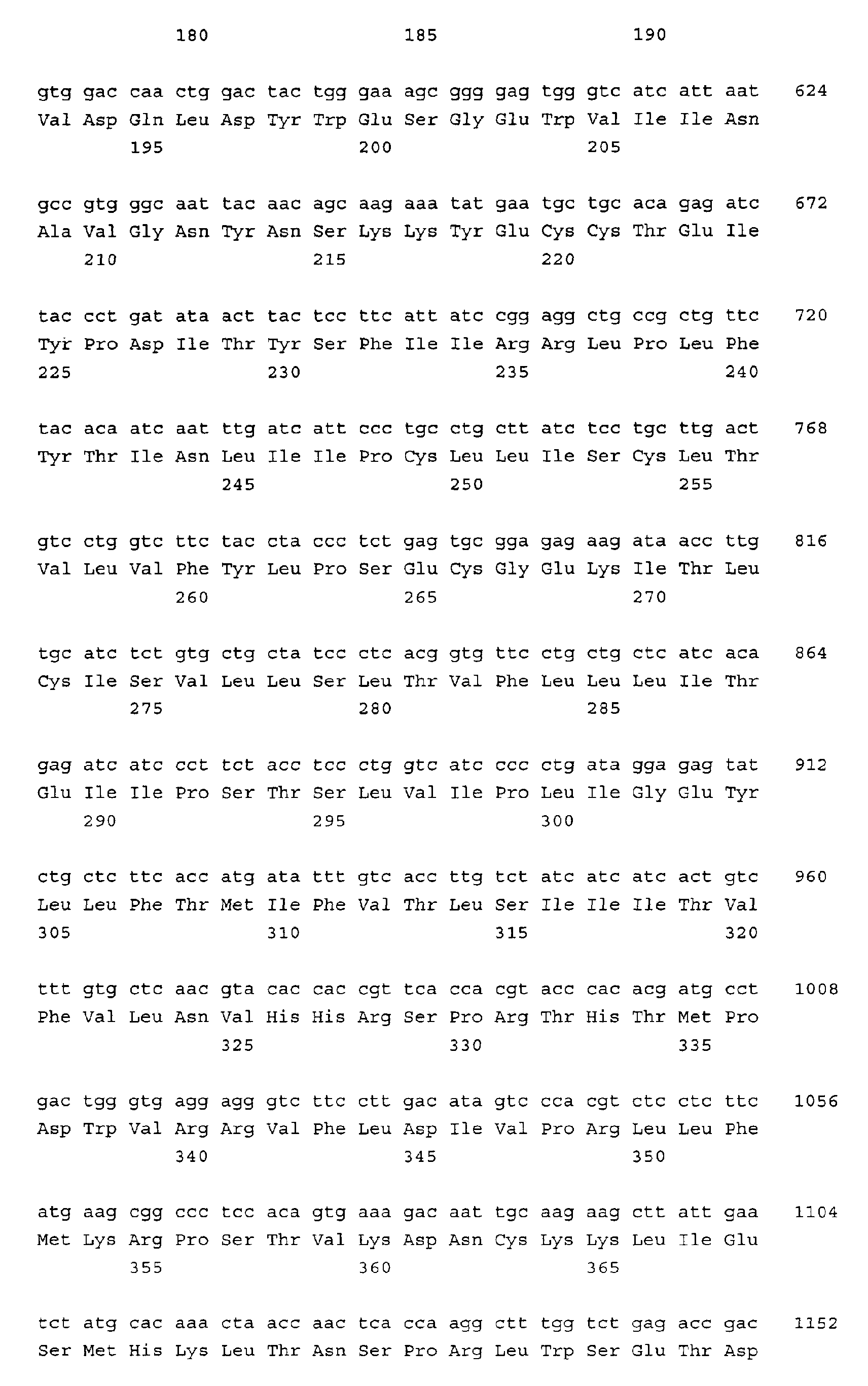

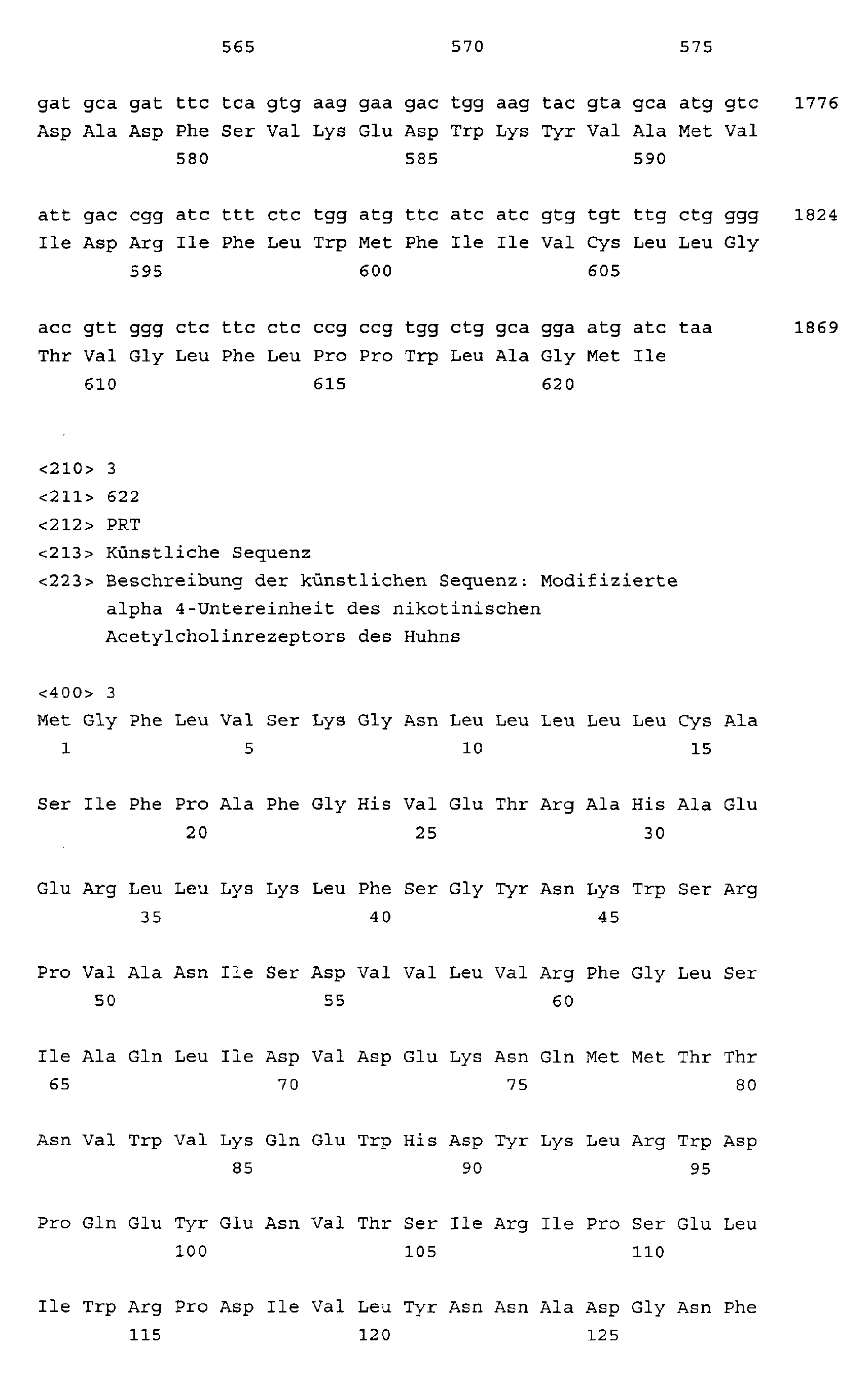



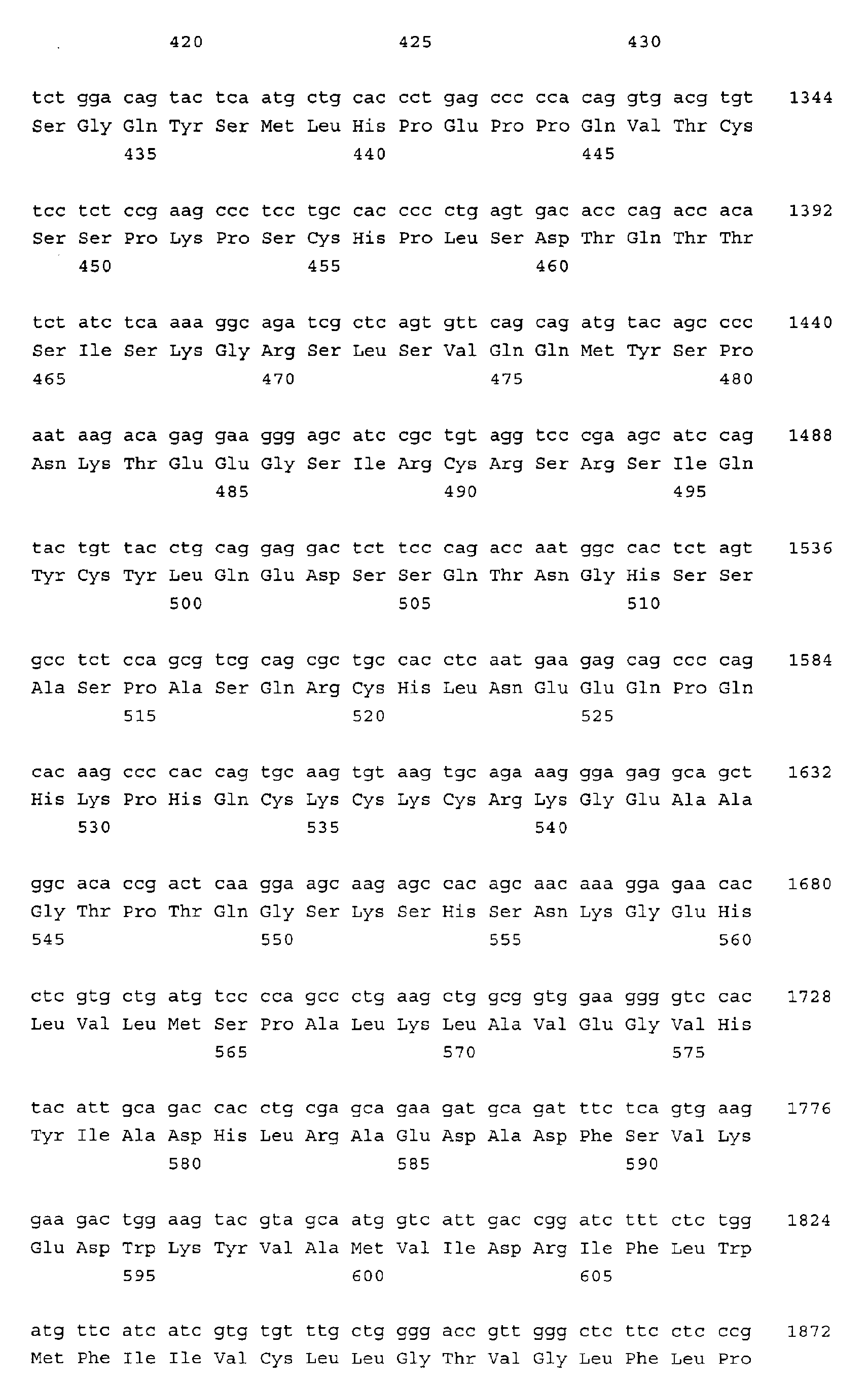
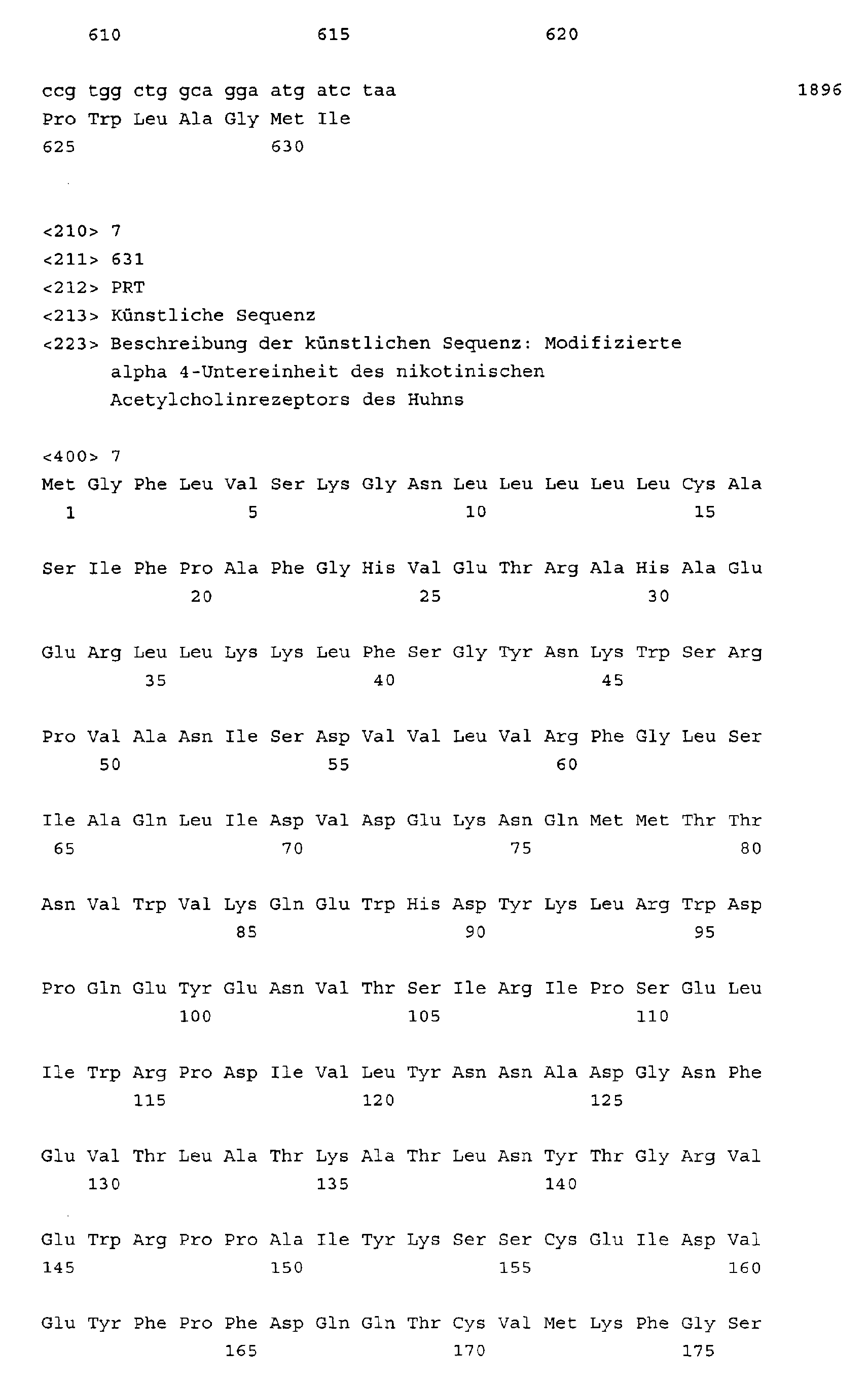

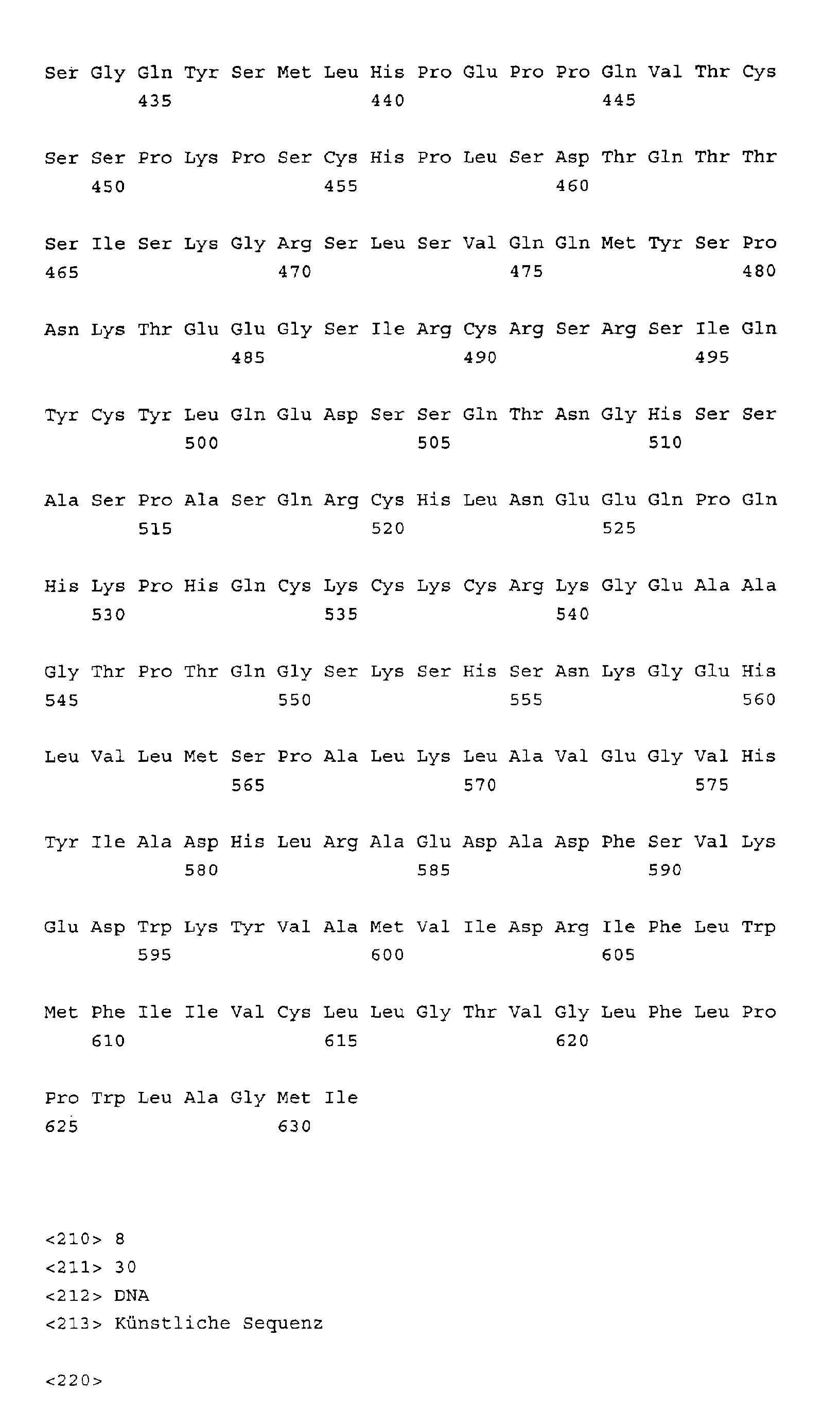
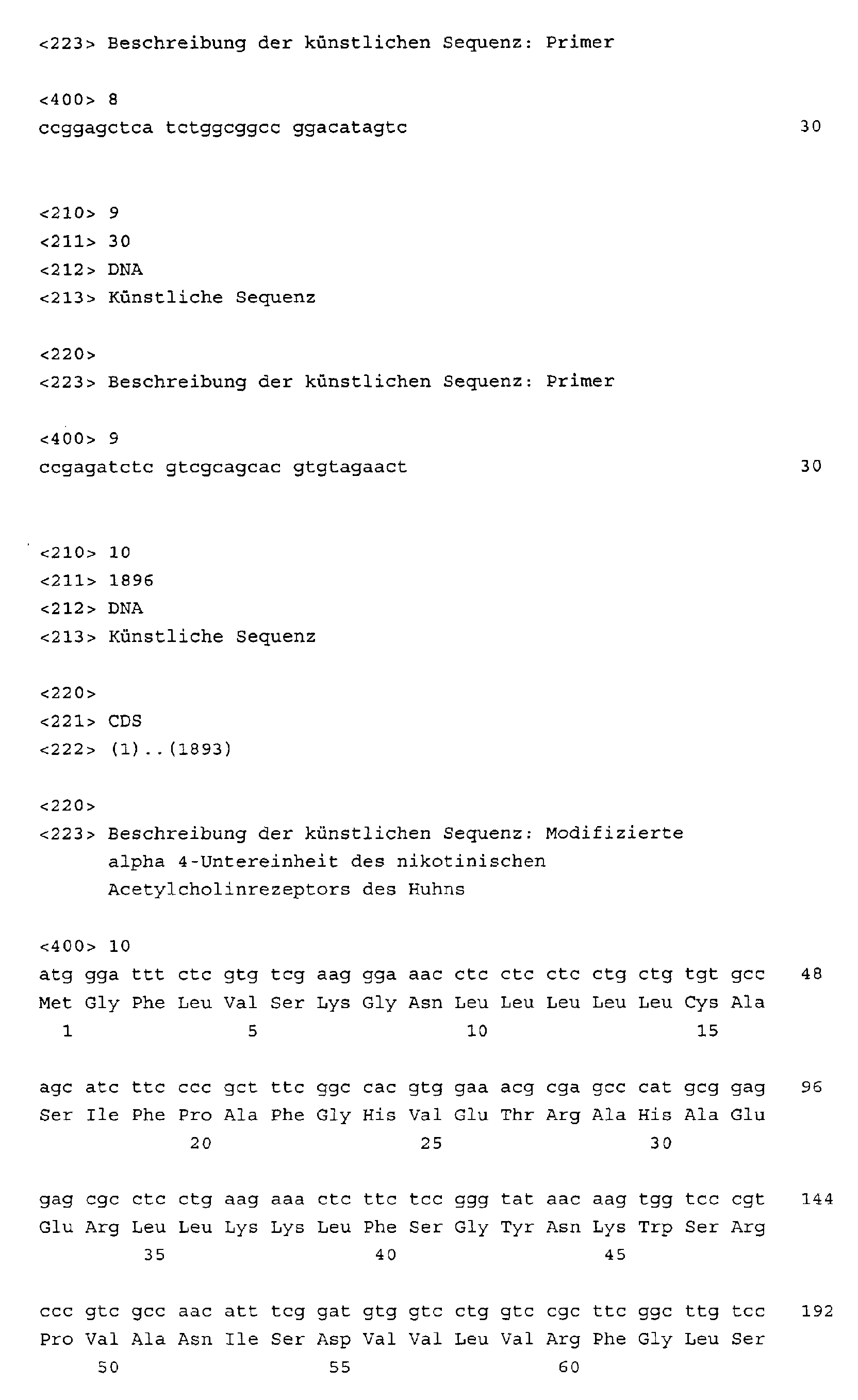
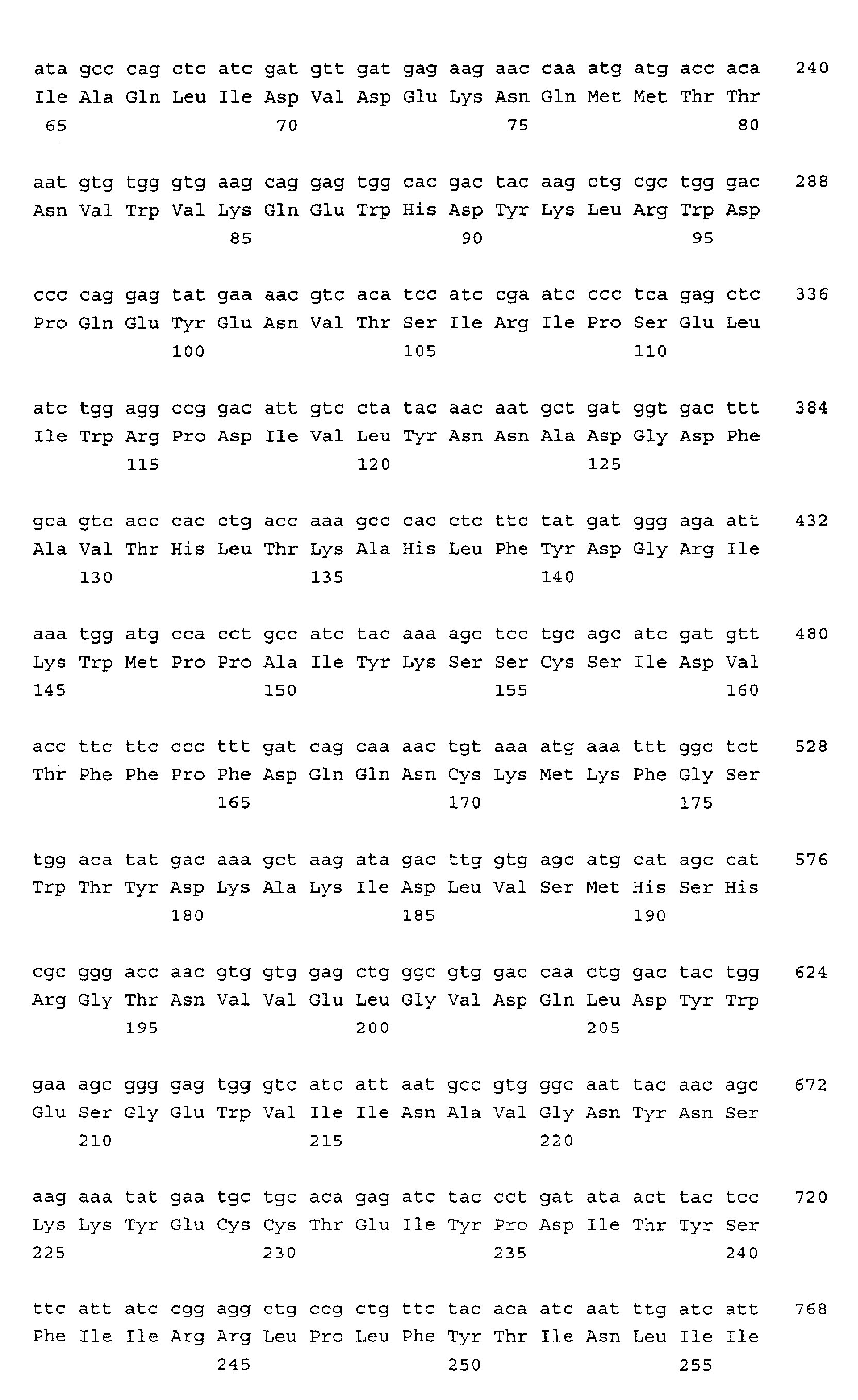
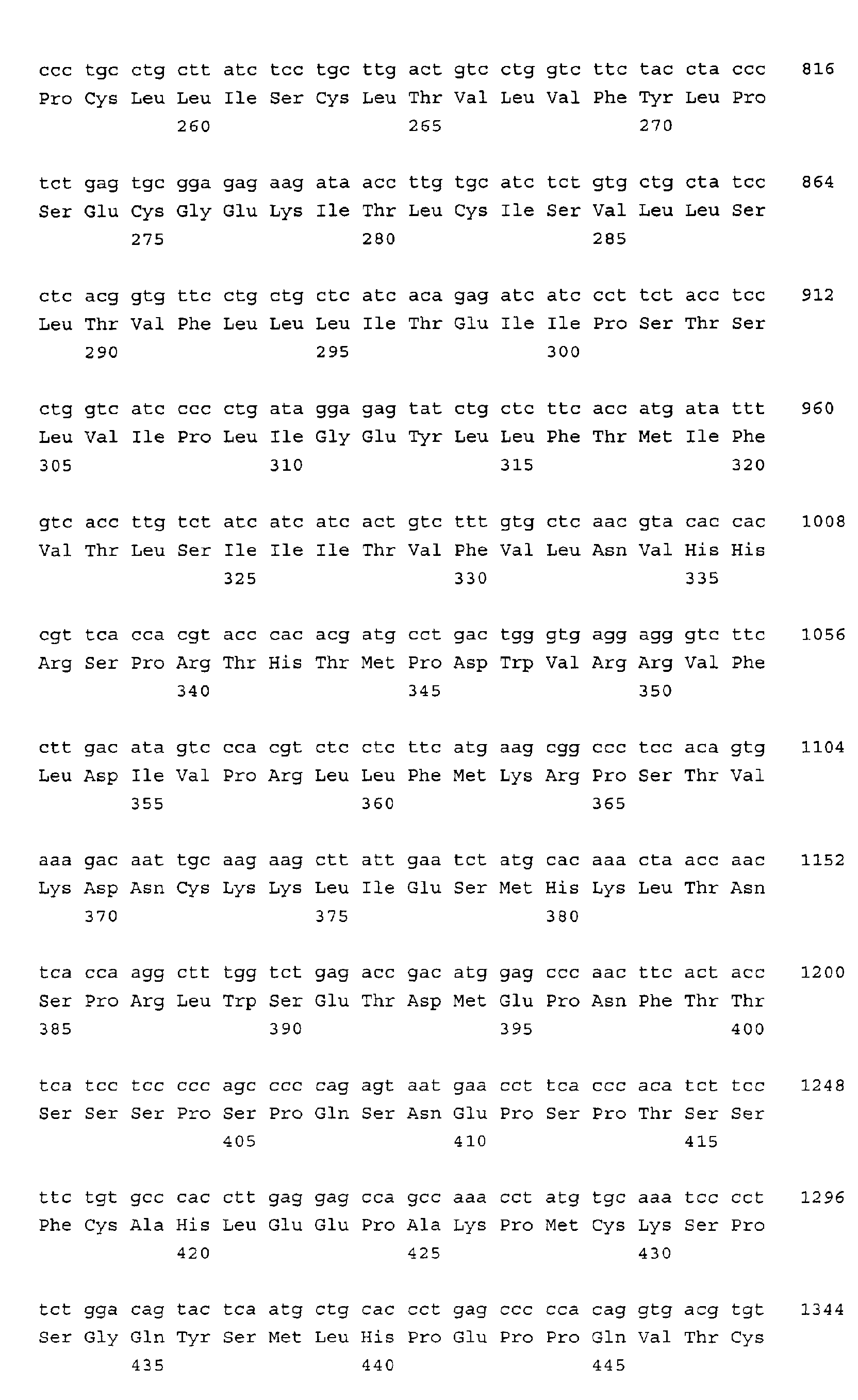

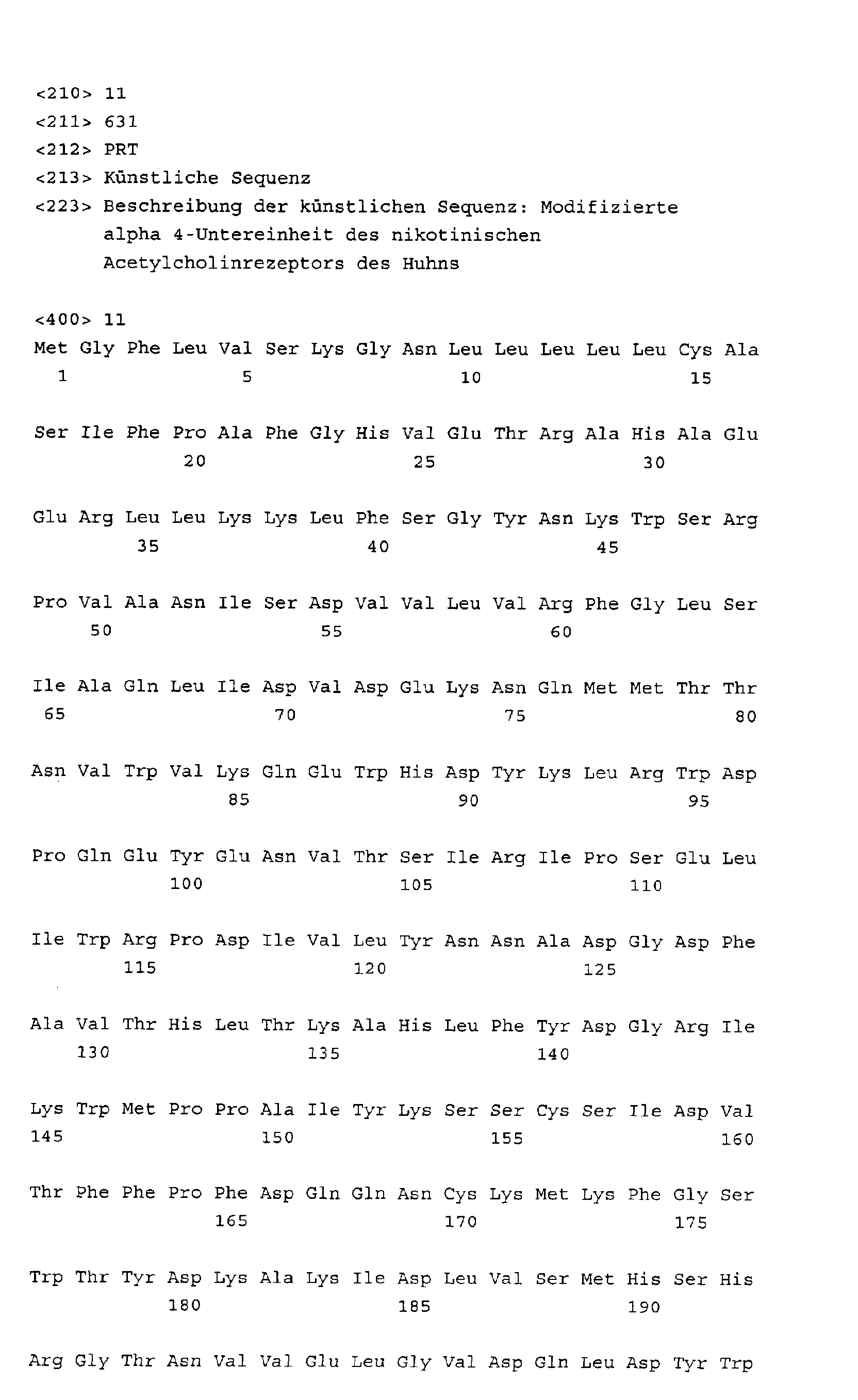

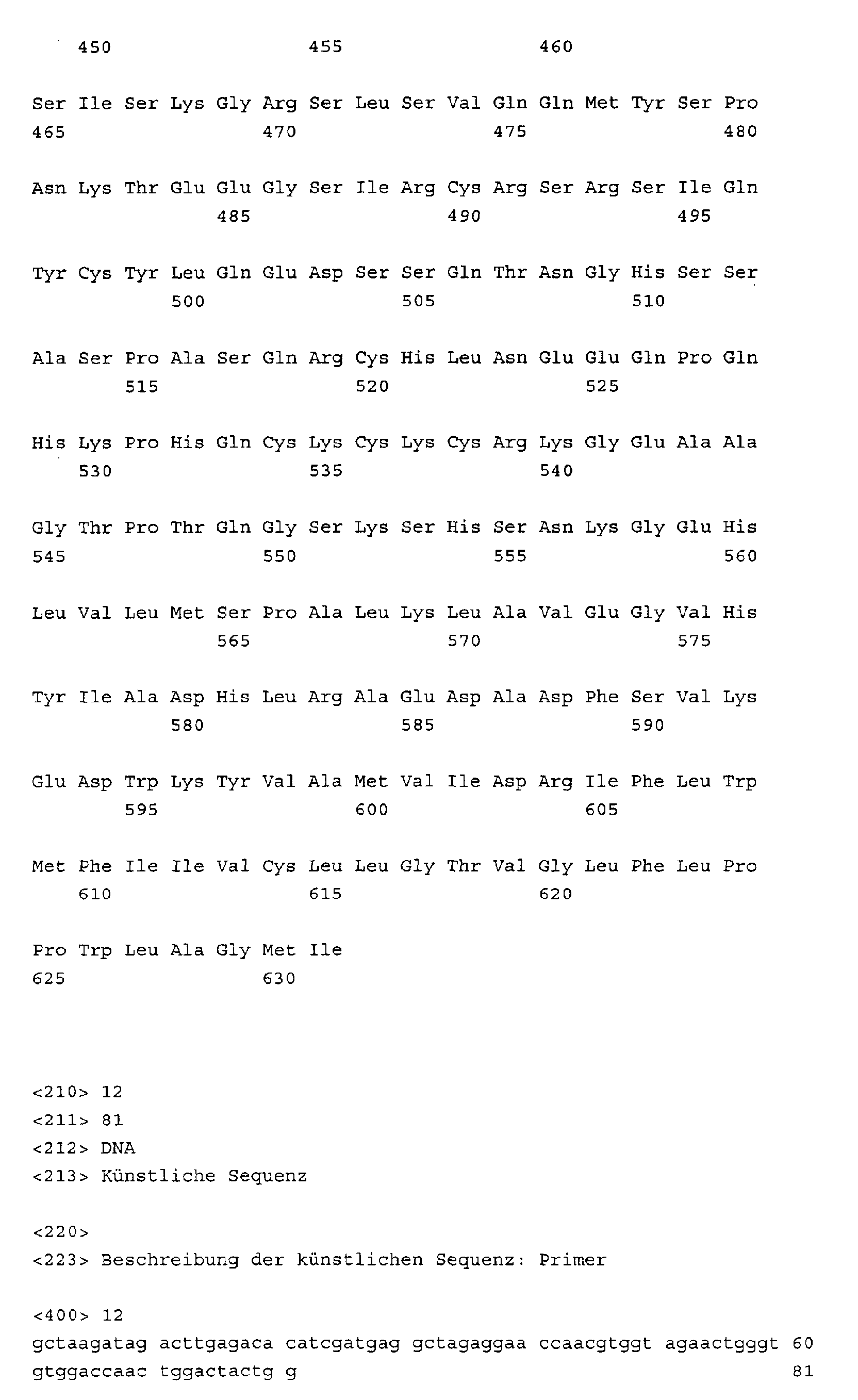


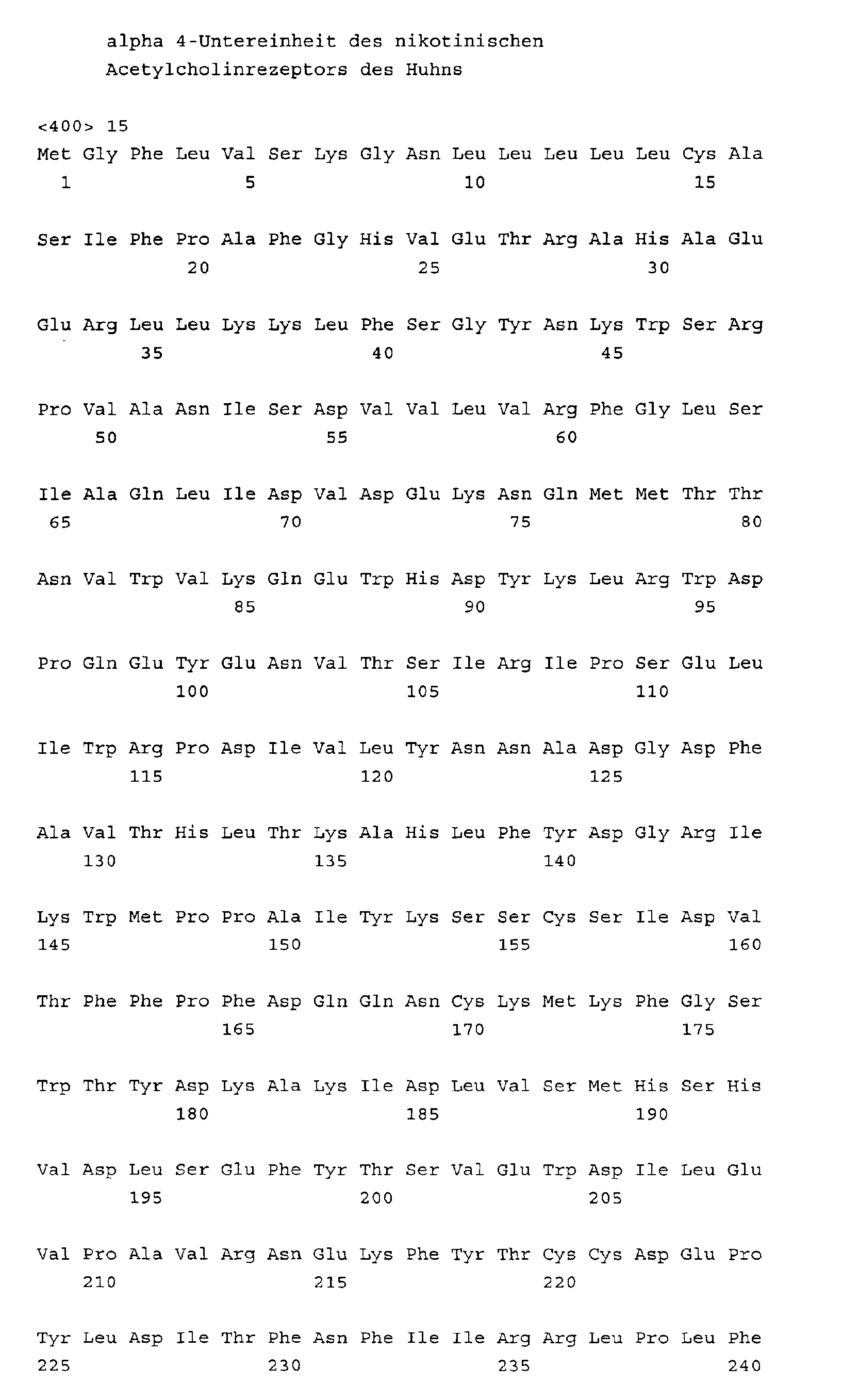


Claims (23)
- Modifizierte Acetylcholinrezeptor-Untereinheit, dadurch gekennzeichnet, dass zumindest eine Aminosäure im Bereich einer α-Untereinheit eines Vertebraten-Acetylcholinrezeptors, welcher zu der Aminosäuresequenz gemäß SEQ ID NO: 1 homolog ist, durch eine Aminosäure, die an der identischen Position in dem entsprechenden Bereich einer α-Untereinheit eines Insekten-Acetylcholinrezeptors vorkommt, ersetzt ist.
- Acetylcholinrezeptor-Untereinheit gemäß Anspruch 1, dadurch gekennzeichnet, dass zumindest vier Aminosäuren der α-Untereinheit eines Vertebraten-Acetylcholinrezeptors durch die entsprechende Anzahl von Aminosäuren einer α-Untereinheit eines Insekten-Acetylcholinrezeptors ersetzt sind.
- Acetylcholinrezeptor-Untereinheit gemäß Anspruch 1, dadurch gekennzeichnet, dass zumindest sieben Aminosäuren der α -Untereinheit eines Vertebraten-Acetylcholinrezeptors durch die entsprechende Anzahl von Aminosäuren einer α-Untereinheit eines Insekten-Acetylcholinrezeptors ersetzt sind.
- Acetylcholinrezeptor-Untereinheit gemäß Anspruch 1, dadurch gekennzeichnet, dass der gesamte besagte Bereich der α -Untereinheit eines Vertebraten-Acetylcholinrezeptors durch den entsprechenden Bereich einer α-Untereinheit eines Insekten-Acetylcholinrezeptors ersetzt ist.
- Acetylcholinrezeptor-Untereinheit gemäß einem der Ansprüche 1 bis 4, dadurch gekennzeichnet, dass es sich bei der α-Untereinheit eines Vertebraten-Acetylcholinrezeptors um neuronale Untereinheiten von Maus, Ratte, Huhn, Zebrafisch, Rhesusaffe, Rind oder Schwein handelt.
- Acetylcholinrezeptor-Untereinheit gemäß einem der Ansprüche 1 bis 5, dadurch gekennzeichnet, dass es sich bei der α-Untereinheit eines Insekten-Acetylcholinrezeptors um die α2-Untereinheit oder die α3-Untereinheit von Myzus persicae, oder um die α1-Untereinheit von Heliothis virescens oder Manduca sexta, oder um die α1-, α2- oder α3-Untereinheit von Drosophila melanogaster handelt.
- Acetylcholinrezeptor-Untereinheit gemäß Anspruch 1, dadurch gekennzeichnet, dass sie die Aminosäuresequenz gemäß SEQ ID NO: 3 umfasst.
- Acetylcholinrezeptor umfassend eine Acetylcholinrezeptor-Untereinheit gemäß einem der Ansprüche 1 bis 7.
- Acetylcholinrezeptor gemäß Anspruch 8, dadurch gekennzeichnet, dass er zusätzlich eine β-Untereinheit von Maus, Ratte, Huhn, Zebrafisch, Rhesusaffe, Rind oder Schwein umfasst.
- Nukleinsäure umfassend eine Nukleotidsequenz, die für eine Acetylcholinrezeptor-Untereinheit gemäß einem der Ansprüche 1 bis 7 codiert.
- Nukleinsäure gemäß Anspruch 10, dadurch gekennzeichnet, dass es sich um einzelsträngige oder doppelsträngige DNA oder RNA handelt.
- Nukleinsäure gemäß Anspruch 11, dadurch gekennzeichnet, dass es sich um Fragmente genomischer DNA oder cDNA handelt.
- Nukleinsäure gemäß Anspruch 10, dadurch gekennzeichnet, dass die Nukleotidsequenz der Sequenz gemäß SEQ ID NO: 2 entspricht.
- DNA-Konstrukt umfassend eine Nukleinsäure gemäß einem der Ansprüche 10 bis 13 und einen heterologen Promotor.
- Vektor umfassend eine Nukleinsäure gemäß einem der Ansprüche 10 bis 13 oder ein DNA-Konstrukt gemäß Anspruch 14.
- Vektor gemäß nach Anspruch 15, dadurch gekennzeichnet, dass die Nukleinsäure funktionell mit regulatorischen Sequenzen verknüpft ist, die die Expression der Nukleinsäure in pro- oder eukaryotischen Zellen gewährleisten.
- Wirtszelle enthaltend eine Nukleinsäure gemäß einem der Ansprüche 10 bis 13, ein DNA-Konstrukt gemäß Anspruch 14 oder einen Vektor gemäß Anspruch 15 oder 16.
- Wirtszelle gemäß Anspruch 17, dadurch gekennzeichnet, dass es sich um eine prokaryotische Zelle, insbesondere um E. coli, handelt.
- Wirtszelle gemäß Anspruch 17, dadurch gekennzeichnet, dass es sich um eine eukaryotische Zelle, insbesondere um eine Säuger- oder Insektenzelle, handelt.
- Verfahren zum Herstellen einer Acetylcholinrezeptor-Untereinheit gemäß einem der Ansprüche 1 bis 7, umfassenda) das Kultivieren einer Wirtszelle gemäß einem der Ansprüche 17 bis 19 unter Bedingungen, die die Expression der Nukleinsäure gemäß einem der Ansprüche 10 bis 13 gewährleisten, oderb) das Exprimieren einer Nukleinsäure gemäß einem der Ansprüche 10 bis 13 in einem in vitro-System, undc) die Gewinnung des Polypeptids aus der Zelle, dem Kulturmedium oder dem in vitro-System.
- Verfahren zum Herstellen einer Nukleinsäure gemäß einem der Ansprüche 10 bis 13, umfassend die folgenden Schritte:(a) Vollständige chemische Synthese auf an sich bekannte Weise, oder(b) chemische Synthese von Oligonukleotiden und Amplifizierung der besagten Nukleinsäure mittels PCR.
- Verfahren zum Auffinden von Wirkstoffen für den Pflanzenschutz oder von pharmazeutischen Wirkstoffen für die Behandlung von Mensch oder Tier umfassend die folgenden Schritte:(a) Bereitstellen einer Wirtszelle gemäß einem der Ansprüche 17 bis 19,(b) Kultivieren der Wirtszelle in der Gegenwart einer oder mehrerer chemischen Verbindungen, und(c) Detektieren veränderter Leitungseigenschaften der Acetylcholinrezeptoren.
- Verwendung einer Acetylcholinrezeptor-Untereinheit gemäß einem der Ansprüche 1 bis 7, eines Acetylcholinrezeptors gemäß Anspruch 8 oder 9, einer Nukleinsäure gemäß einem der Ansprüche 10 bis 13, eines DNA-Konstrukts gemäß Anspruch 14, eines Vektors gemäß Anspruch 15 oder 16, oder einer Wirtszelle gemäß einem der Ansprüche 17 bis 19 zum Auffinden neuer Wirkstoffe für den Pflanzenschutz oder von pharmazeutischen Wirkstoffen für die Behandlung von Mensch oder Tier.
Applications Claiming Priority (2)
| Application Number | Priority Date | Filing Date | Title |
|---|---|---|---|
| DE10042177 | 2000-08-28 | ||
| DE10042177A DE10042177A1 (de) | 2000-08-28 | 2000-08-28 | Acetylcholinrezeptor-Untereinheiten |
Publications (1)
| Publication Number | Publication Date |
|---|---|
| EP1184390A2 true EP1184390A2 (de) | 2002-03-06 |
Family
ID=7654026
Family Applications (2)
| Application Number | Title | Priority Date | Filing Date |
|---|---|---|---|
| EP01118863A Withdrawn EP1184390A2 (de) | 2000-08-28 | 2001-08-16 | Acetylcholinrezeptor-Untereinheiten |
| EP01119704A Withdrawn EP1184391A3 (de) | 2000-08-28 | 2001-08-24 | Acetylcholinrezeptor-Untereinheiten |
Family Applications After (1)
| Application Number | Title | Priority Date | Filing Date |
|---|---|---|---|
| EP01119704A Withdrawn EP1184391A3 (de) | 2000-08-28 | 2001-08-24 | Acetylcholinrezeptor-Untereinheiten |
Country Status (4)
| Country | Link |
|---|---|
| US (1) | US7198942B2 (de) |
| EP (2) | EP1184390A2 (de) |
| JP (1) | JP2002330782A (de) |
| DE (1) | DE10042177A1 (de) |
Cited By (3)
| Publication number | Priority date | Publication date | Assignee | Title |
|---|---|---|---|---|
| WO2006091672A3 (en) * | 2005-02-23 | 2007-05-31 | Dow Agrosciences Llc | Novel assays utilizing nicotinic acetylcholine receptor subunits |
| US7700749B2 (en) | 2001-08-31 | 2010-04-20 | Agensys, Inc. | Nucleic acid and corresponding protein entitled 205P1B5 useful in treatment and detection of cancer |
| US9005981B2 (en) | 2008-12-30 | 2015-04-14 | Dow Agrosciences Llc | Assays utilizing nicotinic acetylcholine receptor subunits |
Families Citing this family (3)
| Publication number | Priority date | Publication date | Assignee | Title |
|---|---|---|---|---|
| US7289179B2 (en) * | 2002-11-08 | 2007-10-30 | Samsung Electronics Co., Ltd. | Liquid crystal display |
| US20050170360A1 (en) * | 2004-01-30 | 2005-08-04 | Papke Roger L. | Variant neuronal nicotinic alpha-7 receptor and methods of use |
| CA2648154C (en) * | 2006-03-31 | 2015-10-20 | Karima Ferrani-Kile | Methods and compositions for obtaining and using biologically active multi-protein complexes |
Family Cites Families (4)
| Publication number | Priority date | Publication date | Assignee | Title |
|---|---|---|---|---|
| US5683912A (en) * | 1994-07-21 | 1997-11-04 | The Salk Institute For Biological Studies | Cloning and expression of a novel acetylcholine-gated ion channel receptor subunit |
| CA1341554C (en) * | 1988-03-18 | 2007-10-09 | The Salk Institute For Biological Studies | Neuronal nicotinic acetylcholine receptor compositions and assay |
| US5599709A (en) * | 1989-09-28 | 1997-02-04 | The Salk Institute For Biological Studies | Recombinant DNA encoding neuronal α-bungarotoxin-binding proteins |
| DE19819829A1 (de) * | 1998-05-04 | 1999-11-11 | Bayer Ag | Nukleinsäuren, die für Acetylcholinrezeptor-Untereinheiten von Insekten kodieren |
-
2000
- 2000-08-28 DE DE10042177A patent/DE10042177A1/de not_active Withdrawn
-
2001
- 2001-08-16 EP EP01118863A patent/EP1184390A2/de not_active Withdrawn
- 2001-08-21 JP JP2001250195A patent/JP2002330782A/ja not_active Withdrawn
- 2001-08-24 EP EP01119704A patent/EP1184391A3/de not_active Withdrawn
- 2001-08-27 US US09/941,179 patent/US7198942B2/en not_active Expired - Fee Related
Cited By (3)
| Publication number | Priority date | Publication date | Assignee | Title |
|---|---|---|---|---|
| US7700749B2 (en) | 2001-08-31 | 2010-04-20 | Agensys, Inc. | Nucleic acid and corresponding protein entitled 205P1B5 useful in treatment and detection of cancer |
| WO2006091672A3 (en) * | 2005-02-23 | 2007-05-31 | Dow Agrosciences Llc | Novel assays utilizing nicotinic acetylcholine receptor subunits |
| US9005981B2 (en) | 2008-12-30 | 2015-04-14 | Dow Agrosciences Llc | Assays utilizing nicotinic acetylcholine receptor subunits |
Also Published As
| Publication number | Publication date |
|---|---|
| US20020146765A1 (en) | 2002-10-10 |
| JP2002330782A (ja) | 2002-11-19 |
| DE10042177A1 (de) | 2002-03-14 |
| EP1184391A3 (de) | 2002-07-10 |
| US7198942B2 (en) | 2007-04-03 |
| EP1184391A2 (de) | 2002-03-06 |
Similar Documents
| Publication | Publication Date | Title |
|---|---|---|
| DE19955408A1 (de) | GABA-B-Rezeptoren | |
| DE69434166T2 (de) | Menschliche metabotropische glutamatrezeptor untertype hmglur7 und verwandte dns-verbindungen | |
| DE69819345T2 (de) | Für den capsaicin rezeptor kodierende nukleinsäuresequenzen und dem capsaicin rezeptor ähnliche polypeptide und ihre verwendung | |
| Sakai et al. | Cloning and functional expression of a novel degenerin‐like Na+ channel gene in mammals | |
| Fleming et al. | Caenorhabditis elegans levamisole resistance genes lev-1, unc-29, and unc-38 encode functional nicotinic acetylcholine receptor subunits | |
| Sattelle et al. | Edit, cut and paste in the nicotinic acetylcholine receptor gene family of Drosophila melanogaster | |
| DE69434067T2 (de) | Menschliche neuronale nikotin-acetylcholin-rezeptor-verbindungen und methoden ihres einsatzes | |
| DE69431432T2 (de) | Untereinheiten von menschlichen n-methyl-d-aspartat rezeptoren, diese kodierende nukleinsäure und dessen verwendung | |
| DE69930378T2 (de) | Therapeutischer wirkstoff gegen ngf | |
| DE69334187T2 (de) | Stabil transfizierte Zelllinien welche Humane GABA-A Rezeptoren mit der Untereinheitskombination Alpha-2, Beta-3 und Gamma-2 exprimieren | |
| DE69233469T2 (de) | Menschliche Calcium-Kanale und Verwendungen davon | |
| DE69635517T2 (de) | Menschliche neuronale acetylcholin-rezeptor verbindungen und methoden zu deren anwendung | |
| DE69838784T2 (de) | Säureempfindlicher neuronaler säugetierkationenkanal, dessen klonierung und anwendung | |
| EP1184391A2 (de) | Acetylcholinrezeptor-Untereinheiten | |
| Fleming et al. | Acetylcholine receptor molecules of the nematode Caenorhabditis elegans | |
| DE10033353A1 (de) | Breit einsetzbares Verfahren zur Identifizierung von Modulatoren von G-Protein gekoppelten Rezeptoren | |
| EP0962528A2 (de) | Nukleisäuren, die für Acetylcholinrezeptor-Untereinheiten von Insekten kodieren | |
| Fleming et al. | Molecular cloning and in vitro expression of C. elegans and parasitic nematode ionotropic receptors | |
| EP1106689A2 (de) | Nukleinsäuren, die für Acetylcholinrezeptor-beta-Untereinheiten für Insekten kodieren | |
| Grenningloh et al. | Molecular cloning of the antagonist-binding subunit of the glycine receptor | |
| DE60113660T2 (de) | G-protein gekoppelter rezeptor | |
| EP1971683B1 (de) | Adenylat-zyklase, für die adenylat-zyklase kodierende gensequenz, vektoren und zellen sowie deren verwendung | |
| WO2001070797A1 (de) | Ligandengesteuerte anionenkanäle von insekten | |
| DE10013618A1 (de) | Rezeptoren für Peptide aus Insekten | |
| DE10036469A1 (de) | Ultraspiracle (USP)-Protein von Heliothis virescens |
Legal Events
| Date | Code | Title | Description |
|---|---|---|---|
| PUAI | Public reference made under article 153(3) epc to a published international application that has entered the european phase |
Free format text: ORIGINAL CODE: 0009012 |
|
| AK | Designated contracting states |
Kind code of ref document: A2 Designated state(s): AT BE CH CY DE DK ES FI FR GB GR IE IT LI LU MC NL PT SE TR |
|
| AX | Request for extension of the european patent |
Free format text: AL;LT;LV;MK;RO;SI |
|
| STAA | Information on the status of an ep patent application or granted ep patent |
Free format text: STATUS: THE APPLICATION HAS BEEN WITHDRAWN |
|
| 18W | Application withdrawn |
Withdrawal date: 20020315 |