EP1170670A2 - Paralleles Verarbeitungssystem in dem die Anwendungssteigerung der CPU verbessert ist und parallele Verarbeitungsmethode dafür - Google Patents
Paralleles Verarbeitungssystem in dem die Anwendungssteigerung der CPU verbessert ist und parallele Verarbeitungsmethode dafür Download PDFInfo
- Publication number
- EP1170670A2 EP1170670A2 EP01115680A EP01115680A EP1170670A2 EP 1170670 A2 EP1170670 A2 EP 1170670A2 EP 01115680 A EP01115680 A EP 01115680A EP 01115680 A EP01115680 A EP 01115680A EP 1170670 A2 EP1170670 A2 EP 1170670A2
- Authority
- EP
- European Patent Office
- Prior art keywords
- request
- asynchronous communication
- communication request
- control unit
- acceptable
- Prior art date
- Legal status (The legal status is an assumption and is not a legal conclusion. Google has not performed a legal analysis and makes no representation as to the accuracy of the status listed.)
- Withdrawn
Links
Images

Classifications
-
- G—PHYSICS
- G06—COMPUTING OR CALCULATING; COUNTING
- G06F—ELECTRIC DIGITAL DATA PROCESSING
- G06F15/00—Digital computers in general; Data processing equipment in general
- G06F15/16—Combinations of two or more digital computers each having at least an arithmetic unit, a program unit and a register, e.g. for a simultaneous processing of several programs
- G06F15/163—Interprocessor communication
- G06F15/173—Interprocessor communication using an interconnection network, e.g. matrix, shuffle, pyramid, star, snowflake
- G06F15/17356—Indirect interconnection networks
- G06F15/17368—Indirect interconnection networks non hierarchical topologies
- G06F15/17381—Two dimensional, e.g. mesh, torus
Definitions
- the present invention relates to a parallel processing system and a parallel processing method.
- a conventional parallel computer system called a perfectly distributed memory parallel computer system is composed of nodes connected by a dedicated network. Each of the nodes is composed of processors or CPUs, a memory, and a communication control unit (CCU). Communication between nodes is carried out via the network.
- a distributed sharing memory type parallel computer system cluster type parallel computer system
- the overhead for the parallel processing is less such as the easiness of the programming and internode data transfer.
- the node is composed of SMP (Symmetric Multiple Processor) and a communication control unit, and a memory is shared by a plurality of processors in the range with appropriate implementing cost.
- the internode communication processing time is large, compared with a calculation processing time in the node. Therefore, the internode communication processing time transfer and the calculation processing are overlapped in the CPU, and an asynchronous communication instruction is completed when a CPU issues the asynchronous communication instruction. Thus, the communication processing time is concealed and the subsequent process and interrupt process can be executed without waiting for the completion of the asynchronous communication instruction.
- a coprocessor is provided separately from a CPU, and communication processing is requested from a user program to an operating system (OS) by a system call from the viewpoint of hardware resource control, as in input/output processing.
- OS operating system
- the communication processing is executed asynchronously from the CPU.
- this system call requires large software overhead so that the performance improvement of the parallel processing system is hindered.
- an asynchronous transfer instruction can be issued directly from the user program.
- the OS controls the asynchronous communication instruction, it is possible to ask the OS to control the asynchronous communication instructions such that the hardware resources are not fully consumed.
- a flow control of the asynchronous transfer instructions is necessary to protect the system from the system performance degradation due to the hardware resource control overhead.
- a hand-shaking system in which when the CCU receives an asynchronous communication request from the CPU, the CCU notifies the reception of the request to the CPU.
- the CPU interprets the hand-shaking reply as the completion of the asynchronous communication instruction and starts the issuance of a subsequent instruction and an interruption process.
- a communication control apparatus is disclosed in Japanese Laid Open Patent application (JP-A-Heisei 2-64838).
- a plurality of communication control apparatuses are connected to a host apparatus.
- the communication control apparatus is composed of a reception buffer receiving and temporarily storing data in accordance with an instruction from the host apparatus.
- a first section sets a reception buffer full notice flag when reception data are stored in the reception buffer more than a first predetermined quantity, and resets the reception buffer full notice flag when the reception data are stored in the reception buffer less than a first predetermined quantity which is less than the first predetermined quantity.
- a flag setting section checks the reception buffer full notice flag when transmitting a transmission frame in response to a transmission instruction from the host apparatus, sets a predetermined bit to "1" of a control section of the transmission frame when the flag is set, and to "0" when the flag is reset, and transmits the transmission frame.
- a second section receives the transmission frame, sets the reception buffer full notice flag when the predetermined bit of the control section is set to "1", and resets the reception buffer full notice flag when the predetermined bit of the control section is set to "0".
- a report section checks the reception buffer full notice flag when a transmission instruction is received from the host apparatus, do not receive transmission data from the host apparatus when the flag is set, and reports that the data are stored in the reception buffer more than the first predetermined quantity.
- a communication control system is disclosed in Japanese Laid Open Patent Application (JP-A-Heisei 4-18500).
- the communication control system is composed of a plurality of communication units communicating with each other.
- the control unit is composed of a communication control section connected to a transmission path and a main control section communicating with the other communication units via the communication control unit.
- a first reception buffer is provided to store reception data to the main control section, and a second reception buffer is provided to store reception data to the communication control section.
- a common memory is provided for the main control section and the communication control section.
- the main control section sets a reception stop flag to the common memory when the first reception buffer is full.
- the communication control section stores the reception data in the second reception buffer depending on the reception stop flag.
- the communication control section transmits a transmission stop signal when the second reception buffer is full and sets a transmission stop signal transmission flag.
- the transmission control section sets a first transmission stop flag to the common memory when the transmission buffer is full.
- the main control section stops sending of the transmission data to the communication control section depending on the first transmission stop flag.
- the main control section resets the reception stop flag when the first reception buffer is not full, and sends an interrupt signal to the communication control section.
- the communication control section transfers the data from the second reception buffer to the first reception buffer in response to the interrupt signal.
- the communication control section transmits a transmission permission signal when the reception stop flag is reset and the transmission stop signal transmission flag is set.
- the communication control section is sets the second transmission stop flag and stops the transmission of the transmission data to the other unit.
- the communication control section resets the second transmission stop flag and restarts the transmission.
- JP-A-Heisei 5-327705 data is transmitted from a host computer to a channel via at least two data buffers.
- a queue buffer an area in which the host computer registers a communication processing request
- the channel control module to control the nearest data buffer to a channel.
- a section for detecting an empty state of the queue buffer a section for stopping registration of a broadcasting data transmission instruction in the queue buffer when the queue buffer is full, a section for notifying a terminal to an application program, the registration of the broadcasting data transmission instruction for the terminal being stopped.
- a communication buffer control apparatus is disclosed in Japanese Laid Open Patent application (JP-A-Heisei 7-93170).
- the communication buffer control apparatus is composed of a buffer remaining quantity table which stores an available remaining buffer quantity, and a task use buffer quantity table which stores a task use buffer quantity which is allocated to every task based on the remaining buffer quantity.
- the remaining buffer quantity becomes smaller than a predetermined minimum value or a buffer quantity used by a task becomes larger than another upper limit value
- the use of the above remaining buffer is stopped and it is notified to a requesting task.
- the remaining buffer quantity becomes larger than a predetermined minimum value and the buffer quantity used by each task becomes smaller than the upper limit value the use of the remaining buffer is restarted.
- fair communication service is given to a plurality of communications links which require processing at the same time.
- the reception is restarted after a temporal reception stop due to fullness of the buffer.
- the detection of the buffer control fault due to a fault of a communication control system gets easy.
- An object of the present invention is to provide a parallel processing system and a parallel processing method in which the use efficiency of a CPU can be improved.
- a parallel processing system includes a network and a plurality of nodes which communicates asynchronously between the plurality of nodes through the network.
- Each of the plurality of nodes may include a plurality of CPUs and a communication control unit.
- Each of the plurality of CPUs as an issuing CPU generates and transmits an asynchronous communication request, retransmits the asynchronous communication request in response to a non-acceptance reply, and executes a subsequent process in response to an acceptance replay.
- the communication control unit determines whether the asynchronous communication request is acceptable, returns the acceptance reply to the issuing CPU when the asynchronous communication request is acceptable, and the non-acceptance reply to the issuing CPU when the asynchronous communication request is not acceptable, and executes the asynchronous communication request.
- the communication control unit has a request buffer, and the communication control unit determines that the asynchronous communication request is acceptable, when the request buffer is not full, and determines that the asynchronous communication request is not acceptable, when the request buffer is full.
- the communication control unit may store the asynchronous communication request in the request buffer when the asynchronous communication request is acceptable. Also, the communication control unit may discard the asynchronous communication request when the asynchronous communication request is not acceptable.
- the issuing CPU enters a waiting mode after transmitting the asynchronous communication request to the communication control unit, and the issuing CPU is in an interrupt prohibition state in the waiting mode.
- the issuing CPU may include an instruction issuing control section which generates and transmits the asynchronous transfer request to the communication control unit, and a reply receiving register which receives the acceptance replay or the non-acceptance replay from the communication control unit.
- the instruction issuing control section of the issuing CPU sets the issuing CPU to a waiting mode in which reception of an interrupt is prohibited, after transmitting the asynchronous communication request to the communication control unit.
- the reply receiving register releases the waiting mode when the acceptance replay is received from the communication control unit.
- the communication control unit may include a request control section and a communication executing section.
- the request control section determines whether the asynchronous communication request is acceptable, and returns the acceptance reply to the issuing CPU when the asynchronous communication request is acceptable, and the non-acceptance reply to the issuing CPU when the asynchronous communication request is not acceptable.
- the communication executing section receives the asynchronous communication request and executes the asynchronous communication request.
- the request control section may include a request receiving section which receives the asynchronous transfer request from the issuing CPU; a determining section which determines whether the asynchronous transfer request is acceptable; and a request control section which has the request buffer, and stores the asynchronous transfer request in the request buffer when the asynchronous transfer request is determined to be acceptable by the determining section.
- a parallel processing method may include a plurality of node, each of which may include a plurality of CPUs and a communication control unit, the parallel processing method may be attained by (a) issuing an asynchronous communication request from one of the plurality of CPUs as an issuing CPU; by (b) setting the issuing CPU to a waiting state such that process change is prohibited, after the issuance; by (c) determining, in the communication control unit, whether the asynchronous communication request is acceptable; by (d) returning an acceptance reply from the communication control unit to the issuing CPU when the asynchronous communication request is acceptable; and by (e) releasing the issuing CPU from the waiting state in response to the acceptance reply.
- the parallel processing method may further include (f) executing a subsequent process in response to the acceptance replay.
- the parallel processing method may further includes (g) returning a non-acceptance reply from the communication control unit to the issuing CPU when the asynchronous communication request is not acceptable; and (h) reissuing the asynchronous communication request from the issuing CPU to the communication control unit in response to the non-acceptance reply.
- the parallel processing method may further include (i) executing the asynchronous communication request.
- the (c) determining step may be attained by determining that the asynchronous communication request is acceptable, when a request buffer in the communication control unit is not full; and by storing the asynchronous communication request in the request buffer when the request buffer is not full.
- the (c) determining step may be attained by determining that the asynchronous communication request is not acceptable, when a request buffer in the communication control unit is full; and by discarding the asynchronous communication request when a request buffer in the communication control unit is full.
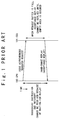
- Fig. 1 is a sequence diagram showing an operation of a conventional parallel processing system
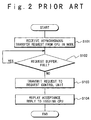
- Fig. 2 is an operation flow showing asynchronous communication in the conventional parallel processing system
- Fig. 3 is a circuit block diagram showing the structure of a parallel processing system according to an embodiment of the present invention.
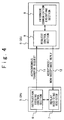
- Fig. 4 is a circuit block showing the structure of a CPU and a communication control unit in the parallel processing system according to the embodiment of the present invention
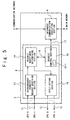
- Fig. 5 is a circuit block diagram showing the structure of the communication control unit in the parallel processing system according to the embodiment of the present invention.
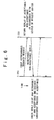
- Fig. 6 is a sequence diagram showing permission and prohibition of the asynchronous communication in the parallel processing system according to the embodiment of the present invention.
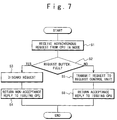
- Fig. 7 is an operation flow diagram showing an operation of the parallel processing system according to the embodiment of the present invention.
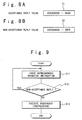
- Figs. 8A and 8B are an acceptance replay and a non-acceptance replay, respectively.
- Fig. 9 is an operation flow diagram showing the parallel processing system according to the embodiment of the present invention.
- Fig. 3 is a block diagram showing the structure of the parallel processing system according to the embodiment of the present invention.
- the parallel processing system is composed of a plurality of nodes 1 connected to each other via a communication network.
- the node 1 is composed of one or more CPUs 3, a main memory 4 shared by the CPUs 3 and a 5 communication control unit (CCU) 5 for controlling communication between the nodes.
- CPUs central processing unit
- main memory 4 shared by the CPUs 3
- CCU 5 communication control unit
- Fig. 4 shows a relation between an optional CPU 3 and the CCU 5 in the node 1.
- the CPU 3 is composed of an instruction issuing control section 6 which decodes a usual operation instruction and an internode communication instruction and controls the issuance of the instruction, and a reply receiving register 7 which stores replies received from the CCU 5.
- a reply receiving register 7 As the reply receiving register 7, a general purpose register can be used.
- the CCU 5 is composed of a request control section 8 and an internode communication executing section 9 which executes internode communication.
- the request control section 8 receives an asynchronous communication request 11 from each CPU in the node.
- the request control section 8 returns an acceptance reply or a non-acceptance reply 12 to the CPU 3 as the issuing source of the asynchronous communication request based on the state of the asynchronous communication request buffer 15-1 in the CCU 5 to indicate whether the request is accepted or non-accepted.
- Fig. 5 shows the request control section 8 of the CCU 5 in detail.
- the request control section 8 is composed of an asynchronous communication request receiving section 13 to receive asynchronous communication requests 11 from the plurality of CPUs 3-0 to 3-n, respectively, and a request acceptance determining section 14, a request control section 15, and a reply return section 16.
- the asynchronous communication request receiving section 13 has a function to receive the asynchronous communication request 11 from each CPU 3 in the node 1, and a function to transmit the asynchronous communication request 11 to the request acceptance determining section 14.
- the asynchronous communication request receiving section 13 selects one of them in order and transmits to the request determining section 14.
- the request acceptance determining section 14 determines whether or not it is possible to receive the asynchronous communication request 11 transmitted from the asynchronous communication request receiving section 13, based on request hold data of the request control section 15.
- the request acceptance determining section 14 transmits an acceptance signal to the reply return section 16 to notify the acceptance, when determining that the asynchronous communication request 11 is acceptable.
- the request acceptance determining section 14 transmits a non-acceptance signal to the reply return section 16 to notify the non-acceptance. Also, the request acceptance determining section 14 discards the asynchronous communication request 11.
- the request control section 15 receives the asynchronous communication request 11 determined to be acceptable by the request acceptance determining section 14 from the request acceptance determining section 14.
- the request control section 15 has a function to hold the request in the asynchronous communication request buffer 15-1 of the request control section 15 until the request control section 15 receives a request transmission request 17 from the internode communication executing section 9. Also, the request control section 15 has a function to notify that the request buffer 15-1 is full, to the request acceptance determining section 14 when the asynchronous communication request buffer 15-1 is full.
- the request control section 15 takes out one of the asynchronous communication requests from the request buffer 15-1 in response to the request transmission request from the internode communication executing section 9 and outputs to the internode communication executing section 9.
- the internode communication executing section 9 executes the taken out asynchronous communication request.
- the internode communication executing section 9 reads out data specified by the asynchronous communication request from the main memory 4 and transmits the read out data to another node.
- the reply return section 16 has a function to return the acceptance signal or the non-acceptance signal notified from the request acceptance determining section 14 to the issuing CPU 3 as an acceptance reply or a non-acceptance reply 12.
- the instruction issuing control section 6 of the CPU 3 enters a completion waiting state of the asynchronous communication instruction until a reply is returned from the CCU 5 to the reply receiving register 7. In this completion waiting state, it is necessary to restrain a process change on the CPU. Therefore, an interrupt prohibition state is set.
- the asynchronous communication request 11 sent out from the CPU is received by the asynchronous communication request receiving section 13 of the request control section 8 of the CCU 5, as shown in the step S1 of Fig. 7.
- the asynchronous communication request receiving section 13 receives the asynchronous communication request 11 from each CPU in the node, and sends out them in order with the issuing CPU number to the request acceptance determining section 14.
- the request acceptance determining section 14 sends the asynchronous communication requests sent from the asynchronous communication request receiving section 13 to the request control section 15.
- the request acceptance determining section 14 determines whether or not the asynchronous communication request buffer 15-1 in the request control section 15 is full, based on request holding data. Thus, the request acceptance determining section 14 determines whether or not it is possible to accept the asynchronous communication request (Step S2). When the asynchronous communication request buffer 15-1 is not full, it is determined to be acceptable.
- the request acceptance determining section 14 notifies the issuing CPU number and the acceptance signal to the reply return section 16.
- the asynchronous communication request buffer 15-1 is full, it is determined as non-acceptance and the issuing CPU number and the non-acceptance signal are notified to the reply return section 16 and the asynchronous communication request 11 is discarded (Ste
- the request control section 15 receives the asynchronous communication request 11 determined to be acceptable by the request acceptance determining section 14 from the request acceptance determining section 14 (Step S5). Then, the request control section 15 holds the request in the asynchronous communication request buffer 15-1 until the request control section 15 receives the request transmission request 17 from the internode communication executing section 9. The request control section 14 notifies to the request acceptance determining section 14 that the buffer 15-1 is full, when the asynchronous communication request buffer 15-1 becomes full.
- the reply return section 16 returns the reply 12 indicating the acceptance or non-acceptance notified from the request acceptance determining section 14 to the issuing CPU (Step S4 or step S6).
- the reply 12 is returned to the issuing CPU is received by the reply receiving register 7.
- the instruction issuing control section 6 interprets the replay as the asynchronous communication instruction completion as shown in Fig. 9 (Step S11). Thus, the completion waiting state is released.
- a software process to have issued an asynchronous communication instruction checks based on the returned value stored in the reply receiving register whether the replay is an acceptance reply or a non-acceptance reply (Step S12).
- Figs. 8A and 8B exemplifies the acceptance reply 21 and the non-acceptance reply 22.
- the software process executes a subsequent program process (Step S13).
- the asynchronous communication instruction 11 is reissued (Step S11).
- an asynchronous communication instruction sequence of the software process on the CPU is repeated. In this way, the problem of the hand-shaking system is solved that the flow control of the hand-shaking reply is not returned when the request buffer 15-1 in the request receiving end is full.
- the problem of the hand-shaking system is solved that the flow control of the hand-shaking reply is not returned when the request buffer 15-1 in the request receiving end is full, and the use efficiency of the CPU is improved.
Landscapes
- Engineering & Computer Science (AREA)
- Physics & Mathematics (AREA)
- Computer Hardware Design (AREA)
- Theoretical Computer Science (AREA)
- Mathematical Physics (AREA)
- Software Systems (AREA)
- General Engineering & Computer Science (AREA)
- General Physics & Mathematics (AREA)
- Multi Processors (AREA)
- Computer And Data Communications (AREA)
Applications Claiming Priority (2)
| Application Number | Priority Date | Filing Date | Title |
|---|---|---|---|
| JP2000203173 | 2000-07-05 | ||
| JP2000203173A JP2002024195A (ja) | 2000-07-05 | 2000-07-05 | 並列処理装置、及び、並列処理方法 |
Publications (2)
| Publication Number | Publication Date |
|---|---|
| EP1170670A2 true EP1170670A2 (de) | 2002-01-09 |
| EP1170670A3 EP1170670A3 (de) | 2005-11-09 |
Family
ID=18700610
Family Applications (1)
| Application Number | Title | Priority Date | Filing Date |
|---|---|---|---|
| EP01115680A Withdrawn EP1170670A3 (de) | 2000-07-05 | 2001-07-04 | Paralleles Verarbeitungssystem in dem die Anwendungssteigerung der CPU verbessert ist und parallele Verarbeitungsmethode dafür |
Country Status (3)
| Country | Link |
|---|---|
| US (1) | US6810457B2 (de) |
| EP (1) | EP1170670A3 (de) |
| JP (1) | JP2002024195A (de) |
Families Citing this family (11)
| Publication number | Priority date | Publication date | Assignee | Title |
|---|---|---|---|---|
| US8095589B2 (en) | 2002-03-07 | 2012-01-10 | Compete, Inc. | Clickstream analysis methods and systems |
| US10296919B2 (en) | 2002-03-07 | 2019-05-21 | Comscore, Inc. | System and method of a click event data collection platform |
| US20080189408A1 (en) | 2002-10-09 | 2008-08-07 | David Cancel | Presenting web site analytics |
| US7890451B2 (en) * | 2002-10-09 | 2011-02-15 | Compete, Inc. | Computer program product and method for refining an estimate of internet traffic |
| JP4607489B2 (ja) * | 2004-04-21 | 2011-01-05 | 株式会社エヌ・ティ・ティ・ドコモ | データ処理装置およびデータ処理方法 |
| US9105028B2 (en) | 2005-08-10 | 2015-08-11 | Compete, Inc. | Monitoring clickstream behavior of viewers of online advertisements and search results |
| US7809874B2 (en) * | 2006-06-21 | 2010-10-05 | International Business Machines Corporation | Method for resource sharing in a multiple pipeline environment |
| TWI457431B (zh) | 2008-01-30 | 2014-10-21 | Chemetall Gmbh | 將金屬表面施以一種潤滑劑組成物的方法 |
| US8019922B2 (en) * | 2008-10-21 | 2011-09-13 | International Business Machines Corporation | Interruption facility for adjunct processor queues |
| US9900395B2 (en) | 2012-01-27 | 2018-02-20 | Comscore, Inc. | Dynamic normalization of internet traffic |
| US8954580B2 (en) | 2012-01-27 | 2015-02-10 | Compete, Inc. | Hybrid internet traffic measurement using site-centric and panel data |
Family Cites Families (8)
| Publication number | Priority date | Publication date | Assignee | Title |
|---|---|---|---|---|
| JPH0264838A (ja) | 1988-08-31 | 1990-03-05 | Oki Electric Ind Co Ltd | 通信制御装置 |
| JP2561873B2 (ja) | 1990-05-11 | 1996-12-11 | 出光石油化学株式会社 | 皮革粉含有組成物 |
| JPH05327705A (ja) | 1992-05-20 | 1993-12-10 | Hitachi Ltd | 同報通信方式 |
| JPH0793170A (ja) | 1993-09-28 | 1995-04-07 | Mitsubishi Electric Corp | 通信バッファ管理装置 |
| US5907485A (en) * | 1995-03-31 | 1999-05-25 | Sun Microsystems, Inc. | Method and apparatus for flow control in packet-switched computer system |
| US5974456A (en) * | 1995-05-05 | 1999-10-26 | Silicon Graphics, Inc. | System and method for input/output flow control in a multiprocessor computer system |
| US6347361B1 (en) * | 1998-02-17 | 2002-02-12 | International Business Machines Corporation | Cache coherency protocols with posted operations |
| US6546429B1 (en) * | 1998-09-21 | 2003-04-08 | International Business Machines Corporation | Non-uniform memory access (NUMA) data processing system that holds and reissues requests at a target processing node in response to a retry |
-
2000
- 2000-07-05 JP JP2000203173A patent/JP2002024195A/ja active Pending
-
2001
- 2001-07-04 EP EP01115680A patent/EP1170670A3/de not_active Withdrawn
- 2001-07-05 US US09/897,885 patent/US6810457B2/en not_active Expired - Fee Related
Also Published As
| Publication number | Publication date |
|---|---|
| US6810457B2 (en) | 2004-10-26 |
| EP1170670A3 (de) | 2005-11-09 |
| US20020004868A1 (en) | 2002-01-10 |
| JP2002024195A (ja) | 2002-01-25 |
Similar Documents
| Publication | Publication Date | Title |
|---|---|---|
| EP0852357A2 (de) | Verfahren zur Unterbrechungsbearbeitung in einer Hochgeschwindigkeits-E/A-Steuervorrichtung | |
| US20030065856A1 (en) | Network adapter with multiple event queues | |
| US6810457B2 (en) | Parallel processing system in which use efficiency of CPU is improved and parallel processing method for the same | |
| US4447871A (en) | Data communication system with a front-end-processor | |
| US5682480A (en) | Parallel computer system for performing barrier synchronization by transferring the synchronization packet through a path which bypasses the packet buffer in response to an interrupt | |
| JP3772690B2 (ja) | サービスシステム及びそれに用いるサービス方法 | |
| US5278975A (en) | Synchronization control system in a parallel computer | |
| EP2336897B1 (de) | Datenverarbeitungsvorrichtung, Datenverarbeitungsverfahren und computerlesbares Speichermedium | |
| JP2001014243A (ja) | 受信割込処理装置 | |
| US20110219155A1 (en) | Processing system and method for transmitting data | |
| US6064647A (en) | Method and system for sending frames around a head of line blocked frame in a connection fabric environment | |
| KR20020067752A (ko) | 코프로세서 방식의 원칩 비동기 마이크로 프로세서 간의인터페이스 회로 | |
| US7167939B2 (en) | Asynchronous system bus adapter for a computer system having a hierarchical bus structure | |
| EP1187422B1 (de) | Verfahren und Vorrichtung zur einstellbaren Paketarbitrierung | |
| EP1119141A1 (de) | Vorrichtung und verfahren für echtzeitkommunikation | |
| JP3115801B2 (ja) | 並列計算機システム | |
| JPH088971A (ja) | 分散型パケット交換機及びそのフロー制御実行制 御方法 | |
| KR950012326B1 (ko) | 지능망 요소시스템의 망 접속부와의 정합방법 | |
| JP2972772B1 (ja) | 系間通信システム及び系間通信制御方法 | |
| JPH03210654A (ja) | 分散制御処理装置 | |
| JPH0583943B2 (de) | ||
| KR100590171B1 (ko) | Isdn 메시지 처리 장치 및 방법 | |
| JP2768300B2 (ja) | 蓄積型・即時型自動切り換えメッセージ通信方法とその方式 | |
| JPH01245668A (ja) | ファクシミリ蓄積交換装置 | |
| JPH07306843A (ja) | クロス接続装置 |
Legal Events
| Date | Code | Title | Description |
|---|---|---|---|
| PUAI | Public reference made under article 153(3) epc to a published international application that has entered the european phase |
Free format text: ORIGINAL CODE: 0009012 |
|
| AK | Designated contracting states |
Kind code of ref document: A2 Designated state(s): AT BE CH CY DE DK ES FI FR GB GR IE IT LI LU MC NL PT SE TR |
|
| AX | Request for extension of the european patent |
Free format text: AL;LT;LV;MK;RO;SI |
|
| RTI1 | Title (correction) |
Free format text: PARALLEL PROCESSING SYSTEM IN WHICH USE EFFICIENCY OF CPU IS IMPROVED AND PARALLEL PROCESSING METHOD FOR THE SAME |
|
| PUAL | Search report despatched |
Free format text: ORIGINAL CODE: 0009013 |
|
| AK | Designated contracting states |
Kind code of ref document: A3 Designated state(s): AT BE CH CY DE DK ES FI FR GB GR IE IT LI LU MC NL PT SE TR |
|
| AX | Request for extension of the european patent |
Extension state: AL LT LV MK RO SI |
|
| 17P | Request for examination filed |
Effective date: 20050928 |
|
| AKX | Designation fees paid |
Designated state(s): DE FR |
|
| STAA | Information on the status of an ep patent application or granted ep patent |
Free format text: STATUS: THE APPLICATION HAS BEEN WITHDRAWN |
|
| 18W | Application withdrawn |
Effective date: 20071006 |