EP1167536A1 - Process for producing l-arabinose, l-arabinose-containing enzymatically processed products, diet foods, diabetic diet foods and fruit or vegetable juices and process for producing the same - Google Patents
Process for producing l-arabinose, l-arabinose-containing enzymatically processed products, diet foods, diabetic diet foods and fruit or vegetable juices and process for producing the same Download PDFInfo
- Publication number
- EP1167536A1 EP1167536A1 EP01902706A EP01902706A EP1167536A1 EP 1167536 A1 EP1167536 A1 EP 1167536A1 EP 01902706 A EP01902706 A EP 01902706A EP 01902706 A EP01902706 A EP 01902706A EP 1167536 A1 EP1167536 A1 EP 1167536A1
- Authority
- EP
- European Patent Office
- Prior art keywords
- arabinose
- enzyme
- arabinoxylan
- arabinogalactan
- arabinan
- Prior art date
- Legal status (The legal status is an assumption and is not a legal conclusion. Google has not performed a legal analysis and makes no representation as to the accuracy of the status listed.)
- Granted
Links
Images

Classifications
-
- C—CHEMISTRY; METALLURGY
- C12—BIOCHEMISTRY; BEER; SPIRITS; WINE; VINEGAR; MICROBIOLOGY; ENZYMOLOGY; MUTATION OR GENETIC ENGINEERING
- C12Y—ENZYMES
- C12Y302/00—Hydrolases acting on glycosyl compounds, i.e. glycosylases (3.2)
- C12Y302/01—Glycosidases, i.e. enzymes hydrolysing O- and S-glycosyl compounds (3.2.1)
- C12Y302/01136—Glucuronoarabinoxylan endo-1,4-beta-xylanase (3.2.1.136), i.e. feraxanase or feraxan-endoxylanase
-
- A—HUMAN NECESSITIES
- A21—BAKING; EDIBLE DOUGHS
- A21D—TREATMENT OF FLOUR OR DOUGH FOR BAKING, e.g. BY ADDITION OF MATERIALS; BAKING; BAKERY PRODUCTS
- A21D2/00—Treatment of flour or dough by adding materials thereto before or during baking
- A21D2/08—Treatment of flour or dough by adding materials thereto before or during baking by adding organic substances
- A21D2/14—Organic oxygen compounds
- A21D2/18—Carbohydrates
- A21D2/181—Sugars or sugar alcohols
-
- A—HUMAN NECESSITIES
- A21—BAKING; EDIBLE DOUGHS
- A21D—TREATMENT OF FLOUR OR DOUGH FOR BAKING, e.g. BY ADDITION OF MATERIALS; BAKING; BAKERY PRODUCTS
- A21D2/00—Treatment of flour or dough by adding materials thereto before or during baking
- A21D2/08—Treatment of flour or dough by adding materials thereto before or during baking by adding organic substances
- A21D2/36—Vegetable material
-
- A—HUMAN NECESSITIES
- A23—FOODS OR FOODSTUFFS; TREATMENT THEREOF, NOT COVERED BY OTHER CLASSES
- A23G—COCOA; COCOA PRODUCTS, e.g. CHOCOLATE; SUBSTITUTES FOR COCOA OR COCOA PRODUCTS; CONFECTIONERY; CHEWING GUM; ICE-CREAM; PREPARATION THEREOF
- A23G9/00—Frozen sweets, e.g. ice confectionery, ice-cream; Mixtures therefor
- A23G9/32—Frozen sweets, e.g. ice confectionery, ice-cream; Mixtures therefor characterised by the composition containing organic or inorganic compounds
- A23G9/34—Frozen sweets, e.g. ice confectionery, ice-cream; Mixtures therefor characterised by the composition containing organic or inorganic compounds characterised by carbohydrates used, e.g. polysaccharides
-
- A—HUMAN NECESSITIES
- A23—FOODS OR FOODSTUFFS; TREATMENT THEREOF, NOT COVERED BY OTHER CLASSES
- A23G—COCOA; COCOA PRODUCTS, e.g. CHOCOLATE; SUBSTITUTES FOR COCOA OR COCOA PRODUCTS; CONFECTIONERY; CHEWING GUM; ICE-CREAM; PREPARATION THEREOF
- A23G9/00—Frozen sweets, e.g. ice confectionery, ice-cream; Mixtures therefor
- A23G9/32—Frozen sweets, e.g. ice confectionery, ice-cream; Mixtures therefor characterised by the composition containing organic or inorganic compounds
- A23G9/42—Frozen sweets, e.g. ice confectionery, ice-cream; Mixtures therefor characterised by the composition containing organic or inorganic compounds containing plants or parts thereof, e.g. fruits, seeds, extracts
-
- A—HUMAN NECESSITIES
- A23—FOODS OR FOODSTUFFS; TREATMENT THEREOF, NOT COVERED BY OTHER CLASSES
- A23L—FOODS, FOODSTUFFS OR NON-ALCOHOLIC BEVERAGES, NOT OTHERWISE PROVIDED FOR; PREPARATION OR TREATMENT THEREOF
- A23L2/00—Non-alcoholic beverages; Dry compositions or concentrates therefor; Preparation or treatment thereof
- A23L2/02—Non-alcoholic beverages; Dry compositions or concentrates therefor; Preparation or treatment thereof containing fruit or vegetable juices
-
- A—HUMAN NECESSITIES
- A23—FOODS OR FOODSTUFFS; TREATMENT THEREOF, NOT COVERED BY OTHER CLASSES
- A23L—FOODS, FOODSTUFFS OR NON-ALCOHOLIC BEVERAGES, NOT OTHERWISE PROVIDED FOR; PREPARATION OR TREATMENT THEREOF
- A23L2/00—Non-alcoholic beverages; Dry compositions or concentrates therefor; Preparation or treatment thereof
- A23L2/52—Adding ingredients
-
- A—HUMAN NECESSITIES
- A23—FOODS OR FOODSTUFFS; TREATMENT THEREOF, NOT COVERED BY OTHER CLASSES
- A23L—FOODS, FOODSTUFFS OR NON-ALCOHOLIC BEVERAGES, NOT OTHERWISE PROVIDED FOR; PREPARATION OR TREATMENT THEREOF
- A23L2/00—Non-alcoholic beverages; Dry compositions or concentrates therefor; Preparation or treatment thereof
- A23L2/52—Adding ingredients
- A23L2/60—Sweeteners
-
- A—HUMAN NECESSITIES
- A23—FOODS OR FOODSTUFFS; TREATMENT THEREOF, NOT COVERED BY OTHER CLASSES
- A23L—FOODS, FOODSTUFFS OR NON-ALCOHOLIC BEVERAGES, NOT OTHERWISE PROVIDED FOR; PREPARATION OR TREATMENT THEREOF
- A23L2/00—Non-alcoholic beverages; Dry compositions or concentrates therefor; Preparation or treatment thereof
- A23L2/70—Clarifying or fining of non-alcoholic beverages; Removing unwanted matter
- A23L2/84—Clarifying or fining of non-alcoholic beverages; Removing unwanted matter using microorganisms or biological material, e.g. enzymes
-
- A—HUMAN NECESSITIES
- A23—FOODS OR FOODSTUFFS; TREATMENT THEREOF, NOT COVERED BY OTHER CLASSES
- A23L—FOODS, FOODSTUFFS OR NON-ALCOHOLIC BEVERAGES, NOT OTHERWISE PROVIDED FOR; PREPARATION OR TREATMENT THEREOF
- A23L27/00—Spices; Flavouring agents or condiments; Artificial sweetening agents; Table salts; Dietetic salt substitutes; Preparation or treatment thereof
- A23L27/30—Artificial sweetening agents
- A23L27/33—Artificial sweetening agents containing sugars or derivatives
-
- A—HUMAN NECESSITIES
- A23—FOODS OR FOODSTUFFS; TREATMENT THEREOF, NOT COVERED BY OTHER CLASSES
- A23L—FOODS, FOODSTUFFS OR NON-ALCOHOLIC BEVERAGES, NOT OTHERWISE PROVIDED FOR; PREPARATION OR TREATMENT THEREOF
- A23L29/00—Foods or foodstuffs containing additives; Preparation or treatment thereof
- A23L29/06—Enzymes
-
- A—HUMAN NECESSITIES
- A23—FOODS OR FOODSTUFFS; TREATMENT THEREOF, NOT COVERED BY OTHER CLASSES
- A23L—FOODS, FOODSTUFFS OR NON-ALCOHOLIC BEVERAGES, NOT OTHERWISE PROVIDED FOR; PREPARATION OR TREATMENT THEREOF
- A23L29/00—Foods or foodstuffs containing additives; Preparation or treatment thereof
- A23L29/20—Foods or foodstuffs containing additives; Preparation or treatment thereof containing gelling or thickening agents
- A23L29/206—Foods or foodstuffs containing additives; Preparation or treatment thereof containing gelling or thickening agents of vegetable origin
- A23L29/231—Pectin; Derivatives thereof
-
- A—HUMAN NECESSITIES
- A23—FOODS OR FOODSTUFFS; TREATMENT THEREOF, NOT COVERED BY OTHER CLASSES
- A23L—FOODS, FOODSTUFFS OR NON-ALCOHOLIC BEVERAGES, NOT OTHERWISE PROVIDED FOR; PREPARATION OR TREATMENT THEREOF
- A23L29/00—Foods or foodstuffs containing additives; Preparation or treatment thereof
- A23L29/30—Foods or foodstuffs containing additives; Preparation or treatment thereof containing carbohydrate syrups; containing sugars; containing sugar alcohols, e.g. xylitol; containing starch hydrolysates, e.g. dextrin
-
- A—HUMAN NECESSITIES
- A23—FOODS OR FOODSTUFFS; TREATMENT THEREOF, NOT COVERED BY OTHER CLASSES
- A23L—FOODS, FOODSTUFFS OR NON-ALCOHOLIC BEVERAGES, NOT OTHERWISE PROVIDED FOR; PREPARATION OR TREATMENT THEREOF
- A23L33/00—Modifying nutritive qualities of foods; Dietetic products; Preparation or treatment thereof
- A23L33/20—Reducing nutritive value; Dietetic products with reduced nutritive value
-
- A—HUMAN NECESSITIES
- A23—FOODS OR FOODSTUFFS; TREATMENT THEREOF, NOT COVERED BY OTHER CLASSES
- A23L—FOODS, FOODSTUFFS OR NON-ALCOHOLIC BEVERAGES, NOT OTHERWISE PROVIDED FOR; PREPARATION OR TREATMENT THEREOF
- A23L33/00—Modifying nutritive qualities of foods; Dietetic products; Preparation or treatment thereof
- A23L33/20—Reducing nutritive value; Dietetic products with reduced nutritive value
- A23L33/21—Addition of substantially indigestible substances, e.g. dietary fibres
-
- A—HUMAN NECESSITIES
- A23—FOODS OR FOODSTUFFS; TREATMENT THEREOF, NOT COVERED BY OTHER CLASSES
- A23L—FOODS, FOODSTUFFS OR NON-ALCOHOLIC BEVERAGES, NOT OTHERWISE PROVIDED FOR; PREPARATION OR TREATMENT THEREOF
- A23L33/00—Modifying nutritive qualities of foods; Dietetic products; Preparation or treatment thereof
- A23L33/20—Reducing nutritive value; Dietetic products with reduced nutritive value
- A23L33/21—Addition of substantially indigestible substances, e.g. dietary fibres
- A23L33/22—Comminuted fibrous parts of plants, e.g. bagasse or pulp
-
- A—HUMAN NECESSITIES
- A23—FOODS OR FOODSTUFFS; TREATMENT THEREOF, NOT COVERED BY OTHER CLASSES
- A23L—FOODS, FOODSTUFFS OR NON-ALCOHOLIC BEVERAGES, NOT OTHERWISE PROVIDED FOR; PREPARATION OR TREATMENT THEREOF
- A23L33/00—Modifying nutritive qualities of foods; Dietetic products; Preparation or treatment thereof
- A23L33/40—Complete food formulations for specific consumer groups or specific purposes, e.g. infant formula
-
- A—HUMAN NECESSITIES
- A23—FOODS OR FOODSTUFFS; TREATMENT THEREOF, NOT COVERED BY OTHER CLASSES
- A23L—FOODS, FOODSTUFFS OR NON-ALCOHOLIC BEVERAGES, NOT OTHERWISE PROVIDED FOR; PREPARATION OR TREATMENT THEREOF
- A23L5/00—Preparation or treatment of foods or foodstuffs, in general; Food or foodstuffs obtained thereby; Materials therefor
-
- A—HUMAN NECESSITIES
- A23—FOODS OR FOODSTUFFS; TREATMENT THEREOF, NOT COVERED BY OTHER CLASSES
- A23L—FOODS, FOODSTUFFS OR NON-ALCOHOLIC BEVERAGES, NOT OTHERWISE PROVIDED FOR; PREPARATION OR TREATMENT THEREOF
- A23L7/00—Cereal-derived products; Malt products; Preparation or treatment thereof
-
- A—HUMAN NECESSITIES
- A23—FOODS OR FOODSTUFFS; TREATMENT THEREOF, NOT COVERED BY OTHER CLASSES
- A23L—FOODS, FOODSTUFFS OR NON-ALCOHOLIC BEVERAGES, NOT OTHERWISE PROVIDED FOR; PREPARATION OR TREATMENT THEREOF
- A23L7/00—Cereal-derived products; Malt products; Preparation or treatment thereof
- A23L7/10—Cereal-derived products
- A23L7/104—Fermentation of farinaceous cereal or cereal material; Addition of enzymes or microorganisms
-
- A—HUMAN NECESSITIES
- A23—FOODS OR FOODSTUFFS; TREATMENT THEREOF, NOT COVERED BY OTHER CLASSES
- A23L—FOODS, FOODSTUFFS OR NON-ALCOHOLIC BEVERAGES, NOT OTHERWISE PROVIDED FOR; PREPARATION OR TREATMENT THEREOF
- A23L7/00—Cereal-derived products; Malt products; Preparation or treatment thereof
- A23L7/10—Cereal-derived products
- A23L7/109—Types of pasta, e.g. macaroni or noodles
-
- A—HUMAN NECESSITIES
- A23—FOODS OR FOODSTUFFS; TREATMENT THEREOF, NOT COVERED BY OTHER CLASSES
- A23L—FOODS, FOODSTUFFS OR NON-ALCOHOLIC BEVERAGES, NOT OTHERWISE PROVIDED FOR; PREPARATION OR TREATMENT THEREOF
- A23L7/00—Cereal-derived products; Malt products; Preparation or treatment thereof
- A23L7/10—Cereal-derived products
- A23L7/115—Cereal fibre products, e.g. bran, husk
-
- C—CHEMISTRY; METALLURGY
- C12—BIOCHEMISTRY; BEER; SPIRITS; WINE; VINEGAR; MICROBIOLOGY; ENZYMOLOGY; MUTATION OR GENETIC ENGINEERING
- C12P—FERMENTATION OR ENZYME-USING PROCESSES TO SYNTHESISE A DESIRED CHEMICAL COMPOUND OR COMPOSITION OR TO SEPARATE OPTICAL ISOMERS FROM A RACEMIC MIXTURE
- C12P19/00—Preparation of compounds containing saccharide radicals
- C12P19/02—Monosaccharides
-
- C—CHEMISTRY; METALLURGY
- C12—BIOCHEMISTRY; BEER; SPIRITS; WINE; VINEGAR; MICROBIOLOGY; ENZYMOLOGY; MUTATION OR GENETIC ENGINEERING
- C12P—FERMENTATION OR ENZYME-USING PROCESSES TO SYNTHESISE A DESIRED CHEMICAL COMPOUND OR COMPOSITION OR TO SEPARATE OPTICAL ISOMERS FROM A RACEMIC MIXTURE
- C12P19/00—Preparation of compounds containing saccharide radicals
- C12P19/14—Preparation of compounds containing saccharide radicals produced by the action of a carbohydrase (EC 3.2.x), e.g. by alpha-amylase, e.g. by cellulase, hemicellulase
-
- C—CHEMISTRY; METALLURGY
- C12—BIOCHEMISTRY; BEER; SPIRITS; WINE; VINEGAR; MICROBIOLOGY; ENZYMOLOGY; MUTATION OR GENETIC ENGINEERING
- C12Y—ENZYMES
- C12Y302/00—Hydrolases acting on glycosyl compounds, i.e. glycosylases (3.2)
- C12Y302/01—Glycosidases, i.e. enzymes hydrolysing O- and S-glycosyl compounds (3.2.1)
- C12Y302/01089—Arabinogalactan endo-beta-1,4-galactanase (3.2.1.89)
-
- C—CHEMISTRY; METALLURGY
- C12—BIOCHEMISTRY; BEER; SPIRITS; WINE; VINEGAR; MICROBIOLOGY; ENZYMOLOGY; MUTATION OR GENETIC ENGINEERING
- C12Y—ENZYMES
- C12Y302/00—Hydrolases acting on glycosyl compounds, i.e. glycosylases (3.2)
- C12Y302/01—Glycosidases, i.e. enzymes hydrolysing O- and S-glycosyl compounds (3.2.1)
- C12Y302/01099—Arabinan endo-1,5-alpha-L-arabinosidase (3.2.1.99)
-
- A—HUMAN NECESSITIES
- A23—FOODS OR FOODSTUFFS; TREATMENT THEREOF, NOT COVERED BY OTHER CLASSES
- A23V—INDEXING SCHEME RELATING TO FOODS, FOODSTUFFS OR NON-ALCOHOLIC BEVERAGES AND LACTIC OR PROPIONIC ACID BACTERIA USED IN FOODSTUFFS OR FOOD PREPARATION
- A23V2002/00—Food compositions, function of food ingredients or processes for food or foodstuffs
-
- A—HUMAN NECESSITIES
- A23—FOODS OR FOODSTUFFS; TREATMENT THEREOF, NOT COVERED BY OTHER CLASSES
- A23V—INDEXING SCHEME RELATING TO FOODS, FOODSTUFFS OR NON-ALCOHOLIC BEVERAGES AND LACTIC OR PROPIONIC ACID BACTERIA USED IN FOODSTUFFS OR FOOD PREPARATION
- A23V2250/00—Food ingredients
- A23V2250/50—Polysaccharides, gums
- A23V2250/51—Polysaccharide
- A23V2250/5116—Other non-digestible fibres
Definitions
- This invention relates to a process for producing L-arabinose, enzyme-treated products containing L-arabinose and a process for producing the same, and diet foods, diabetic foods and fruit or vegetable juices with the use of the same, and processes for the production thereof.
- L-Arabinose is a non-caloric sweetener which has taste characteristics similar to sucrose and shows little absorbability. It is also known that L-arabinose inhibits enzymes which hydrolyze dissacharides such as sucrose and thus exerts an effect of suppressing an increase in blood glucose level due to the intake of sucrose.
- L-arabinose is a saccharide which is useful as a starting material for synthesizing drugs.
- L-Arabinose occurs as arabinan, arabinoxylan, arabinogalactan and the like in hemicellulose of higher plants. Also, a trace amount of L-arabinose in a free state is contained in fermented foods such as miso and sake, instant coffee, etc. Thus, L-arabinose is a saccharide which has been commonly taken over a long time.
- L-arabinose could be obtained at a high yield.
- this method is unsuitable for the mass production of L-arabinose, since a deproteinization treatment of treating beet pulp with a protease and filtering, and an autoclaving treatment (121°C, 20 minutes) are needed as pretreatments in this method, which makes the procedure complicated.
- An object of the invention is to provide a process for economically producing L-arabinose and enzyme-treated products containing L-arabinose obtained from natural substances containing arabinan, arabinoxylan or arabinogalactan and a process for producing the same.
- L-arabinose is sufficiently usable as a low caloric component to be employed in diet foods or diabetic foods, its content in foods should have been restricted due to the high cost caused by the troublesome handling procedures in the conventional processes for producing it. As a result, it is difficult to fully utilize the functions of L-arabinose.
- dietary fiber inherently has sufficient functions, it has been employed hitherto almost exclusively for ameliorating intestinal disorders. Thus, it is not sufficiently expected as exerting the diet effect. In case of using as a material for diabetic foods, moreover, it is feared that dietary fiber would fail to achieve the effect of controlling the blood glucose level.
- Another object of the invention is to provide diet foods or diabetic foods which have enhanced functions of L-arabinose to thereby make it possible to reduce the content of L-arabinose in foods and also posses the functions of dietary fiber, and a process for economically and conveniently producing the same.
- Another object of the invention is to provide fruit or vegetable juices containing L-arabinose having functions such as an effect of inhibiting an increase in the blood glucose level, which is considered to be achieved by the effect of L-arabinose of inhibiting disaccharide-hydrolyzing enzymes, imparted thereto by adding an L-arabinose-containing press juice cake or a solution obtained by solid/liquid separation thereof to conventional juices.
- L-arabinose can be economically produced by treating a natural material containing arabinan, arabinoxylan or arabinogalactan directly with an enzyme having an activity of acting on natural substances containing arabinan, arabinoxylan or arabinogalactan and thus releasing L-arabinose without separating or extracting arabinan, arabinoxylan or arabinogalactan from the natural substance containing arabinan, arabinoxylan or arabinogalactan.
- dietary fiber can be obtained together with L-arabinose by treating a dietary fiber material originating in a natural substance containing arabinan, arabinoxylan or arabinogalactan with a specific enzyme.
- juices containing L-arabinose can be produced by treating press juice cake directly with an enzyme having an activity of acting on natural substances containing arabinan, arabinoxylan or arabinogalactan and thus releasing L-arabinose to give L-arabinose-containing press juice cake and then adding it, either as such or as an L-arabinose-containing fraction obtained after pressing, to juices.
- the gist of the first embodiment of the invention resides in a process for producing L-arabinose by treating a natural material containing arabinan, arabinoxylan or arabinogalactan with an enzyme having an activity of acting on natural substances containing arabinan, arabinoxylan or arabinogalactan and thus releasing L-arabinose to give L-arabinose, characterized in that the above-described natural substance is directly treated with the above-described enzyme without separating or extracting arabinan, arabinoxylan or arabinogalactan.
- the gist of the second embodiment of the invention resides in an enzyme-treated product containing L-arabinose characterized in that a natural substance containing arabinan, arabinoxylan or arabinogalactan contains L-arabinose.
- the gist of the third embodiment of the invention resides in a process for producing an enzyme-treated product containing L-arabinose characterized by comprising releasing L-arabinose by treating a natural substance containing arabinan, arabinoxylan or arabinogalactan directly with an enzyme having an activity of acting on natural substances containing arabinan, arabinoxylan or arabinogalactan and thus releasing L-arabinose to give the enzyme-treated product containing L-arabinose as described above.
- the gist of the fourth embodiment of the invention resides in a diet food characterized by containing L-arabinose and dietary fiber wherein it is preferable that the L-arabinose and dietary fiber employed are obtained by treating a dietary fiber material originating in a natural substance containing arabinan, arabinoxylan or arabinogalactan with an enzyme.
- the gist of the fifth embodiment of the invention resides in a process for producing a diet food characterized by comprising treating a dietary fiber material originating in a natural substance containing arabinan, arabinoxylan or arabinogalactan with an enzyme which degrades arabinan, arabinoxylan or arabinogalactan to give an enzyme-treated product containing L-arabinose and dietary fiber and adding the thus obtained enzyme-treated product to a food.
- the gist of the sixth embodiment of the invention resides in a diabetic food characterized by containing L-arabinose and dietary fiber wherein it is preferable that the L-arabinose and dietary fiber employed are obtained by treating a dietary fiber material originating in a natural substance containing arabinan, arabinoxylan or arabinogalactan with an enzyme.
- the gist of the seventh embodiment of the invention resides in a process for producing a diabetic food characterized by comprising treating a dietary fiber material originating in a natural substance containing arabinan, arabinoxylan or arabinogalactan with an enzyme which degrades arabinan, arabinoxylan or arabinogalactan to give an enzyme-treated product containing L-arabinose and dietary fiber and adding the thus obtained enzyme-treated product to a food.
- the gist of the eighth embodiment of the invention resides in an L-arabinose-containing fruit or vegetable juice characterized by containing an L-arabinose-containing fraction obtained by treating a fruit or vegetable press cake containing arabinan, arabinoxylan or arabinogalactan with an enzyme.
- the gist of the ninth embodiment of the invention resides in a process for producing an arabinose-containing fruit or vegetable juice characterized by comprising treating a fruit or a vegetable containing arabinan, arabinoxylan or arabinogalactan to divide into a juice and a press juice cake, treating the press juice cake with an enzyme to release L-arabinose and then adding the fraction containing the released L-arabinose to the juice.
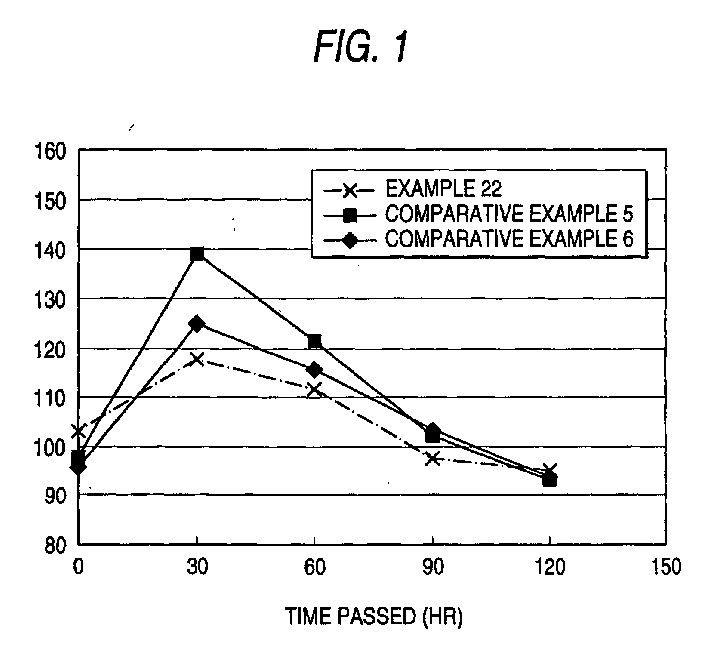
- Fig. 1 is a graph which shows the data concerning the effect of inhibiting an increase in blood glucose level in Example 26.
- Fig. 2 is a graph which shows the data concerning the effect of inhibiting an increase in blood glucose level in Example 27.
- Examples of the material containing arabinan, arabinoxylan or arabinogalactan to be used in the invention include apple, beet, soybean, corn, rice, wheat and by-products obtained as residues in processing these materials such as orange fiber, mandarin orange juice cake, apple fiber, apple juice cake, beet fiber, beet pulp, peanut hull, rice bran, corn cake, soybean cake, corn fiber and peanut oil press cake. It is highly favorable to use wastes or by-products as the starting material not only because the production cost can be lowered thereby but also from the viewpoint of environmental protection by the effective utilization of industrial wastes.
- Orange fiber and mandarin orange juice cake which are the residues remaining after pressing juice from orange, contain about 3 to 10% of L-arabinose in the form of arabinan, etc.
- Apple fiber which is the residues remaining after pressing juice from apple, contains about 4 to 7% by weight of L-arabinose in the form of arabinan, etc.
- Beet pulp which is the residue (press cake) remaining after pressing liquid sugar from beet (also called sugar beet) and optionally having been processed (adding molasses, drying, pelletizing, etc.), contains about 12 to 18% of L-arabinose in the form of arabinan, etc.
- Peanut cake which consists of peanut hull, etc., contains about 5% of L-arabinose in the form of arabinan, etc.
- Arabinan contained in these materials is characterized by having a linear structure consisting of L-arabinose molecules attached to one another and L-arabinose can be relatively easily formed therefrom by an enzyme. From this point of view, beet pulp, apple fiber, orange fiber and the like, from which L-arabinose can be easily released, is considered as favorable materials. In addition, rice bran and corn fiber containing arabinoxylan and soybean cake containing arabinogalactan are usable as favorable materials.
- Use can be made of natural substances containing arabinan, arabinoxylan or arabinogalactan with any origin or production process, so long as they are obtained by usual pressing methods.
- arabinan-decomposing enzymes such as arabinase (arabanase) and arabinofuranosidase.
- arabinase arabinase
- arabinofuranosidase arabinase
- the origin of the arabinan-decomposing enzymes are exemplified by bacteria ( Bacillus subtilis, Streptomyces sp.), yeasts ( Rhodotorula sp.) and fungi ( Aspergillus niger, A. oryzae, A. pulverulentus, A. terreus, A. japonicus, A. flavus, Trichoderma reesei, T. viride, Trichosporon penicillatum, Rhizopus sp.).
- enzymes originating in Aspergillus are appropriate and one originating in Aspergillus niger is particularly preferable.
- enzymes are produced in the culture supernatant or in the cells obtained by culturing the above-described strains by a known method.
- any fractions containing these enzymes may be used. If needed, fractions containing these enzymes may be purified or partially purified by conventional methods and used. It is also possible to use marketed enzymes. It is particularly preferable in the invention to use an arabinase Sumizyme ARS (manufactured by Shin Nihon Kagaku Kogyo K.K.) as a marketed enzyme with a high activity.
- an arabinase Sumizyme ARS manufactured by Shin Nihon Kagaku Kogyo K.K.
- cellulase and hemicellulase preparations sometimes exhibit an activity of releasing L-arabinose upon acting on substances containing arabinan, arabinoxylan or arabinogalactan. This is because these enzymes sometimes have the activity of decomposing arabinan, arabinoxylan or arabinogalactan in addition to the indicated activity, or contain enzymes decomposing arabinan, arabinoxylan or arabinogalactan as contaminants in addition to the enzymes serving as the main component.
- pectinase is favorable.
- pectinases include bacteria ( Bacillus subtilis, Streptomyces sp., Erwinia sp.), Yeasts ( Saccharowyces cerevisiae ), fungi ( Aspergillus niger, A. alliaceus, A. fkavus, A. pulverulentus, A.
- Enzymes originating in Aspergillus are most desirable. These pectinases are produced in the culture supernatant or cells obtained by culturing the above-described strains by a known method. In the invention, any fractions containing these enzymes may be used. If needed, fractions containing these enzymes may be purified or partially purified by conventional methods and used. It is also possible to use marketed enzymes.
- Examples of the marketed enzymes include Sumizyme PX (manufactured by Shin Nihon Kagaku Kogyo K.K.), Sumizyme AP-2 (manufactured by Shin Nihon Kagaku Kogyo K.K.), Sumizyme SPC (manufactured by Shin Nihon Kagaku Kogyo K.K.), Sumizyme MC (manufactured by Shin Nihon Kagaku Kogyo K.K.), Pectinase PL "AMANO” (manufactured by Amano Seiyaku K.K.), Pectinase G “AMANO” (manufactured by Amano Seiyaku K.K.), Pectinase GL “AMANO” (manufactured by Amano Seiyaku K.K.), Cellulosin PC5 (manufactured by Hankyu Bioindustry CO., LTD..), Cellulosin PE
- the yield of L-arabinose can be elevated by mixing two or more of these enzymes having different activities.
- L-arabinose can be obtained at a high yield by the combined use of an enzyme which degrades arabinan, arabinoxylan or arabinogalactan with pectinase.
- a maceration enzyme capable of breaking plant cell wall to thereby elevate the yield of L-arabinose.
- the amount of the enzyme having an activity of acting on materials containing arabinan, arabinoxylan or arabinogalactan and thus releasing L-arabinose is not particularly restricted. Namely, it may be used in such an amount as required in decomposing the arabinan, arabinoxylan or arabinogalactan in the starting material. In case of arabinase, for example, it is preferable to use 0.4 to 4000 U of the enzyme, preferably 2 to 2000 U and still preferably 4 to 1000 U, per 100 g of the starting material.
- the unit (U) as used herein is defined as the amount of enzyme whereby 1 ⁇ mol of L-arabinose is released from linear arabinan per minute.
- a material containing arabinan, arabinoxylan or arabinogalactan is treated with the enzyme.
- the material containing arabinan, arabinoxylan or arabinogalactan is suspended in an aqueous medium and then the enzyme is added thereto. Then the reaction is carried out under stirring or allowing to stand.
- the conditions of treating the material containing arabinan, arabinoxylan or arabinogalactan are not particularly restricted and conditions commonly employed in enzyme reactions may be employed therefor. Namely, the conditions may be appropriately determined depending on the optimum conditions of the enzyme employed and other factors.
- the reaction temperature is controlled to a level at which the enzyme is not inactivated but microorganisms can hardly grow, thereby preventing putrefaction. More particularly speaking, the reaction temperature ranges from 20 to 90°C, preferably from 40 to 80°C and still preferably from 50 to 75°C.
- Concerning the pH value of the liquid reaction mixture it is needless to say that the reaction is carried out preferably under the optimum conditions of the enzyme. That is to say, the pH value is controlled preferably to 2 to 9, preferably 2.5 to 8 and still preferably 3 to 6.
- the reaction time depends on the amounts of the material containing arabinan, arabinoxylan or arabinogalactan and the enzyme. In general, it is preferable from the viewpoint of performance to set the reaction time to 3 to 48 hours.
- the obtained reaction mixture as it is, or after heating at 100°C or above, or after further drying, is usable as the enzyme-treated product containing L-arabinose of the second embodiment of the invention.
- An L-arabinose sugar solution can be obtained by collecting the supernatant of the suspension after the completion of the reaction.
- the L-arabinose thus obtained may be purified by various chromatographic procedures commonly employed in the art with the use of ion exchange resins, active carbon, etc.
- crystalline L-arabinose may be obtained by adding hot ethanol to the solution containing L-arabinose thus obtained.
- the diet foods and the diabetic foods and processes for producing the same will be described in detail.
- the starting materials of the diet foods and the diabetic foods it is desirable to use the above-described materials containing arabinan, arabinoxylan or arabinogalactan and the enzymes as described above, though the invention is not restricted thereto.
- the L-arabinose use can be made of marketed products or those obtained by extracting hemicellulose contained in corn fiber, gum arabic, beet pulp, etc. with an alkali and then acidolyzing.
- the dietary fiber source include water-soluble dietary fibers such as polydextrose, sodium alginate and pectin and water-insoluble dietary fibers such as cellulose, lignin and hemicellulose. It is preferable to use dietary fiber obtained by treating dietary fiber materials originating in the above-described natural substances containing arabinan, arabinoxylan or arabinogalactan with enzymes.
- the diet foods or diabetic foods according to the invention can be produced by treating a dietary fiber material originating in a natural material containing arabinan, arabinoxylan or arabinogalactan with an enzyme which degrades arabinan, arabinoxylan or arabinogalactan to give an enzyme-treated product containing L-arabinose and dietary fiber and adding the thus obtained enzyme-treated product to foods.
- the enzyme-treatment is carried out under the conditions as described above, it is also possible to form L-arabinose and dietary fiber at the same time under specific conditions to give the enzyme-treated product.
- conditions appropriate for the release of L-arabinose and conditions appropriate for the formation of dietary fiber may be successively employed to give the enzyme-treated product.
- the enzyme-treated product thus obtained is blended in the production process of foods.
- the foods usable herein include baked products such as wafers, crackers, biscuits, cookies and Western-style cakes, breads such as white bread, soft rolls, buns, croissants and stick breads, cereals, noodles, chocolates, candies, tablets, frozen products such as ice cream and sherbet, Japanese style cakes such as manju (bean-jam buns) and daifuku (soft rice cake with bean-jam) and ground fish paste products.
- Western-style cakes, breads, cereals, noodles, etc. are prepared usually by kneading cereal flour (wheat flour in most cases and rice flour in some cases), which is employed as the main component, together with saccharides such as sucrose, sodium chloride, water, butter, margarine, egg, etc. and then baking.
- cereal flour wheat flour in most cases and rice flour in some cases
- saccharides such as sucrose, sodium chloride, water, butter, margarine, egg, etc.
- the enzyme-treated product may be added in the step of blending the materials so as to give the above-described content based on the weight of the food.
- L-arabinose uncompetitively inhibits disaccharide-decomposing enzymes (maltase, sucrase, etc.) located on the surface of microchorions (mucociliary borders) in the duodenal and small intestinal mucosae.
- the incorporated carbohydrates are gradually degraded into glucose and fructose which are absorbed scarcely in the duodenum or the upper part of the jejunum but in the middle and lower parts of the small intestine. That is to say, monosaccharides are slowly absorbed in the whole small intestine.
- a rapid increase in blood glucose level hyperglycemia
- an anorectic effect can be achieved by sustaining the feeling of fullness, thereby establishing a diet effect.
- the effect of inhibiting an increase in blood glucose level can be enhanced by simultaneously taking L-arabinose with dietary fiber, though the mechanism thereof is still unknown.
- the fruit and vegetable juices and the process for producing the same will be described in detail.
- materials for the fruit and vegetable juices use can be made of those cited above concerning the process for producing L-arabinose.
- Such a material is divide into a juice and a press juice cake by treating in a conventional manner such as grinding and solid/liquid separation or pressing.
- a conventional manner such as grinding and solid/liquid separation or pressing.
- arabinan which is characterized in having a linear structure of L-arabinose, L-arabinose is relatively easily released by an enzyme-treatment. It is favorable to use apple juice press cake, orange juice press cake, etc. as the starting material, since about 90% or more of arabinan contained therein is released.
- the enzyme to be used in treating the press juice cake containing arabinan, arabinoxylan or arabinogalactan, the amount of the enzyme and the reaction conditions may be determined as in the process of producing L-arabinose as described above.
- L-arabinose-containing juice press cake can be obtained.
- the cake is pressed to give an L-arabinose-containing solution.
- the thus obtained L-arabinose-containing press cake or the L-arabinose-containing fraction obtained by pressing is then added to a juice to give an L-arabinose-containing juice.
- the content of L-arabinose in the juice is controlled preferably to 0.001 to 10 g/L, still preferably 0.1 to 5 g/L.
- L-arabinose-containing fraction which is obtained by treating a fruit or vegetable juice press cake with an enzyme, to juices makes it possible to produce juices having an enhanced effect of inhibiting an increase in blood glucose level compared with the case of adding L-arabinose alone.
- the daily intake of L-arabinose is controlled to 1 to 30 g, preferably 1.5 to 10 g.
- the saccharide concentrations of L-arabinose-containing materials were expressed in Brix% by way of convenience. Each Brix% was measured by using a HAND REFRACTO METER manufactured by ATAGO.
- the analysis was carried out by using an analytical column TSKgel Amide-80 (manufactured by Tosoh Corporation, 4.6 mm (i.d.) x 25 cm) at a column temperature of 80°C and a flow rate of 0.8 mL/min with the use of 80% acetonitrile as an eluent. Saccharides were detected by the fluorescence detection by using benzamidine derivatives and the L-arabinose content was determined based on the quantitative data of standards. As the result of the analysis of the solution obtained after the reaction as described above, 10 g of L-arabinose was accumulated in 1.9 L of the solution.
- this solution was passed successively through an anion exchange resin (Dowex SAR, OH - type, manufactured by The Dow Chemical Company, bed volume: 100 mL), a cation exchange resin (Dowex HCRW2, H + type, manufactured by The Dow Chemical Company, bed volume: 100 mL) and active carbon (Diahope S80 manufactured by Mitsubishi Chemical Corporation, bed volume: 100 mL) in this order and an L-arabinose-containing solution was thus collected.
- the collected solution was concentrated on an evaporator until its Brix attained 70 to give a sugar solution containing 8.6 g of L-arabinose.
- Table 1 summarizes the L-arabinose yields achieved in Examples 1 and 2 and Comparative Example 1. Arabinan contents were determined in the following manner. 2 mL of 72% sulfuric acid was added to 20 mg of a starting material. After stirring for 1 hour, the reaction mixture was diluted 20-fold and maintained at 100°C for 3 hours. The L-arabinose content thus released was quantified by the method described in Example 1 and the value thus obtained was referred to as the content of arabinan in the starting material.
- Amount of the collected L-arabinose means the amount (g) of purified L-arabinose obtained form 200 g of the starting material. Yield means the ratio of the purified L-arabinose to the arabinan contained in the starting material.
- this solution was passed successively through an anion exchange resin (Dowex SAR, OH - type, manufactured by The Dow Chemical Company, bed volume: 100 mL), a cation exchange resin (Dowex HCRW2, H + type, manufactured by The Dow Chemical Company, bed volume: 100 mL) and active carbon (Diahope S80 manufactured by Mitsubishi Chemical Corporation, bed volume: 100 mL) in this order and an L-arabinose-containing solution was thus collected.
- the collected solution was concentrated on an evaporator until its Brix attained 70 to give a sugar solution containing 17.5 g of L-arabinose.
- L-arabinose was quantified by suspending 1 g of an enzyme-treated product in 100 mL of water, extracting the water-soluble fraction and then analyzing free saccharides contained in the enzyme-treated product as in Example 1.
- apple fiber manufactured by Nutrinova Japan, moisture content: 2%) were added 200 mL of water and 4 mL of Sumizyme ARS (arabinase manufactured by Shin Nihon Kagaku Kogyo K.K., titer: 400 U/mL). After mixing, the mixture was reacted under stirring at 55°C for 24 hours. Then, the reaction mixture was vacuum-dried (40°C, 48 hours). Thus 195 g of enzyme-treated apple fiber (L- arabinose content: 7%, dietary fiber content: about 50%, moisture content: about 10%) was obtained.
- Sumizyme ARS Arbinase manufactured by Shin Nihon Kagaku Kogyo K.K., titer: 400 U/mL
- a dough was prepared by blending 200 g of wheat flour, 100 g of the enzyme-treated orange fiber prepared in Example 9, the yolk of an egg, 100 g of butter, 80 g of powdery sugar and an appropriate amount of sodium chloride (total weight: about 500 g, content of the enzyme-treated orange fiber: about 20% based on the total weight), molded and then baked in an oven at 180°C for about 10 minutes to give cookies containing the enzyme-treated orange fiber.
- These enzyme-treated orange fiber-containing cookies contained 2% of L-arabinose and about 10% of dietary fiber.
- a dough was prepared by blending 400 g of wheat flour, 100 g of the enzyme-treated soybean cake prepared in Example 13, 30 g of butter, one large spoonful of sugar, one small spoonful of sodium chloride, two small spoonfuls of dry yeast and 180 cc of warm water (total weight excluding water: about 550 g, content of the enzyme-treated soybean cake: about 18% based on the total weight), put into a white bread mold and then baked in an oven at 200°C for about 10 minutes to give white bread containing the enzyme-treated soybean cake.
- This enzyme-treated soybean cake-containing white bread contained 0.5% of L-arabinose and about 8% of dietary fiber.
- Example 16 ⁇ Cake containing enzyme-treated apple fiber>
- a dough was prepared by blending 90 g of wheat flour, 100 g of the ground enzyme-treated apple fiber (prepared in Example 10), 30 g of butter, 90 g of sugar and 3 eggs (total weight: about 400 g, content of the enzyme-treated apple fiber: about 25% based on the total weight), poured into a mold and then baked in an oven at 180°C for about 25 minutes to give a cake containing the enzyme-treated apple fiber.
- This enzyme-treated apple fiber-containing cake contained 2% of L-arabinose and about 12% of dietary fiber.
- Example 17 Ice cream containing enzyme-treated rice bran>
- This enzyme-treated rice bran-containing ice cream contained 0.5% of L-arabinose and about 5% of dietary fiber.
- a dough was prepared by blending 800 g of wheat flour, 200 g of the ground enzyme-treated peanut hull (prepared in Example 12), 30 g of sodium chloride and 390 g of water (total weight: about 1500 g, content of the enzyme-treated peanut hull: about 13% based on the total weight), spread out and molded to give hand-made udon noodles containing the enzyme-treated peanut hull.
- This enzyme-treated peanut hull-containing hand-made udon noodles contained 0.3% of L-arabinose and about 4% of dietary fiber.
- a mixture comprising 15 g of sugar, 7 g of L-ascorbic acid, a filler, perfume and a colorant, each in an appropriate amount, and 75 g of the enzyme-treated orange fiber (prepared in Example 9) (content of the enzyme-treated orange fiber: about 75% based on the total weight) was directly tabletted by the powder-compression method to give tablets each containing 1.5 g of the enzyme-treated orange fiber.
- These enzyme-treated orange fiber-containing tablets contained 7% of L-arabinose and about 36% of dietary fiber.
- Example 20 ⁇ Test of cookies containing enzyme-treated orange fiber: blood glucose level>
- the enzyme-treated orange fiber-containing cookies (L-arabinose content: 2%) prepared in Example 14 were given at 10:00 a.m. to 10 normal adults (6 males and 4 males) without having the previous evening meal and breakfast. Before the intake and 30, 60 and 120 minutes thereafter, changes in the peripheral blood glucose level were monitored by using an apparatus for measuring blood glucose level and blood glucose level measuring paper (Tide and Tidex, both manufactured by Bayer Medical-Sankyo). For comparison, cookies prepared in the conventional manner (Comparative Example 2), cookies containing 2% of L-arabinose alone (Comparative Example 3) and cookies containing untreated orange fiber alone (Comparative Example 4) were also tested in the same manner.
- Table 2 shows changes in the blood glucose level caused by taking various cookies.
- the intake of the cookies of Comparative Example 2 caused an obvious increase in the blood glucose level compared with the value before the intake. In comparison, the increase in the blood glucose level was suppressed to about 80% in the case of the cookies of Comparative Example 3.
- the cookies of Comparative Example 4 suppressed the increase in the blood glucose level only slightly.
- the intake of the cookies of Example 14 suppressed the increase in the blood glucose level to about 40% in the case of taking the cookies of Comparative Example 2.
- Example 21 Test of enzyme-treated rice bran-containing ice cream: bowel movement>
- Table 3 shows the results of the sensory test of Example 21.
- the intake of the enzyme-treated rice bran-containing ice cream showed an improving effect in each evaluation item, which indicates that the enzyme-treated rice bran-containing ice cream has a favorable effect of ameliorating intestinal disorder.
- Example 22 Apple juice containing L-arabinose-containing fraction>
- Example 22 100 mL of the L-arabinose-containing apple juice obtained in Example 22 was given together with 10 g of sucrose to normal adults and changes in the blood glucose level after intake were monitored.
- a 100% apple juice containing no L-arabinose-containing apple juice cake (Comparative Example 5) and an apple juice containing 2.6 g/L of an L-arabinose reagent (manufactured by Ishizu Seiyaku K.K.) (Comparative Example 6) were tested in the same manner and the data of these groups were compared.
- Fig. 1 shows the results of Example 26.
- Fig. 1 shows, the increase in the blood glucose level after the intake was inhibited in the group with the intake of the apple juice containing the L-arabinose-containing fraction (Example 22), compared with the L- arabinose-free group of Comparative Example 5. It was also clarified that a higher effect was achieved in the group with the intake of the apple juice containing the L-arabinose-containing fraction than in Comparative Example 2 with the addition of the L-arabinose reagent.
- Example 23 100 mL of the L-arabinose-containing orange juice obtained in Example 23 was given together with 10 g of sucrose to normal adults and changes in the blood glucose level after intake were monitored.
- a 100% orange juice containing no L-arabinose-containing solution originating in the orange juice cake (Comparative Example 7) and an orange juice containing 3.0 g/L of an L-arabinose reagent (manufactured by Ishizu Seiyaku K.K.) (Comparative Example 8) were tested in the same manner and the data of these groups were compared.
- Fig. 2 shows the results of Example 27.
- FIG. 2 shows, the increase in the blood glucose level after the intake was inhibited in the group with the intake of the orange juice containing the L-arabinose-containing fraction (Example 23), compared with the L- arabinose-free group of Comparative Example 7. It was also clarified that a higher effect was achieved in the group with the intake of the orange juice containing the L-arabinose-containing fraction than in Comparative Example 8 with the addition of the L-arabinose reagent.
- L-arabinose and enzyme-treated products containing L-arabinose can be easily and economically prepared from natural substances containing arabinan, arabinoxylan or arabinogalactan, which are less expensive materials, without resort to any troublesome procedure (for example, preliminarily taking out arabinan, arabinoxylan or arabinogalactan).
- the obtained products are applicable to diet foods and diabetic foods having effects of inhibiting an increase in blood glucose level and ameliorating bowel movement due to L-arabinose and dietary fiber.
- L-arabinose-containing fruit or vegetable juices having functions of inhibiting an increase in blood glucose level, etc.
- L-arabinose-containing press juice cake or a solution obtained therefrom by solid/liquid separation can be provided by adding L-arabinose-containing press juice cake or a solution obtained therefrom by solid/liquid separation.
Landscapes
- Life Sciences & Earth Sciences (AREA)
- Chemical & Material Sciences (AREA)
- Engineering & Computer Science (AREA)
- Health & Medical Sciences (AREA)
- Food Science & Technology (AREA)
- Polymers & Plastics (AREA)
- Nutrition Science (AREA)
- Organic Chemistry (AREA)
- Zoology (AREA)
- Wood Science & Technology (AREA)
- Biochemistry (AREA)
- Genetics & Genomics (AREA)
- Microbiology (AREA)
- General Health & Medical Sciences (AREA)
- General Engineering & Computer Science (AREA)
- Bioinformatics & Cheminformatics (AREA)
- Mycology (AREA)
- Molecular Biology (AREA)
- Biotechnology (AREA)
- Botany (AREA)
- Chemical Kinetics & Catalysis (AREA)
- General Chemical & Material Sciences (AREA)
- Inorganic Chemistry (AREA)
- Pediatric Medicine (AREA)
- Proteomics, Peptides & Aminoacids (AREA)
- Dispersion Chemistry (AREA)
- Preparation Of Compounds By Using Micro-Organisms (AREA)
- Coloring Foods And Improving Nutritive Qualities (AREA)
Abstract
Description
| Starting material | Arabinan content (a) | Arabinose released from 200 g of starting material | Amount of collected arabinose (b) | Yield (c) | |
| Ex. 1 | apple fiber | 5.2% | 10 g | 8.6 g | 82.7% |
| Ex. 2 | beet pulp | 17.0% | 27 g | 25.0 g | 73.5% |
| Comp. Ex. 1 | beet pulp | 17.0% | - | 1.3 g | 3.8% |
| Note: (c)= (b) ÷ (200x (a)) |
| Cookie | Ex. 14 | Comp. Ex. 2 | Comp. Ex. 3 | Comp. Ex. 4 |
| Before | 0 | 0 | 0 | 0 |
| 30 min after intake | +30 | +68 | +55 | +63 |
| 60 min after intake | +18 | +52 | +42 | +49 |
| 120 min after intake | -1 | +16 | +14 | +14 |
| Evaluation item | Score |
| Bowel movement frequency (Good = Increased) | 3.7 |
| Amount of feces (Good = Increased) | 4.3 |
| Regularity in bowel movement (Good = More regular) | 4.7 |
| Hardness of feces (Good = Softened) | 4.0 |
Claims (17)
- A process for producing L-arabinose by treating a natural material containing arabinan, arabinoxylan or arabinogalactan with an enzyme having an activity of acting on natural substances containing arabinan, arabinoxylan or arabinogalactan and thus releasing L-arabinose to give L-arabinose, wherein said natural substance is directly treated with said enzyme without separating or extracting arabinan, arabinoxylan or arabinogalactan.
- The process for producing L-arabinose as claimed in claim 1, wherein said enzyme having an activity of acting on natural substances containing arabinan, arabinoxylan or arabinogalactan and thus releasing L-arabinose is an enzyme which degrades arabinan, arabinoxylan or arabinogalactan.
- The process for producing L-arabinose as claimed in claim 1, wherein said natural substance containing arabinan, arabinoxylan or arabinogalactan is one or more members selected from among orange, mandarin orange, apple, beet, peanut, corn, rice, wheat, soybean, orange fiber, mandarin orange juice cake, apple fiber, apple juice cake, beet fiber, beet pulp, peanut cake, rice bran, corn cake and soybean cake.
- An enzyme-treated product containing L-arabinose, wherein a natural substance containing arabinan, arabinoxylan or arabinogalactan contains L-arabinose.
- A process for producing an enzyme-treated product containing L-arabinose characterized by comprising releasing L-arabinose by treating a natural substance containing arabinan, arabinoxylan or arabinogalactan directly with an enzyme having an activity of acting on natural substances containing arabinan, arabinoxylan or arabinogalactan and thus releasing L-arabinose to give the enzyme-treated product containing L-arabinose as claimed in claim 4.
- The process for producing L-arabinose as claimed in claim 1, wherein said enzyme having an activity of acting on natural substances containing arabinan, arabinoxylan or arabinogalactan and thus releasing L-arabinose is pectinase.
- The process for producing an enzyme-treated product containing L-arabinose as claimed in claim 5, wherein said enzyme having an activity of acting on natural substances containing arabinan, arabinoxylan or arabinogalactan and thus releasing L-arabinose is pectinase.
- A process for producing L-arabinose or an enzyme-treated product containing L-arabinose characterized by comprising treating a natural substance containing arabinan, arabinoxylan or arabinogalactan directly with an enzyme which degrades L-arabinose together with pectinase without separating or extracting arabinan, arabinoxylan or arabinogalactan from said natural substance.
- A diet food characterized by comprising L-arabinose and dietary fiber.
- The diet food as claimed in claim 9, wherein said L-arabinose and dietary fiber are obtained by treating a dietary fiber material originating in a natural substance containing arabinan, arabinoxylan or arabinogalactan with an enzyme.
- A process for producing a diet food characterized by comprising treating a dietary fiber material originating in a natural substance containing arabinan, arabinoxylan or arabinogalactan with an enzyme which degrades arabinan, arabinoxylan or arabinogalactan to give an enzyme-treated product containing L-arabinose and dietary fiber, and adding the thus obtained enzyme-treated product to a food.
- A diabetic food characterized by containing L-arabinose and dietary fiber.
- The diabetic food as claimed in claim 12, wherein said L-arabinose and dietary fiber are obtained by treating a dietary fiber material originating in a natural substance containing arabinan, arabinoxylan or arabinogalactan with an enzyme.
- A process for producing a diabetic food characterized by comprising treating a dietary fiber material originating in a natural substance containing arabinan, arabinoxylan or arabinogalactan with an enzyme which degrades arabinan, arabinoxylan or arabinogalactan to give an enzyme-treated product containing L-arabinose and dietary fiber, and adding the thus obtained enzyme-treated product to a food.
- An L-arabinose-containing fruit or vegetable juice characterized by containing an L-arabinose-containing fraction obtained by treating a fruit or vegetable press cake containing arabinan, arabinoxylan or arabinogalactan with an enzyme.
- A process for producing an arabinose-containing fruit or vegetable juice characterized by comprising treating a fruit or a vegetable containing arabinan, arabinoxylan or arabinogalactan to divide into a juice and a press juice cake, treating the press juice cake with an enzyme to release L-arabinose, and then adding the fraction containing the released L-arabinose to the juice.
- A method of inhibiting an increase in blood glucose level which comprises administering an effective amount of L-arabinose or an enzyme-treated product containing L-arabinose to a subject.
Priority Applications (2)
| Application Number | Priority Date | Filing Date | Title |
|---|---|---|---|
| EP05027859A EP1645637B1 (en) | 2000-02-01 | 2001-01-31 | A diet food and process for producing same |
| EP05027858A EP1645636B1 (en) | 2000-02-01 | 2001-01-31 | A diabetic food and process for producing same |
Applications Claiming Priority (11)
| Application Number | Priority Date | Filing Date | Title |
|---|---|---|---|
| JP2000024121 | 2000-02-01 | ||
| JP2000024121 | 2000-02-01 | ||
| JP2000224013A JP2001286294A (en) | 2000-02-01 | 2000-07-25 | Method for producing l-arabinose, l-arabinose-containing enzyme treated product and method for producing the same |
| JP2000224013 | 2000-07-25 | ||
| JP2000288745 | 2000-09-22 | ||
| JP2000288745A JP2002095491A (en) | 2000-09-22 | 2000-09-22 | Method for producing l-arabinose or l-arabinose- containing enzymatically treated product |
| JP2000336097 | 2000-11-02 | ||
| JP2000336099A JP3659631B2 (en) | 2000-11-02 | 2000-11-02 | Diet foods, diabetic foods and methods for producing them |
| JP2000336099 | 2000-11-02 | ||
| JP2000336097A JP2002136278A (en) | 2000-11-02 | 2000-11-02 | Arabinose-containing fruit or vegetable juice and method for producing the same |
| PCT/JP2001/000667 WO2001057230A1 (en) | 2000-02-01 | 2001-01-31 | Process for producing l-arabinose, l-arabinose-containing enzymatically processed products, diet foods, diabetic diet foods and fruit or vegetable juices and process for producing the same |
Related Child Applications (2)
| Application Number | Title | Priority Date | Filing Date |
|---|---|---|---|
| EP05027859A Division EP1645637B1 (en) | 2000-02-01 | 2001-01-31 | A diet food and process for producing same |
| EP05027858A Division EP1645636B1 (en) | 2000-02-01 | 2001-01-31 | A diabetic food and process for producing same |
Publications (3)
| Publication Number | Publication Date |
|---|---|
| EP1167536A1 true EP1167536A1 (en) | 2002-01-02 |
| EP1167536A4 EP1167536A4 (en) | 2005-08-03 |
| EP1167536B1 EP1167536B1 (en) | 2008-06-25 |
Family
ID=27531398
Family Applications (3)
| Application Number | Title | Priority Date | Filing Date |
|---|---|---|---|
| EP05027859A Expired - Lifetime EP1645637B1 (en) | 2000-02-01 | 2001-01-31 | A diet food and process for producing same |
| EP01902706A Expired - Lifetime EP1167536B1 (en) | 2000-02-01 | 2001-01-31 | Process for producing l-arabinose |
| EP05027858A Expired - Lifetime EP1645636B1 (en) | 2000-02-01 | 2001-01-31 | A diabetic food and process for producing same |
Family Applications Before (1)
| Application Number | Title | Priority Date | Filing Date |
|---|---|---|---|
| EP05027859A Expired - Lifetime EP1645637B1 (en) | 2000-02-01 | 2001-01-31 | A diet food and process for producing same |
Family Applications After (1)
| Application Number | Title | Priority Date | Filing Date |
|---|---|---|---|
| EP05027858A Expired - Lifetime EP1645636B1 (en) | 2000-02-01 | 2001-01-31 | A diabetic food and process for producing same |
Country Status (7)
| Country | Link |
|---|---|
| US (1) | US6632448B2 (en) |
| EP (3) | EP1645637B1 (en) |
| CN (1) | CN1262670C (en) |
| AU (1) | AU778861B2 (en) |
| CA (1) | CA2368571C (en) |
| DE (3) | DE60134436D1 (en) |
| WO (1) | WO2001057230A1 (en) |
Cited By (4)
| Publication number | Priority date | Publication date | Assignee | Title |
|---|---|---|---|---|
| WO2002079260A1 (en) * | 2001-03-28 | 2002-10-10 | Grain Processing Corporation | Enzymatically catalyzed hydrolysis of corn fiber and products obtained from enzymatically hydrolyzed corn fiber |
| WO2006017785A1 (en) * | 2004-08-06 | 2006-02-16 | Grain Processing Corporation | Frozen food products comprising holocellulose and methods for their manufacture |
| WO2019166514A1 (en) | 2018-02-28 | 2019-09-06 | C-Lecta Gmbh | Enzymatic in-situ fortification of food with functional carbohydrates |
| EP4230635A4 (en) * | 2022-01-06 | 2023-11-08 | Thomson Biotech (Xiamen) Pte. Ltd. | Arabinose as well as preparation and use thereof |
Families Citing this family (31)
| Publication number | Priority date | Publication date | Assignee | Title |
|---|---|---|---|---|
| US20050096464A1 (en) * | 2003-10-30 | 2005-05-05 | Heikki Heikkila | Separation process |
| EP1906769A2 (en) * | 2005-07-15 | 2008-04-09 | Amano Enzyme USA., Ltd. | Enzyme compositions that enhance the flavor of food and beverages |
| IL181431A0 (en) * | 2007-02-19 | 2007-07-04 | Micha Shemer | Fruit juice and puree with a lowered amount of available sugars |
| FR2928817B1 (en) * | 2008-03-19 | 2010-12-17 | Ecopsi | PROCESS AND UNIT FOR PRODUCING BEETS AND JUICE SUGAR FROM BEETS |
| US8043645B2 (en) | 2008-07-09 | 2011-10-25 | Starbucks Corporation | Method of making beverages with enhanced flavors and aromas |
| CN101507728B (en) * | 2009-03-24 | 2014-06-11 | 淮北中润生物能源技术开发有限公司 | Composite for preventing and treating body acidification of diabetic |
| WO2010108314A1 (en) * | 2009-03-24 | 2010-09-30 | 淮北中润生物能源技术开发有限公司 | Use of fiber pentose or composition containing fiber pentose in manufacture of foods or medicines for preventing and/or treating acidification in diabetic patient |
| CN101953442B (en) * | 2009-12-23 | 2013-11-27 | 济南圣泉唐和唐生物科技有限公司 | Health care product with function of reducing blood sugar |
| CN102154410B (en) * | 2010-02-12 | 2014-12-03 | 何遂庆 | Method for producing L-arabinose by using peach gum as raw material |
| BR112012022332A2 (en) * | 2010-03-10 | 2019-09-24 | Toray Industries | "method of production of aqueous refined sugar solution and method of production of a chemical" |
| CN101889600B (en) * | 2010-07-23 | 2012-07-25 | 济南圣泉唐和唐生物科技有限公司 | Moon cake |
| US10334870B2 (en) | 2010-10-07 | 2019-07-02 | Tropicana Products, Inc. | Processing of whole fruits and vegetables, processing of side-stream ingredients of fruits and vegetables, and use of the processed fruits and vegetables in beverage and food products |
| CN102113607A (en) * | 2010-12-31 | 2011-07-06 | 张胜勇 | A kind of preparation method of slimming sugar |
| CN102366094A (en) * | 2011-09-22 | 2012-03-07 | 唐传生物科技(厦门)有限公司 | Fat-reducing and hypolipemic health food |
| TW201318566A (en) * | 2011-11-01 | 2013-05-16 | 呂健民 | Dietary supplement composition and method for regulating blood sugar thereof |
| CN102550915B (en) * | 2012-02-03 | 2013-05-08 | 济南圣泉唐和唐生物科技有限公司 | Health-care food |
| EP2956017B1 (en) | 2013-02-15 | 2020-01-22 | Pepsico, Inc. | Preparation and incorporation of co-products into beverages to enhance nutrition and sensory attributes |
| CN103975997B (en) * | 2014-05-27 | 2015-07-08 | 天津桂发祥十八街麻花食品股份有限公司 | Stuffed fried dough twist capable of inhibiting absorption of sucrose and regulating fat metabolism after eating, and manufacturing method thereof |
| CN103975993B (en) * | 2014-05-27 | 2015-07-08 | 天津桂发祥十八街麻花食品股份有限公司 | Type 2 diabetic patient edible saccharose included stuffed fried dough twist and production method thereof |
| CN104012600A (en) * | 2014-06-05 | 2014-09-03 | 方明 | Method for preparing L-arabinose function cake |
| CN105796651A (en) * | 2014-12-31 | 2016-07-27 | 天津中新药业研究中心 | Composition capable of reducing blood glucose and preparation method |
| CN105796649A (en) * | 2014-12-31 | 2016-07-27 | 天津中新药业研究中心 | Hypoglycemic composition and preparation method thereof |
| CN105796650A (en) * | 2014-12-31 | 2016-07-27 | 天津中新药业研究中心 | Hypoglycemic composition and preparation method thereof |
| CN104770796A (en) * | 2015-03-30 | 2015-07-15 | 方明 | L-arabinose functional fruit juice beverage production method |
| CN107614694B (en) | 2015-04-10 | 2022-03-11 | 彗星生物炼制公司 | Methods and compositions for processing cellulosic biomass and products produced therefrom |
| CN107821539A (en) * | 2017-12-15 | 2018-03-23 | 天津阿尔发保健品有限公司 | A kind of hypoglycemic sugar-free coarse food grain cookies |
| MX2020011986A (en) | 2018-05-10 | 2021-01-29 | Comet Biorefining Inc | Compositions comprising glucose and hemicellulose and their use. |
| CN120242028A (en) | 2019-05-10 | 2025-07-04 | 彗星生物炼制公司 | Materials and methods for producing arabinoxylan compositions |
| KR102713717B1 (en) * | 2019-09-24 | 2024-10-04 | 니치유 가부시키가이샤 | Plant proteoglycans and their uses |
| CN116554239A (en) * | 2022-01-27 | 2023-08-08 | 唐传生物科技(厦门)有限公司 | A kind of arabinose granule and its preparation method and application |
| KR102751504B1 (en) * | 2024-04-04 | 2025-01-07 | 이동원 | Manufacturing method of fish-shaped salt bun |
Family Cites Families (11)
| Publication number | Priority date | Publication date | Assignee | Title |
|---|---|---|---|---|
| JP3079115B2 (en) * | 1990-10-30 | 2000-08-21 | 日清製粉株式会社 | Preparation of water-soluble arabinoxylan |
| US5863783A (en) * | 1991-03-27 | 1999-01-26 | Gist-Brocades, N.V. | Cloning and expression of DNA molecules encoding arabinan-degrading enzymes of fungal origin |
| JPH0665080A (en) * | 1992-03-10 | 1994-03-08 | Godo Shiyusei Kk | Agent for prevention and treatment of hyperglycemia-relating disease containing alpha-glucosidase inhibitor and health food |
| CA2096289A1 (en) * | 1992-05-15 | 1993-11-16 | Wouter Musters | Cloning and expression of dna encoding a ripening form of a polypeptide having rhamnogalacturonase activity |
| JP3354592B2 (en) * | 1992-05-22 | 2002-12-09 | 日清製粉株式会社 | Method for producing oligosaccharide |
| JPH07242551A (en) * | 1994-03-08 | 1995-09-19 | Fujisawa Pharmaceut Co Ltd | Agent for inhibiting accumulation of body fat |
| JPH07309765A (en) * | 1994-05-17 | 1995-11-28 | Fujisawa Pharmaceut Co Ltd | Body fat accumulation inhibitor |
| US6030648A (en) * | 1994-06-15 | 2000-02-29 | Novo Nordisk A/S | Extracts/cloud stability |
| JP3031534B2 (en) * | 1996-05-14 | 2000-04-10 | 北海道糖業株式会社 | How to make arabinose from beet arabinan |
| US5958474A (en) * | 1996-08-21 | 1999-09-28 | Nestec S.A. | Process for preparing food flavor precursors |
| JPH11332514A (en) * | 1998-05-22 | 1999-12-07 | Nof Corp | Balanced nutritive food |
-
2001
- 2001-01-31 EP EP05027859A patent/EP1645637B1/en not_active Expired - Lifetime
- 2001-01-31 WO PCT/JP2001/000667 patent/WO2001057230A1/en not_active Ceased
- 2001-01-31 DE DE60134436T patent/DE60134436D1/en not_active Expired - Lifetime
- 2001-01-31 DE DE60134514T patent/DE60134514D1/en not_active Expired - Lifetime
- 2001-01-31 US US09/937,775 patent/US6632448B2/en not_active Expired - Lifetime
- 2001-01-31 CN CNB018008046A patent/CN1262670C/en not_active Expired - Fee Related
- 2001-01-31 EP EP01902706A patent/EP1167536B1/en not_active Expired - Lifetime
- 2001-01-31 EP EP05027858A patent/EP1645636B1/en not_active Expired - Lifetime
- 2001-01-31 AU AU30552/01A patent/AU778861B2/en not_active Ceased
- 2001-01-31 CA CA2368571A patent/CA2368571C/en not_active Expired - Fee Related
- 2001-01-31 DE DE60134587T patent/DE60134587D1/en not_active Expired - Lifetime
Cited By (4)
| Publication number | Priority date | Publication date | Assignee | Title |
|---|---|---|---|---|
| WO2002079260A1 (en) * | 2001-03-28 | 2002-10-10 | Grain Processing Corporation | Enzymatically catalyzed hydrolysis of corn fiber and products obtained from enzymatically hydrolyzed corn fiber |
| WO2006017785A1 (en) * | 2004-08-06 | 2006-02-16 | Grain Processing Corporation | Frozen food products comprising holocellulose and methods for their manufacture |
| WO2019166514A1 (en) | 2018-02-28 | 2019-09-06 | C-Lecta Gmbh | Enzymatic in-situ fortification of food with functional carbohydrates |
| EP4230635A4 (en) * | 2022-01-06 | 2023-11-08 | Thomson Biotech (Xiamen) Pte. Ltd. | Arabinose as well as preparation and use thereof |
Also Published As
| Publication number | Publication date |
|---|---|
| US20030040489A1 (en) | 2003-02-27 |
| EP1645637A1 (en) | 2006-04-12 |
| AU778861B2 (en) | 2004-12-23 |
| DE60134514D1 (en) | 2008-08-07 |
| EP1167536B1 (en) | 2008-06-25 |
| DE60134587D1 (en) | 2008-08-07 |
| DE60134436D1 (en) | 2008-07-24 |
| CA2368571A1 (en) | 2001-08-09 |
| CN1262670C (en) | 2006-07-05 |
| EP1167536A4 (en) | 2005-08-03 |
| EP1645636A1 (en) | 2006-04-12 |
| EP1645636B1 (en) | 2008-06-11 |
| CN1366552A (en) | 2002-08-28 |
| EP1645637B1 (en) | 2008-06-25 |
| WO2001057230A1 (en) | 2001-08-09 |
| US6632448B2 (en) | 2003-10-14 |
| AU3055201A (en) | 2001-08-14 |
| CA2368571C (en) | 2011-07-12 |
Similar Documents
| Publication | Publication Date | Title |
|---|---|---|
| US6632448B2 (en) | Process for producing L-arabinose, L-arabinose-containing enzymatically processed products, diet foods, diabetic diet foods and fruit or vegetable juices and process for producing the same | |
| EP1513942B1 (en) | Galactosyl isomalt, method for production and use thereof | |
| EP0540421A1 (en) | Indigestible dextrin | |
| US5622738A (en) | Method of preparing water-soluble dietary fiber | |
| KR100888492B1 (en) | Manufacturing method of dietary fiber made from beer foil | |
| EP2156751A1 (en) | Novel sweetener having sugar-like taste and production method and use of the same | |
| DE10262018B4 (en) | Compositions, foodstuffs, food and beverages, confectionery, animal feed, dietary special nutrition, child nutrition, sweeteners and pharmaceutical compositions containing condensed palatinose | |
| KR20110112433A (en) | Process for preparing the composition, the composition and its use as a food additive | |
| EP2047760A1 (en) | Oral composition enabling increased absorption of cryptoxanthin | |
| TW201230968A (en) | Cereal milk drink comprising hydrolyzed whole grain for infants | |
| US20090005342A1 (en) | Composition Having Blood Pressure Reducing and/or Elevation Suppressing Effect and Food and Drink Containing the Same | |
| US20050222406A1 (en) | Condensed palatinose in hydrogenated form | |
| EP0535627B1 (en) | Alcoholic beverage containing an indigestible dextrin | |
| JPH0349662A (en) | Water-soluble dietary fiber-containing food and drink | |
| UA111181C2 (en) | FILLER COMPOSITION WITH THE CONTENT OF HYDROLIZED WHOLE GRAIN | |
| JP2007182395A (en) | Fat lowering composition | |
| JP5243435B2 (en) | Method for producing cellulase and cellooligosaccharide | |
| JP3659631B2 (en) | Diet foods, diabetic foods and methods for producing them | |
| KR20210099483A (en) | Manufacturing method of dietary fiber from beer foil | |
| Cruz-Guerrero et al. | Xylooligosaccharides (XOS) | |
| US20100080866A1 (en) | method of preparing dairy products containing no glucide | |
| JP2008054508A (en) | Method for producing galactomannan enzyme degradation product | |
| JP2005218395A (en) | Functional food material for prevention and improvement of postprandial hyperglycemia and method for producing the same | |
| JP2022528204A (en) | Hydrolysis of beer lees | |
| JP4048227B2 (en) | Antihyperglycemic agent |
Legal Events
| Date | Code | Title | Description |
|---|---|---|---|
| PUAI | Public reference made under article 153(3) epc to a published international application that has entered the european phase |
Free format text: ORIGINAL CODE: 0009012 |
|
| 17P | Request for examination filed |
Effective date: 20011001 |
|
| AK | Designated contracting states |
Kind code of ref document: A1 Designated state(s): AT BE CH CY DE DK ES FI FR GB GR IE IT LI LU MC NL PT SE TR |
|
| RBV | Designated contracting states (corrected) |
Designated state(s): DE FR GB IT |
|
| RIC1 | Information provided on ipc code assigned before grant |
Ipc: 7A 23L 2/02 B Ipc: 7A 23L 1/10 B Ipc: 7A 23G 9/02 B Ipc: 7A 23L 1/30 B Ipc: 7A 23L 1/307 B Ipc: 7A 23L 1/105 B Ipc: 7A 21D 2/18 B Ipc: 7A 23L 1/09 B Ipc: 7A 23L 1/308 B Ipc: 7A 23L 1/236 B Ipc: 7A 23L 1/16 B Ipc: 7C 12P 19/14 A |
|
| A4 | Supplementary search report drawn up and despatched |
Effective date: 20050615 |
|
| 17Q | First examination report despatched |
Effective date: 20050908 |
|
| GRAP | Despatch of communication of intention to grant a patent |
Free format text: ORIGINAL CODE: EPIDOSNIGR1 |
|
| RIC1 | Information provided on ipc code assigned before grant |
Ipc: A23G 9/34 20060101AFI20071107BHEP |
|
| GRAS | Grant fee paid |
Free format text: ORIGINAL CODE: EPIDOSNIGR3 |
|
| GRAA | (expected) grant |
Free format text: ORIGINAL CODE: 0009210 |
|
| AK | Designated contracting states |
Kind code of ref document: B1 Designated state(s): DE FR GB IT |
|
| REG | Reference to a national code |
Ref country code: GB Ref legal event code: FG4D |
|
| REF | Corresponds to: |
Ref document number: 60134514 Country of ref document: DE Date of ref document: 20080807 Kind code of ref document: P |
|
| PLBE | No opposition filed within time limit |
Free format text: ORIGINAL CODE: 0009261 |
|
| STAA | Information on the status of an ep patent application or granted ep patent |
Free format text: STATUS: NO OPPOSITION FILED WITHIN TIME LIMIT |
|
| 26N | No opposition filed |
Effective date: 20090326 |
|
| PGFP | Annual fee paid to national office [announced via postgrant information from national office to epo] |
Ref country code: IT Payment date: 20100121 Year of fee payment: 10 |
|
| PGFP | Annual fee paid to national office [announced via postgrant information from national office to epo] |
Ref country code: DE Payment date: 20110126 Year of fee payment: 11 Ref country code: FR Payment date: 20110128 Year of fee payment: 11 |
|
| PGFP | Annual fee paid to national office [announced via postgrant information from national office to epo] |
Ref country code: GB Payment date: 20110126 Year of fee payment: 11 |
|
| PG25 | Lapsed in a contracting state [announced via postgrant information from national office to epo] |
Ref country code: IT Free format text: LAPSE BECAUSE OF NON-PAYMENT OF DUE FEES Effective date: 20110131 |
|
| GBPC | Gb: european patent ceased through non-payment of renewal fee |
Effective date: 20120131 |
|
| REG | Reference to a national code |
Ref country code: FR Ref legal event code: ST Effective date: 20120928 |
|
| PG25 | Lapsed in a contracting state [announced via postgrant information from national office to epo] |
Ref country code: GB Free format text: LAPSE BECAUSE OF NON-PAYMENT OF DUE FEES Effective date: 20120131 Ref country code: DE Free format text: LAPSE BECAUSE OF NON-PAYMENT OF DUE FEES Effective date: 20120801 |
|
| REG | Reference to a national code |
Ref country code: DE Ref legal event code: R119 Ref document number: 60134514 Country of ref document: DE Effective date: 20120801 |
|
| PG25 | Lapsed in a contracting state [announced via postgrant information from national office to epo] |
Ref country code: FR Free format text: LAPSE BECAUSE OF NON-PAYMENT OF DUE FEES Effective date: 20120131 |