EP1167040B1 - Ink jet printer head and method for manufacturing the same - Google Patents
Ink jet printer head and method for manufacturing the same Download PDFInfo
- Publication number
- EP1167040B1 EP1167040B1 EP01305445A EP01305445A EP1167040B1 EP 1167040 B1 EP1167040 B1 EP 1167040B1 EP 01305445 A EP01305445 A EP 01305445A EP 01305445 A EP01305445 A EP 01305445A EP 1167040 B1 EP1167040 B1 EP 1167040B1
- Authority
- EP
- European Patent Office
- Prior art keywords
- ink
- jet printer
- printer head
- ink jet
- electrodes
- Prior art date
- Legal status (The legal status is an assumption and is not a legal conclusion. Google has not performed a legal analysis and makes no representation as to the accuracy of the status listed.)
- Expired - Lifetime
Links
Images




Classifications
-
- B—PERFORMING OPERATIONS; TRANSPORTING
- B41—PRINTING; LINING MACHINES; TYPEWRITERS; STAMPS
- B41J—TYPEWRITERS; SELECTIVE PRINTING MECHANISMS, i.e. MECHANISMS PRINTING OTHERWISE THAN FROM A FORME; CORRECTION OF TYPOGRAPHICAL ERRORS
- B41J2/00—Typewriters or selective printing mechanisms characterised by the printing or marking process for which they are designed
- B41J2/005—Typewriters or selective printing mechanisms characterised by the printing or marking process for which they are designed characterised by bringing liquid or particles selectively into contact with a printing material
- B41J2/01—Ink jet
- B41J2/135—Nozzles
- B41J2/16—Production of nozzles
- B41J2/1621—Manufacturing processes
- B41J2/1623—Manufacturing processes bonding and adhesion
-
- B—PERFORMING OPERATIONS; TRANSPORTING
- B41—PRINTING; LINING MACHINES; TYPEWRITERS; STAMPS
- B41J—TYPEWRITERS; SELECTIVE PRINTING MECHANISMS, i.e. MECHANISMS PRINTING OTHERWISE THAN FROM A FORME; CORRECTION OF TYPOGRAPHICAL ERRORS
- B41J2/00—Typewriters or selective printing mechanisms characterised by the printing or marking process for which they are designed
- B41J2/005—Typewriters or selective printing mechanisms characterised by the printing or marking process for which they are designed characterised by bringing liquid or particles selectively into contact with a printing material
- B41J2/01—Ink jet
- B41J2/135—Nozzles
- B41J2/14—Structure thereof only for on-demand ink jet heads
- B41J2/14201—Structure of print heads with piezoelectric elements
- B41J2/14209—Structure of print heads with piezoelectric elements of finger type, chamber walls consisting integrally of piezoelectric material
-
- B—PERFORMING OPERATIONS; TRANSPORTING
- B41—PRINTING; LINING MACHINES; TYPEWRITERS; STAMPS
- B41J—TYPEWRITERS; SELECTIVE PRINTING MECHANISMS, i.e. MECHANISMS PRINTING OTHERWISE THAN FROM A FORME; CORRECTION OF TYPOGRAPHICAL ERRORS
- B41J2/00—Typewriters or selective printing mechanisms characterised by the printing or marking process for which they are designed
- B41J2/005—Typewriters or selective printing mechanisms characterised by the printing or marking process for which they are designed characterised by bringing liquid or particles selectively into contact with a printing material
- B41J2/01—Ink jet
- B41J2/135—Nozzles
- B41J2/16—Production of nozzles
- B41J2/1606—Coating the nozzle area or the ink chamber
-
- B—PERFORMING OPERATIONS; TRANSPORTING
- B41—PRINTING; LINING MACHINES; TYPEWRITERS; STAMPS
- B41J—TYPEWRITERS; SELECTIVE PRINTING MECHANISMS, i.e. MECHANISMS PRINTING OTHERWISE THAN FROM A FORME; CORRECTION OF TYPOGRAPHICAL ERRORS
- B41J2/00—Typewriters or selective printing mechanisms characterised by the printing or marking process for which they are designed
- B41J2/005—Typewriters or selective printing mechanisms characterised by the printing or marking process for which they are designed characterised by bringing liquid or particles selectively into contact with a printing material
- B41J2/01—Ink jet
- B41J2/135—Nozzles
- B41J2/16—Production of nozzles
- B41J2/1607—Production of print heads with piezoelectric elements
- B41J2/1609—Production of print heads with piezoelectric elements of finger type, chamber walls consisting integrally of piezoelectric material
-
- B—PERFORMING OPERATIONS; TRANSPORTING
- B41—PRINTING; LINING MACHINES; TYPEWRITERS; STAMPS
- B41J—TYPEWRITERS; SELECTIVE PRINTING MECHANISMS, i.e. MECHANISMS PRINTING OTHERWISE THAN FROM A FORME; CORRECTION OF TYPOGRAPHICAL ERRORS
- B41J2/00—Typewriters or selective printing mechanisms characterised by the printing or marking process for which they are designed
- B41J2/005—Typewriters or selective printing mechanisms characterised by the printing or marking process for which they are designed characterised by bringing liquid or particles selectively into contact with a printing material
- B41J2/01—Ink jet
- B41J2/135—Nozzles
- B41J2/16—Production of nozzles
- B41J2/1621—Manufacturing processes
- B41J2/1632—Manufacturing processes machining
-
- B—PERFORMING OPERATIONS; TRANSPORTING
- B41—PRINTING; LINING MACHINES; TYPEWRITERS; STAMPS
- B41J—TYPEWRITERS; SELECTIVE PRINTING MECHANISMS, i.e. MECHANISMS PRINTING OTHERWISE THAN FROM A FORME; CORRECTION OF TYPOGRAPHICAL ERRORS
- B41J2/00—Typewriters or selective printing mechanisms characterised by the printing or marking process for which they are designed
- B41J2/005—Typewriters or selective printing mechanisms characterised by the printing or marking process for which they are designed characterised by bringing liquid or particles selectively into contact with a printing material
- B41J2/01—Ink jet
- B41J2/135—Nozzles
- B41J2/16—Production of nozzles
- B41J2/1621—Manufacturing processes
- B41J2/164—Manufacturing processes thin film formation
- B41J2/1642—Manufacturing processes thin film formation thin film formation by CVD [chemical vapor deposition]
-
- B—PERFORMING OPERATIONS; TRANSPORTING
- B41—PRINTING; LINING MACHINES; TYPEWRITERS; STAMPS
- B41J—TYPEWRITERS; SELECTIVE PRINTING MECHANISMS, i.e. MECHANISMS PRINTING OTHERWISE THAN FROM A FORME; CORRECTION OF TYPOGRAPHICAL ERRORS
- B41J2/00—Typewriters or selective printing mechanisms characterised by the printing or marking process for which they are designed
- B41J2/005—Typewriters or selective printing mechanisms characterised by the printing or marking process for which they are designed characterised by bringing liquid or particles selectively into contact with a printing material
- B41J2/01—Ink jet
- B41J2/135—Nozzles
- B41J2/16—Production of nozzles
- B41J2/1621—Manufacturing processes
- B41J2/164—Manufacturing processes thin film formation
- B41J2/1643—Manufacturing processes thin film formation thin film formation by plating
-
- B—PERFORMING OPERATIONS; TRANSPORTING
- B41—PRINTING; LINING MACHINES; TYPEWRITERS; STAMPS
- B41J—TYPEWRITERS; SELECTIVE PRINTING MECHANISMS, i.e. MECHANISMS PRINTING OTHERWISE THAN FROM A FORME; CORRECTION OF TYPOGRAPHICAL ERRORS
- B41J2/00—Typewriters or selective printing mechanisms characterised by the printing or marking process for which they are designed
- B41J2/005—Typewriters or selective printing mechanisms characterised by the printing or marking process for which they are designed characterised by bringing liquid or particles selectively into contact with a printing material
- B41J2/01—Ink jet
- B41J2/135—Nozzles
- B41J2/14—Structure thereof only for on-demand ink jet heads
- B41J2/14201—Structure of print heads with piezoelectric elements
- B41J2/14209—Structure of print heads with piezoelectric elements of finger type, chamber walls consisting integrally of piezoelectric material
- B41J2002/14225—Finger type piezoelectric element on only one side of the chamber
Definitions
- the present invention relates to an ink jet printer head being capable of using conductive ink like water ink and the manufacturing the same.
- An ink jet printer comprising a pressure chamber, at least part of which is formed out of piezoelectric member, a nozzle formed in the pressure chamber, and means for applying voltage to the piezoelectric member, so as to jet ink from the pressure chamber through the nozzle using shear mode strain of the pressure chamber generated by applying voltage co the piezoelectric member, has been used so far.
- Japanese laid-open publication (unexamined publication) document Hei 8-52872 and European Patent Application EP-0863008A2 each disclose an ink jet printer head having a pressure chamber covered with an insulation layer consisting of parylene (registered trade mark) or the like by using CVD (Chemical vapor Deposition), for preventing deterioration of the ink.
- the documents Hei 8-52872 and EP-0863008A2 disclose the technique to protect an electrode provided in the pressure chamber by the insulation layer so as to prevent flowing up electricity in the ink in case of using conductive ink so that the ink may be protected from deterioration caused by flowing up electricity therein.
- the documents Hei 8-52872 and EP 0863008A2 also disclose the technique to be capable of uniformly forming the insulation layer consisting of parylene or the like on a substrate having complicated and fine shape like inner surface of the pressure chamber of the ink jet printer head or the like by CDV method.
- Japanese laid-open publication (unexamined publication) document Hei 8-290569 discloses an ink jet printer head, which applies voltage to an electrode on a piezoelectric member, portion inserted into a pressure chamber of which is coated by polyimide resin by using spin coating method for obtaining stability and durability of the piezoelectric member, to generate displacement of the piezoelectric member toward a nozzle so as to jet the ink contained in the pressure chamber.
- the document Hei 8-290569 discloses the technique for preventing the ink to penetrate into the piezoelectric member so as to improve stability and durability of the piezoelectric member.
- the parylene vapor deposition layer formed by CVD method has small adhesion to the substrate, it is required to execute under finishing like silane coupling finishing when the insulation layer is formed.
- the technique disclosed in the documents Hei 8-52872 and EP-0863008A2 has the drawback that the step of forming insulation layer is increased, so that the operability or workability for forming insulation layer is complicated and troublesome.
- the technique disclosed in the document Hei 8-290569 improves stability and durability of the piezoelectric member.
- the technique has drawback that the electricity flows up into the ink contained in the pressure chamber via an ink channel in case of using conductive ink because the electrode is attached to the polyimide resin coated on the piezoelectric member.
- an object of the present invention is to provide an ink jet printer head as claimed in any one of claims 1 to 3.
- the printer head of the present invention is capable of being used for a long time in a steady state without deterioration of the piezoelectric member or the ink when using electrically conductive ink (like water based ink) even in those instances where the piezoelectric member has a polarization property that deteriorates under high temperatures.
- a first embodiment of the present invention is now explained with reference to Figures 1 - 3 .
- the first embodiment is directed to an ink jet printer.
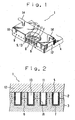
- Figure 1 is a perspective view of an ink jet printer head according to a first embodiment of the present invention.
- Figure 2 is a partial longitudinal sectional view of the ink jet printer head broken away in right-angled direction to longer direction of grooves.
- An ink jet printer head 1 has multi-layered piezoelectric member 4 formed by layered two piezoelectric members 2 and 3 (refer Figure 2 ) comprising from piezoelectric material like PZT (lead zirconate titanate). The polarization direction of the piezoelectric members 2 and 3 are reverse along thickness thereof.
- the multi-layered piezoelectric member 4 provides a plurality of grooves 5 opening toward upper and front surface of the multi layered piezoelectric member 4 in parallel. Grinding technology using dicing with a diamond wheel, which is used for IC wafer cutting, is uses for forming these grooves 5. Each grooves 5 is divided by a plurality of supports 6.
- the grooves 5 is determined in depth range of 0.2 - 1.0 mm (up-and-down direction in Figure 2 ), width range of 20 - 200 ⁇ m (right and left direction in Figure 2 ), and length range of 1 - 500 mm(right angled direction to the paper in Figure 2 ).
- the inner surface of the grooves 5 and the upper surface of the multi-layered piezoelectric member 4 provides a plurality of electrodes 7 forming by the electroless nickel plating method.
- nickel is used for the material forming the electrodes 7, but the present invention does not limit the material of the electrodes 7 to nickel.
- gold, copper or the like may be used as the material of the electrodes 7.
- the nozzle plate 10 has a thickness of 10 - 100 ⁇ m.
- the lid 12 provides an ink supply channel 15 as an ink channel at backside thereof.
- the ink supply channel 15 allows an ink tank (not shown) containing the ink to connect via a pair of ink supply pipes 14 for supplying each pressure chamber 13 (described below).
- the pressure chambers 13 are produced. Each pressure chamber 13 is connected to each other via the ink channel 15.
- the ink jet printer head 1 is connected to a controller (not shown) and a power source (not shown) via a flexible cable (not shown).
- driving pulse (voltage), printing data or the like is input into the ink jet printer head 1 via the flexible cable.
- the electricity flows through the ink filled in each pressure chamber 13 via the ink filled up in the ink channel 15.
- the electricity flowing through the ink may cause the ink to generate electrolysis so as to generate bubbles in the pressure chamber 13.
- the electricity flowing through the ink also may cause the electrodes 7 to precipitate the solid-state material by the electrophoresis. Consequently, the electrodes may not operate correctly.
- the ink jet printer head 1 in order to avoid above mentioned problem, provides the insulation layer 16 comprised from polyurea by vapour deposition polymerization method on the surface of the electrodes 7 contacting to the ink, that is, the inner surface of the pressure chambers 13.
- the vapour deposition polymerization method is defined as the method for forming the organic macromolecule material on the substrate by adding the monomer evaporated by thermal energy and activated thereby to the substrate for forming the layer so as to generate polymerization reaction on the substrate.
- the insulation layer 16 is formed by polyurea in the first embodiment of the present invention, but polyimide, polyimideamide, polyamide, or polyazomethine, for instance, may be used for forming the insulation layer 16.
- the insulation layer 16 is formed by using a vapour deposition polymerization apparatus 17 shown in Figure 3 in this embodiment.
- FIG. 3 is a block schematic diagram of the vapor deposition polymerization apparatus 17.
- the vapor deposition polymerization apparatus 17 has a chamber 19 containing a stage 18 for holding a sample (the piezoelectric member 2 and 3 on which the grooves 5 and the electrodes 7 are formed in this embodiment) that is intended to form a layer by using vapor deposition polymerization.
- the stage 18 provides a temperature control mechanism (not shown). The temperature of the sample can be kept in ordinary temperature (outside temperature) by the temperature control mechanism since the insulation layer 16 is comprised from polyerea.
- the chamber 19 contains inside temperature control mechanism (not shown) for controlling the inside temperature of the chamber 19.
- the inside temperature of the chamber 19 is kept in temperature range of ordinary temperature to 50 ° C since the insulation layer 16 is comprised from polyerea.
- the chamber 19 also provides a pressure reducing mechanism (not shown) for reducing the pressure in the chamber 19.
- the pressure reducing mechanism may be structured as the mechanism that compels the air in the chamber 19 to exhaust to outside of the chamber 19 with a fan or the like.
- a mixing tank 19 is provided on the chamber 19.
- the mixing tank 19 connects with the chamber 19 via a shower plate 21 having a plurality of holes.
- the vapor deposition polymerizing apparatus 17 provides a plurality of evaporation tanks 22 containing source monomer material for adding to the sample.
- Each evaporation tanks 22 contains 4, 4' diaminophenylmethane (MDA) and 4, 4' diphenylmethaneisocyanato as the source monomer material used for forming the insulation layer 16 comprised from polyurea.
- Each evaporation tanks 22 contains heating mechanism (not shown) for heating the source monomer material.
- Each evaporation tanks 22 connects with the mixing tank 20 via a plurality of monomer introduction pipes 23 respectively.
- Each monomer introduction pipes 23 provides a plurality of valves 24 being capable of opening and closing the monomer introduction pipes 23. The monomer introduction pipes 23 are kept in close by the valves 24 except when vapor deposition polymerization is executed.
- step for forming the insulation layer 16 will be explained.
- multi-layered piezoelectric member 4 the grooves 5 of which is formed the electrodes 7 is attached to the stage 18 so as to direct the upper surface on which the grooves 5 are formed toward upper direction. Portions not forming the insulation layer 16 like electrodes 7 to which the flexible cable will connect or the like should be masked previously.
- the evaporation tanks 22 are heated by using a heating mechanism.
- the heated source monomer material evaporates as vapor.
- the monomer introduction pipes 23 are opened after the source monomer was vaporized sufficiently.
- vaporized source monomer material is introduced into the mixing tank 20 via the monomer introduction pipes 23.
- Several kind of monomers are mixed in the mixing tank 20 so as to generate mixed monomer in the mixing tank 20.
- the pressure of the inside of the chamber 19 is reduced by using a pressure reducing mechanism.
- the inside pressure of the mixing tank 20 becomes different to the inside pressure of the chamber 19, so that the mixed monomer is introduced into the chamber via the shower plate 21.
- the mixing monomer introduced into the chamber 19 adds to the multi-layered piezoelectric member 4.
- the source monomer material added on the surface of the multi-layered piezoelectric member 4 begins to deposit to the surface of the multi-layered piezoelectric member 4 on condition that the temperature of the multi-layered piezoelectric member 4 and the inside of the chamber 19 are controlled. Then, the insulation layer 16 comprised from polyerea is formed on the surface of the multi-layered piezoelectric member 4.
- the materials desired to form as the layer is added to the substrate in unit of monomer so as to deposit on the substrate, so that the monomer molecule penetrates to the substrate satisfactorily even though the substrate has complicated form, and the insulation layer 16 can be formed uniformly to even fine portion regardless of shape of the substrate thereby.
- the insulation layer 16 is formed by using the vapor deposition polymerization method having high adhesion and throwing power, under finishing to the surface of the multi-layered piezoelectric member 4 can be eliminated.
- forming layer method other than the vapor deposition polymerization, requiring under finishing to the substrate has difficulties to process the under finishing to the substrate having complicated form like the ink jet printer head 1.
- embodiments of the present invention using the vapor deposition polymerization has advantage to be able to form the insulation layer 16 uniformly to even fine portion, and the operability and workability for forming the insulation layer 16 can be improved thereby.
- the ink jet printer head 1 is capable of using for a long time in steady without deterioration of the ink in case of using conductive ink like water ink.
- the polarization direction of the piezoelectric members 2 and 3 is set at right angle to the direction of the electric field generated by applying voltage to the piezoelectric members 2 and 3.
- the polarization property deteriorates by the over heat of the piezoelectric members 2 and 4, for instance.
- present embodiment introduces polyurea for the material of the insulation layer 16 being capable of beginning deposition in low temperature, so that the insulation layer 16 can be formed on the electrodes 7 in sufficient low temperature to the extent of not deteriorating the polarization property of the piezoelectric members 2 and 3. Accordingly, the ink jet printer head 1 using shear mode strain is capable of using for a long time in steady without deterioration of the piezoelectric member.
- the first embodiment of the present invention introduces the step for forming the insulation layer 16 before attaching the nozzle plate 10 and lid 12 to the multi-layered piezoelectric member 4. But, this step is not limited for manufacturing the ink jet printer head 1.
- the insulation layer 16 may be formed after attaching the nozzle plate 10 and lid 12 to the multi-layered piezoelectric member 4, under appreciation of high throwing power of the vapor deposition polymerization.
- This modified step can eliminate the masking operation to the portions not forming the insulation layer 16 like the portions forming electrode 7 or the like.
- the first embodiment of the present invention also introduces the step for forming the insulation layer 16 out of polyurea in order to prevent the deterioration with respect to the polarization property of the electrodes 2 and 3 caused by over heat.
- polyimide can be used for the material of the insulation layer 16 on condition that a method not causing the deterioration to the polarization property of the electrodes 2 and 3, for instance:
- a second embodiment of the present invention is now explained with reference to Figure 4 .
- the same parts as those in the first embodiment are designated by the same reference numerals, and are not again explained herein.
- the polarization direction of the piezoelectric member is different to the same of the first embodiment of the present invention.
- the piezoelectric member is polarized in right and left direction in Figure 4 .
- Figure 4 is a partial longitudinal sectional view of an ink jet printer head broken away in right-angled direction to longer direction of grooves according to a second embodiment of the present invention.
- the ink jet printer head 25 provides a piezoelectric member 27 layered on a substrate 26.
- a plurality of electrodes 28 is provided between the substrate 26 and the piezoelectric member 27.
- the substrate 26 and the piezoelectric member 27 are adhered via the electrodes 28 by conductive adhesive (not shown).
- the ink jet printer 25 provides a plurality of grooves 30 divided in parallel with certain interval by a plurality of supports 29 formed with the substrate 26 and the piezoelectric member 27. The upper and front of the grooves 30 is opened.
- the lid 32 closing upper openings 31 of the grooves 30.
- the lid 32 provides a common electrode 33 at a surface facing to the ink jet printer head 25.
- the lid 32 connects to the upper surface of the supports 29 via the common electrodes 33 by conductive adhesive (not shown).
- the lid 32 also provides an ink channel (not shown) for supplying ink to each pressure chambers 35.
- the front openings of the grooves 30 are closed by a nozzle plate 10 having a plurality of ink nozzles 9.
- the pressure chambers 35 are formed at the grooves 30 in condition of closing the upper openings 31 and the front openings of the grooves 30 with the lid 32 and the nozzle plate 10.
- an insulation layer 36 is formed on the surface of the electrodes 28 which contacts to the ink by using vapor deposition polymerization method before closing the upper openings 31 of the grooves 30 with the lid 32.
- the insulation layer 36 is formed on whole inner surface of the pressure chambers 35 because it can improve operability and workability for forming the insulation layer 36 as compared with a process to mask the portions other than the electrodes 28 in the pressure chamber 35.
- the insulation layer 36 covering the electrodes 28 prevents electricity to flow through the ink, so that the ink jet printer head 25 of the present invention is capable of using for a long time in steady without deterioration of the ink, producing bubbles in the ink or the like.
- the vapour deposition polymerization method may be executed in condition of closing the upper openings 31 with lid 32 so as to cover the electrodes 28 and common electrode 33 surely with the insulation layer 36.
- the insulating layer 36 covering not only the electrodes 28 but also common electrode 33 is able to prevent the electricity to flow through the ink surely.
- the insulation layer 36 may be formed before closing the front opening of the grooves 30 with the nozzle plate 10 or after closing the front opening of the grooves 30 with the nozzle plate 10.
- a third embodiment of the present invention is now explained with reference to Figure 6 .
- the same parts as those in the first and second embodiments are designated by the same reference numerals, and are not again explained herein.
- the polarization direction of the piezoelectric member is determined as one direction. This point is different to the first and second embodiments of the present invention.
- Such type of ink jet printer head will be called normal mode type hereinafter.
- Figure 6 is a partial horizontal sectional view of the ink jet printer head broken away along longer direction of grooves according to a third embodiment of the present invention.
- An ink jet printer head 37 arranges a plurality of multi-layered piezoelectric members 38 on a substrate 39 in certain interval. This arrangement produces a plurality of grooves 40 between the multi-layered piezoelectric members 38.
- the multi-layered piezoelectric members 38 operate as a plurality of supports.
- the grooves 40 are formed by the arrangement that the multi-layered piezoelectric members 38 formed as cubic form previously are disposed on the substrate 39. Thus, the grooves 40 are formed easily even though the multi-layered piezoelectric member 38 is used.
- Each multi-layered piezoelectric members 38 provides a pair of electrodes 41 at both side thereof (the right and left surfaces of the multi-layered piezoelectric member 38 in Figure 6 ). These electrodes 41 are connected with the controller (not shown) and the power source (not shown) for supplying voltage to each multi-layered piezoelectric members 38 via the flexible cable (not shown).
- a front opening 43 of the grooves 40 are closed with the nozzle plate 10 having a plurality of nozzles 9.
- the lid provides an ink channel (refer in Figure 1 ) for supplying ink to each pressure chamber 44 described below.
- the pressure chambers 44 are formed at the grooves 40 in condition of closing the grooves 40 with the nozzle plate 10, the fillers 42 and the lid.
- the pair of multi-layered piezoelectric members 38 corresponding to the electrodes 41 to which the voltage is applied deforms so as to increase the volume in the pressure chambers 44 and restores consequently so as to decrease the volume in the pressure chambers 44.
- Such restoration of the pair of multi-layered piezoelectric members 38 causes the ink in the pressure chambers 44 to be pressed so as to jet the ink from the nozzles 9 as ink drops.
- insulation layers 45 comprised from polyimide are formed on the surface of the multi-layered piezoelectric members 38 which contact to the ink by using vapour deposition polymerization method before closing the front openings 43 of the grooves 40 with the nozzle plate 10.
- the insulation layers 45 comprised from polyimide resin, are formed on the surface of the electrodes 41, which contacts to the ink, in this embodiment.
- the evaporation tank 22 (refer in Figure 3 ) contains pyromelliticdianhydride (PDMA) and 4, 4' diaminodiphenylether (ODA) as the source polymer material.
- PDMA pyromelliticdianhydride
- ODA 4' diaminodiphenylether
- the source monomer material is added to the surface of the substrate 39 on which the multi-layered piezoelectric members 38 and the fillers 42 are attached and masked at certain portion, in condition of keeping temperature of 170 - 230 ° C in the chamber.
- a macromolecule layer of amino acid is layered on the surface of the grooves 40.
- the macromolecule layer has hydrophilic amino acid in this state.
- the substrate 39 is heated in temperature of over 250 ° C so as to cause the amino acid to imidate.
- the inner surface of the grooves 40 is covered by polyimide resin layer.
- the present invention does not limited for causing the amino acid to imidiate.
- Imidiate can be progressed to the extent of obtaining satisfactory property as the ink jet printer head by increasing process time in temperature 220 ° C as compared with temperature 250 ° C, for instance.
- piezoelectric material the property of which is deteriorated in temperature 250 ° C but is not deteriorated in temperature 220 ° C, for instance, so that wide choice of the piezoelectric material being capable of applying to the ink jet printer head can be obtain.
- the insulation layer 45 covering the electrodes 41 prevents electricity to flow through the ink, so that the ink jet printer head 37 is capable of using for a long time in steady without deterioration of the ink, producing bubbles in the ink or the like.
- PZT may cause deterioration of the polarization in high temperature as mentioned above, and the piezoelectric property may be deteriorated thereby.
- the polarization can be executed after forming the insulation layers 45 by using electrodes for driving, for instance, even though the multi-layered piezoelectric member 38 was headed in temperature of over 250 ° C for imidate.
- the polarization can be executed again by using electrodes for driving, for instance, even though the polarization property of the multi-layered piezoelectric member 38 is deteriorated while the ink jet printer head 37 is manufactured.
- PZT not polarized previously can be polarized later by using electrodes for driving, for instance, if the polarization directions are same.
- productivity with respect to the normal mode ink jet printer head 37 being capable of polarizing after manufacturing can be improved. Further, since the cost of polyimide is low, using polyimide as the insulation layers 45 can decrease product cost for forming the insulation layers 45.
- the insulation layers 45 comprised from polyimide is applied for the normal mode ink jet printer head 37, but the present invention does not limit such structure.
- the insulation layer 45 can be formed from polyimide on condition that PZT having heat resistance not causing the deterioration in the forming temperature of the layer is used.
- the multi-layered piezoelectric members 38 of this embodiment has cubic shape, the insulation layers 45 can be easily formed to the individual multi-layered piezoelectric members 38 having the electrodes 41 using well known process thereby.
- the process requires arraying the multi-layered piezoelectric members 38 on which the insulation layers 45 have been formed. Thus, the process is complicated.
- the plurality of insulation layers 45 can be formed at the same time by using vapor deposition polymerization method after arraying the multi-layered piezoelectric members 38 on which the insulation layers 45 have been formed, so that the operation for forming the insulation layers 45 on the inside of the grooves 40 can be executed easily.
- This embodiment introduces to form the insulation layers 45 before attaching the nozzle plate 10 and the lid to the multi-layered piezoelectric members 38. But, the invention does not limit to form the insulation layers 45 by the process. Since the vapor deposition polymerization method contributes high throwing power, the insulation layers 45 may be formed after attaching the nozzle plate 10 and the lid.
- this embodiment introduces to form the insulation layers 45 from polyimide resin, but the present invention does not limit to form the insulation layers 45 from polyimide resin.
- the insulation layers 45 may be formed from polyurea, for instance.
- a fourth embodiment of the present invention is now explained with reference to Figure 7 .
- the same parts as those in the first, second and third embodiments are designated by the same reference numerals, and are not again explained herein.
- polarization direction of the multi-layered piezoelectric member is different to the third embodiment of the present invention.
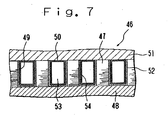
- Figure 7 is a partial longitudinal sectional view of an ink jet printer head broken away in right-angled direction to longer direction of grooves according to a fourth embodiment of the present invention.
- An ink jet printer head 46 arranges a plurality of multi-layered piezoelectric members 47 on a substrate 48 in certain interval. This arrangement produces a plurality of grooves 49 between the multi-layered piezoelectric members 47.
- the multi-layered piezoelectric members 47 operate as a plurality of supports.
- the grooves 49 are formed by the arrangement that the multi-layered piezoelectric members 47 formed as cubic form previously are disposed on the substrate 48. Thus, the grooves 49 are formed easily even though the multi-layered piezoelectric member 47 is used.
- lid 51 provides an ink channel (not shown but refer in Figure 1 ).
- the lid 51 of this embodiment has flexibility which deforms according to the deformation of the multi-layered piezoelectric member 47.
- a front opening of the grooves 49, as same to the first and second embodiment of the present invention, are closed with the nozzle plate 10 having a plurality of nozzles 9.
- pressure chambers 53 are formed at inside of the grooves 49 in condition of closing the grooves 49 with the nozzle plate 10, the fillers 42 and the lid.
- each pressure chamber 53 Inside of each pressure chambers 53 provides an electrode 52.
- the electrodes 52 are connected with the controller (not shown) and the power source (not shown) for supplying voltage to each multi-layered piezoelectric members 47 via the flexible cable (not shown).
- the pair of multi-layered piezoelectric members 47 corresponding to the electrodes 52 to which the voltage is applied deforms so as to increase the volume in the pressure chambers 53 and restores consequently so as to decrease the volume in the pressure chambers 53.
- Such restoration of the pair of multi-layered piezoelectric members 47 causes the ink in the pressure chambers 53 to be pressed so as to jet the ink from the nozzles 9 as ink drops.
- insulation layers 54 are formed on the surface of the electrodes 52 which contact to the ink by using vapor deposition polymerization method after closing the upper openings 50 of the grooves 49 with the lid 51.
- the insulation layers 54 comprised form polyimide resin, are formed on the surface of the electrodes 52 which contacts to the ink in this embodiment.
- the insulation layer 54 covering the electrodes 52 prevents electricity to flow through the ink, so that the ink jet printer head 46 of the present invention is capable of using for a long time in steady without deterioration of the ink, producing bubbles in the ink or the like.
- PZT may cause deterioration of the polarization in high temperature as mentioned above, and the piezoelectric property may be deteriorated thereby.
- the polarization can be executed after forming the insulation layers 54 by using electrodes for driving, for instance, even though the multi-layered piezoelectric member 47 was headed in temperature of over 250 ° C for imidate.
- the polarization can be executed again by using electrodes for driving, for instance, even though the polarization property of the multi-layered piezoelectric member 47 is deteriorated while the ink jet printer head 46 is manufactured.
- PZT not polarized previously can be polarized later by using electrodes for driving, for instance, if the polarization directions are same.
- productivity with respect to the normal mode ink jet printer head 46 being capable of polarizing after manufacturing can be improved. Further, since the cost of polyimide is low, using polyimide as the insulation layers 54 can decrease product cost for forming the insulation layers 54.
- the multi-layered piezoelectric members 47 of this embodiment has cubic shape, the insulation layers 54 can be easily formed to the individual multi-layered piezoelectric members 47 having the electrodes 52 using well known process thereby.
- the process requires arraying the multi-layered piezoelectric members 47 on which the insulation layers 54 have been formed. Thus, the process is complicated.
- the plurality of insulation layers 54 can be formed at the same time by using vapor deposition polymerization method after arraying the multi-layered piezoelectric members 47 on which the insulation layers 54 have been formed, so that the operation for forming the insulation layers 54 on the inside of the grooves 49 can be executed easily.
- This embodiment introduces to form the insulation layers 54 before attaching the lid 51 to the multi-layered piezoelectric members 47. But, the invention does not limit to form the insulation layers 54 by the process. Since the vapor deposition polymerization method contributes high throwing power, the insulation layers 54 may be formed after attaching the lid 51.
- this embodiment introduces to form the insulation layers 54 from polyimide resin, but the present invention does not limit to form the insulation layers 54 from polyimide resin.
- the insulation layers 54 may be formed from polyurea, for instance.
- a fifth embodiment of the present invention is now explained with reference to Figure 8 . Since ink jet printer head of this embodiment is difference to the first, second, third and fourth embodiment of the present invention, it is described together with process for manufacturing the same.
- the process requests forming a plurality of concave portions 57 on an upper surface of a piezoelectric member 56.
- Concavities 58 and convexity 59 are formed on the upper surface of the piezoelectric member 56 thereby as shown in Figure 8(B) .
- an electrode layer 60 is formed on the concavities 58 and the convexity 59 of the piezoelectric member 56 by using spattering or the like as shown in Figure 8(C) .
- the process requests cutting the electrode layer 60 and the upper portion of the piezoelectric member 56 between the concavities 58 and convexity 59 (step) so as to divide the concavities 58 and convexity 59 by narrow grooves 61.
- continued electrode layer 60 is divided so as to form a plurality of electrodes 62.
- a plurality of convex portions 63 is also formed in each concave portion 57.
- a plurality of electrodes 64 are formed on the bottom surface of the piezoelectric member 56 so as to corresponding to the electrodes 62 formed on the upper surface of the piezoelectric member 56. Explanation for forming the electrodes 62 is eliminated because it is well known, but the bottom surface of the piezoelectric member 56 is plane, the electrodes 64 having pattern corresponding to the electrodes 62 formed on the upper surface of the piezoelectric member 56 can be easily formed thereby.
- a lid 65 is attached to the upper surface of the piezoelectric member 56.
- a nozzle plate having nozzles (not shown) is also attached to the front surface of the piezoelectric member 56.
- a plurality of pressure chambers 66 is provided as shown in Figure 8(E) .
- the piezoelectric member 56 is grinded from the upper together with the lid 65, so that a plurality of dividing grooves 67 are formed which divides each convexity 59.
- a plurality of supports 68 is provided as shown in Figure 8(F) .
- reverse voltages are applied to the electrodes 62 provided at the supports 68 of the pressure chamber 66 which intends to jet the ink and the electrode 62 provided on the convex portion 63 of its pressure chamber 66 in condition of supplying ink into the pressure chambers 66.
- the supports 68 and the convex portion 63 corresponding to the electrodes 52 to which the voltage is applied deform so as to increase the volume in the pressure chambers 66 and restores consequently so as to decrease the volume in the pressure chambers 66.
- Such restoration of the supports 68 and the convex portion 63 causes the ink in the pressure chambers 66 to be pressed so as to jet the ink from the nozzle 9 as ink drop.
- a high electric field is generated on the bottom side of the piezoelectric member 56 (making shear mode complex) in case of setting electric potentials with respect to the electrodes 62 provided on the supports 68 and the electrode 62 provided on the convex portion 63 equal, so that the piezoelectric member 56 does not work desirably.
- an insulation layer 69 covering the electrodes 62 provided on the supports 68 and the electrode 62 provided on the convex portion 63 with polyimide resin is formed on inside of each pressure chamber 66 (refer in Figure 8(G) ).
- the insulation layer 69 is formed after attaching the lid 65 to the piezoelectric member 56 and before attaching the nozzle plate to the piezoelectric member 56.
- the insulation layer 69 covering the inside of the pressure chamber 66 prevents electricity to flow through the ink, so that the ink jet printer head 46 of the present invention is capable of using for a long time in steady without deterioration of the ink, producing bubbles in the ink or the like.
- the ink jet printer head 55 of this embodiment has complicated shape in inside of the pressure chamber 66, forming layer method by using vapour deposition polymerization method is especially effective. That is, the insulation layer 69 can be formed uniformly to the fine portion in the pressure chamber 66 by using vapour deposition polymerization method.
- insulation layer 69 may be formed before attaching the lid 65 to the piezoelectric member 56 or after attaching the lid 65 to the piezoelectric member 56.
- this embodiment introduces to form the insulation layers 54 from polyimide resin, but the present invention does not limit to form the insulation layers 54 from polyimide resin.
- the insulation layers 54 may be formed from polyurea, for instance.
- Figure 9 is a longitudinal sectional view of an ink jet printer head broken away along longer direction of grooves according to a sixth embodiment of the present invention.
- a substrate 73 formed a plurality of grooves 72 in parallel is attached to a base plate 71.
- the grooves 72 are formed so as to open both ends. One end of the grooves 72 is closed with a nozzle plate 74 having a plurality of nozzles 74a. At the other end of the grooves 72 a piezoelectric member 75 is inserted. Upper surface and bottom surface of the piezoelectric member 75 provides electrodes 76 respectively. The piezoelectric member 75 deforms longer direction of the grooves 72 (shown in arrow A in Figure 9 ) with applying voltage to the electrodes 76. The piezoelectric member 75 is adhered at rear portion of the grooves 72 by adhesive B.
- An upper opening 77 of the grooves 72 is closed with a lid 79 providing a supply nozzle 78.
- the supply nozzle 78 is connected with an ink tank (not shown) and an ink channel (not shown) for supplying ink to each pressure chambers 80 described below.
- the grooves 72, the nozzle plate 74, and the lid 79 form the pressure chambers 80.
- the piezoelectric member 75 In operation of the ink jet printer head 70, voltage is applied to the electrodes 76 provided on the piezoelectric member 75 which intends to jet the ink.
- the piezoelectric member 75 corresponding to the electrodes 76 to which the voltage is applied is expanded and contracted in its length direction. Since the piezoelectric members 75 are adhered to the substrate 73 by the adhesion B, The piezoelectric member 75 corresponding to the electrodes 76 to which the voltage is applied deforms toward right direction in Figure 9 so as to decrease the volume in the pressure chamber 80, the ink contained in the pressure chamber 80 jets as ink drop thereby.
- insulation layers 81 comprised form polyimide are formed on the surface of the piezoelectric members 75 having the electrodes 76. The insulation layers 81 are formed before closing one opening ends of the grooves 72.
- the insulation layer 81 covering the electrodes 76 prevents electricity to flow through the ink, so that the ink jet printer head 70 invention is capable of using for a long time in steady without deterioration of the ink, producing bubbles in the ink or the like.
- the piezoelectric members 75 of this embodiment have cubic shape, and the insulation layers 81 can be easily formed to the piezoelectric members 75 using well known process thereby. Especially, the insulation layers 81 can be formed at the same time by using vapor deposition polymerization method after fabricating the ink jet printer head 70, so that the operability and workability for forming the insulation layers 81 can be improved.
Landscapes
- Engineering & Computer Science (AREA)
- Manufacturing & Machinery (AREA)
- Particle Formation And Scattering Control In Inkjet Printers (AREA)
Applications Claiming Priority (2)
| Application Number | Priority Date | Filing Date | Title |
|---|---|---|---|
| JP2000191906 | 2000-06-26 | ||
| JP2000191906A JP2002001955A (ja) | 2000-06-26 | 2000-06-26 | インクジェットプリンタヘッドおよびその製造方法 |
Publications (2)
| Publication Number | Publication Date |
|---|---|
| EP1167040A1 EP1167040A1 (en) | 2002-01-02 |
| EP1167040B1 true EP1167040B1 (en) | 2008-02-20 |
Family
ID=18691120
Family Applications (1)
| Application Number | Title | Priority Date | Filing Date |
|---|---|---|---|
| EP01305445A Expired - Lifetime EP1167040B1 (en) | 2000-06-26 | 2001-06-22 | Ink jet printer head and method for manufacturing the same |
Country Status (4)
| Country | Link |
|---|---|
| US (1) | US6547374B2 (enExample) |
| EP (1) | EP1167040B1 (enExample) |
| JP (1) | JP2002001955A (enExample) |
| DE (1) | DE60132849T2 (enExample) |
Families Citing this family (5)
| Publication number | Priority date | Publication date | Assignee | Title |
|---|---|---|---|---|
| US7896630B2 (en) | 2006-12-11 | 2011-03-01 | Regi U.S., Inc. | Rotary device with reciprocating vanes and seals therefor |
| GB0919404D0 (en) | 2009-11-05 | 2009-12-23 | Xennia Technology Ltd | Inkjet printer |
| JP5606266B2 (ja) | 2010-10-26 | 2014-10-15 | 東芝テック株式会社 | インクジェットヘッド |
| CN103963468B (zh) * | 2014-05-21 | 2016-02-10 | 北京派和科技股份有限公司 | 压电喷墨头及包括该压电喷墨头的打印设备 |
| JP6598696B2 (ja) * | 2016-01-29 | 2019-10-30 | 東芝テック株式会社 | インクジェットヘッド及びインクジェットプリンタ |
Family Cites Families (7)
| Publication number | Priority date | Publication date | Assignee | Title |
|---|---|---|---|---|
| JPH0383017A (ja) * | 1989-08-28 | 1991-04-09 | Sharp Corp | 液晶表示装置の製造方法 |
| US6074048A (en) * | 1993-05-12 | 2000-06-13 | Minolta Co., Ltd. | Ink jet recording head including interengaging piezoelectric and non-piezoelectric members and method of manufacturing same |
| JPH0726023A (ja) * | 1993-07-14 | 1995-01-27 | Furukawa Electric Co Ltd:The | 有機高分子薄膜の作製方法 |
| JPH0852872A (ja) * | 1994-08-15 | 1996-02-27 | Citizen Watch Co Ltd | インクジェットヘッドおよびその製造方法 |
| JPH08290569A (ja) | 1995-04-24 | 1996-11-05 | Minolta Co Ltd | インクジェット記録装置 |
| US6808250B2 (en) * | 1997-01-10 | 2004-10-26 | Konica Corporation | Production method of ink-jet head |
| JP3414227B2 (ja) * | 1997-01-24 | 2003-06-09 | セイコーエプソン株式会社 | インクジェット式記録ヘッド |
-
2000
- 2000-06-26 JP JP2000191906A patent/JP2002001955A/ja active Pending
-
2001
- 2001-06-22 EP EP01305445A patent/EP1167040B1/en not_active Expired - Lifetime
- 2001-06-22 DE DE60132849T patent/DE60132849T2/de not_active Expired - Lifetime
- 2001-06-25 US US09/887,432 patent/US6547374B2/en not_active Expired - Lifetime
Also Published As
| Publication number | Publication date |
|---|---|
| DE60132849T2 (de) | 2009-02-12 |
| EP1167040A1 (en) | 2002-01-02 |
| JP2002001955A (ja) | 2002-01-08 |
| US20010055050A1 (en) | 2001-12-27 |
| US6547374B2 (en) | 2003-04-15 |
| DE60132849D1 (de) | 2008-04-03 |
Similar Documents
| Publication | Publication Date | Title |
|---|---|---|
| US5617127A (en) | Actuator having ceramic substrate with slit(s) and ink jet print head using the actuator | |
| US6290340B1 (en) | Multi-layer ink jet print head and manufacturing method therefor | |
| JP3106026B2 (ja) | 圧電/電歪アクチュエータ | |
| JP6949966B2 (ja) | 液滴吐出器 | |
| CN111788073B (zh) | 液滴喷射器 | |
| US5984447A (en) | L-shaped inkjet print head in which driving voltage is directly applied to driving electrodes | |
| US8905522B2 (en) | Ink-jet head and method of manufacturing ink-jet head | |
| JP2012096554A (ja) | インクジェット・プリンティングモジュール | |
| US20080034563A1 (en) | Manufacturing method of actuator device and liquid jet apparatus provided wirth actuator device formed by manufacturing method of the same | |
| US7497962B2 (en) | Method of manufacturing liquid discharge head and method of manufacturing substrate for liquid discharge head | |
| EP1167040B1 (en) | Ink jet printer head and method for manufacturing the same | |
| JP4021687B2 (ja) | インクジェットプリンタヘッドの製造方法 | |
| US6351879B1 (en) | Method of making a printing apparatus | |
| JP4287278B2 (ja) | 低電圧インクジェット・プリント・モジュール | |
| WO1994001284A1 (fr) | Tete a jet d'encre | |
| US6767083B2 (en) | Fluid ejection device with drop volume modulation capabilities | |
| EP1958777B1 (en) | Method of manufacturing piezoelectric actuator and method of manufacturing liquid transporting apparatus | |
| US4449134A (en) | Composite ink jet drivers | |
| JP2003266691A (ja) | インクジェットプリンタヘッドおよびその製造方法 | |
| JP3117340B2 (ja) | インクジェットプリントヘッド | |
| US5980027A (en) | Ink jet print head including adhesive layers enabling optimal electrode coverage and ink droplet velocity | |
| US9028050B2 (en) | Flow path unit, liquid ejecting head, liquid ejecting apparatus, and method of manufacturing flow path unit | |
| US20240399745A1 (en) | Liquid discharge head and liquid discharge apparatus | |
| JP3414905B2 (ja) | 記録ヘッド | |
| JP2002307692A (ja) | インクジェットヘッド及びその製造方法 |
Legal Events
| Date | Code | Title | Description |
|---|---|---|---|
| PUAI | Public reference made under article 153(3) epc to a published international application that has entered the european phase |
Free format text: ORIGINAL CODE: 0009012 |
|
| 17P | Request for examination filed |
Effective date: 20010705 |
|
| AK | Designated contracting states |
Kind code of ref document: A1 Designated state(s): BE CH DE FR GB LI Kind code of ref document: A1 Designated state(s): AT BE CH CY DE DK ES FI FR GB GR IE IT LI LU MC NL PT SE TR |
|
| AX | Request for extension of the european patent |
Free format text: AL;LT;LV;MK;RO;SI |
|
| AKX | Designation fees paid |
Free format text: BE CH DE FR GB LI |
|
| 17Q | First examination report despatched |
Effective date: 20030910 |
|
| GRAP | Despatch of communication of intention to grant a patent |
Free format text: ORIGINAL CODE: EPIDOSNIGR1 |
|
| GRAS | Grant fee paid |
Free format text: ORIGINAL CODE: EPIDOSNIGR3 |
|
| GRAA | (expected) grant |
Free format text: ORIGINAL CODE: 0009210 |
|
| AK | Designated contracting states |
Kind code of ref document: B1 Designated state(s): BE CH DE FR GB LI |
|
| REG | Reference to a national code |
Ref country code: GB Ref legal event code: FG4D |
|
| REG | Reference to a national code |
Ref country code: CH Ref legal event code: EP |
|
| REF | Corresponds to: |
Ref document number: 60132849 Country of ref document: DE Date of ref document: 20080403 Kind code of ref document: P |
|
| PG25 | Lapsed in a contracting state [announced via postgrant information from national office to epo] |
Ref country code: BE Free format text: LAPSE BECAUSE OF FAILURE TO SUBMIT A TRANSLATION OF THE DESCRIPTION OR TO PAY THE FEE WITHIN THE PRESCRIBED TIME-LIMIT Effective date: 20080220 |
|
| PGFP | Annual fee paid to national office [announced via postgrant information from national office to epo] |
Ref country code: CH Payment date: 20080710 Year of fee payment: 8 |
|
| ET | Fr: translation filed | ||
| PLBE | No opposition filed within time limit |
Free format text: ORIGINAL CODE: 0009261 |
|
| STAA | Information on the status of an ep patent application or granted ep patent |
Free format text: STATUS: NO OPPOSITION FILED WITHIN TIME LIMIT |
|
| 26N | No opposition filed |
Effective date: 20081121 |
|
| REG | Reference to a national code |
Ref country code: CH Ref legal event code: PL |
|
| PG25 | Lapsed in a contracting state [announced via postgrant information from national office to epo] |
Ref country code: LI Free format text: LAPSE BECAUSE OF NON-PAYMENT OF DUE FEES Effective date: 20090630 Ref country code: CH Free format text: LAPSE BECAUSE OF NON-PAYMENT OF DUE FEES Effective date: 20090630 |
|
| PGFP | Annual fee paid to national office [announced via postgrant information from national office to epo] |
Ref country code: FR Payment date: 20100709 Year of fee payment: 10 |
|
| REG | Reference to a national code |
Ref country code: FR Ref legal event code: ST Effective date: 20120229 |
|
| PG25 | Lapsed in a contracting state [announced via postgrant information from national office to epo] |
Ref country code: FR Free format text: LAPSE BECAUSE OF NON-PAYMENT OF DUE FEES Effective date: 20110630 |
|
| PGFP | Annual fee paid to national office [announced via postgrant information from national office to epo] |
Ref country code: GB Payment date: 20130619 Year of fee payment: 13 Ref country code: DE Payment date: 20130619 Year of fee payment: 13 |
|
| REG | Reference to a national code |
Ref country code: DE Ref legal event code: R119 Ref document number: 60132849 Country of ref document: DE |
|
| GBPC | Gb: european patent ceased through non-payment of renewal fee |
Effective date: 20140622 |
|
| REG | Reference to a national code |
Ref country code: DE Ref legal event code: R119 Ref document number: 60132849 Country of ref document: DE Effective date: 20150101 |
|
| PG25 | Lapsed in a contracting state [announced via postgrant information from national office to epo] |
Ref country code: DE Free format text: LAPSE BECAUSE OF NON-PAYMENT OF DUE FEES Effective date: 20150101 |
|
| PG25 | Lapsed in a contracting state [announced via postgrant information from national office to epo] |
Ref country code: GB Free format text: LAPSE BECAUSE OF NON-PAYMENT OF DUE FEES Effective date: 20140622 |