EP1165683B1 - Verfahren zur reduzierung des staubverhaltens von silikaten - Google Patents
Verfahren zur reduzierung des staubverhaltens von silikaten Download PDFInfo
- Publication number
- EP1165683B1 EP1165683B1 EP00912513A EP00912513A EP1165683B1 EP 1165683 B1 EP1165683 B1 EP 1165683B1 EP 00912513 A EP00912513 A EP 00912513A EP 00912513 A EP00912513 A EP 00912513A EP 1165683 B1 EP1165683 B1 EP 1165683B1
- Authority
- EP
- European Patent Office
- Prior art keywords
- silicate
- wollastonite
- dust
- polysiloxane
- polyether copolymer
- Prior art date
- Legal status (The legal status is an assumption and is not a legal conclusion. Google has not performed a legal analysis and makes no representation as to the accuracy of the status listed.)
- Expired - Lifetime
Links
- 239000000428 dust Substances 0.000 title claims abstract description 47
- 238000000034 method Methods 0.000 title claims abstract description 15
- 150000004760 silicates Chemical class 0.000 title claims abstract description 10
- BPQQTUXANYXVAA-UHFFFAOYSA-N Orthosilicate Chemical compound [O-][Si]([O-])([O-])[O-] BPQQTUXANYXVAA-UHFFFAOYSA-N 0.000 claims abstract description 30
- 239000004033 plastic Substances 0.000 claims abstract description 27
- 229920003023 plastic Polymers 0.000 claims abstract description 27
- 239000000463 material Substances 0.000 claims abstract description 22
- 239000012763 reinforcing filler Substances 0.000 claims abstract description 12
- 239000010456 wollastonite Substances 0.000 claims description 58
- 229910052882 wollastonite Inorganic materials 0.000 claims description 58
- 239000004721 Polyphenylene oxide Substances 0.000 claims description 21
- 229920000570 polyether Polymers 0.000 claims description 21
- 238000000576 coating method Methods 0.000 claims description 15
- 239000011248 coating agent Substances 0.000 claims description 14
- 239000004743 Polypropylene Substances 0.000 claims description 5
- 235000012241 calcium silicate Nutrition 0.000 claims description 5
- -1 polypropylene Polymers 0.000 claims description 5
- 229920001155 polypropylene Polymers 0.000 claims description 5
- 229910052918 calcium silicate Inorganic materials 0.000 claims description 4
- OYACROKNLOSFPA-UHFFFAOYSA-N calcium;dioxido(oxo)silane Chemical compound [Ca+2].[O-][Si]([O-])=O OYACROKNLOSFPA-UHFFFAOYSA-N 0.000 claims description 4
- 229920002635 polyurethane Polymers 0.000 claims description 4
- 239000004814 polyurethane Substances 0.000 claims description 4
- 239000004952 Polyamide Substances 0.000 claims description 3
- 229920002647 polyamide Polymers 0.000 claims description 3
- 230000009467 reduction Effects 0.000 abstract description 8
- 239000000047 product Substances 0.000 description 23
- 238000005259 measurement Methods 0.000 description 11
- FZHAPNGMFPVSLP-UHFFFAOYSA-N silanamine Chemical compound [SiH3]N FZHAPNGMFPVSLP-UHFFFAOYSA-N 0.000 description 9
- 238000001157 Fourier transform infrared spectrum Methods 0.000 description 6
- 239000000945 filler Substances 0.000 description 6
- PEDCQBHIVMGVHV-UHFFFAOYSA-N Glycerine Chemical compound OCC(O)CO PEDCQBHIVMGVHV-UHFFFAOYSA-N 0.000 description 5
- 239000000654 additive Substances 0.000 description 5
- 230000000996 additive effect Effects 0.000 description 5
- 239000012530 fluid Substances 0.000 description 5
- 238000002156 mixing Methods 0.000 description 5
- 239000002245 particle Substances 0.000 description 5
- 239000002994 raw material Substances 0.000 description 5
- 150000004756 silanes Chemical class 0.000 description 5
- 241000196324 Embryophyta Species 0.000 description 4
- 238000001914 filtration Methods 0.000 description 4
- 238000000227 grinding Methods 0.000 description 4
- 238000004519 manufacturing process Methods 0.000 description 4
- 230000003014 reinforcing effect Effects 0.000 description 4
- XLYOFNOQVPJJNP-UHFFFAOYSA-N water Substances O XLYOFNOQVPJJNP-UHFFFAOYSA-N 0.000 description 4
- 238000010521 absorption reaction Methods 0.000 description 3
- 150000001343 alkyl silanes Chemical class 0.000 description 3
- 230000000052 comparative effect Effects 0.000 description 3
- 238000011156 evaluation Methods 0.000 description 3
- 230000010354 integration Effects 0.000 description 3
- 238000012360 testing method Methods 0.000 description 3
- 238000005303 weighing Methods 0.000 description 3
- 230000005540 biological transmission Effects 0.000 description 2
- 239000011575 calcium Substances 0.000 description 2
- 239000007795 chemical reaction product Substances 0.000 description 2
- 238000011161 development Methods 0.000 description 2
- 238000001035 drying Methods 0.000 description 2
- 229920001971 elastomer Polymers 0.000 description 2
- 238000005516 engineering process Methods 0.000 description 2
- 238000002474 experimental method Methods 0.000 description 2
- 235000011187 glycerol Nutrition 0.000 description 2
- 238000010438 heat treatment Methods 0.000 description 2
- 239000000203 mixture Substances 0.000 description 2
- 238000010137 moulding (plastic) Methods 0.000 description 2
- 229920005862 polyol Polymers 0.000 description 2
- 150000003077 polyols Chemical class 0.000 description 2
- 239000000523 sample Substances 0.000 description 2
- NFDXQGNDWIPXQL-UHFFFAOYSA-N 1-cyclooctyldiazocane Chemical compound C1CCCCCCC1N1NCCCCCC1 NFDXQGNDWIPXQL-UHFFFAOYSA-N 0.000 description 1
- UPMLOUAZCHDJJD-UHFFFAOYSA-N 4,4'-Diphenylmethane Diisocyanate Chemical compound C1=CC(N=C=O)=CC=C1CC1=CC=C(N=C=O)C=C1 UPMLOUAZCHDJJD-UHFFFAOYSA-N 0.000 description 1
- 229910052580 B4C Inorganic materials 0.000 description 1
- 240000007817 Olea europaea Species 0.000 description 1
- 229910004283 SiO 4 Inorganic materials 0.000 description 1
- BLRPTPMANUNPDV-UHFFFAOYSA-N Silane Chemical compound [SiH4] BLRPTPMANUNPDV-UHFFFAOYSA-N 0.000 description 1
- UKLDJPRMSDWDSL-UHFFFAOYSA-L [dibutyl(dodecanoyloxy)stannyl] dodecanoate Chemical compound CCCCCCCCCCCC(=O)O[Sn](CCCC)(CCCC)OC(=O)CCCCCCCCCCC UKLDJPRMSDWDSL-UHFFFAOYSA-L 0.000 description 1
- 238000004458 analytical method Methods 0.000 description 1
- TZCXTZWJZNENPQ-UHFFFAOYSA-L barium sulfate Chemical compound [Ba+2].[O-]S([O-])(=O)=O TZCXTZWJZNENPQ-UHFFFAOYSA-L 0.000 description 1
- 238000005452 bending Methods 0.000 description 1
- 230000015572 biosynthetic process Effects 0.000 description 1
- INAHAJYZKVIDIZ-UHFFFAOYSA-N boron carbide Chemical compound B12B3B4C32B41 INAHAJYZKVIDIZ-UHFFFAOYSA-N 0.000 description 1
- 239000000378 calcium silicate Substances 0.000 description 1
- 239000000919 ceramic Substances 0.000 description 1
- 239000003795 chemical substances by application Substances 0.000 description 1
- 238000004140 cleaning Methods 0.000 description 1
- 239000011362 coarse particle Substances 0.000 description 1
- 230000002860 competitive effect Effects 0.000 description 1
- 239000002131 composite material Substances 0.000 description 1
- 150000001875 compounds Chemical class 0.000 description 1
- 238000001816 cooling Methods 0.000 description 1
- 239000012973 diazabicyclooctane Substances 0.000 description 1
- 239000012975 dibutyltin dilaurate Substances 0.000 description 1
- 230000000694 effects Effects 0.000 description 1
- 239000000806 elastomer Substances 0.000 description 1
- 239000002657 fibrous material Substances 0.000 description 1
- 239000011521 glass Substances 0.000 description 1
- 239000003365 glass fiber Substances 0.000 description 1
- 238000010348 incorporation Methods 0.000 description 1
- 238000002347 injection Methods 0.000 description 1
- 239000007924 injection Substances 0.000 description 1
- 238000011835 investigation Methods 0.000 description 1
- 150000002500 ions Chemical class 0.000 description 1
- 238000000053 physical method Methods 0.000 description 1
- 229920000642 polymer Polymers 0.000 description 1
- 229920005606 polypropylene copolymer Polymers 0.000 description 1
- 229910052573 porcelain Inorganic materials 0.000 description 1
- 239000000843 powder Substances 0.000 description 1
- 238000003825 pressing Methods 0.000 description 1
- 239000002990 reinforced plastic Substances 0.000 description 1
- 239000005060 rubber Substances 0.000 description 1
- 239000013049 sediment Substances 0.000 description 1
- 238000000926 separation method Methods 0.000 description 1
- 229910000077 silane Inorganic materials 0.000 description 1
- 239000003381 stabilizer Substances 0.000 description 1
- 239000000126 substance Substances 0.000 description 1
- PQDJYEQOELDLCP-UHFFFAOYSA-N trimethylsilane Chemical compound C[SiH](C)C PQDJYEQOELDLCP-UHFFFAOYSA-N 0.000 description 1
- 238000011144 upstream manufacturing Methods 0.000 description 1
- UKRDPEFKFJNXQM-UHFFFAOYSA-N vinylsilane Chemical compound [SiH3]C=C UKRDPEFKFJNXQM-UHFFFAOYSA-N 0.000 description 1
Images



Classifications
-
- C—CHEMISTRY; METALLURGY
- C08—ORGANIC MACROMOLECULAR COMPOUNDS; THEIR PREPARATION OR CHEMICAL WORKING-UP; COMPOSITIONS BASED THEREON
- C08K—Use of inorganic or non-macromolecular organic substances as compounding ingredients
- C08K9/00—Use of pretreated ingredients
- C08K9/08—Ingredients agglomerated by treatment with a binding agent
-
- C—CHEMISTRY; METALLURGY
- C01—INORGANIC CHEMISTRY
- C01B—NON-METALLIC ELEMENTS; COMPOUNDS THEREOF; METALLOIDS OR COMPOUNDS THEREOF NOT COVERED BY SUBCLASS C01C
- C01B33/00—Silicon; Compounds thereof
- C01B33/20—Silicates
-
- C—CHEMISTRY; METALLURGY
- C01—INORGANIC CHEMISTRY
- C01B—NON-METALLIC ELEMENTS; COMPOUNDS THEREOF; METALLOIDS OR COMPOUNDS THEREOF NOT COVERED BY SUBCLASS C01C
- C01B33/00—Silicon; Compounds thereof
- C01B33/20—Silicates
- C01B33/24—Alkaline-earth metal silicates
Definitions
- the invention relates to a method for reducing the dust behavior of silicates.
- Another object of the invention is a silicate with reduced Dust behavior.
- Silicates in particular acicular silicates such as wollastonite Chain silicate, are used as reinforcing fillers for plastic applications.
- Wollastonite is a natural calcium silicate of the formula Ca 3 [Si 3 O 9 ].
- Monoclinic wollastonite consists of SiO 4 tetrahedra, which are connected in an arrangement of triple chains of the formula [Si 3 O 9 ] 6- : The individual chains are connected to one another by Ca 2+ ions. This explains why the wollastonite particles can have an acicular structure.
- Wollastonite also has advantageous material properties. This includes, for example the lack of chemically bound water found in others water-containing silicates leads to the fact that the structure when heated Water loss changed. This would do so in the case of incorporation into plastics lead that a reinforcing effect would no longer be achieved. Additional advantages the low degree of shrinkage when drying and heating is a very low expansion coefficient and good mechanical properties of the manufactured Plastic products containing wollastonite. In addition to the application as Additive for plastics, wollastonite is also used for the production of ceramic Products, sanitary ware and porcelain.
- the present invention relates primarily to the use of wollastonite in Plastics.
- the wollastonite is produced as a filler by grinding the obtained Wollastonites with subsequent wind sifting. You then get needle-shaped Wollastonite particles that are either incorporated directly into the plastic mixture or in the form of polymeric premixes in proportions of 10 to 40 % By weight wollastonite can be incorporated into the plastics. Because of the needle-shaped The structure of wollastonite achieves a significant improvement in mechanical properties in plastic and in those made from it Plastic moldings.
- wollastonite is often used with silane compounds coated for better integration into the plastic material to achieve.
- surface coatings with aminosilane, Epoxysilane, methacryisilane, trimethylsilane, vinylsilane or alkylsilane are often used with silane compounds coated for better integration into the plastic material to achieve.
- the technical object of the invention was therefore to provide a simple method for Reduction of the dust behavior of silicates, especially wollastonite to make available that can be carried out as cost-effectively as possible and at a cost considerable reduction in the dust behavior of wollastonite. leads.
- the surface coating a polysiloxane-polyether copolymer in an amount of 0.1 to 4 % By weight, particularly preferably 0.5 to 1.5% by weight.
- polysiloxane-polyether copolymer can be used the dust behavior of silicates, especially calcium metasilicates and most preferably reduce wollastonites.
- Another object of the invention is a silicate with reduced dust behavior, which is surface-coated with a polysiloxane-polyether copolymer, has a Heubach dust content of 500 to 1200 mg / 100 g and the silicate has a specific surface area measured according to DIN 66132-BET of 0.5 to 1.5 m 2 / g.
- the silicate is preferably a calcium metasilicate, particularly preferred around a wollastonite.
- the silicate is preferably 0.1 to 4 % By weight, particularly preferably 0.5 to 1.5% by weight, of polysiloxane-polyether copolymer devistlächenbe Anlagenet.
- the silicate is used as a reinforcing filler Plastics, especially polyurethane, polyamide and polypropylene, are used.
- the silicate is produced by grinding the wollastonite on an appropriate one Crushing plant such as a counter jet impact grinding plant. The shredded finished product is then from the shredding plant removed and in a fluid mixer with the polysiloxane-polyether copolymer surface-coated. This coating takes place at temperatures between 40 and 100 ° C due to frictional heat. After coating it will Material cooled to room temperature.
- the end product obtained is a low-dust one coated wollastonite with the above properties. '
- This material is preferably used as a reinforcing filler in plastics and here leads to an improvement in the mechanical properties, in particular tensile strength and stiffening of the composite. Especially it is preferably used as a reinforcing filler in plastics from the group polyurethane, polyamide, polypropylene.
- a reinforcing filler in plastics from the group polyurethane, polyamide, polypropylene.
- There are other advantages in a high throughput on the extruder due to good dispersibility and high thermal conductivity of the material, less shrinkage and higher Dimensional accuracy of the wollastonite-containing polymer premix by reduction of the linear expansion coefficient.
- the one with the material as reinforcing Plastic parts made of filler have an excellent surface quality due to the finely divided needle structure of the material. Farther the heat resistance is improved and the tendency to creep is reduced.
- the use of the reinforcing fillers also increases the Surface hardness of the premix, due to the hardness of the filler, with
- the speed of the mixing tools is 1200 rpm.
- the fluid mixer is double-walled and makes it possible Setting certain temperature profiles regardless of the frictional heat through indirect heating with hot water or steam. That in Wollastonite set temperature profile reaches 80 ° C.
- the coated wollastonite with a material temperature of 80 ° C in a double-walled cooling mixer Cooled at room temperature.
- the mixing tools are comparable to the mixing tools of the fluid mixer.
- the speed is 140 rpm.
- the end product obtained is a low-dust, coated wollastonite.
- Figure 1 shows an FTIR spectrum of the product obtained as a compact.
- the figure shows the transmissions in% as a function of the wave number in cm -1 .
- the vibration bands are characteristic of the wollastonite system coated with polyosiloxane-polyether copolymer.
- FIG. 2 shows a further FTIR spectrum of the product obtained.
- the evaluation was carried out as a representation of the absorption as a function of the wave number in cm -1 . Only the wavenumber from 2,400 to 3,600 was recorded and the raw material wollastonite from the FTIR spectrum was mathematically subtracted within the scope of the present analysis.
- FIG. 2 shows only the vibration bands of the surface coating, namely the polyorganosiloxane on the surface of wollastonite, in particular in the range from 2,800 to 3,100 wave numbers. The CH vibrations are particularly typical in this wave number range.
- the image thus obtained is therefore a characteristic fingerprint for the surface additive and describes the special structure of the polyosiloxane-polyether copolymer used.
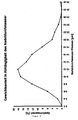
- Figures 3, 4 and 5 characterize the product obtained. regarding the needle length (Figure 3), the needle diameter ( Figure 4) and the average L / D ratio (Length-diameter), depending on the length of the needle (fig 5).
- the suction pipe with hose olive is screwed firmly onto the threaded connector, the stabilizer tube is placed on the pin, fixed with the clamp and the foot attached to the pipe ends.
- the short tripod poles can be used on everyone Location of the boom can be fixed. With the help of the double sleeve and the tripod clamp the desired structure is created.
- the substance to be tested is in motion in the rotating dust generation vessel held.
- the dust is caught by an axially entering air stream and passes a coarse cutter made of glass, in which coarse, non-airborne particles sediment.
- the dust remaining in the air flow is separated on a filter.
- the air pressure required for the test is generated by a vacuum pressure pump; The air volume is measured on the pressure side.
- One unit of the counter corresponds to 0.1 I, i.e. H. for z. B. 100 I air are on Preselect the setpoint adjuster of the four-digit counter "1000". That with filter paper The occupied luff filtration vessel is connected to the pump, the needle valve fully open on the flow meter, power switch actuated, selector switch disengaged (Automatic mode), preselected on the setpoint adjuster 20 I ("0200"). After pressing the "Start” button starts the pump and switches automatically after 20 l from. The needle valve on the pump is closed or opened until the preselected 20 l in exactly 1 min. be promoted. All other measurements now take place with a flow of 20 l air / min.
- the weighed test material is placed in the dust development vessel; ever according to bulk density 25 g, 50 g or 100 g. Up to a bulk density of 0.5 g / ml the weight should be 25 g or 50 g, above 100 g.
- the air filtration vessel covered with filter paper is weighed out (m 1 ).
- the desired air volume is preselected on the four-digit digital setpoint adjuster.
- press the "Start” button and start up both the geared motor and the pump When the preselected air volume is reached, both are automatically stopped. Weighing the filtration vessel again gives m 2 .
- the rubber stopper remaining on the filter should be cleaned with cleaning paper on the outside before weighing.
- the air flowing through the measuring device is always passed through an upstream drying tower in order to eliminate the influence of atmospheric moisture on the development of dust.
- the dust number "s" corresponds to that of 100 g test material under the standardized conditions developed amount of dust in mg.
- Table 1 shows the dust number in mg / 100 g. material Dustiness number [mg / 100 g] Wollastonite according to Example 1 700 Wollastonite without additive 1200 Wollastonite with aminosilane 1500
- polyether 64.4 parts by weight of glycerol / 85 PO / 15 EO, OHZ 35 diethyltoluylenediamine 35 parts by weight diazabicyclooctane 0.5 part by weight dibutyltindilaurate 0.1 part by weight
- polyether Glycerin / 85 PO / 15 EO, OHZ 35 diphenylmethane - 4,4'-diisocyanate NCO content 18%
- the mixing ratio was 100 parts by weight of polyol and 107 parts by weight of semi-prepolymer and 20 parts by weight of wollastonite in the elastomer.
- a plastic molded part was injection molded from the plastic thus produced and its mechanical properties were examined.
- the table shows that the mechanical properties of the plastic, in which the wollastonite is used according to Example 1, compared to the mechanical properties of conventional reinforced plastics are.
- a polypropylene copolymer is produced with a proportion of 20% by weight wollastonite according to Example 1 and with a comparison product, namely wollastonite, coated with alkylsilane.
- a plastic molded part is produced from this material and its mechanical properties are determined.
- the table shows that the mechanical properties of the plastic, in which wollastonite is used according to Example 1, compared to conventional reinforced polypropylene.
Landscapes
- Chemical & Material Sciences (AREA)
- Organic Chemistry (AREA)
- Inorganic Chemistry (AREA)
- General Life Sciences & Earth Sciences (AREA)
- Chemical Kinetics & Catalysis (AREA)
- Medicinal Chemistry (AREA)
- Polymers & Plastics (AREA)
- Life Sciences & Earth Sciences (AREA)
- Health & Medical Sciences (AREA)
- Geology (AREA)
- Compositions Of Macromolecular Compounds (AREA)
- Silicates, Zeolites, And Molecular Sieves (AREA)
- Pigments, Carbon Blacks, Or Wood Stains (AREA)
- Disintegrating Or Milling (AREA)
- Detergent Compositions (AREA)
- Silicon Compounds (AREA)
Description
- Fig 1
- zeigt ein FTIR-Spektrum des erhaltenen Produktes als Pressling. Die Figur zeigt die Transmissionen in % in Abhängigkeit von der Wellenzahl in cm-1.
- Fig. 2
- zeigt ein weiteres FTIR-Spektrum des erhaltenen Produktes. Die Auswertung erfolgt als Darstellung der Absorption in Abhängigkeit von der Wellenzahl in cm-1. Der Rohstoff Wollastonit wurde aus dem FTIR-Spektrum mathematisch subtrahiert.
- Fig. 3
- zeigt den Gewichtsanteil des erfindungsgemäßen Produktes in Abhängigkeit von der Nadellänge. Dabei ist die Nadellänge in Nadellängenklassen in µm angegeben.
- Fig. 4
- zeigt den Gewichtsanteil des erfindungsgemäßen Produktes in Abhängigkeit des Nadeldurchmessers. Der Nadeldurchmesser wird in Nadeldurchmesserklassen in µm angegeben.
- Fig. 5
- zeigt schließlich das mittlere Länge-Durchmesser-Verhältnis des erfindungsgemäßen Produktes in Abhängigkeit von der Nadellänge. Die Nadellänge ist in Nadellängenklassen in µm angegeben.
- 1. Staubmessung mit dem Dustmeter nach Heubach
Für die Untersuchung wird ein Heubach-Dustmeter, eine Analysenwaage
sowie ein Filter GF 92 (S + S) eingesetzt. Das Meßgerät besteht aus Basisgerät
mit Luftmessung (Volumen, Temperatur, Antriebsmotor, Vakuumdruckpumpe).
Es enthält Ausleger mit
- Haltern für Aufbauten
- Staubentwicklungsgefäß
- Grobabscheider
- Luftfiltrationsgefäß
| Luftvolumen | 20 l/min. |
| Meßdauer | 5 min. |
| Einwaage | 50 g |
| Filter | GF 92, Schleicher & Schüll |
| Material | Staubungszahl [mg/100 g] |
| Wollastonit nach Beispiel 1 | 700 |
| Wollastonit ohne Additiv | 1.200 |
| Wollastonit mit Aminosilan | 1.500 |
| Material | spez. Oberfläche [m2/g] |
| Wollastonit nach Beispiel 1 | 0,8 |
| Wollastonit mit Aminosilan | 1,2 |
| Polyether | 64,4 Gew.TI Glycerin / 85 PO /15 EO, OHZ = 35 |
| Diethyltoluylendiamin | 35 Gew.TI |
| Diazabicyclooctan | 0,5 Gew.TI |
| Dibutylzinndilaurat | 0,1 Gew.TI |
| Polyether | Glycerin / 85 PO /15 EO , OHZ = 35 |
| Diphenylmethan | - 4,4'- diisocyanat |
| NCO-Gehalt | 18 % |
| Wollastonit mit Aminosilan | Wollastonit nach Beispiel 1 | |
| Shore D Härte nach DIN 53505 | 63 | 64 |
| Zugfestigkeit nach DIN 53455 | 25 | 25 |
| Bruchdehnung in % nach DIN 53455 | 100 | 130 |
| Biege-E-Modul (Mpa) nach DIN 53457 | 1.600 | 1.800 |
| Schwindung in % nach DIN 53464 | 0,5 | 0,4 |
| Wollastonit mit Alkylsilan | Wollastonit nach Beispiel 1 | |
| Zugfestigkeit (MPa) DIN 53455 | 18,4 | 19,1 |
| Reißdehnung (%) DIN 53455 | 30,4 | 17,9 |
| E-Modul (Gpa) DIN 53457 | 2,266 | 2,233 |
| Schlagzähigkeit (Izod) (kJ/m2) | ||
| ohne Kerbe, Iso 180 | 50,4 | 89,0 |
| mit Kerbe, Iso 180 | 19,0 | 23,5 |
| Formbeständigkeit in der Wärme HDT-B (°C) DIN 53461 | 123 | 115 |
Claims (12)
- Verfahren zur Reduzierung des Staubverhaltens von Silikate, wobei das zerkleinerte Silikat mit einem Polysiloxan-Polyether-Copolymer oberflächenbeschichtet wird.
- Verfahren nach Anspruch 1, dadurch gekennzeichnet, daß für die Beschichtung 0,1 bis 4 Gew.-% Polysiloxan-Polyether-Copolymer eingesetzt werden.
- Verfahren nach Anspruch 1 oder 2, dadurch gekennzeichnet, daß für die Beschichtung 0,5 bis 1,5 Gew.-% Polysiloxan-Polyether-Copolymer eingesetzt werden.
- Verfahren nach den Ansprüchen 1 bis 3, dadurch gekennzeichnet, daß als Silikat Calciummetasilikat eingesetzt wird.
- Verfahren nach den Ansprüchen 1 bis 4, dadurch gekennzeichnet, daß als Silikat Wollastonit eingesetzt wird.
- Silikat mit reduziertem Staubverhalten, dadurch gekennzeichnet, daß es mit Polysiloxan-Polyether-Copolymer oberflächen beschichtet ist und die folgenden Eigenschaften aufweist:spezifische Oberfläche (D1N66132-BET) 0,5 bis 1,5 m2/gStaubanteil (nach Heubach) 500 bis 1200 mg/100g
- Silikat nach Anspruch 6, dadurch gekennzeichnet, daß es ein Calciummetasilikat ist.
- Silikat nach Anspruch 6 oder 7, dadurch gekennzeichnet, daß es Wollastonit ist.
- Silikat nach den Ansprüchen 6 bis 8, dadurch gekennzeichnet, daß es mit 0,1 bis 4 Gew.-% Polysiloxan-Polyether-Copolymer oberflächen beschichtet ist.
- Silikat nach den Ansprüchen 6 bis 9, dadurch gekennzeichnet, daß es mit 0,5 bis 1,5 Gew.-% Polysiloxan-Polyether-Copolymer oberflächenbeschichtet ist.
- Verwendung des Silikates nach den Ansprüchen 6 bis 10 als verstärkender Füllstoff in Kunststoffen.
- Verwendung nach Anspruch 11 als verstärkender Füllstoff in Kunststoffen ausgewählt aus der Gruppe Polyurethan, Polyamid und Polypropylen.
Applications Claiming Priority (3)
| Application Number | Priority Date | Filing Date | Title |
|---|---|---|---|
| DE19913810 | 1999-03-26 | ||
| DE19913810A DE19913810B4 (de) | 1999-03-26 | 1999-03-26 | Verfahren zur Reduzierung des Staubverhaltens von Silikaten, Silikate mit reduziertem Staubverhalten und deren Verwendung |
| PCT/EP2000/001616 WO2000058396A1 (de) | 1999-03-26 | 2000-02-26 | Verfahren zur reduzierung des staubverhaltens von silikaten |
Publications (2)
| Publication Number | Publication Date |
|---|---|
| EP1165683A1 EP1165683A1 (de) | 2002-01-02 |
| EP1165683B1 true EP1165683B1 (de) | 2004-09-29 |
Family
ID=7902551
Family Applications (1)
| Application Number | Title | Priority Date | Filing Date |
|---|---|---|---|
| EP00912513A Expired - Lifetime EP1165683B1 (de) | 1999-03-26 | 2000-02-26 | Verfahren zur reduzierung des staubverhaltens von silikaten |
Country Status (8)
| Country | Link |
|---|---|
| US (1) | US6830739B1 (de) |
| EP (1) | EP1165683B1 (de) |
| AT (1) | ATE277970T1 (de) |
| AU (1) | AU3425100A (de) |
| CA (1) | CA2369374C (de) |
| DE (2) | DE19913810B4 (de) |
| ES (1) | ES2230079T3 (de) |
| WO (1) | WO2000058396A1 (de) |
Families Citing this family (1)
| Publication number | Priority date | Publication date | Assignee | Title |
|---|---|---|---|---|
| DE102023111311A1 (de) * | 2023-05-02 | 2024-11-07 | Gebrüder Dorfner GmbH & Co. Kaolin- und Kristallquarzsand-Werke KG | Partikulärer Füllstoff mit verringerter Staubbildung, Verfahren zu deren Herstellung und deren Verwendung |
Family Cites Families (13)
| Publication number | Priority date | Publication date | Assignee | Title |
|---|---|---|---|---|
| DE2641699C3 (de) | 1976-09-16 | 1981-02-12 | Wacker-Chemie Gmbh, 8000 Muenchen | Wäßrige Trennmitteldiorganopolysiloxanemulsionen |
| DE3439745A1 (de) * | 1983-10-28 | 1985-05-15 | Lugato Chemie Dr. Büchtemann GmbH & Co, 2000 Hamburg | Kalthaertende dauerelastische einkomponenten-masse |
| US4677095A (en) * | 1985-01-31 | 1987-06-30 | Engelhard Corporation | Stabilized alumina catalyst support coatings |
| GB8710107D0 (en) * | 1987-04-29 | 1987-06-03 | Ici Plc | Fillers |
| DE4140793C1 (de) * | 1991-12-11 | 1993-03-11 | Th. Goldschmidt Ag, 4300 Essen, De | |
| DE4140794C1 (de) * | 1991-12-11 | 1993-03-11 | Th. Goldschmidt Ag, 4300 Essen, De | |
| CA2090793A1 (en) * | 1992-10-09 | 1994-04-10 | Ronald Sinclair Nohr | Nonwoven webs having improved tensile strength characteristics |
| GB2284214B (en) * | 1993-11-30 | 1998-03-04 | Gen Electric | Silicone and fluorosilicone heat cured filled rubber compositions |
| US5684066A (en) * | 1995-12-04 | 1997-11-04 | H.B. Fuller Licensing & Financing, Inc. | Protective coatings having enhanced properties |
| DE19647571A1 (de) * | 1996-11-18 | 1998-05-20 | Bayer Ag | Chlorbeständige Elastan-Fasern |
| DE69806560T2 (de) * | 1997-10-31 | 2002-11-28 | Toda Kogyo Corp | Schwarze Verbundpartikel auf der Basis von Eisen, Verfahren zu dessen Herstellung, diese enthaltende Farbe und Kautschuk oder Harz |
| EP1246704A4 (de) * | 1998-06-18 | 2004-09-15 | Mackinac Investors Llc | Verfahren zum dämpfen von geräuschen, vibration und schärfe eines substrats und zusammensetzung dafür |
| US6905634B2 (en) * | 1998-10-13 | 2005-06-14 | Peter Burnell-Jones | Heat curable thermosetting luminescent resins |
-
1999
- 1999-03-26 DE DE19913810A patent/DE19913810B4/de not_active Expired - Fee Related
-
2000
- 2000-02-26 AT AT00912513T patent/ATE277970T1/de not_active IP Right Cessation
- 2000-02-26 ES ES00912513T patent/ES2230079T3/es not_active Expired - Lifetime
- 2000-02-26 EP EP00912513A patent/EP1165683B1/de not_active Expired - Lifetime
- 2000-02-26 CA CA002369374A patent/CA2369374C/en not_active Expired - Fee Related
- 2000-02-26 WO PCT/EP2000/001616 patent/WO2000058396A1/de not_active Ceased
- 2000-02-26 DE DE50007995T patent/DE50007995D1/de not_active Expired - Lifetime
- 2000-02-26 AU AU34251/00A patent/AU3425100A/en not_active Abandoned
- 2000-02-26 US US09/937,387 patent/US6830739B1/en not_active Expired - Lifetime
Also Published As
| Publication number | Publication date |
|---|---|
| ES2230079T3 (es) | 2005-05-01 |
| EP1165683A1 (de) | 2002-01-02 |
| DE19913810A1 (de) | 2000-09-28 |
| CA2369374C (en) | 2004-06-01 |
| ATE277970T1 (de) | 2004-10-15 |
| CA2369374A1 (en) | 2000-10-05 |
| WO2000058396A1 (de) | 2000-10-05 |
| DE50007995D1 (de) | 2004-11-04 |
| AU3425100A (en) | 2000-10-16 |
| US6830739B1 (en) | 2004-12-14 |
| WO2000058396A9 (de) | 2001-10-11 |
| DE19913810B4 (de) | 2005-02-03 |
Similar Documents
| Publication | Publication Date | Title |
|---|---|---|
| DE69637180T2 (de) | Hochgefüllte formbare polyaryletherketone | |
| DE60125396T2 (de) | Geformte weich elastomer/hard polyester zusammensetzung mit shalldämpfenden eingeschaften | |
| DE3136089C2 (de) | Oberflächenmodifizierte Tonerdehydrat-Masse und ihre Verwendung als Füllstoff für thermoplastische Harzmassen aus Polyäthylen, Polypropylen, Polyvinylchlorid sowie Gemischen und Copolymerisaten derselben | |
| DE3883568T2 (de) | Verstärkte Harz-Formmasse. | |
| DE2729244A1 (de) | Faellungskieselsaeure | |
| DE69117840T2 (de) | Polyacetalresin-Zusammensetzung mit Steifigkeit bei hoher Temperatur | |
| EP1717002B1 (de) | Verfahren zur kontinuierlichen Herstellung von hochviskosen vernetzbaren Siliconmassen | |
| DE19646150A1 (de) | Verbundharzmaterial und Verfahren zu dessen Bildung | |
| DE2728233C3 (de) | Lichtbogenbeständige Elektroisoliermasse | |
| Prachayawarakorn et al. | Effect of recycling on properties of rice husk-filled-polypropylene | |
| DE19882709B4 (de) | Polyarylensulfidharz-Zusammensetzung, Verfahren zu ihrer Herstellung sowie ihre Verwendung | |
| DE19913810B4 (de) | Verfahren zur Reduzierung des Staubverhaltens von Silikaten, Silikate mit reduziertem Staubverhalten und deren Verwendung | |
| DE69010463T2 (de) | Wärmebeständige schlagfeste Polystyrolzusammensetzungen. | |
| DE69409701T2 (de) | Verschleissfeste Polyacetalzusammensetzungen | |
| DE2525796C2 (de) | Phenolaldehyd-Preßmasse | |
| DE2257571C2 (de) | Polyesterformmasse | |
| EP1177334B1 (de) | Verstärkungs- und/oder prozessfasern auf der basis von pflanzenfasern und verfahren zu deren herstellung | |
| EP0807509B1 (de) | Kontinuierliches Verfahren zur Herstellung lagerstabiler Organopolysiloxanzusammensetzungen | |
| DE3789195T2 (de) | Silicon-Ausgangsmasse zum Extrudieren. | |
| DE69222205T2 (de) | Verstärkte Polyarylensulfid-Harzzusammensetzung und daraus geformte Produkte | |
| DE19821936A1 (de) | Aromatische Polysulfonharzmasse | |
| DE2526958C2 (de) | Polytetrafluoräthylenformpulver | |
| DE60012633T2 (de) | Polyarylensulfid-harzzusammensetzung | |
| DE69022340T2 (de) | Epoxydharzzusammensetzung. | |
| DE2262752B2 (de) | Granulierte polysiloxanformmasse |
Legal Events
| Date | Code | Title | Description |
|---|---|---|---|
| PUAI | Public reference made under article 153(3) epc to a published international application that has entered the european phase |
Free format text: ORIGINAL CODE: 0009012 |
|
| 17P | Request for examination filed |
Effective date: 20010920 |
|
| AK | Designated contracting states |
Kind code of ref document: A1 Designated state(s): AT BE CH CY DE DK ES FI FR GB GR IE IT LI LU MC NL PT SE |
|
| AX | Request for extension of the european patent |
Free format text: AL;LT;LV;MK;RO;SI |
|
| 17Q | First examination report despatched |
Effective date: 20031229 |
|
| GRAP | Despatch of communication of intention to grant a patent |
Free format text: ORIGINAL CODE: EPIDOSNIGR1 |
|
| GRAS | Grant fee paid |
Free format text: ORIGINAL CODE: EPIDOSNIGR3 |
|
| GRAA | (expected) grant |
Free format text: ORIGINAL CODE: 0009210 |
|
| AK | Designated contracting states |
Kind code of ref document: B1 Designated state(s): AT BE CH CY DE DK ES FI FR GB GR IE IT LI LU MC NL PT SE |
|
| PG25 | Lapsed in a contracting state [announced via postgrant information from national office to epo] |
Ref country code: FI Free format text: LAPSE BECAUSE OF FAILURE TO SUBMIT A TRANSLATION OF THE DESCRIPTION OR TO PAY THE FEE WITHIN THE PRESCRIBED TIME-LIMIT Effective date: 20040929 Ref country code: NL Free format text: LAPSE BECAUSE OF FAILURE TO SUBMIT A TRANSLATION OF THE DESCRIPTION OR TO PAY THE FEE WITHIN THE PRESCRIBED TIME-LIMIT Effective date: 20040929 Ref country code: IE Free format text: LAPSE BECAUSE OF FAILURE TO SUBMIT A TRANSLATION OF THE DESCRIPTION OR TO PAY THE FEE WITHIN THE PRESCRIBED TIME-LIMIT Effective date: 20040929 |
|
| REG | Reference to a national code |
Ref country code: GB Ref legal event code: FG4D Free format text: NOT ENGLISH |
|
| REG | Reference to a national code |
Ref country code: CH Ref legal event code: EP |
|
| REG | Reference to a national code |
Ref country code: IE Ref legal event code: FG4D Free format text: GERMAN |
|
| REF | Corresponds to: |
Ref document number: 50007995 Country of ref document: DE Date of ref document: 20041104 Kind code of ref document: P |
|
| REG | Reference to a national code |
Ref country code: SE Ref legal event code: TRGR |
|
| PG25 | Lapsed in a contracting state [announced via postgrant information from national office to epo] |
Ref country code: DK Free format text: LAPSE BECAUSE OF FAILURE TO SUBMIT A TRANSLATION OF THE DESCRIPTION OR TO PAY THE FEE WITHIN THE PRESCRIBED TIME-LIMIT Effective date: 20041229 Ref country code: GR Free format text: LAPSE BECAUSE OF FAILURE TO SUBMIT A TRANSLATION OF THE DESCRIPTION OR TO PAY THE FEE WITHIN THE PRESCRIBED TIME-LIMIT Effective date: 20041229 |
|
| GBT | Gb: translation of ep patent filed (gb section 77(6)(a)/1977) |
Effective date: 20050117 |
|
| PG25 | Lapsed in a contracting state [announced via postgrant information from national office to epo] |
Ref country code: AT Free format text: LAPSE BECAUSE OF NON-PAYMENT OF DUE FEES Effective date: 20050226 Ref country code: LU Free format text: LAPSE BECAUSE OF NON-PAYMENT OF DUE FEES Effective date: 20050226 Ref country code: CY Free format text: LAPSE BECAUSE OF FAILURE TO SUBMIT A TRANSLATION OF THE DESCRIPTION OR TO PAY THE FEE WITHIN THE PRESCRIBED TIME-LIMIT Effective date: 20050226 |
|
| PG25 | Lapsed in a contracting state [announced via postgrant information from national office to epo] |
Ref country code: MC Free format text: LAPSE BECAUSE OF NON-PAYMENT OF DUE FEES Effective date: 20050228 Ref country code: CH Free format text: LAPSE BECAUSE OF NON-PAYMENT OF DUE FEES Effective date: 20050228 Ref country code: LI Free format text: LAPSE BECAUSE OF NON-PAYMENT OF DUE FEES Effective date: 20050228 Ref country code: BE Free format text: LAPSE BECAUSE OF NON-PAYMENT OF DUE FEES Effective date: 20050228 |
|
| LTIE | Lt: invalidation of european patent or patent extension |
Effective date: 20040929 |
|
| NLV1 | Nl: lapsed or annulled due to failure to fulfill the requirements of art. 29p and 29m of the patents act | ||
| REG | Reference to a national code |
Ref country code: IE Ref legal event code: FD4D |
|
| REG | Reference to a national code |
Ref country code: ES Ref legal event code: FG2A Ref document number: 2230079 Country of ref document: ES Kind code of ref document: T3 |
|
| PLBE | No opposition filed within time limit |
Free format text: ORIGINAL CODE: 0009261 |
|
| STAA | Information on the status of an ep patent application or granted ep patent |
Free format text: STATUS: NO OPPOSITION FILED WITHIN TIME LIMIT |
|
| BERE | Be: lapsed |
Owner name: QUARZWERKE G.M.B.H. Effective date: 20050228 |
|
| ET | Fr: translation filed | ||
| 26N | No opposition filed |
Effective date: 20050630 |
|
| REG | Reference to a national code |
Ref country code: CH Ref legal event code: PL |
|
| BERE | Be: lapsed |
Owner name: *QUARZWERKE G.M.B.H. Effective date: 20050228 |
|
| PG25 | Lapsed in a contracting state [announced via postgrant information from national office to epo] |
Ref country code: PT Free format text: LAPSE BECAUSE OF NON-PAYMENT OF DUE FEES Effective date: 20050228 |
|
| PGFP | Annual fee paid to national office [announced via postgrant information from national office to epo] |
Ref country code: FR Payment date: 20120227 Year of fee payment: 13 |
|
| PGFP | Annual fee paid to national office [announced via postgrant information from national office to epo] |
Ref country code: SE Payment date: 20120217 Year of fee payment: 13 Ref country code: GB Payment date: 20120221 Year of fee payment: 13 Ref country code: IT Payment date: 20120224 Year of fee payment: 13 |
|
| PGFP | Annual fee paid to national office [announced via postgrant information from national office to epo] |
Ref country code: ES Payment date: 20120224 Year of fee payment: 13 |
|
| REG | Reference to a national code |
Ref country code: SE Ref legal event code: EUG |
|
| GBPC | Gb: european patent ceased through non-payment of renewal fee |
Effective date: 20130226 |
|
| PG25 | Lapsed in a contracting state [announced via postgrant information from national office to epo] |
Ref country code: SE Free format text: LAPSE BECAUSE OF NON-PAYMENT OF DUE FEES Effective date: 20130227 |
|
| REG | Reference to a national code |
Ref country code: FR Ref legal event code: ST Effective date: 20131031 |
|
| PG25 | Lapsed in a contracting state [announced via postgrant information from national office to epo] |
Ref country code: IT Free format text: LAPSE BECAUSE OF NON-PAYMENT OF DUE FEES Effective date: 20130226 |
|
| PG25 | Lapsed in a contracting state [announced via postgrant information from national office to epo] |
Ref country code: FR Free format text: LAPSE BECAUSE OF NON-PAYMENT OF DUE FEES Effective date: 20130228 Ref country code: GB Free format text: LAPSE BECAUSE OF NON-PAYMENT OF DUE FEES Effective date: 20130226 |
|
| REG | Reference to a national code |
Ref country code: DE Ref legal event code: R082 Ref document number: 50007995 Country of ref document: DE Representative=s name: GODEMEYER BLUM LENZE PARTNERSCHAFT, PATENTANWA, DE Ref country code: DE Ref legal event code: R082 Ref document number: 50007995 Country of ref document: DE Representative=s name: GODEMEYER BLUM LENZE PATENTANWAELTE, PARTNERSC, DE Ref country code: DE Ref legal event code: R082 Ref document number: 50007995 Country of ref document: DE Representative=s name: GODEMEYER BLUM LENZE - WERKPATENT, DE |
|
| REG | Reference to a national code |
Ref country code: ES Ref legal event code: FD2A Effective date: 20140409 |
|
| PG25 | Lapsed in a contracting state [announced via postgrant information from national office to epo] |
Ref country code: ES Free format text: LAPSE BECAUSE OF NON-PAYMENT OF DUE FEES Effective date: 20130227 |
|
| PGFP | Annual fee paid to national office [announced via postgrant information from national office to epo] |
Ref country code: DE Payment date: 20190118 Year of fee payment: 20 |
|
| REG | Reference to a national code |
Ref country code: DE Ref legal event code: R071 Ref document number: 50007995 Country of ref document: DE |