EP1155352B1 - Antimikrobielles touch-panel und verfahren zu dessen herstellung unter verwendung homeotroper flüssigkristallsilane - Google Patents
Antimikrobielles touch-panel und verfahren zu dessen herstellung unter verwendung homeotroper flüssigkristallsilane Download PDFInfo
- Publication number
- EP1155352B1 EP1155352B1 EP99967768A EP99967768A EP1155352B1 EP 1155352 B1 EP1155352 B1 EP 1155352B1 EP 99967768 A EP99967768 A EP 99967768A EP 99967768 A EP99967768 A EP 99967768A EP 1155352 B1 EP1155352 B1 EP 1155352B1
- Authority
- EP
- European Patent Office
- Prior art keywords
- touch panel
- layer
- liquid crystal
- touch screen
- microbial
- Prior art date
- Legal status (The legal status is an assumption and is not a legal conclusion. Google has not performed a legal analysis and makes no representation as to the accuracy of the status listed.)
- Expired - Lifetime
Links
Images

Classifications
-
- C—CHEMISTRY; METALLURGY
- C03—GLASS; MINERAL OR SLAG WOOL
- C03C—CHEMICAL COMPOSITION OF GLASSES, GLAZES OR VITREOUS ENAMELS; SURFACE TREATMENT OF GLASS; SURFACE TREATMENT OF FIBRES OR FILAMENTS MADE FROM GLASS, MINERALS OR SLAGS; JOINING GLASS TO GLASS OR OTHER MATERIALS
- C03C17/00—Surface treatment of glass, not in the form of fibres or filaments, by coating
- C03C17/28—Surface treatment of glass, not in the form of fibres or filaments, by coating with organic material
- C03C17/32—Surface treatment of glass, not in the form of fibres or filaments, by coating with organic material with synthetic or natural resins
-
- G—PHYSICS
- G06—COMPUTING OR CALCULATING; COUNTING
- G06F—ELECTRIC DIGITAL DATA PROCESSING
- G06F3/00—Input arrangements for transferring data to be processed into a form capable of being handled by the computer; Output arrangements for transferring data from processing unit to output unit, e.g. interface arrangements
- G06F3/01—Input arrangements or combined input and output arrangements for interaction between user and computer
- G06F3/03—Arrangements for converting the position or the displacement of a member into a coded form
- G06F3/041—Digitisers, e.g. for touch screens or touch pads, characterised by the transducing means
-
- C—CHEMISTRY; METALLURGY
- C03—GLASS; MINERAL OR SLAG WOOL
- C03C—CHEMICAL COMPOSITION OF GLASSES, GLAZES OR VITREOUS ENAMELS; SURFACE TREATMENT OF GLASS; SURFACE TREATMENT OF FIBRES OR FILAMENTS MADE FROM GLASS, MINERALS OR SLAGS; JOINING GLASS TO GLASS OR OTHER MATERIALS
- C03C17/00—Surface treatment of glass, not in the form of fibres or filaments, by coating
- C03C17/34—Surface treatment of glass, not in the form of fibres or filaments, by coating with at least two coatings having different compositions
- C03C17/42—Surface treatment of glass, not in the form of fibres or filaments, by coating with at least two coatings having different compositions at least one coating of an organic material and at least one non-metal coating
-
- C—CHEMISTRY; METALLURGY
- C09—DYES; PAINTS; POLISHES; NATURAL RESINS; ADHESIVES; COMPOSITIONS NOT OTHERWISE PROVIDED FOR; APPLICATIONS OF MATERIALS NOT OTHERWISE PROVIDED FOR
- C09D—COATING COMPOSITIONS, e.g. PAINTS, VARNISHES OR LACQUERS; FILLING PASTES; CHEMICAL PAINT OR INK REMOVERS; INKS; CORRECTING FLUIDS; WOODSTAINS; PASTES OR SOLIDS FOR COLOURING OR PRINTING; USE OF MATERIALS THEREFOR
- C09D183/00—Coating compositions based on macromolecular compounds obtained by reactions forming in the main chain of the macromolecule a linkage containing silicon, with or without sulfur, nitrogen, oxygen, or carbon only; Coating compositions based on derivatives of such polymers
- C09D183/04—Polysiloxanes
- C09D183/08—Polysiloxanes containing silicon bound to organic groups containing atoms other than carbon, hydrogen, and oxygen
-
- G—PHYSICS
- G06—COMPUTING OR CALCULATING; COUNTING
- G06F—ELECTRIC DIGITAL DATA PROCESSING
- G06F3/00—Input arrangements for transferring data to be processed into a form capable of being handled by the computer; Output arrangements for transferring data from processing unit to output unit, e.g. interface arrangements
- G06F3/01—Input arrangements or combined input and output arrangements for interaction between user and computer
- G06F3/03—Arrangements for converting the position or the displacement of a member into a coded form
- G06F3/041—Digitisers, e.g. for touch screens or touch pads, characterised by the transducing means
- G06F3/045—Digitisers, e.g. for touch screens or touch pads, characterised by the transducing means using resistive elements, e.g. a single continuous surface or two parallel surfaces put in contact
-
- G—PHYSICS
- G06—COMPUTING OR CALCULATING; COUNTING
- G06F—ELECTRIC DIGITAL DATA PROCESSING
- G06F2203/00—Indexing scheme relating to G06F3/00 - G06F3/048
- G06F2203/041—Indexing scheme relating to G06F3/041 - G06F3/045
- G06F2203/04103—Manufacturing, i.e. details related to manufacturing processes specially suited for touch sensitive devices
-
- H—ELECTRICITY
- H01—ELECTRIC ELEMENTS
- H01H—ELECTRIC SWITCHES; RELAYS; SELECTORS; EMERGENCY PROTECTIVE DEVICES
- H01H2209/00—Layers
- H01H2209/002—Materials
-
- H—ELECTRICITY
- H01—ELECTRIC ELEMENTS
- H01H—ELECTRIC SWITCHES; RELAYS; SELECTORS; EMERGENCY PROTECTIVE DEVICES
- H01H2209/00—Layers
- H01H2209/014—Layers composed of different layers; Lubricant in between
-
- H—ELECTRICITY
- H01—ELECTRIC ELEMENTS
- H01H—ELECTRIC SWITCHES; RELAYS; SELECTORS; EMERGENCY PROTECTIVE DEVICES
- H01H2209/00—Layers
- H01H2209/016—Protection layer, e.g. for legend, anti-scratch
Definitions
- This invention relates to scratch resistant, anti-microbial touch screen as well as to a method of applying an anti-microbial coating to a touch screen.
- Touch panels have become more and more popular as input devices for computers. A touch is sensed by a touch panel when a finger or a stylus comes into contact with the outermost surface of the touch panel. The contact is translated into x and y coordinates of the finger or stylus on the panel. Some touch panels are transparent overlays placed over a display. Other touch panels are non-transparent devices typically used to control cursor movement for example on a portable computer, or as pen input devices for applications including writing or signature input to a computer. Since the data entry is based on contact, touch panels are inherently susceptible to scratches and to microbial contamination.
- a scratch is made by a plastic deformation on a surface.
- the force that produces a scratch can be divided into two components: a component that is perpendicular to the surface and another component parallel to the surface.
- the component perpendicular to the surface produces a plastic deformation on the surface and the component parallel to the surface extends the damage by plowing material out of the way.
- the damage due to the perpendicular component is dependent upon the friction of the contact surfaces. The higher the friction coefficient, the larger the perpendicular component and thus the more damage which results.
- Two of the most widely employed approaches for providing scratch resistance to a surface are the introduction of lubricants and solid/hard protective coatings applied to the outer most layer of the touch panel.
- the introduction of a lubricant reduces the energy dissipation along the surface attributable to the vertical component which would otherwise cause damage to the surface.
- Solid/hard coatings are intended to avoid the initial plastic deformation in the first place. Neither lubricants nor solid/hard protective coatings, however, provide sufficient scratch resistance to touch panels.
- Non-homeotropic organosilanes have long been used as coupling agents which provide a stable bond between dissimilar surfaces. It is an important characteristic of coupling agents that they form a chemical bond to surface materials. Most of the anti-scratch surface treatments involve providing hard coatings although some use organosilanes to improve lubricity of glass surfaces.
- organosilanes Several other families of organosilanes have been tested. These include alkylsiloxanes, alkylaminosiloxanes, perfluoroalkylsiloxanes. None of these organo-silanes, however, have been found to improve scratch resistance to the extent required for touch panels.
- Touch panels can be found in applications from ATM's to casinos to point of sale terminals and portable computers. These environments are extremely harsh and susceptible to scratching from coins, bottles and glasses as well as being exposed to harsh outdoor elements where they are subject to airborne debris and even vandalism. Depending on the severity of the scratch, the function of the display may be greatly affected.
- these touch panels are subject to microbial colonization and damage. Forgetting for the moment the affects of scratches on the touch panel, these panels provide a suitable home for bacteria, fungi, algae, and other one celled organisms which thrive and propagate based on the availability of appropriate amounts of moisture, temperature, nutrients, and receptive surfaces. As these organisms metabolize, they produce chemical by-products. These chemicals are known to etch the touch of sensitive panels, producing odors. Further, the biomass of such colonies fog or obscure the optical properties of the panels, irreparably damaging the touch panel. Cleaning and disinfection with chemicals which leach and poison the organisms and environmental controls which minimize moisture have, to date, been the response to this problem.
- typical touch screen panels e.g., capacitive touch screen panels
- these panels are directly contacted by many different users.
- the variety of chemicals that these organisms produce are also known affect the human user.
- these micro-organisms, as well as their metabolic products can pose serious health risks to users ranging from minor skin irritation to more serious toxic response and disease.
- the public is becoming increasingly aware of and concerned with the presence of microorganisms on these panels and the potential consequences resulting from contact with such contaminated surfaces.
- JP-A-05 266 750 describes an antibacterial touch switch, wherein a transparent electrode is formed on a transparent glass substrate and a transparent antibacterial coating of fluororesin in which antibacterial agent particles are dispersed is formed on the electrode while setting a transparent and water impermeable membrane between them wherein the antibacterial agent consists of silver ions or silver complexes carried on of a carrier of such as silica gel having almost the same refractive index as a fluororesin.
- US-A-5,266,222 discloses a formulation for forming a low surface-energy surface on a substrate having (i) a fluoroalkyl silane having a low surface energy part, (ii) a liquid crystal silane operable for enhancing the orientation of the molecules of the fluoroalkyl silane and for crosslinking with the fluoroalkyl silane, and, (iii) a transport medium for applying the fluoroalkyl silane and the liquid crystal silane to the surface of a substrate.
- EP-A-0 233 954 relates to a composition for treating a solid material to give it antinucrobic, hydrophilic and antistatic properties comprising a siloxane compound which has one or more alkoxysilylalkyl groups and one or more polyoxyalkylene groups and a silane having antimicrobial properties.
- the invention results from the realization that a truly durable and long lasting scratch resistant and anti-microbial touch panel can be obtained by applying a homeotropic organosilane to the outer most surface of the touch panel that chemically bonds to the surface and reduces energy dissipation of an object as the object is dragged transverse to the surface and inhibits the survivability of microorganisms which contact the touch panel.
- This invention features an anti-microbial touch panel including a substrate, an active portion on one surface of the substrate and a homeotropic organosilane layer deposited on the active portion for reducing the survivability of microorganisms contacting the touch panel.
- the active portion may include a conductive layer.
- the active portion includes an organosiloxane protective layer.
- the active portion may include a deformable conductive layer disposed on the conductive layer.
- the organosilane may be a liquid crystal silane.
- the substrate may be transparent.
- the transparent substrate may be glass and the touch panel may be a computer touch screen.
- the first conductive layer may be metal oxide.
- the first and second conductive layers may be tin oxide.
- the invention also features an anti-microbial touch panel having an insulative substrate, an active portion disposed on the substrate, the active portion having at least a first conductive layer disposed adjacent the insulative substrate, a deformable conductive layer adjacent and spaced from the first conductive layer, an organosiloxane protective layer disposed on the deformable conductive layer, and a homeotropic organosiloxane layer disposed on the organosiloxane protective layer for reducing survivability of microorganism contacting the touch panel.
- the present invention provides an anti-microbial touch screen comprising: a substrate; an active portion on one surface of said substrate; an organosiloxane protective layer on the active portion of the substrate; and a homeotropic organosilane layer chemically bonded to the organosiloxane protective layer for reducing survivability of microorganisms contacting the touch screen.
- the present invention also provides a method of applying an anti-microbial coating to a touch screen, the method comprising: depositing an organosiloxane material in a layer on the touch screen to protect the touch screen; applying a homeotropic organosilane compound to the organosiloxane layer; and raising the temperature of the touch screen to form a chemical bond between the organosiloxane layer and the homeotropic organosilane compound.
- the invention also features a method for producing an anti-microbial touch panel by combining a transportation medium and a homeotropic organosilane and applying the combination to the touch panel.
- the touch panel may be a transparent touch panel.
- the method may include chemically activating a surface of the touch panel with an organosilane primer prior to applying the homeotropic organosilane.
- the organosilane is a liquid crystal silane.
- the method includes heating the touch panel, after applying the combination, to a temperature below the dissociation temperature of the combination.
- the transportation medium may include water or alcohol.
- FIG. 3A is a representation of the scratch resistant, anti-microbial touch panel according to this invention demonstrating how the individual carbon chains of the liquid crystal silanes align and are oriented perpendicular to the touch panel and how the liquid crystal silane reacts to an object contacting the touch panel;
- FIG. 3B is a representation, similar to FIG. 3A, demonstrating how microorganisms are impaled on the carbon chains;
- FIG. 4 is a block diagram of the method of providing a scratch resistant and anti-microbial touch panel according to the present invention.
- FIG. 5 is a block diagram, similar to FIG. 4, in which the liquid crystal silane is cured without heat.
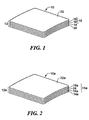
- Scratch resistant, anti-microbial display 10, FIG.1 may be a touch sensitive panel such as, for example, a computer touch panel, available from Microtouch Systems, Inc., Methuen, Massachusetts made up of several different layers.
- a touch sensitive panel such as, for example, a computer touch panel, available from Microtouch Systems, Inc., Methuen, Massachusetts made up of several different layers.
- Touch panel 12 typically includes insulative substrate 14, such as glass, plastic or another transparent medium and active portion 15 on substrate 14.
- Active portion 15 typically includes transparent conductive layer 16 deposited directly on substrate 14.
- Layer 16 is typically a tin oxide layer having a thickness of twenty to sixty nanometers and may be deposited by sputtering, vacuum deposition and other techniques known in the art. The thickness of the layers is exaggerated in the figure for illustrative purposes only and is not intended to represent the layers to scale.
- Conductive layer 16 may also include a conductive polymeric material or a conductive organic-inorganic composite.
- a conductive pattern is typically disposed about the perimeter of conductive layer 16 to provide a uniform electric field throughout conductive layer 16 in order to establish the point of contact between the display and a finger or stylus.
- Active portion 15 also includes protective layer 18 deposited over conductive layer 16 to provide abrasion resistance to protect conductive layer 16.
- Protective layer 18 is a layer of an organosiloxane and may be formed by applying to the article a solution comprising methyltriethoxysilane, tetraethylorthosilicate, isopropanol and water.
- Second conductive layer 20 may be provided to shield display 10 from noise which may result from the electric circuits of a display unit, not shown, to which display 10 may be attached and may similarly include a tin oxide layer deposited in a similar manner as discussed with reference to conductive layer 16.
- conductive layer 20 is not a necessary limitation of the invention as display 10 can function without it.
- Anti-microbial and scratch resistant layer 22 in accordance with this invention is applied to active portion 15 on protective layer 18 to reduce energy dissipation of an object contacting display 10, thereby minimizing or preventing damage to display 10 as well as inhibit the survival and growth of microorganisms which come to rest on display 10.
- Anti-microbial and scratch resistant layer 22 includes a homeotropic liquid crystal silane compound.
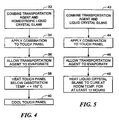
- Display 10a may include, for example, a resistive computer touch panel 12a available from Microtouch Systems, Inc., Methuen, Massachusetts, Elo TouchSystems, Freemont, California, or Dynapro, Vancouver, British Columbia, which includes insulative substrate 14a and conductive layer 16a, similar to FIG. 1.
- Protective layer 18a may include a hard coating which protects and supports deformable conductive layer 24 interposed between conductive layer 16a and protective layer 18a. As display 10a is contacted by a finger or stylus deformable conductive layer 24 compresses and makes contact with conductive layer 16a to indicate the position of the contract.
- Anti-microbial layer 22a is applied to layer 18a and includes a homeotropic liquid crystal silane compound.
- this is not a necessary limitation of the invention as some layers may not be required.
- Liquid crystal silanes are in the family of organosilanes.
- Liquid crystal silanes form durable and long lasting bonds to surfaces such as glass, plastic, ceramic, semiconductors, metal, organic polymer coated substrates or inorganic coated substrates. These silanes have a molecular structure which is highly ordered.
- Homeotropic liquid crystal silanes in addition to being highly ordered, bond such that the major axes of the carbon chains which make up the liquid crystal silanes spontaneously align or tend to align oriented perpendicular to the surface to which they are bonding. Because the alignment is perpendicular, the resultant film has a higher packing density, maximizing Van der Waal forces and thus effectively preventing scratches.
- the chains are perpendicular, the one celled microbes are impaled on the chain, thus, the microbes are destroyed.
- a good example of a liquid crystal silane having such properties is Dow Corning 5700, available from Dow Corning, Midland, Michigan, which contains eight (8) weight percent chloropropyl trimethoxysilane, forty-two (42) weight percent octadecylaminodimethyl trimethoxysilylpropyl ammonium chloride, and fifty (50) weight percent methyl alcohol.
- Another liquid crystal silane is Dow Corning 5772 which contains fifteen (15) weight percent chloropropyl trimethoxysilane, seventy two (72) weight percent octadecylaminodimethyl trimethoxysilylpropyl ammonium chloride, one (1) weight percent diethyl octadecylamine and twelve (12) weight percent methyl alcohol.
- a similar liquid crystal silane to Dow Corning 5700 is Gelest SIO6620.0, available from Gelest, Inc., Tullytown, Pennsylvania, which contains sixty (60) weight percent octadecylaminodimethyl trimethoxysilylpropyl ammonium chloride, three (3) to five (5) weight percent Cl(CH 2 ) 3 Si(OMe) 3 , and thirty five (35) to thirty seven (37) weight percent methanol.
- a transportation medium is typically used to dilute the homeotropic liquid crystal silane as well as to transport the silane to the surface to be protected.
- Small molecule alcohols such as methanol, ethanol, and isopropanol are the preferred vehicle for silane applications, however, water may also be used as a transportation medium. Additionally, water reacts with organosilanes to form hydrolyzed products or silanols.
- a stabilizing agent may be used so that the silanols are stable against self-condensation reactions which may cause precipitation of the solution if the solution is basic.
- the bond formed between the silanol and the substrate is accomplished through a cross condensation reaction.
- the cross condensation reaction between a silanol and a molecule on the substrate is generally slow. This reaction is accelerated by heating the freshly treated substrate at temperatures up to 150°C for several minutes, typically at least three (3) minutes. However, if the temperature exceeds 150°C the silane dissociates with the transportation medium. Typically, heating the substrate to between 100 and 150°C, below the dissociation temperature, for at least three (3) minutes is sufficient to form permanent bonds between the liquid crystal silane and the substrate.
- An organosilane primer layer may be used to enhance the bonding between the substrate and the liquid crystal silane.
- an organosilane layer contains a very high concentration of hydroxyl groups and high angle Si-O-Si bonds. These are the bonding sites for the hydrolyzed liquid crystal silane. Permanent bonding is formed by condensation reactions between the hydrolyzed liquid crystal silane molecules and the organosilane layer. The Si-O-Si bonds are known to be extremely durable. The best bonding can be obtained by applying the liquid crystal silane to a freshly deposited organosilane primer layer.
- a scratch is formed when a plastic deformation occurs and material is plowed away.
- the object such as a finger, stylus, bottle coin or other hard object moves across the surface, energy is dissipated as the result of frictional forces between the contacting surfaces.
- energy dissipation is reduced, there is no plowing and thus no scratching.
- the force of an object contacting display 10, FIG. 3A, is represented by arrow 24 which may be broken down into vertical component 26 and horizontal component 28.
- liquid crystal silane 22 is made up of individual carbon chains 21, shown greatly enlarged, which align or tend to align perpendicular to protective layer 18.
- chains 21 are bent due to contact by an object in a direction corresponding to the direction of arrow 24, the force of the contact is met with an opposing force represented by arrow 24' which can be broken down into components 26' and 28', which oppose vertical and horizontal force components 26 and 28, respectively. Due to the higher packing density, an object is met with an even greater opposing force.
- microorganisms 23, FIG. 3B impact or are deposited on layer 22, the cells are impaled on chains 21 and thus destroyed, preventing colonization of the microorganisms and production of detrimental chemicals thereby preventing spread of disease and degradation of the touch panel.
- the perpendicular orientation of chain 21 and the high packing density cause organisms 23, for example a one celled microorganism such as bacteria, algae or fungus, to become impaled on the chain as it impacts the layer irrespective of the orientation of the organism as it contacts layer 22, destroying the organism.
- liquid crystal silanes The higher packing density of liquid crystal silanes is due to their highly ordered structure. Linear carbon chains of homeotropic organosilanes are tightly packed perpendicularly to the surface thereby providing greater opposing forces than normal lubricants to counter damaging forces. This highly ordered structure presents less structural defects, such as deformation of extended chain structures, and therefore provides better scratch resistance than normal lubricants. Homeotropic liquid crystal silanes maximize the thickness of the protective layer because their axis is perpendicular to the surface.
- non-homeotropic liquid crystal silanes cannot form this highly ordered layer and thus provide much less protection to the surface from scratches, and permit survival and reproduction microorganisms which do not become impaled.
- Treated articles not only showed an increase microbe and scratch resistance, but have further shown improved antistatic properties and easier cleaning:
- Step 34 obtained from Microtouch Systems, Inc., similar to display 12, FIG. 1, by spraying the solution onto the panel and wiping to uniformly distribute the solution.
- the solution may be applied in any number of methods such as brushing, dipping, wiping, and other methods known in the art.
- the transportation medium was allowed to evaporate, Step 36, and the touch panel was subsequently heated to a temperature of 120°C for a period of three (3) minutes, Step 38. Heating cures the film and facilitates bonding between the protective layer and the liquid crystal silane layer.
- the touch panel was then cooled, Step 40.
- microorganisms The anti-microbial function of the present invention is evident from the experiments carried out with model bacteria, Gram - and Gram +, and common fungi. Historic data indicate that if the treatment is effective against these model microorganisms, the treated surfaces will be effective against the full array of one celled organisms commonly referred to as microorganisms.
- a comparison piece of untreated plain window glass was used as a control.
- a mixed culture of Staphylococcus aureus (Gram + Bacteria) and Klebsiella pneumonia Gram - bacteria) at a condition of 10 5 /ml of sterile phosphate buffer was applied to three 1.5 cm 2 area and pressed to the surface with a microscope slide cover slip. The glass was allowed to set in a 37°C incubator for one, two, and four hour intervals. After the appropriate incubation period, each sample was flushed with 50 ml of sterile buffer and the buffer solution was then checked for relative levels of bacterial growth using standard swab techniques. A sterile swab was placed into the buffer wash and streaked onto tryptic soy agar.
- the agar plates were then incubated for 24 and 48 hour intervals and inspected for intensity of growth.
- the scale of growth was as follows. GROWTH RATING SCALE RANGE OF COLONY FORMING UNIT NG (No Growth) 0 VL (Very Light) 1 to 5 L (Light) 6 to 20 M (Medium) 21 to 50 H (Heavy) VH (Very Heavy) 51 to 150 Confluent The results of this testing showed very heavy growth on all the untreated surfaces.
- the treated surfaces showed very light growth after one hour of contact. This equates to a four plus log reduction of the test bacteria. Similarly, at the two hour period one sample showed no growth while the other two showed very light growth. This equates to a four to five log reduction. Finally, the four hour period resulted in two samples having no growth and one only very light growth. This also equates to a four to five log reduction.
- the present invention effectively and significantly reduces the threat.
- the capacitive touch panels also proved very scratch resistant.
- a Balance Beam Scrape Adhesion Mar Tester Model PA-2197, available from Paul N. Gardner Co., Inc., was used to measure scratch resistance of the touch screen panel prior to and after treatment.
- the tester exceeds requirements of ASTM D-2197 standard test methods for adhesion of organic coatings by scrape adhesion and meets ASTM D-5178 standard test methods for mar resistance of organic coatings.
- the tester measures the amount of weight necessary to make a scratch by a stylus.
- a loop stylus produced from 1/16 inch steel having an outside diameter of 0.128 inches and heat treated to a hardness of 55-61 Rockwell, was used to make a scratch.
- a scratch is defined by a functional failure of the protective layer 18, FIG. 1. In other words, protective layer 18 was removed to expose conductive layer 16.
- Step 44 obtained from Microtouch Systems, Inc., similar to touch panel 12a, FIG. 2, by spraying the solution onto the touch panel and wiping to uniformly distribute the solution.
- the transportation medium was allowed to evaporate, Step 46, and the film was left to cure at room temperature for approximately seventy two (72) hours, Step 48.
- a scratch was defined as the delamination of protective layer 18a.
- Step 44 The solution was applied to a capacitive touch panel, Step 44, similar to touch panel 12, FIG. 1, obtained from Microtouch Systems, Inc. is a manner similar to that in EXAMPLE 2, that is, after evaporation of the transportation medium.
- Step 46 no heat was applied to the touch panel and the film was allowed to cure overnight, Step 48.
- Scratch testing was done by using a Micro Scratch Tester, available from CSEM Instruments. The test involved generating a controlled scratch with a hard tip on the touch panel. A tungsten carbide indenter having a radius of 10 microns was drawn across the panel surface under a progressive load. The critical loads are detected very precisely by means of an acoustic sensor attached to the load arm and by optical microscopy.
- the critical load to make a scratch prior to treatment of the touch panel was 0.55N. However, after treatment, the load required to make a scratch was 1.8N.
- touch panels have caused them to appear in a variety of locations subject to a variety of environments. Apart from the inherent threats of scratching through normal, traditional use, they are now further subject to non-traditional hazards such as scratches from bottles, coins and airborne debris as well as vandalism. Moreover, the increase in their use finds them in a variety of locations used by many people, increasing the potential threat of damage and disease transmission from microorganisms living on the touch panels. Through the application of a homeotropic liquid crystal silane to the outer most surface, the damage which would normally occur in these harsh environments, in addition to inherent damage caused by use, is dramatically reduced and often even prevented completely. Moreover, the damage due to microorganisms and the potential threat to users from these microorganisms are dramatically reduced. Prior lubricants and hard coatings, while somewhat effective, cannot provide the scratch resistance nor the anti-microbial properties that the present invention demonstrates.
Landscapes
- Engineering & Computer Science (AREA)
- Chemical & Material Sciences (AREA)
- General Engineering & Computer Science (AREA)
- Theoretical Computer Science (AREA)
- Life Sciences & Earth Sciences (AREA)
- Organic Chemistry (AREA)
- Materials Engineering (AREA)
- Chemical Kinetics & Catalysis (AREA)
- General Physics & Mathematics (AREA)
- Physics & Mathematics (AREA)
- Human Computer Interaction (AREA)
- General Chemical & Material Sciences (AREA)
- Geochemistry & Mineralogy (AREA)
- Wood Science & Technology (AREA)
- Position Input By Displaying (AREA)
- Laminated Bodies (AREA)
- Agricultural Chemicals And Associated Chemicals (AREA)
- Devices For Indicating Variable Information By Combining Individual Elements (AREA)
- Paints Or Removers (AREA)
Claims (4)
- Verfahren zum Auftragen einer antimikrobiellen Beschichtung auf einen Touchscreen, umfassend:Aufbringen eines Organosiloxanmaterials in einer Schicht auf den Touchscreen, um den Touchscreen zu schützen;Auftragen einer homöotropen Organosilanverbindung auf die Organosiloxanschicht undErhöhen der Temperatur des Touchscreens, sodass eine chemische Bindung zwischen der Organosiloxanschicht und der homöotropen Organosilanverbindung gebildet wird.
- Antimikrobieller Touchscreen, umfassend:ein Substrat;einen aktiven Teil auf einer Fläche des Substrats; eine Organosiloxan-Schutzschicht auf dem aktiven Teil des Substrats undeine homöotrope Organosilanschicht, die an die Organosiloxan-Schutzschicht chemisch gebunden ist, um die Überlebensfähigkeit von Mikroorganismen, die den Touchscreen kontaktieren, zu reduzieren.
- Touchscreen nach Anspruch 2, wobei der aktive Teil ferner eine leitende Schicht enthält.
- Touchscreen nach Anspruch 3, wobei die leitende Schicht ein Metalloxid enthält.
Applications Claiming Priority (3)
| Application Number | Priority Date | Filing Date | Title |
|---|---|---|---|
| US233305 | 1994-04-26 | ||
| US09/233,305 US6504583B2 (en) | 1998-10-02 | 1999-01-19 | Anti-microbial touch panel and method of making same using homeotropic liquid crystal silanes |
| PCT/US1999/031239 WO2000043831A1 (en) | 1999-01-19 | 1999-12-30 | Anti-microbial touch panel and method of making same using homeotropic liquid crystal silanes |
Publications (3)
| Publication Number | Publication Date |
|---|---|
| EP1155352A1 EP1155352A1 (de) | 2001-11-21 |
| EP1155352A4 EP1155352A4 (de) | 2002-05-15 |
| EP1155352B1 true EP1155352B1 (de) | 2006-03-08 |
Family
ID=22876716
Family Applications (1)
| Application Number | Title | Priority Date | Filing Date |
|---|---|---|---|
| EP99967768A Expired - Lifetime EP1155352B1 (de) | 1999-01-19 | 1999-12-30 | Antimikrobielles touch-panel und verfahren zu dessen herstellung unter verwendung homeotroper flüssigkristallsilane |
Country Status (9)
| Country | Link |
|---|---|
| US (1) | US6504583B2 (de) |
| EP (1) | EP1155352B1 (de) |
| JP (1) | JP4307739B2 (de) |
| KR (1) | KR20010089610A (de) |
| CN (1) | CN1154006C (de) |
| AU (1) | AU2399000A (de) |
| DE (1) | DE69930316T2 (de) |
| HK (1) | HK1043201A1 (de) |
| WO (1) | WO2000043831A1 (de) |
Families Citing this family (35)
| Publication number | Priority date | Publication date | Assignee | Title |
|---|---|---|---|---|
| AU2734901A (en) * | 1999-12-22 | 2001-07-03 | Agion Technologies, Llc | Touch screen with antimicrobial properties |
| US6488981B1 (en) * | 2001-06-20 | 2002-12-03 | 3M Innovative Properties Company | Method of manufacturing a touch screen panel |
| DE10145133C1 (de) | 2001-09-06 | 2003-04-30 | 4D Vision Gmbh | Verfahren zur räumlichen Darstellung |
| KR20040018713A (ko) * | 2002-08-26 | 2004-03-04 | 삼성전자주식회사 | 기능성 소재를 포함한 디스플레이 장치의 스크린 및 그제조방법 |
| DE10325146A1 (de) | 2003-05-30 | 2004-12-16 | X3D Technologies Gmbh | Verfahren und Anordnung zur räumlichen Darstellung |
| US7291386B2 (en) | 2004-08-26 | 2007-11-06 | 3M Innovative Properties Company | Antiglare coating and articles |
| US7294405B2 (en) * | 2004-08-26 | 2007-11-13 | 3M Innovative Properties Company | Antiglare coating and articles |
| DE602005015212D1 (de) * | 2005-07-29 | 2009-08-13 | Tpk Touch Solutions Inc | Berührungsfühlsamer Schirm mit antibakterieller Schicht |
| WO2007070649A2 (en) * | 2005-12-14 | 2007-06-21 | 3M Innovative Properties Company | Antimicrobial coating system |
| WO2007070650A2 (en) * | 2005-12-14 | 2007-06-21 | 3M Innovative Properties Company | Antimicrobial adhesive films |
| US7626579B2 (en) * | 2006-11-01 | 2009-12-01 | Immersion Corporation | Sanitizing a touch panel surface |
| US20100240799A1 (en) * | 2007-06-13 | 2010-09-23 | 3M Innovative Properties Company | Antimicrobial film-forming composition, antimicrobial film, and method of verifying the presence of an antimicrobial film |
| US20090085883A1 (en) * | 2007-10-02 | 2009-04-02 | Danotech Co., Ltd. | Antiseptic touch panel and a method thereof |
| WO2010011779A2 (en) * | 2008-07-23 | 2010-01-28 | Flextronics Ap, Llc | Integration design for capacitive touch panels and liquid crystal displays |
| US9128568B2 (en) * | 2008-07-30 | 2015-09-08 | New Vision Display (Shenzhen) Co., Limited | Capacitive touch panel with FPC connector electrically coupled to conductive traces of face-to-face ITO pattern structure in single plane |
| US8209861B2 (en) * | 2008-12-05 | 2012-07-03 | Flextronics Ap, Llc | Method for manufacturing a touch screen sensor assembly |
| US20100156811A1 (en) * | 2008-12-22 | 2010-06-24 | Ding Hua Long | New pattern design for a capacitive touch screen |
| US8274486B2 (en) * | 2008-12-22 | 2012-09-25 | Flextronics Ap, Llc | Diamond pattern on a single layer |
| US20100156846A1 (en) * | 2008-12-23 | 2010-06-24 | Flextronics Ap, Llc | Single substrate capacitive touch panel |
| US20100190009A1 (en) * | 2009-01-28 | 2010-07-29 | Chia-Chih Chang | Abrasion-resistant antiseptic touch panel and fabricating method thereof |
| CN101943978B (zh) * | 2009-07-06 | 2012-12-26 | 弗莱克斯电子有限责任公司 | 电容触摸屏面板及其制造方法、电容触摸传感器 |
| US20110025933A1 (en) * | 2009-07-30 | 2011-02-03 | VIZIO Inc. | Television with antimicrobial coating |
| US20110153342A1 (en) * | 2009-12-17 | 2011-06-23 | John Rose | Nonprescription Medication Consumer Tool |
| US9285929B2 (en) | 2010-03-30 | 2016-03-15 | New Vision Display (Shenzhen) Co., Limited | Touchscreen system with simplified mechanical touchscreen design using capacitance and acoustic sensing technologies, and method therefor |
| EP2576471B1 (de) | 2010-05-25 | 2017-10-25 | 3M Innovative Properties Company | Antimikrobielle beschichtete medizinische gegenstände |
| TWI515276B (zh) * | 2010-05-25 | 2016-01-01 | 3M新設資產公司 | 抗微生物塗料 |
| CN103172275A (zh) * | 2011-12-23 | 2013-06-26 | 富港电子(东莞)有限公司 | 抗菌触摸面板及其制造方法 |
| US8525955B2 (en) | 2012-01-31 | 2013-09-03 | Multek Display (Hong Kong) Limited | Heater for liquid crystal display |
| JP5152771B1 (ja) * | 2012-04-02 | 2013-02-27 | 株式会社シェリー | 静電容量型タッチパネル対応のタッチペン |
| TWM442264U (en) * | 2012-08-20 | 2012-12-01 | Yu Star Internat Ltd | Screen protector device for hand-held electronic apparatus |
| DE102012022185B4 (de) | 2012-11-12 | 2015-01-22 | Dräger Medical GmbH | Inkubator mit beschichteter Inkubatorhaube |
| US20140256382A1 (en) * | 2013-03-11 | 2014-09-11 | Patrick E. Eddy | Cellular telephones and touch screen displays having anti-microbial coatings |
| CN106047016A (zh) * | 2016-07-14 | 2016-10-26 | 四川美亚达光电科技有限公司 | 一种手机抗菌处理触摸屏涂层 |
| CN108646927A (zh) * | 2018-07-18 | 2018-10-12 | 杨程飞扬 | 一种便于携带的计算机键盘 |
| US12486373B2 (en) | 2020-10-08 | 2025-12-02 | 3M Innovative Properties Company | Hardcoat composition comprising methyl or ethyl trialkoxy silane, articles and methods |
Citations (1)
| Publication number | Priority date | Publication date | Assignee | Title |
|---|---|---|---|---|
| EP0233954A2 (de) * | 1984-12-21 | 1987-09-02 | Toray Silicone Company Limited | Antimikrobielle antistatische Siloxanzusammensetzungen und Verfahren zur Behandlung von Materialien |
Family Cites Families (28)
| Publication number | Priority date | Publication date | Assignee | Title |
|---|---|---|---|---|
| US3560385A (en) | 1968-11-01 | 1971-02-02 | Dow Corning | Method of lubricating siliceous materials |
| US3730701A (en) | 1971-05-14 | 1973-05-01 | Method for controlling the growth of algae in an aqueous medium | |
| US3860709A (en) | 1971-09-29 | 1975-01-14 | Dow Corning | Method of inhibiting the growth of bacteria and fungi using organosilicon amines |
| GB1386876A (en) | 1971-10-04 | 1975-03-12 | Dow Corning | Bactericidal and fungicidal composition |
| CA1010782A (en) | 1973-02-20 | 1977-05-24 | Charles A. Roth | Articles exhibiting antimicrobial properties |
| CH604198A5 (de) * | 1975-09-02 | 1978-08-31 | Siemens Ag | |
| JPS605610B2 (ja) | 1977-05-10 | 1985-02-13 | 住友化学工業株式会社 | 表面硬度改良方法 |
| US4422732A (en) * | 1981-06-08 | 1983-12-27 | Ditzik Richard J | Beam addressed electrooptic display system |
| JPS59104764A (ja) | 1982-12-03 | 1984-06-16 | Canon Inc | 液晶表示キ−ボ−ド |
| DE3331515A1 (de) * | 1983-09-01 | 1985-03-21 | Merck Patent Gmbh, 6100 Darmstadt | Trialkanoyloxysilane |
| US4911536A (en) * | 1986-05-08 | 1990-03-27 | Ditzik Richard J | Interactive graphic comunications terminal |
| US5115487A (en) * | 1988-03-17 | 1992-05-19 | At&T Bell Laboratories | Alkene-treated silicone compounds |
| JPH01256544A (ja) * | 1988-03-17 | 1989-10-13 | American Teleph & Telegr Co <Att> | 物品の製造方法および製品 |
| US4866192A (en) | 1988-04-18 | 1989-09-12 | Dow Corning Corporation | Organosilicon quaternary ammonium antimicrobial compounds |
| US5266222A (en) * | 1990-05-23 | 1993-11-30 | California Institute Of Technology | Durable low surface-energy surfaces |
| US5411585A (en) | 1991-02-15 | 1995-05-02 | S. C. Johnson & Son, Inc. | Production of stable hydrolyzable organosilane solutions |
| CA2100670C (en) * | 1991-02-15 | 1996-06-11 | Richard W. Avery | Production of stable aqueous hydrolyzable organosilane solutions |
| US5335373A (en) * | 1991-11-29 | 1994-08-09 | Dresdner Jr Karl P | Protective medical gloves and methods for their use |
| JPH05266750A (ja) | 1992-03-18 | 1993-10-15 | Matsushita Electric Ind Co Ltd | 抗菌性タッチスイッチ |
| JPH08185560A (ja) * | 1994-12-27 | 1996-07-16 | Toshiba Corp | 入力装置 |
| US5831700A (en) * | 1995-05-19 | 1998-11-03 | Kent State University | Polymer stabilized four domain twisted nematic liquid crystal display |
| JPH0957893A (ja) * | 1995-08-29 | 1997-03-04 | Toray Ind Inc | 抗菌延伸プラスチックフィルム |
| JPH0957922A (ja) * | 1995-08-29 | 1997-03-04 | Toray Ind Inc | 抗菌性延伸ポリエステルフィルム |
| JP3118197B2 (ja) * | 1995-11-17 | 2000-12-18 | 富士写真フイルム株式会社 | 光学補償シート |
| JPH10161132A (ja) * | 1996-12-02 | 1998-06-19 | Nec Corp | 液晶配向膜およびその製造方法 |
| DE19649954A1 (de) | 1996-12-03 | 1998-06-04 | Huels Chemische Werke Ag | Fluoralkyl-funktionelle Organosiloxan-haltige Zusammensetzungen auf Alkoholbasis, Verfahren zu deren Herstellung sowie deren Verwendung |
| JPH10279885A (ja) * | 1997-04-08 | 1998-10-20 | Nitsupan Kenkyusho:Kk | 機能性コーティング用組成物 |
| US5954869A (en) | 1997-05-07 | 1999-09-21 | Bioshield Technologies, Inc. | Water-stabilized organosilane compounds and methods for using the same |
-
1999
- 1999-01-19 US US09/233,305 patent/US6504583B2/en not_active Expired - Lifetime
- 1999-12-30 KR KR1020017009081A patent/KR20010089610A/ko not_active Ceased
- 1999-12-30 DE DE69930316T patent/DE69930316T2/de not_active Expired - Lifetime
- 1999-12-30 EP EP99967768A patent/EP1155352B1/de not_active Expired - Lifetime
- 1999-12-30 HK HK02102788.0A patent/HK1043201A1/zh unknown
- 1999-12-30 JP JP2000595196A patent/JP4307739B2/ja not_active Expired - Fee Related
- 1999-12-30 AU AU23990/00A patent/AU2399000A/en not_active Abandoned
- 1999-12-30 WO PCT/US1999/031239 patent/WO2000043831A1/en not_active Ceased
- 1999-12-30 CN CNB998164097A patent/CN1154006C/zh not_active Expired - Fee Related
Patent Citations (1)
| Publication number | Priority date | Publication date | Assignee | Title |
|---|---|---|---|---|
| EP0233954A2 (de) * | 1984-12-21 | 1987-09-02 | Toray Silicone Company Limited | Antimikrobielle antistatische Siloxanzusammensetzungen und Verfahren zur Behandlung von Materialien |
Also Published As
| Publication number | Publication date |
|---|---|
| AU2399000A (en) | 2000-08-07 |
| EP1155352A1 (de) | 2001-11-21 |
| HK1043201A1 (zh) | 2002-09-06 |
| CN1154006C (zh) | 2004-06-16 |
| CN1338063A (zh) | 2002-02-27 |
| EP1155352A4 (de) | 2002-05-15 |
| US6504583B2 (en) | 2003-01-07 |
| KR20010089610A (ko) | 2001-10-06 |
| DE69930316D1 (de) | 2006-05-04 |
| WO2000043831A1 (en) | 2000-07-27 |
| DE69930316T2 (de) | 2006-11-09 |
| US20010013907A1 (en) | 2001-08-16 |
| JP2002535766A (ja) | 2002-10-22 |
| JP4307739B2 (ja) | 2009-08-05 |
Similar Documents
| Publication | Publication Date | Title |
|---|---|---|
| US6504583B2 (en) | Anti-microbial touch panel and method of making same using homeotropic liquid crystal silanes | |
| US20120015200A1 (en) | Antimicrobial coatings | |
| EP2576472B1 (de) | Antimikrobielle beschichtungen | |
| CN105452185A (zh) | 具有改善的强度的抗微生物玻璃制品以及它们的制备和使用方法 | |
| KR102070449B1 (ko) | 향균내지문 코팅 조성물, 그 피막, 그 코팅 방법, 및 그 코팅이 적용된 제품 | |
| KR101690091B1 (ko) | 진공증착용 항균성 프라이머 코팅제 및 이를 이용한 다중코팅 방법 | |
| KR20140069801A (ko) | 복합기능 코팅 구조 및 이를 형성하는 방법 | |
| JP5519391B2 (ja) | 耐引っかき性のコーティングされた透明製品の製造方法 | |
| KR101677024B1 (ko) | 항균력을 갖는 진공증착용 발수형 나노 코팅제 및 이를 이용한 코팅 방법 | |
| JP4871846B2 (ja) | タッチパネル用透明導電膜付フィルムとこれを用いたタッチパネル | |
| CN105189391A (zh) | 抗微生物玻璃制品及其制造和使用方法 | |
| KR101784709B1 (ko) | 복합기능 코팅 구조 및 이를 형성하는 방법 | |
| JPH0781979A (ja) | 防汚性ガラス物品 | |
| TW202415634A (zh) | 抗菌液以及使用該抗菌液的抗菌基板 | |
| TW202144306A (zh) | 抗菌液、抗菌基板的製備方法以及抗菌基板 | |
| CN117925099A (zh) | 抗菌液以及使用该抗菌液的抗菌基板 | |
| JP6356611B2 (ja) | 触覚センサ用前面板 |
Legal Events
| Date | Code | Title | Description |
|---|---|---|---|
| PUAI | Public reference made under article 153(3) epc to a published international application that has entered the european phase |
Free format text: ORIGINAL CODE: 0009012 |
|
| 17P | Request for examination filed |
Effective date: 20010817 |
|
| AK | Designated contracting states |
Kind code of ref document: A1 Designated state(s): AT BE CH CY DE DK ES FI FR GB GR IE IT LI LU MC NL PT SE |
|
| AX | Request for extension of the european patent |
Free format text: AL;LT;LV;MK;RO;SI |
|
| RIN1 | Information on inventor provided before grant (corrected) |
Inventor name: GEAGHAN, BERNARD, O. Inventor name: BOTTARI, FRANK, J. Inventor name: LI, CHIA-YEN LUMENON INNOVATIVE L.T. |
|
| A4 | Supplementary search report drawn up and despatched |
Effective date: 20020328 |
|
| AK | Designated contracting states |
Kind code of ref document: A4 Designated state(s): AT BE CH CY DE DK ES FI FR GB GR IE IT LI LU MC NL PT SE |
|
| RIC1 | Information provided on ipc code assigned before grant |
Free format text: 7G 06K 11/00 A, 7G 06F 3/02 B, 7G 06F 3/03 B, 7C 03C 17/30 B, 7C 04B 41/49 B, 7C 08G 77/22 B, 7C 08G 77/24 B, 7C 07F 7/18 B, 7A 01N 55/00 B |
|
| 17Q | First examination report despatched |
Effective date: 20021029 |
|
| RBV | Designated contracting states (corrected) |
Designated state(s): DE FR GB IT NL |
|
| GRAP | Despatch of communication of intention to grant a patent |
Free format text: ORIGINAL CODE: EPIDOSNIGR1 |
|
| GRAS | Grant fee paid |
Free format text: ORIGINAL CODE: EPIDOSNIGR3 |
|
| GRAA | (expected) grant |
Free format text: ORIGINAL CODE: 0009210 |
|
| AK | Designated contracting states |
Kind code of ref document: B1 Designated state(s): DE FR GB IT NL |
|
| PG25 | Lapsed in a contracting state [announced via postgrant information from national office to epo] |
Ref country code: IT Free format text: LAPSE BECAUSE OF FAILURE TO SUBMIT A TRANSLATION OF THE DESCRIPTION OR TO PAY THE FEE WITHIN THE PRESCRIBED TIME-LIMIT;WARNING: LAPSES OF ITALIAN PATENTS WITH EFFECTIVE DATE BEFORE 2007 MAY HAVE OCCURRED AT ANY TIME BEFORE 2007. THE CORRECT EFFECTIVE DATE MAY BE DIFFERENT FROM THE ONE RECORDED. Effective date: 20060308 |
|
| REG | Reference to a national code |
Ref country code: GB Ref legal event code: FG4D |
|
| REF | Corresponds to: |
Ref document number: 69930316 Country of ref document: DE Date of ref document: 20060504 Kind code of ref document: P |
|
| ET | Fr: translation filed | ||
| PLBE | No opposition filed within time limit |
Free format text: ORIGINAL CODE: 0009261 |
|
| STAA | Information on the status of an ep patent application or granted ep patent |
Free format text: STATUS: NO OPPOSITION FILED WITHIN TIME LIMIT |
|
| 26N | No opposition filed |
Effective date: 20061211 |
|
| PG25 | Lapsed in a contracting state [announced via postgrant information from national office to epo] |
Ref country code: NL Free format text: LAPSE BECAUSE OF NON-PAYMENT OF DUE FEES Effective date: 20070701 |
|
| NLV4 | Nl: lapsed or anulled due to non-payment of the annual fee |
Effective date: 20070701 |
|
| REG | Reference to a national code |
Ref country code: GB Ref legal event code: 732E |
|
| REG | Reference to a national code |
Ref country code: FR Ref legal event code: TP |
|
| PGFP | Annual fee paid to national office [announced via postgrant information from national office to epo] |
Ref country code: GB Payment date: 20071227 Year of fee payment: 9 |
|
| PGFP | Annual fee paid to national office [announced via postgrant information from national office to epo] |
Ref country code: FR Payment date: 20071217 Year of fee payment: 9 |
|
| REG | Reference to a national code |
Ref country code: HK Ref legal event code: WD Ref document number: 1043201 Country of ref document: HK |
|
| GBPC | Gb: european patent ceased through non-payment of renewal fee |
Effective date: 20081230 |
|
| REG | Reference to a national code |
Ref country code: FR Ref legal event code: ST Effective date: 20090831 |
|
| PG25 | Lapsed in a contracting state [announced via postgrant information from national office to epo] |
Ref country code: GB Free format text: LAPSE BECAUSE OF NON-PAYMENT OF DUE FEES Effective date: 20081230 |
|
| PG25 | Lapsed in a contracting state [announced via postgrant information from national office to epo] |
Ref country code: FR Free format text: LAPSE BECAUSE OF NON-PAYMENT OF DUE FEES Effective date: 20081231 |
|
| PGFP | Annual fee paid to national office [announced via postgrant information from national office to epo] |
Ref country code: DE Payment date: 20161229 Year of fee payment: 18 |
|
| REG | Reference to a national code |
Ref country code: DE Ref legal event code: R119 Ref document number: 69930316 Country of ref document: DE |
|
| PG25 | Lapsed in a contracting state [announced via postgrant information from national office to epo] |
Ref country code: DE Free format text: LAPSE BECAUSE OF NON-PAYMENT OF DUE FEES Effective date: 20180703 |