EP1152602B1 - Adaptative channel equalizer - Google Patents
Adaptative channel equalizer Download PDFInfo
- Publication number
- EP1152602B1 EP1152602B1 EP00403650A EP00403650A EP1152602B1 EP 1152602 B1 EP1152602 B1 EP 1152602B1 EP 00403650 A EP00403650 A EP 00403650A EP 00403650 A EP00403650 A EP 00403650A EP 1152602 B1 EP1152602 B1 EP 1152602B1
- Authority
- EP
- European Patent Office
- Prior art keywords
- step size
- error rate
- packet error
- coefficient step
- coefficient
- Prior art date
- Legal status (The legal status is an assumption and is not a legal conclusion. Google has not performed a legal analysis and makes no representation as to the accuracy of the status listed.)
- Expired - Lifetime
Links
- 238000000034 method Methods 0.000 claims description 22
- 230000003044 adaptive effect Effects 0.000 claims description 9
- 238000012545 processing Methods 0.000 claims description 6
- 238000003672 processing method Methods 0.000 claims description 2
- 230000008569 process Effects 0.000 description 12
- 238000011084 recovery Methods 0.000 description 9
- 238000005259 measurement Methods 0.000 description 6
- 230000006870 function Effects 0.000 description 5
- 230000005540 biological transmission Effects 0.000 description 4
- 230000004044 response Effects 0.000 description 4
- 230000008859 change Effects 0.000 description 3
- 238000004891 communication Methods 0.000 description 3
- 230000000694 effects Effects 0.000 description 3
- 230000000717 retained effect Effects 0.000 description 3
- 238000005549 size reduction Methods 0.000 description 3
- 230000001419 dependent effect Effects 0.000 description 2
- 230000000670 limiting effect Effects 0.000 description 2
- 230000003068 static effect Effects 0.000 description 2
- 238000012546 transfer Methods 0.000 description 2
- 230000006978 adaptation Effects 0.000 description 1
- 230000008649 adaptation response Effects 0.000 description 1
- 230000009286 beneficial effect Effects 0.000 description 1
- 230000001186 cumulative effect Effects 0.000 description 1
- 230000003247 decreasing effect Effects 0.000 description 1
- 230000006735 deficit Effects 0.000 description 1
- 230000001934 delay Effects 0.000 description 1
- 230000003111 delayed effect Effects 0.000 description 1
- 238000013461 design Methods 0.000 description 1
- 238000001514 detection method Methods 0.000 description 1
- 238000010586 diagram Methods 0.000 description 1
- 238000001914 filtration Methods 0.000 description 1
- 230000002829 reductive effect Effects 0.000 description 1
- 230000003252 repetitive effect Effects 0.000 description 1
- 238000005070 sampling Methods 0.000 description 1
- 230000008054 signal transmission Effects 0.000 description 1
- 230000001360 synchronised effect Effects 0.000 description 1
Images
Classifications
-
- H—ELECTRICITY
- H04—ELECTRIC COMMUNICATION TECHNIQUE
- H04N—PICTORIAL COMMUNICATION, e.g. TELEVISION
- H04N5/00—Details of television systems
- H04N5/14—Picture signal circuitry for video frequency region
- H04N5/21—Circuitry for suppressing or minimising disturbance, e.g. moiré or halo
- H04N5/211—Ghost signal cancellation
-
- H—ELECTRICITY
- H04—ELECTRIC COMMUNICATION TECHNIQUE
- H04L—TRANSMISSION OF DIGITAL INFORMATION, e.g. TELEGRAPHIC COMMUNICATION
- H04L25/00—Baseband systems
- H04L25/02—Details ; arrangements for supplying electrical power along data transmission lines
- H04L25/03—Shaping networks in transmitter or receiver, e.g. adaptive shaping networks
- H04L25/03006—Arrangements for removing intersymbol interference
- H04L25/03012—Arrangements for removing intersymbol interference operating in the time domain
- H04L25/03019—Arrangements for removing intersymbol interference operating in the time domain adaptive, i.e. capable of adjustment during data reception
- H04L25/03038—Arrangements for removing intersymbol interference operating in the time domain adaptive, i.e. capable of adjustment during data reception with a non-recursive structure
-
- H—ELECTRICITY
- H04—ELECTRIC COMMUNICATION TECHNIQUE
- H04L—TRANSMISSION OF DIGITAL INFORMATION, e.g. TELEGRAPHIC COMMUNICATION
- H04L25/00—Baseband systems
- H04L25/02—Details ; arrangements for supplying electrical power along data transmission lines
- H04L25/03—Shaping networks in transmitter or receiver, e.g. adaptive shaping networks
- H04L25/03006—Arrangements for removing intersymbol interference
- H04L2025/0335—Arrangements for removing intersymbol interference characterised by the type of transmission
- H04L2025/03375—Passband transmission
- H04L2025/03382—Single of vestigal sideband
-
- H—ELECTRICITY
- H04—ELECTRIC COMMUNICATION TECHNIQUE
- H04L—TRANSMISSION OF DIGITAL INFORMATION, e.g. TELEGRAPHIC COMMUNICATION
- H04L25/00—Baseband systems
- H04L25/02—Details ; arrangements for supplying electrical power along data transmission lines
- H04L25/03—Shaping networks in transmitter or receiver, e.g. adaptive shaping networks
- H04L25/03006—Arrangements for removing intersymbol interference
- H04L2025/03592—Adaptation methods
- H04L2025/03598—Algorithms
- H04L2025/03611—Iterative algorithms
- H04L2025/03617—Time recursive algorithms
- H04L2025/0363—Feature restoration, e.g. constant modulus
-
- H—ELECTRICITY
- H04—ELECTRIC COMMUNICATION TECHNIQUE
- H04L—TRANSMISSION OF DIGITAL INFORMATION, e.g. TELEGRAPHIC COMMUNICATION
- H04L25/00—Baseband systems
- H04L25/02—Details ; arrangements for supplying electrical power along data transmission lines
- H04L25/03—Shaping networks in transmitter or receiver, e.g. adaptive shaping networks
- H04L25/03006—Arrangements for removing intersymbol interference
- H04L2025/03592—Adaptation methods
- H04L2025/03598—Algorithms
- H04L2025/03681—Control of adaptation
- H04L2025/03687—Control of adaptation of step size
-
- H—ELECTRICITY
- H04—ELECTRIC COMMUNICATION TECHNIQUE
- H04N—PICTORIAL COMMUNICATION, e.g. TELEVISION
- H04N21/00—Selective content distribution, e.g. interactive television or video on demand [VOD]
- H04N21/40—Client devices specifically adapted for the reception of or interaction with content, e.g. set-top-box [STB]; Operations thereof
- H04N21/41—Structure of client; Structure of client peripherals
- H04N21/426—Internal components of the client ; Characteristics thereof
Definitions
- This invention concerns adaptive channel equalization of an image representative signal which may be processed by an image processing and display device such as a television receiver.
- Timing recovery is a process by which a receiver clock (timebase) is synchronized to a transmitter clock. This permits the received signal to be sampled at the optimum point in time to reduce the chance of a slicing error associated with decision-directed processing of received symbol values.
- Carrier recovery is a process by which a received RF signal, after being frequency downconverted to a lower intermediate frequency passband (e.g., near baseband), is frequency shifted to baseband to permit recovery of the modulating baseband information.
- ISI baseband intersymbol interference
- An adaptive equalizer is essentially a digital filter with an adaptive response to compensate for channel distortions.
- Several well-known algorithms are available for adapting the filter coefficients and thereby the filter response to converge the equalizer.
- large step sizes are typically used to allow the coefficients to converge faster during an initial adaptation stage, while small step size changes are used at other times to prevent the coefficient values from changing rapidly.
- the present invention is directed to a process that supports the efficient use of such step size changes.
- US 5,910,960 relates generally to a signal processing for communication systems.
- the present invention is a signal processing method according to claim 1.
- adaptive equalization is facilitated by dynamically changing the equalizer filter coefficient step size during the adaption process as a function of the packet error rate such as may be evidenced by the output of an FEC error detecting and correcting network.
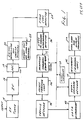
- a terrestrial broadcast analog Input HDTV signal is processed by an input network 14 including radio frequency (RF) tuning circuits and an intermediate frequency (IF) processor 16 for producing an IF passband output signal, and appropriate automatic gain control (AGC) circuits.
- RF radio frequency
- IF intermediate frequency
- AGC automatic gain control
- the received signal is a carrier suppressed multilevel 8-VSB modulated signal in accordance with the ATSC terrestrial broadcast standard adopted in the United States.
- timing signals for clocking the illustrated functional blocks are not shown.
- the passband IF output signal from unit 16 is converted to a digital symbol datastream by an analog to digital converter 19.
- the output digital datastream from ADC 19 is demodulated to baseband by a demodulator/carrier recovery network 22. This is done by a phase locked loop in response to the small reference pilot carrier in the received VSB datastream.
- Unit 22 produces an output I-phase demodulated symbol datastream.
- Unit 22 may include a demodulator of the type described in the Grand Alliance system specification, or of the type described in copending US Patent application Serial No. 09/140,257 of T. J. Wang filed August 26, 1998 .
- ADC 19 Associated with ADC 19 is a segment sync generator and symbol clock recovery network 24.
- Network 24 recovers the repetitive data segment sync components of each data frame from the received random data.
- the segment syncs are used to regenerate a properly phased clock, e.g., 10.76 Msymbols/sec, which is used to control the datastream symbol sampling by analog to digital converter 19.
- Unit 28 detects the data field sync component by comparing every received data segment with an ideal field reference signal stored in memory in the receiver to provide field synchronization.
- NTSC co-channel interference detection and rejection are performed by unit 30.
- the signal is adaptively equalized by channel equalizer 34 which operates in accordance with the principles of the present invention as will be discussed.
- Equalizer 34 may be one of several types, such as the type described in the ATSC HDTV System Specification and in an article by W. Bretl et al., "VSB Modem Subsystem Design for Grand Alliance Digital Television Receivers," IEEE Transactions on Consumer Electronics, August 1995 .
- Equalizer 34 corrects channel distortions, but phase noise randomly rotates the symbol constellation.
- Phase tracking network 36 removes the residual phase and gain noise in the output signal from equalizer 34, including phase noise which has not been removed by the preceding carrier recovery network in response to the pilot signal.
- adaptive equalizer 34 operates in a blind mode using a known blind equalization algorithm such as the constant modulus algorithm (CMA), for example. After some time has elapsed, e.g., 50 ms, the equalizer output is considered to be good enough to permit equalizer 34 to operate in a steady-state decision-directed mode.
- CMA constant modulus algorithm
- the phase-corrected signal from equalizer 34 is trellis decoded by unit 40, then de-interleaved by unit 42.
- Decoded and de-interleaved data packets from unit 40 are error detected and corrected by a forward error correcting (FEC) unit 44, e.g., a Reed-Solomon error detecting and detecting network.
- FEC forward error correcting
- Error corrected packets from unit 44 are descrambled (de-randomized) by unit 46 using well known procedures.
- Microcontroller 60 provides appropriate timing control and clock signals for other elements of the system and also serves as a data communications link between the networks of the system. Error corrector 44 and microcontroller 60 cooperate to control the operation of equalizer 34 in accordance with the principles of the present invention, as will be discussed.
- a decoded datastream is subjected to audio, video and display processing by unit 50.
- the step size of the equalizer filter coefficients during the coefficient updating process is changed as a function of the packet error rate as determined by a measurement at the output of FEC unit 44. This measurement is performed within the FEC unit itself in accordance with the well-known FEC algorithm which knows when a packet contains more errors than can be corrected.
- the step size setting is determined once at signal acquisition, then is held until another acquisition is performed.
- the packet error rate is monitored by microcontroller 60. It is herein recognized that the packet error rate is a direct and accurate measure of system performance and is therefore advantageously used as a cumulative measure of whether or not step size changes produce acceptable or non-acceptable results (lower or higher packet error rates).
- the step size change occurs independent of the equalizer operating modes, i.e., blind or decision-directed operating modes. Changing the step size may assist the equalizer to switch from the blind to the decision-directed operating mode.
- Changing the equalizer step size permits trading off dynamic multipath (“ghost") tracking performance to reduce the noise contribution by random inaccuracies in the filter coefficients.
- Ghost dynamic multipath
- Larger step sizes allow the filter coefficients to change faster, so that the filter can adapt faster to dynamically changing multipath conditions.
- Small step sizes prevent the filter coefficients from changing rapidly. This reduces the noise level contributed by random fluctuations of the filter coefficients about their nominal values. This is particularly beneficial for terrestrial broadcast high definition television signal receivers due to the varying signal impairments under which the receiver must often operate.
- the factors limiting a receiver's performance include thermally generated white noise or static multipath.
- the factor limiting a receiver's performance is dynamic multipath.
- the filter coefficients need not adapt quickly when a steady-state operating condition has been reached, so the step size can be small.
- the filter coefficients need to adapt quickly to the changing multipath parameters.
- the disclosed system advantageously addresses these considerations by making a packet error measurement over an appropriate interval at the output of the FEC detector for an initial step size chosen for typically expected signal conditions. If the measured error rate is above an acceptable threshold, a different step size is set and another packet error measurement is made over the same time interval.
- step size For example, if a large step size was used initially, a smaller step size would be used for the second measurement. At the end of the two measurement intervals, the step size that produces the smaller error rate (as determined by controller 60) is used as long as a properly tuned, useable signal is present. This step size is retained until the next signal acquisition time, when the step size selection process is repeated.
- This process may be tailored to suit the requirements of a particular system. For example, it may happen that there are fewer errors after the first step size change. In such case another step size reduction may be tried if it is available in a given system. If there are substantially the same amount of packet errors after the first step size reduction, a tie-breaker rule may be used. In such case the present system would use a larger step size to retain tracking qualities. However, a different system may use the lower step size if it is deemed desirable to do so in accordance with the requirements of the system.
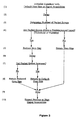
- step (1) at the signal acquisition time, microcontroller 60 initializes the operation of equalizer 34 with a default step size that in this example is based on normally expected signal conditions at acquisition.
- step 2 After a predetermined delay (step 2) of about one second, microcontroller 60 queries FEC unit 44 to determine how many packet errors have been accumulated (step 3). The one second delay is a nominal delay. Other delays may be used in accordance with the requirements of a particular system. If the number of packet errors does not exceed the threshold of visibility, as determined empirically (step 4), the current equalizer coefficient step size is retained (step 5). Afterwards the process stops (step 9) until the next signal acquisition time (step 10).
- controller 60 instructs equalizer 34 to reduce its coefficient step size (step 5). After a predetermined delay (step 6), the microcontroller queries FEC unit 44 to determine if packet errors have increased (step 7). If the number of packet errors has increased, controller 60 causes the equalizer step size to return to the default step size (step 8). Otherwise the reduced step size is retained. The process then stops (step 9) until the next signal acquisition time (step 10).
- step 7 may determine that the number of packet errors did not increase and remains unchanged, or that the number of packet errors has decreased. If the packet errors decrease in step 7, another step size reduction may be tried if such is available (i.e., the smallest step size limit has not been reached). If the packet errors remain unchanged in step 7, a given system may employ a predetermined rule for using a larger or smaller step size.
Landscapes
- Engineering & Computer Science (AREA)
- Signal Processing (AREA)
- Multimedia (AREA)
- Power Engineering (AREA)
- Computer Networks & Wireless Communication (AREA)
- Cable Transmission Systems, Equalization Of Radio And Reduction Of Echo (AREA)
- Detection And Prevention Of Errors In Transmission (AREA)
- Picture Signal Circuits (AREA)
- Data Exchanges In Wide-Area Networks (AREA)
- Digital Transmission Methods That Use Modulated Carrier Waves (AREA)
- Circuits Of Receivers In General (AREA)
- Television Systems (AREA)
- Cartons (AREA)
Applications Claiming Priority (2)
| Application Number | Priority Date | Filing Date | Title |
|---|---|---|---|
| US566159 | 2000-05-05 | ||
| US09/566,159 US6490007B1 (en) | 1999-07-14 | 2000-05-05 | Adaptive channel equalizer |
Publications (3)
| Publication Number | Publication Date |
|---|---|
| EP1152602A2 EP1152602A2 (en) | 2001-11-07 |
| EP1152602A3 EP1152602A3 (en) | 2004-03-24 |
| EP1152602B1 true EP1152602B1 (en) | 2012-10-03 |
Family
ID=24261750
Family Applications (1)
| Application Number | Title | Priority Date | Filing Date |
|---|---|---|---|
| EP00403650A Expired - Lifetime EP1152602B1 (en) | 2000-05-05 | 2000-12-22 | Adaptative channel equalizer |
Country Status (7)
| Country | Link |
|---|---|
| US (1) | US6490007B1 (enExample) |
| EP (1) | EP1152602B1 (enExample) |
| JP (2) | JPH06508805A (enExample) |
| KR (1) | KR100666432B1 (enExample) |
| CN (1) | CN1224227C (enExample) |
| MX (1) | MXPA01000725A (enExample) |
| MY (1) | MY126065A (enExample) |
Families Citing this family (48)
| Publication number | Priority date | Publication date | Assignee | Title |
|---|---|---|---|---|
| EP1315235B1 (en) * | 2000-08-25 | 2008-05-28 | Sanyo Electric Co., Ltd. | Adaptive array device, adaptive array method and program |
| US7072392B2 (en) * | 2000-11-13 | 2006-07-04 | Micronas Semiconductors, Inc. | Equalizer for time domain signal processing |
| US6715113B1 (en) * | 2000-12-22 | 2004-03-30 | Applied Micro Circuits Corporation | Feedback system and method for optimizing the reception of multidimensional digital frame structure communications |
| US6940557B2 (en) | 2001-02-08 | 2005-09-06 | Micronas Semiconductors, Inc. | Adaptive interlace-to-progressive scan conversion algorithm |
| US6829297B2 (en) * | 2001-06-06 | 2004-12-07 | Micronas Semiconductors, Inc. | Adaptive equalizer having a variable step size influenced by output from a trellis decoder |
| US7190744B2 (en) * | 2001-06-07 | 2007-03-13 | Micronas Semiconductors, Inc. | Error generation for adaptive equalizer |
| US7418034B2 (en) * | 2001-06-19 | 2008-08-26 | Micronas Semiconductors. Inc. | Combined trellis decoder and decision feedback equalizer |
| US7158567B2 (en) * | 2001-09-11 | 2007-01-02 | Vitesse Semiconductor Corporation | Method and apparatus for improved high-speed FEC adaptive equalization |
| TW543328B (en) * | 2001-12-10 | 2003-07-21 | Silicon Integrated Sys Corp | TV decoder |
| KR100442255B1 (ko) * | 2002-02-27 | 2004-07-30 | 엘지전자 주식회사 | 채널 등화 장치 |
| US20030206053A1 (en) * | 2002-04-04 | 2003-11-06 | Jingsong Xia | Carrier recovery for DTV receivers |
| US20030235259A1 (en) * | 2002-04-04 | 2003-12-25 | Jingsong Xia | System and method for symbol clock recovery |
| US6995617B2 (en) | 2002-04-05 | 2006-02-07 | Micronas Semiconductors, Inc. | Data-directed frequency-and-phase lock loop |
| US7321642B2 (en) | 2002-04-05 | 2008-01-22 | Micronas Semiconductors, Inc. | Synchronization symbol re-insertion for a decision feedback equalizer combined with a trellis decoder |
| US7376181B2 (en) | 2002-04-05 | 2008-05-20 | Micronas Semiconductors, Inc. | Transposed structure for a decision feedback equalizer combined with a trellis decoder |
| US7272203B2 (en) | 2002-04-05 | 2007-09-18 | Micronas Semiconductors, Inc. | Data-directed frequency-and-phase lock loop for decoding an offset-QAM modulated signal having a pilot |
| US6980059B2 (en) * | 2002-04-05 | 2005-12-27 | Micronas Semiconductors, Inc. | Data directed frequency acquisition loop that synchronizes to a received signal by using the redundancy of the data in the frequency domain |
| KR100451750B1 (ko) * | 2002-10-31 | 2004-10-08 | 엘지전자 주식회사 | 디지털 텔레비전 수신기의 채널 등화 장치 |
| US7305056B2 (en) | 2003-11-18 | 2007-12-04 | Ibiquity Digital Corporation | Coherent tracking for FM in-band on-channel receivers |
| KR100698630B1 (ko) * | 2004-06-28 | 2007-03-21 | 삼성전자주식회사 | 스텝사이즈 조정기능을 구비한 등화기 및 등화방법 |
| KR100603202B1 (ko) * | 2004-06-28 | 2006-07-24 | 삼성전자주식회사 | Lms 등화기의 스텝사이즈 자동 제어방법 및 제어장치 |
| KR100708482B1 (ko) * | 2005-03-04 | 2007-04-18 | 삼성전자주식회사 | 채널 등화기 및 채널 등화 방법 |
| CA2562194C (en) | 2005-10-05 | 2012-02-21 | Lg Electronics Inc. | Method of processing traffic information and digital broadcast system |
| CA2562427C (en) | 2005-10-05 | 2012-07-10 | Lg Electronics Inc. | A digital broadcast system and method of processing traffic information |
| US20070104263A1 (en) * | 2005-11-09 | 2007-05-10 | Chiao-Chih Chang | Method for adaptively tuning an equalizer |
| WO2008002168A1 (en) * | 2006-06-10 | 2008-01-03 | Motorola, Inc. | Stop-and-go algorithm for an equalizer using crc codes |
| WO2007091779A1 (en) | 2006-02-10 | 2007-08-16 | Lg Electronics Inc. | Digital broadcasting receiver and method of processing data |
| WO2007126196A1 (en) | 2006-04-29 | 2007-11-08 | Lg Electronics Inc. | Digital broadcasting system and method of processing data |
| WO2007136166A1 (en) | 2006-05-23 | 2007-11-29 | Lg Electronics Inc. | Digital broadcasting system and method of processing data |
| US7873104B2 (en) | 2006-10-12 | 2011-01-18 | Lg Electronics Inc. | Digital television transmitting system and receiving system and method of processing broadcasting data |
| US7853214B2 (en) * | 2007-01-05 | 2010-12-14 | Microtune (Texas), L.P. | Dynamic multi-path detection device and method |
| KR101253185B1 (ko) | 2007-03-26 | 2013-04-10 | 엘지전자 주식회사 | 디지털 방송 시스템 및 데이터 처리 방법 |
| KR101285887B1 (ko) | 2007-03-26 | 2013-07-11 | 엘지전자 주식회사 | 디지털 방송 시스템 및 데이터 처리 방법 |
| KR101285888B1 (ko) | 2007-03-30 | 2013-07-11 | 엘지전자 주식회사 | 디지털 방송 시스템 및 데이터 처리 방법 |
| EP1976109A1 (en) * | 2007-03-31 | 2008-10-01 | Sony Deutschland Gmbh | Demodulator, method and receiver for demodulation |
| KR20080090784A (ko) * | 2007-04-06 | 2008-10-09 | 엘지전자 주식회사 | 전자 프로그램 정보 제어 방법 및 수신 장치 |
| KR101405966B1 (ko) | 2007-06-26 | 2014-06-20 | 엘지전자 주식회사 | 디지털 방송 시스템 및 데이터 처리 방법 |
| KR101456002B1 (ko) | 2007-06-26 | 2014-11-03 | 엘지전자 주식회사 | 디지털 방송 시스템 및 데이터 처리 방법 |
| US8433973B2 (en) | 2007-07-04 | 2013-04-30 | Lg Electronics Inc. | Digital broadcasting system and method of processing data |
| WO2009005326A2 (en) | 2007-07-04 | 2009-01-08 | Lg Electronics Inc. | Digital broadcasting system and method of processing data |
| KR20090012180A (ko) | 2007-07-28 | 2009-02-02 | 엘지전자 주식회사 | 디지털 방송 시스템 및 데이터 처리 방법 |
| WO2009028848A1 (en) | 2007-08-24 | 2009-03-05 | Lg Electronics Inc. | Digital broadcasting system and method of processing data in digital broadcasting system |
| KR20090021124A (ko) | 2007-08-24 | 2009-02-27 | 엘지전자 주식회사 | 디지털 방송 시스템 및 데이터 처리 방법 |
| CA2694704C (en) | 2007-08-24 | 2013-06-25 | Lg Electronics Inc. | Digital broadcasting system and method of processing data in digital broadcasting system |
| CA2697453C (en) | 2007-08-24 | 2013-10-08 | Lg Electronics Inc. | Digital broadcasting system and method of processing data in digital broadcasting system |
| EP2675073B1 (en) * | 2011-05-10 | 2018-01-10 | Mitsubishi Electric Corporation | Adaptive equalizer, acoustic echo canceller device, and active noise control device |
| US8923382B2 (en) * | 2012-03-16 | 2014-12-30 | Lsi Corporation | Tap adaptation with a fully unrolled decision feedback equalizer |
| CN107682112A (zh) * | 2017-08-24 | 2018-02-09 | 郑州云海信息技术有限公司 | 一种以太网数据传输的控制方法 |
Family Cites Families (22)
| Publication number | Priority date | Publication date | Assignee | Title |
|---|---|---|---|---|
| FR2519753B1 (fr) * | 1982-01-08 | 1986-02-21 | Matra | Bombe de penetration a corps etage |
| JP3038790B2 (ja) * | 1990-04-27 | 2000-05-08 | 日本電気株式会社 | 等化器 |
| US5243624A (en) * | 1991-07-26 | 1993-09-07 | General Instrument Corporation | Method and apparatus for updating coefficients in a complex adaptive equalizer |
| JPH0775099A (ja) * | 1993-05-07 | 1995-03-17 | Philips Electron Nv | マルチプレックス直交振幅変調テレビジョン送信用送信方式、送信機及び受信機 |
| KR0145439B1 (ko) * | 1994-06-14 | 1998-07-15 | 김광호 | 고선명 텔레비젼용 적응등화기의 동작제어 방법 및 장치 |
| US5910960A (en) * | 1995-06-07 | 1999-06-08 | Discovision Associates | Signal processing apparatus and method |
| JPH09135279A (ja) * | 1995-11-08 | 1997-05-20 | Hitachi Ltd | 復調装置 |
| JPH10163934A (ja) * | 1996-12-03 | 1998-06-19 | Matsushita Electric Ind Co Ltd | 受信装置 |
| JPH11122312A (ja) * | 1997-10-17 | 1999-04-30 | Mitsubishi Electric Corp | ディジタル変調装置、ディジタル復調装置、ディジタル変復調装置、ディジタル変調方法、ディジタル復調方法及びディジタル変復調方法 |
| US6233295B1 (en) * | 1998-08-26 | 2001-05-15 | Thomson Licensing S.A. | Segment sync recovery network for an HDTV receiver |
| US5940454A (en) * | 1997-12-17 | 1999-08-17 | Nortel Networks Corporation | Blind switch diversity control apparatus |
| US6222592B1 (en) * | 1998-01-13 | 2001-04-24 | Samsung Electronics Co., Ltd. | TV receiver equalizer storing channel characterizations for each TV channel between times of reception therefrom |
| US6300984B1 (en) * | 1998-01-13 | 2001-10-09 | Samsung Electronics Co., Ltd. | Ghost-cancellation reference signals using spaced PN sequences |
| SG85096A1 (en) * | 1998-02-11 | 2001-12-19 | Samsung Electronics Co Ltd | Decimation of baseband dtv signals prior to channel equalization in digital television signal receivers |
| JP3230482B2 (ja) * | 1998-03-13 | 2001-11-19 | 日本電気株式会社 | 適応等化器 |
| JP2000049666A (ja) * | 1998-07-31 | 2000-02-18 | Matsushita Electric Ind Co Ltd | 等化器及び等化方法 |
| US6384858B1 (en) * | 1998-08-24 | 2002-05-07 | Samsung Electronics Co., Ltd. | Suppression of co-channel NTSC interference artifacts when extracting training signal for a DTV receiver equalizer |
| US6377312B1 (en) * | 1998-08-24 | 2002-04-23 | Samsung Electronics Co., Ltd. | Adaptive fractionally spaced equalizer for received radio transmissions with digital content, such as DTV signals |
| US6441843B1 (en) * | 1998-08-24 | 2002-08-27 | Samsung Electronics Co., Ltd. | Suppression of effects of co-channel NTSC interference artifacts upon digital TV receiver adaptive equalizer |
| JP4535619B2 (ja) * | 1998-10-12 | 2010-09-01 | テレフオンアクチーボラゲット エル エム エリクソン(パブル) | Tdma/tddシステム用のリンクと無線セルの適用 |
| US6418164B1 (en) * | 1999-01-14 | 2002-07-09 | Nxtwave Communications, Inc. | Adaptive equalizer with enhanced error quantization |
| JP3037327B1 (ja) * | 1999-03-16 | 2000-04-24 | 福島日本電気株式会社 | 無線通信装置及び送信出力制御方法 |
-
1991
- 1991-08-05 JP JP3513761A patent/JPH06508805A/ja active Pending
-
2000
- 2000-05-05 US US09/566,159 patent/US6490007B1/en not_active Expired - Lifetime
- 2000-12-20 MY MYPI20005966A patent/MY126065A/en unknown
- 2000-12-22 EP EP00403650A patent/EP1152602B1/en not_active Expired - Lifetime
- 2000-12-26 KR KR1020000081681A patent/KR100666432B1/ko not_active Expired - Fee Related
-
2001
- 2001-01-17 JP JP2001009227A patent/JP4688299B2/ja not_active Expired - Fee Related
- 2001-01-19 MX MXPA01000725A patent/MXPA01000725A/es active IP Right Grant
- 2001-01-20 CN CNB011017031A patent/CN1224227C/zh not_active Expired - Fee Related
Also Published As
| Publication number | Publication date |
|---|---|
| JP4688299B2 (ja) | 2011-05-25 |
| KR100666432B1 (ko) | 2007-01-09 |
| KR20010100756A (ko) | 2001-11-14 |
| JP2001320304A (ja) | 2001-11-16 |
| US6490007B1 (en) | 2002-12-03 |
| CN1224227C (zh) | 2005-10-19 |
| MY126065A (en) | 2006-09-29 |
| EP1152602A3 (en) | 2004-03-24 |
| MXPA01000725A (es) | 2002-08-06 |
| CN1323140A (zh) | 2001-11-21 |
| JPH06508805A (ja) | 1994-10-06 |
| EP1152602A2 (en) | 2001-11-07 |
Similar Documents
| Publication | Publication Date | Title |
|---|---|---|
| EP1152602B1 (en) | Adaptative channel equalizer | |
| US20050175080A1 (en) | Equalizer status monitor | |
| JP4845246B2 (ja) | トレーニングモードを有する適応チャネル等化器 | |
| KR100720324B1 (ko) | 디지탈 기호 타이밍 복구 회로망을 포함하는 데이타스트림 처리 장치 및 방법 | |
| US6816548B1 (en) | HDTV channel equalizer | |
| US6233295B1 (en) | Segment sync recovery network for an HDTV receiver | |
| US6356598B1 (en) | Demodulator for an HDTV receiver | |
| KR100639633B1 (ko) | 기호 데이타 스트림 처리 장치 및 그 방법 | |
| EP1759476B1 (en) | Dual-mode equalizer in an atsc-dtv receiver | |
| EP1197077B8 (en) | Selective gain adjustement to aid carrier acquisition in a high definition television receiver | |
| WO1999023815A1 (en) | Segment sync recovery network for an hdtv receiver | |
| US6266380B1 (en) | Network for eliminating DC offset in a received HDTV signal | |
| JP4425520B2 (ja) | 高精細度テレビジョン信号用のブラインド等化装置 | |
| KR100289583B1 (ko) | 디지털 지상방송 및 케이블방송 수신기의 복조회로 | |
| HK1034397B (en) | An apparatus in a system for processing a received datastream and a method for processing the same | |
| HK1039014B (en) | Hdtv channel equalizer |
Legal Events
| Date | Code | Title | Description |
|---|---|---|---|
| PUAI | Public reference made under article 153(3) epc to a published international application that has entered the european phase |
Free format text: ORIGINAL CODE: 0009012 |
|
| AK | Designated contracting states |
Kind code of ref document: A2 Designated state(s): AT BE CH CY DE DK ES FI FR GB GR IE IT LI LU MC NL PT SE TR |
|
| AX | Request for extension of the european patent |
Free format text: AL;LT;LV;MK;RO;SI |
|
| PUAL | Search report despatched |
Free format text: ORIGINAL CODE: 0009013 |
|
| AK | Designated contracting states |
Kind code of ref document: A3 Designated state(s): AT BE CH CY DE DK ES FI FR GB GR IE IT LI LU MC NL PT SE TR |
|
| AX | Request for extension of the european patent |
Extension state: AL LT LV MK RO SI |
|
| RIC1 | Information provided on ipc code assigned before grant |
Ipc: 7H 04N 5/21 A Ipc: 7H 04L 25/03 B |
|
| 17P | Request for examination filed |
Effective date: 20040903 |
|
| AKX | Designation fees paid |
Designated state(s): DE FR GB IT |
|
| RAP1 | Party data changed (applicant data changed or rights of an application transferred) |
Owner name: THOMSON LICENSING |
|
| RAP1 | Party data changed (applicant data changed or rights of an application transferred) |
Owner name: THOMSON LICENSING |
|
| GRAP | Despatch of communication of intention to grant a patent |
Free format text: ORIGINAL CODE: EPIDOSNIGR1 |
|
| GRAS | Grant fee paid |
Free format text: ORIGINAL CODE: EPIDOSNIGR3 |
|
| GRAA | (expected) grant |
Free format text: ORIGINAL CODE: 0009210 |
|
| AK | Designated contracting states |
Kind code of ref document: B1 Designated state(s): DE FR GB IT |
|
| REG | Reference to a national code |
Ref country code: GB Ref legal event code: FG4D |
|
| REG | Reference to a national code |
Ref country code: DE Ref legal event code: R096 Ref document number: 60047538 Country of ref document: DE Effective date: 20121129 |
|
| PLBE | No opposition filed within time limit |
Free format text: ORIGINAL CODE: 0009261 |
|
| STAA | Information on the status of an ep patent application or granted ep patent |
Free format text: STATUS: NO OPPOSITION FILED WITHIN TIME LIMIT |
|
| PG25 | Lapsed in a contracting state [announced via postgrant information from national office to epo] |
Ref country code: IT Free format text: LAPSE BECAUSE OF FAILURE TO SUBMIT A TRANSLATION OF THE DESCRIPTION OR TO PAY THE FEE WITHIN THE PRESCRIBED TIME-LIMIT Effective date: 20121003 |
|
| 26N | No opposition filed |
Effective date: 20130704 |
|
| REG | Reference to a national code |
Ref country code: DE Ref legal event code: R097 Ref document number: 60047538 Country of ref document: DE Effective date: 20130704 |
|
| REG | Reference to a national code |
Ref country code: FR Ref legal event code: PLFP Year of fee payment: 16 |
|
| REG | Reference to a national code |
Ref country code: FR Ref legal event code: PLFP Year of fee payment: 17 |
|
| REG | Reference to a national code |
Ref country code: DE Ref legal event code: R082 Ref document number: 60047538 Country of ref document: DE Representative=s name: HOFSTETTER, SCHURACK & PARTNER PATENT- UND REC, DE |
|
| REG | Reference to a national code |
Ref country code: FR Ref legal event code: PLFP Year of fee payment: 18 |
|
| PGFP | Annual fee paid to national office [announced via postgrant information from national office to epo] |
Ref country code: FR Payment date: 20171222 Year of fee payment: 18 |
|
| PGFP | Annual fee paid to national office [announced via postgrant information from national office to epo] |
Ref country code: GB Payment date: 20171220 Year of fee payment: 18 |
|
| PGFP | Annual fee paid to national office [announced via postgrant information from national office to epo] |
Ref country code: DE Payment date: 20171218 Year of fee payment: 18 |
|
| REG | Reference to a national code |
Ref country code: DE Ref legal event code: R119 Ref document number: 60047538 Country of ref document: DE |
|
| GBPC | Gb: european patent ceased through non-payment of renewal fee |
Effective date: 20181222 |
|
| PG25 | Lapsed in a contracting state [announced via postgrant information from national office to epo] |
Ref country code: DE Free format text: LAPSE BECAUSE OF NON-PAYMENT OF DUE FEES Effective date: 20190702 Ref country code: FR Free format text: LAPSE BECAUSE OF NON-PAYMENT OF DUE FEES Effective date: 20181231 |
|
| PG25 | Lapsed in a contracting state [announced via postgrant information from national office to epo] |
Ref country code: GB Free format text: LAPSE BECAUSE OF NON-PAYMENT OF DUE FEES Effective date: 20181222 |