EP1152138A2 - Verfahren zum Betreiben eines Verbrennungsmotors sowie Verbrennungsmotor - Google Patents
Verfahren zum Betreiben eines Verbrennungsmotors sowie Verbrennungsmotor Download PDFInfo
- Publication number
- EP1152138A2 EP1152138A2 EP01110266A EP01110266A EP1152138A2 EP 1152138 A2 EP1152138 A2 EP 1152138A2 EP 01110266 A EP01110266 A EP 01110266A EP 01110266 A EP01110266 A EP 01110266A EP 1152138 A2 EP1152138 A2 EP 1152138A2
- Authority
- EP
- European Patent Office
- Prior art keywords
- piston
- combustion
- expansion chamber
- cam
- chamber
- Prior art date
- Legal status (The legal status is an assumption and is not a legal conclusion. Google has not performed a legal analysis and makes no representation as to the accuracy of the status listed.)
- Withdrawn
Links
- 238000002485 combustion reaction Methods 0.000 title claims abstract description 131
- 238000000034 method Methods 0.000 title claims description 16
- 230000008569 process Effects 0.000 title description 2
- 239000000567 combustion gas Substances 0.000 claims abstract description 70
- 239000007789 gas Substances 0.000 claims abstract description 7
- 239000012530 fluid Substances 0.000 claims abstract description 6
- 239000000446 fuel Substances 0.000 claims description 29
- XLYOFNOQVPJJNP-UHFFFAOYSA-N water Substances O XLYOFNOQVPJJNP-UHFFFAOYSA-N 0.000 claims description 18
- 230000007246 mechanism Effects 0.000 claims description 16
- 238000002347 injection Methods 0.000 claims description 12
- 239000007924 injection Substances 0.000 claims description 12
- 230000006835 compression Effects 0.000 claims description 7
- 238000007906 compression Methods 0.000 claims description 7
- 239000000110 cooling liquid Substances 0.000 claims description 7
- 238000001816 cooling Methods 0.000 claims description 6
- 238000005507 spraying Methods 0.000 claims description 6
- 239000000498 cooling water Substances 0.000 claims description 5
- 239000011810 insulating material Substances 0.000 claims description 5
- 239000002828 fuel tank Substances 0.000 claims description 4
- 230000009467 reduction Effects 0.000 claims description 3
- 230000009471 action Effects 0.000 claims description 2
- 239000000919 ceramic Substances 0.000 claims description 2
- 238000006073 displacement reaction Methods 0.000 claims description 2
- 238000007599 discharging Methods 0.000 claims 1
- 230000000284 resting effect Effects 0.000 claims 1
- 230000001360 synchronised effect Effects 0.000 claims 1
- 239000002826 coolant Substances 0.000 abstract description 11
- 238000010790 dilution Methods 0.000 description 13
- 239000012895 dilution Substances 0.000 description 13
- 238000010586 diagram Methods 0.000 description 8
- 239000000203 mixture Substances 0.000 description 7
- 230000007423 decrease Effects 0.000 description 4
- 230000000694 effects Effects 0.000 description 4
- 230000000630 rising effect Effects 0.000 description 4
- 238000007789 sealing Methods 0.000 description 4
- 238000007865 diluting Methods 0.000 description 3
- 230000000977 initiatory effect Effects 0.000 description 3
- 230000001419 dependent effect Effects 0.000 description 2
- 238000009413 insulation Methods 0.000 description 2
- 238000005096 rolling process Methods 0.000 description 2
- 239000004809 Teflon Substances 0.000 description 1
- 229920006362 Teflon® Polymers 0.000 description 1
- 230000005540 biological transmission Effects 0.000 description 1
- 229910010293 ceramic material Inorganic materials 0.000 description 1
- 230000000052 comparative effect Effects 0.000 description 1
- 230000003247 decreasing effect Effects 0.000 description 1
- 238000011038 discontinuous diafiltration by volume reduction Methods 0.000 description 1
- 238000010438 heat treatment Methods 0.000 description 1
- 239000010720 hydraulic oil Substances 0.000 description 1
- 230000001050 lubricating effect Effects 0.000 description 1
- 239000000463 material Substances 0.000 description 1
- 239000004033 plastic Substances 0.000 description 1
- 230000036316 preload Effects 0.000 description 1
- 238000010926 purge Methods 0.000 description 1
- 239000007858 starting material Substances 0.000 description 1
Images


Classifications
-
- F—MECHANICAL ENGINEERING; LIGHTING; HEATING; WEAPONS; BLASTING
- F02—COMBUSTION ENGINES; HOT-GAS OR COMBUSTION-PRODUCT ENGINE PLANTS
- F02B—INTERNAL-COMBUSTION PISTON ENGINES; COMBUSTION ENGINES IN GENERAL
- F02B41/00—Engines characterised by special means for improving conversion of heat or pressure energy into mechanical power
- F02B41/02—Engines with prolonged expansion
- F02B41/06—Engines with prolonged expansion in compound cylinders
-
- F—MECHANICAL ENGINEERING; LIGHTING; HEATING; WEAPONS; BLASTING
- F01—MACHINES OR ENGINES IN GENERAL; ENGINE PLANTS IN GENERAL; STEAM ENGINES
- F01B—MACHINES OR ENGINES, IN GENERAL OR OF POSITIVE-DISPLACEMENT TYPE, e.g. STEAM ENGINES
- F01B9/00—Reciprocating-piston machines or engines characterised by connections between pistons and main shafts, not specific to groups F01B1/00 - F01B7/00
- F01B9/04—Reciprocating-piston machines or engines characterised by connections between pistons and main shafts, not specific to groups F01B1/00 - F01B7/00 with rotary main shaft other than crankshaft
- F01B9/06—Reciprocating-piston machines or engines characterised by connections between pistons and main shafts, not specific to groups F01B1/00 - F01B7/00 with rotary main shaft other than crankshaft the piston motion being transmitted by curved surfaces
-
- F—MECHANICAL ENGINEERING; LIGHTING; HEATING; WEAPONS; BLASTING
- F02—COMBUSTION ENGINES; HOT-GAS OR COMBUSTION-PRODUCT ENGINE PLANTS
- F02B—INTERNAL-COMBUSTION PISTON ENGINES; COMBUSTION ENGINES IN GENERAL
- F02B47/00—Methods of operating engines involving adding non-fuel substances or anti-knock agents to combustion air, fuel, or fuel-air mixtures of engines
- F02B47/02—Methods of operating engines involving adding non-fuel substances or anti-knock agents to combustion air, fuel, or fuel-air mixtures of engines the substances being water or steam
-
- F—MECHANICAL ENGINEERING; LIGHTING; HEATING; WEAPONS; BLASTING
- F02—COMBUSTION ENGINES; HOT-GAS OR COMBUSTION-PRODUCT ENGINE PLANTS
- F02F—CYLINDERS, PISTONS OR CASINGS, FOR COMBUSTION ENGINES; ARRANGEMENTS OF SEALINGS IN COMBUSTION ENGINES
- F02F7/00—Casings, e.g. crankcases
- F02F7/0085—Materials for constructing engines or their parts
- F02F7/0087—Ceramic materials
-
- F—MECHANICAL ENGINEERING; LIGHTING; HEATING; WEAPONS; BLASTING
- F02—COMBUSTION ENGINES; HOT-GAS OR COMBUSTION-PRODUCT ENGINE PLANTS
- F02M—SUPPLYING COMBUSTION ENGINES IN GENERAL WITH COMBUSTIBLE MIXTURES OR CONSTITUENTS THEREOF
- F02M25/00—Engine-pertinent apparatus for adding non-fuel substances or small quantities of secondary fuel to combustion-air, main fuel or fuel-air mixture
- F02M25/022—Adding fuel and water emulsion, water or steam
- F02M25/0227—Control aspects; Arrangement of sensors; Diagnostics; Actuators
-
- F—MECHANICAL ENGINEERING; LIGHTING; HEATING; WEAPONS; BLASTING
- F02—COMBUSTION ENGINES; HOT-GAS OR COMBUSTION-PRODUCT ENGINE PLANTS
- F02M—SUPPLYING COMBUSTION ENGINES IN GENERAL WITH COMBUSTIBLE MIXTURES OR CONSTITUENTS THEREOF
- F02M25/00—Engine-pertinent apparatus for adding non-fuel substances or small quantities of secondary fuel to combustion-air, main fuel or fuel-air mixture
- F02M25/022—Adding fuel and water emulsion, water or steam
- F02M25/025—Adding water
- F02M25/03—Adding water into the cylinder or the pre-combustion chamber
-
- F—MECHANICAL ENGINEERING; LIGHTING; HEATING; WEAPONS; BLASTING
- F01—MACHINES OR ENGINES IN GENERAL; ENGINE PLANTS IN GENERAL; STEAM ENGINES
- F01B—MACHINES OR ENGINES, IN GENERAL OR OF POSITIVE-DISPLACEMENT TYPE, e.g. STEAM ENGINES
- F01B9/00—Reciprocating-piston machines or engines characterised by connections between pistons and main shafts, not specific to groups F01B1/00 - F01B7/00
- F01B9/04—Reciprocating-piston machines or engines characterised by connections between pistons and main shafts, not specific to groups F01B1/00 - F01B7/00 with rotary main shaft other than crankshaft
- F01B9/06—Reciprocating-piston machines or engines characterised by connections between pistons and main shafts, not specific to groups F01B1/00 - F01B7/00 with rotary main shaft other than crankshaft the piston motion being transmitted by curved surfaces
- F01B2009/061—Reciprocating-piston machines or engines characterised by connections between pistons and main shafts, not specific to groups F01B1/00 - F01B7/00 with rotary main shaft other than crankshaft the piston motion being transmitted by curved surfaces by cams
- F01B2009/065—Bi-lobe cams
-
- Y—GENERAL TAGGING OF NEW TECHNOLOGICAL DEVELOPMENTS; GENERAL TAGGING OF CROSS-SECTIONAL TECHNOLOGIES SPANNING OVER SEVERAL SECTIONS OF THE IPC; TECHNICAL SUBJECTS COVERED BY FORMER USPC CROSS-REFERENCE ART COLLECTIONS [XRACs] AND DIGESTS
- Y02—TECHNOLOGIES OR APPLICATIONS FOR MITIGATION OR ADAPTATION AGAINST CLIMATE CHANGE
- Y02T—CLIMATE CHANGE MITIGATION TECHNOLOGIES RELATED TO TRANSPORTATION
- Y02T10/00—Road transport of goods or passengers
- Y02T10/10—Internal combustion engine [ICE] based vehicles
- Y02T10/12—Improving ICE efficiencies
-
- Y—GENERAL TAGGING OF NEW TECHNOLOGICAL DEVELOPMENTS; GENERAL TAGGING OF CROSS-SECTIONAL TECHNOLOGIES SPANNING OVER SEVERAL SECTIONS OF THE IPC; TECHNICAL SUBJECTS COVERED BY FORMER USPC CROSS-REFERENCE ART COLLECTIONS [XRACs] AND DIGESTS
- Y10—TECHNICAL SUBJECTS COVERED BY FORMER USPC
- Y10T—TECHNICAL SUBJECTS COVERED BY FORMER US CLASSIFICATION
- Y10T74/00—Machine element or mechanism
- Y10T74/18—Mechanical movements
- Y10T74/18056—Rotary to or from reciprocating or oscillating
- Y10T74/18296—Cam and slide
Definitions
- the invention relates to a method for operating an internal combustion engine, which has a combustion chamber in which a fuel is burned in a timed manner and from which the excess pressure generated during combustion hot combustion gas into an expansion chamber separate from the combustion chamber flows in, in which it moves a piston, at the end of the expansion phase of the combustion gas a cooling liquid into the expansion chamber is sprayed and by the sudden cooling of the hot combustion gas caused negative pressure in the expansion chamber on the Piston acts and the piston does work under the influence of this vacuum.
- the invention further relates to an internal combustion engine with a combustion chamber for the timed combustion of a fuel to form a combustion gas, one with the combustion chamber via a controllable combustion chamber outlet valve connected, separate expansion chamber, which is slidable mounted pistons for converting energy of the combustion gas into mechanical Has work or energy, at least one in the expansion chamber mouth injector for spraying a coolant for sudden Volume reduction of the expanded combustion gas is provided.
- the object of the invention is to continue a method of the type mentioned improve, the efficiency of the internal combustion engine increased again can be.
- this is achieved with a method of the beginning mentioned type in that the combustion gas at least in part-load operation of the engine before the end of the expansion phase of the combustion gas reached atmospheric pressure in the expansion chamber and subsequently the displacement of the piston in the same direction of movement among others Expansion of the combustion gas in the expansion chamber continues, whereby a pressure below atmospheric pressure, preferably one pressure below 0.8 times atmospheric pressure, in the expansion chamber trains and the coolant at the end of the expansion phase of the Combustion gas into the combustion gas under this vacuum is sprayed, the pressure of the combustion gas further decreasing.
- Such dilution of the combustion gas to a value below atmospheric pressure, before the implosion of the combustion gas by injecting the Coolant is carried out similarly has an efficiency-increasing Effect such as compression of the air supplied to the combustion chamber the combustion of the fuel-air mixture to a higher efficiency results in the combustion of the air-fuel mixture at atmospheric pressure.
- the pressure of the combustion gas is preferably in the expansion chamber before initiating the implosion phase but above the 0.3 times atmospheric pressure.
- compression of the air supplied to the combustion chamber is also carried out, advantageously the piston via a piston rod with a compressor piston Compressor pump is connected and compression during the upward movement of the piston from bottom dead center to top dead center and from Negative pressure is supported in the expansion chamber.
- expansion phase is the phase of the working cycle of the engine meant in which the volume of the expansion chamber of the engine increases and the combustion gas consequently expands (automatically or through Power supply).
- the “implosion phase” follows in which the volume of the expansion chamber decreases, the Combustion gas pressure in turn increases in the direction of atmospheric pressure.
- an “exhaust phase” follows which expels the combustion gas from the expansion chamber. Subsequently preferably follows a “waiting phase” of the piston, in the fuel is burned in the combustion chamber and preferably as a reciprocating piston trained piston remains at its top dead center OT. After that, advantageously complete, combustion of the fuel in the combustion chamber the next expansion phase is initiated.
- An internal combustion engine of the type mentioned, which is used to execute the The method according to the invention is advantageously used, is characterized in that that at least one roller is arranged on the piston rod of the piston is, which forms a thrust member of a cam mechanism, with the roller on both sides Curved surfaces of the cam mechanism acting in both stroke directions of the piston issue.
- the dilution of the combustion gas before initiating the implosion phase by spraying the coolant be carried out in a simple manner.
- the piston rod connected roller thrust member on the curve surface further away from the piston.
- a method according to the invention for operating an internal combustion engine or an internal combustion engine according to the invention are advantageously suitable for operating the internal combustion engine with a partial load.
- An engine according to the invention which can be operated under full load and part load, allows furthermore a much simpler control of the internal combustion engine in comparison to the internal combustion engine known from EP 0 957 250 A2.
- the engine control Control of hydraulic valves, water and fuel injection
- the engine control can in the engine according to the invention from a simple cam pump be carried out because the hydraulic impulses (pressure surges) are always in one defined segment of the revolution must occur and no variable timing or variable angle of rotation occur.
- the implosion is initiated after the atmospheric pressure in the expansion cylinder has been reached - the piston stroke is therefore not carried out to the bottom.
- the implosion can only act within the halved stroke (minus the partial stroke for the exhaust stroke just before TDC).
- the stroke to the bottom is completed, whereby on the one hand a negative pressure occurs in the expansion cylinder and on the other hand, for this thinning work of the piston, it has to be supplied with work from the outside.
- the exhaust gas is cooled by injecting the coolant into the expansion cylinder at the UT.
- the total negative pressure of the implosion reaches a lower value than in the first case example without dilution before the implosion.
- the power supplied towards the end of the expansion stroke for diluting the exhaust gas is approximately recovered during the implosion stroke.
- the implosion performance is thus approximately doubled within the case studies, respectively:
- the usable performance from the implosion phase is, in relation to the second case study, with part load range of the previous expansion phase, approximately the same as with full load run of the previous expansion phase.
- Thinning The cheapest area of reaching an atmospheric Combustion gas pressure to utilize the subject matter of the invention Thinning is in the area around the middle piston stroke.
- the combustion gas only near the UT atmospheric pressure the dilution could due to the lack of a longer stroke of the piston, hardly occur.
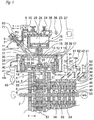
- synchronously running piston 1 In the internal combustion engine according to the invention, preferably at least two acting on the driven shaft 2 from opposite sides, synchronously running piston 1 is provided. There can be one, two or more Pairs of such opposing pairs, each synchronously clocked be provided by piston 1. At least the opposite pistons or all pistons can have the same inner and outer Curved surfaces 3, 4 and their own thrust links in the form of on the piston rods 5 arranged rollers 6 act on the shaft 2, as from the following Description will emerge in more detail.
- Each piston 1 has at least one combustion chamber 7 for clocked combustion assigned to a fuel.
- the combustion chamber is made of a jacket heat insulating material 8 surrounded. Ignition takes place only in the start phase the fuel-air mixture with a spark plug 9. Heat continuously the walls of the combustion chamber 7 above the autoignition temperature of the fuel (to over 700 ° Celsius) and the ignition of the fuel takes place directly when it is injected into the combustion chamber 7, if it is on the latter Walls hits. Together with the fuel, water is preferably used injected to lower the combustion temperature, which in particular leads to a reduction in NOx.
- the injectors for the fuel and that Water is shown only schematically in FIG. 1 as unit 10, with the supply of the fuel by the arrow V and the supply of water by the Arrow VI are indicated.
- the combustion chamber 7 is connected to a controllable combustion chamber outlet valve 11 an expansion chamber 12 separated from the combustion chamber 7, which is designed as a cylinder space in which the piston 1 is slidably mounted is.
- the combustion chamber exhaust valve can be opened gradually or with a delay, such as is executed in more detail below, and thus acts as a throttle valve for the pressurized formed by the combustion of the fuel hot combustion gas, which from the combustion chamber 7 into the expansion chamber 12 flows when the combustion chamber exhaust valve 11 opens.
- the throttle effect of the combustion chamber exhaust valve 11 further heating of the combustion gas does not lead to any significant Reduction in efficiency, since the thermal energy of the Combustion gas used in the implosion phase described below becomes.
- a heat insulating Material preferably a ceramic, formed. It could also be on the area of the combustion chamber exhaust valve on the outside of the internal combustion engine be surrounded by a heat-insulating jacket.
- a heat-insulating layer 14, 15 is preferably made of a ceramic material, also on the inside of the cylinder head 16 and arranged on the top of the piston 1 facing the expansion chamber 12. Only the cylinder wall 17 has no such thermal insulation, on the contrary, it is water-cooled by internal water cooling, as in following is described.
- Such a piston seal 18 is water-lubricable.
- injection nozzles 19 water into the Expansion chamber 12 injected to initiate an implosion phase.
- This Coolant is sprayed onto the cylinder wall 17 and forms one there Water film for cooling the cylinder wall 17 and for lubricating the piston seal 18.
- the injection nozzles 19 are surrounded by an elastic O-ring 20, which forms a self-closing injection check valve.
- the negative pressure in the expansion chamber after the injection of the coolant serves on the one hand for purging the combustion chamber 7, on the other hand thereby the piston 1 is pulled up towards its top dead center OT.
- the Piston 1 is one of the piston rod 22 with the compressor piston 21 a piston-cylinder unit formed compressor pump 23 connected.
- the air inlet valve designed as a self-closing check valve opens 24 and air flows into the cylinder space 25.
- Air volume depending on the current power output of the engine
- a throttle valve 28 is actuated by a servomotor 26, which is controlled by a motor controller 27, a throttle valve 28 more or less closed.
- Throttle valve 28 forms during the downward movement of the piston 1 shows a vacuum in the cylinder chamber which is dependent on the position of the throttle valve 28 25 off and the amount of air available during the subsequent upward movement of the compressor piston 21 is thereby lower.
- the air outlet valve designed as a self-closing check valve 29 opens the air outlet valve designed as a self-closing check valve 29 and a corresponding amount of air leading to a corresponding compressor pressure leads, is pressed into the combustion chamber 7.
- On the compressor piston 21 is a cushion 75 made of a deformable material, so that on uppermost point of this piston all air is pressed out of the cylinder chamber 25, which would otherwise act as an air spring, leading to unnecessary friction would.
- the expansion chamber outlet valve 30 comprises an annular wall 17 surrounding actuator 31, which is under the action of a hydraulic pressure from its downward biased position along the cylinder wall 17 is movable in the direction of the cylinder head 16.
- a hydraulic line 32 provided in a chamber sealed by O-rings 33, 34 flows.
- Actuating the hydraulic line 32 moves the actuator upwards and presses with its free end against you in a ring Groove in the cylinder head 16 arranged sealing ring 35, so that the expansion chamber outlet opening 36 is closed by the actuator 31.
- This expansion chamber outlet 36 is an annular gap between the cylinder head 16 and the cylinder wall 17 are formed. This closure of the expansion chamber outlet valve 30 by the actuator 31 during the downward movement piston 1 from top dead center to bottom dead center, around the pressurized combustion gas in the expansion chamber 12 to include.
- the actuator 31 When the hydraulic line 32 is depressurized, the actuator 31 is in its position biased position below. On the outside of the actuator 31 is in front of the Expansion chamber outlet opening 36 an elastic O-ring 37 arranged on the one hand against a wedge surface 38 on the outside of the actuator 31 and on the other hand is supported on an annular extension 39 on the cylinder head 16. This O-ring 37 thus forms a self-closing when the actuator 31 is open Check valve. When the pressure of the combustion gas goes up with you Moving piston 1 rises above atmospheric pressure, the will O-ring 37 formed, self-closing check valve opened and the combustion gas-water mixture can flow out of the expansion chamber 12.
- a line section 40 arrives in a water separator 41, which is analogous to the water separator described in EP 0 957 250 A2 can.
- the cooling water is in the water tank 42 according to arrow VIII recycled and the combustion gas can flow out through the exhaust 43.
- the cam pump 53 for water injection also functions in an analogous manner into the combustion chamber 7 and the cam pump 54 for the injection of the Cooling water into the expansion chamber 12.
- the cams 55 of all of these cam disks 45 are formed analogously to the section shown in FIG. 4.
- hydraulic oil used is here, in addition to a supplying hydraulic line 32, also a discharge hydraulic line 56 provided a closed circuit of hydraulic fluid to enable.
- a discharge hydraulic line 56 provided a closed circuit of hydraulic fluid to enable.
- the cam 57 shown in section in FIG. 3 the cam pump 58 to a steeply rising flank 79, with the the actuator 31 is moved to the closed position, a gently rising Flank 60 to the drain through the return hydraulic line 56th along the line indicated by I and to compensate the throttle 61 and the actuator 31 during the entire course of the cam 57 in the open Hold position, taking hydraulic fluid according to the line routing VII, 32, 56, I flows into the hydraulic tank 62.
- the combustion chamber exhaust valve is opened via the cam pump 58.
- the the corresponding cam is similar to the cam 60 shown in FIG. 3 formed, only that the rising edge 59 is formed flatter to the Slowly open the combustion chamber exhaust valve.
- In the open state of the Combustion chamber exhaust valve also flows over a rising edge accordingly the flank 60 of the cam 57 hydraulic fluid from the cam pump 58 via the line indicated by II and the line indicated by III through the cylinder chamber 63 of the combustion chamber exhaust valve 11 into the hydraulic tank 62, which is in the closed position of the combustion chamber exhaust valve 11 biased piston 77 is kept open.
- the piston rod 5 of the piston 1 is divided into two and is formed by two rods, those on both sides of the cam 64 with the inner and outer Curved surfaces 3, 4 are.
- On axes 65 are rollers 6 on the facing each other Sides of the two rods of the piston rod 5 mounted between the two curved surfaces 3, 4 are arranged.
- the distance between the two Curved surfaces 3, 4 are slightly larger than the diameter of the rollers, so that the rollers 6, which act as thrust members of the cam mechanism, either can roll on the inner curve surface 3 or the outer curve surface 4.
- the inner and outer curve surfaces 3, 4 are each a circumferentially closed surface. Between the two rollers 6 is a the web 67 connecting the two curved surfaces 3, 4 is arranged.
- the inner curve surface 3 is formed by the circumferential surface of a cam 68, which sitting rigidly on the shaft 2.
- the distance between the inner and outer Curve surface 3, 4 is constant over the circumference of these curve surfaces 3, 4.
- Each the curved surfaces 3, 4 have three sections along their circumference, which are explained below with reference to the inner curve surface 3.
- In the first Section 69 takes the distance of the curved surface from the center of the shaft 2 first quickly, then more slowly. This first section is the downward movement assigned to the piston from top dead center to bottom dead center.
- the initially The rapid decrease in the distance corresponds to the initially rapid Decrease in pressure in the expansion chamber.
- second section 70 the distance of the cam surface 3 from the center of the shaft increases again.
- This section is the upward movement of the piston from bottom dead center assigned to top dead center.
- the part of the circumference of the cam surface that is occupied by the first section 69 is smaller than that of the second section 70, preferably the angular extent of section 70 about 1.5 to 2.5 times larger than that of the first section 69 and is in the range between 80 and 120 °.
- This causes the piston to move downward from OT to UT faster than its upward movement from UT to OT. This has with the result that the exchange time for convection transmission of heat is shortened will reduce the heat loss of the engine.
- a faster one Downward movement of the piston as its upward movement is due to the on average greater pressure difference to atmospheric pressure during the Expansion phase compared to the implosion phase possible without any problems.
- a third section 71 Following the second section 70 is a third section 71, the one constant maximum distance from the center of the shaft 2. While the course of the rollers 6 over this section 71 of the curved surface therefore remains the piston is motionless at TDC ("waiting phase"). During this time the complete combustion of the fuel can be carried out in the combustion chamber 7 become. The angular extent of the third section 71 becomes the same adjusted the time required (which depends on the fuel used, among other things).
- the three sections 69, 70, 71 are along the circumference of the curved surface 3 Provided twice so that during a complete revolution of the shaft 2 two complete work or cycle cycles of the engine are carried out.
- the outer curve surface 4 is corresponding in the sections 69, 70, 71 corresponding Sections divided.
- the two rods of the piston rod 5 are each on their two opposite Side surfaces mounted on bearing rollers 66.
- the clock cycle of the internal combustion engine is described below with reference to that in FIG. 5 illustrated diagram explained.
- Three partial diagrams are shown, whereby the angular degrees of the rotation of the shaft 2 are plotted as the common ordinate are.
- the top dashed line in the upper part of the diagram is the theoretical one Pressure curve shown in the combustion chamber 7.
- the solid line represents the pressure curve in the expansion chamber 12 at full load of the engine, while the dash-dotted line shows the pressure curve in the expansion chamber 12 represents at partial load operation of the engine.
- the two horizontal reference lines in this pressure diagram refer to atmospheric pressure and the absolute pressure zero point. In the linearly increasing area 72 of the pressure curve in the combustion chamber 7 the fresh air is compressed in the combustion chamber 7 by the compressor pump 23.
- the individual tax processes are schematically dependent drawn from the angular position of the shaft 2.
- the lower part diagram shows the course of the piston between its bottom dead center and UT his top dead center OT.
- the engine already reaches atmospheric pressure while the Piston 1 is still on its way from top dead center to bottom dead center.
- the pressure drops in part-load operation the expansion chamber 12 under atmospheric pressure, preferably under the 0.8 times atmospheric pressure, corresponding to section 74 in the dash-dot line Line in Fig. 5.
- the combustion gas is thereby "diluted" before the in the implosion phase is initiated.
- the implosion phase will start as soon as the piston 1 has reached bottom dead center by cooling water into the Expansion chamber 12 is injected, as indicated by the bar IV in Fig. 5 is.
- the dilution of Combustion gas in the expansion chamber 12 below atmospheric pressure only when the engine is under partial load in order to reduce the efficiency at full load of the engine and in partial load operation of the engine as close as possible to each other.
- a dilution of the combustion gas can be provided in full load operation. This is particularly advantageous for engines that operate mainly or only at full load work (e.g. stationary motors).
Landscapes
- Engineering & Computer Science (AREA)
- Chemical & Material Sciences (AREA)
- Mechanical Engineering (AREA)
- General Engineering & Computer Science (AREA)
- Combustion & Propulsion (AREA)
- Ceramic Engineering (AREA)
- Output Control And Ontrol Of Special Type Engine (AREA)
Abstract
Description
Alleine aus der Arbeitsfähigkeit dieses zusätzlichen Druckanteiles unterhalb des Implosionsdruckes des ersten Fallbeispiels wird die gegen Ende des Expansionshubes für das Verdünnen des Abgases zugeführte Leistung während des Implosionshubes in etwa wieder rückgewonnen. Der danach verbleibende und zur Verdichtung bzw. höchstens teilweise auch nach außerhalb des Motors arbeitswirksame Unterdruck der Implosion wirkt nunmehr aber im Gegensatz zum ersten Fallbeispiel nicht nur innerhalb des halben Hubweges, sondern innerhalb des gesamten Hubes (abzüglich Anteil - Auspuffhub). Die Implosionsleistung ist somit innert der Fallbeispiele in etwa verdoppelt, bzw.: Die nutzbare Leistung aus der Implosionsphase ist, bezogen auf das zweite Fallbeispiel, mit Teillastbereich der vorausgegangenen Expansionsphase, in etwa gleich groß als mit Vollastlauf der vorausgegangenen Expansionsphase.
- 1
- Kolben
- 2
- Welle
- 3
- innere Kurvenfläche
- 4
- äußere Kurvenfläche
- 5
- Kolbenstange
- 6
- Rolle
- 7
- Brennkammer
- 8
- wärmeisolierendes Material
- 9
- Zündkerze
- 10
- Einheit
- 11
- Brennkammer-Auslaßventil
- 12
- Expansionskammer
- 13
- Leitungsstück
- 14
- wärmeisolierende Schicht
- 15
- wärmeisolierendes Stück
- 16
- Zylinderkopf
- 17
- Zylinderwand
- 18
- Kolbendichtung
- 19
- Einspritzdüse
- 20
- O-Ring
- 21
- Verdichterkolben
- 22
- Kolbenstange
- 23
- Verdichterpumpe
- 24
- Lufteinlaßventil
- 25
- Zylinderraum
- 26
- Stellmotor
- 27
- Motorsteuerung
- 28
- Drosselklappe
- 29
- Luftauslaßventil
- 30
- Expansionskammer-Auslaßventil
- 31
- Stellglied
- 32
- Hydraulikleitung
- 33
- Dichtring
- 34
- Dichtring
- 35
- Dichtring
- 36
- Expansionskammer-Auslaßöffnung
- 37
- O-Ring
- 38
- Keilfläche
- 39
- Fortsatz
- 40
- Leitungsstück
- 41
- Wasserabscheider
- 42
- Wassertank
- 43
- Auspuff
- 44
- Nockenpumpfe
- 45
- Nockenscheibe
- 46
- Tauchkolben
- 47
- Zylinderraum
- 48
- Kurzschlußleitung
- 49
- Rückschlagventil
- 50
- Drosselventil
- 51
- Treibstofftank
- 52
- Leitung
- 53
- Nockenpumpe
- 54
- Nockenpumpe
- 55
- Nocken
- 56
- Hydraulikleitung
- 57
- Nocken
- 58
- Nockenpumpe
- 59
- Nockenpumpe
- 60
- Flanke
- 61
- Drossel
- 62
- Hydrauliktank
- 63
- Zylinderraum
- 64
- Kurvenscheibe
- 65
- Achse
- 66
- Lagerrolle
- 67
- Steg
- 68
- Kurvenscheibe
- 69
- erster Abschnitt
- 70
- zweiter Abschnitt
- 71
- dritter Abschnitt
- 72
- Bereich
- 73
- Alternator
- 74
- Abschnitt
- 75
- Kissen
- 76
- Rückschlagventil
- 77
- Kolben
- 78
- Bereich
- 79
- Flanke
Claims (20)
- Verfahren zum Betreiben eines Verbrennungsmotors, der eine Brennkammer aufweist, in der ein Treibstoff getaktet verbrannt wird und aus der das bei der Verbrennung gebildete, unter einem Überdruck stehende, heiße Verbrennungsgas in eine von der Brennkammer getrennte Expansionskammer einströmt, in der es einen Kolben verschiebt, wobei am Ende der Expansionsphase des Verbrennungsgases eine Kühlflüssigkeit in die Expansionskammer eingesprüht wird und der durch die plötzliche Abkühlung des heißen Verbrennungsgases hervorgerufene Unterdruck in der Expansionskammer auf den Kolben einwirkt und der Kolben unter Einwirkung dieses Unterdrucks Arbeit leistet, dadurch gekennzeichnet, daß das Verbrennungsgas zumindest in einem Teillastbetrieb des Motors bereits vor Ende der Expansionsphase des Verbrennungsgases in der Expansionskammer (12) Atmosphärendruck erreicht und sich in der Folge die Verschiebung des Kolbens (1) in die gleiche Bewegungsrichtung unter weiterer Expansion des Verbrennungsgases in der Expansionskammer (12) fortsetzt, wobei sich ein unterhalb des Atmosphärendrucks liegender Druck, vorzugsweise ein unterhalb des 0,8fachen Atmosphärendrucks liegender Druck, in der Expansionskammer (12) ausbildet und die Kühlflüssigkeit am Ende der Expansionsphase des Verbrennungsgases in das unter diesem Unterdruck stehende Verbrennungsgas eingesprüht wird, wobei sich der Druck des Verbrennungsgases weiter verringert.
- Verfahren nach Anspruch 1, dadurch gekennzeichnet, daß der Kolben (1) als Hubkolben ausgebildet ist, der in der als Zylinder ausgebildeten Expansionskammer (12) verschiebbar gelagert ist, wobei zwischen der Expansionskammer (12) und der Brennkammer (7) ein steuerbares Brennkammer-Auslaßventil (11) vorgesehen ist, welches nach der im wesentlichen vollständigen Verbrennung des Treibstoffes in der Brennkammer (7) geöffnet wird, wobei sich der Kolben (1) im Bereich seines oberen Totpunktes (OT) befindet.
- Verfahren nach Anspruch 2, dadurch gekennzeichnet, daß die Einsprühung der Kühlflüssigkeit erfolgt, wenn sich der Kolben im Bereich seines unteren Totpunktes (UT) befindet.
- Verfahren nach Anspruch 2 oder Anspruch 3, dadurch gekennzeichnet, daß der Kolben über eine Kolbenstange mit einem Verdichterkolben (21) einer Verdichterpumpe (23) zur Verdichtung von Luft in der Brennkammer (7) verbunden ist, wobei die Verdichtung während der Aufwärtsbewegung des Kolbens (1) vom unteren Totpunkt (UT) zum oberen Totpunkt (OT) erfolgt und vom Unterdruck in der Expansionskammer (12) bewirkt bzw. unterstützt wird.
- Verfahren nach einem der Ansprüche 2 bis 4, dadurch gekennzeichnet, daß an der Kolbenstange (5) des Kolbens (1) zumindest eine Rolle (6) angeordnet ist, die ein Schubglied eines Kurvengetriebes bildet, wobei an der Rolle (6) beidseitig Kurvenflächen (3, 4) des in beide Hubrichtungen des Kolbens (1) wirkenden Kurvengetriebes anliegen.
- Verfahren nach einem der Ansprüche 2 bis 5, dadurch gekennzeichnet, daß die Kurvenflächen (3, 4) einen ersten, der Abwärtsbewegung des Kolbens vom oberen Totpunkt zum unteren Totpunkt zugeordneten Abschnitt (69), einen zweiten, der Aufwärtsbewegung des Kolbens vom unteren Totpunkt zum oberen Totpunkt zugeordneten Abschnitt (70) und einen dritten Abschnitt (71) aufweisen, in dem die Kurvenflächen (3, 4) einen konstanten Abstand vom Mittelpunkt der Welle (2) aufweisen, um die sie sich umfangsgeschlossen erstrecken, und der der Stellung des Kolbens in seinem oberen Totpunkt zugeordnet ist, wobei die Winkelausdehnung des dritten Abschnitts (71) an die Dauer der Verbrennung des Treibstoffs in der Brennkammer (7) angepaßt wird, wobei gerade ausreichend Zeit zur vollständigen Verbrennung des Treibstoffs zur Verfügung gestellt wird.
- Verfahren nach einem der Ansprüche 1 bis 6, dadurch gekennzeichnet, daß der Druck des Verbrennungsgases in der Expansionskammer unmittelbar vor Einleitung der Implosionsphase oberhalb des 0,3fachen Atmosphärendrucks liegt.
- Verfahren nach einem der Ansprüche 1 bis 7, dadurch gekennzeichnet, daß auch im Vollastbetrieb des Motors der Druck des Verbrennungsgases in der Expansionskammer (12) am Ende der Expansionsphase unterhalb des Atmosphärendrucks, vorzugsweise unterhalb des 0,9fachen Atmosphärendrucks liegt.
- Verbrennungsmotor mit einer Brennkammer (7) zur getakteten Verbrennung eines Treibstoffes unter Bildung eines Verbrennungsgases und einer mit der Brennkammer (7) über ein steuerbares Brennkammer-Auslaßventil (11) verbundenen, separaten Expansionskammer (12), die einen verschiebbar gelagerten Kolben (1) zur Umsetzung von Energie des Verbrennungsgases in mechanische Arbeit bzw. Energie aufweist, wobei zumindest eine in die Expansionskammer (12) mündende Einspritzdüse (19) zum Einsprühen einer Kühlflüssigkeit zur plötzlichen Volumsverringerung des expandierten Verbrennungsgases vorgesehen ist, dadurch gekennzeichnet, daß an der Kolbenstange (5) des Kolbens (1) zumindest eine Rolle (6) angeordnet ist, die ein Schubglied eines Kurvengetriebes bildet, wobei an der Rolle (6) beidseitig Kurvenflächen (3, 4) des in beide Hubrichtungen des Kolbens (1) wirkenden Kurvengetriebes anliegen.
- Verbrennungsmotor nach Anspruch 9, dadurch gekennzeichnet, daß das Brennkammer-Auslaßventil (11) als mit einer Verzögerungszeit öffenbares Drosselventil ausgebildet istund die vom heißen Verbrennungsgas berührten Teile dieses Brennkammer-Auslaßventils(11) aus einem wärmeisolierenden Material, vorzugsweise einer Keramik, bestehen oder auf der Außenseite des Verbrennungsmotors von einer wärmeisolierenden Ummantelung umgeben sind.
- Verbrennungsmotor nach Anspruch 9 oder Anspruch 10, dadurch gekennzeichnet, daß zur hydraulischen Betätigung des Brennkammer-Auslaßventils (11) eine Nockenpumpe (59) vorgesehen ist, die von einem Nocken betätigt wird, der auf einer über das Kurvengetriebe angetriebenen Welle (2) angeordnet ist, und mit einer das Brennkammer-Auslaßventil (11) betätigenden Hydraulik-Zylinder-Einheit des Brennkammer-Auslaßventils (11) verbunden ist, wobei der Nocken eine allmählich ansteigende Fläche zur allmählichen Öffnung des Brennkammer-Auslaßventils (11) aufweist.
- Verbrennungsmotor nach Anspruch 11, dadurch gekennzeichnet, daß in der Rücklaufleitung der Hydraulikflüssigkeit vom Zylinderraum (63) der Hydraulik-Zylinder-Einheit des Brennkammer-Auslaßventils (11) zu einem Hydrauliktank (62) eine Drossel (61) vorgesehen ist.
- Verbrennungsmotor nach einem der Ansprüche 9 bis 12, dadurch gekennzeichnet, daß zum Einspritzen des Treibstoffs in die Brennkammer (7) eine Nockenpumpe (44) vorgesehen ist, die von einem Nocken betätigt wird, der auf einer über das Kurvengetriebe angetriebenen Welle (2) angeordnet ist und die mit einer in die Brennkammer (7) mündenden Einspritzdüse verbunden ist, wobei zur Regelung der eingespritzten Treibstoffmenge eine Kurzschlußleitung (48) von der Nockenpumpe (44) zum Treibstofftank (51) vorgesehen ist, in der ein steuerbares Drosselventil (50) angeordnet ist.
- Verbrennungsmotor nach einem der Ansprüche 9 bis 13, dadurch gekennzeichnet, daß zur Einspritzung des Implosionswassers in die Expansionskammer (12) eine Nockenpumpe (54) vorgesehen ist, die von einem Nocken betätigt wird, der auf einer über das Kurvengetriebe angetriebenen Welle (2) angeordnet ist und mit einer Einspritzdüse (19) zur Einsprühung des Kühlwassers in die Expansionskammer (12) verbunden ist, wobei zur Regelung der eingespritzten Kühlflüssigkeitsmenge eine Kurzschlußleitung von der Nockenpumpe zum Wassertank (42) vorgesehen ist, in der ein steuerbares Drosselventil angeordnet ist.
- Verbrennungsmotor nach einem der Ansprüche 9 bis 14, dadurch gekennzeichnet, daß ein Expansionskammer-Auslaßventil zum Einschluß bzw. Ablaß des Verbrennungsgases aus der Expansionskammer (12) einen außen um eine oder mehrere Expansionskammer-Auslaßöffnungen (36) verlaufenden, elastischen O-Ring 37 umfaßt, dessen Ventilsitz einer
seits von einem Fortsatz an der Zylinderwand (17) bzw. am Zylinderkopf (16) und andererseits von einer Keilfläche (38) eines Stellgliedes (31) gebildet wird, das über Beaufschlagung durch Hydraulikflüssigkeit zwischen einer ersten, geöffneten Stellung der Expansionskammer-Auslaßöffnungen (36) und einer zweiten, geschlossenen Stellung der Expansionskammer-Auslaßöffnungen (36) verschiebbar ist. - Verbrennungsmotor nach einem der Ansprüche 9 bis 15, dadurch gekennzeichnet, daß zur Verringerung von Konvektionswärmeverlusten des heißen Verbrennungsgases in der Expansionskammer (12) die Kurvenflächen des Kurvengetriebes einen ersten Abschnitt (69) aufweisen, der der Abwärtsbewegung des Kolbens vom oberen Totpunkt zum unteren Totpunkt zugeordnet ist, und einen zweiten Abschnitt (70) aufweisen, der der Aufwärtsbewegung des Kolbens vom unteren Totpunkt zum oberen Totpunkt zugeordnet ist, wobei die Winkelausdehnung des zweiten Abschnittes (70) der Kurvenfläche (3, 4) um das 1,5fache bis 2,5fache größer ist als die Winkelausdehnung des ersten Abschnittes (69) des Kurvengetriebes.
- Verbrennungsmotor nach Anspruch 16, dadurch gekennzeichnet, daß die Kurvenflächen (3, 4) zwischen einem zweiten Abschnitt (70) und einem ersten Abschnitt (69) einen dritten Abschnitt (71) aufweisen, in dem die Kurvenfläche (3, 4) einen konstanten Abstand vom Mittelpunkt der Welle (2) aufweist, um die sie sich umfangsgeschlossen erstreckt, und der der Stellung des Kolbens in seinem oberen Totpunkt zugeordnet ist.
- Verbrennungsmotor nach einem der Ansprüche 9 bis 17, dadurch gekennzeichnet, daß der Verbrennungsmotor mindestens zwei gegenüberliegende Kolben (1) aufweist, die über jeweils eine oder mehrere an ihren Kolbenstangen (5) angeordnete Rollen (6) auf die gleichen Kurvenflächen (3, 4) wirken und synchron getaktet sind.
- Verbrennungsmotor nach Anspruch 18, dadurch gekennzeichnet, daß mehrere gegenüberliegende Paare von Kolben (1) vorgesehen sind.
- Verbrennungsmotor nach einem der Ansprüche 9 bis 19, dadurch gekennzeichnet, daß das Hubvolumen der Expansionskammer im Verhältnis zum Volumen der Brennkammer (7) und zum Hubvolumen der Verdichterpumpe (23) derart gewählt ist, daß im Vollastbetrieb des Motors der Druck des Verbrennungsgases in der Expansionskammer (12) am Ende der Expansionsphase unterhalb des Atmosphärendrucks, vorzugsweise unterhalb des 0,8fachen Atmosphärendrucks liegt.
Applications Claiming Priority (2)
| Application Number | Priority Date | Filing Date | Title |
|---|---|---|---|
| AT7612000 | 2000-05-02 | ||
| AT7612000 | 2000-05-02 |
Publications (2)
| Publication Number | Publication Date |
|---|---|
| EP1152138A2 true EP1152138A2 (de) | 2001-11-07 |
| EP1152138A3 EP1152138A3 (de) | 2002-04-17 |
Family
ID=3680544
Family Applications (1)
| Application Number | Title | Priority Date | Filing Date |
|---|---|---|---|
| EP01110266A Withdrawn EP1152138A3 (de) | 2000-05-02 | 2001-04-25 | Verfahren zum Betreiben eines Verbrennungsmotors sowie Verbrennungsmotor |
Country Status (2)
| Country | Link |
|---|---|
| US (1) | US6622471B1 (de) |
| EP (1) | EP1152138A3 (de) |
Cited By (1)
| Publication number | Priority date | Publication date | Assignee | Title |
|---|---|---|---|---|
| GB2399394B (en) * | 2002-03-28 | 2005-10-19 | Shane Engines Ltd | A mechanism including a piston-and-cylinder assembly |
Families Citing this family (5)
| Publication number | Priority date | Publication date | Assignee | Title |
|---|---|---|---|---|
| SE0202403L (sv) * | 2002-08-13 | 2004-02-14 | Cargine Engineering Ab | Styrmetid för reglering av gasflödet vid en kompressor |
| US7017534B2 (en) * | 2004-04-01 | 2006-03-28 | Chaney Ray O | Piston-cam engine |
| US8156919B2 (en) | 2008-12-23 | 2012-04-17 | Darrow David S | Rotary vane engines with movable rotors, and engine systems comprising same |
| US10294888B2 (en) * | 2016-09-01 | 2019-05-21 | Caterpillar Inc. | Piston balancing heat dissipation and combustion properties in internal combustion engine |
| CN110884724B (zh) * | 2019-11-28 | 2021-07-20 | 安吉万洲电气有限公司 | 一种牙膏罐装封尾机 |
Citations (2)
| Publication number | Priority date | Publication date | Assignee | Title |
|---|---|---|---|---|
| US5311739A (en) | 1992-02-28 | 1994-05-17 | Clark Garry E | External combustion engine |
| EP0957250A2 (de) | 1998-05-14 | 1999-11-17 | HMS Artist Scheier OEG | Verbrennungsmotor |
Family Cites Families (20)
| Publication number | Priority date | Publication date | Assignee | Title |
|---|---|---|---|---|
| US1370503A (en) * | 1921-03-01 | Fakken | ||
| US883511A (en) * | 1907-07-19 | 1908-03-31 | George Adelard Beaudet | Gas-engine. |
| US1731778A (en) * | 1918-11-18 | 1929-10-15 | Holzwarth Gas Turbine Co | Valve for gas turbines |
| US1783589A (en) * | 1927-06-17 | 1930-12-02 | Shepard Alban Francis | Means for converting rotary into reciprocating motion and vice versa |
| DE2033539B2 (de) * | 1969-07-08 | 1977-04-14 | Fiat S.P.A., Turin (Italien) | Otto-motor mit brennstoff-einspritzeinrichtung und zuendeinrichtung an einer kugelfoermigen verbrennungskammer |
| DE2216082C2 (de) | 1972-04-01 | 1983-02-24 | Alexander 8960 Kempten Russu | Vorrichtung zur Erzeugung einer Rückstoßkraft für Wasserfahrzeuge |
| IL46282A0 (en) * | 1973-12-21 | 1975-03-13 | Ventur E Inc Of Richmond | Vacuum release valve assembly and internal combustion engines comprising it |
| US4369623A (en) * | 1975-03-14 | 1983-01-25 | Johnson David E | Positive displacement engine with separate combustion chamber |
| JPS5925871B2 (ja) | 1977-02-21 | 1984-06-21 | 株式会社豊田中央研究所 | 定常燃焼機関 |
| CA1129346A (en) * | 1981-01-07 | 1982-08-10 | Gerald J. Williams | Sleeve valved engine with positive total exhaust expulsion |
| DE3135675A1 (de) | 1981-01-13 | 1982-08-05 | Karl Kanagawa Eickmann | Verbrennungsmotor und verwandte aggregate, sowie hilfsmittel dafuer |
| FR2607552B1 (fr) * | 1986-05-21 | 1991-07-19 | Innovations Atel Const | Moteur a explosion sans embiellage ni vilebrequin de type cylindres en etoile |
| SU1749554A1 (ru) | 1989-04-25 | 1992-07-23 | Ленинградский горный институт им.Г.В.Плеханова | Плавающий перистальтический насос |
| GB9001413D0 (en) * | 1990-01-22 | 1990-03-21 | Galvin George F | Internal combustion engine |
| US5222466A (en) | 1992-05-18 | 1993-06-29 | Itzchak Gratziani | Internal combustion engine with flexible/piston cylinder |
| DE4232566C2 (de) | 1992-09-29 | 1994-07-14 | Martin Inhoffen | Druckturbinenmotor |
| AUPM982794A0 (en) | 1994-12-02 | 1995-01-05 | Advanced Engine Technology Pty Ltd | New and improved rotary engine |
| US6132270A (en) | 1996-07-03 | 2000-10-17 | Siegfried Nagel | Pulsing reaction drive for water craft |
| WO1999044886A2 (de) * | 1998-03-02 | 1999-09-10 | Hms Artist Scheier Oeg | Verbrennungskraftmaschine |
| IT1315603B1 (it) * | 2000-02-29 | 2003-03-14 | Fantuzzi Reggiane Spa | Motore a combustione interna a funzionamento alternativo perfezionato |
-
2001
- 2001-04-25 EP EP01110266A patent/EP1152138A3/de not_active Withdrawn
- 2001-05-01 US US09/846,869 patent/US6622471B1/en not_active Expired - Fee Related
Patent Citations (2)
| Publication number | Priority date | Publication date | Assignee | Title |
|---|---|---|---|---|
| US5311739A (en) | 1992-02-28 | 1994-05-17 | Clark Garry E | External combustion engine |
| EP0957250A2 (de) | 1998-05-14 | 1999-11-17 | HMS Artist Scheier OEG | Verbrennungsmotor |
Cited By (2)
| Publication number | Priority date | Publication date | Assignee | Title |
|---|---|---|---|---|
| GB2399394B (en) * | 2002-03-28 | 2005-10-19 | Shane Engines Ltd | A mechanism including a piston-and-cylinder assembly |
| US7100549B2 (en) | 2002-03-28 | 2006-09-05 | Robin Humphries | Mechanism including a piston-and-cylinder assembly |
Also Published As
| Publication number | Publication date |
|---|---|
| EP1152138A3 (de) | 2002-04-17 |
| US6622471B1 (en) | 2003-09-23 |
Similar Documents
| Publication | Publication Date | Title |
|---|---|---|
| AT402432B (de) | Brennkraftmaschine | |
| EP2165058B1 (de) | Brennkraftmotor | |
| DE102009017713B4 (de) | Freikolben-Brennkraftmaschine | |
| EP0328602B1 (de) | Einrichtung zur einbringung des kraftstoffes in den brennraum einer brennkraftmaschine | |
| EP2354475B1 (de) | Verfahren zum Betrieb eines Kolbenexpanders eines Dampfmotors | |
| EP0455761B1 (de) | Hydraulische ventilsteuervorrichtung für brennkraftmaschinen | |
| DE3318136A1 (de) | Ladevorrichtung zum aufladen von verbrennungsmotoren | |
| DE2644389A1 (de) | Aufgeladene rotationskolben-brennkraftmaschine | |
| EP1113158A2 (de) | Verbrennungsmotor | |
| DE102005023178B4 (de) | Kompressionsimpulsverfahren zum Anlassen eines Freikolben-Verbrennungsmotors | |
| EP1152138A2 (de) | Verfahren zum Betreiben eines Verbrennungsmotors sowie Verbrennungsmotor | |
| DE3428174A1 (de) | Kraftstoffeinspritzpumpe fuer brennkraftmaschinen | |
| DE69632676T2 (de) | Kraftstoffeinspritzpumpe | |
| DE2009365A1 (de) | Kraftstoff-Einspritzvorrichtung für eine Diesemaschine | |
| DE102015105735B4 (de) | Verfahren zum Betreiben einer Kraftstoffpumpe für einen Verbrennungsmotor, Kraftstoffpumpe und Verbrennungsmotor | |
| DE2244145C3 (de) | Brennkraftmaschine mit äußerer Verbrennung | |
| DE102015215241A1 (de) | Hydraulisch betätigtes Schaltventil | |
| DE102016200487A1 (de) | Brennkraftmaschine | |
| DE102008049090B4 (de) | Brennkraftmaschine mit Expansionszylindern auf kuppelbarer Kurbelwelle | |
| DE102004035301B4 (de) | Dieselmotor | |
| EP0254292B1 (de) | Durch Abgasimpulse einer Verbrennungskraftmaschine antreibbarer Kolbenlader | |
| DE102005020636B4 (de) | Kompressionsimpulsverfahren zum Anlassen eines Freikolben-Verbrennungsmotors mit mehreren Zylindern | |
| EP1195503A2 (de) | Verbrennungsmotor | |
| EP0126464B1 (de) | Verfahren zur Zufuhr von Brennluft in den Brennraum von Verbrennungskraftmaschinen | |
| EP0957250A2 (de) | Verbrennungsmotor |
Legal Events
| Date | Code | Title | Description |
|---|---|---|---|
| PUAI | Public reference made under article 153(3) epc to a published international application that has entered the european phase |
Free format text: ORIGINAL CODE: 0009012 |
|
| AK | Designated contracting states |
Kind code of ref document: A2 Designated state(s): AT BE CH CY DE DK ES FI FR GB GR IE IT LI LU MC NL PT SE TR |
|
| AX | Request for extension of the european patent |
Free format text: AL;LT;LV;MK;RO;SI |
|
| PUAL | Search report despatched |
Free format text: ORIGINAL CODE: 0009013 |
|
| RAP1 | Party data changed (applicant data changed or rights of an application transferred) |
Owner name: HEINZLE, FRIEDRICH |
|
| RAP3 | Party data changed (applicant data changed or rights of an application transferred) |
Owner name: HEINZLE, FRIEDRICH |
|
| AK | Designated contracting states |
Kind code of ref document: A3 Designated state(s): AT BE CH CY DE DK ES FI FR GB GR IE IT LI LU MC NL PT SE TR |
|
| AX | Request for extension of the european patent |
Free format text: AL;LT;LV;MK;RO;SI |
|
| RIC1 | Information provided on ipc code assigned before grant |
Free format text: 7F 02B 41/06 A, 7F 02B 75/02 B |
|
| 17P | Request for examination filed |
Effective date: 20020824 |
|
| AKX | Designation fees paid |
Free format text: AT BE CH CY DE DK ES FI FR GB GR IE IT LI LU MC NL PT SE TR |
|
| STAA | Information on the status of an ep patent application or granted ep patent |
Free format text: STATUS: THE APPLICATION IS DEEMED TO BE WITHDRAWN |
|
| 18D | Application deemed to be withdrawn |
Effective date: 20041103 |