EP1152084A2 - Honigwabe aus Aramid und Verfahren zur Herstellung - Google Patents
Honigwabe aus Aramid und Verfahren zur Herstellung Download PDFInfo
- Publication number
- EP1152084A2 EP1152084A2 EP20000308570 EP00308570A EP1152084A2 EP 1152084 A2 EP1152084 A2 EP 1152084A2 EP 20000308570 EP20000308570 EP 20000308570 EP 00308570 A EP00308570 A EP 00308570A EP 1152084 A2 EP1152084 A2 EP 1152084A2
- Authority
- EP
- European Patent Office
- Prior art keywords
- aramid
- sheets
- para
- honeycombs
- fibers
- Prior art date
- Legal status (The legal status is an assumption and is not a legal conclusion. Google has not performed a legal analysis and makes no representation as to the accuracy of the status listed.)
- Granted
Links
- 229920003235 aromatic polyamide Polymers 0.000 title claims abstract description 299
- 239000004760 aramid Substances 0.000 title claims abstract description 250
- 241000264877 Hippospongia communis Species 0.000 title claims abstract description 131
- 238000004519 manufacturing process Methods 0.000 title claims description 16
- 229920005989 resin Polymers 0.000 claims abstract description 79
- 239000011347 resin Substances 0.000 claims abstract description 79
- 210000002421 cell wall Anatomy 0.000 claims abstract description 57
- 239000011148 porous material Substances 0.000 claims abstract description 56
- 239000011230 binding agent Substances 0.000 claims abstract description 47
- 238000003490 calendering Methods 0.000 claims abstract description 38
- 230000003014 reinforcing effect Effects 0.000 claims abstract description 34
- 239000000463 material Substances 0.000 claims abstract description 21
- 239000000853 adhesive Substances 0.000 claims description 28
- 230000001070 adhesive effect Effects 0.000 claims description 28
- 239000000835 fiber Substances 0.000 claims description 26
- 230000000717 retained effect Effects 0.000 claims description 8
- 210000004027 cell Anatomy 0.000 claims description 7
- 238000003825 pressing Methods 0.000 claims description 6
- 239000011248 coating agent Substances 0.000 claims description 4
- 238000000576 coating method Methods 0.000 claims description 4
- 210000002777 columnar cell Anatomy 0.000 claims description 4
- 238000010438 heat treatment Methods 0.000 claims description 4
- 244000144992 flock Species 0.000 claims description 3
- 238000000034 method Methods 0.000 abstract description 16
- 238000012360 testing method Methods 0.000 description 14
- 239000007788 liquid Substances 0.000 description 11
- OKKJLVBELUTLKV-UHFFFAOYSA-N Methanol Chemical compound OC OKKJLVBELUTLKV-UHFFFAOYSA-N 0.000 description 9
- 239000007787 solid Substances 0.000 description 8
- 230000002950 deficient Effects 0.000 description 6
- 238000001035 drying Methods 0.000 description 6
- XLYOFNOQVPJJNP-UHFFFAOYSA-N water Substances O XLYOFNOQVPJJNP-UHFFFAOYSA-N 0.000 description 6
- 230000006835 compression Effects 0.000 description 5
- 238000007906 compression Methods 0.000 description 5
- 239000000203 mixture Substances 0.000 description 5
- -1 acrylic ester Chemical class 0.000 description 4
- ISWSIDIOOBJBQZ-UHFFFAOYSA-N Phenol Chemical compound OC1=CC=CC=C1 ISWSIDIOOBJBQZ-UHFFFAOYSA-N 0.000 description 3
- 239000004372 Polyvinyl alcohol Substances 0.000 description 3
- 238000005470 impregnation Methods 0.000 description 3
- 239000004615 ingredient Substances 0.000 description 3
- 229920001568 phenolic resin Polymers 0.000 description 3
- 239000005011 phenolic resin Substances 0.000 description 3
- 229920002451 polyvinyl alcohol Polymers 0.000 description 3
- 238000000926 separation method Methods 0.000 description 3
- 239000000243 solution Substances 0.000 description 3
- 239000002904 solvent Substances 0.000 description 3
- 239000007858 starting material Substances 0.000 description 3
- QAOWNCQODCNURD-UHFFFAOYSA-N Sulfuric acid Chemical compound OS(O)(=O)=O QAOWNCQODCNURD-UHFFFAOYSA-N 0.000 description 2
- 239000007864 aqueous solution Substances 0.000 description 2
- 230000000052 comparative effect Effects 0.000 description 2
- 238000001816 cooling Methods 0.000 description 2
- 239000003822 epoxy resin Substances 0.000 description 2
- 238000001914 filtration Methods 0.000 description 2
- LNEPOXFFQSENCJ-UHFFFAOYSA-N haloperidol Chemical compound C1CC(O)(C=2C=CC(Cl)=CC=2)CCN1CCCC(=O)C1=CC=C(F)C=C1 LNEPOXFFQSENCJ-UHFFFAOYSA-N 0.000 description 2
- 239000002075 main ingredient Substances 0.000 description 2
- 230000000149 penetrating effect Effects 0.000 description 2
- 229920000647 polyepoxide Polymers 0.000 description 2
- 229920001721 polyimide Polymers 0.000 description 2
- 239000009719 polyimide resin Substances 0.000 description 2
- 230000002787 reinforcement Effects 0.000 description 2
- 229920005992 thermoplastic resin Polymers 0.000 description 2
- 229920001187 thermosetting polymer Polymers 0.000 description 2
- 239000010409 thin film Substances 0.000 description 2
- RNFJDJUURJAICM-UHFFFAOYSA-N 2,2,4,4,6,6-hexaphenoxy-1,3,5-triaza-2$l^{5},4$l^{5},6$l^{5}-triphosphacyclohexa-1,3,5-triene Chemical compound N=1P(OC=2C=CC=CC=2)(OC=2C=CC=CC=2)=NP(OC=2C=CC=CC=2)(OC=2C=CC=CC=2)=NP=1(OC=1C=CC=CC=1)OC1=CC=CC=C1 RNFJDJUURJAICM-UHFFFAOYSA-N 0.000 description 1
- NIXOWILDQLNWCW-UHFFFAOYSA-M Acrylate Chemical compound [O-]C(=O)C=C NIXOWILDQLNWCW-UHFFFAOYSA-M 0.000 description 1
- 239000004925 Acrylic resin Substances 0.000 description 1
- 229920000178 Acrylic resin Polymers 0.000 description 1
- 208000010392 Bone Fractures Diseases 0.000 description 1
- 206010010214 Compression fracture Diseases 0.000 description 1
- 206010017076 Fracture Diseases 0.000 description 1
- 239000004677 Nylon Substances 0.000 description 1
- 239000004809 Teflon Substances 0.000 description 1
- 229920006362 Teflon® Polymers 0.000 description 1
- 229920006231 aramid fiber Polymers 0.000 description 1
- 238000010009 beating Methods 0.000 description 1
- QHIWVLPBUQWDMQ-UHFFFAOYSA-N butyl prop-2-enoate;methyl 2-methylprop-2-enoate;prop-2-enoic acid Chemical compound OC(=O)C=C.COC(=O)C(C)=C.CCCCOC(=O)C=C QHIWVLPBUQWDMQ-UHFFFAOYSA-N 0.000 description 1
- 239000003795 chemical substances by application Substances 0.000 description 1
- 239000002131 composite material Substances 0.000 description 1
- 238000012669 compression test Methods 0.000 description 1
- 230000007423 decrease Effects 0.000 description 1
- 230000003247 decreasing effect Effects 0.000 description 1
- 239000006185 dispersion Substances 0.000 description 1
- 230000000694 effects Effects 0.000 description 1
- 239000010408 film Substances 0.000 description 1
- 239000003063 flame retardant Substances 0.000 description 1
- 238000002844 melting Methods 0.000 description 1
- 230000008018 melting Effects 0.000 description 1
- 229920001778 nylon Polymers 0.000 description 1
- 230000000979 retarding effect Effects 0.000 description 1
- 238000010008 shearing Methods 0.000 description 1
- 239000000126 substance Substances 0.000 description 1
- 125000000391 vinyl group Chemical group [H]C([*])=C([H])[H] 0.000 description 1
- 229920002554 vinyl polymer Polymers 0.000 description 1
- 238000005303 weighing Methods 0.000 description 1
- 239000002023 wood Substances 0.000 description 1
- 230000037303 wrinkles Effects 0.000 description 1
Images


Classifications
-
- D—TEXTILES; PAPER
- D21—PAPER-MAKING; PRODUCTION OF CELLULOSE
- D21H—PULP COMPOSITIONS; PREPARATION THEREOF NOT COVERED BY SUBCLASSES D21C OR D21D; IMPREGNATING OR COATING OF PAPER; TREATMENT OF FINISHED PAPER NOT COVERED BY CLASS B31 OR SUBCLASS D21G; PAPER NOT OTHERWISE PROVIDED FOR
- D21H13/00—Pulp or paper, comprising synthetic cellulose or non-cellulose fibres or web-forming material
- D21H13/10—Organic non-cellulose fibres
- D21H13/20—Organic non-cellulose fibres from macromolecular compounds obtained otherwise than by reactions only involving carbon-to-carbon unsaturated bonds
- D21H13/26—Polyamides; Polyimides
-
- Y—GENERAL TAGGING OF NEW TECHNOLOGICAL DEVELOPMENTS; GENERAL TAGGING OF CROSS-SECTIONAL TECHNOLOGIES SPANNING OVER SEVERAL SECTIONS OF THE IPC; TECHNICAL SUBJECTS COVERED BY FORMER USPC CROSS-REFERENCE ART COLLECTIONS [XRACs] AND DIGESTS
- Y10—TECHNICAL SUBJECTS COVERED BY FORMER USPC
- Y10T—TECHNICAL SUBJECTS COVERED BY FORMER US CLASSIFICATION
- Y10T428/00—Stock material or miscellaneous articles
- Y10T428/24—Structurally defined web or sheet [e.g., overall dimension, etc.]
- Y10T428/24149—Honeycomb-like
-
- Y—GENERAL TAGGING OF NEW TECHNOLOGICAL DEVELOPMENTS; GENERAL TAGGING OF CROSS-SECTIONAL TECHNOLOGIES SPANNING OVER SEVERAL SECTIONS OF THE IPC; TECHNICAL SUBJECTS COVERED BY FORMER USPC CROSS-REFERENCE ART COLLECTIONS [XRACs] AND DIGESTS
- Y10—TECHNICAL SUBJECTS COVERED BY FORMER USPC
- Y10T—TECHNICAL SUBJECTS COVERED BY FORMER US CLASSIFICATION
- Y10T428/00—Stock material or miscellaneous articles
- Y10T428/29—Coated or structually defined flake, particle, cell, strand, strand portion, rod, filament, macroscopic fiber or mass thereof
- Y10T428/2913—Rod, strand, filament or fiber
-
- Y—GENERAL TAGGING OF NEW TECHNOLOGICAL DEVELOPMENTS; GENERAL TAGGING OF CROSS-SECTIONAL TECHNOLOGIES SPANNING OVER SEVERAL SECTIONS OF THE IPC; TECHNICAL SUBJECTS COVERED BY FORMER USPC CROSS-REFERENCE ART COLLECTIONS [XRACs] AND DIGESTS
- Y10—TECHNICAL SUBJECTS COVERED BY FORMER USPC
- Y10T—TECHNICAL SUBJECTS COVERED BY FORMER US CLASSIFICATION
- Y10T428/00—Stock material or miscellaneous articles
- Y10T428/29—Coated or structually defined flake, particle, cell, strand, strand portion, rod, filament, macroscopic fiber or mass thereof
- Y10T428/2913—Rod, strand, filament or fiber
- Y10T428/2933—Coated or with bond, impregnation or core
-
- Y—GENERAL TAGGING OF NEW TECHNOLOGICAL DEVELOPMENTS; GENERAL TAGGING OF CROSS-SECTIONAL TECHNOLOGIES SPANNING OVER SEVERAL SECTIONS OF THE IPC; TECHNICAL SUBJECTS COVERED BY FORMER USPC CROSS-REFERENCE ART COLLECTIONS [XRACs] AND DIGESTS
- Y10—TECHNICAL SUBJECTS COVERED BY FORMER USPC
- Y10T—TECHNICAL SUBJECTS COVERED BY FORMER US CLASSIFICATION
- Y10T428/00—Stock material or miscellaneous articles
- Y10T428/29—Coated or structually defined flake, particle, cell, strand, strand portion, rod, filament, macroscopic fiber or mass thereof
- Y10T428/2913—Rod, strand, filament or fiber
- Y10T428/2933—Coated or with bond, impregnation or core
- Y10T428/2964—Artificial fiber or filament
- Y10T428/2967—Synthetic resin or polymer
- Y10T428/2969—Polyamide, polyimide or polyester
-
- Y—GENERAL TAGGING OF NEW TECHNOLOGICAL DEVELOPMENTS; GENERAL TAGGING OF CROSS-SECTIONAL TECHNOLOGIES SPANNING OVER SEVERAL SECTIONS OF THE IPC; TECHNICAL SUBJECTS COVERED BY FORMER USPC CROSS-REFERENCE ART COLLECTIONS [XRACs] AND DIGESTS
- Y10—TECHNICAL SUBJECTS COVERED BY FORMER USPC
- Y10T—TECHNICAL SUBJECTS COVERED BY FORMER US CLASSIFICATION
- Y10T428/00—Stock material or miscellaneous articles
- Y10T428/31504—Composite [nonstructural laminate]
- Y10T428/31725—Of polyamide
- Y10T428/31739—Nylon type
Definitions
- the present invention relates to aramid honeycombs and a method for producing the same. More particularly, the invention relates to a honeycomb core using aramid honeycomb sheets as base materials, and a method therefor.
- honeycomb core structure comprising an assembly of a number of hollow, columnar honeycomb cells separated by cell walls adhered linearly to each other. Further, it has been also known to use aramid honeycomb sheets as base materials for the cell walls.
- Aramid honeycomb sheets comprising a nylon-type resin, particularly para-aramid honeycomb resin sheets, have flame-retardant, tough and other excellent properties required for a honeycomb core structure.
- aramid honeycombs used as the base materials for cell walls
- Kokai Jpn. unexamined patent publication
- the aramid honeycomb sheets contain 0 to 50% by weight of a binder and 50 to 100% by weight of para-aramid fibers, wherein the para-aramid fibers represent 20 % to 80% by volume of the total material.
- the aramid sheets have a defective texture or structure. Sheets containing a large amount, i.e., 50% by weight or more, of para-aramid fibers are bulky and are inconvenient for handling. When the aramid paper sheets are produced, fibers are not uniformly stirred in a liquid such as water and, therefore, it is difficult to provide a papermaking treatment to the fibers to disperse the ingredients on a filter. Consequently, the produced aramid sheets are defective in that the para-aramid fibers are not uniformly dispersed and the sheet density is varied between portions of the sheets.
- the sheets are wrinkled locally at portions differed in the number of para-aramid fibers, causing inconvenience in the operation of the production of the honeycombs. Further, a number of large pinholes are produced in sheets through which adhesives pass from one side surface to the other side. For these and other reasons, the production of the aramid honeycombs is often troubled.
- the paper sheet strength is defective. Since the sheets contain a large amount, i.e., 50 % or more, of para-aramid fibers, Freeness value, i.e., a water-maintaining property and a water-filtering property, is unsatisfactory, resulting in the reduction in the bonding property of the binder mixed in a papermaking liquid, such as water. Since the binder is flowed off without being fixed to fibers and, thus, since the fibers are not bonded to each other, the paper strength of the aramid sheets decreases. Thus, when such aramid sheets are used as base materials, the produced honeycombs had an insufficient toughness.
- Fibers have high restoring property. Therefore, thirdly, sheets become excessively thick when they are produced with a large amount, i.e., 50% or more, of para-aramid fibers since the fibers restore their volume after the sheets are produced and the sheets get thick, causing a reduction in sheet density. It was pointed out, therefore, that such thick sheets are inappropriate as base materials for honeycombs.
- the aramid honeycombs disclosed in said Kokai 4-226745 have problems caused by the sheets used as base materials.
- meta-aramid pulps which act also as a binder were used and aramid sheets were provided with a calender treatment under a high temperature and at a high pressure to be used as base materials for aramid honeycombs.
- meta-aramid pulps which are excellent in a fixing property, have been used in addition to the main ingredient, i.e., 50% or more of para-aramid fibers, to overcome the problems of the lack in the fixing property and of the week paper strength.
- the aramid sheets were, after provided with a paper-making treatment, calendered at a high temperature and under a high pressure to produce a thin film so as to overcome the third problems of being a thick sheet and of a reduction in density.
- the meta-aramid pulp has a high softening point of over 200° C. Therefore, para-aramid fibers and meta-aramid pulps are merely entangled with each other in the sheet produced by a normal method with a paper-making liquid such as water and dried at 150° C or lower.
- the meta-aramid pulps are not bonded in a liquid form to the para-aramid fibers, as is the case with a normal binder. Therefore, the sheets thus produced have not the strength sufficient for the production of aramid honeycombs.
- the aramid sheets after produced have been calendered under a high pressure of 29.4 x 10 4 N/m(300kg/cm) applied linearly and at a high temperature of around 300° C.
- the meta-aramid pulps were softened, melted, fluidized and then hardened to act just as a normal binder to obtain a sheet strength necessary for the production of aramid honeycombs.
- aramid honeycombs were produced using the aramid sheets as base materials by a conventional enlarging process which comprises the steps of applying adhesives linearly to the sheets, piling the sheets such that each of the sheets are shifted by a half pitch of the linearly applied adhesives, applying pressure to the piled sheets under heating to bond the sheets to each other, and enlarging the sheets to the direction counter to the piling direction to obtain aramid honeycombs comprising cell walls of the aramid sheets.
- the aramid honeycombs thus obtained were provided with an after treatment so that the cell walls are coated by and impregnated with a reinforcing resin.
- the para-aramid fibers are still not uniformly dispersed and so are unevenly present in the sheets.
- the meta-aramid pulps, fluidized by the high pressure and high temperature calendering treatment, are used only to fill in between para-aramid fibers. Consequently, the density in sheets is varied locally and is scattered. Thus, the heat shrinkage ratio is different between the portions containing much fibers and those containing less fibers, and the sheets at the cooling stage are not uniformly shrank under heat.
- the aramid sheets conventionally used are not smooth, and are liable to be wrinkled. Since the sheets are defective in preciseness, they are difficult in handling and are difficult to be piled precisely.
- the conventional aramid sheets are provided with a calendering treatment under high temperature and high pressure.
- the cost for the treatment is added to the total production cost.
- Third problem is related to the insufficient strength of the aramid honeycombs.
- the aramid sheets used as base materials for the honeycombs are calendered under a linear pressure of 29.4 x 10 4 N/m(300kg/cm) and at a temperature of around 300° C, and no many pores are retained since the melted, fluidized and hardened meta-aramid pulp fill in pores.
- a reinforcing resin is applied to cell walls to strengthen the honeycombs.
- the resin covers only the sheet surface and does not penetrate thereinto since no many pores remain in the sheets.
- the aramid honeycombs are easily broken by an external crushing or shearing force. That is, when the external force is applied, the reinforcing resin layer is apt to be peeled off at the interface, i.e., at the outer surface of the aramid sheets which form the cell walls, and so the layer sometimes does not work effectively for reinforcement.
- the reinforcing resin is apt to be peeled off, there is a problem in the honeycomb strength.
- the cell walls should be denser, causing another problem of heavier aramid honeycombs.
- the present invention has been made to solve the above-mentioned drawbacks related to the conventional arts.
- aramid honeycombs produced using para-aramid sheets comprising para-aramid pulps and a binder.
- para-aramid fibers are contained to form 100% with the para-aramid pulps.
- the para-aramid sheets are calendered by a linear pressure of 19.6 x 10 4 N/m or more and a temperature of 150° C or higher such that the sheets have many pores with a porosity of 20% to 60% by volume.
- a reinforcing resin is adhered to cell walls and the cell walls are impregnated with the resin.
- the technical advantages obtained by the invention are that the texture or structure of the aramid sheets is improved whereby the honeycombs are produced smoothly, that the production cost is reduced and that the produced para-aramid honeycombs have an improved honeycomb strength.
- aramid-honeycombs comprising an assembly of a number of hollow columnar cells separated by cell walls, wherein
- aramid honeycombs according to claim 1, wherein said aramid sheets further comprise para-aramid fibers.
- aramid honeycombs of claim 2 wherein the para-aramid fibers comprise staple fibers of a staple or flock shape, and are used in an amount of 40% by weight or less of the total amount (100%) of the para-aramid pulps and said para-aramid fibers, and wherein the binder is used in an amount of 5% to 20% by weight to the total amount (100%) of the para-aramid pulps and said para-aramid fibers, i.e., 5-20: 100.
- aramid honeycombs according to claim 1 wherein the pores are produced from the surface to the inside of the aramid sheets, and have a porosity of 20% to 60% by volume.
- aramid honeycombs according to claim 4 wherein 50% by volume or more of the pores are filled with the reinforcing resin.
- a method for producing aramid honeycombs which comprises the steps of:
- aramid honeycombs are produced from para-aramid sheets which comprise 60% to 100% by weight of para-aramid pulps, 40% to 0% by weight of para-aramid fibers, and 5 to 20% by weight to the total of the pulps and the fibers, i.e., 100: 5-20.
- the aramid sheets are calendered with a linear pressure of 19.6 x 10 4 N/m or more and at a temperature of 150° C or higher in such a manner that many pores are produced with a porosity of 20% to 60% by volume.
- the cell walls which produce the aramid honeycombs, are formed by applying adhesives linearly to aramid sheets, piling the sheets such that each of the sheets is shifted at a predetermined interval, applying heat and pressure to bond the sheets, and enlarging the sheets to the direction counter to the piling direction.
- the aramid honeycombs thus formed are then provided with an after treatment by which cell walls are coated by and are impregnated with a reinforcing resin and the pores are filled in an amount of 50% or more with the resin.
- the resin filling and penetrating into the inside of cell walls bonds strongly the para aramid pulps, para-aramid fibers and the binder constituting the cell walls. Further, the resin adhered to the surface of the cell walls is bonded three-dimensionally to the resin filling the inside of the cell walls.
- the aramid sheet I used as a base material for the honeycomb contains para-aramid pulps 2, optionally mixed para-aramid fibers 3, and a binder 4.
- the pulps 2 are obtained by treating para-aramid fibers 3 as starting materials, which are fibers of a nylon type resin, with a solution of a sulfuric acid, etc., and by chopping the treated fibers to pieces of from 3mm to 10mm length for example, by a chopper.
- the chopped, and extremely thin para-aramid pulps 2 are preferably curled so that they may be easily entangled with each other, and preferably have from 20 to 700 Freeness (water-retaining property, water-filtering property).
- the para-aramid pulps 2 are used as the main ingredient of the aramid sheet 1, and are contained in the sheet in an amount of from 60 to 100% by weight based on the total amount (100% by weight) of the pulps 2 and the para-aramid fibers 3, i.e., 100: 60 or more.
- the para-aramid fibers 3 are obtained by chopping starting materials to pieces to have flock or staple fiber shapes.
- the fibers are thin and are curled, and have a length of about 3mm to about 10mm, and a fineness of from 0.3 to 3.0 denier (one denier fineness equals to the fineness of a yarn weighing one gram for each 9,000 meters).
- the para-aramid fibers 3 are used in the sheet 1 in an amount of from 0 to 40% by weight based on the total amount (100% by weight) of the para-aramid pulps 2 and the fibers 3, as is seen in Examples shown later, i.e., 50 or less: 100.
- the binder 4 is used to bond or connect the pulps 2 and the fibers 3 with each other after the binder is softened under heat, melted and hardened and whereby the binder 4 provides the aramid sheet with the strength sufficient for a non-woven sheet.
- a resin type binder is preferred.
- vinyl type resins such as a PVA (polyvinyl alcohol), phenolic resins, acrylate resins and other watersoluble thermosetting or thermoplastic resins are used.
- the binder 4 is dispersed or emulsified in a paper making liquid such as water when a papermaking step is carried out.
- the binder 4 is used in the aramid sheet 1 in an amount of from 5 to 20% by weight ratio based on the total amount (100% by weight) of the pulps 2 and the fibers 3, that is, in a ratio of 100: 5 to 100: 20.
- the amount is less than 5%, the bonding or connecting power is insufficient, while if the amount is over 20%, the binder is flowed out, causing a trouble in the paper-making process.
- a binder 4 which adheres strong to a pair of metallic rollers 5 for calendering (see Fig. 1C), such as a PVA resin
- a releasing agent is previously applied to the surface of the rollers 5 or the surface is coated with Teflon.
- the aramid sheet 1 contains the para-aramid pulps 2, para-aramid fibers 3 and the binder 4 in a composite manner.
- the aramid sheet 1 is produced in accordance with a known paper-making process comprising disintegrating, beating, paper-making and drying steps from wood (cellulosic fibers, pulp) as a starting material using a conventional apparatus.
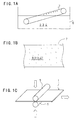
- para-aramid pulps 2, para-aramid fibers 3 and a binder 4, etc. are introduced into a liquid tank 6.
- the tank has been filled with water or an aqueous solution of organic substances.
- the ingredients are stirred, dispersed, mixed and disintegrated.
- the mixed liquid of the para-aramid pulps 2, the para-aramid fibers 3 and the binder 4 is separated by a separation sheet 7, which is a filter, into a solid part 8 constituting the aramid sheets 1, and a liquid part.
- Fig. 1A the separation sheet 7 in a form of an inclined endless belt is shown.
- the sheet 7 moves from bottom toward the top of the mixture, whereby the solid part 8 is adsorbed on the sheet 7 while the liquid part flows through the sheet. 7.
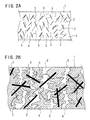
- the solid part 8, still wet, is removed of water content by a vacuum press and so on, and is wound around a drum while being heated at a temperature of from about 100° C to about 150° C to dry the moisture content, whereby an aramid sheet 1 as shown in Fig. 2A and 2B, comprising para-aramid pulps 2, para-aramid fibers 3 and a binder 4, is obtained.
- the aramid sheet 1 produced as above is then provided with a calendering treatment by being rolled through a pair of heated metallic rollers 5 as shown in Fig. 3C.
- the resin binder 4 is softened, melted and hardened to provide the sheet with a strength sufficient for a non-woven paper sheet. Further, the sheet is flattened to an extremely thin and overall smooth film. In addition, pores 9 produced are adjusted to be retained.
- the calendering process is carried out under a pressure of 19.6 X 10 4 N/m (200kg/cm) or higher applied linearly by a pair of metallic rollers 5 heated to 150° C or higher.
- the pressure and/or temperature conditions vary depending on the composition of the aramid sheet 1 and other factors.
- a pressure of lower than 19.6 X 10 4 N/m is applied, the density of the sheet 1 is reduced, resulting in a thick sheet which is not preferred for the production of honeycombs.
- the upper limit of the linear pressure is around 39.2 X 10 4 N/m (400 kg/cm).
- the temperature of the rollers 5 is lower than 150° C, the binder 4 is neither softened nor melted.
- the upper limit of the temperature is around 300° C.
- pores 9 remained in the sheet 1 are adjusted while many pores 9 are produced.
- the pores penetrate into the sheet from the sheet surface. They are retained, even after the sheet is calendered, in a form of vacant spaces between binders 4 which have been softened, melted and hardened to bond para-aramid pulps 2 and para-aramid fibers.
- the calendering treatment is effected in a manner to form and to retain many pores under a relatively low pressure applied linearly and a relatively low temperature.
- the porosity or pore ratio based on the total sheet 1 is from about 20 to 60 % by volume.
- the porosity A is calculated as follows:
- the porosity of the sheet 1 can be expressed also by sheet density (B), and the porosity of 20% to 60% substantially corresponds to the sheet density of 0.9g/cm 3 to 0.4g/cm 3 .
- the filled amount of the reinforcing resin 10 becomes insufficient, resulting in reducing the honeycomb strength. If the porosity is over 60%, the filled amount of the reinforcing resin 10 becomes excessive, the sheet looks a resin made, also reducing the honeycomb strength (see examples shown later).
- the actual porosity in the range between 20% to 60%, obtained after the calendering depends on the composition of para-aramid pulps 2, para-aramid fibers 3, binder 4 and the like, linear pressure and temperature conditions at calendering, and so on.
- the pressure and temperature conditions can be set after a particular composition is set, so that the most appropriate porosity is obtained within the range between 20 to 60%.
- the porosity is as follows:
- a sheet was calendered by passing a raw sheet between a pair or metallic rollers 5 under a linear pressure of 19.6 x 10 4 N/m (200 kg/cm) and a temperature of 200° C, at a feeding speed of from 50m/min to 100m/min. Then, pores 9 were produced and adjusted with a porosity of from 20% to 35% (sheet density: 0.9g/cm 3 to 0.7g/cm 3 ). In this instance, when the temperature condition was changed to 150° C, pores 9 were produced in a porosity of from 40% to 50% (sheet density : 0.6g/cm 3 to 0.8g/cm 3 ).
- the porosity is as follows:
- a sheet was calendered as before, by passing a raw sheet through a pair of metallic rollers 5 under a linear pressure of 19.6 x 10 4 N/m (200 kg/cm) and a temperature of 200° C, at a feeding speed of from 50m/min to 100m/min. Then, pores 9 were produced and adjusted with a porosity of from 30% to 50% (sheet density: 0.8g/cm 3 to 0.6g/cm 3 ). In this instance, when the temperature condition was changed to 150° C, the porosity was from 40% to 50% (sheet density : 0.7g/cm 3 to 0.5g/cm 3 ).
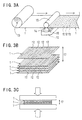
- the aramid honeycomb 11 is formed, after the sheet was produced and calendered and many pores 9 were formed and adjusted, by the steps 1) thorough 4) below, as illustrated respectively in Figs. 3A, 3B and 3C, and Fig. 4A, from the produced sheet.
- Step 1) an adhesives- applying step, is explained with reference to Fig. 3A, wherein an adhesive 12 is applied onto the aramid sheet 1.
- the adhesive 12 is applied along a number of lines at a certain width and a pitch to a belt of the aramid sheet 1 by any applying method or printing method.
- the adhesive may be a resin selected from epoxy resins, phenolic resins, acrylic resins polyimide resins and other resins.
- a belt-like aramid sheet 1 from a reel 13 is fed between a pair of an applying roller 14 and a pressing roller 15.
- the adhesive 12 contained in an adhesive tank 16 is applied or coated along a number of lines to one surface of the sheet 1 and is then dried.
- Step 2 a piling step, is explained with reference to Fig. 2B, wherein the belt-like aramid sheet 1 is cut at a predetermined interval to a number of sheets.
- the cut sheets are piled one on top of the other, such that each of the sheets is shifted to the other by half a pitch or a half the interval of the applied adhesive 12.
- the aramid sheet 1 which was coated with an adhesive 12 along a number of lines according to step 1, is cut at a certain interval. 400 pieces, for example, of the cut sheets are piled vertically, as shown by an arrow 17, to form a block, in such a positional relationship that each of the sheets 1 is shifted by half the interval of the lines of the coated adhesive 12.
- Step 3 a bonding step, is explained.
- each of the piled sheets 1 are bonded to each other by pressure and heat. That is, a number of aramid sheets, which were piled by step 2 above, are then hot-pressed at the melting point of the adhesive 12. Then the adhesive coated along a number of lines are melted and hardened to bond the sheets with each other.
- Step 4 is an enlarging step.
- the piled and bonded aramid sheets 1 are then enlarged to the direction counter to the piling direction by a tensile force or tension, as shown in Fig. 4A.
- a tensile force is applied to the direction shown by an arrow 17 in Figs. 3B, 3C and 4A.
- Each of the sheets 1 are thereby expanded or extended between them such that the sheets are folded along the edges of the bonded portions and the portions not bonded are extended to the direction counter to the piling direction, i. e, the right-hand and left-hand direction in Fig. 4A, to separate the sheets from each other.
- aramid honeycombs are formed by carrying out successively 1) adhesive applying or coating, 2) piling, 3) bonding and 4) enlarging steps. Consequently, there are formed honeycombs composed of a planar assembly of hollow, columnar cells 19 separated by cell walls 18 made of aramid sheets 1 which were bonded to each other along a number of lines and which were expanded.
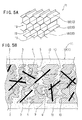
- the aramid honeycombs thus formed are then provided with an after treatment by which cell walls 8 are coated by and are impregnated with a reinforcing resin 10 and pores 9 are filled in with the resin, as shown in Figs. 4B and 4C.
- the structure of the formed honeycombs 11 is placed in a bath 20 containing the resin 10 to be impregnated therewith.
- the resin 10 is selected from phenolic resins, epoxy resins, polyimide resins and other thermosetting or thermoplastic resins, and is used in a varnish-like liquid form wherein the resin is solved in a solvent in a solid ratio of 15% to 70% by weight.
- the resin 10 adheres to and covers the surface of the cell walls 18 and fills in and penetrates into the pores 9.
- the inside of the cell walls also are impregnated with the resin.
- the honeycombs 11 are taken out from the bath 20 and are dried in a drying furnace 21 by hot air as shown in Fig. 4C, whereby the solvent is removed and the adhered resin 10 is hardened or cured.
- the adhering step in the bath 20 and the drying step in the drying furnace 21 are repeated a plurality of times so that the cell walls 18 of the honeycombs 11 may be coated by and impregnated with a predetermined amount of the reinforcing resin 10.
- the resin 10 fills in an amount of 50% to 100% by volume of the pores 9.
- Fig. 5B shows the state that full pore space (100%) is filed in by and impregnated with the reinforcing resin 10, but 50% or more of the pore space is generally filled.
- the aramid honeycombs 11 formed by steps 1) through 4) are coated with and are impregnated with the resin 10, and have a structure of an assembly of a number of hollow columnar cells 19 separated from each other by the cell walls 18 of aramid sheets 1.
- the sheets comprise 60% to 100% by weight of para-aramid pulps, 40% by weight or less of para-aramid fibers 3, and a binder 4 of 5% to 20% by weight to the total amount of the pulps and the fibers, and is calendered in a way to retain many pores 9.
- the cell walls 18 formed by the sheets 1 are coated by and impregnated with the reinforcing resin 10, and the pores 9 are filled in with the resin.
- the cell walls 18 and the cells 19 typically have an equilateral hexagon in a cross section, but may have other hexagonal form such as longitudinal or crosswise hexagonal, trapezoidal, approximately quadrangle form or other form.
- the aramid honeycombs are provided with a plate at both openings, i. e., at the ends of the cells, just as honeycombs generally used and are used as a honeycombs sandwiched panel.
- the aramid honeycombs 11 and their sandwiched panel are excellent in the strength to weight, are light-weighted and have high honeycomb strength in rigidity and strength equal to those of other general honeycombs. Further, they have excellent characteristics in that they have good rectifying effect and have a large surface area per unit volume, etc.
- the honeycombs sandwiched panel is improved, in addition, in plain precision, in heat retaining property, in sound insulating property, and so on and are used as structural materials for various purposes. Since para-aramid sheets 1 are used as the base material for the aramid honeycombs 11, they are excellent particularly in a flame retarding property and in a honeycomb strength such as a compressive strength and sheering strength.
- the aramid honeycombs 11 are composed of aramid sheets comprising 60% to 100% by weight of para-aramid pulps 2 as the main component, 0% to 40% by weight of para-aramid fibers 3, and a binder 4 of 5% to 20% by weight to he total amount (100%) of the pulps and the fibers as shown in Figs. 2A, 2B, etc.
- the aramid sheet 1 is calendered under a linear pressure of 19.6 x 10 4 N/m or more and a temperature of 200° C or higher (Fig. 1C). In spite of being calendered, the sheets have many pores 9 produced and retained in a volumetric ratio of 20% to 60% (Fig. 2B).
- the aramid honeycombs 11 defined by cell walls 18 made of aramid sheets 1 are produced by 1) applying an adhesive 12 linearly to the sheets, 2) piling the sheets at a positional relationship of half a pitch or half an interval of the applied adhesive shifted with each other, 3) bonding each of the sheets along the adhesive, and 4) enlarging each of the sheets by a tensile force applied to the direction counter to the piling direction. (Figs. 3A, 3B, 3C, 4A and 5A).
- the cell walls 18 of thus produced honeycombs 11 are coated by and are impregnated with a reinforcing resin 10, and the pores 9 are filled in with the resin 10 with a porosity of 50% by volume or more.
- the cell walls 18 are formed by aramid sheets 1, which comprise para-aramid pulps 2 as a main component.
- the sheets contain only 40% by weight or less of para-aramid fibers 3 which have an improper bulk dispersion and freeness value and have a high restoring property as shown in Examples.
- the aramid sheets used as the base material for the honeycombs are free from the reduction in the fixing capability of the binder 4 during a sheet-making process and thereby the strength necessary for the sheet is maintained.
- the density of the sheets is uniform overall and is neither varied nor diversified locally.
- the sheets shrink uniformly at cooling after a calendering treatment and are not wrinkled. Due to the calendering treatment, the sheet is processed to a thin film whereby less trouble is caused with respect to the thickness and the density.
- the aramid honeycombs of the invention are produced from the aramid sheets 1 which are improved in texture or structure, they can be handled conveniently during production, can be precisely processed and can be easily piled.
- the adhesive 12 applied to the surface is free from the troubles of passing through from one surface to the other under heat and pressure to cause sheets to be adhered to each other in a block-like manner. For these reasons the aramid honeycombs 11 are smoothly piled, bonded and enlarged.
- the aramid sheets 1 used for cell walls 18 forming the aramid honeycombs contain relatively inexpensive para-aramid pulps 2, para-aramid fibers 3, a resin binder 4, etc., and expensive meta-aramid pulps and the like are not necessarily used.
- the calendering treatment is carried our relatively low, linear pressure of 19.6 X 10 4 N/m or higher, and a relatively low temperature of 150° C or somewhat higher, and is not carried out under costly high pressure or high temperature conditions.
- a reinforcing resin 10 is filled in and penetrate into pores 9 dispersed within cell walls 18, whereby the para-aramid pulps 2, para-aramid fibers 3 and the binder 4 are strongly bonded to each other. Further, the reinforcing resin 10 adhered to and covers the surface of cell walls 18, and the resin 10 penetrating into pores 9 form a strong, three-dimensionally woven structure.
- the reinforcing resin 10 will not be peeled off from the surface of the cell walls by an outer force and, in this way, the aramid honeycombs are improved in the mechanical strength such as a compressive strength and a sheering strength.
- the aramid honeycombs 11 were tested according to MIL-STD-401 and the results showed excellent honeycomb strength, as follows:
- the specific compressive force of the aramid honeycombs obtained by a stabilized compression test was from 21.6kPa(kilopascal)/(kg/m 3 ) to 137.9kPa/(kg/m 3 ) which corresponds approximately to from 50 psi/pcf (pound ⁇ square ⁇ inch/ pound ⁇ cubic ⁇ feet) to 320 psi/pcf.
- the specific sheer strength (L direction) obtained by a plate sheer test was from 12.9kPa/(kg/m 3 ) to 73.3kPa/(kg/m 3 ), i.e., approximately 30 psi/pcf to 170 psi/pcf.
- the L direction is a ribbon direction or extending direction W, i.e., the direction crossing the piling direction 17 (Fig. 4A).
- the specific sheer strength (W direction) obtained by a plate sheer test was from 6.4kPa/(kg/m 3 ) to 38.8kPa/(kg/m 3 ), i.e., 15 psi/pcf to 90 psi/pcf.
- the W direction is an extending direction W.
- the specific sheer elastic modulus (L direction) obtained by a plate sheer test was from 863kPa/(kg/m 3 ) to 5,169kPa/(kg/m 3 ), i.e., 2,000 psi/pcf to 12,000 psi/pcf.
- the specific sheer elastic modulus (W direction) obtained by a plate sheer test was from 431kPa/(kg/m 3 ) to 2588kPa/(kg/m 3 ), i.e., 1,000 psi/pcf to 6,000 psi/pcf.
- W direction The specific sheer elastic modulus obtained by a plate sheer test was from 431kPa/(kg/m 3 ) to 2588kPa/(kg/m 3 ), i.e., 1,000 psi/pcf to 6,000 psi/pcf.
- Fig. 6A and 6B each shows a relationship between the compressive strength of aramid honeycombs 11 and the porosity of the aramid sheets 1.
- the aramid honeycombs of the present invention that is, those made of sheets having a porosity of from 20% to 60% have high values of the compressive strength and were judged to have a coat and impregnation of a proper amount of the reinforcing resin 10.
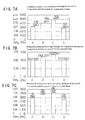
- Figs. 7A to 7C each shows the results of the tests made for the relationship between the strength of the aramid honeycombs 11 of the invention and the amount of para-aramid fibers 3 contained in aramid sheets 1. The tests were made in accordance with MIL-STD-401. Specifically, 3) Fig. 7A shows the result of the compressive strength of the aramid honeycombs 11, 4) Fig. 7B shows the result of the sheer strength (W direction) of the aramid honeycombs 11, and 5) Fig. 7C shows the result of the sheer strength (L direction) of the aramid honeycombs 11.
- A, B and C are the types of the aramid honeycombs 11 of the examples of the present invention, and D is that of a comparative example of prior arts.
- Aramid sheets of types A, B and C of the examples of the invention contain 100 % by weight of para-aramid pulps 2 and para-aramid fibers 3 and 15 % by weight to the total amount (100 %) of the pulps and the fibers, i.e., 100: 15, of a binder resin of the kind similar to the para-aramid pulps and fibers. Further, the aramid sheets 1 for the aramid honeycombs of types A, B and C contain pores 9 with a porosity of 40%.
- the reinforcing resin 10 used to adhere to the surface of cell walls and to fill in the pores for types A, B and C is an aqueous solution of phenol/methanol resin solved in a solvent with a solid content of 40 % by weight and having a viscosity of 360mPa ⁇ s.
- the aramid sheets 1 of the type A honeycombs contain 100 % by weight of para-aramid pulps 2 and contain no para-aramid fibers 3.
- the aramid sheets 1 of the type B honeycombs contain 80 % by weight of para-aramid pulps 2 and 20 % by weight of para-aramid fibers 3.
- the aramid sheets 1 of the type C honeycombs contain 60 % by weight of para-aramid pulps 2 and contain 40 % by weight of para-aramid fibers 3.
- the type D honeycombs of the comparative example contain 60 % by weight of para-aramid fibers and 40 % by weight of meta-aramid fibers which function as a binder.
- For type D pores are scarcely produced or retained, and the reinforcing resin scarcely fills in the inside of cell walls.
- aramid honeycombs 11 of types A, B and C according to the examples of the present invention are much superior to those of type D of prior arts with respect to the 3), 4) and 5) strength.
- the ratio of the para-aramid fibers 3 exceeds 40% by weight, the texture or structure of the aramid sheets 1 suddenly becomes worse. For example, large pinholes passing through the sheets are liable to be produced causing the troubles that adhesives 12 pass through the sheets to the other surface during the production of the honeycombs 11.
- the honeycomb strength increases by the level of 40% by weight of the para-aramid fibers 3, and that the 40% level is the upper limit of the content of the para-aramid fibers.
- para-aramid honeycombs and the process therefor of the invention use, as the base material, para-aramid sheets comprising para-aramid pulps and a binder.
- para-aramid fibers of 40 % by weight or less may be mixed.
- a calendering treatment is carried out with a linear pressure of 19.6 X 10 4 N/m or more and a temperature of 150° C or higher such that many pores are produced and adjusted to have a porosity of 20% to 60%.
- the cell walls are coated by and are impregnated with a reinforcing resin, and pores are filled with the resin in an amount of 50% by volume or more.
- the texture or structure of the base aramid sheets is improved, whereby the aramid honeycombs are smoothly produced.
- the aramid sheets contain only 40% or less of the para-aramid fibers which are not dispersed well and have improper Freeness value. Therefore, there arise fewer problems related to conventional arts, such as insufficient paper strength, non-uniform sheet thickness, non-uniform heat shrinkage after calendering, and the production of wrinkles.
- the aramid sheets to be used as the base materials are improved in the texture or structure, they can be handled effectively, have excellent in preciseness, and can be easily piled. Further, no many large pinholes are produced. Therefore, adhesives coated to one sheet surface will not pass to the other surface causing to adhering to other sheets and resulting in a block aggregate. In addition, an enlarging treatment can be carried out smoothly.
- the aramid honeycombs and the method therefor are cost saving.
- the aramid sheets contain relatively inexpensive para-aramid pulps, resin binder and para-aramid fibers. Further, the calendering treatment can be carried out under a relatively low pressure and low temperature conditions requiring reduced cost.
- the aramid honeycombs according to the invention can be produced at a relatively low cost.
- the base aramid sheets have many pores after a calendering treatment and pores are filled in with the reinforcement resin which is applied as an after treatment of coating and impregnating the cell walls with the resin.
- the reinforcing resin filled in the inside of cell walls Due to the reinforcing resin filled in the inside of cell walls, the para-aramid pulps, para-aramid fibers and the binder composing the cell walls are strongly bonded to each other. Further, the reinforcing resin at the surface of the cell walls and the reinforcing resin inside the cell walls are also strongly bonded to each other.
- the aramid honeycombs of the invention are improved in resistance to compression fracture and to shear fracture and, thus, improved in the honeycomb strength.
- the honeycombs of the invention are required to have a honeycomb strength equal to those of the prior arts, the cell density of the former can be reduced whereby the total weight can be remarkably decreased.
Landscapes
- Chemical & Material Sciences (AREA)
- Chemical Kinetics & Catalysis (AREA)
- Laminated Bodies (AREA)
- Paper (AREA)
Applications Claiming Priority (2)
| Application Number | Priority Date | Filing Date | Title |
|---|---|---|---|
| JP2000100458A JP3321141B2 (ja) | 2000-04-03 | 2000-04-03 | アラミドハニカムおよびその製造方法 |
| JP2000100458 | 2000-04-03 |
Publications (3)
| Publication Number | Publication Date |
|---|---|
| EP1152084A2 true EP1152084A2 (de) | 2001-11-07 |
| EP1152084A3 EP1152084A3 (de) | 2002-07-24 |
| EP1152084B1 EP1152084B1 (de) | 2012-01-25 |
Family
ID=18614664
Family Applications (1)
| Application Number | Title | Priority Date | Filing Date |
|---|---|---|---|
| EP20000308570 Expired - Lifetime EP1152084B1 (de) | 2000-04-03 | 2000-09-29 | Honigwabe aus Aramid und Verfahren zur Herstellung |
Country Status (4)
| Country | Link |
|---|---|
| US (1) | US6544622B1 (de) |
| EP (1) | EP1152084B1 (de) |
| JP (1) | JP3321141B2 (de) |
| AT (1) | ATE542954T1 (de) |
Cited By (2)
| Publication number | Priority date | Publication date | Assignee | Title |
|---|---|---|---|---|
| WO2005103376A1 (en) * | 2004-04-16 | 2005-11-03 | E.I. Dupont De Nemours And Company | Aramid paper blend |
| CN106794653A (zh) * | 2014-10-03 | 2017-05-31 | 纳幕尔杜邦公司 | 具有高压缩强度的蜂窝结构芯 |
Families Citing this family (25)
| Publication number | Priority date | Publication date | Assignee | Title |
|---|---|---|---|---|
| JP2002340280A (ja) * | 2001-05-18 | 2002-11-27 | Jamco Corp | 真空断熱ブロック |
| US7255484B2 (en) * | 2001-12-06 | 2007-08-14 | Finisar Corporation | Method and system for releasing a pluggable module |
| US6537424B1 (en) * | 2002-04-10 | 2003-03-25 | Fibermark, Inc. | High temperature paper |
| US8025949B2 (en) * | 2006-12-15 | 2011-09-27 | E.I. Du Pont De Nemours And Company | Honeycomb containing poly(paraphenylene terephthalamide) paper with aliphatic polyamide binder and articles made therefrom |
| US7771810B2 (en) * | 2006-12-15 | 2010-08-10 | E.I. Du Pont De Nemours And Company | Honeycomb from paper having a high melt point thermoplastic fiber |
| US20080286522A1 (en) * | 2006-12-15 | 2008-11-20 | Subhotosh Khan | Honeycomb having a low coefficient of thermal expansion and articles made from same |
| US7771809B2 (en) * | 2006-12-15 | 2010-08-10 | E. I. Du Pont De Nemours And Company | Shaped honeycomb |
| US7815993B2 (en) * | 2006-12-15 | 2010-10-19 | E.I. Du Pont De Nemours And Company | Honeycomb from paper having flame retardant thermoplastic binder |
| US20080145602A1 (en) | 2006-12-15 | 2008-06-19 | Gary Lee Hendren | Processes for making shaped honeycomb and honeycombs made thereby |
| US7771811B2 (en) * | 2006-12-15 | 2010-08-10 | E.I. Du Pont De Nemours And Company | Honeycomb from controlled porosity paper |
| US7785520B2 (en) * | 2006-12-15 | 2010-08-31 | E.I. Du Pont De Nemours And Company | Processes for making shaped honeycomb and honeycombs made thereby |
| US8268434B2 (en) * | 2007-11-30 | 2012-09-18 | E I Du Pont De Nemours And Company | Honeycomb having a high compression strength and articles made from same |
| US20090214818A1 (en) * | 2008-02-26 | 2009-08-27 | E. I. Du Pont De Nemours And Company | Core having a high shear strength and articles made from same |
| WO2009146114A1 (en) * | 2008-04-04 | 2009-12-03 | E. I. Du Pont De Nemours And Company | Composite panels having improved fluid impermeability |
| CN101343845B (zh) * | 2008-07-22 | 2010-09-08 | 成都龙邦新材料有限公司 | 一种芳纶纤维蜂窝芯原纸及其制备方法 |
| US20100047515A1 (en) * | 2008-08-21 | 2010-02-25 | E. I. Du Pont De Nemours And Company | Honeycomb Core Having a High Compression Strength and Articles Made from the Same |
| US20100048078A1 (en) * | 2008-08-21 | 2010-02-25 | E. I. Du Pont De Nemours And Company | Folded Core Having a High Compression Modulus and Articles Made from the Same |
| US20100141021A1 (en) * | 2008-12-04 | 2010-06-10 | Tomer Hendel | Composite wheel with 3-dimensional core |
| US8783789B2 (en) | 2008-12-04 | 2014-07-22 | Tomer Hendel | Composite wheel with reinforced core |
| US20100141022A1 (en) * | 2008-12-04 | 2010-06-10 | Tomer Hendel | Composite Wheel with Reinforced Core |
| DE102012022713B3 (de) * | 2012-11-21 | 2014-02-13 | Diehl Aircabin Gmbh | Paneel und Verfahren zur Herstellung eines Paneels |
| US10407829B2 (en) | 2015-05-28 | 2019-09-10 | Kolon Industries, Inc. | Aramid paper, manufacturing method therefor, and use thereof |
| CN106468038B (zh) * | 2015-08-19 | 2018-04-10 | 超美斯新材料股份有限公司 | 芳纶蜂窝纤维纸及其制备方法 |
| US10245804B2 (en) | 2015-10-16 | 2019-04-02 | Hexcel Corporation | Fire retarded aramid fiber-based honeycomb |
| JP2019155850A (ja) * | 2018-03-16 | 2019-09-19 | 住友ベークライト株式会社 | 複合材料 |
Citations (1)
| Publication number | Priority date | Publication date | Assignee | Title |
|---|---|---|---|---|
| US5137768A (en) | 1990-07-16 | 1992-08-11 | E. I. Du Pont De Nemours And Company | High shear modulus aramid honeycomb |
Family Cites Families (4)
| Publication number | Priority date | Publication date | Assignee | Title |
|---|---|---|---|---|
| US4729921A (en) * | 1984-10-19 | 1988-03-08 | E. I. Du Pont De Nemours And Company | High density para-aramid papers |
| US5202184A (en) * | 1989-06-05 | 1993-04-13 | E. I. Du Pont De Nemours And Company | Method and apparatus for producing para-aramid pulp and pulp produced thereby |
| US5320892A (en) * | 1993-02-22 | 1994-06-14 | E. I. Du Pont De Nemours And Company | Tough layered papers with improved surface adhesion |
| US5789059A (en) * | 1995-04-28 | 1998-08-04 | Showa Aircraft Industry Co., Ltd. | Honeycomb core |
-
2000
- 2000-04-03 JP JP2000100458A patent/JP3321141B2/ja not_active Expired - Lifetime
- 2000-09-29 EP EP20000308570 patent/EP1152084B1/de not_active Expired - Lifetime
- 2000-09-29 AT AT00308570T patent/ATE542954T1/de active
- 2000-10-11 US US09/689,285 patent/US6544622B1/en not_active Expired - Lifetime
Patent Citations (1)
| Publication number | Priority date | Publication date | Assignee | Title |
|---|---|---|---|---|
| US5137768A (en) | 1990-07-16 | 1992-08-11 | E. I. Du Pont De Nemours And Company | High shear modulus aramid honeycomb |
Cited By (4)
| Publication number | Priority date | Publication date | Assignee | Title |
|---|---|---|---|---|
| WO2005103376A1 (en) * | 2004-04-16 | 2005-11-03 | E.I. Dupont De Nemours And Company | Aramid paper blend |
| CN1942629B (zh) * | 2004-04-16 | 2010-04-07 | 纳幕尔杜邦公司 | 芳纶纸掺合物 |
| CN106794653A (zh) * | 2014-10-03 | 2017-05-31 | 纳幕尔杜邦公司 | 具有高压缩强度的蜂窝结构芯 |
| CN106794653B (zh) * | 2014-10-03 | 2019-08-20 | 纳幕尔杜邦公司 | 具有高压缩强度的蜂窝结构芯 |
Also Published As
| Publication number | Publication date |
|---|---|
| JP3321141B2 (ja) | 2002-09-03 |
| EP1152084A3 (de) | 2002-07-24 |
| EP1152084B1 (de) | 2012-01-25 |
| ATE542954T1 (de) | 2012-02-15 |
| JP2001277387A (ja) | 2001-10-09 |
| US6544622B1 (en) | 2003-04-08 |
Similar Documents
| Publication | Publication Date | Title |
|---|---|---|
| EP1152084B1 (de) | Honigwabe aus Aramid und Verfahren zur Herstellung | |
| EP0739707B1 (de) | Wabenkernstruktur | |
| EP1243697B1 (de) | Zu mindestens zwei dünnschichten abziehbares mehrlagiges papier | |
| US6042936A (en) | Microsphere containing circuit board paper | |
| DE69313248T2 (de) | Zylindrischer Kissenkern aus Verbundpappe und Verfahren zu seiner Herstellung | |
| RU2202021C2 (ru) | Бумажный или картонный слоистый материал и способ его производства | |
| EP2247787B1 (de) | Wabenkern mit hoher scherfestigkeit und daraus hergestellte artikel | |
| EP0467286A1 (de) | Hochschermodulhonigwabe aus Aramid | |
| US3941634A (en) | Method for the preparation of paper containing plastic particles | |
| EP0983140B1 (de) | Nassgelegtes nylonvlies als material für batterieseparator | |
| EP2315658B1 (de) | Wabenkern mit grosser druckfestigkeit und gegenstand mit diesem wabenkern | |
| US6258203B1 (en) | Base webs for printed circuit board production using the foam process and acrylic fibers | |
| CA2017556C (en) | Thin, resin-saturable aromatic polyamide paper and process for making same | |
| US6517676B1 (en) | Recyclable thermoplastic moldable nonwoven liner for office partition and method for its manufacture | |
| DE1560899B2 (de) | Impraegnierter, unverfestigter schichtstoff in bahnen- oder bogenform | |
| JPH09220709A (ja) | 古紙ボード | |
| US5846662A (en) | Release liners for molded product production | |
| US5709931A (en) | Release liners for production of molded products | |
| JP2889474B2 (ja) | コンポジット積層板及びその製造方法 | |
| JPH07156318A (ja) | ハニカムコア | |
| DE2434382C3 (de) | Verfahren zur Herstellung eines steifelastischen, ein- oder mehrlagigen kunstharzimprägnierten Flächengebildes aus Fasern und seine Verwendung als Trägermaterial für Schleifmittel | |
| JP2000006279A (ja) | ハニカムコア用基材およびその製造方法 | |
| DE2600985B2 (de) | Verfahren zum Beschichten einer Asbestzementplatte | |
| DE2434382A1 (de) | Steifelastisches, ein- oder mehrlagiges kunstharzimpraegniertes flaechengebilde aus fasern, verfahren zu seiner herstellung und seine verwendung als traegermaterial fuer schleifmittel |
Legal Events
| Date | Code | Title | Description |
|---|---|---|---|
| PUAI | Public reference made under article 153(3) epc to a published international application that has entered the european phase |
Free format text: ORIGINAL CODE: 0009012 |
|
| AK | Designated contracting states |
Kind code of ref document: A2 Designated state(s): AT BE CH CY DE DK ES FI FR GB GR IE IT LI LU MC NL PT SE |
|
| AX | Request for extension of the european patent |
Free format text: AL;LT;LV;MK;RO;SI |
|
| PUAL | Search report despatched |
Free format text: ORIGINAL CODE: 0009013 |
|
| AK | Designated contracting states |
Kind code of ref document: A3 Designated state(s): AT BE CH CY DE DK ES FI FR GB GR IE IT LI LU MC NL PT SE |
|
| AX | Request for extension of the european patent |
Free format text: AL;LT;LV;MK;RO;SI |
|
| RIC1 | Information provided on ipc code assigned before grant |
Free format text: 7D 21H 13/26 A, 7C 08J 5/06 B, 7B 29C 70/00 B, 7B 32B 3/12 B |
|
| 17P | Request for examination filed |
Effective date: 20030102 |
|
| AKX | Designation fees paid |
Designated state(s): AT BE CH CY DE DK ES FI FR GB GR IE IT LI LU MC NL PT SE |
|
| 17Q | First examination report despatched |
Effective date: 20070830 |
|
| GRAP | Despatch of communication of intention to grant a patent |
Free format text: ORIGINAL CODE: EPIDOSNIGR1 |
|
| GRAC | Information related to communication of intention to grant a patent modified |
Free format text: ORIGINAL CODE: EPIDOSCIGR1 |
|
| RAP1 | Party data changed (applicant data changed or rights of an application transferred) |
Owner name: SHOWA AIRCRAFT INDUSTRY CO., LTD. |
|
| GRAS | Grant fee paid |
Free format text: ORIGINAL CODE: EPIDOSNIGR3 |
|
| GRAA | (expected) grant |
Free format text: ORIGINAL CODE: 0009210 |
|
| AK | Designated contracting states |
Kind code of ref document: B1 Designated state(s): AT BE CH CY DE DK ES FI FR GB GR IE IT LI LU MC NL PT SE |
|
| REG | Reference to a national code |
Ref country code: GB Ref legal event code: FG4D |
|
| REG | Reference to a national code |
Ref country code: CH Ref legal event code: EP |
|
| REG | Reference to a national code |
Ref country code: AT Ref legal event code: REF Ref document number: 542954 Country of ref document: AT Kind code of ref document: T Effective date: 20120215 |
|
| REG | Reference to a national code |
Ref country code: IE Ref legal event code: FG4D |
|
| REG | Reference to a national code |
Ref country code: DE Ref legal event code: R096 Ref document number: 60046869 Country of ref document: DE Effective date: 20120329 |
|
| REG | Reference to a national code |
Ref country code: NL Ref legal event code: T3 |
|
| PG25 | Lapsed in a contracting state [announced via postgrant information from national office to epo] |
Ref country code: GR Free format text: LAPSE BECAUSE OF FAILURE TO SUBMIT A TRANSLATION OF THE DESCRIPTION OR TO PAY THE FEE WITHIN THE PRESCRIBED TIME-LIMIT Effective date: 20120426 Ref country code: FI Free format text: LAPSE BECAUSE OF FAILURE TO SUBMIT A TRANSLATION OF THE DESCRIPTION OR TO PAY THE FEE WITHIN THE PRESCRIBED TIME-LIMIT Effective date: 20120125 Ref country code: PT Free format text: LAPSE BECAUSE OF FAILURE TO SUBMIT A TRANSLATION OF THE DESCRIPTION OR TO PAY THE FEE WITHIN THE PRESCRIBED TIME-LIMIT Effective date: 20120525 |
|
| REG | Reference to a national code |
Ref country code: AT Ref legal event code: MK05 Ref document number: 542954 Country of ref document: AT Kind code of ref document: T Effective date: 20120125 |
|
| PG25 | Lapsed in a contracting state [announced via postgrant information from national office to epo] |
Ref country code: CY Free format text: LAPSE BECAUSE OF FAILURE TO SUBMIT A TRANSLATION OF THE DESCRIPTION OR TO PAY THE FEE WITHIN THE PRESCRIBED TIME-LIMIT Effective date: 20120125 |
|
| PG25 | Lapsed in a contracting state [announced via postgrant information from national office to epo] |
Ref country code: DK Free format text: LAPSE BECAUSE OF FAILURE TO SUBMIT A TRANSLATION OF THE DESCRIPTION OR TO PAY THE FEE WITHIN THE PRESCRIBED TIME-LIMIT Effective date: 20120125 Ref country code: SE Free format text: LAPSE BECAUSE OF FAILURE TO SUBMIT A TRANSLATION OF THE DESCRIPTION OR TO PAY THE FEE WITHIN THE PRESCRIBED TIME-LIMIT Effective date: 20120125 |
|
| PLBE | No opposition filed within time limit |
Free format text: ORIGINAL CODE: 0009261 |
|
| STAA | Information on the status of an ep patent application or granted ep patent |
Free format text: STATUS: NO OPPOSITION FILED WITHIN TIME LIMIT |
|
| RAP2 | Party data changed (patent owner data changed or rights of a patent transferred) |
Owner name: E. I. DU PONT DE NEMOURS AND COMPANY |
|
| 26N | No opposition filed |
Effective date: 20121026 |
|
| PG25 | Lapsed in a contracting state [announced via postgrant information from national office to epo] |
Ref country code: AT Free format text: LAPSE BECAUSE OF FAILURE TO SUBMIT A TRANSLATION OF THE DESCRIPTION OR TO PAY THE FEE WITHIN THE PRESCRIBED TIME-LIMIT Effective date: 20120125 |
|
| PGFP | Annual fee paid to national office [announced via postgrant information from national office to epo] |
Ref country code: BE Payment date: 20120912 Year of fee payment: 13 |
|
| REG | Reference to a national code |
Ref country code: DE Ref legal event code: R097 Ref document number: 60046869 Country of ref document: DE Effective date: 20121026 |
|
| PGFP | Annual fee paid to national office [announced via postgrant information from national office to epo] |
Ref country code: ES Payment date: 20121004 Year of fee payment: 13 |
|
| PG25 | Lapsed in a contracting state [announced via postgrant information from national office to epo] |
Ref country code: MC Free format text: LAPSE BECAUSE OF NON-PAYMENT OF DUE FEES Effective date: 20120930 |
|
| REG | Reference to a national code |
Ref country code: CH Ref legal event code: PL |
|
| REG | Reference to a national code |
Ref country code: DE Ref legal event code: R082 Ref document number: 60046869 Country of ref document: DE Representative=s name: MARKS & CLERK (LUXEMBOURG) LLP, LU Effective date: 20130411 Ref country code: DE Ref legal event code: R081 Ref document number: 60046869 Country of ref document: DE Owner name: E.I. DU PONT DE NEMOURS AND COMPANY, US Free format text: FORMER OWNER: SHOWA AIRCRAFT INDUSTRY CO.,LTD., TOKIO/TOKYO, JP Effective date: 20120203 Ref country code: DE Ref legal event code: R081 Ref document number: 60046869 Country of ref document: DE Owner name: E.I. DU PONT DE NEMOURS AND COMPANY, US Free format text: FORMER OWNER: SHOWA AIRCRAFT INDUSTRY CO.,LTD., TOKIO/TOKYO, JP Effective date: 20130411 Ref country code: DE Ref legal event code: R081 Ref document number: 60046869 Country of ref document: DE Owner name: E.I. DU PONT DE NEMOURS AND COMPANY, WILMINGTO, US Free format text: FORMER OWNER: SHOWA AIRCRAFT INDUSTRY CO.,LTD., TOKIO/TOKYO, JP Effective date: 20120203 Ref country code: DE Ref legal event code: R081 Ref document number: 60046869 Country of ref document: DE Owner name: E.I. DU PONT DE NEMOURS AND COMPANY, WILMINGTO, US Free format text: FORMER OWNER: SHOWA AIRCRAFT INDUSTRY CO.,LTD., TOKIO/TOKYO, JP Effective date: 20130411 |
|
| REG | Reference to a national code |
Ref country code: IE Ref legal event code: MM4A |
|
| REG | Reference to a national code |
Ref country code: GB Ref legal event code: 732E Free format text: REGISTERED BETWEEN 20130613 AND 20130619 |
|
| PG25 | Lapsed in a contracting state [announced via postgrant information from national office to epo] |
Ref country code: IE Free format text: LAPSE BECAUSE OF NON-PAYMENT OF DUE FEES Effective date: 20120929 Ref country code: LI Free format text: LAPSE BECAUSE OF NON-PAYMENT OF DUE FEES Effective date: 20120930 Ref country code: CH Free format text: LAPSE BECAUSE OF NON-PAYMENT OF DUE FEES Effective date: 20120930 |
|
| PGFP | Annual fee paid to national office [announced via postgrant information from national office to epo] |
Ref country code: NL Payment date: 20130910 Year of fee payment: 14 |
|
| PGFP | Annual fee paid to national office [announced via postgrant information from national office to epo] |
Ref country code: IT Payment date: 20130912 Year of fee payment: 14 |
|
| BERE | Be: lapsed |
Owner name: SHOWA AIRCRAFT INDUSTRY CO., LTD. Effective date: 20130930 |
|
| PG25 | Lapsed in a contracting state [announced via postgrant information from national office to epo] |
Ref country code: LU Free format text: LAPSE BECAUSE OF NON-PAYMENT OF DUE FEES Effective date: 20120929 |
|
| PG25 | Lapsed in a contracting state [announced via postgrant information from national office to epo] |
Ref country code: BE Free format text: LAPSE BECAUSE OF NON-PAYMENT OF DUE FEES Effective date: 20130930 |
|
| PG25 | Lapsed in a contracting state [announced via postgrant information from national office to epo] |
Ref country code: NL Free format text: LAPSE BECAUSE OF NON-PAYMENT OF DUE FEES Effective date: 20150401 |
|
| PG25 | Lapsed in a contracting state [announced via postgrant information from national office to epo] |
Ref country code: ES Free format text: LAPSE BECAUSE OF THE APPLICANT RENOUNCES Effective date: 20120125 |
|
| PG25 | Lapsed in a contracting state [announced via postgrant information from national office to epo] |
Ref country code: IT Free format text: LAPSE BECAUSE OF NON-PAYMENT OF DUE FEES Effective date: 20140929 |
|
| PGFP | Annual fee paid to national office [announced via postgrant information from national office to epo] |
Ref country code: GB Payment date: 20150923 Year of fee payment: 16 |
|
| REG | Reference to a national code |
Ref country code: FR Ref legal event code: PLFP Year of fee payment: 17 |
|
| GBPC | Gb: european patent ceased through non-payment of renewal fee |
Effective date: 20160929 |
|
| PG25 | Lapsed in a contracting state [announced via postgrant information from national office to epo] |
Ref country code: GB Free format text: LAPSE BECAUSE OF NON-PAYMENT OF DUE FEES Effective date: 20160929 |
|
| REG | Reference to a national code |
Ref country code: FR Ref legal event code: PLFP Year of fee payment: 18 |
|
| REG | Reference to a national code |
Ref country code: FR Ref legal event code: PLFP Year of fee payment: 19 |
|
| PG25 | Lapsed in a contracting state [announced via postgrant information from national office to epo] |
Ref country code: ES Free format text: THE PATENT HAS BEEN ANNULLED BY A DECISION OF A NATIONAL AUTHORITY Effective date: 20120125 |
|
| PGFP | Annual fee paid to national office [announced via postgrant information from national office to epo] |
Ref country code: FR Payment date: 20190815 Year of fee payment: 20 Ref country code: DE Payment date: 20190917 Year of fee payment: 20 |
|
| REG | Reference to a national code |
Ref country code: DE Ref legal event code: R071 Ref document number: 60046869 Country of ref document: DE |