EP1148170A2 - Verfahren und Vorrichtung zum Falten von Textilen Gegenständen, insbesondere Bekleidungs- oder Wäschestücken - Google Patents
Verfahren und Vorrichtung zum Falten von Textilen Gegenständen, insbesondere Bekleidungs- oder Wäschestücken Download PDFInfo
- Publication number
- EP1148170A2 EP1148170A2 EP01106096A EP01106096A EP1148170A2 EP 1148170 A2 EP1148170 A2 EP 1148170A2 EP 01106096 A EP01106096 A EP 01106096A EP 01106096 A EP01106096 A EP 01106096A EP 1148170 A2 EP1148170 A2 EP 1148170A2
- Authority
- EP
- European Patent Office
- Prior art keywords
- folding
- length
- clothing
- folded
- transverse
- Prior art date
- Legal status (The legal status is an assumption and is not a legal conclusion. Google has not performed a legal analysis and makes no representation as to the accuracy of the status listed.)
- Granted
Links
Images

Classifications
-
- D—TEXTILES; PAPER
- D06—TREATMENT OF TEXTILES OR THE LIKE; LAUNDERING; FLEXIBLE MATERIALS NOT OTHERWISE PROVIDED FOR
- D06F—LAUNDERING, DRYING, IRONING, PRESSING OR FOLDING TEXTILE ARTICLES
- D06F89/00—Apparatus for folding textile articles with or without stapling
- D06F89/02—Apparatus for folding textile articles with or without stapling of textile articles to be worn, e.g. shirts
Definitions
- the invention relates to a method for folding textiles Objects, in particular clothing or laundry according to the preamble of claim 1. Further relates to the invention devices for folding textile objects, in particular items of clothing or laundry, according to the preambles of claims 17 and 19.
- Folding textile items especially Clothing, but also laundry, takes place in Laundry and clothing factories predominantly by machine by folding devices (folding machines).
- the textile objects are preferably - but not necessarily - on Transport brackets fed hanging of the folding device.
- the Folding device has a contact surface on which in Direction of work a folding area follows. On the work surface becomes an object still hanging on the transport brackets laid in the stretched state in a longitudinal direction. To a subsequent folding of his bow arms Transport bracket from the object placed on the support surface pulled out. After that, the item is in the Folded area of the folding device transported and there folded.
- the invention is based on the object Method and device for folding textile objects, especially clothing or laundry items create what even with significant differences in the Dimensions, especially length, always an optimal folding quality is achieved.
- a procedure for solving this problem shows the measures of Claim 1 on.
- the fact that the objects, especially on Garments to be worn before, during and / or After folding can be measured, the folding process can be related towards the same item and / or at a later date folding object taking into account the dimensions, in particular the length or the folding result that the problems mentioned at the beginning are not occur and thereby the folding is optimized.
- groups of different groups are also provided Folding schemes depending on the direction of folding extending length and the predetermined final folding length of the to be determined in each case to be folded.
- the definition such groups happen through the pre-selected final fold length and the minimum overlap; in particular, it can based on the measurement of the object to be folded known length of the same reliably made become. Accordingly, the folding can be done and in particular the folding position can be determined. In particular is after determining the length of the respective item Assignment of the same to groups that only one possible only require cross folding and other groups that have multiple (two) require cross folds. This allows such objects especially clothing that is on the upper body to be worn more quickly at such a point on the folding device are transported past these items do not need to be folded. The folding performance can be thereby increase effectively.
- the Item length determined before folding begins. Due to the then known length of the item can this can be divided into a corresponding group and there is then a targeted control of the folding process. The length is determined individually for everyone Subject, the control of the folding device in relation is carried out on the respective object.
- At least some Groups have different final fold lengths if necessary assign. It turns out that objects are certain Length cannot be brought to a predetermined final folding length, another end fold length, preferably a predetermined one alternative end fold length or another group, chosen that allows a desired folding of the object in question or correct the final fold length if necessary.
- the method when based on the measurement of the object it turns out that a remainder of the length of it that is in a separate layer must be folded, not within one predetermined minimum dimension, so that a minimum overlap location is not guaranteed, either the final fold length to change if there is only a cross folding, or the Change the length of a layer in favor of another layer, the shorter position of the second transverse fold is covered by the position corresponding to the final fold length, which at the second transverse fold is formed. This way it takes effect prevents a layer from being so short that a specific one Minimum overlap is no longer given and therefore the Risk of popping open the package of the folded item consists.
- the method at least one measurement on the object during and / or after at least one preferably first folding process, in particular any required cross folding.
- the lengths of the length sections resulting after the transverse folds and / or layers of the partially and / or completely folded object determined.
- the measurement results obtained in this way serve to correct the control of the folding device for objects to be folded later and / or subsequent ones Folds of the same item, specifically Items in the same group. This can cause deviations folding an object from a desired or given one Folded picture based on a folded object made or deviations in the first transverse folding or the subsequent transverse folding are taken into account.
- the Control of the folding device corrects itself practically automatically without making any manual changes must be made on the control.
- the measurement of the individual layers of an object is preferred in the area of the second transverse folding started by the Pass the rear edge of each layer in the direction of folding a sensor.
- the measurement is stopped when the two Layers connecting the front edge of the object another Sensor happens.
- the length of the respective layer then results from the known distances between the sensors for starting and stopping the measurement minus the measured transport route of the object or the respective location. It can be done this way the length of each layer is simple and reliable determine, with only a minimum of sensors required is.
- a device for solving the problem mentioned at the beginning has the features of claim 17. Corresponds accordingly a path recording device with at least one sensor, the stops the measuring process of the path recording device.
- the path recording device works with a sponsor who spread clothing or other item from the contact surface into the folding area of the folding device transported.
- a measuring process is started with the start-up of the conveyor for removing the object from the contact surface.
- the contact surface is at least one sensor associated with the running along a rear edge of the Object at a certain point on the contact surface detected. This stops the measuring process.
- the length of the The object results from the constant distance of the sensor to a certain point on the shelf where the top of the item usually from a feed conveyor is stored and that determined by the distance measurement Measure the rear edge of the object passing the sensor.
- the Length measurement is particularly reliable because it is in the range the contact surface takes place in front of the folding area, where the to folding object stretched at least in the longitudinal direction is filed.
- a path measuring device provided that with sensors for detecting the trailing (rear) end every single layer of the object in the area of relevant transverse folding station is formed, cooperates.
- the Sensors of the individual layers detect the ends of the same, specifically for each location concerned. So that becomes a Measurement of the path recording device started. This measurement ends as soon as the leading end of the folded object passes an end sensor.
- the device shown here is suitable for folding any textile objects. It can be both laundry items as well as clothing. Special Requirements are placed on the control of the device, when folding clothes worn on the torso such as jackets, smocks, overalls, kasaks, Patient shirts and surgical gowns. If in The following items of clothing are mentioned, are hereby on Clothing to be worn on the upper body or shoulders in particular of the type mentioned above. Such Items of clothing are automatically unsorted by the device to fold. Because of the sometimes distinct from each other different lengths of such clothing (for example If kasaks are much shorter than smocks), the folding processes give way clearly different from each other. In particular, is a different one Number of cross folds, either only one cross fold or two cross folds, required. It is therefore appropriate control of the device is required.
- Fig. 1 shows schematically the addressed device. she essentially has a folding device 10, the one Surface 11 and one seen in the working direction 12 subsequent folding area 13. The contact surface 11 a lay-on conveyor 14 is assigned. Behind the folding area 13 there is a stacker 15 for the folded items of clothing 16.
- the items of clothing 16 to be folded become the folding device 10 fed hanging on transport brackets 17.
- One each individual transport bracket 17 with an attached garment 16 passes over a conveyor rail 18 of the lay-on conveyor 14 to the folding device 10.
- a transport bracket 17 with an attached garment 16 is (individually) along the conveyor rail 18 transported in the working direction 12 and thereby the item of clothing 16 on the contact surface 11 of the Folding device 10 is laid down. After that, swiveling Bracket arms of the respective transport bracket 17 folded and the transport bracket 17 up from one Collar area 19 of the article of clothing 16 pulled out.
- a conveyor 20 at the upper end viewed in the working direction 12 the contact surface 11 becomes the respective item of clothing 16 fed to the folding area 13 of the folding device 10.
- the folding device 10 has a first transverse folding station 21, which is bidded by four conveyors 20, 22, 23 and 24 which are in a known relative arrangement to each other.
- the conveyors 23 and 24 are reversible.
- the conveyor 20 is a conveyor roller 50 assigned.
- the first transverse folding station 21 follows in the working direction 12 a second transverse folding station 25. This is in on formed in a known manner from two conveyors 26 and 27, of which the conveyor 27 is reversible.
- the conveyor 26 is over four deflection or drive drums, making it several dreams involved in folding. In the area of a horizontal upper run of the conveyor 26 is located at least one longitudinal folding station, to which are not described here is received.
- the contact surface 11 of the folding device 10 are here shown two sensors 28 and 29 assigned.
- the Sensors 28 and 29 follow one another at a distance Working direction 12.
- the sensors 28 and 29 serve one lower, rear edge of the respective item of clothing 16 detect, the closer in the working direction 12 to Folding area 13 located sensor 29 serves the lower Detect edge of short clothing 16, which after the Put it on the support surface 11 not in the area of Sensors 28 are sufficient.
- the sensors 28, 29 correspond to a path measuring device.
- the displacement sensor not shown measures on a pulley, preferably a driven one Deflection drum of the conveyor 20 the way that respective garment 16 from the conveyor 20 within one a certain time has been transported.
- the sensor 30 is an upper run 33 of the conveyor 26 assigned.
- the sensor 31 is located in a section of the Conveyor 27 which is laterally upwards opposite a side run 34 of the conveyor 26 protrudes.
- the sensor 32 finally is associated with a lower end portion of the conveyor 27 which corresponds to the side run 34 of the conveyor 26. in the The embodiment shown is the sensor 32 with slight distance next to the lower end of the Conveyor 27 (Fig. 1).
- At least one counter is provided, which the Times between activation of sensor 30 and the sensor 32 or the sensors 31 and 32 measures.
- the sensor 35 is in the Area between conveyors 24 and 26, above the Upper dreams of the same.
- Another sensor 36 is that of the first transverse folding station 21 pointing (rear) end region assigned to the conveyor 23.
- the conveyor 23 and 24 determines the measure around which the cross-folded at the first transverse folding station 21 Garment 16 is shorter than the constant, known distance between the sensors 36 and 35 the length of the one with the first transverse fold Garment, the longest part of it, determine if the determined measure from the measure of the distance of the Sensors 35 and 36 is withdrawn.
- the clothing 16 before, during and / or after folding in the folding device 10, the clothing 16 individually measured.
- the respective item of clothing is assigned to a group 16. It is determined whether 21 and 25 or only one transverse folding station 25 the relevant one Garment 16 is to be folded. You can also use the between the transverse folding stations 21, 25 determined partial length of the Garment 16 determined at least one correction value be used for individual adjustment of the particular following folding process to the specific one to be folded Garment 16 is required.
- the device can measure the length of the whole Garment 16 at the beginning of the folding area 13 and additional measurement of the layer lengths of the folded garment 16 at the end of the folding area 13 and between the Transversal folding stations 21, 25 may be formed. It is also conceivable, the device only with a length measuring device in front of the folding area 13 or a measurement of the layer lengths behind the folding area 13 to be provided.
- An essential principle of the method according to the invention consists of measuring the length of the top layer and the determine the lower position of the fully folded item of clothing 16, whether the upper and lower layers of the specified correspond to the desired final fold length. Is not that the case, corrects a controller, preferably a programmable logic controller Control, at least the overlap value transverse folding, that is, the value by which the upper one Layer overlaps the lower layer. The at least one corrected The overlap value is then used to fold the next one Item of clothing 16 which is to be treated in the same way, recycled. Accordingly, the invention does not meet the requirements appropriate folding of a piece of clothing 16 is used to the or each subsequent item of clothing 16 in more detail to fold.
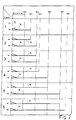
- the items of clothing 16 are dependent on their length fold according to an individual folding scheme. To do this, the Clothing 16 divided into different groups, where each group has a certain length spectrum of clothing 16 is assigned, which is a special folding scheme required. In the exemplary embodiment shown, the items of clothing are 16 different lengths in six different ones Groups classified, which are shown in Fig. 2. The invention is not different on the division long garments 16 limited to six groups. It can be divided into a larger or smaller number of Groups take place. The grouping shown in FIG. 2 is based on the final fold length of the finished folded Garment 16. This final fold length is usually and so also in the embodiment shown 40 cm. The However, the invention is not limited to this.
- Group 1 items of clothing 16 concerns, the length of which is up to 1.5 times the final fold length, therefore a maximum of 60 cm.
- Group 2 concerns clothing 16, in the range between 1.5 times the final fold length (60 cm) and twice the final fold length (80 cm).
- Group 3 concerns clothing 16, their length between twice the final fold length (80 cm) and twice Gusset length plus a minimum overlap of Embodiment shown 10 cm (90 cm in total).
- Group 4 relates to clothing 16, the length of which double final fold length plus the minimum overlap of 10 cm (90 cm in total) up to three times the final fold length (120 cm).
- Group 5 concerns clothing 16, their length between three times the final fold length and four times Final fold length (160 cm).
- the concerns Group 6 items of clothing 16 the length of which is between four times Final fold length and the maximum partial length of im Embodiment shown is 180 cm.
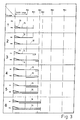
- FIG 3 shows the clothing 16 of all six groups after the first transverse folding station 21.
- the clothing of the Groups 1 and 2 are after the first transverse folding station 21 unfolded because they are only folded once and this only happens in the following second transverse folding station 25.
- the clothes 16 of group 3 are in the first Transverse folding station 21 only in the direction pointing away from the collar area 19 End area folded over a short distance.
- This piece has the Length of the minimum overlap from the embodiment shown 10 centimeters.
- the end of the garment 16 is always around the measure of the minimum overlap in the first transverse folding station 21 folded. This prevents clothing 16 with a length between the minimum dimension and the maximum dimension Group 3 only by a shorter distance than the minimum overlap would be folded over.
- the item of clothing 16 be shorter than twice the final fold length. This leads to, that in the subsequent second cross fold a lower layer the finished folded item of clothing 16 of group 3 shorter is called the final fold length.
- This shortening of the lower layer does not appear optically disadvantageous because it is covered with the collar area 19 by an upper layer, which corresponds to the final fold length.
- Items of clothing 16 of group 4 are in the first transverse folding station 21 also folded over in the end area, with an end portion of such a length that in any case the Minimum overlap exceeds and up to the final fold size can extend.
- the first transverse folding station 21 the item of clothing 16 folded so far that at least one folded end area of the item of clothing corresponds to the final fold length, maximum the garment 16 in the length is halved.
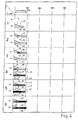
- Fig. 4 shows the folding scheme of the in the second transverse folding station 25 ready-made clothing 16 of groups 1 until 6.
- Short clothes 16 of group 1 are in the second Transverse folding station 25 folded in the middle, so that an equal size Upper layer 37 with the collar area 19 and lower layer 38 are formed.
- the same size layers 37 and 38 of the ready-made garment 1 of group 1 shorter than be the final fold length.
- the upper layer corresponds 39 with the collar area 19 in turn the final fold length.
- a lower layer 42 is either partially double-layered with the Minimum overlap or completely double-layered so that the lower layer 42 from a lower inner layer 43 and one lower outer layer 44 is formed, the lower outer Layer 44 always corresponds to the final fold length and the lower inner Layer 43 from the minimum overlap to the full final fold length can be enough.
- the item of clothing 16 the group 5 via an upper layer 39 with the collar area 19 and a bottom sheet 45, both of which correspond to the final fold length.
- the lower layer 45 always has a lower one inner layer 43 and a lower outer layer 44, the same length are, namely each extend over the final fold length.
- the upper layer 39 can be used with appropriately long items of clothing 16 of group 5 also have two layers, namely one have an upper inner layer 46 and an upper outer layer 47, the inner top layer 46 extending the entire length of the final fold can extend or only over part of the same.
- While the clothing 16 of groups 2 to 5 is always in correspond to at least one layer of the final fold length two layers of clothing 16 of group 6, and the upper layer 48 with the collar area 19 and the lower one Layer 49, over a larger, also predetermined final fold length (here: 45 cm).
- the lower layer 49 is completely two-ply trained so that their lower inner layer and their lower outer layer over the entire enlarged final fold length (45 cm).
- the top layer 48 is at least partially double layered by the top outer layer completely extends over the extended final folding length (45 cm), while the upper inner layer is only part or can also extend the entire extended end fold length.
- the user of the folding device 10 first has the final folding length to set, for example 40 cm. Furthermore, it is Specify minimum overlap, for example 10 cm is. After the garment 16 is stretched out by the lay-on conveyor 14 has been placed on the contact surface 11 the bracket arms of the transport bracket 17 folded and it will the transport bracket 17 from the collar area 19 of the garment 16 pulled out. Laying on the item of clothing 16 on the contact surface 11 is always about the same Place, at the top end of the contact surface 11 lying collar area 19.
- the timing The control will stop as soon as the rear lower edge of the item of clothing 16 on the sensor 28 (or for short Clothing 16 passes the sensor 29). Due to the known constant transport speed of the conveyor 20, 22, 23 and 24 and the conveyor roller 50 can be seen from the calculate a distance measured. At this distance the constant distance from the same place to the Surface 11 of the collared area 19 of the item of clothing 16 added up to the sensor 28 (or possibly 29). The sum is the length of the item of clothing in question 16. It is in the present exemplary embodiment a garment 16 with the minimum length of the group 3 (80 cm).
- the control takes based on the measured length of the garment 16 a classification in the group in question, that is here group 3, before. Based on this grouping controlled the folding of the garment 16. Thereupon will determined that this garment 16 in each transverse folding station 21 and 25 requires cross folding. It will group-specific overlap values are also defined. there it is particularly about folding one Minimum overlap (10 cm) resulting lower edge of the Garment 16 in the first transverse folding station 21 and one associated shortening of the item of clothing 16 under the measure of the double final fold length. Furthermore, for the second transverse folding station 25 sets an overlap value at which the lower layer 41 is shorter than that corresponding to the final folding dimension top layer 39.
- the is measured Minimum overlap that is the length of the in the first transverse folding station 21 folded lower edge of the garment 16 is determined. This is the length of the garment 16 measured after the first transverse fold. That is the Length of origin of the garment 16 minus the order Actual dimension of the minimum overlap in the first transverse folding station 21 folded collarless bottom of the garment 16.
- This measurement is carried out with the aid of sensors 35 and 36.
- the measurement is carried out with reversed conveyors 23 and 24 when the garment 16 in the working direction 12 for Longitudinal folding station and the subsequent second transverse folding station 25 is transported. This in turn becomes a Timing of the control activated when the garment 16 with the collar area 16 on the sensor 36 in the direction of second transverse folding station 25 passes.
- the timekeeping will stopped when an opposite edge of the garment 16 passes the sensor 35. Because of the constant, known transport speed of the conveyor 23 and 24 from this, the measure is determined which in the first transverse folding station 21 folded garment 16 is shorter than that constant distance between sensors 35 and 36. By subtraction this measure of the distance between the sensors 35 and 36 results decreased by the actual dimension of the minimum overlap collarless remaining length of clothing 16 (group 3 min. 3) after the first transverse folding. Is that determined Fixed length from the previously determined total length of the item of clothing 16 deducted, the controller can control the length of the Determine the actual dimension of the minimum overlap.
- Determining the length of the top layer 39 with the collar area 19 is started when the collar area 19 lying end of the layer 39 passes the sensor 30. It takes place then again a time measurement in the control system during transport of the garment 16 between the conveyor 27 and the side run 34 of the conveyor 26 towards the stacker 15. The time measurement is stopped when the preceding one Edge of the article of clothing 16 passes the sensor 32. Because of the known constant transport speeds of the Conveyors 26 and 27 give this measurement the length, the top layer 39 is shorter than the constant distance between sensors 30 and 32. Subtract the measured Away from the known distance between sensors 30 and 32, this gives the length of the upper layer 39 to be measured. In analogously, the length of the lower layer 41 between the Sensors 31 and 32 measured.
- the time measurement started.
- the time measurement is stopped when the leading edge of the garment 16 of the sensor 32. From this, the measure can be determined that the lower layer 41 is shorter than the constant distance between the sensors 31 and 32, so by subtracting this measure from the distance the length of the lower layer between the sensors 31 and 32 41 results.
- This correction value becomes the overlap value of the currently folded garment 16 added or subtracts and gives a new overlap value for the next item of clothing 16 of the same group.
- the correction value is calculated for items of clothing 16 in group 3 the length of the top layer 39 minus the final fold length.
- the in the area of second transverse folding station 25 measurement between the Sensors 30 and 32 then give the length of the inner top Layer 46 of the item of clothing 16. If the overhang becomes positive, is the collarless part created during the first cross fold of the item of clothing 16 is shorter than that of the collar area 19 having part so that when measuring between the sensors 30 and 32 the length of the (longer) upper outer layer 47 was determined. Based on the comparison of the The control shows the overhang after measuring the length of the Layers 39 and 45 of an item of clothing 16 of group 5, whether in Area of the second transverse folding station 25, the upper inner layer 46 or the upper outer layer 47 was measured. Is it in this case about the upper outer layer 47, a directly from it Correction of the overlap values can be made.
- the Damping factor is in the range between 0 and 1. It can be on different ways can be determined, for example as Average of a certain number of measured items of clothing 16, in particular based on the respective Group.
- the folding device 10 can also be used to fold other textiles Items are used. This can be particularly are pants or laundry items. In this case, it does Procedure for correcting the folds described above of clothing 16 worn on the upper body does not take place or modified.
- any order clothing 16 not only to be carried on shoulders fold, but also other items of clothing, for example Pants and / or laundry.
Landscapes
- Engineering & Computer Science (AREA)
- Textile Engineering (AREA)
- Folding Of Thin Sheet-Like Materials, Special Discharging Devices, And Others (AREA)
Abstract
Description
- Fig. 1
- eine schematische Seitenansicht einer Falteinrich- tung mit einem Teil eines Förderers (Auflege- förderer) zum Zuführen von hängenden Bekleidungs- stücken zur Auflegefläche der Falteinrichtung,
- Fig. 2
- eine Übersicht der Gruppeneinteilung zu faltender Bekleidungsstücke im ungefalteten Zustand,
- Fig. 3
- eine Übersicht der Gruppeneinteilung der Beklei- dungsstücke nach einer (soweit erforderlich) ersten Querfaltung,
- Fig. 4
- eine Übersicht der einzelnen Gruppen der Beklei- dungsstücke im fertiggefalteten Zustand nach der zweiten Querfaltung,
- Fig. 5
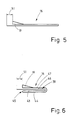
- ein langes Bekleidungsstück nach einer ersten Quer- faltung, und
- Fig. 6
- das lange Bekleidungsstück der Fig. 5 nach einer zweiten Querfaltung.
| Gruppe | Fälle betreffend | Korrektur Überlappungswert 1. Querfaltung | Korrekter Überlappungswert 2. Querfaltung | |
| ÜH | OL/UL | |||
| 1 | entfällt | (OL - UL) : 2 | ||
| 2 | entfällt | OL - EFL | ||
| 4 | OL≠EFL u. UL=EFL | EFL - OL | 0 | |
| OL=EFL u. UL≠EFL | EFL - UL | EFL - UL | ||
| OL≠EFL u. UL≠EFL | 2 * EFL - (OL + UL) | EFL - UL | ||
| OL=EFL UL=EFL | 0 | 0 | ||
| 5 | ≥0 | OL≠EFL u. UL=EFL | EFL - OL | 0 |
| OL=EFL u. UL≠EFL | EFL - UL | EFL - UL | ||
| OL≠EFL u. UL≠EFL | 2 * EFL - (OL + UL) | EFL - UL | ||
| OL=EFL u. UL=EFL | 0 | 0 | ||
| <0 | OL≠EFL u. UL=EFL | EFL - OL - ÜH | 0 | |
| OL=EFL u. UL≠EFL | EFL - UL | EFL - UL | ||
| OL≠EFL u. UL≠EFL | 2 * EFL - (OL + UL + ÜH) | EFL - UL | ||
| OL=EFL u. UL=EFL | 0 | 0 |
- 10
- Falteinrichtung
- 11
- Auflegefläche
- 12
- Arbeitsrichtung
- 13
- Faltbereich
- 14
- Auflegeförderer
- 15
- Abstapler
- 16
- Bekleidungsstück
- 17
- Transportbügel
- 18
- Förderschiene
- 19
- Kragenbereich
- 20
- Förderer
- 21
- erste Querfaltstation
- 22
- Förderer
- 23
- Förderer
- 24
- Förderer
- 25
- zweite Querfaltstation
- 26
- Förderer
- 27
- Förderer
- 28
- Sensor
- 29
- Sensor
- 30
- Sensor
- 31
- Sensor
- 32
- Sensor
- 33
- Obertrum
- 34
- Seitentrum
- 35
- Sensor
- 36
- Sensor
- 37
- obere Lage (Gruppe 1)
- 38
- untere Lage (Gruppe 1)
- 39
- obere Lage (Gruppe 2-5)
- 40
- untere Lage (Gruppe 2)
- 41
- untere Lage (Gruppe 3)
- 42
- untere Lage (Gruppe 4)
- 43
- untere innere Lage
(Gruppe 4 + 5) - 44
- untere äußere Lage
(Gruppe 4 + 5) - 45
- untere Lage (Gruppe 5)
- 46
- obere innere Lage
(Gruppe 5) - 47
- obere äußere Lage
(Gruppe 5) - 48
- obere Lage
- 49
- untere Lage
- 50
- Förderrolle
- 51
- Überhang (ÜH)
Claims (20)
- Verfahren zum Falten von textilen Gegenständen, insbesondere Bekleidungsstücken oder Wäschestücken, wobei die Gegenstände ausgestreckt und vorzugsweise längsgerichtet einer Falteinrichtung zugeführt und in dieser mindestens einmal quer zur Längsrichtung gefaltet werden (Querfaltung), dadurch gekennzeichnet, dass mindestens eine Abmessung des Gegenstands vor, während und/oder nach dem Falten ermittelt wird.
- Verfahren nach Anspruch 1, dadurch gekennzeichnet, dass die Gegenstände in Abhängigkeit von ihrer Größe, insbesondere ihrer Länge (Erstreckung in Längsrichtung), in unterschiedliche Gruppen eingeteilt und die Gegenstände entsprechend der vorgenommenen Gruppeneinteilung gezielt gefaltet werden, insbesondere den Gruppen unterschiedliche Endfaltlängen und/oder maximale Endfaltlängen zugeordnet werden.
- Verfahren nach Anspruch 1 oder 2, dadurch gekennzeichnet, dass bei bestimmten Gruppen nur eine einzige Querfaltung vorgenommen wird und bei den übrigen Gruppen mehrere, insbesondere zwei, Querfaltungen erfolgen, wobei vorzugsweise ein nur einmal querzufaltender Gegenstand nur in einer letzten (zweiten) Faltstation gefaltet wird.
- Verfahren nach einem der vorhergehenden Ansprüche, dadurch gekennzeichnet, dass vor der Faltung die Gesamtlänge des jeweiligen Gegenstands ermittelt (gemessen) wird und/oder nach einer Querfaltung oder auch gegebenenfalls nach jeder Querfaltung mindestens ein durch das Falten gebildeter Abschnitt aus einer Teillänge des Gegenstands, insbesondere eine obere und/oder untere Lage des Gegenstands, gemessen wird.
- Verfahren nach einem der vorhergehenden Ansprüche, dadurch gekennzeichnet, dass die Länge des Gegenstands im vor der Falteinrichtung (10) abgelegten Zustand desselben ermittelt, insbesondere gemessen, wird.
- Verfahren nach einem der vorhergehenden Ansprüche, dadurch gekennzeichnet, dass dann, wenn der zur Bildung einer zweiten Lage dienende Rest der Länge des Gegenstands zur Erreichung einer vorgegebenen Mindestüberlappung bei insbesondere der ersten Querfaltung nicht ausreicht, eine erste Lage verkürzt wird.
- Verfahren nach einem der vorhergehenden Ansprüche, dadurch gekennzeichnet, dass mindestens eine Abmessung des Gegenstands gemessen wird und das Messergebnis zum anschließenden Falten des gleichen und/oder eines nachfolgenden Gegenstands herangezogen wird, insbesondere zur Steuerung mindestens einer Faltung.
- Verfahren nach einem der vorhergehenden Ansprüche, dadurch gekennzeichnet, dass mindestens eine Abmessung, vorzugsweise die Länge des Gegenstands vor und/oder nach der ersten Querfaltung ermittelt wird und der Gegenstand anschließend gemäß den Vorgaben dieser Gruppe gefaltet wird, vorzugsweise nachdem eine Zuordnung des gemessenen Gegenstands zu einer entsprechenden Gruppe erfolgt ist.
- Verfahren nach einem der vorhergehenden Ansprüche, dadurch gekennzeichnet, dass die Länge des Gegenstands vor Beginn des Faltvorgangs ermittelt wird und die so ermittelte Länge des Gegenstands herangezogen wird zur Bestimmung, ob dieser Gegenstand nur einmal oder mehrmals quergefaltet wird und/oder welche Endfaltlänge vorgegeben wird.
- Verfahren nach einem der vorhergehenden Ansprüche, dadurch gekennzeichnet, dass die Messung der Länge des Gegenstands erfolgt, wenn seine hintere Kante (Unterkante) beim Einfördern in die Falteinrichtung (10) einen Sensor (28, 29) passiert, wobei vorzugsweise der gemessene Weg, den der Gegenstand bis zum Passieren des Sensors (28, 29) zurückgelegt hat zum Abstand des betreffenden Sensors (28, 29) von einer konstanten Stelle der Auflegefläche (11), auf der der Gegenstand mit seinem vorderen Rand (Kragenbereich 19) aufgelegt wird, hinzuaddiert wird.
- Verfahren nach einem der vorhergehenden Ansprüche, dadurch gekennzeichnet, dass mindestens eine Messung des Gegenstands nach der letzten Faltung, insbesondere einer zweiten Querfaltung, erfolgt, vorzugsweise bei Gegenständen, die zweimal quergefaltet werden, eine Messung nach jeder Querfaltung erfolgt.
- Verfahren nach einem der vorhergehenden Ansprüche, dadurch gekennzeichnet, dass die Längen mindestens zweier einander wenigstens teilweise überlappender Lagen des Gegenstands nach der zweiten Querfaltung ermittelt werden, wobei vorzugsweise die Längen der einzelnen Lagen separat gemessen werden, insbesondere etwa zeitgleich.
- Verfahren nach einem der vorhergehenden Ansprüche, dadurch gekennzeichnet, dass die gemessenen Längen der Lagen des Gegenstands herangezogen werden zum Falten eines anderen Gegenstands, vorzugsweise des nächsten Gegenstands der gleichen Gruppe, insbesondere zur Korrektur eines Überlappungswertes, des nächsten Gegenstands der gleichen Gruppe.
- Verfahren nach einem der vorhergehenden Ansprüche, dadurch gekennzeichnet, dass während des Weitertransports des Gegenstands nach der zweiten Querfaltung die Länge jeder einzelnen Lage desselben gemessen wird, wobei vorzugsweise während einer bestimmten Wegstrecke des Weitertransports der Lagen gemessen wird.
- Verfahren nach einem der vorhergehenden Ansprüche, dadurch gekennzeichnet, dass die Messung der Lagen gestartet wird, wenn ein in Transportrichtung hinteres Ende der jeweiligen Lage einen Sensor (30, 31) passiert und die Messung gestoppt wird, wenn ein gemeinsamer vorderer Rand beider Lagen einen anderen Sensor (32) passiert.
- Verfahren nach einem der vorhergehenden Ansprüche, dadurch gekennzeichnet, dass die Länge der jeweiligen Lage von einer Steuerung der Falteinrichtung (10) errechnet wird anhand der Wegstrecke, die die jeweilige Lage vom Passieren des rückseitigen Sensors (30, 31) bis zum Passieren des vorderseitigen Sensors (32) zurückgelegt hat, indem diese errechnete Wegstrecke vom Abstand der rückseitigen Sensoren für eine obere bzw. untere Lage zum gemeinsamen vorderseitigen Sensor beider Lagen subtrahiert wird.
- Vorrichtung zum Falten von textilen Gegenständen, insbesondere Bekleidungsstücken oder Wäschestücken, mit einer Auflegefläche zum ausgebreiteten Ablegen eines einzeln angeförderten Gegenstands und eine der Auflegefläche nachgeordnete Falteinrichtung, von der die Gegenstände mindestens einmal quer zu ihrer Längsrichtung faltbar sind, dadurch gekennzeichnet, dass der Auflegefläche (11) mindestens ein Sensor (28, 29) für eine hintere Kante des jeweiligen Gegenstands ortsfest zugeordnet ist und der oder jeder Sensor (28, 29) mit einer Zeitmesseinrichtung korrespondiert.
- Vorrichtung nach Anspruch 17, dadurch gekennzeichnet, dass der Auflegefläche (11) zwei mit Abstand voneinander angeordnete Sensoren (28, 29) ortsfest zugeordnet sind, wobei die Sensoren (28, 29) einen gleichbleibenden Abstand zu einer Ablegestelle eines oberen Bereichs des Gegenstands auf der Auflegefläche (11) aufweisen.
- Vorrichtung zum Falten von textilen Gegenständen, insbesondere Bekleidungsstücken oder Wäschestücken, mit einer Auflegefläche zum ausgebreiteten Ablegen des einzelnen angeförderten Gegenstands und einer der Auflegefläche nachgeordneten Falteinrichtung, von der die Gegenstände mindestens einem quer zu ihrer Längsrichtung faltbar sind, dadurch gekennzeichnet, dass im Bereich mindestens einer Querfaltstation (21, 25) Sensoren zur Ermittlung von in Arbeitsrichtung (12) hintenliegenden Enden jeder Lage des Gegenstands und einem vorderen Ende des Gegenstands zugeordnet sind und die Sensoren mit Zeitmesseinrichtungen korrespondieren.
- Vorrichtung nach Anspruch 19, dadurch gekennzeichnet, dass die Sensoren derart im Bereich der jeweiligen Querfaltstation (21, 25) fest angeordnet sind, dass die Sensoren zuerst die hinteren Kanten der Lagen des jeweiligen Gegenstands detektieren und im Anschluss daran auf das vorauslaufende vordere Ende des Gegenstands ansprechen.
Applications Claiming Priority (4)
| Application Number | Priority Date | Filing Date | Title |
|---|---|---|---|
| DE10019953 | 2000-04-20 | ||
| DE10019953 | 2000-04-20 | ||
| DE10038294 | 2000-08-05 | ||
| DE10038294A DE10038294A1 (de) | 2000-04-20 | 2000-08-05 | Verfahren und Vorrichtung zum Falten von textilen Gegenständen insbesondere Bekleidungs-oder Wäschestücken |
Publications (3)
| Publication Number | Publication Date |
|---|---|
| EP1148170A2 true EP1148170A2 (de) | 2001-10-24 |
| EP1148170A3 EP1148170A3 (de) | 2002-11-06 |
| EP1148170B1 EP1148170B1 (de) | 2007-05-16 |
Family
ID=26005434
Family Applications (1)
| Application Number | Title | Priority Date | Filing Date |
|---|---|---|---|
| EP20010106096 Expired - Lifetime EP1148170B1 (de) | 2000-04-20 | 2001-03-13 | Verfahren und Vorrichtung zum Falten von Textilen Gegenständen, insbesondere Bekleidungs- oder Wäschestücken |
Country Status (2)
| Country | Link |
|---|---|
| EP (1) | EP1148170B1 (de) |
| DE (1) | DE50112501D1 (de) |
Cited By (2)
| Publication number | Priority date | Publication date | Assignee | Title |
|---|---|---|---|---|
| CN113136721A (zh) * | 2020-01-17 | 2021-07-20 | 青岛海尔洗衣机有限公司 | 一种叠衣机的自动纠偏方法 |
| CN114232309A (zh) * | 2020-09-09 | 2022-03-25 | 海尔衣联生态科技(上海)有限公司 | 一种自动化叠衣机用物理接触式感应组件 |
Family Cites Families (6)
| Publication number | Priority date | Publication date | Assignee | Title |
|---|---|---|---|---|
| US2374779A (en) * | 1942-03-27 | 1945-05-01 | American Laundry Company | Sequence timer and measuring control |
| US2629591A (en) * | 1951-08-21 | 1953-02-24 | American Laundry Mach Co | Timing switch mechanism for laundry folding apparatus |
| US2652246A (en) * | 1953-05-08 | 1953-09-15 | American Machine & Metals | Folding machine controls |
| US3154726A (en) * | 1961-10-12 | 1964-10-27 | Super Laundry Mach Co | Folding machine controller |
| US3252700A (en) * | 1963-12-12 | 1966-05-24 | Ametek Inc | Laundry machine |
| DE19839004A1 (de) * | 1998-08-27 | 2000-03-02 | Kannegiesser H Gmbh Co | Verfahren und Vorrichtung zum Zuführen von Wäschestücken zu einer Wäschebehandlungseinrichtung |
-
2001
- 2001-03-13 EP EP20010106096 patent/EP1148170B1/de not_active Expired - Lifetime
- 2001-03-13 DE DE50112501T patent/DE50112501D1/de not_active Expired - Lifetime
Cited By (3)
| Publication number | Priority date | Publication date | Assignee | Title |
|---|---|---|---|---|
| CN113136721A (zh) * | 2020-01-17 | 2021-07-20 | 青岛海尔洗衣机有限公司 | 一种叠衣机的自动纠偏方法 |
| CN114232309A (zh) * | 2020-09-09 | 2022-03-25 | 海尔衣联生态科技(上海)有限公司 | 一种自动化叠衣机用物理接触式感应组件 |
| CN114232309B (zh) * | 2020-09-09 | 2025-11-28 | 海尔衣联生态科技(上海)有限公司 | 一种自动化叠衣机用物理接触式感应组件 |
Also Published As
| Publication number | Publication date |
|---|---|
| EP1148170A3 (de) | 2002-11-06 |
| EP1148170B1 (de) | 2007-05-16 |
| DE50112501D1 (de) | 2007-06-28 |
Similar Documents
| Publication | Publication Date | Title |
|---|---|---|
| EP2891744B1 (de) | Verfahren zum Falten von Wäschestücken | |
| EP3569762B1 (de) | Verfahren und vorrichtung zum ausbreiten von wäschestücken | |
| EP0677610B1 (de) | Verfahren und Vorrichtung zum Falten von Bekleidungsstücken | |
| DE10038294A1 (de) | Verfahren und Vorrichtung zum Falten von textilen Gegenständen insbesondere Bekleidungs-oder Wäschestücken | |
| EP1148170B1 (de) | Verfahren und Vorrichtung zum Falten von Textilen Gegenständen, insbesondere Bekleidungs- oder Wäschestücken | |
| DE102017000209A1 (de) | Verfahren und Vorrichtung zum Ausbreiten von Wäschestücken | |
| EP2330248B1 (de) | Verfahren und Vorrichtung zum Falten von Hosenbeine aufweisenden Bekleidungsstücken | |
| EP3702517B1 (de) | Verfahren und vorrichtung zum falten von wäschestücken | |
| DE102018006466A1 (de) | Verfahren und Vorrichtung zum Zuführen von Wäschestücken zu insbesondere einer Mangel | |
| EP3666967B1 (de) | Verfahren zum eingeben von wäschestücken in eine eingabemaschine | |
| EP3569761B1 (de) | Verfahren und vorrichtung zum zuführen von wäschestücken zu insbesondere einer mangel | |
| EP4056752A1 (de) | Verfahren zur behandlung von wäschestücken | |
| EP0816553B1 (de) | Verfahren und Vorrichtung zum Zuführen von insbesondere Hosen zu einem Faltautomaten oder dergleichen | |
| EP3067460B1 (de) | Verfahren zum falten von wäschestücken | |
| EP4067563B1 (de) | Verfahren und vorrichtungen zum zuführen von wäschestücken zu einer wäschereimaschine, wie insbesondere einer mangel | |
| DE102013020912A1 (de) | Verfahren zum Falten von Wäschestücken | |
| DE3816883C2 (de) | Verfahren zur Minimierung des Materialverbrauchs beim Auslegen einer mit einem Fehler behafteten Stoffbahn | |
| DE4011755C3 (de) | Faltmaschine für Wäschestücke | |
| DE19715338A1 (de) | Verfahren und Vorrichtung zum Zuführen von insbesondere Hosen zu einem Faltautomaten oder dergleichen | |
| DE2227694C3 (de) | Automatisch arbeitende Nähanlage | |
| DE102013009337A1 (de) | Verfahren zur Ermittlung der Größe eines Wäschestücks und Vorrichtung | |
| DE19935304A1 (de) | Verfahren und Vorrichtung zum Zuführen von Bekleidungsstücken zu einem Faltautomaten oder dergleichen | |
| DE1785590A1 (de) | Vorrichtung zum Foerdern von Waeschestuecken mit einer die Waeschestuecke zwangslaeufig foerdernden Einrichtung | |
| DE3202342A1 (de) | Laengenmessvorrichtung und verfahren zum betrieb | |
| EP1424430A2 (de) | Verfahren zum Zuführen von Wäschestücken zu einer Wäschebehandlungsmaschine, insbesondere einer Mangel, und Vorrichtung dafür |
Legal Events
| Date | Code | Title | Description |
|---|---|---|---|
| PUAI | Public reference made under article 153(3) epc to a published international application that has entered the european phase |
Free format text: ORIGINAL CODE: 0009012 |
|
| AK | Designated contracting states |
Kind code of ref document: A2 Designated state(s): AT BE CH CY DE DK ES FI FR GB GR IE IT LI LU MC NL PT SE TR |
|
| AX | Request for extension of the european patent |
Free format text: AL;LT;LV;MK;RO;SI |
|
| PUAL | Search report despatched |
Free format text: ORIGINAL CODE: 0009013 |
|
| RAP1 | Party data changed (applicant data changed or rights of an application transferred) |
Owner name: HERBERT KANNEGIESSER GMBH |
|
| AK | Designated contracting states |
Kind code of ref document: A3 Designated state(s): AT BE CH CY DE DK ES FI FR GB GR IE IT LI LU MC NL PT SE TR |
|
| AX | Request for extension of the european patent |
Free format text: AL;LT;LV;MK;RO;SI |
|
| 17P | Request for examination filed |
Effective date: 20030505 |
|
| AKX | Designation fees paid |
Designated state(s): DE FR GB |
|
| 17Q | First examination report despatched |
Effective date: 20040826 |
|
| GRAP | Despatch of communication of intention to grant a patent |
Free format text: ORIGINAL CODE: EPIDOSNIGR1 |
|
| GRAJ | Information related to disapproval of communication of intention to grant by the applicant or resumption of examination proceedings by the epo deleted |
Free format text: ORIGINAL CODE: EPIDOSDIGR1 |
|
| GRAP | Despatch of communication of intention to grant a patent |
Free format text: ORIGINAL CODE: EPIDOSNIGR1 |
|
| GRAS | Grant fee paid |
Free format text: ORIGINAL CODE: EPIDOSNIGR3 |
|
| GRAA | (expected) grant |
Free format text: ORIGINAL CODE: 0009210 |
|
| AK | Designated contracting states |
Kind code of ref document: B1 Designated state(s): DE FR GB |
|
| REG | Reference to a national code |
Ref country code: GB Ref legal event code: FG4D Free format text: NOT ENGLISH |
|
| REF | Corresponds to: |
Ref document number: 50112501 Country of ref document: DE Date of ref document: 20070628 Kind code of ref document: P |
|
| GBT | Gb: translation of ep patent filed (gb section 77(6)(a)/1977) |
Effective date: 20070801 |
|
| ET | Fr: translation filed | ||
| PLBE | No opposition filed within time limit |
Free format text: ORIGINAL CODE: 0009261 |
|
| STAA | Information on the status of an ep patent application or granted ep patent |
Free format text: STATUS: NO OPPOSITION FILED WITHIN TIME LIMIT |
|
| 26N | No opposition filed |
Effective date: 20080219 |
|
| REG | Reference to a national code |
Ref country code: FR Ref legal event code: PLFP Year of fee payment: 15 |
|
| PGFP | Annual fee paid to national office [announced via postgrant information from national office to epo] |
Ref country code: GB Payment date: 20150408 Year of fee payment: 15 |
|
| REG | Reference to a national code |
Ref country code: FR Ref legal event code: PLFP Year of fee payment: 16 |
|
| PGFP | Annual fee paid to national office [announced via postgrant information from national office to epo] |
Ref country code: FR Payment date: 20160309 Year of fee payment: 16 |
|
| GBPC | Gb: european patent ceased through non-payment of renewal fee |
Effective date: 20160313 |
|
| PG25 | Lapsed in a contracting state [announced via postgrant information from national office to epo] |
Ref country code: GB Free format text: LAPSE BECAUSE OF NON-PAYMENT OF DUE FEES Effective date: 20160313 |
|
| REG | Reference to a national code |
Ref country code: FR Ref legal event code: ST Effective date: 20171130 |
|
| PG25 | Lapsed in a contracting state [announced via postgrant information from national office to epo] |
Ref country code: FR Free format text: LAPSE BECAUSE OF NON-PAYMENT OF DUE FEES Effective date: 20170331 |
|
| PGFP | Annual fee paid to national office [announced via postgrant information from national office to epo] |
Ref country code: DE Payment date: 20190228 Year of fee payment: 19 |
|
| REG | Reference to a national code |
Ref country code: DE Ref legal event code: R119 Ref document number: 50112501 Country of ref document: DE |
|
| PG25 | Lapsed in a contracting state [announced via postgrant information from national office to epo] |
Ref country code: DE Free format text: LAPSE BECAUSE OF NON-PAYMENT OF DUE FEES Effective date: 20201001 |