EP1148079A2 - Diacetylenic polyorganosiloxanes, intermediates therefor, and cured compositions prepared therefrom - Google Patents
Diacetylenic polyorganosiloxanes, intermediates therefor, and cured compositions prepared therefrom Download PDFInfo
- Publication number
- EP1148079A2 EP1148079A2 EP01303440A EP01303440A EP1148079A2 EP 1148079 A2 EP1148079 A2 EP 1148079A2 EP 01303440 A EP01303440 A EP 01303440A EP 01303440 A EP01303440 A EP 01303440A EP 1148079 A2 EP1148079 A2 EP 1148079A2
- Authority
- EP
- European Patent Office
- Prior art keywords
- range
- polyorganosiloxane
- formula
- diacetylenic
- polyorganosiloxanes
- Prior art date
- Legal status (The legal status is an assumption and is not a legal conclusion. Google has not performed a legal analysis and makes no representation as to the accuracy of the status listed.)
- Granted
Links
- 239000000203 mixture Substances 0.000 title claims abstract description 32
- 239000000543 intermediate Substances 0.000 title description 7
- 230000005855 radiation Effects 0.000 claims abstract description 8
- 229910052710 silicon Inorganic materials 0.000 claims description 12
- 125000004432 carbon atom Chemical group C* 0.000 claims description 8
- 239000010703 silicon Substances 0.000 claims description 8
- 125000000217 alkyl group Chemical group 0.000 claims description 6
- 125000004430 oxygen atom Chemical group O* 0.000 claims description 6
- 229910020388 SiO1/2 Inorganic materials 0.000 claims description 5
- 229910020447 SiO2/2 Inorganic materials 0.000 claims description 5
- 238000000034 method Methods 0.000 claims description 5
- 229910020485 SiO4/2 Inorganic materials 0.000 claims description 4
- 125000003118 aryl group Chemical group 0.000 claims description 4
- 238000005859 coupling reaction Methods 0.000 claims description 4
- 229910052739 hydrogen Inorganic materials 0.000 claims description 4
- 239000001257 hydrogen Substances 0.000 claims description 4
- 125000004435 hydrogen atom Chemical group [H]* 0.000 claims description 4
- 125000004178 (C1-C4) alkyl group Chemical group 0.000 claims description 3
- 229910020487 SiO3/2 Inorganic materials 0.000 claims description 3
- 125000003545 alkoxy group Chemical group 0.000 claims description 3
- 125000004104 aryloxy group Chemical group 0.000 claims description 3
- 125000002496 methyl group Chemical group [H]C([H])([H])* 0.000 claims description 3
- 125000001140 1,4-phenylene group Chemical group [H]C1=C([H])C([*:2])=C([H])C([H])=C1[*:1] 0.000 claims description 2
- 239000012190 activator Substances 0.000 claims description 2
- 230000008878 coupling Effects 0.000 claims description 2
- 238000010168 coupling process Methods 0.000 claims description 2
- 238000004519 manufacturing process Methods 0.000 claims description 2
- 125000000383 tetramethylene group Chemical group [H]C([H])([*:1])C([H])([H])C([H])([H])C([H])([H])[*:2] 0.000 claims description 2
- 150000001875 compounds Chemical class 0.000 abstract description 27
- -1 propargyl halide Chemical class 0.000 abstract description 25
- 238000006243 chemical reaction Methods 0.000 abstract description 19
- 238000006459 hydrosilylation reaction Methods 0.000 abstract description 13
- 238000000576 coating method Methods 0.000 abstract description 6
- 150000002440 hydroxy compounds Chemical class 0.000 abstract description 5
- 229920001296 polysiloxane Polymers 0.000 description 50
- YXFVVABEGXRONW-UHFFFAOYSA-N Toluene Chemical compound CC1=CC=CC=C1 YXFVVABEGXRONW-UHFFFAOYSA-N 0.000 description 39
- ZMXDDKWLCZADIW-UHFFFAOYSA-N N,N-Dimethylformamide Chemical compound CN(C)C=O ZMXDDKWLCZADIW-UHFFFAOYSA-N 0.000 description 24
- 239000003054 catalyst Substances 0.000 description 19
- YMWUJEATGCHHMB-UHFFFAOYSA-N Dichloromethane Chemical compound ClCCl YMWUJEATGCHHMB-UHFFFAOYSA-N 0.000 description 15
- JUJWROOIHBZHMG-UHFFFAOYSA-N Pyridine Chemical compound C1=CC=NC=C1 JUJWROOIHBZHMG-UHFFFAOYSA-N 0.000 description 14
- 239000000463 material Substances 0.000 description 11
- BASFCYQUMIYNBI-UHFFFAOYSA-N platinum Chemical group [Pt] BASFCYQUMIYNBI-UHFFFAOYSA-N 0.000 description 11
- 239000000047 product Substances 0.000 description 11
- 150000003254 radicals Chemical class 0.000 description 11
- 239000011541 reaction mixture Substances 0.000 description 11
- CSNNHWWHGAXBCP-UHFFFAOYSA-L Magnesium sulfate Chemical compound [Mg+2].[O-][S+2]([O-])([O-])[O-] CSNNHWWHGAXBCP-UHFFFAOYSA-L 0.000 description 10
- KFZMGEQAYNKOFK-UHFFFAOYSA-N Isopropanol Chemical compound CC(C)O KFZMGEQAYNKOFK-UHFFFAOYSA-N 0.000 description 8
- UMJSCPRVCHMLSP-UHFFFAOYSA-N pyridine Natural products COC1=CC=CN=C1 UMJSCPRVCHMLSP-UHFFFAOYSA-N 0.000 description 7
- KWOLFJPFCHCOCG-UHFFFAOYSA-N Acetophenone Chemical compound CC(=O)C1=CC=CC=C1 KWOLFJPFCHCOCG-UHFFFAOYSA-N 0.000 description 6
- IJGRMHOSHXDMSA-UHFFFAOYSA-N Atomic nitrogen Chemical compound N#N IJGRMHOSHXDMSA-UHFFFAOYSA-N 0.000 description 6
- KWYHDKDOAIKMQN-UHFFFAOYSA-N N,N,N',N'-tetramethylethylenediamine Chemical compound CN(C)CCN(C)C KWYHDKDOAIKMQN-UHFFFAOYSA-N 0.000 description 6
- XUIMIQQOPSSXEZ-UHFFFAOYSA-N Silicon Chemical group [Si] XUIMIQQOPSSXEZ-UHFFFAOYSA-N 0.000 description 5
- QVGXLLKOCUKJST-UHFFFAOYSA-N atomic oxygen Chemical compound [O] QVGXLLKOCUKJST-UHFFFAOYSA-N 0.000 description 5
- 229910052943 magnesium sulfate Inorganic materials 0.000 description 5
- 235000019341 magnesium sulphate Nutrition 0.000 description 5
- 239000001301 oxygen Substances 0.000 description 5
- 229910052760 oxygen Inorganic materials 0.000 description 5
- 239000002904 solvent Substances 0.000 description 5
- XLYOFNOQVPJJNP-UHFFFAOYSA-N water Substances O XLYOFNOQVPJJNP-UHFFFAOYSA-N 0.000 description 5
- 238000005160 1H NMR spectroscopy Methods 0.000 description 4
- GCYHRYNSUGLLMA-UHFFFAOYSA-N 2-prop-2-enoxyethanol Chemical compound OCCOCC=C GCYHRYNSUGLLMA-UHFFFAOYSA-N 0.000 description 4
- 229910021591 Copper(I) chloride Inorganic materials 0.000 description 4
- CTQNGGLPUBDAKN-UHFFFAOYSA-N O-Xylene Chemical compound CC1=CC=CC=C1C CTQNGGLPUBDAKN-UHFFFAOYSA-N 0.000 description 4
- OXBLHERUFWYNTN-UHFFFAOYSA-M copper(I) chloride Chemical compound [Cu]Cl OXBLHERUFWYNTN-UHFFFAOYSA-M 0.000 description 4
- 229940045803 cuprous chloride Drugs 0.000 description 4
- 239000004205 dimethyl polysiloxane Substances 0.000 description 4
- 125000002534 ethynyl group Chemical group [H]C#C* 0.000 description 4
- 150000004678 hydrides Chemical class 0.000 description 4
- 229920000435 poly(dimethylsiloxane) Polymers 0.000 description 4
- 125000001436 propyl group Chemical group [H]C([*])([H])C([H])([H])C([H])([H])[H] 0.000 description 4
- 238000003756 stirring Methods 0.000 description 4
- 239000008096 xylene Substances 0.000 description 4
- MVLGANVFCMOJHR-UHFFFAOYSA-N 1,4-diethynylbenzene Chemical compound C#CC1=CC=C(C#C)C=C1 MVLGANVFCMOJHR-UHFFFAOYSA-N 0.000 description 3
- 238000007096 Glaser coupling reaction Methods 0.000 description 3
- HEMHJVSKTPXQMS-UHFFFAOYSA-M Sodium hydroxide Chemical compound [OH-].[Na+] HEMHJVSKTPXQMS-UHFFFAOYSA-M 0.000 description 3
- 150000005840 aryl radicals Chemical class 0.000 description 3
- 229910052805 deuterium Inorganic materials 0.000 description 3
- 239000010410 layer Substances 0.000 description 3
- 239000007788 liquid Substances 0.000 description 3
- 229910052757 nitrogen Inorganic materials 0.000 description 3
- DSOJWVLXZNRKCS-UHFFFAOYSA-N octa-1,7-diyne Chemical compound C#CCCCCC#C DSOJWVLXZNRKCS-UHFFFAOYSA-N 0.000 description 3
- 229910052697 platinum Inorganic materials 0.000 description 3
- YORCIIVHUBAYBQ-UHFFFAOYSA-N propargyl bromide Chemical compound BrCC#C YORCIIVHUBAYBQ-UHFFFAOYSA-N 0.000 description 3
- 239000010453 quartz Substances 0.000 description 3
- VYPSYNLAJGMNEJ-UHFFFAOYSA-N silicon dioxide Inorganic materials O=[Si]=O VYPSYNLAJGMNEJ-UHFFFAOYSA-N 0.000 description 3
- ODCQCPUUPWRQKV-UHFFFAOYSA-N 1,4-bis(prop-2-ynoxy)benzene Chemical compound C#CCOC1=CC=C(OCC#C)C=C1 ODCQCPUUPWRQKV-UHFFFAOYSA-N 0.000 description 2
- KBPLFHHGFOOTCA-UHFFFAOYSA-N 1-Octanol Chemical compound CCCCCCCCO KBPLFHHGFOOTCA-UHFFFAOYSA-N 0.000 description 2
- RTZKZFJDLAIYFH-UHFFFAOYSA-N Diethyl ether Chemical compound CCOCC RTZKZFJDLAIYFH-UHFFFAOYSA-N 0.000 description 2
- QIGBRXMKCJKVMJ-UHFFFAOYSA-N Hydroquinone Chemical compound OC1=CC=C(O)C=C1 QIGBRXMKCJKVMJ-UHFFFAOYSA-N 0.000 description 2
- KDLHZDBZIXYQEI-UHFFFAOYSA-N Palladium Chemical compound [Pd] KDLHZDBZIXYQEI-UHFFFAOYSA-N 0.000 description 2
- UIIMBOGNXHQVGW-UHFFFAOYSA-M Sodium bicarbonate Chemical compound [Na+].OC([O-])=O UIIMBOGNXHQVGW-UHFFFAOYSA-M 0.000 description 2
- 239000002253 acid Substances 0.000 description 2
- 125000003710 aryl alkyl group Chemical group 0.000 description 2
- 239000012965 benzophenone Substances 0.000 description 2
- 230000015572 biosynthetic process Effects 0.000 description 2
- 229910052799 carbon Inorganic materials 0.000 description 2
- 239000003153 chemical reaction reagent Substances 0.000 description 2
- ZUOUZKKEUPVFJK-UHFFFAOYSA-N diphenyl Chemical compound C1=CC=CC=C1C1=CC=CC=C1 ZUOUZKKEUPVFJK-UHFFFAOYSA-N 0.000 description 2
- 238000001035 drying Methods 0.000 description 2
- 238000005227 gel permeation chromatography Methods 0.000 description 2
- 239000012044 organic layer Substances 0.000 description 2
- 229920000642 polymer Polymers 0.000 description 2
- 239000002243 precursor Substances 0.000 description 2
- 238000002360 preparation method Methods 0.000 description 2
- 125000004368 propenyl group Chemical group C(=CC)* 0.000 description 2
- 239000012258 stirred mixture Substances 0.000 description 2
- 239000000126 substance Substances 0.000 description 2
- 229910052722 tritium Inorganic materials 0.000 description 2
- 125000000391 vinyl group Chemical group [H]C([*])=C([H])[H] 0.000 description 2
- PXYWBGGQYRRUOR-UHFFFAOYSA-N 1-phenyl-2,2-bis(prop-2-ynoxy)ethanone Chemical compound C#CCOC(OCC#C)C(=O)C1=CC=CC=C1 PXYWBGGQYRRUOR-UHFFFAOYSA-N 0.000 description 1
- 238000001644 13C nuclear magnetic resonance spectroscopy Methods 0.000 description 1
- 238000005133 29Si NMR spectroscopy Methods 0.000 description 1
- 239000005749 Copper compound Substances 0.000 description 1
- YZCKVEUIGOORGS-OUBTZVSYSA-N Deuterium Chemical compound [2H] YZCKVEUIGOORGS-OUBTZVSYSA-N 0.000 description 1
- 229910004726 HSiO3/2 Inorganic materials 0.000 description 1
- 238000004566 IR spectroscopy Methods 0.000 description 1
- KJTLSVCANCCWHF-UHFFFAOYSA-N Ruthenium Chemical compound [Ru] KJTLSVCANCCWHF-UHFFFAOYSA-N 0.000 description 1
- 229910018557 Si O Inorganic materials 0.000 description 1
- YZCKVEUIGOORGS-NJFSPNSNSA-N Tritium Chemical compound [3H] YZCKVEUIGOORGS-NJFSPNSNSA-N 0.000 description 1
- 230000009471 action Effects 0.000 description 1
- 230000006978 adaptation Effects 0.000 description 1
- 239000000654 additive Substances 0.000 description 1
- 125000001931 aliphatic group Chemical group 0.000 description 1
- 125000003342 alkenyl group Chemical group 0.000 description 1
- 125000002947 alkylene group Chemical group 0.000 description 1
- XXROGKLTLUQVRX-UHFFFAOYSA-N allyl alcohol Chemical group OCC=C XXROGKLTLUQVRX-UHFFFAOYSA-N 0.000 description 1
- HSFWRNGVRCDJHI-UHFFFAOYSA-N alpha-acetylene Natural products C#C HSFWRNGVRCDJHI-UHFFFAOYSA-N 0.000 description 1
- 150000001408 amides Chemical group 0.000 description 1
- 150000001412 amines Chemical class 0.000 description 1
- 229940045985 antineoplastic platinum compound Drugs 0.000 description 1
- 150000004945 aromatic hydrocarbons Chemical class 0.000 description 1
- 150000008365 aromatic ketones Chemical class 0.000 description 1
- RWCCWEUUXYIKHB-UHFFFAOYSA-N benzophenone Chemical compound C=1C=CC=CC=1C(=O)C1=CC=CC=C1 RWCCWEUUXYIKHB-UHFFFAOYSA-N 0.000 description 1
- 150000008366 benzophenones Chemical class 0.000 description 1
- 125000001797 benzyl group Chemical group [H]C1=C([H])C([H])=C(C([H])=C1[H])C([H])([H])* 0.000 description 1
- 235000010290 biphenyl Nutrition 0.000 description 1
- 239000004305 biphenyl Substances 0.000 description 1
- 125000000484 butyl group Chemical group [H]C([*])([H])C([H])([H])C([H])([H])C([H])([H])[H] 0.000 description 1
- 230000003197 catalytic effect Effects 0.000 description 1
- 238000006555 catalytic reaction Methods 0.000 description 1
- 239000007795 chemical reaction product Substances 0.000 description 1
- 238000009833 condensation Methods 0.000 description 1
- 230000005494 condensation Effects 0.000 description 1
- 239000000470 constituent Substances 0.000 description 1
- 238000001816 cooling Methods 0.000 description 1
- 150000001880 copper compounds Chemical class 0.000 description 1
- 238000004132 cross linking Methods 0.000 description 1
- 239000011243 crosslinked material Substances 0.000 description 1
- 150000003983 crown ethers Chemical class 0.000 description 1
- 125000001995 cyclobutyl group Chemical group [H]C1([H])C([H])([H])C([H])(*)C1([H])[H] 0.000 description 1
- 125000000582 cycloheptyl group Chemical group [H]C1([H])C([H])([H])C([H])([H])C([H])([H])C([H])(*)C([H])([H])C1([H])[H] 0.000 description 1
- 125000000113 cyclohexyl group Chemical group [H]C1([H])C([H])([H])C([H])([H])C([H])(*)C([H])([H])C1([H])[H] 0.000 description 1
- 125000001511 cyclopentyl group Chemical group [H]C1([H])C([H])([H])C([H])([H])C([H])(*)C1([H])[H] 0.000 description 1
- 230000000694 effects Effects 0.000 description 1
- 125000004185 ester group Chemical group 0.000 description 1
- BITPLIXHRASDQB-UHFFFAOYSA-N ethenyl-[ethenyl(dimethyl)silyl]oxy-dimethylsilane Chemical compound C=C[Si](C)(C)O[Si](C)(C)C=C BITPLIXHRASDQB-UHFFFAOYSA-N 0.000 description 1
- 125000001033 ether group Chemical group 0.000 description 1
- 125000001495 ethyl group Chemical group [H]C([H])([H])C([H])([H])* 0.000 description 1
- 238000001914 filtration Methods 0.000 description 1
- 125000003709 fluoroalkyl group Chemical group 0.000 description 1
- 239000011521 glass Substances 0.000 description 1
- 125000005842 heteroatom Chemical group 0.000 description 1
- UIZVMOZAXAMASY-UHFFFAOYSA-N hex-5-en-1-ol Chemical group OCCCCC=C UIZVMOZAXAMASY-UHFFFAOYSA-N 0.000 description 1
- 125000004051 hexyl group Chemical group [H]C([H])([H])C([H])([H])C([H])([H])C([H])([H])C([H])([H])C([H])([H])* 0.000 description 1
- 125000002887 hydroxy group Chemical group [H]O* 0.000 description 1
- 230000006698 induction Effects 0.000 description 1
- 238000002329 infrared spectrum Methods 0.000 description 1
- 230000003993 interaction Effects 0.000 description 1
- 229910052741 iridium Inorganic materials 0.000 description 1
- GKOZUEZYRPOHIO-UHFFFAOYSA-N iridium atom Chemical compound [Ir] GKOZUEZYRPOHIO-UHFFFAOYSA-N 0.000 description 1
- 125000001449 isopropyl group Chemical group [H]C([H])([H])C([H])(*)C([H])([H])[H] 0.000 description 1
- 239000011968 lewis acid catalyst Substances 0.000 description 1
- 229920002521 macromolecule Polymers 0.000 description 1
- 230000007246 mechanism Effects 0.000 description 1
- QSHDDOUJBYECFT-UHFFFAOYSA-N mercury Chemical compound [Hg] QSHDDOUJBYECFT-UHFFFAOYSA-N 0.000 description 1
- 229910052751 metal Inorganic materials 0.000 description 1
- 239000002184 metal Substances 0.000 description 1
- 230000004048 modification Effects 0.000 description 1
- 238000012986 modification Methods 0.000 description 1
- 125000001624 naphthyl group Chemical group 0.000 description 1
- 125000001971 neopentyl group Chemical group [H]C([*])([H])C(C([H])([H])[H])(C([H])([H])[H])C([H])([H])[H] 0.000 description 1
- 230000007935 neutral effect Effects 0.000 description 1
- 239000012454 non-polar solvent Substances 0.000 description 1
- BTRCPWDREMCXHT-UHFFFAOYSA-N octan-1-ol;platinum Chemical group [Pt].CCCCCCCCO BTRCPWDREMCXHT-UHFFFAOYSA-N 0.000 description 1
- 229910052762 osmium Inorganic materials 0.000 description 1
- SYQBFIAQOQZEGI-UHFFFAOYSA-N osmium atom Chemical compound [Os] SYQBFIAQOQZEGI-UHFFFAOYSA-N 0.000 description 1
- 229910052763 palladium Inorganic materials 0.000 description 1
- 125000001147 pentyl group Chemical group C(CCCC)* 0.000 description 1
- 239000003444 phase transfer catalyst Substances 0.000 description 1
- 125000001997 phenyl group Chemical group [H]C1=C([H])C([H])=C(*)C([H])=C1[H] 0.000 description 1
- 125000000286 phenylethyl group Chemical group [H]C1=C([H])C([H])=C(C([H])=C1[H])C([H])([H])C([H])([H])* 0.000 description 1
- 125000004344 phenylpropyl group Chemical group 0.000 description 1
- 125000005496 phosphonium group Chemical group 0.000 description 1
- 239000003504 photosensitizing agent Substances 0.000 description 1
- 150000003058 platinum compounds Chemical class 0.000 description 1
- 238000006116 polymerization reaction Methods 0.000 description 1
- 230000008569 process Effects 0.000 description 1
- 125000001453 quaternary ammonium group Chemical group 0.000 description 1
- 239000000376 reactant Substances 0.000 description 1
- 230000035484 reaction time Effects 0.000 description 1
- 230000009257 reactivity Effects 0.000 description 1
- 229910052703 rhodium Inorganic materials 0.000 description 1
- 239000010948 rhodium Substances 0.000 description 1
- MHOVAHRLVXNVSD-UHFFFAOYSA-N rhodium atom Chemical compound [Rh] MHOVAHRLVXNVSD-UHFFFAOYSA-N 0.000 description 1
- 238000007151 ring opening polymerisation reaction Methods 0.000 description 1
- 229910052707 ruthenium Inorganic materials 0.000 description 1
- 150000003839 salts Chemical class 0.000 description 1
- LIVNPJMFVYWSIS-UHFFFAOYSA-N silicon monoxide Inorganic materials [Si-]#[O+] LIVNPJMFVYWSIS-UHFFFAOYSA-N 0.000 description 1
- 238000001542 size-exclusion chromatography Methods 0.000 description 1
- 235000017557 sodium bicarbonate Nutrition 0.000 description 1
- 229910000030 sodium bicarbonate Inorganic materials 0.000 description 1
- 239000007787 solid Substances 0.000 description 1
- 239000002195 soluble material Substances 0.000 description 1
- 238000004611 spectroscopical analysis Methods 0.000 description 1
- 238000001228 spectrum Methods 0.000 description 1
- 238000003786 synthesis reaction Methods 0.000 description 1
- JRMUNVKIHCOMHV-UHFFFAOYSA-M tetrabutylammonium bromide Chemical compound [Br-].CCCC[N+](CCCC)(CCCC)CCCC JRMUNVKIHCOMHV-UHFFFAOYSA-M 0.000 description 1
- 125000000725 trifluoropropyl group Chemical group [H]C([H])(*)C([H])([H])C(F)(F)F 0.000 description 1
- 238000000870 ultraviolet spectroscopy Methods 0.000 description 1
- 238000005406 washing Methods 0.000 description 1
Classifications
-
- C—CHEMISTRY; METALLURGY
- C08—ORGANIC MACROMOLECULAR COMPOUNDS; THEIR PREPARATION OR CHEMICAL WORKING-UP; COMPOSITIONS BASED THEREON
- C08F—MACROMOLECULAR COMPOUNDS OBTAINED BY REACTIONS ONLY INVOLVING CARBON-TO-CARBON UNSATURATED BONDS
- C08F290/00—Macromolecular compounds obtained by polymerising monomers on to polymers modified by introduction of aliphatic unsaturated end or side groups
- C08F290/08—Macromolecular compounds obtained by polymerising monomers on to polymers modified by introduction of aliphatic unsaturated end or side groups on to polymers modified by introduction of unsaturated side groups
- C08F290/14—Polymers provided for in subclass C08G
- C08F290/148—Polysiloxanes
-
- C—CHEMISTRY; METALLURGY
- C08—ORGANIC MACROMOLECULAR COMPOUNDS; THEIR PREPARATION OR CHEMICAL WORKING-UP; COMPOSITIONS BASED THEREON
- C08F—MACROMOLECULAR COMPOUNDS OBTAINED BY REACTIONS ONLY INVOLVING CARBON-TO-CARBON UNSATURATED BONDS
- C08F299/00—Macromolecular compounds obtained by interreacting polymers involving only carbon-to-carbon unsaturated bond reactions, in the absence of non-macromolecular monomers
- C08F299/02—Macromolecular compounds obtained by interreacting polymers involving only carbon-to-carbon unsaturated bond reactions, in the absence of non-macromolecular monomers from unsaturated polycondensates
- C08F299/08—Macromolecular compounds obtained by interreacting polymers involving only carbon-to-carbon unsaturated bond reactions, in the absence of non-macromolecular monomers from unsaturated polycondensates from polysiloxanes
-
- C—CHEMISTRY; METALLURGY
- C08—ORGANIC MACROMOLECULAR COMPOUNDS; THEIR PREPARATION OR CHEMICAL WORKING-UP; COMPOSITIONS BASED THEREON
- C08G—MACROMOLECULAR COMPOUNDS OBTAINED OTHERWISE THAN BY REACTIONS ONLY INVOLVING UNSATURATED CARBON-TO-CARBON BONDS
- C08G77/00—Macromolecular compounds obtained by reactions forming a linkage containing silicon with or without sulfur, nitrogen, oxygen or carbon in the main chain of the macromolecule
- C08G77/48—Macromolecular compounds obtained by reactions forming a linkage containing silicon with or without sulfur, nitrogen, oxygen or carbon in the main chain of the macromolecule in which at least two but not all the silicon atoms are connected by linkages other than oxygen atoms
- C08G77/50—Macromolecular compounds obtained by reactions forming a linkage containing silicon with or without sulfur, nitrogen, oxygen or carbon in the main chain of the macromolecule in which at least two but not all the silicon atoms are connected by linkages other than oxygen atoms by carbon linkages
Definitions
- This invention relates to acetylenic polyorganosiloxane compounds. More particularly, it relates to a class of diacetylenic polyorganosiloxanes and their curing.
- Silicones having acetylenic moieties are known in the art, being disclosed in a number of publications. For example, compounds having conjugated diacetylenic groups bound directly to silicon atoms are disclosed in Son et al., Macromolecules , 28, 399-400 (1995), and in Parnell et al., J. Poly . Sci ., Poly. Chem . Ed ., 11 , 1107-1110 (1973). Genera of compounds in which similar diacetylenic groups are present in combination with amide or ester groups and silicone moieties are among the subjects of European patent application 210,058 and Lai et al., Mol. Cryst. Liq.
- Such materials have potential for being cured, as by heat or radiation, to produce materials useful, for example, as release coatings or conformal coatings.
- materials useful for example, as release coatings or conformal coatings.
- they suffer from various disadvantages including high cost of preparation and chemical instability, the latter being particularly true of compounds having a Si-O-C linkage.
- French patent applications 96/11,999 and 96/12,000 disclose polymeric compositions containing ether groups in combination with diacetylenic moieties. However, no silicone moieties are present.
- the present invention provides a series of chemically stable diacetylenic silicones and a series of acetylenic silicone intermediates therefor, said intermediates being readily converted to the diacetylenic compounds by a coupling reaction. Also provided are cured compositions prepared from said diacetylenic silicones, as well as a method of curing the same which employs ultraviolet radiation but does not require the presence of promoters, sensitizers or other additives.
- the present invention includes intermediate compositions comprising ethynylorgano polyorganosiloxanes having the formula (I) (M 1 ) a (M 2 ) b (D 1 ) c (D 2 ) d (T 1 ) e (T 2 ) f Q g , wherein:
- compositions comprising poly(conjugated diacetylenic) polyorganosiloxanes formed by coupling of the above-described ethynylorgano polyorganosiloxanes.
- a further aspect of the present invention is a method for producing a cured polyorganosiloxane which comprises exposing said poly(conjugated diacetylenic) polyorganosiloxane compositions to heat or radiation.
- a still further aspect is cured polyorganosiloxanes so prepared.
- the "a"-"g” subscripts are each 0 or greater with the proviso that "b” + “d” + "f” is at least 1.
- "c” is in a range between about 1 and about 500 and "e", "f' and “g” are each 0; i.e., the preferred silicones are triorganosiloxy-terminated polyorganosiloxanes. More preferably, "c" is in a range between about 5 and about 50; most preferably, in a range between about 5 and about 25.
- the sum "b” + “d” + “f”, i.e., the total number of ethynyl groups per molecule, is at least 1, i.e. mono, preferably at least 2, and more preferably 2.
- "b" is 2 and "d” and “f” are each 0; i.e., the preferred compounds are ethynyl-terminated polyorganosiloxanes.
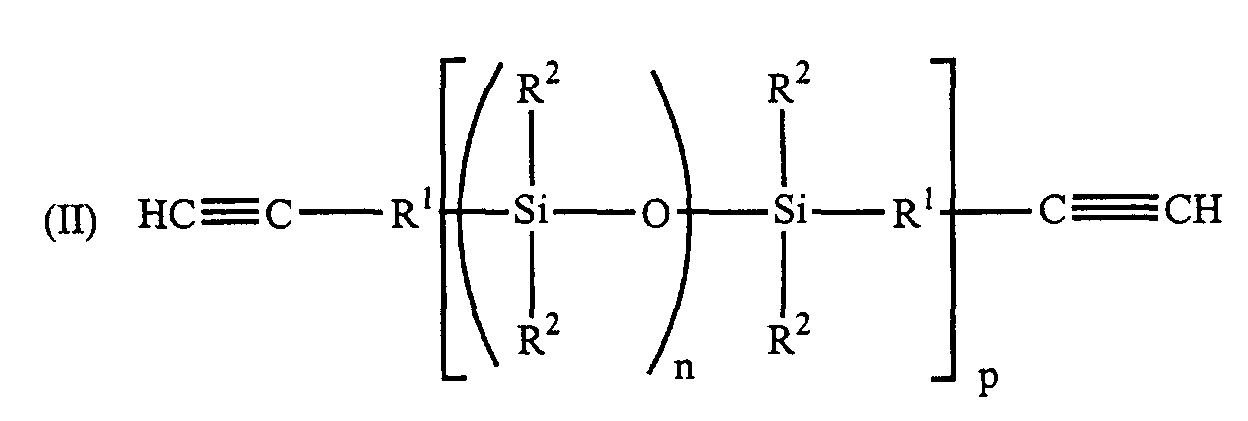
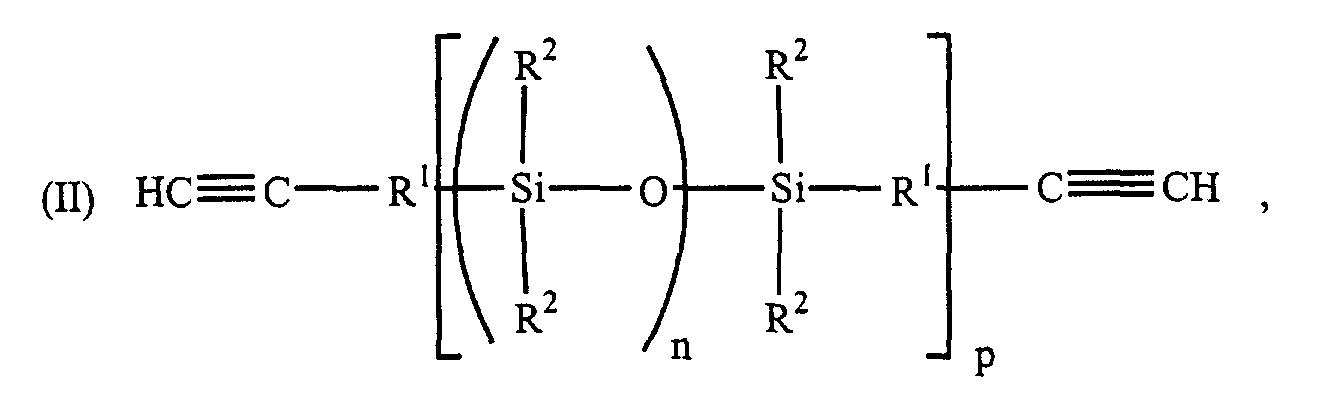
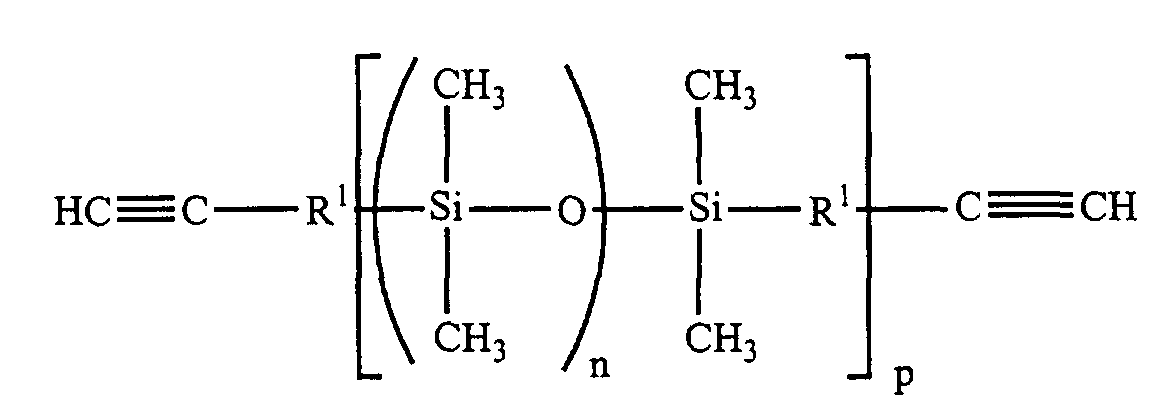
- a particularly preferred class of ethynyl-terminated silicones consists of those having the formula wherein "n” is in a range between about 1 and about 500, preferably in a range between about 5 and about 50 and most preferably in a range between about 5 and about 25; "p" is in a range between about 1 and about 100, preferably in a range between about 1 and about 10, and most preferably 1 or 2; R 1 is as previously defined; and R 2 is independently at each occurrence a C 1-22 alkyl, C 1-22 alkoxy, C 2-22 alkenyl, C 6-20 aryl, C 6-20 aryloxy, C 6-22 alkyl-substituted aryl, and C 6-22 aralkyl which groups may be halogenated, for example, fluorinated to contain fluorocarbons such as C 1-22 fluoroalkyl.
- alkyl as used in various embodiments of the present invention is intended to designate both normal alkyl, branched alkyl, aralkyl, and cycloalkyl radicals.
- Normal and branched alkyl radicals are preferably those containing from 1 to about 12 carbon atoms, and include as illustrative non-limiting examples methyl, ethyl, propyl, isopropyl, butyl, tertiary-butyl, pentyl, neopentyl, and hexyl.
- Cycloalkyl radicals represented are preferably those containing from 4 to about 12 ring carbon atoms.
- cycloalkyl radicals include cyclobutyl, cyclopentyl, cyclohexyl, methylcyclohexyl, and cycloheptyl.
- Preferred aralkyl radicals are those containing from 7 to about 14 carbon atoms; these include, but are not limited to, benzyl, phenylbutyl, phenylpropyl, and phenylethyl.
- Aryl radicals used in the various embodiments of the present invention are preferably those containing from 6 to 14 ring carbon atoms.
- aryl radicals include phenyl, biphenyl, and naphthyl.
- An illustrative non-limiting example of a halogenated moiety suitable for R 2 groups is trifluoropropyl. Most often, all R 2 radicals are methyl.
- R 1 radicals in formulas I and II are divalent radicals which contain no Si-O-C moieties, which detract from stability. In one preferred embodiment of the invention, said R 1 radicals contain at least one oxygen atom not directly bound to Si.
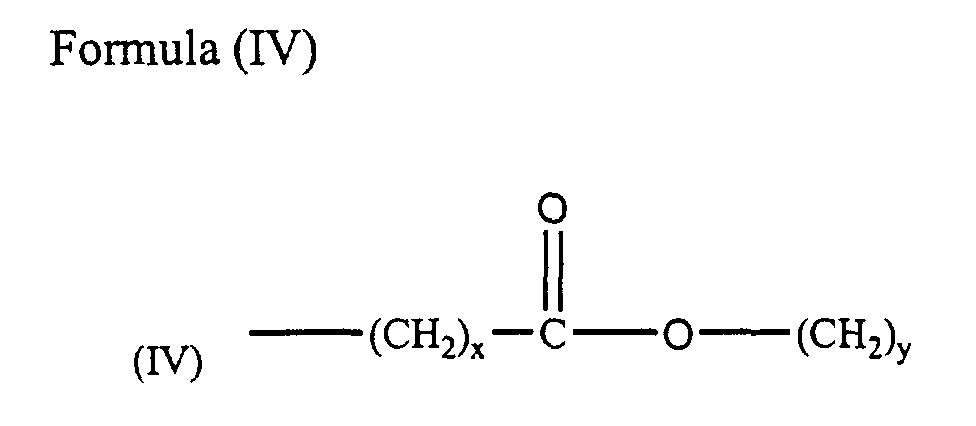
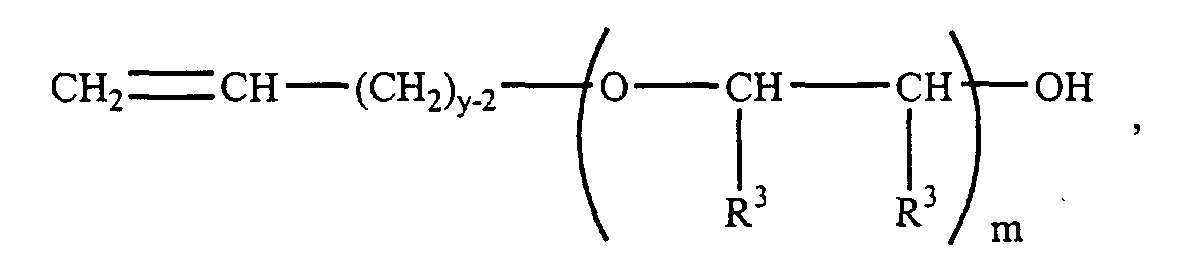
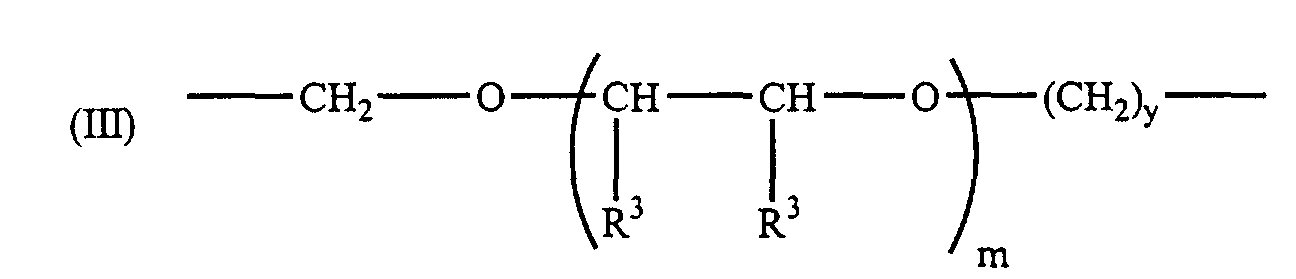
- Such R 1 radicals most often have the formula III or IV wherein each R 3 is independently hydrogen or C 1-4 alkyl, "m” is in a range between about 0 and about 100, “y” is in a range between about 3 and about 10 and (CH 2 ) y is bonded to silicon. Most often, each R 3 is hydrogen, "m" is 1 and "y” is 3.
- R 1 contains at least one olefinic moiety directly bound to Si, and more preferably, only one olefinic moiety directly bound to Si.
- Radicals of this type include those of the formulas and wherein R 4 is a divalent organic radical, which may be an aliphatic, aromatic or mixed aliphatic-aromatic hydrocarbon radical or may contain hetero atoms, and the olefinic carbon atoms are bound to Si.
- R 4 is an alkylene or divalent aromatic hydrocarbon or aromatic ether radical.
- the alkylene radicals employed as R 4 most often contain in a range between about 2 and about 10 carbon atoms, with 4 carbon atoms (i.e., tetramethylene) frequently being preferred.
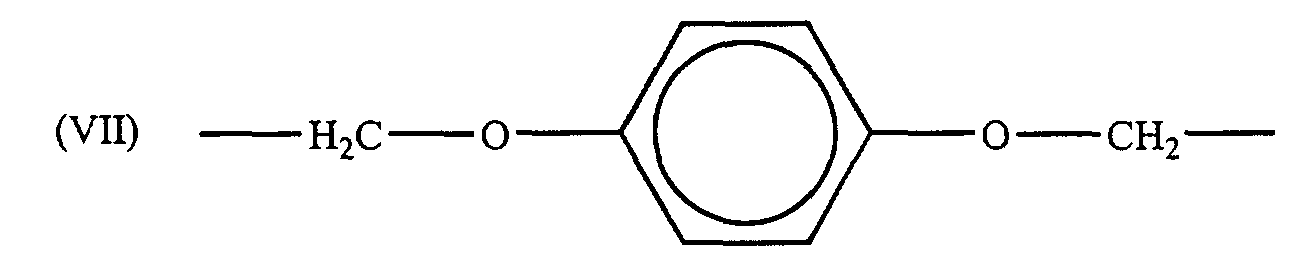
- the preferred aromatic radicals include p-phenylene and a radical of the formula
- R 2 is defined as above.
- One subgenus of intermediate ethynyl-terminated silicones of formula II may be prepared by a 2-step reaction sequence in which the first step is hydrosilylation of a hydride-containing silicone with an olefinic hydroxy compound of the formula wherein R 3 , "m” and “y” are as previously defined. At least one olefinic hydroxy compound having this structure, 2-(2-propenyloxy)ethanol (ethylene glycol allyl ether), is commercially available.
- the polyorganosiloxanes of the present invention are typically prepared by the hydrosilylation of an hydride-containing silicone having the formula: M h M H i D j D H k T l T H m Q n where the subscripts h, j, k, l, m and n are zero or a positive integer, subject to the limitation that the sum of the subscripts i, k and m is one or greater; where M has the formula: R 2 3 SiO 1/2 , M H has the formula: R 2 3-o H o SiO 1/2 , D has the formula: R 2 2 SiO 2/2 , D H has the formula: H 2-p R 2 p SiO 2/2 , T has the formula: R 2 SiO 3/2 , T H has the formula: HSiO 3/2 , and Q has the formula SiO 4/2 , wherein "o” is in a range between about 1 and about 3, and preferably, 1, "p” is 0 or 1 and preferably, 1, wherein each R
- the hydride-containing silicone compounds that are the precursors to the compounds of the present invention may be prepared by the process disclosed in U.S. Pat. No. 5,698,654 herewith.
- the '654 patent discloses a sequential catalysis of the ring opening polymerization of cyclic organosiloxanes using a base catalyst that can be neutralized by a subsequent redistribution and condensation catalyst such as a Lewis acid catalyst, preferably a phosphonitrilic compound, that permits the rapid synthesis of functionalized and poly-functionalized silicone copolymers.
- the subscripts describing the hydride-containing silicone precursor and the hydrosilylation adduct of the present invention are integers as required by the various rules of chemical stoichiometry. As mixtures of compounds that are described by these formulas the subscripts will assume non-integral values, for the mixtures. The restrictions on the subscripts heretofore described for the stoichiometric subscripts of these compounds are for the pure compounds, not the mixtures.
- hydrosilylation conditions may be employed for this reaction. These include temperatures in a range between about 0°C and about 150°C, the optional presence of a relatively non-polar solvent such as toluene, stoichiometric or near-stoichiometric proportions of reagents and the use of a hydrosilylation catalyst, most often in an amount in a range between about 1 ppm and about 500 ppm by weight.
- the catalyst is usually a compound of a platinum group metal; i.e., ruthenium, rhodium, palladium, osmium, iridium or platinum. Examples of suitable hydrosilylation catalysts are disclosed in U.S. Patents 3,159,601, 3,159,662, 3,220,970, 3,516,946, 3,775,452 and 4,029,629.
- the preferred hydrosilylation catalysts are platinum compounds.
- Another suitable platinum-containing catalyst is a platinum-octanol complex containing about 90.9% octanol and about 9.1% chloroplatinic acid by weight.
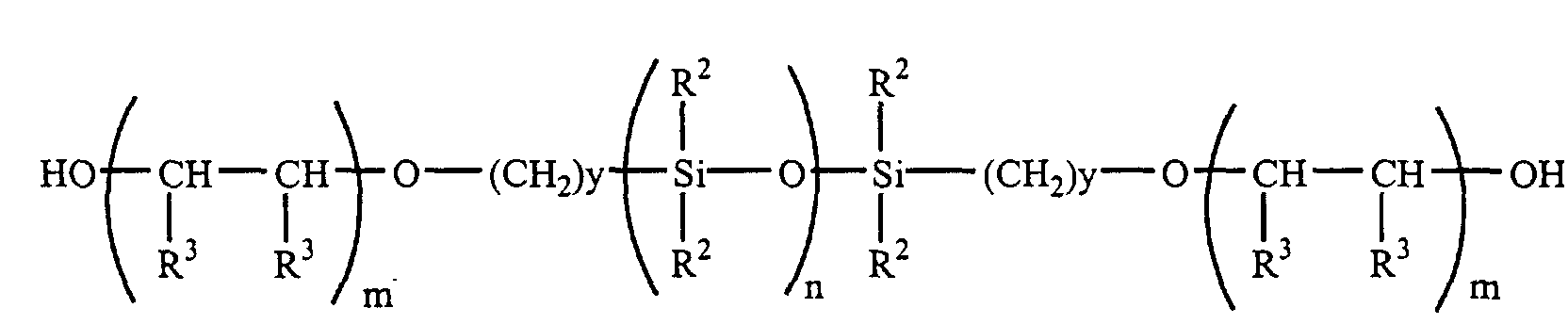
- the hydrosilylation reaction produces a dihydroxy compound of the formula wherein R 2 , R 3 , "m”, “n”, and “y” are as previously defined.
- said dihydroxy compound undergoes reaction with a propargyl halide such as propargyl bromide, typically under alkaline conditions and in the presence of a phase transfer catalyst such as a quaternary ammonium, quaternary phosphonium or hexaalkylguanidinium salt or a crown ether.
- a reaction temperature in a range between about 0°C and about 50°C is most often employed.
- Another subgenus of intermediate ethynyl-terminated silicones of formula II may be prepared by the hydrosilylation reaction between a hydride-terminated silicone and a diethynyl compound of the formula wherein R 4 is as previously defined.
- Suitable diethynyl compounds include 1,7-octadiyne and the compounds p-diethynylbenzene and p-dipropargyloxybenzene, the latter of which may be prepared by the reaction of hydroquinone with propargyl bromide under alkaline conditions as described, for example, in Whitlock et al., J. Am. Chem . Soc ., 105, 838-844 (1983).
- Typical hydrosilylation conditions as described hereinabove, may be employed in the reaction of a hydride-terminated silicone with a bis(ethynyl) compound.
- Molar ratios of olefinic hydroxy compound or diethynyl compound to hydride-terminated silicone are subject to considerable variation; optimum ratios may be determined by simple experimentation. Relevant factors include the reactivities of the reagents, the desire to produce compounds having terminal acetylenic linkages and the desire to avoid, as much as possible, the formation of oligomers (i.e., compounds in which "p" is greater than 1) having internal olefinic linkages, so as to obtain optimum usage of the acetylenic linkages present.
- oligomers i.e., compounds in which "p" is greater than 1 having internal olefinic linkages, so as to obtain optimum usage of the acetylenic linkages present.
- molar ratios of olefinic hydroxy compound or diethynyl compound to hydride-terminated silicone are in the range between about 1:1 and about 4:1 are conveniently employed.
- compositions comprising ethynylorgano silicones are useful as intermediates for preparation of the poly(conjugated diacetylenic) silicone compositions of the invention.
- the latter may be prepared, for example, by subjecting said bis(ethynylorgano)-terminated silicones to a Glaser coupling reaction, in which the bis(ethynylorgano)-terminated silicone is contacted with oxygen at a temperature in the range between about 10°C and about 40°C and in the presence of a catalyst system including a copper compound, an amine such as tetramethylethylenediamine and other catalyst/solvent constituents such as pyridine, dimethylformamide, 2-propanol, and mixtures thereof.
- a catalyst system including a copper compound, an amine such as tetramethylethylenediamine and other catalyst/solvent constituents such as pyridine, dimethylformamide, 2-propanol, and mixtures thereof.
- the poly(conjugated diacetylenic) silicone compositions of this invention may be cured, i.e., crosslinked, by the action of heat or of radiation, typically in the ultraviolet region. It has been discovered that ultraviolet curing may be easily achieved without the use of sensitizers or activators, simply by exposing the poly(conjugated diacetylenic) silicone composition to radiation in the ultraviolet region of the spectrum, although it is also within the scope of the invention to employ an art-recognized sensitizer. Said curing reaction is not fully understood with regard to mechanism or the molecular structure of the product, but it is believed to involve interaction between the acetylene moieties.
- the resulting cured compositions of the invention are useful as release coatings or conformal coatings.
- the curing reaction may be conducted in the presence of aromatic ketones such as an acetophenone or a benzophenone. It has been reported that the presence of such compounds results in an increased curing rate. Reference is made, for example, to Hay et al., Polymer Letters , 8, 97-99 (1970).
- the reaction mixture was stirred while oxygen (19 ml/min) was bubbled through it for 16.5 hours.
- the reaction mixture was then diluted with 100 ml of methylene chloride and washed with water until no blue color was observed in the aqueous layer.
- the organic layer was dried overnight over magnesium sulfate, after which the volatile materials were removed on a rotary evaporator.
- the product was dried under vacuum for 8 hours.
- the desired poly(diacetylenic) silicone was isolated in 82% yield (2.12 g); its Mn was 3,600 and its Mw/Mn was 3.4.
- the coupling reaction was also run in 50/50 pyridine/DMF as well as mixtures of 50/50 pyridine/DMF with toluene or isopropanol.
- Example 1 The procedure of Example 1 was repeated, respectively substituting 3-hydroxy-1-propene and 6-hydroxy-1-hexene on an equimolar basis for the 2-(2-propenyloxy)ethanol. Similar products were obtained.
- a catalyst solution prepared from 19.7 mg (0.20 mmol) of cuprous chloride, 30 ⁇ l (0.20 mmol) of TMEDA, 1.2 ml of pyridine and 1.2 ml of DMF was added to a reaction tube containing 1.79 g (3.2 mmol of terminal acetylenic groups) of the bis(oct-1-en-7-ynyl)-terminated silicone.
- Oxygen (19 ml/min) was bubbled through the stirred reaction mixture at 70°C. After 140 hours, the extent of chain end conversion had reached 65%. Stirring for an additional 70 hours did not result in further conversion.
- the reaction mixture was diluted with 100 ml of methylene chloride and washed with water until no blue color was observed in the aqueous layer.
- the organic solution was dried overnight over magnesium sulfate.
- the volatile materials were then removed on a rotary evaporator and the product was further dried under vacuum for 14 hours.
- the desired poly(diacetylenic) silicone was isolated in 69% yield (1.23 g).
- Mn and Mw/Mn were 3,400 and 2.3, respectively.
- a catalyst solution prepared from 22.5 mg (0.23 mmol) of cuprous chloride, 26 mg (0.23 mmol) of TMEDA, 1.2 ml pyridine and 1.2 ml of DMF was added to 1.84 g (3.6 mmol of terminal acetylenic groups) of the bis ⁇ 3-[p-(2-propynyloxyphenoxy)]propenyl ⁇ -terminated silicone.
- the reaction mixture was stirred at room temperature while oxygen (19 ml/min) was bubbled through. After 20 min the mixture was diluted to 50 ml with methylene chloride and the solution was washed with water until the aqueous layer was colorless. The organic layer was dried over magnesium sulfate.
- the hydride-terminated polydimethylsiloxane of Example 1 (0.998 g, 3.13 mmol based on Si-H) was mixed with 394.3 mg (3.13 mmol) of p-diethynylbenzene, 6 ml of toluene and Karstedt's catalyst (8 ⁇ l, 2.25% solution in xylene, 0.24 mmol Pt/mol Si-H).
- the reaction mixture was allowed to stir at room temperature for 29 hours, at which time it was determined that no Si-H remained.
- the solvent was removed on a rotary evaporator, and the sample was dried under vacuum for 12 hours to remove unreacted p -diethynylbenzene.
- the desired bis[2-(p-ethynylphenyl)ethenyl]-terminated silicone was isolated in 90% yield (1.25 g) as a yellow liquid.
- the Mn was determined by proton nuclear magnetic resonance spectroscopy to be 2,270.
- the bis[2-(p-ethynylphenyl)ethenyl]-terminated silicone (192 mg, 0.20 mmol of terminal acetylenic groups) was placed in a reaction tube and a catalyst solution containing 1.2 mg (0.012 mmol) of cuprous chloride, 14 mg (0.012 mmol) of TMEDA, 0.13 ml of pyridine and 0.13 ml of DMF was added. Oxygen (16 ml/min) was bubbled through at room temperature for 21 hours. The reaction mixture was diluted to 30 ml with methylene chloride and worked up as described in Example 5. The desired poly(diacetylenic) silicone, 0.149 g (78% of theoretical) was isolated as a viscous yellow liquid. Its Mn was 7,000; conversion of chain ends was 70%.
- the poly(diacetylenic) silicone of Example 1 was coated onto quartz plates (2.5 centimeter x 7.5 centimeter) using an applying rod to achieve a film thickness of about 5 microns.
- the films were cured in a UV processor with a Primarc Minicure lamp (medium pressure mercury vapor lamp, 120 Watts/centimeter 2 ) and a line speed of 6 meters/minute. One irradiation was sufficient to make the film appear solid to the touch.
- the crosslinked films were transparent, smooth and slightly yellow.
- a 30 mg sample of cured material were scraped off the glass plate and placed in toluene for 24 hours.
- Gel permeation chromatography was used to analyze the soluble non-crosslinked material left after curing.
- the Mn of the soluble part was found to be about 880 to 1,280 regardless of the number of passes on the processor.
- the amount of soluble material left after curing was estimated by washing the non-soluble part of each sample three times with 2 ml of toluene and then drying under vacuum for 4 hours.
- the amount of insoluble (crosslinked) material after curing accounted for up to 98% of the material scraped off the plate after two curing runs.
- Example 1 A 500 mg sample of the product of Example 1 was dissolved in 5 ml of methylene chloride and 12.8 mg of 2,4-dipropargyloxyacetophenone was added to produce a mixture in which 10% of the total acetylene functionality originated from the acetophenone. The mixture was stirred at room temperature for 30 min. The solvent was removed on a rotary evaporator, and the sample was dried for 14 hours under vacuum.
- Films (5 microns) of the mixture were prepared and cured as described in Example 7. These films cured faster than those of Example 7, as determined qualitatively by UV/visible spectroscopy.
- a toluene solution (30% by weight) of the poly(diacetylenic) silicone of Example 5 was cast onto a quartz plate with the use of an applying rod and a blade, to form a film estimated to be less than 10 microns thick.
- the film was irradiated as described in Example 7 in one pass and the resulting cured product was non-tacky.
- a toluene solution (10% by weight) of the poly(diacetylenic) silicone of Example 6 was cast onto a quartz plate with the use of an applying rod and a blade, to form a film estimated to be less than 10 microns thick.
- the film was irradiated as described in Example 7 in one pass and the resulting cured product was non-tacky.
Landscapes
- Chemical & Material Sciences (AREA)
- Health & Medical Sciences (AREA)
- Chemical Kinetics & Catalysis (AREA)
- Medicinal Chemistry (AREA)
- Polymers & Plastics (AREA)
- Organic Chemistry (AREA)
- Silicon Polymers (AREA)
- Macromonomer-Based Addition Polymer (AREA)
Abstract
Description

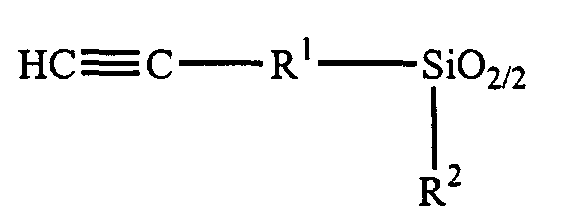

each R1 is independently a divalent organic radical having no Si-O-C moieties and containing at least one oxygen atom not directly bound to Si or at least one CH=CH moiety directly bound to Si; and
each R2 is independently an alkyl radical, alkoxy radical, alkenyl radical, aryl radical, aryloxy radical, alkyl-substituted aryl radical, and aralkyl radical which groups may be halogenated.




Claims (16)
- An intermediate composition comprising ethynylorgano polyorganosiloxanes having the formulaM1 is (R2)3SiO1/2,D1 is (R2)2SiO2/2,T1 is R2 SiO3/2,Q is SiO4/2,M2 is
 D2 is
D2 is T2 is
T2 is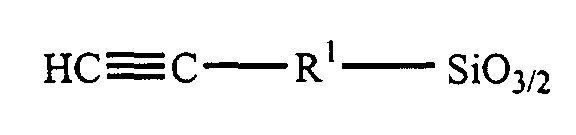 each of a, b, c, d, e, f and g is 0 or greater, with the proviso that b + d + f is at least 1;each R1 is independently a divalent organic radical having no Si-O-C moieties and containing at least one oxygen atom not directly bound to Si or at least one CH=CH moiety directly bound to Si; andeach R2 is independently non-halogenated or halogenated alkyl, aryl, alkoxy or aryloxy.
 - A composition according to claim 1 wherein e, f and g are each 0.
- A composition according to claim 1 or claim 2 wherein b is 2 and d is 0.
- A diethynyl-terminated polyorganosiloxane having the formulawherein:
 each R1 is independently a divalent organic radical having no Si-O-C moieties and containing at least one oxygen atom not directly bound to Si or at least one CH=CH moiety directly bound to Si;each R2 is independently non-halogenated or halogenated alkyl, aryl, alkoxy or aryloxy;n is in a range between about 1 and about 500; andp is in a range between about 1 and about 100.
 - The polyorganosiloxane according to claim 4 wherein each R2 is methyl.
- The polyorganosiloxane according to claim 4 or claim 5 wherein R1 has the formulawherein each R3 is hydrogen or C1-4 alkyl, m is in a range between about 0 and about 100, y is in a range between about 1 and about 10, and (CH2)y is bonded to silicon, or
 wherein "y" is in a range between about 3 and about 10, (CH2)y is bonded to silicon, and "x" is in a range between about 1 and about 100.
- The polyorganosiloxane according to claim 6 wherein m is 1 and y is 3.
- The polyorganosiloxane according to claim 4 or claim 5 wherein each R1 independently has the formulaor
 with the olefinic groups bonded to silicon, wherein R4 is a divalent organic radical.
- The polyorganosiloxane according to claim 8 wherein R4 is an alkylene radical containing carbon atoms in a range between about 2 and about 10, or p-phenylene or has the formula

- The polyorganosiloxane according to claim 9 wherein R4 is tetramethylene.
- A diethynyl-terminated polyorganosiloxane having the formulawherein R1 has the formula -CH2O(CH2)2O(CH2)3- with (CH2)3 bound to silicon;
 or
or with the olefinic groups bonded to silicon; n is in a range between about 5 and about 25; and p is 1 or 2.
- A composition comprising poly(conjugated diacetylenic) polyorganosiloxanes formed by coupling of an ethynylorgano polyorganosiloxane according to any preceding claim.
- The composition according to claim 12 wherein R1 has the formulawherein each R3 is hydrogen or C1-4 alkyl, m is in a range between about 0 and about 100, y is in a range between about 3 and about 10, and (CH2)y is bonded to silicon.
- A method for producing a cured polyorganosiloxane which comprises exposing a poly(conjugated diacetylenic) polyorganosiloxane according to claim 12 to heat or radiation.
- The method according to claim 14 wherein said poly(conjugated diacetylenic) polyorganosiloxane is exposed to ultraviolet radiation in the absence of sensitizers and activators.
- A cured polyorganosiloxane prepared by the method of claim 14 or claim 15.
Applications Claiming Priority (2)
| Application Number | Priority Date | Filing Date | Title |
|---|---|---|---|
| US09/552,574 US6271280B1 (en) | 2000-04-19 | 2000-04-19 | Diacetylenic polyorganosiloxanes, intermediates therefor, and cured compositions prepared therefrom |
| US552574 | 2000-04-19 |
Publications (3)
| Publication Number | Publication Date |
|---|---|
| EP1148079A2 true EP1148079A2 (en) | 2001-10-24 |
| EP1148079A3 EP1148079A3 (en) | 2003-01-29 |
| EP1148079B1 EP1148079B1 (en) | 2006-07-26 |
Family
ID=24205918
Family Applications (1)
| Application Number | Title | Priority Date | Filing Date |
|---|---|---|---|
| EP01303440A Expired - Lifetime EP1148079B1 (en) | 2000-04-19 | 2001-04-12 | Diacetylenic polyorganosiloxanes, intermediates therefor, and cured compositions prepared therefrom |
Country Status (4)
| Country | Link |
|---|---|
| US (1) | US6271280B1 (en) |
| EP (1) | EP1148079B1 (en) |
| JP (1) | JP5252761B2 (en) |
| DE (1) | DE60121659T2 (en) |
Cited By (1)
| Publication number | Priority date | Publication date | Assignee | Title |
|---|---|---|---|---|
| CN104870524A (en) * | 2012-12-20 | 2015-08-26 | 信越化学工业株式会社 | Novel ethynyl-group-containing organopolysiloxane compound, method for producing straight-chain organopolysiloxane compound containing ethynyl group at both molecular chain ends, method for producing alkoxysilyl-ethynyl-group-terminated organosiloxane polymer, room-temperature-curable composition, and molded article that is cured product of same |
Families Citing this family (2)
| Publication number | Priority date | Publication date | Assignee | Title |
|---|---|---|---|---|
| DE10053037C1 (en) * | 2000-10-26 | 2002-01-17 | Consortium Elektrochem Ind | Preparation of silanes, useful as e.g. adhesion promoters or crosslinkers for polymers, uses dichloro-bis(diene-iridium) compound as catalyst and free diene as cocatalyst in the hydrosilylation of an alkene |
| CN111718486A (en) * | 2020-06-22 | 2020-09-29 | 湖北回天新材料股份有限公司 | Thixotropic agent and two-component silicone sealant containing same |
Family Cites Families (20)
| Publication number | Priority date | Publication date | Assignee | Title |
|---|---|---|---|---|
| US4767826A (en) | 1985-07-18 | 1988-08-30 | Polytechnic Institute Of New York | Radiation-sensitive polymers |
| JPS6234923A (en) * | 1985-08-09 | 1987-02-14 | Hitachi Ltd | new polymer |
| GB8728969D0 (en) * | 1987-12-11 | 1988-01-27 | Milburn G H W | Optically active diacetylenes |
| JPH0338551A (en) * | 1989-07-03 | 1991-02-19 | Mitsubishi Petrochem Co Ltd | Production of aromatic diacetylene compound |
| TW201770B (en) * | 1990-10-01 | 1993-03-11 | Gerneral Electric Company | |
| JP2668471B2 (en) * | 1991-09-27 | 1997-10-27 | 信越化学工業株式会社 | Curable resin composition and cured product thereof |
| US5329036A (en) * | 1992-09-02 | 1994-07-12 | Hughes Aircraft Company | (alpha, omega)phenylethynyl siloxane monomers, oligomers, and polymers thereof |
| JP2776184B2 (en) * | 1993-01-25 | 1998-07-16 | 信越化学工業株式会社 | Silicon polymer compound |
| DE4302993A1 (en) | 1993-02-03 | 1994-08-04 | Basf Ag | New poly:hexa-2,4-di:yne-l-siloxane cpds. for prepn. of catalyst |
| DE4303080A1 (en) | 1993-02-04 | 1994-08-11 | Basf Ag | Polyhexa-2,5-dien-3-yne-1,6-bis(siloxanes) |
| JPH06248084A (en) * | 1993-02-25 | 1994-09-06 | Toshiba Silicone Co Ltd | Organic silicon compound containing ethynyl group |
| JPH0733882A (en) * | 1993-07-21 | 1995-02-03 | Mitsui Toatsu Chem Inc | Poly (silylene) diacetylenes and method for producing the same |
| US5563181A (en) * | 1995-05-09 | 1996-10-08 | The United States Of America As Represented By The Secretary Of The Navy | Siloxane unsaturated hydrocarbon based thermosetting polymers |
| JPH0920827A (en) * | 1995-07-07 | 1997-01-21 | Sekisui Chem Co Ltd | Silicone resin cured product |
| DE19541820A1 (en) * | 1995-11-09 | 1997-05-15 | Consortium Elektrochem Ind | Liquid crystalline organosiloxanes containing chiral dianhydrohexite derivatives |
| JPH10120689A (en) * | 1996-10-17 | 1998-05-12 | Mitsui Chem Inc | Production of silicon-based compound and silicon-based polymer |
| DE19645721A1 (en) * | 1996-11-06 | 1998-05-07 | Wacker Chemie Gmbh | Crosslinkable organopolysiloxane compositions |
| JPH11158187A (en) * | 1997-04-10 | 1999-06-15 | Mitsui Chem Inc | Production of compound containing silicon and polymer-containing silicon |
| JPH1192562A (en) * | 1997-09-25 | 1999-04-06 | Kanegafuchi Chem Ind Co Ltd | Curable composition and method for producing molded article using the same |
| JP2000007686A (en) * | 1998-06-23 | 2000-01-11 | Mitsui Chemicals Inc | Silicon-containing compound and production of the same |
-
2000
- 2000-04-19 US US09/552,574 patent/US6271280B1/en not_active Expired - Lifetime
-
2001
- 2001-04-12 EP EP01303440A patent/EP1148079B1/en not_active Expired - Lifetime
- 2001-04-12 DE DE60121659T patent/DE60121659T2/en not_active Expired - Lifetime
- 2001-04-18 JP JP2001118946A patent/JP5252761B2/en not_active Expired - Fee Related
Cited By (1)
| Publication number | Priority date | Publication date | Assignee | Title |
|---|---|---|---|---|
| CN104870524A (en) * | 2012-12-20 | 2015-08-26 | 信越化学工业株式会社 | Novel ethynyl-group-containing organopolysiloxane compound, method for producing straight-chain organopolysiloxane compound containing ethynyl group at both molecular chain ends, method for producing alkoxysilyl-ethynyl-group-terminated organosiloxane polymer, room-temperature-curable composition, and molded article that is cured product of same |
Also Published As
| Publication number | Publication date |
|---|---|
| US6271280B1 (en) | 2001-08-07 |
| JP5252761B2 (en) | 2013-07-31 |
| EP1148079B1 (en) | 2006-07-26 |
| DE60121659D1 (en) | 2006-09-07 |
| DE60121659T2 (en) | 2007-07-19 |
| JP2002020491A (en) | 2002-01-23 |
| EP1148079A3 (en) | 2003-01-29 |
Similar Documents
| Publication | Publication Date | Title |
|---|---|---|
| US6482912B2 (en) | Method of preparing aminofunctional alkoxy polysiloxanes | |
| Whitmarsh et al. | Synthesis and structure of a highly branched polycarbosilane derived from (chloromethyl) trichlorosilane | |
| Li et al. | Catalytic cross-dehydrocoupling polymerization of 1, 4-bis (dimethylsilyl) benzene with water. A new approach to poly [(oxydimethylsilylene)(1, 4-phenylene)(dimethylsilylene)] | |
| KR20050087846A (en) | Branched polymers from organohydrogensilicon compounds | |
| US6225247B1 (en) | Polymer precursor composition, crosslinked polymers, thermosets and ceramics made with silyl and siloxyl substituted carboranes with unsaturated organic end groups | |
| JP2007538070A (en) | Silicone condensation reaction | |
| US7153921B2 (en) | Synthesis of elastomeric carborane-siloxanes by hydrosilation reactions | |
| WO1999043737A1 (en) | Silyl and siloxyl substituted carboranes with unsaturated organic end groups | |
| EP1148079B1 (en) | Diacetylenic polyorganosiloxanes, intermediates therefor, and cured compositions prepared therefrom | |
| US5726271A (en) | Hydroxyphenyl-containing polyorganosiloxanes | |
| WO2001030887A1 (en) | Method of polymerizing silalkylenesiloxane | |
| RU2230747C2 (en) | New fluoroalkyl-substituted cyclotrisiloxanes, their application for preparing new polymers and new polymers | |
| JP3459985B2 (en) | Method for producing thin film of borazine-containing silicon polymer and borazine-containing silicon polymer | |
| JP3041424B1 (en) | Carbosilane borazine-based polymer and method for producing the same | |
| JPH0625420A (en) | Sulfonated silicone | |
| CA2088200C (en) | Poly(silethynylenedisiloxane) and method for the manufacture thereof | |
| KR100379850B1 (en) | Curable siloxane polymer composition and curing method thereof | |
| JPH07233260A (en) | Reactive silicon polymer and curable composition containing the same | |
| Liu et al. | Reactions of silyl ketene acetal-functionalized polysiloxanes. Synthesis of sulfonated polysiloxanes | |
| JP2806216B2 (en) | Silicon compound | |
| Uhlig | Synthesis and functionalization of Poly [5, 5′‐(silylene)‐2, 2′‐dithienylene] s using silyl triflate intermediates | |
| JP3665885B2 (en) | Production method of polysilane | |
| JP3468680B2 (en) | Method for producing carborane-containing silicon-based polymer | |
| JP3602754B2 (en) | Carborane-containing silicon-based polymer and method for producing the same | |
| JPH07309879A (en) | Heat-resistant silicon-based polymer, its production and organic silicon compound to be used in the production of the polymer |
Legal Events
| Date | Code | Title | Description |
|---|---|---|---|
| PUAI | Public reference made under article 153(3) epc to a published international application that has entered the european phase |
Free format text: ORIGINAL CODE: 0009012 |
|
| AK | Designated contracting states |
Kind code of ref document: A2 Designated state(s): AT BE CH CY DE DK ES FI FR GB GR IE IT LI LU MC NL PT SE TR |
|
| AX | Request for extension of the european patent |
Free format text: AL;LT;LV;MK;RO;SI |
|
| PUAL | Search report despatched |
Free format text: ORIGINAL CODE: 0009013 |
|
| AK | Designated contracting states |
Designated state(s): AT BE CH CY DE DK ES FI FR GB GR IE IT LI LU MC NL PT SE TR |
|
| AX | Request for extension of the european patent |
Extension state: AL LT LV MK RO SI |
|
| 17P | Request for examination filed |
Effective date: 20030729 |
|
| AKX | Designation fees paid |
Designated state(s): DE FR GB |
|
| 17Q | First examination report despatched |
Effective date: 20050512 |
|
| GRAP | Despatch of communication of intention to grant a patent |
Free format text: ORIGINAL CODE: EPIDOSNIGR1 |
|
| GRAS | Grant fee paid |
Free format text: ORIGINAL CODE: EPIDOSNIGR3 |
|
| GRAA | (expected) grant |
Free format text: ORIGINAL CODE: 0009210 |
|
| AK | Designated contracting states |
Kind code of ref document: B1 Designated state(s): DE FR GB |
|
| REG | Reference to a national code |
Ref country code: GB Ref legal event code: FG4D |
|
| REF | Corresponds to: |
Ref document number: 60121659 Country of ref document: DE Date of ref document: 20060907 Kind code of ref document: P |
|
| ET | Fr: translation filed | ||
| PLBE | No opposition filed within time limit |
Free format text: ORIGINAL CODE: 0009261 |
|
| STAA | Information on the status of an ep patent application or granted ep patent |
Free format text: STATUS: NO OPPOSITION FILED WITHIN TIME LIMIT |
|
| 26N | No opposition filed |
Effective date: 20070427 |
|
| PGFP | Annual fee paid to national office [announced via postgrant information from national office to epo] |
Ref country code: GB Payment date: 20130429 Year of fee payment: 13 Ref country code: DE Payment date: 20130429 Year of fee payment: 13 |
|
| PGFP | Annual fee paid to national office [announced via postgrant information from national office to epo] |
Ref country code: FR Payment date: 20130506 Year of fee payment: 13 |
|
| REG | Reference to a national code |
Ref country code: DE Ref legal event code: R082 Ref document number: 60121659 Country of ref document: DE Representative=s name: MAI, OPPERMANN & PARTNER I. L., DE Ref country code: DE Ref legal event code: R082 Ref document number: 60121659 Country of ref document: DE Representative=s name: MAI DOERR BESIER PATENTANWAELTE, DE |
|
| REG | Reference to a national code |
Ref country code: DE Ref legal event code: R082 Ref document number: 60121659 Country of ref document: DE Representative=s name: MAI, OPPERMANN & PARTNER I. L., DE Ref country code: DE Ref legal event code: R082 Ref document number: 60121659 Country of ref document: DE Representative=s name: MAI DOERR BESIER PATENTANWAELTE, DE |
|
| REG | Reference to a national code |
Ref country code: DE Ref legal event code: R119 Ref document number: 60121659 Country of ref document: DE |
|
| REG | Reference to a national code |
Ref country code: DE Ref legal event code: R082 Ref document number: 60121659 Country of ref document: DE Representative=s name: MAI DOERR BESIER PATENTANWAELTE, DE |
|
| GBPC | Gb: european patent ceased through non-payment of renewal fee |
Effective date: 20140412 |
|
| REG | Reference to a national code |
Ref country code: FR Ref legal event code: ST Effective date: 20141231 |
|
| REG | Reference to a national code |
Ref country code: DE Ref legal event code: R119 Ref document number: 60121659 Country of ref document: DE Effective date: 20141101 |
|
| PG25 | Lapsed in a contracting state [announced via postgrant information from national office to epo] |
Ref country code: DE Free format text: LAPSE BECAUSE OF NON-PAYMENT OF DUE FEES Effective date: 20141101 Ref country code: GB Free format text: LAPSE BECAUSE OF NON-PAYMENT OF DUE FEES Effective date: 20140412 |
|
| PG25 | Lapsed in a contracting state [announced via postgrant information from national office to epo] |
Ref country code: FR Free format text: LAPSE BECAUSE OF NON-PAYMENT OF DUE FEES Effective date: 20140430 |