EP1147952A2 - Verfahren und Vorrichtung zur Überprüfung, ob eine Anforderung zur Freigabe einer Funktion einer Einrichtung berechtigt ist - Google Patents
Verfahren und Vorrichtung zur Überprüfung, ob eine Anforderung zur Freigabe einer Funktion einer Einrichtung berechtigt ist Download PDFInfo
- Publication number
- EP1147952A2 EP1147952A2 EP01104664A EP01104664A EP1147952A2 EP 1147952 A2 EP1147952 A2 EP 1147952A2 EP 01104664 A EP01104664 A EP 01104664A EP 01104664 A EP01104664 A EP 01104664A EP 1147952 A2 EP1147952 A2 EP 1147952A2
- Authority
- EP
- European Patent Office
- Prior art keywords
- frequency
- signal
- carrier signal
- sweep
- modulated
- Prior art date
- Legal status (The legal status is an assumption and is not a legal conclusion. Google has not performed a legal analysis and makes no representation as to the accuracy of the status listed.)
- Granted
Links
- 238000000034 method Methods 0.000 title claims description 23
- 238000002347 injection Methods 0.000 claims description 32
- 239000007924 injection Substances 0.000 claims description 32
- 230000008859 change Effects 0.000 claims description 16
- 230000001360 synchronised effect Effects 0.000 claims description 11
- 230000000737 periodic effect Effects 0.000 claims description 4
- 238000013475 authorization Methods 0.000 claims description 3
- 230000001960 triggered effect Effects 0.000 claims description 2
- 230000005540 biological transmission Effects 0.000 description 6
- 238000005259 measurement Methods 0.000 description 2
- 230000010363 phase shift Effects 0.000 description 2
- 230000008569 process Effects 0.000 description 2
- 230000004913 activation Effects 0.000 description 1
- 230000008901 benefit Effects 0.000 description 1
- 239000003990 capacitor Substances 0.000 description 1
- 238000005352 clarification Methods 0.000 description 1
- 238000004891 communication Methods 0.000 description 1
- 238000010586 diagram Methods 0.000 description 1
- 238000012545 processing Methods 0.000 description 1
- 230000004044 response Effects 0.000 description 1
- 238000005096 rolling process Methods 0.000 description 1
- 230000002123 temporal effect Effects 0.000 description 1
- 238000012546 transfer Methods 0.000 description 1
Images


Classifications
-
- B—PERFORMING OPERATIONS; TRANSPORTING
- B60—VEHICLES IN GENERAL
- B60R—VEHICLES, VEHICLE FITTINGS, OR VEHICLE PARTS, NOT OTHERWISE PROVIDED FOR
- B60R25/00—Fittings or systems for preventing or indicating unauthorised use or theft of vehicles
- B60R25/20—Means to switch the anti-theft system on or off
- B60R25/24—Means to switch the anti-theft system on or off using electronic identifiers containing a code not memorised by the user
-
- B—PERFORMING OPERATIONS; TRANSPORTING
- B60—VEHICLES IN GENERAL
- B60R—VEHICLES, VEHICLE FITTINGS, OR VEHICLE PARTS, NOT OTHERWISE PROVIDED FOR
- B60R25/00—Fittings or systems for preventing or indicating unauthorised use or theft of vehicles
- B60R25/10—Fittings or systems for preventing or indicating unauthorised use or theft of vehicles actuating a signalling device
- B60R25/1003—Alarm systems characterised by arm or disarm features
Definitions
- the present invention relates to a method as well a device for checking the authorization of a Approval request for a facility, in particular for the central locking system, the immobilizer or the Alarm system of a vehicle.
- EP 0 937 845 A1 discloses a release system for Check whether a request for functions of a Establishment is known. With this On the device side, the release system is replaced by a first one Generator a first, gradually changing code generated, as well as with a remote control by a second generator a second, gradually changing code generated.
- the release system has Means for transmitting the generated second code via a radio link to the facility and one Transponder that is suitable for remote control to authenticate to the facility.
- the remote control has means for transmitting Information about a radio link, as well as a Transponder that is suitable with no need for energy the remote control to receive signals from the vehicle and send signals to the vehicle.
- the vehicle points Means for receiving radio signals and means for Transfer of activation energy and signals to the Remote control transponder and for receiving from Transponder emitted signals.
- the present invention is therefore based on the object based on the transmission and reception frequencies with simple Generate means and a spatial resolution of the Remote control to allow transmitted signal.
- This object is achieved in that Remote control by means of which the release request for the device is to be triggered, a carrier signal is made available whose frequency is periodic is changed that the carrier signal with a preferably binary data signal modulated and by the Remote control is transmitted to the facility that the received signal with regard to its signal frequency the frequency of one present in the facility, its Frequency opposite to the frequency of the carrier signal changing received signal is compared that at Frequency equality between the receiving frequency and the modulated carrier frequency the reception frequency with the Frequency of the modulated carrier signal synchronized is that the data signal from the received signal is demodulated, and that if the Data signal with an existing in the facility Comparison signal the device of the vehicle is released.
- a Frequency control device can the reception frequency to the Frequency of the carrier signal can be adjusted.
- the receiving channel can Correlation receiver of the device very narrow being held.
- the data signal can be demodulated.
- Data signal it is possible to check whether the Approval request to approve a facility is authorized in which the data signal with an im Vehicle existing comparison signal is compared.
- This transmission method can be done with the help of commercial integrated circuits realized become.
- the change in the reception frequency and the frequency of the Carrier signal is using a phase locked loop realized.
- This change can be linear, in a so-called ramp function, as well as non-linear.
- a control loop of Phase Locked Loops applied voltage Receive frequency and the frequency of the carrier signal be changed periodically.
- a Phase locked loops can be done in a very simple way Frequency of the carrier signal and the frequency of the Receiving signal can be controlled. It is so in particular possible to use the capacitor of the phase locked loop with a periodically changing charge / discharge current apply. To do this, it is advantageous to use the control loop of the phase locked loop.
- That the period of the frequency change of the Carrier signal determined using a microcontroller is an embodiment of the invention Process.
- the microcontroller can the period of the frequency sweep of the Carrier signal can be set.
- the period of the change in the reception frequency can be determined with the aid of a synchronization signal. Furthermore, the period of change of the Receive frequency from the course of the carrier signal be derived. By adjusting the Receiving frequency to the modulated carrier signal, especially at its sweep frequency On the device side, the reception channel is narrow-band operate. The synchronization between the Receiving frequency and the modulated carrier signal enables the demodulation of the data.
- the data signal is processed in such a way on the Carrier signal that modulates the direction of the Frequency change of the carrier signal depending on Data signal is changed. Furthermore, the data signal be modulated onto the carrier signal such that the Bit frequency of the data signal with the period of the Carrier signal is synchronized. This allows in a simple way a bipolar data transmission realize.
- the carrier signal is generated on the device side and is emitted, as well as that the carrier signal in the Remote control received with the help of a transponder is, further refinements of the invention Process. It is possible to use the Transponders to receive both the carrier signal as well also send out the modulated carrier signal.
- a carrier signal generated in the remote control has the Advantage that the vehicle is not continuously Must send out carrier signal, but only on receipt of the signal emitted by the remote control Must activate the receiving device.
- the Carrier signal from the device to the remote control sent the frequency of the carrier signal by one Injection frequency shifted, the shifted Carrier signal modulated with the additional data signal that shifted and modulated carrier signal to the Facility sent, received and moved modulated carrier signal in the device around the Injection frequency shifted back from the modulated Signal demodulates the additional data and using a Comparison unit the received carrier signal with the emitted carrier signal compared.
- the Carrier signal from the device to the remote control sent, the frequency of the carrier signal by one Injection frequency shifted, the shifted Carrier signal modulated with the additional data signal that shifted and modulated carrier signal to the Facility sent, received and moved modulated carrier signal in the device around the Injection frequency shifted back from the modulated Signal demodulates the additional data and using a Comparison unit the received carrier signal with the emitted carrier signal compared.
- the facility side next to the data signal also information about the distance between the remote control and the device.
- a further frequency emitted by the facility In addition to the existing carrier signal, a further frequency emitted by the facility. This Frequency can be in particular at 125 KHz or 13.56 MHz lie. After the carrier signal is modulated and with the Injection frequency has been mixed, this can again sent to the facility.
- the received signal with the mixed back at the same injection frequency On the device side, the received signal with the mixed back at the same injection frequency.
- the data signal from the signal thus obtained can be demodulated and on the other hand by comparison the frequencies of the emitted signal and the received signal the distance between the Setup and the remote control can be determined.
- the frequency of the carrier signal be with the frequency of the received carrier signal in the Comparison unit is mixed and that from the Frequency difference the distance between the device and the remote control is determined.
- the frequency difference now allows a statement about the distance between the facility and the Remote control. The implementation effort for that inventive method is through the use of FM discriminator significantly reduced.
- Another object of the invention is a Device for checking whether a request for A function of a facility is authorized, especially to implement a method according to one of claims 1 to 15, which is characterized by distinguishes that the facility means for sending the Carrier signal and means for receiving a modulated carrier signal, and that the Set up a phase locked loop to generate a has its frequency changing carrier signal, wherein the control loop of the phase locked loop is opened and connected a periodic charge / discharge current is applied, and that the device is an automatic frequency adjusting device has, the automatic Frequency adjusting device with a reception frequency received carrier signal synchronized, and that a Remote control Means for receiving a carrier signal and for sending a modulated carrier signal and Means for modulating the carrier signal with a Has data signal.
- the Frequency control of the carrier signal may not be very precise. This can be done with the help of a phase locked loop are generated, the control loop of the phase locked Loops is separated and in the control loop Charge / discharge current is coupled.
- the remote control has means for receiving and sending the Carrier signal. These funds can come from one There are transponders. The device described lets with commercially available integrated circuits Realize inexpensively.
- the facility provide means of dispatch an injection signal and means for mixing one received signal with the injection signal, as well Means to compare the frequency of the broadcast Carrier signal with the frequency of the received to the Injection signal and the additional data signal cleaned Carrier signal, and that the remote control one Has transponder, the transponder Carrier signal and the injection frequency receives and that emits modulated carrier signal and that the Remote control Means for mixing the carrier signal with the injection signal and means for modulating the Carrier signal with the additional data signal.
- the remote control has transponder, the transponder Carrier signal and the injection frequency receives and that emits modulated carrier signal and that the Remote control Means for mixing the carrier signal with the injection signal and means for modulating the Carrier signal with the additional data signal.
- the carrier signal with the Injection signal is mixed in the remote control there is no interference and the modulated carrier signal can be unequivocally from the Facility can be received.
- the two signals have a phase difference that proportional to the distance between the remote control and Facility is.
- a phase difference measurement here very much is complex because the phase shift between the two Signals in the nanosecond range is determined by the device according to the invention the frequency difference used between the two signals.
- This Frequency difference can be e.g. one Detect FM discriminators.
- the shift of the Frequency sweeps against each other is proportional to Running time of the signal and thus the distance between Remote control and vehicle.
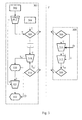
- a signal is transmitted via the air interface F between the remote control 200 and the device 201.
- a control signal for generating the frequency sweep sweep T of the carrier signal T is generated in the unit 202.
- This control signal is fed into the control loop of the phase locked loop PLL.
- the frequency sweep sweep T of the carrier signal is generated with the aid of the control signal.
- the carrier signal T thus generated is fed to the unit 204.
- carrier signal T is modulated with data signal D and modulated carrier signal T D is supplied to unit 206. With the help of the unit 206, the modulated carrier signal T D is now transmitted to the device 201 via the air interface F.
- the modulated carrier signal T D emitted by the remote control 200 is received in the device 201 with the aid of the unit 208.
- a control signal for the phase locked loop PLL of the device is generated in unit 210. This control signal is coupled into the control loop of the phase locked loop PLL.
- the frequency sweep sweep E is generated in the phase locked loop PLL.
- the received signal E thus generated is fed to the unit 212.
- the unit carrier 212 receives the received carrier signal T D from the unit 208. If the frequency of the input signal T D and the frequency of the received signal F E are the same, the direction of the frequency change of the received signal sweep E is reversed. This is done by a control signal which is sent from the unit 212 to the phase locked loop PLL.
- the received signal F E is now synchronized with the received signal T D and the synchronized received signal is transmitted from the unit 212 to the unit 214.
- data signal D is determined from the synchronized received signal and transmitted to unit 216.
- the unit 216 can now use the data signal D to check the request to enable a function.
- the received signal changes its frequency opposite to the frequency change of the carrier signal, which results in a rapid synchronization of the two signals.
- the frequency response of the carrier signal, the modulated carrier signal T D and the received signal F E and the data signal are shown in FIG. 1.
- the periodic change in frequency of the carrier signal F T can be seen in FIG. 1a.
- the frequency of the carrier signal F T is changed in a sweep sweep T from an initial value A to an end value B.
- this frequency profile sweep T can be linear.
- the frequency change sweep T is now repeated periodically.
- the data signal which is shown in Fig. 1b, consists of a sequence of binary information. This information is supported by a positive or negative signal level shown. Here means a positive signal level a logical HIGH and an negative signal level a logical LOW.
- the carrier signal F T present in the remote control is modulated as a function of the additional data signal D, as can be seen in FIG. 1c.
- the carrier signal can be generated directly in the remote control and, on the other hand, it can also be sent from the vehicle to the remote control.
- the modulated carrier signal F TD results from the modulation of the carrier signal.
- the frequency sweep sweep T is maintained at a logic HIGH of the data signal D and when the data signal D is logic LOW, the frequency sweep sweep T of the carrier signal F T is reversed.
- the resulting modulated carrier signal F TD is sent from the remote control to the device.
- a reception signal F E is generated in the device.
- the frequency of the received signal F E is changed periodically and opposite to the frequency of the carrier signal F T.
- the resulting frequency sweep sweep E of the received signal F E is compared with the received signal F TD . If the frequency between the received signal F TD and the received signal F E is the same, the frequency sweep of the received signal sweep E is reversed and synchronized with the frequency sweep of the modulated carrier signal sweep TD .
- the opposing frequencies of sweep T and sweep E ensure that these two frequencies can be synchronized very quickly.
- the reception channel of the vehicle can be operated with a narrow reception band, the reception band being readjusted with the aid of the synchronized reception frequency.
- the data signal D is demodulated on the device side from the received signal F TD with the aid of the received signal F E.
- This data signal D is now used to assess the release authorization (not shown).
- the data signal D can also be present in encrypted form, for example a data signal generated by a rolling code generator.
- FIG. 3 shows the structure of a device for checking whether a request to release a function of a device is authorized, in which information about the distance between device 301 and remote control 300 is additionally determined from the received signal.
- a control signal for a phase locked loop PLL is generated with the aid of the device 302.
- This control signal which is fed into the control loop of the phase locked loop PLL, generates a periodically changing carrier signal sweep T.
- the carrier signal T thus generated is fed to the unit 306.
- an injection signal I which is generated in unit 304, is fed to unit 306.
- the carrier signal T and the injection signal I are sent to the remote control 300 via the air interface F.
- the transponder 308 receives the carrier signal T as well as the injection signal I.
- the carrier signal T is fed to the unit 310.
- the carrier signal T is modulated with the data signal D in the unit 310.
- the modulated carrier signal T D is fed to the unit 312.
- the injection signal I is transmitted from the transponder 308 to the unit 312.
- the injection signal I and the modulated carrier signal T D are thus present in the unit 312.
- the modulated carrier signal T D is mixed with the injection signal I. It is advantageous here that the injection signal I is a harmonic signal with a fixed frequency.
- the carrier signal T D is shifted by the frequency of the injection signal I.
- the shifted carrier signal T ID is transmitted to the transponder 308 and sent through it via the air interface F to the device 301.
- the modulated carrier signal T ID 'shifted by the injection frequency is received by the unit 316 and transmitted to the unit 318.
- the inverted injection signal -I is also present in the unit 318. With the aid of the inverted injection signal -I, the received signal T ID 'is adjusted for the injection signal.
- the modulated carrier signal T D ' adjusted for the injection signal I, is present.
- the data signal D is demodulated from the received signal T D 'with the aid of a received signal (not shown), which changes its frequency essentially opposite to the frequency of the carrier signal sweep T , and with the aid of a frequency adjusting device.
- This data signal is output by unit 320 for further processing.
- the received carrier signal T ' is present at an output of the unit 320.
- the received carrier signal T ' is compared with the transmitted carrier signal T in the unit 321.
- the frequency of the two signals T, T ' is compared. Because of the signal delay between the device 301 and the remote control 300, the frequency sweeps of the transmitted signal and the received signal have shifted against one another, as a result of which the frequencies of these two signals are different.
- distance information can be determined with the aid of the unit 321. This distance information is fed to the unit 322, in which it is used in addition to the data signal D for checking whether the request to release a function of the unit 301 is used.
Landscapes
- Engineering & Computer Science (AREA)
- Mechanical Engineering (AREA)
- Lock And Its Accessories (AREA)
Abstract
Description
- Fig. 1
- die Frequenzänderung der übermittelten Signale in einer zeitlichen Auflösung,
- Fig. 2
- ein Blockschaltbild einer erfindungsgemäßen Datenübertragung,
- Fig. 3
- eine erfindungsgemäße Datenübertragung mit zusätzlicher Ermittlung der Entfernung zwischen Fernbedienung und Einrichtung.
Claims (16)
- Verfahren zur Überprüfung der Berechtigung einer Freigabeanforderung für eine Einrichtung, insbesondere für die Zentralverriegelung, die Wegfahrsperre oder die Alarmanlage eines Fahrzeugs, bestehend aus folgenden Schritten:in einer Fernbedienung (200), mittels der die Freigabeanforderung für die Einrichtung ausgelöst werden soll, wird ein Trägersignal (T) zur Verfügung gestellt, dessen Frequenz (FT) periodisch geändert wird,das Trägersignal (T) wird mit einem vorzugsweise binären Datensignal (D) moduliert und von der Fernbedienung zur Einrichtung (201) übertragen,das empfangene Signal (TD) wird hinsichtlich seiner Signalfrequenz (FTD) mit der Frequenz eines in der Einrichtung (200) vorhandenen, seine Frequenz (FE) entgegengesetzt zur Frequenz des Trägersignals (FT) ändernden Empfangssignals verglichenbei Frequenzgleichheit zwischen der Empfangsfrequenz (FE) und der modulierten Trägerfrequenz (FTD) die Empfangsfrequenz (FE) mit der Frequenz des modulierten Trägersignals (FTD) synchronisiert,aus dem empfangenen Signal (TD) wird das Datensignal (D) demoduliert,bei Übereinstimmung des Datensignals mit einem in der Einrichtung vorhandenen Vergleichsignals wird die Einrichtung des Fahrzeugs freigegeben.
- Verfahren nach Anspruch 1,
dadurch gekennzeichnet, daß mit Hilfe eines Phase Locked Loops (PLL) die Empfangsfrequenz (sweepE) und die Frequenz des Trägersignals (sweepT) geändert werden. - Verfahren nach Anspruch 2,
dadurch gekennzeichnet, daß mit Hilfe einer im Regelkreis des Phase Locked Loops (PLL) angelegten Spannung die Empfangsfrequenz (sweepE) und die Frequenz des Trägersignals (sweepT) periodisch geändert werden. - Verfahren nach einem der Ansprüche 1 bis 3
dadurch gekennzeichnet, daß die Frequenz des Trägersignals (FT) linear geändert wird. - Verfahren nach einem der Ansprüche 1 bis 4,
dadurch gekennzeichnet, daß mit Hilfe eines Microcontrollers die Periodendauer der Frequenzänderung des Trägersignals (sweepT) bestimmt wird. - Verfahren nach einem der Ansprüche 1 bis 5,
dadurch gekennzeichnet, daß mit Hilfe eines Synchronisationssignals die Periodendauer der Änderung der Empfangsfrequenz (sweepE) bestimmt wird. - Verfahren nach einem der Ansprüche 1 bis 5,
dadurch gekennzeichnet, daß aus dem Verlauf des Trägersignals die Periodendauer der Änderung der Empfangsfrequenz (sweepE) abgeleitet wird. - Verfahren nach einem der Ansprüche 1 bis 7,
dadurch gekennzeichnet, daß das Datensignal (D) derart auf das Trägersignal (T) moduliert wird, daß die Richtung der Frequenzänderung des Trägersignals (sweepT) in Abhängigkeit vom Datensignal (D) geändert wird. - Verfahren nach einem der Ansprüche 1 bis 7,
dadurch gekennzeichnet, daß das Datensignal (D) derart auf das Trägersignal (T) moduliert wird, daß die Bitfrequenz des Datensignals (D) mit der Periodendauer des Trägersignals (sweepT) synchronisiert wird. - Verfahren nach einem der Ansprüche 1 bis 9,
dadurch gekennzeichnet, daß das Trägersignal (T) einrichtungsseitig generiert und ausgesendet wird. - Verfahren nach einem der Ansprüche 1 bis 10,
dadurch gekennzeichnet, daß das Trägersignal (T) in der Fernbedienung mit Hilfe eines Transponders empfangen wird. - Verfahren nach einem der Ansprüche 1 bis 10,
dadurch gekennzeichnet, daß das Trägersignal (T) in der Fernbedienung generiert wird. - Verfahren nach einem der Ansprüche 1 bis 12,
dadurch gekennzeichnet,daß das Trägersignal (T) von der Einrichtung an die Fernbedienung gesendet wird,daß die Frequenz des Trägersignals (FT) um eine Injektionsfrequenz (FI) verschoben wird,daß das verschobene Trägersignal (TI) mit dem Zusatzdatensignal (D) moduliert wird,daß das verschobene und modulierte Trägersignal (TID) an die Einrichtung gesendet wird,daß das empfangene, verschobene und modulierte Trägersignal (TID') in der Einrichtung um die Injektionsfrequenz (-FI) zurückverschoben wird, unddaß aus dem modulierten Signal (TD') die Daten (D) demoduliert werden, unddaß mit Hilfe einer Vergleichseineit das empfangene Trägersignal (T') mit dem ausgesendeten Trägersignal (T) verglichen wird. - Verfahren nach Anspruch 13,
dadurch gekennzeichnet, daß die Frequenz des Trägersignals (sweepT) mit der Frequenz des empfangenen Trägersignals (sweepT') in der Vergleichseinheit gemischt wird und daß aus der Frequenzdifferenz die Entfernung zwischen der Einrichtung und der Fernbedienung ermittelt wird. - Vorrichtung zur Überprüfung ob eine Anforderung zur Freigabe einer Funktion einer Einrichtung berechtigt ist, insbesondere zur Verwirklichung eines Verfahrens nach einem der Ansprüche ,
dadurch gekennzeichnet, daß
die Einrichtung Mittel Mittel zum Senden des Trägersignals sowie Mittel zum Empfangen eines modulierten Trägersignals aufweist, und daß die Einrichtung einen Phase Locked Loop zur Erzeugung eines seine Frequenz änderndes Trägersignals aufweist, wobei der Regelkreis des Phase Locked Loops aufgetrennt und mit einem periodischen Lade- Entladestrom beaufschlagt ist, und daß die Einrichtung eine automatische Frequenzstelleinrichtung aufweist, wobei die automatische Frequenzstelleinrichtung eine Empfangsfrequenz mit dem empfangenem Trägersignal synchronisiert, und
daß eine Fernbedienung Mittel zum Empfangen eines Trägersignals sowie zum Senden eines modulierten Trägersignals und Mittel zum Modulieren des Trägersignals mit einem Datensignal aufweist. - Vorrichtung nach Anspruch 15,
dadurch gekennzeichnet, daß
die Einrichtung Mittel zum Versenden eines Injektionssignals und Mittel zum Mischen eines empfangenen Signals mit dem Injektionssignal und Mittel zum Vergleich der Frequenz des gesendeten Trägersignals mit der Frequenz des empfangenen um das Injektionssignal und das Zusatzdatensignal bereinigten Trägersignals aufweist und daß die Fernbedienung einen Transponder aufweist, wobei der Transponder das Trägersignal und die Injektionsfrequenz empfängt und das modulierte Trägersignal aussendet und wobei die Fernbedienung Mittel zum Mischen des Trägersignals mit dem Injektionssignal sowie Mittel zum Modulieren des Trägersignals mit dem Zusatzdatensignal aufweist.
Applications Claiming Priority (2)
| Application Number | Priority Date | Filing Date | Title |
|---|---|---|---|
| DE10019750 | 2000-04-20 | ||
| DE2000119750 DE10019750A1 (de) | 2000-04-20 | 2000-04-20 | Verfahren und Vorrichtung zur Überprüfung, ob eine anforderung zur Freigabe einer Funktion einer Einrichtung berechtigt ist |
Publications (3)
| Publication Number | Publication Date |
|---|---|
| EP1147952A2 true EP1147952A2 (de) | 2001-10-24 |
| EP1147952A3 EP1147952A3 (de) | 2004-08-18 |
| EP1147952B1 EP1147952B1 (de) | 2006-05-03 |
Family
ID=7639556
Family Applications (1)
| Application Number | Title | Priority Date | Filing Date |
|---|---|---|---|
| EP20010104664 Expired - Lifetime EP1147952B1 (de) | 2000-04-20 | 2001-02-24 | Verfahren und Vorrichtung zur Überprüfung, ob eine Anforderung zur Freigabe einer Funktion einer Einrichtung berechtigt ist |
Country Status (2)
| Country | Link |
|---|---|
| EP (1) | EP1147952B1 (de) |
| DE (2) | DE10019750A1 (de) |
Families Citing this family (1)
| Publication number | Priority date | Publication date | Assignee | Title |
|---|---|---|---|---|
| JP5541086B2 (ja) * | 2010-10-27 | 2014-07-09 | 株式会社デンソー | 車載機器制御装置 |
Citations (1)
| Publication number | Priority date | Publication date | Assignee | Title |
|---|---|---|---|---|
| EP0937845A1 (de) | 1998-02-24 | 1999-08-25 | f+g megamos Sicherheitselektronik GmbH | Freigabesystem für die Freigabe von Funktionen einer Einrichtung |
Family Cites Families (2)
| Publication number | Priority date | Publication date | Assignee | Title |
|---|---|---|---|---|
| GB9816170D0 (en) * | 1997-12-20 | 1998-09-23 | Rover Group | A security system |
| DE19846803C1 (de) * | 1998-10-10 | 2000-09-07 | Daimler Chrysler Ag | Verfahren zur Herstellung der Zugangsberechtigung zu einem motorangetriebenen Fahrzeug |
-
2000
- 2000-04-20 DE DE2000119750 patent/DE10019750A1/de not_active Withdrawn
-
2001
- 2001-02-24 EP EP20010104664 patent/EP1147952B1/de not_active Expired - Lifetime
- 2001-02-24 DE DE50109663T patent/DE50109663D1/de not_active Expired - Lifetime
Patent Citations (1)
| Publication number | Priority date | Publication date | Assignee | Title |
|---|---|---|---|---|
| EP0937845A1 (de) | 1998-02-24 | 1999-08-25 | f+g megamos Sicherheitselektronik GmbH | Freigabesystem für die Freigabe von Funktionen einer Einrichtung |
Also Published As
| Publication number | Publication date |
|---|---|
| DE50109663D1 (de) | 2006-06-08 |
| DE10019750A1 (de) | 2001-12-06 |
| EP1147952B1 (de) | 2006-05-03 |
| EP1147952A3 (de) | 2004-08-18 |
Similar Documents
| Publication | Publication Date | Title |
|---|---|---|
| DE102007039599B4 (de) | Fahrzeugsteuersystem | |
| DE69326672T2 (de) | Zeitduplex-Sender-Empfänger | |
| DE19610116C2 (de) | Diebstahlschutzsystem für ein Kraftfahrzeug | |
| DE1950137B2 (de) | Ferngesteuertes Überlagerungs-HF-Sender-Empfängergerät | |
| WO2003102878A1 (de) | Nutzungsberechtigungskontrollverfahren | |
| EP0566773A2 (de) | FSK-Modulationssystem | |
| DE69322520T2 (de) | Auf abstand steuerbares hochsicherheits-fahrzeugzugangssystem | |
| DE60102616T2 (de) | Handfreies Zugangs- und/oder Startsystem für Kraftfahrzeuge | |
| EP1902426A1 (de) | Zugangskontrollsystem für ein kraftfahrzeug | |
| DE69416505T2 (de) | Fernbedienungsvorrichtung | |
| DE2923265A1 (de) | Funknetz | |
| DE3311878C2 (de) | ||
| WO2004035357A2 (de) | Verfahren zur ermittlung des abstands zwischen einer ersten und zweiten sende-empfangs-station | |
| EP1147952B1 (de) | Verfahren und Vorrichtung zur Überprüfung, ob eine Anforderung zur Freigabe einer Funktion einer Einrichtung berechtigt ist | |
| DE2808316A1 (de) | Befehlssignalgenerator fuer eine selbsttaetige kanalauswahlanordnung in einem in bezug aus sendestationen bewegenden rundfunkempfaenger | |
| DE102004006446A1 (de) | Verfahren und Schaltungsanordnung zur drahtlosen Datenübertragung | |
| DE3200560A1 (de) | "verfahren zur unterdrueckung von spiegelwellen- und intermodulationsstoerungen" | |
| DE69924878T2 (de) | Empfänger und frequenzveränderbarer signalgenerator dafür | |
| DE4125678C2 (de) | Übertragungseinrichtung zum Informationsaustausch mit pulsweitenmodulierten Signalen zwischen elektronischen Geräten in Fahrzeugen | |
| DE10013913A1 (de) | Verfahren und System zur Bestimmung der Entfernung eines Handmoduls von einem Einrichtungsmodul | |
| DE19820610A1 (de) | System zur Aktivierung und/oder Deaktivierung einer Sicherheitseinrichtung, insbesondere für ein Kraftfahrzeug | |
| DE3912814C1 (en) | Radio call system - compares ref. signal with unmodulated output to obtain oscillator control voltage | |
| DE19528599A1 (de) | Verfahren zur Zugriffssteuerung von einer Datenstation auf mobile Datenträger | |
| DE10238887A1 (de) | Verfahren und System zur bidirektionalen Datenübertragung und Entfernungsbestimmung | |
| DE2060455C3 (de) | Verfahren zur Kommandoübertragung an einen über Funk fernlenkbaren Flugkörper oder Satelliten und Kommandoübertragungssystem zur Durchführung dieses Verfahrens |
Legal Events
| Date | Code | Title | Description |
|---|---|---|---|
| PUAI | Public reference made under article 153(3) epc to a published international application that has entered the european phase |
Free format text: ORIGINAL CODE: 0009012 |
|
| AK | Designated contracting states |
Kind code of ref document: A2 Designated state(s): AT BE CH CY DE DK ES FI FR GB GR IE IT LI LU MC NL PT SE TR |
|
| AX | Request for extension of the european patent |
Free format text: AL;LT;LV;MK;RO;SI |
|
| PUAL | Search report despatched |
Free format text: ORIGINAL CODE: 0009013 |
|
| AK | Designated contracting states |
Kind code of ref document: A3 Designated state(s): AT BE CH CY DE DK ES FI FR GB GR IE IT LI LU MC NL PT SE TR |
|
| AX | Request for extension of the european patent |
Extension state: AL LT LV MK RO SI |
|
| 17P | Request for examination filed |
Effective date: 20040827 |
|
| GRAP | Despatch of communication of intention to grant a patent |
Free format text: ORIGINAL CODE: EPIDOSNIGR1 |
|
| GRAS | Grant fee paid |
Free format text: ORIGINAL CODE: EPIDOSNIGR3 |
|
| AKX | Designation fees paid |
Designated state(s): DE FR GB IT SE |
|
| GRAA | (expected) grant |
Free format text: ORIGINAL CODE: 0009210 |
|
| AK | Designated contracting states |
Kind code of ref document: B1 Designated state(s): DE FR GB IT SE |
|
| PG25 | Lapsed in a contracting state [announced via postgrant information from national office to epo] |
Ref country code: GB Free format text: LAPSE BECAUSE OF FAILURE TO SUBMIT A TRANSLATION OF THE DESCRIPTION OR TO PAY THE FEE WITHIN THE PRESCRIBED TIME-LIMIT Effective date: 20060503 Ref country code: IT Free format text: LAPSE BECAUSE OF FAILURE TO SUBMIT A TRANSLATION OF THE DESCRIPTION OR TO PAY THE FEE WITHIN THE PRESCRIBED TIME-LIMIT;WARNING: LAPSES OF ITALIAN PATENTS WITH EFFECTIVE DATE BEFORE 2007 MAY HAVE OCCURRED AT ANY TIME BEFORE 2007. THE CORRECT EFFECTIVE DATE MAY BE DIFFERENT FROM THE ONE RECORDED. Effective date: 20060503 |
|
| REG | Reference to a national code |
Ref country code: GB Ref legal event code: FG4D Free format text: NOT ENGLISH |
|
| REF | Corresponds to: |
Ref document number: 50109663 Country of ref document: DE Date of ref document: 20060608 Kind code of ref document: P |
|
| REG | Reference to a national code |
Ref country code: SE Ref legal event code: TRGR |
|
| ET | Fr: translation filed | ||
| GBV | Gb: ep patent (uk) treated as always having been void in accordance with gb section 77(7)/1977 [no translation filed] |
Effective date: 20060503 |
|
| PLBE | No opposition filed within time limit |
Free format text: ORIGINAL CODE: 0009261 |
|
| STAA | Information on the status of an ep patent application or granted ep patent |
Free format text: STATUS: NO OPPOSITION FILED WITHIN TIME LIMIT |
|
| 26N | No opposition filed |
Effective date: 20070206 |
|
| PGFP | Annual fee paid to national office [announced via postgrant information from national office to epo] |
Ref country code: SE Payment date: 20090206 Year of fee payment: 9 |
|
| EUG | Se: european patent has lapsed | ||
| PG25 | Lapsed in a contracting state [announced via postgrant information from national office to epo] |
Ref country code: SE Free format text: LAPSE BECAUSE OF NON-PAYMENT OF DUE FEES Effective date: 20100225 |
|
| REG | Reference to a national code |
Ref country code: FR Ref legal event code: TP Owner name: DELPHI INTERNATIONAL OPERATIONS LUXEMBOURG S.A, LU Effective date: 20131218 |
|
| REG | Reference to a national code |
Ref country code: DE Ref legal event code: R082 Ref document number: 50109663 Country of ref document: DE Representative=s name: MANITZ, FINSTERWALD & PARTNER GBR, DE |
|
| REG | Reference to a national code |
Ref country code: DE Ref legal event code: R082 Ref document number: 50109663 Country of ref document: DE Representative=s name: MANITZ, FINSTERWALD & PARTNER GBR, DE Effective date: 20140409 Ref country code: DE Ref legal event code: R081 Ref document number: 50109663 Country of ref document: DE Owner name: DELPHI INTERNATIONAL OPERATIONS LUXEMBOURG S.A, LU Free format text: FORMER OWNER: DELPHI TECHNOLOGIES, INC., TROY, US Effective date: 20140409 Ref country code: DE Ref legal event code: R081 Ref document number: 50109663 Country of ref document: DE Owner name: DELPHI INTERNATIONAL OPERATIONS LUXEMBOURG S.A, LU Free format text: FORMER OWNER: DELPHI TECHNOLOGIES, INC., TROY, MICH., US Effective date: 20140409 Ref country code: DE Ref legal event code: R082 Ref document number: 50109663 Country of ref document: DE Representative=s name: MANITZ FINSTERWALD PATENTANWAELTE PARTMBB, DE Effective date: 20140409 |
|
| REG | Reference to a national code |
Ref country code: FR Ref legal event code: PLFP Year of fee payment: 16 |
|
| REG | Reference to a national code |
Ref country code: FR Ref legal event code: PLFP Year of fee payment: 17 |
|
| REG | Reference to a national code |
Ref country code: FR Ref legal event code: PLFP Year of fee payment: 18 |
|
| REG | Reference to a national code |
Ref country code: DE Ref legal event code: R082 Ref document number: 50109663 Country of ref document: DE Representative=s name: MANITZ FINSTERWALD PATENT- UND RECHTSANWALTSPA, DE Ref country code: DE Ref legal event code: R081 Ref document number: 50109663 Country of ref document: DE Owner name: APTIV TECHNOLOGIES LIMITED, BB Free format text: FORMER OWNER: DELPHI INTERNATIONAL OPERATIONS LUXEMBOURG S.A R.L., 4940 HAUTCHARAGE, LU Ref country code: DE Ref legal event code: R082 Ref document number: 50109663 Country of ref document: DE Representative=s name: MANITZ FINSTERWALD PATENTANWAELTE PARTMBB, DE Ref country code: DE Ref legal event code: R081 Ref document number: 50109663 Country of ref document: DE Owner name: APTIV TECHNOLOGIES LIMITED, BB Free format text: FORMER OWNER: DELPHI INTERNATIONAL OPERATIONS LUXEMBOURG S.A R.L., 4940 BASCHARAGE, LU |
|
| PGFP | Annual fee paid to national office [announced via postgrant information from national office to epo] |
Ref country code: IT Payment date: 20200226 Year of fee payment: 20 Ref country code: DE Payment date: 20200210 Year of fee payment: 20 |
|
| PGFP | Annual fee paid to national office [announced via postgrant information from national office to epo] |
Ref country code: FR Payment date: 20200224 Year of fee payment: 20 |
|
| REG | Reference to a national code |
Ref country code: DE Ref legal event code: R071 Ref document number: 50109663 Country of ref document: DE |